<?xml version="1.0" encoding="ISO-8859-1"?><article xmlns:mml="http://www.w3.org/1998/Math/MathML" xmlns:xlink="http://www.w3.org/1999/xlink" xmlns:xsi="http://www.w3.org/2001/XMLSchema-instance">
<front>
<journal-meta>
<journal-id>1405-3195</journal-id>
<journal-title><![CDATA[Agrociencia]]></journal-title>
<abbrev-journal-title><![CDATA[Agrociencia]]></abbrev-journal-title>
<issn>1405-3195</issn>
<publisher>
<publisher-name><![CDATA[Colegio de Postgraduados]]></publisher-name>
</publisher>
</journal-meta>
<article-meta>
<article-id>S1405-31952014000700007</article-id>
<title-group>
<article-title xml:lang="en"><![CDATA[Fast qualitative method based on electron paramagnetic resonance (EPR) to date Gmelina arborea and Araucaria angustifolia wood]]></article-title>
<article-title xml:lang="es"><![CDATA[Método cualitativo rápido basado en resonancia paramagnética electrónica para datar madera de Gmelina arborea y Araucaria angustifolia]]></article-title>
</title-group>
<contrib-group>
<contrib contrib-type="author">
<name>
<surname><![CDATA[Bolzón-de Muñiz]]></surname>
<given-names><![CDATA[G. Inés]]></given-names>
</name>
<xref ref-type="aff" rid="A01"/>
</contrib>
<contrib contrib-type="author">
<name>
<surname><![CDATA[Lomelí-Ramírez]]></surname>
<given-names><![CDATA[M. Guadalupe]]></given-names>
</name>
<xref ref-type="aff" rid="A02"/>
</contrib>
<contrib contrib-type="author">
<name>
<surname><![CDATA[Mangrich]]></surname>
<given-names><![CDATA[Antonio S.]]></given-names>
</name>
<xref ref-type="aff" rid="A03"/>
</contrib>
<contrib contrib-type="author">
<name>
<surname><![CDATA[Carbajal- Arizaga]]></surname>
<given-names><![CDATA[G. Guadalupe]]></given-names>
</name>
<xref ref-type="aff" rid="A04"/>
</contrib>
</contrib-group>
<aff id="A01">
<institution><![CDATA[,Universidade Tecnologica Federal do Parana Departamento de Engenheria e Tecnología Florestal ]]></institution>
<addr-line><![CDATA[Curitiba Parana]]></addr-line>
<country>Brasil</country>
</aff>
<aff id="A02">
<institution><![CDATA[,Universidad de Guadalajara Departamento de Madera, Celulosa y Papel ]]></institution>
<addr-line><![CDATA[Guadalajara Jalisco]]></addr-line>
<country>México</country>
</aff>
<aff id="A03">
<institution><![CDATA[,Universidade Tecnologica Federal do Parana Departamento de Química ]]></institution>
<addr-line><![CDATA[Curitiba Parana]]></addr-line>
<country>Brasil</country>
</aff>
<aff id="A04">
<institution><![CDATA[,Universidad de Guadalajara Departamento de Química ]]></institution>
<addr-line><![CDATA[Guadalajara Jalisco]]></addr-line>
<country>México</country>
</aff>
<pub-date pub-type="pub">
<day>00</day>
<month>11</month>
<year>2014</year>
</pub-date>
<pub-date pub-type="epub">
<day>00</day>
<month>11</month>
<year>2014</year>
</pub-date>
<volume>48</volume>
<numero>7</numero>
<fpage>739</fpage>
<lpage>749</lpage>
<copyright-statement/>
<copyright-year/>
<self-uri xlink:href="http://www.scielo.org.mx/scielo.php?script=sci_arttext&amp;pid=S1405-31952014000700007&amp;lng=en&amp;nrm=iso"></self-uri><self-uri xlink:href="http://www.scielo.org.mx/scielo.php?script=sci_abstract&amp;pid=S1405-31952014000700007&amp;lng=en&amp;nrm=iso"></self-uri><self-uri xlink:href="http://www.scielo.org.mx/scielo.php?script=sci_pdf&amp;pid=S1405-31952014000700007&amp;lng=en&amp;nrm=iso"></self-uri><abstract abstract-type="short" xml:lang="en"><p><![CDATA[In Brazil, Gmelina arborea is a common tree to produce char and the content of carbon is an important factor to correlate with the energy content or carbon sequestration capability, whereas Araucaria angustifolia occupies 6 % of its original territory and Brazilian laws protect old native specimens, since the commercial use of wood is restricted for young cultivated specimens. Electron paramagnetic resonance (EPR) spectroscopy is used for detection and quantification of organic free radicals (OFR) and, in this study, it was utilized for exploring OFR content along the rings of one log from G. arborea and A. angustifolia trees, both randomly chosen. The amount of OFR correlated with the carbon content in G. arborea and the age of rings in G. arborea and A. angustifolia. The content of OFR in rings of Gmelina arborea was compared with previous analyses of carbon sequestration in the same tree. Without statistical treatment, an inverse relationship between the carbon and OFR content was found. The concentration of OFR in inner rings (older ages) of A. angustifolia was higher than in outer rings (younger ages). This trend was also observed in G. arborea, suggesting that EPR provides qualitative information about the age. Additionally, a Pleistocene sample of A. angustifolia was analyzed and the content of OFR was one order of magnitude higher than that in the young sample. In conclusion, EPR spectroscopy is proposed as a fast qualitative method to identify the age of wood, especially for confiscated wood loads in protected areas of A. angustifolia and to determine the carbon content in wood.]]></p></abstract>
<abstract abstract-type="short" xml:lang="es"><p><![CDATA[En Brasil, Gmelina arborea es un árbol para producir carbón y el contenido de carbono es un factor importante correlacionado con el contenido de energía o la capacidad de secuestro de carbono, mientras que la Araucaria angustifolia ocupa el 6 % de su territorio original y las leyes brasileñas protegen los viejos especímenes nativos, ya que el uso comercial de la madera está restringido para ejemplares jóvenes cultivados. La espectroscopia de resonancia paramagnética electrónica (EPR) se usa para la detección y cuantificación de los radicales orgánicos libres (OFR, siglas en inglés) y en este estudio se usó para explorar el contenido de OFR en los anillos de un tronco de árbol de G. arborea y otro de A. angustifolia elegidos al azar. La cantidad de OFR se correlacionó con el contenido de carbono en G. arborea y con la edad de los anillos de G. arborea y A. angustifolia. El contenido de OFR en los anillos de G. arborea se comparó con análisis previos de secuestro de carbono en el mismo árbol. Sin tratamiento estadístico, se encontró una relación inversa entre el contenido de carbono y OFR. La concentración de OFR en los anillos internos (de más edad) de A. angustifolia fue mayor que en los anillos externos (de menor edad). Esta tendencia también se observó en G. arborea, lo que sugiere que EPR proporciona información cualitativa acerca de la edad. Además, se analizó una muestra del Pleistoceno de A. angustifolia y el contenido de OFR fue de una magnitud mayor que en la muestra más joven. En conclusión, la espectroscopia EPR se propone como un método cualitativo rápido para identificar la edad de la madera, especialmente para cargas de madera confiscadas en áreas protegidas de A. angustifolia y para determinar el contenido de carbono en la madera.]]></p></abstract>
<kwd-group>
<kwd lng="en"><![CDATA[Araucaria angustifolia]]></kwd>
<kwd lng="en"><![CDATA[electron paramagnetic resonance]]></kwd>
<kwd lng="en"><![CDATA[organic free radicals]]></kwd>
<kwd lng="en"><![CDATA[Gmelina arborea]]></kwd>
<kwd lng="es"><![CDATA[Araucaria angustifolia]]></kwd>
<kwd lng="es"><![CDATA[resonancia paramagnética electrónica]]></kwd>
<kwd lng="es"><![CDATA[radicales libres orgánicos]]></kwd>
<kwd lng="es"><![CDATA[Gmelina arborea]]></kwd>
</kwd-group>
</article-meta>
</front><body><![CDATA[  	    <p align="justify"><font face="verdana" size="4">Recursos naturales renovables</font></p>  	    <p align="justify"><font face="verdana" size="2">&nbsp;</font></p>  	    <p align="center"><font face="verdana" size="4"><b>Fast qualitative method based on electron paramagnetic resonance (EPR) to date <i>Gmelina arborea</i> and <i>Araucaria angustifolia</i> wood</b></font></p>  	    <p align="center"><font face="verdana" size="2">&nbsp;</font></p>  	    <p align="center"><font face="verdana" size="3"><b>M&eacute;todo cualitativo r&aacute;pido basado en resonancia paramagn&eacute;tica electr&oacute;nica para datar madera de <i>Gmelina arborea</i> y <i>Araucaria angustifolia</i></b></font></p>  	    <p align="center"><font face="verdana" size="2">&nbsp;</font></p>  	    <p align="center"><font face="verdana" size="2"><b>G. In&eacute;s Bolz&oacute;n&#45;de Mu&ntilde;iz<sup>1</sup>, M. Guadalupe Lomel&iacute;&#45;Ram&iacute;rez<sup>2</sup>, Antonio S. Mangrich<sup>3</sup>, G. Guadalupe Carbajal&#45; Arizaga<sup>4&#42;</sup></b></font></p>  	    <p align="justify"><font face="verdana" size="2">&nbsp;</font></p>  	    <p align="justify"><font face="verdana" size="2"><sup><i>1</i></sup> <i>Departamento de Engenheria e Tecnolog&iacute;a Florestal. Universidade Federal do Paran&aacute;. Avenida Lothario Meissner, 632, CEP. 80210&#45;170, Curitiba, Paran&aacute;, Brasil.</i></font></p>  	    ]]></body>
<body><![CDATA[<p align="justify"><font face="verdana" size="2"><i><sup>2</sup> Departamento de Madera, Celulosa y Papel. Universidad de Guadalajara, Km 15.5, Carretera Guadalajara&#45;Nogales, 45020 Guadalajara, Jalisco, M&eacute;xico.</i></font></p>  	    <p align="justify"><font face="verdana" size="2"><i><sup>3</sup> Departamento de Qu&iacute;mica, Universidade Federal do Paran&aacute;, UFPR, Centro Polit&eacute;cnico &#45; Jardim das Am&eacute;ricas, 81531&#45;990, Curitiba, PR, Brasil. &amp;&nbsp;Instituto Nacional de Ci&ecirc;ncia e Tecnologia, Energia &amp;&nbsp;Ambiente, UFBA, 40170&#45;290, Salvador, BA, Brasil.</i></font></p>  	    <p align="justify"><font face="verdana" size="2"><i><sup>4</sup> Departamento de Qu&iacute;mica. Universidad de Guadalajara. Marcelino Garcia Barragan 1421, C.P. 44430, Guadalajara, Jalisco, M&eacute;xico. <b><sup>&#42;</sup></b></i> <i>Author for correspondence</i> (<a href="mailto:gregoriocarbajal@yahoo.com.mx" target="_blank">gregoriocarbajal@yahoo.com.mx</a>)</font></p>  	    <p align="justify"><font face="verdana" size="2">&nbsp;</font></p>  	    <p align="justify"><font face="verdana" size="2">Received: January, 2013.    <br> 	Approved: July, 2014.</font></p>  	    <p align="justify"><font face="verdana" size="2">&nbsp;</font></p>  	    <p align="justify"><font face="verdana" size="2"><b>Abstract</b></font></p>  	    <p align="justify"><font face="verdana" size="2">In Brazil, <i>Gmelina arborea</i> is a common tree to produce char and the content of carbon is an important factor to correlate with the energy content or carbon sequestration capability, whereas <i>Araucaria angustifolia</i> occupies 6 % of its original territory and Brazilian laws protect old native specimens, since the commercial use of wood is restricted for young cultivated specimens. Electron paramagnetic resonance (EPR) spectroscopy is used for detection and quantification of organic free radicals (OFR) and, in this study, it was utilized for exploring OFR content along the rings of one log from <i>G. arborea</i> and <i>A. angustifolia</i> trees, both randomly chosen. The amount of OFR correlated with the carbon content in <i>G. arborea</i> and the age of rings in <i>G. arborea</i> and <i>A. angustifolia</i>. The content of OFR in rings of <i>Gmelina arborea</i> was compared with previous analyses of carbon sequestration in the same tree. Without statistical treatment, an inverse relationship between the carbon and OFR content was found. The concentration of OFR in inner rings (older ages) of <i>A. angustifolia</i> was higher than in outer rings (younger ages). This trend was also observed in <i>G. arborea</i>, suggesting that EPR provides qualitative information about the age. Additionally, a Pleistocene sample of <i>A. angustifolia</i> was analyzed and the content of OFR was one order of magnitude higher than that in the young sample. In conclusion, EPR spectroscopy is proposed as a fast qualitative method to identify the age of wood, especially for confiscated wood loads in protected areas of <i>A. angustifolia</i> and to determine the carbon content in wood.</font></p>  	    <p align="justify"><font face="verdana" size="2"><b>Keywords: &nbsp;</b><i>Araucaria angustifolia</i>, electron paramagnetic resonance, organic free radicals, <i>Gmelina arborea</i>.</font></p>  	    ]]></body>
<body><![CDATA[<p align="justify"><font face="verdana" size="2">&nbsp;</font></p>  	    <p align="justify"><font face="verdana" size="2"><b>Resumen</b></font></p>  	    <p align="justify"><font face="verdana" size="2">En Brasil, <i>Gmelina arborea</i> es un &aacute;rbol para producir carb&oacute;n y el contenido de carbono es un factor importante correlacionado con el contenido de energ&iacute;a o la capacidad de secuestro de carbono, mientras que la <i>Araucaria angustifolia</i> ocupa el 6 % de su territorio original y las leyes brasile&ntilde;as protegen los viejos espec&iacute;menes nativos, ya que el uso comercial de la madera est&aacute; restringido para ejemplares j&oacute;venes cultivados. La espectroscopia de resonancia paramagn&eacute;tica electr&oacute;nica (EPR) se usa para la detecci&oacute;n y cuantificaci&oacute;n de los radicales org&aacute;nicos libres (OFR, siglas en ingl&eacute;s) y en este estudio se us&oacute; para explorar el contenido de OFR en los anillos de un tronco de &aacute;rbol de <i>G. arborea</i> y otro de <i>A. angustifolia</i> elegidos al azar. La cantidad de OFR se correlacion&oacute; con el contenido de carbono en <i>G. arborea</i> y con la edad de los anillos de <i>G. arborea</i> y <i>A. angustifolia</i>. El contenido de OFR en los anillos de <i>G. arborea</i> se compar&oacute; con an&aacute;lisis previos de secuestro de carbono en el mismo &aacute;rbol. Sin tratamiento estad&iacute;stico, se encontr&oacute; una relaci&oacute;n inversa entre el contenido de carbono y OFR. La concentraci&oacute;n de OFR en los anillos internos (de m&aacute;s edad) de <i>A. angustifolia</i> fue mayor que en los anillos externos (de menor edad). Esta tendencia tambi&eacute;n se observ&oacute; en <i>G. arborea</i>, lo que sugiere que EPR proporciona informaci&oacute;n cualitativa acerca de la edad. Adem&aacute;s, se analiz&oacute; una muestra del Pleistoceno de <i>A. angustifolia</i> y el contenido de OFR fue de una magnitud mayor que en la muestra m&aacute;s joven. En conclusi&oacute;n, la espectroscopia EPR se propone como un m&eacute;todo cualitativo r&aacute;pido para identificar la edad de la madera, especialmente para cargas de madera confiscadas en &aacute;reas protegidas de <i>A. angustifolia</i> y para determinar el contenido de carbono en la madera.</font></p>  	    <p align="justify"><font face="verdana" size="2"><b>Palabras clave:</b> <i>Araucaria angustifolia</i>, resonancia paramagn&eacute;tica electr&oacute;nica, radicales libres org&aacute;nicos, <i>Gmelina arborea</i>.</font></p>  	    <p align="justify"><font face="verdana" size="2">&nbsp;</font></p>  	    <p align="justify"><font face="verdana" size="2"><b>INTRODUCTION</b></font></p>  	    <p align="justify"><font face="verdana" size="2">Electron paramagnetic resonance (EPR) spectroscopy measures the absorption of electromagnetic waves by paramagnetic species, such as organic free radicals (OFR), allowing their quantification in solid or liquid samples (Budziak <i>et al</i>., 2004; Mangrich <i>et al</i>., 2009; Guedes <i>et al</i>., 2003). EPR spectroscopy is used along with other techniques as a method to date archaeological samples of mega&#45;fauna (Kinoshita <i>et al</i>., 2008; Joannes&#45;Boyau and Gr&uuml;n, 2011) and charred wood (Triantafyllou <i>et al</i>., 2010). The formation of OFR in wood occurs by weathering, mainly when it is exposed to visible or ultraviolet light (Kalnins <i>et al</i>., 1966) or as a response to chemical agents in the environment like fungi or enzymes, including mechanical and physical stress (Hon and Feist, 1981).</font></p>  	    <p align="justify"><font face="verdana" size="2">The classical method to quantify OFR in plants is based on a colorimetric assay with 1,1&#45;diphenyl&#45;2&#45;picryl&#45;hydroazyl (DPPH) and an ethanol/water extract of the plant, where the OFR reacts and develop a color measured at 515&#45;520 nm (Sithisarn <i>et al</i>., 2005; McCune and Johns, 2007; Rocha&#45;Guzman <i>et al</i>., 2007). Another method is through deoxyribose degradation by OFR, which is also followed by colorimetry (Rocha&#45;Guzman <i>et al</i>., 2007; Rocha&#45;Guzman <i>et al</i>., 2009; Ribeiro <i>et al</i>., 2014).</font></p>  	    <p align="justify"><font face="verdana" size="2">The usefulness and practicality of the EPR spectroscopy as an alternative route for characterization in forest sciences should be evaluated, since this technique allows fast and chemical reagents&#45;free quantifications of OFR. In this regard, Illman and Bajts (1997) proposed that the single signal detected by EPR with the specific value of the g factor equal to 2.0 could be the fingerprint for wood. Although this task is not feasible since the OFR signal changes slightly from sample to sample, another information can be monitored, such as the amount of humic substances along the composting process of pine sawdust (Budziak <i>et al</i>., 2004).</font></p>  	    <p align="justify"><font face="verdana" size="2">In this study, samples were collected from <i>Araucaria angustifolia</i>, which currently occupies 6 % of its original territory in Brazil (Oliveira <i>et al</i>., 2007), plus samples from <i>Gmelina arborea</i> Roxb., harvested in the coastal side of Parana State (South Brazil) and used in a previous report (Marcene <i>et al</i>., 2006) to quantify the carbon content. Therefore, the objective of this study was to acquire the EPR spectra of wood samples and evaluate the content of OFR along different rings of both trees, that is to say, along different ages, since each ring correspond to one year of life (Starr and Taggart, 2008). Two additional samples of <i>A. angustifolia</i> were analyzed, and these were used to find a relationship between the OFR concentration and age of trees.</font></p>  	    ]]></body>
<body><![CDATA[<p align="justify"><font face="verdana" size="2">&nbsp;</font></p>  	    <p align="justify"><font face="verdana" size="2"><b>MATERIALS AND METHODS</b></font></p>  	    <p align="justify"><font face="verdana" size="2">The <i>G. arborea</i> Roxb. and <i>A. angustifolia</i> (recently harvested and one corresponding to the Pleistocene age) samples were randomly collected from the Department of Forest Engineering and Technology of the Federal University of Parana State, Brazil. The fresh <i>A. angustifolia</i> sample corresponds to a cultivated tree, not a native one.</font></p>  	    <p align="justify"><font face="verdana" size="2">EPR spectra were obtained in a Bruker EMX spectrometer (Bruker Bio Spin, Germany) operated in the X&#45;band (~9.5 GHz) at room temperature (300 K) in a range of magnetic field between 3485 and 3535 Gauss.</font></p>  	    <p align="justify"><font face="verdana" size="2">One log from <i>G. arborea</i> Roxb. and one from <i>A. angustifolia</i> was separated in rings and mechanically grinded up to powder sizes below 0.25 cm. The size is an important factor because it allows the particles to fill the EPR quartz tube without leaving voids. The amount of OFR was calculated from the area of the absorption curve in the normal mode taking as starting and end point of the absorption the value above the zero (dashed line). Due to the high concentration of OFR, the signal to noise ratio was not corrected.</font></p>  	    <p align="justify"><font face="verdana" size="2">The areas of the absorption spectra were compared with the weak pitch reference sample supplied by Bruker with 1.04x10<sup>13</sup> spin cm<sup>&#45;1</sup> (dark line in <a href="/img/revistas/agro/v48n7/a7f1.jpg" target="_blank">Figure 1</a>). Absorption areas for curves with the same shape are related with the amount of free radicals (Lee <i>et al</i>., 2000), which were related with the mass of wood placed in the tube to calculate the number of spin per gram of sample, <i>i.e</i>. number of radicals per gram. This method was applied in samples of humus (Budziak <i>et al</i>., 2004), mangrove sediments (Mangrich <i>et al</i>., 2009), biochar (Angelo <i>et al</i>., 2013), coffe powder (Krakowian <i>et al</i>., 2014), human tissue and polyolefines (Camara <i>et al</i>., 2006).</font></p>  	    <p align="justify"><font face="verdana" size="2">&nbsp;</font></p>  	    <p align="justify"><font face="verdana" size="2"><b>RESULTS AND DISCUSSION</b></font></p>  	    <p align="justify"><font face="verdana" size="2"><b>Free radicals in <i>Gmelina arb&oacute;rea</i></b></font></p>  	    <p align="justify"><font face="verdana" size="2">The EPR spectra of <i>G. arborea</i> samples presented a clear signal of OFR (<a href="/img/revistas/agro/v48n7/a7f2.jpg" target="_blank">Figure 2</a>). The g factor is the characteristic value that helps to identify paramagnetic species. The OFR signal with g ~2.0040 has the spin density probably more localized on oxygen atoms, and with g ~2.0025 has the spin density localized near carbon atoms. OFR at intermediary distance between carbon and oxygen atoms was found in <i>Pinus taeda</i> samples with g=2.0030 (Budziak <i>et al</i>., 2004), associated to lignin (Pryor, 1992; Budziak <i>et al</i>., 2004; Czechowski <i>et al</i>., 2004). The <i>G. arborea</i> samples in our study presented values between 2.0046 and 2.0047, which match with the g factors found for semiquinones (around oxygen atoms) in wood (Yen <i>et al</i>., 1962; Guedes <i>et al</i>., 2003), which can be even higher, g=2.0050 (Zhou <i>et al</i>., 2009). Then, it is reasonable to accept that the EPR signals detected in <i>G. arborea</i> correspond to free radicals in semiquinone structures.</font></p>  	    ]]></body>
<body><![CDATA[<p align="justify"><font face="verdana" size="2">The intensity of the signals in <a href="/img/revistas/agro/v48n7/a7f2.jpg" target="_blank">Figure 2</a> increases from the outer to the inner rings. The line intensity is proportional to the concentration of paramagnetic species (organic free radicals in this case). The samples were stored under the same moisture environment in order for the humidity to be the same for each one, because a large variation of water could intensify the EPR signal in wood (Humar <i>et al</i>. 2006).</font></p>  	    <p align="justify"><font face="verdana" size="2">The derived absorption signals were integrated with the WinEPR program (Bruker) and the areas were compared with the area of the weak pitch sample in order to obtain the number of spins that contributed to that signal. By knowing the mass of wood placed in the tube, the number of spins (free radicals) per gram of sample was determined (<a href="#t1">Table 1</a>).</font></p>  	    <p align="center"><font face="verdana" size="2"><a name="t1"></a></font></p>  	    <p align="center"><font face="verdana" size="2"><img src="/img/revistas/agro/v48n7/a7t1.jpg"></font></p>  	    <p align="justify"><font face="verdana" size="2">The magnitude of free radicals concentration in all the samples was around 10<sup>12</sup> spin g<sup>&#45;1</sup> and is lower than the concentration of free radicals in fresh or composted samples of <i>P. taeda</i> (10<sup>15</sup> spin g<sup>&#45;1</sup>) (Budziak <i>et al</i>., 2004). <a href="/img/revistas/agro/v48n7/a7f3.jpg" target="_blank">Figure 3A</a> shows the relationship between the free radicals concentration and the rings formed in different ages of the tree. Although there is not a linear behavior in this experimental data (R<sup>2</sup>=0.54), it is clear that the higher amount of free radicals appear in inner rings (older ages). If the dispersed data were eliminated (<a href="/img/revistas/agro/v48n7/a7f3.jpg" target="_blank">Figure 3B</a>), such as values of rings 6 and 8, the recalculated central tendency is close to linearity (R<sup>2</sup>=0.98).</font></p>  	    <p align="justify"><font face="verdana" size="2">It is not unusual to find lower concentration of free radicals in younger rings (outer) since the metabolism takes place there (Starr and Taggart 2008) and it avoids formation of free radicals or eliminates them. This fact was probed when wood samples were analyzed by EPR just after collecting them from the tree. In the first minutes, negligible EPR signals were recorded, whereas the intensity of free radicals increased with time up to 2 h and then became constant (Hon <i>et al</i>., 1980). In <i>Gmelina</i> samples the time was not considered since all the samples had much more than 2 h, and then the amount of free radicals is not supposed to change (Hon <i>et al</i>., 1980). Similarly, a large difference in the water content could lead to differences in the intensities (Humar <i>et al</i>., 2006), but the same drying conditions were applied to all the samples in this work.</font></p>  	    <p align="justify"><font face="verdana" size="2">Although the physiological processes regulate the formation of free radicals in the external rings, there are opposed phenomena that induce the formation of radicals in outer rings such as the incidence of UV&#45;VIS light (Kalnin <i>et al</i>., 1966), and even the indirect exposition to visible light increases the amount of free radicals in wood (Kalnin <i>et al</i>., 1966). In our study, free radicals were found in the outer rings (rings 3&#45;5, <a href="/img/revistas/agro/v48n7/a7f3.jpg" target="_blank">Figure 3A</a>), which are not hermetic systems; thus, the diffusion of compounds with the ability to quench radicals from rings in the middle of the stem, (rings 6 and 8, <a href="/img/revistas/agro/v48n7/a7f3.jpg" target="_blank">Figure 3A</a>), can be an explanation for the lower OFR in those samples. In the case of the inner rings (rings 9 and 10 in <a href="/img/revistas/agro/v48n7/a7f3.jpg" target="_blank">Figure 3A</a>), the reason that could hold the presence of the highest amount of radicals is that those rings retain oldest and dead mater formed by metabolism products such as semiquinone structures (Starr and Taggart, 2008).</font></p>  	    <p align="justify"><font face="verdana" size="2">Additional information appeared when the amount of radicals in the rings was compared with the carbon content of the same rings reported previously (Marcene <i>et al</i>., 2006). When both values were plotted, an inverse relationship between them was detected (<a href="/img/revistas/agro/v48n7/a7f4.jpg" target="_blank">Figure 4</a>). It is remarkable that the carbon content is the highest between rings 3 and 5, where the amount of OFR is the lowest, whereas the carbon content is lower in rings 9 and 10 with a larger amount of OFR. An explanation for these responses could be that in samples with lower carbon content there is higher content of oxygen, which has more ability to stabilize OFR. Although between rings 6 and 8 the tendency is disrupted, the extremes suggest that the inverse relationship could be used to perform a fast determination of carbon content with a simple and easy EPR analysis, but additional experiments with a larger number of samples must be carried out in order to prove this response.</font></p>  	    <p align="justify"><font face="verdana" size="2">&nbsp;</font></p>  	    <p align="justify"><font face="verdana" size="2"><b>Organic free radicals in <i>Araucaria angustifolia</i></b></font></p>  	    ]]></body>
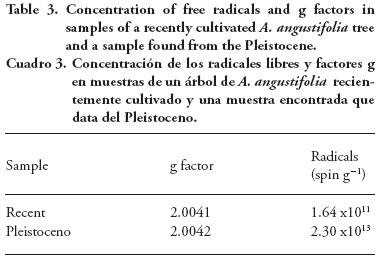
<body><![CDATA[<p align="justify"><font face="verdana" size="2">The EPR measurements on the <i>A. angustifolia</i> samples were used to compare the organic free radicals concentration profile with that of <i>G. arborea</i>. The concentration of OFR in the samples of <i>A. angustifolia</i> was calculated also from the spectra (<a href="/img/revistas/agro/v48n7/a7f5.jpg" target="_blank">Figure 5</a>) and results are listed in <a href="#t2">Table 2</a>.</font></p>  	    <p align="center"><font face="verdana" size="2"><a name="t2"></a></font></p>  	    <p align="center"><font face="verdana" size="2"><img src="/img/revistas/agro/v48n7/a7t2.jpg"></font></p>  	    <p align="justify"><font face="verdana" size="2">The values of the g factor are practically the same as those found in <i>G. arborea</i> and the EPR signal can be associated to semiquinone structures, as it was described for <i>G. arborea</i>. At first sight, the dispersion of the values shows no correlation between the free radical concentration profiles in the rings of <i>A. angustifolia</i> (<a href="/img/revistas/agro/v48n7/a7f6.jpg" target="_blank">Figure 6A</a>) with the age of the rings (R<sup>2</sup>=0.17), as if there were irregularity in the composition of the rings or diffusion of compounds between them. However, if the extreme results for rings 3, 4, 7, 8 and 12 are discarded, the new graph (<a href="/img/revistas/agro/v48n7/a7f6.jpg" target="_blank">Figure 6B</a>) will show a linear trend similar to that found in <i>G. arborea</i> (R<sup>2</sup>=0.94), where the concentration in inner (<i>i.e</i>. older) rings is higher with a radical concentration around 2x10<sup>12</sup> spin g<sup>&#45;1</sup>, whereas the outer rings (1 and 2) contain 2x10<sup>11</sup> spin g<sup>&#45;1</sup>, which a difference of one order of magnitude. This could be explained with the same argument used previously for <i>G. arborea</i>, <i>i.e</i>., the low amount of radicals in the outer rings (1 and 2) can be associated to regulatory mechanisms favored by the metabolic activity in the external region.</font></p>  	    <p align="justify"><font face="verdana" size="2">&nbsp;</font></p>  	    <p align="justify"><font face="verdana" size="2"><i><b>Araucaria angustifolia</b></i> <b>samples from pleistocene age</b></font></p>  	    <p align="justify"><font face="verdana" size="2">With the aim to relate the concentration of free radicals in the samples of <i>A. angustifolia</i> listed in <a href="#t2">Table 2</a> with different specimens, two additional samples were analyzed by EPR corresponding to a recent cultivated Araucaria and one found from the Pleistocene, both without separating the rings but mixing all of them.</font></p>  	    <p align="justify"><font face="verdana" size="2">The results in <a href="#t3">Table 3</a> indicate that the recently cultivated <i>A. angustifolia</i> has 1.64x10<sup>11</sup> spin g<sup>&#45;1</sup>, which is a low value but it matches with the order of magnitude found in the different rings (<a href="#t2">Table 2</a>) that could be a reference value for recent samples. Besides, the concentration of radicals in the sample of the Pleistocene rises to 2.30x10<sup>13</sup> spin g<sup>&#45;1</sup>, and it is not within the mean values found for recent samples. This information leads to infer that the EPR spectrometry would be a qualitative technique for showing, in a short time, differences between old and new samples of <i>A. angustifolia</i> trees.</font></p>  	    <p align="center"><font face="verdana" size="2"><a name="t3"></a></font></p>  	    <p align="center"><font face="verdana" size="2"><img src="/img/revistas/agro/v48n7/a7t3.jpg"></font></p>  	    ]]></body>
<body><![CDATA[<p align="justify"><font face="verdana" size="2">&nbsp;</font></p>  	    <p align="justify"><font face="verdana" size="2"><b>CONCLUSIONS</b></font></p>  	    <p align="justify"><font face="verdana" size="2">The free radicals found in <i>Gmelina arborea</i> correspond to semiquinone structures, according to the EPR spectroscopy g factor values. The concentration of the OFR in the samples analyzed is higher in inner (older) rings. Although outer rings are exposed to light that induces formation of free radicals, the continuous metabolism reactions reduces the number of radicals. The free radicals amount had an inverse relationship with the carbon content in the inner and outer rings. This suggests that the EPR spectroscopy, using specific quality control equipment such as Bruker e&#45;scan EPR systems, could be a fast method for a qualitative determination of carbon content in wood. But further analysis should be carried out with a larger number of specimens in order to establish the exact relationship between these two parameters.</font></p>  	    <p align="justify"><font face="verdana" size="2">Regarding the recently cultivated and the Pleistocene <i>Araucaria angustifolia</i> samples, the concentration of free radicals along the rings is more disperse. However, the inner (older) rings have a higher amount of radicals than outer rings, similar to the profile found in <i>G. arborea</i>. The concentration of free radicals in this sample of <i>A. angustifolia</i> was one order of magnitude higher than the values found in the recently cultivated specimen. Finally, the amount of radicals in the recent specimen fell in the range of free radicals concentration found in the <i>Araucaria</i> sample studied along different rings, suggesting that EPR spectroscopy could be used to qualitatively estimate the age of the tree from which a wood sample is taken.</font></p>  	    <p align="justify"><font face="verdana" size="2">&nbsp;</font></p>  	    <p align="justify"><font face="verdana" size="2"><b>ACKNOWLEDGEMENTS</b></font></p>  	    <p align="justify"><font face="verdana" size="2">To Ronny Rocha Ribeiro for providing assistance for the EPR measurements.</font></p>  	    <p align="justify"><font face="verdana" size="2">&nbsp;</font></p>  	    <p align="justify"><font face="verdana" size="2"><b>LITERATURE CITED</b></font></p>  	    <!-- ref --><p align="justify"><font face="verdana" size="2">Angelo, L. C., A. S. Mangrich, K. M. Mantovani, and S. S. dos Santos. 2013. Loading of VO<sup>2+</sup> and Cu<sup>2+</sup> to partially oxidized charcoal fines rejected from Brazilian metallurgical industry. J Soils Sediments. Published on&#45;line: 21 August 2013.    &nbsp;&nbsp;&nbsp;&nbsp;&nbsp;&nbsp;&nbsp;&nbsp;[&#160;<a href="javascript:void(0);" onclick="javascript: window.open('/scielo.php?script=sci_nlinks&ref=593942&pid=S1405-3195201400070000700001&lng=','','width=640,height=500,resizable=yes,scrollbars=1,menubar=yes,');">Links</a>&#160;]<!-- end-ref --></font></p>  	    <!-- ref --><p align="justify"><font face="verdana" size="2">Budziak, C. R., C. M. B. F. Maia, e A. S. Mangrich. 2004. Transforma&ccedil;&otilde;es qu&iacute;micas da mat&eacute;ria org&acirc;nica durante a compostagem de res&iacute;duos da ind&uacute;stria madeireira. Quim. Nova 27: 399&#45;403.    &nbsp;&nbsp;&nbsp;&nbsp;&nbsp;&nbsp;&nbsp;&nbsp;[&#160;<a href="javascript:void(0);" onclick="javascript: window.open('/scielo.php?script=sci_nlinks&ref=593944&pid=S1405-3195201400070000700002&lng=','','width=640,height=500,resizable=yes,scrollbars=1,menubar=yes,');">Links</a>&#160;]<!-- end-ref --></font></p>  	    <!-- ref --><p align="justify"><font face="verdana" size="2">C&aacute;mara, S., B. C. Gilbert, R. J. M&eacute;ier, M. Van Duin, and A. C. Whitwood. 2006. EPR studies of peroxide decomposition, radical formation and reactions relevant to cross&#45;linking and grafting in polyolefins. Polymer 47: 4683&#45;4693.    &nbsp;&nbsp;&nbsp;&nbsp;&nbsp;&nbsp;&nbsp;&nbsp;[&#160;<a href="javascript:void(0);" onclick="javascript: window.open('/scielo.php?script=sci_nlinks&ref=593946&pid=S1405-3195201400070000700003&lng=','','width=640,height=500,resizable=yes,scrollbars=1,menubar=yes,');">Links</a>&#160;]<!-- end-ref --></font></p>  	    <!-- ref --><p align="justify"><font face="verdana" size="2">Czechowski, F., I. Golonka, and A. Jezierski. 2004. Organic matter transformation in the environment investigated by quantitative electron paramagnetic resonance (EPR) spectroscopy: studies on lignins. Spectrochim. Acta Part A 60: 1387&#45;1394.    &nbsp;&nbsp;&nbsp;&nbsp;&nbsp;&nbsp;&nbsp;&nbsp;[&#160;<a href="javascript:void(0);" onclick="javascript: window.open('/scielo.php?script=sci_nlinks&ref=593948&pid=S1405-3195201400070000700004&lng=','','width=640,height=500,resizable=yes,scrollbars=1,menubar=yes,');">Links</a>&#160;]<!-- end-ref --></font></p>  	    <!-- ref --><p align="justify"><font face="verdana" size="2">Guedes, C. L. B., E. di Mauro, V. Antunes, and A. S. Mangrich. 2003. Photochemical weathering study of Brazilian petroleum by EPR spectroscopy. Mar. Chem. 84: 105&#45;112.    &nbsp;&nbsp;&nbsp;&nbsp;&nbsp;&nbsp;&nbsp;&nbsp;[&#160;<a href="javascript:void(0);" onclick="javascript: window.open('/scielo.php?script=sci_nlinks&ref=593950&pid=S1405-3195201400070000700005&lng=','','width=640,height=500,resizable=yes,scrollbars=1,menubar=yes,');">Links</a>&#160;]<!-- end-ref --><!-- ref --> Hon, D. N. S., and W. C. Feist. 1981. Free radical formation in wood: the role of water. Wood Sci. 14: 41&#45;44.    &nbsp;&nbsp;&nbsp;&nbsp;&nbsp;&nbsp;&nbsp;&nbsp;[&#160;<a href="javascript:void(0);" onclick="javascript: window.open('/scielo.php?script=sci_nlinks&ref=593951&pid=S1405-3195201400070000700006&lng=','','width=640,height=500,resizable=yes,scrollbars=1,menubar=yes,');">Links</a>&#160;]<!-- end-ref --></font></p>  	    ]]></body>
<body><![CDATA[<!-- ref --><p align="justify"><font face="verdana" size="2">Hon, D. N. S., G. Ifju, and W. C. Feist. 1980. Characteristics of free radicals in wood. Wood and Fiber 12: 121&#45;130.    &nbsp;&nbsp;&nbsp;&nbsp;&nbsp;&nbsp;&nbsp;&nbsp;[&#160;<a href="javascript:void(0);" onclick="javascript: window.open('/scielo.php?script=sci_nlinks&ref=593953&pid=S1405-3195201400070000700007&lng=','','width=640,height=500,resizable=yes,scrollbars=1,menubar=yes,');">Links</a>&#160;]<!-- end-ref --></font></p>  	    <!-- ref --><p align="justify"><font face="verdana" size="2">Humar, M., A. Straze, M. Sentjurc, and F. Pohleven F. 2006. Influence of wood moisture content on the intensity of free radicals EPR signal. Holz als Roh&#45; und Werkstoff 64: 515&#45;516.    &nbsp;&nbsp;&nbsp;&nbsp;&nbsp;&nbsp;&nbsp;&nbsp;[&#160;<a href="javascript:void(0);" onclick="javascript: window.open('/scielo.php?script=sci_nlinks&ref=593955&pid=S1405-3195201400070000700008&lng=','','width=640,height=500,resizable=yes,scrollbars=1,menubar=yes,');">Links</a>&#160;]<!-- end-ref --></font></p>  	    <!-- ref --><p align="justify"><font face="verdana" size="2">Joannes&#45;Boyau. R., and R. Gr&uuml;n. 2011. A comprehensive model for CO<sub>2</sub>&#45; radicals in fossil tooth enamel: Implications for ESR dating. Quat. Geochronol. 6: 82&#45;97.    &nbsp;&nbsp;&nbsp;&nbsp;&nbsp;&nbsp;&nbsp;&nbsp;[&#160;<a href="javascript:void(0);" onclick="javascript: window.open('/scielo.php?script=sci_nlinks&ref=593957&pid=S1405-3195201400070000700009&lng=','','width=640,height=500,resizable=yes,scrollbars=1,menubar=yes,');">Links</a>&#160;]<!-- end-ref --></font></p>  	    <!-- ref --><p align="justify"><font face="verdana" size="2">Illman, B. L., and S. Bajt. 1997. Nondestructive elemental analysis of wood biodeterioration using electron paramagnetic resonance and synchrotrons X&#45;ray fluorescence. Int. Biodeterioration Biodegradation 39: 235&#45;242.    &nbsp;&nbsp;&nbsp;&nbsp;&nbsp;&nbsp;&nbsp;&nbsp;[&#160;<a href="javascript:void(0);" onclick="javascript: window.open('/scielo.php?script=sci_nlinks&ref=593959&pid=S1405-3195201400070000700010&lng=','','width=640,height=500,resizable=yes,scrollbars=1,menubar=yes,');">Links</a>&#160;]<!-- end-ref --></font></p>  	    <!-- ref --><p align="justify"><font face="verdana" size="2">Kalnins, M. A., C. Steelink, and H. Tarkow. 1966. Light&#45;induced free radicals in wood. U. S. Forest Service Research Paper fpl 58.    &nbsp;&nbsp;&nbsp;&nbsp;&nbsp;&nbsp;&nbsp;&nbsp;[&#160;<a href="javascript:void(0);" onclick="javascript: window.open('/scielo.php?script=sci_nlinks&ref=593961&pid=S1405-3195201400070000700011&lng=','','width=640,height=500,resizable=yes,scrollbars=1,menubar=yes,');">Links</a>&#160;]<!-- end-ref --></font></p>  	    ]]></body>
<body><![CDATA[<!-- ref --><p align="justify"><font face="verdana" size="2">Kinoshita, A., A. Barreto, R. Alves, A. Maria Figueiredo, J. Eduardo de Souza Sarkis, M. L. Dias, and O. Baffa. 2008. ESR dating of teeth from northeastern Brazilian megafauna. Radiat. Meas. 43: 809&#45;812.    &nbsp;&nbsp;&nbsp;&nbsp;&nbsp;&nbsp;&nbsp;&nbsp;[&#160;<a href="javascript:void(0);" onclick="javascript: window.open('/scielo.php?script=sci_nlinks&ref=593963&pid=S1405-3195201400070000700012&lng=','','width=640,height=500,resizable=yes,scrollbars=1,menubar=yes,');">Links</a>&#160;]<!-- end-ref --></font></p>  	    <!-- ref --><p align="justify"><font face="verdana" size="2">Krakowian, D., D. Skiba, A. Kudelski, B. Pilawa, P. Ramos, J. Adamczyk, and K. Paw&iacute;owska&#45;G&oacute;ral. 2014. Application of EPR spectroscopy to the examination of pro&#45;oxidant activity of coffee. Food Chem. 151:110&#45;119.    &nbsp;&nbsp;&nbsp;&nbsp;&nbsp;&nbsp;&nbsp;&nbsp;[&#160;<a href="javascript:void(0);" onclick="javascript: window.open('/scielo.php?script=sci_nlinks&ref=593965&pid=S1405-3195201400070000700013&lng=','','width=640,height=500,resizable=yes,scrollbars=1,menubar=yes,');">Links</a>&#160;]<!-- end-ref --></font></p>  	    <!-- ref --><p align="justify"><font face="verdana" size="2">Lee, S. Y., J. F. Copeland, G. E. Chabot, and K. P. Gall. 2000. ESR dosimetry of human cortical bone irradiated by a therapeutic proton beam. Proc. 22nd Ann. EMBS Int. Conf., Chicago. 147&#45;150.    &nbsp;&nbsp;&nbsp;&nbsp;&nbsp;&nbsp;&nbsp;&nbsp;[&#160;<a href="javascript:void(0);" onclick="javascript: window.open('/scielo.php?script=sci_nlinks&ref=593967&pid=S1405-3195201400070000700014&lng=','','width=640,height=500,resizable=yes,scrollbars=1,menubar=yes,');">Links</a>&#160;]<!-- end-ref --></font></p>  	    <!-- ref --><p align="justify"><font face="verdana" size="2">Mangrich, A. S., L. Silva, B. F. Pereira, and I. Messerschmidt. 2009. Proposal of an EPR based method for pollution level monitoring in mangrove sediments. J. Braz. Chem. Soc. 20: 294&#45;298.    &nbsp;&nbsp;&nbsp;&nbsp;&nbsp;&nbsp;&nbsp;&nbsp;[&#160;<a href="javascript:void(0);" onclick="javascript: window.open('/scielo.php?script=sci_nlinks&ref=593969&pid=S1405-3195201400070000700015&lng=','','width=640,height=500,resizable=yes,scrollbars=1,menubar=yes,');">Links</a>&#160;]<!-- end-ref --></font></p>  	    <!-- ref --><p align="justify"><font face="verdana" size="2">Marcene E. A., A. P. D. Corte, C. R. Sanquetta, and C. R. Schneider. 2006. Changes in carbon content and individual stock as related to growth of <i>Gmelina arborea</i> Roxb. in the Paran&aacute; Coastal region, Brazil. Scientia Forestalis 71: 55&#45;63.    &nbsp;&nbsp;&nbsp;&nbsp;&nbsp;&nbsp;&nbsp;&nbsp;[&#160;<a href="javascript:void(0);" onclick="javascript: window.open('/scielo.php?script=sci_nlinks&ref=593971&pid=S1405-3195201400070000700016&lng=','','width=640,height=500,resizable=yes,scrollbars=1,menubar=yes,');">Links</a>&#160;]<!-- end-ref --></font></p>  	    ]]></body>
<body><![CDATA[<!-- ref --><p align="justify"><font face="verdana" size="2">McCune, L. M., and T. Johns. 2007. Antioxidant activity relates to plant part, life form and growing condition in some diabetes remedies. J. Ethnopharmacol 112: 461&#45;469.    &nbsp;&nbsp;&nbsp;&nbsp;&nbsp;&nbsp;&nbsp;&nbsp;[&#160;<a href="javascript:void(0);" onclick="javascript: window.open('/scielo.php?script=sci_nlinks&ref=593973&pid=S1405-3195201400070000700017&lng=','','width=640,height=500,resizable=yes,scrollbars=1,menubar=yes,');">Links</a>&#160;]<!-- end-ref --></font></p>  	    <!-- ref --><p align="justify"><font face="verdana" size="2">Oliveira, J. M., V. D. Pillar, e F. A. Roig. 2007. Padr&otilde;es de idade e crescimento de <i>Araucaria angustifolia</i>: reconstruindo hist&oacute;ricos de disturbio e din&acirc;mica vegetacional. VIII Congresso Ecol. do Brasil, Caxambu, Brasil. Resumen 1804.    &nbsp;&nbsp;&nbsp;&nbsp;&nbsp;&nbsp;&nbsp;&nbsp;[&#160;<a href="javascript:void(0);" onclick="javascript: window.open('/scielo.php?script=sci_nlinks&ref=593975&pid=S1405-3195201400070000700018&lng=','','width=640,height=500,resizable=yes,scrollbars=1,menubar=yes,');">Links</a>&#160;]<!-- end-ref --></font></p>  	    <!-- ref --><p align="justify"><font face="verdana" size="2">Pryor, W. A. 1992. Biological effects of cigarette smoke, wood smoke, and the smoke from plastics: the use of electron spin resonance. Free Radical Biol. Med. 13: 659&#45;676.    &nbsp;&nbsp;&nbsp;&nbsp;&nbsp;&nbsp;&nbsp;&nbsp;[&#160;<a href="javascript:void(0);" onclick="javascript: window.open('/scielo.php?script=sci_nlinks&ref=593977&pid=S1405-3195201400070000700019&lng=','','width=640,height=500,resizable=yes,scrollbars=1,menubar=yes,');">Links</a>&#160;]<!-- end-ref --></font></p>  	    <!-- ref --><p align="justify"><font face="verdana" size="2">Ribeiro, M. V., S. Deuner, L. C. Ben&iacute;tez, A. M. Einhardt, J. A. Peters, and E. J. B. Braga. Betacyanin and antioxidant system in tolerance to salt stress in Alternanthera philoxeroides. Agrociencia 48:199&#45;210.    &nbsp;&nbsp;&nbsp;&nbsp;&nbsp;&nbsp;&nbsp;&nbsp;[&#160;<a href="javascript:void(0);" onclick="javascript: window.open('/scielo.php?script=sci_nlinks&ref=593979&pid=S1405-3195201400070000700020&lng=','','width=640,height=500,resizable=yes,scrollbars=1,menubar=yes,');">Links</a>&#160;]<!-- end-ref --></font></p>  	    <!-- ref --><p align="justify"><font face="verdana" size="2">Rocha&#45;Guzm&aacute;n, N. E., J. A. Gallegos&#45;Infante, R. F. Gonz&aacute;lez&#45;Laredo, M. Ramos&#45;G&oacute;mez, M. E. Rodr&iacute;guez&#45;Mu&ntilde;oz, R. Reynoso&#45;Camacho, A. Rocha&#45;Uribe, and M. R. Roque&#45;Rosales. 2007. Antioxidant effect of oregano (<i>Lippia berlandieri</i> v. Shauer) essential oil and mother liquors. Food Chem. 102: 330&#45;335.    &nbsp;&nbsp;&nbsp;&nbsp;&nbsp;&nbsp;&nbsp;&nbsp;[&#160;<a href="javascript:void(0);" onclick="javascript: window.open('/scielo.php?script=sci_nlinks&ref=593981&pid=S1405-3195201400070000700021&lng=','','width=640,height=500,resizable=yes,scrollbars=1,menubar=yes,');">Links</a>&#160;]<!-- end-ref --></font></p>  	    ]]></body>
<body><![CDATA[<!-- ref --><p align="justify"><font face="verdana" size="2">Rocha&#45;Guzm&aacute;n, N. E., J. A. Gallegos&#45;Infante, R. F. Gonz&aacute;lez&#45;Laredo, R. Reynoso&#45;Camacho, M. Ramos&#45;G&oacute;mez, T. Garc&iacute;a&#45;Gasca, M. E. Rodr&iacute;guez&#45;Mu&ntilde;oz, S. H. Guzm&aacute;n&#45;Maldonado, L. Medina&#45;Torres, and B. A. Lujan&#45;Garc&iacute;a. 2009. Antioxidant activity and genotoxic effect on HeLa cells of phenolic compounds from infusions of <i>Quercus resinosa</i> leaves. Food Chem. 115: 1320&#45;1325.    &nbsp;&nbsp;&nbsp;&nbsp;&nbsp;&nbsp;&nbsp;&nbsp;[&#160;<a href="javascript:void(0);" onclick="javascript: window.open('/scielo.php?script=sci_nlinks&ref=593983&pid=S1405-3195201400070000700022&lng=','','width=640,height=500,resizable=yes,scrollbars=1,menubar=yes,');">Links</a>&#160;]<!-- end-ref --></font></p>  	    <!-- ref --><p align="justify"><font face="verdana" size="2">Sithisarn, P., R. Supabphol, and W. Gritsanapan. 2005. Antioxidant activity of Siamese neem tree (VP1209). J Ethnopharmacol. 99: 109&#45;112.    &nbsp;&nbsp;&nbsp;&nbsp;&nbsp;&nbsp;&nbsp;&nbsp;[&#160;<a href="javascript:void(0);" onclick="javascript: window.open('/scielo.php?script=sci_nlinks&ref=593985&pid=S1405-3195201400070000700023&lng=','','width=640,height=500,resizable=yes,scrollbars=1,menubar=yes,');">Links</a>&#160;]<!-- end-ref --></font></p>  	    <!-- ref --><p align="justify"><font face="verdana" size="2">Starr, C., y R. Taggart. 2008. Biologia: La Unidad y Diversidad de la Vida, 11th ed., M&eacute;xico: Cengage Learning. 1064 p.    &nbsp;&nbsp;&nbsp;&nbsp;&nbsp;&nbsp;&nbsp;&nbsp;[&#160;<a href="javascript:void(0);" onclick="javascript: window.open('/scielo.php?script=sci_nlinks&ref=593987&pid=S1405-3195201400070000700024&lng=','','width=640,height=500,resizable=yes,scrollbars=1,menubar=yes,');">Links</a>&#160;]<!-- end-ref --></font></p>  	    <!-- ref --><p align="justify"><font face="verdana" size="2">Triantafyllou, M., P. Papachristodoulou, and A. Pournou. 2010. Wet charred wood: a preliminary study of the material and its conservation treatments. J. Archaeol. Sci. 37, 2277&#45;2283.    &nbsp;&nbsp;&nbsp;&nbsp;&nbsp;&nbsp;&nbsp;&nbsp;[&#160;<a href="javascript:void(0);" onclick="javascript: window.open('/scielo.php?script=sci_nlinks&ref=593989&pid=S1405-3195201400070000700025&lng=','','width=640,height=500,resizable=yes,scrollbars=1,menubar=yes,');">Links</a>&#160;]<!-- end-ref --></font></p>  	    <!-- ref --><p align="justify"><font face="verdana" size="2">Yen, T. F., J. G. Erdman, and A. J. Saraceno. 1962. Investigation of the nature of free radicals in petroleum asphaltenes and related substances by electron spin resonance. Anal. Chem. 34: 694&#45;700.    &nbsp;&nbsp;&nbsp;&nbsp;&nbsp;&nbsp;&nbsp;&nbsp;[&#160;<a href="javascript:void(0);" onclick="javascript: window.open('/scielo.php?script=sci_nlinks&ref=593991&pid=S1405-3195201400070000700026&lng=','','width=640,height=500,resizable=yes,scrollbars=1,menubar=yes,');">Links</a>&#160;]<!-- end-ref --></font></p>  	    ]]></body>
<body><![CDATA[<!-- ref --><p align="justify"><font face="verdana" size="2">Zhou, G., J. Li, Y. Chen, B. Zhao, Y. Cao, X. Duan, and Y. Cao. 2009. Determination of reactive oxygen species generated in laccase catalyzed oxidation of wood fibers from Chinese fir (Cunninghamia lanceolata) by electron spin resonance spectrometry. Bioresource Technol. 100: 505&#45;508.    &nbsp;&nbsp;&nbsp;&nbsp;&nbsp;&nbsp;&nbsp;&nbsp;[&#160;<a href="javascript:void(0);" onclick="javascript: window.open('/scielo.php?script=sci_nlinks&ref=593993&pid=S1405-3195201400070000700027&lng=','','width=640,height=500,resizable=yes,scrollbars=1,menubar=yes,');">Links</a>&#160;]<!-- end-ref --></font></p>      ]]></body><back>
<ref-list>
<ref id="B1">
<nlm-citation citation-type="journal">
<person-group person-group-type="author">
<name>
<surname><![CDATA[Angelo]]></surname>
<given-names><![CDATA[L. C.]]></given-names>
</name>
<name>
<surname><![CDATA[Mangrich]]></surname>
<given-names><![CDATA[A. S.]]></given-names>
</name>
<name>
<surname><![CDATA[Mantovani]]></surname>
<given-names><![CDATA[K. M.]]></given-names>
</name>
<name>
<surname><![CDATA[dos Santos]]></surname>
<given-names><![CDATA[S. S.]]></given-names>
</name>
</person-group>
<article-title xml:lang="en"><![CDATA[Loading of VO2+ and Cu2+ to partially oxidized charcoal fines rejected from Brazilian metallurgical industry]]></article-title>
<source><![CDATA[J Soils Sediments.]]></source>
<year>2013</year>
<month>Au</month>
<day>gu</day>
<volume>21</volume>
</nlm-citation>
</ref>
<ref id="B2">
<nlm-citation citation-type="journal">
<person-group person-group-type="author">
<name>
<surname><![CDATA[Budziak]]></surname>
<given-names><![CDATA[C. R.]]></given-names>
</name>
<name>
<surname><![CDATA[Maia]]></surname>
<given-names><![CDATA[C. M. B. F.]]></given-names>
</name>
<name>
<surname><![CDATA[Mangrich]]></surname>
<given-names><![CDATA[A. S.]]></given-names>
</name>
</person-group>
<article-title xml:lang="pt"><![CDATA[Transformações químicas da matéria orgânica durante a compostagem de resíduos da indústria madeireira]]></article-title>
<source><![CDATA[Quim. Nova]]></source>
<year>2004</year>
<volume>27</volume>
<page-range>399-403</page-range></nlm-citation>
</ref>
<ref id="B3">
<nlm-citation citation-type="journal">
<person-group person-group-type="author">
<name>
<surname><![CDATA[Cámara]]></surname>
<given-names><![CDATA[S.]]></given-names>
</name>
<name>
<surname><![CDATA[Gilbert]]></surname>
<given-names><![CDATA[B. C.]]></given-names>
</name>
<name>
<surname><![CDATA[Méier]]></surname>
<given-names><![CDATA[R. J.]]></given-names>
</name>
<name>
<surname><![CDATA[Van Duin]]></surname>
<given-names><![CDATA[M.]]></given-names>
</name>
<name>
<surname><![CDATA[Whitwood]]></surname>
<given-names><![CDATA[A. C.]]></given-names>
</name>
</person-group>
<article-title xml:lang="en"><![CDATA[EPR studies of peroxide decomposition, radical formation and reactions relevant to cross-linking and grafting in polyolefins]]></article-title>
<source><![CDATA[Polymer]]></source>
<year>2006</year>
<volume>47</volume>
<page-range>4683-4693</page-range></nlm-citation>
</ref>
<ref id="B4">
<nlm-citation citation-type="journal">
<person-group person-group-type="author">
<name>
<surname><![CDATA[Czechowski]]></surname>
<given-names><![CDATA[F.]]></given-names>
</name>
<name>
<surname><![CDATA[Golonka]]></surname>
<given-names><![CDATA[I.]]></given-names>
</name>
<name>
<surname><![CDATA[Jezierski]]></surname>
<given-names><![CDATA[A.]]></given-names>
</name>
</person-group>
<article-title xml:lang="en"><![CDATA[Organic matter transformation in the environment investigated by quantitative electron paramagnetic resonance (EPR) spectroscopy: studies on lignins. Spectrochim]]></article-title>
<source><![CDATA[Acta Part A]]></source>
<year>2004</year>
<volume>60</volume>
<page-range>1387-1394</page-range></nlm-citation>
</ref>
<ref id="B5">
<nlm-citation citation-type="journal">
<person-group person-group-type="author">
<name>
<surname><![CDATA[Guedes]]></surname>
<given-names><![CDATA[C. L. B.]]></given-names>
</name>
<name>
<surname><![CDATA[di Mauro]]></surname>
<given-names><![CDATA[E.]]></given-names>
</name>
<name>
<surname><![CDATA[Antunes]]></surname>
<given-names><![CDATA[V.]]></given-names>
</name>
<name>
<surname><![CDATA[Mangrich]]></surname>
<given-names><![CDATA[A. S.]]></given-names>
</name>
</person-group>
<article-title xml:lang="en"><![CDATA[Photochemical weathering study of Brazilian petroleum by EPR spectroscopy]]></article-title>
<source><![CDATA[Mar. Chem.]]></source>
<year>2003</year>
<volume>84</volume>
<page-range>105-112</page-range></nlm-citation>
</ref>
<ref id="B6">
<nlm-citation citation-type="journal">
<person-group person-group-type="author">
<name>
<surname><![CDATA[Hon]]></surname>
<given-names><![CDATA[D. N. S.]]></given-names>
</name>
<name>
<surname><![CDATA[Feist]]></surname>
<given-names><![CDATA[W. C.]]></given-names>
</name>
</person-group>
<article-title xml:lang="en"><![CDATA[Free radical formation in wood: the role of water]]></article-title>
<source><![CDATA[Wood Sci.]]></source>
<year>1981</year>
<volume>14</volume>
<page-range>41-44</page-range></nlm-citation>
</ref>
<ref id="B7">
<nlm-citation citation-type="journal">
<person-group person-group-type="author">
<name>
<surname><![CDATA[Hon]]></surname>
<given-names><![CDATA[D. N. S.]]></given-names>
</name>
<name>
<surname><![CDATA[Ifju]]></surname>
<given-names><![CDATA[G.]]></given-names>
</name>
<name>
<surname><![CDATA[Feist]]></surname>
<given-names><![CDATA[W. C.]]></given-names>
</name>
</person-group>
<article-title xml:lang="en"><![CDATA[Characteristics of free radicals in wood]]></article-title>
<source><![CDATA[Wood and Fiber]]></source>
<year>1980</year>
<volume>12</volume>
<page-range>121-130</page-range></nlm-citation>
</ref>
<ref id="B8">
<nlm-citation citation-type="journal">
<person-group person-group-type="author">
<name>
<surname><![CDATA[Humar]]></surname>
<given-names><![CDATA[M.]]></given-names>
</name>
<name>
<surname><![CDATA[Straze]]></surname>
<given-names><![CDATA[A.]]></given-names>
</name>
<name>
<surname><![CDATA[Sentjurc]]></surname>
<given-names><![CDATA[M.]]></given-names>
</name>
<name>
<surname><![CDATA[Pohleven F.]]></surname>
<given-names><![CDATA[F.]]></given-names>
</name>
</person-group>
<article-title xml:lang="en"><![CDATA[Influence of wood moisture content on the intensity of free radicals EPR signal]]></article-title>
<source><![CDATA[Holz als Roh- und Werkstoff]]></source>
<year>2006</year>
<volume>64</volume>
<page-range>515-516</page-range></nlm-citation>
</ref>
<ref id="B9">
<nlm-citation citation-type="journal">
<person-group person-group-type="author">
<name>
<surname><![CDATA[Joannes-Boyau]]></surname>
<given-names><![CDATA[R.]]></given-names>
</name>
<name>
<surname><![CDATA[Grün]]></surname>
<given-names><![CDATA[R.]]></given-names>
</name>
</person-group>
<article-title xml:lang="en"><![CDATA[A comprehensive model for CO2- radicals in fossil tooth enamel: Implications for ESR dating]]></article-title>
<source><![CDATA[Quat. Geochronol.]]></source>
<year>2011</year>
<volume>6</volume>
<page-range>82-97</page-range></nlm-citation>
</ref>
<ref id="B10">
<nlm-citation citation-type="journal">
<person-group person-group-type="author">
<name>
<surname><![CDATA[Illman]]></surname>
<given-names><![CDATA[B. L.]]></given-names>
</name>
<name>
<surname><![CDATA[Bajt]]></surname>
<given-names><![CDATA[S.]]></given-names>
</name>
</person-group>
<article-title xml:lang="en"><![CDATA[Nondestructive elemental analysis of wood biodeterioration using electron paramagnetic resonance and synchrotrons X-ray fluorescence]]></article-title>
<source><![CDATA[Int. Biodeterioration Biodegradation]]></source>
<year>1997</year>
<volume>39</volume>
<page-range>235-242</page-range></nlm-citation>
</ref>
<ref id="B11">
<nlm-citation citation-type="book">
<person-group person-group-type="author">
<name>
<surname><![CDATA[Kalnins]]></surname>
<given-names><![CDATA[M. A.]]></given-names>
</name>
<name>
<surname><![CDATA[Steelink]]></surname>
<given-names><![CDATA[C.]]></given-names>
</name>
<name>
<surname><![CDATA[Tarkow]]></surname>
<given-names><![CDATA[H.]]></given-names>
</name>
</person-group>
<source><![CDATA[Light-induced free radicals in wood]]></source>
<year>1966</year>
<publisher-name><![CDATA[U. S. Forest Service Research]]></publisher-name>
</nlm-citation>
</ref>
<ref id="B12">
<nlm-citation citation-type="journal">
<person-group person-group-type="author">
<name>
<surname><![CDATA[Kinoshita]]></surname>
<given-names><![CDATA[A.]]></given-names>
</name>
<name>
<surname><![CDATA[Barreto]]></surname>
<given-names><![CDATA[A.]]></given-names>
</name>
<name>
<surname><![CDATA[Alves]]></surname>
<given-names><![CDATA[R.]]></given-names>
</name>
<name>
<surname><![CDATA[Maria Figueiredo]]></surname>
<given-names><![CDATA[A.]]></given-names>
</name>
<name>
<surname><![CDATA[Sarkis]]></surname>
<given-names><![CDATA[J. Eduardo de Souza]]></given-names>
</name>
<name>
<surname><![CDATA[Dias]]></surname>
<given-names><![CDATA[M. L.]]></given-names>
</name>
<name>
<surname><![CDATA[Baffa]]></surname>
<given-names><![CDATA[O.]]></given-names>
</name>
</person-group>
<article-title xml:lang="en"><![CDATA[ESR dating of teeth from northeastern Brazilian megafauna]]></article-title>
<source><![CDATA[Radiat. Meas.]]></source>
<year>2008</year>
<volume>43</volume>
<page-range>809-812</page-range></nlm-citation>
</ref>
<ref id="B13">
<nlm-citation citation-type="journal">
<person-group person-group-type="author">
<name>
<surname><![CDATA[Krakowian]]></surname>
<given-names><![CDATA[D.]]></given-names>
</name>
<name>
<surname><![CDATA[Skiba]]></surname>
<given-names><![CDATA[D.]]></given-names>
</name>
<name>
<surname><![CDATA[Kudelski]]></surname>
<given-names><![CDATA[A.]]></given-names>
</name>
<name>
<surname><![CDATA[Pilawa]]></surname>
<given-names><![CDATA[B.]]></given-names>
</name>
<name>
<surname><![CDATA[Ramos]]></surname>
<given-names><![CDATA[P.]]></given-names>
</name>
<name>
<surname><![CDATA[Adamczyk]]></surname>
<given-names><![CDATA[J.]]></given-names>
</name>
<name>
<surname><![CDATA[Pawíowska-Góral]]></surname>
<given-names><![CDATA[K.]]></given-names>
</name>
</person-group>
<article-title xml:lang="en"><![CDATA[Application of EPR spectroscopy to the examination of pro-oxidant activity of coffee]]></article-title>
<source><![CDATA[Food Chem.]]></source>
<year>2014</year>
<volume>151</volume>
<page-range>110-119</page-range></nlm-citation>
</ref>
<ref id="B14">
<nlm-citation citation-type="">
<person-group person-group-type="author">
<name>
<surname><![CDATA[Lee]]></surname>
<given-names><![CDATA[S. Y.]]></given-names>
</name>
<name>
<surname><![CDATA[J. F.]]></surname>
<given-names><![CDATA[Copeland]]></given-names>
</name>
<name>
<surname><![CDATA[Chabot]]></surname>
<given-names><![CDATA[G. E.]]></given-names>
</name>
<name>
<surname><![CDATA[Gall]]></surname>
<given-names><![CDATA[K. P.]]></given-names>
</name>
</person-group>
<source><![CDATA[ESR dosimetry of human cortical bone irradiated by a therapeutic proton beam. Proc. 22nd Ann. EMBS Int. Conf.]]></source>
<year>2000</year>
<page-range>147-150</page-range><publisher-loc><![CDATA[Chicago ]]></publisher-loc>
</nlm-citation>
</ref>
<ref id="B15">
<nlm-citation citation-type="journal">
<person-group person-group-type="author">
<name>
<surname><![CDATA[Mangrich]]></surname>
<given-names><![CDATA[A. S.]]></given-names>
</name>
<name>
<surname><![CDATA[Silva]]></surname>
<given-names><![CDATA[L.]]></given-names>
</name>
<name>
<surname><![CDATA[Pereira]]></surname>
<given-names><![CDATA[B. F.]]></given-names>
</name>
<name>
<surname><![CDATA[Messerschmidt]]></surname>
<given-names><![CDATA[I.]]></given-names>
</name>
</person-group>
<article-title xml:lang="en"><![CDATA[Proposal of an EPR based method for pollution level monitoring in mangrove sediments]]></article-title>
<source><![CDATA[J. Braz. Chem. Soc.]]></source>
<year>2009</year>
<volume>20</volume>
<page-range>294-298</page-range></nlm-citation>
</ref>
<ref id="B16">
<nlm-citation citation-type="journal">
<person-group person-group-type="author">
<name>
<surname><![CDATA[Marcene]]></surname>
<given-names><![CDATA[E. A.]]></given-names>
</name>
<name>
<surname><![CDATA[Corte]]></surname>
<given-names><![CDATA[A. P. D.]]></given-names>
</name>
<name>
<surname><![CDATA[Sanquetta]]></surname>
<given-names><![CDATA[C. R.]]></given-names>
</name>
<name>
<surname><![CDATA[Schneider]]></surname>
<given-names><![CDATA[C. R.]]></given-names>
</name>
</person-group>
<article-title xml:lang="en"><![CDATA[Changes in carbon content and individual stock as related to growth of Gmelina arborea Roxb. in the Paraná Coastal region]]></article-title>
<source><![CDATA[Scientia Forestalis]]></source>
<year>2006</year>
<volume>71</volume>
<page-range>55-63</page-range></nlm-citation>
</ref>
<ref id="B17">
<nlm-citation citation-type="journal">
<person-group person-group-type="author">
<name>
<surname><![CDATA[McCune]]></surname>
<given-names><![CDATA[L. M.]]></given-names>
</name>
<name>
<surname><![CDATA[Johns]]></surname>
<given-names><![CDATA[T.]]></given-names>
</name>
</person-group>
<article-title xml:lang="en"><![CDATA[Antioxidant activity relates to plant part, life form and growing condition in some diabetes remedies]]></article-title>
<source><![CDATA[J. Ethnopharmacol]]></source>
<year>2007</year>
<volume>112</volume>
<page-range>461-469</page-range></nlm-citation>
</ref>
<ref id="B18">
<nlm-citation citation-type="">
<person-group person-group-type="author">
<name>
<surname><![CDATA[Oliveira]]></surname>
<given-names><![CDATA[J. M.]]></given-names>
</name>
<name>
<surname><![CDATA[Pillar]]></surname>
<given-names><![CDATA[V. D.]]></given-names>
</name>
<name>
<surname><![CDATA[Roig]]></surname>
<given-names><![CDATA[F. A.]]></given-names>
</name>
</person-group>
<article-title xml:lang="pt"><![CDATA[Padrões de idade e crescimento de Araucaria angustifolia: reconstruindo históricos de disturbio e dinâmica vegetacional]]></article-title>
<source><![CDATA[VIII Congresso Ecol. do Brasil]]></source>
<year>2007</year>
<publisher-loc><![CDATA[Caxambu ]]></publisher-loc>
</nlm-citation>
</ref>
<ref id="B19">
<nlm-citation citation-type="journal">
<person-group person-group-type="author">
<name>
<surname><![CDATA[Pryor]]></surname>
<given-names><![CDATA[W. A.]]></given-names>
</name>
</person-group>
<article-title xml:lang="en"><![CDATA[Biological effects of cigarette smoke, wood smoke, and the smoke from plastics: the use of electron spin resonance]]></article-title>
<source><![CDATA[Free Radical Biol. Med.]]></source>
<year>1992</year>
<volume>13</volume>
<page-range>659-676</page-range></nlm-citation>
</ref>
<ref id="B20">
<nlm-citation citation-type="journal">
<person-group person-group-type="author">
<name>
<surname><![CDATA[Ribeiro]]></surname>
<given-names><![CDATA[M. V.]]></given-names>
</name>
<name>
<surname><![CDATA[Deuner]]></surname>
<given-names><![CDATA[S.]]></given-names>
</name>
<name>
<surname><![CDATA[Benítez]]></surname>
<given-names><![CDATA[L. C.]]></given-names>
</name>
<name>
<surname><![CDATA[Einhardt]]></surname>
<given-names><![CDATA[A. M.]]></given-names>
</name>
<name>
<surname><![CDATA[Peters]]></surname>
<given-names><![CDATA[J. A.]]></given-names>
</name>
<name>
<surname><![CDATA[Braga]]></surname>
<given-names><![CDATA[E. J. B.]]></given-names>
</name>
</person-group>
<article-title xml:lang="en"><![CDATA[Betacyanin and antioxidant system in tolerance to salt stress in Alternanthera philoxeroides]]></article-title>
<source><![CDATA[Agrociencia]]></source>
<year></year>
<volume>48</volume>
<page-range>199-210</page-range></nlm-citation>
</ref>
<ref id="B21">
<nlm-citation citation-type="journal">
<person-group person-group-type="author">
<name>
<surname><![CDATA[Rocha-Guzmán]]></surname>
<given-names><![CDATA[N. E.]]></given-names>
</name>
<name>
<surname><![CDATA[Gallegos-Infante]]></surname>
<given-names><![CDATA[J. A.]]></given-names>
</name>
<name>
<surname><![CDATA[González-Laredo]]></surname>
<given-names><![CDATA[R. F.]]></given-names>
</name>
<name>
<surname><![CDATA[Ramos-Gómez]]></surname>
<given-names><![CDATA[M.]]></given-names>
</name>
<name>
<surname><![CDATA[Rodríguez-Muñoz]]></surname>
<given-names><![CDATA[M. E.]]></given-names>
</name>
<name>
<surname><![CDATA[Reynoso-Camacho]]></surname>
<given-names><![CDATA[R.]]></given-names>
</name>
<name>
<surname><![CDATA[Rocha-Uribe]]></surname>
<given-names><![CDATA[A.]]></given-names>
</name>
<name>
<surname><![CDATA[Roque-Rosales]]></surname>
<given-names><![CDATA[M. R.]]></given-names>
</name>
</person-group>
<article-title xml:lang="en"><![CDATA[Antioxidant effect of oregano (Lippia berlandieri v. Shauer) essential oil and mother liquors]]></article-title>
<source><![CDATA[Food Chem.]]></source>
<year>2007</year>
<volume>102</volume>
<page-range>330-335</page-range></nlm-citation>
</ref>
<ref id="B22">
<nlm-citation citation-type="journal">
<person-group person-group-type="author">
<name>
<surname><![CDATA[Rocha-Guzmán]]></surname>
<given-names><![CDATA[N. E.]]></given-names>
</name>
<name>
<surname><![CDATA[Gallegos-Infante]]></surname>
<given-names><![CDATA[J. A.]]></given-names>
</name>
<name>
<surname><![CDATA[González-Laredo]]></surname>
<given-names><![CDATA[R. F.]]></given-names>
</name>
<name>
<surname><![CDATA[Reynoso-Camacho]]></surname>
<given-names><![CDATA[R.]]></given-names>
</name>
<name>
<surname><![CDATA[Ramos-Gómez]]></surname>
<given-names><![CDATA[M.]]></given-names>
</name>
<name>
<surname><![CDATA[García-Gasca]]></surname>
<given-names><![CDATA[T.]]></given-names>
</name>
<name>
<surname><![CDATA[Rodríguez-Muñoz]]></surname>
<given-names><![CDATA[M. E.]]></given-names>
</name>
<name>
<surname><![CDATA[Guzmán-Maldonado]]></surname>
<given-names><![CDATA[S. H.]]></given-names>
</name>
<name>
<surname><![CDATA[Medina-Torres]]></surname>
<given-names><![CDATA[L.]]></given-names>
</name>
<name>
<surname><![CDATA[Lujan-García]]></surname>
<given-names><![CDATA[B. A.]]></given-names>
</name>
</person-group>
<article-title xml:lang="en"><![CDATA[Antioxidant activity and genotoxic effect on HeLa cells of phenolic compounds from infusions of Quercus resinosa leaves]]></article-title>
<source><![CDATA[Food Chem.]]></source>
<year>2009</year>
<volume>115</volume>
<page-range>1320-1325</page-range></nlm-citation>
</ref>
<ref id="B23">
<nlm-citation citation-type="journal">
<person-group person-group-type="author">
<name>
<surname><![CDATA[Sithisarn]]></surname>
<given-names><![CDATA[P.]]></given-names>
</name>
<name>
<surname><![CDATA[Supabphol]]></surname>
<given-names><![CDATA[R.]]></given-names>
</name>
<name>
<surname><![CDATA[Gritsanapan]]></surname>
<given-names><![CDATA[W.]]></given-names>
</name>
</person-group>
<article-title xml:lang="en"><![CDATA[Antioxidant activity of Siamese neem tree (VP1209)]]></article-title>
<source><![CDATA[J Ethnopharmacol.]]></source>
<year>2005</year>
<volume>99</volume>
<page-range>109-112</page-range></nlm-citation>
</ref>
<ref id="B24">
<nlm-citation citation-type="book">
<person-group person-group-type="author">
<name>
<surname><![CDATA[Starr]]></surname>
<given-names><![CDATA[C.]]></given-names>
</name>
<name>
<surname><![CDATA[Taggart]]></surname>
<given-names><![CDATA[R.]]></given-names>
</name>
</person-group>
<source><![CDATA[Biologia: La Unidad y Diversidad de la Vida]]></source>
<year>2008</year>
<edition>11th</edition>
<page-range>1064</page-range><publisher-loc><![CDATA[México ]]></publisher-loc>
<publisher-name><![CDATA[Cengage Learning]]></publisher-name>
</nlm-citation>
</ref>
<ref id="B25">
<nlm-citation citation-type="journal">
<person-group person-group-type="author">
<name>
<surname><![CDATA[Triantafyllou]]></surname>
<given-names><![CDATA[M.]]></given-names>
</name>
<name>
<surname><![CDATA[Papachristodoulou]]></surname>
<given-names><![CDATA[P.]]></given-names>
</name>
<name>
<surname><![CDATA[Pournou]]></surname>
<given-names><![CDATA[A.]]></given-names>
</name>
</person-group>
<article-title xml:lang="en"><![CDATA[Wet charred wood: a preliminary study of the material and its conservation treatments]]></article-title>
<source><![CDATA[J. Archaeol. Sci.]]></source>
<year>2010</year>
<volume>37</volume>
<page-range>2277-2283</page-range></nlm-citation>
</ref>
<ref id="B26">
<nlm-citation citation-type="journal">
<person-group person-group-type="author">
<name>
<surname><![CDATA[Yen]]></surname>
<given-names><![CDATA[T. F.]]></given-names>
</name>
<name>
<surname><![CDATA[Erdman]]></surname>
<given-names><![CDATA[J. G.]]></given-names>
</name>
<name>
<surname><![CDATA[Saraceno]]></surname>
<given-names><![CDATA[A. J.]]></given-names>
</name>
</person-group>
<article-title xml:lang="en"><![CDATA[Investigation of the nature of free radicals in petroleum asphaltenes and related substances by electron spin resonance]]></article-title>
<source><![CDATA[Anal. Chem.]]></source>
<year>1962</year>
<volume>34</volume>
<page-range>694-700</page-range></nlm-citation>
</ref>
<ref id="B27">
<nlm-citation citation-type="journal">
<person-group person-group-type="author">
<name>
<surname><![CDATA[Zhou]]></surname>
<given-names><![CDATA[G.]]></given-names>
</name>
<name>
<surname><![CDATA[Li]]></surname>
<given-names><![CDATA[J.]]></given-names>
</name>
<name>
<surname><![CDATA[Chen]]></surname>
<given-names><![CDATA[Y.]]></given-names>
</name>
<name>
<surname><![CDATA[Zhao]]></surname>
<given-names><![CDATA[B.]]></given-names>
</name>
<name>
<surname><![CDATA[Cao]]></surname>
<given-names><![CDATA[Y.]]></given-names>
</name>
<name>
<surname><![CDATA[Duan]]></surname>
<given-names><![CDATA[X.]]></given-names>
</name>
<name>
<surname><![CDATA[Cao]]></surname>
<given-names><![CDATA[Y.]]></given-names>
</name>
</person-group>
<article-title xml:lang="en"><![CDATA[Determination of reactive oxygen species generated in laccase catalyzed oxidation of wood fibers from Chinese fir (Cunninghamia lanceolata) by electron spin resonance spectrometry]]></article-title>
<source><![CDATA[Bioresource Technol.]]></source>
<year>2009</year>
<volume>100</volume>
<page-range>505-508</page-range></nlm-citation>
</ref>
</ref-list>
</back>
</article>