<?xml version="1.0" encoding="ISO-8859-1"?><article xmlns:mml="http://www.w3.org/1998/Math/MathML" xmlns:xlink="http://www.w3.org/1999/xlink" xmlns:xsi="http://www.w3.org/2001/XMLSchema-instance">
<front>
<journal-meta>
<journal-id>1405-3195</journal-id>
<journal-title><![CDATA[Agrociencia]]></journal-title>
<abbrev-journal-title><![CDATA[Agrociencia]]></abbrev-journal-title>
<issn>1405-3195</issn>
<publisher>
<publisher-name><![CDATA[Colegio de Postgraduados]]></publisher-name>
</publisher>
</journal-meta>
<article-meta>
<article-id>S1405-31952014000300005</article-id>
<title-group>
<article-title xml:lang="en"><![CDATA[Grain position in spike of wheat (Triticum aestivum L.) affects glutenin macropolymer particles distribution]]></article-title>
<article-title xml:lang="es"><![CDATA[La posición del grano en la espiga de trigo (Triticum aestivum L.) afecta la distribución de las partículas del macropolímero de glutenina]]></article-title>
</title-group>
<contrib-group>
<contrib contrib-type="author">
<name>
<surname><![CDATA[Dai]]></surname>
<given-names><![CDATA[Zhongmin]]></given-names>
</name>
<xref ref-type="aff" rid="A01"/>
<xref ref-type="aff" rid="A02"/>
</contrib>
<contrib contrib-type="author">
<name>
<surname><![CDATA[Yin]]></surname>
<given-names><![CDATA[Yanping]]></given-names>
</name>
<xref ref-type="aff" rid="A02"/>
</contrib>
<contrib contrib-type="author">
<name>
<surname><![CDATA[Li]]></surname>
<given-names><![CDATA[Yong]]></given-names>
</name>
<xref ref-type="aff" rid="A02"/>
</contrib>
<contrib contrib-type="author">
<name>
<surname><![CDATA[Cao]]></surname>
<given-names><![CDATA[Li]]></given-names>
</name>
<xref ref-type="aff" rid="A02"/>
</contrib>
<contrib contrib-type="author">
<name>
<surname><![CDATA[Wang]]></surname>
<given-names><![CDATA[Zhenlin]]></given-names>
</name>
<xref ref-type="aff" rid="A02"/>
</contrib>
</contrib-group>
<aff id="A01">
<institution><![CDATA[,Dezhou University Biology Department ]]></institution>
<addr-line><![CDATA[Dezhou ]]></addr-line>
<country>China</country>
</aff>
<aff id="A02">
<institution><![CDATA[,Shandong Agricultural University Agronomy College State Key Laboratory of Crop Biology]]></institution>
<addr-line><![CDATA[Tai'an ]]></addr-line>
<country>China</country>
</aff>
<pub-date pub-type="pub">
<day>00</day>
<month>05</month>
<year>2014</year>
</pub-date>
<pub-date pub-type="epub">
<day>00</day>
<month>05</month>
<year>2014</year>
</pub-date>
<volume>48</volume>
<numero>3</numero>
<fpage>295</fpage>
<lpage>306</lpage>
<copyright-statement/>
<copyright-year/>
<self-uri xlink:href="http://www.scielo.org.mx/scielo.php?script=sci_arttext&amp;pid=S1405-31952014000300005&amp;lng=en&amp;nrm=iso"></self-uri><self-uri xlink:href="http://www.scielo.org.mx/scielo.php?script=sci_abstract&amp;pid=S1405-31952014000300005&amp;lng=en&amp;nrm=iso"></self-uri><self-uri xlink:href="http://www.scielo.org.mx/scielo.php?script=sci_pdf&amp;pid=S1405-31952014000300005&amp;lng=en&amp;nrm=iso"></self-uri><abstract abstract-type="short" xml:lang="en"><p><![CDATA[Glutenin macfopolymef (GMP), an important component of wheat (Triticum aestivum L.), consists of high weight (HMW-GS) and low-molecular-weight (LMW-GS) gutenin subunits. In wheat, the subunit composition and GMP characteristics are important factors affecting processing quality. The objective of this study was to characterize the effects of soil water status, cultivar and grain position in wheat spike, on GMP particles distribution. Wheat cultivars Jinan 17, Yannong 24 and Lumai 21 with different end-use quality were used in 2009-2011 growing season, and two water regimes (irrigated and rainfed): two irrigations (750 m³ ha-1 each at jointing and booting stage) for irrigated, and none for rainfed. The experimental design was a complete randomized block with three replicates; data were analyzed whith ANOVA and Tukey test (p &#8804; 0.05) for treatment means, using SPSS. All determinations were replicated three times. Plot dimension was 3 mx3 m. At maturity, the heads flowering on the same date were sampled and detached as basal and distal grains according to the position on spikelets. GMP particles distribution and HMW-GS content were affected (p &#8804; 0.05) by soil water, genotype and grain position. Basal grains on middle spikelets showed higher (p &#8804; 0.05) HMW-GS and GMP content than those in distal grains at maturity. The volume and surface area percentage of &gt;100 µm GMP particles in basal grains were higher (p &#8804; 0.05) than that in distal grains, but those of <12 µm particles in basal grains were lower than that in distal grains. Compared with irrigation, percent volume and surface area of &gt;100 µm GMP particles in basal and distal grains were significantly increased (p &#8804; 0.05), and content of HMW-GS and GMP were also increased in rainfed condition. As a result, basal and distal grains have different quality characteristics and application. A promising breeding strategy would be to improve grain yield and quality by increasing average grain weight rather than grain number within a spikelet. When managing for wheat production, the water factor was the most important manipulation to regulate the yield and quality.]]></p></abstract>
<abstract abstract-type="short" xml:lang="es"><p><![CDATA[El macropolímero de glutenina (GMP), un componente importante del trigo (Triticum aestivum L.), se compone de sublimidades de glutenina con peso molecular alto (HMW-GS) y bajo (LMW-GS). En el trigo, la composición de subunidades y características de GMP son factores importantes que afectan la calidad del procesamiento. El objetivo de este estudio fue caracterizar los efectos del estado hídrico del suelo, los cultivares y la posición del grano en la espiga de trigo sobre la distribución de las partículas GMP. Los cultivares de trigo Jinan 17, Yannong 24 y Lumai 21, con diferente calidad en el uso final, fueron utilizados en la temporada de crecimiento 2009-2011 y se aplicaron dos regímenes hídricos (riego y temporal): dos riegos (750 m³ ha-1 cada uno en la etapa de elongación del tallo y formación de la espiga) para los de riego, y ninguno para los de temporal. El diseño experimental fue bloques completos al azar con tres repeticiones y los datos se analizaron con ANDEVA y la prueba de Tukey (p &#8804; 0.05), para comparar de las medias de los tratamientos, usando SPSS. Todas las determinaciones se repitieron tres veces. La dimensión de la parcela fue de 3 mx3 m. En la madurez, las espigas floreciendo en la misma fecha se muestrearon y separaron como granos basales y distales según la posición en las espiguillas. La distribución de las partículas GMP y el contenido de HMW-GS fueron afectados (p &#8804; 0.05) por el agua del suelo, el genotipo y la posición del grano. Los granos basales en las espiguillas de la parte media tenían más (p &#8804; 0.05) HMW-GS y GMP que los distales en madurez. El volumen y porcentaje del área superficial de las partículas GMP &gt;100 µm en granos basales fueron mayores (p &#8804; 0.05) que en los distales, pero los de partículas de <12 µm en los granos basales eran menores que en los distales. En comparación con el riego, el porcentaje de volumen y área superficial de partículas GMP &gt; 100 µm en los granos basales y distales aumentaron significativamente (p<0.05), y los contenidos de HMW-GS y GMP también aumentaron en condiciones de temporal. Como resultado, los granos basales y distales tienen características diferentes de calidad y aplicación. Una estrategia de mejora genética prometedora sería mejorar el rendimiento del grano y su calidad aumentando el peso medio del grano en lugar del número de granos dentro de una espiguilla. En la producción de trigo, el manejo del factor agua fue el más importante para regular el rendimiento y la calidad.]]></p></abstract>
<kwd-group>
<kwd lng="en"><![CDATA[High-molecular-weight glutenin subunit]]></kwd>
<kwd lng="en"><![CDATA[glutenin macropolymer]]></kwd>
<kwd lng="en"><![CDATA[grain position]]></kwd>
<kwd lng="en"><![CDATA[rainfed cultivation]]></kwd>
<kwd lng="en"><![CDATA[wheat]]></kwd>
<kwd lng="es"><![CDATA[subunidad de glutenina de alto peso molecular]]></kwd>
<kwd lng="es"><![CDATA[macropolímero de glutenina]]></kwd>
<kwd lng="es"><![CDATA[posición del grano]]></kwd>
<kwd lng="es"><![CDATA[cultivo de temporal]]></kwd>
<kwd lng="es"><![CDATA[trigo]]></kwd>
</kwd-group>
</article-meta>
</front><body><![CDATA[  	    <p align="justify"><font face="verdana" size="4">Fitociencia</font></p> 	    <p align="center">&nbsp;</p> 	    <p align="center"><font face="verdana" size="4"><b>Grain position in spike of wheat <i>(Triticum aestivum</i> L.) affects glutenin macropolymer particles distribution</b></font></p>      <p align="center"><font face="verdana" size="2">&nbsp;</font></p>  	    <p align="center"><font face="verdana" size="3"><b>La posici&oacute;n del grano en la espiga de trigo <i>(Triticum aestivum</i> L.) afecta la distribuci&oacute;n de las part&iacute;culas del macropol&iacute;mero de glutenina</b></font></p>  	    <p align="center"><font face="verdana" size="2">&nbsp;</font></p>  	    <p align="center"><font face="verdana" size="2"><b>Zhongmin Dai<sup>1, 2</sup>, Yanping Yin<sup>2</sup>, Yong Li<sup>2</sup>, Li Cao<sup>2</sup>, Zhenlin Wang<sup>2</sup>*</b></font></p>  	    <p align="justify"><font face="verdana" size="2">&nbsp;</font></p>  	    <p align="justify"><font face="verdana" size="2"><sup><i>1</i></sup> <i>Biology Department, Dezhou University, Dezhou 253023, China.</i></font></p>  	    ]]></body>
<body><![CDATA[<p align="justify"><font face="verdana" size="2"><sup><i>2</i></sup> <i>State Key Laboratory of Crop Biology, Agronomy College, Shandong Agricultural University, Tai'an 271018, China. * Author for correspondence</i> (<a href="mailto:dzm66@126.com">dzm66@126.com</a>). </font></p>      <p align="justify"><font face="verdana" size="2">&nbsp;</font></p>  	    <p align="justify"><font face="verdana" size="2">Received: August, 2013.    <br> 	Approved: February, 2014.</font></p>  	    <p align="justify"><font face="verdana" size="2">&nbsp;</font></p>  	    <p align="justify"><font face="verdana" size="2"><b>Abstract</b></font></p>  	    <p align="justify"><font face="verdana" size="2">Glutenin macfopolymef (GMP), an important component of wheat <i>(Triticum aestivum</i> L.), consists of high weight (HMW&#45;GS) and low&#45;molecular&#45;weight (LMW&#45;GS) gutenin subunits. In wheat, the subunit composition and GMP characteristics are important factors affecting processing quality. The objective of this study was to characterize the effects of soil water status, cultivar and grain position in wheat spike, on GMP particles distribution. Wheat cultivars Jinan 17, Yannong 24 and Lumai 21 with different end&#45;use quality were used in 2009&#45;2011 growing season, and two water regimes (irrigated and rainfed): two irrigations (750 m<sup>3</sup> ha<sup>&#45;1</sup> each at jointing and booting stage) for irrigated, and none for rainfed. The experimental design was a complete randomized block with three replicates; data were analyzed whith ANOVA and Tukey test (p &le; 0.05) for treatment means, using SPSS. All determinations were replicated three times. Plot dimension was 3 mx3 m. At maturity, the heads flowering on the same date were sampled and detached as basal and distal grains according to the position on spikelets. GMP particles distribution and HMW&#45;GS content were affected (p &le; 0.05) by soil water, genotype and grain position. Basal grains on middle spikelets showed higher (p &le; 0.05) HMW&#45;GS and GMP content than those in distal grains at maturity. The volume and surface area percentage of &gt;100 <i><i>&micro;</i>m</i> GMP particles in basal grains were higher (p &le; 0.05) than that in distal grains, but those of &lt;12 <i><i>&micro;</i>m</i> particles in basal grains were lower than that in distal grains. Compared with irrigation, percent volume and surface area of &gt;100 <i>&micro;</i>m GMP particles in basal and distal grains were significantly increased (p &le; 0.05), and content of HMW&#45;GS and GMP were also increased in rainfed condition. As a result, basal and distal grains have different quality characteristics and application. A promising breeding strategy would be to improve grain yield and quality by increasing average grain weight rather than grain number within a spikelet. When managing for wheat production, the water factor was the most important manipulation to regulate the yield and quality.</font></p>  	    <p align="justify"><font face="verdana" size="2"><b>Key words:</b> High&#45;molecular&#45;weight glutenin subunit, glutenin macropolymer, grain position, rainfed cultivation, wheat.</font></p>  	    <p align="justify"><font face="verdana" size="2">&nbsp;</font></p>  	    <p align="justify"><font face="verdana" size="2"><b>Resumen</b></font></p>  	    ]]></body>
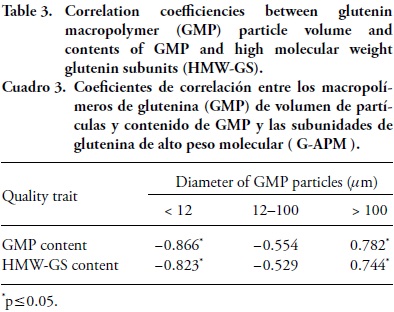
<body><![CDATA[<p align="justify"><font face="verdana" size="2">El macropol&iacute;mero de glutenina (GMP), un componente importante del trigo <i>(Triticum aestivum</i> L.), se compone de sublimidades de glutenina con peso molecular alto (HMW&#45;GS) y bajo (LMW&#45;GS). En el trigo, la composici&oacute;n de subunidades y caracter&iacute;sticas de GMP son factores importantes que afectan la calidad del procesamiento. El objetivo de este estudio fue caracterizar los efectos del estado h&iacute;drico del suelo, los cultivares y la posici&oacute;n del grano en la espiga de trigo sobre la distribuci&oacute;n de las part&iacute;culas GMP. Los cultivares de trigo Jinan 17, Yannong 24 y Lumai 21, con diferente calidad en el uso final, fueron utilizados en la temporada de crecimiento 2009&#45;2011 y se aplicaron dos reg&iacute;menes h&iacute;dricos (riego y temporal): dos riegos (750 m<sup>3</sup> ha<sup>&#45;1</sup> cada uno en la etapa de elongaci&oacute;n del tallo y formaci&oacute;n de la espiga) para los de riego, y ninguno para los de temporal. El dise&ntilde;o experimental fue bloques completos al azar con tres repeticiones y los datos se analizaron con ANDEVA y la prueba de Tukey (p &le; 0.05), para comparar de las medias de los tratamientos, usando SPSS. Todas las determinaciones se repitieron tres veces. La dimensi&oacute;n de la parcela fue de 3 mx3 m. En la madurez, las espigas floreciendo en la misma fecha se muestrearon y separaron como granos basales y distales seg&uacute;n la posici&oacute;n en las espiguillas. La distribuci&oacute;n de las part&iacute;culas GMP y el contenido de HMW&#45;GS fueron afectados (p &le; 0.05) por el agua del suelo, el genotipo y la posici&oacute;n del grano. Los granos basales en las espiguillas de la parte media ten&iacute;an m&aacute;s (p &le; 0.05) HMW&#45;GS y GMP que los distales en madurez. El volumen y porcentaje del &aacute;rea superficial de las part&iacute;culas GMP &gt;100 <i><i>&micro;</i>m</i> en granos basales fueron mayores (p &le; 0.05) que en los distales, pero los de part&iacute;culas de &lt;12 <i><i>&micro;</i>m</i> en los granos basales eran menores que en los distales. En comparaci&oacute;n con el riego, el porcentaje de volumen y &aacute;rea superficial de part&iacute;culas GMP &gt; 100 <i><i>&micro;</i>m</i> en los granos basales y distales aumentaron significativamente (p&lt;0.05), y los contenidos de HMW&#45;GS y GMP tambi&eacute;n aumentaron en condiciones de temporal. Como resultado, los granos basales y distales tienen caracter&iacute;sticas diferentes de calidad y aplicaci&oacute;n. Una estrategia de mejora gen&eacute;tica prometedora ser&iacute;a mejorar el rendimiento del grano y su calidad aumentando el peso medio del grano en lugar del n&uacute;mero de granos dentro de una espiguilla. En la producci&oacute;n de trigo, el manejo del factor agua fue el m&aacute;s importante para regular el rendimiento y la calidad.</font></p>  	    <p align="justify"><font face="verdana" size="2"><b>Palabras clave:</b> subunidad de glutenina de alto peso molecular, macropol&iacute;mero de glutenina, posici&oacute;n del grano, cultivo de temporal, trigo.</font></p>  	    <p align="justify"><font face="verdana" size="2">&nbsp;</font></p>  	    <p align="justify"><font face="verdana" size="2"><b>INTRODUCTION</b></font></p>  	    <p align="justify"><font face="verdana" size="2">Wheat <i>(Triticum aestivum</i> L.) is the most consumed food crop in the world, being processed for a range of breads, baked goods, pasta, and noodles. In wheat, glutenin macropolymer (GMP) is a major component of grain and an important factor affecting the processing quality of wheat (Don <i>et al.,</i> 2005). GMP consists of high molecular weight glutenin subunits (HMW&#45;GS) linked with low molecular weight glutenin subunits (LMW&#45;GS) through disulfide bonds (Goesaert <i>et al.,</i> 2005). HMW&#45;GS play an important role in determining the glutenin protein network structure (Don <i>et al.,</i> 2006), and LMW&#45;GS may also have a specific effect on glutenin aggregation (Dupont and Altenbach, 2003). GMP that consists of a higher ratio of HMW&#45;GS to LMW&#45;GS is correlated with improved wheat flour quality (Pechanek <i>et al.,</i> 1997).</font></p>  	    <p align="justify"><font face="verdana" size="2">There is a significant correlation between amount of GMP in wheat grains and flour quality variables, such as loaf and physical dough properties (Weegels <i>et</i> al., 1996; Tarekegne and Labuschagne, 2005). GMP quantity is an indicator of wheat flour quality and the rigidity of the GMP gel&#45;layer, expressed as the G' (Pa) value obtained from a dynamic rheological measurement, correlates with bread&#45;making quality (Pritchard, 1993). There is also a strong positive correlation between dough development time and G' plateau values of GMP isolated from flour (Bekkers <i>et al.,</i> 2000). GMP particle distribution size is another important factor for wheat bread&#45;making quality (Dupont and Altenbach, 2003). According to Don <i>et al.</i> (2006), GMP particle size strongly correlates with dough development time. Both the quantity and composition of HMW&#45;GS correlates with dough properties and bread&#45;making quality. Besides, subunits 2+12 and 5+10 are strongly correlated with weak and strong gluten properties, respectively. However, total amount of HMW&#45;GS and its relative amount to total grain protein play more important roles than HMW&#45;GS composition in determining flour quality (Vasil and Anderson, 1997; Sliwinski <i>et al.,</i> 2004). Thus, accumulation of HMW&#45;GS in grain could be important for wheat quality development.</font></p>  	    <p align="justify"><font face="verdana" size="2">Content and size distribution of GMP in wheat grains are both genetically and environmentally controlled; individual grains of wheat cultivars show significant variation in grain mass and nutrient concentration depending on their position within the spike (Stoddard, 1999). Grains in distal positions on the spikelet have lower N, macronutrient and micronutrient concentrations than those in proximal positions on basal&#45;central spikelets (Calderini and Ortiz&#45;Monasterio, 2003). Environmental factors, such as soil water content, have also significant effect on GMP characteristics. Moisture stress during grain&#45;filling increases flour protein content and sodium dodecyl sulfate (SDS) sedimentation volume (Saint Pierre <i>et al.,</i> 2008). Drought promote HMW&#45;GS accumulation at early grain filling stage, whereas the case is just opposite at late grain filling stage (Jiang <i>et al.,</i> 2009). According to Li <i>et al.</i> (2011), increased N levels promote accumulation of HMW and LMW&#45;GS, GMP content, and proportion of the larger particle of GMP under irrigated condition; besides, protein content also increased under rainfed condition. Both dough development time and stability time are longest with single post&#45;anthesis irrigation, while the second irrigation lead to shortened dough development and stability time and weakened gluten strength, as well as decreased glutenin polymerization index and average size of GMP (Yao <i>et al.,</i> 2010). Hence, a better understanding of size distribution of GMP particles in wheat grains could help determine suitable management practices and design wheat breeding strategies aimed at increasing grain yield without affecting grain quality.</font></p>  	    <p align="justify"><font face="verdana" size="2">In the north of China wheat is traditionally irrigated two or three times, at jointing and booting stages (or grain filling stage). The booting stage is the critical period of water requirement. However, frequent soil water stress has influenced both the dry matter production and the grain formation of wheat (Ma <i>et al.,</i> 2007). Water&#45;saving irrigation technology more and more important in recent years. Hence, a better understanding of formation of glutenin in wheat grains under different irrigation patterns could help determine suitable management practices.</font></p>  	    <p align="justify"><font face="verdana" size="2">The objectives of this study were to assess granule size distribution of GMP in grains set at different positions within spike in three winter wheat cultivars, and to determine the role played by soil water status in determining GMP and HMW&#45;GS contents.</font></p>  	    <p align="justify"><font face="verdana" size="2">&nbsp;</font></p>  	    ]]></body>
<body><![CDATA[<p align="justify"><font face="verdana" size="2"><b>MATERIALS AND METHODS</b></font></p>  	    <p align="justify"><font face="verdana" size="2"><b>Plant materials and experiment description</b></font></p>  	    <p align="justify"><font face="verdana" size="2">The experiment was conducted at the experimental farm of the Research Institute of Agricultural Science (37 &deg;N, 116 &deg;E), Dezhou, PR China, during 2009&#45;2010 and 2010&#45;2011 growing seasons. Treatments were three wheat cultivars and two irrigation systems. Three winter wheat cultivars with different end&#45;use quality were used: Jinan 17, Yannong 24 and Lumai 21. Yannong 24 and Lumai 21 were sown on October 15, 2010 and the 0&#45;20 cm soil layer contained 83.6 mg kg<sup>&#45;1</sup> available N, 18.2 mg kg<sup>&#45;1</sup> available phosphate and 95.2 mg kg<sup>&#45;1</sup> available K. Jinan 17 and Lumai 21 were sown on October 17, 2009; in the soil the content of available N, P and K was 81.5, 17.6 and 93.6 mg kg<sup>&#45;1</sup>. Irrigation systemsa were: 1) two irrigations (750 m<sup>3</sup> ha<sup>&#45;1</sup> each at jointing and booting stages) and, 2) rainfed (no irrigation). The moisture content in soil after anthesis is shown in <a href="/img/revistas/agro/v48n3/a5f1.jpg" target="_blank">Figure 1</a>. Plot dimension was 3 mx3 m and each experimental unit consisted of 10 rows of wheat with 25&#45;cm spacing. Regional crop farming practices were implemented to minimize pest, disease, and weed incidence.</font></p>  	    <p align="justify"><font face="verdana" size="2"><b>Plant sampling</b></font></p>  	    <p align="justify"><font face="verdana" size="2">Heads fully flowering on the same date were labeled with thread. At maturity, the labeled heads were hand&#45;harvested on June 14, 2010 and June 12, 2011. Each sample was oven&#45;dried at 70 &deg;C for 72 h and used for measuring GMP particles distribution and content of GMP and HMW&#45;GS. From the basal five to 12 spikelets on spikes of these cultivars, the first and second basal grains on each spikelet were detached as basal grains, whereas the most distal grain on the same spikelet was detached as distal grains. The basal and distal grains were respectively detached and then ground into flour to perform determinations.</font></p>  	    <p align="justify"><font face="verdana" size="2"><b>GMP content analysis</b></font></p>  	    <p align="justify"><font face="verdana" size="2">A quantity of 0.05 g of flour was dispersed, mixed with 1 mL of SDS (98.5 %, Sigma) and centrifuged at 15,500 x <i>g</i> for 15 min using an Allegra X&#45;64R centrifuge (Beckman, San Francisco, CA). Glutenin macropolymer content was measured using TU&#45;1901 dual&#45;wavelength spectrophotometer (Persee Instruments, Peking, China). Glutenin macropolymer content was calculated with a set of Kjeldahl protein values.</font></p>  	    <p align="justify"><font face="verdana" size="2"><b>Isolation of glutenin macropolymer</b></font></p>  	    <p align="justify"><font face="verdana" size="2">Glutenin macropolymer&#45;gel was isolated by dispersing 1.4 g of defatted flour into 0.05 mol L<sup>&#45;1</sup> SDS (28 mL) and then centrifuged at 80 000 x <i>g</i> for 30 min at 20 &deg;C using an ultracentrifuge Beckman L&#45;60 (Beckman, San Francisco, CA) as described by Graveland <i>et al.</i> (1985). The GMP gel&#45;layer was collected on the top of the supernatant.</font></p>  	    <p align="justify"><font face="verdana" size="2"><b>Coulter laser particle size analysis</b></font></p>  	    ]]></body>
<body><![CDATA[<p align="justify"><font face="verdana" size="2">One gram of GMP&#45;gel was added to 8 mL of 0.05 mol L<sup>&#45;1</sup> SDS solvent, the tube was sealed and placed on a roller&#45;bank for 3 h at 23 &deg;C and analyzed with a Coulter Laser LS13320 (Beckman Coulter Instruments, San Francisco, CA). From the pattern, the GMP surface area distribution and volume distribution was measured and calculated.</font></p>  	    <p align="justify"><font face="verdana" size="2"><b>HMW&#45;GS content analysis</b></font></p>  	    <p align="justify"><font face="verdana" size="2">The quantification of the HMW&#45;GS was performed according to Liang <i>et al.</i> (2002). HMW&#45;GS were first separated by SDS&#45;polyacrylate gel electrophoresis (SDS&#45;PAGE), the gel was stained with 0.05 % Coomassie Brilliant Blue B250 (Sigma) for 24 h, and destained in distilled water for 48 h; then each band was separately cut off from the gel and placed in an Eppendorf tube. Depending on the intensity of each band, 1 mL of 50 % isopropyl alcohol containing 3 % SDS was added to the tube which was incubated at 37 &deg;C for 24 h until the gel cleared. The extraction was monitored at 595 nm with a UV&#45;2401 Shimadzu spectrophotometer (Shimadzu Corporation, Kyoto, Japan).</font></p>  	    <p align="justify"><font face="verdana" size="2"><b>Experimental design and statistical analysis</b></font></p>  	    <p align="justify"><font face="verdana" size="2">The experimental design was a complete randomized block with three replicates, data were analyzed using ANOVA and Tukey test (p &le; 0.05) for treatment means, with SPSS software. General correlation coefficients were calculated between diameter of GMP particles and content of GMP and HMW&#45;GS.</font></p>  	    <p align="justify"><font face="verdana" size="2">&nbsp;</font></p>  	    <p align="justify"><font face="verdana" size="2"><b>RESULTS AND DISCUSSION</b></font></p>  	    <p align="justify"><font face="verdana" size="2"><b>Content of total HMW&#45;GS in grains</b></font></p>  	    <p align="justify"><font face="verdana" size="2">In the three cultivars, the HMW&#45;GS total content in basal grains was higher (p &le; 0.05) than in distal grains in the two irrigation treatments (<a href="/img/revistas/agro/v48n3/a5f2.jpg" target="_blank">Figure 2</a>). Irrigated and rainfed conditions had different influence on HMW&#45;GS content. Under irrigation, the HMW&#45;GS content in basal and distal grains decreased when compared with those under rainfed. The results indicated that rainfed was beneficial for the accumulation of HMW&#45;GS in wheat.</font></p>  	    <p align="justify"><font face="verdana" size="2">These results are similar to those of Li <i>et al.(</i> 2011), who indicated that rainfed could increase the contents of HMW&#45;GS and LMW&#45;GS and H/L values in wheat, although the proportions of single subunits varied under the irrigation treatments.</font></p>  	    ]]></body>
<body><![CDATA[<p align="justify"><font face="verdana" size="2"><b>GMP content in grains</b></font></p>  	    <p align="justify"><font face="verdana" size="2">Changes of GMP content in basal grains were higher than in distal grains (<a href="/img/revistas/agro/v48n3/a5f3.jpg" target="_blank">Figure 3</a>), indicating that more glutenin is accumulated in basal grains. Besides, under rainfed GMP content in basal and distal grains were significantly increased by 9.318.7 % and 17.2&#45;24.8 %, as compared to irrigation.</font></p>  	    <p align="justify"><font face="verdana" size="2">These results were similar to those of Stoddard (1999), who concluded that grains from distal florets were always smaller and had lower nitrogen contents than those from the two proximal florets on each spikelet. There were differences in grain mass and N between florets within spikelets, and between spikelets within head varied according to cultivar.</font></p>  	    <p align="justify"><font face="verdana" size="2">There are some discrepancy between the results of the present study and those of Li <i>et al.</i> (2011), who found that the GMP contents increased as N rates increased under irrigation. But under the rainfed, the GMP contents showed difference with the N level. Some of these differences may be related mainly to the water&#45;N interaction.</font></p>  	    <p align="justify"><font face="verdana" size="2"><b>Particle volume distribution</b></font></p>  	    <p align="justify"><font face="verdana" size="2">The volume percentages of particles &gt;100 <i><i>&micro;</i>m</i> in basal grains were 19.6&#45;34.3 % and higher (p &le; 0.05) than in distal grains (11.1&#45;17.4 %) under irrigation and rainfed, whereas volume percentages of 12100 <i><i>&micro;</i>m</i> and &lt;12 <i><i>&micro;</i>m</i> particles in distal grains were higher than those in basal grains (<a href="/img/revistas/agro/v48n3/a5t1.jpg" target="_blank">Table 1</a>).</font></p>  	    <p align="justify"><font face="verdana" size="2">Under rainfed, volume percentages of &gt;100 <i><i>&micro;</i>m</i> in basal and distal grains were increased (except Jinan 17 distal grains in 2009&#45;2010), whereas those of &lt;12 <i><i>&micro;</i>m</i> were decreased compared to irrigation. These results indicate that soil water deficit (rainfed condition) would increase volume percentages of large particles. Results also show that particle size distribution in basal and distal grains was significantly different, which might be due to differences in development time of floret and structure of vascular bundle in individual grains on a wheat spike. In basal grains, the development time of floret was earlier and the number and cross&#45;sectional area of vascular bundles were higher than those in distal grains, which was beneficial for transportation and accumulation of N. As a result, basal grains have a stronger capacity of protein synthesis than distal grains, which might promote the development and growth of large GMP particles (Ru <i>et al.,</i> 2006; Xiong <i>et al.,</i> 2009).</font></p>  	    <p align="justify"><font face="verdana" size="2"><b>Surface area distribution</b></font></p>  	    <p align="justify"><font face="verdana" size="2">Under irrigated and rainfed conditions, surface area percentages of &gt; 100 <i><i>&micro;</i>m</i> in basal grains were 1.2&#45;2.9 %, i.e. higher than those in distal grains (0.61.1 %), whereas surface area percentages &lt;12 <i><i>&micro;</i>m</i> in basal grains were 74.1&#45;85.8 % and lower than in distal grains (80.2&#45;88.9 %) (<a href="/img/revistas/agro/v48n3/a5t2.jpg" target="_blank">Table 2</a>). Compared with irrigation, the surface area percentages of &gt;100 <i><i>&micro;</i>m</i> increased by 12.0&#45;50.0 % and 0.0&#45;83.3 % in basal and distal grains under rainfed, indicating that drought could increase surface area percentage of large particles in the three wheat cultivars.</font></p>  	    <p align="justify"><font face="verdana" size="2">Environment has a strong effect on the size of GMP particles and on GMP content in wheat grains (Yao <i>etal.,</i> 2010; Li <i>etal.,</i> 2011). Results of the present study confirmed that GMP particles size was affected by irrigation regime, since volume percentage and surface area percentage of large particles (&gt;100 /mm) increased under rainfed, indicating that soil water deficit led to a change in percentage volume and surface area of GMP particles.</font></p>  	    ]]></body>
<body><![CDATA[<p align="justify"><font face="verdana" size="2">According to Don <i>et al.</i> (2003), GMP consists of spherical glutenin particles and originates from protein bodies observed in developing grain. Van </font><font face="verdana" size="2">Herpen <i>et al.</i> (2008) suggest that protein bodies were the building blocks for the formation of larger glutenin particles during the desiccation phase of kernel development. A close correlation was found between accumulation of GMP and rapid loss of water during desiccation (Carceller and Aussenac, 2001). The premature desiccation of wheat grain induces SDS&#45;insoluble polymer formation and percentage of SDS&#45;insoluble polymers as a proportion of total polymers can increase from less than 10 % at the end of kernel ripening to 50 % in as little as 10 d. In the present study, the volume and surface area percentages of large GMP particles under rainfed conditions were significantly increased, suggesting that water&#45;deficit treatment is probably beneficial for desiccation of grains and thus promote the formation of large GMP particles.</font></p>     <p align="justify"><font face="verdana" size="2"><b>Relationships between GMP size distribution and content of GMP and HMW&#45;GS</b></font></p>  	    <p align="justify"><font face="verdana" size="2">Correlation between GMP size distribution and HMW&#45;GS content with volume percentage &lt;12 <i><i>&micro;</i>m</i> GMP particles was negative, but it was positive with &gt;100 <i><i>&micro;</i>m</i> GMP particles (<a href="#a5t3">Table 3</a>), suggesting that large GMP particles have high GMP content.</font></p>  	    <p align="center"><font face="verdana" size="2"><a name="a5t3"></a> 	<img src="/img/revistas/agro/v48n3/a5t3.jpg"></font></p>  	    <p align="justify"><font face="verdana" size="2">&nbsp;</font></p>  	    <p align="justify"><font face="verdana" size="2"><b>CONCLUSIONS</b></font></p>  	    <p align="justify"><font face="verdana" size="2">There is a higher volume and surface area percentages of large particles in basal grains than in distal grains, whereas those of small particles were the opposite. High&#45;molecular&#45;weight gutenin subunit and GMP content in basal grains were higher than that in distal grains, indicating that more GMP particles were accumulated in basal grains than in distal grains, and then the small ones assembled larger ones. The soil water deficit enhanced accumulation of HMW&#45;GS and GMP, and was prone to forming larger GMP particles in basal and distal wheat grains; thus, irrigation levels could influence both glutenin biosynthesis and HMW&#45;GS content, and eventually influence wheat flour quality. Regarding wheat production, irrigation was the most important factor for regulating yield and quality.</font></p>  	    <p align="justify"><font face="verdana" size="2">&nbsp;</font></p>  	    <p align="justify"><font face="verdana" size="2"><b>ACKNOWLEGEMENTS</b></font></p>  	    <p align="justify"><font face="verdana" size="2">This research was supported by the National Natural Science Foundation of China (31271667, 30871477), the Natural Science Foundation of Shandong Province, China (ZR2010CM044), the National Basic Research Program of China (973 Program 2009CB118602), and State Key Laboratory of Crop Biology (Grant no. 2012KF01) at Shandong Agricultural University, China.</font></p>  	    ]]></body>
<body><![CDATA[<p align="justify"><font face="verdana" size="2">&nbsp;</font></p>  	    <p align="justify"><font face="verdana" size="2"><b>LITERATURE CITED</b></font></p>  	    <!-- ref --><p align="justify"><font face="verdana" size="2">Bekkers, A. C. A. P. A., W. J. Lichtendonk, A. Graveland, and J. J. Plijter. 2000. Mixing of wheat flour dough as a function of the physicochemical properties of the SDS&#45;gel proteins. <i>In:</i> Shewry, P. R., and A. S. Tatham (eds). Wheat Gluten&#45;Proceedings of the 7th International Workshop Gluten, Royal Society of Chemistry, Cambridge, pp: 408&#45;412.    &nbsp;&nbsp;&nbsp;&nbsp;&nbsp;&nbsp;&nbsp;&nbsp;[&#160;<a href="javascript:void(0);" onclick="javascript: window.open('/scielo.php?script=sci_nlinks&ref=586383&pid=S1405-3195201400030000500001&lng=','','width=640,height=500,resizable=yes,scrollbars=1,menubar=yes,');">Links</a>&#160;]<!-- end-ref --></font></p>  	    <!-- ref --><p align="justify"><font face="verdana" size="2">Calderini, D. F., and I. Ortiz&#45;Monasterio. 2003. Grain position affects grain macronutrient and micronutrient concentrations in wheat. Crop Sci. 43: 141&#45;151.    &nbsp;&nbsp;&nbsp;&nbsp;&nbsp;&nbsp;&nbsp;&nbsp;[&#160;<a href="javascript:void(0);" onclick="javascript: window.open('/scielo.php?script=sci_nlinks&ref=586385&pid=S1405-3195201400030000500002&lng=','','width=640,height=500,resizable=yes,scrollbars=1,menubar=yes,');">Links</a>&#160;]<!-- end-ref --></font></p>  	    <!-- ref --><p align="justify"><font face="verdana" size="2">Carceller, J. L., and T. Aussenac. 2001. Size characterisation of glutenin polymers by HPSEC&#45;MALLS. J. Cereal Sci. 33: 131&#45;142.    &nbsp;&nbsp;&nbsp;&nbsp;&nbsp;&nbsp;&nbsp;&nbsp;[&#160;<a href="javascript:void(0);" onclick="javascript: window.open('/scielo.php?script=sci_nlinks&ref=586387&pid=S1405-3195201400030000500003&lng=','','width=640,height=500,resizable=yes,scrollbars=1,menubar=yes,');">Links</a>&#160;]<!-- end-ref --></font></p>  	    <!-- ref --><p align="justify"><font face="verdana" size="2">Don, C., W. Lichtendonk, J. J. Plijter, and R. J. Hamer. 2003. Glutenin macropolymer: a gel formed by glutenin particles. J. Cereal Sci. 37: 1&#45;7.    &nbsp;&nbsp;&nbsp;&nbsp;&nbsp;&nbsp;&nbsp;&nbsp;[&#160;<a href="javascript:void(0);" onclick="javascript: window.open('/scielo.php?script=sci_nlinks&ref=586389&pid=S1405-3195201400030000500004&lng=','','width=640,height=500,resizable=yes,scrollbars=1,menubar=yes,');">Links</a>&#160;]<!-- end-ref --></font></p>  	    ]]></body>
<body><![CDATA[<!-- ref --><p align="justify"><font face="verdana" size="2">Don, C., G. Lookhart, H. Naeem, F. MacRitchie, and R. J. Hamer. 2005. Heat stress and genotype affect the glutenin particles of the glutenin macropolymer&#45;gel fraction. J. Cereal Sci. 42: 69&#45;80.    &nbsp;&nbsp;&nbsp;&nbsp;&nbsp;&nbsp;&nbsp;&nbsp;[&#160;<a href="javascript:void(0);" onclick="javascript: window.open('/scielo.php?script=sci_nlinks&ref=586391&pid=S1405-3195201400030000500005&lng=','','width=640,height=500,resizable=yes,scrollbars=1,menubar=yes,');">Links</a>&#160;]<!-- end-ref --></font></p>  	    <!-- ref --><p align="justify"><font face="verdana" size="2">Don, C., G. Mann, F. Bekes, and R. J. Hamer. 2006. HMW&#45;GS affect the properties of glutenin particles in GMP and thus flour quality. J. Cereal Sci. 44: 127&#45;136.    &nbsp;&nbsp;&nbsp;&nbsp;&nbsp;&nbsp;&nbsp;&nbsp;[&#160;<a href="javascript:void(0);" onclick="javascript: window.open('/scielo.php?script=sci_nlinks&ref=586393&pid=S1405-3195201400030000500006&lng=','','width=640,height=500,resizable=yes,scrollbars=1,menubar=yes,');">Links</a>&#160;]<!-- end-ref --></font></p>  	    <!-- ref --><p align="justify"><font face="verdana" size="2">Dupont, F. M., and S. B. Altenbach. 2003. Molecular and biochemical impacts of environmental factors on wheat grain development and protein synthesis. J. Cereal Sci. 38: 133&#45;146.    &nbsp;&nbsp;&nbsp;&nbsp;&nbsp;&nbsp;&nbsp;&nbsp;[&#160;<a href="javascript:void(0);" onclick="javascript: window.open('/scielo.php?script=sci_nlinks&ref=586395&pid=S1405-3195201400030000500007&lng=','','width=640,height=500,resizable=yes,scrollbars=1,menubar=yes,');">Links</a>&#160;]<!-- end-ref --></font></p>  	    <!-- ref --><p align="justify"><font face="verdana" size="2">Goesaert, H., K. Brijs, W. S. Veraverbeke, C. M. Courtin, K. Gebruers, and J. A. Delcour. 2005. "Wheat flour constituents: how they impact bread quality, and how to impact their functionality. Trends Food Sci. Technol. 16: 12&#45;30.    &nbsp;&nbsp;&nbsp;&nbsp;&nbsp;&nbsp;&nbsp;&nbsp;[&#160;<a href="javascript:void(0);" onclick="javascript: window.open('/scielo.php?script=sci_nlinks&ref=586397&pid=S1405-3195201400030000500008&lng=','','width=640,height=500,resizable=yes,scrollbars=1,menubar=yes,');">Links</a>&#160;]<!-- end-ref --></font></p>  	    <!-- ref --><p align="justify"><font face="verdana" size="2">Graveland, A., P. Bosveld, W. J. Lichtendonk, J. P. Marseille, J. H. E. Moonen, and A. . Scheepstra. 1985. A model for the molecular structure of the glutenins from wheat flour. J. Cereal Sci. 3: 1&#45;16.    &nbsp;&nbsp;&nbsp;&nbsp;&nbsp;&nbsp;&nbsp;&nbsp;[&#160;<a href="javascript:void(0);" onclick="javascript: window.open('/scielo.php?script=sci_nlinks&ref=586399&pid=S1405-3195201400030000500009&lng=','','width=640,height=500,resizable=yes,scrollbars=1,menubar=yes,');">Links</a>&#160;]<!-- end-ref --></font></p>  	    ]]></body>
<body><![CDATA[<!-- ref --><p align="justify"><font face="verdana" size="2">Jiang, D., H. Yue, B. Wollenweber, W .Tan, H. Mu, Y. Bo, T. Dai, Q. Jing, and W. Cao. 2009. Effects of post&#45;anthesis drought and waterlogging on accumulation of high&#45;molecular&#45;weight glutenin subunits and glutenin macropolymers content in wheat grain. J. Agron. Crop Sci. 195: 89&#45;97.    &nbsp;&nbsp;&nbsp;&nbsp;&nbsp;&nbsp;&nbsp;&nbsp;[&#160;<a href="javascript:void(0);" onclick="javascript: window.open('/scielo.php?script=sci_nlinks&ref=586401&pid=S1405-3195201400030000500010&lng=','','width=640,height=500,resizable=yes,scrollbars=1,menubar=yes,');">Links</a>&#160;]<!-- end-ref --></font></p>  	    <!-- ref --><p align="justify"><font face="verdana" size="2">Li, Y., Y. P. Yin, Q. Zhao, and Z. L. Wang. 2011. Changes of glutenin subunits due to water&#45;nitrogen interaction influence size and ditribution of glutenin macropolymer particles and flour quality. Crop Sci. 51: 2809&#45;2819.    &nbsp;&nbsp;&nbsp;&nbsp;&nbsp;&nbsp;&nbsp;&nbsp;[&#160;<a href="javascript:void(0);" onclick="javascript: window.open('/scielo.php?script=sci_nlinks&ref=586403&pid=S1405-3195201400030000500011&lng=','','width=640,height=500,resizable=yes,scrollbars=1,menubar=yes,');">Links</a>&#160;]<!-- end-ref --></font></p>  	    <!-- ref --><p align="justify"><font face="verdana" size="2">Liang, R. Q., Y. R. Zhang, M. S. You, S. F. Mao, J. M. Song, and G. T. Liu. 2002. Multi&#45;stacking SDS&#45;PAGE for wheat glutenin polymer and it's relation to bread&#45;making quality. Acta Agron. Sinica 28: 609&#45;614.    &nbsp;&nbsp;&nbsp;&nbsp;&nbsp;&nbsp;&nbsp;&nbsp;[&#160;<a href="javascript:void(0);" onclick="javascript: window.open('/scielo.php?script=sci_nlinks&ref=586405&pid=S1405-3195201400030000500012&lng=','','width=640,height=500,resizable=yes,scrollbars=1,menubar=yes,');">Links</a>&#160;]<!-- end-ref --></font></p>  	    <!-- ref --><p align="justify"><font face="verdana" size="2">Ma, R. K., X. L. Jia, Q. G. Zhang, L. H. Zhang, Y. R. Yao, and L. H. Yang. 2007. Physiological characteristics of water in wheat cultivar SX733: the effect of watersaving irrigation. Acta Agron. Sinica 33: 1446&#45;1451.    &nbsp;&nbsp;&nbsp;&nbsp;&nbsp;&nbsp;&nbsp;&nbsp;[&#160;<a href="javascript:void(0);" onclick="javascript: window.open('/scielo.php?script=sci_nlinks&ref=586407&pid=S1405-3195201400030000500013&lng=','','width=640,height=500,resizable=yes,scrollbars=1,menubar=yes,');">Links</a>&#160;]<!-- end-ref --></font></p>  	    <!-- ref --><p align="justify"><font face="verdana" size="2">Pritchard, P.E.. 1993. The glutenin fraction (gel&#45;protein) of wheat protein&#45;a new tool in the prediction of baking quality. Asp. Appl. Biol. 36: 75&#45;84.    &nbsp;&nbsp;&nbsp;&nbsp;&nbsp;&nbsp;&nbsp;&nbsp;[&#160;<a href="javascript:void(0);" onclick="javascript: window.open('/scielo.php?script=sci_nlinks&ref=586409&pid=S1405-3195201400030000500014&lng=','','width=640,height=500,resizable=yes,scrollbars=1,menubar=yes,');">Links</a>&#160;]<!-- end-ref --></font></p>  	    ]]></body>
<body><![CDATA[<!-- ref --><p align="justify"><font face="verdana" size="2">Pechanek, U., A. Karger, S. Gr&ouml;ger, B. Charvat, G. Sch&ouml;ggl, and T. Lelley. 1997. Effect of nitrogen fertilization on quantity of flour protein components, dough properties, and breadmaking quality of wheat. Cereal Chem. 74: 800&#45;805.    &nbsp;&nbsp;&nbsp;&nbsp;&nbsp;&nbsp;&nbsp;&nbsp;[&#160;<a href="javascript:void(0);" onclick="javascript: window.open('/scielo.php?script=sci_nlinks&ref=586411&pid=S1405-3195201400030000500015&lng=','','width=640,height=500,resizable=yes,scrollbars=1,menubar=yes,');">Links</a>&#160;]<!-- end-ref --></font></p>  	    <!-- ref --><p align="justify"><font face="verdana" size="2">Ru, Z. G., G. Li, T. Z. Hu, and L. B. Li. 2006. Analysis of grain weight and quality at different floret position of strong glutenin wheat. J. Triticeae Crops 26: 134&#45;136.    &nbsp;&nbsp;&nbsp;&nbsp;&nbsp;&nbsp;&nbsp;&nbsp;[&#160;<a href="javascript:void(0);" onclick="javascript: window.open('/scielo.php?script=sci_nlinks&ref=586413&pid=S1405-3195201400030000500016&lng=','','width=640,height=500,resizable=yes,scrollbars=1,menubar=yes,');">Links</a>&#160;]<!-- end-ref --></font></p>  	    <!-- ref --><p align="justify"><font face="verdana" size="2">Saint Pierre, C., C. J. Peterson, A. S. Ross, J. B. Ohm, M. C. Verhoeven, M. Larson, and B. Hoefer. 2008. Winter wheat genotypes under different levels of nitrogen and water stress: Changes in grain protein composition. J. Cereal Sci. 47: 407&#45;416.    &nbsp;&nbsp;&nbsp;&nbsp;&nbsp;&nbsp;&nbsp;&nbsp;[&#160;<a href="javascript:void(0);" onclick="javascript: window.open('/scielo.php?script=sci_nlinks&ref=586415&pid=S1405-3195201400030000500017&lng=','','width=640,height=500,resizable=yes,scrollbars=1,menubar=yes,');">Links</a>&#160;]<!-- end-ref --></font></p>  	    <!-- ref --><p align="justify"><font face="verdana" size="2">Sliwinski, E. L., P. Kolster, A. Prins, and T. van Vliet. 2004. On the relationship between gluten protein composition of wheat flours and large&#45;deformation properties of their doughs. J. Cereal Sci. 39: 247&#45;264.    &nbsp;&nbsp;&nbsp;&nbsp;&nbsp;&nbsp;&nbsp;&nbsp;[&#160;<a href="javascript:void(0);" onclick="javascript: window.open('/scielo.php?script=sci_nlinks&ref=586417&pid=S1405-3195201400030000500018&lng=','','width=640,height=500,resizable=yes,scrollbars=1,menubar=yes,');">Links</a>&#160;]<!-- end-ref --></font></p>  	    <!-- ref --><p align="justify"><font face="verdana" size="2">Stoddard, F. L. 1999. Variation in grain mass, grain nitrogen and starch B&#45;granule content within wheat heads. Cereal Chem. 76: 139&#45;144.    &nbsp;&nbsp;&nbsp;&nbsp;&nbsp;&nbsp;&nbsp;&nbsp;[&#160;<a href="javascript:void(0);" onclick="javascript: window.open('/scielo.php?script=sci_nlinks&ref=586419&pid=S1405-3195201400030000500019&lng=','','width=640,height=500,resizable=yes,scrollbars=1,menubar=yes,');">Links</a>&#160;]<!-- end-ref --></font></p>  	    ]]></body>
<body><![CDATA[<!-- ref --><p align="justify"><font face="verdana" size="2">Tarekegne, A., and M. T. Labuschagne. 2005. Relationship between high molecular weight glutenin subunit composition and gluten quality in Ethiopian&#45;grown bread and durum wheat cultivars and lines. J. Agron. Crop Sci. 191: 300&#45;307.    &nbsp;&nbsp;&nbsp;&nbsp;&nbsp;&nbsp;&nbsp;&nbsp;[&#160;<a href="javascript:void(0);" onclick="javascript: window.open('/scielo.php?script=sci_nlinks&ref=586421&pid=S1405-3195201400030000500020&lng=','','width=640,height=500,resizable=yes,scrollbars=1,menubar=yes,');">Links</a>&#160;]<!-- end-ref --></font></p>  	    <!-- ref --><p align="justify"><font face="verdana" size="2">Van Herpen, T. W. J. M., J. H. G. Cordewener, H. J. Klok, J. Freeman, A. H. P. America, D. Bosch, M. J. M. Smulders , L. J. W. J. Gilissen, P. R. Shewry, and R. J. Hamer. 2008. The origin and early development of wheat glutenin particles. J. Cereal Sci. 48: 870&#45;877.    &nbsp;&nbsp;&nbsp;&nbsp;&nbsp;&nbsp;&nbsp;&nbsp;[&#160;<a href="javascript:void(0);" onclick="javascript: window.open('/scielo.php?script=sci_nlinks&ref=586423&pid=S1405-3195201400030000500021&lng=','','width=640,height=500,resizable=yes,scrollbars=1,menubar=yes,');">Links</a>&#160;]<!-- end-ref --></font></p>  	    <!-- ref --><p align="justify"><font face="verdana" size="2">Vasil, I. K., and O. D. Anderson. 1997. Genetic engineering of wheat gluten. Trends Plant Sci. 2: 292&#45;297.    &nbsp;&nbsp;&nbsp;&nbsp;&nbsp;&nbsp;&nbsp;&nbsp;[&#160;<a href="javascript:void(0);" onclick="javascript: window.open('/scielo.php?script=sci_nlinks&ref=586425&pid=S1405-3195201400030000500022&lng=','','width=640,height=500,resizable=yes,scrollbars=1,menubar=yes,');">Links</a>&#160;]<!-- end-ref --></font></p>  	    <!-- ref --><p align="justify"><font face="verdana" size="2">Weegels, P. L., A. M. van de Pijpekamp, A. Graveland, R. J. Hamer, and J. D. Schofield. 1996. Depolymerisation and repolymerisation of wheat glutenin during dough processing: I. Relationships between glutenin macropolymer content and quality parameters. J. Cereal Sci. 23: 103&#45;111.    &nbsp;&nbsp;&nbsp;&nbsp;&nbsp;&nbsp;&nbsp;&nbsp;[&#160;<a href="javascript:void(0);" onclick="javascript: window.open('/scielo.php?script=sci_nlinks&ref=586427&pid=S1405-3195201400030000500023&lng=','','width=640,height=500,resizable=yes,scrollbars=1,menubar=yes,');">Links</a>&#160;]<!-- end-ref --></font></p>  	    <!-- ref --><p align="justify"><font face="verdana" size="2">Xiong, F., Y. Kong, X. R. Meng, W. Lu, S. B. Ma, and Z. Wang. 2009. Study on vascular bundle system in spikes and caryopsis of wheat. J. Triticeae Crops 29: 93&#45;99.    &nbsp;&nbsp;&nbsp;&nbsp;&nbsp;&nbsp;&nbsp;&nbsp;[&#160;<a href="javascript:void(0);" onclick="javascript: window.open('/scielo.php?script=sci_nlinks&ref=586429&pid=S1405-3195201400030000500024&lng=','','width=640,height=500,resizable=yes,scrollbars=1,menubar=yes,');">Links</a>&#160;]<!-- end-ref --></font></p>  	    ]]></body>
<body><![CDATA[<!-- ref --><p align="justify"><font face="verdana" size="2">Yao, F. J., M. R. He, D. Y. Jia, X. L. Dai, and Q. Cao. 2010. Effects of post&#45;anthesis irrigation on degree of polymerization of storage protein and rheological properties in wheat. Chinese J. Plant Ecol. 34: 271&#45;278.    &nbsp;&nbsp;&nbsp;&nbsp;&nbsp;&nbsp;&nbsp;&nbsp;[&#160;<a href="javascript:void(0);" onclick="javascript: window.open('/scielo.php?script=sci_nlinks&ref=586431&pid=S1405-3195201400030000500025&lng=','','width=640,height=500,resizable=yes,scrollbars=1,menubar=yes,');">Links</a>&#160;]<!-- end-ref --></font></p>      ]]></body><back>
<ref-list>
<ref id="B1">
<nlm-citation citation-type="book">
<person-group person-group-type="author">
<name>
<surname><![CDATA[Bekkers]]></surname>
<given-names><![CDATA[A. C. A. P. A.]]></given-names>
</name>
<name>
<surname><![CDATA[Lichtendonk]]></surname>
<given-names><![CDATA[W. J.]]></given-names>
</name>
<name>
<surname><![CDATA[Graveland]]></surname>
<given-names><![CDATA[A.]]></given-names>
</name>
<name>
<surname><![CDATA[Plijter]]></surname>
<given-names><![CDATA[J. J.]]></given-names>
</name>
</person-group>
<article-title xml:lang="en"><![CDATA[Mixing of wheat flour dough as a function of the physicochemical properties of the SDS-gel proteins]]></article-title>
<person-group person-group-type="editor">
<name>
<surname><![CDATA[Shewry]]></surname>
<given-names><![CDATA[P. R.]]></given-names>
</name>
<name>
<surname><![CDATA[Tatham]]></surname>
<given-names><![CDATA[A. S.]]></given-names>
</name>
</person-group>
<source><![CDATA[Wheat Gluten-Proceedings of the 7th International Workshop Gluten]]></source>
<year>2000</year>
<page-range>408-412</page-range><publisher-loc><![CDATA[Cambridge ]]></publisher-loc>
<publisher-name><![CDATA[Royal Society of Chemistry]]></publisher-name>
</nlm-citation>
</ref>
<ref id="B2">
<nlm-citation citation-type="journal">
<person-group person-group-type="author">
<name>
<surname><![CDATA[Calderini]]></surname>
<given-names><![CDATA[D. F.]]></given-names>
</name>
<name>
<surname><![CDATA[Ortiz-Monasterio]]></surname>
<given-names><![CDATA[I.]]></given-names>
</name>
</person-group>
<article-title xml:lang="en"><![CDATA[Grain position affects grain macronutrient and micronutrient concentrations in wheat]]></article-title>
<source><![CDATA[Crop Sci.]]></source>
<year>2003</year>
<volume>43</volume>
<page-range>141-151</page-range></nlm-citation>
</ref>
<ref id="B3">
<nlm-citation citation-type="journal">
<person-group person-group-type="author">
<name>
<surname><![CDATA[Carceller]]></surname>
<given-names><![CDATA[J. L.]]></given-names>
</name>
<name>
<surname><![CDATA[Aussenac]]></surname>
<given-names><![CDATA[T.]]></given-names>
</name>
</person-group>
<article-title xml:lang="en"><![CDATA[Size characterisation of glutenin polymers by HPSEC-MALLS]]></article-title>
<source><![CDATA[J. Cereal Sci.]]></source>
<year>2001</year>
<volume>33</volume>
<page-range>131-142</page-range></nlm-citation>
</ref>
<ref id="B4">
<nlm-citation citation-type="journal">
<person-group person-group-type="author">
<name>
<surname><![CDATA[Don]]></surname>
<given-names><![CDATA[C.]]></given-names>
</name>
<name>
<surname><![CDATA[Lichtendonk]]></surname>
<given-names><![CDATA[W.]]></given-names>
</name>
<name>
<surname><![CDATA[Plijter]]></surname>
<given-names><![CDATA[J. J.]]></given-names>
</name>
<name>
<surname><![CDATA[Hamer]]></surname>
<given-names><![CDATA[R. J.]]></given-names>
</name>
</person-group>
<article-title xml:lang="en"><![CDATA[Glutenin macropolymer: a gel formed by glutenin particles]]></article-title>
<source><![CDATA[J. Cereal Sci.]]></source>
<year>2003</year>
<volume>37</volume>
<page-range>1-7</page-range></nlm-citation>
</ref>
<ref id="B5">
<nlm-citation citation-type="journal">
<person-group person-group-type="author">
<name>
<surname><![CDATA[Don]]></surname>
<given-names><![CDATA[C.]]></given-names>
</name>
<name>
<surname><![CDATA[Lookhart]]></surname>
<given-names><![CDATA[G.]]></given-names>
</name>
<name>
<surname><![CDATA[Naeem]]></surname>
<given-names><![CDATA[H.]]></given-names>
</name>
<name>
<surname><![CDATA[MacRitchie]]></surname>
<given-names><![CDATA[F.]]></given-names>
</name>
<name>
<surname><![CDATA[Hamer]]></surname>
<given-names><![CDATA[R. J.]]></given-names>
</name>
</person-group>
<article-title xml:lang="en"><![CDATA[Heat stress and genotype affect the glutenin particles of the glutenin macropolymer-gel fraction]]></article-title>
<source><![CDATA[J. Cereal Sci.]]></source>
<year>2005</year>
<volume>42</volume>
<page-range>69-80</page-range></nlm-citation>
</ref>
<ref id="B6">
<nlm-citation citation-type="journal">
<person-group person-group-type="author">
<name>
<surname><![CDATA[Don]]></surname>
<given-names><![CDATA[C.]]></given-names>
</name>
<name>
<surname><![CDATA[Mann]]></surname>
<given-names><![CDATA[G.]]></given-names>
</name>
<name>
<surname><![CDATA[Bekes]]></surname>
<given-names><![CDATA[F.]]></given-names>
</name>
<name>
<surname><![CDATA[Hamer]]></surname>
<given-names><![CDATA[R. J.]]></given-names>
</name>
</person-group>
<article-title xml:lang="en"><![CDATA[HMW-GS affect the properties of glutenin particles in GMP and thus flour quality]]></article-title>
<source><![CDATA[J. Cereal Sci.]]></source>
<year>2006</year>
<volume>44</volume>
<page-range>127-136</page-range></nlm-citation>
</ref>
<ref id="B7">
<nlm-citation citation-type="journal">
<person-group person-group-type="author">
<name>
<surname><![CDATA[Dupont]]></surname>
<given-names><![CDATA[F. M.]]></given-names>
</name>
<name>
<surname><![CDATA[Altenbach]]></surname>
<given-names><![CDATA[S. B.]]></given-names>
</name>
</person-group>
<article-title xml:lang="en"><![CDATA[Molecular and biochemical impacts of environmental factors on wheat grain development and protein synthesis]]></article-title>
<source><![CDATA[J. Cereal Sci.]]></source>
<year>2003</year>
<volume>38</volume>
<page-range>133-146</page-range></nlm-citation>
</ref>
<ref id="B8">
<nlm-citation citation-type="journal">
<person-group person-group-type="author">
<name>
<surname><![CDATA[Goesaert]]></surname>
<given-names><![CDATA[H.]]></given-names>
</name>
<name>
<surname><![CDATA[Brijs]]></surname>
<given-names><![CDATA[K.]]></given-names>
</name>
<name>
<surname><![CDATA[Veraverbeke]]></surname>
<given-names><![CDATA[W. S.]]></given-names>
</name>
<name>
<surname><![CDATA[Courtin]]></surname>
<given-names><![CDATA[C. M.]]></given-names>
</name>
<name>
<surname><![CDATA[Gebruers]]></surname>
<given-names><![CDATA[K.]]></given-names>
</name>
<name>
<surname><![CDATA[Delcour]]></surname>
<given-names><![CDATA[J. A.]]></given-names>
</name>
</person-group>
<article-title xml:lang="en"><![CDATA["Wheat flour constituents: how they impact bread quality, and how to impact their functionality]]></article-title>
<source><![CDATA[Trends Food Sci. Technol.]]></source>
<year>2005</year>
<volume>16</volume>
<page-range>12-30</page-range></nlm-citation>
</ref>
<ref id="B9">
<nlm-citation citation-type="journal">
<person-group person-group-type="author">
<name>
<surname><![CDATA[Graveland]]></surname>
<given-names><![CDATA[A.]]></given-names>
</name>
<name>
<surname><![CDATA[Bosveld]]></surname>
<given-names><![CDATA[P.]]></given-names>
</name>
<name>
<surname><![CDATA[Lichtendonk]]></surname>
<given-names><![CDATA[W. J.]]></given-names>
</name>
<name>
<surname><![CDATA[Marseille]]></surname>
<given-names><![CDATA[J. P.]]></given-names>
</name>
<name>
<surname><![CDATA[Moonen]]></surname>
<given-names><![CDATA[J. H. E.]]></given-names>
</name>
<name>
<surname><![CDATA[Scheepstra]]></surname>
<given-names><![CDATA[A. .]]></given-names>
</name>
</person-group>
<article-title xml:lang="en"><![CDATA[A model for the molecular structure of the glutenins from wheat flour]]></article-title>
<source><![CDATA[J. Cereal Sci.]]></source>
<year>1985</year>
<volume>3</volume>
<page-range>1-16</page-range></nlm-citation>
</ref>
<ref id="B10">
<nlm-citation citation-type="journal">
<person-group person-group-type="author">
<name>
<surname><![CDATA[Jiang]]></surname>
<given-names><![CDATA[D.]]></given-names>
</name>
<name>
<surname><![CDATA[Yue]]></surname>
<given-names><![CDATA[H.]]></given-names>
</name>
<name>
<surname><![CDATA[Wollenweber]]></surname>
<given-names><![CDATA[B.]]></given-names>
</name>
<name>
<surname><![CDATA[Tan]]></surname>
<given-names><![CDATA[W]]></given-names>
</name>
<name>
<surname><![CDATA[Mu]]></surname>
<given-names><![CDATA[H.]]></given-names>
</name>
<name>
<surname><![CDATA[Bo]]></surname>
<given-names><![CDATA[Y.]]></given-names>
</name>
<name>
<surname><![CDATA[Dai]]></surname>
<given-names><![CDATA[T.]]></given-names>
</name>
<name>
<surname><![CDATA[Jing]]></surname>
<given-names><![CDATA[Q.]]></given-names>
</name>
<name>
<surname><![CDATA[Cao]]></surname>
<given-names><![CDATA[W.]]></given-names>
</name>
</person-group>
<article-title xml:lang="en"><![CDATA[Effects of post-anthesis drought and waterlogging on accumulation of high-molecular-weight glutenin subunits and glutenin macropolymers content in wheat grain]]></article-title>
<source><![CDATA[J. Agron. Crop Sci.]]></source>
<year>2009</year>
<volume>195</volume>
<page-range>89-97</page-range></nlm-citation>
</ref>
<ref id="B11">
<nlm-citation citation-type="journal">
<person-group person-group-type="author">
<name>
<surname><![CDATA[Li]]></surname>
<given-names><![CDATA[Y.]]></given-names>
</name>
<name>
<surname><![CDATA[Yin]]></surname>
<given-names><![CDATA[Y. P.]]></given-names>
</name>
<name>
<surname><![CDATA[Zhao]]></surname>
<given-names><![CDATA[Q.]]></given-names>
</name>
<name>
<surname><![CDATA[Wang]]></surname>
<given-names><![CDATA[Z. L.]]></given-names>
</name>
</person-group>
<article-title xml:lang="en"><![CDATA[Changes of glutenin subunits due to water-nitrogen interaction influence size and ditribution of glutenin macropolymer particles and flour quality]]></article-title>
<source><![CDATA[Crop Sci.]]></source>
<year>2011</year>
<volume>51</volume>
<page-range>2809-2819</page-range></nlm-citation>
</ref>
<ref id="B12">
<nlm-citation citation-type="journal">
<person-group person-group-type="author">
<name>
<surname><![CDATA[Liang]]></surname>
<given-names><![CDATA[R. Q.]]></given-names>
</name>
<name>
<surname><![CDATA[Zhang]]></surname>
<given-names><![CDATA[Y. R.]]></given-names>
</name>
<name>
<surname><![CDATA[You]]></surname>
<given-names><![CDATA[M. S.]]></given-names>
</name>
<name>
<surname><![CDATA[Mao]]></surname>
<given-names><![CDATA[S. F.]]></given-names>
</name>
<name>
<surname><![CDATA[Song]]></surname>
<given-names><![CDATA[J. M.]]></given-names>
</name>
<name>
<surname><![CDATA[Liu]]></surname>
<given-names><![CDATA[G. T.]]></given-names>
</name>
</person-group>
<article-title xml:lang="en"><![CDATA[Multi-stacking SDS-PAGE for wheat glutenin polymer and it's relation to bread-making quality]]></article-title>
<source><![CDATA[Acta Agron. Sinica]]></source>
<year>2002</year>
<volume>28</volume>
<page-range>609-614</page-range></nlm-citation>
</ref>
<ref id="B13">
<nlm-citation citation-type="journal">
<person-group person-group-type="author">
<name>
<surname><![CDATA[Ma]]></surname>
<given-names><![CDATA[R. K.]]></given-names>
</name>
<name>
<surname><![CDATA[Jia]]></surname>
<given-names><![CDATA[X. L.]]></given-names>
</name>
<name>
<surname><![CDATA[Zhang]]></surname>
<given-names><![CDATA[Q. G.]]></given-names>
</name>
<name>
<surname><![CDATA[Zhang]]></surname>
<given-names><![CDATA[L. H.]]></given-names>
</name>
<name>
<surname><![CDATA[Yao]]></surname>
<given-names><![CDATA[Y. R.]]></given-names>
</name>
<name>
<surname><![CDATA[Yang]]></surname>
<given-names><![CDATA[L. H.]]></given-names>
</name>
</person-group>
<article-title xml:lang="en"><![CDATA[Physiological characteristics of water in wheat cultivar SX733: the effect of watersaving irrigation]]></article-title>
<source><![CDATA[Acta Agron. Sinica]]></source>
<year>2007</year>
<volume>33</volume>
<page-range>1446-1451</page-range></nlm-citation>
</ref>
<ref id="B14">
<nlm-citation citation-type="journal">
<person-group person-group-type="author">
<name>
<surname><![CDATA[Pritchard]]></surname>
<given-names><![CDATA[P.E.]]></given-names>
</name>
</person-group>
<article-title xml:lang="en"><![CDATA[The glutenin fraction (gel-protein) of wheat protein-a new tool in the prediction of baking quality]]></article-title>
<source><![CDATA[Asp. Appl. Biol.]]></source>
<year>1993</year>
<volume>36</volume>
<page-range>75-84</page-range></nlm-citation>
</ref>
<ref id="B15">
<nlm-citation citation-type="journal">
<person-group person-group-type="author">
<name>
<surname><![CDATA[Pechanek]]></surname>
<given-names><![CDATA[U.]]></given-names>
</name>
<name>
<surname><![CDATA[Karger]]></surname>
<given-names><![CDATA[A.]]></given-names>
</name>
<name>
<surname><![CDATA[Gröger]]></surname>
<given-names><![CDATA[S.]]></given-names>
</name>
<name>
<surname><![CDATA[Charvat]]></surname>
<given-names><![CDATA[B.]]></given-names>
</name>
<name>
<surname><![CDATA[Schöggl]]></surname>
<given-names><![CDATA[G.]]></given-names>
</name>
<name>
<surname><![CDATA[Lelley]]></surname>
<given-names><![CDATA[T.]]></given-names>
</name>
</person-group>
<article-title xml:lang="en"><![CDATA[Effect of nitrogen fertilization on quantity of flour protein components, dough properties, and breadmaking quality of wheat]]></article-title>
<source><![CDATA[Cereal Chem.]]></source>
<year>1997</year>
<volume>74</volume>
<page-range>800-805</page-range></nlm-citation>
</ref>
<ref id="B16">
<nlm-citation citation-type="journal">
<person-group person-group-type="author">
<name>
<surname><![CDATA[Ru]]></surname>
<given-names><![CDATA[Z. G.]]></given-names>
</name>
<name>
<surname><![CDATA[Li]]></surname>
<given-names><![CDATA[G.]]></given-names>
</name>
<name>
<surname><![CDATA[Hu]]></surname>
<given-names><![CDATA[T. Z.]]></given-names>
</name>
<name>
<surname><![CDATA[Li]]></surname>
<given-names><![CDATA[L. B.]]></given-names>
</name>
</person-group>
<article-title xml:lang="en"><![CDATA[Analysis of grain weight and quality at different floret position of strong glutenin wheat]]></article-title>
<source><![CDATA[J. Triticeae Crops]]></source>
<year>2006</year>
<volume>26</volume>
<page-range>134-136</page-range></nlm-citation>
</ref>
<ref id="B17">
<nlm-citation citation-type="journal">
<person-group person-group-type="author">
<name>
<surname><![CDATA[Saint Pierre]]></surname>
<given-names><![CDATA[C.]]></given-names>
</name>
<name>
<surname><![CDATA[Peterson]]></surname>
<given-names><![CDATA[C. J.]]></given-names>
</name>
<name>
<surname><![CDATA[Ross]]></surname>
<given-names><![CDATA[A. S.]]></given-names>
</name>
<name>
<surname><![CDATA[Ohm]]></surname>
<given-names><![CDATA[J. B.]]></given-names>
</name>
<name>
<surname><![CDATA[Verhoeven]]></surname>
<given-names><![CDATA[M. C.]]></given-names>
</name>
<name>
<surname><![CDATA[Larson]]></surname>
<given-names><![CDATA[M.]]></given-names>
</name>
<name>
<surname><![CDATA[Hoefer]]></surname>
<given-names><![CDATA[B.]]></given-names>
</name>
</person-group>
<article-title xml:lang="en"><![CDATA[Winter wheat genotypes under different levels of nitrogen and water stress: Changes in grain protein composition]]></article-title>
<source><![CDATA[J. Cereal Sci.]]></source>
<year>2008</year>
<volume>47</volume>
<page-range>407-416</page-range></nlm-citation>
</ref>
<ref id="B18">
<nlm-citation citation-type="journal">
<person-group person-group-type="author">
<name>
<surname><![CDATA[Sliwinski]]></surname>
<given-names><![CDATA[E. L.]]></given-names>
</name>
<name>
<surname><![CDATA[Kolster]]></surname>
<given-names><![CDATA[P.]]></given-names>
</name>
<name>
<surname><![CDATA[Prins]]></surname>
<given-names><![CDATA[A.]]></given-names>
</name>
<name>
<surname><![CDATA[van Vliet]]></surname>
<given-names><![CDATA[T.]]></given-names>
</name>
</person-group>
<article-title xml:lang="en"><![CDATA[On the relationship between gluten protein composition of wheat flours and large-deformation properties of their doughs]]></article-title>
<source><![CDATA[J. Cereal Sci.]]></source>
<year>2004</year>
<volume>39</volume>
<page-range>247-264</page-range></nlm-citation>
</ref>
<ref id="B19">
<nlm-citation citation-type="journal">
<person-group person-group-type="author">
<name>
<surname><![CDATA[Stoddard]]></surname>
<given-names><![CDATA[F. L]]></given-names>
</name>
</person-group>
<article-title xml:lang="en"><![CDATA[Variation in grain mass, grain nitrogen and starch B-granule content within wheat heads]]></article-title>
<source><![CDATA[Cereal Chem.]]></source>
<year>1999</year>
<volume>76</volume>
<page-range>139-144</page-range></nlm-citation>
</ref>
<ref id="B20">
<nlm-citation citation-type="journal">
<person-group person-group-type="author">
<name>
<surname><![CDATA[Tarekegne]]></surname>
<given-names><![CDATA[A.]]></given-names>
</name>
<name>
<surname><![CDATA[Labuschagne]]></surname>
<given-names><![CDATA[M. T.]]></given-names>
</name>
</person-group>
<article-title xml:lang="en"><![CDATA[Relationship between high molecular weight glutenin subunit composition and gluten quality in Ethiopian-grown bread and durum wheat cultivars and lines]]></article-title>
<source><![CDATA[J. Agron. Crop Sci.]]></source>
<year>2005</year>
<volume>191</volume>
<page-range>300-307</page-range></nlm-citation>
</ref>
<ref id="B21">
<nlm-citation citation-type="journal">
<person-group person-group-type="author">
<name>
<surname><![CDATA[Van Herpen]]></surname>
<given-names><![CDATA[T. W. J. M.]]></given-names>
</name>
<name>
<surname><![CDATA[Cordewener]]></surname>
<given-names><![CDATA[J. H. G.]]></given-names>
</name>
<name>
<surname><![CDATA[Klok]]></surname>
<given-names><![CDATA[H. J.]]></given-names>
</name>
<name>
<surname><![CDATA[Freeman]]></surname>
<given-names><![CDATA[J.]]></given-names>
</name>
<name>
<surname><![CDATA[America]]></surname>
<given-names><![CDATA[A. H. P.]]></given-names>
</name>
<name>
<surname><![CDATA[Bosch]]></surname>
<given-names><![CDATA[D.]]></given-names>
</name>
<name>
<surname><![CDATA[Smulders]]></surname>
<given-names><![CDATA[M. J. M.]]></given-names>
</name>
<name>
<surname><![CDATA[Gilissen]]></surname>
<given-names><![CDATA[L. J. W. J.]]></given-names>
</name>
<name>
<surname><![CDATA[Shewry]]></surname>
<given-names><![CDATA[P. R.]]></given-names>
</name>
<name>
<surname><![CDATA[Hamer]]></surname>
<given-names><![CDATA[R. J.]]></given-names>
</name>
</person-group>
<article-title xml:lang="en"><![CDATA[The origin and early development of wheat glutenin particles]]></article-title>
<source><![CDATA[J. Cereal Sci.]]></source>
<year>2008</year>
<volume>48</volume>
<page-range>870-877</page-range></nlm-citation>
</ref>
<ref id="B22">
<nlm-citation citation-type="journal">
<person-group person-group-type="author">
<name>
<surname><![CDATA[Vasil]]></surname>
<given-names><![CDATA[I. K.]]></given-names>
</name>
<name>
<surname><![CDATA[Anderson]]></surname>
<given-names><![CDATA[O. D.]]></given-names>
</name>
</person-group>
<article-title xml:lang="en"><![CDATA[Genetic engineering of wheat gluten]]></article-title>
<source><![CDATA[Trends Plant Sci.]]></source>
<year>1997</year>
<volume>2</volume>
<page-range>292-297</page-range></nlm-citation>
</ref>
<ref id="B23">
<nlm-citation citation-type="journal">
<person-group person-group-type="author">
<name>
<surname><![CDATA[Weegels]]></surname>
<given-names><![CDATA[P. L.]]></given-names>
</name>
<name>
<surname><![CDATA[van de Pijpekamp]]></surname>
<given-names><![CDATA[A. M.]]></given-names>
</name>
<name>
<surname><![CDATA[Graveland]]></surname>
<given-names><![CDATA[A.]]></given-names>
</name>
<name>
<surname><![CDATA[Hamer]]></surname>
<given-names><![CDATA[R. J.]]></given-names>
</name>
<name>
<surname><![CDATA[Schofield]]></surname>
<given-names><![CDATA[J. D.]]></given-names>
</name>
</person-group>
<article-title xml:lang="en"><![CDATA[Depolymerisation and repolymerisation of wheat glutenin during dough processing: I. Relationships between glutenin macropolymer content and quality parameters]]></article-title>
<source><![CDATA[J. Cereal Sci.]]></source>
<year>1996</year>
<volume>23</volume>
<page-range>103-111</page-range></nlm-citation>
</ref>
<ref id="B24">
<nlm-citation citation-type="journal">
<person-group person-group-type="author">
<name>
<surname><![CDATA[Xiong]]></surname>
<given-names><![CDATA[F.]]></given-names>
</name>
<name>
<surname><![CDATA[Kong]]></surname>
<given-names><![CDATA[Y.]]></given-names>
</name>
<name>
<surname><![CDATA[Meng]]></surname>
<given-names><![CDATA[X. R.]]></given-names>
</name>
<name>
<surname><![CDATA[Lu]]></surname>
<given-names><![CDATA[W.]]></given-names>
</name>
<name>
<surname><![CDATA[Ma]]></surname>
<given-names><![CDATA[S. B.]]></given-names>
</name>
<name>
<surname><![CDATA[Wang]]></surname>
<given-names><![CDATA[Z.]]></given-names>
</name>
</person-group>
<article-title xml:lang="en"><![CDATA[Study on vascular bundle system in spikes and caryopsis of wheat]]></article-title>
<source><![CDATA[J. Triticeae Crops]]></source>
<year>2009</year>
<volume>29</volume>
<page-range>93-99</page-range></nlm-citation>
</ref>
<ref id="B25">
<nlm-citation citation-type="journal">
<person-group person-group-type="author">
<name>
<surname><![CDATA[Yao]]></surname>
<given-names><![CDATA[F. J.]]></given-names>
</name>
<name>
<surname><![CDATA[He]]></surname>
<given-names><![CDATA[M. R.]]></given-names>
</name>
<name>
<surname><![CDATA[Jia]]></surname>
<given-names><![CDATA[D. Y.]]></given-names>
</name>
<name>
<surname><![CDATA[Dai]]></surname>
<given-names><![CDATA[X. L.]]></given-names>
</name>
<name>
<surname><![CDATA[Cao]]></surname>
<given-names><![CDATA[Q.]]></given-names>
</name>
</person-group>
<article-title xml:lang="en"><![CDATA[Effects of post-anthesis irrigation on degree of polymerization of storage protein and rheological properties in wheat]]></article-title>
<source><![CDATA[Chinese J. Plant Ecol.]]></source>
<year>2010</year>
<volume>34</volume>
<page-range>271-278</page-range></nlm-citation>
</ref>
</ref-list>
</back>
</article>
