<?xml version="1.0" encoding="ISO-8859-1"?><article xmlns:mml="http://www.w3.org/1998/Math/MathML" xmlns:xlink="http://www.w3.org/1999/xlink" xmlns:xsi="http://www.w3.org/2001/XMLSchema-instance">
<front>
<journal-meta>
<journal-id>1405-3195</journal-id>
<journal-title><![CDATA[Agrociencia]]></journal-title>
<abbrev-journal-title><![CDATA[Agrociencia]]></abbrev-journal-title>
<issn>1405-3195</issn>
<publisher>
<publisher-name><![CDATA[Colegio de Postgraduados]]></publisher-name>
</publisher>
</journal-meta>
<article-meta>
<article-id>S1405-31952011000300001</article-id>
<title-group>
<article-title xml:lang="en"><![CDATA[Relations between hidrogeomorphic attributes of the Dourados basin-Brazil and their enviromental signficance]]></article-title>
<article-title xml:lang="es"><![CDATA[Relaciones entre atributos hidrogeomorfológicos de la cuenca del río Dourados y su importancia ambiental]]></article-title>
</title-group>
<contrib-group>
<contrib contrib-type="author">
<name>
<surname><![CDATA[Samantha Alcaraz]]></surname>
<given-names><![CDATA[Omar Daniel]]></given-names>
</name>
<xref ref-type="aff" rid="A01"/>
<xref ref-type="aff" rid="A02"/>
</contrib>
<contrib contrib-type="author">
<name>
<surname><![CDATA[Tadeu-Vitorino]]></surname>
<given-names><![CDATA[A. Carlos]]></given-names>
</name>
<xref ref-type="aff" rid="A02"/>
</contrib>
<contrib contrib-type="author">
<name>
<surname><![CDATA[Sannier]]></surname>
<given-names><![CDATA[Christophe]]></given-names>
</name>
<xref ref-type="aff" rid="A01"/>
</contrib>
</contrib-group>
<aff id="A01">
<institution><![CDATA[,Cranfield University Department of Natural Resources ]]></institution>
<addr-line><![CDATA[ ]]></addr-line>
<country>United Kingdom</country>
</aff>
<aff id="A02">
<institution><![CDATA[,Universidade Federal da Grande Dourados Faculdade de Ciencias Agrarias ]]></institution>
<addr-line><![CDATA[ ]]></addr-line>
</aff>
<pub-date pub-type="pub">
<day>00</day>
<month>05</month>
<year>2011</year>
</pub-date>
<pub-date pub-type="epub">
<day>00</day>
<month>05</month>
<year>2011</year>
</pub-date>
<volume>45</volume>
<numero>3</numero>
<fpage>267</fpage>
<lpage>279</lpage>
<copyright-statement/>
<copyright-year/>
<self-uri xlink:href="http://www.scielo.org.mx/scielo.php?script=sci_arttext&amp;pid=S1405-31952011000300001&amp;lng=en&amp;nrm=iso"></self-uri><self-uri xlink:href="http://www.scielo.org.mx/scielo.php?script=sci_abstract&amp;pid=S1405-31952011000300001&amp;lng=en&amp;nrm=iso"></self-uri><self-uri xlink:href="http://www.scielo.org.mx/scielo.php?script=sci_pdf&amp;pid=S1405-31952011000300001&amp;lng=en&amp;nrm=iso"></self-uri><abstract abstract-type="short" xml:lang="en"><p><![CDATA[The study of the morphometry within of catchment boundaries allowed to quantify aspect of the fluvial system in relation to geology, geomorphology and hydrology of the basin of Dourados river, Brazil, making possible to analyse the relations between hydrographic and environmental properties like the first step to better understand the processes taking place within the catchment area. The drainage network was described using qualitative and dimensional observations, from which significant quantitative attributes were derived, including interpolated drainage density and drainage frequency. Environmental data such as geology, geomorphology and soils type were acquired to allow an interpretation of their relationships with the drainage network. The geomorphologic and hydrologic characteristics confirm that the drainage system is strictly dependent on the nature of the bedrock, and on its regional and local structural control. Basaltic lava flow and associated soils shape tabular landforms where dendritic network of low drainage density and low density of dissection are develop. On sandstone and residual basal conglomerate, the drainage frequency is lower but the relief variation is locally increased by erosion processes that create deep and narrow valleys. The drainage network does not appear strongly influenced by regional tectonic control. Nevertheless, lineaments on NW-SE and NE-SW trends could be related to structural constraints affecting the western area of the sedimentary Paraná basin, in relation to the Andine orogeny. To highlight the influence of soil distribution on the drainage network, a smaller area of interest would need to be selected.]]></p></abstract>
<abstract abstract-type="short" xml:lang="es"><p><![CDATA[El análisis morfométrico de las zonas de captación permitió cuantificar aspectos del sistema fluvial en relación con la geología, geomorfología e hidrología de la cuenca del Río Dourados, Brasil, lo que permitió estudiar las relaciones entre las propiedades hidrográficas y ambientales como el primer paso para entender mejor los procesos que se llevan a cabo dentro del área de captación. El sistema de drenaje se describió usando observaciones cualitativas y dimensionales, de las que derivaron atributos cuantitativos importantes, incluyendo densidad de drenaje y frecuencia de drenaje por interpolación. Se obtuvo información sobre el ambiente, como la geología, la geomorfología y los tipos de suelo, para interpretar sus relaciones con el sistema de drenaje. Las características geomorfológicas e hidrológicas confirman que el sistema de drenaje depende rigurosamente de la naturaleza del cimiento, así como de su control estructural regional y local. La corriente de lava basáltica y los suelos asociados conforman relieves tabulares donde se desarrolla un dendrítico de baja densidad de drenaje y baja densidad de disección. En las areniscas y los conglomerados basales, la frecuencia de drenaje es menor, pero la variación de los relieves aumenta localmente por los procesos de erosión que generan valles profundos y estrechos. Al parecer, el sistema de drenaje no está fuertemente influenciado por el marco tectónico regional. Sin embargo, las tendencias lineales georesistivas en direcciones NO-SE y NE-SO podrían deberse a limitaciones estructurales que afectan la zona occidental de la cuenca sedimentaria del Paraná, en relación con la orogenia andina. Para destacar la influencia de la distribución del suelo sobre el sistema de drenaje se necesita seleccionar una área menor de interés.]]></p></abstract>
<kwd-group>
<kwd lng="en"><![CDATA[hydrogeomorphology]]></kwd>
<kwd lng="en"><![CDATA[watershed]]></kwd>
<kwd lng="en"><![CDATA[catchment]]></kwd>
<kwd lng="es"><![CDATA[hidrogeomorfología]]></kwd>
<kwd lng="es"><![CDATA[interfluvio]]></kwd>
<kwd lng="es"><![CDATA[captación]]></kwd>
</kwd-group>
</article-meta>
</front><body><![CDATA[  	    <p align="justify"><font face="verdana" size="4">Agua&#45;suelo&#45;clima</font></p>  	    <p align="justify"><font face="verdana" size="2">&nbsp;</font></p>  	    <p align="center"><font face="verdana" size="4"><b>Relations between hidrogeomorphic attributes of the Dourados basin&#45;Brazil and their enviromental signficance</b></font></p>  	    <p align="center"><font face="verdana" size="2">&nbsp;</font></p>  	    <p align="center"><font face="verdana" size="3"><b>Relaciones entre atributos hidrogeomorfol&oacute;gicos de la cuenca del r&iacute;o Dourados y su importancia ambiental</b></font></p>  	    <p align="center"><font face="verdana" size="2">&nbsp;</font></p>  	    <p align="center"><font face="verdana" size="2"><b>Samantha Alcaraz<sup>1</sup>, Omar Daniel<sup>2*</sup>, A. Carlos Tadeu&#45;Vitorino<sup>2</sup>, Christophe Sannier<sup>1</sup></b></font></p>  	    <p align="justify"><font face="verdana" size="2">&nbsp;</font></p>  	    <p align="justify"><font face="verdana" size="2"><sup><i>1</i></sup><i> Cranfield University, Department of Natural Resources, Silsoe Bedfordshire MK43 0AL, UK, United Kingdom.</i> (<a href="mailto:samantha.alcaraz@gmail.com">samantha.alcaraz@gmail.com</a>), (<a href="mailto:christophe.sannier@sirs-fr.com">christophe.sannier@sirs&#45;fr.com</a>).</font></p>  	    ]]></body>
<body><![CDATA[<p align="justify"><font face="verdana" size="2"><sup><i>2</i></sup><i> Universidade Federal da Grande Dourados, Faculdade de Ciencias Agrarias, 79.825&#45;070 Dourados&#45;MS.</i> (<a href="mailto:omar.daniel@pq.cnpq.br">omar.daniel@pq.cnpq.br</a>), (<a href="mailto:antoniovitorino@ufgd.edu.br">antoniovitorino@ufgd.edu.br</a>). <i>* Author for correspondence.</i></font></p>  	    <p align="justify"><font face="verdana" size="2">&nbsp;</font></p>  	    <p align="justify"><font face="verdana" size="2">Received: June, 2010.    <br> 	Approved: March, 2011.</font></p>  	    <p align="justify"><font face="verdana" size="2">&nbsp;</font></p>  	    <p align="justify"><font face="verdana" size="2"><b>Abstract</b></font></p>  	    <p align="justify"><font face="verdana" size="2">The study of the morphometry within of catchment boundaries allowed to quantify aspect of the fluvial system in relation to geology, geomorphology and hydrology of the basin of Dourados river, Brazil, making possible to analyse the relations between hydrographic and environmental properties like the first step to better understand the processes taking place within the catchment area. The drainage network was described using qualitative and dimensional observations, from which significant quantitative attributes were derived, including interpolated drainage density and drainage frequency. Environmental data such as geology, geomorphology and soils type were acquired to allow an interpretation of their relationships with the drainage network. The geomorphologic and hydrologic characteristics confirm that the drainage system is strictly dependent on the nature of the bedrock, and on its regional and local structural control. Basaltic lava flow and associated soils shape tabular landforms where dendritic network of low drainage density and low density of dissection are develop. On sandstone and residual basal conglomerate, the drainage frequency is lower but the relief variation is locally increased by erosion processes that create deep and narrow valleys. The drainage network does not appear strongly influenced by regional tectonic control. Nevertheless, lineaments on NW&#45;SE and NE&#45;SW trends could be related to structural constraints affecting the western area of the sedimentary Paran&aacute; basin, in relation to the Andine orogeny. To highlight the influence of soil distribution on the drainage network, a smaller area of interest would need to be selected.</font></p>  	    <p align="justify"><font face="verdana" size="2"><b>Key words:</b> hydrogeomorphology, watershed, catchment.</font></p>  	    <p align="justify"><font face="verdana" size="2">&nbsp;</font></p>  	    <p align="justify"><font face="verdana" size="2"><b>Resumen</b></font></p>  	    ]]></body>
<body><![CDATA[<p align="justify"><font face="verdana" size="2">El an&aacute;lisis morfom&eacute;trico de las zonas de captaci&oacute;n permiti&oacute; cuantificar aspectos del sistema fluvial en relaci&oacute;n con la geolog&iacute;a, geomorfolog&iacute;a e hidrolog&iacute;a de la cuenca del R&iacute;o Dourados, Brasil, lo que permiti&oacute; estudiar las relaciones entre las propiedades hidrogr&aacute;ficas y ambientales como el primer paso para entender mejor los procesos que se llevan a cabo dentro del &aacute;rea de captaci&oacute;n. El sistema de drenaje se describi&oacute; usando observaciones cualitativas y dimensionales, de las que derivaron atributos cuantitativos importantes, incluyendo densidad de drenaje y frecuencia de drenaje por interpolaci&oacute;n. Se obtuvo informaci&oacute;n sobre el ambiente, como la geolog&iacute;a, la geomorfolog&iacute;a y los tipos de suelo, para interpretar sus relaciones con el sistema de drenaje. Las caracter&iacute;sticas geomorfol&oacute;gicas e hidrol&oacute;gicas confirman que el sistema de drenaje depende rigurosamente de la naturaleza del cimiento, as&iacute; como de su control estructural regional y local. La corriente de lava bas&aacute;ltica y los suelos asociados conforman relieves tabulares donde se desarrolla un dendr&iacute;tico de baja densidad de drenaje y baja densidad de disecci&oacute;n. En las areniscas y los conglomerados basales, la frecuencia de drenaje es menor, pero la variaci&oacute;n de los relieves aumenta localmente por los procesos de erosi&oacute;n que generan valles profundos y estrechos. Al parecer, el sistema de drenaje no est&aacute; fuertemente influenciado por el marco tect&oacute;nico regional. Sin embargo, las tendencias lineales georesistivas en direcciones NO&#45;SE y NE&#45;SO podr&iacute;an deberse a limitaciones estructurales que afectan la zona occidental de la cuenca sedimentaria del Paran&aacute;, en relaci&oacute;n con la orogenia andina. Para destacar la influencia de la distribuci&oacute;n del suelo sobre el sistema de drenaje se necesita seleccionar una &aacute;rea menor de inter&eacute;s.</font></p>  	    <p align="justify"><font face="verdana" size="2"><b>Palabras clave:</b> hidrogeomorfolog&iacute;a, interfluvio, captaci&oacute;n.</font></p>  	    <p align="justify"><font face="verdana" size="2">&nbsp;</font></p>  	    <p align="justify"><font face="verdana" size="2"><b>Introduction</b></font></p>  	    <p align="justify"><font face="verdana" size="2">The Dourados hydrographic basin, a subsidiary of the Paran&aacute; river, is located south of the state of Mato Grosso do Sul, south&#45;eastern Brazil, and covers an area of 9205.41 km<sup>2</sup> (Mato Grosso do Sul, 2000). The Dourados River is the main supplier of fresh water for human consumption in Mato Grosso do Sul and maintaining its water quality environmental and natural resources management is necessary.</font></p>  	    <p align="justify"><font face="verdana" size="2">The first step to better understand the processes taking place within the basin is to study the relations between hydrographic and environmental properties. The catchment boundary defines an area which is often considered as the most basic unit of monitoring, analysis and management (Brown and Harper, 1999). The study of the basin morphometry within these boundaries will allow to quantify numerically and mathematically aspect of the fluvial system in relation to geology, geomorphology and hydrology of the basin (Clarke, 1966; Mart&iacute;nez&#45;Casasnovas and Stuiver, 1998; Oliveira and Ferreira, 2001).</font></p>  	    <p align="justify"><font face="verdana" size="2">The expansion of digital representation has stimulated the development of automatic procedures to extract topographic and hydrologic information from Digital Terrain Models (DEM), using GIS software packages and hydrologic models that integrate multiple databases within a minimal time (Lin <i>et al.,</i> 2005). These methods are objective, fast to implement, and allow multi&#45;criteria analyses.</font></p>  	    <p align="justify"><font face="verdana" size="2">The objective of this study was to characterise the drainage network of the Dourados catchment using qualitative and quantitative attributes, comparing raw topographic data and drainage networks form pre&#45;processed digital terrain models, and to establish the relations between these geomorphologic and hydrologic attributes and their significance in terms of the actual geomorphology and geology of the area.</font></p>  	    <p align="justify"><font face="verdana" size="2">&nbsp;</font></p>  	    <p align="justify"><font face="verdana" size="2"><b>Material and Methods</b></font></p>  	    ]]></body>
<body><![CDATA[<p align="justify"><font face="verdana" size="2">Land morphology and channel network properties of the Dourados hydrographic basin were analysed using qualitative and quantitative attributes extracted from topographic data and digital terrain models, in relation to the watershed boundary. The processes of defining adequately the boundary of the basin and the automatic generation of the drainage network have been described by Alcaraz <i>et al.</i> (2009). Once determined, the drainage characteristics are interpreted in relation to gathered geological and geomorphological data.</font></p>  	    <p align="justify"><font face="verdana" size="2">&nbsp;</font></p>  	    <p align="justify"><font face="verdana" size="2"><b>Dourados hydrographic basin</b></font></p>  	    <p align="justify"><font face="verdana" size="2">The Dourados hydrographic basin is located south of the Mato Grosso do Sul state (21&deg; 56' S &#45; 53&deg; 59' W) and annual rainfall varies between 1300 to 1750 mm (Arai <i>et al.,</i> 2010). This basin covers 11 municipal districts, with 368 956 inhabitants (IBGE, 2010), and concentrate activities of intensive farming and agricultural development due to fertile soils, gentle slope and appropriate climate. Rio Dourados, the main river of the basin, flows from the Serra de Maracaju near the town of Antonio Jo&aacute;o (<a href="/img/revistas/agro/v45n3/a1f1.jpg" target="_blank">Figure 1</a>) and evolves 370 km from west to east until joining Rio Brilhante.</font></p>  	    <p align="justify"><font face="verdana" size="2">The Dourados catchment area belongs to the vast Paran&aacute; sedimentary basin, filled with 7000 m of sedimentary and igneous rocks, and located at the southern boundary of the Amazonian platform. The surface geology of the basin itself is homogeneous and limited to the Sao Bento group, including formation Serra Geral (JKsg), and the Bauru group with formations Ponta Pora (Qpp) and Caiu&aacute; (Kc). The geological description of the formations in the basin of Dourados (Almeida, 1946; RADAMBRASIL, 1982; Courtillot and Renne, 2003) can be summarized as follow: the Serra Geral formation is made up of massive, dark grey, basaltic lava flows with layers of sandstone in the lower unit, usually 1 to 2 m thick, and they are related to numerous sills and dykes of diabases; basalts in outcrops often show spheroid weathering; the Bauru group is represented by medium to fine sandstone intercalated with rounded gravels and conglomerates; pebbles are of volcanic and metamorphic origin in the lower layers, while the sedimentary influence is stronger in the upper units; the formation is strongly weathered and rich in clay.</font></p>  	    <p align="justify"><font face="verdana" size="2">The geomorphology of the area is characterised by the Maracaju &#45; Campo Grande plateaux, lined up along the basaltic escarpment of Serra de Maracuju. The Dourados plateau itself is sculpted in the Serra Geral basaltic rocks, locally covered by the Bauru sandstones, forming flat inter&#45;fluvial relieves slightly inclined towards the south&#45;east with elevation decreasing from 500 m to 300 m. Basalts shape tabular landform (t41, t51, Ep) associated to shallow valleys (RADAMBRASIL, 1982), where the basalts are covered by the Bauru sandstones, landforms are rounded (c22, c31, t31), and conglomerated form residual hills (c23) (RADAMBRASIL, 1982).</font></p>  	    <p align="justify"><font face="verdana" size="2">&nbsp;</font></p>  	    <p align="justify"><font face="verdana" size="2"><b>Methodology</b></font></p>  	    <p align="justify"><font face="verdana" size="2">The morphometric attributes of the Dourados hydrographic basin were firstly computed from the printed data layers; the Dourados basin was outlined from aerial photography interpretation; rivers, contours and spot height data were digitised from topographic maps. The same procedure was then applied to pre&#45;processed digital terrain models and drainage network using GIS packages (Alcaraz <i>et al.,</i> 2009). Two DEM were used for this study: 1) a 50 m resolution DEM formed from the interpolation of digitised contour lines and spot height data (processed via Topogrid, ArcInfo); 2) a 90 m resolution SRTM DEM acquired by interferometry radar. Interpretation must take in account the grid scale which greatly influences the details of information extracted, as some hydrological and geomorphological attributes might be lost (Hancock, 2005).</font></p>  	    <p align="justify"><font face="verdana" size="2">The qualitative and quantitative attributes extracted for geomorphological classification and drainage analyses, comparing automatically generated drainage networks and raw data digitised from topographic maps, are summarised in <a href="/img/revistas/agro/v45n3/a1t1.jpg" target="_blank">Table 1</a> and <a href="/img/revistas/agro/v45n3/a1t2.jpg" target="_blank">2</a>.</font></p>  	    ]]></body>
<body><![CDATA[<p align="justify"><font face="verdana" size="2">Hypsometry is the measurement of land elevation relative to sea level. It provides a quantitative method for analyzing the geometric form of the catchment, describing the elevation as a function of the total basin area (Luo, 1998). The hypsometric integral gives a measure of the degree of dissection of a landscape (Evans, 1972) and the extent to which topography is opened up by erosion (Clarke, 1966). Two methods were used:</font></p>  	    <blockquote> 		    <p align="justify"><font face="verdana" size="2">1) Estimation of the hypsometric integral from a simple calculation (Equation 1):</font></p>  		    <p align="center"><font face="verdana" size="2"><img src="/img/revistas/agro/v45n3/a1e1.jpg"></font></p>  		    <p align="justify"><font face="verdana" size="2">2) Using the DEM to create classes of elevation, 10 groups in this case, and to extract their respective areas to generate a hypsometric curve and its integral.</font></p> 	</blockquote>  	    <p align="justify"><font face="verdana" size="2">The drainage was specifically studied according to its pattern type and its texture, also known as density of dissection (Way, 1973). While the first parameter is associated to the nature and structure of the substratum (Howard, 1967), the second is related to rock and soil permeability.</font></p>  	    <p align="justify"><font face="verdana" size="2">Stream ordering is directly proportional to the watershed dimensions, channel size and discharge (Strahler, 1957). The determination of the stream segments hierarchy was made manually. The bifurcation ratio and length relation refer to factors governing the structure of the various stream attributes in a similar predictable way, certainly linked to the watershed geomorphology. Diverse aspects of drainage network were also found to be quantifiable, such as the drainage density and the drainage frequency. Both attributes were averaged for the entire Dourados basin, but their variableness within the basin was also analysed.</font></p>  	    <p align="justify"><font face="verdana" size="2">All these attributes were compared to the geological and geomorphological data assembled. Maps were created and combined using GIS spatial analyses capabilities to highlight key relationships between these attributes.</font></p>  	    <p align="justify"><font face="verdana" size="2">&nbsp;</font></p>  	    <p align="justify"><font face="verdana" size="2"><b>Results and Discussion</b></font></p>  	    ]]></body>
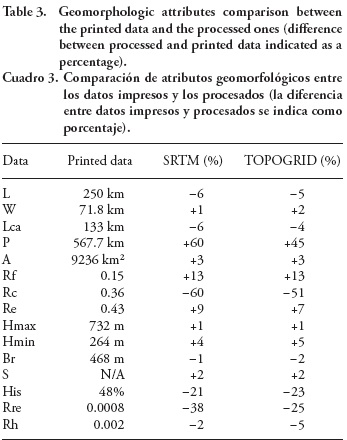
<body><![CDATA[<p align="justify"><font face="verdana" size="2">The Dourados hydrographic basin has the form of a curved ellipse (250 km length and 72 km width), a dimensionless circulatory ratio of 0.36 and an elongation ratio of 0.43 (<a href="#t3">Table 3</a>). The basin relief is 468 m between the highest point in the Serra de Maracaju and the outlet, inducing low relief ratio and low relative relief values. Average slope variation is 1.99 %, with the top of the plateau and plains being less than 1 %, valley walls varying from 2 to 5 %, and locally reaching up to 10 %. The same geomorphologic attributes extracted for the drainage networks generated by automatic methods commonly present a good correlation, with differences up to 5 % for the manual extraction (Garbrecht and Martz, 1993).</font></p>  	    <p align="center"><font face="verdana" size="2"><a name="t3"></a></font></p>  	    <p align="center"><font face="verdana" size="2"><img src="/img/revistas/agro/v45n3/a1t3.jpg"></font></p>  	    <p align="justify"><font face="verdana" size="2">Elevation for two&#45;thirds of the entire basin area varies between 340 and 525 m. The estimation of the hypsometry (Equation 1) gives a value of 48 %, whereas the derived integral built from the exact hypsometric curve, which gives a better estimation of the distribution of land mass above the outlet datum, is 61 % (<a href="#f2">Figure 2</a>).</font></p>  	    <p align="center"><font face="verdana" size="2"><a name="f2"></a></font></p>  	    <p align="center"><font face="verdana" size="2"><img src="/img/revistas/agro/v45n3/a1f2.jpg"></font></p>  	    <p align="justify"><font face="verdana" size="2">These geomorphological attributes characterise an elongated basin, with very gentle slope, favouring run&#45;off to be spread out. The hypsometric integral expresses the volume of the original basin still <i>in situ;</i> 61 % indicates that the basin morphology is still susceptible to erosion. This is typical of a basin developed on resistant lithography or soils with good water infiltration and low run&#45;off. Vitorino <i>et al</i> (2003) report the importance of the mineralogy of Oxisols in the genesis of its structure, which often defines their high permeability (Ferreira <i>et al.,</i> 1999). Such characteristic of these soils confers resistance to erosion and can be confirmed by the study from Arai <i>et al.</i> (2010) where we observe small values for the erodibility of the soils in the basin.</font></p>  	    <p align="justify"><font face="verdana" size="2">The drainage qualitative properties can be summarised as follow: 1) the Dourados hydrographic basin presents a dendritic drainage pattern and meandering channels; 2) the stream integration is generally good, especially up&#45;stream, as well as the uniformity for the printed and SRTM data sets; 3)&nbsp;there is no general orientation of the streams, but local NW&#45;SE and NE&#45;SW trends are noticeable; 4)&nbsp;they coincide with a regional scale control influence.</font></p>  	    <p align="justify"><font face="verdana" size="2">Looking at the entire SRTM DEM, that covers the south of Mato Grosso do Sul, it becomes apparent that both orientations point out the structure of the western Paran&aacute; sedimentary basin. However, at a local scale the channel directions are variable and streams junction are mainly acute. Quantitative attributes for the three data sets are presented in <a href="/img/revistas/agro/v45n3/a1t4.jpg" target="_blank">Table 4</a>.</font></p>  	    <p align="justify"><font face="verdana" size="2">The reference data set and the automatically generated ones present clear dissimilarities due to the issues encountered in generating the channel pattern in flat area (Alcaraz <i>et al.,</i> 2009). Concentrating on the printed data set, the maximum stream length is 437 km for a valley length of only 250 km. The qualitative description are corroborated by the quantitative and systematic attributes such as: the texture is coarse, the drainage density evolves from 0 to 1305 m km <sup>&#45;2</sup> (<a href="/img/revistas/agro/v45n3/a1f3.jpg" target="_blank">Figure 3</a>), with a low average of 360 m km <sup>&#45;2</sup>, and the frequency varies from 0 to 0.987 (<a href="/img/revistas/agro/v45n3/a1f4.jpg" target="_blank">Figure 4</a>) with a small average of 0.07. The sinuosity variation is high and the meanders wavelength down to only 250 m for streams of order 4 and 5. It does indeed characterize a permeable and well&#45;vegetated landscape, with few streams and low run&#45;ofF in area of smallest slope gradient, favouring the development of ponds, swamps and meanders. A coarse texture value is also an indication of a bedrock resistant to the erosion, which is confirmed by the distribution of soils relatively resistant to the process of erosion in this area (Hernani <i>et al.,</i> 1999; Panachuki <i>et al.,</i> 2006).</font></p>  	    ]]></body>
<body><![CDATA[<p align="justify"><font face="verdana" size="2">Data derived from automatic processes tend to overestimate the number of streams (<a href="/img/revistas/agro/v45n3/a1t4.jpg" target="_blank">Table 4</a>); however, the relationships between stream orders and channels properties are strong (<a href="/img/revistas/agro/v45n3/a1f5.jpg" target="_blank">Figure 5</a>), and the bifurcation and length ratios are consistent. Bifurcation ratios of 4 to 5 are typical of a drainage developed on homogeneous geology without a strong structural control influence (Strahler, 1964), confirming the orientation and structural control observations at local scale.</font></p>  	    <p align="justify"><font face="verdana" size="2">Drainage density and stream frequency are continuous surfaces interpolated over the entire Dourados basin (<a href="/img/revistas/agro/v45n3/a1f3.jpg" target="_blank">Figures 3</a> and <a href="/img/revistas/agro/v45n3/a1f4.jpg" target="_blank">4</a>). Spatial analyses using GIS capabilities allow investigation of the influence of geomorphology and geology on the drainage density and frequency. The stream frequency associated to the Bauru formation (Qc, Qpp) is on average lower than 0.2 (<a href="#f6">Figure 6</a>). The lowest values in relation with geomorphology are 0.22 and 0.3, units c22 and c31, which are typically associated with the Bauru formation. They represent dissected landscape of convex relieves due to the basal residuals conglomerates of Bauru sandstone that can formed residuals mounts and favours higher dissection depth. The drainage density is relatively high for the tabular relief (t31) that dominates in the western part of the basin, where the average stream density reach 417 m km<sup>2</sup>.</font></p>  	    <p align="center"><font face="verdana" size="2"><a name="f6"></a></font></p>  	    <p align="center"><font face="verdana" size="2"><img src="/img/revistas/agro/v45n3/a1f6.jpg"></font></p>  	    <p align="justify"><font face="verdana" size="2">The Serra Geral (JKsg) formation in average has frequency value higher than 0.2 and density above 2250 m km<sup>2</sup>. The geomorphological units associated with the formation (t41 and t51) confirm it with frequency values of 0.38 and 0.36. These sub&#45;units characterize gentle, tabular and poorly dissect relieves formed in relation to the resistant basalt flood. The density on these areas is about 340 m. It is smaller than for the t31 relieve previously described and is then in accord with the classification of RADAMBRASIL (1982) that estimated drainage intervals of 750 to 1750 m for t31, and only 1750 to 12750 m for t41 and t51.</font></p>  	    <p align="justify"><font face="verdana" size="2">It is also consistent to notice that globally the drainage frequency is higher in soils formed by the decomposition of the basalt of the Serra Geral formation, that those soil characteristics of the Bauru formation. The drainage density in relation with the soils is heterogeneous and does not show any evident relationship. A smaller scale of work would be necessary as the drainage network is not enough precise in relation with the accuracy of the soil distribution.</font></p>  	    <p align="justify"><font face="verdana" size="2">&nbsp;</font></p>  	    <p align="justify"><font face="verdana" size="2"><b>Conclusions</b></font></p>  	    <p align="justify"><font face="verdana" size="2">The geomorphologic and hydrologic attributes were sufficient to confirm that in Dourados basin area the drainage system is strictly dependent on the slope, the nature of the bedrock and its regional and local structural control.</font></p>  	    <p align="justify"><font face="verdana" size="2">The soils developed over the basalts of the Serra Geral formation shape tabular relieve associated to a dendritic network of low drainage density and low density of dissection. Where basalt is covered by sandstone and residual basal conglomerate of the Bauru formation, the drainage frequency is lower but the relief variation and slope are locally higher, due to weaker materials, increased dissection rate and a deepening of V&#45;shaped valleys.</font></p>  	    ]]></body>
<body><![CDATA[<p align="justify"><font face="verdana" size="2">Nevertheless, drainage is not influenced by a strong tectonic control; regional lineaments on NW&#45;SE and NE&#45;SW directions trace the structural constraints on the western part of the sedimentary Paran&aacute; basin related to the Andine epirogeny.</font></p>  	    <p align="justify"><font face="verdana" size="2">The soils distribution is also directly linked to the geology, as they result of the decomposition of the underlying bedrock, but a smaller scale of work would be necessary to highlight their influence on the drainage network.</font></p>  	    <p align="justify"><font face="verdana" size="2">&nbsp;</font></p>  	    <p align="justify"><font face="verdana" size="2"><b>Literature Cited</b></font></p>  	    <!-- ref --><p align="justify"><font face="verdana" size="2">Alcaraz, S. A., C. Sannier, A. C. T. Vitorino, and O. Daniel. 2009. Comparison of methodologies for automatic generation of limits and drainage networks for hydrographic basins. Rev. Bras. Eng. Agr&iacute;c. Ambient. 13(4): 369&#45;375.    &nbsp;&nbsp;&nbsp;&nbsp;&nbsp;&nbsp;&nbsp;&nbsp;[&#160;<a href="javascript:void(0);" onclick="javascript: window.open('/scielo.php?script=sci_nlinks&ref=554750&pid=S1405-3195201100030000100001&lng=','','width=640,height=500,resizable=yes,scrollbars=1,menubar=yes,');">Links</a>&#160;]<!-- end-ref --></font></p>  	    <!-- ref --><p align="justify"><font face="verdana" size="2">Almeida, F. F. 1946. Dep&oacute;sitos mesoz&oacute;icos do planalto de Maracaju, Estado de Mato Grosso. <i>In:</i> Congresso Panamericano de Engenharia de Minas e Geologia.    &nbsp;&nbsp;&nbsp;&nbsp;&nbsp;&nbsp;&nbsp;&nbsp;[&#160;<a href="javascript:void(0);" onclick="javascript: window.open('/scielo.php?script=sci_nlinks&ref=554752&pid=S1405-3195201100030000100002&lng=','','width=640,height=500,resizable=yes,scrollbars=1,menubar=yes,');">Links</a>&#160;]<!-- end-ref --></font></p>  	    <!-- ref --><p align="justify"><font face="verdana" size="2">Arai, F. K., G.G.G. Goncalves, S.B. Pereira, E. Comunello, A.C.T. Vitorino, e O. Daniel. 2010. Espacializa&ccedil;&atilde;o da precipita&ccedil;&atilde;o e erosividade na bacia hidrogr&aacute;fica do Rio Dourados &#45; MS. Engenharia Agr&iacute;c. 30(5):922&#45;931.    &nbsp;&nbsp;&nbsp;&nbsp;&nbsp;&nbsp;&nbsp;&nbsp;[&#160;<a href="javascript:void(0);" onclick="javascript: window.open('/scielo.php?script=sci_nlinks&ref=554754&pid=S1405-3195201100030000100003&lng=','','width=640,height=500,resizable=yes,scrollbars=1,menubar=yes,');">Links</a>&#160;]<!-- end-ref --></font></p>  	    ]]></body>
<body><![CDATA[<!-- ref --><p align="justify"><font face="verdana" size="2">Brown, A. G., and D. Harper. 1999. Sustainability in the context of tropical catchments. <i>In:</i> Harper, D., and A. G. Brown (eds). The Sustainable Management of Tropical Catchments. Wiley: Chichester. pp: 3&#45;18.    &nbsp;&nbsp;&nbsp;&nbsp;&nbsp;&nbsp;&nbsp;&nbsp;[&#160;<a href="javascript:void(0);" onclick="javascript: window.open('/scielo.php?script=sci_nlinks&ref=554756&pid=S1405-3195201100030000100004&lng=','','width=640,height=500,resizable=yes,scrollbars=1,menubar=yes,');">Links</a>&#160;]<!-- end-ref --></font></p>  	    <!-- ref --><p align="justify"><font face="verdana" size="2">Clarke, J. I. 1966. Morphometry from maps. <i>In:</i> Dury, G. H. (ed). Essays in Geomorphology. Heinemann, London. pp: 235&#45;274.    &nbsp;&nbsp;&nbsp;&nbsp;&nbsp;&nbsp;&nbsp;&nbsp;[&#160;<a href="javascript:void(0);" onclick="javascript: window.open('/scielo.php?script=sci_nlinks&ref=554758&pid=S1405-3195201100030000100005&lng=','','width=640,height=500,resizable=yes,scrollbars=1,menubar=yes,');">Links</a>&#160;]<!-- end-ref --></font></p>  	    <!-- ref --><p align="justify"><font face="verdana" size="2">Courtillot, V., and P. R. Renne. 2003. On the ages of flood basalt events. C. R. Geosci. 335: 113&#45;140.    &nbsp;&nbsp;&nbsp;&nbsp;&nbsp;&nbsp;&nbsp;&nbsp;[&#160;<a href="javascript:void(0);" onclick="javascript: window.open('/scielo.php?script=sci_nlinks&ref=554760&pid=S1405-3195201100030000100006&lng=','','width=640,height=500,resizable=yes,scrollbars=1,menubar=yes,');">Links</a>&#160;]<!-- end-ref --></font></p>  	    <!-- ref --><p align="justify"><font face="verdana" size="2">Evans, I. S. 1972. General geomorphometry, derivatives of altitude, and descriptive statistics. <i>In:</i> Chorley, R. J. (ed). Spatial Analysis in Geomorphology. British Geomorphological Research Group, New York. pp: 17&#45;90.    &nbsp;&nbsp;&nbsp;&nbsp;&nbsp;&nbsp;&nbsp;&nbsp;[&#160;<a href="javascript:void(0);" onclick="javascript: window.open('/scielo.php?script=sci_nlinks&ref=554762&pid=S1405-3195201100030000100007&lng=','','width=640,height=500,resizable=yes,scrollbars=1,menubar=yes,');">Links</a>&#160;]<!-- end-ref --></font></p>  	    <!-- ref --><p align="justify"><font face="verdana" size="2">Ferreira, M.M., B. Fernandes, e N. Curi. 1999. Influ&ecirc;ncia da mineralogia da fra&ccedil;&atilde;o argila nas propriedades f&iacute;sicas de latossolos da regi&atilde;o Sudeste do Brasil. Ver. Bras. Ci&ecirc;ncia do Solo 23(3): 515&#45;524.    &nbsp;&nbsp;&nbsp;&nbsp;&nbsp;&nbsp;&nbsp;&nbsp;[&#160;<a href="javascript:void(0);" onclick="javascript: window.open('/scielo.php?script=sci_nlinks&ref=554764&pid=S1405-3195201100030000100008&lng=','','width=640,height=500,resizable=yes,scrollbars=1,menubar=yes,');">Links</a>&#160;]<!-- end-ref --></font></p>  	    ]]></body>
<body><![CDATA[<!-- ref --><p align="justify"><font face="verdana" size="2">Garbrecht, J., and L. Martz. 1993. Network and subwatershed parameters extracted from digital elevation models &#45; the Bills Creek experience. Water Resour. Bull. 29: 909&#45;916.    &nbsp;&nbsp;&nbsp;&nbsp;&nbsp;&nbsp;&nbsp;&nbsp;[&#160;<a href="javascript:void(0);" onclick="javascript: window.open('/scielo.php?script=sci_nlinks&ref=554766&pid=S1405-3195201100030000100009&lng=','','width=640,height=500,resizable=yes,scrollbars=1,menubar=yes,');">Links</a>&#160;]<!-- end-ref --></font></p>  	    <!-- ref --><p align="justify"><font face="verdana" size="2">Hancock, G. R. 2005. The use of digital elevation models in the identification and characterization of catchment over different grid scales. Hydrol. Processes 19: 1727&#45;1749.    &nbsp;&nbsp;&nbsp;&nbsp;&nbsp;&nbsp;&nbsp;&nbsp;[&#160;<a href="javascript:void(0);" onclick="javascript: window.open('/scielo.php?script=sci_nlinks&ref=554768&pid=S1405-3195201100030000100010&lng=','','width=640,height=500,resizable=yes,scrollbars=1,menubar=yes,');">Links</a>&#160;]<!-- end-ref --></font></p>  	    <!-- ref --><p align="justify"><font face="verdana" size="2">Hernani, L. C., C. H. Kurihara, e W. M. Silva. 1999. Sistemas de manejo de solo e perdas de nutrientes e mat&eacute;ria org&acirc;nica por eros&atilde;o. Rev. Bras. Ci&ecirc;nc. Solo 23(1): 145&#45;154.    &nbsp;&nbsp;&nbsp;&nbsp;&nbsp;&nbsp;&nbsp;&nbsp;[&#160;<a href="javascript:void(0);" onclick="javascript: window.open('/scielo.php?script=sci_nlinks&ref=554770&pid=S1405-3195201100030000100011&lng=','','width=640,height=500,resizable=yes,scrollbars=1,menubar=yes,');">Links</a>&#160;]<!-- end-ref --></font></p>  	    <!-- ref --><p align="justify"><font face="verdana" size="2">Horton, R. E. 1945. Erosional development of streams and their drainage basins, hydrophysical approach to quantitative morphology. Bull. Geol. Soc. Am. 56: 275&#45;310.    &nbsp;&nbsp;&nbsp;&nbsp;&nbsp;&nbsp;&nbsp;&nbsp;[&#160;<a href="javascript:void(0);" onclick="javascript: window.open('/scielo.php?script=sci_nlinks&ref=554772&pid=S1405-3195201100030000100012&lng=','','width=640,height=500,resizable=yes,scrollbars=1,menubar=yes,');">Links</a>&#160;]<!-- end-ref --></font></p>  	    <!-- ref --><p align="justify"><font face="verdana" size="2">Howard, A. D. 1967. Drainage analysis in geologic interpretation: a summation. A.A.P.G. Bull. 51(11): 2246&#45;2259.    &nbsp;&nbsp;&nbsp;&nbsp;&nbsp;&nbsp;&nbsp;&nbsp;[&#160;<a href="javascript:void(0);" onclick="javascript: window.open('/scielo.php?script=sci_nlinks&ref=554774&pid=S1405-3195201100030000100013&lng=','','width=640,height=500,resizable=yes,scrollbars=1,menubar=yes,');">Links</a>&#160;]<!-- end-ref --></font></p>  	    ]]></body>
<body><![CDATA[<!-- ref --><p align="justify"><font face="verdana" size="2">IBGE &#45; Instituto Brasileiro de Geograf&iacute;a e Estat&iacute;stica. 2010. Banco de dados agregados. <a href="http://www.sidra.ibge.gov.br" target="_blank">sidra.ibge.gov.br</a>. (Consultado: maio, 2010).    &nbsp;&nbsp;&nbsp;&nbsp;&nbsp;&nbsp;&nbsp;&nbsp;[&#160;<a href="javascript:void(0);" onclick="javascript: window.open('/scielo.php?script=sci_nlinks&ref=554776&pid=S1405-3195201100030000100014&lng=','','width=640,height=500,resizable=yes,scrollbars=1,menubar=yes,');">Links</a>&#160;]<!-- end-ref --></font></p>      <!-- ref --><p align="justify"><font face="verdana" size="2">Lin, W.&#45;T., W.&#45;C. Chou, C.&#45;Y. Lin, P.&#45;H. Huang, and J.&#45;S. Tsai. 2005. Automated suitable drainage network extraction from digital elevation models in Taiwan's upstream watersheds. Hydrol. Processes 20(2): 289&#45;306.    &nbsp;&nbsp;&nbsp;&nbsp;&nbsp;&nbsp;&nbsp;&nbsp;[&#160;<a href="javascript:void(0);" onclick="javascript: window.open('/scielo.php?script=sci_nlinks&ref=554778&pid=S1405-3195201100030000100015&lng=','','width=640,height=500,resizable=yes,scrollbars=1,menubar=yes,');">Links</a>&#160;]<!-- end-ref --></font></p>  	    <!-- ref --><p align="justify"><font face="verdana" size="2">Luo, W. 1998. Hypsometric analysis with a geographic information system. Comput. Geosci. 24: 815&#45;821.    &nbsp;&nbsp;&nbsp;&nbsp;&nbsp;&nbsp;&nbsp;&nbsp;[&#160;<a href="javascript:void(0);" onclick="javascript: window.open('/scielo.php?script=sci_nlinks&ref=554780&pid=S1405-3195201100030000100016&lng=','','width=640,height=500,resizable=yes,scrollbars=1,menubar=yes,');">Links</a>&#160;]<!-- end-ref --></font></p>  	    <!-- ref --><p align="justify"><font face="verdana" size="2">Mart&iacute;nez&#45;Casasnovas, J. A. and H. J. Stuiver. 1998. Automatic delineation of drainage networks and elementary catchments from Digital Elevation Models. Int. J. Aerospace Survey Earth Sci. (ITC J.) 3(4): 198&#45;208.    &nbsp;&nbsp;&nbsp;&nbsp;&nbsp;&nbsp;&nbsp;&nbsp;[&#160;<a href="javascript:void(0);" onclick="javascript: window.open('/scielo.php?script=sci_nlinks&ref=554782&pid=S1405-3195201100030000100017&lng=','','width=640,height=500,resizable=yes,scrollbars=1,menubar=yes,');">Links</a>&#160;]<!-- end-ref --></font></p>  	    <!-- ref --><p align="justify"><font face="verdana" size="2">Mato Grosso do Sul. 2000. Bacia Hidrogr&aacute;fica do Rio Dourados: Diagn&oacute;stico e implanta&ccedil;&atilde;o da rede b&aacute;sica de monitoramento da qualidade das &aacute;guas. Secretaria de Estado de Meio Ambiente, FEMAP/MS, Coordenadoria de Recursos H&iacute;dricos e Qualidade Ambiental. Campo Grande, Brasil. 78 p.    &nbsp;&nbsp;&nbsp;&nbsp;&nbsp;&nbsp;&nbsp;&nbsp;[&#160;<a href="javascript:void(0);" onclick="javascript: window.open('/scielo.php?script=sci_nlinks&ref=554784&pid=S1405-3195201100030000100018&lng=','','width=640,height=500,resizable=yes,scrollbars=1,menubar=yes,');">Links</a>&#160;]<!-- end-ref --></font></p>  	    ]]></body>
<body><![CDATA[<!-- ref --><p align="justify"><font face="verdana" size="2">Oliveira, A. e E. Ferreira. 2001. Caracteriza&ccedil;&atilde;o de sub&#45;bacias hidrogr&aacute;ficas. UFLA&#45;FAEPE. Lavras, Brasil. 64 p. (Textos acad&ecirc;micos).    &nbsp;&nbsp;&nbsp;&nbsp;&nbsp;&nbsp;&nbsp;&nbsp;[&#160;<a href="javascript:void(0);" onclick="javascript: window.open('/scielo.php?script=sci_nlinks&ref=554786&pid=S1405-3195201100030000100019&lng=','','width=640,height=500,resizable=yes,scrollbars=1,menubar=yes,');">Links</a>&#160;]<!-- end-ref --></font></p>  	    <!-- ref --><p align="justify"><font face="verdana" size="2">Panachuki, E., A. C. T. Vitorino, T. Alves Sobrinho, D. F. Carvalho, e M. A Urchei. 2006. Par&acirc;metros f&iacute;sicos do solo e eros&atilde;o h&iacute;drica, sob chuva simulada, em sistema de integra&ccedil;&atilde;o agricultura&#45;pecu&aacute;ria. Rev. Bras. Eng. Agr&iacute;c. Ambient. 10: 261&#45;268.    &nbsp;&nbsp;&nbsp;&nbsp;&nbsp;&nbsp;&nbsp;&nbsp;[&#160;<a href="javascript:void(0);" onclick="javascript: window.open('/scielo.php?script=sci_nlinks&ref=554788&pid=S1405-3195201100030000100020&lng=','','width=640,height=500,resizable=yes,scrollbars=1,menubar=yes,');">Links</a>&#160;]<!-- end-ref --></font></p>  	    <!-- ref --><p align="justify"><font face="verdana" size="2">RADAMBRASIL. 1982. Mapa Geol&oacute;gico, SF. 21 Campo Grande. Minist&eacute;rio das Minas e Energia. Bras&iacute;lia, Brasil.    &nbsp;&nbsp;&nbsp;&nbsp;&nbsp;&nbsp;&nbsp;&nbsp;[&#160;<a href="javascript:void(0);" onclick="javascript: window.open('/scielo.php?script=sci_nlinks&ref=554790&pid=S1405-3195201100030000100021&lng=','','width=640,height=500,resizable=yes,scrollbars=1,menubar=yes,');">Links</a>&#160;]<!-- end-ref --></font></p>  	    <!-- ref --><p align="justify"><font face="verdana" size="2">Strahler, A. N. 1957. Quantitative analysis of watershed geomorphology. E.O.S. T. Am. Geophys. Un. 8(6): 913&#45;920.    &nbsp;&nbsp;&nbsp;&nbsp;&nbsp;&nbsp;&nbsp;&nbsp;[&#160;<a href="javascript:void(0);" onclick="javascript: window.open('/scielo.php?script=sci_nlinks&ref=554792&pid=S1405-3195201100030000100022&lng=','','width=640,height=500,resizable=yes,scrollbars=1,menubar=yes,');">Links</a>&#160;]<!-- end-ref --></font></p>  	    <!-- ref --><p align="justify"><font face="verdana" size="2">Strahler, A. 1964. Quantitative Geomorphology of Drainage Basins and Channel Networks. <i>In:</i> Chow (ed). Handbook of Applied Hydrology. New York: McGraw&#45;Hill.    &nbsp;&nbsp;&nbsp;&nbsp;&nbsp;&nbsp;&nbsp;&nbsp;[&#160;<a href="javascript:void(0);" onclick="javascript: window.open('/scielo.php?script=sci_nlinks&ref=554794&pid=S1405-3195201100030000100023&lng=','','width=640,height=500,resizable=yes,scrollbars=1,menubar=yes,');">Links</a>&#160;]<!-- end-ref --></font></p>  	    ]]></body>
<body><![CDATA[<!-- ref --><p align="justify"><font face="verdana" size="2">Vitorino, A.C.T., M.M. Ferreira, N. Curi, J.M. de Lima, M.L.N. Silva, e P.E. F. Motta. 2003. Mineralogia, qu&iacute;mica e estabilidade de agregados do tamanho de silte de solos da regi&atilde;o do sudeste do Brasil. Pesquisa Agrop. Bras. 38:133&#45;141.    &nbsp;&nbsp;&nbsp;&nbsp;&nbsp;&nbsp;&nbsp;&nbsp;[&#160;<a href="javascript:void(0);" onclick="javascript: window.open('/scielo.php?script=sci_nlinks&ref=554796&pid=S1405-3195201100030000100024&lng=','','width=640,height=500,resizable=yes,scrollbars=1,menubar=yes,');">Links</a>&#160;]<!-- end-ref --></font></p>  	    <!-- ref --><p align="justify"><font face="verdana" size="2">Way, D. S. 1973. Terrain Analysis: A Guide to Site Selection using Aerial Photographic Interpretation. Dowden, Hutchinson &amp; Ross Inc. Stroudsburg, PA. 392 p.    &nbsp;&nbsp;&nbsp;&nbsp;&nbsp;&nbsp;&nbsp;&nbsp;[&#160;<a href="javascript:void(0);" onclick="javascript: window.open('/scielo.php?script=sci_nlinks&ref=554798&pid=S1405-3195201100030000100025&lng=','','width=640,height=500,resizable=yes,scrollbars=1,menubar=yes,');">Links</a>&#160;]<!-- end-ref --></font></p>      ]]></body><back>
<ref-list>
<ref id="B1">
<nlm-citation citation-type="journal">
<person-group person-group-type="author">
<name>
<surname><![CDATA[Alcaraz]]></surname>
<given-names><![CDATA[S. A.]]></given-names>
</name>
<name>
<surname><![CDATA[Sannier]]></surname>
<given-names><![CDATA[C.]]></given-names>
</name>
<name>
<surname><![CDATA[Vitorino]]></surname>
<given-names><![CDATA[A. C. T.]]></given-names>
</name>
<name>
<surname><![CDATA[Daniel]]></surname>
<given-names><![CDATA[O.]]></given-names>
</name>
</person-group>
<article-title xml:lang="en"><![CDATA[Comparison of methodologies for automatic generation of limits and drainage networks for hydrographic basins]]></article-title>
<source><![CDATA[Rev. Bras. Eng. Agríc. Ambient.]]></source>
<year>2009</year>
<volume>13</volume>
<numero>4</numero>
<issue>4</issue>
<page-range>369-375</page-range></nlm-citation>
</ref>
<ref id="B2">
<nlm-citation citation-type="">
<person-group person-group-type="author">
<name>
<surname><![CDATA[Almeida]]></surname>
<given-names><![CDATA[F. F.]]></given-names>
</name>
</person-group>
<article-title xml:lang="pt"><![CDATA[Depósitos mesozóicos do planalto de Maracaju, Estado de Mato Grosso]]></article-title>
<source><![CDATA[Congresso Panamericano de Engenharia de Minas e Geologia]]></source>
<year>1946</year>
</nlm-citation>
</ref>
<ref id="B3">
<nlm-citation citation-type="journal">
<person-group person-group-type="author">
<name>
<surname><![CDATA[Arai]]></surname>
<given-names><![CDATA[F. K.]]></given-names>
</name>
<name>
<surname><![CDATA[G.G.G.]]></surname>
<given-names><![CDATA[Goncalves]]></given-names>
</name>
<name>
<surname><![CDATA[Pereira]]></surname>
<given-names><![CDATA[S.B.]]></given-names>
</name>
<name>
<surname><![CDATA[Comunello]]></surname>
<given-names><![CDATA[E.]]></given-names>
</name>
<name>
<surname><![CDATA[Vitorino]]></surname>
<given-names><![CDATA[A.C.T.]]></given-names>
</name>
<name>
<surname><![CDATA[Daniel]]></surname>
<given-names><![CDATA[O.]]></given-names>
</name>
</person-group>
<article-title xml:lang="pt"><![CDATA[Espacialização da precipitação e erosividade na bacia hidrográfica do Rio Dourados - MS]]></article-title>
<source><![CDATA[Engenharia Agríc.]]></source>
<year>2010</year>
<volume>30</volume>
<numero>5</numero>
<issue>5</issue>
<page-range>922-931</page-range></nlm-citation>
</ref>
<ref id="B4">
<nlm-citation citation-type="book">
<person-group person-group-type="author">
<name>
<surname><![CDATA[Brown]]></surname>
<given-names><![CDATA[A. G.]]></given-names>
</name>
<name>
<surname><![CDATA[Harper]]></surname>
<given-names><![CDATA[D.]]></given-names>
</name>
</person-group>
<article-title xml:lang="en"><![CDATA[Sustainability in the context of tropical catchments]]></article-title>
<person-group person-group-type="editor">
<name>
<surname><![CDATA[Harper]]></surname>
<given-names><![CDATA[D.]]></given-names>
</name>
<name>
<surname><![CDATA[Brown]]></surname>
<given-names><![CDATA[A. G.]]></given-names>
</name>
</person-group>
<source><![CDATA[The Sustainable Management of Tropical Catchments]]></source>
<year>1999</year>
<page-range>3-18</page-range><publisher-loc><![CDATA[Chichester ]]></publisher-loc>
<publisher-name><![CDATA[Wiley]]></publisher-name>
</nlm-citation>
</ref>
<ref id="B5">
<nlm-citation citation-type="book">
<person-group person-group-type="author">
<name>
<surname><![CDATA[Clarke]]></surname>
<given-names><![CDATA[J. I.]]></given-names>
</name>
</person-group>
<article-title xml:lang="en"><![CDATA[Morphometry from maps]]></article-title>
<person-group person-group-type="editor">
<name>
<surname><![CDATA[Dury]]></surname>
<given-names><![CDATA[G. H.]]></given-names>
</name>
</person-group>
<source><![CDATA[Essays in Geomorphology]]></source>
<year>1966</year>
<page-range>235-274</page-range><publisher-loc><![CDATA[London ]]></publisher-loc>
<publisher-name><![CDATA[Heinemann]]></publisher-name>
</nlm-citation>
</ref>
<ref id="B6">
<nlm-citation citation-type="journal">
<person-group person-group-type="author">
<name>
<surname><![CDATA[Courtillot]]></surname>
<given-names><![CDATA[V.]]></given-names>
</name>
<name>
<surname><![CDATA[Renne]]></surname>
<given-names><![CDATA[P. R.]]></given-names>
</name>
</person-group>
<article-title xml:lang="en"><![CDATA[On the ages of flood basalt events]]></article-title>
<source><![CDATA[C. R. Geosci.]]></source>
<year>2003</year>
<volume>335</volume>
<page-range>113-140</page-range></nlm-citation>
</ref>
<ref id="B7">
<nlm-citation citation-type="book">
<person-group person-group-type="author">
<name>
<surname><![CDATA[Evans]]></surname>
<given-names><![CDATA[I. S.]]></given-names>
</name>
</person-group>
<article-title xml:lang="en"><![CDATA[General geomorphometry, derivatives of altitude, and descriptive statistics]]></article-title>
<person-group person-group-type="editor">
<name>
<surname><![CDATA[Chorley]]></surname>
<given-names><![CDATA[R. J.]]></given-names>
</name>
</person-group>
<source><![CDATA[Spatial Analysis in Geomorphology]]></source>
<year>1972</year>
<page-range>17-90</page-range><publisher-loc><![CDATA[New York ]]></publisher-loc>
<publisher-name><![CDATA[British Geomorphological Research Group]]></publisher-name>
</nlm-citation>
</ref>
<ref id="B8">
<nlm-citation citation-type="journal">
<person-group person-group-type="author">
<name>
<surname><![CDATA[Ferreira]]></surname>
<given-names><![CDATA[M.M.]]></given-names>
</name>
<name>
<surname><![CDATA[Fernandes]]></surname>
<given-names><![CDATA[B.]]></given-names>
</name>
<name>
<surname><![CDATA[Curi]]></surname>
<given-names><![CDATA[N.]]></given-names>
</name>
</person-group>
<article-title xml:lang="pt"><![CDATA[Influência da mineralogia da fração argila nas propriedades físicas de latossolos da região Sudeste do Brasil]]></article-title>
<source><![CDATA[Ver. Bras. Ciência do Solo]]></source>
<year>1999</year>
<volume>23</volume>
<numero>3</numero>
<issue>3</issue>
<page-range>515-524</page-range></nlm-citation>
</ref>
<ref id="B9">
<nlm-citation citation-type="journal">
<person-group person-group-type="author">
<name>
<surname><![CDATA[Garbrecht]]></surname>
<given-names><![CDATA[J.]]></given-names>
</name>
<name>
<surname><![CDATA[Martz]]></surname>
<given-names><![CDATA[L.]]></given-names>
</name>
</person-group>
<article-title xml:lang="en"><![CDATA[Network and subwatershed parameters extracted from digital elevation models - the Bills Creek experience]]></article-title>
<source><![CDATA[Water Resour. Bull.]]></source>
<year>1993</year>
<volume>29</volume>
<page-range>909-916</page-range></nlm-citation>
</ref>
<ref id="B10">
<nlm-citation citation-type="journal">
<person-group person-group-type="author">
<name>
<surname><![CDATA[Hancock]]></surname>
<given-names><![CDATA[G. R.]]></given-names>
</name>
</person-group>
<article-title xml:lang="en"><![CDATA[The use of digital elevation models in the identification and characterization of catchment over different grid scales]]></article-title>
<source><![CDATA[Hydrol. Processes]]></source>
<year>2005</year>
<volume>19</volume>
<page-range>1727-1749</page-range></nlm-citation>
</ref>
<ref id="B11">
<nlm-citation citation-type="journal">
<person-group person-group-type="author">
<name>
<surname><![CDATA[Hernani]]></surname>
<given-names><![CDATA[L. C.]]></given-names>
</name>
<name>
<surname><![CDATA[Kurihara]]></surname>
<given-names><![CDATA[C. H.]]></given-names>
</name>
<name>
<surname><![CDATA[Silva]]></surname>
<given-names><![CDATA[W. M.]]></given-names>
</name>
</person-group>
<article-title xml:lang="pt"><![CDATA[Sistemas de manejo de solo e perdas de nutrientes e matéria orgânica por erosão]]></article-title>
<source><![CDATA[Rev. Bras. Ciênc. Solo]]></source>
<year>1999</year>
<volume>23</volume>
<numero>1</numero>
<issue>1</issue>
<page-range>145-154</page-range></nlm-citation>
</ref>
<ref id="B12">
<nlm-citation citation-type="journal">
<person-group person-group-type="author">
<name>
<surname><![CDATA[Horton]]></surname>
<given-names><![CDATA[R. E.]]></given-names>
</name>
</person-group>
<source><![CDATA[Bull. Geol. Soc. Am.]]></source>
<year>1945</year>
<volume>56</volume>
<page-range>275-310</page-range></nlm-citation>
</ref>
<ref id="B13">
<nlm-citation citation-type="journal">
<person-group person-group-type="author">
<name>
<surname><![CDATA[Howard]]></surname>
<given-names><![CDATA[A. D.]]></given-names>
</name>
</person-group>
<article-title xml:lang="en"><![CDATA[Drainage analysis in geologic interpretation: a summation]]></article-title>
<source><![CDATA[A.A.P.G. Bull.]]></source>
<year>1967</year>
<volume>51</volume>
<numero>11</numero>
<issue>11</issue>
<page-range>2246-2259</page-range></nlm-citation>
</ref>
<ref id="B14">
<nlm-citation citation-type="">
<collab>Instituto Brasileiro de Geografía e Estatística</collab>
<source><![CDATA[Banco de dados agregados]]></source>
<year>2010</year>
</nlm-citation>
</ref>
<ref id="B15">
<nlm-citation citation-type="journal">
<person-group person-group-type="author">
<name>
<surname><![CDATA[Lin]]></surname>
<given-names><![CDATA[W.-T.]]></given-names>
</name>
<name>
<surname><![CDATA[Chou]]></surname>
<given-names><![CDATA[W.-C.]]></given-names>
</name>
<name>
<surname><![CDATA[Lin]]></surname>
<given-names><![CDATA[C.-Y.]]></given-names>
</name>
<name>
<surname><![CDATA[Huang]]></surname>
<given-names><![CDATA[P.-H.]]></given-names>
</name>
<name>
<surname><![CDATA[Tsai]]></surname>
<given-names><![CDATA[J.-S.]]></given-names>
</name>
</person-group>
<article-title xml:lang="en"><![CDATA[Automated suitable drainage network extraction from digital elevation models in Taiwan's upstream watersheds]]></article-title>
<source><![CDATA[Hydrol. Processes]]></source>
<year>2005</year>
<volume>20</volume>
<numero>2</numero>
<issue>2</issue>
<page-range>289-306</page-range></nlm-citation>
</ref>
<ref id="B16">
<nlm-citation citation-type="journal">
<person-group person-group-type="author">
<name>
<surname><![CDATA[Luo]]></surname>
<given-names><![CDATA[W.]]></given-names>
</name>
</person-group>
<article-title xml:lang="en"><![CDATA[Hypsometric analysis with a geographic information system]]></article-title>
<source><![CDATA[Comput. Geosci.]]></source>
<year>1998</year>
<volume>24</volume>
<page-range>815-821</page-range></nlm-citation>
</ref>
<ref id="B17">
<nlm-citation citation-type="journal">
<person-group person-group-type="author">
<name>
<surname><![CDATA[Martínez-Casasnovas]]></surname>
<given-names><![CDATA[J. A.]]></given-names>
</name>
<name>
<surname><![CDATA[Stuiver]]></surname>
<given-names><![CDATA[H. J.]]></given-names>
</name>
</person-group>
<article-title xml:lang="en"><![CDATA[Automatic delineation of drainage networks and elementary catchments from Digital Elevation Models]]></article-title>
<source><![CDATA[Int. J. Aerospace Survey Earth Sci.]]></source>
<year>1998</year>
<volume>3</volume>
<numero>4</numero>
<issue>4</issue>
<page-range>198-208</page-range></nlm-citation>
</ref>
<ref id="B18">
<nlm-citation citation-type="book">
<collab>Mato Grosso do Sul</collab>
<source><![CDATA[Bacia Hidrográfica do Rio Dourados: Diagnóstico e implantação da rede básica de monitoramento da qualidade das águas]]></source>
<year>2000</year>
<page-range>78</page-range><publisher-loc><![CDATA[Campo Grande ]]></publisher-loc>
<publisher-name><![CDATA[Secretaria de Estado de Meio AmbienteFEMAP/MSCoordenadoria de Recursos Hídricos e Qualidade Ambiental]]></publisher-name>
</nlm-citation>
</ref>
<ref id="B19">
<nlm-citation citation-type="book">
<person-group person-group-type="author">
<name>
<surname><![CDATA[Oliveira]]></surname>
<given-names><![CDATA[A.]]></given-names>
</name>
<name>
<surname><![CDATA[Ferreira]]></surname>
<given-names><![CDATA[E.]]></given-names>
</name>
</person-group>
<source><![CDATA[Caracterização de sub-bacias hidrográficas]]></source>
<year>2001</year>
<page-range>64</page-range><publisher-loc><![CDATA[Lavras ]]></publisher-loc>
<publisher-name><![CDATA[UFLA-FAEPE]]></publisher-name>
</nlm-citation>
</ref>
<ref id="B20">
<nlm-citation citation-type="journal">
<person-group person-group-type="author">
<name>
<surname><![CDATA[Panachuki]]></surname>
<given-names><![CDATA[E.]]></given-names>
</name>
<name>
<surname><![CDATA[Vitorino]]></surname>
<given-names><![CDATA[A. C. T.]]></given-names>
</name>
<name>
<surname><![CDATA[Alves Sobrinho]]></surname>
<given-names><![CDATA[T.]]></given-names>
</name>
<name>
<surname><![CDATA[Carvalho]]></surname>
<given-names><![CDATA[D. F.]]></given-names>
</name>
<name>
<surname><![CDATA[Urchei]]></surname>
<given-names><![CDATA[M. A]]></given-names>
</name>
</person-group>
<article-title xml:lang="pt"><![CDATA[Parâmetros físicos do solo e erosão hídrica, sob chuva simulada, em sistema de integração agricultura-pecuária]]></article-title>
<source><![CDATA[Rev. Bras. Eng. Agríc. Ambient.]]></source>
<year>2006</year>
<volume>10</volume>
<page-range>261-268</page-range></nlm-citation>
</ref>
<ref id="B21">
<nlm-citation citation-type="book">
<collab>RADAMBRASIL</collab>
<source><![CDATA[Mapa Geológico, SF. 21 Campo Grande]]></source>
<year>1982</year>
<publisher-loc><![CDATA[Brasília ]]></publisher-loc>
<publisher-name><![CDATA[Ministério das Minas e Energia]]></publisher-name>
</nlm-citation>
</ref>
<ref id="B22">
<nlm-citation citation-type="journal">
<person-group person-group-type="author">
<name>
<surname><![CDATA[Strahler]]></surname>
<given-names><![CDATA[A. N.]]></given-names>
</name>
</person-group>
<article-title xml:lang="en"><![CDATA[Quantitative analysis of watershed geomorphology]]></article-title>
<source><![CDATA[E.O.S. T. Am. Geophys. Un.]]></source>
<year>1957</year>
<volume>8</volume>
<numero>6</numero>
<issue>6</issue>
<page-range>913-920</page-range></nlm-citation>
</ref>
<ref id="B23">
<nlm-citation citation-type="book">
<person-group person-group-type="author">
<name>
<surname><![CDATA[Strahler]]></surname>
<given-names><![CDATA[A.]]></given-names>
</name>
</person-group>
<article-title xml:lang="en"><![CDATA[Quantitative Geomorphology of Drainage Basins and Channel Networks]]></article-title>
<person-group person-group-type="editor">
<name>
<surname><![CDATA[Chow]]></surname>
</name>
</person-group>
<source><![CDATA[Handbook of Applied Hydrology]]></source>
<year>1964</year>
<publisher-loc><![CDATA[New York ]]></publisher-loc>
<publisher-name><![CDATA[McGraw-Hill]]></publisher-name>
</nlm-citation>
</ref>
<ref id="B24">
<nlm-citation citation-type="journal">
<person-group person-group-type="author">
<name>
<surname><![CDATA[Vitorino]]></surname>
<given-names><![CDATA[A.C.T.]]></given-names>
</name>
<name>
<surname><![CDATA[Ferreira]]></surname>
<given-names><![CDATA[M.M.]]></given-names>
</name>
<name>
<surname><![CDATA[Curi]]></surname>
<given-names><![CDATA[N.]]></given-names>
</name>
<name>
<surname><![CDATA[de Lima]]></surname>
<given-names><![CDATA[J.M.]]></given-names>
</name>
<name>
<surname><![CDATA[Silva]]></surname>
<given-names><![CDATA[M.L.N.]]></given-names>
</name>
<name>
<surname><![CDATA[Motta]]></surname>
<given-names><![CDATA[P.E. F.]]></given-names>
</name>
</person-group>
<article-title xml:lang="pt"><![CDATA[Mineralogia, química e estabilidade de agregados do tamanho de silte de solos da região do sudeste do Brasil]]></article-title>
<source><![CDATA[Pesquisa Agrop. Bras.]]></source>
<year>2003</year>
<volume>38</volume>
<page-range>133-141</page-range></nlm-citation>
</ref>
<ref id="B25">
<nlm-citation citation-type="book">
<person-group person-group-type="author">
<name>
<surname><![CDATA[Way]]></surname>
<given-names><![CDATA[D. S.]]></given-names>
</name>
</person-group>
<source><![CDATA[Terrain Analysis: A Guide to Site Selection using Aerial Photographic Interpretation]]></source>
<year>1973</year>
<page-range>392</page-range><publisher-loc><![CDATA[Stroudsburg^ePA PA]]></publisher-loc>
<publisher-name><![CDATA[Dowden, Hutchinson & Ross Inc.]]></publisher-name>
</nlm-citation>
</ref>
</ref-list>
</back>
</article>
