<?xml version="1.0" encoding="ISO-8859-1"?><article xmlns:mml="http://www.w3.org/1998/Math/MathML" xmlns:xlink="http://www.w3.org/1999/xlink" xmlns:xsi="http://www.w3.org/2001/XMLSchema-instance">
<front>
<journal-meta>
<journal-id>1405-3195</journal-id>
<journal-title><![CDATA[Agrociencia]]></journal-title>
<abbrev-journal-title><![CDATA[Agrociencia]]></abbrev-journal-title>
<issn>1405-3195</issn>
<publisher>
<publisher-name><![CDATA[Colegio de Postgraduados]]></publisher-name>
</publisher>
</journal-meta>
<article-meta>
<article-id>S1405-31952011000100005</article-id>
<title-group>
<article-title xml:lang="en"><![CDATA[Replacing clean fallow with minimum tilled pulse legume in a subtropical dryland at Pothwar, Pakistán]]></article-title>
<article-title xml:lang="es"><![CDATA[Reemplazo de barbecho limpio con arado mínimo y leguminosa en un subtrópico seco de Pothwar, Paquistán]]></article-title>
</title-group>
<contrib-group>
<contrib contrib-type="author">
<name>
<surname><![CDATA[Sohail-Ijaz]]></surname>
<given-names><![CDATA[Shahzada]]></given-names>
</name>
<xref ref-type="aff" rid="A01"/>
</contrib>
<contrib contrib-type="author">
<name>
<surname><![CDATA[Ali]]></surname>
<given-names><![CDATA[Safdar]]></given-names>
</name>
<xref ref-type="aff" rid="A01"/>
</contrib>
</contrib-group>
<aff id="A01">
<institution><![CDATA[,University Rawalpindi PMAS-Arid Agriculture Department of Soil Science & SWC]]></institution>
<addr-line><![CDATA[ ]]></addr-line>
<country>Pakistán</country>
</aff>
<pub-date pub-type="pub">
<day>00</day>
<month>02</month>
<year>2011</year>
</pub-date>
<pub-date pub-type="epub">
<day>00</day>
<month>02</month>
<year>2011</year>
</pub-date>
<volume>45</volume>
<numero>1</numero>
<fpage>43</fpage>
<lpage>53</lpage>
<copyright-statement/>
<copyright-year/>
<self-uri xlink:href="http://www.scielo.org.mx/scielo.php?script=sci_arttext&amp;pid=S1405-31952011000100005&amp;lng=en&amp;nrm=iso"></self-uri><self-uri xlink:href="http://www.scielo.org.mx/scielo.php?script=sci_abstract&amp;pid=S1405-31952011000100005&amp;lng=en&amp;nrm=iso"></self-uri><self-uri xlink:href="http://www.scielo.org.mx/scielo.php?script=sci_pdf&amp;pid=S1405-31952011000100005&amp;lng=en&amp;nrm=iso"></self-uri><abstract abstract-type="short" xml:lang="en"><p><![CDATA[Clean fallowing has been criticized in the recent past due to the fact that it causes accelerated soil erosion, emission of CO2 to the atmosphere and reduction in farm income. In an effort to reduce fallowing in Pothwar, Pakistan, field experiments were carried out from 2005 through 2008 at three locations (Rawalpindi, Chakwal and Fateh Jang). The experimental design was split-plot and treatments were applied as follows: conventional cultivator, moldboard plow and minimum tillage in main plots; fallow, legume (mungbean, Vigna radiata) and mulch of wheat straw were used in sub plots. Wheat (Triticum aestivum) was planted in all the subplots during winter. All the treatment plots had equivalent volumetric water content at wheat planting. Consequently, the wheat biomass and grain yields were also statistically equivalent under all the applied treatments. The average yields were 7.37, 6.19 and 4.27 Mg ha-1 for wheat biomass and 3.06, 3.56 and 1.6 Mg ha-1 for wheat grain yield at Rawalpindi, Chakwal and Fateh Jang sites. Irrespective of the tillage system, summer legume treatment had the highest average gross margins of 55 924, 37 864 and 33 722 rupees (1 dollar = 80 Rs.) and efficiency coefficients of 4.20, 2.86 and 2.54, at Rawalpindi, Chakwal and Fateh Jang sites. The three-year consistent results allow concluding that replacing intensively tilled summer fallow with minimum tilled grain legume provides equivalent wheat yield to conventional practices while increasing income.]]></p></abstract>
<abstract abstract-type="short" xml:lang="es"><p><![CDATA[El uso de barbecho limpio ha sido criticado en los últimos años debido a que causa una erosión rápida del suelo, emisiones de CO2 a la atmósfera y reducción de los ingresos agrícolas. En un esfuerzo por reducir el uso de barbecho en Pothwar, Pakistán, se realizaron experimentos de campo entre 2005 y 2008 en tres localidades (Rawalpindi, Chakwal y Fateh Jang). El diseño experimental fue parcelas divididas y los tratamientos fueron asi: cultivador convencional, arado de vertedera y labranza mínima en las parcelas principales; barbecho, leguminosas (frijol mungo, Vigna radiata) y la capa de paja de trigo se usaron en las subparcelas. Se plantó trigo (Triticum aestivum) en todas las subparcelas durante el invierno. Todas las parcelas de tratamiento tenían un contenido volumétrico de agua equivalente a la siembra de trigo. En consecuencia, los rendimientos de biomasa y grano de trigo también fueron estadísticamente equivalentes en todos los tratamientos aplicados. Los rendimientos promedio fueron 7.37, 6.19 y 4.27 Mg ha-1 para la biomasa de trigo y 3.06, 3.56 y 1.6 Mg ha-1 para el rendimiento de grano de trigo en los sitios de Rawalpindi, Chakwal y Fateh Jang. Independientemente del sistema de labranza, el tratamiento de verano de leguminosas tuvo el mayor margen bruto promedio de 55 924, 37 864 y 33 722 rupias (1 dólar = 80 Rs.) y los coeficientes de eficiencia de 4.20, 2.86 y 2.54, en Rawalpindi, Chakwal y Fateh Jang. Los sólidos resultados de tres años permiten concluir que el reemplazo del barbecho intensivo de verano por leguminosas de grano con cultivo mínimo proporciona un rendimiento de trigo equivalente a las prácticas convencionales y aumenta los ingresos.]]></p></abstract>
<kwd-group>
<kwd lng="en"><![CDATA[fallow]]></kwd>
<kwd lng="en"><![CDATA[tillage]]></kwd>
<kwd lng="en"><![CDATA[mungbean]]></kwd>
<kwd lng="en"><![CDATA[soil water content]]></kwd>
<kwd lng="en"><![CDATA[wheat]]></kwd>
<kwd lng="en"><![CDATA[gross margins]]></kwd>
<kwd lng="es"><![CDATA[barbecho]]></kwd>
<kwd lng="es"><![CDATA[labranza]]></kwd>
<kwd lng="es"><![CDATA[frijol mungo]]></kwd>
<kwd lng="es"><![CDATA[contenido de agua del suelo]]></kwd>
<kwd lng="es"><![CDATA[trigo]]></kwd>
<kwd lng="es"><![CDATA[márgenes brutos]]></kwd>
</kwd-group>
</article-meta>
</front><body><![CDATA[ <p align="justify"><font face="verdana" size="4">Fitociencia</font></p>     <p align="center"><font face="verdana" size="2">&nbsp;</font></p>     <p align="center"><font face="verdana" size="4"><b>Replacing clean fallow with minimum tilled pulse legume in a subtropical dryland at Pothwar, Pakist&aacute;n</b></font></p>     <p align="center"><font face="verdana" size="2">&nbsp;</font></p>     <p align="center"><font face="verdana" size="3"><b>Reemplazo de barbecho limpio con arado m&iacute;nimo y leguminosa en un subtr&oacute;pico seco de Pothwar, Paquist&aacute;n</b></font></p>     <p align="center"><font face="verdana" size="2">&nbsp;</font></p>     <p align="center"><font face="verdana" size="2"><b>Shahzada Sohail&#150;Ijaz<sup>*</sup> and Safdar Ali</b></font></p>     <p align="justify"><font face="verdana" size="2">&nbsp;</font></p>     <p align="justify"><font face="verdana" size="2"><i>Department of Soil Science &amp; SWC, PMAS&#150;Arid Agriculture, University Rawalpindi. Pakist&aacute;n. * Autor responsable:</i> (<a href="mailto:shahzadasohail@gmail.com">shahzadasohail@gmail.com</a>).</font></p>     <p align="justify"><font face="verdana" size="2">&nbsp;</font></p>     ]]></body>
<body><![CDATA[<p align="justify"><font face="verdana" size="2">Received: October, 2009.    <br>   Approved: December, 2010.</font></p>     <p align="justify"><font face="verdana" size="2">&nbsp;</font></p>     <p align="justify"><font face="verdana" size="2"><b>Abstract</b></font></p>     <p align="justify"><font face="verdana" size="2">Clean fallowing has been criticized in the recent past due to the fact that it causes accelerated soil erosion, emission of CO<sub>2</sub> to the atmosphere and reduction in farm income. In an effort to reduce fallowing in Pothwar, Pakistan, field experiments were carried out from 2005 through 2008 at three locations (Rawalpindi, Chakwal and Fateh Jang). The experimental design was split&#150;plot and treatments were applied as follows: conventional cultivator, moldboard plow and minimum tillage in main plots; fallow, legume (mungbean, <i>Vigna radiata) </i>and mulch of wheat straw were used in sub plots. Wheat <i>(Triticum aestivum) </i>was planted in all the subplots during winter. All the treatment plots had equivalent volumetric water content at wheat planting. Consequently, the wheat biomass and grain yields were also statistically equivalent under all the applied treatments. The average yields were 7.37, 6.19 and 4.27 Mg ha<sup>&#150;1</sup> for wheat biomass and 3.06, 3.56 and 1.6 Mg ha<sup>&#150;1</sup> for wheat grain yield at Rawalpindi, Chakwal and Fateh Jang sites. Irrespective of the tillage system, summer legume treatment had the highest average gross margins of 55 924, 37 864 and 33 722 rupees (1 dollar = 80 Rs.) and efficiency coefficients of 4.20, 2.86 and 2.54, at Rawalpindi, Chakwal and Fateh Jang sites. The three&#150;year consistent results allow concluding that replacing intensively tilled summer fallow with minimum tilled grain legume provides equivalent wheat yield to conventional practices while increasing income.</font></p>     <p align="justify"><font face="verdana" size="2"><b>Key words:</b> fallow, tillage, mungbean, soil water content, wheat, gross margins.</font></p>     <p align="justify"><font face="verdana" size="2">&nbsp;</font></p>     <p align="justify"><font face="verdana" size="2"><b>Resumen</b></font></p>     <p align="justify"><font face="verdana" size="2">El uso de barbecho limpio ha sido criticado en los &uacute;ltimos a&ntilde;os debido a que causa una erosi&oacute;n r&aacute;pida del suelo, emisiones de CO<sub>2</sub> a la atm&oacute;sfera y reducci&oacute;n de los ingresos agr&iacute;colas. En un esfuerzo por reducir el uso de barbecho en Pothwar, Pakist&aacute;n, se realizaron experimentos de campo entre 2005 y 2008 en tres localidades (Rawalpindi, Chakwal y Fateh Jang). El dise&ntilde;o experimental fue parcelas divididas y los tratamientos fueron asi: cultivador convencional, arado de vertedera y labranza m&iacute;nima en las parcelas principales; barbecho, leguminosas (frijol mungo, <i>Vigna radiata) </i>y la capa de paja de trigo se usaron en las subparcelas. Se plant&oacute; trigo <i>(Triticum aestivum) </i>en todas las subparcelas durante el invierno. Todas las parcelas de tratamiento ten&iacute;an un contenido volum&eacute;trico de agua equivalente a la siembra de trigo. En consecuencia, los rendimientos de biomasa y grano de trigo tambi&eacute;n fueron estad&iacute;sticamente equivalentes en todos los tratamientos aplicados. Los rendimientos promedio fueron 7.37, 6.19 y 4.27 Mg ha<sup>&#150;1</sup> para la biomasa de trigo y 3.06, 3.56 y 1.6 Mg ha<sup>&#150;1</sup> para el rendimiento de grano de trigo en los sitios de Rawalpindi, Chakwal y Fateh Jang. Independientemente del sistema de labranza, el tratamiento de verano de leguminosas tuvo el mayor margen bruto promedio de 55 924, 37 864 y 33 722 rupias (1 d&oacute;lar = 80 Rs.) y los coeficientes de eficiencia de 4.20, 2.86 y 2.54, en Rawalpindi, Chakwal y Fateh Jang. Los s&oacute;lidos resultados de tres a&ntilde;os permiten concluir que el reemplazo del barbecho intensivo de verano por leguminosas de grano con cultivo m&iacute;nimo proporciona un rendimiento de trigo equivalente a las pr&aacute;cticas convencionales y aumenta los ingresos.</font></p>     <p align="justify"><font face="verdana" size="2"><b>Palabras clave:</b> barbecho, labranza, frijol mungo, contenido de agua del suelo, trigo, m&aacute;rgenes brutos.</font></p>     ]]></body>
<body><![CDATA[<p align="justify"><font face="verdana" size="2">&nbsp;</font></p>     <p align="justify"><font face="verdana" size="2"><b>INTRODUCTION</b></font></p>     <p align="justify"><font face="verdana" size="2">In the rainfed Pothwar plateau (32&deg; 10' to 34&deg; 9' N and 71&deg; 10' to 73&deg; 55' E), Pakistan, total rainfall is adequate for crop production; however, seasonal rainfall patterns do not coincide with plant growth requirements, especially wheat (Sahi <i>et al., </i>1997). Wheat is planted in winter, while about 60&#150;70 % of total annual rainfall takes place during summer (Nizami <i>et al., </i>2004). In order to meet the moisture requirement of winter wheat, a six&#150;month summer fallowing is a common practice in the area. The farmers perform around 10 plowings during a single fallow period to control weeds and conserve moisture. Excessive plowing not only accentuates the erosion problem, but also increases CO<sub>2</sub> released to the atmosphere which in turn adds up to global warming. The strategy suggested to face this problem is to grow cover crops and perform conservation tillage practices during summer period (Lai, 2004).</font></p>     <p align="justify"><font face="verdana" size="2">When used as cover crops, legumes reduce the surface evaporation and soil erosion; besides, they improve soil quality by increasing organic matter content, structure, water holding capacity and nutrient availability (Buresh and Dedatta, 1991; Lawrence <i>et al., </i>2008). Cereals cropped in sequence with legumes derive N benefits from them, compared with cereal monoculture. The benefits in legume&#150;cereal rotations have been attributed entirely to the transfer of biologically fixed N (Munyinda <i>et al., </i>1998). Such benefits are more important for farmers in rainfed areas who practice low&#150;input agriculture because of high risk due to climatic uncertainties. However, there is a risk that the summer legume may use soil moisture and leave the soil drier for the ensuing wheat.</font></p>     <p align="justify"><font face="verdana" size="2">Conservation tillage systems produce equal or even higher crop yields in many regions along with saving time, fuel, money and soil. By definition, they include any system with 30 % residue remaining after planting (Eltiti, 2003); also, they include minimum tillage, mulch tillage and even no tillage. However, performance of conservation tillage systems is not consistent in different agro&#150;ecological conditions. Some studies showed no difference between conventional and reduced tillage (Schillinger, 2001; Lampurlanes <i>et al., </i>2002). Even negative results, in terms of moisture conservation and crop yield, have been reported for no&#150;till fallow (Cooke <i>et al., </i>1985). Thus, crop residues, soil type and properties, type and depth of tillage and various climatic conditions could modify the effects of tillage practices on various soil properties (Singh and Malhi, 2006).</font></p>     <p align="justify"><font face="verdana" size="2">Therefore, this study was carried out in Pothwar plateau, Pakistan, in order to evaluate double cropping summer grain legume with wheat and minimum tillage system as an alternative to excessively tilled clean fallowing.</font></p>     <p align="justify"><font face="verdana" size="2">&nbsp;</font></p>     <p align="justify"><font face="verdana" size="2"><b>MATERIALS AND METHODS</b></font></p>     <p align="justify"><font face="verdana" size="2"><b>Locations, climatic conditions and soils</b></font></p>     <p align="justify"><font face="verdana" size="2">The field experiments were carried out from summer 2005 until 2008, in the Pothwar plateau region, Pakistan, at three sites selected on the basis of annual rainfall: a research farm at PMAS&#150;Arid Agriculture University Rawalpindi (1037 mm) and farmer's fields at Fateh Jang (862 mm) and Chakwal (640 mm). The rainfall incidence pattern in these areas is of bi&#150;model type with maxima occurring in late summer and during the winter&#150;spring periods (<a href="/img/revistas/agro/v45n1/a5f1.jpg" target="_blank">Figure 1</a>); about 70 % of the total annual rainfall is during summer rainy season (monsoon rains). Temperature during summer ranges from 36 to 42 &deg;C with maximum of 48 &deg;C (Nizami <i>et al., </i>2004). As reported by Soil Survey of Pakistan (GOP, 1974), the soil at Rawalpindi site (33&deg; 38' N, 73" 05' E) belongs to Rawalpindi soil series and both the Fateh Jang site (33&deg; 36' N, 72&deg; 48' E) and the Chakwal site (33&deg; 03' N, 72&deg; 50' E) belong to Guliana soil series, all classified as Typic Ustochrepts. The physical and chemical characteristics of these soils, such as texture (Gee and Bauder, 1982), pH (Thomas, 1996), electrical conductivity (Rhoades, 1996), available P (Kuo, 1996), extractable K (Ryan and Garabet, 1994), nitrate&#150;N (Anderson and Ingram, 1993) and soil organic carbon (Nelson and Sommers, 2005) are shown in <a href="/img/revistas/agro/v45n1/a5t1.jpg" target="_blank">Table 1</a>.</font></p>     ]]></body>
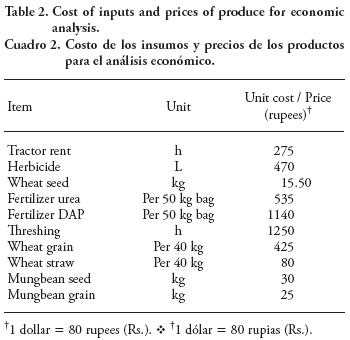
<body><![CDATA[<p align="justify"><font face="verdana" size="2"><b>Treatments and field operations</b></font></p>     <p align="justify"><font face="verdana" size="2">During summer, different management practices were administered in a split&#150;plot randomized complete block design with three replications. Main plot treatments were tillage systems which included conventional cultivator (CC), moldboard plowing (MB) and minimum tillage (MT). Sub&#150;plot treatments were different soil cover practices: fallow (FA), mungbean <i>(Vigna radiatd) </i>as legume (LE), and mulch (MU) of chopped wheat straw. The main plot size was 6 m X16 m each divided into three equal sub&#150;plots of 6 mX5 m.</font></p>     <p align="justify"><font face="verdana" size="2">The CC treatment was standard farmer practice for the area and involved sweep cultivation to a depth of 15 cm, MB was applied to a tillage depth of 25 cm and MT had no tillage applied prior to planting. Weed control in MT was done by repeated applications of glyphosate to ensure weed free conditions. Wheat straw was applied (4 Mg ha ) to MU treatments after tillage and tilled lightly into the soil. Mungbean was sown (20 kg seed ha ) as a grain legume crop. Mungbean grain yield data was recorded by harvesting samples from a 1 m<sup>2</sup> area at maturity.</font></p>     <p align="justify"><font face="verdana" size="2">Wheat was sown (60 kg ha<sup>&#150;1</sup>) with seed drill during the first week of November in each year (2005&#150;2008). All the plots received 80 kg N ha<sup>&#150;1</sup> (as urea) and 40 kg P<sub>2</sub>O<sub>5</sub> ha<sup>&#150;1</sup> (diamonium phosphate, DAP) as side dressing. No K fertilization was necessary. Wheat was manually harvested with a sickle in May.</font></p>     <p align="justify"><font face="verdana" size="2"><b>Sampling and data collection</b></font></p>     <p align="justify"><font face="verdana" size="2">Soil moisture content at wheat plantation was determined to a depth of 1 m using a soil core. Volumetric water content (VWQ was calculated by the method described by Brady and Weil (2002). Wheat biomass and wheat grain yield were measured by harvesting the entire sub&#150;plot. Rainfall and evaporation data were obtained from Regional Agro&#150;met Centers (<a href="/img/revistas/agro/v45n1/a5f1.jpg" target="_blank">Figure 1</a>).</font></p>     <p align="justify"><font face="verdana" size="2"><b>Economic analysis</b></font></p>     <p align="justify"><font face="verdana" size="2">Gross margins and efficiency coefficients were calculated to determine the profitability of treatment combinations. The gross margin is gross income less the variable costs incurred in achieving that income. Variable costs were those which were directly attributable to the enterprise: <i>e. g. </i>tillage, weed control, seeding, fertilization and harvest operations. The gross margin was not equivalent to gross profit because it did not include fixed or overhead costs such as depreciation, interest payments or permanent labor, all of which had to be met regardless of enterprise size (Scott, 2001).</font></p>     <p align="justify"><font face="verdana" size="2">The efficiency coefficient was calculated by dividing gross income with the total variable cost incurred for achieving that income. It was assumed that sowing, fertilizer spreading and harvesting were carried out through family labor. Estimated time for one time tillage was 2 h with cultivator and 3 h ha with MB. All input costs and output prices used in the economic calculations were those recorded during the experiment (<a href="#t2">Table 2</a>).</font></p>     <p align="center"><font face="verdana" size="2"><a name="t2"></a></font></p>     ]]></body>
<body><![CDATA[<p align="center"><font face="verdana" size="2"><img src="/img/revistas/agro/v45n1/a5t2.jpg"></font></p>     <p align="justify"><font face="verdana" size="2"><b>Statistical analysis</b></font></p>     <p align="justify"><font face="verdana" size="2">The experimental design was a split plot and an analysis of variance was performed to analyze the data. The LSD test (p&#8804;0.05) was used to compare treatment means (Gomez and Gomez, 1984). The MSTAT&#150;C software (MSTAT&#150;C, 1988) was used for all the statistical analysis.</font></p>     <p align="justify"><font face="verdana" size="2">&nbsp;</font></p>     <p align="justify"><font face="verdana" size="2"><b>RESULTS AND DISCUSSION</b></font></p>     <p align="justify"><font face="verdana" size="2"><b>Soil profile moisture</b></font></p>     <p align="justify"><font face="verdana" size="2">The volumetric water content (VWC) in 90 cm soil profiles at wheat planting was statistically similar (p&gt;0.05; <a href="/img/revistas/agro/v45n1/a5t3.jpg" target="_blank">Table 3</a>) under all the summer treatments; that is, during summer there were no differences for capture and retention of rainwater between treatments. These results agree with those reported by Gill <i>et al. </i>(2000) and Chaudhry <i>et al. </i>(1990), who observed that soil water contents did not vary among tillage systems. The non&#150;significant differences in the mulched plots might be explained by a very fast decomposition of organic residues in the area due to a combined effect of high temperatures, low rainfall and alkaline soils (Rashid and Memon, 1996). The straw applied was chopped and slowly incorporated into soil by cultivation, thus avoiding losses caused by wind blowing; however, the temperature&#150;driven decomposition of chopped straw was accelerated, leaving the soil unprotected against evaporation. Moreover, the weed control in the case of CC and MB was carried out by repeated cultivation, which furthered an early decomposition of the chopped straw. Lopez <i>et al. </i>(1996) observed that immediately after primary tillage, the initial 60 % of crop residue decreased to less than 1 % in conventional tillage and 12 % in reduced tillage. Equal moisture capture and storage by different management practices have also been reported by Fuentes <i>et al. </i>(2003) in Washington State (USA), Latta and O'Leary (2003) in Walpepup (Victoria, Australia), and Schillinger (2001) in Tribune (Kansas, USA).</font></p>     <p align="justify"><font face="verdana" size="2"><b>Wheat biomass and grain yields</b></font></p>     <p align="justify"><font face="verdana" size="2">There were no statistical differences (p&gt;0.05) between treatments for wheat biomass (<a href="/img/revistas/agro/v45n1/a5t4.jpg" target="_blank">Table 4</a>) and grain yields (<a href="/img/revistas/agro/v45n1/a5t5.jpg" target="_blank">Table 5</a>) which may be due to the fact that VWC was equivalent at wheat planting (<a href="/img/revistas/agro/v45n1/a5t3.jpg" target="_blank">Table 3</a>), considering that moisture is the main limiting factor for crop production in the Pothwar plateau. These results are in agreement with findings by Mohammad <i>et al. </i>(2006) who, in long&#150;term field experiments in rainfed areas of the North Western Frontier Province (Pakistan), observed that almost identical wheat yields under different tillage systems were explained by similar water content; besides, Mrabet (2000) found that tillage systems (traditional, MB, MT and NT) did not change biomass and grain yield of wheat.</font></p>     <p align="justify"><font face="verdana" size="2"><b>Gross margins and efficiency coefficients</b></font></p>     ]]></body>
<body><![CDATA[<p align="justify"><font face="verdana" size="2">Gross margins (GM) in rupees per hectare (1 dollar = 80 rupees, Rs.) at three locations (average of three years) are shown in <a href="/img/revistas/agro/v45n1/a5f2.jpg" target="_blank">Figure 2A</a>. The highest GM (Rs. 62 321) was recorded under combination of MB with legume at the Rawalpindi site, followed by combination of CC with legume (Rs. 53 849) and MT with legume (Rs. 51 602). The trend was same at the Fateh Jang site, where the highest GM (Rs. 40 497) was for MB with legume, followed by CC with legume (Rs. 37 066) and by MT with legume (Rs. 36 030). At Chakwal site, the highest GM (Rs. 37 083) was for CC with legume, followed by MB with legume (Rs. 35 248), CC (Rs. 30 706) and by MT with legume (Rs. 28 835).</font></p>     <p align="justify"><font face="verdana" size="2">The best return on investment does not necessarily correlate with gross margin, since costs were different for each treatment in our study. Thus, in order to select the treatments with the best return per rupee invested, the efficiency coefficient was calculated (<a href="/img/revistas/agro/v45n1/a5f2.jpg" target="_blank">Figure B</a>): 1) at Rawalpindi site the efficiency coefficients were 4.27 for MB with legume, 4.21 for CC with legume and 4.13 for MT; 2) at Fateh Jang site the efficiency coefficients were 2.90 for CC with legume, 2.89 for MT with legume and 2.78 for MB with legume; 3) at Chakwal site the efficiency coefficients were 2.90 for CC with legume, 2.42 for MB with legume and 2.31 for MT with legume.</font></p>     <p align="justify"><font face="verdana" size="2">The analyses of the results indicate that the grain yields were statistically similar between treatments. However, the legum e elicited a better economical combination across the three tillage systems, higher gross margins and efficiency coefficients at the three locations, as well as additional income during summer. The application of mulch did not provide an adequate return on investment because of the high input cost of wheat straw.</font></p>     <p align="justify"><font face="verdana" size="2">&nbsp;</font></p>     <p align="justify"><font face="verdana" size="2"><b>CONCLUSIONS</b></font></p>     <p align="justify"><font face="verdana" size="2">The three&#150;year results were consistent which allows concluding that replacing intensively tilled clean fallow with minimum tilled mungbean provides a viable and profitable option in the experimental area. However, application of wheat straw as mulch is not economically adequate.</font></p>     <p align="justify"><font face="verdana" size="2">&nbsp;</font></p>     <p align="justify"><font face="verdana" size="2"><b>LITERATURE CITE</b></font></p>     <!-- ref --><p align="justify"><font face="verdana" size="2">Anderson, J. M., and J. S. I. Ingram. 1993. Tropical Soil Biology and Fertility, A Handbook of Methods. CABI Publishing. Wallingfold, UK. pp: 70&#150;75.    &nbsp;&nbsp;&nbsp;&nbsp;&nbsp;&nbsp;&nbsp;&nbsp;[&#160;<a href="javascript:void(0);" onclick="javascript: window.open('/scielo.php?script=sci_nlinks&ref=550926&pid=S1405-3195201100010000500001&lng=','','width=640,height=500,resizable=yes,scrollbars=1,menubar=yes,');">Links</a>&#160;]<!-- end-ref --></font></p>     ]]></body>
<body><![CDATA[<!-- ref --><p align="justify"><font face="verdana" size="2">Brady, N. C, and R. R. Weil. 2002. Nature and Properties of Soils. 13th ed. Pearson Education, Inc. Delhi, India. 191 p.    &nbsp;&nbsp;&nbsp;&nbsp;&nbsp;&nbsp;&nbsp;&nbsp;[&#160;<a href="javascript:void(0);" onclick="javascript: window.open('/scielo.php?script=sci_nlinks&ref=550928&pid=S1405-3195201100010000500002&lng=','','width=640,height=500,resizable=yes,scrollbars=1,menubar=yes,');">Links</a>&#160;]<!-- end-ref --></font></p>     <!-- ref --><p align="justify"><font face="verdana" size="2">Buresh., R. J., and S. K. Dedatta. 1991. Nitrogen dynamics and management in rice&#150;legume cropping systems. Adv. Agron. 45: 1&#150;59.    &nbsp;&nbsp;&nbsp;&nbsp;&nbsp;&nbsp;&nbsp;&nbsp;[&#160;<a href="javascript:void(0);" onclick="javascript: window.open('/scielo.php?script=sci_nlinks&ref=550930&pid=S1405-3195201100010000500003&lng=','','width=640,height=500,resizable=yes,scrollbars=1,menubar=yes,');">Links</a>&#160;]<!-- end-ref --></font></p>     <!-- ref --><p align="justify"><font face="verdana" size="2">Chaudhry, M. A., S. Ali, and R. Khalid. 1990. Effect of mulching on moisture conservation and growth of wheat crop under rainfed condition. Proc. Second National Congress of Soil Sci. Faisalabad, Pakistan, pp: 226&#150;232.    &nbsp;&nbsp;&nbsp;&nbsp;&nbsp;&nbsp;&nbsp;&nbsp;[&#160;<a href="javascript:void(0);" onclick="javascript: window.open('/scielo.php?script=sci_nlinks&ref=550932&pid=S1405-3195201100010000500004&lng=','','width=640,height=500,resizable=yes,scrollbars=1,menubar=yes,');">Links</a>&#160;]<!-- end-ref --></font></p>     <!-- ref --><p align="justify"><font face="verdana" size="2">Cooke J. K., G. W. Ford, R. G. Dumsday, and S. T. Willatt. 1985. Effect of fallowing practices on the growth and yield of wheat in southeastern Australia. Aust. J. Exp. Agrie. 25: 614&#150;627.    &nbsp;&nbsp;&nbsp;&nbsp;&nbsp;&nbsp;&nbsp;&nbsp;[&#160;<a href="javascript:void(0);" onclick="javascript: window.open('/scielo.php?script=sci_nlinks&ref=550934&pid=S1405-3195201100010000500005&lng=','','width=640,height=500,resizable=yes,scrollbars=1,menubar=yes,');">Links</a>&#160;]<!-- end-ref --></font></p>     <!-- ref --><p align="justify"><font face="verdana" size="2">Eltiti, A. E. 2003. Soil Tillage in Agroecosystems. CRC Press. Washington DC, USA. pp: 3&#150;5.    &nbsp;&nbsp;&nbsp;&nbsp;&nbsp;&nbsp;&nbsp;&nbsp;[&#160;<a href="javascript:void(0);" onclick="javascript: window.open('/scielo.php?script=sci_nlinks&ref=550936&pid=S1405-3195201100010000500006&lng=','','width=640,height=500,resizable=yes,scrollbars=1,menubar=yes,');">Links</a>&#160;]<!-- end-ref --></font></p>     ]]></body>
<body><![CDATA[<!-- ref --><p align="justify"><font face="verdana" size="2">Fuentes, J. P., M. Flury, D. R. Huggins, and D. F. Bezdicek. 2003. Soil water and nitrogen dynamics in dryland cropping systems of Washington State, USA. Soil Till. Res. 71: 33&#150;47.    &nbsp;&nbsp;&nbsp;&nbsp;&nbsp;&nbsp;&nbsp;&nbsp;[&#160;<a href="javascript:void(0);" onclick="javascript: window.open('/scielo.php?script=sci_nlinks&ref=550938&pid=S1405-3195201100010000500007&lng=','','width=640,height=500,resizable=yes,scrollbars=1,menubar=yes,');">Links</a>&#160;]<!-- end-ref --></font></p>     <!-- ref --><p align="justify"><font face="verdana" size="2">Gee, G. W., and J. W Bauder. 1982. Hydrometer method. <i>In: </i>Klute, A. (ed). Methods of Soil Analysis, Part 1. Amer. Soc. Agron. Madison, Wisconsin, USA. pp: 383&#150;411.    &nbsp;&nbsp;&nbsp;&nbsp;&nbsp;&nbsp;&nbsp;&nbsp;[&#160;<a href="javascript:void(0);" onclick="javascript: window.open('/scielo.php?script=sci_nlinks&ref=550940&pid=S1405-3195201100010000500008&lng=','','width=640,height=500,resizable=yes,scrollbars=1,menubar=yes,');">Links</a>&#160;]<!-- end-ref --></font></p>     <!-- ref --><p align="justify"><font face="verdana" size="2">Gill, S. M., M. S. Akhtar, and Z. Saeed. 2000. Soil water use and bulk density as affected by tillage and fertilizer in rainfed wheat production system. Pak. J. Biol. Sci. 3: 1223&#150;1226.    &nbsp;&nbsp;&nbsp;&nbsp;&nbsp;&nbsp;&nbsp;&nbsp;[&#160;<a href="javascript:void(0);" onclick="javascript: window.open('/scielo.php?script=sci_nlinks&ref=550942&pid=S1405-3195201100010000500009&lng=','','width=640,height=500,resizable=yes,scrollbars=1,menubar=yes,');">Links</a>&#160;]<!-- end-ref --></font></p>     <!-- ref --><p align="justify"><font face="verdana" size="2">Gomez, K. A., and A. A. Gomez. 1984. Statistical Procedures for Agricultural Research. John Wiley and Sons, Inc. Singapore. pp: 680.    &nbsp;&nbsp;&nbsp;&nbsp;&nbsp;&nbsp;&nbsp;&nbsp;[&#160;<a href="javascript:void(0);" onclick="javascript: window.open('/scielo.php?script=sci_nlinks&ref=550944&pid=S1405-3195201100010000500010&lng=','','width=640,height=500,resizable=yes,scrollbars=1,menubar=yes,');">Links</a>&#160;]<!-- end-ref --></font></p>     <!-- ref --><p align="justify"><font face="verdana" size="2">GOP (Government of Pakistan). 1974. Soil Series Key and Soil Classification. Soil Survey of Pakistan, MINFAL. Lahore, Pakistan, pp: 133.    &nbsp;&nbsp;&nbsp;&nbsp;&nbsp;&nbsp;&nbsp;&nbsp;[&#160;<a href="javascript:void(0);" onclick="javascript: window.open('/scielo.php?script=sci_nlinks&ref=550946&pid=S1405-3195201100010000500011&lng=','','width=640,height=500,resizable=yes,scrollbars=1,menubar=yes,');">Links</a>&#160;]<!-- end-ref --></font></p>     ]]></body>
<body><![CDATA[<!-- ref --><p align="justify"><font face="verdana" size="2">Kou, S. 1996. Phosphorus. <i>In: </i>Sparks, D. L. (ed). Methods of Soil Analysis, Part 3. Soil Sci. Soc. Am. Madison, Wisconsin, USA. pp: 869&#150;919.    &nbsp;&nbsp;&nbsp;&nbsp;&nbsp;&nbsp;&nbsp;&nbsp;[&#160;<a href="javascript:void(0);" onclick="javascript: window.open('/scielo.php?script=sci_nlinks&ref=550948&pid=S1405-3195201100010000500012&lng=','','width=640,height=500,resizable=yes,scrollbars=1,menubar=yes,');">Links</a>&#160;]<!-- end-ref --></font></p>     <!-- ref --><p align="justify"><font face="verdana" size="2">Lal, R. 2004. Soil carbon sequestration to mitigate climate change. Geoderma. 123: 1&#150;22.    &nbsp;&nbsp;&nbsp;&nbsp;&nbsp;&nbsp;&nbsp;&nbsp;[&#160;<a href="javascript:void(0);" onclick="javascript: window.open('/scielo.php?script=sci_nlinks&ref=550950&pid=S1405-3195201100010000500013&lng=','','width=640,height=500,resizable=yes,scrollbars=1,menubar=yes,');">Links</a>&#160;]<!-- end-ref --></font></p>     <!-- ref --><p align="justify"><font face="verdana" size="2">Lampurlanes, J., P. Angas, and C. Martinez. 2002. Tillage effects on water storage during fallow, and on barley root growth and yield in two contrasting soils of the semi&#150;arid Segarra region in Spain. Soil Till. Res. 65: 207&#150;220.    &nbsp;&nbsp;&nbsp;&nbsp;&nbsp;&nbsp;&nbsp;&nbsp;[&#160;<a href="javascript:void(0);" onclick="javascript: window.open('/scielo.php?script=sci_nlinks&ref=550952&pid=S1405-3195201100010000500014&lng=','','width=640,height=500,resizable=yes,scrollbars=1,menubar=yes,');">Links</a>&#160;]<!-- end-ref --></font></p>     <!-- ref --><p align="justify"><font face="verdana" size="2">Latta, J., and G. J. O'Leary. 2003. Long&#150;term comparison of rotation and fallow tillage systems of wheat in Australia. Field Crops Res. 83: 173&#150;190.    &nbsp;&nbsp;&nbsp;&nbsp;&nbsp;&nbsp;&nbsp;&nbsp;[&#160;<a href="javascript:void(0);" onclick="javascript: window.open('/scielo.php?script=sci_nlinks&ref=550954&pid=S1405-3195201100010000500015&lng=','','width=640,height=500,resizable=yes,scrollbars=1,menubar=yes,');">Links</a>&#160;]<!-- end-ref --></font></p>     <!-- ref --><p align="justify"><font face="verdana" size="2">Lawrence, J. R., Q. M. Ketterings, and J. H. Cherney. 2008. Effect of nitrogen application on yield and quality of silage corn after forage legume grass. Agron. J. 100: 73&#150;79.    &nbsp;&nbsp;&nbsp;&nbsp;&nbsp;&nbsp;&nbsp;&nbsp;[&#160;<a href="javascript:void(0);" onclick="javascript: window.open('/scielo.php?script=sci_nlinks&ref=550956&pid=S1405-3195201100010000500016&lng=','','width=640,height=500,resizable=yes,scrollbars=1,menubar=yes,');">Links</a>&#160;]<!-- end-ref --></font></p>     ]]></body>
<body><![CDATA[<!-- ref --><p align="justify"><font face="verdana" size="2">Lopez, M. V., J. L. Arrue, and V. S. Giron. 1996. A comparison between seasonal changes in soil water storage and penetration resistance under conventional and conservation tillage systems in Arag&oacute;n. Soil Till. Res. 37: 251&#150;271.    &nbsp;&nbsp;&nbsp;&nbsp;&nbsp;&nbsp;&nbsp;&nbsp;[&#160;<a href="javascript:void(0);" onclick="javascript: window.open('/scielo.php?script=sci_nlinks&ref=550958&pid=S1405-3195201100010000500017&lng=','','width=640,height=500,resizable=yes,scrollbars=1,menubar=yes,');">Links</a>&#160;]<!-- end-ref --></font></p>     <!-- ref --><p align="justify"><font face="verdana" size="2">MSTAT&#150;C. 1988. MSTAT Development Team, Michigan State University. East Lansing, Michigan, USA. (CD).    &nbsp;&nbsp;&nbsp;&nbsp;&nbsp;&nbsp;&nbsp;&nbsp;[&#160;<a href="javascript:void(0);" onclick="javascript: window.open('/scielo.php?script=sci_nlinks&ref=550960&pid=S1405-3195201100010000500018&lng=','','width=640,height=500,resizable=yes,scrollbars=1,menubar=yes,');">Links</a>&#160;]<!-- end-ref --></font></p>     <!-- ref --><p align="justify"><font face="verdana" size="2">Mohammad W, S. M. Shah, S. Shehzadi, S. A. Shah, and H. Nawaz. 2006. Wheat and oat yields and water use efficiency as influenced by tillage under rainfed conditions. Soil Environ. 25: 48&#150;54.    &nbsp;&nbsp;&nbsp;&nbsp;&nbsp;&nbsp;&nbsp;&nbsp;[&#160;<a href="javascript:void(0);" onclick="javascript: window.open('/scielo.php?script=sci_nlinks&ref=550962&pid=S1405-3195201100010000500019&lng=','','width=640,height=500,resizable=yes,scrollbars=1,menubar=yes,');">Links</a>&#160;]<!-- end-ref --></font></p>     <!-- ref --><p align="justify"><font face="verdana" size="2">Mrabet, R. 2000. Differential response of wheat to tillage management systems in a semi arid area of Morocco. Field Crops Res. 66: 165&#150;174.    &nbsp;&nbsp;&nbsp;&nbsp;&nbsp;&nbsp;&nbsp;&nbsp;[&#160;<a href="javascript:void(0);" onclick="javascript: window.open('/scielo.php?script=sci_nlinks&ref=550964&pid=S1405-3195201100010000500020&lng=','','width=640,height=500,resizable=yes,scrollbars=1,menubar=yes,');">Links</a>&#160;]<!-- end-ref --></font></p>     <!-- ref --><p align="justify"><font face="verdana" size="2">Munyinda, K., R. E. Karamanos, and I. P. O'Hallorn. 1998. Yields of wheat in rotation with maize and soybeans in Zambia. Can. J. Soil Sci. 68: 747&#150;753.    &nbsp;&nbsp;&nbsp;&nbsp;&nbsp;&nbsp;&nbsp;&nbsp;[&#160;<a href="javascript:void(0);" onclick="javascript: window.open('/scielo.php?script=sci_nlinks&ref=550966&pid=S1405-3195201100010000500021&lng=','','width=640,height=500,resizable=yes,scrollbars=1,menubar=yes,');">Links</a>&#160;]<!-- end-ref --></font></p>     ]]></body>
<body><![CDATA[<!-- ref --><p align="justify"><font face="verdana" size="2">Nelson, D. W., and L. E. Sommers. 2005. Total carbon, organic carbon and organic matter. <i>In: </i>Sparks, D. L. (eds). Methods of Soil Analysis, Part 3. Soil Sci. Soc. Am. Madison, Wisconsin, USA. pp: 996&#150;998.    &nbsp;&nbsp;&nbsp;&nbsp;&nbsp;&nbsp;&nbsp;&nbsp;[&#160;<a href="javascript:void(0);" onclick="javascript: window.open('/scielo.php?script=sci_nlinks&ref=550968&pid=S1405-3195201100010000500022&lng=','','width=640,height=500,resizable=yes,scrollbars=1,menubar=yes,');">Links</a>&#160;]<!-- end-ref --></font></p>     <!-- ref --><p align="justify"><font face="verdana" size="2">Nizami, M. M. I., M. Shafiq, A. Rashid, and M. Aslam. 2004. The Soils and their Agricultural Development Potential in Potwar. NARC. Islamabad, Pakistan, pp: 5&#150;7.    &nbsp;&nbsp;&nbsp;&nbsp;&nbsp;&nbsp;&nbsp;&nbsp;[&#160;<a href="javascript:void(0);" onclick="javascript: window.open('/scielo.php?script=sci_nlinks&ref=550970&pid=S1405-3195201100010000500023&lng=','','width=640,height=500,resizable=yes,scrollbars=1,menubar=yes,');">Links</a>&#160;]<!-- end-ref --></font></p>     <!-- ref --><p align="justify"><font face="verdana" size="2">Rashid, A., and K. S. Memon. 1996. Soil Science. NBF. Islamabad. 248 p.    &nbsp;&nbsp;&nbsp;&nbsp;&nbsp;&nbsp;&nbsp;&nbsp;[&#160;<a href="javascript:void(0);" onclick="javascript: window.open('/scielo.php?script=sci_nlinks&ref=550972&pid=S1405-3195201100010000500024&lng=','','width=640,height=500,resizable=yes,scrollbars=1,menubar=yes,');">Links</a>&#160;]<!-- end-ref --></font></p>     <!-- ref --><p align="justify"><font face="verdana" size="2">Roades, J. D. 1996. Salinity, electrical conductivity and total dissolve solids. <i>In: </i>Sparks, D. L. (ed). Methods of Soil Analysis, Part 3. Soil Sci. Soc. Am. Madison, Wisconsin, USA. pp: 417.    &nbsp;&nbsp;&nbsp;&nbsp;&nbsp;&nbsp;&nbsp;&nbsp;[&#160;<a href="javascript:void(0);" onclick="javascript: window.open('/scielo.php?script=sci_nlinks&ref=550974&pid=S1405-3195201100010000500025&lng=','','width=640,height=500,resizable=yes,scrollbars=1,menubar=yes,');">Links</a>&#160;]<!-- end-ref --></font></p>     <!-- ref --><p align="justify"><font face="verdana" size="2">Ryan, J., and S. Garabet. 1994. Soil test standardization in West Asia&#150;North Africa region. Commun. Soil Sci. Plant Anal. 25: 1641&#150;1653.    &nbsp;&nbsp;&nbsp;&nbsp;&nbsp;&nbsp;&nbsp;&nbsp;[&#160;<a href="javascript:void(0);" onclick="javascript: window.open('/scielo.php?script=sci_nlinks&ref=550976&pid=S1405-3195201100010000500026&lng=','','width=640,height=500,resizable=yes,scrollbars=1,menubar=yes,');">Links</a>&#160;]<!-- end-ref --></font></p>     ]]></body>
<body><![CDATA[<!-- ref --><p align="justify"><font face="verdana" size="2">Sahi, F., N. U. Khan, and S. Ahmed. 1997. Soil problems and management in Potwar. Proceeding of symposium on plant nutrition management for sustainable agricultural growth. NFDC. Islamabad, Pakistan, pp: 355&#150;360.    &nbsp;&nbsp;&nbsp;&nbsp;&nbsp;&nbsp;&nbsp;&nbsp;[&#160;<a href="javascript:void(0);" onclick="javascript: window.open('/scielo.php?script=sci_nlinks&ref=550978&pid=S1405-3195201100010000500027&lng=','','width=640,height=500,resizable=yes,scrollbars=1,menubar=yes,');">Links</a>&#160;]<!-- end-ref --></font></p>     <!-- ref --><p align="justify"><font face="verdana" size="2">Schillinger, W. F. 2001. Minimum and delayed conservation tillage for wheat&#150;fallow farming. Soil Sci. Soc. Am. J. 65: 1203&#150;1209.    &nbsp;&nbsp;&nbsp;&nbsp;&nbsp;&nbsp;&nbsp;&nbsp;[&#160;<a href="javascript:void(0);" onclick="javascript: window.open('/scielo.php?script=sci_nlinks&ref=550980&pid=S1405-3195201100010000500028&lng=','','width=640,height=500,resizable=yes,scrollbars=1,menubar=yes,');">Links</a>&#160;]<!-- end-ref --></font></p>     <!-- ref --><p align="justify"><font face="verdana" size="2">Scott, F. 2001. Farm Budget Handbook 2001, Northen NSW Winter Crops, NSW Agriculture. Australia. 76 p.    &nbsp;&nbsp;&nbsp;&nbsp;&nbsp;&nbsp;&nbsp;&nbsp;[&#160;<a href="javascript:void(0);" onclick="javascript: window.open('/scielo.php?script=sci_nlinks&ref=550982&pid=S1405-3195201100010000500029&lng=','','width=640,height=500,resizable=yes,scrollbars=1,menubar=yes,');">Links</a>&#160;]<!-- end-ref --></font></p>     <!-- ref --><p align="justify"><font face="verdana" size="2">Singh, B., and S. S. Malhi. 2006. Response of soil physical properties to tillage and residue management on two soils in a cool temperate environment. Soil Till. Res. 85: 143&#150;153.    &nbsp;&nbsp;&nbsp;&nbsp;&nbsp;&nbsp;&nbsp;&nbsp;[&#160;<a href="javascript:void(0);" onclick="javascript: window.open('/scielo.php?script=sci_nlinks&ref=550984&pid=S1405-3195201100010000500030&lng=','','width=640,height=500,resizable=yes,scrollbars=1,menubar=yes,');">Links</a>&#160;]<!-- end-ref --></font></p>     <!-- ref --><p align="justify"><font face="verdana" size="2">Thomas, G. W. 1996. Soil pH and soil acidity. <i>In: </i>Sparks, D. L. (ed). Methods of Soil Analysis, Part 3. Soil Sci. Soc. Am. Madison, Wisconsin, USA. pp: 475&#150;490.    &nbsp;&nbsp;&nbsp;&nbsp;&nbsp;&nbsp;&nbsp;&nbsp;[&#160;<a href="javascript:void(0);" onclick="javascript: window.open('/scielo.php?script=sci_nlinks&ref=550986&pid=S1405-3195201100010000500031&lng=','','width=640,height=500,resizable=yes,scrollbars=1,menubar=yes,');">Links</a>&#160;]<!-- end-ref --></font></p>     ]]></body>
<body><![CDATA[ ]]></body><back>
<ref-list>
<ref id="B1">
<nlm-citation citation-type="book">
<person-group person-group-type="author">
<name>
<surname><![CDATA[Anderson]]></surname>
<given-names><![CDATA[J. M]]></given-names>
</name>
<name>
<surname><![CDATA[Ingram]]></surname>
<given-names><![CDATA[J. S. I]]></given-names>
</name>
</person-group>
<source><![CDATA[Tropical Soil Biology and Fertility, A Handbook of Methods]]></source>
<year>1993</year>
<page-range>70-75</page-range><publisher-loc><![CDATA[Wallingfold ]]></publisher-loc>
<publisher-name><![CDATA[CABI Publishing]]></publisher-name>
</nlm-citation>
</ref>
<ref id="B2">
<nlm-citation citation-type="book">
<person-group person-group-type="author">
<name>
<surname><![CDATA[Brady]]></surname>
<given-names><![CDATA[N. C]]></given-names>
</name>
<name>
<surname><![CDATA[Weil]]></surname>
<given-names><![CDATA[R. R]]></given-names>
</name>
</person-group>
<source><![CDATA[Nature and Properties of Soils]]></source>
<year>2002</year>
<edition>13th</edition>
<page-range>191</page-range><publisher-loc><![CDATA[Delhi ]]></publisher-loc>
<publisher-name><![CDATA[Pearson Education, Inc]]></publisher-name>
</nlm-citation>
</ref>
<ref id="B3">
<nlm-citation citation-type="journal">
<person-group person-group-type="author">
<name>
<surname><![CDATA[Buresh.]]></surname>
<given-names><![CDATA[R. J]]></given-names>
</name>
<name>
<surname><![CDATA[Dedatta]]></surname>
<given-names><![CDATA[S. K]]></given-names>
</name>
</person-group>
<article-title xml:lang="en"><![CDATA[Nitrogen dynamics and management in rice-legume cropping systems]]></article-title>
<source><![CDATA[Adv. Agron]]></source>
<year>1991</year>
<volume>45</volume>
<page-range>1-59</page-range></nlm-citation>
</ref>
<ref id="B4">
<nlm-citation citation-type="confpro">
<person-group person-group-type="author">
<name>
<surname><![CDATA[Chaudhry]]></surname>
<given-names><![CDATA[M. A]]></given-names>
</name>
<name>
<surname><![CDATA[Ali]]></surname>
<given-names><![CDATA[S]]></given-names>
</name>
<name>
<surname><![CDATA[Khalid]]></surname>
<given-names><![CDATA[R]]></given-names>
</name>
</person-group>
<source><![CDATA[Effect of mulching on moisture conservation and growth of wheat crop under rainfed condition]]></source>
<year>1990</year>
<conf-name><![CDATA[Second National Congress of Soil Sci]]></conf-name>
<conf-loc>Faisalabad </conf-loc>
<page-range>226-232</page-range></nlm-citation>
</ref>
<ref id="B5">
<nlm-citation citation-type="journal">
<person-group person-group-type="author">
<name>
<surname><![CDATA[Cooke]]></surname>
<given-names><![CDATA[J. K]]></given-names>
</name>
<name>
<surname><![CDATA[Ford]]></surname>
<given-names><![CDATA[G. W]]></given-names>
</name>
<name>
<surname><![CDATA[Dumsday]]></surname>
<given-names><![CDATA[R. G]]></given-names>
</name>
<name>
<surname><![CDATA[Willatt]]></surname>
<given-names><![CDATA[S. T]]></given-names>
</name>
</person-group>
<article-title xml:lang="en"><![CDATA[Effect of fallowing practices on the growth and yield of wheat in southeastern Australia]]></article-title>
<source><![CDATA[Aust. J. Exp. Agrie]]></source>
<year>1985</year>
<volume>25</volume>
<page-range>614-627</page-range></nlm-citation>
</ref>
<ref id="B6">
<nlm-citation citation-type="book">
<person-group person-group-type="author">
<name>
<surname><![CDATA[Eltiti]]></surname>
<given-names><![CDATA[A. E]]></given-names>
</name>
</person-group>
<source><![CDATA[Soil Tillage in Agroecosystems]]></source>
<year>2003</year>
<page-range>3-5</page-range><publisher-loc><![CDATA[Washington^eDC DC]]></publisher-loc>
<publisher-name><![CDATA[CRC Press]]></publisher-name>
</nlm-citation>
</ref>
<ref id="B7">
<nlm-citation citation-type="journal">
<person-group person-group-type="author">
<name>
<surname><![CDATA[Fuentes]]></surname>
<given-names><![CDATA[J. P]]></given-names>
</name>
<name>
<surname><![CDATA[Flury]]></surname>
<given-names><![CDATA[M]]></given-names>
</name>
<name>
<surname><![CDATA[Huggins]]></surname>
<given-names><![CDATA[D. R]]></given-names>
</name>
<name>
<surname><![CDATA[Bezdicek]]></surname>
<given-names><![CDATA[D. F]]></given-names>
</name>
</person-group>
<article-title xml:lang="en"><![CDATA[Soil water and nitrogen dynamics in dryland cropping systems of Washington State, USA]]></article-title>
<source><![CDATA[Soil Till. Res]]></source>
<year>2003</year>
<volume>71</volume>
<page-range>33-47</page-range></nlm-citation>
</ref>
<ref id="B8">
<nlm-citation citation-type="">
<person-group person-group-type="author">
<name>
<surname><![CDATA[Gee]]></surname>
<given-names><![CDATA[G. W]]></given-names>
</name>
<name>
<surname><![CDATA[Bauder]]></surname>
<given-names><![CDATA[J. W]]></given-names>
</name>
</person-group>
<article-title xml:lang="en"><![CDATA[Hydrometer method]]></article-title>
<person-group person-group-type="editor">
<name>
<surname><![CDATA[Klute]]></surname>
<given-names><![CDATA[A]]></given-names>
</name>
</person-group>
<source><![CDATA[Methods of Soil Analysis, Part 1. Amer. Soc. Agron]]></source>
<year>1982</year>
<page-range>383-411</page-range><publisher-loc><![CDATA[Madison^eWisconsin Wisconsin]]></publisher-loc>
</nlm-citation>
</ref>
<ref id="B9">
<nlm-citation citation-type="journal">
<person-group person-group-type="author">
<name>
<surname><![CDATA[Gill]]></surname>
<given-names><![CDATA[S. M]]></given-names>
</name>
<name>
<surname><![CDATA[Akhtar]]></surname>
<given-names><![CDATA[M. S]]></given-names>
</name>
<name>
<surname><![CDATA[Saeed]]></surname>
<given-names><![CDATA[Z]]></given-names>
</name>
</person-group>
<article-title xml:lang="en"><![CDATA[Soil water use and bulk density as affected by tillage and fertilizer in rainfed wheat production system]]></article-title>
<source><![CDATA[Pak. J. Biol. Sci]]></source>
<year>2000</year>
<volume>3</volume>
<page-range>1223-1226</page-range></nlm-citation>
</ref>
<ref id="B10">
<nlm-citation citation-type="book">
<person-group person-group-type="author">
<name>
<surname><![CDATA[Gomez]]></surname>
<given-names><![CDATA[K. A]]></given-names>
</name>
<name>
<surname><![CDATA[Gomez]]></surname>
<given-names><![CDATA[A. A]]></given-names>
</name>
</person-group>
<source><![CDATA[Statistical Procedures for Agricultural Research]]></source>
<year>1984</year>
<page-range>680</page-range><publisher-loc><![CDATA[Singapore ]]></publisher-loc>
<publisher-name><![CDATA[John Wiley and Sons, Inc]]></publisher-name>
</nlm-citation>
</ref>
<ref id="B11">
<nlm-citation citation-type="book">
<collab>GOP (Government of Pakistan)</collab>
<source><![CDATA[Soil Series Key and Soil Classification. Soil Survey of Pakistan]]></source>
<year>1974</year>
<page-range>133</page-range><publisher-loc><![CDATA[Lahore ]]></publisher-loc>
<publisher-name><![CDATA[MINFAL]]></publisher-name>
</nlm-citation>
</ref>
<ref id="B12">
<nlm-citation citation-type="">
<person-group person-group-type="author">
<name>
<surname><![CDATA[Kou]]></surname>
<given-names><![CDATA[S]]></given-names>
</name>
</person-group>
<article-title xml:lang="en"><![CDATA[Phosphorus]]></article-title>
<person-group person-group-type="editor">
<name>
<surname><![CDATA[Sparks]]></surname>
<given-names><![CDATA[D. L]]></given-names>
</name>
</person-group>
<source><![CDATA[Methods of Soil Analysis, Part 3. Soil Sci. Soc. Am]]></source>
<year>1996</year>
<page-range>869-919</page-range><publisher-loc><![CDATA[Madison^eWisconsin Wisconsin]]></publisher-loc>
</nlm-citation>
</ref>
<ref id="B13">
<nlm-citation citation-type="journal">
<person-group person-group-type="author">
<name>
<surname><![CDATA[Lal]]></surname>
<given-names><![CDATA[R]]></given-names>
</name>
</person-group>
<article-title xml:lang="en"><![CDATA[Soil carbon sequestration to mitigate climate change]]></article-title>
<source><![CDATA[Geoderma]]></source>
<year>2004</year>
<volume>123</volume>
<page-range>1-22</page-range></nlm-citation>
</ref>
<ref id="B14">
<nlm-citation citation-type="journal">
<person-group person-group-type="author">
<name>
<surname><![CDATA[Lampurlanes]]></surname>
<given-names><![CDATA[J]]></given-names>
</name>
<name>
<surname><![CDATA[Angas]]></surname>
<given-names><![CDATA[P]]></given-names>
</name>
<name>
<surname><![CDATA[Martinez]]></surname>
<given-names><![CDATA[C]]></given-names>
</name>
</person-group>
<article-title xml:lang="en"><![CDATA[Tillage effects on water storage during fallow, and on barley root growth and yield in two contrasting soils of the semi-arid Segarra region in Spain]]></article-title>
<source><![CDATA[Soil Till. Res]]></source>
<year>2002</year>
<volume>65</volume>
<page-range>207-220</page-range></nlm-citation>
</ref>
<ref id="B15">
<nlm-citation citation-type="journal">
<person-group person-group-type="author">
<name>
<surname><![CDATA[Latta]]></surname>
<given-names><![CDATA[J]]></given-names>
</name>
<name>
<surname><![CDATA[O'Leary]]></surname>
<given-names><![CDATA[G. J]]></given-names>
</name>
</person-group>
<article-title xml:lang="en"><![CDATA[Long-term comparison of rotation and fallow tillage systems of wheat in Australia]]></article-title>
<source><![CDATA[Field Crops Res]]></source>
<year>2003</year>
<volume>83</volume>
<page-range>173-190</page-range></nlm-citation>
</ref>
<ref id="B16">
<nlm-citation citation-type="journal">
<person-group person-group-type="author">
<name>
<surname><![CDATA[Lawrence]]></surname>
<given-names><![CDATA[J. R]]></given-names>
</name>
<name>
<surname><![CDATA[Ketterings]]></surname>
<given-names><![CDATA[Q. M]]></given-names>
</name>
<name>
<surname><![CDATA[Cherney]]></surname>
<given-names><![CDATA[J. H]]></given-names>
</name>
</person-group>
<article-title xml:lang="en"><![CDATA[Effect of nitrogen application on yield and quality of silage corn after forage legume grass]]></article-title>
<source><![CDATA[Agron. J]]></source>
<year>2008</year>
<volume>100</volume>
<page-range>73-79</page-range></nlm-citation>
</ref>
<ref id="B17">
<nlm-citation citation-type="journal">
<person-group person-group-type="author">
<name>
<surname><![CDATA[Lopez]]></surname>
<given-names><![CDATA[M. V]]></given-names>
</name>
<name>
<surname><![CDATA[Arrue]]></surname>
<given-names><![CDATA[J. L]]></given-names>
</name>
<name>
<surname><![CDATA[Giron]]></surname>
<given-names><![CDATA[V. S]]></given-names>
</name>
</person-group>
<article-title xml:lang="en"><![CDATA[A comparison between seasonal changes in soil water storage and penetration resistance under conventional and conservation tillage systems in Aragón]]></article-title>
<source><![CDATA[Soil Till. Res]]></source>
<year>1996</year>
<volume>37</volume>
<page-range>251-271</page-range></nlm-citation>
</ref>
<ref id="B18">
<nlm-citation citation-type="book">
<collab>MSTAT-C</collab>
<source><![CDATA[MSTAT Development Team]]></source>
<year>1988</year>
<publisher-loc><![CDATA[Michigan ]]></publisher-loc>
<publisher-name><![CDATA[Michigan State University. East Lansing]]></publisher-name>
</nlm-citation>
</ref>
<ref id="B19">
<nlm-citation citation-type="journal">
<person-group person-group-type="author">
<name>
<surname><![CDATA[Mohammad]]></surname>
<given-names><![CDATA[W]]></given-names>
</name>
<name>
<surname><![CDATA[Shah]]></surname>
<given-names><![CDATA[S. M]]></given-names>
</name>
<name>
<surname><![CDATA[Shehzadi]]></surname>
<given-names><![CDATA[S]]></given-names>
</name>
<name>
<surname><![CDATA[Shah]]></surname>
<given-names><![CDATA[S. A]]></given-names>
</name>
<name>
<surname><![CDATA[Nawaz]]></surname>
<given-names><![CDATA[H]]></given-names>
</name>
</person-group>
<article-title xml:lang="en"><![CDATA[Wheat and oat yields and water use efficiency as influenced by tillage under rainfed conditions]]></article-title>
<source><![CDATA[Soil Environ]]></source>
<year>2006</year>
<volume>25</volume>
<page-range>48-54</page-range></nlm-citation>
</ref>
<ref id="B20">
<nlm-citation citation-type="journal">
<person-group person-group-type="author">
<name>
<surname><![CDATA[Mrabet]]></surname>
<given-names><![CDATA[R]]></given-names>
</name>
</person-group>
<article-title xml:lang="en"><![CDATA[Differential response of wheat to tillage management systems in a semi arid area of Morocco]]></article-title>
<source><![CDATA[Field Crops Res]]></source>
<year>2000</year>
<volume>66</volume>
<page-range>165-174</page-range></nlm-citation>
</ref>
<ref id="B21">
<nlm-citation citation-type="journal">
<person-group person-group-type="author">
<name>
<surname><![CDATA[Munyinda]]></surname>
<given-names><![CDATA[K]]></given-names>
</name>
<name>
<surname><![CDATA[Karamanos]]></surname>
<given-names><![CDATA[R. E]]></given-names>
</name>
<name>
<surname><![CDATA[O'Hallorn]]></surname>
<given-names><![CDATA[I. P]]></given-names>
</name>
</person-group>
<article-title xml:lang="en"><![CDATA[Yields of wheat in rotation with maize and soybeans in Zambia]]></article-title>
<source><![CDATA[Can. J. Soil Sci]]></source>
<year>1998</year>
<volume>68</volume>
<page-range>747-753</page-range></nlm-citation>
</ref>
<ref id="B22">
<nlm-citation citation-type="">
<person-group person-group-type="author">
<name>
<surname><![CDATA[Nelson]]></surname>
<given-names><![CDATA[D. W]]></given-names>
</name>
<name>
<surname><![CDATA[Sommers]]></surname>
<given-names><![CDATA[L. E]]></given-names>
</name>
</person-group>
<article-title xml:lang="en"><![CDATA[Total carbon, organic carbon and organic matter]]></article-title>
<person-group person-group-type="editor">
<name>
<surname><![CDATA[Sparks]]></surname>
<given-names><![CDATA[D. L]]></given-names>
</name>
</person-group>
<source><![CDATA[Methods of Soil Analysis, Part 3. Soil Sci. Soc. Am]]></source>
<year>2005</year>
<page-range>996-998</page-range><publisher-loc><![CDATA[Madison^eWisconsin Wisconsin]]></publisher-loc>
</nlm-citation>
</ref>
<ref id="B23">
<nlm-citation citation-type="book">
<person-group person-group-type="author">
<name>
<surname><![CDATA[Nizami]]></surname>
<given-names><![CDATA[M. M. I]]></given-names>
</name>
<name>
<surname><![CDATA[Shafiq]]></surname>
<given-names><![CDATA[M]]></given-names>
</name>
<name>
<surname><![CDATA[Rashid]]></surname>
<given-names><![CDATA[A]]></given-names>
</name>
<name>
<surname><![CDATA[Aslam]]></surname>
<given-names><![CDATA[M]]></given-names>
</name>
</person-group>
<source><![CDATA[The Soils and their Agricultural Development Potential in Potwar]]></source>
<year>2004</year>
<page-range>5-7</page-range><publisher-loc><![CDATA[Islamabad ]]></publisher-loc>
<publisher-name><![CDATA[NARC]]></publisher-name>
</nlm-citation>
</ref>
<ref id="B24">
<nlm-citation citation-type="book">
<person-group person-group-type="author">
<name>
<surname><![CDATA[Rashid]]></surname>
<given-names><![CDATA[A]]></given-names>
</name>
<name>
<surname><![CDATA[Memon]]></surname>
<given-names><![CDATA[K. S]]></given-names>
</name>
</person-group>
<source><![CDATA[Soil Science]]></source>
<year>1996</year>
<page-range>248</page-range><publisher-loc><![CDATA[Islamabad ]]></publisher-loc>
<publisher-name><![CDATA[NBF]]></publisher-name>
</nlm-citation>
</ref>
<ref id="B25">
<nlm-citation citation-type="">
<person-group person-group-type="author">
<name>
<surname><![CDATA[Roades]]></surname>
<given-names><![CDATA[J. D]]></given-names>
</name>
</person-group>
<article-title xml:lang="en"><![CDATA[Salinity, electrical conductivity and total dissolve solids]]></article-title>
<person-group person-group-type="editor">
<name>
<surname><![CDATA[Sparks]]></surname>
<given-names><![CDATA[D. L]]></given-names>
</name>
</person-group>
<source><![CDATA[Methods of Soil Analysis, Part 3. Soil Sci. Soc. Am]]></source>
<year>1996</year>
<page-range>417</page-range><publisher-loc><![CDATA[Madison^eWisconsin Wisconsin]]></publisher-loc>
</nlm-citation>
</ref>
<ref id="B26">
<nlm-citation citation-type="journal">
<person-group person-group-type="author">
<name>
<surname><![CDATA[Ryan]]></surname>
<given-names><![CDATA[J]]></given-names>
</name>
<name>
<surname><![CDATA[Garabet]]></surname>
<given-names><![CDATA[S]]></given-names>
</name>
</person-group>
<article-title xml:lang="en"><![CDATA[Soil test standardization in West Asia-North Africa region]]></article-title>
<source><![CDATA[Commun. Soil Sci. Plant Anal]]></source>
<year>1994</year>
<volume>25</volume>
<page-range>1641-1653</page-range></nlm-citation>
</ref>
<ref id="B27">
<nlm-citation citation-type="book">
<person-group person-group-type="author">
<name>
<surname><![CDATA[Sahi]]></surname>
<given-names><![CDATA[F]]></given-names>
</name>
<name>
<surname><![CDATA[Khan]]></surname>
<given-names><![CDATA[N. U]]></given-names>
</name>
<name>
<surname><![CDATA[Ahmed]]></surname>
<given-names><![CDATA[S]]></given-names>
</name>
</person-group>
<source><![CDATA[Soil problems and management in Potwar. Proceeding of symposium on plant nutrition management for sustainable agricultural growth]]></source>
<year>1997</year>
<page-range>355-360</page-range><publisher-loc><![CDATA[Islamabad ]]></publisher-loc>
<publisher-name><![CDATA[NFDC]]></publisher-name>
</nlm-citation>
</ref>
<ref id="B28">
<nlm-citation citation-type="journal">
<person-group person-group-type="author">
<name>
<surname><![CDATA[Schillinger]]></surname>
<given-names><![CDATA[W. F]]></given-names>
</name>
</person-group>
<article-title xml:lang="en"><![CDATA[Minimum and delayed conservation tillage for wheat-fallow farming]]></article-title>
<source><![CDATA[Soil Sci. Soc. Am. J]]></source>
<year>2001</year>
<volume>65</volume>
<page-range>1203-1209</page-range></nlm-citation>
</ref>
<ref id="B29">
<nlm-citation citation-type="book">
<person-group person-group-type="author">
<name>
<surname><![CDATA[Scott]]></surname>
<given-names><![CDATA[F]]></given-names>
</name>
</person-group>
<source><![CDATA[Farm Budget Handbook 2001, Northen NSW Winter Crops]]></source>
<year>2001</year>
<page-range>76</page-range><publisher-name><![CDATA[NSW Agriculture]]></publisher-name>
</nlm-citation>
</ref>
<ref id="B30">
<nlm-citation citation-type="journal">
<person-group person-group-type="author">
<name>
<surname><![CDATA[Singh]]></surname>
<given-names><![CDATA[B]]></given-names>
</name>
<name>
<surname><![CDATA[Malhi]]></surname>
<given-names><![CDATA[S. S]]></given-names>
</name>
</person-group>
<article-title xml:lang="en"><![CDATA[Response of soil physical properties to tillage and residue management on two soils in a cool temperate environment]]></article-title>
<source><![CDATA[Soil Till. Res]]></source>
<year>2006</year>
<volume>85</volume>
<page-range>143-153</page-range></nlm-citation>
</ref>
<ref id="B31">
<nlm-citation citation-type="">
<person-group person-group-type="author">
<name>
<surname><![CDATA[Thomas]]></surname>
<given-names><![CDATA[G. W]]></given-names>
</name>
</person-group>
<article-title xml:lang="en"><![CDATA[Soil pH and soil acidity]]></article-title>
<person-group person-group-type="editor">
<name>
<surname><![CDATA[Sparks]]></surname>
<given-names><![CDATA[D. L]]></given-names>
</name>
</person-group>
<source><![CDATA[Methods of Soil Analysis, Part 3. Soil Sci. Soc. Am]]></source>
<year>1996</year>
<page-range>475-490</page-range><publisher-loc><![CDATA[Madison^eWisconsin Wisconsin]]></publisher-loc>
</nlm-citation>
</ref>
</ref-list>
</back>
</article>