<?xml version="1.0" encoding="ISO-8859-1"?><article xmlns:mml="http://www.w3.org/1998/Math/MathML" xmlns:xlink="http://www.w3.org/1999/xlink" xmlns:xsi="http://www.w3.org/2001/XMLSchema-instance">
<front>
<journal-meta>
<journal-id>1405-3195</journal-id>
<journal-title><![CDATA[Agrociencia]]></journal-title>
<abbrev-journal-title><![CDATA[Agrociencia]]></abbrev-journal-title>
<issn>1405-3195</issn>
<publisher>
<publisher-name><![CDATA[Colegio de Postgraduados]]></publisher-name>
</publisher>
</journal-meta>
<article-meta>
<article-id>S1405-31952010000700004</article-id>
<title-group>
<article-title xml:lang="en"><![CDATA[Application of low concentrations of salicilyc acid increases the number of flowers in Petunia hibrida]]></article-title>
<article-title xml:lang="es"><![CDATA[Bajas concentraciones de ácido salicílico incrementa el número de flores en Petunia híbrida]]></article-title>
</title-group>
<contrib-group>
<contrib contrib-type="author">
<name>
<surname><![CDATA[Martín-Mex]]></surname>
<given-names><![CDATA[Rodolfo]]></given-names>
</name>
<xref ref-type="aff" rid="A01"/>
</contrib>
<contrib contrib-type="author">
<name>
<surname><![CDATA[Vergara-Yoisura]]></surname>
<given-names><![CDATA[Silvia]]></given-names>
</name>
<xref ref-type="aff" rid="A01"/>
</contrib>
<contrib contrib-type="author">
<name>
<surname><![CDATA[Nexticapán-Garcés]]></surname>
<given-names><![CDATA[Ángel]]></given-names>
</name>
<xref ref-type="aff" rid="A01"/>
</contrib>
<contrib contrib-type="author">
<name>
<surname><![CDATA[Larqué-Saavedra]]></surname>
<given-names><![CDATA[Alfonso]]></given-names>
</name>
<xref ref-type="aff" rid="A01"/>
</contrib>
</contrib-group>
<aff id="A01">
<institution><![CDATA[,Centro de Investigación Científica de Yucatán  ]]></institution>
<addr-line><![CDATA[Mérida Yucatán]]></addr-line>
<country>México</country>
</aff>
<pub-date pub-type="pub">
<day>00</day>
<month>11</month>
<year>2010</year>
</pub-date>
<pub-date pub-type="epub">
<day>00</day>
<month>11</month>
<year>2010</year>
</pub-date>
<volume>44</volume>
<numero>7</numero>
<fpage>773</fpage>
<lpage>778</lpage>
<copyright-statement/>
<copyright-year/>
<self-uri xlink:href="http://www.scielo.org.mx/scielo.php?script=sci_arttext&amp;pid=S1405-31952010000700004&amp;lng=en&amp;nrm=iso"></self-uri><self-uri xlink:href="http://www.scielo.org.mx/scielo.php?script=sci_abstract&amp;pid=S1405-31952010000700004&amp;lng=en&amp;nrm=iso"></self-uri><self-uri xlink:href="http://www.scielo.org.mx/scielo.php?script=sci_pdf&amp;pid=S1405-31952010000700004&amp;lng=en&amp;nrm=iso"></self-uri><abstract abstract-type="short" xml:lang="en"><p><![CDATA[The effect of applications of low concentrations of salicylic acid (SA) on the number of flowers and the date of flower initiation in Petunia (Petunia híbrida) in reported in this paper. Concentrations of 1 &#956;M to lpM of SA were spread on three occasions to the shoot of plantlets cultivated in greenhouse conditions. Analysis of the results showed that all the concentrations of SA tested increased the number of open flowers per plant. Concentrations as low as lpM or 0.lnM induced positive riesponses by 33 % and 37 %, as compared with that of the control. The highest concentration of 1 &#956;M increased not only the number of flowers by 72 % but also induced early flowering by six days.]]></p></abstract>
<abstract abstract-type="short" xml:lang="es"><p><![CDATA[Se reporta el efecto de aplicaciones de bajas concentraciones de ácido salicílico (AS) en el número de flores y la fecha del inicio de floración en petunia (Petunia híbrida). Se asperjaron concentraciones de 1 &#956;M a lpM de AS en tres ocasiones, a plántulas cultivadas en condiciones de invernadero. Los análisis de los resultados mostraron que todas las concentraciones probadas de AS incrementaron el número de flores abiertas por planta. Concentraciones tan bajas como de lpM o 0.lnM indujeron respuestas positivas en 33 % y 37 %, en comparación con el testigo. La concentración más alta, de 1 &#956;M, aumentó no sólo el número de flores en 72 %, sino también indujo la floración seis días antes.]]></p></abstract>
<kwd-group>
<kwd lng="en"><![CDATA[flowering]]></kwd>
<kwd lng="en"><![CDATA[low concentrations]]></kwd>
<kwd lng="en"><![CDATA[petunia]]></kwd>
<kwd lng="en"><![CDATA[salicylic acid]]></kwd>
<kwd lng="es"><![CDATA[floración]]></kwd>
<kwd lng="es"><![CDATA[bajas concentraciones]]></kwd>
<kwd lng="es"><![CDATA[petunia]]></kwd>
<kwd lng="es"><![CDATA[ácido salicílico]]></kwd>
</kwd-group>
</article-meta>
</front><body><![CDATA[ <p align="justify"><font face="verdana" size="4">Fitociencia</font></p>     <p align="justify"><font face="verdana" size="2">&nbsp;</font></p>     <p align="center"><font face="verdana" size="4"><b>Application of low concentrations of salicilyc acid increases the number of flowers in <i>Petunia hibrida</i></b></font></p>     <p align="justify"><font face="verdana" size="2">&nbsp;</font></p>     <p align="center"><font face="verdana" size="3"><b>Bajas concentraciones de &aacute;cido salic&iacute;lico incrementa el n&uacute;mero de flores en <i>Petunia h&iacute;brida</i></b></font></p>     <p align="justify"><font face="verdana" size="2">&nbsp;</font></p>     <p align="center"><font face="verdana" size="2"><b>Rodolfo Mart&iacute;n&#150;Mex, Silvia Vergara&#150;Yoisura, &Aacute;ngel Nexticap&aacute;n&#150;Garc&eacute;s, Alfonso Larqu&eacute;&#150;Saavedra<sup>*</sup></b></font></p>     <p align="justify"><font face="verdana" size="2">&nbsp;</font></p>     <p align="justify"><font face="verdana" size="2"><i>Centro de Investigaci&oacute;n Cient&iacute;fica de Yucat&aacute;n A.C. Calle 43 No. 130, Chuburn&aacute; de Hidalgo, 97200, M&eacute;rida, Yucat&aacute;n, M&eacute;xico. * Autor responsable:</i> (<a href="mailto:larque@cicy.mx">larque@cicy.mx</a>)</font></p>     <p align="justify"><font face="verdana" size="2">&nbsp;</font></p>     ]]></body>
<body><![CDATA[<p align="justify"><font face="verdana" size="2">Received: October, 2009.    <br>   Approved: June, 2010.</font></p>     <p align="justify"><font face="verdana" size="2">&nbsp;</font></p>     <p align="justify"><font face="verdana" size="2"><b>Abstract</b></font></p>     <p align="justify"><font face="verdana" size="2"> The effect of applications of low concentrations of salicylic acid (SA) on the number of flowers and the date of flower initiation in Petunia <i>(Petunia h&iacute;brida) </i>in reported in this paper. Concentrations of 1 <i>&#956;</i>M to lpM of SA were spread on three occasions to the shoot of plantlets cultivated in greenhouse conditions. Analysis of the results showed that all the concentrations of SA tested increased the number of open flowers per plant. Concentrations as low as lpM or 0.lnM induced positive riesponses by 33 <i>% </i>and 37 <i>%, </i>as compared with that of the control. The highest concentration of 1 <i>&#956;</i>M increased not only the number of flowers by 72 <i>% </i>but also induced early flowering by six days.</font></p>     <p align="justify"><font face="verdana" size="2"> <b>Key words: </b>flowering, low concentrations, petunia, salicylic acid.</font></p>     <p align="justify"><font face="verdana" size="2"> &nbsp;</font></p>     <p align="justify"><font face="verdana" size="2"> <b>Resumen</b></font></p>     <p align="justify"><font face="verdana" size="2"> Se reporta el efecto de aplicaciones de bajas concentraciones de &aacute;cido salic&iacute;lico (AS) en el n&uacute;mero de flores y la fecha del inicio de floraci&oacute;n en petunia <i>(Petunia h&iacute;brida). </i>Se asperjaron concentraciones de 1 <i>&#956;</i>M a lpM de AS en tres ocasiones, a pl&aacute;ntulas cultivadas en condiciones de invernadero. Los an&aacute;lisis de los resultados mostraron que todas las concentraciones probadas de AS incrementaron el n&uacute;mero de flores abiertas por planta. Concentraciones tan bajas como de lpM o 0.lnM indujeron respuestas positivas en 33 % y 37 %, en comparaci&oacute;n con el testigo. La concentraci&oacute;n m&aacute;s alta, de 1 <i>&#956;</i>M, aument&oacute; no s&oacute;lo el n&uacute;mero de flores en 72 %, sino tambi&eacute;n indujo la floraci&oacute;n seis d&iacute;as antes.</font></p>     <p align="justify"><font face="verdana" size="2"> <b>Palabras clave: </b>floraci&oacute;n, bajas concentraciones, petunia, &aacute;cido salic&iacute;lico.</font></p>     ]]></body>
<body><![CDATA[<p align="justify"><font face="verdana" size="2"> &nbsp;</font></p>     <p align="justify"><font face="verdana" size="2"> <b>INTRODUCTION</b></font></p>     <p align="justify"><font face="verdana" size="2"> Since 1975, it was reported that applications of salicylates induce physiological responses in plants, such as stomata closure (Larqu&eacute;&#150;Saavedra and Martin&#150;Mex, 2007). Further work demonstrated that salicylic acid (SA) should be considered as a growth regulator (Raskin, 1992). Among other plant responses, SA has been reported to affect various physiological processes such as photosynthesis, plant growth, nitrate metabolism, ethylene production, mineral nutrients, heat production (Hayat <i>et al. </i>2007); increase the biomass of soya <i>(Glycine max) </i>and pine <i>(Pinus patula) </i>(Guti&eacute;rrez <i>et al. </i>1998; San Miguel <i>et al. </i>2003); increase, the somatic embryogenesis in tissue cultures (Luo <i>et al. </i>2001; Quiroz&#150;Figueroa <i>et al. </i>2001); induction of abiotic stress tolerance in potato <i>(Solatium tuberosum), </i>bean and tomato <i>(Licopersicum esculentum) </i>plants (L&oacute;pez&#150;Delgado <i>et al. </i>2004; Senaratna <i>et al. </i>2000); and UV protection (Mahdavian <i>et al. </i>2008). Besides, it is important in the activation of stress defense genes and in oxidative and calcium signaling (Holuigue <i>et al. </i>2007; Kawano and Furuichi, 2007). High levels of endogenous SA have been identified as an important factor in the acquired systemic resistance (ASR) in several species (Shah, 2003).</font></p>     <p align="justify"><font face="verdana" size="2"> Agronomists and ecologists know that stress conditions induce early flowering in certain species of plants described as avoiders. Stress stimulates the accumulation of fitohormones such as abscisic acid, ethylene and other metabolites such as salicylic acid that have been involved in the flowering process (Larqu&eacute;&#150;Saavedra and Wain, 1974; Raskin, 1992). Martinez <i>et al. </i>(2003) in <i>Arabidopsis </i>have began to explain at the molecular level how UV&#150;C light stress activates via SA the flowering in <i>Arabidopsis thaliana.</i></font></p>     <p align="justify"><font face="verdana" size="2"> The effect of application of SA in flowering was reported by Cleland and Tanaka (1979) who found that this hormone could substitute the photoperiod stimulus in <i>Lemma gibba, </i>a long day plant. This finding was considered important in our line of research on salicylates. In a previous works it was found that African violet <i>(Saintpaulia ionantha) </i>a long day plant treated with 0.1 nM of SA increased the number of flowers by 75 % (Martin&#150;Mex <i>et al., </i>2005). The present report was carried out to test the hypothesis that application of low concentrations of SA affects the flowering of the long day ornamental plant petunia <i>(Petunia h&iacute;brida).</i></font></p>     <p align="justify"><font face="verdana" size="2"> &nbsp;</font></p>     <p align="justify"><font face="verdana" size="2"> <b>MATERIALS AND METHODS</b></font></p>     <p align="justify"><font face="verdana" size="2"> Seeds of Petunia plants <i>(Petunia h&iacute;brida) </i>cv "Madness White" (Ball Seed, Inc.) were sown into plug&#150;trays (volume of each cell 40 mL) containing peat moss. These were watered and held for seed germination. At emergence, uniform seedlings were transferred and cultivated in 370 mL pots, under greenhouse conditions with average day and night temperatures of 30 &deg;C and 19 &deg;C, and under natural conditions of light (800 mmol m<sup>&#150;2</sup> s<sup>&#150;1</sup>) with a 11/13 h day/ night photoperiod. A mixture of soil was used as a substrate (Sunshine Mix &#35; 1<sup>&#174;</sup>, Sun Gro Horticulture, Bellevue, Wash, and Redi earth <sup>&#174;</sup>Scotts&#150;Sierra Horticultural Products Company). The plants were kept in well water conditions and fertilized weekly via the irrigation system with 130 mg L<sup>&#150;1</sup> of nitrogen, phosphorous and potassium (Haifa Chemicals Ltd.)&#150; The experiment was carried out at the Scientific Research Center of Yucat&aacute;n in M&eacute;rida, M&eacute;xico, from August to December, following the regular cultural techniques and methods for ornamental plants.</font></p>     <p align="justify"><font face="verdana" size="2"> The salicylic acid solutions (Merck, Co.) were applied as treatments at concentrations of 1.0, 0.01, 0.0001 and 0.000001 <i>&#956;</i>M, and water as a control. Tween&#150;20 was added to the solution as surfactant. All treatments were sprayed simultaneously to the shoot of plants until runoff at 6 a.m. The applications were carried out at 27, 34 and 41 d of plant age. The initiation of flowering was evaluated over the subsequent 18 weeks after the first applications of the solution by counting the number of fully open flowers (corolla fully open) exposed.</font></p>     <p align="justify"><font face="verdana" size="2"> The experimental design was completely randomized with five replicates per treatment. Data from the experiment were analyzed with ANOVA (Tukey, p&#8804;0.05) using SAS (2003).</font></p>     ]]></body>
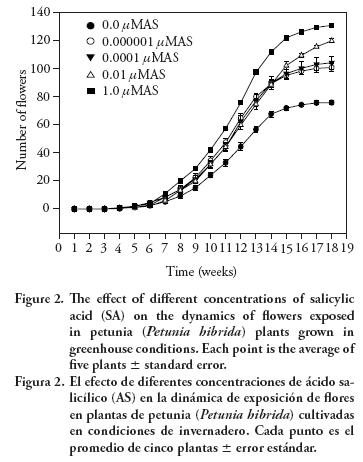
<body><![CDATA[<p align="justify"><font face="verdana" size="2"> &nbsp;</font></p>     <p align="justify"><font face="verdana" size="2"> <b>RESULTS AND DISCUSSION</b></font></p>     <p align="justify"><font face="verdana" size="2"> Results showed that applications of salicylic acid (SA) have a significant effect on the number of flowers per plant at the concentrations evaluated (<a href="#f1">Figure 1</a>). The curve pattern registered indicates that the best treatment was 1<i> &#956;</i>M which increased the number of flowers by 72 %, in comparison with that of the control, while the treatments of 0.01 <i>&#956;</i>M, 0.lnM, and lpM SA did by 58 %, 37 % and 33 %. Flowering initiated the third week after the first spraying and by the fifth week, the treatment of 1 <i>&#956;</i>MSA presented 20 flowers per plant, while the control had only 9 (<a href="#f2">Figure 2</a>).</font></p>     <p align="center"><font face="verdana" size="2"><a name="f1"></a></font></p>     <p align="center"><font face="verdana" size="2"><img src="/img/revistas/agro/v44n7/a4f1.jpg"></font></p>     <p align="center"><font face="verdana" size="2"><a name="f2"></a></font></p>     <p align="center"><font face="verdana" size="2"><img src="/img/revistas/agro/v44n7/a4f2.jpg"></font></p>     <p align="justify"><font face="verdana" size="2">The data of this experiment confirm that applications of low concentrations of SA to the shoot of seedlings affect the flowering of ornamental plants. However the sensitivity of plants to SA concentrations when compared with data recorded on similar experiments with two other ornamental plants is different. African violet required only 0.lnM to increase the number of flowers per plant, gloxinia 0.01 <i>&#956;</i>Mof SA and Petunia 1 <i>&#956;</i>Mof SA. It must be said, however, that in the three species studied SA induce early flowering (Martin&#150;Mex <i>et al., </i>2005).</font></p>     <p align="justify"><font face="verdana" size="2">The results of the present experiment agree with our previous reports that there is a great sensitivity of plant tissues to applications of low concentrations of SA. Transformed roots as well as somatic embryogenesis bioassay systems and the data of the present report suggest that it might be a complex mechanism of action of SA to explain such responses (Quiroz&#150;Figueroa <i>et al. </i>2001; Martin&#150;Mex <i>et al., </i>2005; Echevarria&#150;Machado <i>et al. </i>2007).</font></p>     <p align="justify"><font face="verdana" size="2">The results of the present report with petunia, a long day plant, correlate with the work reported by Cleland and Tanaka (1979) with <i>Lemna gibba, </i>where application of SA overcome the demand of photoperiod to flower. Photoperiods as well as thermo period have been described as critical for the expression of genes in the flowering process. The data of the present report might be linked to the seasonal flowering locus (SFL), a regulatory molecular mechanism that switches photoperiod and thermo period to flowering (Mouhu <i>et al. </i>2009).</font></p>     ]]></body>
<body><![CDATA[<p align="justify"><font face="verdana" size="2">Martinez <i>et al. </i>(2003) report that stress activates flowering in <i>Arabidopsis thaliana </i>via SA. Using a SA deficient mutant they show the importance of this molecule, that seems to induce flowering without the activations of well known genes, reported in the process such as <i>CONSTANTS </i>(CO) or <i>FLOWERING LOCUS </i>(FC). The present report could be linked with the proposal of these authors in the sense that SA induces flowering, following a novel and independent metabolic way. Besides, the use of SA might be a new tool for the molecular biologists as to elucidate the genes and mechanisms that regulate flowering, since this process is not fully understood.</font></p>     <p align="justify"><font face="verdana" size="2">The findings of the present report might be of importance for practical use in ornamental horticulture.</font></p>     <p align="justify"><font face="verdana" size="2">&nbsp;</font></p>     <p align="justify"><font face="verdana" size="2"><b>CONCLUSIONS</b></font></p>     <p align="justify"><font face="verdana" size="2">A dose response curve to estimate the effect of low concentrations of SA in the number of flowers in petunia plants was established. SA at 1 <i>&#956;</i>Mincreases up to 72 % the number of flowers per plant in comparison with the control. SA induced earliness in the flowering of petunia by six days.</font></p>     <p align="justify"><font face="verdana" size="2">&nbsp;</font></p>     <p align="justify"><font face="verdana" size="2"><b>ACKNOWLEDGEMENTS</b></font></p>     <p align="justify"><font face="verdana" size="2">To CONACYT Grant No. 33647&#150;B; to E. Bal&aacute;m Uc and G. Brice&ntilde;o for their technical support.</font></p>     <p align="justify"><font face="verdana" size="2">&nbsp;</font></p>     <p align="justify"><font face="verdana" size="2"><b>LITERATURE CITED</b></font></p>     ]]></body>
<body><![CDATA[<!-- ref --><p align="justify"><font face="verdana" size="2">Cleland, C. R, and O. Tanaka. 1979. Effect of day length on the ability of salicylic acid to induce flowering in the long&#150;day plant <i>Lemna gibba </i>G3 and the short&#150;day plant <i>Lemna paucicostata </i>6746. Plant Physiol. 64: 421&#150;424.    &nbsp;&nbsp;&nbsp;&nbsp;&nbsp;&nbsp;&nbsp;&nbsp;[&#160;<a href="javascript:void(0);" onclick="javascript: window.open('/scielo.php?script=sci_nlinks&ref=549717&pid=S1405-3195201000070000400001&lng=','','width=640,height=500,resizable=yes,scrollbars=1,menubar=yes,');">Links</a>&#160;]<!-- end-ref --></font></p>     <!-- ref --><p align="justify"><font face="verdana" size="2">Echeverr&iacute;a&#150;Machado I., R. M. Escobedo&#150;G.M., and A. Larqu&eacute;&#150;Saavedra. 2007. Responses of transformed <i>Catharanthus roseus </i>roots to femtomolar concentrations of salicylic acid. Plant Physiol. Biochem. 45:501&#150;507.    &nbsp;&nbsp;&nbsp;&nbsp;&nbsp;&nbsp;&nbsp;&nbsp;[&#160;<a href="javascript:void(0);" onclick="javascript: window.open('/scielo.php?script=sci_nlinks&ref=549719&pid=S1405-3195201000070000400002&lng=','','width=640,height=500,resizable=yes,scrollbars=1,menubar=yes,');">Links</a>&#160;]<!-- end-ref --></font></p>     <!-- ref --><p align="justify"><font face="verdana" size="2">Guti&eacute;rrez C., M, L.C. Trejo, and A. Larqu&eacute;&#150;Saavedra. 1998. Effects of salicylic acid on the growth of roots and shoots in soybean. Plant Physiol. Biochem. 36:(8) 563&#150;565.    &nbsp;&nbsp;&nbsp;&nbsp;&nbsp;&nbsp;&nbsp;&nbsp;[&#160;<a href="javascript:void(0);" onclick="javascript: window.open('/scielo.php?script=sci_nlinks&ref=549721&pid=S1405-3195201000070000400003&lng=','','width=640,height=500,resizable=yes,scrollbars=1,menubar=yes,');">Links</a>&#160;]<!-- end-ref --></font></p>     <!-- ref --><p align="justify"><font face="verdana" size="2">Hayat, S., B. Ali, and A. Ahmad. 2007. Salicylic acid: Biosynthesis, metabolism and physiological role in plants (Chapter 1). <i>In: </i>Hayat, S., and A. Ahmad (eds). Salicylic Acid&#150;A Plant Hormone. Springer, Dordrecht. The Netherlands, pp: 1&#150;14.    &nbsp;&nbsp;&nbsp;&nbsp;&nbsp;&nbsp;&nbsp;&nbsp;[&#160;<a href="javascript:void(0);" onclick="javascript: window.open('/scielo.php?script=sci_nlinks&ref=549723&pid=S1405-3195201000070000400004&lng=','','width=640,height=500,resizable=yes,scrollbars=1,menubar=yes,');">Links</a>&#160;]<!-- end-ref --></font></p>     <!-- ref --><p align="justify"><font face="verdana" size="2">Holuigue, L., P. Salinas, F. Blanco, and V. Garret&oacute;n. 2007. Salicylic acid and reactive oxygen species in the activation of stress defense genes (Chapter 8). <i>In: </i>Hayat, S., and A. Ahmad (eds). Salicylic Acid&#150;A Plant Hormone. Springer, Dordrecht. The Netherlands, pp: 197&#150;246.    &nbsp;&nbsp;&nbsp;&nbsp;&nbsp;&nbsp;&nbsp;&nbsp;[&#160;<a href="javascript:void(0);" onclick="javascript: window.open('/scielo.php?script=sci_nlinks&ref=549725&pid=S1405-3195201000070000400005&lng=','','width=640,height=500,resizable=yes,scrollbars=1,menubar=yes,');">Links</a>&#160;]<!-- end-ref --></font></p>     ]]></body>
<body><![CDATA[<!-- ref --><p align="justify"><font face="verdana" size="2">Kawano, T., and T. Furuichi. 2007. Salicylic acid and reactive oxygen species in the activation of stress defense genes (Chapter 10). <i>In: </i>Hayat, S., and A. Ahmad (eds). Salicylic Acid&#150;A Plant Hormone. Springer, Dordrecht. The Netherlands, pp: 277&#150;321.    &nbsp;&nbsp;&nbsp;&nbsp;&nbsp;&nbsp;&nbsp;&nbsp;[&#160;<a href="javascript:void(0);" onclick="javascript: window.open('/scielo.php?script=sci_nlinks&ref=549727&pid=S1405-3195201000070000400006&lng=','','width=640,height=500,resizable=yes,scrollbars=1,menubar=yes,');">Links</a>&#160;]<!-- end-ref --></font></p>     <!-- ref --><p align="justify"><font face="verdana" size="2"> Larqu&eacute;&#150;Saavedra, A., and R. L. Wain. 1974. Abscisic acid levels in relation to drought tolerance in varieties of<i> Zea mays </i>L. Nature 251(5477):716&#150;717.    &nbsp;&nbsp;&nbsp;&nbsp;&nbsp;&nbsp;&nbsp;&nbsp;[&#160;<a href="javascript:void(0);" onclick="javascript: window.open('/scielo.php?script=sci_nlinks&ref=549729&pid=S1405-3195201000070000400007&lng=','','width=640,height=500,resizable=yes,scrollbars=1,menubar=yes,');">Links</a>&#160;]<!-- end-ref --></font></p>     <!-- ref --><p align="justify"><font face="verdana" size="2">Larqu&eacute;&#150;Saavedra, A., and R. Martin&#150;Mex. 2007. Effects of salicylic acid on the bioproductivity of plants (Chapter 2). <i>In: </i>Hayat, S., and A. Ahmad (eds). Salicylic Acid&#150;A Plant Hormone. Springer, Dordrecht. The Netherlands, pp: 15&#150;23.    &nbsp;&nbsp;&nbsp;&nbsp;&nbsp;&nbsp;&nbsp;&nbsp;[&#160;<a href="javascript:void(0);" onclick="javascript: window.open('/scielo.php?script=sci_nlinks&ref=549731&pid=S1405-3195201000070000400008&lng=','','width=640,height=500,resizable=yes,scrollbars=1,menubar=yes,');">Links</a>&#160;]<!-- end-ref --></font></p>     <!-- ref --><p align="justify"><font face="verdana" size="2">L&oacute;pez&#150;Delgado, H., M. E. Mora&#150;Herrera, H. A. Zavaleta&#150;Mancera, M. Cadena&#150;Hinojosa, and I. M. Scott. 2004. Salicylic acid enhances heat tolerance and potato virus X (PVX) elimination during thermotherapy of potato microplants. Am. J. Potato Res. 81:171&#150;176.    &nbsp;&nbsp;&nbsp;&nbsp;&nbsp;&nbsp;&nbsp;&nbsp;[&#160;<a href="javascript:void(0);" onclick="javascript: window.open('/scielo.php?script=sci_nlinks&ref=549733&pid=S1405-3195201000070000400009&lng=','','width=640,height=500,resizable=yes,scrollbars=1,menubar=yes,');">Links</a>&#160;]<!-- end-ref --></font></p>     <!-- ref --><p align="justify"><font face="verdana" size="2"> Luo J. P., S. T. Jiang, and L. J. Pan. 2001. Enhanced somatic embryogenesis by salicylic acid of<i> Astragalus adsurgens </i>Pall.: relationship with H<sub>2</sub>O<sub>2</sub> production and H<sub>2</sub>O<sub>2</sub>&#150;metabolizing enzyme activities. Plant Sci. 161:125&#150;132.    &nbsp;&nbsp;&nbsp;&nbsp;&nbsp;&nbsp;&nbsp;&nbsp;[&#160;<a href="javascript:void(0);" onclick="javascript: window.open('/scielo.php?script=sci_nlinks&ref=549735&pid=S1405-3195201000070000400010&lng=','','width=640,height=500,resizable=yes,scrollbars=1,menubar=yes,');">Links</a>&#160;]<!-- end-ref --></font></p>     ]]></body>
<body><![CDATA[<!-- ref --><p align="justify"><font face="verdana" size="2">Mahdavian K., K.M. Kalantari, M. Ghorbanli, and M. Torkzade, 2008. The effects of salicylic acid on pigment contents in ultraviolet radiation stressed pepper plants. Biol. Plant. 52 (1): 170&#150;172.    &nbsp;&nbsp;&nbsp;&nbsp;&nbsp;&nbsp;&nbsp;&nbsp;[&#160;<a href="javascript:void(0);" onclick="javascript: window.open('/scielo.php?script=sci_nlinks&ref=549737&pid=S1405-3195201000070000400011&lng=','','width=640,height=500,resizable=yes,scrollbars=1,menubar=yes,');">Links</a>&#160;]<!-- end-ref --></font></p>     <!-- ref --><p align="justify"><font face="verdana" size="2">Martin&#150;Mex, R., E. Villanueva&#150;Couoh, T. Herrera&#150;Campos, and A. Larqu&eacute;&#150;Saavedra. 2005. Possitive effect of salicylates on the flowering of African violet. Scientia Horticulturae; 103 499&#150;502.    &nbsp;&nbsp;&nbsp;&nbsp;&nbsp;&nbsp;&nbsp;&nbsp;[&#160;<a href="javascript:void(0);" onclick="javascript: window.open('/scielo.php?script=sci_nlinks&ref=549739&pid=S1405-3195201000070000400012&lng=','','width=640,height=500,resizable=yes,scrollbars=1,menubar=yes,');">Links</a>&#160;]<!-- end-ref --></font></p>     <!-- ref --><p align="justify"><font face="verdana" size="2">Martinez, C, E. Pons, G. Prats, and J. Le&oacute;n. 2003. Salicylic acid regulates flowering time and links defence responses and reproductive development. Plant J. 37:2 209&#150;217.    &nbsp;&nbsp;&nbsp;&nbsp;&nbsp;&nbsp;&nbsp;&nbsp;[&#160;<a href="javascript:void(0);" onclick="javascript: window.open('/scielo.php?script=sci_nlinks&ref=549741&pid=S1405-3195201000070000400013&lng=','','width=640,height=500,resizable=yes,scrollbars=1,menubar=yes,');">Links</a>&#160;]<!-- end-ref --></font></p>     <!-- ref --><p align="justify"><font face="verdana" size="2">Mouhu, K., T. Hyt&oacute;nen, K. Folta, M. Rantanen, L. Paulin, P. Auvinen, and P. Elomaa. 2009. Identification of flowering genes in strawberry, a perennial SD plant. BMC Plant Biol. 9:122.    &nbsp;&nbsp;&nbsp;&nbsp;&nbsp;&nbsp;&nbsp;&nbsp;[&#160;<a href="javascript:void(0);" onclick="javascript: window.open('/scielo.php?script=sci_nlinks&ref=549743&pid=S1405-3195201000070000400014&lng=','','width=640,height=500,resizable=yes,scrollbars=1,menubar=yes,');">Links</a>&#160;]<!-- end-ref --></font></p>     <!-- ref --><p align="justify"><font face="verdana" size="2">Quiroz&#150;Figueroa F, M. M&eacute;ndez&#150;Zel, A. Larqu&eacute;&#150;Saavedra, and V.M. Loyola&#150;Vargas. 2001. Picomolar concentrations of salicylates induce cellular growth and enhance somatic embryiogenesis in <i>Coffea ar&aacute;bica </i>tissue culture. Plant Cell Rep. 20:679&#150;684.    &nbsp;&nbsp;&nbsp;&nbsp;&nbsp;&nbsp;&nbsp;&nbsp;[&#160;<a href="javascript:void(0);" onclick="javascript: window.open('/scielo.php?script=sci_nlinks&ref=549745&pid=S1405-3195201000070000400015&lng=','','width=640,height=500,resizable=yes,scrollbars=1,menubar=yes,');">Links</a>&#160;]<!-- end-ref --></font></p>     ]]></body>
<body><![CDATA[<!-- ref --><p align="justify"><font face="verdana" size="2">Raskin, I. 1992. Role of salicylic acid in plants. Annu. Rev. Plant Physiol. and Plant Mol. Biol. 43:439&#150;463.    &nbsp;&nbsp;&nbsp;&nbsp;&nbsp;&nbsp;&nbsp;&nbsp;[&#160;<a href="javascript:void(0);" onclick="javascript: window.open('/scielo.php?script=sci_nlinks&ref=549747&pid=S1405-3195201000070000400016&lng=','','width=640,height=500,resizable=yes,scrollbars=1,menubar=yes,');">Links</a>&#160;]<!-- end-ref --></font></p>     <!-- ref --><p align="justify"><font face="verdana" size="2"> San Miguel R., M. Guti&eacute;rrez and A. Larqu&eacute;&#150;Saavedra. 2003. Salicylic acid increases the biomass accumulation of<i> Pinus <i>patula. </i>Appl. Forestry, </i>27:52&#150;54.    &nbsp;&nbsp;&nbsp;&nbsp;&nbsp;&nbsp;&nbsp;&nbsp;[&#160;<a href="javascript:void(0);" onclick="javascript: window.open('/scielo.php?script=sci_nlinks&ref=549749&pid=S1405-3195201000070000400017&lng=','','width=640,height=500,resizable=yes,scrollbars=1,menubar=yes,');">Links</a>&#160;]<!-- end-ref --></font></p>     <!-- ref --><p align="justify"><font face="verdana" size="2">SAS Institute Inc. 2003. The Analyst Application. Second Edition. Cary, NC, USA. 500 p.    &nbsp;&nbsp;&nbsp;&nbsp;&nbsp;&nbsp;&nbsp;&nbsp;[&#160;<a href="javascript:void(0);" onclick="javascript: window.open('/scielo.php?script=sci_nlinks&ref=549751&pid=S1405-3195201000070000400018&lng=','','width=640,height=500,resizable=yes,scrollbars=1,menubar=yes,');">Links</a>&#160;]<!-- end-ref --></font></p>     <!-- ref --><p align="justify"><font face="verdana" size="2"> Shah, J. 2003. The salicylic acid loop in plant defense. <i>Curr,<i>Opin. </i>Plant. Biol</i>. 6:365&#150;371.    &nbsp;&nbsp;&nbsp;&nbsp;&nbsp;&nbsp;&nbsp;&nbsp;[&#160;<a href="javascript:void(0);" onclick="javascript: window.open('/scielo.php?script=sci_nlinks&ref=549753&pid=S1405-3195201000070000400019&lng=','','width=640,height=500,resizable=yes,scrollbars=1,menubar=yes,');">Links</a>&#160;]<!-- end-ref --><i>&nbsp; &nbsp; &nbsp; &nbsp; &nbsp; &nbsp; &nbsp;</i></font></p>     <!-- ref --><p align="justify"><font face="verdana" size="2"> Senaratna T., D. Touchell, E. Bunn, and K. Dixon. 2000. Acetyl salicylic acid (Aspirin) and salicylic acid induce multiple stress tolerance in bean and tomato plants. Plant Growth Reg. 30:157&#150;161.    &nbsp;&nbsp;&nbsp;&nbsp;&nbsp;&nbsp;&nbsp;&nbsp;[&#160;<a href="javascript:void(0);" onclick="javascript: window.open('/scielo.php?script=sci_nlinks&ref=549755&pid=S1405-3195201000070000400020&lng=','','width=640,height=500,resizable=yes,scrollbars=1,menubar=yes,');">Links</a>&#160;]<!-- end-ref --></font></p>     ]]></body>
<body><![CDATA[ ]]></body><back>
<ref-list>
<ref id="B1">
<nlm-citation citation-type="journal">
<person-group person-group-type="author">
<name>
<surname><![CDATA[Cleland]]></surname>
<given-names><![CDATA[C. R]]></given-names>
</name>
<name>
<surname><![CDATA[Tanaka]]></surname>
<given-names><![CDATA[O]]></given-names>
</name>
</person-group>
<article-title xml:lang="en"><![CDATA[Effect of day length on the ability of salicylic acid to induce flowering in the long-day plant Lemna gibba G3 and the short-day plant Lemna paucicostata 6746]]></article-title>
<source><![CDATA[Plant Physiol.]]></source>
<year>1979</year>
<volume>64</volume>
<page-range>421-424</page-range></nlm-citation>
</ref>
<ref id="B2">
<nlm-citation citation-type="journal">
<person-group person-group-type="author">
<name>
<surname><![CDATA[Echeverría-Machado]]></surname>
<given-names><![CDATA[I]]></given-names>
</name>
<name>
<surname><![CDATA[Escobedo-G.M.]]></surname>
<given-names><![CDATA[R. M.]]></given-names>
</name>
<name>
<surname><![CDATA[Larqué-Saavedra]]></surname>
<given-names><![CDATA[A]]></given-names>
</name>
</person-group>
<article-title xml:lang="en"><![CDATA[Responses of transformed Catharanthus roseus roots to femtomolar concentrations of salicylic acid]]></article-title>
<source><![CDATA[Plant Physiol. Biochem.]]></source>
<year>2007</year>
<volume>45</volume>
<page-range>501-507</page-range></nlm-citation>
</ref>
<ref id="B3">
<nlm-citation citation-type="journal">
<person-group person-group-type="author">
<name>
<surname><![CDATA[Gutiérrez]]></surname>
<given-names><![CDATA[C. M]]></given-names>
</name>
<name>
<surname><![CDATA[Trejo]]></surname>
<given-names><![CDATA[L.C.]]></given-names>
</name>
<name>
<surname><![CDATA[Larqué-Saavedra]]></surname>
<given-names><![CDATA[A]]></given-names>
</name>
</person-group>
<article-title xml:lang="en"><![CDATA[Effects of salicylic acid on the growth of roots and shoots in soybean]]></article-title>
<source><![CDATA[Plant Physiol. Biochem.]]></source>
<year>1998</year>
<volume>36</volume>
<numero>8</numero>
<issue>8</issue>
<page-range>563-565</page-range></nlm-citation>
</ref>
<ref id="B4">
<nlm-citation citation-type="book">
<person-group person-group-type="author">
<name>
<surname><![CDATA[Hayat]]></surname>
<given-names><![CDATA[S]]></given-names>
</name>
<name>
<surname><![CDATA[Ali]]></surname>
<given-names><![CDATA[B]]></given-names>
</name>
<name>
<surname><![CDATA[Ahmad]]></surname>
<given-names><![CDATA[A]]></given-names>
</name>
</person-group>
<article-title xml:lang="en"><![CDATA[Salicylic acid: Biosynthesis, metabolism and physiological role in plants (Chapter 1)]]></article-title>
<person-group person-group-type="editor">
<name>
<surname><![CDATA[Hayat]]></surname>
<given-names><![CDATA[S]]></given-names>
</name>
<name>
<surname><![CDATA[Ahmad]]></surname>
<given-names><![CDATA[A]]></given-names>
</name>
</person-group>
<source><![CDATA[Salicylic Acid-A Plant Hormone]]></source>
<year>2007</year>
<page-range>1-14</page-range><publisher-loc><![CDATA[Dordrecht ]]></publisher-loc>
<publisher-name><![CDATA[Springer]]></publisher-name>
</nlm-citation>
</ref>
<ref id="B5">
<nlm-citation citation-type="book">
<person-group person-group-type="author">
<name>
<surname><![CDATA[Holuigue]]></surname>
<given-names><![CDATA[L]]></given-names>
</name>
<name>
<surname><![CDATA[Salinas]]></surname>
<given-names><![CDATA[P]]></given-names>
</name>
<name>
<surname><![CDATA[Blanco]]></surname>
<given-names><![CDATA[F]]></given-names>
</name>
<name>
<surname><![CDATA[Garretón]]></surname>
<given-names><![CDATA[V]]></given-names>
</name>
</person-group>
<article-title xml:lang="en"><![CDATA[Salicylic acid and reactive oxygen species in the activation of stress defense genes (Chapter 8)]]></article-title>
<person-group person-group-type="editor">
<name>
<surname><![CDATA[Hayat]]></surname>
<given-names><![CDATA[S]]></given-names>
</name>
<name>
<surname><![CDATA[Ahmad]]></surname>
<given-names><![CDATA[A]]></given-names>
</name>
</person-group>
<source><![CDATA[Salicylic Acid-A Plant Hormone]]></source>
<year>2007</year>
<page-range>197-246</page-range><publisher-loc><![CDATA[Dordrecht ]]></publisher-loc>
<publisher-name><![CDATA[Springer]]></publisher-name>
</nlm-citation>
</ref>
<ref id="B6">
<nlm-citation citation-type="book">
<person-group person-group-type="author">
<name>
<surname><![CDATA[Kawano]]></surname>
<given-names><![CDATA[T]]></given-names>
</name>
<name>
<surname><![CDATA[Furuichi]]></surname>
<given-names><![CDATA[T]]></given-names>
</name>
</person-group>
<article-title xml:lang="en"><![CDATA[Salicylic acid and reactive oxygen species in the activation of stress defense genes (Chapter 10)]]></article-title>
<person-group person-group-type="editor">
<name>
<surname><![CDATA[Hayat]]></surname>
<given-names><![CDATA[S]]></given-names>
</name>
<name>
<surname><![CDATA[Ahmad]]></surname>
<given-names><![CDATA[A]]></given-names>
</name>
</person-group>
<source><![CDATA[Salicylic Acid-A Plant Hormone]]></source>
<year>2007</year>
<page-range>277-321</page-range><publisher-loc><![CDATA[Dordrecht ]]></publisher-loc>
<publisher-name><![CDATA[Springer]]></publisher-name>
</nlm-citation>
</ref>
<ref id="B7">
<nlm-citation citation-type="journal">
<person-group person-group-type="author">
<name>
<surname><![CDATA[Larqué-Saavedra]]></surname>
<given-names><![CDATA[A]]></given-names>
</name>
<name>
<surname><![CDATA[Wain]]></surname>
<given-names><![CDATA[R. L.]]></given-names>
</name>
</person-group>
<article-title xml:lang="en"><![CDATA[Abscisic acid levels in relation to drought tolerance in varieties of Zea mays L]]></article-title>
<source><![CDATA[Nature]]></source>
<year>1974</year>
<volume>251</volume>
<numero>5477</numero>
<issue>5477</issue>
<page-range>716-717</page-range></nlm-citation>
</ref>
<ref id="B8">
<nlm-citation citation-type="book">
<person-group person-group-type="author">
<name>
<surname><![CDATA[Larqué-Saavedra]]></surname>
<given-names><![CDATA[A]]></given-names>
</name>
<name>
<surname><![CDATA[Martin-Mex]]></surname>
<given-names><![CDATA[R]]></given-names>
</name>
</person-group>
<article-title xml:lang="en"><![CDATA[Effects of salicylic acid on the bioproductivity of plants (Chapter 2)]]></article-title>
<person-group person-group-type="editor">
<name>
<surname><![CDATA[Hayat]]></surname>
<given-names><![CDATA[S]]></given-names>
</name>
<name>
<surname><![CDATA[Ahmad]]></surname>
<given-names><![CDATA[A]]></given-names>
</name>
</person-group>
<source><![CDATA[Salicylic Acid-A Plant Hormone]]></source>
<year>2007</year>
<page-range>15-23</page-range><publisher-loc><![CDATA[Dordrecht ]]></publisher-loc>
<publisher-name><![CDATA[Springer]]></publisher-name>
</nlm-citation>
</ref>
<ref id="B9">
<nlm-citation citation-type="journal">
<person-group person-group-type="author">
<name>
<surname><![CDATA[López-Delgado]]></surname>
<given-names><![CDATA[H]]></given-names>
</name>
<name>
<surname><![CDATA[Mora-Herrera]]></surname>
<given-names><![CDATA[M. E.]]></given-names>
</name>
<name>
<surname><![CDATA[Zavaleta-Mancera]]></surname>
<given-names><![CDATA[H. A.]]></given-names>
</name>
<name>
<surname><![CDATA[Cadena-Hinojosa]]></surname>
<given-names><![CDATA[M]]></given-names>
</name>
<name>
<surname><![CDATA[Scott]]></surname>
<given-names><![CDATA[I. M.]]></given-names>
</name>
</person-group>
<article-title xml:lang="en"><![CDATA[Salicylic acid enhances heat tolerance and potato virus X (PVX) elimination during thermotherapy of potato microplants]]></article-title>
<source><![CDATA[Am. J. Potato Res.]]></source>
<year>2004</year>
<volume>81</volume>
<page-range>171-176</page-range></nlm-citation>
</ref>
<ref id="B10">
<nlm-citation citation-type="journal">
<person-group person-group-type="author">
<name>
<surname><![CDATA[Luo]]></surname>
<given-names><![CDATA[J. P.]]></given-names>
</name>
<name>
<surname><![CDATA[Jiang]]></surname>
<given-names><![CDATA[S. T.]]></given-names>
</name>
<name>
<surname><![CDATA[Pan]]></surname>
<given-names><![CDATA[L. J.]]></given-names>
</name>
</person-group>
<article-title xml:lang="en"><![CDATA[Enhanced somatic embryogenesis by salicylic acid of Astragalus adsurgens Pall.: relationship with H2O2 production and H2O2-metabolizing enzyme activities]]></article-title>
<source><![CDATA[Plant Sci.]]></source>
<year>2001</year>
<volume>161</volume>
<page-range>125-132</page-range></nlm-citation>
</ref>
<ref id="B11">
<nlm-citation citation-type="journal">
<person-group person-group-type="author">
<name>
<surname><![CDATA[Mahdavian]]></surname>
<given-names><![CDATA[K]]></given-names>
</name>
<name>
<surname><![CDATA[Kalantari]]></surname>
<given-names><![CDATA[K.M.]]></given-names>
</name>
<name>
<surname><![CDATA[Ghorbanli]]></surname>
<given-names><![CDATA[M]]></given-names>
</name>
<name>
<surname><![CDATA[Torkzade]]></surname>
<given-names><![CDATA[M]]></given-names>
</name>
</person-group>
<article-title xml:lang="en"><![CDATA[The effects of salicylic acid on pigment contents in ultraviolet radiation stressed pepper plants]]></article-title>
<source><![CDATA[Biol. Plant.]]></source>
<year>2008</year>
<volume>52</volume>
<numero>1</numero>
<issue>1</issue>
<page-range>170-172</page-range></nlm-citation>
</ref>
<ref id="B12">
<nlm-citation citation-type="journal">
<person-group person-group-type="author">
<name>
<surname><![CDATA[Martin-Mex]]></surname>
<given-names><![CDATA[R]]></given-names>
</name>
<name>
<surname><![CDATA[Villanueva-Couoh]]></surname>
<given-names><![CDATA[E]]></given-names>
</name>
<name>
<surname><![CDATA[Herrera-Campos]]></surname>
<given-names><![CDATA[T]]></given-names>
</name>
<name>
<surname><![CDATA[Larqué-Saavedra]]></surname>
<given-names><![CDATA[A]]></given-names>
</name>
</person-group>
<article-title xml:lang="en"><![CDATA[Possitive effect of salicylates on the flowering of African violet]]></article-title>
<source><![CDATA[Scientia Horticulturae]]></source>
<year>2005</year>
<volume>103</volume>
<page-range>499-502</page-range></nlm-citation>
</ref>
<ref id="B13">
<nlm-citation citation-type="journal">
<person-group person-group-type="author">
<name>
<surname><![CDATA[Martinez]]></surname>
<given-names><![CDATA[C]]></given-names>
</name>
<name>
<surname><![CDATA[Pons]]></surname>
<given-names><![CDATA[E]]></given-names>
</name>
<name>
<surname><![CDATA[Prats]]></surname>
<given-names><![CDATA[G]]></given-names>
</name>
<name>
<surname><![CDATA[León]]></surname>
<given-names><![CDATA[J]]></given-names>
</name>
</person-group>
<article-title xml:lang="en"><![CDATA[Salicylic acid regulates flowering time and links defence responses and reproductive development]]></article-title>
<source><![CDATA[Plant J.]]></source>
<year>2003</year>
<volume>37</volume>
<numero>2</numero>
<issue>2</issue>
<page-range>209-217</page-range></nlm-citation>
</ref>
<ref id="B14">
<nlm-citation citation-type="journal">
<person-group person-group-type="author">
<name>
<surname><![CDATA[Mouhu]]></surname>
<given-names><![CDATA[K]]></given-names>
</name>
<name>
<surname><![CDATA[Hytónen]]></surname>
<given-names><![CDATA[T]]></given-names>
</name>
<name>
<surname><![CDATA[Folta]]></surname>
<given-names><![CDATA[K]]></given-names>
</name>
<name>
<surname><![CDATA[Rantanen]]></surname>
<given-names><![CDATA[M]]></given-names>
</name>
<name>
<surname><![CDATA[Paulin]]></surname>
<given-names><![CDATA[L]]></given-names>
</name>
<name>
<surname><![CDATA[Auvinen]]></surname>
<given-names><![CDATA[P]]></given-names>
</name>
<name>
<surname><![CDATA[Elomaa]]></surname>
<given-names><![CDATA[P]]></given-names>
</name>
</person-group>
<article-title xml:lang="en"><![CDATA[Identification of flowering genes in strawberry, a perennial SD plant]]></article-title>
<source><![CDATA[BMC Plant Biol.]]></source>
<year>2009</year>
<volume>9</volume>
<page-range>122</page-range></nlm-citation>
</ref>
<ref id="B15">
<nlm-citation citation-type="journal">
<person-group person-group-type="author">
<name>
<surname><![CDATA[Quiroz-Figueroa]]></surname>
<given-names><![CDATA[F]]></given-names>
</name>
<name>
<surname><![CDATA[Méndez-Zel]]></surname>
<given-names><![CDATA[M]]></given-names>
</name>
<name>
<surname><![CDATA[Larqué-Saavedra]]></surname>
<given-names><![CDATA[A]]></given-names>
</name>
<name>
<surname><![CDATA[Loyola-Vargas]]></surname>
<given-names><![CDATA[V.M.]]></given-names>
</name>
</person-group>
<article-title xml:lang="en"><![CDATA[Picomolar concentrations of salicylates induce cellular growth and enhance somatic embryiogenesis in Coffea arábica tissue culture]]></article-title>
<source><![CDATA[Plant Cell Rep.]]></source>
<year>2001</year>
<volume>20</volume>
<page-range>679-684</page-range></nlm-citation>
</ref>
<ref id="B16">
<nlm-citation citation-type="journal">
<person-group person-group-type="author">
<name>
<surname><![CDATA[Raskin]]></surname>
<given-names><![CDATA[I]]></given-names>
</name>
</person-group>
<article-title xml:lang="en"><![CDATA[Role of salicylic acid in plants]]></article-title>
<source><![CDATA[Annu. Rev. Plant Physiol. and Plant Mol. Biol.]]></source>
<year>1992</year>
<volume>43</volume>
<page-range>439-463</page-range></nlm-citation>
</ref>
<ref id="B17">
<nlm-citation citation-type="journal">
<person-group person-group-type="author">
<name>
<surname><![CDATA[San Miguel]]></surname>
<given-names><![CDATA[R]]></given-names>
</name>
<name>
<surname><![CDATA[Gutiérrez]]></surname>
<given-names><![CDATA[M]]></given-names>
</name>
<name>
<surname><![CDATA[Larqué-Saavedra]]></surname>
<given-names><![CDATA[A]]></given-names>
</name>
</person-group>
<article-title xml:lang="en"><![CDATA[Salicylic acid increases the biomass accumulation of Pinus patula]]></article-title>
<source><![CDATA[Appl. Forestry]]></source>
<year>2003</year>
<volume>27</volume>
<page-range>52-54</page-range></nlm-citation>
</ref>
<ref id="B18">
<nlm-citation citation-type="">
<collab>SAS Institute</collab>
<source><![CDATA[The Analyst Application]]></source>
<year>2003</year>
<edition>Second</edition>
<page-range>500</page-range><publisher-loc><![CDATA[Cary^eNC NC]]></publisher-loc>
</nlm-citation>
</ref>
<ref id="B19">
<nlm-citation citation-type="journal">
<person-group person-group-type="author">
<name>
<surname><![CDATA[Shah]]></surname>
<given-names><![CDATA[J]]></given-names>
</name>
</person-group>
<article-title xml:lang="en"><![CDATA[The salicylic acid loop in plant defense]]></article-title>
<source><![CDATA[Curr,Opin. Plant. Biol.]]></source>
<year>2003</year>
<volume>6</volume>
<page-range>365-371</page-range></nlm-citation>
</ref>
<ref id="B20">
<nlm-citation citation-type="journal">
<person-group person-group-type="author">
<name>
<surname><![CDATA[Senaratna]]></surname>
<given-names><![CDATA[T]]></given-names>
</name>
<name>
<surname><![CDATA[Touchell]]></surname>
<given-names><![CDATA[D]]></given-names>
</name>
<name>
<surname><![CDATA[Bunn]]></surname>
<given-names><![CDATA[E]]></given-names>
</name>
<name>
<surname><![CDATA[Dixon]]></surname>
<given-names><![CDATA[K]]></given-names>
</name>
</person-group>
<article-title xml:lang="en"><![CDATA[Acetyl salicylic acid (Aspirin) and salicylic acid induce multiple stress tolerance in bean and tomato plants]]></article-title>
<source><![CDATA[Plant Growth Reg.]]></source>
<year>2000</year>
<volume>30</volume>
<page-range>157-161</page-range></nlm-citation>
</ref>
</ref-list>
</back>
</article>