<?xml version="1.0" encoding="ISO-8859-1"?><article xmlns:mml="http://www.w3.org/1998/Math/MathML" xmlns:xlink="http://www.w3.org/1999/xlink" xmlns:xsi="http://www.w3.org/2001/XMLSchema-instance">
<front>
<journal-meta>
<journal-id>1405-3195</journal-id>
<journal-title><![CDATA[Agrociencia]]></journal-title>
<abbrev-journal-title><![CDATA[Agrociencia]]></abbrev-journal-title>
<issn>1405-3195</issn>
<publisher>
<publisher-name><![CDATA[Colegio de Postgraduados]]></publisher-name>
</publisher>
</journal-meta>
<article-meta>
<article-id>S1405-31952009000800005</article-id>
<title-group>
<article-title xml:lang="en"><![CDATA[Effect of integrated application of sulphur and phosphorus on nitrogen fixation and nutrient uptake by Chickpea (Cicer arietinum L.)]]></article-title>
<article-title xml:lang="es"><![CDATA[Efecto de la aplicación de azufre-fósforo sobre la fijación de nitrógeno y la captación de nutrientes en garbanzo (Cicer arietinum L.)]]></article-title>
</title-group>
<contrib-group>
<contrib contrib-type="author">
<name>
<surname><![CDATA[Islam]]></surname>
<given-names><![CDATA[Muhammad]]></given-names>
</name>
<xref ref-type="aff" rid="A01"/>
</contrib>
<contrib contrib-type="author">
<name>
<surname><![CDATA[Safdar]]></surname>
<given-names><![CDATA[Ali]]></given-names>
</name>
<xref ref-type="aff" rid="A01"/>
</contrib>
</contrib-group>
<aff id="A01">
<institution><![CDATA[,PMAS- Arid Agriculture University Department of Soil Science & SWC ]]></institution>
<addr-line><![CDATA[Rawalpindi ]]></addr-line>
<country>Pakistan</country>
</aff>
<pub-date pub-type="pub">
<day>00</day>
<month>12</month>
<year>2009</year>
</pub-date>
<pub-date pub-type="epub">
<day>00</day>
<month>12</month>
<year>2009</year>
</pub-date>
<volume>43</volume>
<numero>8</numero>
<fpage>815</fpage>
<lpage>826</lpage>
<copyright-statement/>
<copyright-year/>
<self-uri xlink:href="http://www.scielo.org.mx/scielo.php?script=sci_arttext&amp;pid=S1405-31952009000800005&amp;lng=en&amp;nrm=iso"></self-uri><self-uri xlink:href="http://www.scielo.org.mx/scielo.php?script=sci_abstract&amp;pid=S1405-31952009000800005&amp;lng=en&amp;nrm=iso"></self-uri><self-uri xlink:href="http://www.scielo.org.mx/scielo.php?script=sci_pdf&amp;pid=S1405-31952009000800005&amp;lng=en&amp;nrm=iso"></self-uri><abstract abstract-type="short" xml:lang="en"><p><![CDATA[Nitrogen fixing capability of legumes can be enhanced by the supply of adequate amounts of nutrients, especially phosphorus (P) and sulphur (S). However, combined application of P and S may have synefgistic oí antognistic effects on crop yield, depending upon initial fertility status of soil, level of nutrients applied and test crop used. Field experiments were conducted at two different locations (Barani Agriculture Research Institute, Chakwal, and farmer's field, Talagang) in northern fainfed Punjab, Pakistan, to assess nodulation, nitrogen fixation and nutrient uptake by chickpea (Cicer arietinum L.) in response to application of P (0, 40 and 80 kg ha-1) and of S (0, 15 and 30 kg ha-1) in different combinations. Application of P and S significantly increased seed yield (27 to 41 % and 7 to 11 %) over control. Sulphur application increased N derived from ah- (% Ndfa) by 5 to 7 % over control; however, P application had no significant effect on Ndfa. Both P and S application increased N fixation (16 to 40 % and 15 to 22 %) over control. Nutrient uptake (N, P and S) increased significantly with the application of both P and S. There was a wreak correlation between P uptake and % Ndfa (R=0.28*) but a positive correlation between S uptake and % Ndfa (R=0.76**). Phosphorus (R=0.56") and sulphur (R=0.97**) uptake correlated positively with N fixation.]]></p></abstract>
<abstract abstract-type="short" xml:lang="es"><p><![CDATA[La capacidad de las leguminosas para asimilar el nitrógeno puede incrementarse si se suministran cantidades adecuadas de nutrientes, específicamente fósforo (P) y azufre (S). Sin embargo, la aplicación combinada de P y S puede tener efectos sinérgicos o antagónicos en el rendimiento del cultivo, dependiendo del estatus inicial de fertilidad del suelo, del nivel de nutrientes suministrados, así como del cultivo de prueba utilizado. Los experimentos de campo se realizaron en dos áreas (Barani Research Institute, Chakwal, y el campo agrícola de Talagang) de secano en el norte de Punjab, Pakistán, para evaluar nodulación, fijación de nitrógeno (N) y captación de nutrientes en el garbanzo (Cicer arietinum L.) en respuesta a la aplicación de P (0, 40 y 80 kg ha-1) y de S (0, 15 y 30 kg ha-1) en distintas combinaciones. La aplicación de P y S incrementó significativamente el rendimiento de semilla (27 % a 41 % y 7 % a 11 °/o) respecto al testigo. La aplicación de S aumentó el N derivado del aire (% Ndfa) en 5 % respecto al testigo; sin embargo la aplicación de P no tuvo un efecto significativo en Ndfa. La aplicación tanto de P como de S incrementó la fijación de N (16 % a 40 % y 15 % a 22 %) respecto al testigo. La captación de nutrientes (N, P y S) aumentó significativamente con la aplicación tanto de P como de S. Hubo una ligera correlación entre la captación de P y % Ndfa (R = 0.28*), y una correlación positiva entre la captación de S y % Ndfa (R=0.76**). La captación tanto de P (R=0.56**) como de S (R=0.97**) se correlacionó positivamente con la fijación de N.]]></p></abstract>
<kwd-group>
<kwd lng="en"><![CDATA[Legume]]></kwd>
<kwd lng="en"><![CDATA[mineral nutrition]]></kwd>
<kwd lng="en"><![CDATA[natural abundance technique]]></kwd>
<kwd lng="en"><![CDATA[nitrogen derived from air]]></kwd>
<kwd lng="es"><![CDATA[Leguminosas]]></kwd>
<kwd lng="es"><![CDATA[nutrición mineral]]></kwd>
<kwd lng="es"><![CDATA[método de abundancia natural]]></kwd>
<kwd lng="es"><![CDATA[nitrógeno derivado del aire]]></kwd>
</kwd-group>
</article-meta>
</front><body><![CDATA[ <p align="justify"><font face="verdana" size="4">Fitociencia</font></p>     <p align="justify"><font face="verdana" size="4">&nbsp;</font></p>     <p align="center"><font face="verdana" size="4"><b>Effect of integrated application of sulphur and phosphorus on nitrogen fixation and nutrient uptake by Chickpea (<i>Cicer arietinum </i>L.)</b></font></p>     <p align="center"><font face="verdana" size="4">&nbsp;</font></p>     <p align="center"><font face="verdana" size="3"><b>Efecto de la aplicaci&oacute;n de azufre&#150;f&oacute;sforo sobre la fijaci&oacute;n de nitr&oacute;geno y la captaci&oacute;n de nutrientes en garbanzo (<i>Cicer arietinum </i>L.)</b></font></p>     <p align="center"><font face="verdana" size="3">&nbsp;</font></p>     <p align="center"><font face="verdana" size="2"><b>Muhammad Islam<sup>*</sup>, Safdar Ali</b></font></p>     <p align="justify"><font face="verdana" size="2">&nbsp;</font></p>     <p align="justify"><font face="verdana" size="2"><i>Department of Soil Science &amp; SWC, PMAS&#150; Arid Agriculture University, Rawalpindi&#150;46300 Pakistan. *Autor responsable:</i> (<a href="mailto:islamuaf@gmail.com">islamuaf@gmail.com</a>)</font></p>     <p align="justify"><font face="verdana" size="2">&nbsp;</font></p>     ]]></body>
<body><![CDATA[<p align="justify"><font face="verdana" size="2">Recibido: Julio, 2008.    <br> Aprobado: Julio, 2009.</font></p>     <p align="justify"><font face="verdana" size="2">&nbsp;</font></p>     <p align="justify"><font face="verdana" size="2"><b>ABSTRACT</b></font></p>     <p align="justify"><font face="verdana" size="2">Nitrogen fixing capability of legumes can be enhanced by the supply of adequate amounts of nutrients, especially phosphorus (P) and sulphur (S). However, combined application of P and S may have synefgistic o&iacute; antognistic effects on crop yield, depending upon initial fertility status of soil, level of nutrients applied and test crop used. Field experiments were conducted at two different locations (Barani Agriculture Research Institute, Chakwal, and farmer's field, Talagang) in northern fainfed Punjab, Pakistan, to assess nodulation, nitrogen fixation and nutrient uptake by chickpea (<i>Cicer arietinum </i>L.) in response to application of P (0, 40 and 80 kg ha<sup>&#150;1</sup>) and of S (0, 15 and 30 kg ha<sup>&#150;1</sup>) in different combinations. Application of P and S significantly increased seed yield (27 to 41 % and 7 to 11 <i>%) </i>over control. Sulphur application increased N derived from ah&#150; (% N<sub>dfa</sub>) by 5 to 7 % over control; however, P application had no significant effect on N<sub>dfa</sub>. Both P and S application increased N fixation (16 to 40 % and 15 to 22 %<i>) </i>over control. Nutrient uptake (N, P and S) increased significantly with the application of both P and S. There was a wreak correlation between P uptake and % N<sub>dfa</sub> (R=0.28*) but a positive correlation between S uptake and % N<sub>dfa</sub> (R=0.76**). Phosphorus (R=0.56") and sulphur (R=0.97**) uptake correlated positively with N fixation.</font></p>     <p align="justify"><font face="verdana" size="2"><b>Key words:</b> Legume, mineral nutrition, natural abundance technique, nitrogen derived from air.</font></p>     <p align="justify"><font face="verdana" size="2">&nbsp;</font></p>     <p align="justify"><font face="verdana" size="2"><b>RESUMEN</b></font></p>     <p align="justify"><font face="verdana" size="2">La capacidad de las leguminosas para asimilar el nitr&oacute;geno puede incrementarse si se suministran cantidades adecuadas de nutrientes, espec&iacute;ficamente f&oacute;sforo (P) y azufre (S). Sin embargo, la aplicaci&oacute;n combinada de P y S puede tener efectos sin&eacute;rgicos o antag&oacute;nicos en el rendimiento del cultivo, dependiendo del estatus inicial de fertilidad del suelo, del nivel de nutrientes suministrados, as&iacute; como del cultivo de prueba utilizado. Los experimentos de campo se realizaron en dos &aacute;reas (Barani Research Institute, Chakwal, y el campo agr&iacute;cola de Talagang) de secano en el norte de Punjab, Pakist&aacute;n, para evaluar nodulaci&oacute;n, fijaci&oacute;n de nitr&oacute;geno (N) y captaci&oacute;n de nutrientes en el garbanzo (<i>Cicer arietinum </i>L.) en respuesta a la aplicaci&oacute;n de P (0, 40 y 80 kg ha<sup>&#150;1</sup>) y de S (0, 15 y 30 kg ha<sup>&#150;1</sup>) en distintas combinaciones. La aplicaci&oacute;n de P y S increment&oacute; significativamente el rendimiento de semilla (27 % a 41 % y 7 % a 11 &deg;/o) respecto al testigo. La aplicaci&oacute;n de S aument&oacute; el N derivado del aire (% N<sub>dfa</sub>) en 5 % respecto al testigo; sin embargo la aplicaci&oacute;n de P no tuvo un efecto significativo en N<sub>dfa</sub>. La aplicaci&oacute;n tanto de P como de S increment&oacute; la fijaci&oacute;n de N (16 % a 40 % y 15 % a 22 %) respecto al testigo. La captaci&oacute;n de nutrientes (N, P y S) aument&oacute; significativamente con la aplicaci&oacute;n tanto de P como de S. Hubo una ligera correlaci&oacute;n entre la captaci&oacute;n de P y % N<sub>dfa</sub> (R = 0.28*), y una correlaci&oacute;n positiva entre la captaci&oacute;n de S y % N<sub>dfa</sub> (R=0.76**). La captaci&oacute;n tanto de P (R=0.56**) como de S (R=0.97**) se correlacion&oacute; positivamente con la fijaci&oacute;n de N.</font></p>     <p align="justify"><font face="verdana" size="2"><b>Palabras clave:</b> Leguminosas, nutrici&oacute;n mineral, m&eacute;todo de abundancia natural, nitr&oacute;geno derivado del aire.</font></p>     ]]></body>
<body><![CDATA[<p align="justify"><font face="verdana" size="2">&nbsp;</font></p>     <p align="justify"><font face="verdana" size="2"><b> INTRODUCTION </b></font></p>     <p align="justify"><font face="verdana" size="2">Chickpea is the second most important pulse crop in the world, grown in at least 33 countries. Chickpea was grown on 1046 000 ha in Pakistan during 2007&#150;08, with a production of 823 000 Mg (Economic Survey, 2008). Average yield was 787 kg ha<sup>&#150;1</sup> which is very low as compared to the USA (1391 kg ha<sup>&#150;1</sup>), Canada (1427 kg ha<sup>&#150;1</sup>) and China (4135 kg ha<sup>&#150;1</sup>) (FAO, 2006). This low yield of the crop in Pakistan is primarily due to genetic, agronomic and economic factors. From an agronomic point of view, nutritional deficiency is likely to depress its nitrogen&#150;fixing role and may in turn limit crop yield.</font></p>     <p align="justify"><font face="verdana" size="2">An adequate supply of mineral nutrients to legumes enhances nitrogen fixation (Ganeshamurthy and Reddy, 2000). For example, starter N stimulated early seedling growth and nodulation (Daramola <i>et al, </i>1982); P and sulphur improve nodulation activity (Olivera <i>et al, </i>2004; Scherer <i>et al, </i>2008). Sulphur deficiency decreases the concentration of N in the shoots of many legumes (Claro&#150;Cortes <i>et al, </i>2002). Whether this is due to a direct effect on symbiotic N fixation or an effect on the host plants is not very clear. In pot experiments with different legumes, Scherer and Lange (1996) found a lower N accumulation and a yield reduction when S was limiting. Therefore, S affects leguminous plant species growth through its effect upon N fixation (Varin <i>et al, </i>2009). With S deficiency, amino acids and other N forms accumulate due to a lack of proteins synthesis which may have a feed&#150;back repression on N fixation (Ahmad and Abedin, 2000). Furthermore, S deficiency may affect N fixation because of the relatively high S content of the nitrogenase (Mortenson and Thornley, 1979) and of ferredoxin (Fukuyama, 2004). It may be speculated that the synthesis of photosynthates is limited under S deficiency conditions, resulting in a reduced N<sub>2 </sub>fixation (Scherer <i>et al, </i>2006).</font></p>     <p align="justify"><font face="verdana" size="2">Under semarid conditions of Ethopia, an increase by 53 % and 95 % relative to control has been reported for nodule number and nodule fresh weight with application of 30 kg S ha<sup>&#150;1</sup> using faba bean (<i>Vicia faba </i>L.) as test crop in a S deficient soil, whereas S application enhanced N<sub>dfa </sub> from 55 % to 72 % and N fixation from 49 to 100 kg N ha<sup>&#150;1</sup>(Habtemichial <i>et al, </i>2007). In England, three&#150;fold increases in nodule weight and two&#150;fold increases in N<sub>2</sub> fixation have been recorded in pot experiments on peas (<i>Pisum sativum </i>L.) (Scherer <i>et al., </i>2006).</font></p>     <p align="justify"><font face="verdana" size="2">In many soil types especially calcareous soils, P is the most limiting nutrient for the production of crops (Jiang <i>et al, </i>2006). As nitrogen fixing plants, legumes require P for adequate growth and nodulation (Tang <i>et al, </i>2001a). The influence of phosphorous on symbiotic nitrogen fixation in legumes has received considerable attention, but its role in the process remains unclear (Tsvetkova and Georgiev, 2003). Somado <i>et al. </i>(2006) applied 90 kg P<sub>2</sub>O<sub>5</sub> ha<sup>&#150;1</sup> and recorded four&#150;fold increases in N uptake of <i>Crotalaria micans; </i>they concluded that P application increased total N accumulated rather than % N<sub>dfa</sub>.</font></p>     <p align="justify"><font face="verdana" size="2">Nutrient requirement of the crops depends upon many factors and balance between different nutrients is of great importance, since there may be synergistic or antagonistic effects of one nutrient on the other. Application of S increased N uptake in chickpea by 44.26 %, in black gram by 41.99 %, in linseed by 10.50 % and in wheat by 37&#150;55 % (Dwivedi <i>et al, </i>1996). Increase in P uptake has been observed with application of S containing fertilizers (Goos and Johnson, 2001; Togay <i>etal, </i>2008).</font></p>     <p align="justify"><font face="verdana" size="2">In Pakistan, research on crop response to S application has been limited to oilseeds and their oil contents only. Research work regarding integrated use of P and S and their role in legume N fixation and nutrient uptake is very scarce. Therefore, the present study was conducted to assess the interactive effect of S and P application on nitrogen fixation and nutrient uptake by chickpea crop under rainfed conditions of Pothwar Plateau, Pakistan.</font></p>     <p align="justify"><font face="verdana" size="2">&nbsp;</font></p>     <p align="justify"><font face="verdana" size="2"><b>MATERIALS AND METHODS</b></font></p>     ]]></body>
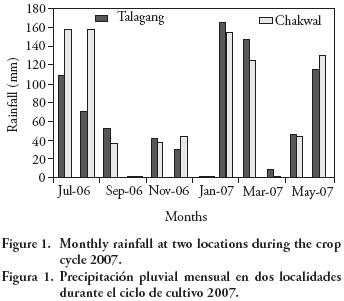
<body><![CDATA[<p align="justify"><font face="verdana" size="2">Field experiments were conducted with chickpea at Barani Agriculture Research Institute (BARI), Chakwal (sandy loam, pH 7.6, AB&#150;DTPA extractable P 3.0 mg kg<sup>&#150;1</sup>, CaCl<sub>2</sub> extractable SO<sub>4</sub>&#150;S 6.4 mg kg<sup>&#150;1</sup>) 32.5&deg;N, 72.4&deg; E; and farmers field, Talagang (loamy sand, pH 7.7, AB&#150;DTPA extractable P 1.4 mg kg<sup>&#150;1</sup>, CaCl<sub>2 </sub>extractable SO<sub>4</sub>&#150;S 7.5 mg kg<sup>&#150;1</sup>) 32.5&deg; N, 72.2&deg; E, during the crop cycle 2006&#150;07. The trial was carried out according to split plot arrangement in randomized complete block design (1.5&times;3.5 m plot at BARI, Chakwal; and 1.8&times;4 m farmer's field, Talagang) with P rates in main plots and S rates in subplots. There were nine treatments with combinations of P (0, 40, 80 kg ha<sup>&#150;1</sup>) and S rates (0, 15, 30 kg ha<sup>&#150;1</sup>). Starter dose of N (26 kg ha<sup>&#150;1</sup>) was applied as urea. Phosphorus was applied as triple super phosphate (TSP) and S as gypsum. All the treatments were replicated three times. Chickpea crop was sown in mid October, maintaining 30 cm row to row distance. All the fertilizers were applied at the time of sowing. Crop was grown under rainfed conditions and no irrigation water was applied. Rainfall data were recorded for both locations (<a href="#f1">Figure 1</a>). Harvesting was done in the first week of May. Crop from a 1 m<sup>2</sup> area in the middle of each plot was harvested separately and data were recorded for seed yield after threshing. Representative samples of 100 g for both straw and grain separately were collected from bulk sample, oven dried, ground and analyzed for N and P (Ryan <i>et al, </i>2001) and S (Verma <i>et al, </i>1977). Titrate obtained from N determination was concentrated and used for (&#948;<sup>15</sup>N measurement by mass spectrometer (Peoples <i>et al., </i>1989):</font></p>     <p align="justify"><font face="verdana" size="2">% N<sub>dfa </sub> =100 &times; (&#948;<sup>15</sup>N (soil N) &#150; &#948;<sup>15</sup>N legume N)/ (&#948;<sup>15</sup>N (soil N)&#150;B)</font></p>     <p align="justify"><font face="verdana" size="2">where &#948;<sup>15</sup>N (soil N) is commonly obtained from a non N fixing reference plant grown in the same soil as the legume; B is the (&#948;<sup>15</sup>N of the same N fixing plant when grown with N as the sole source of N and its value is &#150;2.5 (Shah <i>et al, </i>1997).</font></p>     <p align="center"><font face="verdana" size="2"><a name="f1"></a></font></p>     <p align="center"><font face="verdana" size="2"><img src="/img/revistas/agro/v43n8/a5f1.jpg"></font></p>     <p align="justify"><font face="verdana" size="2">Legume kg N ha<sup>&#150;1</sup> = legume total biomass kg ha<sup>&#150;1</sup> &times; % N in plant</font></p>     <p align="justify"><font face="verdana" size="2">kg N fixed ha<sup>&#150;1</sup>=legume kg N ha<sup>&#150;1</sup><i> </i>&times; % N<sub>dfa</sub> &times; l.5*</font></p>     <p align="justify"><font face="verdana" size="2">*1.5 factor was used to include an estimate for contribution by underground N (Peoples <i>et al., </i>1989).</font></p>     <p align="justify"><font face="verdana" size="2">Data on all observations were subjected to analysis of variance (ANOVA) using the software MSTATC. Treatment means were compared by orthogonal contrasts.</font></p>     <p align="justify"><font face="verdana" size="2">&nbsp;</font></p>     ]]></body>
<body><![CDATA[<p align="justify"><font face="verdana" size="2"><b>RESULTS AND DISCUSSIONS</b></font></p>     <p align="justify"><font face="verdana" size="2"><b>Seed yield</b></font></p>     <p align="justify"><font face="verdana" size="2">There was a significant interaction between P and S on seed yield at Chakwal but not at Talagang (<a href="/img/revistas/agro/v43n8/a5t1.jpg" target="_blank">Table 1</a>). Different levels of P and S had significant effect on seed yield at both locations. Contrast of P<sub>0</sub> <i>vs. </i>P<sub>1</sub> and P<sub>2</sub> and P<sub>1</sub> <i>vs. </i>P<sub>2</sub> showed significant differences regarding seed yield being the highest (1380 kg ha<sup>&#150;1</sup>) in P<sub>2</sub>S<sub>2</sub>, less (1368 kg ha<sup>&#150;1</sup>) in P<sub>2</sub>S<sub>1</sub> and least (942 kg ha<sup>&#150;1</sup>) in P<sub>0</sub>S<sub>0</sub> (<a href="/img/revistas/agro/v43n8/a5t2.jpg" target="_blank">Tables 2</a> and <a href="/img/revistas/agro/v43n8/a5t3.jpg" target="_blank">3</a>).</font></p>     <p align="justify"><font face="verdana" size="2">Increase in seed yield due to P application is similar to those found by Aslam <i>et al. </i>(2000) and Hayat (2005). Adequate P nutrition enhances many aspects of plant physiology including photosynthesis, flowering, fruiting and maturation (Brady and Weil, 2005). Increase in yield due to S application may be due to the fact that S is related to photosynthesis of plants. Sulphur application increased rate of photosynthesis due to an increment in protein synthesis and maintenance of high chlorophyll content (Ahmad and Abedin, 2000). Similar results of increased seed yield due to application of S were found by Srinivasarao <i>et al. </i>(2004) and Raina and Tanawade (2005).</font></p>     <p align="justify"><font face="verdana" size="2"><b>Nitrogen derived from air (% N<sub>dfa</sub>)</b></font></p>     <p align="justify"><font face="verdana" size="2">Regarding % N<sub>dfa </sub>, similar results were recorded at both locations (<a href="/img/revistas/agro/v43n8/a5t1.jpg" target="_blank">Table 1</a>). The main effect of P as well as P by S interaction was not significant on % N<sub>dfa </sub>. Sulphur application (15 and 30 kg ha<sup>&#150;1</sup>) resulted in significant increase of % N<sub>dfa </sub> by 5 and 7 % at both locations (<a href="/img/revistas/agro/v43n8/a5t4.jpg" target="_blank">Table 4</a>). Comparison of S<sub>0 </sub>with S<sub>1</sub> and S<sub>2</sub> exhibited significant difference at both locations (<a href="/img/revistas/agro/v43n8/a5t2.jpg" target="_blank">Table 2</a>). Difference between S<sub>1</sub> and S<sub>2</sub> was not significant at Chakwal, but it was significant at Talagang. These results are also confirmed by the correlation analysis as there was positive correlation between % N<sub>dfa </sub> and S uptake (R = 0.76"), but R value was low (0.28*) between P uptake and % N<sub>dfa </sub>(<a href="/img/revistas/agro/v43n8/a5t9.jpg" target="_blank">Table 9</a>).</font></p>     <p align="justify"><font face="verdana" size="2">Similar results have been reported by Scherer and Lange (1996), Zhao <i>et al. </i>(1999) and Scherer <i>et al. </i>(2006). With S deficiency amino acids accumulate and protein cannot be synthesized, which may inhibit N fixation (Varin <i>et al, </i>2009). Sulphur increased nitrogenase activity because of higher ferredoxin and ATP concentration in bacterioids of root nodules of legumes (Scherer <i>et al., </i>2008). Increase in N fixation due to P application is comparable to those reported by Sanginga <i>et al. </i>(1996), Ankomah <i>et al. </i>(1996) and Somado <i>et al. </i>(2006). Phosphorous application affected total N accumulated rather than % N<sub>dfa</sub>, which was due to an increase in growth of host plant due to P application rather than direct involvement of P in N fixation.</font></p>     <p align="justify"><font face="verdana" size="2"><b>Nitrogen fixation</b></font></p>     <p align="justify"><font face="verdana" size="2">Individual effect of P and S was significant but combined application had no significant effect on N fixation at both locations (<a href="/img/revistas/agro/v43n8/a5t1.jpg" target="_blank">Table 1</a>). Application of P (40 and 80 kg ha<sup>&#150;1</sup>) increased N fixation by 26 % and 40 % and 16 % and 40 % at Chakwal and Talagang (<a href="/img/revistas/agro/v43n8/a5t4.jpg" target="_blank">Table 4</a>). Orthogonal contrast showed that higher (80 kg P<sub>2</sub>O<sub>5</sub> ha<sup>1</sup>) and lower level (40 kg P<sub>2</sub>O<sub>5 </sub>ha<sup>&#150;1</sup>) of P application differed significantly from each other as well as from P<sub>0</sub> (<a href="/img/revistas/agro/v43n8/a5t2.jpg" target="_blank">Table 2</a>). Similarly, an increase of 15 % and 19 % and 16% and 22 % was recorded with S application (15 and 30 kg ha<sup>&#150;1</sup>) at Chakwal, and Talagang (<a href="/img/revistas/agro/v43n8/a5t4.jpg" target="_blank">Table 4</a>). Lower (30 kg S ha<sup>&#150;1</sup>) and higher level (30 kg S ha<sup>&#150;1</sup>) of S were similar to each other but differed significantly from S<sub>0</sub> (<a href="/img/revistas/agro/v43n8/a5t2.jpg" target="_blank">Table 2</a>). Furthermore, there was a positive correlation of both P (R=0.56**) and S uptake (R=0.97**) with N fixation (<a href="/img/revistas/agro/v43n8/a5t9.jpg" target="_blank">Table 9</a>).</font></p>     <p align="justify"><font face="verdana" size="2">Phosphorus fertilization of legume species leads to increased nitrogenase activity, nodule number, nodule mass and plant N accumulation (Shu&#150;Jie <i>et al., </i>2007). Deteriorated phosphate metabolism leads to impairment of photosynthetic and nitrogen fixing metabolism (Liao and Yan, 1999). Nitrogen fixation is directly affected by S as it is an essential component of the ferredoxins, an iron&#150;sulphur protein occurring in the chloroplasts. Ferredoxin has a significant role in NO<sub>2</sub><sup>&#150;</sup> and SO<sub>4</sub><sup>&#150;2</sup> reduction, the assimilation of N<sub>2</sub> by root nodule bacteria and free living N&#151;fixing soil bacteria (Havlin <i>et al, </i>2007). Besides, root and nodule development on the roots of legumes is promoted by sulphur fertilization (Scherer, 2008; Scherer <i>etal, </i>2008).</font></p>     ]]></body>
<body><![CDATA[<p align="justify"><font face="verdana" size="2"><b>Nutrient uptake</b></font></p>     <p align="justify"><font face="verdana" size="2">Effect of P and S application was significant on N, P and S uptake at both locations (<a href="/img/revistas/agro/v43n8/a5t5.jpg" target="_blank">Table 5</a>). Orthogonal comparison of P<sub>0</sub> <i>vs. </i>P<sub>1</sub> and P<sub>2</sub> indicated significant difference for nutrient uptake, but P<sub>1</sub><i> vs. </i>P<sub>2</sub> showed no differences regarding P uptake (<a href="/img/revistas/agro/v43n8/a5t6.jpg" target="_blank">Table 6</a>). Phosphorus application increased N uptake by 25 % and 38 % and 15 % and 36 % at Chakwal and Talagang (<a href="/img/revistas/agro/v43n8/a5t7.jpg" target="_blank">Table 7</a>). There was a positive correlation of N uptake with both P (R = 0.65**) and S uptake (R = 0.97**) (<a href="/img/revistas/agro/v43n8/a5t9.jpg" target="_blank">Table 9</a>). Shu&#150;Jie <i>etal. </i>(2007) and Reed <i>etal. </i>(2007) reported similar results concerning increase in N uptake due P application. Increase in N uptake might be due to a better plant growth, especially roots. Root growth, and particularly development of lateral roots and fibrous rootlets, is encouraged by addition of P (Lopez&#150;Bucio <i>etal, </i>2002). Adequate P nutrition enhances many aspects of plant physiology including photosynthesis (Brady and Weil, 2005). This leads to increased N assimilation, and as a result, increased N uptake by the plant.</font></p>     <p align="justify"><font face="verdana" size="2">Increase in N uptake due to S application has been reported by Scherer <i>et al. </i>(2006) and Tiwari and Gupta (2006). Sulphur can readily alter primary and lateral root growth, modifying the overall root architecture (Kutz <i>et al, </i>2002). In fact, nutrient ions act as signaling molecules for the regulation of root development (Lopez&#150; Bucio <i>et al, </i>2003). Increased N uptake may also be due to increased protein synthesis and subsequent photosynthesis (Sexton <i>et al., </i>1998). Hence, it may be argued that increased sulphur availability resulted in better root and shoot growth and ultimately increased N uptake due to increased dry matter production.</font></p>     <p align="justify"><font face="verdana" size="2">There was a positive correlation between P uptake with S uptake (R=0.57**) (<a href="/img/revistas/agro/v43n8/a5t9.jpg" target="_blank">Table 9</a>). Increase in P uptake due to P application was due to its increased availability in soil, a result similar to those reported by Amrani <i>et al. </i>(2001) and Kanwar and Paliyal (2002). Phosphorus application not only increased biomass production but also increased P concentration in plant tissue (Shu&#150;Jie <i>et al, </i>2007).</font></p>     <p align="justify"><font face="verdana" size="2">Increase in P uptake due to S application has been already reported by Tiwari and Gupta (2006). Besides, Bagayoko <i>et al. </i>(2000) and Scherer <i>et al. </i>(2008) have shown a positive effect of P and S application on root growth and morphology. Due to the acidifying effect of S oxidation, the availability of other nutrients like N and P is also influenced (Togay <i>et al, </i>2008) Application of P and S increased uptake of these nutrients by the plant, which may be due to their increased availability in soil. It may be argued that better root growth resulted in increased uptake of these nutrients from soil (Zhao <i>et al, </i>2008).</font></p>     <p align="justify"><font face="verdana" size="2">The highest increases among nutrients were recorded regarding S uptake up to 54 % and 22 % due to P and S application (<a href="/img/revistas/agro/v43n8/a5t7.jpg" target="_blank">Table 7</a>). Lower (15 kg S ha<sup>&#150;1</sup>) and higher (30 kg S ha<sup>&#150;1</sup>) level of S application differed from S<sub>0</sub> regarding nutrient uptake but were similar to each other (<a href="/img/revistas/agro/v43n8/a5t6.jpg" target="_blank">Table 6</a>). The P&times;S interaction was not significant regarding N and P uptake but showed significant effect on S uptake at Talagang (<a href="/img/revistas/agro/v43n8/a5t5.jpg" target="_blank">Table 5</a>). The maximum S uptake (10.76 kg ha<sup>&#150;1</sup>) was recorded in P<sub>2</sub>S<sub>1</sub> which was at par with P<sub>2</sub>S<sub>2</sub> (10.19 kg ha<sup>&#150;1</sup>) and minimum (6.12 kg ha<sup>&#150;1</sup>) in P<sub>0</sub>S<sub>0</sub> (<a href="/img/revistas/agro/v43n8/a5t8.jpg" target="_blank">Table 8</a>). Bagayoko <i>et al. </i>(2000) and Tang <i>et al. </i>(2001b) have shown the positive effect of P and S application on root growth and morphology. Application of P and S increased uptake of these nutrients by the plant which may be due to their increased availability in soil. It may be argued that deeper root penetration resulted in increased uptake of these nutrients from soil.</font></p>     <p align="justify"><font face="verdana" size="2">&nbsp;</font></p>     <p align="justify"><font face="verdana" size="2"><b>CONCLUSION</b></font></p>     <p align="justify"><font face="verdana" size="2">Application of P and S significantly increased seed yield, N fixation and N uptake at both locations. The effect of P on % N<sub>dfa</sub> was not significant but the effect </font><font face="verdana" size="2">of S was significant. It was observed that P application increased total N uptake, which contributed towards an increase in N fixation. Thus, the effect of P application on N fixation was indirect. Besides, the effect of S application on N fixation was direct since it increased N uptake as well as %N<sub>dfa</sub>. Application of both P and S increased nutrient uptake, which may improve the quality of produce. Increased N<sub>2 </sub>fixation due to application of P and S may lead to sustainability of soil resources.</font></p>     <p align="justify"><font face="verdana" size="2">&nbsp;</font></p>     ]]></body>
<body><![CDATA[<p align="justify"><font face="verdana" size="2"><b>LITERATURE CITED </b></font></p>     <!-- ref --><p align="justify"><font face="verdana" size="2">Ahmad, A., and M. Z. Abdin. 2000. Photosynthesis and its related physiological variables in the leaves of <i>Brassial </i>genotypes as influenced by sulphur fertilization. Physiol. Plantarum 110: 144&#150;149.</font>&nbsp;&nbsp;&nbsp;&nbsp;&nbsp;&nbsp;&nbsp;&nbsp;[&#160;<a href="javascript:void(0);" onclick="javascript: window.open('/scielo.php?script=sci_nlinks&ref=538976&pid=S1405-3195200900080000500001&lng=','','width=640,height=500,resizable=yes,scrollbars=1,menubar=yes,');">Links</a>&#160;]<!-- end-ref --><!-- ref --><p align="justify"><font face="verdana" size="2">Amrani, M, D. G. Westfall, and L. Moughli. 2001. Phosphorus management in continuous wheat and wheat legume rotations. Nutr. Cycl. Agroecosyst. 59: 19&#150;27.</font>&nbsp;&nbsp;&nbsp;&nbsp;&nbsp;&nbsp;&nbsp;&nbsp;[&#160;<a href="javascript:void(0);" onclick="javascript: window.open('/scielo.php?script=sci_nlinks&ref=538977&pid=S1405-3195200900080000500002&lng=','','width=640,height=500,resizable=yes,scrollbars=1,menubar=yes,');">Links</a>&#160;]<!-- end-ref --><!-- ref --><p align="justify"><font face="verdana" size="2">Ankomah A. B., F. Zapata, G. Hardarson, and S. K. A. Danso. 1996. Yield, nodulation and N fixation by cowpea cultivars at different phosphorus rates. Biol. Fert. Soils 22 (1&#150;2): 10&#150;15.</font>&nbsp;&nbsp;&nbsp;&nbsp;&nbsp;&nbsp;&nbsp;&nbsp;[&#160;<a href="javascript:void(0);" onclick="javascript: window.open('/scielo.php?script=sci_nlinks&ref=538978&pid=S1405-3195200900080000500003&lng=','','width=640,height=500,resizable=yes,scrollbars=1,menubar=yes,');">Links</a>&#160;]<!-- end-ref --><!-- ref --><p align="justify"><font face="verdana" size="2">Aslam, M., I. A. Mahmood, T. Sultan, S. Ahmad, and M. A. Zahid. 2000. Growth and yield response of chickpea (<i>Cicer arietinum </i>L.) to various <i>Rhizobium </i>strains fertilized with different phosphorus levels. Int. J. Agr. Biol. 2(1&#150;2): 89&#150;91.</font>&nbsp;&nbsp;&nbsp;&nbsp;&nbsp;&nbsp;&nbsp;&nbsp;[&#160;<a href="javascript:void(0);" onclick="javascript: window.open('/scielo.php?script=sci_nlinks&ref=538979&pid=S1405-3195200900080000500004&lng=','','width=640,height=500,resizable=yes,scrollbars=1,menubar=yes,');">Links</a>&#160;]<!-- end-ref --><!-- ref --><p align="justify"><font face="verdana" size="2">Bagayoko, M., E. George, V. Romheld, and A. Buerkert. 2000. Effects of mycorrhizae and phosphorus on growth and nutrient uptake of millet, cowpea and sorghum on a West African soil. J. Agr. Sci. 135: 399&#150;407.</font>&nbsp;&nbsp;&nbsp;&nbsp;&nbsp;&nbsp;&nbsp;&nbsp;[&#160;<a href="javascript:void(0);" onclick="javascript: window.open('/scielo.php?script=sci_nlinks&ref=538980&pid=S1405-3195200900080000500005&lng=','','width=640,height=500,resizable=yes,scrollbars=1,menubar=yes,');">Links</a>&#160;]<!-- end-ref --><!-- ref --><p align="justify"><font face="verdana" size="2">Brady, N. C, and R. R. Weil. 2005. The Nature and Properties of Soils. 13<sup>th</sup> Ed. Pearson education, Singapure. 976 p.</font>&nbsp;&nbsp;&nbsp;&nbsp;&nbsp;&nbsp;&nbsp;&nbsp;[&#160;<a href="javascript:void(0);" onclick="javascript: window.open('/scielo.php?script=sci_nlinks&ref=538981&pid=S1405-3195200900080000500006&lng=','','width=640,height=500,resizable=yes,scrollbars=1,menubar=yes,');">Links</a>&#160;]<!-- end-ref --><!-- ref --><p align="justify"><font face="verdana" size="2">Claro&#150;Cortes, P., R. Nunez&#150;Escobar, and J. D. Etchevers&#150;Barra. 2002. Green house grown maize respose to sulphur in two soils of Puebla state Mexico. Agrociencia 36: 633&#150;642.</font>&nbsp;&nbsp;&nbsp;&nbsp;&nbsp;&nbsp;&nbsp;&nbsp;[&#160;<a href="javascript:void(0);" onclick="javascript: window.open('/scielo.php?script=sci_nlinks&ref=538982&pid=S1405-3195200900080000500007&lng=','','width=640,height=500,resizable=yes,scrollbars=1,menubar=yes,');">Links</a>&#160;]<!-- end-ref --><!-- ref --><p align="justify"><font face="verdana" size="2">Daramola, D. S., A. Adebayo, and O. Odeyemi. 1982. Effect of herbicide application on legume <i>Rhizobium </i>symbiosis with and without starter nitrogen. Turrialba 32: 315&#150;320.</font>&nbsp;&nbsp;&nbsp;&nbsp;&nbsp;&nbsp;&nbsp;&nbsp;[&#160;<a href="javascript:void(0);" onclick="javascript: window.open('/scielo.php?script=sci_nlinks&ref=538983&pid=S1405-3195200900080000500008&lng=','','width=640,height=500,resizable=yes,scrollbars=1,menubar=yes,');">Links</a>&#160;]<!-- end-ref --><!-- ref --><p align="justify"><font face="verdana" size="2">Dwivedi, K. N., P. Chandra, and V. C. Pandey. 1996. Relative efficacy of sulphur carriers on yield and nutrient uptake by black gram. J. Indian Soc. Soil Sci. 44: 790&#150;791.</font>&nbsp;&nbsp;&nbsp;&nbsp;&nbsp;&nbsp;&nbsp;&nbsp;[&#160;<a href="javascript:void(0);" onclick="javascript: window.open('/scielo.php?script=sci_nlinks&ref=538984&pid=S1405-3195200900080000500009&lng=','','width=640,height=500,resizable=yes,scrollbars=1,menubar=yes,');">Links</a>&#160;]<!-- end-ref --><!-- ref --><p align="justify"><font face="verdana" size="2">Economic Survey, 2008. Ministry of finance. Government of Pakistan, pp: 16 &#150;24.</font>&nbsp;&nbsp;&nbsp;&nbsp;&nbsp;&nbsp;&nbsp;&nbsp;[&#160;<a href="javascript:void(0);" onclick="javascript: window.open('/scielo.php?script=sci_nlinks&ref=538985&pid=S1405-3195200900080000500010&lng=','','width=640,height=500,resizable=yes,scrollbars=1,menubar=yes,');">Links</a>&#160;]<!-- end-ref --><!-- ref --><p align="justify"><font face="verdana" size="2">FAO, Food and Agricultural Organization. 2006. FAOSTAT (<a href="http://faostat.fao.org/site/567/DesktopDefault.aspx?PageID=567#ancor" target="_blank">http://faostat.fao.org/site/567/DesktopDefault.aspx?PageID=567</a> accessed on 20&#150;03&#150;2008).</font>&nbsp;&nbsp;&nbsp;&nbsp;&nbsp;&nbsp;&nbsp;&nbsp;[&#160;<a href="javascript:void(0);" onclick="javascript: window.open('/scielo.php?script=sci_nlinks&ref=538986&pid=S1405-3195200900080000500011&lng=','','width=640,height=500,resizable=yes,scrollbars=1,menubar=yes,');">Links</a>&#160;]<!-- end-ref --><!-- ref --><p align="justify"><font face="verdana" size="2">Fukuyama, K. 2004. Structure and function of plant&#150; type ferredoxin. Photosynth. Res. 81: 291&#150;301.</font>&nbsp;&nbsp;&nbsp;&nbsp;&nbsp;&nbsp;&nbsp;&nbsp;[&#160;<a href="javascript:void(0);" onclick="javascript: window.open('/scielo.php?script=sci_nlinks&ref=538987&pid=S1405-3195200900080000500012&lng=','','width=640,height=500,resizable=yes,scrollbars=1,menubar=yes,');">Links</a>&#160;]<!-- end-ref --><!-- ref --><p align="justify"><font face="verdana" size="2">Ganeshamurthy, A. N., and K. S. Reddy. 2000. Effect of integrated use of farm yard manure and sulphur in soybean and wheat cropping system on nodulation, dry matter production and chlorophyll content of soybean on swell shrink soils in Central India. J. Agron. Crop Sci. 185: 191&#150;197.</font>&nbsp;&nbsp;&nbsp;&nbsp;&nbsp;&nbsp;&nbsp;&nbsp;[&#160;<a href="javascript:void(0);" onclick="javascript: window.open('/scielo.php?script=sci_nlinks&ref=538988&pid=S1405-3195200900080000500013&lng=','','width=640,height=500,resizable=yes,scrollbars=1,menubar=yes,');">Links</a>&#160;]<!-- end-ref --><!-- ref --><p align="justify"><font face="verdana" size="2">Goos, R. J., and B. E. Johnson. 2001. Response of spring wheat to phosphorus and sulphur starter fertilizers of differing acidification potential. J. Agr. Sci. 136:283&#150;289.</font>&nbsp;&nbsp;&nbsp;&nbsp;&nbsp;&nbsp;&nbsp;&nbsp;[&#160;<a href="javascript:void(0);" onclick="javascript: window.open('/scielo.php?script=sci_nlinks&ref=538989&pid=S1405-3195200900080000500014&lng=','','width=640,height=500,resizable=yes,scrollbars=1,menubar=yes,');">Links</a>&#160;]<!-- end-ref --><!-- ref --><p align="justify"><font face="verdana" size="2">Habtemichial, K. H., B. R. Singh, and J. B. Aune. 2007. Wheat response to N  fixed by faba bean (<i>Vicia faba </i>L.) as affected by sulphur fertilization and rhizobial inoculation in semi arid Northern Ethiopia. J. Plant Nutr. Soil Sci. 170: 412&#150;418.</font>&nbsp;&nbsp;&nbsp;&nbsp;&nbsp;&nbsp;&nbsp;&nbsp;[&#160;<a href="javascript:void(0);" onclick="javascript: window.open('/scielo.php?script=sci_nlinks&ref=538990&pid=S1405-3195200900080000500015&lng=','','width=640,height=500,resizable=yes,scrollbars=1,menubar=yes,');">Links</a>&#160;]<!-- end-ref --><!-- ref --><p align="justify"><font face="verdana" size="2">Havlin, J. L., J. D. Beaton, S. L.Tisdale, and W. L. Nelson. 2007. Soil Fertility and Fertilizers. An Introduction to Nutrient Management. 7<sup>th</sup> ed. Pearson Education Inc., Singapore. 476 p.</font>&nbsp;&nbsp;&nbsp;&nbsp;&nbsp;&nbsp;&nbsp;&nbsp;[&#160;<a href="javascript:void(0);" onclick="javascript: window.open('/scielo.php?script=sci_nlinks&ref=538991&pid=S1405-3195200900080000500016&lng=','','width=640,height=500,resizable=yes,scrollbars=1,menubar=yes,');">Links</a>&#160;]<!-- end-ref --><!-- ref --><p align="justify"><font face="verdana" size="2">Hayat, R. 2005. Sustainable legume cereal cropping system through managemnt of biological nitrogen fixation in pothwar. Ph.D. thesis, University of Arid Agriculture Rawalpindi. 161 p.</font>&nbsp;&nbsp;&nbsp;&nbsp;&nbsp;&nbsp;&nbsp;&nbsp;[&#160;<a href="javascript:void(0);" onclick="javascript: window.open('/scielo.php?script=sci_nlinks&ref=538992&pid=S1405-3195200900080000500017&lng=','','width=640,height=500,resizable=yes,scrollbars=1,menubar=yes,');">Links</a>&#160;]<!-- end-ref --><!-- ref --><p align="justify"><font face="verdana" size="2">Jiang, D., H. Hengsdijk, T. B. Dai, W de Boer, Q. Jing, and W. X. Cao. 2006. Long term effect of manure and inorgainc fertilizer on yield and soil fertility for a winter wheat&#150; maize system in Jiangsu, China. Pedosphere 16: 25&#150;32.</font>&nbsp;&nbsp;&nbsp;&nbsp;&nbsp;&nbsp;&nbsp;&nbsp;[&#160;<a href="javascript:void(0);" onclick="javascript: window.open('/scielo.php?script=sci_nlinks&ref=538993&pid=S1405-3195200900080000500018&lng=','','width=640,height=500,resizable=yes,scrollbars=1,menubar=yes,');">Links</a>&#160;]<!-- end-ref --><!-- ref --><p align="justify"><font face="verdana" size="2">Kanwar, K., and S. S. Paliyal. 2002. Influence of phosphorus management and organic manuring on uptake and yield of chickpea. Ann. Agr. Res. 23 (4): 642&#150;645.</font>&nbsp;&nbsp;&nbsp;&nbsp;&nbsp;&nbsp;&nbsp;&nbsp;[&#160;<a href="javascript:void(0);" onclick="javascript: window.open('/scielo.php?script=sci_nlinks&ref=538994&pid=S1405-3195200900080000500019&lng=','','width=640,height=500,resizable=yes,scrollbars=1,menubar=yes,');">Links</a>&#160;]<!-- end-ref --><!-- ref --><p align="justify"><font face="verdana" size="2">Kutz, A., A. Muller, P. Henning, W. M. Kaiser, M. iotrowsky, and E.&nbsp;W. Weiler. 2002. A role for nitrilase 3 in the regulation of root morphology in sulphur&#150;starving Arabidopsis thaliana. Plant J. 30:95&#150;106.</font>&nbsp;&nbsp;&nbsp;&nbsp;&nbsp;&nbsp;&nbsp;&nbsp;[&#160;<a href="javascript:void(0);" onclick="javascript: window.open('/scielo.php?script=sci_nlinks&ref=538995&pid=S1405-3195200900080000500020&lng=','','width=640,height=500,resizable=yes,scrollbars=1,menubar=yes,');">Links</a>&#160;]<!-- end-ref --><!-- ref --><p align="justify"><font face="verdana" size="2">Liao, H., and X. Yan. 1999. Seed size is closely related to phosphorus use efficiency and photosynthetic phosphorus use efficiency in common bean. J. Plant Nutr. 22: 877&#151;888.</font>&nbsp;&nbsp;&nbsp;&nbsp;&nbsp;&nbsp;&nbsp;&nbsp;[&#160;<a href="javascript:void(0);" onclick="javascript: window.open('/scielo.php?script=sci_nlinks&ref=538996&pid=S1405-3195200900080000500021&lng=','','width=640,height=500,resizable=yes,scrollbars=1,menubar=yes,');">Links</a>&#160;]<!-- end-ref --><!-- ref --><p align="justify"><font face="verdana" size="2">L&oacute;pez&#150;Bucio, J. A. Cruz&#150;Ramirez, and L. Herrera&#150;Estrella. 2003. The role of nutrient availability in regulating root architecture. Curr. Opin.  Plant Biol. 6: 280&#150;287.</font>&nbsp;&nbsp;&nbsp;&nbsp;&nbsp;&nbsp;&nbsp;&nbsp;[&#160;<a href="javascript:void(0);" onclick="javascript: window.open('/scielo.php?script=sci_nlinks&ref=538997&pid=S1405-3195200900080000500022&lng=','','width=640,height=500,resizable=yes,scrollbars=1,menubar=yes,');">Links</a>&#160;]<!-- end-ref --><!-- ref --><p align="justify"><font face="verdana" size="2">L&oacute;pez&#150;Bucio, J., E. Hern&aacute;ndez&#150;Abreu, L. S&aacute;nchez&#150;Calder&oacute;n, M. F.&nbsp;Nieto&#150;Jacobo, J. Simpson, and L. Herrera&#150;Estrella. 2002. Phosphate availability alters architecture and causes changes in hormone sensitivity in the Arabidopsis root system. Plant Physiol. 129:244&#150;256.</font>&nbsp;&nbsp;&nbsp;&nbsp;&nbsp;&nbsp;&nbsp;&nbsp;[&#160;<a href="javascript:void(0);" onclick="javascript: window.open('/scielo.php?script=sci_nlinks&ref=538998&pid=S1405-3195200900080000500023&lng=','','width=640,height=500,resizable=yes,scrollbars=1,menubar=yes,');">Links</a>&#160;]<!-- end-ref --><!-- ref --><p align="justify"><font face="verdana" size="2">Mortenson, L. E., and R. N. F. Thornley. 1979. Structure and function of nitrogenase. Ann. Rev. Biochem. 48: 387&#150;418.</font>&nbsp;&nbsp;&nbsp;&nbsp;&nbsp;&nbsp;&nbsp;&nbsp;[&#160;<a href="javascript:void(0);" onclick="javascript: window.open('/scielo.php?script=sci_nlinks&ref=538999&pid=S1405-3195200900080000500024&lng=','','width=640,height=500,resizable=yes,scrollbars=1,menubar=yes,');">Links</a>&#160;]<!-- end-ref --><!-- ref --><p align="justify"><font face="verdana" size="2">Olivera, M., N. Tejera, C. Iribarne, A. Ocana, and C. Lluch. 2004. Growth, nitrogen fixation and ammonium assimilation in common bean (<i>Phaseolus vulgaris): </i>effect of phosphorus. Physiologia Plantarum 121: 498&#150;505.</font>&nbsp;&nbsp;&nbsp;&nbsp;&nbsp;&nbsp;&nbsp;&nbsp;[&#160;<a href="javascript:void(0);" onclick="javascript: window.open('/scielo.php?script=sci_nlinks&ref=539000&pid=S1405-3195200900080000500025&lng=','','width=640,height=500,resizable=yes,scrollbars=1,menubar=yes,');">Links</a>&#160;]<!-- end-ref --><!-- ref --><p align="justify"><font face="verdana" size="2">Peoples, M.B., A. W. Faizah, B. Rekasem, and D. F. Herridge. 1989. Methods for evaluating nitrogen fixation by nodulated legumes in the field. Monograph No. 11. ACIAR. pp: 22&#150;45.</font>&nbsp;&nbsp;&nbsp;&nbsp;&nbsp;&nbsp;&nbsp;&nbsp;[&#160;<a href="javascript:void(0);" onclick="javascript: window.open('/scielo.php?script=sci_nlinks&ref=539001&pid=S1405-3195200900080000500026&lng=','','width=640,height=500,resizable=yes,scrollbars=1,menubar=yes,');">Links</a>&#160;]<!-- end-ref --><!-- ref --><p align="justify"><font face="verdana" size="2">Raina, A. K., and S. K. Tanawade. 2005. Delineation of sulphur deficient areas of Maharashtra and crop response to sulphur application. Ind. J. Fert. 1(7): 61&#150;67.</font>&nbsp;&nbsp;&nbsp;&nbsp;&nbsp;&nbsp;&nbsp;&nbsp;[&#160;<a href="javascript:void(0);" onclick="javascript: window.open('/scielo.php?script=sci_nlinks&ref=539002&pid=S1405-3195200900080000500027&lng=','','width=640,height=500,resizable=yes,scrollbars=1,menubar=yes,');">Links</a>&#160;]<!-- end-ref --><!-- ref --><p align="justify"><font face="verdana" size="2">Reed, S. C., T. R. Seastedt, C. M. Mann, K. N. Suding, A. R. Townsed, and K. L. Cherwin. 2007. Phosphorus fertilization stimulates nitrogen fixation and increases inorganic nitrogen concentration in a restored prairie. Appl. Soil Ecol. 36: 238&#150;242.</font>&nbsp;&nbsp;&nbsp;&nbsp;&nbsp;&nbsp;&nbsp;&nbsp;[&#160;<a href="javascript:void(0);" onclick="javascript: window.open('/scielo.php?script=sci_nlinks&ref=539003&pid=S1405-3195200900080000500028&lng=','','width=640,height=500,resizable=yes,scrollbars=1,menubar=yes,');">Links</a>&#160;]<!-- end-ref --><!-- ref --><p align="justify"><font face="verdana" size="2">Ryan. J., G. Estefan, and A. Rashid. 2001. Soil and Plant Analysis Laboratory Manual. International Centre for Agricultural Research in Dry Areas. (ICARDA) Allepo, Syria, pp: 124&#150;134.</font>&nbsp;&nbsp;&nbsp;&nbsp;&nbsp;&nbsp;&nbsp;&nbsp;[&#160;<a href="javascript:void(0);" onclick="javascript: window.open('/scielo.php?script=sci_nlinks&ref=539004&pid=S1405-3195200900080000500029&lng=','','width=640,height=500,resizable=yes,scrollbars=1,menubar=yes,');">Links</a>&#160;]<!-- end-ref --><!-- ref --><p align="justify"><font face="verdana" size="2">Sanginga, N., J. A. Okogun, I. O. Akalobundes, and B. T. Kang. 1996. Phosphorus requirement and nodulation of herbaceous and shrub legumes in low P soils of a Gui&ntilde;ean Savana in Nigeria. Appl. Soil Ecol. 3(3): 247&#150;255.</font>&nbsp;&nbsp;&nbsp;&nbsp;&nbsp;&nbsp;&nbsp;&nbsp;[&#160;<a href="javascript:void(0);" onclick="javascript: window.open('/scielo.php?script=sci_nlinks&ref=539005&pid=S1405-3195200900080000500030&lng=','','width=640,height=500,resizable=yes,scrollbars=1,menubar=yes,');">Links</a>&#160;]<!-- end-ref --><!-- ref --><p align="justify"><font face="verdana" size="2">Scherer, H. W., and A. Lange. 1996. N fixation and growth of legumes as affected by sulphur fertilization. Biol. Fert. Soils 23: 449&#150;453.</font>&nbsp;&nbsp;&nbsp;&nbsp;&nbsp;&nbsp;&nbsp;&nbsp;[&#160;<a href="javascript:void(0);" onclick="javascript: window.open('/scielo.php?script=sci_nlinks&ref=539006&pid=S1405-3195200900080000500031&lng=','','width=640,height=500,resizable=yes,scrollbars=1,menubar=yes,');">Links</a>&#160;]<!-- end-ref --><!-- ref --><p align="justify"><font face="verdana" size="2">Scherer, H. W., S. Pacyna, N. Manthey, and M. Schulz. 2006. Sulphur supply to peas (<i>Pisum sativum </i>L.) influence symbiotic nitrogen fixation. Plant Soil Environ. 2:<i>72&#150;77.</i></font>&nbsp;&nbsp;&nbsp;&nbsp;&nbsp;&nbsp;&nbsp;&nbsp;[&#160;<a href="javascript:void(0);" onclick="javascript: window.open('/scielo.php?script=sci_nlinks&ref=539007&pid=S1405-3195200900080000500032&lng=','','width=640,height=500,resizable=yes,scrollbars=1,menubar=yes,');">Links</a>&#160;]<!-- end-ref --><!-- ref --><p align="justify"><font face="verdana" size="2">Scherer, H.W. 2008. Impact of sulphur on N fixation of legumes. <i>In: </i>Khan, N. A. (ed). Sulphur Assimilation and Abiotic Stress in Plants. Kluwer Academic Publishers, The Netherlands, pp: 51&#150;60.</font>&nbsp;&nbsp;&nbsp;&nbsp;&nbsp;&nbsp;&nbsp;&nbsp;[&#160;<a href="javascript:void(0);" onclick="javascript: window.open('/scielo.php?script=sci_nlinks&ref=539008&pid=S1405-3195200900080000500033&lng=','','width=640,height=500,resizable=yes,scrollbars=1,menubar=yes,');">Links</a>&#160;]<!-- end-ref --><!-- ref --><p align="justify"><font face="verdana" size="2">Scherer, H. W., S. Pacyna, K. Spoth, and M. Schulz. 2008. Low levels of ferredoxin, ATP and leghemoglobin contribute to limited N fixation of peas (<i>Pisum sativum </i>L.) and alfalfa (<i>Medicago sativa </i>L.) under S deficiency conditions. Biol. F&eacute;rtil. Soils 44: 909&#150;916.</font>&nbsp;&nbsp;&nbsp;&nbsp;&nbsp;&nbsp;&nbsp;&nbsp;[&#160;<a href="javascript:void(0);" onclick="javascript: window.open('/scielo.php?script=sci_nlinks&ref=539009&pid=S1405-3195200900080000500034&lng=','','width=640,height=500,resizable=yes,scrollbars=1,menubar=yes,');">Links</a>&#160;]<!-- end-ref --><!-- ref --><p align="justify"><font face="verdana" size="2">Sexton, P. J., N. C. Peak, and R. Shibles. 1998. Soybean sulphur and nitrogen balance under varying levels of available sulphur. Crop Sci. 38: 975&#150;982.</font>&nbsp;&nbsp;&nbsp;&nbsp;&nbsp;&nbsp;&nbsp;&nbsp;[&#160;<a href="javascript:void(0);" onclick="javascript: window.open('/scielo.php?script=sci_nlinks&ref=539010&pid=S1405-3195200900080000500035&lng=','','width=640,height=500,resizable=yes,scrollbars=1,menubar=yes,');">Links</a>&#160;]<!-- end-ref --><!-- ref --><p align="justify"><font face="verdana" size="2">Shah Z., S. H. Shah, M. B. People, and D. F. Herridge. 1997. Surveys of N fixation of lentil, mung bean and black gram in farmer's field in North West Frontier Province, Pakistan. <i>In: </i>Extending nitrogen fixation research to farmers field: Proc. Int. workshop on Managing legume nitrogen fixation in the cropping systems of Asia, 20&#150;24 Aug, 1996, ICRISTAT Asia Centre, India, Patancheru 502 324, Andhra Pradesh, India: Int. Crops Res. Inst. Semi Arid Tropics, pp: 333&#150;341.</font>&nbsp;&nbsp;&nbsp;&nbsp;&nbsp;&nbsp;&nbsp;&nbsp;[&#160;<a href="javascript:void(0);" onclick="javascript: window.open('/scielo.php?script=sci_nlinks&ref=539011&pid=S1405-3195200900080000500036&lng=','','width=640,height=500,resizable=yes,scrollbars=1,menubar=yes,');">Links</a>&#160;]<!-- end-ref --><!-- ref --><p align="justify"><font face="verdana" size="2">Shu&#150;Jie, M., Q. Yun&#150;Fa, H. Xiao&#150; Zeng, and A.N. M. 2007. Nodule formation and development in soybean (<i>Glycine max </i>L.) response to phosphorus supply in solution culture. Pedosphere 17(1): 36&#150;43.</font>&nbsp;&nbsp;&nbsp;&nbsp;&nbsp;&nbsp;&nbsp;&nbsp;[&#160;<a href="javascript:void(0);" onclick="javascript: window.open('/scielo.php?script=sci_nlinks&ref=539012&pid=S1405-3195200900080000500037&lng=','','width=640,height=500,resizable=yes,scrollbars=1,menubar=yes,');">Links</a>&#160;]<!-- end-ref --><!-- ref --><p align="justify"><font face="verdana" size="2">Somado, E. A., K. L. Sahrawat, and R. F. Kuehne. 2006. Rock phosphate&#150;P enhances biomass and nitrogen accumulation by legumes in upland crop production systems in humid West Africa. Biol. Fert. Soils 43:124&#150;130.</font>&nbsp;&nbsp;&nbsp;&nbsp;&nbsp;&nbsp;&nbsp;&nbsp;[&#160;<a href="javascript:void(0);" onclick="javascript: window.open('/scielo.php?script=sci_nlinks&ref=539013&pid=S1405-3195200900080000500038&lng=','','width=640,height=500,resizable=yes,scrollbars=1,menubar=yes,');">Links</a>&#160;]<!-- end-ref --><!-- ref --><p align="justify"><font face="verdana" size="2">Srinivasarao, Ch., A. N. Ganeshamurthy, M. Ali, R. N. Singh, and K. K. Singh. 2004. Sulphur fractions, distribution and their relationship with soil properties in different soil types of major pulse growing regions of India. Commun. Soil Sci. Plant Anal. 35 (19 &amp; 20): 2757&#150;2769.</font>&nbsp;&nbsp;&nbsp;&nbsp;&nbsp;&nbsp;&nbsp;&nbsp;[&#160;<a href="javascript:void(0);" onclick="javascript: window.open('/scielo.php?script=sci_nlinks&ref=539014&pid=S1405-3195200900080000500039&lng=','','width=640,height=500,resizable=yes,scrollbars=1,menubar=yes,');">Links</a>&#160;]<!-- end-ref --><!-- ref --><p align="justify"><font face="verdana" size="2">Tang, C, P. J. Hinsiger, J. J. Drevon, and B. Jaillard. 2001a. Phosphorus deficiency impairs early nodule functioning and enhances proton release in roots of <i>Medicago truncatula </i>L. Ann Bot. 88: 131&#150;138.</font>&nbsp;&nbsp;&nbsp;&nbsp;&nbsp;&nbsp;&nbsp;&nbsp;[&#160;<a href="javascript:void(0);" onclick="javascript: window.open('/scielo.php?script=sci_nlinks&ref=539015&pid=S1405-3195200900080000500040&lng=','','width=640,height=500,resizable=yes,scrollbars=1,menubar=yes,');">Links</a>&#160;]<!-- end-ref --><!-- ref --><p align="justify"><font face="verdana" size="2">Tang, C, P. Hinsiger, B. Jaillard, Z. Rengel, and J. J. Drevon. 2001b. Effect of phosphorus deficiency on the growth, symbiotic N2 fixation and proton release by two bean (<i>Phaseolus vulgaris) </i>genotypes. Agronomie 21: 683&#150;689.</font>&nbsp;&nbsp;&nbsp;&nbsp;&nbsp;&nbsp;&nbsp;&nbsp;[&#160;<a href="javascript:void(0);" onclick="javascript: window.open('/scielo.php?script=sci_nlinks&ref=539016&pid=S1405-3195200900080000500041&lng=','','width=640,height=500,resizable=yes,scrollbars=1,menubar=yes,');">Links</a>&#160;]<!-- end-ref --><!-- ref --><p align="justify"><font face="verdana" size="2">Tiwari K. N., and B. R. Gupta, 2006. Sulphur for sustainable high yield in Uttarpardesh. Indian J. Fert. 1 (11): 37&#150;52.</font>&nbsp;&nbsp;&nbsp;&nbsp;&nbsp;&nbsp;&nbsp;&nbsp;[&#160;<a href="javascript:void(0);" onclick="javascript: window.open('/scielo.php?script=sci_nlinks&ref=539017&pid=S1405-3195200900080000500042&lng=','','width=640,height=500,resizable=yes,scrollbars=1,menubar=yes,');">Links</a>&#160;]<!-- end-ref --><!-- ref --><p align="justify"><font face="verdana" size="2">Togay, Y., N. Togay, F. Cig, M. Erman, and A. E. Celen. 2008. The effect of sulphur applications on nutrient composition, yield and some yield components of barley (<i>Hordeum vulgare </i>L.). Afr. J. Biotech. 7: 3255&#150;3260.</font>&nbsp;&nbsp;&nbsp;&nbsp;&nbsp;&nbsp;&nbsp;&nbsp;[&#160;<a href="javascript:void(0);" onclick="javascript: window.open('/scielo.php?script=sci_nlinks&ref=539018&pid=S1405-3195200900080000500043&lng=','','width=640,height=500,resizable=yes,scrollbars=1,menubar=yes,');">Links</a>&#160;]<!-- end-ref --><!-- ref --><p align="justify"><font face="verdana" size="2">Tsvetkova, G. E., and G. I. Georgiev. 2003. Effect of phosphorus nutrition on the nodulation, nitrogen fixation and nutrient use efficiency of <i>Bradyrhizobium japonicum </i>&#150; soybean (<i>Glycine max </i>L. Merr) symbiosis. Bulg. J. Plant Physiol. Special Issue 331&#150;335.</font>&nbsp;&nbsp;&nbsp;&nbsp;&nbsp;&nbsp;&nbsp;&nbsp;[&#160;<a href="javascript:void(0);" onclick="javascript: window.open('/scielo.php?script=sci_nlinks&ref=539019&pid=S1405-3195200900080000500044&lng=','','width=640,height=500,resizable=yes,scrollbars=1,menubar=yes,');">Links</a>&#160;]<!-- end-ref --><!-- ref --><p align="justify"><font face="verdana" size="2">Varin, S., B. Leveel, S. L. Lavenant, and J. B. Cliquet. 2009. Does the white clover response to sulphur availability correspond to phenotypic or ontogenetic plasticity? Acta Oecologica 35: 452&#150;457.</font>&nbsp;&nbsp;&nbsp;&nbsp;&nbsp;&nbsp;&nbsp;&nbsp;[&#160;<a href="javascript:void(0);" onclick="javascript: window.open('/scielo.php?script=sci_nlinks&ref=539020&pid=S1405-3195200900080000500045&lng=','','width=640,height=500,resizable=yes,scrollbars=1,menubar=yes,');">Links</a>&#160;]<!-- end-ref --><!-- ref --><p align="justify"><font face="verdana" size="2">Verma, B.C., K. Swaminathan, and K.C. Sud. 1977. An improved turbidimetric procedure for determination of sulphate in plants and soils. Talanta 24: 49&#150;50.</font>&nbsp;&nbsp;&nbsp;&nbsp;&nbsp;&nbsp;&nbsp;&nbsp;[&#160;<a href="javascript:void(0);" onclick="javascript: window.open('/scielo.php?script=sci_nlinks&ref=539021&pid=S1405-3195200900080000500046&lng=','','width=640,height=500,resizable=yes,scrollbars=1,menubar=yes,');">Links</a>&#160;]<!-- end-ref --><!-- ref --><p align="justify"><font face="verdana" size="2">Zhao F. J., A. P. Wood, and S. P. McGrath. 1999. Effect of sulphur nutrition on growth and nitrogen fixation of pea. Plant Soil. 212: 209&#150;219.</font>&nbsp;&nbsp;&nbsp;&nbsp;&nbsp;&nbsp;&nbsp;&nbsp;[&#160;<a href="javascript:void(0);" onclick="javascript: window.open('/scielo.php?script=sci_nlinks&ref=539022&pid=S1405-3195200900080000500047&lng=','','width=640,height=500,resizable=yes,scrollbars=1,menubar=yes,');">Links</a>&#160;]<!-- end-ref --><!-- ref --><p align="justify"><font face="verdana" size="2">Zhao, Y, X. Xiao, D. Bi, and F. Hu. 2008. Effect of sulphur fertilization on soybean root and leaf traits and soil microbial activity. J. Plant Nutr. 31: 473&#150;483.</font>&nbsp;&nbsp;&nbsp;&nbsp;&nbsp;&nbsp;&nbsp;&nbsp;[&#160;<a href="javascript:void(0);" onclick="javascript: window.open('/scielo.php?script=sci_nlinks&ref=539023&pid=S1405-3195200900080000500048&lng=','','width=640,height=500,resizable=yes,scrollbars=1,menubar=yes,');">Links</a>&#160;]<!-- end-ref --> ]]></body><back>
<ref-list>
<ref id="B1">
<nlm-citation citation-type="journal">
<person-group person-group-type="author">
<name>
<surname><![CDATA[Ahmad]]></surname>
<given-names><![CDATA[A.]]></given-names>
</name>
<name>
<surname><![CDATA[Abdin]]></surname>
<given-names><![CDATA[M. Z.]]></given-names>
</name>
</person-group>
<article-title xml:lang="en"><![CDATA[Photosynthesis and its related physiological variables in the leaves of Brassial genotypes as influenced by sulphur fertilization]]></article-title>
<source><![CDATA[Physiol. Plantarum]]></source>
<year>2000</year>
<volume>110</volume>
<page-range>144-149</page-range></nlm-citation>
</ref>
<ref id="B2">
<nlm-citation citation-type="journal">
<person-group person-group-type="author">
<name>
<surname><![CDATA[Amrani]]></surname>
<given-names><![CDATA[M]]></given-names>
</name>
<name>
<surname><![CDATA[Westfall]]></surname>
<given-names><![CDATA[D. G.]]></given-names>
</name>
<name>
<surname><![CDATA[Moughli]]></surname>
<given-names><![CDATA[L.]]></given-names>
</name>
</person-group>
<article-title xml:lang="en"><![CDATA[Phosphorus management in continuous wheat and wheat legume rotations]]></article-title>
<source><![CDATA[Nutr. Cycl. Agroecosyst.]]></source>
<year>2001</year>
<volume>59</volume>
<page-range>19-27</page-range></nlm-citation>
</ref>
<ref id="B3">
<nlm-citation citation-type="journal">
<person-group person-group-type="author">
<name>
<surname><![CDATA[Ankomah]]></surname>
<given-names><![CDATA[A. B.]]></given-names>
</name>
<name>
<surname><![CDATA[Zapata]]></surname>
<given-names><![CDATA[F.]]></given-names>
</name>
<name>
<surname><![CDATA[Hardarson]]></surname>
<given-names><![CDATA[G.]]></given-names>
</name>
<name>
<surname><![CDATA[Danso]]></surname>
<given-names><![CDATA[S. K. A.]]></given-names>
</name>
</person-group>
<article-title xml:lang="en"><![CDATA[Yield, nodulation and N fixation by cowpea cultivars at different phosphorus rates]]></article-title>
<source><![CDATA[Biol. Fert. Soils]]></source>
<year>1996</year>
<volume>22</volume>
<numero>1-2</numero>
<issue>1-2</issue>
<page-range>10-15</page-range></nlm-citation>
</ref>
<ref id="B4">
<nlm-citation citation-type="journal">
<person-group person-group-type="author">
<name>
<surname><![CDATA[Aslam]]></surname>
<given-names><![CDATA[M.]]></given-names>
</name>
<name>
<surname><![CDATA[Mahmood]]></surname>
<given-names><![CDATA[I. A.]]></given-names>
</name>
<name>
<surname><![CDATA[Sultan]]></surname>
<given-names><![CDATA[T.]]></given-names>
</name>
<name>
<surname><![CDATA[Ahmad]]></surname>
<given-names><![CDATA[S.]]></given-names>
</name>
<name>
<surname><![CDATA[Zahid]]></surname>
<given-names><![CDATA[M. A.]]></given-names>
</name>
</person-group>
<article-title xml:lang="en"><![CDATA[Growth and yield response of chickpea (Cicer arietinum L.) to various Rhizobium strains fertilized with different phosphorus levels]]></article-title>
<source><![CDATA[Int. J. Agr. Biol.]]></source>
<year>2000</year>
<volume>2</volume>
<numero>1-2</numero>
<issue>1-2</issue>
<page-range>89-91</page-range></nlm-citation>
</ref>
<ref id="B5">
<nlm-citation citation-type="journal">
<person-group person-group-type="author">
<name>
<surname><![CDATA[Bagayoko]]></surname>
<given-names><![CDATA[M.]]></given-names>
</name>
<name>
<surname><![CDATA[George]]></surname>
<given-names><![CDATA[E.]]></given-names>
</name>
<name>
<surname><![CDATA[Romheld]]></surname>
<given-names><![CDATA[V.]]></given-names>
</name>
<name>
<surname><![CDATA[Buerkert]]></surname>
<given-names><![CDATA[A.]]></given-names>
</name>
</person-group>
<article-title xml:lang="en"><![CDATA[Effects of mycorrhizae and phosphorus on growth and nutrient uptake of millet, cowpea and sorghum on a West African soil]]></article-title>
<source><![CDATA[J. Agr. Sci.]]></source>
<year>2000</year>
<volume>135</volume>
<page-range>399-407</page-range></nlm-citation>
</ref>
<ref id="B6">
<nlm-citation citation-type="book">
<person-group person-group-type="author">
<name>
<surname><![CDATA[Brady]]></surname>
<given-names><![CDATA[N. C,]]></given-names>
</name>
<name>
<surname><![CDATA[Weil]]></surname>
<given-names><![CDATA[R. R.]]></given-names>
</name>
</person-group>
<source><![CDATA[The Nature and Properties of Soils]]></source>
<year>2005</year>
<edition>13</edition>
<page-range>976</page-range><publisher-loc><![CDATA[Singapure ]]></publisher-loc>
<publisher-name><![CDATA[Pearson education]]></publisher-name>
</nlm-citation>
</ref>
<ref id="B7">
<nlm-citation citation-type="journal">
<person-group person-group-type="author">
<name>
<surname><![CDATA[Claro-Cortes]]></surname>
<given-names><![CDATA[P.]]></given-names>
</name>
<name>
<surname><![CDATA[Nunez-Escobar]]></surname>
<given-names><![CDATA[R.]]></given-names>
</name>
<name>
<surname><![CDATA[Etchevers-Barra]]></surname>
<given-names><![CDATA[J. D.]]></given-names>
</name>
</person-group>
<article-title xml:lang="en"><![CDATA[Green house grown maize respose to sulphur in two soils of Puebla state Mexico]]></article-title>
<source><![CDATA[Agrociencia]]></source>
<year>2002</year>
<volume>36</volume>
<page-range>633-642</page-range></nlm-citation>
</ref>
<ref id="B8">
<nlm-citation citation-type="journal">
<person-group person-group-type="author">
<name>
<surname><![CDATA[Daramola]]></surname>
<given-names><![CDATA[D. S.]]></given-names>
</name>
<name>
<surname><![CDATA[Adebayo]]></surname>
<given-names><![CDATA[A.]]></given-names>
</name>
<name>
<surname><![CDATA[Odeyemi]]></surname>
<given-names><![CDATA[O.]]></given-names>
</name>
</person-group>
<article-title xml:lang="en"><![CDATA[Effect of herbicide application on legume Rhizobium symbiosis with and without starter nitrogen]]></article-title>
<source><![CDATA[Turrialba]]></source>
<year>1982</year>
<volume>32</volume>
<page-range>315-320</page-range></nlm-citation>
</ref>
<ref id="B9">
<nlm-citation citation-type="journal">
<person-group person-group-type="author">
<name>
<surname><![CDATA[Dwivedi]]></surname>
<given-names><![CDATA[K. N.]]></given-names>
</name>
<name>
<surname><![CDATA[Chandra]]></surname>
<given-names><![CDATA[P.]]></given-names>
</name>
<name>
<surname><![CDATA[Pandey]]></surname>
<given-names><![CDATA[V. C.]]></given-names>
</name>
</person-group>
<article-title xml:lang="en"><![CDATA[Relative efficacy of sulphur carriers on yield and nutrient uptake by black gram]]></article-title>
<source><![CDATA[J. Indian Soc. Soil Sci.]]></source>
<year>1996</year>
<volume>44</volume>
<page-range>790-791</page-range></nlm-citation>
</ref>
<ref id="B10">
<nlm-citation citation-type="book">
<collab>Economic Survey</collab>
<source><![CDATA[Ministry of finance]]></source>
<year>2008</year>
<page-range>16 -24</page-range><publisher-name><![CDATA[Government of Pakistan]]></publisher-name>
</nlm-citation>
</ref>
<ref id="B11">
<nlm-citation citation-type="book">
<collab>FAO, Food and Agricultural Organization</collab>
<source><![CDATA[]]></source>
<year>2006</year>
<publisher-name><![CDATA[FAOSTAT]]></publisher-name>
</nlm-citation>
</ref>
<ref id="B12">
<nlm-citation citation-type="journal">
<person-group person-group-type="author">
<name>
<surname><![CDATA[Fukuyama]]></surname>
<given-names><![CDATA[K.]]></given-names>
</name>
</person-group>
<article-title xml:lang="en"><![CDATA[Structure and function of plant- type ferredoxin]]></article-title>
<source><![CDATA[Photosynth. Res.]]></source>
<year>2004</year>
<volume>81</volume>
<page-range>291-301</page-range></nlm-citation>
</ref>
<ref id="B13">
<nlm-citation citation-type="journal">
<person-group person-group-type="author">
<name>
<surname><![CDATA[Ganeshamurthy]]></surname>
<given-names><![CDATA[A. N.]]></given-names>
</name>
<name>
<surname><![CDATA[Reddy]]></surname>
<given-names><![CDATA[K. S.]]></given-names>
</name>
</person-group>
<article-title xml:lang="en"><![CDATA[Effect of integrated use of farm yard manure and sulphur in soybean and wheat cropping system on nodulation, dry matter production and chlorophyll content of soybean on swell shrink soils in Central India]]></article-title>
<source><![CDATA[J. Agron. Crop Sci.]]></source>
<year>2000</year>
<volume>185</volume>
<page-range>191-197</page-range></nlm-citation>
</ref>
<ref id="B14">
<nlm-citation citation-type="journal">
<person-group person-group-type="author">
<name>
<surname><![CDATA[Goos]]></surname>
<given-names><![CDATA[R. J.]]></given-names>
</name>
<name>
<surname><![CDATA[Johnson]]></surname>
<given-names><![CDATA[B. E.]]></given-names>
</name>
</person-group>
<article-title xml:lang="en"><![CDATA[Response of spring wheat to phosphorus and sulphur starter fertilizers of differing acidification potential]]></article-title>
<source><![CDATA[J. Agr. Sci.]]></source>
<year>2001</year>
<volume>136</volume>
<page-range>283-289</page-range></nlm-citation>
</ref>
<ref id="B15">
<nlm-citation citation-type="journal">
<person-group person-group-type="author">
<name>
<surname><![CDATA[Habtemichial]]></surname>
<given-names><![CDATA[K. H.]]></given-names>
</name>
<name>
<surname><![CDATA[Singh]]></surname>
<given-names><![CDATA[B. R.]]></given-names>
</name>
<name>
<surname><![CDATA[Aune]]></surname>
<given-names><![CDATA[J. B.]]></given-names>
</name>
</person-group>
<article-title xml:lang="en"><![CDATA[Wheat response to N fixed by faba bean (Vicia faba L.) as affected by sulphur fertilization and rhizobial inoculation in semi arid Northern Ethiopia]]></article-title>
<source><![CDATA[J. Plant Nutr. Soil Sci.]]></source>
<year>2007</year>
<volume>170</volume>
<page-range>412-418</page-range></nlm-citation>
</ref>
<ref id="B16">
<nlm-citation citation-type="book">
<person-group person-group-type="author">
<name>
<surname><![CDATA[Havlin]]></surname>
<given-names><![CDATA[J. L.]]></given-names>
</name>
<name>
<surname><![CDATA[Beaton]]></surname>
<given-names><![CDATA[J. D.]]></given-names>
</name>
<name>
<surname><![CDATA[Tisdale]]></surname>
<given-names><![CDATA[S. L.]]></given-names>
</name>
<name>
<surname><![CDATA[Nelson]]></surname>
<given-names><![CDATA[W. L.]]></given-names>
</name>
</person-group>
<source><![CDATA[Soil Fertility and Fertilizers: An Introduction to Nutrient Management]]></source>
<year>2007</year>
<edition>7</edition>
<page-range>476</page-range><publisher-loc><![CDATA[Singapore ]]></publisher-loc>
<publisher-name><![CDATA[Pearson Education Inc.]]></publisher-name>
</nlm-citation>
</ref>
<ref id="B17">
<nlm-citation citation-type="">
<person-group person-group-type="author">
<name>
<surname><![CDATA[Hayat]]></surname>
<given-names><![CDATA[R.]]></given-names>
</name>
</person-group>
<source><![CDATA[Sustainable legume cereal cropping system through managemnt of biological nitrogen fixation in pothwar]]></source>
<year>2005</year>
<page-range>161</page-range></nlm-citation>
</ref>
<ref id="B18">
<nlm-citation citation-type="journal">
<person-group person-group-type="author">
<name>
<surname><![CDATA[Jiang]]></surname>
<given-names><![CDATA[D.]]></given-names>
</name>
<name>
<surname><![CDATA[Hengsdijk]]></surname>
<given-names><![CDATA[H.]]></given-names>
</name>
<name>
<surname><![CDATA[Dai]]></surname>
<given-names><![CDATA[T. B.]]></given-names>
</name>
<name>
<surname><![CDATA[de Boer]]></surname>
<given-names><![CDATA[W]]></given-names>
</name>
<name>
<surname><![CDATA[Jing]]></surname>
<given-names><![CDATA[Q.]]></given-names>
</name>
<name>
<surname><![CDATA[Cao]]></surname>
<given-names><![CDATA[W. X.]]></given-names>
</name>
</person-group>
<article-title xml:lang="en"><![CDATA[Long term effect of manure and inorgainc fertilizer on yield and soil fertility for a winter wheat- maize system in Jiangsu, China]]></article-title>
<source><![CDATA[Pedosphere]]></source>
<year>2006</year>
<volume>16</volume>
<page-range>25-32</page-range></nlm-citation>
</ref>
<ref id="B19">
<nlm-citation citation-type="journal">
<person-group person-group-type="author">
<name>
<surname><![CDATA[Kanwar]]></surname>
<given-names><![CDATA[K.]]></given-names>
</name>
<name>
<surname><![CDATA[Paliyal]]></surname>
<given-names><![CDATA[S. S.]]></given-names>
</name>
</person-group>
<article-title xml:lang="en"><![CDATA[Influence of phosphorus management and organic manuring on uptake and yield of chickpea]]></article-title>
<source><![CDATA[Ann. Agr. Res.]]></source>
<year>2002</year>
<volume>23</volume>
<numero>4</numero>
<issue>4</issue>
<page-range>642-645</page-range></nlm-citation>
</ref>
<ref id="B20">
<nlm-citation citation-type="journal">
<person-group person-group-type="author">
<name>
<surname><![CDATA[Kutz]]></surname>
<given-names><![CDATA[A.]]></given-names>
</name>
<name>
<surname><![CDATA[Muller]]></surname>
<given-names><![CDATA[A.]]></given-names>
</name>
<name>
<surname><![CDATA[Henning]]></surname>
<given-names><![CDATA[P.]]></given-names>
</name>
<name>
<surname><![CDATA[Kaiser]]></surname>
<given-names><![CDATA[W. M.]]></given-names>
</name>
<name>
<surname><![CDATA[iotrowsky]]></surname>
<given-names><![CDATA[M.]]></given-names>
</name>
<name>
<surname><![CDATA[Weiler]]></surname>
<given-names><![CDATA[E. W.]]></given-names>
</name>
</person-group>
<article-title xml:lang="en"><![CDATA[A role for nitrilase 3 in the regulation of root morphology in sulphur-starving Arabidopsis thaliana]]></article-title>
<source><![CDATA[Plant J.]]></source>
<year>2002</year>
<volume>30</volume>
<page-range>95-106</page-range></nlm-citation>
</ref>
<ref id="B21">
<nlm-citation citation-type="journal">
<person-group person-group-type="author">
<name>
<surname><![CDATA[Liao]]></surname>
<given-names><![CDATA[H.]]></given-names>
</name>
<name>
<surname><![CDATA[Yan]]></surname>
<given-names><![CDATA[X.]]></given-names>
</name>
</person-group>
<article-title xml:lang="en"><![CDATA[Seed size is closely related to phosphorus use efficiency and photosynthetic phosphorus use efficiency in common bean]]></article-title>
<source><![CDATA[J. Plant Nutr.]]></source>
<year>1999</year>
<volume>22</volume>
<page-range>877-888</page-range></nlm-citation>
</ref>
<ref id="B22">
<nlm-citation citation-type="journal">
<person-group person-group-type="author">
<name>
<surname><![CDATA[López-Bucio]]></surname>
<given-names><![CDATA[J.]]></given-names>
</name>
<name>
<surname><![CDATA[Cruz-Ramirez]]></surname>
<given-names><![CDATA[A.]]></given-names>
</name>
<name>
<surname><![CDATA[Herrera-Estrella]]></surname>
<given-names><![CDATA[L.]]></given-names>
</name>
</person-group>
<article-title xml:lang="en"><![CDATA[The role of nutrient availability in regulating root architecture]]></article-title>
<source><![CDATA[Curr. Opin. Plant Biol.]]></source>
<year>2003</year>
<volume>6</volume>
<page-range>280-287</page-range></nlm-citation>
</ref>
<ref id="B23">
<nlm-citation citation-type="journal">
<person-group person-group-type="author">
<name>
<surname><![CDATA[López-Bucio]]></surname>
<given-names><![CDATA[J.]]></given-names>
</name>
<name>
<surname><![CDATA[Hernández-Abreu]]></surname>
<given-names><![CDATA[E.]]></given-names>
</name>
<name>
<surname><![CDATA[Sánchez-Calderón]]></surname>
<given-names><![CDATA[L.]]></given-names>
</name>
<name>
<surname><![CDATA[Nieto-Jacobo]]></surname>
<given-names><![CDATA[M. F.]]></given-names>
</name>
<name>
<surname><![CDATA[Simpson]]></surname>
<given-names><![CDATA[J.]]></given-names>
</name>
<name>
<surname><![CDATA[Herrera-Estrella]]></surname>
<given-names><![CDATA[L.]]></given-names>
</name>
</person-group>
<article-title xml:lang="en"><![CDATA[Phosphate availability alters architecture and causes changes in hormone sensitivity in the Arabidopsis root system]]></article-title>
<source><![CDATA[Plant Physiol.]]></source>
<year>2002</year>
<volume>129</volume>
<page-range>244-256</page-range></nlm-citation>
</ref>
<ref id="B24">
<nlm-citation citation-type="journal">
<person-group person-group-type="author">
<name>
<surname><![CDATA[Mortenson]]></surname>
<given-names><![CDATA[L. E.]]></given-names>
</name>
<name>
<surname><![CDATA[Thornley]]></surname>
<given-names><![CDATA[R. N. F.]]></given-names>
</name>
</person-group>
<article-title xml:lang="en"><![CDATA[Structure and function of nitrogenase]]></article-title>
<source><![CDATA[Ann. Rev. Biochem.]]></source>
<year>1979</year>
<volume>48</volume>
<page-range>387-418</page-range></nlm-citation>
</ref>
<ref id="B25">
<nlm-citation citation-type="journal">
<person-group person-group-type="author">
<name>
<surname><![CDATA[Olivera]]></surname>
<given-names><![CDATA[M.]]></given-names>
</name>
<name>
<surname><![CDATA[Tejera]]></surname>
<given-names><![CDATA[N.]]></given-names>
</name>
<name>
<surname><![CDATA[Iribarne]]></surname>
<given-names><![CDATA[C.]]></given-names>
</name>
<name>
<surname><![CDATA[Ocana]]></surname>
<given-names><![CDATA[A.]]></given-names>
</name>
<name>
<surname><![CDATA[Lluch]]></surname>
<given-names><![CDATA[C.]]></given-names>
</name>
</person-group>
<article-title xml:lang="en"><![CDATA[Growth, nitrogen fixation and ammonium assimilation in common bean (Phaseolus vulgaris): effect of phosphorus]]></article-title>
<source><![CDATA[Physiologia Plantarum]]></source>
<year>2004</year>
<volume>121</volume>
<page-range>498-505</page-range></nlm-citation>
</ref>
<ref id="B26">
<nlm-citation citation-type="book">
<person-group person-group-type="author">
<name>
<surname><![CDATA[Peoples]]></surname>
<given-names><![CDATA[M.B.]]></given-names>
</name>
<name>
<surname><![CDATA[Faizah]]></surname>
<given-names><![CDATA[A. W.]]></given-names>
</name>
<name>
<surname><![CDATA[Rekasem]]></surname>
<given-names><![CDATA[B.]]></given-names>
</name>
<name>
<surname><![CDATA[Herridge]]></surname>
<given-names><![CDATA[D. F.]]></given-names>
</name>
</person-group>
<article-title xml:lang="en"><![CDATA[Methods for evaluating nitrogen fixation by nodulated legumes in the field]]></article-title>
<source><![CDATA[Monograph]]></source>
<year>1989</year>
<volume>11</volume>
<page-range>22-45</page-range><publisher-name><![CDATA[ACIAR]]></publisher-name>
</nlm-citation>
</ref>
<ref id="B27">
<nlm-citation citation-type="journal">
<person-group person-group-type="author">
<name>
<surname><![CDATA[Raina]]></surname>
<given-names><![CDATA[A. K.]]></given-names>
</name>
<name>
<surname><![CDATA[Tanawade]]></surname>
<given-names><![CDATA[S. K.]]></given-names>
</name>
</person-group>
<article-title xml:lang="en"><![CDATA[Delineation of sulphur deficient areas of Maharashtra and crop response to sulphur application]]></article-title>
<source><![CDATA[Ind. J. Fert.]]></source>
<year>2005</year>
<volume>1</volume>
<numero>7</numero>
<issue>7</issue>
<page-range>61-67</page-range></nlm-citation>
</ref>
<ref id="B28">
<nlm-citation citation-type="journal">
<person-group person-group-type="author">
<name>
<surname><![CDATA[Reed]]></surname>
<given-names><![CDATA[S. C.]]></given-names>
</name>
<name>
<surname><![CDATA[Seastedt]]></surname>
<given-names><![CDATA[T. R.]]></given-names>
</name>
<name>
<surname><![CDATA[Mann]]></surname>
<given-names><![CDATA[C. M.]]></given-names>
</name>
<name>
<surname><![CDATA[Suding]]></surname>
<given-names><![CDATA[K. N.]]></given-names>
</name>
<name>
<surname><![CDATA[Townsed]]></surname>
<given-names><![CDATA[A. R.]]></given-names>
</name>
<name>
<surname><![CDATA[Cherwin]]></surname>
<given-names><![CDATA[K. L.]]></given-names>
</name>
</person-group>
<article-title xml:lang="en"><![CDATA[Phosphorus fertilization stimulates nitrogen fixation and increases inorganic nitrogen concentration in a restored prairie]]></article-title>
<source><![CDATA[Appl. Soil Ecol.]]></source>
<year>2007</year>
<volume>36</volume>
<page-range>238-242</page-range></nlm-citation>
</ref>
<ref id="B29">
<nlm-citation citation-type="book">
<person-group person-group-type="author">
<name>
<surname><![CDATA[Ryan]]></surname>
<given-names><![CDATA[J.]]></given-names>
</name>
<name>
<surname><![CDATA[Estefan]]></surname>
<given-names><![CDATA[G.]]></given-names>
</name>
<name>
<surname><![CDATA[Rashid]]></surname>
<given-names><![CDATA[A.]]></given-names>
</name>
</person-group>
<source><![CDATA[Soil and Plant Analysis Laboratory Manual]]></source>
<year>2001</year>
<page-range>124-134</page-range><publisher-loc><![CDATA[Allepo ]]></publisher-loc>
<publisher-name><![CDATA[International Centre for Agricultural Research in Dry Areas. (ICARDA)]]></publisher-name>
</nlm-citation>
</ref>
<ref id="B30">
<nlm-citation citation-type="journal">
<person-group person-group-type="author">
<name>
<surname><![CDATA[Sanginga]]></surname>
<given-names><![CDATA[N.]]></given-names>
</name>
<name>
<surname><![CDATA[Okogun]]></surname>
<given-names><![CDATA[J. A.]]></given-names>
</name>
<name>
<surname><![CDATA[Akalobundes]]></surname>
<given-names><![CDATA[I. O.]]></given-names>
</name>
<name>
<surname><![CDATA[Kang]]></surname>
<given-names><![CDATA[B. T.]]></given-names>
</name>
</person-group>
<article-title xml:lang="en"><![CDATA[Phosphorus requirement and nodulation of herbaceous and shrub legumes in low P soils of a Guiñean Savana in Nigeria]]></article-title>
<source><![CDATA[Appl. Soil Ecol.]]></source>
<year>1996</year>
<volume>3</volume>
<numero>3</numero>
<issue>3</issue>
<page-range>247-255</page-range></nlm-citation>
</ref>
<ref id="B31">
<nlm-citation citation-type="journal">
<person-group person-group-type="author">
<name>
<surname><![CDATA[Scherer]]></surname>
<given-names><![CDATA[H. W.]]></given-names>
</name>
<name>
<surname><![CDATA[Lange]]></surname>
<given-names><![CDATA[A.]]></given-names>
</name>
</person-group>
<article-title xml:lang="en"><![CDATA[N fixation and growth of legumes as affected by sulphur fertilization]]></article-title>
<source><![CDATA[Biol. Fert. Soils]]></source>
<year>1996</year>
<volume>23</volume>
<page-range>449-453</page-range></nlm-citation>
</ref>
<ref id="B32">
<nlm-citation citation-type="journal">
<person-group person-group-type="author">
<name>
<surname><![CDATA[Scherer]]></surname>
<given-names><![CDATA[H. W.]]></given-names>
</name>
<name>
<surname><![CDATA[Pacyna]]></surname>
<given-names><![CDATA[S.]]></given-names>
</name>
<name>
<surname><![CDATA[Manthey]]></surname>
<given-names><![CDATA[N.]]></given-names>
</name>
<name>
<surname><![CDATA[Schulz]]></surname>
<given-names><![CDATA[M.]]></given-names>
</name>
</person-group>
<article-title xml:lang="en"><![CDATA[Sulphur supply to peas (Pisum sativum L.) influence symbiotic nitrogen fixation]]></article-title>
<source><![CDATA[Plant Soil Environ.]]></source>
<year>2006</year>
<volume>2</volume>
<page-range>72-77</page-range></nlm-citation>
</ref>
<ref id="B33">
<nlm-citation citation-type="book">
<person-group person-group-type="author">
<name>
<surname><![CDATA[Scherer]]></surname>
<given-names><![CDATA[H.W.]]></given-names>
</name>
</person-group>
<article-title xml:lang="en"><![CDATA[Impact of sulphur on N fixation of legumes]]></article-title>
<person-group person-group-type="editor">
<name>
<surname><![CDATA[Khan]]></surname>
<given-names><![CDATA[N. A.]]></given-names>
</name>
</person-group>
<source><![CDATA[Sulphur Assimilation and Abiotic Stress in Plants]]></source>
<year>2008</year>
<page-range>51-60</page-range><publisher-name><![CDATA[Kluwer Academic Publishers]]></publisher-name>
</nlm-citation>
</ref>
<ref id="B34">
<nlm-citation citation-type="journal">
<person-group person-group-type="author">
<name>
<surname><![CDATA[Scherer]]></surname>
<given-names><![CDATA[H. W.]]></given-names>
</name>
<name>
<surname><![CDATA[Pacyna]]></surname>
<given-names><![CDATA[S.]]></given-names>
</name>
<name>
<surname><![CDATA[Spoth]]></surname>
<given-names><![CDATA[K.]]></given-names>
</name>
<name>
<surname><![CDATA[Schulz]]></surname>
<given-names><![CDATA[M.]]></given-names>
</name>
</person-group>
<article-title xml:lang="en"><![CDATA[Low levels of ferredoxin, ATP and leghemoglobin contribute to limited N fixation of peas (Pisum sativum L.) and alfalfa (Medicago sativa L.) under S deficiency conditions]]></article-title>
<source><![CDATA[Biol. Fértil. Soils]]></source>
<year>2008</year>
<volume>44</volume>
<page-range>909-916</page-range></nlm-citation>
</ref>
<ref id="B35">
<nlm-citation citation-type="journal">
<person-group person-group-type="author">
<name>
<surname><![CDATA[Sexton]]></surname>
<given-names><![CDATA[P. J.]]></given-names>
</name>
<name>
<surname><![CDATA[Peak]]></surname>
<given-names><![CDATA[N. C.]]></given-names>
</name>
<name>
<surname><![CDATA[Shibles]]></surname>
<given-names><![CDATA[R.]]></given-names>
</name>
</person-group>
<article-title xml:lang="en"><![CDATA[Soybean sulphur and nitrogen balance under varying levels of available sulphur]]></article-title>
<source><![CDATA[Crop Sci.]]></source>
<year>1998</year>
<volume>38</volume>
<page-range>975-982</page-range></nlm-citation>
</ref>
<ref id="B36">
<nlm-citation citation-type="confpro">
<person-group person-group-type="author">
<name>
<surname><![CDATA[Shah]]></surname>
<given-names><![CDATA[Z.]]></given-names>
</name>
<name>
<surname><![CDATA[Shah]]></surname>
<given-names><![CDATA[S. H.]]></given-names>
</name>
<name>
<surname><![CDATA[People]]></surname>
<given-names><![CDATA[M. B.]]></given-names>
</name>
<name>
<surname><![CDATA[Herridge]]></surname>
<given-names><![CDATA[D. F.]]></given-names>
</name>
</person-group>
<article-title xml:lang="en"><![CDATA[Surveys of N fixation of lentil, mung bean and black gram in farmer's field in North West Frontier Province, Pakistan]]></article-title>
<source><![CDATA[]]></source>
<year>1997</year>
<conf-name><![CDATA[ Extending nitrogen fixation research to farmers field: Proc. Int. workshop on Managing legume nitrogen fixation in the cropping systems of Asia]]></conf-name>
<conf-date>20-24 Aug, 1996</conf-date>
<conf-loc>Patancheru </conf-loc>
<page-range>333-341</page-range></nlm-citation>
</ref>
<ref id="B37">
<nlm-citation citation-type="journal">
<person-group person-group-type="author">
<name>
<surname><![CDATA[Shu-Jie]]></surname>
<given-names><![CDATA[M.]]></given-names>
</name>
<name>
<surname><![CDATA[Yun-Fa]]></surname>
<given-names><![CDATA[Q.]]></given-names>
</name>
<name>
<surname><![CDATA[Xiao- Zeng]]></surname>
<given-names><![CDATA[H.]]></given-names>
</name>
<name>
<surname><![CDATA[M.]]></surname>
<given-names><![CDATA[A.N.]]></given-names>
</name>
</person-group>
<article-title xml:lang="en"><![CDATA[Nodule formation and development in soybean (Glycine max L.) response to phosphorus supply in solution culture]]></article-title>
<source><![CDATA[Pedosphere]]></source>
<year>2007</year>
<volume>17</volume>
<numero>1</numero>
<issue>1</issue>
<page-range>36-43</page-range></nlm-citation>
</ref>
<ref id="B38">
<nlm-citation citation-type="journal">
<person-group person-group-type="author">
<name>
<surname><![CDATA[Somado]]></surname>
<given-names><![CDATA[E. A.]]></given-names>
</name>
<name>
<surname><![CDATA[Sahrawat]]></surname>
<given-names><![CDATA[K. L.]]></given-names>
</name>
<name>
<surname><![CDATA[Kuehne]]></surname>
<given-names><![CDATA[R. F.]]></given-names>
</name>
</person-group>
<article-title xml:lang="en"><![CDATA[Rock phosphate-P enhances biomass and nitrogen accumulation by legumes in upland crop production systems in humid West Africa]]></article-title>
<source><![CDATA[Biol. Fert. Soils]]></source>
<year>2006</year>
<volume>43</volume>
<page-range>124-130</page-range></nlm-citation>
</ref>
<ref id="B39">
<nlm-citation citation-type="journal">
<person-group person-group-type="author">
<name>
<surname><![CDATA[Srinivasarao]]></surname>
<given-names><![CDATA[Ch.]]></given-names>
</name>
<name>
<surname><![CDATA[Ganeshamurthy]]></surname>
<given-names><![CDATA[A. N.]]></given-names>
</name>
<name>
<surname><![CDATA[Ali]]></surname>
<given-names><![CDATA[M.]]></given-names>
</name>
<name>
<surname><![CDATA[Singh]]></surname>
<given-names><![CDATA[R. N.]]></given-names>
</name>
<name>
<surname><![CDATA[Singh]]></surname>
<given-names><![CDATA[K. K.]]></given-names>
</name>
</person-group>
<article-title xml:lang="en"><![CDATA[Sulphur fractions, distribution and their relationship with soil properties in different soil types of major pulse growing regions of India]]></article-title>
<source><![CDATA[Commun. Soil Sci. Plant Anal.]]></source>
<year>2004</year>
<volume>35</volume>
<numero>19 & 20</numero>
<issue>19 & 20</issue>
<page-range>2757-2769</page-range></nlm-citation>
</ref>
<ref id="B40">
<nlm-citation citation-type="journal">
<person-group person-group-type="author">
<name>
<surname><![CDATA[Tang]]></surname>
<given-names><![CDATA[C]]></given-names>
</name>
<name>
<surname><![CDATA[Hinsiger]]></surname>
<given-names><![CDATA[P. J.]]></given-names>
</name>
<name>
<surname><![CDATA[Drevon]]></surname>
<given-names><![CDATA[J. J.]]></given-names>
</name>
<name>
<surname><![CDATA[Jaillard]]></surname>
<given-names><![CDATA[B.]]></given-names>
</name>
</person-group>
<article-title xml:lang="en"><![CDATA[Phosphorus deficiency impairs early nodule functioning and enhances proton release in roots of Medicago truncatula L.]]></article-title>
<source><![CDATA[Ann Bot.]]></source>
<year>2001</year>
<month>a</month>
<volume>88</volume>
<page-range>131-138</page-range></nlm-citation>
</ref>
<ref id="B41">
<nlm-citation citation-type="journal">
<person-group person-group-type="author">
<name>
<surname><![CDATA[Tang]]></surname>
<given-names><![CDATA[C,]]></given-names>
</name>
<name>
<surname><![CDATA[Hinsiger]]></surname>
<given-names><![CDATA[P.]]></given-names>
</name>
<name>
<surname><![CDATA[Jaillard]]></surname>
<given-names><![CDATA[B.]]></given-names>
</name>
<name>
<surname><![CDATA[Rengel]]></surname>
<given-names><![CDATA[Z.]]></given-names>
</name>
<name>
<surname><![CDATA[Drevon]]></surname>
<given-names><![CDATA[J. J.]]></given-names>
</name>
</person-group>
<article-title xml:lang="en"><![CDATA[Effect of phosphorus deficiency on the growth, symbiotic N2 fixation and proton release by two bean (Phaseolus vulgaris) genotypes]]></article-title>
<source><![CDATA[Agronomie]]></source>
<year>2001</year>
<month>b</month>
<volume>21</volume>
<page-range>683-689</page-range></nlm-citation>
</ref>
<ref id="B42">
<nlm-citation citation-type="journal">
<person-group person-group-type="author">
<name>
<surname><![CDATA[Tiwari]]></surname>
<given-names><![CDATA[K. N.]]></given-names>
</name>
<name>
<surname><![CDATA[Gupta]]></surname>
<given-names><![CDATA[B. R.]]></given-names>
</name>
</person-group>
<article-title xml:lang="en"><![CDATA[Sulphur for sustainable high yield in Uttarpardesh]]></article-title>
<source><![CDATA[Indian J. Fert.]]></source>
<year>2006</year>
<volume>1</volume>
<numero>11</numero>
<issue>11</issue>
<page-range>37-52</page-range></nlm-citation>
</ref>
<ref id="B43">
<nlm-citation citation-type="journal">
<person-group person-group-type="author">
<name>
<surname><![CDATA[Togay]]></surname>
<given-names><![CDATA[Y.]]></given-names>
</name>
<name>
<surname><![CDATA[Togay]]></surname>
<given-names><![CDATA[N.]]></given-names>
</name>
<name>
<surname><![CDATA[Cig]]></surname>
<given-names><![CDATA[F.]]></given-names>
</name>
<name>
<surname><![CDATA[Erman]]></surname>
<given-names><![CDATA[M.]]></given-names>
</name>
<name>
<surname><![CDATA[Celen]]></surname>
<given-names><![CDATA[A. E.]]></given-names>
</name>
</person-group>
<article-title xml:lang="en"><![CDATA[The effect of sulphur applications on nutrient composition, yield and some yield components of barley (Hordeum vulgare L.)]]></article-title>
<source><![CDATA[Afr. J. Biotech.]]></source>
<year>2008</year>
<volume>7</volume>
<page-range>3255-3260</page-range></nlm-citation>
</ref>
<ref id="B44">
<nlm-citation citation-type="journal">
<person-group person-group-type="author">
<name>
<surname><![CDATA[Tsvetkova]]></surname>
<given-names><![CDATA[G. E.]]></given-names>
</name>
<name>
<surname><![CDATA[Georgiev]]></surname>
<given-names><![CDATA[G. I.]]></given-names>
</name>
</person-group>
<article-title xml:lang="en"><![CDATA[Effect of phosphorus nutrition on the nodulation, nitrogen fixation and nutrient use efficiency of Bradyrhizobium japonicum - soybean (Glycine max L. Merr) symbiosis]]></article-title>
<source><![CDATA[Bulg. J. Plant Physiol.]]></source>
<year>2003</year>
<numero>^sSpecial Issue</numero>
<issue>^sSpecial Issue</issue>
<supplement>Special Issue</supplement>
<page-range>331-335</page-range></nlm-citation>
</ref>
<ref id="B45">
<nlm-citation citation-type="journal">
<person-group person-group-type="author">
<name>
<surname><![CDATA[Varin]]></surname>
<given-names><![CDATA[S.]]></given-names>
</name>
<name>
<surname><![CDATA[Leveel]]></surname>
<given-names><![CDATA[B.]]></given-names>
</name>
<name>
<surname><![CDATA[Lavenant]]></surname>
<given-names><![CDATA[S. L.]]></given-names>
</name>
<name>
<surname><![CDATA[Cliquet]]></surname>
<given-names><![CDATA[J. B.]]></given-names>
</name>
</person-group>
<article-title xml:lang="en"><![CDATA[Does the white clover response to sulphur availability correspond to phenotypic or ontogenetic plasticity?]]></article-title>
<source><![CDATA[Acta Oecologica]]></source>
<year>2009</year>
<volume>35</volume>
<page-range>452-457</page-range></nlm-citation>
</ref>
<ref id="B46">
<nlm-citation citation-type="journal">
<person-group person-group-type="author">
<name>
<surname><![CDATA[Verma]]></surname>
<given-names><![CDATA[B.C.]]></given-names>
</name>
<name>
<surname><![CDATA[Swaminathan]]></surname>
<given-names><![CDATA[K.]]></given-names>
</name>
<name>
<surname><![CDATA[Sud]]></surname>
<given-names><![CDATA[K.C.]]></given-names>
</name>
</person-group>
<article-title xml:lang="en"><![CDATA[An improved turbidimetric procedure for determination of sulphate in plants and soils]]></article-title>
<source><![CDATA[Talanta]]></source>
<year>1977</year>
<volume>24</volume>
<page-range>49-50</page-range></nlm-citation>
</ref>
<ref id="B47">
<nlm-citation citation-type="journal">
<person-group person-group-type="author">
<name>
<surname><![CDATA[Zhao]]></surname>
<given-names><![CDATA[F. J.]]></given-names>
</name>
<name>
<surname><![CDATA[Wood]]></surname>
<given-names><![CDATA[A. P.]]></given-names>
</name>
<name>
<surname><![CDATA[McGrath]]></surname>
<given-names><![CDATA[S. P.]]></given-names>
</name>
</person-group>
<article-title xml:lang="en"><![CDATA[Effect of sulphur nutrition on growth and nitrogen fixation of pea]]></article-title>
<source><![CDATA[Plant Soil.]]></source>
<year>1999</year>
<volume>212</volume>
<page-range>209-219</page-range></nlm-citation>
</ref>
<ref id="B48">
<nlm-citation citation-type="journal">
<person-group person-group-type="author">
<name>
<surname><![CDATA[Zhao]]></surname>
<given-names><![CDATA[Y]]></given-names>
</name>
<name>
<surname><![CDATA[Xiao]]></surname>
<given-names><![CDATA[X.]]></given-names>
</name>
<name>
<surname><![CDATA[Bi]]></surname>
<given-names><![CDATA[D.]]></given-names>
</name>
<name>
<surname><![CDATA[Hu]]></surname>
<given-names><![CDATA[F.]]></given-names>
</name>
</person-group>
<article-title xml:lang="en"><![CDATA[Effect of sulphur fertilization on soybean root and leaf traits and soil microbial activity]]></article-title>
<source><![CDATA[J. Plant Nutr.]]></source>
<year>2008</year>
<volume>31</volume>
<page-range>473-483</page-range></nlm-citation>
</ref>
</ref-list>
</back>
</article>
