<?xml version="1.0" encoding="ISO-8859-1"?><article xmlns:mml="http://www.w3.org/1998/Math/MathML" xmlns:xlink="http://www.w3.org/1999/xlink" xmlns:xsi="http://www.w3.org/2001/XMLSchema-instance">
<front>
<journal-meta>
<journal-id>1405-3195</journal-id>
<journal-title><![CDATA[Agrociencia]]></journal-title>
<abbrev-journal-title><![CDATA[Agrociencia]]></abbrev-journal-title>
<issn>1405-3195</issn>
<publisher>
<publisher-name><![CDATA[Colegio de Postgraduados]]></publisher-name>
</publisher>
</journal-meta>
<article-meta>
<article-id>S1405-31952008000500003</article-id>
<title-group>
<article-title xml:lang="en"><![CDATA[Sucrose application suppresses infection of the parasitic plant Orobanche ramosa in tomato (Lycopersicon esculentum)]]></article-title>
<article-title xml:lang="es"><![CDATA[La aplicación de sacarosa suprime la infección de la planta parásita Orobanche ramosa en tomate (Lycopersicon esculentum)]]></article-title>
</title-group>
<contrib-group>
<contrib contrib-type="author">
<name>
<surname><![CDATA[González-Verdejo]]></surname>
<given-names><![CDATA[Clara I.]]></given-names>
</name>
<xref ref-type="aff" rid="A01"/>
</contrib>
<contrib contrib-type="author">
<name>
<surname><![CDATA[Dita]]></surname>
<given-names><![CDATA[Miguel A.]]></given-names>
</name>
<xref ref-type="aff" rid="A02"/>
</contrib>
<contrib contrib-type="author">
<name>
<surname><![CDATA[Nadal]]></surname>
<given-names><![CDATA[Salvador]]></given-names>
</name>
</contrib>
<contrib contrib-type="author">
<name>
<surname><![CDATA[Moreno]]></surname>
<given-names><![CDATA[M. Teresa]]></given-names>
</name>
</contrib>
<contrib contrib-type="author">
<name>
<surname><![CDATA[Román]]></surname>
<given-names><![CDATA[Belen]]></given-names>
</name>
</contrib>
</contrib-group>
<aff id="A01">
<institution><![CDATA[,IFAPA Centro Alameda del Obispo Área de Mejora y Biotecnología]]></institution>
<addr-line><![CDATA[Córdoba ]]></addr-line>
<country>Spain</country>
</aff>
<aff id="A02">
<institution><![CDATA[,EMBRAPA Mandioca e Fruticultura Tropical ]]></institution>
<addr-line><![CDATA[Bahia ]]></addr-line>
<country>Brasil</country>
</aff>
<pub-date pub-type="pub">
<day>00</day>
<month>08</month>
<year>2008</year>
</pub-date>
<pub-date pub-type="epub">
<day>00</day>
<month>08</month>
<year>2008</year>
</pub-date>
<volume>42</volume>
<numero>5</numero>
<fpage>513</fpage>
<lpage>517</lpage>
<copyright-statement/>
<copyright-year/>
<self-uri xlink:href="http://www.scielo.org.mx/scielo.php?script=sci_arttext&amp;pid=S1405-31952008000500003&amp;lng=en&amp;nrm=iso"></self-uri><self-uri xlink:href="http://www.scielo.org.mx/scielo.php?script=sci_abstract&amp;pid=S1405-31952008000500003&amp;lng=en&amp;nrm=iso"></self-uri><self-uri xlink:href="http://www.scielo.org.mx/scielo.php?script=sci_pdf&amp;pid=S1405-31952008000500003&amp;lng=en&amp;nrm=iso"></self-uri><abstract abstract-type="short" xml:lang="en"><p><![CDATA[Orobanche ramosa is an achlorophyllous holoparasitic weed that causes devastating losses in many commercial crops. An experiment was made using sucrose to evaluate its effect on the early growth stages of the parasite. Although O. ramosa germination was not statistically affected by sucrose, the radicle length, the number of attachments sites and the nodules formed decreased significantly.]]></p></abstract>
<abstract abstract-type="short" xml:lang="es"><p><![CDATA[Orobanche ramosa es una maleza aclorófila haloparásita que ocasiona pérdidas devastadoras en muchos cultivos comerciales. Se realizó un experimento con sacarosa para evaluar su efecto en las etapas tempranas de crecimiento del parásito. Aunque la germinación de O. Ramosa no fue estadísticamente afectada por la sacarosa, la longitud radicular, el número de sitios de adhesión y los nódulos desarrollados disminuyeron significativamente.]]></p></abstract>
<kwd-group>
<kwd lng="en"><![CDATA[Lycopersicon sculentum]]></kwd>
<kwd lng="en"><![CDATA[growth regulation]]></kwd>
<kwd lng="en"><![CDATA[parasitism]]></kwd>
<kwd lng="en"><![CDATA[sugar]]></kwd>
<kwd lng="es"><![CDATA[Lycopersicon sculentum]]></kwd>
<kwd lng="es"><![CDATA[regulación del crecimiento]]></kwd>
<kwd lng="es"><![CDATA[parasitismo]]></kwd>
<kwd lng="es"><![CDATA[azúcar]]></kwd>
</kwd-group>
</article-meta>
</front><body><![CDATA[ <p align="justify"><font face="verdana" size="4">Fitociencia</font></p>     <p align="justify"><font face="verdana" size="2">&nbsp;</font></p>     <p align="center"><font face="verdana" size="4"><b>Sucrose application suppresses infection of the parasitic plant <i>Orobanche ramosa </i>in tomato <i>(Lycopersicon esculentum)</i></b></font></p>     <p align="justify"><font face="verdana" size="2">&nbsp;</font></p>     <p align="center"><font face="verdana" size="3"><b>La aplicaci&oacute;n de sacarosa suprime la infecci&oacute;n de la planta par&aacute;sita<i> Orobanche ramosa </i>en tomate<i> (Lycopersicon esculentum)</i></b></font></p>     <p align="justify"><font face="verdana" size="2">&nbsp;</font></p>     <p align="center"><font face="verdana" size="2"><b>Clara I. Gonz&aacute;lez&#150;Verdejo<sup>1</sup>*, Miguel A. Dita<sup>2</sup>, Salvador Nadal<sup>1</sup>, M. Teresa Moreno<sup>1</sup> and Belen Rom&aacute;n<sup>1</sup></b></font></p>     <p align="justify"><font face="verdana" size="2">&nbsp;</font></p>     <p align="justify"><font face="verdana" size="2"><sup>1 </sup><i> IFAPA, Centro Alameda del Obispo, &Aacute;rea de Mejora y Biotecnolog&iacute;a, Apdo. 3092, 14080 C&oacute;rdoba, Spain </i><i>*Author for correspondence: </i>(<a href="mailto:clara.gonzalez.ext@juntadeandalucia.es">clara.gonzalez.ext@juntadeandalucia.es</a>). </font></p>     <p align="justify"><font face="verdana" size="2"><sup>2 </sup><i>EMBRAPA, Mandioca e Fruticultura Tropical, Cruz Das Almas, 44380&#150;000. Bahia, Brasil.</i></font></p>     ]]></body>
<body><![CDATA[<p align="justify"><font face="verdana" size="2">&nbsp;</font></p>     <p align="justify"><font face="verdana" size="2">Received: July, 2007.    <br>   Aproved: June, 2008.</font></p>     <p align="justify"><font face="verdana" size="2">&nbsp;</font></p>     <p align="justify"><font face="verdana" size="2"><b>Abstract</b></font></p>     <p align="justify"><font face="verdana" size="2"><i>Orobanche ramosa </i>is an achlorophyllous holoparasitic weed that causes devastating losses in many commercial crops. An experiment was made using sucrose to evaluate its effect on the early growth stages of the parasite. Although <i>O. ramosa </i>germination was not statistically affected by sucrose, the radicle length, the number of attachments sites and the nodules formed decreased significantly.</font></p>     <p align="justify"><font face="verdana" size="2"><b>Keywords: </b><i>Lycopersicon sculentum, </i>growth regulation, parasitism, sugar.</font></p>     <p align="justify"><font face="verdana" size="2">&nbsp;</font></p>     <p align="justify"><font face="verdana" size="2"><b>Resumen</b></font></p>     <p align="justify"><font face="verdana" size="2"><i>Orobanche ramosa </i>es una maleza aclor&oacute;fila halopar&aacute;sita que ocasiona p&eacute;rdidas devastadoras en muchos cultivos comerciales. Se realiz&oacute; un experimento con sacarosa para evaluar su efecto en las etapas tempranas de crecimiento del par&aacute;sito. Aunque la germinaci&oacute;n de <i>O. Ramosa </i>no fue estad&iacute;sticamente afectada por la sacarosa, la longitud radicular, el n&uacute;mero de sitios de adhesi&oacute;n y los n&oacute;dulos desarrollados disminuyeron significativamente.</font></p>     ]]></body>
<body><![CDATA[<p align="justify"><font face="verdana" size="2"><b>Palabras clave: </b><i>Lycopersicon sculentum, </i>regulaci&oacute;n del crecimiento, parasitismo, az&uacute;car.</font></p>     <p align="justify"><font face="verdana" size="2">&nbsp;</font></p>     <p align="justify"><font face="verdana" size="2"><b>Introduction</b></font></p>     <p align="justify"><font face="verdana" size="2">Soluble sugars like glucose and sucrose are important regulators of various plant processes (Graham, 1996; Gibson, 2004). In <i>O. ramosa, </i>the addition of sucrose (30 g L<sup>&#150;1</sup>) to <i>in vitro </i>germinating seeds in the absence of the host, results in dramatic changes in radicle growth pattern (Gonz&aacute;lez&#150;Verdejo <i>et al., </i>2006). This sugar mimics the later stages of infection when the parasite is connected to the host vascular system and obtains its carbohydrate nutrients mostly as sucrose (Aber, 1984). This prompted us to investigate if development alterations caused by exogenous sucrose application takes place when <i>Orobanche </i>grows directly on tomato <i>(Lycopersicon esculentum) </i>roots. In this study, tomato plants infected with <i>O. ramosa </i>were watered with a solution of sucrose (0, 15, 30 and 60 g L<sup>&#150;1</sup>). Possible alterations could influence the infection process and could lead to control this parasitic plant.</font></p>     <p align="justify"><font face="verdana" size="2">&nbsp;</font></p>     <p align="justify"><font face="verdana" size="2"><b>MATERIALS AND METHODS</b></font></p>     <p align="justify"><font face="verdana" size="2">Tomato seeds <i>(Lycopersicon sculentum </i>cv. <i>Money Maker) </i>were sterilized in 3.5% sodium hypochlorite for 10 min, then rinsed three times with sterile distilled water. <i>O. ramosa </i>seeds were collected from plants which were parasitizing tobacco fields in Granada (Spain) and sterilized 2 h with 0.5% formaldehyde, followed by a 20 min incubation at 50 &deg;C. Finally, seeds were rinsed three times with sterile distilled water ( Gonz&aacute;lez&#150;Verdejo <i>et al. </i>2005).</font></p>     <p align="justify"><font face="verdana" size="2">Assays were performed following the methodology described by P&eacute;rez de Luque <i>et al. </i>(2004) with slight modifications: tomato seeds were pre&#150;germinated in vermiculite and then transferred to Petri dishes containing perlite covered by a sheet of glass&#150;fibre filter (Whatman International, Kent, UK); plates had a hole in its upper part to allow for free growth of the aerial part of the plant. Approximately 6 mg of <i>O. ramosa </i>seeds were sown on each sheet of glass&#150;fibre filter with the tomato roots; then the plates were wrapped in aluminium foil to maintain <i>O. </i>ramosa seeds in the dark. Plates were watered and vertically stored in a growth chamber (21 &deg;C; 16 h light). After 10 d of conditioning period, sucrose (Merk 141621) was added to the water (0, 15, 30, and 60 g L<sup>&#150;1</sup>; treatments): plates without sucrose were used as negative controls.</font></p>     <p align="justify"><font face="verdana" size="2">Four independent plates (each a randomized block), were set for each of the treatments. Percentages of seed germination were determined based on 400 seeds per plate (100 seeds in each section of the four analysis fields established per plate). The relationship between the germination data to root length (germination rate per root. m) was determined by the intercept method of Tennant (1975). The radicle length was determined in 40 seeds per plate (10 seeds in each of the four analysis fields) per treatment. All experiments were repeated three times with similar results.</font></p>     <p align="justify"><font face="verdana" size="2">The experimental design was randomized complete blocks with four treatments. Means were compared using the Tukey test (p<u>&lt;</u>0.05). Percentages of broomrape germination data were transformed with arcsin (&radic;/x /100) before analysis.</font></p>     ]]></body>
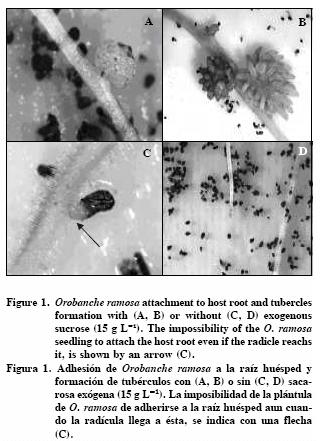
<body><![CDATA[<p align="justify"><font face="verdana" size="2">&nbsp;</font></p>     <p align="justify"><font face="verdana" size="2"><b>RESULTS AND DISCUSSION</b></font></p>     <p align="justify"><font face="verdana" size="2"><b><i>O. ramosa </i>seed germination in presence of sucrose</b></font></p>     <p align="justify"><font face="verdana" size="2">Low and intermediate sucrose concentrations (15 and 30 g L<sup>&#150;1</sup><i>) </i>did not reduce the number of germinating <i>O. ramosa </i>seeds, and only the highest concentration (60 g L<sup>&#150;1</sup>) caused a moderate reduction on the germination rate (<a href="/img/revistas/agro/v42n5/a3t1.jpg" target="_blank">Table 1</a>). This has been also observed in <i>Arabidopsis, </i>where 90&#150;100% of seeds treated with high glucose or sucrose showed similar results (Laby <i>et al., </i>2000).</font></p>     <p align="justify"><font face="verdana" size="2"><b>Effect of sucrose on early seedling development of <i>O. ramosa</i></b></font></p>     <p align="justify"><font face="verdana" size="2">Radicle lenght was reduced by sucrose (30 and 60 g L<sup>&#150;1</sup>); with 60 g L<sup>&#150;1</sup> reduction was approximately 60% (<a href="/img/revistas/agro/v42n5/a3t1.jpg" target="_blank">Table 1</a>). In our study, differences on seed morphology were also observed (data not shown). The sucrose treatment seemed to increase the number of seedlings with no radicle development showing an apresorium emerging directly from the testa. Therefore, although sucrose did not inhibit the germination, it was effective in a second stage of the seedling development.</font></p>     <p align="justify"><font face="verdana" size="2"><b><i>O. ramosa </i>infection and tubercles formation in the presence of sucrose</b></font></p>     <p align="justify"><font face="verdana" size="2">All treatments with sucrose effectively prevented successful seedling establishment and tubercles formation (<a href="/img/revistas/agro/v42n5/a3t1.jpg" target="_blank">Table 1</a>; <a href="#f1">Figure 1</a>). Since 15 g L<sup>&#150;1</sup> of sucrose controled nodules development, a wider range around this concentration should be tested.</font></p>     <p align="center"><font face="verdana" size="2"><a name="f1"></a></font></p>     <p align="center"><font face="verdana" size="2"><img src="/img/revistas/agro/v42n5/a3f1.jpg"></font></p>     ]]></body>
<body><![CDATA[<p align="justify"><font face="verdana" size="2">Even when the radicle reached the host root, it was unable to infect it (<a href="#f1">Figure 1C</a>). This finding is consistent with similar results observed by Ben&#150;Hod <i>et al. </i>(1991) with <i>O. aegyptiaca </i>callouses developed <i>in vitro. </i>Protusions of these callii behaving like radicles of germinating seeds were unable to infect host roots when grown on media containing organic nutrients.</font></p>     <p align="justify"><font face="verdana" size="2">The results, both on seedling development and total amount of attachments, could be attributed to the modified osmotic potential of the media with the sucrose concentrations, rather than to sucrose concentration itself. In studies with the model plant <i>Arabidopsis thaliana, </i>the changes produced by 0.11 M glucose on germinating seeds were not due to osmotic stress (To <i>et al., </i>2002). We used 15, 30 and 60 g L<sup>&#150;1</sup> (0.044, 0.088 and 0.18 M), concentrations lower or similar to those used for <i>Arabidopsis. </i>For this reason, it is improbable that <i>O. ramosa </i>seeds sensitivity to the sugar concentrations tested could be due to the osmotic potential of the media. Further studies should consider sorbitol treatment in the <i>O. ramosa/tomato </i>system in order to neject this hypothesis.</font></p>     <p align="justify"><font face="verdana" size="2"><b>Sucrose effect on host plant</b></font></p>     <p align="justify"><font face="verdana" size="2">The effect of sucrose on the host plant was tested by determining the root length for each treatment: 5.90, 5.61, 4.55 and 3.47 m for 0, 15, 30 and 60 g L<sup>&#150;1</sup>. There were significant differences between the 60 g L<sup>&#150;1</sup> and 30 g L<sup>&#150;1</sup> as well as between the control and the 30 g L<sup>&#150;1</sup> concentration (<a href="/img/revistas/agro/v42n5/a3t1.jpg" target="_blank">Table 1</a>). Thus, it is highly desirable to determinate the sucrose concentration needed to control <i>O. ramosa </i>without interfering with the host root development.</font></p>     <p align="justify"><font face="verdana" size="2">&nbsp;</font></p>     <p align="justify"><font face="verdana" size="2"><b>CONCLUSIONS</b></font></p>     <p align="justify"><font face="verdana" size="2">Sucrose blocks <i>O. ramosa </i>life cycle by modifying the normal germination step and preventing its attachment to the host plant. Nevertheless, the results of sucrose application could be different under field conditions, where precipitations or soil microbe interaction might alter initial concentrations or interfere with the host development. Studies about different <i>Orobanche </i>species attacking other crops <i>(O. crenata&#150;</i>legumes or <i>O. cumana / </i>sunflower systems) could also be of utmost interest.</font></p>     <p align="justify"><font face="verdana" size="2">&nbsp;</font></p>     <p align="justify"><font face="verdana" size="2"><b>ACKNOWLEDGEMENTS</b></font></p>     <p align="justify"><font face="verdana" size="2">This work was financially supported by the INIA_RTA04&#150;067 project.</font></p>     ]]></body>
<body><![CDATA[<p align="justify"><font face="verdana" size="2">&nbsp;</font></p>     <p align="justify"><font face="verdana" size="2"><b>LITERATURE CITED</b></font></p>     <!-- ref --><p align="justify"><font face="verdana" size="2">Aber, M. 1984. Cytophysiological aspects of <i>Orobanche crenata </i>Forsk. parasitizing <i>Vicia faba </i>L. Third International Symposium on Parasitic Weeds, Aleppo.</font>&nbsp;&nbsp;&nbsp;&nbsp;&nbsp;&nbsp;&nbsp;&nbsp;[&#160;<a href="javascript:void(0);" onclick="javascript: window.open('/scielo.php?script=sci_nlinks&ref=522898&pid=S1405-3195200800050000300001&lng=','','width=640,height=500,resizable=yes,scrollbars=1,menubar=yes,');">Links</a>&#160;]<!-- end-ref --><!-- ref --><p align="justify"><font face="verdana" size="2">Ben&#150;Hod, G., D. Losner, D. M. Joel, and A. M. Mayer. 1991. Infection of tomato roots using callii of broomrape. Physiologia Plantarum. 83: 353&#150;356.</font>&nbsp;&nbsp;&nbsp;&nbsp;&nbsp;&nbsp;&nbsp;&nbsp;[&#160;<a href="javascript:void(0);" onclick="javascript: window.open('/scielo.php?script=sci_nlinks&ref=522899&pid=S1405-3195200800050000300002&lng=','','width=640,height=500,resizable=yes,scrollbars=1,menubar=yes,');">Links</a>&#160;]<!-- end-ref --><!-- ref --><p align="justify"><font face="verdana" size="2">Gibson, S. I. 2004. Sugar and phytohormone response pathways: navigating a signalling network. J.   Exp. Bot. 55: 253&#150;264.</font>&nbsp;&nbsp;&nbsp;&nbsp;&nbsp;&nbsp;&nbsp;&nbsp;[&#160;<a href="javascript:void(0);" onclick="javascript: window.open('/scielo.php?script=sci_nlinks&ref=522900&pid=S1405-3195200800050000300003&lng=','','width=640,height=500,resizable=yes,scrollbars=1,menubar=yes,');">Links</a>&#160;]<!-- end-ref --><!-- ref --><p align="justify"><font face="verdana" size="2">Gonz&aacute;lez&#150;Verdejo, C. I., X. Barandiaran L, M. T. Moreno Y, J. I. Cubero S, and A. Di Pietro. 2005. An improved axenic system for studying pre&#150;infection development of the parasitic plant <i>Orobanche ramosa. </i>Annals Bot. 96: 1121&#150;1127.</font>&nbsp;&nbsp;&nbsp;&nbsp;&nbsp;&nbsp;&nbsp;&nbsp;[&#160;<a href="javascript:void(0);" onclick="javascript: window.open('/scielo.php?script=sci_nlinks&ref=522901&pid=S1405-3195200800050000300004&lng=','','width=640,height=500,resizable=yes,scrollbars=1,menubar=yes,');">Links</a>&#160;]<!-- end-ref --><!-- ref --><p align="justify"><font face="verdana" size="2">Gonz&aacute;lez&#150;Verdejo, C. I., X. Barandiaran L, M. T. Moreno Y, J. I. Cubero S, and A. Di Pietro. 2006. A peroxidase gene expressed during early developmental stages of the parasitic plant <i>Orobanche ramosa. </i>J. Exp. Bot. 57: 185&#150;192.</font>&nbsp;&nbsp;&nbsp;&nbsp;&nbsp;&nbsp;&nbsp;&nbsp;[&#160;<a href="javascript:void(0);" onclick="javascript: window.open('/scielo.php?script=sci_nlinks&ref=522902&pid=S1405-3195200800050000300005&lng=','','width=640,height=500,resizable=yes,scrollbars=1,menubar=yes,');">Links</a>&#160;]<!-- end-ref --><!-- ref --><p align="justify"><font face="verdana" size="2">Graham, I. A. 1996. Carbohydrate control of gene expression in higher plants. Res. Microbiol. 147: 572&#150;580.</font>&nbsp;&nbsp;&nbsp;&nbsp;&nbsp;&nbsp;&nbsp;&nbsp;[&#160;<a href="javascript:void(0);" onclick="javascript: window.open('/scielo.php?script=sci_nlinks&ref=522903&pid=S1405-3195200800050000300006&lng=','','width=640,height=500,resizable=yes,scrollbars=1,menubar=yes,');">Links</a>&#160;]<!-- end-ref --><!-- ref --><p align="justify"><font face="verdana" size="2">Laby, R. J., M. S. Kincaid, D. Kim, and S. I. Gibson. 2000. The&nbsp;<i>Arabidopsis </i>sugar&#150;insensitive mutants sis4 and sis5 are defective in abscisic acid synthesis and response. The Plant J. 23: 587&#150;596.</font>&nbsp;&nbsp;&nbsp;&nbsp;&nbsp;&nbsp;&nbsp;&nbsp;[&#160;<a href="javascript:void(0);" onclick="javascript: window.open('/scielo.php?script=sci_nlinks&ref=522904&pid=S1405-3195200800050000300007&lng=','','width=640,height=500,resizable=yes,scrollbars=1,menubar=yes,');">Links</a>&#160;]<!-- end-ref --><!-- ref --><p align="justify"><font face="verdana" size="2">P&eacute;rez&#150;de&#150;Luque, A., J. V. Jorr&iacute;n, and D. Rubiales. 2004. <i>Crenate </i>broomrape control in pea by foliar application of benzothiadiazole (BTH). Phytoparasitica. 32: 21&#150;29.</font>&nbsp;&nbsp;&nbsp;&nbsp;&nbsp;&nbsp;&nbsp;&nbsp;[&#160;<a href="javascript:void(0);" onclick="javascript: window.open('/scielo.php?script=sci_nlinks&ref=522905&pid=S1405-3195200800050000300008&lng=','','width=640,height=500,resizable=yes,scrollbars=1,menubar=yes,');">Links</a>&#160;]<!-- end-ref --><!-- ref --><p align="justify"><font face="verdana" size="2">Tennant, D.  1975. A test of a modified line intersect method of estimating root lenght. J. Ecol. 63: 955&#150;1001.</font>&nbsp;&nbsp;&nbsp;&nbsp;&nbsp;&nbsp;&nbsp;&nbsp;[&#160;<a href="javascript:void(0);" onclick="javascript: window.open('/scielo.php?script=sci_nlinks&ref=522906&pid=S1405-3195200800050000300009&lng=','','width=640,height=500,resizable=yes,scrollbars=1,menubar=yes,');">Links</a>&#160;]<!-- end-ref --><!-- ref --><p align="justify"><font face="verdana" size="2">To, J. P. C., W. D. Reiter, and S. I. Gibson. 2002. Mobilization of seed storage lipid by <i>Arabidopsis </i>seedlings is retarded in the <i>&nbsp;</i>presence of exogenous sugars. BMC Plant Biol. 2: 4. </font>&nbsp;&nbsp;&nbsp;&nbsp;&nbsp;&nbsp;&nbsp;&nbsp;[&#160;<a href="javascript:void(0);" onclick="javascript: window.open('/scielo.php?script=sci_nlinks&ref=522907&pid=S1405-3195200800050000300010&lng=','','width=640,height=500,resizable=yes,scrollbars=1,menubar=yes,');">Links</a>&#160;]<!-- end-ref --> ]]></body><back>
<ref-list>
<ref id="B1">
<nlm-citation citation-type="confpro">
<person-group person-group-type="author">
<name>
<surname><![CDATA[Aber]]></surname>
<given-names><![CDATA[M.]]></given-names>
</name>
</person-group>
<article-title xml:lang="en"><![CDATA[Cytophysiological aspects of Orobanche crenata Forsk. parasitizing Vicia faba L.]]></article-title>
<source><![CDATA[]]></source>
<year>1984</year>
<conf-name><![CDATA[ Third International Symposium on Parasitic Weeds]]></conf-name>
<conf-loc>Aleppo </conf-loc>
</nlm-citation>
</ref>
<ref id="B2">
<nlm-citation citation-type="journal">
<person-group person-group-type="author">
<name>
<surname><![CDATA[Ben-Hod]]></surname>
<given-names><![CDATA[G]]></given-names>
</name>
<name>
<surname><![CDATA[Losner]]></surname>
<given-names><![CDATA[D.]]></given-names>
</name>
<name>
<surname><![CDATA[Joel]]></surname>
<given-names><![CDATA[D. M.]]></given-names>
</name>
<name>
<surname><![CDATA[Mayer]]></surname>
<given-names><![CDATA[A. M.]]></given-names>
</name>
</person-group>
<article-title xml:lang="en"><![CDATA[Infection of tomato roots using callii of broomrape]]></article-title>
<source><![CDATA[Physiologia Plantarum]]></source>
<year>1991</year>
<volume>83</volume>
<page-range>353-356</page-range></nlm-citation>
</ref>
<ref id="B3">
<nlm-citation citation-type="journal">
<person-group person-group-type="author">
<name>
<surname><![CDATA[Gibson]]></surname>
<given-names><![CDATA[S. I]]></given-names>
</name>
</person-group>
<article-title xml:lang="en"><![CDATA[Sugar and phytohormone response pathways: navigating a signalling network]]></article-title>
<source><![CDATA[J. Exp. Bot]]></source>
<year>2004</year>
<volume>55</volume>
<page-range>253-264</page-range></nlm-citation>
</ref>
<ref id="B4">
<nlm-citation citation-type="journal">
<person-group person-group-type="author">
<name>
<surname><![CDATA[González-Verdejo]]></surname>
<given-names><![CDATA[C. I]]></given-names>
</name>
<name>
<surname><![CDATA[Barandiaran L]]></surname>
<given-names><![CDATA[X.]]></given-names>
</name>
<name>
<surname><![CDATA[Moreno Y]]></surname>
<given-names><![CDATA[M. T.]]></given-names>
</name>
<name>
<surname><![CDATA[Cubero S]]></surname>
<given-names><![CDATA[J. I.]]></given-names>
</name>
<name>
<surname><![CDATA[Di Pietro]]></surname>
<given-names><![CDATA[A.]]></given-names>
</name>
</person-group>
<article-title xml:lang="en"><![CDATA[An improved axenic system for studying pre-infection development of the parasitic plant Orobanche ramosa]]></article-title>
<source><![CDATA[Annals Bot]]></source>
<year>2005</year>
<volume>96</volume>
<page-range>1121-1127</page-range></nlm-citation>
</ref>
<ref id="B5">
<nlm-citation citation-type="journal">
<person-group person-group-type="author">
<name>
<surname><![CDATA[González-Verdejo]]></surname>
<given-names><![CDATA[C. I]]></given-names>
</name>
<name>
<surname><![CDATA[Barandiaran L]]></surname>
<given-names><![CDATA[X.]]></given-names>
</name>
<name>
<surname><![CDATA[Moreno Y]]></surname>
<given-names><![CDATA[M. T.]]></given-names>
</name>
<name>
<surname><![CDATA[Cubero S]]></surname>
<given-names><![CDATA[J. I.]]></given-names>
</name>
<name>
<surname><![CDATA[Di Pietro]]></surname>
<given-names><![CDATA[A.]]></given-names>
</name>
</person-group>
<article-title xml:lang="en"><![CDATA[A peroxidase gene expressed during early developmental stages of the parasitic plant Orobanche ramosa]]></article-title>
<source><![CDATA[J. Exp. Bot]]></source>
<year>2006</year>
<volume>57</volume>
<page-range>185-192</page-range></nlm-citation>
</ref>
<ref id="B6">
<nlm-citation citation-type="journal">
<person-group person-group-type="author">
<name>
<surname><![CDATA[Graham]]></surname>
<given-names><![CDATA[I. A]]></given-names>
</name>
</person-group>
<article-title xml:lang="en"><![CDATA[Carbohydrate control of gene expression in higher plants]]></article-title>
<source><![CDATA[Res. Microbiol]]></source>
<year>1996</year>
<volume>147</volume>
<page-range>572-580</page-range></nlm-citation>
</ref>
<ref id="B7">
<nlm-citation citation-type="journal">
<person-group person-group-type="author">
<name>
<surname><![CDATA[Laby]]></surname>
<given-names><![CDATA[R. J]]></given-names>
</name>
<name>
<surname><![CDATA[Kincaid]]></surname>
<given-names><![CDATA[M. S.]]></given-names>
</name>
<name>
<surname><![CDATA[Kim]]></surname>
<given-names><![CDATA[D.]]></given-names>
</name>
<name>
<surname><![CDATA[Gibson]]></surname>
<given-names><![CDATA[S. I.]]></given-names>
</name>
</person-group>
<article-title xml:lang="en"><![CDATA[The Arabidopsis sugar-insensitive mutants sis4 and sis5 are defective in abscisic acid synthesis and response]]></article-title>
<source><![CDATA[The Plant J]]></source>
<year>2000</year>
<volume>23</volume>
<page-range>587-596</page-range></nlm-citation>
</ref>
<ref id="B8">
<nlm-citation citation-type="journal">
<person-group person-group-type="author">
<name>
<surname><![CDATA[Pérez-de-Luque]]></surname>
<given-names><![CDATA[A]]></given-names>
</name>
<name>
<surname><![CDATA[Jorrín]]></surname>
<given-names><![CDATA[J. V.]]></given-names>
</name>
<name>
<surname><![CDATA[Rubiales]]></surname>
<given-names><![CDATA[D.]]></given-names>
</name>
</person-group>
<article-title xml:lang="en"><![CDATA[Crenate broomrape control in pea by foliar application of benzothiadiazole (BTH)]]></article-title>
<source><![CDATA[Phytoparasitica]]></source>
<year>2004</year>
<volume>32</volume>
<page-range>21-29</page-range></nlm-citation>
</ref>
<ref id="B9">
<nlm-citation citation-type="journal">
<person-group person-group-type="author">
<name>
<surname><![CDATA[Tennant]]></surname>
<given-names><![CDATA[D]]></given-names>
</name>
</person-group>
<article-title xml:lang="en"><![CDATA[A test of a modified line intersect method of estimating root lenght]]></article-title>
<source><![CDATA[J. Ecol]]></source>
<year>1975</year>
<volume>63</volume>
<page-range>955-1001</page-range></nlm-citation>
</ref>
<ref id="B10">
<nlm-citation citation-type="journal">
<person-group person-group-type="author">
<name>
<surname><![CDATA[To]]></surname>
<given-names><![CDATA[J. P. C]]></given-names>
</name>
<name>
<surname><![CDATA[Reiter]]></surname>
<given-names><![CDATA[W. D.]]></given-names>
</name>
<name>
<surname><![CDATA[Gibson]]></surname>
<given-names><![CDATA[S. I.]]></given-names>
</name>
</person-group>
<article-title xml:lang="en"><![CDATA[Mobilization of seed storage lipid by Arabidopsis seedlings is retarded in the presence of exogenous sugars]]></article-title>
<source><![CDATA[BMC Plant Biol]]></source>
<year>2002</year>
<volume>2</volume>
<page-range>4</page-range></nlm-citation>
</ref>
</ref-list>
</back>
</article>
