<?xml version="1.0" encoding="ISO-8859-1"?><article xmlns:mml="http://www.w3.org/1998/Math/MathML" xmlns:xlink="http://www.w3.org/1999/xlink" xmlns:xsi="http://www.w3.org/2001/XMLSchema-instance">
<front>
<journal-meta>
<journal-id>1405-2768</journal-id>
<journal-title><![CDATA[Polibotánica]]></journal-title>
<abbrev-journal-title><![CDATA[Polibotánica]]></abbrev-journal-title>
<issn>1405-2768</issn>
<publisher>
<publisher-name><![CDATA[Instituto Politécnico Nacional, Escuela Nacional de Ciencias Biológicas]]></publisher-name>
</publisher>
</journal-meta>
<article-meta>
<article-id>S1405-27682009000200010</article-id>
<title-group>
<article-title xml:lang="en"><![CDATA[Antimicrobial activity of medicinal plants from the Huautla Sierra Biosphere Reserve in Morelos (Mexico)]]></article-title>
<article-title xml:lang="es"><![CDATA[Actividad antimicrobiana de las plantas medicinales de la reserva de la biosfera Sierra de Huautla en Morelos (México)]]></article-title>
</title-group>
<contrib-group>
<contrib contrib-type="author">
<name>
<surname><![CDATA[Salinas Sánchez]]></surname>
<given-names><![CDATA[David O.]]></given-names>
</name>
<xref ref-type="aff" rid="A02"/>
</contrib>
<contrib contrib-type="author">
<name>
<surname><![CDATA[Arteaga Najera]]></surname>
<given-names><![CDATA[Gema L.]]></given-names>
</name>
<xref ref-type="aff" rid="A02"/>
</contrib>
<contrib contrib-type="author">
<name>
<surname><![CDATA[León Rivera]]></surname>
<given-names><![CDATA[Ismael]]></given-names>
</name>
<xref ref-type="aff" rid="A03"/>
</contrib>
<contrib contrib-type="author">
<name>
<surname><![CDATA[Dorado Ramírez]]></surname>
<given-names><![CDATA[Oscar]]></given-names>
</name>
<xref ref-type="aff" rid="A04"/>
</contrib>
<contrib contrib-type="author">
<name>
<surname><![CDATA[Valladares Cisneros]]></surname>
<given-names><![CDATA[Ma. Guadalupe]]></given-names>
</name>
<xref ref-type="aff" rid="A05"/>
</contrib>
<contrib contrib-type="author">
<name>
<surname><![CDATA[Navarro García]]></surname>
<given-names><![CDATA[Víctor M.]]></given-names>
</name>
<xref ref-type="aff" rid="A01"/>
</contrib>
</contrib-group>
<aff id="A01">
<institution><![CDATA[,Instituto Mexicano del Seguro Social Centro de Investigación Biomédica del Sur Laboratorio de Microbiología]]></institution>
<addr-line><![CDATA[Xochitepec Morelos]]></addr-line>
<country>México</country>
</aff>
<aff id="A02">
<institution><![CDATA[,Universidad Autónoma del Estado de Morelos Facultad de Ciencias Biológicas ]]></institution>
<addr-line><![CDATA[Cuernavaca Morelos]]></addr-line>
<country>México</country>
</aff>
<aff id="A03">
<institution><![CDATA[,Universidad Autónoma del Estado de Morelos Centro de Investigaciones Químicas ]]></institution>
<addr-line><![CDATA[Cuernavaca Morelos]]></addr-line>
<country>México</country>
</aff>
<aff id="A04">
<institution><![CDATA[,Universidad Autónoma del Estado de Morelos Centro de Educación Ambiental e Investigación Sierra de Huautla ]]></institution>
<addr-line><![CDATA[Cuernavaca Morelos]]></addr-line>
<country>México</country>
</aff>
<aff id="A05">
<institution><![CDATA[,Universidad Autónoma del Estado de MCentro de Educación Ambiental e Investigación Sierra de Huautla Facultad de Ciencias Químicas e Ingeniería Laboratorio de Principios Fitoquímicos Bioactivos]]></institution>
<addr-line><![CDATA[Cuernavaca Morelos]]></addr-line>
<country>México</country>
</aff>
<pub-date pub-type="pub">
<day>00</day>
<month>09</month>
<year>2009</year>
</pub-date>
<pub-date pub-type="epub">
<day>00</day>
<month>09</month>
<year>2009</year>
</pub-date>
<numero>28</numero>
<fpage>213</fpage>
<lpage>225</lpage>
<copyright-statement/>
<copyright-year/>
<self-uri xlink:href="http://www.scielo.org.mx/scielo.php?script=sci_arttext&amp;pid=S1405-27682009000200010&amp;lng=en&amp;nrm=iso"></self-uri><self-uri xlink:href="http://www.scielo.org.mx/scielo.php?script=sci_abstract&amp;pid=S1405-27682009000200010&amp;lng=en&amp;nrm=iso"></self-uri><self-uri xlink:href="http://www.scielo.org.mx/scielo.php?script=sci_pdf&amp;pid=S1405-27682009000200010&amp;lng=en&amp;nrm=iso"></self-uri><abstract abstract-type="short" xml:lang="en"><p><![CDATA[Twenty-two extracts from nine Mexican medicinal plants of eight different families used for people neighbor to Huautla Sierra Biosphere Reserve (REBIOSH) in different infectious diseases were assayed in vitro to determine their antibacterial activity against Staphylococcus aureus, Streptococcus faecalis; Escherichia coli; Proteus mirabilis; Salmonella typhi and the yeast Candida albicans. Most plants showed antibacterial activity, while two plants showed activity against range 0.25 a 4 mg/mL almost one microorganism used. The extracts showed minimum inhibitory concentration (MIC) against S. aureus and S. faecalis, represents microorganisms Gram-positive were hexanic and acetonic extracts of Bur ser a copallifera and hexanic extract of B. grandifolia. The ethanol extract of Lippia graveolens showed a MIC value of 1 mg/mL against yeast Candida albicans.]]></p></abstract>
<abstract abstract-type="short" xml:lang="es"><p><![CDATA[Se determinó la actividad antimicrobiana de veintidós extractos orgánicos de nueve especies vegetales medicinales de ocho diferentes familias, que son comúnmente empleadas por los habitantes de las comunidades vecinas a la reserva de la biosfera Sierra de Huautla (REBIOSH), Morelos, para tratar diferentes padecimientos infecciosos. Los microorganismos empleados fueron: Staphylococcus aureus; Streptococcus faecalis; Escherichia coli; Proteus mirabilis; Salmonella typhi y la levadura Candida albicans. La mayoría de los extractos de las plantas probadas inhibieron el crecimiento microbiano en un rango de 0.25 a 4 mg/mL de al menos uno de los microorganismos utilizados. Los extractos que mostraron las menores concentraciones mínimas inhibitorias (CMI) frente a los microorganismos S. aureus y S. faecalis, representativos de Gram-positivos fueron el extracto hexánico y acetónico de Bur ser a copallifera y el hexánico de B. grandifolia. El extracto etanólico de Lippia graveolens logró inhibir a C. albicans con una CMI de 1 mg/mL.]]></p></abstract>
<kwd-group>
<kwd lng="en"><![CDATA[antimicrobial activity]]></kwd>
<kwd lng="en"><![CDATA[minimum inhibitory concentration (MIC)]]></kwd>
<kwd lng="en"><![CDATA[medicinal plants]]></kwd>
<kwd lng="en"><![CDATA[Huautla Sierra Biosphere Reserve]]></kwd>
<kwd lng="en"><![CDATA[Morelos]]></kwd>
<kwd lng="es"><![CDATA[Actividad antimicrobiana]]></kwd>
<kwd lng="es"><![CDATA[concentración mínima inhibitoria (CMI)]]></kwd>
<kwd lng="es"><![CDATA[plantas medicinales]]></kwd>
<kwd lng="es"><![CDATA[Reserva de la Biosfera Sierra de Huautla]]></kwd>
<kwd lng="es"><![CDATA[Morelos]]></kwd>
</kwd-group>
</article-meta>
</front><body><![CDATA[ <p align="center"><font face="verdana" size="4"><b>Antimicrobial activity of medicinal plants from the Huautla Sierra Biosphere Reserve in Morelos (Mexico) </b></font></p>     <p align="center"><font face="verdana" size="2">&nbsp;</font></p>     <p align="center"><font face="verdana" size="3"><b>Actividad antimicrobiana de las plantas medicinales de la reserva de la biosfera Sierra de Huautla en Morelos (M&eacute;xico) </b></font></p>     <p align="center"><font face="verdana" size="2">&nbsp;</font></p>     <p align="center"><font face="verdana" size="2"><b>David O. Salinas S&aacute;nchez<sup>2</sup>,<sup>4</sup>, Gema L. Arteaga Najera<sup>2</sup>, Ismael Le&oacute;n Rivera<sup>3</sup>, Oscar Dorado Ram&iacute;rez<sup>4</sup>, Ma. Guadalupe Valladares Cisneros<sup>5</sup>, V&iacute;ctor M. Navarro Garc&iacute;a<sup>1</sup></b></font></p>     <p align="justify"><font face="verdana" size="2">&nbsp;</font></p>     <p align="justify"><font face="verdana" size="2"><i><sup>1</sup> Laboratorio de Microbiolog&iacute;a, Centro de Investigaci&oacute;n Biom&eacute;dica del Sur, Instituto Mexicano del Seguro Social, Xochitepec Morelos, M&eacute;xico.</i></font></p>     <p align="justify"><font face="verdana" size="2"><i><sup>2</sup> Facultad de Ciencias Biol&oacute;gicas, Universidad Aut&oacute;noma del Estado de Morelos, Cuernavaca, Morelos, M&eacute;xico. </i></font></p>     <p align="justify"><font face="verdana" size="2"><i><sup>3</sup> Centro de Investigaciones Qu&iacute;micas, Universidad Aut&oacute;noma del Estado de Morelos, Cuernavaca, Morelos, M&eacute;xico. </i></font></p>     <p align="justify"><font face="verdana" size="2"><i><sup>4</sup> Centro de Educaci&oacute;n Ambiental e Investigaci&oacute;n Sierra de Huautla, Universidad Aut&oacute;noma del Estado de Morelos, Cuernavaca, Morelos, M&eacute;xico.</i></font></p>     ]]></body>
<body><![CDATA[<p align="justify"><font face="verdana" size="2"><i><sup>5</sup> Laboratorio de Principios Fitoqu&iacute;micos Bioactivos, Facultad de Ciencias Qu&iacute;micas e Ingenier&iacute;a; Universidad Aut&oacute;noma del Estado de Morelos, Cuernavaca, Morelos, M&eacute;xico. </i>Correo electr&oacute;nico: <a href="mailto:vmanavg@yahoo.com.mx">vmanavg@yahoo.com.mx</a>, <a href="mailto:osval1671@hotmail.com.mx">osval1671@hotmail.com.mx</a></font></p>     <p align="justify"><font face="verdana" size="2">&nbsp;</font></p>     <p align="justify"><font face="verdana" size="2">Recibido: 9 enero 2009    <br>  Aceptado: 7 agosto 2009</font></p>     <p align="justify"><font face="verdana" size="2">&nbsp;</font></p>     <p align="justify"><font face="verdana" size="2"><b>Abstract</b></font></p>     <p align="justify"><font face="verdana" size="2">Twenty&#150;two extracts from nine Mexican medicinal plants of eight different families used for people neighbor to Huautla Sierra Biosphere Reserve (REBIOSH) in different infectious diseases were assayed in vitro to determine their antibacterial activity against <i>Staphylococcus aureus, Streptococcus faecalis; Escherichia coli; Proteus mirabilis; Salmonella typhi </i>and the yeast <i>Candida albicans. </i>Most plants showed antibacterial activity, while two plants showed activity against range 0.25 a 4 mg/mL almost one microorganism used. The extracts showed minimum inhibitory concentration (MIC) against <i>S. aureus </i>and <i>S. faecalis, </i>represents microorganisms Gram&#150;positive were hexanic and acetonic extracts <i>of Bur ser a copallifera </i>and hexanic extract of <i>B. grandifolia. </i>The ethanol extract of <i>Lippia graveolens </i>showed a MIC value of 1 mg/mL against yeast <i>Candida albicans.</i></font></p>     <p align="justify"><font face="verdana" size="2"><b>Key words:</b> antimicrobial activity, minimum inhibitory concentration (MIC), medicinal plants, Huautla Sierra Biosphere Reserve, Morelos.</font></p>     <p align="justify"><font face="verdana" size="2">&nbsp;</font></p>     <p align="justify"><font face="verdana" size="2"><b>Resumen</b></font></p>     ]]></body>
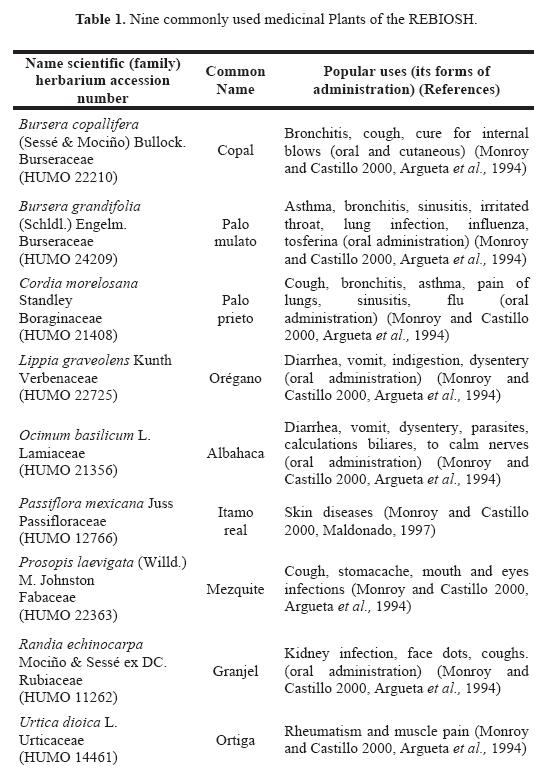
<body><![CDATA[<p align="justify"><font face="verdana" size="2">Se determin&oacute; la actividad antimicrobiana de veintid&oacute;s extractos org&aacute;nicos de nueve especies vegetales medicinales de ocho diferentes familias, que son com&uacute;nmente empleadas por los habitantes de las comunidades vecinas a la reserva de la biosfera Sierra de Huautla (REBIOSH), Morelos, para tratar diferentes padecimientos infecciosos. Los microorganismos empleados fueron: <i>Staphylococcus aureus; Streptococcus faecalis; Escherichia coli; Proteus mirabilis; Salmonella typhi </i>y la levadura <i>Candida albicans. </i>La mayor&iacute;a de los extractos de las plantas probadas inhibieron el crecimiento microbiano en un rango de 0.25 a 4 mg/mL de al menos uno de los microorganismos utilizados. Los extractos que mostraron las menores concentraciones m&iacute;nimas inhibitorias (CMI) frente a los microorganismos <i>S. aureus </i>y <i>S. faecalis, </i>representativos de Gram&#150;positivos fueron el extracto hex&aacute;nico y acet&oacute;nico de <i>Bur ser a copallifera </i>y el hex&aacute;nico de <i>B. grandifolia. </i>El extracto etan&oacute;lico de <i>Lippia graveolens </i>logr&oacute; inhibir a <i>C. albicans </i>con una CMI de 1 mg/mL.</font></p>     <p align="justify"><font face="verdana" size="2"><b>Palabras clave: </b>Actividad antimicrobiana, concentraci&oacute;n m&iacute;nima inhibitoria (CMI), plantas medicinales, Reserva de la Biosfera Sierra de Huautla, Morelos.</font></p>     <p align="justify"><font face="verdana" size="2">&nbsp;</font></p>     <p align="justify"><font face="verdana" size="2"><b>INTRODUCTION</b></font></p>     <p align="justify"><font face="verdana" size="2">According to the World Health Organization, the population most susceptible to infectious diseases are children. In the whole world, a little over two million children under five years old died from these diseases from 2000&#150;2003 (Lerberghe, 2005). In Mexico, the mortality statistics rank acute infectious respiratory diseases among the ten principal causes of death; seventh place with for women with 6 381 deaths, and in eighth place for men with 7 463 deaths (Estad&iacute;sticas de Mortalidad en M&eacute;xico, 2005). In the state of Morelos these diseases have high frequency rates, and in many cases are initially cared for by an herbalist (Taddei&#150;Bringas <i>et al., </i>1999, Monroy and Castillo, 2000; Romero <i>et al., </i>2004; Maldonado <i>et al., </i>2004).</font></p>     <p align="justify"><font face="verdana" size="2">In the Huautla Sierra Biosphere Reserve, Morelos&#150;M&eacute;xico (REBIOSH) (<a href="/img/revistas/polib/n28/a10f1.jpg" target="_blank">Figure 1</a>), 1,025 species of vascular plants were documented to occur, and around 401 medicinal plant species were reported. Among them, are those used to control infectious diseases (Dorado <i>et al., </i>2005). In the REBIOSH, the vegetation type is characterized as tropical deciduous forest (TDF), but in some areas temperate forest can be found mainly dominated by <i>Quercus </i>spp., and in some humid gullies the vegetation is similar to semi&#150;deciduous forest. The TDF in the REBIOSH is found in general altitudes from 800 to 1500 m.a.s.l. Annual average temperatures are between 20&deg; and 29&deg;C, which is a determining factor in the distribution of the TDF (Rzedowski, 1978). A very important aspect is the fact that in this hilly region of south and southeast Morelos, more than 20 000 people live in about 29 communities inside the Reserve. Some of the species of wild medicinal flora of the REBIOSH are used by the people of the region to treat various sicknesses (Maldonado, 1997; Maldonado <i>et al., </i>2004; Dorado <i>et al., </i>2005).</font></p>     <p align="justify"><font face="verdana" size="2">At present, our team is investigating the field of medicinal plants with the potential to treat infectious diseases (Navarro <i>et al., </i>1996; Navarro and Delgado, 1999; Rojas <i>et al., </i>2001; Navarro <i>et al., </i>2006). In the last few years, several plants that are used for various diseases have been studied, and the families&#150;genera of plants that stand out are Boraginaceae&#150;Cordia (Ioset <i>et al., </i>1998; Ioset <i>et al., </i>2000), Burseraceae&#150;Bursera (Camporese <i>et al., </i>2003; Yasunaka <i>et al. </i>2005), <i>Fabaceae&#150;Prosopis </i>(Salvat <i>et al., </i>2004), <i>Lamiaceae&#150;Ocimum </i>(Bozin <i>et al., </i>2006), <i>Passifloraceae&#150;Passiflora </i>(Nicolls <i>et al., </i>1973), Rubiaceae&#150;Randia (Jayasinghe <i>et al., </i>2002), Urticaceae&#150; <i>Urtica </i>(Gulcin <i>et al., </i>2004) and Verbenaceae&#150;Lippia (Pascual <i>et al., </i>2001). As we continued the investigation of the aforementioned families&#150;genera, we decided to perform antimicrobial bioassays on nine medicinal species belonging to these families of medicinal plants, whose habitat is the REBIOSH.</font></p>     <p align="justify"><font face="verdana" size="2">The present research paper is focused on the scientific validation of the use of certain medicinal plants for the treatment of infectious diseases by the communities next to the REBIOSH, who use this natural resource.</font></p>     <p align="justify"><font face="verdana" size="2">&nbsp;</font></p>     <p align="justify"><font face="verdana" size="2"><b>MATERIAL AND METHODS</b></font></p>     ]]></body>
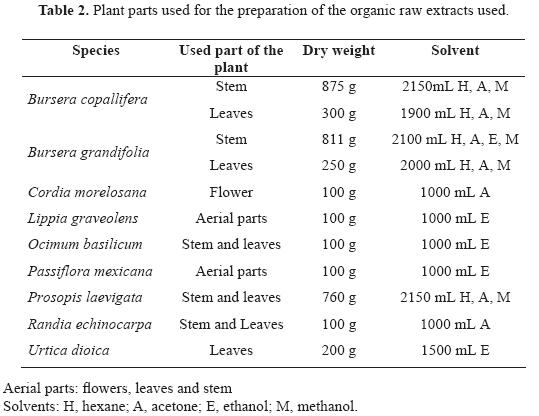
<body><![CDATA[<p align="justify"><font face="verdana" size="2"><b>Collecting the vegetable material</b></font></p>     <p align="justify"><font face="verdana" size="2">Plants material was collected in March and June, 2005, in the REBIOSH. The nine species were prepared for depositing in HUMO herbarium (Herbarium of the University of Morelos) of the Center of Environmental Education and Investigation of the Huautla Sierra of the Autonomous University of the State of Morelos. List the specimen accession number, as well as their common name and other ethnobotanical information (<a href="#t1">Table 1</a>).</font></p>     <p align="center"><font face="verdana" size="2"><a name="t1"></a></font></p>     <p align="center"><font face="verdana" size="2"><img src="/img/revistas/polib/n28/a10t1.jpg"></font></p>     <p align="center"><font face="verdana" size="2">&nbsp;</font></p>     <p align="justify"><font face="verdana" size="2"><b>Preparation of extracts</b></font></p>     <p align="justify"><font face="verdana" size="2">Plant materials (stem, leaves and flowers) were shade&#150;dried at room temperature, powdered, and individually extracted sequentially with n&#150;hexane, acetone, ethanol and methanol at room temperature (<a href="#t2">Table 2</a>). Each solvent was replaced three&#150;times with fresh solvent, remaining in contact with the plant material for 48 h on each occasion. After filtration, the extracts were concentrated under low pressure at 40&deg;C. The resulting crude extracts were stored at &#150; 20 &deg;C until they were tested.</font></p>     <p align="center"><font face="verdana" size="2"><a name="t2"></a></font></p>     <p align="center"><font face="verdana" size="2"><b><img src="/img/revistas/polib/n28/a10t2.jpg"></b></font></p>     <p align="center"><font face="verdana" size="2">&nbsp;</font></p>     ]]></body>
<body><![CDATA[<p align="justify"><font face="verdana" size="2"><b>Microorganisms and media</b></font></p>     <p align="justify"><font face="verdana" size="2">The microorganisms used for the antimicrobial evaluation were purchased from the American Type Culture Collection (ATCC; Rockville, MD, USA). The following Gram&#150;positive bacteria were used: <i>Staphylococcus aureus </i>(ATCC 6358), and <i>Streptococcus faecalis </i>(ATCC 10231). The following Gram&#150;negative strains were used: <i>Escherichia coli </i>(ATCC 8937), <i>Proteus mirabilis </i>(ATCC 43071), <i>Salmonella typhi </i>(ATCC 06539) and the yeast <i>Candida albicans </i>(ATCC 10231). All bacteria were maintained on tryptic soybean agar (TSA; Merck, Darmstadt, Germany) and assayed on Mueller&#150;Hinton agar (MH; Merck). Sabouraud 4% glucose agar (SGA; Merck) was used to maintain the yeast and as the assay medium.</font></p>     <p align="justify"><font face="verdana" size="2">&nbsp;</font></p>     <p align="justify"><font face="verdana" size="2"><b>Antimicrobial activity assays</b></font></p>     <p align="justify"><font face="verdana" size="2">The antibacterial and antifungal activities of the crude extracts were determined using the agar dilution method (Jorgensen <i>et al. </i>1999). The hexane, acetone, ethanol and methanol extracts were individually dissolved in 2% dimethylsulfoxide (DMSO; Merck). Further two&#150;fold dilutions of each extract were performed using sterile distilled water and were added to melted agar culture medium in 100 mm Petri dishes (Falcon Franklin Lakes, New Jersey, USA) at the following final concentrations: 0.125, 0.25, 0.50, 1, 2, 4, and 8 mg/mL. Agar culture medium and DMSO 2% were used as negative controls. The procedures followed for the antibacterial and antifungal assays are described below.</font></p>     <p align="justify"><font face="verdana" size="2">&nbsp;</font></p>     <p align="justify"><font face="verdana" size="2"><b>Antibacterial activity assay</b></font></p>     <p align="justify"><font face="verdana" size="2">Suspensions for each strain were prepared by transferring five or six colonies, chosen after overnight growth on tryptic soybean agar, to 5 mL of Mueller&#150;Hinton broth (MHB; Merck). Cultures were incubated at 36&deg;C until they were visibly turbid, and the suspensions were then diluted until the turbidity matched the 0.5 McFarland standard turbidity equivalents &#91;10<sup>8</sup> colony&#150;forming units (CFU)/mL&#93;. Microbial suspensions were further diluted 1:10 to obtain a concentration of 10<sup>7</sup> CFU/mL. The diluted inoculum was applied with a loop calibrated to deliver 0.002 mL, resulting in a spot covering a circle of 5 to 8 mm diameter and containing 10<sup>4</sup> CFU/mL. The plates were incubated for 24 h at 36&deg;C. Gentamicin (5 mg/mL; Sigma&#150;Aldrich, St. Louis, MO, USA) was used as positive control. Observations were performed in duplicate, and results are expressed as the lowest concentration of plant extract that produced a complete suppression of colony growth, the minimal inhibitory concentration (MIC) (R&iacute;os <i>et al., </i>1988).</font></p>     <p align="justify"><font face="verdana" size="2">&nbsp;</font></p>     <p align="justify"><font face="verdana" size="2"><b>Antifungal activity assay</b></font></p>     ]]></body>
<body><![CDATA[<p align="justify"><font face="verdana" size="2"><i>C. albicans </i>inoculum was prepared by diluting the yeast suspension (adjusted to McFarland 0.5 scale) in 0.85% NaCl solution to a final concentration of 10<sup>5</sup> cell/mL. The filamentous fungi inoculums were prepared by diluting the scraped cells mass in 0.85% NaCl to a final concentration of 10<sup>6</sup> spores/mL. The diluted inocula were delivered on the top of the solidified agar with a loop calibrated to deliver 0.005 mL. The plates were incubated at 29&deg;C. <i>C. albicans </i>growth was checked both in control plates prepared without any test sample and in experimental plates, <i>C. albicans </i>was cultured 48 h. Experiments were duplicated, and results were expressed as MIC. Positive control was prepared with Nystatin (5 mg/mL; Merck).</font></p>     <p align="center"><font face="verdana" size="2">&nbsp;</font></p>     <p align="justify"><font face="verdana" size="2"><b>RESULTS AND DISCUSSION</b></font></p>     <p align="justify"><font face="verdana" size="2"><a href="/img/revistas/polib/n28/a10t3.jpg" target="_blank">Table 3</a> shows the plant part used, the percentage of yield, and the MIC obtained for the corresponding evaluations of each extract. The agar dilution method used in this investigation has been employed frequently and recommended as a good method for determining the relative potency of complex extracts and for establishing their antimicrobial spectrum (R&iacute;os and Recio, 2005). In our experience and according to previous antimicrobial studies carried out in our laboratory, crude plant extracts with MIC values between 2.5 and 8 mg/mL (Lozoya <i>et al., </i>1992; Navarro <i>et al.</i>, 1996) have led to the isolation of strong antimicrobial compounds (Navarro and Delgado 1999). Under this criterion, and considering that in this study only crude extracts were employed, extracts with MIC values of 8 mg/mL or below against any of the microorganisms tested were considered active. Most of the extracts used showed antimicrobial activity with the Gram&#150;positives bacteria being the more sensitive to the extracts.</font></p>     <p align="justify"><font face="verdana" size="2">The species which showed the highest activity was <i>B. copallifera, </i>of which the acetone stems extract and the methanol leaves extract were the most active against the <i>S. aureus, </i>both of them with a MIC value of 0.25 mg/mL. In addition these same extracts showed values of 1 and 0.25 mg/mL respectively against <i>S. faecalis. </i>On the other hand, the leaves acetone extract of this species showed a wide scale of inhibition against all the microorganisms, with MIC value of 2 mg/mL against the Gram&#150;negatives and yeast. It is important to mention that the other species in this genus, that is to say <i>B. grandifolia, </i>also showed antimicrobial activity. The stems hexane and acetone extracts showed a MIC value of 0.5 mg/mL against the <i>S. aureus. </i>The hexane extract to <i>B. grandifolia </i>showed a MIC value of 4 mg/mL against all the microorganisms. The remainder of the plant species also showed notable antimicrobial activities. The ethanol extract of <i>L. graveolens </i>showed a MIC value of 1 mg/mL against <i>S. aureus </i>and the yeast <i>C. albicans, </i>and a MIC value of 4 mg/mL against <i>S. faecalis. </i>The ethanol extracts of <i>O. basilicum </i>and P. <i>mexicana </i>showed MIC values of 4 mg/mL against <i>S. aureus.</i></font></p>     <p align="justify"><font face="verdana" size="2">On the other hand all the extracts of the medicinal plant <i>P. laevigata </i>showed antimicrobial activity. The hexane extract gave a MIC value of 0.5 mg/mL and the acetone extract showed a MIC value of 4 mg/mL, both against <i>S. aureus. </i>The ethanol extract of <i>U. dioica </i>showed antimicrobial activity with a MIC value of 1 mg/mL against the Gram&#150;positive bacteria.</font></p>     <p align="justify"><font face="verdana" size="2">There were no literature reports of antimicrobial activity for most species studied, however, the chemical nature or the antimicrobial activity of some species of the same genera are described in the following research work.</font></p>     <p align="justify"><font face="verdana" size="2">The extract of <i>Bursera simaruba </i>(bark) was evaluated for its antibacterial properties. Activity was tested against standard strains of <i>Escherichia coli </i>ATCC 25922, <i>Pseudomonas aeruginosa </i>ATCC 27853, <i>Staphylococcus aureus </i>ATCC 25923 and <i>Enterococcus faecalis </i>ATCC 29212. The extract inhibited the growth of all of the bacterial strains, except that of <i>Entero&#150;coccus faecalis </i>(Camporese <i>et al., </i>2003). Other studies <i>B. simaruba </i>showed, higher activity against <i>Staphylococcus aureus </i>(methicillin&#150;sensitive and methicillin&#150;resistant) than against <i>Escherichia coli </i>(Yasunaka <i>et al., </i>2005).</font></p>     <p align="justify"><font face="verdana" size="2">Two new natural products, characterized as 1&#150;(3 '&#150;methoxypropanoyl)&#150;2,4,5&#150;trimethoxybenzene and a prenylated hydroquinone, 2&#150;(2Z)&#150;(3&#150;hydroxy&#150;3,7&#150;dimethylocta&#150;2, 6&#150;dienyl)&#150;1,4&#150;benzenediol, have been isolated from the root bark of <i>Cordia alliodora. </i>Both compounds exhibited antifungal properties against the phytopathogenic mold <i>Cladosporium cucumerinum </i>(Ioset <i>et al., </i>2000). Also, two meroterpenoid naphthoquinones, the known cordiaquinone B and a new naphthoxirene, have been isolated from the roots of Cordia linnaei. The two showed activity against <i>Cladosporium cucumerinum </i>and <i>Candida albicans </i>(Ioset <i>et al., </i>1998).</font></p>     <p align="justify"><font face="verdana" size="2">In a literature review of the genus <i>Lippia, </i>(Pascual <i>et al., </i>2001) found that <i>in vitro </i>screening with extracts of <i>L. alba, </i>and <i>L dulcis </i>demonstrated an inhibitory activity against many of the Gram&#150;positive bacteria most frequently responsible for infections in humans <i>(Staphylococcus aureus. Streptococcus pneumoniae </i>and <i>Streptococcus pyogenes), </i>and thus, may provide a scientific basis for the ethnomedical use of this species against bacterial respiratory infections (C&aacute;ceres <i>et al., </i>1991).</font></p>     ]]></body>
<body><![CDATA[<p align="justify"><font face="verdana" size="2">Other studies report that the essential oils from genus <i>Lippia </i>have also been shown to exhibit antimicrobial activity against other microorganisms. For example <i>L. sidoides </i>shows a inhibitory activity against <i>E. coli, S. aureus, Bacilus subtilis, </i>and <i>Mycobacterium smegmatis, </i>and a low activity against <i>Pseudomonas aeruginosa </i>(Lemos <i>et al., </i>1990).</font></p>     <p align="justify"><font face="verdana" size="2">The ethanolic extracts of <i>L. palmeri </i>and <i>L. formosa </i>exhibit activity against <i>S. aureus, S. faecalis </i>and <i>B. subtilis </i>(Dimayuga and Keer Garc&iacute;a, 1991). Extracts isolated from <i>L. dulcis, </i>shows antimicrobial activity against enteropathogenic <i>Salmonella typhi </i>and <i>Shigella flexneri </i>(C&aacute;ceres <i>et al., </i>1993).</font></p>     <p align="justify"><font face="verdana" size="2">Some species of the genus <i>Prosopis </i>have been reported to exhibit antimicrobial activity. This is the case for <i>P. juliflora. </i>One alkaloid from this plant, which has been named juliprosinene, showed antibacterial activity against <i>Escherichia coli </i>strains 11303 HER 1024 and K&#150;125 HER 1037, <i>Klebsiella pneumoniae </i>C3HER 1111, <i>Pseudomonas aeruginosa </i>PA 01 HER 1018, <i>Staphylococcus aureus </i>B&#150;827, and <i>Shigella sonnei </i>YER HER 1048 (Ahmad <i>et al., </i>1989). In another study of this plant, a mixture of alkaloids containing mainly juliprosine and isojuliprosine was tested for antifungal activity against dermatophytos, <i>Aspergillus </i>and <i>Candida </i>species in comparison with griseofulvin and econazole. Although econazole was found to be the most active one, the alkaloidal mixture was found more effective than griseofulvin (Ahmad and Khursheed, 1989).</font></p>     <p align="justify"><font face="verdana" size="2">Methanol extracts of the barks of two species of <i>Prosopis </i>were evaluated to determine their antimicrobial activity. <i>Prosopis kuntzei </i>exhibited antimicrobial activity against <i>S. aureus </i>ATCC 8095, INE 2213, and <i>Ps. aeuruginosa </i>ATCC 25617, with CMI below 1 mg/mL. On the other hand, <i>Prosopis ruscifolia </i>had activity against <i>S. aureus ATCC </i>8095, INE 2213, <i>Ent. faecium </i>INEI 2464 and <i>Kl. pneumoniae </i>ATCC 25922, with MIC of 0.5, 0.38, 0.75 and 0.75 mg/mL respectively (Salvat <i>et al., </i>2004).</font></p>     <p align="justify"><font face="verdana" size="2">Recent research has discovered a new potent anti&#150;infective and antiparasitic compound, 2,3&#150;dihydro&#150;1H&#150;indolizinium chloride, from <i>Prosopis glandulosa </i>var. <i>glandulosa. </i>It shows antibacterial activity against methicillin&#150;resistant <i>Staphylococcus aureus </i>and <i>Micobacterium intracellulare </i>with values of IC50 0.35 and 0.9 ug/mL respectively (Samoylenko <i>et al., </i>2009).</font></p>     <p align="justify"><font face="verdana" size="2">An investigation of <i>Urtica dioica </i>showed that a water extract exhibited antioxidant, antimicrobial, antiulcer and analgesic activities (Gulcin <i>et al., </i>2004).</font></p>     <p align="justify"><font face="verdana" size="2">The results obtained in the current investigation indicate that <i>B. copallifera, B. grandifolia, L. graveolens, P. leavigata </i>and <i>U. dioica </i>possesses antibacterial and/or antifungal properties, showing a strong correlation between the reported uses of these plant species by the communities of the Huautla Sierra in the State of Morelos and in Mexican folk medicine and the obtained experimental data. It also supports the importance of ethnopharmacology as a guide in the selection of plants for the discovery of bioactive compounds.</font></p>     <p align="justify"><font face="verdana" size="2">Phytochemical bioguided studies are currently under way in order to isolate and characterize the compounds responsible for the antimicrobial activities of theses plants.</font></p>     <p align="justify"><font face="verdana" size="2">&nbsp;</font></p>     <p align="justify"><font face="verdana" size="2"><b>ACKNOWLEDGMENTS</b></font></p>     ]]></body>
<body><![CDATA[<p align="justify"><font face="verdana" size="2">The authors would like to thank Biol. Juan Carlos Ju&aacute;rez from the CEAMISH/UAE&#150;Morelos for assistance in the collection and identification of plant specimens.</font></p>     <p align="justify"><font face="verdana" size="2">&nbsp;</font></p>     <p align="justify"><font face="verdana" size="2"><b>REFERENCES</b> </font></p>     <!-- ref --><p align="justify"><font face="verdana" size="2">Ahmad, A., Khursheed, A.K., 1989. "Antifungal activity of some hydrosoluble <i>Prosopis juliflora </i>alkaloids". <i>Fitoterapia, </i><b>60</b>(1):86&#150;89.    &nbsp;&nbsp;&nbsp;&nbsp;&nbsp;&nbsp;&nbsp;&nbsp;[&#160;<a href="javascript:void(0);" onclick="javascript: window.open('/scielo.php?script=sci_nlinks&ref=6067661&pid=S1405-2768200900020001000001&lng=','','width=640,height=500,resizable=yes,scrollbars=1,menubar=yes,');">Links</a>&#160;]<!-- end-ref --></font></p>     <!-- ref --><p align="justify"><font face="verdana" size="2">Ahmad, V.U., Sultana, A., Qazi S., 1989. "Alkaloids from the leaves of<i> Prosopis juliflora". Journal Natural Products, </i><b>52</b>(3): 497&#150;501.    &nbsp;&nbsp;&nbsp;&nbsp;&nbsp;&nbsp;&nbsp;&nbsp;[&#160;<a href="javascript:void(0);" onclick="javascript: window.open('/scielo.php?script=sci_nlinks&ref=6067663&pid=S1405-2768200900020001000002&lng=','','width=640,height=500,resizable=yes,scrollbars=1,menubar=yes,');">Links</a>&#160;]<!-- end-ref --></font></p>     <!-- ref --><p align="justify"><font face="verdana" size="2">Argueta, A., Cano, L., Rodarte, M., 1994. <i>Atlas de las Plantas de la Medicina Tradicional Mexicana. </i>Instituto Nacional Indigenista (1&#150;3): 86&#150;88, 999&#150;1000, 1073&#150;1074, 1086&#150;1087.    &nbsp;&nbsp;&nbsp;&nbsp;&nbsp;&nbsp;&nbsp;&nbsp;[&#160;<a href="javascript:void(0);" onclick="javascript: window.open('/scielo.php?script=sci_nlinks&ref=6067665&pid=S1405-2768200900020001000003&lng=','','width=640,height=500,resizable=yes,scrollbars=1,menubar=yes,');">Links</a>&#160;]<!-- end-ref --></font></p>     <!-- ref --><p align="justify"><font face="verdana" size="2">Bozin, B., Mimica&#150;Dukic, N., Simin, N., Anackov, G., 2006. "Characterization of the volatile composition of essential oils of some lamiaceae spices and the antimicrobial and antioxidant activities of the entire oils". <i>Journal Agricultural and Food Chemistry. </i><b>54</b>(5): 1822<b>&#150;</b>1828.    &nbsp;&nbsp;&nbsp;&nbsp;&nbsp;&nbsp;&nbsp;&nbsp;[&#160;<a href="javascript:void(0);" onclick="javascript: window.open('/scielo.php?script=sci_nlinks&ref=6067667&pid=S1405-2768200900020001000004&lng=','','width=640,height=500,resizable=yes,scrollbars=1,menubar=yes,');">Links</a>&#160;]<!-- end-ref --></font></p>     <!-- ref --><p align="justify"><font face="verdana" size="2">C&aacute;ceres, A., &Aacute;lvarez, A.V., Ovando, A.E., Samayoa, B.E., 1991. "Plants used in Guatemala for the treatment of respiratory diseases. 1. Screening of 68 plants against Gram&#150;positive bacteria". <i>Journal of Ethnopharmacology, </i><b>31</b>: 193&#150;208.    &nbsp;&nbsp;&nbsp;&nbsp;&nbsp;&nbsp;&nbsp;&nbsp;[&#160;<a href="javascript:void(0);" onclick="javascript: window.open('/scielo.php?script=sci_nlinks&ref=6067669&pid=S1405-2768200900020001000005&lng=','','width=640,height=500,resizable=yes,scrollbars=1,menubar=yes,');">Links</a>&#160;]<!-- end-ref --></font></p>     <!-- ref --><p align="justify"><font face="verdana" size="2">C&aacute;ceres, A., Fletes, L., Aguilar, L., Ram&iacute;rez, O., Figueroa, L., Taracena, A. M., Samayoa, B., 1993. "Plants used in Guatemala for the treatment of gastrointestinal disorders. 3. Confirmation of activity against enterobacteria of 16 plants". <i>Journal of Ethnopharmacology, </i><b>38</b>: 31&#150;38.    &nbsp;&nbsp;&nbsp;&nbsp;&nbsp;&nbsp;&nbsp;&nbsp;[&#160;<a href="javascript:void(0);" onclick="javascript: window.open('/scielo.php?script=sci_nlinks&ref=6067671&pid=S1405-2768200900020001000006&lng=','','width=640,height=500,resizable=yes,scrollbars=1,menubar=yes,');">Links</a>&#160;]<!-- end-ref --></font></p>     <!-- ref --><p align="justify"><font face="verdana" size="2">Camporese, A., Balick, M., Arvigo, R., Esposito, R., Morsellino, N., De Simone, F., Tubazo, A., 2003. "Screening of antibacterial activity of medicinal plants from Belize (Central America)". <i>Journal of Ethnopharmacology, </i><b>87</b>(1): 103&#150;7.    &nbsp;&nbsp;&nbsp;&nbsp;&nbsp;&nbsp;&nbsp;&nbsp;[&#160;<a href="javascript:void(0);" onclick="javascript: window.open('/scielo.php?script=sci_nlinks&ref=6067673&pid=S1405-2768200900020001000007&lng=','','width=640,height=500,resizable=yes,scrollbars=1,menubar=yes,');">Links</a>&#160;]<!-- end-ref --></font></p>     <!-- ref --><p align="justify"><font face="verdana" size="2">Dimayuga, R.E., Keer Garc&iacute;a S., 1991. "Antimicrobial screening of medicinal plants from Baja California Sur, Mexico". <i>Journal of Ethnopharmacology, </i><b>31</b>: 181&#150;192.    &nbsp;&nbsp;&nbsp;&nbsp;&nbsp;&nbsp;&nbsp;&nbsp;[&#160;<a href="javascript:void(0);" onclick="javascript: window.open('/scielo.php?script=sci_nlinks&ref=6067675&pid=S1405-2768200900020001000008&lng=','','width=640,height=500,resizable=yes,scrollbars=1,menubar=yes,');">Links</a>&#160;]<!-- end-ref --></font></p>     <!-- ref --><p align="justify"><font face="verdana" size="2">Dorado, O., Maldonado, B., Arias, D., Sorani, V., Ram&iacute;rez, R., Leyva, E., Valenzuela, D., 2005. "Programa de Conservaci&oacute;n y Manejo Reserva de la Biosfera Sierra de Huautla". Comisi&oacute;n Nacional de &Aacute;reas Naturales Protegidas, M&eacute;xico; p. 3&#150;4; 33&#150;34; 54; 139&#150;170.    &nbsp;&nbsp;&nbsp;&nbsp;&nbsp;&nbsp;&nbsp;&nbsp;[&#160;<a href="javascript:void(0);" onclick="javascript: window.open('/scielo.php?script=sci_nlinks&ref=6067677&pid=S1405-2768200900020001000009&lng=','','width=640,height=500,resizable=yes,scrollbars=1,menubar=yes,');">Links</a>&#160;]<!-- end-ref --></font></p>     <!-- ref --><p align="justify"><font face="verdana" size="2">Estad&iacute;sticas de Mortalidad en M&eacute;xico, 2005. "Muertes registradas en el a&ntilde;o 2003". <i>Salud P&uacute;blica de M&eacute;xico, </i>Mar./Apr. <b>47</b>(2): 178&#150;179, 180,183.    &nbsp;&nbsp;&nbsp;&nbsp;&nbsp;&nbsp;&nbsp;&nbsp;[&#160;<a href="javascript:void(0);" onclick="javascript: window.open('/scielo.php?script=sci_nlinks&ref=6067679&pid=S1405-2768200900020001000010&lng=','','width=640,height=500,resizable=yes,scrollbars=1,menubar=yes,');">Links</a>&#160;]<!-- end-ref --></font></p>     <!-- ref --><p align="justify"><font face="verdana" size="2">Gulcin, I., Kufrevioglu, O., Oktay, M., Buyukokuroglu, M., 2004. "Antioxidant, antimicrobial, y antiulcera and analgesic activities of nettle <i>(Urtica dioica </i>L.)". <i>Journal of Ethnopharmacology, </i><b>90</b>(2&#150;3): 205&#150;215.    &nbsp;&nbsp;&nbsp;&nbsp;&nbsp;&nbsp;&nbsp;&nbsp;[&#160;<a href="javascript:void(0);" onclick="javascript: window.open('/scielo.php?script=sci_nlinks&ref=6067681&pid=S1405-2768200900020001000011&lng=','','width=640,height=500,resizable=yes,scrollbars=1,menubar=yes,');">Links</a>&#160;]<!-- end-ref --></font></p>     <!-- ref --><p align="justify"><font face="verdana" size="2">Ioset, J.R., Marston, A., Gupta, M., Hostettmann, K., 1998. "Antifungal and larvicidal meroterpenoid naphthoquinones and a naphthoxirene from the roots of <i>Cordia linnaei". Phytochemistry, </i><b>47</b>(5): 729&#150;34.    &nbsp;&nbsp;&nbsp;&nbsp;&nbsp;&nbsp;&nbsp;&nbsp;[&#160;<a href="javascript:void(0);" onclick="javascript: window.open('/scielo.php?script=sci_nlinks&ref=6067683&pid=S1405-2768200900020001000012&lng=','','width=640,height=500,resizable=yes,scrollbars=1,menubar=yes,');">Links</a>&#160;]<!-- end-ref --></font></p>     <!-- ref --><p align="justify"><font face="verdana" size="2">Ioset, J.R., Marston, A., Gupta, M., Hostettmann, K., 2000. "Antifungal and larvicidal cordiaquinones from the roots of <i>Cordia curassavica ". Phytochemistry, </i><b>53</b>(5): 613&#150;7.    &nbsp;&nbsp;&nbsp;&nbsp;&nbsp;&nbsp;&nbsp;&nbsp;[&#160;<a href="javascript:void(0);" onclick="javascript: window.open('/scielo.php?script=sci_nlinks&ref=6067685&pid=S1405-2768200900020001000013&lng=','','width=640,height=500,resizable=yes,scrollbars=1,menubar=yes,');">Links</a>&#160;]<!-- end-ref --></font></p>     <!-- ref --><p align="justify"><font face="verdana" size="2">Jayasinghe, U., Jayasooriya, C., Bandara, B., Ekanayake, S., Merlini, L., Assante, G., 2002. "Antimicrobial activity of some Sri Lankan Rubiaceae and Meliaceae". <i>Fitoterapia, </i><b>73</b>(5): 439&#150;441.    &nbsp;&nbsp;&nbsp;&nbsp;&nbsp;&nbsp;&nbsp;&nbsp;[&#160;<a href="javascript:void(0);" onclick="javascript: window.open('/scielo.php?script=sci_nlinks&ref=6067687&pid=S1405-2768200900020001000014&lng=','','width=640,height=500,resizable=yes,scrollbars=1,menubar=yes,');">Links</a>&#160;]<!-- end-ref --></font></p>     <!-- ref --><p align="justify"><font face="verdana" size="2">Jorgensen, J.H., Turnidege, J.D., Washington, J.A., 1999. "Antibacterial susceptibility tests: Dilution and disk difussion nietbods". In: <i>Annual of Clinical Microbiology, </i>7th ed. Washington, DC, ASM Press, pp. 1526&#150;1530.    &nbsp;&nbsp;&nbsp;&nbsp;&nbsp;&nbsp;&nbsp;&nbsp;[&#160;<a href="javascript:void(0);" onclick="javascript: window.open('/scielo.php?script=sci_nlinks&ref=6067689&pid=S1405-2768200900020001000015&lng=','','width=640,height=500,resizable=yes,scrollbars=1,menubar=yes,');">Links</a>&#160;]<!-- end-ref --></font></p>     <!-- ref --><p align="justify"><font face="verdana" size="2">Lemos, T.L.G., Matos, F.J.A., Alencar, J.W., Craveiro, A. A., Clark, A.M., McChesney, J.D., 1990. "Antimicrobial activity of essential oils of Brazilian plants". <i>Phytotherapy Research, </i><b>4</b>: 82&#150;84.    &nbsp;&nbsp;&nbsp;&nbsp;&nbsp;&nbsp;&nbsp;&nbsp;[&#160;<a href="javascript:void(0);" onclick="javascript: window.open('/scielo.php?script=sci_nlinks&ref=6067691&pid=S1405-2768200900020001000016&lng=','','width=640,height=500,resizable=yes,scrollbars=1,menubar=yes,');">Links</a>&#160;]<!-- end-ref --></font></p>     <!-- ref --><p align="justify"><font face="verdana" size="2">Lerberghe, W., 2005. <i>Informe Sobre la Salud en el Mundo. </i>Organizaci&oacute;n Mundial de la Salud. Cuadro 3 N&uacute;mero anual de defunciones por distintas causas en menores de 5 a&ntilde;os en las regiones de la OMS, estimaciones para 2000&#150;2003, p. 208.    &nbsp;&nbsp;&nbsp;&nbsp;&nbsp;&nbsp;&nbsp;&nbsp;[&#160;<a href="javascript:void(0);" onclick="javascript: window.open('/scielo.php?script=sci_nlinks&ref=6067693&pid=S1405-2768200900020001000017&lng=','','width=640,height=500,resizable=yes,scrollbars=1,menubar=yes,');">Links</a>&#160;]<!-- end-ref --></font></p>     <!-- ref --><p align="justify"><font face="verdana" size="2">Lozoya, X., Navarro, V., Garc&iacute;a, M., Zurita, M., 1992. <i>"Solanum chrysotrichum </i>(Schldl.) a plant used in Mexico for the treatment of skin mycosis". <i>Journal Ethnopharmacology, </i><b>36</b>(2): 127&#150;32.    &nbsp;&nbsp;&nbsp;&nbsp;&nbsp;&nbsp;&nbsp;&nbsp;[&#160;<a href="javascript:void(0);" onclick="javascript: window.open('/scielo.php?script=sci_nlinks&ref=6067695&pid=S1405-2768200900020001000018&lng=','','width=640,height=500,resizable=yes,scrollbars=1,menubar=yes,');">Links</a>&#160;]<!-- end-ref --></font></p>     <!-- ref --><p align="justify"><font face="verdana" size="2">Maldonado, B., 1997. <i>Aprovechamiento de los Recursos Flor&iacute;sticos de la Sierra de Huautla, Morelos. </i>Tesis de Maestr&iacute;a. Facultad de Ciencias. UNAM. M&eacute;xico DF.    &nbsp;&nbsp;&nbsp;&nbsp;&nbsp;&nbsp;&nbsp;&nbsp;[&#160;<a href="javascript:void(0);" onclick="javascript: window.open('/scielo.php?script=sci_nlinks&ref=6067697&pid=S1405-2768200900020001000019&lng=','','width=640,height=500,resizable=yes,scrollbars=1,menubar=yes,');">Links</a>&#160;]<!-- end-ref --></font></p>     <!-- ref --><p align="justify"><font face="verdana" size="2">Maldonado, B., Ortiz, S., Dorado, O., 2004. <i>Preparados Gal&eacute;nicos e Im&aacute;genes de Plantas Medicinales, Una alternativa para promotoras de la salud en la Reserva de la Biosfera Sierra de Huautla, </i>Centro de Educaci&oacute;n Ambiental e Investigaci&oacute;n Sierra de Huautla, Universidad Aut&oacute;noma del Estado de Morelos, p. 7&#150;11.    &nbsp;&nbsp;&nbsp;&nbsp;&nbsp;&nbsp;&nbsp;&nbsp;[&#160;<a href="javascript:void(0);" onclick="javascript: window.open('/scielo.php?script=sci_nlinks&ref=6067699&pid=S1405-2768200900020001000020&lng=','','width=640,height=500,resizable=yes,scrollbars=1,menubar=yes,');">Links</a>&#160;]<!-- end-ref --></font></p>     <!-- ref --><p align="justify"><font face="verdana" size="2">Monroy, C., Castillo, P., 2000. <i>Plantas Medicinales Utilizadas en el Estado de Morelos, </i>Centro de Investigaciones Biol&oacute;gicas. UAEM, p. 89, 90, 95, 136, 150, 203, 216, 228, 239, 258, 291, 298.    &nbsp;&nbsp;&nbsp;&nbsp;&nbsp;&nbsp;&nbsp;&nbsp;[&#160;<a href="javascript:void(0);" onclick="javascript: window.open('/scielo.php?script=sci_nlinks&ref=6067701&pid=S1405-2768200900020001000021&lng=','','width=640,height=500,resizable=yes,scrollbars=1,menubar=yes,');">Links</a>&#160;]<!-- end-ref --></font></p>     <!-- ref --><p align="justify"><font face="verdana" size="2">Navarro, V., Villareal, M., Rojas, G., Lozoya, X., 1996. "Antimicrobial evaluation of some plants used in Mexican traditional medicine for the treatment of infectious disease". <i>Journal of Ethnopharmacology, </i><b>53</b>(3): 143&#150;147.    &nbsp;&nbsp;&nbsp;&nbsp;&nbsp;&nbsp;&nbsp;&nbsp;[&#160;<a href="javascript:void(0);" onclick="javascript: window.open('/scielo.php?script=sci_nlinks&ref=6067703&pid=S1405-2768200900020001000022&lng=','','width=640,height=500,resizable=yes,scrollbars=1,menubar=yes,');">Links</a>&#160;]<!-- end-ref --></font></p>     <!-- ref --><p align="justify"><font face="verdana" size="2">Navarro, V., Delgado, G., 1999. "Two antimicrobial alkaloids from <i>Bocconia arborea". Journal of Ethnopharmacology, </i><b>66</b>(2): 223&#150;226.    &nbsp;&nbsp;&nbsp;&nbsp;&nbsp;&nbsp;&nbsp;&nbsp;[&#160;<a href="javascript:void(0);" onclick="javascript: window.open('/scielo.php?script=sci_nlinks&ref=6067705&pid=S1405-2768200900020001000023&lng=','','width=640,height=500,resizable=yes,scrollbars=1,menubar=yes,');">Links</a>&#160;]<!-- end-ref --></font></p>     <!-- ref --><p align="justify"><font face="verdana" size="2">Navarro, V., Rojas, G., Zepeda, L., Aviles, M., Fuentes, M., Herrera, A., Jim&eacute;nez, E., 2006. "Antifungal and antibacterial activity of four selected Mexican medicinal plants". <i>Pharmaceutical Biology, </i><b>44</b>(4): 1&#150;4.    &nbsp;&nbsp;&nbsp;&nbsp;&nbsp;&nbsp;&nbsp;&nbsp;[&#160;<a href="javascript:void(0);" onclick="javascript: window.open('/scielo.php?script=sci_nlinks&ref=6067707&pid=S1405-2768200900020001000024&lng=','','width=640,height=500,resizable=yes,scrollbars=1,menubar=yes,');">Links</a>&#160;]<!-- end-ref --></font></p>     <!-- ref --><p align="justify"><font face="verdana" size="2">Nicolls, J., Birner, J., Forsell, P., 1973. "Passicol, an antibacterial and antifungal agent produced by <i>Passiflora </i>plant species: qualitative and quantitative range of activity". <i>Antimicrobial Agents Chemotherapy, </i><b>3</b>(1): 110&#150;7.    &nbsp;&nbsp;&nbsp;&nbsp;&nbsp;&nbsp;&nbsp;&nbsp;[&#160;<a href="javascript:void(0);" onclick="javascript: window.open('/scielo.php?script=sci_nlinks&ref=6067709&pid=S1405-2768200900020001000025&lng=','','width=640,height=500,resizable=yes,scrollbars=1,menubar=yes,');">Links</a>&#160;]<!-- end-ref --></font></p>     <!-- ref --><p align="justify"><font face="verdana" size="2">Pascual, M., Slowing, K., Carretero, E., S&aacute;nchez Mata, D., Villar, A., 2001. <i>"Lippia: </i>traditional uses, chemistry and pharmacology: a review". <i>Journal of Ethnopharmacology, </i><b>76</b>(3): 201&#150;214.    &nbsp;&nbsp;&nbsp;&nbsp;&nbsp;&nbsp;&nbsp;&nbsp;[&#160;<a href="javascript:void(0);" onclick="javascript: window.open('/scielo.php?script=sci_nlinks&ref=6067711&pid=S1405-2768200900020001000026&lng=','','width=640,height=500,resizable=yes,scrollbars=1,menubar=yes,');">Links</a>&#160;]<!-- end-ref --></font></p>     <!-- ref --><p align="justify"><font face="verdana" size="2">Romero, C., Reyes, M., Herrera, A., Lozoya, X., Tortoriello, J., 2004. "Aceptaci&oacute;n de los fitof&aacute;rmacos por m&eacute;dicos y pacientes en cl&iacute;nicas de atenci&oacute;n primaria". <i>Revista M&eacute;dica IMSS; </i><b>42</b>(2): 125&#150;130.    &nbsp;&nbsp;&nbsp;&nbsp;&nbsp;&nbsp;&nbsp;&nbsp;[&#160;<a href="javascript:void(0);" onclick="javascript: window.open('/scielo.php?script=sci_nlinks&ref=6067713&pid=S1405-2768200900020001000027&lng=','','width=640,height=500,resizable=yes,scrollbars=1,menubar=yes,');">Links</a>&#160;]<!-- end-ref --></font></p>     <!-- ref --><p align="justify"><font face="verdana" size="2">R&iacute;os, J. L., Recio, M. C., Villar, A. (1988) "Screening methods for natural products with antimicrobial activity: a review of the literature". <i>Journal of ethnopharmacology, </i><b>23</b>: 127&#150;149.    &nbsp;&nbsp;&nbsp;&nbsp;&nbsp;&nbsp;&nbsp;&nbsp;[&#160;<a href="javascript:void(0);" onclick="javascript: window.open('/scielo.php?script=sci_nlinks&ref=6067715&pid=S1405-2768200900020001000028&lng=','','width=640,height=500,resizable=yes,scrollbars=1,menubar=yes,');">Links</a>&#160;]<!-- end-ref --></font></p>     <!-- ref --><p align="justify"><font face="verdana" size="2">R&iacute;os, J.L., Recio, M.C., 2005. "Medicinal plants and antimicrobial activity". <i>Journal of Ethnopharmacology, </i><b>100</b>(1&#150;2): 80&#150;84.    &nbsp;&nbsp;&nbsp;&nbsp;&nbsp;&nbsp;&nbsp;&nbsp;[&#160;<a href="javascript:void(0);" onclick="javascript: window.open('/scielo.php?script=sci_nlinks&ref=6067717&pid=S1405-2768200900020001000029&lng=','','width=640,height=500,resizable=yes,scrollbars=1,menubar=yes,');">Links</a>&#160;]<!-- end-ref --></font></p>     <!-- ref --><p align="justify"><font face="verdana" size="2">Rojas, G., L&eacute;varo, J., Tortoriello, J., Navarro, V., 2001. "Antimicrobial evaluation of certain plants used in Mexican traditional medicine for the treatment of respiratory disease". <i>Journal of Ethnopharmacology, </i><b>74</b>(1): 97&#150;101.    &nbsp;&nbsp;&nbsp;&nbsp;&nbsp;&nbsp;&nbsp;&nbsp;[&#160;<a href="javascript:void(0);" onclick="javascript: window.open('/scielo.php?script=sci_nlinks&ref=6067719&pid=S1405-2768200900020001000030&lng=','','width=640,height=500,resizable=yes,scrollbars=1,menubar=yes,');">Links</a>&#160;]<!-- end-ref --></font></p>     <!-- ref --><p align="justify"><font face="verdana" size="2">Rzedowski, J., 1978. <i>Vegetaci&oacute;n de M&eacute;xico. </i>Ed. Limusa, M&eacute;xico, p. 432.    &nbsp;&nbsp;&nbsp;&nbsp;&nbsp;&nbsp;&nbsp;&nbsp;[&#160;<a href="javascript:void(0);" onclick="javascript: window.open('/scielo.php?script=sci_nlinks&ref=6067721&pid=S1405-2768200900020001000031&lng=','','width=640,height=500,resizable=yes,scrollbars=1,menubar=yes,');">Links</a>&#160;]<!-- end-ref --></font></p>     <!-- ref --><p align="justify"><font face="verdana" size="2">Samoylenko, V., Ashfaq, M.K., Jacob, M.R., Tekwani, B.L., Khan, S.I., Manly, S.P., Joshi, V.C., Walter, L. A., Muhammad I., 2009. "Indolizidine, Antiinfective and Antiparasitic Compounds from <i>Prosopis galdulosa </i>var. <i>glandulosa". Journal of Natural Products, </i><b>72</b>: 92&#150;98.    &nbsp;&nbsp;&nbsp;&nbsp;&nbsp;&nbsp;&nbsp;&nbsp;[&#160;<a href="javascript:void(0);" onclick="javascript: window.open('/scielo.php?script=sci_nlinks&ref=6067723&pid=S1405-2768200900020001000032&lng=','','width=640,height=500,resizable=yes,scrollbars=1,menubar=yes,');">Links</a>&#160;]<!-- end-ref --></font></p>     <!-- ref --><p align="justify"><font face="verdana" size="2">Salvat, A., Antonacci, L., Suarez, E., Godoy, H., 2004. "Antimicrobial activity in methanolic extracts of several plant species from northern Argentina". <i>Phytomedicine, </i><b>11</b>: 230&#150;234.    &nbsp;&nbsp;&nbsp;&nbsp;&nbsp;&nbsp;&nbsp;&nbsp;[&#160;<a href="javascript:void(0);" onclick="javascript: window.open('/scielo.php?script=sci_nlinks&ref=6067725&pid=S1405-2768200900020001000033&lng=','','width=640,height=500,resizable=yes,scrollbars=1,menubar=yes,');">Links</a>&#160;]<!-- end-ref --></font></p>     <!-- ref --><p align="justify"><font face="verdana" size="2">Taddei&#150;Bringas, G., Santillana, M., Romero, J., Romero, M., 1999. <i>Aceptaci&oacute;n y Uso de Herbolaria en Medicina Familiar. Salud P&uacute;blica de M&eacute;xico, </i><b>41</b>(3): 216&#150;220.    &nbsp;&nbsp;&nbsp;&nbsp;&nbsp;&nbsp;&nbsp;&nbsp;[&#160;<a href="javascript:void(0);" onclick="javascript: window.open('/scielo.php?script=sci_nlinks&ref=6067727&pid=S1405-2768200900020001000034&lng=','','width=640,height=500,resizable=yes,scrollbars=1,menubar=yes,');">Links</a>&#160;]<!-- end-ref --></font></p>     <!-- ref --><p align="justify"><font face="verdana" size="2">Yasunaka, K., Abe, F., Nagayama, A., Okabe, H., Lozada&#150;P&eacute;rez, L., L&oacute;pez&#150;Villafranco, E., Estrada&#150;Mu&ntilde;iz, E., Aguilar, A., Reyes&#150;Chilpa, R., 2005. "Antibacterial activity of crude extracts from Mexican medicinal plants and purified coumarins and xanthones". <i>Journal of Ethnopharmacology, </i><b>97</b>(2): 293&#150;9.    &nbsp;&nbsp;&nbsp;&nbsp;&nbsp;&nbsp;&nbsp;&nbsp;[&#160;<a href="javascript:void(0);" onclick="javascript: window.open('/scielo.php?script=sci_nlinks&ref=6067729&pid=S1405-2768200900020001000035&lng=','','width=640,height=500,resizable=yes,scrollbars=1,menubar=yes,');">Links</a>&#160;]<!-- end-ref --></font></p>      ]]></body><back>
<ref-list>
<ref id="B1">
<nlm-citation citation-type="journal">
<person-group person-group-type="author">
<name>
<surname><![CDATA[Ahmad]]></surname>
<given-names><![CDATA[A]]></given-names>
</name>
<name>
<surname><![CDATA[Khursheed]]></surname>
<given-names><![CDATA[A.K]]></given-names>
</name>
</person-group>
<article-title xml:lang="en"><![CDATA["Antifungal activity of some hydrosoluble Prosopis juliflora alkaloids"]]></article-title>
<source><![CDATA[Fitoterapia]]></source>
<year>1989</year>
<volume>60</volume>
<numero>1</numero>
<issue>1</issue>
<page-range>86-89</page-range></nlm-citation>
</ref>
<ref id="B2">
<nlm-citation citation-type="journal">
<person-group person-group-type="author">
<name>
<surname><![CDATA[Ahmad]]></surname>
<given-names><![CDATA[V.U]]></given-names>
</name>
<name>
<surname><![CDATA[Sultana]]></surname>
<given-names><![CDATA[A]]></given-names>
</name>
<name>
<surname><![CDATA[Qazi]]></surname>
<given-names><![CDATA[S]]></given-names>
</name>
</person-group>
<article-title xml:lang="en"><![CDATA["Alkaloids from the leaves of Prosopis juliflora"]]></article-title>
<source><![CDATA[Journal Natural Products]]></source>
<year>1989</year>
<volume>52</volume>
<numero>3</numero>
<issue>3</issue>
<page-range>497-501</page-range></nlm-citation>
</ref>
<ref id="B3">
<nlm-citation citation-type="book">
<person-group person-group-type="author">
<name>
<surname><![CDATA[Argueta]]></surname>
<given-names><![CDATA[A]]></given-names>
</name>
<name>
<surname><![CDATA[Cano]]></surname>
<given-names><![CDATA[L]]></given-names>
</name>
<name>
<surname><![CDATA[Rodarte]]></surname>
<given-names><![CDATA[M]]></given-names>
</name>
</person-group>
<source><![CDATA[Atlas de las Plantas de la Medicina Tradicional Mexicana]]></source>
<year>1994</year>
<page-range>86-88, 999-1000, 1073-1074, 1086-1087</page-range><publisher-name><![CDATA[Instituto Nacional Indigenista]]></publisher-name>
</nlm-citation>
</ref>
<ref id="B4">
<nlm-citation citation-type="journal">
<person-group person-group-type="author">
<name>
<surname><![CDATA[Bozin]]></surname>
<given-names><![CDATA[B]]></given-names>
</name>
<name>
<surname><![CDATA[Mimica-Dukic]]></surname>
<given-names><![CDATA[N]]></given-names>
</name>
<name>
<surname><![CDATA[Simin]]></surname>
<given-names><![CDATA[N]]></given-names>
</name>
<name>
<surname><![CDATA[Anackov]]></surname>
<given-names><![CDATA[G]]></given-names>
</name>
</person-group>
<article-title xml:lang="en"><![CDATA["Characterization of the volatile composition of essential oils of some lamiaceae spices and the antimicrobial and antioxidant activities of the entire oils"]]></article-title>
<source><![CDATA[Journal Agricultural and Food Chemistry]]></source>
<year>2006</year>
<volume>54</volume>
<numero>5</numero>
<issue>5</issue>
<page-range>1822-1828</page-range></nlm-citation>
</ref>
<ref id="B5">
<nlm-citation citation-type="journal">
<person-group person-group-type="author">
<name>
<surname><![CDATA[Cáceres]]></surname>
<given-names><![CDATA[A]]></given-names>
</name>
<name>
<surname><![CDATA[Álvarez]]></surname>
<given-names><![CDATA[A.V]]></given-names>
</name>
<name>
<surname><![CDATA[Ovando]]></surname>
<given-names><![CDATA[A.E]]></given-names>
</name>
<name>
<surname><![CDATA[Samayoa]]></surname>
<given-names><![CDATA[B.E]]></given-names>
</name>
</person-group>
<article-title xml:lang="en"><![CDATA["Plants used in Guatemala for the treatment of respiratory diseases. 1. Screening of 68 plants against Gram-positive bacteria"]]></article-title>
<source><![CDATA[Journal of Ethnopharmacology]]></source>
<year>1991</year>
<volume>31</volume>
<page-range>193-208</page-range></nlm-citation>
</ref>
<ref id="B6">
<nlm-citation citation-type="journal">
<person-group person-group-type="author">
<name>
<surname><![CDATA[Cáceres]]></surname>
<given-names><![CDATA[A]]></given-names>
</name>
<name>
<surname><![CDATA[Fletes]]></surname>
<given-names><![CDATA[L]]></given-names>
</name>
<name>
<surname><![CDATA[Aguilar]]></surname>
<given-names><![CDATA[L]]></given-names>
</name>
<name>
<surname><![CDATA[Ramírez]]></surname>
<given-names><![CDATA[O]]></given-names>
</name>
<name>
<surname><![CDATA[Figueroa]]></surname>
<given-names><![CDATA[L]]></given-names>
</name>
<name>
<surname><![CDATA[Taracena]]></surname>
<given-names><![CDATA[A. M]]></given-names>
</name>
<name>
<surname><![CDATA[Samayoa]]></surname>
<given-names><![CDATA[B]]></given-names>
</name>
</person-group>
<article-title xml:lang="en"><![CDATA["Plants used in Guatemala for the treatment of gastrointestinal disorders. 3. Confirmation of activity against enterobacteria of 16 plants"]]></article-title>
<source><![CDATA[Journal of Ethnopharmacology]]></source>
<year>1993</year>
<volume>38</volume>
<page-range>31-38</page-range></nlm-citation>
</ref>
<ref id="B7">
<nlm-citation citation-type="journal">
<person-group person-group-type="author">
<name>
<surname><![CDATA[Camporese]]></surname>
<given-names><![CDATA[A]]></given-names>
</name>
<name>
<surname><![CDATA[Balick]]></surname>
<given-names><![CDATA[M]]></given-names>
</name>
<name>
<surname><![CDATA[Arvigo]]></surname>
<given-names><![CDATA[R]]></given-names>
</name>
<name>
<surname><![CDATA[Esposito]]></surname>
<given-names><![CDATA[R]]></given-names>
</name>
<name>
<surname><![CDATA[Morsellino]]></surname>
<given-names><![CDATA[N]]></given-names>
</name>
<name>
<surname><![CDATA[De Simone]]></surname>
<given-names><![CDATA[F]]></given-names>
</name>
<name>
<surname><![CDATA[Tubazo]]></surname>
<given-names><![CDATA[A]]></given-names>
</name>
</person-group>
<article-title xml:lang="en"><![CDATA["Screening of antibacterial activity of medicinal plants from Belize (Central America)"]]></article-title>
<source><![CDATA[Journal of Ethnopharmacology]]></source>
<year>2003</year>
<volume>87</volume>
<numero>1</numero>
<issue>1</issue>
<page-range>103-7</page-range></nlm-citation>
</ref>
<ref id="B8">
<nlm-citation citation-type="journal">
<person-group person-group-type="author">
<name>
<surname><![CDATA[Dimayuga]]></surname>
<given-names><![CDATA[R.E]]></given-names>
</name>
<name>
<surname><![CDATA[Keer García]]></surname>
<given-names><![CDATA[S]]></given-names>
</name>
</person-group>
<article-title xml:lang="en"><![CDATA["Antimicrobial screening of medicinal plants from Baja California Sur, Mexico"]]></article-title>
<source><![CDATA[Journal of Ethnopharmacology]]></source>
<year>1991</year>
<volume>31</volume>
<page-range>181-192</page-range></nlm-citation>
</ref>
<ref id="B9">
<nlm-citation citation-type="book">
<person-group person-group-type="author">
<name>
<surname><![CDATA[Dorado]]></surname>
<given-names><![CDATA[O]]></given-names>
</name>
<name>
<surname><![CDATA[Maldonado]]></surname>
<given-names><![CDATA[B]]></given-names>
</name>
<name>
<surname><![CDATA[Arias]]></surname>
<given-names><![CDATA[D]]></given-names>
</name>
<name>
<surname><![CDATA[Sorani]]></surname>
<given-names><![CDATA[V]]></given-names>
</name>
<name>
<surname><![CDATA[Ramírez]]></surname>
<given-names><![CDATA[R]]></given-names>
</name>
<name>
<surname><![CDATA[Leyva]]></surname>
<given-names><![CDATA[E]]></given-names>
</name>
<name>
<surname><![CDATA[Valenzuela]]></surname>
<given-names><![CDATA[D]]></given-names>
</name>
</person-group>
<source><![CDATA["Programa de Conservación y Manejo Reserva de la Biosfera Sierra de Huautla"]]></source>
<year>2005</year>
<page-range>3-4</page-range><publisher-name><![CDATA[Comisión Nacional de Áreas Naturales Protegidas]]></publisher-name>
</nlm-citation>
</ref>
<ref id="B10">
<nlm-citation citation-type="journal">
<source><![CDATA[Salud Pública de México]]></source>
<year></year>
<volume>47</volume>
<numero>2</numero>
<issue>2</issue>
<page-range>178-179, 180,183</page-range></nlm-citation>
</ref>
<ref id="B11">
<nlm-citation citation-type="journal">
<person-group person-group-type="author">
<name>
<surname><![CDATA[Gulcin]]></surname>
<given-names><![CDATA[I]]></given-names>
</name>
<name>
<surname><![CDATA[Kufrevioglu]]></surname>
<given-names><![CDATA[O]]></given-names>
</name>
<name>
<surname><![CDATA[Oktay]]></surname>
<given-names><![CDATA[M]]></given-names>
</name>
<name>
<surname><![CDATA[Buyukokuroglu]]></surname>
<given-names><![CDATA[M]]></given-names>
</name>
</person-group>
<article-title xml:lang="en"><![CDATA["Antioxidant, antimicrobial, y antiulcera and analgesic activities of nettle (Urtica dioica L.)"]]></article-title>
<source><![CDATA[Journal of Ethnopharmacology]]></source>
<year>2004</year>
<volume>90</volume>
<numero>2-3</numero>
<issue>2-3</issue>
<page-range>205-215</page-range></nlm-citation>
</ref>
<ref id="B12">
<nlm-citation citation-type="journal">
<person-group person-group-type="author">
<name>
<surname><![CDATA[Ioset]]></surname>
<given-names><![CDATA[J.R]]></given-names>
</name>
<name>
<surname><![CDATA[Marston]]></surname>
<given-names><![CDATA[A]]></given-names>
</name>
<name>
<surname><![CDATA[Gupta]]></surname>
<given-names><![CDATA[M]]></given-names>
</name>
<name>
<surname><![CDATA[Hostettmann]]></surname>
<given-names><![CDATA[K]]></given-names>
</name>
</person-group>
<article-title xml:lang="en"><![CDATA["Antifungal and larvicidal meroterpenoid naphthoquinones and a naphthoxirene from the roots of Cordia linnaei"]]></article-title>
<source><![CDATA[Phytochemistry]]></source>
<year>1998</year>
<volume>47</volume>
<numero>5</numero>
<issue>5</issue>
<page-range>729-34</page-range></nlm-citation>
</ref>
<ref id="B13">
<nlm-citation citation-type="journal">
<person-group person-group-type="author">
<name>
<surname><![CDATA[Ioset]]></surname>
<given-names><![CDATA[J.R]]></given-names>
</name>
<name>
<surname><![CDATA[Marston]]></surname>
<given-names><![CDATA[A]]></given-names>
</name>
<name>
<surname><![CDATA[Gupta]]></surname>
<given-names><![CDATA[M]]></given-names>
</name>
<name>
<surname><![CDATA[Hostettmann]]></surname>
<given-names><![CDATA[K]]></given-names>
</name>
</person-group>
<article-title xml:lang="en"><![CDATA["Antifungal and larvicidal cordiaquinones from the roots of Cordia curassavica "]]></article-title>
<source><![CDATA[Phytochemistry]]></source>
<year>2000</year>
<volume>53</volume>
<numero>5</numero>
<issue>5</issue>
<page-range>613-7</page-range></nlm-citation>
</ref>
<ref id="B14">
<nlm-citation citation-type="journal">
<person-group person-group-type="author">
<name>
<surname><![CDATA[Jayasinghe]]></surname>
<given-names><![CDATA[U]]></given-names>
</name>
<name>
<surname><![CDATA[Jayasooriya]]></surname>
<given-names><![CDATA[C]]></given-names>
</name>
<name>
<surname><![CDATA[Bandara]]></surname>
<given-names><![CDATA[B]]></given-names>
</name>
<name>
<surname><![CDATA[Ekanayake]]></surname>
<given-names><![CDATA[S]]></given-names>
</name>
<name>
<surname><![CDATA[Merlini]]></surname>
<given-names><![CDATA[L]]></given-names>
</name>
<name>
<surname><![CDATA[Assante]]></surname>
<given-names><![CDATA[G]]></given-names>
</name>
</person-group>
<article-title xml:lang="en"><![CDATA["Antimicrobial activity of some Sri Lankan Rubiaceae and Meliaceae"]]></article-title>
<source><![CDATA[Fitoterapia]]></source>
<year>2002</year>
<volume>73</volume>
<numero>5</numero>
<issue>5</issue>
<page-range>439-441</page-range></nlm-citation>
</ref>
<ref id="B15">
<nlm-citation citation-type="journal">
<person-group person-group-type="author">
<name>
<surname><![CDATA[Jorgensen]]></surname>
<given-names><![CDATA[J.H]]></given-names>
</name>
<name>
<surname><![CDATA[Turnidege]]></surname>
<given-names><![CDATA[J.D]]></given-names>
</name>
<name>
<surname><![CDATA[Washington]]></surname>
<given-names><![CDATA[J.A]]></given-names>
</name>
</person-group>
<article-title xml:lang="en"><![CDATA["Antibacterial susceptibility tests: Dilution and disk difussion nietbods"]]></article-title>
<source><![CDATA[Annual of Clinical Microbiology]]></source>
<year>1999</year>
<page-range>1526-1530</page-range><publisher-loc><![CDATA[Washington ]]></publisher-loc>
<publisher-name><![CDATA[ASM Press]]></publisher-name>
</nlm-citation>
</ref>
<ref id="B16">
<nlm-citation citation-type="journal">
<person-group person-group-type="author">
<name>
<surname><![CDATA[Lemos]]></surname>
<given-names><![CDATA[T.L.G]]></given-names>
</name>
<name>
<surname><![CDATA[Matos]]></surname>
<given-names><![CDATA[F.J.A]]></given-names>
</name>
<name>
<surname><![CDATA[Alencar]]></surname>
<given-names><![CDATA[J.W]]></given-names>
</name>
<name>
<surname><![CDATA[Craveiro]]></surname>
<given-names><![CDATA[A. A]]></given-names>
</name>
<name>
<surname><![CDATA[Clark]]></surname>
<given-names><![CDATA[A.M]]></given-names>
</name>
<name>
<surname><![CDATA[McChesney]]></surname>
<given-names><![CDATA[J.D]]></given-names>
</name>
</person-group>
<article-title xml:lang="en"><![CDATA["Antimicrobial activity of essential oils of Brazilian plants"]]></article-title>
<source><![CDATA[Phytotherapy Research]]></source>
<year>1990</year>
<volume>4</volume>
<page-range>82-84</page-range></nlm-citation>
</ref>
<ref id="B17">
<nlm-citation citation-type="">
<person-group person-group-type="author">
<name>
<surname><![CDATA[Lerberghe]]></surname>
<given-names><![CDATA[W]]></given-names>
</name>
</person-group>
<source><![CDATA[Informe Sobre la Salud en el Mundo. Organización Mundial de la Salud: Cuadro 3 Número anual de defunciones por distintas causas en menores de 5 años en las regiones de la OMS, estimaciones para 2000-2003]]></source>
<year>2005</year>
<page-range>208</page-range></nlm-citation>
</ref>
<ref id="B18">
<nlm-citation citation-type="journal">
<person-group person-group-type="author">
<name>
<surname><![CDATA[Lozoya]]></surname>
<given-names><![CDATA[X]]></given-names>
</name>
<name>
<surname><![CDATA[Navarro]]></surname>
<given-names><![CDATA[V]]></given-names>
</name>
<name>
<surname><![CDATA[García]]></surname>
<given-names><![CDATA[M]]></given-names>
</name>
<name>
<surname><![CDATA[Zurita]]></surname>
<given-names><![CDATA[M]]></given-names>
</name>
</person-group>
<article-title xml:lang="en"><![CDATA["Solanum chrysotrichum (Schldl.) a plant used in Mexico for the treatment of skin mycosis"]]></article-title>
<source><![CDATA[Journal Ethnopharmacology]]></source>
<year>1992</year>
<volume>36</volume>
<numero>2</numero>
<issue>2</issue>
<page-range>127-32</page-range></nlm-citation>
</ref>
<ref id="B19">
<nlm-citation citation-type="">
<person-group person-group-type="author">
<name>
<surname><![CDATA[Maldonado]]></surname>
<given-names><![CDATA[B]]></given-names>
</name>
</person-group>
<source><![CDATA[Aprovechamiento de los Recursos Florísticos de la Sierra de Huautla, Morelos]]></source>
<year>1997</year>
</nlm-citation>
</ref>
<ref id="B20">
<nlm-citation citation-type="book">
<person-group person-group-type="author">
<name>
<surname><![CDATA[Maldonado]]></surname>
<given-names><![CDATA[B]]></given-names>
</name>
<name>
<surname><![CDATA[Ortiz]]></surname>
<given-names><![CDATA[S]]></given-names>
</name>
<name>
<surname><![CDATA[Dorado]]></surname>
<given-names><![CDATA[O]]></given-names>
</name>
</person-group>
<source><![CDATA[Preparados Galénicos e Imágenes de Plantas Medicinales, Una alternativa para promotoras de la salud en la Reserva de la Biosfera Sierra de Huautla]]></source>
<year>2004</year>
<page-range>7-11</page-range><publisher-name><![CDATA[Centro de Educación Ambiental e Investigación Sierra de HuautlaUniversidad Autónoma del Estado de Morelos]]></publisher-name>
</nlm-citation>
</ref>
<ref id="B21">
<nlm-citation citation-type="book">
<person-group person-group-type="author">
<name>
<surname><![CDATA[Monroy]]></surname>
<given-names><![CDATA[C]]></given-names>
</name>
<name>
<surname><![CDATA[Castillo]]></surname>
<given-names><![CDATA[P]]></given-names>
</name>
</person-group>
<source><![CDATA[Plantas Medicinales Utilizadas en el Estado de Morelos]]></source>
<year>2000</year>
<page-range>89, 90, 95, 136, 150, 203, 216, 228, 239, 258, 291, 298</page-range><publisher-name><![CDATA[Centro de Investigaciones BiológicasUAEM]]></publisher-name>
</nlm-citation>
</ref>
<ref id="B22">
<nlm-citation citation-type="journal">
<person-group person-group-type="author">
<name>
<surname><![CDATA[Navarro]]></surname>
<given-names><![CDATA[V]]></given-names>
</name>
<name>
<surname><![CDATA[Villareal]]></surname>
<given-names><![CDATA[M]]></given-names>
</name>
<name>
<surname><![CDATA[Rojas]]></surname>
<given-names><![CDATA[G]]></given-names>
</name>
<name>
<surname><![CDATA[Lozoya]]></surname>
<given-names><![CDATA[X]]></given-names>
</name>
</person-group>
<article-title xml:lang="en"><![CDATA["Antimicrobial evaluation of some plants used in Mexican traditional medicine for the treatment of infectious disease"]]></article-title>
<source><![CDATA[Journal of Ethnopharmacology]]></source>
<year>1996</year>
<volume>53</volume>
<numero>3</numero>
<issue>3</issue>
<page-range>143-147</page-range></nlm-citation>
</ref>
<ref id="B23">
<nlm-citation citation-type="journal">
<person-group person-group-type="author">
<name>
<surname><![CDATA[Navarro]]></surname>
<given-names><![CDATA[V]]></given-names>
</name>
<name>
<surname><![CDATA[Delgado]]></surname>
<given-names><![CDATA[G]]></given-names>
</name>
</person-group>
<article-title xml:lang="en"><![CDATA["Two antimicrobial alkaloids from Bocconia arborea"]]></article-title>
<source><![CDATA[Journal of Ethnopharmacology]]></source>
<year>1999</year>
<volume>66</volume>
<numero>2</numero>
<issue>2</issue>
<page-range>223-226</page-range></nlm-citation>
</ref>
<ref id="B24">
<nlm-citation citation-type="journal">
<person-group person-group-type="author">
<name>
<surname><![CDATA[Navarro]]></surname>
<given-names><![CDATA[V]]></given-names>
</name>
<name>
<surname><![CDATA[Rojas]]></surname>
<given-names><![CDATA[G]]></given-names>
</name>
<name>
<surname><![CDATA[Zepeda]]></surname>
<given-names><![CDATA[L]]></given-names>
</name>
<name>
<surname><![CDATA[Aviles]]></surname>
<given-names><![CDATA[M]]></given-names>
</name>
<name>
<surname><![CDATA[Fuentes]]></surname>
<given-names><![CDATA[M]]></given-names>
</name>
<name>
<surname><![CDATA[Herrera]]></surname>
<given-names><![CDATA[A]]></given-names>
</name>
<name>
<surname><![CDATA[Jiménez]]></surname>
<given-names><![CDATA[E]]></given-names>
</name>
</person-group>
<article-title xml:lang="en"><![CDATA["Antifungal and antibacterial activity of four selected Mexican medicinal plants"]]></article-title>
<source><![CDATA[Pharmaceutical Biology]]></source>
<year>2006</year>
<volume>44</volume>
<numero>4</numero>
<issue>4</issue>
<page-range>1-4</page-range></nlm-citation>
</ref>
<ref id="B25">
<nlm-citation citation-type="journal">
<person-group person-group-type="author">
<name>
<surname><![CDATA[Nicolls]]></surname>
<given-names><![CDATA[J]]></given-names>
</name>
<name>
<surname><![CDATA[Birner]]></surname>
<given-names><![CDATA[J]]></given-names>
</name>
<name>
<surname><![CDATA[Forsell]]></surname>
<given-names><![CDATA[P]]></given-names>
</name>
</person-group>
<article-title xml:lang="en"><![CDATA["Passicol, an antibacterial and antifungal agent produced by Passiflora plant species: qualitative and quantitative range of activity"]]></article-title>
<source><![CDATA[Antimicrobial Agents Chemotherapy]]></source>
<year>1973</year>
<volume>3</volume>
<numero>1</numero>
<issue>1</issue>
<page-range>110-7</page-range></nlm-citation>
</ref>
<ref id="B26">
<nlm-citation citation-type="journal">
<person-group person-group-type="author">
<name>
<surname><![CDATA[Pascual]]></surname>
<given-names><![CDATA[M]]></given-names>
</name>
<name>
<surname><![CDATA[Slowing]]></surname>
<given-names><![CDATA[K]]></given-names>
</name>
<name>
<surname><![CDATA[Carretero]]></surname>
<given-names><![CDATA[E]]></given-names>
</name>
<name>
<surname><![CDATA[Sánchez Mata]]></surname>
<given-names><![CDATA[D]]></given-names>
</name>
<name>
<surname><![CDATA[Villar]]></surname>
<given-names><![CDATA[A]]></given-names>
</name>
</person-group>
<article-title xml:lang="en"><![CDATA["Lippia: traditional uses, chemistry and pharmacology: a review"]]></article-title>
<source><![CDATA[Journal of Ethnopharmacology]]></source>
<year>2001</year>
<volume>76</volume>
<numero>3</numero>
<issue>3</issue>
<page-range>201-214</page-range></nlm-citation>
</ref>
<ref id="B27">
<nlm-citation citation-type="journal">
<person-group person-group-type="author">
<name>
<surname><![CDATA[Romero]]></surname>
<given-names><![CDATA[C]]></given-names>
</name>
<name>
<surname><![CDATA[Reyes]]></surname>
<given-names><![CDATA[M]]></given-names>
</name>
<name>
<surname><![CDATA[Herrera]]></surname>
<given-names><![CDATA[A]]></given-names>
</name>
<name>
<surname><![CDATA[Lozoya]]></surname>
<given-names><![CDATA[X]]></given-names>
</name>
<name>
<surname><![CDATA[Tortoriello]]></surname>
<given-names><![CDATA[J]]></given-names>
</name>
</person-group>
<article-title xml:lang="es"><![CDATA["Aceptación de los fitofármacos por médicos y pacientes en clínicas de atención primaria"]]></article-title>
<source><![CDATA[Revista Médica IMSS]]></source>
<year>2004</year>
<volume>42</volume>
<numero>2</numero>
<issue>2</issue>
<page-range>125-130</page-range></nlm-citation>
</ref>
<ref id="B28">
<nlm-citation citation-type="journal">
<person-group person-group-type="author">
<name>
<surname><![CDATA[Ríos]]></surname>
<given-names><![CDATA[J. L]]></given-names>
</name>
<name>
<surname><![CDATA[Recio]]></surname>
<given-names><![CDATA[M. C]]></given-names>
</name>
<name>
<surname><![CDATA[Villar]]></surname>
<given-names><![CDATA[A]]></given-names>
</name>
</person-group>
<article-title xml:lang="en"><![CDATA["Screening methods for natural products with antimicrobial activity: a review of the literature"]]></article-title>
<source><![CDATA[Journal of ethnopharmacology]]></source>
<year>1988</year>
<volume>23</volume>
<page-range>127-149</page-range></nlm-citation>
</ref>
<ref id="B29">
<nlm-citation citation-type="journal">
<person-group person-group-type="author">
<name>
<surname><![CDATA[Ríos]]></surname>
<given-names><![CDATA[J.L]]></given-names>
</name>
<name>
<surname><![CDATA[Recio]]></surname>
<given-names><![CDATA[M.C]]></given-names>
</name>
</person-group>
<article-title xml:lang="en"><![CDATA["Medicinal plants and antimicrobial activity"]]></article-title>
<source><![CDATA[Journal of Ethnopharmacology]]></source>
<year>2005</year>
<volume>100</volume>
<numero>1-2</numero>
<issue>1-2</issue>
<page-range>80-84</page-range></nlm-citation>
</ref>
<ref id="B30">
<nlm-citation citation-type="journal">
<person-group person-group-type="author">
<name>
<surname><![CDATA[Rojas]]></surname>
<given-names><![CDATA[G]]></given-names>
</name>
<name>
<surname><![CDATA[Lévaro]]></surname>
<given-names><![CDATA[J]]></given-names>
</name>
<name>
<surname><![CDATA[Tortoriello]]></surname>
<given-names><![CDATA[J]]></given-names>
</name>
<name>
<surname><![CDATA[Navarro]]></surname>
<given-names><![CDATA[V]]></given-names>
</name>
</person-group>
<article-title xml:lang="en"><![CDATA["Antimicrobial evaluation of certain plants used in Mexican traditional medicine for the treatment of respiratory disease"]]></article-title>
<source><![CDATA[Journal of Ethnopharmacology]]></source>
<year>2001</year>
<volume>74</volume>
<numero>1</numero>
<issue>1</issue>
<page-range>97-101</page-range></nlm-citation>
</ref>
<ref id="B31">
<nlm-citation citation-type="book">
<person-group person-group-type="author">
<name>
<surname><![CDATA[Rzedowski]]></surname>
<given-names><![CDATA[J]]></given-names>
</name>
</person-group>
<source><![CDATA[Vegetación de México]]></source>
<year>1978</year>
<page-range>432</page-range><publisher-name><![CDATA[Ed. Limusa]]></publisher-name>
</nlm-citation>
</ref>
<ref id="B32">
<nlm-citation citation-type="journal">
<person-group person-group-type="author">
<name>
<surname><![CDATA[Samoylenko]]></surname>
<given-names><![CDATA[V]]></given-names>
</name>
<name>
<surname><![CDATA[Ashfaq]]></surname>
<given-names><![CDATA[M.K]]></given-names>
</name>
<name>
<surname><![CDATA[Jacob]]></surname>
<given-names><![CDATA[M.R]]></given-names>
</name>
<name>
<surname><![CDATA[Tekwani]]></surname>
<given-names><![CDATA[B.L]]></given-names>
</name>
<name>
<surname><![CDATA[Khan]]></surname>
<given-names><![CDATA[S.I]]></given-names>
</name>
<name>
<surname><![CDATA[Manly]]></surname>
<given-names><![CDATA[S.P]]></given-names>
</name>
<name>
<surname><![CDATA[Joshi]]></surname>
<given-names><![CDATA[V.C]]></given-names>
</name>
<name>
<surname><![CDATA[Walter]]></surname>
<given-names><![CDATA[L. A]]></given-names>
</name>
<name>
<surname><![CDATA[Muhammad]]></surname>
<given-names><![CDATA[I]]></given-names>
</name>
</person-group>
<article-title xml:lang="en"><![CDATA["Indolizidine, Antiinfective and Antiparasitic Compounds from Prosopis galdulosa var. glandulosa"]]></article-title>
<source><![CDATA[Journal of Natural Products]]></source>
<year>2009</year>
<volume>72</volume>
<page-range>92-98</page-range></nlm-citation>
</ref>
<ref id="B33">
<nlm-citation citation-type="journal">
<person-group person-group-type="author">
<name>
<surname><![CDATA[Salvat]]></surname>
<given-names><![CDATA[A]]></given-names>
</name>
<name>
<surname><![CDATA[Antonacci]]></surname>
<given-names><![CDATA[L]]></given-names>
</name>
<name>
<surname><![CDATA[Suarez]]></surname>
<given-names><![CDATA[E]]></given-names>
</name>
<name>
<surname><![CDATA[Godoy]]></surname>
<given-names><![CDATA[H]]></given-names>
</name>
</person-group>
<article-title xml:lang="en"><![CDATA["Antimicrobial activity in methanolic extracts of several plant species from northern Argentina"]]></article-title>
<source><![CDATA[Phytomedicine]]></source>
<year>2004</year>
<volume>11</volume>
<page-range>230-234</page-range></nlm-citation>
</ref>
<ref id="B34">
<nlm-citation citation-type="journal">
<person-group person-group-type="author">
<name>
<surname><![CDATA[Taddei-Bringas]]></surname>
<given-names><![CDATA[G]]></given-names>
</name>
<name>
<surname><![CDATA[Santillana]]></surname>
<given-names><![CDATA[M]]></given-names>
</name>
<name>
<surname><![CDATA[Romero]]></surname>
<given-names><![CDATA[J]]></given-names>
</name>
<name>
<surname><![CDATA[Romero]]></surname>
<given-names><![CDATA[M]]></given-names>
</name>
</person-group>
<article-title xml:lang="es"><![CDATA[Aceptación y Uso de Herbolaria en Medicina Familiar]]></article-title>
<source><![CDATA[Salud Pública de México]]></source>
<year>1999</year>
<volume>41</volume>
<numero>3</numero>
<issue>3</issue>
<page-range>216-220</page-range></nlm-citation>
</ref>
<ref id="B35">
<nlm-citation citation-type="journal">
<person-group person-group-type="author">
<name>
<surname><![CDATA[Yasunaka]]></surname>
<given-names><![CDATA[K]]></given-names>
</name>
<name>
<surname><![CDATA[Abe]]></surname>
<given-names><![CDATA[F]]></given-names>
</name>
<name>
<surname><![CDATA[Nagayama]]></surname>
<given-names><![CDATA[A]]></given-names>
</name>
<name>
<surname><![CDATA[Okabe]]></surname>
<given-names><![CDATA[H]]></given-names>
</name>
<name>
<surname><![CDATA[Lozada-Pérez]]></surname>
<given-names><![CDATA[L]]></given-names>
</name>
<name>
<surname><![CDATA[López-Villafranco]]></surname>
<given-names><![CDATA[E]]></given-names>
</name>
<name>
<surname><![CDATA[Estrada-Muñiz]]></surname>
<given-names><![CDATA[E]]></given-names>
</name>
<name>
<surname><![CDATA[Aguilar]]></surname>
<given-names><![CDATA[A]]></given-names>
</name>
<name>
<surname><![CDATA[Reyes-Chilpa]]></surname>
<given-names><![CDATA[R]]></given-names>
</name>
</person-group>
<article-title xml:lang="en"><![CDATA["Antibacterial activity of crude extracts from Mexican medicinal plants and purified coumarins and xanthones"]]></article-title>
<source><![CDATA[Journal of Ethnopharmacology]]></source>
<year>2005</year>
<volume>97</volume>
<numero>2</numero>
<issue>2</issue>
<page-range>293-9</page-range></nlm-citation>
</ref>
</ref-list>
</back>
</article>