<?xml version="1.0" encoding="ISO-8859-1"?><article xmlns:mml="http://www.w3.org/1998/Math/MathML" xmlns:xlink="http://www.w3.org/1999/xlink" xmlns:xsi="http://www.w3.org/2001/XMLSchema-instance">
<front>
<journal-meta>
<journal-id>1405-2768</journal-id>
<journal-title><![CDATA[Polibotánica]]></journal-title>
<abbrev-journal-title><![CDATA[Polibotánica]]></abbrev-journal-title>
<issn>1405-2768</issn>
<publisher>
<publisher-name><![CDATA[Instituto Politécnico Nacional, Escuela Nacional de Ciencias Biológicas]]></publisher-name>
</publisher>
</journal-meta>
<article-meta>
<article-id>S1405-27682009000200006</article-id>
<title-group>
<article-title xml:lang="en"><![CDATA[Propagation and conservation of Castilleja tenuiflora Benth. ("hierba del cancer") through in vitro culture]]></article-title>
<article-title xml:lang="es"><![CDATA[Propagación y conservación de Castilleja tenuiflora Benth. ("hierba del cáncer") a través de cultivo in vitro]]></article-title>
</title-group>
<contrib-group>
<contrib contrib-type="author">
<name>
<surname><![CDATA[Salcedo-Morales]]></surname>
<given-names><![CDATA[Guadalupe]]></given-names>
</name>
<xref ref-type="aff" rid="A01"/>
</contrib>
<contrib contrib-type="author">
<name>
<surname><![CDATA[Rosas-Romero]]></surname>
<given-names><![CDATA[Gabriel]]></given-names>
</name>
<xref ref-type="aff" rid="A01"/>
</contrib>
<contrib contrib-type="author">
<name>
<surname><![CDATA[Nabor-Correa]]></surname>
<given-names><![CDATA[Nayeli]]></given-names>
</name>
<xref ref-type="aff" rid="A02"/>
</contrib>
<contrib contrib-type="author">
<name>
<surname><![CDATA[Bermúdez-Torres]]></surname>
<given-names><![CDATA[Kalina]]></given-names>
</name>
<xref ref-type="aff" rid="A01"/>
</contrib>
<contrib contrib-type="author">
<name>
<surname><![CDATA[López-Laredo]]></surname>
<given-names><![CDATA[Alma R.]]></given-names>
</name>
<xref ref-type="aff" rid="A01"/>
</contrib>
<contrib contrib-type="author">
<name>
<surname><![CDATA[Trejo-Tapia]]></surname>
<given-names><![CDATA[Gabriela]]></given-names>
</name>
<xref ref-type="aff" rid="A01"/>
</contrib>
</contrib-group>
<aff id="A01">
<institution><![CDATA[,Instituto Politécnico Nacional Centro de Desarrollo de Productos Bióticos Departamento de Biotecnología]]></institution>
<addr-line><![CDATA[Yautepec Morelos]]></addr-line>
<country>México</country>
</aff>
<aff id="A02">
<institution><![CDATA[,Universidad Politécnica del Estado de Morelos  ]]></institution>
<addr-line><![CDATA[Jiutepec Morelos]]></addr-line>
<country>México</country>
</aff>
<pub-date pub-type="pub">
<day>00</day>
<month>09</month>
<year>2009</year>
</pub-date>
<pub-date pub-type="epub">
<day>00</day>
<month>09</month>
<year>2009</year>
</pub-date>
<numero>28</numero>
<fpage>119</fpage>
<lpage>137</lpage>
<copyright-statement/>
<copyright-year/>
<self-uri xlink:href="http://www.scielo.org.mx/scielo.php?script=sci_arttext&amp;pid=S1405-27682009000200006&amp;lng=en&amp;nrm=iso"></self-uri><self-uri xlink:href="http://www.scielo.org.mx/scielo.php?script=sci_abstract&amp;pid=S1405-27682009000200006&amp;lng=en&amp;nrm=iso"></self-uri><self-uri xlink:href="http://www.scielo.org.mx/scielo.php?script=sci_pdf&amp;pid=S1405-27682009000200006&amp;lng=en&amp;nrm=iso"></self-uri><abstract abstract-type="short" xml:lang="en"><p><![CDATA[We undertook this study to (1) evaluate an in vitro procedure for plantlet regeneration of Castilleja tenuiflora Benth. (Scrophulariaceae) from axillary buds and (2) induce callugenesis and organogenesis through the manipulation of explant type, culture media and plant growth regulators. An efficient propagation protocol for in vitro multiplication and plantlet regeneration of C. tenuiflora using axillary buds of wild plants was developed. Shoot multiplication was induced from axillary buds in Murashige and Skoog (MS) medium containing 0.2 mg L-1 BAP and 0.1 mg L-1 NAA with an efficiency of 33%. Shoot multiplication and elongation were achieved in one step using 0.1 mg L-1 IBA and 0.25 mg L-1 BAP. After 14 days, an average of four shoots per explant was observed. For rooting, IBA was increased to 1.0 mg L-1 and BAP was excluded. Hyperhydricity was not observed and 88% of the shoots rooted. From one axillary bud, 250 plantlets were produced within eight weeks. To induce callugenesis and organogenesis, explants (leaves and internodes) from plantlets were excised and inoculated into MS, B5 and NN culture media in combination with NAA (0-10 µM) and kinetin (0-0.5 µM). In general, rhizogenesis was the main in vitro response (up to 100%) followed by shoot formation (5-50%) and, finally, callugenesis (2-35%). Internodes were more competent than leaves for both callugenesis and organogenesis, along with the fact that leaf explants oxidized easily. Rhizogenesis depended on exogenous NAA, but auxin requirement varied according to the culture medium and type of explant used. On the basis of our results, conditions for callugenesis and organogenesis induction of C. tenuiflora can be recommended: a) callus-internode, 0.1 µM NAA and B5 medium; b) rhizogenesis-0.1 µM NAA and NN medium; and c) shoots-internode, 0.1 µM NAA and MS medium. Results of the present study show the feasibility of using in vitro culture to propagate and conserve germplasm of the 'cancer herb' C. tenuiflora.]]></p></abstract>
<abstract abstract-type="short" xml:lang="es"><p><![CDATA[La presente investigación tuvo por objetivos: 1) evaluar un procedimiento in vitro para la regeneración de plántulas de la "hierba del cáncer" Castilleja tenuiflora Benth. (Scrophulariaceae) a partir de yemas axilares e, 2) inducir callogénesis y organogénesis utilizando diferentes tipos de explante, medios de cultivo y reguladores de crecimiento. Se desarrolló un procedimiento eficiente para la multiplicación in vitro de brotes y la regeneración de plántulas de C. tenuiflora utilizando yemas axilares. Este método consta de una etapa de inducción de brotes (eficiencia del 33%) en medio de cultivo Murashige y Skoog (MS) complementado con 0.2 mg L-1 BAP y 0.1 mg L-1 ANA. Posteriormente, la multiplicación de los brotes y su elongación se lograron en un mismo paso utilizando 0.1 mg L-1 AIB y 0.25 mg L-1 BAP. Cada 14 días se generan en promedio, cuatro brotes por explante. Para el enraizamiento de los brotes se utilizó 1.0 mg L-1 AIB sin BAP. A partir de una yema axilar, es posible obtener 250 plántulas en un periodo de ocho semanas. Para inducir la callogénesis y la organogénesis, se inocularon explantes de hojas e internodo, en los medios de cultivo MS, B5 y NN en combinación con ANA (0-10 µM) y cinetina (0-0.5 µM). En general, la principal respuesta fue la rizogénesis (hasta el 100%) seguida de la formación de brotes (5-50%) y por último, la callogénesis (2-35%). Los internodos fueron más competentes que las hojas para formar callos y órganos; por otro lado, los explantes de hoja se oxidaron fácilmente. La rizogénesis fue dependiente de la adición exógena de ANA, pero los requerimientos de esta auxina variaron según el medio de cultivo y el tipo de explante. De acuerdo con los resultados, se pueden recomendar condiciones para la inducción de callos y órganos de C. tenuiflora: a) callos-internodo, 0.1 µM ANA y medio B5; b) rizogénesis-0.1 µM ANA y medio NN; y c) brotes-internodo, 0.1 µM ANA y medio MS. Los resultados de esta investigación muestran la factibilidad de utilizar el cultivo in vitro para propagar y conservar germoplasma de la "hierba del cáncer" C. tenuiflora.]]></p></abstract>
<kwd-group>
<kwd lng="en"><![CDATA[medicinal herb]]></kwd>
<kwd lng="en"><![CDATA[micropropagation]]></kwd>
<kwd lng="en"><![CDATA[organogenesis]]></kwd>
<kwd lng="en"><![CDATA[Scrophulariaceae]]></kwd>
<kwd lng="en"><![CDATA[shoot multiplication]]></kwd>
<kwd lng="es"><![CDATA[hierba medicinal]]></kwd>
<kwd lng="es"><![CDATA[micropropagación]]></kwd>
<kwd lng="es"><![CDATA[multiplicación de brotes]]></kwd>
<kwd lng="es"><![CDATA[organogénesis]]></kwd>
<kwd lng="es"><![CDATA[Scrophulariaceae]]></kwd>
</kwd-group>
</article-meta>
</front><body><![CDATA[ <p align="center"><font face="verdana" size="4"><b>Propagation and conservation of <i>Castilleja tenuiflora </i>Benth. ("hierba del cancer") through in vitro culture</b></font></p>     <p align="center"><font face="verdana" size="2">&nbsp;</font></p>     <p align="center"><font face="verdana" size="3"><b>Propagaci&oacute;n y conservaci&oacute;n de Castilleja tenuiflora <i>Benth</i>. ("<i>hierba del c&aacute;ncer</i>") a trav&eacute;s de cultivo in vitro</b> </font></p>     <p align="justify"><font face="verdana" size="2">&nbsp;</font></p>     <p align="center"><font face="verdana" size="2"><b>Guadalupe Salcedo&#150;Morales<sup>1</sup>, Gabriel Rosas&#150;Romero<sup>1</sup>, Nayeli Nabor&#150;Correa<sup>2</sup>, Kalina Berm&uacute;dez&#150;Torres<sup>1</sup>, Alma R. L&oacute;pez&#150;Laredo<sup>1</sup> &amp; Gabriela Trejo&#150;Tapia<sup>1</sup></b></font></p>     <p align="justify"><font face="verdana" size="2">&nbsp;</font></p>     <p align="justify"><font face="verdana" size="2"><i><i><sup>1 </sup></i>Departamento de Biotecnolog&iacute;a, Centro de Desarrollo de Productos Bi&oacute;ticos, Instituto Polit&eacute;cnico Nacional (CEPROBI&#150;IPN), P.O. Box 24, 62730, Yautepec, Morelos, M&eacute;xico. </i>Correo electr&oacute;nico: <a href="mailto:gttapia@ipn.mx">gttapia@ipn.mx</a></font></p>     <p align="justify"><font face="verdana" size="2"><i><sup>2</sup> Universidad Polit&eacute;cnica del Estado de Morelos, Carretera Federal Cuernavaca&#150;Cuautla Km.14, Col. Lomas del Texcal, 62574, Jiutepec, Morelos, M&eacute;xico.</i></font></p>     <p align="justify"><font face="verdana" size="2">&nbsp;</font></p>     <p align="justify"><font face="verdana" size="2">Recibido: 14 enero 2009    ]]></body>
<body><![CDATA[<br> Aceptado: 12 agosto 2009</font></p>     <p align="justify"><font face="verdana" size="2">&nbsp;</font></p>     <p align="justify"><font face="verdana" size="2"><b>Abstract</b></font></p>     <p align="justify"><font face="verdana" size="2">We undertook this study to (1) evaluate an in vitro procedure for plantlet regeneration of <i>Castilleja tenuiflora </i>Benth. (Scrophulariaceae) from axillary buds and (2) induce callugenesis and organogenesis through the manipulation of explant type, culture media and plant growth regulators. An efficient propagation protocol for in vitro multiplication and plantlet regeneration of <i>C. tenuiflora </i>using axillary buds of wild plants was developed. Shoot multiplication was induced from axillary buds in Murashige and Skoog (MS) medium containing 0.2 mg L<sup>&#150;1</sup> BAP and 0.1 mg L<sup>&#150;1</sup> NAA with an efficiency of 33%. Shoot multiplication and elongation were achieved in one step using 0.1 mg L<sup>&#150;1</sup> IBA and 0.25 mg L<sup>&#150;1</sup> BAP. After 14 days, an average of four shoots per explant was observed. For rooting, IBA was increased to 1.0 mg L<sup>&#150;1</sup> and BAP was excluded. Hyperhydricity was not observed and 88% of the shoots rooted. From one axillary bud, 250 plantlets were produced within eight weeks. To induce callugenesis and organogenesis, explants (leaves and internodes) from plantlets were excised and inoculated into MS, B5 and NN culture media in combination with NAA (0&#150;10 &micro;M) and kinetin (0&#150;0.5 &micro;M). In general, rhizogenesis was the main in vitro response (up to 100%) followed by shoot formation (5&#150;50%) and, finally, callugenesis (2&#150;35%). Internodes were more competent than leaves for both callugenesis and organogenesis, along with the fact that leaf explants oxidized easily. Rhizogenesis depended on exogenous NAA, but auxin requirement varied according to the culture medium and type of explant used. On the basis of our results, conditions for callugenesis and organogenesis induction of <i>C. tenuiflora </i>can be recommended: a) callus&#150;internode, 0.1 &micro;M NAA and B5 medium; b) rhizogenesis&#150;0.1 &micro;M NAA and NN medium; and c) shoots&#150;internode, 0.1 &micro;M NAA and MS medium. Results of the present study show the feasibility of using in vitro culture to propagate and conserve germplasm of the 'cancer herb' <i>C. tenuiflora</i>.</font></p>     <p align="justify"><font face="verdana" size="2"><b>Key words: </b>medicinal herb, micropropagation, organogenesis, Scrophulariaceae, shoot multiplication.</font></p>     <p align="justify"><font face="verdana" size="2">&nbsp;</font></p>     <p align="justify"><font face="verdana" size="2"><b>Resumen</b></font></p>     <p align="justify"><font face="verdana" size="2">La presente investigaci&oacute;n tuvo por objetivos: <i>1) </i>evaluar un procedimiento <i>in vitro </i>para la regeneraci&oacute;n de pl&aacute;ntulas de la "hierba del c&aacute;ncer" <i>Castilleja tenuiflora </i>Benth. (Scrophulariaceae) a partir de yemas axilares e, <i>2) </i>inducir callog&eacute;nesis y organog&eacute;nesis utilizando diferentes tipos de explante, medios de cultivo y reguladores de crecimiento. Se desarroll&oacute; un procedimiento eficiente para la multiplicaci&oacute;n <i>in vitro </i>de brotes y la regeneraci&oacute;n de pl&aacute;ntulas de <i>C. tenuiflora </i>utilizando yemas axilares. Este m&eacute;todo consta de una etapa de inducci&oacute;n de brotes (eficiencia del 33%) en medio de cultivo Murashige y Skoog (MS) complementado con 0.2 mg L<sup>&#150;1</sup> BAP y 0.1 mg L<sup>&#150;1</sup> ANA. Posteriormente, la multiplicaci&oacute;n de los brotes y su elongaci&oacute;n se lograron en un mismo paso utilizando 0.1 mg L<sup>&#150;1</sup> AIB y 0.25 mg L<sup>&#150;1</sup> BAP. Cada 14 d&iacute;as se generan en promedio, cuatro brotes por explante. Para el enraizamiento de los brotes se utiliz&oacute; 1.0 mg L<sup>&#150;1</sup> AIB sin BAP. A partir de una yema axilar, es posible obtener 250 pl&aacute;ntulas en un periodo de ocho semanas. Para inducir la callog&eacute;nesis y la organog&eacute;nesis, se inocularon explantes de hojas e internodo, en los medios de cultivo MS, B5 y NN en combinaci&oacute;n con ANA (0&#150;10 &micro;M) y cinetina (0&#150;0.5 &micro;M). En general, la principal respuesta fue la rizog&eacute;nesis (hasta el 100%) seguida de la formaci&oacute;n de brotes (5&#150;50%) y por &uacute;ltimo, la callog&eacute;nesis (2&#150;35%). Los internodos fueron m&aacute;s competentes que las hojas para formar callos y &oacute;rganos; por otro lado, los explantes de hoja se oxidaron f&aacute;cilmente. La rizog&eacute;nesis fue dependiente de la adici&oacute;n ex&oacute;gena de ANA, pero los requerimientos de esta auxina variaron seg&uacute;n el medio de cultivo y el tipo de explante. De acuerdo con los resultados, se pueden recomendar condiciones para la inducci&oacute;n de callos y &oacute;rganos de <i>C. tenuiflora</i>: a) callos&#150;internodo, 0.1 &micro;M ANA y medio B5; b) rizog&eacute;nesis&#150;0.1 &micro;M ANA y medio NN; y c) brotes&#150;internodo, 0.1 &micro;M ANA y medio MS. Los resultados de esta investigaci&oacute;n muestran la factibilidad de utilizar el cultivo <i>in vitro </i>para propagar y conservar germoplasma de la "hierba del c&aacute;ncer" <i>C. tenuiflora</i>.</font></p>     <p align="justify"><font face="verdana" size="2"><b>Palabras clave: </b>hierba medicinal, micropropagaci&oacute;n, multiplicaci&oacute;n de brotes, organog&eacute;nesis, Scrophulariaceae.</font></p>     <p align="justify"><font face="verdana" size="2">&nbsp;</font></p>     ]]></body>
<body><![CDATA[<p align="justify"><font face="verdana" size="2"><b>INTRODUCTION</b></font></p>     <p align="justify"><font face="verdana" size="2">Plants are sources of biologically active compounds that are effective against several diseases such as cancer or AIDS. Their study has recently been renewed because of interest in these products and increasing demand as pharmaceuticals. According to the World Health Organization (2000), &gt; 80% of the population in developing countries depend on traditional medicine for their primary health needs. Folk medicine has also expanded globally and is now used in those countries where conventional medicine is the first option of the national health system. Marketing of medicinal products is estimated at several billion dollars, making standardization and regulation of these products an important focus. Evaluation of safety and efficacy of medicinal products includes issues such as identification of the plant species, ethnobotanical research, establishment of harvest/cultivation conditions and clinical trials, among others (WHO, 2000).</font></p>     <p align="justify"><font face="verdana" size="2">Mexico is acknowledged for its high biodiversity and ancient traditional knowledge for its application as a health benefit. Mexican flora comprise about 30 000 species and &gt;10% have been used in traditional medicine (Almaguer, 2001; Betancourt and Guti&eacute;rrez, 1999). Despite our long&#150;standing herbal tradition and biological potential, scientific research focusing on Mexican medical plants remains inadequate. Plant species commonly known as "cancer herbs" are recommended by folk medicine practitioners to treat tumors and related diseases. There are at least 12 species known under this name belonging to the families Amaranthaceae, Euphorbiaceae, Sterculiaceae, Lythraceae and Scrophulariaceae (Mart&iacute;nez, 1994). However, in medicinal plant markets of central Mexico, one of the most "in demand" cancer herbs is <i>Castilleja tenuiflora </i>Benth. (Scrophulariaceae) (Rosas, 2007).</font></p>     <p align="justify"><font face="verdana" size="2"><i>Castilleja tenuiflora </i>is a wild native perennial herb growing in the mountains and hills of Mexico between elevations of 1300 and 2 250 m (Holmgren, 1976). Within Mexican traditional medicine, its Aztec name is "Atzoyatl" and it has been used since the 16th century (Bejar <i>et al.</i>, 2000). The whole plant is largely prescribed to heal tumors (Graham <i>et al.</i>, 2000) and to treat sterility, gastrointestinal disorders and cirrhosis (Mart&iacute;nez, 1994; Bejar <i>et al.</i>, 2000) but little scientific research has been performed on this species. <i>C. tenuiflora </i>accumulates iridoids such as aucubin and bartsioside derivatives in the aerial part of the plant (Jim&eacute;nez <i>et al.</i>, 1995) and in the root (Rosas, 2007). Iridoids, which are chemical compounds derived from terpenes, are restricted to some plant families (Jensen &amp; Schripsema, 2002) and display proven biological activities such as antitumoral (G&aacute;lvez <i>et al.</i>, 2005; Hung <i>et al.</i>, 2008), cytotoxic (Nguyen <i>et al.</i>, 2005), immunostimulant (Mathad <i>et al.</i>, 1998) and photo&#150;protective (Ho <i>et al.</i>, 2005). The presence of these compounds in <i>C. tenuiflora </i>may explain its medicinal uses.</font></p>     <p align="justify"><font face="verdana" size="2">Other species of <i>Castilleja</i>, e.g., the North American <i>C. integra </i>and <i>C. miniata</i>, accumulate similar iridoids (Arslanian <i>et al.</i>, 1985; Mead &amp; Stermitz, 1993). However, a high degree of variability on concentration and iridoid profile among individuals and parts of the plant has been observed (Arslanian <i>et al.</i>, 1985; Stermitz &amp; Harris, 1987). This species grows in habitats exposed to disturbances such as fire or clearance and is indiscriminately harvested commercially. These two facts resulted in a decrease of natural populations. It is important to propose alternatives for obtaining homogeneous products and to establish protocols for propagation and germplasm conservation of <i>C. tenuiflora </i>that may help to relieve pressure on wild populations and that will eventually serve as a source of active compounds or for the elaboration of medicinal products. Biotechnological systems of <i>C. tenuiflora </i>may be useful for these purposes, added to the possibility of investigating its chemical constitution and secondary metabolite biosynthesis.</font></p>     <p align="justify"><font face="verdana" size="2"><i>Castilleja tenuiflora </i>is not cultivated and information on its natural propagation is lacking in the literature. Other species of the genus such as <i>C. levisecta </i>(Lawrence, 2005), <i>C. scabrida </i>or <i>C. miniata </i>(Meyer and Carlson, 2004) reproduce by seeds. However, seeds are highly dormant at harvest, germination is slow, emergence is non&#150;uniform and seedlings are very small and fragile. Moreover, reports of other species of <i>Castilleja </i>suggest that the hemiparasitic nature may be an obstacle for its cultivation because this genus relies on a root connection with a host plant as a source of inorganic and organic nutrients as well as water (Meyer and Carlson, 2004). Therefore, dormancy of seeds combined with the lack of a host plant may be limiting for seed propagation. Axillary bud culture represents a useful technique for the rapid multiplication of recalcitrant species with the advantage of producing individuals identical to mother plants. This technique has been successful for some Scrophulariaceae such as <i>Bacopa monniera </i>(Tiwari <i>et al.</i>, 2001) and <i>Isoplexis canariensis </i>(Arrebola <i>et al.</i>, 1997).</font></p>     <p align="justify"><font face="verdana" size="2">Biotechnological systems such as callus or organ cultures are also appropriate for germplasm conservation and propagation. It is known that among the main factors influencing in vitro responses are explant type, culture medium and plant growth regulators. In this study, biotechnological research on <i>C. tenuiflora </i>considered two approaches: <i>(1) </i>evaluation of an in vitro procedure for plantlet regeneration through axillary buds and <i>(2) </i>induction of callugenesis and organogenesis through the manipulation of explant type, culture medium and plant growth regulators.</font></p>     <p align="justify"><font face="verdana" size="2">&nbsp;</font></p>     <p align="justify"><font face="verdana" size="2"><b>METHODS</b></font></p>     <p align="justify"><font face="verdana" size="2"><b>Plant material</b></font></p>     ]]></body>
<body><![CDATA[<p align="justify"><font face="verdana" size="2">Seed capsules (<a href="#f1">Fig. 1A</a>) and axillary buds with leaves and ~20 cm stem of <i>C. tenuiflora </i>grown in the wild were collected in the State of Mexico from March 2006 October 2006. Seed capsules were air dried immediately upon collection and stored in the dark at room temperature (25&deg;C) until used in the germination tests. Vegetative material was wrapped in wet Kraft paper for transport and stored in plastic bags at 4&deg;C for a maximum of 48 h. Species determination was performed by the HUMO herbarium of the Centro de Educaci&oacute;n Ambiental e Investigaci&oacute;n Sierra de Huatla, Universidad Aut&oacute;noma del Estado de Morelos (CEAMISH&#150;UAEM) and a voucher specimen (HUMO25208) was deposited.</font></p>     <p align="center"><font face="verdana" size="2"><a name="f1"></a></font></p>     <p align="center"><font face="verdana" size="2"><img src="/img/revistas/polib/n28/a6f1.jpg"></font></p>     <p align="justify"><font face="verdana" size="2">&nbsp;</font></p>     <p align="justify"><font face="verdana" size="2"><b>Germination tests</b></font></p>     <p align="justify"><font face="verdana" size="2">Germination was tested in two ways: <i>1) </i>filter paper and <i>2) </i>solid substrate. In both cases, germination (%) was recorded every day for 30 days and calculated as the ratio of germinated seeds in relation to the total number. Capsules were surface sterilized with ethanol 70% (v/v) at different times (0, 30 and 60 sec) and washed with sterile deionized water for 30 sec. Seeds were considered to have germinated when the radicle penetrated the seed coat.</font></p>     <p align="justify"><font face="verdana" size="2">For germination on filter paper, seeds were carefully removed from the capsules. Two batches of 100 seeds were placed on wet filter paper (Whatman 41) in Drigalski dishes (15&#150;150 mm) and incubated in the dark at 25&deg;C. Filter paper was kept moist with sterilized distilled water (20 ml each third day).</font></p>     <p align="justify"><font face="verdana" size="2">For the solid substrate germination, three kinds of substrates were used: <i>1) </i>tepojalturba (1:1), <i>2) </i>vermicompost (produced by earthworm species <i>Eisenia foetida</i>, <i>Eisenia hortensis</i>, among others) and <i>3) </i>soil from the site of collection. Seeds were placed in 200&#150;pot trays filled with the sterile substrate. Five seeds were placed in each pot for a total of 2000 seeds (two trays). Seeds were incubated in a growth chamber at 25 &plusmn; 2&deg;C under darkness, and substrate was kept moist with deionized water. Extreme care was taken to avoid damage to seedlings. In vitro procedure for plantlet regeneration from axillary buds</font></p>     <p align="justify"><font face="verdana" size="2">Axillary buds with leaves were surface sterilized with commercial soap solution (1% w/v) for 2 min followed by 0.5% sodium hypochlorite for 5 min without agitation and done in a laminar flow cabinet. Buds were washed three times (5 min each) with deionized sterile water and soaked in ethanol 70% (v/v) and, finally, sprayed with a solution of the fungicide benomyl (0.1% w/v). Leaves were excised and the axillary buds of ~0.5 cm were placed into shoot induction medium (SIM) consisting of MS (Murashige and Skoog, 1962) salts with 30 g L<sup>&#150;1</sup> sucrose, 0.9 mg L<sup>&#150;1</sup> thiamine, 0.5 mg L<sup>&#150;1</sup> folic acid, 0.05 mg L<sup>&#150;1</sup> biotin and, as growth regulators, 0.2 mg L<sup>&#150;1 </sup>bencylaminopurine (BAP) and 0.1 mg L<sup>&#150;1 </sup>naphthalene acetic acid (NAA) (Ventura <i>et al.</i>, 2003). pH of the medium was adjusted to 5.8 and solidified with 0.8% Bacto agar (w/v) before autoclaving at 15 lb in<sup>2</sup> for 15 min. Buds were placed individually in a container with 20 mL of SIM (n = 39). The experiment was performed twice. The frequency of buds forming shoots (%) was measured after 30 days. Throughout the procedure, the cultures were maintained in a growth room at 25 &plusmn; 2&deg;C under 16 h photoperiod with illumination of 270 &micro;mol m<sup>&#150;2</sup> s<sup>&#150;1</sup>.</font></p>     <p align="justify"><font face="verdana" size="2">For multiplication and elongation, shoots were transferred to shoot elongation medium (SEM) consisting of MS medium with 0.1 mg L<sup>&#150;1</sup> of indole butyric acid (IBA), 0.25 mg L<sup>&#150;1</sup> BAP (Hisano <i>et al.</i>, 2004) and 0.8% Bacto agar (w/v). Shoots were then transferred to root induction medium (RIM) with MS salts, 1 mg L<sup>&#150;1</sup> IBA and 0.8% Bacto agar (w/v) (Tiwari <i>et al.</i>, 2001). MS medium without plant growth regulators was used as a control. As was done previously, pH was adjusted to 5.8. Multiplication rate and rooting (%) were determined after 14 days for three successive subcultures.</font></p>     ]]></body>
<body><![CDATA[<p align="justify"><font face="verdana" size="2">&nbsp;</font></p>     <p align="justify"><font face="verdana" size="2"><b>Induction of callugenesis and organo&#150;genesis</b></font></p>     <p align="justify"><font face="verdana" size="2"><b>Explant type, culture media and NAA concentration</b></font></p>     <p align="justify"><font face="verdana" size="2">To evaluate the influence of culture medium, explant type, and NAA concentration on in vitro responses, callugenesis (formation of callus) and organogenesis (formation of shoots or roots), internodes and leaf explants (~0.5 cm length) were excised from 14&#150;day&#150;old in vitro plantlets and placed in containers with 25 mL (five explants in each of the four containers) containing one of the following culture media: MS, B5 (Gamborg <i>et al.</i>, 1968) and Nitsch &amp; Nitsch (NN, 1969) supplemented with 3% (w/v) sucrose, 0.8% (w/v) Bacto agar and the following concentrations of NAA: 0, 0.1, 1 and 10 &micro;M (Rosas, 2007). In this case, the frequency of explants forming callus, shoots and roots (%) was measured at day 21. Cultures were maintained in a growth room at 25 &plusmn; 2&deg;C under 16 h photoperiod with illumination of 270 &micro;mol m<sup>2</sup> s<sup>1</sup>. The experiment was repeated twice.</font></p>     <p align="justify"><font face="verdana" size="2">&nbsp;</font></p>     <p align="justify"><font face="verdana" size="2"><b>Auxin: Cytokinin ratio</b></font></p>     <p align="justify"><font face="verdana" size="2">After selecting the explant type, culture media, and NAA concentration that provided the best conditions for callugenesis and organogenesis, the influence of different auxin:cytokinin ratios on in vitro response was tested. For this process, NAA was combined with the cytokinin kinetin (KIN) at 0, 0.05, 0.1 and 0.5 &micro;M. Culture conditions and evaluation were as described above. The experiment was repeated twice.</font></p>     <p align="justify"><font face="verdana" size="2">&nbsp;</font></p>     <p align="justify"><font face="verdana" size="2"><b>Statistical analysis</b></font></p>     <p align="justify"><font face="verdana" size="2">Statistical analysis was performed by one&#150;way ANOVA and Tukey's multiple comparison test. For statistical analysis, those values expressed as percentage were arcsine transformed. Significance level for all statistical tests was set at 5%.</font></p>     ]]></body>
<body><![CDATA[<p align="justify"><font face="verdana" size="2">&nbsp;</font></p>     <p align="justify"><font face="verdana" size="2"><b>RESULTS</b></font></p>     <p align="justify"><font face="verdana" size="2"><b>Seed germination</b></font></p>     <p align="justify"><font face="verdana" size="2">After 30 days, seeds from non&#150;disinfected capsules presented a germination of 82% (<a href="#t1">Table 1</a>), whereas those from ethanol&#150;disinfected capsules (for 30 and 60 sec) germinated in 42% and 59%, respectively. These results indicated that <i>C. tenuiflora </i>seeds were viable but sensitive to ethanol disinfection. Obtained seedlings reached between 6 and 8 mm during the test period.</font></p>     <p align="center"><font size="2" face="verdana"><a name="t1"></a></font></p>     <p align="center"><font size="2" face="verdana"><img src="/img/revistas/polib/n28/a6t1.jpg"></font></p>     <p align="justify"><font face="verdana" size="2">In the following tests, seeds were placed in various substrates. In vermicompost and soil from the site, germination was &lt; 10%, whereas in tepojal&#150;turba, seed germination began at day seven and reached 67% at day 30 (<a href="#t1">Table 1</a>). However, seedlings presented slow growth and reached 1 cm height after 60 days (<a href="#f1">Figure 1B</a>). These results show that the collected seeds of <i>C. tenuiflora </i>are capable of germinating in different solid substrates. However, due to the fragility and size of the obtained seedlings, they were not appropriate as an explant source for biotechnological research or for chemical analysis of produced compounds. Therefore, in vitro propagation through axillary buds was assayed.</font></p>     <p align="justify"><font face="verdana" size="2">&nbsp;</font></p>     <p align="justify"><font face="verdana" size="2"><b><i>In vitro </i>propagation through axillary buds</b></font></p>     <p align="justify"><font face="verdana" size="2">Shoot formation from axillary buds (<a href="#f1">Figure 1C</a>) of wild plants of C. tenuiflora occurred after 30 days on SIM (<a href="#f1">Figure 1D</a>), and the average efficiency was 33%. There was no contamination in this step, demonstrating that the disinfection protocol was highly reliable for wild material, but 67% necrosis of axillary buds was observed. No callusing was detected, suggesting direct organogenesis.</font></p>     ]]></body>
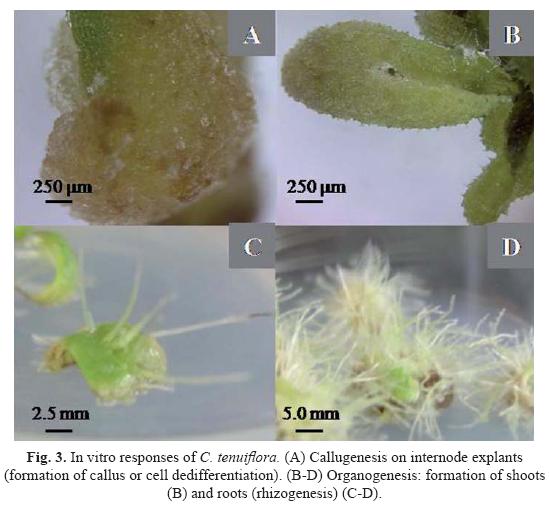
<body><![CDATA[<p align="justify"><font face="verdana" size="2">The resulting shoots were multiplied and elongated in SEM, with an average of four shoots per explant observed after 14 days (<a href="#f1">Figure 1E</a>). Shoots were 3&#150;fold higher (5.04 &plusmn; 1.5 cm) than those that developed in the control (without growth regulators). After 14 days, 88% of the shoots cultured in RIM developed roots (<a href="#f1">Figures 1F</a> and <a href="#f1">1G</a>) in contrast to the control (21%). Moreover, in RIM, roots were longer (1.75 &plusmn; 1.1 cm) than those grown in the control (0.29 &plusmn; 0.6 cm). Plantlets developed in free&#150;growth regulator culture medium (control) showed hyperhydricity. These observations are important because plantlet survival during acclimatization depends highly on the development of strong and functional roots. Hyperhydricity occurring mainly during multiplication phase needs to be avoided for ensuring plant survival.</font></p>     <p align="justify"><font face="verdana" size="2">&nbsp;</font></p>     <p align="justify"><font face="verdana" size="2"><b>Induction of callugenesis and organo&#150;genesis</b></font></p>     <p align="justify"><font face="verdana" size="2"><b>Explant type, culture media and NAA concentration</b></font></p>     <p align="justify"><font face="verdana" size="2">To establish conditions for inducing <i>C. tenuiflora </i>in vitro cultures, the combination of two types of explants (internode and leaf) was tested, three culture media and four concentrations of NAA (<a href="#f2">Fig. 2</a>). In general, callugenesis (formation of callus or cell dedifferentiation) (<a href="#f3">Fig. 3A</a>) and organogenesis were observed, both as formation of shoots (caulogenesis) (<a href="#f3">Fig. 3B</a>) and roots (rhizogenesis) (<a href="#f3">Figures 3C </a>and <a href="#f3">3D</a>). In these two last cases, there was no evidence of callus formation, suggesting the occurrence of direct organogenesis. In particular, rhizogenesis was the primary in vitro response (up to 100%) followed by shoot formation (5&#150;50%) and, finally, callugenesis (2&#150;35%) (<a href="#f2">Fig. 2</a>). Results are presented according to <i>in vitro </i>response in order to facilitate analysis. The highest yield of callugenesis (35%) was achieved on internodes using 0.1 &micro;M NAA and B5 medium (p &lt;0.05) (<a href="#f2">Fig. 2A</a>). In a lower proportion (10%), calli were formed on leaf explants with MS medium and the highest level of NAA tested (10 &micro;M). Callugenesis did not occur in NN medium. In all cases, callus were green and friable (easily disaggregated) and spontaneously formed roots 14 days after being induced.</font></p>     <p align="center"><font size="2" face="verdana"><a name="f2"></a></font></p>     <p align="center"><font size="2" face="verdana"><img src="/img/revistas/polib/n28/a6f2.jpg"></font></p>     <p align="center"><font size="2" face="verdana"><a name="f3"></a></font></p>     <p align="center"><font size="2" face="verdana"><img src="/img/revistas/polib/n28/a6f3.jpg"></font></p>     <p align="justify"><font face="verdana" size="2">Caulogenesis was the only response that occurred without the auxin NAA (<a href="#f2">Fig. 2B</a>); this was observed on internodes and using MS medium (20%). However, with the same explant and medium, shoot formation yield increased significantly to 50% when 0.1 &micro;M NAA was used (p &lt; 0.05). If leaves were cultured in this NAA concentration (but using B5 culture medium) the same yield was achieved (p &gt; 0.05). Clearly, the increase in NAA concentration &gt; 0.1 &micro;M had a negative effect on shoot formation (p &lt; 0.05) regardless of explant type and culture medium. Moreover, caulogenesis was inhibited with 10 &micro;M NAA. In NN medium, only 5% of internodes formed shoots, clearly indicating that the medium is inadequate for this purpose. Shoots formed under either condition spontaneously developed adventitious roots and converted to plantlets. This took place on average 14&#150;21 days after shoots were induced, confirming the potential of plant biotechnology for offering alternatives to provide plant material. However, plantlets obtained by this procedure were less uniform in height than those obtained from axillary buds.</font></p>     ]]></body>
<body><![CDATA[<p align="justify"><font face="verdana" size="2">Rhizogenesis was observed in the three culture media in both explants but only when NAA was used (0.1&#150;10 &micro;M) (<a href="#f2">Fig. 2C</a>). The highest root formation (100%) was achieved with the lowest level of NAA (0.1 &micro;M) and NN culture medium (p &lt; 0.05); explant type did not influence rhizogenesis in this case (p &gt; 0.05). In contrast, internodes exposed to 1 &micro;M NAA were more competent than leaves to form roots (p &lt; 0.05) regardless of culture media. Similar to that observed with caulogenesis, the increase in NAA concentration had a negative effect on rhizogenesis (p &lt; 0.05). Our data show that rhizogenesis depends on exogenous NAA but auxin requirement varies according to the culture medium and explant used. Results clearly indicate that culture media, explant type and NAA concentration influenced the in vitro response of <i>C. tenuiflora</i>. The interaction between auxin, culture medium and explant type has been previously reported in other plant species such as <i>Bacopa monnieri </i>(Scrophula&#150;riaceae) (Tiwari <i>et al.</i>, 1998) or <i>Pinguicula lusitanica </i>(Gon&ccedil;alves <i>et al.</i>, 2008). MS and B5 media offer more alternatives than NN for developing callus or organs, but NN is highly efficient for inducing rhizogenesis. In a complementary manner, internodes were more competent than leaves for both callugenesis and organogenesis, along with the fact that leaf explants oxidized easily (&gt; 60% of the explants). For these reasons, the following experiment was performed using internode explants with MS and B5 medium.</font></p>     <p align="justify"><font face="verdana" size="2">&nbsp;</font></p>     <p align="justify"><font face="verdana" size="2"><b>Auxin: Cytokinin ratio</b></font></p>     <p align="justify"><font face="verdana" size="2">To test the infl uence of different auxin:cytokinin ratios on <i>in vitro </i>response, the auxin NAA (0.1 &micro;M) was combined with the cytokinin KIN (0&#150;0.5 &micro;M). From the above results and considering the occurrence of all in vitro responses, this experiment was done using only MS (formation of shoots and roots) and B5 media (formation of callus). It was observed that rhizogenesis tends to increase as auxin:cytokinin ratio increased (<a href="#f4">Fig. 4A</a>). The highest yield of rhizogenesis (65%) was observed with the highest auxin:cytokinin ratio (2:1, 0.1 &micro;M NAA + 0.05 &micro;M KIN) (p &lt; 0.05). Moreover, the low levels of KIN (0.05 and 0.1 &micro;M; ratios 2:1 and 1: 1, respectively) had a positive effect on rhizogenesis (p &lt; 0.05) because the yields were higher (p &lt; 0.05) than those obtained when NAA was used alone. However, rhizogenesis was similar with 0.1 &micro;M NAA used alone or combined with 0.5 &micro;M NAA to give an auxin:cytokinin ratio of 1: 5 (p &gt; 0.5).</font></p>     <p align="center"><font size="2" face="verdana"><a name="f4"></a></font></p>     <p align="center"><font size="2" face="verdana"><img src="/img/revistas/polib/n28/a6f4.jpg"></font></p>     <p align="justify"><font face="verdana" size="2">As expected, caulogenesis presented an opposite behavior to rhizogenesis and tended to decrease as auxin:cytokinin ratio increased (<a href="#f4">Fig. 4B</a>). The highest shoot formation (64&#150;73%) occurred with the lowest auxin: cytokinin ratio (1:5; 0.1 &micro;M NAA + 0.5 &micro;M KIN) (p &lt; 0.05). In this case, the highest level of KIN (0.5 &micro;M, 1: 5 auxin:cytokinin ratio) had a positive effect on shoot formation (p &lt; 0.05) compared to using only NAA. In contrast to organogenesis, no clear relation between auxin:cytokinin ratio and callugenesis was found. In fact, 0.1 &micro;M NAA induced callugenesis (35%) at similar levels than when combined with KIN (15&#150;20%) (p &gt; 0.05).</font></p>     <p align="justify"><font face="verdana" size="2">&nbsp;</font></p>     <p align="justify"><font face="verdana" size="2"><b>DISCUSSION</b></font></p>     <p align="justify"><font face="verdana" size="2">The results of the present study show the feasibility of using in vitro culture to propagate and conserve germplasm of the 'cancer herb' <i>C. tenuiflora</i>. As previously outlined, two approaches were considered. First, an efficient propagation protocol for <i>in vitro </i>shoot multiplication and plantlet regeneration of <i>C. tenuiflora </i>using axillary buds of wild plants was developed. Shoots were subcultured every 14 days in SEM and the multiplicative capacity has been maintained for at least 16 months. As an advantage, elongation and multiplication can be done in the same step. From one axillary bud, 250 plantlets were produced within eight weeks. Plant growth regulator combinations used for <i>C. tenuiflora </i>agreed with those reported for other Scrophulariaceae such as <i>Scrophularia yoshimurae</i>. Shoot multiplication was achieved by culturing several explants (shoot&#150;tip, leaf&#150;base, stem&#150;node and stem&#150;internode explants) in MS medium supplemented with 4.44 mM N6&#150;benzyladenine (BA) and 1.07 mM NAA. Moreover, <i>S. yoshimurae </i>shoots were rooted on free&#150;growth regulator MS basal medium (Sagare <i>et al.</i>, 2001). With the protocol established for <i>C. tenuiflora </i>we are able to provide a constant source of plant material during the year, compared to wild material that is available only during a short season. Further studies are being performed in order to establish acclimatization conditions.</font></p>     ]]></body>
<body><![CDATA[<p align="justify"><font face="verdana" size="2">Results of the present study show that through the manipulation of explant type, culture media and plant growth regulators, it was feasible to induce both cell dedifferentiation (callus formation) and organogenesis (shoot and root formation). This offers major possibilities for developing biotechnological systems to conserve germplasm and for basic and applied research. Previously, Rosas (2007) initiated <i>in vitro </i>cultures of <i>C. tenuiflora </i>but from leaf explants of wild growing plants, which was the available material at that time. In that study, two auxins (NAA and 2,4&#150;dichlorophenoxyacetic acid (2,4&#150;D)), two cytokinins (KIN and BAP) at 10 &micro;M and their combination were tested. Of all, NAA alone was the best for inducing organogenesis (4%), whereas 2,4&#150;D alone induced callugenesis by 20%. Now the use of <i>C. tenuiflora in vitro </i>plantlets as explant donors allowed obtaining caulogenesis yields &gt;70% and up to 100% for rhizogenesis. Callusing response of <i>C. tenuiflora </i>occurred in few of the combinations tested and was very low (35%). This agreed with what was reported for the Scrophulariaceae <i>Bacopa monnieri</i>. Both stem and leaf explants incubated in MS medium with varying concentrations of the auxins NAA, 3&#150;indole acetic acid (IAA), and 2,4&#150;D (2&#150;8 mM) individually and in combination with the cytokinin BAP (1 and 2 mM) exhibited a tendency to regenerate shoots or roots rather than to form callus (Shrivastava and Rajani, 1999). In addition, 2,4&#150;D and IAA were more efficient than NAA for inducing callugenesis. In <i>Harpagophytum procumbens </i>(iridoid&#150;producing species belonging to Pedaliaceae), high levels of the auxin IAA (10 &micro;M) induced callus formation on nodal explants but at lower rates than roots (Levieille and Wilson, 2002). In the present study, callugenesis occurred mainly in B5 medium, which has a lower content of total nitrogen (26.74 mM) than MS medium (60.01 mM) but a higher nitrate:ammonium ratio (12: 1 in B5 vs. 2: 1 in MS). Until now, B5 had not been used for Scrophulariaceae in vitro culture.</font></p>     <p align="justify"><font face="verdana" size="2"><i>Castilleja tenuiflora </i>caulogenesis occurred both in MS and in B5 medium, whereas NN was inadequate. In contrast, the highest rhizogenesis occurred in NN medium. Both responses were also related to NAA concentration and explant type and were favored by the addition of the cytokinin KIN. Culture media used for plant <i>in vitro </i>culture are highly complex and little research has been performed to understand the role of mineral nutrition in regulating and controlling morphogenesis (Ramage and Williams, 2002; Niedz and Evens, 2007). Moreover, the medium components interact with the carbon source and endogenous and exogenous plant growth regulators and influence the sensitivity of explants to them (Ramage and Williams, 2002). Elucidation of the individual effects of culture medium components on <i>C. tenuiflora </i>shoot and root formation is beyond the aims of the present study. Therefore, the following discussion will be focused on the differences in N because it is one of their main components exerting effect on <i>in vitro </i>responses (Niedz and Evens, 2007). As previously mentioned, MS medium contains a high level of total N (60.01 mM), whereas B5 (26.74 mM) and NN (27.41 mM) contain lower levels. In each, nitrate: ammonium ratio is also different (2: 1 in MS, 12: 1 in B5 and 2: 1 in NN).</font></p>     <p align="justify"><font face="verdana" size="2">Nitrogen concentration, its forms (nitrate vs. ammonium) and their proportions may influence cell division and differentiation. Different forms of nitrogen in the culture media alter the endogenous levels of cell metabolites as well as those of proteins, organic acids and plant hormones (Sotiropoulos <i>et al.</i>, 2005). Nitrate ion itself functions not only as a metabolic substrate for assimilation, but also as a signal for modulating the pattern of growth and development by means of regulating the expression of various genes such as those related to root architecture, among others. Moreover, N availability is related to cytokinin biosynthesis (Takei <i>et al. </i>2002), and elevated cytokinin levels result in long&#150;term reduction of the pool size and biosynthesis rate of auxins in Arabidopsis (Nordstrom <i>et al.</i>, 2004). In this species, it has also been observed that auxin rapidly regulates (suppressed) both the rate of biosynthesis and the pool size of cytokinins (Nordstrom <i>et al.</i>, 2004). This suggests the complexity of organogenic responses in <i>in vitro </i>cultures where nutrients and plant growth regulators are added. Differences in <i>C. tenuiflora </i>organogenesis may be attributed to the difference in total N concentration or its nitrate:ammonium ratio, although the interaction with explant type or plant growth regulator concentration cannot be excluded. <i>C. tenuiflora </i>shoot formation appears to occur regardless of total N content or explant type if 0.1 &micro;M NAA is used alone or in combination with KIN. Instead, for <i>C. tenuiflora </i>rhizogenesis a low level of N combined with a low level of NAA (0.1 &micro;M) is superior to high total N+ high NAA level or the addition of KIN. In other plant species, the effect of culture medium or nitrogen has also been reported. For instance, reduction of nutrients by diluting MS (50%) reduced shoot formation on internodal explants of <i>B. monnieri </i>2&#150; to 3&#150;fold compared to complete MS (Baneerjee &amp; Shrivastava, 2008). An increase in nitrate:ammonium ratio had a positive effect on <i>Prunus domestica </i>shoot regeneration from leaf explants (Nowak <i>et al.</i>, 2007). In <i>Pinguicula lusitanica</i>, rooting was best with &#188; MS medium (Gon&ccedil;alves <i>et al.</i>, 2008).</font></p>     <p align="justify"><font face="verdana" size="2">Similar to the results obtained with <i>C. tenuiflora </i>organogenesis, in <i>B. monnieri </i>NAA concentration influenced rhizogenesis and high levels (2.0 mg/L) reduced this response (Baneerjee and Shrivastava, 2008). Moreover, in the same species, lower levels of NAA (2 and 4 mM) induced shoots. In <i>B. monnieri </i>and <i>Mecardonia tenella</i>, BA combined with NAA induced roots (Escand&oacute;n <i>et al.</i>, 2006; Baneerjee and Shrivastava, 2008). In contrast, cytokinin is required for adventitious shoot&#150;bud induction in <i>B. monnieri</i>. Shoot formation in <i>H. procumbens </i>was significantly reduced at lower concentrations of the auxin IAA (Levielle &amp; Wilson, 2002). Moreover, influence of the source of the explants has been reported for other Scrophulariaceae. For instance, in <i>B. monnieri</i>, leaf explants yielded a larger number of shoots than other explants such as node, internodes or stem (Tiwari <i>et al.</i>, 1998; Shrivastava and Rajani, 1999). For <i>S. yoshimurae</i>, stem&#150;node and shoot&#150;tip explants showed the highest response followed by stem&#150;internode and leaf&#150;base explants (Sagare <i>et al.</i>, 2001).</font></p>     <p align="justify"><font face="verdana" size="2">In <i>C. tenuiflora </i>a high cytokinin:auxin ratio (or high cytokinin with no auxin) was required to induce shoot organogenesis, whereas the opposite (high auxin with no cytokinin) provided rhizogenesis. Although this is typical in plant tissue culture, final responses are highly dependent on genotype, developmental stage of plant donor and even explant type (Phillips, 2004). The efficiency of the cytokinin BA uptake and endogenous level in <i>Pinus pinea </i>cotyledons depends on the genotype and influences caulogenic response (Cuesta <i>et al.</i>, 2009). Moreover, the ontogeny of the tissue also influences organogenesis. In <i>Eucalyptus globulus</i>, roots could be originated <i>in vitro </i>either from old vascular tissue or from newly formed xylem (Calderon <i>et al.</i>, 2004), whereas in response to auxins, root meristems in Medicago truncatula leaf explants arise from vascular&#150;derived procambial&#150;like cells (Rose <i>et al.</i>, 2006). Therefore, in order to develop biotechno&#150;logical systems it is necessary to perform specific studies for the plant of interest.</font></p>     <p align="justify"><font face="verdana" size="2">&nbsp;</font></p>     <p align="justify"><font face="verdana" size="2"><b>CONCLUSION</b></font></p>     <p align="justify"><font face="verdana" size="2">An efficient propagation protocol for in vitro shoot multiplication and plantlet regeneration of <i>C. tenuiflora </i>using axillary buds of wild plants was developed. Culture medium, explant type and NAA concentration influenced <i>in vitro </i>response of <i>C. tenuiflora</i>. It is feasible to propagate and conserve germplasm of the 'cancer herb' <i>C. tenuiflora </i>through <i>in vitro </i>culture.</font></p>     <p align="justify"><font face="verdana" size="2">&nbsp;</font></p>     <p align="justify"><font face="verdana" size="2"><b>ACKNOWLEDGMENTS</b></font></p>     ]]></body>
<body><![CDATA[<p align="justify"><font face="verdana" size="2">This work was funded by the Secretar&iacute;a de Investigaci&oacute;n y Posgrado del Instituto Polit&eacute;cnico Nacional (SIP 20070118 &amp; 20090311) and by Fondo Mixto de Fomento a la Investigaci&oacute;n Cient&iacute;fica y Tecnol&oacute;gica CONACYT&#150;Gobierno del Estado de Morelos (MOR&#150;2007&#150;C01&#150;79409). G. Rosas&#150;Romero is indebted to Instituto Polit&eacute;cnico Nacional (PIFI&#150;IPN) and CONACYT for the fellowship awarded. G. Salcedo&#150;Morales, K. Berm&uacute;dez&#150;Torres, A.R. L&oacute;pez&#150;Laredo and G. Trejo&#150;Tapia thank the support of EDI and/or SIBE&#150;IPN. Authors are grateful to Rolando Ram&iacute;rez from HUMO herbarium of CEAMISH&#150;UAEM for specimen determination.</font></p>     <p align="justify"><font face="verdana" size="2">&nbsp;</font></p>     <p align="justify"><font face="verdana" size="2"><b>LITERATURE CITED</b></font></p>     <!-- ref --><p align="justify"><font face="verdana" size="2">Almaguer, G.J., 2001. "Programa de Trabajo 2001&#150;2006 de la Direcci&oacute;n de Medicina Tradicional". Coordinaci&oacute;n de Salud para los Pueblos Ind&iacute;genas. Secretar&iacute;a de Salud. M&eacute;xico, DF, Manuscrito. 12 pp.    &nbsp;&nbsp;&nbsp;&nbsp;&nbsp;&nbsp;&nbsp;&nbsp;[&#160;<a href="javascript:void(0);" onclick="javascript: window.open('/scielo.php?script=sci_nlinks&ref=6065540&pid=S1405-2768200900020000600001&lng=','','width=640,height=500,resizable=yes,scrollbars=1,menubar=yes,');">Links</a>&#160;]<!-- end-ref --></font></p>     <!-- ref --><p align="justify"><font face="verdana" size="2">Arrebola, M.L., O. Socorro, R. Verpoorte, 1997. "Micropropagation of <i>Isoplexis canariensis </i>(L.) G. Don.". <i>Plant Cell Tiss. Org. Cult.</i>, <b>49</b>: 117&#150;119.    &nbsp;&nbsp;&nbsp;&nbsp;&nbsp;&nbsp;&nbsp;&nbsp;[&#160;<a href="javascript:void(0);" onclick="javascript: window.open('/scielo.php?script=sci_nlinks&ref=6065542&pid=S1405-2768200900020000600002&lng=','','width=640,height=500,resizable=yes,scrollbars=1,menubar=yes,');">Links</a>&#160;]<!-- end-ref --></font></p>     <!-- ref --><p align="justify"><font face="verdana" size="2">Arslanian, R.L., G.H. Harris, F.R. Stermitz, 1985. "Some iridoid glucosides, including the new 6&#150;deoxycatalpol, from Indian paintbrush species related to <i>Castilleja miniata</i>". <i>J. Nat. Prod.</i>, <b>48</b>: 957&#150;961.    &nbsp;&nbsp;&nbsp;&nbsp;&nbsp;&nbsp;&nbsp;&nbsp;[&#160;<a href="javascript:void(0);" onclick="javascript: window.open('/scielo.php?script=sci_nlinks&ref=6065544&pid=S1405-2768200900020000600003&lng=','','width=640,height=500,resizable=yes,scrollbars=1,menubar=yes,');">Links</a>&#160;]<!-- end-ref --></font></p>     <!-- ref --><p align="justify"><font face="verdana" size="2">Banerjee, M., S. Shrivastava, 2008. "An improved protocol for <i>in vitro </i>multiplication of <i>Bacopa monnieri </i>(L.)". World J. Microbiol. <i>Biotechnol.</i>, <b>24</b>: 1355&#150;1359.    &nbsp;&nbsp;&nbsp;&nbsp;&nbsp;&nbsp;&nbsp;&nbsp;[&#160;<a href="javascript:void(0);" onclick="javascript: window.open('/scielo.php?script=sci_nlinks&ref=6065546&pid=S1405-2768200900020000600004&lng=','','width=640,height=500,resizable=yes,scrollbars=1,menubar=yes,');">Links</a>&#160;]<!-- end-ref --></font></p>     <!-- ref --><p align="justify"><font face="verdana" size="2">Bejar, E., R. Reyes&#150;Chilpa, M. Jim&eacute;nez&#150;Estrada, 2000. "Bioactive compounds from selected plants used in the XVI Century Mexican Traditional medicine". <i>Studies in Natural Products Chemistry</i>, <b>24</b>: 799&#150;844.    &nbsp;&nbsp;&nbsp;&nbsp;&nbsp;&nbsp;&nbsp;&nbsp;[&#160;<a href="javascript:void(0);" onclick="javascript: window.open('/scielo.php?script=sci_nlinks&ref=6065548&pid=S1405-2768200900020000600005&lng=','','width=640,height=500,resizable=yes,scrollbars=1,menubar=yes,');">Links</a>&#160;]<!-- end-ref --></font></p>     <!-- ref --><p align="justify"><font face="verdana" size="2">Betancourt, A.S.Y., M.A. Guti&eacute;rrez, 1999. "Proyecto Mercados Verdes Herbolarios". Informe t&eacute;cnico final. Fondo de Am&eacute;rica del Norte para la Cooperaci&oacute;n Ambiental (FANCA), Ecolog&iacute;a y Desarrollo de Tlaxcala y Puebla A.C. M&eacute;xico, DF, 250 pp.    &nbsp;&nbsp;&nbsp;&nbsp;&nbsp;&nbsp;&nbsp;&nbsp;[&#160;<a href="javascript:void(0);" onclick="javascript: window.open('/scielo.php?script=sci_nlinks&ref=6065550&pid=S1405-2768200900020000600006&lng=','','width=640,height=500,resizable=yes,scrollbars=1,menubar=yes,');">Links</a>&#160;]<!-- end-ref --></font></p>     <!-- ref --><p align="justify"><font face="verdana" size="2">Calderon, X., G. Montenegro, E. De Garc&iacute;a, 2004. "Ontogeny of <i>in vitro </i>rooting processes in <i>Eucalyptus globules</i>". <i>In Vitro Cell. Dev. Biol. Plant</i>, <b>40</b>: 499&#150;503.    &nbsp;&nbsp;&nbsp;&nbsp;&nbsp;&nbsp;&nbsp;&nbsp;[&#160;<a href="javascript:void(0);" onclick="javascript: window.open('/scielo.php?script=sci_nlinks&ref=6065552&pid=S1405-2768200900020000600007&lng=','','width=640,height=500,resizable=yes,scrollbars=1,menubar=yes,');">Links</a>&#160;]<!-- end-ref --></font></p>     <!-- ref --><p align="justify"><font face="verdana" size="2">Cuesta, C., A. Rodr&iacute;guez, M.L. Centeno, R.J. Ord&aacute;s, B. Fern&aacute;ndez, 2009. "Caulogenic induction in cotyledons of stone pine (<i>Pinus pinea</i>): Relationship between organogenic response and benzyladenine trends in selected families". <i>J. Plant Physiol.</i>, doi: 10.1016/j.jplph.2009.01.004</font>&nbsp;&nbsp;&nbsp;&nbsp;&nbsp;&nbsp;&nbsp;&nbsp;[&#160;<a href="javascript:void(0);" onclick="javascript: window.open('/scielo.php?script=sci_nlinks&ref=6065554&pid=S1405-2768200900020000600008&lng=','','width=640,height=500,resizable=yes,scrollbars=1,menubar=yes,');">Links</a>&#160;]<!-- end-ref --><!-- ref --><p align="justify"><font face="verdana" size="2">Escand&oacute;n, A., A. Kato, M. Mori, M. Alderete, 2006. "Establishment of an in vitro micropropagation protocol for Mercadonia tenella". Electronic J<i>. Biotechnol.</i>, url: <a href="http://www.ejbiotechnology.info/content/vol9/issue3/full/6/index.html" target="_blank">http://www.ejbiotechnology.info/content/vol9/issue3/full/6/index.html</a> .ISSN 0717&#150;3458</font>&nbsp;&nbsp;&nbsp;&nbsp;&nbsp;&nbsp;&nbsp;&nbsp;[&#160;<a href="javascript:void(0);" onclick="javascript: window.open('/scielo.php?script=sci_nlinks&ref=6065555&pid=S1405-2768200900020000600009&lng=','','width=640,height=500,resizable=yes,scrollbars=1,menubar=yes,');">Links</a>&#160;]<!-- end-ref --><!-- ref --><p align="justify"><font face="verdana" size="2">G&aacute;lvez, M., C. Mart&iacute;n&#150;Cordero, M. J. Ayuso, 2005. "Iridoids as DNA topoisomerase I poisons". <i>J. Enz. Inhib. Med. Chem.</i>, <b>20</b>: 389&#150;392.    &nbsp;&nbsp;&nbsp;&nbsp;&nbsp;&nbsp;&nbsp;&nbsp;[&#160;<a href="javascript:void(0);" onclick="javascript: window.open('/scielo.php?script=sci_nlinks&ref=6065556&pid=S1405-2768200900020000600010&lng=','','width=640,height=500,resizable=yes,scrollbars=1,menubar=yes,');">Links</a>&#160;]<!-- end-ref --></font></p>     <!-- ref --><p align="justify"><font face="verdana" size="2">Gamborg, O.L., R.A. Miller, K. Ojima, 1968. "Nutrient requirement of suspension cultures of soybean root cells". <i>Exp. Cell. Res.</i>, <b>50</b>: 151&#150;158.    &nbsp;&nbsp;&nbsp;&nbsp;&nbsp;&nbsp;&nbsp;&nbsp;[&#160;<a href="javascript:void(0);" onclick="javascript: window.open('/scielo.php?script=sci_nlinks&ref=6065558&pid=S1405-2768200900020000600011&lng=','','width=640,height=500,resizable=yes,scrollbars=1,menubar=yes,');">Links</a>&#160;]<!-- end-ref --></font></p>     <!-- ref --><p align="justify"><font face="verdana" size="2">George, E.F., G.J. de Klerk, 2008. "The components of plant tissue culture media I: Macro and micronutrients". In: Plant Propagation by Tissue Culture, George, E.F., M.A. Hall, G.J. de Klerk (eds.). Springer, p. 65&#150;113.    &nbsp;&nbsp;&nbsp;&nbsp;&nbsp;&nbsp;&nbsp;&nbsp;[&#160;<a href="javascript:void(0);" onclick="javascript: window.open('/scielo.php?script=sci_nlinks&ref=6065560&pid=S1405-2768200900020000600012&lng=','','width=640,height=500,resizable=yes,scrollbars=1,menubar=yes,');">Links</a>&#160;]<!-- end-ref --></font></p>     <!-- ref --><p align="justify"><font face="verdana" size="2">Gon&ccedil;alves, S., A.L. Escapa, T. Grevenstuk, A. Romano, 2008. "An efficient in vitro propagation protocol for <i>Pinguicula lusitanica</i>, a rare insectivorous plant" <i>Plant Cell Tiss. Org. Cult.</i>, <b>95</b>: 239&#150;243.    &nbsp;&nbsp;&nbsp;&nbsp;&nbsp;&nbsp;&nbsp;&nbsp;[&#160;<a href="javascript:void(0);" onclick="javascript: window.open('/scielo.php?script=sci_nlinks&ref=6065562&pid=S1405-2768200900020000600013&lng=','','width=640,height=500,resizable=yes,scrollbars=1,menubar=yes,');">Links</a>&#160;]<!-- end-ref --></font></p>     <!-- ref --><p align="justify"><font face="verdana" size="2">Graham, J.G., M.L. Quinn, D.S. Fabricant, N.R. Farnsworth, 2000. "Plants used against cancer &#150;an extension of the work of Jonathan Hartwell". <i>J. Ethnopharm</i>, <b>73</b>: 347&#150;377.    &nbsp;&nbsp;&nbsp;&nbsp;&nbsp;&nbsp;&nbsp;&nbsp;[&#160;<a href="javascript:void(0);" onclick="javascript: window.open('/scielo.php?script=sci_nlinks&ref=6065564&pid=S1405-2768200900020000600014&lng=','','width=640,height=500,resizable=yes,scrollbars=1,menubar=yes,');">Links</a>&#160;]<!-- end-ref --></font></p>     <!-- ref --><p align="justify"><font face="verdana" size="2">Hisano, K., Y. Kimoto, H. Hayakawa, J. Takeichi, T. Domae, R. Hashimoto, J. Abe, A. Asano, A. Kanazawa, 2004. "High frequency Agrobacteriumme&#150;diated transformation and plant regeneration via direct shoot formation from leaf explants in <i>Beta vulgaris </i>and <i>Beta maritime</i>". <i>Plant Cell Tiss. Org. Cult.</i>, <b>22</b>: 910&#150;918.    &nbsp;&nbsp;&nbsp;&nbsp;&nbsp;&nbsp;&nbsp;&nbsp;[&#160;<a href="javascript:void(0);" onclick="javascript: window.open('/scielo.php?script=sci_nlinks&ref=6065566&pid=S1405-2768200900020000600015&lng=','','width=640,height=500,resizable=yes,scrollbars=1,menubar=yes,');">Links</a>&#160;]<!-- end-ref --></font></p>     <!-- ref --><p align="justify"><font face="verdana" size="2">Ho, J.N., Y.H. Lee, Y.D. Lee, W.J. Jun, H.K. Kim, B.S. Hong, D.H. Shin, H.Y. Cho, 2005. "Inhibitory effect of aucubin isolated from <i>Eucommia ulmoides </i>against UVB&#150;induced matrix metalloproteinase&#150;1 production in human skin fibroblasts". <i>Biosc. Biotechnol. Biochem.</i>, <b>69</b>: 2227&#150;2231.    &nbsp;&nbsp;&nbsp;&nbsp;&nbsp;&nbsp;&nbsp;&nbsp;[&#160;<a href="javascript:void(0);" onclick="javascript: window.open('/scielo.php?script=sci_nlinks&ref=6065568&pid=S1405-2768200900020000600016&lng=','','width=640,height=500,resizable=yes,scrollbars=1,menubar=yes,');">Links</a>&#160;]<!-- end-ref --></font></p>     <!-- ref --><p align="justify"><font face="verdana" size="2">Holmgren, N.H., 1976. "Four new species of Mexican <i>Castilleja </i>(Subgenus <i>Castilleja</i>, Scrophulariaceae) and their relatives". <i>Brittonia</i>, <b>28</b>: 195&#150;208.    &nbsp;&nbsp;&nbsp;&nbsp;&nbsp;&nbsp;&nbsp;&nbsp;[&#160;<a href="javascript:void(0);" onclick="javascript: window.open('/scielo.php?script=sci_nlinks&ref=6065570&pid=S1405-2768200900020000600017&lng=','','width=640,height=500,resizable=yes,scrollbars=1,menubar=yes,');">Links</a>&#160;]<!-- end-ref --></font></p>     <!-- ref --><p align="justify"><font face="verdana" size="2">Hung, J.Y., C.J. Yang, Y.M. Tsai, H.W. Huang, M.S. Huang, 2008. "Antiproliferative activity of aucubin is through cell cycle arrest and apoptosis in human non&#150;small cell lung cancer A549 cells". <i>Clin. Exp. Pharm. Physiol.</i>, <b>35</b>: 995&#150;1001.    &nbsp;&nbsp;&nbsp;&nbsp;&nbsp;&nbsp;&nbsp;&nbsp;[&#160;<a href="javascript:void(0);" onclick="javascript: window.open('/scielo.php?script=sci_nlinks&ref=6065572&pid=S1405-2768200900020000600018&lng=','','width=640,height=500,resizable=yes,scrollbars=1,menubar=yes,');">Links</a>&#160;]<!-- end-ref --></font></p>     <!-- ref --><p align="justify"><font face="verdana" size="2">Jensen, S.R., J. Schripsema, 2002. "Chemotaxonomy and pharmacology of Gentianaceae". In: <i>Gentianaceae&#150;systematics and natural history</i>. Struwe, L., Albert, V. (eds.). Cambridge University Press. p. 573&#150;631.    &nbsp;&nbsp;&nbsp;&nbsp;&nbsp;&nbsp;&nbsp;&nbsp;[&#160;<a href="javascript:void(0);" onclick="javascript: window.open('/scielo.php?script=sci_nlinks&ref=6065574&pid=S1405-2768200900020000600019&lng=','','width=640,height=500,resizable=yes,scrollbars=1,menubar=yes,');">Links</a>&#160;]<!-- end-ref --></font></p>     <!-- ref --><p align="justify"><font face="verdana" size="2">Jim&eacute;nez, M.E., M.E. Padilla, Ch.R. Reyes, L.M. Espinosa, E. Melendez, A. Lira&#150;Rocha, 1995. "Iridoid glycoside constituents of <i>Castilleja tenuiflora</i>". <i>Biochem. System. Ecol.</i>, <b>23</b>: 455&#150;456.    &nbsp;&nbsp;&nbsp;&nbsp;&nbsp;&nbsp;&nbsp;&nbsp;[&#160;<a href="javascript:void(0);" onclick="javascript: window.open('/scielo.php?script=sci_nlinks&ref=6065576&pid=S1405-2768200900020000600020&lng=','','width=640,height=500,resizable=yes,scrollbars=1,menubar=yes,');">Links</a>&#160;]<!-- end-ref --></font></p>     <!-- ref --><p align="justify"><font face="verdana" size="2">Lawrence, B., 2005. <i>Studies to facilitate reintroduction of golden paintbrush (</i>Castilleja levisecta<i>) to the Willamette Valley, Oregon</i>. Master Sciences Thesis. Department of Botany and Plant Pathology, Oregon State University, Corvalis, Oregon. 86 pp.    &nbsp;&nbsp;&nbsp;&nbsp;&nbsp;&nbsp;&nbsp;&nbsp;[&#160;<a href="javascript:void(0);" onclick="javascript: window.open('/scielo.php?script=sci_nlinks&ref=6065578&pid=S1405-2768200900020000600021&lng=','','width=640,height=500,resizable=yes,scrollbars=1,menubar=yes,');">Links</a>&#160;]<!-- end-ref --></font></p>     <!-- ref --><p align="justify"><font face="verdana" size="2">Levieille, G., G. Wilson, 2002. "<i>In vitro </i>propagation and iridoid analysis of the medicinal species <i>Harpagophytum procumbens </i>and <i>H. zeyheri</i>". <i>Plant Cell Rep.</i>, <b>21</b>: 220&#150;225.    &nbsp;&nbsp;&nbsp;&nbsp;&nbsp;&nbsp;&nbsp;&nbsp;[&#160;<a href="javascript:void(0);" onclick="javascript: window.open('/scielo.php?script=sci_nlinks&ref=6065580&pid=S1405-2768200900020000600022&lng=','','width=640,height=500,resizable=yes,scrollbars=1,menubar=yes,');">Links</a>&#160;]<!-- end-ref --></font></p>     <!-- ref --><p align="justify"><font face="verdana" size="2">Mart&iacute;nez, M. (ed.), 1994. <i>Cat&aacute;logo de nombres vulgares y cient&iacute;ficos de Plantas Mexicanas</i>. Fondo de Cultura Econ&oacute;mica, M&eacute;xico.    &nbsp;&nbsp;&nbsp;&nbsp;&nbsp;&nbsp;&nbsp;&nbsp;[&#160;<a href="javascript:void(0);" onclick="javascript: window.open('/scielo.php?script=sci_nlinks&ref=6065582&pid=S1405-2768200900020000600023&lng=','','width=640,height=500,resizable=yes,scrollbars=1,menubar=yes,');">Links</a>&#160;]<!-- end-ref --></font></p>     <!-- ref --><p align="justify"><font face="verdana" size="2">Mathad, V.T., K. Raj, A. P. Bhaduri, R. Sahai, A. Puri, L.M. Tripathi, V.M.L. Srivastava, 1998. "Studies on the profile of immunostimulant activities of modified iridoid glycosides". <i>Bioorganic Med. Chem.</i>, <b>6</b>: 605&#150;611.    &nbsp;&nbsp;&nbsp;&nbsp;&nbsp;&nbsp;&nbsp;&nbsp;[&#160;<a href="javascript:void(0);" onclick="javascript: window.open('/scielo.php?script=sci_nlinks&ref=6065584&pid=S1405-2768200900020000600024&lng=','','width=640,height=500,resizable=yes,scrollbars=1,menubar=yes,');">Links</a>&#160;]<!-- end-ref --></font></p>     <!-- ref --><p align="justify"><font face="verdana" size="2">Mead, E.W., F.R. Stermitz, 1993. "Content of iridoid glycosides in different parts of <i>Castilleja integra</i>". <i>Phytochem.</i>, <b>32</b>: 1155&#150;1158.    &nbsp;&nbsp;&nbsp;&nbsp;&nbsp;&nbsp;&nbsp;&nbsp;[&#160;<a href="javascript:void(0);" onclick="javascript: window.open('/scielo.php?script=sci_nlinks&ref=6065586&pid=S1405-2768200900020000600025&lng=','','width=640,height=500,resizable=yes,scrollbars=1,menubar=yes,');">Links</a>&#160;]<!-- end-ref --></font></p>     <!-- ref --><p align="justify"><font face="verdana" size="2">Meyer, S.E., S.L. Carlson, 2004. <i>Comparative seed germination biology and seed propagation of eight intermountain species of Indian Paintbrush</i>. USDA Forest Service Proceedings RMRS&#150;P&#150;31. p. 125&#150;130.    &nbsp;&nbsp;&nbsp;&nbsp;&nbsp;&nbsp;&nbsp;&nbsp;[&#160;<a href="javascript:void(0);" onclick="javascript: window.open('/scielo.php?script=sci_nlinks&ref=6065588&pid=S1405-2768200900020000600026&lng=','','width=640,height=500,resizable=yes,scrollbars=1,menubar=yes,');">Links</a>&#160;]<!-- end-ref --></font></p>     <!-- ref --><p align="justify"><font face="verdana" size="2">Murashige, T., F. Skoog, 1962. "A revised medium for rapid growth and bioassays with tobacco tissue cultures". <i>Physiol. Plant.</i>, <b>15</b>: 473&#150;497.    &nbsp;&nbsp;&nbsp;&nbsp;&nbsp;&nbsp;&nbsp;&nbsp;[&#160;<a href="javascript:void(0);" onclick="javascript: window.open('/scielo.php?script=sci_nlinks&ref=6065590&pid=S1405-2768200900020000600027&lng=','','width=640,height=500,resizable=yes,scrollbars=1,menubar=yes,');">Links</a>&#160;]<!-- end-ref --></font></p>     <!-- ref --><p align="justify"><font face="verdana" size="2">Niedz, R., T. Evens, 2007. "Regulating plant tissue growth by mineral nutrition". In Vitro <i>Cell. Dev. Biol. Plant</i>, <b>43</b>: 370&#150;381.    &nbsp;&nbsp;&nbsp;&nbsp;&nbsp;&nbsp;&nbsp;&nbsp;[&#160;<a href="javascript:void(0);" onclick="javascript: window.open('/scielo.php?script=sci_nlinks&ref=6065592&pid=S1405-2768200900020000600028&lng=','','width=640,height=500,resizable=yes,scrollbars=1,menubar=yes,');">Links</a>&#160;]<!-- end-ref --></font></p>     <!-- ref --><p align="justify"><font face="verdana" size="2">Nguyen, A.T., J. Fontaine, H. Malonne, M. Claeys, M. Luhmer, P. Duez, 2005. "A sugar ester and an iridoid glycoside from <i>Scrophularia ningpoensis</i>". <i>Phytochem.</i>, <b>66</b>: 1186&#150;1191.    &nbsp;&nbsp;&nbsp;&nbsp;&nbsp;&nbsp;&nbsp;&nbsp;[&#160;<a href="javascript:void(0);" onclick="javascript: window.open('/scielo.php?script=sci_nlinks&ref=6065594&pid=S1405-2768200900020000600029&lng=','','width=640,height=500,resizable=yes,scrollbars=1,menubar=yes,');">Links</a>&#160;]<!-- end-ref --></font></p>     <!-- ref --><p align="justify"><font face="verdana" size="2">Nitsch, J.P., C. Nitsch, 1969. "Haploid plants from pollen grains". <i>Science, </i><b>163</b>: 85&#150;87.    &nbsp;&nbsp;&nbsp;&nbsp;&nbsp;&nbsp;&nbsp;&nbsp;[&#160;<a href="javascript:void(0);" onclick="javascript: window.open('/scielo.php?script=sci_nlinks&ref=6065596&pid=S1405-2768200900020000600030&lng=','','width=640,height=500,resizable=yes,scrollbars=1,menubar=yes,');">Links</a>&#160;]<!-- end-ref --></font></p>     <!-- ref --><p align="justify"><font face="verdana" size="2">Nordstr&ouml;m, A., P. Tarkowski, D. Tarkowska, R. Norbaek, C. &Acirc;stot, K. Dolezal, G. Sandberg, 2004. "Auxin regulation of cytokinin biosynthesis in <i>Arabidopsis thaliana: </i>a factor of potential importance for auxin&#150;cytokinin regulated development". <i>Proc. Nati. Acad. Sci. </i>USA., <b>101</b>: 8039&#150;8044.    &nbsp;&nbsp;&nbsp;&nbsp;&nbsp;&nbsp;&nbsp;&nbsp;[&#160;<a href="javascript:void(0);" onclick="javascript: window.open('/scielo.php?script=sci_nlinks&ref=6065598&pid=S1405-2768200900020000600031&lng=','','width=640,height=500,resizable=yes,scrollbars=1,menubar=yes,');">Links</a>&#160;]<!-- end-ref --></font></p>     <!-- ref --><p align="justify"><font face="verdana" size="2">Nowak, B., K. Miczy&ntilde;ski, H. Ludwik, 2007. "The effect of total inorganic nitrogen and the balance between its ionic forms on adventitious bud formation and callus growth of ' Wegierka Zwyk&#322;a' plum <i>(Prunus domestica </i>L.)". <i>Acta Physiol. Plant., </i><b>29</b>: 479&#150;484.    &nbsp;&nbsp;&nbsp;&nbsp;&nbsp;&nbsp;&nbsp;&nbsp;[&#160;<a href="javascript:void(0);" onclick="javascript: window.open('/scielo.php?script=sci_nlinks&ref=6065600&pid=S1405-2768200900020000600032&lng=','','width=640,height=500,resizable=yes,scrollbars=1,menubar=yes,');">Links</a>&#160;]<!-- end-ref --></font></p>     <!-- ref --><p align="justify"><font face="verdana" size="2">Phillips, G, 2004. <i>"In vitro </i>morphogenesis in plants&#150;recent advances". In Vitro <i>Cell. Dev. Biol. Plant, </i><b>40</b>: 342&#150;345.    &nbsp;&nbsp;&nbsp;&nbsp;&nbsp;&nbsp;&nbsp;&nbsp;[&#160;<a href="javascript:void(0);" onclick="javascript: window.open('/scielo.php?script=sci_nlinks&ref=6065602&pid=S1405-2768200900020000600033&lng=','','width=640,height=500,resizable=yes,scrollbars=1,menubar=yes,');">Links</a>&#160;]<!-- end-ref --></font></p>     <!-- ref --><p align="justify"><font face="verdana" size="2">Ramage, C, R. Williams, 2002. "Mineral nutrition and plant morphogenesis". In Vitro <i>Cell. Dev. Biol. Plant, </i><b>38</b>: 116&#150;124.    &nbsp;&nbsp;&nbsp;&nbsp;&nbsp;&nbsp;&nbsp;&nbsp;[&#160;<a href="javascript:void(0);" onclick="javascript: window.open('/scielo.php?script=sci_nlinks&ref=6065604&pid=S1405-2768200900020000600034&lng=','','width=640,height=500,resizable=yes,scrollbars=1,menubar=yes,');">Links</a>&#160;]<!-- end-ref --></font></p>     <!-- ref --><p align="justify"><font face="verdana" size="2">Rosas, G., 2007. <i>Establecimiento del cultivo </i>in vitro <i>de </i>Castilleja tenuiflora <i>Benth. </i>Master Sciences Thesis. Centro de Desarrollo de Productos Bi&oacute;ticos. Instituto Polit&eacute;cnico Nacional. M&eacute;xico. 73 pp.    &nbsp;&nbsp;&nbsp;&nbsp;&nbsp;&nbsp;&nbsp;&nbsp;[&#160;<a href="javascript:void(0);" onclick="javascript: window.open('/scielo.php?script=sci_nlinks&ref=6065606&pid=S1405-2768200900020000600035&lng=','','width=640,height=500,resizable=yes,scrollbars=1,menubar=yes,');">Links</a>&#160;]<!-- end-ref --></font></p>     <!-- ref --><p align="justify"><font face="verdana" size="2">Rose, R.J., X.D. Wang, K.E. Nolan, B.G. Rolfe, 2006. "Root meristems in <i>Medicago truncatula </i>tissue culture arise from vascular&#150;derived procambial&#150;like cells in a process regulated by ethylene". <i>J. Exp. Bot.</i>, <b>57</b>: 2227&#150;2235.    &nbsp;&nbsp;&nbsp;&nbsp;&nbsp;&nbsp;&nbsp;&nbsp;[&#160;<a href="javascript:void(0);" onclick="javascript: window.open('/scielo.php?script=sci_nlinks&ref=6065608&pid=S1405-2768200900020000600036&lng=','','width=640,height=500,resizable=yes,scrollbars=1,menubar=yes,');">Links</a>&#160;]<!-- end-ref --></font></p>     <!-- ref --><p align="justify"><font face="verdana" size="2">Sagare, A.P., C.L. Kuo, F.S. Chueh, H.S. Tsay, 2001. "De novo regeneration of <i>Scrophularia yoshimurae </i>YAMAZAKI (Scrophulariaceae) and quantitative analysis of harpagoside, an iridoid glucoside, formed in aerial and underground parts of in vitro propagated and wild plants by HPLC". <i>Biol. Pharm. Bull.</i>, <b>24</b>: 1311&#150;1315.    &nbsp;&nbsp;&nbsp;&nbsp;&nbsp;&nbsp;&nbsp;&nbsp;[&#160;<a href="javascript:void(0);" onclick="javascript: window.open('/scielo.php?script=sci_nlinks&ref=6065610&pid=S1405-2768200900020000600037&lng=','','width=640,height=500,resizable=yes,scrollbars=1,menubar=yes,');">Links</a>&#160;]<!-- end-ref --></font></p>     <!-- ref --><p align="justify"><font face="verdana" size="2">Shrivastava, N., M. Rajani, 1999. "Multiple shoot regeneration and tissue culture studies on <i>Bacopa monnieri </i>(L.) Pennell". <i>Plant Cell Rep.</i>, <b>18</b>: 919&#150;923.    &nbsp;&nbsp;&nbsp;&nbsp;&nbsp;&nbsp;&nbsp;&nbsp;[&#160;<a href="javascript:void(0);" onclick="javascript: window.open('/scielo.php?script=sci_nlinks&ref=6065612&pid=S1405-2768200900020000600038&lng=','','width=640,height=500,resizable=yes,scrollbars=1,menubar=yes,');">Links</a>&#160;]<!-- end-ref --></font></p>     <!-- ref --><p align="justify"><font face="verdana" size="2">Singh, D., N. Tiwari, V. Tiwari, 2001. "Comparative studies of cytokinins on <i>in vitro </i>propagation of <i>Bacopa monniera</i>". <i>Plant Cell Tiss. Org. Cult.</i>, <b>66</b>: 9&#150;16.    &nbsp;&nbsp;&nbsp;&nbsp;&nbsp;&nbsp;&nbsp;&nbsp;[&#160;<a href="javascript:void(0);" onclick="javascript: window.open('/scielo.php?script=sci_nlinks&ref=6065614&pid=S1405-2768200900020000600039&lng=','','width=640,height=500,resizable=yes,scrollbars=1,menubar=yes,');">Links</a>&#160;]<!-- end-ref --></font></p>     <!-- ref --><p align="justify"><font face="verdana" size="2">Sotiropoulos, T., G. Mouhtaridou, T. Thomidis, V. Tsirakoglou, K. Dimassi, I. Therios, 2005. "Effects of different N&#150;sources on growth, nutritional status, chlorophyll content, and photosynthetic parameters of shoots of the apple rootstock MM 106 cultured <i>in vitro</i>". <i>Biol. Plant.</i>, <b>49</b>: 297&#150;99.    &nbsp;&nbsp;&nbsp;&nbsp;&nbsp;&nbsp;&nbsp;&nbsp;[&#160;<a href="javascript:void(0);" onclick="javascript: window.open('/scielo.php?script=sci_nlinks&ref=6065616&pid=S1405-2768200900020000600040&lng=','','width=640,height=500,resizable=yes,scrollbars=1,menubar=yes,');">Links</a>&#160;]<!-- end-ref --></font></p>     <!-- ref --><p align="justify"><font face="verdana" size="2">Stermitz, F.R., G.H. Harris, 1987. "Transfer of pyrrolizidine and quinolizidine alkaloids to <i>Castilleja </i>(Scrophulariaceae) hemiparasites from composite and legume host plants". <i>J. Chem. Ecol.</i>, <b>13</b>: 1917&#150;1925.    &nbsp;&nbsp;&nbsp;&nbsp;&nbsp;&nbsp;&nbsp;&nbsp;[&#160;<a href="javascript:void(0);" onclick="javascript: window.open('/scielo.php?script=sci_nlinks&ref=6065618&pid=S1405-2768200900020000600041&lng=','','width=640,height=500,resizable=yes,scrollbars=1,menubar=yes,');">Links</a>&#160;]<!-- end-ref --></font></p>     <!-- ref --><p align="justify"><font face="verdana" size="2">Takei, K., T. Takahasi, T. Sugiyama, T. Yamaya, H. Sakakibara, 2002. "Multiple routes communicating nitrogen availability from roots to shoots: a signal transduction pathway mediated by cytokinin". <i>J. Exp. Bot.</i>, <b>53</b>: 971&#150;977.    &nbsp;&nbsp;&nbsp;&nbsp;&nbsp;&nbsp;&nbsp;&nbsp;[&#160;<a href="javascript:void(0);" onclick="javascript: window.open('/scielo.php?script=sci_nlinks&ref=6065620&pid=S1405-2768200900020000600042&lng=','','width=640,height=500,resizable=yes,scrollbars=1,menubar=yes,');">Links</a>&#160;]<!-- end-ref --></font></p>     <!-- ref --><p align="justify"><font face="verdana" size="2">Tiwari, V., K.N. Tiwari, B.D. Singh, 2001. "Comparative studies of cytokinins on <i>in vitro </i>propagation of <i>Bacopamonniera</i>". <i>Plant Cell Tiss. Org. Cult.</i>, <b>66</b>: 9&#150;16.    &nbsp;&nbsp;&nbsp;&nbsp;&nbsp;&nbsp;&nbsp;&nbsp;[&#160;<a href="javascript:void(0);" onclick="javascript: window.open('/scielo.php?script=sci_nlinks&ref=6065622&pid=S1405-2768200900020000600043&lng=','','width=640,height=500,resizable=yes,scrollbars=1,menubar=yes,');">Links</a>&#160;]<!-- end-ref --></font></p>     <!-- ref --><p align="justify"><font face="verdana" size="2">Tiwari, V. , B.D. Singh, K.N: Tiwari, 1998. "Shoot regeneration and somatic embryogenesis from different explants on Brahmi (<i>Bacopa Monniera </i>(L.) Wettst)". <i>Plant Cell Rep.</i>, <b>17</b>: 538&#150;43</font>&nbsp;&nbsp;&nbsp;&nbsp;&nbsp;&nbsp;&nbsp;&nbsp;[&#160;<a href="javascript:void(0);" onclick="javascript: window.open('/scielo.php?script=sci_nlinks&ref=6065624&pid=S1405-2768200900020000600044&lng=','','width=640,height=500,resizable=yes,scrollbars=1,menubar=yes,');">Links</a>&#160;]<!-- end-ref --><!-- ref --><p align="justify"><font face="verdana" size="2">Ventura, Z., G. Salcedo, A. Hern&aacute;ndez, B. Mart&iacute;nez, G. Trejo, A. de Jes&uacute;s, M. Vel&aacute;zquez, A. Jim&eacute;nez, 2002. "<i>In vitro </i>regeneration and acclimatization of plants of Turmeric (<i>Curcuma longa</i> L.) in a hydroponic system". <i>Biotecnolog&iacute;a Aplicada</i>,  <b>20</b>: 25&#150;31.    &nbsp;&nbsp;&nbsp;&nbsp;&nbsp;&nbsp;&nbsp;&nbsp;[&#160;<a href="javascript:void(0);" onclick="javascript: window.open('/scielo.php?script=sci_nlinks&ref=6065625&pid=S1405-2768200900020000600045&lng=','','width=640,height=500,resizable=yes,scrollbars=1,menubar=yes,');">Links</a>&#160;]<!-- end-ref --> </font></p>     ]]></body>
<body><![CDATA[<!-- ref --><p align="justify"><font face="verdana" size="2"> World Health Organization, 2000. "General guidelines for methodologies on research and evaluation of traditional  medicine". On line: <a href="http://whqlibdoc.who.int/hq/2000/WHO_EDM_TRM_2000.1.pdf" target="_blank">http://whqlibdoc.who.int/hq/2000/WHO_EDM_TRM_2000.1.pdf</a> Available: 13 February 2008.    &nbsp;&nbsp;&nbsp;&nbsp;&nbsp;&nbsp;&nbsp;&nbsp;[&#160;<a href="javascript:void(0);" onclick="javascript: window.open('/scielo.php?script=sci_nlinks&ref=6065627&pid=S1405-2768200900020000600046&lng=','','width=640,height=500,resizable=yes,scrollbars=1,menubar=yes,');">Links</a>&#160;]<!-- end-ref --></font></p>      ]]></body><back>
<ref-list>
<ref id="B1">
<nlm-citation citation-type="book">
<person-group person-group-type="author">
<name>
<surname><![CDATA[Almaguer]]></surname>
<given-names><![CDATA[G.J]]></given-names>
</name>
</person-group>
<source><![CDATA["Programa de Trabajo 2001-2006 de la Dirección de Medicina Tradicional"]]></source>
<year>2001</year>
<page-range>12</page-range><publisher-loc><![CDATA[México^eDF DF]]></publisher-loc>
<publisher-name><![CDATA[Coordinación de Salud para los Pueblos IndígenasSecretaría de Salud]]></publisher-name>
</nlm-citation>
</ref>
<ref id="B2">
<nlm-citation citation-type="journal">
<person-group person-group-type="author">
<name>
<surname><![CDATA[Arrebola]]></surname>
<given-names><![CDATA[M.L]]></given-names>
</name>
<name>
<surname><![CDATA[Socorro]]></surname>
<given-names><![CDATA[O]]></given-names>
</name>
<name>
<surname><![CDATA[Verpoorte]]></surname>
<given-names><![CDATA[R]]></given-names>
</name>
</person-group>
<article-title xml:lang="en"><![CDATA["Micropropagation of Isoplexis canariensis (L.) G. Don."]]></article-title>
<source><![CDATA[Plant Cell Tiss. Org. Cult.]]></source>
<year>1997</year>
<volume>49</volume>
<page-range>117-119</page-range></nlm-citation>
</ref>
<ref id="B3">
<nlm-citation citation-type="journal">
<person-group person-group-type="author">
<name>
<surname><![CDATA[Arslanian]]></surname>
<given-names><![CDATA[R.L]]></given-names>
</name>
<name>
<surname><![CDATA[Harris]]></surname>
<given-names><![CDATA[G.H]]></given-names>
</name>
<name>
<surname><![CDATA[Stermitz]]></surname>
<given-names><![CDATA[F.R]]></given-names>
</name>
</person-group>
<article-title xml:lang="en"><![CDATA["Some iridoid glucosides, including the new 6-deoxycatalpol, from Indian paintbrush species related to Castilleja miniata"]]></article-title>
<source><![CDATA[J. Nat. Prod]]></source>
<year>1985</year>
<volume>48</volume>
<page-range>957-961</page-range></nlm-citation>
</ref>
<ref id="B4">
<nlm-citation citation-type="journal">
<person-group person-group-type="author">
<name>
<surname><![CDATA[Banerjee]]></surname>
<given-names><![CDATA[M]]></given-names>
</name>
<name>
<surname><![CDATA[Shrivastava]]></surname>
<given-names><![CDATA[S]]></given-names>
</name>
</person-group>
<article-title xml:lang="en"><![CDATA["An improved protocol for in vitro multiplication of Bacopa monnieri (L.)"]]></article-title>
<source><![CDATA[Biotechnol]]></source>
<year>2008</year>
<volume>24</volume>
<page-range>1355-1359</page-range></nlm-citation>
</ref>
<ref id="B5">
<nlm-citation citation-type="journal">
<person-group person-group-type="author">
<name>
<surname><![CDATA[Bejar]]></surname>
<given-names><![CDATA[E]]></given-names>
</name>
<name>
<surname><![CDATA[Reyes-Chilpa]]></surname>
<given-names><![CDATA[R]]></given-names>
</name>
<name>
<surname><![CDATA[Jiménez-Estrada]]></surname>
<given-names><![CDATA[M]]></given-names>
</name>
</person-group>
<article-title xml:lang="en"><![CDATA["Bioactive compounds from selected plants used in the XVI Century Mexican Traditional medicine"]]></article-title>
<source><![CDATA[Studies in Natural Products Chemistry]]></source>
<year>2000</year>
<volume>24</volume>
<page-range>799-844</page-range></nlm-citation>
</ref>
<ref id="B6">
<nlm-citation citation-type="book">
<person-group person-group-type="author">
<name>
<surname><![CDATA[Betancourt]]></surname>
<given-names><![CDATA[A.S.Y]]></given-names>
</name>
<name>
<surname><![CDATA[Gutiérrez]]></surname>
<given-names><![CDATA[M.A]]></given-names>
</name>
</person-group>
<source><![CDATA["Proyecto Mercados Verdes Herbolarios"]]></source>
<year>1999</year>
<page-range>250</page-range><publisher-loc><![CDATA[México^eDF DF]]></publisher-loc>
<publisher-name><![CDATA[Fondo de América del Norte para la Cooperación Ambiental (FANCA)Ecología y Desarrollo de Tlaxcala y Puebla A.C.]]></publisher-name>
</nlm-citation>
</ref>
<ref id="B7">
<nlm-citation citation-type="journal">
<person-group person-group-type="author">
<name>
<surname><![CDATA[Calderon]]></surname>
<given-names><![CDATA[X]]></given-names>
</name>
<name>
<surname><![CDATA[Montenegro]]></surname>
<given-names><![CDATA[G]]></given-names>
</name>
<name>
<surname><![CDATA[De García]]></surname>
<given-names><![CDATA[E]]></given-names>
</name>
</person-group>
<article-title xml:lang="en"><![CDATA["Ontogeny of in vitro rooting processes in Eucalyptus globules"]]></article-title>
<source><![CDATA[Vitro Cell. Dev. Biol. Plant]]></source>
<year>2004</year>
<volume>40</volume>
<page-range>499-503</page-range></nlm-citation>
</ref>
<ref id="B8">
<nlm-citation citation-type="journal">
<person-group person-group-type="author">
<name>
<surname><![CDATA[Cuesta]]></surname>
<given-names><![CDATA[C]]></given-names>
</name>
<name>
<surname><![CDATA[Rodríguez]]></surname>
<given-names><![CDATA[A]]></given-names>
</name>
<name>
<surname><![CDATA[Centeno]]></surname>
<given-names><![CDATA[M.L]]></given-names>
</name>
<name>
<surname><![CDATA[Ordás]]></surname>
<given-names><![CDATA[R.J]]></given-names>
</name>
<name>
<surname><![CDATA[Fernández]]></surname>
<given-names><![CDATA[B]]></given-names>
</name>
</person-group>
<article-title xml:lang="en"><![CDATA["Caulogenic induction in cotyledons of stone pine (Pinus pinea): Relationship between organogenic response and benzyladenine trends in selected families"]]></article-title>
<source><![CDATA[J. Plant Physiol]]></source>
<year>2009</year>
</nlm-citation>
</ref>
<ref id="B9">
<nlm-citation citation-type="journal">
<person-group person-group-type="author">
<name>
<surname><![CDATA[Escandón]]></surname>
<given-names><![CDATA[A]]></given-names>
</name>
<name>
<surname><![CDATA[Kato]]></surname>
<given-names><![CDATA[A]]></given-names>
</name>
<name>
<surname><![CDATA[Mori]]></surname>
<given-names><![CDATA[M]]></given-names>
</name>
<name>
<surname><![CDATA[Alderete]]></surname>
<given-names><![CDATA[M]]></given-names>
</name>
</person-group>
<article-title xml:lang="en"><![CDATA["Establishment of an in vitro micropropagation protocol for Mercadonia tenella"]]></article-title>
<source><![CDATA[Electronic J. Biotechnol]]></source>
<year>2006</year>
</nlm-citation>
</ref>
<ref id="B10">
<nlm-citation citation-type="journal">
<person-group person-group-type="author">
<name>
<surname><![CDATA[Gálvez]]></surname>
<given-names><![CDATA[M]]></given-names>
</name>
<name>
<surname><![CDATA[Martín-Cordero]]></surname>
<given-names><![CDATA[C]]></given-names>
</name>
<name>
<surname><![CDATA[Ayuso]]></surname>
<given-names><![CDATA[M. J]]></given-names>
</name>
</person-group>
<article-title xml:lang="en"><![CDATA["Iridoids as DNA topoisomerase I poisons"]]></article-title>
<source><![CDATA[J. Enz. Inhib. Med. Chem.]]></source>
<year>2005</year>
<volume>20</volume>
<page-range>389-392</page-range></nlm-citation>
</ref>
<ref id="B11">
<nlm-citation citation-type="journal">
<person-group person-group-type="author">
<name>
<surname><![CDATA[Gamborg]]></surname>
<given-names><![CDATA[O.L]]></given-names>
</name>
<name>
<surname><![CDATA[Miller]]></surname>
<given-names><![CDATA[R.A]]></given-names>
</name>
<name>
<surname><![CDATA[Ojima]]></surname>
<given-names><![CDATA[K]]></given-names>
</name>
</person-group>
<article-title xml:lang="en"><![CDATA["Nutrient requirement of suspension cultures of soybean root cells"]]></article-title>
<source><![CDATA[Exp. Cell. Res]]></source>
<year>1968</year>
<volume>50</volume>
<page-range>151-158</page-range></nlm-citation>
</ref>
<ref id="B12">
<nlm-citation citation-type="book">
<person-group person-group-type="author">
<name>
<surname><![CDATA[George]]></surname>
<given-names><![CDATA[E.F]]></given-names>
</name>
<name>
<surname><![CDATA[de Klerk]]></surname>
<given-names><![CDATA[G.J]]></given-names>
</name>
</person-group>
<article-title xml:lang="en"><![CDATA["The components of plant tissue culture media I: Macro and micronutrients"]]></article-title>
<person-group person-group-type="editor">
<name>
<surname><![CDATA[George]]></surname>
<given-names><![CDATA[E.F]]></given-names>
</name>
<name>
<surname><![CDATA[Hall]]></surname>
<given-names><![CDATA[M.A]]></given-names>
</name>
<name>
<surname><![CDATA[de Klerk]]></surname>
<given-names><![CDATA[G.J]]></given-names>
</name>
</person-group>
<source><![CDATA[Plant Propagation by Tissue Culture]]></source>
<year>2008</year>
<page-range>65-113</page-range><publisher-name><![CDATA[Springer]]></publisher-name>
</nlm-citation>
</ref>
<ref id="B13">
<nlm-citation citation-type="journal">
<person-group person-group-type="author">
<name>
<surname><![CDATA[Gonçalves]]></surname>
<given-names><![CDATA[S]]></given-names>
</name>
<name>
<surname><![CDATA[Escapa]]></surname>
<given-names><![CDATA[A.L]]></given-names>
</name>
<name>
<surname><![CDATA[Grevenstuk]]></surname>
<given-names><![CDATA[T]]></given-names>
</name>
<name>
<surname><![CDATA[Romano]]></surname>
<given-names><![CDATA[A]]></given-names>
</name>
</person-group>
<article-title xml:lang="en"><![CDATA["An efficient in vitro propagation protocol for Pinguicula lusitanica, a rare insectivorous plant"]]></article-title>
<source><![CDATA[Plant Cell Tiss. Org. Cult]]></source>
<year>2008</year>
<volume>95</volume>
<page-range>239-243</page-range></nlm-citation>
</ref>
<ref id="B14">
<nlm-citation citation-type="journal">
<person-group person-group-type="author">
<name>
<surname><![CDATA[Graham]]></surname>
<given-names><![CDATA[J.G]]></given-names>
</name>
<name>
<surname><![CDATA[Quinn]]></surname>
<given-names><![CDATA[M.L]]></given-names>
</name>
<name>
<surname><![CDATA[Fabricant]]></surname>
<given-names><![CDATA[D.S]]></given-names>
</name>
<name>
<surname><![CDATA[Farnsworth]]></surname>
<given-names><![CDATA[N.R]]></given-names>
</name>
</person-group>
<article-title xml:lang="en"><![CDATA["Plants used against cancer -an extension of the work of Jonathan Hartwell"]]></article-title>
<source><![CDATA[J. Ethnopharm]]></source>
<year>2000</year>
<volume>73</volume>
<page-range>347-377</page-range></nlm-citation>
</ref>
<ref id="B15">
<nlm-citation citation-type="journal">
<person-group person-group-type="author">
<name>
<surname><![CDATA[Hisano]]></surname>
<given-names><![CDATA[K]]></given-names>
</name>
<name>
<surname><![CDATA[Kimoto]]></surname>
<given-names><![CDATA[Y]]></given-names>
</name>
<name>
<surname><![CDATA[Hayakawa]]></surname>
<given-names><![CDATA[H]]></given-names>
</name>
<name>
<surname><![CDATA[Takeichi]]></surname>
<given-names><![CDATA[J]]></given-names>
</name>
<name>
<surname><![CDATA[Domae]]></surname>
<given-names><![CDATA[T]]></given-names>
</name>
<name>
<surname><![CDATA[Hashimoto]]></surname>
<given-names><![CDATA[R]]></given-names>
</name>
<name>
<surname><![CDATA[Abe]]></surname>
<given-names><![CDATA[J]]></given-names>
</name>
<name>
<surname><![CDATA[Asano]]></surname>
<given-names><![CDATA[A]]></given-names>
</name>
<name>
<surname><![CDATA[Kanazawa]]></surname>
<given-names><![CDATA[A]]></given-names>
</name>
</person-group>
<article-title xml:lang="en"><![CDATA["High frequency Agrobacteriumme-diated transformation and plant regeneration via direct shoot formation from leaf explants in Beta vulgaris and Beta maritime"]]></article-title>
<source><![CDATA[Plant Cell Tiss. Org. Cult]]></source>
<year>2004</year>
<volume>22</volume>
<page-range>910-918</page-range></nlm-citation>
</ref>
<ref id="B16">
<nlm-citation citation-type="journal">
<person-group person-group-type="author">
<name>
<surname><![CDATA[Ho]]></surname>
<given-names><![CDATA[J.N]]></given-names>
</name>
<name>
<surname><![CDATA[Lee]]></surname>
<given-names><![CDATA[Y.H]]></given-names>
</name>
<name>
<surname><![CDATA[Lee]]></surname>
<given-names><![CDATA[Y.D]]></given-names>
</name>
<name>
<surname><![CDATA[Jun]]></surname>
<given-names><![CDATA[W.J]]></given-names>
</name>
<name>
<surname><![CDATA[Kim]]></surname>
<given-names><![CDATA[H.K]]></given-names>
</name>
<name>
<surname><![CDATA[Hong]]></surname>
<given-names><![CDATA[B.S]]></given-names>
</name>
<name>
<surname><![CDATA[Shin]]></surname>
<given-names><![CDATA[D.H]]></given-names>
</name>
<name>
<surname><![CDATA[Cho]]></surname>
<given-names><![CDATA[H.Y]]></given-names>
</name>
</person-group>
<article-title xml:lang="en"><![CDATA["Inhibitory effect of aucubin isolated from Eucommia ulmoides against UVB-induced matrix metalloproteinase-1 production in human skin fibroblasts"]]></article-title>
<source><![CDATA[Biosc. Biotechnol. Biochem]]></source>
<year>2005</year>
<volume>69</volume>
<page-range>2227-2231</page-range></nlm-citation>
</ref>
<ref id="B17">
<nlm-citation citation-type="journal">
<person-group person-group-type="author">
<name>
<surname><![CDATA[Holmgren]]></surname>
<given-names><![CDATA[N.H]]></given-names>
</name>
</person-group>
<article-title xml:lang="en"><![CDATA["Four new species of Mexican Castilleja (Subgenus Castilleja, Scrophulariaceae) and their relatives"]]></article-title>
<source><![CDATA[Brittonia]]></source>
<year>1976</year>
<volume>28</volume>
<page-range>195-208</page-range></nlm-citation>
</ref>
<ref id="B18">
<nlm-citation citation-type="journal">
<person-group person-group-type="author">
<name>
<surname><![CDATA[Hung]]></surname>
<given-names><![CDATA[J.Y]]></given-names>
</name>
<name>
<surname><![CDATA[Yang]]></surname>
<given-names><![CDATA[C.J]]></given-names>
</name>
<name>
<surname><![CDATA[Tsai]]></surname>
<given-names><![CDATA[Y.M]]></given-names>
</name>
<name>
<surname><![CDATA[Huang]]></surname>
<given-names><![CDATA[H.W]]></given-names>
</name>
<name>
<surname><![CDATA[Huang]]></surname>
<given-names><![CDATA[M.S]]></given-names>
</name>
</person-group>
<article-title xml:lang="en"><![CDATA["Antiproliferative activity of aucubin is through cell cycle arrest and apoptosis in human non-small cell lung cancer A549 cells"]]></article-title>
<source><![CDATA[Clin. Exp. Pharm. Physiol.]]></source>
<year>2008</year>
<volume>35</volume>
<page-range>995-1001</page-range></nlm-citation>
</ref>
<ref id="B19">
<nlm-citation citation-type="book">
<person-group person-group-type="author">
<name>
<surname><![CDATA[Jensen]]></surname>
<given-names><![CDATA[S.R]]></given-names>
</name>
<name>
<surname><![CDATA[Schripsema]]></surname>
<given-names><![CDATA[J]]></given-names>
</name>
</person-group>
<article-title xml:lang="en"><![CDATA["Chemotaxonomy and pharmacology of Gentianaceae"]]></article-title>
<person-group person-group-type="editor">
<name>
<surname><![CDATA[Struwe]]></surname>
<given-names><![CDATA[L]]></given-names>
</name>
<name>
<surname><![CDATA[Albert]]></surname>
<given-names><![CDATA[V]]></given-names>
</name>
</person-group>
<source><![CDATA[Gentianaceae-systematics and natural history]]></source>
<year>2002</year>
<page-range>573-631</page-range><publisher-name><![CDATA[Cambridge University Press]]></publisher-name>
</nlm-citation>
</ref>
<ref id="B20">
<nlm-citation citation-type="journal">
<person-group person-group-type="author">
<name>
<surname><![CDATA[Jiménez]]></surname>
<given-names><![CDATA[M.E]]></given-names>
</name>
<name>
<surname><![CDATA[Padilla]]></surname>
<given-names><![CDATA[M.E]]></given-names>
</name>
<name>
<surname><![CDATA[Reyes]]></surname>
<given-names><![CDATA[Ch.R]]></given-names>
</name>
<name>
<surname><![CDATA[Espinosa]]></surname>
<given-names><![CDATA[L.M]]></given-names>
</name>
<name>
<surname><![CDATA[Melendez]]></surname>
<given-names><![CDATA[E]]></given-names>
</name>
<name>
<surname><![CDATA[Lira-Rocha]]></surname>
<given-names><![CDATA[A]]></given-names>
</name>
</person-group>
<article-title xml:lang="en"><![CDATA["Iridoid glycoside constituents of Castilleja tenuiflora"]]></article-title>
<source><![CDATA[Biochem. System. Ecol]]></source>
<year>1995</year>
<volume>23</volume>
<page-range>455-456</page-range></nlm-citation>
</ref>
<ref id="B21">
<nlm-citation citation-type="">
<person-group person-group-type="author">
<name>
<surname><![CDATA[Lawrence]]></surname>
<given-names><![CDATA[B]]></given-names>
</name>
</person-group>
<source><![CDATA[Studies to facilitate reintroduction of golden paintbrush (Castilleja levisecta) to the Willamette Valley, Oregon]]></source>
<year>2005</year>
<page-range>86</page-range></nlm-citation>
</ref>
<ref id="B22">
<nlm-citation citation-type="journal">
<person-group person-group-type="author">
<name>
<surname><![CDATA[Levieille]]></surname>
<given-names><![CDATA[G]]></given-names>
</name>
<name>
<surname><![CDATA[Wilson]]></surname>
<given-names><![CDATA[G]]></given-names>
</name>
</person-group>
<article-title xml:lang="en"><![CDATA["In vitro propagation and iridoid analysis of the medicinal species Harpagophytum procumbens and H. zeyheri"]]></article-title>
<source><![CDATA[Plant Cell Rep]]></source>
<year>2002</year>
<volume>21</volume>
<page-range>220-225</page-range></nlm-citation>
</ref>
<ref id="B23">
<nlm-citation citation-type="book">
<person-group person-group-type="author">
<name>
<surname><![CDATA[Martínez]]></surname>
<given-names><![CDATA[M]]></given-names>
</name>
</person-group>
<source><![CDATA[Catálogo de nombres vulgares y científicos de Plantas Mexicanas]]></source>
<year>1994</year>
<publisher-name><![CDATA[Fondo de Cultura Económica]]></publisher-name>
</nlm-citation>
</ref>
<ref id="B24">
<nlm-citation citation-type="journal">
<person-group person-group-type="author">
<name>
<surname><![CDATA[Mathad]]></surname>
<given-names><![CDATA[V.T]]></given-names>
</name>
<name>
<surname><![CDATA[Raj]]></surname>
<given-names><![CDATA[K]]></given-names>
</name>
<name>
<surname><![CDATA[Bhaduri]]></surname>
<given-names><![CDATA[A. P]]></given-names>
</name>
<name>
<surname><![CDATA[Sahai]]></surname>
<given-names><![CDATA[R]]></given-names>
</name>
<name>
<surname><![CDATA[Puri]]></surname>
<given-names><![CDATA[A]]></given-names>
</name>
<name>
<surname><![CDATA[Tripathi]]></surname>
<given-names><![CDATA[L.M]]></given-names>
</name>
<name>
<surname><![CDATA[Srivastava]]></surname>
<given-names><![CDATA[V.M.L]]></given-names>
</name>
</person-group>
<article-title xml:lang="en"><![CDATA["Studies on the profile of immunostimulant activities of modified iridoid glycosides"]]></article-title>
<source><![CDATA[Bioorganic Med. Chem]]></source>
<year>1998</year>
<volume>6</volume>
<page-range>605-611</page-range></nlm-citation>
</ref>
<ref id="B25">
<nlm-citation citation-type="journal">
<person-group person-group-type="author">
<name>
<surname><![CDATA[Mead]]></surname>
<given-names><![CDATA[E.W]]></given-names>
</name>
<name>
<surname><![CDATA[Stermitz]]></surname>
<given-names><![CDATA[F.R]]></given-names>
</name>
</person-group>
<article-title xml:lang="en"><![CDATA["Content of iridoid glycosides in different parts of Castilleja integra"]]></article-title>
<source><![CDATA[Phytochem]]></source>
<year>1993</year>
<volume>32</volume>
<page-range>1155-1158</page-range></nlm-citation>
</ref>
<ref id="B26">
<nlm-citation citation-type="book">
<person-group person-group-type="author">
<name>
<surname><![CDATA[Meyer]]></surname>
<given-names><![CDATA[S.E]]></given-names>
</name>
<name>
<surname><![CDATA[Carlson]]></surname>
<given-names><![CDATA[S.L]]></given-names>
</name>
</person-group>
<source><![CDATA[Comparative seed germination biology and seed propagation of eight intermountain species of Indian Paintbrush]]></source>
<year>2004</year>
<page-range>125-130</page-range><publisher-name><![CDATA[USDA Forest Service Proceedings]]></publisher-name>
</nlm-citation>
</ref>
<ref id="B27">
<nlm-citation citation-type="journal">
<person-group person-group-type="author">
<name>
<surname><![CDATA[Murashige]]></surname>
<given-names><![CDATA[T]]></given-names>
</name>
<name>
<surname><![CDATA[Skoog]]></surname>
<given-names><![CDATA[F]]></given-names>
</name>
</person-group>
<article-title xml:lang="en"><![CDATA["A revised medium for rapid growth and bioassays with tobacco tissue cultures"]]></article-title>
<source><![CDATA[Physiol. Plant]]></source>
<year>1962</year>
<volume>15</volume>
<page-range>473-497</page-range></nlm-citation>
</ref>
<ref id="B28">
<nlm-citation citation-type="journal">
<person-group person-group-type="author">
<name>
<surname><![CDATA[Niedz]]></surname>
<given-names><![CDATA[R]]></given-names>
</name>
<name>
<surname><![CDATA[Evens]]></surname>
<given-names><![CDATA[T]]></given-names>
</name>
</person-group>
<article-title xml:lang="en"><![CDATA["Regulating plant tissue growth by mineral nutrition"]]></article-title>
<source><![CDATA[Vitro Cell. Dev. Biol. Plant]]></source>
<year>2007</year>
<volume>43</volume>
<page-range>370-381</page-range></nlm-citation>
</ref>
<ref id="B29">
<nlm-citation citation-type="journal">
<person-group person-group-type="author">
<name>
<surname><![CDATA[Nguyen]]></surname>
<given-names><![CDATA[A.T]]></given-names>
</name>
<name>
<surname><![CDATA[Fontaine]]></surname>
<given-names><![CDATA[J]]></given-names>
</name>
<name>
<surname><![CDATA[Malonne]]></surname>
<given-names><![CDATA[H]]></given-names>
</name>
<name>
<surname><![CDATA[Claeys]]></surname>
<given-names><![CDATA[M]]></given-names>
</name>
<name>
<surname><![CDATA[Luhmer]]></surname>
<given-names><![CDATA[M]]></given-names>
</name>
<name>
<surname><![CDATA[Duez]]></surname>
<given-names><![CDATA[P]]></given-names>
</name>
</person-group>
<article-title xml:lang="en"><![CDATA["A sugar ester and an iridoid glycoside from Scrophularia ningpoensis"]]></article-title>
<source><![CDATA[Phytochem]]></source>
<year>2005</year>
<volume>66</volume>
<page-range>1186-1191</page-range></nlm-citation>
</ref>
<ref id="B30">
<nlm-citation citation-type="journal">
<person-group person-group-type="author">
<name>
<surname><![CDATA[Nitsch]]></surname>
<given-names><![CDATA[J.P]]></given-names>
</name>
<name>
<surname><![CDATA[Nitsch]]></surname>
<given-names><![CDATA[C]]></given-names>
</name>
</person-group>
<article-title xml:lang="en"><![CDATA["Haploid plants from pollen grains"]]></article-title>
<source><![CDATA[Science]]></source>
<year>1969</year>
<volume>163</volume>
<page-range>85-87</page-range></nlm-citation>
</ref>
<ref id="B31">
<nlm-citation citation-type="journal">
<person-group person-group-type="author">
<name>
<surname><![CDATA[Nordström]]></surname>
<given-names><![CDATA[A]]></given-names>
</name>
<name>
<surname><![CDATA[Tarkowski]]></surname>
<given-names><![CDATA[P]]></given-names>
</name>
<name>
<surname><![CDATA[Tarkowska]]></surname>
<given-names><![CDATA[D]]></given-names>
</name>
<name>
<surname><![CDATA[Norbaek]]></surname>
<given-names><![CDATA[R]]></given-names>
</name>
<name>
<surname><![CDATA[Âstot]]></surname>
<given-names><![CDATA[C]]></given-names>
</name>
<name>
<surname><![CDATA[Dolezal]]></surname>
<given-names><![CDATA[K]]></given-names>
</name>
<name>
<surname><![CDATA[Sandberg]]></surname>
<given-names><![CDATA[G]]></given-names>
</name>
</person-group>
<article-title xml:lang="en"><![CDATA["Auxin regulation of cytokinin biosynthesis in Arabidopsis thaliana: a factor of potential importance for auxin-cytokinin regulated development"]]></article-title>
<source><![CDATA[Proc. Nati. Acad. Sci]]></source>
<year>2004</year>
<volume>101</volume>
<page-range>8039-8044</page-range></nlm-citation>
</ref>
<ref id="B32">
<nlm-citation citation-type="journal">
<person-group person-group-type="author">
<name>
<surname><![CDATA[Nowak]]></surname>
<given-names><![CDATA[B]]></given-names>
</name>
<name>
<surname><![CDATA[Miczyñski]]></surname>
<given-names><![CDATA[K]]></given-names>
</name>
<name>
<surname><![CDATA[Ludwik]]></surname>
<given-names><![CDATA[H]]></given-names>
</name>
</person-group>
<article-title xml:lang="en"><![CDATA["The effect of total inorganic nitrogen and the balance between its ionic forms on adventitious bud formation and callus growth of ' Wegierka Zwyk&#322;a' plum (Prunus domestica L.)"]]></article-title>
<source><![CDATA[Acta Physiol. Plant.]]></source>
<year>2007</year>
<volume>29</volume>
<page-range>479-484</page-range></nlm-citation>
</ref>
<ref id="B33">
<nlm-citation citation-type="journal">
<person-group person-group-type="author">
<name>
<surname><![CDATA[Phillips]]></surname>
<given-names><![CDATA[G]]></given-names>
</name>
</person-group>
<article-title xml:lang="en"><![CDATA["In vitro morphogenesis in plants-recent advances".]]></article-title>
<source><![CDATA[Vitro Cell. Dev. Biol. Plant]]></source>
<year>2004</year>
<volume>40</volume>
<page-range>342-345</page-range></nlm-citation>
</ref>
<ref id="B34">
<nlm-citation citation-type="journal">
<person-group person-group-type="author">
<name>
<surname><![CDATA[Ramage]]></surname>
<given-names><![CDATA[C]]></given-names>
</name>
<name>
<surname><![CDATA[Williams]]></surname>
<given-names><![CDATA[R]]></given-names>
</name>
</person-group>
<article-title xml:lang="en"><![CDATA["Mineral nutrition and plant morphogenesis"]]></article-title>
<source><![CDATA[Vitro Cell. Dev. Biol. Plant]]></source>
<year>2002</year>
<volume>38</volume>
<page-range>116-124</page-range></nlm-citation>
</ref>
<ref id="B35">
<nlm-citation citation-type="">
<person-group person-group-type="author">
<name>
<surname><![CDATA[Rosas]]></surname>
<given-names><![CDATA[G]]></given-names>
</name>
</person-group>
<source><![CDATA[Establecimiento del cultivo in vitro de Castilleja tenuiflora Benth]]></source>
<year>2007</year>
<page-range>73</page-range></nlm-citation>
</ref>
<ref id="B36">
<nlm-citation citation-type="journal">
<person-group person-group-type="author">
<name>
<surname><![CDATA[Rose]]></surname>
<given-names><![CDATA[R.J]]></given-names>
</name>
<name>
<surname><![CDATA[Wang]]></surname>
<given-names><![CDATA[X.D]]></given-names>
</name>
<name>
<surname><![CDATA[Nolan]]></surname>
<given-names><![CDATA[K.E]]></given-names>
</name>
<name>
<surname><![CDATA[Rolfe]]></surname>
<given-names><![CDATA[B.G]]></given-names>
</name>
</person-group>
<article-title xml:lang="en"><![CDATA["Root meristems in Medicago truncatula tissue culture arise from vascular-derived procambial-like cells in a process regulated by ethylene"]]></article-title>
<source><![CDATA[J. Exp. Bot]]></source>
<year>2006</year>
<volume>57</volume>
<page-range>2227-2235</page-range></nlm-citation>
</ref>
<ref id="B37">
<nlm-citation citation-type="journal">
<person-group person-group-type="author">
<name>
<surname><![CDATA[Sagare]]></surname>
<given-names><![CDATA[A.P]]></given-names>
</name>
<name>
<surname><![CDATA[Kuo]]></surname>
<given-names><![CDATA[C.L]]></given-names>
</name>
<name>
<surname><![CDATA[Chueh]]></surname>
<given-names><![CDATA[F.S]]></given-names>
</name>
<name>
<surname><![CDATA[Tsay]]></surname>
<given-names><![CDATA[H.S]]></given-names>
</name>
</person-group>
<article-title xml:lang="en"><![CDATA["De novo regeneration of Scrophularia yoshimurae YAMAZAKI (Scrophulariaceae) and quantitative analysis of harpagoside, an iridoid glucoside, formed in aerial and underground parts of in vitro propagated and wild plants by HPLC"]]></article-title>
<source><![CDATA[Biol. Pharm. Bull]]></source>
<year>2001</year>
<volume>24</volume>
<page-range>1311-1315</page-range></nlm-citation>
</ref>
<ref id="B38">
<nlm-citation citation-type="journal">
<person-group person-group-type="author">
<name>
<surname><![CDATA[Shrivastava]]></surname>
<given-names><![CDATA[N]]></given-names>
</name>
<name>
<surname><![CDATA[Rajani]]></surname>
<given-names><![CDATA[M]]></given-names>
</name>
</person-group>
<article-title xml:lang="en"><![CDATA["Multiple shoot regeneration and tissue culture studies on Bacopa monnieri (L.) Pennell"]]></article-title>
<source><![CDATA[Plant Cell Rep]]></source>
<year>1999</year>
<volume>18</volume>
<page-range>919-923</page-range></nlm-citation>
</ref>
<ref id="B39">
<nlm-citation citation-type="journal">
<person-group person-group-type="author">
<name>
<surname><![CDATA[Singh]]></surname>
<given-names><![CDATA[D]]></given-names>
</name>
<name>
<surname><![CDATA[Tiwari]]></surname>
<given-names><![CDATA[N]]></given-names>
</name>
<name>
<surname><![CDATA[Tiwari]]></surname>
<given-names><![CDATA[V]]></given-names>
</name>
</person-group>
<article-title xml:lang="en"><![CDATA["Comparative studies of cytokinins on in vitro propagation of Bacopa monniera"]]></article-title>
<source><![CDATA[Plant Cell Tiss. Org. Cult]]></source>
<year>2001</year>
<volume>66</volume>
<page-range>9-16</page-range></nlm-citation>
</ref>
<ref id="B40">
<nlm-citation citation-type="journal">
<person-group person-group-type="author">
<name>
<surname><![CDATA[Sotiropoulos]]></surname>
<given-names><![CDATA[T]]></given-names>
</name>
<name>
<surname><![CDATA[Mouhtaridou]]></surname>
<given-names><![CDATA[G]]></given-names>
</name>
<name>
<surname><![CDATA[Thomidis]]></surname>
<given-names><![CDATA[T]]></given-names>
</name>
<name>
<surname><![CDATA[Tsirakoglou]]></surname>
<given-names><![CDATA[V]]></given-names>
</name>
<name>
<surname><![CDATA[Dimassi]]></surname>
<given-names><![CDATA[K]]></given-names>
</name>
<name>
<surname><![CDATA[Therios]]></surname>
<given-names><![CDATA[I]]></given-names>
</name>
</person-group>
<article-title xml:lang="en"><![CDATA["Effects of different N-sources on growth, nutritional status, chlorophyll content, and photosynthetic parameters of shoots of the apple rootstock MM 106 cultured in vitro"]]></article-title>
<source><![CDATA[Biol. Plant]]></source>
<year>2005</year>
<volume>49</volume>
<page-range>297-99</page-range></nlm-citation>
</ref>
<ref id="B41">
<nlm-citation citation-type="journal">
<person-group person-group-type="author">
<name>
<surname><![CDATA[Stermitz]]></surname>
<given-names><![CDATA[F.R]]></given-names>
</name>
<name>
<surname><![CDATA[Harris]]></surname>
<given-names><![CDATA[G.H]]></given-names>
</name>
</person-group>
<article-title xml:lang="en"><![CDATA["Transfer of pyrrolizidine and quinolizidine alkaloids to Castilleja (Scrophulariaceae) hemiparasites from composite and legume host plants"]]></article-title>
<source><![CDATA[J. Chem. Ecol]]></source>
<year>1987</year>
<volume>13</volume>
<page-range>1917-1925</page-range></nlm-citation>
</ref>
<ref id="B42">
<nlm-citation citation-type="journal">
<person-group person-group-type="author">
<name>
<surname><![CDATA[Takei]]></surname>
<given-names><![CDATA[K]]></given-names>
</name>
<name>
<surname><![CDATA[Takahasi]]></surname>
<given-names><![CDATA[T]]></given-names>
</name>
<name>
<surname><![CDATA[Sugiyama]]></surname>
<given-names><![CDATA[T]]></given-names>
</name>
<name>
<surname><![CDATA[Yamaya]]></surname>
<given-names><![CDATA[T]]></given-names>
</name>
<name>
<surname><![CDATA[Sakakibara]]></surname>
<given-names><![CDATA[H]]></given-names>
</name>
</person-group>
<article-title xml:lang="en"><![CDATA["Multiple routes communicating nitrogen availability from roots to shoots: a signal transduction pathway mediated by cytokinin"]]></article-title>
<source><![CDATA[J. Exp. Bot]]></source>
<year>2002</year>
<volume>53</volume>
<page-range>971-977</page-range></nlm-citation>
</ref>
<ref id="B43">
<nlm-citation citation-type="journal">
<person-group person-group-type="author">
<name>
<surname><![CDATA[Tiwari]]></surname>
<given-names><![CDATA[V]]></given-names>
</name>
<name>
<surname><![CDATA[Tiwari]]></surname>
<given-names><![CDATA[K.N]]></given-names>
</name>
<name>
<surname><![CDATA[Singh]]></surname>
<given-names><![CDATA[B.D]]></given-names>
</name>
</person-group>
<article-title xml:lang="en"><![CDATA["Comparative studies of cytokinins on in vitro propagation of Bacopamonniera"]]></article-title>
<source><![CDATA[Plant Cell Tiss. Org. Cult]]></source>
<year>2001</year>
<volume>66</volume>
<page-range>9-16</page-range></nlm-citation>
</ref>
<ref id="B44">
<nlm-citation citation-type="journal">
<person-group person-group-type="author">
<name>
<surname><![CDATA[Tiwari]]></surname>
<given-names><![CDATA[V]]></given-names>
</name>
<name>
<surname><![CDATA[Singh]]></surname>
<given-names><![CDATA[B.D]]></given-names>
</name>
<name>
<surname><![CDATA[Tiwari]]></surname>
<given-names><![CDATA[K.N]]></given-names>
</name>
</person-group>
<article-title xml:lang="en"><![CDATA["Shoot regeneration and somatic embryogenesis from different explants on Brahmi (Bacopa Monniera (L.) Wettst)"]]></article-title>
<source><![CDATA[Plant Cell Rep]]></source>
<year>1998</year>
<volume>17</volume>
<page-range>538-43</page-range></nlm-citation>
</ref>
<ref id="B45">
<nlm-citation citation-type="journal">
<person-group person-group-type="author">
<name>
<surname><![CDATA[Ventura]]></surname>
<given-names><![CDATA[Z]]></given-names>
</name>
<name>
<surname><![CDATA[Salcedo]]></surname>
<given-names><![CDATA[G]]></given-names>
</name>
<name>
<surname><![CDATA[Hernández]]></surname>
<given-names><![CDATA[A]]></given-names>
</name>
<name>
<surname><![CDATA[Martínez]]></surname>
<given-names><![CDATA[B]]></given-names>
</name>
<name>
<surname><![CDATA[Trejo]]></surname>
<given-names><![CDATA[G]]></given-names>
</name>
<name>
<surname><![CDATA[de Jesús]]></surname>
<given-names><![CDATA[A]]></given-names>
</name>
<name>
<surname><![CDATA[Velázquez]]></surname>
<given-names><![CDATA[M]]></given-names>
</name>
<name>
<surname><![CDATA[Jiménez]]></surname>
<given-names><![CDATA[A]]></given-names>
</name>
</person-group>
<article-title xml:lang="en"><![CDATA["In vitro regeneration and acclimatization of plants of Turmeric (Curcuma longa L.) in a hydroponic system"]]></article-title>
<source><![CDATA[Biotecnología Aplicada]]></source>
<year>2002</year>
<volume>20</volume>
<page-range>25-31</page-range></nlm-citation>
</ref>
<ref id="B46">
<nlm-citation citation-type="">
<collab>World Health Organization</collab>
<source><![CDATA["General guidelines for methodologies on research and evaluation of traditional medicine"]]></source>
<year>2000</year>
</nlm-citation>
</ref>
</ref-list>
</back>
</article>