<?xml version="1.0" encoding="ISO-8859-1"?><article xmlns:mml="http://www.w3.org/1998/Math/MathML" xmlns:xlink="http://www.w3.org/1999/xlink" xmlns:xsi="http://www.w3.org/2001/XMLSchema-instance">
<front>
<journal-meta>
<journal-id>1405-2768</journal-id>
<journal-title><![CDATA[Polibotánica]]></journal-title>
<abbrev-journal-title><![CDATA[Polibotánica]]></abbrev-journal-title>
<issn>1405-2768</issn>
<publisher>
<publisher-name><![CDATA[Instituto Politécnico Nacional, Escuela Nacional de Ciencias Biológicas]]></publisher-name>
</publisher>
</journal-meta>
<article-meta>
<article-id>S1405-27682009000100003</article-id>
<title-group>
<article-title xml:lang="en"><![CDATA[Small-scale environmental gradients in a pine-oak forest community in Nueva Colonia, Mezquitic, Jalisco, Mexico]]></article-title>
<article-title xml:lang="es"><![CDATA[Gradientes ambientales a pequeña escala de un bosque de pino-encino en Nueva Colonia, Mezquitic, Jalisco, México]]></article-title>
</title-group>
<contrib-group>
<contrib contrib-type="author">
<name>
<surname><![CDATA[Nieves-Hernández]]></surname>
<given-names><![CDATA[Gregorio]]></given-names>
</name>
<xref ref-type="aff" rid="A01"/>
</contrib>
<contrib contrib-type="author">
<name>
<surname><![CDATA[Vázquez-García]]></surname>
<given-names><![CDATA[J. Antonio]]></given-names>
</name>
<xref ref-type="aff" rid="A01"/>
</contrib>
<contrib contrib-type="author">
<name>
<surname><![CDATA[Vargas-Rodriguez]]></surname>
<given-names><![CDATA[Yalma L.]]></given-names>
</name>
<xref ref-type="aff" rid="A02"/>
</contrib>
<contrib contrib-type="author">
<name>
<surname><![CDATA[Vázquez-García]]></surname>
<given-names><![CDATA[Marcelino]]></given-names>
</name>
<xref ref-type="aff" rid="A01"/>
</contrib>
<contrib contrib-type="author">
<name>
<surname><![CDATA[González-Gallegos]]></surname>
<given-names><![CDATA[Jesús]]></given-names>
</name>
<xref ref-type="aff" rid="A01"/>
</contrib>
</contrib-group>
<aff id="A01">
<institution><![CDATA[,Universidad de Guadalajara Centro Universitario de Ciencias Biológicas y Agropecuarias ]]></institution>
<addr-line><![CDATA[Zapopan Jalisco]]></addr-line>
<country>México</country>
</aff>
<aff id="A02">
<institution><![CDATA[,Louisiana State University Department of Biological Sciences ]]></institution>
<addr-line><![CDATA[Baton Rouge Louisiana]]></addr-line>
<country>USA</country>
</aff>
<pub-date pub-type="pub">
<day>00</day>
<month>04</month>
<year>2009</year>
</pub-date>
<pub-date pub-type="epub">
<day>00</day>
<month>04</month>
<year>2009</year>
</pub-date>
<numero>27</numero>
<fpage>31</fpage>
<lpage>52</lpage>
<copyright-statement/>
<copyright-year/>
<self-uri xlink:href="http://www.scielo.org.mx/scielo.php?script=sci_arttext&amp;pid=S1405-27682009000100003&amp;lng=en&amp;nrm=iso"></self-uri><self-uri xlink:href="http://www.scielo.org.mx/scielo.php?script=sci_abstract&amp;pid=S1405-27682009000100003&amp;lng=en&amp;nrm=iso"></self-uri><self-uri xlink:href="http://www.scielo.org.mx/scielo.php?script=sci_pdf&amp;pid=S1405-27682009000100003&amp;lng=en&amp;nrm=iso"></self-uri><abstract abstract-type="short" xml:lang="en"><p><![CDATA[We explored environmental variables related to pine-oak forest community structure at one locality in Jalisco, Mexico. We used an NMS ordination in conjunction with the Sørensen distance to identify the major small-scale community gradients along 25 contiguous quadrats (25 m x 25 m, 400 m² each) of pine-oak forest in Nueva Colonia, Mezquitic, Jalisco, Mexico. The main matrix (25 stands x 7 tree species) included basal area data, and the environmental matrix consisted of 19 quantitative environmental variables. Community structure, through sociological ordination, showed a direct correlation with the vertical altitudinal gradient and apparent soil density, as well as with slope inclination across the horizontal gradient; it also showed an inverse correlation with cation exchange capacity, Ca + Mg, Mg, and altitude across the horizontal gradient. Direct gradient analyses showed an increase of cation exchange capacity, Ca+Mg, Mg and K with decreasing altitude along the vertical gradient (from north to south). Total nitrogen increased with decreasing altitude across the horizontal gradient (from west to east). In addition, we identified three main community groups using UPGMA cluster analysis; however, groups were weakly related to the ordination results and to the physical space. At the 1-hectare scale, species composition and basal area of pine-oak forest in Nueva Colonia can be explained by niche partitioning of altitude and soil gradients. The relevance of nitrogen for this community could be the result of habitat specialization or disturbance history.]]></p></abstract>
<abstract abstract-type="short" xml:lang="es"><p><![CDATA[Nosotros exploramos cuáles variables ambientales se relacionan con la estructura de comunidades de pino-encino en Nueva Colonia, Mezquitic Jalisco, México. A través de una ordenación NMS y usando la distancia Sørensen se identificaron en la escala pequeña los principales gradientes de comunidades entre 25 parcelas contiguas (25 x 25 m, cada una de 400 m²) de bosque de pino-encino. La matriz principal (25 rodales x 7 especies de árboles) incluyó datos de área basal y la matriz ambiental consistió de 19 variables ambientales cuantitativas. La estructura de la comunidad, mediante la ordenación sociológica, mostró una correlación directa, sobre el gradiente vertical, con la altitud y con la densidad aparente del suelo; y, sobre el gradiente horizontal, con la inclinación de la pendiente; también mostró una correlación inversa, sobre el gradiente horizontal, con la capacidad de intercambio catiónico, Ca + Mg, Mg y con la altitud. El análisis de gradientes directos mostró, en el gradiente vertical (de norte a sur), un incremento de la capacidad de intercambio catiónico, Ca+Mg, Mg y K con la disminución de la altitud. El nitrógeno total, en el gradiente horizontal (de oeste a este), incrementó con la disminución de la altitud. Además, se identificaron tres grupos principales de comunidades usando el análisis de conglomerados de UPGMA, sin embargo, los grupos mostraron una relación débil con los resultados de la ordenación y con el espacio físico. A la escala de una hectárea, la composición de las especies y el área basal del bosque de pino-encino en Nueva Colonia pueden ser explicados por la partición de nicho en gradientes de altitud y de suelo. La relevancia del nitrógeno para esta comunidad podría resultar de la especialización de hábitat o del historial de disturbio.]]></p></abstract>
<kwd-group>
<kwd lng="en"><![CDATA[calcium]]></kwd>
<kwd lng="en"><![CDATA[magnesium]]></kwd>
<kwd lng="en"><![CDATA[environmental gradients]]></kwd>
<kwd lng="en"><![CDATA[habitat differentiation]]></kwd>
<kwd lng="en"><![CDATA[niche partitioning]]></kwd>
<kwd lng="es"><![CDATA[calcio]]></kwd>
<kwd lng="es"><![CDATA[magnesio]]></kwd>
<kwd lng="es"><![CDATA[gradientes ambientales]]></kwd>
<kwd lng="es"><![CDATA[diferenciación de hábitat]]></kwd>
<kwd lng="es"><![CDATA[partición de nicho]]></kwd>
</kwd-group>
</article-meta>
</front><body><![CDATA[ <p align="center"><font face="verdana" size="4"><b>Small&#150;scale environmental gradients in a pine&#150;oak forest community in Nueva Colonia, Mezquitic, Jalisco, Mexico </b></font></p>     <p align="center"><font face="verdana" size="2">&nbsp;</font></p>     <p align="center"><font face="verdana" size="3"><b>Gradientes ambientales a peque&ntilde;a escala de un bosque de pino&#150;encino en Nueva Colonia, Mezquitic, Jalisco, M&eacute;xico </b></font></p>     <p align="center"><font face="verdana" size="2">&nbsp;</font></p>     <p align="center"><font face="verdana" size="2"><b>Gregorio Nieves&#150;Hern&aacute;ndez<sup>1</sup>, J. Antonio V&aacute;zquez&#150;Garc&iacute;a<sup>1</sup>, Yalma L. Vargas&#150;Rodriguez<sup>2</sup>, Marcelino V&aacute;zquez&#150;Garc&iacute;a<sup>1</sup> and Jes&uacute;s Gonz&aacute;lez&#150;Gallegos<sup>1</sup></b></font></p>     <p align="center"><font face="verdana" size="2">&nbsp;</font></p>     <p align="justify"><font face="verdana" size="2"><i><sup>1</sup> Centro Universitario de Ciencias Biol&oacute;gicas y Agropecuarias, Universidad de Guadalajara, Km 15, carretera Guadalajara&#150;Nogales, Las Agujas, Zapopan, Jalisco, 45110, M&eacute;xico. </i>Correo electr&oacute;nico: <a href="mailto:jvazquez@cucba.udg.mx">jvazquez@cucba.udg.mx</a></font></p>     <p align="justify"><font face="verdana" size="2"><i><sup>2</sup> 107 Life Sciences Building, Department of Biological Sciences, Louisiana State University, Baton Rouge, Louisiana, 70803, USA.</i></font></p>     <p align="justify"><font face="verdana" size="2">&nbsp;</font></p>     <p align="justify"><font face="verdana" size="2">Recibido: 6 febrero 2008    ]]></body>
<body><![CDATA[<br> Aceptado: 2 diciembre 2008</font></p>     <p align="justify"><font face="verdana" size="2">&nbsp;</font></p>     <p align="justify"><font face="verdana" size="2"><b>Abstract</b></font></p>     <p align="justify"><font face="verdana" size="2">We explored environmental variables related to pine&#150;oak forest community structure at one locality in Jalisco, Mexico. We used an NMS ordination in conjunction with the S&oslash;rensen distance to identify the major small&#150;scale community gradients along 25 contiguous quadrats (25 m x 25 m, 400 m<sup>2 </sup>each) of pine&#150;oak forest in Nueva Colonia, Mezquitic, Jalisco, Mexico. The main matrix (25 stands x 7 tree species) included basal area data, and the environmental matrix consisted of 19 quantitative environmental variables. Community structure, through sociological ordination, showed a direct correlation with the vertical altitudinal gradient and apparent soil density, as well as with slope inclination across the horizontal gradient; it also showed an inverse correlation with cation exchange capacity, Ca + Mg, Mg, and altitude across the horizontal gradient. Direct gradient analyses showed an increase of cation exchange capacity, Ca+Mg, Mg and K with decreasing altitude along the vertical gradient (from north to south). Total nitrogen increased with decreasing altitude across the horizontal gradient (from west to east). In addition, we identified three main community groups using UPGMA cluster analysis; however, groups were weakly related to the ordination results and to the physical space. At the 1&#150;hectare scale, species composition and basal area of pine&#150;oak forest in Nueva Colonia can be explained by niche partitioning of altitude and soil gradients. The relevance of nitrogen for this community could be the result of habitat specialization or disturbance history.</font></p>     <p align="justify"><font face="verdana" size="2"><b>Key words: </b>calcium, magnesium, environmental gradients, habitat differentiation, niche partitioning.</font></p>     <p align="justify"><font face="verdana" size="2">&nbsp;</font></p>     <p align="justify"><font face="verdana" size="2"><b>Resumen</b></font></p>     <p align="justify"><font face="verdana" size="2">Nosotros exploramos cu&aacute;les variables ambientales se relacionan con la estructura de comunidades de pino&#150;encino en Nueva Colonia, Mezquitic Jalisco, M&eacute;xico. A trav&eacute;s de una ordenaci&oacute;n NMS y usando la distancia S&oslash;rensen se identificaron en la escala peque&ntilde;a los principales gradientes de comunidades entre 25 parcelas contiguas (25 x 25 m, cada una de 400 m<sup>2</sup>) de bosque de pino&#150;encino. La matriz principal (25 rodales x 7 especies de &aacute;rboles) incluy&oacute; datos de &aacute;rea basal y la matriz ambiental consisti&oacute; de 19 variables ambientales cuantitativas. La estructura de la comunidad, mediante la ordenaci&oacute;n sociol&oacute;gica, mostr&oacute; una correlaci&oacute;n directa, sobre el gradiente vertical, con la altitud y con la densidad aparente del suelo; y, sobre el gradiente horizontal, con la inclinaci&oacute;n de la pendiente; tambi&eacute;n mostr&oacute; una correlaci&oacute;n inversa, sobre el gradiente horizontal, con la capacidad de intercambio cati&oacute;nico, Ca + Mg, Mg y con la altitud. El an&aacute;lisis de gradientes directos mostr&oacute;, en el gradiente vertical (de norte a sur), un incremento de la capacidad de intercambio cati&oacute;nico, Ca+Mg, Mg y K con la disminuci&oacute;n de la altitud. El nitr&oacute;geno total, en el gradiente horizontal (de oeste a este), increment&oacute; con la disminuci&oacute;n de la altitud. Adem&aacute;s, se identificaron tres grupos principales de comunidades usando el an&aacute;lisis de conglomerados de UPGMA, sin embargo, los grupos mostraron una relaci&oacute;n d&eacute;bil con los resultados de la ordenaci&oacute;n y con el espacio f&iacute;sico. A la escala de una hect&aacute;rea, la composici&oacute;n de las especies y el &aacute;rea basal del bosque de pino&#150;encino en Nueva Colonia pueden ser explicados por la partici&oacute;n de nicho en gradientes de altitud y de suelo. La relevancia del nitr&oacute;geno para esta comunidad podr&iacute;a resultar de la especializaci&oacute;n de h&aacute;bitat o del historial de disturbio.</font></p>     <p align="justify"><font face="verdana" size="2"><b>Palabras clave: </b>calcio, magnesio, gradientes ambientales, diferenciaci&oacute;n de h&aacute;bitat, partici&oacute;n de nicho.</font></p>     <p align="justify"><font face="verdana" size="2">&nbsp;</font></p>     ]]></body>
<body><![CDATA[<p align="justify"><font face="verdana" size="2"><b>INTRODUCTION</b></font></p>     <p align="justify"><font face="verdana" size="2">Many studies of large&#150;scale plant community patterns have supported the individualistic hypothesis of plant community organization (Gleason, 1926) in both, temperate areas (Whittaker, 1956, 1960; Curtis and McIntosh, 1951; Peet, 1980) and subtropical to tropical areas (V&aacute;zquez&#150;Garc&iacute;a, 1995, 1998; Cuevas, 2002), some other authors document vegetational discontinuities (Beals, 1969; Kitayama, 1992). However, studies of small&#150;scale community patterns to assess whether or not the individualistic hypothesis is supported, have largely been neglected.</font></p>     <p align="justify"><font face="verdana" size="2">Understanding patterns of species distribution and abundance across landscapes have been central goals in Ecology. Ecological studies have focused on determining whether species specialize to partition environments or whether distributions are the result of stochastic processes (Brokaw and Busing, 2000; Hubbell, 2001). A number of mechanisms have been proposed to explain how diversity and abundance are regulated in tropical and temperate systems (Wills <i>et al., </i>1997; Wright, 2002). Niche differentiation among species, arising from resource partitioning across resource gradients, has been hypothesized to be a major mechanism maintaining tree diversity in both temperate and tropical forests. Many studies (Denslow, 1980; Kabakof and Chazdon, 1996; Chazdon <i>et al., </i>1999; Capers <i>et al., </i>2005; iarte and Chazdon, 2005; Gouvenain <i>et al., </i>2007) have focused only on light gradients as driving force or mechanism in resource partitioning among tree species, however, little or no attention has been given to other resources such as soil variables.</font></p>     <p align="justify"><font face="verdana" size="2">Climatic variables might determine plant community distribution at a landscape level. Latitude, longitude, precipitation, temperature, and moisture variables have an effect in plant composition and distribution (Rzedowski, 1978, Gentry, 1982). However, at small&#150;scale gradients (&lt; 200 m in altitude), topography is considered a more relevant variable that affects tree community spatial variation rather than it is altitude or any other climatic variable (Basnet, 1992; V&aacute;zquez&#150;Garc&iacute;a, 1995). Topography is also related to patterns in moisture regimes and soil chemical properties (Oliveira&#150;Filho <i>et al. </i>1999, 1994; Ratter, 1980; Bourgeron, 1983; Johnston, 1992). For instance, soil leaching patterns along an elevational gradient are affected by topography (Smith, 1990).</font></p>     <p align="justify"><font face="verdana" size="2">Soil characteristics and biotic interactions, at a small scale (within a hectare), might be more important determining plant community patterns (Fowler, 1981). The soil organic horizon is related to chemical composition, biological activity, fertility, and soil development. Soil nutrients distributions vary at a small&#150;scale, affecting plant development and species distributions. For instance, nitrogen availability commonly limits plant growth in forested ecosystems (Aber <i>et al., </i>1989). In upland forests, N mineralization rates have been related to tree species composition (Pastor <i>et al. </i>1982; <i>Zak et al., </i>1986; Garten <i>et al., </i>1994) and productivity (Pastor <i>et al., </i>1984; Liu and Muller, 1993).</font></p>     <p align="justify"><font face="verdana" size="2">Habitat specialization for soil resources in a tropical dry forest is likely to be more important at early stages in tree life histories than it is in later life history (Vargas&#150;Rodr&iacute;guez <i>et al., </i>2005). This fact is very relevant for understanding tree establishment and regeneration and could help guide land managers in implementing restoration policies. However, environmental variables explaining main small&#150;scale gradients in community composition of pine&#150;oak forests in northern Jalisco have not been explored yet. Tree community variation needs to be evaluated at a much larger scale, however community variation of early stages in tree life histories (e.g. saplings) may be studied at smaller scales. Here we use 25 quadrats (0.04 ha) within 1 ha plot to focus on tree communities patterns at early stages in life tree histories (woody species &gt; 2.5 cm in diam.) within a small area, with the advantage of low habitat and climatic heterogeneity.</font></p>     <p align="justify"><font face="verdana" size="2">In the present study, we aim to generate hypotheses, rather than to test them, about what environmental gradients are evident at a hectare plot and which environmental variables possibly explain small&#150;scale community gradients at early stages of tree life histories of a pine&#150;oak forest in Nueva Colonia, Mezquitic, Jalisco, Mexico.</font></p>     <p align="justify"><font face="verdana" size="2">&nbsp;</font></p>     <p align="justify"><font face="verdana" size="2"><b>METHODS</b></font></p>     <p align="justify"><font face="verdana" size="2"><b>Study area</b></font></p>     ]]></body>
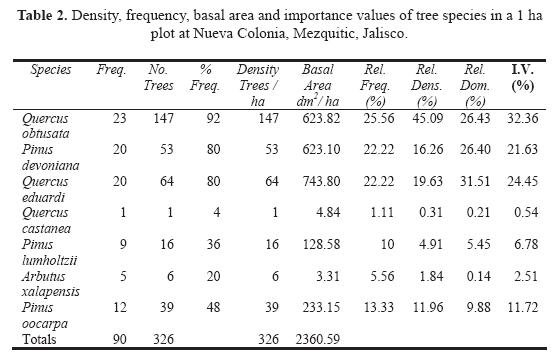
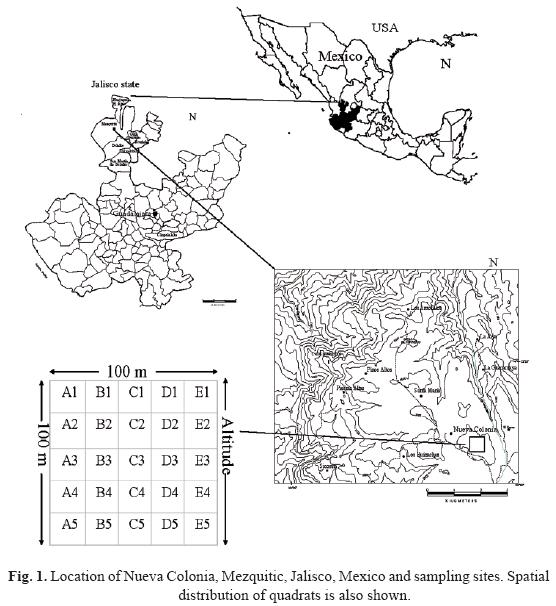
<body><![CDATA[<p align="justify"><font face="verdana" size="2">The study area was located at 6 km northeast of Nueva Colonia, southeast of Mezquitic, Mezquitic municipality, Jalisco, Mexico. We located a hectare plot within the tributary watershed Los Coyotes, along an 1800&#150;2400 altitudinal gradient, at the southern portion of Sierra Madre Occidental (<a href="#f1">Fig. 1</a>). The climate at Nueva Colonia was temperate with cold and moist winters (V&aacute;zquez&#150;Garc&iacute;a <i>et al., </i>2004). Mean annual rainfall was 600 mm with the wet season from July to August. Relief ranged from 5&#150;20% slope, of southern aspect. Volcanic acidic extrusive rocks and igneous Toba rocks were prevalent in the area. Silt soils and ferric Luvisol soils were common in the area (INEGI 1970a, 1970b).</font></p>     <p align="center"><font face="verdana" size="2"><i><a name="f1"></a></i></font></p>     <p align="center"><font face="verdana" size="2"><img src="/img/revistas/polib/n27/a3f1.jpg"></font></p>     <p align="justify"><font face="verdana" size="2">Floristic checklists for the municipality included over 373 vascular plant species (V&aacute;zquez&#150;Garc&iacute;a <i>et al. </i>2004). The dominant vegetation was pine and pine&#150;oak forests. In accordance with vegetation class, the most common species in the area were <i>Pinus <i>oocarpa, P. devoniana, P. durangensis, P. duglasiana, Quercus castanea, Q. crassifolia, Q. splendens, Arbutus xalapensis, Befaria mexicana, Alnus jorullensis </i>and <i>Juniperus flacida </i>(V&aacute;zquez <i>et al., </i>1999; V&aacute;zquez and Vargas, 1999; V&aacute;zquez&#150;Garc&iacute;a <i>et al., </i>2004).</i></font></p>     <p align="center"><font face="verdana" size="2">&nbsp;</font></p>     <p align="justify"><font face="verdana" size="2"><b>Field sampling</b></font></p>     <p align="justify"><font face="verdana" size="2">We selected the least disturbed (forest stands with larger dbh) pineoak forest in Nueva Colonia through field reconnaissance. The huichol community has designated this forest as sacred and no logging is allowed in this area. The total area sampled was 1 hectare (100 m x 100 m). We divided the hectare in 25 quadrats, each one was 400 m<sup>2</sup>. The altitudinal variation within the hectare ranged from 2353 to 2367 m (14 m difference in elevation or 14% slope degree). To prevent confusion, we assigned a number to each quadrat, following a west&#150;east and north&#150;south order (first row A1&#150;A5, second row B1&#150;B5, and so on) (<a href="#f1">Fig. 1</a>). At each quadrat, we recorded plant species &gt; 2.5 cm DBH and collected a voucher of each species. The sampling was conducted during the summer of 2002 (late June&#150;early July). Species' identifications were determined by the authors. Nomenclature generally follows V&aacute;zquez&#150;Garc&iacute;a <i>et al. </i>(2004). Herbarium specimens were deposited at the The University of Guadalajara's herbarium (IBUG) (Holmgren <i>et al., </i>1990).</font></p>     <p align="justify"><font face="verdana" size="2">We collected a total of ten composite soil samples. Each of them represented five quadrats, either from a row within the elevational gradient or from a column along the elevational gradient. All of the samples were selected from one hectare's grid with twenty five 20 x 20 m. squares. The composite soil samples were obtained to increase soil representation in the area. Soil density, texture (sand, clay, silt), soil moisture, organic matter, cation exchange capacity (CEC), Mg, Ca, Ca+Mg, Na, K, pH, N, and P were analyzed (<a href="/img/revistas/polib/n27/a3t1.jpg" target="_blank">Table 1</a>). Nutrients were measured following Mehlich III's extraction method, P was extracted with the Olsen method, pH with a potentiometer, soil moisture with the gravimetric method, organic matter with Walkey&#150;Black's process, and texture with Bouyoucos' methods (AOAC International, 1990; APHA&#150;AWWA&#150;WPCF, 1992; Agricultural Experiment Stations, 1998). We recorded site conditions within the plot and determined position and altitude using a global positioning device (GPS 12 Garmin corporation) and aspect and slope using a compass and a clinometer, respectively. Rockiness was also noted visually as a percent of a quadrat covered and averaged for a row or a column of quadrats.</font></p>     <p align="justify"><font face="verdana" size="2">We measured the extent of natural and anthropogenic disturbances at each site. We assessed the degree of disturbance by recording the number of standing dead trees, fallen trees, woody stems, and tree stumps. Cattle grazing and fire evidence were also recorded (Olvera&#150;Vargas <i>et al., </i>1996). Average disturbance values were used to assign one of three disturbance classes (high, intermediate or low) for each column or row of quadrats.</font></p>     <p align="justify"><font face="verdana" size="2">We obtained species basal area for each of the 25 quadrats and summarized them in one matrix, containing seven tree species and 25 quadrats (<a href="#t2">Table 2</a>). The environmental variables were summarized in a matrix with 19 quantitative variables and 25 quadrats.</font></p>     ]]></body>
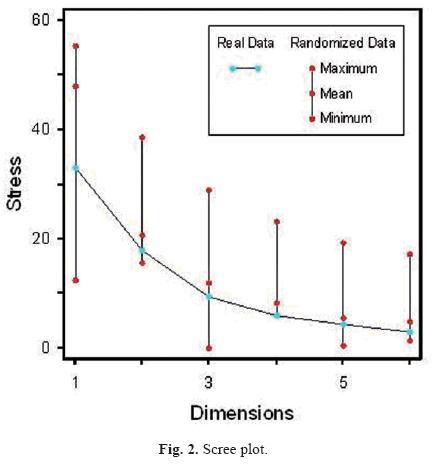
<body><![CDATA[<p align="center"><font face="verdana" size="2"><a name="t2"></a></font></p>     <p align="center"><font face="verdana" size="2"><img src="/img/revistas/polib/n27/a3t2.jpg"></font></p>     <p align="justify"><font face="verdana" size="2"><b>Environmental gradients</b></font></p>     <p align="justify"><font face="verdana" size="2">Using direct gradient analysis, we identified major environmental gradients and how they were related to altitude along the vertical gradient (from north to south) and to the horizontal gradient (from west to east), averaging data on variables for each row or column of quadrats.</font></p>     <p align="justify"><font face="verdana" size="2"><b>Sociological ordination</b></font></p>     <p align="justify"><font face="verdana" size="2">Matrices were analyzed using Global Non&#150;metric Multidimensional Scaling (NMS) ordination, available in PCORD v.4, a software that performs multivariate analyses for ecological data (McCune and Mefford 1999). NMS was performed following the method described by Kruskal (1964) and Mather (1976). NMS is an effective ordination method for ecological community data because it does not assume linear relationships among variables (Minchin, 1987). The method searches for the best position on n entities on k axes with the objective of minimizing the stress on the k&#150;dimensional configuration (Minchin, 1987; McCune and Grace, 2002).</font></p>     <p align="justify"><font face="verdana" size="2">A general procedure for NMS was used as suggested by McCune &amp; Grace (2002): a) data were adjusted, <i>Quercus castanea </i>occurred in less than 5% of sample units and was removed as a rare species; sample unit E2 was identified as a moderate outlier an thus removed; given the range of basal area values for each species, there was no need for their standardization; raw data were preferred over relativized ones for an appropriate representation of shifts in species structure (e.g. increases in basal area), b) a preliminary configuration with 100 runs was employed to asses how possible would the observed pattern be in the ordination if only a random process would be operating at the community configuration, this step suggested a three dimensional model; c) dimensionality of the data set was determined by plotting a scree plot, which shows stress as a function of dimensionality of the gradient model (<a href="#f2">Fig. 2</a>); d) three dimensions were specified; e) a plot of stress vs. iteration assisted in checking for stability; f) the final configuration included the S&oslash;rensen distance measure, 3 axes, number five was used as a seed for the random number generator, with no step down dimensionality, one real run, and no Monte Carlo test (no randomized runs).</font></p>     <p align="center"><font face="verdana" size="2"><a name="f2"></a></font></p>     <p align="center"><font face="verdana" size="2"><img src="/img/revistas/polib/n27/a3f2.jpg"></font></p>     <p align="justify"><font face="verdana" size="2">The S&oslash;rensen's distance measure was used, a robust measure for ecological distance (Beals, 1984; Faith <i>et al., </i>1987). The relationship between tree species and environmental variables was evaluated using Pearson correlations between the calculated ordination axes and the environmental variables. Only variables from the secondary matrix with an r<sup>2</sup> (with scores on either axis) larger than the cutoff value were plotted. The default cutoff is 0.2, but it was set to 0.3 to overlay few and relevant vectors.</font></p>     ]]></body>
<body><![CDATA[<p align="justify"><font face="verdana" size="2"><b>Classification</b></font></p>     <p align="justify"><font face="verdana" size="2">We classified the studied forest plots using the grouping algorithm of Unweighted Pair Group Average (UPGMA). We used UPGMA in connection with the S&oslash;rensen distance S:</font></p>     <p align="center"><font face="verdana" size="2">S = 1 &#150; 2w/(a+b)</font></p>     <p align="justify"><font face="verdana" size="2">where a and b are the numbers of species in each of two samples and w is the number of species the samples share. UPGMA is a hierarchical polythetic agglomerative technique that groups samples into classes and classes into a hierarchy, using information simultaneously from all samples. Each sample is assigned to a cluster on a hierarchy of increasingly inclusive clusters until all samples are part of one cluster. Opposed to related classification techniques, UPGMA's dissimilarities between clusters are equal to the average dissimilarity rather than equal to the maximum dissimilarity (Orl&oacute;ci, 1978). UPGMA maximizes the correlation between input and output compositional dissimilarities implied in the obtained dendrogram (Gauch 1982).</font></p>     <p align="justify"><font face="verdana" size="2">&nbsp;</font></p>     <p align="justify"><font face="verdana" size="2"><b>RESULTS</b></font></p>     <p align="justify"><font face="verdana" size="2">A total of 326 individual trees were recorded in the studied area (1 ha, 25 plots). We found seven tree species: <i>Pinus devoniana, P. lumholtzii, P. oocarpa, Quercus obtusata, Q. eduardii, Q. castanea </i>and <i>Arbutus xalapensis. </i>The tree diversity index value was H' = 1.483. Oak species were the dominant elements in the forest. <i>Q. eduardii </i>had the highest basal area (<a href="#t2">Table 2</a>). <i>Q. obtusata, Q. eduardii, </i>and <i>P. devoniana </i>had the highest importance values (32%, 24%, and 22% respectively). Total basal area in the plot was 24 m<sup>2</sup> ha (<a href="#t2">Table 2</a>). Limited anthropogenic disturbance occurs in the study area by restricting visitors to the sacred forested area. We were told that the last wood selective extraction occurred about 30 years ago. Four percent of trees had fire scares. Evidence of past forest fires is attributable to lightening (local inhabitants, pers. comm.). There was no evidence of cattle grazing or insect predation, at least on tree saplings or adults.</font></p>     <p align="justify"><font face="verdana" size="2"><b>Environmental ordination</b></font></p>     <p align="justify"><font face="verdana" size="2">Regression analysis showed that CEC, Ca + Mg, Mg and K increased with decreasing elevation, which represents an increase of nutrients from north to south (<a href="/img/revistas/polib/n27/a3f3.jpg" target="_blank">Fig. 3</a>). Percent of total&#150;nitrogen increased from west to east within elevation (<a href="/img/revistas/polib/n27/a3f4.jpg" target="_blank">Fig. 4</a>).</font></p>     <p align="justify"><font face="verdana" size="2"><b>Sociological ordination</b></font></p>     ]]></body>
<body><![CDATA[<p align="justify"><font face="verdana" size="2">The scree plot (<a href="#f2">Fig. 2</a>) and the Monte Carlo test recommended a three dimensional solution. The proportion of randomized runs with stress less than or equal to the observed stress was 0.0495. The final stress for a three&#150;dimensional solution of the NMS ordination was 9.718. Axes accounted for a reduction in stress of 0.0001 and instability of 0.06427 with 100 iterations. Most of the stress was reduced after 20 iterations. Axes 1 and 2 were not explained by any of the measured environmental variables. However, axis 3 was directly related to altitude along the vertical gradient, apparent density and the slope of the horizontal gradient (<a href="/img/revistas/polib/n27/a3f5.jpg" target="_blank">Fig. 5a</a>); and inversely related to CEC, Mg, Ca + Mg, and altitude along the horizontal gradient (<a href="/img/revistas/polib/n27/a3f5.jpg" target="_blank">Fig. 5a</a>). In relation to species patterns, axis 1 was directly related to basal area <i>of Pinus oocarpa </i>and inversely related to basal area <i>of P. devoniana </i>(<a href="/img/revistas/polib/n27/a3f6.jpg" target="_blank">Fig. 5b</a>); axis 2 was directly related to basal area of <i>Quercus obtusata </i>(<a href="/img/revistas/polib/n27/a3f7.jpg" target="_blank">Fig. 5c</a>); axis 3 was inversely related to basal area of <i>Q. eduardii </i>(<a href="/img/revistas/polib/n27/a3f8.jpg" target="_blank">Fig. 5d</a>). Environmental variables explaining major community gradients in the sociological ordination were largely consistent with those identified through direct gradient analyses.</font></p>     <p align="justify"><font face="verdana" size="2"><b>Classification</b></font></p>     <p align="justify"><font face="verdana" size="2">UPGMA recognized three groups containing 25% of the remaining information. A heterogeneous group is composed by A1, B1, B2, C3 y C4 quadrats, which are spatially correlated. A second heterogeneous group contains B3, C1, D1 and E2, which are spatially separated. The third group containing 16 quadrats was the largest, it was less heterogeneous, and spatially separated (<a href="/img/revistas/polib/n27/a3f9.jpg" target="_blank">Fig. 6</a>). Classification results did not reproduced physical location of quadrats, and were weakly related to ordination results.</font></p>     <p align="justify"><font face="verdana" size="2">&nbsp;</font></p>     <p align="justify"><font face="verdana" size="2"><b>DISCUSSION</b></font></p>     <p align="justify"><font face="verdana" size="2">Community structure of pine&#150;oak forest in Nueva Colonia may be explained by habitat specialization to altitude and soil gradients. Consistently, establishment of pine species has been related to soil and topographic conditions (Park 2001). In addition, species interactions allow differences in species dominance in the community, for instance, <i>Pinus devoniana </i>and <i>P. oocarpa </i>dominated different ends of axis 1; <i>Quercus obtusata </i>dominated axis 2; and <i>Q. eduardii </i>dominated axis 3. Differences in dominance along these axes was explained by CEC and by soil nutrients (Ca + Mg, Mg). Community patterns at the Sierra Huichola support the individualistic hypothesis of plant community organization, with no evidence for vegetational discontinuities.</font></p>     <p align="justify"><font face="verdana" size="2">The fact that five from seven species have an aggregated distribution pattern indicates habitat specialization or spatial autocorrelation (Harms <i>et al., </i>2001). A correlation analysis with ecological equivalence among quadrants could help to explain species habitat preferences. A third of these species have random distribution, supporting the neutral theory, in which species are habitat independent.</font></p>     <p align="justify"><font face="verdana" size="2">There is a soil&#150;species relationship in pine&#150;oak forest at Nueva Colonia. Soil nutrients and soil moisture appear correlated with temperate tree species distributions (Cowell 1993). Other factors such as topography and moisture conditions might be important structuring forest composition, however, the role of nutrients and disturbance are primary forces controlling vegetation patterns in temperate forests (Peet and Christensen, 1980; Cowell, 1993; Park, 2001; Cavender&#150;Bares <i>et al.</i>, 2004). Variation in exchangeable magnesium, calcium, and potassium allow differences in growth and mortality rates of oaks and pine species, resulting in different patterns of species distributions (Breemen <i>et al.</i>, 1997; Arii and Lechowicz, 2002; Bigelow and Canham 2002; Dijkstra and Smits, 2002; Horsley <i>et al., </i>2002). Soil nutrients can change on small scale across topography gradients, thus producing gradients in soil fertility and affecting species dominance (Bailey <i>et al.</i>, 2004). At a 1 hectare scale, species maintenance and basal area of oak and pine in Nueva Colonia can be explained by niche partitioning of soil gradients. This competitive interaction for soil resources is a key mechanism structuring the community (Muscolo <i>et al., </i>2007). Consistently, 17 oak species in Florida show clear patterns of specialization along soil moisture and nutrient gradients and show a pattern of habitat differentiation (Cavender&#150;Bares et al., 2004).</font></p>     <p align="justify"><font face="verdana" size="2">Habitat heterogeneity can be observed at a small scale, as showed in classification. Spatially contiguous sites with low climatic and topographic heterogeneity have small scale differences and have an effect in soil nutrients distribution (Muscolo <i>et al. </i>2007). The increase in bases at lower elevations might be related to a leaching process. Constant soil leaching has a pronounced effect on Ca and Mg availability (Schier and McQueattie, 2000). Soil leaching occurring in Nueva Colonia resembles the cascade effect (low nutrients at higher elevations increasing at lower) observed in mountains of Sierra de Manantl&aacute;n (V&aacute;zquez and Givnish, 1998; Ortiz&#150;Arrona, 1999). The nitrogen relevance for this community might be the result of disturbance regime stage or habitat specialization. N availability is strongly correlated with vegetation patterns, linking below&#150;ground processes and above&#150;ground biodiversity (Hutchinson <i>et al.</i>, 1999). Therefore, species are specialized and distributed in microsites with different nitrogen and other nutrients availability.</font></p>     <p align="justify"><font face="verdana" size="2">&nbsp;</font></p>     ]]></body>
<body><![CDATA[<p align="justify"><font face="verdana" size="2"><b>ACKNOWLEDGMENTS</b></font></p>     <p align="justify"><font face="verdana" size="2">The Centro de Ingenier&iacute;a Ambiental, Unidad de Apoyo a Comunidades Ind&iacute;genas, both from University of Guadalajara; SIMORE&#150;LOS&#150;CONACYT&#150;1996, through Ordenamiento Ecol&oacute;gico Territorial de Jalisco; and Instituto Nacional Indigenista (SEDESOL) provided financial support for this research. Miguel de J. Ch&aacute;zaro B., Ram&oacute;n Cuevas </font><font face="verdana" size="2">G., Mollie Harker, Jacqueline Reynoso D., Roberto Gonz&aacute;lez T. and Mar&iacute;a Eugenia Barba R. helped with species identification. Rafael L&oacute;pez de la Torre, wirrarika, kindly helped to locate forest sites and gave us logistic support. Luzmila Herrera P&eacute;rez, Justo Murgu&iacute;a Castillo, Mar&iacute;a Eugenia Barba Robert, and Magdalena Alc&aacute;zar Garc&iacute;a collected voucher plant specimens and assisted during field work. We thank Susana and Diana Parker for proofreading the English. Special thanks to anonimous reviewers of Polibot&aacute;nica and to Ram&oacute;n Cuevas, from the Manantl&aacute;n Institute, Universidad de Guadalajara, for their valuable suggestions.</font></p>     <p align="justify"><font face="verdana" size="2">&nbsp;</font></p>     <p align="justify"><font face="verdana" size="2"><b>LITERATURE CITED</b></font></p>     <!-- ref --><p align="justify"><font face="verdana" size="2">Aber, J.D., K.J. Nadelhoffer, P.Steudler &amp; J. M. Melillo, 1989. "Nitrogen saturation in northern forest ecosystems". <i>Bioscience, </i><b>39</b>: 378&#150;386.    &nbsp;&nbsp;&nbsp;&nbsp;&nbsp;&nbsp;&nbsp;&nbsp;[&#160;<a href="javascript:void(0);" onclick="javascript: window.open('/scielo.php?script=sci_nlinks&ref=6062362&pid=S1405-2768200900010000300001&lng=','','width=640,height=500,resizable=yes,scrollbars=1,menubar=yes,');">Links</a>&#160;]<!-- end-ref --></font></p>     <!-- ref --><p align="justify"><font face="verdana" size="2">Agricultural Experiment Stations, 1998. "Recommended chemical soil test procedures". <i>North Central Regional Research Publications </i>221, Missouri Agricultural Experiment Station, Columbia, Missouri.    &nbsp;&nbsp;&nbsp;&nbsp;&nbsp;&nbsp;&nbsp;&nbsp;[&#160;<a href="javascript:void(0);" onclick="javascript: window.open('/scielo.php?script=sci_nlinks&ref=6062364&pid=S1405-2768200900010000300002&lng=','','width=640,height=500,resizable=yes,scrollbars=1,menubar=yes,');">Links</a>&#160;]<!-- end-ref --></font></p>     <!-- ref --><p align="justify"><font face="verdana" size="2">Allendorf, F.W. &amp; N. Ryman, 2002. "The role of genetics in population viability analysis". In: Beissinger, S.R. &amp; McCullough, D.R. (eds.) <i>Population viability analysis, </i>pp. 50&#150;85. University of Chicago Press, Chicago, Illinois.    &nbsp;&nbsp;&nbsp;&nbsp;&nbsp;&nbsp;&nbsp;&nbsp;[&#160;<a href="javascript:void(0);" onclick="javascript: window.open('/scielo.php?script=sci_nlinks&ref=6062366&pid=S1405-2768200900010000300003&lng=','','width=640,height=500,resizable=yes,scrollbars=1,menubar=yes,');">Links</a>&#160;]<!-- end-ref --></font></p>     ]]></body>
<body><![CDATA[<!-- ref --><p align="justify"><font face="verdana" size="2">AOAC International, 1990. <i>Official methods of analysis: </i>volume I, Association of Official Analytical Chemists SB 1001. Missouri Agricultural Experiment Station, Maryland, Missouri.    &nbsp;&nbsp;&nbsp;&nbsp;&nbsp;&nbsp;&nbsp;&nbsp;[&#160;<a href="javascript:void(0);" onclick="javascript: window.open('/scielo.php?script=sci_nlinks&ref=6062368&pid=S1405-2768200900010000300004&lng=','','width=640,height=500,resizable=yes,scrollbars=1,menubar=yes,');">Links</a>&#160;]<!-- end-ref --></font></p>     <!-- ref --><p align="justify"><font face="verdana" size="2">APHA&#150;AWWA&#150;WPCF, 1992. <i>Standard methods for the examination of water and wastewater, </i>American Public Health Association, Washington, D.C.    &nbsp;&nbsp;&nbsp;&nbsp;&nbsp;&nbsp;&nbsp;&nbsp;[&#160;<a href="javascript:void(0);" onclick="javascript: window.open('/scielo.php?script=sci_nlinks&ref=6062370&pid=S1405-2768200900010000300005&lng=','','width=640,height=500,resizable=yes,scrollbars=1,menubar=yes,');">Links</a>&#160;]<!-- end-ref --></font></p>     <!-- ref --><p align="justify"><font face="verdana" size="2">Arii, K. &amp; M.J. Lechowicz, 2002. "The influence of overstory trees and abiotic factors on the sapling community in an old&#150;growth Fagus&#150;Acer forest". <i>Ecoscience, </i><b>9</b>(3): 386&#150;396.    &nbsp;&nbsp;&nbsp;&nbsp;&nbsp;&nbsp;&nbsp;&nbsp;[&#160;<a href="javascript:void(0);" onclick="javascript: window.open('/scielo.php?script=sci_nlinks&ref=6062372&pid=S1405-2768200900010000300006&lng=','','width=640,height=500,resizable=yes,scrollbars=1,menubar=yes,');">Links</a>&#160;]<!-- end-ref --></font></p>     <!-- ref --><p align="justify"><font face="verdana" size="2">Bailey, S.W., Horsley, S.B., Long, R.P. &amp; Hallett, R.A., 2004. "Influence of edaphic factors on sugar maple nutrition and health on the allegheny plateau". <i>Soil Science Society American Journal, </i><b>68</b>: 243&#150;252.    &nbsp;&nbsp;&nbsp;&nbsp;&nbsp;&nbsp;&nbsp;&nbsp;[&#160;<a href="javascript:void(0);" onclick="javascript: window.open('/scielo.php?script=sci_nlinks&ref=6062374&pid=S1405-2768200900010000300007&lng=','','width=640,height=500,resizable=yes,scrollbars=1,menubar=yes,');">Links</a>&#160;]<!-- end-ref --></font></p>     <!-- ref --><p align="justify"><font face="verdana" size="2">Basnet, K., 1992. "Effect of topography on the pattern of trees in tabonuco <i>(Dacryodes excelsa) </i>dominated rain forest in Puerto Rico". <i>Biotropica, </i><b>4</b>: 31&#150;42.    &nbsp;&nbsp;&nbsp;&nbsp;&nbsp;&nbsp;&nbsp;&nbsp;[&#160;<a href="javascript:void(0);" onclick="javascript: window.open('/scielo.php?script=sci_nlinks&ref=6062376&pid=S1405-2768200900010000300008&lng=','','width=640,height=500,resizable=yes,scrollbars=1,menubar=yes,');">Links</a>&#160;]<!-- end-ref --></font></p>     ]]></body>
<body><![CDATA[<!-- ref --><p align="justify"><font face="verdana" size="2">Beals, E.W., 1969. "Vegetation changes along altitudinal gradients". <i>Science, </i><b>165: </b>981&#150;985.    &nbsp;&nbsp;&nbsp;&nbsp;&nbsp;&nbsp;&nbsp;&nbsp;[&#160;<a href="javascript:void(0);" onclick="javascript: window.open('/scielo.php?script=sci_nlinks&ref=6062378&pid=S1405-2768200900010000300009&lng=','','width=640,height=500,resizable=yes,scrollbars=1,menubar=yes,');">Links</a>&#160;]<!-- end-ref --></font></p>     <!-- ref --><p align="justify"><font face="verdana" size="2">&#150;&#150;&#150;&#150;&#150;&#150;&#150;&#150;&#150;&#150;, 1984. "Bray Curtis ordination: an effective strategy for analysis of multivariate ecological data". <i>Advances Ecol. Research, </i><b>14</b>: 1&#150;55.    &nbsp;&nbsp;&nbsp;&nbsp;&nbsp;&nbsp;&nbsp;&nbsp;[&#160;<a href="javascript:void(0);" onclick="javascript: window.open('/scielo.php?script=sci_nlinks&ref=6062380&pid=S1405-2768200900010000300010&lng=','','width=640,height=500,resizable=yes,scrollbars=1,menubar=yes,');">Links</a>&#160;]<!-- end-ref --></font></p>     <!-- ref --><p align="justify"><font face="verdana" size="2">Bigelow, S.W. &amp; C.D. Canham, 2002. "Community organization of tree species along soil gradients in a north&#150;eastern USA forest". <i>Journal of Ecology, </i><b>90</b>: 188&#150;200.    &nbsp;&nbsp;&nbsp;&nbsp;&nbsp;&nbsp;&nbsp;&nbsp;[&#160;<a href="javascript:void(0);" onclick="javascript: window.open('/scielo.php?script=sci_nlinks&ref=6062382&pid=S1405-2768200900010000300011&lng=','','width=640,height=500,resizable=yes,scrollbars=1,menubar=yes,');">Links</a>&#160;]<!-- end-ref --></font></p>     <!-- ref --><p align="justify"><font face="verdana" size="2">Bourgeron, P.S., 1983. "Spatial aspects of vegetation structure". pp. 29&#150;47. In: F.B. Golley (ed.). <i>Ecosystems of the world: tropical rain forest ecosystems </i>14. Elsevier, Amsterdam.    &nbsp;&nbsp;&nbsp;&nbsp;&nbsp;&nbsp;&nbsp;&nbsp;[&#160;<a href="javascript:void(0);" onclick="javascript: window.open('/scielo.php?script=sci_nlinks&ref=6062384&pid=S1405-2768200900010000300012&lng=','','width=640,height=500,resizable=yes,scrollbars=1,menubar=yes,');">Links</a>&#160;]<!-- end-ref --></font></p>     <!-- ref --><p align="justify"><font face="verdana" size="2">Breemen, N. Van, A.C. Finzi &amp; C.D. Canham, 1997. "Canopy tree&#150;soil interactions within temperate forests: effects of soil elemental composition and texture on species distributions". <i>Canadian Journal of Forest Research, </i><b>27</b>: 1110&#150;1116.    &nbsp;&nbsp;&nbsp;&nbsp;&nbsp;&nbsp;&nbsp;&nbsp;[&#160;<a href="javascript:void(0);" onclick="javascript: window.open('/scielo.php?script=sci_nlinks&ref=6062386&pid=S1405-2768200900010000300013&lng=','','width=640,height=500,resizable=yes,scrollbars=1,menubar=yes,');">Links</a>&#160;]<!-- end-ref --></font></p>     ]]></body>
<body><![CDATA[<!-- ref --><p align="justify"><font face="verdana" size="2">Brokaw, N. &amp; R.T. Busing, 2000. "Niche versus chance and tree diversity in forest gaps". <i>Tree, </i><b>15: </b>183&#150;188.    &nbsp;&nbsp;&nbsp;&nbsp;&nbsp;&nbsp;&nbsp;&nbsp;[&#160;<a href="javascript:void(0);" onclick="javascript: window.open('/scielo.php?script=sci_nlinks&ref=6062388&pid=S1405-2768200900010000300014&lng=','','width=640,height=500,resizable=yes,scrollbars=1,menubar=yes,');">Links</a>&#160;]<!-- end-ref --></font></p>     <!-- ref --><p align="justify"><font face="verdana" size="2">Capers, R.S., R.L. Chazdon, Al. Redondo Brenes &amp; B. Vilchez Alvarado, 2005. "Successional dynamics of woody seedling communities in wet tropical secondary forests". <i>Journal of Ecology, </i><b>93</b>: 1071&#150;1084.    &nbsp;&nbsp;&nbsp;&nbsp;&nbsp;&nbsp;&nbsp;&nbsp;[&#160;<a href="javascript:void(0);" onclick="javascript: window.open('/scielo.php?script=sci_nlinks&ref=6062390&pid=S1405-2768200900010000300015&lng=','','width=640,height=500,resizable=yes,scrollbars=1,menubar=yes,');">Links</a>&#160;]<!-- end-ref --></font></p>     <!-- ref --><p align="justify"><font face="verdana" size="2">Cavender&#150;Bares, J., K. Kitajima, &amp; F. A. Bazzaz, 2004. "Multiple traits associations in relation to habitat differentiation among 17 floridian oak species". <i>Ecological Monographs, </i><b>74</b>: 635&#150;662.    &nbsp;&nbsp;&nbsp;&nbsp;&nbsp;&nbsp;&nbsp;&nbsp;[&#160;<a href="javascript:void(0);" onclick="javascript: window.open('/scielo.php?script=sci_nlinks&ref=6062392&pid=S1405-2768200900010000300016&lng=','','width=640,height=500,resizable=yes,scrollbars=1,menubar=yes,');">Links</a>&#160;]<!-- end-ref --></font></p>     <!-- ref --><p align="justify"><font face="verdana" size="2">Chazdon, R.L., R.K. Colwell &amp; J.S. Denslow, 1999. "Tropical tree richness and resource&#150;based niches". <i>Science, </i><b>285: </b>1459a &#91;on&#150;line journal only&#93;    &nbsp;&nbsp;&nbsp;&nbsp;&nbsp;&nbsp;&nbsp;&nbsp;[&#160;<a href="javascript:void(0);" onclick="javascript: window.open('/scielo.php?script=sci_nlinks&ref=6062394&pid=S1405-2768200900010000300017&lng=','','width=640,height=500,resizable=yes,scrollbars=1,menubar=yes,');">Links</a>&#160;]<!-- end-ref -->.</font></p>     <!-- ref --><p align="justify"><font face="verdana" size="2">Cowell, C.M., 1993. "Environmental gradients in secondary forests of the Georgia Piedmont, U. S. A". <i>Journal of Biogeography, </i><b>20</b>: 199&#150;207.    &nbsp;&nbsp;&nbsp;&nbsp;&nbsp;&nbsp;&nbsp;&nbsp;[&#160;<a href="javascript:void(0);" onclick="javascript: window.open('/scielo.php?script=sci_nlinks&ref=6062396&pid=S1405-2768200900010000300018&lng=','','width=640,height=500,resizable=yes,scrollbars=1,menubar=yes,');">Links</a>&#160;]<!-- end-ref --></font></p>     ]]></body>
<body><![CDATA[<!-- ref --><p align="justify"><font face="verdana" size="2">Cuevas G., R., 2002. <i>An&aacute;lisis de gradientes de la vegetaci&oacute;n de la ca&ntilde;ada El Tecolote en La Sierra de Manantl&aacute;n, Jalisco, M&eacute;xico. </i>Tesis doctoral. Colegio de Posgraduados, Montecillo, M&eacute;xico. 140 pp.    &nbsp;&nbsp;&nbsp;&nbsp;&nbsp;&nbsp;&nbsp;&nbsp;[&#160;<a href="javascript:void(0);" onclick="javascript: window.open('/scielo.php?script=sci_nlinks&ref=6062398&pid=S1405-2768200900010000300019&lng=','','width=640,height=500,resizable=yes,scrollbars=1,menubar=yes,');">Links</a>&#160;]<!-- end-ref --></font></p>     <!-- ref --><p align="justify"><font face="verdana" size="2">Curtis, J.T. &amp; R.P. McIntosh, 1951. "An upland forest continuum of the prairie forest border region of Wisconsin". <i>Ecology, </i><b>32</b>: 476&#150;496.    &nbsp;&nbsp;&nbsp;&nbsp;&nbsp;&nbsp;&nbsp;&nbsp;[&#160;<a href="javascript:void(0);" onclick="javascript: window.open('/scielo.php?script=sci_nlinks&ref=6062400&pid=S1405-2768200900010000300020&lng=','','width=640,height=500,resizable=yes,scrollbars=1,menubar=yes,');">Links</a>&#160;]<!-- end-ref --></font></p>     <!-- ref --><p align="justify"><font face="verdana" size="2">Denslow, J.S., 1980. "Gap partitioning among tropical rainforest trees". <i>Biotropica, </i><b>12</b>: 47&#150;55.    &nbsp;&nbsp;&nbsp;&nbsp;&nbsp;&nbsp;&nbsp;&nbsp;[&#160;<a href="javascript:void(0);" onclick="javascript: window.open('/scielo.php?script=sci_nlinks&ref=6062402&pid=S1405-2768200900010000300021&lng=','','width=640,height=500,resizable=yes,scrollbars=1,menubar=yes,');">Links</a>&#160;]<!-- end-ref --></font></p>     <!-- ref --><p align="justify"><font face="verdana" size="2">Dijkstra, F.A. &amp; M.M. Smits, 2002. "Tree species effects on calcium cycling: the role of calcium uptake in deep soils". <i>Ecosystems, </i><b>5</b>: 385&#150;398.    &nbsp;&nbsp;&nbsp;&nbsp;&nbsp;&nbsp;&nbsp;&nbsp;[&#160;<a href="javascript:void(0);" onclick="javascript: window.open('/scielo.php?script=sci_nlinks&ref=6062404&pid=S1405-2768200900010000300022&lng=','','width=640,height=500,resizable=yes,scrollbars=1,menubar=yes,');">Links</a>&#160;]<!-- end-ref --></font></p>     <!-- ref --><p align="justify"><font face="verdana" size="2">Faith, P.D., P.R. Minchin &amp; L. Belbin, 1987. "Compositional dissimilarity: a robust measure of ecological distance". <i>Vegetation, </i><b>69</b>: 57&#150;68.    &nbsp;&nbsp;&nbsp;&nbsp;&nbsp;&nbsp;&nbsp;&nbsp;[&#160;<a href="javascript:void(0);" onclick="javascript: window.open('/scielo.php?script=sci_nlinks&ref=6062406&pid=S1405-2768200900010000300023&lng=','','width=640,height=500,resizable=yes,scrollbars=1,menubar=yes,');">Links</a>&#160;]<!-- end-ref --></font></p>     ]]></body>
<body><![CDATA[<!-- ref --><p align="justify"><font face="verdana" size="2">Fowler, C.W., 1981. "Density dependence as related to life history strategy". <i>Ecology, </i><b>62</b>: 602&#150;610.    &nbsp;&nbsp;&nbsp;&nbsp;&nbsp;&nbsp;&nbsp;&nbsp;[&#160;<a href="javascript:void(0);" onclick="javascript: window.open('/scielo.php?script=sci_nlinks&ref=6062408&pid=S1405-2768200900010000300024&lng=','','width=640,height=500,resizable=yes,scrollbars=1,menubar=yes,');">Links</a>&#160;]<!-- end-ref --></font></p>     <!-- ref --><p align="justify"><font face="verdana" size="2">Garten, C.T., M.A. Huston &amp; C.A. Thoms, 1994. "Topographic variation of soil nitrogen dynamics at Walker Branch Watershed, Tennessee". <i>Forest Science, </i><b>40</b>: 497&#150;512.    &nbsp;&nbsp;&nbsp;&nbsp;&nbsp;&nbsp;&nbsp;&nbsp;[&#160;<a href="javascript:void(0);" onclick="javascript: window.open('/scielo.php?script=sci_nlinks&ref=6062410&pid=S1405-2768200900010000300025&lng=','','width=640,height=500,resizable=yes,scrollbars=1,menubar=yes,');">Links</a>&#160;]<!-- end-ref --></font></p>     <!-- ref --><p align="justify"><font face="verdana" size="2">Gauch, H.G., 1982. <i>Multivariate analysis in community ecology. </i>Cambridge University Press.    &nbsp;&nbsp;&nbsp;&nbsp;&nbsp;&nbsp;&nbsp;&nbsp;[&#160;<a href="javascript:void(0);" onclick="javascript: window.open('/scielo.php?script=sci_nlinks&ref=6062412&pid=S1405-2768200900010000300026&lng=','','width=640,height=500,resizable=yes,scrollbars=1,menubar=yes,');">Links</a>&#160;]<!-- end-ref --></font></p>     <!-- ref --><p align="justify"><font face="verdana" size="2">Gentry, A.H., 1982. "Patterns of neotropical plant species diversity". <i>Annals of the Missouri Botanical Garden, </i><b>69</b>: 557&#150;593.    &nbsp;&nbsp;&nbsp;&nbsp;&nbsp;&nbsp;&nbsp;&nbsp;[&#160;<a href="javascript:void(0);" onclick="javascript: window.open('/scielo.php?script=sci_nlinks&ref=6062414&pid=S1405-2768200900010000300027&lng=','','width=640,height=500,resizable=yes,scrollbars=1,menubar=yes,');">Links</a>&#160;]<!-- end-ref --></font></p>     <!-- ref --><p align="justify"><font face="verdana" size="2">Glitzenstein, J.S., WJ. Platt &amp; D. R. Streng, 1995. "Effects of fire regime and habitat on tree dynamics in North Florida longleaf pine savannas". <i>Ecological Monographs, </i><b>65</b>: 441&#150;476.    &nbsp;&nbsp;&nbsp;&nbsp;&nbsp;&nbsp;&nbsp;&nbsp;[&#160;<a href="javascript:void(0);" onclick="javascript: window.open('/scielo.php?script=sci_nlinks&ref=6062416&pid=S1405-2768200900010000300028&lng=','','width=640,height=500,resizable=yes,scrollbars=1,menubar=yes,');">Links</a>&#160;]<!-- end-ref --></font></p>     ]]></body>
<body><![CDATA[<!-- ref --><p align="justify"><font face="verdana" size="2">Gouvenain, R. C., R. K. Kobe &amp; J. A. Silander, 2007. "Partitioning of understorey light and dry&#150;season soil moisture gradients among seedlings of four rain&#150;forest tree species in Madagascar". <i>Journal of Tropical Ecology, </i><b>23</b>: 569&#150;579.    &nbsp;&nbsp;&nbsp;&nbsp;&nbsp;&nbsp;&nbsp;&nbsp;[&#160;<a href="javascript:void(0);" onclick="javascript: window.open('/scielo.php?script=sci_nlinks&ref=6062418&pid=S1405-2768200900010000300029&lng=','','width=640,height=500,resizable=yes,scrollbars=1,menubar=yes,');">Links</a>&#160;]<!-- end-ref --></font></p>     <!-- ref --><p align="justify"><font face="verdana" size="2">Harms, K.E., R. Condit, S.P. Hubbell &amp; R.B. Foster, 2001. "Habitat Associations of Trees and Shrubs in a 50&#150;Ha Neotropical Forest Plot". <i>Journal of Ecology, </i><b>89</b>(6): 947&#150;959.    &nbsp;&nbsp;&nbsp;&nbsp;&nbsp;&nbsp;&nbsp;&nbsp;[&#160;<a href="javascript:void(0);" onclick="javascript: window.open('/scielo.php?script=sci_nlinks&ref=6062420&pid=S1405-2768200900010000300030&lng=','','width=640,height=500,resizable=yes,scrollbars=1,menubar=yes,');">Links</a>&#160;]<!-- end-ref --></font></p>     <!-- ref --><p align="justify"><font face="verdana" size="2">Holmgren, P.K., Holmgren, N.H. &amp; Barnett, L.C., 1990. "Index Herbariorum". Part <i>I. Regnum Vegetation, </i><b>120</b>: 1&#150;693.    &nbsp;&nbsp;&nbsp;&nbsp;&nbsp;&nbsp;&nbsp;&nbsp;[&#160;<a href="javascript:void(0);" onclick="javascript: window.open('/scielo.php?script=sci_nlinks&ref=6062422&pid=S1405-2768200900010000300031&lng=','','width=640,height=500,resizable=yes,scrollbars=1,menubar=yes,');">Links</a>&#160;]<!-- end-ref --></font></p>     <!-- ref --><p align="justify"><font face="verdana" size="2">Horsley, S.B., R. P.Long, S.W. Bailey, R.A. Hallett &amp; P.M. Wargo, 2002. "Health of eastern North America sugar maple forests and factors affecting decline". <i>Northern J. Appl. For., </i><b>19</b>: 34&#150;44.    &nbsp;&nbsp;&nbsp;&nbsp;&nbsp;&nbsp;&nbsp;&nbsp;[&#160;<a href="javascript:void(0);" onclick="javascript: window.open('/scielo.php?script=sci_nlinks&ref=6062424&pid=S1405-2768200900010000300032&lng=','','width=640,height=500,resizable=yes,scrollbars=1,menubar=yes,');">Links</a>&#160;]<!-- end-ref --></font></p>     <!-- ref --><p align="justify"><font face="verdana" size="2">Hubbell, S.P., 2001. <i>The Unified Theory of Biodiversity and Biogeography. </i>Princeton University Press, Princeton, NJ.    &nbsp;&nbsp;&nbsp;&nbsp;&nbsp;&nbsp;&nbsp;&nbsp;[&#160;<a href="javascript:void(0);" onclick="javascript: window.open('/scielo.php?script=sci_nlinks&ref=6062426&pid=S1405-2768200900010000300033&lng=','','width=640,height=500,resizable=yes,scrollbars=1,menubar=yes,');">Links</a>&#160;]<!-- end-ref --></font></p>     ]]></body>
<body><![CDATA[<!-- ref --><p align="justify"><font face="verdana" size="2">Hutchinson, T.F., R.E. Boerner, L.R. Iverson, S. Sutherland &amp; E.K. Sutherland, 1999. "Landscape patterns of understory composition and richness across moisture and nitrogen mineralization gradient in Ohio (USA) <i>Quercus foresf&quot;. Plant Ecology, </i><b>144</b>: 177&#150;189.    &nbsp;&nbsp;&nbsp;&nbsp;&nbsp;&nbsp;&nbsp;&nbsp;[&#160;<a href="javascript:void(0);" onclick="javascript: window.open('/scielo.php?script=sci_nlinks&ref=6062428&pid=S1405-2768200900010000300034&lng=','','width=640,height=500,resizable=yes,scrollbars=1,menubar=yes,');">Links</a>&#160;]<!-- end-ref --></font></p>     <!-- ref --><p align="justify"><font face="verdana" size="2">INEGI, 1970a. <i>Carta edafol&oacute;gica, </i>escala 1: 50 000. Instituto Nacional de Estad&iacute;stica, Geograf&iacute;a e Inform&aacute;tica, M&eacute;xico, DF.    &nbsp;&nbsp;&nbsp;&nbsp;&nbsp;&nbsp;&nbsp;&nbsp;[&#160;<a href="javascript:void(0);" onclick="javascript: window.open('/scielo.php?script=sci_nlinks&ref=6062430&pid=S1405-2768200900010000300035&lng=','','width=640,height=500,resizable=yes,scrollbars=1,menubar=yes,');">Links</a>&#160;]<!-- end-ref --></font></p>     <!-- ref --><p align="justify"><font face="verdana" size="2">&#150;&#150;&#150;&#150;&#150;&#150;&#150;&#150;&#150;&#150;, 1970b<b>. </b><i>Carta geol&oacute;gica, </i>escala 1: 50 000. Instituto Nacional de Estad&iacute;stica, Geograf&iacute;a e Inform&aacute;tica, M&eacute;xico, DF.    &nbsp;&nbsp;&nbsp;&nbsp;&nbsp;&nbsp;&nbsp;&nbsp;[&#160;<a href="javascript:void(0);" onclick="javascript: window.open('/scielo.php?script=sci_nlinks&ref=6062432&pid=S1405-2768200900010000300036&lng=','','width=640,height=500,resizable=yes,scrollbars=1,menubar=yes,');">Links</a>&#160;]<!-- end-ref --></font></p>     <!-- ref --><p align="justify"><font face="verdana" size="2">Iriarte, S.B.B. &amp; R.L. Chazdon, 2005. "Light&#150;dependent seedling survival and growth of four tree species in Costa Rican second&#150;growth rain forests". <i>Journal of Tropical Ecology, </i><b>21: </b>383&#150;395.    &nbsp;&nbsp;&nbsp;&nbsp;&nbsp;&nbsp;&nbsp;&nbsp;[&#160;<a href="javascript:void(0);" onclick="javascript: window.open('/scielo.php?script=sci_nlinks&ref=6062434&pid=S1405-2768200900010000300037&lng=','','width=640,height=500,resizable=yes,scrollbars=1,menubar=yes,');">Links</a>&#160;]<!-- end-ref --></font></p>     <!-- ref --><p align="justify"><font face="verdana" size="2">Johnston, M.H., 1992. "Soil&#150;vegetation relationships in a Tabonuco forest community in the Luquillo mountains of Puerto Rico"<b>. </b><i>Journal of Tropical Ecology, </i><b>8</b>: 253&#150;263.    &nbsp;&nbsp;&nbsp;&nbsp;&nbsp;&nbsp;&nbsp;&nbsp;[&#160;<a href="javascript:void(0);" onclick="javascript: window.open('/scielo.php?script=sci_nlinks&ref=6062436&pid=S1405-2768200900010000300038&lng=','','width=640,height=500,resizable=yes,scrollbars=1,menubar=yes,');">Links</a>&#160;]<!-- end-ref --></font></p>     ]]></body>
<body><![CDATA[<!-- ref --><p align="justify"><font face="verdana" size="2">Kitayama, K., 1992. "An altitudinal transect study of the vegetation of Mount Kinabal&uacute;, Borneo". <i>Vegetatio, </i><b>102</b>: 149&#150;171.    &nbsp;&nbsp;&nbsp;&nbsp;&nbsp;&nbsp;&nbsp;&nbsp;[&#160;<a href="javascript:void(0);" onclick="javascript: window.open('/scielo.php?script=sci_nlinks&ref=6062438&pid=S1405-2768200900010000300039&lng=','','width=640,height=500,resizable=yes,scrollbars=1,menubar=yes,');">Links</a>&#160;]<!-- end-ref --></font></p>     <!-- ref --><p align="justify"><font face="verdana" size="2">Kabakoff, R.P. &amp; R.L. Chazdon, 1996. "Effects of canopy species dominance on understory light availability in tropical secondary rain forest". <i>Journal of Tropical Ecology, </i><b>12</b>: 779<b>&#150;</b>788.    &nbsp;&nbsp;&nbsp;&nbsp;&nbsp;&nbsp;&nbsp;&nbsp;[&#160;<a href="javascript:void(0);" onclick="javascript: window.open('/scielo.php?script=sci_nlinks&ref=6062440&pid=S1405-2768200900010000300040&lng=','','width=640,height=500,resizable=yes,scrollbars=1,menubar=yes,');">Links</a>&#160;]<!-- end-ref --></font></p>     <!-- ref --><p align="justify"><font face="verdana" size="2">Kruskal, J.B., 1964. "Nonmetric multidimensional scaling: a numerical method". <i>Psychometrika, </i><b>29</b>: 115&#150;129.    &nbsp;&nbsp;&nbsp;&nbsp;&nbsp;&nbsp;&nbsp;&nbsp;[&#160;<a href="javascript:void(0);" onclick="javascript: window.open('/scielo.php?script=sci_nlinks&ref=6062442&pid=S1405-2768200900010000300041&lng=','','width=640,height=500,resizable=yes,scrollbars=1,menubar=yes,');">Links</a>&#160;]<!-- end-ref --></font></p>     <!-- ref --><p align="justify"><font face="verdana" size="2">Liu, Y. &amp; R.N. Muller, 1993. "Above&#150;ground net primary productivity and nitrogen mineralization in a mixed mesophytic forest of eastern Kentucky". <i>Forest Ecology and Management, </i><b>59</b>: 53&#150;62.    &nbsp;&nbsp;&nbsp;&nbsp;&nbsp;&nbsp;&nbsp;&nbsp;[&#160;<a href="javascript:void(0);" onclick="javascript: window.open('/scielo.php?script=sci_nlinks&ref=6062444&pid=S1405-2768200900010000300042&lng=','','width=640,height=500,resizable=yes,scrollbars=1,menubar=yes,');">Links</a>&#160;]<!-- end-ref --></font></p>     <!-- ref --><p align="justify"><font face="verdana" size="2">Mather, P.M., 1976. <i>Computational methods of multivariate analysis in physical geography. </i>J. Wiley &amp; Sons, London.    &nbsp;&nbsp;&nbsp;&nbsp;&nbsp;&nbsp;&nbsp;&nbsp;[&#160;<a href="javascript:void(0);" onclick="javascript: window.open('/scielo.php?script=sci_nlinks&ref=6062446&pid=S1405-2768200900010000300043&lng=','','width=640,height=500,resizable=yes,scrollbars=1,menubar=yes,');">Links</a>&#160;]<!-- end-ref --></font></p>     ]]></body>
<body><![CDATA[<!-- ref --><p align="justify"><font face="verdana" size="2">McCune, B. &amp; J.B. Grace, 2002. <i>Analysis of ecological communities. </i>MjM Software Design, Gleneden Beach, Oregon.    &nbsp;&nbsp;&nbsp;&nbsp;&nbsp;&nbsp;&nbsp;&nbsp;[&#160;<a href="javascript:void(0);" onclick="javascript: window.open('/scielo.php?script=sci_nlinks&ref=6062448&pid=S1405-2768200900010000300044&lng=','','width=640,height=500,resizable=yes,scrollbars=1,menubar=yes,');">Links</a>&#160;]<!-- end-ref --></font></p>     <!-- ref --><p align="justify"><font face="verdana" size="2">McCune, B. &amp; M.J. Mefford, 1999. PC&#150;ORD<b>. </b><i>Multivariate analysis of ecological data: </i>version 4.27. MjM Software, Gleneden Beach, Oregon, US.    &nbsp;&nbsp;&nbsp;&nbsp;&nbsp;&nbsp;&nbsp;&nbsp;[&#160;<a href="javascript:void(0);" onclick="javascript: window.open('/scielo.php?script=sci_nlinks&ref=6062450&pid=S1405-2768200900010000300045&lng=','','width=640,height=500,resizable=yes,scrollbars=1,menubar=yes,');">Links</a>&#160;]<!-- end-ref --></font></p>     <!-- ref --><p align="justify"><font face="verdana" size="2">Minchin, P.R., 1987. "An evaluation of the relative robustness of techniques for ecological ordination". <i>Vegetatio, </i><b>69</b>: 89&#150;107.    &nbsp;&nbsp;&nbsp;&nbsp;&nbsp;&nbsp;&nbsp;&nbsp;[&#160;<a href="javascript:void(0);" onclick="javascript: window.open('/scielo.php?script=sci_nlinks&ref=6062452&pid=S1405-2768200900010000300046&lng=','','width=640,height=500,resizable=yes,scrollbars=1,menubar=yes,');">Links</a>&#160;]<!-- end-ref --></font></p>     <!-- ref --><p align="justify"><font face="verdana" size="2">Muscolo, A., M. Sidari &amp; R. Mercurio, 2007. "Influence of gap size on organic matter decomposition, microbial biomass and nutrient cycle in Calabrian pine <i>(Pinus laricio, </i>Poiret) stands". <i>Forest Ecology and Management, </i><b>242</b>: 412&#150;418.    &nbsp;&nbsp;&nbsp;&nbsp;&nbsp;&nbsp;&nbsp;&nbsp;[&#160;<a href="javascript:void(0);" onclick="javascript: window.open('/scielo.php?script=sci_nlinks&ref=6062454&pid=S1405-2768200900010000300047&lng=','','width=640,height=500,resizable=yes,scrollbars=1,menubar=yes,');">Links</a>&#160;]<!-- end-ref --></font></p>     <!-- ref --><p align="justify"><font face="verdana" size="2">Oliveira&#150;Filho, A.T., J. A. Ratter &amp; G. J. Shepperd, 1990. "Floristic composition and community structure of a central Brazilian gallery forest". <i>Flora, </i><b>184</b>: 103&#150;117.    &nbsp;&nbsp;&nbsp;&nbsp;&nbsp;&nbsp;&nbsp;&nbsp;[&#160;<a href="javascript:void(0);" onclick="javascript: window.open('/scielo.php?script=sci_nlinks&ref=6062456&pid=S1405-2768200900010000300048&lng=','','width=640,height=500,resizable=yes,scrollbars=1,menubar=yes,');">Links</a>&#160;]<!-- end-ref --></font></p>     ]]></body>
<body><![CDATA[<!-- ref --><p align="justify"><font face="verdana" size="2">Oliveira&#150;Filho, A.T., E.A. Vilela, D.A. Carvalho &amp; M.L. Gavilanes, 1994. "Effects of soils and topography on the distribution of tree species in a tropical riverine forest in south&#150;eastern Brazil". J. <i>of Trop. Ecology, </i><b>10</b>: 483&#150;508.    &nbsp;&nbsp;&nbsp;&nbsp;&nbsp;&nbsp;&nbsp;&nbsp;[&#160;<a href="javascript:void(0);" onclick="javascript: window.open('/scielo.php?script=sci_nlinks&ref=6062458&pid=S1405-2768200900010000300049&lng=','','width=640,height=500,resizable=yes,scrollbars=1,menubar=yes,');">Links</a>&#160;]<!-- end-ref --></font></p>     <!-- ref --><p align="justify"><font face="verdana" size="2">Orl&oacute;ci, L., 1978<b>. </b><i>Multivariate analysis in vegetation research. </i>2nd. Ed. Junk, The Hague.    &nbsp;&nbsp;&nbsp;&nbsp;&nbsp;&nbsp;&nbsp;&nbsp;[&#160;<a href="javascript:void(0);" onclick="javascript: window.open('/scielo.php?script=sci_nlinks&ref=6062460&pid=S1405-2768200900010000300050&lng=','','width=640,height=500,resizable=yes,scrollbars=1,menubar=yes,');">Links</a>&#160;]<!-- end-ref --></font></p>     <!-- ref --><p align="justify"><font face="verdana" size="2">Ortiz&#150;Arrona, C., 1999. <i>Environmental effects on cloud forest tree seedling establishment under a </i>Pinus canopy <i>in Mexico. </i>M.Sc. thesis, Department of Forestry, University of Aberdeen, Aberdeen.    &nbsp;&nbsp;&nbsp;&nbsp;&nbsp;&nbsp;&nbsp;&nbsp;[&#160;<a href="javascript:void(0);" onclick="javascript: window.open('/scielo.php?script=sci_nlinks&ref=6062462&pid=S1405-2768200900010000300051&lng=','','width=640,height=500,resizable=yes,scrollbars=1,menubar=yes,');">Links</a>&#160;]<!-- end-ref --></font></p>     <!-- ref --><p align="justify"><font face="verdana" size="2">Park, A., 2001. "Environmental influences on post&#150;harvest natural regeneration in Mexican pine&#150;oak forests". <i>Forest Ecology and Management, </i><b>144</b>: 213<b>&#150;</b>218.    &nbsp;&nbsp;&nbsp;&nbsp;&nbsp;&nbsp;&nbsp;&nbsp;[&#160;<a href="javascript:void(0);" onclick="javascript: window.open('/scielo.php?script=sci_nlinks&ref=6062464&pid=S1405-2768200900010000300052&lng=','','width=640,height=500,resizable=yes,scrollbars=1,menubar=yes,');">Links</a>&#160;]<!-- end-ref --></font></p>     <!-- ref --><p align="justify"><font face="verdana" size="2">Pastor, J., J.D. Aber &amp; C.A. McClaugherty, 1982. "Geology, soils and vegetation of Blackhawk Island, Wisconsin". <i>American Midland Naturalist, </i><b>108</b>: 266&#150;277.    &nbsp;&nbsp;&nbsp;&nbsp;&nbsp;&nbsp;&nbsp;&nbsp;[&#160;<a href="javascript:void(0);" onclick="javascript: window.open('/scielo.php?script=sci_nlinks&ref=6062466&pid=S1405-2768200900010000300053&lng=','','width=640,height=500,resizable=yes,scrollbars=1,menubar=yes,');">Links</a>&#160;]<!-- end-ref --></font></p>     ]]></body>
<body><![CDATA[<!-- ref --><p align="justify"><font face="verdana" size="2">&#150;&#150;&#150;&#150;&#150;&#150;&#150;&#150;&#150;&#150;, 1984. "Aboveground production and N and P cycling along a nitrogen mineralization gradient on Blackhawk Island, Wisconsin". <i>Ecology, </i><b>65</b>: 256&#150;268.    &nbsp;&nbsp;&nbsp;&nbsp;&nbsp;&nbsp;&nbsp;&nbsp;[&#160;<a href="javascript:void(0);" onclick="javascript: window.open('/scielo.php?script=sci_nlinks&ref=6062468&pid=S1405-2768200900010000300054&lng=','','width=640,height=500,resizable=yes,scrollbars=1,menubar=yes,');">Links</a>&#160;]<!-- end-ref --></font></p>     <!-- ref --><p align="justify"><font face="verdana" size="2">Peet, R.K., 1980. "Ordination as a tool for analyzing complex data sets". <i>Vegetatio, </i><b>42</b>: 171&#150;174.    &nbsp;&nbsp;&nbsp;&nbsp;&nbsp;&nbsp;&nbsp;&nbsp;[&#160;<a href="javascript:void(0);" onclick="javascript: window.open('/scielo.php?script=sci_nlinks&ref=6062470&pid=S1405-2768200900010000300055&lng=','','width=640,height=500,resizable=yes,scrollbars=1,menubar=yes,');">Links</a>&#160;]<!-- end-ref --></font></p>     <!-- ref --><p align="justify"><font face="verdana" size="2">Peet, R.K.&amp; N.L. Christensen, 1980. "Hardwood forest vegetation of the North Carolina piedmont. Ver&ouml;ff. Geobot". <i>Inst. ETH Stiftung R&uuml;bel, </i><b>69</b>:  14&#150;39.    &nbsp;&nbsp;&nbsp;&nbsp;&nbsp;&nbsp;&nbsp;&nbsp;[&#160;<a href="javascript:void(0);" onclick="javascript: window.open('/scielo.php?script=sci_nlinks&ref=6062472&pid=S1405-2768200900010000300056&lng=','','width=640,height=500,resizable=yes,scrollbars=1,menubar=yes,');">Links</a>&#160;]<!-- end-ref --></font></p>     <!-- ref --><p align="justify"><font face="verdana" size="2">Ratter, J.A., 1980<b>. </b><i>Notes on the vegetation of Fazenda &Aacute;gua Limpa </i>(Brasilia&#150;DF, Brasil). Royal Botanical Garden, Edinburgh.    &nbsp;&nbsp;&nbsp;&nbsp;&nbsp;&nbsp;&nbsp;&nbsp;[&#160;<a href="javascript:void(0);" onclick="javascript: window.open('/scielo.php?script=sci_nlinks&ref=6062474&pid=S1405-2768200900010000300057&lng=','','width=640,height=500,resizable=yes,scrollbars=1,menubar=yes,');">Links</a>&#160;]<!-- end-ref --></font></p>     <!-- ref --><p align="justify"><font face="verdana" size="2">Rzedowski, J., 1978<b>. </b><i>La vegetaci&oacute;n de M&eacute;xico. </i>Editorial Limusa, M&eacute;xico, cuarta reimpresi&oacute;n, M&eacute;xico, DF. 432 pp.    &nbsp;&nbsp;&nbsp;&nbsp;&nbsp;&nbsp;&nbsp;&nbsp;[&#160;<a href="javascript:void(0);" onclick="javascript: window.open('/scielo.php?script=sci_nlinks&ref=6062476&pid=S1405-2768200900010000300058&lng=','','width=640,height=500,resizable=yes,scrollbars=1,menubar=yes,');">Links</a>&#160;]<!-- end-ref --></font></p>     ]]></body>
<body><![CDATA[<!-- ref --><p align="justify"><font face="verdana" size="2">Schier, G.A. &amp; C.J. McQuattie, 2000. "Effect of manganese on endomycorrhizal sugar maple seedlings". <i>Journal of Plant Nutrition, </i><b>23</b><i>:</i> 1533&#150;1545.    &nbsp;&nbsp;&nbsp;&nbsp;&nbsp;&nbsp;&nbsp;&nbsp;[&#160;<a href="javascript:void(0);" onclick="javascript: window.open('/scielo.php?script=sci_nlinks&ref=6062478&pid=S1405-2768200900010000300059&lng=','','width=640,height=500,resizable=yes,scrollbars=1,menubar=yes,');">Links</a>&#160;]<!-- end-ref --></font></p>     <!-- ref --><p align="justify"><font face="verdana" size="2">Smith, R.L., 1990. <i>Ecology and Field Biology. </i>Harper &amp; Row Publishers, New York.    &nbsp;&nbsp;&nbsp;&nbsp;&nbsp;&nbsp;&nbsp;&nbsp;[&#160;<a href="javascript:void(0);" onclick="javascript: window.open('/scielo.php?script=sci_nlinks&ref=6062480&pid=S1405-2768200900010000300060&lng=','','width=640,height=500,resizable=yes,scrollbars=1,menubar=yes,');">Links</a>&#160;]<!-- end-ref --></font></p>     <!-- ref --><p align="justify"><font face="verdana" size="2">Vargas&#150;Rodr&iacute;guez, Y.L., J.A. V&aacute;zquez&#150;Garc&iacute;a, &amp; G.B. Williamson, 2005. "Environmental Correlates of Tree and Seedling&#150;Sapling Distributions in a Mexican Tropical Dry Forest". <i>Plant Ecology, </i><b>80</b>(1): 117&#150;134.    &nbsp;&nbsp;&nbsp;&nbsp;&nbsp;&nbsp;&nbsp;&nbsp;[&#160;<a href="javascript:void(0);" onclick="javascript: window.open('/scielo.php?script=sci_nlinks&ref=6062482&pid=S1405-2768200900010000300061&lng=','','width=640,height=500,resizable=yes,scrollbars=1,menubar=yes,');">Links</a>&#160;]<!-- end-ref --></font></p>     <!-- ref --><p align="justify"><font face="verdana" size="2">V&aacute;zquez&#150;Garc&iacute;a, J.A., 1995. <i>Gradient analyses of neotropical montane forests. </i>Ph.D. Thesis. University of Wisconsin&#150;Madison. 179 pp.    &nbsp;&nbsp;&nbsp;&nbsp;&nbsp;&nbsp;&nbsp;&nbsp;[&#160;<a href="javascript:void(0);" onclick="javascript: window.open('/scielo.php?script=sci_nlinks&ref=6062484&pid=S1405-2768200900010000300062&lng=','','width=640,height=500,resizable=yes,scrollbars=1,menubar=yes,');">Links</a>&#160;]<!-- end-ref --></font></p>     <!-- ref --><p align="justify"><font face="verdana" size="2">V&aacute;zquez&#150;Garc&iacute;a, J.A. &amp; T.J. Givnish, 1998. "Altitudinal gradients in tropical forest composition, structure and diversity in the Sierra de Manantl&aacute;n". <i>J. Ecology, </i><b>86</b>: 999&#150;1020.    &nbsp;&nbsp;&nbsp;&nbsp;&nbsp;&nbsp;&nbsp;&nbsp;[&#160;<a href="javascript:void(0);" onclick="javascript: window.open('/scielo.php?script=sci_nlinks&ref=6062486&pid=S1405-2768200900010000300063&lng=','','width=640,height=500,resizable=yes,scrollbars=1,menubar=yes,');">Links</a>&#160;]<!-- end-ref --></font></p>     ]]></body>
<body><![CDATA[<!-- ref --><p align="justify"><font face="verdana" size="2">V&aacute;zquez&#150;Garc&iacute;a, J.A. &amp; Y.L. Vargas&#150;Rodr&iacute;guez, 1999. "Diversidad de la flora vascular en la regi&oacute;n huichola y municipios circunvecinos". Scientia&#150;CUCB A (Universidad de Guadalajara) <b>1</b>: 7&#150;12.    &nbsp;&nbsp;&nbsp;&nbsp;&nbsp;&nbsp;&nbsp;&nbsp;[&#160;<a href="javascript:void(0);" onclick="javascript: window.open('/scielo.php?script=sci_nlinks&ref=6062488&pid=S1405-2768200900010000300064&lng=','','width=640,height=500,resizable=yes,scrollbars=1,menubar=yes,');">Links</a>&#160;]<!-- end-ref --></font></p>     <!-- ref --><p align="justify"><font face="verdana" size="2">V&aacute;zquez&#150;Garc&iacute;a, J.A., E. Iracheta R. &amp; Y.L. Vargas&#150;Rodr&iacute;guez. 1999. "Exploraciones bot&aacute;nicas en la regi&oacute;n huichola de Jalisco". <i>Mexicoa, </i><b>1</b>(1): 86&#150;89.    &nbsp;&nbsp;&nbsp;&nbsp;&nbsp;&nbsp;&nbsp;&nbsp;[&#160;<a href="javascript:void(0);" onclick="javascript: window.open('/scielo.php?script=sci_nlinks&ref=6062490&pid=S1405-2768200900010000300065&lng=','','width=640,height=500,resizable=yes,scrollbars=1,menubar=yes,');">Links</a>&#160;]<!-- end-ref --></font></p>     <!-- ref --><p align="justify"><font face="verdana" size="2">V&aacute;zquez&#150;Garc&iacute;a, J.A., M. Ch&aacute;zaro, G. Nieves, Y.L. Vargas&#150;Rodr&iacute;guez, M. V&aacute;zquez &amp; A. Flores, 2004. <i>Flora del norte de Jalisco y etnobot&aacute;nica huichola. </i>Serie Fronteras de Biodiversidad 1. Universidad de Guadalajara, M&eacute;xico. 181 pp.    &nbsp;&nbsp;&nbsp;&nbsp;&nbsp;&nbsp;&nbsp;&nbsp;[&#160;<a href="javascript:void(0);" onclick="javascript: window.open('/scielo.php?script=sci_nlinks&ref=6062492&pid=S1405-2768200900010000300066&lng=','','width=640,height=500,resizable=yes,scrollbars=1,menubar=yes,');">Links</a>&#160;]<!-- end-ref --></font></p>     <!-- ref --><p align="justify"><font face="verdana" size="2">V&aacute;zquez&#150;Garc&iacute;a, J.A., Y.L. Vargas&#150;Rodr&iacute;guez &amp; G. Nieves H., 2004. "Diversidad alfa y espectro de la flora vascular del norte de Jalisco y zonas adyacentes", pp 42&#150;52. En: V&aacute;zquez&#150;Garc&iacute;a <i>et al. </i>(eds.). <i>Flora del norte de Jalisco y etnobot&aacute;nica huichola. </i>Serie Fronteras de Biodiversidad 1. Universidad de Guadalajara, M&eacute;xico. 181 pp.    &nbsp;&nbsp;&nbsp;&nbsp;&nbsp;&nbsp;&nbsp;&nbsp;[&#160;<a href="javascript:void(0);" onclick="javascript: window.open('/scielo.php?script=sci_nlinks&ref=6062494&pid=S1405-2768200900010000300067&lng=','','width=640,height=500,resizable=yes,scrollbars=1,menubar=yes,');">Links</a>&#160;]<!-- end-ref --></font></p>     <!-- ref --><p align="justify"><font face="verdana" size="2">Whittaker, R.H., 1956. "Vegetation of the Great Smokey Mountains". <i>Ecological Monographs, </i><b>26</b>: 1&#150;80.    &nbsp;&nbsp;&nbsp;&nbsp;&nbsp;&nbsp;&nbsp;&nbsp;[&#160;<a href="javascript:void(0);" onclick="javascript: window.open('/scielo.php?script=sci_nlinks&ref=6062496&pid=S1405-2768200900010000300068&lng=','','width=640,height=500,resizable=yes,scrollbars=1,menubar=yes,');">Links</a>&#160;]<!-- end-ref --></font></p>     ]]></body>
<body><![CDATA[<!-- ref --><p align="justify"><font face="verdana" size="2">&#150;&#150;&#150;&#150;&#150;&#150;&#150;&#150;&#150;&#150;, 1960. "Vegetation of the Siskiyou Mountains". Oregon and California. <i>Ecological Monographs, </i><b>30</b>: 279&#150;338.    &nbsp;&nbsp;&nbsp;&nbsp;&nbsp;&nbsp;&nbsp;&nbsp;[&#160;<a href="javascript:void(0);" onclick="javascript: window.open('/scielo.php?script=sci_nlinks&ref=6062498&pid=S1405-2768200900010000300069&lng=','','width=640,height=500,resizable=yes,scrollbars=1,menubar=yes,');">Links</a>&#160;]<!-- end-ref --></font></p>     <!-- ref --><p align="justify"><font face="verdana" size="2">Wills, C., R. Condit, R.B. Foster &amp; S.P. Hubbell, 1997. "Strong density&#150; and diversity&#150;related effects help to maintain tree species diversity in a neotropical forest". <i>Proceedings of the National Academy of Sciences of the United States of America, </i><b>94</b>(4): 1252&#150;1257.    &nbsp;&nbsp;&nbsp;&nbsp;&nbsp;&nbsp;&nbsp;&nbsp;[&#160;<a href="javascript:void(0);" onclick="javascript: window.open('/scielo.php?script=sci_nlinks&ref=6062500&pid=S1405-2768200900010000300070&lng=','','width=640,height=500,resizable=yes,scrollbars=1,menubar=yes,');">Links</a>&#160;]<!-- end-ref --></font></p>     <!-- ref --><p align="justify"><font face="verdana" size="2">Wright, S.J., 2002. "Plant diversity in tropical forests: a review of mechanisms of species coexistence". <i>Oecologia, </i><b>130</b>(1): 1&#150;14.    &nbsp;&nbsp;&nbsp;&nbsp;&nbsp;&nbsp;&nbsp;&nbsp;[&#160;<a href="javascript:void(0);" onclick="javascript: window.open('/scielo.php?script=sci_nlinks&ref=6062502&pid=S1405-2768200900010000300071&lng=','','width=640,height=500,resizable=yes,scrollbars=1,menubar=yes,');">Links</a>&#160;]<!-- end-ref --></font></p>     <!-- ref --><p align="justify"><font face="verdana" size="2">Zak, D.R., K.S. Pregitzer &amp; G.E. Host, 1986. "Landscape variation in nitrogen mineralization and nitrification". <i>Canadian Journal of Forest Research, </i><b>16</b>: 1258&#150;1263.    &nbsp;&nbsp;&nbsp;&nbsp;&nbsp;&nbsp;&nbsp;&nbsp;[&#160;<a href="javascript:void(0);" onclick="javascript: window.open('/scielo.php?script=sci_nlinks&ref=6062504&pid=S1405-2768200900010000300072&lng=','','width=640,height=500,resizable=yes,scrollbars=1,menubar=yes,');">Links</a>&#160;]<!-- end-ref --></font></p>      ]]></body><back>
<ref-list>
<ref id="B1">
<nlm-citation citation-type="journal">
<person-group person-group-type="author">
<name>
<surname><![CDATA[Aber]]></surname>
<given-names><![CDATA[J.D]]></given-names>
</name>
<name>
<surname><![CDATA[Nadelhoffer]]></surname>
<given-names><![CDATA[K.J]]></given-names>
</name>
<name>
<surname><![CDATA[Steudler]]></surname>
<given-names><![CDATA[P]]></given-names>
</name>
<name>
<surname><![CDATA[Melillo]]></surname>
<given-names><![CDATA[J. M]]></given-names>
</name>
</person-group>
<article-title xml:lang="en"><![CDATA["Nitrogen saturation in northern forest ecosystems"]]></article-title>
<source><![CDATA[Bioscience]]></source>
<year>1989</year>
<volume>39</volume>
<page-range>378-386</page-range></nlm-citation>
</ref>
<ref id="B2">
<nlm-citation citation-type="book">
<collab>Agricultural Experiment Stations</collab>
<source><![CDATA["Recommended chemical soil test procedures"]]></source>
<year>1998</year>
<volume>221</volume>
<publisher-loc><![CDATA[Columbia^eMissouri Missouri]]></publisher-loc>
<publisher-name><![CDATA[Missouri Agricultural Experiment Station]]></publisher-name>
</nlm-citation>
</ref>
<ref id="B3">
<nlm-citation citation-type="book">
<person-group person-group-type="author">
<name>
<surname><![CDATA[Allendorf]]></surname>
<given-names><![CDATA[F.W]]></given-names>
</name>
<name>
<surname><![CDATA[Ryman]]></surname>
<given-names><![CDATA[N]]></given-names>
</name>
</person-group>
<article-title xml:lang="en"><![CDATA["The role of genetics in population viability analysis"]]></article-title>
<person-group person-group-type="editor">
<name>
<surname><![CDATA[Beissinger]]></surname>
<given-names><![CDATA[S.R]]></given-names>
</name>
<name>
<surname><![CDATA[McCullough]]></surname>
<given-names><![CDATA[D.R]]></given-names>
</name>
</person-group>
<source><![CDATA[Population viability analysis]]></source>
<year>2002</year>
<page-range>50-85</page-range><publisher-loc><![CDATA[Chicago^eIllinois Illinois]]></publisher-loc>
<publisher-name><![CDATA[University of Chicago Press]]></publisher-name>
</nlm-citation>
</ref>
<ref id="B4">
<nlm-citation citation-type="book">
<collab>AOAC International</collab>
<source><![CDATA[Official methods of analysis]]></source>
<year>1990</year>
<volume>I</volume>
<publisher-loc><![CDATA[Maryland^eMissouri Missouri]]></publisher-loc>
<publisher-name><![CDATA[Missouri Agricultural Experiment Station]]></publisher-name>
</nlm-citation>
</ref>
<ref id="B5">
<nlm-citation citation-type="book">
<collab>APHA</collab>
<collab>AWWA</collab>
<collab>WPCF</collab>
<source><![CDATA[Standard methods for the examination of water and wastewater]]></source>
<year>1992</year>
<publisher-loc><![CDATA[Washington^eD.C D.C]]></publisher-loc>
<publisher-name><![CDATA[American Public Health Association]]></publisher-name>
</nlm-citation>
</ref>
<ref id="B6">
<nlm-citation citation-type="journal">
<person-group person-group-type="author">
<name>
<surname><![CDATA[Arii]]></surname>
<given-names><![CDATA[K]]></given-names>
</name>
<name>
<surname><![CDATA[Lechowicz]]></surname>
<given-names><![CDATA[M.J]]></given-names>
</name>
</person-group>
<article-title xml:lang="en"><![CDATA[The influence of overstory trees and abiotic factors on the sapling community in an old-growth Fagus-Acer forest]]></article-title>
<source><![CDATA[Ecoscience]]></source>
<year>2002</year>
<volume>9</volume>
<numero>3</numero>
<issue>3</issue>
<page-range>386-396</page-range></nlm-citation>
</ref>
<ref id="B7">
<nlm-citation citation-type="journal">
<person-group person-group-type="author">
<name>
<surname><![CDATA[Bailey]]></surname>
<given-names><![CDATA[S.W]]></given-names>
</name>
<name>
<surname><![CDATA[Horsley]]></surname>
<given-names><![CDATA[S.B]]></given-names>
</name>
<name>
<surname><![CDATA[Long]]></surname>
<given-names><![CDATA[R.P]]></given-names>
</name>
<name>
<surname><![CDATA[Hallett]]></surname>
<given-names><![CDATA[R.A]]></given-names>
</name>
</person-group>
<article-title xml:lang="en"><![CDATA["Influence of edaphic factors on sugar maple nutrition and health on the allegheny plateau"]]></article-title>
<source><![CDATA[Soil Science Society American Journal]]></source>
<year>2004</year>
<volume>68</volume>
<page-range>243-252</page-range></nlm-citation>
</ref>
<ref id="B8">
<nlm-citation citation-type="journal">
<person-group person-group-type="author">
<name>
<surname><![CDATA[Basnet]]></surname>
<given-names><![CDATA[K]]></given-names>
</name>
</person-group>
<article-title xml:lang="en"><![CDATA["Effect of topography on the pattern of trees in tabonuco (Dacryodes excelsa) dominated rain forest in Puerto Rico"]]></article-title>
<source><![CDATA[Biotropica]]></source>
<year>1992</year>
<volume>4</volume>
<page-range>31-42</page-range></nlm-citation>
</ref>
<ref id="B9">
<nlm-citation citation-type="journal">
<person-group person-group-type="author">
<name>
<surname><![CDATA[Beals]]></surname>
<given-names><![CDATA[E.W]]></given-names>
</name>
</person-group>
<article-title xml:lang="en"><![CDATA[Vegetation changes along altitudinal gradients]]></article-title>
<source><![CDATA[Science]]></source>
<year>1969</year>
<volume>165</volume>
<page-range>981-985</page-range></nlm-citation>
</ref>
<ref id="B10">
<nlm-citation citation-type="journal">
<person-group person-group-type="author">
<name>
<surname><![CDATA[Beals]]></surname>
<given-names><![CDATA[E.W]]></given-names>
</name>
</person-group>
<article-title xml:lang="en"><![CDATA["Bray Curtis ordination: an effective strategy for analysis of multivariate ecological data"]]></article-title>
<source><![CDATA[Advances Ecol. Research]]></source>
<year>1984</year>
<volume>14</volume>
<page-range>1-55</page-range></nlm-citation>
</ref>
<ref id="B11">
<nlm-citation citation-type="journal">
<person-group person-group-type="author">
<name>
<surname><![CDATA[Bigelow]]></surname>
<given-names><![CDATA[S.W]]></given-names>
</name>
<name>
<surname><![CDATA[Canham]]></surname>
<given-names><![CDATA[C.D]]></given-names>
</name>
</person-group>
<article-title xml:lang="en"><![CDATA["Community organization of tree species along soil gradients in a north-eastern USA forest"]]></article-title>
<source><![CDATA[Journal of Ecology]]></source>
<year>2002</year>
<volume>90</volume>
<page-range>188-200</page-range></nlm-citation>
</ref>
<ref id="B12">
<nlm-citation citation-type="book">
<person-group person-group-type="author">
<name>
<surname><![CDATA[Bourgeron]]></surname>
<given-names><![CDATA[P.S]]></given-names>
</name>
</person-group>
<article-title xml:lang="en"><![CDATA[Spatial aspects of vegetation structure]]></article-title>
<person-group person-group-type="editor">
<name>
<surname><![CDATA[Golley]]></surname>
<given-names><![CDATA[F.B]]></given-names>
</name>
</person-group>
<source><![CDATA[Ecosystems of the world: tropical rain forest ecosystems]]></source>
<year>1983</year>
<volume>14</volume>
<page-range>29-47</page-range><publisher-loc><![CDATA[Amsterdam ]]></publisher-loc>
<publisher-name><![CDATA[Elsevier]]></publisher-name>
</nlm-citation>
</ref>
<ref id="B13">
<nlm-citation citation-type="journal">
<person-group person-group-type="author">
<name>
<surname><![CDATA[Breemen]]></surname>
<given-names><![CDATA[N. Van]]></given-names>
</name>
<name>
<surname><![CDATA[Finzi]]></surname>
<given-names><![CDATA[A.C]]></given-names>
</name>
<name>
<surname><![CDATA[Canham]]></surname>
<given-names><![CDATA[C.D]]></given-names>
</name>
</person-group>
<article-title xml:lang="en"><![CDATA["Canopy tree-soil interactions within temperate forests: effects of soil elemental composition and texture on species distributions"]]></article-title>
<source><![CDATA[Canadian Journal of Forest Research]]></source>
<year>1997</year>
<volume>27</volume>
<page-range>1110-1116</page-range></nlm-citation>
</ref>
<ref id="B14">
<nlm-citation citation-type="journal">
<person-group person-group-type="author">
<name>
<surname><![CDATA[Brokaw]]></surname>
<given-names><![CDATA[N]]></given-names>
</name>
<name>
<surname><![CDATA[Busing]]></surname>
<given-names><![CDATA[R.T]]></given-names>
</name>
</person-group>
<article-title xml:lang="en"><![CDATA["Niche versus chance and tree diversity in forest gaps"]]></article-title>
<source><![CDATA[Tree]]></source>
<year>2000</year>
<volume>15</volume>
<page-range>183-188</page-range></nlm-citation>
</ref>
<ref id="B15">
<nlm-citation citation-type="journal">
<person-group person-group-type="author">
<name>
<surname><![CDATA[Capers]]></surname>
<given-names><![CDATA[R.S]]></given-names>
</name>
<name>
<surname><![CDATA[Chazdon]]></surname>
<given-names><![CDATA[R.L]]></given-names>
</name>
<name>
<surname><![CDATA[Redondo Brenes]]></surname>
<given-names><![CDATA[Al.]]></given-names>
</name>
<name>
<surname><![CDATA[Vilchez Alvarado]]></surname>
<given-names><![CDATA[B]]></given-names>
</name>
</person-group>
<article-title xml:lang="en"><![CDATA["Successional dynamics of woody seedling communities in wet tropical secondary forests"]]></article-title>
<source><![CDATA[Journal of Ecology]]></source>
<year>2005</year>
<volume>93</volume>
<page-range>1071-1084</page-range></nlm-citation>
</ref>
<ref id="B16">
<nlm-citation citation-type="journal">
<person-group person-group-type="author">
<name>
<surname><![CDATA[Cavender-Bares]]></surname>
<given-names><![CDATA[J]]></given-names>
</name>
<name>
<surname><![CDATA[Kitajima]]></surname>
<given-names><![CDATA[K]]></given-names>
</name>
<name>
<surname><![CDATA[Bazzaz]]></surname>
<given-names><![CDATA[F. A]]></given-names>
</name>
</person-group>
<article-title xml:lang="en"><![CDATA["Multiple traits associations in relation to habitat differentiation among 17 floridian oak species"]]></article-title>
<source><![CDATA[Ecological Monographs]]></source>
<year>2004</year>
<volume>74</volume>
<page-range>635-662</page-range></nlm-citation>
</ref>
<ref id="B17">
<nlm-citation citation-type="journal">
<person-group person-group-type="author">
<name>
<surname><![CDATA[Chazdon]]></surname>
<given-names><![CDATA[R.L]]></given-names>
</name>
<name>
<surname><![CDATA[Colwell]]></surname>
<given-names><![CDATA[R.K]]></given-names>
</name>
<name>
<surname><![CDATA[Denslow]]></surname>
<given-names><![CDATA[J.S]]></given-names>
</name>
</person-group>
<article-title xml:lang="en"><![CDATA["Tropical tree richness and resource-based niches"]]></article-title>
<source><![CDATA[Science]]></source>
<year>1999</year>
<volume>285</volume>
<page-range>1459</page-range></nlm-citation>
</ref>
<ref id="B18">
<nlm-citation citation-type="journal">
<person-group person-group-type="author">
<name>
<surname><![CDATA[Cowell]]></surname>
<given-names><![CDATA[C.M]]></given-names>
</name>
</person-group>
<article-title xml:lang="en"><![CDATA["Environmental gradients in secondary forests of the Georgia Piedmont, U. S. A"]]></article-title>
<source><![CDATA[Journal of Biogeography]]></source>
<year>1993</year>
<volume>20</volume>
<page-range>199-207</page-range></nlm-citation>
</ref>
<ref id="B19">
<nlm-citation citation-type="">
<person-group person-group-type="author">
<name>
<surname><![CDATA[Cuevas G]]></surname>
<given-names><![CDATA[R]]></given-names>
</name>
</person-group>
<source><![CDATA[Análisis de gradientes de la vegetación de la cañada El Tecolote en La Sierra de Manantlán, Jalisco, México]]></source>
<year>2002</year>
</nlm-citation>
</ref>
<ref id="B20">
<nlm-citation citation-type="journal">
<person-group person-group-type="author">
<name>
<surname><![CDATA[Curtis]]></surname>
<given-names><![CDATA[J.T]]></given-names>
</name>
<name>
<surname><![CDATA[McIntosh]]></surname>
<given-names><![CDATA[R.P]]></given-names>
</name>
</person-group>
<article-title xml:lang="en"><![CDATA["An upland forest continuum of the prairie forest border region of Wisconsin"]]></article-title>
<source><![CDATA[Ecology]]></source>
<year>1951</year>
<volume>32</volume>
<page-range>476-496</page-range></nlm-citation>
</ref>
<ref id="B21">
<nlm-citation citation-type="journal">
<person-group person-group-type="author">
<name>
<surname><![CDATA[Denslow]]></surname>
<given-names><![CDATA[J.S]]></given-names>
</name>
</person-group>
<article-title xml:lang="en"><![CDATA["Gap partitioning among tropical rainforest trees"]]></article-title>
<source><![CDATA[Biotropica]]></source>
<year>1980</year>
<volume>12</volume>
<page-range>47-55</page-range></nlm-citation>
</ref>
<ref id="B22">
<nlm-citation citation-type="journal">
<person-group person-group-type="author">
<name>
<surname><![CDATA[Dijkstra]]></surname>
<given-names><![CDATA[F.A]]></given-names>
</name>
<name>
<surname><![CDATA[Smits]]></surname>
<given-names><![CDATA[M.M]]></given-names>
</name>
</person-group>
<article-title xml:lang="en"><![CDATA["Tree species effects on calcium cycling: the role of calcium uptake in deep soils"]]></article-title>
<source><![CDATA[Ecosystems]]></source>
<year>2002</year>
<volume>5</volume>
<page-range>385-398</page-range></nlm-citation>
</ref>
<ref id="B23">
<nlm-citation citation-type="journal">
<person-group person-group-type="author">
<name>
<surname><![CDATA[Faith]]></surname>
<given-names><![CDATA[P.D]]></given-names>
</name>
<name>
<surname><![CDATA[Minchin]]></surname>
<given-names><![CDATA[P.R]]></given-names>
</name>
<name>
<surname><![CDATA[Belbin]]></surname>
<given-names><![CDATA[L]]></given-names>
</name>
</person-group>
<article-title xml:lang="en"><![CDATA["Compositional dissimilarity: a robust measure of ecological distance"]]></article-title>
<source><![CDATA[Vegetation]]></source>
<year>1987</year>
<volume>69</volume>
<page-range>57-68</page-range></nlm-citation>
</ref>
<ref id="B24">
<nlm-citation citation-type="journal">
<person-group person-group-type="author">
<name>
<surname><![CDATA[Fowler]]></surname>
<given-names><![CDATA[C.W]]></given-names>
</name>
</person-group>
<article-title xml:lang="en"><![CDATA["Density dependence as related to life history strategy"]]></article-title>
<source><![CDATA[Ecology]]></source>
<year>1981</year>
<volume>62</volume>
<page-range>602-610</page-range></nlm-citation>
</ref>
<ref id="B25">
<nlm-citation citation-type="journal">
<person-group person-group-type="author">
<name>
<surname><![CDATA[Garten]]></surname>
<given-names><![CDATA[C.T]]></given-names>
</name>
<name>
<surname><![CDATA[Huston]]></surname>
<given-names><![CDATA[M.A]]></given-names>
</name>
<name>
<surname><![CDATA[Thoms]]></surname>
<given-names><![CDATA[C.A]]></given-names>
</name>
</person-group>
<article-title xml:lang="en"><![CDATA["Topographic variation of soil nitrogen dynamics at Walker Branch Watershed, Tennessee"]]></article-title>
<source><![CDATA[Forest Science]]></source>
<year>1994</year>
<volume>40:</volume>
<page-range>497-512</page-range></nlm-citation>
</ref>
<ref id="B26">
<nlm-citation citation-type="book">
<person-group person-group-type="author">
<name>
<surname><![CDATA[Gauch]]></surname>
<given-names><![CDATA[H.G.]]></given-names>
</name>
</person-group>
<source><![CDATA[Multivariate analysis in community ecology]]></source>
<year>1982</year>
<publisher-name><![CDATA[Cambridge University Press]]></publisher-name>
</nlm-citation>
</ref>
<ref id="B27">
<nlm-citation citation-type="journal">
<person-group person-group-type="author">
<name>
<surname><![CDATA[Gentry]]></surname>
<given-names><![CDATA[A.H]]></given-names>
</name>
</person-group>
<article-title xml:lang="en"><![CDATA["Patterns of neotropical plant species diversity"]]></article-title>
<source><![CDATA[Annals of the Missouri Botanical Garden]]></source>
<year>1982</year>
<volume>69</volume>
<page-range>557-593</page-range></nlm-citation>
</ref>
<ref id="B28">
<nlm-citation citation-type="journal">
<person-group person-group-type="author">
<name>
<surname><![CDATA[Glitzenstein]]></surname>
<given-names><![CDATA[J.S]]></given-names>
</name>
<name>
<surname><![CDATA[Platt]]></surname>
<given-names><![CDATA[WJ]]></given-names>
</name>
<name>
<surname><![CDATA[Streng]]></surname>
<given-names><![CDATA[D. R]]></given-names>
</name>
</person-group>
<article-title xml:lang="en"><![CDATA["Effects of fire regime and habitat on tree dynamics in North Florida longleaf pine savannas"]]></article-title>
<source><![CDATA[Ecological Monographs]]></source>
<year>1995</year>
<volume>65</volume>
<page-range>441-476</page-range></nlm-citation>
</ref>
<ref id="B29">
<nlm-citation citation-type="journal">
<person-group person-group-type="author">
<name>
<surname><![CDATA[Gouvenain]]></surname>
<given-names><![CDATA[R. C]]></given-names>
</name>
<name>
<surname><![CDATA[Kobe]]></surname>
<given-names><![CDATA[R. K]]></given-names>
</name>
<name>
<surname><![CDATA[Silander]]></surname>
<given-names><![CDATA[J. A]]></given-names>
</name>
</person-group>
<article-title xml:lang="en"><![CDATA["Partitioning of understorey light and dry-season soil moisture gradients among seedlings of four rain-forest tree species in Madagascar"]]></article-title>
<source><![CDATA[Journal of Tropical Ecology]]></source>
<year>2007</year>
<volume>23</volume>
<page-range>569-579</page-range></nlm-citation>
</ref>
<ref id="B30">
<nlm-citation citation-type="journal">
<person-group person-group-type="author">
<name>
<surname><![CDATA[Harms]]></surname>
<given-names><![CDATA[K.E]]></given-names>
</name>
<name>
<surname><![CDATA[Condit]]></surname>
<given-names><![CDATA[R]]></given-names>
</name>
<name>
<surname><![CDATA[Hubbell]]></surname>
<given-names><![CDATA[S.P]]></given-names>
</name>
<name>
<surname><![CDATA[Foster]]></surname>
<given-names><![CDATA[R.B]]></given-names>
</name>
</person-group>
<article-title xml:lang="en"><![CDATA["Habitat Associations of Trees and Shrubs in a 50-Ha Neotropical Forest Plot"]]></article-title>
<source><![CDATA[Journal of Ecology]]></source>
<year>2001</year>
<volume>89</volume>
<numero>6</numero>
<issue>6</issue>
<page-range>947-959</page-range></nlm-citation>
</ref>
<ref id="B31">
<nlm-citation citation-type="journal">
<person-group person-group-type="author">
<name>
<surname><![CDATA[Holmgren]]></surname>
<given-names><![CDATA[P.K]]></given-names>
</name>
<name>
<surname><![CDATA[Holmgren]]></surname>
<given-names><![CDATA[N.H]]></given-names>
</name>
<name>
<surname><![CDATA[Barnett]]></surname>
<given-names><![CDATA[L.C]]></given-names>
</name>
</person-group>
<article-title xml:lang="en"><![CDATA["Index Herbariorum"]]></article-title>
<source><![CDATA[Regnum Vegetation]]></source>
<year>1990</year>
<volume>120</volume>
<page-range>1-693</page-range></nlm-citation>
</ref>
<ref id="B32">
<nlm-citation citation-type="journal">
<person-group person-group-type="author">
<name>
<surname><![CDATA[Horsley]]></surname>
<given-names><![CDATA[S.B]]></given-names>
</name>
<name>
<surname><![CDATA[Long]]></surname>
<given-names><![CDATA[R. P]]></given-names>
</name>
<name>
<surname><![CDATA[Bailey]]></surname>
<given-names><![CDATA[S.W]]></given-names>
</name>
<name>
<surname><![CDATA[Hallett]]></surname>
<given-names><![CDATA[R.A]]></given-names>
</name>
<name>
<surname><![CDATA[Wargo]]></surname>
<given-names><![CDATA[P.M]]></given-names>
</name>
</person-group>
<article-title xml:lang="en"><![CDATA["Health of eastern North America sugar maple forests and factors affecting decline"]]></article-title>
<source><![CDATA[Northern J. Appl. For]]></source>
<year>2002</year>
<volume>19</volume>
<page-range>34-44</page-range></nlm-citation>
</ref>
<ref id="B33">
<nlm-citation citation-type="book">
<person-group person-group-type="author">
<name>
<surname><![CDATA[Hubbell]]></surname>
<given-names><![CDATA[S.P]]></given-names>
</name>
</person-group>
<source><![CDATA[The Unified Theory of Biodiversity and Biogeography]]></source>
<year>2001</year>
<publisher-loc><![CDATA[Princeton^eNJ NJ]]></publisher-loc>
<publisher-name><![CDATA[Princeton University Press]]></publisher-name>
</nlm-citation>
</ref>
<ref id="B34">
<nlm-citation citation-type="journal">
<person-group person-group-type="author">
<name>
<surname><![CDATA[Hutchinson]]></surname>
<given-names><![CDATA[T.F]]></given-names>
</name>
<name>
<surname><![CDATA[Boerner]]></surname>
<given-names><![CDATA[R.E]]></given-names>
</name>
<name>
<surname><![CDATA[Iverson]]></surname>
<given-names><![CDATA[L.R]]></given-names>
</name>
<name>
<surname><![CDATA[Sutherland]]></surname>
<given-names><![CDATA[S]]></given-names>
</name>
<name>
<surname><![CDATA[Sutherland]]></surname>
<given-names><![CDATA[E.K]]></given-names>
</name>
</person-group>
<article-title xml:lang="en"><![CDATA["Landscape patterns of understory composition and richness across moisture and nitrogen mineralization gradient in Ohio (USA) Quercus foresf"]]></article-title>
<source><![CDATA[Plant Ecology]]></source>
<year>1999</year>
<volume>144</volume>
<page-range>177-189</page-range></nlm-citation>
</ref>
<ref id="B35">
<nlm-citation citation-type="book">
<collab>INEGI</collab>
<source><![CDATA[Carta edafológica, escala 1: 50 000]]></source>
<year>1970</year>
<publisher-loc><![CDATA[México^eDF DF]]></publisher-loc>
<publisher-name><![CDATA[Instituto Nacional de Estadística, Geografía e Informática]]></publisher-name>
</nlm-citation>
</ref>
<ref id="B36">
<nlm-citation citation-type="book">
<collab>INEGI</collab>
<source><![CDATA[Carta geológica, escala 1: 50 000]]></source>
<year>1970</year>
<publisher-loc><![CDATA[México^eDF DF]]></publisher-loc>
<publisher-name><![CDATA[Instituto Nacional de Estadística, Geografía e Informática]]></publisher-name>
</nlm-citation>
</ref>
<ref id="B37">
<nlm-citation citation-type="journal">
<person-group person-group-type="author">
<name>
<surname><![CDATA[Iriarte]]></surname>
<given-names><![CDATA[S.B.B]]></given-names>
</name>
<name>
<surname><![CDATA[Chazdon]]></surname>
<given-names><![CDATA[R.L]]></given-names>
</name>
</person-group>
<article-title xml:lang="en"><![CDATA["Light-dependent seedling survival and growth of four tree species in Costa Rican second-growth rain forests"]]></article-title>
<source><![CDATA[Journal of Tropical Ecology]]></source>
<year>2005</year>
<volume>21</volume>
<page-range>383-395</page-range></nlm-citation>
</ref>
<ref id="B38">
<nlm-citation citation-type="journal">
<person-group person-group-type="author">
<name>
<surname><![CDATA[Johnston]]></surname>
<given-names><![CDATA[M.H]]></given-names>
</name>
</person-group>
<article-title xml:lang="en"><![CDATA["Soil-vegetation relationships in a Tabonuco forest community in the Luquillo mountains of Puerto Rico"]]></article-title>
<source><![CDATA[Journal of Tropical Ecology]]></source>
<year>1992</year>
<volume>8</volume>
<page-range>253-263</page-range></nlm-citation>
</ref>
<ref id="B39">
<nlm-citation citation-type="journal">
<person-group person-group-type="author">
<name>
<surname><![CDATA[Kitayama]]></surname>
<given-names><![CDATA[K]]></given-names>
</name>
</person-group>
<article-title xml:lang="en"><![CDATA["An altitudinal transect study of the vegetation of Mount Kinabalú, Borneo"]]></article-title>
<source><![CDATA[Vegetatio]]></source>
<year>1992</year>
<volume>102</volume>
<page-range>149-171</page-range></nlm-citation>
</ref>
<ref id="B40">
<nlm-citation citation-type="journal">
<person-group person-group-type="author">
<name>
<surname><![CDATA[Kabakoff]]></surname>
<given-names><![CDATA[R.P]]></given-names>
</name>
<name>
<surname><![CDATA[Chazdon]]></surname>
<given-names><![CDATA[R.L]]></given-names>
</name>
</person-group>
<article-title xml:lang="en"><![CDATA["Effects of canopy species dominance on understory light availability in tropical secondary rain forest"]]></article-title>
<source><![CDATA[Journal of Tropical Ecology]]></source>
<year>1996</year>
<volume>12</volume>
<page-range>779-788</page-range></nlm-citation>
</ref>
<ref id="B41">
<nlm-citation citation-type="journal">
<person-group person-group-type="author">
<name>
<surname><![CDATA[Kruskal]]></surname>
<given-names><![CDATA[J.B]]></given-names>
</name>
</person-group>
<article-title xml:lang="en"><![CDATA[Nonmetric multidimensional scaling: a numerical method]]></article-title>
<source><![CDATA[Psychometrika]]></source>
<year>1964</year>
<volume>29</volume>
<page-range>115-129</page-range></nlm-citation>
</ref>
<ref id="B42">
<nlm-citation citation-type="journal">
<person-group person-group-type="author">
<name>
<surname><![CDATA[Liu]]></surname>
<given-names><![CDATA[Y]]></given-names>
</name>
<name>
<surname><![CDATA[Muller]]></surname>
<given-names><![CDATA[R.N]]></given-names>
</name>
</person-group>
<article-title xml:lang="en"><![CDATA["Above-ground net primary productivity and nitrogen mineralization in a mixed mesophytic forest of eastern Kentucky"]]></article-title>
<source><![CDATA[Forest Ecology and Management]]></source>
<year>1993</year>
<volume>59</volume>
<page-range>53-62</page-range></nlm-citation>
</ref>
<ref id="B43">
<nlm-citation citation-type="book">
<person-group person-group-type="author">
<name>
<surname><![CDATA[Mather]]></surname>
<given-names><![CDATA[P.M]]></given-names>
</name>
</person-group>
<source><![CDATA[Computational methods of multivariate analysis in physical geography]]></source>
<year>1976</year>
<publisher-loc><![CDATA[London ]]></publisher-loc>
<publisher-name><![CDATA[J. Wiley & Sons]]></publisher-name>
</nlm-citation>
</ref>
<ref id="B44">
<nlm-citation citation-type="">
<person-group person-group-type="author">
<name>
<surname><![CDATA[McCune]]></surname>
<given-names><![CDATA[B]]></given-names>
</name>
<name>
<surname><![CDATA[Grace]]></surname>
<given-names><![CDATA[J.B]]></given-names>
</name>
</person-group>
<source><![CDATA[]]></source>
<year></year>
</nlm-citation>
</ref>
<ref id="B45">
<nlm-citation citation-type="book">
<person-group person-group-type="author">
<name>
<surname><![CDATA[McCune]]></surname>
<given-names><![CDATA[B]]></given-names>
</name>
<name>
<surname><![CDATA[Mefford]]></surname>
<given-names><![CDATA[M.J]]></given-names>
</name>
</person-group>
<source><![CDATA[PC-ORD. Multivariate analysis of ecological data: version 4.27]]></source>
<year>1999</year>
<publisher-loc><![CDATA[Gleneden Beach^eOregon Oregon]]></publisher-loc>
<publisher-name><![CDATA[MjM Software]]></publisher-name>
</nlm-citation>
</ref>
<ref id="B46">
<nlm-citation citation-type="journal">
<person-group person-group-type="author">
<name>
<surname><![CDATA[Minchin]]></surname>
<given-names><![CDATA[P.R]]></given-names>
</name>
</person-group>
<article-title xml:lang="en"><![CDATA["An evaluation of the relative robustness of techniques for ecological ordination"]]></article-title>
<source><![CDATA[Vegetatio]]></source>
<year>1987</year>
<volume>69</volume>
<page-range>89-107</page-range></nlm-citation>
</ref>
<ref id="B47">
<nlm-citation citation-type="journal">
<person-group person-group-type="author">
<name>
<surname><![CDATA[Muscolo]]></surname>
<given-names><![CDATA[A]]></given-names>
</name>
<name>
<surname><![CDATA[Sidari]]></surname>
<given-names><![CDATA[M]]></given-names>
</name>
<name>
<surname><![CDATA[Mercurio]]></surname>
<given-names><![CDATA[R]]></given-names>
</name>
</person-group>
<article-title xml:lang="en"><![CDATA["Influence of gap size on organic matter decomposition, microbial biomass and nutrient cycle in Calabrian pine (Pinus laricio, Poiret) stands"]]></article-title>
<source><![CDATA[Forest Ecology and Management]]></source>
<year>2007</year>
<volume>242</volume>
<page-range>412-418</page-range></nlm-citation>
</ref>
<ref id="B48">
<nlm-citation citation-type="journal">
<person-group person-group-type="author">
<name>
<surname><![CDATA[Oliveira-Filho]]></surname>
<given-names><![CDATA[A.T]]></given-names>
</name>
<name>
<surname><![CDATA[Ratter]]></surname>
<given-names><![CDATA[J. A]]></given-names>
</name>
<name>
<surname><![CDATA[Shepperd]]></surname>
<given-names><![CDATA[G. J]]></given-names>
</name>
</person-group>
<article-title xml:lang="en"><![CDATA["Floristic composition and community structure of a central Brazilian gallery forest"]]></article-title>
<source><![CDATA[Flora]]></source>
<year>1990</year>
<volume>184</volume>
<page-range>103-117</page-range></nlm-citation>
</ref>
<ref id="B49">
<nlm-citation citation-type="journal">
<person-group person-group-type="author">
<name>
<surname><![CDATA[Oliveira-Filho]]></surname>
<given-names><![CDATA[A.T]]></given-names>
</name>
<name>
<surname><![CDATA[Vilela]]></surname>
<given-names><![CDATA[E.A]]></given-names>
</name>
<name>
<surname><![CDATA[Carvalho]]></surname>
<given-names><![CDATA[D.A]]></given-names>
</name>
<name>
<surname><![CDATA[Gavilanes]]></surname>
<given-names><![CDATA[M.L]]></given-names>
</name>
</person-group>
<article-title xml:lang="en"><![CDATA["Effects of soils and topography on the distribution of tree species in a tropical riverine forest in south-eastern Brazil"]]></article-title>
<source><![CDATA[J. of Trop. Ecology]]></source>
<year>1994</year>
<volume>10</volume>
<page-range>483-508</page-range></nlm-citation>
</ref>
<ref id="B50">
<nlm-citation citation-type="book">
<person-group person-group-type="author">
<name>
<surname><![CDATA[Orlóci]]></surname>
<given-names><![CDATA[L]]></given-names>
</name>
</person-group>
<source><![CDATA[Multivariate analysis in vegetation research]]></source>
<year>1978</year>
<edition>2nd</edition>
<publisher-loc><![CDATA[The Hague ]]></publisher-loc>
<publisher-name><![CDATA[Junk]]></publisher-name>
</nlm-citation>
</ref>
<ref id="B51">
<nlm-citation citation-type="">
<person-group person-group-type="author">
<name>
<surname><![CDATA[Ortiz-Arrona]]></surname>
<given-names><![CDATA[C]]></given-names>
</name>
</person-group>
<source><![CDATA[Environmental effects on cloud forest tree seedling establishment under a Pinus canopy in Mexico]]></source>
<year>1999</year>
</nlm-citation>
</ref>
<ref id="B52">
<nlm-citation citation-type="journal">
<person-group person-group-type="author">
<name>
<surname><![CDATA[Park]]></surname>
<given-names><![CDATA[A]]></given-names>
</name>
</person-group>
<article-title xml:lang="en"><![CDATA[Environmental influences on post-harvest natural regeneration in Mexican pine-oak forests]]></article-title>
<source><![CDATA[Forest Ecology and Management]]></source>
<year>2001</year>
<volume>144</volume>
<page-range>213-218</page-range></nlm-citation>
</ref>
<ref id="B53">
<nlm-citation citation-type="journal">
<person-group person-group-type="author">
<name>
<surname><![CDATA[Pastor]]></surname>
<given-names><![CDATA[J]]></given-names>
</name>
<name>
<surname><![CDATA[Aber]]></surname>
<given-names><![CDATA[J.D]]></given-names>
</name>
<name>
<surname><![CDATA[McClaugherty]]></surname>
<given-names><![CDATA[C.A]]></given-names>
</name>
</person-group>
<article-title xml:lang="en"><![CDATA["Geology, soils and vegetation of Blackhawk Island, Wisconsin"]]></article-title>
<source><![CDATA[American Midland Naturalist]]></source>
<year>1982</year>
<volume>108</volume>
<page-range>266-277</page-range></nlm-citation>
</ref>
<ref id="B54">
<nlm-citation citation-type="journal">
<person-group person-group-type="author">
<name>
<surname><![CDATA[Pastor]]></surname>
<given-names><![CDATA[J]]></given-names>
</name>
</person-group>
<article-title xml:lang="en"><![CDATA["Aboveground production and N and P cycling along a nitrogen mineralization gradient on Blackhawk Island, Wisconsin"]]></article-title>
<source><![CDATA[Ecology]]></source>
<year>1984</year>
<volume>65</volume>
<page-range>256-268</page-range></nlm-citation>
</ref>
<ref id="B55">
<nlm-citation citation-type="journal">
<person-group person-group-type="author">
<name>
<surname><![CDATA[Peet]]></surname>
<given-names><![CDATA[R.K]]></given-names>
</name>
</person-group>
<article-title xml:lang="en"><![CDATA["Ordination as a tool for analyzing complex data sets"]]></article-title>
<source><![CDATA[Vegetatio]]></source>
<year>1980</year>
<volume>42</volume>
<page-range>171-174</page-range></nlm-citation>
</ref>
<ref id="B56">
<nlm-citation citation-type="journal">
<person-group person-group-type="author">
<name>
<surname><![CDATA[Peet]]></surname>
<given-names><![CDATA[R.K]]></given-names>
</name>
<name>
<surname><![CDATA[Christensen]]></surname>
<given-names><![CDATA[N.L]]></given-names>
</name>
</person-group>
<article-title xml:lang="en"><![CDATA["Hardwood forest vegetation of the North Carolina piedmont. Veröff. Geobot"]]></article-title>
<source><![CDATA[Inst. ETH Stiftung Rübel]]></source>
<year>1980</year>
<volume>69</volume>
<page-range>14-39</page-range></nlm-citation>
</ref>
<ref id="B57">
<nlm-citation citation-type="book">
<person-group person-group-type="author">
<name>
<surname><![CDATA[Ratter]]></surname>
<given-names><![CDATA[J.A]]></given-names>
</name>
</person-group>
<source><![CDATA[Notes on the vegetation of Fazenda Água Limpa (Brasilia-DF, Brasil)]]></source>
<year>1980</year>
<publisher-loc><![CDATA[Edinburgh ]]></publisher-loc>
<publisher-name><![CDATA[Royal Botanical Garden]]></publisher-name>
</nlm-citation>
</ref>
<ref id="B58">
<nlm-citation citation-type="book">
<person-group person-group-type="author">
<name>
<surname><![CDATA[Rzedowski]]></surname>
<given-names><![CDATA[J]]></given-names>
</name>
</person-group>
<source><![CDATA[La vegetación de México]]></source>
<year>1978</year>
<page-range>432</page-range><publisher-loc><![CDATA[México^eDF DF]]></publisher-loc>
<publisher-name><![CDATA[Editorial Limusa]]></publisher-name>
</nlm-citation>
</ref>
<ref id="B59">
<nlm-citation citation-type="journal">
<person-group person-group-type="author">
<name>
<surname><![CDATA[Schier]]></surname>
<given-names><![CDATA[G.A]]></given-names>
</name>
<name>
<surname><![CDATA[McQuattie]]></surname>
<given-names><![CDATA[C.J]]></given-names>
</name>
</person-group>
<article-title xml:lang="en"><![CDATA["Effect of manganese on endomycorrhizal sugar maple seedlings"]]></article-title>
<source><![CDATA[Journal of Plant Nutrition]]></source>
<year>2000</year>
<volume>23</volume>
<page-range>1533-1545</page-range></nlm-citation>
</ref>
<ref id="B60">
<nlm-citation citation-type="book">
<person-group person-group-type="author">
<name>
<surname><![CDATA[Smith]]></surname>
<given-names><![CDATA[R.L]]></given-names>
</name>
</person-group>
<source><![CDATA[Ecology and Field Biology]]></source>
<year>1990</year>
<publisher-loc><![CDATA[New York ]]></publisher-loc>
<publisher-name><![CDATA[Harper & Row Publishers]]></publisher-name>
</nlm-citation>
</ref>
<ref id="B61">
<nlm-citation citation-type="journal">
<person-group person-group-type="author">
<name>
<surname><![CDATA[Vargas-Rodríguez]]></surname>
<given-names><![CDATA[Y.L]]></given-names>
</name>
<name>
<surname><![CDATA[Vázquez-García]]></surname>
<given-names><![CDATA[J.A]]></given-names>
</name>
<name>
<surname><![CDATA[Williamson]]></surname>
<given-names><![CDATA[G.B]]></given-names>
</name>
</person-group>
<article-title xml:lang="en"><![CDATA["Environmental Correlates of Tree and Seedling-Sapling Distributions in a Mexican Tropical Dry Forest"]]></article-title>
<source><![CDATA[Plant Ecology]]></source>
<year>2005</year>
<volume>80</volume>
<numero>1</numero>
<issue>1</issue>
<page-range>117-134</page-range></nlm-citation>
</ref>
<ref id="B62">
<nlm-citation citation-type="">
<person-group person-group-type="author">
<name>
<surname><![CDATA[Vázquez-García]]></surname>
<given-names><![CDATA[J.A]]></given-names>
</name>
</person-group>
<source><![CDATA[Gradient analyses of neotropical montane forests]]></source>
<year>1995</year>
<page-range>179</page-range></nlm-citation>
</ref>
<ref id="B63">
<nlm-citation citation-type="journal">
<person-group person-group-type="author">
<name>
<surname><![CDATA[Vázquez-García]]></surname>
<given-names><![CDATA[J.A]]></given-names>
</name>
<name>
<surname><![CDATA[Givnish]]></surname>
<given-names><![CDATA[T.J]]></given-names>
</name>
</person-group>
<article-title xml:lang="en"><![CDATA["Altitudinal gradients in tropical forest composition, structure and diversity in the Sierra de Manantlán"]]></article-title>
<source><![CDATA[J. Ecology]]></source>
<year>1998</year>
<volume>86</volume>
<page-range>999-1020</page-range></nlm-citation>
</ref>
<ref id="B64">
<nlm-citation citation-type="journal">
<person-group person-group-type="author">
<name>
<surname><![CDATA[Vázquez-García]]></surname>
<given-names><![CDATA[J.A]]></given-names>
</name>
<name>
<surname><![CDATA[Vargas-Rodríguez]]></surname>
<given-names><![CDATA[Y.L]]></given-names>
</name>
</person-group>
<article-title xml:lang="en"><![CDATA["Diversidad de la flora vascular en la región huichola y municipios circunvecinos"]]></article-title>
<source><![CDATA[Scientia]]></source>
<year>1999</year>
<volume>1</volume>
<page-range>7-12</page-range><publisher-name><![CDATA[Universidad de Guadalajara]]></publisher-name>
</nlm-citation>
</ref>
<ref id="B65">
<nlm-citation citation-type="journal">
<person-group person-group-type="author">
<name>
<surname><![CDATA[Vázquez-García]]></surname>
<given-names><![CDATA[J.A]]></given-names>
</name>
<name>
<surname><![CDATA[Iracheta R]]></surname>
<given-names><![CDATA[E]]></given-names>
</name>
<name>
<surname><![CDATA[Vargas-Rodríguez]]></surname>
<given-names><![CDATA[Y.L]]></given-names>
</name>
</person-group>
<article-title xml:lang="es"><![CDATA["Exploraciones botánicas en la región huichola de Jalisco"]]></article-title>
<source><![CDATA[Mexicoa]]></source>
<year>1999</year>
<volume>1</volume>
<numero>1</numero>
<issue>1</issue>
<page-range>86-89</page-range></nlm-citation>
</ref>
<ref id="B66">
<nlm-citation citation-type="book">
<person-group person-group-type="author">
<name>
<surname><![CDATA[Vázquez-García]]></surname>
<given-names><![CDATA[J.A]]></given-names>
</name>
<name>
<surname><![CDATA[Cházaro]]></surname>
<given-names><![CDATA[M]]></given-names>
</name>
<name>
<surname><![CDATA[Nieves]]></surname>
<given-names><![CDATA[G]]></given-names>
</name>
<name>
<surname><![CDATA[Vargas-Rodríguez]]></surname>
<given-names><![CDATA[Y.L]]></given-names>
</name>
<name>
<surname><![CDATA[Vázquez]]></surname>
<given-names><![CDATA[M]]></given-names>
</name>
<name>
<surname><![CDATA[Flores]]></surname>
<given-names><![CDATA[A]]></given-names>
</name>
</person-group>
<source><![CDATA[Flora del norte de Jalisco y etnobotánica huichola]]></source>
<year>2004</year>
<volume>1</volume>
<page-range>181</page-range><publisher-name><![CDATA[Universidad de Guadalajara]]></publisher-name>
</nlm-citation>
</ref>
<ref id="B67">
<nlm-citation citation-type="book">
<person-group person-group-type="author">
<name>
<surname><![CDATA[Vázquez-García]]></surname>
<given-names><![CDATA[J.A]]></given-names>
</name>
<name>
<surname><![CDATA[Vargas-Rodríguez]]></surname>
<given-names><![CDATA[Y.L]]></given-names>
</name>
<name>
<surname><![CDATA[Nieves H]]></surname>
<given-names><![CDATA[G]]></given-names>
</name>
</person-group>
<article-title xml:lang="es"><![CDATA["Diversidad alfa y espectro de la flora vascular del norte de Jalisco y zonas adyacentes"]]></article-title>
<person-group person-group-type="editor">
<name>
<surname><![CDATA[Vázquez-García]]></surname>
</name>
</person-group>
<source><![CDATA[Flora del norte de Jalisco y etnobotánica huichola]]></source>
<year>2004</year>
<volume>1</volume>
<page-range>42-52</page-range><page-range>181</page-range><publisher-name><![CDATA[Universidad de Guadalajara]]></publisher-name>
</nlm-citation>
</ref>
<ref id="B68">
<nlm-citation citation-type="journal">
<person-group person-group-type="author">
<name>
<surname><![CDATA[Whittaker]]></surname>
<given-names><![CDATA[R.H]]></given-names>
</name>
</person-group>
<article-title xml:lang="en"><![CDATA["Vegetation of the Great Smokey Mountains"]]></article-title>
<source><![CDATA[Ecological Monographs]]></source>
<year>1956</year>
<volume>26</volume>
<page-range>1-80</page-range></nlm-citation>
</ref>
<ref id="B69">
<nlm-citation citation-type="journal">
<person-group person-group-type="author">
<name>
<surname><![CDATA[Whittaker]]></surname>
<given-names><![CDATA[R.H]]></given-names>
</name>
</person-group>
<article-title xml:lang="en"><![CDATA["Vegetation of the Siskiyou Mountains".]]></article-title>
<source><![CDATA[Ecological Monographs]]></source>
<year>1960</year>
<volume>30</volume>
<page-range>279-338</page-range></nlm-citation>
</ref>
<ref id="B70">
<nlm-citation citation-type="journal">
<person-group person-group-type="author">
<name>
<surname><![CDATA[Wills]]></surname>
<given-names><![CDATA[C]]></given-names>
</name>
<name>
<surname><![CDATA[Condit]]></surname>
<given-names><![CDATA[R]]></given-names>
</name>
<name>
<surname><![CDATA[Foster]]></surname>
<given-names><![CDATA[R.B]]></given-names>
</name>
<name>
<surname><![CDATA[Hubbell]]></surname>
<given-names><![CDATA[S.P]]></given-names>
</name>
</person-group>
<article-title xml:lang="en"><![CDATA[Strong density- and diversity-related effects help to maintain tree species diversity in a neotropical forest"]]></article-title>
<source><![CDATA[Proceedings of the National Academy of Sciences of the United States of America]]></source>
<year>1997</year>
<volume>94</volume>
<numero>4</numero>
<issue>4</issue>
<page-range>1252-1257</page-range></nlm-citation>
</ref>
<ref id="B71">
<nlm-citation citation-type="journal">
<person-group person-group-type="author">
<name>
<surname><![CDATA[Wright]]></surname>
<given-names><![CDATA[S.J]]></given-names>
</name>
</person-group>
<article-title xml:lang="en"><![CDATA["Plant diversity in tropical forests: a review of mechanisms of species coexistence"]]></article-title>
<source><![CDATA[Oecologia]]></source>
<year>2002</year>
<volume>130</volume>
<numero>1</numero>
<issue>1</issue>
<page-range>1-14</page-range></nlm-citation>
</ref>
<ref id="B72">
<nlm-citation citation-type="journal">
<person-group person-group-type="author">
<name>
<surname><![CDATA[Zak]]></surname>
<given-names><![CDATA[D.R]]></given-names>
</name>
<name>
<surname><![CDATA[Pregitzer]]></surname>
<given-names><![CDATA[K.S]]></given-names>
</name>
<name>
<surname><![CDATA[Host]]></surname>
<given-names><![CDATA[G.E]]></given-names>
</name>
</person-group>
<article-title xml:lang="en"><![CDATA["Landscape variation in nitrogen mineralization and nitrification"]]></article-title>
<source><![CDATA[Canadian Journal of Forest Research]]></source>
<year>1986</year>
<volume>16</volume>
<page-range>1258-1263</page-range></nlm-citation>
</ref>
</ref-list>
</back>
</article>