<?xml version="1.0" encoding="ISO-8859-1"?><article xmlns:mml="http://www.w3.org/1998/Math/MathML" xmlns:xlink="http://www.w3.org/1999/xlink" xmlns:xsi="http://www.w3.org/2001/XMLSchema-instance">
<front>
<journal-meta>
<journal-id>1405-0471</journal-id>
<journal-title><![CDATA[Madera y bosques]]></journal-title>
<abbrev-journal-title><![CDATA[Madera bosques]]></abbrev-journal-title>
<issn>1405-0471</issn>
<publisher>
<publisher-name><![CDATA[Instituto de Ecología A.C.]]></publisher-name>
</publisher>
</journal-meta>
<article-meta>
<article-id>S1405-04712014000200008</article-id>
<title-group>
<article-title xml:lang="en"><![CDATA[Correlation between chemical compounds and mechanical response in culms of two different ages of Guadua angustifolia Kunth]]></article-title>
<article-title xml:lang="es"><![CDATA[Correlación entre composición química y respuesta mecánica para dos edades de culmos de bambú Guadua angustifolia Kunth]]></article-title>
</title-group>
<contrib-group>
<contrib contrib-type="author">
<name>
<surname><![CDATA[Sánchez-Echeverri]]></surname>
<given-names><![CDATA[Luz Adriana]]></given-names>
</name>
<xref ref-type="aff" rid="A01"/>
</contrib>
<contrib contrib-type="author">
<name>
<surname><![CDATA[Aita]]></surname>
<given-names><![CDATA[Giovanna]]></given-names>
</name>
<xref ref-type="aff" rid="A02"/>
</contrib>
<contrib contrib-type="author">
<name>
<surname><![CDATA[Robert]]></surname>
<given-names><![CDATA[Diana]]></given-names>
</name>
<xref ref-type="aff" rid="A02"/>
</contrib>
<contrib contrib-type="author">
<name>
<surname><![CDATA[Rodriguez Garcia]]></surname>
<given-names><![CDATA[Mario Enrique]]></given-names>
</name>
<xref ref-type="aff" rid="A03"/>
</contrib>
</contrib-group>
<aff id="A01">
<institution><![CDATA[,Universidad de Ibagué Facultad de Ciencias Naturales y Matemáticas ]]></institution>
<addr-line><![CDATA[Ibagué Tolima]]></addr-line>
<country>Colombia</country>
</aff>
<aff id="A02">
<institution><![CDATA[,Louisiana state University Audubon Sugar Institute Agricultural Center]]></institution>
<addr-line><![CDATA[Baton Rouge Luisiana]]></addr-line>
<country>Estados Unidos de América</country>
</aff>
<aff id="A03">
<institution><![CDATA[,Universidad Nacional Autónoma de México Centro de Física Aplicada y Tecnología Avanzada ]]></institution>
<addr-line><![CDATA[Juriquilla Querétaro]]></addr-line>
<country>México</country>
</aff>
<pub-date pub-type="pub">
<day>00</day>
<month>08</month>
<year>2014</year>
</pub-date>
<pub-date pub-type="epub">
<day>00</day>
<month>08</month>
<year>2014</year>
</pub-date>
<volume>20</volume>
<numero>2</numero>
<fpage>87</fpage>
<lpage>94</lpage>
<copyright-statement/>
<copyright-year/>
<self-uri xlink:href="http://www.scielo.org.mx/scielo.php?script=sci_arttext&amp;pid=S1405-04712014000200008&amp;lng=en&amp;nrm=iso"></self-uri><self-uri xlink:href="http://www.scielo.org.mx/scielo.php?script=sci_abstract&amp;pid=S1405-04712014000200008&amp;lng=en&amp;nrm=iso"></self-uri><self-uri xlink:href="http://www.scielo.org.mx/scielo.php?script=sci_pdf&amp;pid=S1405-04712014000200008&amp;lng=en&amp;nrm=iso"></self-uri><abstract abstract-type="short" xml:lang="en"><p><![CDATA[Wet chemical analysis was used to determine carbohydrate structural contents, as well as ash and extractive contents on four Guadua Angustifolia Kunth forms (f. Cebolla, f. Macana, f. Rayada Amarilla and f. Castilla) with two different growth ages (young and mature). Soluble and insoluble fiber content was determined by using AOAC 985.29 method. Bending tests were conducted in a universal testing machine following ASTM D143 standard method in order to determine modulus of rupture (MOR). Finally, a correlation between contents of chemical compounds and bending behavior (MOR modulus) was carried out with SPSS Statistical Package, version 7.0, obtaining Pearson's coefficient correlation and showing the relationship between soluble fibers and bending response for mature Guadua culms.]]></p></abstract>
<abstract abstract-type="short" xml:lang="es"><p><![CDATA[Mediante un análisis químico, se determinó el contenido de carbohidratos estructurales, contenido de cenizas y el contenido de extractivos de cuatro formas de Guadua Angustifolia Kunth (f. Rayada Amarilla, f. Macana, f. Cebolla y f. Castilla), en dos edades de crecimiento diferente (joven y madura). Se determinó el contenido de fibra soluble e insoluble mediante el método oficial AOAC 985.29. Se realizaron ensayos de flexión, siguiendo el método estándar ASTM D143, para determinar el módulo de ruptura (MOR) en las cuatro variedades de Guadua. Por último, se realizó una correlación mediante el paquete estadístico SPSS versión 7, entre el contenido de compuestos químicos y la respuesta de flexión, obteniendo el coeficiente de correlación de Pearson. Se encontró una correlación entre el contenido de fibra soluble e insoluble y la respuesta de flexión (MOR) en las Guaduas con mayor edad de crecimiento (maduras).]]></p></abstract>
<kwd-group>
<kwd lng="en"><![CDATA[bamboo culms]]></kwd>
<kwd lng="en"><![CDATA[Chemical composition]]></kwd>
<kwd lng="en"><![CDATA[Fiber Content]]></kwd>
<kwd lng="en"><![CDATA[Modulus of Rupture]]></kwd>
<kwd lng="en"><![CDATA[Mechanical properties]]></kwd>
<kwd lng="es"><![CDATA[tallos de bambú]]></kwd>
<kwd lng="es"><![CDATA[composición química]]></kwd>
<kwd lng="es"><![CDATA[contenido de fibra]]></kwd>
<kwd lng="es"><![CDATA[módulo de ruptura]]></kwd>
<kwd lng="es"><![CDATA[propiedades mecánicas]]></kwd>
</kwd-group>
</article-meta>
</front><body><![CDATA[  	    <p align="justify"><font face="verdana" size="4">Art&iacute;culos de investigaci&oacute;n</font></p>     <p align="justify">&nbsp;</p>     <p align="center"><font face="verdana" size="4"><b>Correlation between chemical compounds and mechanical response in culms of two different ages of <i>Guadua angustifolia</i> Kunth</b></font></p>     <p align="center">&nbsp;</p>  	    <p align="center"><font face="verdana" size="3"><b>Correlaci&oacute;n entre composici&oacute;n qu&iacute;mica y respuesta mec&aacute;nica para dos edades de culmos de bamb&uacute; <i>Guadua</i> <i>angustifolia</i> Kunth</b></font></p>     <p align="center">&nbsp;</p>  	    <p align="center"><font face="verdana" size="2"><b>Luz Adriana S&aacute;nchez&#45;Echeverri<sup>1</sup>, Giovanna Aita<sup>2</sup>, Diana Robert<sup>2</sup> and Mario Enrique Rodriguez Garcia<sup>3</sup></b></font></p> 	    <p align="justify">&nbsp;</p>  	    <p align="justify"><font face="verdana" size="2"><sup><i>1</i></sup><i> Facultad de Ciencias Naturales y Matem&aacute;ticas. Universidad de Ibagu&eacute;. Ibagu&eacute; Tolima, Colombia.</i> <a href="mailto:luz.sanchez@unibague.edu.co">luz.sanchez@unibague.edu.co</a></font></p>  	    ]]></body>
<body><![CDATA[<p align="justify"><font face="verdana" size="2"><sup><i>2</i></sup><i> Audubon Sugar Institute. Louisiana State University Agricultural Center</i></font><i>.</i></p>  	    <p align="justify"><font face="verdana" size="2"><sup><i>3</i></sup><i> Centro de F&iacute;sica Aplicada y Tecnolog&iacute;a Avanzada, Universidad Nacional Aut&oacute;noma de M&eacute;xico, Campus Juriquilla, Quer&eacute;taro, M&eacute;xico.</i></font></p>     <p align="justify">&nbsp;</p> 			    <p align="justify"><font face="verdana" size="2">Manuscrito recibido el 19 de junio de 2013.    <br> Aceptado el 11 de febrero de 2014.</font></p>     <p align="justify">&nbsp;</p> 	    <p align="justify"><font face="verdana" size="2"><b>ABSTRACT</b></font></p>      <p align="justify"><font face="verdana" size="2">Wet chemical analysis was used to determine carbohydrate structural contents, as well as ash and extractive contents on four <i>Guadua</i> <i>Angustifolia</i> Kunth forms (f. Cebolla, f. Macana, f. Rayada Amarilla and f. Castilla) with two different growth ages (young and mature). Soluble and insoluble fiber content was determined by using AOAC 985.29 method. Bending tests were conducted in a universal testing machine following ASTM D143 standard method in order to determine modulus of rupture (MOR). Finally, a correlation between contents of chemical compounds and bending behavior (MOR modulus) was carried out with SPSS Statistical Package, version 7.0, obtaining Pearson's coefficient correlation and showing the relationship between soluble fibers and bending response for mature <i>Guadua</i> culms.</font></p>  	    <p align="justify"><font face="verdana" size="2"><b>Key words:</b> bamboo culms, Chemical composition, Fiber Content, Modulus of Rupture, Mechanical properties.</font></p>     <p align="justify">&nbsp;</p>  	    ]]></body>
<body><![CDATA[<p align="justify"><font face="verdana" size="2"><b>RESUMEN</b></font></p>      <p align="justify"><font face="verdana" size="2">Mediante un an&aacute;lisis qu&iacute;mico, se determin&oacute; el contenido de carbohidratos estructurales, contenido de cenizas y el contenido de extractivos de cuatro formas de <i>Guadua Angustifolia</i> Kunth (f. Rayada Amarilla, f. Macana, f. Cebolla y f. Castilla), en dos edades de crecimiento diferente (joven y madura). Se determin&oacute; el contenido de fibra soluble e insoluble mediante el m&eacute;todo oficial AOAC 985.29. Se realizaron ensayos de flexi&oacute;n, siguiendo el m&eacute;todo est&aacute;ndar ASTM D143, para determinar el m&oacute;dulo de ruptura (MOR) en las cuatro variedades de <i>Guadua</i>. Por &uacute;ltimo, se realiz&oacute; una correlaci&oacute;n mediante el paquete estad&iacute;stico SPSS versi&oacute;n 7, entre el contenido de compuestos qu&iacute;micos y la respuesta de flexi&oacute;n, obteniendo el coeficiente de correlaci&oacute;n de Pearson. Se encontr&oacute; una correlaci&oacute;n entre el contenido de fibra soluble e insoluble y la respuesta de flexi&oacute;n (MOR) en las <i>Guaduas</i> con mayor edad de crecimiento (maduras).</font></p>  	    <p align="justify"><font face="verdana" size="2"><b>Palabras clave:</b> tallos de bamb&uacute;, composici&oacute;n qu&iacute;mica, contenido de fibra, m&oacute;dulo de ruptura, propiedades mec&aacute;nicas.</font></p>     <p align="justify">&nbsp;</p>  	    <p align="justify"><font face="verdana" size="2"><b>INTRODUCTION</b></font></p>  	    <p align="justify"><font face="verdana" size="2">Bamboo is a fast growing plant (Porterfield, 1928; Liese and Hamburg, 1987), which grows naturally in all continents except Europe; however, most species are found in Asia Pacific and South America (Liese and Hamburg, 1987; Bystriakova <i>et al</i>., 2003; Chaomao <i>et al</i>., 2004). Some species can tolerate temperatures between 40 &deg;C and 50 &deg;C, whereas others can withstand snow or even temperatures of severe frost. Bamboo plays an essential role in the daily lives of millions of people in subtropical and tropical regions; even in some countries like Japan, bamboo has become an important natural material and it is widely used for many purposes. There are many bamboo species; one of the most important species that grows in Central and South America is called <i>Guadua;</i> this bamboo species is higher and thicker than Asian bamboo species.</font></p>  	    <p align="justify"><font face="verdana" size="2">All bamboo species are composite natural materials, whose culms are a vertical consecutive arrangement of nodes and internodes and their properties are mainly determined by their anatomy and chemical composition (Liese and Hamburg, 1987; Ghavami and Marinho, 2005). The total bamboo culm comprises about 50% parenchyma, 40% fibers, and 10% conducting tissue (Liese, 1998), some percentage variations exist according to species, however, all of them have a unique distribution pattern within a culm. The distribution pattern consists of long&#45;fiber aligned cellulose embedded into a lignin and hemicellulose matrix; these fibers do not have a homogenous content within the bamboo culm and it has been recorded that the fibers increase from the inner to the outer wall (Grosser and Liese, 1971), as well as from bottom to top and this distribution affects the mechanical behavior (Mohan and Mohana, 2007; Gyansah <i>et al</i>., 2010). It is well known that the fibers in Asian bamboo culms are grouped into cup shapes of around 1,5 mm to 4,5 mm&#45;long conductive tissue (Porterfield, 1928). This arrangement is quite characteristic of various bamboo species, including <i>Guadua</i>. Knowledge of Asian bamboo fibers has permitted using these fibers mainly in pulp paper and textile industries (Ning y Yang, 2007; Oda, 2003; Hammett <i>et al</i>., 2005); nevertheless, nowadays bamboo fibers have become an important alternative in the research of reinforced composite materials with natural fibers (Ghavami, 2005). That knowledge permits finding in this plant a good material for several necessities like housing, food, furniture, toys, apparel, and paper, among others.</font></p>  	    <p align="justify"><font face="verdana" size="2">The useful life of bamboo as a plant is around three years and it is possible to find different applications, which are correlated with its age. Young culms are commonly used in food, while the older bamboo culms are used as construction building material (Van der Lugt <i>et al</i>., 2006), but in some applications such as textile, pulp paper, and handicrafts among others, bamboo culm age does not matter. Another important aspect to determine uses for bamboo species is related to their chemical composition. Fiber content and chemical composition has been studied on Asian and Japanese bamboo species and their variation with age and height have also been determined by different authors (Liese and Weiner, 1996; Low <i>et al</i>., 2006; Lybeer and Koch, 2005) and these studies have permitted to consider this type of bamboo as an alternative in biomass research and its application (Scurlock <i>et al</i>., 2000). Despite, all the information about Asian and Japanese bamboo species, <i>Guadua</i> has not been studied in detail and no reports exist of its chemical composition or its mechanical behavior.</font></p>     <p align="justify">&nbsp;</p>  	    <p align="justify"><font face="verdana" size="2"><b>OBJETIVE</b></font></p>  	    ]]></body>
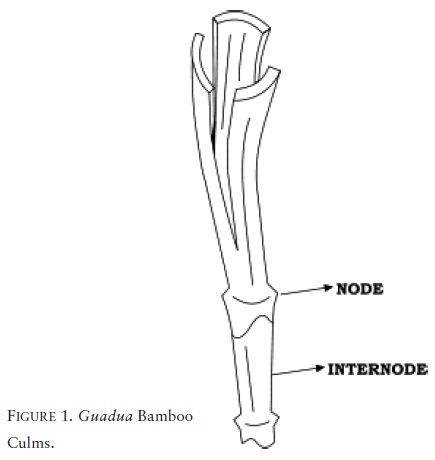
<body><![CDATA[<p align="justify"><font face="verdana" size="2">The objective of this work is to present a complete chemical composition of four <i>Guadua</i> bamboo culms to increase future research areas with this kind of bamboo. Moreover, the present work seeks to provide results from a regression analysis between chemical composition and bending behavior.</font></p>     <p align="justify">&nbsp;</p>  	    <p align="justify"><font face="verdana" size="2"><b>MATERIALS AND METHODS</b></font></p>  	    <p align="justify"><font face="verdana" size="2"><b>Description of samples</b></font></p>  	    <p align="justify"><font face="verdana" size="2">Bamboo samples came from an experimental field located in Armenia, Quind&iacute;o (Central region of Colombia). All the specimens were oven dried at 40 &deg;C for 8 h to reduce moisture content and decrease microorganism proliferation. The culms of these kinds of bamboo are hollow in the center and the distance between the internal to external wall is on average 1,5 cm; the <i>Guadua</i> bamboo culms are separated by nodes and internodes, as shown in <a href="#f1">figure 1</a>. In this work, bamboo samples were taken from the bottom culm and were classify as mature for culms with 4 years and young for culms with 2 years.</font></p> 	    <p align="center"><a name="f1"></a></p> 	    <p align="center"><img src="/img/revistas/mb/v20n2/a8f1.jpg"></p>  	    <p align="justify"><font face="verdana" size="2"><b>Wet chemical composition analysis</b></font></p>     <p align="justify"><font face="verdana" size="2">All bamboo samples were analyzed by using standard biomass analysis by the National Renewable Energy Laboratory (NREL) with laboratory analytical procedures (LAPs) for whole biomass analysis, as listed:</font></p>  	 		    <blockquote> 		      ]]></body>
<body><![CDATA[<p align="justify"><font face="verdana" size="2">&#8226; NREL/TP&#45;510&#45;42620 Preparation of Samples for Composition Analysis</font></p> 		      <p align="justify"><font face="verdana" size="2">&#8226; NREL/TP&#45;510&#45;42619 Determination of Extractives in Biomass</font></p> 		      <p align="justify"><font face="verdana" size="2">&#8226; NREL/TP&#45;510&#45;42622 Determination of Ash in Biomass</font></p> 		      <p align="justify"><font face="verdana" size="2">&#8226; NREL/TP&#45;510&#45;42618 Determination of Structural Carbohydrates and Lignin in Biomass</font></p> </blockquote>  		    <p align="justify"><font face="verdana" size="2">US National Institute of Standards and Technology (NIST) Bagasse Standard Reference Material # 8491 was analyzed with each batch of bamboo samples, as a quality&#45;assurance reference for determination of extractives, lignin, and carbohydrates. Aqueous and ethanolic extractions were performed in duplicate on the milled, homogenized samples. Each extractive&#45;free sample was analyzed in duplicate for lignin and carbohydrate content, giving a total of four separate determinations for each bamboo sample. Direct measurement of the protein content in these samples was not performed, but the protein content can be estimated from the nitrogen elemental analysis (Phillips,1939) and varies only slightly with age in the range of 1,4% &#45; 3,8%</font></p>  			    <p align="justify"><font face="verdana" size="2"><b>Soluble and Insoluble Fiber content</b></font></p>  			    <p align="justify"><font face="verdana" size="2">Insoluble fiber determination was performed by using the standard Method AOAC 985.29 (AOAC, 2000). All measurements were done in triplicate.</font></p>  			    <p align="justify"><font face="verdana" size="2"><b>Bending test</b></font></p>  			    <p align="justify"><font face="verdana" size="2">The bamboo samples were tested by following the ASTM D143&#45;94 (ASTM, 2007) standard test method, modified accordingly, to accommodate the specific characteristics of the bamboo specimens, in a universal machine (INSTRON 4401). The load was applied on the transverse surface with a crosshead speed of 0,5 mm/min (<a href="#f2">Fig. 2</a>). The specimens were cut as strips and its size was set at 160&#45;mm length and 10&#45;mm width, and thickness was determined with each culm thickness. The Modulus of Rupture (MOR) was obtained in triplicate for each bamboo sample.</font></p> 			    <p align="center"><a name="f2"></a></p> 			    ]]></body>
<body><![CDATA[<p align="center"><img src="/img/revistas/mb/v20n2/a8f2.jpg"></p>  			    <p align="justify"><font face="verdana" size="2"><b>Regression</b></font></p>  			    <p align="justify"><font face="verdana" size="2">Statistical analysis was performed with the STATGRAPHICS 5.1 Plus Statistical Package to obtain Pearson's correlation coefficient. Five variables were used and the multiple linear regression analysis was made among Insoluble Fiber, Soluble Fiber, Lignin, Cellulose, and Hemicellulose with the MOR.</font></p>     <p align="justify">&nbsp;</p>  			    <p align="justify"><font face="verdana" size="2"><b>RESULTS</b></font></p>      <p align="justify"><font face="verdana" size="2"><b>Chemical composition</b></font></p>  			    <p align="justify"><font face="verdana" size="2"><a href="/img/revistas/mb/v20n2/a8t1.jpg" target="_blank">Table 1</a> shows the complete wet chemical analysis (soluble fiber) of all the <i>Guadua b</i>amboo specimens in mature and young culms. Total mass for all specimens is close to 90% or above, indicating that the analysis was complete and no significant biomass fractions were lost. The direct protein measurement was not performed, but protein content could be obtained by nitrogen element analysis and did not have significant variation (Phillips, 1939). Higuchi (1957) measured chemical composition for different kinds of Asian bamboos and found a similar chemical composition to <i>Guadua</i> bamboo chemical composition. Scurlock <i>et al</i>. (2000) reported a wet chemical composition analysis for a Japanese bamboo; these results are close in value to <i>Guadua</i> bamboo chemical composition analysis.</font></p>  			    <p align="justify"><font face="verdana" size="2">Lignin content values for <i>Guadua</i> are between 23% and 27%; meanwhile, Scurlock reported a range between 24% and 37% for softwoods (Scurlock <i>et al</i>., 2000), suggesting that <i>Guadua</i> bamboo has similar physical properties and can be used as conventional softwood. On the other hand, a Cellulose content of 37% &#45; 44% and a hemicellulose content of 13% &#45; 20% for <i>Guadua</i> bamboo could be compared to cellulosic biomass feedstock with a content of 35% &#45; 50% for cellulose and 10% &#45; 40% for hemicellulose (McKendry, 2002). It placed <i>Guadua</i> bamboo as natural material comparable to biomass feedstock in which its high cellulose/hemicellulose content could be used for ethanol and paper production.</font></p>  			    <p align="justify"><font face="verdana" size="2"><b>Soluble and Insoluble fiber</b></font></p>  			    <p align="justify"><font face="verdana" size="2">Soluble and Insoluble fiber are the total fiber content and each is made up of complex carbohydrates, including cellulose, hemicellulose, and lignin (Selvendran, 1984). The fiber content was determined for all samples in mature and young culms. <a href="/img/revistas/mb/v20n2/a8f3.jpg" target="_blank">Figure 3</a> shows the insoluble and soluble total fiber content per specimen. It is possible to see that for all samples the main fiber content is insoluble fiber.</font>			</p> 			    ]]></body>
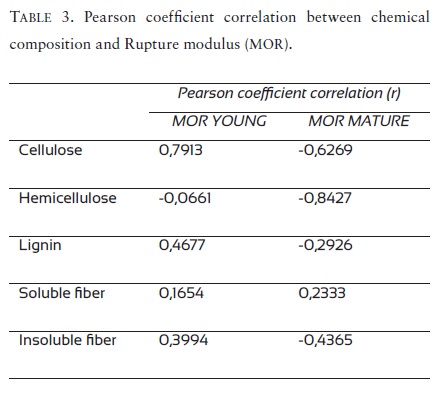
<body><![CDATA[<p align="justify"><font face="verdana" size="2">From the ANOVA statistical analysis, it is possible to establish that the insoluble and soluble fiber content for some varieties do not have significant differences. It is also possible to see that, in general, the insoluble fiber content exhibit a small decrease in samples with age, while soluble fiber exhibit a high increases with age. Total fiber content is an important test that provides information related to each <i>Guadua</i> bamboo variety and it is possible to establish the potential uses of this kind of bamboo. The results shown in this figure correspond to five measurements per specimen.</font></p>  			    <p align="justify"><font face="verdana" size="2"><b>Bending test</b></font></p>  			    <p align="justify"><font face="verdana" size="2">Failure of test specimens is associated to a common failure mode known as local crushing and this was identified in all specimens tested (Chung and Yu, 2000). Typical load deflection curves were obtained, as shown in <a href="#f4">figure 4</a>.</font></p> 			    <p align="center"><a name="f4"></a></p> 			    <p align="center"><img src="/img/revistas/mb/v20n2/a8f4.jpg"></p>  			    <p align="justify"><font face="verdana" size="2"><a href="#t2">Table 2</a> shows the MOR in each bamboo sample for mature and young culms; from the ANOVA statistical analysis, it is possible to establish that the MOR does not have significant differences in young culms. Decreased MOR with age is noted in most varieties; this decrease is above 50%. These results agree with those reported by Correal and Arbelaez (2010) who found that for <i>Guadua Angustifolia</i> Kunt all mechanical properties including MOR have a correlation with age; they showed that these mechanical properties decrease in old culms. In addition, variations in the chemical components could be correlated to the mechanical behavior (S&aacute;nchez&#45;Echeverri <i>et al</i>., 2010). The results shown in <a href="#t2">Table 2</a> correspond to three measurements per specimen.</font></p>  			    <p align="center"><a name="t2"></a></p> 			    <p align="center"><img src="/img/revistas/mb/v20n2/a8t2.jpg"></p>     <p align="justify"><font face="verdana" size="2"><b>Correlations</b></font></p>      <p align="justify"><font face="verdana" size="2"><a href="#t3">Table 3</a> shows Pearson's coefficient correlation between MOR and the chemical composition in each <i>Guadua</i> bamboo sample for mature and young culms. The bold number shows a highly significant Pearson's coefficient correlation with p &lt; 0,05. These results indicated that only exists an inverse correlation among MOR and cellulose and hemicellulose content for mature culms, while young culms do not have any correlation. Genet, <i>et al</i>. (2005) related cellulose content with mechanical properties, they found a positive correlation between tensile strength and Cellulose, however; they did not separate Cellulose and Hemicellulose and that positive correlation is influenced by the high stiffness in the longitudinal direction of the cellulose fibers (Persson, 2000), nevertheless; there are no published data about bending behavior and chemical compounds content for transversal direction for those materials or <i>Guadua</i>. It is interesting that results shown here are against others previously published, despite there are not results presented specifically for <i>Guadua</i>, some results for materials composed mainly by cellulose, hemicellulose and lignin (fibrous ligno&#45;cellulosic materials) as leaves and roots increase their mechanical properties with cellulose content (Angeles <i>et al</i>., 2010; Genet <i>et al</i>., 2005).</font></p>     ]]></body>
<body><![CDATA[<p align="center"><a name="t3"></a></p>     <p align="center"><img src="/img/revistas/mb/v20n2/a8t3.jpg"></p>  			    <p align="justify"><font face="verdana" size="2"><a href="#f5">Figure 5</a> shows cellulose, hemicellulose content, and MOR for mature <i>Guadua</i> bamboo culms. The MOR is influenced by content of cellulose and hemicellulose as expected in a composite material.</font></p> 			    <p align="center"><a name="f5"></a></p> 			    <p align="center"><img src="/img/revistas/mb/v20n2/a8f5.jpg"></p>     <p align="justify">&nbsp;</p>     <p align="justify"><font face="verdana" size="2"><b>CONCLUSIONS</b></font></p>      <p align="justify"><font face="verdana" size="2">Wet chemical analysis (soluble fiber) for <i>Guadua</i> bamboo culms can be compared to results found for other kinds of Asian and Japanese bamboos, which currently have important applications. Although there is a variation in both soluble and insoluble fiber content with age, the variation in insoluble fiber is not significant, however; for the two <i>Guadua</i> ages analyzed, the main fiber content is insoluble fiber. The main chemical compounds that have an influence in the mechanical properties are Cellulose, Hemicellulose and Lignin whose elastic properties were described by Davalos&#45;Sotelo (2005); for <i>Guadua</i> these were the main compounds found.</font></p>  			    <p align="justify"><font face="verdana" size="2">The hemicellulose and cellulose content has inverse proportionality with MOR for mature culms. As is well known, Cellulose fibers has a longitudinal orientation and hence Hemicellulose, which is a polysaccharide linked to cellulose also has the same general orientation; the distribution ratio in these two principal compounds will have an effect in the bending behavior which was tested in transversal direction. The inverse correlation could be explained due the low stiffness strength of cellulose and hemicellulose on radial direction (Persson, 2000), hence a high content of both components results in a low MOR. Knowledge of chemical and mechanical properties and their relationship in <i>Guadua</i> bamboo is a base to develop studies with this plant and generate potential applications.</font></p>     <p align="justify">&nbsp;</p>  			    ]]></body>
<body><![CDATA[<p align="justify"><font face="verdana" size="2"><b>REFERENCES</b></font></p>      <!-- ref --><p align="justify"><font face="verdana" size="2">AOAC&#45;2000 Official Methods of Analysis of the Association of Official Analytical Chemists, 17<sup>th</sup> ed. Method 985.29.    &nbsp;&nbsp;&nbsp;&nbsp;&nbsp;&nbsp;&nbsp;&nbsp;[&#160;<a href="javascript:void(0);" onclick="javascript: window.open('/scielo.php?script=sci_nlinks&ref=5179964&pid=S1405-0471201400020000800001&lng=','','width=640,height=500,resizable=yes,scrollbars=1,menubar=yes,');">Links</a>&#160;]<!-- end-ref --></font></p>  			    <!-- ref --><p align="justify"><font face="verdana" size="2">Angeles, G., M. Lascurain, R. Davalos&#45;Sotelo, R.P. Zarate&#45;Morales and F. Ortega&#45;Escalona. 2013. Anatomical and physical changes in leaves during the production of tamales. <i>American Journal of Botany</i> 100(8):1509&#45;1521.    &nbsp;&nbsp;&nbsp;&nbsp;&nbsp;&nbsp;&nbsp;&nbsp;[&#160;<a href="javascript:void(0);" onclick="javascript: window.open('/scielo.php?script=sci_nlinks&ref=5179966&pid=S1405-0471201400020000800002&lng=','','width=640,height=500,resizable=yes,scrollbars=1,menubar=yes,');">Links</a>&#160;]<!-- end-ref --></font></p>  			    <!-- ref --><p align="justify"><font face="verdana" size="2">ASTM D143&#45;94. 2007. Standard Test Methods for Small Clear Specimens of Timber. ASTM International, 100 Barr Harbor Drive, PO Box C700, West Conshohocken, PA, 19428&#45;2959 USA.    &nbsp;&nbsp;&nbsp;&nbsp;&nbsp;&nbsp;&nbsp;&nbsp;[&#160;<a href="javascript:void(0);" onclick="javascript: window.open('/scielo.php?script=sci_nlinks&ref=5179968&pid=S1405-0471201400020000800003&lng=','','width=640,height=500,resizable=yes,scrollbars=1,menubar=yes,');">Links</a>&#160;]<!-- end-ref --></font></p>  			    <!-- ref --><p align="justify"><font face="verdana" size="2">Bystriakova, N., V. Kapos, I. Lysenko and C.M.A. Stapleton. 2003. Distribution and conservation status of forest bamboo biodiversity in the Asia&#45;Pacific region. <i>Biodiversity and Conservation</i> 12(9):1833&#45;1841.    &nbsp;&nbsp;&nbsp;&nbsp;&nbsp;&nbsp;&nbsp;&nbsp;[&#160;<a href="javascript:void(0);" onclick="javascript: window.open('/scielo.php?script=sci_nlinks&ref=5179970&pid=S1405-0471201400020000800004&lng=','','width=640,height=500,resizable=yes,scrollbars=1,menubar=yes,');">Links</a>&#160;]<!-- end-ref --></font></p>  			    <!-- ref --><p align="justify"><font face="verdana" size="2">Chaomao, H., H. Jizhen, Z.Guoxue and Y. Yuming. 2004. Studies on the present situation and prospects of bamboo diversities and its sustainable development in China. <i>World Forestry Research</i> 2004(1):51&#45;54</font>&nbsp;&nbsp;&nbsp;&nbsp;&nbsp;&nbsp;&nbsp;&nbsp;[&#160;<a href="javascript:void(0);" onclick="javascript: window.open('/scielo.php?script=sci_nlinks&ref=5179972&pid=S1405-0471201400020000800005&lng=','','width=640,height=500,resizable=yes,scrollbars=1,menubar=yes,');">Links</a>&#160;]<!-- end-ref --><!-- ref --><p align="justify"><font face="verdana" size="2">Chung, K.F. and W.K. Yu. 2002. Mechanical properties of structural bamboo for bamboo scaffoldings. <i>Engineering Structures</i> 24(4):429&#45;442.    &nbsp;&nbsp;&nbsp;&nbsp;&nbsp;&nbsp;&nbsp;&nbsp;[&#160;<a href="javascript:void(0);" onclick="javascript: window.open('/scielo.php?script=sci_nlinks&ref=5179973&pid=S1405-0471201400020000800006&lng=','','width=640,height=500,resizable=yes,scrollbars=1,menubar=yes,');">Links</a>&#160;]<!-- end-ref --></font></p>  			    <!-- ref --><p align="justify"><font face="verdana" size="2">Correal, J.F. and J. Arbealez. 2010. Influence of age and height position on Colombian <i>Guadua angustifolia</i> bamboo mechanical properties. <i>Maderas. Ciencia y tecnolog&iacute;a</i> 12(2):105&#45;113.    &nbsp;&nbsp;&nbsp;&nbsp;&nbsp;&nbsp;&nbsp;&nbsp;[&#160;<a href="javascript:void(0);" onclick="javascript: window.open('/scielo.php?script=sci_nlinks&ref=5179975&pid=S1405-0471201400020000800007&lng=','','width=640,height=500,resizable=yes,scrollbars=1,menubar=yes,');">Links</a>&#160;]<!-- end-ref --></font></p>  			    <!-- ref --><p align="justify"><font face="verdana" size="2">Davalos&#45;Sotelo, R. 2005. Determination of elastic properties of clear wood by the homogenization method in two dimensions. <i>Wood Science and Technology</i> 39:385&#45;417.    &nbsp;&nbsp;&nbsp;&nbsp;&nbsp;&nbsp;&nbsp;&nbsp;[&#160;<a href="javascript:void(0);" onclick="javascript: window.open('/scielo.php?script=sci_nlinks&ref=5179977&pid=S1405-0471201400020000800008&lng=','','width=640,height=500,resizable=yes,scrollbars=1,menubar=yes,');">Links</a>&#160;]<!-- end-ref --></font></p>  			    <!-- ref --><p align="justify"><font face="verdana" size="2">Genet, M., Stokes, A., Salin, F., Mickovski, S.B., Fourcaud, T., Dumail, J&#45;F. van Beek., R. 2005. The influence of cellulose content on tensile strength in tree roots. <i>Plant and Soil</i> 278(1&#45;2):1&#45;9.    &nbsp;&nbsp;&nbsp;&nbsp;&nbsp;&nbsp;&nbsp;&nbsp;[&#160;<a href="javascript:void(0);" onclick="javascript: window.open('/scielo.php?script=sci_nlinks&ref=5179979&pid=S1405-0471201400020000800009&lng=','','width=640,height=500,resizable=yes,scrollbars=1,menubar=yes,');">Links</a>&#160;]<!-- end-ref --></font></p>  			    <!-- ref --><p align="justify"><font face="verdana" size="2">Ghavami, K. 2005. Bamboo as reinforcement in structural concrete elements. <i>Cement and concrete composites</i> 27(6):637&#45;649.    &nbsp;&nbsp;&nbsp;&nbsp;&nbsp;&nbsp;&nbsp;&nbsp;[&#160;<a href="javascript:void(0);" onclick="javascript: window.open('/scielo.php?script=sci_nlinks&ref=5179981&pid=S1405-0471201400020000800010&lng=','','width=640,height=500,resizable=yes,scrollbars=1,menubar=yes,');">Links</a>&#160;]<!-- end-ref --></font></p>  			    ]]></body>
<body><![CDATA[<!-- ref --><p align="justify"><font face="verdana" size="2">Ghavami, K. and A.B. Marinho. 2005. Propriedades f&iacute;sicas e mec&acirc;nicas do colmo inteiro do bambu da esp&eacute;cie <i>Guadua angustifolia</i>. <i>Revista Brasileira de Engenharia Agr&iacute;cola e Ambiental</i> 9(1):107&#45;114.    &nbsp;&nbsp;&nbsp;&nbsp;&nbsp;&nbsp;&nbsp;&nbsp;[&#160;<a href="javascript:void(0);" onclick="javascript: window.open('/scielo.php?script=sci_nlinks&ref=5179983&pid=S1405-0471201400020000800011&lng=','','width=640,height=500,resizable=yes,scrollbars=1,menubar=yes,');">Links</a>&#160;]<!-- end-ref --></font></p>  			    <!-- ref --><p align="justify"><font face="verdana" size="2">Grosser, D. and W. Liese. 1971. On the anatomy of Asian bamboos, with special reference to their vascular bundles. <i>Wood Science and Technology</i> 5:290&#45;312.    &nbsp;&nbsp;&nbsp;&nbsp;&nbsp;&nbsp;&nbsp;&nbsp;[&#160;<a href="javascript:void(0);" onclick="javascript: window.open('/scielo.php?script=sci_nlinks&ref=5179985&pid=S1405-0471201400020000800012&lng=','','width=640,height=500,resizable=yes,scrollbars=1,menubar=yes,');">Links</a>&#160;]<!-- end-ref --></font></p>  			    <!-- ref --><p align="justify"><font face="verdana" size="2">Gyansah, L., A.S. Akinwonmi and M. Affam. 2010. The fracture behaviour of fresh bamboo under uniaxial compressive loading condition. <i>Research Journal of Applied Sciences, Engineering and Technology</i> 2(8):720&#45;726.    &nbsp;&nbsp;&nbsp;&nbsp;&nbsp;&nbsp;&nbsp;&nbsp;[&#160;<a href="javascript:void(0);" onclick="javascript: window.open('/scielo.php?script=sci_nlinks&ref=5179987&pid=S1405-0471201400020000800013&lng=','','width=640,height=500,resizable=yes,scrollbars=1,menubar=yes,');">Links</a>&#160;]<!-- end-ref --></font></p>  			    <!-- ref --><p align="justify"><font face="verdana" size="2">Hammett, A.L., L. Robert, L. Youngs, X. Sun and M. Chandra. 2005. Non&#45; wood fiber as an alternative to wood fiber in China pulp and paper industry. <i>Holzforschung</i> 55(2):219&#45;224.    &nbsp;&nbsp;&nbsp;&nbsp;&nbsp;&nbsp;&nbsp;&nbsp;[&#160;<a href="javascript:void(0);" onclick="javascript: window.open('/scielo.php?script=sci_nlinks&ref=5179989&pid=S1405-0471201400020000800014&lng=','','width=640,height=500,resizable=yes,scrollbars=1,menubar=yes,');">Links</a>&#160;]<!-- end-ref --></font></p>  			    <!-- ref --><p align="justify"><font face="verdana" size="2">Higuchi, H. 1957. Biochemical studies of lignin formation, III. <i>Physiologia Plantarum</i> 10(4):633&#45;648.    &nbsp;&nbsp;&nbsp;&nbsp;&nbsp;&nbsp;&nbsp;&nbsp;[&#160;<a href="javascript:void(0);" onclick="javascript: window.open('/scielo.php?script=sci_nlinks&ref=5179991&pid=S1405-0471201400020000800015&lng=','','width=640,height=500,resizable=yes,scrollbars=1,menubar=yes,');">Links</a>&#160;]<!-- end-ref --></font></p>  			    ]]></body>
<body><![CDATA[<!-- ref --><p align="justify"><font face="verdana" size="2">Liese, W. 1998. The anatomy of bamboo culms, Technical report. International network for bamboo and rattan (INBAR). BRILL. 208 p.    &nbsp;&nbsp;&nbsp;&nbsp;&nbsp;&nbsp;&nbsp;&nbsp;[&#160;<a href="javascript:void(0);" onclick="javascript: window.open('/scielo.php?script=sci_nlinks&ref=5179993&pid=S1405-0471201400020000800016&lng=','','width=640,height=500,resizable=yes,scrollbars=1,menubar=yes,');">Links</a>&#160;]<!-- end-ref --></font></p>  			    <!-- ref --><p align="justify"><font face="verdana" size="2">Liese, W. and F.R.G. Hamburg. 1987. Research on bamboo. <i>Wood Science and Technology</i> 21(3):189&#45;207.    &nbsp;&nbsp;&nbsp;&nbsp;&nbsp;&nbsp;&nbsp;&nbsp;[&#160;<a href="javascript:void(0);" onclick="javascript: window.open('/scielo.php?script=sci_nlinks&ref=5179995&pid=S1405-0471201400020000800017&lng=','','width=640,height=500,resizable=yes,scrollbars=1,menubar=yes,');">Links</a>&#160;]<!-- end-ref --></font></p>  			    <!-- ref --><p align="justify"><font face="verdana" size="2">Liese, W. and G. Weiner. 1996. Ageing of bamboo culms, A review. <i>Wood Science and Technology</i> 30(2):77&#45;89.    &nbsp;&nbsp;&nbsp;&nbsp;&nbsp;&nbsp;&nbsp;&nbsp;[&#160;<a href="javascript:void(0);" onclick="javascript: window.open('/scielo.php?script=sci_nlinks&ref=5179997&pid=S1405-0471201400020000800018&lng=','','width=640,height=500,resizable=yes,scrollbars=1,menubar=yes,');">Links</a>&#160;]<!-- end-ref --></font></p>  			    <!-- ref --><p align="justify"><font face="verdana" size="2">Low, I.M., Z.Y. Che and B.A. Latella,. 2006. Mapping the structure, composition and mechanical properties of bamboo. <i>Journal of Material Research</i> 21:1969&#45;1976.    &nbsp;&nbsp;&nbsp;&nbsp;&nbsp;&nbsp;&nbsp;&nbsp;[&#160;<a href="javascript:void(0);" onclick="javascript: window.open('/scielo.php?script=sci_nlinks&ref=5179999&pid=S1405-0471201400020000800019&lng=','','width=640,height=500,resizable=yes,scrollbars=1,menubar=yes,');">Links</a>&#160;]<!-- end-ref --></font></p>  			    <!-- ref --><p align="justify"><font face="verdana" size="2">Lybeer, B. and G. Koch. 2005. A topochemical and semiquantitative study of the lignifications during ageing of bamboo culms (phyllostachysviridiglaucescens). <i>IAWA Journal</i> 26(1):99&#45;109.    &nbsp;&nbsp;&nbsp;&nbsp;&nbsp;&nbsp;&nbsp;&nbsp;[&#160;<a href="javascript:void(0);" onclick="javascript: window.open('/scielo.php?script=sci_nlinks&ref=5180001&pid=S1405-0471201400020000800020&lng=','','width=640,height=500,resizable=yes,scrollbars=1,menubar=yes,');">Links</a>&#160;]<!-- end-ref --></font></p>  			    ]]></body>
<body><![CDATA[<!-- ref --><p align="justify"><font face="verdana" size="2">McKendry, P. 2002. Energy production from biomass (part 1): overview of biomass. <i>Bioresource Technology</i> 83(1):37&#45;46.    &nbsp;&nbsp;&nbsp;&nbsp;&nbsp;&nbsp;&nbsp;&nbsp;[&#160;<a href="javascript:void(0);" onclick="javascript: window.open('/scielo.php?script=sci_nlinks&ref=5180003&pid=S1405-0471201400020000800021&lng=','','width=640,height=500,resizable=yes,scrollbars=1,menubar=yes,');">Links</a>&#160;]<!-- end-ref --></font></p>  			    <!-- ref --><p align="justify"><font face="verdana" size="2">Mohan, K.M. and K. Mohana. 2007. Extraction and tensile properties of natural fibers: Vakka, date and bamboo. <i>Composite Structures</i> 77(3):288&#45;295.    &nbsp;&nbsp;&nbsp;&nbsp;&nbsp;&nbsp;&nbsp;&nbsp;[&#160;<a href="javascript:void(0);" onclick="javascript: window.open('/scielo.php?script=sci_nlinks&ref=5180005&pid=S1405-0471201400020000800022&lng=','','width=640,height=500,resizable=yes,scrollbars=1,menubar=yes,');">Links</a>&#160;]<!-- end-ref --></font></p>  			    <!-- ref --><p align="justify"><font face="verdana" size="2">Ning, L. and B. Yang. 2007. Characteristics of bamboo fiber and its application. <i>Progress in Textile Science &amp; Technology</i> 2007(3):15&#45;17.    &nbsp;&nbsp;&nbsp;&nbsp;&nbsp;&nbsp;&nbsp;&nbsp;[&#160;<a href="javascript:void(0);" onclick="javascript: window.open('/scielo.php?script=sci_nlinks&ref=5180007&pid=S1405-0471201400020000800023&lng=','','width=640,height=500,resizable=yes,scrollbars=1,menubar=yes,');">Links</a>&#160;]<!-- end-ref --></font></p>  			    <!-- ref --><p align="justify"><font face="verdana" size="2">Oda, T. 2003. Yam and cloths made mainly from bamboo sheaths and methods for manufacturing the same, United States Patent application. Publication number US7060211 B2, Application number US 10/222,839.    &nbsp;&nbsp;&nbsp;&nbsp;&nbsp;&nbsp;&nbsp;&nbsp;[&#160;<a href="javascript:void(0);" onclick="javascript: window.open('/scielo.php?script=sci_nlinks&ref=5180009&pid=S1405-0471201400020000800024&lng=','','width=640,height=500,resizable=yes,scrollbars=1,menubar=yes,');">Links</a>&#160;]<!-- end-ref --></font></p>  			    <!-- ref --><p align="justify"><font face="verdana" size="2">Persson, K. 2000. Micromechanical modeling of wood and fiber properties. Ph.D. dissertation, Lund University, Lund&#45;Sweden.    &nbsp;&nbsp;&nbsp;&nbsp;&nbsp;&nbsp;&nbsp;&nbsp;[&#160;<a href="javascript:void(0);" onclick="javascript: window.open('/scielo.php?script=sci_nlinks&ref=5180011&pid=S1405-0471201400020000800025&lng=','','width=640,height=500,resizable=yes,scrollbars=1,menubar=yes,');">Links</a>&#160;]<!-- end-ref --></font></p>  			    ]]></body>
<body><![CDATA[<!-- ref --><p align="justify"><font face="verdana" size="2">Phillips, M. 1939. Studies on the quantitative estimation of lignin. IV Effect of certain proteins on the determination of lignin by the fuming hydrochloric acid method. <i>Journal of the Association of Official Agricultural Chemists</i> 22: 422&#45;427.    &nbsp;&nbsp;&nbsp;&nbsp;&nbsp;&nbsp;&nbsp;&nbsp;[&#160;<a href="javascript:void(0);" onclick="javascript: window.open('/scielo.php?script=sci_nlinks&ref=5180013&pid=S1405-0471201400020000800026&lng=','','width=640,height=500,resizable=yes,scrollbars=1,menubar=yes,');">Links</a>&#160;]<!-- end-ref --></font></p>  			    <!-- ref --><p align="justify"><font face="verdana" size="2">Porterfield, W.M. 1928. A study of the grand period of growth in bamboo. <i>Bulletin of the</i> <i>Torrey Botanical</i> <i>Club</i> 55(7):327&#45;405.    &nbsp;&nbsp;&nbsp;&nbsp;&nbsp;&nbsp;&nbsp;&nbsp;[&#160;<a href="javascript:void(0);" onclick="javascript: window.open('/scielo.php?script=sci_nlinks&ref=5180015&pid=S1405-0471201400020000800027&lng=','','width=640,height=500,resizable=yes,scrollbars=1,menubar=yes,');">Links</a>&#160;]<!-- end-ref --></font></p>  			    <!-- ref --><p align="justify"><font face="verdana" size="2">S&aacute;nchez&#45;Echeverri, L.A., M. Contreras&#45;Padilla and M.E. Rodriguez&#45;Garcia. 2010. A correlation between soluble and insoluble fiber with the elastic modulus in four varieties of bamboo. Mater. Res. Soc. Symp. Proc. 1277. Materials Research Society Symposium Proceedings 1277 p: 46&#45;51.    &nbsp;&nbsp;&nbsp;&nbsp;&nbsp;&nbsp;&nbsp;&nbsp;[&#160;<a href="javascript:void(0);" onclick="javascript: window.open('/scielo.php?script=sci_nlinks&ref=5180017&pid=S1405-0471201400020000800028&lng=','','width=640,height=500,resizable=yes,scrollbars=1,menubar=yes,');">Links</a>&#160;]<!-- end-ref --></font></p>  			    <!-- ref --><p align="justify"><font face="verdana" size="2">Scurlock, J.M.O., D.C. Dayton and B. Hames. 2000. Bamboo: an overlooked biomass resource?. <i>Biomass and Bioenergy</i> 19(4):229&#45;244.    &nbsp;&nbsp;&nbsp;&nbsp;&nbsp;&nbsp;&nbsp;&nbsp;[&#160;<a href="javascript:void(0);" onclick="javascript: window.open('/scielo.php?script=sci_nlinks&ref=5180019&pid=S1405-0471201400020000800029&lng=','','width=640,height=500,resizable=yes,scrollbars=1,menubar=yes,');">Links</a>&#160;]<!-- end-ref --></font></p>      <!-- ref --><p align="justify"><font face="verdana" size="2">Selvendran, R.R. 1984. The plant cell as a source of dietary fiber: Chemistry and structure. <i>American Journal of Clinical Nutrition</i> 39(2):320&#45;337.    &nbsp;&nbsp;&nbsp;&nbsp;&nbsp;&nbsp;&nbsp;&nbsp;[&#160;<a href="javascript:void(0);" onclick="javascript: window.open('/scielo.php?script=sci_nlinks&ref=5180021&pid=S1405-0471201400020000800030&lng=','','width=640,height=500,resizable=yes,scrollbars=1,menubar=yes,');">Links</a>&#160;]<!-- end-ref --></font></p>  			    ]]></body>
<body><![CDATA[<!-- ref --><p align="justify"><font face="verdana" size="2">Van der Lugt, P., A.A.J.F. Van de Dobbelsteen and J.J.A. Janssen. 2006. An environmental, economic and practical assessment of bamboo as a building material for supporting structures. <i>Construction and</i> <i>Building Materials</i> 20(9):648&#45;656.    &nbsp;&nbsp;&nbsp;&nbsp;&nbsp;&nbsp;&nbsp;&nbsp;[&#160;<a href="javascript:void(0);" onclick="javascript: window.open('/scielo.php?script=sci_nlinks&ref=5180023&pid=S1405-0471201400020000800031&lng=','','width=640,height=500,resizable=yes,scrollbars=1,menubar=yes,');">Links</a>&#160;]<!-- end-ref --></font></p>     <p align="justify">&nbsp;</p>  			    <p align="justify"><font face="verdana" size="2"><b>Nota</b></font></p>      <p align="justify"><font face="verdana" size="2">Este documento se debe citar como: S&aacute;nchez&#45;Echeverri, L.A., G. Aita, D. Robert and M.E. Rodr&iacute;guez&#45;Garc&iacute;a 2014. Correlation between chemical compounds and mechanical response in culms two different ages of <i>Guadua angustifolia</i> Kunth. <i>Madera y Bosques</i> 20(2):87&#45;94.</font></p>      ]]></body><back>
<ref-list>
<ref id="B1">
<nlm-citation citation-type="book">
<collab>AOAC</collab>
<source><![CDATA[Official Methods of Analysis of the Association of Official Analytical Chemists]]></source>
<year>2000</year>
<edition>17</edition>
<page-range>985.29</page-range><publisher-name><![CDATA[Method]]></publisher-name>
</nlm-citation>
</ref>
<ref id="B2">
<nlm-citation citation-type="journal">
<person-group person-group-type="author">
<name>
<surname><![CDATA[Angeles]]></surname>
<given-names><![CDATA[G.]]></given-names>
</name>
<name>
<surname><![CDATA[Lascurain]]></surname>
<given-names><![CDATA[M.]]></given-names>
</name>
<name>
<surname><![CDATA[Davalos-Sotelo]]></surname>
<given-names><![CDATA[R.]]></given-names>
</name>
<name>
<surname><![CDATA[Zarate-Morales]]></surname>
<given-names><![CDATA[R.P.]]></given-names>
</name>
<name>
<surname><![CDATA[Ortega-Escalona]]></surname>
<given-names><![CDATA[F.]]></given-names>
</name>
</person-group>
<article-title xml:lang="en"><![CDATA[Anatomical and physical changes in leaves during the production of tamales]]></article-title>
<source><![CDATA[American Journal of Botany]]></source>
<year>2013</year>
<volume>100</volume>
<numero>8</numero>
<issue>8</issue>
<page-range>1509-1521</page-range></nlm-citation>
</ref>
<ref id="B3">
<nlm-citation citation-type="book">
<collab>ASTM D143-94</collab>
<source><![CDATA[Standard Test Methods for Small Clear Specimens of Timber]]></source>
<year>2007</year>
<page-range>19428-2959</page-range><publisher-loc><![CDATA[West Conshohocken^ePA PA]]></publisher-loc>
<publisher-name><![CDATA[ASTM International]]></publisher-name>
</nlm-citation>
</ref>
<ref id="B4">
<nlm-citation citation-type="journal">
<person-group person-group-type="author">
<name>
<surname><![CDATA[Bystriakova]]></surname>
<given-names><![CDATA[N.]]></given-names>
</name>
<name>
<surname><![CDATA[Kapos]]></surname>
<given-names><![CDATA[V.]]></given-names>
</name>
<name>
<surname><![CDATA[Lysenko]]></surname>
<given-names><![CDATA[I.]]></given-names>
</name>
<name>
<surname><![CDATA[Stapleton]]></surname>
<given-names><![CDATA[C.M.A.]]></given-names>
</name>
</person-group>
<article-title xml:lang="en"><![CDATA[Distribution and conservation status of forest bamboo biodiversity in the Asia-Pacific region]]></article-title>
<source><![CDATA[Biodiversity and Conservation]]></source>
<year>2003</year>
<volume>12</volume>
<numero>9</numero>
<issue>9</issue>
<page-range>1833-1841</page-range></nlm-citation>
</ref>
<ref id="B5">
<nlm-citation citation-type="journal">
<person-group person-group-type="author">
<name>
<surname><![CDATA[Chaomao]]></surname>
<given-names><![CDATA[H.]]></given-names>
</name>
<name>
<surname><![CDATA[Jizhen]]></surname>
<given-names><![CDATA[H.]]></given-names>
</name>
<name>
<surname><![CDATA[Guoxue]]></surname>
<given-names><![CDATA[Z.]]></given-names>
</name>
<name>
<surname><![CDATA[Yuming]]></surname>
<given-names><![CDATA[Y.]]></given-names>
</name>
</person-group>
<article-title xml:lang="en"><![CDATA[Studies on the present situation and prospects of bamboo diversities and its sustainable development in China]]></article-title>
<source><![CDATA[World Forestry Research]]></source>
<year>2004</year>
<volume>2004</volume>
<numero>1</numero>
<issue>1</issue>
<page-range>51-54</page-range></nlm-citation>
</ref>
<ref id="B6">
<nlm-citation citation-type="journal">
<person-group person-group-type="author">
<name>
<surname><![CDATA[Chung]]></surname>
<given-names><![CDATA[K.F.]]></given-names>
</name>
<name>
<surname><![CDATA[Yu]]></surname>
<given-names><![CDATA[W.K.]]></given-names>
</name>
</person-group>
<article-title xml:lang="en"><![CDATA[Mechanical properties of structural bamboo for bamboo scaffoldings]]></article-title>
<source><![CDATA[Engineering Structures]]></source>
<year>2002</year>
<volume>24</volume>
<numero>4</numero>
<issue>4</issue>
<page-range>429-442</page-range></nlm-citation>
</ref>
<ref id="B7">
<nlm-citation citation-type="journal">
<person-group person-group-type="author">
<name>
<surname><![CDATA[Correal]]></surname>
<given-names><![CDATA[J.F.]]></given-names>
</name>
<name>
<surname><![CDATA[Arbealez]]></surname>
<given-names><![CDATA[J.]]></given-names>
</name>
</person-group>
<article-title xml:lang="en"><![CDATA[Influence of age and height position on Colombian Guadua angustifolia bamboo mechanical properties]]></article-title>
<source><![CDATA[Maderas. Ciencia y tecnología]]></source>
<year>2010</year>
<volume>12</volume>
<numero>2</numero>
<issue>2</issue>
<page-range>105-113</page-range></nlm-citation>
</ref>
<ref id="B8">
<nlm-citation citation-type="journal">
<person-group person-group-type="author">
<name>
<surname><![CDATA[Davalos-Sotelo]]></surname>
<given-names><![CDATA[R.]]></given-names>
</name>
</person-group>
<article-title xml:lang="en"><![CDATA[Determination of elastic properties of clear wood by the homogenization method in two dimensions]]></article-title>
<source><![CDATA[Wood Science and Technology]]></source>
<year>2005</year>
<volume>39</volume>
<page-range>385-417</page-range></nlm-citation>
</ref>
<ref id="B9">
<nlm-citation citation-type="journal">
<person-group person-group-type="author">
<name>
<surname><![CDATA[Genet]]></surname>
<given-names><![CDATA[M.]]></given-names>
</name>
<name>
<surname><![CDATA[Stokes]]></surname>
<given-names><![CDATA[A.]]></given-names>
</name>
<name>
<surname><![CDATA[Salin]]></surname>
<given-names><![CDATA[F.]]></given-names>
</name>
<name>
<surname><![CDATA[Mickovski]]></surname>
<given-names><![CDATA[S.B.]]></given-names>
</name>
<name>
<surname><![CDATA[Fourcaud]]></surname>
<given-names><![CDATA[T.]]></given-names>
</name>
<name>
<surname><![CDATA[Dumail]]></surname>
<given-names><![CDATA[J-F.]]></given-names>
</name>
<name>
<surname><![CDATA[van Beek]]></surname>
<given-names><![CDATA[R.]]></given-names>
</name>
</person-group>
<article-title xml:lang="en"><![CDATA[The influence of cellulose content on tensile strength in tree roots]]></article-title>
<source><![CDATA[Plant and Soil]]></source>
<year>2005</year>
<volume>278</volume>
<page-range>1-2</page-range><page-range>1-9</page-range></nlm-citation>
</ref>
<ref id="B10">
<nlm-citation citation-type="journal">
<person-group person-group-type="author">
<name>
<surname><![CDATA[Ghavami]]></surname>
<given-names><![CDATA[K.]]></given-names>
</name>
</person-group>
<article-title xml:lang="en"><![CDATA[Bamboo as reinforcement in structural concrete elements]]></article-title>
<source><![CDATA[Cement and concrete composites]]></source>
<year>2005</year>
<volume>27</volume>
<numero>6</numero>
<issue>6</issue>
<page-range>637-649</page-range></nlm-citation>
</ref>
<ref id="B11">
<nlm-citation citation-type="journal">
<person-group person-group-type="author">
<name>
<surname><![CDATA[Ghavami]]></surname>
<given-names><![CDATA[K.]]></given-names>
</name>
<name>
<surname><![CDATA[Marinho]]></surname>
<given-names><![CDATA[A.B.]]></given-names>
</name>
</person-group>
<article-title xml:lang="pt"><![CDATA[Propriedades físicas e mecânicas do colmo inteiro do bambu da espécie Guadua angustifolia]]></article-title>
<source><![CDATA[Revista Brasileira de Engenharia Agrícola e Ambiental]]></source>
<year>2005</year>
<volume>9</volume>
<numero>1</numero>
<issue>1</issue>
<page-range>107-114</page-range></nlm-citation>
</ref>
<ref id="B12">
<nlm-citation citation-type="journal">
<person-group person-group-type="author">
<name>
<surname><![CDATA[Grosser]]></surname>
<given-names><![CDATA[D.]]></given-names>
</name>
<name>
<surname><![CDATA[Liese]]></surname>
<given-names><![CDATA[W.]]></given-names>
</name>
</person-group>
<article-title xml:lang="en"><![CDATA[On the anatomy of Asian bamboos, with special reference to their vascular bundles]]></article-title>
<source><![CDATA[Wood Science and Technology]]></source>
<year>1971</year>
<volume>5</volume>
<page-range>290-312</page-range></nlm-citation>
</ref>
<ref id="B13">
<nlm-citation citation-type="journal">
<person-group person-group-type="author">
<name>
<surname><![CDATA[Gyansah]]></surname>
<given-names><![CDATA[L.]]></given-names>
</name>
<name>
<surname><![CDATA[Akinwonmi]]></surname>
<given-names><![CDATA[A.S.]]></given-names>
</name>
<name>
<surname><![CDATA[Affam]]></surname>
<given-names><![CDATA[M.]]></given-names>
</name>
</person-group>
<article-title xml:lang="en"><![CDATA[The fracture behaviour of fresh bamboo under uniaxial compressive loading condition]]></article-title>
<source><![CDATA[Research Journal of Applied Sciences, Engineering and Technology]]></source>
<year>2010</year>
<volume>2</volume>
<numero>8</numero>
<issue>8</issue>
<page-range>720-726</page-range></nlm-citation>
</ref>
<ref id="B14">
<nlm-citation citation-type="journal">
<person-group person-group-type="author">
<name>
<surname><![CDATA[Hammett]]></surname>
<given-names><![CDATA[A.L.]]></given-names>
</name>
<name>
<surname><![CDATA[Robert]]></surname>
<given-names><![CDATA[L.]]></given-names>
</name>
<name>
<surname><![CDATA[Youngs]]></surname>
<given-names><![CDATA[L.]]></given-names>
</name>
<name>
<surname><![CDATA[Sun]]></surname>
<given-names><![CDATA[X.]]></given-names>
</name>
<name>
<surname><![CDATA[Chandra]]></surname>
<given-names><![CDATA[M.]]></given-names>
</name>
</person-group>
<article-title xml:lang="en"><![CDATA[Non- wood fiber as an alternative to wood fiber in China pulp and paper industry]]></article-title>
<source><![CDATA[Holzforschung]]></source>
<year>2005</year>
<volume>55</volume>
<numero>2</numero>
<issue>2</issue>
<page-range>219-224</page-range></nlm-citation>
</ref>
<ref id="B15">
<nlm-citation citation-type="journal">
<person-group person-group-type="author">
<name>
<surname><![CDATA[Higuchi]]></surname>
<given-names><![CDATA[H.]]></given-names>
</name>
</person-group>
<article-title xml:lang="en"><![CDATA[Biochemical studies of lignin formation, III]]></article-title>
<source><![CDATA[Physiologia Plantarum]]></source>
<year>1957</year>
<volume>10</volume>
<numero>4</numero>
<issue>4</issue>
<page-range>633-648</page-range></nlm-citation>
</ref>
<ref id="B16">
<nlm-citation citation-type="book">
<person-group person-group-type="author">
<name>
<surname><![CDATA[Liese]]></surname>
<given-names><![CDATA[W.]]></given-names>
</name>
</person-group>
<source><![CDATA[The anatomy of bamboo culms]]></source>
<year>1998</year>
<page-range>208</page-range><publisher-name><![CDATA[International network for bamboo and rattan (INBAR). BRILL]]></publisher-name>
</nlm-citation>
</ref>
<ref id="B17">
<nlm-citation citation-type="journal">
<person-group person-group-type="author">
<name>
<surname><![CDATA[Liese]]></surname>
<given-names><![CDATA[W.]]></given-names>
</name>
<name>
<surname><![CDATA[Hamburg]]></surname>
<given-names><![CDATA[F.R.G.]]></given-names>
</name>
</person-group>
<article-title xml:lang="en"><![CDATA[Research on bamboo]]></article-title>
<source><![CDATA[Wood Science and Technology]]></source>
<year>1987</year>
<volume>21</volume>
<numero>3</numero>
<issue>3</issue>
<page-range>189-207</page-range></nlm-citation>
</ref>
<ref id="B18">
<nlm-citation citation-type="journal">
<person-group person-group-type="author">
<name>
<surname><![CDATA[Liese]]></surname>
<given-names><![CDATA[W.]]></given-names>
</name>
<name>
<surname><![CDATA[Weiner]]></surname>
<given-names><![CDATA[G.]]></given-names>
</name>
</person-group>
<article-title xml:lang="en"><![CDATA[Ageing of bamboo culms, A review]]></article-title>
<source><![CDATA[Wood Science and Technology]]></source>
<year>1996</year>
<volume>30</volume>
<numero>2</numero>
<issue>2</issue>
<page-range>77-89</page-range></nlm-citation>
</ref>
<ref id="B19">
<nlm-citation citation-type="journal">
<person-group person-group-type="author">
<name>
<surname><![CDATA[Low]]></surname>
<given-names><![CDATA[I.M.]]></given-names>
</name>
<name>
<surname><![CDATA[Che]]></surname>
<given-names><![CDATA[Z.Y.]]></given-names>
</name>
<name>
<surname><![CDATA[Latella]]></surname>
<given-names><![CDATA[B.A.]]></given-names>
</name>
</person-group>
<article-title xml:lang="en"><![CDATA[Mapping the structure, composition and mechanical properties of bamboo]]></article-title>
<source><![CDATA[Journal of Material Research]]></source>
<year>2006</year>
<volume>21</volume>
<page-range>1969-1976</page-range></nlm-citation>
</ref>
<ref id="B20">
<nlm-citation citation-type="">
<person-group person-group-type="author">
<name>
<surname><![CDATA[Lybeer]]></surname>
<given-names><![CDATA[B.]]></given-names>
</name>
<name>
<surname><![CDATA[Koch]]></surname>
<given-names><![CDATA[G.]]></given-names>
</name>
</person-group>
<article-title xml:lang="en"><![CDATA[A topochemical and semiquantitative study of the lignifications during ageing of bamboo culms (phyllostachysviridiglaucescens)]]></article-title>
<source><![CDATA[]]></source>
<year>2005</year>
<volume>26</volume>
<numero>1</numero>
<issue>1</issue>
<page-range>99-109</page-range></nlm-citation>
</ref>
<ref id="B21">
<nlm-citation citation-type="journal">
<person-group person-group-type="author">
<name>
<surname><![CDATA[McKendry]]></surname>
<given-names><![CDATA[P.]]></given-names>
</name>
</person-group>
<article-title xml:lang="en"><![CDATA[Energy production from biomass (part 1): overview of biomass]]></article-title>
<source><![CDATA[Bioresource Technology]]></source>
<year>2002</year>
<volume>83</volume>
<numero>1</numero>
<issue>1</issue>
<page-range>37-46</page-range></nlm-citation>
</ref>
<ref id="B22">
<nlm-citation citation-type="journal">
<person-group person-group-type="author">
<name>
<surname><![CDATA[Mohan]]></surname>
<given-names><![CDATA[K.M.]]></given-names>
</name>
<name>
<surname><![CDATA[Mohana]]></surname>
<given-names><![CDATA[K.]]></given-names>
</name>
</person-group>
<article-title xml:lang="en"><![CDATA[Extraction and tensile properties of natural fibers: Vakka, date and bamboo]]></article-title>
<source><![CDATA[Composite Structures]]></source>
<year>2007</year>
<volume>77</volume>
<numero>3</numero>
<issue>3</issue>
<page-range>288-295</page-range></nlm-citation>
</ref>
<ref id="B23">
<nlm-citation citation-type="journal">
<person-group person-group-type="author">
<name>
<surname><![CDATA[Ning]]></surname>
<given-names><![CDATA[L.]]></given-names>
</name>
<name>
<surname><![CDATA[Yang]]></surname>
<given-names><![CDATA[B.]]></given-names>
</name>
</person-group>
<article-title xml:lang="en"><![CDATA[Characteristics of bamboo fiber and its application]]></article-title>
<source><![CDATA[Progress in Textile Science & Technology]]></source>
<year>2007</year>
<volume>2007</volume>
<numero>3</numero>
<issue>3</issue>
<page-range>15-17</page-range></nlm-citation>
</ref>
<ref id="B24">
<nlm-citation citation-type="">
<person-group person-group-type="author">
<name>
<surname><![CDATA[Oda]]></surname>
<given-names><![CDATA[T.]]></given-names>
</name>
</person-group>
<source><![CDATA[Yam and cloths made mainly from bamboo sheaths and methods for manufacturing the same]]></source>
<year>2003</year>
</nlm-citation>
</ref>
<ref id="B25">
<nlm-citation citation-type="">
<person-group person-group-type="author">
<name>
<surname><![CDATA[Persson]]></surname>
<given-names><![CDATA[K.]]></given-names>
</name>
</person-group>
<source><![CDATA[Micromechanical modeling of wood and fiber properties]]></source>
<year>2000</year>
</nlm-citation>
</ref>
<ref id="B26">
<nlm-citation citation-type="journal">
<person-group person-group-type="author">
<name>
<surname><![CDATA[Phillips]]></surname>
<given-names><![CDATA[M.]]></given-names>
</name>
</person-group>
<article-title xml:lang="en"><![CDATA[Studies on the quantitative estimation of lignin. IV Effect of certain proteins on the determination of lignin by the fuming hydrochloric acid method]]></article-title>
<source><![CDATA[Journal of the Association of Official Agricultural Chemists]]></source>
<year>1939</year>
<volume>22</volume>
<page-range>422-427</page-range></nlm-citation>
</ref>
<ref id="B27">
<nlm-citation citation-type="journal">
<person-group person-group-type="author">
<name>
<surname><![CDATA[Porterfield]]></surname>
<given-names><![CDATA[W.M.]]></given-names>
</name>
</person-group>
<article-title xml:lang="en"><![CDATA[A study of the grand period of growth in bamboo]]></article-title>
<source><![CDATA[Bulletin of the Torrey Botanical Club]]></source>
<year>1928</year>
<volume>55</volume>
<numero>7</numero>
<issue>7</issue>
<page-range>327-405</page-range></nlm-citation>
</ref>
<ref id="B28">
<nlm-citation citation-type="">
<person-group person-group-type="author">
<name>
<surname><![CDATA[Sánchez-Echeverri]]></surname>
<given-names><![CDATA[L.A.]]></given-names>
</name>
<name>
<surname><![CDATA[Contreras-Padilla]]></surname>
<given-names><![CDATA[M.]]></given-names>
</name>
<name>
<surname><![CDATA[Rodriguez-Garcia]]></surname>
<given-names><![CDATA[M.E.]]></given-names>
</name>
</person-group>
<source><![CDATA[A correlation between soluble and insoluble fiber with the elastic modulus in four varieties of bamboo]]></source>
<year>2010</year>
<page-range>46-51</page-range></nlm-citation>
</ref>
<ref id="B29">
<nlm-citation citation-type="journal">
<person-group person-group-type="author">
<name>
<surname><![CDATA[Scurlock]]></surname>
<given-names><![CDATA[J.M.O.]]></given-names>
</name>
<name>
<surname><![CDATA[Dayton]]></surname>
<given-names><![CDATA[D.C.]]></given-names>
</name>
<name>
<surname><![CDATA[Hames]]></surname>
<given-names><![CDATA[B.]]></given-names>
</name>
</person-group>
<article-title xml:lang="en"><![CDATA[Bamboo: an overlooked biomass resource?]]></article-title>
<source><![CDATA[Biomass and Bioenergy]]></source>
<year>2000</year>
<volume>19</volume>
<numero>4</numero>
<issue>4</issue>
<page-range>229-244</page-range></nlm-citation>
</ref>
<ref id="B30">
<nlm-citation citation-type="journal">
<person-group person-group-type="author">
<name>
<surname><![CDATA[Selvendran]]></surname>
<given-names><![CDATA[R.R.]]></given-names>
</name>
</person-group>
<article-title xml:lang="en"><![CDATA[The plant cell as a source of dietary fiber: Chemistry and structure]]></article-title>
<source><![CDATA[American Journal of Clinical Nutrition]]></source>
<year>1984</year>
<volume>39</volume>
<numero>2</numero>
<issue>2</issue>
<page-range>320-337</page-range></nlm-citation>
</ref>
<ref id="B31">
<nlm-citation citation-type="journal">
<person-group person-group-type="author">
<name>
<surname><![CDATA[Van der Lugt]]></surname>
<given-names><![CDATA[P.]]></given-names>
</name>
<name>
<surname><![CDATA[Van de Dobbelsteen]]></surname>
<given-names><![CDATA[A.A.J.F.]]></given-names>
</name>
<name>
<surname><![CDATA[Janssen]]></surname>
<given-names><![CDATA[J.J.A.]]></given-names>
</name>
</person-group>
<article-title xml:lang="en"><![CDATA[An environmental, economic and practical assessment of bamboo as a building material for supporting structures]]></article-title>
<source><![CDATA[Construction and Building Materials]]></source>
<year>2006</year>
<volume>20</volume>
<numero>9</numero>
<issue>9</issue>
<page-range>648-656</page-range></nlm-citation>
</ref>
</ref-list>
</back>
</article>