<?xml version="1.0" encoding="ISO-8859-1"?><article xmlns:mml="http://www.w3.org/1998/Math/MathML" xmlns:xlink="http://www.w3.org/1999/xlink" xmlns:xsi="http://www.w3.org/2001/XMLSchema-instance">
<front>
<journal-meta>
<journal-id>1027-152X</journal-id>
<journal-title><![CDATA[Revista Chapingo. Serie horticultura]]></journal-title>
<abbrev-journal-title><![CDATA[Rev. Chapingo Ser.Hortic]]></abbrev-journal-title>
<issn>1027-152X</issn>
<publisher>
<publisher-name><![CDATA[Universidad Autónoma Chapingo]]></publisher-name>
</publisher>
</journal-meta>
<article-meta>
<article-id>S1027-152X2008000300018</article-id>
<title-group>
<article-title xml:lang="es"><![CDATA[Arbuscular mycorrhizal fungi and Zn accumulation in the metallophytic plant Viola calaminaria (Gingins.) Lej.]]></article-title>
<article-title xml:lang="en"><![CDATA[Hongos micorrízico arbusculares en la acumulación de Zn en Viola calaminaria (Gingins.) Lej., una planta metalófita]]></article-title>
</title-group>
<contrib-group>
<contrib contrib-type="author">
<name>
<surname><![CDATA[Fernández-Fernández]]></surname>
<given-names><![CDATA[O.]]></given-names>
</name>
<xref ref-type="aff" rid="A01"/>
</contrib>
<contrib contrib-type="author">
<name>
<surname><![CDATA[Carrillo-González]]></surname>
<given-names><![CDATA[R.]]></given-names>
</name>
<xref ref-type="aff" rid="A02"/>
</contrib>
<contrib contrib-type="author">
<name>
<surname><![CDATA[Vangrosveld]]></surname>
<given-names><![CDATA[J.]]></given-names>
</name>
<xref ref-type="aff" rid="A03"/>
</contrib>
<contrib contrib-type="author">
<name>
<surname><![CDATA[González-Chávez]]></surname>
<given-names><![CDATA[M. C.]]></given-names>
</name>
<xref ref-type="aff" rid="A02"/>
</contrib>
</contrib-group>
<aff id="A01">
<institution><![CDATA[,Universidad Autónoma Chapingo  ]]></institution>
<addr-line><![CDATA[Chapingo Estado de México]]></addr-line>
</aff>
<aff id="A02">
<institution><![CDATA[,Colegio de Postgraduados, Campus Montecillo  ]]></institution>
<addr-line><![CDATA[Montecillo ]]></addr-line>
<country>México</country>
</aff>
<aff id="A03">
<institution><![CDATA[,Environmental Biology Hasselt University  ]]></institution>
<addr-line><![CDATA[Diepenbeek ]]></addr-line>
<country>Belgium</country>
</aff>
<pub-date pub-type="pub">
<day>00</day>
<month>12</month>
<year>2008</year>
</pub-date>
<pub-date pub-type="epub">
<day>00</day>
<month>12</month>
<year>2008</year>
</pub-date>
<volume>14</volume>
<numero>3</numero>
<fpage>355</fpage>
<lpage>360</lpage>
<copyright-statement/>
<copyright-year/>
<self-uri xlink:href="http://www.scielo.org.mx/scielo.php?script=sci_arttext&amp;pid=S1027-152X2008000300018&amp;lng=en&amp;nrm=iso"></self-uri><self-uri xlink:href="http://www.scielo.org.mx/scielo.php?script=sci_abstract&amp;pid=S1027-152X2008000300018&amp;lng=en&amp;nrm=iso"></self-uri><self-uri xlink:href="http://www.scielo.org.mx/scielo.php?script=sci_pdf&amp;pid=S1027-152X2008000300018&amp;lng=en&amp;nrm=iso"></self-uri><abstract abstract-type="short" xml:lang="en"><p><![CDATA[Arbuscular mycorrhizal fungi (AMF) play an important role in metal tolerance of their host plant, but their effects on metallophyte plants are not well known. The objectives of this research were to determine the level of mycotrophy in Viola calaminaria (Gingins.) Lej., a plant endemic to metal-enriched soils, and to investigate the effect of AMF on Zn accumulation. Two experiments were conducted. The first experiment (3 months long) was carried out in pots containing inoculated and non-inoculated plants grown in river sand as substrate under non Zn -polluted conditions. The second used plants from the first experiment; these were grown for 15 days under hydroponic conditions with different levels of Zn+2 (50, 200, 300 and 400 mgˇliter-1). The AMF were Glomus mosseae (Nicol. & Gerd.) Gerd. & Trappe isolates BEG-132 and BEG-25 originating from soils polluted or non-polluted by metals, respectively. Experiment 1 indicated that V. calaminaria was colonized by both fungi but did not benefit from being colonized. Dry mass, root volume and P - Zn contents in inoculated plants were not different from that in non inoculated plants. Experiment 2 showed that total Zn content per plant increased when colonized by AMF and that accumulation was higher in plants colonized by the fungus from unpolluted soil (BEG-25). Fungal root colonization was not affected by Zn content. It remains to be determined whether AMF adapted to soils with high metal contents confer a growth and survival advantage on metallophyte plants in the field.]]></p></abstract>
<abstract abstract-type="short" xml:lang="es"><p><![CDATA[Los hongos micorrízico arbusculares (HMA) incrementan la tolerancia a metales en la mayoría de sus plantas hospederas, sin embargo, se conoce poco de su efecto en plantas metalófitas. Los objetivos de esta investigación fueron: 1) determinar la respuesta a la inoculación con dos HMA de Viola calaminaria (Gingins.) Lej., una planta endémica de suelos contaminados con metales pesados, y 2) investigar el efecto de la inoculación con HMA en la acumulación de zinc. Se establecieron dos experimentos: El primero duró tres meses y consistió en la inoculación de plantas de V. calaminaria con dos HMA utilizando arena de río como sustrato de crecimiento. El segundo experimento duró dos semanas y consideró el efecto de la inoculación de las plantas procedentes del primer experimento y que se transfirieron a condiciones de hidroponia con diferentes niveles de Zn+2 (50, 200, 300 y 400 mgˇlitro-1). Los HMA que se estudiaron fueron dos aislados de Glomus mosseae (Nicol. & Gerd.) Gerd. & Trappe: BEG-132- y BEG-25, los cuales se aislaron, respectivamente, de suelos contaminados o no con metales pesados. El experimento 1 mostró que las raíces de V. calaminaria se colonizaron por ambos aislados micorrízicos; sin embargo las plantas no presentaron beneficios en relación a crecimiento, desarrollo y nutrición. El segundo experimento mostró que la inoculación incrementó el contenido total de Zn por planta y que el aislado BEG 25 fue el que mayor influencia tuvo. La colonización micorrízica en las raíces de V. calaminaria no se afectó por las concentraciones de Zn. Resulta relevante continuar experimentos de este tipo para conocer si los HMA adaptados a altos contenidos de metales pesados confieren ventajas sobre crecimiento y supervivencia en campo en estas y otras plantas metalíferas.]]></p></abstract>
<kwd-group>
<kwd lng="en"><![CDATA[phytoremediation]]></kwd>
<kwd lng="en"><![CDATA[heavy metals]]></kwd>
<kwd lng="en"><![CDATA[mycorrhizal symbiosis]]></kwd>
<kwd lng="en"><![CDATA[polluted soils]]></kwd>
<kwd lng="es"><![CDATA[fito-remediación]]></kwd>
<kwd lng="es"><![CDATA[metales pesados]]></kwd>
<kwd lng="es"><![CDATA[simbiosis micorrízica]]></kwd>
<kwd lng="es"><![CDATA[suelos contaminados]]></kwd>
</kwd-group>
</article-meta>
</front><body><![CDATA[ <p align="center"><font face="verdana" size="4"><b>Arbuscular mycorrhizal fungi and Zn accumulation in the metallophytic plant <i>Viola calaminaria </i>(Gingins.) Lej.</b></font></p>     <p align="center"><font face="verdana" size="2">&nbsp;</font></p>     <p align="center"><font face="verdana" size="3"><b>Hongos micorr&iacute;zico arbusculares en la acumulaci&oacute;n de Zn en <i>Viola calaminaria </i>(Gingins.) Lej.<i>, </i>una planta metal&oacute;fita</b></font></p>     <p align="center"><font face="verdana" size="2">&nbsp;</font></p>     <p align="center"><font face="verdana" size="2"><b>O. Fern&aacute;ndez&#150;Fern&aacute;ndez<sup>1</sup>, R. Carrillo&#150;Gonz&aacute;lez<sup>2</sup>, </b><b>J. Vangrosveld<sup>3</sup> y  M. C. Gonz&aacute;lez&#150;Ch&aacute;vez<sup>2*</sup></b></font></p>     <p align="center"><font face="verdana" size="2">&nbsp;</font></p>     <p align="justify"><font face="verdana" size="2"><i><sup>1</sup> Universidad Aut&oacute;noma Chapingo. Km. 38.5 Carretera M&eacute;xico&#150;Texcoco. Chapingo, Estado de M&eacute;xico. 56230.</i></font></p>     <p align="justify"><font face="verdana" size="2"><i><sup>2</sup> Colegio de Postgraduados, Campus Montecillo. Carretera M&eacute;xico&#150;Texcoco Km. 36.5 Montecillo, M&eacute;xico 56230. Correo&#150;e:</i> <a href="mailto:carmeng@colpos.mx">carmeng@colpos.mx</a> <i>(*Autor responsable).</i></font></p>     <p align="justify"><font face="verdana" size="2"><i><sup>3</sup> Environmental Biology Hasselt University, B&#150;3590 Diepenbeek, Belgium.</i></font></p>     <p align="justify"><font face="verdana" size="2">&nbsp;</font></p>     ]]></body>
<body><![CDATA[<p align="justify"><font face="verdana" size="2">Recibido: 19 de octubre, 2006    <br> Aceptado: 7 de noviembre, 2008</font></p>     <p align="justify"><font face="verdana" size="2">&nbsp;</font></p>     <p align="justify"><font size="2" face="verdana"><b>Abstract</b></font></p>     <p align="justify"><font face="verdana" size="2">Arbuscular mycorrhizal fungi (AMF) play an important role in metal tolerance of their host plant, but their effects on metallophyte plants are not well known. The objectives of this research were to determine the level of mycotrophy in <i>Viola calaminaria </i>(Gingins.) Lej., a plant endemic to metal&#150;enriched soils, and to investigate the effect of AMF on Zn accumulation. Two experiments were conducted. The first experiment (3 months long) was carried out in pots containing inoculated and non&#150;inoculated plants grown in river sand as substrate under non Zn &#150;polluted conditions. The second used plants from the first experiment; these were grown for 15 days under hydroponic conditions with different levels of Zn<sup>+2</sup> (50, 200, 300 and 400 mg&middot;liter<sup>&#150;1</sup>). The AMF were <i>Glomus mosseae </i>(Nicol. &amp; Gerd.) Gerd. &amp; Trappe isolates BEG&#150;132 and BEG&#150;25 originating from soils polluted or non&#150;polluted by metals, respectively. Experiment 1 indicated that <i>V. calaminaria </i>was colonized by both fungi but did not benefit from being colonized. Dry mass, root volume and P &#150; Zn contents in inoculated plants were not different from that in non inoculated plants. Experiment 2 showed that total Zn content per plant increased when colonized by AMF and that accumulation was higher in plants colonized by the fungus from unpolluted soil (BEG&#150;25). Fungal root colonization was not affected by Zn content. It remains to be determined whether AMF adapted to soils with high metal contents confer a growth and survival advantage on metallophyte plants in the field.</font></p>     <p align="justify"><font face="verdana" size="2"><b>Key words: </b>phytoremediation, heavy metals, mycorrhizal symbiosis, polluted soils.</font></p>     <p align="justify"><font face="verdana" size="2">&nbsp;</font></p>     <p align="justify"><font face="verdana" size="2"><b>Resumen</b></font></p>     <p align="justify"><font face="verdana" size="2">Los hongos micorr&iacute;zico arbusculares (HMA) incrementan la tolerancia a metales en la mayor&iacute;a de sus plantas hospederas, sin embargo, se conoce poco de su efecto en plantas metal&oacute;fitas. Los objetivos de esta investigaci&oacute;n fueron: 1) determinar la respuesta a la inoculaci&oacute;n con dos HMA de <i>Viola calaminaria </i>(Gingins.) Lej., una planta end&eacute;mica de suelos contaminados con metales pesados, y 2) investigar el efecto de la inoculaci&oacute;n con HMA en la acumulaci&oacute;n de zinc. Se establecieron dos experimentos: El primero dur&oacute; tres meses y consisti&oacute; en la inoculaci&oacute;n de plantas de <i>V. calaminaria </i>con dos HMA utilizando arena de r&iacute;o como sustrato de crecimiento. El segundo experimento dur&oacute; dos semanas y consider&oacute; el efecto de la inoculaci&oacute;n de las plantas procedentes del primer experimento y que se transfirieron a condiciones de hidroponia con diferentes niveles de Zn<sup>+2</sup> (50, 200, 300 y 400 mg&middot;litro<sup>&#150;1</sup>). Los HMA que se estudiaron fueron dos aislados de <i>Glomus mosseae </i>(Nicol. &amp; Gerd.) Gerd. &amp; Trappe: BEG&#150;132&#150; y BEG&#150;25, los cuales se aislaron, respectivamente, de suelos contaminados o no con metales pesados. El experimento 1 mostr&oacute; que las ra&iacute;ces de <i>V. calaminaria </i>se colonizaron por ambos aislados micorr&iacute;zicos; sin embargo las plantas no presentaron beneficios en relaci&oacute;n a crecimiento, desarrollo y nutrici&oacute;n. El segundo experimento mostr&oacute; que la inoculaci&oacute;n increment&oacute; el contenido total de Zn por planta y que el aislado BEG 25 fue el que mayor influencia tuvo. La colonizaci&oacute;n micorr&iacute;zica en las ra&iacute;ces de <i>V. calaminaria </i>no se afect&oacute; por las concentraciones de Zn. Resulta relevante continuar experimentos de este tipo para conocer si los HMA adaptados a altos contenidos de metales pesados confieren ventajas sobre crecimiento y supervivencia en campo en estas y otras plantas metal&iacute;feras.</font></p>     <p align="justify"><font face="verdana" size="2"><b>Palabras clave: </b>fito&#150;remediaci&oacute;n, metales pesados, simbiosis micorr&iacute;zica, suelos contaminados.</font></p>     ]]></body>
<body><![CDATA[<p align="justify"><font face="verdana" size="2">&nbsp;</font></p>     <p align="justify"><font face="verdana" size="2"><b>INTRODUCTION</b></font></p>     <p align="justify"><font face="verdana" size="2">Several studies suggest that ornamental plants are able to deal with some contaminants such as heavy metals (Caselles <i>et al</i>., 2004; Sharma <i>et al</i>., 2004). For example, Caselles <i>et al</i>. (2004) showed that <i>Petunia nyctaginiflora </i>Juss plants grown in urban areas were able to control the contents of Mn and Zn when high concentrations of Al, Fe and Pb, and medium concentrations of Cu were deposited on its leaves. Hence, it is of interest to study other ornamentals with potential for use in remediation of metal&#150;polluted soils.</font></p>     <p align="justify"><font face="verdana" size="2"><i>Viola calaminaria </i>is present on Pb&#150; and Zn&#150;polluted sites and abandoned mine sites (Hildebrandt <i>et al</i>., 1999; Colpaert and Vandenkoornhuyse, 2001; Tonin <i>et al</i>., 2001). Bizoux <i>et al</i>. (2004) mentioned that this plant is a threatened species, which has been found at sites in Belgium contaminated by atmospheric deposits from metal smelters, where there were elevated concentrations of Zn, Pb, and Cd. Tonin <i>et al. </i>(2001) noted that despite extremely high levels of metals in the soil, this yellow violet is an absolute metallophyte that accumulates metals only at very low levels. However, Baker <i>et al. </i>(2000) reported that <i>V. calaminaria </i>can accumulate up to 1% Zn in its leaves.</font></p>     <p align="justify"><font face="verdana" size="2">The removal of soil contaminants using plants (phytoremediation) is a relatively new approach to soil decontamination. Baker <i>et al. </i>(2000) suggest the use of hyperaccumulating metallophytes for this purpose.</font></p>     <p align="justify"><font face="verdana" size="2">Numerous reports show that soil microorganisms affect availability and uptake of metals by plants and also their tolerance to metals (Burd <i>et al.</i>, 2000; Gonz&aacute;lez&#150;Ch&aacute;vez <i>et al</i>., 2006; Turnau <i>et al</i>., 2006). Most metal&#150;hyperaccumulating plant species tested so far accumulates Ni (145); others have been shown to accumulate Co (26), Cu (24), Zn (14), Pb (4) and Cr (2). Boyd and Martens (1998) speculated that some hyperaccumulators may form mycorrhizae and in some cases, the fungal endophyte may play a role in metal uptake. Now new information is available regarding the relationship between AMF and hyperaccumulator plants (Turnau and Mesjasz&#150;Przybylowics, 2003; Regvar <i>et al</i>., 2003; Vogel&#150;Mik&ucirc;s <i>et al</i>., 2005;Leung <i>et al., </i>2006).</font></p>     <p align="justify"><font face="verdana" size="2">Hildebrandt <i>et al. </i>(1999) reported that roots of <i>V. calaminaria </i>were consistently colonized by AMF. The presence of these microorganisms in the soil is likely to play a basic role in the tolerance to and accumulation of metals exhibited by the host plants. However, we are not aware of data on the relationship and interactions between <i>V. calaminaria </i>and AMF.</font></p>     <p align="justify"><font face="verdana" size="2">Tonin <i>et al. </i>(2001) studied the ability of AMF fungi isolated from <i>V. calaminaria </i>to colonize and reduce metal uptake by <i>Trifolium subterraneum </i>L. Use of these fungi resulted in lower metal accumulation than the use of a metal tolerant AM fungus isolated from a non&#150;tolerant plant. Similar results were reported by Hildebrandt <i>et al. </i>(1999) who found that the <i>Glomu</i>s isolate 'Brl' from <i>V. calaminaria </i>supported growth of maize (<i>Zea mays </i>L<i>.) </i>or alfalfa (<i>Medicago sativa </i>L.) more efficiently in heavy metal&#150;enriched soils than a commonly used isolate of <i>Glomus intraradices (</i>Schenck &amp; Smith).</font></p>     <p align="justify"><font face="verdana" size="2">Root colonization by AMF is important for plants in phytoremediation (Wang <i>et al</i>., 2005; Gonz&aacute;lez&#150;Ch&aacute;vez <i>et al</i>., 2006; Turnau <i>et al</i>., 2006). Tak&aacute;cs <i>et al. </i>(2005) observed a strong correlation between plant survival and the frequency of AMF colonization in seven clones of 1&#150;year&#150;old poplar established at an industrial site strongly polluted by heavy metals. These authors showed that two clones, which had not been colonized by AMF, had the lowest survival rates in contrast to those that were colonized. Hence, remediation and revegetation of heavy metal&#150;contaminated sites might be facilitated by selection of tolerant plant species and isolation of tolerant AMF (Gonz&aacute;lez&#150;Ch&aacute;vez <i>et al</i>., 2006; Turnau <i>et al</i>., 2006).</font></p>     <p align="justify"><font face="verdana" size="2">Since the role of AMF in roots of metallophyte <i>V. calaminaria </i>and their relation to plant physiology needs to be elucidated, the objectives of this study were to determine whether inoculation with AMF improves growth of <i>Viola calaminaria</i>, and to investigate the effect of two AMF on Zn accumulation under hydroponic conditions.</font></p>     ]]></body>
<body><![CDATA[<p align="justify"><font face="verdana" size="2">&nbsp;</font></p>     <p align="justify"><font face="verdana" size="2"><b>MATERIALS AND METHODS</b></font></p>     <p align="justify"><font face="verdana" size="2"><b>Experiment 1. Response of <i>V. calaminaria </i>to colonization by two AMF</b></font></p>     <p align="justify"><font face="verdana" size="2">Isolate<i>s </i>BEG&#150;25 (from nonpolluted soil) and BEG&#150;132 (from As&#150; and Cu&#150;polluted soil, Gonzalez&#150;Chavez <i>et al.</i>, 2002a) of <i>Glomus mosseae </i>were used to inoculate <i>V. calaminaria </i>seedlings. Sorghum (<i>Sorghum bicolor </i>(L.) Moench) cultures, inoculated with the isolates BEG&#150;25 or BEG&#150;132, were used as inocula. Sorghum roots (90% colonization) were cut into 1 cm long segments and mixed with the original trap&#150;culture sand which contained at least 50 spores per 10 g. The inoculum was placed in the planting hole before transplanting one <i>Viola </i>seedling per pot. <i>V. calaminaria </i>seeds were collected on the site of a former Pb and Zn mine in Plombi&egrave;res (Belgium) that was highly contaminated with heavy metals, particularly Zn, Pb and Cd. Seeds were sterilized with 10% sodium hypochlorite and germinated in sand. The experimental units were plastic pots containing 1 kg of coarse sand and planted with one 15&#150;day&#150;old <i>V. calaminaria </i>seedling. The sand was acid&#150;washed and autoclaved. Plants were grown for 3 months in a growth chamber arranged at random. They were subjected to a 16 h photoperiod (400 W Na&#150;vapor lamps) and day/night temperatures of 24 / 12 &deg;C. Pots were gravimetrically adjusted with distilled water every 2 days to maintain soil moisture at 80% water&#150;holding capacity. Plants were watered every week with 100 ml of Long&#150;Ashton nutrient solution (Hewitt, 1966).</font></p>     <p align="justify"><font face="verdana" size="2">The experiment was arranged in a completely random design with three AMF treatments (control, BEG&#150;25 and BEG&#150;132), each with 16 replicates, for a total of 48 experimental units. Differences between treatments were tested by ANOVA followed by the Tukey test (<i>P</i>&lt;0.05), using the software SAS v6.12 (Statistical Analysis System, 1998).</font></p>     <p align="justify"><font face="verdana" size="2">Dry weights of aerial part and roots, and root volume (liquid displacement method) were determined. Phosphorous and Zn concentrations were determined in shoots and roots after acid digestion with concentrated nitric acid and analyzed by ICP&#150;ES (Varian inductively coupled plasma emission spectrometer). A sub&#150;sample (0.5 g) was taken from each root system to evaluate the percentage of root colonization by AMF. Roots were cleared and stained with acid glycerol Trypan Blue (Koske and Gemma, 1989). One hundred stained root segments were mounted on slides in 50% aqueous glycerol (v/v) and examined under a compound microscope (Nikon Alphaphot 2 YS2) at 100x magnification. The frequency of AMF structures was estimated by rating the presence of fungal structures (arbuscules, vesicles and hyphae) expressed as a percentage. There were three replicates for each root sub&#150;sample (total of 300 root segments per plant root sample).</font></p>     <p align="justify"><font face="verdana" size="2"><b>Experiment 2. Effect of fungal inoculation on Zn accumulation <i>V. calaminaria </i>under hydroponic system</b></font></p>     <p align="justify"><font face="verdana" size="2">After 12 weeks of growth, plants from the first experiment were separated from the sand by gently washing off all sand particles adhering to the roots. They were then placed in 1&#150;liter pots containing a buffered (0.01 M HEPES) Long Asthon nutrient solution with four different zinc levels (50, 200, 300 and 400 mg Zn&middot;liter<sup>&#150;1</sup>). The 16 replicates of each of the three AMF treatments from Experiment 1 were divided into four parts by assigning four plants to each of the four new Zn treatments. Thus, Experiment 2 had a 3 x 4 factorial design with AMF (3 levels) and Zn (4 levels) as factors, and the 12 new treatments were replicated four times. Plants were maintained hydroponically for 2 weeks in a growth chamber under the conditions of Exp 1. After these 2 weeks at the four Zn concentrations, plants were harvested. Aerial part and root dry weights, root volume, P and Zn concentrations were determined in aerial part and roots as described for Experiment 1. Differences between treatments were tested by ANOVA followed by the Tukey test (<i>P</i>&lt;0.05), using the software SAS v6.12 (Statistical Analysis System, 1998).</font></p>     <p align="justify"><font face="verdana" size="2">A quality control program was implemented including reagent blanks, duplicate samples, in&#150;house reference material. Detection limit was 0.01 for Zn.</font></p>     <p align="justify"><font face="verdana" size="2">&nbsp;</font></p>     ]]></body>
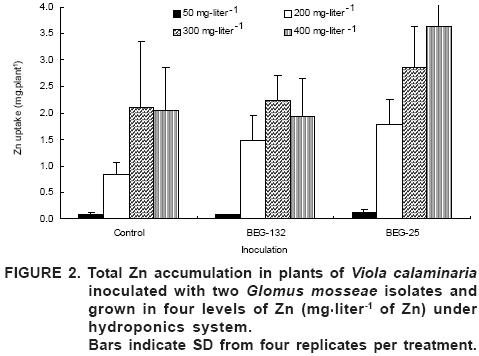
<body><![CDATA[<p align="justify"><font face="verdana" size="2"><b>RESULTS AND DISCUSSION</b></font></p>     <p align="justify"><font face="verdana" size="2"><b>Experiment 1. Response of <i>V. calaminaria </i>to inoculation with two AMF</b></font></p>     <p align="justify"><font face="verdana" size="2">Colonization of <i>V. calaminaria </i>roots was 19% by BEG&#150;132 and 47% by BEG&#150;25. Besides this difference in fungal colonization, after three months of fungal inoculation, no changes in plant growth were observed between AMF treatments. Neither shoot and root dry masses nor P and Zn concentrations in shoots and root parts were significantly (<i>P</i>&lt;0.05) different between the control and the two AMF treatments (<a href="/img/revistas/rcsh/v14n3/a18t1.jpg" target="_blank">Table 1</a>). This suggested that <i>Viola calaminaria </i>did not behave as a mycotrophic plant in these experimental conditions. However, it would be interesting to know whether, under field conditions, AMF might be useful to <i>V. calaminaria </i>and other metallophytes growing under conditions of restricted, low essential nutrient concentrations or stress. These fungi may be important in multiple responses of their host in addition to plant growth alone, which Whitfield <i>et al</i>. (2004) mentioned.</font></p>     <p align="justify"><font face="verdana" size="2"><b>Experiment 2. Effect of fungal inoculation on Zn accumulation <i>V. calaminaria </i>under Zn stress</b></font></p>     <p align="justify"><font face="verdana" size="2">Colonization by two fungal isolates of <i>Glomus mosseae </i>was little affected by Zn application (<a href="/img/revistas/rcsh/v14n3/a18t2.jpg" target="_blank">Table 2</a>). Root colonization by <i>G. mosseae </i>BEG&#150;132 was lower (19 a 26%) than by BEG&#150;25 (44 a 60%). Liu e<i>t al. </i>(2005) obtained similar results in fungal colonization when exposing plants to different levels of As (0 to 75 mg&middot;kg<sup>&#150;1</sup> soil).</font></p>     <p align="justify"><font face="verdana" size="2">Bizoux <i>et al. </i>(2004) mentioned that many of metalliferous species are actually dependent on high concentrations of metals in soils and grow less well in uncontaminated soils. In our study, Zn content in shoots and roots of <i>V. calaminaria </i>increased with increasing Zn concentration in the growth medium (<a href="/img/revistas/rcsh/v14n3/a18f1.jpg" target="_blank">Figure 1a, b</a>). However, this concentration was not high enough to consider <i>V. calaminaria </i>a hyperaccumulator plant according to the definition by Baker (1981) who reported that, to consider a plant species a Zn hyperacumulator, the threshold is 10,000 &#956;g&middot;g<sup>&#150;1</sup> dry matter in leaves. Our results are in agreement with the findings of Tonin <i>et al. </i>(2001), who found that <i>V. calaminaria </i>accumulated only low levels of metals although it was growing in highly polluted soil.</font></p>     <p align="justify"><font face="verdana" size="2">In this experiment, compared with the control Zn level (50 mg&middot;liter<sup>&#150;1</sup> of Zn), shoots and roots of inoculated and non&#150;inoculated plants showed significantly higher Zn concentrations when exposed to higher Zn levels. These increases were at least 7 and 29 times higher between 200 and 400 mg&middot;liter<sup>&#150;1</sup> Zn, respectively, relative to Zn concentrations in the control. Inoculation with BEG&#150;132 significantly increased (<i>P</i>&lt;0.05) Zn concentration in shoots at 50 to 300 mg&middot;liter<sup>&#150;1</sup>, but at 400 mg&middot;liter<sup>&#150;1</sup> all treatments behaved similarly (<a href="/img/revistas/rcsh/v14n3/a18f1.jpg" target="_blank">Figure 1a</a>). Significant differences in root Zn concentrations were only observed by inoculation with BEG&#150;132 at 50 mg&middot;liter<sup>&#150;1</sup> and by two fungi at 200 mg&middot;liter<sup>&#150;1</sup>. At higher exposures inoculated and non inoculated plants did not show statistical differences (<a href="/img/revistas/rcsh/v14n3/a18f1.jpg" target="_blank">Figure 1b</a>). Whitfield <i>et al. </i>(2004) reported that mycorrhizal colonization increased tissue Zn concentrations. <i>V. calaminaria </i>seeds used in this research were collected from soil polluted with Pb, Cd and Zn. Studies considering the species' association with AMF and the effects not only of Zn but also of Pb and Cd, should be conducted.</font></p>     <p align="justify"><font face="verdana" size="2">Zinc concentrations in roots were much higher than in shoots (<a href="/img/revistas/rcsh/v14n3/a18f1.jpg" target="_blank">Figure 1b</a>). This result confirms other research, where roots are the main plant organ retaining metals such as Cd or Pb (Salt <i>et al</i>., 1997; Vogel&#150;Mik&ucirc;s <i>et al., </i>2006). The present results suggest that the isolate BEG&#150;25 contributed significantly more to Zn accumulation in the roots than BEG&#150;132. Higher root colonization by BEG&#150;25 than by BEG&#150;132 (approximately two times more) may be a reason for this effect, especially if the endophyte itself should be an accumulator of Zn, and this remains to be shown.</font></p>     <p align="justify"><font face="verdana" size="2">Inoculation with the isolate BEG&#150;25 significantly (<i>P</i>&lt;0.05) increased (58 to 114%) shoot dry weight and total dry weight (51 to 99%) at all Zn concentrations (except 300 mg&middot;liter<sup>&#150;1</sup>). A similar trend was observed for root dry weight at 200 and 400 mg&middot;liter<sup>&#150;1</sup> of Zn (<a href="/img/revistas/rcsh/v14n3/a18t2.jpg" target="_blank">Table 2</a>). Controls and BEG&#150;132 plants did not differ significantly (<i>P&gt;</i>0.05) in their shoot or root dry masses.</font></p>     <p align="justify"><font face="verdana" size="2">The total Zn content was significantly higher in plants inoculated with each fungus at 200 mg&middot;liter<sup>&#150;1</sup>. However, no difference between inoculation treatments was found at 300 mg&middot;liter<sup>&#150;1</sup>, while at 400 mg&middot;liter<sup>&#150;1</sup> BEG&#150;25 plants showed a higher Zn content compared to BEG&#150;132 inoculated plants and controls (<a href="#figura2">Figure 2</a>). BEG&#150;25 plants tended to accumulate more Zn than BEG&#150;132 plants. These results suggest that the two fungi mediate, in different ways, Zn toxicity and concomitant Zn accumulation to their host plant. The isolate BEG&#150;132 originated from a soil polluted by mainly As and Cu, but also containing increased Zn levels (297 mg&middot;kg<sup>&#150;1 </sup>DTPA&#150;available), while BEG&#150;25 was isolated from an uncontaminated agricultural soil.</font></p>     ]]></body>
<body><![CDATA[<p align="center"><font face="verdana" size="2"><a name="figura2"></a></font></p>     <p align="center"><font face="verdana" size="2"><img src="/img/revistas/rcsh/v14n3/a18f2.jpg"></font></p>     <p align="justify"><font face="verdana" size="2">Gonzalez&#150;Chavez <i>et al. </i>(2002b) reported that <i>G. mosseae </i>isolates BEG&#150;132 and BEG&#150;25 both suppressed high affinity arsenate/phosphate transport into the roots of both resistant and non&#150;resistant <i>Holcus lanatus</i>. Toler <i>et al</i>. (2005) showed reduced Cu acquisition under elevated Cu conditions by fungal isolates from heavy&#150;metal polluted soils in sorghum exposed to elevated Cu relative to fungal isolates from non polluted soil. In the present experiment only the BEG&#150;25 isolate, a fungus from non&#150;polluted soil, significantly increased Zn accumulation in <i>Viola </i>plants. The mechanism involved is not known. BEG&#150;132, an isolate from As&#150; and Cu&#150;polluted soil, did not significantly affect Zn accumulation. Perhaps tolerance to one metal does not confer tolerance to another; furthermore this isolate has been propagated in pollutant&#150;free substrates for more than two years. Tolerance may have been lost as reported previously by Gonzalez&#150;Chavez <i>et al</i>. (2004) and Malcov&aacute; <i>et al. </i>(2003).</font></p>     <p align="justify"><font face="verdana" size="2">There is increasing evidence on the role of AMF in phytoextraction in metal hyperaccumulating and non&#150;hyperaccumulating plants. Wang <i>et al. </i>(2005) studied the effect of inoculating <i>Elsholtzia splendens </i>with a fungal consortium MII (<i>Gigaspora margarita </i>ZJ37, <i>Gigaspora decipens </i>ZJ38, <i>Scutellospora gilmori </i>ZJ39, <i>Acaulospora </i>spp. and <i>Glomus </i>spp). This mycorrhizal fungal consortium increased phytoextraction of several heavy metals. Turnau and Mesjasz&#150;Przybylowics (2003) found Ni&#150;hyperaccumulating species of the Asteraceae family consistently colonized by AMF, and Turnau <i>et al. </i>(2006) mentioned that preliminary results in the Ni&#150;hyperaccumulating <i>Berkheya coddii </i>plants more than doubled Ni content and shoot biomass after inoculation with native AMF (<i>Gigaspora </i>spp. and <i>Glomus tenue</i>). Leung <i>et al. </i>(2006) and Liu <i>et al</i>. (2005) also reported increased As&#150;accumulation in As hyperaccumulating <i>Pteris vittata </i>L. fern after inoculation with AMF. Citerio <i>et al. </i>(2005) also observed that inoculation increased accumulation of Ni, Cd and Cr in <i>Cannabis sativa </i>L. plants.</font></p>     <p align="justify"><font face="verdana" size="2">Janouskova <i>et al. </i>(2005) found that <i>G. intraradices </i>decreased the Cd&#150;phytoextraction efficiency of transgenic tobacco plants bearing yeast metallothionein CUP1 combined with a polyhistidine cluster, while it increased that of non&#150;transgenic plants. However, since these authors did not mention whether their fungus was isolated from polluted or nonpolluted soils, comparison is difficult.</font></p>     <p align="justify"><font face="verdana" size="2">Regvar <i>et al. </i>(2003) and Vogel&#150;Mik&ucirc;s <i>et al</i>. (2005) examined natural colonization by AMF in three <i>Thlaspi </i>species, metallophytes growing on sites similar to those of <i>V. calaminaria</i>. <i>Thlaspi </i>especies (Brassicaceae) have been regarded as non mycorrhizal plants. Their results showed sparse but distinct AMF colonization. Recently, Vogel&#150;Mik&ucirc;s <i>et al. </i>(2006) reported that under a greenhouse experiment AMF colonized <i>Thlaspi praecox</i>, a Zn, Cd and Pb hyperaccumulator plant, only during the plant reproductive period were changes in metal tolerance strategy observed. Cd and Zn uptake was reduced at higher soil metal contents. The results presented in our paper show effective symbiosis during the entire period of study with <i>V. calaminaria</i>, with increased Zn accumulation in shoot and root.</font></p>     <p align="justify"><font face="verdana" size="2">More work should be done with other plants and metals in order to improve the chances of successful phytoremediation. The increment of metal accumulation in shoots and higher production of shoot biomass by BEG 25 are two relevant factors for phytoextraction, which give potential to its application.</font></p>     <p align="justify"><font face="verdana" size="2">&nbsp;</font></p>     <p align="justify"><font face="verdana" size="2"><b>CONCLUSIONS</b></font></p>     <p align="justify"><font face="verdana" size="2">Symbiotic fungi can be used to enhance growth and metal accumulation in <i>Viola calaminaria </i>plants. The results presented in this paper point to more detailed study of the role of AMF in <i>Viola </i>and other metallophyte plants.</font></p>     ]]></body>
<body><![CDATA[<p align="justify"><font face="verdana" size="2">&nbsp;</font></p>     <p align="justify"><font face="verdana" size="2"><b>ACKNOWLEDGEMENTS</b></font></p>     <p align="justify"><font face="verdana" size="2">This research was funded through project SEMARNAT&#150;CONACyT C0&#150;01&#150;2002&#150;739.</font></p>     <p align="justify"><font face="verdana" size="2">&nbsp;</font></p>     <p align="justify"><font face="verdana" size="2"><b>LITERATURE CITED</b></font></p>     <!-- ref --><p align="justify"><font face="verdana" size="2">BAKER, A. J. M. 1981. Accumulators and excluders &#150;strategies in the response of plants to heavy metals. Journal of Plant Nutrition 3: 643&#150;654.    &nbsp;&nbsp;&nbsp;&nbsp;&nbsp;&nbsp;&nbsp;&nbsp;[&#160;<a href="javascript:void(0);" onclick="javascript: window.open('/scielo.php?script=sci_nlinks&ref=6651257&pid=S1027-152X200800030001800001&lng=','','width=640,height=500,resizable=yes,scrollbars=1,menubar=yes,');">Links</a>&#160;]<!-- end-ref --></font></p>     <!-- ref --><p align="justify"><font face="verdana" size="2">BAKER, A. J. M.; MCGRATH, S. P.; REEVES, R. D.; SMITH, J. A. C. 2000. Metal hyperaccumulator plants: A review of the ecology and physiology of a biological resource for phytoremediaton of metal&#150;polluted soils, pp. 85&#150; 107. <i>In</i>: Phytoremediation of Contaminated Soil and Water. TERRY, N.; BA&Ntilde;UELOS. G. S. (eds.). CRC Press Inc. Boca Raton, Florida, USA.    &nbsp;&nbsp;&nbsp;&nbsp;&nbsp;&nbsp;&nbsp;&nbsp;[&#160;<a href="javascript:void(0);" onclick="javascript: window.open('/scielo.php?script=sci_nlinks&ref=6651259&pid=S1027-152X200800030001800002&lng=','','width=640,height=500,resizable=yes,scrollbars=1,menubar=yes,');">Links</a>&#160;]<!-- end-ref --></font></p>     <!-- ref --><p align="justify"><font face="verdana" size="2">BIZOUX, J. P.; BREVERS, F.; MEERTS, P.; GRAITSON, E.; MAHY, G. 2004. Ecology and conservation of Belgian populations of <i>Viola calaminaria</i>, a metallophyte with a restricted geographic. Belgian Journal of Botany 137: 91&#150;104.    &nbsp;&nbsp;&nbsp;&nbsp;&nbsp;&nbsp;&nbsp;&nbsp;[&#160;<a href="javascript:void(0);" onclick="javascript: window.open('/scielo.php?script=sci_nlinks&ref=6651261&pid=S1027-152X200800030001800003&lng=','','width=640,height=500,resizable=yes,scrollbars=1,menubar=yes,');">Links</a>&#160;]<!-- end-ref --></font></p>     <!-- ref --><p align="justify"><font face="verdana" size="2">BOYD, R. S.; MARTENS, S. N. 1998. The significance of metal hypera&#150;ccumulation for biotic interactions. Chemoecology 8: 1&#150;7.    &nbsp;&nbsp;&nbsp;&nbsp;&nbsp;&nbsp;&nbsp;&nbsp;[&#160;<a href="javascript:void(0);" onclick="javascript: window.open('/scielo.php?script=sci_nlinks&ref=6651263&pid=S1027-152X200800030001800004&lng=','','width=640,height=500,resizable=yes,scrollbars=1,menubar=yes,');">Links</a>&#160;]<!-- end-ref --></font></p>     <!-- ref --><p align="justify"><font face="verdana" size="2">BURD, G. I.; DIXON, D. G.; GLICK, B. R. 2000. Plant growth &#150;promoting bacteria that decrease heavy metal toxicity in plants. Canadian Journal of Microbiology 4: 237&#150;245.    &nbsp;&nbsp;&nbsp;&nbsp;&nbsp;&nbsp;&nbsp;&nbsp;[&#160;<a href="javascript:void(0);" onclick="javascript: window.open('/scielo.php?script=sci_nlinks&ref=6651265&pid=S1027-152X200800030001800005&lng=','','width=640,height=500,resizable=yes,scrollbars=1,menubar=yes,');">Links</a>&#160;]<!-- end-ref --></font></p>     <!-- ref --><p align="justify"><font face="verdana" size="2">CASELLES, J.; COLLIGA, C.; ZORNOZA, P. 2004. Evaluation of trace element pollution from vehicle emissions in petunia plants. Water, Air and Soil Pollution 136: 1&#150;9.    &nbsp;&nbsp;&nbsp;&nbsp;&nbsp;&nbsp;&nbsp;&nbsp;[&#160;<a href="javascript:void(0);" onclick="javascript: window.open('/scielo.php?script=sci_nlinks&ref=6651267&pid=S1027-152X200800030001800006&lng=','','width=640,height=500,resizable=yes,scrollbars=1,menubar=yes,');">Links</a>&#160;]<!-- end-ref --></font></p>     <!-- ref --><p align="justify"><font face="verdana" size="2">CITTERIO, S.; PRATO, N.; FUMAGALLI, P.; AINA, R.; MASSA, N.; SANTAGOSTINO, A.; SGORBATI, S.; BERTA, G . 2005. The arbuscular mycorrhizal fungus <i>Glomus mosseae </i>induces growth and metal accumulation changes in <i>Cannabis sativa </i>L. Chemosphere 59: 21&#150;29</font>&nbsp;&nbsp;&nbsp;&nbsp;&nbsp;&nbsp;&nbsp;&nbsp;[&#160;<a href="javascript:void(0);" onclick="javascript: window.open('/scielo.php?script=sci_nlinks&ref=6651269&pid=S1027-152X200800030001800007&lng=','','width=640,height=500,resizable=yes,scrollbars=1,menubar=yes,');">Links</a>&#160;]<!-- end-ref --><!-- ref --><p align="justify"><font face="verdana" size="2">COLPAERT, J. V.; VANDENKOORNHUYSE, P. 2001. Mycorrhizal fungi, pp. 37&#150;58. <i>In</i>: Metals in the Environment. PRASAD, M.N.V. (ed.). Marcel Dekker Inc. New York, USA.    &nbsp;&nbsp;&nbsp;&nbsp;&nbsp;&nbsp;&nbsp;&nbsp;[&#160;<a href="javascript:void(0);" onclick="javascript: window.open('/scielo.php?script=sci_nlinks&ref=6651270&pid=S1027-152X200800030001800008&lng=','','width=640,height=500,resizable=yes,scrollbars=1,menubar=yes,');">Links</a>&#160;]<!-- end-ref --></font></p>     ]]></body>
<body><![CDATA[<!-- ref --><p align="justify"><font face="verdana" size="2">GONZ&Aacute;LEZ&#150;CH&Aacute;VEZ, M. C.; D'HAEN, J.; VANGRONSVELD, J. J.; DODD, J. C. 2002a. Copper sorption and accumulation by the extraradical mycelium of different <i>Glomus </i>spp. (arbuscular mycorrhizal fungi) isolated from the same polluted soil. Plant Soil 240: 287&#150;297.    &nbsp;&nbsp;&nbsp;&nbsp;&nbsp;&nbsp;&nbsp;&nbsp;[&#160;<a href="javascript:void(0);" onclick="javascript: window.open('/scielo.php?script=sci_nlinks&ref=6651272&pid=S1027-152X200800030001800009&lng=','','width=640,height=500,resizable=yes,scrollbars=1,menubar=yes,');">Links</a>&#160;]<!-- end-ref --></font></p>     <!-- ref --><p align="justify"><font face="verdana" size="2">GONZ&Aacute;LEZ CH&Aacute;VEZ, C.; HARRIS, P.J.; DODD, J.; MEHARG, A.A. 2002b. Arbuscular mycorrhizal fungi confer enhanced arsenate resistance on <i>Holcus lanatus</i>. New Phytologist 155: 163&#150;171.    &nbsp;&nbsp;&nbsp;&nbsp;&nbsp;&nbsp;&nbsp;&nbsp;[&#160;<a href="javascript:void(0);" onclick="javascript: window.open('/scielo.php?script=sci_nlinks&ref=6651274&pid=S1027-152X200800030001800010&lng=','','width=640,height=500,resizable=yes,scrollbars=1,menubar=yes,');">Links</a>&#160;]<!-- end-ref --></font></p>     <!-- ref --><p align="justify"><font face="verdana" size="2">GONZ&Aacute;LEZ&#150;CH&Aacute;VEZ, M. C.; CARRILLO&#150;GONZ&Aacute;LEZ, R.; WRIGHT, S. F.; NICHOLS, K. 2004. The role of glomalin, protein produced by arbuscular mycorrhizal fungi in sequestering potentially toxic elements. Environmental Pollution 130: 317&#150;323<i>.    &nbsp;&nbsp;&nbsp;&nbsp;&nbsp;&nbsp;&nbsp;&nbsp;[&#160;<a href="javascript:void(0);" onclick="javascript: window.open('/scielo.php?script=sci_nlinks&ref=6651276&pid=S1027-152X200800030001800011&lng=','','width=640,height=500,resizable=yes,scrollbars=1,menubar=yes,');">Links</a>&#160;]<!-- end-ref --></i></font></p>     <!-- ref --><p align="justify"><font face="verdana" size="2">GONZ&Aacute;LEZ&#150;CH&Aacute;VEZ, M. C.; J. VANGRONSVELD, J. COLPAERT, C. LEYVAL. 2006. Arbuscular mycorrhizal fungi and heavy metals: Tolerance mechanisms and potential use in bioremediation, pp. 211&#150;234. <i>In</i>: PRASAD, M.N.V.; SAJWAN, K. S.; NAIDU, R. (eds.). Trace Elements in the Environment. Biogeochemistry, Biotechnology, and Bioremediation. CRC Press. Boca Raton, Florida, USA.    &nbsp;&nbsp;&nbsp;&nbsp;&nbsp;&nbsp;&nbsp;&nbsp;[&#160;<a href="javascript:void(0);" onclick="javascript: window.open('/scielo.php?script=sci_nlinks&ref=6651278&pid=S1027-152X200800030001800012&lng=','','width=640,height=500,resizable=yes,scrollbars=1,menubar=yes,');">Links</a>&#160;]<!-- end-ref --></font></p>     <!-- ref --><p align="justify"><font face="verdana" size="2">HEWITT, E. 1966. Sand and water culture methods used in the study of plant nutrition. Commonwealth Agricultural Bureau Technical Communication 22, Farnham Royal, UK.    &nbsp;&nbsp;&nbsp;&nbsp;&nbsp;&nbsp;&nbsp;&nbsp;[&#160;<a href="javascript:void(0);" onclick="javascript: window.open('/scielo.php?script=sci_nlinks&ref=6651280&pid=S1027-152X200800030001800013&lng=','','width=640,height=500,resizable=yes,scrollbars=1,menubar=yes,');">Links</a>&#160;]<!-- end-ref --></font></p>     ]]></body>
<body><![CDATA[<!-- ref --><p align="justify"><font face="verdana" size="2">HILDEBRANDT, U.; KALDORF, M.; BOTHE, H. 1999. The zinc violet and its colonization by arbuscular mycorrhizal fungi. Journal of Plant Physiology 154: 709&#150;717.    &nbsp;&nbsp;&nbsp;&nbsp;&nbsp;&nbsp;&nbsp;&nbsp;[&#160;<a href="javascript:void(0);" onclick="javascript: window.open('/scielo.php?script=sci_nlinks&ref=6651282&pid=S1027-152X200800030001800014&lng=','','width=640,height=500,resizable=yes,scrollbars=1,menubar=yes,');">Links</a>&#160;]<!-- end-ref --></font></p>     <!-- ref --><p align="justify"><font face="verdana" size="2">JANOUSKOVA, M.; PAVLIKOVA, D.; MACEK, T.; VOSATK&Aacute;, M: 2005. Arbuscular mycorrhiza decreases cadmium phytoextraction by transgenic tobacco with inserted metallothionein. Plant Soil 272: 29&#150;40.    &nbsp;&nbsp;&nbsp;&nbsp;&nbsp;&nbsp;&nbsp;&nbsp;[&#160;<a href="javascript:void(0);" onclick="javascript: window.open('/scielo.php?script=sci_nlinks&ref=6651284&pid=S1027-152X200800030001800015&lng=','','width=640,height=500,resizable=yes,scrollbars=1,menubar=yes,');">Links</a>&#160;]<!-- end-ref --></font></p>     <!-- ref --><p align="justify"><font face="verdana" size="2">KOSKE, R. E.; GEMMA, J. N. 1989. A modified procedure for staining roots to detect VA mycorrhizas. Mycological Research 92: 486&#150;505.    &nbsp;&nbsp;&nbsp;&nbsp;&nbsp;&nbsp;&nbsp;&nbsp;[&#160;<a href="javascript:void(0);" onclick="javascript: window.open('/scielo.php?script=sci_nlinks&ref=6651286&pid=S1027-152X200800030001800016&lng=','','width=640,height=500,resizable=yes,scrollbars=1,menubar=yes,');">Links</a>&#160;]<!-- end-ref --></font></p>     <!-- ref --><p align="justify"><font face="verdana" size="2">LEUNG, H. M.; YE, Z. H.; WONG, M. H. 2006. Interactions of mycorrhizal fungi with <i>Pteris vittata </i>(As hyperaccumulator) in As&#150;contaminated soils. Environment Pollution 139: 1&#150;8.    &nbsp;&nbsp;&nbsp;&nbsp;&nbsp;&nbsp;&nbsp;&nbsp;[&#160;<a href="javascript:void(0);" onclick="javascript: window.open('/scielo.php?script=sci_nlinks&ref=6651288&pid=S1027-152X200800030001800017&lng=','','width=640,height=500,resizable=yes,scrollbars=1,menubar=yes,');">Links</a>&#160;]<!-- end-ref --></font></p>     <!-- ref --><p align="justify"><font face="verdana" size="2">LIU, Y. ; ZHU, Y. G.; CHEN, B. D.; CHRISTIE, P.; LI, X. L. 2005. Influence of the arbuscular mycorrhizal fungus <i>Glomus mosseae </i>on uptake of arsenate by the As hyperaccumulator fern <i>Pteris vittata </i>L. Mycorrhiza 15: 187&#150;192.    &nbsp;&nbsp;&nbsp;&nbsp;&nbsp;&nbsp;&nbsp;&nbsp;[&#160;<a href="javascript:void(0);" onclick="javascript: window.open('/scielo.php?script=sci_nlinks&ref=6651290&pid=S1027-152X200800030001800018&lng=','','width=640,height=500,resizable=yes,scrollbars=1,menubar=yes,');">Links</a>&#160;]<!-- end-ref --></font></p>     ]]></body>
<body><![CDATA[<!-- ref --><p align="justify"><font face="verdana" size="2">MALCOV&Aacute;, R.; FYDOV&Aacute;, J.; VOSATK&Aacute;, M. 2003. Metal&#150;free cultivation of <i>Glomus </i>sp., BEG 140 isolated from Mn&#150;contaminated soil reduces tolerance to Mn. Mycorrhiza 13: 151&#150;157.    &nbsp;&nbsp;&nbsp;&nbsp;&nbsp;&nbsp;&nbsp;&nbsp;[&#160;<a href="javascript:void(0);" onclick="javascript: window.open('/scielo.php?script=sci_nlinks&ref=6651292&pid=S1027-152X200800030001800019&lng=','','width=640,height=500,resizable=yes,scrollbars=1,menubar=yes,');">Links</a>&#160;]<!-- end-ref --></font></p>     <!-- ref --><p align="justify"><font face="verdana" size="2">REGVAR, M.; VOGEL, K.; IRGEL, N.; WRABER, T.; HILDEBRANDT, U.; WILDE, P.; BOTHE, H. 2003. Colonization of pennycresses (<i>Thlaspi </i>spp.) of the Brassicaceae by arbuscular my&#150;corrhizal fungi. Journal of Plant Physiology 160: 615&#150;626.    &nbsp;&nbsp;&nbsp;&nbsp;&nbsp;&nbsp;&nbsp;&nbsp;[&#160;<a href="javascript:void(0);" onclick="javascript: window.open('/scielo.php?script=sci_nlinks&ref=6651294&pid=S1027-152X200800030001800020&lng=','','width=640,height=500,resizable=yes,scrollbars=1,menubar=yes,');">Links</a>&#160;]<!-- end-ref --></font></p>     <!-- ref --><p align="justify"><font face="verdana" size="2">SALT, D. E.; PICKERING, I. J.; PRINCE, R. C.; GLEBA, D.; DUSHENKOV, S.; SMITH, R. D.; RASKIN, I. 1997. Metal accumulation by aquacultured seedlings of indian mustard. Environmental Science and Technology 31: 1636&#150;1644.    &nbsp;&nbsp;&nbsp;&nbsp;&nbsp;&nbsp;&nbsp;&nbsp;[&#160;<a href="javascript:void(0);" onclick="javascript: window.open('/scielo.php?script=sci_nlinks&ref=6651296&pid=S1027-152X200800030001800021&lng=','','width=640,height=500,resizable=yes,scrollbars=1,menubar=yes,');">Links</a>&#160;]<!-- end-ref --></font></p>     <!-- ref --><p align="justify"><font face="verdana" size="2">SHARMA, K.; SHARMA, K. P.; GROVER, R. 2004. <i>In vitro </i>studies to analyze the response of some ornamental plant species to heavy metals at germination and other stages. Nature, Environmental Pollution and Technology 3: 369&#150;376.    &nbsp;&nbsp;&nbsp;&nbsp;&nbsp;&nbsp;&nbsp;&nbsp;[&#160;<a href="javascript:void(0);" onclick="javascript: window.open('/scielo.php?script=sci_nlinks&ref=6651298&pid=S1027-152X200800030001800022&lng=','','width=640,height=500,resizable=yes,scrollbars=1,menubar=yes,');">Links</a>&#160;]<!-- end-ref --></font></p>     <!-- ref --><p align="justify"><font face="verdana" size="2">TAK&Aacute;CS, D.; RADIMSZKY, L.; NEMETH, T. 2005. The arbuscular mycor&#150;rhizal status of poplar clones selected for phytoremediation of soils contaminated with heavy metals. Zeitschrift fur Naturforschung C&#150;A J. Biosciences 60: 357&#150;361.    &nbsp;&nbsp;&nbsp;&nbsp;&nbsp;&nbsp;&nbsp;&nbsp;[&#160;<a href="javascript:void(0);" onclick="javascript: window.open('/scielo.php?script=sci_nlinks&ref=6651300&pid=S1027-152X200800030001800023&lng=','','width=640,height=500,resizable=yes,scrollbars=1,menubar=yes,');">Links</a>&#160;]<!-- end-ref --></font></p>     ]]></body>
<body><![CDATA[<!-- ref --><p align="justify"><font face="verdana" size="2">TOLER, H. D.; MORTON, J. B.; CUMMING, J. R. 2005. Growth and metal accumulation of mycorrhizal sorghum exposed to elevated copper and zinc. Water, Air and Soil Pollution164: 155&#150;172.    &nbsp;&nbsp;&nbsp;&nbsp;&nbsp;&nbsp;&nbsp;&nbsp;[&#160;<a href="javascript:void(0);" onclick="javascript: window.open('/scielo.php?script=sci_nlinks&ref=6651302&pid=S1027-152X200800030001800024&lng=','','width=640,height=500,resizable=yes,scrollbars=1,menubar=yes,');">Links</a>&#160;]<!-- end-ref --></font></p>     <!-- ref --><p align="justify"><font face="verdana" size="2">TONIN, C.; VANDENKOORNHUYSE, P.; JONER, E.J.; STRACZEK, J.; LEYVAL, C. 2001. Assessment of arbuscular mycorrhizal fungi diversity in the rhizosphere of <i>Viola calaminaria </i>and effect of these fungi on heavy metal uptake by clover. Mycorrhiza 10: 161&#150;168.    &nbsp;&nbsp;&nbsp;&nbsp;&nbsp;&nbsp;&nbsp;&nbsp;[&#160;<a href="javascript:void(0);" onclick="javascript: window.open('/scielo.php?script=sci_nlinks&ref=6651304&pid=S1027-152X200800030001800025&lng=','','width=640,height=500,resizable=yes,scrollbars=1,menubar=yes,');">Links</a>&#160;]<!-- end-ref --></font></p>     <!-- ref --><p align="justify"><font face="verdana" size="2">TURNAU, K.; MESJASZ&#150;PRZYBYLOWICS, J. 2003. Arbuscular mycorrhizal of <i>Berkheya coddii </i>and other Ni&#150;hyperaccumulating members of Asteraceae from ultramafic soils in South Africa. Mycorrhiza 13: 185&#150;190.    &nbsp;&nbsp;&nbsp;&nbsp;&nbsp;&nbsp;&nbsp;&nbsp;[&#160;<a href="javascript:void(0);" onclick="javascript: window.open('/scielo.php?script=sci_nlinks&ref=6651306&pid=S1027-152X200800030001800026&lng=','','width=640,height=500,resizable=yes,scrollbars=1,menubar=yes,');">Links</a>&#160;]<!-- end-ref --></font></p>     <!-- ref --><p align="justify"><font face="verdana" size="2">TURNAU, K.; JURKIEWICZ, A.; LINGUA, G.; BAREA, J. M.; GIANINAZZI&#150;PEARSON, V. 2006. Role of arbuscular mycorrhiza and associated microorganisms in phytoremediation of heavy metal polluted sites, pp. 235&#150;252. <i>In</i>: PRASAD, M.N.V.; SAJWAN, K. S.; NAIDU, R. (eds.). Trace Elements in the Environment. Biogeochemistry, Biotechnology, and Bioremediation. CRC Press. Boca Raton, Florida, USA.    &nbsp;&nbsp;&nbsp;&nbsp;&nbsp;&nbsp;&nbsp;&nbsp;[&#160;<a href="javascript:void(0);" onclick="javascript: window.open('/scielo.php?script=sci_nlinks&ref=6651308&pid=S1027-152X200800030001800027&lng=','','width=640,height=500,resizable=yes,scrollbars=1,menubar=yes,');">Links</a>&#160;]<!-- end-ref --></font></p>     <!-- ref --><p align="justify"><font face="verdana" size="2">VOGEL&#150;MIK&Ucirc;S, K.; DROBNE, D.; REGVAR, M. 2005. Zn, Cd and Pb accumulation and arbuscular mycorrhizal colonization of pennycress <i>Thlaspi praecox </i>Wulf. (Brassicaceae) from the vicinity of a lead mine and smelter in Slovenia. Environmental Pollution 133: 233&#150;242.    &nbsp;&nbsp;&nbsp;&nbsp;&nbsp;&nbsp;&nbsp;&nbsp;[&#160;<a href="javascript:void(0);" onclick="javascript: window.open('/scielo.php?script=sci_nlinks&ref=6651310&pid=S1027-152X200800030001800028&lng=','','width=640,height=500,resizable=yes,scrollbars=1,menubar=yes,');">Links</a>&#160;]<!-- end-ref --></font></p>     ]]></body>
<body><![CDATA[<!-- ref --><p align="justify"><font face="verdana" size="2">VOGEL&#150;MIK&Ucirc;S, K.; PONGRAC, P.; KUMP, P.; NECEMER, M.; REGVAR, M. 2006. Colonization of a Zn, Cd and Pb hyperaccumulator <i>Thlaspi praecox </i>Wulfen with indigenous arbuscular my&#150;corrhizal fungal mixtures induces changes in heavy metal and nutrient uptake. Environmental Pollution 139: 362&#150;371.    &nbsp;&nbsp;&nbsp;&nbsp;&nbsp;&nbsp;&nbsp;&nbsp;[&#160;<a href="javascript:void(0);" onclick="javascript: window.open('/scielo.php?script=sci_nlinks&ref=6651312&pid=S1027-152X200800030001800029&lng=','','width=640,height=500,resizable=yes,scrollbars=1,menubar=yes,');">Links</a>&#160;]<!-- end-ref --></font></p>     <!-- ref --><p align="justify"><font face="verdana" size="2">WANG, F. Y. ; LIN, S. G.; YIN, R. 2005. Heavy metal uptake by arbuscular mycorrhizas of <i>Elsholtzia splendens </i>and the potential for phytoremediation of contaminated soil. Plant Soil 269: 225&#150;232.    &nbsp;&nbsp;&nbsp;&nbsp;&nbsp;&nbsp;&nbsp;&nbsp;[&#160;<a href="javascript:void(0);" onclick="javascript: window.open('/scielo.php?script=sci_nlinks&ref=6651314&pid=S1027-152X200800030001800030&lng=','','width=640,height=500,resizable=yes,scrollbars=1,menubar=yes,');">Links</a>&#160;]<!-- end-ref --></font></p>     <!-- ref --><p align="justify"><font face="verdana" size="2">WHITFIELD, L.; RICHARDS, A. J.; RIMMER, D. L. 2004. Effects of mycorrhizal colonization on <i>Thymus polytrichus </i>from heavy&#150;metal&#150;contaminated sites in northern England. Mycorrhiza 14: 47&#150;54.    &nbsp;&nbsp;&nbsp;&nbsp;&nbsp;&nbsp;&nbsp;&nbsp;[&#160;<a href="javascript:void(0);" onclick="javascript: window.open('/scielo.php?script=sci_nlinks&ref=6651316&pid=S1027-152X200800030001800031&lng=','','width=640,height=500,resizable=yes,scrollbars=1,menubar=yes,');">Links</a>&#160;]<!-- end-ref --></font></p>      ]]></body><back>
<ref-list>
<ref id="B1">
<nlm-citation citation-type="journal">
<person-group person-group-type="author">
<name>
<surname><![CDATA[BAKER]]></surname>
<given-names><![CDATA[A. J. M.]]></given-names>
</name>
</person-group>
<article-title xml:lang="en"><![CDATA[Accumulators and excluders -strategies in the response of plants to heavy metals]]></article-title>
<source><![CDATA[Journal of Plant Nutrition]]></source>
<year>1981</year>
<volume>3</volume>
<page-range>643-654</page-range></nlm-citation>
</ref>
<ref id="B2">
<nlm-citation citation-type="book">
<person-group person-group-type="author">
<name>
<surname><![CDATA[BAKER]]></surname>
<given-names><![CDATA[A. J. M.]]></given-names>
</name>
<name>
<surname><![CDATA[MCGRATH]]></surname>
<given-names><![CDATA[S. P.]]></given-names>
</name>
<name>
<surname><![CDATA[REEVES]]></surname>
<given-names><![CDATA[R. D.]]></given-names>
</name>
<name>
<surname><![CDATA[SMITH]]></surname>
<given-names><![CDATA[J. A. C.]]></given-names>
</name>
</person-group>
<article-title xml:lang="en"><![CDATA[Metal hyperaccumulator plants: A review of the ecology and physiology of a biological resource for phytoremediaton of metal-polluted soils]]></article-title>
<person-group person-group-type="editor">
<name>
<surname><![CDATA[TERRY]]></surname>
<given-names><![CDATA[N]]></given-names>
</name>
<name>
<surname><![CDATA[BAŃUELOS]]></surname>
<given-names><![CDATA[G. S.]]></given-names>
</name>
</person-group>
<source><![CDATA[Phytoremediation of Contaminated Soil and Water]]></source>
<year>2000</year>
<page-range>85- 107</page-range><publisher-loc><![CDATA[Boca Raton^eFlorida Florida]]></publisher-loc>
<publisher-name><![CDATA[CRC Press]]></publisher-name>
</nlm-citation>
</ref>
<ref id="B3">
<nlm-citation citation-type="journal">
<person-group person-group-type="author">
<name>
<surname><![CDATA[BIZOUX]]></surname>
<given-names><![CDATA[J. P.]]></given-names>
</name>
<name>
<surname><![CDATA[BREVERS]]></surname>
<given-names><![CDATA[F]]></given-names>
</name>
<name>
<surname><![CDATA[MEERTS]]></surname>
<given-names><![CDATA[P]]></given-names>
</name>
<name>
<surname><![CDATA[GRAITSON]]></surname>
<given-names><![CDATA[E]]></given-names>
</name>
<name>
<surname><![CDATA[MAHY]]></surname>
<given-names><![CDATA[G]]></given-names>
</name>
</person-group>
<article-title xml:lang="en"><![CDATA[Ecology and conservation of Belgian populations of Viola calaminaria, a metallophyte with a restricted geographic]]></article-title>
<source><![CDATA[Belgian Journal of Botany]]></source>
<year>2004</year>
<volume>137</volume>
<page-range>91-104</page-range></nlm-citation>
</ref>
<ref id="B4">
<nlm-citation citation-type="journal">
<person-group person-group-type="author">
<name>
<surname><![CDATA[BOYD]]></surname>
<given-names><![CDATA[R. S.]]></given-names>
</name>
<name>
<surname><![CDATA[MARTENS]]></surname>
<given-names><![CDATA[S. N.]]></given-names>
</name>
</person-group>
<article-title xml:lang="en"><![CDATA[The significance of metal hypera-ccumulation for biotic interactions]]></article-title>
<source><![CDATA[Chemoecology]]></source>
<year>1998</year>
<volume>8</volume>
<page-range>1-7</page-range></nlm-citation>
</ref>
<ref id="B5">
<nlm-citation citation-type="journal">
<person-group person-group-type="author">
<name>
<surname><![CDATA[BURD]]></surname>
<given-names><![CDATA[G. I.]]></given-names>
</name>
<name>
<surname><![CDATA[DIXON]]></surname>
<given-names><![CDATA[D. G.]]></given-names>
</name>
<name>
<surname><![CDATA[GLICK]]></surname>
<given-names><![CDATA[B. R.]]></given-names>
</name>
</person-group>
<article-title xml:lang="en"><![CDATA[Plant growth -promoting bacteria that decrease heavy metal toxicity in plants]]></article-title>
<source><![CDATA[Canadian Journal of Microbiology]]></source>
<year>2000</year>
<volume>4</volume>
<page-range>237-245</page-range></nlm-citation>
</ref>
<ref id="B6">
<nlm-citation citation-type="journal">
<person-group person-group-type="author">
<name>
<surname><![CDATA[CASELLES]]></surname>
<given-names><![CDATA[J]]></given-names>
</name>
<name>
<surname><![CDATA[COLLIGA]]></surname>
<given-names><![CDATA[C]]></given-names>
</name>
<name>
<surname><![CDATA[ZORNOZA]]></surname>
<given-names><![CDATA[P]]></given-names>
</name>
</person-group>
<article-title xml:lang="en"><![CDATA[Evaluation of trace element pollution from vehicle emissions in petunia plants]]></article-title>
<source><![CDATA[Water, Air and Soil Pollution]]></source>
<year>2004</year>
<volume>136</volume>
<page-range>1-9</page-range></nlm-citation>
</ref>
<ref id="B7">
<nlm-citation citation-type="journal">
<person-group person-group-type="author">
<name>
<surname><![CDATA[CITTERIO]]></surname>
<given-names><![CDATA[S]]></given-names>
</name>
<name>
<surname><![CDATA[PRATO]]></surname>
<given-names><![CDATA[N]]></given-names>
</name>
<name>
<surname><![CDATA[FUMAGALLI]]></surname>
<given-names><![CDATA[P]]></given-names>
</name>
<name>
<surname><![CDATA[AINA]]></surname>
<given-names><![CDATA[R]]></given-names>
</name>
<name>
<surname><![CDATA[MASSA]]></surname>
<given-names><![CDATA[N]]></given-names>
</name>
<name>
<surname><![CDATA[SANTAGOSTINO]]></surname>
<given-names><![CDATA[A]]></given-names>
</name>
<name>
<surname><![CDATA[SGORBATI]]></surname>
<given-names><![CDATA[S]]></given-names>
</name>
<name>
<surname><![CDATA[BERTA]]></surname>
<given-names><![CDATA[G]]></given-names>
</name>
</person-group>
<article-title xml:lang="en"><![CDATA[The arbuscular mycorrhizal fungus Glomus mosseae induces growth and metal accumulation changes in Cannabis sativa L]]></article-title>
<source><![CDATA[Chemosphere]]></source>
<year>2005</year>
<volume>59</volume>
<page-range>21-29</page-range></nlm-citation>
</ref>
<ref id="B8">
<nlm-citation citation-type="book">
<person-group person-group-type="author">
<name>
<surname><![CDATA[COLPAERT]]></surname>
<given-names><![CDATA[J. V.]]></given-names>
</name>
<name>
<surname><![CDATA[VANDENKOORNHUYSE]]></surname>
<given-names><![CDATA[P]]></given-names>
</name>
</person-group>
<article-title xml:lang="en"><![CDATA[Mycorrhizal fungi]]></article-title>
<person-group person-group-type="editor">
<name>
<surname><![CDATA[PRASAD]]></surname>
<given-names><![CDATA[M.N.V.]]></given-names>
</name>
</person-group>
<source><![CDATA[Metals in the Environment]]></source>
<year>2001</year>
<page-range>37-58</page-range><publisher-loc><![CDATA[^eNew York New York]]></publisher-loc>
<publisher-name><![CDATA[Marcel Dekker]]></publisher-name>
</nlm-citation>
</ref>
<ref id="B9">
<nlm-citation citation-type="journal">
<person-group person-group-type="author">
<name>
<surname><![CDATA[GONZÁLEZ-CHÁVEZ]]></surname>
<given-names><![CDATA[M. C.]]></given-names>
</name>
<name>
<surname><![CDATA[D'HAEN]]></surname>
<given-names><![CDATA[J]]></given-names>
</name>
<name>
<surname><![CDATA[VANGRONSVELD]]></surname>
<given-names><![CDATA[J. J.]]></given-names>
</name>
<name>
<surname><![CDATA[DODD]]></surname>
<given-names><![CDATA[J. C.]]></given-names>
</name>
</person-group>
<article-title xml:lang="en"><![CDATA[Copper sorption and accumulation by the extraradical mycelium of different Glomus spp. (arbuscular mycorrhizal fungi) isolated from the same polluted soil]]></article-title>
<source><![CDATA[Plant Soil]]></source>
<year>2002</year>
<volume>240</volume>
<page-range>287-297</page-range></nlm-citation>
</ref>
<ref id="B10">
<nlm-citation citation-type="journal">
<person-group person-group-type="author">
<name>
<surname><![CDATA[GONZÁLEZ CHÁVEZ]]></surname>
<given-names><![CDATA[C]]></given-names>
</name>
<name>
<surname><![CDATA[HARRIS]]></surname>
<given-names><![CDATA[P.J.]]></given-names>
</name>
<name>
<surname><![CDATA[DODD]]></surname>
<given-names><![CDATA[J]]></given-names>
</name>
<name>
<surname><![CDATA[MEHARG]]></surname>
<given-names><![CDATA[A.A.]]></given-names>
</name>
</person-group>
<article-title xml:lang="en"><![CDATA[Arbuscular mycorrhizal fungi confer enhanced arsenate resistance on Holcus lanatus]]></article-title>
<source><![CDATA[New Phytologist]]></source>
<year>2002</year>
<volume>155</volume>
<page-range>163-171</page-range></nlm-citation>
</ref>
<ref id="B11">
<nlm-citation citation-type="journal">
<person-group person-group-type="author">
<name>
<surname><![CDATA[GONZÁLEZ-CHÁVEZ]]></surname>
<given-names><![CDATA[M. C.]]></given-names>
</name>
<name>
<surname><![CDATA[CARRILLO-GONZÁLEZ]]></surname>
<given-names><![CDATA[R]]></given-names>
</name>
<name>
<surname><![CDATA[WRIGHT]]></surname>
<given-names><![CDATA[S. F.]]></given-names>
</name>
<name>
<surname><![CDATA[NICHOLS]]></surname>
<given-names><![CDATA[K]]></given-names>
</name>
</person-group>
<article-title xml:lang="en"><![CDATA[The role of glomalin, protein produced by arbuscular mycorrhizal fungi in sequestering potentially toxic elements]]></article-title>
<source><![CDATA[Environmental Pollution]]></source>
<year>2004</year>
<volume>130</volume>
<page-range>317-323</page-range></nlm-citation>
</ref>
<ref id="B12">
<nlm-citation citation-type="book">
<person-group person-group-type="author">
<name>
<surname><![CDATA[GONZÁLEZ-CHÁVEZ]]></surname>
<given-names><![CDATA[M. C.]]></given-names>
</name>
<name>
<surname><![CDATA[VANGRONSVELD]]></surname>
<given-names><![CDATA[J]]></given-names>
</name>
<name>
<surname><![CDATA[COLPAERT]]></surname>
<given-names><![CDATA[J]]></given-names>
</name>
<name>
<surname><![CDATA[LEYVAL]]></surname>
<given-names><![CDATA[C]]></given-names>
</name>
</person-group>
<article-title xml:lang="en"><![CDATA[Arbuscular mycorrhizal fungi and heavy metals: Tolerance mechanisms and potential use in bioremediation]]></article-title>
<person-group person-group-type="editor">
<name>
<surname><![CDATA[PRASAD]]></surname>
<given-names><![CDATA[M.N.V.]]></given-names>
</name>
<name>
<surname><![CDATA[SAJWAN]]></surname>
<given-names><![CDATA[K. S.]]></given-names>
</name>
<name>
<surname><![CDATA[NAIDU]]></surname>
<given-names><![CDATA[R]]></given-names>
</name>
</person-group>
<source><![CDATA[Trace Elements in the Environment. Biogeochemistry, Biotechnology, and Bioremediation]]></source>
<year>2006</year>
<page-range>211-234</page-range><publisher-loc><![CDATA[Boca Raton^eFlorida Florida]]></publisher-loc>
<publisher-name><![CDATA[CRC Press]]></publisher-name>
</nlm-citation>
</ref>
<ref id="B13">
<nlm-citation citation-type="">
<person-group person-group-type="author">
<name>
<surname><![CDATA[HEWITT]]></surname>
<given-names><![CDATA[E]]></given-names>
</name>
</person-group>
<source><![CDATA[Sand and water culture methods used in the study of plant nutrition. Commonwealth Agricultural Bureau Technical Communication 22]]></source>
<year>1966</year>
<publisher-loc><![CDATA[Farnham Royal ]]></publisher-loc>
</nlm-citation>
</ref>
<ref id="B14">
<nlm-citation citation-type="journal">
<person-group person-group-type="author">
<name>
<surname><![CDATA[HILDEBRANDT]]></surname>
<given-names><![CDATA[U]]></given-names>
</name>
<name>
<surname><![CDATA[KALDORF]]></surname>
<given-names><![CDATA[M]]></given-names>
</name>
<name>
<surname><![CDATA[BOTHE]]></surname>
<given-names><![CDATA[H]]></given-names>
</name>
</person-group>
<article-title xml:lang="en"><![CDATA[The zinc violet and its colonization by arbuscular mycorrhizal fungi]]></article-title>
<source><![CDATA[Journal of Plant Physiology]]></source>
<year>1999</year>
<volume>154</volume>
<page-range>709-717</page-range></nlm-citation>
</ref>
<ref id="B15">
<nlm-citation citation-type="journal">
<person-group person-group-type="author">
<name>
<surname><![CDATA[JANOUSKOVA]]></surname>
<given-names><![CDATA[M]]></given-names>
</name>
<name>
<surname><![CDATA[PAVLIKOVA]]></surname>
<given-names><![CDATA[D]]></given-names>
</name>
<name>
<surname><![CDATA[MACEK]]></surname>
<given-names><![CDATA[T]]></given-names>
</name>
<name>
<surname><![CDATA[VOSATKÁ]]></surname>
<given-names><![CDATA[M]]></given-names>
</name>
</person-group>
<article-title xml:lang="en"><![CDATA[Arbuscular mycorrhiza decreases cadmium phytoextraction by transgenic tobacco with inserted metallothionein]]></article-title>
<source><![CDATA[Plant Soil]]></source>
<year>2005</year>
<volume>272</volume>
<page-range>29-40</page-range></nlm-citation>
</ref>
<ref id="B16">
<nlm-citation citation-type="journal">
<person-group person-group-type="author">
<name>
<surname><![CDATA[KOSKE]]></surname>
<given-names><![CDATA[R. E.]]></given-names>
</name>
<name>
<surname><![CDATA[GEMMA]]></surname>
<given-names><![CDATA[J. N.]]></given-names>
</name>
</person-group>
<article-title xml:lang="en"><![CDATA[A modified procedure for staining roots to detect VA mycorrhizas]]></article-title>
<source><![CDATA[Mycological Research]]></source>
<year>1989</year>
<volume>92</volume>
<page-range>486-505</page-range></nlm-citation>
</ref>
<ref id="B17">
<nlm-citation citation-type="journal">
<person-group person-group-type="author">
<name>
<surname><![CDATA[LEUNG]]></surname>
<given-names><![CDATA[H. M.]]></given-names>
</name>
<name>
<surname><![CDATA[YE]]></surname>
<given-names><![CDATA[Z. H.]]></given-names>
</name>
<name>
<surname><![CDATA[WONG]]></surname>
<given-names><![CDATA[M. H.]]></given-names>
</name>
</person-group>
<article-title xml:lang="en"><![CDATA[Interactions of mycorrhizal fungi with Pteris vittata (As hyperaccumulator) in As-contaminated soils]]></article-title>
<source><![CDATA[Environment Pollution]]></source>
<year>2006</year>
<volume>139</volume>
<page-range>1-8</page-range></nlm-citation>
</ref>
<ref id="B18">
<nlm-citation citation-type="journal">
<person-group person-group-type="author">
<name>
<surname><![CDATA[LIU]]></surname>
<given-names><![CDATA[Y]]></given-names>
</name>
<name>
<surname><![CDATA[ZHU]]></surname>
<given-names><![CDATA[Y. G.]]></given-names>
</name>
<name>
<surname><![CDATA[CHEN]]></surname>
<given-names><![CDATA[B. D.]]></given-names>
</name>
<name>
<surname><![CDATA[CHRISTIE]]></surname>
<given-names><![CDATA[P]]></given-names>
</name>
<name>
<surname><![CDATA[LI]]></surname>
<given-names><![CDATA[X. L.]]></given-names>
</name>
</person-group>
<article-title xml:lang="en"><![CDATA[Influence of the arbuscular mycorrhizal fungus Glomus mosseae on uptake of arsenate by the As hyperaccumulator fern Pteris vittata L]]></article-title>
<source><![CDATA[Mycorrhiza]]></source>
<year>2005</year>
<volume>15</volume>
<page-range>187-192</page-range></nlm-citation>
</ref>
<ref id="B19">
<nlm-citation citation-type="journal">
<person-group person-group-type="author">
<name>
<surname><![CDATA[MALCOVÁ]]></surname>
<given-names><![CDATA[R]]></given-names>
</name>
<name>
<surname><![CDATA[FYDOVÁ]]></surname>
<given-names><![CDATA[J]]></given-names>
</name>
<name>
<surname><![CDATA[VOSATKÁ]]></surname>
<given-names><![CDATA[M]]></given-names>
</name>
</person-group>
<article-title xml:lang="en"><![CDATA[Metal-free cultivation of Glomus sp., BEG 140 isolated from Mn-contaminated soil reduces tolerance to Mn]]></article-title>
<source><![CDATA[Mycorrhiza]]></source>
<year>2003</year>
<volume>13</volume>
<page-range>151-157</page-range></nlm-citation>
</ref>
<ref id="B20">
<nlm-citation citation-type="journal">
<person-group person-group-type="author">
<name>
<surname><![CDATA[REGVAR]]></surname>
<given-names><![CDATA[M]]></given-names>
</name>
<name>
<surname><![CDATA[VOGEL]]></surname>
<given-names><![CDATA[K]]></given-names>
</name>
<name>
<surname><![CDATA[IRGEL]]></surname>
<given-names><![CDATA[N]]></given-names>
</name>
<name>
<surname><![CDATA[WRABER]]></surname>
<given-names><![CDATA[T]]></given-names>
</name>
<name>
<surname><![CDATA[HILDEBRANDT]]></surname>
<given-names><![CDATA[U]]></given-names>
</name>
<name>
<surname><![CDATA[WILDE]]></surname>
<given-names><![CDATA[P]]></given-names>
</name>
<name>
<surname><![CDATA[BOTHE]]></surname>
<given-names><![CDATA[H]]></given-names>
</name>
</person-group>
<article-title xml:lang="en"><![CDATA[Colonization of pennycresses (Thlaspi spp.) of the Brassicaceae by arbuscular my-corrhizal fungi]]></article-title>
<source><![CDATA[Journal of Plant Physiology]]></source>
<year>2003</year>
<volume>160</volume>
<page-range>615-626</page-range></nlm-citation>
</ref>
<ref id="B21">
<nlm-citation citation-type="journal">
<person-group person-group-type="author">
<name>
<surname><![CDATA[SALT]]></surname>
<given-names><![CDATA[D. E.]]></given-names>
</name>
<name>
<surname><![CDATA[PICKERING]]></surname>
<given-names><![CDATA[I. J.]]></given-names>
</name>
<name>
<surname><![CDATA[PRINCE]]></surname>
<given-names><![CDATA[R. C.]]></given-names>
</name>
<name>
<surname><![CDATA[GLEBA]]></surname>
<given-names><![CDATA[D]]></given-names>
</name>
<name>
<surname><![CDATA[DUSHENKOV]]></surname>
<given-names><![CDATA[S]]></given-names>
</name>
<name>
<surname><![CDATA[SMITH]]></surname>
<given-names><![CDATA[R. D.]]></given-names>
</name>
<name>
<surname><![CDATA[RASKIN]]></surname>
<given-names><![CDATA[I]]></given-names>
</name>
</person-group>
<article-title xml:lang="en"><![CDATA[Metal accumulation by aquacultured seedlings of indian mustard]]></article-title>
<source><![CDATA[Environmental Science and Technology]]></source>
<year>1997</year>
<volume>31</volume>
<page-range>1636-1644</page-range></nlm-citation>
</ref>
<ref id="B22">
<nlm-citation citation-type="journal">
<person-group person-group-type="author">
<name>
<surname><![CDATA[SHARMA]]></surname>
<given-names><![CDATA[K]]></given-names>
</name>
<name>
<surname><![CDATA[SHARMA]]></surname>
<given-names><![CDATA[K. P.]]></given-names>
</name>
<name>
<surname><![CDATA[GROVER]]></surname>
<given-names><![CDATA[R]]></given-names>
</name>
</person-group>
<article-title xml:lang="en"><![CDATA[In vitro studies to analyze the response of some ornamental plant species to heavy metals at germination and other stages]]></article-title>
<source><![CDATA[Nature, Environmental Pollution and Technology]]></source>
<year>2004</year>
<volume>3</volume>
<page-range>369-376</page-range></nlm-citation>
</ref>
<ref id="B23">
<nlm-citation citation-type="journal">
<person-group person-group-type="author">
<name>
<surname><![CDATA[TAKÁCS]]></surname>
<given-names><![CDATA[D]]></given-names>
</name>
<name>
<surname><![CDATA[RADIMSZKY]]></surname>
<given-names><![CDATA[L]]></given-names>
</name>
<name>
<surname><![CDATA[NEMETH]]></surname>
<given-names><![CDATA[T]]></given-names>
</name>
</person-group>
<article-title xml:lang="en"><![CDATA[The arbuscular mycor-rhizal status of poplar clones selected for phytoremediation of soils contaminated with heavy metals. Zeitschrift fur Naturforschung C-A J]]></article-title>
<source><![CDATA[Biosciences]]></source>
<year>2005</year>
<volume>60</volume>
<page-range>357-361</page-range></nlm-citation>
</ref>
<ref id="B24">
<nlm-citation citation-type="journal">
<person-group person-group-type="author">
<name>
<surname><![CDATA[TOLER]]></surname>
<given-names><![CDATA[H. D.]]></given-names>
</name>
<name>
<surname><![CDATA[MORTON]]></surname>
<given-names><![CDATA[J. B.]]></given-names>
</name>
<name>
<surname><![CDATA[CUMMING]]></surname>
<given-names><![CDATA[J. R.]]></given-names>
</name>
</person-group>
<article-title xml:lang="en"><![CDATA[Growth and metal accumulation of mycorrhizal sorghum exposed to elevated copper and zinc]]></article-title>
<source><![CDATA[Water, Air and Soil Pollution]]></source>
<year>2005</year>
<volume>164</volume>
<page-range>155-172</page-range></nlm-citation>
</ref>
<ref id="B25">
<nlm-citation citation-type="journal">
<person-group person-group-type="author">
<name>
<surname><![CDATA[TONIN]]></surname>
<given-names><![CDATA[C]]></given-names>
</name>
<name>
<surname><![CDATA[VANDENKOORNHUYSE]]></surname>
<given-names><![CDATA[P]]></given-names>
</name>
<name>
<surname><![CDATA[JONER]]></surname>
<given-names><![CDATA[E.J]]></given-names>
</name>
<name>
<surname><![CDATA[STRACZEK]]></surname>
<given-names><![CDATA[J]]></given-names>
</name>
<name>
<surname><![CDATA[LEYVAL]]></surname>
<given-names><![CDATA[C]]></given-names>
</name>
</person-group>
<article-title xml:lang="en"><![CDATA[Assessment of arbuscular mycorrhizal fungi diversity in the rhizosphere of Viola calaminaria and effect of these fungi on heavy metal uptake by clover]]></article-title>
<source><![CDATA[Mycorrhiza]]></source>
<year>2001</year>
<volume>10</volume>
<page-range>161-168</page-range></nlm-citation>
</ref>
<ref id="B26">
<nlm-citation citation-type="journal">
<person-group person-group-type="author">
<name>
<surname><![CDATA[TURNAU]]></surname>
<given-names><![CDATA[K]]></given-names>
</name>
<name>
<surname><![CDATA[MESJASZ-PRZYBYLOWICS]]></surname>
<given-names><![CDATA[J]]></given-names>
</name>
</person-group>
<article-title xml:lang="en"><![CDATA[Arbuscular mycorrhizal of Berkheya coddii and other Ni-hyperaccumulating members of Asteraceae from ultramafic soils in South Africa]]></article-title>
<source><![CDATA[Mycorrhiza]]></source>
<year>2003</year>
<volume>13</volume>
<page-range>185-190</page-range></nlm-citation>
</ref>
<ref id="B27">
<nlm-citation citation-type="book">
<person-group person-group-type="author">
<name>
<surname><![CDATA[TURNAU]]></surname>
<given-names><![CDATA[K]]></given-names>
</name>
<name>
<surname><![CDATA[JURKIEWICZ]]></surname>
<given-names><![CDATA[A]]></given-names>
</name>
<name>
<surname><![CDATA[LINGUA]]></surname>
<given-names><![CDATA[G]]></given-names>
</name>
<name>
<surname><![CDATA[BAREA]]></surname>
<given-names><![CDATA[J. M.]]></given-names>
</name>
<name>
<surname><![CDATA[GIANINAZZI-PEARSON]]></surname>
<given-names><![CDATA[V]]></given-names>
</name>
</person-group>
<article-title xml:lang="en"><![CDATA[ole of arbuscular mycorrhiza and associated microorganisms in phytoremediation of heavy metal polluted sites]]></article-title>
<person-group person-group-type="editor">
<name>
<surname><![CDATA[PRASAD]]></surname>
<given-names><![CDATA[M.N.V]]></given-names>
</name>
<name>
<surname><![CDATA[SAJWAN]]></surname>
<given-names><![CDATA[K. S.]]></given-names>
</name>
<name>
<surname><![CDATA[NAIDU]]></surname>
<given-names><![CDATA[R]]></given-names>
</name>
</person-group>
<source><![CDATA[Trace Elements in the Environment. Biogeochemistry, Biotechnology, and Bioremediation]]></source>
<year>2006</year>
<page-range>235-252</page-range><publisher-loc><![CDATA[Boca Raton^eFlorida Florida]]></publisher-loc>
<publisher-name><![CDATA[CRC Press]]></publisher-name>
</nlm-citation>
</ref>
<ref id="B28">
<nlm-citation citation-type="journal">
<person-group person-group-type="author">
<name>
<surname><![CDATA[VOGEL-MIKŰS]]></surname>
<given-names><![CDATA[K]]></given-names>
</name>
<name>
<surname><![CDATA[DROBNE]]></surname>
<given-names><![CDATA[D]]></given-names>
</name>
<name>
<surname><![CDATA[REGVAR]]></surname>
<given-names><![CDATA[M]]></given-names>
</name>
</person-group>
<article-title xml:lang="en"><![CDATA[Zn, Cd and Pb accumulation and arbuscular mycorrhizal colonization of pennycress Thlaspi praecox Wulf. (Brassicaceae) from the vicinity of a lead mine and smelter in Slovenia]]></article-title>
<source><![CDATA[Environmental Pollution]]></source>
<year>2005</year>
<volume>133</volume>
<page-range>233-242</page-range></nlm-citation>
</ref>
<ref id="B29">
<nlm-citation citation-type="journal">
<person-group person-group-type="author">
<name>
<surname><![CDATA[VOGEL-MIKŰS]]></surname>
<given-names><![CDATA[K]]></given-names>
</name>
<name>
<surname><![CDATA[PONGRAC]]></surname>
<given-names><![CDATA[P]]></given-names>
</name>
<name>
<surname><![CDATA[KUMP]]></surname>
<given-names><![CDATA[P]]></given-names>
</name>
<name>
<surname><![CDATA[NECEMER]]></surname>
<given-names><![CDATA[M]]></given-names>
</name>
<name>
<surname><![CDATA[REGVAR]]></surname>
<given-names><![CDATA[M]]></given-names>
</name>
</person-group>
<article-title xml:lang="en"><![CDATA[Colonization of a Zn, Cd and Pb hyperaccumulator Thlaspi praecox Wulfen with indigenous arbuscular my-corrhizal fungal mixtures induces changes in heavy metal and nutrient uptake]]></article-title>
<source><![CDATA[Environmental Pollution]]></source>
<year>2006</year>
<volume>139</volume>
<page-range>362-371</page-range></nlm-citation>
</ref>
<ref id="B30">
<nlm-citation citation-type="journal">
<person-group person-group-type="author">
<name>
<surname><![CDATA[WANG]]></surname>
<given-names><![CDATA[F. Y.]]></given-names>
</name>
<name>
<surname><![CDATA[LIN]]></surname>
<given-names><![CDATA[S. G.]]></given-names>
</name>
<name>
<surname><![CDATA[YIN]]></surname>
<given-names><![CDATA[R]]></given-names>
</name>
</person-group>
<article-title xml:lang="en"><![CDATA[Heavy metal uptake by arbuscular mycorrhizas of Elsholtzia splendens and the potential for phytoremediation of contaminated soil]]></article-title>
<source><![CDATA[Plant Soil]]></source>
<year>2005</year>
<volume>269</volume>
<page-range>225-232</page-range></nlm-citation>
</ref>
<ref id="B31">
<nlm-citation citation-type="journal">
<person-group person-group-type="author">
<name>
<surname><![CDATA[WHITFIELD]]></surname>
<given-names><![CDATA[L]]></given-names>
</name>
<name>
<surname><![CDATA[RICHARDS]]></surname>
<given-names><![CDATA[A. J.]]></given-names>
</name>
<name>
<surname><![CDATA[RIMMER]]></surname>
<given-names><![CDATA[D. L.]]></given-names>
</name>
</person-group>
<article-title xml:lang="en"><![CDATA[Effects of mycorrhizal colonization on Thymus polytrichus from heavy-metal-contaminated sites in northern England]]></article-title>
<source><![CDATA[Mycorrhiza]]></source>
<year>2004</year>
<volume>14</volume>
<page-range>47-54</page-range></nlm-citation>
</ref>
</ref-list>
</back>
</article>
