<?xml version="1.0" encoding="ISO-8859-1"?><article xmlns:mml="http://www.w3.org/1998/Math/MathML" xmlns:xlink="http://www.w3.org/1999/xlink" xmlns:xsi="http://www.w3.org/2001/XMLSchema-instance">
<front>
<journal-meta>
<journal-id>1026-8774</journal-id>
<journal-title><![CDATA[Revista mexicana de ciencias geológicas]]></journal-title>
<abbrev-journal-title><![CDATA[Rev. mex. cienc. geol]]></abbrev-journal-title>
<issn>1026-8774</issn>
<publisher>
<publisher-name><![CDATA[Universidad Nacional Autónoma de México, Instituto de Geología]]></publisher-name>
</publisher>
</journal-meta>
<article-meta>
<article-id>S1026-87742013000300002</article-id>
<title-group>
<article-title xml:lang="en"><![CDATA[Genesis of manganese oxide mineralization in the Boleo region and Concepción Peninsula, Baja California Sur: constraints from Pb-Sr isotopes and REE geochemistry]]></article-title>
<article-title xml:lang="es"><![CDATA[Génesis de la mineralización de óxidos de manganeso en la región de Boleo y la Península de Concepción, Baja California Sur: restricciones a partir de isótopos de Pb-Sr y geoquímica de elementos de las tierras raras]]></article-title>
</title-group>
<contrib-group>
<contrib contrib-type="author">
<name>
<surname><![CDATA[Del Rio-Salas]]></surname>
<given-names><![CDATA[Rafael]]></given-names>
</name>
<xref ref-type="aff" rid="A01"/>
</contrib>
<contrib contrib-type="author">
<name>
<surname><![CDATA[Ochoa-Landín]]></surname>
<given-names><![CDATA[Lucas]]></given-names>
</name>
<xref ref-type="aff" rid="A03"/>
</contrib>
<contrib contrib-type="author">
<name>
<surname><![CDATA[Eastoe]]></surname>
<given-names><![CDATA[Christopher J.]]></given-names>
</name>
<xref ref-type="aff" rid="A01"/>
</contrib>
<contrib contrib-type="author">
<name>
<surname><![CDATA[Ruiz]]></surname>
<given-names><![CDATA[Joaquín]]></given-names>
</name>
<xref ref-type="aff" rid="A01"/>
</contrib>
<contrib contrib-type="author">
<name>
<surname><![CDATA[Meza-Figueroa]]></surname>
<given-names><![CDATA[Diana]]></given-names>
</name>
<xref ref-type="aff" rid="A03"/>
</contrib>
<contrib contrib-type="author">
<name>
<surname><![CDATA[Valencia-Moreno]]></surname>
<given-names><![CDATA[Martín]]></given-names>
</name>
<xref ref-type="aff" rid="A02"/>
</contrib>
<contrib contrib-type="author">
<name>
<surname><![CDATA[Zúñiga-Hernández]]></surname>
<given-names><![CDATA[Hugo]]></given-names>
</name>
<xref ref-type="aff" rid="A03"/>
</contrib>
<contrib contrib-type="author">
<name>
<surname><![CDATA[Zúñiga-Hernández]]></surname>
<given-names><![CDATA[Luis]]></given-names>
</name>
<xref ref-type="aff" rid="A03"/>
</contrib>
<contrib contrib-type="author">
<name>
<surname><![CDATA[Moreno-Rodríguez]]></surname>
<given-names><![CDATA[Verónica]]></given-names>
</name>
<xref ref-type="aff" rid="A04"/>
</contrib>
<contrib contrib-type="author">
<name>
<surname><![CDATA[Mendívil-Quijada]]></surname>
<given-names><![CDATA[Héctor]]></given-names>
</name>
<xref ref-type="aff" rid="A02"/>
</contrib>
</contrib-group>
<aff id="A01">
<institution><![CDATA[,University of Arizona Geosciences Department ]]></institution>
<addr-line><![CDATA[Tucson Arizona]]></addr-line>
<country>USA</country>
</aff>
<aff id="A02">
<institution><![CDATA[,Universidad Nacional Autónoma de México Instituto de Geología Estación Regional del Noroeste]]></institution>
<addr-line><![CDATA[Hermosillo Sonora]]></addr-line>
<country>México</country>
</aff>
<aff id="A03">
<institution><![CDATA[,Universidad de Sonora División de Ciencias Exactas y Naturales Departamento de Geología]]></institution>
<addr-line><![CDATA[Hermosillo Sonora]]></addr-line>
<country>México</country>
</aff>
<aff id="A04">
<institution><![CDATA[,Universidad de Granada Facultad de Ciencias Departamento de Mineralogía y Petrología]]></institution>
<addr-line><![CDATA[Granada ]]></addr-line>
<country>España</country>
</aff>
<pub-date pub-type="pub">
<day>00</day>
<month>12</month>
<year>2013</year>
</pub-date>
<pub-date pub-type="epub">
<day>00</day>
<month>12</month>
<year>2013</year>
</pub-date>
<volume>30</volume>
<numero>3</numero>
<fpage>482</fpage>
<lpage>499</lpage>
<copyright-statement/>
<copyright-year/>
<self-uri xlink:href="http://www.scielo.org.mx/scielo.php?script=sci_arttext&amp;pid=S1026-87742013000300002&amp;lng=en&amp;nrm=iso"></self-uri><self-uri xlink:href="http://www.scielo.org.mx/scielo.php?script=sci_abstract&amp;pid=S1026-87742013000300002&amp;lng=en&amp;nrm=iso"></self-uri><self-uri xlink:href="http://www.scielo.org.mx/scielo.php?script=sci_pdf&amp;pid=S1026-87742013000300002&amp;lng=en&amp;nrm=iso"></self-uri><abstract abstract-type="short" xml:lang="en"><p><![CDATA[Manganese oxide mineralization on the eastern coast of Baja California Sur is intimately related to the Neogene tectonic evolution of the Gulf of California. Manganese is closely associated with the Cu-Co-Zn mineralization of the Boleo district and nearby deposits of Santa Rosalía region and Concepción peninsula. Trace element and rare earth element geochemistry of the manganese oxides provides clear evidence of a hydrothermal origin and excludes the hydrogenous nature for these deposits. Lead isotope data suggest that metal sources for the manganese mineralization along the eastern coast Baja California Sur are mostly the Miocene Andesite of Sierra Santa Lucía volcanics and the Peninsular Ranges batholith rocks. The strontium isotope data indicate that the mineralizing fluids involved in the manganese mineralization from Boleo district resulted from the interaction of two end-members: (1) the Sierra Santa Lucía volcanic rocks and (2) the gypsum member of the Boleo Formation. The geological observations and the available isotope and geochronological data suggest a southward migration of the hydrothermal processes in response to the evolving tectonic context of the opening of the Gulf of California.]]></p></abstract>
<abstract abstract-type="short" xml:lang="es"><p><![CDATA[La mineralización de óxidos de manganeso de la porción oriental de Baja California Sur está íntimamente relacionada a la evolución tectónica del Golfo de California durante el Neógeno. Estos depósitos de manganeso están a su vez relacionados a la mineralización de Cu-Co-Zn del distrito El Boleo y otros sitios en los alrededores de Santa Rosalía y la Península de Concepción. La geoquímica de elementos traza y elementos de las tierras raras de los óxidos de manganeso muestra claramente un origen hidrotermal y excluye la naturaleza hidrogénica para estos depósitos. Los análisis de isótopos de plomo sugieren que las fuentes del manganeso pudieron haber sido las rocas volcánicas del Mioceno de la Sierra Santa Lucía y el batolito Peninsular. Los isótopos de estroncio indican que los fluidos involucrados en la mineralización de manganeso en el distrito El Boleo son el resultado de la interacción entre dos miembros extremos: (1) las rocas volcánicas de Sierra Santa Lucía y (2) el yeso de la Formación Boleo. Las observaciones geológicas y los datos isotópicos y geocronológicos disponibles, sugieren una migración de los procesos hidrotermales hacia el sureste, relacionados al desarrollo del contexto tectónico de la apertura del Golfo de California.]]></p></abstract>
<kwd-group>
<kwd lng="en"><![CDATA[manganese oxide]]></kwd>
<kwd lng="en"><![CDATA[mineralization]]></kwd>
<kwd lng="en"><![CDATA[rare earth elements]]></kwd>
<kwd lng="en"><![CDATA[Pb-Sr isotopes]]></kwd>
<kwd lng="en"><![CDATA[Baja California]]></kwd>
<kwd lng="en"><![CDATA[Mexico]]></kwd>
<kwd lng="es"><![CDATA[óxidos de manganeso]]></kwd>
<kwd lng="es"><![CDATA[mineralización]]></kwd>
<kwd lng="es"><![CDATA[elementos de las tierras raras]]></kwd>
<kwd lng="es"><![CDATA[isótopos de Pb-Sr]]></kwd>
<kwd lng="es"><![CDATA[Baja California]]></kwd>
<kwd lng="es"><![CDATA[México]]></kwd>
</kwd-group>
</article-meta>
</front><body><![CDATA[  	    <p align="center"><font face="verdana" size="4"><b>Genesis of manganese oxide mineralization in the Boleo region and Concepci&oacute;n Peninsula, Baja California Sur: constraints from Pb&#45;Sr isotopes and REE geochemistry</b></font></p>  	    <p align="center"><font face="verdana" size="2">&nbsp;</font></p>  	    <p align="center"><font face="verdana" size="3"><b>G&eacute;nesis de la mineralizaci&oacute;n de &oacute;xidos de   manganeso en la regi&oacute;n de Boleo y la Pen&iacute;nsula de Concepci&oacute;n, Baja California Sur: restricciones a partir de is&oacute;topos de Pb-Sr y geoqu&iacute;mica de elementos de las tierras raras</b></font></p>          <p align="center"><font face="verdana" size="2">&nbsp;</font></p>             <p align="center"><font face="verdana" size="2"><b>Rafael Del Rio&#45;Salas<sup>1,2</sup>*, Lucas Ochoa&#45;Land&iacute;n<sup>3</sup>, Christopher J. Eastoe<sup>1</sup>, Joaqu&iacute;n Ruiz<sup>1</sup>, Diana Meza&#45;Figueroa<sup>3</sup>, Mart&iacute;n Valencia&#45;Moreno<sup>2</sup>, Hugo Z&uacute;&ntilde;iga&#45;Hern&aacute;ndez<sup>3</sup>, Luis Z&uacute;&ntilde;iga&#45;Hern&aacute;ndez<sup>3</sup>, Ver&oacute;nica Moreno&#45;Rodr&iacute;guez<sup>2,4</sup>, and H&eacute;ctor Mend&iacute;vil&#45;Quijada<sup>2</sup></b></font></p>             <p align="justify"><font face="verdana" size="2">&nbsp;</font></p>             <p align="justify"><font face="verdana" size="2"><i><sup>1</sup> Geosciences Department, University of Arizona, 1040 E 4th St, Tucson Arizona, 85721, USA.</i></font></p>             <p align="justify"><font face="verdana" size="2"><i><sup>2</sup> Estaci&oacute;n Regional del Noroeste, Instituto de Geolog&iacute;a, Universidad Nacional Aut&oacute;noma de M&eacute;xico. Colosio y Madrid s/n, 83000, Hermosillo, Sonora, M&eacute;xico. *</i> <a href="mailto:rdelriosalas@gmail.com">rdelriosalas@gmail.com</a>.</font></p>             <p align="justify"><font face="verdana" size="2"><i><sup>3</sup> Departamento de Geolog&iacute;a, Divisi&oacute;n de Ciencias Exactas y Naturales, Universidad de Sonora, Rosales y Encinas, 83000, Hermosillo, Sonora, M&eacute;xico.</i></font></p>             ]]></body>
<body><![CDATA[<p align="justify"><font face="verdana" size="2"><i><sup>4</sup> Dpto. de Mineralog&iacute;a y Petrolog&iacute;a, Facultad de Ciencias, Universidad de Granada. Avda. Fuentenueva s/n 18002 Granada, Espa&ntilde;a.</i></font></p>             <p align="justify"><font face="verdana" size="2">&nbsp;</font></p>             <p align="justify"><font face="verdana" size="2">Manuscript received: August 15, 2013    <br>     Corrected manuscript received: October 18, 2013    <br> Manuscript accepted: October 22, 2013</font></p>             <p align="justify"><font face="verdana" size="2">&nbsp;</font></p>             <p align="justify"><font face="verdana" size="2"><b>ABSTRACT</b></font></p>             <p align="justify"><font face="verdana" size="2">Manganese oxide mineralization on the eastern coast of Baja California Sur is intimately related to the Neogene tectonic evolution of the Gulf of California. Manganese is closely associated with the Cu&#45;Co&#45;Zn mineralization of the Boleo district and nearby deposits of Santa Rosal&iacute;a region and Concepci&oacute;n peninsula. Trace element and rare earth element geochemistry of the manganese oxides provides clear evidence of a hydrothermal origin and excludes the hydrogenous nature for these deposits. Lead isotope data suggest that metal sources for the manganese mineralization along the eastern coast Baja California Sur are mostly the Miocene Andesite of Sierra Santa Luc&iacute;a volcanics and the Peninsular Ranges batholith rocks. The strontium isotope data indicate that the mineralizing fluids involved in the manganese mineralization from Boleo district resulted from the interaction of two end&#45;members: (1) the Sierra Santa Luc&iacute;a volcanic rocks and (2) the gypsum member of the Boleo Formation. The geological observations and the available isotope and geochronological data suggest a southward migration of the hydrothermal processes in response to the evolving tectonic context of the opening of the Gulf of California.</font></p>              <p align="justify"><font face="verdana" size="2"><b>Keywords: </b>manganese oxide, mineralization, rare earth elements, Pb&#45;Sr isotopes, Baja California, Mexico.</font></p>              <p align="justify"><font face="verdana" size="2">&nbsp;</font></p>             ]]></body>
<body><![CDATA[<p align="justify"><font face="verdana" size="2"><b>RESUMEN</b></font></p>             <p align="justify"><font face="verdana" size="2">La mineralizaci&oacute;n de &oacute;xidos de manganeso de la porci&oacute;n oriental de Baja California Sur est&aacute; &iacute;ntimamente relacionada a la evoluci&oacute;n tect&oacute;nica del Golfo de California durante el Ne&oacute;geno. Estos dep&oacute;sitos de manganeso est&aacute;n a su vez relacionados a la mineralizaci&oacute;n de Cu&#45;Co&#45;Zn del distrito El Boleo y otros sitios en los alrededores de Santa Rosal&iacute;a y la Pen&iacute;nsula de Concepci&oacute;n. La geoqu&iacute;mica de elementos traza y elementos de las tierras raras de los &oacute;xidos de manganeso muestra claramente un origen hidrotermal y excluye la naturaleza hidrog&eacute;nica para estos dep&oacute;sitos. Los an&aacute;lisis de is&oacute;topos de plomo sugieren que las fuentes del manganeso pudieron haber sido las rocas volc&aacute;nicas del Mioceno de la Sierra Santa Luc&iacute;a y el batolito Peninsular. Los is&oacute;topos de estroncio indican que los fluidos involucrados en la mineralizaci&oacute;n de manganeso en el distrito El Boleo son el resultado de la interacci&oacute;n entre dos miembros extremos: (1) las rocas volc&aacute;nicas de Sierra Santa Luc&iacute;a y (2) el yeso de la Formaci&oacute;n Boleo. Las observaciones geol&oacute;gicas y los datos isot&oacute;picos y geocronol&oacute;gicos disponibles, sugieren una migraci&oacute;n de los procesos hidrotermales hacia el sureste, relacionados al desarrollo del contexto tect&oacute;nico de la apertura del Golfo de California.</font></p>              <p align="justify"><font face="verdana" size="2"><b>Palabras clave:</b> &oacute;xidos de manganeso, mineralizaci&oacute;n, elementos de las tierras raras, is&oacute;topos de Pb&#45;Sr, Baja California, M&eacute;xico.</font></p>              <p align="justify"><font face="verdana" size="2">&nbsp;</font></p>             <p align="justify"><font face="verdana" size="2"><b>INTRODUCTION</b></font></p>             <p align="justify"><font face="verdana" size="2">The tectonic evolution of the Gulf of California has produced several isolated basins, magmatism, volcanism, and hydrothermal activity along the gulf (Karig and Jensky, 1972; Atwater, 1989; Hausback, 1984; Sawlan and Smith, 1984; Lonsdale, 1989; Sawlan, 1991; Canet <i>et al.,</i> 2005). Different occurrences and metal endowment are present in the Miocene to Pliocene (Au, Ag, Cu, Co, Zn, and Mn) and recent (Au, Ag, Cu, Co, Zn, and Mn) mineral deposits on the eastern coast of Baja California Sur (Wilson and Rocha, 1955; Gonz&aacute;lez&#45;Reyna, 1956; Ter&aacute;n&#45;Ortega and &Aacute;valos&#45;Zerme&ntilde;o, 1993; Ochoa Land&iacute;n <i>et al.,</i> 2000; Prol&#45;Ledesma <i>et al.,</i> 2004; Conly <i>et al.,</i> 2006, 2011; Rodr&iacute;guez&#45;D&iacute;az <i>et al.,</i> 2010). Among these metals, manganese is a key metal in these deposits because its usefulness to constrain metal&#45;logenic processes in space and time in the Baja California province.</font></p>              <p align="justify"><font face="verdana" size="2">Manganese oxide mineralization has been classified on the basis of mineralogy and geochemistry to constrain the depositional environments and the origin of the manganese deposits (Bonatti <i>et al.,</i> 1972; Crerar <i>et al.,</i> 1982; Nicholson, 1992; Roy, 1992). In general, manganese oxides are deposited in a variety of continental and marine environments as a consequence of hydrogenetic, supergene, and hydrothermal processes (Nicholson, 1992; Roy, 1992).</font></p>              <p align="justify"><font face="verdana" size="2">The purpose of this study is to trace the metal sources and examine the geochemistry of the mineralizing fluids involved during the manganese oxide precipitation. In order to elucidate the genesis of the manganese oxide mineralization, the present study uses Pb and Sr isotopic systematics to trace the metal sources involved in the mineralization. Also, the geochemistry of rare earth elements (REE) and other trace elements in the manganese mineralization is employed to characterize the genesis of the manganese mineralization present at the different mineralized mantos in the Boleo district and surroundings areas.</font></p>              <p align="justify"><font face="verdana" size="2">&nbsp;</font></p>             <p align="justify"><font face="verdana" size="2"><b>GEOLOGICAL SETTING</b></font></p>             ]]></body>
<body><![CDATA[<p align="justify"><font face="verdana" size="2">The Gulf of California formed as a result of continental rifting and slow transfer of the Baja California Peninsula from North America to the Pacific plate (Lonsdale, 1989; Spencer and Normark, 1989). The Santa Rosal&iacute;a basin is an incipient rift basin, formed as a result of northwest&#45; to southeast&#45;trending pre&#45;Gulf continental rifting during Late Miocene (Karig and Jensky, 1972; Stock and Hodges, 1989). This basin hosts the Cu&#45;Co&#45;Zn mineralization from the Boleo district as well as the manganese oxide deposits of nearby areas. The Santa Rosal&iacute;a basin is bounded to the north&#45;northwest by the Pliocene&#45;Quaternary Tres V&iacute;rgenes volcanic field and La Reforma caldera, and to the west&#45;southwest by the 24&#45;12 Ma Andesite of Sierra Santa Luc&iacute;a (ASL) volcanic rocks, and to the east by the Gulf of California (<a href="/img/revistas/rmcg/v30n3/a2f1.jpg" target="_blank">Figure 1</a>).</font></p>              <p align="justify"><font face="verdana" size="2">The oldest rock in the region is a biotite quartz&#45;monzonite dated at 91.2 &plusmn; 2.1 Ma (Schmidt, 1975). This intrusive rock corresponds to the southeastern extension of the Mesozoic Peninsular Ranges batholith complex that represents the crystalline basement of Baja California (Gastil <i>et al.,</i> 1975). The ASL suite unconformably lies over the biotite quartz&#45;monzonite intrusive. It is more than 1 km thick and mostly consists of andesite, basaltic andesite and basalt flows, tuffs, breccias, agglomerates and tuffaceous sandstones, predominantly of andesitic composition (Sawlan and Smith, 1984). K&#45;Ar geochronology in the ASL volcanic rocks from Santa Rosal&iacute;a region yielded ages between 24 and 13 Ma (Sawlan and Smith, 1984; Conly <i>et al.,</i> 2005). The ASL suite is the result of the oblique subduction of the Farallon&#45;Guadalupe plate under the North American plate along the western margin of Baja California (Atwater, 1989; Londsdale, 1989; Stock and Hodges, 1989). These volcanic rocks are medium&#45;K calc&#45;alkaline and are widely exposed through the Boleo district and the Concepci&oacute;n Peninsula (Sawlan and Smith, 1984). The final stage of the arc volcanism is represented by the Santa Rosal&iacute;a dacite unit, which consists of lavas, erupted between 13 and 12 Ma (Conly <i>et al.,</i> 2005).</font></p>              <p align="justify"><font face="verdana" size="2">Subsequent volcanic activity records the transition from arc to rift volcanism associated with the initial opening of the Gulf of California (Conly, 2003; Conly <i>et al.,</i> 2005). The rift&#45;related suite was unconformably emplaced over the ASL volcanic rocks (<a href="/img/revistas/rmcg/v30n3/a2f2.jpg" target="_blank">Figure 2</a>), and consists of three volcanic groups (Conly <i>et al.,</i> 2005): 1) the 11&#45;9 Ma lava flows of the Boleo basalts and the basaltic andesites; 2) El Morro tuff, a 9&#45;8 Ma felsic lapilli tuff to ignimbrite unit; and 3) the 9.5 to 7.7 Ma high&#45;K andesitic lava flow of the Cerro San Lucas unit.</font></p>              <p align="justify"><font face="verdana" size="2">The Miocene ASL and rift&#45;related volcanic rocks in the Santa Rosal&iacute;a region are overlain by a series of sedimentary marine and non&#45;marine formations including the Boleo Formation (Wilson and Rocha, 1955). The thickness of the Boleo Formation varies from 250 to 350 m, and is divided into four members: the basal conglomerate member, the limestone member followed by the gypsum member. and the upper clastic member (<a href="/img/revistas/rmcg/v30n3/a2f2.jpg" target="_blank">Figure 2</a>; Wilson and Rocha. 1955). The basal conglomerate has a maximum thickness of 10 m. and is composed of angular to sub&#45;angular boulders and pebbles derived from the ASL volcanic rocks. supported by a brownish sandy matrix (Wilson and Rocha. 1955); the basal conglomerate is directly overlain by 4 m&#45;thick. red&#45;dish to brownish, locally fossiliferous, marine limestone (Wilson and Rocha, 1955). The gypsum member overlies either the limestone member or the ASL volcanic rocks, although a rare occurrence is reported where the limestone overlies the gypsum member (Conly, 2003). The gypsum member ranges in thickness from a few meters up to 60 m, and forms massive to distinctly banded beds. The size and shape of these gypsum bodies are variable and range from large horizontal massive beds (hundreds of meters) to small lenses (tens of meters). Overlying the gypsum member is the clastic member, which consists of a series of five coarsening upward fan&#45;delta cycles, with thicknesses ranging between 10 and 140 m (Wilson and Rocha, 1955; Conly, 2003, Conly <i>et al.,</i> 2006). However, at least three well&#45;organized cycles are reported (Ochoa&#45;Land&iacute;n, 1998; Ochoa&#45;Land&iacute;n <i>et al.</i>, 2000), with each cycle ranging between 90 to 100 m in thickness. The clastic cycles consist of siltstones and sandstones at the base, grading upwards to conglomerates (<a href="/img/revistas/rmcg/v30n3/a2f2.jpg" target="_blank">Figure 2</a>). The clastic section has been subdivided into five distinctive lithofacies, which correspond to distinct alluvial fan&#45;delta deposits of a series of progradational episodes. Each deposit was formed in response to a period of basin floor subsidence related to the initial stages of the opening of the Gulf of California (Ochoa&#45;Land&iacute;n <i>et al.</i>, 2000). Holt <i>et al.</i> (2000) constrained the age at the base of the Boleo Formation between 7.1 Ma and 6.9 Ma, and from 6.3 to 6.1 Ma at the top. An important stratigraphic marker is present between the sedimentary cycles 3 and 2, which is locally known as "cinta colorada". This unit consists of a thin layer (~0.5 m) of a coarse grained lithic tuff, containing coarse ash to lapilli, mostly andesitic in composition (Wilson and Rocha, 1955). Additionally, pyroclastic volcanism of dacitic to rhyolitic composition is recorded during the deposition of the Boleo Formation, particularly during the deposition of the finest facies (claystone&#45;siltstone) at the beginning of each sedimentary cycle (Ochoa Land&iacute;n, 1998).</font></p>          <p align="justify"><font face="verdana" size="2">The early to middle Pliocene Gloria Formation (Ortlieb and Colleta, 1984) unconformably lies over the Boleo Formation. The thickness of the Gloria Formation is estimated at ~60 m along the coastal area, and it thins and pinches out inland. The formation grades inland from shallow marine to non&#45;marine conglomerates and sandstones, which locally rest on a basal conglomerate (Wilson and Rocha, 1955). The Gloria Formation is unconformably overlain by the 20&#45;30 m thick Upper Pliocene Infierno Formation (Wilson and Rocha, 1955), which consists of fossiliferous marine sandstone, grading southwest to a continental conglomerate. The Infierno Formation is overlain by the Pleistocene Santa Rosal&iacute;a Formation (Wilson and Rocha, 1955), which has a thickness of 10&#45;15 m and consists of fossiliferous sandstones and non&#45;marine conglomerates, grading landward to continental breccias and conglomerates (Ortlieb and Colleta, 1984). The most recent lithologies are related to the volcanic activity of Tres V&iacute;rgenes, La Reforma caldera, and Mencenares (Camprub&iacute; <i>et al.</i> 2008; Schmitt <i>et al.</i> 2010).</font></p>              <p align="justify"><font face="verdana" size="2">&nbsp;</font></p>             <p align="justify"><font face="verdana" size="2"><b>MANGANESE MINERALIZATION IN THE BOLEO REGION</b></font></p>             <p align="justify"><font face="verdana" size="2"><b>Boleo deposits</b></font></p>              <p align="justify"><font face="verdana" size="2">The mineralization in the Boleo district consists of laterally extensive and stratiform ore bodies (known as mantos) of disseminated Cu&#45;Co&#45;Zn sulfides and manganese oxides, constrained within the fine&#45;grained facies at the base of each cycle of the Boleo Formation (<a href="/img/revistas/rmcg/v30n3/a2f2.jpg" target="_blank">Figure 2</a>; Wilson and Rocha, 1955; Ochoa&#45;Land&iacute;n, 1998; Conly, 2003). The mantos are numbered from 4 to 0, with manto 4 being the lowest in the stratigraphic column and manto 0 the uppermost (Wilson and Rocha, 1955).</font></p>          <p align="justify"><font face="verdana" size="2">Manto 4 is commonly related to faults that affected the ASL rocks; these fault zones show evidence of Cu and Mn mineralization (Ochoa&#45;Land&iacute;n 1998). Manto 4 occurs either above the limestone or the ASL rocks, within the finegrained facies of the first sedimentary cycle of the Boleo formation, and consists of 1 m&#45;thick laminar calcareous mudstone overlain by a 2 m&#45;thick monomictic breccia with high Mn and Fe oxide content (Wilson and Rocha, 1955). Locally, the Mn and Fe oxides are mixed with jasper that replaced the limestone. The Mn&#45;oxide mineralization in manto 4 occurs directly over the ASL volcanic rocks, and shows dendritic textures within the fine&#45;grained sediments of the Boleo Formation.</font></p>              ]]></body>
<body><![CDATA[<p align="justify"><font face="verdana" size="2">Manto 3 is the more extensive and can be continuously traced over an area of 6 &times; 3 km. The fine&#45;grained facies that host manto 3 consist of a 0.25 to 0.5 m&#45;thick interval of calcareous mudstone at the bottom and a 1 to 20 m&#45;thick fine&#45;laminar claystone&#45;siltstone interval at the top. The later contains a chaotic breccia zone with claystone&#45;siltstone fragments ranging in diameter from 1 to 5 cm, in a claystone&#45;siltstone matrix. The mineralization occurs along the laminar structures of the brecciated fragments and rarely in the matrix (Ochoa&#45;Land&iacute;n, 1998); however, some authors determined that sulfide mineralization is present in both the fragments and matrix (Bailes <i>et al.,</i> 2001; Conly, 2003; Conly <i>et al.,</i> 2006; Conly <i>et al.,</i> 2011). This manto is important in the district because of its high content of copper minerals, including chalcocite, covellite, chalcopy&#45;rite, bornite, native copper, and minor cuprite (Wilson and Rocha, 1955; Ochoa&#45;Land&iacute;n, 1998). Manganese oxides are present within and above the copper&#45;rich zone, usually as thin horizons along with chrysocolla veinlets, and as small nodules. Locally, the manganese oxide mineralization in manto 3 occurs as nodules, with diameter ranging from 8 to 15 cm, hosted within the fine&#45;grained sediments.</font></p>              <p align="justify"><font face="verdana" size="2">Manto 2 is less extensive, and is also hosted within the fine&#45;grained sediments. The base of the sedimentary sequence consists of a 1 m&#45;thick mudstone, and a 2.5 m&#45;thick breccia zone with siltstone and sandstone fragments in a silty sandstone matrix. The mineralization consists of copper sulfides, mostly chalcocite, along with disseminated pyrite. The manganese content is usually higher at the top of the mineralized manto as seen in manto 3. Many of the ores in manto 2 are manganiferous and ferruginous. and are associated with NW&#45;SE silicified structures (Wilson and Rocha. 1955).</font></p>              <p align="justify"><font face="verdana" size="2">A few manganiferous horizons with small quantities of copper are found between mantos 1 and 2, and between mantos 2 and 3. These horizons are commonly discontinuous, thin, and in general, low&#45;grade (Wilson and Rocha, 1955). Manto 1 is the second most important manto after manto 3 as a producer, with ore grade ~4.5% Cu. This manto is the most extensive in the district, but has been productive only in the southeastern portion of the district (Wilson and Rocha, 1955). Manto 0 is the least important of the mantos in the Boleo district. It is commonly manganiferous and ferruginous, and the copper grade is as high as 1% Cu (Wilson and Rocha, 1955).</font></p>              <p align="justify"><font face="verdana" size="2">&nbsp;</font></p>              <p align="justify"><font face="verdana" size="2"><b>Neptuno area</b></font></p>              <p align="justify"><font face="verdana" size="2">The manganese mineralization in Neptuno area correlates with manto 4. It is mostly located near the base of the first sedimentary cycle of the Boleo Formation and is hosted by siltstones and sandstones. These manganese oxide bodies were deposited in lenticular basins (10&times;15 m) with depths of ~2 m and directly on top of the ASL rocks. These lenticular basins were geomorphic traps that favored the preservation of manganese oxides. In these basins, the Mn and Fe oxides show a strong zonation similar to that observed at the Lucifer deposit. Other manganese oxide outcrops are located directly above the limestone, restricted to N&#45;S fault&#45;controlled depressions. Some manganese oxides with botryoidal morphology are intercalated within the fine&#45;grained sediments below manto 3. In addition to the Mn mineralization in manto 4, the Neptuno area also has evidence of mineralization corresponding to manto 3 just a few meters above manto 4 (Wilson and Rocha, 1955). The mineralization in manto 3 consists of a thin horizon less than 30 cm thick, hosted within claystone&#45;siltstones of the sedimentary cycle 2.</font></p>              <p align="justify"><font face="verdana" size="2">&nbsp;</font></p>              <p align="justify"><font face="verdana" size="2"><b>Lucifer deposit</b></font></p>              <p align="justify"><font face="verdana" size="2">The Lucifer manganese deposit is a stratiform manto deposit hosted within the first sedimentary cycle of the Boleo Formation (manto 4. <a href="/img/revistas/rmcg/v30n3/a2f2.jpg" target="_blank">Figure 2</a>); however. 1 to 5 mm wide manganese oxide veinlets, filling a NW&#45;SE fracture that crosscuts a weakly argillized zone in the ASL rocks has been pointed out by Freiberg (1983). The lower zone of the Lucifer deposit is composed of a fine&#45;grained sandstone sequence that overlies the limestone member. It contains thin manganese oxides lenses of about 40 cm thickness interbedded within the fine&#45;grained sequence (Freiberg, 1983). These manganese oxide horizons mostly consist of pyrolusite and cryptomelane, and are crosscut by 2 to 5 mm thick silica veins, and are overlain by a 10 m&#45;thick horizon of chaotic breccia, containing angular manganese oxide fragments composed by pyrolusite, cryptomelane, and todorokite. The angular fragments (1 to 5 cm in diameter) represent around 30% of the horizon and are supported in a matrix of Mn oxide. This unit is overlain by a 5 m thick horizon with a brecciated lens composed of angular manganese oxide fragments of similar composition, but with minor content of Fe oxides (hematite and goethite), and jasper fragments, all ranging from 5 to 15 cm in diameter. This lens constitutes the richest manganese ore in the Lucifer deposit, with about 40% Mn. This horizon is overlain by other brecciated lenses, which are massive bodies composed mainly of brecciated jasper. The jasper bodies contain Fe oxides such as goethite and hematite, and are overlain by a breccia with jasper fragments and minor Mn oxide fragments, both ranging from 5 to 20 cm in diameter, supported by a manganese oxide and jasper matrix. The distal facies of the main Mn orebodies in the Lucifer deposit have minor manganese mineralization within fine&#45;grained sediments. The incipient Mn mineralization consists of thin manganese oxide horizons (10&#45;15 cm thick), associated with clay that shows load structures caused by the boulders and pebbles of the conglomerate member.</font></p>          <p align="justify"><font face="verdana" size="2">&nbsp;</font></p>              ]]></body>
<body><![CDATA[<p align="justify"><font face="verdana" size="2"><b>MANGANESE MINERALIZATION IN THE CONCEPCI&Oacute;N PENINSULA</b></font></p>              <p align="justify"><font face="verdana" size="2">Several localities with manganese oxide mineralization occur along the Concepci&oacute;n Peninsula to the southern part of the Mencenares volcanic field (<a href="/img/revistas/rmcg/v30n3/a2f1.jpg" target="_blank">Figure 1</a>). The manganese mineralization is hosted by volcanic and volcanoclastic rocks, and is constrained by NW&#45;SE fault systems, similarly as in the Santa Rosal&iacute;a region.</font></p>              <p align="justify"><font face="verdana" size="2">The Gavil&aacute;n deposit is located at the northeastern tip of the Concepci&oacute;n Peninsula, 15 km east of Muleg&eacute; (<a href="/img/revistas/rmcg/v30n3/a2f1.jpg" target="_blank">Figure 1</a>). The hosting rocks in Concepci&oacute;n Peninsula are part of the upper Oligocene to middle Miocene Comond&uacute; Group (Hausback, 1984). These volcanic rocks essentially belong to the same volcanic episode that formed the ASL rocks (Sawlan and Smith, 1984). Several name discrepancies exist for these Oligocene&#45;Miocene volcanic rocks (Umhoefer <i>et al.,</i> 2001, and references therein). In this work, the nomenclature used for the volcanic rocks from the Concepci&oacute;n Peninsula is from Hausback (1984), since some of the formations that host the manganese mineralization are time constrained.</font></p>              <p align="justify"><font face="verdana" size="2">The manganese mineralization is hosted by andesitic&#45;basaltic lavas of the Pilares Formation from the upper Oligocene to middle Miocene Comond&uacute; Group (Camprub&iacute; <i>et al.,</i> 2008), and consists of a series of NW&#45;SE&#45;oriented manganese oxide veins, which crosscut highly fractured volcanic flows of this formation (Wilson and Veytia, 1949; Noble, 1950). Two types of veins can be distinguished: (1) veins with massive or laminated manganese oxides, and (2) laminated veins with dolomite and quartz that might contain minor manganese oxides (Camprub&iacute; <i>et al.,</i> 2008). These veins are separated between 2 to 3 m (Wilson and Veytia, 1949), and, in most cases, they are 1 to 10 cm thick, although, some can exceed 0.5 m along fault zones. Also, the manganese mineralization occurs as stockwork with veinlets 1&#45;12 cm thick consisting of pyrolusite with minor coronadite and romanechite, along with dolomite, barite, and vanadinite (Camprub&iacute; <i>et al.,</i> 2008). The manganese oxides also occurs as breccia matrix; the fragments consist of basaltic and basaltic&#45;andesite lavas with an average diameter around 10 cm. The matrix assemblage is composed by coronadite and minor pyrolusite, and dolomite (Camprub&iacute; <i>et al.</i>, 2008).</font></p>              <p align="justify"><font face="verdana" size="2">Other less important manganese deposits are present along the Concepci&oacute;n Peninsula (Guadalupe, Minitas, Pilares, Trinidad, Santa Teresa, Azteca mine), and most of them share similar geological features. The manganese mineralization mostly consists of pyrolusite and romanechite, and grades between 4 and 42 wt% Mn. It occurs generally in NW&#45;SE veins systems, hosted in volcanic and volcanoclastic rocks from the Comond&uacute; Group (Camprub&iacute; <i>et al.,</i> 2008). Only two manganese deposits (Santa Rosa and San Juanico mines) show slight differences. The mineralization at the Santa Rosa mine, located south of the Concepci&oacute;n Peninsula, occurs along N&#45;S vertical veins hosted in Pliocene alluvial conglomerates, although the mineralization also replaces the matrix of the same conglomerates (Camprub&iacute; <i>et al.</i>, 2008; Rodr&iacute;guez&#45;D&iacute;az <i>et al.</i>, 2010). The manganese mineralogy consists of botroidal romanechite or coronadite, along with opal and phanerocrystalline barite. San Juanico mine is located south of the Concepci&oacute;n Peninsula near Cerro Mencenares volcanic filed. The mineralization is related to fault zones within the Comond&uacute; Group volcanic rocks and Pliocene limestones of the Infierno Formation, and consists of pyrolusite and romanechite, with Fe oxides and quartz (Camprub&iacute; <i>et al.,</i> 2008).</font></p>              <p align="justify"><font face="verdana" size="2">&nbsp;</font></p>              <p align="justify"><font face="verdana" size="2"><b>ANALYTICAL PROCEDURES</b></font></p>              <p align="justify"><font face="verdana" size="2"><b>Major and trace elements</b></font></p>              <p align="justify"><font face="verdana" size="2">Manganese oxides were analyzed for major elements (Mn, Cu, Fe) and some trace elements, including the rare earth elements (REE). For the analysis, pure manganese oxide samples were digested using HClO<sub>4</sub> at around 100&deg;C for a few hours, and then the solutions were evaporated to dryness. This step was repeated three times in order to ensure total digestion. Subsequently, the samples were treated with aqua regia overnight, and then the solutions were evaporated to dryness. The last step was repeated once.</font></p>              <p align="justify"><font face="verdana" size="2">Analysis were performed with an Elan DRC&#45;II inductively coupled plasma &#45; mass spectrometer (ICP&#45;MS) system and a Perkin&#45;Elmer inductively coupled plasma &#45;optical emission spectrometer (ICP&#45;OES) model Optima 4200 DV. Results for the Boleo district samples are shown in <a href="/img/revistas/rmcg/v30n3/a2t1.jpg" target="_blank">Tables 1</a> and <a href="/img/revistas/rmcg/v30n3/a2t2.jpg" target="_blank">2</a>, along with data for the Neptuno, Lucifer and Gavil&aacute;n manganese deposits reported by Del Rio Salas <i>et al.</i> (2008).</font></p>          ]]></body>
<body><![CDATA[<p align="justify"><font face="verdana" size="2">&nbsp;</font></p>              <p align="justify"><font face="verdana" size="2"><b>Lead and strontium isotopes</b></font></p>              <p align="justify"><font face="verdana" size="2">Whole rock powdered samples were digested using Savillex teflon containers in a 5:1 mixture of HF and HNO<sub>3</sub>. The samples were evaporated to dryness and treated with HClO<sub>4</sub>. After evaporation, concentrated HNO<sub>3</sub> was added to the samples and evaporated to dryness. The samples were treated with 8N HCl and evaporated to dryness. Some steps described above were repeated to ensure total digestion of the samples. Powders from micro&#45;drilled manganese ore samples were extracted using lead&#45;free tungsten&#45;carbide dental drill bit. The powders were digested using the same procedure described above.</font></p>              <p align="justify"><font face="verdana" size="2">Sr and Pb were separated from the resulting solutions using a chromatographic method following the procedure described by Thibodeau <i>et al.</i> (2007). Lead isotope analyses were conducted using a GV Instruments multicollector&#45; inductively coupled plasma &#45; mass spectrometer (MC&#45;ICP&#45;MS) according to the methods discussed in Thibodeau <i>et al.</i> (2007). Analysis of NBS&#45;981 standard produced the following results <sup>206</sup>Pb/<sup>204</sup>Pb = 16.9405 (&plusmn; 0.0029 2&sigma;), <sup>207</sup>Pb/<sup>204</sup>Pb = 15.4963 (&plusmn; 0.0034 2&sigma;), and <sup>208</sup>Pb/<sup>204</sup>Pb = 36.7219 (&plusmn; 0.0099 2&sigma;).</font></p>          <p align="justify"><font face="verdana" size="2">The strontium solution separates were loaded on tantalum filaments with Ta gel to enhance ionization following the procedure in Chesley <i>et al.</i> (2002). The isotopic analyses were performed by negative thermal ionization mass spectrometry (N&#45;TIMS) using a VG 54 mass spectrometer, according to Chesley <i>et al.</i> (2002). Analytical uncertainties (2&sigma;) are <sup>87</sup>Sr/<sup>86</sup>Sr = 0.0011% or better.</font></p>          <p align="justify"><font face="verdana" size="2">The obtained lead and strontium isotope data for the manganese oxide mineralization in the Boleo, Neptuno, Lucifer, and Gavil&aacute;n deposits are shown in <a href="#t3">Table 3</a>.</font></p>              <p align="center"><font face="verdana" size="2"><a name="t3"></a></font></p>         <p align="center"><font face="verdana" size="2"><img src="/img/revistas/rmcg/v30n3/a2t3.jpg">&nbsp;</font></p>         <p align="justify">&nbsp;</p>     <p align="justify"><font face="verdana" size="2"><b>RESULTS</b></font></p>              ]]></body>
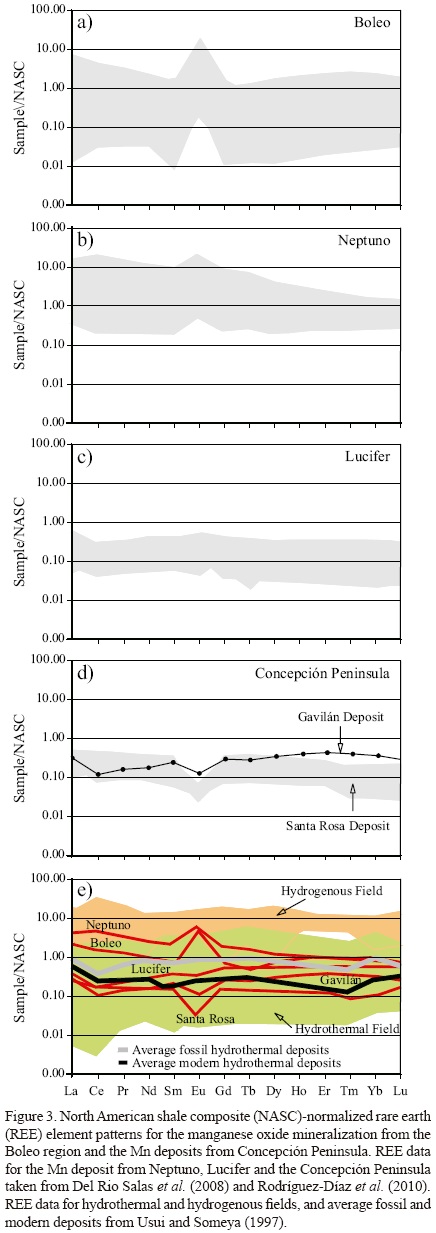
<body><![CDATA[<p align="justify"><font face="verdana" size="2"><b>Major and trace elements in manganese oxides</b></font></p>              <p align="justify"><font face="verdana" size="2">In general, the manganese concentration in manto 4 is greater than the concentrations in mantos 3 and 2 (1.2 to 52.7 wt%), with an average concentration of 25.9 wt%. However, copper concentrations in the manganese oxides are lower than those of mantos 3 and 2, ranging from 0.2 to 8.4 wt%. Zinc and cobalt concentrations range from 0.4 to 1.7 wt%, and 32 to 1600 ppm, respectively.</font></p>              <p align="justify"><font face="verdana" size="2">The manganese concentrations from manto 3 range from 0.8 to 19.7 wt%. The copper concentrations in the manganese oxides are higher than in the rest of the mantos and range from 0.03 to 68 wt%. The zinc and cobalt concentrations are higher than concentrations in manto 4, and range from 0.2 to 1.6 wt% and 393 to 4600 ppm, respectively. Mantos 3A and 2 show lower manganese concentrations (~2.5 wt%), and exhibit lower copper content (5.5 and 13.4 wt%, respectively), and higher cobalt and zinc concentrations than manto 3 and 4 (<a href="/img/revistas/rmcg/v30n3/a2t1.jpg" target="_blank">Table 1</a>).</font></p>              <p align="justify"><font face="verdana" size="2">The REE abundances, normalized to the North American shale composite (NASC) from Gromet <i>et al.</i> (1984), are shown in <a href="#f3">Figure</a><a href="/img/revistas/rmcg/v30n3/a2f3.jpg" target="_blank"> 3</a>. The shaded area in <a href="#f3">Figure 3a</a> represents the REE&#45;normalized trend for the manganese oxides from the different mineralized mantos in the Boleo district. The NASC&#45;normalized La/Sm and Gd/Yb ratios (<a href="/img/revistas/rmcg/v30n3/a2t2.jpg" target="_blank">Table 2</a>) are variable, yielding an average of 2.9 and 1.1, respectively. In general the REE spectrum is relatively flat (<a href="#f3">Figure 3</a>), yielding an average (La/Yb)<sub>n</sub> ratio of 2.4 (<a href="/img/revistas/rmcg/v30n3/a2t2.jpg" target="_blank">Table 2</a>), and is characterized by a positive Eu anomaly.</font></p>              <p align="center"><font face="verdana" size="2"><a name="f3"></a></font></p>              <p align="center"><font face="verdana" size="2"><img src="/img/revistas/rmcg/v30n3/a2f3.jpg">&nbsp;</font></p>              <p align="justify"><font face="verdana" size="2">&nbsp;</font></p>              <p align="justify"><font face="verdana" size="2"><b>Pb and Sr isotopes</b></font></p>              <p align="justify"><font face="verdana" size="2">The lead isotope ratios of the manganese mineralization from manto 4 of the Boleo district are <sup>206</sup>Pb/<sup>204</sup>Pb = 18.726 to 18.8 3 3 , <sup>207</sup>Pb/<sup>204</sup>Pb = 15.589 to 15.595, and <sup>208</sup>Pb/<sup>204</sup>Pb = 38.471 to 38.499. The Pb isotope values for the manganese mineralization from manto 3 are <sup>206</sup>Pb/<sup>204</sup>Pb = 18.708 to 18.800, <sup>207</sup>Pb/<sup>204</sup>Pb = 15.588 to 15.598, and <sup>208</sup>Pb/<sup>204</sup>Pb = 38.452 to 38.511. The lead data in the manganese oxides from manto 3A is <sup>206</sup>Pb/<sup>204</sup>Pb = 18.751, <sup>207</sup>Pb/<sup>204</sup>Pb = 15.591 to 15.593, <sup>208</sup>Pb/<sup>204</sup>Pb = 38.483 to 38.494. A single manganese oxide from manto 2 has <sup>206</sup>Pb/<sup>204</sup>Pb = 18.721, <sup>207</sup>Pb/ <sup>204</sup>Pb = 15.589, <sup>208</sup>Pb/<sup>204</sup>Pb = 38.469.</font></p>              <p align="justify"><font face="verdana" size="2">The lead isotope analysis of manganese oxide from the Lucifer deposit yielded <sup>206</sup>Pb/<sup>204</sup>Pb = 18.743 to 18.788, <sup>207</sup>Pb/<sup>204</sup>Pb = 15.597 to 15.606, <sup>208</sup>Pb/<sup>204</sup>Pb = 38.512 to 38.590. A single lead data of the ASL rocks and a manganese oxide vein from the Gavil&aacute;n deposit have <sup>206</sup>Pb/<sup>204</sup>Pb = 18.621, <sup>207</sup>Pb/<sup>204</sup>Pb = 15.584, <sup>208</sup>Pb/<sup>204</sup>Pb = 38.432, and <sup>206</sup>Pb/<sup>204</sup>Pb = 18.612, <sup>207</sup>Pb/<sup>204</sup>Pb = 15.579, <sup>208</sup>Pb/<sup>204</sup>Pb = 38.421, respectively.</font></p>              ]]></body>
<body><![CDATA[<p align="justify"><font face="verdana" size="2">The Sr isotope data for the manganese oxide mineralization from the Boleo district mantos range from 0.7043 to 0.7067. The strontium isotope data for manganese mineralization from Lucifer deposit range from 0.7050 to 0.7052. The single data for the Neptuno and Gavil&aacute;n deposits are 0.7067 and 0.7052, respectively.</font></p>              <p align="justify"><font face="verdana" size="2">&nbsp;</font></p>              <p align="justify"><font face="verdana" size="2"><b>DISCUSSION</b></font></p>              <p align="justify"><font face="verdana" size="2"><b>Manganese mineralization and hydrothermal activity</b></font></p>              <p align="justify"><font face="verdana" size="2">In the Boleo district, the NW&#45;SE structures constituted by manganese oxides and copper silicates crosscut the Andesite of Sierra Santa Luc&iacute;a (ASL) rocks. Manganese oxide mineralization is also related to the NW&#45;SE structures crosscutting the ASL volcanic rocks in the Lucifer area (Del Rio Salas <i>et al.,</i> 2008). The NW&#45;SE structures served as conducts for the ascent of the mineralizing fluids that were discharged into the Santa Rosal&iacute;a basin. The fact that the mineralizing fluids ascended through these structures is inferred by the juxtaposition of high&#45;grade Cu &plusmn; Co zones and localized discordant to stratabound zones of pervasive Mn&#45;Fe&#45;Si alteration (Conly <i>et al.,</i> 2006).</font></p>              <p align="justify"><font face="verdana" size="2">Equilibration temperatures using the quartz&#45;pyrolusite geothermometer from Zheng (1991) produced a range of temperatures between 18 and 118 &deg;C for the manganese oxide mineralization in the different Boleo mantos (Conly, 2003; Conly <i>et al.,</i> 2006). The mineralogy and geochemical data suggest a conservative mineralization temperature range between 70 and 118 &deg;C.</font></p>          <p align="justify"><font face="verdana" size="2">Late Cenozoic hydrothermal activity along a 200 km segment of the eastern coast of Baja California Sur is evidenced by a series of mineralized localities (<a href="/img/revistas/rmcg/v30n3/a2f1.jpg" target="_blank">Figure 1</a>). North of Tres V&iacute;rgenes volcanic field, evidence of hydro&#45; thermal activity is recorded by the copper and manganese mineralization within the ASL rocks in the San Alberto prospect, and copper mineralization at the Caracol alteration zone (<a href="/img/revistas/rmcg/v30n3/a2f1.jpg" target="_blank">Figure 1</a>). South of Boleo district, the hydrothermal activity is mostly represented by manganese deposits such as Mantitas, Gavil&aacute;n, La Trinidad, Pilares, Las Minitas, Santa Teresa, and Azteca (Bustamante&#45;Garc&iacute;a, 1999; Camprub&iacute; <i>et al.,</i> 2008). Fluid inclusion microthermometry on barite samples from the Mn&#45;Ba Santa Rosa deposit, southern Concepci&oacute;n Peninsula, yielded a temperature range between 97 and 160 &deg;C, with two fluid inclusions population: (1) average T<sub>h</sub> = 136.5 &deg;C and 4.2 wt. % equivalent NaCl, and (2) average T<sub>h</sub> = 136 &deg;C and 11.4 wt. % equivalent NaCl (Rodr&iacute;guez&#45;D&iacute;az <i>et al.,</i> 2010).</font></p>          <p align="justify"><font face="verdana" size="2">The geothermal waters from springs and wells in and around the Tres V&iacute;rgenes and La Reforma caldera fields located north of the Boleo district (<a href="/img/revistas/rmcg/v30n3/a2f1.jpg" target="_blank">Figure 1</a>) are characterized by temperatures from 21 to 98 &deg;C (Portugal <i>et al.,</i> 2000). South of the Boleo district, localities such as Saquicismunde and Los Volcanes (<a href="/img/revistas/rmcg/v30n3/a2f1.jpg" target="_blank">Figure 1</a>), are current examples of hydrothermal activity that may correspond in type to that responsible for the mineralization in the Boleo district. These geothermal emanations are geographically quite dispersed, and all of them share similar geological features such as the structural northwest&#45;southeast control, the evidence of hydrothermal alteration, the occurrence within the Miocene volcanic or volcanoclastic rocks, and the low temperatures range between 38 to 94 &deg;C (Casarrubias and G&oacute;mez&#45;L&oacute;pez, 1994; Bustamante&#45;Garc&iacute;a, 1999; Camprub&iacute; <i>et al.</i>, 2008). Hydrothermal activity is also present along the western coast of Concepci&oacute;n Bay, between the Santispac and the Mapachitos areas (<a href="/img/revistas/rmcg/v30n3/a2f1.jpg" target="_blank">Figure 1</a>). Temperatures of hydrothermal fluids range between 72 to 87 &deg;C in submarine diffusive venting areas (Canet <i>et al.</i>, 2005). Although some of these geothermal emanations occur within the shallow submarine environment (&lt;20 m depth), they share similar features than those exposed above (Prol&#45;Ledesma <i>et al., </i>2004; Canet <i>et al.,</i> 2005).</font></p>              <p align="justify"><font face="verdana" size="2">&nbsp;</font></p>              <p align="justify"><font face="verdana" size="2"><b>Mineralization age</b></font></p>              ]]></body>
<body><![CDATA[<p align="justify"><font face="verdana" size="2">The age of the Boleo Formation in the Santa Rosal&iacute;a region has been previously constrained by Holt <i>et al.</i> (2000). The age was calculated using isotope data in conjunction with magnetostratigraphy, which is correlated with the geomagnetic polarity time scale. The most likely correlation yielded an age of7.09&#45;6.93 Ma for the base and 6.27&#45; 6.14 Ma for the top of the Boleo Formation (Holt <i>et al.,</i> 2000). The manganese mineralization in the Boleo deposit has yielded an age of 7.0 &plusmn; 0.2 Ma (Conly <i>et al.,</i> 2011), which is stratigraphically and chronologically in agreement with the deposition age for the base of the Boleo Formation. Moreover, the manganese mineralization age is also in agreement with the geochronologic data for the underlying lithologic units in the Santa Rosal&iacute;a region, which include the 24&#45;13 Ma ASL, the 11&#45;9 Ma Boleo basalts and Boleo basaltic andesites, and the 9&#45;8 Ma El Morro tuff (Conly <i>et al.,</i> 2005).</font></p>              <p align="justify"><font face="verdana" size="2">Moreover, the Gulf of California region has been subjected to intense volcanism and tectonic activity (Sawlan 1991). Around the Santa Rosal&iacute;a region, Conly <i>et al.</i> (2005) reported K&#45;Ar ages for the high&#45;K andesites from Cerro San Lucas suite, which represents volcanic activity during the transition from arc&#45; to rift magmatism between 9.5 and 7.7 Ma. Furthermore, Pallares <i>et al.</i> (2008) reported geochronologic data supporting the continuation of volcanic activity until the Pleistocene, following the end of the calc&#45;alkaline volcanism northern Santa Rosal&iacute;a region.</font></p>              <p align="justify"><font face="verdana" size="2">&nbsp;</font></p>              <p align="justify"><font face="verdana" size="2"><b>Geochemistry of manganese oxides</b></font></p>              <p align="justify"><font face="verdana" size="2">Discrimination diagrams for the origin of manganese deposits have been proposed on the basis of the cation&#45;adsorption capacity of manganese oxides, considering the concentrations of specific trace elements present in manganese oxides. These discrimination diagrams have been used to distinguish between a hydrothermal (continental or marine) and a hydrogenous origin. The term hydrothermal refers to manganese oxides deposited directly from geo&#45;thermal waters around hot springs and pools in continental environments or sedimentary exhalative manganese mineralization deposited in marine environments (Nicholson, 1992 and references therein). The term hydrogenous refers to deposits formed by slow precipitation or adsorption of dissolved components from seawater (Bonatti <i>et al.,</i> 1972; Crerar <i>et al.,</i> 1982; Nicholson, 1992).</font></p>              <p align="justify"><font face="verdana" size="2">Elements such as Ba, Cu, Ni, Co, Pb, Sr, V, and Zn are frequently found in hydrothermal manganese&#45;rich systems (Nicholson, 1992). These elements are present in significant concentrations in the manganese oxide mineralization from Santa Rosal&iacute;a region and Concepci&oacute;n Peninsula (<a href="/img/revistas/rmcg/v30n3/a2t1.jpg" target="_blank">Table 1</a>). Hydrothermal oxides have lower Co, Cu, Ni, and Zn concentrations, relative to hydrogenous deposits (Nicholson 1992 and references therein); hence, high cobalt concentrations are indicative of marine environments (hydrogenous). Nicholson (1992) proposed discrimination diagram for hydrothermal and supergene manganese oxide deposits based on the abundance of trace elements (<a href="#f4">Figure 4</a>); in this diagram the manganese oxides from marine and freshwater environments are included within the supergene field.</font></p>         <p align="center"><a name="f4"></a></p>         <p align="center"><img src="/img/revistas/rmcg/v30n3/a2f4.jpg"></p>          <p align="justify"><font face="verdana" size="2">Previous studies in Lucifer deposit and the manganese oxides from Concepci&oacute;n Peninsula have documented the hydrothermal nature of the manganese oxide deposits (Canet <i>et</i> al., 2005; Camprub&iacute; <i>et al.,</i> 2008; Del Rio Salas <i>et al.,</i> 2008; Rodr&iacute;guez&#45;D&iacute;az <i>et al.,</i> 2010). In <a href="#f4">Figure 4</a>, the manganese ore samples reported from Baja California Sur and those from the Boleo mantos plot within the hydrothermal field. In general, the samples from Concepci&oacute;n Peninsula are characterized by lower Co and Ni concentrations, like those from the Lucifer deposit (<a href="#f4">Figure 4</a>). The data from the Neptuno area plot above the Lucifer and the Concepci&oacute;n Peninsula deposits, and are characterized by higher concentrations of Co and Ni. The Boleo manto samples are relatively richer in Co and Ni compared with the samples mentioned before. Within the Boleo samples, it is possible to notice a relative enrichment from manto 4 to manto 2. The trace element concentrations in the manganese oxides indicate a clear hydrothermal origin for all manganese deposits in the Santa Rosal&iacute;a region and the Concepci&oacute;n Peninsula.</font></p>              <p align="justify"><font face="verdana" size="2">The shaded area in <a href="#f3">Figure</a><a href="/img/revistas/rmcg/v30n3/a2f3.jpg" target="_blank"> 3a</a> represents the NASC&#45;normalized REE spectrum for the manganese oxides in the Boleo mantos. No particular difference is observed in the REE enrichment of the different the mantos; the entire spectrum is relatively flat and displays a subtle enrichment of the light rare earth element (LREE) over the heavy rare earth element (HREE), as pointed out with the normalized La/Yb ratios, as well as the noticeable positive Eu anomaly. The normalized REE spectrum of the manganese mineralization from Neptuno area displays also a positive Eu anomaly with relatively flat trends, except for sample LF&#45;46, which is the most enriched in the LREE relative to the NASC, as noticed by the high normalized La/Yb ratio (<a href="/img/revistas/rmcg/v30n3/a2t2.jpg" target="_blank">Table 2</a>) (Del Rio Salas <i>et al.,</i> 2008). The REE pattern of the manganese oxides from Lucifer deposit is flat (<a href="#f3">Figure</a><a href="/img/revistas/rmcg/v30n3/a2f3.jpg" target="_blank"> 3c</a>) as noticed by an average normalized La/Yb ratio of 2.0 (<a href="/img/revistas/rmcg/v30n3/a2t2.jpg" target="_blank">Table 2</a>), and they signatures are characterized by the absence of either positive or negative Ce or Eu anomalies (Del Rio Salas <i>et al.,</i> 2008).</font></p>              ]]></body>
<body><![CDATA[<p align="justify"><font face="verdana" size="2">The available REE data for the manganese oxides from Concepci&oacute;n Peninsula are presented in <a href="#f3">Figure 3d</a>. A sample from the Gavil&aacute;n deposit has REE concentrations that are lower than NASC, and a relatively flat REE pattern with an average normalized La/Yb of 0.9, and slightly negative Ce and Eu anomalies (<a href="#f3">Figure</a> <a href="#f3">3d</a>) (Del Rio Salas <i>et al.,</i> 2008). <a href="#f3">Figure 3d</a> also shows the REE data from Santa Rosa manganese oxides, which is depleted in REE with respect to NASC, and has a relatively flat spectrum with slightly Ce and clear Eu negative anomalies (<a href="#f3">Figure 3d</a>) (Rodr&iacute;guez&#45;D&iacute;az <i>et al.,</i> 2010). In general, the available REE data of the manganese oxides from Concepci&oacute;n Peninsula exhibit relatively flat patterns, characterized by slightly negative Ce and Eu anomalies.</font></p>              <p align="justify"><font face="verdana" size="2"><a href="/img/revistas/rmcg/v30n3/a2t4.jpg" target="_blank">Table 4</a> shows the average of the total REE abundances of various manganese oxide deposits of hydrothermal and hydrogenous nature. The total REE concentrations in hydrothermal deposits range from 45 to 648 ppm, whereas those for hydrogenous deposits range from 1208 to 1918 ppm (Glasby <i>et al.,</i> 1997; Miura and Hariya, 1997; Nath <i>et al.,</i> 1992; Nath <i>et al.</i>, 1997; Usui and Someya, 1997; Wiltshire <i>et al.,</i> 1999). The average of the total REE for the Boleo mantos ranges from 50 to 270 ppm and produce an average of 215 ppm. The average total REE for the manganese oxides from Neptuno area is around 560 ppm; sample LF&#45;46 is characterized by a total REE around 1900 ppm, and excluding this particular sample, the average of total REE is 220 ppm. The average total REE for Lucifer and the deposits in Concepci&oacute;n Peninsula ranges from 25 to 37 ppm.</font></p>              <p align="justify"><font face="verdana" size="2"><a href="#f3">Figure 3e</a> shows the NASC&#45;normalized REE patterns for manganese oxides from hydrogenous and hydrothermal deposits from Usui and Someya (1997). The pattern for the hydrogenous deposits is enriched relative to the NASC values, whereas the pattern for the hydrothermal deposits is either depleted or slightly enriched than NASC values. This figure also shows the spectrum for the average modern and fossil hydrothermal deposits from Usui and Someya (1997). In addition, this figure includes the average NASC&#45;normalized REE spectra from the manganese deposits from the Boleo and adjacent areas, which are included within the hydrothermal field. The average REE patterns for the Lucifer and Santa Rosa deposits are the most depleted in REE and agree with the average modern hydrothermal deposits. The REE signature of the Gavil&aacute;n deposit is located between the average modern and average fossil hydrothermal deposits. Finally, the REE signatures for the Boleo and Neptuno deposits are slightly more enriched in REE than the average fossil hydrothermal deposits, but still located within the hydrothermal field (<a href="#f3">Figure 3e</a>).</font></p>              <p align="justify"><font face="verdana" size="2">In general, NASC&#45;normalized REE patterns for the manganese mineralization around the Boleo district and Concepci&oacute;n Peninsula are relatively flat as noticed from the consistent normalized La/Sm, Gd/Yb, and La/Yb ratios. The REE patterns of the Boleo district and Neptuno area show middle REE enrichment (<a href="#f3">Figure</a><a href="/img/revistas/rmcg/v30n3/a2f3.jpg" target="_blank"> 3</a> a and <a href="#f3">3b</a>), which can be characteristic of hydrogenous manganese samples (Nath <i>et al.,</i> 1992, 1997). Also, the REE patterns exhibit very distinctive positive Eu anomalies, which is a characteristic feature of modern hydrothermal deposits in the ocean (Hodkinson <i>et al.,</i> 1994), as opposed to the REE signature of seawater, which exhibits a negative Ce anomaly and a slight enrichment of the HREE over the LREE (Douville <i>et al.,</i> 1999). Although the mineralization in these deposits is not properly from hydrothermal activity in a marine environment, the Eu enrichment in the manganese ores can be explained by the presence of plagioclase in the fine&#45;grained sediments derived from the ASL rocks. The mobility of Eu depends strongly on redox and temperature conditions (Michard <i>et</i> al., 1983), and Eu enrichment involves hot and reduced fluids, whereas Eu depletion involves cold and oxidizing fluids (Parr, 1992; Canet <i>et al.,</i> 2005). Since each manto experienced such redox conditions, a positive Eu anomaly can be explained by the cyclical hydrothermal activity related to the formation of each manto. Moreover, these samples are located within the field of hydrothermal field deposits (<a href="#f3">Figure</a><a href="/img/revistas/rmcg/v30n3/a2f3.jpg" target="_blank"> 3</a>), and the hydrothermal nature is also confirmed by the total REE in <a href="/img/revistas/rmcg/v30n3/a2t4.jpg" target="_blank">Table 4</a>.</font></p>          <p align="justify"><font face="verdana" size="2">The NASC&#45;normalized REE patterns for the manganese ores from the Lucifer and the manganese deposits from Concepci&oacute;n Peninsula agree with the spectra of the average hydrothermal deposits (Usui and Someya 1997); only the average of total REE for the Gavil&aacute;n deposit exhibits a subtle enrichment especially in the HREE relative to the average of modern hydrothermal deposits (<a href="#f3">Figure</a><a href="/img/revistas/rmcg/v30n3/a2f3.jpg" target="_blank"> 3e</a>). Hydrogenous manganese deposits are characterized by a positive Ce anomaly (Fleet, 1983), as a result of the oxidation of Ce<sup>3</sup>+ to Ce<sup>4</sup>+, which forms highly insoluble CeO<sub>2</sub> in seawater (Elderfield and Greaves, 1981; Fleet, 1983; Nath <i>et al.,</i> 1997; Canet <i>et al.,</i> 2008). Conversely a negative Ce anomaly is characteristic of hydrothermal Fe&#45;Mn deposits (Fleet, 1983). The slightly negative Eu could be explained by cold and oxidizing fluids (Parr, 1992), as previously reported for the recent Mn mineralization in Concepci&oacute;n Bay (Canet <i>et al.,</i> 2005). Furthermore, the total REE content of these deposits confirms their hydrothermal nature when compared to other hydrothermal deposits in <a href="/img/revistas/rmcg/v30n3/a2t4.jpg" target="_blank">Table 4</a>.</font></p>          <p align="justify"><font face="verdana" size="2">In summary, trace element and REE geochemistry in the manganese oxides from the Boleo district and Concepci&oacute;n peninsula, demonstrates the hydrothermal nature of the ores (<a href="#f3">Figure</a><a href="#f3" target="_blank">s 3</a> and <a href="#f4">4</a>). The REE enrichments for the Boleo mantos and Neptuno mineralization can be explained by mixing of hydrothermal and hydrogenous sources or by supergene processes.</font></p>              <p align="justify"><font face="verdana" size="2">&nbsp;</font></p>             <p align="justify"><font face="verdana" size="2"><b>Metal sources</b></font></p>             <p align="justify"><font face="verdana" size="2">Lead and strontium isotope data for the Peninsular Ranges batholith and the volcanic rocks in Santa Rosal&iacute;a region, the Boleo conglomerate, and the sulfide and manganese oxide mineralization have been reported previously by Conly (2003) and Conly <i>et al.</i> (2005, 2006, and 2011). The present study contributes with Pb and Sr isotope data for the lithologic units and the manganese oxide mineralization from the different mantos in the Boleo district as well as for the mineralized zones around the Santa Rosal&iacute;a region (<a href="#t3">Table 3</a>). The lead isotope fields for the lithologic units and manganese oxide mineralization are shown in <a href="/img/revistas/rmcg/v30n3/a2f5.jpg" target="_blank">Figure 5</a> (Conly <i>et al.,</i> 2005 and 2011; present study).</font></p>          <p align="justify"><font face="verdana" size="2"><a href="/img/revistas/rmcg/v30n3/a2f5.jpg" target="_blank">Figure 5</a> shows that the Pb isotope data for the manganese oxide mineralization from the Boleo district reported in the present study are located inside and below the fields for the ASL and Boleo Formation rocks, with the <sup>207</sup>Pb/<sup>204</sup>Pb ratios constrained to a limited range between 15.583 and 15.608, and between 38.440 to 38.590 for the <sup>208</sup>Pb/<sup>204</sup>Pb ratio, vaguely deviated from the ASL field and at lower Pb&#45;isotope ratios than those of the Peninsular Ranges batholith, which suggests that the principal source of metals in the different mantos in the Boleo district and the manganese mineralization in the Neptuno is mainly the ASL volcanic rocks.</font></p>              ]]></body>
<body><![CDATA[<p align="justify"><font face="verdana" size="2">Despite the scarcity of isotopic data for the rift&#45;related rock suite, according to the data for a single sample from the Boleo basalt reported in this study, along with the data for the Cerro San Lucas volcanic rocks, whose <sup>206</sup>Pb/<sup>204</sup>Pb ratios range from 18.43 to 18.61 (Conly, 2003), the rift&#45;related suite rocks are characterized by less radiogenic lead, which suggests that the volcanism related to the rifting of the Gulf of California is not contributing to the metal budget in the mineralized areas reported in the present study.</font></p>              <p align="justify"><font face="verdana" size="2">The lead isotope data for the manganese oxides from Lucifer deposit are located within the field of the ASL rocks; however there is a trend towards the Peninsular Ranges batholith member. This suggests that the mineralizing fluids for Lucifer deposit are the result of mixing processes between the ASL and the Peninsular Ranges batholith rocks. This interpretation is supported by field observations along the Arroyo del Infierno in Lucifer area, where the Peninsular Ranges batholith is found underlying the ASL rocks; also, some ASL rocks contain xenoliths of the Peninsular Ranges batholith. In contrast, lead isotope data for the Boleo manganese oxides suggest negligible mixing processes between the ASL and batholith rocks, basically because the ALS rocks act as the basement in the Boleo district.</font></p>              <p align="justify"><font face="verdana" size="2">Lead isotope measurement of a single sample from the Gavil&aacute;n deposit in Concepci&oacute;n Peninsula, indicate that the ASL rocks in that area are less radiogenic that those from the Santa Rosal&iacute;a region (<a href="/img/revistas/rmcg/v30n3/a2f5.jpg" target="_blank">Figure 5a</a>), suggesting slight isotopic differences for the sources involved in the genesis of the ASL rocks trend along Baja California (<a href="/img/revistas/rmcg/v30n3/a2f1.jpg" target="_blank">Figure 1</a>). An alternative explanation for the less radiogenic nature of the ASL rocks in the Gavil&aacute;n deposit is the possibility of the continuation of the regional isotope trend of the ASL rocks from the Boleo district; this is probably reflecting the less radiogenic nature of the underlying rocks along this segment of the Baja California Peninsula. The manganese oxide sample from the Gavil&aacute;n deposit exhibits the same isotopie signature as the ASL rocks, suggesting that the source of metals in the mineralized zones is in the ASL rocks.</font></p>              <p align="justify"><font face="verdana" size="2">The similarity of the <sup>206</sup>Pb/<sup>204</sup>Pb ratios of the manganese oxides and manto sulfides demonstrate that the fluids responsible for the Cu&#45;Co&#45;Zn mineralization are similar to those that precipitated the Mn oxides of the Boleo district, although significant differences are noted in the <sup>208</sup>Pb/<sup>204</sup>Pb and <sup>207</sup>Pb/<sup>204</sup>Pb ratios suggesting a more radiogenic lead in the manganese oxides than in the manto sulfides (Conly <i>et al.</i> 2011). The slight shift to higher <sup>206</sup>Pb/<sup>207</sup>Pb ratios of the Boleo manto sulfides is interpreted as the result of the interaction of Pb from basin seawater with ferromagnesian minerals from the arc&#45;to&#45;rift volcanic rocks and <sup>206</sup>Pb/<sup>207</sup>Pb&#45;enriched seawater fluids that interacted with the Cretaceous quartz&#45;monzonite basement (Conly <i>et al.</i> 2011). The higher <sup>206</sup>Pb/<sup>207</sup>Pb ratios of the Boleo manganese mineralization suggest diagenetic alteration by sedimentary pore waters due to the interaction with Th&#45;rich fluids (Conly <i>et al.</i>, 2011). However, the new lead isotope data of the Boleo manganese oxides from the different mineralized mantos overlap the isotope fields for the ASL and the Boleo Formation rocks, suggesting similarities in the lead isotope ratios, and therefore an alternative explanation is that the metals involved in the manganese oxide mineralization in the Boleo mantos were leached from the ASL and Boleo Formation rocks (<a href="/img/revistas/rmcg/v30n3/a2f5.jpg" target="_blank">Figures 5a</a> and <a href="/img/revistas/rmcg/v30n3/a2f5.jpg" target="_blank">5b</a>). The lead isotope field for the Boleo manto sulfides partially overlaps those of the Boleo manganese oxides, the ALS, and the Boleo Formation rocks, which suggests a source with similar isotopic composition for the metals. The isotopic shift can be explained by modifications in the isotope signature due to interactions with post&#45;depositional fluids, which can be easily explained by the fine&#45;grained nature (&lt;50 &#181;m) of the sulfide mineralization (Conly <i>et al.,</i> 2006).</font></p>              <p align="justify"><font face="verdana" size="2"><a href="#f6">Figure 6</a> shows the strontium and lead isotope compositions of the lithologic units and manganese oxides. In general the <sup>87</sup>Sr/<sup>86</sup>Sr and <sup>206</sup>Pb/<sup>204</sup>Pb isotope ratios for the ASL rocks and the Peninsular Ranges batholith have a constrained range and form a restricted field, as oppose to the rift&#45;related rocks, which are characterized by lower <sup>87</sup>Sr/<sup>86</sup>Sr ratios and less radiogenic lead. The most elevated <sup>87</sup>Sr/<sup>86</sup>Sr ratios belong to the gypsum member of the Boleo Formation, which clearly has an important component of seawater as indicated by the Sr isotope composition of seawater at the time of deposition around 7 Ma (<a href="#f6">Figure 6</a>) (McArthur <i>et al.,</i> 2001; Conly <i>et al.</i> 2011).</font></p>              <p align="center"><font face="verdana" size="2"><a name="f6"></a></font></p>          <p align="center"><font face="verdana" size="2"><img src="/img/revistas/rmcg/v30n3/a2f6.jpg"></font></p>          <p align="justify"><font face="verdana" size="2">The manganese oxide mineralization from the Boleo district and surrounding areas is clearly located on a mixing trend between the high <sup>87</sup>Sr/<sup>86</sup>Sr gypsum end&#45;member and the low <sup>87</sup>Sr/<sup>86</sup>Sr ASL and Peninsular Ranges batholith end&#45;member (<a href="#f6">Figure 6</a>). The elevated <sup>87</sup>Sr/<sup>86</sup>Sr ratios in the manganese oxides from Boleo district indicate the incorporation of more radiogenic strontium in the mineralizing fluids, and could suggests an important involvement of seawater fluids during the formation of the mantos. The most probable explanation for the <sup>87</sup>Sr/<sup>86</sup>Sr ratios is the interaction of the ascending fluids with the gypsum member located stratigraphically below the clastic sequence that hosts the mineralized mantos (<a href="/img/revistas/rmcg/v30n3/a2f2.jpg" target="_blank">Figure 2</a>). The isotope field for the manganese oxides from Lucifer deposit is closer to the more radiogenic members of the ASL rocks and Peninsular Ranges batholith, suggesting that the involvement of seawater fluids during the mineralization processes was minimal.</font></p>          <p align="justify"><font face="verdana" size="2">The manganese oxides from the Gavil&aacute;n deposit in Concepci&oacute;n Peninsula show <sup>87</sup>Sr/<sup>86</sup>Sr similar to those from Lucifer deposit and a <sup>206</sup>Pb/<sup>204</sup>Pb isotope ratio within the range of ASL rocks (Conly, 2003; Conly <i>et al.</i> 2005, 2006, and 2011) and the more radiogenic end&#45;member of the rift&#45;related rocks (Conly, 2003; Conly <i>et al.</i> 2005, 2006, and 2011) (<a href="#f6">Figure 6</a>). The Sr isotope signature of the ASL rocks in Concepci&oacute;n Peninsula is similar to that of the manganese oxide from Lucifer deposit; therefore, a minimal interaction with seawater is interpreted for the manganese oxide mineralizing fluids. The lead and strontium isotope signatures of the manganese oxides clearly shows that the rift&#45;related volcanics are not the source of metals for the manganese mineralization, and that the ASL rocks undoubtedly act as the most important source, with a minor role of the Peninsular Ranges batholith rocks.</font></p>              <p align="justify"><font face="verdana" size="2">&nbsp;</font></p>             ]]></body>
<body><![CDATA[<p align="justify"><font face="verdana" size="2"><b>Manganese oxide mineralization and regional implication</b></font></p>             <p align="justify"><font face="verdana" size="2">The constraints on the genesis of the manganese oxides along the eastern coast of Baja California contributes to the understanding of metallogenetic processes during the proto&#45;rift to rifting tectonics of the Gulf of Baja California. Hydrothermal activity and manganese oxide mineralization is recorded along a stretch of 200 km on the eastern coast from Lucifer deposit, located in the northwestern portion, to the Cerro Mencenares volcanic field, located in the southeastern portion (<a href="/img/revistas/rmcg/v30n3/a2f1.jpg" target="_blank">Figure 1</a>).</font></p>              <p align="justify"><font face="verdana" size="2">The most reliable age for the manganese oxides from the Boleo district is obtained from a hydrothermal manganese oxide&#45;quartz vein hosted in manto 4, constrained to 7 Ma, which is within the range of the Boleo Formation deposition age (Conly <i>et al.,</i> 2011). Lucifer deposit correlates with manto 4 of the Boleo district, and is considered to have been located within the margin zones of the basin when the Boleo Formation was deposited (Del Rio Salas <i>et al.</i>, 2008). Therefore, on the basis of geological correlation and fieldwork observations, a similar manganese oxide age (~7 Ma) is interpreted for the Lucifer deposit. This age is also consistent with the geochronological constraints for the 24&#45;13 Ma volcanic rocks of Andesita of Sierra Santa Luc&iacute;a (Sawlan and Smith, 1984; Conly <i>et al.,</i> 2005) that is hosting manganese oxide veins underlying the Lucifer deposit.</font></p>              <p align="justify"><font face="verdana" size="2">In contrast, the southern manganese mineralization, such as those in Santa Rosa and Juanico, is constrained to Pliocene structures (Gonz&aacute;lez&#45;Reyna, 1956; Ter&aacute;n&#45;Ortega and &Aacute;valos&#45;Zerme&ntilde;o, 1993; Umhoefer <i>et al.</i>, 2002), therefore, the hydrothermal activity responsible for the manganese mineralization in this area is younger than the geochronologic data reported for the Boleo district by Conly <i>et al.</i> (2011). In addition to this, volcanic activity such as the Pliocene Mencenares volcanic center is reported to be coeval with the manganese mineralization (Bigioggero <i>et</i> al., 1995), which suggests the migration of the mineralization activity to the south of the Boleo district, as evidenced also by the present day hydrothermal activity reported in Concepcion Bay by Prol&#45;Ledesma <i>et al.</i> (2004).</font></p>              <p align="justify"><font face="verdana" size="2">The geology and the available geochronological data suggest a southward migration of the hydrothermal processes related to the evolving tectonic regime of the opening of the Gulf of California. In detail, such southward migration is recorded at a smaller scale within the Santa Rosal&iacute;a basin, where the southward migration, due to the basin subsidence, is recorded by the presence of the first two sedimentary cycles (4 and 3) in the north sub&#45;basin, whereas the last sedimentary cycles (2 to 0) are present in both north and south sub&#45;basins (Conly <i>et al.,</i> 2006). The migration of the hydrothermal activity can be explained as a response of the regional southward trend of Proto&#45;Gulf extension (Stock and Hodges, 1989).</font></p>              <p align="justify"><font face="verdana" size="2">The lead isotope systematics support the southward migration by the isotopic trend from a more radiogenic end&#45;member to a less radiogenic end&#45;member that geographically correspond to the Peninsular Ranges batholith located in northwestern portion, and to Concepci&oacute;n Peninsula in the southeastern portion, respectively (<a href="/img/revistas/rmcg/v30n3/a2f5.jpg" target="_blank">Figure 5b</a>). The available lead isotope data suggests a migration of the hydrothermal processes where: 1) the metals were leached mostly from ASL rocks with minor involvement Peninsular Ranges batholith in the southern manganese oxide localities, and 2) the thermal energy was supplied by magmatism, or by the increase of geothermal gradient related to crustal thinning, or a combination of both, related to the evolving context of the opening of the Gulf of California. More lead isotope data are needed to support the proposed migration, especially in younger manganese oxide localities of the southeastern areas <i>(i.e.</i> Santa Rosa and Juanico).</font></p>              <p align="justify"><font face="verdana" size="2">&nbsp;</font></p>              <p align="justify"><font face="verdana" size="2"><b>CONCLUSIONS</b></font></p>              <p align="justify"><font face="verdana" size="2">The geological context, the hydrothermal activity, and the Mn mineralization in the Boleo district, in conjunction with the manganese deposits of the eastern coast of Baja California, confirm the strong relationship between metal&#45;logenetic processes and the evolution of the proto&#45;rift to rifting tectonics of the Gulf of Baja California</font></p>              <p align="justify"><font face="verdana" size="2">The trace element concentrations in the manganese oxides from the Boleo mantos, in conjunction with those for the manganese mineralization from Lucifer, Neptuno, and the manganese deposits from Concepci&oacute;n Peninsula, demonstrate the hydrothermal origin and the exhalative nature for all manganese deposits reported in the present study. The REE geochemistry in the manganese oxides supports the hydrothermal nature and excludes the hydrogenous nature for the manganese oxides.</font></p>              ]]></body>
<body><![CDATA[<p align="justify"><font face="verdana" size="2">Lead isotopes demonstrate that the sources for the ore metals in the Santa Rosal&iacute;a region are the ASL rocks and the Peninsular Ranges batholith. In contrast, the early&#45;rift volcanic rocks, which are nearly coeval with the mineralization, do not contribute with metals for the ore&#45;forming processes, although they could have contributed with thermal energy to promote the hydrothermal activity. The lead isotope systematics also support a southward migration of the hydrothermal processes, indicated by the isotopic trend from a more radiogenic end&#45;member to a less radiogenic end&#45;member, from Lucifer deposit located at the northwest, to Concepci&oacute;n Peninsula in the southeastern portion. Field observations and Pb and Sr isotope signatures show that the fluids involved in the Mn mineralization from the Boleo district are essentially hydrothermal and exhalative in origin; the isotope signatures show that mineralizing fluids interacted with two end&#45;members: 1) ASL rocks and the Peninsular Ranges batholith, and 2) the gypsum member of the Boleo Formation. The isotope data supports a less radiogenic nature for the fluids involved in the genesis of the manganese oxides from Lucifer in the Boleo area and Gavil&aacute;n in the Concepci&oacute;n Peninsula, suggesting less involvement of seawater fluids.</font></p>              <p align="justify"><font face="verdana" size="2">&nbsp;</font></p>              <p align="justify"><font face="verdana" size="2"><b>ACKNOWLEDGMENTS</b></font></p>              <p align="justify"><font face="verdana" size="2">This research was supported by the Consejo Nacional de Ciencia y Tecnolog&iacute;a (CONACYT) grant 166600. We are thankful to Francisco Escand&oacute;n for the earlier support and helpful discussions. We are also thankful to Baja Mining Corp by the logistical and fieldwork assistance, especially to Tawn Albinson, Roberto Gast&eacute;lum, Elisiel Moreno, and Lorenzo Ruiz. Finally, we would like to thank Andrew Conly, Nursel Oksuz, and Carles Canet for their revisions and constructive comments.</font></p>              <p align="justify"><font face="verdana" size="2">&nbsp;</font></p>              <p align="justify"><font face="verdana" size="2"><b>REFERENCES</b></font></p>              <!-- ref --><p align="justify"><font face="verdana" size="2">Atwater, T., 1989, Plate tectonic history, northeastern Pacific and western North America, <i>in</i> Winterer E.L., Hussong D.M., Decker R.W. (eds.), The eastern Pacific Ocean and Hawaii: Geological Society of America, The Geology of North America, v. N, 21&#45;72.    &nbsp;&nbsp;&nbsp;&nbsp;&nbsp;&nbsp;&nbsp;&nbsp;[&#160;<a href="javascript:void(0);" onclick="javascript: window.open('/scielo.php?script=sci_nlinks&ref=8091778&pid=S1026-8774201300030000200001&lng=','','width=640,height=500,resizable=yes,scrollbars=1,menubar=yes,');">Links</a>&#160;]<!-- end-ref --></font></p>              <!-- ref --><p align="justify"><font face="verdana" size="2">Bailes, R.J., Christoffersen, J.E., Escandon, V.F., Peatfield, G.R., 2001, Sediment&#45;hosted deposits of the Bol&eacute;o copper&#45;cobalt&#45;zinc district, Baja California Sur, Mexico, <i>in</i> Albinson, T., Nelson, C.E. (eds), New mines and discoveries in Mexico and Central America: Society of Economic Geologist, Special Publication 8, 291&#45;306.    &nbsp;&nbsp;&nbsp;&nbsp;&nbsp;&nbsp;&nbsp;&nbsp;[&#160;<a href="javascript:void(0);" onclick="javascript: window.open('/scielo.php?script=sci_nlinks&ref=8091780&pid=S1026-8774201300030000200002&lng=','','width=640,height=500,resizable=yes,scrollbars=1,menubar=yes,');">Links</a>&#160;]<!-- end-ref --></font></p>              ]]></body>
<body><![CDATA[<!-- ref --><p align="justify"><font face="verdana" size="2">Bigioggero, B., Chiesa, S., Zanchi, A., Montrasio, A., Vezzoli, L., 1995, The Cerro Mencenares volcanic center, Baja California Sur: Source and tectonic control on postsubduction magmatism within the Gulf Rift: Geological Society of America Bulletin, 107, 1108&#45;1122.    &nbsp;&nbsp;&nbsp;&nbsp;&nbsp;&nbsp;&nbsp;&nbsp;[&#160;<a href="javascript:void(0);" onclick="javascript: window.open('/scielo.php?script=sci_nlinks&ref=8091782&pid=S1026-8774201300030000200003&lng=','','width=640,height=500,resizable=yes,scrollbars=1,menubar=yes,');">Links</a>&#160;]<!-- end-ref --></font></p>              <!-- ref --><p align="justify"><font face="verdana" size="2">Bonatti, E., Kraemer, T., Rydell, H., 1972, Classification and genesis of submarine iron&#45;manganese deposits, <i>in</i> Horn, D. (ed.), Ferromanganese deposits on the ocean floor: Washington, D. C., National Science Foundation, 149&#45;166.    &nbsp;&nbsp;&nbsp;&nbsp;&nbsp;&nbsp;&nbsp;&nbsp;[&#160;<a href="javascript:void(0);" onclick="javascript: window.open('/scielo.php?script=sci_nlinks&ref=8091784&pid=S1026-8774201300030000200004&lng=','','width=640,height=500,resizable=yes,scrollbars=1,menubar=yes,');">Links</a>&#160;]<!-- end-ref --></font></p>              <!-- ref --><p align="justify"><font face="verdana" size="2">Bustamante Garc&iacute;a, J., 1999, Monograf&iacute;a Geol&oacute;gico&#45;Minera del Estado de Baja California Sur: M&eacute;xico, Secretar&iacute;a de Comercio y Fomento Industrial, Coordinaci&oacute;n General de Miner&iacute;a, 180 pp.    &nbsp;&nbsp;&nbsp;&nbsp;&nbsp;&nbsp;&nbsp;&nbsp;[&#160;<a href="javascript:void(0);" onclick="javascript: window.open('/scielo.php?script=sci_nlinks&ref=8091786&pid=S1026-8774201300030000200005&lng=','','width=640,height=500,resizable=yes,scrollbars=1,menubar=yes,');">Links</a>&#160;]<!-- end-ref --></font></p>              <!-- ref --><p align="justify"><font face="verdana" size="2">Camprub&iacute;, A., Canet, C., Rodr&iacute;guez&#45;D&iacute;az, A., Prol&#45;Ledesma, R, Blanco&#45;Florido, D., Villanueva, R., L&oacute;pez&#45;S&aacute;nchez, A., 2008, Geology, ore deposits and hydrothermal venting in Bah&iacute;a Concepci&oacute;n, Baja California Sur, Mexico: Island Arc, 17, 6&#45;25.    &nbsp;&nbsp;&nbsp;&nbsp;&nbsp;&nbsp;&nbsp;&nbsp;[&#160;<a href="javascript:void(0);" onclick="javascript: window.open('/scielo.php?script=sci_nlinks&ref=8091788&pid=S1026-8774201300030000200006&lng=','','width=640,height=500,resizable=yes,scrollbars=1,menubar=yes,');">Links</a>&#160;]<!-- end-ref --></font></p>              <!-- ref --><p align="justify"><font face="verdana" size="2">Canet, C., Prol&#45;Ledesma, R.M., Proenza, J., Rubio&#45;Ramos, M.A., Forrest, M.J., Torres&#45;Vera, M.A., Rodr&iacute;guez&#45;D&iacute;az, A., 2005, Mn&#45;Ba&#45;Hg mineralization at shallow submarine hydrothermal vents in Bah&iacute;a Concepci&oacute;n, Baja California Sur, Mexico: Chemical Geology 224, 96&#45;112.    &nbsp;&nbsp;&nbsp;&nbsp;&nbsp;&nbsp;&nbsp;&nbsp;[&#160;<a href="javascript:void(0);" onclick="javascript: window.open('/scielo.php?script=sci_nlinks&ref=8091790&pid=S1026-8774201300030000200007&lng=','','width=640,height=500,resizable=yes,scrollbars=1,menubar=yes,');">Links</a>&#160;]<!-- end-ref --></font></p>              ]]></body>
<body><![CDATA[<!-- ref --><p align="justify"><font face="verdana" size="2">Canet, C., Prol&#45;Ledesma, R.M., Bandy, W.L., Schaaf, P., Linares, C., Camprub&iacute;, A., Tauler, E., Mortera&#45;Guti&eacute;rrez, C., 2008, Mineralogical and geochemical constraints on the origin of ferromanganese crusts from the Rivera Plate (western margin of Mexico): Marine Geology, 251, 47&#45;59.    &nbsp;&nbsp;&nbsp;&nbsp;&nbsp;&nbsp;&nbsp;&nbsp;[&#160;<a href="javascript:void(0);" onclick="javascript: window.open('/scielo.php?script=sci_nlinks&ref=8091792&pid=S1026-8774201300030000200008&lng=','','width=640,height=500,resizable=yes,scrollbars=1,menubar=yes,');">Links</a>&#160;]<!-- end-ref --></font></p>              <!-- ref --><p align="justify"><font face="verdana" size="2">Casarrubias, U.Z., G&oacute;mez&#45;L&oacute;pez, G., 1994, Geolog&iacute;a y evaluaci&oacute;n geot&eacute;rmica de la zona de Bah&iacute;a Concepci&oacute;n, Baja California Sur, M&eacute;xico, <i>in</i> Res&uacute;menes de la 3a Reuni&oacute;n Internacional sobre geolog&iacute;a de la Pen&iacute;nsula de Baja California: La Paz Baja California Sur, M&eacute;xico, Universidad Aut&oacute;noma de Baja California Sur, 22&#45;23.    &nbsp;&nbsp;&nbsp;&nbsp;&nbsp;&nbsp;&nbsp;&nbsp;[&#160;<a href="javascript:void(0);" onclick="javascript: window.open('/scielo.php?script=sci_nlinks&ref=8091794&pid=S1026-8774201300030000200009&lng=','','width=640,height=500,resizable=yes,scrollbars=1,menubar=yes,');">Links</a>&#160;]<!-- end-ref --></font></p>              <!-- ref --><p align="justify"><font face="verdana" size="2">Chesley, J., Ruiz, J., Righter, K., Ferrari, L., G&oacute;mez&#45;Tuena, A., 2002. Source contamination versus assimilation: an example from the Trans&#45;Mexican volcanic arc: Earth and Planet Science Letters, 195, 211&#45;221.    &nbsp;&nbsp;&nbsp;&nbsp;&nbsp;&nbsp;&nbsp;&nbsp;[&#160;<a href="javascript:void(0);" onclick="javascript: window.open('/scielo.php?script=sci_nlinks&ref=8091796&pid=S1026-8774201300030000200010&lng=','','width=640,height=500,resizable=yes,scrollbars=1,menubar=yes,');">Links</a>&#160;]<!-- end-ref --></font></p>              <!-- ref --><p align="justify"><font face="verdana" size="2">Conly, A.G., 2003, Origin of the Boleo Cu&#45;Co&#45;Zn deposit, Baja California Sur, M&eacute;xico: Implications for the interaction of magmatic&#45;hydrothermal fluids in a low&#45;temperature hydrothermal system: Toronto, Canada, University of Toronto, Ph.D. Thesis, 433 pp.    &nbsp;&nbsp;&nbsp;&nbsp;&nbsp;&nbsp;&nbsp;&nbsp;[&#160;<a href="javascript:void(0);" onclick="javascript: window.open('/scielo.php?script=sci_nlinks&ref=8091798&pid=S1026-8774201300030000200011&lng=','','width=640,height=500,resizable=yes,scrollbars=1,menubar=yes,');">Links</a>&#160;]<!-- end-ref --></font></p>              <!-- ref --><p align="justify"><font face="verdana" size="2">Conly, A.G., Brenan, J.M., Bellon, H., Scott, S.D., 2005, Arc to rift transitional volcanism in the Santa Rosal&iacute;a region, Baja California Sur, M&eacute;xico: Journal of Volcanology and Geothermal Research, 142, 303&#45;341.    &nbsp;&nbsp;&nbsp;&nbsp;&nbsp;&nbsp;&nbsp;&nbsp;[&#160;<a href="javascript:void(0);" onclick="javascript: window.open('/scielo.php?script=sci_nlinks&ref=8091800&pid=S1026-8774201300030000200012&lng=','','width=640,height=500,resizable=yes,scrollbars=1,menubar=yes,');">Links</a>&#160;]<!-- end-ref --></font></p>              ]]></body>
<body><![CDATA[<!-- ref --><p align="justify"><font face="verdana" size="2">Conly, A.G., Beaudoin, G., Scott, S.D., 2006, Isotopic constraints on fluid evolution and precipitation mechanisms for the Bol&eacute;o Cu&#45;Co&#45;Zn district, Mexico: Mineralium Deposita, 41(2), 127&#45;151.    &nbsp;&nbsp;&nbsp;&nbsp;&nbsp;&nbsp;&nbsp;&nbsp;[&#160;<a href="javascript:void(0);" onclick="javascript: window.open('/scielo.php?script=sci_nlinks&ref=8091802&pid=S1026-8774201300030000200013&lng=','','width=640,height=500,resizable=yes,scrollbars=1,menubar=yes,');">Links</a>&#160;]<!-- end-ref --></font></p>              <!-- ref --><p align="justify"><font face="verdana" size="2">Conly, A.G., Scott, S.D., Bellon, H., 2011, Metalliferous manganese oxide mineralization associated with the Boleo Cu&#45;Co&#45;Zn district, Mexico: Economic Geology, 106, 1173&#45;1196</font>.    &nbsp;&nbsp;&nbsp;&nbsp;&nbsp;&nbsp;&nbsp;&nbsp;[&#160;<a href="javascript:void(0);" onclick="javascript: window.open('/scielo.php?script=sci_nlinks&ref=8091804&pid=S1026-8774201300030000200014&lng=','','width=640,height=500,resizable=yes,scrollbars=1,menubar=yes,');">Links</a>&#160;]<!-- end-ref --></p>              <!-- ref --><p align="justify"><font face="verdana" size="2">Crerar, D.A., Namson, J., Chyi, M.S., Williams, L., Feigenson, M.D., 1982, Manganiferous cherts of the Franciscan assemblage: I. General geology, ancient and modern analogues, and implications for the hydrothermal convection at oceanic spreading centers: Economic Geology, 77, 519&#45;540.    &nbsp;&nbsp;&nbsp;&nbsp;&nbsp;&nbsp;&nbsp;&nbsp;[&#160;<a href="javascript:void(0);" onclick="javascript: window.open('/scielo.php?script=sci_nlinks&ref=8091806&pid=S1026-8774201300030000200015&lng=','','width=640,height=500,resizable=yes,scrollbars=1,menubar=yes,');">Links</a>&#160;]<!-- end-ref --></font></p>              <!-- ref --><p align="justify"><font face="verdana" size="2">Del Rio Salas, R., Ruiz J., Ochoa Land&iacute;n, L., Noriega, O., Barra, F., Meza&#45;Figueroa, D., Paz Moreno, F., 2008, Geology, Geochemistry and Re&#151;Os systematics of manganese deposits from the Santa Rosal&iacute;a Basin and adjacent areas in Baja California Sur, M&eacute;xico: Mineralium Deposita, 43, 467&#45;482.    &nbsp;&nbsp;&nbsp;&nbsp;&nbsp;&nbsp;&nbsp;&nbsp;[&#160;<a href="javascript:void(0);" onclick="javascript: window.open('/scielo.php?script=sci_nlinks&ref=8091808&pid=S1026-8774201300030000200016&lng=','','width=640,height=500,resizable=yes,scrollbars=1,menubar=yes,');">Links</a>&#160;]<!-- end-ref --></font></p>              <!-- ref --><p align="justify"><font face="verdana" size="2">Del Rio Salas, R., 2011, Metallogenesis for the Bol&eacute;o and Cananea Copper Mining Districts: a contribution to the understanding of copper ore deposits in Northwestern Mexico: Tucson, Arizona, University of Arizona, Ph.D. dissertation, 259 pp.    &nbsp;&nbsp;&nbsp;&nbsp;&nbsp;&nbsp;&nbsp;&nbsp;[&#160;<a href="javascript:void(0);" onclick="javascript: window.open('/scielo.php?script=sci_nlinks&ref=8091810&pid=S1026-8774201300030000200017&lng=','','width=640,height=500,resizable=yes,scrollbars=1,menubar=yes,');">Links</a>&#160;]<!-- end-ref --></font></p>              ]]></body>
<body><![CDATA[<!-- ref --><p align="justify"><font face="verdana" size="2">Douville, E., Bienvenu, P., Charlou, J.L., Donval, J.P., Fouquet, Y., Appriou, P., Gamo, T., 1999, Yttrium and rare earth elements in fluids from various deep&#45;sea hydrothermal systems: Geochimica et Cosmochimica Acta, 63, 627&#45;643.    &nbsp;&nbsp;&nbsp;&nbsp;&nbsp;&nbsp;&nbsp;&nbsp;[&#160;<a href="javascript:void(0);" onclick="javascript: window.open('/scielo.php?script=sci_nlinks&ref=8091812&pid=S1026-8774201300030000200018&lng=','','width=640,height=500,resizable=yes,scrollbars=1,menubar=yes,');">Links</a>&#160;]<!-- end-ref --> </font></p>              <!-- ref --><p align="justify"><font face="verdana" size="2">Elderfield, H., Greaves, M.J., 1981, Negative cerium anomalies in the rare earth element patterns of oceanic ferromanganese nodules: Earth and Planetary Science Letters, 55, 163&#45;170.    &nbsp;&nbsp;&nbsp;&nbsp;&nbsp;&nbsp;&nbsp;&nbsp;[&#160;<a href="javascript:void(0);" onclick="javascript: window.open('/scielo.php?script=sci_nlinks&ref=8091814&pid=S1026-8774201300030000200019&lng=','','width=640,height=500,resizable=yes,scrollbars=1,menubar=yes,');">Links</a>&#160;]<!-- end-ref --> </font></p>              <!-- ref --><p align="justify"><font face="verdana" size="2">Fleet, A.J., 1983, Hydrothermal and hydrogenous ferromanganese deposits: Do they form a continuum? The rare earth element evidence, <i>in</i> Rona, P.A., Bostr&ouml;m, K., Laubier, L., Smith, K.L. (eds), Hydrothermal Process at Seafloor Spreading Centers: New York, Plenum Press, 535&#45;555.    &nbsp;&nbsp;&nbsp;&nbsp;&nbsp;&nbsp;&nbsp;&nbsp;[&#160;<a href="javascript:void(0);" onclick="javascript: window.open('/scielo.php?script=sci_nlinks&ref=8091816&pid=S1026-8774201300030000200020&lng=','','width=640,height=500,resizable=yes,scrollbars=1,menubar=yes,');">Links</a>&#160;]<!-- end-ref --> </font></p>              <!-- ref --><p align="justify"><font face="verdana" size="2">Freiberg, D.A., 1983, Geologic setting and origin of the Lucifer manganese deposit, Baja California Sur, M&eacute;xico: Economic Geology, 78, 931&#45;43.    &nbsp;&nbsp;&nbsp;&nbsp;&nbsp;&nbsp;&nbsp;&nbsp;[&#160;<a href="javascript:void(0);" onclick="javascript: window.open('/scielo.php?script=sci_nlinks&ref=8091818&pid=S1026-8774201300030000200021&lng=','','width=640,height=500,resizable=yes,scrollbars=1,menubar=yes,');">Links</a>&#160;]<!-- end-ref --></font></p>              <!-- ref --><p align="justify"><font face="verdana" size="2">Gastil, G., Phillips, R., Allison, E., 1975, Recconaissance geology of the State of Baja California: The Geologial Society of America, Memoir 140, 169 pp.    &nbsp;&nbsp;&nbsp;&nbsp;&nbsp;&nbsp;&nbsp;&nbsp;[&#160;<a href="javascript:void(0);" onclick="javascript: window.open('/scielo.php?script=sci_nlinks&ref=8091820&pid=S1026-8774201300030000200022&lng=','','width=640,height=500,resizable=yes,scrollbars=1,menubar=yes,');">Links</a>&#160;]<!-- end-ref --></font></p>              ]]></body>
<body><![CDATA[<!-- ref --><p align="justify"><font face="verdana" size="2">Glasby, G.P., St&uuml;ben, D., Jeschke, G., Staffers, P., Garbe&#45;Sch&ouml;nberg, C.D., 1997, A model for the formation of hydrothermal manganese crusts from the Pitcairn Island hotspot: Geochimica et Cosmochimica Acta, 61, 4583&#45;4597.    &nbsp;&nbsp;&nbsp;&nbsp;&nbsp;&nbsp;&nbsp;&nbsp;[&#160;<a href="javascript:void(0);" onclick="javascript: window.open('/scielo.php?script=sci_nlinks&ref=8091822&pid=S1026-8774201300030000200023&lng=','','width=640,height=500,resizable=yes,scrollbars=1,menubar=yes,');">Links</a>&#160;]<!-- end-ref --></font></p>          <!-- ref --><p align="justify"><font face="verdana" size="2">Gonz&aacute;lez&#45;Reyna, J., 1956, Los yacimientos de manganeso de El Gavil&aacute;n, La Azteca y Guadalupe, Baja California, M&eacute;xico, <i>in</i> Gonz&aacute;lez&#45;Reyna, J. (ed.), Symposium sobre yacimientos de manganeso, v. III: XX Congreso Geol&oacute;gico Internacional, Mexico City, 79&#45;96</font>.    &nbsp;&nbsp;&nbsp;&nbsp;&nbsp;&nbsp;&nbsp;&nbsp;[&#160;<a href="javascript:void(0);" onclick="javascript: window.open('/scielo.php?script=sci_nlinks&ref=8091824&pid=S1026-8774201300030000200024&lng=','','width=640,height=500,resizable=yes,scrollbars=1,menubar=yes,');">Links</a>&#160;]<!-- end-ref --></p>              <!-- ref --><p align="justify"><font face="verdana" size="2">Gromet, L.P., Dymek, R.F., Haskin, L.A., Korotev, R.L., 1984, The "North American Shale Composite": its implication, major and trace element characteristics: Geochimica et Cosmochimica Acta, 48, 2469&#45;2482.    &nbsp;&nbsp;&nbsp;&nbsp;&nbsp;&nbsp;&nbsp;&nbsp;[&#160;<a href="javascript:void(0);" onclick="javascript: window.open('/scielo.php?script=sci_nlinks&ref=8091826&pid=S1026-8774201300030000200025&lng=','','width=640,height=500,resizable=yes,scrollbars=1,menubar=yes,');">Links</a>&#160;]<!-- end-ref --></font></p>              <!-- ref --><p align="justify"><font face="verdana" size="2">Hausback, B.P., 1984, Cenozoic volcanism and tectonic evolution of Baja California Sur, Mexico, <i>in</i> Frizzel, Virgil A. Jr, (ed.), Geology of the Baja California Peninsula: Pacific Section S.E.P.M., 39, 219&#45;236.    &nbsp;&nbsp;&nbsp;&nbsp;&nbsp;&nbsp;&nbsp;&nbsp;[&#160;<a href="javascript:void(0);" onclick="javascript: window.open('/scielo.php?script=sci_nlinks&ref=8091828&pid=S1026-8774201300030000200026&lng=','','width=640,height=500,resizable=yes,scrollbars=1,menubar=yes,');">Links</a>&#160;]<!-- end-ref --></font></p>              <!-- ref --><p align="justify"><font face="verdana" size="2">Hodkinson, R.A., Staffers, P., Scholten, J., Cronan, D.S., Jeschke, G., Rogers, T.D.S., 1994, Geochemistry of hydrothermal manganese deposits from the Pitcairn Island hotspot, southeastern Pacific: Geochimica et Cosmochimica Acta, 58, 5011&#45;5029.    &nbsp;&nbsp;&nbsp;&nbsp;&nbsp;&nbsp;&nbsp;&nbsp;[&#160;<a href="javascript:void(0);" onclick="javascript: window.open('/scielo.php?script=sci_nlinks&ref=8091830&pid=S1026-8774201300030000200027&lng=','','width=640,height=500,resizable=yes,scrollbars=1,menubar=yes,');">Links</a>&#160;]<!-- end-ref --></font></p>              ]]></body>
<body><![CDATA[<!-- ref --><p align="justify"><font face="verdana" size="2">Holt, J.W., Holt, E.W., Stock, J.M., 2000, An age constraint on Gulf of California rifting from Santa Rosalia basin, Baja California Sur, Mexico: Geological Society of America Bulletin 112, 540&#45;549.    &nbsp;&nbsp;&nbsp;&nbsp;&nbsp;&nbsp;&nbsp;&nbsp;[&#160;<a href="javascript:void(0);" onclick="javascript: window.open('/scielo.php?script=sci_nlinks&ref=8091832&pid=S1026-8774201300030000200028&lng=','','width=640,height=500,resizable=yes,scrollbars=1,menubar=yes,');">Links</a>&#160;]<!-- end-ref --></font></p>              <!-- ref --><p align="justify"><font face="verdana" size="2">Karig, D.E., Jensky, W., 1972, The protogulf of California: Earth and Planetary Science Letters, 17, 169&#45;172.    &nbsp;&nbsp;&nbsp;&nbsp;&nbsp;&nbsp;&nbsp;&nbsp;[&#160;<a href="javascript:void(0);" onclick="javascript: window.open('/scielo.php?script=sci_nlinks&ref=8091834&pid=S1026-8774201300030000200029&lng=','','width=640,height=500,resizable=yes,scrollbars=1,menubar=yes,');">Links</a>&#160;]<!-- end-ref --></font></p>              <!-- ref --><p align="justify"><font face="verdana" size="2">Lonsdale, P., 1989, Geology of tectonic history of the Gulf of California, <i>in</i> Winterer, E.L., Hussong D.M., Decker R.W. (eds.), The Eastern Pacific Ocean and Hawaii: Geological Society of America, The Geology of the North America, v. N, 499&#45;522.    &nbsp;&nbsp;&nbsp;&nbsp;&nbsp;&nbsp;&nbsp;&nbsp;[&#160;<a href="javascript:void(0);" onclick="javascript: window.open('/scielo.php?script=sci_nlinks&ref=8091836&pid=S1026-8774201300030000200030&lng=','','width=640,height=500,resizable=yes,scrollbars=1,menubar=yes,');">Links</a>&#160;]<!-- end-ref --></font></p>              <!-- ref --><p align="justify"><font face="verdana" size="2">McArthur, J.M., Howarth, R.J., Bailey, T.R., 2001, Strontium isotope stratigraphy: LOWESS version 3: best fit to the marine Sr&#45;isotope curve for 0&#45;509 Ma and accompanying look&#45;up table for deriving numerical age: The Journal of Geology, 109, 155&#45;170.    &nbsp;&nbsp;&nbsp;&nbsp;&nbsp;&nbsp;&nbsp;&nbsp;[&#160;<a href="javascript:void(0);" onclick="javascript: window.open('/scielo.php?script=sci_nlinks&ref=8091838&pid=S1026-8774201300030000200031&lng=','','width=640,height=500,resizable=yes,scrollbars=1,menubar=yes,');">Links</a>&#160;]<!-- end-ref --></font></p>              <!-- ref --><p align="justify"><font face="verdana" size="2">Michard, A., Albar&egrave;de, F., Michard, G., Minster, J.F., Charlou, J.L., 1983, Rare&#45;earth elements and uranium in high&#45;temperature solutions from the East Pacific Rise hydrothermal vent field (13&deg;N): Nature, 303, 795&#45;797.    &nbsp;&nbsp;&nbsp;&nbsp;&nbsp;&nbsp;&nbsp;&nbsp;[&#160;<a href="javascript:void(0);" onclick="javascript: window.open('/scielo.php?script=sci_nlinks&ref=8091840&pid=S1026-8774201300030000200032&lng=','','width=640,height=500,resizable=yes,scrollbars=1,menubar=yes,');">Links</a>&#160;]<!-- end-ref --></font></p>              ]]></body>
<body><![CDATA[<!-- ref --><p align="justify"><font face="verdana" size="2">Miura, H., Hariya, Y., 1997, Recent manganese oxide deposits in Hokkaido, Japan, <i>in</i> Nicholson, K., Hein, J.R., B&uuml;hn, B., Dasgupta, S. (eds), Manganese mineralization: geochemistry and mineralogy of terrestrial and marine deposits: The Geological Society London, Special Publication 119, 281&#45;299.    &nbsp;&nbsp;&nbsp;&nbsp;&nbsp;&nbsp;&nbsp;&nbsp;[&#160;<a href="javascript:void(0);" onclick="javascript: window.open('/scielo.php?script=sci_nlinks&ref=8091842&pid=S1026-8774201300030000200033&lng=','','width=640,height=500,resizable=yes,scrollbars=1,menubar=yes,');">Links</a>&#160;]<!-- end-ref --></font></p>              <!-- ref --><p align="justify"><font face="verdana" size="2">Nath, B.N., Balaram, V., Sudhakar, M., Pl&uuml;ger, W.L., 1992, Rare earth element geochemistry of ferromanganese deposits from the Indian Ocean: Marine Chemistry, 38, 185&#45;208.    &nbsp;&nbsp;&nbsp;&nbsp;&nbsp;&nbsp;&nbsp;&nbsp;[&#160;<a href="javascript:void(0);" onclick="javascript: window.open('/scielo.php?script=sci_nlinks&ref=8091844&pid=S1026-8774201300030000200034&lng=','','width=640,height=500,resizable=yes,scrollbars=1,menubar=yes,');">Links</a>&#160;]<!-- end-ref --></font></p>              <!-- ref --><p align="justify"><font face="verdana" size="2">Nath, B.N., Pl&uuml;ger, W.L., Roelandts, I., 1997, Geochemical constraints on the hydrothermal origin of ferromanganese encrustations from the Rodriguez Triple Junction, Indian Ocean, <i>in</i> Nicholson. K., Hein J.R., B&uuml;hn, B., Dasgupta, S. (eds), Manganese mineralization: geochemistry and mineralogy of terrestrial and marine deposits: The Geological Society London, Special Publication 119, 199-211.    &nbsp;&nbsp;&nbsp;&nbsp;&nbsp;&nbsp;&nbsp;&nbsp;[&#160;<a href="javascript:void(0);" onclick="javascript: window.open('/scielo.php?script=sci_nlinks&ref=8091846&pid=S1026-8774201300030000200035&lng=','','width=640,height=500,resizable=yes,scrollbars=1,menubar=yes,');">Links</a>&#160;]<!-- end-ref --></font></p>              <!-- ref --><p align="justify"><font face="verdana" size="2">Nicholson, K., 1992, Contrasting mineralogical&#45;geochemical signatures of manganese oxides; guides to metallogenesis: Economic Geology 87, 1253&#45;1264.    &nbsp;&nbsp;&nbsp;&nbsp;&nbsp;&nbsp;&nbsp;&nbsp;[&#160;<a href="javascript:void(0);" onclick="javascript: window.open('/scielo.php?script=sci_nlinks&ref=8091848&pid=S1026-8774201300030000200036&lng=','','width=640,height=500,resizable=yes,scrollbars=1,menubar=yes,');">Links</a>&#160;]<!-- end-ref --></font></p>              <!-- ref --><p align="justify"><font face="verdana" size="2">Noble, J.A., 1950, Manganese on Punta Concepci&oacute;n, Baja California, Mexico: Economic Geology, 45, 771&#45;785.    &nbsp;&nbsp;&nbsp;&nbsp;&nbsp;&nbsp;&nbsp;&nbsp;[&#160;<a href="javascript:void(0);" onclick="javascript: window.open('/scielo.php?script=sci_nlinks&ref=8091850&pid=S1026-8774201300030000200037&lng=','','width=640,height=500,resizable=yes,scrollbars=1,menubar=yes,');">Links</a>&#160;]<!-- end-ref --></font></p>              ]]></body>
<body><![CDATA[<!-- ref --><p align="justify"><font face="verdana" size="2">Ochoa&#45;Land&iacute;n, L., 1998, Geological, sedimentological and geochemical studies of the Bol&eacute;o Cu&#45;Co&#45;Zn deposit, Santa Rosal&iacute;a, Baja California, Mexico: Tucson, Arizona, University of Arizona, Ph.D. Thesis, 148 pp.    &nbsp;&nbsp;&nbsp;&nbsp;&nbsp;&nbsp;&nbsp;&nbsp;[&#160;<a href="javascript:void(0);" onclick="javascript: window.open('/scielo.php?script=sci_nlinks&ref=8091852&pid=S1026-8774201300030000200038&lng=','','width=640,height=500,resizable=yes,scrollbars=1,menubar=yes,');">Links</a>&#160;]<!-- end-ref --></font></p>              <!-- ref --><p align="justify"><font face="verdana" size="2">Ochoa&#45;Land&iacute;n, L., Ruiz, J., Calmus, T., P&eacute;rez, E., Escandon, F., 2000, Sedimentology and stratigraphy of the Upper Miocene Boleo Formation, Santa Rosal&iacute;a, Baja California, Mexico: Revista Mexicana de Ciencias Geol&oacute;gicas, 17, 83&#45;95.    &nbsp;&nbsp;&nbsp;&nbsp;&nbsp;&nbsp;&nbsp;&nbsp;[&#160;<a href="javascript:void(0);" onclick="javascript: window.open('/scielo.php?script=sci_nlinks&ref=8091854&pid=S1026-8774201300030000200039&lng=','','width=640,height=500,resizable=yes,scrollbars=1,menubar=yes,');">Links</a>&#160;]<!-- end-ref --></font></p>              <!-- ref --><p align="justify"><font face="verdana" size="2">Ortlieb, L., Colletta, B., 1984, S&iacute;ntesis cronoestratigr&aacute;fica sobre el Neogeno y el Cuaternario marino de la cuenca de Santa Rosal&iacute;a, Baja California Sur, M&eacute;xico, <i>in</i> Malpica&#45;Cruz, V., Celis&#45;Guti&eacute;rrez, S., Guerrero&#45;Garc&iacute;a, J., Ortlieb, L. (eds.), Neotectonics and Sea Level Variations in the Gulf of California Area, a Symposium, Abstracts: M&eacute;xico, D.F., Universidad Nacional Aut&oacute;noma de M&eacute;xico, Instituto de Geolog&iacute;a, 242&#45;268.    &nbsp;&nbsp;&nbsp;&nbsp;&nbsp;&nbsp;&nbsp;&nbsp;[&#160;<a href="javascript:void(0);" onclick="javascript: window.open('/scielo.php?script=sci_nlinks&ref=8091856&pid=S1026-8774201300030000200040&lng=','','width=640,height=500,resizable=yes,scrollbars=1,menubar=yes,');">Links</a>&#160;]<!-- end-ref --></font></p>              <!-- ref --><p align="justify"><font face="verdana" size="2">Pallares, C., Bellon, H., Benoit, M., Maury, R.C., Aguill&oacute;n&#45;Robles, A., Calmus, T., Cotten, J., 2008, Temporal geochemical evolution of Neogene volcanism in northern Baja California (27&deg;&#45;30&deg; N): Insights on the origin of post&#45;subduction magnesian andesites: Lithos, 105, 162&#45;180.    &nbsp;&nbsp;&nbsp;&nbsp;&nbsp;&nbsp;&nbsp;&nbsp;[&#160;<a href="javascript:void(0);" onclick="javascript: window.open('/scielo.php?script=sci_nlinks&ref=8091858&pid=S1026-8774201300030000200041&lng=','','width=640,height=500,resizable=yes,scrollbars=1,menubar=yes,');">Links</a>&#160;]<!-- end-ref --></font></p>              <!-- ref --><p align="justify"><font face="verdana" size="2">Parr, J.M., 1992, Rare&#45;earth element distribution in the exhalites associated with Broken Hill&#45;type mineralisation at the Pinnacles deposit, New South Wales, Australia: Chemical Geology, 100, 73&#45;91.    &nbsp;&nbsp;&nbsp;&nbsp;&nbsp;&nbsp;&nbsp;&nbsp;[&#160;<a href="javascript:void(0);" onclick="javascript: window.open('/scielo.php?script=sci_nlinks&ref=8091860&pid=S1026-8774201300030000200042&lng=','','width=640,height=500,resizable=yes,scrollbars=1,menubar=yes,');">Links</a>&#160;]<!-- end-ref --></font></p>              ]]></body>
<body><![CDATA[<!-- ref --><p align="justify"><font face="verdana" size="2">Portugal, E., Birkle, P., Barragan, R.R.M., Arellano, G.V.M., Tello, E., Tello, M., 2000, Hydrochemical&#45;isotopic and hydrogeological conceptual model of the Las Tres V&iacute;rgenes geothermal field, Baja California Sur, Mexico: Journal of Volcanology and Geothermal Research, 101, 223&#45;244.    &nbsp;&nbsp;&nbsp;&nbsp;&nbsp;&nbsp;&nbsp;&nbsp;[&#160;<a href="javascript:void(0);" onclick="javascript: window.open('/scielo.php?script=sci_nlinks&ref=8091862&pid=S1026-8774201300030000200043&lng=','','width=640,height=500,resizable=yes,scrollbars=1,menubar=yes,');">Links</a>&#160;]<!-- end-ref --></font></p>              <!-- ref --><p align="justify"><font face="verdana" size="2">Prol&#45;Ledesma, R.M., Canet, C., Torres&#45;Vera, M.A., Forrest, M.J., Armienta, M.A., 2004, Vent fluid chemistry in Bah&iacute;a Concepci&oacute;n coastal submarine hydrothermal system, Baja California Sur, M&eacute;xico: Journal of Volcanology and Geothermal Research, 137, 311&#45;328.    &nbsp;&nbsp;&nbsp;&nbsp;&nbsp;&nbsp;&nbsp;&nbsp;[&#160;<a href="javascript:void(0);" onclick="javascript: window.open('/scielo.php?script=sci_nlinks&ref=8091864&pid=S1026-8774201300030000200044&lng=','','width=640,height=500,resizable=yes,scrollbars=1,menubar=yes,');">Links</a>&#160;]<!-- end-ref --></font></p>              <!-- ref --><p align="justify"><font face="verdana" size="2">Rodr&iacute;guez&#45;D&iacute;az, A.A., Blanco&#45;Florido, D., Canet, C., Gervilla&#45;Linares, F., Gonz&aacute;lez&#45;Partida, E., Prol&#45;Ledesma, R.M., Morales&#45;Ruano, S., Garc&iacute;a&#45;Valles, M., 2010, Metalogenia del dep&oacute;sito de manganeso Santa Rosa, Baja California Sur, M&eacute;xico: Bolet&iacute;n de la Sociedad Geol&oacute;gica Mexicana, 62, 141&#45;159</font>.    &nbsp;&nbsp;&nbsp;&nbsp;&nbsp;&nbsp;&nbsp;&nbsp;[&#160;<a href="javascript:void(0);" onclick="javascript: window.open('/scielo.php?script=sci_nlinks&ref=8091866&pid=S1026-8774201300030000200045&lng=','','width=640,height=500,resizable=yes,scrollbars=1,menubar=yes,');">Links</a>&#160;]<!-- end-ref --></p>              <!-- ref --><p align="justify"><font face="verdana" size="2">Roy, S., 1992, Environments and processes of manganese deposition: Economic Geology, 87, 1218&#45;1236</font>.    &nbsp;&nbsp;&nbsp;&nbsp;&nbsp;&nbsp;&nbsp;&nbsp;[&#160;<a href="javascript:void(0);" onclick="javascript: window.open('/scielo.php?script=sci_nlinks&ref=8091868&pid=S1026-8774201300030000200046&lng=','','width=640,height=500,resizable=yes,scrollbars=1,menubar=yes,');">Links</a>&#160;]<!-- end-ref --></p>              <!-- ref --><p align="justify"><font face="verdana" size="2">Sawlan, M.G., Smith, J.G., 1984, Petrologic characteristics, age and tectonic setting of Neogene volcanic rocks in Northern Baja California Sur, Mexico, <i>in</i> Frizzel, V.A. (ed.), Geology of the Baja California Peninsula: Pacific Section S.E.P.M., 39, 237&#45;251.    &nbsp;&nbsp;&nbsp;&nbsp;&nbsp;&nbsp;&nbsp;&nbsp;[&#160;<a href="javascript:void(0);" onclick="javascript: window.open('/scielo.php?script=sci_nlinks&ref=8091870&pid=S1026-8774201300030000200047&lng=','','width=640,height=500,resizable=yes,scrollbars=1,menubar=yes,');">Links</a>&#160;]<!-- end-ref --></font></p>              ]]></body>
<body><![CDATA[<!-- ref --><p align="justify"><font face="verdana" size="2">Sawlan, M.G., 1991, Magmatic evolution of the Gulf of California Rift, <i>in</i> Dauphin, J.P., Simoneit, B.R.T. (eds.), The Gulf and Peninsular Province of the Californias: American Association of Petroleum Geologists, 47, 301&#45;369.    &nbsp;&nbsp;&nbsp;&nbsp;&nbsp;&nbsp;&nbsp;&nbsp;[&#160;<a href="javascript:void(0);" onclick="javascript: window.open('/scielo.php?script=sci_nlinks&ref=8091872&pid=S1026-8774201300030000200048&lng=','','width=640,height=500,resizable=yes,scrollbars=1,menubar=yes,');">Links</a>&#160;]<!-- end-ref --></font></p>              <!-- ref --><p align="justify"><font face="verdana" size="2">Schmidt, E.K., 1975, Plate tectonics, volcanic petrology, and ore formation in the Santa Rosal&iacute;a area, Baja California, Mexico: Tucson AZ, University of Arizona, M. Sc. thesis, 194 pp.    &nbsp;&nbsp;&nbsp;&nbsp;&nbsp;&nbsp;&nbsp;&nbsp;[&#160;<a href="javascript:void(0);" onclick="javascript: window.open('/scielo.php?script=sci_nlinks&ref=8091874&pid=S1026-8774201300030000200049&lng=','','width=640,height=500,resizable=yes,scrollbars=1,menubar=yes,');">Links</a>&#160;]<!-- end-ref --></font></p>              <!-- ref --><p align="justify"><font face="verdana" size="2">Schmitt, A.K., Stockli, D.F., Niedermann, S., Lovera, O.M., Hausback, B.P., 2010, Eruption ages of Las Tres V&iacute;rgenes volcano (Baja California): A tale of two helium isotopes: Quaternary Geochronology, 5, 503&#45;511.    &nbsp;&nbsp;&nbsp;&nbsp;&nbsp;&nbsp;&nbsp;&nbsp;[&#160;<a href="javascript:void(0);" onclick="javascript: window.open('/scielo.php?script=sci_nlinks&ref=8091876&pid=S1026-8774201300030000200050&lng=','','width=640,height=500,resizable=yes,scrollbars=1,menubar=yes,');">Links</a>&#160;]<!-- end-ref --></font></p>              <!-- ref --><p align="justify"><font face="verdana" size="2">Spencer, J.E., Normark, W.R., 1989, Neogene plate&#45;tectonic evolution of the Baja California Sur continental margin and the southern Gulf of California, <i>in</i> Winterer, E.L., Hussong, D.M., Decker, R.W. (eds), The Eastern Pacific Ocean and Hawaii: Geological Society of America, The Geology of the North America, v. N, 489&#45;498.    &nbsp;&nbsp;&nbsp;&nbsp;&nbsp;&nbsp;&nbsp;&nbsp;[&#160;<a href="javascript:void(0);" onclick="javascript: window.open('/scielo.php?script=sci_nlinks&ref=8091878&pid=S1026-8774201300030000200051&lng=','','width=640,height=500,resizable=yes,scrollbars=1,menubar=yes,');">Links</a>&#160;]<!-- end-ref --></font></p>              <!-- ref --><p align="justify"><font face="verdana" size="2">Stock, J.M., Hodges, K.V. 1989, Pre&#45;Pliocene extension around the Gulf of California and the transfer of Baja California to the Pacific Plate: Tectonics, 8, 99&#45;115.    &nbsp;&nbsp;&nbsp;&nbsp;&nbsp;&nbsp;&nbsp;&nbsp;[&#160;<a href="javascript:void(0);" onclick="javascript: window.open('/scielo.php?script=sci_nlinks&ref=8091880&pid=S1026-8774201300030000200052&lng=','','width=640,height=500,resizable=yes,scrollbars=1,menubar=yes,');">Links</a>&#160;]<!-- end-ref --></font></p>              ]]></body>
<body><![CDATA[<!-- ref --><p align="justify"><font face="verdana" size="2">Ter&aacute;n&#45;Ortega, L.A., &Aacute;valos&#45;Zerme&ntilde;o, A., 1993, Prospecto Las Mantitas, &aacute;rea Bah&iacute;a Concepci&oacute;n, Municipio de Muleg&eacute;, Baja California Sur: M&eacute;xico D.F., Consejo de Recursos Minerales, Reporte T&eacute;cnico, 65 pp.    &nbsp;&nbsp;&nbsp;&nbsp;&nbsp;&nbsp;&nbsp;&nbsp;[&#160;<a href="javascript:void(0);" onclick="javascript: window.open('/scielo.php?script=sci_nlinks&ref=8091882&pid=S1026-8774201300030000200053&lng=','','width=640,height=500,resizable=yes,scrollbars=1,menubar=yes,');">Links</a>&#160;]<!-- end-ref --></font></p>              <!-- ref --><p align="justify"><font face="verdana" size="2">Thibodeau, A.M., Killick, D.J., Ruiz, J., Chesley, J.T., Deagan, K., Cruxent, J.M., Lyman, W., 2007, The strange case of the earliest silver extraction by European colonists in the New World: Proceedings of the National Academy of Sciences, 104, 3663&#45;3666.    &nbsp;&nbsp;&nbsp;&nbsp;&nbsp;&nbsp;&nbsp;&nbsp;[&#160;<a href="javascript:void(0);" onclick="javascript: window.open('/scielo.php?script=sci_nlinks&ref=8091884&pid=S1026-8774201300030000200054&lng=','','width=640,height=500,resizable=yes,scrollbars=1,menubar=yes,');">Links</a>&#160;]<!-- end-ref --> </font></p>              <!-- ref --><p align="justify"><font face="verdana" size="2">Umhoefer, P.J., Dorsey, R.J., Willsey S., Mayer, L., Renne P., 2001, Stratigraphy and geochronology of the Comond&uacute; Group near Loreto, Baja California Sur, Mexico: Sedimentary Geology, 144, 125&#45;47.    &nbsp;&nbsp;&nbsp;&nbsp;&nbsp;&nbsp;&nbsp;&nbsp;[&#160;<a href="javascript:void(0);" onclick="javascript: window.open('/scielo.php?script=sci_nlinks&ref=8091886&pid=S1026-8774201300030000200055&lng=','','width=640,height=500,resizable=yes,scrollbars=1,menubar=yes,');">Links</a>&#160;]<!-- end-ref --></font></p>              <!-- ref --><p align="justify"><font face="verdana" size="2">Umhoefer, P.J., Mayer, L., Dorsey, R.J., 2002, Evolution of the margin of the Gulf of California near Loreto, Baja California Peninsula, Mexico: Geological Society of America Bulletin, 114, 849&#45;868.    &nbsp;&nbsp;&nbsp;&nbsp;&nbsp;&nbsp;&nbsp;&nbsp;[&#160;<a href="javascript:void(0);" onclick="javascript: window.open('/scielo.php?script=sci_nlinks&ref=8091888&pid=S1026-8774201300030000200056&lng=','','width=640,height=500,resizable=yes,scrollbars=1,menubar=yes,');">Links</a>&#160;]<!-- end-ref --></font></p>              <!-- ref --><p align="justify"><font face="verdana" size="2">Usui, A., Someya, M., 1997, Distribution and composition of marine hydrogenetic and hydrothermal manganese deposits in the northwest Pacific, <i>in</i> Nicholson, K., Hein, J.R., B&uuml;hn, B., Dasgupta, S. (eds), Manganese Mineralization: Geochemistry and mineralogy of terrestrial and marine deposits: The Geological Society London, Special Publication 119, 177&#45;198.    &nbsp;&nbsp;&nbsp;&nbsp;&nbsp;&nbsp;&nbsp;&nbsp;[&#160;<a href="javascript:void(0);" onclick="javascript: window.open('/scielo.php?script=sci_nlinks&ref=8091890&pid=S1026-8774201300030000200057&lng=','','width=640,height=500,resizable=yes,scrollbars=1,menubar=yes,');">Links</a>&#160;]<!-- end-ref --></font></p>              ]]></body>
<body><![CDATA[<!-- ref --><p align="justify"><font face="verdana" size="2">Wilson, I.F., Veytia, M., 1949, Geology and manganese deposits of the Lucifer district northwest of Santa Rosal&iacute;a, Baja California, Mexico: Washington D.C., United States Department of the Interior, Geological Survey, Bulletin 960&#45;F, 177&#45;231.    &nbsp;&nbsp;&nbsp;&nbsp;&nbsp;&nbsp;&nbsp;&nbsp;[&#160;<a href="javascript:void(0);" onclick="javascript: window.open('/scielo.php?script=sci_nlinks&ref=8091892&pid=S1026-8774201300030000200058&lng=','','width=640,height=500,resizable=yes,scrollbars=1,menubar=yes,');">Links</a>&#160;]<!-- end-ref --></font></p>              <!-- ref --><p align="justify"><font face="verdana" size="2">Wilson, I.F., Rocha, V.S., 1955, Geology and Mineral Deposits of the Boleo Copper District Baja California, Mexico: United States Geological Survey, Professional Paper 273, 134 pp.    &nbsp;&nbsp;&nbsp;&nbsp;&nbsp;&nbsp;&nbsp;&nbsp;[&#160;<a href="javascript:void(0);" onclick="javascript: window.open('/scielo.php?script=sci_nlinks&ref=8091894&pid=S1026-8774201300030000200059&lng=','','width=640,height=500,resizable=yes,scrollbars=1,menubar=yes,');">Links</a>&#160;]<!-- end-ref --></font></p>              <!-- ref --><p align="justify"><font face="verdana" size="2">Wiltshire, J.C., Wen, X.Y., Yao, D., 1999, Ferromanganese crusts near Johnston Island: Geochemistry, stratigraphy and economic potential: Marine Georesources and Geotechnology, 17, 257&#45;27.    &nbsp;&nbsp;&nbsp;&nbsp;&nbsp;&nbsp;&nbsp;&nbsp;[&#160;<a href="javascript:void(0);" onclick="javascript: window.open('/scielo.php?script=sci_nlinks&ref=8091896&pid=S1026-8774201300030000200060&lng=','','width=640,height=500,resizable=yes,scrollbars=1,menubar=yes,');">Links</a>&#160;]<!-- end-ref --></font></p>              <!-- ref --><p align="justify"><font face="verdana" size="2">Zheng, Y.F., 1991, Calculation of oxygen isotope fractionation in metal oxides: Geochimica et Cosmochimica Acta, 55, 2299&#45;2307.    &nbsp;&nbsp;&nbsp;&nbsp;&nbsp;&nbsp;&nbsp;&nbsp;[&#160;<a href="javascript:void(0);" onclick="javascript: window.open('/scielo.php?script=sci_nlinks&ref=8091898&pid=S1026-8774201300030000200061&lng=','','width=640,height=500,resizable=yes,scrollbars=1,menubar=yes,');">Links</a>&#160;]<!-- end-ref --></font></p>       ]]></body><back>
<ref-list>
<ref id="B1">
<nlm-citation citation-type="book">
<person-group person-group-type="author">
<name>
<surname><![CDATA[Atwater]]></surname>
<given-names><![CDATA[T.]]></given-names>
</name>
</person-group>
<article-title xml:lang="en"><![CDATA[Plate tectonic history, northeastern Pacific and western North America]]></article-title>
<person-group person-group-type="editor">
<name>
<surname><![CDATA[Winterer]]></surname>
<given-names><![CDATA[E.L.]]></given-names>
</name>
<name>
<surname><![CDATA[Hussong]]></surname>
<given-names><![CDATA[D.M.]]></given-names>
</name>
<name>
<surname><![CDATA[Decker]]></surname>
<given-names><![CDATA[R.W.]]></given-names>
</name>
</person-group>
<source><![CDATA[The eastern Pacific Ocean and Hawaii: Geological Society of America]]></source>
<year>1989</year>
<volume>N</volume>
<page-range>21-72</page-range><publisher-name><![CDATA[The Geology of North America]]></publisher-name>
</nlm-citation>
</ref>
<ref id="B2">
<nlm-citation citation-type="book">
<person-group person-group-type="author">
<name>
<surname><![CDATA[Bailes]]></surname>
<given-names><![CDATA[R.J.]]></given-names>
</name>
<name>
<surname><![CDATA[Christoffersen]]></surname>
<given-names><![CDATA[J.E.]]></given-names>
</name>
<name>
<surname><![CDATA[Escandon]]></surname>
<given-names><![CDATA[V.F.]]></given-names>
</name>
<name>
<surname><![CDATA[Peatfield]]></surname>
<given-names><![CDATA[G.R.]]></given-names>
</name>
</person-group>
<article-title xml:lang="en"><![CDATA[Sediment-hosted deposits of the Boléo copper-cobalt-zinc district, Baja California Sur, Mexico]]></article-title>
<person-group person-group-type="editor">
<name>
<surname><![CDATA[Albinson]]></surname>
<given-names><![CDATA[T.]]></given-names>
</name>
<name>
<surname><![CDATA[Nelson]]></surname>
<given-names><![CDATA[C.E.]]></given-names>
</name>
</person-group>
<source><![CDATA[New mines and discoveries in Mexico and Central America]]></source>
<year>2001</year>
<page-range>291-306</page-range><publisher-name><![CDATA[Society of Economic Geologist]]></publisher-name>
</nlm-citation>
</ref>
<ref id="B3">
<nlm-citation citation-type="journal">
<person-group person-group-type="author">
<name>
<surname><![CDATA[Bigioggero]]></surname>
<given-names><![CDATA[B.]]></given-names>
</name>
<name>
<surname><![CDATA[Chiesa]]></surname>
<given-names><![CDATA[S.]]></given-names>
</name>
<name>
<surname><![CDATA[Zanchi]]></surname>
<given-names><![CDATA[A.]]></given-names>
</name>
<name>
<surname><![CDATA[Montrasio]]></surname>
<given-names><![CDATA[A.]]></given-names>
</name>
<name>
<surname><![CDATA[Vezzoli]]></surname>
<given-names><![CDATA[L.]]></given-names>
</name>
</person-group>
<article-title xml:lang="en"><![CDATA[The Cerro Mencenares volcanic center, Baja California Sur: Source and tectonic control on postsubduction magmatism within the Gulf Rift]]></article-title>
<source><![CDATA[Geological Society of America Bulletin]]></source>
<year>1995</year>
<volume>107</volume>
<page-range>1108-1122</page-range></nlm-citation>
</ref>
<ref id="B4">
<nlm-citation citation-type="book">
<person-group person-group-type="author">
<name>
<surname><![CDATA[Bonatti]]></surname>
<given-names><![CDATA[E.]]></given-names>
</name>
<name>
<surname><![CDATA[Kraemer]]></surname>
<given-names><![CDATA[T.]]></given-names>
</name>
<name>
<surname><![CDATA[Rydell]]></surname>
<given-names><![CDATA[H.]]></given-names>
</name>
</person-group>
<article-title xml:lang="en"><![CDATA[Classification and genesis of submarine iron-manganese deposits]]></article-title>
<person-group person-group-type="editor">
<name>
<surname><![CDATA[Horn]]></surname>
<given-names><![CDATA[D.]]></given-names>
</name>
</person-group>
<source><![CDATA[Ferromanganese deposits on the ocean floor]]></source>
<year>1972</year>
<page-range>149-166</page-range><publisher-loc><![CDATA[Washington^eD. C. D. C.]]></publisher-loc>
<publisher-name><![CDATA[National Science Foundation]]></publisher-name>
</nlm-citation>
</ref>
<ref id="B5">
<nlm-citation citation-type="book">
<person-group person-group-type="author">
<name>
<surname><![CDATA[Bustamante García]]></surname>
<given-names><![CDATA[J.]]></given-names>
</name>
</person-group>
<source><![CDATA[Monografía Geológico-Minera del Estado de Baja California Sur]]></source>
<year>1999</year>
<page-range>180</page-range><publisher-name><![CDATA[Secretaría de Comercio y Fomento Industrial, Coordinación General de Minería]]></publisher-name>
</nlm-citation>
</ref>
<ref id="B6">
<nlm-citation citation-type="journal">
<person-group person-group-type="author">
<name>
<surname><![CDATA[Camprubí]]></surname>
<given-names><![CDATA[A.]]></given-names>
</name>
<name>
<surname><![CDATA[Canet]]></surname>
<given-names><![CDATA[C.]]></given-names>
</name>
<name>
<surname><![CDATA[Rodríguez-Díaz]]></surname>
<given-names><![CDATA[A.]]></given-names>
</name>
<name>
<surname><![CDATA[Prol-Ledesma]]></surname>
<given-names><![CDATA[R, Blanco-Florido, D.]]></given-names>
</name>
<name>
<surname><![CDATA[Villanueva]]></surname>
<given-names><![CDATA[R.]]></given-names>
</name>
<name>
<surname><![CDATA[López-Sánchez]]></surname>
<given-names><![CDATA[A.]]></given-names>
</name>
</person-group>
<article-title xml:lang="en"><![CDATA[Geology, ore deposits and hydrothermal venting in Bahía Concepción, Baja California Sur, Mexico]]></article-title>
<source><![CDATA[Island Arc]]></source>
<year>2008</year>
<volume>17</volume>
<page-range>6-25</page-range></nlm-citation>
</ref>
<ref id="B7">
<nlm-citation citation-type="journal">
<person-group person-group-type="author">
<name>
<surname><![CDATA[Canet]]></surname>
<given-names><![CDATA[C.]]></given-names>
</name>
<name>
<surname><![CDATA[Prol-Ledesma]]></surname>
<given-names><![CDATA[R.M.]]></given-names>
</name>
<name>
<surname><![CDATA[Proenza]]></surname>
<given-names><![CDATA[J.]]></given-names>
</name>
<name>
<surname><![CDATA[Rubio-Ramos]]></surname>
<given-names><![CDATA[M.A.]]></given-names>
</name>
<name>
<surname><![CDATA[Forrest]]></surname>
<given-names><![CDATA[M.J.]]></given-names>
</name>
<name>
<surname><![CDATA[Torres-Vera]]></surname>
<given-names><![CDATA[M.A.]]></given-names>
</name>
<name>
<surname><![CDATA[Rodríguez-Díaz]]></surname>
<given-names><![CDATA[A.]]></given-names>
</name>
</person-group>
<article-title xml:lang="en"><![CDATA[Mn-Ba-Hg mineralization at shallow submarine hydrothermal vents in Bahía Concepción, Baja California Sur, Mexico]]></article-title>
<source><![CDATA[Chemical Geology]]></source>
<year>2005</year>
<volume>224</volume>
<page-range>96-112</page-range></nlm-citation>
</ref>
<ref id="B8">
<nlm-citation citation-type="journal">
<person-group person-group-type="author">
<name>
<surname><![CDATA[Canet]]></surname>
<given-names><![CDATA[C.]]></given-names>
</name>
<name>
<surname><![CDATA[Prol-Ledesma]]></surname>
<given-names><![CDATA[R.M.]]></given-names>
</name>
<name>
<surname><![CDATA[Bandy]]></surname>
<given-names><![CDATA[W.L.]]></given-names>
</name>
<name>
<surname><![CDATA[Schaaf]]></surname>
<given-names><![CDATA[P.]]></given-names>
</name>
<name>
<surname><![CDATA[Linares]]></surname>
<given-names><![CDATA[C.]]></given-names>
</name>
<name>
<surname><![CDATA[Camprubí]]></surname>
<given-names><![CDATA[A.]]></given-names>
</name>
<name>
<surname><![CDATA[Tauler]]></surname>
<given-names><![CDATA[E.]]></given-names>
</name>
<name>
<surname><![CDATA[Mortera-Gutiérrez]]></surname>
<given-names><![CDATA[C.]]></given-names>
</name>
</person-group>
<article-title xml:lang="en"><![CDATA[Mineralogical and geochemical constraints on the origin of ferromanganese crusts from the Rivera Plate (western margin of Mexico)]]></article-title>
<source><![CDATA[Marine Geology]]></source>
<year>2008</year>
<volume>251</volume>
<page-range>47-59</page-range></nlm-citation>
</ref>
<ref id="B9">
<nlm-citation citation-type="book">
<person-group person-group-type="author">
<name>
<surname><![CDATA[Casarrubias]]></surname>
<given-names><![CDATA[U.Z.]]></given-names>
</name>
<name>
<surname><![CDATA[Gómez-López]]></surname>
<given-names><![CDATA[G.]]></given-names>
</name>
</person-group>
<article-title xml:lang="es"><![CDATA[Geología y evaluación geotérmica de la zona de Bahía Concepción, Baja California Sur, México]]></article-title>
<source><![CDATA[Resúmenes de la 3a Reunión Internacional sobre geología de la Península de Baja California]]></source>
<year>1994</year>
<page-range>22-23</page-range><publisher-loc><![CDATA[La Paz^eBaja California Sur Baja California Sur]]></publisher-loc>
<publisher-name><![CDATA[Universidad Autónoma de Baja California Sur]]></publisher-name>
</nlm-citation>
</ref>
<ref id="B10">
<nlm-citation citation-type="journal">
<person-group person-group-type="author">
<name>
<surname><![CDATA[Chesley]]></surname>
<given-names><![CDATA[J.]]></given-names>
</name>
<name>
<surname><![CDATA[Ruiz]]></surname>
<given-names><![CDATA[J.]]></given-names>
</name>
<name>
<surname><![CDATA[Righter]]></surname>
<given-names><![CDATA[K.]]></given-names>
</name>
<name>
<surname><![CDATA[Ferrari]]></surname>
<given-names><![CDATA[L.]]></given-names>
</name>
<name>
<surname><![CDATA[Gómez-Tuena]]></surname>
<given-names><![CDATA[A.]]></given-names>
</name>
</person-group>
<article-title xml:lang="en"><![CDATA[Source contamination versus assimilation: an example from the Trans-Mexican volcanic arc]]></article-title>
<source><![CDATA[Earth and Planet Science Letters]]></source>
<year>2002</year>
<volume>195</volume>
<page-range>211-221</page-range></nlm-citation>
</ref>
<ref id="B11">
<nlm-citation citation-type="">
<person-group person-group-type="author">
<name>
<surname><![CDATA[Conly]]></surname>
<given-names><![CDATA[A.G.]]></given-names>
</name>
</person-group>
<source><![CDATA[Origin of the Boleo Cu-Co-Zn deposit, Baja California Sur, México: Implications for the interaction of magmatic-hydrothermal fluids in a low-temperature hydrothermal system]]></source>
<year>2003</year>
<page-range>433</page-range></nlm-citation>
</ref>
<ref id="B12">
<nlm-citation citation-type="journal">
<person-group person-group-type="author">
<name>
<surname><![CDATA[Conly]]></surname>
<given-names><![CDATA[A.G.]]></given-names>
</name>
<name>
<surname><![CDATA[Brenan]]></surname>
<given-names><![CDATA[J.M.]]></given-names>
</name>
<name>
<surname><![CDATA[Bellon]]></surname>
<given-names><![CDATA[H.]]></given-names>
</name>
<name>
<surname><![CDATA[Scott]]></surname>
<given-names><![CDATA[S.D.]]></given-names>
</name>
</person-group>
<article-title xml:lang="en"><![CDATA[Arc to rift transitional volcanism in the Santa Rosalía region, Baja California Sur, México]]></article-title>
<source><![CDATA[Journal of Volcanology and Geothermal Research]]></source>
<year>2005</year>
<volume>142</volume>
<page-range>303-341</page-range></nlm-citation>
</ref>
<ref id="B13">
<nlm-citation citation-type="journal">
<person-group person-group-type="author">
<name>
<surname><![CDATA[Conly]]></surname>
<given-names><![CDATA[A.G.]]></given-names>
</name>
<name>
<surname><![CDATA[Beaudoin]]></surname>
<given-names><![CDATA[G.]]></given-names>
</name>
<name>
<surname><![CDATA[Scott]]></surname>
<given-names><![CDATA[S.D.]]></given-names>
</name>
</person-group>
<article-title xml:lang="en"><![CDATA[Isotopic constraints on fluid evolution and precipitation mechanisms for the Boléo Cu-Co-Zn district, Mexico]]></article-title>
<source><![CDATA[Mineralium Deposita]]></source>
<year>2006</year>
<volume>41</volume>
<numero>2</numero>
<issue>2</issue>
<page-range>127-151</page-range></nlm-citation>
</ref>
<ref id="B14">
<nlm-citation citation-type="journal">
<person-group person-group-type="author">
<name>
<surname><![CDATA[Conly]]></surname>
<given-names><![CDATA[A.G.]]></given-names>
</name>
<name>
<surname><![CDATA[Scott]]></surname>
<given-names><![CDATA[S.D.]]></given-names>
</name>
<name>
<surname><![CDATA[Bellon]]></surname>
<given-names><![CDATA[H.]]></given-names>
</name>
</person-group>
<article-title xml:lang="en"><![CDATA[Metalliferous manganese oxide mineralization associated with the Boleo Cu-Co-Zn district, Mexico]]></article-title>
<source><![CDATA[Economic Geology]]></source>
<year>2011</year>
<volume>106</volume>
<page-range>1173-1196</page-range></nlm-citation>
</ref>
<ref id="B15">
<nlm-citation citation-type="journal">
<person-group person-group-type="author">
<name>
<surname><![CDATA[Crerar]]></surname>
<given-names><![CDATA[D.A.]]></given-names>
</name>
<name>
<surname><![CDATA[Namson]]></surname>
<given-names><![CDATA[J.]]></given-names>
</name>
<name>
<surname><![CDATA[Chyi]]></surname>
<given-names><![CDATA[M.S.]]></given-names>
</name>
<name>
<surname><![CDATA[Williams]]></surname>
<given-names><![CDATA[L.]]></given-names>
</name>
<name>
<surname><![CDATA[Feigenson]]></surname>
<given-names><![CDATA[M.D.]]></given-names>
</name>
</person-group>
<article-title xml:lang="en"><![CDATA[Manganiferous cherts of the Franciscan assemblage: I. General geology, ancient and modern analogues, and implications for the hydrothermal convection at oceanic spreading centers]]></article-title>
<source><![CDATA[Economic Geology]]></source>
<year>1982</year>
<volume>77</volume>
<page-range>519-540</page-range></nlm-citation>
</ref>
<ref id="B16">
<nlm-citation citation-type="journal">
<person-group person-group-type="author">
<name>
<surname><![CDATA[Del Rio Salas]]></surname>
<given-names><![CDATA[R.]]></given-names>
</name>
<name>
<surname><![CDATA[Ruiz]]></surname>
<given-names><![CDATA[J.]]></given-names>
</name>
<name>
<surname><![CDATA[Ochoa Landín]]></surname>
<given-names><![CDATA[L.]]></given-names>
</name>
<name>
<surname><![CDATA[Noriega]]></surname>
<given-names><![CDATA[O.]]></given-names>
</name>
<name>
<surname><![CDATA[Barra]]></surname>
<given-names><![CDATA[F.]]></given-names>
</name>
<name>
<surname><![CDATA[Meza-Figueroa]]></surname>
<given-names><![CDATA[D.]]></given-names>
</name>
<name>
<surname><![CDATA[Paz Moreno]]></surname>
<given-names><![CDATA[F.]]></given-names>
</name>
</person-group>
<article-title xml:lang="en"><![CDATA[Geology, Geochemistry and Re-Os systematics of manganese deposits from the Santa Rosalía Basin and adjacent areas in Baja California Sur, México]]></article-title>
<source><![CDATA[Mineralium Deposita]]></source>
<year>2008</year>
<volume>43</volume>
<page-range>467-482</page-range></nlm-citation>
</ref>
<ref id="B17">
<nlm-citation citation-type="">
<person-group person-group-type="author">
<name>
<surname><![CDATA[Del Rio Salas]]></surname>
<given-names><![CDATA[R.]]></given-names>
</name>
</person-group>
<source><![CDATA[Metallogenesis for the Boléo and Cananea Copper Mining Districts: a contribution to the understanding of copper ore deposits in Northwestern Mexico]]></source>
<year>2011</year>
<page-range>259</page-range></nlm-citation>
</ref>
<ref id="B18">
<nlm-citation citation-type="journal">
<person-group person-group-type="author">
<name>
<surname><![CDATA[Douville]]></surname>
<given-names><![CDATA[E.]]></given-names>
</name>
<name>
<surname><![CDATA[Bienvenu]]></surname>
<given-names><![CDATA[P.]]></given-names>
</name>
<name>
<surname><![CDATA[Charlou]]></surname>
<given-names><![CDATA[J.L.]]></given-names>
</name>
<name>
<surname><![CDATA[Donval]]></surname>
<given-names><![CDATA[J.P.]]></given-names>
</name>
<name>
<surname><![CDATA[Fouquet]]></surname>
<given-names><![CDATA[Y.]]></given-names>
</name>
<name>
<surname><![CDATA[Appriou]]></surname>
<given-names><![CDATA[P.]]></given-names>
</name>
<name>
<surname><![CDATA[Gamo]]></surname>
<given-names><![CDATA[T.]]></given-names>
</name>
</person-group>
<article-title xml:lang="en"><![CDATA[Yttrium and rare earth elements in fluids from various deep-sea hydrothermal systems]]></article-title>
<source><![CDATA[Geochimica et Cosmochimica Acta]]></source>
<year>1999</year>
<volume>63</volume>
<page-range>627-643</page-range></nlm-citation>
</ref>
<ref id="B19">
<nlm-citation citation-type="journal">
<person-group person-group-type="author">
<name>
<surname><![CDATA[Elderfield]]></surname>
<given-names><![CDATA[H.]]></given-names>
</name>
<name>
<surname><![CDATA[Greaves]]></surname>
<given-names><![CDATA[M.J.]]></given-names>
</name>
</person-group>
<article-title xml:lang="en"><![CDATA[Negative cerium anomalies in the rare earth element patterns of oceanic ferromanganese nodules]]></article-title>
<source><![CDATA[Earth and Planetary Science Letters]]></source>
<year>1981</year>
<volume>55</volume>
<page-range>163-170</page-range></nlm-citation>
</ref>
<ref id="B20">
<nlm-citation citation-type="book">
<person-group person-group-type="author">
<name>
<surname><![CDATA[Fleet]]></surname>
<given-names><![CDATA[A.J.]]></given-names>
</name>
</person-group>
<article-title xml:lang="en"><![CDATA[Hydrothermal and hydrogenous ferromanganese deposits: Do they form a continuum? The rare earth element evidence]]></article-title>
<person-group person-group-type="editor">
<name>
<surname><![CDATA[Rona]]></surname>
<given-names><![CDATA[P.A.]]></given-names>
</name>
<name>
<surname><![CDATA[Boström]]></surname>
<given-names><![CDATA[K.]]></given-names>
</name>
<name>
<surname><![CDATA[Laubier]]></surname>
<given-names><![CDATA[L.]]></given-names>
</name>
<name>
<surname><![CDATA[Smith]]></surname>
<given-names><![CDATA[K.L.]]></given-names>
</name>
</person-group>
<source><![CDATA[Hydrothermal Process at Seafloor Spreading Centers]]></source>
<year>1983</year>
<page-range>535-555</page-range><publisher-loc><![CDATA[New York ]]></publisher-loc>
<publisher-name><![CDATA[Plenum Press]]></publisher-name>
</nlm-citation>
</ref>
<ref id="B21">
<nlm-citation citation-type="journal">
<person-group person-group-type="author">
<name>
<surname><![CDATA[Freiberg]]></surname>
<given-names><![CDATA[D.A.]]></given-names>
</name>
</person-group>
<article-title xml:lang="en"><![CDATA[Geologic setting and origin of the Lucifer manganese deposit, Baja California Sur, México]]></article-title>
<source><![CDATA[Economic Geology]]></source>
<year>1983</year>
<volume>78</volume>
<page-range>931-43</page-range></nlm-citation>
</ref>
<ref id="B22">
<nlm-citation citation-type="">
<person-group person-group-type="author">
<name>
<surname><![CDATA[Gastil]]></surname>
<given-names><![CDATA[G.]]></given-names>
</name>
<name>
<surname><![CDATA[Phillips]]></surname>
<given-names><![CDATA[R.]]></given-names>
</name>
<name>
<surname><![CDATA[Allison]]></surname>
<given-names><![CDATA[E.]]></given-names>
</name>
</person-group>
<source><![CDATA[Recconaissance geology of the State of Baja California]]></source>
<year>1975</year>
<page-range>169</page-range><publisher-loc><![CDATA[The Geologial Society of America ]]></publisher-loc>
</nlm-citation>
</ref>
<ref id="B23">
<nlm-citation citation-type="journal">
<person-group person-group-type="author">
<name>
<surname><![CDATA[Glasby]]></surname>
<given-names><![CDATA[G.P.]]></given-names>
</name>
<name>
<surname><![CDATA[Stüben]]></surname>
<given-names><![CDATA[D.]]></given-names>
</name>
<name>
<surname><![CDATA[Jeschke]]></surname>
<given-names><![CDATA[G.]]></given-names>
</name>
<name>
<surname><![CDATA[Staffers]]></surname>
<given-names><![CDATA[P.]]></given-names>
</name>
<name>
<surname><![CDATA[Garbe-Schönberg]]></surname>
<given-names><![CDATA[C.D.]]></given-names>
</name>
</person-group>
<article-title xml:lang="en"><![CDATA[A model for the formation of hydrothermal manganese crusts from the Pitcairn Island hotspot]]></article-title>
<source><![CDATA[Geochimica et Cosmochimica Acta]]></source>
<year>1997</year>
<volume>61</volume>
<page-range>4583-4597</page-range></nlm-citation>
</ref>
<ref id="B24">
<nlm-citation citation-type="">
<person-group person-group-type="author">
<name>
<surname><![CDATA[González-Reyna]]></surname>
<given-names><![CDATA[J.]]></given-names>
</name>
</person-group>
<article-title xml:lang="es"><![CDATA[Los yacimientos de manganeso de El Gavilán, La Azteca y Guadalupe, Baja California, México]]></article-title>
<person-group person-group-type="editor">
<name>
<surname><![CDATA[González-Reyna]]></surname>
<given-names><![CDATA[J.]]></given-names>
</name>
</person-group>
<source><![CDATA[Symposium sobre yacimientos de manganeso]]></source>
<year>1956</year>
<volume>III</volume>
<page-range>79-96</page-range><publisher-loc><![CDATA[Mexico City ]]></publisher-loc>
</nlm-citation>
</ref>
<ref id="B25">
<nlm-citation citation-type="journal">
<person-group person-group-type="author">
<name>
<surname><![CDATA[Gromet]]></surname>
<given-names><![CDATA[L.P.]]></given-names>
</name>
<name>
<surname><![CDATA[Dymek]]></surname>
<given-names><![CDATA[R.F.]]></given-names>
</name>
<name>
<surname><![CDATA[Haskin]]></surname>
<given-names><![CDATA[L.A.]]></given-names>
</name>
<name>
<surname><![CDATA[Korotev]]></surname>
<given-names><![CDATA[R.L.]]></given-names>
</name>
</person-group>
<article-title xml:lang="en"><![CDATA[The "North American Shale Composite": its implication, major and trace element characteristics]]></article-title>
<source><![CDATA[Geochimica et Cosmochimica Acta]]></source>
<year>1984</year>
<volume>48</volume>
<page-range>2469-2482</page-range></nlm-citation>
</ref>
<ref id="B26">
<nlm-citation citation-type="book">
<person-group person-group-type="author">
<name>
<surname><![CDATA[Hausback]]></surname>
<given-names><![CDATA[B.P.]]></given-names>
</name>
</person-group>
<article-title xml:lang="en"><![CDATA[Cenozoic volcanism and tectonic evolution of Baja California Sur, Mexico]]></article-title>
<person-group person-group-type="editor">
<name>
<surname><![CDATA[Frizzel]]></surname>
<given-names><![CDATA[Virgil A. Jr]]></given-names>
</name>
</person-group>
<source><![CDATA[Geology of the Baja California Peninsula]]></source>
<year>1984</year>
<volume>39</volume>
<page-range>219-236</page-range><publisher-name><![CDATA[Pacific Section S.E.P.M.]]></publisher-name>
</nlm-citation>
</ref>
<ref id="B27">
<nlm-citation citation-type="journal">
<person-group person-group-type="author">
<name>
<surname><![CDATA[Hodkinson]]></surname>
<given-names><![CDATA[R.A.]]></given-names>
</name>
<name>
<surname><![CDATA[Staffers]]></surname>
<given-names><![CDATA[P.]]></given-names>
</name>
<name>
<surname><![CDATA[Scholten]]></surname>
<given-names><![CDATA[J.]]></given-names>
</name>
<name>
<surname><![CDATA[Cronan]]></surname>
<given-names><![CDATA[D.S.]]></given-names>
</name>
<name>
<surname><![CDATA[Jeschke]]></surname>
<given-names><![CDATA[G.]]></given-names>
</name>
<name>
<surname><![CDATA[Rogers]]></surname>
<given-names><![CDATA[T.D.S.]]></given-names>
</name>
</person-group>
<article-title xml:lang="en"><![CDATA[Geochemistry of hydrothermal manganese deposits from the Pitcairn Island hotspot, southeastern Pacific]]></article-title>
<source><![CDATA[Geochimica et Cosmochimica Acta]]></source>
<year>1994</year>
<volume>58</volume>
<page-range>5011-5029</page-range></nlm-citation>
</ref>
<ref id="B28">
<nlm-citation citation-type="journal">
<person-group person-group-type="author">
<name>
<surname><![CDATA[Holt]]></surname>
<given-names><![CDATA[J.W.]]></given-names>
</name>
<name>
<surname><![CDATA[Holt]]></surname>
<given-names><![CDATA[E.W.]]></given-names>
</name>
<name>
<surname><![CDATA[Stock]]></surname>
<given-names><![CDATA[J.M.]]></given-names>
</name>
</person-group>
<article-title xml:lang="en"><![CDATA[An age constraint on Gulf of California rifting from Santa Rosalia basin, Baja California Sur, Mexico]]></article-title>
<source><![CDATA[Geological Society of America Bulletin]]></source>
<year>2000</year>
<volume>112</volume>
<page-range>540-549</page-range></nlm-citation>
</ref>
<ref id="B29">
<nlm-citation citation-type="journal">
<person-group person-group-type="author">
<name>
<surname><![CDATA[Karig]]></surname>
<given-names><![CDATA[D.E.]]></given-names>
</name>
<name>
<surname><![CDATA[Jensky]]></surname>
<given-names><![CDATA[W.]]></given-names>
</name>
</person-group>
<article-title xml:lang="en"><![CDATA[The protogulf of California]]></article-title>
<source><![CDATA[Earth and Planetary Science Letters]]></source>
<year>1972</year>
<volume>17</volume>
<page-range>169-172</page-range></nlm-citation>
</ref>
<ref id="B30">
<nlm-citation citation-type="book">
<person-group person-group-type="author">
<name>
<surname><![CDATA[Lonsdale]]></surname>
<given-names><![CDATA[P.]]></given-names>
</name>
</person-group>
<article-title xml:lang="en"><![CDATA[Geology of tectonic history of the Gulf of California]]></article-title>
<person-group person-group-type="editor">
<name>
<surname><![CDATA[Winterer]]></surname>
<given-names><![CDATA[E.L.]]></given-names>
</name>
<name>
<surname><![CDATA[Hussong]]></surname>
<given-names><![CDATA[D.M.]]></given-names>
</name>
<name>
<surname><![CDATA[Decker]]></surname>
<given-names><![CDATA[R.W.]]></given-names>
</name>
</person-group>
<source><![CDATA[The Eastern Pacific Ocean and Hawaii]]></source>
<year>1989</year>
<volume>N</volume>
<page-range>499-522</page-range><publisher-name><![CDATA[Geological Society of AmericaThe Geology of the North America]]></publisher-name>
</nlm-citation>
</ref>
<ref id="B31">
<nlm-citation citation-type="journal">
<person-group person-group-type="author">
<name>
<surname><![CDATA[McArthur]]></surname>
<given-names><![CDATA[J.M.]]></given-names>
</name>
<name>
<surname><![CDATA[Howarth]]></surname>
<given-names><![CDATA[R.J.]]></given-names>
</name>
<name>
<surname><![CDATA[Bailey]]></surname>
<given-names><![CDATA[T.R.]]></given-names>
</name>
</person-group>
<article-title xml:lang="en"><![CDATA[Strontium isotope stratigraphy: LOWESS version 3: best fit to the marine Sr-isotope curve for 0-509 Ma and accompanying look-up table for deriving numerical age]]></article-title>
<source><![CDATA[The Journal of Geology]]></source>
<year>2001</year>
<volume>109</volume>
<page-range>155-170</page-range></nlm-citation>
</ref>
<ref id="B32">
<nlm-citation citation-type="journal">
<person-group person-group-type="author">
<name>
<surname><![CDATA[Michard]]></surname>
<given-names><![CDATA[A.]]></given-names>
</name>
<name>
<surname><![CDATA[Albarède]]></surname>
<given-names><![CDATA[F.]]></given-names>
</name>
<name>
<surname><![CDATA[Michard]]></surname>
<given-names><![CDATA[G.]]></given-names>
</name>
<name>
<surname><![CDATA[Minster]]></surname>
<given-names><![CDATA[J.F.]]></given-names>
</name>
<name>
<surname><![CDATA[Charlou]]></surname>
<given-names><![CDATA[J.L.]]></given-names>
</name>
</person-group>
<article-title xml:lang="en"><![CDATA[Rare-earth elements and uranium in high-temperature solutions from the East Pacific Rise hydrothermal vent field (13°N)]]></article-title>
<source><![CDATA[Nature]]></source>
<year>1983</year>
<volume>303</volume>
<page-range>795-797</page-range></nlm-citation>
</ref>
<ref id="B33">
<nlm-citation citation-type="book">
<person-group person-group-type="author">
<name>
<surname><![CDATA[Miura]]></surname>
<given-names><![CDATA[H.]]></given-names>
</name>
<name>
<surname><![CDATA[Hariya]]></surname>
<given-names><![CDATA[Y.]]></given-names>
</name>
</person-group>
<article-title xml:lang="en"><![CDATA[Recent manganese oxide deposits in Hokkaido, Japan]]></article-title>
<person-group person-group-type="editor">
<name>
<surname><![CDATA[Nicholson]]></surname>
<given-names><![CDATA[K.]]></given-names>
</name>
<name>
<surname><![CDATA[Hein]]></surname>
<given-names><![CDATA[J.R.]]></given-names>
</name>
<name>
<surname><![CDATA[Bühn]]></surname>
<given-names><![CDATA[B.]]></given-names>
</name>
<name>
<surname><![CDATA[Dasgupta]]></surname>
<given-names><![CDATA[S.]]></given-names>
</name>
</person-group>
<source><![CDATA[Manganese mineralization: geochemistry and mineralogy of terrestrial and marine deposits]]></source>
<year>1997</year>
<page-range>281-299</page-range><publisher-loc><![CDATA[London ]]></publisher-loc>
<publisher-name><![CDATA[The Geological Society]]></publisher-name>
</nlm-citation>
</ref>
<ref id="B34">
<nlm-citation citation-type="journal">
<person-group person-group-type="author">
<name>
<surname><![CDATA[Nath]]></surname>
<given-names><![CDATA[B.N.]]></given-names>
</name>
<name>
<surname><![CDATA[Balaram]]></surname>
<given-names><![CDATA[V.]]></given-names>
</name>
<name>
<surname><![CDATA[Sudhakar]]></surname>
<given-names><![CDATA[M.]]></given-names>
</name>
<name>
<surname><![CDATA[Plüger]]></surname>
<given-names><![CDATA[W.L.]]></given-names>
</name>
</person-group>
<article-title xml:lang="en"><![CDATA[Rare earth element geochemistry of ferromanganese deposits from the Indian Ocean]]></article-title>
<source><![CDATA[Marine Chemistry]]></source>
<year>1992</year>
<volume>38</volume>
<page-range>185-208</page-range></nlm-citation>
</ref>
<ref id="B35">
<nlm-citation citation-type="book">
<person-group person-group-type="author">
<name>
<surname><![CDATA[Nath]]></surname>
<given-names><![CDATA[B.N.]]></given-names>
</name>
<name>
<surname><![CDATA[Plüger]]></surname>
<given-names><![CDATA[W.L.]]></given-names>
</name>
<name>
<surname><![CDATA[Roelandts]]></surname>
<given-names><![CDATA[I.]]></given-names>
</name>
</person-group>
<article-title xml:lang="en"><![CDATA[Geochemical constraints on the hydrothermal origin of ferromanganese encrustations from the Rodriguez Triple Junction, Indian Ocean]]></article-title>
<person-group person-group-type="editor">
<name>
<surname><![CDATA[Nicholson.]]></surname>
<given-names><![CDATA[K.]]></given-names>
</name>
<name>
<surname><![CDATA[Hein]]></surname>
<given-names><![CDATA[J.R.]]></given-names>
</name>
<name>
<surname><![CDATA[Bühn]]></surname>
<given-names><![CDATA[B.]]></given-names>
</name>
<name>
<surname><![CDATA[Dasgupta]]></surname>
<given-names><![CDATA[S.]]></given-names>
</name>
</person-group>
<source><![CDATA[Manganese mineralization: geochemistry and mineralogy of terrestrial and marine deposits]]></source>
<year>1997</year>
<page-range>199-211</page-range><publisher-loc><![CDATA[London ]]></publisher-loc>
<publisher-name><![CDATA[The Geological Society]]></publisher-name>
</nlm-citation>
</ref>
<ref id="B36">
<nlm-citation citation-type="journal">
<person-group person-group-type="author">
<name>
<surname><![CDATA[Nicholson]]></surname>
<given-names><![CDATA[K.]]></given-names>
</name>
</person-group>
<article-title xml:lang="en"><![CDATA[Contrasting mineralogical-geochemical signatures of manganese oxides; guides to metallogenesis]]></article-title>
<source><![CDATA[Economic Geology]]></source>
<year>1992</year>
<volume>87</volume>
<page-range>1253-1264</page-range></nlm-citation>
</ref>
<ref id="B37">
<nlm-citation citation-type="journal">
<person-group person-group-type="author">
<name>
<surname><![CDATA[Noble]]></surname>
<given-names><![CDATA[J.A.]]></given-names>
</name>
</person-group>
<article-title xml:lang="en"><![CDATA[Manganese on Punta Concepción, Baja California, Mexico]]></article-title>
<source><![CDATA[Economic Geology]]></source>
<year>1950</year>
<volume>45</volume>
<page-range>771-785</page-range></nlm-citation>
</ref>
<ref id="B38">
<nlm-citation citation-type="">
<person-group person-group-type="author">
<name>
<surname><![CDATA[Ochoa-Landín]]></surname>
<given-names><![CDATA[L.]]></given-names>
</name>
</person-group>
<source><![CDATA[Geological, sedimentological and geochemical studies of the Boléo Cu-Co-Zn deposit, Santa Rosalía, Baja California, Mexico]]></source>
<year>1998</year>
</nlm-citation>
</ref>
<ref id="B39">
<nlm-citation citation-type="journal">
<person-group person-group-type="author">
<name>
<surname><![CDATA[Ochoa-Landín]]></surname>
<given-names><![CDATA[L.]]></given-names>
</name>
<name>
<surname><![CDATA[Ruiz]]></surname>
<given-names><![CDATA[J.]]></given-names>
</name>
<name>
<surname><![CDATA[Calmus]]></surname>
<given-names><![CDATA[T.]]></given-names>
</name>
<name>
<surname><![CDATA[Pérez]]></surname>
<given-names><![CDATA[E.]]></given-names>
</name>
<name>
<surname><![CDATA[Escandon]]></surname>
<given-names><![CDATA[F.]]></given-names>
</name>
</person-group>
<article-title xml:lang="en"><![CDATA[Sedimentology and stratigraphy of the Upper Miocene Boleo Formation, Santa Rosalía, Baja California, Mexico]]></article-title>
<source><![CDATA[Revista Mexicana de Ciencias Geológicas]]></source>
<year>2000</year>
<volume>17</volume>
<page-range>83-95</page-range></nlm-citation>
</ref>
<ref id="B40">
<nlm-citation citation-type="book">
<person-group person-group-type="author">
<name>
<surname><![CDATA[Ortlieb]]></surname>
<given-names><![CDATA[L.]]></given-names>
</name>
<name>
<surname><![CDATA[Colletta]]></surname>
<given-names><![CDATA[B.]]></given-names>
</name>
</person-group>
<article-title xml:lang="es"><![CDATA[Síntesis cronoestratigráfica sobre el Neogeno y el Cuaternario marino de la cuenca de Santa Rosalía, Baja California Sur, México]]></article-title>
<person-group person-group-type="editor">
<name>
<surname><![CDATA[Malpica-Cruz]]></surname>
<given-names><![CDATA[V.]]></given-names>
</name>
<name>
<surname><![CDATA[Celis-Gutiérrez]]></surname>
<given-names><![CDATA[S.]]></given-names>
</name>
<name>
<surname><![CDATA[Guerrero-García]]></surname>
<given-names><![CDATA[J.]]></given-names>
</name>
<name>
<surname><![CDATA[Ortlieb]]></surname>
<given-names><![CDATA[L.]]></given-names>
</name>
</person-group>
<source><![CDATA[Neotectonics and Sea Level Variations in the Gulf of California Area, a Symposium, Abstracts]]></source>
<year>1984</year>
<page-range>242-268</page-range><publisher-loc><![CDATA[México^eD.F. D.F.]]></publisher-loc>
<publisher-name><![CDATA[Universidad Nacional Autónoma de México, Instituto de Geología]]></publisher-name>
</nlm-citation>
</ref>
<ref id="B41">
<nlm-citation citation-type="journal">
<person-group person-group-type="author">
<name>
<surname><![CDATA[Pallares]]></surname>
<given-names><![CDATA[C.]]></given-names>
</name>
<name>
<surname><![CDATA[Bellon]]></surname>
<given-names><![CDATA[H.]]></given-names>
</name>
<name>
<surname><![CDATA[Benoit]]></surname>
<given-names><![CDATA[M.]]></given-names>
</name>
<name>
<surname><![CDATA[Maury]]></surname>
<given-names><![CDATA[R.C.]]></given-names>
</name>
<name>
<surname><![CDATA[Aguillón-Robles]]></surname>
<given-names><![CDATA[A.]]></given-names>
</name>
<name>
<surname><![CDATA[Calmus]]></surname>
<given-names><![CDATA[T.]]></given-names>
</name>
<name>
<surname><![CDATA[Cotten]]></surname>
<given-names><![CDATA[J.]]></given-names>
</name>
</person-group>
<article-title xml:lang="en"><![CDATA[Temporal geochemical evolution of Neogene volcanism in northern Baja California (27°-30° N): Insights on the origin of post-subduction magnesian andesites]]></article-title>
<source><![CDATA[Lithos]]></source>
<year>2008</year>
<volume>105</volume>
<page-range>162-180</page-range></nlm-citation>
</ref>
<ref id="B42">
<nlm-citation citation-type="journal">
<person-group person-group-type="author">
<name>
<surname><![CDATA[Parr]]></surname>
<given-names><![CDATA[J.M.]]></given-names>
</name>
</person-group>
<article-title xml:lang="en"><![CDATA[Rare-earth element distribution in the exhalites associated with Broken Hill-type mineralisation at the Pinnacles deposit, New South Wales, Australia]]></article-title>
<source><![CDATA[Chemical Geology]]></source>
<year>1992</year>
<volume>100</volume>
<page-range>73-91</page-range></nlm-citation>
</ref>
<ref id="B43">
<nlm-citation citation-type="journal">
<person-group person-group-type="author">
<name>
<surname><![CDATA[Portugal]]></surname>
<given-names><![CDATA[E.]]></given-names>
</name>
<name>
<surname><![CDATA[Birkle]]></surname>
<given-names><![CDATA[P.]]></given-names>
</name>
<name>
<surname><![CDATA[Barragan]]></surname>
<given-names><![CDATA[R.R.M.]]></given-names>
</name>
<name>
<surname><![CDATA[Arellano]]></surname>
<given-names><![CDATA[G.V.M.]]></given-names>
</name>
<name>
<surname><![CDATA[Tello]]></surname>
<given-names><![CDATA[E.]]></given-names>
</name>
<name>
<surname><![CDATA[Tello]]></surname>
<given-names><![CDATA[M.]]></given-names>
</name>
</person-group>
<article-title xml:lang="en"><![CDATA[Hydrochemical-isotopic and hydrogeological conceptual model of the Las Tres Vírgenes geothermal field, Baja California Sur, Mexico]]></article-title>
<source><![CDATA[Journal of Volcanology and Geothermal Research]]></source>
<year>2000</year>
<volume>101</volume>
<page-range>223-244</page-range></nlm-citation>
</ref>
<ref id="B44">
<nlm-citation citation-type="journal">
<person-group person-group-type="author">
<name>
<surname><![CDATA[Prol-Ledesma]]></surname>
<given-names><![CDATA[R.M.]]></given-names>
</name>
<name>
<surname><![CDATA[Canet]]></surname>
<given-names><![CDATA[C.]]></given-names>
</name>
<name>
<surname><![CDATA[Torres-Vera]]></surname>
<given-names><![CDATA[M.A.]]></given-names>
</name>
<name>
<surname><![CDATA[Forrest]]></surname>
<given-names><![CDATA[M.J.]]></given-names>
</name>
<name>
<surname><![CDATA[Armienta]]></surname>
<given-names><![CDATA[M.A.]]></given-names>
</name>
</person-group>
<article-title xml:lang="en"><![CDATA[Vent fluid chemistry in Bahía Concepción coastal submarine hydrothermal system, Baja California Sur, México]]></article-title>
<source><![CDATA[Journal of Volcanology and Geothermal Research]]></source>
<year>2004</year>
<volume>137</volume>
<page-range>311-328</page-range></nlm-citation>
</ref>
<ref id="B45">
<nlm-citation citation-type="journal">
<person-group person-group-type="author">
<name>
<surname><![CDATA[Rodríguez-Díaz]]></surname>
<given-names><![CDATA[A.A.]]></given-names>
</name>
<name>
<surname><![CDATA[Blanco-Florido]]></surname>
<given-names><![CDATA[D.]]></given-names>
</name>
<name>
<surname><![CDATA[Canet]]></surname>
<given-names><![CDATA[C.]]></given-names>
</name>
<name>
<surname><![CDATA[Gervilla-Linares]]></surname>
<given-names><![CDATA[F.]]></given-names>
</name>
<name>
<surname><![CDATA[González-Partida]]></surname>
<given-names><![CDATA[E.]]></given-names>
</name>
<name>
<surname><![CDATA[Prol-Ledesma]]></surname>
<given-names><![CDATA[R.M.]]></given-names>
</name>
<name>
<surname><![CDATA[Morales-Ruano]]></surname>
<given-names><![CDATA[S.]]></given-names>
</name>
<name>
<surname><![CDATA[García-Valles]]></surname>
<given-names><![CDATA[M.]]></given-names>
</name>
</person-group>
<article-title xml:lang="es"><![CDATA[Metalogenia del depósito de manganeso Santa Rosa, Baja California Sur, México]]></article-title>
<source><![CDATA[Boletín de la Sociedad Geológica Mexicana]]></source>
<year>2010</year>
<volume>62</volume>
<page-range>141-159</page-range></nlm-citation>
</ref>
<ref id="B46">
<nlm-citation citation-type="journal">
<person-group person-group-type="author">
<name>
<surname><![CDATA[Roy]]></surname>
<given-names><![CDATA[S.]]></given-names>
</name>
</person-group>
<article-title xml:lang="en"><![CDATA[Environments and processes of manganese deposition]]></article-title>
<source><![CDATA[Economic Geology]]></source>
<year>1992</year>
<volume>87</volume>
<page-range>1218-1236</page-range></nlm-citation>
</ref>
<ref id="B47">
<nlm-citation citation-type="book">
<person-group person-group-type="author">
<name>
<surname><![CDATA[Sawlan]]></surname>
<given-names><![CDATA[M.G.]]></given-names>
</name>
<name>
<surname><![CDATA[Smith]]></surname>
<given-names><![CDATA[J.G.]]></given-names>
</name>
</person-group>
<article-title xml:lang="en"><![CDATA[Petrologic characteristics, age and tectonic setting of Neogene volcanic rocks in Northern Baja California Sur, Mexico]]></article-title>
<person-group person-group-type="editor">
<name>
<surname><![CDATA[Frizzel]]></surname>
<given-names><![CDATA[V.A.]]></given-names>
</name>
</person-group>
<source><![CDATA[Geology of the Baja California Peninsula]]></source>
<year>1984</year>
<volume>39</volume>
<page-range>237-251</page-range><publisher-name><![CDATA[Pacific Section S.E.P.M.]]></publisher-name>
</nlm-citation>
</ref>
<ref id="B48">
<nlm-citation citation-type="book">
<person-group person-group-type="author">
<name>
<surname><![CDATA[Sawlan]]></surname>
<given-names><![CDATA[M.G.]]></given-names>
</name>
</person-group>
<article-title xml:lang="en"><![CDATA[Magmatic evolution of the Gulf of California Rift]]></article-title>
<person-group person-group-type="editor">
<name>
<surname><![CDATA[Dauphin]]></surname>
<given-names><![CDATA[J.P.]]></given-names>
</name>
<name>
<surname><![CDATA[Simoneit]]></surname>
<given-names><![CDATA[B.R.T.]]></given-names>
</name>
</person-group>
<source><![CDATA[The Gulf and Peninsular Province of the Californias]]></source>
<year>1991</year>
<volume>47</volume>
<page-range>301-369</page-range><publisher-name><![CDATA[American Association of Petroleum Geologists]]></publisher-name>
</nlm-citation>
</ref>
<ref id="B49">
<nlm-citation citation-type="">
<person-group person-group-type="author">
<name>
<surname><![CDATA[Schmidt]]></surname>
<given-names><![CDATA[E.K.]]></given-names>
</name>
</person-group>
<source><![CDATA[Plate tectonics, volcanic petrology, and ore formation in the Santa Rosalía area, Baja California, Mexico]]></source>
<year>1975</year>
<page-range>194</page-range></nlm-citation>
</ref>
<ref id="B50">
<nlm-citation citation-type="journal">
<person-group person-group-type="author">
<name>
<surname><![CDATA[Schmitt]]></surname>
<given-names><![CDATA[A.K.]]></given-names>
</name>
<name>
<surname><![CDATA[Stockli]]></surname>
<given-names><![CDATA[D.F.]]></given-names>
</name>
<name>
<surname><![CDATA[Niedermann]]></surname>
<given-names><![CDATA[S.]]></given-names>
</name>
<name>
<surname><![CDATA[Lovera]]></surname>
<given-names><![CDATA[O.M.]]></given-names>
</name>
<name>
<surname><![CDATA[Hausback]]></surname>
<given-names><![CDATA[B.P.]]></given-names>
</name>
</person-group>
<article-title xml:lang="en"><![CDATA[Eruption ages of Las Tres Vírgenes volcano (Baja California): A tale of two helium isotopes]]></article-title>
<source><![CDATA[Quaternary Geochronology]]></source>
<year>2010</year>
<volume>5</volume>
<page-range>503-511</page-range></nlm-citation>
</ref>
<ref id="B51">
<nlm-citation citation-type="book">
<person-group person-group-type="author">
<name>
<surname><![CDATA[Spencer]]></surname>
<given-names><![CDATA[J.E.]]></given-names>
</name>
<name>
<surname><![CDATA[Normark]]></surname>
<given-names><![CDATA[W.R.]]></given-names>
</name>
</person-group>
<article-title xml:lang="en"><![CDATA[Neogene plate-tectonic evolution of the Baja California Sur continental margin and the southern Gulf of California]]></article-title>
<person-group person-group-type="editor">
<name>
<surname><![CDATA[Winterer]]></surname>
<given-names><![CDATA[E.L.]]></given-names>
</name>
<name>
<surname><![CDATA[Hussong]]></surname>
<given-names><![CDATA[D.M.]]></given-names>
</name>
<name>
<surname><![CDATA[Decker]]></surname>
<given-names><![CDATA[R.W.]]></given-names>
</name>
</person-group>
<source><![CDATA[The Eastern Pacific Ocean and Hawaii]]></source>
<year>1989</year>
<volume>N</volume>
<page-range>489-498</page-range><publisher-name><![CDATA[Geological Society of AmericaThe Geology of the North America]]></publisher-name>
</nlm-citation>
</ref>
<ref id="B52">
<nlm-citation citation-type="journal">
<person-group person-group-type="author">
<name>
<surname><![CDATA[Stock]]></surname>
<given-names><![CDATA[J.M.]]></given-names>
</name>
<name>
<surname><![CDATA[Hodges]]></surname>
<given-names><![CDATA[K.V.]]></given-names>
</name>
</person-group>
<article-title xml:lang="en"><![CDATA[Pre-Pliocene extension around the Gulf of California and the transfer of Baja California to the Pacific Plate]]></article-title>
<source><![CDATA[Tectonics]]></source>
<year>1989</year>
<volume>8</volume>
<page-range>99-115</page-range></nlm-citation>
</ref>
<ref id="B53">
<nlm-citation citation-type="book">
<person-group person-group-type="author">
<name>
<surname><![CDATA[Terán-Ortega]]></surname>
<given-names><![CDATA[L.A.]]></given-names>
</name>
<name>
<surname><![CDATA[Ávalos-Zermeño]]></surname>
<given-names><![CDATA[A.]]></given-names>
</name>
</person-group>
<source><![CDATA[Prospecto Las Mantitas, área Bahía Concepción, Municipio de Mulegé, Baja California Sur]]></source>
<year>1993</year>
<page-range>65</page-range><publisher-loc><![CDATA[México^eD.F. D.F.]]></publisher-loc>
<publisher-name><![CDATA[Consejo de Recursos Minerales]]></publisher-name>
</nlm-citation>
</ref>
<ref id="B54">
<nlm-citation citation-type="journal">
<person-group person-group-type="author">
<name>
<surname><![CDATA[Thibodeau]]></surname>
<given-names><![CDATA[A.M.]]></given-names>
</name>
<name>
<surname><![CDATA[Killick]]></surname>
<given-names><![CDATA[D.J.]]></given-names>
</name>
<name>
<surname><![CDATA[Ruiz]]></surname>
<given-names><![CDATA[J.]]></given-names>
</name>
<name>
<surname><![CDATA[Chesley]]></surname>
<given-names><![CDATA[J.T.]]></given-names>
</name>
<name>
<surname><![CDATA[Deagan]]></surname>
<given-names><![CDATA[K.]]></given-names>
</name>
<name>
<surname><![CDATA[Cruxent]]></surname>
<given-names><![CDATA[J.M.]]></given-names>
</name>
<name>
<surname><![CDATA[Lyman]]></surname>
<given-names><![CDATA[W.]]></given-names>
</name>
</person-group>
<article-title xml:lang="en"><![CDATA[The strange case of the earliest silver extraction by European colonists in the New World]]></article-title>
<source><![CDATA[Proceedings of the National Academy of Sciences]]></source>
<year>2007</year>
<volume>104</volume>
<page-range>3663-3666</page-range></nlm-citation>
</ref>
<ref id="B55">
<nlm-citation citation-type="journal">
<person-group person-group-type="author">
<name>
<surname><![CDATA[Umhoefer]]></surname>
<given-names><![CDATA[P.J.]]></given-names>
</name>
<name>
<surname><![CDATA[Dorsey]]></surname>
<given-names><![CDATA[R.J.]]></given-names>
</name>
<name>
<surname><![CDATA[Willsey]]></surname>
<given-names><![CDATA[S.]]></given-names>
</name>
<name>
<surname><![CDATA[Mayer]]></surname>
<given-names><![CDATA[L.]]></given-names>
</name>
<name>
<surname><![CDATA[Renne]]></surname>
<given-names><![CDATA[P.]]></given-names>
</name>
</person-group>
<article-title xml:lang="en"><![CDATA[Stratigraphy and geochronology of the Comondú Group near Loreto, Baja California Sur, Mexico]]></article-title>
<source><![CDATA[Sedimentary Geology]]></source>
<year>2001</year>
<volume>144</volume>
<page-range>125-47</page-range></nlm-citation>
</ref>
<ref id="B56">
<nlm-citation citation-type="journal">
<person-group person-group-type="author">
<name>
<surname><![CDATA[Umhoefer]]></surname>
<given-names><![CDATA[P.J.]]></given-names>
</name>
<name>
<surname><![CDATA[Mayer]]></surname>
<given-names><![CDATA[L.]]></given-names>
</name>
<name>
<surname><![CDATA[Dorsey]]></surname>
<given-names><![CDATA[R.J.]]></given-names>
</name>
</person-group>
<article-title xml:lang="en"><![CDATA[Evolution of the margin of the Gulf of California near Loreto, Baja California Peninsula, Mexico]]></article-title>
<source><![CDATA[Geological Society of America Bulletin]]></source>
<year>2002</year>
<volume>114</volume>
<page-range>849-868</page-range></nlm-citation>
</ref>
<ref id="B57">
<nlm-citation citation-type="book">
<person-group person-group-type="author">
<name>
<surname><![CDATA[Usui]]></surname>
<given-names><![CDATA[A.]]></given-names>
</name>
<name>
<surname><![CDATA[Someya]]></surname>
<given-names><![CDATA[M.]]></given-names>
</name>
</person-group>
<article-title xml:lang="en"><![CDATA[Distribution and composition of marine hydrogenetic and hydrothermal manganese deposits in the northwest Pacific]]></article-title>
<person-group person-group-type="editor">
<name>
<surname><![CDATA[Nicholson]]></surname>
<given-names><![CDATA[K.]]></given-names>
</name>
<name>
<surname><![CDATA[Hein]]></surname>
<given-names><![CDATA[J.R.]]></given-names>
</name>
<name>
<surname><![CDATA[Bühn]]></surname>
<given-names><![CDATA[B.]]></given-names>
</name>
<name>
<surname><![CDATA[Dasgupta]]></surname>
<given-names><![CDATA[S.]]></given-names>
</name>
</person-group>
<source><![CDATA[Manganese Mineralization: Geochemistry and mineralogy of terrestrial and marine deposits]]></source>
<year>1997</year>
<page-range>177-198</page-range><publisher-loc><![CDATA[London ]]></publisher-loc>
<publisher-name><![CDATA[The Geological Society]]></publisher-name>
</nlm-citation>
</ref>
<ref id="B58">
<nlm-citation citation-type="book">
<person-group person-group-type="author">
<name>
<surname><![CDATA[Wilson]]></surname>
<given-names><![CDATA[I.F.]]></given-names>
</name>
<name>
<surname><![CDATA[Veytia]]></surname>
<given-names><![CDATA[M.]]></given-names>
</name>
</person-group>
<source><![CDATA[Geology and manganese deposits of the Lucifer district northwest of Santa Rosalía, Baja California, Mexico]]></source>
<year>1949</year>
<page-range>177-231</page-range><publisher-loc><![CDATA[Washington^eD.C. D.C.]]></publisher-loc>
<publisher-name><![CDATA[United States Department of the Interior, Geological Survey]]></publisher-name>
</nlm-citation>
</ref>
<ref id="B59">
<nlm-citation citation-type="book">
<person-group person-group-type="author">
<name>
<surname><![CDATA[Wilson]]></surname>
<given-names><![CDATA[I.F.]]></given-names>
</name>
<name>
<surname><![CDATA[Rocha]]></surname>
<given-names><![CDATA[V.S.]]></given-names>
</name>
</person-group>
<source><![CDATA[Geology and Mineral Deposits of the Boleo Copper District Baja California, Mexico]]></source>
<year>1955</year>
<page-range>134</page-range><publisher-name><![CDATA[United States Geological Survey]]></publisher-name>
</nlm-citation>
</ref>
<ref id="B60">
<nlm-citation citation-type="journal">
<person-group person-group-type="author">
<name>
<surname><![CDATA[Wiltshire]]></surname>
<given-names><![CDATA[J.C.]]></given-names>
</name>
<name>
<surname><![CDATA[Wen]]></surname>
<given-names><![CDATA[X.Y.]]></given-names>
</name>
<name>
<surname><![CDATA[Yao]]></surname>
<given-names><![CDATA[D.]]></given-names>
</name>
</person-group>
<article-title xml:lang="en"><![CDATA[Ferromanganese crusts near Johnston Island: Geochemistry, stratigraphy and economic potential]]></article-title>
<source><![CDATA[Marine Georesources and Geotechnology]]></source>
<year>1999</year>
<volume>17</volume>
<page-range>257-27</page-range></nlm-citation>
</ref>
<ref id="B61">
<nlm-citation citation-type="journal">
<person-group person-group-type="author">
<name>
<surname><![CDATA[Zheng]]></surname>
<given-names><![CDATA[Y.F.]]></given-names>
</name>
</person-group>
<article-title xml:lang="en"><![CDATA[Calculation of oxygen isotope fractionation in metal oxides]]></article-title>
<source><![CDATA[Geochimica et Cosmochimica Acta]]></source>
<year>1991</year>
<volume>55</volume>
<page-range>2299-2307</page-range></nlm-citation>
</ref>
</ref-list>
</back>
</article>