<?xml version="1.0" encoding="ISO-8859-1"?><article xmlns:mml="http://www.w3.org/1998/Math/MathML" xmlns:xlink="http://www.w3.org/1999/xlink" xmlns:xsi="http://www.w3.org/2001/XMLSchema-instance">
<front>
<journal-meta>
<journal-id>1026-8774</journal-id>
<journal-title><![CDATA[Revista mexicana de ciencias geológicas]]></journal-title>
<abbrev-journal-title><![CDATA[Rev. mex. cienc. geol]]></abbrev-journal-title>
<issn>1026-8774</issn>
<publisher>
<publisher-name><![CDATA[Universidad Nacional Autónoma de México, Instituto de Geología]]></publisher-name>
</publisher>
</journal-meta>
<article-meta>
<article-id>S1026-87742013000200004</article-id>
<title-group>
<article-title xml:lang="en"><![CDATA[Post-Laramide, Eocene magmatic activity in Sierra de Catorce, San Luis Potosí, México]]></article-title>
<article-title xml:lang="es"><![CDATA[Actividad magmática eocénica post Laramide en la Sierra de Catorce, San Luis Potosí, México]]></article-title>
</title-group>
<contrib-group>
<contrib contrib-type="author">
<name>
<surname><![CDATA[Mascuñano]]></surname>
<given-names><![CDATA[Eduardo]]></given-names>
</name>
<xref ref-type="aff" rid="A01"/>
</contrib>
<contrib contrib-type="author">
<name>
<surname><![CDATA[Levresse]]></surname>
<given-names><![CDATA[Gilles]]></given-names>
</name>
<xref ref-type="aff" rid="A01"/>
</contrib>
<contrib contrib-type="author">
<name>
<surname><![CDATA[Cardellach]]></surname>
<given-names><![CDATA[Esteve]]></given-names>
</name>
<xref ref-type="aff" rid="A02"/>
</contrib>
<contrib contrib-type="author">
<name>
<surname><![CDATA[Tritlla]]></surname>
<given-names><![CDATA[Jordi]]></given-names>
</name>
<xref ref-type="aff" rid="A01"/>
</contrib>
<contrib contrib-type="author">
<name>
<surname><![CDATA[Corona-Esquivel]]></surname>
<given-names><![CDATA[Rodolfo]]></given-names>
</name>
<xref ref-type="aff" rid="A03"/>
</contrib>
<contrib contrib-type="author">
<name>
<surname><![CDATA[Meyzen]]></surname>
<given-names><![CDATA[Christine]]></given-names>
</name>
<xref ref-type="aff" rid="A04"/>
</contrib>
</contrib-group>
<aff id="A01">
<institution><![CDATA[,Universidad Nacional Autónoma de México. Centro de Geociencias. ]]></institution>
<addr-line><![CDATA[Querétaro ]]></addr-line>
<country>México</country>
</aff>
<aff id="A02">
<institution><![CDATA[,Universitat Autónoma de Barcelona. Departament de Geologia. ]]></institution>
<addr-line><![CDATA[Cerdanyola del Valles ]]></addr-line>
<country>Spain</country>
</aff>
<aff id="A03">
<institution><![CDATA[,Universidad Nacional Autónoma de México. Instituto de Geología. ]]></institution>
<addr-line><![CDATA[México D.F.]]></addr-line>
<country>Mexico</country>
</aff>
<aff id="A04">
<institution><![CDATA[,Universitá degli Studi di Padova. Dipartimento di Geoscienze. ]]></institution>
<addr-line><![CDATA[Padova ]]></addr-line>
<country>Italia</country>
</aff>
<pub-date pub-type="pub">
<day>00</day>
<month>08</month>
<year>2013</year>
</pub-date>
<pub-date pub-type="epub">
<day>00</day>
<month>08</month>
<year>2013</year>
</pub-date>
<volume>30</volume>
<numero>2</numero>
<fpage>299</fpage>
<lpage>311</lpage>
<copyright-statement/>
<copyright-year/>
<self-uri xlink:href="http://www.scielo.org.mx/scielo.php?script=sci_arttext&amp;pid=S1026-87742013000200004&amp;lng=en&amp;nrm=iso"></self-uri><self-uri xlink:href="http://www.scielo.org.mx/scielo.php?script=sci_abstract&amp;pid=S1026-87742013000200004&amp;lng=en&amp;nrm=iso"></self-uri><self-uri xlink:href="http://www.scielo.org.mx/scielo.php?script=sci_pdf&amp;pid=S1026-87742013000200004&amp;lng=en&amp;nrm=iso"></self-uri><abstract abstract-type="short" xml:lang="en"><p><![CDATA[The Sierra de Catorce is a N-S-trending mountain range located in the northeastern portion of the Mesa Central physiographic province, Mexico. The Sierra lies at the northern end of the Taxco-San Miguel de Allende fault system, which is interpreted as the surface expression of a major crustal discontinuity. A Triassic to upper Cretaceous sedimentary succession, deformed during the Laramide orogeny, crops out in the range. From the structural point of view, the Sierra de Catorce is a double plunging anticlinorium bounded in its western side by a post-Laramide N-S-trending and west dipping normal fault. We report geochronologic and geochemical data for several post-tectonic granitoids cropping out in the range. The intrusive bodies are I-type continental arc granitoids with Eocene instrusion ages (ca. 38 to 45 Ma, U-Pb determined by LA-ICPMS on individual zircon crystals). Epithermal argentiferous ore deposits are spatially associated with the granitoids. The geochemical signature of the granitoids indicates that magmas derived from a metasomatized mantle, and were highly contaminated with crustal materials. Despite the inferred position of the subduction zone during the Eocene (over 600 km westward), an influence of the subducted slab is needed to explain the metasomatization of the mantle wedge and the high-Ba content observed in all the Sierra de Catorce granitoids. Geochemical features of the granitic rocks are consistent with the regional and local geological framework that allowed rapid emplacement of magma pulses in a post-orogenic extensional geodynamic setting.]]></p></abstract>
<abstract abstract-type="short" xml:lang="es"><p><![CDATA[La Sierra de Catorce se ubica en el límite nororiental de la provincia fisiográfica de la Mesa Central. La sierra está constituida principalmente por formaciones sedimentarias de edad mesozoica, las cuales están plegadas formando un doble anticlinal orientado N-S y recumbente hacia el E, formado durante la deformación laramídica. El límite occidental es una falla normal que forma parte del sistema Taxco - San Miguel de Allende, el cual se considera la expresión superficial de una discontinuidad de la corteza continental de México. Varias intrusiones magmáticas se emplazaron durante eventos extensivos posorogénicos. Los cuerpos intrusivos están relacionados espacialmente con depósitos argentíferos epitermales encajados en calizas mesozoicas. Las edades isotópicas de los intrusivos graníticos varían entre 38 y 45 Ma (U-Pb en circones, LA-ICPMS). La firma geoquímica de estos granitoides es de arco continental de tipo I, formados a partir de un magma derivado del manto metasomatizado, altamente contaminado por materiales corticales. A pesar de la posición de la zona de subducción durante el Eoceno (más de 600 km hacia el W), es preciso recurrir a una subducción plana de más de 600 km para explicar tanto la metasomatización del manto como el alto contenido de Ba observado en todas las muestras. Las características geoquímicas de los granitoides son coherentes con la geología regional y local, la cual controló el emplazamiento rápido de pulsos de magmas relacionados con el ambiente geodinámico extensional poscolisión.]]></p></abstract>
<kwd-group>
<kwd lng="en"><![CDATA[post-orogenic magmatism]]></kwd>
<kwd lng="en"><![CDATA[petrogenesis]]></kwd>
<kwd lng="en"><![CDATA[U-Pb dating]]></kwd>
<kwd lng="en"><![CDATA[granitoids]]></kwd>
<kwd lng="en"><![CDATA[Eocene]]></kwd>
<kwd lng="en"><![CDATA[Sierra de Catorce]]></kwd>
<kwd lng="en"><![CDATA[Mexico]]></kwd>
<kwd lng="es"><![CDATA[magmatismo posorogénico]]></kwd>
<kwd lng="es"><![CDATA[petrogénesis]]></kwd>
<kwd lng="es"><![CDATA[fechamiento U-Pb]]></kwd>
<kwd lng="es"><![CDATA[granitoides]]></kwd>
<kwd lng="es"><![CDATA[Eoceno]]></kwd>
<kwd lng="es"><![CDATA[Sierra de Catorce]]></kwd>
<kwd lng="es"><![CDATA[México]]></kwd>
</kwd-group>
</article-meta>
</front><body><![CDATA[  	    <p align="center"><font face="verdana" size="4"><b>Post&#45;Laramide, Eocene magmatic activity in Sierra de Catorce, San Luis Potos&iacute;, M&eacute;xico</b></font></p>  	    <p align="center"><font face="verdana" size="2">&nbsp;</font></p>  	    <p align="center"><font face="verdana" size="3"><b>Actividad magm&aacute;tica eoc&eacute;nica post Laramide en la Sierra de Catorce, San Luis Potos&iacute;, M&eacute;xico</b></font></p>  	    <p align="center"><font face="verdana" size="2">&nbsp;</font></p>  	    <p align="center"><font face="verdana" size="2"><b>Eduardo Mascu&ntilde;ano<sup>1</sup>, Gilles Levresse<sup>1</sup>*, Esteve Cardellach<sup>2</sup>, Jordi Tritlla<sup>1</sup>, Rodolfo Corona&#45;Esquivel<sup>3</sup>, and Christine Meyzen<sup>4</sup></b></font></p>  	    <p align="justify"><font face="verdana" size="2">&nbsp;</font></p>  	    <p align="justify"><font face="verdana" size="2"><i><sup>1</sup> Geofluidos, Centro de Geociencias, Universidad Nacional Aut&oacute;noma de M&eacute;xico, Blvd. Juriquilla No. 3001, 76230 Quer&eacute;taro, M&eacute;xico.</i> * <a href="mailto:glevresse@geociencias.unam.mx">glevresse@geociencias.unam.mx</a></font></p>  	    <p align="justify"><font face="verdana" size="2"><i><sup>2</sup> Departament de Geologia de la Universitat Aut&oacute;noma de Barcelona, Edifici Cs, 08193&#45;Cerdanyola del Valles, Spain.</i></font></p>  	    <p align="justify"><font face="verdana" size="2"><i><sup>3</sup> Instituto de Geolog&iacute;a, Universidad Nacional Aut&oacute;noma de M&eacute;xico, Ciudad Universitaria, 04510 M&eacute;xico, D.F., Mexico.</i></font></p>  	    ]]></body>
<body><![CDATA[<p align="justify"><font face="verdana" size="2"><i><sup>4</sup> Dipartimento di Geoscienze, Universit&aacute; degli Studi di Padova, Via G. Gradenigo, 35131 Padova, Italia.</i></font></p>  	    <p align="justify"><font face="verdana" size="2">&nbsp;</font></p>  	    <p align="justify"><font face="verdana" size="2">Manuscript received: December 16, 2012    <br> 	Corrected manuscript received: February 2, 2013    <br> 	Manuscript accepted: February 20, 2013</font></p>  	    <p align="justify"><font face="verdana" size="2">&nbsp;</font></p>  	    <p align="justify"><font face="verdana" size="2"><b>ABSTRACT</b></font></p>  	    <p align="justify"><font face="verdana" size="2">The Sierra de Catorce is a N&#45;S&#45;trending mountain range located in the northeastern portion of the Mesa Central physiographic province, Mexico. The Sierra lies at the northern end of the Taxco&#45;San Miguel de Allende fault system, which is interpreted as the surface expression of a major crustal discontinuity. A Triassic to upper Cretaceous sedimentary succession, deformed during the Laramide orogeny, crops out in the range. From the structural point of view, the Sierra de Catorce is a double plunging anticlinorium bounded in its western side by a post&#45;Laramide N&#45;S&#45;trending and west dipping normal fault. We report geochronologic and geochemical data for several post&#45;tectonic granitoids cropping out in the range. The intrusive bodies are I&#45;type continental arc granitoids with Eocene instrusion ages (ca. 38 to 45 Ma, U&#45;Pb determined by LA&#45;ICPMS on individual zircon crystals). Epithermal argentiferous ore deposits are spatially associated with the granitoids. The geochemical signature of the granitoids indicates that magmas derived from a metasomatized mantle, and were highly contaminated with crustal materials. Despite the inferred position of the subduction zone during the Eocene (over 600 km westward), an influence of the subducted slab is needed to explain the metasomatization of the mantle wedge and the high&#45;Ba content observed in all the Sierra de Catorce granitoids. Geochemical features of the granitic rocks are consistent with the regional and local geological framework that allowed rapid emplacement of magma pulses in a post&#45;orogenic extensional geodynamic setting.</font></p>  	    <p align="justify"><font face="verdana" size="2"><b>Key words:</b> post&#45;orogenic magmatism, petrogenesis, U&#45;Pb dating, granitoids, Eocene, Sierra de Catorce, Mexico.</font></p>  	    <p align="justify"><font face="verdana" size="2">&nbsp;</font></p>  	    ]]></body>
<body><![CDATA[<p align="justify"><font face="verdana" size="2"><b>RESUMEN</b></font></p>  	    <p align="justify"><font face="verdana" size="2">La Sierra de Catorce se ubica en el l&iacute;mite nororiental de la provincia fisiogr&aacute;fica de la Mesa Central. La sierra est&aacute; constituida principalmente por formaciones sedimentarias de edad mesozoica, las cuales est&aacute;n plegadas formando un doble anticlinal orientado N&#45;S y recumbente hacia el E, formado durante la deformaci&oacute;n laram&iacute;dica. El l&iacute;mite occidental es una falla normal que forma parte del sistema Taxco &#45; San Miguel de Allende, el cual se considera la expresi&oacute;n superficial de una discontinuidad de la corteza continental de M&eacute;xico. Varias intrusiones magm&aacute;ticas se emplazaron durante eventos extensivos posorog&eacute;nicos. Los cuerpos intrusivos est&aacute;n relacionados espacialmente con dep&oacute;sitos argent&iacute;feros epitermales encajados en calizas mesozoicas. Las edades isot&oacute;picas de los intrusivos gran&iacute;ticos var&iacute;an entre 38 y 45 Ma (U&#45;Pb en circones, LA&#45;ICPMS). La firma geoqu&iacute;mica de estos granitoides es de arco continental de tipo I, formados a partir de un magma derivado del manto metasomatizado, altamente contaminado por materiales corticales. A pesar de la posici&oacute;n de la zona de subducci&oacute;n durante el Eoceno (m&aacute;s de 600 km hacia el W), es preciso recurrir a una subducci&oacute;n plana de m&aacute;s de 600 km para explicar tanto la metasomatizaci&oacute;n del manto como el alto contenido de Ba observado en todas las muestras. Las caracter&iacute;sticas geoqu&iacute;micas de los granitoides son coherentes con la geolog&iacute;a regional y local, la cual control&oacute; el emplazamiento r&aacute;pido de pulsos de magmas relacionados con el ambiente geodin&aacute;mico extensional poscolisi&oacute;n.</font></p>  	    <p align="justify"><font face="verdana" size="2"><b>Palabras clave:</b> magmatismo posorog&eacute;nico, petrog&eacute;nesis, fechamiento U&#45;Pb, granitoides, Eoceno, Sierra de Catorce, M&eacute;xico.</font></p>  	    <p align="justify"><font face="verdana" size="2">&nbsp;</font></p>  	    <p align="justify"><font face="verdana" size="2"><b>INTRODUCTION</b></font></p>  	    <p align="justify"><font face="verdana" size="2">The Sierra de Catorce range (SDCR) is an important historic mining region located in central Mexico (<a href="/img/revistas/rmcg/v30n2/a4f1.jpg" target="_blank">Figure 1</a>). The region is divided into four metallogenetic districts; three of them are magmatic&#45;related: (1) the historical Real de Catorce (Ag&#45;Au&#45;Pb&#45;Zn), (2) La Paz Cu&#45;Au skarn and associated Ag&#45;Pb&#45;Zn veins (Pinto&#45;Linares <i>et al.</i>, 2008), and (3) La Maroma prospect, where evidence exists for Au&#45;Ag&#45;Pb mineralization (Chippendale, 1910). The Wadley simple&#45;Sb and stratabound deposits constitute the fourth district in the range (White and Gonz&aacute;les, 1946; Z&aacute;rate del Valle, 1982). Despite its historical mining importance, the SDCR has received little attention from geoscientists. In the last thirty years, just a few studies on the geological environment of the different deposits have been published <i>(e.g.</i>, Carrizales&#45;Ibarra, 1989; Gunnesch <i>et al.,</i> 1994; Pinto&#45;Linares <i>et al.,</i> 2008). Regional geological studies have been focused on the characterization of the Mesozoic stratigraphic sequence (e.g., Carrillo&#45;Bravo, 1968; Blauser, 1979; Geoffrey, 1979; Barboza&#45;Gudi&ntilde;o <i>et al.,</i> 1998, 2004, 2008; Ol&oacute;riz <i>et al.,</i> 1999; Hoppe, 2000; Mart&iacute;nez&#45;Mac&iacute;as, 2004).</font></p>  	    <p align="justify"><font face="verdana" size="2">The characterization of the different intrusive bodies and other minor extrusive materials is almost limited to K&#45;Ar dating (whole rock, 53 &plusmn; 4 Ma, Real de Catorce, Mujica&#45;Mondragon and Jacobo&#45;Albarran, 1983; <i>ca.</i> 35.7 &plusmn; 1.0 Ma in biotite, Fraile, Tuta <i>et al.,</i> 1988). Only the Fraile Cu&#45;Au skarn and Ag&#45;Pb&#45;Zn associated veins have received more attention in this sense, including U&#45;Pb dating and geochemical studies (Pinto&#45;Linares <i>el al.,</i> 2008).</font></p>  	    <p align="justify"><font face="verdana" size="2">In this study, we present new geochemical data for granitoids and basaltic rocks of the SDCR to elucidate the possible magma sources, and U&#45;Pb zircon data for some samples of felsic granitoids.</font></p>  	    <p align="justify"><font face="verdana" size="2">&nbsp;</font></p>  	    <p align="justify"><font face="verdana" size="2"><b>GEOLOGICAL SETTING</b></font></p>  	    ]]></body>
<body><![CDATA[<p align="justify"><font face="verdana" size="2">The SDCR is located in the eastern border of the Mesa Central, in central Mexico. The Mesa Central is an elevated plateau partly covered by Cenozoic volcanic sequences, affected by the Eocene and Oligocene east&#45;west extension (Nieto&#45;Samaniego <i>et al.,</i> 2005) that created a series of deep continental basins, which are now partially filled with alluvial and lacustrine sediments. The eastern tectonic boundary of the Mesa Central is the Taxco&#45;San Miguel de Allende fault system, a regional structure that extends across the Trans&#45;Mexican Volcanic Belt, in a N&#45;S direction, from the Taxco mining district in southern Mexico to the SDCR region (Demant, 1978, Alaniz&#45;&Aacute;lvarez and Nieto&#45;Samaniego, 2005).</font></p>  	    <p align="justify"><font face="verdana" size="2">The oldest rocks exposed in the Mesa Central are Triassic marine turbidites, which are overlain, along the Mesa Central, by Lower and Middle Jurassic continental rocks, including volcanic flows, conglomerates and sandstones, and an Upper Jurassic to Upper Cretaceous marine sedimentary succession (Barboza&#45;Gudi&ntilde;o <i>et al.,</i> 2012). Cenozoic materials are mostly represented by continental conglomerates and volcanic rocks of andesitic to rhyolitic composition. The last Cenozoic magmatic felsic event is characterized by the presence of F&#45;rich topaz rhyolites (Orozco&#45;Esquivel <i>et al.,</i> 2002). Locally, mafic alkalic lava flows and associated pyroclastics of Miocene to Quaternary age are also exposed (Aranda&#45;G&oacute;mez and Luhr, 1996; Luhr and Aranda&#45;G&oacute;mez, 1997). The Laramide orogeny affected the entire Mesozoic sedimentary column causing folding and reverse faulting in the whole Mesa Central, and in the northeast corner caused the uplift of the SDCR (Barboza&#45;Gudi&ntilde;o <i>et al.,</i> 2012).</font></p>  	    <p align="justify"><font face="verdana" size="2">The detailed stratigraphic column of the Sierra de Catorce range was fully described by Barboza&#45;Gudi&ntilde;o <i>et al.</i> (1998, 2004). Briefly, the oldest outcrops are siliciclastic sediments of the Triassic Zacatecas Formation. The stratigraphic succession is continuous from Oxfordian to Maastrichtian. The Jurassic succession is represented by the volcanoclastic Nazas and La Joya formations, and by the sedimentary the Zuloaga and La Caja formations. From bottom to top, the Cretaceous succession is composed by the the Taraises, Lower Tamaulipas, Otates, Upper Tamaulipas, Cuesta del Cura, Indidura, and Caracol marine sedimentary formations.</font></p>  	    <p align="justify"><font face="verdana" size="2">The SDCR is a double plunging, N&#45;S trending anti&#45;clinorium, recumbent to the east (<a href="/img/revistas/rmcg/v30n2/a4f1.jpg" target="_blank">Figure 1</a>). A Pleistocene to Recent alluvial cover fills up the basins developed immediately E and W of the SDCR. One of the most conspicuous Cenozoic structures in the region is a N&#45;S&#45;trending, west dipping normal fault, which constitutes the western limit of the SDCR. This fault crosscuts a NW&#45;SE strike&#45;slip fault system, which appears to be related to a Neogene reactivation of a segment of the Taxco San Miguel de Allende fault system (TSMAFS; Pinto&#45;Linares <i>et al.,</i> 2008). This fault system is more obvious in the central part of the range, than at its north and south tips (<a href="/img/revistas/rmcg/v30n2/a4f1.jpg" target="_blank">Figure 1</a>). White and Gonz&aacute;les (1946) assumed that the NW&#45;SE strike&#45;slip faults systems observed in the SDCR formed locally during the early Paleogene Laramide compression that produced the anticlinorium and associated thrust faults. All the fault systems in the SDCR present evidence of complex polyphase movements. The Sierra del Fraile is a minor range (5.5 km length), located northeast of the northern tip of SDCR and is part of the same SDCR fold system developed during the Laramide orogeny.</font></p>  	    <p align="justify"><font face="verdana" size="2">In the SDCR, five post&#45;Mesozoic intrusions are recognized. La Maroma intrusive is exposed in two outcrops in the southern part of the SDCR. The largest one is in the central part of the range and is almost 3.5 km<sup>2</sup> wide. The second outcrop lies about 5 km toward the northeast and is only 0.5 km<sup>2</sup> wide. Dikes are radiating from the main body. These granitoids crosscut the Oxfordian Zuloaga formation (limestone), causing a partial recrystalization of the host rock at the contact. About 12 km north of the La Maroma intrusive, the Los Alamitos ranch granite (ARG) occurs. It is formed by a semicircular granitic body with a exposed surface of 200 m<sup>2</sup>. It is also hosted by the Zuloaga formation. No metasomatism or alteration was recognized in the contact of the intrusive body with the host rock.</font></p>  	    <p align="justify"><font face="verdana" size="2">The Real de Catorce stock (RCS) occurs in the vicinity of the homonimous town (<a href="/img/revistas/rmcg/v30n2/a4f1.jpg" target="_blank">Figure 1</a>). It is exposed in several granitic outcrops with almost 1 km<sup>2</sup> of total exposed surface. These different bodies are hosted by limestones including the Oxfordian Zuloaga Fm. to the Hauterivian Lower Tamaulipas Fm. The intrusion of these bodies caused a slight alteration and recrystallization by contact metamorphism. Mujica&#45;Mondragon and Jacobo&#45;Albarran (1983) reported a K&#45;Ar age of 53 &plusmn; 4 Ma for plagioclase separated from the RCS. These intrusive bodies are spatially connected by a network of NE&#45;SW and N&#45;S striking dykes. These dikes are up to 7 meters in thickness and over 2 km in length and show the same intrusive relation with the country rocks as the RCS. No major alteration was observed in the host rocks. The crosscutting relations of these dykes with the main intrusive bodies could not be established in the field.</font></p>  	    <p align="justify"><font face="verdana" size="2">In the nearby Sierra del Fraile, Pinto&#45;Linares <i>et al.</i> (2008) report quartz&#45;monzonite intrusive stocks dated by U&#45;Pb at <i>ca.</i> 36 Ma. This body is exposed in the northern part of the Sierra del Fraile, in a 0.3 km<sup>2</sup> wide outcrop. A second outcrop with similar extension lies about one kilometer to the south. These stocks intruded Cenomanian and Turonian limestones of El Abra and Indiura Formation, causing intense contact metamorphism with development of an economic Cu&#45;Au skarn deposits and Ag&#45;Pb&#45;Zn associated veins.</font></p>  	    <p align="justify"><font face="verdana" size="2">The youngest magmatic event in the region corresponds to relatively small volumes of basaltic flows, which crop out on the vicinity of Real de Catorce. These flows are arranged in minor volcanic bodies, and some gross stratification (up to 2 meters thick) can be recognized locally. The total exposed surface of these rocks is difficult to establish. They are widespread in the northern part of the SDCR forming minor outcrops 100&#45;200 m<sup>2</sup> in size. The whole sedimentary column and the granitoids are crosscut by these basalts (Barboza&#45;Gudi&ntilde;o <i>et al.,</i> 2004). These rocks are also observed to the west (Los Encinos, and Sierra del Fraile) and to the north (San Juan de Vanegas), where numerous volcanic necks and lava flow remnants of Miocene hawaiites were dated at 13&#45;10 Ma (<sup>40</sup>Ar/<sup>39</sup>Ar in plagioclase, Luhr and Aranda&#45;G&oacute;mez, 1997).</font></p>  	    <p align="justify"><font face="verdana" size="2">The main objective of this study is to characterize from the geochronologic and geochemical point of view the post&#45;Mesozoic granitoids of the Sierra de Catorce.</font></p>  	    <p align="justify"><font face="verdana" size="2">&nbsp;</font></p>  	    ]]></body>
<body><![CDATA[<p align="justify"><font face="verdana" size="2"><b>ANALYTICAL TECHNIQUES</b></font></p>  	    <p align="justify"><font face="verdana" size="2"><b><i>Petrography.</i></b> Magmatic and alteration relationships were documented through field observations, and further completed with petrographic and SEM analyses. Mineral phases were identified with a SEM&#45;EDX at the Laboratorio de Geofluidos in the Centro de Geociencias, Universidad Nacional Aut&oacute;noma de M&eacute;xico, in Juriquilla, Queretaro (CGEO).</font></p>  	    <p align="justify"><font face="verdana" size="2"><b><i>Zircon separation.</i></b> Six rock samples from the granitic intrusive bodies were collected (<a href="/img/revistas/rmcg/v30n2/a4f1.jpg" target="_blank">Figure 1</a>; red stars). The samples were crushed, powdered, and sieved (200 to 50 mesh). Heavy mineral fractions were obtained by density preconcentration with heavy liquids (methylene iodide). The non&#45;magnetic fraction was separated with a Franz iso&#45;dynamic magnet. Final zircon separates were hand picked under a binocular microscope and mounted in epoxy resin together with a standard (NIST), and subsequently polished. Laser ablation target points were selected on cathodolu&#45;miniscence images in order to identify zircon cores and overgrowth zones.</font></p>  	    <p align="justify"><font face="verdana" size="2"><b><i>U&#45;Pb age dating.</i></b> The zircon samples were analyzed at the laser ablation system facility at Laboratorio de Estudios Isotopicos (LEI), Centro de Geociencias, UNAM. The instrument consists of a Resonetics excimer laser ablation workstation (Solari <i>et al.,</i> 2010), coupled with a Thermo X<sup>n</sup>&#45;Series quadrupole ICPMS. The laser ablation workstation operates a Coherent LPX 200, 193 nm excimer laser and an optical system equipped with a long working&#45;distance lens with 50&#45;200 urn focus depth. The ablation cell is He&#45;pressurized capable of fast signal uptake and washout. The drill size employed during this work was of 34 um, and the drill depth during the analysis is about 20&#45;25 um, for a total mass ablated during each analysis of ~ 70&#45;80 ng.</font></p>  	    <p align="justify"><font face="verdana" size="2">Seventeen isotopes are scanned during each analysis. This allows a quantitative measurement of those isotopes necessary for U&#45;Pb dating (lead, uranium and thorium), as well as detailed monitoring of major and trace elements such as Si, P, Ti, Zr and REEs, which can yield important information on the presence of microscopic inclusions in the zircons <i>(e.g.</i> monazite, apatite, or titanite) that produce erroneous age results. For each analysis, 25 s of signal background are monitored, followed by 30 s of signal with laser firing with a frequency of 5 Hz and an energy density of ~ 8 J/cm<sup>2</sup> on target. The remnants 25 second are employed for washout and stage repositioning. A normal experiment involves the analysis of natural zircon standards, as well as standard glasses. NIST standard glass analyses are used to recalculate the U and Th concentration in zircon. Repeated standard measurements are in turn used for mass&#45;bias correction, as well as for calculation of down&#45;hole and drift fractionations.</font></p>  	    <p align="justify"><font face="verdana" size="2"><b><i>Geochemical analysis.</i></b> Major elements were determined by X&#45;ray fluorescence spectroscopy (XRF) using a Siemens SRS&#45;3000 instrument at the Laboratorio Universitario de Geoquimica Isotopica (LUGIS), UNAM, Mexico City. Procedures are described by Lozano and Bernal (2005).</font></p>  	    <p align="justify"><font face="verdana" size="2">Trace element data were obtained by inductively&#45;coupled plasma mass spectrometry (ICP&#45;MS) at the CGEO, using a Thermo Series X<sup>II</sup> instrument, and following procedures reported by Mori <i>et al.</i> (2007).</font></p>  	    <p align="justify"><font face="verdana" size="2">&nbsp;</font></p>  	    <p align="justify"><font face="verdana" size="2"><b>RESULTS</b></font></p>  	    <p align="justify"><font face="verdana" size="2">Six samples of granitoids were collected from the SDCR for dating and analyses (major and trace elements; <a href="/img/revistas/rmcg/v30n2/a4f1.jpg" target="_blank">Figure 1</a>). From south to north, the granitoid samples come from La Maroma stock (MAR), Los Alamitos ranch stock (ARG), the Real de Catorce stock (RCS), two dykes from borehole samples within the Real de Catorce Ag&#45;mineralized area (VMP&#45;16 and VMS&#45;34), and a quartz monzonite from the Sierra del Fraile (<a href="/img/revistas/rmcg/v30n2/a4f1.jpg" target="_blank">Figure 1</a>).</font></p>  	    ]]></body>
<body><![CDATA[<p align="justify"><font face="verdana" size="2">The Real de Catorce stock (RCS) outcrops are completely weathered, witnessed by a variety of ochre colours. Due to this intense wheathering, no fresh samples could be collected for chemical analysis. However, a sample of weathered granite (sand) was collected and processed for zircon dating.</font></p>  	    <p align="justify"><font face="verdana" size="2"><b>Lithologic and petrographic description</b></font></p>  	    <p align="justify"><font face="verdana" size="2">All studied stocks and dykes from La Maroma to Real de Catorce (MAR, RCS, VMP&#45;16 and VMS&#45;34) are characterized by a porphyritic texture.</font></p>  	    <p align="justify"><font face="verdana" size="2">The Maroma granodioritic body (MAR) has porphyritic texture and shows pale ochre to greenish&#45;gray colour in intense weathered surfaces. In less weathered surfaces, the rock presents a pale green colour mottled with white or translucid centimetric phenocrysts. In fresh surfaces, the rock is green, and centimetric phenocrysts of feldspar (up to 3 cm in size) and quartz can be easily recognized. Minor pyrite cubes (up to 2 millimetres in size) are also recognized in hand specimen.</font></p>  	    <p align="justify"><font face="verdana" size="2">The two borehole samples collected within the Real de Catorce Ag&#45;mineralized area were selected from various drill cores, obtained during an exploration campaign in the Real de Catorce argentiferous mines. The samples come from the granitic veins found in the mineralized zone. The analyzed cores show a green colour mottled with phenocrysts of feldspar (up to 4 cm) and quartz (up to 0.8 cm). In thin section, phenocrysts are zoned plagioclase (21% &#45;40%), quartz (24% &#45; 30%), K&#45;feldspar (19% &#45; 34%), mafic minerals (biotite + hornblende, 3% &#45; 5%), and disseminated sulphides (pyrite, 3% &#45; 5 %). Zircon, apatite, and titanite are accessory phases included in a groundmass composed of quartz and feldspar microliths (<a href="/img/revistas/rmcg/v30n2/a4f2.jpg" target="_blank">Figure 2</a>). Phenocryst size in the dykes (VMP&#45;16 and VMS&#45;34) is significantly smaller than in the stocks from Real de Catorce. Quartz phenocrysts are partially resorbed; in thin section they appear rounded and with embayments. Locally, plagioclase and K&#45;feldspar are intensely altered to sericite.</font></p>  	    <p align="justify"><font face="verdana" size="2">The Los Alamitos ranch stock (ARG) is brown in outcrop, showing less developed weathering. In hand specimen phenocrysts of feldspars and minor quartz are recognized. In thin section, the groundmass is formed mainly by plagioclase and K&#45;feldespar in microcrystals up to 0.3 mm long. Quartz and orthoclase, representing up to 25% to 35% of the crystals, and are up to 1 cm in diameter and show evidence of resorption. A single crystal of microcline was identified. Some crystals of quartz and orthoclase bear plagioclase micro&#45;inclusions 0.1 mm in size. The phenocrysts of plagioclase are up to 0.5 mm (20% of the crystals) and may show xenocrysts cores and overgrowths. Biotite altered to argillaceous minerals (5% &#45; 10%), and apatite in partially resorbed, elongated microxenocrysts (&lt;0.3mm, 5%) are accessory phases.</font></p>  	    <p align="justify"><font face="verdana" size="2">The sample from Sierra del Fraile is a quartz monzo&#45;nite with porphyritic texture. The phenocrysts are mainly plagioclase (35% &#45; 40%), K&#45;feldspar (25% &#45; 30%), quartz (25% &#45; 30%) and biotite and/or hornblende (8% &#45; 10%). The matrix is composed of quartz and feldspars. However, the sample presents intense hydrothermal alteration (cf Mart&iacute;nez&#45;Herrera, 1993). The biotite is altered to chlorite and the feldspars are altered to sericite.</font></p>  	    <p align="justify"><font face="verdana" size="2"><b>U&#45;Pb dating</b></font></p>  	    <p align="justify"><font face="verdana" size="2">Fifty&#45;four analyses carried out on zircon grains from La Maroma intrusive (MAR), provided <sup>206</sup>Pb/<sup>238</sup>Pb ages ranging from 36.9 &plusmn; 0.5 Ma to 228.0 &plusmn; 2.0 Ma. Thirty analyses were discarded due to their high sigma errors (over 25%), or because of their <sup>206</sup>Pb/<sup>238</sup>U and <sup>207</sup>Pb/<sup>235</sup>U discordant ages. The remaining twenty&#45;four <sup>206</sup>Pb/<sup>238</sup>Pb ages range from 39.5 &plusmn; 0.2 Ma to 42.2 &plusmn; 0.3 Ma and form a tight cluster (<a href="/img/revistas/rmcg/v30n2/a4f3.jpg" target="_blank">Figures 3</a>&#45;<a href="/img/revistas/rmcg/v30n2/a4f4.jpg" target="_blank">4</a>, and supplementary <a href="http://rmcg.unam.mx/" target="_blank">Table A1</a><a href="http://%20rmcg.unam.mx/" target="_blank"></a>). These data yielded a weighted mean <sup>206</sup>Pb/<sup>238</sup>U age of 40.8 &plusmn; 0.3 Ma (<i>n</i>=24; MSWD of 7.5), calculated using the Isoplot software (Ludwig, 2008). One subconcordant age of 228.0 &plusmn; 2.0 Ma, suggests inherited zircon cores of a Triassic magmatic event.</font></p>      <p align="justify"><font face="verdana" size="2">For the Real de Catorce intrusive (RCS, <a href="/img/revistas/rmcg/v30n2/a4f1.jpg" target="_blank">Figure 1</a>) sixty&#45;nine analyses provided <sup>206</sup>Pb/<sup>238</sup>U ages dispersed between 34.6 &plusmn; 0.5 Ma and 2093.0 &plusmn; 86.0 Ma. Forty&#45;nine analyses were discarded due to their high sigma errors, or their <sup>206</sup>Pb/<sup>238</sup>U and <sup>207</sup>Pb/<sup>235</sup>U discordant ages. The remaining twenty concordant ages range from 41.5 &plusmn; 0.2 Ma to 45.4 &plusmn; 0.3 Ma and form a tight cluster. The weighted mean crystallization age (Ludwig, 2008) of zircons from the Real de Catorce intrusive is 42.9 &plusmn; 0.5 Ma (<i>n</i>=21; MSWD of 20; <a href="/img/revistas/rmcg/v30n2/a4f3.jpg" target="_blank">Figure 3</a>, <a href="http://rmcg.unam.mx/" target="_blank">Table A1</a><a href="http://%20rmcg.unam.mx/" target="_blank"></a>).</font></p>      ]]></body>
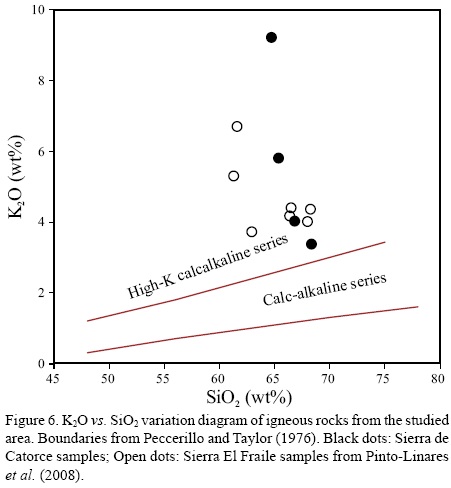
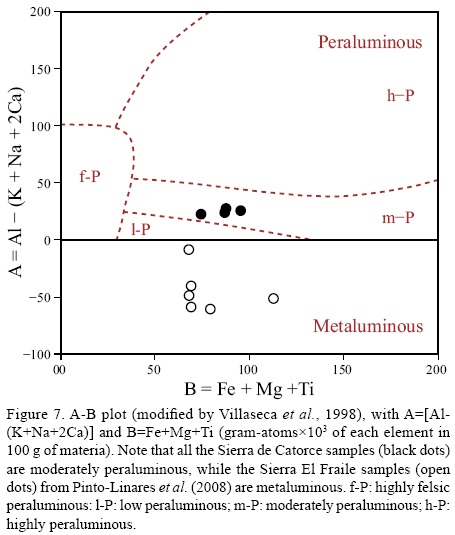
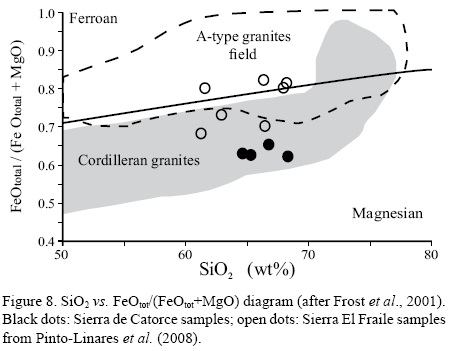
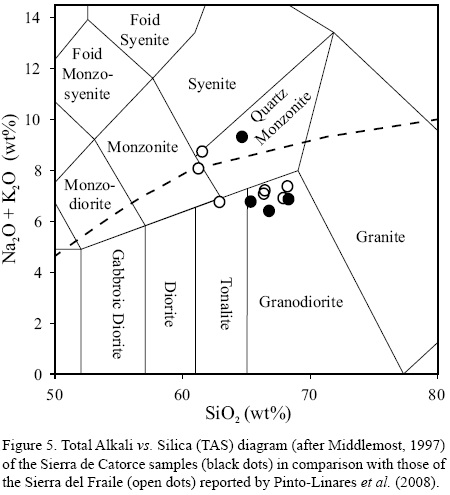
<body><![CDATA[<p align="justify"><font face="verdana" size="2">Fifty&#45;six analyses performed in zircon crystals separated from Los Alamitos intrusive (ARG, <a href="/img/revistas/rmcg/v30n2/a4f1.jpg" target="_blank">Figure 1</a>) yielded <sup>206</sup>Pb/<sup>238</sup>U ages in the range between 41.2 &plusmn; 0.2 Ma and 2521.0 &plusmn; 65.0 Ma. Twenty&#45;six analyses were discarded for the same reasons as above. The remaining twenty concordant ages range from 41.9 &plusmn; 0.3 Ma to 49.0 &plusmn; 0.3 Ma and form a tight cluster. The weighted mean crystallization age (Ludwig, 2008) is 44.6 &plusmn; 0.8 Ma (<i>n</i>=25; MSWD of 38; <a href="/img/revistas/rmcg/v30n2/a4f3.jpg" target="_blank">Figure 3</a><a href="/img/revistas/rmcg/v30n2/a4f4.jpg" target="_blank">&#45;4</a>, <a href="http://rmcg.unam.mx/" target="_blank">Table A1</a><a href="http://%20rmcg.unam.mx/" target="_blank"></a>). Thirteen zircon grains yielded concordant ages scattered between 49.0 &plusmn; 0.3 Ma and 1320.0 &plusmn; 19.0 Ma. They probably represent xenocrysts inherited from older country rocks, documenting assimilation. Particularly relevant to this group are the ages of <i>ca.</i> 160 Ma (<i>n</i>=2) correlative to the Bathonian age rhyolite flow that is found intercalated within the Middle Jurassic sedimentary formation (Barboza&#45;Gudi&ntilde;o <i>et al.,</i> 2004). Other groups of concordant ages revealed the existence of four xenocrysts zircons including Ladinian (ca. 240 Ma, <i>n</i>=2), Silurian (ca. 420 Ma, <i>n</i>=1), Edicarian (ca. 620 Ma, <i>n</i>=1), and Stenian (ca. 1000 Ma, <i>n</i>=1) ages. Four discordant ages defining a discordia line with an upper intercept at 1100 Ma and a lower intercept at 54.4 &plusmn; 0.5 Ma, are in good agreement with inherited and crystallization ages, respectively.</font></p>      <p align="justify"><font face="verdana" size="2">For the Real de Catorce VMP&#45;16 dyke sample (<a href="/img/revistas/rmcg/v30n2/a4f1.jpg" target="_blank">Figure 1</a>), sixty&#45;one analyses provide <sup>206</sup>Pb/<sup>238</sup>U ages from 34.7 &plusmn; 0.3 Ma to 52.0 &plusmn; 2.0 Ma. Thirty&#45;six analyses were discarded for the same reasons as above. The remaining twenty&#45;five concordant ages range from 40.4 &plusmn; 0.3 Ma to 43.8 &plusmn; 0.4 Ma and form a tight cluster. The weighted mean crystallization age (Ludwig, 2008) is 41.8 &plusmn; 0.3 Ma (<i>n</i>=25; MSWD of 9; <a href="/img/revistas/rmcg/v30n2/a4f3.jpg" target="_blank">Figure 3</a>, <a href="http://rmcg.unam.mx/" target="_blank">Table A1</a><a href="http://%20rmcg.unam.mx/" target="_blank"></a>).</font></p>      <p align="justify"><font face="verdana" size="2">For the Real de Catorce VMS&#45;34 dyke sample (<a href="/img/revistas/rmcg/v30n2/a4f1.jpg" target="_blank">Figure 1</a>), forty analyses provide <sup>206</sup>Pb/<sup>238</sup>U ages from 39.4 &plusmn; 0.3 Ma to 69.8 &plusmn; 0.4 Ma. Twelve analyses were discarded. The remaining twenty&#45;eight concordant ages range from 40.9 &plusmn; 0.3 Ma to 44.0 &plusmn; 0.3 Ma and form a tight cluster. The weighted mean crystallization age (Ludwig, 2008) is 42.6 &plusmn; 0.3 Ma (<i>n</i>=28; MSWD of 8.3; <a href="/img/revistas/rmcg/v30n2/a4f3.jpg" target="_blank">Figure 3</a><a href="/img/revistas/rmcg/v30n2/a4f4.jpg" target="_blank">&#45;4</a>, <a href="http://rmcg.unam.mx/" target="_blank">Table A1</a><a href="http://%20rmcg.unam.mx/" target="_blank"></a>).</font></p>      <p align="justify"><font face="verdana" size="2">Thirty&#45;three analyses performed in El Fraile intrusive indicated <sup>206</sup>Pb/<sup>238</sup>U ages ranging from 28.8 &plusmn; 0.4 Ma to 114.0 &plusmn; 1.0 Ma. Twenty analyses were discarded. The remaining thirteen concordant ages range from 34.2 &plusmn; 0.5 Ma to 36.6 &plusmn; 0.4 Ma and form a tight cluster. The weighted mean crystallization age (Ludwig, 2008) is 35.8 &plusmn; 0.4 Ma (<i>n</i>=13; MSWD of 4; <a href="/img/revistas/rmcg/v30n2/a4f3.jpg" target="_blank">Figure 3</a>, <a href="http://rmcg.unam.mx/" target="_blank">Table A1</a><a href="http://%20rmcg.unam.mx/" target="_blank"></a>).</font></p>      <p align="justify"><font face="verdana" size="2"><b>Major and trace elements</b></font></p>  	    <p align="justify"><font face="verdana" size="2">The major and trace element contents of the intrusives (MAR, ARG, RCS, VMP&#45;16 and VMS&#45;34) are shown in Table 2. A regional geochemical dataset for El Fraile granodiorite (Pinto&#45;Linares <i>et al.,</i> 2008) was considered here for comparison.</font></p>  	    <p align="justify"><font face="verdana" size="2">The major element contents (except K2O) of all studied intrusive samples show no obvious correlation with increasing LOI, indicating that the original compositions of the samples have probably not been largely changed by alteration. In the TAS diagram (<a href="#f5">Figure 5</a>) the samples plot in the granodiorite and quartz&#45;monzonite fields. All these rocks show high&#45;K calc&#45;alkaline affinity (3.4 % &lt; K2O &lt; 9.2 %; <a href="#f6">Figure 6</a>); with a K<sub>2</sub>O/Na<sub>2</sub>O ratio ranging from 0.96 to 6.01. Within the A&#45;B diagram (modified by Villaseca <i>et al.</i>, 1998), the Sierra de Catorce samples plot on the moderately peralu&#45;minous field with A &#91;= Al&#45;(K+Na+2Ca)&#93; values from 22.6 to 27.6, (<a href="#f7">Figure 7</a>). None of the analysed rocks in this study contain normative corundum; they present ASI values &#91;molar Al<sub>2</sub>O<sub>3</sub>/(CaO+Na<sub>2</sub>O+K<sub>2</sub>O)&#93; less or equal than 1.1. Thus, these rocks are classified as I&#45;type granitoids, that plot close to the limit with the S&#45;type (Chappell and White, 2001). The Fraile quartzmonzonite present lower ASI values (0.73 to 0.97), and is clearly an I&#45;type granitoid. According to their relative low Fe* &#91;= FeO<sub>total</sub>/(FeO<sub>total</sub> +MgO)&#93; values, all the Sierra de Catorce intrusive bodies and several samples of Fraile are magnesian granitoids (<a href="#f8">Figure 8</a>, Frost <i>et al.,</i> 2001); they plot inside the field of cordilleran granites, which are considered as I&#45;type granites (Chappell and White, 1974) and equivalent to the volcanic arc granites of Pearce <i>et al.</i> (1984), or island arc and continental arc granitoids of Maniar and Piccoli (1989) (see Frost <i>et al.,</i> 2001).</font></p>  	    <p align="center"><font face="verdana" size="2"><b><a name="f5"></a></b></font></p>  	    <p align="center"><font face="verdana" size="2"><b><img src="/img/revistas/rmcg/v30n2/a4f5.jpg"></b></font></p>  	    <p align="center"><font face="verdana" size="2"><b><a name="f6"></a></b></font></p>  	    ]]></body>
<body><![CDATA[<p align="center"><font face="verdana" size="2"><b><img src="/img/revistas/rmcg/v30n2/a4f6.jpg"></b></font></p>  	    <p align="center"><font face="verdana" size="2"><b><a name="f7"></a></b></font></p>  	    <p align="center"><font face="verdana" size="2"><b><img src="/img/revistas/rmcg/v30n2/a4f7.jpg"></b></font></p>  	    <p align="center"><font face="verdana" size="2"><b><a name="f8"></a></b></font></p>  	    <p align="center"><font face="verdana" size="2"><b><img src="/img/revistas/rmcg/v30n2/a4f8.jpg"></b></font></p>  	    <p align="justify"><font face="verdana" size="2">Chondrite&#45;normalized (Sun and McDonough, 1989) rare earth element (REE) patterns illustrate that all the samples are similar and display a strong fractionation from light REE to middle REE (11.3&lt; (La/Yb)<sub>N</sub> &lt;15.5), a general absence of a significant Eu anomaly and a slight fractionation from MREE to HREE (2.0&lt; (Gd/Yb)N &lt;3.7) with a concave&#45;upward shape (<a href="/img/revistas/rmcg/v30n2/a4f9.jpg" target="_blank">Figure 9a</a>). Such REE pattern is consistent with the existence of two different magma sources or the interaction of two differentiation processes (Rollinson, 1993). The presence of inherited zircons indicates assimilation of country rocks. On the other hand, magma mixing is common in cordilleran granites (Brown, 1977). If there were only a single magma source from which the granitoids differentiated by fractional crystallization, a pronounced negative Eu anomaly and a stronger fraction&#45;ation from LREE to HREE would be expected.</font></p>  	    <p align="justify"><font face="verdana" size="2">Primitive mantle&#45;normalized incompatible element spider diagrams reveal similar trends for all the SDCR and Fraile rocks with obvious negative anomalies in Nb, P and Ti (<a href="/img/revistas/rmcg/v30n2/a4f9.jpg" target="_blank">Figure 9b</a>) and positive anomalies in Pb, which reflect a subduction&#45;related signature (Pearce <i>et al.,</i> 1984, 1990). All the samples are considerably enriched in light incompatible lithophile elements (LILE) (in the order of 100&#45;1000 times over the reference values) and in light rare earth elements (LREE) (in the order of a few 10 to a few 100), but only slightly enriched in high field strenght elements (HFSE), except Nb, (in the order of10&#45;100) and with very low HREE contents. The relative enrichment in Th, Rb and U may also have resulted from assimilation combined with fractional crystallization processes (Wilson, 1989; Rollinson, 1993). The high concentrations of Ba (466 to 6683 ppm) and Sr (204 to 607 ppm) (<a href="/img/revistas/rmcg/v30n2/a4t1.jpg" target="_blank">Table 1</a>) are in the range of values observed in classical continental arc granites (Qian <i>et al.,</i> 2003), and more precisely as high&#45;Ba&#45;Sr granitoids (Tarney and Jones, 1994).</font></p>  	    <p align="justify"><font face="verdana" size="2">Geotectonically, the SDCR intrusives are classified as volcanic arc granites in the limit with the syn&#45;collisional granite field (<a href="/img/revistas/rmcg/v30n2/a4f10.jpg" target="_blank">Figure 10a</a> and <a href="/img/revistas/rmcg/v30n2/a4f10.jpg" target="_blank">10b</a>; Pearce <i>et al.,</i> 1984). Relatively low Rb/Zr ratios and Nb concentrations (<a href="/img/revistas/rmcg/v30n2/a4f11.jpg" target="_blank">Figure 11</a>) further indicate a normal, calc&#45;alkaline continental arc setting for the studied granitoids (Brown, 1984)./font&gt;</font></p>  	    <p align="justify"><font face="verdana" size="2"><b>&nbsp;</b></font></p>  	    <p align="justify"><font face="verdana" size="2"><b>DISCUSSION</b></font></p>  	    ]]></body>
<body><![CDATA[<p align="justify"><font face="verdana" size="2">As a whole, the distribution of the intrusion ages (<a href="/img/revistas/rmcg/v30n2/a4f3.jpg" target="_blank">Figure 3</a>) allows distinguishing two separate Eocene magmatic events in the SDCR. The granitoids of Sierra de Catorce define a middle Eocene magmatic pulse, while El Fraile intrusive has a late Eocene age.</font></p>  	    <p align="justify"><font face="verdana" size="2">The age distribution may reflect a cluster of discrete magmatic pulses associated with Los Alamitos (AGS: 44.6 &plusmn; 0.8 Ma) and La Maroma (MAR: 40.9 &plusmn; 0.3 Ma) stocks (<a href="/img/revistas/rmcg/v30n2/a4f3.jpg" target="_blank">Figure 3</a>, <a href="http://rmcg.unam.mx/" target="_blank">Table A1</a><a href="http://%20rmcg.unam.mx/" target="_blank"></a>). The lack of deformation indicates post&#45;orogenic emplacement, in agreement with the pre&#45;middle Eocene chronology proposed by Cuellar&#45;Cardenas <i>et al.,</i> (2012) for the Laramide orogeny in this area.</font></p>      <p align="justify"><font face="verdana" size="2">The Lutetian age of the Sierra de Catorce intrusives (ca. 42 Ma) indicates that igneous activity was contemporaneous with the Zimapan Cu&#45;Zn skarn deposit (Hidalgo state; 41 &plusmn; 1 to 44 &plusmn; 1 Ma, K&#45;Ar in whole rock; Vassallo <i>et al.,</i> 2008), the Zn&#45;Cu skarn at Charcas (San Luis Potosi state, 43 &plusmn; 3 Ma, K&#45;Ar in orthoclase; Mujica&#45;Mondragon and Jacobo&#45;Albarran, 1983) and Conception del Oro district (ca. 32 to 45 Ma, U&#45;Pb in zircon; Gonzalez&#45;Guzman, 2012). As a whole, this set of intrusions represents the first magmatic and mineralizing episodes related to the post Laramide volcanic activity in the region. It may also correlate with the uppermost part of the Lower Volcanic Complex of the Sierra Madre Occidental volcanic province (McDowell and Clabaugh, 1979; Ferrari <i>et al.,</i> 2007).</font></p>  	    <p align="justify"><font face="verdana" size="2"><b>Magma origin</b></font></p>  	    <p align="justify"><font face="verdana" size="2">The petrography of granitoids shows a porphyric texture. The granitoids have the same mineralogical composition and porphyric minerals ratios. The SDCR granitoids are metaluminus to weakly peraluminus, consistent with the presence of amphibole, as well as the absence of muscovite.</font></p>  	    <p align="justify"><font face="verdana" size="2">The whole&#45;rock geochemical signatures indicate that the middle to late Eocene intrusives correspond to continental arc magmatism (I&#45;type granitoids). I&#45;type granites can be formed in a variety of ways. They are the result of a multi&#45;source/multi&#45;stage phenomenon.</font></p>  	    <p align="justify"><font face="verdana" size="2">Discrimination diagrams (<a href="/img/revistas/rmcg/v30n2/a4f10.jpg" target="_blank">Figure 10</a> and <a href="/img/revistas/rmcg/v30n2/a4f11.jpg" target="_blank">11</a>) indicate that the SDCR were generated in a mature continental arc environment. But, in contrast to what is observed in typical I&#45;type granitoids, the intrusive rocks of the SDCR present a high concentration of Ba and Sr, and high Sr/Y and La/Yb ratio values. These characteristics are comparable to those reported for high Ba&#45;Sr granitoids originated by partial melting of an enriched lithospheric mantle in post&#45;orogenic environments, followed by assimilation of continental crust (Tarney and Jones, 1994). This model is congruent with the local geodynamical evolution. Humpreys <i>et al.,</i> (2003) and, more recently, Cuellar&#45;Cardenas <i>et al.</i> (2012), propose a migration to the East for the Laramide orogeny. Following Cuellar&#45;Cardenas <i>et al.</i> (2012), the deformation peak in the SDCR area occurs at <i>ca.</i> 60 Ma.</font></p>  	    <p align="justify"><font face="verdana" size="2">Because Zr/Hf decreases with increasing evolution of a silicate melt, some authors have proposed this ratio as a fractionation index for granitic rocks (Bea <i>et al.,</i> 2006; Zaraysky <i>et al.,</i> 2007). The SDCR show Zr/Hf ratios characteristic of non&#45;evolved granites, (Zr/Hf = 36&#45;39). As well, the relation between the SiO<sub>2</sub> and REE concentration does not indicated fractional crystallization as a main process.</font></p>  	    <p align="justify"><font face="verdana" size="2">We conclude that the formation of SDCR granitoids is related to multiple sources and have a complex history. The Ba&#45;enrichment trend in the SDCR granitoids is interpreted as the evidence of slab dehydration and generation of LILE&#45;enriched fluids that produced partial melting of the mantle wedge just below the base of a thick and light continental crust. During their ascent these melts underwent fractional crystallization, as well as assimilation and melting of crustal components (Hildreth and Moorbath, 1988).</font></p>  	    <p align="justify"><font face="verdana" size="2"><b>&nbsp;</b></font></p>  	    ]]></body>
<body><![CDATA[<p align="justify"><font face="verdana" size="2"><b>CONCLUSIONS</b></font></p>  	    <p align="justify"><font face="verdana" size="2">The Sierra de Catorce and the El Fraile samples correspond to a N&#45;S dyke and elongate stock that consist predominantly of monzogranites and granodiorites. They represent two distinctive magmatic pulses at 45 and 38 Ma, respectively. Inherited zircon grains, which were incorporated into the granodioritic magma during its formation and/or ascent through the crust highlight the presence of a Mesoproterozoic lower crust beneath the Mesa Central.</font></p>  	    <p align="justify"><font face="verdana" size="2">Major and trace element compositions and comparison with similar rocks in Andean Cordillera suggest that the arc granitoids were emplaced in a thick continental crust. The origin of the granitoids in this locality can be explained from a complex model that involves partial melting of metasomatized mantle in a post&#45;orogenic scenario. During its ascent and emplacement, the magmas underwent a process of fractional crystallization coupled with assimilation of crustal material.</font></p>  	    <p align="justify"><font face="verdana" size="2"><b>&nbsp;</b></font></p>  	    <p align="justify"><font face="verdana" size="2"><b>ACKNOWLEDGEMENTS</b></font></p>  	    <p align="justify"><font face="verdana" size="2">Our deep thanks to Ing. Ram&oacute;n D&aacute;vila, Chief Operating Officer of First Majestic and Lic. Jos&eacute; Cerrillo Chowell, General Director of Negociaci&oacute;n Minera Santa Maria de La Paz y Anexas, S.A. de C.V. for their support and permission to publish. Special thanks to Porfirio Pinto&#45;Linares and Jorge Aranda, for help in fieldwork in the Sierra de Catorce and to Carlos Ortega Obreg&oacute;n and Ofelia P&eacute;rez Arvizu for assitence at CGEO laboratory. We sincerely thank Dr. Garc&iacute;a&#45;Casco, Dr. Barboza&#45;Gudi&ntilde;o, Dr. Solari, Dr. Alaniz&#45;&Aacute;lvarez and Dr. Luca Ferrari for their constructive reviews. This study was financially supported by UNAM&#45;PAPIIT project IN100707, IN109410&#45;3, and CONACyT project 81584.</font></p>  	    <p align="justify"><font face="verdana" size="2"><b>&nbsp;</b></font></p>  	    <p align="justify"><font face="verdana" size="2"><b>APPENDIX A. SUPPLEMENTARY DATA</b></font></p>  	    <p align="justify"><font face="verdana" size="2"><a href="http://rmcg.unam.mx/" target="_blank">Table A1</a><a href="http://%20rmcg.unam.mx/" target="_blank"></a> can be found at the journal web site &lt;<a href="http://rmcg.unam.mx/" target="_blank">http:// rmcg.unam.mx/</a>&gt;, in the table of contents of this issue.</font></p>      <p align="justify"><font face="verdana" size="2"><b>&nbsp;</b></font></p>  	    ]]></body>
<body><![CDATA[<p align="justify"><font face="verdana" size="2"><b>REFERENCES</b></font></p>  	    <!-- ref --><p align="justify"><font face="verdana" size="2">Alaniz&#45;&Aacute;lvarez, S.A., Nieto&#45;Samaniego, A.F., 2005, El sistema de fallas Taxco&#45;San Miguel de Allende y la Faja Volc&aacute;nica Transmexicana, dos fronteras tect&oacute;nicas del centro de M&eacute;xico activas durante el Cenozoico: Bolet&iacute;n de la Sociedad Geol&oacute;gica Mexicana, 57(1), 65&#45;82.    &nbsp;&nbsp;&nbsp;&nbsp;&nbsp;&nbsp;&nbsp;&nbsp;[&#160;<a href="javascript:void(0);" onclick="javascript: window.open('/scielo.php?script=sci_nlinks&ref=8089528&pid=S1026-8774201300020000400001&lng=','','width=640,height=500,resizable=yes,scrollbars=1,menubar=yes,');">Links</a>&#160;]<!-- end-ref --></font></p>  	    <!-- ref --><p align="justify"><font face="verdana" size="2">Aranda&#45;G&oacute;mez, J.J., Luhr, J.F., 1996, Origin of the Joya Honda maar, San Luis Potos&iacute;, M&eacute;xico: Journal of Volcanology and Geothermal Research, 74, 1&#45;18.    &nbsp;&nbsp;&nbsp;&nbsp;&nbsp;&nbsp;&nbsp;&nbsp;[&#160;<a href="javascript:void(0);" onclick="javascript: window.open('/scielo.php?script=sci_nlinks&ref=8089530&pid=S1026-8774201300020000400002&lng=','','width=640,height=500,resizable=yes,scrollbars=1,menubar=yes,');">Links</a>&#160;]<!-- end-ref --></font></p>  	    <!-- ref --><p align="justify"><font face="verdana" size="2">Barboza&#45;Gudi&ntilde;o, J.R., &Aacute;lvarez&#45;Maya, V.M., Torres&#45;Hern&aacute;ndez, J., 1998, Informe de la Carta Geol&oacute;gico Minera y Geoqu&iacute;mica; Hoja Real de Catorce; Escala 1:50.000, technical report, Consejo de Recursos Minerales, 258 p.    &nbsp;&nbsp;&nbsp;&nbsp;&nbsp;&nbsp;&nbsp;&nbsp;[&#160;<a href="javascript:void(0);" onclick="javascript: window.open('/scielo.php?script=sci_nlinks&ref=8089532&pid=S1026-8774201300020000400003&lng=','','width=640,height=500,resizable=yes,scrollbars=1,menubar=yes,');">Links</a>&#160;]<!-- end-ref --></font></p>  	    <!-- ref --><p align="justify"><font face="verdana" size="2">Barboza&#45;Gudi&ntilde;o, J.R., Hoppe, M., G&oacute;mez&#45;Anguiano, M., Mart&iacute;nez&#45;Mac&iacute;as, P.R., 2004, Aportaciones para la interpretaci&oacute;n estratigr&aacute;fica y estructural de la porci&oacute;n noroccidental de la Sierra de Catorce, San Luis Potos&iacute;, M&eacute;xico: Revista Mexicana de Ciencias Geol&oacute;gicas, 21(2), 299&#45;319.    &nbsp;&nbsp;&nbsp;&nbsp;&nbsp;&nbsp;&nbsp;&nbsp;[&#160;<a href="javascript:void(0);" onclick="javascript: window.open('/scielo.php?script=sci_nlinks&ref=8089534&pid=S1026-8774201300020000400004&lng=','','width=640,height=500,resizable=yes,scrollbars=1,menubar=yes,');">Links</a>&#160;]<!-- end-ref --></font></p>  	    <!-- ref --><p align="justify"><font face="verdana" size="2">Barboza&#45;Gudi&ntilde;o, J.R., Orozco&#45;Esquivel, M.T., G&oacute;mez&#45;Anguiano, M., Zavala&#45;Monsiv&aacute;is, A., 2008, The Early Mesozoic volcanic arc of western North America in northeastern Mexico: Journal of South American Earth Sciences, 25, 49&#45;63.    &nbsp;&nbsp;&nbsp;&nbsp;&nbsp;&nbsp;&nbsp;&nbsp;[&#160;<a href="javascript:void(0);" onclick="javascript: window.open('/scielo.php?script=sci_nlinks&ref=8089536&pid=S1026-8774201300020000400005&lng=','','width=640,height=500,resizable=yes,scrollbars=1,menubar=yes,');">Links</a>&#160;]<!-- end-ref --></font></p>  	    <!-- ref --><p align="justify"><font face="verdana" size="2">Barboza&#45;Gudi&ntilde;o, J.R., Molina&#45;Garza, R.S., Lawton, T.F., 2012, Sierra de Catorce: Remnants of the ancient western equatorial margin of Pangea in central Mexico, <i>in</i> Aranda&#45;G&oacute;mez, J.J., Tolson, G., Molina&#45;Garza, R.S. (eds.), The Southern Cordillera and Beyond: GSA Field Guides, 25, 1&#45;18.    &nbsp;&nbsp;&nbsp;&nbsp;&nbsp;&nbsp;&nbsp;&nbsp;[&#160;<a href="javascript:void(0);" onclick="javascript: window.open('/scielo.php?script=sci_nlinks&ref=8089538&pid=S1026-8774201300020000400006&lng=','','width=640,height=500,resizable=yes,scrollbars=1,menubar=yes,');">Links</a>&#160;]<!-- end-ref --></font></p>  	    <!-- ref --><p align="justify"><font face="verdana" size="2">Bea, F., Montero, P., Ortega, M., 2006, A LA&#45;ICPMS evaluation of Zr reservoirs in common crustal rocks: implications for a Zr and Hf geochemistry, and zircon&#45;forming processes: Canadian Mineralogist, 44, 693&#45;714.    &nbsp;&nbsp;&nbsp;&nbsp;&nbsp;&nbsp;&nbsp;&nbsp;[&#160;<a href="javascript:void(0);" onclick="javascript: window.open('/scielo.php?script=sci_nlinks&ref=8089540&pid=S1026-8774201300020000400007&lng=','','width=640,height=500,resizable=yes,scrollbars=1,menubar=yes,');">Links</a>&#160;]<!-- end-ref --></font></p>  	    <!-- ref --><p align="justify"><font face="verdana" size="2">Blauser, W.H., 1979, Geology of the Southern Sierra de Catorce and Stratigraphy of the Taraises Formation in North&#45;Central Mexico: The Univerity of Texas at Arlington, Master Thesis, 91 p.    &nbsp;&nbsp;&nbsp;&nbsp;&nbsp;&nbsp;&nbsp;&nbsp;[&#160;<a href="javascript:void(0);" onclick="javascript: window.open('/scielo.php?script=sci_nlinks&ref=8089542&pid=S1026-8774201300020000400008&lng=','','width=640,height=500,resizable=yes,scrollbars=1,menubar=yes,');">Links</a>&#160;]<!-- end-ref --></font></p>  	    <!-- ref --><p align="justify"><font face="verdana" size="2">Brown, C.G., 1977, Mantle origin of Cordilleran granites: Nature, 265, 21 &#45; 24.    &nbsp;&nbsp;&nbsp;&nbsp;&nbsp;&nbsp;&nbsp;&nbsp;[&#160;<a href="javascript:void(0);" onclick="javascript: window.open('/scielo.php?script=sci_nlinks&ref=8089544&pid=S1026-8774201300020000400009&lng=','','width=640,height=500,resizable=yes,scrollbars=1,menubar=yes,');">Links</a>&#160;]<!-- end-ref --></font></p>  	    <!-- ref --><p align="justify"><font face="verdana" size="2">Brown, M., 1984, The generation, segregation, ascent and emplacement of granite magma: the migmatite to crustally derived granite connection in thickened orogens: Earth&#45;Science Reviews, 36, 83&#45;130.    &nbsp;&nbsp;&nbsp;&nbsp;&nbsp;&nbsp;&nbsp;&nbsp;[&#160;<a href="javascript:void(0);" onclick="javascript: window.open('/scielo.php?script=sci_nlinks&ref=8089546&pid=S1026-8774201300020000400010&lng=','','width=640,height=500,resizable=yes,scrollbars=1,menubar=yes,');">Links</a>&#160;]<!-- end-ref --></font></p>  	    <!-- ref --><p align="justify"><font face="verdana" size="2">Carrillo&#45;Bravo, J., 1968, Reconocimiento geol&oacute;gico preliminar de la porci&oacute;n central del Altiplano Mexicano: Petr&oacute;leos Mexicanos, Technical Report, 89 p.    &nbsp;&nbsp;&nbsp;&nbsp;&nbsp;&nbsp;&nbsp;&nbsp;[&#160;<a href="javascript:void(0);" onclick="javascript: window.open('/scielo.php?script=sci_nlinks&ref=8089548&pid=S1026-8774201300020000400011&lng=','','width=640,height=500,resizable=yes,scrollbars=1,menubar=yes,');">Links</a>&#160;]<!-- end-ref --></font></p>  	    <!-- ref --><p align="justify"><font face="verdana" size="2">Carrizales&#45;Ibarra, M., 1989, Estudio geo&#45;econ&oacute;mico del &aacute;rea central, minas de San Jos&eacute;, Tierras Negras, Municipio. de Catorce, S.L.P.: Mexico, Universidad Aut&oacute;noma de San Luis Potos&iacute;, Escuela de Ingenier&iacute;a, tesis de licenciatura, 42 p.    &nbsp;&nbsp;&nbsp;&nbsp;&nbsp;&nbsp;&nbsp;&nbsp;[&#160;<a href="javascript:void(0);" onclick="javascript: window.open('/scielo.php?script=sci_nlinks&ref=8089550&pid=S1026-8774201300020000400012&lng=','','width=640,height=500,resizable=yes,scrollbars=1,menubar=yes,');">Links</a>&#160;]<!-- end-ref --></font></p>  	    <!-- ref --><p align="justify"><font face="verdana" size="2">Chappell, B.W., White, J.R., 1974, Two contrasting granite types: Pacific Geology, 8, 173&#45;174.    &nbsp;&nbsp;&nbsp;&nbsp;&nbsp;&nbsp;&nbsp;&nbsp;[&#160;<a href="javascript:void(0);" onclick="javascript: window.open('/scielo.php?script=sci_nlinks&ref=8089552&pid=S1026-8774201300020000400013&lng=','','width=640,height=500,resizable=yes,scrollbars=1,menubar=yes,');">Links</a>&#160;]<!-- end-ref --></font></p>  	    <!-- ref --><p align="justify"><font face="verdana" size="2">Chappell, B.W., White, J.R., 2001, Two contrasting granite types: 25 years later: Australian Journal of Earth Sciences, 48, 489&#45;499.    &nbsp;&nbsp;&nbsp;&nbsp;&nbsp;&nbsp;&nbsp;&nbsp;[&#160;<a href="javascript:void(0);" onclick="javascript: window.open('/scielo.php?script=sci_nlinks&ref=8089554&pid=S1026-8774201300020000400014&lng=','','width=640,height=500,resizable=yes,scrollbars=1,menubar=yes,');">Links</a>&#160;]<!-- end-ref --></font></p>  	    <!-- ref --><p align="justify"><font face="verdana" size="2">Chippendale, A., 1910, Matehuala district; supplementary report on the silver Mines of Maroma: Servicio Geologico Mexicano, unpublished report, 152 p.    &nbsp;&nbsp;&nbsp;&nbsp;&nbsp;&nbsp;&nbsp;&nbsp;[&#160;<a href="javascript:void(0);" onclick="javascript: window.open('/scielo.php?script=sci_nlinks&ref=8089556&pid=S1026-8774201300020000400015&lng=','','width=640,height=500,resizable=yes,scrollbars=1,menubar=yes,');">Links</a>&#160;]<!-- end-ref --></font></p>  	    <!-- ref --><p align="justify"><font face="verdana" size="2">Cu&eacute;llar&#45;C&aacute;rdenas, M.A., Nieto&#45;Samaniego, A.F., Levresse, L., Alaniz&#45;&Aacute;lvarez, S.A., Ortega&#45;Obreg&oacute;n, C., L&oacute;pez&#45;Mart&iacute;nez, M., Solari, L., 2012, Limites temporales de la deformaci&oacute;n contractiva Laramide en el centro de M&eacute;xico: Revista de Ciencias Geologicas Mexicanas, 29(1), 179&#45;203.    &nbsp;&nbsp;&nbsp;&nbsp;&nbsp;&nbsp;&nbsp;&nbsp;[&#160;<a href="javascript:void(0);" onclick="javascript: window.open('/scielo.php?script=sci_nlinks&ref=8089558&pid=S1026-8774201300020000400016&lng=','','width=640,height=500,resizable=yes,scrollbars=1,menubar=yes,');">Links</a>&#160;]<!-- end-ref --></font></p>  	    <!-- ref --><p align="justify"><font face="verdana" size="2">Demant, A., 1978, Caracter&iacute;sticas del Eje Neovolc&aacute;nico Transrnexicano y sus problemas de interpretaci&oacute;n: Universidad Nacional Aut&oacute;noma de M&eacute;xico, Instituto de Geolog&iacute;a,    &nbsp;&nbsp;&nbsp;&nbsp;&nbsp;&nbsp;&nbsp;&nbsp;[&#160;<a href="javascript:void(0);" onclick="javascript: window.open('/scielo.php?script=sci_nlinks&ref=8089560&pid=S1026-8774201300020000400017&lng=','','width=640,height=500,resizable=yes,scrollbars=1,menubar=yes,');">Links</a>&#160;]<!-- end-ref --> Revista, 2, 172&#45;187.</font></p>  	    <!-- ref --><p align="justify"><font face="verdana" size="2">Ferrari, L., Valencia&#45;Moreno, M., Bryan, S., 2007, Magmatism and tectonics of the Sierra Madre Occidental and its relation with the evolution of the western margin of North America, <i>in</i> Alaniz&#45;&Aacute;lvarez, S.A., Nieto&#45;Samaniego, &Aacute;.F. (eds.), Geology of M&eacute;xico: Celebrating the Centenary of the Geological Society of M&eacute;xico: Geological Society of America Special Paper 422, 1&#45;39.    &nbsp;&nbsp;&nbsp;&nbsp;&nbsp;&nbsp;&nbsp;&nbsp;[&#160;<a href="javascript:void(0);" onclick="javascript: window.open('/scielo.php?script=sci_nlinks&ref=8089562&pid=S1026-8774201300020000400018&lng=','','width=640,height=500,resizable=yes,scrollbars=1,menubar=yes,');">Links</a>&#160;]<!-- end-ref --></font></p>  	    <!-- ref --><p align="justify"><font face="verdana" size="2">Frost, B.R., Barnes, C.G., Collins, W.J., Arculus, R.J., Ellis, D.J., Frost, C.D., 2001, A Geochemical Classification for Granitic Rocks: Journal of Petrology, 42, 2033&#45;2048.    &nbsp;&nbsp;&nbsp;&nbsp;&nbsp;&nbsp;&nbsp;&nbsp;[&#160;<a href="javascript:void(0);" onclick="javascript: window.open('/scielo.php?script=sci_nlinks&ref=8089564&pid=S1026-8774201300020000400019&lng=','','width=640,height=500,resizable=yes,scrollbars=1,menubar=yes,');">Links</a>&#160;]<!-- end-ref --></font></p>  	    <!-- ref --><p align="justify"><font face="verdana" size="2">Geoffrey I.R., 1979, Geology of the Northernmost Sierra de Catorce and Stratigraphy and Biostratigraphy of the Cuesta del Cura Formation in Northeastern and Northcentral Mexico: The University of Texas at Arlingon, Master Thesis, 176 p.    &nbsp;&nbsp;&nbsp;&nbsp;&nbsp;&nbsp;&nbsp;&nbsp;[&#160;<a href="javascript:void(0);" onclick="javascript: window.open('/scielo.php?script=sci_nlinks&ref=8089566&pid=S1026-8774201300020000400020&lng=','','width=640,height=500,resizable=yes,scrollbars=1,menubar=yes,');">Links</a>&#160;]<!-- end-ref --></font></p>  	    <!-- ref --><p align="justify"><font face="verdana" size="2">Gonz&aacute;lez&#45;Guzm&aacute;n, R., 2012, Origen y Evoluci&oacute;n Magm&aacute;tica del Cintur&oacute;n de Intrusivos de Concepci&oacute;n del Oro: Universidad Aut&oacute;noma de Nuevo Le&oacute;n, Facultad de Ciencias de la Tierra, M. Sc. Thesis, 205 p.    &nbsp;&nbsp;&nbsp;&nbsp;&nbsp;&nbsp;&nbsp;&nbsp;[&#160;<a href="javascript:void(0);" onclick="javascript: window.open('/scielo.php?script=sci_nlinks&ref=8089568&pid=S1026-8774201300020000400021&lng=','','width=640,height=500,resizable=yes,scrollbars=1,menubar=yes,');">Links</a>&#160;]<!-- end-ref --></font></p>  	    <!-- ref --><p align="justify"><font face="verdana" size="2">Gunnesch, K.A., Torres&#45;del Angel, C., Cuba&#45;Castro, C., Saenz, J., 1994, The Cu&#45;Au Skarn and Ag&#45;Pb&#45;Zn vein deposits of La Paz, northeastern Mexico: Mineralogical, paragenetic and fluid inclusion characteristics: Economic Geology, 98, 455&#45;489.    &nbsp;&nbsp;&nbsp;&nbsp;&nbsp;&nbsp;&nbsp;&nbsp;[&#160;<a href="javascript:void(0);" onclick="javascript: window.open('/scielo.php?script=sci_nlinks&ref=8089570&pid=S1026-8774201300020000400022&lng=','','width=640,height=500,resizable=yes,scrollbars=1,menubar=yes,');">Links</a>&#160;]<!-- end-ref --></font></p>  	    <!-- ref --><p align="justify"><font face="verdana" size="2">Hildreth,W., Moorbath, S.,1988, Crustal contributions to arc magmatism in the Andes of Central Chile: Contributions to Mineralogy and Petrology, 98, 455&#45;489.    &nbsp;&nbsp;&nbsp;&nbsp;&nbsp;&nbsp;&nbsp;&nbsp;[&#160;<a href="javascript:void(0);" onclick="javascript: window.open('/scielo.php?script=sci_nlinks&ref=8089572&pid=S1026-8774201300020000400023&lng=','','width=640,height=500,resizable=yes,scrollbars=1,menubar=yes,');">Links</a>&#160;]<!-- end-ref --></font></p>  	    <!-- ref --><p align="justify"><font face="verdana" size="2">Hoppe, M., 2000, Geologische Kartierung (1:10,000) im Gebiet Ojo de Agua, nordwestliche Sierra de Catorce und sedimentpetrologische Untersuchungen an pra.oberjurassischen Sedimenten ("Zacatecas formation"): Technische Universitat Clausthal, Master thesis, 182 p.    &nbsp;&nbsp;&nbsp;&nbsp;&nbsp;&nbsp;&nbsp;&nbsp;[&#160;<a href="javascript:void(0);" onclick="javascript: window.open('/scielo.php?script=sci_nlinks&ref=8089574&pid=S1026-8774201300020000400024&lng=','','width=640,height=500,resizable=yes,scrollbars=1,menubar=yes,');">Links</a>&#160;]<!-- end-ref --></font></p>  	    <!-- ref --><p align="justify"><font face="verdana" size="2">Lozano, R., Bernal, J.P., 2005, Characterization of a new set of eight geochemical reference materials for XRF major and trace element analysis: Revista Mexicana de Ciencias Geol&oacute;gicas, 22(3), 329&#45;344.    &nbsp;&nbsp;&nbsp;&nbsp;&nbsp;&nbsp;&nbsp;&nbsp;[&#160;<a href="javascript:void(0);" onclick="javascript: window.open('/scielo.php?script=sci_nlinks&ref=8089576&pid=S1026-8774201300020000400025&lng=','','width=640,height=500,resizable=yes,scrollbars=1,menubar=yes,');">Links</a>&#160;]<!-- end-ref --></font></p>  	    <!-- ref --><p align="justify"><font face="verdana" size="2">Ludwig, K.L., 2008, Isoplot 3.7. A geochronological toolkit for Microsoft Excel: Berkeley Geochronology Center Special Publication, 4, 1&#45;77.    &nbsp;&nbsp;&nbsp;&nbsp;&nbsp;&nbsp;&nbsp;&nbsp;[&#160;<a href="javascript:void(0);" onclick="javascript: window.open('/scielo.php?script=sci_nlinks&ref=8089578&pid=S1026-8774201300020000400026&lng=','','width=640,height=500,resizable=yes,scrollbars=1,menubar=yes,');">Links</a>&#160;]<!-- end-ref --></font></p>  	    <!-- ref --><p align="justify"><font face="verdana" size="2">Luhr, J.F., Aranda&#45;G&oacute;mez, J.J., 1997, Mexican peridotite xenoliths and tectonic terranes: correlations among vent, location, texture, temperature, pressure, and oxygen fugacity: Journal of Petrology, 38, 1075&#45;1112.    &nbsp;&nbsp;&nbsp;&nbsp;&nbsp;&nbsp;&nbsp;&nbsp;[&#160;<a href="javascript:void(0);" onclick="javascript: window.open('/scielo.php?script=sci_nlinks&ref=8089580&pid=S1026-8774201300020000400027&lng=','','width=640,height=500,resizable=yes,scrollbars=1,menubar=yes,');">Links</a>&#160;]<!-- end-ref --></font></p>  	    <!-- ref --><p align="justify"><font face="verdana" size="2">Maniar, P.D., Piccoli, P.M., 1989, Tectonic discrimination of granitoids: Geological Society of America Bulletin, 101, 635&#45;643.    &nbsp;&nbsp;&nbsp;&nbsp;&nbsp;&nbsp;&nbsp;&nbsp;[&#160;<a href="javascript:void(0);" onclick="javascript: window.open('/scielo.php?script=sci_nlinks&ref=8089582&pid=S1026-8774201300020000400028&lng=','','width=640,height=500,resizable=yes,scrollbars=1,menubar=yes,');">Links</a>&#160;]<!-- end-ref --></font></p>  	    <!-- ref --><p align="justify"><font face="verdana" size="2">Mart&iacute;nez&#45;Herrera, N., 1993, Cartograf&iacute;a Geol&oacute;gica, estudio petrogr&aacute;fico y mineral&oacute;gico de los yacimientos polimet&aacute;licos (Cu&#45;Pb&#45;Zn&#45;Ag) del distrito La Paz, S.L.P.: M&eacute;xico, Universidad Aut&oacute;noma de Nuevo Le&oacute;n. Tesis de Licenciatura, 85 p.    &nbsp;&nbsp;&nbsp;&nbsp;&nbsp;&nbsp;&nbsp;&nbsp;[&#160;<a href="javascript:void(0);" onclick="javascript: window.open('/scielo.php?script=sci_nlinks&ref=8089584&pid=S1026-8774201300020000400029&lng=','','width=640,height=500,resizable=yes,scrollbars=1,menubar=yes,');">Links</a>&#160;]<!-- end-ref --></font></p>  	    <!-- ref --><p align="justify"><font face="verdana" size="2">Mart&iacute;nez&#45;Mac&iacute;as, P.R., 2004, Litoestratigraf&iacute;a de la Sierra de Catorce; San Lu&iacute;s Potos&iacute;, M&eacute;xico, Universidad Nacional Aut&oacute;noma de M&eacute;xico, Posgrado en Ciencias de la Tierra, tesis de Maestr&iacute;a, 175 p.    &nbsp;&nbsp;&nbsp;&nbsp;&nbsp;&nbsp;&nbsp;&nbsp;[&#160;<a href="javascript:void(0);" onclick="javascript: window.open('/scielo.php?script=sci_nlinks&ref=8089586&pid=S1026-8774201300020000400030&lng=','','width=640,height=500,resizable=yes,scrollbars=1,menubar=yes,');">Links</a>&#160;]<!-- end-ref --></font></p>  	    <!-- ref --><p align="justify"><font face="verdana" size="2">McDowell, F.W., Clabaugh, S.E., 1979, Ignimbrites of the Sierra Madre Occidental and their relation to the tectonic history of western Mexico, <i>in</i> Chapin, C.E., Elston, W.E. (eds.), Ash&#45;Flow Tuffs: Geological Society of America Special Paper 180, 113&#45;124.    &nbsp;&nbsp;&nbsp;&nbsp;&nbsp;&nbsp;&nbsp;&nbsp;[&#160;<a href="javascript:void(0);" onclick="javascript: window.open('/scielo.php?script=sci_nlinks&ref=8089588&pid=S1026-8774201300020000400031&lng=','','width=640,height=500,resizable=yes,scrollbars=1,menubar=yes,');">Links</a>&#160;]<!-- end-ref --></font></p>  	    <!-- ref --><p align="justify"><font face="verdana" size="2">Middlemost, E.A.K., 1997, Magmas, Rocks and Planetary Development: Longman, Harlow, 299 p.    &nbsp;&nbsp;&nbsp;&nbsp;&nbsp;&nbsp;&nbsp;&nbsp;[&#160;<a href="javascript:void(0);" onclick="javascript: window.open('/scielo.php?script=sci_nlinks&ref=8089590&pid=S1026-8774201300020000400032&lng=','','width=640,height=500,resizable=yes,scrollbars=1,menubar=yes,');">Links</a>&#160;]<!-- end-ref --></font></p>  	    <!-- ref --><p align="justify"><font face="verdana" size="2">Mori, L., G&oacute;mez&#45;Tuena, A., Cai, Y., Goldstein, S.L., 2007, Effects of prolonged flat subduction on the Miocene magmatic record of central Trans Mexican Volcanic Belt: Chemical Geology, 244, 452&#45;473.    &nbsp;&nbsp;&nbsp;&nbsp;&nbsp;&nbsp;&nbsp;&nbsp;[&#160;<a href="javascript:void(0);" onclick="javascript: window.open('/scielo.php?script=sci_nlinks&ref=8089592&pid=S1026-8774201300020000400033&lng=','','width=640,height=500,resizable=yes,scrollbars=1,menubar=yes,');">Links</a>&#160;]<!-- end-ref --></font></p>  	    <!-- ref --><p align="justify"><font face="verdana" size="2">M&uacute;jica&#45;Mondrag&oacute;n, R., Jacobo&#45;Albarr&aacute;n, J., 1983, Estudio petrogen&eacute;tico de las rocas &iacute;gneas y metam&oacute;rficas del Altiplano Mexicano: Instituto Mexicano del Petr&oacute;leo, Subdirecci&oacute;n T&eacute;cnica de Exploraci&oacute;n, Proyecto C&#45;1156, technical report, 87 p.    &nbsp;&nbsp;&nbsp;&nbsp;&nbsp;&nbsp;&nbsp;&nbsp;[&#160;<a href="javascript:void(0);" onclick="javascript: window.open('/scielo.php?script=sci_nlinks&ref=8089594&pid=S1026-8774201300020000400034&lng=','','width=640,height=500,resizable=yes,scrollbars=1,menubar=yes,');">Links</a>&#160;]<!-- end-ref --></font></p>  	    <!-- ref --><p align="justify"><font face="verdana" size="2">Nieto&#45;Samaniego, A.F., Alaniz&#45;&Aacute;lvarez, S.A., Camprub&iacute;, A., 2005, La Mesa Central de M&eacute;xico: estratigraf&iacute;a, estructura y evoluci&oacute;n tect&oacute;nica cenozoica: Bolet&iacute;n de la Sociedad Geol&oacute;gica Mexicana, 57, 285&#45;318.    &nbsp;&nbsp;&nbsp;&nbsp;&nbsp;&nbsp;&nbsp;&nbsp;[&#160;<a href="javascript:void(0);" onclick="javascript: window.open('/scielo.php?script=sci_nlinks&ref=8089596&pid=S1026-8774201300020000400035&lng=','','width=640,height=500,resizable=yes,scrollbars=1,menubar=yes,');">Links</a>&#160;]<!-- end-ref --></font></p>  	    <!-- ref --><p align="justify"><font face="verdana" size="2">Ol&oacute;riz, F., Villase&ntilde;or, A.B., Gonz&aacute;lez&#45;Arreola, C., Westermann, G.E.G., 1999, Ammonite biostratigraphy and correlations in the Upper Jurassic&#45;Lowermost Cretaceous La Caja Formation of northcentral Mexico (Sierra de Catorce, San Luis Potos&iacute;), <i>in</i> Ol&oacute;riz, F., Rodr&iacute;guez&#45;Tovar, F.J. (eds.), Advancing research on living and fossils cephalopods: New York, Kluwer Academic &#45; Plenum Publishers, 463&#45;492.    &nbsp;&nbsp;&nbsp;&nbsp;&nbsp;&nbsp;&nbsp;&nbsp;[&#160;<a href="javascript:void(0);" onclick="javascript: window.open('/scielo.php?script=sci_nlinks&ref=8089598&pid=S1026-8774201300020000400036&lng=','','width=640,height=500,resizable=yes,scrollbars=1,menubar=yes,');">Links</a>&#160;]<!-- end-ref --></font></p>  	    <!-- ref --><p align="justify"><font face="verdana" size="2">Orozco&#45;Esquivel, M., Nieto&#45;Samaniego, A., Alaniz&#45;&Aacute;lvarez, S.A., 2002, Origin of rhyolitic lavas in the Mesa Central, Mexico, by crustal melting related to extension: Journal of Volcanology and Geothermal Research, 118, 37&#45;56.    &nbsp;&nbsp;&nbsp;&nbsp;&nbsp;&nbsp;&nbsp;&nbsp;[&#160;<a href="javascript:void(0);" onclick="javascript: window.open('/scielo.php?script=sci_nlinks&ref=8089600&pid=S1026-8774201300020000400037&lng=','','width=640,height=500,resizable=yes,scrollbars=1,menubar=yes,');">Links</a>&#160;]<!-- end-ref --></font></p>  	    <!-- ref --><p align="justify"><font face="verdana" size="2">Pearce, J.A., Harris, N.B.W., Tindle, A.G., 1984, Trace element discrimination diagrams for the tectonic interpretation of granitic rocks: Journal of Petrology, 25, 956&#45;983.    &nbsp;&nbsp;&nbsp;&nbsp;&nbsp;&nbsp;&nbsp;&nbsp;[&#160;<a href="javascript:void(0);" onclick="javascript: window.open('/scielo.php?script=sci_nlinks&ref=8089602&pid=S1026-8774201300020000400038&lng=','','width=640,height=500,resizable=yes,scrollbars=1,menubar=yes,');">Links</a>&#160;]<!-- end-ref --></font></p>  	    <!-- ref --><p align="justify"><font face="verdana" size="2">Pearce, J.A., Bender, J.F., De Long, S.E., Kidd, W.S.F., Low, P.J., G&uuml;ner, Y., Saroglu, F., Yilmaz, Y, Moorbath, S., Mitchell, J.G., 1990, Genesis of collision volcanism in Eastern Anatolia, Turkey: Journal of Volcanology and Geothermal Research, 44, 189&#45;229.    &nbsp;&nbsp;&nbsp;&nbsp;&nbsp;&nbsp;&nbsp;&nbsp;[&#160;<a href="javascript:void(0);" onclick="javascript: window.open('/scielo.php?script=sci_nlinks&ref=8089604&pid=S1026-8774201300020000400039&lng=','','width=640,height=500,resizable=yes,scrollbars=1,menubar=yes,');">Links</a>&#160;]<!-- end-ref --></font></p>  	    <!-- ref --><p align="justify"><font face="verdana" size="2">Peccerillo, R., Taylor, S.R., 1976, Geochemistry of Eocene calcalkaline volcanic rocks from the Kastamonu area, northern Turkey: Contributions to Mineral Petrology, 58, 63&#45;81.    &nbsp;&nbsp;&nbsp;&nbsp;&nbsp;&nbsp;&nbsp;&nbsp;[&#160;<a href="javascript:void(0);" onclick="javascript: window.open('/scielo.php?script=sci_nlinks&ref=8089606&pid=S1026-8774201300020000400040&lng=','','width=640,height=500,resizable=yes,scrollbars=1,menubar=yes,');">Links</a>&#160;]<!-- end-ref --></font></p>  	    <!-- ref --><p align="justify"><font face="verdana" size="2">Pinto&#45;Linares, P. J., Levresse, G., Tritlla, J., Valencia, V., Torres&#45;Aguilera, M., J., Gonz&aacute;lez, M., Estrada, D., 2008, Transitional adakite&#45;like to calc&#45;alkaline magmas in a continental extensional setting at La Paz Au&#45;Cu skarn deposits, Mesa Central, Mexico: metallogenic implications: Revista Mexicana de Ciencias Geol&oacute;gicas, 25, 39&#45;58.    &nbsp;&nbsp;&nbsp;&nbsp;&nbsp;&nbsp;&nbsp;&nbsp;[&#160;<a href="javascript:void(0);" onclick="javascript: window.open('/scielo.php?script=sci_nlinks&ref=8089608&pid=S1026-8774201300020000400041&lng=','','width=640,height=500,resizable=yes,scrollbars=1,menubar=yes,');">Links</a>&#160;]<!-- end-ref --></font></p>  	    <!-- ref --><p align="justify"><font face="verdana" size="2">Qian, Q., Chung, S.L., Lee, T.Y., Wen, D.J., 2003, Mesozoic high&#45;Ba&#45;Sr granitoids from North China: geochemical characteristics and geological implications: Terra Nova, 15, 272&#45;278.    &nbsp;&nbsp;&nbsp;&nbsp;&nbsp;&nbsp;&nbsp;&nbsp;[&#160;<a href="javascript:void(0);" onclick="javascript: window.open('/scielo.php?script=sci_nlinks&ref=8089610&pid=S1026-8774201300020000400042&lng=','','width=640,height=500,resizable=yes,scrollbars=1,menubar=yes,');">Links</a>&#160;]<!-- end-ref --></font></p>  	    <!-- ref --><p align="justify"><font face="verdana" size="2">Rollinson, H.R., 1993, Using geochemical data: evaluation, presentation, interpretation: New York, Longman Scientific and Technical, 384 p.    &nbsp;&nbsp;&nbsp;&nbsp;&nbsp;&nbsp;&nbsp;&nbsp;[&#160;<a href="javascript:void(0);" onclick="javascript: window.open('/scielo.php?script=sci_nlinks&ref=8089612&pid=S1026-8774201300020000400043&lng=','','width=640,height=500,resizable=yes,scrollbars=1,menubar=yes,');">Links</a>&#160;]<!-- end-ref --></font></p>  	    <!-- ref --><p align="justify"><font face="verdana" size="2">Solari, L.A., G&oacute;mez&#45;Tuena, A., Bernal, J.P., P&eacute;rez&#45;Arvizu, O., Tanner, M., 2010, U&#45;Pb zircon geochronology by an integrated LA&#45;ICPMS microanalytical workstation: achievements in precision and accuracy: Geostandards and Geoanalytical Research, 34(1), 5&#45;18.    &nbsp;&nbsp;&nbsp;&nbsp;&nbsp;&nbsp;&nbsp;&nbsp;[&#160;<a href="javascript:void(0);" onclick="javascript: window.open('/scielo.php?script=sci_nlinks&ref=8089614&pid=S1026-8774201300020000400044&lng=','','width=640,height=500,resizable=yes,scrollbars=1,menubar=yes,');">Links</a>&#160;]<!-- end-ref --></font></p>  	    <!-- ref --><p align="justify"><font face="verdana" size="2">Sun, S.S., McDonough, W.F., 1989, Chemical and isotopic systematics of oceanic basalts: implications for mantle composition and processes, <i>in</i> Saunders, A.D., Norry, M.J. (eds.), Magmatism in the Ocean Basins: Geological Society of London,Special Publication 42, 313&#45;345.    &nbsp;&nbsp;&nbsp;&nbsp;&nbsp;&nbsp;&nbsp;&nbsp;[&#160;<a href="javascript:void(0);" onclick="javascript: window.open('/scielo.php?script=sci_nlinks&ref=8089616&pid=S1026-8774201300020000400045&lng=','','width=640,height=500,resizable=yes,scrollbars=1,menubar=yes,');">Links</a>&#160;]<!-- end-ref --></font></p>  	    <!-- ref --><p align="justify"><font face="verdana" size="2">Tarney, J., Jones, C.E., 1994, Trace element geochemistry of orogenic igneous rocks and crustal growth models: Journal of Geological Society London, 151, 855&#45;868.    &nbsp;&nbsp;&nbsp;&nbsp;&nbsp;&nbsp;&nbsp;&nbsp;[&#160;<a href="javascript:void(0);" onclick="javascript: window.open('/scielo.php?script=sci_nlinks&ref=8089618&pid=S1026-8774201300020000400046&lng=','','width=640,height=500,resizable=yes,scrollbars=1,menubar=yes,');">Links</a>&#160;]<!-- end-ref --></font></p>  	    <!-- ref --><p align="justify"><font face="verdana" size="2">Tuta, Z.H., Sutter, J.F., Kesler, S.E., Ruiz, J., 1988, Geochronology of mercury, tin, and fluorine mineralization in Northern Mexico: Economic Geology, 83, 1931&#45;1942.    &nbsp;&nbsp;&nbsp;&nbsp;&nbsp;&nbsp;&nbsp;&nbsp;[&#160;<a href="javascript:void(0);" onclick="javascript: window.open('/scielo.php?script=sci_nlinks&ref=8089620&pid=S1026-8774201300020000400047&lng=','','width=640,height=500,resizable=yes,scrollbars=1,menubar=yes,');">Links</a>&#160;]<!-- end-ref --></font></p>  	    <!-- ref --><p align="justify"><font face="verdana" size="2">Vassallo, L., Solorio, J.G., Ortega&#45;Rivera, M.A., Sousa, J.E., Olalde, G., 2008, Paleogene magmatism and associated skarn&#45;hydrothermal mineralization in the central part of Mexico: Bol&#45;e, 4, 3, &lt;<a href="http://www.geociencias.unam.mx/~bole/eboletin/aVassallo0908.pdf" target="_blank">http://www.geociencias.unam.mx/~bole/eboletin/aVassallo0908.pdf</a>&gt;    &nbsp;&nbsp;&nbsp;&nbsp;&nbsp;&nbsp;&nbsp;&nbsp;[&#160;<a href="javascript:void(0);" onclick="javascript: window.open('/scielo.php?script=sci_nlinks&ref=8089622&pid=S1026-8774201300020000400048&lng=','','width=640,height=500,resizable=yes,scrollbars=1,menubar=yes,');">Links</a>&#160;]<!-- end-ref -->.</font></p>  	    <!-- ref --><p align="justify"><font face="verdana" size="2">Villaseca, C., Barbero, L., Herreros, V., 1998, A re&#45;examination of the typology of peraluminous granite&#45;types in intracontinental orogenic belts: Transactions of the Royal Society of Edinburgh: Earth Sciences, 89, 113&#45;119.    &nbsp;&nbsp;&nbsp;&nbsp;&nbsp;&nbsp;&nbsp;&nbsp;[&#160;<a href="javascript:void(0);" onclick="javascript: window.open('/scielo.php?script=sci_nlinks&ref=8089624&pid=S1026-8774201300020000400049&lng=','','width=640,height=500,resizable=yes,scrollbars=1,menubar=yes,');">Links</a>&#160;]<!-- end-ref --></font></p>  	    <!-- ref --><p align="justify"><font face="verdana" size="2">White, D.E., Gonz&aacute;les, R.J., 1946, San Jos&eacute; antimony mines near Wadley, State of San Luis Postos&iacute;, M&eacute;xico: United States Geological Survey, Geological Investigations in the American Republics, Bulletin 946&#45;E, 131&#45;153.    &nbsp;&nbsp;&nbsp;&nbsp;&nbsp;&nbsp;&nbsp;&nbsp;[&#160;<a href="javascript:void(0);" onclick="javascript: window.open('/scielo.php?script=sci_nlinks&ref=8089626&pid=S1026-8774201300020000400050&lng=','','width=640,height=500,resizable=yes,scrollbars=1,menubar=yes,');">Links</a>&#160;]<!-- end-ref --></font></p>  	    <!-- ref --><p align="justify"><font face="verdana" size="2">Wilson, M., 1989, Igneous petrogenesis, A global tectonic approach: London, Unwin Hyman, 466 p.    &nbsp;&nbsp;&nbsp;&nbsp;&nbsp;&nbsp;&nbsp;&nbsp;[&#160;<a href="javascript:void(0);" onclick="javascript: window.open('/scielo.php?script=sci_nlinks&ref=8089628&pid=S1026-8774201300020000400051&lng=','','width=640,height=500,resizable=yes,scrollbars=1,menubar=yes,');">Links</a>&#160;]<!-- end-ref --></font></p>  	    <!-- ref --><p align="justify"><font face="verdana" size="2">Z&aacute;rate del Valle, P.F., 1982, Geolog&iacute;a y an&aacute;lisis metalog&eacute;nico de la Sierra de Catorce: Bolet&iacute;n de la Sociedad Geol&oacute;gica Mexicana, 43, 1&#45;21.    &nbsp;&nbsp;&nbsp;&nbsp;&nbsp;&nbsp;&nbsp;&nbsp;[&#160;<a href="javascript:void(0);" onclick="javascript: window.open('/scielo.php?script=sci_nlinks&ref=8089630&pid=S1026-8774201300020000400052&lng=','','width=640,height=500,resizable=yes,scrollbars=1,menubar=yes,');">Links</a>&#160;]<!-- end-ref --></font></p>  	    <!-- ref --><p align="justify"><font face="verdana" size="2">Zaraysky, G.P., Alfereva, J.O., Udoratina, O.V., 2007, Geochemical features of the Etyka tantalum deposit in Eastern Transbaikalia, <i>in</i> Sixth International Hutton Symposium, Stellenbosch University, South Africa, 232&#45;233.    &nbsp;&nbsp;&nbsp;&nbsp;&nbsp;&nbsp;&nbsp;&nbsp;[&#160;<a href="javascript:void(0);" onclick="javascript: window.open('/scielo.php?script=sci_nlinks&ref=8089632&pid=S1026-8774201300020000400053&lng=','','width=640,height=500,resizable=yes,scrollbars=1,menubar=yes,');">Links</a>&#160;]<!-- end-ref --></font></p>      ]]></body><back>
<ref-list>
<ref id="B1">
<nlm-citation citation-type="journal">
<person-group person-group-type="author">
<name>
<surname><![CDATA[Alaniz-Álvarez]]></surname>
<given-names><![CDATA[S.A.]]></given-names>
</name>
<name>
<surname><![CDATA[Nieto-Samaniego]]></surname>
<given-names><![CDATA[A.F.]]></given-names>
</name>
</person-group>
<article-title xml:lang="es"><![CDATA[El sistema de fallas Taxco-San Miguel de Allende y la Faja Volcánica Transmexicana, dos fronteras tectónicas del centro de México activas durante el Cenozoico]]></article-title>
<source><![CDATA[Boletín de la Sociedad Geológica Mexicana]]></source>
<year>2005</year>
<volume>57</volume>
<numero>1</numero>
<issue>1</issue>
<page-range>65-82</page-range></nlm-citation>
</ref>
<ref id="B2">
<nlm-citation citation-type="journal">
<person-group person-group-type="author">
<name>
<surname><![CDATA[Aranda-Gómez]]></surname>
<given-names><![CDATA[J.J.]]></given-names>
</name>
<name>
<surname><![CDATA[Luhr]]></surname>
<given-names><![CDATA[J.F.]]></given-names>
</name>
</person-group>
<article-title xml:lang="en"><![CDATA[Origin of the Joya Honda maar, San Luis Potosí, México]]></article-title>
<source><![CDATA[Journal of Volcanology and Geothermal Research]]></source>
<year>1996</year>
<volume>74</volume>
<page-range>1-18</page-range></nlm-citation>
</ref>
<ref id="B3">
<nlm-citation citation-type="book">
<person-group person-group-type="author">
<name>
<surname><![CDATA[Barboza-Gudiño]]></surname>
<given-names><![CDATA[J.R.]]></given-names>
</name>
<name>
<surname><![CDATA[Álvarez-Maya]]></surname>
<given-names><![CDATA[V.M.]]></given-names>
</name>
<name>
<surname><![CDATA[Torres-Hernández]]></surname>
<given-names><![CDATA[J.]]></given-names>
</name>
</person-group>
<source><![CDATA[Informe de la Carta Geológico Minera y Geoquímica; Hoja Real de Catorce; Escala 1:50.000, technical report]]></source>
<year>1998</year>
<page-range>258</page-range><publisher-name><![CDATA[Consejo de Recursos Minerales]]></publisher-name>
</nlm-citation>
</ref>
<ref id="B4">
<nlm-citation citation-type="journal">
<person-group person-group-type="author">
<name>
<surname><![CDATA[Barboza-Gudiño]]></surname>
<given-names><![CDATA[J.R.]]></given-names>
</name>
<name>
<surname><![CDATA[Hoppe]]></surname>
<given-names><![CDATA[M.]]></given-names>
</name>
<name>
<surname><![CDATA[Gómez-Anguiano]]></surname>
<given-names><![CDATA[M.]]></given-names>
</name>
<name>
<surname><![CDATA[Martínez-Macías]]></surname>
<given-names><![CDATA[P.R.]]></given-names>
</name>
</person-group>
<article-title xml:lang="es"><![CDATA[Aportaciones para la interpretación estratigráfica y estructural de la porción noroccidental de la Sierra de Catorce, San Luis Potosí, México]]></article-title>
<source><![CDATA[Revista Mexicana de Ciencias Geológicas]]></source>
<year>2004</year>
<volume>21</volume>
<numero>2</numero>
<issue>2</issue>
<page-range>299-319</page-range></nlm-citation>
</ref>
<ref id="B5">
<nlm-citation citation-type="journal">
<person-group person-group-type="author">
<name>
<surname><![CDATA[Barboza-Gudiño]]></surname>
<given-names><![CDATA[J.R.]]></given-names>
</name>
<name>
<surname><![CDATA[Orozco-Esquivel]]></surname>
<given-names><![CDATA[M.T.]]></given-names>
</name>
<name>
<surname><![CDATA[Gómez-Anguiano]]></surname>
<given-names><![CDATA[M.]]></given-names>
</name>
<name>
<surname><![CDATA[Zavala-Monsiváis]]></surname>
<given-names><![CDATA[A.]]></given-names>
</name>
</person-group>
<article-title xml:lang="en"><![CDATA[The Early Mesozoic volcanic arc of western North America in northeastern Mexico]]></article-title>
<source><![CDATA[Journal of South American Earth Sciences]]></source>
<year>2008</year>
<volume>25</volume>
<page-range>49-63</page-range></nlm-citation>
</ref>
<ref id="B6">
<nlm-citation citation-type="">
<person-group person-group-type="author">
<name>
<surname><![CDATA[Barboza-Gudiño]]></surname>
<given-names><![CDATA[J.R.]]></given-names>
</name>
<name>
<surname><![CDATA[Molina-Garza]]></surname>
<given-names><![CDATA[R.S.]]></given-names>
</name>
<name>
<surname><![CDATA[Lawton]]></surname>
<given-names><![CDATA[T.F.]]></given-names>
</name>
</person-group>
<article-title xml:lang="en"><![CDATA[Sierra de Catorce: Remnants of the ancient western equatorial margin of Pangea in central Mexico]]></article-title>
<person-group person-group-type="editor">
<name>
<surname><![CDATA[Aranda-Gómez]]></surname>
<given-names><![CDATA[J.J.]]></given-names>
</name>
<name>
<surname><![CDATA[Tolson]]></surname>
<given-names><![CDATA[G.]]></given-names>
</name>
<name>
<surname><![CDATA[Molina-Garza]]></surname>
<given-names><![CDATA[R.S.]]></given-names>
</name>
</person-group>
<source><![CDATA[The Southern Cordillera and Beyond]]></source>
<year>2012</year>
<page-range>1-18</page-range></nlm-citation>
</ref>
<ref id="B7">
<nlm-citation citation-type="journal">
<person-group person-group-type="author">
<name>
<surname><![CDATA[Bea]]></surname>
<given-names><![CDATA[F.]]></given-names>
</name>
<name>
<surname><![CDATA[Montero]]></surname>
<given-names><![CDATA[P.]]></given-names>
</name>
<name>
<surname><![CDATA[Ortega]]></surname>
<given-names><![CDATA[M.]]></given-names>
</name>
</person-group>
<article-title xml:lang="en"><![CDATA[A LA-ICPMS evaluation of Zr reservoirs in common crustal rocks: implications for a Zr and Hf geochemistry, and zircon-forming processes]]></article-title>
<source><![CDATA[Canadian Mineralogist]]></source>
<year>2006</year>
<volume>44</volume>
<page-range>693-714</page-range></nlm-citation>
</ref>
<ref id="B8">
<nlm-citation citation-type="">
<person-group person-group-type="author">
<name>
<surname><![CDATA[Blauser]]></surname>
<given-names><![CDATA[W.H.]]></given-names>
</name>
</person-group>
<source><![CDATA[Geology of the Southern Sierra de Catorce and Stratigraphy of the Taraises Formation in North-Central Mexico]]></source>
<year>1979</year>
<page-range>91</page-range></nlm-citation>
</ref>
<ref id="B9">
<nlm-citation citation-type="journal">
<person-group person-group-type="author">
<name>
<surname><![CDATA[Brown]]></surname>
<given-names><![CDATA[C.G.]]></given-names>
</name>
</person-group>
<article-title xml:lang="en"><![CDATA[Mantle origin of Cordilleran granites]]></article-title>
<source><![CDATA[Nature]]></source>
<year>1977</year>
<volume>265</volume>
<page-range>21 - 24</page-range></nlm-citation>
</ref>
<ref id="B10">
<nlm-citation citation-type="journal">
<person-group person-group-type="author">
<name>
<surname><![CDATA[Brown]]></surname>
<given-names><![CDATA[M.]]></given-names>
</name>
</person-group>
<article-title xml:lang="en"><![CDATA[The generation, segregation, ascent and emplacement of granite magma: the migmatite to crustally derived granite connection in thickened orogens]]></article-title>
<source><![CDATA[Earth-Science Reviews]]></source>
<year>1984</year>
<volume>36</volume>
<page-range>83-130</page-range></nlm-citation>
</ref>
<ref id="B11">
<nlm-citation citation-type="book">
<person-group person-group-type="author">
<name>
<surname><![CDATA[Carrillo-Bravo]]></surname>
<given-names><![CDATA[J.]]></given-names>
</name>
</person-group>
<source><![CDATA[Reconocimiento geológico preliminar de la porción central del Altiplano Mexicano]]></source>
<year>1968</year>
<page-range>89</page-range><publisher-name><![CDATA[Petróleos Mexicanos]]></publisher-name>
</nlm-citation>
</ref>
<ref id="B12">
<nlm-citation citation-type="">
<person-group person-group-type="author">
<name>
<surname><![CDATA[Carrizales-Ibarra]]></surname>
<given-names><![CDATA[M.]]></given-names>
</name>
</person-group>
<source><![CDATA[Estudio geo-económico del área central, minas de San José, Tierras Negras, Municipio. de Catorce, S.L.P.]]></source>
<year>1989</year>
<page-range>42</page-range></nlm-citation>
</ref>
<ref id="B13">
<nlm-citation citation-type="journal">
<person-group person-group-type="author">
<name>
<surname><![CDATA[Chappell]]></surname>
<given-names><![CDATA[B.W.]]></given-names>
</name>
<name>
<surname><![CDATA[White]]></surname>
<given-names><![CDATA[J.R.]]></given-names>
</name>
</person-group>
<article-title xml:lang="en"><![CDATA[Two contrasting granite types]]></article-title>
<source><![CDATA[Pacific Geology]]></source>
<year>1974</year>
<volume>8</volume>
<page-range>173-174</page-range></nlm-citation>
</ref>
<ref id="B14">
<nlm-citation citation-type="journal">
<person-group person-group-type="author">
<name>
<surname><![CDATA[Chappell]]></surname>
<given-names><![CDATA[B.W.]]></given-names>
</name>
<name>
<surname><![CDATA[White]]></surname>
<given-names><![CDATA[J.R.]]></given-names>
</name>
</person-group>
<article-title xml:lang="en"><![CDATA[Two contrasting granite types: 25 years later]]></article-title>
<source><![CDATA[Australian Journal of Earth Sciences]]></source>
<year>2001</year>
<volume>48</volume>
<page-range>489-499</page-range></nlm-citation>
</ref>
<ref id="B15">
<nlm-citation citation-type="book">
<person-group person-group-type="author">
<name>
<surname><![CDATA[Chippendale]]></surname>
<given-names><![CDATA[A.]]></given-names>
</name>
</person-group>
<source><![CDATA[Matehuala district; supplementary report on the silver Mines of Maroma]]></source>
<year>1910</year>
<page-range>152</page-range><publisher-name><![CDATA[Servicio Geologico Mexicano]]></publisher-name>
</nlm-citation>
</ref>
<ref id="B16">
<nlm-citation citation-type="journal">
<person-group person-group-type="author">
<name>
<surname><![CDATA[Cuéllar-Cárdenas]]></surname>
<given-names><![CDATA[M.A.]]></given-names>
</name>
<name>
<surname><![CDATA[Nieto-Samaniego]]></surname>
<given-names><![CDATA[A.F.]]></given-names>
</name>
<name>
<surname><![CDATA[Levresse]]></surname>
<given-names><![CDATA[L.]]></given-names>
</name>
<name>
<surname><![CDATA[Alaniz-Álvarez]]></surname>
<given-names><![CDATA[S.A.]]></given-names>
</name>
<name>
<surname><![CDATA[Ortega-Obregón]]></surname>
<given-names><![CDATA[C.]]></given-names>
</name>
<name>
<surname><![CDATA[López-Martínez]]></surname>
<given-names><![CDATA[M.]]></given-names>
</name>
<name>
<surname><![CDATA[Solari]]></surname>
<given-names><![CDATA[L.]]></given-names>
</name>
</person-group>
<article-title xml:lang="es"><![CDATA[Limites temporales de la deformación contractiva Laramide en el centro de México]]></article-title>
<source><![CDATA[Revista de Ciencias Geologicas Mexicanas]]></source>
<year>2012</year>
<volume>29</volume>
<numero>1</numero>
<issue>1</issue>
<page-range>179-203</page-range></nlm-citation>
</ref>
<ref id="B17">
<nlm-citation citation-type="book">
<person-group person-group-type="author">
<name>
<surname><![CDATA[Demant]]></surname>
<given-names><![CDATA[A.]]></given-names>
</name>
</person-group>
<source><![CDATA[Características del Eje Neovolcánico Transrnexicano y sus problemas de interpretación]]></source>
<year>1978</year>
<publisher-name><![CDATA[Universidad Nacional Autónoma de MéxicoInstituto de Geología]]></publisher-name>
</nlm-citation>
</ref>
<ref id="B18">
<nlm-citation citation-type="">
<person-group person-group-type="author">
<name>
<surname><![CDATA[Ferrari]]></surname>
<given-names><![CDATA[L.]]></given-names>
</name>
<name>
<surname><![CDATA[Valencia-Moreno]]></surname>
<given-names><![CDATA[M.]]></given-names>
</name>
<name>
<surname><![CDATA[Bryan]]></surname>
<given-names><![CDATA[S.]]></given-names>
</name>
</person-group>
<article-title xml:lang="en"><![CDATA[Magmatism and tectonics of the Sierra Madre Occidental and its relation with the evolution of the western margin of North America]]></article-title>
<person-group person-group-type="editor">
<name>
<surname><![CDATA[Alaniz-Álvarez]]></surname>
<given-names><![CDATA[S.A.]]></given-names>
</name>
<name>
<surname><![CDATA[Nieto-Samaniego]]></surname>
<given-names><![CDATA[Á.F.]]></given-names>
</name>
</person-group>
<source><![CDATA[Geology of México: Celebrating the Centenary of the Geological Society of México]]></source>
<year>2007</year>
<page-range>1-39</page-range></nlm-citation>
</ref>
<ref id="B19">
<nlm-citation citation-type="journal">
<person-group person-group-type="author">
<name>
<surname><![CDATA[Frost]]></surname>
<given-names><![CDATA[B.R.]]></given-names>
</name>
<name>
<surname><![CDATA[Barnes]]></surname>
<given-names><![CDATA[C.G.]]></given-names>
</name>
<name>
<surname><![CDATA[Collins]]></surname>
<given-names><![CDATA[W.J.]]></given-names>
</name>
<name>
<surname><![CDATA[Arculus]]></surname>
<given-names><![CDATA[R.J.]]></given-names>
</name>
<name>
<surname><![CDATA[Ellis]]></surname>
<given-names><![CDATA[D.J.]]></given-names>
</name>
<name>
<surname><![CDATA[Frost]]></surname>
<given-names><![CDATA[C.D.]]></given-names>
</name>
</person-group>
<article-title xml:lang="en"><![CDATA[A Geochemical Classification for Granitic Rocks]]></article-title>
<source><![CDATA[Journal of Petrology]]></source>
<year>2001</year>
<volume>42</volume>
<page-range>2033-2048</page-range></nlm-citation>
</ref>
<ref id="B20">
<nlm-citation citation-type="">
<person-group person-group-type="author">
<name>
<surname><![CDATA[Geoffrey]]></surname>
<given-names><![CDATA[I.R.]]></given-names>
</name>
</person-group>
<source><![CDATA[Geology of the Northernmost Sierra de Catorce and Stratigraphy and Biostratigraphy of the Cuesta del Cura Formation in Northeastern and Northcentral Mexico]]></source>
<year>1979</year>
<page-range>176</page-range></nlm-citation>
</ref>
<ref id="B21">
<nlm-citation citation-type="">
<person-group person-group-type="author">
<name>
<surname><![CDATA[González-Guzmán]]></surname>
<given-names><![CDATA[R.]]></given-names>
</name>
</person-group>
<source><![CDATA[Origen y Evolución Magmática del Cinturón de Intrusivos de Concepción del Oro]]></source>
<year>2012</year>
<page-range>205</page-range></nlm-citation>
</ref>
<ref id="B22">
<nlm-citation citation-type="journal">
<person-group person-group-type="author">
<name>
<surname><![CDATA[Gunnesch]]></surname>
<given-names><![CDATA[K.A.]]></given-names>
</name>
<name>
<surname><![CDATA[Torres-del Angel]]></surname>
<given-names><![CDATA[C.]]></given-names>
</name>
<name>
<surname><![CDATA[Cuba-Castro]]></surname>
<given-names><![CDATA[C.]]></given-names>
</name>
<name>
<surname><![CDATA[Saenz]]></surname>
<given-names><![CDATA[J.]]></given-names>
</name>
</person-group>
<article-title xml:lang="en"><![CDATA[The Cu-Au Skarn and Ag-Pb-Zn vein deposits of La Paz, northeastern Mexico: Mineralogical, paragenetic and fluid inclusion characteristics]]></article-title>
<source><![CDATA[Economic Geology]]></source>
<year>1994</year>
<volume>98</volume>
<page-range>455-489</page-range></nlm-citation>
</ref>
<ref id="B23">
<nlm-citation citation-type="journal">
<person-group person-group-type="author">
<name>
<surname><![CDATA[Hildreth]]></surname>
<given-names><![CDATA[W.]]></given-names>
</name>
<name>
<surname><![CDATA[Moorbath]]></surname>
<given-names><![CDATA[S.]]></given-names>
</name>
</person-group>
<article-title xml:lang="en"><![CDATA[Crustal contributions to arc magmatism in the Andes of Central Chile]]></article-title>
<source><![CDATA[Contributions to Mineralogy and Petrology]]></source>
<year>1988</year>
<volume>98</volume>
<page-range>455-489</page-range></nlm-citation>
</ref>
<ref id="B24">
<nlm-citation citation-type="">
<person-group person-group-type="author">
<name>
<surname><![CDATA[Hoppe]]></surname>
<given-names><![CDATA[M.]]></given-names>
</name>
</person-group>
<source><![CDATA[Geologische Kartierung (1:10,000) im Gebiet Ojo de Agua, nordwestliche Sierra de Catorce und sedimentpetrologische Untersuchungen an pra.oberjurassischen Sedimenten ("Zacatecas formation")]]></source>
<year>2000</year>
<page-range>182</page-range></nlm-citation>
</ref>
<ref id="B25">
<nlm-citation citation-type="journal">
<person-group person-group-type="author">
<name>
<surname><![CDATA[Lozano]]></surname>
<given-names><![CDATA[R.]]></given-names>
</name>
<name>
<surname><![CDATA[Bernal]]></surname>
<given-names><![CDATA[J.P.]]></given-names>
</name>
</person-group>
<article-title xml:lang="en"><![CDATA[Characterization of a new set of eight geochemical reference materials for XRF major and trace element analysis]]></article-title>
<source><![CDATA[Revista Mexicana de Ciencias Geológicas]]></source>
<year>2005</year>
<volume>22</volume>
<numero>3</numero>
<issue>3</issue>
<page-range>329-344</page-range></nlm-citation>
</ref>
<ref id="B26">
<nlm-citation citation-type="book">
<person-group person-group-type="author">
<name>
<surname><![CDATA[Ludwig]]></surname>
<given-names><![CDATA[K.L.]]></given-names>
</name>
</person-group>
<source><![CDATA[Isoplot 3.7. A geochronological toolkit for Microsoft Excel]]></source>
<year>2008</year>
<page-range>1-77</page-range><publisher-name><![CDATA[Berkeley Geochronology Center]]></publisher-name>
</nlm-citation>
</ref>
<ref id="B27">
<nlm-citation citation-type="journal">
<person-group person-group-type="author">
<name>
<surname><![CDATA[Luhr]]></surname>
<given-names><![CDATA[J.F.]]></given-names>
</name>
<name>
<surname><![CDATA[Aranda-Gómez]]></surname>
<given-names><![CDATA[J.J.]]></given-names>
</name>
</person-group>
<article-title xml:lang="en"><![CDATA[Mexican peridotite xenoliths and tectonic terranes: correlations among vent, location, texture, temperature, pressure, and oxygen fugacity]]></article-title>
<source><![CDATA[Journal of Petrology]]></source>
<year>1997</year>
<volume>38</volume>
<page-range>1075-1112</page-range></nlm-citation>
</ref>
<ref id="B28">
<nlm-citation citation-type="journal">
<person-group person-group-type="author">
<name>
<surname><![CDATA[Maniar]]></surname>
<given-names><![CDATA[P.D.]]></given-names>
</name>
<name>
<surname><![CDATA[Piccoli]]></surname>
<given-names><![CDATA[P.M.]]></given-names>
</name>
</person-group>
<article-title xml:lang="en"><![CDATA[Tectonic discrimination of granitoids]]></article-title>
<source><![CDATA[Geological Society of America Bulletin]]></source>
<year>1989</year>
<volume>101</volume>
<page-range>635-643</page-range></nlm-citation>
</ref>
<ref id="B29">
<nlm-citation citation-type="">
<person-group person-group-type="author">
<name>
<surname><![CDATA[Martínez-Herrera]]></surname>
<given-names><![CDATA[N.]]></given-names>
</name>
</person-group>
<source><![CDATA[Cartografía Geológica, estudio petrográfico y mineralógico de los yacimientos polimetálicos (Cu-Pb-Zn-Ag) del distrito La Paz, S.L.P.]]></source>
<year>1993</year>
<page-range>85</page-range></nlm-citation>
</ref>
<ref id="B30">
<nlm-citation citation-type="">
<person-group person-group-type="author">
<name>
<surname><![CDATA[Martínez-Macías]]></surname>
<given-names><![CDATA[P.R.]]></given-names>
</name>
</person-group>
<source><![CDATA[Litoestratigrafía de la Sierra de Catorce]]></source>
<year>2004</year>
<page-range>175</page-range></nlm-citation>
</ref>
<ref id="B31">
<nlm-citation citation-type="">
<person-group person-group-type="author">
<name>
<surname><![CDATA[McDowell]]></surname>
<given-names><![CDATA[F.W.]]></given-names>
</name>
<name>
<surname><![CDATA[Clabaugh]]></surname>
<given-names><![CDATA[S.E.]]></given-names>
</name>
</person-group>
<article-title xml:lang="en"><![CDATA[Ignimbrites of the Sierra Madre Occidental and their relation to the tectonic history of western Mexico]]></article-title>
<person-group person-group-type="editor">
<name>
<surname><![CDATA[Chapin]]></surname>
<given-names><![CDATA[C.E.]]></given-names>
</name>
<name>
<surname><![CDATA[Elston]]></surname>
<given-names><![CDATA[W.E.]]></given-names>
</name>
</person-group>
<source><![CDATA[Ash-Flow Tuffs]]></source>
<year>1979</year>
<page-range>113-124</page-range></nlm-citation>
</ref>
<ref id="B32">
<nlm-citation citation-type="book">
<person-group person-group-type="author">
<name>
<surname><![CDATA[Middlemost]]></surname>
<given-names><![CDATA[E.A.K.]]></given-names>
</name>
</person-group>
<source><![CDATA[Magmas, Rocks and Planetary Development]]></source>
<year>1997</year>
<page-range>299</page-range><publisher-loc><![CDATA[Harlow ]]></publisher-loc>
<publisher-name><![CDATA[Longman]]></publisher-name>
</nlm-citation>
</ref>
<ref id="B33">
<nlm-citation citation-type="journal">
<person-group person-group-type="author">
<name>
<surname><![CDATA[Mori]]></surname>
<given-names><![CDATA[L.]]></given-names>
</name>
<name>
<surname><![CDATA[Gómez-Tuena]]></surname>
<given-names><![CDATA[A.]]></given-names>
</name>
<name>
<surname><![CDATA[Cai]]></surname>
<given-names><![CDATA[Y.]]></given-names>
</name>
<name>
<surname><![CDATA[Goldstein]]></surname>
<given-names><![CDATA[S.L.]]></given-names>
</name>
</person-group>
<article-title xml:lang="en"><![CDATA[Effects of prolonged flat subduction on the Miocene magmatic record of central Trans Mexican Volcanic Belt]]></article-title>
<source><![CDATA[Chemical Geology]]></source>
<year>2007</year>
<volume>244</volume>
<page-range>452-473</page-range></nlm-citation>
</ref>
<ref id="B34">
<nlm-citation citation-type="book">
<person-group person-group-type="author">
<name>
<surname><![CDATA[Mújica-Mondragón]]></surname>
<given-names><![CDATA[R.]]></given-names>
</name>
<name>
<surname><![CDATA[Jacobo-Albarrán]]></surname>
<given-names><![CDATA[J.]]></given-names>
</name>
</person-group>
<source><![CDATA[Estudio petrogenético de las rocas ígneas y metamórficas del Altiplano Mexicano]]></source>
<year>1983</year>
<page-range>87</page-range><publisher-name><![CDATA[Instituto Mexicano del Petróleo, Subdirección Técnica de Exploración]]></publisher-name>
</nlm-citation>
</ref>
<ref id="B35">
<nlm-citation citation-type="journal">
<person-group person-group-type="author">
<name>
<surname><![CDATA[Nieto-Samaniego]]></surname>
<given-names><![CDATA[A.F.]]></given-names>
</name>
<name>
<surname><![CDATA[Alaniz-Álvarez]]></surname>
<given-names><![CDATA[S.A.]]></given-names>
</name>
<name>
<surname><![CDATA[Camprubí]]></surname>
<given-names><![CDATA[A.]]></given-names>
</name>
</person-group>
<article-title xml:lang="es"><![CDATA[La Mesa Central de México: estratigrafía, estructura y evolución tectónica cenozoica]]></article-title>
<source><![CDATA[Boletín de la Sociedad Geológica Mexicana]]></source>
<year>2005</year>
<volume>57</volume>
<page-range>285-318</page-range></nlm-citation>
</ref>
<ref id="B36">
<nlm-citation citation-type="book">
<person-group person-group-type="author">
<name>
<surname><![CDATA[Olóriz]]></surname>
<given-names><![CDATA[F.]]></given-names>
</name>
<name>
<surname><![CDATA[Villaseñor]]></surname>
<given-names><![CDATA[A.B.]]></given-names>
</name>
<name>
<surname><![CDATA[González-Arreola]]></surname>
<given-names><![CDATA[C.]]></given-names>
</name>
<name>
<surname><![CDATA[Westermann]]></surname>
<given-names><![CDATA[G.E.G.]]></given-names>
</name>
</person-group>
<article-title xml:lang="en"><![CDATA[Ammonite biostratigraphy and correlations in the Upper Jurassic-Lowermost Cretaceous La Caja Formation of northcentral Mexico (Sierra de Catorce, San Luis Potosí)]]></article-title>
<person-group person-group-type="editor">
<name>
<surname><![CDATA[Olóriz]]></surname>
<given-names><![CDATA[F.]]></given-names>
</name>
<name>
<surname><![CDATA[Rodríguez-Tovar]]></surname>
<given-names><![CDATA[F.J.]]></given-names>
</name>
</person-group>
<source><![CDATA[Advancing research on living and fossils cephalopods]]></source>
<year>1999</year>
<page-range>463-492</page-range><publisher-loc><![CDATA[New York ]]></publisher-loc>
<publisher-name><![CDATA[Kluwer AcademicPlenum Publishers]]></publisher-name>
</nlm-citation>
</ref>
<ref id="B37">
<nlm-citation citation-type="journal">
<person-group person-group-type="author">
<name>
<surname><![CDATA[Orozco-Esquivel]]></surname>
<given-names><![CDATA[M.]]></given-names>
</name>
<name>
<surname><![CDATA[Nieto-Samaniego]]></surname>
<given-names><![CDATA[A.]]></given-names>
</name>
<name>
<surname><![CDATA[Alaniz-Álvarez]]></surname>
<given-names><![CDATA[S.A.]]></given-names>
</name>
</person-group>
<article-title xml:lang="en"><![CDATA[Origin of rhyolitic lavas in the Mesa Central, Mexico, by crustal melting related to extension]]></article-title>
<source><![CDATA[Journal of Volcanology and Geothermal Research]]></source>
<year>2002</year>
<volume>118</volume>
<page-range>37-56</page-range></nlm-citation>
</ref>
<ref id="B38">
<nlm-citation citation-type="journal">
<person-group person-group-type="author">
<name>
<surname><![CDATA[Pearce]]></surname>
<given-names><![CDATA[J.A.]]></given-names>
</name>
<name>
<surname><![CDATA[Harris]]></surname>
<given-names><![CDATA[N.B.W.]]></given-names>
</name>
<name>
<surname><![CDATA[Tindle]]></surname>
<given-names><![CDATA[A.G.]]></given-names>
</name>
</person-group>
<article-title xml:lang="en"><![CDATA[Trace element discrimination diagrams for the tectonic interpretation of granitic rocks]]></article-title>
<source><![CDATA[Journal of Petrology]]></source>
<year>1984</year>
<volume>25</volume>
<page-range>956-983</page-range></nlm-citation>
</ref>
<ref id="B39">
<nlm-citation citation-type="journal">
<person-group person-group-type="author">
<name>
<surname><![CDATA[Pearce]]></surname>
<given-names><![CDATA[J.A.]]></given-names>
</name>
<name>
<surname><![CDATA[Bender]]></surname>
<given-names><![CDATA[J.F.]]></given-names>
</name>
<name>
<surname><![CDATA[De Long]]></surname>
<given-names><![CDATA[S.E.]]></given-names>
</name>
<name>
<surname><![CDATA[Kidd]]></surname>
<given-names><![CDATA[W.S.F.]]></given-names>
</name>
<name>
<surname><![CDATA[Low]]></surname>
<given-names><![CDATA[P.J.]]></given-names>
</name>
<name>
<surname><![CDATA[Güner]]></surname>
<given-names><![CDATA[Y.]]></given-names>
</name>
<name>
<surname><![CDATA[Saroglu]]></surname>
<given-names><![CDATA[F.]]></given-names>
</name>
<name>
<surname><![CDATA[Yilmaz]]></surname>
<given-names><![CDATA[Y]]></given-names>
</name>
<name>
<surname><![CDATA[Moorbath]]></surname>
<given-names><![CDATA[S.]]></given-names>
</name>
<name>
<surname><![CDATA[Mitchell]]></surname>
<given-names><![CDATA[J.G.]]></given-names>
</name>
</person-group>
<article-title xml:lang="en"><![CDATA[Genesis of collision volcanism in Eastern Anatolia, Turkey]]></article-title>
<source><![CDATA[Journal of Volcanology and Geothermal Research]]></source>
<year>1990</year>
<volume>44</volume>
<page-range>189-229</page-range></nlm-citation>
</ref>
<ref id="B40">
<nlm-citation citation-type="journal">
<person-group person-group-type="author">
<name>
<surname><![CDATA[Peccerillo]]></surname>
<given-names><![CDATA[R.]]></given-names>
</name>
<name>
<surname><![CDATA[Taylor]]></surname>
<given-names><![CDATA[S.R.]]></given-names>
</name>
</person-group>
<article-title xml:lang="en"><![CDATA[Geochemistry of Eocene calcalkaline volcanic rocks from the Kastamonu area, northern Turkey]]></article-title>
<source><![CDATA[Contributions to Mineral Petrology]]></source>
<year>1976</year>
<volume>58</volume>
<page-range>63-81</page-range></nlm-citation>
</ref>
<ref id="B41">
<nlm-citation citation-type="journal">
<person-group person-group-type="author">
<name>
<surname><![CDATA[Pinto-Linares]]></surname>
<given-names><![CDATA[P. J.]]></given-names>
</name>
<name>
<surname><![CDATA[Levresse]]></surname>
<given-names><![CDATA[G.]]></given-names>
</name>
<name>
<surname><![CDATA[Tritlla]]></surname>
<given-names><![CDATA[J.]]></given-names>
</name>
<name>
<surname><![CDATA[Valencia]]></surname>
<given-names><![CDATA[V.]]></given-names>
</name>
<name>
<surname><![CDATA[Torres-Aguilera]]></surname>
<given-names><![CDATA[M., J.]]></given-names>
</name>
<name>
<surname><![CDATA[González]]></surname>
<given-names><![CDATA[M.]]></given-names>
</name>
<name>
<surname><![CDATA[Estrada]]></surname>
<given-names><![CDATA[D.]]></given-names>
</name>
</person-group>
<article-title xml:lang="en"><![CDATA[Transitional adakite-like to calc-alkaline magmas in a continental extensional setting at La Paz Au-Cu skarn deposits, Mesa Central, Mexico: metallogenic implications]]></article-title>
<source><![CDATA[Revista Mexicana de Ciencias Geológicas]]></source>
<year>2008</year>
<volume>25</volume>
<page-range>39-58</page-range></nlm-citation>
</ref>
<ref id="B42">
<nlm-citation citation-type="journal">
<person-group person-group-type="author">
<name>
<surname><![CDATA[Qian]]></surname>
<given-names><![CDATA[Q.]]></given-names>
</name>
<name>
<surname><![CDATA[Chung]]></surname>
<given-names><![CDATA[S.L.]]></given-names>
</name>
<name>
<surname><![CDATA[Lee]]></surname>
<given-names><![CDATA[T.Y.]]></given-names>
</name>
<name>
<surname><![CDATA[Wen]]></surname>
<given-names><![CDATA[D.J.]]></given-names>
</name>
</person-group>
<article-title xml:lang="en"><![CDATA[Mesozoic high-Ba-Sr granitoids from North China: geochemical characteristics and geological implications]]></article-title>
<source><![CDATA[Terra Nova]]></source>
<year>2003</year>
<volume>15</volume>
<page-range>272-278</page-range></nlm-citation>
</ref>
<ref id="B43">
<nlm-citation citation-type="book">
<person-group person-group-type="author">
<name>
<surname><![CDATA[Rollinson]]></surname>
<given-names><![CDATA[H.R.]]></given-names>
</name>
</person-group>
<source><![CDATA[Using geochemical data: evaluation, presentation, interpretation]]></source>
<year>1993</year>
<page-range>384</page-range><publisher-loc><![CDATA[New York ]]></publisher-loc>
<publisher-name><![CDATA[Longman Scientific and Technical]]></publisher-name>
</nlm-citation>
</ref>
<ref id="B44">
<nlm-citation citation-type="journal">
<person-group person-group-type="author">
<name>
<surname><![CDATA[Solari]]></surname>
<given-names><![CDATA[L.A.]]></given-names>
</name>
<name>
<surname><![CDATA[Gómez-Tuena]]></surname>
<given-names><![CDATA[A.]]></given-names>
</name>
<name>
<surname><![CDATA[Bernal]]></surname>
<given-names><![CDATA[J.P.]]></given-names>
</name>
<name>
<surname><![CDATA[Pérez-Arvizu]]></surname>
<given-names><![CDATA[O.]]></given-names>
</name>
<name>
<surname><![CDATA[Tanner]]></surname>
<given-names><![CDATA[M.]]></given-names>
</name>
</person-group>
<article-title xml:lang="en"><![CDATA[U-Pb zircon geochronology by an integrated LA-ICPMS microanalytical workstation: achievements in precision and accuracy]]></article-title>
<source><![CDATA[Geostandards and Geoanalytical Research]]></source>
<year>2010</year>
<volume>34</volume>
<numero>1</numero>
<issue>1</issue>
<page-range>5-18</page-range></nlm-citation>
</ref>
<ref id="B45">
<nlm-citation citation-type="book">
<person-group person-group-type="author">
<name>
<surname><![CDATA[Sun]]></surname>
<given-names><![CDATA[S.S.]]></given-names>
</name>
<name>
<surname><![CDATA[McDonough]]></surname>
<given-names><![CDATA[W.F.]]></given-names>
</name>
</person-group>
<article-title xml:lang="en"><![CDATA[Chemical and isotopic systematics of oceanic basalts: implications for mantle composition and processes]]></article-title>
<person-group person-group-type="editor">
<name>
<surname><![CDATA[Saunders]]></surname>
<given-names><![CDATA[A.D.]]></given-names>
</name>
<name>
<surname><![CDATA[Norry]]></surname>
<given-names><![CDATA[M.J.]]></given-names>
</name>
</person-group>
<source><![CDATA[Magmatism in the Ocean Basins]]></source>
<year>1989</year>
<page-range>313-345</page-range><publisher-name><![CDATA[Geological Society of London]]></publisher-name>
</nlm-citation>
</ref>
<ref id="B46">
<nlm-citation citation-type="journal">
<person-group person-group-type="author">
<name>
<surname><![CDATA[Tarney]]></surname>
<given-names><![CDATA[J.]]></given-names>
</name>
<name>
<surname><![CDATA[Jones]]></surname>
<given-names><![CDATA[C.E.]]></given-names>
</name>
</person-group>
<article-title xml:lang="en"><![CDATA[Trace element geochemistry of orogenic igneous rocks and crustal growth models]]></article-title>
<source><![CDATA[Journal of Geological Society London]]></source>
<year>1994</year>
<volume>151</volume>
<page-range>855-868</page-range></nlm-citation>
</ref>
<ref id="B47">
<nlm-citation citation-type="journal">
<person-group person-group-type="author">
<name>
<surname><![CDATA[Tuta]]></surname>
<given-names><![CDATA[Z.H.]]></given-names>
</name>
<name>
<surname><![CDATA[Sutter]]></surname>
<given-names><![CDATA[J.F.]]></given-names>
</name>
<name>
<surname><![CDATA[Kesler]]></surname>
<given-names><![CDATA[S.E.]]></given-names>
</name>
<name>
<surname><![CDATA[Ruiz]]></surname>
<given-names><![CDATA[J.]]></given-names>
</name>
</person-group>
<article-title xml:lang="en"><![CDATA[Geochronology of mercury, tin, and fluorine mineralization in Northern Mexico]]></article-title>
<source><![CDATA[Economic Geology]]></source>
<year>1988</year>
<volume>83</volume>
<page-range>1931-1942</page-range></nlm-citation>
</ref>
<ref id="B48">
<nlm-citation citation-type="">
<person-group person-group-type="author">
<name>
<surname><![CDATA[Vassallo]]></surname>
<given-names><![CDATA[L.]]></given-names>
</name>
<name>
<surname><![CDATA[Solorio]]></surname>
<given-names><![CDATA[J.G.]]></given-names>
</name>
<name>
<surname><![CDATA[Ortega-Rivera]]></surname>
<given-names><![CDATA[M.A.]]></given-names>
</name>
<name>
<surname><![CDATA[Sousa]]></surname>
<given-names><![CDATA[J.E.]]></given-names>
</name>
<name>
<surname><![CDATA[Olalde]]></surname>
<given-names><![CDATA[G.]]></given-names>
</name>
</person-group>
<source><![CDATA[Paleogene magmatism and associated skarn-hydrothermal mineralization in the central part of Mexico: Bol-e, 4, 3]]></source>
<year>2008</year>
</nlm-citation>
</ref>
<ref id="B49">
<nlm-citation citation-type="journal">
<person-group person-group-type="author">
<name>
<surname><![CDATA[Villaseca]]></surname>
<given-names><![CDATA[C.]]></given-names>
</name>
<name>
<surname><![CDATA[Barbero]]></surname>
<given-names><![CDATA[L.]]></given-names>
</name>
<name>
<surname><![CDATA[Herreros]]></surname>
<given-names><![CDATA[V.]]></given-names>
</name>
</person-group>
<article-title xml:lang="en"><![CDATA[A re-examination of the typology of peraluminous granite-types in intracontinental orogenic belts: Transactions of the Royal Society of Edinburgh]]></article-title>
<source><![CDATA[Earth Sciences]]></source>
<year>1998</year>
<volume>89</volume>
<page-range>113-119</page-range></nlm-citation>
</ref>
<ref id="B50">
<nlm-citation citation-type="">
<person-group person-group-type="author">
<name>
<surname><![CDATA[White]]></surname>
<given-names><![CDATA[D.E.]]></given-names>
</name>
<name>
<surname><![CDATA[Gonzáles]]></surname>
<given-names><![CDATA[R.J.]]></given-names>
</name>
</person-group>
<article-title xml:lang="en"><![CDATA[San José antimony mines near Wadley, State of San Luis Postosí, México]]></article-title>
<collab>United States Geological Survey</collab>
<source><![CDATA[Geological Investigations in the American Republics]]></source>
<year>1946</year>
<page-range>131-153</page-range></nlm-citation>
</ref>
<ref id="B51">
<nlm-citation citation-type="book">
<person-group person-group-type="author">
<name>
<surname><![CDATA[Wilson]]></surname>
<given-names><![CDATA[M.]]></given-names>
</name>
</person-group>
<source><![CDATA[Igneous petrogenesis, A global tectonic approach]]></source>
<year>1989</year>
<page-range>466</page-range><publisher-loc><![CDATA[London ]]></publisher-loc>
<publisher-name><![CDATA[Unwin Hyman]]></publisher-name>
</nlm-citation>
</ref>
<ref id="B52">
<nlm-citation citation-type="journal">
<person-group person-group-type="author">
<name>
<surname><![CDATA[Zárate del Valle]]></surname>
<given-names><![CDATA[P.F.]]></given-names>
</name>
</person-group>
<article-title xml:lang="es"><![CDATA[Geología y análisis metalogénico de la Sierra de Catorce]]></article-title>
<source><![CDATA[Boletín de la Sociedad Geológica Mexicana]]></source>
<year>1982</year>
<volume>43</volume>
<page-range>1-21</page-range></nlm-citation>
</ref>
<ref id="B53">
<nlm-citation citation-type="book">
<person-group person-group-type="author">
<name>
<surname><![CDATA[Zaraysky]]></surname>
<given-names><![CDATA[G.P.]]></given-names>
</name>
<name>
<surname><![CDATA[Alfereva]]></surname>
<given-names><![CDATA[J.O.]]></given-names>
</name>
<name>
<surname><![CDATA[Udoratina]]></surname>
<given-names><![CDATA[O.V.]]></given-names>
</name>
</person-group>
<source><![CDATA[Geochemical features of the Etyka tantalum deposit in Eastern Transbaikalia, in Sixth International Hutton Symposium]]></source>
<year>2007</year>
<page-range>232-233</page-range><publisher-name><![CDATA[Stellenbosch University]]></publisher-name>
</nlm-citation>
</ref>
</ref-list>
</back>
</article>