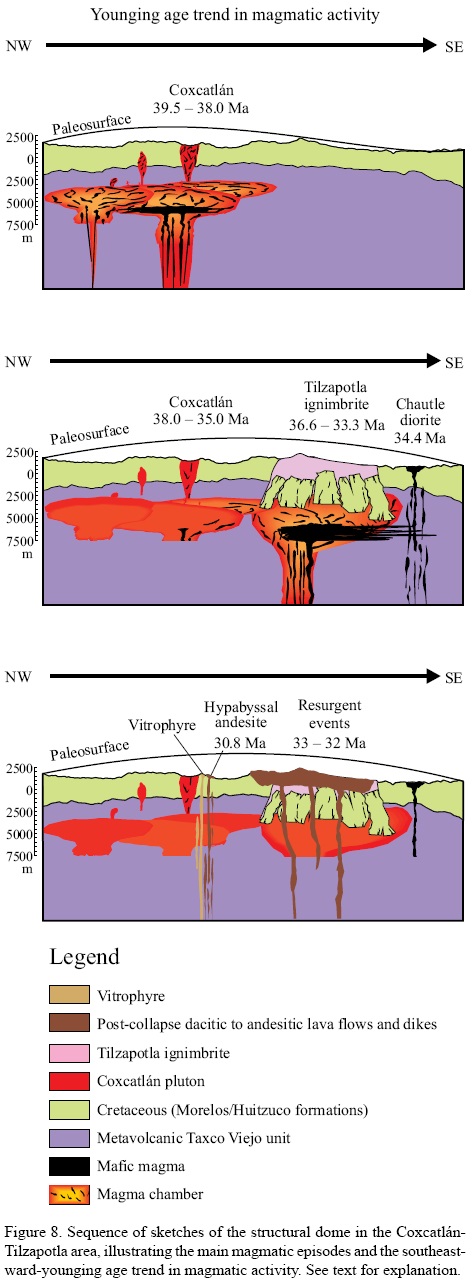
<?xml version="1.0" encoding="ISO-8859-1"?><article xmlns:mml="http://www.w3.org/1998/Math/MathML" xmlns:xlink="http://www.w3.org/1999/xlink" xmlns:xsi="http://www.w3.org/2001/XMLSchema-instance">
<front>
<journal-meta>
<journal-id>1026-8774</journal-id>
<journal-title><![CDATA[Revista mexicana de ciencias geológicas]]></journal-title>
<abbrev-journal-title><![CDATA[Rev. mex. cienc. geol]]></abbrev-journal-title>
<issn>1026-8774</issn>
<publisher>
<publisher-name><![CDATA[Universidad Nacional Autónoma de México, Instituto de Geología]]></publisher-name>
</publisher>
</journal-meta>
<article-meta>
<article-id>S1026-87742013000200001</article-id>
<title-group>
<article-title xml:lang="en"><![CDATA[Caldera formation and progressive batholith construction: Geochronological, petrographic and stratigraphic constraints from the Coxcatlán-Tilzapotla area, Sierra Madre del Sur, Mexico]]></article-title>
<article-title xml:lang="es"><![CDATA[Formación de calderas y construcción progresiva de batolitos: restricciones geocronológicas, petrográficas y estratigráficas del área Coxcatlán-Tilzapotla, Sierra Madre del Sur, México]]></article-title>
</title-group>
<contrib-group>
<contrib contrib-type="author">
<name>
<surname><![CDATA[Martiny]]></surname>
<given-names><![CDATA[Barbara M.]]></given-names>
</name>
<xref ref-type="aff" rid="A01"/>
</contrib>
<contrib contrib-type="author">
<name>
<surname><![CDATA[Morán-Zenteno]]></surname>
<given-names><![CDATA[Dante J.]]></given-names>
</name>
<xref ref-type="aff" rid="A01"/>
</contrib>
<contrib contrib-type="author">
<name>
<surname><![CDATA[Solari]]></surname>
<given-names><![CDATA[Luigi]]></given-names>
</name>
<xref ref-type="aff" rid="A02"/>
</contrib>
<contrib contrib-type="author">
<name>
<surname><![CDATA[López-Martínez]]></surname>
<given-names><![CDATA[Margarita]]></given-names>
</name>
<xref ref-type="aff" rid="A03"/>
</contrib>
<contrib contrib-type="author">
<name>
<surname><![CDATA[de Silva]]></surname>
<given-names><![CDATA[Shanaka L.]]></given-names>
</name>
<xref ref-type="aff" rid="A04"/>
</contrib>
<contrib contrib-type="author">
<name>
<surname><![CDATA[Flores-Huerta]]></surname>
<given-names><![CDATA[Diana]]></given-names>
</name>
<xref ref-type="aff" rid="A05"/>
</contrib>
<contrib contrib-type="author">
<name>
<surname><![CDATA[Zúñiga-Lagunes]]></surname>
<given-names><![CDATA[Lilibeth]]></given-names>
</name>
<xref ref-type="aff" rid="A05"/>
</contrib>
<contrib contrib-type="author">
<name>
<surname><![CDATA[Luna-González]]></surname>
<given-names><![CDATA[Laura]]></given-names>
</name>
<xref ref-type="aff" rid="A06"/>
</contrib>
</contrib-group>
<aff id="A01">
<institution><![CDATA[,Universidad Nacional Autónoma de México. Instituto de Geología. Departamento de Geoquímica.]]></institution>
<addr-line><![CDATA[México D.F.]]></addr-line>
<country>México</country>
</aff>
<aff id="A02">
<institution><![CDATA[,Universidad Nacional Autónoma de México. Centro de Geociencias. ]]></institution>
<addr-line><![CDATA[Querétaro ]]></addr-line>
<country>México</country>
</aff>
<aff id="A03">
<institution><![CDATA[,Centro de Investigación Científica y de Educación Superior de Ensenada (CICESE). División de Ciencias de la Tierra. ]]></institution>
<addr-line><![CDATA[Ensenada Baja California]]></addr-line>
<country>México</country>
</aff>
<aff id="A04">
<institution><![CDATA[,Oregon State University. Department of Geosciences. ]]></institution>
<addr-line><![CDATA[Corvallis ]]></addr-line>
<country>U.S.A.</country>
</aff>
<aff id="A05">
<institution><![CDATA[,Universidad Nacional Autónoma de México. Facultad de Ingeniería. ]]></institution>
<addr-line><![CDATA[México D.F.]]></addr-line>
<country>México</country>
</aff>
<aff id="A06">
<institution><![CDATA[,Universidad Nacional Autónoma de México. Instituto de Geología. Departamento de Geología Regional.]]></institution>
<addr-line><![CDATA[México D.F.]]></addr-line>
<country>México</country>
</aff>
<pub-date pub-type="pub">
<day>00</day>
<month>08</month>
<year>2013</year>
</pub-date>
<pub-date pub-type="epub">
<day>00</day>
<month>08</month>
<year>2013</year>
</pub-date>
<volume>30</volume>
<numero>2</numero>
<fpage>247</fpage>
<lpage>267</lpage>
<copyright-statement/>
<copyright-year/>
<self-uri xlink:href="http://www.scielo.org.mx/scielo.php?script=sci_arttext&amp;pid=S1026-87742013000200001&amp;lng=en&amp;nrm=iso"></self-uri><self-uri xlink:href="http://www.scielo.org.mx/scielo.php?script=sci_abstract&amp;pid=S1026-87742013000200001&amp;lng=en&amp;nrm=iso"></self-uri><self-uri xlink:href="http://www.scielo.org.mx/scielo.php?script=sci_pdf&amp;pid=S1026-87742013000200001&amp;lng=en&amp;nrm=iso"></self-uri><abstract abstract-type="short" xml:lang="en"><p><![CDATA[A feature of great interest in the late Eocene-early Oligocene volcanic province of the Sierra Madre del Sur is an elliptical NW-SE oriented dome structure (52 x 30 km) in the Coxcatlán-Tilzapotla region. The elliptical structure encompasses the Tilzapotla collapse caldera, rhyolitic domes, large volumes of ignimbrites, as well as the Buenavista intrusive body, and the Coxcatlán and Chautle plutons located west and east of the structural margin of the caldera, respectively. Previous geochronological studies carried out on the silicic and intermediate magmatic rocks intercalated with pre-caldera tilted terrestrial sediments, as well as the occurrence of an angular unconformity separating fine-grained and coarse-grained beds, constrain uplift in the dome area to the late Eocene (~38-34 Ma). This suggests that doming was related to emplacement of magmas into the crust prior to collapse of the Tilzapotla caldera at 34.3 Ma. New LA-ICPMS zircon U-Pb and 40Ar-39Ar mineral ages for the key magmatic units combined with field observations, petrographic studies and geochemical analyses reveal the geochronology of magma emplacement and development of the volcano-plutonic complex, and its connection with the dome. Zircon 206pb/238U ages of the Coxcatlán pluton ranging from 39.5 ± 0.6 to 35.2 ± 0.2 Ma suggest that the Coxcatlán pluton was constructed gradually over ~4 m.y. and overlapped in time with the beginning of the development of the Tilzapotla ignimbrite (36.6 ± 0.4 to 33.3 ± 0.5 Ma). Significant overlap of the population density distributions is found indicating temporal continuity of the zircon crystallization record. Zircons from the mafic Chautle pluton (34.37 ± 0.26Ma) yield the same weighted mean age within uncertainty as zircon from the Tilzapotla ignimbrite. These data are best reconciled with a continuous but incremental assembly of a volcano-plutonic system that climaxed with the caldera collapse and the eruption of the Tilzapotla ignimbrite. The evidence of mafic inputs throughout the history indicates that recharge provided the thermal engine for the prolonged history of the system. Mutual intrusion relationships observed between mafic enclaves and granodiorite facies indicate magma mingling within the magma chamber when both host and enclaves were not completely crystallized. Development of the Coxcatlán-Tilzapotla system resulted in updoming of the surface, extending the "roof above the melt-rich part of the system in the southeast. The spatial and temporal relationship between the crystal-rich Tilzapotla ignimbrite and the less differentiated Chautle intrusion suggests that mafic magma injection might have disrupted crystal mushes in the chamber, and destabilized the "perched" magma reservoir and thereby triggering the eruption in the southeastern part of the dome.]]></p></abstract>
<abstract abstract-type="short" xml:lang="es"><p><![CDATA[Un rasgo de mucho interés en la provincia volcánica del Eoceno tardío-Oligoceno temprano de la Sierra Madre del Sur es la estructura dómica de forma elíptica, orientada al NW-SE (52 x 30 km) y ubicada en el área de Coxcatlán-Tilzapotla. La estructura elíptica contiene la caldera de Tilzapotla, domos riolíticos, volúmenes importantes de unidades ignimbríticas, así como el intrusivo de Buenavista y los plutones de Coxcatlán y Chautle, ubicado estos últimos al occidente y al oriente del anillo de la caldera, respectivamente. Los estudios geocronológicos realizados previamente en las rocas magmáticas silícicas y las intermedias intercaladas en sedimentos continentales anteriores a la caldera, así como la presencia de una discordancia angular entre capas de grano fino y grueso, constriñen el tiempo del levantamiento del domo al Eoceno tardío (~38-34 Ma). Lo anterior sugiere que el proceso de formación del domo está relacionado al emplazamiento de magmas en la corteza previo al colapso de la caldera (34.3 Ma). Nuevas edades de U-Pbpor LA-ICPMS en zirconesy edades de 40Ar-39Ar en minerales de unidades magmáticas clave, combinadas con observaciones de campo, estudios petrográficos y análisis geoquímicos ponen de manifiesto la geocronología del emplazamiento magmáticoy el desarrollo del complejo volcánico-plutónico, así como su conexión con el domo. El rango de edades 206Pb/238U en circones del plutón de Coxcatlán de 39.5 ± 0.6 a 35.2 ± 0.2 Ma sugiere que elplutón de Coxcatlán se construyó gradualmente durante ~4 m.a. y se traslapa con la historia magmática de la ignimbrita Tilzapotla (36.6 ± 0.4 a 33.3 ± 0.5 Ma). Se observa un traslape significativo en la distribución de edades de las poblaciones que indica una continuidad temporal en el registro de la cristalización de los circones. Los fechamientos de circones del plutón máfico de Chautle arroja una edad igual (34.37 ± 0.26 Ma), dentro del error, a las edades principales de la ignimbrita Tilzapotla. Estos datos se ajustan mejor con un proceso continuo pero creciente de construcción de un sistema volcánico-plutónico que alcanzó su clímax con el colapso de la caldera y la erupción de la ignimbrita Tilzapotla. La evidencia de la inyección de magmas máficos durante este proceso indica que la recarga de magmas proporcionó la energía térmica durante la historia prolongada del sistema magmático. Las relaciones mutuas de intrusión observadas entre los enclaves máficos y la facies de granodiorita indican mezcla inhomogénea (mingling) dentro de la cámara cuando ambas fases no habían alcanzado la cristalización completa. El desarrollo del sistema Coxcatlán-Tilzapotla resultó en la formación del domo, extendiendo el techo arriba de la zona rica en fundido hacia el sureste. La relación espacial y temporal entre la ignimbrita Tilzapotla, que es rica en cristales, y la intrusión menos diferenciada de Chautle sugiere que la inyección de magmas máficos en la cámara podría haber perturbado las acumulaciones de cristales (mushes) y desestabilizó el reservorio magmático en la parte superior de la corteza causando la erupción en la parte sureste del domo.]]></p></abstract>
<kwd-group>
<kwd lng="en"><![CDATA[volcanic-plutonic connection]]></kwd>
<kwd lng="en"><![CDATA[ignimbrite]]></kwd>
<kwd lng="en"><![CDATA[Coxcatlán pluton]]></kwd>
<kwd lng="en"><![CDATA[Tilzapotla caldera]]></kwd>
<kwd lng="en"><![CDATA[southern Mexico]]></kwd>
<kwd lng="es"><![CDATA[conexión volcánico-plutónica]]></kwd>
<kwd lng="es"><![CDATA[ignimbrita]]></kwd>
<kwd lng="es"><![CDATA[plutón de Coxcatlán]]></kwd>
<kwd lng="es"><![CDATA[caldera de Tilzapotla]]></kwd>
<kwd lng="es"><![CDATA[sur de México]]></kwd>
</kwd-group>
</article-meta>
</front><body><![CDATA[  	    <p align="center"><font face="verdana" size="4"><b>Caldera formation and progressive batholith construction: Geochronological, petrographic and stratigraphic constraints from the Coxcatl&aacute;n&#45;Tilzapotla area, Sierra Madre del Sur, Mexico</b></font></p>  	    <p align="center"><font face="verdana" size="2">&nbsp;</font></p>  	    <p align="center"><font face="verdana" size="3"><b>Formaci&oacute;n de calderas y construcci&oacute;n progresiva de batolitos: restricciones geocronol&oacute;gicas, petrogr&aacute;ficas y estratigr&aacute;ficas del &aacute;rea Coxcatl&aacute;n&#45;Tilzapotla, Sierra Madre del Sur, M&eacute;xico</b></font></p>  	    <p align="center"><font face="verdana" size="2">&nbsp;</font></p>  	    <p align="center"><font face="verdana" size="2"><b>Barbara M. Martiny<sup>1</sup>*, Dante J. Mor&aacute;n&#45;Zenteno<sup>1</sup>, Luigi Solari<sup>2</sup>, Margarita L&oacute;pez&#45;Mart&iacute;nez<sup>3</sup>, Shanaka L. de Silva<sup>4</sup>, Diana Flores&#45;Huerta<sup>5</sup>, Lilibeth Z&uacute;&ntilde;iga&#45;Lagunes<sup>5</sup>, and Laura Luna&#45;Gonz&aacute;lez<sup>6</sup></b></font></p>  	    <p align="justify"><font face="verdana" size="2">&nbsp;</font></p>  	    <p align="justify"><font face="verdana" size="2"><i><sup>1</sup> Departamento de Geoqu&iacute;mica, Instituto de Geolog&iacute;a, Universidad Nacional Aut&oacute;noma de M&eacute;xico, 04510 M&eacute;xico, D.F., M&eacute;xico.</i> * <a href="mailto:martiny@unam.mx">martiny@unam.mx</a></font></p>  	    <p align="justify"><font face="verdana" size="2"><i><sup>2</sup> Centro de Geociencias, Universidad Nacional Aut&oacute;noma de M&eacute;xico, Campus UNAM Juriquilla, 76230 Quer&eacute;taro, M&eacute;xico.</i></font></p>  	    <p align="justify"><font face="verdana" size="2"><i><sup>3</sup> Divisi&oacute;n de Ciencias de la Tierra, Centro de Investigaci&oacute;n Cient&iacute;fica y de Educaci&oacute;n Superior de Ensenada (CICESE), Carretera Ensenada&#45;Tijuana No. 3918, 22860 Ensenada, Baja California, M&eacute;xico.</i></font></p>  	    ]]></body>
<body><![CDATA[<p align="justify"><font face="verdana" size="2"><i><sup>4</sup> Department of Geosciences, Oregon State University, Corvallis, OR 97333, U.S.A.</i></font></p>  	    <p align="justify"><font face="verdana" size="2"><i><sup>5</sup> Facultad de Ingenier&iacute;a, Universidad Nacional Aut&oacute;noma de M&eacute;xico, 04510 M&eacute;xico, D.F., M&eacute;xico.</i></font></p>  	    <p align="justify"><font face="verdana" size="2"><i><sup>6</sup> Departamento de Geolog&iacute;a Regional, Instituto de Geolog&iacute;a, Universidad Nacional Aut&oacute;noma de M&eacute;xico, M&eacute;xico, D.F., 04510, M&eacute;xico.</i></font></p>  	    <p align="justify"><font face="verdana" size="2">&nbsp;</font></p>  	    <p align="justify"><font face="verdana" size="2">Manuscript received: June 6, 2012    <br> 	Corrected manuscript received: May 31, 2013    <br> 	Manuscript accepted: June 1, 2013</font></p>  	    <p align="justify"><font face="verdana" size="2">&nbsp;</font></p>  	    <p align="justify"><font face="verdana" size="2"><b>ABSTRACT</b></font></p>  	    <p align="justify"><font face="verdana" size="2">A feature of great interest in the late Eocene&#45;early Oligocene volcanic province of the Sierra Madre del Sur is an elliptical NW&#45;SE oriented dome structure (52 x 30 km) in the Coxcatl&aacute;n&#45;Tilzapotla region. The elliptical structure encompasses the Tilzapotla collapse caldera, rhyolitic domes, large volumes of ignimbrites, as well as the Buenavista intrusive body, and the Coxcatl&aacute;n and Chautle plutons located west and east of the structural margin of the caldera, respectively. Previous geochronological studies carried out on the silicic and intermediate magmatic rocks intercalated with pre&#45;caldera tilted terrestrial sediments, as well as the occurrence of an angular unconformity separating fine&#45;grained and coarse&#45;grained beds, constrain uplift in the dome area to the late Eocene (~38&#45;34 Ma). This suggests that doming was related to emplacement of magmas into the crust prior to collapse of the Tilzapotla caldera at 34.3 Ma.</font></p>  	    ]]></body>
<body><![CDATA[<p align="justify"><font face="verdana" size="2">New LA&#45;ICPMS zircon U&#45;Pb and <sup>40</sup>Ar&#45;<sup>39</sup>Ar mineral ages for the key magmatic units combined with field observations, petrographic studies and geochemical analyses reveal the geochronology of magma emplacement and development of the volcano&#45;plutonic complex, and its connection with the dome. Zircon <sup>206</sup>pb/<sup>238</sup>U ages of the Coxcatl&aacute;n pluton ranging from 39.5 &plusmn; 0.6 to 35.2 &plusmn; 0.2 Ma suggest that the Coxcatl&aacute;n pluton was constructed gradually over ~4 m.y. and overlapped in time with the beginning of the development of the Tilzapotla ignimbrite (36.6 &plusmn; 0.4 to 33.3 &plusmn; 0.5 Ma). Significant overlap of the population density distributions is found indicating temporal continuity of the zircon crystallization record. Zircons from the mafic Chautle pluton (34.37 &plusmn; 0.26Ma) yield the same weighted mean age within uncertainty as zircon from the Tilzapotla ignimbrite. These data are best reconciled with a continuous but incremental assembly of a volcano&#45;plutonic system that climaxed with the caldera collapse and the eruption of the Tilzapotla ignimbrite. The evidence of mafic inputs throughout the history indicates that recharge provided the thermal engine for the prolonged history of the system. Mutual intrusion relationships observed between mafic enclaves and granodiorite facies indicate magma mingling within the magma chamber when both host and enclaves were not completely crystallized.</font></p>  	    <p align="justify"><font face="verdana" size="2">Development of the Coxcatl&aacute;n&#45;Tilzapotla system resulted in updoming of the surface, extending the "roof above the melt&#45;rich part of the system in the southeast. The spatial and temporal relationship between the crystal&#45;rich Tilzapotla ignimbrite and the less differentiated Chautle intrusion suggests that mafic magma injection might have disrupted crystal mushes in the chamber, and destabilized the "perched" magma reservoir and thereby triggering the eruption in the southeastern part of the dome.</font></p>  	    <p align="justify"><font face="verdana" size="2"><b>Key words:</b> volcanic&#45;plutonic connection, ignimbrite, Coxcatl&aacute;n pluton, Tilzapotla caldera, southern Mexico.</font></p>  	    <p align="justify"><font face="verdana" size="2">&nbsp;</font></p>  	    <p align="justify"><font face="verdana" size="2"><b>RESUMEN</b></font></p>  	    <p align="justify"><font face="verdana" size="2">Un rasgo de mucho inter&eacute;s en la provincia volc&aacute;nica del Eoceno tard&iacute;o&#45;Oligoceno temprano de la Sierra Madre del Sur es la estructura d&oacute;mica de forma el&iacute;ptica, orientada al NW&#45;SE (52 x 30 km) y ubicada en el &aacute;rea de Coxcatl&aacute;n&#45;Tilzapotla. La estructura el&iacute;ptica contiene la caldera de Tilzapotla, domos riol&iacute;ticos, vol&uacute;menes importantes de unidades ignimbr&iacute;ticas, as&iacute; como el intrusivo de Buenavista y los plutones de Coxcatl&aacute;n y Chautle, ubicado estos &uacute;ltimos al occidente y al oriente del anillo de la caldera, respectivamente. Los estudios geocronol&oacute;gicos realizados previamente en las rocas magm&aacute;ticas sil&iacute;cicas y las intermedias intercaladas en sedimentos continentales anteriores a la caldera, as&iacute; como la presencia de una discordancia angular entre capas de grano fino y grueso, constri&ntilde;en el tiempo del levantamiento del domo al Eoceno tard&iacute;o (~38&#45;34 Ma). Lo anterior sugiere que el proceso de formaci&oacute;n del domo est&aacute; relacionado al emplazamiento de magmas en la corteza previo al colapso de la caldera (34.3 Ma).</font></p>  	    <p align="justify"><font face="verdana" size="2">Nuevas edades de U&#45;Pbpor LA&#45;ICPMS en zirconesy edades de <sup>40</sup>Ar&#45;<sup>39</sup>Ar en minerales de unidades magm&aacute;ticas clave, combinadas con observaciones de campo, estudios petrogr&aacute;ficos y an&aacute;lisis geoqu&iacute;micos ponen de manifiesto la geocronolog&iacute;a del emplazamiento magm&aacute;ticoy el desarrollo del complejo volc&aacute;nico&#45;plut&oacute;nico, as&iacute; como su conexi&oacute;n con el domo. El rango de edades <sup>206</sup>Pb/<sup>238</sup>U en circones del plut&oacute;n de Coxcatl&aacute;n de 39.5 &plusmn; 0.6 a 35.2 &plusmn; 0.2 Ma sugiere que elplut&oacute;n de Coxcatl&aacute;n se construy&oacute; gradualmente durante ~4 m.a. y se traslapa con la historia magm&aacute;tica de la ignimbrita Tilzapotla (36.6 &plusmn; 0.4 a 33.3 &plusmn; 0.5 Ma). Se observa un traslape significativo en la distribuci&oacute;n de edades de las poblaciones que indica una continuidad temporal en el registro de la cristalizaci&oacute;n de los circones. Los fechamientos de circones del plut&oacute;n m&aacute;fico de Chautle arroja una edad igual (34.37 &plusmn; 0.26 Ma), dentro del error, a las edades principales de la ignimbrita Tilzapotla. Estos datos se ajustan mejor con un proceso continuo pero creciente de construcci&oacute;n de un sistema volc&aacute;nico&#45;plut&oacute;nico que alcanz&oacute; su cl&iacute;max con el colapso de la caldera y la erupci&oacute;n de la ignimbrita Tilzapotla. La evidencia de la inyecci&oacute;n de magmas m&aacute;ficos durante este proceso indica que la recarga de magmas proporcion&oacute; la energ&iacute;a t&eacute;rmica durante la historia prolongada del sistema magm&aacute;tico. Las relaciones mutuas de intrusi&oacute;n observadas entre los enclaves m&aacute;ficos y la facies de granodiorita indican mezcla inhomog&eacute;nea (mingling) dentro de la c&aacute;mara cuando ambas fases no hab&iacute;an alcanzado la cristalizaci&oacute;n completa.</font></p>  	    <p align="justify"><font face="verdana" size="2">El desarrollo del sistema Coxcatl&aacute;n&#45;Tilzapotla result&oacute; en la formaci&oacute;n del domo, extendiendo el techo arriba de la zona rica en fundido hacia el sureste. La relaci&oacute;n espacial y temporal entre la ignimbrita Tilzapotla, que es rica en cristales, y la intrusi&oacute;n menos diferenciada de Chautle sugiere que la inyecci&oacute;n de magmas m&aacute;ficos en la c&aacute;mara podr&iacute;a haber perturbado las acumulaciones de cristales (mushes) y desestabiliz&oacute; el reservorio magm&aacute;tico en la parte superior de la corteza causando la erupci&oacute;n en la parte sureste del domo.</font></p>  	    <p align="justify"><font face="verdana" size="2"><b>Palabras clave:</b> conexi&oacute;n volc&aacute;nico&#45;plut&oacute;nica, ignimbrita, plut&oacute;n de Coxcatl&aacute;n, caldera de Tilzapotla, sur de M&eacute;xico.</font></p>  	    <p align="justify"><font face="verdana" size="2">&nbsp;</font></p>  	    ]]></body>
<body><![CDATA[<p align="justify"><font face="verdana" size="2"><b>INTRODUCTION</b></font></p>  	    <p align="justify"><font face="verdana" size="2">There has been considerable debate in recent years about the relationship of large caldera systems and batho&#45;liths. The debate has centered on the largest volcanic systems, commonly called "supervolcanic". It is generally agreed that large silicic eruptions can be interpreted in terms of "snapshots" that record conditions in the magma chamber, whereas plutons provide a longer record of magmatic evolution (Bachmann <i>et al.,</i> 2007b; Lipman, 2007). However, some view these as separate systems where batholiths represent slow accumulations of silicic magma that never attained eruptibility, while supervolcanic systems represent rapid accumulations of silicic magma that have no plutonic record (Glazner <i>et al.,</i> 2004; Coleman <i>et al.,</i> 2004, Zimmerer and Mcintosh, 2012; Tappa <i>et al.,</i> 2011). The alternative view most recently articulated by the likes of Bachmann <i>et al.</i> (2007b), de Silva and Gosnold (2007), Lipman (2007), and Miller (2008) is that large silicic eruptions associated with collapse calderas are intimately related to contemporaneous, consanguineous, co&#45;genetic intrusives, that represent "non&#45;erupted" dominant volumes of the magmatic systems (e.g., Smith, 1979; Lipman, 1984; Elston, 1984). In this view, individual calderas record the development of a pluton and different cycles of activity from that system would mark the progressive or incremental development of that pluton. Collections of spatially and temporally&#45;associated calderas would record the development of a composite batholith at depth. Herein we provide insight into this debate through a study of the Coxcatl&aacute;n&#45;Tilzapotla region of the Sierra Madre del Sur in Mexico.</font></p>  	    <p align="justify"><font face="verdana" size="2">The north&#45;central Sierra Madre del Sur (SMS) has been recognized as a site of broad exposures of volcanic and plutonic rocks in the central part of the late Eocene&#45;early Oligocene silicic volcanic province in southern Mexico (Mor&aacute;n&#45;Zenteno <i>et al.,</i> 1999). Of particular interest is the Coxcatl&aacute;n&#45;Tilzapotla area, given its location within a NW&#45;SE oriented elliptical dome structure (52x30 km) that encloses the Tilzapotla caldera, medium&#45;grained plutons, hypabyssal intrusive bodies, rhyolitic domes, and voluminous ignimbrites (<a href="/img/revistas/rmcg/v30n2/a1f1.jpg" target="_blank">Figures 1</a> and <a href="/img/revistas/rmcg/v30n2/a1f2.jpg" target="_blank">2</a>). Age and compositional similarities in these broad exposures of volcanic and plutonic rocks suggest a genetic relationship between them, and provide an excellent opportunity for studying the evolution of the magmatic system within the elliptical dome structure and understanding the genetic connection between the volcanic and plutonic realms.</font></p>  	    <p align="justify"><font face="verdana" size="2">Based on the geochronologic relationships, compositional variations and geochemical characteristics of the voluminous late Eocene&#45;early Oligocene volcanic successions, Mori <i>et al.</i> (2012) interpreted the origin of the silicic centers in terms of the gradual thermomechanical maturation of the crust due to a sustained mantle power input during the Eocene. This group of silicic centers displays volume&#45;time patterns similar to those documented and summarized by de Silva <i>et al.</i> (2006) and de Silva and Gosnold (2007) and are thus interpreted as the sequence of events and conditions that trigger the formation of ignimbrite flare&#45;ups.</font></p>  	    <p align="justify"><font face="verdana" size="2">Regional geological and geochronological studies were carried out previously by our group near the elliptical dome structure in the silicic magmatic rocks, the tilted pre&#45;volcanic continental sediments and intercalated volcanic rocks, as well as the underlying deformed Cretaceous marine sedimentary rocks. Results suggested uplifting in this region during the late Eocene (~38&#45;34 Ma) and a doming process related to the emplacement of magma into the upper crust prior to extrusion of the Tilzapotla ignimbrite at 34.3 Ma, which is associated with the caldera collapse (Mor&aacute;n&#45;Zenteno <i>et al.,</i> 2004; Mor&aacute;n&#45;Zenteno <i>et al.,</i> 2007). Dome construction was initially interpreted by Mor&aacute;n&#45;Zenteno <i>et al.</i> (2004) as the expression of the tumescence stage in the development of the Tilzapotla caldera; however, results presented here indicate a more complex scenario.</font></p>  	    <p align="justify"><font face="verdana" size="2">Earlier studies in the Coxcatl&aacute;n&#45;Tilzapotla sector focused mainly on the volcanic rocks and pre&#45;volcanic continental sedimentary rocks, whereas plutonic and hyp&#45;abyssal intrusive rocks exposed along and outside of the Tilzapotla caldera ring, the structural margin of the caldera, have received less attention (<a href="/img/revistas/rmcg/v30n2/a1f2.jpg" target="_blank">Figure 2</a>).</font></p>  	    <p align="justify"><font face="verdana" size="2">The present study is based on new LA&#45;ICP&#45;MS zircon U&#45;Pb and Ar&#45;Ar mineral ages for several of the different magmatic facies within the elliptical dome structure, with emphasis on the plutonic and hypabyssal rocks (Coxcatl&aacute;n and Chautle plutons, Buenavista intrusion) in order to identify intrusive rocks that are contemporaneous with the Tilzapotla ignimbrite and caldera collapse, and gain insight on plutonic&#45;ignimbrite connections. We include description of the petrography of different magmatic facies of the Coxcatl&aacute;n pluton, including magmatic enclaves, the Tilzapotla ignimbrite and related units. In addition we document the temporal evolution of magma emplacement within the elliptical dome. Particular attention was focused on the development of the elliptical dome structure and its possible relationship to the progressive construction of a batholith at depth under the Coxcatl&aacute;n&#45;Tilzapotla region.</font></p>  	    <p align="justify"><font face="verdana" size="2">&nbsp;</font></p>  	    <p align="justify"><font face="verdana" size="2"><b>GEOLOGICAL SETTING AND STRATIGRAPHY OF THE COXCATL&Aacute;N&#45;TILZAPOTLA AREA</b></font></p>  	    <p align="justify"><font face="verdana" size="2">The Tilzapotla caldera area is part of the subduction related magmatic record in the SMS that extends over a broad region in southern Mexico and became extinct between the early Oligocene and early Miocene (Schaaf <i>et</i> al., 1995; Mor&aacute;n&#45;Zenteno <i>et al.,</i> 1999). Magmatic activity in the Coxcatl&aacute;n&#45;Tilzapotla sector formed part of a major episode of late Eocene to early Oligocene explosive silicic activity preceded by pulses of andesitic and mafic volcanism in the north&#45;central SMS. Silicic volcanism produced voluminous ignimbrites, collapse caldera structures, rhyolitic domes, pyroclastic dikes, hypabyssal intrusive bodies and intermediate to silicic lavas between Nanchititla and Huautla (<a href="/img/revistas/rmcg/v30n2/a1f1.jpg" target="_blank">Figure 1</a>). General rejuvenation in the region led to the partial exhumation of most of the Paleogene silicic centers and the exposure of feeding conduits and plutonic counter&#45;parts. After the Paleocene volcanism died out at ~28 Ma, arc volcanism reinitiated at 20 Ma in a more northern position in the Trans Mexican Volcanic Belt (Ferrari <i>et al.</i>, 2012).</font></p>  	    ]]></body>
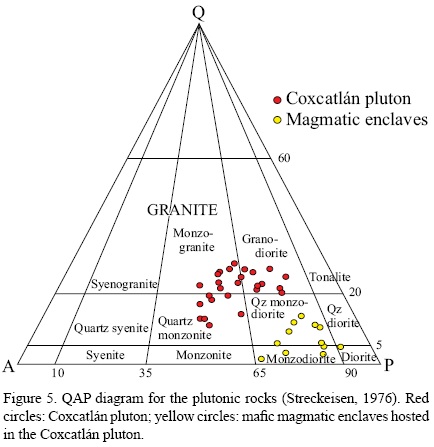
<body><![CDATA[<p align="justify"><font face="verdana" size="2">Silicic volcanism of the Coxcatl&aacute;n&#45;Tilzapotla area covers folded Cretaceous marine and sedimentary units that include calcareous and clastic beds of the Morelos/ Huitzuco and Mexcala formations (Fries, 1960); it also overlies Eocene terrestrial deposits with intermediate and mafic dikes and lavas intercalated in the sequence (Balsas Group) (Fries, 1960; Mor&aacute;n&#45;Zenteno <i>et al.,</i> 2007) (<a href="/img/revistas/rmcg/v30n2/a1f2.jpg" target="_blank">Figure 2</a>).</font></p>  	    <p align="justify"><font face="verdana" size="2">The structural dome associated with the Tilzapotla&#45;Coxcatl&aacute;n magmatic system is a NW&#45;SE oriented elliptical structure with a long axis of 52 km and a short axis of 30 km (<a href="/img/revistas/rmcg/v30n2/a1f1.jpg" target="_blank">Figure 1</a>). The 30x20 km collapse caldera structure is contained in the southeastern part of the dome, whereas the Coxcatl&aacute;n pluton is located in the northwestern part. Compared with pre&#45;volcanic ~N&#45;S folds characteristic of the Late Cretaceous &#45; Paleocene shortening in the region (Laramide), the Coxcatl&aacute;n&#45;Tilzapotla dome clearly displays a different orientation of its long axis. The effects of this structural interference are expressed by the northward and southward plunging of the small&#45;scale Laramide folds on the northern and southern flanks of the dome, respectively (<a href="/img/revistas/rmcg/v30n2/a1f1.jpg" target="_blank">Figures 1</a> and <a href="/img/revistas/rmcg/v30n2/a1f3.jpg" target="_blank">3</a>). Timing of the dome formation has been constrained by an angular unconformity and a significant facies change between two Eocene terrestrial successions exposed outside the northwestern edge of the structural dome. The lower and upper successions are separated by ignimbrites dated by K&#45;Ar in sanidine at 38.5 &plusmn; 0.7 Ma and 35.1 &plusmn; 0.4 Ma (Mor&aacute;n&#45;Zenteno <i>et al.,</i> 2007). Tilting of the lower succession, as well as a coarsening&#45;upward tendency observed in the upper part of the lower succession, is indicative of rejuvenation of the landscape due to uplift of the Coxcatl&aacute;n&#45;Tilzapotla dome structure. The occurrence of ignimbrites as old as 38.5 Ma between the two successions and tilting of the upper succession away from the dome structure indicate that uplift had already initiated at least 38 m.y. ago and continued until ~34 Ma, when the Tilzapotla caldera collapsed.</font></p>  	    <p align="justify"><font face="verdana" size="2"><b>Volcanic stratigraphy</b></font></p>  	    <p align="justify"><font face="verdana" size="2">Ignimbrites associated with caldera collapse, post&#45;caldera ignimbrites and rhyolitic domes in the Tilzapotla area were erupted from 35.5 to ~33 Ma (Mor&aacute;n&#45;Zenteno <i>et al.</i> , 2004). The pre&#45;silicic volcanic record is represented by low volume andesitic to mafic lavas and dikes intercalated with and intruding the terrestrial deposits of the Balsas Group (Fries, 1960; de Cserna and Fries, 1981), which include the Tepetlapa and Huanjintlan formations cropping out northwest of the dome structure (Mor&aacute;n&#45;Zenteno <i>et al.</i>, 2007). Intercalated with the Balsas Group and separating the Tepetlapa and Huanjintlan formations are ignimbrite flows dated at 38.5 &plusmn; 0.7 and 35.1 &plusmn; 0.4 Ma; the earlier ignimbrite has the same age within uncertainty as basal sanidine&#45;rich ignimbrites of the neighboring Taxco volcanic center, suggesting that the two flows are related (Mor&aacute;n&#45;Zenteno <i>et al.</i>, 2007). The upper dacitic to andesitic lava flows and dikes in the caldera area span from 33 to 32 Ma and are related to resurgence that produced uplift of the central block of the caldera infill (<a href="/img/revistas/rmcg/v30n2/a1f2.jpg" target="_blank">Figure 2</a>) (Mor&aacute;n&#45;Zenteno <i>et al.,</i> 2007).</font></p>  	    <p align="justify"><font face="verdana" size="2">The Tilzapotla ignimbrite (<a href="/img/revistas/rmcg/v30n2/a1f4.jpg" target="_blank">Figure 4a</a>), which is interpreted as the pyroclastic unit related to the collapse, varies in exposed thickness from at least 600 m in the caldera interior to 50&#45;150 m of preserved ignimbrite sections outside the caldera (Mor&aacute;n&#45;Zenteno <i>et al.,</i> 2004). The intra&#45;caldera ignimbrite succession is formed by at least five flows that display differences in the relative abundances of lithic and pumice components. Phenocryst abundance in pumice fragments varies typically from 25% to 35%, although in basal units of the northern extra&#45;caldera facies the abundance is less than 5%. The main phenocryst phases in order of abundance are quartz, plagioclase, sanidine and biotite. Traces of altered hornblende are also present. The groundmass of the ignimbrites is generally devitrified and is composed of microcrystalline quartz and feldspar. The caldera ring on the north and south sides coincides with NW&#45;SE trending faults that record post&#45;collapse lateral displacement (<a href="/img/revistas/rmcg/v30n2/a1f2.jpg" target="_blank">Figure 2</a>). The ignimbrite facies near the ring has relatively high abundance of limestone lithics and some sections display collapse megabreccia. We therefore interpret the "ring" as the structural margin of the caldera.</font></p>  	    <p align="justify"><font face="verdana" size="2">Post&#45;collapse silicic units include the Rodarte and Atopula ignimbrites that overlie debris flows and conglomerate deposits derived from the Tilzapotla ignimbrite. The Rodarte ignimbrite contains large crystal&#45;poor pumice fragments, whereas the Atopula unit displays crystal&#45;rich (30&#45;40%) pumice fragments. Relative phenocryst phase abundances are similar to the Tilzapotla ignimbrite, with quartz dominating over plagioclase and sanidine. In the central area of the caldera these units are overlain by the Gallego formation, a ~50 m succession of vitrophyres interpreted as having been formed from densely welded crystal poor ash flows. A series of rhyolitic domes with characteristic flow structure are distributed along the western segment of the caldera ring.</font></p>  	    <p align="justify"><font face="verdana" size="2">The post&#45;ignimbrite volcanic record is represented by a succession of hornblende dacite to pyroxene&#45;bearing andesitic lava flows and feeding dikes, up to 200 m thick, that are distributed in the central and northwestern sectors of the caldera. The succession includes the dacitic to andes&#45;itic El Salto formation and the andesitic Rodeo formation (Mor&aacute;n&#45;Zenteno <i>et al.,</i> 2004). Differential erosion of the caldera and uplift related to the resurgence led to inverted relief, so that the top of the caldera infill ignimbrites and lavas are now at higher elevations than the surrounding Mesozoic calcareous rocks (Mor&aacute;n&#45;Zenteno <i>et al.,</i> 2004).</font></p>  	    <p align="justify"><font face="verdana" size="2"><b>Plutonic record</b></font></p>  	    <p align="justify"><font face="verdana" size="2">The intrusive record is represented by three plutons located outside of, but relatively close to, the caldera structural margin and within the structural dome containing the Tilzapotla caldera. Their position within the dome and the spatial and temporal proximity to the Tilzapotla caldera strongly suggest that they belong to the same magmatic system that produced the caldera. The largest exposure, located west of the structural margin, corresponds to the Coxcatl&aacute;n pluton (<a href="/img/revistas/rmcg/v30n2/a1f2.jpg" target="_blank">Figure 2</a>), which represents a shallow apophysis of the deeper silicic reservoir in the uncol&#45;lapsed part of the dome that has been exposed by drainage incision. The other two plutons are represented by small exposures located along the structural margin southwest of Buenavista (Buenavista intrusion) and east of the structural margin (Chautle pluton). The characteristics of the plutonic exposures in the vicinity of the Tilzapotla caldera were poorly known and only brief mention has been made of the intrusive rocks in a local publication and a technical report (Ontiveros&#45;Tarango, 1973; Carrizales&#45;Aguilar, 1997), in several works focused on different geological features of the north&#45;central sector of the SMS (Fries 1960, 1966), and in more recent works that include radiometric age data (Meza&#45;Figueroa <i>et al.,</i> 2003; Mor&aacute;n&#45;Zenteno <i>et al.,</i> 2004). The present work is part of an ongoing study to examine the intrusive exposures, and represents the first study of the field, petrographic and geochemical characteristics of the plutons, with focus on the largest of the intrusive bodies, the Coxcatl&aacute;n pluton.</font></p>  	    <p align="justify"><font face="verdana" size="2">The Coxcatl&aacute;n pluton, emplaced in Cretaceous limestone, is exposed over an area of about 18 km<sup>2</sup> and comprises at least two apparently coeval facies. Thin sections of 41 samples from the Coxcatl&aacute;n pluton were studied in a pe&#45;trographic microscope in order to characterize mineralogi&#45;cal and textural features. Modal analyses were carried out mainly to determine the amounts of quartz, K&#45;feldspar and plagioclase present. Field observations indicate that most of the exposed pluton is a light gray colored, medium&#45;grained rock speckled with variable amounts of dark minerals. In some parts of the pluton, crystals of plagioclase and alkali feldspar noticeably larger than the surrounding medium&#45;grained minerals are common. These megacrysts are mostly &lt;1 cm, but can reach up to 2 cm or more. Modal mineral analyses indicate that the Coxcatl&aacute;n pluton plots mainly as monzogranite&#45;granodiorite on a Streckeisen (1976) QAP diagram, with some samples extending into the quartz monzonite field (<a href="#f5">Figure 5</a>); for simplicity, in this work the dominant facies of the Coxcatl&aacute;n pluton is generally referred to below as a granodiorite. In this facies, biotite is ubiquitous (up to ~10%), minor hornblende (&lt;2%) is often but not always present, and scarce pyroxene (up to 1%) and sometimes two pyroxenes were identified in a small number of samples. Titanite has not been observed. The granodiorite displays textural, mineralogical and slight geochemical variations. A finer&#45;grained variety, exposed in the interior part of the pluton, is somewhat lighter in color compared to the dominant facies due to the smaller content of fer&#45;romagnesian minerals (&lt;5% biotite). Light colored felsic magmatic enclaves (see below) enclosed in the granodiorite could testify to an additional subsequent pulse of silicic magma. Xenoliths, rarely observed in the pluton, measure from 9 to 15 cm in length and have lithologies similar to those of the country rock.</font></p> 	    ]]></body>
<body><![CDATA[<p align="center"><font face="verdana" size="2"><a name="f5"></a></font></p> 	    <p align="center"><font face="verdana" size="2"><img src="/img/revistas/rmcg/v30n2/a1f5.jpg"></font></p>      <p align="justify"><font face="verdana" size="2">The second facies is represented by pyroxene&#45;bearing magmatic enclaves, which are an important feature of the granodiorite. Mafic magmatic enclaves (MME) are ubiquitous and are finer&#45;grained and darker than the host rock (<a href="/img/revistas/rmcg/v30n2/a1f4.jpg" target="_blank">Figure 4b</a>, <a href="/img/revistas/rmcg/v30n2/a1f4.jpg" target="_blank">4d</a>, <a href="/img/revistas/rmcg/v30n2/a1f4.jpg" target="_blank">4e</a>, <a href="/img/revistas/rmcg/v30n2/a1f4.jpg" target="_blank">4f</a>, <a href="/img/revistas/rmcg/v30n2/a1f4.jpg" target="_blank">4h</a>); scarce felsic enclaves have been observed in the southern part of the pluton (<a href="/img/revistas/rmcg/v30n2/a1f4.jpg" target="_blank">Figure 4c</a>). Most enclaves have ellipsoidal or rounded shapes, although some have irregular or lobate forms (<a href="/img/revistas/rmcg/v30n2/a1f4.jpg" target="_blank">Figure 4d</a>); these forms suggest plastic deformation within a still fluid host. Contacts between the magmatic enclaves and the host rocks can be sharp with chilled margins or diffuse. Magmatic enclaves are usually &lt;10 cm in length, but can reach up to 20 cm or more. Aligned belts of MME suggest dismembered dikes emplaced in a still fluid host rock (<a href="/img/revistas/rmcg/v30n2/a1f4.jpg" target="_blank">Figure 4e</a>). Mafic mag&#45;matic enclaves contain up to 10% quartz but typically less, plagioclase &gt; potassic feldspar, and usually plot as quartz monzodiorites and monzodiorites in the QAP Streckeisen diagram (yellow circles in <a href="#f5">Figure 5</a>). MME have a much higher content of ferromagnesian minerals with respect to the granodiorite. They contain abundant biotite (usually 10&#45;20%, reaching up to 25%) and pyroxene (usually &lt;10%, but up to 15%); minor hornblende (generally &lt;3%) can be present, but is observed as a reaction product of pyroxene in the transitional contact zone with the host granitoid. In a few enclaves elongate biotite grains show moderate to strong alignment, reflecting magmatic flow. Large plagioclase and alkali feldspar megacrysts are often observed in the MME and could have been transferred from the host granitoid when both magmas were still partially molten (Vernon, 1986; Barbarin, 1990). Double magmatic enclaves (enclave within enclave) are frequently observed (<a href="/img/revistas/rmcg/v30n2/a1f4.jpg" target="_blank">Figure 4f</a>). The presence of rounded to elongate enclaves, lobate contacts, double magmatic enclaves, and mafic and felsic enclaves side by side (<a href="/img/revistas/rmcg/v30n2/a1f4.jpg" target="_blank">Figure 4g</a>) are features that suggest mingling (Vernon <i>et al.</i>, 1988) in which pulses of magma of different compositions were injected into the host granodiorite. Mafic magmatic swarms are observed in the southern sector of the Coxcatl&aacute;n pluton (<a href="/img/revistas/rmcg/v30n2/a1f4.jpg" target="_blank">Figure 4h</a>).</font></p>  	    <p align="justify"><font face="verdana" size="2">We have not observed any composite dikes in the area. Occasional thin aplite veins seven to eight cm wide are observed different parts of the Coxcatl&aacute;n pluton, and a small aplite mass of approximately 40 cm is exposed in the northern sector of the pluton, along the highway to the northwest of the town of Coxcatl&aacute;n. The aplitic rock is finegrained and is constituted mainly by quartz and feldspar intergrowth in a graphic texture, with small amounts of biotite and oxides.</font></p>  	    <p align="justify"><font face="verdana" size="2">Recent widening of the highway at the northern edge of the Coxcatl&aacute;n pluton has exposed small pegmatite lenses and a contact aureole between the granodiorite and Cretaceous limestone; yellow&#45;brown garnet crystals in this zone measure 1&#45;3 mm, but can reach 1.5 cm in diameter. X&#45;ray diffraction in whole rock and clay&#45;sized (&lt;2 Lim) fractions identified calcite, wollastonite, spessartite, vesu&#45;vianite, and smectite in the contact aureole. XRD analyses were preformed with a Shimadzu XRD&#45;6000, equipped with a monochromator, using Cu radiation.</font></p>  	    <p align="justify"><font face="verdana" size="2">The Buenavista intrusion is a porphyritic subvol&#45;canic body exposed in an area of approximately 2x0.5 km at the southern limits of the town of Buenavista de Cuellar, and is limited to the east by ignimbrites and to the west by Mesozoic limestone, where it is associated with a Fe skarn deposit. It consists of phenocrysts of altered plagioclase crystals with disequilibrium features and embayed anhedral quartz grains, with scarce biotite in a fine granular silicified groundmass. Meza&#45;Figueroa <i>et al.</i> (2003) report <sup>40</sup>Ar/<sup>39</sup>Ar plateau ages of 35.5 &plusmn; 0.6 Ma and 34.7 &plusmn; 0.6 Ma for two different experiments on biotite of the Buenavista intrusion.</font></p>  	    <p align="justify"><font face="verdana" size="2">The Chautle pluton is a small intrusive body emplaced in Cretaceous limestone beds at a distance of ~3 km east of the caldera ring. It is a dark gray, fine&#45; to medium&#45;grained rock that contains plagioclase of variable size that includes fine&#45; to medium&#45;grained crystals as well as large crystals showing disequilibrium features such as sieve texture, oscillatory zoning, and resorbed margins. The Chautle pluton contains two pyroxenes (15&#45;20%) with minor amounts of biotite (&lt;5%), and has a dioritic composition, which is significantly more mafic than the dominant facies of the Coxcatl&aacute;n pluton.</font></p>  	    <p align="justify"><font face="verdana" size="2">&nbsp;</font></p>  	    <p align="justify"><font face="verdana" size="2"><b>GEOCHEMISTRY</b></font></p>  	    <p align="justify"><font face="verdana" size="2">Major elements were determined by fused disk X&#45;ray fluorescence spectrometry at the Laboratorio Universitario de Geoquimica Isotopica (LUGIS) of the Universidad Nacional Autonoma de Mexico (UNAM), using a Siemens SRS&#45;3000 spectrometer, following procedures outlined by Lozano and Bernal (2005).</font></p>  	    ]]></body>
<body><![CDATA[<p align="justify"><font face="verdana" size="2">Whole rock major element analysis of volcanic units of the Tilzapotla caldera show a dacitic composition for the collapse&#45;related Tilzapotla ignimbrite (~67&#45;69 wt% SiO<sub>2</sub>); post&#45;collapse/pre&#45;resurgence products have dacitic to rhyolitic compositions (~67&#45;74 wt% SiO<sub>2</sub>), and lava flows related to resurgence (34.4 to 32.8 Ma) have andesitic to dacitic compositions (57&#45;65 wt% SiO2) (Mor&aacute;n&#45;Zenteno <i>et al.,</i> 2004). Late stage volcanic rocks exposed between Buenavista and Coxcatl&aacute;n were analyzed in this study; a hypabyssal unit (sample Cox15b) displays an andesitic composition with SiO<sub>2</sub> of ~57 wt% and a dacitic vitrophyre (sample Cox54) contains ~65% SiO<sub>2</sub> (<a href="/img/revistas/rmcg/v30n2/a1t1.jpg" target="_blank">Table 1</a>).</font></p>  	    <p align="justify"><font face="verdana" size="2">Geochemical analyses carried out on a group of intrusive rocks within the Coxcatl&aacute;n&#45;Tilzapotla elliptical structure display significant compositional variations in the late Eocene&#45;early Oligocene plutonic record (<a href="/img/revistas/rmcg/v30n2/a1t1.jpg" target="_blank">Table 1</a>). West of the caldera ring, the dominant facies of the Coxcatl&aacute;n pluton ranges in composition from granite to granodiorite (~71 to 69 wt% SiO<sub>2</sub> (Cox26 and Cox7, respectively), but magmatic enclaves in the granitoids are generally much more mafic, and present a dioritic composition (SiO<sub>2</sub> = ~53 wt%, Cox32). East of the caldera ring, the Chautle pluton (Chaul) is also more mafic than the dominant facies of the Coxcatl&aacute;n pluton, with SiO<sub>2</sub> of ~55 wt%.</font></p>  	    <p align="justify"><font face="verdana" size="2">In a geochemical study of the late Eocene&#45;early Oligocene volcanic centers of the north&#45;central SMS, Mori <i>et al.</i> (2012) suggest that the evolution of andesitic to rhyolitic rocks associated with the Tilzapotla caldera was dominated by low&#45;pressure fractional crystallization of pyroxene and plagioclase assemblages, with assimilation of Rb&#45;enriched middle&#45;upper crustal rocks to produce the dacitic and rhyolitic compositions. This interpretation was based on a coherent decrease of MgO, CaO, Al2O3 and Sr concentrations with increasing silica contents, a negative correlation between Eu/Eu* and the differentiation index, and similar La/Yb and Sm/Yb ratios throughout the suite, which precludes the crystallization of garnet, a high pressure mineral with high partitions coefficients for heavy rare earth elements such as Sm and Yb. This is confirmed by high <sup>143</sup>Nd/<sup>144</sup>Nd ratios, low <sup>87</sup>Sr/<sup>86</sup>Sr ratios, and a negative correlation between <sup>143</sup>Nd<sup>/144</sup>Nd and SiO<sub>2</sub>.</font></p>  	    <p align="justify"><font face="verdana" size="2">&nbsp;</font></p>  	    <p align="justify"><font face="verdana" size="2"><b>COMPARATIVE ANALYSIS OF THE GEOCHRONOLOGICAL DATA FROM THE PLUTONIC AND VOLCANIC ROCKS IN THE COXCATL&Aacute;N&#45;TILZAPOTLA REGION</b></font></p>  	    <p align="justify"><font face="verdana" size="2">Geochronological dating was performed on distinct magmatic units not only to attempt to better constrain the evolution of magmas within the elliptical dome structure in the Coxcatl&aacute;n&#45;Tilzapotla caldera area, but also to explore pluton growth and the duration of the magmatic system prior to eruption. We present <sup>40</sup>Ar/<sup>39</sup>Ar mineral dating and U&#45;Pb LA&#45;ICPMS dating of zircon, in a number of instances from the same sample, of several intrusive bodies and extrusive units (<a href="/img/revistas/rmcg/v30n2/a1t2.jpg" target="_blank">Table 2</a>).</font></p> 	    <p align="justify">&nbsp;</p>      <p align="justify"><font face="verdana" size="2"><b><sup>40</sup>Ar/<sup>39</sup>Ar geochronology</b></font></p>  	    <p align="justify"><font face="verdana" size="2"><b><i>Analytical methods</i></b></font></p>  	    <p align="justify"><font face="verdana" size="2">Seven mineral separates were prepared from six whole rock samples collected in the Coxcatl&aacute;n&#45;Tilzapotla area. Four of the mineral separates were obtained from three samples collected in different parts of the Coxcatl&aacute;n pluton: biotite&#45;bearing samples Cox3 (biotite) and Cox10 (biotite and alkali feldspar), and biotite&#45;poor sample Cox26 (alkali feldspar). Other samples dated are the Chautle diorite (plagioclase, sample Chau1), an intermediate volcanic rock (plagioclase, sample Cox15b), and the Atopula ignimbrite (sanidine, sample Cox20).</font></p>  	    ]]></body>
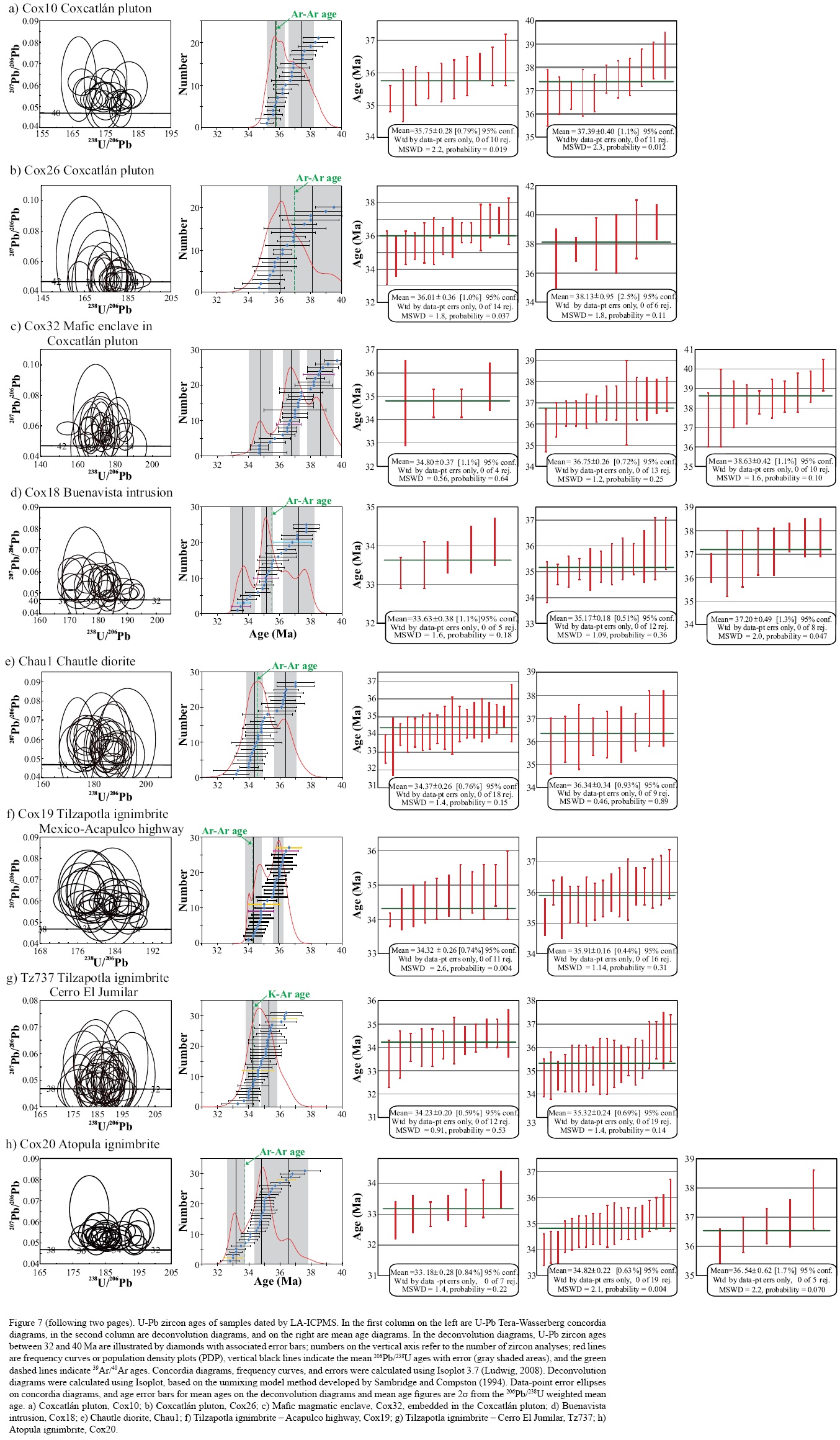
<body><![CDATA[<p align="justify"><font face="verdana" size="2">The samples were prepared at the Mineral Separation Laboratory of the Departamento de Geologia at the Centro de Investigacion Cientifica y de Education Superior de Ensenada (CICESE), Ensenada, Baja California, Mexico. The basic sample preparation consisted of crushing and sieving, then rinsing with distilled water followed by 98% acetone. The rock fragments were dried overnight at ~60 &deg;C. The minerals were then concentrated by Frantz magnetic separator to insure &gt;99% purity. Samples were selected by handpicking under a binocular microscope from fractions ranging in size &lt;710 to &gt;350 Lim for samples Cox10 and Cox 20. Samples Cox3, Cox15b, Cox26 and Chau1 range in size from &lt;350 to &gt;250 Lm. As irradiation monitor, aliquots of sanidine FCT 2 (28.201 &plusmn; 0.046 Ma; Kuiper <i>et al.</i>, 2008) were irradiated alongside the samples. The samples and monitor were irradiated with Cd&#45;liner at the University of McMaster (Hamilton, Ontario) in the U&#45;enriched research reactor receiving a dose of 30 MW. The <sup>40</sup>Ar&#45;<sup>39</sup>Ar experiments were conducted at the Geochronology Laboratory at CICESE using a Coherent Ar&#45;ion Innova 370 laser extraction system on&#45;line with a VG5400 mass spectrometer. The irradiation monitors were fused in one step. All the samples were step&#45;heated and additionally for sanidine Cox20 four one&#45;step fusion experiments were performed. All the argon experiments were preceded by a blank measurement, with the five argon isotopes measured. Upon blank subtraction, the argon isotopes were corrected for radioactive decay, mass discrimination, calcium, potassium and chlorine neutron induced interference reactions. In processing the data, the decay constants and isotopic composition recommended by Steiger and Jager (1977) were used. Equations given by York <i>et al.</i> (2004) were used in all straight&#45;line calculations.</font></p>  	    <p align="justify"><font face="verdana" size="2"><b><i>Results</i></b></font></p>  	    <p align="justify"><font face="verdana" size="2"><sup>40</sup>Ar&#45;<sup>39</sup>Ar results are summarized in <a href="/img/revistas/rmcg/v30n2/a1t2.jpg" target="_blank">Table 2</a> with full <sup>40</sup>Ar&#45;<sup>39</sup>Ar data of all the experiments in the electronic <a href="http://rmcg.unam.mx/" target="_blank">appendix A1</a>, and details of each sample analyzed presented in <a href="http://rmcg.unam.mx/" target="_blank">appendix A2</a>. Figures with age spectra and the <sup>36</sup>Ar/<sup>40</sup>Ar versus <sup>39</sup>Ar/<sup>40</sup>Ar correlation diagrams for each sample are presented in <a href="/img/revistas/rmcg/v30n2/a1f6.jpg" target="_blank">Figure 6</a>. Note that all errors are reported at lo level. The errors in the integrated, plateau and isochron age include the uncertainty in the irradiation parameter J. Additionally, for the plateau and isochron ages, the goodness of fit was included in the age uncertainty whenever the MSWD exceeded 1. The integrated ages were calculated adding the fractions of the step&#45;heating experiments. Plateau ages were calculated with the weighted mean of three or more consecutive fractions, which were in agreement within lo errors excluding the uncertainty in <i>J</i>.</font></p>      <p align="justify"><font face="verdana" size="2">In general, the <sup>40</sup>Ar&#45;<sup>39</sup>Ar and K&#45;Ar age data are consistent with geologic relations and magmatic stratigraphy. Where available, biotite and alkali feldspar ages are concordant, suggesting that inherited&#45;Ar is not a problem at this age range (e.g., Hora <i>et al.,</i> 2010). The Coxcatl&aacute;n pluton yields the oldest ages, ranging from 36.97 &plusmn; 0.12 to 35.76 &plusmn; 0.13 Ma. At the 2o level these ages are still discordant suggesting a protracted cooling history in a body of significant volume. The Tilzapotla ignimbrite yields generally younger K&#45;Ar and <sup>40</sup>Ar&#45;<sup>39</sup>Ar ages of 34.3 &plusmn; 1.5 and 34.26 &plusmn; 0.09 Ma, respectively, although the K&#45;Ar age is relatively imprecise and is concordant within error with the younger Coxcatl&aacute;n age. The ages of the subordinate units of the Chautle diorite, Buenavista intrusion, and Atopula ignimbrite are consistent with them representing post&#45;caldera activity (Mor&aacute;n&#45;Zenteno <i>et al.</i>, 2004) and a general eastward younging of the magmatic system.</font></p>     <p align="justify">&nbsp;</p>      <p align="justify"><font face="verdana" size="2"><b>U&#45;Pb LA&#45;ICPMS zircon geochronology</b></font></p>  	    <p align="justify"><font face="verdana" size="2"><b><i>Analytical methods</i></b></font></p>  	    <p align="justify"><font face="verdana" size="2">The eight samples selected for zircon geochronol&#45;ogy were crushed and standard techniques such as Wilfley separation and heavy liquids were used for mineral separation. Zircon concentrates were observed under a binocular microscope and approximately 100 grains were selected from each sample, taking care to include all the morphological, shape and color variations. The selected grains were mounted in epoxy resin, ground by hand to expose half of the crystals, and imaged by cathodoluminescence using an ELM 3R luminoscope (Marshall, 1988).</font></p>  	    <p align="justify"><font face="verdana" size="2">LA&#45;ICP&#45;MS U&#45;Pb analyses were performed at the Laboratorio de Estudios Isotopicos (LEI), Centro de Geociencias, UNAM, using a Resolution M050 excimer laser workstation coupled with a Thermo Xseries quadru&#45;pole ICPMS. The Plesovice standard zircon (ca. 337 Ma; Slama <i>et al.,</i> 2008) was used as bracketing standard. All the analyses were performed employing a spot of 32 Lim in diameter and a fluence of <i>ca.</i> 6 J/cm<sup>2</sup>. A 1&#45;sigma external reproducibility of 0.6% (<sup>206</sup>Pb/<sup>238</sup>U ratio), 0.95% (<sup>207</sup>Pb/<sup>206</sup>Pb ratio) and 1.1% (<sup>208</sup>Pb/<sup>232</sup>Th ratio) was measured on such standard zircon, and quadratically propagated to the unknown measured ratios, to take into account the natural standard inhomogeneity. Further details of the analytical procedures are given in Solari <i>et al.</i> (2010). The obtained raw data were reduced, and errors propagated, using internally developed software (Solari and Tanner, 2011). When needed, the common Pb contribution was corrected using the algebraic method of Andersen (2002), provided that the <sup>204</sup>Pb signal is generally swamped by the <sup>204</sup>Hg interference and cannot be correctly evaluated by the current instrumentation. The obtained data were screened and filtered, following a discordance criteria (all the analyses which yielded more than 30% and less than &#45;5% discordance were considered unreliable and thus discarded), and then an error criteria on isotopic ratios (all the analyses which corrected isotopic ratios yielded more than 5% 1 sigma error were discarded). Finally, further screening was performed observing rare earth element (REE) patterns, as well as some trace&#45;element contents, such as P and La. The presence of analyses with high values <i>(e.g.</i>, &gt;1500 ppm P and &gt;30 ppm La) strongly suggests that an apatite inclusion was hit during analysis, and were thus discarded. U and Th content were screened cautiously, because the higher their content, the greater the probability of crystal damage from radioactive decay, and thus of possible Pb loss. In due case, those analyses were also discarded.</font></p>  	    <p align="justify"><font face="verdana" size="2">The concordia plots, deconvolution calculations, and age&#45;error calculations were completed using Isoplot v. 3.7 (Ludwig, 2008). Especially useful for the Paleogene ages presented below are the mean <sup>206</sup>Pb/<sup>238</sup>U ages, given that the measurement of <sup>207</sup>Pb is problematic in those young zircons, and the consequent uncertainty in the <sup>207</sup>Pb/<sup>206</sup>Pb ratio is not a good indicator of geologically meaningful discordances. It is also common to observe scattering in the mean <sup>206</sup>Pb/<sup>238</sup>U ages, which yield MSWD (mean square of weighted deviates) values that are largely greater than one, an indication that the possibility of mixed age&#45;populations exists. To try and recognize the different age components in those samples that showed an initial MSWD generally above 3, we used the deconvolution method implemented in Isoplot and based on the Sambridge and Compston (1994) mixture modeling method. Once the mixture components were recognized, their mean <sup>206</sup>Pb/<sup>238</sup>U ages were plotted together with errors and recalculated MSWD in <a href="/img/revistas/rmcg/v30n2/a1f7.jpg" target="_blank">Figure 7</a>. This figure includes U&#45;Pb concordia plots (first column); deconvolution diagrams with frequency curves (red curves) or population density plots (PDP) and, for comparative purposes, <sup>40</sup>Ar/<sup>39</sup>Ar ages where available (second column); and mean age diagrams (on the right side of <a href="/img/revistas/rmcg/v30n2/a1f7.jpg" target="_blank">Figure 7</a>).</font></p>  	    ]]></body>
<body><![CDATA[<p align="justify"><font face="verdana" size="2"><b><i>Results</i></b></font></p>  	    <p align="justify"><font face="verdana" size="2">Details of analyzed zircons from the samples are given in <a href="http://rmcg.unam.mx/" target="_blank">appendices A3</a> and <a href="http://rmcg.unam.mx/" target="_blank">A4</a>, and a summary of the apparent ages is given in <a href="/img/revistas/rmcg/v30n2/a1t2.jpg" target="_blank">Table 2</a>. Details of the age data for each sample are in narrative form in <a href="http://rmcg.unam.mx/" target="_blank">appendix A2</a>. Descriptions of most samples dated by this method are given above in the sections on "Geological setting and stratigraphy of the Coxcatl&aacute;n&#45;Tilzapotla area" and <a href="http://rmcg.unam.mx/" target="_blank">Appendix A2</a>.</font></p>      <p align="justify"><font face="verdana" size="2">Complex populations are revealed in population density plots or PDPs (<a href="/img/revistas/rmcg/v30n2/a1f7.jpg" target="_blank">Figure 7</a>). Individual zircon ages in deconvolution plots (<a href="/img/revistas/rmcg/v30n2/a1f7.jpg">Figure 7</a>, second column) reveal almost continuous distributions, but show slight breaks that suggest different pulses of zircon crystallization. This was confirmed by the application of the unmixing algorithm (Sambridge and Compston, 1994), by which two or three different populations with distinct weighted mean ages were obtained for each sample.</font></p>  	    <p align="justify"><font face="verdana" size="2"><b><i>Inherited ages and core&#45;rim age variations in single zircons</i></b></font></p>  	    <p align="justify"><font face="verdana" size="2">It is now well established that volcanic rocks often record a significant pre&#45;magmatic history of inherited or xenocrystic "basement" zircons. Additionally, "antecrysts", zircons from an earlier confocal magmatic episode, are also common. The dominant population however, should be "autocrysts", zircons that grew in the erupted magma <i>(e.g.</i>, Miller <i>et al.</i>, 2007, Folkes <i>et al.,</i> 2011). The youngest zircon populations seen in the PDPs (<a href="/img/revistas/rmcg/v30n2/a1f7.jpg" target="_blank">Figure 7</a>) correspond to these "autocrysts", whereas the older populations correspond to "antecrysts".</font></p>  	    <p align="justify"><font face="verdana" size="2">Cathodoluminescence imaging revealed cores in some of the zircon grains, and oscillatory growth zoning was frequently observed. Cox 10 and 26 and Chau1 have a significant number of grains ranging in age from Precambrian to middle Eocene that are consistent with the age of basement units in the region (e.g., El&iacute;as&#45;Herrera <i>et al.</i>, 2000; Talavera&#45;Mendoza <i>et al.</i>, 2005, 2007), or that can be explained by assimilation of sedimentary or metasedi&#45;mentary crustal units.</font></p>  	    <p align="justify"><font face="verdana" size="2">It is interesting to note that inherited zircon grains in the Coxcatl&aacute;n&#45;Tilzapotla samples are often of a different size and shape when compared to the main zircon population. The characteristics of the main zircon populations in the eight samples studied display certain variations (<a href="/img/revistas/rmcg/v30n2/a1t3.jpg" target="_blank">Table 3</a>). In general, the late Eocene zircon autocrysts studied are colorless to pale yellow, have elongated prismatic shapes, measure from ~130 to 340 Lim in length, and have aspect ratios of 2 to 4, with some exceptions; for example, many of the zircon grains are noticeably larger in Tilzapotla ignimbrite sample Tz737 (<a href="/img/revistas/rmcg/v30n2/a1t3.jpg" target="_blank">Table 3</a>). In contrast, in Coxcatl&aacute;n pluton sample Cox10 two small (~100 Lim), dark stubby inherited zircons yielded a slightly discordant age of 526 Ma and a concordant age of 65 Ma, and an unusually large, dark zircon has a core age of 167 Ma.</font></p>  	    <p align="justify"><font face="verdana" size="2">The larger size of the cores and growth zones in some of the zircon grains allowed exploring age variations between cores and rims. Analyses in two zircon grains of the Coxcatl&aacute;n pluton yielded core&#45;rim age pairs of 167 and 164 Ma, and 92 and 35.6 Ma, respectively (<a href="/img/revistas/rmcg/v30n2/a1t3.jpg" target="_blank">Table A3</a>, sample Cox10). Additional core&#45;rim analyses in the samples yielded late Eocene age pairs that are interpreted as different pulses of the magma system that were injected into the magma chamber during different stages of development. Seven core&#45;rim age pairs are indicated in the deconvolution plots of <a href="/img/revistas/rmcg/v30n2/a1f7.jpg" target="_blank">Figure 7</a>, in which each pair has the same color error bar. Core&#45;rim age variations in the seven pairs range from 1.6 to 3.4 m.y. Core ages correspond to one of the earlier mean age groups obtained and are interpreted as antecrysts. Rim ages correspond to the younger mean age group defined by autocrysts.</font></p>  	    <p align="justify"><font face="verdana" size="2">We turn our attention now to the autocrysts. These record the most recent episode of magmatism and hold the keys to understanding the development of the magmatic system.</font></p>  	    <p align="justify"><font face="verdana" size="2">&nbsp;</font></p>  	    ]]></body>
<body><![CDATA[<p align="justify"><font face="verdana" size="2"><b>DISCUSSION</b></font></p>  	    <p align="justify"><font face="verdana" size="2"><b>The record of zircon autocrysts</b></font></p>  	    <p align="justify"><font face="verdana" size="2">Miller <i>et al.</i> (2007) regard the lower age trend of zircon arrays as autocrysts representing the best approximation of the crystallization age, as the last zircon growth or complete solidification of the pluton, assuming that Pb loss can be discounted. For the geochronological data obtained in the Coxcatl&aacute;n&#45;Tilzapotla area, the youngest mean ages in the deconvolution plots of <a href="/img/revistas/rmcg/v30n2/a1f7.jpg" target="_blank">Figure 7</a> are thus interpreted as the mean apparent age of the pluton or magma batch. The interpretation of the these ages as mean apparent magmatic ages is confirmed by the <sup>40</sup>Ar/<sup>39</sup>Ar mineral ages obtained, which are indistinguishable within uncertainty from the apparent age of the sample (<a href="/img/revistas/rmcg/v30n2/a1f7.jpg" target="_blank">Figure 7</a>, <a href="/img/revistas/rmcg/v30n2/a1t2.jpg" target="_blank">Table 2</a>).</font></p>  	    <p align="justify"><font face="verdana" size="2">Weighted mean autocryst ages for the two samples of the Coxcatl&aacute;n pluton are significantly older than those from the two samples of Tilzapotla ignimbrite. However, in detail the significance of this statistical discordance is offset by some interesting overlap in the individual. For instance, individual zircons from the Tilzapotla ignimbrite define a range in age from 36.6 &plusmn; 0.4 to 33.3 &plusmn; 0.5 Ma (lo), while Coxcatl&aacute;n pluton zircons range in age from 39.5 &plusmn; 0.6 to 35.2 &plusmn; 0.2 Ma. The autocryst populations of the two units show significant overlap in the PDPs, rim ages of Coxcatl&aacute;n pluton autocrysts are younger or overlap with core ages of Tilzapotla zircons, and some individual Coxcatl&aacute;n zircons that have ages concordant with Tilzapotla ignimbrite zircons. We cannot reasonably attribute any of the overlap to Pb loss in the Coxcatl&aacute;n pluton based on coherence of the data on the Tera&#45;Wasserberg concordia plots. Thus, despite the statistical discordance of the weighted mean ages, we interpret these records to indicate significant overlap of zircon crystallization in the Coxcatl&aacute;n pluton and the Tilzapotla ignimbrite.</font></p>  	    <p align="justify"><font face="verdana" size="2">The Buenavista intrusion, on the west caldera rim and east of the Coxcatl&aacute;n pluton, displays a wide range of zircon ages from 37.7 to 33.3 Ma. A major peak at ~35 Ma is defined in the PDP (<a href="/img/revistas/rmcg/v30n2/a1f7.jpg" target="_blank">Figure 7d</a>), and yields a weighted mean age within error of the <sup>40</sup>Ar/<sup>39</sup>Ar biotite plateau ages of 35.5 and 34.7 Ma obtained by Meza&#45;Figueroa <i>et al.</i> (2003). Compared to the Coxcatl&aacute;n pluton, zircon crystallization in the Buenavista intrusion began and ended later, but took place over a similar time period (~4 m.y.).</font></p>  	    <p align="justify"><font face="verdana" size="2">In two samples (MME sample Cox32 and Buenavista intrusion sample Cox18), the youngest mean ages are represented by a small group of data with error bars that display little overlap with the main zircon population and are somewhat younger than the <sup>40</sup>Ar/<sup>39</sup>Ar ages (<a href="/img/revistas/rmcg/v30n2/a1f7.jpg" target="_blank">Figure 7</a>). Again we cannot reject these as due to Pb loss as these appear coherent on the Tera&#45;Wasserberg plots. They must represent real zircon crystallization ages and attest to discordance between U&#45;Pb zircon ages and <sup>40</sup>Ar&#45;<sup>39</sup>Ar biotite ages in Cox 18 (no Ar&#45;Ar age is available for Cox 32). We note that the <sup>40</sup>Ar&#45;<sup>39</sup>Ar biotite age came from a different but closely located sample to Cox 18, that biotite can be open to Ar and K exchange during alteration, and that a skarn deposit is in this area.</font></p>  	    <p align="justify"><font face="verdana" size="2">Ages for Cox 32 for the mafic enclave in the Coxcatl&aacute;n pluton show significant overlap with the pluton data. The Buenavista intrusion sample Cox 18 also shows significant overlap. However, a significantly younger autocryst population appears to be recorded in the Chautle diorite (37.0 to 33.2 Ma) and the Atopula ignimbrite (37.6 to 32.8 Ma).</font></p> 	    <p align="justify">&nbsp;</p>      <p align="justify"><font face="verdana" size="2"><b>Age patterns in the Coxcatl&aacute;n&#45;Tilzapotla area</b></font></p>  	    <p align="justify"><font face="verdana" size="2">Significant overlap in all the zircon populations suggests continuous zircon crystallization in the Coxcatl&aacute;n&#45;Tilzpotla system as distinct batches of magma evolved over an approximately 6 m.y. period to build a significant volcano&#45;plutonic complex. During this time, some of the complexity in the zircon populations could have been produced by recharge events, as evidenced by the Chautle, MME, and the young andesite. Hot magma intruding into a cooler, incompletely crystallized magma body preserved as supra&#45;solidus crystal mush could result in changing the conditions of zircon saturation sufficiently to cause significant complexity. We are unable to resolve such events categorically but note the possibility of this for further investigation.</font></p>  	    ]]></body>
<body><![CDATA[<p align="justify"><font face="verdana" size="2">A spatial trend of younger zircon ages is recorded to the east, not only in the Tilzapotla ignimbrite, which is the most voluminous volcanic unit and is associated with caldera collapse in the eastern sector of the dome, but also in the Chautle diorite and Atopula ignimbrite (<a href="/img/revistas/rmcg/v30n2/a1f7.jpg" target="_blank">Figure 7</a>). Ar&#45;Ar geochronological data for these units are also younger. We interpret this to suggest a generally eastward migrating magmatic focus. It is of interest to note the U&#45;Pb zircon apparent ages obtained for the Tilzapotla ignimbrite and Chautle diorite are the same within error, indicating a temporal relationship between the two units and suggesting a shared magmatic history (<a href="/img/revistas/rmcg/v30n2/a1f7.jpg" target="_blank">Figures 7e</a>, <a href="/img/revistas/rmcg/v30n2/a1f7.jpg" target="_blank">7f</a>, <a href="/img/revistas/rmcg/v30n2/a1f7.jpg" target="_blank">7g</a>), in which the emplacement of mafic batches similar to and coeval with the Chautle diorite into the magma chamber could have triggered ignimbrite eruption and caldera collapse.</font></p>  	    <p align="justify"><font face="verdana" size="2">Compared to the Tilzapotla ignimbrite, post&#45;collapse ignimbrites <i>(i.e.,</i> Atopula unit along the southern caldera limit) display a nearly continuous range in the zircon age data of ~4 m.y., starting at ~37 Ma and extending to a younger array at ~33 Ma, indicating the arrival of new batches of silicic magma into the chamber. <sup>40</sup>Ar&#45;<sup>39</sup>Ar ages of the dacitic to andesitic lava flow units associated with the resurgence of the central block of the caldera floor and infill range from 33 to 32 Ma (Mor&aacute;n&#45;Zenteno <i>et al.,</i> 2004).</font></p>  	    <p align="justify"><font face="verdana" size="2">The southeastward younging trend of the zircon ages reveals that batholith construction underneath the Coxcatl&aacute;n&#45;Tilzapotla dome progressed from west to east as pulses arrived in series into the upper crust. Individual pulses may have been emplaced sufficiently closely in time and space to have shared zircon crystallization histories, at least in part, as evidenced by overlap of rim and core ages in Coxcatl&aacute;n pluton and Tilzapotla ignimbrite, respectively. The younging trend in the magmatic activity is illustrated in <a href="#f8">Figure 8</a>. In the first stage, beginning at ~39.5 Ma, magma batches were emplaced in the western part and crystallized over a period of ~4 m.y. probably sustained by mafic recharge. This produced an initial doming deformation in this sector. As the magmatic focus moved eastward, the most significant thermal anomaly developed from 36.6 to 33.3 Ma, leading to the construction of a significant eruptible magma volume that extended the doming effect to the east. This doming in response to development of a major silicic magmatic system is consistent with classic geological observations of pre&#45;caldera tumescence <i>(e.g.,</i> Smith and Bailey, 1968) and recent thermomechanical models of caldera systems (Gregg <i>et al.,</i> 2012). Continued intrusion of mafic magmas is evidenced by the Chautle diorite approximately concordant with eruption of the Tilzapotla ignimbrite and caldera collapse. Finally (~3 3&#45;31 Ma) a series of silicic and intermediate injections of magma produced caldera resurgence and minor volcanic episodes outside the caldera.</font></p> 	    <p align="center"><font face="verdana" size="2"><a name="f8"></a></font></p> 	    <p align="center"><font face="verdana" size="2"><img src="/img/revistas/rmcg/v30n2/a1f8.jpg"></font></p>     <p align="justify"><font face="verdana" size="2"><b>Batholith construction in the Coxcatl&aacute;n&#45;Tilzapotla area</b></font></p>  	    <p align="justify"><font face="verdana" size="2">Recent advances of in situ U&#45;Pb zircon dating of volcanic and plutonic rocks have shown that granitoid plutons (e.g., McNulty <i>et al.,</i> 1996, 2000; Coleman <i>et al.</i> 2004; Glazner <i>et al.,</i> 2004; Matzel <i>et al.,</i> 2006; Lipman, 2007; Miller <i>et al.,</i> 2007; Tappa <i>et al.,</i> 2011) as well as the volcanic products of silicic magma systems <i>(e.g.</i>, Schmitt <i>et al.,</i> 2003; Reid, 2003; Bachmann <i>et al.,</i> 2007a, 2007c; Folkes <i>et al.,</i> 2011) record a multistage history of numerous pulses of magmas that accumulate over time and cannibalize their progenitors. We clearly see evidence for this in the Coxcatl&aacute;n&#45;Tilzapotla elliptical dome structure. We believe that the record here is one of incremental but continuous assembly of batholith from numerous pulses of magma. The nearly continuous age range observed for all samples suggest an approximately 6 m.y. period for the development of the system. This is consistent with, for example, Cretaceous batholiths in the western United States that have a duration of &gt;5 m.y. for Mt. Stuart (Matzel <i>et al.,</i> 2006) and &gt;8 m.y. for Tuolumne (Coleman <i>et al.,</i> 2004).</font></p>  	    <p align="justify"><font face="verdana" size="2">The Coxcatl&aacute;n pluton seems to represent an apophysis of a deep&#45;seated plutonic complex, and displays textural and mineralogical diversity in addition to features that we interpret as key aspects in the understanding of the mag&#45;matic system evolution. It is located in a segment of the structural dome where no significant volcanic conduits have been identified and where there is no caldera development. The overlapping age distributions (39.5 Ma to ~35 Ma) of zircons from different facies within the Coxacatlan pluton and observed mutual intrusion relationships documented between the mafic and grandiorite facies confirm that newer pulses were emplaced in an interval of ~4 m.y., without complete crystallization of previous pulses.</font></p>  	    <p align="justify"><font face="verdana" size="2">The clear time&#45;space relationship between the Coxcatl&aacute;n pluton intrusion, the uplift in the Coxcatl&aacute;n&#45;Tilzapotla dome area, and the Tilzapotla caldera formation strongly suggest that these episodes are part of a continuous magmatic development driven and thermally sustained by mafic magma recharge. U&#45;Pb zircon ages that span approximately 6 m.y., starting at ~39 Ma in the west part of the dome (Coxcatl&aacute;n pluton) to ~33 Ma in the east (Tilzapotla and Atopula ignimbrites and Chautle pluton), as well as the compositional variations of pluton facies and volcanic units in the area can be taken as evidence that the dome uplift was the result of gradual construction of a batholith underneath due to the injection of different magma batches.</font></p>  	    <p align="justify"><font face="verdana" size="2"><b>What triggered the formation of the Tilzapotla caldera?</b></font></p>  	    ]]></body>
<body><![CDATA[<p align="justify"><font face="verdana" size="2">The last decade has seen major developments in understanding of causes of intense episodes of explosive silicic volcanism, or ignimbrite flare&#45;ups. Large storage regions of eruptible magma are characterized as crystal mushes that may contain over 50% of crystals and may themselves erupt or may be the source of residual liquids that are extracted and then erupted (Lindsay <i>et al.,</i> 2001; Bachmann and Bergantz, 2008). According to numerical simulations of heat transfer in the upper crust, de Silva and Gosnold (2007) have shown that an elevated thermal flux is critical for the rheological conditions necessary to allow a large magma chamber to grow without erupting. These same conditions are necessary to maintain large melt&#45;rich volumes of magma to feed caldera&#45;forming eruptions (Annen, 2009). The recognition that such fluxes are most commonly found during magmatic flare&#45;ups and are characteristic of batholith formation as well (e.g., Ducea, 2001) suggests that a view where caldera forming eruptions and pluton formation require separate conditions is unwarranted. Large catastrophic caldera&#45;forming eruptions that produce large ignimbrites are thus intimately associated with intrusive activity at depth (e.g., Smith, 1979; de Silva <i>et al.,</i> 2006; Bachmann <i>et al.,</i> 2007b; Lipman, 2007). Extended plutonic activity would result in the development of crystal mushes that can lead to the accumulation of enough residual magma to produce a voluminous volcanic eruption. In such a scenario, the growing "batholith" reaches a point where the "domed" roof is extended, faulted, and mechanically unstable. At a "tipping point", the roof can be induced to collapse into the "chamber" producing a catastrophic caldera collapse (Gregg <i>et al.</i>, 2012) where most of the erupting crystal&#45;mush accumulates as intra&#45;caldera tuff (de Silva <i>et al.,</i> 2006). The relative abundance of phenocrysts in juvenile pumice fragments as well as the occurrence of glomerocrysts with abundant plagioclase in the Tilzapotla ignimbrite suggest that the major volcanic eruptions related to caldera formation were associated with the disruption of crystal mushes. Compared to the plutonic units, the narrower age range of zircons in population density plots of the Tilzapotla ignimbrite (<a href="/img/revistas/rmcg/v30n2/a1f7.jpg" target="_blank">Figure 7f</a>, <a href="/img/revistas/rmcg/v30n2/a1f7.jpg" target="_blank">7g</a>) might be an indication of rapid development of the eruptible magma in the central&#45;eastern sector of the dome as the thermal conditions evolved (<a href="#f8">Figure 8</a>). Overlapping zircon age ranges of the Tilzapotla ignimbrite and the small mafic Chautle pluton located near the caldera ring, as well as the Ar&#45;Ar mineral age obtained for the Chautle pluton, which is within uncertainty of the zircon age, may suggest that injection of less evolved high&#45;temperature magmas were instrumental in destabilizing crystal mushes <i>(e.g.</i>, Bachmann <i>et al.</i>, 2007b) and the roof and triggering caldera formation (Gregg <i>et al.,</i> 2012).</font></p>  	    <p align="justify"><font face="verdana" size="2">&nbsp;</font></p>  	    <p align="justify"><font face="verdana" size="2"><b>CONCLUSIONS</b></font></p>  	    <p align="justify"><font face="verdana" size="2">Zircon U&#45;Pb dating of late Eocene plutons and ignimbrites of the Tilzapotla caldera indicates that they represent the record a long&#45;lived magmatic system genetically related to the construction of the large scale Coxcatl&aacute;n&#45;Tilzapotla volcano&#45;plutonic complex and associated structural dome. As suggested by compositional variations and the multiple injections recognized in the Coxcatl&aacute;n pluton, the dome is the superficial expression of a batholith that progressively grew from a series of injections of silicic magmas into the upper crust. <sup>40</sup>Ar/<sup>39</sup>Ar mineral cooling ages obtained for the Coxcatl&aacute;n pluton are generally concordant with the weighted mean <sup>206</sup>Pb/<sup>238</sup>U zircon ages, suggesting shallow emplacement and relatively rapid crystallization. U&#45;Pb age ranges, as well as mean ages of the Coxcatl&aacute;n pluton with respect to ignimbrites of the Tilzapotla caldera and the Buenavista and Chautle plutons, indicate a southeastward migration of the thermal anomaly with the highest intensity being underneath where the caldera developed. In the southeastern part of the dome, catastrophic caldera collapse occurred due to the magmatic system reaching a mechanical threshold where the extended and domed roof above the growing batholith was unstable and eventually failed. Recharge with less differentiated high&#45;temperature magma may have been the trigger for the eruption and caldera (roof) collapse as it disrupted crystal mushes and destabilized the magma chamber.</font></p>  	    <p align="justify"><font face="verdana" size="2">&nbsp;</font></p>  	    <p align="justify"><font face="verdana" size="2"><b>APPENDIX A. SUPPLEMENTARY MATERIAL</b></font></p>  	    <p align="justify"><font face="verdana" size="2">Appendices A1 to A4 can be found at the journal web site &lt;<a href="http://rmcg.unam.mx/" target="_blank">http://rmcg.unam.mx/</a>&gt;, in the table of contents of this issue.</font></p>  	    <p align="justify"><font face="verdana" size="2">&nbsp;</font></p>  	    <p align="justify"><font face="verdana" size="2"><b>ACKNOWLEDGEMENTS</b></font></p>  	    <p align="justify"><font face="verdana" size="2">Financial support for this study was provided by PAPIIT grant IN108210 and the Instituto de Geologia, Universidad Nacional Autonoma de Mexico. We would like to thank Cathy Busby and Allen F. Glazner for their careful reviews and valuable comments, which were helpful in improving the paper. S de Silva acknowledges support from the National Science Foundation to work on volcano&#45;plutonic systems. We are grateful to Carlos Ortega&#45;Obregon for assistance with the U&#45;Pb zircon analyses, Rufino Lozano SantaCruz for the XRF analyses, Teresa Pi Puig for X ray diffraction analyses and, for the <sup>40</sup>Ar&#45;<sup>39</sup>Ar experiments, M.A. Garcia Gracia for mass spectrometry, and A.S. Rosas Montoya, V.M. Perez Arroyo and G. Rendon Marquez for sample preparation and evaluation.</font></p>  	    ]]></body>
<body><![CDATA[<p align="justify"><font face="verdana" size="2">&nbsp;</font></p>  	    <p align="justify"><font face="verdana" size="2"><b>REFERENCES</b></font></p>  	    <!-- ref --><p align="justify"><font face="verdana" size="2">Andersen, T., 2002, Correction of common lead in U&#45;Pb analyses that do not report <sup>204</sup>Pb: Chemical Geology, 192(1), 59&#45;79.    &nbsp;&nbsp;&nbsp;&nbsp;&nbsp;&nbsp;&nbsp;&nbsp;[&#160;<a href="javascript:void(0);" onclick="javascript: window.open('/scielo.php?script=sci_nlinks&ref=8086830&pid=S1026-8774201300020000100001&lng=','','width=640,height=500,resizable=yes,scrollbars=1,menubar=yes,');">Links</a>&#160;]<!-- end-ref --></font></p>  	    <!-- ref --><p align="justify"><font face="verdana" size="2">Annen, C., 2009, From plutons to magma chambers: Thermal constraints on the accumulation of eruptible silicic magma in the upper crust: Earth and Planetary Science Letters, 284, 409&#45;416.    &nbsp;&nbsp;&nbsp;&nbsp;&nbsp;&nbsp;&nbsp;&nbsp;[&#160;<a href="javascript:void(0);" onclick="javascript: window.open('/scielo.php?script=sci_nlinks&ref=8086832&pid=S1026-8774201300020000100002&lng=','','width=640,height=500,resizable=yes,scrollbars=1,menubar=yes,');">Links</a>&#160;]<!-- end-ref --></font></p>  	    <!-- ref --><p align="justify"><font face="verdana" size="2">Bachmann, O., Bergantz, G.W., 2008, Rhyolites and their source mushes across tectonic settings: Journal of Petrology, 49(12), 2277&#45;2285.    &nbsp;&nbsp;&nbsp;&nbsp;&nbsp;&nbsp;&nbsp;&nbsp;[&#160;<a href="javascript:void(0);" onclick="javascript: window.open('/scielo.php?script=sci_nlinks&ref=8086834&pid=S1026-8774201300020000100003&lng=','','width=640,height=500,resizable=yes,scrollbars=1,menubar=yes,');">Links</a>&#160;]<!-- end-ref --></font></p>  	    <!-- ref --><p align="justify"><font face="verdana" size="2">Bachmann, O., Charlier, B.L.A., Lowenstern, J.B., 2007a, Zircon crystallization and recycling in the magma chamber of the rhyolitic Kos Plateau Tuff (Aegean Arc): Geology, 35, 73&#45;76.    &nbsp;&nbsp;&nbsp;&nbsp;&nbsp;&nbsp;&nbsp;&nbsp;[&#160;<a href="javascript:void(0);" onclick="javascript: window.open('/scielo.php?script=sci_nlinks&ref=8086836&pid=S1026-8774201300020000100004&lng=','','width=640,height=500,resizable=yes,scrollbars=1,menubar=yes,');">Links</a>&#160;]<!-- end-ref --></font></p>  	    ]]></body>
<body><![CDATA[<!-- ref --><p align="justify"><font face="verdana" size="2">Bachman, O., Miller, C.F., de Silva, S.L., 2007b, The volcanic&#45;plutonic connection as a stage for understanding crustal magmatism: Journal of Volcanology and Geothermal Research, 167, 1&#45;23.    &nbsp;&nbsp;&nbsp;&nbsp;&nbsp;&nbsp;&nbsp;&nbsp;[&#160;<a href="javascript:void(0);" onclick="javascript: window.open('/scielo.php?script=sci_nlinks&ref=8086838&pid=S1026-8774201300020000100005&lng=','','width=640,height=500,resizable=yes,scrollbars=1,menubar=yes,');">Links</a>&#160;]<!-- end-ref --></font></p>  	    <!-- ref --><p align="justify"><font face="verdana" size="2">Bachmann, O., Oberli, F., Dungan, M.A., Meier, M., Mundil, R., Fischer, H., 2007c, <sup>40</sup>Ar/<sup>39</sup>Ar and U&#45;Pb dating of the Fish Canyon magmatic system, San Juan Volcanic field, Colorado: evidence for an extended crystallization history: Chemical Geology, 236, 134&#45;166.    &nbsp;&nbsp;&nbsp;&nbsp;&nbsp;&nbsp;&nbsp;&nbsp;[&#160;<a href="javascript:void(0);" onclick="javascript: window.open('/scielo.php?script=sci_nlinks&ref=8086840&pid=S1026-8774201300020000100006&lng=','','width=640,height=500,resizable=yes,scrollbars=1,menubar=yes,');">Links</a>&#160;]<!-- end-ref --></font></p>  	    <!-- ref --><p align="justify"><font face="verdana" size="2">Barbarin, B., 1990, Plagioclase xenocrysts and mafic magmatic enclaves in some granitoids of the Sierra Nevada batholith, California: Journal of Geophysical Research, 95(B11), 17, 747&#45;17, 756.    &nbsp;&nbsp;&nbsp;&nbsp;&nbsp;&nbsp;&nbsp;&nbsp;[&#160;<a href="javascript:void(0);" onclick="javascript: window.open('/scielo.php?script=sci_nlinks&ref=8086842&pid=S1026-8774201300020000100007&lng=','','width=640,height=500,resizable=yes,scrollbars=1,menubar=yes,');">Links</a>&#160;]<!-- end-ref --></font></p>  	    <!-- ref --><p align="justify"><font face="verdana" size="2">Carrizales&#45;Aguilar, A., 1997, Informe de la visita de reconocimiento a los lotes mineros Cristo Rey, Arroyo y Arroyo 2, ubicados en el ejido Tlamacazapa municipio de Buenavista de Cuellar estado de Guerrero: Consejo de Recursos Minerales, Archivo T&eacute;cnico 120374, 22 pp.    &nbsp;&nbsp;&nbsp;&nbsp;&nbsp;&nbsp;&nbsp;&nbsp;[&#160;<a href="javascript:void(0);" onclick="javascript: window.open('/scielo.php?script=sci_nlinks&ref=8086844&pid=S1026-8774201300020000100008&lng=','','width=640,height=500,resizable=yes,scrollbars=1,menubar=yes,');">Links</a>&#160;]<!-- end-ref --></font></p>  	    <!-- ref --><p align="justify"><font face="verdana" size="2">Coleman, D.S., Gray, W., Glazner, A.F., 2004, Rethinking the emplacement and evolution of zoned plutons: Geochronological evidence for incremental assembly of the Tuolumne Intrusive Suite, California: Geology, 32(5), 433&#45;436.    &nbsp;&nbsp;&nbsp;&nbsp;&nbsp;&nbsp;&nbsp;&nbsp;[&#160;<a href="javascript:void(0);" onclick="javascript: window.open('/scielo.php?script=sci_nlinks&ref=8086846&pid=S1026-8774201300020000100009&lng=','','width=640,height=500,resizable=yes,scrollbars=1,menubar=yes,');">Links</a>&#160;]<!-- end-ref --></font></p>  	    ]]></body>
<body><![CDATA[<!-- ref --><p align="justify"><font face="verdana" size="2">de Cserna, Z., Fries, C., Jr., 1981, Hoja Taxco 14Q&#45;h(7), con Resumen de la geolog&iacute;a de la Hoja-Taxco, estados de Guerrero, M&eacute;xico y  Morelos: Universidad Nacional Aut&oacute;noma de M&eacute;xico, Instituto de Geolog&iacute;a, Carta Geol&oacute;gica  de M&eacute;xico, 1:100 000 series, map with text.    &nbsp;&nbsp;&nbsp;&nbsp;&nbsp;&nbsp;&nbsp;&nbsp;[&#160;<a href="javascript:void(0);" onclick="javascript: window.open('/scielo.php?script=sci_nlinks&ref=8086848&pid=S1026-8774201300020000100010&lng=','','width=640,height=500,resizable=yes,scrollbars=1,menubar=yes,');">Links</a>&#160;]<!-- end-ref --></font></p>      <!-- ref --><p align="justify"><font face="verdana" size="2">de Silva, S.L., Gosnold, W.D., 2007, Episodic construction of batholiths: Insights from the spatiotemporal development of an ignimbrite flare&#45;up: Journal of Volcanology and Geothermal Research, 167, 320&#45;335.    &nbsp;&nbsp;&nbsp;&nbsp;&nbsp;&nbsp;&nbsp;&nbsp;[&#160;<a href="javascript:void(0);" onclick="javascript: window.open('/scielo.php?script=sci_nlinks&ref=8086850&pid=S1026-8774201300020000100011&lng=','','width=640,height=500,resizable=yes,scrollbars=1,menubar=yes,');">Links</a>&#160;]<!-- end-ref --></font></p>  	    <!-- ref --><p align="justify"><font face="verdana" size="2">de Silva, S., Zandt, G., Trumbull, R., Viramonte, J.G., Salas, G., Jimenez, N., 2006, Large ignimbrite eruptions and volcano&#45;tectonic depressions in the Central Andes: a thermomechanical perspective: Geological Society, London, Special Publications, 269, 47&#45;63.    &nbsp;&nbsp;&nbsp;&nbsp;&nbsp;&nbsp;&nbsp;&nbsp;[&#160;<a href="javascript:void(0);" onclick="javascript: window.open('/scielo.php?script=sci_nlinks&ref=8086852&pid=S1026-8774201300020000100012&lng=','','width=640,height=500,resizable=yes,scrollbars=1,menubar=yes,');">Links</a>&#160;]<!-- end-ref --></font></p>  	    <!-- ref --><p align="justify"><font face="verdana" size="2">Ducea, M., 2001, The California arc: Thick granitic batholiths, eclogitic residues, lithospheric&#45;scale thrusting, and magmatic flare&#45;ups: GSA Today, 11(11), 4&#45;10.    &nbsp;&nbsp;&nbsp;&nbsp;&nbsp;&nbsp;&nbsp;&nbsp;[&#160;<a href="javascript:void(0);" onclick="javascript: window.open('/scielo.php?script=sci_nlinks&ref=8086854&pid=S1026-8774201300020000100013&lng=','','width=640,height=500,resizable=yes,scrollbars=1,menubar=yes,');">Links</a>&#160;]<!-- end-ref --></font></p>  	    <!-- ref --><p align="justify"><font face="verdana" size="2">El&iacute;as&#45;Herrera, M., Sanchez&#45;Zavala, J.L., Mac&iacute;as&#45;Romo, C., 2000, Geological and geochronological data of Guerrero terrene in the Tejupilco area, southern Mexico: New constraints on its tectonic interpretation: Journal of South American Earth Sciences, 13, 355&#45;375.    &nbsp;&nbsp;&nbsp;&nbsp;&nbsp;&nbsp;&nbsp;&nbsp;[&#160;<a href="javascript:void(0);" onclick="javascript: window.open('/scielo.php?script=sci_nlinks&ref=8086856&pid=S1026-8774201300020000100014&lng=','','width=640,height=500,resizable=yes,scrollbars=1,menubar=yes,');">Links</a>&#160;]<!-- end-ref --></font></p>  	    ]]></body>
<body><![CDATA[<!-- ref --><p align="justify"><font face="verdana" size="2">Elston, W.E., 1984, Mid&#45;Tertiary ash&#45;flow tuff cauldrons, southwestern New Mexico: Journal of Geophysical Research, 89, 8733&#45;8750.    &nbsp;&nbsp;&nbsp;&nbsp;&nbsp;&nbsp;&nbsp;&nbsp;[&#160;<a href="javascript:void(0);" onclick="javascript: window.open('/scielo.php?script=sci_nlinks&ref=8086858&pid=S1026-8774201300020000100015&lng=','','width=640,height=500,resizable=yes,scrollbars=1,menubar=yes,');">Links</a>&#160;]<!-- end-ref --></font></p>  	    <!-- ref --><p align="justify"><font face="verdana" size="2">Ferrari, L., Orozco&#45;Esquivel, T., Manea V., Manea M., 2012, The dynamic history of the Trans&#45;Mexican Volcanic Belt and the Mexico subduction zone: Tectonophysics, 522&#45;523, 122&#45;149.    &nbsp;&nbsp;&nbsp;&nbsp;&nbsp;&nbsp;&nbsp;&nbsp;[&#160;<a href="javascript:void(0);" onclick="javascript: window.open('/scielo.php?script=sci_nlinks&ref=8086860&pid=S1026-8774201300020000100016&lng=','','width=640,height=500,resizable=yes,scrollbars=1,menubar=yes,');">Links</a>&#160;]<!-- end-ref --></font></p>  	    <!-- ref --><p align="justify"><font face="verdana" size="2">Folkes, C.B., de Silva, S.L., Schmitt, A.K., Cas, R.A.F., 2011, A reconnaissance of U&#45;Pb zircon ages in the Cerro Gal&aacute;n system, NW Argentina: Prolonged magma residence, crystal recycling, and crustal assimilation: Journal of Volcanology and Geothermal Research, 206, 136&#45;147.    &nbsp;&nbsp;&nbsp;&nbsp;&nbsp;&nbsp;&nbsp;&nbsp;[&#160;<a href="javascript:void(0);" onclick="javascript: window.open('/scielo.php?script=sci_nlinks&ref=8086862&pid=S1026-8774201300020000100017&lng=','','width=640,height=500,resizable=yes,scrollbars=1,menubar=yes,');">Links</a>&#160;]<!-- end-ref --></font></p>  	    <!-- ref --><p align="justify"><font face="verdana" size="2">Fries, C., Jr., 1960, Geolog&iacute;a del Estado de Morelos y de partes adyacentes de M&eacute;xico y Guerrero, regi&oacute;n central meridional de M&eacute;xico: Universidad Nacional Aut&oacute;noma de M&eacute;xico, Instituto de Geolog&iacute;a, Bolet&iacute;n 60, 229 pp.    &nbsp;&nbsp;&nbsp;&nbsp;&nbsp;&nbsp;&nbsp;&nbsp;[&#160;<a href="javascript:void(0);" onclick="javascript: window.open('/scielo.php?script=sci_nlinks&ref=8086864&pid=S1026-8774201300020000100018&lng=','','width=640,height=500,resizable=yes,scrollbars=1,menubar=yes,');">Links</a>&#160;]<!-- end-ref --></font></p>  	    <!-- ref --><p align="justify"><font face="verdana" size="2">Fries, C., Jr., 1966, Hoja Cuernavaca 14Q&#45;h(8), Geolog&iacute;a de la hoja Cuernavaca, Estado de Morelos: M&eacute;xico, D.F., Universidad Nacional Aut&oacute;noma de M&eacute;xico, Instituto de Geolog&iacute;a, Carta geol&oacute;gica de M&eacute;xico, serie 1:100,00, map with text.    &nbsp;&nbsp;&nbsp;&nbsp;&nbsp;&nbsp;&nbsp;&nbsp;[&#160;<a href="javascript:void(0);" onclick="javascript: window.open('/scielo.php?script=sci_nlinks&ref=8086866&pid=S1026-8774201300020000100019&lng=','','width=640,height=500,resizable=yes,scrollbars=1,menubar=yes,');">Links</a>&#160;]<!-- end-ref --></font></p>  	    ]]></body>
<body><![CDATA[<!-- ref --><p align="justify"><font face="verdana" size="2">Glazner, A.F., Bartley, J.M., Coleman, D.S., Gray, W., Taylor, R.Z., 2004, Are plutons assembled over millions of years by amalgamation from small magma chambers?: GSA Today, 14(4&#45;5), 4&#45;11.    &nbsp;&nbsp;&nbsp;&nbsp;&nbsp;&nbsp;&nbsp;&nbsp;[&#160;<a href="javascript:void(0);" onclick="javascript: window.open('/scielo.php?script=sci_nlinks&ref=8086868&pid=S1026-8774201300020000100020&lng=','','width=640,height=500,resizable=yes,scrollbars=1,menubar=yes,');">Links</a>&#160;]<!-- end-ref --></font></p>  	    <!-- ref --><p align="justify"><font face="verdana" size="2">Gregg, P.M., de Silva, S.L., Grosfils, E.B., Parmigiani, J.P., 2012, Catastrophic caldera&#45;forming eruption: Thermomechanics and implications for eruption triggering and maximum caldera dimensions on Earth: Journal of Volcanology and Geothermal Research, 241&#45;242, 1&#45;12.    &nbsp;&nbsp;&nbsp;&nbsp;&nbsp;&nbsp;&nbsp;&nbsp;[&#160;<a href="javascript:void(0);" onclick="javascript: window.open('/scielo.php?script=sci_nlinks&ref=8086870&pid=S1026-8774201300020000100021&lng=','','width=640,height=500,resizable=yes,scrollbars=1,menubar=yes,');">Links</a>&#160;]<!-- end-ref --></font></p>  	    <!-- ref --><p align="justify"><font face="verdana" size="2">Hora, J.M., Singer, B.S., Jicha, B.R., Beard, B.L., Johnson, C.M., de Silva, S., Salisbury, M., 2010, Volcanic biotite&#45;sanidine <sup>40</sup>Ar/<sup>39</sup>Ar age discordances reflect Ar partitioning and pre&#45;eruption closure in biotite: Geology, 38(10), 923&#45;926.    &nbsp;&nbsp;&nbsp;&nbsp;&nbsp;&nbsp;&nbsp;&nbsp;[&#160;<a href="javascript:void(0);" onclick="javascript: window.open('/scielo.php?script=sci_nlinks&ref=8086872&pid=S1026-8774201300020000100022&lng=','','width=640,height=500,resizable=yes,scrollbars=1,menubar=yes,');">Links</a>&#160;]<!-- end-ref --></font></p>  	    <!-- ref --><p align="justify"><font face="verdana" size="2">Kuiper, K.F., Deino, A., Hilgen, F.J., Krijgsman, W., Renne, P.R., Wijbrans, J.R., 2008, Synchronizing rock clocks of earth history: Science, 320(5875), 500&#45;504.    &nbsp;&nbsp;&nbsp;&nbsp;&nbsp;&nbsp;&nbsp;&nbsp;[&#160;<a href="javascript:void(0);" onclick="javascript: window.open('/scielo.php?script=sci_nlinks&ref=8086874&pid=S1026-8774201300020000100023&lng=','','width=640,height=500,resizable=yes,scrollbars=1,menubar=yes,');">Links</a>&#160;]<!-- end-ref --></font></p>  	    <!-- ref --><p align="justify"><font face="verdana" size="2">Lindsay, J.M., Schmitt, A.K., Trumbull, R.B., de Silva, S.L., Siebel, W., Emmermann, R., 2001, Magmatic evolution of the La Pacana caldera system, Central Andes, Chile: Compositional variations of the cogenetic, large&#45;volume felsic ignimbrite: Journal of Petrology, 42(3), 459&#45;486.    &nbsp;&nbsp;&nbsp;&nbsp;&nbsp;&nbsp;&nbsp;&nbsp;[&#160;<a href="javascript:void(0);" onclick="javascript: window.open('/scielo.php?script=sci_nlinks&ref=8086876&pid=S1026-8774201300020000100024&lng=','','width=640,height=500,resizable=yes,scrollbars=1,menubar=yes,');">Links</a>&#160;]<!-- end-ref --></font></p>  	    ]]></body>
<body><![CDATA[<!-- ref --><p align="justify"><font face="verdana" size="2">Lipman, P.W., 1984, The roots of ash&#45;flow calderas in western North America: Windows into the tops of granitic batholiths: Journal of Geophysical Research, 89, 8801&#45;8841.    &nbsp;&nbsp;&nbsp;&nbsp;&nbsp;&nbsp;&nbsp;&nbsp;[&#160;<a href="javascript:void(0);" onclick="javascript: window.open('/scielo.php?script=sci_nlinks&ref=8086878&pid=S1026-8774201300020000100025&lng=','','width=640,height=500,resizable=yes,scrollbars=1,menubar=yes,');">Links</a>&#160;]<!-- end-ref --></font></p>  	    <!-- ref --><p align="justify"><font face="verdana" size="2">Lipman, P. W., 2007, Incremental assembly and prolonged consolidation of Cordilleran magma chambers: Evidence from the Southern Rocky Mountain volcanic field: Geosphere, 3(1), 42&#45;70.    &nbsp;&nbsp;&nbsp;&nbsp;&nbsp;&nbsp;&nbsp;&nbsp;[&#160;<a href="javascript:void(0);" onclick="javascript: window.open('/scielo.php?script=sci_nlinks&ref=8086880&pid=S1026-8774201300020000100026&lng=','','width=640,height=500,resizable=yes,scrollbars=1,menubar=yes,');">Links</a>&#160;]<!-- end-ref --></font></p>  	    <!-- ref --><p align="justify"><font face="verdana" size="2">Lozano, R., Bernal, J.P., 2005, Characterization of a new set of eight geochemical reference materials for XRF major and trace element analysis: Revista Mexicana de Ciencias Geologicas, 22(3), 329&#45;344.    &nbsp;&nbsp;&nbsp;&nbsp;&nbsp;&nbsp;&nbsp;&nbsp;[&#160;<a href="javascript:void(0);" onclick="javascript: window.open('/scielo.php?script=sci_nlinks&ref=8086882&pid=S1026-8774201300020000100027&lng=','','width=640,height=500,resizable=yes,scrollbars=1,menubar=yes,');">Links</a>&#160;]<!-- end-ref --></font></p>  	    <!-- ref --><p align="justify"><font face="verdana" size="2">Ludwig, K.R., 2008, Isoplot 3.70. A geochronological toolkit for Microsoft Excel: Berkeley Geochronology Center, Special Publications, 4, rev. August 26, 1&#45;77.    &nbsp;&nbsp;&nbsp;&nbsp;&nbsp;&nbsp;&nbsp;&nbsp;[&#160;<a href="javascript:void(0);" onclick="javascript: window.open('/scielo.php?script=sci_nlinks&ref=8086884&pid=S1026-8774201300020000100028&lng=','','width=640,height=500,resizable=yes,scrollbars=1,menubar=yes,');">Links</a>&#160;]<!-- end-ref --></font></p>  	    <!-- ref --><p align="justify"><font face="verdana" size="2">Marshall, D.J., 1988, Cathodolunimescence of geological materials: Boston, Sydney, Wellington, Unwin Hyman, 146 pp.    &nbsp;&nbsp;&nbsp;&nbsp;&nbsp;&nbsp;&nbsp;&nbsp;[&#160;<a href="javascript:void(0);" onclick="javascript: window.open('/scielo.php?script=sci_nlinks&ref=8086886&pid=S1026-8774201300020000100029&lng=','','width=640,height=500,resizable=yes,scrollbars=1,menubar=yes,');">Links</a>&#160;]<!-- end-ref --></font></p>  	    ]]></body>
<body><![CDATA[<!-- ref --><p align="justify"><font face="verdana" size="2">Matzel, J.E.P., Bowring, S.A., Miller, R.B., 2006, Time scales of pluton construction at differing crustal levels: Examples from the Mount Stuart and Tenpeak intrusions, North Cascades, Washington: Geological Society of America Bulletin, 118 (11&#45;12), 1412&#45;1430.    &nbsp;&nbsp;&nbsp;&nbsp;&nbsp;&nbsp;&nbsp;&nbsp;[&#160;<a href="javascript:void(0);" onclick="javascript: window.open('/scielo.php?script=sci_nlinks&ref=8086888&pid=S1026-8774201300020000100030&lng=','','width=640,height=500,resizable=yes,scrollbars=1,menubar=yes,');">Links</a>&#160;]<!-- end-ref --></font></p>  	    <!-- ref --><p align="justify"><font face="verdana" size="2">McNulty, B.A., Tong, W., Tobisch, O.T., 1996, Assembly of a dike&#45;fed magma chamber: The Jackass Lakes pluton, central Sierra Nevada, California: Geological Society of America Bulletin, 108(8), 926&#45;940.    &nbsp;&nbsp;&nbsp;&nbsp;&nbsp;&nbsp;&nbsp;&nbsp;[&#160;<a href="javascript:void(0);" onclick="javascript: window.open('/scielo.php?script=sci_nlinks&ref=8086890&pid=S1026-8774201300020000100031&lng=','','width=640,height=500,resizable=yes,scrollbars=1,menubar=yes,');">Links</a>&#160;]<!-- end-ref --></font></p>  	    <!-- ref --><p align="justify"><font face="verdana" size="2">McNulty, B.A., Tobisch, O.T., Cruden, A.R., Gilder, S., 2000, Multistage emplacement of the Mount Givens pluton, central Sierra Nevada batholith, California: Geological Society of America Bulletin, 112(1), 119&#45;135.    &nbsp;&nbsp;&nbsp;&nbsp;&nbsp;&nbsp;&nbsp;&nbsp;[&#160;<a href="javascript:void(0);" onclick="javascript: window.open('/scielo.php?script=sci_nlinks&ref=8086892&pid=S1026-8774201300020000100032&lng=','','width=640,height=500,resizable=yes,scrollbars=1,menubar=yes,');">Links</a>&#160;]<!-- end-ref --></font></p>  	    <!-- ref --><p align="justify"><font face="verdana" size="2">Meza&#45;Figueroa, D., Valencia&#45;Moreno, M., Valencia, V.A., Ochoa&#45;Landin, L., Perez&#45;Segura E., Diaz&#45;Salgado, C., 2003, Major and trace element geochemistry and <sup>40</sup>Ar/<sup>39</sup>Ar geochronology of Laramide plutonic rocks associated with gold&#45;bearing Fe skarn deposits in Guerrero state, southern Mexico: Journal of South American Earth Sciences, 16, 205&#45;217.    &nbsp;&nbsp;&nbsp;&nbsp;&nbsp;&nbsp;&nbsp;&nbsp;[&#160;<a href="javascript:void(0);" onclick="javascript: window.open('/scielo.php?script=sci_nlinks&ref=8086894&pid=S1026-8774201300020000100033&lng=','','width=640,height=500,resizable=yes,scrollbars=1,menubar=yes,');">Links</a>&#160;]<!-- end-ref --></font></p>  	    <!-- ref --><p align="justify"><font face="verdana" size="2">Miller, J.S., 2008, Assembling a pluton.. .one increment at a time: Geology, 36(6), 511&#45;512.    &nbsp;&nbsp;&nbsp;&nbsp;&nbsp;&nbsp;&nbsp;&nbsp;[&#160;<a href="javascript:void(0);" onclick="javascript: window.open('/scielo.php?script=sci_nlinks&ref=8086896&pid=S1026-8774201300020000100034&lng=','','width=640,height=500,resizable=yes,scrollbars=1,menubar=yes,');">Links</a>&#160;]<!-- end-ref --></font></p>  	    ]]></body>
<body><![CDATA[<!-- ref --><p align="justify"><font face="verdana" size="2">Miller, J.S., Matzel, J.E.P., Miller, C.F., Burgess, S.D., Miller, R.B., 2007,&nbsp;Zircon growth and recycling during the assembly of large, composite arc plutons: Journal of Volcanology and Geothermal Research, 167, 282&#45;299.    &nbsp;&nbsp;&nbsp;&nbsp;&nbsp;&nbsp;&nbsp;&nbsp;[&#160;<a href="javascript:void(0);" onclick="javascript: window.open('/scielo.php?script=sci_nlinks&ref=8086898&pid=S1026-8774201300020000100035&lng=','','width=640,height=500,resizable=yes,scrollbars=1,menubar=yes,');">Links</a>&#160;]<!-- end-ref --></font></p>  	    <!-- ref --><p align="justify"><font face="verdana" size="2">Mor&aacute;n&#45;Zenteno, D.J., Tolson, G., Mart&iacute;nez&#45;Serrano, R.G., Martiny, B., Schaaf, P., Silva&#45;Romo, G., Mac&iacute;as&#45;Romo, C., Alba&#45;Aldave, L., Hern&aacute;ndez&#45;Bernal, M.S., Sol&iacute;s&#45;Pichardo, G.N., 1999, Tertiary arc&#45;magmatism of the Sierra Madre del Sur, Mexico, and its transition to the volcanic activity of the Trans&#45;Mexican Volcanic Belt: Journal of South American Earth Sciences, 12(6), 513&#45;535.    &nbsp;&nbsp;&nbsp;&nbsp;&nbsp;&nbsp;&nbsp;&nbsp;[&#160;<a href="javascript:void(0);" onclick="javascript: window.open('/scielo.php?script=sci_nlinks&ref=8086900&pid=S1026-8774201300020000100036&lng=','','width=640,height=500,resizable=yes,scrollbars=1,menubar=yes,');">Links</a>&#160;]<!-- end-ref --></font></p>  	    <!-- ref --><p align="justify"><font face="verdana" size="2">Mor&aacute;n&#45;Zenteno, D.J., Alba&#45;Aldave, L.A., Sol&eacute;, J., Iriondo, A., 2004, A major resurgent caldera in southern Mexico: the source of the late Eocene Tilzapotla ignimbrite: Journal of Volcanology and Geothermal Research, 136, 97&#45;119.    &nbsp;&nbsp;&nbsp;&nbsp;&nbsp;&nbsp;&nbsp;&nbsp;[&#160;<a href="javascript:void(0);" onclick="javascript: window.open('/scielo.php?script=sci_nlinks&ref=8086902&pid=S1026-8774201300020000100037&lng=','','width=640,height=500,resizable=yes,scrollbars=1,menubar=yes,');">Links</a>&#160;]<!-- end-ref --></font></p>  	    <!-- ref --><p align="justify"><font face="verdana" size="2">Mor&aacute;n&#45;Zenteno, D.J., Monter&#45;Ramirez, A., Centeno&#45;Garcia, E., Alba&#45;Aldave, L.A., Sol&eacute;, J., 2007, Stratigraphy of the Balsas Group in the Amacuzac area, southern Mexico: relationship with Eocene volcanism and deformation ofthe Tilzapotla&#45;Taxco sector: Revista Mexicana de Ciencias Geologicas, 24(1), 68&#45;80.    &nbsp;&nbsp;&nbsp;&nbsp;&nbsp;&nbsp;&nbsp;&nbsp;[&#160;<a href="javascript:void(0);" onclick="javascript: window.open('/scielo.php?script=sci_nlinks&ref=8086904&pid=S1026-8774201300020000100038&lng=','','width=640,height=500,resizable=yes,scrollbars=1,menubar=yes,');">Links</a>&#160;]<!-- end-ref --></font></p>  	    <!-- ref --><p align="justify"><font face="verdana" size="2">Mori, L., Mor&aacute;n&#45;Zenteno, D.J., Martiny, B.M., Gonz&aacute;lez&#45;Torres, E.A., Chapela&#45;Lara, M., Diaz&#45;Bravo, B.A., Roberge, J., 2012, Thermomechanical maturation of the continental crust and its effects on the late Eocene&#45;early Oligocene volcanic record of the Sierra Madre del Sur Province, southern Mexico: International Geology Review, 54(13), 1475&#45;1496.    &nbsp;&nbsp;&nbsp;&nbsp;&nbsp;&nbsp;&nbsp;&nbsp;[&#160;<a href="javascript:void(0);" onclick="javascript: window.open('/scielo.php?script=sci_nlinks&ref=8086906&pid=S1026-8774201300020000100039&lng=','','width=640,height=500,resizable=yes,scrollbars=1,menubar=yes,');">Links</a>&#160;]<!-- end-ref --></font></p>  	    ]]></body>
<body><![CDATA[<!-- ref --><p align="justify"><font face="verdana" size="2">Ontiveros&#45;Tarango, G., 1973, Estudio estratigr&aacute;fico de la porci&oacute;n noroccidental de la Cuenca Morelos&#45;Guerrero: Bolet&iacute;n de la Asociaci&oacute;n Mexicana de Ge&oacute;logos Petroleros, 25(4&#45;6), 190&#45;234.    &nbsp;&nbsp;&nbsp;&nbsp;&nbsp;&nbsp;&nbsp;&nbsp;[&#160;<a href="javascript:void(0);" onclick="javascript: window.open('/scielo.php?script=sci_nlinks&ref=8086908&pid=S1026-8774201300020000100040&lng=','','width=640,height=500,resizable=yes,scrollbars=1,menubar=yes,');">Links</a>&#160;]<!-- end-ref --></font></p>  	    <!-- ref --><p align="justify"><font face="verdana" size="2">Reid, M.R., 2003, Timescales of magma transfer and storage in the crust, <i>in</i> Rudnick, R.L., (ed.), Treatise on Geochemistry: Amsterdam, Elsevier, 263&#45;292.    &nbsp;&nbsp;&nbsp;&nbsp;&nbsp;&nbsp;&nbsp;&nbsp;[&#160;<a href="javascript:void(0);" onclick="javascript: window.open('/scielo.php?script=sci_nlinks&ref=8086910&pid=S1026-8774201300020000100041&lng=','','width=640,height=500,resizable=yes,scrollbars=1,menubar=yes,');">Links</a>&#160;]<!-- end-ref --></font></p>  	    <!-- ref --><p align="justify"><font face="verdana" size="2">Sambridge, M.S., Compston, W., 1994, Mixture modeling of multi&#45;component data sets with application to ion&#45;probe zircon ages: Earth and Planetary Science Letters, 128, 373&#45;390.    &nbsp;&nbsp;&nbsp;&nbsp;&nbsp;&nbsp;&nbsp;&nbsp;[&#160;<a href="javascript:void(0);" onclick="javascript: window.open('/scielo.php?script=sci_nlinks&ref=8086912&pid=S1026-8774201300020000100042&lng=','','width=640,height=500,resizable=yes,scrollbars=1,menubar=yes,');">Links</a>&#160;]<!-- end-ref --></font></p>  	    <!-- ref --><p align="justify"><font face="verdana" size="2">Schaaf, P., Mor&aacute;n&#45;Zenteno, D., Hern&aacute;ndez&#45;Bernal, M. S., Sol&iacute;s&#45;Pichardo, G., Tolson, G., K&ouml;hler, H., 1995, Paleogene continental margin truncation in southwestern Mexico: Geochronological evidence: Tectonics, 14(5), 1339&#45;1350.    &nbsp;&nbsp;&nbsp;&nbsp;&nbsp;&nbsp;&nbsp;&nbsp;[&#160;<a href="javascript:void(0);" onclick="javascript: window.open('/scielo.php?script=sci_nlinks&ref=8086914&pid=S1026-8774201300020000100043&lng=','','width=640,height=500,resizable=yes,scrollbars=1,menubar=yes,');">Links</a>&#160;]<!-- end-ref --></font></p>  	    <!-- ref --><p align="justify"><font face="verdana" size="2">Schmitt, A.K., Grove, M., Harrison, T.M., Lovera, O., Hulen, J., Walters, M., 2003, The Geysers&#45;Cobb Mountain magma system, California (Part 2): Timescales of pluton emplacement and implications for its thermal history: Geochimica et Cosmochimica Acta, 67(18), 3443&#45;3458.    &nbsp;&nbsp;&nbsp;&nbsp;&nbsp;&nbsp;&nbsp;&nbsp;[&#160;<a href="javascript:void(0);" onclick="javascript: window.open('/scielo.php?script=sci_nlinks&ref=8086916&pid=S1026-8774201300020000100044&lng=','','width=640,height=500,resizable=yes,scrollbars=1,menubar=yes,');">Links</a>&#160;]<!-- end-ref --></font></p>  	    ]]></body>
<body><![CDATA[<!-- ref --><p align="justify"><font face="verdana" size="2">Slama, J., Kosler, J., Condon, D.J., Crowley, J.L., Gerdes, A., Hanchar, J.M., Horstwood, M.S.A., Morris, G.A., Nasdala, L., Norberg, N., Schaltegger, U., Schoene, B., Tubrett, M.N., Whitehouse, M.J., 2008,&nbsp;Plesovice zircon &#45;A new natural reference material for U&#45;Pb and Hf isotopic microanalysis: Chemical Geology, 249, 1&#45;35.    &nbsp;&nbsp;&nbsp;&nbsp;&nbsp;&nbsp;&nbsp;&nbsp;[&#160;<a href="javascript:void(0);" onclick="javascript: window.open('/scielo.php?script=sci_nlinks&ref=8086918&pid=S1026-8774201300020000100045&lng=','','width=640,height=500,resizable=yes,scrollbars=1,menubar=yes,');">Links</a>&#160;]<!-- end-ref --></font></p>  	    <!-- ref --><p align="justify"><font face="verdana" size="2">Smith, R.L., 1979, Ash&#45;flow magmatism, <i>in</i> Chapin, C.E., Elston, W.E., (eds.), Ash&#45;flow Tuffs: Geological Society of America Special Paper 180, 5&#45;27.    &nbsp;&nbsp;&nbsp;&nbsp;&nbsp;&nbsp;&nbsp;&nbsp;[&#160;<a href="javascript:void(0);" onclick="javascript: window.open('/scielo.php?script=sci_nlinks&ref=8086920&pid=S1026-8774201300020000100046&lng=','','width=640,height=500,resizable=yes,scrollbars=1,menubar=yes,');">Links</a>&#160;]<!-- end-ref --></font></p>  	    <!-- ref --><p align="justify"><font face="verdana" size="2">Smith, R.L., Bailey, R.A., 1968, Resurgent cauldrons, <i>in</i> Coates, R.R., Hay, R.L., Anderson, C.A., (eds.), Studies in Volcanology: Geological Society of America Memoir 116, 613&#45;662.    &nbsp;&nbsp;&nbsp;&nbsp;&nbsp;&nbsp;&nbsp;&nbsp;[&#160;<a href="javascript:void(0);" onclick="javascript: window.open('/scielo.php?script=sci_nlinks&ref=8086922&pid=S1026-8774201300020000100047&lng=','','width=640,height=500,resizable=yes,scrollbars=1,menubar=yes,');">Links</a>&#160;]<!-- end-ref --></font></p>  	    <!-- ref --><p align="justify"><font face="verdana" size="2">Solari, L.A., Tanner, M., 2011, UPb.age, a fast data reduction script for LA&#45;ICP&#45;MS U&#45;Pb geochronology: Revista Mexicana de Ciencias Geologicas, 28(1), 83&#45;91.    &nbsp;&nbsp;&nbsp;&nbsp;&nbsp;&nbsp;&nbsp;&nbsp;[&#160;<a href="javascript:void(0);" onclick="javascript: window.open('/scielo.php?script=sci_nlinks&ref=8086924&pid=S1026-8774201300020000100048&lng=','','width=640,height=500,resizable=yes,scrollbars=1,menubar=yes,');">Links</a>&#160;]<!-- end-ref --></font></p>  	    <!-- ref --><p align="justify"><font face="verdana" size="2">Solari, L.A., Gomez&#45;Tuena, A., Bernal, J.P., Perez&#45;Arvizu, O., Tanner, M., 2010, U&#45;Pb zircon geochronology with an integrated LA&#45;ICP&#45;MS microanalytical workstation: achievements in precision and accuracy: Geostandards and Geoanalytical Research, 34(1), 5&#45;18.    &nbsp;&nbsp;&nbsp;&nbsp;&nbsp;&nbsp;&nbsp;&nbsp;[&#160;<a href="javascript:void(0);" onclick="javascript: window.open('/scielo.php?script=sci_nlinks&ref=8086926&pid=S1026-8774201300020000100049&lng=','','width=640,height=500,resizable=yes,scrollbars=1,menubar=yes,');">Links</a>&#160;]<!-- end-ref --></font></p>  	    ]]></body>
<body><![CDATA[<!-- ref --><p align="justify"><font face="verdana" size="2">Steiger, R.H., Jager, E., 1977, Subcommission on geochronology: Convention on the use of decay constants in geo&#45; and cosmochronology: Earth and Planetary Science Letters, 36, 359&#45;362.    &nbsp;&nbsp;&nbsp;&nbsp;&nbsp;&nbsp;&nbsp;&nbsp;[&#160;<a href="javascript:void(0);" onclick="javascript: window.open('/scielo.php?script=sci_nlinks&ref=8086928&pid=S1026-8774201300020000100050&lng=','','width=640,height=500,resizable=yes,scrollbars=1,menubar=yes,');">Links</a>&#160;]<!-- end-ref --></font></p>  	    <!-- ref --><p align="justify"><font face="verdana" size="2">Streckeisen, A., 1976, To each plutonic rock its proper name: Earth&#45;Science Reviews, 12, 1&#45;33.    &nbsp;&nbsp;&nbsp;&nbsp;&nbsp;&nbsp;&nbsp;&nbsp;[&#160;<a href="javascript:void(0);" onclick="javascript: window.open('/scielo.php?script=sci_nlinks&ref=8086930&pid=S1026-8774201300020000100051&lng=','','width=640,height=500,resizable=yes,scrollbars=1,menubar=yes,');">Links</a>&#160;]<!-- end-ref --></font></p>  	    <!-- ref --><p align="justify"><font face="verdana" size="2">Talavera&#45;Mendoza, O., Ruiz, J., Gehrels, G.E., Meza&#45;Figueroa, D.M., Vega&#45;Granillo, R., Campa&#45;Uranga, M.F., 2005, U&#45;Pb geochronology of the Acatlan Complex and implications for the Paleozoic paleogeography and tectonic evolution of southern Mexico: Earth and Planetary Science Letters, 235, 682&#45;699.    &nbsp;&nbsp;&nbsp;&nbsp;&nbsp;&nbsp;&nbsp;&nbsp;[&#160;<a href="javascript:void(0);" onclick="javascript: window.open('/scielo.php?script=sci_nlinks&ref=8086932&pid=S1026-8774201300020000100052&lng=','','width=640,height=500,resizable=yes,scrollbars=1,menubar=yes,');">Links</a>&#160;]<!-- end-ref --></font></p>  	    <!-- ref --><p align="justify"><font face="verdana" size="2">Talavera&#45;Mendoza, O., Ruiz, J., Gehrels, G.E., Valencia, V.A., Centeno&#45;Garcia, E., 2007, Detrital zircon U/Pb geochronology of southern Guerrero and western Mixteca arc successions (southern Mexico): New insights for the tectonic evolution of southwestern North America during the late Mesozoic: Geological Society of America Bulletin, 119(9/10), 1052&#45;1065.    &nbsp;&nbsp;&nbsp;&nbsp;&nbsp;&nbsp;&nbsp;&nbsp;[&#160;<a href="javascript:void(0);" onclick="javascript: window.open('/scielo.php?script=sci_nlinks&ref=8086934&pid=S1026-8774201300020000100053&lng=','','width=640,height=500,resizable=yes,scrollbars=1,menubar=yes,');">Links</a>&#160;]<!-- end-ref --></font></p>  	    <!-- ref --><p align="justify"><font face="verdana" size="2">Tappa, M.J., Coleman, D.S., Mills, R.D., Samperton, K.M., 2011, The plutonic record of a silicic ignimbrite from the Latir volcanic field, New Mexico: Geochemistry, Geophysics, Geosystems, 12, Q10011, doi;10.1029/2011GC003700.    &nbsp;&nbsp;&nbsp;&nbsp;&nbsp;&nbsp;&nbsp;&nbsp;[&#160;<a href="javascript:void(0);" onclick="javascript: window.open('/scielo.php?script=sci_nlinks&ref=8086936&pid=S1026-8774201300020000100054&lng=','','width=640,height=500,resizable=yes,scrollbars=1,menubar=yes,');">Links</a>&#160;]<!-- end-ref --></font></p>  	    ]]></body>
<body><![CDATA[<!-- ref --><p align="justify"><font face="verdana" size="2">Vernon, R.H., 1986, K&#45;feldspar megacrysts in granites &#45; Phenocrysts, not porphyroblasts: Earth Science Reviews, 23, 1&#45;63.    &nbsp;&nbsp;&nbsp;&nbsp;&nbsp;&nbsp;&nbsp;&nbsp;[&#160;<a href="javascript:void(0);" onclick="javascript: window.open('/scielo.php?script=sci_nlinks&ref=8086938&pid=S1026-8774201300020000100055&lng=','','width=640,height=500,resizable=yes,scrollbars=1,menubar=yes,');">Links</a>&#160;]<!-- end-ref --></font></p>  	    <!-- ref --><p align="justify"><font face="verdana" size="2">Vernon, R.H., Etheridge, M.A., Wall, V.J., 1988, Shape and microstructure of microgranitoid enclaves: indicators of magma mingling and flow: Lithos, 22, 1&#45;11.    &nbsp;&nbsp;&nbsp;&nbsp;&nbsp;&nbsp;&nbsp;&nbsp;[&#160;<a href="javascript:void(0);" onclick="javascript: window.open('/scielo.php?script=sci_nlinks&ref=8086940&pid=S1026-8774201300020000100056&lng=','','width=640,height=500,resizable=yes,scrollbars=1,menubar=yes,');">Links</a>&#160;]<!-- end-ref --></font></p>  	    <!-- ref --><p align="justify"><font face="verdana" size="2">York, D., Evensen, N.M., Lopez&#45;Mart&iacute;nez, M., De Basabe&#45;Delgado, J., 2004, Unified equations for the slope, intercept, and standard errors of the best straight line: American Journal of Physics, 72(3), 367&#45;375.    &nbsp;&nbsp;&nbsp;&nbsp;&nbsp;&nbsp;&nbsp;&nbsp;[&#160;<a href="javascript:void(0);" onclick="javascript: window.open('/scielo.php?script=sci_nlinks&ref=8086942&pid=S1026-8774201300020000100057&lng=','','width=640,height=500,resizable=yes,scrollbars=1,menubar=yes,');">Links</a>&#160;]<!-- end-ref --></font></p>  	    <!-- ref --><p align="justify"><font face="verdana" size="2">Zimmerer, M.J., McIntosh, W.C., 2012, An investigation of caldera&#45;forming magma chambers using the timing of ignimbrite eruption and pluton emplacement at the Mt. Aetna caldera complex: Journal of Volcanology and Geothermal Research, 245&#45;246, 128&#45;148.    &nbsp;&nbsp;&nbsp;&nbsp;&nbsp;&nbsp;&nbsp;&nbsp;[&#160;<a href="javascript:void(0);" onclick="javascript: window.open('/scielo.php?script=sci_nlinks&ref=8086944&pid=S1026-8774201300020000100058&lng=','','width=640,height=500,resizable=yes,scrollbars=1,menubar=yes,');">Links</a>&#160;]<!-- end-ref --></font></p>      ]]></body><back>
<ref-list>
<ref id="B1">
<nlm-citation citation-type="journal">
<person-group person-group-type="author">
<name>
<surname><![CDATA[Andersen]]></surname>
<given-names><![CDATA[T.]]></given-names>
</name>
</person-group>
<article-title xml:lang="en"><![CDATA[Correction of common lead in U-Pb analyses that do not report 204Pb]]></article-title>
<source><![CDATA[Chemical Geology]]></source>
<year>2002</year>
<volume>192</volume>
<numero>1</numero>
<issue>1</issue>
<page-range>59-79</page-range></nlm-citation>
</ref>
<ref id="B2">
<nlm-citation citation-type="journal">
<person-group person-group-type="author">
<name>
<surname><![CDATA[Annen]]></surname>
<given-names><![CDATA[C.]]></given-names>
</name>
</person-group>
<article-title xml:lang="en"><![CDATA[From plutons to magma chambers: Thermal constraints on the accumulation of eruptible silicic magma in the upper crust]]></article-title>
<source><![CDATA[Earth and Planetary Science Letters]]></source>
<year>2009</year>
<volume>284</volume>
<page-range>409-416</page-range></nlm-citation>
</ref>
<ref id="B3">
<nlm-citation citation-type="journal">
<person-group person-group-type="author">
<name>
<surname><![CDATA[Bachmann]]></surname>
<given-names><![CDATA[O.]]></given-names>
</name>
<name>
<surname><![CDATA[Bergantz]]></surname>
<given-names><![CDATA[G.W.]]></given-names>
</name>
</person-group>
<article-title xml:lang="en"><![CDATA[Rhyolites and their source mushes across tectonic settings]]></article-title>
<source><![CDATA[Journal of Petrology]]></source>
<year>2008</year>
<volume>49</volume>
<numero>12</numero>
<issue>12</issue>
<page-range>2277-2285</page-range></nlm-citation>
</ref>
<ref id="B4">
<nlm-citation citation-type="journal">
<person-group person-group-type="author">
<name>
<surname><![CDATA[Bachmann]]></surname>
<given-names><![CDATA[O.]]></given-names>
</name>
<name>
<surname><![CDATA[Charlier]]></surname>
<given-names><![CDATA[B.L.A.]]></given-names>
</name>
<name>
<surname><![CDATA[Lowenstern]]></surname>
<given-names><![CDATA[J.B.]]></given-names>
</name>
</person-group>
<article-title xml:lang="en"><![CDATA[Zircon crystallization and recycling in the magma chamber of the rhyolitic Kos Plateau Tuff (Aegean Arc)]]></article-title>
<source><![CDATA[Geology]]></source>
<year>2007</year>
<volume>35</volume>
<page-range>73-76</page-range></nlm-citation>
</ref>
<ref id="B5">
<nlm-citation citation-type="journal">
<person-group person-group-type="author">
<name>
<surname><![CDATA[Bachman]]></surname>
<given-names><![CDATA[O.]]></given-names>
</name>
<name>
<surname><![CDATA[Miller]]></surname>
<given-names><![CDATA[C.F.]]></given-names>
</name>
<name>
<surname><![CDATA[de Silva]]></surname>
<given-names><![CDATA[S.L.]]></given-names>
</name>
</person-group>
<article-title xml:lang="en"><![CDATA[The volcanic-plutonic connection as a stage for understanding crustal magmatism]]></article-title>
<source><![CDATA[Journal of Volcanology and Geothermal Research]]></source>
<year>2007</year>
<volume>167</volume>
<page-range>1-23</page-range></nlm-citation>
</ref>
<ref id="B6">
<nlm-citation citation-type="journal">
<person-group person-group-type="author">
<name>
<surname><![CDATA[Bachmann]]></surname>
<given-names><![CDATA[O.]]></given-names>
</name>
<name>
<surname><![CDATA[Oberli]]></surname>
<given-names><![CDATA[F.]]></given-names>
</name>
<name>
<surname><![CDATA[Dungan]]></surname>
<given-names><![CDATA[M.A.]]></given-names>
</name>
<name>
<surname><![CDATA[Meier]]></surname>
<given-names><![CDATA[M.]]></given-names>
</name>
<name>
<surname><![CDATA[Mundil]]></surname>
<given-names><![CDATA[R.]]></given-names>
</name>
<name>
<surname><![CDATA[Fischer]]></surname>
<given-names><![CDATA[H.]]></given-names>
</name>
</person-group>
<article-title xml:lang="en"><![CDATA[40Ar/39Ar and U-Pb dating of the Fish Canyon magmatic system, San Juan Volcanic field, Colorado: evidence for an extended crystallization history]]></article-title>
<source><![CDATA[Chemical Geology]]></source>
<year>2007</year>
<volume>236</volume>
<page-range>134-166</page-range></nlm-citation>
</ref>
<ref id="B7">
<nlm-citation citation-type="journal">
<person-group person-group-type="author">
<name>
<surname><![CDATA[Barbarin]]></surname>
<given-names><![CDATA[B.]]></given-names>
</name>
</person-group>
<article-title xml:lang="en"><![CDATA[Plagioclase xenocrysts and mafic magmatic enclaves in some granitoids of the Sierra Nevada batholith, California]]></article-title>
<source><![CDATA[Journal of Geophysical Research]]></source>
<year>1990</year>
<volume>95</volume>
<numero>B11</numero>
<issue>B11</issue>
<page-range>17, 747-17, 756</page-range></nlm-citation>
</ref>
<ref id="B8">
<nlm-citation citation-type="book">
<person-group person-group-type="author">
<name>
<surname><![CDATA[Carrizales-Aguilar]]></surname>
<given-names><![CDATA[A.]]></given-names>
</name>
</person-group>
<source><![CDATA[Informe de la visita de reconocimiento a los lotes mineros Cristo Rey, Arroyo y Arroyo 2, ubicados en el ejido Tlamacazapa municipio de Buenavista de Cuellar estado de Guerrero]]></source>
<year>1997</year>
<page-range>22</page-range><publisher-name><![CDATA[Consejo de Recursos Minerales]]></publisher-name>
</nlm-citation>
</ref>
<ref id="B9">
<nlm-citation citation-type="journal">
<person-group person-group-type="author">
<name>
<surname><![CDATA[Coleman]]></surname>
<given-names><![CDATA[D.S.]]></given-names>
</name>
<name>
<surname><![CDATA[Gray]]></surname>
<given-names><![CDATA[W.]]></given-names>
</name>
<name>
<surname><![CDATA[Glazner]]></surname>
<given-names><![CDATA[A.F.]]></given-names>
</name>
</person-group>
<article-title xml:lang="en"><![CDATA[Rethinking the emplacement and evolution of zoned plutons: Geochronological evidence for incremental assembly of the Tuolumne Intrusive Suite, California]]></article-title>
<source><![CDATA[Geology]]></source>
<year>2004</year>
<volume>32</volume>
<numero>5</numero>
<issue>5</issue>
<page-range>433-436</page-range></nlm-citation>
</ref>
<ref id="B10">
<nlm-citation citation-type="book">
<person-group person-group-type="author">
<name>
<surname><![CDATA[de Cserna]]></surname>
<given-names><![CDATA[Z.]]></given-names>
</name>
<name>
<surname><![CDATA[Fries]]></surname>
<given-names><![CDATA[C., Jr.]]></given-names>
</name>
</person-group>
<source><![CDATA[Hoja Taxco 14Q-h(7), con Resumen de la geología de la Hoja-Taxco, estados de Guerrero, México y MorelosCarta Geológica de México, 1:100 000 series]]></source>
<year>1981</year>
<publisher-name><![CDATA[Universidad Nacional Autónoma de MéxicoInstituto de Geología]]></publisher-name>
</nlm-citation>
</ref>
<ref id="B11">
<nlm-citation citation-type="journal">
<person-group person-group-type="author">
<name>
<surname><![CDATA[de Silva]]></surname>
<given-names><![CDATA[S.L.]]></given-names>
</name>
<name>
<surname><![CDATA[Gosnold]]></surname>
<given-names><![CDATA[W.D.]]></given-names>
</name>
</person-group>
<article-title xml:lang="en"><![CDATA[Episodic construction of batholiths: Insights from the spatiotemporal development of an ignimbrite flare-up]]></article-title>
<source><![CDATA[Journal of Volcanology and Geothermal Research]]></source>
<year>2007</year>
<volume>167</volume>
<page-range>320-335</page-range></nlm-citation>
</ref>
<ref id="B12">
<nlm-citation citation-type="book">
<person-group person-group-type="author">
<name>
<surname><![CDATA[de Silva]]></surname>
<given-names><![CDATA[S.]]></given-names>
</name>
<name>
<surname><![CDATA[Zandt]]></surname>
<given-names><![CDATA[G.]]></given-names>
</name>
<name>
<surname><![CDATA[Trumbull]]></surname>
<given-names><![CDATA[R.]]></given-names>
</name>
<name>
<surname><![CDATA[Viramonte]]></surname>
<given-names><![CDATA[J.G.]]></given-names>
</name>
<name>
<surname><![CDATA[Salas]]></surname>
<given-names><![CDATA[G.]]></given-names>
</name>
<name>
<surname><![CDATA[Jimenez]]></surname>
<given-names><![CDATA[N.]]></given-names>
</name>
</person-group>
<source><![CDATA[Large ignimbrite eruptions and volcano-tectonic depressions in the Central Andes: a thermomechanical perspective]]></source>
<year>2006</year>
<page-range>47-63</page-range><publisher-loc><![CDATA[London ]]></publisher-loc>
<publisher-name><![CDATA[Geological Society]]></publisher-name>
</nlm-citation>
</ref>
<ref id="B13">
<nlm-citation citation-type="journal">
<person-group person-group-type="author">
<name>
<surname><![CDATA[Ducea]]></surname>
<given-names><![CDATA[M.]]></given-names>
</name>
</person-group>
<article-title xml:lang="en"><![CDATA[The California arc: Thick granitic batholiths, eclogitic residues, lithospheric-scale thrusting, and magmatic flare-ups]]></article-title>
<source><![CDATA[GSA Today]]></source>
<year>2001</year>
<volume>11</volume>
<numero>11</numero>
<issue>11</issue>
<page-range>4-10</page-range></nlm-citation>
</ref>
<ref id="B14">
<nlm-citation citation-type="journal">
<person-group person-group-type="author">
<name>
<surname><![CDATA[Elías-Herrera]]></surname>
<given-names><![CDATA[M.]]></given-names>
</name>
<name>
<surname><![CDATA[Sanchez-Zavala]]></surname>
<given-names><![CDATA[J.L.]]></given-names>
</name>
<name>
<surname><![CDATA[Macías-Romo]]></surname>
<given-names><![CDATA[C.]]></given-names>
</name>
</person-group>
<article-title xml:lang="en"><![CDATA[Geological and geochronological data of Guerrero terrene in the Tejupilco area, southern Mexico: New constraints on its tectonic interpretation]]></article-title>
<source><![CDATA[Journal of South American Earth Sciences]]></source>
<year>2000</year>
<volume>13</volume>
<page-range>355-375</page-range></nlm-citation>
</ref>
<ref id="B15">
<nlm-citation citation-type="journal">
<person-group person-group-type="author">
<name>
<surname><![CDATA[Elston]]></surname>
<given-names><![CDATA[W.E.]]></given-names>
</name>
</person-group>
<article-title xml:lang="en"><![CDATA[Mid-Tertiary ash-flow tuff cauldrons, southwestern New Mexico]]></article-title>
<source><![CDATA[Journal of Geophysical Research]]></source>
<year>1984</year>
<volume>89</volume>
<page-range>8733-8750</page-range></nlm-citation>
</ref>
<ref id="B16">
<nlm-citation citation-type="journal">
<person-group person-group-type="author">
<name>
<surname><![CDATA[Ferrari]]></surname>
<given-names><![CDATA[L.]]></given-names>
</name>
<name>
<surname><![CDATA[Orozco-Esquivel]]></surname>
<given-names><![CDATA[T.]]></given-names>
</name>
<name>
<surname><![CDATA[Manea]]></surname>
<given-names><![CDATA[V.]]></given-names>
</name>
<name>
<surname><![CDATA[Manea]]></surname>
<given-names><![CDATA[M.]]></given-names>
</name>
</person-group>
<article-title xml:lang="en"><![CDATA[The dynamic history of the Trans-Mexican Volcanic Belt and the Mexico subduction zone]]></article-title>
<source><![CDATA[Tectonophysics]]></source>
<year>2012</year>
<page-range>522-523, 122-149</page-range></nlm-citation>
</ref>
<ref id="B17">
<nlm-citation citation-type="journal">
<person-group person-group-type="author">
<name>
<surname><![CDATA[Folkes]]></surname>
<given-names><![CDATA[C.B.]]></given-names>
</name>
<name>
<surname><![CDATA[de Silva]]></surname>
<given-names><![CDATA[S.L.]]></given-names>
</name>
<name>
<surname><![CDATA[Schmitt]]></surname>
<given-names><![CDATA[A.K.]]></given-names>
</name>
<name>
<surname><![CDATA[Cas]]></surname>
<given-names><![CDATA[R.A.F.]]></given-names>
</name>
</person-group>
<article-title xml:lang="en"><![CDATA[A reconnaissance of U-Pb zircon ages in the Cerro Galán system, NW Argentina: Prolonged magma residence, crystal recycling, and crustal assimilation]]></article-title>
<source><![CDATA[Journal of Volcanology and Geothermal Research]]></source>
<year>2011</year>
<volume>206</volume>
<page-range>136-147</page-range></nlm-citation>
</ref>
<ref id="B18">
<nlm-citation citation-type="book">
<person-group person-group-type="author">
<name>
<surname><![CDATA[Fries]]></surname>
<given-names><![CDATA[C., Jr.]]></given-names>
</name>
</person-group>
<source><![CDATA[Geología del Estado de Morelos y de partes adyacentes de México y Guerrero, región central meridional de México]]></source>
<year>1960</year>
<page-range>229</page-range><publisher-name><![CDATA[Universidad Nacional Autónoma de MéxicoInstituto de Geología]]></publisher-name>
</nlm-citation>
</ref>
<ref id="B19">
<nlm-citation citation-type="book">
<person-group person-group-type="author">
<name>
<surname><![CDATA[Fries]]></surname>
<given-names><![CDATA[C., Jr.]]></given-names>
</name>
</person-group>
<source><![CDATA[Hoja Cuernavaca 14Q-h(8), Geología de la hoja Cuernavaca, Estado de Morelos: México, D.F.]]></source>
<year>1966</year>
<publisher-name><![CDATA[Universidad Nacional Autónoma de MéxicoInstituto de Geología]]></publisher-name>
</nlm-citation>
</ref>
<ref id="B20">
<nlm-citation citation-type="journal">
<person-group person-group-type="author">
<name>
<surname><![CDATA[Glazner]]></surname>
<given-names><![CDATA[A.F.]]></given-names>
</name>
<name>
<surname><![CDATA[Bartley]]></surname>
<given-names><![CDATA[J.M.]]></given-names>
</name>
<name>
<surname><![CDATA[Coleman]]></surname>
<given-names><![CDATA[D.S.]]></given-names>
</name>
<name>
<surname><![CDATA[Gray]]></surname>
<given-names><![CDATA[W.]]></given-names>
</name>
<name>
<surname><![CDATA[Taylor]]></surname>
<given-names><![CDATA[R.Z.]]></given-names>
</name>
</person-group>
<article-title xml:lang="en"><![CDATA[Are plutons assembled over millions of years by amalgamation from small magma chambers?]]></article-title>
<source><![CDATA[GSA Today]]></source>
<year>2004</year>
<volume>14</volume>
<numero>4-5</numero>
<issue>4-5</issue>
<page-range>4-11</page-range></nlm-citation>
</ref>
<ref id="B21">
<nlm-citation citation-type="journal">
<person-group person-group-type="author">
<name>
<surname><![CDATA[Gregg]]></surname>
<given-names><![CDATA[P.M.]]></given-names>
</name>
<name>
<surname><![CDATA[de Silva]]></surname>
<given-names><![CDATA[S.L.]]></given-names>
</name>
<name>
<surname><![CDATA[Grosfils]]></surname>
<given-names><![CDATA[E.B.]]></given-names>
</name>
<name>
<surname><![CDATA[Parmigiani]]></surname>
<given-names><![CDATA[J.P.]]></given-names>
</name>
</person-group>
<article-title xml:lang="en"><![CDATA[Catastrophic caldera-forming eruption: Thermomechanics and implications for eruption triggering and maximum caldera dimensions on Earth]]></article-title>
<source><![CDATA[Journal of Volcanology and Geothermal Research]]></source>
<year>2012</year>
</nlm-citation>
</ref>
<ref id="B22">
<nlm-citation citation-type="journal">
<person-group person-group-type="author">
<name>
<surname><![CDATA[Hora]]></surname>
<given-names><![CDATA[J.M.]]></given-names>
</name>
<name>
<surname><![CDATA[Singer]]></surname>
<given-names><![CDATA[B.S.]]></given-names>
</name>
<name>
<surname><![CDATA[Jicha]]></surname>
<given-names><![CDATA[B.R.]]></given-names>
</name>
<name>
<surname><![CDATA[Beard]]></surname>
<given-names><![CDATA[B.L.]]></given-names>
</name>
<name>
<surname><![CDATA[Johnson]]></surname>
<given-names><![CDATA[C.M.]]></given-names>
</name>
<name>
<surname><![CDATA[de Silva]]></surname>
<given-names><![CDATA[S.]]></given-names>
</name>
<name>
<surname><![CDATA[Salisbury]]></surname>
<given-names><![CDATA[M.]]></given-names>
</name>
</person-group>
<article-title xml:lang="en"><![CDATA[Volcanic biotite-sanidine 40Ar/39Ar age discordances reflect Ar partitioning and pre-eruption closure in biotite]]></article-title>
<source><![CDATA[Geology]]></source>
<year>2010</year>
<volume>38</volume>
<numero>10</numero>
<issue>10</issue>
<page-range>923-926</page-range></nlm-citation>
</ref>
<ref id="B23">
<nlm-citation citation-type="journal">
<person-group person-group-type="author">
<name>
<surname><![CDATA[Kuiper]]></surname>
<given-names><![CDATA[K.F.]]></given-names>
</name>
<name>
<surname><![CDATA[Deino]]></surname>
<given-names><![CDATA[A.]]></given-names>
</name>
<name>
<surname><![CDATA[Hilgen]]></surname>
<given-names><![CDATA[F.J.]]></given-names>
</name>
<name>
<surname><![CDATA[Krijgsman]]></surname>
<given-names><![CDATA[W.]]></given-names>
</name>
<name>
<surname><![CDATA[Renne]]></surname>
<given-names><![CDATA[P.R.]]></given-names>
</name>
<name>
<surname><![CDATA[Wijbrans]]></surname>
<given-names><![CDATA[J.R.]]></given-names>
</name>
</person-group>
<article-title xml:lang="en"><![CDATA[Synchronizing rock clocks of earth history]]></article-title>
<source><![CDATA[Science]]></source>
<year>2008</year>
<volume>320</volume>
<numero>5875</numero>
<issue>5875</issue>
<page-range>500-504</page-range></nlm-citation>
</ref>
<ref id="B24">
<nlm-citation citation-type="journal">
<person-group person-group-type="author">
<name>
<surname><![CDATA[Lindsay]]></surname>
<given-names><![CDATA[J.M.]]></given-names>
</name>
<name>
<surname><![CDATA[Schmitt]]></surname>
<given-names><![CDATA[A.K.]]></given-names>
</name>
<name>
<surname><![CDATA[Trumbull]]></surname>
<given-names><![CDATA[R.B.]]></given-names>
</name>
<name>
<surname><![CDATA[de Silva]]></surname>
<given-names><![CDATA[S.L.]]></given-names>
</name>
<name>
<surname><![CDATA[Siebel]]></surname>
<given-names><![CDATA[W.]]></given-names>
</name>
<name>
<surname><![CDATA[Emmermann]]></surname>
<given-names><![CDATA[R.]]></given-names>
</name>
</person-group>
<article-title xml:lang="en"><![CDATA[Magmatic evolution of the La Pacana caldera system, Central Andes, Chile: Compositional variations of the cogenetic, large-volume felsic ignimbrite]]></article-title>
<source><![CDATA[Journal of Petrology]]></source>
<year>2001</year>
<volume>42</volume>
<numero>3</numero>
<issue>3</issue>
<page-range>459-486</page-range></nlm-citation>
</ref>
<ref id="B25">
<nlm-citation citation-type="journal">
<person-group person-group-type="author">
<name>
<surname><![CDATA[Lipman]]></surname>
<given-names><![CDATA[P.W.]]></given-names>
</name>
</person-group>
<article-title xml:lang="en"><![CDATA[The roots of ash-flow calderas in western North America: Windows into the tops of granitic batholiths]]></article-title>
<source><![CDATA[Journal of Geophysical Research]]></source>
<year>1984</year>
<volume>89</volume>
<page-range>8801-8841</page-range></nlm-citation>
</ref>
<ref id="B26">
<nlm-citation citation-type="journal">
<person-group person-group-type="author">
<name>
<surname><![CDATA[Lipman]]></surname>
<given-names><![CDATA[P. W.]]></given-names>
</name>
</person-group>
<article-title xml:lang="en"><![CDATA[Incremental assembly and prolonged consolidation of Cordilleran magma chambers: Evidence from the Southern Rocky Mountain volcanic field]]></article-title>
<source><![CDATA[Geosphere]]></source>
<year>2007</year>
<volume>3</volume>
<numero>1</numero>
<issue>1</issue>
<page-range>42-70</page-range></nlm-citation>
</ref>
<ref id="B27">
<nlm-citation citation-type="journal">
<person-group person-group-type="author">
<name>
<surname><![CDATA[Lozano]]></surname>
<given-names><![CDATA[R.]]></given-names>
</name>
<name>
<surname><![CDATA[Bernal]]></surname>
<given-names><![CDATA[J.P.]]></given-names>
</name>
</person-group>
<article-title xml:lang="en"><![CDATA[Characterization of a new set of eight geochemical reference materials for XRF major and trace element analysis]]></article-title>
<source><![CDATA[Revista Mexicana de Ciencias Geologicas]]></source>
<year>2005</year>
<volume>22</volume>
<numero>3</numero>
<issue>3</issue>
<page-range>329-344</page-range></nlm-citation>
</ref>
<ref id="B28">
<nlm-citation citation-type="book">
<person-group person-group-type="author">
<name>
<surname><![CDATA[Ludwig]]></surname>
<given-names><![CDATA[K.R.]]></given-names>
</name>
</person-group>
<source><![CDATA[Isoplot 3.70. A geochronological toolkit for Microsoft Excel]]></source>
<year>2008</year>
<page-range>1-77</page-range><publisher-name><![CDATA[Berkeley Geochronology Center]]></publisher-name>
</nlm-citation>
</ref>
<ref id="B29">
<nlm-citation citation-type="book">
<person-group person-group-type="author">
<name>
<surname><![CDATA[Marshall]]></surname>
<given-names><![CDATA[D.J.]]></given-names>
</name>
</person-group>
<source><![CDATA[Cathodolunimescence of geological materials]]></source>
<year>1988</year>
<page-range>146</page-range><publisher-loc><![CDATA[BostonSydneyWellington ]]></publisher-loc>
<publisher-name><![CDATA[Unwin Hyman]]></publisher-name>
</nlm-citation>
</ref>
<ref id="B30">
<nlm-citation citation-type="journal">
<person-group person-group-type="author">
<name>
<surname><![CDATA[Matzel]]></surname>
<given-names><![CDATA[J.E.P.]]></given-names>
</name>
<name>
<surname><![CDATA[Bowring]]></surname>
<given-names><![CDATA[S.A.]]></given-names>
</name>
<name>
<surname><![CDATA[Miller]]></surname>
<given-names><![CDATA[R.B.]]></given-names>
</name>
</person-group>
<article-title xml:lang="en"><![CDATA[Time scales of pluton construction at differing crustal levels: Examples from the Mount Stuart and Tenpeak intrusions, North Cascades, Washington]]></article-title>
<source><![CDATA[Geological Society of America Bulletin]]></source>
<year>2006</year>
<volume>118</volume>
<numero>11-12</numero>
<issue>11-12</issue>
<page-range>1412-1430</page-range></nlm-citation>
</ref>
<ref id="B31">
<nlm-citation citation-type="journal">
<person-group person-group-type="author">
<name>
<surname><![CDATA[McNulty]]></surname>
<given-names><![CDATA[B.A.]]></given-names>
</name>
<name>
<surname><![CDATA[Tong]]></surname>
<given-names><![CDATA[W.]]></given-names>
</name>
<name>
<surname><![CDATA[Tobisch]]></surname>
<given-names><![CDATA[O.T.]]></given-names>
</name>
</person-group>
<article-title xml:lang="en"><![CDATA[Assembly of a dike-fed magma chamber: The Jackass Lakes pluton, central Sierra Nevada, California]]></article-title>
<source><![CDATA[Geological Society of America Bulletin]]></source>
<year>1996</year>
<volume>108</volume>
<numero>8</numero>
<issue>8</issue>
<page-range>926-940</page-range></nlm-citation>
</ref>
<ref id="B32">
<nlm-citation citation-type="journal">
<person-group person-group-type="author">
<name>
<surname><![CDATA[McNulty]]></surname>
<given-names><![CDATA[B.A.]]></given-names>
</name>
<name>
<surname><![CDATA[Tobisch]]></surname>
<given-names><![CDATA[O.T.]]></given-names>
</name>
<name>
<surname><![CDATA[Cruden]]></surname>
<given-names><![CDATA[A.R.]]></given-names>
</name>
<name>
<surname><![CDATA[Gilder]]></surname>
<given-names><![CDATA[S.]]></given-names>
</name>
</person-group>
<article-title xml:lang="en"><![CDATA[Multistage emplacement of the Mount Givens pluton, central Sierra Nevada batholith, California]]></article-title>
<source><![CDATA[Geological Society of America Bulletin]]></source>
<year>2000</year>
<volume>112</volume>
<numero>1</numero>
<issue>1</issue>
<page-range>119-135</page-range></nlm-citation>
</ref>
<ref id="B33">
<nlm-citation citation-type="journal">
<person-group person-group-type="author">
<name>
<surname><![CDATA[Meza-Figueroa]]></surname>
<given-names><![CDATA[D.]]></given-names>
</name>
<name>
<surname><![CDATA[Valencia-Moreno]]></surname>
<given-names><![CDATA[M.]]></given-names>
</name>
<name>
<surname><![CDATA[Valencia]]></surname>
<given-names><![CDATA[V.A.]]></given-names>
</name>
<name>
<surname><![CDATA[Ochoa-Landin]]></surname>
<given-names><![CDATA[L.]]></given-names>
</name>
<name>
<surname><![CDATA[Perez-Segura]]></surname>
<given-names><![CDATA[E.]]></given-names>
</name>
<name>
<surname><![CDATA[Diaz-Salgado]]></surname>
<given-names><![CDATA[C.]]></given-names>
</name>
</person-group>
<article-title xml:lang="en"><![CDATA[Major and trace element geochemistry and 40Ar/39Ar geochronology of Laramide plutonic rocks associated with gold-bearing Fe skarn deposits in Guerrero state, southern Mexico]]></article-title>
<source><![CDATA[Journal of South American Earth Sciences]]></source>
<year>2003</year>
<volume>16</volume>
<page-range>205-217</page-range></nlm-citation>
</ref>
<ref id="B34">
<nlm-citation citation-type="journal">
<person-group person-group-type="author">
<name>
<surname><![CDATA[Miller]]></surname>
<given-names><![CDATA[J.S.]]></given-names>
</name>
</person-group>
<article-title xml:lang="en"><![CDATA[Assembling a pluton.. .one increment at a time]]></article-title>
<source><![CDATA[Geology]]></source>
<year>2008</year>
<volume>36</volume>
<numero>6</numero>
<issue>6</issue>
<page-range>511-512</page-range></nlm-citation>
</ref>
<ref id="B35">
<nlm-citation citation-type="journal">
<person-group person-group-type="author">
<name>
<surname><![CDATA[Miller]]></surname>
<given-names><![CDATA[J.S.]]></given-names>
</name>
<name>
<surname><![CDATA[Matzel]]></surname>
<given-names><![CDATA[J.E.P.]]></given-names>
</name>
<name>
<surname><![CDATA[Miller]]></surname>
<given-names><![CDATA[C.F.]]></given-names>
</name>
<name>
<surname><![CDATA[Burgess]]></surname>
<given-names><![CDATA[S.D.]]></given-names>
</name>
<name>
<surname><![CDATA[Miller]]></surname>
<given-names><![CDATA[R.B.]]></given-names>
</name>
</person-group>
<article-title xml:lang="en"><![CDATA[Zircon growth and recycling during the assembly of large, composite arc plutons]]></article-title>
<source><![CDATA[Journal of Volcanology and Geothermal Research]]></source>
<year>2007</year>
<volume>167</volume>
<page-range>282-299</page-range></nlm-citation>
</ref>
<ref id="B36">
<nlm-citation citation-type="journal">
<person-group person-group-type="author">
<name>
<surname><![CDATA[Morán-Zenteno]]></surname>
<given-names><![CDATA[D.J.]]></given-names>
</name>
<name>
<surname><![CDATA[Tolson]]></surname>
<given-names><![CDATA[G.]]></given-names>
</name>
<name>
<surname><![CDATA[Martínez-Serrano]]></surname>
<given-names><![CDATA[R.G.]]></given-names>
</name>
<name>
<surname><![CDATA[Martiny]]></surname>
<given-names><![CDATA[B.]]></given-names>
</name>
<name>
<surname><![CDATA[Schaaf]]></surname>
<given-names><![CDATA[P.]]></given-names>
</name>
<name>
<surname><![CDATA[Silva-Romo]]></surname>
<given-names><![CDATA[G.]]></given-names>
</name>
<name>
<surname><![CDATA[Macías-Romo]]></surname>
<given-names><![CDATA[C.]]></given-names>
</name>
<name>
<surname><![CDATA[Alba-Aldave]]></surname>
<given-names><![CDATA[L.]]></given-names>
</name>
<name>
<surname><![CDATA[Hernández-Bernal]]></surname>
<given-names><![CDATA[M.S.]]></given-names>
</name>
<name>
<surname><![CDATA[Solís-Pichardo]]></surname>
<given-names><![CDATA[G.N.]]></given-names>
</name>
</person-group>
<article-title xml:lang="en"><![CDATA[Tertiary arc-magmatism of the Sierra Madre del Sur, Mexico, and its transition to the volcanic activity of the Trans-Mexican Volcanic Belt]]></article-title>
<source><![CDATA[Journal of South American Earth Sciences]]></source>
<year>1999</year>
<volume>12</volume>
<numero>6</numero>
<issue>6</issue>
<page-range>513-535</page-range></nlm-citation>
</ref>
<ref id="B37">
<nlm-citation citation-type="journal">
<person-group person-group-type="author">
<name>
<surname><![CDATA[Morán-Zenteno]]></surname>
<given-names><![CDATA[D.J.]]></given-names>
</name>
<name>
<surname><![CDATA[Alba-Aldave]]></surname>
<given-names><![CDATA[L.A.]]></given-names>
</name>
<name>
<surname><![CDATA[Solé]]></surname>
<given-names><![CDATA[J.]]></given-names>
</name>
<name>
<surname><![CDATA[Iriondo]]></surname>
<given-names><![CDATA[A.]]></given-names>
</name>
</person-group>
<article-title xml:lang="en"><![CDATA[A major resurgent caldera in southern Mexico: the source of the late Eocene Tilzapotla ignimbrite]]></article-title>
<source><![CDATA[Journal of Volcanology and Geothermal Research]]></source>
<year>2004</year>
<volume>136</volume>
<page-range>97-119</page-range></nlm-citation>
</ref>
<ref id="B38">
<nlm-citation citation-type="journal">
<person-group person-group-type="author">
<name>
<surname><![CDATA[Morán-Zenteno]]></surname>
<given-names><![CDATA[D.J.]]></given-names>
</name>
<name>
<surname><![CDATA[Monter-Ramirez]]></surname>
<given-names><![CDATA[A.]]></given-names>
</name>
<name>
<surname><![CDATA[Centeno-Garcia]]></surname>
<given-names><![CDATA[E.]]></given-names>
</name>
<name>
<surname><![CDATA[Alba-Aldave]]></surname>
<given-names><![CDATA[L.A.]]></given-names>
</name>
<name>
<surname><![CDATA[Solé]]></surname>
<given-names><![CDATA[J.]]></given-names>
</name>
</person-group>
<article-title xml:lang="en"><![CDATA[Stratigraphy of the Balsas Group in the Amacuzac area, southern Mexico: relationship with Eocene volcanism and deformation ofthe Tilzapotla-Taxco sector]]></article-title>
<source><![CDATA[Revista Mexicana de Ciencias Geologicas]]></source>
<year>2007</year>
<volume>24</volume>
<numero>1</numero>
<issue>1</issue>
<page-range>68-80</page-range></nlm-citation>
</ref>
<ref id="B39">
<nlm-citation citation-type="journal">
<person-group person-group-type="author">
<name>
<surname><![CDATA[Mori]]></surname>
<given-names><![CDATA[L.]]></given-names>
</name>
<name>
<surname><![CDATA[Morán-Zenteno]]></surname>
<given-names><![CDATA[D.J.]]></given-names>
</name>
<name>
<surname><![CDATA[Martiny]]></surname>
<given-names><![CDATA[B.M.]]></given-names>
</name>
<name>
<surname><![CDATA[González-Torres]]></surname>
<given-names><![CDATA[E.A.]]></given-names>
</name>
<name>
<surname><![CDATA[Chapela-Lara]]></surname>
<given-names><![CDATA[M.]]></given-names>
</name>
<name>
<surname><![CDATA[Diaz-Bravo]]></surname>
<given-names><![CDATA[B.A.]]></given-names>
</name>
<name>
<surname><![CDATA[Roberge]]></surname>
<given-names><![CDATA[J.]]></given-names>
</name>
</person-group>
<article-title xml:lang="en"><![CDATA[Thermomechanical maturation of the continental crust and its effects on the late Eocene-early Oligocene volcanic record of the Sierra Madre del Sur Province, southern Mexico]]></article-title>
<source><![CDATA[International Geology Review]]></source>
<year>2012</year>
<volume>54</volume>
<numero>13</numero>
<issue>13</issue>
<page-range>1475-1496</page-range></nlm-citation>
</ref>
<ref id="B40">
<nlm-citation citation-type="journal">
<person-group person-group-type="author">
<name>
<surname><![CDATA[Ontiveros-Tarango]]></surname>
<given-names><![CDATA[G.]]></given-names>
</name>
</person-group>
<article-title xml:lang="es"><![CDATA[Estudio estratigráfico de la porción noroccidental de la Cuenca Morelos-Guerrero]]></article-title>
<source><![CDATA[Boletín de la Asociación Mexicana de Geólogos Petroleros]]></source>
<year>1973</year>
<volume>25</volume>
<numero>4-6</numero>
<issue>4-6</issue>
<page-range>190-234</page-range></nlm-citation>
</ref>
<ref id="B41">
<nlm-citation citation-type="book">
<person-group person-group-type="author">
<name>
<surname><![CDATA[Reid]]></surname>
<given-names><![CDATA[M.R.]]></given-names>
</name>
</person-group>
<article-title xml:lang="en"><![CDATA[Timescales of magma transfer and storage in the crust]]></article-title>
<person-group person-group-type="editor">
<name>
<surname><![CDATA[Rudnick]]></surname>
<given-names><![CDATA[R.L.]]></given-names>
</name>
</person-group>
<source><![CDATA[Treatise on Geochemistry]]></source>
<year>2003</year>
<page-range>263-292</page-range><publisher-loc><![CDATA[Amsterdam ]]></publisher-loc>
<publisher-name><![CDATA[Elsevier]]></publisher-name>
</nlm-citation>
</ref>
<ref id="B42">
<nlm-citation citation-type="journal">
<person-group person-group-type="author">
<name>
<surname><![CDATA[Sambridge]]></surname>
<given-names><![CDATA[M.S.]]></given-names>
</name>
<name>
<surname><![CDATA[Compston]]></surname>
<given-names><![CDATA[W.]]></given-names>
</name>
</person-group>
<article-title xml:lang="en"><![CDATA[Mixture modeling of multi-component data sets with application to ion-probe zircon ages]]></article-title>
<source><![CDATA[Earth and Planetary Science Letters]]></source>
<year>1994</year>
<volume>128</volume>
<page-range>373-390</page-range></nlm-citation>
</ref>
<ref id="B43">
<nlm-citation citation-type="journal">
<person-group person-group-type="author">
<name>
<surname><![CDATA[Schaaf]]></surname>
<given-names><![CDATA[P.]]></given-names>
</name>
<name>
<surname><![CDATA[Morán-Zenteno]]></surname>
<given-names><![CDATA[D.]]></given-names>
</name>
<name>
<surname><![CDATA[Hernández-Bernal]]></surname>
<given-names><![CDATA[M. S.]]></given-names>
</name>
<name>
<surname><![CDATA[Solís-Pichardo]]></surname>
<given-names><![CDATA[G.]]></given-names>
</name>
<name>
<surname><![CDATA[Tolson]]></surname>
<given-names><![CDATA[G.]]></given-names>
</name>
<name>
<surname><![CDATA[Köhler]]></surname>
<given-names><![CDATA[H.]]></given-names>
</name>
</person-group>
<article-title xml:lang="en"><![CDATA[Paleogene continental margin truncation in southwestern Mexico: Geochronological evidence]]></article-title>
<source><![CDATA[Tectonics]]></source>
<year>1995</year>
<volume>14</volume>
<numero>5</numero>
<issue>5</issue>
<page-range>1339-1350</page-range></nlm-citation>
</ref>
<ref id="B44">
<nlm-citation citation-type="journal">
<person-group person-group-type="author">
<name>
<surname><![CDATA[Schmitt]]></surname>
<given-names><![CDATA[A.K.]]></given-names>
</name>
<name>
<surname><![CDATA[Grove]]></surname>
<given-names><![CDATA[M.]]></given-names>
</name>
<name>
<surname><![CDATA[Harrison]]></surname>
<given-names><![CDATA[T.M.]]></given-names>
</name>
<name>
<surname><![CDATA[Lovera]]></surname>
<given-names><![CDATA[O.]]></given-names>
</name>
<name>
<surname><![CDATA[Hulen]]></surname>
<given-names><![CDATA[J.]]></given-names>
</name>
<name>
<surname><![CDATA[Walters]]></surname>
<given-names><![CDATA[M.]]></given-names>
</name>
</person-group>
<article-title xml:lang="en"><![CDATA[The Geysers-Cobb Mountain magma system, California (Part 2): Timescales of pluton emplacement and implications for its thermal history]]></article-title>
<source><![CDATA[Geochimica et Cosmochimica Acta]]></source>
<year>2003</year>
<volume>67</volume>
<numero>18</numero>
<issue>18</issue>
<page-range>3443-3458</page-range></nlm-citation>
</ref>
<ref id="B45">
<nlm-citation citation-type="journal">
<person-group person-group-type="author">
<name>
<surname><![CDATA[Slama]]></surname>
<given-names><![CDATA[J.]]></given-names>
</name>
<name>
<surname><![CDATA[Kosler]]></surname>
<given-names><![CDATA[J.]]></given-names>
</name>
<name>
<surname><![CDATA[Condon]]></surname>
<given-names><![CDATA[D.J.]]></given-names>
</name>
<name>
<surname><![CDATA[Crowley]]></surname>
<given-names><![CDATA[J.L.]]></given-names>
</name>
<name>
<surname><![CDATA[Gerdes]]></surname>
<given-names><![CDATA[A.]]></given-names>
</name>
<name>
<surname><![CDATA[Hanchar]]></surname>
<given-names><![CDATA[J.M.]]></given-names>
</name>
<name>
<surname><![CDATA[Horstwood]]></surname>
<given-names><![CDATA[M.S.A.]]></given-names>
</name>
<name>
<surname><![CDATA[Morris]]></surname>
<given-names><![CDATA[G.A.]]></given-names>
</name>
<name>
<surname><![CDATA[Nasdala]]></surname>
<given-names><![CDATA[L.]]></given-names>
</name>
<name>
<surname><![CDATA[Norberg]]></surname>
<given-names><![CDATA[N.]]></given-names>
</name>
<name>
<surname><![CDATA[Schaltegger]]></surname>
<given-names><![CDATA[U.]]></given-names>
</name>
<name>
<surname><![CDATA[Schoene]]></surname>
<given-names><![CDATA[B.]]></given-names>
</name>
<name>
<surname><![CDATA[Tubrett]]></surname>
<given-names><![CDATA[M.N.]]></given-names>
</name>
<name>
<surname><![CDATA[Whitehouse]]></surname>
<given-names><![CDATA[M.J.]]></given-names>
</name>
</person-group>
<article-title xml:lang="en"><![CDATA[Plesovice zircon -A new natural reference material for U-Pb and Hf isotopic microanalysis]]></article-title>
<source><![CDATA[Chemical Geology]]></source>
<year>2008</year>
<volume>249</volume>
<page-range>1-35</page-range></nlm-citation>
</ref>
<ref id="B46">
<nlm-citation citation-type="book">
<person-group person-group-type="author">
<name>
<surname><![CDATA[Smith]]></surname>
<given-names><![CDATA[R.L.]]></given-names>
</name>
</person-group>
<article-title xml:lang="en"><![CDATA[Ash-flow magmatism]]></article-title>
<person-group person-group-type="editor">
<name>
<surname><![CDATA[Chapin]]></surname>
<given-names><![CDATA[C.E.]]></given-names>
</name>
<name>
<surname><![CDATA[Elston]]></surname>
<given-names><![CDATA[W.E.]]></given-names>
</name>
</person-group>
<source><![CDATA[Ash-flow Tuffs]]></source>
<year>1979</year>
<page-range>5-27</page-range><publisher-name><![CDATA[Geological Society of America]]></publisher-name>
</nlm-citation>
</ref>
<ref id="B47">
<nlm-citation citation-type="book">
<person-group person-group-type="author">
<name>
<surname><![CDATA[Smith]]></surname>
<given-names><![CDATA[R.L.]]></given-names>
</name>
<name>
<surname><![CDATA[Bailey]]></surname>
<given-names><![CDATA[R.A.]]></given-names>
</name>
</person-group>
<article-title xml:lang="en"><![CDATA[Resurgent cauldrons]]></article-title>
<person-group person-group-type="editor">
<name>
<surname><![CDATA[Coates]]></surname>
<given-names><![CDATA[R.R.]]></given-names>
</name>
<name>
<surname><![CDATA[Hay]]></surname>
<given-names><![CDATA[R.L.]]></given-names>
</name>
<name>
<surname><![CDATA[Anderson]]></surname>
<given-names><![CDATA[C.A.]]></given-names>
</name>
</person-group>
<source><![CDATA[Studies in Volcanology]]></source>
<year>1968</year>
<page-range>613-662</page-range><publisher-name><![CDATA[Geological Society of America]]></publisher-name>
</nlm-citation>
</ref>
<ref id="B48">
<nlm-citation citation-type="journal">
<person-group person-group-type="author">
<name>
<surname><![CDATA[Solari]]></surname>
<given-names><![CDATA[L.A.]]></given-names>
</name>
<name>
<surname><![CDATA[Tanner]]></surname>
<given-names><![CDATA[M.]]></given-names>
</name>
</person-group>
<article-title xml:lang="en"><![CDATA[UPb.age, a fast data reduction script for LA-ICP-MS U-Pb geochronology]]></article-title>
<source><![CDATA[Revista Mexicana de Ciencias Geologicas]]></source>
<year>2011</year>
<volume>28</volume>
<numero>1</numero>
<issue>1</issue>
<page-range>83-91</page-range></nlm-citation>
</ref>
<ref id="B49">
<nlm-citation citation-type="journal">
<person-group person-group-type="author">
<name>
<surname><![CDATA[Solari]]></surname>
<given-names><![CDATA[L.A.]]></given-names>
</name>
<name>
<surname><![CDATA[Gomez-Tuena]]></surname>
<given-names><![CDATA[A.]]></given-names>
</name>
<name>
<surname><![CDATA[Bernal]]></surname>
<given-names><![CDATA[J.P.]]></given-names>
</name>
<name>
<surname><![CDATA[Perez-Arvizu]]></surname>
<given-names><![CDATA[O.]]></given-names>
</name>
<name>
<surname><![CDATA[Tanner]]></surname>
<given-names><![CDATA[M.]]></given-names>
</name>
</person-group>
<article-title xml:lang="en"><![CDATA[U-Pb zircon geochronology with an integrated LA-ICP-MS microanalytical workstation: achievements in precision and accuracy]]></article-title>
<source><![CDATA[Geostandards and Geoanalytical Research]]></source>
<year>2010</year>
<volume>34</volume>
<numero>1</numero>
<issue>1</issue>
<page-range>5-18</page-range></nlm-citation>
</ref>
<ref id="B50">
<nlm-citation citation-type="journal">
<person-group person-group-type="author">
<name>
<surname><![CDATA[Steiger]]></surname>
<given-names><![CDATA[R.H.]]></given-names>
</name>
<name>
<surname><![CDATA[Jager]]></surname>
<given-names><![CDATA[E.]]></given-names>
</name>
</person-group>
<article-title xml:lang="en"><![CDATA[Subcommission on geochronology: Convention on the use of decay constants in geo- and cosmochronology]]></article-title>
<source><![CDATA[Earth and Planetary Science Letters]]></source>
<year>1977</year>
<volume>36</volume>
<page-range>359-362</page-range></nlm-citation>
</ref>
<ref id="B51">
<nlm-citation citation-type="journal">
<person-group person-group-type="author">
<name>
<surname><![CDATA[Streckeisen]]></surname>
<given-names><![CDATA[A.]]></given-names>
</name>
</person-group>
<article-title xml:lang="en"><![CDATA[To each plutonic rock its proper name]]></article-title>
<source><![CDATA[Earth-Science Reviews]]></source>
<year>1976</year>
<volume>12</volume>
<page-range>1-33</page-range></nlm-citation>
</ref>
<ref id="B52">
<nlm-citation citation-type="journal">
<person-group person-group-type="author">
<name>
<surname><![CDATA[Talavera-Mendoza]]></surname>
<given-names><![CDATA[O.]]></given-names>
</name>
<name>
<surname><![CDATA[Ruiz]]></surname>
<given-names><![CDATA[J.]]></given-names>
</name>
<name>
<surname><![CDATA[Gehrels]]></surname>
<given-names><![CDATA[G.E.]]></given-names>
</name>
<name>
<surname><![CDATA[Meza-Figueroa]]></surname>
<given-names><![CDATA[D.M.]]></given-names>
</name>
<name>
<surname><![CDATA[Vega-Granillo]]></surname>
<given-names><![CDATA[R.]]></given-names>
</name>
<name>
<surname><![CDATA[Campa-Uranga]]></surname>
<given-names><![CDATA[M.F.]]></given-names>
</name>
</person-group>
<article-title xml:lang="en"><![CDATA[U-Pb geochronology of the Acatlan Complex and implications for the Paleozoic paleogeography and tectonic evolution of southern Mexico]]></article-title>
<source><![CDATA[Earth and Planetary Science Letters]]></source>
<year>2005</year>
<volume>235</volume>
<page-range>682-699</page-range></nlm-citation>
</ref>
<ref id="B53">
<nlm-citation citation-type="journal">
<person-group person-group-type="author">
<name>
<surname><![CDATA[Talavera-Mendoza]]></surname>
<given-names><![CDATA[O.]]></given-names>
</name>
<name>
<surname><![CDATA[Ruiz]]></surname>
<given-names><![CDATA[J.]]></given-names>
</name>
<name>
<surname><![CDATA[Gehrels]]></surname>
<given-names><![CDATA[G.E.]]></given-names>
</name>
<name>
<surname><![CDATA[Valencia]]></surname>
<given-names><![CDATA[V.A.]]></given-names>
</name>
<name>
<surname><![CDATA[Centeno-Garcia]]></surname>
<given-names><![CDATA[E.]]></given-names>
</name>
</person-group>
<article-title xml:lang="en"><![CDATA[Detrital zircon U/Pb geochronology of southern Guerrero and western Mixteca arc successions (southern Mexico): New insights for the tectonic evolution of southwestern North America during the late Mesozoic]]></article-title>
<source><![CDATA[Geological Society of America Bulletin]]></source>
<year>2007</year>
<volume>119</volume>
<numero>9/10</numero>
<issue>9/10</issue>
<page-range>1052-1065</page-range></nlm-citation>
</ref>
<ref id="B54">
<nlm-citation citation-type="journal">
<person-group person-group-type="author">
<name>
<surname><![CDATA[Tappa]]></surname>
<given-names><![CDATA[M.J.]]></given-names>
</name>
<name>
<surname><![CDATA[Coleman]]></surname>
<given-names><![CDATA[D.S.]]></given-names>
</name>
<name>
<surname><![CDATA[Mills]]></surname>
<given-names><![CDATA[R.D.]]></given-names>
</name>
<name>
<surname><![CDATA[Samperton]]></surname>
<given-names><![CDATA[K.M.]]></given-names>
</name>
</person-group>
<article-title xml:lang="en"><![CDATA[The plutonic record of a silicic ignimbrite from the Latir volcanic field, New Mexico]]></article-title>
<source><![CDATA[Geochemistry, Geophysics, Geosystems]]></source>
<year>2011</year>
<volume>12</volume>
</nlm-citation>
</ref>
<ref id="B55">
<nlm-citation citation-type="journal">
<person-group person-group-type="author">
<name>
<surname><![CDATA[Vernon]]></surname>
<given-names><![CDATA[R.H.]]></given-names>
</name>
</person-group>
<article-title xml:lang="en"><![CDATA[K-feldspar megacrysts in granites - Phenocrysts, not porphyroblasts]]></article-title>
<source><![CDATA[Earth Science Reviews]]></source>
<year>1986</year>
<volume>23</volume>
<page-range>1-63</page-range></nlm-citation>
</ref>
<ref id="B56">
<nlm-citation citation-type="journal">
<person-group person-group-type="author">
<name>
<surname><![CDATA[Vernon]]></surname>
<given-names><![CDATA[R.H.]]></given-names>
</name>
<name>
<surname><![CDATA[Etheridge]]></surname>
<given-names><![CDATA[M.A.]]></given-names>
</name>
<name>
<surname><![CDATA[Wall]]></surname>
<given-names><![CDATA[V.J.]]></given-names>
</name>
</person-group>
<article-title xml:lang="en"><![CDATA[Shape and microstructure of microgranitoid enclaves: indicators of magma mingling and flow]]></article-title>
<source><![CDATA[Lithos]]></source>
<year>1988</year>
<volume>22</volume>
<page-range>1-11</page-range></nlm-citation>
</ref>
<ref id="B57">
<nlm-citation citation-type="journal">
<person-group person-group-type="author">
<name>
<surname><![CDATA[York]]></surname>
<given-names><![CDATA[D.]]></given-names>
</name>
<name>
<surname><![CDATA[Evensen]]></surname>
<given-names><![CDATA[N.M.]]></given-names>
</name>
<name>
<surname><![CDATA[Lopez-Martínez]]></surname>
<given-names><![CDATA[M.]]></given-names>
</name>
<name>
<surname><![CDATA[De Basabe-Delgado]]></surname>
<given-names><![CDATA[J.]]></given-names>
</name>
</person-group>
<article-title xml:lang="en"><![CDATA[Unified equations for the slope, intercept, and standard errors of the best straight line]]></article-title>
<source><![CDATA[American Journal of Physics]]></source>
<year>2004</year>
<volume>72</volume>
<numero>3</numero>
<issue>3</issue>
<page-range>367-375</page-range></nlm-citation>
</ref>
<ref id="B58">
<nlm-citation citation-type="journal">
<person-group person-group-type="author">
<name>
<surname><![CDATA[Zimmerer]]></surname>
<given-names><![CDATA[M.J.]]></given-names>
</name>
<name>
<surname><![CDATA[McIntosh]]></surname>
<given-names><![CDATA[W.C.]]></given-names>
</name>
</person-group>
<article-title xml:lang="en"><![CDATA[An investigation of caldera-forming magma chambers using the timing of ignimbrite eruption and pluton emplacement at the Mt. Aetna caldera complex]]></article-title>
<source><![CDATA[Journal of Volcanology and Geothermal Research]]></source>
<year>2012</year>
</nlm-citation>
</ref>
</ref-list>
</back>
</article>