<?xml version="1.0" encoding="ISO-8859-1"?><article xmlns:mml="http://www.w3.org/1998/Math/MathML" xmlns:xlink="http://www.w3.org/1999/xlink" xmlns:xsi="http://www.w3.org/2001/XMLSchema-instance">
<front>
<journal-meta>
<journal-id>1026-8774</journal-id>
<journal-title><![CDATA[Revista mexicana de ciencias geológicas]]></journal-title>
<abbrev-journal-title><![CDATA[Rev. mex. cienc. geol]]></abbrev-journal-title>
<issn>1026-8774</issn>
<publisher>
<publisher-name><![CDATA[Universidad Nacional Autónoma de México, Instituto de Geología]]></publisher-name>
</publisher>
</journal-meta>
<article-meta>
<article-id>S1026-87742012000200015</article-id>
<title-group>
<article-title xml:lang="en"><![CDATA[Island arc tholeiites of Early Silurian, Late Jurassic and Late Cretaceous ages in the El Fuerte region, northwestern Mexico]]></article-title>
<article-title xml:lang="es"><![CDATA[Toleitas de arco insular del Silúrico Temprano, Jurásico Tardío y Cretácico Tardío en la región de El Fuerte, noroeste de México]]></article-title>
</title-group>
<contrib-group>
<contrib contrib-type="author">
<name>
<surname><![CDATA[Vega-Granillo]]></surname>
<given-names><![CDATA[Ricardo]]></given-names>
</name>
<xref ref-type="aff" rid="A01"/>
</contrib>
<contrib contrib-type="author">
<name>
<surname><![CDATA[Vidal-Solano]]></surname>
<given-names><![CDATA[Jesús Roberto]]></given-names>
</name>
<xref ref-type="aff" rid="A01"/>
</contrib>
<contrib contrib-type="author">
<name>
<surname><![CDATA[Herrera-Urbina]]></surname>
<given-names><![CDATA[Saúl]]></given-names>
</name>
<xref ref-type="aff" rid="A01"/>
</contrib>
</contrib-group>
<aff id="A01">
<institution><![CDATA[,Universidad de Sonora Departamento de Geología ]]></institution>
<addr-line><![CDATA[ ]]></addr-line>
</aff>
<pub-date pub-type="pub">
<day>00</day>
<month>08</month>
<year>2012</year>
</pub-date>
<pub-date pub-type="epub">
<day>00</day>
<month>08</month>
<year>2012</year>
</pub-date>
<volume>29</volume>
<numero>2</numero>
<fpage>492</fpage>
<lpage>513</lpage>
<copyright-statement/>
<copyright-year/>
<self-uri xlink:href="http://www.scielo.org.mx/scielo.php?script=sci_arttext&amp;pid=S1026-87742012000200015&amp;lng=en&amp;nrm=iso"></self-uri><self-uri xlink:href="http://www.scielo.org.mx/scielo.php?script=sci_abstract&amp;pid=S1026-87742012000200015&amp;lng=en&amp;nrm=iso"></self-uri><self-uri xlink:href="http://www.scielo.org.mx/scielo.php?script=sci_pdf&amp;pid=S1026-87742012000200015&amp;lng=en&amp;nrm=iso"></self-uri><abstract abstract-type="short" xml:lang="en"><p><![CDATA[Three distinctive igneous suites crop out in the El Fuerte block, northwestern Mexico. The oldest of these suites is the Realito Gabbro, which intrudes the Middle-Upper Ordovician Río Fuerte Formation. This gabbro yielded an Early Silurian U-Pb zircon age of ca. 430 ± 15 Ma. The Topaco Formation is a greenschist facies metamorphosed volcanosedimentary sequence. Basaltic rocks of this unit yielded a Late Jurassic U-Pb zircon age of 155 ± 3.5 Ma (Kimmeridgian). The Guamuchil Formation mainly consists of basaltic flows overprinted by greenschist facies contact metamorphism. A sample of this unit yielded a Late Cretaceous U-Pb zircon age of 73 ± 1.5 Ma (Campanian). Geochemical signatures of the three suites suggest an island arc tholeiitic environment. The Upper Jurassic Cubampo Granite is a peraluminous subalkaline granite. Age coincidence and similarities in rare earth element patterns and trace elements concentrations suggest that a genetic link exists between the Cubampo Granite and the Topaco Formation. In a regional context, the Realito Gabbro is coeval with Silurian rocks of the Acatlán Complex in southern Mexico, although geochemical data indicate they originated in different tectonic settings. In a larger scale, the Realito Gabbro rocks are coeval with rocks located along the Appalachian chain and northwestern South America. Late Jurassic magmatism in the El Fuerte region may be the southern prolongation of the continental magmatic belt of Sonora and southwestern USA. Late Cretaceous magmatism of the Guamuchil Formation may correlate with the Sonora-Sinaloa belt of intrusive and volcanic rocks, which was emplaced after accretion of the Guerrero terrane. The island arc tectonic setting indicated by geochemistry of the Mesozoic suites in the El Fuerte region differs from the continental arc setting of north-central Sonora and southwestern USA, which is probably due to mantle source differences.]]></p></abstract>
<abstract abstract-type="short" xml:lang="es"><p><![CDATA[En el bloque El Fuerte, situado al norte del estado de Sinaloa en el noroeste de México, afloran tres grupos ígneos distintivos. La unidad más antigua es el Gabro Realito, el cual intrusiona a la Formación Río Fuerte del Ordovícico Medio-Superior. Este gabro produjo una edad U-Pb en zircones de ca. 430 ± 15 Ma, correspondiente al Silúrico Temprano. La Formación Topaco es una secuencia volcanosedimentaria con metamorfismo en facies de esquisto verde. Análisis U-Pb en zircones separados de una roca basáltica de esta unidad produjo una edad de 155 ± 3.5 Ma (Kimmeridgiano). La Formación Guamúchil está formada principalmente por flujos basálticos con un metamorfismo de contacto en facies de esquisto verde. En una muestra de esta unidad se obtuvo un edad U-Pb en zircones de 73 ± 1.5 Ma (Campaniano). La firma geoquímica de los tres grupos es muy similar e indica que corresponden a toleítas de arco de islas. Las características geoquímicas del Granito Cubampo del Jurásico Superior y rocas relacionadas, indica que se trata de un granito subalcalino peraluminoso. Similitudes en las concentraciones de elementos de las tierras raras y otros elementos traza entre el Granito Cubampo y las rocas máficas de la Formación Topaco sugieren algún tipo de relación genética entre ambas unidades. En un contexto regional, el Gabro Realito es contemporáneo de las rocas silúricas del Complejo Acatlán que afloran en el sur de México, aunque diferencias geoquímicas y en las condiciones de metamorfismo indican que los contextos tectónicos para ambas regiones fueron diferentes. En una escala mayor, el Gabro Realito es contemporáneo de rocas localizadas a lo largo de la cadena apalachiana o en el noroeste de América del Sur. Considerando su edad, el magmatismo del Jurásico Tardío en la región de El Fuerte puede corresponder con la prolongación al sur de un cinturón magmático continental que se extiende a través de Sonora desde el suroeste de los EUA, o bien, puede corresponder al magmatismo del Jurásico Tardío-Cretácico Temprano del terreno compuesto Guerrero. El magmatismo del Cretácico Tardío de la Formación Guamúchil puede relacionarse al cinturón magmático de Sonora-Sinaloa, formado por rocas intrusivas y volcánicas emplazadas después de la acreción del terreno Guerrero. El contexto tectónico de arco de islas indicado por la geoquímica de las rocas mesozoicas en la región de El Fuerte difiere del contexto de arco continental de Sonora central-norte y suroeste de los EUA, lo cual se considera producido por diferencias en la fuente mantélica.]]></p></abstract>
<kwd-group>
<kwd lng="en"><![CDATA[island arc magmatism]]></kwd>
<kwd lng="en"><![CDATA[Early Silurian]]></kwd>
<kwd lng="en"><![CDATA[Late Jurassic]]></kwd>
<kwd lng="en"><![CDATA[Late Cretaceous]]></kwd>
<kwd lng="en"><![CDATA[El Fuerte]]></kwd>
<kwd lng="en"><![CDATA[Sonobari]]></kwd>
<kwd lng="en"><![CDATA[Sinaloa]]></kwd>
<kwd lng="en"><![CDATA[Mexico]]></kwd>
<kwd lng="es"><![CDATA[magmatismo de arco insular]]></kwd>
<kwd lng="es"><![CDATA[Silúrico Temprano]]></kwd>
<kwd lng="es"><![CDATA[Jurásico Tardío]]></kwd>
<kwd lng="es"><![CDATA[Cretácico Tardío]]></kwd>
<kwd lng="es"><![CDATA[El Fuerte]]></kwd>
<kwd lng="es"><![CDATA[Sonobari]]></kwd>
<kwd lng="es"><![CDATA[Sinaloa]]></kwd>
<kwd lng="es"><![CDATA[México]]></kwd>
</kwd-group>
</article-meta>
</front><body><![CDATA[  	    <p align="center"><font face="verdana" size="4"><b>Island arc tholeiites of Early Silurian, Late Jurassic and Late Cretaceous ages in the El Fuerte region, northwestern Mexico</b></font></p>  	    <p align="center"><font face="verdana" size="2">&nbsp;</font></p>  	    <p align="center"><font face="verdana" size="3"><b>Toleitas de arco insular del Sil&uacute;rico Temprano, Jur&aacute;sico Tard&iacute;o y Cret&aacute;cico Tard&iacute;o en la regi&oacute;n de El Fuerte, noroeste de M&eacute;xico</b></font></p>  	    <p align="center"><font face="verdana" size="2">&nbsp;</font></p>  	    <p align="center"><font face="verdana" size="2"><b>Ricardo Vega&#150;Granillo*, Jes&uacute;s Roberto Vidal&#150;Solano, and Sa&uacute;l Herrera&#150;Urbina</b></font></p>  	    <p align="justify"><font face="verdana" size="2">&nbsp;</font></p>  	    <p align="justify"><font face="verdana" size="2"><i>Departamento de Geolog&iacute;a, Universidad de Sonora, Rosales y Encinas s/n, 83000 Hermosillo, Sonora, M&eacute;xico.</i> *<a href="mailto:rvega@ciencias.uson.mx">rvega@ciencias.uson.mx</a></font></p>  	    <p align="justify"><font face="verdana" size="2">&nbsp;</font></p>  	    <p align="justify"><font face="verdana" size="2">Manucript received: November 3, 2011.    ]]></body>
<body><![CDATA[<br> 	Corrected manuscript received: April 18, 2012.    <br> 	Manuscript accepted: April 24, 2012.</font></p>  	    <p align="justify"><font face="verdana" size="2">&nbsp;</font></p>  	    <p align="justify"><font face="verdana" size="2"><b>ABSTRACT</b></font></p>  	    <p align="justify"><font face="verdana" size="2"><i>Three distinctive igneous suites crop out in the El Fuerte block, northwestern Mexico. The oldest of these suites is the Realito Gabbro, which intrudes the Middle&#150;Upper Ordovician R&iacute;o Fuerte Formation. This gabbro yielded an Early Silurian U&#150;Pb zircon age of ca. 430 &plusmn; 15 Ma. The Topaco Formation is a greenschist facies metamorphosed volcanosedimentary sequence. Basaltic rocks of this unit yielded a Late Jurassic U&#150;Pb zircon age of 155 &plusmn; 3.5 Ma (Kimmeridgian). The Guamuchil Formation mainly consists of basaltic flows overprinted by greenschist facies contact metamorphism. A sample of this unit yielded a Late Cretaceous U&#150;Pb zircon age of 73 &plusmn; 1.5 Ma (Campanian). Geochemical signatures of the three suites suggest an island arc tholeiitic environment. The Upper Jurassic Cubampo Granite is a peraluminous subalkaline granite. Age coincidence and similarities in rare earth element patterns and trace elements concentrations suggest that a genetic link exists between the Cubampo Granite and the Topaco Formation. In a regional context, the Realito Gabbro is coeval with Silurian rocks of the Acatl&aacute;n Complex in southern Mexico, although geochemical data indicate they originated in different tectonic settings. In a larger scale, the Realito Gabbro rocks are coeval with rocks located along the Appalachian chain and northwestern South America. Late Jurassic magmatism in the El Fuerte region may be the southern prolongation of the continental magmatic belt of Sonora and southwestern USA. Late Cretaceous magmatism of the Guamuchil Formation may correlate with the Sonora&#150;Sinaloa belt of intrusive and volcanic rocks, which was emplaced after accretion of the Guerrero terrane. The island arc tectonic setting indicated by geochemistry of the Mesozoic suites in the El Fuerte region differs from the continental arc setting of north&#150;central Sonora and southwestern USA, which is probably due to mantle source differences.</i></font></p>  	    <p align="justify"><font face="verdana" size="2"><b>Key words:</b> <i>island arc magmatism, Early Silurian, Late Jurassic, Late Cretaceous, El Fuerte, Sonobari, Sinaloa, Mexico.</i></font></p>  	    <p align="justify"><font face="verdana" size="2">&nbsp;</font></p>  	    <p align="justify"><font face="verdana" size="2"><b>RESUMEN</b></font></p>  	    <p align="justify"><font face="verdana" size="2"><i>En el bloque El Fuerte, situado al norte del estado de Sinaloa en el noroeste de M&eacute;xico, afloran tres grupos &iacute;gneos distintivos. La unidad m&aacute;s antigua es el Gabro Realito, el cual intrusiona a la Formaci&oacute;n R&iacute;o Fuerte del Ordov&iacute;cico Medio&#150;Superior. Este gabro produjo una edad U&#150;Pb en zircones de ca. 430 &plusmn; 15 Ma, correspondiente al Sil&uacute;rico Temprano. La Formaci&oacute;n Topaco es una secuencia volcanosedimentaria con metamorfismo en facies de esquisto verde. An&aacute;lisis U&#150;Pb en zircones separados de una roca bas&aacute;ltica de esta unidad produjo una edad de 155 &plusmn; 3.5 Ma (Kimmeridgiano). La Formaci&oacute;n Guam&uacute;chil est&aacute; formada principalmente por flujos bas&aacute;lticos con un metamorfismo de contacto en facies de esquisto verde. En una muestra de esta unidad se obtuvo un edad U&#150;Pb en zircones de 73 &plusmn; 1.5 Ma (Campaniano). La firma geoqu&iacute;mica de los tres grupos es muy similar e indica que corresponden a tole&iacute;tas de arco de islas. Las caracter&iacute;sticas geoqu&iacute;micas del Granito Cubampo del Jur&aacute;sico Superior y rocas relacionadas, indica que se trata de un granito subalcalino peraluminoso. Similitudes en las concentraciones de elementos de las tierras raras y otros elementos traza entre el Granito Cubampo y las rocas m&aacute;ficas de la Formaci&oacute;n Topaco sugieren alg&uacute;n tipo de relaci&oacute;n gen&eacute;tica entre ambas unidades. En un contexto regional, el Gabro Realito es contempor&aacute;neo de las rocas sil&uacute;ricas del Complejo Acatl&aacute;n que afloran en el sur de M&eacute;xico, aunque diferencias geoqu&iacute;micas y en las condiciones de metamorfismo indican que los contextos tect&oacute;nicos para ambas regiones fueron diferentes. En una escala mayor, el Gabro Realito es contempor&aacute;neo de rocas localizadas a lo largo de la cadena apalachiana o en el noroeste de Am&eacute;rica del Sur. Considerando su edad, el magmatismo del Jur&aacute;sico Tard&iacute;o en la regi&oacute;n de El Fuerte puede corresponder con la prolongaci&oacute;n al sur de un cintur&oacute;n magm&aacute;tico continental que se extiende a trav&eacute;s de Sonora desde el suroeste de los EUA, o bien, puede corresponder al magmatismo del Jur&aacute;sico Tard&iacute;o&#150;Cret&aacute;cico Temprano del terreno compuesto Guerrero. El magmatismo del Cret&aacute;cico Tard&iacute;o de la Formaci&oacute;n Guam&uacute;chil puede relacionarse al cintur&oacute;n magm&aacute;tico de Sonora&#150;Sinaloa, formado por rocas intrusivas y volc&aacute;nicas emplazadas despu&eacute;s de la acreci&oacute;n del terreno Guerrero. El contexto tect&oacute;nico de arco de islas indicado por la geoqu&iacute;mica de las rocas mesozoicas en la regi&oacute;n de El Fuerte difiere del contexto de arco continental de Sonora central&#150;norte y suroeste de los EUA, lo cual se considera producido por diferencias en la fuente mant&eacute;lica.</i></font></p>  	    <p align="justify"><font face="verdana" size="2"><b>Palabras clave:</b> <i>magmatismo de arco insular, Sil&uacute;rico Temprano, Jur&aacute;sico Tard&iacute;o, Cret&aacute;cico Tard&iacute;o, El Fuerte, Sonobari, Sinaloa, M&eacute;xico.</i></font></p>  	    ]]></body>
<body><![CDATA[<p align="justify"><font face="verdana" size="2">&nbsp;</font></p>  	    <p align="justify"><font face="verdana" size="2"><b>INTRODUCTION</b></font></p>  	    <p align="justify"><font face="verdana" size="2">The El Fuerte block consists of metamorphic rocks that crop out in northern Sinaloa, about 300 km south of the Laurentian craton boundary (<a href="/img/revistas/rmcg/v29n2/a15f1.jpg" target="_blank">Figure 1</a>). This block is a piece of a late Paleozoic orogen located outboard of the Sonora&#150;Marathon&#150;Ouachita fold&#150;and&#150;thrust belt (Poole <i>et al.,</i> 2005). That location suggested an exotic origin that contrasts with the Laurentian blocks of central and northern Sonora (Poole <i>et al.,</i> 2005). The basement of the El Fuerte block is the Sonobari complex (de Cserna and Kent, 1961; Campa and Coney, 1983). This complex is comprised by the Middle to Upper Ordovician R&iacute;o Fuerte Formation (Mullan, 1978; Poole <i>et al.,</i> 2005; Vega&#150;Granillo <i>et al.,</i> 2008) and the Late Jurassic Topaco Formation (Vega&#150;Granillo <i>et al.,</i> 2008), which crop out east of the El Fuerte town, as well as the Late Triassic (?) Francisco Gneiss (Mullan, 1978; Anderson and Schmidt, 1983; Keppie <i>et al.,</i> 2006) which crops out west of the El Fuerte town. Detrital zircon data from the R&iacute;o Fuerte Formation indicate a peri&#150;Gondwanan provenance (Vega&#150;Granillo <i>et al.,</i> 2008). The terranes map of Campa and Coney (1983) shows that the Sonobari Complex is surrounded by the Guerrero Terrane or superterrane (inset in <a href="/img/revistas/rmcg/v29n2/a15f1.jpg" target="_blank">Figure 1</a>). This terrane is composed by Upper Jurassic to Lower Cretaceous volcanic, volcanosedimentary and minor sedimentary rocks (Campa and Coney, 1983), deposited over a Late Triassic metamorphosed basement (Centeno&#150;Garc&iacute;a <i>et al.,</i> 1993).</font></p>  	    <p align="justify"><font face="verdana" size="2">This study deals with three igneous units cropping out in the El Fuerte area, which lack detailed geochemical or isotopic studies. Tentative ages of Late Cretaceous, Late Jurassic, and Early Cretaceous, were previously proposed by Mullan (1978) for the Realito Gabbro, Topaco Formation and Guamuchil Formation, respectively, based on petrology, geological relationships, and correlations. In this work, we present a U&#150;Pb geochronology study, aimed to obtain precise ages. Additionally, geochemical analyses of major, minor, and rare earth elements, were performed on selected rocks of each unit to identify their geochemical affinity and tectonic setting. Based on these data, a list of the igneous units that may correlate with those of the study area is included, and the probable associated tectonic scenarios are discussed.</font></p>  	    <p align="justify"><font face="verdana" size="2">&nbsp;</font></p>  	    <p align="justify"><font face="verdana" size="2"><b>ANALYTICAL METHODS</b></font></p>  	    <p align="justify"><font face="verdana" size="2">U&#150;Pb isotopic ratios of zircons were measured by laser ablation multicollector inductively coupled plasma mass spectrometry (LA&#150;MC&#150;ICPMS) at the University of Arizona LaserChron Center using the procedures described by Gehrels <i>et al.</i> (2006).</font></p>  	    <p align="justify"><font face="verdana" size="2">Mineral composition was determined using a CAMECA SX&#150;100 electron microprobe at the Department of Lunar and Planetary Sciences of the University of Arizona. For the geochemical measurements in whole rock, samples were ground first in a steel jaw crusher and then finely powdered in an agate grinder. Major and compatible trace elements were quantified by inductively coupled plasma atomic emission spectrometry (ICP&#150;AES), whereas rare earth elements (REE) and additional trace elements were obtained for a subset of samples by inductively coupled plasma&#150;mass spectrometry (ICP&#150;MS) at ALS Chemex laboratory. Some major element compositions were obtained using a Bruker SRS3400 WD&#150;XRF spectrometer at the "Laboratorio de Cristalograf&iacute;a y Geoqu&iacute;mica del Departamento de Geolog&iacute;a" of the Universidad de Sonora. Analytical errors are 1&#150;3% for major elements and about 3% for trace elements.</font></p>  	    <p align="justify"><font face="verdana" size="2">&nbsp;</font></p>  	    <p align="justify"><font face="verdana" size="2"><b>GEOLOGICAL SETTING</b></font></p>  	    ]]></body>
<body><![CDATA[<p align="justify"><font face="verdana" size="2">The R&iacute;o Fuerte Formation is the oldest unit in the study area (<a href="#f2">Figure 2</a>). This unit consists of greenschist to amphibolite metasedimentary rocks (Vega&#150;Granillo <i>et al.,</i> 2011) containing Middle to Late Ordovician conodonts (Poole <i>et al.</i>, 2005). Detrital zircons data indicate deposition in an intra&#150;oceanic basin located between an Ordovician arc and an extinct peri&#150;Gondwanan arc (Vega&#150;Granillo <i>et al.,</i> 2008). The R&iacute;o Fuerte Formation underwent at least two low P/T (Buchan type) metamorphic events, which are coeval with two deformational phases (Vega&#150;Granillo <i>et al.,</i> 2011).</font></p>  	    <p align="center"><font face="verdana" size="2"><a name="f2"></a></font></p>  	    <p align="center"><font face="verdana" size="2"><img src="/img/revistas/rmcg/v29n2/a15f2.jpg"></font></p>  	    <p align="justify"><font face="verdana" size="2">The greenschist metamorphosed Cubampo Granite and related aplite sills intrude the R&iacute;o Fuerte Formation yielding ages of 155 and 151 Ma, respectively (U&#150;Pb, zircon; Vega&#150;Granillo <i>et al.,</i> 2008). The Realito Gabbro, also intruding the R&iacute;o Fuerte Formation (<a href="#f3">Figure 3</a>), was tentatively considered as Late Cretaceous in age (Mullan, 1978), but a precise age is presented in this work.</font></p>  	    <p align="center"><font face="verdana" size="2"><a name="f3"></a></font></p>  	    <p align="center"><font face="verdana" size="2"><img src="/img/revistas/rmcg/v29n2/a15f3.jpg"></font></p>  	    <p align="justify"><font face="verdana" size="2">The Topaco Formation is a greenschist metamorphosed volcanic and volcaniclastic unit assigned to the Late Jurassic (Mullan, 1978) on the basis of geological relationships. Meta&#150;agglomerates of this unit contain clasts of the Upper Jurassic Cubampo aplite as well as clasts of the R&iacute;o Fuerte Formation (Vega&#150;Granillo <i>et al.,</i> 2011). The R&iacute;o Fuerte Formation is thrust over the Topaco Formation. Although precise ages for metamorphic events in the El Fuerte units are unknown, the first event affecting only the R&iacute;o Fuerte Formation must have occurred between the Late Ordovician and Late Jurassic times; and the second, imposed on both, the R&iacute;o Fuerte and Topaco formations, may be Late Jurassic in age (Vega&#150;Granillo <i>et al.,</i> 2008).</font></p>  	    <p align="justify"><font face="verdana" size="2">The Guamuchil Formation is a thick unit made of lava flows with greenschist facies contact metamorphism, which structurally overlies the R&iacute;o Fuerte and Topaco formations. In turn, this unit is overlain by &#126;100 m of slightly recrystallized micritic limestones named Los Amoles Formation (Mullan, 1978), in which no fossils have been founded. In spite of lacking fossils, limestones of this unit were tentatively correlated with fossiliferous Albian&#150;Cenomanian beds of the Alisitos Formation from Baja California (Mullan, 1978). Based on that correlation, the Guamuchil Formation was considered as the volcanic lower section of the Alisitos Formation, and consequently, of Early Cretaceous age (Mullan, 1978). However, a precise age for the Guamuchil Formation is included in this work. Granodioritic to dioritic bodies referred to as the Capomos Granite intrudes all previous units. These intrusives yielded K&#150;Ar biotite ages of 57.2 &plusmn; 1.2 Ma (Damon <i>et al.,</i> 1983).</font></p>  	    <p align="justify"><font face="verdana" size="2"><b>Lithological units</b></font></p>  	    <p align="justify"><font face="verdana" size="2"><b><i>Realito Gabbro</i></b></font></p>  	    ]]></body>
<body><![CDATA[<p align="justify"><font face="verdana" size="2">This unit includes three small gabbro intrusions (&lt;1 km wide) outcropping near the town of Realito (<a href="#f3">Figure 3</a>). Mafic dikes crosscut the gabbro and are regarded as part of the same suite by their close field relationship. The gabbro plutons intrude the R&iacute;o Fuerte Formation and, in turn, both units are intruded by the Upper Jurassic Cubampo Granite and the Paleocene Capomos Granite (<a href="/img/revistas/rmcg/v29n2/a15f1.jpg" target="_blank">Figure 1</a>).</font></p>  	    <p align="justify"><font face="verdana" size="2">The Realito Gabbro is composed of large amphibole crystals containing anhedral relics of Al&#150;Cr diopside. Amphibole and pyroxene classification diagrams are included in <a href="/img/revistas/rmcg/v29n2/a15f4.jpg" target="_blank">Figure 4</a>. Metamorphic minerals partially replaced the gabbro original mineralogy during regional and/or contact metamorphism events; in particular, plagioclase is absent due to total replacement by secondary minerals. Secondary fine&#150;grained clinozoisite&#150;epidote, chlorite, and actinolite, surround large amphibole crystals. Amphibole zoning is complex including Mg&#150;hornblende cores with Mg&#150;hastingsite and pargasite rims, which in turn, are irregularly replaced by zones of actinolite and minor tremolite. Mafic dikes cutting the gabbro display an incipient foliation and are made of fibroradial amphibole and labra&#150;dorite, with secondary zoisite, chlorite, titanite, and calcite. Thin veinlets of quartz + chlorite + calcite + epidote crosscut the gabbro and dikes.</font></p>  	    <p align="justify"><font face="verdana" size="2"><b><i>Cubampo Granite</i></b></font></p>  	    <p align="justify"><font face="verdana" size="2">This unit includes an irregular shaped granite stock, aplitic dikes and sills, as well as isolated enclaves of medium&#150;grey color. These rocks intrude the R&iacute;o Fuerte Formation and the Realito Gabbro (<a href="/img/revistas/rmcg/v29n2/a15f1.jpg" target="_blank">Figures 1</a> and <a href="#f3">3</a>). Aplite sills emplaced along the Middle to Upper Ordovician R&iacute;o Fuerte metasedimentary rocks were originally considered as a rhyolite flow and used as stratigraphic marker (Mullan, 1978); however, a sill yielded a 155 &plusmn; 4 Ma age confirming its intrusive character (Vega&#150;Granillo <i>et al.</i>, 2008). The main Cubampo body and related sills are characterized by nodules of quartz as large as 1.5 cm. Mineralogy consists of K&#150;feldspar, quartz, plagioclase, and minor muscovite, biotite, titanite and zircon. Retrogressive metamorphic minerals are epidote&#150;zoisite, chlorite, tremolite, and sericite. Foliation is incipient in the main granitic body and more developed in the fine&#150;grained aplite sills, occurring as aligned chlorite&#150;sericite&#150;epidote grains.</font></p>  	    <p align="justify"><font face="verdana" size="2"><b><i>Topaco Formation</i></b></font></p>  	    <p align="justify"><font face="verdana" size="2">This unit mostly consists of meta&#150;agglomerates, some intercalated metabasites, scarce metarhyolite, slate, quartzite, and minor mafic dikes, with a structural thickness varying from 1300 to 5000 m. Clasts in meta&#150;agglomerates are petrographically similar to rocks of the R&iacute;o Fuerte Formation and the Cubampo Granite. One nodular aplite clast from the meta&#150;agglomerate yielded a 151 &plusmn; 1 Ma age (U&#150;Pb zircon, Vega&#150;Granillo <i>et al.,</i> 2011) coincident with the ages of the Cubampo Granite and related sills. The Topaco Formation displays mesoscopic well&#150;developed pervasive foliation, which is parallel to the S2 foliation of the R&iacute;o Fuerte Formation. Structural relationships indicate the R&iacute;o Fuerte Formation is thrust over the Topaco Formation (Vega&#150;Granillo <i>et al.,</i> 2011).</font></p>  	    <p align="justify"><font face="verdana" size="2">Two samples of the Topaco Formation were collected for geochemical and geochronological studies. Sample ELF&#150;205 is a mafic flow made of plagioclase phenocrysts and amphibole clusters in a groundmass of fine&#150;grained plagioclase, amphibole, with accessory biotite and titanite. Sample ELF&#150;206 is a diorite dike crosscutting andesite meta&#150;agglomerates. Diorite consists of prismatic phenocrysts of amphibole surrounded by plagioclase + quartz groundmass. Plagioclase displays zoning from labradorite to andesine and some myrmekite overgrowths. Amphibole has Mg&#150;hornblende cores and actinolite rims (<a href="/img/revistas/rmcg/v29n2/a15f4.jpg" target="_blank">Figure 4</a>). Metamorphic minerals like actinolite, epidote, chlorite, white mica, and calcite, partially replaced primary minerals, occurring also as thin veinlets.</font></p>  	    <p align="justify"><font face="verdana" size="2"><b><i>Guamuchil Formation</i></b></font></p>  	    <p align="justify"><font face="verdana" size="2">This unit consists of dark&#150;green to black volcanic flows, minor agglomerate and tuff. Mafic rocks display porphyritic to glomeroporphyritic texture, with plagioclase phenocrysts in clusters or isolated, in a groundmass of amphibole + plagioclase. Some metabasites contain spheroidal clusters of coarse&#150;grained amphibole. Amphibole is mainly tschermakite, with minor Mg&#150;hornblende, and outer rims of tremolite (<a href="/img/revistas/rmcg/v29n2/a15f4.jpg" target="_blank">Figure 4</a>). Plagioclase is zoned with bytownite cores and oligoclase rims. Groundmass is made of secondary biotite + epidote + titanite + quartz. Mesoscopic lenses and layers of palegreen epidote, amphibole, quartz, chlorite and opaque minerals, are originated by hydrothermal metamorphism. Veinlets and lenses of amphibole &plusmn; quartz &plusmn; opaque minerals are common. Intermediate flows interbedded with metabasite consist of andesine phenocrysts in a groundmass of plagioclase + Kfeldspar + quartz + biotite (<i>e.g.</i>, ELF&#150;214). Some of these rocks display a poorly developed foliation.</font></p>  	    <p align="justify"><font face="verdana" size="2">&nbsp;</font></p>  	    ]]></body>
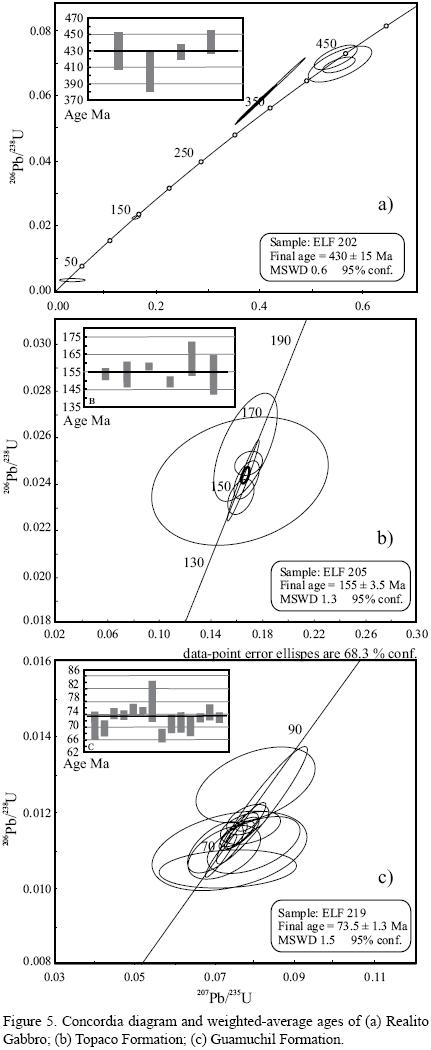
<body><![CDATA[<p align="justify"><font face="verdana" size="2"><b>GEOCHRONOLOGY</b></font></p>  	    <p align="justify"><font face="verdana" size="2">Mafic rocks of the Realito Gabbro, Topaco and Guamuchil formations were sampled for U&#150;Pb zircon geochronology (<a href="/img/revistas/rmcg/v29n2/html/a15t1.htm" target="_blank">Table 1</a>, <a href="#f5">Figure 5</a>), location of samples is included in <a href="#t2">Table 2</a>. Sample ELF&#150;202 from the Realito Gabbro is a coarse&#150;grained hornblende&#150;pyroxene gabbro. Very few zircons obtained from this sample are light pink in color, with euhedral to subhedral shape. Four zircons yielded a mean weighted age of 430 &plusmn; 15 Ma (Llandovery) with a MSWD of 0.6 (<a href="#f5">Figure 5a</a>). Dated zircons have Th/U ratios from 0.5 to 2.3 suggesting a magmatic origin, provided that metamorphic zircons usually have Th/U ratios &lt;0.07 (Rubatto, 2002). Five younger ages varying from Mississippian to Late Cretaceous are mostly isolated and are considered as produced by Pb&#150;loss related with later metamorphic events, although one Late Jurassic (156 Ma) and one Early Cretaceous (144 Ma) ages are also concordant.</font></p>  	    <p align="center"><font face="verdana" size="2"><a name="f5"></a></font></p>  	    <p align="center"><font face="verdana" size="2"><img src="/img/revistas/rmcg/v29n2/a15f5.jpg"></font></p>  	    <p align="center"><font face="verdana" size="2"><a name="t2"></a></font></p>  	    <p align="center"><font face="verdana" size="2"><img src="/img/revistas/rmcg/v29n2/a15t2.jpg"></font></p>  	    <p align="justify"><font face="verdana" size="2">In the Topaco Formation sample (ELF&#150;205), six light pink, euhedral to subhedral zircons making the only cluster of the sample yielded a mean weighted age of 155 &plusmn; 3.5 Ma age (Kimmeridgian) with a MSWD of 1.3 (<a href="#f5">Figure 5b</a>). Besides these six zircons, only one inherited Precambrian zircon was dated. Because no younger ages were obtained and Th/U ratios vary from 0.26 to 0.61, the Late Jurassic age is considered representative of the magmatic age of the sample.</font></p>  	    <p align="justify"><font face="verdana" size="2">The Guamuchil Formation dated sample (ELF&#150;219) is a fine&#150;grained mafic rock made up of amphibole and plagioclase, with pseudomorph lenses of zeolite + chlorite &plusmn; amphibole. Fourteen dated zircons yielded an age of 73 &plusmn; 1.5 Ma (Campanian) with a MSWD of 1.5 (<a href="#f5">Figure 5c</a>), interpreted as indicating its magmatic crystallization. Older ages are considered as coming from inherited zircons.</font></p>  	    <p align="justify"><font face="verdana" size="2">&nbsp;</font></p>  	    <p align="justify"><font face="verdana" size="2"><b>GEOCHEMISTRY</b></font></p>  	    ]]></body>
<body><![CDATA[<p align="justify"><font face="verdana" size="2">Major and trace element compositions of all dated igneous units from the El Fuerte area were obtained (<a href="/img/revistas/rmcg/v29n2/html/a15t3.htm" target="_blank">Table 3</a>) and its location included in <a href="#t2">Table 2</a>. Major element compositions were normalized to 100% on a volatile&#150;free basis before being plotted. Some altered rocks were studied to see how metamorphism might have modified their geochemical composition; anyway, most rocks display coherent distribution of major elements and therefore, metamorphism is assumed to be mostly isochemical.</font></p>  	    <p align="justify"><font face="verdana" size="2">The Realito Gabbro has a subalkaline character with low TiO<sub>2</sub> (&lt;0.7 wt.%), low SiO<sub>2</sub> and low alkalis contents (<a href="/img/revistas/rmcg/v29n2/a15f6.jpg" target="_blank">Figure 6a</a>). The low ratios of the high field strength (HFS) elements Nb/Y and Zr/Ti (<a href="/img/revistas/rmcg/v29n2/a15f6.jpg" target="_blank">Figure 6b</a>), which are generally immobile (Rollinson, 1993) confirm this feature. High FeOt concentration shows a typical tholeiitic signature (<a href="/img/revistas/rmcg/v29n2/a15f7.jpg" target="_blank">Figure 7a</a> and <a href="/img/revistas/rmcg/v29n2/a15f7.jpg" target="_blank">7b</a>). The gabbro is characterized by its high content of MgO (&#126;18 wt.%), Ni, Cr, and Co.</font></p>  	    <p align="justify"><font face="verdana" size="2">Fine&#150;grained mafic dikes cutting the Realito Gabbro have tholeiitic composition, higher Al<sub>2</sub>O<sub>3</sub>, but lower MgO, Ni, Cr and Co, than the host rock. ELF 225 sample is richer in SiO<sub>2</sub> and Zr than the coarse&#150;grained gabbro, but remains in the gabbro field (<a href="/img/revistas/rmcg/v29n2/a15f6.jpg" target="_blank">Figure 6a</a> and <a href="/img/revistas/rmcg/v29n2/a15f6.jpg" target="_blank">6b</a>). Rare earth element (REE) spectra normalized to chondritic values of Sun and McDonough (1989) and incompatible multi&#150;element patterns normalized to MORB (Pearce, 1983) relate gabbro and its crosscutting dikes (<a href="/img/revistas/rmcg/v29n2/a15f8.jpg" target="_blank">Figure 8a</a> and <a href="/img/revistas/rmcg/v29n2/a15f8.jpg" target="_blank">8d</a>). Both types of rock are slightly enriched in light rare earth elements (LREE) &#91;(La/Yb)<sub>N</sub> = 3.40 &#150; 4.25&#93;, and depleted in heavy rare earths elements (HREE). REE abundances are mostly lesser than 10X the chondritic relation. This feature distinguishes microgabbro dikes from rocks of the Topaco and Guamuchil formations (<a href="/img/revistas/rmcg/v29n2/a15f8.jpg" target="_blank">Figure 8a</a>, <a href="/img/revistas/rmcg/v29n2/a15f8.jpg" target="_blank">8c</a>). MORB&#150;normalized multi&#150;element spectra of the Realito Gabbro and microgabbro display enrichment of low&#150;field strength (LFS) elements and depletion of high&#150;field strength (HFS) elements (<a href="/img/revistas/rmcg/v29n2/a15f8.jpg" target="_blank">Figure 8d</a>). Their patterns are characterized by 1) forming a hump in Ce&#150;P, and a more pronounced one in Rb, Ba and Th; and 2) slight negative anomalies in Nb. Gabbro and microgabbro normative composition includes plagioclase (Pl), olivine (Ol), diopside (Di), and hypersthene (Hy), which is distinctive of olivine tholeiites (Yoder and Tilley, 1962).</font></p>  	    <p align="justify"><font face="verdana" size="2">High content in MgO (&#126;18%), Ni, Cr, and Co, in the Realito Gabbro suggests either a komatiitic affinity or derivation of a cumulate process. According to Seiferd <i>et al.</i> (1996) cumulate gabbros have lost most of the incompatible elements, which is specially obvious in the REE diagram, where they display REE abundance between 1X to 5X chondrite, while isotropic gabbros have abundances near or above 10X chondrite (Seiferd <i>et al.,</i> 1996). Both, the Realito gabbro and dikes have REE abundance lesser than 10X chondrite coinciding with those described for cumulate gabbros (Seiferd <i>et al.,</i> 1996). Although a cumulate origin can be proposed for the coarse&#150;grained gabbro, this cannot be done for the dikes. An alternative explanation for the low REE abundances in both gabbro and microgabbro is a high degree of partial melting in the source (Best, 2003).</font></p>  	    <p align="justify"><font face="verdana" size="2">Cubampo Granite and related dikes correspond to per&#150;aluminous subalkaline granites with normative corundum (<a href="/img/revistas/rmcg/v29n2/a15f6.jpg" target="_blank">Figure 6a</a>). Granites have high SiO<sub>2</sub> (75 &#150; 78 wt.%) and Fe (2.2 &#150; 3.4 wt.%) content. An enclave within the granite has quartzdiorite composition. All samples display a regular increase in LREE, a strong negative anomaly in Eu, and flat patterns for the HREE (<a href="/img/revistas/rmcg/v29n2/a15f8.jpg" target="_blank">Figure 8b</a>) relative to chondrite. The aplite sample has a more depleted LREE and enriched HREE spectra. In the multi&#150;element diagram, felsic rocks display spiky patterns due to: (1) a pronounced hump in Th and most large&#150;ion lithophile (LIL) elements; (2) negative anomalies in Sr, P, and Ti; (3) much&#150;less significant ones in Nb&#150;Ta (<a href="/img/revistas/rmcg/v29n2/a15f8.jpg" target="_blank">Figure 8e</a>).</font></p>  	    <p align="justify"><font face="verdana" size="2">The samples of the Topaco Formation, as those of the Realito Gabbro, have subalkaline mafic composition, tholeiitic affinity, similar concentration of REE &#91;(La/ Yb)<sub>N</sub> = 3.3&#150;3.4&#93;, as well as low Ti and high Fe contents. Nevertheless, the Topaco Formation rocks have higher silica (52&#150;53 wt.%) and alkalis (2.77&#150;3.61 wt.%) content (<a href="/img/revistas/rmcg/v29n2/a15f6.jpg" target="_blank">Figure 6a</a>). In addition, REE and multi&#150;elements patterns are more enriched than those of the Realito Gabbro, although they are mostly parallel (<a href="/img/revistas/rmcg/v29n2/a15f8.jpg" target="_blank">Figure 8a</a>, <a href="/img/revistas/rmcg/v29n2/a15f8.jpg" target="_blank">8b</a>, <a href="/img/revistas/rmcg/v29n2/a15f8.jpg" target="_blank">8d</a> and <a href="/img/revistas/rmcg/v29n2/a15f8.jpg" target="_blank">8e</a>). In addition, normative minerals in the Topaco Formation are quartz (Qtz), plagioclase (Pl), diopside (Di), and hypersthene (Hy), which is representative of quartz tholeiites (Yoder and Tilley, 1962). Similarities in REE and trace elements concentrations between Cubampo Granite rocks and mafic rocks of the Topaco Formation suggest some kind of genetic link between them, maybe peraluminous granites were formed after crustal heating by mafic magmas.</font></p>  	    <p align="justify"><font face="verdana" size="2">Upper Cretaceous lava flows of the Guamuchil Formation include basaltic andesites, minor basalt, and andesite, all of which have a subalkaline composition (<a href="/img/revistas/rmcg/v29n2/a15f6.jpg" target="_blank">Figure 6a</a> and <a href="/img/revistas/rmcg/v29n2/a15f6.jpg" target="_blank">6b</a>). These rocks show considerable variation in chemical composition, exemplified by the SiO<sub>2</sub> content from 45 to 66 wt.% (on a volatile free basis). Silica content under 45 wt.% may imply a process of alkaline&#150;basic metasomatism, which cause depletion of acid (SiO<sub>2</sub>, F, Cl, SO<sub>3</sub>, CO<sub>2</sub>, etc.) and input of alkaline/basic (K<sub>2</sub>O, Na<sub>2</sub>O, CaO, MgO, etc.) components (Zharikov <i>et al.,</i> 2007). Samples with low silica of the Guamuchil Formation have higher Ti values than those of the Realito and Topaco formations (0.8 &#150; 1.4 wt.%). Basalt and basaltic andesite are alumina rich (14 &#150; 19 wt. %), with tholeiitic character, which is evidenced by a Fenner trend (Fenner, 1937) in the Al<sub>2</sub>O<sub>3</sub>&#150;FeO&#150;MgO (AFM) diagram (<a href="/img/revistas/rmcg/v29n2/a15f7.jpg" target="_blank">Figure 7b</a>). REE and multi&#150;elements patterns of the Guamuchil Formation (<a href="/img/revistas/rmcg/v29n2/a15f8.jpg" target="_blank">Figure 8c</a> and <a href="/img/revistas/rmcg/v29n2/a15f8.jpg" target="_blank">8f</a>) are indistinguishable of those of the Topaco Formation (<a href="/img/revistas/rmcg/v29n2/a15f8.jpg" target="_blank">Figure 8b</a> and <a href="/img/revistas/rmcg/v29n2/a15f8.jpg" target="_blank">8e</a>), and both units have the same normative minerals including Qtz, Cpx, Opx and Pl, indicating they are quartz tholeiites (Yoder and Tilley, 1962).</font></p>  	    <p align="justify"><font face="verdana" size="2"><b>Metamorphism</b></font></p>  	    <p align="justify"><font face="verdana" size="2">Metamorphism has affected the primary concentrations of SiO<sub>2</sub> and some trace elements in some rocks of the Realito Gabbro, as indicated by higher loss on ignition (LOI) (<i>e.g.</i> ELF 226B and ELF 226C) and changes in REE patterns (<a href="/img/revistas/rmcg/v29n2/a15f8.jpg" target="_blank">Figure 8</a>). Altered dikes have higher depletion in most REE excepting La, Eu, and Tm.</font></p>  	    <p align="justify"><font face="verdana" size="2">In few samples of the Guamuchil Formation, hydrothermal metamorphism replaced original minerals by epidote, actinolite&#150;tremolite, and chlorite. This process is responsible for variation in concentrations of major elements. For example, metasomatic SiO<sub>2</sub> loss in sample ELF 219 originated its plotting in the ultramafic field (<a href="/img/revistas/rmcg/v29n2/a15f6.jpg" target="_blank">Figure 6a</a>), and a sodic alkaline character marked by the presence of leucite and nepheline in the CIPW norm. In spite of variation in major elements of samples ELF 219 and ELF 217 (<a href="/img/revistas/rmcg/v29n2/a15f6.jpg" target="_blank">Figure 6a</a>), ratios of immobile HFS elements (Nb/Y <i>vs.</i> Zr/ Ti, <a href="/img/revistas/rmcg/v29n2/a15f6.jpg" target="_blank">Figure 6b</a>) and the REE patterns (<a href="/img/revistas/rmcg/v29n2/a15f8.jpg" target="_blank">Figure 8c</a>) are identical to those of other samples in this formation (<a href="/img/revistas/rmcg/v29n2/a15f8.jpg" target="_blank">Figure 8a</a> and <a href="/img/revistas/rmcg/v29n2/a15f8.jpg" target="_blank">8b</a>); while the multi&#150;element patterns display lower content of K, Rb, and Ba, in the altered samples (<a href="/img/revistas/rmcg/v29n2/a15f8.jpg" target="_blank">Figure 8f</a>). Only the ELF 214 sample displays a differentiated composition with more enriched LREE concentration and subtly negative anomaly in Eu (white triangle in <a href="/img/revistas/rmcg/v29n2/a15f8.jpg" target="_blank">Figure 8c</a>).</font></p>  	    ]]></body>
<body><![CDATA[<p align="justify"><font face="verdana" size="2"><b>Tectonic setting</b></font></p>  	    <p align="justify"><font face="verdana" size="2">In order to elucidate the tectonic setting that the El Fuerte samples are more akin, a comparison between analyzed multi&#150;element spectra of the El Fuerte units and those of basalts in present tectonic environments was carry out using the diagram of Pearce (1983) modified by Wilson (1989) (<a href="/img/revistas/rmcg/v29n2/a15f9.jpg" target="_blank">Figure 9a</a>). In this diagram, signatures of the El Fuerte basalts are analogous to those of oceanic island arc environments, with the Guamuchil Formation spectra more similar to oceanic island arc calc&#150;alkaline basalts and those of the Realito Gabbro with a trend to oceanic island&#150;arc tholeiitic basalts. In addition, samples were plotted in the Ti&#150;V diagram of Shervais (1982), which is adequate because these elements are immobile under conditions of hydrothermal alteration and at intermediate&#150;to&#150;high grades of metamorphism (Rollinson, 1993). In the Ti&#150;V diagram, rocks of the Realito Gabbro and Topaco Formation clearly fall in the field of arc tholeiite (<a href="/img/revistas/rmcg/v29n2/a15f9.jpg" target="_blank">Figure 9b</a>). The Guamuchil Formation samples fall in either the arc tholeiite, calc&#150;alkaline, or mid&#150;ocean ridge basalts (MORB) and backarc basin (BAB) fields. In order to discriminate between the overlapping fields of the Ti&#150;V diagram for the Guamuchil Formation, we use the Ti&#150;Zr&#150;Sr/2 diagram of Pearce and Cann (1973). In this diagram, basalts of the Guamuchil Formation fall in the island&#150;arc tholeiite field (<a href="/img/revistas/rmcg/v29n2/a15f9.jpg" target="_blank">Figure 9c</a>) far from the MORB field. Although Rollinson (1993) indicates that the Ti&#150;Zr&#150;Sr/2 diagram can only be used for fresh samples because of the relative mobility of Sr, the coherent behavior of this element in all samples suggests that no major alteration&#150;related dispersion has occurred.</font></p>  	    <p align="justify"><font face="verdana" size="2">&nbsp;</font></p>  	    <p align="justify"><font face="verdana" size="2"><b>DISCUSSION</b></font></p>  	    <p align="justify"><font face="verdana" size="2"><b>Regional Comparisons</b></font></p>  	    <p align="justify"><font face="verdana" size="2"><b><i>Lower Silurian Realito Gabbro</i></b></font></p>  	    <p align="justify"><font face="verdana" size="2">Silurian magmatic rocks are scarce in Mexico. In our knowledge, only the Acatl&aacute;n Complex basement of the Mixteco terrane in southern Mexico includes rocks of this age (location in <a href="/img/revistas/rmcg/v29n2/a15f10.jpg" target="_blank">Figure 10</a>). There, batholitic granite with 440&#150;442 Ma U&#150;Pb zircon ages (Ortega&#150;Guti&eacute;rrez <i>et al.,</i> 1999; Talavera&#150;Mendoza <i>et al.,</i> 2005; Vega&#150;Granillo <i>et al.,</i> 2007) intrudes into sedimentary rocks and, in turn, basaltic dikes crosscut both types of rock. Subsequently, all of these rocks, grouped as the Esperanza suite, underwent eclogitic metamorphism (Vega&#150;Granillo <i>et al.</i> , 2007). However, some unmetamorphosed granites of the Acatl&aacute;n Complex, also regarded as the Esperanza Granitoids, yield Late Ordovician ages (<i>e.g.</i>, Keppie <i>et al.,</i> 2008). The age of the eclogitic metamorphism is either Lower Silurian (430 &plusmn; 10 Ma, <sup>39</sup>Ar/<sup>40</sup>Ar isochron) obtained dating amphibole in eclogite (Vega&#150;Granillo <i>et al.,</i> 2007), or Late Devonian&#150;Mississippian (<i>e.g.</i>, El&iacute;as&#150;Herrera <i>et al.,</i> 2004; Murphy <i>et al.</i> , 2006). Esperanza meta&#150;granitoids are per&#150;aluminous with calkalcaline continental arc signature (Ram&iacute;rez&#150;Espinosa, 2001), while the mafic rocks have characteristics of within&#150;plate continental tholeiites (Murphy <i>et al.,</i> 2006). In a wider context, Silurian magmatism occurs in the Maya mountains of Belize (Martens <i>et al.</i>, 2010), the Appalachian chain (<i>e.g.</i>, Whalen <i>et al.,</i> 2006), and northwestern South America (Chew <i>et al.,</i> 2007). For example, Silurian plutonic suites in the Newfoundland Appalachians include abundant gabbro, monzogabbro and granite to granodiorite and lesser quartz&#150;diorite and tonalite. Mafic rocks include both arc&#150;like (Nb/Th&lt;3) calc&#150;alkaline, and non&#150;arc&#150;like (Nb/Th&gt;3) transitional calc&#150;alkaline basalt to continental tholeiitic affinity compositions (Lissenberg <i>et al.,</i> 2006; Whalen <i>et al.,</i> 2006). Gabbro complexes have ages from 435 &plusmn; 1 to 430 &plusmn; 2 Ma (Lissenberg <i>et al.,</i> 2006; Whalen <i>et al.</i>, 2006). In the Eastern Cordilleras of Per&uacute; and Ecuador, subduction&#150;related magmatic rocks yielded ages of 474 to 442 Ma (Chew <i>et al.,</i> 2007), but its geochemical character is unknown.</font></p>  	    <p align="justify"><font face="verdana" size="2">In order to review the probable relation between the Acatl&aacute;n complex, the R&iacute;o Fuerte Formation and the Granjeno Schist from southern, northwestern and northeastern Mexico respectively, detrital zircon plots from metamorphic units of each region (data from Talavera&#150;Mendoza <i>et al.,</i> 2005; Vega&#150;Granillo <i>et al.,</i> 2008; Barboza&#150;Gudi&ntilde;o <i>et al.,</i> 2011) were tested through the similarity&#150;overlap method described by Gehrels (2000). Degree of overlap is the degree to which the two age probabilities overlap; there, 1.0 is a perfect overlap, 0.0 indicates no overlap occurs. Degree of similarity is a measure of whether proportions of overlapping ages are similar. Higher values (up to 1.0) reflect similar proportions of overlapping ages. Lower values (down to 0.0) reflect different proportions of ages that may or may not overlap. Results of that comparison, displayed in <a href="/img/revistas/rmcg/v29n2/a15t4.jpg" target="_blank">Table 4</a>, indicate the El Fuerte detrital zircon plots have larger overlap and similarity with those of the Cosoltepec and Ixcamilpa formations of the Acatl&aacute;n Complex, being both noteworthy high (overlap from 0.74 to 0.81 and similarity from 0.67 to 0.78). However, the Middle to Late Ordovician age of the R&iacute;o Fuerte Formation precludes correlation with the Cosoltepec Formation because this later unit is considered Early Devonian or younger in age (<i>e.g.</i>, Talavera&#150;Mendoza <i>et al.,</i> 2005). Besides, the R&iacute;o Fuerte detrital zircon plots are comparable with those obtained in the Granjeno Schist from Tamaulipas and Nuevo Le&oacute;n, Mexico (Barboza&#150;Gudi&ntilde;o <i>et al.,</i> 2011) with overlap from 0.86 to 0.77 and similarity between 0.74 and 0.55 (<a href="/img/revistas/rmcg/v29n2/a15t4.jpg" target="_blank">Table 4</a>). In the <a href="/img/revistas/rmcg/v29n2/a15t4.jpg" target="_blank">Table 4</a>, it is also noteworthy the high similarity between some units of the Granjeno Schist with some units in the Acatl&aacute;n Complex.</font></p>  	    <p align="justify"><font face="verdana" size="2"><b><i>Upper Jurassic Cubampo Granite and Topaco Formation</i></b></font></p>  	    <p align="justify"><font face="verdana" size="2">The Late Jurassic ages of the Cubampo Granite and related dikes (Vega&#150;Granillo <i>et al.,</i> 2008; 2011) are coeval within analytical errors with the age obtained from the metabasite of the Topaco Formation. Similarities in REE and trace elements concentrations between these two types of rocks, also suggest they are genetically related.</font></p>  	    ]]></body>
<body><![CDATA[<p align="justify"><font face="verdana" size="2">At regional scale, Jurassic magmatic rocks occur in two areas: 1) southwestern Arizona, southeastern California and northwestern Sonora (Tosdal <i>et al.,</i> 1989); and 2) Central Mexico (<a href="/img/revistas/rmcg/v29n2/a15f10.jpg" target="_blank">Figure 10</a>). Both areas have been considered as parts of a continuous Late Triassic&#150;Middle Jurassic magmatic arc (Bartolini <i>et al.,</i> 2003), or as parts of a truncated arc displaced about 800 to 1000 km to southeast by the Mojave&#150;Sonora megashear (<i>e.g.,</i> Anderson <i>et al.,</i> 2005; Haxel <i>et al.,</i> 2005). In the northwestern area (1), calk&#150;alcaline magmatic rocks yielding ages between 175 and 165 Ma are interpreted as continental arc magmatism (Anderson <i>et al.,</i> 2005; Haxel <i>et al.,</i> 2005). In the central Mexico area (2), the Nazas Formation is a thick sequence of andesite and dacite with minor rhyolite and latite, capped by red beds (Blickwede, 2001). Welded eutaxitic tuffs in the upper part of the Nazas Formation have U&#150;Pb ages of 172 and 169 Ma (Lawton, 2010). Consequently, the suites from the northwestern and central areas are older than the Cubampo and Topaco formations and cannot be correlated with them.</font></p>  	    <p align="justify"><font face="verdana" size="2">A regional suite of Upper Jurassic sedimentary, volcanic, and plutonic units, overlies or intrudes Middle Jurassic sequences in southwestern USA (<i>e.g.</i>, Saleeby and Busby&#150;Spera, 1992; Anderson <i>et al.,</i> 2005). These units (<i>e.g.</i>, Artesa, Ko Vaya, McCoy Mountains, Glance formations) yield 165 to 145 Ma ages (<i>e.g.</i>, Barth <i>et al.,</i> 2004; Anderson <i>et al.,</i> 2005; Haxel <i>et al.,</i> 2005). The Glance Conglomerate of southwestern Arizona contains abundant rhyolitic, dacitic, and andesitic volcanic and volcaniclastic deposits inter&#150;stratified with boulder breccia&#150;conglomerates (<i>e.g.</i>, Busby <i>et al.,</i> 2005). Geochemical data suggest these rocks record a variation from continental arc to rift volcanism (Krebs and Ruiz, 1987; Anderson <i>et al.,</i> 2005), or continental arc setting only (Busby <i>et al.</i>, 2005). Two granodiorites and one metarhyolite from the Caborca terrane yielded 153 Ma, 164 Ma and 141 Ma ages, respectively (Anderson <i>et al.,</i> 2005). In addition, ortogneisses in the eastern Peninsular Ranges in Baja California yielded a 162 Ma age (<i>e.g.</i> Alsleben <i>et al.</i> , 2008). Whereas, in Central Mexico an intrusive related to the Coapas schist yielded a 158 &plusmn; 4 Ma age (U&#150;Pb zircon age, Jones <i>et al.,</i> 1995). All previous rocks are nearly coeval to the Cubampo and Topaco dated samples.</font></p>  	    <p align="justify"><font face="verdana" size="2">In addition to the Late Jurassic magmatism mentioned above and considered as formed in continental arc setting, Late Jurassic&#150;Early Cretaceous magmatism occurs in the Guerrero superterrane (<a href="/img/revistas/rmcg/v29n2/a15f11.jpg" target="_blank">Figure 11c</a>), which includes the Alisitos terrane of Baja California. Some authors consider this superterrane as relatively or partially exotic to Precambrian&#150;Paleozoic terranes composed of Laurentian or Gondwanan blocks forming mainland Mexico (<i>e.g.</i>, Campa and Coney, 1983; Dickinson and Lawton, 2001). However, there is no consensus about the exotic origin of the Guerrero superterrane. The Arteaga Complex, considered the basement of the Guerrero superterrane (Centeno&#150;Garc&iacute;a <i>et al.,</i> 2003), consists of metamorphosed sedimentary, volcanic and intrusive rocks assigned to the Late Triassic&#150;Lower Jurassic (Centeno&#150;Garc&iacute;a <i>et al.,</i> 1993). The Tumbiscat&iacute;o Granite intrudes the Arteaga Complex and yielded a U&#150;Pb age of 163 Ma (Centeno&#150;Garc&iacute;a <i>et al.</i>, 2003) and a K&#150;Ar age of 158 &plusmn; 5 Ma (Grajales&#150;Nishimura and L&oacute;pez&#150;Infanz&oacute;n, 1984). The arc assemblage of the Guerrero terrane includes basalts yielding K&#150;Ar and <sup>39</sup>Ar/<sup>40</sup>Ar ages of 105 to 93 Ma (Delgado&#150;Argote <i>et al.,</i> 1990; Ortiz&#150;Hern&aacute;ndez and Lapierre, 1991; El&iacute;as&#150;Herrera <i>et al.,</i> 2000), which are covered by Lower Cretaceous sedimentary rocks (Guerrero&#150;Su&aacute;stegui <i>et al.,</i> 1993; Salinas, 1994). In Guanajuato, a magmatic sequence formed by a cogenetic island&#150;arc tholeiitic suite, ultramafic&#150;mafic cumulate rocks, diabasic feeder dikes, and basaltic pillow lavas (Lapierre <i>et al.,</i> 1992) yielded K&#150;Ar ages ranging from 157 to 108 Ma (Ortiz&#150;Hern&aacute;ndez <i>et al.,</i> 1990; Lapierre <i>et al.,</i> 1992). This sequence is thrust to the NNE over a contemporaneous, highly deformed, detrital and volcanic sequence named the Arperos Formation (Monod <i>et al.,</i> 1990), which is an island arc tholeiitic suite, ranging from ultramafic&#150;mafic cumulate rocks, diabasic feeder dikes, and basaltic pillow lavas (Lapierre <i>et al.,</i> 1992). The lowermost limestone levels of the Arperos Formation contain nannofosils of Tithonian&#150;Hauterivian age (Corona&#150;Ch&aacute;vez, 1988). Limestones with Aptian&#150;Albian fossils (Chiodi <i>et al.,</i> 1988; Quintero&#150;Legorreta, 1992) cover the Arperos formation.</font></p>  	    <p align="justify"><font face="verdana" size="2">In the Vizcaino Peninsula and Cedros Island of western Baja California, magmatism spans from the Late Triassic (221 Ma) to the Early Cretaceous (ca. 135 Ma; Kimbrough and Moore, 2003). In that region, the Upper Jurassic&#150;Lower Cretaceous Coloradito and Eugenia Formations contain mudflows and olistostrome blocks interbedded with arc volcanogenic sediment and rift&#150;related pillow lavas. Middle Jurassic to Lower Cretaceous plutonic arc rocks (ca. 165&#150;135 Ma) intrude low greenschist facies ophiolite and volcanic arc basement (Kimbrough and Moore, 2003). These intrusions are I&#150;type Cordilleran batholithic rocks, ranging from gabbro to granodiorite, with dominant tonalite, and relatively primitive arc geochemical affinities (initial <sup>87</sup>Sr/<sup>86</sup>Sr range from &#126;0.704 to 0.706), but they are distinctively calcic in nature (Kimbrough and Moore, 2003). A tonalite dated at about 155&#150;152 Ma, a gneissic tonalite of <i>ca.</i> 149 Ma, and a leucotonalite containing fractions with ages of 150 to 160 Ma (Kimbrough and Moore, 2003) are coeval to the Cubampo Granite.</font></p>  	    <p align="justify"><font face="verdana" size="2"><b><i>Upper Cretaceous Guamuchil Formation</i></b></font></p>  	    <p align="justify"><font face="verdana" size="2">The Upper Cretaceous Guamuchil Formation is coeval with volcanic suites dispersed along the North and South America western border. Late Cretaceous&#150;early Tertiary arc magmatism in east&#150;central Sonora includes the Sonoran batholith and its volcanic equivalent the Tarahumara Formation (McDowell <i>et al.,</i> 2001). The Tarahumara Formation includes about 2500 m of andesitic to dacitic lava, agglomerate, and volcanic breccia, with subordinate felsic pyroclastic components (McDowell <i>et al.,</i> 2001), which yielded ages from 90 to 70 Ma (U&#150;Pb zircon; K&#150;Ar biotite and hornblende, <i>e.g.,</i> McDowell <i>et al.,</i> 2001; Rold&aacute;n&#150;Quintana, 2002). Rocks ranging in age from 70 to 100 Ma (<sup>39</sup>Ar/<sup>40</sup>Ar) are common in the Peninsular Ranges province of Baja California (Tulloch and Kimbrough, 2003). In the Sinaloa batholith, which is the southward extension of the Sonora batolith, Henry <i>et al.</i> (2003) reported syntectonic intrusions with hornblende K&#150;Ar ages between 98 and 90 Ma; and post&#150;tectonic intrusions emplaced nearly continuous between 90 and 45 Ma.</font></p>  	    <p align="justify"><font face="verdana" size="2">The Guamuchil Formation cannot be correlated with rocks of the composite Guerrero terrane, because the upper sedimentary part of that terrane has Aptian&#150;Albian fossils (<i>e.g.</i>, Allison, 1955; Talavera&#150;Mendoza and Guerrero&#150;Su&aacute;stegui, 2000) and the lower volcanic part has Lower Cretaceous ages (Delgado&#150;Argote <i>et al.</i> , 1990; Ortiz&#150;Hern&aacute;ndez and Lapierre, 1991; El&iacute;as&#150;Herrera <i>et al.,</i> 2000). Furthermore, the Alisitos arc accretion to the continental border occurred before 108 Ma (Wetmore <i>et al.,</i> 2002; Alsleben <i>et al.,</i> 2008). The Guamuchil Formation may be correlated with the La Uni&oacute;n&#150;Zihuatanejo assemblage occurring in the Zihuatanejo subterrane, which consists of sedimentary rocks interbedded with andesitic lava flows, volcanic breccia, and tuffs. Martini <i>et al.</i> (2010) interpreted Late Cretaceous &#126;88 Ma detrital zircon ages in sedimentary rocks as probably derived from the interbedded tuff units.</font></p>  	    <p align="justify"><font face="verdana" size="2"><b>Discussion on the tectonic context</b></font></p>  	    <p align="justify"><font face="verdana" size="2">In the tectonic model proposed by Vega&#150;Granillo <i>et al.</i> (2008), the R&iacute;o Fuerte Formation deposition occurred in a basin between an active Ordovician arc and an extinct Neoproterozoic peri&#150;Gondwanan arc. Although the Late Ordovician arc was hypothesized on the basis of detrital zircon ages in metasediments of the R&iacute;o Fuerte Formation, the Realito Gabbro may be the Early Silurian extension of this arc. Geochemical data indicate that the Realito Gabbro emplacement occurred in an island arc tectonic setting. The model of Vega&#150;Granillo <i>et al.</i> (2008) proposed south&#150;directed subduction, which eventually may have caused the accretion of the R&iacute;o Fuerte Formation and the Realito Gabbro to southern Laurentia, probably by Carboniferous&#150;Permian times. The accretion time is constrained by the timing of emplacement of Paleozoic slope and abyssal sequences over coeval platform sequences in Central Sonora (Poole and Madrid, 1988; Poole <i>et al.,</i> 2005).</font></p>  	    <p align="justify"><font face="verdana" size="2">Detrital zircon ages and Silurian magmatism relate the Sonobari Complex of northern Sinaloa with the Acatl&aacute;n Complex of southern Mexico, suggesting their proximity in Paleozoic times (<a href="/img/revistas/rmcg/v29n2/a15f11.jpg" target="_blank">Figure 11a</a>). However, the geochemical signature, calk&#150;alkaline for the Esperanza Granitoids in the Acatl&aacute;n Complex and tholeiitic for the Realito Gabbro; and metamorphic conditions, high P/T in the Ixcamilpa and Esperanza suites against low P/T for the R&iacute;o Fuerte Formation, suggest those regions underwent distinctive tectonic evolutions. Whereas the high P/T metamorphism in the Ixcamilpa suite occurred along a subduction zone (Vega&#150;Granillo <i>et al.</i>, 2007), the low P/T metamorphism in the R&iacute;o Fuerte Formation is more typical of magmatic arc setting (Vega&#150;Granillo <i>et al.,</i> 2011).</font></p>  	    ]]></body>
<body><![CDATA[<p align="justify"><font face="verdana" size="2">Considering the present position of the El Fuerte region, the Upper Jurassic felsic&#150;mafic magmatism of that area may have occurred in two scenarios: 1) as a southern prolongation of the Upper Jurassic continental magmatism of northwestern Sonora, eastern Peninsular Ranges and southwestern USA; or 2) as part of the Upper Jurassic&#150;Lower Cretaceous arc assemblages of the Guerrero super&#150;terrane (<a href="/img/revistas/rmcg/v29n2/a15f11.jpg" target="_blank">Figure 11b</a> and <a href="/img/revistas/rmcg/v29n2/html/a15f2.htm" target="_blank">Figure 12</a>). Considering that the Cubampo Granite and related dikes intrude the R&iacute;o Fuerte Formation, and clasts of these two units made part of the agglomerates in the Topaco Formation, the Upper Jurassic magmatism must have been emplaced over and/or through the R&iacute;o Fuerte Formation and the Realito Gabbro. Then, if the accretion of basement sequences to the Laurentian craton occurred since late Paleozoic time, the Upper Jurassic magmatism in the El Fuerte area must be autochthonous. Besides, the Arteaga Complex, basement of the Guerrero terrane, is regarded Late Triassic&#150;Lower Jurassic in age (Centeno&#150;Garc&iacute;a <i>et al.,</i> 1993) and consequently, cannot be correlated with the Middle&#150;Upper Ordovician R&iacute;o Fuerte Formation. The island arc geochemical character of the Topaco Formation differs from the coeval continental arc magmatism in northern Sonora and southwestern Arizona. Anyway, this variation may be due to differences in the mantle from which these two suites derive, which is supported by Nd and Sr isotopes and REE variations in granites from northern Sonora through northern Sinaloa (Valencia&#150;Moreno <i>et al.,</i> 2011).</font></p>  	    <p align="justify"><font face="verdana" size="2">By Late Cretaceous, the Guerrero superterrane was already accreted to mainland Mexico (<i>e.g.,</i> Tardy <i>et al.,</i> 1994; Alsleben <i>et al.,</i> 2008) (<a href="/img/revistas/rmcg/v29n2/a15f11.jpg" target="_blank">Figure 11c</a>). In this scenario, the Guamuchil Formation may be part of the Late Cretaceous magmatic arc developed along the western border of Mexico, from Sonora to Guerrero (<a href="/img/revistas/rmcg/v29n2/a15f11.jpg" target="_blank">Figure 11c</a>). Again, particular oceanic island&#150;arc signature of the Upper Cretaceous magmatism may derive from the particular mantle source underlying the El Fuerte region.</font></p>  	    <p align="justify"><font face="verdana" size="2">&nbsp;</font></p>  	    <p align="justify"><font face="verdana" size="2"><b>CONCLUSIONS</b></font></p>  	    <p align="justify"><font face="verdana" size="2">In the El Fuerte region northwestern Mexico, four units with igneous rocks crop out:</font></p>  	    <p align="justify"><font face="verdana" size="2">The Realito Gabbro yielded a 430 &plusmn; 15 Ma U&#150;Pb zircon age. This unit intrudes the Middle&#150;Upper Ordovician R&iacute;o Fuerte Formation, and corresponds to hornblende&#150;pyroxene gabbro with retrogressive metamorphism. Geochemistry studies indicate rocks of this unit are subalkaline island arc tholeiite with komatiitic affinity, which may be caused by cumulate processes.</font></p>  	    <p align="justify"><font face="verdana" size="2">A Late Jurassic suite made up by the Cubampo Granite and the Topaco Formation. The Cubampo Granite and related aplite dikes with ages between 155 and 151 Ma are peraluminous subalkaline granites. The granite contains quartz&#150;diorite enclaves. The 155 &plusmn; 3.5 Ma age yielded by basalts of the Topaco Formation indicates that is coeval with the Cubampo Granite. The Topaco Formation samples correspond to island arc basalts with subalkaline composition and tholeiitic affinity. Similarities in REE and trace elements concentrations between the felsic rocks of the Cubampo Granite and mafic rocks of the Topaco Formation suggest some kind of genetic link between these units, maybe peraluminous granites were formed after crustal heating by mafic magmas.</font></p>  	    <p align="justify"><font face="verdana" size="2">The Guamuchil Formation mainly consists of basalt and basaltic andesite with subalkaline composition, high alumina but tholeiitic character. A dated sample yielded a 73 &plusmn; 1.5 Ma (Campanian) age.</font></p>  	    <p align="justify"><font face="verdana" size="2">The Early Silurian age of the Realito Gabbro and previously obtained detrital zircon plots of the R&iacute;o Fuerte Formation (Vega&#150;Granillo <i>et al.,</i> 2008), suggests a relationship between the El Fuerte units and the Ixcamilpa and Esperanza suites of the Acatl&aacute;n Complex of southern Mexico, although subsequently, each region underwent distinctive tectonic evolutions. Petrology and field relationships indicate that the Late Jurassic rocks of the Topaco and Cubampo units were emplaced on or through the R&iacute;o Fuerte Formation, which was accreted to Laurentia since late Paleozoic time. Consequently, this magmatism is considered authoctonous. The Upper Cretaceous Guamuchil Formation must be part of a large belt of coeval intrusions and volcanic rocks extending from Sonora to Guerrero in Mexico. The island&#150;arc tholeiitic signature of these lavas differs from the continental calc&#150;alkaline character of contemporaneous rocks, and may arise from a distinctive mantle source. At last, regarding the ages obtained from volcanic rocks of the El Fuerte region, the Lower Cretaceous lavas characteristic of the Guerrero terrane were not found in this study.</font></p>  	    <p align="justify"><font face="verdana" size="2">&nbsp;</font></p>  	    ]]></body>
<body><![CDATA[<p align="justify"><font face="verdana" size="2"><b>ACKNOWLEDGEMENTS</b></font></p>  	    <p align="justify"><font face="verdana" size="2">The research for this paper was financed by a CONACYT (79759) grant to Ricardo Vega&#150;Granillo. We appreciate helpful assistance of Ken Domanik for microprobe analysis, and Mark Pecha for geochronologic determinations, as well as thoroughly review by Brendan Murphy, Ryan Mathur, and two anonymous reviewers.</font></p>  	    <p align="justify"><font face="verdana" size="2">&nbsp;</font></p>  	    <p align="justify"><font face="verdana" size="2"><b>REFERENCES</b></font></p>  	    <!-- ref --><p align="justify"><font face="verdana" size="2">Allison, E.C., 1955, Middle Cretaceous gastropoda of Punta china, Baja California, Mexico: Journal of Paleontology, 29, 400&#150;432.    &nbsp;&nbsp;&nbsp;&nbsp;&nbsp;&nbsp;&nbsp;&nbsp;[&#160;<a href="javascript:void(0);" onclick="javascript: window.open('/scielo.php?script=sci_nlinks&ref=8124684&pid=S1026-8774201200020001500001&lng=','','width=640,height=500,resizable=yes,scrollbars=1,menubar=yes,');">Links</a>&#160;]<!-- end-ref --></font></p>  	    <!-- ref --><p align="justify"><font face="verdana" size="2">Alsleben, H., Wetmore, P. H., Schmidt, K. L., Paterson, S. R., Melis, E. A., 2008, Complex deformation during arc&#150;continent collision: Quantifying finite strain in the accreted Alisitos arc, Peninsular Ranges batholith, Baja California: Journal of Structural Geology, 30, 220&#150;236.    &nbsp;&nbsp;&nbsp;&nbsp;&nbsp;&nbsp;&nbsp;&nbsp;[&#160;<a href="javascript:void(0);" onclick="javascript: window.open('/scielo.php?script=sci_nlinks&ref=8124686&pid=S1026-8774201200020001500002&lng=','','width=640,height=500,resizable=yes,scrollbars=1,menubar=yes,');">Links</a>&#160;]<!-- end-ref --></font></p>  	    <!-- ref --><p align="justify"><font face="verdana" size="2">Anderson, T.H., Schmidt, V.A., 1983, A model of the evolution of Middle America and the Gulf of Mexico&#150;Caribbean Sea region during Mesozoic time: Geological Society of America Bulletin, 94, 941&#150;966.    &nbsp;&nbsp;&nbsp;&nbsp;&nbsp;&nbsp;&nbsp;&nbsp;[&#160;<a href="javascript:void(0);" onclick="javascript: window.open('/scielo.php?script=sci_nlinks&ref=8124688&pid=S1026-8774201200020001500003&lng=','','width=640,height=500,resizable=yes,scrollbars=1,menubar=yes,');">Links</a>&#160;]<!-- end-ref --></font></p>  	    ]]></body>
<body><![CDATA[<!-- ref --><p align="justify"><font face="verdana" size="2">Anderson, T.H., Rodr&iacute;guez&#150;Casta&ntilde;eda, J.L., Silver, L.T., 2005, Jurassic rocks in Sonora, Mexico: Relations to the Mojave&#150;Sonora megashear and its inferred northwestward extension, <i>in</i> Anderson, T.H., Nourse, J.A., McKee, J.W., Steiner, M.B. (eds.), The Mojave&#150;Sonora Megashear Hypothesis: Development, assessment, and alternatives: Geological Society of America Special Paper 393, 51&#150;95.    &nbsp;&nbsp;&nbsp;&nbsp;&nbsp;&nbsp;&nbsp;&nbsp;[&#160;<a href="javascript:void(0);" onclick="javascript: window.open('/scielo.php?script=sci_nlinks&ref=8124690&pid=S1026-8774201200020001500004&lng=','','width=640,height=500,resizable=yes,scrollbars=1,menubar=yes,');">Links</a>&#160;]<!-- end-ref --></font></p>  	    <!-- ref --><p align="justify"><font face="verdana" size="2">Barboza&#150;Gudi&ntilde;o, J.R., Ram&iacute;rez&#150;Fern&aacute;ndez, J.A., Torres&#150;S&aacute;nchez, S.A., Valencia, V.A., 2011, Geocronolog&iacute;a de circones detr&iacute;ticos de diferentes localidades del Esquisto Granjeno en el noreste de M&eacute;xico: Bolet&iacute;n de la Sociedad Geol&oacute;gica Mexicana, 63(2), 201&#150;216.    &nbsp;&nbsp;&nbsp;&nbsp;&nbsp;&nbsp;&nbsp;&nbsp;[&#160;<a href="javascript:void(0);" onclick="javascript: window.open('/scielo.php?script=sci_nlinks&ref=8124692&pid=S1026-8774201200020001500005&lng=','','width=640,height=500,resizable=yes,scrollbars=1,menubar=yes,');">Links</a>&#160;]<!-- end-ref --></font></p>  	    <!-- ref --><p align="justify"><font face="verdana" size="2">Barth, A.P., Wooden, J.L., Jacobson, C.J., Probst, K., 2004, U&#150;Pb geochronology and geochemistry of the McCoy Mountains Formation, southeastern California: A Cretaceous retroarc foreland basin: Geological Society of America Bulletin, 116, 142&#150;153.    &nbsp;&nbsp;&nbsp;&nbsp;&nbsp;&nbsp;&nbsp;&nbsp;[&#160;<a href="javascript:void(0);" onclick="javascript: window.open('/scielo.php?script=sci_nlinks&ref=8124694&pid=S1026-8774201200020001500006&lng=','','width=640,height=500,resizable=yes,scrollbars=1,menubar=yes,');">Links</a>&#160;]<!-- end-ref --></font></p>  	    <!-- ref --><p align="justify"><font face="verdana" size="2">Bartolini, C., Lang, H., Spell, T., 2003, Geochronology, geochemistry, and tectonic setting of the Mesozoic Nazas arc in North&#150;Central Mexico, and its continuation to northern South America, <i>in</i> Bartolini, C., Fuffler, R.T., Blickwede, J. (eds.), The Cicum&#150;Gulf of Mexico and the Caribbean: Hydrocarbon habitats, basin formation, and plate tectonics: American Association of Petroleum Geologists, Memoir, 79, 427 &#150; 461.    &nbsp;&nbsp;&nbsp;&nbsp;&nbsp;&nbsp;&nbsp;&nbsp;[&#160;<a href="javascript:void(0);" onclick="javascript: window.open('/scielo.php?script=sci_nlinks&ref=8124696&pid=S1026-8774201200020001500007&lng=','','width=640,height=500,resizable=yes,scrollbars=1,menubar=yes,');">Links</a>&#160;]<!-- end-ref --></font></p>  	    <!-- ref --><p align="justify"><font face="verdana" size="2">Best, M., 2003, Igneous and Metamorphic Petrology: Blackwell Science Ltd, (second edition), 729 p.    &nbsp;&nbsp;&nbsp;&nbsp;&nbsp;&nbsp;&nbsp;&nbsp;[&#160;<a href="javascript:void(0);" onclick="javascript: window.open('/scielo.php?script=sci_nlinks&ref=8124698&pid=S1026-8774201200020001500008&lng=','','width=640,height=500,resizable=yes,scrollbars=1,menubar=yes,');">Links</a>&#160;]<!-- end-ref --></font></p>  	    ]]></body>
<body><![CDATA[<!-- ref --><p align="justify"><font face="verdana" size="2">Blickwede, J.F., 2001, The Nazas Formation: a detailed look at the early Mesozoic convergent margin along the western rim of the Gulf of Mexico Basin, <i>in</i> Bartolini, C., Buffler, R.T., Cant&uacute;&#150;Chapa, A. (eds.), The western Gulf of Mexico Basin: Tectonics, sedimentary basins, and petroleum systems: American Association of Petroleum Geologists Memoir 75, 317&#150;342.    &nbsp;&nbsp;&nbsp;&nbsp;&nbsp;&nbsp;&nbsp;&nbsp;[&#160;<a href="javascript:void(0);" onclick="javascript: window.open('/scielo.php?script=sci_nlinks&ref=8124700&pid=S1026-8774201200020001500009&lng=','','width=640,height=500,resizable=yes,scrollbars=1,menubar=yes,');">Links</a>&#160;]<!-- end-ref --></font></p>  	    <!-- ref --><p align="justify"><font face="verdana" size="2">Busby, C.J., Bassett, K., Steiner, M.B., Riggs, N.R., 2005, Climatic and tectonic controls on Jurassic intra&#150;arc basins related to northward drift of North America, <i>in</i> Anderson, T.H., Nourse, J.A., McKee, J.W., Steiner, M.B. (eds.), The Mojave&#150;Sonora Megashear Hypothesis: Development, Assessment, and Alternatives: Geological Society of America, Special Paper 393, 359&#150;376.    &nbsp;&nbsp;&nbsp;&nbsp;&nbsp;&nbsp;&nbsp;&nbsp;[&#160;<a href="javascript:void(0);" onclick="javascript: window.open('/scielo.php?script=sci_nlinks&ref=8124702&pid=S1026-8774201200020001500010&lng=','','width=640,height=500,resizable=yes,scrollbars=1,menubar=yes,');">Links</a>&#160;]<!-- end-ref --></font></p>  	    <!-- ref --><p align="justify"><font face="verdana" size="2">Campa, M.F., Coney, P.J., 1983, Tectono&#150;stratigraphic terranes and mineral resource distributions of Mexico: Canadian Journal of Earth Sciences, 20, 1040&#150;1051.    &nbsp;&nbsp;&nbsp;&nbsp;&nbsp;&nbsp;&nbsp;&nbsp;[&#160;<a href="javascript:void(0);" onclick="javascript: window.open('/scielo.php?script=sci_nlinks&ref=8124704&pid=S1026-8774201200020001500011&lng=','','width=640,height=500,resizable=yes,scrollbars=1,menubar=yes,');">Links</a>&#160;]<!-- end-ref --></font></p>  	    <!-- ref --><p align="justify"><font face="verdana" size="2">Centeno&#150;Garc&iacute;a, E., Garc&iacute;a, J. L., Guerrero&#150;Su&aacute;stegui, M., Ram&iacute;re&#150;Espinosa, J., Salinas&#150;Prieto, J. C., Talavera&#150;Mendoza, O., 1993, Geology of the southern part of the Guerrero Terrane, Ciudad Altamirano&#150;Teloloapan area, <i>in</i> Ortega&#150;Guti&eacute;rrez, F. (ed.), Proceedings of the first Circum Pacific and Circum&#150;Atlantic Terrane Conference, Guanajuato, Mexico: Universidad Nacional Aut&oacute;noma de M&eacute;xico, Instituto de Geolog&iacute;a, 22&#150;33.    &nbsp;&nbsp;&nbsp;&nbsp;&nbsp;&nbsp;&nbsp;&nbsp;[&#160;<a href="javascript:void(0);" onclick="javascript: window.open('/scielo.php?script=sci_nlinks&ref=8124706&pid=S1026-8774201200020001500012&lng=','','width=640,height=500,resizable=yes,scrollbars=1,menubar=yes,');">Links</a>&#160;]<!-- end-ref --></font></p>  	    <!-- ref --><p align="justify"><font face="verdana" size="2">Centeno&#150;Garc&iacute;a, E., Corona&#150;Chavez, P., Talavera&#150;Mendoza, O., Iriondo, A., 2003, Geology and tectonic evolution of the Western Guerrero terrane&#150;A transect from Puerto Vallarta to Zihuatanejo, M&eacute;xico, <i>in</i> Alcayde, M., G&oacute;mez&#150;Caballero, A. (eds.), Geologic Transects across Cordilleran M&eacute;xico: Guidebook for Field Trips of the 99th Geological Society of America Cordilleran Section Meeting: Universidad Nacional Aut&oacute;noma de M&eacute;xico, Instituto de Geologia, Publicaci&oacute;n Especial no. 1, 201&#150;228.    &nbsp;&nbsp;&nbsp;&nbsp;&nbsp;&nbsp;&nbsp;&nbsp;[&#160;<a href="javascript:void(0);" onclick="javascript: window.open('/scielo.php?script=sci_nlinks&ref=8124708&pid=S1026-8774201200020001500013&lng=','','width=640,height=500,resizable=yes,scrollbars=1,menubar=yes,');">Links</a>&#160;]<!-- end-ref --></font></p>  	    ]]></body>
<body><![CDATA[<!-- ref --><p align="justify"><font face="verdana" size="2">Chew, D.M., Kosler J., Whitehouse, M.J., Gutjahr, M., Spikings R.A., Miskovic, A., 2007, U&#150;Pb geochronologic evidence for the evolution of the Gondwanan margin of the north&#150;central Andes, Geological Society of America Bulletin, 119 (5&#150;6), 697&#150;711.    &nbsp;&nbsp;&nbsp;&nbsp;&nbsp;&nbsp;&nbsp;&nbsp;[&#160;<a href="javascript:void(0);" onclick="javascript: window.open('/scielo.php?script=sci_nlinks&ref=8124710&pid=S1026-8774201200020001500014&lng=','','width=640,height=500,resizable=yes,scrollbars=1,menubar=yes,');">Links</a>&#160;]<!-- end-ref --></font></p>  	    <!-- ref --><p align="justify"><font face="verdana" size="2">Chiodi, M., Monod, O., Busnardo, R., Gaspard, D., S&aacute;nchez, A., Yta, M., 1988, Une discordance ant&eacute;&#150;albienne dat&eacute;e par una faune d'ammonites et de brachiopodes de type t&eacute;thysien au Mexique central: Geobios, 21, 125&#150;135.    &nbsp;&nbsp;&nbsp;&nbsp;&nbsp;&nbsp;&nbsp;&nbsp;[&#160;<a href="javascript:void(0);" onclick="javascript: window.open('/scielo.php?script=sci_nlinks&ref=8124712&pid=S1026-8774201200020001500015&lng=','','width=640,height=500,resizable=yes,scrollbars=1,menubar=yes,');">Links</a>&#160;]<!-- end-ref --></font></p>  	    <!-- ref --><p align="justify"><font face="verdana" size="2">Corona&#150;Ch&aacute;vez, P., 1988, An&aacute;lisis estratigr&aacute;fico&#150;estructural de la porci&oacute;n centro&#150;sur de la Sierra de Guanajuato: M&eacute;xico, D.F., Instituto Polit&eacute;cnico Nacional, Escuela Superior de Ingenier&iacute;a y Arquitectura, tesis profesional, 60 pp. (unpublished).    &nbsp;&nbsp;&nbsp;&nbsp;&nbsp;&nbsp;&nbsp;&nbsp;[&#160;<a href="javascript:void(0);" onclick="javascript: window.open('/scielo.php?script=sci_nlinks&ref=8124714&pid=S1026-8774201200020001500016&lng=','','width=640,height=500,resizable=yes,scrollbars=1,menubar=yes,');">Links</a>&#160;]<!-- end-ref --></font></p>  	    <!-- ref --><p align="justify"><font face="verdana" size="2">Damon, P.E., Shafiqullah, M., Rold&aacute;n&#150;Quintana J., Cochem&eacute;, J.J., 1983, El batolito Laramide (90&#150;40 Ma) de Sonora: Guadalajara, Jalisco, Asociaci&oacute;n de Ingenieros de Minas, Metalurgistas y Ge&oacute;logos de M&eacute;xico, Memoria T&eacute;cnica XV, 63&#150;95.    &nbsp;&nbsp;&nbsp;&nbsp;&nbsp;&nbsp;&nbsp;&nbsp;[&#160;<a href="javascript:void(0);" onclick="javascript: window.open('/scielo.php?script=sci_nlinks&ref=8124716&pid=S1026-8774201200020001500017&lng=','','width=640,height=500,resizable=yes,scrollbars=1,menubar=yes,');">Links</a>&#160;]<!-- end-ref --></font></p>  	    <!-- ref --><p align="justify"><font face="verdana" size="2">De Cserna, Z., Kent B.H., 1961, Mapa geol&oacute;gico de reconocimiento y secciones estructurales de la regi&oacute;n de San Blas y El Fuerte, Estado de Sinaloa: Cartas Geol&oacute;gicas y Mineras No. 4, escala 1:100,000: Universidad Nacional Aut&oacute;noma de M&eacute;xico, Instituto de Geolog&iacute;a.    &nbsp;&nbsp;&nbsp;&nbsp;&nbsp;&nbsp;&nbsp;&nbsp;[&#160;<a href="javascript:void(0);" onclick="javascript: window.open('/scielo.php?script=sci_nlinks&ref=8124718&pid=S1026-8774201200020001500018&lng=','','width=640,height=500,resizable=yes,scrollbars=1,menubar=yes,');">Links</a>&#160;]<!-- end-ref --></font></p>  	    ]]></body>
<body><![CDATA[<!-- ref --><p align="justify"><font face="verdana" size="2">Delgado&#150;Argote, L., L&oacute;pez&#150;Mart&iacute;nez, M., York, D., Hall, C.M., 1990, Geology and geochronology of ultramafic localities in the Cuicateco and Tierra Caliente Complexes, southern Mexico: Geological Society of America, Abstracts with programs 22, 326.    &nbsp;&nbsp;&nbsp;&nbsp;&nbsp;&nbsp;&nbsp;&nbsp;[&#160;<a href="javascript:void(0);" onclick="javascript: window.open('/scielo.php?script=sci_nlinks&ref=8124720&pid=S1026-8774201200020001500019&lng=','','width=640,height=500,resizable=yes,scrollbars=1,menubar=yes,');">Links</a>&#160;]<!-- end-ref --></font></p>  	    <!-- ref --><p align="justify"><font face="verdana" size="2">Dickinson, W.R., Lawton, T, F., 2001, Carboniferous to Cretaceous assembly and fragmentation of Mexico: Geological Society of America Bulletin, 113(9), 1142&#150;1160.    &nbsp;&nbsp;&nbsp;&nbsp;&nbsp;&nbsp;&nbsp;&nbsp;[&#160;<a href="javascript:void(0);" onclick="javascript: window.open('/scielo.php?script=sci_nlinks&ref=8124722&pid=S1026-8774201200020001500020&lng=','','width=640,height=500,resizable=yes,scrollbars=1,menubar=yes,');">Links</a>&#160;]<!-- end-ref --></font></p>  	    <!-- ref --><p align="justify"><font face="verdana" size="2">El&iacute;as&#150;Herrera, M., S&aacute;nchez&#150;Zavala, J.L., Mac&iacute;as&#150;Romo, C., 2000, Geologic and geocronologic data from Guerrero Terrane in the Tejupilco area, southern M&eacute;xico: new constrains on its tectonic interpretation: Journal of South American Earth Sciences, special issue Geologic evolution of the Guerrero Terrane, western Mexico, 13&#150;15, 355&#150;376.    &nbsp;&nbsp;&nbsp;&nbsp;&nbsp;&nbsp;&nbsp;&nbsp;[&#160;<a href="javascript:void(0);" onclick="javascript: window.open('/scielo.php?script=sci_nlinks&ref=8124724&pid=S1026-8774201200020001500021&lng=','','width=640,height=500,resizable=yes,scrollbars=1,menubar=yes,');">Links</a>&#160;]<!-- end-ref --></font></p>  	    <!-- ref --><p align="justify"><font face="verdana" size="2">El&iacute;as&#150;Herrera, M., Ortega&#150;Guti&eacute;rrez, F., S&aacute;nchez&#150;Zavala, J.L., Reyes&#150;Salas, A.M., Mac&iacute;as&#150;Romo, C., Iriondo, A., 2004, New geochronological and stratigraphic data related to the Paleozoic evolution of the high&#150;P Piaxtla Group, Acatl&aacute;n Complex, southern Mexico, <i>in</i> Libro de Res&uacute;menes IV Reunion Nacional de Ciencias de la Tierra, Juriquilla, Quer&eacute;taro, p. 150.    &nbsp;&nbsp;&nbsp;&nbsp;&nbsp;&nbsp;&nbsp;&nbsp;[&#160;<a href="javascript:void(0);" onclick="javascript: window.open('/scielo.php?script=sci_nlinks&ref=8124726&pid=S1026-8774201200020001500022&lng=','','width=640,height=500,resizable=yes,scrollbars=1,menubar=yes,');">Links</a>&#160;]<!-- end-ref --></font></p>  	    <!-- ref --><p align="justify"><font face="verdana" size="2">Fenner, C.N., 1937, A view of magmatic differentiation: Journal of Geology, 45, 158&#150;168.    &nbsp;&nbsp;&nbsp;&nbsp;&nbsp;&nbsp;&nbsp;&nbsp;[&#160;<a href="javascript:void(0);" onclick="javascript: window.open('/scielo.php?script=sci_nlinks&ref=8124728&pid=S1026-8774201200020001500023&lng=','','width=640,height=500,resizable=yes,scrollbars=1,menubar=yes,');">Links</a>&#160;]<!-- end-ref --></font></p>  	    ]]></body>
<body><![CDATA[<!-- ref --><p align="justify"><font face="verdana" size="2">Gehrels, G.E., 2000, Introduction to detrital zircon studies of Paleozoic and Triassic strata in western Nevada and northern California, <i>in</i> Soreghan, M.J., Gehrels, G.E. (eds.), Paleozoic and Triassic Paleogeography and Tectonics of Western Nevada and Northern California: Geological Society of America, Special Paper 347, 1&#150;17.    &nbsp;&nbsp;&nbsp;&nbsp;&nbsp;&nbsp;&nbsp;&nbsp;[&#160;<a href="javascript:void(0);" onclick="javascript: window.open('/scielo.php?script=sci_nlinks&ref=8124730&pid=S1026-8774201200020001500024&lng=','','width=640,height=500,resizable=yes,scrollbars=1,menubar=yes,');">Links</a>&#160;]<!-- end-ref --></font></p>  	    <!-- ref --><p align="justify"><font face="verdana" size="2">Gehrels, G.E., DeCelles, P.G., Ojha, T.P., Upreti B.N., 2006, Geologic and U&#150;Th&#150;Pb geochronologic evidence for early Paleozoic tectonism in the Kathmandu thrust sheet, central Nepal Himalaya: Geological Society of America Bulletin, 118 (1&#150;2), 185&#150;198.    &nbsp;&nbsp;&nbsp;&nbsp;&nbsp;&nbsp;&nbsp;&nbsp;[&#160;<a href="javascript:void(0);" onclick="javascript: window.open('/scielo.php?script=sci_nlinks&ref=8124732&pid=S1026-8774201200020001500025&lng=','','width=640,height=500,resizable=yes,scrollbars=1,menubar=yes,');">Links</a>&#160;]<!-- end-ref --></font></p>  	    <!-- ref --><p align="justify"><font face="verdana" size="2">Grajales&#150;Nishimura, M., L&oacute;pez&#150;Infanz&oacute;n, M., 1984, Estudio petrog&eacute;netico de las rocas &iacute;gneas y metam&oacute;rficas en el Prospecto Tomatl&aacute;n&#150;Guerrero&#150;Jalisco: Instituto Mexicano del Petr&oacute;leo, Subdirecci&oacute;n de Tecnolog&iacute;a y Exploraci&oacute;n, Proyecto C&#150;1160 (unpublished).    &nbsp;&nbsp;&nbsp;&nbsp;&nbsp;&nbsp;&nbsp;&nbsp;[&#160;<a href="javascript:void(0);" onclick="javascript: window.open('/scielo.php?script=sci_nlinks&ref=8124734&pid=S1026-8774201200020001500026&lng=','','width=640,height=500,resizable=yes,scrollbars=1,menubar=yes,');">Links</a>&#160;]<!-- end-ref --></font></p>  	    <!-- ref --><p align="justify"><font face="verdana" size="2">Guerrero&#150;Su&aacute;stegui, M., Talavera&#150;Mendoza, O., Ram&iacute;rez&#150;Espinosa, J., Rodr&iacute;guez, J., 1993, Estratigraf&iacute;a y caracter&iacute;sticas de dep&oacute;sito del conjunto petrotect&oacute;nico de Teloloapan, Terreno Guerrero, M&eacute;xico, <i>in</i> Ortega&#150;Guti&eacute;rrez, F. (ed.), Proceedings of the First Circum&#150;Pacific and Circum&#150;Atlantic Terrane Conference: Guanajuato, M&eacute;xico, 61&#150;63.    &nbsp;&nbsp;&nbsp;&nbsp;&nbsp;&nbsp;&nbsp;&nbsp;[&#160;<a href="javascript:void(0);" onclick="javascript: window.open('/scielo.php?script=sci_nlinks&ref=8124736&pid=S1026-8774201200020001500027&lng=','','width=640,height=500,resizable=yes,scrollbars=1,menubar=yes,');">Links</a>&#160;]<!-- end-ref --></font></p>  	    <!-- ref --><p align="justify"><font face="verdana" size="2">Haxel, G.B., Wright, J.E., Riggs, N.R., Tosdal, R.M., May, D.J., 2005, Middle Jurassic Topawa Group, Baboquivari Mountains, south&#150;central Arizona: volcanic and sedimentary record of deep basins within the Jurassic magmatic arc, <i>in</i> Anderson, T.H., Nourse, J.A., McKee, J.W., Steiner, M.B. (eds.), The Mojave&#150;Sonora ;Megashear Hypothesis: development, assessment, and alternatives: Geological Society of America Special Paper 393, 329&#150;357.    &nbsp;&nbsp;&nbsp;&nbsp;&nbsp;&nbsp;&nbsp;&nbsp;[&#160;<a href="javascript:void(0);" onclick="javascript: window.open('/scielo.php?script=sci_nlinks&ref=8124738&pid=S1026-8774201200020001500028&lng=','','width=640,height=500,resizable=yes,scrollbars=1,menubar=yes,');">Links</a>&#160;]<!-- end-ref --></font></p>  	    ]]></body>
<body><![CDATA[<!-- ref --><p align="justify"><font face="verdana" size="2">Henry, C.D., McDowell, F.W., Silver, L.T., 2003, Geology and geochronology of granitic batholitic complex, Sinaloa, M&eacute;xico: Implications for Cordilleran magmatism and tectonics, <i>in</i> Johnson, S.E., Paterson, S.R., Fletcher, J.M., Girty, G.H., Kimbrough, D.L., Mart&iacute;n&#150;Barajas, A. (eds.), Tectonic Evolution of Northwestern M&eacute;xico and the Southwestern USA: Boulder, Colorado, Geological Society of America, Special Paper 374, 237&#150;273.    &nbsp;&nbsp;&nbsp;&nbsp;&nbsp;&nbsp;&nbsp;&nbsp;[&#160;<a href="javascript:void(0);" onclick="javascript: window.open('/scielo.php?script=sci_nlinks&ref=8124740&pid=S1026-8774201200020001500029&lng=','','width=640,height=500,resizable=yes,scrollbars=1,menubar=yes,');">Links</a>&#160;]<!-- end-ref --></font></p>  	    <!-- ref --><p align="justify"><font face="verdana" size="2">Irvine, T.N., Baragar, W.R.A., 1971, A guide to the chemical classification of the common volcanic rocks: Canadian Journal of Earth Sciences, 8, 523&#150;548.    &nbsp;&nbsp;&nbsp;&nbsp;&nbsp;&nbsp;&nbsp;&nbsp;[&#160;<a href="javascript:void(0);" onclick="javascript: window.open('/scielo.php?script=sci_nlinks&ref=8124742&pid=S1026-8774201200020001500030&lng=','','width=640,height=500,resizable=yes,scrollbars=1,menubar=yes,');">Links</a>&#160;]<!-- end-ref --></font></p>  	    <!-- ref --><p align="justify"><font face="verdana" size="2">Jones, N.W., McKee, J.W., Anderson, T.H., Silver, L.T., 1995, Jurassic volcanic rocks in northern Mexico: A possible remnant of a Cordilleran magmatic arc, <i>in</i> Jacques&#150; Ayala, C., and Rold&aacute;n&#150;Quintana, J. (eds.), Studies on the Mesozoic of Sonora and adjacent areas: Geological Society of America, Special Paper 301, 179&#150;190</font>&nbsp;&nbsp;&nbsp;&nbsp;&nbsp;&nbsp;&nbsp;&nbsp;[&#160;<a href="javascript:void(0);" onclick="javascript: window.open('/scielo.php?script=sci_nlinks&ref=8124744&pid=S1026-8774201200020001500031&lng=','','width=640,height=500,resizable=yes,scrollbars=1,menubar=yes,');">Links</a>&#160;]<!-- end-ref --><!-- ref --><p align="justify"><font face="verdana" size="2">Keppie, D.J., Dostal, J., Miller, B.V., Ortega&#150;Rivera, A., Rold&aacute;n&#150;Quintana, J., Lee, J.W.K., 2006, Geochronology and geochemistry of the Francisco Gneiss: Triassic continental rift tholeiites on the Mexican margin of Pangea metamorphosed and exhumed in a Tertiary core complex: International Geology Review, 48(1), 1&#150;16.    &nbsp;&nbsp;&nbsp;&nbsp;&nbsp;&nbsp;&nbsp;&nbsp;[&#160;<a href="javascript:void(0);" onclick="javascript: window.open('/scielo.php?script=sci_nlinks&ref=8124745&pid=S1026-8774201200020001500032&lng=','','width=640,height=500,resizable=yes,scrollbars=1,menubar=yes,');">Links</a>&#160;]<!-- end-ref --></font></p>  	    <!-- ref --><p align="justify"><font face="verdana" size="2">Keppie, J.D., Dostal, J., Miller, B.V., Ramos&#150;Arias, M.A., Morales&#150;G&aacute;mez, M., Nance, D.M., Murphy, B., Ortega&#150;Rivera, A., Lee, J.W.K., Housh, T., Cooper, P., 2008, Ordovician&#150;earliest Silurian rift tholeiites in the Acatl&aacute;n Complex, southern Mexico: Evidence of rifting on the southern margin of the Rheic Ocean: Tectonophysics, 461, 130&#150;156.    &nbsp;&nbsp;&nbsp;&nbsp;&nbsp;&nbsp;&nbsp;&nbsp;[&#160;<a href="javascript:void(0);" onclick="javascript: window.open('/scielo.php?script=sci_nlinks&ref=8124747&pid=S1026-8774201200020001500033&lng=','','width=640,height=500,resizable=yes,scrollbars=1,menubar=yes,');">Links</a>&#160;]<!-- end-ref --></font></p>  	    <!-- ref --><p align="justify"><font face="verdana" size="2">Kimbrough, D.L., Moore, T.E., 2003, Ophiolite and volcanic arc assemblages on the Vizcaino Peninsula and Cedros Island, Baja California Sur, Mexico: Mesozoic forearc lithosphere of the Cordilleran magmatic arc, <i>in</i> Johnson, S.E., Paterson, S.R., Fletcher, J., Girty, G.H., Kimbrough, D.L., Martin&#150;Barajas, A. (eds.), Tectonic evolution of northwestern Mexico and the southwestern USA: A Volume in Honor of R. Gordon Gastil: Geological Society of America, Special Paper 374, 43&#150;71.    &nbsp;&nbsp;&nbsp;&nbsp;&nbsp;&nbsp;&nbsp;&nbsp;[&#160;<a href="javascript:void(0);" onclick="javascript: window.open('/scielo.php?script=sci_nlinks&ref=8124749&pid=S1026-8774201200020001500034&lng=','','width=640,height=500,resizable=yes,scrollbars=1,menubar=yes,');">Links</a>&#160;]<!-- end-ref --></font></p>  	    <!-- ref --><p align="justify"><font face="verdana" size="2">Krebs, C., Ruiz, J., 1987, Petrology of the Canelo Hill volcanic: Arizona Geology Digest, 18, 139&#150;151.    &nbsp;&nbsp;&nbsp;&nbsp;&nbsp;&nbsp;&nbsp;&nbsp;[&#160;<a href="javascript:void(0);" onclick="javascript: window.open('/scielo.php?script=sci_nlinks&ref=8124751&pid=S1026-8774201200020001500035&lng=','','width=640,height=500,resizable=yes,scrollbars=1,menubar=yes,');">Links</a>&#160;]<!-- end-ref --></font></p>  	    <!-- ref --><p align="justify"><font face="verdana" size="2">Lapierre, H., Ortiz, H.E., Abouchami, N.V., Monod, O., Coulon, C., Zimmermann, J.L., 1992, A crustal section of an intra&#150;oceanic island arc: The Late Jurassic&#150;Early Cretaceous Guanajuato magmatic sequence (central Mexico): Earth and Planetary Sciences Letters, 108, 61&#150;67.    &nbsp;&nbsp;&nbsp;&nbsp;&nbsp;&nbsp;&nbsp;&nbsp;[&#160;<a href="javascript:void(0);" onclick="javascript: window.open('/scielo.php?script=sci_nlinks&ref=8124753&pid=S1026-8774201200020001500036&lng=','','width=640,height=500,resizable=yes,scrollbars=1,menubar=yes,');">Links</a>&#160;]<!-- end-ref --></font></p>  	    <!-- ref --><p align="justify"><font face="verdana" size="2">Lawton, T., 2010, Latest Triassic&#150;Middle Jurassic age of cordilleran&#150;Nazas arc in Mexico indicated by U&#150;Pb detrital zircon and volcanic&#150;rock ages: Geological Society of America, Abstracts with Programs, 42(5), 345</font>&nbsp;&nbsp;&nbsp;&nbsp;&nbsp;&nbsp;&nbsp;&nbsp;[&#160;<a href="javascript:void(0);" onclick="javascript: window.open('/scielo.php?script=sci_nlinks&ref=8124755&pid=S1026-8774201200020001500037&lng=','','width=640,height=500,resizable=yes,scrollbars=1,menubar=yes,');">Links</a>&#160;]<!-- end-ref --><!-- ref --><p align="justify"><font face="verdana" size="2">Leake, B.E. <i>et al.,</i> 1997, Nomenclature of amphiboles: report of the subcommittee on amphiboles of the International Mineralogical Association, Commission on new mineral names: The Canadian Mineralogist, 35, 219&#150;246</font>&nbsp;&nbsp;&nbsp;&nbsp;&nbsp;&nbsp;&nbsp;&nbsp;[&#160;<a href="javascript:void(0);" onclick="javascript: window.open('/scielo.php?script=sci_nlinks&ref=8124756&pid=S1026-8774201200020001500038&lng=','','width=640,height=500,resizable=yes,scrollbars=1,menubar=yes,');">Links</a>&#160;]<!-- end-ref --><!-- ref --><p align="justify"><font face="verdana" size="2">Lissenberg, C.J., McNicoll, V.J., van Staal, C.R., 2006, The origin of mafic&#150;ultramafic bodies within the northern Dashwoods Subzone, Newfoundland Appalachians: Atlantic Geology, 42, 1&#150;12.    &nbsp;&nbsp;&nbsp;&nbsp;&nbsp;&nbsp;&nbsp;&nbsp;[&#160;<a href="javascript:void(0);" onclick="javascript: window.open('/scielo.php?script=sci_nlinks&ref=8124757&pid=S1026-8774201200020001500039&lng=','','width=640,height=500,resizable=yes,scrollbars=1,menubar=yes,');">Links</a>&#160;]<!-- end-ref --></font></p>  	    <!-- ref --><p align="justify"><font face="verdana" size="2">Martens, U., Weber, B., Valencia, V., 2010, U/Pb geochronology of Devonian and older Paleozoic beds in the southeastern Maya block, Central America: Its affinity with peri&#150;Gondwanan terranes: Geological Society of America Bulletin, 122 (5/6), 815&#150;829.    &nbsp;&nbsp;&nbsp;&nbsp;&nbsp;&nbsp;&nbsp;&nbsp;[&#160;<a href="javascript:void(0);" onclick="javascript: window.open('/scielo.php?script=sci_nlinks&ref=8124759&pid=S1026-8774201200020001500040&lng=','','width=640,height=500,resizable=yes,scrollbars=1,menubar=yes,');">Links</a>&#160;]<!-- end-ref --></font></p>  	    <!-- ref --><p align="justify"><font face="verdana" size="2">Martini, M., Ferrari, L., L&oacute;pez&#150;Mart&iacute;nez, M., 2010, Stratigraphic redefinition of the Zihuatanejo area, southwestern Mexico: Revista Mexicana de Ciencias Geol&oacute;gicas, 27, 412&#150;430.    &nbsp;&nbsp;&nbsp;&nbsp;&nbsp;&nbsp;&nbsp;&nbsp;[&#160;<a href="javascript:void(0);" onclick="javascript: window.open('/scielo.php?script=sci_nlinks&ref=8124761&pid=S1026-8774201200020001500041&lng=','','width=640,height=500,resizable=yes,scrollbars=1,menubar=yes,');">Links</a>&#160;]<!-- end-ref --></font></p>  	    <!-- ref --><p align="justify"><font face="verdana" size="2">McDowell, F.W., Rold&aacute;n&#150;Quintana, J., Connelly, J.N., 2001, Duration of Late Cretaceous&#150;early Tertiary magmatism in east&#150;central Sonora, Mexico: Bulletin of the Geological Society of America, 113, 521&#150;531.    &nbsp;&nbsp;&nbsp;&nbsp;&nbsp;&nbsp;&nbsp;&nbsp;[&#160;<a href="javascript:void(0);" onclick="javascript: window.open('/scielo.php?script=sci_nlinks&ref=8124763&pid=S1026-8774201200020001500042&lng=','','width=640,height=500,resizable=yes,scrollbars=1,menubar=yes,');">Links</a>&#160;]<!-- end-ref --></font></p>  	    <!-- ref --><p align="justify"><font face="verdana" size="2">Middlemost, E. A. K., 1994, Naming materials in magma/igneous rock system: Earth Science Reviews, 37, 215&#150;224.    &nbsp;&nbsp;&nbsp;&nbsp;&nbsp;&nbsp;&nbsp;&nbsp;[&#160;<a href="javascript:void(0);" onclick="javascript: window.open('/scielo.php?script=sci_nlinks&ref=8124765&pid=S1026-8774201200020001500043&lng=','','width=640,height=500,resizable=yes,scrollbars=1,menubar=yes,');">Links</a>&#160;]<!-- end-ref --></font></p>  	    <!-- ref --><p align="justify"><font face="verdana" size="2">Miyashiro, A., 1974, Volcanic rocks series in island arcs and active continental margins: American Journal of Sciences, 274, 321&#150;355.    &nbsp;&nbsp;&nbsp;&nbsp;&nbsp;&nbsp;&nbsp;&nbsp;[&#160;<a href="javascript:void(0);" onclick="javascript: window.open('/scielo.php?script=sci_nlinks&ref=8124767&pid=S1026-8774201200020001500044&lng=','','width=640,height=500,resizable=yes,scrollbars=1,menubar=yes,');">Links</a>&#160;]<!-- end-ref --></font></p>  	    <!-- ref --><p align="justify"><font face="verdana" size="2">Miyashiro, A., 1978, Nature of alkalic volcanic rock series: Contributions to Mineralogy and Petrology, 66, 91&#150;104.    &nbsp;&nbsp;&nbsp;&nbsp;&nbsp;&nbsp;&nbsp;&nbsp;[&#160;<a href="javascript:void(0);" onclick="javascript: window.open('/scielo.php?script=sci_nlinks&ref=8124769&pid=S1026-8774201200020001500045&lng=','','width=640,height=500,resizable=yes,scrollbars=1,menubar=yes,');">Links</a>&#160;]<!-- end-ref --></font></p>  	    <!-- ref --><p align="justify"><font face="verdana" size="2">Monod, O., Lapierre, H., Chiodi, M, Mart&iacute;nez R. J., Calvet, P, Ortiz, H.L.E., Zimmermann, J.L., 1990, Reconstitution d'un arc insulaires intra&#150;oc&eacute;anique au Mexique central&#150; la s&eacute;quence intra&#150;oc&eacute;anique au Mexique central&#150; la sequence volcano&#150;plutoique de Guanajuato (Cr&eacute;tac&eacute; inferieur): Comptes Rendus Hebdomadaires des S&eacute;ances de l'Acad&ccedil;&eacute;mie des Sciences (Paris), ser. 2., v. 310, 45&#150;51.    &nbsp;&nbsp;&nbsp;&nbsp;&nbsp;&nbsp;&nbsp;&nbsp;[&#160;<a href="javascript:void(0);" onclick="javascript: window.open('/scielo.php?script=sci_nlinks&ref=8124771&pid=S1026-8774201200020001500046&lng=','','width=640,height=500,resizable=yes,scrollbars=1,menubar=yes,');">Links</a>&#160;]<!-- end-ref --></font></p>  	    <!-- ref --><p align="justify"><font face="verdana" size="2">Morimoto, N., Fabries, J., Ferguson, A.K., Ginzburg, I.V., Ross, M., Seifert, F.A., Zussman, J., Aoki, K., Gottardi, D., 1988, Nomenclature of pyroxenes: American Mineralogist, 62, 53&#150;62.    &nbsp;&nbsp;&nbsp;&nbsp;&nbsp;&nbsp;&nbsp;&nbsp;[&#160;<a href="javascript:void(0);" onclick="javascript: window.open('/scielo.php?script=sci_nlinks&ref=8124773&pid=S1026-8774201200020001500047&lng=','','width=640,height=500,resizable=yes,scrollbars=1,menubar=yes,');">Links</a>&#160;]<!-- end-ref --></font></p>  	    <!-- ref --><p align="justify"><font face="verdana" size="2">Mullan, H.S., 1978, Evolution of the Nevadan orogen in northwestern Mexico: Geological Society of America Bulletin, 89(8), 1175&#150;1188.    &nbsp;&nbsp;&nbsp;&nbsp;&nbsp;&nbsp;&nbsp;&nbsp;[&#160;<a href="javascript:void(0);" onclick="javascript: window.open('/scielo.php?script=sci_nlinks&ref=8124775&pid=S1026-8774201200020001500048&lng=','','width=640,height=500,resizable=yes,scrollbars=1,menubar=yes,');">Links</a>&#160;]<!-- end-ref --></font></p>  	    <!-- ref --><p align="justify"><font face="verdana" size="2">Murphy, J.B., Keppie, J.D., Nance, R.D., Miller, B.V., Dostal, J., Middleton, M., Fern&aacute;ndez&#150;Suarez, J., Jeffries, T.E., Storey, C.D., 2006, Geochemistry and U&#150;Pb protolith ages of eclogitic rocks of the As&iacute;s Lithodeme, Piaxtla Suite, Acatl&aacute;n Complex, southern Mexico: tectonothermal activity along the southern margin of the Rheic Ocean: Journal of the Geological Society of London, 163, 683&#150;695.    &nbsp;&nbsp;&nbsp;&nbsp;&nbsp;&nbsp;&nbsp;&nbsp;[&#160;<a href="javascript:void(0);" onclick="javascript: window.open('/scielo.php?script=sci_nlinks&ref=8124777&pid=S1026-8774201200020001500049&lng=','','width=640,height=500,resizable=yes,scrollbars=1,menubar=yes,');">Links</a>&#160;]<!-- end-ref --></font></p>  	    <!-- ref --><p align="justify"><font face="verdana" size="2">Ortiz&#150;Hern&aacute;ndez, L.E., Lapierre, H., 1991, Las secuencias tole&iacute;ticas de Guanajuato y Arcelia, M&eacute;xico centro&#150;meridional: Remanentes de un arco insular intra&#150;oce&aacute;nico del Jur&aacute;sico superior&#150;Cret&aacute;cico inferior: Zentralblatt f&uuml;r Geologie und Pal&auml;ntologie, Teil I, 6, 1503&#150;1517.    &nbsp;&nbsp;&nbsp;&nbsp;&nbsp;&nbsp;&nbsp;&nbsp;[&#160;<a href="javascript:void(0);" onclick="javascript: window.open('/scielo.php?script=sci_nlinks&ref=8124779&pid=S1026-8774201200020001500050&lng=','','width=640,height=500,resizable=yes,scrollbars=1,menubar=yes,');">Links</a>&#160;]<!-- end-ref --></font></p>  	    <!-- ref --><p align="justify"><font face="verdana" size="2">Ortiz&#150;Hern&aacute;ndez, L.E., Chiodi, M., Lapierre, H., Monod, O., Calvet, P., 1990, El arco intraoce&aacute;nico al&oacute;ctono (Cret&aacute;cico Inferior) de Guanajuato &#150;caracter&iacute;sticas petrogr&aacute;ficas, geoqu&iacute;micas, estructurales e isot&oacute;picas del complejo filoniano y de las lavas bas&aacute;lticas asociadas: implicaciones geodin&aacute;micas: Universidad Nacional Aut&oacute;noma de M&eacute;xico, Revista del Instituto de Geolog&iacute;a, 9(2), 126&#150;145.    &nbsp;&nbsp;&nbsp;&nbsp;&nbsp;&nbsp;&nbsp;&nbsp;[&#160;<a href="javascript:void(0);" onclick="javascript: window.open('/scielo.php?script=sci_nlinks&ref=8124781&pid=S1026-8774201200020001500051&lng=','','width=640,height=500,resizable=yes,scrollbars=1,menubar=yes,');">Links</a>&#160;]<!-- end-ref --></font></p>  	    <!-- ref --><p align="justify"><font face="verdana" size="2">Ortega&#150;Guti&eacute;rrez, F., El&iacute;as&#150;Herrera. M., Mac&iacute;as&#150;Romero, C., L&oacute;pez, R., 1999, Late Ordovician&#150;Early Silurian continental collisional orogeny in southern Mexico and its bearing on Gondwana&#150;Laurentia connections: Geology, 27 (8), 719&#150;722.    &nbsp;&nbsp;&nbsp;&nbsp;&nbsp;&nbsp;&nbsp;&nbsp;[&#160;<a href="javascript:void(0);" onclick="javascript: window.open('/scielo.php?script=sci_nlinks&ref=8124783&pid=S1026-8774201200020001500052&lng=','','width=640,height=500,resizable=yes,scrollbars=1,menubar=yes,');">Links</a>&#160;]<!-- end-ref --></font></p>  	    <!-- ref --><p align="justify"><font face="verdana" size="2">Pearce, J.A., 1983, Role of the sub&#150;continental lithosphere in magma genesis at active continental margins, <i>in</i> Hawkesworth, C.J., Norry, M.J. (eds.), Continental basalts and mantle xenoliths, Shiva, Nantwich, Cheshire, United Kingdom, 230&#150; 250.    &nbsp;&nbsp;&nbsp;&nbsp;&nbsp;&nbsp;&nbsp;&nbsp;[&#160;<a href="javascript:void(0);" onclick="javascript: window.open('/scielo.php?script=sci_nlinks&ref=8124785&pid=S1026-8774201200020001500053&lng=','','width=640,height=500,resizable=yes,scrollbars=1,menubar=yes,');">Links</a>&#160;]<!-- end-ref --></font></p>  	    <!-- ref --><p align="justify"><font face="verdana" size="2">Pearce, J.A., 1996, A user's guide to basalt discrimination diagrams, <i>in</i> Wyman, D.A. (ed.), Trace element geochemistry of volcanic rocks: Applications for massive sulphide exploration: Geological Association of Canada, Short Course Notes, 12, 79&#150;113.    &nbsp;&nbsp;&nbsp;&nbsp;&nbsp;&nbsp;&nbsp;&nbsp;[&#160;<a href="javascript:void(0);" onclick="javascript: window.open('/scielo.php?script=sci_nlinks&ref=8124787&pid=S1026-8774201200020001500054&lng=','','width=640,height=500,resizable=yes,scrollbars=1,menubar=yes,');">Links</a>&#160;]<!-- end-ref --></font></p>  	    <!-- ref --><p align="justify"><font face="verdana" size="2">Pearce, J.A., Cann, J.R., 1973, Tectonic setting of basic volcanic rocks determined using trace elements analyses: Earth and Planetary Science Letters, 19, 290&#150;300.    &nbsp;&nbsp;&nbsp;&nbsp;&nbsp;&nbsp;&nbsp;&nbsp;[&#160;<a href="javascript:void(0);" onclick="javascript: window.open('/scielo.php?script=sci_nlinks&ref=8124789&pid=S1026-8774201200020001500055&lng=','','width=640,height=500,resizable=yes,scrollbars=1,menubar=yes,');">Links</a>&#160;]<!-- end-ref --></font></p>  	    <!-- ref --><p align="justify"><font face="verdana" size="2">Poole, F.G., Madrid, R.J., 1988, Allochtonous Paleozoic eugeoclinal rocks of the Barita de Sonora mine area, central Sonora, Mexico, <i>in</i> Rodr&iacute;guez&#150;Torres, R. (ed.), El Paleozoico de la regi&oacute;n central del Estado de Sonora: Libreto Gu&iacute;a de la Excursi&oacute;n para el Segundo Simposio sobre la Geolog&iacute;a y Miner&iacute;a en el Estado de Sonora: Universidad Nacional Aut&oacute;noma de M&eacute;xico, Instituto de Geolog&iacute;a, 32&#150;41.    &nbsp;&nbsp;&nbsp;&nbsp;&nbsp;&nbsp;&nbsp;&nbsp;[&#160;<a href="javascript:void(0);" onclick="javascript: window.open('/scielo.php?script=sci_nlinks&ref=8124791&pid=S1026-8774201200020001500056&lng=','','width=640,height=500,resizable=yes,scrollbars=1,menubar=yes,');">Links</a>&#160;]<!-- end-ref --></font></p>  	    <!-- ref --><p align="justify"><font face="verdana" size="2">Poole, F. G., Perry Jr., W.J., Madrid, R.J., Amaya&#150;Mart&iacute;nez, R., 2005, Tectonic synthesis of the Ouachita&#150;Marathon&#150;Sonora orogenic margin of southern Laurentia: Stratigraphic and structural implications for timing of deformational events and plate&#150;tectonic model, <i>in</i> Anderson, T.H., Nourse, J.A., McKee, J.W., Steiner, M.B. (eds.): The Mojave&#150;Sonora Megashear Hypothesis: Development, Assessment, and Alternatives: Geological Society of America, Special Paper 393, 543&#150;596.    &nbsp;&nbsp;&nbsp;&nbsp;&nbsp;&nbsp;&nbsp;&nbsp;[&#160;<a href="javascript:void(0);" onclick="javascript: window.open('/scielo.php?script=sci_nlinks&ref=8124793&pid=S1026-8774201200020001500057&lng=','','width=640,height=500,resizable=yes,scrollbars=1,menubar=yes,');">Links</a>&#160;]<!-- end-ref --></font></p>  	    <!-- ref --><p align="justify"><font face="verdana" size="2">Quintero&#150;Legorreta, O., 1992, Geolog&iacute;a de la regi&oacute;n de Comanja, estados de Guanajuato y Jalisco: Universidad Nacional Aut&oacute;noma de M&eacute;xico, Revista del Instituto de Geolog&iacute;a, 10(1), 6&#150;25.    &nbsp;&nbsp;&nbsp;&nbsp;&nbsp;&nbsp;&nbsp;&nbsp;[&#160;<a href="javascript:void(0);" onclick="javascript: window.open('/scielo.php?script=sci_nlinks&ref=8124795&pid=S1026-8774201200020001500058&lng=','','width=640,height=500,resizable=yes,scrollbars=1,menubar=yes,');">Links</a>&#160;]<!-- end-ref --></font></p>  	    <!-- ref --><p align="justify"><font face="verdana" size="2">Ram&iacute;rez&#150;Espinosa, J., 2001, Tectono&#150;magmatic evolution of the Paleozoic Acatl&aacute;n Complex in southern Mexico, and its correlation with the Appalachian system: Tucson, Arizona, U.S.A., University of Arizona, Ph.D. thesis, 177 pp.    &nbsp;&nbsp;&nbsp;&nbsp;&nbsp;&nbsp;&nbsp;&nbsp;[&#160;<a href="javascript:void(0);" onclick="javascript: window.open('/scielo.php?script=sci_nlinks&ref=8124797&pid=S1026-8774201200020001500059&lng=','','width=640,height=500,resizable=yes,scrollbars=1,menubar=yes,');">Links</a>&#160;]<!-- end-ref --></font></p>  	    <!-- ref --><p align="justify"><font face="verdana" size="2">Rold&aacute;n&#150;Quintana, J., 2002, Caracterizaci&oacute;n geol&oacute;gico&#150;geoqu&iacute;mica y evoluci&oacute;n del arco magm&aacute;tico Mesozoico&#150;Terciario entre San Carlos y Maycoba, sur de Sonora: M&eacute;xico, D. F., Universidad Nacional Aut&oacute;noma de M&eacute;xico, tesis doctoral, 185 pp.    &nbsp;&nbsp;&nbsp;&nbsp;&nbsp;&nbsp;&nbsp;&nbsp;[&#160;<a href="javascript:void(0);" onclick="javascript: window.open('/scielo.php?script=sci_nlinks&ref=8124799&pid=S1026-8774201200020001500060&lng=','','width=640,height=500,resizable=yes,scrollbars=1,menubar=yes,');">Links</a>&#160;]<!-- end-ref --></font></p>  	    <!-- ref --><p align="justify"><font face="verdana" size="2">Rollinson, H.R., 1993, Using geochemical data: evaluation, presentation, interpretation: Pearson&#150;Prentice Hall, 352 pp.    &nbsp;&nbsp;&nbsp;&nbsp;&nbsp;&nbsp;&nbsp;&nbsp;[&#160;<a href="javascript:void(0);" onclick="javascript: window.open('/scielo.php?script=sci_nlinks&ref=8124801&pid=S1026-8774201200020001500061&lng=','','width=640,height=500,resizable=yes,scrollbars=1,menubar=yes,');">Links</a>&#160;]<!-- end-ref --></font></p>  	    <!-- ref --><p align="justify"><font face="verdana" size="2">Rubatto, D., 2002, Zircon trace element geochemistry: partitioning with garnet and the link between U&#150;Pb ages and metamorphism: Chemical Geology 184, 123&#150;138.    &nbsp;&nbsp;&nbsp;&nbsp;&nbsp;&nbsp;&nbsp;&nbsp;[&#160;<a href="javascript:void(0);" onclick="javascript: window.open('/scielo.php?script=sci_nlinks&ref=8124803&pid=S1026-8774201200020001500062&lng=','','width=640,height=500,resizable=yes,scrollbars=1,menubar=yes,');">Links</a>&#160;]<!-- end-ref --></font></p>  	    <!-- ref --><p align="justify"><font face="verdana" size="2">Saleeby, J.R., C. Busby&#150;Spera. 1992. Early Mesozoic tectonic evolution of the western U.S. Cordillera, <i>in</i> Burchfiel, B.C., Lipman, P. W., Zoback, M.L. (eds.), The Cordilleran Orogen: Conterminous U.S.: Boulder, Geological Society of America, The Geology of North America, G&#150;3, 107&#150;168.    &nbsp;&nbsp;&nbsp;&nbsp;&nbsp;&nbsp;&nbsp;&nbsp;[&#160;<a href="javascript:void(0);" onclick="javascript: window.open('/scielo.php?script=sci_nlinks&ref=8124805&pid=S1026-8774201200020001500063&lng=','','width=640,height=500,resizable=yes,scrollbars=1,menubar=yes,');">Links</a>&#160;]<!-- end-ref --></font></p>  	    <!-- ref --><p align="justify"><font face="verdana" size="2">Salinas, J.C. 1994. Etude structurale du Sudouest Mexicain (Guerrero): Analyse Microtectonique des D&eacute;formations Ductiles dy Tertiaire inferrieur: Orl&eacute;ans, France, Universite d'Orleans, Th&egrave;se du doctorat, 230 pp.    &nbsp;&nbsp;&nbsp;&nbsp;&nbsp;&nbsp;&nbsp;&nbsp;[&#160;<a href="javascript:void(0);" onclick="javascript: window.open('/scielo.php?script=sci_nlinks&ref=8124807&pid=S1026-8774201200020001500064&lng=','','width=640,height=500,resizable=yes,scrollbars=1,menubar=yes,');">Links</a>&#160;]<!-- end-ref --></font></p>  	    <!-- ref --><p align="justify"><font face="verdana" size="2">Seiferd, K., Gibson, I., Weis, D., Brunotte, D., 1996, Geochemistry of metamorphosed cumulate gabbros from hole 900A, Iberia Abyssal Plain, <i>in</i> Withmarsh, R.B., Sawyer, D.S., Klaus, A., Masson, D.G. (eds.): Procceeding of the Ocean Drilling Program, Scientific Results, 149, 471&#150;488.    &nbsp;&nbsp;&nbsp;&nbsp;&nbsp;&nbsp;&nbsp;&nbsp;[&#160;<a href="javascript:void(0);" onclick="javascript: window.open('/scielo.php?script=sci_nlinks&ref=8124809&pid=S1026-8774201200020001500065&lng=','','width=640,height=500,resizable=yes,scrollbars=1,menubar=yes,');">Links</a>&#160;]<!-- end-ref --></font></p>  	    <!-- ref --><p align="justify"><font face="verdana" size="2">Shervais, J.W., 1982, Ti&#150;V plots and petrogenesis of modern and ophiolitic lavas: Earth and Planetary Science Letters, 59, 101&#150;118.    &nbsp;&nbsp;&nbsp;&nbsp;&nbsp;&nbsp;&nbsp;&nbsp;[&#160;<a href="javascript:void(0);" onclick="javascript: window.open('/scielo.php?script=sci_nlinks&ref=8124811&pid=S1026-8774201200020001500066&lng=','','width=640,height=500,resizable=yes,scrollbars=1,menubar=yes,');">Links</a>&#160;]<!-- end-ref --></font></p>  	    <!-- ref --><p align="justify"><font face="verdana" size="2">Sun, S.S., McDonough W. F., 1989, Chemical and isotopic systematics of oceanic basalts: implications for mantle compositional processes, <i>in</i> Saunders A.D., Norry M.J. (eds.), Magmatism in Ocean Basins: Geological Society of London, Special Publication 42, 313&#150;345.    &nbsp;&nbsp;&nbsp;&nbsp;&nbsp;&nbsp;&nbsp;&nbsp;[&#160;<a href="javascript:void(0);" onclick="javascript: window.open('/scielo.php?script=sci_nlinks&ref=8124813&pid=S1026-8774201200020001500067&lng=','','width=640,height=500,resizable=yes,scrollbars=1,menubar=yes,');">Links</a>&#160;]<!-- end-ref --></font></p>  	    <!-- ref --><p align="justify"><font face="verdana" size="2">Talavera&#150;Mendoza, O., Guerrero&#150;Su&aacute;stegui, M., 2000, Geochemistry and isotopic composition of the Guerrero Terrane (western Mexico): implications for the tectono&#150;magmatic evolution of the southwestern North America during the Late Mesozoic: Journal of South American Earth Sciences, 13, 297&#150;324.    &nbsp;&nbsp;&nbsp;&nbsp;&nbsp;&nbsp;&nbsp;&nbsp;[&#160;<a href="javascript:void(0);" onclick="javascript: window.open('/scielo.php?script=sci_nlinks&ref=8124815&pid=S1026-8774201200020001500068&lng=','','width=640,height=500,resizable=yes,scrollbars=1,menubar=yes,');">Links</a>&#160;]<!-- end-ref --></font></p>  	    <!-- ref --><p align="justify"><font face="verdana" size="2">Talavera&#150;Mendoza O., Ruiz, J., Gehrels, G.E., Meza&#150;Figueroa, D.M., Vega&#150;Granillo, R., Campa&#150;Uranga, M. F., 2005, U&#150;Pb geochronology of the Acatl&aacute;n Complex and implications for the Paleozoic paleogeography and tectonic evolution of southern Mexico: Earth and Planetary Sciences Letters, 235, 682&#150;699.    &nbsp;&nbsp;&nbsp;&nbsp;&nbsp;&nbsp;&nbsp;&nbsp;[&#160;<a href="javascript:void(0);" onclick="javascript: window.open('/scielo.php?script=sci_nlinks&ref=8124817&pid=S1026-8774201200020001500069&lng=','','width=640,height=500,resizable=yes,scrollbars=1,menubar=yes,');">Links</a>&#160;]<!-- end-ref --></font></p>  	    <!-- ref --><p align="justify"><font face="verdana" size="2">Tardy, M., Lapierre, H., Freydier, C., Coulon, C., Gill, J., Mercier de Lepinay, B., Beck, C., Mart&iacute;nez, J., Talavera Mendoza, O., Ortiz, E., Stein, G., Yta, M., 1994, The Guerrero suspect terrane (western M&eacute;xico) and coeval arc terranes (the Greater Antilles and the western Cordillera of Colombie): A late Mesozoic intra&#150;oceanic arc accreted during Late Cretaceous: Tectonophysics, 230, 49&#150;73.    &nbsp;&nbsp;&nbsp;&nbsp;&nbsp;&nbsp;&nbsp;&nbsp;[&#160;<a href="javascript:void(0);" onclick="javascript: window.open('/scielo.php?script=sci_nlinks&ref=8124819&pid=S1026-8774201200020001500070&lng=','','width=640,height=500,resizable=yes,scrollbars=1,menubar=yes,');">Links</a>&#160;]<!-- end-ref --></font></p>  	    <!-- ref --><p align="justify"><font face="verdana" size="2">Tosdal, R.M., Haxel, G.B., Wright, J.E., 1989, Jurassic geology of the Sonoran desert region, southern Arizona, southeastern California, and northernmost Sonora&#150;Construction of a continental&#150;margin magmatic arc, <i>in</i> Jenny, J.P., Reynolds, S.J. (eds.), Geologic evolution of Arizona: Arizona Geological Society Digest, 17, 297&#150;434.    &nbsp;&nbsp;&nbsp;&nbsp;&nbsp;&nbsp;&nbsp;&nbsp;[&#160;<a href="javascript:void(0);" onclick="javascript: window.open('/scielo.php?script=sci_nlinks&ref=8124821&pid=S1026-8774201200020001500071&lng=','','width=640,height=500,resizable=yes,scrollbars=1,menubar=yes,');">Links</a>&#160;]<!-- end-ref --></font></p>  	    <!-- ref --><p align="justify"><font face="verdana" size="2">Tulloch, A.J., Kimbrough, D.L., 2003, Paired plutonic belts in convergent margins and the development of high Sr/Y magmatism: Peninsular Ranges Batholith of Baja California and Median Batholith of New Zealand, <i>in</i> Johnson, S.E.; Paterson, S.R., Fletcher, J.M., Girty, G.H., Kimbrough, D.L., Martin&#150;Barajas, A. (eds.), Tectonic Evolution of Northwestern Mexico and the Southwestern U.S.A.: Geological Society of America, Special Paper 374, 275&#150;295.    &nbsp;&nbsp;&nbsp;&nbsp;&nbsp;&nbsp;&nbsp;&nbsp;[&#160;<a href="javascript:void(0);" onclick="javascript: window.open('/scielo.php?script=sci_nlinks&ref=8124823&pid=S1026-8774201200020001500072&lng=','','width=640,height=500,resizable=yes,scrollbars=1,menubar=yes,');">Links</a>&#160;]<!-- end-ref --></font></p>  	    <!-- ref --><p align="justify"><font face="verdana" size="2">Valencia&#150;Moreno, M., Ruiz, J., Barton, M.D., Patchett, P.J., Zurcher, L., Hodkinson, D.G., Rold&aacute;n&#150;Quintana, J., 2011, A chemical and isotopic study of the Laramide granitic belt of Northwestern Mexico: Identification of the southern edge of the North American Precambrian basement: Geological Society of America Bulletin, 113(11), 1409&#150;1422.    &nbsp;&nbsp;&nbsp;&nbsp;&nbsp;&nbsp;&nbsp;&nbsp;[&#160;<a href="javascript:void(0);" onclick="javascript: window.open('/scielo.php?script=sci_nlinks&ref=8124825&pid=S1026-8774201200020001500073&lng=','','width=640,height=500,resizable=yes,scrollbars=1,menubar=yes,');">Links</a>&#160;]<!-- end-ref --></font></p>  	    <!-- ref --><p align="justify"><font face="verdana" size="2">Vega&#150;Granillo, R., Talavera Mendoza, O., Meza&#150;Figueroa, D., Ruiz, J., Gehrels, G., L&oacute;pez Mart&iacute;nez, M., de la Cruz Vargas, J.C., 2007, Pressure&#150;temperature&#150;time evolution of Paleozoic high&#150;pressure rocks of the Acatl&aacute;n Complex (southern Mexico): implications for the evolution of the Iapetus and Rheic Oceans: Geological Society of America Bulletin, 119, 1249&#150;1264.    &nbsp;&nbsp;&nbsp;&nbsp;&nbsp;&nbsp;&nbsp;&nbsp;[&#160;<a href="javascript:void(0);" onclick="javascript: window.open('/scielo.php?script=sci_nlinks&ref=8124827&pid=S1026-8774201200020001500074&lng=','','width=640,height=500,resizable=yes,scrollbars=1,menubar=yes,');">Links</a>&#160;]<!-- end-ref --></font></p>  	    <!-- ref --><p align="justify"><font face="verdana" size="2">Vega&#150;Granillo, R., Salgado&#150;Souto, S., Herrera&#150;Urbina, S., Valencia, V., Ruiz, J., Meza&#150;Figueroa, D., Talavera&#150;Mendoza, O., 2008, U&#150;Pb detrital zircon data of the Rio Fuerte Formation (NW Mexico): its peri&#150;Gondwanan provenance and exotic nature in relation to southwestern North America: Journal South American Earth Sciences, 26, 343&#150;354.    &nbsp;&nbsp;&nbsp;&nbsp;&nbsp;&nbsp;&nbsp;&nbsp;[&#160;<a href="javascript:void(0);" onclick="javascript: window.open('/scielo.php?script=sci_nlinks&ref=8124829&pid=S1026-8774201200020001500075&lng=','','width=640,height=500,resizable=yes,scrollbars=1,menubar=yes,');">Links</a>&#160;]<!-- end-ref --></font></p>  	    <!-- ref --><p align="justify"><font face="verdana" size="2">Vega&#150;Granillo, R., Salgado Souto S., Herrera Urbina S., Valencia G&oacute;mez, V., Vidal Solano, J.R., 2011, Metamorphism and deformation in the El Fuerte region: their role in the tectonic evolution of NW Mexico: Revista Mexicana de Ciencias Geol&oacute;gicas, 28(1), 10&#150;23.    &nbsp;&nbsp;&nbsp;&nbsp;&nbsp;&nbsp;&nbsp;&nbsp;[&#160;<a href="javascript:void(0);" onclick="javascript: window.open('/scielo.php?script=sci_nlinks&ref=8124831&pid=S1026-8774201200020001500076&lng=','','width=640,height=500,resizable=yes,scrollbars=1,menubar=yes,');">Links</a>&#160;]<!-- end-ref --></font></p>  	    <!-- ref --><p align="justify"><font face="verdana" size="2">Wetmore, P.H., Schmidt, K.L., Paterson, S.R., Herzig, C., 2002, Tectonic implications for the along&#150;strike variation of the Peninsular Ranges Batholith, Southern and Baja California: Geology, 30, 247&#150;250.    &nbsp;&nbsp;&nbsp;&nbsp;&nbsp;&nbsp;&nbsp;&nbsp;[&#160;<a href="javascript:void(0);" onclick="javascript: window.open('/scielo.php?script=sci_nlinks&ref=8124833&pid=S1026-8774201200020001500077&lng=','','width=640,height=500,resizable=yes,scrollbars=1,menubar=yes,');">Links</a>&#160;]<!-- end-ref --></font></p>  	    <!-- ref --><p align="justify"><font face="verdana" size="2">Whalen, J.B., McNicolla, V.J., van Staal, C.R., Lissenberg, C.J., Longstafec, F.J., Jenner, G.A., van Bremman, O., 2006, Spatial, temporal and geochemical characteristics of Silurian collision&#150;zone magmatism, Newfoundland Appalachians: An example of a rapidly evolving magmatic system related to slab break&#150;off: Lithos, 89(3&#150;4), 377&#150;404.    &nbsp;&nbsp;&nbsp;&nbsp;&nbsp;&nbsp;&nbsp;&nbsp;[&#160;<a href="javascript:void(0);" onclick="javascript: window.open('/scielo.php?script=sci_nlinks&ref=8124835&pid=S1026-8774201200020001500078&lng=','','width=640,height=500,resizable=yes,scrollbars=1,menubar=yes,');">Links</a>&#160;]<!-- end-ref --></font></p>  	    <!-- ref --><p align="justify"><font face="verdana" size="2">Wilson, M., 1989, Igneous Petrogenesis: Dordrecht, Netherlands, Springer, 466 pp.    &nbsp;&nbsp;&nbsp;&nbsp;&nbsp;&nbsp;&nbsp;&nbsp;[&#160;<a href="javascript:void(0);" onclick="javascript: window.open('/scielo.php?script=sci_nlinks&ref=8124837&pid=S1026-8774201200020001500079&lng=','','width=640,height=500,resizable=yes,scrollbars=1,menubar=yes,');">Links</a>&#160;]<!-- end-ref --></font></p>  	    <!-- ref --><p align="justify"><font face="verdana" size="2">Winchester, J.A., Floyd, P.A., 1977, Geochemical discrimination of different magma series and their differentiation products using immobile elements: Chemical Geology, 20, 325&#150;342.    &nbsp;&nbsp;&nbsp;&nbsp;&nbsp;&nbsp;&nbsp;&nbsp;[&#160;<a href="javascript:void(0);" onclick="javascript: window.open('/scielo.php?script=sci_nlinks&ref=8124839&pid=S1026-8774201200020001500080&lng=','','width=640,height=500,resizable=yes,scrollbars=1,menubar=yes,');">Links</a>&#160;]<!-- end-ref --></font></p>  	    <!-- ref --><p align="justify"><font face="verdana" size="2">Yoder, H.S., Tilley, C.E., 1962, Origin of basalt magmas: an experimental study of natural and synthetic rock systems: Journal of Petrology, 3, 342&#150;532.    &nbsp;&nbsp;&nbsp;&nbsp;&nbsp;&nbsp;&nbsp;&nbsp;[&#160;<a href="javascript:void(0);" onclick="javascript: window.open('/scielo.php?script=sci_nlinks&ref=8124841&pid=S1026-8774201200020001500081&lng=','','width=640,height=500,resizable=yes,scrollbars=1,menubar=yes,');">Links</a>&#160;]<!-- end-ref --></font></p>  	    <!-- ref --><p align="justify"><font face="verdana" size="2">Zharikov, V., Pertsev, N., Rusinov, V., Callegari, E., Fettes, D., 2007, Metasomatism and metasomatic rocks, <i>in</i> Fettes, D., Desmons, J. (eds.), Metamorphic Rocks &#150;A classification and glossary of terms: Cambridge University Press, 58&#150;68.    &nbsp;&nbsp;&nbsp;&nbsp;&nbsp;&nbsp;&nbsp;&nbsp;[&#160;<a href="javascript:void(0);" onclick="javascript: window.open('/scielo.php?script=sci_nlinks&ref=8124843&pid=S1026-8774201200020001500082&lng=','','width=640,height=500,resizable=yes,scrollbars=1,menubar=yes,');">Links</a>&#160;]<!-- end-ref --></font></p>      ]]></body><back>
<ref-list>
<ref id="B1">
<nlm-citation citation-type="journal">
<person-group person-group-type="author">
<name>
<surname><![CDATA[Allison]]></surname>
<given-names><![CDATA[E.C.]]></given-names>
</name>
</person-group>
<article-title xml:lang="en"><![CDATA[Middle Cretaceous gastropoda of Punta china, Baja California, Mexico]]></article-title>
<source><![CDATA[Journal of Paleontology]]></source>
<year>1955</year>
<volume>29</volume>
<page-range>400-432</page-range></nlm-citation>
</ref>
<ref id="B2">
<nlm-citation citation-type="journal">
<person-group person-group-type="author">
<name>
<surname><![CDATA[Alsleben]]></surname>
<given-names><![CDATA[H.]]></given-names>
</name>
<name>
<surname><![CDATA[Wetmore]]></surname>
<given-names><![CDATA[P. H.]]></given-names>
</name>
<name>
<surname><![CDATA[Schmidt]]></surname>
<given-names><![CDATA[K. L.]]></given-names>
</name>
<name>
<surname><![CDATA[Paterson]]></surname>
<given-names><![CDATA[S. R.]]></given-names>
</name>
<name>
<surname><![CDATA[Melis]]></surname>
<given-names><![CDATA[E. A.]]></given-names>
</name>
</person-group>
<article-title xml:lang="en"><![CDATA[Complex deformation during arc-continent collision: Quantifying finite strain in the accreted Alisitos arc, Peninsular Ranges batholith, Baja California]]></article-title>
<source><![CDATA[Journal of Structural Geology]]></source>
<year>2008</year>
<volume>30</volume>
<page-range>220-236</page-range></nlm-citation>
</ref>
<ref id="B3">
<nlm-citation citation-type="journal">
<person-group person-group-type="author">
<name>
<surname><![CDATA[Anderson]]></surname>
<given-names><![CDATA[T.H.]]></given-names>
</name>
<name>
<surname><![CDATA[Schmidt]]></surname>
<given-names><![CDATA[V.A.]]></given-names>
</name>
</person-group>
<article-title xml:lang="en"><![CDATA[A model of the evolution of Middle America and the Gulf of Mexico-Caribbean Sea region during Mesozoic time]]></article-title>
<source><![CDATA[Geological Society of America Bulletin]]></source>
<year>1983</year>
<volume>94</volume>
<page-range>941-966</page-range></nlm-citation>
</ref>
<ref id="B4">
<nlm-citation citation-type="book">
<person-group person-group-type="author">
<name>
<surname><![CDATA[Anderson]]></surname>
<given-names><![CDATA[T.H.]]></given-names>
</name>
<name>
<surname><![CDATA[Rodríguez-Castañeda]]></surname>
<given-names><![CDATA[J.L.]]></given-names>
</name>
<name>
<surname><![CDATA[Silver]]></surname>
<given-names><![CDATA[L.T.]]></given-names>
</name>
</person-group>
<article-title xml:lang="en"><![CDATA[Jurassic rocks in Sonora, Mexico: Relations to the Mojave-Sonora megashear and its inferred northwestward extension]]></article-title>
<person-group person-group-type="editor">
<name>
<surname><![CDATA[Anderson]]></surname>
<given-names><![CDATA[T.H.]]></given-names>
</name>
<name>
<surname><![CDATA[Nourse]]></surname>
<given-names><![CDATA[J.A.]]></given-names>
</name>
<name>
<surname><![CDATA[McKee]]></surname>
<given-names><![CDATA[J.W.]]></given-names>
</name>
<name>
<surname><![CDATA[Steiner]]></surname>
<given-names><![CDATA[M.B.]]></given-names>
</name>
</person-group>
<source><![CDATA[The Mojave-Sonora Megashear Hypothesis: Development, assessment, and alternatives]]></source>
<year>2005</year>
<page-range>51-95</page-range><publisher-name><![CDATA[Geological Society of America]]></publisher-name>
</nlm-citation>
</ref>
<ref id="B5">
<nlm-citation citation-type="journal">
<person-group person-group-type="author">
<name>
<surname><![CDATA[Barboza-Gudiño]]></surname>
<given-names><![CDATA[J.R.]]></given-names>
</name>
<name>
<surname><![CDATA[Ramírez-Fernández]]></surname>
<given-names><![CDATA[J.A.]]></given-names>
</name>
<name>
<surname><![CDATA[Torres-Sánchez]]></surname>
<given-names><![CDATA[S.A.]]></given-names>
</name>
<name>
<surname><![CDATA[Valencia]]></surname>
<given-names><![CDATA[V.A.]]></given-names>
</name>
</person-group>
<article-title xml:lang="en"><![CDATA[Geocronología de circones detríticos de diferentes localidades del Esquisto Granjeno en el noreste de México]]></article-title>
<source><![CDATA[Boletín de la Sociedad Geológica Mexicana]]></source>
<year>2011</year>
<volume>63</volume>
<numero>2</numero>
<issue>2</issue>
<page-range>201-216</page-range></nlm-citation>
</ref>
<ref id="B6">
<nlm-citation citation-type="journal">
<person-group person-group-type="author">
<name>
<surname><![CDATA[Barth]]></surname>
<given-names><![CDATA[A.P.]]></given-names>
</name>
<name>
<surname><![CDATA[Wooden]]></surname>
<given-names><![CDATA[J.L.]]></given-names>
</name>
<name>
<surname><![CDATA[Jacobson]]></surname>
<given-names><![CDATA[C.J.]]></given-names>
</name>
<name>
<surname><![CDATA[Probst]]></surname>
<given-names><![CDATA[K.]]></given-names>
</name>
</person-group>
<article-title xml:lang="en"><![CDATA[U-Pb geochronology and geochemistry of the McCoy Mountains Formation, southeastern California: A Cretaceous retroarc foreland basin]]></article-title>
<source><![CDATA[Geological Society of America Bulletin]]></source>
<year>2004</year>
<volume>116</volume>
<page-range>142-153</page-range></nlm-citation>
</ref>
<ref id="B7">
<nlm-citation citation-type="book">
<person-group person-group-type="author">
<name>
<surname><![CDATA[Bartolini]]></surname>
<given-names><![CDATA[C.]]></given-names>
</name>
<name>
<surname><![CDATA[Lang]]></surname>
<given-names><![CDATA[H.]]></given-names>
</name>
<name>
<surname><![CDATA[Spell]]></surname>
<given-names><![CDATA[T.]]></given-names>
</name>
</person-group>
<article-title xml:lang="en"><![CDATA[Geochronology, geochemistry, and tectonic setting of the Mesozoic Nazas arc in North-Central Mexico, and its continuation to northern South America]]></article-title>
<person-group person-group-type="editor">
<name>
<surname><![CDATA[Bartolini]]></surname>
<given-names><![CDATA[C.]]></given-names>
</name>
<name>
<surname><![CDATA[Fuffler]]></surname>
<given-names><![CDATA[R.T.]]></given-names>
</name>
<name>
<surname><![CDATA[Blickwede]]></surname>
<given-names><![CDATA[J.]]></given-names>
</name>
</person-group>
<source><![CDATA[The Cicum-Gulf of Mexico and the Caribbean: Hydrocarbon habitats, basin formation, and plate tectonics]]></source>
<year>2003</year>
<volume>79</volume>
<page-range>427 - 461</page-range><publisher-name><![CDATA[American Association of Petroleum Geologists]]></publisher-name>
</nlm-citation>
</ref>
<ref id="B8">
<nlm-citation citation-type="book">
<person-group person-group-type="author">
<name>
<surname><![CDATA[Best]]></surname>
<given-names><![CDATA[M.]]></given-names>
</name>
</person-group>
<source><![CDATA[Igneous and Metamorphic Petrology]]></source>
<year>2003</year>
<edition>second</edition>
<page-range>729</page-range><publisher-name><![CDATA[Blackwell Science Ltd]]></publisher-name>
</nlm-citation>
</ref>
<ref id="B9">
<nlm-citation citation-type="book">
<person-group person-group-type="author">
<name>
<surname><![CDATA[Blickwede]]></surname>
<given-names><![CDATA[J.F.]]></given-names>
</name>
</person-group>
<article-title xml:lang="en"><![CDATA[The Nazas Formation: a detailed look at the early Mesozoic convergent margin along the western rim of the Gulf of Mexico Basin]]></article-title>
<person-group person-group-type="editor">
<name>
<surname><![CDATA[Bartolini]]></surname>
<given-names><![CDATA[C.]]></given-names>
</name>
<name>
<surname><![CDATA[Buffler]]></surname>
<given-names><![CDATA[R.T.]]></given-names>
</name>
<name>
<surname><![CDATA[Cantú-Chapa]]></surname>
<given-names><![CDATA[A.]]></given-names>
</name>
</person-group>
<source><![CDATA[The western Gulf of Mexico Basin: Tectonics, sedimentary basins, and petroleum systems]]></source>
<year>2001</year>
<page-range>317-342</page-range><publisher-name><![CDATA[American Association of Petroleum Geologists]]></publisher-name>
</nlm-citation>
</ref>
<ref id="B10">
<nlm-citation citation-type="book">
<person-group person-group-type="author">
<name>
<surname><![CDATA[Busby]]></surname>
<given-names><![CDATA[C.J.]]></given-names>
</name>
<name>
<surname><![CDATA[Bassett]]></surname>
<given-names><![CDATA[K.]]></given-names>
</name>
<name>
<surname><![CDATA[Steiner]]></surname>
<given-names><![CDATA[M.B.]]></given-names>
</name>
<name>
<surname><![CDATA[Riggs]]></surname>
<given-names><![CDATA[N.R.]]></given-names>
</name>
</person-group>
<article-title xml:lang="en"><![CDATA[Climatic and tectonic controls on Jurassic intra-arc basins related to northward drift of North America]]></article-title>
<person-group person-group-type="editor">
<name>
<surname><![CDATA[Anderson]]></surname>
<given-names><![CDATA[T.H.]]></given-names>
</name>
<name>
<surname><![CDATA[Nourse]]></surname>
<given-names><![CDATA[J.A.]]></given-names>
</name>
<name>
<surname><![CDATA[McKee]]></surname>
<given-names><![CDATA[J.W.]]></given-names>
</name>
<name>
<surname><![CDATA[Steiner]]></surname>
<given-names><![CDATA[M.B.]]></given-names>
</name>
</person-group>
<source><![CDATA[The Mojave-Sonora Megashear Hypothesis: Development, Assessment, and Alternatives]]></source>
<year>2005</year>
<page-range>359-376</page-range><publisher-name><![CDATA[Geological Society of America]]></publisher-name>
</nlm-citation>
</ref>
<ref id="B11">
<nlm-citation citation-type="journal">
<person-group person-group-type="author">
<name>
<surname><![CDATA[Campa]]></surname>
<given-names><![CDATA[M.F.]]></given-names>
</name>
<name>
<surname><![CDATA[Coney]]></surname>
<given-names><![CDATA[P.J.]]></given-names>
</name>
</person-group>
<article-title xml:lang="en"><![CDATA[Tectono-stratigraphic terranes and mineral resource distributions of Mexico]]></article-title>
<source><![CDATA[Canadian Journal of Earth Sciences]]></source>
<year>1983</year>
<volume>20</volume>
<page-range>1040-1051</page-range></nlm-citation>
</ref>
<ref id="B12">
<nlm-citation citation-type="book">
<person-group person-group-type="author">
<name>
<surname><![CDATA[Centeno-García]]></surname>
<given-names><![CDATA[E.]]></given-names>
</name>
<name>
<surname><![CDATA[García]]></surname>
<given-names><![CDATA[J. L.]]></given-names>
</name>
<name>
<surname><![CDATA[Guerrero-Suástegui]]></surname>
<given-names><![CDATA[M.]]></given-names>
</name>
<name>
<surname><![CDATA[Ramíre-Espinosa]]></surname>
<given-names><![CDATA[J.]]></given-names>
</name>
<name>
<surname><![CDATA[Salinas-Prieto]]></surname>
<given-names><![CDATA[J. C.]]></given-names>
</name>
<name>
<surname><![CDATA[Talavera-Mendoza]]></surname>
<given-names><![CDATA[O.]]></given-names>
</name>
</person-group>
<article-title xml:lang="en"><![CDATA[Geology of the southern part of the Guerrero Terrane, Ciudad Altamirano-Teloloapan area]]></article-title>
<person-group person-group-type="editor">
<name>
<surname><![CDATA[Ortega-Gutiérrez]]></surname>
<given-names><![CDATA[F.]]></given-names>
</name>
</person-group>
<source><![CDATA[Proceedings of the first Circum Pacific and Circum-Atlantic Terrane Conference, Guanajuato, Mexico]]></source>
<year>1993</year>
<page-range>22-33</page-range><publisher-name><![CDATA[Universidad Nacional Autónoma de México, Instituto de Geología]]></publisher-name>
</nlm-citation>
</ref>
<ref id="B13">
<nlm-citation citation-type="confpro">
<person-group person-group-type="author">
<name>
<surname><![CDATA[Centeno-García]]></surname>
<given-names><![CDATA[E.]]></given-names>
</name>
<name>
<surname><![CDATA[Corona-Chavez]]></surname>
<given-names><![CDATA[P.]]></given-names>
</name>
<name>
<surname><![CDATA[Talavera-Mendoza]]></surname>
<given-names><![CDATA[O.]]></given-names>
</name>
<name>
<surname><![CDATA[Iriondo]]></surname>
<given-names><![CDATA[A.]]></given-names>
</name>
</person-group>
<article-title xml:lang="en"><![CDATA[Geology and tectonic evolution of the Western Guerrero terrane-A transect from Puerto Vallarta to Zihuatanejo, México]]></article-title>
<person-group person-group-type="editor">
<name>
<surname><![CDATA[Alcayde]]></surname>
<given-names><![CDATA[M.]]></given-names>
</name>
<name>
<surname><![CDATA[Gómez-Caballero]]></surname>
<given-names><![CDATA[A.]]></given-names>
</name>
</person-group>
<source><![CDATA[Geologic Transects across Cordilleran México]]></source>
<year>2003</year>
<conf-name><![CDATA[99t Geological Society of America Cordilleran Section Meeting]]></conf-name>
<conf-loc> </conf-loc>
<page-range>201-228</page-range></nlm-citation>
</ref>
<ref id="B14">
<nlm-citation citation-type="journal">
<person-group person-group-type="author">
<name>
<surname><![CDATA[Chew]]></surname>
<given-names><![CDATA[D.M.]]></given-names>
</name>
<name>
<surname><![CDATA[Kosler]]></surname>
<given-names><![CDATA[J.]]></given-names>
</name>
<name>
<surname><![CDATA[Whitehouse]]></surname>
<given-names><![CDATA[M.J.]]></given-names>
</name>
<name>
<surname><![CDATA[Gutjahr]]></surname>
<given-names><![CDATA[M.]]></given-names>
</name>
<name>
<surname><![CDATA[Spikings]]></surname>
<given-names><![CDATA[R.A.]]></given-names>
</name>
<name>
<surname><![CDATA[Miskovic]]></surname>
<given-names><![CDATA[A.]]></given-names>
</name>
</person-group>
<article-title xml:lang="en"><![CDATA[U-Pb geochronologic evidence for the evolution of the Gondwanan margin of the north-central Andes]]></article-title>
<source><![CDATA[Geological Society of America Bulletin]]></source>
<year>2007</year>
<volume>119</volume>
<numero>5-6</numero>
<issue>5-6</issue>
<page-range>697-711</page-range></nlm-citation>
</ref>
<ref id="B15">
<nlm-citation citation-type="journal">
<person-group person-group-type="author">
<name>
<surname><![CDATA[Chiodi]]></surname>
<given-names><![CDATA[M.]]></given-names>
</name>
<name>
<surname><![CDATA[Monod]]></surname>
<given-names><![CDATA[O.]]></given-names>
</name>
<name>
<surname><![CDATA[Busnardo]]></surname>
<given-names><![CDATA[R.]]></given-names>
</name>
<name>
<surname><![CDATA[Gaspard]]></surname>
<given-names><![CDATA[D.]]></given-names>
</name>
<name>
<surname><![CDATA[Sánchez]]></surname>
<given-names><![CDATA[A.]]></given-names>
</name>
<name>
<surname><![CDATA[Yta]]></surname>
<given-names><![CDATA[M.]]></given-names>
</name>
</person-group>
<article-title xml:lang="en"><![CDATA[Une discordance anté-albienne datée par una faune d'ammonites et de brachiopodes de type téthysien au Mexique central]]></article-title>
<source><![CDATA[Geobios]]></source>
<year>1988</year>
<volume>21</volume>
<page-range>125-135</page-range></nlm-citation>
</ref>
<ref id="B16">
<nlm-citation citation-type="">
<person-group person-group-type="author">
<name>
<surname><![CDATA[Corona-Chávez]]></surname>
<given-names><![CDATA[P.]]></given-names>
</name>
</person-group>
<source><![CDATA[Análisis estratigráfico-estructural de la porción centro-sur de la Sierra de Guanajuato]]></source>
<year>1988</year>
<page-range>60</page-range><publisher-loc><![CDATA[México^eD.F. D.F.]]></publisher-loc>
</nlm-citation>
</ref>
<ref id="B17">
<nlm-citation citation-type="book">
<person-group person-group-type="author">
<name>
<surname><![CDATA[Damon]]></surname>
<given-names><![CDATA[P.E.]]></given-names>
</name>
<name>
<surname><![CDATA[Shafiqullah]]></surname>
<given-names><![CDATA[M.]]></given-names>
</name>
<name>
<surname><![CDATA[Roldán-Quintana]]></surname>
<given-names><![CDATA[J.]]></given-names>
</name>
<name>
<surname><![CDATA[Cochemé]]></surname>
<given-names><![CDATA[J.J.]]></given-names>
</name>
</person-group>
<source><![CDATA[El batolito Laramide (90-40 Ma) de Sonora]]></source>
<year>1983</year>
<page-range>63-95</page-range><publisher-loc><![CDATA[Guadalajara^eJalisco Jalisco]]></publisher-loc>
<publisher-name><![CDATA[Asociación de Ingenieros de Minas, Metalurgistas y Geólogos de México]]></publisher-name>
</nlm-citation>
</ref>
<ref id="B18">
<nlm-citation citation-type="book">
<person-group person-group-type="author">
<name>
<surname><![CDATA[De Cserna]]></surname>
<given-names><![CDATA[Z.]]></given-names>
</name>
<name>
<surname><![CDATA[Kent]]></surname>
<given-names><![CDATA[B.H.]]></given-names>
</name>
</person-group>
<source><![CDATA[Mapa geológico de reconocimiento y secciones estructurales de la región de San Blas y El Fuerte, Estado de Sinaloa: Cartas Geológicas y Mineras No. 4, escala 1:100,000]]></source>
<year>1961</year>
<publisher-name><![CDATA[Universidad Nacional Autónoma de México, Instituto de Geología]]></publisher-name>
</nlm-citation>
</ref>
<ref id="B19">
<nlm-citation citation-type="journal">
<person-group person-group-type="author">
<name>
<surname><![CDATA[Delgado-Argote]]></surname>
<given-names><![CDATA[L.]]></given-names>
</name>
<name>
<surname><![CDATA[López-Martínez]]></surname>
<given-names><![CDATA[M.]]></given-names>
</name>
<name>
<surname><![CDATA[York]]></surname>
<given-names><![CDATA[D.]]></given-names>
</name>
<name>
<surname><![CDATA[Hall]]></surname>
<given-names><![CDATA[C.M.]]></given-names>
</name>
</person-group>
<article-title xml:lang="en"><![CDATA[Geology and geochronology of ultramafic localities in the Cuicateco and Tierra Caliente Complexes, southern Mexico]]></article-title>
<source><![CDATA[Geological Society of America]]></source>
<year>1990</year>
<volume>22</volume>
<page-range>326</page-range></nlm-citation>
</ref>
<ref id="B20">
<nlm-citation citation-type="journal">
<person-group person-group-type="author">
<name>
<surname><![CDATA[Dickinson]]></surname>
<given-names><![CDATA[W.R.]]></given-names>
</name>
<name>
<surname><![CDATA[Lawton]]></surname>
<given-names><![CDATA[T, F.]]></given-names>
</name>
</person-group>
<article-title xml:lang="en"><![CDATA[Carboniferous to Cretaceous assembly and fragmentation of Mexico]]></article-title>
<source><![CDATA[Geological Society of America Bulletin]]></source>
<year>2001</year>
<volume>113</volume>
<numero>9</numero>
<issue>9</issue>
<page-range>1142-1160</page-range></nlm-citation>
</ref>
<ref id="B21">
<nlm-citation citation-type="journal">
<person-group person-group-type="author">
<name>
<surname><![CDATA[Elías-Herrera]]></surname>
<given-names><![CDATA[M.]]></given-names>
</name>
<name>
<surname><![CDATA[Sánchez-Zavala]]></surname>
<given-names><![CDATA[J.L.]]></given-names>
</name>
<name>
<surname><![CDATA[Macías-Romo]]></surname>
<given-names><![CDATA[C.]]></given-names>
</name>
</person-group>
<article-title xml:lang="en"><![CDATA[Geologic and geocronologic data from Guerrero Terrane in the Tejupilco area, southern México: new constrains on its tectonic interpretation]]></article-title>
<source><![CDATA[Journal of South American Earth Sciences]]></source>
<year>2000</year>
<volume>13-15</volume>
<page-range>355-376</page-range></nlm-citation>
</ref>
<ref id="B22">
<nlm-citation citation-type="confpro">
<person-group person-group-type="author">
<name>
<surname><![CDATA[Elías-Herrera]]></surname>
<given-names><![CDATA[M.]]></given-names>
</name>
<name>
<surname><![CDATA[Ortega-Gutiérrez]]></surname>
<given-names><![CDATA[F.]]></given-names>
</name>
<name>
<surname><![CDATA[Sánchez-Zavala]]></surname>
<given-names><![CDATA[J.L.]]></given-names>
</name>
<name>
<surname><![CDATA[Reyes-Salas]]></surname>
<given-names><![CDATA[A.M.]]></given-names>
</name>
<name>
<surname><![CDATA[Macías-Romo]]></surname>
<given-names><![CDATA[C.]]></given-names>
</name>
<name>
<surname><![CDATA[Iriondo]]></surname>
<given-names><![CDATA[A.]]></given-names>
</name>
</person-group>
<source><![CDATA[New geochronological and stratigraphic data related to the Paleozoic evolution of the high-P Piaxtla Group, Acatlán Complex, southern Mexico]]></source>
<year>2004</year>
<conf-name><![CDATA[IV Reunion Nacional de Ciencias de la Tierra]]></conf-name>
<conf-loc>Juriquilla Querétaro</conf-loc>
<page-range>150</page-range></nlm-citation>
</ref>
<ref id="B23">
<nlm-citation citation-type="journal">
<person-group person-group-type="author">
<name>
<surname><![CDATA[Fenner]]></surname>
<given-names><![CDATA[C.N.]]></given-names>
</name>
</person-group>
<article-title xml:lang="en"><![CDATA[A view of magmatic differentiation]]></article-title>
<source><![CDATA[Journal of Geology]]></source>
<year>1937</year>
<volume>45</volume>
<page-range>158-168</page-range></nlm-citation>
</ref>
<ref id="B24">
<nlm-citation citation-type="book">
<person-group person-group-type="author">
<name>
<surname><![CDATA[Gehrels]]></surname>
<given-names><![CDATA[G.E.]]></given-names>
</name>
</person-group>
<article-title xml:lang="en"><![CDATA[Introduction to detrital zircon studies of Paleozoic and Triassic strata in western Nevada and northern California]]></article-title>
<person-group person-group-type="editor">
<name>
<surname><![CDATA[Soreghan]]></surname>
<given-names><![CDATA[M.J.]]></given-names>
</name>
<name>
<surname><![CDATA[Gehrels]]></surname>
<given-names><![CDATA[G.E.]]></given-names>
</name>
</person-group>
<source><![CDATA[Paleozoic and Triassic Paleogeography and Tectonics of Western Nevada and Northern California]]></source>
<year>2000</year>
<page-range>1-17</page-range><publisher-name><![CDATA[Geological Society of America]]></publisher-name>
</nlm-citation>
</ref>
<ref id="B25">
<nlm-citation citation-type="journal">
<person-group person-group-type="author">
<name>
<surname><![CDATA[Gehrels]]></surname>
<given-names><![CDATA[G.E.]]></given-names>
</name>
<name>
<surname><![CDATA[DeCelles]]></surname>
<given-names><![CDATA[P.G.]]></given-names>
</name>
<name>
<surname><![CDATA[Ojha]]></surname>
<given-names><![CDATA[T.P.]]></given-names>
</name>
<name>
<surname><![CDATA[Upreti]]></surname>
<given-names><![CDATA[B.N.]]></given-names>
</name>
</person-group>
<article-title xml:lang="en"><![CDATA[Geologic and U-Th-Pb geochronologic evidence for early Paleozoic tectonism in the Kathmandu thrust sheet, central Nepal Himalaya]]></article-title>
<source><![CDATA[Geological Society of America Bulletin]]></source>
<year>2006</year>
<volume>118</volume>
<numero>1-2</numero>
<issue>1-2</issue>
<page-range>185-198</page-range></nlm-citation>
</ref>
<ref id="B26">
<nlm-citation citation-type="book">
<person-group person-group-type="author">
<name>
<surname><![CDATA[Grajales-Nishimura]]></surname>
<given-names><![CDATA[M.]]></given-names>
</name>
<name>
<surname><![CDATA[López-Infanzón]]></surname>
<given-names><![CDATA[M.]]></given-names>
</name>
</person-group>
<source><![CDATA[Estudio petrogénetico de las rocas ígneas y metamórficas en el Prospecto Tomatlán-Guerrero-Jalisco]]></source>
<year>1984</year>
<publisher-name><![CDATA[Instituto Mexicano del Petróleo, Subdirección de Tecnología y Exploración]]></publisher-name>
</nlm-citation>
</ref>
<ref id="B27">
<nlm-citation citation-type="">
<person-group person-group-type="author">
<name>
<surname><![CDATA[Guerrero-Suástegui]]></surname>
<given-names><![CDATA[M.]]></given-names>
</name>
<name>
<surname><![CDATA[Talavera-Mendoza]]></surname>
<given-names><![CDATA[O.]]></given-names>
</name>
<name>
<surname><![CDATA[Ramírez-Espinosa]]></surname>
<given-names><![CDATA[J.]]></given-names>
</name>
<name>
<surname><![CDATA[Rodríguez]]></surname>
<given-names><![CDATA[J.]]></given-names>
</name>
</person-group>
<article-title xml:lang="es"><![CDATA[Estratigrafía y características de depósito del conjunto petrotectónico de Teloloapan, Terreno Guerrero, México]]></article-title>
<person-group person-group-type="editor">
<name>
<surname><![CDATA[Ortega-Gutiérrez]]></surname>
<given-names><![CDATA[F.]]></given-names>
</name>
</person-group>
<source><![CDATA[Proceedings of the First Circum-Pacific and Circum-Atlantic Terrane Conference]]></source>
<year>1993</year>
<page-range>61-63</page-range><publisher-loc><![CDATA[Guanajuato ]]></publisher-loc>
</nlm-citation>
</ref>
<ref id="B28">
<nlm-citation citation-type="book">
<person-group person-group-type="author">
<name>
<surname><![CDATA[Haxel]]></surname>
<given-names><![CDATA[G.B.]]></given-names>
</name>
<name>
<surname><![CDATA[Wright]]></surname>
<given-names><![CDATA[J.E.]]></given-names>
</name>
<name>
<surname><![CDATA[Riggs]]></surname>
<given-names><![CDATA[N.R.]]></given-names>
</name>
<name>
<surname><![CDATA[Tosdal]]></surname>
<given-names><![CDATA[R.M.]]></given-names>
</name>
<name>
<surname><![CDATA[May]]></surname>
<given-names><![CDATA[D.J.]]></given-names>
</name>
</person-group>
<article-title xml:lang="en"><![CDATA[Middle Jurassic Topawa Group, Baboquivari Mountains, south-central Arizona: volcanic and sedimentary record of deep basins within the Jurassic magmatic arc]]></article-title>
<person-group person-group-type="editor">
<name>
<surname><![CDATA[Anderson]]></surname>
<given-names><![CDATA[T.H.]]></given-names>
</name>
<name>
<surname><![CDATA[Nourse]]></surname>
<given-names><![CDATA[J.A.]]></given-names>
</name>
<name>
<surname><![CDATA[McKee]]></surname>
<given-names><![CDATA[J.W.]]></given-names>
</name>
<name>
<surname><![CDATA[Steiner]]></surname>
<given-names><![CDATA[M.B.]]></given-names>
</name>
</person-group>
<source><![CDATA[The Mojave-Sonora ;Megashear Hypothesis: development, assessment, and alternatives]]></source>
<year>2005</year>
<page-range>329-357</page-range><publisher-name><![CDATA[Geological Society of America]]></publisher-name>
</nlm-citation>
</ref>
<ref id="B29">
<nlm-citation citation-type="book">
<person-group person-group-type="author">
<name>
<surname><![CDATA[Henry]]></surname>
<given-names><![CDATA[C.D.]]></given-names>
</name>
<name>
<surname><![CDATA[McDowell]]></surname>
<given-names><![CDATA[F.W.]]></given-names>
</name>
<name>
<surname><![CDATA[Silver]]></surname>
<given-names><![CDATA[L.T.]]></given-names>
</name>
</person-group>
<article-title xml:lang="en"><![CDATA[Geology and geochronology of granitic batholitic complex, Sinaloa, México: Implications for Cordilleran magmatism and tectonics]]></article-title>
<person-group person-group-type="editor">
<name>
<surname><![CDATA[Johnson]]></surname>
<given-names><![CDATA[S.E.]]></given-names>
</name>
<name>
<surname><![CDATA[Paterson]]></surname>
<given-names><![CDATA[S.R.]]></given-names>
</name>
<name>
<surname><![CDATA[Fletcher]]></surname>
<given-names><![CDATA[J.M.]]></given-names>
</name>
<name>
<surname><![CDATA[Girty]]></surname>
<given-names><![CDATA[G.H.]]></given-names>
</name>
<name>
<surname><![CDATA[Kimbrough]]></surname>
<given-names><![CDATA[D.L.]]></given-names>
</name>
<name>
<surname><![CDATA[Martín-Barajas]]></surname>
<given-names><![CDATA[A.]]></given-names>
</name>
</person-group>
<source><![CDATA[Tectonic Evolution of Northwestern México and the Southwestern USA]]></source>
<year>2003</year>
<page-range>237-273</page-range><publisher-loc><![CDATA[Boulder^eColorado Colorado]]></publisher-loc>
<publisher-name><![CDATA[Geological Society of America]]></publisher-name>
</nlm-citation>
</ref>
<ref id="B30">
<nlm-citation citation-type="journal">
<person-group person-group-type="author">
<name>
<surname><![CDATA[Irvine]]></surname>
<given-names><![CDATA[T.N.]]></given-names>
</name>
<name>
<surname><![CDATA[Baragar]]></surname>
<given-names><![CDATA[W.R.A.]]></given-names>
</name>
</person-group>
<article-title xml:lang="en"><![CDATA[A guide to the chemical classification of the common volcanic rocks]]></article-title>
<source><![CDATA[Canadian Journal of Earth Sciences]]></source>
<year>1971</year>
<volume>8</volume>
<page-range>523-548</page-range></nlm-citation>
</ref>
<ref id="B31">
<nlm-citation citation-type="book">
<person-group person-group-type="author">
<name>
<surname><![CDATA[Jones]]></surname>
<given-names><![CDATA[N.W.]]></given-names>
</name>
<name>
<surname><![CDATA[McKee]]></surname>
<given-names><![CDATA[J.W.]]></given-names>
</name>
<name>
<surname><![CDATA[Anderson]]></surname>
<given-names><![CDATA[T.H.]]></given-names>
</name>
<name>
<surname><![CDATA[Silver]]></surname>
<given-names><![CDATA[L.T.]]></given-names>
</name>
</person-group>
<article-title xml:lang="en"><![CDATA[Jurassic volcanic rocks in northern Mexico: A possible remnant of a Cordilleran magmatic arc]]></article-title>
<person-group person-group-type="editor">
<name>
<surname><![CDATA[Jacques- Ayala]]></surname>
<given-names><![CDATA[C.]]></given-names>
</name>
<name>
<surname><![CDATA[Roldán-Quintana]]></surname>
<given-names><![CDATA[J.]]></given-names>
</name>
</person-group>
<source><![CDATA[Studies on the Mesozoic of Sonora and adjacent areas]]></source>
<year>1995</year>
<page-range>179-190</page-range><publisher-name><![CDATA[Geological Society of America]]></publisher-name>
</nlm-citation>
</ref>
<ref id="B32">
<nlm-citation citation-type="journal">
<person-group person-group-type="author">
<name>
<surname><![CDATA[Keppie]]></surname>
<given-names><![CDATA[D.J.]]></given-names>
</name>
<name>
<surname><![CDATA[Dostal]]></surname>
<given-names><![CDATA[J.]]></given-names>
</name>
<name>
<surname><![CDATA[Miller]]></surname>
<given-names><![CDATA[B.V.]]></given-names>
</name>
<name>
<surname><![CDATA[Ortega-Rivera]]></surname>
<given-names><![CDATA[A.]]></given-names>
</name>
<name>
<surname><![CDATA[Roldán-Quintana]]></surname>
<given-names><![CDATA[J.]]></given-names>
</name>
<name>
<surname><![CDATA[Lee]]></surname>
<given-names><![CDATA[J.W.K.]]></given-names>
</name>
</person-group>
<article-title xml:lang="en"><![CDATA[Geochronology and geochemistry of the Francisco Gneiss: Triassic continental rift tholeiites on the Mexican margin of Pangea metamorphosed and exhumed in a Tertiary core complex]]></article-title>
<source><![CDATA[International Geology Review]]></source>
<year>2006</year>
<volume>48</volume>
<numero>1</numero>
<issue>1</issue>
<page-range>1-16</page-range></nlm-citation>
</ref>
<ref id="B33">
<nlm-citation citation-type="journal">
<person-group person-group-type="author">
<name>
<surname><![CDATA[Keppie]]></surname>
<given-names><![CDATA[J.D.]]></given-names>
</name>
<name>
<surname><![CDATA[Dostal]]></surname>
<given-names><![CDATA[J.]]></given-names>
</name>
<name>
<surname><![CDATA[Miller]]></surname>
<given-names><![CDATA[B.V.]]></given-names>
</name>
<name>
<surname><![CDATA[Ramos-Arias]]></surname>
<given-names><![CDATA[M.A.]]></given-names>
</name>
<name>
<surname><![CDATA[Morales-Gámez]]></surname>
<given-names><![CDATA[M.]]></given-names>
</name>
<name>
<surname><![CDATA[Nance]]></surname>
<given-names><![CDATA[D.M.]]></given-names>
</name>
<name>
<surname><![CDATA[Murphy]]></surname>
<given-names><![CDATA[B.]]></given-names>
</name>
<name>
<surname><![CDATA[Ortega-Rivera]]></surname>
<given-names><![CDATA[A.]]></given-names>
</name>
<name>
<surname><![CDATA[Lee]]></surname>
<given-names><![CDATA[J.W.K.]]></given-names>
</name>
<name>
<surname><![CDATA[Housh]]></surname>
<given-names><![CDATA[T.]]></given-names>
</name>
<name>
<surname><![CDATA[Cooper]]></surname>
<given-names><![CDATA[P.]]></given-names>
</name>
</person-group>
<article-title xml:lang="en"><![CDATA[Ordovician-earliest Silurian rift tholeiites in the Acatlán Complex, southern Mexico: Evidence of rifting on the southern margin of the Rheic Ocean]]></article-title>
<source><![CDATA[Tectonophysics]]></source>
<year>2008</year>
<volume>461</volume>
<page-range>130-156</page-range></nlm-citation>
</ref>
<ref id="B34">
<nlm-citation citation-type="book">
<person-group person-group-type="author">
<name>
<surname><![CDATA[Kimbrough]]></surname>
<given-names><![CDATA[D.L.]]></given-names>
</name>
<name>
<surname><![CDATA[Moore]]></surname>
<given-names><![CDATA[T.E.]]></given-names>
</name>
</person-group>
<article-title xml:lang="en"><![CDATA[Ophiolite and volcanic arc assemblages on the Vizcaino Peninsula and Cedros Island, Baja California Sur, Mexico: Mesozoic forearc lithosphere of the Cordilleran magmatic arc]]></article-title>
<person-group person-group-type="editor">
<name>
<surname><![CDATA[Johnson]]></surname>
<given-names><![CDATA[S.E.]]></given-names>
</name>
<name>
<surname><![CDATA[Paterson]]></surname>
<given-names><![CDATA[S.R.]]></given-names>
</name>
<name>
<surname><![CDATA[Fletcher]]></surname>
<given-names><![CDATA[J.]]></given-names>
</name>
<name>
<surname><![CDATA[Girty]]></surname>
<given-names><![CDATA[G.H.]]></given-names>
</name>
<name>
<surname><![CDATA[Kimbrough]]></surname>
<given-names><![CDATA[D.L.]]></given-names>
</name>
<name>
<surname><![CDATA[Martin-Barajas]]></surname>
<given-names><![CDATA[A.]]></given-names>
</name>
</person-group>
<source><![CDATA[Tectonic evolution of northwestern Mexico and the southwestern USA: A Volume in Honor of R. Gordon Gastil]]></source>
<year>2003</year>
<page-range>43-71</page-range><publisher-name><![CDATA[Geological Society of America]]></publisher-name>
</nlm-citation>
</ref>
<ref id="B35">
<nlm-citation citation-type="journal">
<person-group person-group-type="author">
<name>
<surname><![CDATA[Krebs]]></surname>
<given-names><![CDATA[C.]]></given-names>
</name>
<name>
<surname><![CDATA[Ruiz]]></surname>
<given-names><![CDATA[J.]]></given-names>
</name>
</person-group>
<article-title xml:lang="en"><![CDATA[Petrology of the Canelo Hill volcanic]]></article-title>
<source><![CDATA[Arizona Geology Digest]]></source>
<year>1987</year>
<volume>18</volume>
<page-range>139-151</page-range></nlm-citation>
</ref>
<ref id="B36">
<nlm-citation citation-type="journal">
<person-group person-group-type="author">
<name>
<surname><![CDATA[Lapierre]]></surname>
<given-names><![CDATA[H.]]></given-names>
</name>
<name>
<surname><![CDATA[Ortiz]]></surname>
<given-names><![CDATA[H.E.]]></given-names>
</name>
<name>
<surname><![CDATA[Abouchami]]></surname>
<given-names><![CDATA[N.V.]]></given-names>
</name>
<name>
<surname><![CDATA[Monod]]></surname>
<given-names><![CDATA[O.]]></given-names>
</name>
<name>
<surname><![CDATA[Coulon]]></surname>
<given-names><![CDATA[C.]]></given-names>
</name>
<name>
<surname><![CDATA[Zimmermann]]></surname>
<given-names><![CDATA[J.L.]]></given-names>
</name>
</person-group>
<article-title xml:lang="en"><![CDATA[A crustal section of an intra-oceanic island arc: The Late Jurassic-Early Cretaceous Guanajuato magmatic sequence (central Mexico)]]></article-title>
<source><![CDATA[Earth and Planetary Sciences Letters]]></source>
<year>1992</year>
<volume>108</volume>
<page-range>61-67</page-range></nlm-citation>
</ref>
<ref id="B37">
<nlm-citation citation-type="journal">
<person-group person-group-type="author">
<name>
<surname><![CDATA[Lawton]]></surname>
<given-names><![CDATA[T.]]></given-names>
</name>
</person-group>
<article-title xml:lang="en"><![CDATA[Latest Triassic-Middle Jurassic age of cordilleran-Nazas arc in Mexico indicated by U-Pb detrital zircon and volcanic-rock ages]]></article-title>
<source><![CDATA[Geological Society of America]]></source>
<year>2010</year>
<volume>42</volume>
<numero>5</numero>
<issue>5</issue>
<page-range>345</page-range></nlm-citation>
</ref>
<ref id="B38">
<nlm-citation citation-type="journal">
<person-group person-group-type="author">
<name>
<surname><![CDATA[Leake]]></surname>
<given-names><![CDATA[B.E.]]></given-names>
</name>
</person-group>
<article-title xml:lang="en"><![CDATA[Nomenclature of amphiboles: report of the subcommittee on amphiboles of the International Mineralogical Association, Commission on new mineral names]]></article-title>
<source><![CDATA[The Canadian Mineralogist]]></source>
<year>1997</year>
<volume>35</volume>
<page-range>219-246</page-range></nlm-citation>
</ref>
<ref id="B39">
<nlm-citation citation-type="journal">
<person-group person-group-type="author">
<name>
<surname><![CDATA[Lissenberg]]></surname>
<given-names><![CDATA[C.J.]]></given-names>
</name>
<name>
<surname><![CDATA[McNicoll]]></surname>
<given-names><![CDATA[V.J.]]></given-names>
</name>
<name>
<surname><![CDATA[van Staal]]></surname>
<given-names><![CDATA[C.R.]]></given-names>
</name>
</person-group>
<article-title xml:lang="en"><![CDATA[The origin of mafic-ultramafic bodies within the northern Dashwoods Subzone, Newfoundland Appalachians]]></article-title>
<source><![CDATA[Atlantic Geology]]></source>
<year>2006</year>
<volume>42</volume>
<page-range>1-12</page-range></nlm-citation>
</ref>
<ref id="B40">
<nlm-citation citation-type="journal">
<person-group person-group-type="author">
<name>
<surname><![CDATA[Martens]]></surname>
<given-names><![CDATA[U.]]></given-names>
</name>
<name>
<surname><![CDATA[Weber]]></surname>
<given-names><![CDATA[B.]]></given-names>
</name>
<name>
<surname><![CDATA[Valencia]]></surname>
<given-names><![CDATA[V.]]></given-names>
</name>
</person-group>
<article-title xml:lang="en"><![CDATA[U/Pb geochronology of Devonian and older Paleozoic beds in the southeastern Maya block, Central America: Its affinity with peri-Gondwanan terranes]]></article-title>
<source><![CDATA[Geological Society of America Bulletin]]></source>
<year>2010</year>
<volume>122</volume>
<numero>5/6</numero>
<issue>5/6</issue>
<page-range>815-829</page-range></nlm-citation>
</ref>
<ref id="B41">
<nlm-citation citation-type="journal">
<person-group person-group-type="author">
<name>
<surname><![CDATA[Martini]]></surname>
<given-names><![CDATA[M.]]></given-names>
</name>
<name>
<surname><![CDATA[Ferrari]]></surname>
<given-names><![CDATA[L.]]></given-names>
</name>
<name>
<surname><![CDATA[López-Martínez]]></surname>
<given-names><![CDATA[M.]]></given-names>
</name>
</person-group>
<article-title xml:lang="en"><![CDATA[Stratigraphic redefinition of the Zihuatanejo area, southwestern Mexico]]></article-title>
<source><![CDATA[Revista Mexicana de Ciencias Geológicas]]></source>
<year>2010</year>
<volume>27</volume>
<page-range>412-430</page-range></nlm-citation>
</ref>
<ref id="B42">
<nlm-citation citation-type="journal">
<person-group person-group-type="author">
<name>
<surname><![CDATA[McDowell]]></surname>
<given-names><![CDATA[F.W.]]></given-names>
</name>
<name>
<surname><![CDATA[Roldán-Quintana]]></surname>
<given-names><![CDATA[J.]]></given-names>
</name>
<name>
<surname><![CDATA[Connelly]]></surname>
<given-names><![CDATA[J.N.]]></given-names>
</name>
</person-group>
<article-title xml:lang="en"><![CDATA[Duration of Late Cretaceous-early Tertiary magmatism in east-central Sonora, Mexico]]></article-title>
<source><![CDATA[Bulletin of the Geological Society of America]]></source>
<year>2001</year>
<volume>113</volume>
<page-range>521-531</page-range></nlm-citation>
</ref>
<ref id="B43">
<nlm-citation citation-type="journal">
<person-group person-group-type="author">
<name>
<surname><![CDATA[Middlemost]]></surname>
<given-names><![CDATA[E. A. K.]]></given-names>
</name>
</person-group>
<article-title xml:lang="en"><![CDATA[Naming materials in magma/igneous rock system]]></article-title>
<source><![CDATA[Earth Science Reviews]]></source>
<year>1994</year>
<volume>37</volume>
<page-range>215-224</page-range></nlm-citation>
</ref>
<ref id="B44">
<nlm-citation citation-type="journal">
<person-group person-group-type="author">
<name>
<surname><![CDATA[Miyashiro]]></surname>
<given-names><![CDATA[A.]]></given-names>
</name>
</person-group>
<article-title xml:lang="en"><![CDATA[Volcanic rocks series in island arcs and active continental margins]]></article-title>
<source><![CDATA[American Journal of Sciences]]></source>
<year>1974</year>
<volume>274</volume>
<page-range>321-355</page-range></nlm-citation>
</ref>
<ref id="B45">
<nlm-citation citation-type="journal">
<person-group person-group-type="author">
<name>
<surname><![CDATA[Miyashiro]]></surname>
<given-names><![CDATA[A.]]></given-names>
</name>
</person-group>
<article-title xml:lang="en"><![CDATA[Nature of alkalic volcanic rock series]]></article-title>
<source><![CDATA[Contributions to Mineralogy and Petrology]]></source>
<year>1978</year>
<volume>66</volume>
<page-range>91-104</page-range></nlm-citation>
</ref>
<ref id="B46">
<nlm-citation citation-type="journal">
<person-group person-group-type="author">
<name>
<surname><![CDATA[Monod]]></surname>
<given-names><![CDATA[O.]]></given-names>
</name>
<name>
<surname><![CDATA[Lapierre]]></surname>
<given-names><![CDATA[H.]]></given-names>
</name>
<name>
<surname><![CDATA[Chiodi]]></surname>
<given-names><![CDATA[M]]></given-names>
</name>
<name>
<surname><![CDATA[Martínez]]></surname>
<given-names><![CDATA[R. J.]]></given-names>
</name>
<name>
<surname><![CDATA[Calvet]]></surname>
<given-names><![CDATA[P]]></given-names>
</name>
<name>
<surname><![CDATA[Ortiz]]></surname>
<given-names><![CDATA[H.L.E.]]></given-names>
</name>
<name>
<surname><![CDATA[Zimmermann]]></surname>
<given-names><![CDATA[J.L.]]></given-names>
</name>
</person-group>
<article-title xml:lang="fr"><![CDATA[Reconstitution d'un arc insulaires intra-océanique au Mexique central- la séquence intra-océanique au Mexique central- la sequence volcano-plutoique de Guanajuato (Crétacé inferieur)]]></article-title>
<source><![CDATA[Comptes Rendus Hebdomadaires des Séances de l'Acadçémie des Sciences]]></source>
<year>1990</year>
<volume>310</volume>
<page-range>45-51</page-range><publisher-loc><![CDATA[Paris ]]></publisher-loc>
</nlm-citation>
</ref>
<ref id="B47">
<nlm-citation citation-type="journal">
<person-group person-group-type="author">
<name>
<surname><![CDATA[Morimoto]]></surname>
<given-names><![CDATA[N.]]></given-names>
</name>
<name>
<surname><![CDATA[Fabries]]></surname>
<given-names><![CDATA[J.]]></given-names>
</name>
<name>
<surname><![CDATA[Ferguson]]></surname>
<given-names><![CDATA[A.K.]]></given-names>
</name>
<name>
<surname><![CDATA[Ginzburg]]></surname>
<given-names><![CDATA[I.V.]]></given-names>
</name>
<name>
<surname><![CDATA[Ross]]></surname>
<given-names><![CDATA[M.]]></given-names>
</name>
<name>
<surname><![CDATA[Seifert]]></surname>
<given-names><![CDATA[F.A.]]></given-names>
</name>
<name>
<surname><![CDATA[Zussman]]></surname>
<given-names><![CDATA[J.]]></given-names>
</name>
<name>
<surname><![CDATA[Aoki]]></surname>
<given-names><![CDATA[K.]]></given-names>
</name>
<name>
<surname><![CDATA[Gottardi]]></surname>
<given-names><![CDATA[D.]]></given-names>
</name>
</person-group>
<article-title xml:lang="en"><![CDATA[Nomenclature of pyroxenes]]></article-title>
<source><![CDATA[American Mineralogist]]></source>
<year>1988</year>
<volume>62</volume>
<page-range>53-62</page-range></nlm-citation>
</ref>
<ref id="B48">
<nlm-citation citation-type="journal">
<person-group person-group-type="author">
<name>
<surname><![CDATA[Mullan]]></surname>
<given-names><![CDATA[H.S.]]></given-names>
</name>
</person-group>
<article-title xml:lang="en"><![CDATA[Evolution of the Nevadan orogen in northwestern Mexico]]></article-title>
<source><![CDATA[Geological Society of America Bulletin]]></source>
<year>1978</year>
<volume>89</volume>
<numero>8</numero>
<issue>8</issue>
<page-range>1175-1188</page-range></nlm-citation>
</ref>
<ref id="B49">
<nlm-citation citation-type="journal">
<person-group person-group-type="author">
<name>
<surname><![CDATA[Murphy]]></surname>
<given-names><![CDATA[J.B.]]></given-names>
</name>
<name>
<surname><![CDATA[Keppie]]></surname>
<given-names><![CDATA[J.D.]]></given-names>
</name>
<name>
<surname><![CDATA[Nance]]></surname>
<given-names><![CDATA[R.D.]]></given-names>
</name>
<name>
<surname><![CDATA[Miller]]></surname>
<given-names><![CDATA[B.V.]]></given-names>
</name>
<name>
<surname><![CDATA[Dostal]]></surname>
<given-names><![CDATA[J.]]></given-names>
</name>
<name>
<surname><![CDATA[Middleton]]></surname>
<given-names><![CDATA[M.]]></given-names>
</name>
<name>
<surname><![CDATA[Fernández-Suarez]]></surname>
<given-names><![CDATA[J.]]></given-names>
</name>
<name>
<surname><![CDATA[Jeffries]]></surname>
<given-names><![CDATA[T.E.]]></given-names>
</name>
<name>
<surname><![CDATA[Storey]]></surname>
<given-names><![CDATA[C.D.]]></given-names>
</name>
</person-group>
<article-title xml:lang="en"><![CDATA[Geochemistry and U-Pb protolith ages of eclogitic rocks of the Asís Lithodeme, Piaxtla Suite, Acatlán Complex, southern Mexico: tectonothermal activity along the southern margin of the Rheic Ocean]]></article-title>
<source><![CDATA[Journal of the Geological Society of London]]></source>
<year>2006</year>
<volume>163</volume>
<page-range>683-695</page-range></nlm-citation>
</ref>
<ref id="B50">
<nlm-citation citation-type="journal">
<person-group person-group-type="author">
<name>
<surname><![CDATA[Ortiz-Hernández]]></surname>
<given-names><![CDATA[L.E.]]></given-names>
</name>
<name>
<surname><![CDATA[Lapierre]]></surname>
<given-names><![CDATA[H.]]></given-names>
</name>
</person-group>
<article-title xml:lang="en"><![CDATA[Las secuencias toleíticas de Guanajuato y Arcelia, México centro-meridional: Remanentes de un arco insular intra-oceánico del Jurásico superior-Cretácico inferior]]></article-title>
<source><![CDATA[Zentralblatt für Geologie und Paläntologie, Teil I]]></source>
<year>1991</year>
<volume>6</volume>
<page-range>1503-1517</page-range></nlm-citation>
</ref>
<ref id="B51">
<nlm-citation citation-type="journal">
<person-group person-group-type="author">
<name>
<surname><![CDATA[Ortiz-Hernández]]></surname>
<given-names><![CDATA[L.E.]]></given-names>
</name>
<name>
<surname><![CDATA[Chiodi]]></surname>
<given-names><![CDATA[M.]]></given-names>
</name>
<name>
<surname><![CDATA[Lapierre]]></surname>
<given-names><![CDATA[H.]]></given-names>
</name>
<name>
<surname><![CDATA[Monod]]></surname>
<given-names><![CDATA[O.]]></given-names>
</name>
<name>
<surname><![CDATA[Calvet]]></surname>
<given-names><![CDATA[P.]]></given-names>
</name>
</person-group>
<article-title xml:lang="es"><![CDATA[El arco intraoceánico alóctono (Cretácico Inferior) de Guanajuato -características petrográficas, geoquímicas, estructurales e isotópicas del complejo filoniano y de las lavas basálticas asociadas: implicaciones geodinámicas]]></article-title>
<source><![CDATA[Revista del Instituto de Geología]]></source>
<year>1990</year>
<volume>9</volume>
<numero>2</numero>
<issue>2</issue>
<page-range>126-145</page-range></nlm-citation>
</ref>
<ref id="B52">
<nlm-citation citation-type="journal">
<person-group person-group-type="author">
<name>
<surname><![CDATA[Ortega-Gutiérrez]]></surname>
<given-names><![CDATA[F.]]></given-names>
</name>
<name>
<surname><![CDATA[Elías-Herrera.]]></surname>
<given-names><![CDATA[M.]]></given-names>
</name>
<name>
<surname><![CDATA[Macías-Romero]]></surname>
<given-names><![CDATA[C.]]></given-names>
</name>
<name>
<surname><![CDATA[López]]></surname>
<given-names><![CDATA[R.]]></given-names>
</name>
</person-group>
<article-title xml:lang="en"><![CDATA[Late Ordovician-Early Silurian continental collisional orogeny in southern Mexico and its bearing on Gondwana-Laurentia connections]]></article-title>
<source><![CDATA[Geology]]></source>
<year>1999</year>
<volume>27</volume>
<numero>8</numero>
<issue>8</issue>
<page-range>719-722</page-range></nlm-citation>
</ref>
<ref id="B53">
<nlm-citation citation-type="">
<person-group person-group-type="author">
<name>
<surname><![CDATA[Pearce]]></surname>
<given-names><![CDATA[J.A.]]></given-names>
</name>
</person-group>
<article-title xml:lang="en"><![CDATA[Role of the sub-continental lithosphere in magma genesis at active continental margins]]></article-title>
<person-group person-group-type="editor">
<name>
<surname><![CDATA[Hawkesworth]]></surname>
<given-names><![CDATA[C.J.]]></given-names>
</name>
<name>
<surname><![CDATA[Norry]]></surname>
<given-names><![CDATA[M.J.]]></given-names>
</name>
</person-group>
<source><![CDATA[Continental basalts and mantle xenoliths]]></source>
<year>1983</year>
<page-range>230- 250</page-range><publisher-loc><![CDATA[Nantwich^eCheshire Cheshire]]></publisher-loc>
</nlm-citation>
</ref>
<ref id="B54">
<nlm-citation citation-type="book">
<person-group person-group-type="author">
<name>
<surname><![CDATA[Pearce]]></surname>
<given-names><![CDATA[J.A.]]></given-names>
</name>
</person-group>
<article-title xml:lang="en"><![CDATA[A user's guide to basalt discrimination diagrams]]></article-title>
<person-group person-group-type="editor">
<name>
<surname><![CDATA[Wyman]]></surname>
<given-names><![CDATA[D.A.]]></given-names>
</name>
</person-group>
<source><![CDATA[Trace element geochemistry of volcanic rocks: Applications for massive sulphide exploration]]></source>
<year>1996</year>
<volume>12</volume>
<page-range>79-113</page-range><publisher-name><![CDATA[Geological Association of Canada]]></publisher-name>
</nlm-citation>
</ref>
<ref id="B55">
<nlm-citation citation-type="journal">
<person-group person-group-type="author">
<name>
<surname><![CDATA[Pearce]]></surname>
<given-names><![CDATA[J.A.]]></given-names>
</name>
<name>
<surname><![CDATA[Cann]]></surname>
<given-names><![CDATA[J.R.]]></given-names>
</name>
</person-group>
<article-title xml:lang="en"><![CDATA[Tectonic setting of basic volcanic rocks determined using trace elements analyses]]></article-title>
<source><![CDATA[Earth and Planetary Science Letters]]></source>
<year>1973</year>
<volume>19</volume>
<page-range>290-300</page-range></nlm-citation>
</ref>
<ref id="B56">
<nlm-citation citation-type="book">
<person-group person-group-type="author">
<name>
<surname><![CDATA[Poole]]></surname>
<given-names><![CDATA[F.G.]]></given-names>
</name>
<name>
<surname><![CDATA[Madrid]]></surname>
<given-names><![CDATA[R.J.]]></given-names>
</name>
</person-group>
<article-title xml:lang="en"><![CDATA[Allochtonous Paleozoic eugeoclinal rocks of the Barita de Sonora mine area, central Sonora, Mexico]]></article-title>
<person-group person-group-type="editor">
<name>
<surname><![CDATA[Rodríguez-Torres]]></surname>
<given-names><![CDATA[R.]]></given-names>
</name>
</person-group>
<source><![CDATA[El Paleozoico de la región central del Estado de Sonora: Libreto Guía de la Excursión para el Segundo Simposio sobre la Geología y Minería en el Estado de Sonora]]></source>
<year>1988</year>
<page-range>32-41</page-range><publisher-name><![CDATA[Universidad Nacional Autónoma de México, Instituto de Geología]]></publisher-name>
</nlm-citation>
</ref>
<ref id="B57">
<nlm-citation citation-type="book">
<person-group person-group-type="author">
<name>
<surname><![CDATA[Poole]]></surname>
<given-names><![CDATA[F. G.]]></given-names>
</name>
<name>
<surname><![CDATA[Perry]]></surname>
<given-names><![CDATA[W.J.]]></given-names>
</name>
<name>
<surname><![CDATA[Madrid]]></surname>
<given-names><![CDATA[R.J.]]></given-names>
</name>
<name>
<surname><![CDATA[Amaya-Martínez]]></surname>
<given-names><![CDATA[R.]]></given-names>
</name>
</person-group>
<article-title xml:lang="en"><![CDATA[Tectonic synthesis of the Ouachita-Marathon-Sonora orogenic margin of southern Laurentia: Stratigraphic and structural implications for timing of deformational events and plate-tectonic model]]></article-title>
<person-group person-group-type="editor">
<name>
<surname><![CDATA[Anderson]]></surname>
<given-names><![CDATA[T.H.]]></given-names>
</name>
<name>
<surname><![CDATA[Nourse]]></surname>
<given-names><![CDATA[J.A.]]></given-names>
</name>
<name>
<surname><![CDATA[McKee]]></surname>
<given-names><![CDATA[J.W.]]></given-names>
</name>
<name>
<surname><![CDATA[Steiner]]></surname>
<given-names><![CDATA[M.B.]]></given-names>
</name>
</person-group>
<source><![CDATA[The Mojave-Sonora Megashear Hypothesis: Development, Assessment, and Alternatives]]></source>
<year>2005</year>
<page-range>543-596</page-range><publisher-name><![CDATA[Geological Society of America]]></publisher-name>
</nlm-citation>
</ref>
<ref id="B58">
<nlm-citation citation-type="journal">
<person-group person-group-type="author">
<name>
<surname><![CDATA[Quintero-Legorreta]]></surname>
<given-names><![CDATA[O.]]></given-names>
</name>
</person-group>
<article-title xml:lang="es"><![CDATA[Geología de la región de Comanja, estados de Guanajuato y Jalisco]]></article-title>
<source><![CDATA[Revista del Instituto de Geología]]></source>
<year>1992</year>
<volume>10</volume>
<numero>1</numero>
<issue>1</issue>
<page-range>6-25</page-range></nlm-citation>
</ref>
<ref id="B59">
<nlm-citation citation-type="">
<person-group person-group-type="author">
<name>
<surname><![CDATA[Ramírez-Espinosa]]></surname>
<given-names><![CDATA[J.]]></given-names>
</name>
</person-group>
<source><![CDATA[Tectono-magmatic evolution of the Paleozoic Acatlán Complex in southern Mexico, and its correlation with the Appalachian system]]></source>
<year>2001</year>
<page-range>177</page-range></nlm-citation>
</ref>
<ref id="B60">
<nlm-citation citation-type="">
<person-group person-group-type="author">
<name>
<surname><![CDATA[Roldán-Quintana]]></surname>
<given-names><![CDATA[J.]]></given-names>
</name>
</person-group>
<source><![CDATA[Caracterización geológico-geoquímica y evolución del arco magmático Mesozoico-Terciario entre San Carlos y Maycoba, sur de Sonora]]></source>
<year>2002</year>
<page-range>185</page-range></nlm-citation>
</ref>
<ref id="B61">
<nlm-citation citation-type="book">
<person-group person-group-type="author">
<name>
<surname><![CDATA[Rollinson]]></surname>
<given-names><![CDATA[H.R.]]></given-names>
</name>
</person-group>
<source><![CDATA[Using geochemical data: evaluation, presentation, interpretation]]></source>
<year>1993</year>
<page-range>352</page-range><publisher-name><![CDATA[Pearson-Prentice Hall]]></publisher-name>
</nlm-citation>
</ref>
<ref id="B62">
<nlm-citation citation-type="journal">
<person-group person-group-type="author">
<name>
<surname><![CDATA[Rubatto]]></surname>
<given-names><![CDATA[D.]]></given-names>
</name>
</person-group>
<article-title xml:lang="en"><![CDATA[Zircon trace element geochemistry: partitioning with garnet and the link between U-Pb ages and metamorphism]]></article-title>
<source><![CDATA[Chemical Geology]]></source>
<year>2002</year>
<volume>184</volume>
<page-range>123-138</page-range></nlm-citation>
</ref>
<ref id="B63">
<nlm-citation citation-type="book">
<person-group person-group-type="author">
<name>
<surname><![CDATA[Saleeby]]></surname>
<given-names><![CDATA[J.R.]]></given-names>
</name>
<name>
<surname><![CDATA[Busby-Spera]]></surname>
<given-names><![CDATA[C.]]></given-names>
</name>
</person-group>
<article-title xml:lang="en"><![CDATA[Early Mesozoic tectonic evolution of the western U.S. Cordillera]]></article-title>
<person-group person-group-type="editor">
<name>
<surname><![CDATA[Burchfiel]]></surname>
<given-names><![CDATA[B.C.]]></given-names>
</name>
<name>
<surname><![CDATA[Lipman]]></surname>
<given-names><![CDATA[P. W.]]></given-names>
</name>
<name>
<surname><![CDATA[Zoback]]></surname>
<given-names><![CDATA[M.L.]]></given-names>
</name>
</person-group>
<source><![CDATA[The Cordilleran Orogen: Conterminous U.S.]]></source>
<year>1992</year>
<page-range>107-168</page-range><publisher-loc><![CDATA[Boulder ]]></publisher-loc>
<publisher-name><![CDATA[Geological Society of America]]></publisher-name>
</nlm-citation>
</ref>
<ref id="B64">
<nlm-citation citation-type="">
<person-group person-group-type="author">
<name>
<surname><![CDATA[Salinas]]></surname>
<given-names><![CDATA[J.C.]]></given-names>
</name>
</person-group>
<source><![CDATA[Etude structurale du Sudouest Mexicain (Guerrero): Analyse Microtectonique des Déformations Ductiles dy Tertiaire inferrieur]]></source>
<year>1994</year>
<page-range>230</page-range></nlm-citation>
</ref>
<ref id="B65">
<nlm-citation citation-type="">
<person-group person-group-type="author">
<name>
<surname><![CDATA[Seiferd]]></surname>
<given-names><![CDATA[K.]]></given-names>
</name>
<name>
<surname><![CDATA[Gibson]]></surname>
<given-names><![CDATA[I.]]></given-names>
</name>
<name>
<surname><![CDATA[Weis]]></surname>
<given-names><![CDATA[D.]]></given-names>
</name>
<name>
<surname><![CDATA[Brunotte]]></surname>
<given-names><![CDATA[D.]]></given-names>
</name>
</person-group>
<article-title xml:lang="en"><![CDATA[Geochemistry of metamorphosed cumulate gabbros from hole 900A, Iberia Abyssal Plain]]></article-title>
<person-group person-group-type="editor">
<name>
<surname><![CDATA[Withmarsh]]></surname>
<given-names><![CDATA[R.B.]]></given-names>
</name>
<name>
<surname><![CDATA[Sawyer]]></surname>
<given-names><![CDATA[D.S.]]></given-names>
</name>
<name>
<surname><![CDATA[Klaus]]></surname>
<given-names><![CDATA[A.]]></given-names>
</name>
<name>
<surname><![CDATA[Masson]]></surname>
<given-names><![CDATA[D.G.]]></given-names>
</name>
</person-group>
<source><![CDATA[Procceeding of the Ocean Drilling Program, Scientific Results]]></source>
<year>1996</year>
<volume>149</volume>
<page-range>471-488</page-range></nlm-citation>
</ref>
<ref id="B66">
<nlm-citation citation-type="journal">
<person-group person-group-type="author">
<name>
<surname><![CDATA[Shervais]]></surname>
<given-names><![CDATA[J.W.]]></given-names>
</name>
</person-group>
<article-title xml:lang="en"><![CDATA[Ti-V plots and petrogenesis of modern and ophiolitic lavas]]></article-title>
<source><![CDATA[Earth and Planetary Science Letters]]></source>
<year>1982</year>
<volume>59</volume>
<page-range>101-118</page-range></nlm-citation>
</ref>
<ref id="B67">
<nlm-citation citation-type="book">
<person-group person-group-type="author">
<name>
<surname><![CDATA[Sun]]></surname>
<given-names><![CDATA[S.S.]]></given-names>
</name>
<name>
<surname><![CDATA[McDonough]]></surname>
<given-names><![CDATA[W. F.]]></given-names>
</name>
</person-group>
<article-title xml:lang="en"><![CDATA[Chemical and isotopic systematics of oceanic basalts: implications for mantle compositional processes]]></article-title>
<person-group person-group-type="editor">
<name>
<surname><![CDATA[Saunders]]></surname>
<given-names><![CDATA[A.D.]]></given-names>
</name>
<name>
<surname><![CDATA[Norry]]></surname>
<given-names><![CDATA[M.J.]]></given-names>
</name>
</person-group>
<source><![CDATA[Magmatism in Ocean Basins]]></source>
<year>1989</year>
<page-range>313-345</page-range><publisher-name><![CDATA[Geological Society of London]]></publisher-name>
</nlm-citation>
</ref>
<ref id="B68">
<nlm-citation citation-type="journal">
<person-group person-group-type="author">
<name>
<surname><![CDATA[Talavera-Mendoza]]></surname>
<given-names><![CDATA[O.]]></given-names>
</name>
<name>
<surname><![CDATA[Guerrero-Suástegui]]></surname>
<given-names><![CDATA[M.]]></given-names>
</name>
</person-group>
<article-title xml:lang="en"><![CDATA[Geochemistry and isotopic composition of the Guerrero Terrane (western Mexico): implications for the tectono-magmatic evolution of the southwestern North America during the Late Mesozoic]]></article-title>
<source><![CDATA[Journal of South American Earth Sciences]]></source>
<year>2000</year>
<volume>13</volume>
<page-range>297-324</page-range></nlm-citation>
</ref>
<ref id="B69">
<nlm-citation citation-type="journal">
<person-group person-group-type="author">
<name>
<surname><![CDATA[Talavera-Mendoza]]></surname>
<given-names><![CDATA[O.]]></given-names>
</name>
<name>
<surname><![CDATA[Ruiz]]></surname>
<given-names><![CDATA[J.]]></given-names>
</name>
<name>
<surname><![CDATA[Gehrels]]></surname>
<given-names><![CDATA[G.E.]]></given-names>
</name>
<name>
<surname><![CDATA[Meza-Figueroa]]></surname>
<given-names><![CDATA[D.M.]]></given-names>
</name>
<name>
<surname><![CDATA[Vega-Granillo]]></surname>
<given-names><![CDATA[R.]]></given-names>
</name>
<name>
<surname><![CDATA[Campa-Uranga]]></surname>
<given-names><![CDATA[M. F.]]></given-names>
</name>
</person-group>
<article-title xml:lang="en"><![CDATA[U-Pb geochronology of the Acatlán Complex and implications for the Paleozoic paleogeography and tectonic evolution of southern Mexico]]></article-title>
<source><![CDATA[Earth and Planetary Sciences Letters]]></source>
<year>2005</year>
<volume>235</volume>
<page-range>682-699</page-range></nlm-citation>
</ref>
<ref id="B70">
<nlm-citation citation-type="journal">
<person-group person-group-type="author">
<name>
<surname><![CDATA[Tardy]]></surname>
<given-names><![CDATA[M.]]></given-names>
</name>
<name>
<surname><![CDATA[Lapierre]]></surname>
<given-names><![CDATA[H.]]></given-names>
</name>
<name>
<surname><![CDATA[Freydier]]></surname>
<given-names><![CDATA[C.]]></given-names>
</name>
<name>
<surname><![CDATA[Coulon]]></surname>
<given-names><![CDATA[C.]]></given-names>
</name>
<name>
<surname><![CDATA[Gill]]></surname>
<given-names><![CDATA[J.]]></given-names>
</name>
<name>
<surname><![CDATA[Mercier de Lepinay]]></surname>
<given-names><![CDATA[B.]]></given-names>
</name>
<name>
<surname><![CDATA[Beck]]></surname>
<given-names><![CDATA[C.]]></given-names>
</name>
<name>
<surname><![CDATA[Martínez]]></surname>
<given-names><![CDATA[J.]]></given-names>
</name>
<name>
<surname><![CDATA[Talavera Mendoza]]></surname>
<given-names><![CDATA[O.]]></given-names>
</name>
<name>
<surname><![CDATA[Ortiz]]></surname>
<given-names><![CDATA[E.]]></given-names>
</name>
<name>
<surname><![CDATA[Stein]]></surname>
<given-names><![CDATA[G.]]></given-names>
</name>
<name>
<surname><![CDATA[Yta]]></surname>
<given-names><![CDATA[M.]]></given-names>
</name>
</person-group>
<article-title xml:lang="en"><![CDATA[The Guerrero suspect terrane (western México) and coeval arc terranes (the Greater Antilles and the western Cordillera of Colombie): A late Mesozoic intra-oceanic arc accreted during Late Cretaceous]]></article-title>
<source><![CDATA[Tectonophysics]]></source>
<year>1994</year>
<volume>230</volume>
<page-range>49-73</page-range></nlm-citation>
</ref>
<ref id="B71">
<nlm-citation citation-type="book">
<person-group person-group-type="author">
<name>
<surname><![CDATA[Tosdal]]></surname>
<given-names><![CDATA[R.M.]]></given-names>
</name>
<name>
<surname><![CDATA[Haxel]]></surname>
<given-names><![CDATA[G.B.]]></given-names>
</name>
<name>
<surname><![CDATA[Wright]]></surname>
<given-names><![CDATA[J.E.]]></given-names>
</name>
</person-group>
<article-title xml:lang="en"><![CDATA[Jurassic geology of the Sonoran desert region, southern Arizona, southeastern California, and northernmost Sonora-Construction of a continental-margin magmatic arc]]></article-title>
<person-group person-group-type="editor">
<name>
<surname><![CDATA[Jenny]]></surname>
<given-names><![CDATA[J.P.]]></given-names>
</name>
<name>
<surname><![CDATA[Reynolds]]></surname>
<given-names><![CDATA[S.J.]]></given-names>
</name>
</person-group>
<source><![CDATA[Geologic evolution of Arizona]]></source>
<year>1989</year>
<volume>17</volume>
<page-range>297-434</page-range><publisher-name><![CDATA[Arizona Geological Society Digest]]></publisher-name>
</nlm-citation>
</ref>
<ref id="B72">
<nlm-citation citation-type="book">
<person-group person-group-type="author">
<name>
<surname><![CDATA[Tulloch]]></surname>
<given-names><![CDATA[A.J.]]></given-names>
</name>
<name>
<surname><![CDATA[Kimbrough]]></surname>
<given-names><![CDATA[D.L.]]></given-names>
</name>
</person-group>
<article-title xml:lang="en"><![CDATA[Paired plutonic belts in convergent margins and the development of high Sr/Y magmatism: Peninsular Ranges Batholith of Baja California and Median Batholith of New Zealand]]></article-title>
<person-group person-group-type="editor">
<name>
<surname><![CDATA[Johnson]]></surname>
<given-names><![CDATA[S.E.]]></given-names>
</name>
<name>
<surname><![CDATA[Paterson]]></surname>
<given-names><![CDATA[S.R.]]></given-names>
</name>
<name>
<surname><![CDATA[Fletcher]]></surname>
<given-names><![CDATA[J.M.]]></given-names>
</name>
<name>
<surname><![CDATA[Girty]]></surname>
<given-names><![CDATA[G.H.]]></given-names>
</name>
<name>
<surname><![CDATA[Kimbrough]]></surname>
<given-names><![CDATA[D.L.]]></given-names>
</name>
<name>
<surname><![CDATA[Martin-Barajas]]></surname>
<given-names><![CDATA[A.]]></given-names>
</name>
</person-group>
<source><![CDATA[Tectonic Evolution of Northwestern Mexico and the Southwestern U.S.A.]]></source>
<year>2003</year>
<page-range>275-295</page-range><publisher-name><![CDATA[Geological Society of America]]></publisher-name>
</nlm-citation>
</ref>
<ref id="B73">
<nlm-citation citation-type="journal">
<person-group person-group-type="author">
<name>
<surname><![CDATA[Valencia-Moreno]]></surname>
<given-names><![CDATA[M.]]></given-names>
</name>
<name>
<surname><![CDATA[Ruiz]]></surname>
<given-names><![CDATA[J.]]></given-names>
</name>
<name>
<surname><![CDATA[Barton]]></surname>
<given-names><![CDATA[M.D.]]></given-names>
</name>
<name>
<surname><![CDATA[Patchett]]></surname>
<given-names><![CDATA[P.J.]]></given-names>
</name>
<name>
<surname><![CDATA[Zurcher]]></surname>
<given-names><![CDATA[L.]]></given-names>
</name>
<name>
<surname><![CDATA[Hodkinson]]></surname>
<given-names><![CDATA[D.G.]]></given-names>
</name>
<name>
<surname><![CDATA[Roldán-Quintana]]></surname>
<given-names><![CDATA[J.]]></given-names>
</name>
</person-group>
<article-title xml:lang="en"><![CDATA[A chemical and isotopic study of the Laramide granitic belt of Northwestern Mexico: Identification of the southern edge of the North American Precambrian basement]]></article-title>
<source><![CDATA[Geological Society of America Bulletin]]></source>
<year>2011</year>
<volume>113</volume>
<numero>11</numero>
<issue>11</issue>
<page-range>1409-1422</page-range></nlm-citation>
</ref>
<ref id="B74">
<nlm-citation citation-type="journal">
<person-group person-group-type="author">
<name>
<surname><![CDATA[Vega-Granillo]]></surname>
<given-names><![CDATA[R.]]></given-names>
</name>
<name>
<surname><![CDATA[Talavera Mendoza]]></surname>
<given-names><![CDATA[O.]]></given-names>
</name>
<name>
<surname><![CDATA[Meza-Figueroa]]></surname>
<given-names><![CDATA[D.]]></given-names>
</name>
<name>
<surname><![CDATA[Ruiz]]></surname>
<given-names><![CDATA[J.]]></given-names>
</name>
<name>
<surname><![CDATA[Gehrels]]></surname>
<given-names><![CDATA[G.]]></given-names>
</name>
<name>
<surname><![CDATA[López Martínez]]></surname>
<given-names><![CDATA[M.]]></given-names>
</name>
<name>
<surname><![CDATA[de la Cruz Vargas]]></surname>
<given-names><![CDATA[J.C.]]></given-names>
</name>
</person-group>
<article-title xml:lang="en"><![CDATA[Pressure-temperature-time evolution of Paleozoic high-pressure rocks of the Acatlán Complex (southern Mexico): implications for the evolution of the Iapetus and Rheic Oceans]]></article-title>
<source><![CDATA[Geological Society of America Bulletin]]></source>
<year>2007</year>
<volume>119</volume>
<page-range>1249-1264</page-range></nlm-citation>
</ref>
<ref id="B75">
<nlm-citation citation-type="journal">
<person-group person-group-type="author">
<name>
<surname><![CDATA[Vega-Granillo]]></surname>
<given-names><![CDATA[R.]]></given-names>
</name>
<name>
<surname><![CDATA[Salgado-Souto]]></surname>
<given-names><![CDATA[S.]]></given-names>
</name>
<name>
<surname><![CDATA[Herrera-Urbina]]></surname>
<given-names><![CDATA[S.]]></given-names>
</name>
<name>
<surname><![CDATA[Valencia]]></surname>
<given-names><![CDATA[V.]]></given-names>
</name>
<name>
<surname><![CDATA[Ruiz]]></surname>
<given-names><![CDATA[J.]]></given-names>
</name>
<name>
<surname><![CDATA[Meza-Figueroa]]></surname>
<given-names><![CDATA[D.]]></given-names>
</name>
<name>
<surname><![CDATA[Talavera-Mendoza]]></surname>
<given-names><![CDATA[O.]]></given-names>
</name>
</person-group>
<article-title xml:lang="en"><![CDATA[U-Pb detrital zircon data of the Rio Fuerte Formation (NW Mexico): its peri-Gondwanan provenance and exotic nature in relation to southwestern North America]]></article-title>
<source><![CDATA[Journal South American Earth Sciences]]></source>
<year>2008</year>
<volume>26</volume>
<page-range>343-354</page-range></nlm-citation>
</ref>
<ref id="B76">
<nlm-citation citation-type="journal">
<person-group person-group-type="author">
<name>
<surname><![CDATA[Vega-Granillo]]></surname>
<given-names><![CDATA[R.]]></given-names>
</name>
<name>
<surname><![CDATA[Salgado Souto]]></surname>
<given-names><![CDATA[S.]]></given-names>
</name>
<name>
<surname><![CDATA[Herrera]]></surname>
<given-names><![CDATA[Urbina S.]]></given-names>
</name>
<name>
<surname><![CDATA[Valencia Gómez]]></surname>
<given-names><![CDATA[V.]]></given-names>
</name>
<name>
<surname><![CDATA[Vidal Solano]]></surname>
<given-names><![CDATA[J.R.]]></given-names>
</name>
</person-group>
<article-title xml:lang="en"><![CDATA[Metamorphism and deformation in the El Fuerte region: their role in the tectonic evolution of NW Mexico]]></article-title>
<source><![CDATA[Revista Mexicana de Ciencias Geológicas]]></source>
<year>2011</year>
<volume>28</volume>
<numero>1</numero>
<issue>1</issue>
<page-range>10-23</page-range></nlm-citation>
</ref>
<ref id="B77">
<nlm-citation citation-type="journal">
<person-group person-group-type="author">
<name>
<surname><![CDATA[Wetmore]]></surname>
<given-names><![CDATA[P.H.]]></given-names>
</name>
<name>
<surname><![CDATA[Schmidt]]></surname>
<given-names><![CDATA[K.L.]]></given-names>
</name>
<name>
<surname><![CDATA[Paterson]]></surname>
<given-names><![CDATA[S.R.]]></given-names>
</name>
<name>
<surname><![CDATA[Herzig]]></surname>
<given-names><![CDATA[C.]]></given-names>
</name>
</person-group>
<article-title xml:lang="en"><![CDATA[Tectonic implications for the along-strike variation of the Peninsular Ranges Batholith, Southern and Baja California]]></article-title>
<source><![CDATA[Geology]]></source>
<year>2002</year>
<volume>30</volume>
<page-range>247-250</page-range></nlm-citation>
</ref>
<ref id="B78">
<nlm-citation citation-type="journal">
<person-group person-group-type="author">
<name>
<surname><![CDATA[Whalen]]></surname>
<given-names><![CDATA[J.B.]]></given-names>
</name>
<name>
<surname><![CDATA[McNicolla]]></surname>
<given-names><![CDATA[V.J.]]></given-names>
</name>
<name>
<surname><![CDATA[van Staal]]></surname>
<given-names><![CDATA[C.R.]]></given-names>
</name>
<name>
<surname><![CDATA[Lissenberg]]></surname>
<given-names><![CDATA[C.J.]]></given-names>
</name>
<name>
<surname><![CDATA[Longstafec]]></surname>
<given-names><![CDATA[F.J.]]></given-names>
</name>
<name>
<surname><![CDATA[Jenner]]></surname>
<given-names><![CDATA[G.A.]]></given-names>
</name>
<name>
<surname><![CDATA[van Bremman]]></surname>
<given-names><![CDATA[O.]]></given-names>
</name>
</person-group>
<article-title xml:lang="en"><![CDATA[Spatial, temporal and geochemical characteristics of Silurian collision-zone magmatism, Newfoundland Appalachians: An example of a rapidly evolving magmatic system related to slab break-off]]></article-title>
<source><![CDATA[Lithos]]></source>
<year>2006</year>
<volume>89</volume>
<numero>3-4</numero>
<issue>3-4</issue>
<page-range>377-404</page-range></nlm-citation>
</ref>
<ref id="B79">
<nlm-citation citation-type="book">
<person-group person-group-type="author">
<name>
<surname><![CDATA[Wilson]]></surname>
<given-names><![CDATA[M.]]></given-names>
</name>
</person-group>
<source><![CDATA[Igneous Petrogenesis]]></source>
<year>1989</year>
<page-range>466</page-range><publisher-loc><![CDATA[Dordrecht ]]></publisher-loc>
<publisher-name><![CDATA[Springer]]></publisher-name>
</nlm-citation>
</ref>
<ref id="B80">
<nlm-citation citation-type="journal">
<person-group person-group-type="author">
<name>
<surname><![CDATA[Winchester]]></surname>
<given-names><![CDATA[J.A.]]></given-names>
</name>
<name>
<surname><![CDATA[Floyd]]></surname>
<given-names><![CDATA[P.A.]]></given-names>
</name>
</person-group>
<article-title xml:lang="en"><![CDATA[Geochemical discrimination of different magma series and their differentiation products using immobile elements]]></article-title>
<source><![CDATA[Chemical Geology]]></source>
<year>1977</year>
<volume>20</volume>
<page-range>325-342</page-range></nlm-citation>
</ref>
<ref id="B81">
<nlm-citation citation-type="journal">
<person-group person-group-type="author">
<name>
<surname><![CDATA[Yoder]]></surname>
<given-names><![CDATA[H.S.]]></given-names>
</name>
<name>
<surname><![CDATA[Tilley]]></surname>
<given-names><![CDATA[C.E.]]></given-names>
</name>
</person-group>
<article-title xml:lang="en"><![CDATA[Origin of basalt magmas: an experimental study of natural and synthetic rock systems]]></article-title>
<source><![CDATA[Journal of Petrology]]></source>
<year>1962</year>
<volume>3</volume>
<page-range>342-532</page-range></nlm-citation>
</ref>
<ref id="B82">
<nlm-citation citation-type="book">
<person-group person-group-type="author">
<name>
<surname><![CDATA[Zharikov]]></surname>
<given-names><![CDATA[V.]]></given-names>
</name>
<name>
<surname><![CDATA[Pertsev]]></surname>
<given-names><![CDATA[N.]]></given-names>
</name>
<name>
<surname><![CDATA[Rusinov]]></surname>
<given-names><![CDATA[V.]]></given-names>
</name>
<name>
<surname><![CDATA[Callegari]]></surname>
<given-names><![CDATA[E.]]></given-names>
</name>
<name>
<surname><![CDATA[Fettes]]></surname>
<given-names><![CDATA[D.]]></given-names>
</name>
</person-group>
<article-title xml:lang="en"><![CDATA[Metasomatism and metasomatic rocks]]></article-title>
<person-group person-group-type="editor">
<name>
<surname><![CDATA[Fettes]]></surname>
<given-names><![CDATA[D.]]></given-names>
</name>
<name>
<surname><![CDATA[Desmons]]></surname>
<given-names><![CDATA[J.]]></given-names>
</name>
</person-group>
<source><![CDATA[Metamorphic Rocks -A classification and glossary of terms]]></source>
<year>2007</year>
<page-range>58-68</page-range><publisher-name><![CDATA[Cambridge University Press]]></publisher-name>
</nlm-citation>
</ref>
</ref-list>
</back>
</article>