<?xml version="1.0" encoding="ISO-8859-1"?><article xmlns:mml="http://www.w3.org/1998/Math/MathML" xmlns:xlink="http://www.w3.org/1999/xlink" xmlns:xsi="http://www.w3.org/2001/XMLSchema-instance">
<front>
<journal-meta>
<journal-id>1026-8774</journal-id>
<journal-title><![CDATA[Revista mexicana de ciencias geológicas]]></journal-title>
<abbrev-journal-title><![CDATA[Rev. mex. cienc. geol]]></abbrev-journal-title>
<issn>1026-8774</issn>
<publisher>
<publisher-name><![CDATA[Universidad Nacional Autónoma de México, Instituto de Geología]]></publisher-name>
</publisher>
</journal-meta>
<article-meta>
<article-id>S1026-87742012000200002</article-id>
<title-group>
<article-title xml:lang="en"><![CDATA[New material of Tapirus (Perissodactyla: Tapiridae) from the Pleistocene of southern Brazil]]></article-title>
<article-title xml:lang="es"><![CDATA[Nuevo material de Tapirus (Perissodactyla: Tapiridae) del Pleistoceno del sur de Brasil]]></article-title>
</title-group>
<contrib-group>
<contrib contrib-type="author">
<name>
<surname><![CDATA[Holanda]]></surname>
<given-names><![CDATA[Elizete C.]]></given-names>
</name>
<xref ref-type="aff" rid="A01"/>
</contrib>
<contrib contrib-type="author">
<name>
<surname><![CDATA[Ribeiro]]></surname>
<given-names><![CDATA[Ana Maria]]></given-names>
</name>
<xref ref-type="aff" rid="A02"/>
</contrib>
<contrib contrib-type="author">
<name>
<surname><![CDATA[Ferigolo]]></surname>
<given-names><![CDATA[Jorge]]></given-names>
</name>
<xref ref-type="aff" rid="A02"/>
</contrib>
</contrib-group>
<aff id="A01">
<institution><![CDATA[,Universidade Federal do Rio Grande do Su  ]]></institution>
<addr-line><![CDATA[Porto Alegre RS]]></addr-line>
<country>Brazil</country>
</aff>
<aff id="A02">
<institution><![CDATA[,Museu de Ciências Naturais Fundação Zoobotânica do Rio Grande do Su ]]></institution>
<addr-line><![CDATA[Porto Alegre RS]]></addr-line>
<country>Brazil</country>
</aff>
<pub-date pub-type="pub">
<day>00</day>
<month>08</month>
<year>2012</year>
</pub-date>
<pub-date pub-type="epub">
<day>00</day>
<month>08</month>
<year>2012</year>
</pub-date>
<volume>29</volume>
<numero>2</numero>
<fpage>308</fpage>
<lpage>318</lpage>
<copyright-statement/>
<copyright-year/>
<self-uri xlink:href="http://www.scielo.org.mx/scielo.php?script=sci_arttext&amp;pid=S1026-87742012000200002&amp;lng=en&amp;nrm=iso"></self-uri><self-uri xlink:href="http://www.scielo.org.mx/scielo.php?script=sci_abstract&amp;pid=S1026-87742012000200002&amp;lng=en&amp;nrm=iso"></self-uri><self-uri xlink:href="http://www.scielo.org.mx/scielo.php?script=sci_pdf&amp;pid=S1026-87742012000200002&amp;lng=en&amp;nrm=iso"></self-uri><abstract abstract-type="short" xml:lang="en"><p><![CDATA[New material of Tapirus from the late Pleistocene of Rio Grande do Sul State is described, and other specimens previously collected are reviewed. The material comes from Alegrete (Sanga da Cruz Creek), Dom Pedrito (São Luiz cattle ranch), Iraí, Quaraí (Cerro da Tapera), and Santa Vitória do Palmar (Hermenegildo Beach). The specimens from Iraí are referred to the extant species, T. terrestris, on the basis of their size and morphology. Specimens from Sanga da Cruz Creek, Hermenegildo Beach, São Luiz cattle ranch and Cerro da Tapera are very fragmentary or present no diagnostic characters, and are tentatively assigned to Tapirus cf. T. terrestris. We confirm the presence of the T. terrestris in the upper Pleistocene of Rio Grande do Sul state. Currently, there are neither archaeological nor historical records of this species for the southern region of this state.]]></p></abstract>
<abstract abstract-type="short" xml:lang="es"><p><![CDATA[Nuevos materiales del género Tapirus de Pleistoceno tardío del Estado de Rio Grande do Sul son presentado, mientras otros especímenes previamente recolectados son revisados. El material descripto proviene de las municipalidades de Alegrete (Sanga da Cruz), Dom Pedrito (Estancia São Luiz), Iraí, Quaraí (Cerro da Tapera), y Santa Vitória do Palmar (Playa del Hermenegildo). Los especímenes de las localidades de Iraí fueron comparados con otras especies del género, y debido a su morfología y tamaño, ellos fueron referidos a la especie reciente, T. terrestris. Los especímenes de Sanga da Cruz, Playa del Hermenegildo, Estancia São Luiz y Cerro da Tapera están muy fragmentados o no presentan caracteres diagnósticos, y fueron tentativamente asignados a Tapirus cf. T. terrestris. Nosotros confirmamos la presencia de T. terrestris en el Pleistoceno tardío del Estado de Rio Grande do Sul. Actualmente, no hay registros arqueológicos ni históricos de esta especie para la región sur de este estado.]]></p></abstract>
<kwd-group>
<kwd lng="en"><![CDATA[late Pleistocene]]></kwd>
<kwd lng="en"><![CDATA[Perissodactyla]]></kwd>
<kwd lng="en"><![CDATA[Tapirus]]></kwd>
<kwd lng="en"><![CDATA[Rio Grande do Sul]]></kwd>
<kwd lng="en"><![CDATA[Brazil]]></kwd>
<kwd lng="es"><![CDATA[Pleistoceno tardío]]></kwd>
<kwd lng="es"><![CDATA[Perissodactyla]]></kwd>
<kwd lng="es"><![CDATA[Tapirus]]></kwd>
<kwd lng="es"><![CDATA[Rio Grande do Sul]]></kwd>
<kwd lng="es"><![CDATA[Brasil]]></kwd>
</kwd-group>
</article-meta>
</front><body><![CDATA[  	    <p align="center"><font face="verdana" size="4"><b>New material of <i>Tapirus</i> (Perissodactyla: Tapiridae) from the Pleistocene of southern Brazil</b></font></p>  	    <p align="center"><font face="verdana" size="2">&nbsp;</font></p>  	    <p align="center"><font face="verdana" size="3"><b>Nuevo material de <i>Tapirus</i> (Perissodactyla: Tapiridae) del Pleistoceno del sur de Brasil</b></font></p>  	    <p align="center"><font face="verdana" size="2">&nbsp;</font></p>  	    <p align="center"><font face="verdana" size="2"><b>Elizete C. Holanda<sup>1</sup>*, Ana Maria Ribeiro<sup>2</sup>, and Jorge Ferigolo<sup>2</sup></b></font></p>  	    <p align="justify"><font face="verdana" size="2">&nbsp;</font></p>  	    <p align="justify"><font face="verdana" size="2"><i><sup>1</sup> Programa de P&oacute;s&#150;Gradua&ccedil;&atilde;o em Geoci&ecirc;ncias, Universidade Federal do Rio Grande do Sul, Campus do Vale, Caixa Postal 15001, CEP 91501&#150;970, Porto Alegre, RS, Brazil.</i></font></p>  	    <p align="justify"><font face="verdana" size="2"><i><sup>2</sup> Museu de Ci&ecirc;ncias Naturais, Funda&ccedil;&atilde;o Zoobot&acirc;nica do Rio Grande do Sul, Av. Dr. Salvador Fran&ccedil;a, 1427, Jardim Bot&acirc;nico, CEP 90690&#150;000, Porto Alegre, RS, Brazil. *</i> <a href="mailto:elizete.holanda@gmail.com">elizete.holanda@gmail.com</a></font></p>  	    <p align="justify"><font face="verdana" size="2">&nbsp;</font></p>  	    ]]></body>
<body><![CDATA[<p align="justify"><font face="verdana" size="2">Manuscript received: April 28, 2011.    <br> 	Corrected manuscript received: November 7, 2011.    <br> 	Manuscript accepted: November 7, 2011.</font></p>  	    <p align="justify"><font face="verdana" size="2">&nbsp;</font></p>  	    <p align="justify"><font face="verdana" size="2"><b>ABSTRACT</b></font></p>  	    <p align="justify"><font face="verdana" size="2"><i>New material of Tapirus from the late Pleistocene of Rio Grande do Sul State is described, and other specimens previously collected are reviewed. The material comes from Alegrete (Sanga da Cruz Creek), Dom Pedrito (S&atilde;o Luiz cattle ranch), Ira&iacute;, Quara&iacute; (Cerro da Tapera), and Santa Vit&oacute;ria do Palmar (Hermenegildo Beach). The specimens from Ira&iacute; are referred to the extant species, T. terrestris, on the basis of their size and morphology. Specimens from Sanga da Cruz Creek, Hermenegildo Beach, S&atilde;o Luiz cattle ranch and Cerro da Tapera are very fragmentary or present no diagnostic characters, and are tentatively assigned to Tapirus cf. T. terrestris.</i> We <i>confirm the presence of the T. terrestris in the upper Pleistocene of Rio Grande do Sul state. Currently, there are neither archaeological nor historical records of this species for the southern region of this state.</i></font></p>  	    <p align="justify"><font face="verdana" size="2"><b>Key words:</b> <i>late Pleistocene, Perissodactyla, Tapirus, Rio Grande do Sul, Brazil.</i></font></p>  	    <p align="justify"><font face="verdana" size="2">&nbsp;</font></p>  	    <p align="justify"><font face="verdana" size="2"><b>RESUMEN</b></font></p>  	    <p align="justify"><font face="verdana" size="2"><i>Nuevos materiales del g&eacute;nero Tapirus de Pleistoceno tard&iacute;o del Estado de Rio Grande do Sul son presentado, mientras otros espec&iacute;menes previamente recolectados son revisados. El material descripto proviene de las municipalidades de Alegrete (Sanga da Cruz), Dom Pedrito (Estancia S&atilde;o Luiz), Ira&iacute;, Quara&iacute; (Cerro da Tapera), y Santa Vit&oacute;ria do Palmar (Playa del Hermenegildo). Los espec&iacute;menes de las localidades de Ira&iacute; fueron comparados con otras especies del g&eacute;nero, y debido a su morfolog&iacute;a y tama&ntilde;o, ellos fueron referidos a la especie reciente, T. terrestris. Los espec&iacute;menes de Sanga da Cruz, Playa del Hermenegildo, Estancia S&atilde;o Luiz y Cerro da Tapera est&aacute;n muy fragmentados o no presentan caracteres diagn&oacute;sticos, y fueron tentativamente asignados a Tapirus cf. T. terrestris.</i> Nosotros confirmamos la presencia de <i>T. terrestris en el Pleistoceno tard&iacute;o del Estado de Rio Grande do Sul. Actualmente, no hay registros arqueol&oacute;gicos ni hist&oacute;ricos de esta especie para la regi&oacute;n sur de este estado.</i></font></p>  	    ]]></body>
<body><![CDATA[<p align="justify"><font face="verdana" size="2"><b>Palabras clave:</b> <i>Pleistoceno tard&iacute;o, Perissodactyla, Tapirus, Rio Grande do Sul, Brasil.</i></font></p>  	    <p align="justify"><font face="verdana" size="2">&nbsp;</font></p>  	    <p align="justify"><font face="verdana" size="2"><b>INTRODUCTION</b></font></p>  	    <p align="justify"><font face="verdana" size="2">Family Tapiridae contains a single extant genus, <i>Tapirus</i> Brisson, 1762, with four extant species; one species inhabits southeastern Asia and three are found in Neotropical America (Brooks <i>et al.</i>, 1997). Tapirs reached South America during the Great American Biotic Interchange, where they are today the largest terrestrial mammals (Stehli and Webb, 1985). The species of <i>Tapirus</i> live in the neotropical zone and are associated with humid tropical and subtropical forest. They are browsers and frugivores, playing a critical role in structuring of tropical forests as seed dispersers (Fragoso and Huffman, 2000), and are indicators of ancient forested environments (DeSantis and MacFadden, 2007).</font></p>  	    <p align="justify"><font face="verdana" size="2">Some species of <i>Tapirus</i> have been described from Pleistocene deposits of South America based on mandibular and dentary fragments. These are <i>T. tarijensis</i> Ameghino, 1902 (Tarija, Bolivia, dubious stratigraphic provenance), <i>T. rioplatensis</i> Cattoi, 1957 (Buenos Aires Province, Argentina &#150; early Pleistocene) and <i>T. oliverasi</i> Ubilla, 1983 (Department of Montevideo, Libertad Formation, Uruguay &#150; early Pleistocene).</font></p>  	    <p align="justify"><font face="verdana" size="2">Three late Pleistocene species have been described based on cranial material; <i>T. cristatellus</i> Winge, 1906 from Minas Gerais and Bahia states, Brazil (Cartelle, 1999; Holanda <i>et al.</i>, 2007), <i>T. mesopotamicus</i> Ferrero and Noriega, 2007 from the Mesopotamia region of Entre Rios Province, Argentina, and <i>T. rondoniensis</i> Holanda, Ferigolo and Ribeiro, 2011 from southwestern Amazonia.</font></p>  	    <p align="justify"><font face="verdana" size="2">Late Pleistocene records of <i>T. terrestris</i> (Linnaeus, 1758) are known from many places in Argentina, Brazil, Uruguay and Venezuela (Paula Couto, 1980; Rancy, 1981; Simpson and Paula Couto, 1981; Tonni, 1992; Ubilla, 1996; Hyrooka, 2003; Porpino and Santos, 2003; Salles <i>et</i> <i>al.,</i> 2006; Ferrero <i>et al.,</i> 2007; Holanda and Rinc&oacute;n, 2009; Oliveira, 2010). In addition to these records, fragmentary material from the late Pleistocene of Uruguay, Argentina, Brazil, Peru and Venezuela have been referred to <i>Tapirus,</i> but without specific determination (Rusconi, 1928; Cattoi, 1951; Rolim, 1974; Ubilla, 1983; Marshall <i>et al.,</i> 1984; Sedor <i>et al.,</i> 2004; Holanda and Cozzuol, 2006; Holanda and Rinc&oacute;n, 2009).</font></p>  	    <p align="justify"><font face="verdana" size="2"><b>Previous studies of <i>Tapirus</i> in southern Brazil</b></font></p>  	    <p align="justify"><font face="verdana" size="2">Specimens of <i>Tapirus</i> from Rio Grande do Sul state are scarce, incomplete, and comprised almost exclusively of dental fragments and postcranial remains. Bombin (1976) referred late Pleistocene material from the Touro Passo Formation (Uruguaiana Municipality) to the species <i>T. ter&#150;restris,</i> but specimens mentioned by the author could not be located in any collection. The presence of fossil tapirs from Touro Passo Creek was confirmed by Kerber and Oliveira (2008) at the Ponte Velha I outcrop (<a href="/img/revistas/rmcg/v29n2/a2f1.jpg" target="_blank">Figure 1</a>), based on lower molar remains.</font></p>  	    <p align="justify"><font face="verdana" size="2">Soliani (1973) identified remains of <i>T. terrestris</i> at Arroio Chu&iacute;, and Oliveira (1992) cites <i>T. terrestris</i> from the Coastal Plain, but specimens mentioned by these authors could not be located in any collection, and at moment, it is not possible to confirm the presence of tapirs at this site. Paula Couto (1943) recorded the first fossil tapir from Ira&iacute; Municipality, a lower molar, probably m3. Souza Cunha (1959) reported postcranial fragments of <i>T. terrestris,</i> also from Ira&iacute;; specimens that are re&#150;described in this study. Holanda <i>et al.</i> (2005) recorded the first tapir from Dom Pedrito Municipality, described herein.</font></p>  	    ]]></body>
<body><![CDATA[<p align="justify"><font face="verdana" size="2">&nbsp;</font></p>  	    <p align="justify"><font face="verdana" size="2"><b>GEOLOGICAL SETTING</b></font></p>  	    <p align="justify"><font face="verdana" size="2">The tapir material described herein comes from five localities in Rio Grande do Sul state. Sanga da Cruz Creek is a tributary of the Ibicu&iacute; River, situated 23 km north of Alegrete City (Da Rosa, 2003; Ribeiro and Scherer, 2009; <a href="/img/revistas/rmcg/v29n2/a2f1.jpg" target="_blank">Figure 1</a>). The specimen described here comes from Sanga da Cruz, however the precise point of collection is lacking. Most mammals from Sanga da Cruz are found in conglomeratic facies that yielded a thermoluminescence date between 14,925 &plusmn; 800 and 14,830 &plusmn; 750 years BP (Milder, 2000; Da Rosa, 2003). At another point near the outfall of the Ibucu&iacute; River is a mudstone facies where Miller (1987) reported <i>Glossotherium robustum,</i> and this yielded a <sup>14</sup>C date of 12,770 &plusmn; 220 years BP.</font></p>  	    <p align="justify"><font face="verdana" size="2">The Cerro da Tapera outcrop is situated on the right margin of the Quara&iacute; River, Quara&iacute; Municipality, about 200 m downstream from the outfall of Cati Creek (30&deg;51'98"S, 56&deg;29'30"W; <a href="/img/revistas/rmcg/v29n2/a2f1.jpg" target="_blank">Figure 1</a>). The deposit here is typically fluvial, with several levels of fine to medium sandstone and brown mudstone (Ribeiro <i>et al.,</i> 2008). The fossils collected at this locality are isolated fragments of <i>Propraopus gran</i>dis, <i>Morenelaphus</i> sp., Glyptodontidae, Mylodontinae, Toxodontidae, Cervidae, Carnivora and indeterminate fragments (Ribeiro and Scherer, 2009). According to Ribeiro <i>et al.</i> (2008) these deposits yielded thermoluminescence dates from two levels of 11,000 &plusmn; 2,000 and 13,000 &plusmn; 2,150 years BP.</font></p>  	    <p align="justify"><font face="verdana" size="2">The S&atilde;o Luiz cattle ranch is a private property within the limits of the Dom Pedrito Municipality, in southern Rio Grande do Sul state. A fossil tapir specimen was found here associated with <i>Stegomastodon waringi.</i> Many Glyptodontidae osteoderms were recovered at the same locality. At Ira&iacute;, tapir fossils were found during an excavation for extraction of mineral water in 1936 (Tupi Caldas, 1939); material here was also associated with <i>S. waringi</i> according to Gadens Marcon (2008). No biostratigraphic or geochronologic studies have been done for these two sites, but both are stated to be late Pleistocene in age (Ribeiro and Scherer, 2009).</font></p>  	    <p align="justify"><font face="verdana" size="2">"Hermenegildo Beach" on the Coastal Plain, is part of the Pelotas Basin that contains deposits of an extensive system of alluvial fans, and four lagoon&#150;barrier systems, known as I to IV (Villwock and Tomazelli, 1995). Lagoon&#150;Barrier System III represents the third transgression/regression sequence of the Pleistocene. Tapir fossils were exhumed at the beach, on Hermenegildo's parcel (53&deg;15'S and 33&deg;42'W; Lopes <i>et al.,</i> 2001). The lagoonal depression that is now drained by the Chu&iacute; Creek, where mammalian fossils are found, is correlated with this system (Villwock and Tomazelli, 1995). Recently, Lopes <i>et al.</i> (2010) performed Electron Spin Resonance dating on fossils from Chu&iacute; Creek and the coastline. The Chu&iacute; Creek specimens yielded ages between 42 and 38 ka, much younger than previously estimated (Lopes <i>et al.,</i> 2001). Specimens from the coastline produced a wide age range, around 6 x 10<sup>4</sup> years, indicating, according to the authors, that the fossils came from deposits of different ages that were successively reworked and re&#150;deposited in younger sediments by sea&#150;level oscillations. The associated mammalian fauna includes the following: Tardigrada, Cingulata, Litopterna, Notoungulata, Carnivora, Rodentia, Proboscidea, Artiodactyla and Perissodactyla (Oliveira, 1992; Buchmann, 2002; Ribeiro and Scherer, 2009).</font></p>  	    <p align="justify"><font face="verdana" size="2">&nbsp;</font></p>  	    <p align="justify"><font face="verdana" size="2"><b>MATERIALS AND METHODS</b></font></p>  	    <p align="justify"><font face="verdana" size="2">New material described herein is housed in the paleo&#150;vertebrate collections of Museu de Ci&ecirc;ncias Naturais (MCN) and Museu de Ci&ecirc;ncias e Tecnologia (MCP). The specimens from Ira&iacute; reported by Souza Cunha (1959) are re&#150;described here. The material was compared to both recent and fossil specimens (see Appendix). The dental terminology follows Butler (1952) and the taxonomy follows Colbert (2005). The measurements follow Simpson (1945), Hue (1907) and Hulbert (2005). The descriptive statistics were done using the most recent available version of Palaeontological Statistics &#150; PAST software (Hammer <i>et al.,</i> 2001).</font></p>  	    <p align="justify"><font face="verdana" size="2">The abbreviations used in this study are as follows: DGM, Departamento Nacional de Produ&ccedil;&atilde;o Mineral, Rio de Janeiro, Brazil; MACN, Museo Argentino de Ciencias Naturales Bernardino Rivadavia, Buenos Aires, Argentina; MCN, Museu de Ci&ecirc;ncias Naturais, Funda&ccedil;&atilde;o Zoobot&acirc;nica do Rio Grande do Sul, Porto Alegre, Brazil; MCP, Museu de Ci&ecirc;ncias of Pontif&iacute;cia Universidade Cat&oacute;lica do Rio Grande do Sul, Porto Alegre, Brazil; MLP, Museo de La Plata, Argentina; MN, Museu Nacional do Rio de Janeiro, Brazil; MZUSP, Museu de Zoologia of Universidade de S&atilde;o Paulo, Brazil.</font></p>  	    ]]></body>
<body><![CDATA[<p align="justify"><font face="verdana" size="2">&nbsp;</font></p>  	    <p align="justify"><font face="verdana" size="2"><b>SYSTEMATIC PALEONTOLOGY</b></font></p>  	    <p align="center"><font face="verdana" size="2">Order Perissodactyla Owen, 1848</font></p>  	    <p align="center"><font face="verdana" size="2">Family Tapiridae Burnett, 1830</font></p>  	    <p align="center"><font face="verdana" size="2">Genus <i>Tapirus</i> Brisson, 1762</font></p>  	    <p align="center"><font face="verdana" size="2"><b><i>Tapirus terrestris</i> (Linnaeus, 1758)</b></font></p>  	    <p align="center"><font face="verdana" size="2">(<a href="/img/revistas/rmcg/v29n2/a2f2.jpg" target="_blank">Figure 2</a>, <a href="#t1">Tables 1</a>&#150;(<a href="/img/revistas/rmcg/v29n2/a2t2.jpg" target="_blank">2</a>)&#150;<a href="#t3">3</a>)</font></p>  	    <p align="center"><font face="verdana" size="2"><a name="t1"></a></font></p>  	    <p align="center"><font face="verdana" size="2"><img src="/img/revistas/rmcg/v29n2/a2t1.jpg"></font></p>  	    <p align="center"><font face="verdana" size="2"><a name="t3"></a></font></p>  	    ]]></body>
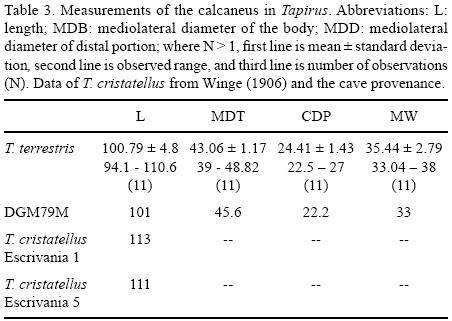
<body><![CDATA[<p align="center"><font face="verdana" size="2"><img src="/img/revistas/rmcg/v29n2/a2t3.jpg"></font></p>  	    <p align="justify"><font face="verdana" size="2"><b>Referred material and provenance.</b> MN2099&#150;V, incomplete left humerus; MN2098&#150;V, right tibia; DGM79M, left calcaneum, Ira&iacute; Municipality.</font></p>  	    <p align="justify"><font face="verdana" size="2"><b>Description.</b> The distal end of a left humerus MN2099&#150;V has the condyles slightly worn (<a href="/img/revistas/rmcg/v29n2/a2f2.jpg" target="_blank">Figure 2a</a> &#150; b, <a href="#t1">Table 1</a>); the distal articular face is semi&#150;cylindrical and oblique, higher medially than laterally. The humeral trochlea is slightly rectangular, has a pronounced constriction on its centre, and is wider and higher than the capitulum, which is narrow and low. Both the coronoid and olecranon fossae are covered by sediment, but it is possible observe that the olecranon fossa is narrower and higher than the coronoid fossa. The ectepicondyle is low and prominent, and is lateral directed. The lateral supracondyloid crest extends to the caudodistal margin of the ectepicondyle. The entepicondyle is robust and high.</font></p>  	    <p align="justify"><font face="verdana" size="2">The tibia MN2098&#150;V is more complete but the extremities are slightly abraded (<a href="/img/revistas/rmcg/v29n2/a2f2.jpg" target="_blank">Figure 2g&#150;j</a>; <a href="/img/revistas/rmcg/v29n2/a2t2.jpg" target="_blank">Table 2</a>). Its proximal half is slightly triangular and nearly cylindrical. The proximal end is relatively broad. The medial condyle is oval and flat, and is thicker and narrower than the lateral one, which is nearly circular and craniocaudally convex. The condyles are separated posteriorly by a poorly visible popliteal notch, and axially by the intercondylar eminence. The intercondylar eminence is formed by a high and laminated medial tubercle, and by a low and robust lateral tubercle, which are separated by an irregular central depression. The tibial tuberosity is large and rounded. Extending distally from the tibial tuberosity is the tibial crest, which has a noticeable medial inclination. The lateral surface of the tibia is smooth and slightly sprained in spiral. The medial surface is broad and flat on the proximal half, and narrow and convex on the distal half. The caudal surface is narrow and is divided in two parts by an oblique popliteal line. The proximal region of the popliteal line has a rugous concave area. The distal region of the popliteal line has a smooth and convex area. The distal end is slightly rectangular and much smaller than the proximal end. In the astragalar notch, facets for the proximal trochlea of the astragalus are deep and asymmetric. These facets are separated sagittally by a low and convex ridge. This ridge extends between two processes located at the cranial and caudal margins of the cochlea. The medial malleolus is very prominent and forms the craniomedial wall of the astragalar notch, which is slightly inclined in the direction of the facet.</font></p>  	    <p align="justify"><font face="verdana" size="2">The calcaneum DGM79M is long and thin, and its ends are lightly abraded (<a href="/img/revistas/rmcg/v29n2/a2f2.jpg" target="_blank">Figure 2c&#150;f</a>, <a href="#t3">Table 3</a>). The distal half is transversely wide, and the axial portion is thickened on the facet for the cuboid. The tuberosity is quite prominent, mediolaterally compressed and dorsoplantarly thick. On the more axial face, the tuberosity is rugose and convex. On the distal half, the dorsal surface has three facets for the astragalus. The sustentacular process is a medial projection and has an oval concave facet for the astragalus. Dorsoproximally, the coracoid process holds a concave proximal facet, and its proximomedial border is convex. The distalmost and smallest articular surface for the astragalus is narrow and nearly flat. The distal end of the calcaneum is narrower lateromedially than the rest of the body and bears the cuboid facet. The groove between the articular facets is deep and rugose. In the plantar surface there is a slightly visible groove. On lateral surface, distal to the coracoid process, there is a rough and slightly rounded projection for the insertion of the external ligament.</font></p>  	    <p align="justify"><font face="verdana" size="2"><b>Remarks.</b> The distal end of the left humerus (MN2099&#150;V) was erroneously considered by Souza Cunha (1959) to be a femur. The postcranial materials from Ira&iacute; are similar in size and morphology to those of <i>T. terrestris.</i> The only fossil tapir with preserved postcranium known from the Pleistocene of South America is <i>T. cristatellus.</i> Almost all measurements of <i>T. cristatellus</i> are much larger than for <i>T. terrestris</i> (<a href="#t1">Tables 1</a>&#150;<a href="#t3">3</a>).</font></p>  	    <p align="justify"><font face="verdana" size="2">Comparing the humerus (MN2099&#150;V), tibia (MN 2098 PV) and calcaneum (DGM79M) measurements, this material is similar in size with <i>T. terrestris</i> in all measurements (<a href="#t1">Tables 1</a>&#150;<a href="#t3">3</a>). The specimens are very gracile, as in <i>T. terrestris.</i> The tibia and calcaneum measurements are smaller than for <i>T. cristatellus</i> (<a href="/img/revistas/rmcg/v29n2/a2t2.jpg" target="_blank">Tables 2</a>&#150;<a href="#t3">3</a>). Although <i>T. pinchaque</i> and <i>T. bairdii</i> have considerable overlap in their dental measurements with <i>T. terrestris</i> (Simpson, 1945), the postcranium of <i>T. pinchaque</i> (Roulin, 1829) has been described as smaller than in <i>T.terrestris. T. bairdii</i> (Gill, 1865) and <i>T. indicus</i> Desmarest, 1819 are larger than <i>T. terrestris</i> (Simpson, 1945 &#150; including measures from <i>T. bairdii;</i> Eisenmann and Gu&eacute;rin, 1992).</font></p>  	    <p align="center"><font face="verdana" size="2"><b><i>Tapirus</i> cf. <i>T. terrestris</i></b></font></p>  	    <p align="center"><font face="verdana" size="2">(<a href="#f3">Figures 3</a>&#150;(<a href="/img/revistas/rmcg/v29n2/a2f4.jpg" target="_blank">4</a>)&#150;<a href="/img/revistas/rmcg/v29n2/a2f5.jpg" target="_blank">5</a>, <a href="/img/revistas/rmcg/v29n2/a2t4.jpg" target="_blank">Tables 4</a>&#150;<a href="/img/revistas/rmcg/v29n2/a2t5.jpg" target="_blank">5</a>)</font></p>  	    <p align="center"><font face="verdana" size="2"><a name="f3"></a></font></p>  	    ]]></body>
<body><![CDATA[<p align="center"><font face="verdana" size="2"><img src="/img/revistas/rmcg/v29n2/a2f3.jpg"></font></p>  	    <p align="justify"><font face="verdana" size="2"><b>Referred material and provenance.</b> MCP&#150;4290&#150;PV, fragment of left maxilla, S&atilde;o Luiz cattle ranch; MCN&#150;PV&#150;3515, MCN&#150;PV&#150;6968, MCN&#150;PV&#150;8085&#150;8087, dental crowns, MCN&#150;PV&#150;8843, symphyseal portion of mandible, MCN&#150;PV&#150;10069, proximal portion of left metatarsal III, Hermenegildo Beach; MCN&#150;PV&#150;9700, right scapula, Cerro da Tapera; MCN&#150;PV&#150;7071, left metacarpal II, Sanga da Cruz Creek.</font></p>  	    <p align="justify"><font face="verdana" size="2"><b>Description.</b> The incomplete left maxilla (MCP&#150;4290&#150;PV) bearing M2 and M3, is from an adult. Both molars show considerable occlusal wear (<a href="#f3">Figure 3 a</a>). Only parts of the alveolar and jugal processes of the maxilla are preserved. The fragment is broken anterior to M2, and extends posterior to M3. The posterior portion of the jugal process is a lateroposteriorly directed blade, forming a concavity in the posteroventral border of the maxilla.</font></p>  	    <p align="justify"><font face="verdana" size="2">The M2 and M3 (MCP&#150;4290&#150;PV) have a trapezoidal form, with the protoloph wider than the metaloph. The protocone of M2 is fractured and exhibits much wear on the lophs (<a href="#f3">Figure 3</a>). The protoloph and metaloph are separated lingually by a transverse groove, but buccally the paracone and metacone are united due to wear, forming a pronounced longitudinal crest (ectoloph). The mesial cingulum is worn completely and the distal cingulum is still sharp. The M2 parastyle is well developed. The M3 protocone is also fractured and shows less wear than the M2. The M3 meta&#150;loph and protoloph have wear on the mesial face. The M3 parastyle is smaller than in the M2. The M3 has a greater subcingulum, and is separated from the paracone by a conspicuous buccal groove. The mesial cingulum shows wear and the distal cingulum is much more defined. Both the M2 and M3 have a lingual cingulum on the metalophs.</font></p>  	    <p align="justify"><font face="verdana" size="2">The mandible fragment (MCN&#150;PV&#150;8843) preserves alveoli for the canines and right p2 (<a href="/img/revistas/rmcg/v29n2/a2f4.jpg" target="_blank">Figure 4a</a>). The diastema is 35 mm long, and the portion bearing alveoli for incisors is lacking. The symphysis is solidly fused, concave and very robust (46.5 mm in width), extending posteriorly to a point anterior to p2. The labial wall of the mental foramen is located posteroventral to the p2 alveolus.</font></p>  	    <p align="justify"><font face="verdana" size="2">Specimen MCN&#150;PV&#150;3515 is a left protoloph, probably a DP4, showing little wear or abrasion (<a href="/img/revistas/rmcg/v29n2/a2f4.jpg" target="_blank">Figure 4b&#150;c</a>). The protocone is higher than the paracone; the parastyle is small and separated from the paracone by a transverse groove. The mesial cingulum is very visible. Specimen MCN&#150;PV&#150;6968 is a right protoloph, probably a DP3/P4 (<a href="/img/revistas/rmcg/v29n2/a2f4.jpg" target="_blank">Figure 4d&#150;e</a>). It displays only the protocone and part of the cross crest with little wear. The mesial cingulum is hardly visible. Specimen MCN&#150;PV&#150;8087 is a crown fragment of an upper molar, showing wear in the protoloph and metaloph, and much abrasion (<a href="/img/revistas/rmcg/v29n2/a2f4.jpg" target="_blank">Figure 4f</a>). The cingulum and parastyle are absent. MCN&#150;PV&#150;8085 is a fragment of a left protolophid, probably from a dp3 (<a href="/img/revistas/rmcg/v29n2/a2f4.jpg" target="_blank">Figure 4g&#150;h</a>). The mesial cingulum is very well marked. The protoconid and metaconid are higher than the cross crest that unites them, forming a slightly V&#150;shaped protolophid. MCN&#150;PV&#150;8086 is also a crown fragment, but a hypolophid, probably of a right m2, showing little wear and abrasion (<a href="/img/revistas/rmcg/v29n2/a2f4.jpg" target="_blank">Figure 4i&#150;j</a>). Its distal cingulum and subcingulum are conspicuous. The entoconid is higher than the hypoconid, and the cross crest is lower, forming a V&#150;shaped hipolophid.</font></p>  	    <p align="justify"><font face="verdana" size="2">The scapula (MCN&#150;PV&#150;9700) is well preserved and has the robust form with deep musculature fossae indicative of a full adult (<a href="/img/revistas/rmcg/v29n2/a2f5.jpg" target="_blank">Figure 5a&#150;b</a>). The specimen is elongate and narrow. The lateral surface is divided into two slightly asymmetric fossae by a prominent scapular spine. The free crest of the spine is thickened, directed caudally, and bears no acromion. There is a prominent and robust tuber in the middle of the free crest of the spine. The supraspinous fossa is wider than the infraspinous fossa, and slightly triangular. On the surface of the supraspinous fossa there is a muscular line, very thickened, that divides it into two slightly deep fossae. The medial surface is irregular, and presents the slightly rugose <i>facies serrata.</i> The subscapular fossa is much deeper and larger.</font></p>  	    <p align="justify"><font face="verdana" size="2">The cranial border is thickener and more rounded than the caudal border, and slightly oblique in relation to the spine. Distal to the cranial border, it forms a deep and high scapular notch. The dorsal border is much thickened in the most axial portion, which is most prominent and inclined medially. The ventral border is the most robust part of the scapula. The glenoid cavity is shallow; its lateral border forms a larger arc than the medial border, and it extends cranially around the contour of the lateral supraglenoid tuberosity. The supraglenoid tuberosity projects ventrally, with a medial inclination. Dorsal to supraglenoid tuberosity is the robust and rugose coracoid process.</font></p>  	    <p align="justify"><font face="verdana" size="2">The scapula measurements (in millimeters) are: maximum length: 299; craniocaudal diameter: 142; maximum width of supraspinous fossa: 65.6; craniocaudal diameter of neck: 47.2; craniocaudal diameter of articular surface: 78; craniocaudal diameter of glenoid cavity: 43; lateromedial diameter of glenoid cavity: 46.5.</font></p>  	    <p align="justify"><font face="verdana" size="2">The metacarpal II (MCN&#150;PV&#150;7071) has a proximal end slightly narrower than the distal (<a href="/img/revistas/rmcg/v29n2/a2f5.jpg" target="_blank">Figure 5d</a>). There are two proximal facets separated by a high ridge; the medial facet for the trapezoid, thicker than broad, slightly rectangular, concave dorsally and convex palmarly, and the lateral facet for the magnum, narrower, flat lateromedially, and slightly convex dorsopalmarly (<a href="/img/revistas/rmcg/v29n2/a2f5.jpg" target="_blank">Figure 5f</a>). Medially and palmarly to the trapezoid facet is a small facet, slightly convex to the trapezium. Lateral to facet for the magnum is a low but thick, slightly flat facet for metacarpal III. The body has two faces: one dorsal, slightly flat and turned dorsomedially; and one palmar, more convex and very rough. The distal condyle is robust, dorsally convex, and palmarly divided by a high crest in two convexities. Lateral to each condyle is a small semicircular notch.</font></p>  	    ]]></body>
<body><![CDATA[<p align="justify"><font face="verdana" size="2">The metatarsal III (MCN&#150;PV&#150;10069) has one larger facet for the ectocuneiform in the proximal end. The ecto&#150;cuneiform facet is slightly triangular and concave, with the lateral margin higher than medial margin (<a href="/img/revistas/rmcg/v29n2/a2f5.jpg" target="_blank">Figure 5i</a>). Lateral to the ectocuneiform facet are two facets for metatarsal IV; the dorsal facet is slightly triangular and the plantar one is oval, these separated by a deep groove. The plantar facet is on a prominent process, although partly broken, and is directed lateroplantarly. Medial to the ectocuneiform facet there are two smaller facets for metatarsal II, separated by a shallow groove. The dorsal facet is larger than plantar facet, and slightly oval.</font></p>  	    <p align="justify"><font face="verdana" size="2"><b>Remarks.</b> The specimen from Dom Pedrito (S&atilde;o Luiz cattle ranch) was compared to material from other species of <i>Tapirus</i> wherever possible. The dental characters in MCP&#150;4290&#150;PV are very similar to those found in <i>T. terrestris.</i> Considering its size, the M2 is smaller than that in <i>T. indicus</i> or in <i>T. cristatellus,</i> but is similar in size to that in <i>T. terrestris</i> and <i>T. mesopotamicus</i> (<a href="/img/revistas/rmcg/v29n2/a2t4.jpg" target="_blank">Table 4</a>). Regarding the M3, all compared species overlap, although <i>T. indicus</i> and <i>T. cristatellus</i> specimens are larger than those of <i>T. terrestris.</i></font></p>  	    <p align="justify"><font face="verdana" size="2">The Hermenegildo Beach materials are very fragmentary, abraded, and show signs of reworking, but they do not differ from <i>T. terrestris.</i> The postcranial specimens (MCN&#150;PV&#150;7071, MCN&#150;PV&#150;9700, and MCN&#150;PV&#150;10069) are robust, but are within of large end of the size range in <i>T. terrestris,</i> except for craniocaudal diameter of the proximal portion of metacarpal II (MCN&#150;PV&#150;7071) and the mediolateral diameter of proximal portion of metatarsal III (MCN&#150;PV&#150;10069; <a href="/img/revistas/rmcg/v29n2/a2t5.jpg" target="_blank">Table 5</a>). All other measures of metacarpal II and metatarsal III are as in <i>T. terrestris,</i> MCN&#150;PV&#150;7071 and &#150;10069 are both smaller than in <i>T. cristatellus</i> (<a href="/img/revistas/rmcg/v29n2/a2t5.jpg" target="_blank">Table 5</a>).</font></p>  	    <p align="justify"><font face="verdana" size="2">These specimens are here tentatively assigned to <i>Tapirus</i> cf. <i>T. terrestris</i> despite having a somewhat larger size, considering that there is otherwise no difference with <i>T. terrestris, T. mesopotamicus</i> shows an overlap in some dental measurements with <i>T. terrestris,</i> although the length total of the skull is 390 mm (Ferrero and Noriega, 2007), whereas <i>T. terrestris</i> has a mean length of 351.7 mm (Simpson, 1945). There is no difference in the dental morphology or size between <i>T. terrestris</i> and <i>T. mesopotamicus.</i></font></p>  	    <p align="justify"><font face="verdana" size="2">&nbsp;</font></p>  	    <p align="justify"><font face="verdana" size="2"><b>DISCUSSION AND CONCLUSIONS</b></font></p>  	    <p align="justify"><font face="verdana" size="2">The material described herein confirms the presence of <i>Tapirus terrestris</i> in the late Pleistocene of Rio Grande do Sul state. Currently, <i>T. terrestris</i> occurs in Rio Grande do Sul state, in some remnants of the Atlantic Forest in the Upper Uruguay River, specifically at Parque Estadual do Turvo (Kasper <i>et al.,</i> 2007), in the northwestern part of the state. Historical records are known from the Taquari&#150;Antas River (Ferri, 1991), but with no localities specified. In addition, Ihering (1892) and Rambo (2000) report the occurrence of this species on the slopes of Serra Geral, Araucaria Plateau. Recently, Rosa and Jacobus (2009) recorded <i>T. terrestris</i> from archaeological sites dated between &plusmn; 2,000 and 8,790 years B.P. at Maquin&eacute;, Santo Ant&ocirc;nio da Patrullha, Torres, Porto Alegre, and Candel&aacute;ria Municipalities, in the central and east regions of the state. However, popular names of villages and cartographic toponyms, such as "Po&ccedil;o das Antas" and "Anta Gorda", indicate the occurrence of this species in the central region of Rio Grande do Sul before colonization. Ihering (1892) proposed that 32&deg;S latitude (<a href="/img/revistas/rmcg/v29n2/a2f1.jpg" target="_blank">Figure 1</a>), which he called the "line of Paca", was the southern distribution limit of some species, including <i>T. terrestris,</i> which was the same as the limit of virgin forest at that time.</font></p>  	    <p align="justify"><font face="verdana" size="2">In either case, regarding the southern area of Rio Grande do Sul state, there are hitherto neither historical nor recent records of this species. However, the fossil record indicates that during the late Pleistocene in Rio Grande do Sul, as well as in Argentina and Uruguay (Tonni, 1992; Ubilla, 1996), this species had a more southern distribution, perhaps reflecting of a better climate and more southerly distribution of forest that ceased at the end of Pleistocene time and lead to its local extinction.</font></p>  	    <p align="justify"><font face="verdana" size="2">&nbsp;</font></p>  	    <p align="justify"><font face="verdana" size="2"><b>ACKNOWLEDGEMENTS</b></font></p>  	    ]]></body>
<body><![CDATA[<p align="justify"><font face="verdana" size="2">The authors are greatly indebted to R. Cassab (DNPM), M.C. Malabarba (PUCRS) and D. D. Rego (MNRJ) for access to the specimens studied; to C.C. Cardoso (MHN/UFMG), C. Cartelle (PUCMinas), D. Flores (MACN), M. Martins (MCN), M. Merino (MLP), J.A. de Oliveira (MNRJ), and M. de Vivo (MZUSP), for access to comparative material under their care; to L. Rota who collected many of the studied fossils; to J.C. Cisneros for language revision; to L. F. Lopes (UFRGS) for photography of <a href="/img/revistas/rmcg/v29n2/a2f4.jpg" target="_blank">Figure 4</a>; and to Conselho Nacional de Desenvolvimento Cient&iacute;fico e Tecnol&oacute;gico (CNPq) for financial support (CNPq/Universal 474485/2008&#150;0, CNPq/Prosul 490299/2008&#150;3 and E.C. Holanda's fellowship).</font></p>  	    <p align="justify"><font face="verdana" size="2">&nbsp;</font></p>  	    <p align="justify"><font face="verdana" size="2"><b>APPENDIX</b></font></p>  	    <p align="justify"><font face="verdana" size="2">Material used for anatomical comparisons: <i>T. terrestris:</i> MLP 01, 754, 755, 1349, 1402, 1681, 4IV0013; MACN 7.6, 31211, 33276, 50559; MCN 1315, 2532, 2750, 2848; MN18, 600, 1605, 53701, 57062, 57067, 64437, 64572, 64652, 70698, 71599; MZUSP 106, 3232, 3266, 3268, 3269, 3727, 3728, 3758, 5701, 6139, 6140, 6575, 7005, 7006, 7007, 7700, 9604, 9712, 9714, 22421, 22422, 29085, 20035, 20037, 10715, 20034, 31983; UNIR 17, 20, 68, 83. <i>T. indicus:</i> MACN 129, 2553, 4347, 29926, 30351.</font></p>  	    <p align="justify"><font face="verdana" size="2">&nbsp;</font></p>  	    <p align="justify"><font face="verdana" size="2"><b>REFERENCES</b></font></p>  	    <!-- ref --><p align="justify"><font face="verdana" size="2">Ameghino, C.F., 1902, Notas sobre algunos mam&iacute;feros f&oacute;siles nuevos o poco conocidos del Valle de Tarija: Anales del Museo de Historia Natural de Buenos Aires, 3, 225&#150;261.    &nbsp;&nbsp;&nbsp;&nbsp;&nbsp;&nbsp;&nbsp;&nbsp;[&#160;<a href="javascript:void(0);" onclick="javascript: window.open('/scielo.php?script=sci_nlinks&ref=8075713&pid=S1026-8774201200020000200001&lng=','','width=640,height=500,resizable=yes,scrollbars=1,menubar=yes,');">Links</a>&#160;]<!-- end-ref --></font></p>  	    <!-- ref --><p align="justify"><font face="verdana" size="2">Bombin, M., 1976, Modelo paleoecol&oacute;gico evolutivo para o Neoquatern&aacute;rio da Regi&atilde;o da Campanha&#150;Oeste do Rio Grande do Sul (Brasil). A Forma&ccedil;&atilde;o Touro Passo, seu conte&uacute;do fossil&iacute;fero e a pedog&ecirc;nese p&oacute;s&#150;deposicional: Comunica&ccedil;&otilde;es do Museu de Ci&ecirc;ncias da PUCRGS, 15,1&#150;70.    &nbsp;&nbsp;&nbsp;&nbsp;&nbsp;&nbsp;&nbsp;&nbsp;[&#160;<a href="javascript:void(0);" onclick="javascript: window.open('/scielo.php?script=sci_nlinks&ref=8075715&pid=S1026-8774201200020000200002&lng=','','width=640,height=500,resizable=yes,scrollbars=1,menubar=yes,');">Links</a>&#160;]<!-- end-ref --></font></p>  	    ]]></body>
<body><![CDATA[<!-- ref --><p align="justify"><font face="verdana" size="2">Brisson, M.J., 1762, Regnum animale in classes IX. distributum, sive synopsis methodica sistens generalem animalium distributionem in classes IX, &amp; duarum primarum classium, quadrupedum scilicet &amp; cetaceorum, particularem divisionem in ordines, sectiones, genera &amp; species. Cum brevi cujusque speciei descriptione, citationibus auctorum de iis tractantium, nominibus eis ab ipsis &amp; nationibus impositis, nominibusque vulgaribus: Editio altera auctior. Lugduni Batavorum, 296 pp.    &nbsp;&nbsp;&nbsp;&nbsp;&nbsp;&nbsp;&nbsp;&nbsp;[&#160;<a href="javascript:void(0);" onclick="javascript: window.open('/scielo.php?script=sci_nlinks&ref=8075717&pid=S1026-8774201200020000200003&lng=','','width=640,height=500,resizable=yes,scrollbars=1,menubar=yes,');">Links</a>&#160;]<!-- end-ref --></font></p>  	    <!-- ref --><p align="justify"><font face="verdana" size="2">Brooks, D.M., Bodmer, R.E., Matola, S., 1997, Tapirs &#150; Status Survey and Conservation Action Plan: Gland, Switzerland and Cambridge, UK, IUCN/SSC Tapir Specialist Group, 164 pp.    &nbsp;&nbsp;&nbsp;&nbsp;&nbsp;&nbsp;&nbsp;&nbsp;[&#160;<a href="javascript:void(0);" onclick="javascript: window.open('/scielo.php?script=sci_nlinks&ref=8075719&pid=S1026-8774201200020000200004&lng=','','width=640,height=500,resizable=yes,scrollbars=1,menubar=yes,');">Links</a>&#160;]<!-- end-ref --></font></p>  	    <!-- ref --><p align="justify"><font face="verdana" size="2">Buchmann, F.S.C., 2002, Bioclastos de organismos terrestres e marinhos na praia e plataforma interna do Rio Grande do Sul: natureza, distribui&ccedil;&atilde;o, origem e significado geol&oacute;gico: Porto Alegre, Brazil, Universidade Federal do Rio Grande do Sul, Doctoral thesis, 108 pp.    &nbsp;&nbsp;&nbsp;&nbsp;&nbsp;&nbsp;&nbsp;&nbsp;[&#160;<a href="javascript:void(0);" onclick="javascript: window.open('/scielo.php?script=sci_nlinks&ref=8075721&pid=S1026-8774201200020000200005&lng=','','width=640,height=500,resizable=yes,scrollbars=1,menubar=yes,');">Links</a>&#160;]<!-- end-ref --></font></p>  	    <!-- ref --><p align="justify"><font face="verdana" size="2">Burnett, G.T., 1830, Illustrations of the Quadrupeda, or quadrupeds, being the arrangement of the true four&#150;footed beasts, indicated in outline: Quarterly Journal of Scientific Literary Arts, 26, 336&#150;353.    &nbsp;&nbsp;&nbsp;&nbsp;&nbsp;&nbsp;&nbsp;&nbsp;[&#160;<a href="javascript:void(0);" onclick="javascript: window.open('/scielo.php?script=sci_nlinks&ref=8075723&pid=S1026-8774201200020000200006&lng=','','width=640,height=500,resizable=yes,scrollbars=1,menubar=yes,');">Links</a>&#160;]<!-- end-ref --></font></p>  	    <!-- ref --><p align="justify"><font face="verdana" size="2">Butler, P.M., 1952, The milk&#150;molars of Perissodactyla, with remarks on molar occlusion: Proceedings of the Zoological Society of London, 121, 777&#150;817.    &nbsp;&nbsp;&nbsp;&nbsp;&nbsp;&nbsp;&nbsp;&nbsp;[&#160;<a href="javascript:void(0);" onclick="javascript: window.open('/scielo.php?script=sci_nlinks&ref=8075725&pid=S1026-8774201200020000200007&lng=','','width=640,height=500,resizable=yes,scrollbars=1,menubar=yes,');">Links</a>&#160;]<!-- end-ref --></font></p>  	    ]]></body>
<body><![CDATA[<!-- ref --><p align="justify"><font face="verdana" size="2">Cartelle, C.,1999, Pleistocene Mammals of the Cerrado and Caatinga of Brazil, <i>in</i> Eisenberg, J. F, Redford, K. H. (eds.) Mammals of the Neotropicals: The Central Neotropicals, Vol. 3: University of Chicago Press, Chicago, 27&#150;46.    &nbsp;&nbsp;&nbsp;&nbsp;&nbsp;&nbsp;&nbsp;&nbsp;[&#160;<a href="javascript:void(0);" onclick="javascript: window.open('/scielo.php?script=sci_nlinks&ref=8075727&pid=S1026-8774201200020000200008&lng=','','width=640,height=500,resizable=yes,scrollbars=1,menubar=yes,');">Links</a>&#160;]<!-- end-ref --></font></p>  	    <!-- ref --><p align="justify"><font face="verdana" size="2">Cattoi, N., 1951, El status de <i>Tapirus dupuyi</i> (C. Amegh.): Comunicaciones del Instituto Nacional de Investigacion de las Ciencias Naturales e Museo Argentino de Ciencias Naturales "Bernardino Rivadavia", 2 (8), 103&#150;112.    &nbsp;&nbsp;&nbsp;&nbsp;&nbsp;&nbsp;&nbsp;&nbsp;[&#160;<a href="javascript:void(0);" onclick="javascript: window.open('/scielo.php?script=sci_nlinks&ref=8075729&pid=S1026-8774201200020000200009&lng=','','width=640,height=500,resizable=yes,scrollbars=1,menubar=yes,');">Links</a>&#160;]<!-- end-ref --></font></p>  	    <!-- ref --><p align="justify"><font face="verdana" size="2">Cattoi, N., 1957, Uma especie extinguida de <i>Tapirus</i> Brisson (<i>T. rioplatensis</i> nov. sp.), Ameghiniana, 1 (3), 15 &#150; 21.    &nbsp;&nbsp;&nbsp;&nbsp;&nbsp;&nbsp;&nbsp;&nbsp;[&#160;<a href="javascript:void(0);" onclick="javascript: window.open('/scielo.php?script=sci_nlinks&ref=8075731&pid=S1026-8774201200020000200010&lng=','','width=640,height=500,resizable=yes,scrollbars=1,menubar=yes,');">Links</a>&#160;]<!-- end-ref --></font></p>  	    <!-- ref --><p align="justify"><font face="verdana" size="2">Colbert, M.W., 2005, The facial skeleton of the early Oligocene <i>Colodon</i> (Perissodactyla, Tapiroidea): Palaeontologia Eletronica, 8 (1), 12A&#150;27, 600kb.    &nbsp;&nbsp;&nbsp;&nbsp;&nbsp;&nbsp;&nbsp;&nbsp;[&#160;<a href="javascript:void(0);" onclick="javascript: window.open('/scielo.php?script=sci_nlinks&ref=8075733&pid=S1026-8774201200020000200011&lng=','','width=640,height=500,resizable=yes,scrollbars=1,menubar=yes,');">Links</a>&#160;]<!-- end-ref --></font></p>  	    <!-- ref --><p align="justify"><font face="verdana" size="2">Da Rosa, A. A. S., 2003, Preliminary correlation of fluvial deposits at the extreme west of Rio Grande do Sul State, Southern Brazil, <i>in</i> 3th Latinamerican Congress of Sedimentology, Bel&eacute;m: Abstracts, p. 243&#150;245.    &nbsp;&nbsp;&nbsp;&nbsp;&nbsp;&nbsp;&nbsp;&nbsp;[&#160;<a href="javascript:void(0);" onclick="javascript: window.open('/scielo.php?script=sci_nlinks&ref=8075735&pid=S1026-8774201200020000200012&lng=','','width=640,height=500,resizable=yes,scrollbars=1,menubar=yes,');">Links</a>&#160;]<!-- end-ref --></font></p>  	    ]]></body>
<body><![CDATA[<!-- ref --><p align="justify"><font face="verdana" size="2">Desmarest, A.G., 1819, Nouveau dictionnaire d'histoire naturelle. Volume 32: Chez Deterville, Paris.    &nbsp;&nbsp;&nbsp;&nbsp;&nbsp;&nbsp;&nbsp;&nbsp;[&#160;<a href="javascript:void(0);" onclick="javascript: window.open('/scielo.php?script=sci_nlinks&ref=8075737&pid=S1026-8774201200020000200013&lng=','','width=640,height=500,resizable=yes,scrollbars=1,menubar=yes,');">Links</a>&#160;]<!-- end-ref --></font></p>  	    <!-- ref --><p align="justify"><font face="verdana" size="2">DeSantis, L.R.G., MacFadden, B., 2007, Identifying forested environments in Deep Time using fossil tapirs: evidence from evolutionary morphology and stable isotopes: Courier Forschunsinstitut Senckenberg, 258, 147&#150;157.    &nbsp;&nbsp;&nbsp;&nbsp;&nbsp;&nbsp;&nbsp;&nbsp;[&#160;<a href="javascript:void(0);" onclick="javascript: window.open('/scielo.php?script=sci_nlinks&ref=8075739&pid=S1026-8774201200020000200014&lng=','','width=640,height=500,resizable=yes,scrollbars=1,menubar=yes,');">Links</a>&#160;]<!-- end-ref --></font></p>  	    <!-- ref --><p align="justify"><font face="verdana" size="2">Eisenmann, V., Gu&eacute;rin, C., 1992, <i>Tapirus priscus</i> Kaup from the Upper Miocene of Western Europe: palaeontology, biostratigraphy, and palaeoecology: Paleontologia I Evoluci&oacute;, 24&#150;25, 113&#150;122.    &nbsp;&nbsp;&nbsp;&nbsp;&nbsp;&nbsp;&nbsp;&nbsp;[&#160;<a href="javascript:void(0);" onclick="javascript: window.open('/scielo.php?script=sci_nlinks&ref=8075741&pid=S1026-8774201200020000200015&lng=','','width=640,height=500,resizable=yes,scrollbars=1,menubar=yes,');">Links</a>&#160;]<!-- end-ref --></font></p>  	    <!-- ref --><p align="justify"><font face="verdana" size="2">Ferrero, B.S., Noriega, J. I., 2007, A new upper Pleistocene tapir from Argentina: remarks on the phylogenetics and diversification of neotropical Tapiridae: Journal of Vertebrate Paleontology, 27, 504&#150;511.    &nbsp;&nbsp;&nbsp;&nbsp;&nbsp;&nbsp;&nbsp;&nbsp;[&#160;<a href="javascript:void(0);" onclick="javascript: window.open('/scielo.php?script=sci_nlinks&ref=8075743&pid=S1026-8774201200020000200016&lng=','','width=640,height=500,resizable=yes,scrollbars=1,menubar=yes,');">Links</a>&#160;]<!-- end-ref --></font></p>  	    <!-- ref --><p align="justify"><font face="verdana" size="2">Ferrero, B.S., Brandoni, J. I., Noriega, J. I., Carlini, A. A., 2007, Mam&iacute;feros de la Formaci&oacute;n El Palmar (Pleistoceno tard&iacute;o) de la Provincia de Entre R&iacute;os: Revista del Museo Argentino de Ciencias Naturales "Bernardino Rivadavia", 9, 109&#150;117.    &nbsp;&nbsp;&nbsp;&nbsp;&nbsp;&nbsp;&nbsp;&nbsp;[&#160;<a href="javascript:void(0);" onclick="javascript: window.open('/scielo.php?script=sci_nlinks&ref=8075745&pid=S1026-8774201200020000200017&lng=','','width=640,height=500,resizable=yes,scrollbars=1,menubar=yes,');">Links</a>&#160;]<!-- end-ref --></font></p>  	    ]]></body>
<body><![CDATA[<!-- ref --><p align="justify"><font face="verdana" size="2">Ferri, G.,1991, Hist&oacute;ria do Rio Taquari &#150; Antas: Encantado, Grafen Gr&aacute;fica e Editora, 319 pp.    &nbsp;&nbsp;&nbsp;&nbsp;&nbsp;&nbsp;&nbsp;&nbsp;[&#160;<a href="javascript:void(0);" onclick="javascript: window.open('/scielo.php?script=sci_nlinks&ref=8075747&pid=S1026-8774201200020000200018&lng=','','width=640,height=500,resizable=yes,scrollbars=1,menubar=yes,');">Links</a>&#160;]<!-- end-ref --></font></p>  	    <!-- ref --><p align="justify"><font face="verdana" size="2">Fragoso, J.M., Huffman, J.M., 2000, Seed&#150;dispersal and seedling recruitment patterns by the last Neotropical megafaunal element in Amazonia, the tapir: Journal of Tropical Ecology, 16, 369&#150;385.    &nbsp;&nbsp;&nbsp;&nbsp;&nbsp;&nbsp;&nbsp;&nbsp;[&#160;<a href="javascript:void(0);" onclick="javascript: window.open('/scielo.php?script=sci_nlinks&ref=8075749&pid=S1026-8774201200020000200019&lng=','','width=640,height=500,resizable=yes,scrollbars=1,menubar=yes,');">Links</a>&#160;]<!-- end-ref --></font></p>  	    <!-- ref --><p align="justify"><font face="verdana" size="2">Gadens Marcon, G.T., 2008, Contribui&ccedil;&atilde;o ao estudo dos Proboscidea (Mammalia, Gomphotheriidae) do Quatern&aacute;rio do Estado do Rio Grande do Sul, Brasil: Revista Universidade Guarulhos &#150;Geoci&ecirc;ncias, 7, 1, 93&#150;109.    &nbsp;&nbsp;&nbsp;&nbsp;&nbsp;&nbsp;&nbsp;&nbsp;[&#160;<a href="javascript:void(0);" onclick="javascript: window.open('/scielo.php?script=sci_nlinks&ref=8075751&pid=S1026-8774201200020000200020&lng=','','width=640,height=500,resizable=yes,scrollbars=1,menubar=yes,');">Links</a>&#160;]<!-- end-ref --></font></p>  	    <!-- ref --><p align="justify"><font face="verdana" size="2">Gill, T.N., 1865, No title: Proceedings of the Academy of Natural Science Philadelphia, 17, 183.    &nbsp;&nbsp;&nbsp;&nbsp;&nbsp;&nbsp;&nbsp;&nbsp;[&#160;<a href="javascript:void(0);" onclick="javascript: window.open('/scielo.php?script=sci_nlinks&ref=8075753&pid=S1026-8774201200020000200021&lng=','','width=640,height=500,resizable=yes,scrollbars=1,menubar=yes,');">Links</a>&#160;]<!-- end-ref --></font></p>  	    <!-- ref --><p align="justify"><font face="verdana" size="2">Hammer, O., Harper, D.A.T., Ryan, P.D., 2001, PAST &#150; Paleontological Statistics Software Package for Education and Data Analysis: Palaeontologia Electronica, 4, 1, 9pp.    &nbsp;&nbsp;&nbsp;&nbsp;&nbsp;&nbsp;&nbsp;&nbsp;[&#160;<a href="javascript:void(0);" onclick="javascript: window.open('/scielo.php?script=sci_nlinks&ref=8075755&pid=S1026-8774201200020000200022&lng=','','width=640,height=500,resizable=yes,scrollbars=1,menubar=yes,');">Links</a>&#160;]<!-- end-ref --></font></p>  	    ]]></body>
<body><![CDATA[<!-- ref --><p align="justify"><font face="verdana" size="2">Holanda, E.C., Cozzuol, M.A., 2006, New records of <i>Tapirus</i> from the late Pleistocene of southwestern Amazonia, Brazil: Revista Brasileira de Paleontologia, 9 (2), 193&#150;200.    &nbsp;&nbsp;&nbsp;&nbsp;&nbsp;&nbsp;&nbsp;&nbsp;[&#160;<a href="javascript:void(0);" onclick="javascript: window.open('/scielo.php?script=sci_nlinks&ref=8075757&pid=S1026-8774201200020000200023&lng=','','width=640,height=500,resizable=yes,scrollbars=1,menubar=yes,');">Links</a>&#160;]<!-- end-ref --></font></p>  	    <!-- ref --><p align="justify"><font face="verdana" size="2">Holanda, E.C., Rinc&oacute;n, A.D., 2009, El registro f&oacute;sil de los tapires (Mammalia: Perissodactyla) de Venezuela, <i>in</i> Libro de Res&uacute;menes del XXIV Jornadas Argentinas de Paleontolog&iacute;a de Vertebrados, San Rafael, 38&#150;39.    &nbsp;&nbsp;&nbsp;&nbsp;&nbsp;&nbsp;&nbsp;&nbsp;[&#160;<a href="javascript:void(0);" onclick="javascript: window.open('/scielo.php?script=sci_nlinks&ref=8075759&pid=S1026-8774201200020000200024&lng=','','width=640,height=500,resizable=yes,scrollbars=1,menubar=yes,');">Links</a>&#160;]<!-- end-ref --></font></p>  	    <!-- ref --><p align="justify"><font face="verdana" size="2">Holanda, E.C., Ribeiro, A.M., Ferigolo, J., Cozzuol, M.A., 2005, Novos registros de <i>Tapirus</i> Brunnich, 1771 (Mammalia, Perissodactyla) para o Quatern&aacute;rio do Brasil (resumos), <i>in</i> Boletim de Resumos do II Congresso Latino&#150;Americano de Paleontologia de Vertebrados, Rio de Janeiro, 136&#150;136.    &nbsp;&nbsp;&nbsp;&nbsp;&nbsp;&nbsp;&nbsp;&nbsp;[&#160;<a href="javascript:void(0);" onclick="javascript: window.open('/scielo.php?script=sci_nlinks&ref=8075761&pid=S1026-8774201200020000200025&lng=','','width=640,height=500,resizable=yes,scrollbars=1,menubar=yes,');">Links</a>&#160;]<!-- end-ref --></font></p>  	    <!-- ref --><p align="justify"><font face="verdana" size="2">Holanda, E.C., Ferigolo, J., Cartelle, C., 2007, Novas considera&ccedil;&otilde;es sobre a esp&eacute;cie <i>Tapirus cristatellus</i> Winge (Mammalia, Perissodactyla), Pleistoceno superior, Estado da Bahia, Brasil: Ameghiniana, 44, 23R.    &nbsp;&nbsp;&nbsp;&nbsp;&nbsp;&nbsp;&nbsp;&nbsp;[&#160;<a href="javascript:void(0);" onclick="javascript: window.open('/scielo.php?script=sci_nlinks&ref=8075763&pid=S1026-8774201200020000200026&lng=','','width=640,height=500,resizable=yes,scrollbars=1,menubar=yes,');">Links</a>&#160;]<!-- end-ref --></font></p>  	    <!-- ref --><p align="justify"><font face="verdana" size="2">Holanda, E.C., Ferigolo, J., Ribeiro, A.M., 2011, New <i>Tapirus</i> species (Mammalia: Perissodactyla: Tapiridae) from the upper Pleistocene of Amazonia, Brazil: Journal of Mammalogy, 92, 111&#150;120.    &nbsp;&nbsp;&nbsp;&nbsp;&nbsp;&nbsp;&nbsp;&nbsp;[&#160;<a href="javascript:void(0);" onclick="javascript: window.open('/scielo.php?script=sci_nlinks&ref=8075765&pid=S1026-8774201200020000200027&lng=','','width=640,height=500,resizable=yes,scrollbars=1,menubar=yes,');">Links</a>&#160;]<!-- end-ref --></font></p>  	    ]]></body>
<body><![CDATA[<!-- ref --><p align="justify"><font face="verdana" size="2">Hue, E., 1907, Mus&eacute;e Ost&eacute;ologique &#150; &eacute;tude de la faune quaternaire. Ost&eacute;om&eacute;trie des mammif&eacute;res: Paris, Schleicher Fr&eacute;res, vol. 1, 50 pp.    &nbsp;&nbsp;&nbsp;&nbsp;&nbsp;&nbsp;&nbsp;&nbsp;[&#160;<a href="javascript:void(0);" onclick="javascript: window.open('/scielo.php?script=sci_nlinks&ref=8075767&pid=S1026-8774201200020000200028&lng=','','width=640,height=500,resizable=yes,scrollbars=1,menubar=yes,');">Links</a>&#160;]<!-- end-ref --></font></p>  	    <!-- ref --><p align="justify"><font face="verdana" size="2">Hulbert Jr., R.C., 2005, Late Miocene <i>Tapirus</i> (Mammalia, Perissodactyla) from Florida, with description of a new species, <i>Tapirus webbi:</i> Bulletin of the Florida Museum of Natural History, 45 (4), 465&#150;494.    &nbsp;&nbsp;&nbsp;&nbsp;&nbsp;&nbsp;&nbsp;&nbsp;[&#160;<a href="javascript:void(0);" onclick="javascript: window.open('/scielo.php?script=sci_nlinks&ref=8075769&pid=S1026-8774201200020000200029&lng=','','width=640,height=500,resizable=yes,scrollbars=1,menubar=yes,');">Links</a>&#160;]<!-- end-ref --></font></p>  	    <!-- ref --><p align="justify"><font face="verdana" size="2">Hyrooka, S.S., 2003, As cavernas do Bauxi como detentoras de informa&ccedil;&otilde;es do per&iacute;odo Pleistoceno (reumo), <i>in</i> Boletim de Resumos do VIII Simp&oacute;sio de Geologia do Centro&#150;Oeste, Cuiab&aacute;, 204&#150;205.    &nbsp;&nbsp;&nbsp;&nbsp;&nbsp;&nbsp;&nbsp;&nbsp;[&#160;<a href="javascript:void(0);" onclick="javascript: window.open('/scielo.php?script=sci_nlinks&ref=8075771&pid=S1026-8774201200020000200030&lng=','','width=640,height=500,resizable=yes,scrollbars=1,menubar=yes,');">Links</a>&#160;]<!-- end-ref --></font></p>  	    <!-- ref --><p align="justify"><font face="verdana" size="2">Ihering, H. V., 1892, Os mam&iacute;feros do Rio Grande do Sul, <i>in</i> Azambuja, G. A. (ed.): Annu&aacute;rio do Estado do Rio Grande do Sul para o Ano 1892: Porto Alegre, Gundlach &amp; Krahe, 96 &#150;123.    &nbsp;&nbsp;&nbsp;&nbsp;&nbsp;&nbsp;&nbsp;&nbsp;[&#160;<a href="javascript:void(0);" onclick="javascript: window.open('/scielo.php?script=sci_nlinks&ref=8075773&pid=S1026-8774201200020000200031&lng=','','width=640,height=500,resizable=yes,scrollbars=1,menubar=yes,');">Links</a>&#160;]<!-- end-ref --></font></p>  	    <!-- ref --><p align="justify"><font face="verdana" size="2">Kasper, C.B., Mazim, F.D., Soares, J. B., Oliveira, T. G. de, Fabi&aacute;n, M. E., 2007, Composi&ccedil;&atilde;o e abund&acirc;ncia relativa dos mam&iacute;feros de m&eacute;dio e grande porte no Parque Estadual do Turvo, Rio Grande do Sul, Brasil: Revista Brasileira de Zoologia, 24 (4),1087&#150;1100.    &nbsp;&nbsp;&nbsp;&nbsp;&nbsp;&nbsp;&nbsp;&nbsp;[&#160;<a href="javascript:void(0);" onclick="javascript: window.open('/scielo.php?script=sci_nlinks&ref=8075775&pid=S1026-8774201200020000200032&lng=','','width=640,height=500,resizable=yes,scrollbars=1,menubar=yes,');">Links</a>&#160;]<!-- end-ref --></font></p>  	    ]]></body>
<body><![CDATA[<!-- ref --><p align="justify"><font face="verdana" size="2">Kerber, L., Oliveira, E.V., 2008, Sobre a presen&ccedil;a de <i>Tapirus</i> (Tapiridae, Perissodactyla) na Forma&ccedil;&atilde;o Touro Passo (Pleistoceno superior), oeste do Rio Grande do Sul: Biodiversidade Pampeana, 6 (1), 9&#150;14.    &nbsp;&nbsp;&nbsp;&nbsp;&nbsp;&nbsp;&nbsp;&nbsp;[&#160;<a href="javascript:void(0);" onclick="javascript: window.open('/scielo.php?script=sci_nlinks&ref=8075777&pid=S1026-8774201200020000200033&lng=','','width=640,height=500,resizable=yes,scrollbars=1,menubar=yes,');">Links</a>&#160;]<!-- end-ref --></font></p>  	    <!-- ref --><p align="justify"><font face="verdana" size="2">Linnaeus, C., 1758, Systema naturae per regna tria naturae, Vol. I, Regnum Animale: Sweden, L. Salvii, Holmiae, 824 pp.    &nbsp;&nbsp;&nbsp;&nbsp;&nbsp;&nbsp;&nbsp;&nbsp;[&#160;<a href="javascript:void(0);" onclick="javascript: window.open('/scielo.php?script=sci_nlinks&ref=8075779&pid=S1026-8774201200020000200034&lng=','','width=640,height=500,resizable=yes,scrollbars=1,menubar=yes,');">Links</a>&#160;]<!-- end-ref --></font></p>  	    <!-- ref --><p align="justify"><font face="verdana" size="2">Lopes, R.P., Buchmann, F.S.C., Caron, F., Itusarry, M.E.,2001, Tafonomia dos f&oacute;sseis de vertebrados (Megafauna extinta) encontrados nas barrancas do Arroio Chui e Linha de Costa, Rio Grande do Sul, Brasil: Pesquisas em Geoci&ecirc;ncias, 28 (2), 67&#150;73.    &nbsp;&nbsp;&nbsp;&nbsp;&nbsp;&nbsp;&nbsp;&nbsp;[&#160;<a href="javascript:void(0);" onclick="javascript: window.open('/scielo.php?script=sci_nlinks&ref=8075781&pid=S1026-8774201200020000200035&lng=','','width=640,height=500,resizable=yes,scrollbars=1,menubar=yes,');">Links</a>&#160;]<!-- end-ref --></font></p>  	    <!-- ref --><p align="justify"><font face="verdana" size="2">Lopes, R.P., Oliveira, L.C., Figueiredo, A.M.G., Kinoshita, A., Baffa, O., Buchmann, F.S., 2010, ESR dating of Pleistocene mammal teeth and its implications for the biostratigraphy and geological evolution of the coastal plain, Rio Grande do Sul, southern Brazil: Quaternary International, 212 (2010), 213&#150;222.    &nbsp;&nbsp;&nbsp;&nbsp;&nbsp;&nbsp;&nbsp;&nbsp;[&#160;<a href="javascript:void(0);" onclick="javascript: window.open('/scielo.php?script=sci_nlinks&ref=8075783&pid=S1026-8774201200020000200036&lng=','','width=640,height=500,resizable=yes,scrollbars=1,menubar=yes,');">Links</a>&#160;]<!-- end-ref --></font></p>  	    <!-- ref --><p align="justify"><font face="verdana" size="2">Marshall, L.G., Berta, A., Hoffstetter, R., Pascual, R., Reig, O. A., Bombin, M., Mones, A., 1984, Mammals and stratigraphy: geochronology of the continental mammal&#150;bearing Quaternary of South America: Palaeovertebrata, M&eacute;moire Extraordinaire, 1&#150;76.    &nbsp;&nbsp;&nbsp;&nbsp;&nbsp;&nbsp;&nbsp;&nbsp;[&#160;<a href="javascript:void(0);" onclick="javascript: window.open('/scielo.php?script=sci_nlinks&ref=8075785&pid=S1026-8774201200020000200037&lng=','','width=640,height=500,resizable=yes,scrollbars=1,menubar=yes,');">Links</a>&#160;]<!-- end-ref --></font></p>  	    ]]></body>
<body><![CDATA[<!-- ref --><p align="justify"><font face="verdana" size="2">Milder, S.E.S., 2000, Arqueologia do Sudeste do Rio Grande do Sul: Uma Perspectiva Geoarqueol&oacute;gica: S&atilde;o Paulo, Brazil, Universidade de S&atilde;o Paulo, Doctoral thesis, 172 pp.    &nbsp;&nbsp;&nbsp;&nbsp;&nbsp;&nbsp;&nbsp;&nbsp;[&#160;<a href="javascript:void(0);" onclick="javascript: window.open('/scielo.php?script=sci_nlinks&ref=8075787&pid=S1026-8774201200020000200038&lng=','','width=640,height=500,resizable=yes,scrollbars=1,menubar=yes,');">Links</a>&#160;]<!-- end-ref --></font></p>  	    <!-- ref --><p align="justify"><font face="verdana" size="2">Miller, E.T., 1987, Pesquisas arqueol&oacute;gicas paleoind&iacute;genas no Brasil Ocidental: Est&uacute;dios Atacame&ntilde;os, 8, 37&#150;61.    &nbsp;&nbsp;&nbsp;&nbsp;&nbsp;&nbsp;&nbsp;&nbsp;[&#160;<a href="javascript:void(0);" onclick="javascript: window.open('/scielo.php?script=sci_nlinks&ref=8075789&pid=S1026-8774201200020000200039&lng=','','width=640,height=500,resizable=yes,scrollbars=1,menubar=yes,');">Links</a>&#160;]<!-- end-ref --></font></p>  	    <!-- ref --><p align="justify"><font face="verdana" size="2">Oliveira, &Eacute;.V.,1992, Mam&iacute;feros f&oacute;sseis do Quatern&aacute;rio do Estado do Rio Grande do Sul, Brasil: Porto Alegre, Brazil, Universidade Federal do Rio Grande do Sul, M&aacute;ster thesis, 101 pp.    &nbsp;&nbsp;&nbsp;&nbsp;&nbsp;&nbsp;&nbsp;&nbsp;[&#160;<a href="javascript:void(0);" onclick="javascript: window.open('/scielo.php?script=sci_nlinks&ref=8075791&pid=S1026-8774201200020000200040&lng=','','width=640,height=500,resizable=yes,scrollbars=1,menubar=yes,');">Links</a>&#160;]<!-- end-ref --></font></p>  	    <!-- ref --><p align="justify"><font face="verdana" size="2">Oliveira, P.V. de, 2010, Mam&iacute;feros de Neopleistoceno &#150; Holoceno do Parque Nacional de Ubajara, Cear&aacute;: Porto Alegre, Brazil, Universidade Federal do Rio Grande do Sul, M&aacute;ster thesis, 166 pp.    &nbsp;&nbsp;&nbsp;&nbsp;&nbsp;&nbsp;&nbsp;&nbsp;[&#160;<a href="javascript:void(0);" onclick="javascript: window.open('/scielo.php?script=sci_nlinks&ref=8075793&pid=S1026-8774201200020000200041&lng=','','width=640,height=500,resizable=yes,scrollbars=1,menubar=yes,');">Links</a>&#160;]<!-- end-ref --></font></p>  	    <!-- ref --><p align="justify"><font face="verdana" size="2">Owen, R.,1848, Description of the teeth and portions of jaws of two extinct anthracotheroid quadrupeds <i>(Hyopotamus vectianus</i> and <i>H. bovinus)</i> discovered by the Marchioness of Hastings in the Eocene deposits of the N.W. coast of the Isle of Wight: with an attempt to develop Cuviers's idea of the classification of Pachyderms by the number of their toes: Quart. Journal Geol. Soc. London, 4, 103&#150;141.    &nbsp;&nbsp;&nbsp;&nbsp;&nbsp;&nbsp;&nbsp;&nbsp;[&#160;<a href="javascript:void(0);" onclick="javascript: window.open('/scielo.php?script=sci_nlinks&ref=8075795&pid=S1026-8774201200020000200042&lng=','','width=640,height=500,resizable=yes,scrollbars=1,menubar=yes,');">Links</a>&#160;]<!-- end-ref --></font></p>  	    ]]></body>
<body><![CDATA[<!-- ref --><p align="justify"><font face="verdana" size="2">Paula Couto, C. de, 1943, Vertebrados f&oacute;sseis do Rio Grande do Sul (revis&atilde;o): Porto Alegre, Tip. Thurman, 51 pp.    &nbsp;&nbsp;&nbsp;&nbsp;&nbsp;&nbsp;&nbsp;&nbsp;[&#160;<a href="javascript:void(0);" onclick="javascript: window.open('/scielo.php?script=sci_nlinks&ref=8075797&pid=S1026-8774201200020000200043&lng=','','width=640,height=500,resizable=yes,scrollbars=1,menubar=yes,');">Links</a>&#160;]<!-- end-ref --></font></p>  	    <!-- ref --><p align="justify"><font face="verdana" size="2">Paula Couto, C. de., 1980, Mam&iacute;feros f&oacute;sseis do Pleistoceno de Jacupiranga, Estado de S&atilde;o Paulo: Anais da Academia Brasileira de Ci&ecirc;ncias, 52, 135&#150;142.    &nbsp;&nbsp;&nbsp;&nbsp;&nbsp;&nbsp;&nbsp;&nbsp;[&#160;<a href="javascript:void(0);" onclick="javascript: window.open('/scielo.php?script=sci_nlinks&ref=8075799&pid=S1026-8774201200020000200044&lng=','','width=640,height=500,resizable=yes,scrollbars=1,menubar=yes,');">Links</a>&#160;]<!-- end-ref --></font></p>  	    <!-- ref --><p align="justify"><font face="verdana" size="2">Porpino, K.O., Santos, M. F. C. F. dos, 2003, Novos registros de Artiodactyla e Perissodactyla para o Lajedo da Escada, Bara&uacute;na/RN (resumo), <i>in</i> Boletim de Resumos do XVIII Congresso Brasileiro de Paleontologia, Bras&iacute;lia, 226.    &nbsp;&nbsp;&nbsp;&nbsp;&nbsp;&nbsp;&nbsp;&nbsp;[&#160;<a href="javascript:void(0);" onclick="javascript: window.open('/scielo.php?script=sci_nlinks&ref=8075801&pid=S1026-8774201200020000200045&lng=','','width=640,height=500,resizable=yes,scrollbars=1,menubar=yes,');">Links</a>&#160;]<!-- end-ref --></font></p>  	    <!-- ref --><p align="justify"><font face="verdana" size="2">Rambo, B.S.J., 2000, A Fisionomia do Rio Grande do Sul. 3 ed.: S&atilde;o Leopoldo, Editora UNISINOS, 473pp.    &nbsp;&nbsp;&nbsp;&nbsp;&nbsp;&nbsp;&nbsp;&nbsp;[&#160;<a href="javascript:void(0);" onclick="javascript: window.open('/scielo.php?script=sci_nlinks&ref=8075803&pid=S1026-8774201200020000200046&lng=','','width=640,height=500,resizable=yes,scrollbars=1,menubar=yes,');">Links</a>&#160;]<!-- end-ref --></font></p>  	    <!-- ref --><p align="justify"><font face="verdana" size="2">Rancy, A.,1981, Mam&iacute;feros f&oacute;sseis do Cenoz&oacute;ico do Alto Juru&aacute;&#150;Acre: Porto Alegre, Brazil, Universidade Federal do Rio Grande do Sul, M&aacute;ster thesis, 122 pp.    &nbsp;&nbsp;&nbsp;&nbsp;&nbsp;&nbsp;&nbsp;&nbsp;[&#160;<a href="javascript:void(0);" onclick="javascript: window.open('/scielo.php?script=sci_nlinks&ref=8075805&pid=S1026-8774201200020000200047&lng=','','width=640,height=500,resizable=yes,scrollbars=1,menubar=yes,');">Links</a>&#160;]<!-- end-ref --></font></p>  	    ]]></body>
<body><![CDATA[<!-- ref --><p align="justify"><font face="verdana" size="2">Ribeiro, A.M., Da Rosa, A.A.S., Scherer, C.S., Hsiou, A.S., Pitana, V.G., 2008, S&iacute;tio Cerro da Tapera, uma nova localidade fossil&iacute;fera para o Pleistoceno do Rio Grande do Sul, Brasil: Paleontologia em Destaque, Ed. Especial, 1 (1), 164&#150;165.    &nbsp;&nbsp;&nbsp;&nbsp;&nbsp;&nbsp;&nbsp;&nbsp;[&#160;<a href="javascript:void(0);" onclick="javascript: window.open('/scielo.php?script=sci_nlinks&ref=8075807&pid=S1026-8774201200020000200048&lng=','','width=640,height=500,resizable=yes,scrollbars=1,menubar=yes,');">Links</a>&#160;]<!-- end-ref --></font></p>  	    <!-- ref --><p align="justify"><font face="verdana" size="2">Ribeiro, A.M., Scherer, C.S., 2009, Mam&iacute;feros do Pleistoceno do Rio Grande do Sul, <i>in</i> Ribeiro, A. M., Bauermann, S. G., Scherer, C. S. (eds.): Quatern&aacute;rio do Rio Grande do Sul &#150; Integrando conhecimentos, Porto Alegre, Sociedade Brasileira de Paleontologia, 171&#150;191.    &nbsp;&nbsp;&nbsp;&nbsp;&nbsp;&nbsp;&nbsp;&nbsp;[&#160;<a href="javascript:void(0);" onclick="javascript: window.open('/scielo.php?script=sci_nlinks&ref=8075809&pid=S1026-8774201200020000200049&lng=','','width=640,height=500,resizable=yes,scrollbars=1,menubar=yes,');">Links</a>&#160;]<!-- end-ref --></font></p>  	    <!-- ref --><p align="justify"><font face="verdana" size="2">Rolim, J.L., 1974, Paleontologia e Estratigraf&iacute;a do Pleistoceno Continental do Nordeste Brasileiro "Forma&ccedil;&atilde;o Cacimbas": Porto Alegre, Brazil, Universidade Federal do Rio Grande do Sul, M&aacute;ster thesis, 110 pp.    &nbsp;&nbsp;&nbsp;&nbsp;&nbsp;&nbsp;&nbsp;&nbsp;[&#160;<a href="javascript:void(0);" onclick="javascript: window.open('/scielo.php?script=sci_nlinks&ref=8075811&pid=S1026-8774201200020000200050&lng=','','width=640,height=500,resizable=yes,scrollbars=1,menubar=yes,');">Links</a>&#160;]<!-- end-ref --></font></p>  	    <!-- ref --><p align="justify"><font face="verdana" size="2">Rosa, A.O., Jacobus, A.L., 2009, Registro de mam&iacute;feros em s&iacute;tios arqueol&oacute;gicos do Rio Grande do Sul, Brasil, <i>in</i> Ribeiro, A.M., Bauermann, S.G., Scherer, C.S. (eds.): Quatern&aacute;rio do Rio Grande do Sul &#150; Integrando conhecimentos, Porto Alegre, Sociedade Brasileira de Paleontologia, 233&#150;241.    &nbsp;&nbsp;&nbsp;&nbsp;&nbsp;&nbsp;&nbsp;&nbsp;[&#160;<a href="javascript:void(0);" onclick="javascript: window.open('/scielo.php?script=sci_nlinks&ref=8075813&pid=S1026-8774201200020000200051&lng=','','width=640,height=500,resizable=yes,scrollbars=1,menubar=yes,');">Links</a>&#160;]<!-- end-ref --></font></p>  	    <!-- ref --><p align="justify"><font face="verdana" size="2">Roulin, X., 1829, Memoir pour servir a l'histoire du tapir; et description dune espece nouvelle appartenant aux hautes regions de la Cordillere des Andes: Annales des Science Naturelle Zoologie Paris, 17, 26&#150;55.    &nbsp;&nbsp;&nbsp;&nbsp;&nbsp;&nbsp;&nbsp;&nbsp;[&#160;<a href="javascript:void(0);" onclick="javascript: window.open('/scielo.php?script=sci_nlinks&ref=8075815&pid=S1026-8774201200020000200052&lng=','','width=640,height=500,resizable=yes,scrollbars=1,menubar=yes,');">Links</a>&#160;]<!-- end-ref --></font></p>  	    ]]></body>
<body><![CDATA[<!-- ref --><p align="justify"><font face="verdana" size="2">Rusconi, C., 1928, Nueva especie fosil de tapir de la Argentina <i>Tapirus australis</i> n. sp. con una nota sobre <i>Tapirus tarijensis,</i> Ameghino: Imp. M. L. R&atilde;no, 3&#150;15.    &nbsp;&nbsp;&nbsp;&nbsp;&nbsp;&nbsp;&nbsp;&nbsp;[&#160;<a href="javascript:void(0);" onclick="javascript: window.open('/scielo.php?script=sci_nlinks&ref=8075817&pid=S1026-8774201200020000200053&lng=','','width=640,height=500,resizable=yes,scrollbars=1,menubar=yes,');">Links</a>&#160;]<!-- end-ref --></font></p>  	    <!-- ref --><p align="justify"><font face="verdana" size="2">Salles, L. de O., Cartelle, C., Guedes, P. G., Boggiani, P.C., Janoo, A., Russo, C.A.M., 2006, Quaternary mammals from Serra da Bodoquena, Mato Grosso do Sul, Brazil: Boletim do Museu Nacional, S&eacute;rie Zoologia, 521, 1&#150;12.    &nbsp;&nbsp;&nbsp;&nbsp;&nbsp;&nbsp;&nbsp;&nbsp;[&#160;<a href="javascript:void(0);" onclick="javascript: window.open('/scielo.php?script=sci_nlinks&ref=8075819&pid=S1026-8774201200020000200054&lng=','','width=640,height=500,resizable=yes,scrollbars=1,menubar=yes,');">Links</a>&#160;]<!-- end-ref --></font></p>  	    <!-- ref --><p align="justify"><font face="verdana" size="2">Sedor, F.A., Born, P.A., Santos, F.M.S., 2004, F&oacute;sseis pleistoc&ecirc;nicos de <i>Scelidodon</i> (Mylodontidae) e <i>Tapirus</i> (Tapiridae) em cavernas paranaenses (PR, sul do Brasil): Acta Biol&oacute;gica Paranaense, 33 (1, 2, 3, 4), 121&#150;128.    &nbsp;&nbsp;&nbsp;&nbsp;&nbsp;&nbsp;&nbsp;&nbsp;[&#160;<a href="javascript:void(0);" onclick="javascript: window.open('/scielo.php?script=sci_nlinks&ref=8075821&pid=S1026-8774201200020000200055&lng=','','width=640,height=500,resizable=yes,scrollbars=1,menubar=yes,');">Links</a>&#160;]<!-- end-ref --></font></p>  	    <!-- ref --><p align="justify"><font face="verdana" size="2">Simpson, G.G., 1945, Notes on Pleistocene and recent Tapirs: Bulletin of the American Museum of Natural History, 86, 34&#150;81.    &nbsp;&nbsp;&nbsp;&nbsp;&nbsp;&nbsp;&nbsp;&nbsp;[&#160;<a href="javascript:void(0);" onclick="javascript: window.open('/scielo.php?script=sci_nlinks&ref=8075823&pid=S1026-8774201200020000200056&lng=','','width=640,height=500,resizable=yes,scrollbars=1,menubar=yes,');">Links</a>&#160;]<!-- end-ref --></font></p>  	    <!-- ref --><p align="justify"><font face="verdana" size="2">Simpson, G.G., Paula Couto, C. de., 1981, Fossil mammals from de Cenozoic of Acre, Brazil III &#150; Pleistocene Edentata Pilosa, Proboscidea, Sirenia, Perissodactyla and Artiodactyla: Iheringia, S&eacute;rie Geologia, 6, 11&#150;73.    &nbsp;&nbsp;&nbsp;&nbsp;&nbsp;&nbsp;&nbsp;&nbsp;[&#160;<a href="javascript:void(0);" onclick="javascript: window.open('/scielo.php?script=sci_nlinks&ref=8075825&pid=S1026-8774201200020000200057&lng=','','width=640,height=500,resizable=yes,scrollbars=1,menubar=yes,');">Links</a>&#160;]<!-- end-ref --></font></p>  	    ]]></body>
<body><![CDATA[<!-- ref --><p align="justify"><font face="verdana" size="2">Soliani, E., 1973, Geologia da regi&atilde;o de Santa Vit&oacute;ria do Palmar, Rio Grande do Sul, e a posi&ccedil;&atilde;o estratigr&aacute;fica dos f&oacute;sseis de mam&iacute;feros pleistoc&ecirc;nicos: Porto Alegre, Brazil, Universidade Federal do Rio Grande do Sul, M&aacute;ster thesis, 88 pp.    &nbsp;&nbsp;&nbsp;&nbsp;&nbsp;&nbsp;&nbsp;&nbsp;[&#160;<a href="javascript:void(0);" onclick="javascript: window.open('/scielo.php?script=sci_nlinks&ref=8075827&pid=S1026-8774201200020000200058&lng=','','width=640,height=500,resizable=yes,scrollbars=1,menubar=yes,');">Links</a>&#160;]<!-- end-ref --></font></p>  	    <!-- ref --><p align="justify"><font face="verdana" size="2">Souza Cunha, F.L. de, 1959, Mam&iacute;feros do Pleistoceno do Rio Grande do Sul. I &#150; Ungulados: Rio de Janeiro, DNPM, DGM, 47pp.    &nbsp;&nbsp;&nbsp;&nbsp;&nbsp;&nbsp;&nbsp;&nbsp;[&#160;<a href="javascript:void(0);" onclick="javascript: window.open('/scielo.php?script=sci_nlinks&ref=8075829&pid=S1026-8774201200020000200059&lng=','','width=640,height=500,resizable=yes,scrollbars=1,menubar=yes,');">Links</a>&#160;]<!-- end-ref --></font></p>  	    <!-- ref --><p align="justify"><font face="verdana" size="2">Stehli, F. G., Webb, S.D., 1985, The Great American Biotic Interchange: New York, Plenum Press, 536 pp.    &nbsp;&nbsp;&nbsp;&nbsp;&nbsp;&nbsp;&nbsp;&nbsp;[&#160;<a href="javascript:void(0);" onclick="javascript: window.open('/scielo.php?script=sci_nlinks&ref=8075831&pid=S1026-8774201200020000200060&lng=','','width=640,height=500,resizable=yes,scrollbars=1,menubar=yes,');">Links</a>&#160;]<!-- end-ref --></font></p>  	    <!-- ref --><p align="justify"><font face="verdana" size="2">Tonni, E.P., 1992, <i>Tapirus</i> Brisson, 1762 (Mammalia, Perissodactyla) en el Lujanense (Pleistoceno Superior&#150;Holoceno Inferior) de la Provincia de Entre Rios, Republica Argentina: Ameghiniana, 29 (1), 3&#150;8.    &nbsp;&nbsp;&nbsp;&nbsp;&nbsp;&nbsp;&nbsp;&nbsp;[&#160;<a href="javascript:void(0);" onclick="javascript: window.open('/scielo.php?script=sci_nlinks&ref=8075833&pid=S1026-8774201200020000200061&lng=','','width=640,height=500,resizable=yes,scrollbars=1,menubar=yes,');">Links</a>&#160;]<!-- end-ref --></font></p>  	    <!-- ref --><p align="justify"><font face="verdana" size="2">Tupi Caldas, J.A.I., 1939, Nota Paleontol&oacute;gica f&oacute;ssil de Ira&iacute;: Revista do Instituto Hist&oacute;rico e Geogr&aacute;fico do Rio Grande do Sul, 76, 321&#150;324.    &nbsp;&nbsp;&nbsp;&nbsp;&nbsp;&nbsp;&nbsp;&nbsp;[&#160;<a href="javascript:void(0);" onclick="javascript: window.open('/scielo.php?script=sci_nlinks&ref=8075835&pid=S1026-8774201200020000200062&lng=','','width=640,height=500,resizable=yes,scrollbars=1,menubar=yes,');">Links</a>&#160;]<!-- end-ref --></font></p>  	    ]]></body>
<body><![CDATA[<!-- ref --><p align="justify"><font face="verdana" size="2">Ubilla, M., 1983, Sobre la presencia de tapires f&oacute;siles en el Uruguay (Mammalia, Perissodactyla, Tapiridae): Revista de la Facultad de Humanidades y Ciencias, 1, (3), 85&#150;104.    &nbsp;&nbsp;&nbsp;&nbsp;&nbsp;&nbsp;&nbsp;&nbsp;[&#160;<a href="javascript:void(0);" onclick="javascript: window.open('/scielo.php?script=sci_nlinks&ref=8075837&pid=S1026-8774201200020000200063&lng=','','width=640,height=500,resizable=yes,scrollbars=1,menubar=yes,');">Links</a>&#160;]<!-- end-ref --></font></p>  	    <!-- ref --><p align="justify"><font face="verdana" size="2">Ubilla, M., 1996, Paleozoolog&iacute;a del Cuaternario Continental de La Cuenca norte del Uruguay: Biogeograf&iacute;a, Cronolog&iacute;a y aspectos clim&aacute;tico&#150;ambientales: Montevideo, Uruguay, Universidad de La Rep&uacute;blica, Doctoral thesis, 232 pp.    &nbsp;&nbsp;&nbsp;&nbsp;&nbsp;&nbsp;&nbsp;&nbsp;[&#160;<a href="javascript:void(0);" onclick="javascript: window.open('/scielo.php?script=sci_nlinks&ref=8075839&pid=S1026-8774201200020000200064&lng=','','width=640,height=500,resizable=yes,scrollbars=1,menubar=yes,');">Links</a>&#160;]<!-- end-ref --></font></p>  	    <!-- ref --><p align="justify"><font face="verdana" size="2">Villwock, J.A., Tomazelli, L.J.,1995, Geologia Costeira do Rio Grande do Sul: Notas T&eacute;cnicas, Publica&ccedil;&atilde;o CECO&#150;UFRGS, 8, 1&#150;45.    &nbsp;&nbsp;&nbsp;&nbsp;&nbsp;&nbsp;&nbsp;&nbsp;[&#160;<a href="javascript:void(0);" onclick="javascript: window.open('/scielo.php?script=sci_nlinks&ref=8075841&pid=S1026-8774201200020000200065&lng=','','width=640,height=500,resizable=yes,scrollbars=1,menubar=yes,');">Links</a>&#160;]<!-- end-ref --></font></p>  	    <!-- ref --><p align="justify"><font face="verdana" size="2">Winge, H., 1906, Jordfundne og nulevend Hovdyr (Ungulata) fra Lagoa Santa, Minas Gerais, Brasilien: E Museo Lundii, 3 (1),1&#150;239.    &nbsp;&nbsp;&nbsp;&nbsp;&nbsp;&nbsp;&nbsp;&nbsp;[&#160;<a href="javascript:void(0);" onclick="javascript: window.open('/scielo.php?script=sci_nlinks&ref=8075843&pid=S1026-8774201200020000200066&lng=','','width=640,height=500,resizable=yes,scrollbars=1,menubar=yes,');">Links</a>&#160;]<!-- end-ref --></font></p>      ]]></body><back>
<ref-list>
<ref id="B1">
<nlm-citation citation-type="journal">
<person-group person-group-type="author">
<name>
<surname><![CDATA[Ameghino]]></surname>
<given-names><![CDATA[C.F.]]></given-names>
</name>
</person-group>
<article-title xml:lang="es"><![CDATA[Notas sobre algunos mamíferos fósiles nuevos o poco conocidos del Valle de Tarija]]></article-title>
<source><![CDATA[Anales del Museo de Historia Natural de Buenos Aires]]></source>
<year>1902</year>
<volume>3</volume>
<page-range>225-261</page-range></nlm-citation>
</ref>
<ref id="B2">
<nlm-citation citation-type="journal">
<person-group person-group-type="author">
<name>
<surname><![CDATA[Bombin]]></surname>
<given-names><![CDATA[M.]]></given-names>
</name>
</person-group>
<article-title xml:lang="pt"><![CDATA[Modelo paleoecológico evolutivo para o Neoquaternário da Região da Campanha-Oeste do Rio Grande do Sul (Brasil). A Formação Touro Passo, seu conteúdo fossilífero e a pedogênese pós-deposicional]]></article-title>
<source><![CDATA[Comunicações do Museu de Ciências da PUCRGS]]></source>
<year>1976</year>
<volume>15</volume>
<page-range>1-70</page-range></nlm-citation>
</ref>
<ref id="B3">
<nlm-citation citation-type="book">
<person-group person-group-type="author">
<name>
<surname><![CDATA[Brisson]]></surname>
<given-names><![CDATA[M.J.]]></given-names>
</name>
</person-group>
<source><![CDATA[Regnum animale in classes IX. distributum, sive synopsis methodica sistens generalem animalium distributionem in classes IX, & duarum primarum classium, quadrupedum scilicet & cetaceorum, particularem divisionem in ordines, sectiones, genera & species. Cum brevi cujusque speciei descriptione, citationibus auctorum de iis tractantium, nominibus eis ab ipsis & nationibus impositis, nominibusque vulgaribus]]></source>
<year>1762</year>
<page-range>296</page-range><publisher-name><![CDATA[Lugduni Batavorum]]></publisher-name>
</nlm-citation>
</ref>
<ref id="B4">
<nlm-citation citation-type="book">
<person-group person-group-type="author">
<name>
<surname><![CDATA[Brooks]]></surname>
<given-names><![CDATA[D.M.]]></given-names>
</name>
<name>
<surname><![CDATA[Bodmer]]></surname>
<given-names><![CDATA[R.E.]]></given-names>
</name>
<name>
<surname><![CDATA[Matola]]></surname>
<given-names><![CDATA[S.]]></given-names>
</name>
</person-group>
<source><![CDATA[Tapirs - Status Survey and Conservation Action Plan]]></source>
<year>1997</year>
<page-range>164</page-range><publisher-loc><![CDATA[GlandCambridge ]]></publisher-loc>
<publisher-name><![CDATA[IUCNSSC Tapir Specialist Group]]></publisher-name>
</nlm-citation>
</ref>
<ref id="B5">
<nlm-citation citation-type="">
<person-group person-group-type="author">
<name>
<surname><![CDATA[Buchmann]]></surname>
<given-names><![CDATA[F.S.C.]]></given-names>
</name>
</person-group>
<source><![CDATA[Bioclastos de organismos terrestres e marinhos na praia e plataforma interna do Rio Grande do Sul: natureza, distribuição, origem e significado geológico]]></source>
<year>2002</year>
<page-range>108</page-range></nlm-citation>
</ref>
<ref id="B6">
<nlm-citation citation-type="journal">
<person-group person-group-type="author">
<name>
<surname><![CDATA[Burnett]]></surname>
<given-names><![CDATA[G.T.]]></given-names>
</name>
</person-group>
<article-title xml:lang="en"><![CDATA[Illustrations of the Quadrupeda, or quadrupeds, being the arrangement of the true four-footed beasts, indicated in outline]]></article-title>
<source><![CDATA[Quarterly Journal of Scientific Literary Arts]]></source>
<year>1830</year>
<volume>26</volume>
<page-range>336-353</page-range></nlm-citation>
</ref>
<ref id="B7">
<nlm-citation citation-type="journal">
<person-group person-group-type="author">
<name>
<surname><![CDATA[Butler]]></surname>
<given-names><![CDATA[P.M.]]></given-names>
</name>
</person-group>
<article-title xml:lang="en"><![CDATA[The milk-molars of Perissodactyla, with remarks on molar occlusion]]></article-title>
<source><![CDATA[Proceedings of the Zoological Society of London]]></source>
<year>1952</year>
<volume>121</volume>
<page-range>777-817</page-range></nlm-citation>
</ref>
<ref id="B8">
<nlm-citation citation-type="book">
<person-group person-group-type="author">
<name>
<surname><![CDATA[Cartelle]]></surname>
<given-names><![CDATA[C.]]></given-names>
</name>
</person-group>
<article-title xml:lang="en"><![CDATA[Pleistocene Mammals of the Cerrado and Caatinga of Brazil]]></article-title>
<person-group person-group-type="editor">
<name>
<surname><![CDATA[Eisenberg]]></surname>
<given-names><![CDATA[J. F]]></given-names>
</name>
<name>
<surname><![CDATA[Redford]]></surname>
<given-names><![CDATA[K. H.]]></given-names>
</name>
</person-group>
<source><![CDATA[Mammals of the Neotropicals: The Central Neotropicals]]></source>
<year>1999</year>
<volume>3</volume>
<page-range>27-46</page-range><publisher-loc><![CDATA[Chicago ]]></publisher-loc>
<publisher-name><![CDATA[University of Chicago Press]]></publisher-name>
</nlm-citation>
</ref>
<ref id="B9">
<nlm-citation citation-type="journal">
<person-group person-group-type="author">
<name>
<surname><![CDATA[Cattoi]]></surname>
<given-names><![CDATA[N.]]></given-names>
</name>
</person-group>
<article-title xml:lang="es"><![CDATA[El status de Tapirus dupuyi (C. Amegh.)]]></article-title>
<source><![CDATA[Comunicaciones del Instituto Nacional de Investigacion de las Ciencias Naturales e Museo Argentino de Ciencias Naturales "Bernardino Rivadavia"]]></source>
<year>1951</year>
<volume>2</volume>
<numero>8</numero>
<issue>8</issue>
<page-range>103-112</page-range></nlm-citation>
</ref>
<ref id="B10">
<nlm-citation citation-type="journal">
<person-group person-group-type="author">
<name>
<surname><![CDATA[Cattoi]]></surname>
<given-names><![CDATA[N.]]></given-names>
</name>
</person-group>
<article-title xml:lang="pt"><![CDATA[Uma especie extinguida de Tapirus Brisson (T. rioplatensis nov. sp.)]]></article-title>
<source><![CDATA[Ameghiniana]]></source>
<year>1957</year>
<volume>1</volume>
<numero>3</numero>
<issue>3</issue>
<page-range>15 - 21</page-range></nlm-citation>
</ref>
<ref id="B11">
<nlm-citation citation-type="journal">
<person-group person-group-type="author">
<name>
<surname><![CDATA[Colbert]]></surname>
<given-names><![CDATA[M.W.]]></given-names>
</name>
</person-group>
<article-title xml:lang="en"><![CDATA[The facial skeleton of the early Oligocene Colodon (Perissodactyla, Tapiroidea)]]></article-title>
<source><![CDATA[Palaeontologia Eletronica]]></source>
<year>2005</year>
<volume>8</volume>
<numero>1</numero>
<issue>1</issue>
<page-range>12A-27, 600kb</page-range></nlm-citation>
</ref>
<ref id="B12">
<nlm-citation citation-type="confpro">
<person-group person-group-type="author">
<name>
<surname><![CDATA[Da Rosa]]></surname>
<given-names><![CDATA[A. A. S.]]></given-names>
</name>
</person-group>
<source><![CDATA[Preliminary correlation of fluvial deposits at the extreme west of Rio Grande do Sul State, Southern Brazil]]></source>
<year>2003</year>
<conf-name><![CDATA[3th Latinamerican Congress of Sedimentology]]></conf-name>
<conf-loc>Belém </conf-loc>
<page-range>243-245</page-range></nlm-citation>
</ref>
<ref id="B13">
<nlm-citation citation-type="book">
<person-group person-group-type="author">
<name>
<surname><![CDATA[Desmarest]]></surname>
<given-names><![CDATA[A.G.]]></given-names>
</name>
</person-group>
<source><![CDATA[Nouveau dictionnaire d'histoire naturelle]]></source>
<year>1819</year>
<volume>32</volume>
<publisher-loc><![CDATA[Paris ]]></publisher-loc>
<publisher-name><![CDATA[Chez Deterville]]></publisher-name>
</nlm-citation>
</ref>
<ref id="B14">
<nlm-citation citation-type="journal">
<person-group person-group-type="author">
<name>
<surname><![CDATA[DeSantis]]></surname>
<given-names><![CDATA[L.R.G.]]></given-names>
</name>
<name>
<surname><![CDATA[MacFadden]]></surname>
<given-names><![CDATA[B.]]></given-names>
</name>
</person-group>
<article-title xml:lang="en"><![CDATA[Identifying forested environments in Deep Time using fossil tapirs: evidence from evolutionary morphology and stable isotopes]]></article-title>
<source><![CDATA[Courier Forschunsinstitut Senckenberg]]></source>
<year>2007</year>
<volume>258</volume>
<page-range>147-157</page-range></nlm-citation>
</ref>
<ref id="B15">
<nlm-citation citation-type="journal">
<person-group person-group-type="author">
<name>
<surname><![CDATA[Eisenmann]]></surname>
<given-names><![CDATA[V.]]></given-names>
</name>
<name>
<surname><![CDATA[Guérin]]></surname>
<given-names><![CDATA[C.]]></given-names>
</name>
</person-group>
<article-title xml:lang="en"><![CDATA[Tapirus priscus Kaup from the Upper Miocene of Western Europe: palaeontology, biostratigraphy, and palaeoecology]]></article-title>
<source><![CDATA[Paleontologia I Evolució]]></source>
<year>1992</year>
<volume>24</volume>
<page-range>113-122</page-range></nlm-citation>
</ref>
<ref id="B16">
<nlm-citation citation-type="journal">
<person-group person-group-type="author">
<name>
<surname><![CDATA[Ferrero]]></surname>
<given-names><![CDATA[B.S.]]></given-names>
</name>
<name>
<surname><![CDATA[Noriega]]></surname>
<given-names><![CDATA[J. I.]]></given-names>
</name>
</person-group>
<article-title xml:lang="en"><![CDATA[A new upper Pleistocene tapir from Argentina: remarks on the phylogenetics and diversification of neotropical Tapiridae]]></article-title>
<source><![CDATA[Journal of Vertebrate Paleontology]]></source>
<year>2007</year>
<volume>27</volume>
<page-range>504-511</page-range></nlm-citation>
</ref>
<ref id="B17">
<nlm-citation citation-type="journal">
<person-group person-group-type="author">
<name>
<surname><![CDATA[Ferrero]]></surname>
<given-names><![CDATA[B.S.]]></given-names>
</name>
<name>
<surname><![CDATA[Brandoni]]></surname>
<given-names><![CDATA[J. I.]]></given-names>
</name>
<name>
<surname><![CDATA[Noriega]]></surname>
<given-names><![CDATA[J. I.]]></given-names>
</name>
<name>
<surname><![CDATA[Carlini]]></surname>
<given-names><![CDATA[A. A.]]></given-names>
</name>
</person-group>
<article-title xml:lang="es"><![CDATA[Mamíferos de la Formación El Palmar (Pleistoceno tardío) de la Provincia de Entre Ríos]]></article-title>
<source><![CDATA[Revista del Museo Argentino de Ciencias Naturales "Bernardino Rivadavia"]]></source>
<year>2007</year>
<volume>9</volume>
<page-range>109-117</page-range></nlm-citation>
</ref>
<ref id="B18">
<nlm-citation citation-type="book">
<person-group person-group-type="author">
<name>
<surname><![CDATA[Ferri]]></surname>
<given-names><![CDATA[G.]]></given-names>
</name>
</person-group>
<source><![CDATA[História do Rio Taquari - Antas]]></source>
<year>1991</year>
<page-range>319</page-range><publisher-name><![CDATA[Grafen Gráfica e Editora]]></publisher-name>
</nlm-citation>
</ref>
<ref id="B19">
<nlm-citation citation-type="journal">
<person-group person-group-type="author">
<name>
<surname><![CDATA[Fragoso]]></surname>
<given-names><![CDATA[J.M.]]></given-names>
</name>
<name>
<surname><![CDATA[Huffman]]></surname>
<given-names><![CDATA[J.M.]]></given-names>
</name>
</person-group>
<article-title xml:lang="en"><![CDATA[Seed-dispersal and seedling recruitment patterns by the last Neotropical megafaunal element in Amazonia, the tapir]]></article-title>
<source><![CDATA[Journal of Tropical Ecology]]></source>
<year>2000</year>
<volume>16</volume>
<page-range>369-385</page-range></nlm-citation>
</ref>
<ref id="B20">
<nlm-citation citation-type="journal">
<person-group person-group-type="author">
<name>
<surname><![CDATA[Gadens Marcon]]></surname>
<given-names><![CDATA[G.T.]]></given-names>
</name>
</person-group>
<article-title xml:lang="pt"><![CDATA[Contribuição ao estudo dos Proboscidea (Mammalia, Gomphotheriidae) do Quaternário do Estado do Rio Grande do Sul, Brasil]]></article-title>
<source><![CDATA[Revista Universidade Guarulhos -Geociências]]></source>
<year>2008</year>
<volume>7</volume>
<page-range>1, 93-109</page-range></nlm-citation>
</ref>
<ref id="B21">
<nlm-citation citation-type="journal">
<person-group person-group-type="author">
<name>
<surname><![CDATA[Gill]]></surname>
<given-names><![CDATA[T.N.]]></given-names>
</name>
</person-group>
<article-title xml:lang="en"><![CDATA[No title]]></article-title>
<source><![CDATA[Proceedings of the Academy of Natural Science Philadelphia]]></source>
<year>1865</year>
<volume>17</volume>
<page-range>183</page-range></nlm-citation>
</ref>
<ref id="B22">
<nlm-citation citation-type="journal">
<person-group person-group-type="author">
<name>
<surname><![CDATA[Hammer]]></surname>
<given-names><![CDATA[O.]]></given-names>
</name>
<name>
<surname><![CDATA[Harper]]></surname>
<given-names><![CDATA[D.A.T.]]></given-names>
</name>
<name>
<surname><![CDATA[Ryan]]></surname>
<given-names><![CDATA[P.D.]]></given-names>
</name>
</person-group>
<article-title xml:lang="en"><![CDATA[PAST - Paleontological Statistics Software Package for Education and Data Analysis]]></article-title>
<source><![CDATA[Palaeontologia Electronica]]></source>
<year>2001</year>
<volume>4</volume>
<page-range>9</page-range></nlm-citation>
</ref>
<ref id="B23">
<nlm-citation citation-type="journal">
<person-group person-group-type="author">
<name>
<surname><![CDATA[Holanda]]></surname>
<given-names><![CDATA[E.C.]]></given-names>
</name>
<name>
<surname><![CDATA[Cozzuol]]></surname>
<given-names><![CDATA[M.A.]]></given-names>
</name>
</person-group>
<article-title xml:lang="en"><![CDATA[New records of Tapirus from the late Pleistocene of southwestern Amazonia, Brazil]]></article-title>
<source><![CDATA[Revista Brasileira de Paleontologia]]></source>
<year>2006</year>
<volume>9</volume>
<numero>2</numero>
<issue>2</issue>
<page-range>193-200</page-range></nlm-citation>
</ref>
<ref id="B24">
<nlm-citation citation-type="confpro">
<person-group person-group-type="author">
<name>
<surname><![CDATA[Holanda]]></surname>
<given-names><![CDATA[E.C.]]></given-names>
</name>
<name>
<surname><![CDATA[Rincón]]></surname>
<given-names><![CDATA[A.D.]]></given-names>
</name>
</person-group>
<source><![CDATA[El registro fósil de los tapires (Mammalia: Perissodactyla) de Venezuela]]></source>
<year>2009</year>
<conf-name><![CDATA[XXIV Jornadas Argentinas de Paleontología de Vertebrados]]></conf-name>
<conf-loc>San Rafael </conf-loc>
<page-range>38-39</page-range></nlm-citation>
</ref>
<ref id="B25">
<nlm-citation citation-type="confpro">
<person-group person-group-type="author">
<name>
<surname><![CDATA[Holanda]]></surname>
<given-names><![CDATA[E.C.]]></given-names>
</name>
<name>
<surname><![CDATA[Ribeiro]]></surname>
<given-names><![CDATA[A.M.]]></given-names>
</name>
<name>
<surname><![CDATA[Ferigolo]]></surname>
<given-names><![CDATA[J.]]></given-names>
</name>
<name>
<surname><![CDATA[Cozzuol]]></surname>
<given-names><![CDATA[M.A.]]></given-names>
</name>
</person-group>
<source><![CDATA[Novos registros de Tapirus Brunnich, 1771 (Mammalia, Perissodactyla) para o Quaternário do Brasil (resumos)]]></source>
<year>2005</year>
<conf-name><![CDATA[II Congresso Latino-Americano de Paleontologia de Vertebrados]]></conf-name>
<conf-loc>Rio de Janeiro </conf-loc>
<page-range>136-136</page-range></nlm-citation>
</ref>
<ref id="B26">
<nlm-citation citation-type="journal">
<person-group person-group-type="author">
<name>
<surname><![CDATA[Holanda]]></surname>
<given-names><![CDATA[E.C.]]></given-names>
</name>
<name>
<surname><![CDATA[Ferigolo]]></surname>
<given-names><![CDATA[J.]]></given-names>
</name>
<name>
<surname><![CDATA[Cartelle]]></surname>
<given-names><![CDATA[C.]]></given-names>
</name>
</person-group>
<article-title xml:lang="pt"><![CDATA[Novas considerações sobre a espécie Tapirus cristatellus Winge (Mammalia, Perissodactyla), Pleistoceno superior, Estado da Bahia, Brasil]]></article-title>
<source><![CDATA[Ameghiniana]]></source>
<year>2007</year>
<volume>44</volume>
<page-range>23R</page-range></nlm-citation>
</ref>
<ref id="B27">
<nlm-citation citation-type="journal">
<person-group person-group-type="author">
<name>
<surname><![CDATA[Holanda]]></surname>
<given-names><![CDATA[E.C.]]></given-names>
</name>
<name>
<surname><![CDATA[Ferigolo]]></surname>
<given-names><![CDATA[J.]]></given-names>
</name>
<name>
<surname><![CDATA[Ribeiro]]></surname>
<given-names><![CDATA[A.M.]]></given-names>
</name>
</person-group>
<article-title xml:lang="en"><![CDATA[New Tapirus species (Mammalia: Perissodactyla: Tapiridae) from the upper Pleistocene of Amazonia, Brazil]]></article-title>
<source><![CDATA[Journal of Mammalogy]]></source>
<year>2011</year>
<volume>92</volume>
<page-range>111-120</page-range></nlm-citation>
</ref>
<ref id="B28">
<nlm-citation citation-type="book">
<person-group person-group-type="author">
<name>
<surname><![CDATA[Hue]]></surname>
<given-names><![CDATA[E.]]></given-names>
</name>
</person-group>
<source><![CDATA[Musée Ostéologique - étude de la faune quaternaire. Ostéométrie des mammiféres]]></source>
<year>1907</year>
<volume>1</volume>
<page-range>50</page-range><publisher-loc><![CDATA[Paris ]]></publisher-loc>
<publisher-name><![CDATA[Schleicher Fréres]]></publisher-name>
</nlm-citation>
</ref>
<ref id="B29">
<nlm-citation citation-type="journal">
<person-group person-group-type="author">
<name>
<surname><![CDATA[Hulbert]]></surname>
<given-names><![CDATA[R.C.]]></given-names>
</name>
</person-group>
<article-title xml:lang="en"><![CDATA[Late Miocene Tapirus (Mammalia, Perissodactyla) from Florida, with description of a new species, Tapirus webbi]]></article-title>
<source><![CDATA[Bulletin of the Florida Museum of Natural History]]></source>
<year>2005</year>
<volume>45</volume>
<numero>4</numero>
<issue>4</issue>
<page-range>465-494</page-range></nlm-citation>
</ref>
<ref id="B30">
<nlm-citation citation-type="confpro">
<person-group person-group-type="author">
<name>
<surname><![CDATA[Hyrooka]]></surname>
<given-names><![CDATA[S.S.]]></given-names>
</name>
</person-group>
<source><![CDATA[As cavernas do Bauxi como detentoras de informações do período Pleistoceno (reumo)]]></source>
<year>2003</year>
<conf-name><![CDATA[VIII Simpósio de Geologia do Centro-Oeste]]></conf-name>
<conf-loc>Cuiabá </conf-loc>
<page-range>204-205</page-range></nlm-citation>
</ref>
<ref id="B31">
<nlm-citation citation-type="book">
<person-group person-group-type="author">
<name>
<surname><![CDATA[Ihering]]></surname>
<given-names><![CDATA[H. V.]]></given-names>
</name>
</person-group>
<article-title xml:lang="pt"><![CDATA[Os mamíferos do Rio Grande do Sul]]></article-title>
<person-group person-group-type="editor">
<name>
<surname><![CDATA[Azambuja]]></surname>
<given-names><![CDATA[G. A.]]></given-names>
</name>
</person-group>
<source><![CDATA[Annuário do Estado do Rio Grande do Sul para o Ano 1892]]></source>
<year>1892</year>
<page-range>96 -123</page-range><publisher-loc><![CDATA[Porto Alegre ]]></publisher-loc>
<publisher-name><![CDATA[Gundlach & Krahe]]></publisher-name>
</nlm-citation>
</ref>
<ref id="B32">
<nlm-citation citation-type="journal">
<person-group person-group-type="author">
<name>
<surname><![CDATA[Kasper]]></surname>
<given-names><![CDATA[C.B.]]></given-names>
</name>
<name>
<surname><![CDATA[Mazim]]></surname>
<given-names><![CDATA[F.D.]]></given-names>
</name>
<name>
<surname><![CDATA[Soares]]></surname>
<given-names><![CDATA[J. B.]]></given-names>
</name>
<name>
<surname><![CDATA[Oliveira]]></surname>
<given-names><![CDATA[T. G. de]]></given-names>
</name>
<name>
<surname><![CDATA[Fabián]]></surname>
<given-names><![CDATA[M. E.]]></given-names>
</name>
</person-group>
<article-title xml:lang="pt"><![CDATA[Composição e abundância relativa dos mamíferos de médio e grande porte no Parque Estadual do Turvo, Rio Grande do Sul, Brasil]]></article-title>
<source><![CDATA[Revista Brasileira de Zoologia]]></source>
<year>2007</year>
<volume>24</volume>
<numero>4</numero>
<issue>4</issue>
<page-range>1087-1100</page-range></nlm-citation>
</ref>
<ref id="B33">
<nlm-citation citation-type="journal">
<person-group person-group-type="author">
<name>
<surname><![CDATA[Kerber]]></surname>
<given-names><![CDATA[L.]]></given-names>
</name>
<name>
<surname><![CDATA[Oliveira]]></surname>
<given-names><![CDATA[E.V.]]></given-names>
</name>
</person-group>
<article-title xml:lang="pt"><![CDATA[Sobre a presença de Tapirus (Tapiridae, Perissodactyla) na Formação Touro Passo (Pleistoceno superior), oeste do Rio Grande do Sul]]></article-title>
<source><![CDATA[Biodiversidade Pampeana]]></source>
<year>2008</year>
<volume>6</volume>
<numero>1</numero>
<issue>1</issue>
<page-range>9-14</page-range></nlm-citation>
</ref>
<ref id="B34">
<nlm-citation citation-type="book">
<person-group person-group-type="author">
<name>
<surname><![CDATA[Linnaeus]]></surname>
<given-names><![CDATA[C.]]></given-names>
</name>
</person-group>
<source><![CDATA[Systema naturae per regna tria naturae]]></source>
<year>1758</year>
<volume>I</volume>
<page-range>824</page-range><publisher-loc><![CDATA[Salvii ]]></publisher-loc>
<publisher-name><![CDATA[Holmiae]]></publisher-name>
</nlm-citation>
</ref>
<ref id="B35">
<nlm-citation citation-type="journal">
<person-group person-group-type="author">
<name>
<surname><![CDATA[Lopes]]></surname>
<given-names><![CDATA[R.P.]]></given-names>
</name>
<name>
<surname><![CDATA[Buchmann]]></surname>
<given-names><![CDATA[F.S.C.]]></given-names>
</name>
<name>
<surname><![CDATA[Caron]]></surname>
<given-names><![CDATA[F.]]></given-names>
</name>
<name>
<surname><![CDATA[Itusarry]]></surname>
<given-names><![CDATA[M.E.]]></given-names>
</name>
</person-group>
<article-title xml:lang="pt"><![CDATA[Tafonomia dos fósseis de vertebrados (Megafauna extinta) encontrados nas barrancas do Arroio Chui e Linha de Costa, Rio Grande do Sul, Brasil]]></article-title>
<source><![CDATA[Pesquisas em Geociências]]></source>
<year>2001</year>
<volume>28</volume>
<numero>2</numero>
<issue>2</issue>
<page-range>67-73</page-range></nlm-citation>
</ref>
<ref id="B36">
<nlm-citation citation-type="journal">
<person-group person-group-type="author">
<name>
<surname><![CDATA[Lopes]]></surname>
<given-names><![CDATA[R.P.]]></given-names>
</name>
<name>
<surname><![CDATA[Oliveira]]></surname>
<given-names><![CDATA[L.C.]]></given-names>
</name>
<name>
<surname><![CDATA[Figueiredo]]></surname>
<given-names><![CDATA[A.M.G.]]></given-names>
</name>
<name>
<surname><![CDATA[Kinoshita]]></surname>
<given-names><![CDATA[A.]]></given-names>
</name>
<name>
<surname><![CDATA[Baffa]]></surname>
<given-names><![CDATA[O.]]></given-names>
</name>
<name>
<surname><![CDATA[Buchmann]]></surname>
<given-names><![CDATA[F.S.]]></given-names>
</name>
</person-group>
<article-title xml:lang="en"><![CDATA[ESR dating of Pleistocene mammal teeth and its implications for the biostratigraphy and geological evolution of the coastal plain, Rio Grande do Sul, southern Brazil]]></article-title>
<source><![CDATA[Quaternary International]]></source>
<year>2010</year>
<volume>212</volume>
<numero>2010</numero>
<issue>2010</issue>
<page-range>213-222</page-range></nlm-citation>
</ref>
<ref id="B37">
<nlm-citation citation-type="">
<person-group person-group-type="author">
<name>
<surname><![CDATA[Marshall]]></surname>
<given-names><![CDATA[L.G.]]></given-names>
</name>
<name>
<surname><![CDATA[Berta]]></surname>
<given-names><![CDATA[A.]]></given-names>
</name>
<name>
<surname><![CDATA[Hoffstetter]]></surname>
<given-names><![CDATA[R.]]></given-names>
</name>
<name>
<surname><![CDATA[Pascual]]></surname>
<given-names><![CDATA[R.]]></given-names>
</name>
<name>
<surname><![CDATA[Reig]]></surname>
<given-names><![CDATA[O. A.]]></given-names>
</name>
<name>
<surname><![CDATA[Bombin]]></surname>
<given-names><![CDATA[M.]]></given-names>
</name>
<name>
<surname><![CDATA[Mones]]></surname>
<given-names><![CDATA[A.]]></given-names>
</name>
</person-group>
<source><![CDATA[Mammals and stratigraphy: geochronology of the continental mammal-bearing Quaternary of South America]]></source>
<year>1984</year>
<page-range>1-76</page-range></nlm-citation>
</ref>
<ref id="B38">
<nlm-citation citation-type="">
<person-group person-group-type="author">
<name>
<surname><![CDATA[Milder]]></surname>
<given-names><![CDATA[S.E.S.]]></given-names>
</name>
</person-group>
<source><![CDATA[Arqueologia do Sudeste do Rio Grande do Sul: Uma Perspectiva Geoarqueológica]]></source>
<year>2000</year>
<page-range>172</page-range></nlm-citation>
</ref>
<ref id="B39">
<nlm-citation citation-type="journal">
<person-group person-group-type="author">
<name>
<surname><![CDATA[Miller]]></surname>
<given-names><![CDATA[E.T.]]></given-names>
</name>
</person-group>
<article-title xml:lang="pt"><![CDATA[Pesquisas arqueológicas paleoindígenas no Brasil Ocidental]]></article-title>
<source><![CDATA[Estúdios Atacameños]]></source>
<year>1987</year>
<volume>8</volume>
<page-range>37-61</page-range></nlm-citation>
</ref>
<ref id="B40">
<nlm-citation citation-type="">
<person-group person-group-type="author">
<name>
<surname><![CDATA[Oliveira]]></surname>
<given-names><![CDATA[É.V.]]></given-names>
</name>
</person-group>
<source><![CDATA[Mamíferos fósseis do Quaternário do Estado do Rio Grande do Sul, Brasil]]></source>
<year>1992</year>
<page-range>101</page-range></nlm-citation>
</ref>
<ref id="B41">
<nlm-citation citation-type="">
<person-group person-group-type="author">
<name>
<surname><![CDATA[Oliveira]]></surname>
<given-names><![CDATA[P.V. de]]></given-names>
</name>
</person-group>
<source><![CDATA[Mamíferos de Neopleistoceno - Holoceno do Parque Nacional de Ubajara, Ceará]]></source>
<year>2010</year>
<page-range>166</page-range></nlm-citation>
</ref>
<ref id="B42">
<nlm-citation citation-type="journal">
<person-group person-group-type="author">
<name>
<surname><![CDATA[Owen]]></surname>
<given-names><![CDATA[R.]]></given-names>
</name>
</person-group>
<article-title xml:lang="en"><![CDATA[Description of the teeth and portions of jaws of two extinct anthracotheroid quadrupeds (Hyopotamus vectianus and H. bovinus) discovered by the Marchioness of Hastings in the Eocene deposits of the N.W. coast of the Isle of Wight: with an attempt to develop Cuviers's idea of the classification of Pachyderms by the number of their toes]]></article-title>
<source><![CDATA[Quart. Journal Geol. Soc. London]]></source>
<year>1848</year>
<volume>4</volume>
<page-range>103-141</page-range></nlm-citation>
</ref>
<ref id="B43">
<nlm-citation citation-type="book">
<person-group person-group-type="author">
<name>
<surname><![CDATA[Paula Couto]]></surname>
<given-names><![CDATA[C. de]]></given-names>
</name>
</person-group>
<source><![CDATA[Vertebrados fósseis do Rio Grande do Sul (revisão)]]></source>
<year>1943</year>
<page-range>51</page-range><publisher-loc><![CDATA[Porto Alegre ]]></publisher-loc>
<publisher-name><![CDATA[Tip. Thurman]]></publisher-name>
</nlm-citation>
</ref>
<ref id="B44">
<nlm-citation citation-type="journal">
<person-group person-group-type="author">
<name>
<surname><![CDATA[Paula Couto]]></surname>
<given-names><![CDATA[C. de.]]></given-names>
</name>
</person-group>
<article-title xml:lang="pt"><![CDATA[Mamíferos fósseis do Pleistoceno de Jacupiranga, Estado de São Paulo]]></article-title>
<source><![CDATA[Anais da Academia Brasileira de Ciências]]></source>
<year>1980</year>
<volume>52</volume>
<page-range>135-142</page-range></nlm-citation>
</ref>
<ref id="B45">
<nlm-citation citation-type="confpro">
<person-group person-group-type="author">
<name>
<surname><![CDATA[Porpino]]></surname>
<given-names><![CDATA[K.O.]]></given-names>
</name>
<name>
<surname><![CDATA[Santos]]></surname>
<given-names><![CDATA[M. F. C. F. dos]]></given-names>
</name>
</person-group>
<source><![CDATA[Novos registros de Artiodactyla e Perissodactyla para o Lajedo da Escada, Baraúna/RN (resumo)]]></source>
<year>2003</year>
<conf-name><![CDATA[XVIII Congresso Brasileiro de Paleontologia]]></conf-name>
<conf-loc>Brasília </conf-loc>
<page-range>226</page-range></nlm-citation>
</ref>
<ref id="B46">
<nlm-citation citation-type="book">
<person-group person-group-type="author">
<name>
<surname><![CDATA[Rambo]]></surname>
<given-names><![CDATA[B.S.J.]]></given-names>
</name>
</person-group>
<source><![CDATA[A Fisionomia do Rio Grande do Sul]]></source>
<year>2000</year>
<edition>3</edition>
<page-range>473</page-range><publisher-loc><![CDATA[São Leopoldo ]]></publisher-loc>
<publisher-name><![CDATA[Editora UNISINOS]]></publisher-name>
</nlm-citation>
</ref>
<ref id="B47">
<nlm-citation citation-type="">
<person-group person-group-type="author">
<name>
<surname><![CDATA[Rancy]]></surname>
<given-names><![CDATA[A.]]></given-names>
</name>
</person-group>
<source><![CDATA[Mamíferos fósseis do Cenozóico do Alto Juruá-Acre]]></source>
<year>1981</year>
<page-range>122</page-range></nlm-citation>
</ref>
<ref id="B48">
<nlm-citation citation-type="journal">
<person-group person-group-type="author">
<name>
<surname><![CDATA[Ribeiro]]></surname>
<given-names><![CDATA[A.M.]]></given-names>
</name>
<name>
<surname><![CDATA[Da Rosa]]></surname>
<given-names><![CDATA[A.A.S.]]></given-names>
</name>
<name>
<surname><![CDATA[Scherer]]></surname>
<given-names><![CDATA[C.S.]]></given-names>
</name>
<name>
<surname><![CDATA[Hsiou]]></surname>
<given-names><![CDATA[A.S.]]></given-names>
</name>
<name>
<surname><![CDATA[Pitana]]></surname>
<given-names><![CDATA[V.G.]]></given-names>
</name>
</person-group>
<article-title xml:lang="pt"><![CDATA[Sítio Cerro da Tapera, uma nova localidade fossilífera para o Pleistoceno do Rio Grande do Sul, Brasil]]></article-title>
<source><![CDATA[Paleontologia em Destaque]]></source>
<year>2008</year>
<volume>1</volume>
<numero>1</numero>
<issue>1</issue>
<page-range>164-165</page-range></nlm-citation>
</ref>
<ref id="B49">
<nlm-citation citation-type="book">
<person-group person-group-type="author">
<name>
<surname><![CDATA[Ribeiro]]></surname>
<given-names><![CDATA[A.M.]]></given-names>
</name>
<name>
<surname><![CDATA[Scherer]]></surname>
<given-names><![CDATA[C.S.]]></given-names>
</name>
</person-group>
<article-title xml:lang="pt"><![CDATA[Mamíferos do Pleistoceno do Rio Grande do Sul]]></article-title>
<person-group person-group-type="editor">
<name>
<surname><![CDATA[Ribeiro]]></surname>
<given-names><![CDATA[A. M.]]></given-names>
</name>
<name>
<surname><![CDATA[Bauermann]]></surname>
<given-names><![CDATA[S. G.]]></given-names>
</name>
<name>
<surname><![CDATA[Scherer]]></surname>
<given-names><![CDATA[C. S.]]></given-names>
</name>
</person-group>
<source><![CDATA[Quaternário do Rio Grande do Sul - Integrando conhecimentos]]></source>
<year>2009</year>
<page-range>171-191</page-range><publisher-loc><![CDATA[Porto Alegre ]]></publisher-loc>
<publisher-name><![CDATA[Sociedade Brasileira de Paleontologia]]></publisher-name>
</nlm-citation>
</ref>
<ref id="B50">
<nlm-citation citation-type="">
<person-group person-group-type="author">
<name>
<surname><![CDATA[Rolim]]></surname>
<given-names><![CDATA[J.L.]]></given-names>
</name>
</person-group>
<source><![CDATA[Paleontologia e Estratigrafía do Pleistoceno Continental do Nordeste Brasileiro "Formação Cacimbas"]]></source>
<year>1974</year>
<page-range>110</page-range></nlm-citation>
</ref>
<ref id="B51">
<nlm-citation citation-type="book">
<person-group person-group-type="author">
<name>
<surname><![CDATA[Rosa]]></surname>
<given-names><![CDATA[A.O.]]></given-names>
</name>
<name>
<surname><![CDATA[Jacobus]]></surname>
<given-names><![CDATA[A.L.]]></given-names>
</name>
</person-group>
<article-title xml:lang="pt"><![CDATA[Registro de mamíferos em sítios arqueológicos do Rio Grande do Sul, Brasil]]></article-title>
<person-group person-group-type="editor">
<name>
<surname><![CDATA[Ribeiro]]></surname>
<given-names><![CDATA[A.M.]]></given-names>
</name>
<name>
<surname><![CDATA[Bauermann]]></surname>
<given-names><![CDATA[S.G.]]></given-names>
</name>
<name>
<surname><![CDATA[Scherer]]></surname>
<given-names><![CDATA[C.S.]]></given-names>
</name>
</person-group>
<source><![CDATA[Quaternário do Rio Grande do Sul - Integrando conhecimentos]]></source>
<year>2009</year>
<page-range>233-241</page-range><publisher-loc><![CDATA[Porto Alegre ]]></publisher-loc>
<publisher-name><![CDATA[Sociedade Brasileira de Paleontologia]]></publisher-name>
</nlm-citation>
</ref>
<ref id="B52">
<nlm-citation citation-type="journal">
<person-group person-group-type="author">
<name>
<surname><![CDATA[Roulin]]></surname>
<given-names><![CDATA[X.]]></given-names>
</name>
</person-group>
<article-title xml:lang="fr"><![CDATA[Memoir pour servir a l'histoire du tapir; et description dune espece nouvelle appartenant aux hautes regions de la Cordillere des Andes]]></article-title>
<source><![CDATA[Annales des Science Naturelle Zoologie Paris]]></source>
<year>1829</year>
<volume>17</volume>
<page-range>26-55</page-range></nlm-citation>
</ref>
<ref id="B53">
<nlm-citation citation-type="book">
<person-group person-group-type="author">
<name>
<surname><![CDATA[Rusconi]]></surname>
<given-names><![CDATA[C.]]></given-names>
</name>
</person-group>
<source><![CDATA[Nueva especie fosil de tapir de la Argentina Tapirus australis n. sp. con una nota sobre Tapirus tarijensis, Ameghino]]></source>
<year>1928</year>
<page-range>3-15</page-range><publisher-name><![CDATA[Imp. M. L. Rãno]]></publisher-name>
</nlm-citation>
</ref>
<ref id="B54">
<nlm-citation citation-type="journal">
<person-group person-group-type="author">
<name>
<surname><![CDATA[Salles]]></surname>
<given-names><![CDATA[L. de O.]]></given-names>
</name>
<name>
<surname><![CDATA[Cartelle]]></surname>
<given-names><![CDATA[C.]]></given-names>
</name>
<name>
<surname><![CDATA[Guedes]]></surname>
<given-names><![CDATA[P. G.]]></given-names>
</name>
<name>
<surname><![CDATA[Boggiani]]></surname>
<given-names><![CDATA[P.C.]]></given-names>
</name>
<name>
<surname><![CDATA[Janoo]]></surname>
<given-names><![CDATA[A.]]></given-names>
</name>
<name>
<surname><![CDATA[Russo]]></surname>
<given-names><![CDATA[C.A.M.]]></given-names>
</name>
</person-group>
<article-title xml:lang="en"><![CDATA[Quaternary mammals from Serra da Bodoquena, Mato Grosso do Sul, Brazil]]></article-title>
<source><![CDATA[Boletim do Museu Nacional, Série Zoologia]]></source>
<year>2006</year>
<volume>521</volume>
<page-range>1-12</page-range></nlm-citation>
</ref>
<ref id="B55">
<nlm-citation citation-type="journal">
<person-group person-group-type="author">
<name>
<surname><![CDATA[Sedor]]></surname>
<given-names><![CDATA[F.A.]]></given-names>
</name>
<name>
<surname><![CDATA[Born]]></surname>
<given-names><![CDATA[P.A.]]></given-names>
</name>
<name>
<surname><![CDATA[Santos]]></surname>
<given-names><![CDATA[F.M.S.]]></given-names>
</name>
</person-group>
<article-title xml:lang="pt"><![CDATA[Fósseis pleistocênicos de Scelidodon (Mylodontidae) e Tapirus (Tapiridae) em cavernas paranaenses (PR, sul do Brasil)]]></article-title>
<source><![CDATA[Acta Biológica Paranaense]]></source>
<year>2004</year>
<volume>33</volume>
<numero>1, 2, 3, 4</numero>
<issue>1, 2, 3, 4</issue>
<page-range>121-128</page-range></nlm-citation>
</ref>
<ref id="B56">
<nlm-citation citation-type="journal">
<person-group person-group-type="author">
<name>
<surname><![CDATA[Simpson]]></surname>
<given-names><![CDATA[G.G.]]></given-names>
</name>
</person-group>
<article-title xml:lang="en"><![CDATA[Notes on Pleistocene and recent Tapirs]]></article-title>
<source><![CDATA[Bulletin of the American Museum of Natural History]]></source>
<year>1945</year>
<volume>86</volume>
<page-range>34-81</page-range></nlm-citation>
</ref>
<ref id="B57">
<nlm-citation citation-type="journal">
<person-group person-group-type="author">
<name>
<surname><![CDATA[Simpson]]></surname>
<given-names><![CDATA[G.G.]]></given-names>
</name>
<name>
<surname><![CDATA[Paula Couto]]></surname>
<given-names><![CDATA[C. de.]]></given-names>
</name>
</person-group>
<article-title xml:lang="en"><![CDATA[Fossil mammals from de Cenozoic of Acre, Brazil III - Pleistocene Edentata Pilosa, Proboscidea, Sirenia, Perissodactyla and Artiodactyla]]></article-title>
<source><![CDATA[Iheringia, Série Geologia]]></source>
<year>1981</year>
<volume>6</volume>
<page-range>11-73</page-range></nlm-citation>
</ref>
<ref id="B58">
<nlm-citation citation-type="">
<person-group person-group-type="author">
<name>
<surname><![CDATA[Soliani]]></surname>
<given-names><![CDATA[E.]]></given-names>
</name>
</person-group>
<source><![CDATA[Geologia da região de Santa Vitória do Palmar, Rio Grande do Sul, e a posição estratigráfica dos fósseis de mamíferos pleistocênicos]]></source>
<year>1973</year>
<page-range>88</page-range></nlm-citation>
</ref>
<ref id="B59">
<nlm-citation citation-type="book">
<person-group person-group-type="author">
<name>
<surname><![CDATA[Souza Cunha]]></surname>
<given-names><![CDATA[F.L. de]]></given-names>
</name>
</person-group>
<source><![CDATA[Mamíferos do Pleistoceno do Rio Grande do Sul. I - Ungulados]]></source>
<year>1959</year>
<page-range>47</page-range><publisher-loc><![CDATA[Rio de Janeiro ]]></publisher-loc>
<publisher-name><![CDATA[DNPMDGM]]></publisher-name>
</nlm-citation>
</ref>
<ref id="B60">
<nlm-citation citation-type="book">
<person-group person-group-type="author">
<name>
<surname><![CDATA[Stehli]]></surname>
<given-names><![CDATA[F. G.]]></given-names>
</name>
<name>
<surname><![CDATA[Webb]]></surname>
<given-names><![CDATA[S.D.]]></given-names>
</name>
</person-group>
<source><![CDATA[The Great American Biotic Interchange]]></source>
<year>1985</year>
<page-range>536</page-range><publisher-loc><![CDATA[New York ]]></publisher-loc>
<publisher-name><![CDATA[Plenum Press]]></publisher-name>
</nlm-citation>
</ref>
<ref id="B61">
<nlm-citation citation-type="journal">
<person-group person-group-type="author">
<name>
<surname><![CDATA[Tonni]]></surname>
<given-names><![CDATA[E.P.]]></given-names>
</name>
</person-group>
<article-title xml:lang="es"><![CDATA[Tapirus Brisson, 1762 (Mammalia, Perissodactyla) en el Lujanense (Pleistoceno Superior-Holoceno Inferior) de la Provincia de Entre Rios, Republica Argentina]]></article-title>
<source><![CDATA[Ameghiniana]]></source>
<year>1992</year>
<volume>29</volume>
<numero>1</numero>
<issue>1</issue>
<page-range>3-8</page-range></nlm-citation>
</ref>
<ref id="B62">
<nlm-citation citation-type="journal">
<person-group person-group-type="author">
<name>
<surname><![CDATA[Tupi Caldas]]></surname>
<given-names><![CDATA[J.A.I.]]></given-names>
</name>
</person-group>
<article-title xml:lang="pt"><![CDATA[Nota Paleontológica fóssil de Iraí]]></article-title>
<source><![CDATA[Revista do Instituto Histórico e Geográfico do Rio Grande do Sul]]></source>
<year>1939</year>
<volume>76</volume>
<page-range>321-324</page-range></nlm-citation>
</ref>
<ref id="B63">
<nlm-citation citation-type="journal">
<person-group person-group-type="author">
<name>
<surname><![CDATA[Ubilla]]></surname>
<given-names><![CDATA[M.]]></given-names>
</name>
</person-group>
<article-title xml:lang="es"><![CDATA[Sobre la presencia de tapires fósiles en el Uruguay (Mammalia, Perissodactyla, Tapiridae)]]></article-title>
<source><![CDATA[Revista de la Facultad de Humanidades y Ciencias]]></source>
<year>1983</year>
<volume>1</volume>
<numero>3</numero>
<issue>3</issue>
<page-range>85-104</page-range></nlm-citation>
</ref>
<ref id="B64">
<nlm-citation citation-type="">
<person-group person-group-type="author">
<name>
<surname><![CDATA[Ubilla]]></surname>
<given-names><![CDATA[M.]]></given-names>
</name>
</person-group>
<source><![CDATA[Paleozoología del Cuaternario Continental de La Cuenca norte del Uruguay: Biogeografía, Cronología y aspectos climático-ambientales]]></source>
<year>1996</year>
<page-range>232</page-range></nlm-citation>
</ref>
<ref id="B65">
<nlm-citation citation-type="journal">
<person-group person-group-type="author">
<name>
<surname><![CDATA[Villwock]]></surname>
<given-names><![CDATA[J.A.]]></given-names>
</name>
<name>
<surname><![CDATA[Tomazelli]]></surname>
<given-names><![CDATA[L.J.]]></given-names>
</name>
</person-group>
<article-title xml:lang="pt"><![CDATA[Geologia Costeira do Rio Grande do Sul]]></article-title>
<source><![CDATA[Notas Técnicas, Publicação CECO-UFRGS]]></source>
<year>1995</year>
<volume>8</volume>
<page-range>1-45</page-range></nlm-citation>
</ref>
<ref id="B66">
<nlm-citation citation-type="journal">
<person-group person-group-type="author">
<name>
<surname><![CDATA[Winge]]></surname>
<given-names><![CDATA[H.]]></given-names>
</name>
</person-group>
<article-title xml:lang="sv"><![CDATA[Jordfundne og nulevend Hovdyr (Ungulata) fra Lagoa Santa, Minas Gerais, Brasilien]]></article-title>
<source><![CDATA[E Museo Lundii]]></source>
<year>1906</year>
<volume>3</volume>
<numero>1</numero>
<issue>1</issue>
<page-range>1-239</page-range></nlm-citation>
</ref>
</ref-list>
</back>
</article>