<?xml version="1.0" encoding="ISO-8859-1"?><article xmlns:mml="http://www.w3.org/1998/Math/MathML" xmlns:xlink="http://www.w3.org/1999/xlink" xmlns:xsi="http://www.w3.org/2001/XMLSchema-instance">
<front>
<journal-meta>
<journal-id>1026-8774</journal-id>
<journal-title><![CDATA[Revista mexicana de ciencias geológicas]]></journal-title>
<abbrev-journal-title><![CDATA[Rev. mex. cienc. geol]]></abbrev-journal-title>
<issn>1026-8774</issn>
<publisher>
<publisher-name><![CDATA[Universidad Nacional Autónoma de México, Instituto de Geología]]></publisher-name>
</publisher>
</journal-meta>
<article-meta>
<article-id>S1026-87742012000100004</article-id>
<title-group>
<article-title xml:lang="en"><![CDATA[Microbiostratigraphy of the Lower Cretaceous strata from the Bararig Mountain, SE Iran]]></article-title>
<article-title xml:lang="es"><![CDATA[Microbioestratigrafía de los estratos del Cretácico Inferior de la Montaña Bararig, SE de Irán]]></article-title>
</title-group>
<contrib-group>
<contrib contrib-type="author">
<name>
<surname><![CDATA[Rami]]></surname>
<given-names><![CDATA[Mahin]]></given-names>
</name>
<xref ref-type="aff" rid="A01"/>
</contrib>
<contrib contrib-type="author">
<name>
<surname><![CDATA[Reza Vaziri]]></surname>
<given-names><![CDATA[Mohammad]]></given-names>
</name>
<xref ref-type="aff" rid="A02"/>
</contrib>
<contrib contrib-type="author">
<name>
<surname><![CDATA[Taherpour Khalil Abad]]></surname>
<given-names><![CDATA[Morteza]]></given-names>
</name>
<xref ref-type="aff" rid="A03"/>
</contrib>
<contrib contrib-type="author">
<name>
<surname><![CDATA[Abolfazl Hosseini]]></surname>
<given-names><![CDATA[Seyed]]></given-names>
</name>
<xref ref-type="aff" rid="A04"/>
</contrib>
<contrib contrib-type="author">
<name>
<surname><![CDATA[Carevic]]></surname>
<given-names><![CDATA[Ivana]]></given-names>
</name>
<xref ref-type="aff" rid="A05"/>
</contrib>
<contrib contrib-type="author">
<name>
<surname><![CDATA[Allameh]]></surname>
<given-names><![CDATA[Mohsen]]></given-names>
</name>
<xref ref-type="aff" rid="A06"/>
</contrib>
</contrib-group>
<aff id="A01">
<institution><![CDATA[,Islamic Azad University North-Tehran Branch Department of Geology]]></institution>
<addr-line><![CDATA[Tehran ]]></addr-line>
<country>Iran</country>
</aff>
<aff id="A02">
<institution><![CDATA[,Shahid Bahonar Universty  ]]></institution>
<addr-line><![CDATA[Kerman ]]></addr-line>
<country>Iran</country>
</aff>
<aff id="A03">
<institution><![CDATA[,Islamic Azad University Mashhad Branch Department of Geology]]></institution>
<addr-line><![CDATA[Mashhad ]]></addr-line>
<country>Iran</country>
</aff>
<aff id="A04">
<institution><![CDATA[,National Iranian Oil Company  ]]></institution>
<addr-line><![CDATA[Tehran ]]></addr-line>
<country>Iran</country>
</aff>
<aff id="A05">
<institution><![CDATA[,University of Belgrade Faculty of Geography ]]></institution>
<addr-line><![CDATA[Belgrade ]]></addr-line>
<country>Serbia</country>
</aff>
<aff id="A06">
<institution><![CDATA[,Islamic Azad University Mashhad Branch Department of Geology]]></institution>
<addr-line><![CDATA[Mashhad ]]></addr-line>
<country>Iran</country>
</aff>
<pub-date pub-type="pub">
<day>00</day>
<month>04</month>
<year>2012</year>
</pub-date>
<pub-date pub-type="epub">
<day>00</day>
<month>04</month>
<year>2012</year>
</pub-date>
<volume>29</volume>
<numero>1</numero>
<fpage>63</fpage>
<lpage>75</lpage>
<copyright-statement/>
<copyright-year/>
<self-uri xlink:href="http://www.scielo.org.mx/scielo.php?script=sci_arttext&amp;pid=S1026-87742012000100004&amp;lng=en&amp;nrm=iso"></self-uri><self-uri xlink:href="http://www.scielo.org.mx/scielo.php?script=sci_abstract&amp;pid=S1026-87742012000100004&amp;lng=en&amp;nrm=iso"></self-uri><self-uri xlink:href="http://www.scielo.org.mx/scielo.php?script=sci_pdf&amp;pid=S1026-87742012000100004&amp;lng=en&amp;nrm=iso"></self-uri><abstract abstract-type="short" xml:lang="en"><p><![CDATA[The Barremian-Aptian sediments in the Bararig section (Southwest of Kuhbanan) consist of an alternation of marl and limestone. Thepalaeontological analysis led to identification of twenty seven taxa of benthic foraminifera and algae in the section studied. Diverse assemblages of benthic foraminifera and also the lowplanktonic/benthic (P/B) ratio show that the sedimentary environment in the study area was oxygenated and shallow.]]></p></abstract>
<abstract abstract-type="short" xml:lang="es"><p><![CDATA[Los sedimentos del Barremiano-Aptiano en la sección Bararig section (al suroeste de Kuhbanan) consisten en una alternancia de margas y calizas. El análisis paleontológico permitió la identificación de 27 taxa de foraminíferos bentónicos y algas en la sección estudidad. Diversas asociaciones de foraminíferos bentónicos y la baja relación de planctónicos/bentónicos (P/B) indica que el ambiente sedimentario en el área de estudio fue oxigenado y somero.]]></p></abstract>
<kwd-group>
<kwd lng="en"><![CDATA[microbiostratigraphy]]></kwd>
<kwd lng="en"><![CDATA[palaeoecology]]></kwd>
<kwd lng="en"><![CDATA[Lower Cretaceous]]></kwd>
<kwd lng="en"><![CDATA[Bararig section]]></kwd>
<kwd lng="en"><![CDATA[Kerman Province]]></kwd>
<kwd lng="en"><![CDATA[Iran]]></kwd>
<kwd lng="es"><![CDATA[microbiostratigrafía]]></kwd>
<kwd lng="es"><![CDATA[paleoecología]]></kwd>
<kwd lng="es"><![CDATA[Cretácico Inferior]]></kwd>
<kwd lng="es"><![CDATA[sección Bararig]]></kwd>
<kwd lng="es"><![CDATA[Provincia Kerman]]></kwd>
<kwd lng="es"><![CDATA[Irán]]></kwd>
</kwd-group>
</article-meta>
</front><body><![CDATA[ <p align="center"><font face="verdana" size="4"><b>Microbiostratigraphy of the Lower Cretaceous strata from the Bararig Mountain, SE Iran</b></font></p>     <p align="center"><font face="verdana" size="2">&nbsp;</font></p>     <p align="center"><font face="verdana" size="3"><b>Microbioestratigraf&iacute;a de los estratos del Cret&aacute;cico Inferior de la Monta&ntilde;a Bararig, SE de Ir&aacute;n</b></font></p>     <p align="center"><font face="verdana" size="2">&nbsp;</font></p>     <p align="center"><font face="verdana" size="2"><b>Mahin Rami<sup>1</sup>, Mohammad Reza Vaziri<sup>2</sup>, Morteza Taherpour Khalil Abad<sup>3*</sup>, Seyed Abolfazl Hosseini<sup>4</sup>, Ivana Carevic<sup>5</sup>, and Mohsen Allameh<sup>6</sup></b></font></p>     <p align="justify"><font face="verdana" size="2">&nbsp;</font></p>     <p align="justify"><font face="verdana" size="2"><i><sup>1</sup> Department of Geology, North&#150;Tehran Branch, Islamic Azad University, Tehran, Iran.</i></font></p>     <p align="justify"><font face="verdana" size="2"><i><sup>2</sup> Shahid Bahonar Universty, Kerman, Iran.</i></font></p>     <p align="justify"><font face="verdana" size="2"><i><sup>3</sup> Department of Geology, Mashhad Branch, Islamic Azad University, Mashhad, Iran. Young Researchers Club, Mashhad Branch, Islamic Azad University.</i>* <a href="mailto:m_taherpour@mshdiau.ac.ir">m_taherpour@mshdiau.ac.ir</a></font></p>     <p align="justify"><font face="verdana" size="2"><i><sup>4 </sup>Exploration Directorate, National Iranian Oil Company, Tehran, Iran.</i></font></p>     ]]></body>
<body><![CDATA[<p align="justify"><font face="verdana" size="2"><i><sup>5</sup> Faculty of Geography, University of Belgrade, Studentski trg 3/3, 11000 Belgrade, Serbia.</i></font></p>     <p align="justify"><font face="verdana" size="2"><i><sup>6</sup> Department of Geology, Mashhad Branch, Islamic Azad University, Mashhad, Iran.</i></font></p>     <p align="justify"><font face="verdana" size="2">&nbsp;</font></p>     <p align="justify"><font face="verdana" size="2">Manuscript received: June 14, 2011    <br>   Corrected manuscript received: August 26, 2011    <br> Manuscript accepted: September 2, 2011</font></p>     <p align="justify"><font face="verdana" size="2">&nbsp;</font></p>     <p align="justify"><font face="verdana" size="2"><b>ABSTRACT</b></font></p>     <p align="justify"><font face="verdana" size="2"><i>The Barremian&#150;Aptian sediments in the Bararig section (Southwest of Kuhbanan) consist of an alternation of marl and limestone. Thepalaeontological analysis led to identification of twenty seven taxa of benthic foraminifera and algae in the section studied. Diverse assemblages of benthic foraminifera and also the lowplanktonic/benthic (P/B) ratio show that the sedimentary environment in the study area was oxygenated and shallow.</i></font></p>     <p align="justify"><font face="verdana" size="2"><b><i>Key words:</i></b><i> microbiostratigraphy, palaeoecology, Lower Cretaceous, Bararig section, Kerman Province, Iran.</i></font></p>     ]]></body>
<body><![CDATA[<p align="justify"><font face="verdana" size="2">&nbsp;</font></p>     <p align="justify"><font face="verdana" size="2"><b>RESUMEN</b></font></p>     <p align="justify"><font face="verdana" size="2"><i>Los sedimentos del Barremiano&#150;Aptiano en la secci&oacute;n Bararig section (al suroeste de Kuhbanan) consisten en una alternancia de margas y calizas. El an&aacute;lisis paleontol&oacute;gico permiti&oacute; la identificaci&oacute;n de 27 taxa de foramin&iacute;feros bent&oacute;nicos y algas en la secci&oacute;n estudidad. Diversas asociaciones de foramin&iacute;feros bent&oacute;nicos y la baja relaci&oacute;n de planct&oacute;nicos/bent&oacute;nicos (P/B) indica que el ambiente sedimentario en el &aacute;rea de estudio fue oxigenado y somero.</i></font></p>     <p align="justify"><font face="verdana" size="2"><b><i>Palabras clave:</i></b><i> microbiostratigraf&iacute;a, paleoecolog&iacute;a, Cret&aacute;cico Inferior, secci&oacute;n Bararig, Provincia Kerman, Ir&aacute;n.</i></font></p>     <p align="justify"><font face="verdana" size="2">&nbsp;</font></p>     <p align="justify"><font face="verdana" size="2"><b>INTRODUCTION AND GEOLOGICAL SETTING</b></font></p>     <p align="justify"><font face="verdana" size="2">Lower Cretaceous sediments in some areas of the Kerman region, Iran, such as Baghin, Ekhtiyar&#150;Abad and Kuhbanan, are marlstones and limestones with intercalations of marl. The first studies in the Kerman region were done by Pilgrim (1924). Huckreide <i>et al.</i> (1962) comprehensively studied the geology of the Kerman region and delineated the Cretaceous palaeogeography of this region. Cretaceous foraminifera of the Kerman region have been studied by Mahanipoor (2003), and Arab (2003, 2004, 2005). Vaziri (2003) studied the distribution of foraminifera and the paleoecology of the Cenomanian deposits. Hosseinipour <i>et al.</i> (2003), Arab <i>et al.</i> (2004, 2005) and Vaziri <i>et al.</i> (2006) studied the Albian&#150;Cenomanian deposits in two stratigraphic sections (Henouj and Chenaroieh) in the western part of the Kerman region, and, eventually, biostratigraphic and paleoecologic studies were done by Ahmadi <i>et al.</i> (2010). Cretaceous outcrops in the Kerman Province are shown in the <a href="#f1">Figure 1</a>.</font></p>     <p align="center"><font face="verdana" size="2"><a name="f1"></a></font></p>     <p align="center"><font face="verdana" size="2"><img src="/img/revistas/rmcg/v29n1/a4f1.jpg"></font></p>     <p align="justify"><font face="verdana" size="2">This paper presents the results of a palaeoecological study based on the microfossil content of samples collected in the Lower Cretaceous Bararig section, along the Zarand&#150;Kuhbanan&#150;Deh Ali road, Karman province (<a href="#f2">Figure 2</a>).</font></p>     ]]></body>
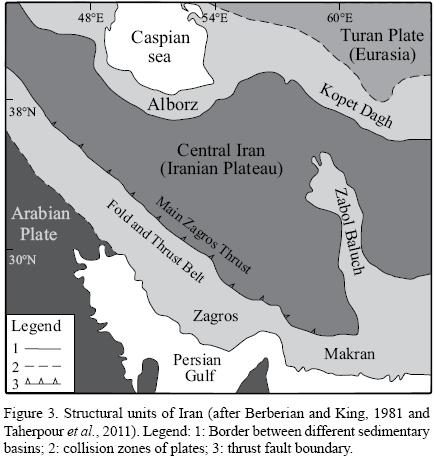
<body><![CDATA[<p align="center"><font face="verdana" size="2"><a name="f2"></a></font></p>     <p align="center"><font face="verdana" size="2"><img src="/img/revistas/rmcg/v29n1/a4f2.jpg"></font></p>     <p align="justify"><font face="verdana" size="2"><b>Structural units of Iran</b></font></p>     <p align="justify"><font face="verdana" size="2">units to be recognized in the studied area, separated by ophiolite&#150;bearing sutures. Other criteria such as structural style, the age and intensity of deformation, and the age and nature of magmatism are used to subdivide these major zones into smaller elements. The three major units and their main constituents are as follows: 1) the southern unit, with a crystalline basement consolidated in Precambrian time, platform&#150;type Paleozoic sediments and younger deposits. This unit comprises the Zagros fold belt; 2) the central unit, interpreted as an assemblage of marginal Gondwana fragments, originally united with the main continent and separated from the North (Eurasian) continent during the Paleozoic. In Mesozoic times, these fragments were detached from Gondwana and attached to Eurasia. During the Late Cretaceous they rejoined the Gondwanic Afro&#150;Arabia. This unit comprises Central Iran and the Alborz; 3) the northern unit, markedly separated from the central unit by ophiolites of the North Iran suture. The continental crust includes remnants of more or less cratonized, former (Paleozoic) oceanic crust possibly that of the Paleotethys. The northern unit represents a marginal strip of the Hercynian realm of Central Asia, broadly overlapped by the Alpine realm. It was deformed and largely consolidated by strong Early Cimmerian and Late Alpine folding (Stocklin, 1968). The Northern Unit comprises the South Caspian Depression and the Kopet&#150;Dagh Range (<a href="#f3">Figure 3</a>).</font></p>     <p align="center"><font face="verdana" size="2"><a name="f3"></a></font></p>     <p align="center"><font face="verdana" size="2"><img src="/img/revistas/rmcg/v29n1/a4f3.jpg"></font></p>     <p align="justify"><font face="verdana" size="2"><b>A brief comparison of Cretaceous deposits in different parts of Iran</b></font></p>     <p align="justify"><font face="verdana" size="2">The most complete Cretaceous sections in North Iran are found in the Kopet&#150;Dagh range on the border of Iran and Turkmenistan. The rocks consist of marine shales, marls, limestones and sandstones. The sequence reaches a thickness of more than 3000 m and seems to represent all major parts of the Lower Cretaceous strata (Afshar&#150;Harb, 1994). In the Alborz mountains and farther south, Cretaceous limestones and marls are widely distributed but the sections are less complete. Elsewhere, unfossiliferous red clastic basal beds, which in the Ravar&#150;Darband area northern Kerman province, contain considerable amounts of gypsum, frequently initiate the Cretaceous sequence and are followed by limestones and marls of different ages. The oldest marine beds are Orbitolina&#150;bearing limestones (Tiz&#150;Kuh Formation of the Alborz, "Orbitolina limestone" in general), which are conventionally regarded as Aptian&#150;Albian but may include stages as old as Barremian and as young as Cenomanian. An unusual shale facies reaching great thickness and containing very rare cephalopods represents the Barremian&#150;Albian in the Biabanak area of Central Iran (Stocklin and Setudehnia, 1991).</font></p>     <p align="justify"><font face="verdana" size="2">With the exception of the Kopet Dagh area mentioned above, detailed stratigraphic studies of the Upper Cretaceous deposits have been carried out only in a few limited areas such as the central Alborz, Tehran, Jandaq, Esfahan and Kerman areas. Detrital limestones, reef limestones, marls and shales prevail. However, the marine sequences are frequently interrupted by conglomerates, red beds, sedimentary gaps and unconformities and the sections vary in detail over short distances, reflecting the unstable conditions of the sedimentary environment during the initial phases of the Alpine orogeny. This and considerable disagreement between interpretations of different authors regarding the stratigraphic significance of the faunas has so far made reliable correlation over any greater distance difficult and a consistent stratigraphic subdivision of the Upper Cretaceous has yet to be established. The Stratigraphic Terminological Committee (STC) of Iran has recommended not introducing any formal stratigraphic names for the Upper Cretaceous strata of the Alborz and of central and eastern Iran until more regional information becomes available to clarify the situation, in compliance with this recommendation (Stocklin and Setudehnia, 1991).</font></p>     <p align="justify"><font face="verdana" size="2"><b>Stratigraphy of the Bararig section</b></font></p>     ]]></body>
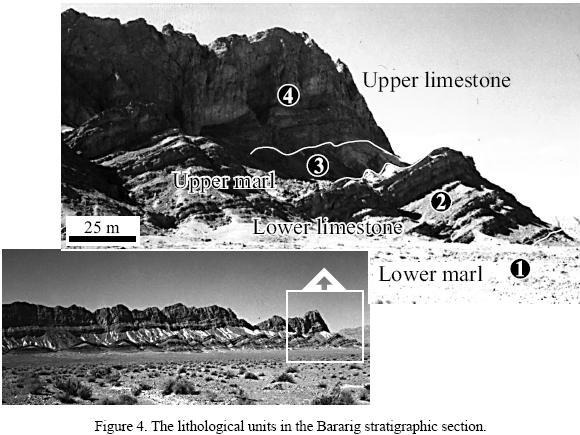
<body><![CDATA[<p align="justify"><font face="verdana" size="2">The Bararig section is situated in the NW&#150;SE striking Bararig mountains, at approximately 60 km southwest of Kuhbanan city (Kerman Province), and is accessible by the Zarand&#150;Kuhbanan&#150;Deh Ali road (<a href="#f2">Figure 2</a>). The section is 190 m thick and is composed of two lithological associations, marls and limestones, which were deposited alternatively (<a href="#f4">Figure 4</a>). The section from the lower to the upper part is as follows: green marls (90 m), gray limestones with intercalation of marls (40 m), light green marls (25 m) and gray, thick&#150;bedded limestones (35 m). The mentioned units contain ostracods, benthic foraminifera and macrofossils. In order to conduct palaeontological studies, samples from marls and limestones were collected. Due to lack offoraminifera in the marly layers, thin&#150;sections of limestoneshave been made. The stratigraphic column and the rangechart of benthic foraminifers are shown in <a href="/img/revistas/rmcg/v29n1/a4f5.jpg" target="_blank">Figure 5</a>.</font></p>     <p align="center"><font face="verdana" size="2"><a name="f4"></a></font></p>     <p align="center"><font face="verdana" size="2"><img src="/img/revistas/rmcg/v29n1/a4f4.jpg"></font></p>     <p align="justify"><font face="verdana" size="2">&nbsp;</font></p>     <p align="justify"><font face="verdana" size="2"><b>MATERIALS AND METHODS</b></font></p>     <p align="justify"><font face="verdana" size="2">This paper is based on the study of the Bararig section along the Zarand&#150;Kuhbanan&#150;Deh Ali road. The Barremian&#150;Aptian succession was measured and sampled. Microfossil content of the samples was studied in 37 thin sections with an optical microscope. These allowed the identification of the vertical foraminiferal distribution and establishment of two regional biozones. The palaeoecological study deter&#150;mined three benthic foraminiferal groups. All rock samples and thin sections are housed in the Department of Geology, Shahid Bahonar University of Kerman.</font></p>     <p align="justify"><font face="verdana" size="2">The taxonomic determination of the foraminifers is based on the latest changes in the foraminiferal classifications: Loeblich and Tappan (1988, 1992) and Kaminski (2004), and takes into account the following works: Jones and Charnock (1985), Koutsoukos <i>et al.</i> (1990), Baud <i>et al.</i> (1994), Cherchi and Schroeder (1999), Yilmaz (1999), Granier <i>et al.</i> (2003), Masse <i>et al.</i> (2004, 2009).</font></p>     <p align="justify"><font face="verdana" size="2">&nbsp;</font></p>     <p align="justify"><font size="2" face="verdana"><b>SYSTEMATIC PALEONTOLOGY</b></font></p>     <p align="center"><font size="2" face="verdana"><b><i>Cylindroporella</i> sp. cf. <i>Cylindroporella sugdeni </i>Elliott, 1957    ]]></body>
<body><![CDATA[<br> </b><a href="/img/revistas/rmcg/v29n1/a4f6.jpg" target="_blank">Figure 6&#150;1</a></font></p>     <p align="justify"><font face="verdana" size="2"><b>Description.</b> Oblique&#150;transversal section shows a cylindrical thallus, with primary branches connecting to the main axis with a short peduncle. The inner diameter is about 0.17 mm; whereas it shows an outer diameter of approximately 0.55 mm. Primary laterals are followed by large spherical gamete production. The secondary branches arise from the sterile primary branches. It presents a calcified sheath composed of calcite covering the strikethrough.</font></p>     <p align="justify"><font face="verdana" size="2"><b>Total range.</b> Hauterivian &#150; Aptian.</font></p>     <p align="justify"><font face="verdana" size="2"><b>Occurrence.</b> S45, S47 (see sample position in <a href="/img/revistas/rmcg/v29n1/a4f5.jpg" target="_blank">Figure 5</a>).</font></p>     <p align="justify"><font face="verdana" size="2"><b>Stratigraphic distribution.</b> Hauterivian&#150;Aptian of Switzerland, Portugal, France, and Aptian of Iran.</font></p>     <p align="center"><font face="verdana" size="2"><b><i>Nautiloculina oolithica</i> Mohler, 1938    <br> </b><a href="/img/revistas/rmcg/v29n1/a4f6.jpg" target="_blank">Figure 6&#150;4</a></font></p>     <p align="justify"><font face="verdana" size="2"><b>Description.</b> Longitudinal section shows a lenticular shape and planispiral coil, which is involute. Proloculus is globular and followed by three small chambers. Chambers increase gradually in size. Wall agglutinated, microgranular and single layered.</font></p>     <p align="justify"><font face="verdana" size="2"><b>Total range.</b> Oxfordian&#150;Aptian.</font></p>     <p align="justify"><font face="verdana" size="2"><b>Occurrence.</b> S46, S47, S57, S59.</font></p>     ]]></body>
<body><![CDATA[<p align="justify"><font face="verdana" size="2"><b>Stratigraphic distribution.</b> Aptian of Iran and Late  Oxfordian&#150;Berriasian of Ukraine.</font></p>     <p align="center"><font face="verdana" size="2"><b><i>Marssonella turris</i> d'Orbigny, 1840    <br> </b><a href="/img/revistas/rmcg/v29n1/a4f6.jpg" target="_blank">Figure 6&#150;5</a></font></p>     <p align="justify"><font face="verdana" size="2"><b>Description.</b> Subaxial section shows biserial stage of a trochospiral. Diameter of chambers increases rapidly and the terminal chamber becomes flattened. Wall agglutinated with organic lining in calcareous particles.</font></p>     <p align="justify"><font face="verdana" size="2"><b>Total range.</b> Early to Late Cretaceous.</font></p>     <p align="justify"><font face="verdana" size="2"><b>Occurrence.</b> S31, S37, S39, S41, S49, S53, S56, S57, S59.</font></p>     <p align="justify"><font face="verdana" size="2"><b>Stratigraphic distribution.</b> Cosmopolitan in the Early to Late Cretaceous. Aptian of Iran.</font></p>     <p align="center"><font face="verdana" size="2"><b><i>Novalesia angulosa</i> Magniez, 1974    <br> </b><a href="/img/revistas/rmcg/v29n1/a4f6.jpg" target="_blank">Figure 6&#150;6</a></font></p>     <p align="justify"><font face="verdana" size="2"><b>Description.</b> Axial section represents biserial stage of coiling with seven rows of chambers. Radial beams are not clear, wall agglutinated with relict of interio&#150;marginal slit aperture.</font></p>     ]]></body>
<body><![CDATA[<p align="justify"><font face="verdana" size="2"><b>Total range.</b> Late Aptian to Albian.</font></p>     <p align="justify"><font face="verdana" size="2"><b>Occurrence.</b> S31, S37, S39, S41, S44, S55, S56, S57, S59, S72, S73, S74.</font></p>     <p align="justify"><font face="verdana" size="2"><b>Stratigraphic distribution.</b> Late Aptian&#150;early Albian of Spain and France. Albian of Croatia. Aptian of Iran.</font></p>     <p align="center"><font face="verdana" size="2"><b><i>Charentia cuvillieri</i> Neumann, 1965    <br> </b><a href="/img/revistas/rmcg/v29n1/a4f6.jpg" target="_blank">Figure 6&#150;7</a></font></p>     <p align="justify"><font face="verdana" size="2"><b>Description.</b> Transversal section shows planispirally enrolled test with biumbonate to lenticular shape. The last chambers have tendency to uncoil. Laterally compressed and periphery nearly rounded. Wall finely agglutinated.</font></p>     <p align="justify"><font face="verdana" size="2"><b>Total range.</b> Hauterivian&#150;Cenomanian.</font></p>     <p align="justify"><font face="verdana" size="2"><b>Occurrence.</b> S39, S41, S43, S44, S46, S47, S49, S51, S53, S55, S57, S59, S70, S72, S73, S74.</font></p>     <p align="justify"><font face="verdana" size="2"><b>Stratigraphic distribution.</b> Upper Barremian&#150;Cenomanian of France, Spain, Crimea, Texas and Egypt. Aptian of Iran.</font></p>     <p align="center"><font face="verdana" size="2"><b><i>Pseudolituonella recheli</i> Marie, 1955    ]]></body>
<body><![CDATA[<br> </b><a href="/img/revistas/rmcg/v29n1/a4f6.jpg" target="_blank">Figure 6&#150;8</a></font></p>     <p align="justify"><font face="verdana" size="2"><b>Description.</b> Test conical elongate. Early portion with a short trochospiral stage in the type species but more elongate in geologically younger species, later stage with broad and low uniserial chambers. The wall is calcareous, microgranular, imperforate and single layered.</font></p>     <p align="justify"><font face="verdana" size="2"><b>Range.</b> In this study, the late Aptian is considered as the age of this taxon in the studied section.</font></p>     <p align="justify"><font face="verdana" size="2"><b>Occurrence.</b> S31, S37, S39, S46, S49, S51, S55, S57, S59, S70, S72, S73, S74.</font></p>     <p align="justify"><font face="verdana" size="2"><b>Stratigraphic distribution.</b> Cenomanian&#150;Campanian of France, Spain, Turkey. Aptian of Iran. Lutetian of Libya.</font></p>     <p align="center"><font face="verdana" size="2"><b><i>Vercorsella</i> sp. cf. <i>Vercorsella scarsellai </i>De Castro, 1963    <br> </b><a href="/img/revistas/rmcg/v29n1/a4f6.jpg" target="_blank">Figure 6&#150;9</a></font></p>     <p align="justify"><font face="verdana" size="2"><b>Description.</b> Axial section reveals a small, elongate and conical test. Apical angle about 20&deg;. Initial trochospiral stage consists of a rounded protoconch, a small deuteroconch, and one chamber, followed by a biserial stage with up to eight chambers, slightly compressed parallel to the plane.</font></p>     <p align="justify"><font face="verdana" size="2"><b>Total range.</b> Barremian to Albian.</font></p>     <p align="justify"><font face="verdana" size="2"><b>Occurrence.</b> S31, S35, S37, S39, S41, S43, S46, S47, S49, S51, S53, S55, S56, S57, S59, S70, S72, S73, S74.</font></p>     ]]></body>
<body><![CDATA[<p align="justify"><font face="verdana" size="2"><b>Stratigraphic distribution.</b> Early Hauterivian&#150;Bedoulian of France and Italy. Aptian of Iran.</font></p>     <p align="center"><font face="verdana" size="2"><b><i>Orbitolina (Mesorbitolina)</i> cf. <i>Orbitolina (Mesorbitolina) texana</i> Roemer, 1849</b>    <br>   <a href="/img/revistas/rmcg/v29n1/a4f6.jpg" target="_blank">Figure 6&#150;10</a></font></p>     <p align="justify"><font face="verdana" size="2"><b>Description.</b> The embryonic apparatus of macrospheric forms, which is very important for an exact determination, is preserved as well and is composed of protoconch, deuteroconch, and sub embryonic zone. It is located on the top of the specimen. The thickness of protoconch is about 0.11 mm and embryonic apparatus is about 0.25 mm.</font></p>     <p align="justify"><font face="verdana" size="2"><b>Total range.</b> Late Aptian&#150;Early Albian.</font></p>     <p align="justify"><font face="verdana" size="2"><b>Occurrence.</b> S31, S33, S35, S37, S39, S40, S41, S43, S44, S46, S47, S49, S51, S53, S55, S56, S57, S59, S70, S70, S72, S73, S74.</font></p>     <p align="justify"><font face="verdana" size="2"><b>Stratigraphic distribution.</b> Albian&#150;Early Cenomanian of USA, Italy, Spain, China, Tibet and Indian. Aptian of Iran.</font></p>     <p align="center"><font face="verdana" size="2"><b>cf. <i>Mayncina bulgarica</i> Laug, Peybern&egrave;s and Rey, 1980    <br> </b><a href="/img/revistas/rmcg/v29n1/a4f7.jpg" target="_blank">Figure 7&#150;1</a></font></p>     <p align="justify"><font face="verdana" size="2"><b>Description.</b> Equatorial section shows numerous chambers, about ten chambers per whorl, in a planispiral coiling. Chambers arrangement reveals height increase and a tendency to uncoil of the last two or three chambers. The wall is finely agglutinated.</font></p>     ]]></body>
<body><![CDATA[<p align="justify"><font face="verdana" size="2"><b>Total range.</b> Late Hauterivian&#150;Aptian.</font></p>     <p align="justify"><font face="verdana" size="2"><b>Occurrence.</b> S37, S39, S70.</font></p>     <p align="justify"><font face="verdana" size="2"><b>Stratigraphic distribution.</b> Cenomanian of France. Aptian of Iran. Tithonian&#150;Barremian of Ukraine.</font></p>     <p align="center"><font face="verdana" size="2"><b><i>Pseudocyclammina</i> cf. <i>Pseudocyclammina lituus </i>Yokoyama, 1890    <br> </b><a href="/img/revistas/rmcg/v29n1/a4f7.jpg" target="_blank">Figure 7&#150;2</a></font></p>     <p align="justify"><font face="verdana" size="2"><b>Description.</b> Sub&#150;equatorial section shows planispirally enrolled, the early stage may be streptospiral and repre<i>strata from the Bararig Mountain SE Iran</i> 69 sents uncoiling later. Wall coarsely agglutinated with sub epidermal network.</font></p>     <p align="justify"><font face="verdana" size="2"><b>Total range.</b> Oxfordian&#150;Aptian.</font></p>     <p align="justify"><font face="verdana" size="2"><b>Occurrence.</b> S31, S33, S35, S37, S41, S43, S46, S47, S49, S51, S53, S55, S73, S74.</font></p>     <p align="justify"><font face="verdana" size="2"><b>Stratigraphic distribution.</b> Early Jurassic&#150;Late Cretaceous of Morroco, Libya, France, Italy, Poland, Mexico and Ukraine. Aptian of Iran.</font></p>     <p align="center"><font face="verdana" size="2"><b><i>Rumanoloculina pseudominima</i> Bartenstein and Kovatcheva, 1982    ]]></body>
<body><![CDATA[<br> </b><a href="/img/revistas/rmcg/v29n1/a4f7.jpg" target="_blank">Figure 7&#150;3</a></font></p>     <p align="justify"><font face="verdana" size="2"><b>Description.</b> Transversal sections show the typical "Y" and somewhat loose mode of chamber arrangement and subacute periphery of the test.</font></p>     <p align="justify"><font face="verdana" size="2"><b>Total range.</b> Berriasian&#150;Albian.</font></p>     <p align="justify"><font face="verdana" size="2"><b>Occurrence.</b> S31, S33, S37, S39, S40, S41, S44, S46, S49, S51, S53, S55, S57, S59, S70, S72, S73, S74.</font></p>     <p align="justify"><font face="verdana" size="2"><b>Stratigraphic distribution.</b> Late Cretaceous of Poland. Berriasian and Aptian of Iran.</font></p>     <p align="center"><font face="verdana" size="2"><b><i>Derventina filipescui</i> Neagu, 1968    <br> </b><a href="/img/revistas/rmcg/v29n1/a4f7.jpg" target="_blank">Figure 7&#150;5</a></font></p>     <p align="justify"><font face="verdana" size="2"><b>Description.</b> Axial section shows quinqueloculine arrangement in the early stage, becomes later planispriral. Wall calcareous imperforate.</font></p>     <p align="justify"><font face="verdana" size="2"><b>Total range.</b> Late Barremian&#150;Early Aptian.</font></p>     <p align="justify"><font face="verdana" size="2"><b>Occurrence.</b> S41, S42, S43, S44, S45.</font></p>     ]]></body>
<body><![CDATA[<p align="justify"><font face="verdana" size="2"><b>Stratigraphic distribution.</b> Barremian of Romania. Aptian of Iran.</font></p>     <p align="center"><font face="verdana" size="2"><b><i>Istriloculina</i> sp. cf. <i>Istriloculina alimanensis </i>Neagu, 1984    <br> </b><a href="/img/revistas/rmcg/v29n1/a4f7.jpg" target="_blank">Figure 7&#150;6</a></font></p>     <p align="justify"><font face="verdana" size="2"><b>Description.</b> The sample shows globular shape, with different coiling, quinqueloculine in the early stage, then triloculine to pseudotriloculine. Wall calcareous imperforate.</font></p>     <p align="justify"><font face="verdana" size="2"><b>Total range.</b> Late Barremian&#150;Early Aptian.</font></p>     <p align="justify"><font face="verdana" size="2"><b>Occurrence.</b> S33, S57, S59.</font></p>     <p align="justify"><font face="verdana" size="2"><b>Stratigraphic distribution.</b> Late Barremian&#150;Early Aptian of Iran and Poland.</font></p>     <p align="center"><font face="verdana" size="2"><b><i>Montseciella arabica</i> Henson, 1948    <br> </b><a href="/img/revistas/rmcg/v29n1/a4f7.jpg" target="_blank">Figure 7&#150;11</a></font></p>     <p align="justify"><font face="verdana" size="2"><b>Description.</b> Sub&#150;axial section shows horizontal subepidermal plates in the marginal zone. The central zone exhibits thin, vermicular partitions forming a labyrinthic structure and bordering relatively spacious hollows.</font></p>     ]]></body>
<body><![CDATA[<p align="justify"><font face="verdana" size="2"><b>Total range.</b> Barremian&#150;Aptian</font></p>     <p align="justify"><font face="verdana" size="2"><b>Occurrence.</b> S40, S53, S59.</font></p>     <p align="justify"><font face="verdana" size="2"><b>Stratigraphic distribution.</b> Barremian&#150;Aptian of Romania and Iran.</font></p>     <p align="justify"><font face="verdana" size="2">&nbsp;</font></p>     <p align="justify"><font size="2" face="verdana"><b>IDENTIFIED BIOZONES IN THE BARARIG STRATIGRAPHIC SECTION</b></font></p>     <p align="justify"><font size="2" face="verdana">According to the studies of thin&#150;sections and identified taxa, two regional biozones are determined and described as follow:</font></p>     <p align="justify"><font face="verdana" size="2"><b><i>Montseciella arabica</i> Range Zone</b></font></p>     <p align="justify"><font face="verdana" size="2">Biostratigraphic interval represented by the total range of <i>Montseciella arabica.</i> This biozone is located in the middle part of the section and suggests a Barremian&#150;Aptian age.</font></p>     <p align="justify"><font face="verdana" size="2"><b><i>Orbitolina (Mesorbitolina) texana&#150;Nezzazatinella picardi</i> Assemblage Zone</b></font></p>     <p align="justify"><font face="verdana" size="2">This assemblage zone contains <i>Praechrysalidina</i> sp., <i>Marssonella turris, Minouxia</i> sp., <i>Novalesia angulosa, Rumanoloculinapseudominima, Haplophragmmoides</i> sp., <i>Vercorsella</i> cf. <i>Vercorsella scarsellai,</i> cf. <i>Mayncina bulgarica,</i> and <i>Charentia cuvillieri.</i> The mentioned biozone is defined by the first appearance of <i>Orbitolina (Mesorbitolina) texana</i> taxon and the overthrow of <i>Nezzazatinella picardi</i> taxon; it is found in the lower &#150; upper limestones of the studied section and shows the Aptian age for these deposits.</font></p>     ]]></body>
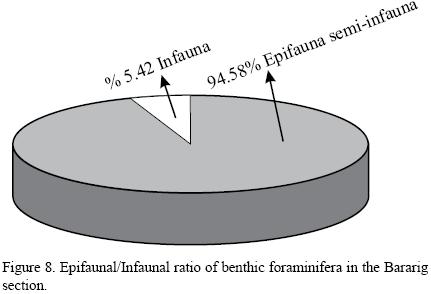
<body><![CDATA[<p align="justify"><font face="verdana" size="2">&nbsp;</font></p>     <p align="justify"><font size="2" face="verdana"><b>PALAEOECOLOGY</b></font></p>     <p align="justify"><font size="2" face="verdana">The most abundant foraminifera in the studied section are orbitolinids represented by <i>Pseudotextulariella, Orbitolina (Mesorbitolina), Pseudolituonella,</i> miliolids and <i>Pseudocyclammina.</i> Paleoecological studies show that, there are three groups ofbenthic foraminifera associations in the Bararig section, whereas pelagic foraminifera are missing: 1) Epifaunal genera: <i>Charentia, Rzehakina, Lenticulina, Glomospira, Nezzazata Glomospirella, Nezzazatinella, Nutiloculina, Happlophragmoides, Trochamminoides, Rumanoloculina, Istriloculina, Ophthalmidium, Pseudocyclammina.</i> 2) semi&#150;nfaunal genera: <i>Orbitolina (Mesorbitolina)</i> and <i>Orbitolina.</i> 3) Infaunal genus: <i>Pseudolituonella, Pseudotextulariella, Praechrysalidina, Minouxia, Marssonella, Bolivinopsis, Novalesia</i> (Vaziri, 2003).</font></p>     <p align="justify"><font face="verdana" size="2">Epifaunal/infaunal ratio of benthic foraminifera is shown in the <a href="#f8">Figure 8</a>. According to the thin&#150;sections, epifaunal and semi&#150;infaunal foraminifera make 94.58% of the total percentage of foraminifers in the Berarig section and only 5.42% of foraminifers in this section belong to infaunal forms. It is clear that epifaunal foraminifers are unstable in environments with low amount of oxygen but the infaunal foraminifers are stable in such conditions (Lamolda, 1982; Hart, 1985) therefore, the abundance of epifaunal foraminifers indicates an environment rich in oxygen. Meanwhile, the association of larger benthic foraminifera (such as orbitolinids) with algae shows that the environment is shallow and situated within the photic zone. The available palaeoecological data on miliolids indicates a preference for warm, shallow&#150;water and tolerance between 18 to 36% fluctuations in salinity.</font></p>     <p align="center"><font face="verdana" size="2"><a name="f8"></a></font></p>     <p align="center"><font face="verdana" size="2"><img src="/img/revistas/rmcg/v29n1/a4f8.jpg"></font></p>     <p align="justify"><font face="verdana" size="2"><b>Foraminiferal morphogroups and P/B ratio in the Bararig stratigraphic section</b></font></p>     <p align="justify"><font face="verdana" size="2">Each microhabitat category has distinct morphological characteristics. Epifaunal taxa are typical with plano&#150;convex or bi&#150;convex cross sections, with trochospiral coiling and with large pores absent or found on only one side. Shallow infaunal taxa are uniserially, triserially, or even planispirally coiled with surface ornamentation present on a number of taxa. The intermediate infaunal taxa are distinguishable with rounded peripheries, with pores over the entire test and with planispiral coiling. The deep infaunal taxa are typical, with general, planispiral or triserial coiling of cylindrical or ovate shaped tests (Corliss, 1991). Although several fluctuations occurred in the generally low planktonic/benthic (P/B) ratio found in the lower limestones, benthic forms are dominating and in 47/06 represent 100% of the whole assemblage. In the upper limestones the rate of oscillation decreased (77/14 to 100%) (see <a href="#f9">Figures 9</a> and <a href="/img/revistas/rmcg/v29n1/a4f10.jpg" target="_blank">10</a>).</font></p>     <p align="center"><font face="verdana" size="2"><a name="f9"></a></font></p>     <p align="center"><font face="verdana" size="2"><img src="/img/revistas/rmcg/v29n1/a4f9.jpg"></font></p>     ]]></body>
<body><![CDATA[<p align="justify"><font face="verdana" size="2">&nbsp;</font></p>     <p align="justify"><font size="2" face="verdana"><b>DISCUSSION AND CONCLUSIONS</b></font></p>     <p align="justify"><font size="2" face="verdana">Barremian&#150;Aptian sediments of the Bararig mountain have all the characteristics of shallow&#150;water deposits. The Urgonian succession consists of two depositional sequences characterized by marls and limestones. According to the foraminiferal assemblages found in the Bararig stratigraphic section and their comparison with stratigraphical sections in other parts of the world (specifically Europe) (Luperto&#150;Sinni and Masse, 1986; Mancinelli <i>et al.</i>, 2003; Luperto&#150;Sinni, 1979), a Barremian&#150;Aptian age is suggested for this stratigraphic section.</font></p>     <p align="justify"><font size="2" face="verdana">Also, according to the studies of thin&#150;sections and identified taxa two regional biozones are described: 1) <i>Montseciella arabica</i> Range Zone, and 2) <i>Orbitolina (Mesorbitolina) texana&#150;Nezzazatinella picardi</i> Assemblage Zone. The abundance of larger foraminifera indicates good oxygenation of the environment (Kaiho and Hasegawa, 1994). Furthermore, because of the high amount of benthic foraminifera and the low P/B (planktonic/benthic) ratio in the studied section, a low water depth for the environment also is suggested. This is confirmed by the presence of epifaunal and infaunal foraminifers, which are found together in shallow environments (Corliss and Chen, 1988) and also by the presence of algae, also living in shallow, high light, and well aerated environments (Flugel, 1982).</font></p>     <p align="justify"><font face="verdana" size="2">&nbsp;</font></p>     <p align="justify"><font size="2" face="verdana"><b>ACKNOWLEDGEMENTS</b></font></p>     <p align="justify"><font size="2" face="verdana">The authors would like to thank Mohammad Javad Hasani, Ahmad Arab, Hamed Ameri, Maryam Taheri, Shohreh Jaber and Maryam Derisi for their contributions in field sampling. Helpful comments by the reviewers, Prof. Dr. Seyed Hamid Vaziri (Department of Geology, Faculty of Basic Sciences, Islamic Azad University&#150;North Tehran Branch, Tehran, Iran) and Prof. Dr. Josef Michalik (SAS Geological Institute, Bratislava, Slovakia) are acknowledged. Review of the English by Hasmik Asmaryan (Ecocenter NAS RA) is gratefully acknowledged.</font></p>     <p align="justify"><font face="verdana" size="2">&nbsp;</font></p>     <p align="justify"><font size="2" face="verdana"><b>REFERENCES</b></font></p>     <!-- ref --><p align="justify"><font size="2" face="verdana">Ahmadi, T., 2003, Biostatigraphy and Palaeoecology of Lower Cretaceous sediments in the North of Kerman (Ravar): Shahid Bahonar University of Kerman, M.Sc. thesis, 215 pp.    &nbsp;&nbsp;&nbsp;&nbsp;&nbsp;&nbsp;&nbsp;&nbsp;[&#160;<a href="javascript:void(0);" onclick="javascript: window.open('/scielo.php?script=sci_nlinks&ref=8071943&pid=S1026-8774201200010000400001&lng=','','width=640,height=500,resizable=yes,scrollbars=1,menubar=yes,');">Links</a>&#160;]<!-- end-ref --></font></p>     <!-- ref --><p align="justify"><font size="2" face="verdana">Ahmadi, T., Vaziri, M.R., Dastanpour, M., 2010, Biostratigraphy and paleoecology of the Lower Cretaceous deposits in the Ravar region, North of Kerman: Stratigraphy and Sedimentology Investigations, University of Esfahan. 25(2), 87&#150;116.    &nbsp;&nbsp;&nbsp;&nbsp;&nbsp;&nbsp;&nbsp;&nbsp;[&#160;<a href="javascript:void(0);" onclick="javascript: window.open('/scielo.php?script=sci_nlinks&ref=8071945&pid=S1026-8774201200010000400002&lng=','','width=640,height=500,resizable=yes,scrollbars=1,menubar=yes,');">Links</a>&#160;]<!-- end-ref --></font></p>     <!-- ref --><p align="justify"><font face="verdana" size="2">Afshar&#150;Harb, A., 1994, Geology of Kopet&#150;Dagh (in Persian): Tehran, Geological Survey of Iran, 275 pp.    &nbsp;&nbsp;&nbsp;&nbsp;&nbsp;&nbsp;&nbsp;&nbsp;[&#160;<a href="javascript:void(0);" onclick="javascript: window.open('/scielo.php?script=sci_nlinks&ref=8071947&pid=S1026-8774201200010000400003&lng=','','width=640,height=500,resizable=yes,scrollbars=1,menubar=yes,');">Links</a>&#160;]<!-- end-ref --></font></p>     <!-- ref --><p align="justify"><font face="verdana" size="2">Arab, A., 2003, Stratigraphy, Palaeontology and Palaeoecology of Upper Cretaceous sediments in the West of Kerman: Shahid Bahonar University of Kerman, M.Sc. thesis, 248 pp.    &nbsp;&nbsp;&nbsp;&nbsp;&nbsp;&nbsp;&nbsp;&nbsp;[&#160;<a href="javascript:void(0);" onclick="javascript: window.open('/scielo.php?script=sci_nlinks&ref=8071949&pid=S1026-8774201200010000400004&lng=','','width=640,height=500,resizable=yes,scrollbars=1,menubar=yes,');">Links</a>&#160;]<!-- end-ref --></font></p>     <!-- ref --><p align="justify"><font face="verdana" size="2">Arab, A., 2004, Biostratigraphy and paleoecology of the Upper Cretaceous in Cheshmeh gaz stratigraphic section, West of Kerman, in Ashouri A. R., Yazdi M., Aryaei A. A. (eds),. Proceeding of the 8th Symposium of Geological Society of Iran: 230&#150;237.    &nbsp;&nbsp;&nbsp;&nbsp;&nbsp;&nbsp;&nbsp;&nbsp;[&#160;<a href="javascript:void(0);" onclick="javascript: window.open('/scielo.php?script=sci_nlinks&ref=8071951&pid=S1026-8774201200010000400005&lng=','','width=640,height=500,resizable=yes,scrollbars=1,menubar=yes,');">Links</a>&#160;]<!-- end-ref --></font></p>     <!-- ref --><p align="justify"><font face="verdana" size="2">Arab, A., 2005, Lithostratigraphy and biostratigraphy of the Upper Cretaceous deposits, West of Kerman, in Yazdi M., Hamdi B. A., Ashouri A. R. (eds),. Proceeding of the 25th Convention of Geosciences, Iran, 126&#150;129.    &nbsp;&nbsp;&nbsp;&nbsp;&nbsp;&nbsp;&nbsp;&nbsp;[&#160;<a href="javascript:void(0);" onclick="javascript: window.open('/scielo.php?script=sci_nlinks&ref=8071953&pid=S1026-8774201200010000400006&lng=','','width=640,height=500,resizable=yes,scrollbars=1,menubar=yes,');">Links</a>&#160;]<!-- end-ref --></font></p>     <!-- ref --><p align="justify"><font face="verdana" size="2">Arab, A., Vaziri, M.R., 2005, Ostracoda and ecological environment in the Upper Albian&#150;Lower Cenomanian in the Chenaroieh section (West of Kerman), <i>in</i> Proceedings of the 5th Conference of the Iranian Paleontological Society, Kerman, Iran.    &nbsp;&nbsp;&nbsp;&nbsp;&nbsp;&nbsp;&nbsp;&nbsp;[&#160;<a href="javascript:void(0);" onclick="javascript: window.open('/scielo.php?script=sci_nlinks&ref=8071955&pid=S1026-8774201200010000400007&lng=','','width=640,height=500,resizable=yes,scrollbars=1,menubar=yes,');">Links</a>&#160;]<!-- end-ref --></font></p>     <!-- ref --><p align="justify"><font face="verdana" size="2">Arab, A., Hakimeh Pour, M.A., Kheradmand, A., Faryabi, A., 2004, Biostratigraphy and Palaeoecology of Upper Cretaceous sediment in the Hanoj section (West of Kerman), <i>in</i> Proceedings of the 5th Conference of the Iranian Paleontological Society, Kerman, Iran.    &nbsp;&nbsp;&nbsp;&nbsp;&nbsp;&nbsp;&nbsp;&nbsp;[&#160;<a href="javascript:void(0);" onclick="javascript: window.open('/scielo.php?script=sci_nlinks&ref=8071957&pid=S1026-8774201200010000400008&lng=','','width=640,height=500,resizable=yes,scrollbars=1,menubar=yes,');">Links</a>&#160;]<!-- end-ref --></font></p>     <!-- ref --><p align="justify"><font face="verdana" size="2">Arab, A., Vaziri, M.R., Dastanpour, M., 2005, The first report on the Upper Albian&#150;Lower Cenomanian Ostracods in Chenarooyeh stratigraphic section, West of Kerman, <i>in</i> Ashouri, A.R., Ghavidel Syooki, M. (eds),. Proceeding of the 9th Symposium of the Geological Society of Iran, 213&#150;218.    &nbsp;&nbsp;&nbsp;&nbsp;&nbsp;&nbsp;&nbsp;&nbsp;[&#160;<a href="javascript:void(0);" onclick="javascript: window.open('/scielo.php?script=sci_nlinks&ref=8071959&pid=S1026-8774201200010000400009&lng=','','width=640,height=500,resizable=yes,scrollbars=1,menubar=yes,');">Links</a>&#160;]<!-- end-ref --></font></p>     <!-- ref --><p align="justify"><font face="verdana" size="2">Arab, A., Vaziri, M.R., Dastanpour, M., Kheradmand, A., 2006, Biostratigraphy of the Late Albian&#150;Cenomanian foraminifera in Chenarooyeh stratigraphic section, West of Kerman, <i>in</i> Amiri Bakhtiar, H., Shemirani, A., Sadeghi, A. (eds),. Proceeding of the 10th Symposium of the Geological Society of Iran, 105&#150;108.    &nbsp;&nbsp;&nbsp;&nbsp;&nbsp;&nbsp;&nbsp;&nbsp;[&#160;<a href="javascript:void(0);" onclick="javascript: window.open('/scielo.php?script=sci_nlinks&ref=8071961&pid=S1026-8774201200010000400010&lng=','','width=640,height=500,resizable=yes,scrollbars=1,menubar=yes,');">Links</a>&#160;]<!-- end-ref --></font></p>     <!-- ref --><p align="justify"><font face="verdana" size="2">Bakhtiari, S., 2007, Road Atlas of Iran: Tehran, Gitashenasi Geographical and Cartographic Institute.    &nbsp;&nbsp;&nbsp;&nbsp;&nbsp;&nbsp;&nbsp;&nbsp;[&#160;<a href="javascript:void(0);" onclick="javascript: window.open('/scielo.php?script=sci_nlinks&ref=8071963&pid=S1026-8774201200010000400011&lng=','','width=640,height=500,resizable=yes,scrollbars=1,menubar=yes,');">Links</a>&#160;]<!-- end-ref --></font></p>     <!-- ref --><p align="justify"><font face="verdana" size="2"> Bartenstein, H., Kovatcheva, T., 1982, A comparison of Aptian Foraminifera in Bulgaria and North West Germany: Eclogae Geologicae Helvetiae, 75(3), 621&#150;667.    &nbsp;&nbsp;&nbsp;&nbsp;&nbsp;&nbsp;&nbsp;&nbsp;[&#160;<a href="javascript:void(0);" onclick="javascript: window.open('/scielo.php?script=sci_nlinks&ref=8071965&pid=S1026-8774201200010000400012&lng=','','width=640,height=500,resizable=yes,scrollbars=1,menubar=yes,');">Links</a>&#160;]<!-- end-ref --></font></p>     <!-- ref --><p align="justify"><font face="verdana" size="2">Baud, A., Cherchi, A. and Schroeder, R., 1994, Dictyoconus arabicus Henson (Foraminiferida) from the late Barremian of the Lhasa block (Central Tibet): Rivista Italiana di Paleontologia e Stratigrafia, 100(3), 383&#150;394.    &nbsp;&nbsp;&nbsp;&nbsp;&nbsp;&nbsp;&nbsp;&nbsp;[&#160;<a href="javascript:void(0);" onclick="javascript: window.open('/scielo.php?script=sci_nlinks&ref=8071967&pid=S1026-8774201200010000400013&lng=','','width=640,height=500,resizable=yes,scrollbars=1,menubar=yes,');">Links</a>&#160;]<!-- end-ref --></font></p>     <!-- ref --><p align="justify"><font face="verdana" size="2">Berberian, M., King, G.G.P., 1981, Towards a paleogeography and tectonic evolution of Iran: Canadian Journal of Earth Sciences, 18, 210&#150;265.    &nbsp;&nbsp;&nbsp;&nbsp;&nbsp;&nbsp;&nbsp;&nbsp;[&#160;<a href="javascript:void(0);" onclick="javascript: window.open('/scielo.php?script=sci_nlinks&ref=8071969&pid=S1026-8774201200010000400014&lng=','','width=640,height=500,resizable=yes,scrollbars=1,menubar=yes,');">Links</a>&#160;]<!-- end-ref --></font></p>     <!-- ref --><p align="justify"><font face="verdana" size="2">Cherchi, A., Schroeder, R., 1999, <i>Montseciella,</i> a new orbitolinid genus (Foraminiferida) from the Uppermost Hauterivian&#150;Early Barremian of SW Europe: Treballs del Museu de Geologia de Barcelona, 8, 5&#150;23.    &nbsp;&nbsp;&nbsp;&nbsp;&nbsp;&nbsp;&nbsp;&nbsp;[&#160;<a href="javascript:void(0);" onclick="javascript: window.open('/scielo.php?script=sci_nlinks&ref=8071971&pid=S1026-8774201200010000400015&lng=','','width=640,height=500,resizable=yes,scrollbars=1,menubar=yes,');">Links</a>&#160;]<!-- end-ref --></font></p>     <!-- ref --><p align="justify"><font face="verdana" size="2">Corliss, B.H., 1991, Morphology and microhabitat preferences of benthic foraminifera from the northwest Atlantic Ocean: Marine Micropaleontology, 17, 195&#150;236.    &nbsp;&nbsp;&nbsp;&nbsp;&nbsp;&nbsp;&nbsp;&nbsp;[&#160;<a href="javascript:void(0);" onclick="javascript: window.open('/scielo.php?script=sci_nlinks&ref=8071973&pid=S1026-8774201200010000400016&lng=','','width=640,height=500,resizable=yes,scrollbars=1,menubar=yes,');">Links</a>&#160;]<!-- end-ref --></font></p>     <!-- ref --><p align="justify"><font face="verdana" size="2">Corliss, B.H., Chen, Ch., 1988, Morphotype patterns of Norwegian Sea deep&#150;sea benthic foraminifera and ecological implications: Geology, 16, 716&#150;719.    &nbsp;&nbsp;&nbsp;&nbsp;&nbsp;&nbsp;&nbsp;&nbsp;[&#160;<a href="javascript:void(0);" onclick="javascript: window.open('/scielo.php?script=sci_nlinks&ref=8071975&pid=S1026-8774201200010000400017&lng=','','width=640,height=500,resizable=yes,scrollbars=1,menubar=yes,');">Links</a>&#160;]<!-- end-ref --></font></p>     <!-- ref --><p align="justify"><font face="verdana" size="2">d'Orbigny, A., 1840, M&eacute;moires sur les foraminif&egrave;res de la craie blanche du bassin de Paris: M&eacute;moires de la Soci&eacute;t&eacute; G&eacute;ologique de France, 4, 1&#150;51.    &nbsp;&nbsp;&nbsp;&nbsp;&nbsp;&nbsp;&nbsp;&nbsp;[&#160;<a href="javascript:void(0);" onclick="javascript: window.open('/scielo.php?script=sci_nlinks&ref=8071977&pid=S1026-8774201200010000400018&lng=','','width=640,height=500,resizable=yes,scrollbars=1,menubar=yes,');">Links</a>&#160;]<!-- end-ref --></font></p>     <!-- ref --><p align="justify"><font face="verdana" size="2">De Castro, P., 1963, Cuneolina scarsellai n. sp. nel Cretacico dell'Appennino Meridionale: Bollettino della Societ &amp; dei Naturalisti in Napoli: 72, 71&#150;76.    &nbsp;&nbsp;&nbsp;&nbsp;&nbsp;&nbsp;&nbsp;&nbsp;[&#160;<a href="javascript:void(0);" onclick="javascript: window.open('/scielo.php?script=sci_nlinks&ref=8071979&pid=S1026-8774201200010000400019&lng=','','width=640,height=500,resizable=yes,scrollbars=1,menubar=yes,');">Links</a>&#160;]<!-- end-ref --></font></p>     <!-- ref --><p align="justify"><font face="verdana" size="2">Elliott, G.F., 1957, New calcareous algae from the Arabian peninsula: Micropaleontology, 3, 227&#150;230.    &nbsp;&nbsp;&nbsp;&nbsp;&nbsp;&nbsp;&nbsp;&nbsp;[&#160;<a href="javascript:void(0);" onclick="javascript: window.open('/scielo.php?script=sci_nlinks&ref=8071981&pid=S1026-8774201200010000400020&lng=','','width=640,height=500,resizable=yes,scrollbars=1,menubar=yes,');">Links</a>&#160;]<!-- end-ref --></font></p>     <!-- ref --><p align="justify"><font face="verdana" size="2">Henson, F., 1948, Larger imperforate Foraminifera of south&#150;west Asia. Families Lituolidae, Orbitolinidae, and Meandropsinidae: British Museum (Natural History), London, 127 pp.    &nbsp;&nbsp;&nbsp;&nbsp;&nbsp;&nbsp;&nbsp;&nbsp;[&#160;<a href="javascript:void(0);" onclick="javascript: window.open('/scielo.php?script=sci_nlinks&ref=8071983&pid=S1026-8774201200010000400021&lng=','','width=640,height=500,resizable=yes,scrollbars=1,menubar=yes,');">Links</a>&#160;]<!-- end-ref --></font></p>     <!-- ref --><p align="justify"><font face="verdana" size="2">Laug, B., Peybernes, B., Rey, J., 1980, <i>Mayncina bulgarica</i> n.sp. Lituolid&eacute; nouveau du Cr&eacute;tac&eacute; inf&eacute;rieur M&eacute;sog&eacute;en (Bulgarie, Portugal, Pyr&eacute;n&eacute;es, Tunisie): Bulletin de la Soci&eacute;t&eacute; d'Histoire Naturelle de Toulouse, 116, 68&#150;76.    &nbsp;&nbsp;&nbsp;&nbsp;&nbsp;&nbsp;&nbsp;&nbsp;[&#160;<a href="javascript:void(0);" onclick="javascript: window.open('/scielo.php?script=sci_nlinks&ref=8071985&pid=S1026-8774201200010000400022&lng=','','width=640,height=500,resizable=yes,scrollbars=1,menubar=yes,');">Links</a>&#160;]<!-- end-ref --></font></p>     <!-- ref --><p align="justify"><font face="verdana" size="2">Luperto&#150;Sinni, E., 1979, I microfossili del livello a <i>"Palorbitolina lenticularis"</i> delle murge baresi: Rivista Italiana di Paleontologia e Stratigrafia, 85 (2), 1&#150;70.    &nbsp;&nbsp;&nbsp;&nbsp;&nbsp;&nbsp;&nbsp;&nbsp;[&#160;<a href="javascript:void(0);" onclick="javascript: window.open('/scielo.php?script=sci_nlinks&ref=8071987&pid=S1026-8774201200010000400023&lng=','','width=640,height=500,resizable=yes,scrollbars=1,menubar=yes,');">Links</a>&#160;]<!-- end-ref --></font></p>     <!-- ref --><p align="justify"><font face="verdana" size="2">Luperto&#150;Sinni, E., Masse, J.P., 1986, Donn&eacute;es nouvelles sur la stratigraphie des Calcaires de plate&#150;forme du Cr&eacute;tac&eacute; inf&eacute;rieur du Gargano (Italie meridionale): Rivista Italiana di Paleontologia e Stratigrafia, 92 (1), 33&#150;66.    &nbsp;&nbsp;&nbsp;&nbsp;&nbsp;&nbsp;&nbsp;&nbsp;[&#160;<a href="javascript:void(0);" onclick="javascript: window.open('/scielo.php?script=sci_nlinks&ref=8071989&pid=S1026-8774201200010000400024&lng=','','width=640,height=500,resizable=yes,scrollbars=1,menubar=yes,');">Links</a>&#160;]<!-- end-ref --></font></p>     <!-- ref --><p align="justify"><font face="verdana" size="2">Neagu, T., 1968, <i>Andersenia rumana,</i> n. gen., n. sp., and some taxonomic observations on the subfamily Valvulininae: Contributions from the Cushman Foundation for Foraminiferal Research, 19, 120&#150;122.    &nbsp;&nbsp;&nbsp;&nbsp;&nbsp;&nbsp;&nbsp;&nbsp;[&#160;<a href="javascript:void(0);" onclick="javascript: window.open('/scielo.php?script=sci_nlinks&ref=8071991&pid=S1026-8774201200010000400025&lng=','','width=640,height=500,resizable=yes,scrollbars=1,menubar=yes,');">Links</a>&#160;]<!-- end-ref --></font></p>     <!-- ref --><p align="justify"><font face="verdana" size="2">Neagu, T., 1984, Nouvelles donnees sur la morphologie du test, sur la systematique et la nomenclature des miliolides agatisthegues du mesozoique, 16, 75&#150;90.    &nbsp;&nbsp;&nbsp;&nbsp;&nbsp;&nbsp;&nbsp;&nbsp;[&#160;<a href="javascript:void(0);" onclick="javascript: window.open('/scielo.php?script=sci_nlinks&ref=8071993&pid=S1026-8774201200010000400026&lng=','','width=640,height=500,resizable=yes,scrollbars=1,menubar=yes,');">Links</a>&#160;]<!-- end-ref --></font></p>     <!-- ref --><p align="justify"><font face="verdana" size="2">Flugel, E., 1982, Microfacies Analysis of Limestone: Berlin, Springer, 633 pp.    &nbsp;&nbsp;&nbsp;&nbsp;&nbsp;&nbsp;&nbsp;&nbsp;[&#160;<a href="javascript:void(0);" onclick="javascript: window.open('/scielo.php?script=sci_nlinks&ref=8071995&pid=S1026-8774201200010000400027&lng=','','width=640,height=500,resizable=yes,scrollbars=1,menubar=yes,');">Links</a>&#160;]<!-- end-ref --></font></p>     <!-- ref --><p align="justify"><font face="verdana" size="2">Granier, B., Al Suwaidi, A. S., Busnardo, R., Aziz, S.K., Schroeder, R., 2003, New insight on the stratigraphy of the ''Upper Thamama" in Offshore Abu Dhabi (U.A.E.): Carnets de Geologie/Notebooks on Geology, 17, Maintenon, Article 2003/05, (CG2003_A05_BG_etal).    &nbsp;&nbsp;&nbsp;&nbsp;&nbsp;&nbsp;&nbsp;&nbsp;[&#160;<a href="javascript:void(0);" onclick="javascript: window.open('/scielo.php?script=sci_nlinks&ref=8071997&pid=S1026-8774201200010000400028&lng=','','width=640,height=500,resizable=yes,scrollbars=1,menubar=yes,');">Links</a>&#160;]<!-- end-ref --></font></p>     <!-- ref --><p align="justify"><font face="verdana" size="2">Hart, M.B., 1985, Oceanic anoxic event 2 on&#150;shore and off&#150;shore SW England: Proceeding of the Ussher Society, 6, 183&#150;190.    &nbsp;&nbsp;&nbsp;&nbsp;&nbsp;&nbsp;&nbsp;&nbsp;[&#160;<a href="javascript:void(0);" onclick="javascript: window.open('/scielo.php?script=sci_nlinks&ref=8071999&pid=S1026-8774201200010000400029&lng=','','width=640,height=500,resizable=yes,scrollbars=1,menubar=yes,');">Links</a>&#160;]<!-- end-ref --></font></p>     <!-- ref --><p align="justify"><font face="verdana" size="2">Henson, F.R.S., 1948, Larger imperforate foraminifera of South&#150;Western Asia, Families Lituolidae, Orbitolinidae and Meandropsinidae: British Museum (Natural History), 1&#150;127.    &nbsp;&nbsp;&nbsp;&nbsp;&nbsp;&nbsp;&nbsp;&nbsp;[&#160;<a href="javascript:void(0);" onclick="javascript: window.open('/scielo.php?script=sci_nlinks&ref=8072001&pid=S1026-8774201200010000400030&lng=','','width=640,height=500,resizable=yes,scrollbars=1,menubar=yes,');">Links</a>&#160;]<!-- end-ref --></font></p>     <!-- ref --><p align="justify"><font face="verdana" size="2">Hosseinipour, F., Vaziri, M. R., Dastanpour, M., Arab, A., 2003, Oligo&#150;Miocene Ostracods in Boojan stratigraphic section and the related paleoecology, <i>in</i> Aryaei A.A., Ghavidel Syooki M., Vaziri Moghadam ,S.H (eds), Proceeding of the 10th Symposium of the Geological Society of Iran, 115&#150;120.    &nbsp;&nbsp;&nbsp;&nbsp;&nbsp;&nbsp;&nbsp;&nbsp;[&#160;<a href="javascript:void(0);" onclick="javascript: window.open('/scielo.php?script=sci_nlinks&ref=8072003&pid=S1026-8774201200010000400031&lng=','','width=640,height=500,resizable=yes,scrollbars=1,menubar=yes,');">Links</a>&#160;]<!-- end-ref --></font></p>     <!-- ref --><p align="justify"><font face="verdana" size="2"> Huckreide, R., Kursten, M., Venzlaff, I., 1962, Zur Geologie des Gebietes Zwischen Kerman un Sagand (Iran): Hannover Bundesanstalt f&uuml;r Bodenforschung, 197 pp.    &nbsp;&nbsp;&nbsp;&nbsp;&nbsp;&nbsp;&nbsp;&nbsp;[&#160;<a href="javascript:void(0);" onclick="javascript: window.open('/scielo.php?script=sci_nlinks&ref=8072005&pid=S1026-8774201200010000400032&lng=','','width=640,height=500,resizable=yes,scrollbars=1,menubar=yes,');">Links</a>&#160;]<!-- end-ref --></font></p>     <!-- ref --><p align="justify"><font face="verdana" size="2">Jones, R.W., Charnock, M.A., 1985, Morphogroups of agglutinating Foraminifera, their life positions and feeding habits and potential applicanility in (Paleo) ecological studies: Revue de Pal&eacute;obiologie, 4, 311&#150; 320.    &nbsp;&nbsp;&nbsp;&nbsp;&nbsp;&nbsp;&nbsp;&nbsp;[&#160;<a href="javascript:void(0);" onclick="javascript: window.open('/scielo.php?script=sci_nlinks&ref=8072007&pid=S1026-8774201200010000400033&lng=','','width=640,height=500,resizable=yes,scrollbars=1,menubar=yes,');">Links</a>&#160;]<!-- end-ref --></font></p>     <!-- ref --><p align="justify"><font face="verdana" size="2">Kaiho, K., Hasegawa T., 1994, End Cenomanian benthic foraminiferal extinctions and oceanic dysoxic events in the northwestwern Pacific Ocean: Palaeogeography, Palaeoclimatology, Palaeoecology, 111, 29&#150;43.    &nbsp;&nbsp;&nbsp;&nbsp;&nbsp;&nbsp;&nbsp;&nbsp;[&#160;<a href="javascript:void(0);" onclick="javascript: window.open('/scielo.php?script=sci_nlinks&ref=8072009&pid=S1026-8774201200010000400034&lng=','','width=640,height=500,resizable=yes,scrollbars=1,menubar=yes,');">Links</a>&#160;]<!-- end-ref --></font></p>     <!-- ref --><p align="justify"><font face="verdana" size="2">Kaminski, M.A., 2004, The Year 2000 Classification of the Agglutinated Foraminifera, in Bub&iacute;k M., Kaminski M.A. (eds), Proceedings of the Sixth International Workshop on Agglutinated Foraminifera, Grzybowski Foundation, Special Publication, 237&#150;255.    &nbsp;&nbsp;&nbsp;&nbsp;&nbsp;&nbsp;&nbsp;&nbsp;[&#160;<a href="javascript:void(0);" onclick="javascript: window.open('/scielo.php?script=sci_nlinks&ref=8072011&pid=S1026-8774201200010000400035&lng=','','width=640,height=500,resizable=yes,scrollbars=1,menubar=yes,');">Links</a>&#160;]<!-- end-ref --></font></p>     <!-- ref --><p align="justify"><font face="verdana" size="2">Koutsoukos, E.A.M., Leary, P.N., Hart, M.B., 1990b, Latest Cenomanian&#150;Earliest Turonian low&#150;oxygen tolerant benthonic foraminifera: a case study from the Sergipe Basin (NE Brazil) and the western Anglo&#150;Paris Basin (southern England): Palaeogeography, Palaeoclimatology, Palaeoecology, 77, 145&#150;177.    &nbsp;&nbsp;&nbsp;&nbsp;&nbsp;&nbsp;&nbsp;&nbsp;[&#160;<a href="javascript:void(0);" onclick="javascript: window.open('/scielo.php?script=sci_nlinks&ref=8072013&pid=S1026-8774201200010000400036&lng=','','width=640,height=500,resizable=yes,scrollbars=1,menubar=yes,');">Links</a>&#160;]<!-- end-ref --></font></p>     <!-- ref --><p align="justify"><font face="verdana" size="2">Lamolda, M.A., 1982, Le Turonian Basco&#150;Cantabrique et ses faunes caract&eacute;ristiques: M&eacute;moires du Mus&eacute;um national d'Histoire naturelle, C49, 101&#150;112.    &nbsp;&nbsp;&nbsp;&nbsp;&nbsp;&nbsp;&nbsp;&nbsp;[&#160;<a href="javascript:void(0);" onclick="javascript: window.open('/scielo.php?script=sci_nlinks&ref=8072015&pid=S1026-8774201200010000400037&lng=','','width=640,height=500,resizable=yes,scrollbars=1,menubar=yes,');">Links</a>&#160;]<!-- end-ref --></font></p>     <!-- ref --><p align="justify"><font face="verdana" size="2">Leoblich, A.R., Tapan, H., 1988, Foraminiferal genera and their classification: New York, Van Nostrand Reinhold Company.    &nbsp;&nbsp;&nbsp;&nbsp;&nbsp;&nbsp;&nbsp;&nbsp;[&#160;<a href="javascript:void(0);" onclick="javascript: window.open('/scielo.php?script=sci_nlinks&ref=8072017&pid=S1026-8774201200010000400038&lng=','','width=640,height=500,resizable=yes,scrollbars=1,menubar=yes,');">Links</a>&#160;]<!-- end-ref --></font></p>     <!-- ref --><p align="justify"><font face="verdana" size="2">Loeblich, A.R., Tappan, H., 1992, Present status of foraminiferal classification, <i>in</i> Takayanagi, Y., Saito, T. (eds.), Studies in Benthic Foraminifera, Proceedings of the Fourth Symposium on benthic foraminifera, Sendai, 1990: Tokyo, Tokai University Press, 93&#150;102.    &nbsp;&nbsp;&nbsp;&nbsp;&nbsp;&nbsp;&nbsp;&nbsp;[&#160;<a href="javascript:void(0);" onclick="javascript: window.open('/scielo.php?script=sci_nlinks&ref=8072019&pid=S1026-8774201200010000400039&lng=','','width=640,height=500,resizable=yes,scrollbars=1,menubar=yes,');">Links</a>&#160;]<!-- end-ref --></font></p>     <!-- ref --><p align="justify"><font face="verdana" size="2">Mahanipoor, A., 2003, Biostatigraphy and Palaeoecology of Upper Cretaceous sediment in the North and North West of Kerman: Shahid Bahonar University of Kerman, M.Sc. thesis, 196 pp.    &nbsp;&nbsp;&nbsp;&nbsp;&nbsp;&nbsp;&nbsp;&nbsp;[&#160;<a href="javascript:void(0);" onclick="javascript: window.open('/scielo.php?script=sci_nlinks&ref=8072021&pid=S1026-8774201200010000400040&lng=','','width=640,height=500,resizable=yes,scrollbars=1,menubar=yes,');">Links</a>&#160;]<!-- end-ref --></font></p>     <!-- ref --><p align="justify"><font face="verdana" size="2">Magniez, F., 1974, Novalesia, nouveau nom pour le genre de foraminifere Spiroplectamminoides Magniz, 1972: Revista Espa&ntilde;ola de Micropaleontolog&iacute;a, 6, 155.    &nbsp;&nbsp;&nbsp;&nbsp;&nbsp;&nbsp;&nbsp;&nbsp;[&#160;<a href="javascript:void(0);" onclick="javascript: window.open('/scielo.php?script=sci_nlinks&ref=8072023&pid=S1026-8774201200010000400041&lng=','','width=640,height=500,resizable=yes,scrollbars=1,menubar=yes,');">Links</a>&#160;]<!-- end-ref --></font></p>     <!-- ref --><p align="justify"><font face="verdana" size="2">Mancinelli, A., Chiocchini, M., Coccia, B., 2003, Orbitolinidae and Alveolinidae (Foraminiferida) from the uppermost Albian&#150;Lower Cenomanian of Monti d' Ocre (Abruzzi, Italy): Cretaceous Research, 24, 729&#150;741.    &nbsp;&nbsp;&nbsp;&nbsp;&nbsp;&nbsp;&nbsp;&nbsp;[&#160;<a href="javascript:void(0);" onclick="javascript: window.open('/scielo.php?script=sci_nlinks&ref=8072025&pid=S1026-8774201200010000400042&lng=','','width=640,height=500,resizable=yes,scrollbars=1,menubar=yes,');">Links</a>&#160;]<!-- end-ref --></font></p>     <!-- ref --><p align="justify"><font face="verdana" size="2">Marie, P., 1955, Quelques genres nouveaux de foraminif&egrave;res du Cr&eacute;tac&eacute; &agrave; facies r&eacute;cifal, <i>in</i> Comptes Rendus de la dix&#150;neuvi&egrave;me session, Congr&egrave;s G&egrave;ologique International, Alger 1952, Section 13(15), 117&#150;124.    &nbsp;&nbsp;&nbsp;&nbsp;&nbsp;&nbsp;&nbsp;&nbsp;[&#160;<a href="javascript:void(0);" onclick="javascript: window.open('/scielo.php?script=sci_nlinks&ref=8072027&pid=S1026-8774201200010000400043&lng=','','width=640,height=500,resizable=yes,scrollbars=1,menubar=yes,');">Links</a>&#160;]<!-- end-ref --></font></p>     <!-- ref --><p align="justify"><font face="verdana" size="2">Masse, J.P., &Otilde;zer, S., Fenerci, M., 2004, Upper Barremian&#150;Lower Aptian rudist faunas from the western Black Sea region (Turkey): Courier Forschungsinstitut Senckenberg, 247, 75&#150;88.    &nbsp;&nbsp;&nbsp;&nbsp;&nbsp;&nbsp;&nbsp;&nbsp;[&#160;<a href="javascript:void(0);" onclick="javascript: window.open('/scielo.php?script=sci_nlinks&ref=8072029&pid=S1026-8774201200010000400044&lng=','','width=640,height=500,resizable=yes,scrollbars=1,menubar=yes,');">Links</a>&#160;]<!-- end-ref --></font></p>     <!-- ref --><p align="justify"><font face="verdana" size="2">Masse, J.P., T&uuml;ys&uuml;z, O., Fenerci&#150;Masse, M., &Otilde;zer, S., Sari, B., 2009, Stratigraphic organisation, spatial distribution, palaeoenvironmental reconstruction, and demise of Lower Cretaceous (Barremian&#150;lower Aptian) carbonate platforms of the Western Pontides (Black Sea region, Turkey): Cretaceous Research, 30, 1170&#150;1180.    &nbsp;&nbsp;&nbsp;&nbsp;&nbsp;&nbsp;&nbsp;&nbsp;[&#160;<a href="javascript:void(0);" onclick="javascript: window.open('/scielo.php?script=sci_nlinks&ref=8072031&pid=S1026-8774201200010000400045&lng=','','width=640,height=500,resizable=yes,scrollbars=1,menubar=yes,');">Links</a>&#160;]<!-- end-ref --></font></p>     <!-- ref --><p align="justify"><font face="verdana" size="2">Neumann, M., 1965, Contribution a l'etude de quelques Lituolides du Cenomanien de l'lle Madame (Charente&#150;Maritime): Revue de Micropaleontologie, 8, 90&#150;95.    &nbsp;&nbsp;&nbsp;&nbsp;&nbsp;&nbsp;&nbsp;&nbsp;[&#160;<a href="javascript:void(0);" onclick="javascript: window.open('/scielo.php?script=sci_nlinks&ref=8072033&pid=S1026-8774201200010000400046&lng=','','width=640,height=500,resizable=yes,scrollbars=1,menubar=yes,');">Links</a>&#160;]<!-- end-ref --></font></p>     <!-- ref --><p align="justify"><font face="verdana" size="2">Pilgrim, G.E., 1924, The Geology of parts of the Persian Provinces of Fars, Kerman and Luristan: Geological Survey of India, Memoir, 48, 2, 1&#150;118.    &nbsp;&nbsp;&nbsp;&nbsp;&nbsp;&nbsp;&nbsp;&nbsp;[&#160;<a href="javascript:void(0);" onclick="javascript: window.open('/scielo.php?script=sci_nlinks&ref=8072035&pid=S1026-8774201200010000400047&lng=','','width=640,height=500,resizable=yes,scrollbars=1,menubar=yes,');">Links</a>&#160;]<!-- end-ref --></font></p>     <!-- ref --><p align="justify"><font face="verdana" size="2">Roemer, F., 1849, Texas, mit besonderer R&uuml;cksicht auf deutsche Auswanderung und die physischen Verh&auml;ltnisse des Landes nach eigener Beobachtungen geschildert: Bonn, A. Marcus, 464 pp.    &nbsp;&nbsp;&nbsp;&nbsp;&nbsp;&nbsp;&nbsp;&nbsp;[&#160;<a href="javascript:void(0);" onclick="javascript: window.open('/scielo.php?script=sci_nlinks&ref=8072037&pid=S1026-8774201200010000400048&lng=','','width=640,height=500,resizable=yes,scrollbars=1,menubar=yes,');">Links</a>&#160;]<!-- end-ref --></font></p>     <!-- ref --><p align="justify"><font face="verdana" size="2">Stocklin, J., 1968, Structural history and tectonics of Iran, a review: American Association of Petroleum Geologists Bulletin, 52, 1229&#150;1258.    &nbsp;&nbsp;&nbsp;&nbsp;&nbsp;&nbsp;&nbsp;&nbsp;[&#160;<a href="javascript:void(0);" onclick="javascript: window.open('/scielo.php?script=sci_nlinks&ref=8072039&pid=S1026-8774201200010000400049&lng=','','width=640,height=500,resizable=yes,scrollbars=1,menubar=yes,');">Links</a>&#160;]<!-- end-ref --></font></p>     <!-- ref --><p align="justify"><font face="verdana" size="2">Stocklin J., Setudehnia A., 1991, Stratigraphic Lexicon of Iran, Report No. 18: Tehran, Iran, Geological Survey of Iran, 376 pp.    &nbsp;&nbsp;&nbsp;&nbsp;&nbsp;&nbsp;&nbsp;&nbsp;[&#160;<a href="javascript:void(0);" onclick="javascript: window.open('/scielo.php?script=sci_nlinks&ref=8072041&pid=S1026-8774201200010000400050&lng=','','width=640,height=500,resizable=yes,scrollbars=1,menubar=yes,');">Links</a>&#160;]<!-- end-ref --></font></p>     <!-- ref --><p align="justify"><font face="verdana" size="2">Taherpour Khalil Abad, M., Aryaei, A.A., Ashouri, A.R., Ghaderi, A., 2011, Introducing some echinoderms from the Tirgan Formation, Kopeh&#150;Dagh Basin, NE of Iran: Geopersia, University of Tehran, 1(1), 83&#150;94.    &nbsp;&nbsp;&nbsp;&nbsp;&nbsp;&nbsp;&nbsp;&nbsp;[&#160;<a href="javascript:void(0);" onclick="javascript: window.open('/scielo.php?script=sci_nlinks&ref=8072043&pid=S1026-8774201200010000400051&lng=','','width=640,height=500,resizable=yes,scrollbars=1,menubar=yes,');">Links</a>&#160;]<!-- end-ref --></font></p>     <!-- ref --><p align="justify"><font face="verdana" size="2">Vaziri, M.R., 2003, Dominated foraminifera and their paleological properties in Cenomanian deposits of Kerman: Esfahan University Press, 18(2), 1&#150;18.    &nbsp;&nbsp;&nbsp;&nbsp;&nbsp;&nbsp;&nbsp;&nbsp;[&#160;<a href="javascript:void(0);" onclick="javascript: window.open('/scielo.php?script=sci_nlinks&ref=8072045&pid=S1026-8774201200010000400052&lng=','','width=640,height=500,resizable=yes,scrollbars=1,menubar=yes,');">Links</a>&#160;]<!-- end-ref --></font></p>     <!-- ref --><p align="justify"><font face="verdana" size="2">Vaziri, M. R., Dastanpour, M., Mahanipour, A. , Arab, A., 2006, Macrofossil assemblages of the Middle Cretaceous in the West of Kerman region: Journal of Sciences, University of Tehran, 32(2), 105&#150;113.    &nbsp;&nbsp;&nbsp;&nbsp;&nbsp;&nbsp;&nbsp;&nbsp;[&#160;<a href="javascript:void(0);" onclick="javascript: window.open('/scielo.php?script=sci_nlinks&ref=8072047&pid=S1026-8774201200010000400053&lng=','','width=640,height=500,resizable=yes,scrollbars=1,menubar=yes,');">Links</a>&#160;]<!-- end-ref --></font></p>     <!-- ref --><p align="justify"><font face="verdana" size="2">Yilmaz, I.&Ouml;., 1999, Taxonomic and Paelogeographic Approaches to the Dasyclad Algae in the Upper Jurassic (Kimmeridgian)&#150;Upper Cretaceous (Cenomanian) Peritidal Carbonates of the Fele (YassYbel) Area (Western Taurides, Turkey): Turkish Journal of Earth Sciences, 8 (2&#150;3), 81&#150;101.    &nbsp;&nbsp;&nbsp;&nbsp;&nbsp;&nbsp;&nbsp;&nbsp;[&#160;<a href="javascript:void(0);" onclick="javascript: window.open('/scielo.php?script=sci_nlinks&ref=8072049&pid=S1026-8774201200010000400054&lng=','','width=640,height=500,resizable=yes,scrollbars=1,menubar=yes,');">Links</a>&#160;]<!-- end-ref --></font></p>     <!-- ref --><p align="justify"><font face="verdana" size="2">Yokoyamo, M., 1890, Foraminiferen aus dem Kalksteine von Torinosu und Kompira: Wien, Denkschriften der Kaiserlichen Akademie der Wissenschaften: Mathematisch&#150;Naturwissenschaftliche Classe, 57, 26&#150;27.    &nbsp;&nbsp;&nbsp;&nbsp;&nbsp;&nbsp;&nbsp;&nbsp;[&#160;<a href="javascript:void(0);" onclick="javascript: window.open('/scielo.php?script=sci_nlinks&ref=8072051&pid=S1026-8774201200010000400055&lng=','','width=640,height=500,resizable=yes,scrollbars=1,menubar=yes,');">Links</a>&#160;]<!-- end-ref --></font></p>      ]]></body><back>
<ref-list>
<ref id="B1">
<nlm-citation citation-type="">
<person-group person-group-type="author">
<name>
<surname><![CDATA[Ahmadi]]></surname>
<given-names><![CDATA[T.]]></given-names>
</name>
</person-group>
<source><![CDATA[Biostatigraphy and Palaeoecology of Lower Cretaceous sediments in the North of Kerman (Ravar)]]></source>
<year>2003</year>
<page-range>215</page-range></nlm-citation>
</ref>
<ref id="B2">
<nlm-citation citation-type="book">
<person-group person-group-type="author">
<name>
<surname><![CDATA[Ahmadi]]></surname>
<given-names><![CDATA[T.]]></given-names>
</name>
<name>
<surname><![CDATA[Vaziri]]></surname>
<given-names><![CDATA[M.R.]]></given-names>
</name>
<name>
<surname><![CDATA[Dastanpour]]></surname>
<given-names><![CDATA[M.]]></given-names>
</name>
</person-group>
<article-title xml:lang="en"><![CDATA[Biostratigraphy and paleoecology of the Lower Cretaceous deposits in the Ravar region, North of Kerman]]></article-title>
<source><![CDATA[Stratigraphy and Sedimentology Investigations]]></source>
<year>2010</year>
<volume>25</volume>
<page-range>87-116</page-range><publisher-name><![CDATA[University of Esfahan]]></publisher-name>
</nlm-citation>
</ref>
<ref id="B3">
<nlm-citation citation-type="book">
<person-group person-group-type="author">
<name>
<surname><![CDATA[Afshar-Harb]]></surname>
<given-names><![CDATA[A.]]></given-names>
</name>
</person-group>
<source><![CDATA[Geology of Kopet-Dagh (in Persian)]]></source>
<year>1994</year>
<page-range>275</page-range><publisher-loc><![CDATA[Tehran ]]></publisher-loc>
<publisher-name><![CDATA[Geological Survey of Iran]]></publisher-name>
</nlm-citation>
</ref>
<ref id="B4">
<nlm-citation citation-type="">
<person-group person-group-type="author">
<name>
<surname><![CDATA[Arab]]></surname>
<given-names><![CDATA[A.]]></given-names>
</name>
</person-group>
<source><![CDATA[Stratigraphy, Palaeontology and Palaeoecology of Upper Cretaceous sediments in the West of Kerman]]></source>
<year>2003</year>
<page-range>248</page-range></nlm-citation>
</ref>
<ref id="B5">
<nlm-citation citation-type="confpro">
<person-group person-group-type="author">
<name>
<surname><![CDATA[Arab]]></surname>
<given-names><![CDATA[A.]]></given-names>
</name>
</person-group>
<article-title xml:lang="en"><![CDATA[Biostratigraphy and paleoecology of the Upper Cretaceous in Cheshmeh gaz stratigraphic section, West of Kerman]]></article-title>
<person-group person-group-type="editor">
<name>
<surname><![CDATA[Ashouri]]></surname>
<given-names><![CDATA[A. R.]]></given-names>
</name>
<name>
<surname><![CDATA[Yazdi]]></surname>
<given-names><![CDATA[M.]]></given-names>
</name>
<name>
<surname><![CDATA[Aryaei]]></surname>
<given-names><![CDATA[A. A.]]></given-names>
</name>
</person-group>
<source><![CDATA[]]></source>
<year>2004</year>
<conf-name><![CDATA[8 Symposium of Geological Society of Iran]]></conf-name>
<conf-loc> </conf-loc>
<page-range>230-237</page-range></nlm-citation>
</ref>
<ref id="B6">
<nlm-citation citation-type="confpro">
<person-group person-group-type="author">
<name>
<surname><![CDATA[Arab]]></surname>
<given-names><![CDATA[A.]]></given-names>
</name>
</person-group>
<article-title xml:lang="en"><![CDATA[Lithostratigraphy and biostratigraphy of the Upper Cretaceous deposits, West of Kerman]]></article-title>
<person-group person-group-type="editor">
<name>
<surname><![CDATA[Yazdi]]></surname>
<given-names><![CDATA[M.]]></given-names>
</name>
<name>
<surname><![CDATA[Hamdi]]></surname>
<given-names><![CDATA[B. A.]]></given-names>
</name>
<name>
<surname><![CDATA[Ashouri]]></surname>
<given-names><![CDATA[A. R.]]></given-names>
</name>
</person-group>
<source><![CDATA[]]></source>
<year>2005</year>
<conf-name><![CDATA[25 Convention of Geosciences]]></conf-name>
<conf-loc> </conf-loc>
<page-range>126-129</page-range></nlm-citation>
</ref>
<ref id="B7">
<nlm-citation citation-type="confpro">
<person-group person-group-type="author">
<name>
<surname><![CDATA[Arab]]></surname>
<given-names><![CDATA[A.]]></given-names>
</name>
<name>
<surname><![CDATA[Vaziri]]></surname>
<given-names><![CDATA[M.R.]]></given-names>
</name>
</person-group>
<source><![CDATA[Ostracoda and ecological environment in the Upper Albian-Lower Cenomanian in the Chenaroieh section (West of Kerman)]]></source>
<year>2005</year>
<conf-name><![CDATA[5 Conference of the Iranian Paleontological Society]]></conf-name>
<conf-loc>Kerman </conf-loc>
</nlm-citation>
</ref>
<ref id="B8">
<nlm-citation citation-type="confpro">
<person-group person-group-type="author">
<name>
<surname><![CDATA[Arab]]></surname>
<given-names><![CDATA[A.]]></given-names>
</name>
<name>
<surname><![CDATA[Hakimeh Pour]]></surname>
<given-names><![CDATA[M.A.]]></given-names>
</name>
<name>
<surname><![CDATA[Kheradmand]]></surname>
<given-names><![CDATA[A.]]></given-names>
</name>
<name>
<surname><![CDATA[Faryabi]]></surname>
<given-names><![CDATA[A.]]></given-names>
</name>
</person-group>
<source><![CDATA[Biostratigraphy and Palaeoecology of Upper Cretaceous sediment in the Hanoj section (West of Kerman)]]></source>
<year>2004</year>
<conf-name><![CDATA[5 Conference of the Iranian Paleontological Society]]></conf-name>
<conf-loc>Kerman </conf-loc>
</nlm-citation>
</ref>
<ref id="B9">
<nlm-citation citation-type="confpro">
<person-group person-group-type="author">
<name>
<surname><![CDATA[Arab]]></surname>
<given-names><![CDATA[A.]]></given-names>
</name>
<name>
<surname><![CDATA[Vaziri]]></surname>
<given-names><![CDATA[M.R.]]></given-names>
</name>
<name>
<surname><![CDATA[Dastanpour]]></surname>
<given-names><![CDATA[M.]]></given-names>
</name>
</person-group>
<article-title xml:lang="en"><![CDATA[The first report on the Upper Albian-Lower Cenomanian Ostracods in Chenarooyeh stratigraphic section, West of Kerman]]></article-title>
<person-group person-group-type="editor">
<name>
<surname><![CDATA[Ashouri]]></surname>
<given-names><![CDATA[A.R.]]></given-names>
</name>
<name>
<surname><![CDATA[Ghavidel Syooki]]></surname>
<given-names><![CDATA[M.]]></given-names>
</name>
</person-group>
<source><![CDATA[]]></source>
<year>2005</year>
<conf-name><![CDATA[9 Symposium of the Geological Society of Iran]]></conf-name>
<conf-loc> </conf-loc>
<page-range>213-218</page-range></nlm-citation>
</ref>
<ref id="B10">
<nlm-citation citation-type="confpro">
<person-group person-group-type="author">
<name>
<surname><![CDATA[Arab]]></surname>
<given-names><![CDATA[A.]]></given-names>
</name>
<name>
<surname><![CDATA[Vaziri]]></surname>
<given-names><![CDATA[M.R.]]></given-names>
</name>
<name>
<surname><![CDATA[Dastanpour]]></surname>
<given-names><![CDATA[M.]]></given-names>
</name>
<name>
<surname><![CDATA[Kheradmand]]></surname>
<given-names><![CDATA[A.]]></given-names>
</name>
</person-group>
<article-title xml:lang="en"><![CDATA[Biostratigraphy of the Late Albian-Cenomanian foraminifera in Chenarooyeh stratigraphic section, West of Kerman]]></article-title>
<person-group person-group-type="editor">
<name>
<surname><![CDATA[Amiri Bakhtiar]]></surname>
<given-names><![CDATA[H.]]></given-names>
</name>
<name>
<surname><![CDATA[Shemirani]]></surname>
<given-names><![CDATA[A.]]></given-names>
</name>
<name>
<surname><![CDATA[Sadeghi]]></surname>
<given-names><![CDATA[A.]]></given-names>
</name>
</person-group>
<source><![CDATA[]]></source>
<year>2006</year>
<conf-name><![CDATA[10 Symposium of the Geological Society of Iran]]></conf-name>
<conf-loc> </conf-loc>
<page-range>105-108</page-range></nlm-citation>
</ref>
<ref id="B11">
<nlm-citation citation-type="book">
<person-group person-group-type="author">
<name>
<surname><![CDATA[Bakhtiari]]></surname>
<given-names><![CDATA[S.]]></given-names>
</name>
</person-group>
<source><![CDATA[Road Atlas of Iran]]></source>
<year>2007</year>
<publisher-loc><![CDATA[Tehran ]]></publisher-loc>
<publisher-name><![CDATA[Gitashenasi Geographical and Cartographic Institute]]></publisher-name>
</nlm-citation>
</ref>
<ref id="B12">
<nlm-citation citation-type="journal">
<person-group person-group-type="author">
<name>
<surname><![CDATA[Bartenstein]]></surname>
<given-names><![CDATA[H.]]></given-names>
</name>
<name>
<surname><![CDATA[Kovatcheva]]></surname>
<given-names><![CDATA[T.]]></given-names>
</name>
</person-group>
<article-title xml:lang="en"><![CDATA[A comparison of Aptian Foraminifera in Bulgaria and North West Germany]]></article-title>
<source><![CDATA[Eclogae Geologicae Helvetiae]]></source>
<year>1982</year>
<volume>75</volume>
<numero>3</numero>
<issue>3</issue>
<page-range>621-667</page-range></nlm-citation>
</ref>
<ref id="B13">
<nlm-citation citation-type="journal">
<person-group person-group-type="author">
<name>
<surname><![CDATA[Baud]]></surname>
<given-names><![CDATA[A.]]></given-names>
</name>
<name>
<surname><![CDATA[Cherchi]]></surname>
<given-names><![CDATA[A.]]></given-names>
</name>
<name>
<surname><![CDATA[Schroeder]]></surname>
<given-names><![CDATA[R.]]></given-names>
</name>
</person-group>
<article-title xml:lang="en"><![CDATA[Dictyoconus arabicus Henson (Foraminiferida) from the late Barremian of the Lhasa block (Central Tibet)]]></article-title>
<source><![CDATA[Rivista Italiana di Paleontologia e Stratigrafia]]></source>
<year>1994</year>
<volume>100</volume>
<numero>3</numero>
<issue>3</issue>
<page-range>383-394</page-range></nlm-citation>
</ref>
<ref id="B14">
<nlm-citation citation-type="journal">
<person-group person-group-type="author">
<name>
<surname><![CDATA[Berberian]]></surname>
<given-names><![CDATA[M.]]></given-names>
</name>
<name>
<surname><![CDATA[King]]></surname>
<given-names><![CDATA[G.G.P.]]></given-names>
</name>
</person-group>
<article-title xml:lang="en"><![CDATA[Towards a paleogeography and tectonic evolution of Iran]]></article-title>
<source><![CDATA[Canadian Journal of Earth Sciences]]></source>
<year>1981</year>
<volume>18</volume>
<page-range>210-265</page-range></nlm-citation>
</ref>
<ref id="B15">
<nlm-citation citation-type="journal">
<person-group person-group-type="author">
<name>
<surname><![CDATA[Cherchi]]></surname>
<given-names><![CDATA[A.]]></given-names>
</name>
<name>
<surname><![CDATA[Schroeder]]></surname>
<given-names><![CDATA[R.]]></given-names>
</name>
</person-group>
<article-title xml:lang="en"><![CDATA[Montseciella, a new orbitolinid genus (Foraminiferida) from the Uppermost Hauterivian-Early Barremian of SW Europe]]></article-title>
<source><![CDATA[Treballs del Museu de Geologia de Barcelona]]></source>
<year>1999</year>
<volume>8</volume>
<page-range>5-23</page-range></nlm-citation>
</ref>
<ref id="B16">
<nlm-citation citation-type="journal">
<person-group person-group-type="author">
<name>
<surname><![CDATA[Corliss]]></surname>
<given-names><![CDATA[B.H.]]></given-names>
</name>
</person-group>
<article-title xml:lang="en"><![CDATA[Morphology and microhabitat preferences of benthic foraminifera from the northwest Atlantic Ocean]]></article-title>
<source><![CDATA[Marine Micropaleontology]]></source>
<year>1991</year>
<volume>17</volume>
<page-range>195-236</page-range></nlm-citation>
</ref>
<ref id="B17">
<nlm-citation citation-type="journal">
<person-group person-group-type="author">
<name>
<surname><![CDATA[Corliss]]></surname>
<given-names><![CDATA[B.H.]]></given-names>
</name>
<name>
<surname><![CDATA[Chen]]></surname>
<given-names><![CDATA[Ch.]]></given-names>
</name>
</person-group>
<article-title xml:lang="en"><![CDATA[Morphotype patterns of Norwegian Sea deep-sea benthic foraminifera and ecological implications]]></article-title>
<source><![CDATA[Geology]]></source>
<year>1988</year>
<volume>16</volume>
<page-range>716-719</page-range></nlm-citation>
</ref>
<ref id="B18">
<nlm-citation citation-type="journal">
<person-group person-group-type="author">
<name>
<surname><![CDATA[d'Orbigny]]></surname>
<given-names><![CDATA[A.]]></given-names>
</name>
</person-group>
<article-title xml:lang="fr"><![CDATA[Mémoires sur les foraminifères de la craie blanche du bassin de Paris]]></article-title>
<source><![CDATA[Mémoires de la Société Géologique de France]]></source>
<year>1840</year>
<volume>4</volume>
<page-range>1-51</page-range></nlm-citation>
</ref>
<ref id="B19">
<nlm-citation citation-type="book">
<person-group person-group-type="author">
<name>
<surname><![CDATA[De Castro]]></surname>
<given-names><![CDATA[P.]]></given-names>
</name>
</person-group>
<source><![CDATA[Cuneolina scarsellai n. sp. nel Cretacico dell'Appennino Meridionale]]></source>
<year>1963</year>
<volume>72</volume>
<page-range>71-76</page-range><publisher-name><![CDATA[Bollettino della Societ & dei Naturalisti in Napoli]]></publisher-name>
</nlm-citation>
</ref>
<ref id="B20">
<nlm-citation citation-type="journal">
<person-group person-group-type="author">
<name>
<surname><![CDATA[Elliott]]></surname>
<given-names><![CDATA[G.F.]]></given-names>
</name>
</person-group>
<article-title xml:lang="en"><![CDATA[New calcareous algae from the Arabian peninsula]]></article-title>
<source><![CDATA[Micropaleontology]]></source>
<year>1957</year>
<volume>3</volume>
<page-range>227-230</page-range></nlm-citation>
</ref>
<ref id="B21">
<nlm-citation citation-type="book">
<person-group person-group-type="author">
<name>
<surname><![CDATA[Henson]]></surname>
<given-names><![CDATA[F.]]></given-names>
</name>
</person-group>
<source><![CDATA[Larger imperforate Foraminifera of south-west Asia. Families Lituolidae, Orbitolinidae, and Meandropsinidae]]></source>
<year>1948</year>
<page-range>127</page-range><publisher-loc><![CDATA[London ]]></publisher-loc>
<publisher-name><![CDATA[British Museum (Natural History)]]></publisher-name>
</nlm-citation>
</ref>
<ref id="B22">
<nlm-citation citation-type="journal">
<person-group person-group-type="author">
<name>
<surname><![CDATA[Laug]]></surname>
<given-names><![CDATA[B.]]></given-names>
</name>
<name>
<surname><![CDATA[Peybernes]]></surname>
<given-names><![CDATA[B.]]></given-names>
</name>
<name>
<surname><![CDATA[Rey]]></surname>
<given-names><![CDATA[J.]]></given-names>
</name>
</person-group>
<article-title xml:lang="fr"><![CDATA[Mayncina bulgarica n.sp. Lituolidé nouveau du Crétacé inférieur Mésogéen (Bulgarie, Portugal, Pyrénées, Tunisie)]]></article-title>
<source><![CDATA[Bulletin de la Société d'Histoire Naturelle de Toulouse]]></source>
<year>1980</year>
<volume>116</volume>
<page-range>68-76</page-range></nlm-citation>
</ref>
<ref id="B23">
<nlm-citation citation-type="journal">
<person-group person-group-type="author">
<name>
<surname><![CDATA[Luperto-Sinni]]></surname>
<given-names><![CDATA[E.]]></given-names>
</name>
</person-group>
<article-title xml:lang="it"><![CDATA[I microfossili del livello a "Palorbitolina lenticularis" delle murge baresi]]></article-title>
<source><![CDATA[Rivista Italiana di Paleontologia e Stratigrafia]]></source>
<year>1979</year>
<volume>85</volume>
<numero>2</numero>
<issue>2</issue>
<page-range>1-70</page-range></nlm-citation>
</ref>
<ref id="B24">
<nlm-citation citation-type="journal">
<person-group person-group-type="author">
<name>
<surname><![CDATA[Luperto-Sinni]]></surname>
<given-names><![CDATA[E.]]></given-names>
</name>
<name>
<surname><![CDATA[Masse]]></surname>
<given-names><![CDATA[J.P.]]></given-names>
</name>
</person-group>
<article-title xml:lang="fr"><![CDATA[Données nouvelles sur la stratigraphie des Calcaires de plate-forme du Crétacé inférieur du Gargano (Italie meridionale)]]></article-title>
<source><![CDATA[Rivista Italiana di Paleontologia e Stratigrafia]]></source>
<year>1986</year>
<volume>92</volume>
<numero>1</numero>
<issue>1</issue>
<page-range>33-66</page-range></nlm-citation>
</ref>
<ref id="B25">
<nlm-citation citation-type="journal">
<person-group person-group-type="author">
<name>
<surname><![CDATA[Neagu]]></surname>
<given-names><![CDATA[T.]]></given-names>
</name>
</person-group>
<article-title xml:lang="en"><![CDATA[Andersenia rumana, n. gen., n. sp., and some taxonomic observations on the subfamily Valvulininae]]></article-title>
<source><![CDATA[Contributions from the Cushman Foundation for Foraminiferal Research]]></source>
<year>1968</year>
<volume>19</volume>
<page-range>120-122</page-range></nlm-citation>
</ref>
<ref id="B26">
<nlm-citation citation-type="">
<person-group person-group-type="author">
<name>
<surname><![CDATA[Neagu]]></surname>
<given-names><![CDATA[T.]]></given-names>
</name>
</person-group>
<source><![CDATA[Nouvelles donnees sur la morphologie du test, sur la systematique et la nomenclature des miliolides agatisthegues du mesozoique]]></source>
<year>1984</year>
<volume>16</volume>
<page-range>75-90</page-range></nlm-citation>
</ref>
<ref id="B27">
<nlm-citation citation-type="book">
<person-group person-group-type="author">
<name>
<surname><![CDATA[Flugel]]></surname>
<given-names><![CDATA[E.]]></given-names>
</name>
</person-group>
<source><![CDATA[Microfacies Analysis of Limestone]]></source>
<year>1982</year>
<page-range>633</page-range><publisher-loc><![CDATA[Berlin ]]></publisher-loc>
<publisher-name><![CDATA[Springer]]></publisher-name>
</nlm-citation>
</ref>
<ref id="B28">
<nlm-citation citation-type="journal">
<person-group person-group-type="author">
<name>
<surname><![CDATA[Granier]]></surname>
<given-names><![CDATA[B.]]></given-names>
</name>
<name>
<surname><![CDATA[Al Suwaidi]]></surname>
<given-names><![CDATA[A. S.]]></given-names>
</name>
<name>
<surname><![CDATA[Busnardo]]></surname>
<given-names><![CDATA[R.]]></given-names>
</name>
<name>
<surname><![CDATA[Aziz]]></surname>
<given-names><![CDATA[S.K.]]></given-names>
</name>
<name>
<surname><![CDATA[Schroeder]]></surname>
<given-names><![CDATA[R.]]></given-names>
</name>
</person-group>
<article-title xml:lang="en"><![CDATA[New insight on the stratigraphy of the ''Upper Thamama" in Offshore Abu Dhabi (U.A.E.)]]></article-title>
<source><![CDATA[Carnets de Geologie/Notebooks on Geology]]></source>
<year>2003</year>
<volume>17</volume>
</nlm-citation>
</ref>
<ref id="B29">
<nlm-citation citation-type="journal">
<person-group person-group-type="author">
<name>
<surname><![CDATA[Hart]]></surname>
<given-names><![CDATA[M.B.]]></given-names>
</name>
</person-group>
<article-title xml:lang="en"><![CDATA[Oceanic anoxic event 2 on-shore and off-shore SW England]]></article-title>
<source><![CDATA[Proceeding of the Ussher Society]]></source>
<year>1985</year>
<volume>6</volume>
<page-range>183-190</page-range></nlm-citation>
</ref>
<ref id="B30">
<nlm-citation citation-type="book">
<person-group person-group-type="author">
<name>
<surname><![CDATA[Henson]]></surname>
<given-names><![CDATA[F.R.S.]]></given-names>
</name>
</person-group>
<source><![CDATA[Larger imperforate foraminifera of South-Western Asia, Families Lituolidae, Orbitolinidae and Meandropsinidae]]></source>
<year>1948</year>
<page-range>1-127</page-range><publisher-name><![CDATA[British Museum (Natural History)]]></publisher-name>
</nlm-citation>
</ref>
<ref id="B31">
<nlm-citation citation-type="confpro">
<person-group person-group-type="author">
<name>
<surname><![CDATA[Hosseinipour]]></surname>
<given-names><![CDATA[F.]]></given-names>
</name>
<name>
<surname><![CDATA[Vaziri]]></surname>
<given-names><![CDATA[M. R.]]></given-names>
</name>
<name>
<surname><![CDATA[Dastanpour]]></surname>
<given-names><![CDATA[M.]]></given-names>
</name>
<name>
<surname><![CDATA[Arab]]></surname>
<given-names><![CDATA[A.]]></given-names>
</name>
</person-group>
<article-title xml:lang="en"><![CDATA[Oligo-Miocene Ostracods in Boojan stratigraphic section and the related paleoecology]]></article-title>
<person-group person-group-type="editor">
<name>
<surname><![CDATA[Aryaei]]></surname>
<given-names><![CDATA[A.A.]]></given-names>
</name>
<name>
<surname><![CDATA[Ghavidel]]></surname>
<given-names><![CDATA[Syooki M.]]></given-names>
</name>
<name>
<surname><![CDATA[Vaziri Moghadam]]></surname>
<given-names><![CDATA[S.H]]></given-names>
</name>
</person-group>
<source><![CDATA[]]></source>
<year>2003</year>
<conf-name><![CDATA[10 Symposium of the Geological Society of Iran]]></conf-name>
<conf-loc> </conf-loc>
<page-range>115-120</page-range></nlm-citation>
</ref>
<ref id="B32">
<nlm-citation citation-type="book">
<person-group person-group-type="author">
<name>
<surname><![CDATA[Huckreide]]></surname>
<given-names><![CDATA[R.]]></given-names>
</name>
<name>
<surname><![CDATA[Kursten]]></surname>
<given-names><![CDATA[M.]]></given-names>
</name>
<name>
<surname><![CDATA[Venzlaff]]></surname>
<given-names><![CDATA[I.]]></given-names>
</name>
</person-group>
<source><![CDATA[Zur Geologie des Gebietes Zwischen Kerman un Sagand (Iran)]]></source>
<year>1962</year>
<page-range>197</page-range><publisher-name><![CDATA[Hannover Bundesanstalt für Bodenforschung]]></publisher-name>
</nlm-citation>
</ref>
<ref id="B33">
<nlm-citation citation-type="journal">
<person-group person-group-type="author">
<name>
<surname><![CDATA[Jones]]></surname>
<given-names><![CDATA[R.W.]]></given-names>
</name>
<name>
<surname><![CDATA[Charnock]]></surname>
<given-names><![CDATA[M.A.]]></given-names>
</name>
</person-group>
<article-title xml:lang="en"><![CDATA[Morphogroups of agglutinating Foraminifera, their life positions and feeding habits and potential applicanility in (Paleo) ecological studies]]></article-title>
<source><![CDATA[Revue de Paléobiologie]]></source>
<year>1985</year>
<volume>4</volume>
<page-range>311- 320</page-range></nlm-citation>
</ref>
<ref id="B34">
<nlm-citation citation-type="journal">
<person-group person-group-type="author">
<name>
<surname><![CDATA[Kaiho]]></surname>
<given-names><![CDATA[K.]]></given-names>
</name>
<name>
<surname><![CDATA[Hasegawa]]></surname>
<given-names><![CDATA[T.]]></given-names>
</name>
</person-group>
<article-title xml:lang="en"><![CDATA[End Cenomanian benthic foraminiferal extinctions and oceanic dysoxic events in the northwestwern Pacific Ocean]]></article-title>
<source><![CDATA[Palaeogeography, Palaeoclimatology, Palaeoecology]]></source>
<year>1994</year>
<volume>111</volume>
<page-range>29-43</page-range></nlm-citation>
</ref>
<ref id="B35">
<nlm-citation citation-type="confpro">
<person-group person-group-type="author">
<name>
<surname><![CDATA[Kaminski]]></surname>
<given-names><![CDATA[M.A.]]></given-names>
</name>
</person-group>
<article-title xml:lang="en"><![CDATA[The Year 2000 Classification of the Agglutinated Foraminifera]]></article-title>
<person-group person-group-type="editor">
<name>
<surname><![CDATA[Bubík]]></surname>
<given-names><![CDATA[M.]]></given-names>
</name>
<name>
<surname><![CDATA[Kaminski]]></surname>
<given-names><![CDATA[M.A.]]></given-names>
</name>
</person-group>
<source><![CDATA[]]></source>
<year>2004</year>
<conf-name><![CDATA[Sixth International Workshop on Agglutinated Foraminifera]]></conf-name>
<conf-loc> </conf-loc>
<page-range>237-255</page-range><publisher-name><![CDATA[Grzybowski Foundation]]></publisher-name>
</nlm-citation>
</ref>
<ref id="B36">
<nlm-citation citation-type="journal">
<person-group person-group-type="author">
<name>
<surname><![CDATA[Koutsoukos]]></surname>
<given-names><![CDATA[E.A.M.]]></given-names>
</name>
<name>
<surname><![CDATA[Leary]]></surname>
<given-names><![CDATA[P.N.]]></given-names>
</name>
<name>
<surname><![CDATA[Hart]]></surname>
<given-names><![CDATA[M.B.]]></given-names>
</name>
</person-group>
<article-title xml:lang="en"><![CDATA[Latest Cenomanian-Earliest Turonian low-oxygen tolerant benthonic foraminifera: a case study from the Sergipe Basin (NE Brazil) and the western Anglo-Paris Basin (southern England)]]></article-title>
<source><![CDATA[Palaeogeography, Palaeoclimatology, Palaeoecology]]></source>
<year>1990</year>
<volume>77</volume>
<page-range>145-177</page-range></nlm-citation>
</ref>
<ref id="B37">
<nlm-citation citation-type="book">
<person-group person-group-type="author">
<name>
<surname><![CDATA[Lamolda]]></surname>
<given-names><![CDATA[M.A.]]></given-names>
</name>
</person-group>
<source><![CDATA[Le Turonian Basco-Cantabrique et ses faunes caractéristiques]]></source>
<year>1982</year>
<page-range>101-112</page-range><publisher-name><![CDATA[Mémoires du Muséum national d'Histoire naturelle]]></publisher-name>
</nlm-citation>
</ref>
<ref id="B38">
<nlm-citation citation-type="book">
<person-group person-group-type="author">
<name>
<surname><![CDATA[Leoblich]]></surname>
<given-names><![CDATA[A.R.]]></given-names>
</name>
<name>
<surname><![CDATA[Tapan]]></surname>
<given-names><![CDATA[H.]]></given-names>
</name>
</person-group>
<source><![CDATA[Foraminiferal genera and their classification]]></source>
<year>1988</year>
<publisher-loc><![CDATA[New York ]]></publisher-loc>
<publisher-name><![CDATA[Van Nostrand Reinhold Company]]></publisher-name>
</nlm-citation>
</ref>
<ref id="B39">
<nlm-citation citation-type="confpro">
<person-group person-group-type="author">
<name>
<surname><![CDATA[Loeblich]]></surname>
<given-names><![CDATA[A.R.]]></given-names>
</name>
<name>
<surname><![CDATA[Tappan]]></surname>
<given-names><![CDATA[H.]]></given-names>
</name>
</person-group>
<article-title xml:lang="en"><![CDATA[Present status of foraminiferal classification]]></article-title>
<person-group person-group-type="editor">
<name>
<surname><![CDATA[Takayanagi]]></surname>
<given-names><![CDATA[Y.]]></given-names>
</name>
<name>
<surname><![CDATA[Saito]]></surname>
<given-names><![CDATA[T.]]></given-names>
</name>
</person-group>
<source><![CDATA[]]></source>
<year>1992</year>
<month>19</month>
<day>90</day>
<conf-name><![CDATA[Fourth Symposium on benthic foraminifera]]></conf-name>
<conf-loc>Sendai </conf-loc>
<page-range>93-102</page-range><publisher-loc><![CDATA[Tokyo ]]></publisher-loc>
<publisher-name><![CDATA[Tokai University Press]]></publisher-name>
</nlm-citation>
</ref>
<ref id="B40">
<nlm-citation citation-type="">
<person-group person-group-type="author">
<name>
<surname><![CDATA[Mahanipoor]]></surname>
<given-names><![CDATA[A.]]></given-names>
</name>
</person-group>
<source><![CDATA[Biostatigraphy and Palaeoecology of Upper Cretaceous sediment in the North and North West of Kerman]]></source>
<year>2003</year>
<page-range>196</page-range></nlm-citation>
</ref>
<ref id="B41">
<nlm-citation citation-type="journal">
<person-group person-group-type="author">
<name>
<surname><![CDATA[Magniez]]></surname>
<given-names><![CDATA[F.]]></given-names>
</name>
</person-group>
<article-title xml:lang="fr"><![CDATA[Novalesia, nouveau nom pour le genre de foraminifere Spiroplectamminoides Magniz, 1972]]></article-title>
<source><![CDATA[Revista Española de Micropaleontología]]></source>
<year>1974</year>
<volume>6</volume>
<page-range>155</page-range></nlm-citation>
</ref>
<ref id="B42">
<nlm-citation citation-type="journal">
<person-group person-group-type="author">
<name>
<surname><![CDATA[Mancinelli]]></surname>
<given-names><![CDATA[A.]]></given-names>
</name>
<name>
<surname><![CDATA[Chiocchini]]></surname>
<given-names><![CDATA[M.]]></given-names>
</name>
<name>
<surname><![CDATA[Coccia]]></surname>
<given-names><![CDATA[B.]]></given-names>
</name>
</person-group>
<article-title xml:lang="en"><![CDATA[Orbitolinidae and Alveolinidae (Foraminiferida) from the uppermost Albian-Lower Cenomanian of Monti d' Ocre (Abruzzi, Italy)]]></article-title>
<source><![CDATA[Cretaceous Research]]></source>
<year>2003</year>
<volume>24</volume>
<page-range>729-741</page-range></nlm-citation>
</ref>
<ref id="B43">
<nlm-citation citation-type="confpro">
<person-group person-group-type="author">
<name>
<surname><![CDATA[Marie]]></surname>
<given-names><![CDATA[P.]]></given-names>
</name>
</person-group>
<article-title xml:lang="fr"><![CDATA[Quelques genres nouveaux de foraminifères du Crétacé à facies récifal]]></article-title>
<source><![CDATA[]]></source>
<year>1955</year>
<conf-name><![CDATA[dix-neuvième Congrès Gèologique International]]></conf-name>
<conf-loc> </conf-loc>
<page-range>117-124</page-range></nlm-citation>
</ref>
<ref id="B44">
<nlm-citation citation-type="journal">
<person-group person-group-type="author">
<name>
<surname><![CDATA[Masse]]></surname>
<given-names><![CDATA[J.P.]]></given-names>
</name>
<name>
<surname><![CDATA[Õzer]]></surname>
<given-names><![CDATA[S.]]></given-names>
</name>
<name>
<surname><![CDATA[Fenerci]]></surname>
<given-names><![CDATA[M.]]></given-names>
</name>
</person-group>
<article-title xml:lang="en"><![CDATA[Upper Barremian-Lower Aptian rudist faunas from the western Black Sea region (Turkey)]]></article-title>
<source><![CDATA[Courier Forschungsinstitut Senckenberg]]></source>
<year>2004</year>
<volume>247</volume>
<page-range>75-88</page-range></nlm-citation>
</ref>
<ref id="B45">
<nlm-citation citation-type="journal">
<person-group person-group-type="author">
<name>
<surname><![CDATA[Masse]]></surname>
<given-names><![CDATA[J.P.]]></given-names>
</name>
<name>
<surname><![CDATA[Tüysüz]]></surname>
<given-names><![CDATA[O.]]></given-names>
</name>
<name>
<surname><![CDATA[Fenerci-Masse]]></surname>
<given-names><![CDATA[M.]]></given-names>
</name>
<name>
<surname><![CDATA[Õzer]]></surname>
<given-names><![CDATA[S.]]></given-names>
</name>
<name>
<surname><![CDATA[Sari]]></surname>
<given-names><![CDATA[B.]]></given-names>
</name>
</person-group>
<article-title xml:lang="en"><![CDATA[Stratigraphic organisation, spatial distribution, palaeoenvironmental reconstruction, and demise of Lower Cretaceous (Barremian-lower Aptian) carbonate platforms of the Western Pontides (Black Sea region, Turkey)]]></article-title>
<source><![CDATA[Cretaceous Research]]></source>
<year>2009</year>
<volume>30</volume>
<page-range>1170-1180</page-range></nlm-citation>
</ref>
<ref id="B46">
<nlm-citation citation-type="journal">
<person-group person-group-type="author">
<name>
<surname><![CDATA[Neumann]]></surname>
<given-names><![CDATA[M.]]></given-names>
</name>
</person-group>
<article-title xml:lang="en"><![CDATA[Contribution a l'etude de quelques Lituolides du Cenomanien de l'lle Madame (Charente-Maritime)]]></article-title>
<source><![CDATA[Revue de Micropaleontologie]]></source>
<year>1965</year>
<volume>8</volume>
<page-range>90-95</page-range></nlm-citation>
</ref>
<ref id="B47">
<nlm-citation citation-type="journal">
<person-group person-group-type="author">
<name>
<surname><![CDATA[Pilgrim]]></surname>
<given-names><![CDATA[G.E.]]></given-names>
</name>
</person-group>
<article-title xml:lang="en"><![CDATA[The Geology of parts of the Persian Provinces of Fars, Kerman and Luristan]]></article-title>
<source><![CDATA[Geological Survey of India, Memoir]]></source>
<year>1924</year>
<volume>48</volume><volume>2</volume>
<page-range>1-118</page-range></nlm-citation>
</ref>
<ref id="B48">
<nlm-citation citation-type="book">
<person-group person-group-type="author">
<name>
<surname><![CDATA[Roemer]]></surname>
<given-names><![CDATA[F.]]></given-names>
</name>
</person-group>
<source><![CDATA[Texas, mit besonderer Rücksicht auf deutsche Auswanderung und die physischen Verhältnisse des Landes nach eigener Beobachtungen geschildert]]></source>
<year>1849</year>
<page-range>464</page-range><publisher-loc><![CDATA[Bonn ]]></publisher-loc>
<publisher-name><![CDATA[A. Marcus]]></publisher-name>
</nlm-citation>
</ref>
<ref id="B49">
<nlm-citation citation-type="journal">
<person-group person-group-type="author">
<name>
<surname><![CDATA[Stocklin]]></surname>
<given-names><![CDATA[J.]]></given-names>
</name>
</person-group>
<article-title xml:lang="en"><![CDATA[Structural history and tectonics of Iran, a review]]></article-title>
<source><![CDATA[American Association of Petroleum Geologists Bulletin]]></source>
<year>1968</year>
<volume>52</volume>
<page-range>1229-1258</page-range></nlm-citation>
</ref>
<ref id="B50">
<nlm-citation citation-type="book">
<person-group person-group-type="author">
<name>
<surname><![CDATA[Stocklin]]></surname>
<given-names><![CDATA[J.]]></given-names>
</name>
<name>
<surname><![CDATA[Setudehnia]]></surname>
<given-names><![CDATA[A.]]></given-names>
</name>
</person-group>
<source><![CDATA[Stratigraphic Lexicon of Iran]]></source>
<year>1991</year>
<page-range>376</page-range><publisher-loc><![CDATA[Tehran ]]></publisher-loc>
<publisher-name><![CDATA[Geological Survey of Iran]]></publisher-name>
</nlm-citation>
</ref>
<ref id="B51">
<nlm-citation citation-type="journal">
<person-group person-group-type="author">
<name>
<surname><![CDATA[Taherpour Khalil Abad]]></surname>
<given-names><![CDATA[M.]]></given-names>
</name>
<name>
<surname><![CDATA[Aryaei]]></surname>
<given-names><![CDATA[A.A.]]></given-names>
</name>
<name>
<surname><![CDATA[Ashouri]]></surname>
<given-names><![CDATA[A.R.]]></given-names>
</name>
<name>
<surname><![CDATA[Ghaderi]]></surname>
<given-names><![CDATA[A.]]></given-names>
</name>
</person-group>
<article-title xml:lang="en"><![CDATA[Introducing some echinoderms from the Tirgan Formation, Kopeh-Dagh Basin, NE of Iran]]></article-title>
<source><![CDATA[Geopersia]]></source>
<year>2011</year>
<volume>1</volume>
<numero>1</numero>
<issue>1</issue>
<page-range>83-94</page-range><publisher-name><![CDATA[University of Tehran]]></publisher-name>
</nlm-citation>
</ref>
<ref id="B52">
<nlm-citation citation-type="book">
<person-group person-group-type="author">
<name>
<surname><![CDATA[Vaziri]]></surname>
<given-names><![CDATA[M.R.]]></given-names>
</name>
</person-group>
<source><![CDATA[Dominated foraminifera and their paleological properties in Cenomanian deposits of Kerman]]></source>
<year>2003</year>
<volume>18</volume>
<page-range>1-18</page-range><publisher-name><![CDATA[Esfahan University Press]]></publisher-name>
</nlm-citation>
</ref>
<ref id="B53">
<nlm-citation citation-type="journal">
<person-group person-group-type="author">
<name>
<surname><![CDATA[Vaziri]]></surname>
<given-names><![CDATA[M. R.]]></given-names>
</name>
<name>
<surname><![CDATA[Dastanpour]]></surname>
<given-names><![CDATA[M.]]></given-names>
</name>
<name>
<surname><![CDATA[Mahanipour]]></surname>
<given-names><![CDATA[A.]]></given-names>
</name>
<name>
<surname><![CDATA[Arab]]></surname>
<given-names><![CDATA[A.]]></given-names>
</name>
</person-group>
<article-title xml:lang="en"><![CDATA[Macrofossil assemblages of the Middle Cretaceous in the West of Kerman region]]></article-title>
<source><![CDATA[Journal of Sciences]]></source>
<year>2006</year>
<volume>32</volume>
<numero>2</numero>
<issue>2</issue>
<page-range>105-113</page-range><publisher-name><![CDATA[University of Tehran]]></publisher-name>
</nlm-citation>
</ref>
<ref id="B54">
<nlm-citation citation-type="journal">
<person-group person-group-type="author">
<name>
<surname><![CDATA[Yilmaz]]></surname>
<given-names><![CDATA[I.Ö.]]></given-names>
</name>
</person-group>
<article-title xml:lang="en"><![CDATA[Taxonomic and Paelogeographic Approaches to the Dasyclad Algae in the Upper Jurassic (Kimmeridgian)-Upper Cretaceous (Cenomanian) Peritidal Carbonates of the Fele (YassYbel) Area (Western Taurides, Turkey)]]></article-title>
<source><![CDATA[Turkish Journal of Earth Sciences]]></source>
<year>1999</year>
<volume>8</volume>
<numero>2-3</numero>
<issue>2-3</issue>
<page-range>81-101</page-range></nlm-citation>
</ref>
<ref id="B55">
<nlm-citation citation-type="journal">
<person-group person-group-type="author">
<name>
<surname><![CDATA[Yokoyamo]]></surname>
<given-names><![CDATA[M.]]></given-names>
</name>
</person-group>
<article-title xml:lang="en"><![CDATA[Foraminiferen aus dem Kalksteine von Torinosu und Kompira: Wien, Denkschriften der Kaiserlichen Akademie der Wissenschaften]]></article-title>
<source><![CDATA[Mathematisch-Naturwissenschaftliche Classe]]></source>
<year>1890</year>
<volume>57</volume>
<page-range>26-27</page-range></nlm-citation>
</ref>
</ref-list>
</back>
</article>