<?xml version="1.0" encoding="ISO-8859-1"?><article xmlns:mml="http://www.w3.org/1998/Math/MathML" xmlns:xlink="http://www.w3.org/1999/xlink" xmlns:xsi="http://www.w3.org/2001/XMLSchema-instance">
<front>
<journal-meta>
<journal-id>1026-8774</journal-id>
<journal-title><![CDATA[Revista mexicana de ciencias geológicas]]></journal-title>
<abbrev-journal-title><![CDATA[Rev. mex. cienc. geol]]></abbrev-journal-title>
<issn>1026-8774</issn>
<publisher>
<publisher-name><![CDATA[Universidad Nacional Autónoma de México, Instituto de Geología]]></publisher-name>
</publisher>
</journal-meta>
<article-meta>
<article-id>S1026-87742012000100001</article-id>
<title-group>
<article-title xml:lang="en"><![CDATA[Geology and emplacement history of the Nuevo Rosarito plutonic suite in the southern Peninsular Ranges batholith, Baja California, México]]></article-title>
<article-title xml:lang="es"><![CDATA[Geología e historia de emplazamiento de la serie plutónica Nuevo Rosarito en la parte sur del batolito de las Sierras Peninsulares, Baja California, México]]></article-title>
</title-group>
<contrib-group>
<contrib contrib-type="author">
<name>
<surname><![CDATA[Peña-Alonso]]></surname>
<given-names><![CDATA[Tomás Alejandro]]></given-names>
</name>
<xref ref-type="aff" rid="A01"/>
</contrib>
<contrib contrib-type="author">
<name>
<surname><![CDATA[Delgado-Argote]]></surname>
<given-names><![CDATA[Luis Alberto]]></given-names>
</name>
<xref ref-type="aff" rid="A01"/>
</contrib>
<contrib contrib-type="author">
<name>
<surname><![CDATA[Weber]]></surname>
<given-names><![CDATA[Bodo]]></given-names>
</name>
<xref ref-type="aff" rid="A01"/>
</contrib>
<contrib contrib-type="author">
<name>
<surname><![CDATA[Velasco-Tapia]]></surname>
<given-names><![CDATA[Fernando]]></given-names>
</name>
<xref ref-type="aff" rid="A02"/>
</contrib>
<contrib contrib-type="author">
<name>
<surname><![CDATA[Valencia]]></surname>
<given-names><![CDATA[Víctor]]></given-names>
</name>
<xref ref-type="aff" rid="A03"/>
</contrib>
</contrib-group>
<aff id="A01">
<institution><![CDATA[,Centro de Investigación Científica y de Educación Superior de Ensenada (CICESE) Departamento de Geología ]]></institution>
<addr-line><![CDATA[Ensenada Baja California]]></addr-line>
<country>México</country>
</aff>
<aff id="A02">
<institution><![CDATA[,Universidad Autónoma de Nuevo León Facultad de Ciencias de la Tierra ]]></institution>
<addr-line><![CDATA[Linares Nuevo León]]></addr-line>
<country>México</country>
</aff>
<aff id="A03">
<institution><![CDATA[,University of Arizona Department of Geosciences ]]></institution>
<addr-line><![CDATA[Tucson AZ]]></addr-line>
<country>United States of America</country>
</aff>
<pub-date pub-type="pub">
<day>00</day>
<month>04</month>
<year>2012</year>
</pub-date>
<pub-date pub-type="epub">
<day>00</day>
<month>04</month>
<year>2012</year>
</pub-date>
<volume>29</volume>
<numero>1</numero>
<fpage>1</fpage>
<lpage>23</lpage>
<copyright-statement/>
<copyright-year/>
<self-uri xlink:href="http://www.scielo.org.mx/scielo.php?script=sci_arttext&amp;pid=S1026-87742012000100001&amp;lng=en&amp;nrm=iso"></self-uri><self-uri xlink:href="http://www.scielo.org.mx/scielo.php?script=sci_abstract&amp;pid=S1026-87742012000100001&amp;lng=en&amp;nrm=iso"></self-uri><self-uri xlink:href="http://www.scielo.org.mx/scielo.php?script=sci_pdf&amp;pid=S1026-87742012000100001&amp;lng=en&amp;nrm=iso"></self-uri><abstract abstract-type="short" xml:lang="en"><p><![CDATA[The Cretaceous Nuevo Rosarito plutonic suite is located in the southern part of the Peninsular Ranges batholith (~28.7 °N). It is hosted by a suite of Jurassicgranitoidrocks datedat 151.6Ma (U-Pb single zircon ages) and by Late Jurassic - Early Cretaceous volcanic and volcaniclastic rocks. Host rocks display solid-state fabrics related to a deformational event that occurred before the emplacement of the Nuevo Rosarito plutonic suite. The composition of the suite ranges from gabbro to granite. The suite is sub-alkaline and it is divided into three mafic and four felsic units. The geochemical composition of the felsic units varies from metaluminous to peraluminous, and shows arc-related geochemical signatures. Structural and geochemical data suggest that the emplacement of the plutonic suite took place in two episodes. The first one is defined by the intrusion of mafic units in which dioritic bodies were emplaced within a gabbroic body along NNE-SSW oriented extensionalfractures. The second episode is defined by the intrusion of three felsic units during a NE-side up, syn-emplacement movement that occurred around 108.4 Ma.]]></p></abstract>
<abstract abstract-type="short" xml:lang="es"><p><![CDATA[La serie plutónica Nuevo Rosarito del Cretácico se localiza en la parte sur del batolito de las Sierras Peninsulares (~28.7 °N). Está encajonada por granitoides jurásicos fechados en 151.6 Ma (edad U-Pb en zircones individuales) y por rocas volcánicas y volcanoclásticas del Jurásico Tardío -Cretácico Temprano. Las rocas encajonantes presentan fábricas de estado sólido relacionadas a un evento de deformación que ocurrió antes del emplazamiento de la serie plutónica. La composición de la serie varía de gabro a granito. La serie, que es subalcalina, se divide en tres unidades máficas y cuatro félsicas. La composición geoquímica de las unidades félsicas varía de metaluminosa a peraluminosa y muestrafirmas geoquímicas relacionadas a arco. A partir de datos estructurales y geoquímicos se sugieren dos episodios de emplazamiento. El primero está definido por la intrusión de unidades máficas en donde cuerpos dioríticos fueron emplazados dentro de un cuerpo gabróico a través de fracturas de extensión. El segundo episodio está definido por la intrusión de tres unidades félsicas durante un movimiento del bloque NE hacia arriba, simultáneo al emplazamiento, que ocurrió a ca. 108.4 Ma.]]></p></abstract>
<kwd-group>
<kwd lng="en"><![CDATA[geochemistry]]></kwd>
<kwd lng="en"><![CDATA[geochronology]]></kwd>
<kwd lng="en"><![CDATA[deformation]]></kwd>
<kwd lng="en"><![CDATA[emplacement]]></kwd>
<kwd lng="en"><![CDATA[Peninsular Range batholith]]></kwd>
<kwd lng="en"><![CDATA[Mexico]]></kwd>
<kwd lng="es"><![CDATA[geoquímica]]></kwd>
<kwd lng="es"><![CDATA[geocronología]]></kwd>
<kwd lng="es"><![CDATA[deformación]]></kwd>
<kwd lng="es"><![CDATA[emplazamiento]]></kwd>
<kwd lng="es"><![CDATA[Batolito de las Sierras Peninsulares]]></kwd>
<kwd lng="es"><![CDATA[México]]></kwd>
</kwd-group>
</article-meta>
</front><body><![CDATA[ <p align="center"><font face="verdana" size="4"><b>Geology and emplacement history of the Nuevo Rosarito plutonic suite in the southern Peninsular Ranges batholith, Baja California, M&eacute;xico</b></font></p>     <p align="center"><font face="verdana" size="2">&nbsp;</font></p>     <p align="center"><font face="verdana" size="3"><b>Geolog&iacute;a e historia de emplazamiento de la serie plut&oacute;nica Nuevo Rosarito en la parte sur del batolito de las Sierras Peninsulares, Baja California, M&eacute;xico </b></font></p>     <p align="center"><font face="verdana" size="2">&nbsp;</font></p>     <p align="center"><font face="verdana" size="2"><b>Tom&aacute;s Alejandro Pe&ntilde;a&#150;Alonso<sup>1*</sup>, Luis Alberto Delgado&#150;Argote<sup>1</sup>, Bodo Weber<sup>1</sup>, Fernando Velasco&#150;Tapia<sup>2</sup>, and V&iacute;ctor Valencia<sup>3,4</sup></b></font></p>     <p align="justify"><font face="verdana" size="2">&nbsp;</font></p>     <p align="justify"><font face="verdana" size="2"><i><sup>1</sup> Departamento de Geolog&iacute;a, CICESE, 22800 Ensenada, Baja California, M&eacute;xico.</i></font></p>     <p align="justify"><font face="verdana" size="2"><i><sup>2</sup> Facultad de Ciencias de la Tierra, Universidad Aut&oacute;noma de Nuevo Le&oacute;n, 67700 Linares, Nuevo Le&oacute;n, M&eacute;xico.</i></font></p>     <p align="justify"><font face="verdana" size="2"><i><sup>3</sup> Department of Geosciences, University of Arizona, Tucson AZ, 85721, United States of America.</i></font></p>     <p align="justify"><font face="verdana" size="2"><i><sup>4</sup> Valencia Geoservices, 3389 NRiver Rapids Dr, Tucson AZ, 85712, United States of America. </i>* <a href="mailto:alepena@cicese.mx">alepena@cicese.mx</a>, <a href="mailto:topeax@gmail.com">topeax@gmail.com</a>.</font></p>     ]]></body>
<body><![CDATA[<p align="justify"><font face="verdana" size="2">&nbsp;</font></p>     <p align="justify"><font face="verdana" size="2">Manuscript received: May 16, 2011    <br>   Corrected manuscript received: August 23, 2011    <br> Manuscript accepted: September 5, 2011</font></p>     <p align="justify"><font face="verdana" size="2">&nbsp;</font></p>     <p align="justify"><font face="verdana" size="2"><b>ABSTRACT</b></font></p>     <p align="justify"><font face="verdana" size="2"><i>The Cretaceous Nuevo Rosarito plutonic suite is located in the southern part of the Peninsular Ranges batholith (~28.7 &deg;N). It is hosted by a suite of Jurassicgranitoidrocks datedat 151.6Ma (U&#150;Pb single zircon ages) and by Late Jurassic &#150; Early Cretaceous volcanic and volcaniclastic rocks. Host rocks display solid&#150;state fabrics related to a deformational event that occurred before the emplacement of the Nuevo Rosarito plutonic suite. The composition of the suite ranges from gabbro to granite. The suite is sub&#150;alkaline and it is divided into three mafic and four felsic units. The geochemical composition of the felsic units varies from metaluminous to peraluminous, and shows arc&#150;related geochemical signatures. Structural and geochemical data suggest that the emplacement of the plutonic suite took place in two episodes. The first one is defined by the intrusion of mafic units in which dioritic bodies were emplaced within a gabbroic body along NNE&#150;SSW oriented extensionalfractures. The second episode is defined by the intrusion of three felsic units during a NE&#150;side up, syn&#150;emplacement movement that occurred around 108.4 Ma.</i></font></p>     <p align="justify"><font face="verdana" size="2"><b><i>Keywords:</i></b><i> geochemistry, geochronology, deformation, emplacement, Peninsular Range batholith, Mexico.</i></font></p>     <p align="justify"><font face="verdana" size="2">&nbsp;</font></p>     <p align="justify"><font face="verdana" size="2"><b>RESUMEN</b></font></p>     ]]></body>
<body><![CDATA[<p align="justify"><font face="verdana" size="2"><i>La serie plut&oacute;nica Nuevo Rosarito del Cret&aacute;cico se localiza en la parte sur del batolito de las Sierras Peninsulares (~28.7 &deg;N). Est&aacute; encajonada por granitoides jur&aacute;sicos fechados en 151.6 Ma (edad U&#150;Pb en zircones individuales) y por rocas volc&aacute;nicas y volcanocl&aacute;sticas del Jur&aacute;sico Tard&iacute;o &#150;Cret&aacute;cico Temprano. Las rocas encajonantes presentan f&aacute;bricas de estado s&oacute;lido relacionadas a un evento de deformaci&oacute;n que ocurri&oacute; antes del emplazamiento de la serie plut&oacute;nica. La composici&oacute;n de la serie var&iacute;a de gabro a granito. La serie, que es subalcalina, se divide en tres unidades m&aacute;ficas y cuatro f&eacute;lsicas. La composici&oacute;n geoqu&iacute;mica de las unidades f&eacute;lsicas var&iacute;a de metaluminosa a peraluminosa y muestrafirmas geoqu&iacute;micas relacionadas a arco. A partir de datos estructurales y geoqu&iacute;micos se sugieren dos episodios de emplazamiento. El primero est&aacute; definido por la intrusi&oacute;n de unidades m&aacute;ficas en donde </i><i>cuerpos dior&iacute;ticos fueron emplazados dentro de un cuerpo gabr&oacute;ico a trav&eacute;s de fracturas de extensi&oacute;n. El segundo episodio est&aacute; definido por la intrusi&oacute;n de tres unidades f&eacute;lsicas durante un movimiento del bloque NE hacia arriba, simult&aacute;neo al emplazamiento, que ocurri&oacute; a ca. 108.4 Ma.</i></font></p>     <p align="justify"><font face="verdana" size="2"><b><i>Palabras clave:</i></b><i> geoqu&iacute;mica, geocronolog&iacute;a, deformaci&oacute;n, emplazamiento, Batolito de las Sierras Peninsulares, M&eacute;xico.</i></font></p>     <p align="justify"><font face="verdana" size="2">&nbsp;</font></p>     <p align="justify"><font face="verdana" size="2"><b>INTRODUCTION</b></font></p>     <p align="justify"><font face="verdana" size="2">The Peninsular Ranges batholith (PRB) is a continuous belt of Late Cretaceous plutons that crops out from southern California, USA, to the northern half of the Baja California peninsula, Mexico. According to geochemical, mineralogical, geophysical, and age data <i>(e.g.,</i> DePaolo, 1981; Todd and Shaw, 1985; Gromet and Silver, 1987; Silver and Chappell, 1988; Gastil <i>et al.,</i> 1994; Tulloch and Kimbrough, 2003), it is a general convention to divide axially the batholith into a western and an eastern zone. The western zone is characterized by I&#150; type plutons (Walawender <i>et al.,</i> 1990) related to an oceanic arc and emplaced at sub&#150;volcanic depths (Johnson <i>et al.,</i> 2002). Most of the plutons of the western zone intrude Albian&#150;Aptian volcanic and volcaniclastic intra&#150;arc assemblages associated with the Alisitos Formation (Gastil <i>et al.,</i> 1975; Beggs, 1984; Busby <i>et al.,</i> 2006). The eastern zone is characterized by younger I&#150; and S&#150;type plutons related to a Late Cretaceous, eastward&#150;migrating arc (Gromet and Silver, 1987) that intruded Ordovician to Permian continental clastic assemblages, as well as Proterozoic to Permian carbonate&#150;siliciclastic assemblages (Gastil and Miller, 1984; Gastil, 1993). Between the western and eastern zones, a transitional zone has been described in several areas as distinct Triassic(?)&#150;Cretaceous clastic and volcaniclastic flysch&#150;like assemblage of uncertain tectonic origin (<a href="/img/revistas/rmcg/v29n1/a1f1.jpg" target="_blank">Figure 1a</a>; Schmidt <i>et al.,</i> 2002).</font></p>     <p align="justify"><font face="verdana" size="2">Intense ductile deformation found in areas like the Sierra San Pedro M&aacute;rtir and Calamaju&eacute; (localities SSPM and 5, respectively, in <a href="/img/revistas/rmcg/v29n1/a1f1.jpg" target="_blank">Figure 1a</a>), in the eastern edge of the western zone and within the transitional zone, suggests that the Alisitos arc was accreted along the southwestern North American continental margin <i>ca.</i> 115&#150;108 Ma (Johnson <i>et al.,</i> 1999).</font></p>     <p align="justify"><font face="verdana" size="2">Most studies of plutons within the PRB are concentrated between southern California, and the latitude of El Rosario area in Baja California (<a href="/img/revistas/rmcg/v29n1/a1f1.jpg" target="_blank">Figure 1</a>; locality 6). For example, in the El Rosario area, PRB plutons are hosted by the Cretaceous Alisitos Formation (Busby <i>et al.,</i> 2006). Few other studies have been conducted south of this region, especially in the El Arco area (<a href="/img/revistas/rmcg/v29n1/a1f1.jpg" target="_blank">Figure 1a</a>, locality 10), which has been recognized as the southernmost exposure of the PRB (Schmidt <i>et al.,</i> 2002). In contrast to the geology reported in the El Rosario area, El Arco is a Middle Jurassic porphyry copper deposit (Valencia <i>et al.,</i> 2006) emplaced in a primitive oceanic crust environment (Weber and L&oacute;pez&#150;Mart&iacute;nez, 2006) that can be correlated with Jurassic magmatic sequences of the Cedros Island and the Vizcaino pen&iacute;nsula (Kimbrough and Moore, 2003; Hickey, 1984; locality 11).</font></p>     <p align="justify"><font face="verdana" size="2">Another important sequence to consider is the Eugenia Formation. This is represented by Late Jurassic&#150;Cretaceous rocks outcropping in the Vizca&iacute;no peninsula and the Cedros Island as well (Hickey, 1984). It has been proposed that this formation was derived from the San Andr&eacute;s volcano&#150;plutonic complex (Barnes, 1984), which, in turn, is contemporaneous to the flysch&#150;like assemblages of the PRB transitional zone and to the Alisitos Formation.</font></p>     <p align="justify"><font face="verdana" size="2">The study area consists of a plutonic suite that intrudes prebatholithic undifferentiated metamorphic rocks (<a href="/img/revistas/rmcg/v29n1/a1f1.jpg" target="_blank">Figure 1b</a>). However, northwestward from the study area, the prebatholithic rocks consist of volcanic and volcaniclastic rocks of the Early Cretaceous Alisitos Formation, which have been described by Beggs (1984) around the locality of Punta Prieta (<a href="/img/revistas/rmcg/v29n1/a1f1.jpg" target="_blank">Figure 1b</a>). Similarly, volcaniclastic rocks including fragments of fossiliferous limestone crop out about 10 km north of the study area.</font></p>     <p align="justify"><font face="verdana" size="2">In order to define the relationships between plutonic rocks of the southern PRB and contrasted sequences of prebatholithic rocks, we conducted a comprehensive geological study that includes field work, structural, petrological, geochemical and geochronological analyses in the plutonic suite that has been labeled as the Nuevo Rosarito plutonic suite.</font></p>     ]]></body>
<body><![CDATA[<p align="justify"><font face="verdana" size="2">&nbsp;</font></p>     <p align="justify"><font face="verdana" size="2"><b>GEOLOGICAL BACKGROUND</b></font></p>     <p align="justify"><font face="verdana" size="2">The Nuevo Rosarito plutonic suite is located between 28.66 &deg;N and 28.59&deg; N, near the Pacific coast of Baja California (<a href="/img/revistas/rmcg/v29n1/a1f1.jpg" target="_blank">Figure 1</a>). It comprises a northern and a southern part, which share the same lithology and field relationships, but have different geometries and their rocks exhibit drastic textural and mineralogical variations. The northern part consist of a 15 km<sup>2</sup> elliptical body elongated in a NNW&#150;SSE direction, while the southern part consist of a 7 km<sup>2</sup> circular body with a dome&#150;like shape that includes host rocks screens as large as 150 m<sup>2</sup> (<a href="/img/revistas/rmcg/v29n1/a1f2.jpg" target="_blank">Figure 2a</a>).</font></p>     <p align="justify"><font face="verdana" size="2">Under the premise that plutons are composite bodies usually assembled by several individual magma pulses (e.g., Coleman <i>et al.,</i> 2004; Vigneresse, 2004; Matzel <i>et al.,</i> 2006; Kemp <i>et al.</i>, 2007; Michel <i>et al.</i>, 2008), we identified seven different intrusive units that altogether comprise the Nuevo Rosarito plutonic suite. This suite is dominated by mafic rocks. The older and most widely exposed intrusive unit consists of two&#150;pyroxene gabbro. The gabbro is cut by smaller intrusions of a two&#150;pyroxene diorite (Kd) and a hornblende&#150;pyroxene quartz diorite (Kqd). All these lithologies are intruded, in turn, by younger felsic dikes. Moreover, these dikes can be divided according to field relationships, mineralogy, texture, and geochemical composition into four distinct intrusive units: Kt (hornblende&#150;biotite tonalite), Kg1 (biotite&#150;hornblende tonalite&#150;granodiorite&#150;granite), Kg2 (hornblende&#150;clinopyroxene granite&#150;monzogranite&#150;syenogranite) and Kg3 (biotite granite), in that chronological order.</font></p>     <p align="justify"><font face="verdana" size="2">In the following sections, the lithology and the struc&#150;tural patterns of the northern and southern parts of the Nuevo Rosarito plutonic suite and their host rocks are described. The emplacement conditions are interpreted from petrography and microstructure analyses, whereas igneous processes are elucidated from geochemistry. Furthermore, U&#150;Pb ages of zircons from host rock units are reported here for the first time, together with an age of a hornblende&#150;biotite tonalite from the central part of the plutonic suite.</font></p>     <p align="justify"><font face="verdana" size="2">&nbsp;</font></p>     <p align="justify"><font size="2" face="verdana"><b>HOST ROCKS</b></font></p>     <p align="justify"><font size="2" face="verdana">The host rocks of the Nuevo Rosarito plutonic suite are grouped into five lithologic units (<a href="/img/revistas/rmcg/v29n1/a1f2.jpg" target="_blank">Figure 2a</a>): granitoid rocks (Jt), metamorphosed quartzfeldespatic volcanic and volcaniclastic rocks (Jv), amphibolitic rocks (Jma), hornfels (Kmh), and clastic rocks (Js).</font></p>     <p align="justify"><font size="2" face="verdana">The granitoid rocks (Jt unit) are widely exposed in the southeastern part of the study area. They are medium to coarse&#150;grained rocks that according to their mineralogy vary from tonalite to granodiorite. They also display pro&#150;tomylonitic to mylonitic fabrics and cm&#150;scale aplitic dikes as well as quartz veins. The Jt unit usually contains screens of Jv and Jma rocks that have a nearly vertical attitude and sizes ranging from a few cm up to 600 m long.</font></p>     <p align="justify"><font face="verdana" size="2">In the northern part of the suite, the volcanic and volcaniclastic rocks of the Jv unit are mostly formed by andesitic to dacitic feldspar&#150;rich porphyritic lava flows showing a greenschist facies mineralogy. They are composed of abundant euhedral to subhedral, feldspar phenocrysts (0.5 to 1.5 mm) in a very fine&#150;grained, quartzfeldspatic, biotite&gt;hornblende matrix. The Jv unit includes horizons of flow breccias formed by matrix&#150;supported, cobble&#150;sized fragments of mafic and felsic intrusive rocks, and pro&#150;tomilonitic rocks of andesitic flow breccias and fine&#150;grained volcaniclastics. These protomilonitic rocks are located near the NR24 sample site (<a href="/img/revistas/rmcg/v29n1/a1f2.jpg" target="_blank">Figure 2a</a>). Another feature of the Jv unit from the northern part of the suite is that it is in contact with chloritized coarse&#150;grained hornblende&#150;biotite tonalitic rocks that show schistose to protomylonitic fabrics and that locally contain a few m&#150;thick screens of felsic protomylonites and amphibolites. Here we hypothesize that such tonalitic rocks are part of the widely exposed Jt unit located on the southern part of the suite; however, this idea remains to be tested.</font></p>     ]]></body>
<body><![CDATA[<p align="justify"><font face="verdana" size="2">In the southern part of the suite, the Jv unit is made up by andesitic and rhyolitic lava flows, volcanic breccias, and felsic tuffs. Mafic schists and orthogneisses are also present. Some portions of these Jv volcanic units display dynamic recrystallization and protomylonitic texture. In the eastern side of the study area, near the sample site 17XII07, clastic rocks (Js) are apparently interstratified with protomylonites of volcanic breccias that include granitoid fragments and tuffaceous material.</font></p>     <p align="justify"><font face="verdana" size="2">Amphibolitic rocks (Jma; <a href="/img/revistas/rmcg/v29n1/a1f2.jpg" target="_blank">Figure 2a</a>) parallel the foliation of the granitoid unit Jt and crop out as large lens&#150;like screens in the eastern margin of the study area or as isolated rock screens within the gabbroic rocks (Kgb). Their typical mineral assemblage is plagioclase+hornblende+actinolite&plusmn; biotite&plusmn;epidote.</font></p>     <p align="justify"><font face="verdana" size="2">Along the western contact with the gabbroic rocks of the northern part of the suite, the host rocks developed a 10 to 100 m&#150;wide contact aureole that is characterized by hornblende&#150;hornfels and pyroxene&#150;hornfels facies (Kmh; <a href="/img/revistas/rmcg/v29n1/a1f2.jpg" target="_blank">Figure 2a</a>). The mineralogy of the hornblende&#150;hornfels is plagioclase+hornblende+clinopyroxene+opaques&plusmn;quartz in a fine&#150;grained texture. The pyroxene&#150;hornfels, in turn, is formed by an assemblage of plagioclase+orthopyroxene +clinopyroxene+opaques&plusmn;biotite&plusmn;hornblende, having a medium to coarse&#150;grained granoblastic texture. A subvertical penetrative schistosity developed on the Jv volcanic rocks and the Kmh hornfels of the northern part of the suite, parallel to the contact aureole, is sometimes destroyed by younger Kg1 and Kg2 felsic bodies.</font></p>     <p align="justify"><font face="verdana" size="2">The intensity of the fabrics and the structural pat&#150;terns of the host rocks of the northern part of the suite are strongly different from those of the southern one. On the one hand, in the northern part of the suite, the host rocks have solid&#150;state fabrics ranging from schistose to protomylonitic. Moreover, average foliation and bedding dips towards the SW (mean 150&deg;/60&deg;W; <a href="/img/revistas/rmcg/v29n1/a1f3.jpg" target="_blank">Figure 3a</a>). In addition to that, the protomylonitic rocks exhibit a well&#150;developed SW&#150;dipping stretching lineation that is oriented towards 228&deg;/58&deg; in average (<a href="/img/revistas/rmcg/v29n1/a1f3.jpg" target="_blank">Figure 3a</a>). On the other hand, in the southern part of the suite, host rock bedding and deformational fabrics are sub&#150;vertical and NNW oriented (mean 342&deg;/83&deg;E; <a href="/img/revistas/rmcg/v29n1/a1f3.jpg" target="_blank">Figure 3b</a>). The Jv volcanic host rocks display intense deformational fabrics, defined by penetrative schistosity and/or asymmetric porphyroclast tails in the lava&#150;like rocks, and by elongated fragments in the volcanic breccias. Furthermore, well&#150;developed stretching lineations in biotite from granitoids, and lineation of quartz exhibited by some volcanics are nearly vertical or dip toward SE (<a href="/img/revistas/rmcg/v29n1/a1f3.jpg" target="_blank">Figure 3b</a>). All those patterns are also present in the host rock screens contained within the gabbroic rocks (which indicates that their deformational fabrics were developed prior to the gab&#150;bro emplacement). Another difference between the northern and southern part of the suite is that the circular geometry of the southern part of the suite locally controls the schistose fabrics of the surrounding host rocks.</font></p>     <p align="justify"><font face="verdana" size="2">&nbsp;</font></p>     <p align="justify"><font size="2" face="verdana"><b>THE NUEVO ROSARITO PLUTONIC SUITE</b></font></p>     <p align="justify"><font size="2" face="verdana">Melanocratic two&#150;pyroxene gabbro (Kgb) show coarse&#150; to medium&#150;grained textures, and commonly exhibits 6 cm to 2 m thick layers defined by granulometric variations of the plagioclase. In the southern part of the suite, the gabbro locally displays cm to m&#150;scale cumulitic layers composed of mm to 2 cm&#150;euhedral plagioclase phenocrysts (<a href="/img/revistas/rmcg/v29n1/a1f4.jpg" target="_blank">Figure 4a</a>). Along the contacts with the host rock screens, the Kgb unit shows magmatic fabrics defined by cm&#150;wide compositional banding. Also, they usually preserve vertical primary fractures oriented towards NW&#150;SE and NE&#150;SW (<a href="/img/revistas/rmcg/v29n1/a1f3.jpg" target="_blank">Figure 3c</a>).</font></p>     <p align="justify"><font face="verdana" size="2">In the northern part of the suite, two&#150;pyroxene diorite (Kd) crop out as bodies of less than 100 meters long and as cm&#150;scale dikes as well. Diorite is cut by abundant amphibole veins of probable hydrothermal origin (dioritic enclave in <a href="/img/revistas/rmcg/v29n1/a1f4.jpg" target="_blank">Figures 4b and 4c</a>). However, in the southern part of the suite, diorite crops out as 2 to 20 m&#150;wide bodies of inter&#150;fingered geometry and with jagged&#150;like contacts (<a href="/img/revistas/rmcg/v29n1/a1f4.jpg" target="_blank">Figure 4d</a>), as well as 3 to 50 cm&#150;thick dikes displaying smoothly curviplanar contacts. The interfingered Kd bodies and dikes are persistently oriented towards NNE throughout the suite (mean 21&deg;/85&deg;SE, <a href="/img/revistas/rmcg/v29n1/a1f3.jpg" target="_blank">Figure 3d</a>).</font></p>     <p align="justify"><font face="verdana" size="2">The geometry of a hornblende&#150;pyroxene quartz diorite (Kqd) that crops out in the central portion of the study area is obscured by the intrusion of younger felsic bodies (Kt, Kg1, Kg2, and Kg3 in <a href="/img/revistas/rmcg/v29n1/a1f2.jpg" target="_blank">Figure 2a</a>). This unit includes subangular enclaves of the two&#150;pyroxene diorite (Kd) suggesting that it postdates Kd. Occasionally, quartz diorites have NW&#150;SE oriented solid&#150;state fabrics indicated by the elongation of amphiboles and cm&#150;scale shear bands.</font></p>     <p align="justify"><font face="verdana" size="2">The gabbro (Kgb), diorite (Kd) and quartz diorite (Kqd) units are intruded by a medium&#150; to coarse&#150;grained, hornblende&#150;biotite tonalitic&#150;granodioritic unit (Kt). This unit crops out in the southwestern portion of the study area as a massive body of approximately 800 m<sup>2</sup> or like NW&#150;SE oriented dikes in the northern part of the suite. The Kt mas&#150;sive body shows numerous angular to subrounded, cm&#150; to dm&#150;scale dioritic autoliths and enclaves (<a href="/img/revistas/rmcg/v29n1/a1f4.jpg" target="_blank">Figures 4b and 4c</a>), and displays well&#150;preserved vertical magmatic fabrics defined by the alignment of minerals, by local schlieren&#150;type banding, and by the alignment and/or elongation of dioritic enclaves and autoliths (mean 172&deg;/87&deg;W; <a href="/img/revistas/rmcg/v29n1/a1f3.jpg" target="_blank">Figure 3e</a>). In contrast, the Kt dikes exhibit magmatic fabrics delineated by mineral alignment, and overprinted by schistose textures.</font></p>     ]]></body>
<body><![CDATA[<p align="justify"><font face="verdana" size="2">Following the sequence of emplacement, the Kt unit is intruded, in turn, by a series of dikes showing single and sheeted geometries. Their modal composition varies from tonalite to granite (Kg1 unit) or from granite to syenogranite (Kg2 unit). Both Kg1 and Kg2 units show imbricate contact relationships suggesting a penecontemporaneous emplacement.</font></p>     <p align="justify"><font face="verdana" size="2">The Kg1 unit represents white to light gray, biotite&#150;rich bodies showing sheeted&#150;like geometries or cropping out as single cm&#150; to m&#150;thick dikes following a NW orientation. The sheeted&#150;like Kg1 bodies have porphyritic to granular texture, and display local schistosity paralleling dm&#150;scale Kg2 dikes (<a href="/img/revistas/rmcg/v29n1/a1f4.jpg" target="_blank">Figures 4e and 4f</a>). However, Kg1 dikes exhibit intense solid&#150;state fabrics (<a href="/img/revistas/rmcg/v29n1/a1f4.jpg" target="_blank">Figure 4g</a>) dominated by mylonitic textures (<a href="/img/revistas/rmcg/v29n1/a1f4.jpg" target="_blank">Figures 4h and 4i</a>). They can also contain ductile deformed mafic xenoliths or host rock enclaves oriented subparallel to the foliation.</font></p>     <p align="justify"><font face="verdana" size="2">The Kg2 unit represents pink&#150;colored, hornblende&#150;rich dikes ranging from few decimeters to 1 m in thickness exhibiting internal compositional banding and mm&#150;scale miarolitic cavities. In the northern part of the suite they have sheeted geometries containing cm&#150;scale Kg1 dikes and lenses of mafic rocks, whereas in the southern part they crop out as single dikes.</font></p>     <p align="justify"><font face="verdana" size="2">The mafic rocks in the immediate vicinity of Kg1 and Kg2 units usually display ductile features (<a href="/img/revistas/rmcg/v29n1/a1f4.jpg" target="_blank">Figures 4h and 4i</a>). The internal fabrics of the Kt dikes and the Kg1 bodies are oriented towards NW&#150;SE (<a href="/img/revistas/rmcg/v29n1/a1f3.jpg" target="_blank">Figure 3f</a>), exhibiting stretching lineation dipping SW and NE in average (<a href="/img/revistas/rmcg/v29n1/a1f3.jpg" target="_blank">Figure 3g</a>). In contrast, the Kg2 bodies are mainly oriented SE (<a href="/img/revistas/rmcg/v29n1/a1f3.jpg" target="_blank">Figure 3h</a>), developing a SW directed lineation (<a href="/img/revistas/rmcg/v29n1/a1f3.jpg" target="_blank">Figure 3i</a>). Nine kinematic indicators were obtained from the Kt dikes, and the Kg1 and Kg2 bodies: two from outcrops (as the S&#150;C structures from <a href="/img/revistas/rmcg/v29n1/a1f4.jpg" target="_blank">Figure 4g</a>), and seven from thin sections oriented parallel to the XZ plane. Those kinematic indicators invariably indicate a northeast side up sense of shear.</font></p>     <p align="justify"><font face="verdana" size="2">The last unit in the emplacement sequence is composed of cm to m&#150;thick aplitic dikes of biotite granite (Kg3 unit) that include pegmatite facies concentrated at their margins or along their axial planes. These dikes are mainly NE&#150;SW oriented (<a href="/img/revistas/rmcg/v29n1/a1f3.jpg" target="_blank">Figure 3j</a>).</font></p>     <p align="justify"><font face="verdana" size="2">&nbsp;</font></p>     <p align="justify"><font size="2" face="verdana"><b>PETROGRAPHY AND MICROSTRUCTURES OF THE NUEVO ROSARITO INTRUSIVE UNITS</b></font></p>     <p align="justify"><font face="verdana" size="2"><b>Two&#150;pyroxene gabbro (Kgb)</b></font></p>     <p align="justify"><font face="verdana" size="2">As shown in the modal classification of <a href="/img/revistas/rmcg/v29n1/a1f5.jpg" target="_blank">Figure 5a</a>, seven of the eleven samples of the gabbroic rocks plot in the gabbronorite field. They display hypidiomorphic textures, showing seriated, euhedral to anhedral labradorite&#150;andesine (40&#150;62 %) typically exhibiting a normal zonation. Orthopyroxene (4&#150;29 %) is coarse&#150;grained, granular to subophitic. Subophitic augite (4&#150;27 %) is medium to coarse&#150;grained. Opaque minerals can reach 12 % of total mineral content. The cumulitic textures of the southern part of the suite are made up by 90&#150;98 % coarse&#150;grained labradorite that can exhibit reaction rims. Additionally, augite commonly exhibits rope&#150;type pigeonite exsolution lamellae and minor inverted pigeonite. Also, plagioclase crystals occasionally have trachytoid textures. At the contacts with the Kd interfingered bodies (<a href="/img/revistas/rmcg/v29n1/a1f4.jpg" target="_blank">Figure 4d</a>), up to 34 % of the Kgb pyroxene content is partially replaced by green&#150;brown hornblende.</font></p>     <p align="justify"><font face="verdana" size="2">At two locations, where deformed gabbro occurs in the immediate vicinity of the felsic dikes, the gabbro is metamorphosed under greenschist (albite+quartz+acti&#150;nolite&plusmn;biotite&plusmn;epidote&plusmn;oligoclase) to amphibolite (sodic plagioclase+hornblende&plusmn;epidote&plusmn;clinopyroxene) facies conditions.</font></p>     ]]></body>
<body><![CDATA[<p align="justify"><font face="verdana" size="2"><b>Two&#150;pyroxene diorite (Kd)</b></font></p>     <p align="justify"><font face="verdana" size="2">Diorite is commonly alliotromorphic granular. Its modal composition is defined by andesine (51&#150;55 %), fine to medium&#150;grained subophitic enstatite (7&#150;25 %), augite (10&#150;13 %), minor brown&#150;poikilitic or green&#150;interstitial hornblende (4&#150;17 %), and opaque minerals (6&#150;12 %).</font></p>     <p align="justify"><font face="verdana" size="2">In the southern part of the suite, dioritic rocks in contact with gabbro commonly contain calcic plagioclase xenocrysts, which composition is highly similar to the gabbroic plagioclase. In addition, the contact between interfingered diorite and gabbro (<a href="/img/revistas/rmcg/v29n1/a1f4.jpg" target="_blank">Figure 4d</a>) is microscopically delineated by the crystalline margins of plagioclase grains from the gabbro (<a href="/img/revistas/rmcg/v29n1/a1f6.jpg" target="_blank">Figure 6a</a>). Both observations define an interlocking texture as described by Hibbard and Waters (1985), suggesting late magmatic fracturing.</font></p>     <p align="justify"><font face="verdana" size="2"><b>Hornblende&#150;pyroxene quartz diorite (Kqd)</b></font></p>     <p align="justify"><font face="verdana" size="2">Most of the quartz dioritic rocks show seriated medium to coarse&#150;grained, hypidiomorphic and allotriomorphic textures composed of andesine (52&#150;79 %), intergranular quartz showing undulatory extinction (&lt;4 %), subophitic green hornblende with occasional inclusions of augite (13&#150;41 %), reddish brown biotite (3&#150;4 %), and opaque minerals (1&#150;3 %). Few analyzed samples include minor hypersthene grains (&lt;3 %). Numerous plagioclase grains are discontinuously normal zoned and show highly fractured, boxy&#150;like calcic cores with convoluted rims that are indicative of core resorption.</font></p>     <p align="justify"><font face="verdana" size="2"><b>Hornblende&#150;biotite tonalite (Kt)</b></font></p>     <p align="justify"><font face="verdana" size="2">The massive body of this unit is formed by coarse&#150; to medium&#150;grained, hypidiomorphic rocks, whereas dikes are usually allotriomorphic. This unit is composed of oligoclase (37&#150;62 %) commonly displaying discontinuous normal and oscillatory zonation; potassic feldspar (&lt;12 %) with subophitic texture usually displaying tartan twinning; fine&#150;grained quartz (23&#150;25 %) with incipient chessboard undulatory extinction (<a href="/img/revistas/rmcg/v29n1/a1f6.jpg" target="_blank">Figure 6b</a>); green hornblende (2&#150;15 %) with intergranular fractures; intergranular to intragranular red&#150;brown biotite (up to 14 %) exhibiting misoriented segments or kinking; and opaque minerals (up to 2%). Zircon and apatite occur as accessory minerals. Kt dikes can exhibit incipient S&#150;C structures and myrmekite intergrowth in the potassic feldspar grains.</font></p>     <p align="justify"><font face="verdana" size="2"><b>Biotite&#150;rich tonalite&#150;granodiorite&#150;granite (Kg1)</b></font></p>     <p align="justify"><font face="verdana" size="2">This unit has compositions ranging from biotite tonalite to potassic feldspar&#150;rich granite (<a href="/img/revistas/rmcg/v29n1/a1f5.jpg" target="_blank">Figure 5b</a>), containing oligoclase (10&#150;49 %), potassic feldspar (10&#150;66 %), quartz (24&#150;40 %), biotite (&lt;16 %), and opaque minerals (&lt;1 %). Zircon, apatite, and tourmaline can also be present as accessory minerales. In the southern part of the suite, this unit also contains hornblende (2&#150;8 %).</font></p>     <p align="justify"><font face="verdana" size="2">The internal fabrics of the Kg1 dikes are mainly mylonitic, defined in the microscale by feldspar, quartz and/or hornblende porphyroclasts wrapped by fine&#150;grained, quartz and biotite&#150;rich folia. The feldspar porphyroclasts display sigmoid shape, and moderate to intensively recrystallized grain margins (<a href="/img/revistas/rmcg/v29n1/a1f6.jpg" target="_blank">Figure 6c</a>). Potassic feldspar porphyroclasts frequently exhibit tartan twinning and/or flame perthites. The quartz porphyroclasts are rounded, displaying undulatory or chessboard extinction. The hornblende porphyroclasts exhibit misoriented segments and boudinage (<a href="/img/revistas/rmcg/v29n1/a1f6.jpg" target="_blank">Figure 6d</a>). Hornblende can also occur as recrystallized aggregates outlining the folia. The texture of the quartz of the folia (anastomose around the deformed porphyroclasts) suggests recrystallization by bulging or subgrain rotation mechanism.</font></p>     ]]></body>
<body><![CDATA[<p align="justify"><font face="verdana" size="2">Some samples include feldspar grains with intra&#150;granular fractures filled by late phases of albite or quartz (submagmatic fractures after Bouchez <i>et al.,</i> 1992). We also report zoned plagioclase grains whose chemical zonation is truncated in high angles with respect to the foliation and healed by late&#150;phases, which are in optical continuity with the outer rims (<a href="/img/revistas/rmcg/v29n1/a1f6.jpg" target="_blank">Figure 6e</a>; fusion contact from Park and Means, 1996).</font></p>     <p align="justify"><font face="verdana" size="2"><b>Hornblende&#150;rich granite&#150;monzogranite&#150;syenogranite (Kg2)</b></font></p>     <p align="justify"><font face="verdana" size="2">The bodies from this unit are fine&#150;grained, allotriomorphic granular, composed of subhedral to anhedral oligoclase displaying mechanical twinning and misoriented segments (21&#150;47 %); anhedral potassic feldspar with tartan twinning and/or replaced by myrmekites (12&#150;63 %); indented to lobular quartz (<a href="/img/revistas/rmcg/v29n1/a1f6.jpg" target="_blank">Figure 6f</a>) with subgrains and undulatory to incipient chessboard extinction (6&#150;43 %); and elongated green hornblende (sometimes boudinaged) paralleling the foliation (1&#150;14 %). They also contain minor anhedral augite or pigeonite (trace&#150;4 %), opaque minerals (trace&#150;8 %), and a relatively high population of accessories (2&#150;5 %), includ&#150;ing apatite, tourmaline, zircon, sphene, rutile, and hematite.</font></p>     <p align="justify"><font face="verdana" size="2"><b>Biotite granite (Kg3)</b></font></p>     <p align="justify"><font face="verdana" size="2">Dikes from this unit have hypidiomorphic to allot&#150;riomorphic granular textures. Oligoclase (21&#150;45 %) shows normal zoning and mechanical twining; potassic feldspar (26&#150;53 %) is present in perthites and mesophertites with a typical tartan twinning; and anhedral quartz grains (19&#150;26 %) showing consertal textures and undulatory to incipient chessboard extinction. Other minerals present in this unit are intergranular biotite incipiently chloritized (2 %), minor white mica (&lt;1 %), opaque minerals (&lt;1 %), and apatite and zircon as accessory minerals (&lt;1 %). Euhedral to sub&#150;hedral almandine can reach up to 6 % volume content in the northern part of the suite.</font></p>     <p align="justify"><font face="verdana" size="2">&nbsp;</font></p>     <p align="justify"><font size="2" face="verdana"><b>WHOLE&#150;ROCK GEOCHEMISTRY</b></font></p>     <p align="justify"><font face="verdana" size="2"><b>Analytical and initial data handling procedures</b></font></p>     <p align="justify"><font face="verdana" size="2">Representative samples of all plutonic units, excepting Kqd, were selected to establish their major and trace element composition. Sample locations are shown in <a href="/img/revistas/rmcg/v29n1/a1f2.jpg" target="_blank">Figure 2a</a>, whereas details of field description and petrographic features are summarized in <a href="/img/revistas/rmcg/v29n1/a1t1.jpg" target="_blank">Table 1</a>.</font></p>     <p align="justify"><font face="verdana" size="2">Samples were initially processed at the Geology Department at CICESE using a Braun&reg; iron&#150;jaw crusher and a Bico&reg; disk plate pulverizer to obtain grain sizes less than 1.0 mm. Following, representative aliquots of ~100 gr of rock powder were processed using a Bico&reg; tungsten carbide ring pulverizer and stored in Nalgene&reg; HDPE (high density polyethylene) bottles. Whole&#150;rock major and trace element compositions were determined in ActLabs laboratories, Canada, by 4B or 4Litho analytical codes. Major and trace element compositions under 4Litho code, and major element compositions under 4B code, were determined by a lithium metaborate/tetraborate fusion procedure followed by an ICP&#150;MS method. Trace element compositions under 4B code were determined by: (a) a total digestion procedure followed by ICP&#150;MS analysis (Cu, Mo, Ni, S, Zn), (b) a lithium metaborate/tetraborate fusion procedure followed by ICP&#150;MS analysis (Sr, V, Y, Zr), and (c) an instrumental neutron activation technique (As, Co, Cr, Hf, Rb, Sc, Th, U, La, Ce, Nd, Sm, Eu, Yb, Lu). CIPW norms were calculated considering an anhydrous 100% adjusted basis, with Fe<sub>2</sub>O<sub>3</sub>/ FeO ratios adjusted according to SiO<sub>2</sub> content (Middlemost, 1989). All computations (anhydrous and iron&#150;oxidation ratio adjustments, and CIPW norm compositions) were automatically done using the SINCLAS software (Verma <i>et al.,</i> 2003). Geochemical data were compiled and used to construct several variation and REE chondrite&#150;normalized diagrams. Normalization REE data of chondrite were taken from Haskin <i>et al.</i> (1968) and Nakamura (1974).</font></p>     ]]></body>
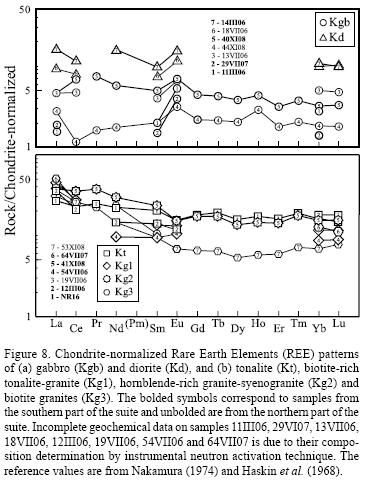
<body><![CDATA[<p align="justify"><font face="verdana" size="2"><b>Geochemistry</b></font></p>     <p align="justify"><font face="verdana" size="2">As expected, with the exception of alkalis, TiO<sub>2</sub> and P<sub>2</sub>O<sub>5</sub>, major element compositions decrease with increasing SiO2 (for example MgO; <a href="/img/revistas/rmcg/v29n1/a1f7.jpg" target="_blank">Figure 7a</a>). In contrast, (Na<sub>2</sub>O + K<sub>2</sub>O) content increases with SiO<sub>2</sub>, showing a nearly linear pattern (<a href="/img/revistas/rmcg/v29n1/a1f7.jpg" target="_blank">Figure 7b</a>). Sr also shows a marked decrease with increasing SiO<sub>2</sub> (<a href="/img/revistas/rmcg/v29n1/a1f7.jpg" target="_blank">Figure 7c</a>), whereas Ba, Zr, and LREE display an opposite behavior (for example, <a href="/img/revistas/rmcg/v29n1/a1f7.jpg" target="_blank">Figure 7d</a>). The rest of the trace elements are characterized by a lack of coherent trends in the variation diagrams.</font></p>     <p align="justify"><font face="verdana" size="2"><b><i>Mafic units</i></b></font></p>     <p align="justify"><font face="verdana" size="2">Gabbroic rocks (Kgb; 42.9&#150;47.5 wt % SiO<sub>2</sub>) have high alumina (17.2&#150;23.7 wt %) and moderate to high magnesium content (5.6&#150;11.7 wt %). Most of the samples contain nor&#150;mative olivine (1.5&#150;29.6 %) and hypersthene (0.8&#150;13.5 %) with the exception of one sample that yielded normative nepheline (0.8 &deg;%). Gabbroic rocks are characterized by low concentrations of TiO<sub>2</sub> and P<sub>2</sub>O<sub>5</sub> compared to the other units (<a href="/img/revistas/rmcg/v29n1/a1t2.jpg" target="_blank">Table 2</a>). Chondrite&#150;normalized REE abundances of the gabbroic rocks (<a href="#f8">Figure 8a</a>) have 2 to 5 times the chondrite level, display relatively flat patterns (La/Yb<sub>CN</sub> 0.5&#150;1.5), and positive&#150;Eu anomaly (Eu/Eu* 0.52). One sample has a negative Ce anomaly (gabbro 40XI08; <a href="/img/revistas/rmcg/v29n1/a1t2.jpg" target="_blank">Table 2</a>), prob&#150;ably related to oxidation and secondary mobility of Ce. As pyroxene of this sample is moderately altered to uralite, particle scavenging hydrothermal activity <i>(e.g.</i>, Hongo <i>et al.</i> , 2007) may explain this anomaly.</font></p>     <p align="center"><font face="verdana" size="2"><a name="f8"></a></font></p>     <p align="center"><font face="verdana" size="2"><img src="/img/revistas/rmcg/v29n1/a1f8.jpg"></font></p>     <p align="justify"><font face="verdana" size="2">Dioritic rocks (Kd; 49.3&#150;50.2 wt % SiO<sub>2</sub>) also have high alumina (18.2&#150;18.4 wt %), and moderate magnesium content (5.2&#150;5.8 wt %). Their CIPW norm is characterized by low olivine (0.2&#150;1.9 %) and high hypersthene content (21.9&#150;23.9 %). Chondrite&#150;normalized REE abundances of diorite (<a href="#f8">Figure 8a</a>) have 7 to 17 times the chondrite level. Our available REE data indicate a minor LREE fraction&#150;ation (La/Sm<sub>CN</sub> 1.3&#150;1.7), and suggest a positive Eu anomaly (<a href="#f8">Figure 8a</a>).</font></p>     <p align="justify"><font face="verdana" size="2">According to the Ti/V ratios of gabbro (Kgb; 7.613.3) and diorite (Kd; 16.4 &#150; 20.1), these units plot in the lower limit or within the arc field on the Shervais (1982) Ti&#150;V discrimination diagram (<a href="#f9">Figure 9</a>).</font></p>     <p align="center"><font face="verdana" size="2"><a name="f9"></a></font></p>     <p align="center"><font face="verdana" size="2"><img src="/img/revistas/rmcg/v29n1/a1f9.jpg"></font></p>     ]]></body>
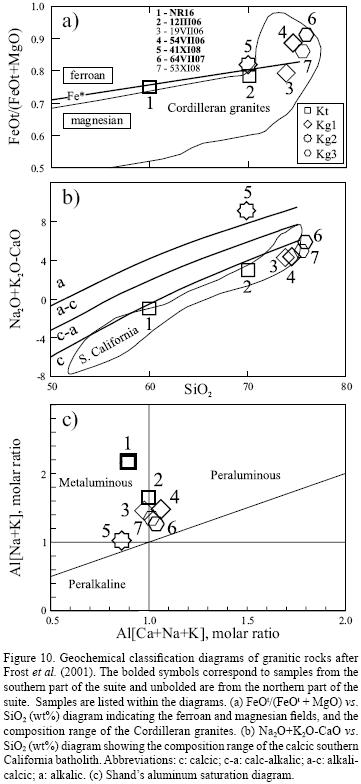
<body><![CDATA[<p align="justify"><font size="2" face="verdana"><b><i>Felsic units</i></b></font></p>     <p align="justify"><font size="2" face="verdana">According to the classification scheme for granitic rocks based in the Fe* <i>vs</i> weight per cent SiO<sub>2</sub> diagram (Fe*=FeO<sup>t</sup>/(FeO<sup>t</sup> + MgO); Frost <i>et al.</i>, 2001), tonalites of the Kt unit (samples NR16 and 12III06) and the Kg1 dike repre&#150;sented by the sample 19VII06 are magnesian. The rest of the felsic samples plot in the ferroan field. Even though, all the felsic units are inside the Cordilleran granites field (<a href="#f10">Figure 10a</a>). From the MALI diagram (modified alkali&#150;lime index; Frost <i>et al.</i>, 2001), Kt and Kg1 units plot in the calcic field, which typify the granitoids of the Cordilleran Mesozoic batholiths. The only exception is sample 41XI08 from Kg2 unit, which is alkaline granite (<a href="#f10">Figure 10b</a>). In relation to the Shand aluminum saturation index (Al / &#91;Na+K&#93; <i>vs</i> Al / &#91;Ca+Na+K&#93;; Terra Softa, Inc., 2009), both the Kt unit and the Kg1 dike 19VII06 plot within the metaluminous field. The other three samples are peraluminous, whereas granite 41XI08 is located in the border of the metaluminous and the peralkaline fields (<a href="#f10">Figure 10c</a>).</font></p>     <p align="center"><font face="verdana" size="2"><a name="f10"></a></font></p>     <p align="center"><font face="verdana" size="2"><img src="/img/revistas/rmcg/v29n1/a1f10.jpg"></font></p>     <p align="justify"><font face="verdana" size="2">Chondrite&#150;normalized REE abundances of the Kt unit samples (NR16 and 12III06 in <a href="#f8">Figure 8b</a>) have about 27 times the chondritic levels (except for La of sample 12III06). The REE pattern of sample NR16 from the massive outcrop displays only slight LREE fractionation (La/SmCN 1.3), a moderate negative Eu anomaly (Eu/Eu* &#150;0.74), and a flat HREE pattern (<a href="#f8">Figure 8b</a>). The 12III06 Kt dike shows a similar chondrite&#150;normalized REE pattern and higher LREE fractionaiton (La/Sm<sub>CN</sub> 2.6) relative to NR16. Available data also suggest a moderate negative Eu anomaly.</font></p>     <p align="justify"><font face="verdana" size="2">Chondrite&#150;normalized REE abundances of the two samples representing the Kg1 unit (12III06 and 19VII06; <a href="#f8">Figure 8b</a>) are 30 to 45 times the chondritic levels, with a moderate fractionation of LREE (La/Sm<sub>CN</sub> 2.4&#150;4.8). In turn, the sample 41XI08 (<a href="#f8">Figure 8b</a>) has about 30 times the chondritic content, slight fractionation of LREE (La/ Sm<sub>CN</sub> 1.6), slight negative Eu anomaly (Eu/Eu* &#150;0.75), and a relative flat HREE pattern (<a href="#f8">Figure 8b</a>). Finally, the Kg3 unit (samples 64VII07 and 53XI08; <a href="#f8">Figure 8b</a>) have 10 to 45 times the chondritic content, the highest silica (76.7 wt %) and the lowest magnesium content (0.2&#150;0.3 wt %). In turn, sample 53XI08 shows a highly fractionated LREE (La/Sm<sub>CN</sub> 3.9&#150;4.8). It is characterized by the absence of a Eu anomaly, a concave&#150;down shape of their HREE with the lowest value at Dy, and a positive slope in their LREE (<a href="#f8">Figure 8b</a>).</font></p>     <p align="justify"><font face="verdana" size="2">&nbsp;</font></p>     <p align="justify"><font size="2" face="verdana"><b>U&#150;Pb GEOCHRONOLOGY</b></font></p>     <p align="justify"><font size="2" face="verdana"><b>Analytical procedures</b></font></p>     <p align="justify"><font size="2" face="verdana">Zircons were separated by standard procedures at the Geology Department, CICESE. Crushed, milled, and sieved samples were processed using a Wilfley&reg; table, a Frantz&reg; isodynamic separator, and heavy liquid techniques using methylene iodide. Finally, inclusions&#150;free crystals were selected by handpicking.</font></p>     ]]></body>
<body><![CDATA[<p align="justify"><font face="verdana" size="2">Individual zircon crystals were analyzed at the Geosciences Department of the University of Arizona, Tucson, with a Micromass Isoprobe multi&#150;collector ICPMS, equipped with nine Faraday collectors, an axial Daly detector, and four ion&#150;counting channels. An ArF Excimer laser system with an emission wavelength of 193 nm is coupled to the isoprobe. The collector configuration allows measurement of <sup>204</sup>Pb with an ion&#150;counting channel whereas <sup>206</sup>Pb, <sup>207</sup>Pb, <sup>208</sup>Pb, <sup>232</sup>Th and <sup>238</sup>U are measured simultaneously with Faraday detectors. The analyses were conducted following the method described by Gehrels <i>et al.</i> (2006) in static mode with a laser beam diameter of 35 um with output energy of ~32 mJ and a repetition rate of 8 Hz. Each analysis consisted of one 20 seconds&#150;integration on peaks with no laser firing for background measurement and 12 one&#150;second integrations on peaks with laser firing. The background values are used to remove any Hg contribution to the <sup>204</sup>Pb mass. Uranium and Thorium concentrations were monitored by analyzing a standard (NIST 610 Glass) with ~500 ppm Th and U, for every sample. Inter&#150;element fractionation was monitored by analyzing zircon standard fragments from Sri Lanka (SL&#150;1) with a known concordant ID&#150;TIMS age of 564 &plusmn; 4 Ma (2o) (Gehrels <i>et al.,</i> 2008), once for every four unknown sample zircon grains.</font></p>     <p align="justify"><font face="verdana" size="2">All reported ages are based on the <sup>206</sup>Pb/<sup>238</sup>U ratios because errors of the <sup>207</sup>Pb/<sup>235</sup>U and <sup>206</sup>Pb/<sup>207</sup>Pb ratios are greater due to the low <sup>207</sup>Pb signal of young samples. The <sup>206</sup>Pb/<sup>238</sup>U ratios were corrected for common lead by using the measured <sup>204</sup>Pb assuming an initial Pb composition from Stacey and Kramers (1975) and an uncertainty of 1.0 for <sup>206</sup>Pb/<sup>204</sup>Pb.</font></p>     <p align="justify"><font face="verdana" size="2">Weighted average ages were calculated using Isoplot v. 3 (Ludwig, 2003). Systematic errors were propagated separately, and include the age of the standard, calibration correction from standard analyses, composition of common Pb, and U decay constant uncertainties. All age uncertainties are reported at the 2&#150;sigma level (2o). U&#150;Pb geochronological data are presented in <a href="/img/revistas/rmcg/v29n1/a1t3.jpg" target="_blank">Table 3</a>.</font></p>     <p align="justify"><font face="verdana" size="2"><b>Zircon U&#150;Pb results</b></font></p>     <p align="justify"><font face="verdana" size="2">We analyzed zircons from a hosting granitoid rock of the unit Jt (sample 17XII07; <a href="/img/revistas/rmcg/v29n1/a1f2.jpg" target="_blank">Figure 2</a>), a hosting volcanic breccia of the Jv unit (sample NR24), and a tonalite from the Kt massive body (sample NR16). Measurements were made at the center and tips of the zircon crystals. Zircons from all three samples are colorless, and have a well&#150;developed prism {110} and pyramid {101} forms. They also have U/ Th &lt;3 indicating a magmatic origin (Rubatto, 2002).</font></p>     <p align="justify"><font face="verdana" size="2">Zircons from the plutonic rocks (17XII07 and NR16) are dominantly prismatic (length&#150;to&#150;width ratio between 2 and 4). Separated grain sizes vary from 100 to 450 um. Thirty one zircon grains from sample 17XII07 were measured, yielding a weighted <sup>206</sup>Pb/<sup>238</sup>U age of 151.6 &plusmn; 2.6 Ma (2o, including systematic error; <a href="#f11">Figure 11a</a>). Thirty two laser spots were measured on zircons from sample NR16. They yield a weighted <sup>206</sup>Pb/<sup>238</sup>U age of 108.4 &plusmn; 2.2 Ma (2o, including systematic error; <a href="#f11">Figure 11b</a>). Zircon crystals from sample NR24 are long prismatic (l/w of 6 to12), ranging from 550 to 120 um in size. Twenty six laser spots on zircons from sample NR24 yield a weighted <sup>206</sup>Pb/<sup>238</sup>U age of 139.5 &plusmn; 2.0 Ma (2o, including systematic error; <a href="#f11">Figure 11c</a>). In one grain of the last sample an inherited zircon core with a <sup>206</sup>Pb/<sup>238</sup>U age of 152.7 &plusmn; 1.5 Ma (1o analytical uncertainty) was detected.</font></p>     <p align="center"><font face="verdana" size="2"><a name="f11"></a></font></p>     <p align="center"><font face="verdana" size="2"><img src="/img/revistas/rmcg/v29n1/a1f11.jpg"></font></p>     <p align="justify"><font face="verdana" size="2">&nbsp;</font></p>     <p align="justify"><font size="2" face="verdana"><b>DISCUSSION</b></font></p>     ]]></body>
<body><![CDATA[<p align="justify"><font size="2" face="verdana"><b>Host rocks</b></font></p>     <p align="justify"><font size="2" face="verdana">The host rocks of the Nuevo Rosarito plutonic suite are dominated by volcanic units and granitoid rocks. The granitoids have minor screens of volcanics, amphibolite and clastic sedimentary rocks. Accordingly, we assume that the Nuevo Rosarito plutonic suite was emplaced into a volcano&#150;plutonic assemblage.</font></p>     <p align="justify"><font face="verdana" size="2">In the southern part of the suite, the 151.6 &plusmn; 2.6 Ma U&#150;Pb age obtained from the granitoid Jt unit makes this plutonic sequence contemporaneous to the San Andr&eacute;s volcano&#150;plutonic complex (locality 11; <a href="/img/revistas/rmcg/v29n1/a1f1.jpg" target="_blank">Figure 1a</a>), whose U&#150;Pb zircon ages vary between 134.5 and 155.6 Ma (Kimbrough and Moore, 2003). In the northern part of the suite, the dated sample NR24 from a volcanic breccia deposit yield an U&#150;Pb zircon age of 139.5 &plusmn; 2.0 Ma, which is also contemporaneous to the San Andr&eacute;s volcano&#150;plutonic complex and to the volcanogenic deposits from the Eugenia formation. The orientations of the fabrics of all host rock units (including the screens within the gabbroic rocks) are persistent at the regional scale, except for the outcrops close to the margins of the southern part of the suite, where fabrics have a tendency to outline its circular geometry. Such tendency indicates that ductile deformation and overturning of the structures occurred before the emplacement of the gabbro.</font></p>     <p align="justify"><font face="verdana" size="2"><b>Mafic units (Kgb, Kd, Kqd)</b></font></p>     <p align="justify"><font face="verdana" size="2">The absence of olivine and the presence of orthopyrox&#150;ene in the gabbroic (Kgb) and dioritic (Kd) rocks allow us to compare the mafic units with the amphibole&#150;orthopyroxene subseries of the gabbroic rocks of the Peninsular Ranges batholith in southern California (Walawender and Smith, 1980). The Kgb rocks have alumina concentrations in the range of 17.2 to 23.7% (<a href="/img/revistas/rmcg/v29n1/a1t2.jpg" target="_blank">Table 2</a>), exceeding the normal content for sub&#150;alkaline gabbroic rocks (Cox <i>et al.,</i> 1979). Such high alumina content is a typical composition of high&#150;alumina arc basalts (17&#150;22 wt %; <i>e.g.</i>, Fournelle and Marsh, 1991), which is the dominant rock type in most island arc settings (e.g., Wilson, 1989). As observed elsewhere (Fournelle and Marsh, 1991; Tate <i>et al.,</i> 1999), positive Eu anomaly (<a href="#f8">Figure 8a</a>) is associated with the presence of the plagioclase cumulates from the southern part of the suite (<a href="/img/revistas/rmcg/v29n1/a1f4.jpg" target="_blank">Figure 4a</a>).</font></p>     <p align="justify"><font face="verdana" size="2">The Kd interfingered bodies (<a href="/img/revistas/rmcg/v29n1/a1f4.jpg" target="_blank">Figure 4d</a>) exhibit at the microscopic and hand specimen scales a clear interlock&#150;ing texture (<a href="/img/revistas/rmcg/v29n1/a1f6.jpg" target="_blank">Figure 6a</a>). According to Hibbard and Waters (1985), such texture suggests magmatic fracturing with presence of intergranular melt that, in this case, is dioritic. Non&#150;fractured fragments of gabbro included within diorite dikes support a late stage magmatic fracturing with a minor presence of intergranular dioritic melt compared with the interfingered bodies. Both the Kd interfingered bodies and Kd dikes do not have chilled margins, suggesting a small temperature contrast between the dioritic melt and the hosting gabbro. As a result, the textural variation in the Kd dikes and the fact that diorite is enclosed by the gabbro also suggest that dioritic melt was segregated from a gabbroic mush. This interpretation is supported by the following geochemical data: (a) the MgO and alkalis contents of the two diorite samples (18VII06 and 14III06) are similar to the lowest compositional values of the same oxides of the gabbroic rocks (<a href="/img/revistas/rmcg/v29n1/a1f7.jpg" target="_blank">Figures 7a and 7b</a>); (b) dioritic and gabbroic rocks have comparable REE patterns with positive Eu anomalies (<a href="#f8">Figure 8a</a>); (c) diorite has higher REE abundances and higher incompatible element concentrations <i>(e.g.</i> Ba, Y, Zr, Hf, La, Ce; <a href="/img/revistas/rmcg/v29n1/a1t2.jpg" target="_blank">Table 2</a>) than gabbro.</font></p>     <p align="justify"><font face="verdana" size="2">Decades of observations of intrusive geometries have shown that the alignment of magmatic bodies is the product of (a) melt channelizing through preexisting fabric anisotropies (e.g., Sawyer, 2001) or (b) melt migration along extensional fractures or dilatant structures generated by active stress regimes (e.g., Anderson, 1938, 1951; D'Lemos <i>et al.,</i> 1992; Brown and Solar, 1998; Barros <i>et al.,</i> 2001; Geshi, 2001). In accordance with previous studies, we favor the generation of extensional structures oriented NNE&#150;SSW in a progressively crystallizing gabbroic mass as the mechanism responsible for the dioritic emplacement because (a) it is unexpected for a progressively crystallizing magmatic body to hold any preexisting anisotropy; (b) the Kd interfingered bodies and Kd dikes have a persistent orientation within the gabbro (<a href="/img/revistas/rmcg/v29n1/a1f3.jpg" target="_blank">Figure 3d</a>); (c) the vertical geometry of the dioritic bodies suggest a vertical direction of the maximum main stress; and (d) the lack of field evidence for any transpressional or transtensional deformation to produce dilatant structures (e.g., en&#150;echelon structures, structures with systematic orientation variation, etc.) during the diorite emplacement.</font></p>     <p align="justify"><font face="verdana" size="2">This proposal may be regionally reconciled with the numerous mafic dikes oriented NNE&#150;SSW reported by Busby <i>et al.</i> (2006) near El Rosario (<a href="/img/revistas/rmcg/v29n1/a1f1.jpg" target="_blank">Figure 1a</a>; locality 6), which were interpreted by these authors from field observations and U&#150;Pb in zircon data as syn&#150;volcanic faults generated under an extensional regime at <i>ca.</i> 111 Ma.</font></p>     <p align="justify"><font face="verdana" size="2"><b>Felsic units (Kt, Kg1, Kg2 and Kg3)</b></font></p>     <p align="justify"><font face="verdana" size="2">The geochemistry of the felsic units of the Nuevo Rosarito plutonic suite (<a href="#f10">Figures 10a and 10b</a>) is consistent with the composition of the Cordilleran batholiths reported by Frost <i>et al.</i> (2001), except for the Kg2 dike, which shows anomalously high alkalis (sample 41XI08; <a href="#f10">Figure 10b</a>). Nevertheless, chondrite&#150;normalized REE patterns of this sample, as well as those of the rest of the felsic units, are consistent with those reported by Gromet and Silver (1987) for the western zone of the Peninsular Ranges batholith. Also, the Sr content, and the Sm/Dy and Sr/Y ratios of all the felsic units can be compared with those reported by Gromet and Silver (1987) and Tulloch and Kimbrough (2003) for the western zone batholith.</font></p>     ]]></body>
<body><![CDATA[<p align="justify"><font face="verdana" size="2">The REE pattern of the Kg3 unit is distinct from the rest of the felsic units, specifically the concave shape pattern of their HREE which is indicative of hornblende fraction&#150;ation (Gromet and Silver, 1987; Bea, 1996).</font></p>     <p align="justify"><font face="verdana" size="2"><b><i>Syn&#150;emplacement deformation</i></b></font></p>     <p align="justify"><font face="verdana" size="2">The conspicuous intense solid&#150;state fabrics exhibited by the Kt dikes and the Kg1 and Kg2 bodies at the mesoscale (<a href="/img/revistas/rmcg/v29n1/a1f4.jpg" target="_blank">Figures 4e</a>), and the ductile deformation that the gabbro usually shows in the vicinity of the felsic dikes (<a href="/img/revistas/rmcg/v29n1/a1f4.jpg" target="_blank">Figures 4h and 4i</a>), strongly suggest that the ductile deformation in these units was simultaneous to their emplacement. Evidence of syn&#150;emplacement deformation is also found at the microscale through the submagmatic fractures (Bouchez <i>et al.,</i> 1992; Park and Means, 1996) observed within the feldspar grains of many Kt and Kg1 unit samples, as well as the fusion contact microstructure observed in feldspars. Other evidences are the common high&#150;temperature and solid&#150;state microstructures (Vernon, 2000) observed as chessboard extinction in quartz (Mainprice <i>et al.,</i> 1986), flame perthites in potassic feldspar (Vernon, 1999), and boudinage in hornblende (Hacker and Christie, 1990).</font></p>     <p align="justify"><font face="verdana" size="2">These mesoscale and microscale observations imply that the Kt dikes and the Kg1 and Kg2 units experienced a transition from magmatic, melt&#150;supported flow to solid&#150;state, grain&#150;supported flow prior to their complete crystallization (submagmatic flow; Paterson <i>et al.,</i> 1998; Vernon, 2004). Such submagmatic flow, in addition to their persistent NW&#150;SE orientation and NE&#150;SW&#150;directed lineation (<a href="/img/revistas/rmcg/v29n1/a1f3.jpg" target="_blank">Figures 3g and 3i</a>), further suggests that those felsic units were more or less coeval, and linked together under a single deformational event.</font></p>     <p align="justify"><font face="verdana" size="2">Field observations indicate that the generation of the felsic units started with the emplacement of the Kt unit. In contrast to the Kt dikes which display intense internal fabrics, the Kt massive body exhibits clear magmatic fabrics in the mesoscale (<a href="/img/revistas/rmcg/v29n1/a1f4.jpg" target="_blank">Figures 4b and 4c</a>) and different structural patterns (compare <a href="/img/revistas/rmcg/v29n1/a1f3.jpg" target="_blank">Figure 3e</a> with <a href="/img/revistas/rmcg/v29n1/a1f3.jpg" target="_blank">Figures 3f and 3h</a>). Thus, because deformation is particularly well recorded in the Kt dikes, and in the Kg1 and Kg2 bodies as well, we propose that the emplacement of the 108.4 &plusmn; 2.2 Ma old Kt massive body marks the beginning of increasing strain rates, and therefore the initiation of the NE&#150;side up deformational event.</font></p>     <p align="justify"><font face="verdana" size="2">The time interval and shear sense of the deformational event reported here is comparable to the intense ductile deformation that, according to Johnson <i>et al.</i> (1999) and Alsleben <i>et al.</i> (2008), mainly occurred between <i>ca.</i> 115 and 108 Ma in Sierra San Pedro M&aacute;rtir (<a href="/img/revistas/rmcg/v29n1/a1f1.jpg" target="_blank">Figure 1a</a>; locality SSPM), and between <i>ca.</i> 115 and 95 Ma in Calamaju&eacute; (<a href="/img/revistas/rmcg/v29n1/a1f1.jpg" target="_blank">Figure 1a</a>; locality 5), respectively.</font></p>     <p align="justify"><font face="verdana" size="2">The emplacement of the Kg3 dikes was the last intrusive event. These dikes have distinct orientations relative to the Kt dikes and the Kg1 and Kg2 bodies (compare <a href="/img/revistas/rmcg/v29n1/a1f3.jpg" target="_blank">Figure 3j</a> with <a href="/img/revistas/rmcg/v29n1/a1f3.jpg" target="_blank">Figures 3f </a>and 3h), distinct REE patterns (<a href="#f8">Figure 8b</a>), and less intense solid&#150;state microstructures relative to the Kg1 unit. These observations suggest that the emplacement of the Kg3 unit may coincide with the decrease of the strain rates and/or the presence of a different stress regime.</font></p>     <p align="justify"><font face="verdana" size="2">&nbsp;</font></p>     <p align="justify"><font size="2" face="verdana"><b>SUMMARY AND CONCLUSIONS</b></font></p>     <p align="justify"><font size="2" face="verdana">The 139.5 &plusmn; 2.0 Ma U&#150;Pb zircon age of the hosting volcanic breccia from the northern part of the suite is contemporaneous with the lower member of the Eugenia Formation located in the Vizca&iacute;no pen&iacute;nsula and the flysh&#150;like assemblages of the PRB transitional zone. In turn, the 151.6 &plusmn; 2.6 Ma old granitoid (Jt unit) located in the southern part of the suite is coeval with the San Andr&eacute;s&#150;Cedros volcano&#150;plutonic. However, north of Punta Prieta (<a href="/img/revistas/rmcg/v29n1/a1f1.jpg" target="_blank">Figure 1b</a>), plutonic rocks of the PRB intrude the Cretaceous Alisitos Formation, which indicates that the Nuevo Rosarito plutonic suite is located near a boundary between the Cretaceous arc, represented by the Alisitos Formation, and a Jurassic arc, represented by a volcano&#150;plutonic sequence that is contemporaneous to the San Andr&eacute;s complex in the Vizca&iacute;no peninsula.</font></p>     ]]></body>
<body><![CDATA[<p align="justify"><font face="verdana" size="2">Field relationships and structural analyses suggest that the deformational event responsible for the overturning of the host rocks and their intense internal fabrics occurred prior to the Cretaceous emplacement of the Nuevo Rosarito plutonic suite.</font></p>     <p align="justify"><font face="verdana" size="2">Nuevo Rosarito has geochemical characteristics similar to the western zone of the Peninsular Ranges batholith. Their intrusive units have a wide compositional range and a emplacement history that is separated into two phases. The first phase is defined by the emplacement of the mafic units, particularly, to the late crystallization of the gabbro and its fracturation under an extensional stress regime.</font></p>     <p align="justify"><font face="verdana" size="2">We propose that this promoted a local pressure contrast that drew the gabbroic residual melt to produce the NNE&#150;oriented diorite bodies. The second phase is defined by the emplacement of the felsic units, particularly when a NE&#150;side up deformational event occurred just after the emplacement of the 108.4 Ma old Kt massive body. This event was mainly recorded by the Kt dikes and the Kg1 and Kg2 bodies. The emplacement of the Kg3 dikes would indicate the end of the deformational event.</font></p>     <p align="justify"><font face="verdana" size="2">&nbsp;</font></p>     <p align="justify"><font size="2" face="verdana"><b>ACKNOWLEDGEMENTS</b></font></p>     <p align="justify"><font size="2" face="verdana">This paper was benefited from several discussions with colleagues at CICESE, including J. Fletcher, F. Su&aacute;rez, A. Mart&iacute;n&#150;Barajas, and O. Ter&aacute;n. We thank P. Montecinos, J. Estrada, G. Villalobos, and J. Contreras for comments on an early draft of the paper, Gabriel Rend&oacute;n, V&iacute;ctor P&eacute;rez, Susana Rosas, and Luis Gradilla for their technical support, and Emmanuelle Frery, Doris Pi&ntilde;eiro, Rom&aacute;n Manjarrez, Porfirio Avilez and Patricia Ju&aacute;rez for joining us during fieldwork. Also thanks to Joaquin Ruiz and George Gehrels for allowing us the use of the LA&#150;ICP&#150;MS facilities at the Department of Geosciences, University of Arizona at Tucson, and to Felipe Escalona for his help during the LA&#150;ICPMS measurements. Financial support was mostly provided by the project CONACyT 45817 granted to Luis Delgado, and by PAICYT&#150;UANL CT131&#150;09 granted to Fernando Velasco.</font></p>     <p align="justify"><font face="verdana" size="2">&nbsp;</font></p>     <p align="justify"><font size="2" face="verdana"><b>REFERENCES</b></font></p>     <!-- ref --><p align="justify"><font size="2" face="verdana">Alsleben, H., Wetmore, P.H., Schmidt, K.L., Paterson, S.R., Melis, E.A., 2008, Complex deformation during arc continent collision: Quantifying finite strain in the accreted Alisitos arc, Peninsular Ranges batholith, Baja California: Journal of Structural Geology, 30, 220&#150;236.    &nbsp;&nbsp;&nbsp;&nbsp;&nbsp;&nbsp;&nbsp;&nbsp;[&#160;<a href="javascript:void(0);" onclick="javascript: window.open('/scielo.php?script=sci_nlinks&ref=8067432&pid=S1026-8774201200010000100001&lng=','','width=640,height=500,resizable=yes,scrollbars=1,menubar=yes,');">Links</a>&#160;]<!-- end-ref --></font></p>     ]]></body>
<body><![CDATA[<!-- ref --><p align="justify"><font face="verdana" size="2">Anderson, E.M., 1938, The dynamics of sheet intrusion: Proceedings of the Royal Society of Edinburgh, 58, 242&#150;251.    &nbsp;&nbsp;&nbsp;&nbsp;&nbsp;&nbsp;&nbsp;&nbsp;[&#160;<a href="javascript:void(0);" onclick="javascript: window.open('/scielo.php?script=sci_nlinks&ref=8067434&pid=S1026-8774201200010000100002&lng=','','width=640,height=500,resizable=yes,scrollbars=1,menubar=yes,');">Links</a>&#160;]<!-- end-ref --></font></p>     <!-- ref --><p align="justify"><font face="verdana" size="2">Anderson, E.M., 1951, The dynamics of faulting: Edinburgh, Oliver and Boyd, 206 pp.    &nbsp;&nbsp;&nbsp;&nbsp;&nbsp;&nbsp;&nbsp;&nbsp;[&#160;<a href="javascript:void(0);" onclick="javascript: window.open('/scielo.php?script=sci_nlinks&ref=8067436&pid=S1026-8774201200010000100003&lng=','','width=640,height=500,resizable=yes,scrollbars=1,menubar=yes,');">Links</a>&#160;]<!-- end-ref --></font></p>     <!-- ref --><p align="justify"><font face="verdana" size="2">Barnes, D.A., 1984, Volcanic arc derived, Mesozoic sedimentary rocks, Vizcaino Peninsula, Baja California Sur, Mexico, <i>in</i> V.A. Frizzell (ed.), Geology of the Baja California Peninsula: Society of Economic Paleontologists and Mineralogists, Pacific Section, 39, 119&#150;130.    &nbsp;&nbsp;&nbsp;&nbsp;&nbsp;&nbsp;&nbsp;&nbsp;[&#160;<a href="javascript:void(0);" onclick="javascript: window.open('/scielo.php?script=sci_nlinks&ref=8067438&pid=S1026-8774201200010000100004&lng=','','width=640,height=500,resizable=yes,scrollbars=1,menubar=yes,');">Links</a>&#160;]<!-- end-ref --></font></p>     <!-- ref --><p align="justify"><font face="verdana" size="2">Barros, C.E.M., Barbey, P., Boullier, A.M., 2001, Role of magma pressure, tectonic stress and crystallization progress in the emplacement of the syntectonic A&#150;type Estrela Granite Complex (Caraj&aacute;s Mineral Province, Brazil): Tectonophysics, 343, 93&#150;109.    &nbsp;&nbsp;&nbsp;&nbsp;&nbsp;&nbsp;&nbsp;&nbsp;[&#160;<a href="javascript:void(0);" onclick="javascript: window.open('/scielo.php?script=sci_nlinks&ref=8067440&pid=S1026-8774201200010000100005&lng=','','width=640,height=500,resizable=yes,scrollbars=1,menubar=yes,');">Links</a>&#160;]<!-- end-ref --></font></p>     <!-- ref --><p align="justify"><font face="verdana" size="2">Bea, F., 1996, Residence of REE, Y, Th and U in Granites and Crustal Protoliths; Implications for the Chemistry of Crustal Melts: Journal of Petrology, 37, 521&#150;552.    &nbsp;&nbsp;&nbsp;&nbsp;&nbsp;&nbsp;&nbsp;&nbsp;[&#160;<a href="javascript:void(0);" onclick="javascript: window.open('/scielo.php?script=sci_nlinks&ref=8067442&pid=S1026-8774201200010000100006&lng=','','width=640,height=500,resizable=yes,scrollbars=1,menubar=yes,');">Links</a>&#160;]<!-- end-ref --></font></p>     ]]></body>
<body><![CDATA[<!-- ref --><p align="justify"><font face="verdana" size="2">Beggs, J.M., 1984, Volcaniclastic rocks of the Alisitos Group, Baja California, Mexico, <i>in</i> Frizzell Jr., V.A. (ed.), Geology of the Baja California Peninsula: Society of Economic Paleontologists and Mineralogists, Pacific Section, Field Trip Guidebook, book 39, 1&#150;7.    &nbsp;&nbsp;&nbsp;&nbsp;&nbsp;&nbsp;&nbsp;&nbsp;[&#160;<a href="javascript:void(0);" onclick="javascript: window.open('/scielo.php?script=sci_nlinks&ref=8067444&pid=S1026-8774201200010000100007&lng=','','width=640,height=500,resizable=yes,scrollbars=1,menubar=yes,');">Links</a>&#160;]<!-- end-ref --></font></p>     <!-- ref --><p align="justify"><font face="verdana" size="2">Bouchez, J.L., Delas, C., Gleizes, G., N&eacute;d&eacute;lec, A., Cuney, M., 1992, Submagmatic microfractures in granites: Geology, 20, 35&#150;38.    &nbsp;&nbsp;&nbsp;&nbsp;&nbsp;&nbsp;&nbsp;&nbsp;[&#160;<a href="javascript:void(0);" onclick="javascript: window.open('/scielo.php?script=sci_nlinks&ref=8067446&pid=S1026-8774201200010000100008&lng=','','width=640,height=500,resizable=yes,scrollbars=1,menubar=yes,');">Links</a>&#160;]<!-- end-ref --></font></p>     <!-- ref --><p align="justify"><font face="verdana" size="2">Boullier, A.M., Bouchez, J.L., 1978, Le quartz en rubans dans les mylonites: Bulletin de la Soci&eacute;t&eacute; Geologique de France, 7(XX), 253&#150;262.    &nbsp;&nbsp;&nbsp;&nbsp;&nbsp;&nbsp;&nbsp;&nbsp;[&#160;<a href="javascript:void(0);" onclick="javascript: window.open('/scielo.php?script=sci_nlinks&ref=8067448&pid=S1026-8774201200010000100009&lng=','','width=640,height=500,resizable=yes,scrollbars=1,menubar=yes,');">Links</a>&#160;]<!-- end-ref --></font></p>     <!-- ref --><p align="justify"><font face="verdana" size="2">Brown, M., Solar, G.S., 1998, Granite ascent and emplacement during contractional deformation in convergent orogens: Journal of Structural Geology, 20(9/10), 1365&#150;1393.    &nbsp;&nbsp;&nbsp;&nbsp;&nbsp;&nbsp;&nbsp;&nbsp;[&#160;<a href="javascript:void(0);" onclick="javascript: window.open('/scielo.php?script=sci_nlinks&ref=8067450&pid=S1026-8774201200010000100010&lng=','','width=640,height=500,resizable=yes,scrollbars=1,menubar=yes,');">Links</a>&#160;]<!-- end-ref --></font></p>     <!-- ref --><p align="justify"><font face="verdana" size="2">Busby, C.J., Fackler A.B., Mattinson, J., De Oreo, S., 2006, View of an intact oceanic arc, from surficial to mesozonal levels: Cretaceous Alisitos Arc, Baja California, Mexico: Journal of Volcanology and Geothermal Research, 149, 1&#150;46.    &nbsp;&nbsp;&nbsp;&nbsp;&nbsp;&nbsp;&nbsp;&nbsp;[&#160;<a href="javascript:void(0);" onclick="javascript: window.open('/scielo.php?script=sci_nlinks&ref=8067452&pid=S1026-8774201200010000100011&lng=','','width=640,height=500,resizable=yes,scrollbars=1,menubar=yes,');">Links</a>&#160;]<!-- end-ref --></font></p>     ]]></body>
<body><![CDATA[<!-- ref --><p align="justify"><font face="verdana" size="2">Camarena&#150;Garc&iacute;a, M.A., 2006, An&aacute;lisis morfol&oacute;gico y estructural de los complejos plut&oacute;nicos de Baja California Central a trav&eacute;s de las t&eacute;cnicas de percepci&oacute;n remota: Ensenada, M&eacute;xico, Centro de Investigaci&oacute;n Cient&iacute;fica y de Estudios Superiores de Ensenada (CICESE), tesis de maestr&iacute;a, 112 pp.    &nbsp;&nbsp;&nbsp;&nbsp;&nbsp;&nbsp;&nbsp;&nbsp;[&#160;<a href="javascript:void(0);" onclick="javascript: window.open('/scielo.php?script=sci_nlinks&ref=8067454&pid=S1026-8774201200010000100012&lng=','','width=640,height=500,resizable=yes,scrollbars=1,menubar=yes,');">Links</a>&#160;]<!-- end-ref --></font></p>     <!-- ref --><p align="justify"><font face="verdana" size="2">Coleman, D.S., Gray, W., Glazner, A.F., 2004, Rethinking the emplacement and evolution of zoned plutons: Geochronologic evidence for incremental assembly of the Tuolumne Intrusive Suite, California: Geology, 32, 433&#150;436.    &nbsp;&nbsp;&nbsp;&nbsp;&nbsp;&nbsp;&nbsp;&nbsp;[&#160;<a href="javascript:void(0);" onclick="javascript: window.open('/scielo.php?script=sci_nlinks&ref=8067456&pid=S1026-8774201200010000100013&lng=','','width=640,height=500,resizable=yes,scrollbars=1,menubar=yes,');">Links</a>&#160;]<!-- end-ref --></font></p>     <!-- ref --><p align="justify"><font face="verdana" size="2">Comisi&oacute;n de Estudios del Territorio Nacional (CETENAL), 1977, Mapa geol&oacute;gico Rosarito H11D69, escala 1:50000: M&eacute;xico, D.F., Instituto Nacional de Estad&iacute;stica, Geograf&iacute;a e Inform&aacute;tica (INEGI), 1 mapa.    &nbsp;&nbsp;&nbsp;&nbsp;&nbsp;&nbsp;&nbsp;&nbsp;[&#160;<a href="javascript:void(0);" onclick="javascript: window.open('/scielo.php?script=sci_nlinks&ref=8067458&pid=S1026-8774201200010000100014&lng=','','width=640,height=500,resizable=yes,scrollbars=1,menubar=yes,');">Links</a>&#160;]<!-- end-ref --></font></p>     <!-- ref --><p align="justify"><font face="verdana" size="2">Cox, K.G., Bell, J.D., Pankhurst, R.J., 1979, The Interpretation of Igneous Rocks, George Allen and Unwin, 450 pp.    &nbsp;&nbsp;&nbsp;&nbsp;&nbsp;&nbsp;&nbsp;&nbsp;[&#160;<a href="javascript:void(0);" onclick="javascript: window.open('/scielo.php?script=sci_nlinks&ref=8067460&pid=S1026-8774201200010000100015&lng=','','width=640,height=500,resizable=yes,scrollbars=1,menubar=yes,');">Links</a>&#160;]<!-- end-ref --></font></p>     <!-- ref --><p align="justify"><font face="verdana" size="2">Delgado&#150;Argote, L.A., 2000, Evoluci&oacute;n Tect&oacute;nica y Magmatismo Ne&oacute;geno de la Margen Oriental de Baja California Central: M&eacute;xico, D.F., Universidad Nacional Aut&oacute;noma de M&eacute;xico (UNAM), tesis doctoral, 194 pp.    &nbsp;&nbsp;&nbsp;&nbsp;&nbsp;&nbsp;&nbsp;&nbsp;[&#160;<a href="javascript:void(0);" onclick="javascript: window.open('/scielo.php?script=sci_nlinks&ref=8067462&pid=S1026-8774201200010000100016&lng=','','width=640,height=500,resizable=yes,scrollbars=1,menubar=yes,');">Links</a>&#160;]<!-- end-ref --></font></p>     ]]></body>
<body><![CDATA[<!-- ref --><p align="justify"><font face="verdana" size="2">DePaolo, D.J., 1981, A Neodymium and Strontium Isotopic Study of the Mesozoic Calc&#150;Alkaline Granitic Batholiths of the Sierra Nevada and Peninsular Ranges, California: Journal of Geophysical Research, 86, 10470&#150;10488.    &nbsp;&nbsp;&nbsp;&nbsp;&nbsp;&nbsp;&nbsp;&nbsp;[&#160;<a href="javascript:void(0);" onclick="javascript: window.open('/scielo.php?script=sci_nlinks&ref=8067464&pid=S1026-8774201200010000100017&lng=','','width=640,height=500,resizable=yes,scrollbars=1,menubar=yes,');">Links</a>&#160;]<!-- end-ref --></font></p>     <!-- ref --><p align="justify"><font face="verdana" size="2">D'Lemos, R.S., Brown, M., Strachan, R.A., 1992, Granite magma generation, ascent and emplacement within a transpressional orogen: Journal of Geological Society, 149, 487&#150;490.    &nbsp;&nbsp;&nbsp;&nbsp;&nbsp;&nbsp;&nbsp;&nbsp;[&#160;<a href="javascript:void(0);" onclick="javascript: window.open('/scielo.php?script=sci_nlinks&ref=8067466&pid=S1026-8774201200010000100018&lng=','','width=640,height=500,resizable=yes,scrollbars=1,menubar=yes,');">Links</a>&#160;]<!-- end-ref --></font></p>     <!-- ref --><p align="justify"><font face="verdana" size="2">Fournelle, J., Marsh, B.D., 1991, Shishaldin Volcano: Aleutian high&#150;alumina basalts and the question of plagioclase accumulation: Geology, 19, 234&#150;237.    &nbsp;&nbsp;&nbsp;&nbsp;&nbsp;&nbsp;&nbsp;&nbsp;[&#160;<a href="javascript:void(0);" onclick="javascript: window.open('/scielo.php?script=sci_nlinks&ref=8067468&pid=S1026-8774201200010000100019&lng=','','width=640,height=500,resizable=yes,scrollbars=1,menubar=yes,');">Links</a>&#160;]<!-- end-ref --></font></p>     <!-- ref --><p align="justify"><font face="verdana" size="2">Frost, B.R., Barnes, C.G., Collins, W.J., Arculus, R.J., Ellis, D.J., Frost, C.D., 2001, A geochemical classification for granitic rocks: Journal of Petrology, 42, 2033&#150;2048.    &nbsp;&nbsp;&nbsp;&nbsp;&nbsp;&nbsp;&nbsp;&nbsp;[&#160;<a href="javascript:void(0);" onclick="javascript: window.open('/scielo.php?script=sci_nlinks&ref=8067470&pid=S1026-8774201200010000100020&lng=','','width=640,height=500,resizable=yes,scrollbars=1,menubar=yes,');">Links</a>&#160;]<!-- end-ref --></font></p>     <!-- ref --><p align="justify"><font face="verdana" size="2">Gastil, R.G., 1993, Prebatholithic history of peninsular California, <i>in</i> Gastil, R.G., and Miller, R.H. (eds.), The prebatholithic stratigraphy of peninsular California: Boulder, Colorado, Geological Society of America Special Paper 279, 145&#150;156.    &nbsp;&nbsp;&nbsp;&nbsp;&nbsp;&nbsp;&nbsp;&nbsp;[&#160;<a href="javascript:void(0);" onclick="javascript: window.open('/scielo.php?script=sci_nlinks&ref=8067472&pid=S1026-8774201200010000100021&lng=','','width=640,height=500,resizable=yes,scrollbars=1,menubar=yes,');">Links</a>&#160;]<!-- end-ref --></font></p>     ]]></body>
<body><![CDATA[<!-- ref --><p align="justify"><font face="verdana" size="2">Gastil, R.G., Miller, R.H., 1984, Prebatholithic paleogeography of peninsular California and adjacent Mexico, <i>in</i> Frizzel, V.A. (ed.), Geology of the Baja California peninsula: Society of Economic Paleontologists and Mineralogists, Pacific Section, 9&#150;16.    &nbsp;&nbsp;&nbsp;&nbsp;&nbsp;&nbsp;&nbsp;&nbsp;[&#160;<a href="javascript:void(0);" onclick="javascript: window.open('/scielo.php?script=sci_nlinks&ref=8067474&pid=S1026-8774201200010000100022&lng=','','width=640,height=500,resizable=yes,scrollbars=1,menubar=yes,');">Links</a>&#160;]<!-- end-ref --></font></p>     <!-- ref --><p align="justify"><font face="verdana" size="2">Gastil, R.G., Phillips, R.P., Allison, E.C., 1975, Reconnaissance geology of the State of Baja California: Geological Society of America Memoir 140, 170.    &nbsp;&nbsp;&nbsp;&nbsp;&nbsp;&nbsp;&nbsp;&nbsp;[&#160;<a href="javascript:void(0);" onclick="javascript: window.open('/scielo.php?script=sci_nlinks&ref=8067476&pid=S1026-8774201200010000100023&lng=','','width=640,height=500,resizable=yes,scrollbars=1,menubar=yes,');">Links</a>&#160;]<!-- end-ref --></font></p>     <!-- ref --><p align="justify"><font face="verdana" size="2">Gastil, R.G., Diamond, C.K., Walawender, M.J., Marshal, M., Boyles, C., Chadwick, B., 1990, The problem of the magnetite/ilmenite boundary in southern and Baja California, <i>in</i> Anderson, J.L. (ed.), The Nature and Origin of Cordilleran Magmatism: Boulder, Colorado, Geological Society of America Memoir 174, 19&#150;32.    &nbsp;&nbsp;&nbsp;&nbsp;&nbsp;&nbsp;&nbsp;&nbsp;[&#160;<a href="javascript:void(0);" onclick="javascript: window.open('/scielo.php?script=sci_nlinks&ref=8067478&pid=S1026-8774201200010000100024&lng=','','width=640,height=500,resizable=yes,scrollbars=1,menubar=yes,');">Links</a>&#160;]<!-- end-ref --></font></p>     <!-- ref --><p align="justify"><font face="verdana" size="2">Gastil, R.G., Kimbrough, J., Shimizu, M., Tainosho, Y., 1994, Origin of the magnetite boundary in the Peninsular Ranges batholith, Southern California, U.S.A., and Baja California, M&eacute;xico: Revista Mexicana de Ciencias Geol&oacute;gicas, 11(2), 157&#150;167.    &nbsp;&nbsp;&nbsp;&nbsp;&nbsp;&nbsp;&nbsp;&nbsp;[&#160;<a href="javascript:void(0);" onclick="javascript: window.open('/scielo.php?script=sci_nlinks&ref=8067480&pid=S1026-8774201200010000100025&lng=','','width=640,height=500,resizable=yes,scrollbars=1,menubar=yes,');">Links</a>&#160;]<!-- end-ref --></font></p>     <!-- ref --><p align="justify"><font face="verdana" size="2">Gehrels, G., Valencia, V., Pullen, A., 2006, Detrital Zircon Geochronology by Laser Ablation Multicollector ICPMS at the Arizona LaserChron Center, <i>in</i> Olszewski, T. (ed.), Geochronology: Emerging Opportunities: Paleontology Society Papers, 12, 67&#150;76.    &nbsp;&nbsp;&nbsp;&nbsp;&nbsp;&nbsp;&nbsp;&nbsp;[&#160;<a href="javascript:void(0);" onclick="javascript: window.open('/scielo.php?script=sci_nlinks&ref=8067482&pid=S1026-8774201200010000100026&lng=','','width=640,height=500,resizable=yes,scrollbars=1,menubar=yes,');">Links</a>&#160;]<!-- end-ref --></font></p>     ]]></body>
<body><![CDATA[<!-- ref --><p align="justify"><font face="verdana" size="2">Gehrels, G., Valencia, V., Ruiz, J., 2008, Enhanced precision, accuracy, efficiency, and spatial resolution of U&#150;Pb ages by laser ablation&#150;multicollector&#150;inductively coupled plasma&#150;mass spectrometry: Geochemistry Geophysics Geosystems, 9, Q03017.    &nbsp;&nbsp;&nbsp;&nbsp;&nbsp;&nbsp;&nbsp;&nbsp;[&#160;<a href="javascript:void(0);" onclick="javascript: window.open('/scielo.php?script=sci_nlinks&ref=8067484&pid=S1026-8774201200010000100027&lng=','','width=640,height=500,resizable=yes,scrollbars=1,menubar=yes,');">Links</a>&#160;]<!-- end-ref --></font></p>     <!-- ref --><p align="justify"><font face="verdana" size="2">Geshi, N., 2001, Melt segregation by localized shear deformation and fracturing during crystallization of magma in shallow intrusions of the Otoge volcanic complex, central Japan: Journal of Volcanology and Geothermal Research, 106, 285&#150;300.    &nbsp;&nbsp;&nbsp;&nbsp;&nbsp;&nbsp;&nbsp;&nbsp;[&#160;<a href="javascript:void(0);" onclick="javascript: window.open('/scielo.php?script=sci_nlinks&ref=8067486&pid=S1026-8774201200010000100028&lng=','','width=640,height=500,resizable=yes,scrollbars=1,menubar=yes,');">Links</a>&#160;]<!-- end-ref --></font></p>     <!-- ref --><p align="justify"><font face="verdana" size="2">Gromet, L.P., Silver, L.T., 1987, REE variations across the Peninsular Ranges batholith: Implications for batholithic petrogenesis and crustal growth in magmatic arcs: Journal of Petrology, 28, 77&#150;125.    &nbsp;&nbsp;&nbsp;&nbsp;&nbsp;&nbsp;&nbsp;&nbsp;[&#160;<a href="javascript:void(0);" onclick="javascript: window.open('/scielo.php?script=sci_nlinks&ref=8067488&pid=S1026-8774201200010000100029&lng=','','width=640,height=500,resizable=yes,scrollbars=1,menubar=yes,');">Links</a>&#160;]<!-- end-ref --></font></p>     <!-- ref --><p align="justify"><font face="verdana" size="2">Hacker, B.R., Christie, J.M., 1990, Brittle/ductile and plastic/cataclastic transitions in experimentally deformed and metamorphosed amphibolites: American Geophysical Union Monograph 56, 127&#150;147.    &nbsp;&nbsp;&nbsp;&nbsp;&nbsp;&nbsp;&nbsp;&nbsp;[&#160;<a href="javascript:void(0);" onclick="javascript: window.open('/scielo.php?script=sci_nlinks&ref=8067490&pid=S1026-8774201200010000100030&lng=','','width=640,height=500,resizable=yes,scrollbars=1,menubar=yes,');">Links</a>&#160;]<!-- end-ref --></font></p>     <!-- ref --><p align="justify"><font face="verdana" size="2">Haskin, L., Haskin, M., Frey, F., Wildeman, T., 1968, Relative and absolute terrestrial abundances of the rare earths, <i>in</i> Ahrens L. (ed.), Origin and Distribution of the Elements: Oxford, Pergamon Press, 889&#150;912.    &nbsp;&nbsp;&nbsp;&nbsp;&nbsp;&nbsp;&nbsp;&nbsp;[&#160;<a href="javascript:void(0);" onclick="javascript: window.open('/scielo.php?script=sci_nlinks&ref=8067492&pid=S1026-8774201200010000100031&lng=','','width=640,height=500,resizable=yes,scrollbars=1,menubar=yes,');">Links</a>&#160;]<!-- end-ref --></font></p>     ]]></body>
<body><![CDATA[<!-- ref --><p align="justify"><font face="verdana" size="2">Hibbard, M.J., Waters, R.J., 1985, Fracturing and diking in incompletely crystallized granitic plutons: Lithos, 18, 1&#150;12.    &nbsp;&nbsp;&nbsp;&nbsp;&nbsp;&nbsp;&nbsp;&nbsp;[&#160;<a href="javascript:void(0);" onclick="javascript: window.open('/scielo.php?script=sci_nlinks&ref=8067494&pid=S1026-8774201200010000100032&lng=','','width=640,height=500,resizable=yes,scrollbars=1,menubar=yes,');">Links</a>&#160;]<!-- end-ref --></font></p>     <!-- ref --><p align="justify"><font face="verdana" size="2">Hickey, J., 1984, Stratigraphy and composition of a Jura&#150;Cretaceous volcanic arc apron, Punta Eugenia, Baja California Sur, Mexico, <i>in</i> Frizzell, V.A.,Jr., (ed.), Geology of the Baja California peninsula: Field Trip Guidebook&#150;Pacific Section: Society of Economic Paleontologists and Mineralogists, Pacific Section, 39, 149&#150;160.    &nbsp;&nbsp;&nbsp;&nbsp;&nbsp;&nbsp;&nbsp;&nbsp;[&#160;<a href="javascript:void(0);" onclick="javascript: window.open('/scielo.php?script=sci_nlinks&ref=8067496&pid=S1026-8774201200010000100033&lng=','','width=640,height=500,resizable=yes,scrollbars=1,menubar=yes,');">Links</a>&#160;]<!-- end-ref --></font></p>     <!-- ref --><p align="justify"><font face="verdana" size="2">Hongo, Y., Obata, H., Gamo, T., Nakaseama, M., Ishibashi, J., Konno, U., Saegusa, S., Ohkubo, S., Tsunogai, U., 2007. Rare Earth Elements in the hydrothermal system at Okinawa Trough back&#150;arc basin: Geochemical Journal, 41, 1&#150;15.    &nbsp;&nbsp;&nbsp;&nbsp;&nbsp;&nbsp;&nbsp;&nbsp;[&#160;<a href="javascript:void(0);" onclick="javascript: window.open('/scielo.php?script=sci_nlinks&ref=8067498&pid=S1026-8774201200010000100034&lng=','','width=640,height=500,resizable=yes,scrollbars=1,menubar=yes,');">Links</a>&#160;]<!-- end-ref --></font></p>     <!-- ref --><p align="justify"><font face="verdana" size="2">Johnson, S.E., Tate, M.C., Fanning, C.M., 1999, New geological and SHRIMP U&#150;Pb zircon data in the Peninsular Ranges batholith, Baja California, M&eacute;xico: Evidence for a suture?: Geology, 27, 743&#150;746.    &nbsp;&nbsp;&nbsp;&nbsp;&nbsp;&nbsp;&nbsp;&nbsp;[&#160;<a href="javascript:void(0);" onclick="javascript: window.open('/scielo.php?script=sci_nlinks&ref=8067500&pid=S1026-8774201200010000100035&lng=','','width=640,height=500,resizable=yes,scrollbars=1,menubar=yes,');">Links</a>&#160;]<!-- end-ref --></font></p>     <!-- ref --><p align="justify"><font face="verdana" size="2">Johnson, S.E., Schmidt, K.L., Tate, M.C., 2002, Ring complexes in the Peninsular Ranges Batholith, Baja California, M&eacute;xico and southern California, USA: middle&#150; to upper&#150;crustal magma plumbing systems: Lithos, 61, 187&#150;208.    &nbsp;&nbsp;&nbsp;&nbsp;&nbsp;&nbsp;&nbsp;&nbsp;[&#160;<a href="javascript:void(0);" onclick="javascript: window.open('/scielo.php?script=sci_nlinks&ref=8067502&pid=S1026-8774201200010000100036&lng=','','width=640,height=500,resizable=yes,scrollbars=1,menubar=yes,');">Links</a>&#160;]<!-- end-ref --></font></p>     ]]></body>
<body><![CDATA[<!-- ref --><p align="justify"><font face="verdana" size="2">Kemp, A.I.S., Hawkesworth, C.J., Foster, G.L., Paterson, B.A., Woodhead, J.D., Hergt, J.M., Gray, C.M., Whitehouse, M.J. 2007, Magmatic and crustal differentiation history of granitic rocks from Hf&#150;O isotopes in zircon: Science, 315, 980&#150;983.    &nbsp;&nbsp;&nbsp;&nbsp;&nbsp;&nbsp;&nbsp;&nbsp;[&#160;<a href="javascript:void(0);" onclick="javascript: window.open('/scielo.php?script=sci_nlinks&ref=8067504&pid=S1026-8774201200010000100037&lng=','','width=640,height=500,resizable=yes,scrollbars=1,menubar=yes,');">Links</a>&#160;]<!-- end-ref --></font></p>     <!-- ref --><p align="justify"><font face="verdana" size="2">Kimbrough, D.L., Moore, T.E., 2003, Ophiolite and volcanic arc assemblages on the Vizcaino Peninsula and Cedros Island, Baja California Sur, Mexico: Mesozoic forearc lithosphere of the Cordilleran magmatic arc, <i>in</i> Johnson, S.E., Paterson, S.R., Fletcher, J., Girty, G.H., Kimbrough, D.L., Mart&iacute;n&#150;Barajas, A. (eds.), Tectonic evolution of northwestern Mexico and the southwestern USA: Geological Society of America Special Paper 374. 43&#150;72.    &nbsp;&nbsp;&nbsp;&nbsp;&nbsp;&nbsp;&nbsp;&nbsp;[&#160;<a href="javascript:void(0);" onclick="javascript: window.open('/scielo.php?script=sci_nlinks&ref=8067506&pid=S1026-8774201200010000100038&lng=','','width=640,height=500,resizable=yes,scrollbars=1,menubar=yes,');">Links</a>&#160;]<!-- end-ref --></font></p>     <!-- ref --><p align="justify"><font face="verdana" size="2">Ludwig, K.J., 2003. Isoplot ver. 3.00: Berkeley, Berkeley Geochronology Center, Special Publication 4, 70 pp.    &nbsp;&nbsp;&nbsp;&nbsp;&nbsp;&nbsp;&nbsp;&nbsp;[&#160;<a href="javascript:void(0);" onclick="javascript: window.open('/scielo.php?script=sci_nlinks&ref=8067508&pid=S1026-8774201200010000100039&lng=','','width=640,height=500,resizable=yes,scrollbars=1,menubar=yes,');">Links</a>&#160;]<!-- end-ref --></font></p>     <!-- ref --><p align="justify"><font face="verdana" size="2">Mainprice, D., Bouchez, J.L., Blumenfeld, P., Tubia, J.M., 1986, Dominant c slip in naturally deformed quartz: implications for dramatic plastic softening at high temperature: Geology, 14, 819&#150;822.    &nbsp;&nbsp;&nbsp;&nbsp;&nbsp;&nbsp;&nbsp;&nbsp;[&#160;<a href="javascript:void(0);" onclick="javascript: window.open('/scielo.php?script=sci_nlinks&ref=8067510&pid=S1026-8774201200010000100040&lng=','','width=640,height=500,resizable=yes,scrollbars=1,menubar=yes,');">Links</a>&#160;]<!-- end-ref --></font></p>     <!-- ref --><p align="justify"><font face="verdana" size="2"> Mart&iacute;n&#150;Barajas, A., Delgado&#150;Argote, L.A., 1996, Monograf&iacute;a Geol&oacute;gico Minera de Baja California: Baja California, M&eacute;xico, Secretar&iacute;a de Desarrollo Econ&oacute;mico, 107 pp.    &nbsp;&nbsp;&nbsp;&nbsp;&nbsp;&nbsp;&nbsp;&nbsp;[&#160;<a href="javascript:void(0);" onclick="javascript: window.open('/scielo.php?script=sci_nlinks&ref=8067512&pid=S1026-8774201200010000100041&lng=','','width=640,height=500,resizable=yes,scrollbars=1,menubar=yes,');">Links</a>&#160;]<!-- end-ref --></font></p>     ]]></body>
<body><![CDATA[<!-- ref --><p align="justify"><font face="verdana" size="2">Matzel, J.E.P., Bowring, S.A., Miller, R.B., 2006, Time scales of pluton construction at differing crustal levels: Examples from the Mount Stuart and Tenpeak intrusions, North Cascades, Washington: Geological Society of America Bulletin, 118, 1412&#150;1430.    &nbsp;&nbsp;&nbsp;&nbsp;&nbsp;&nbsp;&nbsp;&nbsp;[&#160;<a href="javascript:void(0);" onclick="javascript: window.open('/scielo.php?script=sci_nlinks&ref=8067514&pid=S1026-8774201200010000100042&lng=','','width=640,height=500,resizable=yes,scrollbars=1,menubar=yes,');">Links</a>&#160;]<!-- end-ref --></font></p>     <!-- ref --><p align="justify"><font face="verdana" size="2">Michel, J., Baumgartner, L., Putlitz, B., Schaltegger, U., Ovtcharova, M., 2008, Incremental growth of the Patagonian Torres del Paine laccolith over 90 k.y.: Geology, 36, 459&#150;462.    &nbsp;&nbsp;&nbsp;&nbsp;&nbsp;&nbsp;&nbsp;&nbsp;[&#160;<a href="javascript:void(0);" onclick="javascript: window.open('/scielo.php?script=sci_nlinks&ref=8067516&pid=S1026-8774201200010000100043&lng=','','width=640,height=500,resizable=yes,scrollbars=1,menubar=yes,');">Links</a>&#160;]<!-- end-ref --></font></p>     <!-- ref --><p align="justify"><font face="verdana" size="2">Middlemost, E.A.K., 1989, Iron oxidation ratios, norms and the classification of volcanic rocks: Chemical Geology, 77, 19&#150;26.    &nbsp;&nbsp;&nbsp;&nbsp;&nbsp;&nbsp;&nbsp;&nbsp;[&#160;<a href="javascript:void(0);" onclick="javascript: window.open('/scielo.php?script=sci_nlinks&ref=8067518&pid=S1026-8774201200010000100044&lng=','','width=640,height=500,resizable=yes,scrollbars=1,menubar=yes,');">Links</a>&#160;]<!-- end-ref --></font></p>     <!-- ref --><p align="justify"><font face="verdana" size="2">Nakamura, N., 1974, Determination of REE, Ba, Fe, Mg, Na and K in carbonaceous and ordinary chondrites: Geochimica et Cosmochimica Acta, 38, 757&#150;775.    &nbsp;&nbsp;&nbsp;&nbsp;&nbsp;&nbsp;&nbsp;&nbsp;[&#160;<a href="javascript:void(0);" onclick="javascript: window.open('/scielo.php?script=sci_nlinks&ref=8067520&pid=S1026-8774201200010000100045&lng=','','width=640,height=500,resizable=yes,scrollbars=1,menubar=yes,');">Links</a>&#160;]<!-- end-ref --></font></p>     <!-- ref --><p align="justify"><font face="verdana" size="2">Park, Y., Means D., 1996, Direct observation of deformation processes in crystal mushes: Journal of Structural Geology, 18, 847&#150;858.    &nbsp;&nbsp;&nbsp;&nbsp;&nbsp;&nbsp;&nbsp;&nbsp;[&#160;<a href="javascript:void(0);" onclick="javascript: window.open('/scielo.php?script=sci_nlinks&ref=8067522&pid=S1026-8774201200010000100046&lng=','','width=640,height=500,resizable=yes,scrollbars=1,menubar=yes,');">Links</a>&#160;]<!-- end-ref --></font></p>     ]]></body>
<body><![CDATA[<!-- ref --><p align="justify"><font face="verdana" size="2">Paterson, S.R., Fowler Jr., T.K., Schmidt, K.L., Yoshinobu, A.S., Yuan, E.S., Miller, R.B., 1998, Interpreting magmatic fabric patterns in plutons: Lithos, 44, 53&#150;82.    &nbsp;&nbsp;&nbsp;&nbsp;&nbsp;&nbsp;&nbsp;&nbsp;[&#160;<a href="javascript:void(0);" onclick="javascript: window.open('/scielo.php?script=sci_nlinks&ref=8067524&pid=S1026-8774201200010000100047&lng=','','width=640,height=500,resizable=yes,scrollbars=1,menubar=yes,');">Links</a>&#160;]<!-- end-ref --></font></p>     <!-- ref --><p align="justify"><font face="verdana" size="2">Rubatto, D., 2002, Zircon trace element geochemistry: partitioning with garnet and the link between U&#150;Pb ages and metamorphism: Chemical Geology, 184, 123&#150;138.    &nbsp;&nbsp;&nbsp;&nbsp;&nbsp;&nbsp;&nbsp;&nbsp;[&#160;<a href="javascript:void(0);" onclick="javascript: window.open('/scielo.php?script=sci_nlinks&ref=8067526&pid=S1026-8774201200010000100048&lng=','','width=640,height=500,resizable=yes,scrollbars=1,menubar=yes,');">Links</a>&#160;]<!-- end-ref --></font></p>     <!-- ref --><p align="justify"><font face="verdana" size="2">Sawyer, E.W., 2001, Melt segregation in the continental crust: Distribution and movement of melt in anatectic rocks: Journal of Metamorphic Geology, 19, 291&#150;309.    &nbsp;&nbsp;&nbsp;&nbsp;&nbsp;&nbsp;&nbsp;&nbsp;[&#160;<a href="javascript:void(0);" onclick="javascript: window.open('/scielo.php?script=sci_nlinks&ref=8067528&pid=S1026-8774201200010000100049&lng=','','width=640,height=500,resizable=yes,scrollbars=1,menubar=yes,');">Links</a>&#160;]<!-- end-ref --></font></p>     <!-- ref --><p align="justify"><font face="verdana" size="2">Schmidt, K.L., Wetmore, P.H., Johnson, S.E., Paterson, S.R., 2002, Controls on orogenesis along an ocean&#150;continent margin transition in the Jura&#150;Cretaceous Peninsular Ranges batholith, <i>in</i> Barth, A. (ed.), Contributions to Crustal Evolution of the Southwestern United States: Boulder, Colorado, Geological Society of America Special Paper 365, 49&#150;71.    &nbsp;&nbsp;&nbsp;&nbsp;&nbsp;&nbsp;&nbsp;&nbsp;[&#160;<a href="javascript:void(0);" onclick="javascript: window.open('/scielo.php?script=sci_nlinks&ref=8067530&pid=S1026-8774201200010000100050&lng=','','width=640,height=500,resizable=yes,scrollbars=1,menubar=yes,');">Links</a>&#160;]<!-- end-ref --></font></p>     <!-- ref --><p align="justify"><font face="verdana" size="2">Shervais, J.W., 1982, Ti&#150;V plots and the petrogenesis of modern and ophiolitic lavas: Earth and Planetary Science Letters, 59, 101&#150;118.    &nbsp;&nbsp;&nbsp;&nbsp;&nbsp;&nbsp;&nbsp;&nbsp;[&#160;<a href="javascript:void(0);" onclick="javascript: window.open('/scielo.php?script=sci_nlinks&ref=8067532&pid=S1026-8774201200010000100051&lng=','','width=640,height=500,resizable=yes,scrollbars=1,menubar=yes,');">Links</a>&#160;]<!-- end-ref --></font></p>     ]]></body>
<body><![CDATA[<!-- ref --><p align="justify"><font face="verdana" size="2">Silver, L.T., Chappell, B., 1988, The Peninsular Ranges batholith: An insight into the Cordilleran batholiths of southwestern North America: Transactions of the Royal Society of Edinburgh, Earth Sciences, 79, 105&#150;121.    &nbsp;&nbsp;&nbsp;&nbsp;&nbsp;&nbsp;&nbsp;&nbsp;[&#160;<a href="javascript:void(0);" onclick="javascript: window.open('/scielo.php?script=sci_nlinks&ref=8067534&pid=S1026-8774201200010000100052&lng=','','width=640,height=500,resizable=yes,scrollbars=1,menubar=yes,');">Links</a>&#160;]<!-- end-ref --></font></p>     <!-- ref --><p align="justify"><font face="verdana" size="2">Stacey, J.S.K., Kramers, J.D., 1975, Approximation of terrestrial lead isotope evolution by a two&#150;stage model: Earth and Planetary Science Letters, 26, 207&#150;221.    &nbsp;&nbsp;&nbsp;&nbsp;&nbsp;&nbsp;&nbsp;&nbsp;[&#160;<a href="javascript:void(0);" onclick="javascript: window.open('/scielo.php?script=sci_nlinks&ref=8067536&pid=S1026-8774201200010000100053&lng=','','width=640,height=500,resizable=yes,scrollbars=1,menubar=yes,');">Links</a>&#160;]<!-- end-ref --></font></p>     <!-- ref --><p align="justify"><font face="verdana" size="2">Streckeisen, A.L., 1976, To each plutonic rock its proper name: Earth Science Reviews, 12, 1&#150;33.    &nbsp;&nbsp;&nbsp;&nbsp;&nbsp;&nbsp;&nbsp;&nbsp;[&#160;<a href="javascript:void(0);" onclick="javascript: window.open('/scielo.php?script=sci_nlinks&ref=8067538&pid=S1026-8774201200010000100054&lng=','','width=640,height=500,resizable=yes,scrollbars=1,menubar=yes,');">Links</a>&#160;]<!-- end-ref --></font></p>     <!-- ref --><p align="justify"><font face="verdana" size="2">Tate, M.C., Norman, D.C., Johnson, S.E., Fanning, C.M., Anderson, J.L., 1999, Generation of Tonalite and Trondhjemite by Subvolcanic Fractionation and Partial Melting in the Zarza Intrusive Complex, Western Peninsular Ranges Batholith, Northwestern Mexico: Journal of Petrology, 40, 983&#150;1010.    &nbsp;&nbsp;&nbsp;&nbsp;&nbsp;&nbsp;&nbsp;&nbsp;[&#160;<a href="javascript:void(0);" onclick="javascript: window.open('/scielo.php?script=sci_nlinks&ref=8067540&pid=S1026-8774201200010000100055&lng=','','width=640,height=500,resizable=yes,scrollbars=1,menubar=yes,');">Links</a>&#160;]<!-- end-ref --></font></p>     <!-- ref --><p align="justify"><font face="verdana" size="2">Terra Softa, Inc., 2009, IGPET for Windows, Manual, 49 pp.    &nbsp;&nbsp;&nbsp;&nbsp;&nbsp;&nbsp;&nbsp;&nbsp;[&#160;<a href="javascript:void(0);" onclick="javascript: window.open('/scielo.php?script=sci_nlinks&ref=8067542&pid=S1026-8774201200010000100056&lng=','','width=640,height=500,resizable=yes,scrollbars=1,menubar=yes,');">Links</a>&#160;]<!-- end-ref --></font></p>     ]]></body>
<body><![CDATA[<!-- ref --><p align="justify"><font face="verdana" size="2">Todd, V.R., Shaw, S.E., 1985, S&#150;type granitoids and an I&#150;S line in the Peninsular Ranges batholith, southern California, Geology, 13, 231&#150;233.    &nbsp;&nbsp;&nbsp;&nbsp;&nbsp;&nbsp;&nbsp;&nbsp;[&#160;<a href="javascript:void(0);" onclick="javascript: window.open('/scielo.php?script=sci_nlinks&ref=8067544&pid=S1026-8774201200010000100057&lng=','','width=640,height=500,resizable=yes,scrollbars=1,menubar=yes,');">Links</a>&#160;]<!-- end-ref --></font></p>     <!-- ref --><p align="justify"><font face="verdana" size="2">Tulloch, A.J., Kimbrough, D.L., 2003, Paired plutonic belts in convergent margins and the development of high Sr/Y magmatism: Peninsular Ranges batholith of Baja&#150;California and Median batholith of New Zealand, <i>in</i> Johnson, S.E., Paterson, S.R., Fletcher, J., Girty, G.H., Kimbrough, D.L., Mart&iacute;n&#150;Barajas, A. (eds.), Tectonic Evolution of Northwestern Mexico and the Southwestern USA: Geological Society of America Special Paper 374, 275&#150;295.    &nbsp;&nbsp;&nbsp;&nbsp;&nbsp;&nbsp;&nbsp;&nbsp;[&#160;<a href="javascript:void(0);" onclick="javascript: window.open('/scielo.php?script=sci_nlinks&ref=8067546&pid=S1026-8774201200010000100058&lng=','','width=640,height=500,resizable=yes,scrollbars=1,menubar=yes,');">Links</a>&#160;]<!-- end-ref --></font></p>     <!-- ref --><p align="justify"><font face="verdana" size="2">Valencia, V. A., Barra F., Weber B., Ruiz J., Geherls G., Chesley J., Lopez Martinez M. 2006, Re&#150;Os and U&#150;Pb geochronology of the El Arco Porphyry copper deposit, Baja California Mexico: Journal of South American Earth Sciences, 22, 39&#150;51.    &nbsp;&nbsp;&nbsp;&nbsp;&nbsp;&nbsp;&nbsp;&nbsp;[&#160;<a href="javascript:void(0);" onclick="javascript: window.open('/scielo.php?script=sci_nlinks&ref=8067548&pid=S1026-8774201200010000100059&lng=','','width=640,height=500,resizable=yes,scrollbars=1,menubar=yes,');">Links</a>&#160;]<!-- end-ref --></font></p>     <!-- ref --><p align="justify"><font face="verdana" size="2">Verma, S.P., Torres&#150;Alvarado, I.S., Velasco&#150;Tapia, F., 2003, A revised CIPW norm: Schweizerische Mineralogische und Petrographische (Swiss Bulletin of Mineralogy and Petrology), 83, 197&#150;216.    &nbsp;&nbsp;&nbsp;&nbsp;&nbsp;&nbsp;&nbsp;&nbsp;[&#160;<a href="javascript:void(0);" onclick="javascript: window.open('/scielo.php?script=sci_nlinks&ref=8067550&pid=S1026-8774201200010000100060&lng=','','width=640,height=500,resizable=yes,scrollbars=1,menubar=yes,');">Links</a>&#160;]<!-- end-ref --></font></p>     <!-- ref --><p align="justify"><font face="verdana" size="2">Vernon, R.H. 1999, Flame perthite in metapelitic gneisses in the Cooma Complex, SE Australia: American Mineralogist, 84, 1760&#150;1765.    &nbsp;&nbsp;&nbsp;&nbsp;&nbsp;&nbsp;&nbsp;&nbsp;[&#160;<a href="javascript:void(0);" onclick="javascript: window.open('/scielo.php?script=sci_nlinks&ref=8067552&pid=S1026-8774201200010000100061&lng=','','width=640,height=500,resizable=yes,scrollbars=1,menubar=yes,');">Links</a>&#160;]<!-- end-ref --></font></p>     ]]></body>
<body><![CDATA[<!-- ref --><p align="justify"><font face="verdana" size="2">Vernon, R.H., 2000, Review of microstructural evidence of magmatic and solid&#150;state flow: Electronic Geosciences, 5, 2.    &nbsp;&nbsp;&nbsp;&nbsp;&nbsp;&nbsp;&nbsp;&nbsp;[&#160;<a href="javascript:void(0);" onclick="javascript: window.open('/scielo.php?script=sci_nlinks&ref=8067554&pid=S1026-8774201200010000100062&lng=','','width=640,height=500,resizable=yes,scrollbars=1,menubar=yes,');">Links</a>&#160;]<!-- end-ref --></font></p>     <!-- ref --><p align="justify"><font face="verdana" size="2">Vernon, R.H., 2004, A Practical Guide to Rock Microstructure: Cambridge University Press, 594 pp.    &nbsp;&nbsp;&nbsp;&nbsp;&nbsp;&nbsp;&nbsp;&nbsp;[&#160;<a href="javascript:void(0);" onclick="javascript: window.open('/scielo.php?script=sci_nlinks&ref=8067556&pid=S1026-8774201200010000100063&lng=','','width=640,height=500,resizable=yes,scrollbars=1,menubar=yes,');">Links</a>&#160;]<!-- end-ref --></font></p>     <!-- ref --><p align="justify"><font face="verdana" size="2"> Vigneresse, J.L., 2004, A new paradigm for granite generation: Transactions of the Royal Society of Edinburgh, 95, 11&#150;22.    &nbsp;&nbsp;&nbsp;&nbsp;&nbsp;&nbsp;&nbsp;&nbsp;[&#160;<a href="javascript:void(0);" onclick="javascript: window.open('/scielo.php?script=sci_nlinks&ref=8067558&pid=S1026-8774201200010000100064&lng=','','width=640,height=500,resizable=yes,scrollbars=1,menubar=yes,');">Links</a>&#160;]<!-- end-ref --></font></p>     <!-- ref --><p align="justify"><font face="verdana" size="2">Walawender, M.J., Smith, T.E., 1980, Geochemical and petrologic evolution of the basic plutons of the Peninsular Ranges batholith, southern California: Journal of Geology, 88, 233&#150;242.    &nbsp;&nbsp;&nbsp;&nbsp;&nbsp;&nbsp;&nbsp;&nbsp;[&#160;<a href="javascript:void(0);" onclick="javascript: window.open('/scielo.php?script=sci_nlinks&ref=8067560&pid=S1026-8774201200010000100065&lng=','','width=640,height=500,resizable=yes,scrollbars=1,menubar=yes,');">Links</a>&#160;]<!-- end-ref --></font></p>     <!-- ref --><p align="justify"><font face="verdana" size="2">Walawender, M.J., Gastil, R.G., Clinkenbeard, W.V., McCormick, W.V., Eastman, B.G.,Wernicke, M.S.,Wardlaw, M.S., Gunn, S.H., Smith, B.M., 1990, Origin and evolution of the zoned La Posta&#150;type plutons, eastern Peninsular Ranges batholith, southern and Baja California, <i>in</i> Anderson, J.L. (ed.), The Nature and Origin of Cordilleran Magmatism: Boulder, Colorado, Geological Society of America Memoir 174, 1&#150;18.    &nbsp;&nbsp;&nbsp;&nbsp;&nbsp;&nbsp;&nbsp;&nbsp;[&#160;<a href="javascript:void(0);" onclick="javascript: window.open('/scielo.php?script=sci_nlinks&ref=8067562&pid=S1026-8774201200010000100066&lng=','','width=640,height=500,resizable=yes,scrollbars=1,menubar=yes,');">Links</a>&#160;]<!-- end-ref --></font></p>     ]]></body>
<body><![CDATA[<!-- ref --><p align="justify"><font face="verdana" size="2">Weber B., Lopez Martinez M., 2006, Pb, Sr, and Nd isotopic and chemical evidence for a primitive island arc emplacement of the El Arco porphyry copper deposit (Baja California, Mexico): Mineralium Deposita, 40, 707&#150;725.    &nbsp;&nbsp;&nbsp;&nbsp;&nbsp;&nbsp;&nbsp;&nbsp;[&#160;<a href="javascript:void(0);" onclick="javascript: window.open('/scielo.php?script=sci_nlinks&ref=8067564&pid=S1026-8774201200010000100067&lng=','','width=640,height=500,resizable=yes,scrollbars=1,menubar=yes,');">Links</a>&#160;]<!-- end-ref --></font></p>     <!-- ref --><p align="justify"><font face="verdana" size="2">Wilson, M., 1989, Igneous Petrogenesis: A global tectonic approach: London, Chapman &amp; Hall, 466 pp.    &nbsp;&nbsp;&nbsp;&nbsp;&nbsp;&nbsp;&nbsp;&nbsp;[&#160;<a href="javascript:void(0);" onclick="javascript: window.open('/scielo.php?script=sci_nlinks&ref=8067566&pid=S1026-8774201200010000100068&lng=','','width=640,height=500,resizable=yes,scrollbars=1,menubar=yes,');">Links</a>&#160;]<!-- end-ref --></font></p>      ]]></body><back>
<ref-list>
<ref id="B1">
<nlm-citation citation-type="journal">
<person-group person-group-type="author">
<name>
<surname><![CDATA[Alsleben]]></surname>
<given-names><![CDATA[H.]]></given-names>
</name>
<name>
<surname><![CDATA[Wetmore]]></surname>
<given-names><![CDATA[P.H.]]></given-names>
</name>
<name>
<surname><![CDATA[Schmidt]]></surname>
<given-names><![CDATA[K.L.]]></given-names>
</name>
<name>
<surname><![CDATA[Paterson]]></surname>
<given-names><![CDATA[S.R.]]></given-names>
</name>
<name>
<surname><![CDATA[Melis]]></surname>
<given-names><![CDATA[E.A.]]></given-names>
</name>
</person-group>
<article-title xml:lang="en"><![CDATA[Complex deformation during arc continent collision: Quantifying finite strain in the accreted Alisitos arc, Peninsular Ranges batholith, Baja California]]></article-title>
<source><![CDATA[Journal of Structural Geology]]></source>
<year>2008</year>
<volume>30</volume>
<page-range>220-236</page-range></nlm-citation>
</ref>
<ref id="B2">
<nlm-citation citation-type="journal">
<person-group person-group-type="author">
<name>
<surname><![CDATA[Anderson]]></surname>
<given-names><![CDATA[E.M.]]></given-names>
</name>
</person-group>
<article-title xml:lang="en"><![CDATA[The dynamics of sheet intrusion]]></article-title>
<source><![CDATA[Proceedings of the Royal Society of Edinburgh]]></source>
<year>1938</year>
<volume>58</volume>
<page-range>242-251</page-range></nlm-citation>
</ref>
<ref id="B3">
<nlm-citation citation-type="book">
<person-group person-group-type="author">
<name>
<surname><![CDATA[Anderson]]></surname>
<given-names><![CDATA[E.M.]]></given-names>
</name>
</person-group>
<source><![CDATA[The dynamics of faulting]]></source>
<year>1951</year>
<page-range>206</page-range><publisher-loc><![CDATA[Edinburgh ]]></publisher-loc>
<publisher-name><![CDATA[Oliver and Boyd]]></publisher-name>
</nlm-citation>
</ref>
<ref id="B4">
<nlm-citation citation-type="">
<person-group person-group-type="author">
<name>
<surname><![CDATA[Barnes]]></surname>
<given-names><![CDATA[D.A.]]></given-names>
</name>
</person-group>
<article-title xml:lang="en"><![CDATA[Volcanic arc derived, Mesozoic sedimentary rocks, Vizcaino Peninsula, Baja California Sur, Mexico]]></article-title>
<person-group person-group-type="editor">
<name>
<surname><![CDATA[Frizzell]]></surname>
<given-names><![CDATA[V.A.]]></given-names>
</name>
</person-group>
<source><![CDATA[Geology of the Baja California Peninsula: Society of Economic Paleontologists and Mineralogists]]></source>
<year>1984</year>
<volume>39</volume>
<page-range>119-130</page-range></nlm-citation>
</ref>
<ref id="B5">
<nlm-citation citation-type="journal">
<person-group person-group-type="author">
<name>
<surname><![CDATA[Barros]]></surname>
<given-names><![CDATA[C.E.M.]]></given-names>
</name>
<name>
<surname><![CDATA[Barbey]]></surname>
<given-names><![CDATA[P.]]></given-names>
</name>
<name>
<surname><![CDATA[Boullier]]></surname>
<given-names><![CDATA[A.M.]]></given-names>
</name>
</person-group>
<article-title xml:lang="en"><![CDATA[Role of magma pressure, tectonic stress and crystallization progress in the emplacement of the syntectonic A-type Estrela Granite Complex (Carajás Mineral Province, Brazil)]]></article-title>
<source><![CDATA[Tectonophysics]]></source>
<year>2001</year>
<volume>343</volume>
<page-range>93-109</page-range></nlm-citation>
</ref>
<ref id="B6">
<nlm-citation citation-type="journal">
<person-group person-group-type="author">
<name>
<surname><![CDATA[Bea]]></surname>
<given-names><![CDATA[F.]]></given-names>
</name>
</person-group>
<article-title xml:lang="en"><![CDATA[Residence of REE, Y, Th and U in Granites and Crustal Protoliths; Implications for the Chemistry of Crustal Melts]]></article-title>
<source><![CDATA[Journal of Petrology]]></source>
<year>1996</year>
<volume>37</volume>
<page-range>521-552</page-range></nlm-citation>
</ref>
<ref id="B7">
<nlm-citation citation-type="">
<person-group person-group-type="author">
<name>
<surname><![CDATA[Beggs]]></surname>
<given-names><![CDATA[J.M.]]></given-names>
</name>
</person-group>
<article-title xml:lang="en"><![CDATA[Volcaniclastic rocks of the Alisitos Group, Baja California, Mexico]]></article-title>
<person-group person-group-type="editor">
<name>
<surname><![CDATA[Frizzell]]></surname>
<given-names><![CDATA[V.A.]]></given-names>
</name>
</person-group>
<source><![CDATA[Geology of the Baja California Peninsula: Society of Economic Paleontologists and Mineralogists]]></source>
<year>1984</year>
<page-range>1-7</page-range></nlm-citation>
</ref>
<ref id="B8">
<nlm-citation citation-type="journal">
<person-group person-group-type="author">
<name>
<surname><![CDATA[Bouchez]]></surname>
<given-names><![CDATA[J.L.]]></given-names>
</name>
<name>
<surname><![CDATA[Delas]]></surname>
<given-names><![CDATA[C.]]></given-names>
</name>
<name>
<surname><![CDATA[Gleizes]]></surname>
<given-names><![CDATA[G.]]></given-names>
</name>
<name>
<surname><![CDATA[Nédélec]]></surname>
<given-names><![CDATA[A.]]></given-names>
</name>
<name>
<surname><![CDATA[Cuney]]></surname>
<given-names><![CDATA[M.]]></given-names>
</name>
</person-group>
<article-title xml:lang="en"><![CDATA[Submagmatic microfractures in granites]]></article-title>
<source><![CDATA[Geology]]></source>
<year>1992</year>
<volume>20</volume>
<page-range>35-38</page-range></nlm-citation>
</ref>
<ref id="B9">
<nlm-citation citation-type="journal">
<person-group person-group-type="author">
<name>
<surname><![CDATA[Boullier]]></surname>
<given-names><![CDATA[A.M.]]></given-names>
</name>
<name>
<surname><![CDATA[Bouchez]]></surname>
<given-names><![CDATA[J.L.]]></given-names>
</name>
</person-group>
<article-title xml:lang="fr"><![CDATA[Le quartz en rubans dans les mylonites]]></article-title>
<source><![CDATA[Bulletin de la Société Geologique de France]]></source>
<year>1978</year>
<volume>7</volume>
<numero>XX</numero>
<issue>XX</issue>
<page-range>253-262</page-range></nlm-citation>
</ref>
<ref id="B10">
<nlm-citation citation-type="journal">
<person-group person-group-type="author">
<name>
<surname><![CDATA[Brown]]></surname>
<given-names><![CDATA[M.]]></given-names>
</name>
<name>
<surname><![CDATA[Solar]]></surname>
<given-names><![CDATA[G.S.]]></given-names>
</name>
</person-group>
<article-title xml:lang="en"><![CDATA[Granite ascent and emplacement during contractional deformation in convergent orogens]]></article-title>
<source><![CDATA[Journal of Structural Geology]]></source>
<year>1998</year>
<volume>20</volume>
<numero>9/10</numero>
<issue>9/10</issue>
<page-range>1365-1393</page-range></nlm-citation>
</ref>
<ref id="B11">
<nlm-citation citation-type="journal">
<person-group person-group-type="author">
<name>
<surname><![CDATA[Busby]]></surname>
<given-names><![CDATA[C.J.]]></given-names>
</name>
<name>
<surname><![CDATA[Fackler]]></surname>
<given-names><![CDATA[A.B.]]></given-names>
</name>
<name>
<surname><![CDATA[Mattinson]]></surname>
<given-names><![CDATA[J.]]></given-names>
</name>
<name>
<surname><![CDATA[De Oreo]]></surname>
<given-names><![CDATA[S.]]></given-names>
</name>
</person-group>
<article-title xml:lang="en"><![CDATA[View of an intact oceanic arc, from surficial to mesozonal levels: Cretaceous Alisitos Arc, Baja California, Mexico]]></article-title>
<source><![CDATA[Journal of Volcanology and Geothermal Research]]></source>
<year>2006</year>
<volume>149</volume>
<page-range>1-46</page-range></nlm-citation>
</ref>
<ref id="B12">
<nlm-citation citation-type="">
<person-group person-group-type="author">
<name>
<surname><![CDATA[Camarena-García]]></surname>
<given-names><![CDATA[M.A.]]></given-names>
</name>
</person-group>
<source><![CDATA[Análisis morfológico y estructural de los complejos plutónicos de Baja California Central a través de las técnicas de percepción remota: Ensenada, México]]></source>
<year>2006</year>
<page-range>112</page-range></nlm-citation>
</ref>
<ref id="B13">
<nlm-citation citation-type="journal">
<person-group person-group-type="author">
<name>
<surname><![CDATA[Coleman]]></surname>
<given-names><![CDATA[D.S.]]></given-names>
</name>
<name>
<surname><![CDATA[Gray]]></surname>
<given-names><![CDATA[W.]]></given-names>
</name>
<name>
<surname><![CDATA[Glazner]]></surname>
<given-names><![CDATA[A.F.]]></given-names>
</name>
</person-group>
<article-title xml:lang="en"><![CDATA[Rethinking the emplacement and evolution of zoned plutons: Geochronologic evidence for incremental assembly of the Tuolumne Intrusive Suite, California]]></article-title>
<source><![CDATA[Geology]]></source>
<year>2004</year>
<volume>32</volume>
<page-range>433-436</page-range></nlm-citation>
</ref>
<ref id="B14">
<nlm-citation citation-type="book">
<collab>Comisión de Estudios del Territorio Nacional</collab>
<source><![CDATA[Mapa geológico Rosarito H11D69, escala 1:50000]]></source>
<year>1977</year>
<publisher-loc><![CDATA[México^eD.F. D.F.]]></publisher-loc>
<publisher-name><![CDATA[Instituto Nacional de Estadística, Geografía e Informática]]></publisher-name>
</nlm-citation>
</ref>
<ref id="B15">
<nlm-citation citation-type="book">
<person-group person-group-type="author">
<name>
<surname><![CDATA[Cox]]></surname>
<given-names><![CDATA[K.G.]]></given-names>
</name>
<name>
<surname><![CDATA[Bell]]></surname>
<given-names><![CDATA[J.D.]]></given-names>
</name>
<name>
<surname><![CDATA[Pankhurst]]></surname>
<given-names><![CDATA[R.J.]]></given-names>
</name>
</person-group>
<source><![CDATA[The Interpretation of Igneous Rocks]]></source>
<year>1979</year>
<page-range>450</page-range><publisher-name><![CDATA[George Allen and Unwin]]></publisher-name>
</nlm-citation>
</ref>
<ref id="B16">
<nlm-citation citation-type="">
<person-group person-group-type="author">
<name>
<surname><![CDATA[Delgado-Argote]]></surname>
<given-names><![CDATA[L.A.]]></given-names>
</name>
</person-group>
<source><![CDATA[Tectónica y Magmatismo Neógeno de la Margen Oriental de Baja California Central: México, D.F.]]></source>
<year>2000</year>
<page-range>194</page-range></nlm-citation>
</ref>
<ref id="B17">
<nlm-citation citation-type="journal">
<person-group person-group-type="author">
<name>
<surname><![CDATA[DePaolo]]></surname>
<given-names><![CDATA[D.J.]]></given-names>
</name>
</person-group>
<article-title xml:lang="en"><![CDATA[A Neodymium and Strontium Isotopic Study of the Mesozoic Calc-Alkaline Granitic Batholiths of the Sierra Nevada and Peninsular Ranges, California]]></article-title>
<source><![CDATA[Journal of Geophysical Research]]></source>
<year>1981</year>
<volume>86</volume>
<page-range>10470-10488</page-range></nlm-citation>
</ref>
<ref id="B18">
<nlm-citation citation-type="journal">
<person-group person-group-type="author">
<name>
<surname><![CDATA[D'Lemos]]></surname>
<given-names><![CDATA[R.S.]]></given-names>
</name>
<name>
<surname><![CDATA[Brown]]></surname>
<given-names><![CDATA[M.]]></given-names>
</name>
<name>
<surname><![CDATA[Strachan]]></surname>
<given-names><![CDATA[R.A.]]></given-names>
</name>
</person-group>
<article-title xml:lang="en"><![CDATA[Granite magma generation, ascent and emplacement within a transpressional orogen]]></article-title>
<source><![CDATA[Journal of Geological Society]]></source>
<year>1992</year>
<volume>149</volume>
<page-range>487-490</page-range></nlm-citation>
</ref>
<ref id="B19">
<nlm-citation citation-type="journal">
<person-group person-group-type="author">
<name>
<surname><![CDATA[Fournelle]]></surname>
<given-names><![CDATA[J.]]></given-names>
</name>
<name>
<surname><![CDATA[Marsh]]></surname>
<given-names><![CDATA[B.D.]]></given-names>
</name>
</person-group>
<article-title xml:lang="en"><![CDATA[Shishaldin Volcano: Aleutian high-alumina basalts and the question of plagioclase accumulation]]></article-title>
<source><![CDATA[Geology]]></source>
<year>1991</year>
<volume>19</volume>
<page-range>234-237</page-range></nlm-citation>
</ref>
<ref id="B20">
<nlm-citation citation-type="journal">
<person-group person-group-type="author">
<name>
<surname><![CDATA[Frost]]></surname>
<given-names><![CDATA[B.R.]]></given-names>
</name>
<name>
<surname><![CDATA[Barnes]]></surname>
<given-names><![CDATA[C.G.]]></given-names>
</name>
<name>
<surname><![CDATA[Collins]]></surname>
<given-names><![CDATA[W.J.]]></given-names>
</name>
<name>
<surname><![CDATA[Arculus]]></surname>
<given-names><![CDATA[R.J.]]></given-names>
</name>
<name>
<surname><![CDATA[Ellis]]></surname>
<given-names><![CDATA[D.J.]]></given-names>
</name>
<name>
<surname><![CDATA[Frost]]></surname>
<given-names><![CDATA[C.D.]]></given-names>
</name>
</person-group>
<article-title xml:lang="en"><![CDATA[A geochemical classification for granitic rocks]]></article-title>
<source><![CDATA[Journal of Petrology]]></source>
<year>2001</year>
<volume>42</volume>
<page-range>2033-2048</page-range></nlm-citation>
</ref>
<ref id="B21">
<nlm-citation citation-type="book">
<person-group person-group-type="author">
<name>
<surname><![CDATA[Gastil]]></surname>
<given-names><![CDATA[R.G.]]></given-names>
</name>
</person-group>
<article-title xml:lang="en"><![CDATA[Prebatholithic history of peninsular California]]></article-title>
<person-group person-group-type="editor">
<name>
<surname><![CDATA[Gastil]]></surname>
<given-names><![CDATA[R.G.]]></given-names>
</name>
<name>
<surname><![CDATA[Miller]]></surname>
<given-names><![CDATA[R.H.]]></given-names>
</name>
</person-group>
<source><![CDATA[The prebatholithic stratigraphy of peninsular California: Boulder, Colorado]]></source>
<year>1993</year>
<page-range>145-156</page-range><publisher-name><![CDATA[Geological Society of America]]></publisher-name>
</nlm-citation>
</ref>
<ref id="B22">
<nlm-citation citation-type="">
<person-group person-group-type="author">
<name>
<surname><![CDATA[Gastil]]></surname>
<given-names><![CDATA[R.G.]]></given-names>
</name>
<name>
<surname><![CDATA[Miller]]></surname>
<given-names><![CDATA[R.H.]]></given-names>
</name>
</person-group>
<article-title xml:lang="en"><![CDATA[Prebatholithic paleogeography of peninsular California and adjacent Mexico]]></article-title>
<person-group person-group-type="editor">
<name>
<surname><![CDATA[Frizzel]]></surname>
<given-names><![CDATA[V.A.]]></given-names>
</name>
</person-group>
<source><![CDATA[Geology of the Baja California peninsula: Society of Economic Paleontologists and Mineralogists]]></source>
<year>1984</year>
<page-range>9-16</page-range></nlm-citation>
</ref>
<ref id="B23">
<nlm-citation citation-type="book">
<person-group person-group-type="author">
<name>
<surname><![CDATA[Gastil]]></surname>
<given-names><![CDATA[R.G.]]></given-names>
</name>
<name>
<surname><![CDATA[Phillips]]></surname>
<given-names><![CDATA[R.P.]]></given-names>
</name>
<name>
<surname><![CDATA[Allison]]></surname>
<given-names><![CDATA[E.C.]]></given-names>
</name>
</person-group>
<source><![CDATA[Reconnaissance geology of the State of Baja California]]></source>
<year>1975</year>
<volume>140</volume>
<page-range>170</page-range><publisher-name><![CDATA[Geological Society of America Memoir]]></publisher-name>
</nlm-citation>
</ref>
<ref id="B24">
<nlm-citation citation-type="book">
<person-group person-group-type="author">
<name>
<surname><![CDATA[Gastil]]></surname>
<given-names><![CDATA[R.G.]]></given-names>
</name>
<name>
<surname><![CDATA[Diamond]]></surname>
<given-names><![CDATA[C.K.]]></given-names>
</name>
<name>
<surname><![CDATA[Walawender]]></surname>
<given-names><![CDATA[M.J.]]></given-names>
</name>
<name>
<surname><![CDATA[Marshal]]></surname>
<given-names><![CDATA[M.]]></given-names>
</name>
<name>
<surname><![CDATA[Boyles]]></surname>
<given-names><![CDATA[C.]]></given-names>
</name>
<name>
<surname><![CDATA[Chadwick]]></surname>
<given-names><![CDATA[B.]]></given-names>
</name>
</person-group>
<article-title xml:lang="en"><![CDATA[The problem of the magnetite/ilmenite boundary in southern and Baja California]]></article-title>
<person-group person-group-type="editor">
<name>
<surname><![CDATA[Anderson]]></surname>
<given-names><![CDATA[J.L.]]></given-names>
</name>
</person-group>
<source><![CDATA[The Nature and Origin of Cordilleran Magmatism: Boulder, Colorado]]></source>
<year>1990</year>
<volume>174</volume>
<page-range>19-32</page-range><publisher-name><![CDATA[Geological Society of America Memoir]]></publisher-name>
</nlm-citation>
</ref>
<ref id="B25">
<nlm-citation citation-type="journal">
<person-group person-group-type="author">
<name>
<surname><![CDATA[Gastil]]></surname>
<given-names><![CDATA[R.G.]]></given-names>
</name>
<name>
<surname><![CDATA[Kimbrough]]></surname>
<given-names><![CDATA[J.]]></given-names>
</name>
<name>
<surname><![CDATA[Shimizu]]></surname>
<given-names><![CDATA[M.]]></given-names>
</name>
<name>
<surname><![CDATA[Tainosho]]></surname>
<given-names><![CDATA[Y.]]></given-names>
</name>
</person-group>
<article-title xml:lang="en"><![CDATA[Origin of the magnetite boundary in the Peninsular Ranges batholith, Southern California, U.S.A., and Baja California, México]]></article-title>
<source><![CDATA[Revista Mexicana de Ciencias Geológicas]]></source>
<year>1994</year>
<volume>11</volume>
<numero>2</numero>
<issue>2</issue>
<page-range>157-167</page-range></nlm-citation>
</ref>
<ref id="B26">
<nlm-citation citation-type="">
<person-group person-group-type="author">
<name>
<surname><![CDATA[Gehrels]]></surname>
<given-names><![CDATA[G.]]></given-names>
</name>
<name>
<surname><![CDATA[Valencia]]></surname>
<given-names><![CDATA[V.]]></given-names>
</name>
<name>
<surname><![CDATA[Pullen]]></surname>
<given-names><![CDATA[A.]]></given-names>
</name>
</person-group>
<article-title xml:lang="en"><![CDATA[Detrital Zircon Geochronology by Laser Ablation Multicollector ICPMS at the Arizona LaserChron Center]]></article-title>
<person-group person-group-type="editor">
<name>
<surname><![CDATA[Olszewski]]></surname>
<given-names><![CDATA[T.]]></given-names>
</name>
</person-group>
<source><![CDATA[Geochronology: Emerging Opportunities]]></source>
<year>2006</year>
<page-range>67-76</page-range></nlm-citation>
</ref>
<ref id="B27">
<nlm-citation citation-type="journal">
<person-group person-group-type="author">
<name>
<surname><![CDATA[Gehrels]]></surname>
<given-names><![CDATA[G.]]></given-names>
</name>
<name>
<surname><![CDATA[Valencia]]></surname>
<given-names><![CDATA[V.]]></given-names>
</name>
<name>
<surname><![CDATA[Ruiz]]></surname>
<given-names><![CDATA[J.]]></given-names>
</name>
</person-group>
<article-title xml:lang="en"><![CDATA[Enhanced precision, accuracy, efficiency, and spatial resolution of U-Pb ages by laser ablation-multicollector-inductively coupled plasma-mass spectrometry]]></article-title>
<source><![CDATA[Geochemistry Geophysics Geosystems]]></source>
<year>2008</year>
<volume>9</volume>
</nlm-citation>
</ref>
<ref id="B28">
<nlm-citation citation-type="journal">
<person-group person-group-type="author">
<name>
<surname><![CDATA[Geshi]]></surname>
<given-names><![CDATA[N.]]></given-names>
</name>
</person-group>
<article-title xml:lang="en"><![CDATA[Melt segregation by localized shear deformation and fracturing during crystallization of magma in shallow intrusions of the Otoge volcanic complex, central Japan]]></article-title>
<source><![CDATA[Journal of Volcanology and Geothermal Research]]></source>
<year>2001</year>
<volume>106</volume>
<page-range>285-300</page-range></nlm-citation>
</ref>
<ref id="B29">
<nlm-citation citation-type="journal">
<person-group person-group-type="author">
<name>
<surname><![CDATA[Gromet]]></surname>
<given-names><![CDATA[L.P.]]></given-names>
</name>
<name>
<surname><![CDATA[Silver]]></surname>
<given-names><![CDATA[L.T.]]></given-names>
</name>
</person-group>
<article-title xml:lang="en"><![CDATA[REE variations across the Peninsular Ranges batholith: Implications for batholithic petrogenesis and crustal growth in magmatic arcs]]></article-title>
<source><![CDATA[Journal of Petrology]]></source>
<year>1987</year>
<volume>28</volume>
<page-range>77-125</page-range></nlm-citation>
</ref>
<ref id="B30">
<nlm-citation citation-type="">
<person-group person-group-type="author">
<name>
<surname><![CDATA[Hacker]]></surname>
<given-names><![CDATA[B.R.]]></given-names>
</name>
<name>
<surname><![CDATA[Christie]]></surname>
<given-names><![CDATA[J.M.]]></given-names>
</name>
</person-group>
<source><![CDATA[Brittle/ductile and plastic/cataclastic transitions in experimentally deformed and metamorphosed amphibolites]]></source>
<year>1990</year>
<volume>56</volume>
<page-range>127-147</page-range></nlm-citation>
</ref>
<ref id="B31">
<nlm-citation citation-type="book">
<person-group person-group-type="author">
<name>
<surname><![CDATA[Haskin]]></surname>
<given-names><![CDATA[L.]]></given-names>
</name>
<name>
<surname><![CDATA[Haskin]]></surname>
<given-names><![CDATA[M.]]></given-names>
</name>
<name>
<surname><![CDATA[Frey]]></surname>
<given-names><![CDATA[F.]]></given-names>
</name>
<name>
<surname><![CDATA[Wildeman]]></surname>
<given-names><![CDATA[T.]]></given-names>
</name>
</person-group>
<article-title xml:lang="en"><![CDATA[Relative and absolute terrestrial abundances of the rare earths]]></article-title>
<person-group person-group-type="editor">
<name>
<surname><![CDATA[Ahrens]]></surname>
<given-names><![CDATA[L.]]></given-names>
</name>
</person-group>
<source><![CDATA[Origin and Distribution of the Elements]]></source>
<year>1968</year>
<page-range>889-912</page-range><publisher-loc><![CDATA[Oxford ]]></publisher-loc>
<publisher-name><![CDATA[Pergamon Press]]></publisher-name>
</nlm-citation>
</ref>
<ref id="B32">
<nlm-citation citation-type="journal">
<person-group person-group-type="author">
<name>
<surname><![CDATA[Hibbard]]></surname>
<given-names><![CDATA[M.J.]]></given-names>
</name>
<name>
<surname><![CDATA[Waters]]></surname>
<given-names><![CDATA[R.J.]]></given-names>
</name>
</person-group>
<article-title xml:lang="en"><![CDATA[Fracturing and diking in incompletely crystallized granitic plutons]]></article-title>
<source><![CDATA[Lithos]]></source>
<year>1985</year>
<volume>18</volume>
<page-range>1-12</page-range></nlm-citation>
</ref>
<ref id="B33">
<nlm-citation citation-type="">
<person-group person-group-type="author">
<name>
<surname><![CDATA[Hickey]]></surname>
<given-names><![CDATA[J.]]></given-names>
</name>
</person-group>
<article-title xml:lang="en"><![CDATA[Stratigraphy and composition of a Jura-Cretaceous volcanic arc apron, Punta Eugenia, Baja California Sur, Mexico]]></article-title>
<person-group person-group-type="editor">
<name>
<surname><![CDATA[Frizzell]]></surname>
<given-names><![CDATA[V.A.]]></given-names>
</name>
</person-group>
<source><![CDATA[Geology of the Baja California peninsula: Field Trip Guidebook-Pacific Section: Society of Economic Paleontologists and Mineralogists]]></source>
<year>1984</year>
<volume>39</volume>
<page-range>149-160</page-range></nlm-citation>
</ref>
<ref id="B34">
<nlm-citation citation-type="journal">
<person-group person-group-type="author">
<name>
<surname><![CDATA[Hongo]]></surname>
<given-names><![CDATA[Y.]]></given-names>
</name>
<name>
<surname><![CDATA[Obata]]></surname>
<given-names><![CDATA[H.]]></given-names>
</name>
<name>
<surname><![CDATA[Gamo]]></surname>
<given-names><![CDATA[T.]]></given-names>
</name>
<name>
<surname><![CDATA[Nakaseama]]></surname>
<given-names><![CDATA[M.]]></given-names>
</name>
<name>
<surname><![CDATA[Ishibashi]]></surname>
<given-names><![CDATA[J.]]></given-names>
</name>
<name>
<surname><![CDATA[Konno]]></surname>
<given-names><![CDATA[U.]]></given-names>
</name>
<name>
<surname><![CDATA[Saegusa]]></surname>
<given-names><![CDATA[S.]]></given-names>
</name>
<name>
<surname><![CDATA[Ohkubo]]></surname>
<given-names><![CDATA[S.]]></given-names>
</name>
<name>
<surname><![CDATA[Tsunogai]]></surname>
<given-names><![CDATA[U.]]></given-names>
</name>
</person-group>
<article-title xml:lang="en"><![CDATA[Rare Earth Elements in the hydrothermal system at Okinawa Trough back-arc basin]]></article-title>
<source><![CDATA[Geochemical Journal]]></source>
<year>2007</year>
<volume>41</volume>
<page-range>1-15</page-range></nlm-citation>
</ref>
<ref id="B35">
<nlm-citation citation-type="journal">
<person-group person-group-type="author">
<name>
<surname><![CDATA[Johnson]]></surname>
<given-names><![CDATA[S.E.]]></given-names>
</name>
<name>
<surname><![CDATA[Tate]]></surname>
<given-names><![CDATA[M.C.]]></given-names>
</name>
<name>
<surname><![CDATA[Fanning]]></surname>
<given-names><![CDATA[C.M.]]></given-names>
</name>
</person-group>
<article-title xml:lang="en"><![CDATA[New geological and SHRIMP U-Pb zircon data in the Peninsular Ranges batholith, Baja California, México: Evidence for a suture?]]></article-title>
<source><![CDATA[Geology]]></source>
<year>1999</year>
<volume>27</volume>
<page-range>743-746</page-range></nlm-citation>
</ref>
<ref id="B36">
<nlm-citation citation-type="journal">
<person-group person-group-type="author">
<name>
<surname><![CDATA[Johnson]]></surname>
<given-names><![CDATA[S.E.]]></given-names>
</name>
<name>
<surname><![CDATA[Schmidt]]></surname>
<given-names><![CDATA[K.L.]]></given-names>
</name>
<name>
<surname><![CDATA[Tate]]></surname>
<given-names><![CDATA[M.C.]]></given-names>
</name>
</person-group>
<article-title xml:lang="en"><![CDATA[Ring complexes in the Peninsular Ranges Batholith, Baja California, México and southern California, USA: middle- to upper-crustal magma plumbing systems]]></article-title>
<source><![CDATA[Lithos]]></source>
<year>2002</year>
<volume>61</volume>
<page-range>187-208</page-range></nlm-citation>
</ref>
<ref id="B37">
<nlm-citation citation-type="journal">
<person-group person-group-type="author">
<name>
<surname><![CDATA[Kemp]]></surname>
<given-names><![CDATA[A.I.S.]]></given-names>
</name>
<name>
<surname><![CDATA[Hawkesworth]]></surname>
<given-names><![CDATA[C.J.]]></given-names>
</name>
<name>
<surname><![CDATA[Foster]]></surname>
<given-names><![CDATA[G.L.]]></given-names>
</name>
<name>
<surname><![CDATA[Paterson]]></surname>
<given-names><![CDATA[B.A.]]></given-names>
</name>
<name>
<surname><![CDATA[Woodhead]]></surname>
<given-names><![CDATA[J.D.]]></given-names>
</name>
<name>
<surname><![CDATA[Hergt]]></surname>
<given-names><![CDATA[J.M.]]></given-names>
</name>
<name>
<surname><![CDATA[Gray]]></surname>
<given-names><![CDATA[C.M.]]></given-names>
</name>
<name>
<surname><![CDATA[Whitehouse]]></surname>
<given-names><![CDATA[M.J.]]></given-names>
</name>
</person-group>
<article-title xml:lang="en"><![CDATA[Magmatic and crustal differentiation history of granitic rocks from Hf-O isotopes in zircon]]></article-title>
<source><![CDATA[Science]]></source>
<year>2007</year>
<volume>315</volume>
<page-range>980-983</page-range></nlm-citation>
</ref>
<ref id="B38">
<nlm-citation citation-type="">
<person-group person-group-type="author">
<name>
<surname><![CDATA[Kimbrough]]></surname>
<given-names><![CDATA[D.L.]]></given-names>
</name>
<name>
<surname><![CDATA[Moore]]></surname>
<given-names><![CDATA[T.E.]]></given-names>
</name>
</person-group>
<article-title xml:lang="en"><![CDATA[Ophiolite and volcanic arc assemblages on the Vizcaino Peninsula and Cedros Island, Baja California Sur, Mexico: Mesozoic forearc lithosphere of the Cordilleran magmatic arc]]></article-title>
<person-group person-group-type="editor">
<name>
<surname><![CDATA[Johnson]]></surname>
<given-names><![CDATA[S.E.]]></given-names>
</name>
<name>
<surname><![CDATA[Paterson]]></surname>
<given-names><![CDATA[S.R.]]></given-names>
</name>
<name>
<surname><![CDATA[Fletcher]]></surname>
<given-names><![CDATA[J.]]></given-names>
</name>
<name>
<surname><![CDATA[Girty]]></surname>
<given-names><![CDATA[G.H.]]></given-names>
</name>
<name>
<surname><![CDATA[Kimbrough]]></surname>
<given-names><![CDATA[D.L.]]></given-names>
</name>
<name>
<surname><![CDATA[Martín-Barajas]]></surname>
<given-names><![CDATA[A.]]></given-names>
</name>
</person-group>
<source><![CDATA[Tectonic evolution of northwestern Mexico and the southwestern USA]]></source>
<year>2003</year>
<volume>374</volume>
<page-range>43-72</page-range></nlm-citation>
</ref>
<ref id="B39">
<nlm-citation citation-type="book">
<person-group person-group-type="author">
<name>
<surname><![CDATA[Ludwig]]></surname>
<given-names><![CDATA[K.J.]]></given-names>
</name>
</person-group>
<source><![CDATA[Isoplot ver. 3.00]]></source>
<year>2003</year>
<page-range>70</page-range><publisher-loc><![CDATA[Berkeley ]]></publisher-loc>
<publisher-name><![CDATA[Berkeley Geochronology Center]]></publisher-name>
</nlm-citation>
</ref>
<ref id="B40">
<nlm-citation citation-type="journal">
<person-group person-group-type="author">
<name>
<surname><![CDATA[Mainprice]]></surname>
<given-names><![CDATA[D.]]></given-names>
</name>
<name>
<surname><![CDATA[Bouchez]]></surname>
<given-names><![CDATA[J.L.]]></given-names>
</name>
<name>
<surname><![CDATA[Blumenfeld]]></surname>
<given-names><![CDATA[P.]]></given-names>
</name>
<name>
<surname><![CDATA[Tubia]]></surname>
<given-names><![CDATA[J.M.]]></given-names>
</name>
</person-group>
<article-title xml:lang="en"><![CDATA[Dominant c slip in naturally deformed quartz: implications for dramatic plastic softening at high temperature]]></article-title>
<source><![CDATA[Geology]]></source>
<year>1986</year>
<volume>14</volume>
<page-range>819-822</page-range></nlm-citation>
</ref>
<ref id="B41">
<nlm-citation citation-type="book">
<person-group person-group-type="author">
<name>
<surname><![CDATA[Martín-Barajas]]></surname>
<given-names><![CDATA[A.]]></given-names>
</name>
<name>
<surname><![CDATA[Delgado-Argote]]></surname>
<given-names><![CDATA[L.A.]]></given-names>
</name>
</person-group>
<source><![CDATA[Monografía Geológico Minera de Baja California]]></source>
<year>1996</year>
<page-range>107</page-range><publisher-loc><![CDATA[^eBaja California Baja California]]></publisher-loc>
<publisher-name><![CDATA[Secretaría de Desarrollo Económico]]></publisher-name>
</nlm-citation>
</ref>
<ref id="B42">
<nlm-citation citation-type="journal">
<person-group person-group-type="author">
<name>
<surname><![CDATA[Matzel]]></surname>
<given-names><![CDATA[J.E.P.]]></given-names>
</name>
<name>
<surname><![CDATA[Bowring]]></surname>
<given-names><![CDATA[S.A.]]></given-names>
</name>
<name>
<surname><![CDATA[Miller]]></surname>
<given-names><![CDATA[R.B.]]></given-names>
</name>
</person-group>
<article-title xml:lang="en"><![CDATA[Time scales of pluton construction at differing crustal levels: Examples from the Mount Stuart and Tenpeak intrusions, North Cascades, Washington]]></article-title>
<source><![CDATA[Geological Society of America Bulletin]]></source>
<year>2006</year>
<volume>118</volume>
<page-range>1412-1430</page-range></nlm-citation>
</ref>
<ref id="B43">
<nlm-citation citation-type="journal">
<person-group person-group-type="author">
<name>
<surname><![CDATA[Michel]]></surname>
<given-names><![CDATA[J.]]></given-names>
</name>
<name>
<surname><![CDATA[Baumgartner]]></surname>
<given-names><![CDATA[L.]]></given-names>
</name>
<name>
<surname><![CDATA[Putlitz]]></surname>
<given-names><![CDATA[B.]]></given-names>
</name>
<name>
<surname><![CDATA[Schaltegger]]></surname>
<given-names><![CDATA[U.]]></given-names>
</name>
<name>
<surname><![CDATA[Ovtcharova]]></surname>
<given-names><![CDATA[M.]]></given-names>
</name>
</person-group>
<article-title xml:lang="en"><![CDATA[Incremental growth of the Patagonian Torres del Paine laccolith over 90 k.y.]]></article-title>
<source><![CDATA[Geology]]></source>
<year>2008</year>
<volume>36</volume>
<page-range>459-462</page-range></nlm-citation>
</ref>
<ref id="B44">
<nlm-citation citation-type="journal">
<person-group person-group-type="author">
<name>
<surname><![CDATA[Middlemost]]></surname>
<given-names><![CDATA[E.A.K.]]></given-names>
</name>
</person-group>
<article-title xml:lang="en"><![CDATA[Iron oxidation ratios, norms and the classification of volcanic rocks]]></article-title>
<source><![CDATA[Chemical Geology]]></source>
<year>1989</year>
<volume>77</volume>
<page-range>19-26</page-range></nlm-citation>
</ref>
<ref id="B45">
<nlm-citation citation-type="journal">
<person-group person-group-type="author">
<name>
<surname><![CDATA[Nakamura]]></surname>
<given-names><![CDATA[N.]]></given-names>
</name>
</person-group>
<article-title xml:lang="en"><![CDATA[Determination of REE, Ba, Fe, Mg, Na and K in carbonaceous and ordinary chondrites]]></article-title>
<source><![CDATA[Geochimica et Cosmochimica Acta]]></source>
<year>1974</year>
<volume>38</volume>
<page-range>757-775</page-range></nlm-citation>
</ref>
<ref id="B46">
<nlm-citation citation-type="journal">
<person-group person-group-type="author">
<name>
<surname><![CDATA[Park]]></surname>
<given-names><![CDATA[Y.]]></given-names>
</name>
<name>
<surname><![CDATA[Means]]></surname>
<given-names><![CDATA[D.]]></given-names>
</name>
</person-group>
<article-title xml:lang="en"><![CDATA[Direct observation of deformation processes in crystal mushes]]></article-title>
<source><![CDATA[Journal of Structural Geology]]></source>
<year>1996</year>
<volume>18</volume>
<page-range>847-858</page-range></nlm-citation>
</ref>
<ref id="B47">
<nlm-citation citation-type="journal">
<person-group person-group-type="author">
<name>
<surname><![CDATA[Paterson]]></surname>
<given-names><![CDATA[S.R.]]></given-names>
</name>
<name>
<surname><![CDATA[Fowler]]></surname>
<given-names><![CDATA[T.K.]]></given-names>
</name>
<name>
<surname><![CDATA[Schmidt]]></surname>
<given-names><![CDATA[K.L.]]></given-names>
</name>
<name>
<surname><![CDATA[Yoshinobu]]></surname>
<given-names><![CDATA[A.S.]]></given-names>
</name>
<name>
<surname><![CDATA[Yuan]]></surname>
<given-names><![CDATA[E.S.]]></given-names>
</name>
<name>
<surname><![CDATA[Miller]]></surname>
<given-names><![CDATA[R.B.]]></given-names>
</name>
</person-group>
<article-title xml:lang="en"><![CDATA[Interpreting magmatic fabric patterns in plutons]]></article-title>
<source><![CDATA[Lithos]]></source>
<year>1998</year>
<volume>44</volume>
<page-range>53-82</page-range></nlm-citation>
</ref>
<ref id="B48">
<nlm-citation citation-type="journal">
<person-group person-group-type="author">
<name>
<surname><![CDATA[Rubatto]]></surname>
<given-names><![CDATA[D.]]></given-names>
</name>
</person-group>
<article-title xml:lang="en"><![CDATA[Zircon trace element geochemistry: partitioning with garnet and the link between U-Pb ages and metamorphism]]></article-title>
<source><![CDATA[Chemical Geology]]></source>
<year>2002</year>
<volume>184</volume>
<page-range>123-138</page-range></nlm-citation>
</ref>
<ref id="B49">
<nlm-citation citation-type="journal">
<person-group person-group-type="author">
<name>
<surname><![CDATA[Sawyer]]></surname>
<given-names><![CDATA[E.W.]]></given-names>
</name>
</person-group>
<article-title xml:lang="en"><![CDATA[Melt segregation in the continental crust: Distribution and movement of melt in anatectic rocks]]></article-title>
<source><![CDATA[Journal of Metamorphic Geology]]></source>
<year>2001</year>
<volume>19</volume>
<page-range>291-309</page-range></nlm-citation>
</ref>
<ref id="B50">
<nlm-citation citation-type="">
<person-group person-group-type="author">
<name>
<surname><![CDATA[Schmidt]]></surname>
<given-names><![CDATA[K.L.]]></given-names>
</name>
<name>
<surname><![CDATA[Wetmore]]></surname>
<given-names><![CDATA[P.H.]]></given-names>
</name>
<name>
<surname><![CDATA[Johnson]]></surname>
<given-names><![CDATA[S.E.]]></given-names>
</name>
<name>
<surname><![CDATA[Paterson]]></surname>
<given-names><![CDATA[S.R.]]></given-names>
</name>
</person-group>
<article-title xml:lang="en"><![CDATA[Controls on orogenesis along an ocean-continent margin transition in the Jura-Cretaceous Peninsular Ranges batholith]]></article-title>
<person-group person-group-type="editor">
<name>
<surname><![CDATA[Barth]]></surname>
<given-names><![CDATA[A.]]></given-names>
</name>
</person-group>
<source><![CDATA[Contributions to Crustal Evolution of the Southwestern United States: Boulder, Colorado]]></source>
<year>2002</year>
<page-range>49-71</page-range></nlm-citation>
</ref>
<ref id="B51">
<nlm-citation citation-type="journal">
<person-group person-group-type="author">
<name>
<surname><![CDATA[Shervais]]></surname>
<given-names><![CDATA[J.W.]]></given-names>
</name>
</person-group>
<article-title xml:lang="en"><![CDATA[Ti-V plots and the petrogenesis of modern and ophiolitic lavas]]></article-title>
<source><![CDATA[Earth and Planetary Science Letters]]></source>
<year>1982</year>
<volume>59</volume>
<page-range>101-118</page-range></nlm-citation>
</ref>
<ref id="B52">
<nlm-citation citation-type="journal">
<person-group person-group-type="author">
<name>
<surname><![CDATA[Silver]]></surname>
<given-names><![CDATA[L.T.]]></given-names>
</name>
<name>
<surname><![CDATA[Chappell]]></surname>
<given-names><![CDATA[B.]]></given-names>
</name>
</person-group>
<article-title xml:lang="en"><![CDATA[The Peninsular Ranges batholith: An insight into the Cordilleran batholiths of southwestern North America]]></article-title>
<source><![CDATA[Transactions of the Royal Society of Edinburgh, Earth Sciences]]></source>
<year>1988</year>
<volume>79</volume>
<page-range>105-121</page-range></nlm-citation>
</ref>
<ref id="B53">
<nlm-citation citation-type="journal">
<person-group person-group-type="author">
<name>
<surname><![CDATA[Stacey]]></surname>
<given-names><![CDATA[J.S.K.]]></given-names>
</name>
<name>
<surname><![CDATA[Kramers]]></surname>
<given-names><![CDATA[J.D.]]></given-names>
</name>
</person-group>
<article-title xml:lang="en"><![CDATA[Approximation of terrestrial lead isotope evolution by a two-stage model]]></article-title>
<source><![CDATA[Earth and Planetary Science Letters]]></source>
<year>1975</year>
<volume>26</volume>
<page-range>207-221</page-range></nlm-citation>
</ref>
<ref id="B54">
<nlm-citation citation-type="journal">
<person-group person-group-type="author">
<name>
<surname><![CDATA[Streckeisen]]></surname>
<given-names><![CDATA[A.L.]]></given-names>
</name>
</person-group>
<article-title xml:lang="en"><![CDATA[To each plutonic rock its proper name]]></article-title>
<source><![CDATA[Earth Science Reviews]]></source>
<year>1976</year>
<volume>12</volume>
<page-range>1-33</page-range></nlm-citation>
</ref>
<ref id="B55">
<nlm-citation citation-type="journal">
<person-group person-group-type="author">
<name>
<surname><![CDATA[Tate]]></surname>
<given-names><![CDATA[M.C.]]></given-names>
</name>
<name>
<surname><![CDATA[Norman]]></surname>
<given-names><![CDATA[D.C.]]></given-names>
</name>
<name>
<surname><![CDATA[Johnson]]></surname>
<given-names><![CDATA[S.E.]]></given-names>
</name>
<name>
<surname><![CDATA[Fanning]]></surname>
<given-names><![CDATA[C.M.]]></given-names>
</name>
<name>
<surname><![CDATA[Anderson]]></surname>
<given-names><![CDATA[J.L.]]></given-names>
</name>
</person-group>
<article-title xml:lang="en"><![CDATA[Generation of Tonalite and Trondhjemite by Subvolcanic Fractionation and Partial Melting in the Zarza Intrusive Complex, Western Peninsular Ranges Batholith, Northwestern Mexico]]></article-title>
<source><![CDATA[Journal of Petrology]]></source>
<year>1999</year>
<volume>40</volume>
<page-range>983-1010</page-range></nlm-citation>
</ref>
<ref id="B56">
<nlm-citation citation-type="">
<collab>Terra Softa, Inc.</collab>
<source><![CDATA[IGPET for Windows]]></source>
<year>2009</year>
<page-range>49</page-range></nlm-citation>
</ref>
<ref id="B57">
<nlm-citation citation-type="journal">
<person-group person-group-type="author">
<name>
<surname><![CDATA[Todd]]></surname>
<given-names><![CDATA[V.R.]]></given-names>
</name>
<name>
<surname><![CDATA[Shaw]]></surname>
<given-names><![CDATA[S.E.]]></given-names>
</name>
</person-group>
<article-title xml:lang="en"><![CDATA[S-type granitoids and an I-S line in the Peninsular Ranges batholith]]></article-title>
<source><![CDATA[Geology]]></source>
<year>1985</year>
<volume>13</volume>
<page-range>231-233</page-range></nlm-citation>
</ref>
<ref id="B58">
<nlm-citation citation-type="">
<person-group person-group-type="author">
<name>
<surname><![CDATA[Tulloch]]></surname>
<given-names><![CDATA[A.J.]]></given-names>
</name>
<name>
<surname><![CDATA[Kimbrough]]></surname>
<given-names><![CDATA[D.L.]]></given-names>
</name>
</person-group>
<article-title xml:lang="en"><![CDATA[Paired plutonic belts in convergent margins and the development of high Sr/Y magmatism: Peninsular Ranges batholith of Baja-California and Median batholith of New Zealand]]></article-title>
<person-group person-group-type="editor">
<name>
<surname><![CDATA[Johnson]]></surname>
<given-names><![CDATA[S.E.]]></given-names>
</name>
<name>
<surname><![CDATA[Paterson]]></surname>
<given-names><![CDATA[S.R.]]></given-names>
</name>
<name>
<surname><![CDATA[Fletcher]]></surname>
<given-names><![CDATA[J.]]></given-names>
</name>
<name>
<surname><![CDATA[Girty]]></surname>
<given-names><![CDATA[G.H.]]></given-names>
</name>
<name>
<surname><![CDATA[Kimbrough]]></surname>
<given-names><![CDATA[D.L.]]></given-names>
</name>
<name>
<surname><![CDATA[Martín-Barajas]]></surname>
<given-names><![CDATA[A.]]></given-names>
</name>
</person-group>
<source><![CDATA[Tectonic Evolution of Northwestern Mexico and the Southwestern USA]]></source>
<year>2003</year>
<volume>374</volume>
<page-range>275-295</page-range></nlm-citation>
</ref>
<ref id="B59">
<nlm-citation citation-type="journal">
<person-group person-group-type="author">
<name>
<surname><![CDATA[Valencia]]></surname>
<given-names><![CDATA[V. A.]]></given-names>
</name>
<name>
<surname><![CDATA[Barra]]></surname>
<given-names><![CDATA[F.]]></given-names>
</name>
<name>
<surname><![CDATA[Weber]]></surname>
<given-names><![CDATA[B.]]></given-names>
</name>
<name>
<surname><![CDATA[Ruiz]]></surname>
<given-names><![CDATA[J.]]></given-names>
</name>
<name>
<surname><![CDATA[Geherls]]></surname>
<given-names><![CDATA[G.]]></given-names>
</name>
<name>
<surname><![CDATA[Chesley]]></surname>
<given-names><![CDATA[J.]]></given-names>
</name>
<name>
<surname><![CDATA[LopezMartinez]]></surname>
<given-names><![CDATA[M.]]></given-names>
</name>
</person-group>
<article-title xml:lang="en"><![CDATA[Re-Os and U-Pb geochronology of the El Arco Porphyry copper deposit, Baja California Mexico]]></article-title>
<source><![CDATA[Journal of South American Earth Sciences]]></source>
<year>2006</year>
<volume>22</volume>
<page-range>39-51</page-range></nlm-citation>
</ref>
<ref id="B60">
<nlm-citation citation-type="journal">
<person-group person-group-type="author">
<name>
<surname><![CDATA[Verma]]></surname>
<given-names><![CDATA[S.P.]]></given-names>
</name>
<name>
<surname><![CDATA[Torres-Alvarado]]></surname>
<given-names><![CDATA[I.S.]]></given-names>
</name>
<name>
<surname><![CDATA[Velasco-Tapia]]></surname>
<given-names><![CDATA[F.]]></given-names>
</name>
</person-group>
<article-title xml:lang="en"><![CDATA[A revised CIPW norm]]></article-title>
<source><![CDATA[Schweizerische Mineralogische und Petrographische]]></source>
<year>2003</year>
<volume>83</volume>
<page-range>197-216</page-range></nlm-citation>
</ref>
<ref id="B61">
<nlm-citation citation-type="journal">
<person-group person-group-type="author">
<name>
<surname><![CDATA[Vernon]]></surname>
<given-names><![CDATA[R.H.]]></given-names>
</name>
</person-group>
<article-title xml:lang="en"><![CDATA[Flame perthite in metapelitic gneisses in the Cooma Complex, SE Australia]]></article-title>
<source><![CDATA[American Mineralogist]]></source>
<year>1999</year>
<volume>84</volume>
<page-range>1760-1765</page-range></nlm-citation>
</ref>
<ref id="B62">
<nlm-citation citation-type="journal">
<person-group person-group-type="author">
<name>
<surname><![CDATA[Vernon]]></surname>
<given-names><![CDATA[R.H.]]></given-names>
</name>
</person-group>
<article-title xml:lang="en"><![CDATA[Review of microstructural evidence of magmatic and solid-state flow]]></article-title>
<source><![CDATA[Electronic Geosciences]]></source>
<year>2000</year>
<volume>5</volume>
<page-range>2</page-range></nlm-citation>
</ref>
<ref id="B63">
<nlm-citation citation-type="book">
<person-group person-group-type="author">
<name>
<surname><![CDATA[Vernon]]></surname>
<given-names><![CDATA[R.H.]]></given-names>
</name>
</person-group>
<source><![CDATA[A Practical Guide to Rock Microstructure]]></source>
<year>2004</year>
<page-range>594</page-range><publisher-name><![CDATA[Cambridge University Press]]></publisher-name>
</nlm-citation>
</ref>
<ref id="B64">
<nlm-citation citation-type="journal">
<person-group person-group-type="author">
<name>
<surname><![CDATA[Vigneresse]]></surname>
<given-names><![CDATA[J.L.]]></given-names>
</name>
</person-group>
<article-title xml:lang="en"><![CDATA[A new paradigm for granite generation]]></article-title>
<source><![CDATA[Transactions of the Royal Society of Edinburgh]]></source>
<year>2004</year>
<volume>95</volume>
<page-range>11-22</page-range></nlm-citation>
</ref>
<ref id="B65">
<nlm-citation citation-type="journal">
<person-group person-group-type="author">
<name>
<surname><![CDATA[Walawender]]></surname>
<given-names><![CDATA[M.J.]]></given-names>
</name>
<name>
<surname><![CDATA[Smith]]></surname>
<given-names><![CDATA[T.E.]]></given-names>
</name>
</person-group>
<article-title xml:lang="en"><![CDATA[Geochemical and petrologic evolution of the basic plutons of the Peninsular Ranges batholith, southern California]]></article-title>
<source><![CDATA[Journal of Geology]]></source>
<year>1980</year>
<volume>88</volume>
<page-range>233-242</page-range></nlm-citation>
</ref>
<ref id="B66">
<nlm-citation citation-type="book">
<person-group person-group-type="author">
<name>
<surname><![CDATA[Walawender]]></surname>
<given-names><![CDATA[M.J.]]></given-names>
</name>
<name>
<surname><![CDATA[Gastil]]></surname>
<given-names><![CDATA[R.G.]]></given-names>
</name>
<name>
<surname><![CDATA[Clinkenbeard]]></surname>
<given-names><![CDATA[W.V.]]></given-names>
</name>
<name>
<surname><![CDATA[McCormick]]></surname>
<given-names><![CDATA[W.V.]]></given-names>
</name>
<name>
<surname><![CDATA[Eastman]]></surname>
<given-names><![CDATA[B.G.]]></given-names>
</name>
<name>
<surname><![CDATA[Wernicke]]></surname>
<given-names><![CDATA[M.S.]]></given-names>
</name>
<name>
<surname><![CDATA[Wardlaw]]></surname>
<given-names><![CDATA[M.S.]]></given-names>
</name>
<name>
<surname><![CDATA[Gunn]]></surname>
<given-names><![CDATA[S.H.]]></given-names>
</name>
<name>
<surname><![CDATA[Smith]]></surname>
<given-names><![CDATA[B.M.]]></given-names>
</name>
</person-group>
<article-title xml:lang="en"><![CDATA[Origin and evolution of the zoned La Posta-type plutons, eastern Peninsular Ranges batholith, southern and Baja California]]></article-title>
<person-group person-group-type="editor">
<name>
<surname><![CDATA[Anderson]]></surname>
<given-names><![CDATA[J.L.]]></given-names>
</name>
</person-group>
<source><![CDATA[The Nature and Origin of Cordilleran Magmatism]]></source>
<year>1990</year>
<volume>174</volume>
<page-range>1-18</page-range><publisher-loc><![CDATA[Boulder^eColorado Colorado]]></publisher-loc>
<publisher-name><![CDATA[Geological Society of America Memoir]]></publisher-name>
</nlm-citation>
</ref>
<ref id="B67">
<nlm-citation citation-type="journal">
<person-group person-group-type="author">
<name>
<surname><![CDATA[Weber]]></surname>
<given-names><![CDATA[B.]]></given-names>
</name>
<name>
<surname><![CDATA[LopezMartinez]]></surname>
<given-names><![CDATA[M.]]></given-names>
</name>
</person-group>
<article-title xml:lang="en"><![CDATA[Pb, Sr, and Nd isotopic and chemical evidence for a primitive island arc emplacement of the El Arco porphyry copper deposit (Baja California, Mexico)]]></article-title>
<source><![CDATA[Mineralium Deposita]]></source>
<year>2006</year>
<volume>40</volume>
<page-range>707-725</page-range></nlm-citation>
</ref>
<ref id="B68">
<nlm-citation citation-type="book">
<person-group person-group-type="author">
<name>
<surname><![CDATA[Wilson]]></surname>
<given-names><![CDATA[M.]]></given-names>
</name>
</person-group>
<source><![CDATA[Igneous Petrogenesis: A global tectonic approach]]></source>
<year>1989</year>
<page-range>466</page-range><publisher-loc><![CDATA[London ]]></publisher-loc>
<publisher-name><![CDATA[Chapman & Hall]]></publisher-name>
</nlm-citation>
</ref>
</ref-list>
</back>
</article>