<?xml version="1.0" encoding="ISO-8859-1"?><article xmlns:mml="http://www.w3.org/1998/Math/MathML" xmlns:xlink="http://www.w3.org/1999/xlink" xmlns:xsi="http://www.w3.org/2001/XMLSchema-instance">
<front>
<journal-meta>
<journal-id>1026-8774</journal-id>
<journal-title><![CDATA[Revista mexicana de ciencias geológicas]]></journal-title>
<abbrev-journal-title><![CDATA[Rev. mex. cienc. geol]]></abbrev-journal-title>
<issn>1026-8774</issn>
<publisher>
<publisher-name><![CDATA[Universidad Nacional Autónoma de México, Instituto de Geología]]></publisher-name>
</publisher>
</journal-meta>
<article-meta>
<article-id>S1026-87742011000200006</article-id>
<title-group>
<article-title xml:lang="en"><![CDATA[The Cretaceous corals from the Bisbee Group (Sonora; late Barremian - early Albian): Introduction and family Aulastraeoporidae]]></article-title>
<article-title xml:lang="es"><![CDATA[Los corales cretácicos del Grupo Bisbee (Sonora: Barremiano tardío-Albiano temprano): introducción y familia Aulastraeoporidae]]></article-title>
</title-group>
<contrib-group>
<contrib contrib-type="author">
<name>
<surname><![CDATA[Löser]]></surname>
<given-names><![CDATA[Hannes]]></given-names>
</name>
<xref ref-type="aff" rid="A01"/>
</contrib>
</contrib-group>
<aff id="A01">
<institution><![CDATA[,Universidad Nacional Autónoma de México Instituto de Geología Estación Regional del Noroeste]]></institution>
<addr-line><![CDATA[Hermosillo Sonora]]></addr-line>
<country>México</country>
</aff>
<pub-date pub-type="pub">
<day>00</day>
<month>08</month>
<year>2011</year>
</pub-date>
<pub-date pub-type="epub">
<day>00</day>
<month>08</month>
<year>2011</year>
</pub-date>
<volume>28</volume>
<numero>2</numero>
<fpage>254</fpage>
<lpage>261</lpage>
<copyright-statement/>
<copyright-year/>
<self-uri xlink:href="http://www.scielo.org.mx/scielo.php?script=sci_arttext&amp;pid=S1026-87742011000200006&amp;lng=en&amp;nrm=iso"></self-uri><self-uri xlink:href="http://www.scielo.org.mx/scielo.php?script=sci_abstract&amp;pid=S1026-87742011000200006&amp;lng=en&amp;nrm=iso"></self-uri><self-uri xlink:href="http://www.scielo.org.mx/scielo.php?script=sci_pdf&amp;pid=S1026-87742011000200006&amp;lng=en&amp;nrm=iso"></self-uri><abstract abstract-type="short" xml:lang="en"><p><![CDATA[The present contribution is the first instalment in a systematic revision of the corals from the Sonoran Bisbee Group (late Barremian to early Albian). The article gives a short overview on the lithostratigraphy and outcrops of the study area and reports the corals of the family Aulastraeoporidae (suborder Rhipidogyrina). The family contains 10 genera, three of which were found in Sonora. Since the genera Aulastraeopora and Preverastraea were recently systematically revised including the material from the Bisbee Group, the details are not repeated here. For the genus Paraacanthogyra a new species from the early Albian of the La Ceja mountain range is reported. This species is the first indication of the genus in the Western Hemisphere. It differs from other species of the same genus by its very small calicular diameter.]]></p></abstract>
<abstract abstract-type="short" xml:lang="es"><p><![CDATA[Esta contribución es la primera parte de una revisión sistemática de los corales del Grupo Bisbee (Barremiano tardío - Albiano temprano) de Sonora. El artículo da una introducción breve de la litoestratigrafía y las localidades del área de estudio y reporta los corales de la familia Aulastraeoporidae (suborden Rhipidogyrina). La familia cuenta con 10 géneros, tres de ellos se encuentran en Sonora. Los géneros Aulastraeopora y Preverastraea, que recién fueron sistemáticamente revisados, incluyendo el material del Grupo Bisbee, no se reportan con detalle. Dentro del género Paraacanthogyra, se establece una especie nueva del Albiano temprano del área del cerro La Ceja. Esta especie representa la primera evidencia del género en el Hemisferio Occidental. Se distingue de las otras especies del mismo género por sus cálices muy pequeños.]]></p></abstract>
<kwd-group>
<kwd lng="en"><![CDATA[corals]]></kwd>
<kwd lng="en"><![CDATA[Scleractinia]]></kwd>
<kwd lng="en"><![CDATA[new taxa]]></kwd>
<kwd lng="en"><![CDATA[Early Cretaceous]]></kwd>
<kwd lng="en"><![CDATA[Sonora]]></kwd>
<kwd lng="en"><![CDATA[Mexico]]></kwd>
<kwd lng="es"><![CDATA[corales]]></kwd>
<kwd lng="es"><![CDATA[Scleractinia]]></kwd>
<kwd lng="es"><![CDATA[taxón nuevo]]></kwd>
<kwd lng="es"><![CDATA[Cretácico Temprano]]></kwd>
<kwd lng="es"><![CDATA[Sonora]]></kwd>
</kwd-group>
</article-meta>
</front><body><![CDATA[  	    <p align="center"><font face="verdana" size="4"><b>The Cretaceous corals from the Bisbee Group (Sonora; late Barremian &#150; early Albian): Introduction and family Aulastraeoporidae</b></font></p>  	    <p align="center"><font face="verdana" size="2">&nbsp;</font></p>  	    <p align="center"><font face="verdana" size="3"><b>Los corales cret&aacute;cicos del Grupo Bisbee (Sonora: Barremiano tard&iacute;o&#150;Albiano temprano): introducci&oacute;n y familia Aulastraeoporidae</b></font></p>  	    <p align="center"><font face="verdana" size="2">&nbsp;</font></p>  	    <p align="center"><font face="verdana" size="2"><b>Hannes L&ouml;ser</b></font></p>  	    <p align="justify"><font face="verdana" size="2">&nbsp;</font></p>  	    <p align="justify"><font face="verdana" size="2"><i>Estaci&oacute;n Regional del Noroeste, Instituto de Geolog&iacute;a, Universidad Nacional Aut&oacute;noma de M&eacute;xico, Av. Luis Donaldo Colosio s/n y Madrid, campus UniSon, 83000 Hermosillo, Sonora, M&eacute;xico. E&#150;mail:</i> <a href="mailto:loeser@paleotax.de">loeser@paleotax.de</a></font></p>  	    <p align="justify"><font face="verdana" size="2">&nbsp;</font></p>  	    <p align="justify"><font face="verdana" size="2">Manuscript received: September 4, 2010.    ]]></body>
<body><![CDATA[<br> 	Corrected manuscript received: December 11, 2010.    <br> 	Manuscript accepted: January 28, 2011.</font></p>  	    <p align="justify"><font face="verdana" size="2">&nbsp;</font></p>  	    <p align="justify"><font face="verdana" size="2"><b>ABSTRACT</b></font></p>  	    <p align="justify"><font face="verdana" size="2"><i>The present contribution is the first instalment in a systematic revision of the corals from the Sonoran Bisbee Group (late Barremian to early Albian). The article gives a short overview on the lithostratigraphy and outcrops of the study area and reports the corals of the family Aulastraeoporidae (suborder Rhipidogyrina). The family contains 10 genera, three of which were found in Sonora. Since the genera Aulastraeopora and Preverastraea were recently systematically revised including the material from the Bisbee Group, the details are not repeated here. For the genus Paraacanthogyra a new species from the early Albian of the La Ceja mountain range is reported. This species is the first indication of the genus in the Western Hemisphere. It differs from other species of the same genus by its very small calicular diameter.</i></font></p>  	    <p align="justify"><font face="verdana" size="2"><b>Key words:</b> corals, Scleractinia, new taxa, Early Cretaceous, Sonora, Mexico.</font></p>  	    <p align="justify"><font face="verdana" size="2">&nbsp;</font></p>  	    <p align="justify"><font face="verdana" size="2"><b>RESUMEN</b></font></p>  	    <p align="justify"><font face="verdana" size="2"><i>Esta contribuci&oacute;n es la primera parte de una revisi&oacute;n sistem&aacute;tica de los corales del Grupo Bisbee (Barremiano tard&iacute;o &#150; Albiano temprano) de Sonora. El art&iacute;culo da una introducci&oacute;n breve de la litoestratigraf&iacute;a y las localidades del &aacute;rea de estudio y reporta los corales de la familia Aulastraeoporidae (suborden Rhipidogyrina). La familia cuenta con 10 g&eacute;neros, tres de ellos se encuentran en Sonora. Los g&eacute;neros Aulastraeopora y Preverastraea, que reci&eacute;n fueron sistem&aacute;ticamente revisados, incluyendo el material del Grupo Bisbee, no se reportan con detalle. Dentro del g&eacute;nero Paraacanthogyra, se establece una especie nueva del Albiano temprano del &aacute;rea del cerro La Ceja. Esta especie representa la primera evidencia del g&eacute;nero en el Hemisferio Occidental. Se distingue de las otras especies del mismo g&eacute;nero por sus c&aacute;lices muy peque&ntilde;os.</i></font></p>  	    <p align="justify"><font face="verdana" size="2"><b>Palabras clave:</b> corales, Scleractinia, tax&oacute;n nuevo, Cret&aacute;cico Temprano, Sonora, M&eacute;xico.</font></p>  	    ]]></body>
<body><![CDATA[<p align="justify"><font face="verdana" size="2">&nbsp;</font></p>  	    <p align="justify"><font face="verdana" size="2"><b>INTRODUCTION</b></font></p>  	    <p align="justify"><font face="verdana" size="2">In comparison to the central Tethys (<i>e.g.</i>, Europe), large coral faunas of the Early Cretaceous are rare in the Western Hemisphere (western Tethys and Caribbean; <i>e.g.</i>, the American Continent). Substantial faunas are only known from the Barremian to Aptian of Puebla (Mexico; Felix, 1891, Reyeros&#150;Navarro, 1963, L&ouml;ser, 2006), the Aptian&#150;Cenomanian faunas of the Texas platform (USA; Wells, 1932, 1933) and the late Barremian to early Albian coral faunas of the Bisbee Basin (Arizona, USA; Sonora, Mexico; Baron&#150;Szabo and Gonz&aacute;lez&#150;Le&oacute;n, 1999, 2003; L&ouml;ser and Minor, 2007; Scott, 1981, 1987; Scott and Brenckle, 1977). Corals have been known from the Bisbee Basin for a long time, mainly from Arizona, but taxonomically they were poorly reported because it was difficult to obtain them from the pure carbonates and they were poorly preserved. More recent intensive geological exploration in Sonora yielded a significant quantity of better preserved material and resulted in the first substantial taxonomic contribution to the Early Cretaceous coral fauna of the Bisbee Group (Baron&#150;Szabo and Gonz&aacute;lez&#150;Le&oacute;n, 1999, 2003). Since then, more material has been obtained from both new and previously sampled outcrops in northern Sonora.</font></p>  	    <p align="justify"><font face="verdana" size="2">A more detailed taxonomic review of the material is not only necessary because of the large number of new samples, but also because additional type material from collections around the world have been examined in order to apply proper names to the sonoran coral material. Study of type material is critical because the methods to examine Mesozoic corals have changed drastically over the past fifty years. Until the mid&#150;20<sup>th</sup> century, description and classification were generally based on what was visible at the coral surface, and typically only complete specimens were figured. Following the work of French palaeontologist James Alloiteau, the use of thin sections became more and more common and now is standard. This method resulted in the discovery of numerous, new morphological structures and microstructures and changed the view of the classification of the Mesozoic corals. It also became common to illustrate polished slabs and thin sections in addition to complete, unsectioned specimens. However, these changes have one disadvantage: the published literature before this dramatic change is now in need of profound revision. Unfortunately, much of this revision is still overdue &#150; most of the important fossil coral collections have still not been fully re&#150;examined using modern methods. For the majority of taxa established from the beginning of the study of Cretaceous corals up to the middle of the 20<sup>th</sup> century, detailed illustrations based on acetate peels or thin sections do not exist. This condition makes taxonomic work difficult since material examined using thin sections is difficult to compare with previously published work using only complete samples. For the present study, substantial type material from important coral collections in America, Asia and Europe was studied, and in many cases it was possible to prepare polished surfaces or obtain thin sections. So, the comparison of the mexican material to other species is not restricted to the literature, but also includes type specimens available for study.</font></p>  	    <p align="justify"><font face="verdana" size="2">The principal reason for the present study is the large quantity of available samples and the high number of species that were found over the study area. Because of the large number of samples and species, and the resulting time consuming preparation of the material and production of thin sections, the detailed taxonomic revision will be published in instalments.</font></p>  	    <p align="justify"><font face="verdana" size="2">This first small contribution reports the corals of the Aulastraeoporidae family (suborder Rhipidogyrina) from the Bisbee Group. The family contains ten genera, four of them being synonymous:</font></p>  	    <p align="justify"><font face="verdana" size="2"><i>Apoplacophyllia</i> Morycowa <i>in</i> Morycowa and Marcopoulou&#150;Diacantoni, 2002</font></p>  	    <p align="justify"><font face="verdana" size="2"><i>Aulastraeopora</i>, Prever, 1909</font></p>  	    <p align="justify"><font face="verdana" size="2"><i>Blothrocyathus</i> Wells, 1932 (= Aulastraeopora)</font></p>  	    <p align="justify"><font face="verdana" size="2"><i>Bogdanovicoenia</i> Kuzmicheva, 2002 (= Preverastraea)</font></p>  	    ]]></body>
<body><![CDATA[<p align="justify"><font face="verdana" size="2"><i>Budiopsis</i> He and Xiao, 1990 (= Aulastraeopora)</font></p>  	    <p align="justify"><font face="verdana" size="2"><i>Oedalmiopsis</i> Roniewicz, 2008</font></p>  	    <p align="justify"><font face="verdana" size="2"><i>Paraacanthogyra</i> Morycowa and Marcopoulou&#150;Diacantoni, 1997</font></p>  	    <p align="justify"><font face="verdana" size="2"><i>Preverastraea</i> Beauvais, 1976</font></p>  	    <p align="justify"><font face="verdana" size="2"><i>Rhipidomeandra</i> Morycowa and Masse, 1998</font></p>  	    <p align="justify"><font face="verdana" size="2">Saxuligyra Eli&aacute;<img src="/img/revistas/rmcg/v28n2/a6s1.jpg">ov&aacute;, 1991 (= <i>Preverastraea</i>)</font></p>  	    <p align="justify"><font face="verdana" size="2">Three of them are known from the Cretaceous of the Bisbee Group: <i>Aulastraeopora, Paraacanthogyra</i> and <i>Preverastraea</i>. <i>Aulastraeopora</i> and <i>Preverastraea</i> were recently systematically revised (L&ouml;ser, 2007, 2008) and the material from the Bisbee Group was included in these studies. For the genus <i>Paraacanthogyra</i> a new species has been found and is described here.</font></p>  	    <p align="justify"><font face="verdana" size="2">&nbsp;</font></p>  	    <p align="justify"><font face="verdana" size="2"><b>STUDY AREA</b></font></p>  	    <p align="justify"><font face="verdana" size="2">The fossil coral material is derived from the Bisbee Group, Cerro de Oro Formation (late Barremian to early Aptian) and the Mural Formation (late Aptian to early Albian). The geology, lithostratigraphy and chronostratigraphy is reported in Lawton <i>et al.</i> (2004) and Gonz&aacute;lez&#150;Le&oacute;n <i>et al.</i> (2008). A description of the study area and data on the occurrence of corals were provided by L&ouml;ser and Minor (2007). Corals from the Cerro de Oro Formation were collected from only one level close to the top of the section in the Cerro de Oro area. Corals in the Mural Formation occur in various levels: in the clastic Los Coyotes Member, in the marly basal and the carbonatic middle to upper part of the Cerro La Espina Member (all early Albian), and rarely in the Mesa Quemada Member (early or even middle Albian). The limit between the Aptian and Albian in the Mural Formation is for the moment correlated with the base of the Los Coyotes Member based on strontium 86/87 bulk sample dating (J. Madhavaraju, personal communication, December 2010). Corals are only obtained from the late Barremian to the early Aptian and throughout the whole early Albian (<a href="/img/revistas/rmcg/v28n2/a6f1.jpg" target="_blank">Figure 1</a>). The problems determining the precise age of the coral bearing layers within the Cerro de Oro Formation has been already discussed (L&ouml;ser and Minor, 2007). Within the study area, the corals come from 43 outcrops or sample points. For most of them, exact sample locations or their position in a measured section are known. <a href="/img/revistas/rmcg/v28n2/a6t1.jpg" target="_blank">Table 1</a> lists the formations, age, outcrop areas, sample points and positions (WGS84). Sample points are indicated under the occurrence of the species.</font></p>  	    ]]></body>
<body><![CDATA[<p align="justify"><font face="verdana" size="2">&nbsp;</font></p>  	    <p align="justify"><font face="verdana" size="2"><b>MATERIAL</b></font></p>  	    <p align="justify"><font face="verdana" size="2">The only specimen of the new species derives from a section in the cerro La Ceja area, Municipio Arizpe, Sonora, Mexico (<a href="/img/revistas/rmcg/v28n2/a6f2.jpg" target="_blank">Figure 2</a>). It was found at the base of the Cerro La Espina Member, Mural Formation, Bisbee Group. This layer has an early Albian age (Gonz&aacute;lez&#150;Le&oacute;n <i>et al.</i>, 2008). The specimen is large and well preserved, and even though the surface has been eroded it yielded multiple, well&#150;preserved thin sections. Although extensive fieldwork was carried out over several years and thousands of samples were reviewed or collected, no other specimen could be found, suggesting that this species is extremely rare in the Albian of the Bisbee Basin. The type locality itself was sampled with great care but even there no other sample could be found. The material is kept at the collection of the Universidad Nacional Aut&oacute;noma de M&eacute;xico, Instituto de Geolog&iacute;a, Estaci&oacute;n Regional del Nororeste, Hermosillo, Sonora, Mexico.</font></p>  	    <p align="justify"><font face="verdana" size="2">&nbsp;</font></p>  	    <p align="justify"><font face="verdana" size="2"><b>SYSTEMATIC PALEONTOLOGY</b></font></p>  	    <p align="center"><font face="verdana" size="2">Class Anthozoa Ehrenberg, 1834</font></p>  	    <p align="center"><font face="verdana" size="2">Order Scleractinia Bourne, 1900</font></p>  	    <p align="center"><font face="verdana" size="2">Suborder Rhipidogyrina Roniewicz, 1976</font></p>  	    <p align="center"><font face="verdana" size="2">Family Aulastraeoporidae Alloiteau, 1957</font></p>  	    <p align="center"><font face="verdana" size="2"><b>Genus <i>Aulastraeopora</i> Prever, 1909</b></font></p>  	    ]]></body>
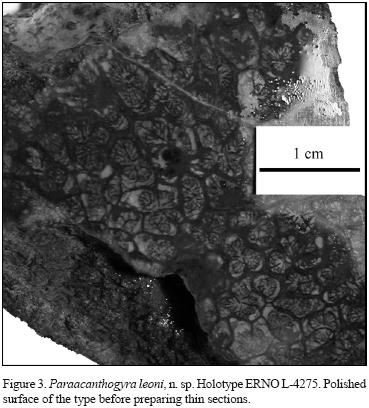
<body><![CDATA[<p align="justify"><font face="verdana" size="2"><b>Type species.</b> <i>Aulastraeopora deangelisi</i> Prever, 1909, designated by Wells (1933).</font></p>  	    <p align="justify"><font face="verdana" size="2"><b>Discussion.</b> One species, <i>Aulastraeopora harrisi</i> (Wells, 1932), has been indicated in the Bisbee Basin. It occurs in the late Barremian to early Aptian of the Cerro de Oro Formation and in early Albian of the Cerro la Espina Member.</font></p>  	    <p align="center"><font face="verdana" size="2"><b>Genus <i>Paraacanthogyra</i> Morycowa and</b></font></p>  	    <p align="center"><font face="verdana" size="2"><b>Marcopoulou&#150;Diacantoni, 1997</b></font></p>  	    <p align="justify"><font face="verdana" size="2"><b>Type species.</b> <i>Paraacanthogyra parnassensis</i> Morycowa and Marcopoulou&#150;Diacantoni, 1997, originally designated.</font></p>  	    <p align="justify"><font face="verdana" size="2"><b>Species.</b> <i>P. aptiana</i> (Turn<img src="/img/revistas/rmcg/v28n2/a6s1.jpg">ek and Mihajlovic, 1981), P. parnassensis Morycowa and Marcopoulou&#150;Diacantoni, 1997, P. leoni n. sp.</font></p>  	    <p align="justify"><font face="verdana" size="2"><b>Occurrence.</b> Central Tethys and Western Hemisphere. Since the stratigraphy of the outcrop of the type species is uncertain (see discussion in L&ouml;ser, 2005, p. 237), the occurrence cannot be well confined. The first occurrence is Aptian, while the last occurrence is less certain and is early Albian or possibly early Cenomanian.</font></p>  	    <p align="justify"><font face="verdana" size="2"><b>Discussion.</b> The type species is based on a single, small specimen. All thin sections obtained of the type specimen are oblique and do not clearly show the characteristics ascribed to the genus. Therefore the genus has been considered synonymous with the very closely related <i>Preverastraea</i> (L&ouml;ser, 2007). However, this is not the case. The most striking differentiating feature is the formation of new calices: whereas it is exclusively extracalicinal in <i>Preverastraea</i>, it is intracalicinal by septal division in <i>Paraacanthogyra</i>. This feature is not clearly observable in the type species, but visible in the new material from Sonora.</font></p>  	    <p align="center"><font face="verdana" size="2"><i><b>Paraacanthogyra leoni new species</b></i></font></p>  	    <p align="center"><font face="verdana" size="2"><a href="#f3">Figures 3</a>, <a href="/img/revistas/rmcg/v28n2/a6f4.jpg" target="_blank">4</a></font></p>  	    ]]></body>
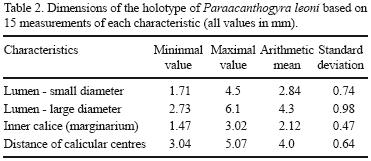
<body><![CDATA[<p align="center"><font face="verdana" size="2"><a name="f3"></a></font></p>  	    <p align="center"><font face="verdana" size="2"><img src="/img/revistas/rmcg/v28n2/a6f3.jpg"></font></p>  	    <p align="justify"><font face="verdana" size="2"><b>Diagnosis.</b> <i>Paraacanthogyra</i> with a calicular diameter of 1.7&#150;4.5 mm (small lumen) and 2.7&#150;6.1 mm (large lumen) and 18&#150;27 septa.</font></p>  	    <p align="justify"><font face="verdana" size="2"><b>Dimensions.</b> See <a href="#t2">Table 2</a>.</font></p>  	    <p align="center"><font face="verdana" size="2"><a name="t2"></a></font></p>  	    <p align="center"><font face="verdana" size="2"><img src="/img/revistas/rmcg/v28n2/a6t2.jpg"></font></p>  	    <p align="justify"><font face="verdana" size="2"><b>Description.</b> Calicular arrangement is cerioid. Every calice has a wall and the walls are directly connected only rarely leaving a small intercalicular space. Calicular outline is of irregular shape; circular in small calices, elliptical, polygonal or in the form of a four&#150;leaf clover in adult calices. Larger and smaller diameter of the lumen differ remarkably in size. Calicular diameter varies depending on its ontogenetic stage. They are small (2.7&#150;4 mm, larger lumen) when forming and become larger (4&#150;6 mm, larger lumen) until they divide into various small calices. Septal symmetry irregular radial. A hexameral symmetry is most common, but also pentameral or octomeral symmetry can be observed. Typically, only one cycle of septa reach the wall, but rarely there are two. In the latter case, the septa of the second cycle are shorter. Septa of the first cycle(s) reach from the wall into the center of the calice. These septa are generally thicker and may be swollen at their inner tips. All following septa are lonsdaleoid septa that grow from the marginarium. They are shorter and thinner. Endotheca consists of thin transversal tabulae in the center of the calice and thin dissepiments in the marginal zone of the calices. The wall has the same structure as septa. Budding is exclusively intracalicinal, by septal division. An adult calice forms between three and four new calices. The formation of new calices is irregular. Young calices are small and have a round outline. They start with few (four to six) thin lonsdaloid septa and an extensive marginarium. The septa of the first cycle connect to the wall and a second generation of lonsdaleoid septa is subsequently formed. The septa attached to the wall gain length and thickness and develop apophysal septa in places as ornamentation. The septa of the first cycle connect to each other and subsequently form new calices.</font></p>  	    <p align="justify"><font face="verdana" size="2"><b>Etymology.</b> Fieldwork in the type locality (and in many other places in Sonora) was only possible through the kind help of Carlos Manuel Gonz&aacute;lez&#150;Le&oacute;n, undoubtedly the true "Lion" (Spanish: Le&oacute;n) of Sonoran geology, to whom the new species is respectfully dedicated.</font></p>  	    <p align="justify"><font face="verdana" size="2"><b>Type.</b> Holotype ERNO L&#150;4275, five thin sections and four remaining pieces. Mexico, Sonora, Municipio Arizpe, mountain range La Ceja. WGS84 30&deg;28'22.6"N 110&deg;16'15.3"W. Bisbee Group, Mural Formation, basal Cerro La Espina Member. early Albian.</font></p>  	    <p align="justify"><font face="verdana" size="2"><b>Discussion.</b> The new species is distinguished from the other known species by its much smaller calicular dimensions.</font></p>  	    ]]></body>
<body><![CDATA[<p align="center"><font face="verdana" size="2"><b>Genus <i>Preverastraea</i> Beauvais, 1976</b></font></p>  	    <p align="justify"><font face="verdana" size="2"><b>Type species.</b> <i>Aulastraeopora chelussi</i> Prever, 1909, by original designation.</font></p>  	    <p align="justify"><font face="verdana" size="2"><b>Discussion.</b> Several species are known from the Bisbee Basin: <i>Preverastraea comalensis</i> (Wells, 1932), <i>Preverastraea diplothecata</i> (Hackemesser, 1936), <i>Preverastraea felixi</i> (Hackemesser, 1936), <i>Preverastraea isseli</i> (Prever, 1909), <i>Preverastraea maior</i> (Eli&aacute;<img src="/img/revistas/rmcg/v28n2/a6s1.jpg">ov&aacute;, 1991) (= <i>Stiboriopsis sonoraensis</i> Baron&#150;Szabo and Gonz&aacute;lez&#150;Le&oacute;n, 1999), <i>Preverastraea major</i> (Hackemesser, 1936), <i>Preverastraea multistella</i> (Stoliczka, 1873), <i>Preverastraea roveretoi</i> (Prever, 1909). The species created by Filkorn and Pantoja&#150;Alor (2009) are nomina nuda because the publication does not constitute a valid publication (Art. 8.6 of the ICZN, 1999, was not fulfilled). <i>Preverastraea</i> species are common in both late Barremian to early Aptian of the Cerro de Oro Formation and early Albian of the Cerro La Espina Formation.</font></p>  	    <p align="justify"><font face="verdana" size="2">&nbsp;</font></p>  	    <p align="justify"><font face="verdana" size="2"><b>ACKNOWLEDGEMENTS</b></font></p>  	    <p align="justify"><font face="verdana" size="2">I am grateful to Carlos Manuel Gonz&aacute;lez&#150;Le&oacute;n who introduced me to the type locality of the new taxon and reviewed the geological part of the paper. Field work expenses and the preparation of thin sections were covered by project PAPIIT&#150;DGAPA project IN107803. Steve Cairns, Ann Molineux and Elzbieta Morycowa made sample examination in Washington D.C. (USA), Austin (Texas, USA) and Krak&oacute;w (Poland) possible. Jacob Leloux (Leiden) reviewed the taxonomic part for what I am grateful. For grammatical correction I would like to thank Brian Hallmark (Tucson, Arizona).</font></p>  	    <p align="justify"><font face="verdana" size="2">&nbsp;</font></p>  	    <p align="justify"><font face="verdana" size="2"><b>REFERENCES</b></font></p>  	    <!-- ref --><p align="justify"><font face="verdana" size="2">Alloiteau, J., 1957, Contribution &agrave; la syst&eacute;matique des Madr&eacute;poraires fossiles: Paris, Centre National de la Recherche Scientifique, 462 p.    &nbsp;&nbsp;&nbsp;&nbsp;&nbsp;&nbsp;&nbsp;&nbsp;[&#160;<a href="javascript:void(0);" onclick="javascript: window.open('/scielo.php?script=sci_nlinks&ref=8060667&pid=S1026-8774201100020000600001&lng=','','width=640,height=500,resizable=yes,scrollbars=1,menubar=yes,');">Links</a>&#160;]<!-- end-ref --></font></p>  	    ]]></body>
<body><![CDATA[<!-- ref --><p align="justify"><font face="verdana" size="2">Baron&#150;Szabo, R.C., Gonz&aacute;lez&#150;Le&oacute;n, C. M., 1999, Lower Cretaceous corals and stratigraphy of the Bisbee Group (Cerro de Oro and Lampazos areas), Sonora, Mexico: Cretaceous Research, 20, 465&#150;497.    &nbsp;&nbsp;&nbsp;&nbsp;&nbsp;&nbsp;&nbsp;&nbsp;[&#160;<a href="javascript:void(0);" onclick="javascript: window.open('/scielo.php?script=sci_nlinks&ref=8060669&pid=S1026-8774201100020000600002&lng=','','width=640,height=500,resizable=yes,scrollbars=1,menubar=yes,');">Links</a>&#160;]<!-- end-ref --></font></p>  	    <!-- ref --><p align="justify"><font face="verdana" size="2">Baron&#150;Szabo, R.C., Gonz&aacute;lez&#150;Le&oacute;n, C.M., 2003, Late Aptian&#150;Early Albian corals from the Mural Limestone of the Bisbee Group (Tuape and Cerro de Oro areas), Sonora, Mexico, <i>in</i> Scott, R.W. (ed.), Bob F. Perkins Memorial Volume: Special Publications in Geology, 187&#150;225.    &nbsp;&nbsp;&nbsp;&nbsp;&nbsp;&nbsp;&nbsp;&nbsp;[&#160;<a href="javascript:void(0);" onclick="javascript: window.open('/scielo.php?script=sci_nlinks&ref=8060671&pid=S1026-8774201100020000600003&lng=','','width=640,height=500,resizable=yes,scrollbars=1,menubar=yes,');">Links</a>&#160;]<!-- end-ref --></font></p>  	    <!-- ref --><p align="justify"><font face="verdana" size="2">Beauvais, L., 1976, Madr&eacute;poraires du Jurassique (1:) &Eacute;tude morphologique, taxonomique et phylog&eacute;n&eacute;tique du sous&#150;ordre Amphiastraeida Alloiteau: M&eacute;moires de la Soci&eacute;t&eacute; g&eacute;ologique de France, 55, M&eacute;m. 126, 1&#150;42.    &nbsp;&nbsp;&nbsp;&nbsp;&nbsp;&nbsp;&nbsp;&nbsp;[&#160;<a href="javascript:void(0);" onclick="javascript: window.open('/scielo.php?script=sci_nlinks&ref=8060673&pid=S1026-8774201100020000600004&lng=','','width=640,height=500,resizable=yes,scrollbars=1,menubar=yes,');">Links</a>&#160;]<!-- end-ref --></font></p>  	    <!-- ref --><p align="justify"><font face="verdana" size="2">Bourne, G.C., 1900, The Anthozoa, <i>in</i> Lankester, R. (ed.), Treatise on Zoology, Porifera and Coelenterata: London, A. and C. Black, 59&#150;79.    &nbsp;&nbsp;&nbsp;&nbsp;&nbsp;&nbsp;&nbsp;&nbsp;[&#160;<a href="javascript:void(0);" onclick="javascript: window.open('/scielo.php?script=sci_nlinks&ref=8060675&pid=S1026-8774201100020000600005&lng=','','width=640,height=500,resizable=yes,scrollbars=1,menubar=yes,');">Links</a>&#160;]<!-- end-ref --></font></p>  	    <!-- ref --><p align="justify"><font face="verdana" size="2">Ehrenberg, C.G., 1834, Die Corallenthiere des rothen Meeres. Beitr&auml;ge zur physiologischen Kenntniss der Corallenthiere im Allgemeinen: Abhandlungen der K&ouml;niglichen Akademie der Wissenschaften, for 1832, 225&#150;380.    &nbsp;&nbsp;&nbsp;&nbsp;&nbsp;&nbsp;&nbsp;&nbsp;[&#160;<a href="javascript:void(0);" onclick="javascript: window.open('/scielo.php?script=sci_nlinks&ref=8060677&pid=S1026-8774201100020000600006&lng=','','width=640,height=500,resizable=yes,scrollbars=1,menubar=yes,');">Links</a>&#160;]<!-- end-ref --></font></p>  	    ]]></body>
<body><![CDATA[<!-- ref --><p align="justify"><font face="verdana" size="2">Eli&aacute;sov&aacute;, H., 1991, Rhipidogyrid&eacute;s (Scl&eacute;ractiniaires) du Cr&eacute;tac&eacute; de Boh&ecirc;me (C&eacute;nomanien sup&eacute;rieur &#150; Turonien inf&eacute;rieur, Tch&eacute;coslovaquie): Vestnik Ustredn&iacute;ho &uacute;stavu geologick&eacute;ho, 66(3), 163&#150;172.    &nbsp;&nbsp;&nbsp;&nbsp;&nbsp;&nbsp;&nbsp;&nbsp;[&#160;<a href="javascript:void(0);" onclick="javascript: window.open('/scielo.php?script=sci_nlinks&ref=8060679&pid=S1026-8774201100020000600007&lng=','','width=640,height=500,resizable=yes,scrollbars=1,menubar=yes,');">Links</a>&#160;]<!-- end-ref --></font></p>  	    <!-- ref --><p align="justify"><font face="verdana" size="2">Felix, J., 1891, Versteinerungen aus der mexicanischen Jura und Kreideformation, <i>in</i> Felix, J., Lenk, H. (eds.), Beitr&auml;ge zur Geologie und Pal&auml;ontologie der Republik Mexico (3): Palaeontographica, 37, 140&#150;194.    &nbsp;&nbsp;&nbsp;&nbsp;&nbsp;&nbsp;&nbsp;&nbsp;[&#160;<a href="javascript:void(0);" onclick="javascript: window.open('/scielo.php?script=sci_nlinks&ref=8060681&pid=S1026-8774201100020000600008&lng=','','width=640,height=500,resizable=yes,scrollbars=1,menubar=yes,');">Links</a>&#160;]<!-- end-ref --></font></p>  	    <!-- ref --><p align="justify"><font face="verdana" size="2">Filkorn, H.F., Pantoja&#150;Alor, J., 2009, Cretaceous corals from the Huetamo region, Michoac&aacute;n and Guerrero, southwestern Mexico: Universidad Nacional Aut&oacute;noma de M&eacute;xico, Bolet&iacute;n del Instituto de Geolog&iacute;a, 116, 1&#150;169 (CD&#150;ROM).    &nbsp;&nbsp;&nbsp;&nbsp;&nbsp;&nbsp;&nbsp;&nbsp;[&#160;<a href="javascript:void(0);" onclick="javascript: window.open('/scielo.php?script=sci_nlinks&ref=8060683&pid=S1026-8774201100020000600009&lng=','','width=640,height=500,resizable=yes,scrollbars=1,menubar=yes,');">Links</a>&#160;]<!-- end-ref --></font></p>  	    <!-- ref --><p align="justify"><font face="verdana" size="2">Gonz&aacute;lez&#150;Le&oacute;n, C. M., Jacques&#150;Ayala, C., 1988, Estratigraf&iacute;a de las rocas cret&aacute;cicas del &aacute;rea de Cerro de Oro, Sonora Central: Bolet&iacute;n del Departamento de Geolog&iacute;a, Universidad de Sonora, 5, 1/2, 1&#150;12.    &nbsp;&nbsp;&nbsp;&nbsp;&nbsp;&nbsp;&nbsp;&nbsp;[&#160;<a href="javascript:void(0);" onclick="javascript: window.open('/scielo.php?script=sci_nlinks&ref=8060685&pid=S1026-8774201100020000600010&lng=','','width=640,height=500,resizable=yes,scrollbars=1,menubar=yes,');">Links</a>&#160;]<!-- end-ref --></font></p>  	    <!-- ref --><p align="justify"><font face="verdana" size="2">Gonz&aacute;lez&#150;Le&oacute;n, C. M., Scott, R.W., L&ouml;ser, H., Lawton, T.F., Robert, E., Valencia, V.A., 2008, Upper Aptian&#150;Lower Albian Mural Formation: stratigraphy, biostratigraphy and depositional cycles on the Sonoran shelf, northern M&eacute;xico: Cretaceous Research, 29, 249&#150;266.    &nbsp;&nbsp;&nbsp;&nbsp;&nbsp;&nbsp;&nbsp;&nbsp;[&#160;<a href="javascript:void(0);" onclick="javascript: window.open('/scielo.php?script=sci_nlinks&ref=8060687&pid=S1026-8774201100020000600011&lng=','','width=640,height=500,resizable=yes,scrollbars=1,menubar=yes,');">Links</a>&#160;]<!-- end-ref --></font></p>  	    ]]></body>
<body><![CDATA[<!-- ref --><p align="justify"><font face="verdana" size="2">Hackemesser, M., 1936, Eine kretazische Korallenfauna aus Mittel&#150;Griechenland und ihre pal&auml;obiologischen Beziehungen: Palaeontographica, (A) 84, 1&#150;97.    &nbsp;&nbsp;&nbsp;&nbsp;&nbsp;&nbsp;&nbsp;&nbsp;[&#160;<a href="javascript:void(0);" onclick="javascript: window.open('/scielo.php?script=sci_nlinks&ref=8060689&pid=S1026-8774201100020000600012&lng=','','width=640,height=500,resizable=yes,scrollbars=1,menubar=yes,');">Links</a>&#160;]<!-- end-ref --></font></p>  	    <!-- ref --><p align="justify"><font face="verdana" size="2">He, X., Xiao, J.&#150;d., 1990, Jurassic and Cretaceous hexacorals of Ngari area, <i>in</i> Zunyi, Yang, Zetong, Nie (eds.), Paleontology of Ngari, Tibet (Xizang): Beijing, China University Geoscience Press, 146&#150;159.    &nbsp;&nbsp;&nbsp;&nbsp;&nbsp;&nbsp;&nbsp;&nbsp;[&#160;<a href="javascript:void(0);" onclick="javascript: window.open('/scielo.php?script=sci_nlinks&ref=8060691&pid=S1026-8774201100020000600013&lng=','','width=640,height=500,resizable=yes,scrollbars=1,menubar=yes,');">Links</a>&#160;]<!-- end-ref --></font></p>  	    <!-- ref --><p align="justify"><font face="verdana" size="2">ICZN (International Commission on Zoological Nomenclature), 1999, International Code of Zoological Nomenclature: &lt;<a href="http://iczn.org/" target="_blank">http://www.iczn.org/</a>&gt;    &nbsp;&nbsp;&nbsp;&nbsp;&nbsp;&nbsp;&nbsp;&nbsp;[&#160;<a href="javascript:void(0);" onclick="javascript: window.open('/scielo.php?script=sci_nlinks&ref=8060693&pid=S1026-8774201100020000600014&lng=','','width=640,height=500,resizable=yes,scrollbars=1,menubar=yes,');">Links</a>&#160;]<!-- end-ref -->.</font></p>  	    <!-- ref --><p align="justify"><font face="verdana" size="2">Kuzmicheva, E.I., 2002, Skeletal morphology, systematics and evolution of the Scleractinia: Trudy Paleontologicheskogo Instituta, 286, 1&#150;211.    &nbsp;&nbsp;&nbsp;&nbsp;&nbsp;&nbsp;&nbsp;&nbsp;[&#160;<a href="javascript:void(0);" onclick="javascript: window.open('/scielo.php?script=sci_nlinks&ref=8060695&pid=S1026-8774201100020000600015&lng=','','width=640,height=500,resizable=yes,scrollbars=1,menubar=yes,');">Links</a>&#160;]<!-- end-ref --></font></p>  	    <!-- ref --><p align="justify"><font face="verdana" size="2">Lawton, T.F., Gonz&aacute;lez&#150;Le&oacute;n, C. M., Lucas, S.G., Scott, R.W., 2004, Stratigraphy and sedimentology of the upper Aptian&#150;upper Albian Mural Limestone (Bisbee Group) in northern Sonora, Mexico: Cretaceous Research, 25, 43&#150;60.    &nbsp;&nbsp;&nbsp;&nbsp;&nbsp;&nbsp;&nbsp;&nbsp;[&#160;<a href="javascript:void(0);" onclick="javascript: window.open('/scielo.php?script=sci_nlinks&ref=8060697&pid=S1026-8774201100020000600016&lng=','','width=640,height=500,resizable=yes,scrollbars=1,menubar=yes,');">Links</a>&#160;]<!-- end-ref --></font></p>  	    ]]></body>
<body><![CDATA[<!-- ref --><p align="justify"><font face="verdana" size="2">L&ouml;ser, H., 2005, Stratigraphy of Cretaceous coral genera: Neues Jahrbuch f&uuml;r Geologie und Pal&auml;ontologie, Abhandlungen, 238, 231&#150;277.    &nbsp;&nbsp;&nbsp;&nbsp;&nbsp;&nbsp;&nbsp;&nbsp;[&#160;<a href="javascript:void(0);" onclick="javascript: window.open('/scielo.php?script=sci_nlinks&ref=8060699&pid=S1026-8774201100020000600017&lng=','','width=640,height=500,resizable=yes,scrollbars=1,menubar=yes,');">Links</a>&#160;]<!-- end-ref --></font></p>  	    <!-- ref --><p align="justify"><font face="verdana" size="2">L&ouml;ser, H., 2006, Barremian corals from San Antonio Texcala, Puebla, Mexico &#150; A review of the type material of Felix 1891: Universidad Nacional Aut&oacute;noma de M&eacute;xico, Bolet&iacute;n del Instituto de Geolog&iacute;a, 114, 1&#150;68 (CD&#150;ROM).    &nbsp;&nbsp;&nbsp;&nbsp;&nbsp;&nbsp;&nbsp;&nbsp;[&#160;<a href="javascript:void(0);" onclick="javascript: window.open('/scielo.php?script=sci_nlinks&ref=8060701&pid=S1026-8774201100020000600018&lng=','','width=640,height=500,resizable=yes,scrollbars=1,menubar=yes,');">Links</a>&#160;]<!-- end-ref --></font></p>  	    <!-- ref --><p align="justify"><font face="verdana" size="2">L&ouml;ser, H., 2007, Morphology, taxonomy and distribution of the Cretaceous coral genus Preverastraea (Late Barremian&#150;Cenomanian; Scleractinia): Rivista italiana di paleontologia e stratigrafia, 113, 1, 3&#150;19.    &nbsp;&nbsp;&nbsp;&nbsp;&nbsp;&nbsp;&nbsp;&nbsp;[&#160;<a href="javascript:void(0);" onclick="javascript: window.open('/scielo.php?script=sci_nlinks&ref=8060703&pid=S1026-8774201100020000600019&lng=','','width=640,height=500,resizable=yes,scrollbars=1,menubar=yes,');">Links</a>&#160;]<!-- end-ref --></font></p>  	    <!-- ref --><p align="justify"><font face="verdana" size="2">L&ouml;ser, H., 2008, Morphology, taxonomy and distribution of the Cretaceous coral genus Aulastraeopora (Late Barremian&#150;Early Cenomanian; Scleractinia): Rivista italiana di paleontologia e stratigrafia, 114, 1, 19&#150;27.    &nbsp;&nbsp;&nbsp;&nbsp;&nbsp;&nbsp;&nbsp;&nbsp;[&#160;<a href="javascript:void(0);" onclick="javascript: window.open('/scielo.php?script=sci_nlinks&ref=8060705&pid=S1026-8774201100020000600020&lng=','','width=640,height=500,resizable=yes,scrollbars=1,menubar=yes,');">Links</a>&#160;]<!-- end-ref --></font></p>  	    <!-- ref --><p align="justify"><font face="verdana" size="2">L&ouml;ser, H., Minor, K., 2007, Palaeobiogeographic aspects of Late Barremian to Late Albian coral faunas from Northern Mexico (Sonora) and the southern USA (Arizona, Texas): Neues Jahrbuch f&uuml;r Geologie und Pal&auml;ontologie, Abhandlungen, 245(2), 193&#150;218.    &nbsp;&nbsp;&nbsp;&nbsp;&nbsp;&nbsp;&nbsp;&nbsp;[&#160;<a href="javascript:void(0);" onclick="javascript: window.open('/scielo.php?script=sci_nlinks&ref=8060707&pid=S1026-8774201100020000600021&lng=','','width=640,height=500,resizable=yes,scrollbars=1,menubar=yes,');">Links</a>&#160;]<!-- end-ref --></font></p>  	    ]]></body>
<body><![CDATA[<!-- ref --><p align="justify"><font face="verdana" size="2">Morycowa, E., Marcopoulou&#150;Diacantoni, A., 1997, Cretaceous Scleractinian corals from the Parnassos area (Central Greece) (Preliminary note): Bulletin of the Geological Society of Greece, 30, 2, 249&#150;273.    &nbsp;&nbsp;&nbsp;&nbsp;&nbsp;&nbsp;&nbsp;&nbsp;[&#160;<a href="javascript:void(0);" onclick="javascript: window.open('/scielo.php?script=sci_nlinks&ref=8060709&pid=S1026-8774201100020000600022&lng=','','width=640,height=500,resizable=yes,scrollbars=1,menubar=yes,');">Links</a>&#160;]<!-- end-ref --></font></p>  	    <!-- ref --><p align="justify"><font face="verdana" size="2">Morycowa, E., Marcopoulou&#150;Diacantoni, A., 2002, Albian corals from the Subpelagonian zone of Central Greece (Agrostylia, Parnassos region): Annales Societatis Geologorum Poloniae, 72, 1&#150;65.    &nbsp;&nbsp;&nbsp;&nbsp;&nbsp;&nbsp;&nbsp;&nbsp;[&#160;<a href="javascript:void(0);" onclick="javascript: window.open('/scielo.php?script=sci_nlinks&ref=8060711&pid=S1026-8774201100020000600023&lng=','','width=640,height=500,resizable=yes,scrollbars=1,menubar=yes,');">Links</a>&#160;]<!-- end-ref --></font></p>  	    <!-- ref --><p align="justify"><font face="verdana" size="2">Morycowa, E., Masse, J.P., 1998, Les Scl&eacute;ractiniaires du Barr&eacute;mien&#150;Aptien inf&eacute;rieur de Provence (SE de la France): Geobios, 31(6), 725&#150;766.    &nbsp;&nbsp;&nbsp;&nbsp;&nbsp;&nbsp;&nbsp;&nbsp;[&#160;<a href="javascript:void(0);" onclick="javascript: window.open('/scielo.php?script=sci_nlinks&ref=8060713&pid=S1026-8774201100020000600024&lng=','','width=640,height=500,resizable=yes,scrollbars=1,menubar=yes,');">Links</a>&#160;]<!-- end-ref --></font></p>  	    <!-- ref --><p align="justify"><font face="verdana" size="2">Prever, P.L., 1909, Anthozoa, <i>in</i> Parona, C.F. (ed.), La fauna coralligena del Cretaceo dei Monti d'Ocre nell'Abruzzo Aquilano: Memorie descrittive della carta geologica d'Italia, 5, 1, 51&#150;147.    &nbsp;&nbsp;&nbsp;&nbsp;&nbsp;&nbsp;&nbsp;&nbsp;[&#160;<a href="javascript:void(0);" onclick="javascript: window.open('/scielo.php?script=sci_nlinks&ref=8060715&pid=S1026-8774201100020000600025&lng=','','width=640,height=500,resizable=yes,scrollbars=1,menubar=yes,');">Links</a>&#160;]<!-- end-ref --></font></p>  	    <!-- ref --><p align="justify"><font face="verdana" size="2">Reyeros&#150;Navarro, M.M., 1963, Corales del Cret&aacute;cico inferior de San Juan Raya, Estado de Puebla: Paleontolog&iacute;a Mexicana, 17, 1&#150;21.    &nbsp;&nbsp;&nbsp;&nbsp;&nbsp;&nbsp;&nbsp;&nbsp;[&#160;<a href="javascript:void(0);" onclick="javascript: window.open('/scielo.php?script=sci_nlinks&ref=8060717&pid=S1026-8774201100020000600026&lng=','','width=640,height=500,resizable=yes,scrollbars=1,menubar=yes,');">Links</a>&#160;]<!-- end-ref --></font></p>  	    ]]></body>
<body><![CDATA[<!-- ref --><p align="justify"><font face="verdana" size="2">Roniewicz, E., 1976, Les scl&eacute;ractiniaires du Jurassique sup&eacute;rieur de la Dobrogea centrale Roumanie: Palaeontologia Polonica, 34, 17&#150;121.    &nbsp;&nbsp;&nbsp;&nbsp;&nbsp;&nbsp;&nbsp;&nbsp;[&#160;<a href="javascript:void(0);" onclick="javascript: window.open('/scielo.php?script=sci_nlinks&ref=8060719&pid=S1026-8774201100020000600027&lng=','','width=640,height=500,resizable=yes,scrollbars=1,menubar=yes,');">Links</a>&#160;]<!-- end-ref --></font></p>  	    <!-- ref --><p align="justify"><font face="verdana" size="2">Roniewicz, E., 2008, Kimmeridgian&#150;Valanginian reef corals from The Moesian platform from Bulgaria: Annales Societatis Geologorum Poloniae, 78(2), 91&#150;134.    &nbsp;&nbsp;&nbsp;&nbsp;&nbsp;&nbsp;&nbsp;&nbsp;[&#160;<a href="javascript:void(0);" onclick="javascript: window.open('/scielo.php?script=sci_nlinks&ref=8060721&pid=S1026-8774201100020000600028&lng=','','width=640,height=500,resizable=yes,scrollbars=1,menubar=yes,');">Links</a>&#160;]<!-- end-ref --></font></p>  	    <!-- ref --><p align="justify"><font face="verdana" size="2">Scott, R.W., 1981, Biotic relations in Early Cretaceous coral&#150;algae&#150;rudist reefs, Arizona: Journal of Paleontology, 55(2), 463&#150;478.    &nbsp;&nbsp;&nbsp;&nbsp;&nbsp;&nbsp;&nbsp;&nbsp;[&#160;<a href="javascript:void(0);" onclick="javascript: window.open('/scielo.php?script=sci_nlinks&ref=8060723&pid=S1026-8774201100020000600029&lng=','','width=640,height=500,resizable=yes,scrollbars=1,menubar=yes,');">Links</a>&#160;]<!-- end-ref --></font></p>  	    <!-- ref --><p align="justify"><font face="verdana" size="2">Scott, R.W., 1987, Stratigraphy and correlation of the Cretaceous Mural Limestone, Arizona and Sonora, <i>in</i> Dickinson, R.W., Klute, M.A. (eds.), Mesozoic rocks of southern Arizona and adjacent areas: Arizona Geological Society Digest, 18, 327&#150;334.    &nbsp;&nbsp;&nbsp;&nbsp;&nbsp;&nbsp;&nbsp;&nbsp;[&#160;<a href="javascript:void(0);" onclick="javascript: window.open('/scielo.php?script=sci_nlinks&ref=8060725&pid=S1026-8774201100020000600030&lng=','','width=640,height=500,resizable=yes,scrollbars=1,menubar=yes,');">Links</a>&#160;]<!-- end-ref --></font></p>  	    <!-- ref --><p align="justify"><font face="verdana" size="2">Scott, R.W., Brenckle, P.L., 1977, Biotic zonation of a Lower Cretaceous coral&#150;algal&#150;rudist reef, Arizona: Proceedings of the (Third) International Coral Reef Symposium Miami, 3(2), 183&#150;189.    &nbsp;&nbsp;&nbsp;&nbsp;&nbsp;&nbsp;&nbsp;&nbsp;[&#160;<a href="javascript:void(0);" onclick="javascript: window.open('/scielo.php?script=sci_nlinks&ref=8060727&pid=S1026-8774201100020000600031&lng=','','width=640,height=500,resizable=yes,scrollbars=1,menubar=yes,');">Links</a>&#160;]<!-- end-ref --></font></p>  	    ]]></body>
<body><![CDATA[<!-- ref --><p align="justify"><font face="verdana" size="2">Stoliczka, F., 1873, The corals or Anthozoa from the Cretaceous rocks of South India: Memoirs of the Geological Survey of India, Palaeontologia Indica, (4), 8, 4/5, 130&#150;202.    &nbsp;&nbsp;&nbsp;&nbsp;&nbsp;&nbsp;&nbsp;&nbsp;[&#160;<a href="javascript:void(0);" onclick="javascript: window.open('/scielo.php?script=sci_nlinks&ref=8060729&pid=S1026-8774201100020000600032&lng=','','width=640,height=500,resizable=yes,scrollbars=1,menubar=yes,');">Links</a>&#160;]<!-- end-ref --></font></p>  	    <!-- ref --><p align="justify"><font face="verdana" size="2">Turnsek, D., Mihajlovic, M., 1981, Lower Cretaceous Cnidarians from eastern Serbia: Razprave Slovenska akademija znanosti in umetnosti, (4), 23, 1, 1&#150;54.    &nbsp;&nbsp;&nbsp;&nbsp;&nbsp;&nbsp;&nbsp;&nbsp;[&#160;<a href="javascript:void(0);" onclick="javascript: window.open('/scielo.php?script=sci_nlinks&ref=8060731&pid=S1026-8774201100020000600033&lng=','','width=640,height=500,resizable=yes,scrollbars=1,menubar=yes,');">Links</a>&#160;]<!-- end-ref --></font></p>  	    <!-- ref --><p align="justify"><font face="verdana" size="2">Wells, J.W., 1932, Corals of the Trinity Group of the Commanchean of central Texas: Journal of Paleontology, 6, 3, 225&#150;256.    &nbsp;&nbsp;&nbsp;&nbsp;&nbsp;&nbsp;&nbsp;&nbsp;[&#160;<a href="javascript:void(0);" onclick="javascript: window.open('/scielo.php?script=sci_nlinks&ref=8060733&pid=S1026-8774201100020000600034&lng=','','width=640,height=500,resizable=yes,scrollbars=1,menubar=yes,');">Links</a>&#160;]<!-- end-ref --></font></p>  	    <!-- ref --><p align="justify"><font face="verdana" size="2">Wells, J.W., 1933, Corals of the Cretaceous of the Atlantic and Gulf Coastal Plains and Western Interior of the United States: Bulletin of American Paleontology, 18, 67, 83&#150;292.    &nbsp;&nbsp;&nbsp;&nbsp;&nbsp;&nbsp;&nbsp;&nbsp;[&#160;<a href="javascript:void(0);" onclick="javascript: window.open('/scielo.php?script=sci_nlinks&ref=8060735&pid=S1026-8774201100020000600035&lng=','','width=640,height=500,resizable=yes,scrollbars=1,menubar=yes,');">Links</a>&#160;]<!-- end-ref --></font></p>      ]]></body><back>
<ref-list>
<ref id="B1">
<nlm-citation citation-type="book">
<person-group person-group-type="author">
<name>
<surname><![CDATA[Alloiteau]]></surname>
<given-names><![CDATA[J.]]></given-names>
</name>
</person-group>
<source><![CDATA[Contribution à la systématique des Madréporaires fossiles]]></source>
<year>1957</year>
<page-range>462</page-range><publisher-loc><![CDATA[Paris ]]></publisher-loc>
<publisher-name><![CDATA[Centre National de la Recherche Scientifique]]></publisher-name>
</nlm-citation>
</ref>
<ref id="B2">
<nlm-citation citation-type="journal">
<person-group person-group-type="author">
<name>
<surname><![CDATA[Baron-Szabo]]></surname>
<given-names><![CDATA[R.C.]]></given-names>
</name>
<name>
<surname><![CDATA[González-León]]></surname>
<given-names><![CDATA[C. M.]]></given-names>
</name>
</person-group>
<article-title xml:lang="en"><![CDATA[Lower Cretaceous corals and stratigraphy of the Bisbee Group (Cerro de Oro and Lampazos areas), Sonora, Mexico]]></article-title>
<source><![CDATA[Cretaceous Research]]></source>
<year>1999</year>
<volume>20</volume>
<page-range>465-497</page-range></nlm-citation>
</ref>
<ref id="B3">
<nlm-citation citation-type="">
<person-group person-group-type="author">
<name>
<surname><![CDATA[Baron-Szabo]]></surname>
<given-names><![CDATA[R.C.]]></given-names>
</name>
<name>
<surname><![CDATA[González-León]]></surname>
<given-names><![CDATA[C.M.]]></given-names>
</name>
</person-group>
<article-title xml:lang="en"><![CDATA[Late Aptian-Early Albian corals from the Mural Limestone of the Bisbee Group (Tuape and Cerro de Oro areas), Sonora, Mexico]]></article-title>
<person-group person-group-type="editor">
<name>
<surname><![CDATA[Scott]]></surname>
<given-names><![CDATA[R.W.]]></given-names>
</name>
</person-group>
<source><![CDATA[Bob F. Perkins Memorial Volume: Special Publications in Geology]]></source>
<year>2003</year>
<page-range>187-225</page-range></nlm-citation>
</ref>
<ref id="B4">
<nlm-citation citation-type="">
<person-group person-group-type="author">
<name>
<surname><![CDATA[Beauvais]]></surname>
<given-names><![CDATA[L.]]></given-names>
</name>
</person-group>
<article-title xml:lang="fr"><![CDATA[Madréporaires du Jurassique (1:) Étude morphologique, taxonomique et phylogénétique du sous-ordre Amphiastraeida Alloiteau]]></article-title>
<source><![CDATA[]]></source>
<year>1976</year>
<volume>55</volume>
<page-range>1-42</page-range></nlm-citation>
</ref>
<ref id="B5">
<nlm-citation citation-type="book">
<person-group person-group-type="author">
<name>
<surname><![CDATA[Bourne]]></surname>
<given-names><![CDATA[G.C.]]></given-names>
</name>
</person-group>
<article-title xml:lang="en"><![CDATA[The Anthozoa]]></article-title>
<person-group person-group-type="editor">
<name>
<surname><![CDATA[Lankester]]></surname>
<given-names><![CDATA[R.]]></given-names>
</name>
</person-group>
<source><![CDATA[Treatise on Zoology, Porifera and Coelenterata]]></source>
<year>1900</year>
<page-range>59-79</page-range><publisher-loc><![CDATA[London ]]></publisher-loc>
<publisher-name><![CDATA[A. and C. Black]]></publisher-name>
</nlm-citation>
</ref>
<ref id="B6">
<nlm-citation citation-type="">
<person-group person-group-type="author">
<name>
<surname><![CDATA[Ehrenberg]]></surname>
<given-names><![CDATA[C.G.]]></given-names>
</name>
</person-group>
<article-title xml:lang="de"><![CDATA[Die Corallenthiere des rothen Meeres. Beiträge zur physiologischen Kenntniss der Corallenthiere im Allgemeinen]]></article-title>
<source><![CDATA[Abhandlungen der Königlichen Akademie der Wissenschaften]]></source>
<year>1834</year>
<month>18</month>
<day>32</day>
<page-range>225-380</page-range></nlm-citation>
</ref>
<ref id="B7">
<nlm-citation citation-type="journal">
<person-group person-group-type="author">
<name>
<surname><![CDATA[Eliásová]]></surname>
<given-names><![CDATA[H.]]></given-names>
</name>
</person-group>
<article-title xml:lang="ru"><![CDATA[Rhipidogyridés (Scléractiniaires) du Crétacé de Bohême (Cénomanien supérieur - Turonien inférieur, Tchécoslovaquie)]]></article-title>
<source><![CDATA[Vestnik Ustredního ústavu geologického]]></source>
<year>1991</year>
<volume>66</volume>
<numero>3</numero>
<issue>3</issue>
<page-range>163-172</page-range></nlm-citation>
</ref>
<ref id="B8">
<nlm-citation citation-type="journal">
<person-group person-group-type="author">
<name>
<surname><![CDATA[Felix]]></surname>
<given-names><![CDATA[J.]]></given-names>
</name>
</person-group>
<article-title xml:lang="de"><![CDATA[Versteinerungen aus der mexicanischen Jura und Kreideformation]]></article-title>
<source><![CDATA[Palaeontographica]]></source>
<year>1891</year>
<volume>37</volume>
<page-range>140-194</page-range></nlm-citation>
</ref>
<ref id="B9">
<nlm-citation citation-type="journal">
<person-group person-group-type="author">
<name>
<surname><![CDATA[Filkorn]]></surname>
<given-names><![CDATA[H.F.]]></given-names>
</name>
<name>
<surname><![CDATA[Pantoja-Alor]]></surname>
<given-names><![CDATA[J.]]></given-names>
</name>
</person-group>
<article-title xml:lang="en"><![CDATA[Cretaceous corals from the Huetamo region, Michoacán and Guerrero, southwestern Mexico]]></article-title>
<source><![CDATA[Boletín del Instituto de Geología]]></source>
<year>2009</year>
<volume>116</volume>
<page-range>1-169</page-range></nlm-citation>
</ref>
<ref id="B10">
<nlm-citation citation-type="journal">
<person-group person-group-type="author">
<name>
<surname><![CDATA[González-León]]></surname>
<given-names><![CDATA[C. M.]]></given-names>
</name>
<name>
<surname><![CDATA[Jacques-Ayala]]></surname>
<given-names><![CDATA[C.]]></given-names>
</name>
</person-group>
<article-title xml:lang="en"><![CDATA[Estratigrafía de las rocas cretácicas del área de Cerro de Oro, Sonora Central]]></article-title>
<source><![CDATA[Boletín del Departamento de Geología, Universidad de Sonora]]></source>
<year>1988</year>
<volume>5</volume>
<numero>1</numero><numero>2</numero>
<issue>1</issue><issue>2</issue>
<page-range>1-12</page-range></nlm-citation>
</ref>
<ref id="B11">
<nlm-citation citation-type="journal">
<person-group person-group-type="author">
<name>
<surname><![CDATA[González-León]]></surname>
<given-names><![CDATA[C. M.]]></given-names>
</name>
<name>
<surname><![CDATA[Scott]]></surname>
<given-names><![CDATA[R.W.]]></given-names>
</name>
<name>
<surname><![CDATA[Löser]]></surname>
<given-names><![CDATA[H.]]></given-names>
</name>
<name>
<surname><![CDATA[Lawton]]></surname>
<given-names><![CDATA[T.F.]]></given-names>
</name>
<name>
<surname><![CDATA[Robert]]></surname>
<given-names><![CDATA[E.]]></given-names>
</name>
<name>
<surname><![CDATA[Valencia]]></surname>
<given-names><![CDATA[V.A.]]></given-names>
</name>
</person-group>
<article-title xml:lang="en"><![CDATA[Upper Aptian-Lower Albian Mural Formation: stratigraphy, biostratigraphy and depositional cycles on the Sonoran shelf, northern México]]></article-title>
<source><![CDATA[Cretaceous Research]]></source>
<year>2008</year>
<volume>29</volume>
<page-range>249-266</page-range></nlm-citation>
</ref>
<ref id="B12">
<nlm-citation citation-type="journal">
<person-group person-group-type="author">
<name>
<surname><![CDATA[Hackemesser]]></surname>
<given-names><![CDATA[M.]]></given-names>
</name>
</person-group>
<article-title xml:lang="de"><![CDATA[Eine kretazische Korallenfauna aus Mittel-Griechenland und ihre paläobiologischen Beziehungen]]></article-title>
<source><![CDATA[Palaeontographica]]></source>
<year>1936</year>
<volume>84</volume>
<page-range>1-97</page-range></nlm-citation>
</ref>
<ref id="B13">
<nlm-citation citation-type="book">
<person-group person-group-type="author">
<name>
<surname><![CDATA[He]]></surname>
<given-names><![CDATA[X.]]></given-names>
</name>
<name>
<surname><![CDATA[Xiao]]></surname>
<given-names><![CDATA[J.-d.]]></given-names>
</name>
</person-group>
<article-title xml:lang="en"><![CDATA[Jurassic and Cretaceous hexacorals of Ngari area]]></article-title>
<person-group person-group-type="editor">
<name>
<surname><![CDATA[Zunyi]]></surname>
<given-names><![CDATA[Yang]]></given-names>
</name>
<name>
<surname><![CDATA[Zetong]]></surname>
<given-names><![CDATA[Nie]]></given-names>
</name>
</person-group>
<source><![CDATA[Paleontology of Ngari, Tibet (Xizang)]]></source>
<year>1990</year>
<page-range>146-159</page-range><publisher-loc><![CDATA[Beijing ]]></publisher-loc>
<publisher-name><![CDATA[China University Geoscience Press]]></publisher-name>
</nlm-citation>
</ref>
<ref id="B14">
<nlm-citation citation-type="">
<collab>International Commission on Zoological Nomenclature</collab>
<source><![CDATA[International Code of Zoological Nomenclature]]></source>
<year>1999</year>
</nlm-citation>
</ref>
<ref id="B15">
<nlm-citation citation-type="journal">
<person-group person-group-type="author">
<name>
<surname><![CDATA[Kuzmicheva]]></surname>
<given-names><![CDATA[E.I.]]></given-names>
</name>
</person-group>
<article-title xml:lang="en"><![CDATA[Skeletal morphology, systematics and evolution of the Scleractinia]]></article-title>
<source><![CDATA[Trudy Paleontologicheskogo Instituta]]></source>
<year>2002</year>
<volume>286</volume>
<page-range>1-211</page-range></nlm-citation>
</ref>
<ref id="B16">
<nlm-citation citation-type="journal">
<person-group person-group-type="author">
<name>
<surname><![CDATA[Lawton]]></surname>
<given-names><![CDATA[T.F.]]></given-names>
</name>
<name>
<surname><![CDATA[González-León]]></surname>
<given-names><![CDATA[C. M.]]></given-names>
</name>
<name>
<surname><![CDATA[Lucas]]></surname>
<given-names><![CDATA[S.G.]]></given-names>
</name>
<name>
<surname><![CDATA[Scott]]></surname>
<given-names><![CDATA[R.W.]]></given-names>
</name>
</person-group>
<article-title xml:lang="en"><![CDATA[Stratigraphy and sedimentology of the upper Aptian-upper Albian Mural Limestone (Bisbee Group) in northern Sonora, Mexico]]></article-title>
<source><![CDATA[Cretaceous Research]]></source>
<year>2004</year>
<volume>25</volume>
<page-range>43-60</page-range></nlm-citation>
</ref>
<ref id="B17">
<nlm-citation citation-type="journal">
<person-group person-group-type="author">
<name>
<surname><![CDATA[Löser]]></surname>
<given-names><![CDATA[H.]]></given-names>
</name>
</person-group>
<article-title xml:lang="en"><![CDATA[Stratigraphy of Cretaceous coral genera]]></article-title>
<source><![CDATA[Neues Jahrbuch für Geologie und Paläontologie, Abhandlungen]]></source>
<year>2005</year>
<volume>238</volume>
<page-range>231-277</page-range></nlm-citation>
</ref>
<ref id="B18">
<nlm-citation citation-type="journal">
<person-group person-group-type="author">
<name>
<surname><![CDATA[Löser]]></surname>
<given-names><![CDATA[H.]]></given-names>
</name>
</person-group>
<article-title xml:lang="en"><![CDATA[Barremian corals from San Antonio Texcala, Puebla, Mexico - A review of the type material of Felix 1891]]></article-title>
<source><![CDATA[Boletín del Instituto de Geología]]></source>
<year>2006</year>
<volume>114</volume>
<page-range>1-68</page-range></nlm-citation>
</ref>
<ref id="B19">
<nlm-citation citation-type="journal">
<person-group person-group-type="author">
<name>
<surname><![CDATA[Löser]]></surname>
<given-names><![CDATA[H.]]></given-names>
</name>
</person-group>
<article-title xml:lang="en"><![CDATA[Morphology, taxonomy and distribution of the Cretaceous coral genus Preverastraea (Late Barremian-Cenomanian; Scleractinia)]]></article-title>
<source><![CDATA[Rivista italiana di paleontologia e stratigrafia]]></source>
<year>2007</year>
<volume>113</volume>
<page-range>1, 3-19</page-range></nlm-citation>
</ref>
<ref id="B20">
<nlm-citation citation-type="journal">
<person-group person-group-type="author">
<name>
<surname><![CDATA[Löser]]></surname>
<given-names><![CDATA[H.]]></given-names>
</name>
</person-group>
<article-title xml:lang="en"><![CDATA[Morphology, taxonomy and distribution of the Cretaceous coral genus Aulastraeopora (Late Barremian-Early Cenomanian; Scleractinia)]]></article-title>
<source><![CDATA[Rivista italiana di paleontologia e stratigrafia]]></source>
<year>2008</year>
<volume>114</volume>
<numero>1</numero>
<issue>1</issue>
<page-range>19-27</page-range></nlm-citation>
</ref>
<ref id="B21">
<nlm-citation citation-type="journal">
<person-group person-group-type="author">
<name>
<surname><![CDATA[Löser]]></surname>
<given-names><![CDATA[H.]]></given-names>
</name>
<name>
<surname><![CDATA[Minor]]></surname>
<given-names><![CDATA[K.]]></given-names>
</name>
</person-group>
<article-title xml:lang="en"><![CDATA[Palaeobiogeographic aspects of Late Barremian to Late Albian coral faunas from Northern Mexico (Sonora) and the southern USA (Arizona, Texas)]]></article-title>
<source><![CDATA[Neues Jahrbuch für Geologie und Paläontologie, Abhandlungen]]></source>
<year>2007</year>
<volume>245</volume>
<numero>2</numero>
<issue>2</issue>
<page-range>193-218</page-range></nlm-citation>
</ref>
<ref id="B22">
<nlm-citation citation-type="journal">
<person-group person-group-type="author">
<name>
<surname><![CDATA[Morycowa]]></surname>
<given-names><![CDATA[E.]]></given-names>
</name>
<name>
<surname><![CDATA[Marcopoulou-Diacantoni]]></surname>
<given-names><![CDATA[A.]]></given-names>
</name>
</person-group>
<article-title xml:lang="en"><![CDATA[Cretaceous Scleractinian corals from the Parnassos area (Central Greece) (Preliminary note)]]></article-title>
<source><![CDATA[Bulletin of the Geological Society of Greece]]></source>
<year>1997</year>
<volume>30</volume>
<numero>2</numero>
<issue>2</issue>
<page-range>249-273</page-range></nlm-citation>
</ref>
<ref id="B23">
<nlm-citation citation-type="journal">
<person-group person-group-type="author">
<name>
<surname><![CDATA[Morycowa]]></surname>
<given-names><![CDATA[E.]]></given-names>
</name>
<name>
<surname><![CDATA[Marcopoulou-Diacantoni]]></surname>
<given-names><![CDATA[A.]]></given-names>
</name>
</person-group>
<article-title xml:lang="en"><![CDATA[Albian corals from the Subpelagonian zone of Central Greece (Agrostylia, Parnassos region)]]></article-title>
<source><![CDATA[Annales Societatis Geologorum Poloniae]]></source>
<year>2002</year>
<volume>72</volume>
<page-range>1-65</page-range></nlm-citation>
</ref>
<ref id="B24">
<nlm-citation citation-type="journal">
<person-group person-group-type="author">
<name>
<surname><![CDATA[Morycowa]]></surname>
<given-names><![CDATA[E.]]></given-names>
</name>
<name>
<surname><![CDATA[Masse]]></surname>
<given-names><![CDATA[J.P.]]></given-names>
</name>
</person-group>
<article-title xml:lang="fr"><![CDATA[Les Scléractiniaires du Barrémien-Aptien inférieur de Provence (SE de la France)]]></article-title>
<source><![CDATA[Geobios]]></source>
<year>1998</year>
<volume>31</volume>
<numero>6</numero>
<issue>6</issue>
<page-range>725-766</page-range></nlm-citation>
</ref>
<ref id="B25">
<nlm-citation citation-type="confpro">
<person-group person-group-type="author">
<name>
<surname><![CDATA[Prever]]></surname>
<given-names><![CDATA[P.L.]]></given-names>
</name>
</person-group>
<article-title xml:lang="it"><![CDATA[Anthozoa]]></article-title>
<person-group person-group-type="editor">
<name>
<surname><![CDATA[Parona]]></surname>
<given-names><![CDATA[C.F.]]></given-names>
</name>
</person-group>
<source><![CDATA[La fauna coralligena del Cretaceo dei Monti d'Ocre nell'Abruzzo Aquilano]]></source>
<year>1909</year>
<conf-name><![CDATA[5 Memorie descrittive della carta geologica d'Italia]]></conf-name>
<conf-loc> </conf-loc>
<page-range>51-147</page-range></nlm-citation>
</ref>
<ref id="B26">
<nlm-citation citation-type="journal">
<person-group person-group-type="author">
<name>
<surname><![CDATA[Reyeros-Navarro]]></surname>
<given-names><![CDATA[M.M.]]></given-names>
</name>
</person-group>
<article-title xml:lang="es"><![CDATA[Corales del Cretácico inferior de San Juan Raya, Estado de Puebla]]></article-title>
<source><![CDATA[Paleontología Mexicana]]></source>
<year>1963</year>
<volume>17</volume>
<page-range>1-21</page-range></nlm-citation>
</ref>
<ref id="B27">
<nlm-citation citation-type="journal">
<person-group person-group-type="author">
<name>
<surname><![CDATA[Roniewicz]]></surname>
<given-names><![CDATA[E.]]></given-names>
</name>
</person-group>
<article-title xml:lang="fr"><![CDATA[Les scléractiniaires du Jurassique supérieur de la Dobrogea centrale Roumanie]]></article-title>
<source><![CDATA[Palaeontologia Polonica]]></source>
<year>1976</year>
<volume>34</volume>
<page-range>17-121</page-range></nlm-citation>
</ref>
<ref id="B28">
<nlm-citation citation-type="journal">
<person-group person-group-type="author">
<name>
<surname><![CDATA[Roniewicz]]></surname>
<given-names><![CDATA[E.]]></given-names>
</name>
</person-group>
<article-title xml:lang="zz"><![CDATA[Kimmeridgian-Valanginian reef corals from The Moesian platform from Bulgaria]]></article-title>
<source><![CDATA[Annales Societatis Geologorum Poloniae]]></source>
<year>2008</year>
<volume>78</volume>
<numero>2</numero>
<issue>2</issue>
<page-range>91-134</page-range></nlm-citation>
</ref>
<ref id="B29">
<nlm-citation citation-type="journal">
<person-group person-group-type="author">
<name>
<surname><![CDATA[Scott]]></surname>
<given-names><![CDATA[R.W.]]></given-names>
</name>
</person-group>
<article-title xml:lang="en"><![CDATA[Biotic relations in Early Cretaceous coral-algae-rudist reefs, Arizona]]></article-title>
<source><![CDATA[Journal of Paleontology]]></source>
<year>1981</year>
<volume>55</volume>
<numero>2</numero>
<issue>2</issue>
<page-range>463-478</page-range></nlm-citation>
</ref>
<ref id="B30">
<nlm-citation citation-type="book">
<person-group person-group-type="author">
<name>
<surname><![CDATA[Scott]]></surname>
<given-names><![CDATA[R.W.]]></given-names>
</name>
</person-group>
<article-title xml:lang="en"><![CDATA[Stratigraphy and correlation of the Cretaceous Mural Limestone, Arizona and Sonora]]></article-title>
<person-group person-group-type="editor">
<name>
<surname><![CDATA[Dickinson]]></surname>
<given-names><![CDATA[R.W.]]></given-names>
</name>
<name>
<surname><![CDATA[Klute]]></surname>
<given-names><![CDATA[M.A.]]></given-names>
</name>
</person-group>
<source><![CDATA[Mesozoic rocks of southern Arizona and adjacent areas]]></source>
<year>1987</year>
<volume>18</volume>
<page-range>327-334</page-range><publisher-name><![CDATA[Arizona Geological Society Digest]]></publisher-name>
</nlm-citation>
</ref>
<ref id="B31">
<nlm-citation citation-type="journal">
<person-group person-group-type="author">
<name>
<surname><![CDATA[Scott]]></surname>
<given-names><![CDATA[R.W.]]></given-names>
</name>
<name>
<surname><![CDATA[Brenckle]]></surname>
<given-names><![CDATA[P.L.]]></given-names>
</name>
</person-group>
<article-title xml:lang="en"><![CDATA[Biotic zonation of a Lower Cretaceous coral-algal-rudist reef, Arizona]]></article-title>
<source><![CDATA[Proceedings of the (Third) International Coral Reef Symposium Miami]]></source>
<year>1977</year>
<volume>3</volume>
<numero>2</numero>
<issue>2</issue>
<page-range>183-189</page-range></nlm-citation>
</ref>
<ref id="B32">
<nlm-citation citation-type="confpro">
<person-group person-group-type="author">
<name>
<surname><![CDATA[Stoliczka]]></surname>
<given-names><![CDATA[F.]]></given-names>
</name>
</person-group>
<article-title xml:lang="en"><![CDATA[The corals or Anthozoa from the Cretaceous rocks of South India]]></article-title>
<source><![CDATA[]]></source>
<year>1873</year>
<conf-name><![CDATA[4 Memoirs of the Geological Survey of India, Palaeontologia Indica]]></conf-name>
<conf-loc> </conf-loc>
<page-range>130-202</page-range></nlm-citation>
</ref>
<ref id="B33">
<nlm-citation citation-type="journal">
<person-group person-group-type="author">
<name>
<surname><![CDATA[Turnsek]]></surname>
<given-names><![CDATA[D.]]></given-names>
</name>
<name>
<surname><![CDATA[Mihajlovic]]></surname>
<given-names><![CDATA[M.]]></given-names>
</name>
</person-group>
<article-title xml:lang="en"><![CDATA[Lower Cretaceous Cnidarians from eastern Serbia]]></article-title>
<source><![CDATA[Razprave Slovenska akademija znanosti in umetnosti, (4)]]></source>
<year>1981</year>
<volume>23</volume>
<page-range>1, 1-54</page-range></nlm-citation>
</ref>
<ref id="B34">
<nlm-citation citation-type="journal">
<person-group person-group-type="author">
<name>
<surname><![CDATA[Wells]]></surname>
<given-names><![CDATA[J.W.]]></given-names>
</name>
</person-group>
<article-title xml:lang="en"><![CDATA[Corals of the Trinity Group of the Commanchean of central Texas]]></article-title>
<source><![CDATA[Journal of Paleontology]]></source>
<year>1932</year>
<volume>6</volume>
<page-range>3, 225-256</page-range></nlm-citation>
</ref>
<ref id="B35">
<nlm-citation citation-type="journal">
<person-group person-group-type="author">
<name>
<surname><![CDATA[Wells]]></surname>
<given-names><![CDATA[J.W.]]></given-names>
</name>
</person-group>
<article-title xml:lang="en"><![CDATA[Corals of the Cretaceous of the Atlantic and Gulf Coastal Plains and Western Interior of the United States]]></article-title>
<source><![CDATA[Bulletin of American Paleontology]]></source>
<year>1933</year>
<volume>18</volume>
<page-range>67, 83-292</page-range></nlm-citation>
</ref>
</ref-list>
</back>
</article>