<?xml version="1.0" encoding="ISO-8859-1"?><article xmlns:mml="http://www.w3.org/1998/Math/MathML" xmlns:xlink="http://www.w3.org/1999/xlink" xmlns:xsi="http://www.w3.org/2001/XMLSchema-instance">
<front>
<journal-meta>
<journal-id>1026-8774</journal-id>
<journal-title><![CDATA[Revista mexicana de ciencias geológicas]]></journal-title>
<abbrev-journal-title><![CDATA[Rev. mex. cienc. geol]]></abbrev-journal-title>
<issn>1026-8774</issn>
<publisher>
<publisher-name><![CDATA[Universidad Nacional Autónoma de México, Instituto de Geología]]></publisher-name>
</publisher>
</journal-meta>
<article-meta>
<article-id>S1026-87742011000100013</article-id>
<title-group>
<article-title xml:lang="en"><![CDATA[Microfossils, paleoenvironments and biostratigraphy of the Mal Paso Formation (Cretaceous, upper Albian), State of Guerrero, Mexico]]></article-title>
<article-title xml:lang="es"><![CDATA[Microfósiles, paleoambiente y bioestratigrafía de la Formación Mal Paso (Cretácico, Albiano superior), Estado de Guerrero, México]]></article-title>
</title-group>
<contrib-group>
<contrib contrib-type="author">
<name>
<surname><![CDATA[Filkorn]]></surname>
<given-names><![CDATA[Harry F.]]></given-names>
</name>
<xref ref-type="aff" rid="A01"/>
</contrib>
<contrib contrib-type="author">
<name>
<surname><![CDATA[Scott]]></surname>
<given-names><![CDATA[Robert W.]]></given-names>
</name>
<xref ref-type="aff" rid="A02"/>
</contrib>
</contrib-group>
<aff id="A01">
<institution><![CDATA[,Los Angeles Pierce College Physics and Planetary Sciences Department ]]></institution>
<addr-line><![CDATA[ California]]></addr-line>
<country>USA</country>
</aff>
<aff id="A02">
<institution><![CDATA[,Precision Stratigraphy Associates  ]]></institution>
<addr-line><![CDATA[ ]]></addr-line>
<country>USA</country>
</aff>
<pub-date pub-type="pub">
<day>00</day>
<month>04</month>
<year>2011</year>
</pub-date>
<pub-date pub-type="epub">
<day>00</day>
<month>04</month>
<year>2011</year>
</pub-date>
<volume>28</volume>
<numero>1</numero>
<fpage>175</fpage>
<lpage>191</lpage>
<copyright-statement/>
<copyright-year/>
<self-uri xlink:href="http://www.scielo.org.mx/scielo.php?script=sci_arttext&amp;pid=S1026-87742011000100013&amp;lng=en&amp;nrm=iso"></self-uri><self-uri xlink:href="http://www.scielo.org.mx/scielo.php?script=sci_abstract&amp;pid=S1026-87742011000100013&amp;lng=en&amp;nrm=iso"></self-uri><self-uri xlink:href="http://www.scielo.org.mx/scielo.php?script=sci_pdf&amp;pid=S1026-87742011000100013&amp;lng=en&amp;nrm=iso"></self-uri><abstract abstract-type="short" xml:lang="en"><p><![CDATA[Microfossils from an outcrop of the coral reef and rudist-bearing calcareous upper member of the Mal Paso Formation just north of Chumbítaro, State of Michoacán, Mexico, indicate a deepening trend and transition from nearshore through outer shelf depositional environments upward through the sampled stratigraphic interval. The microbiota is mostly composed of species of calcareous algae and foraminifera. The identified calcareous algae are: Pseudolithothamnium album Pfender, 1936; Cayeuxia kurdistanensis Elliott, 1957; Acicularia americana Konishi and Epis, 1962; and Dissocladella sp. cf. D. savitriae Rama Rao and Pia, 1936. The species of foraminifera are: Nezzazata sp. cf. N. isabellae Arnaud-Vanneau and Sliter, 1995; Buccicrenata subgoodlandensis (Vanderpool, 1933); Cuneolina parva Henson, 1948; Pseudolituonella sp.; Praechrysalidina sp.; and Rotalipora appenninica (Renz, 1936). In addition, a species of stromatoporoid is illustrated and an indeterminate tube-shaped calcitic microorganism is described as an incertae sedis. From the base of the section upward, four biofacies are defined by the co-occurrences of these taxa: a benthic foraminiferal assemblage, a coral assemblage, a caprinid - dasycladacean assemblage, and a coral - miliolid assemblage. This report documents the first detailed examination of the microbiota of the calcareous upper member of the Mal Paso Formation. Data from this analysis of the microbiota supplement earlier paleoenvironmental interpretations based on studies of macrofossils, mainly scleractinian corals, rudists, and other mollusks, and carbonate facies relationships. The combined stratigraphic ranges of the microfossil species identified from this measured section of the Mal Paso Formation support an age determination of late Albian. The occurrence of Rotalipora appenninica (Renz, 1936), a planktic foraminiferan, in the uppermost portion of the exposed stratigraphic section is especially significant because its presence indicates a marked deepening of the depositional environment which can be correlated with the onset of the global late Albian marine transgression and drowning of Tethyan carbonate platforms that is known as the R. appenninica - event. A late Albian age was also suggested by previous studies of other taxonomic groups that have been discovered in the same stratigraphic section, particularly the species of the rudist bivalve genus Mexicaprina Coogan, 1973.]]></p></abstract>
<abstract abstract-type="short" xml:lang="es"><p><![CDATA[Microfósiles del miembro superior calcáreo de la Fomación Mal Paso colectados en un afloramiento justo al norte de Chumbítaro, Estado de Michoacán, indican una tendencia la profundización y una transición de un ambiente de depósito de plataforma interna a uno de plataforma externa hacia la porción superior del intervalo estratigráfico muestreado. La microbiota se compone mayoritariamente de especies de algas calcáreas y foraminíferos. Las algas calcáreas identificadas son: Pseudolithothamnium album Pfender, 1936; Cayeuxia kurdistanensis Elliott, 1957; Acicularia americana Konishi y Epis, 1962; y Dissocladella sp. cf. D. savitriae Rama Rao y Pia, 1936. Las especies de foraminíferos son: Nezzazata sp. cf. N. isabellae Arnaud-Vanneau y Sliter, 1995; Buccicrenata subgoodlandensis (Vanderpool, 1933); Cuneolina parva Henson, 1948; Pseudolituonella sp.; Praechrysalidina sp.; and Rotalipora appenninica (Renz, 1936). Adicionalmente, se ilustra una especie de estromatopórido y se describe como incertae sedis un organismo calcítico tubular no determinado. Desde la base y hacia la porción superior de la sección se definen cuatro biofacies por la concurrencia de estos taxa: un ensamble de foraminíferos, un ensamble de corales, un ensamble de caprínidos- dasycladáceas, y un ensamble de corales-miliólidos. Este reporte documenta el primer examen detallado de la microbiota del miembro superior calcáreo de la Formación Mal Paso. Los datos derivados de este análisis de la microbiota complementan interpretaciones paleoambientales previas basadas en estudios de microfósiles, principalmente corales escleractinios, rudistas, y otros moluscos, así como en relaciones de facies carbonatadas. Los alcances estratigráficos combinados de las especies microfósiles identificadas en la sección medida de la Formación Mal Paso apoyan la determinación de una edad del Albiano tardío. La presencia de Rotalipora appenninica (Renz, 1936), un foraminífero planctónico, en la porción más alta de la sección estratigráfica expuesta es especialmente significativa dado que indica una marcada profundización del ambiente de depósito, el cual puede ser correlacionado con el inicio de la trasgresión marina global del Albiano tardío y con la inundación de las plataformas carbonatadas del Tethys conocido como evento R. appenninica. Una edad correspondiente al Albiano tardío había sido también sugerida en estudios previos de otros grupos taxonómicos que fueron descubiertos en la misma sección estratigráfica, particularmente las especies del género de rudistas Mexicaprina Coogan, 1973.]]></p></abstract>
<kwd-group>
<kwd lng="en"><![CDATA[foraminfera]]></kwd>
<kwd lng="en"><![CDATA[algae]]></kwd>
<kwd lng="en"><![CDATA[paleoenvironment]]></kwd>
<kwd lng="en"><![CDATA[Mal Paso Formation]]></kwd>
<kwd lng="en"><![CDATA[Cretaceous]]></kwd>
<kwd lng="en"><![CDATA[Albian]]></kwd>
<kwd lng="en"><![CDATA[Mexico]]></kwd>
<kwd lng="es"><![CDATA[foraminíferos]]></kwd>
<kwd lng="es"><![CDATA[algas]]></kwd>
<kwd lng="es"><![CDATA[paleoambiente]]></kwd>
<kwd lng="es"><![CDATA[Formación Mal Paso]]></kwd>
<kwd lng="es"><![CDATA[Cretácico]]></kwd>
<kwd lng="es"><![CDATA[Albiano]]></kwd>
<kwd lng="es"><![CDATA[México]]></kwd>
</kwd-group>
</article-meta>
</front><body><![CDATA[ <p align="center"><font face="verdana" size="4"><b>Microfossils, paleoenvironments and biostratigraphy of the Mal Paso Formation (Cretaceous, upper Albian), State of Guerrero, Mexico</b></font></p>     <p align="center"><font face="verdana" size="2">&nbsp;</font></p>     <p align="center"><font face="verdana" size="3"><b>Microf&oacute;siles, paleoambiente y bioestratigraf&iacute;a de la Formaci&oacute;n Mal Paso (Cret&aacute;cico, Albiano superior), Estado de Guerrero, M&eacute;xico</b></font></p>     <p align="center"><font face="verdana" size="2">&nbsp;</font></p>     <p align="center"><font face="verdana" size="2"><b>Harry F. Filkorn<sup>1,*</sup> and Robert W. Scott<sup>2</sup></b></font></p>     <p align="center"><font face="verdana" size="2">&nbsp;</font></p>     <p align="justify"><font face="verdana" size="2"><sup><i>1</i></sup><i> Physics and Planetary Sciences Department, Los Angeles Pierce College, 6201 Winnetka Avenue, Woodland Hills, California 91371 USA.</i></font></p>     <p align="justify"><font face="verdana" size="2"><i><sup>2</sup> Precision Stratigraphy Associates and University of Tulsa, 149 West Ridge Road, Cleveland, Oklahoma 74020, USA.</i> * <a href="mailto:filkornh@piercecollege.edu">filkornh@piercecollege.edu</a></font></p> 	    <p align="justify"><font face="verdana" size="2">&nbsp;</font></p> 	    <p align="justify"><font face="verdana" size="2">Manuscript received: April 6, 2010    ]]></body>
<body><![CDATA[<br>     Corrected manuscript received: October 14, 2010    <br>     Manuscript accepted: December 13, 2010</font></p> 	    <p align="justify"><font face="verdana" size="2">&nbsp;</font></p> 	    <p align="justify"><font face="verdana" size="2"><b>ABSTRACT</b></font></p> 	    <p align="justify"><font face="verdana" size="2"><i>Microfossils from an outcrop of the coral reef and rudist&#150;bearing calcareous upper member of the Mal Paso Formation just north of Chumb&iacute;taro, State of Michoac&aacute;n, Mexico, indicate a deepening trend and transition from nearshore through outer shelf depositional environments upward through the sampled stratigraphic interval. The microbiota is mostly composed of species of calcareous algae and foraminifera. The identified calcareous algae are: Pseudolithothamnium album Pfender, 1936; Cayeuxia kurdistanensis Elliott, 1957; Acicularia americana Konishi and Epis, 1962; and Dissocladella sp. cf. D. savitriae Rama Rao and Pia, 1936. The species of foraminifera are: Nezzazata sp. cf. N. isabellae Arnaud&#150;Vanneau and Sliter, 1995; Buccicrenata subgoodlandensis (Vanderpool, 1933); Cuneolina parva Henson, 1948; Pseudolituonella sp.; Praechrysalidina sp.; and Rotalipora appenninica (Renz, 1936). In addition, a species of stromatoporoid is illustrated and an indeterminate tube&#150;shaped calcitic microorganism is described as an incertae sedis. From the base of the section upward, four biofacies are defined by the co&#150;occurrences of these taxa: a benthic foraminiferal assemblage, a coral assemblage, a caprinid &#150; dasycladacean assemblage, and a coral &#150; miliolid assemblage. This report documents the first detailed examination of the microbiota of the calcareous upper member of the Mal Paso Formation. Data from this analysis of the microbiota supplement earlier paleoenvironmental interpretations based on studies of macrofossils, mainly scleractinian corals, rudists, and other mollusks, and carbonate facies relationships.</i></font></p> 	    <p align="justify"><font face="verdana" size="2"><i>The combined stratigraphic ranges of the microfossil species identified from this measured section of the Mal Paso Formation support an age determination of late Albian. The occurrence of Rotalipora appenninica (Renz, 1936), a planktic foraminiferan, in the uppermost portion of the exposed stratigraphic section is especially significant because its presence indicates a marked deepening of the depositional environment which can be correlated with the onset of the global late Albian marine transgression and drowning of Tethyan carbonate platforms that is known as the R. appenninica &#150; event. A late Albian age was also suggested by previous studies of other taxonomic groups that have been discovered in the same stratigraphic section, particularly the species of the rudist bivalve genus Mexicaprina Coogan, 1973.</i></font></p> 	    <p align="justify"><font face="verdana" size="2"><b>Key words:</b> <i>foraminfera, algae, paleoenvironment, Mal Paso Formation, Cretaceous, Albian, Mexico.</i></font></p> 	    <p align="justify"><font face="verdana" size="2">&nbsp;</font></p> 	    <p align="justify"><font face="verdana" size="2"><b>RESUMEN</b></font></p> 	    <p align="justify"><font face="verdana" size="2"><i>Microf&oacute;siles del miembro superior calc&aacute;reo de la Fomaci&oacute;n Mal Paso colectados en un afloramiento justo al norte de Chumb&iacute;taro, Estado de Michoac&aacute;n, indican una tendencia la profundizaci&oacute;n y una transici&oacute;n de un ambiente de dep&oacute;sito de plataforma interna a uno de plataforma externa hacia la porci&oacute;n superior del intervalo estratigr&aacute;fico muestreado. La microbiota se compone mayoritariamente de especies de algas calc&aacute;reas y foramin&iacute;feros. Las algas calc&aacute;reas identificadas son: Pseudolithothamnium album Pfender, 1936; Cayeuxia kurdistanensis Elliott, 1957; Acicularia americana Konishi y Epis, 1962; y Dissocladella sp. cf. D. savitriae Rama Rao y Pia, 1936. Las especies de foramin&iacute;feros son: Nezzazata sp. cf. N. isabellae Arnaud&#150;Vanneau y Sliter, 1995; Buccicrenata subgoodlandensis (Vanderpool, 1933); Cuneolina parva Henson, 1948; Pseudolituonella sp.; Praechrysalidina sp.; and Rotalipora appenninica (Renz, 1936). Adicionalmente, se ilustra una especie de estromatop&oacute;rido y se describe como incertae sedis un organismo calc&iacute;tico tubular no determinado. Desde la base y hacia la porci&oacute;n superior de la secci&oacute;n se definen cuatro biofacies por la concurrencia de estos taxa: un ensamble de foramin&iacute;feros, un ensamble de corales, un ensamble de capr&iacute;nidos&#150; dasyclad&aacute;ceas, y un ensamble de corales&#150;mili&oacute;lidos. Este reporte documenta el primer examen detallado de la microbiota del miembro superior calc&aacute;reo de la Formaci&oacute;n Mal Paso. Los datos derivados de este an&aacute;lisis de la microbiota complementan interpretaciones paleoambientales previas basadas en estudios de microf&oacute;siles, principalmente corales escleractinios, rudistas, y otros moluscos, as&iacute; como en relaciones de facies carbonatadas.</i></font></p> 	    ]]></body>
<body><![CDATA[<p align="justify"><font face="verdana" size="2"><i>Los alcances estratigr&aacute;ficos combinados de las especies microf&oacute;siles identificadas en la secci&oacute;n medida de la Formaci&oacute;n Mal Paso apoyan la determinaci&oacute;n de una edad del Albiano tard&iacute;o. La presencia de Rotalipora appenninica (Renz, 1936), un foramin&iacute;fero planct&oacute;nico, en la porci&oacute;n m&aacute;s alta de la secci&oacute;n estratigr&aacute;fica expuesta es especialmente significativa dado que indica una marcada profundizaci&oacute;n del ambiente de dep&oacute;sito, el cual puede ser correlacionado con el inicio de la trasgresi&oacute;n marina global del Albiano tard&iacute;o y con la inundaci&oacute;n de las plataformas carbonatadas del Tethys conocido como evento R. appenninica. Una edad correspondiente al Albiano tard&iacute;o hab&iacute;a sido tambi&eacute;n sugerida en estudios previos de otros grupos taxon&oacute;micos que fueron descubiertos en la misma secci&oacute;n estratigr&aacute;fica, particularmente las especies del g&eacute;nero de rudistas Mexicaprina Coogan, 1973.</i></font></p> 	    <p align="justify"><font face="verdana" size="2"><b>Palabras clave:</b> <i>foramin&iacute;feros, algas, paleoambiente, Formaci&oacute;n Mal Paso, Cret&aacute;cico, Albiano, M&eacute;xico.</i></font></p> 	    <p align="justify"><font face="verdana" size="2">&nbsp;</font></p> 	    <p align="justify"><font face="verdana" size="2"><b>INTRODUCTION</b></font></p> 	    <p align="justify"><font face="verdana" size="2">The Albian Mal Paso Formation is a significant, thick lithostratigraphic unit in southwestern Mexico (Pantoja&#150;Alor, 1959, 1992). The Mal Paso Formation is divided informally into two parts, a lower siliciclastic and volcaniclastic unit and an upper carbonate interval. The upper carbonate interval has yielded diverse and abundant corals, mollusks, echinoids, foraminifera, and calcareous algae (Garc&iacute;a&#150;Barrera and Pantoja&#150;Alor, 1991). It was deposited in a tectonically active island&#150;arc setting during the late Albian relative sea&#150;level rise. A similar microfossil assemblage is known from Albian shallow&#150;water carbonates in Ahuacatl&aacute;n, Quer&eacute;taro (Buitr&oacute;n&#150;S&aacute;nchez <i>et al</i>., 1995). Aptian benthic foraminifera have been reported from the nearby El Cajon locality (Oma&ntilde;a&#150;Pulido and Pantoja&#150;Alor, 1998) which is stratigraphically below the Mal Paso Formation. This section is a data point relevant to hypotheses about the replacement of coral communities by rudist communities.</font></p> 	    <p align="justify"><font face="verdana" size="2">We describe for the first time the microfossil assemblage of the Mal Paso Formation. The microfossils are from a fossiliferous outcrop of the calcareous upper member of the Mal Paso Formation that is located in the State of Guerrero, on the western limb of the Mal Paso syncline, approximately 0.75 km north of the rural village of Chumb&iacute;taro, Michoac&aacute;n (<a href="#f1">Figure 1</a>). A measured stratigraphic section at this locality is composed of a continuous sequence of limestone strata about 200 m thick. This interval contains horizons with significant in situ accumulations of oysters, reef corals, stromatoporoids, and rudist bivalves (<a href="#f2">Figure 2</a>). The strata of this section have been assigned numbers from the base upward, units MP1 through MP18, in order to facilitate lithologic descriptions and as a reference frame for the positions of fossiliferous horizons and lithologic samples. Thin sections prepared from lithologic samples taken throughout this section have yielded a diverse microbiota that complements the paleontological and paleoecological data derived from previous studies of other macrofaunal groups of the Mal Paso Formation including scleractinian corals (Filkorn and Pantoja&#150;Alor, 2004, 2009), rudist bivalves (Filkorn, 2002a), gastropods (Buitr&oacute;n&#150;S&aacute;nchez and Pantoja&#150;Alor, 1994, 1996, 1998), and echinoids (Garc&iacute;a&#150;Barrera and Pantoja&#150;Alor, 1991). The 23 thin sections examined in this study (<a href="/img/revistas/rmcg/v28n1/a13t1.jpg" target="_blank">Table 1</a>) also included three from samples of beds below the base of the upper member, in the clastic lower member of the formation (samples labeled HFLMP1, 2, and 3), but these thin sections are barren of microfossils. All 20 of the thin sections of samples from beds in the upper member contained identifiable microfossils (<a href="/img/revistas/rmcg/v28n1/a13t1.jpg" target="_blank">Table 1</a>). Because facies of the Mal Paso change greatly laterally and vertically at other localities (Garc&iacute;a&#150;Barrera and Pantoja&#150;Alor, 1991), the conclusions presented herein pertain to this site only.</font></p> 	    <p align="center"><font face="verdana" size="2"><a name="f1"></a></font></p> 	    <p align="center"><font face="verdana" size="2"><img src="/img/revistas/rmcg/v28n1/a13f1.jpg"></font></p> 	    <p align="center"><font face="verdana" size="2"><a name="f2"></a></font></p> 	    <p align="center"><font face="verdana" size="2"><img src="/img/revistas/rmcg/v28n1/a13f2.jpg"></font></p> 	    ]]></body>
<body><![CDATA[<p align="justify"><font face="verdana" size="2">&nbsp;</font></p> 	    <p align="justify"><font face="verdana" size="2"><b>PALEOECOLOGY</b></font></p> 	    <p align="justify"><font face="verdana" size="2">The studied section of the upper member of the Mal Paso Formation records a major late Albian marine transgression and drowning of the area from the base of the section upward through the highest sampled bed. The shift from continental siliciclastics and volcaniclastics in the top of the lower member to predominantly calcium carbonate sediments in the basal part of the upper member marks a significant shift in depositional setting and begins the transition of environments upward through the section from lagoonal to back reef, coral&#150;stromatoporoid reef, caprinid rudist forereef, distal reef bioclastics, and ultimately deposits in deeper water. The presence of small colonies of corals (<i>Ovalastrea</i> sp., <i>Preverastraea</i> sp.) and stromatoporoids, rudist bivalves, miliolids and other benthic foraminifera suspended in a fine&#150;grained matrix in the lower part of the section indicate normally quiet and relatively shallow marine conditions of a lagoonal or inner shelf setting. A bed with abundant recrystallized fragments of a branching dendroid coral species and a species of red alga (unit MP7) occurs just below an <i>in situ</i> deposit of oyster shells (unit MP8). Above this horizon, the sedimentology and diverse biota of small, isolated coralla of massive and phaceloid colonial coral species, species of the rudist <i>Radiolites</i>, and species of other mollusks such as nerineid gastropods and the pectinid bivalve <i>Neithea &#91;Pecten&#93; roemeri</i> Hill, 1889, indicate an increased affinity with a coral reef environment. The microbiota from this same part of the section (units MP9 &#150; MP12) is in the caprinid &#150; dasyclad biofacies and mainly composed of a diverse assemblage of species of calcareous green algae (<i>Cayeuxia</i> and <i>Dissocladella</i>), encrusting red algae (<i>Pseudolithothamnium</i>) and benthic foraminifera (<a href="/img/revistas/rmcg/v28n1/a13t1.jpg" target="_blank">Table 1</a>). Thus, the biota clearly supports the interpretation of deposition in a shallow marine environment that was well within the depth limits of the photic zone. The rudist species Mexicaprina alata has its lowest recognized occurrence in this stratigraphic section of the upper member in unit MP12 where it occurs with Neithea roemeri and abundant quantities of other molluscan bioclastics.</font></p> 	    <p align="justify"><font face="verdana" size="2">A 19 m&#150;thick coral reef horizon (unit MP13) overlies and was initially established on the molluscan bioclastic debris of unit MP12. The fauna of the coral reef interval includes a diverse assemblage of at least 15 <i>in situ</i> colonial scleractinian coral species with encrusting, massive, ramose, foliaceous and phaceloid growth forms, a species of stromatoporoid (<i>Actinostromaria</i> sp., which is most abundant in the upper part of this unit), species of the rudist <i>Radiolites</i> and <i>Mexicaprina</i>, large articulated specimens of <i>Neithea roemeri</i>, and nerineid gastropods (Filkorn and Pantoja&#150;Alor, 2009). At the scale of the outcrop and in hand sample, the sediments deposited between the larger coral colonies and mollusks in the coral reef horizon could be classified as an echinoid spine wackestone or floatstone with local packstone. Notably, echinoid tests were not observed in the same bed and the obvious presence of the majority of the larger taxa in the reef facies is not evident from examination of the fine&#150;grained bioclastics of the intra&#150;reef rock. Thus, the microbiota of the coral reef horizon is within the caprinid &#150; dasyclad biofacies and the algal &#150; caprinid microfacies, similar to that of the stratigraphically adjacent beds, and the identified elements are mostly caprinid rudist fragments, calcareous green algae (<i>Dissocladella</i>) and benthic foraminifera (miliolids, <i>Buccicrenata, Cuneolina</i>).</font></p> 	    <p align="justify"><font face="verdana" size="2">The coral reef horizon is conformably overlain by a bed of <i>Mexicaprina</i> floatstone (unit MP14, samples M48 and M49 in <a href="/img/revistas/rmcg/v28n1/a13t1.jpg" target="_blank">Table 1</a>) that is approximately 6.5 m&#150;thick. Large colonial corals are absent from this stratum and the macrofossil assemblage is almost exclusively composed of valves of the rudist species <i>Mexicaprina alata</i>. The microbiota is primarily composed of calcareous green algae (<i>Cayeuxia</i> and <i>Dissocladella</i>), therefore the observed algal &#150; caprinid microfacies and petrographically determined caprinid &#150; dasyclad biofacies are the same as those of the underlying coral reef horizon. Thus, the stratigraphic relationship coupled with the identified biota indicate that the <i>Mexicaprina</i> floatstone was deposited in a forereef setting adjacent to the coral reef environment and that the physical conditions of the habitat also were within the limits of the essential ecological requirements (light intensity, water temperature and bathymetry) of calcareous green algae. The distribution of the Mexicaprina valves and colonial corals in the stratigraphic interval which spans units MP12 &#150; MP14, <i>i.e</i>., <i>Mexicaprina</i> valves transported into and behind the coral reef, but no corals transported in the opposite direction and forward of the reef front into the forereef facies, suggests that the prevailing water currents and wave energy were from an offshore direction and toward the reef front, as would be expected in most coastal settings.</font></p> 	    <p align="justify"><font face="verdana" size="2">Above the top of unit MP14, in unit MP15, the taxonomic diversity decreases, calcareous algae are absent, and the microbiota is primarily composed of benthic foraminifera (miliolids and <i>Cuneolina</i>). In addition, the bedding changes noticeably in the strata above unit MP14, where strata become thin&#150; to medium&#150;bedded and an intercalated argillaceous mudstone and wackestone component is introduced, concurrent with a decrease in macrofossils and an increase in the degree of sorting of fine&#150;grained bioclastics. The top of unit MP14 is the highest observed occurrence of Mexicaprina valves in this stratigraphic section.</font></p> 	    <p align="justify"><font face="verdana" size="2">Higher up the stratigraphic section, in a 1.2 m&#150;thick wackestone bed (unit MP17), six species of colonial corals occurred as isolated coralla along with other species of caprinid rudists, but the macrofauna is not entirely the same as that of the underlying units. The coral fauna of this unit is predominantly composed of species with a ramose growth form and relatively thin branches. Although four of these six coral species also occurred in the main coral reef horizon (unit MP13), the other two coral species were not observed anywhere lower in the stratigraphic section. The scattered distribution of isolated ramose coralla within this interval suggests that the substrate may have been undergoing an initial stage of coral colonization, but evidently the environmental conditions were not optimal for the growth of coral thickets or further development into a coral reef. Notably, unit MP17 contains the highest stratigraphic occurrence of colonial reef&#150;building coral species in this stratigraphic section. Benthic foraminifera and rare calcareous alga also occur in unit MP17, an indication that conditions may have been favorable for coral growth for a relatively brief time. This upper part of unit MP17 likely represents deposition in the outer zone of the middle shelf and at the lower limits of the bathymetric ranges suitable for the existence of zooxanthellate colonial reef corals and calcareous green algae.</font></p> 	    <p align="justify"><font face="verdana" size="2">The uppermost part of unit MP17 contains an argillaceous horizon with abundant whole de&#150;spined tests of regular echinoids as well as irregular echinoid tests, but the spines are not preserved in the same bed. In contrast, echinoid spines are common in the intra&#150;reef rock of the coral reef horizon (unit MP13), but no echinoid tests were found in the same bed. The combination of these kinds of occurrences has been interpreted as evidence that the regular echinoids lived in the shallow&#150;water coral reef habitat where they were de&#150;spined and that their whole tests were later transported into deeper water by weak bottom currents flowing in an offshore direction.</font></p> 	    <p align="justify"><font face="verdana" size="2">The stratigraphically highest bed exposed in this measured section of the upper member is a 1 m&#150;thick deposit of fine&#150;grained wackestone, unit MP18. This bed has yielded two species of scleractinian corals: <i>Blastozopsammia guerreroterion</i> Filkorn and Pantoja&#150;Alor, 2004, a thin&#150;branched, ramose, colonial dendrophylliid, and Paracycloseris effrenatus Filkorn and Pantoja&#150;Alor, 2009, a small, disc&#150;shaped or cupolate, solitary cunnolitid. The dendrophylliid species <i>B. guerreroterion</i> belongs to a group of scleractinian corals that is recognized as primarily inhabiting deep&#150; or cold&#150;water environments, therefore this species presumably lacked the kind of algal symbionts that are typical of modern reef&#150;building corals (<i>i.e</i>., it was azooxanthellate) and lived beneath the lower limit of the photic zone. The small, solitary coral species P. effrenatus also was not a reef&#150;building form and it is likely that it too was azooxanthellate and existed in deeper water. The microbiota identified from unit MP18 is particularly significant because it is predominantly composed of benthic foraminifera (Cuneolina, Ne zzazata, miliolids), calcareous algae are absent, and one species of planktic foraminifera, Rotalipora appenninica (Renz, 1936) makes its first appearance in the section (see <a href="/img/revistas/rmcg/v28n1/a13t1.jpg" target="_blank">Table 1</a>). The lack of calcareous algae, a common biotic component of the underlying strata in this section, suggests that the depositional environment had become deeper upward into this horizon of the upper member and that the substrate was now below the photic zone. The presence of the planktic foraminiferan species <i>R. appenninica</i> in unit MP18 is extremely significant because it adds further support to this interpretation. The <i>Rotalipora appenninica</i> Zone spans an interval of carbonate platform drowning in the Tethys typically referred to as the R. appenninica&#150;event (Gr&ouml;tsch <i>et al</i>., 1993). On carbonate platforms in the Mediterranean region this stratigraphic interval overlies a karstic contact that represents a sequence boundary. Thus, the entire fossil assemblage from unit MP18 supports the interpretation that the environment of deposition was in a deeper&#150;water setting. This interpretation completes the stratigraphic transition of depositional environments upward through the upper member of the Mal Paso Formation at this locality and supports the overall interpretation that this section records a major marine transgression.</font></p> 	    <p align="justify"><font face="verdana" size="2">To summarize, the four biofacies in the Mal Paso Formation are defined by the co&#150;occurrence of fossil groups. In stratigraphic order from the base they are: the benthic foraminiferal assemblage; the coral assemblage; the caprinid&#150;dasyclad assemblage; and the coral&#150;miliolid assemblage (<a href="/img/revistas/rmcg/v28n1/a13t1.jpg" target="_blank">Table 1</a>). These biofacies document a progression from nearshore to offshore depositional environments at this locality. The benthic foraminiferal assemblage represents the inner shelf miliolid assemblage (Sliter and Baker, 1972) and the middle to external carbonate shelf (Tronchetti, 1984). In the Middle East the genera range in depth from 10 to 65 m (Banner and Simmons, 1994). The calcareous algal assemblage of <i>Pseudolithothamnium album, Cayeuxia kurdistanensis, Acicularia americana</i>, and <i>Dissocladella</i> without udoteacean algae compose the Dasyclad&#150;Rhodophyte assemblage and represents depths of 15 to 30 m (Banner and Simmons, 1994). The same model projects planktic foraminifera appearing at outer platform depths below about 60 m. The stratigraphic succession in species diversity and composition reflects a progressive change in environment from nearshore with quartz sand influx to shallow shelf followed by late stage deepening to approximately 60 to 65 m.</font></p> 	    ]]></body>
<body><![CDATA[<p align="justify"><font face="verdana" size="2">The co&#150;occurrence of rudists and colonial corals and their formation of buildups can be used to test hypotheses posed to explain the apparent replacement of coral paleocommunities by rudist paleocommunities. One hypothesis proposes that late Albian rudists out&#150;competed corals in a high salinity "Supertethys" zone (Kauffman and Johnson, 1988). Another hypothesis, so&#150;called "Strangelove" pump with niche exclusion, proposes that Albian corals occupied deeper parts of the shelf than rudists and were stressed repeatedly by Albian anoxic events OAE 1b, 1c, and 1d (Scott, 1995). If the present position of this section relative to northern Mexico is the same as suggested by the Late Aptian plate reconstruction of Mann (1999, fig.16), it was well within the "Supertethys" hypersaline zone. Thus corals were not excluded by the local salinity, which was approximately 'normal' as suggested by the diverse fossil assemblage. Likewise no direct evidence of periodic low oxygen waters supports the niche exclusion by successive dysaerobic conditions. However, the progressive deepening and vertical succession of corals after rudists supports the idea that corals tended to occupy deeper substrates than many rudist assemblages. In this case, the apparent community replacement may be a result of superposition of laterally adjacent carbonate facies (Filkorn, 2002b). Additional well exposed Upper Albian &#150; Lower Cenomanian carbonate sections in the so&#150;called "Supertethys" zone need to be documented to understand the apparent replacement of coral communities by rudist communities.</font></p> 	    <p align="justify"><font face="verdana" size="2">&nbsp;</font></p> 	    <p align="justify"><font face="verdana" size="2"><b>BIOSTRATIGRAPHY</b></font></p> 	    <p align="justify"><font face="verdana" size="2">The calcareous algae and foraminifera species from this section of the calcareous upper member of the Mal Paso Formation support a late Albian age determination. The planktic foraminiferal <i>Rotalipora appenninica</i> Zone in the upper part of the section (unit MP18) has been correlated with latest Albian ammonite zones (Premoli Silva and Sliter, 2002; Scott, 2009). This zone is defined as the interval above the first occurrence (FO) of the nominate species up to the FO of <i>Rotalipora brotzeni</i> (Sigal) that is at the base of the Cenomanian Stage. The species <i>Buccicrenata subgoodlandensis</i> (Vanderpool, 1933), <i>Cuneolina parva</i> Henson, 1948, <i>Nezzazata</i> sp. cf. <i>N. isabellae</i> Arnaud&#150;Vanneau and Sliter, 1995, <i>Pseudolituonella</i> sp., and <i>Praechrysalidina</i> sp. of the benthic foraminiferal assemblage all have longer stratigraphic ranges, but they also are consistent with a late Albian age. Thus, the stratigraphic ranges of the foraminifera support the previous age determination of the strata at this locality that was mainly based upon the occurrence of species of the caprinid rudist <i>Mexicaprina</i> Coogan, 1973 (Filkorn, 2002a). This genus characterizes the uppermost Albian rudist zone in the Gulf Coast (Scott and Filkorn, 2007).</font></p> 	    <p align="justify"><font face="verdana" size="2">The upper Mal Paso Formation at this site records the latest Albian relative rise in sea level and a marine transgression which correlate with a widespread sea&#150;level cycle. In north Texas, the Pawpaw and Main Street formations in the upper part of the Washita Group, cycle WA 5, represent a siliciclastic flooding and shoaling into a carbonate shelf (Scott <i>et al</i>., 2003). This latest Albian sea&#150;level cycle is also recorded in Europe (Am&eacute;dro, 2008; Am&eacute;dro and Robaszynski, 2008). However, as with many other areas in southwestern Mexico, deposition of the Mal Paso Formation was also affected by local tectonics (Garc&iacute;a&#150;Barrera and Pantoja&#150;Alor, 1991).</font></p> 	    <p align="justify"><font face="verdana" size="2">&nbsp;</font></p> 	    <p align="justify"><font face="verdana" size="2"><b>SYSTEMATIC PALEONTOLOGY</b></font></p> 	    <p align="justify"><font face="verdana" size="2">The thin sections which contain the fossils described herein are in the collections of the Museo de Paleontolog&iacute;a, Instituto de Geolog&iacute;a (= IGM), Universidad Nacional Aut&oacute;noma de M&eacute;xico, Mexico City. The illustrated specimens are denoted by IGM specimen numbers in the figure captions. The suprageneric classification of calcareous algae is as yet developing (Saunders and Hommersand, 2004). Thus, we use the classification of Wray (1978). For foraminifera, the suprageneric classification of Loeblich and Tappan (1988) is followed.</font></p> 	    <p align="center"><font face="verdana" size="2">Phylum Rhodophyta</font></p> 	    <p align="center"><font face="verdana" size="2">Class Rhodophyceae</font></p> 	    ]]></body>
<body><![CDATA[<p align="center"><font face="verdana" size="2">Order Cryptonemiales</font></p> 	    <p align="center"><font face="verdana" size="2">Family Squamaraceae Hauck, 1885</font></p> 	    <p align="center"><font face="verdana" size="2">Genus <i>Pseudolithothamnium </i>Pfender, 1936</font></p> 	    <p align="center"><font face="verdana" size="2"><b><i>Pseudolithothamnium album </i>Pfender, 1936</b></font></p> 	    <p align="center"><font face="verdana" size="2"><a href="/img/revistas/rmcg/v28n1/a13f3.jpg" target="_blank">Figure 3.1, 3.2</a></font></p> 	    <p align="justify"><font face="verdana" size="2">1936 <i>Pseudolithothamnium album</i> Pfender, 1936, p. 304&#150;308, pl. 19, figs. 1&#150;5.</font></p> 	    <p align="justify"><font face="verdana" size="2">1963 <i>Ethelia alba</i> (Pfender), Elliott, p. 293&#150;294, pl. 47, figs. 1&#150;3.</font></p> 	    <p align="justify"><font face="verdana" size="2">1969 <i>Ethelia alba</i> (Pfender), Johnson, p. 31&#150;32, pl. 19, figs. 1&#150;2 (previous synonymy provided).</font></p> 	    <p align="justify"><font face="verdana" size="2">1986 <i>Pseudolithothamnium album</i> Pfender, 1936, Kuss, p. 232&#150;233, fig. 6b.</font></p> 	    <p align="justify"><font face="verdana" size="2">1991 <i>Pseudolithothamnium album</i> Pfender, 1936, Kuss and Conrad, p. 878.</font></p> 	    ]]></body>
<body><![CDATA[<p align="justify"><font face="verdana" size="2"><b>Remarks</b>. <i>Pseudolithothamnium album </i>encrusts micrite nodules and large bioclasts in the basal bed of the upper member of the Mal Paso Formation where it occurs with the rudist <i>Mexicaprina cornuta</i>. The thalli are 0.089&#150;0.179 mm thick and composed of curved tubes 7 to 21 &micro;m in diameter. Full descriptions are provided by Johnson (1969) and Kuss and Conrad (1991).</font></p> 	    <p align="justify"><font face="verdana" size="2"><b>Stratigraphic range</b>. This species has been reported from Upper Albian strata in Texas (Johnson, 1969) and Maastrichtian to Paleocene strata in Egypt, Sinai and Jordan (Kuss and Conrad, 1991). In the upper member of the Mal Paso Formation, this species has been recognized in several horizons in the lower part of the section, below the main coral reef interval (MP13).</font></p> 	    <p align="center"><font face="verdana" size="2">Phylum Chlorophyta</font></p> 	    <p align="center"><font face="verdana" size="2">Class Chlorophyaceae</font></p> 	    <p align="center"><font face="verdana" size="2">Order Siphonales</font></p> 	    <p align="center"><font face="verdana" size="2">Family Codiaceae K&uuml;tzing, 1843</font></p> 	    <p align="center"><font face="verdana" size="2">Genus <i>Cayeuxia</i> Frollo, 1938</font></p> 	    <p align="center"><font face="verdana" size="2"><b><i>Cayeuxia kurdistanensis </i>Elliott, 1957</b></font></p> 	    <p align="center"><font face="verdana" size="2"><a href="/img/revistas/rmcg/v28n1/a13f3.jpg" target="_blank">Figure 3.3</a></font></p> 	    <p align="justify"><font face="verdana" size="2">1957 <i>Cayeuxia kurdistanensis </i>Elliott, p. 790&#150;791, pl. 25, figs. 8 &#150; 10.</font></p> 	    ]]></body>
<body><![CDATA[<p align="justify"><font face="verdana" size="2">1969 <i>Cayeuxia kurdistanensis </i>Elliott, Johnson, p. 37&#150;38, pl. 26, fig. 1.</font></p>  	    <p align="justify"><font face="verdana" size="2">1970 <i>Cayeuxia kurdistanensis</i>, Dragastan, p. 120.</font></p>  	    <p align="justify"><font face="verdana" size="2">1995 <i>Cayeuxia kurdistanensis</i> Elliott, Buitr&oacute;n&#150;S&aacute;nchez <i>et al</i>., p. 150, pl. 3, fig. 1.</font></p>  	    <p align="justify"><font face="verdana" size="2">2005 <i>Cayeuxia (Rivularia) kurdistanensis</i> Elliott, Palma <i>et al</i>., p. 128, fig. 6C.</font></p> 	    <p align="justify"><font face="verdana" size="2"><b>Description</b>. Thallus a nodular mass, height 1 mm, width 0.804 mm, and composed of slender oval radial tubes 0.018&#150;0.036 mm (18&#150;36 microns) in diameter. Radial tube walls 0.007&#150;0.014 mm (7&#150;14 microns) thick and composed of microcrystalline calcite. Tubes filled with calcite spar; horizontal partitions absent, although calcite spar exhibits horizontal fractures and faces. Tubes diverge toward distal margin of nodule and bifurcate at acute angles from preceding tubes. Tubes branch at angles approaching 45&deg; only near tuft margin (as described by Johnson, 1969).</font></p> 	    <p align="justify"><font face="verdana" size="2"><b>Stratigraphic range</b>. The dimensions of the specimen from the Mal Paso Formation are most similar to those of Elliott's (1957) species, which has been reported from Iraq, France, and Texas (Johnson, 1969). This species also is known from other Cretaceous localities in Mexico (Albian; Buitr&oacute;n&#150;S&aacute;nchez <i>et al</i>., 1995, and references therein), Europe (Dragastan, 1970) and the Middle East (Johnson, 1969). It also has been reported from Middle Jurassic nearshore carbonates in Argentina (Palma <i>et al</i>., 2005).</font></p> 	    <p align="center"><font face="verdana" size="2">Order Dasycladales</font></p> 	    <p align="center"><font face="verdana" size="2">Family Dasycladaceae K&uuml;tzing, 1843</font></p> 	    <p align="center"><font face="verdana" size="2">Genus <i>Acicularia </i>d'Archiac, 1843</font></p> 	    <p align="center"><font face="verdana" size="2"><b><i>Acicularia americana </i>Konishi and Epis, 1962</b></font></p> 	    ]]></body>
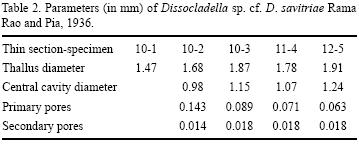
<body><![CDATA[<p align="center"><font face="verdana" size="2"><a href="/img/revistas/rmcg/v28n1/a13f3.jpg" target="_blank">Figure 3.8</a></font></p> 	    <p align="justify"><font face="verdana" size="2">1962 <i>Acicularia americana</i> Konishi and Epis, p. 71&#150;72, pl. 1, figs. 7 &#150; 9, 11, 14.</font></p> 	    <p align="justify"><font face="verdana" size="2"><b>Description</b>. Spicule stem solid, diameter 0.232 mm. Sporangia chambers 12 in number, pore diameter 0.0179&#150;0.027 mm.</font></p> 	    <p align="justify"><font face="verdana" size="2"><b>Remarks</b>.The diameter of the spicule and the diameter of the sporangial chambers are near the range of those described for <i>Acicularia americana</i>, 0.088&#150;0.122 mm and 0.025&#150;0.040 mm, respectively. This species may be placed in Terquemella (B. Granier, personal communication, June 25, 2010).</font></p> 	    <p align="justify"><font face="verdana" size="2"><b>Stratigraphic range</b>. This species is common in the Albian of Texas and Arizona (Johnson, 1969; Scott and Gonz&aacute;lez&#150;Le&oacute;n, 1991).</font></p> 	    <p align="center"><font face="verdana" size="2">Genus <i>Dissocladella </i>Pia in Rama Rao and Pia, 1936</font></p> 	    <p align="center"><font face="verdana" size="2"><b><i>Dissocladella </i>sp. cf. D. <i>savitriae </i>Rama Rao and Pia, 1936</b></font></p> 	    <p align="center"><font face="verdana" size="2"><a href="/img/revistas/rmcg/v28n1/a13f3.jpg" target="_blank">Figure 3.4 &#150; 3.7</a></font></p> 	    <p align="justify"><font face="verdana" size="2"><b>Description</b>. Thallus elongate, cylindrical, with subparallel margins; wall much thinner than thallus diameter; diameter of axial cavity about 60% of total thallus diameter. Inner primary branches numerous, vase&#150;shaped, tapered inward toward axial cavity. Each primary branch divided into 2 to 4 secondary branches. Outer secondary branches typically slightly v&#150;shaped outwards. Skeleton composed of blocky calcite spar, presumably replacing original aragonite.</font></p> 	    <p align="justify"><font face="verdana" size="2"><b>Remarks</b>. The dimensions and the large number of primary branches of the specimens from the Mal Paso Formation are very similar to those of <i>D. savitriae</i>, which is known from Maastrichtian &#150; Danian beds in India. However, the Mexican species seems to have a greater number of primary branches than the Indian species and its primary branches are smaller. Also, the Mexican species is much larger than the Cretaceous species <i>Dissocladella undulata</i> (Raineri) (Johnson, 1969; Bassoullet <i>et al</i>., 1978; Kuss and Conrad, 1991).</font></p> 	    ]]></body>
<body><![CDATA[<p align="justify"><font face="verdana" size="2"><b>Dimensions</b>. <a href="#t2">Table 2</a>. Measurements are given in mm.</font></p> 	    <p align="center"><font face="verdana" size="2"><a name="t2"></a></font></p> 	    <p align="center"><font face="verdana" size="2"><img src="/img/revistas/rmcg/v28n1/a13t2.jpg"></font></p> 	    <p align="justify"><font face="verdana" size="2"><b>Stratigraphic range</b>. This species occurs throughout a fairly thick interval of the Upper Albian calcareous upper member of the Mal Paso Formation, from unit MP9 to unit MP17, and it is common in unit MP14, the horizon which contains the main accumulation of the rudist Mexicaprina alata.</font></p> 	    <p align="center"><font face="verdana" size="2"><b>Incertae Sedis</b></font></p> 	    <p align="center"><font face="verdana" size="2">Tube&#150;within&#150;a&#150;tube fossil</font></p> 	    <p align="center"><font face="verdana" size="2"><a href="/img/revistas/rmcg/v28n1/a13f3.jpg" target="_blank">Figure 3.9&#150;3.11</a></font></p> 	    <p align="justify"><font face="verdana" size="2"><b>Description</b>. Elongate, curved tube with an internal tube or axis, circular to oval in cross section; diameter: outer tube, 0.232&#150;0.214 mm, inner tube, 0.125 mm; walls of each tube composed of equant microgranular calcite and perforated by minute oval pores. Specimens which lack a central tube possess a wall composed of fine radial calcite fibers that originate from central axis; darker concentric growth rings closely spaced.</font></p> 	    <p align="justify"><font face="verdana" size="2"><b>Remarks</b>. Specimens of this taxon were recognized in thin section samples from units MP 9, MP10 and MP12 of the calcareous upper member of the Mal Paso Formation.</font></p> 	    <p align="center"><font face="verdana" size="2">Order Foraminiferida Eichwald, 1830</font></p> 	    ]]></body>
<body><![CDATA[<p align="center"><font face="verdana" size="2">Suborder Textulariina Delage and H&eacute;rouard, 1896</font></p> 	    <p align="center"><font face="verdana" size="2">Superfamily Haplophragmiacea Eimer and Fickert, 1899</font></p> 	    <p align="center"><font face="verdana" size="2">Family Nezzazatidae Hamaoui and Saint&#150;Marc, 1970</font></p> 	    <p align="center"><font face="verdana" size="2">Subfamily Nezzazatinae Hamaoui and Saint&#150;Marc, 1970</font></p> 	    <p align="center"><font face="verdana" size="2">Genus <i>Nezzazata</i> Omara, 1956</font></p> 	    <p align="center"><font face="verdana" size="2"><b>Type species</b>. <i>Nezzazata simplex</i> Omara, 1956, p. 887.</font></p> 	    <p align="center"><font face="verdana" size="2"><b><i>Nezzazata </i>sp. cf. N. isabellae Arnaud&#150;Vanneau and Sliter, 1995</b></font></p> 	    <p align="center"><font face="verdana" size="2"><a href="/img/revistas/rmcg/v28n1/a13f4.jpg" target="_blank">Figure 4.1&#150;4.5</a></font></p> 	    <p align="justify"><font face="verdana" size="2">1995 <i>Nezzazata isabellae </i>Arnaud&#150;Vanneau and Sliter, p. 552, figs. 7A&#150;7D, pl. 2, figs. 11&#150;24 (for comparison).</font></p> 	    <p align="justify"><font face="verdana" size="2">1995 <i>Nezzazata isabellae </i>Arnaud&#150;Vanneau and Sliter, Arnaud&#150;Vanneau and Premoli Silva, p. 206, pl. 2, figs. 1&#150;3 (for comparison).</font></p> 	    ]]></body>
<body><![CDATA[<p align="justify"><font face="verdana" size="2"><b>Description</b>. Test low trochospiral, planoconvex; six to eight chambers per whorl; periphery rounded; diameter up to 0.60 mm. Short projections on inner edges of septa directed into preceding chamber. Wall microgranular calcite, imperforate.</font></p> 	    <p align="justify"><font face="verdana" size="2"><b>Remarks</b>. These planoconvex specimens are larger in diameter than the Aptian to Lower Albian <i>Nezzazata isabellae</i> Arnaud&#150;Vanneau and Sliter, 1995, which has a biconvex test. The specimens from the Mal Paso Formation differ from <i>Nezzazata gyra</i> (Smout, 1956) and other Cenomanian species (Fleury, 1971) by their rounded periphery and unforked septal plate. This may be a new transitional species related to <i>N. isabellae.</i></font></p> 	    <p align="justify"><font face="verdana" size="2"><b>Stratigraphic range</b>. All of the specimens are from unit MP18, near the top of the measured section of the calcareous upper member of the Mal Paso Formation. This morphotype of <i>Nezzazata</i> is part of the upper Albian microbiota assemblage which overlies species of the rudist <i>Mexicaprina</i>.</font></p> 	    <p align="center"><font face="verdana" size="2">Superfamily Loftusiacea Brady, 1884</font></p> 	    <p align="center"><font face="verdana" size="2">Family Cyclamminidae Marie, 1941</font></p> 	    <p align="justify"><font face="verdana" size="2"><b>Diagnosis</b>. Test enrolled, involute to uncoiled; wall agglutinated, outer layer imperforate, inner layer alveolar; septal structure differentiated from outer wall; aperture interio&#150;marginal near septal base.</font></p> 	    <p align="justify"><font face="verdana" size="2"><b>Remarks</b>. Loeblich and Tappan (1988) and Banner and Highton (1990) placed the family Cyclamminidae in the superfamily Loftusiacea because of the alveolar inner wall layer. However, BouDagher&#150;Fadel (2001) placed this family in the superfamily Lituolacea de Blainville.</font></p> 	    <p align="justify"><font face="verdana" size="2">Subfamily Buccicrenatinae Loeblich and Tappan, 1985</font></p> 	    <p align="justify"><font face="verdana" size="2"><b>Diagnosis</b>. Few chambers per whorl, wall and septa of early whorls may be solid, later stage with thin wall with large ovate alveolae; base of septa thickened with triangular chomata; chamber cavity open; aperture slit&#150;like to zig&#150;zag in coiling plane.</font></p> 	    <p align="center"><font face="verdana" size="2">Genus <i>Buccicrenata </i>Loeblich and Tappan, 1949</font></p> 	    ]]></body>
<body><![CDATA[<p align="justify"><font face="verdana" size="2"><b>Type species</b>. <i>Ammobaculites subgoodlandensis </i>Vanderpool, 1933, p. 407.</font></p> 	    <p align="justify"><font face="verdana" size="2"><b>Diagnosis</b>. Test compressed, inner wall alveolae may bifurcate; septa solid or locally perforate; zig&#150;zag aperture; other features of the subfamily.</font></p> 	    <p align="justify"><font face="verdana" size="2"><b>Remarks</b>. <i>Buccicrenata </i>is characterized by less than a complete whorl in its planispirally coiled stage and its chambers are arcuate reniform; the agglutinate outer wall has few tubular alveolae separated by large calcite and bioclastic grains; chamber septa are unperforated to locally perforated; base of septa next to preceding whorl are thickened triangle; the zigzag aperture spans the face of the last septum.</font></p> 	    <p align="justify"><font face="verdana" size="2"><i>Everticyclammina </i>Redmond, 1964, also in the subfamily Buccicrenatinae, is more lenticular and less compressed than <i>Buccicrenata</i>, has two whorls in its planispirally coiled stage and its chambers are wedge&#150;shaped; the agglutinate outer wall has small alveolae and septa are unperforated; and the single simple aperture is wide (Loeblich and Tappan, 1988; Banner and Highton, 1990).</font></p> 	    <p align="justify"><font face="verdana" size="2"><i>Pseudocyclammina</i> Yabe and Hanzawa, 1926, in the subfamily Choffatellinae Maync, is characterized by its type species <i>P. lituus</i> (Yokoyama, 1890), which has two to three whorls in its planispirally coiled stage with narrow arcuate chambers; numerous closely spaced alveolae transect both the agglutinate wall and the septa; and the cribrate aperture fills the face of the last septum (Loeblich and Tappan, 1988).</font></p> 	    <p align="center"><font face="verdana" size="2"><b><i>Buccicrenata subgoodlandensis </i>(Vanderpool, 1933)</b></font></p> 	    <p align="center"><font face="verdana" size="2"><a href="/img/revistas/rmcg/v28n1/a13f4.jpg" target="_blank">Figure 4.7, 4.8</a></font></p> 	    <p align="justify"><font face="verdana" size="2">1933 <i>Ammobaculites subgoodlandensis </i>Vanderpool, p. 407, pl. 49, figs. 1&#150;3;</font></p> 	    <p align="justify"><font face="verdana" size="2">1944 <i>Ammobaculites subgoodlandensis </i>Vanderpool, Lozo, p. 540, pl. 1, figs. 2&#150;3, pl. 4, fig. 1, text&#150;figs. 15A&#150;G.</font></p> 	    <p align="justify"><font face="verdana" size="2">1949 <i>Buccicrenata subgoodlandensis </i>(Vanderpool), Loeblich and Tappan, p. 253, pl. 47, figs. 5&#150;15b.</font></p> 	    ]]></body>
<body><![CDATA[<p align="justify"><font face="verdana" size="2">1954 <i>Lituola subgoodlandensis </i>(Vanderpool), Frizzell, p. 66.</font></p> 	    <p align="justify"><font face="verdana" size="2">1965 <i>Lituola subgoodlandensis </i>(Vanderpool), Applin and Applin, pl. 1, fig. 11.</font></p> 	    <p align="justify"><font face="verdana" size="2">1966 <i>Pseudocyclammina </i>aff. <i>hedbergi </i>(Maync), Banner, pl. 3, figs. 5a&#150;5b.</font></p> 	    <p align="justify"><font face="verdana" size="2">1970 <i>Pseudocyclammina </i>aff. <i>hedbergi </i>(Maync), Banner, pl. 5, figs. 7, 7a.</font></p> 	    <p align="justify"><font face="verdana" size="2">1985 <i>Buccicrenata subgoodlandensis </i>(Vanderpool), Loeblich and Tappan, p. 100, pl. 2, figs. 4&#150;10.</font></p> 	    <p align="justify"><font face="verdana" size="2">1987 <i>Buccicrenata subgoodlandensis </i>(Vanderpool), Simmons and Hart, pl. 10.5, fig. 1.</font></p> 	    <p align="justify"><font face="verdana" size="2">1988 <i>Buccicrenata subgoodlandensis </i>(Vanderpool), Loeblich and Tappan, p. 99, pl. 96, figs. 1&#150;9.</font></p> 	    <p align="justify"><font face="verdana" size="2">1990 <i>Buccicrenata subgoodlandensis </i>(Vanderpool), Banner and Highton, p. 12.</font></p> 	    <p align="justify"><font face="verdana" size="2">1991 <i>Pseudocyclammina hedbergi </i>Maync, Scott and Gonz&aacute;lez&#150;Le&oacute;n, p. 58;</font></p> 	    <p align="justify"><font face="verdana" size="2">1999 <i>Pseudocyclammina hedbergi </i>Maync, Scott and Finch, 1999, fig. 4D, E.</font></p> 	    ]]></body>
<body><![CDATA[<p align="justify"><font face="verdana" size="2">2001 <i>Buccicrenata subgoodlandensis </i>(Vanderpool), BouDagher&#150;Fadel, p. 168&#150;169, pl. 1, figs. 5&#150;7.</font></p> 	    <p align="justify"><font face="verdana" size="2"><b>Diagnosis</b>. Test planispiral to uniserial, four to five hemispherical chambers in coil; uniserial part with one to three ellipsoidal chambers; simple terminal aperture.</font></p> 	    <p align="justify"><font face="verdana" size="2"><b>Remarks</b>. The five other species of <i>Buccicrenata</i> are described by BouDagher&#150;Fadel (2001). Measurements of specimens from the Walnut Formation: length 0.71 to 4.73 mm, coil diameter 1.38 mm to 2.69 mm, test thickness 0.58 mm (Vanderpool, 1933; Loeblich and Tappan, 1949). The specimens from the Mal Paso Formation range in length from 0.98 mm to 1.79 mm, axial width 0.64 to 1.27 mm, and proloculus diameter 0.125 mm.</font></p> 	    <p align="justify"><font face="verdana" size="2"><b>Stratigraphic range</b>. The type specimens are from the Middle Albian Walnut Formation in southern Oklahoma (Vanderpool, 1933). The species ranges throughout the Albian in Tethyan sections from North America to the Middle East. In Texas the species occurs in the Lower Albian Glen Rose Formation and in the Lower to Upper Albian Walnut and Goodland formations of the Fredericksburg Group. In Florida the species was identified as <i>Lituola subgoodlanensis</i> where it occurs with <i>Coskinolinoides texanus</i> Keijzer in the Fredericksburg Group (Applin and Applin, 1965). In Mexico and Honduras the species was reported in Middle to Upper Albian strata as <i>P. hedbergi</i> by Scott and Gonz&aacute;lez&#150;Le&oacute;n (1991) and Scott and Finch (1999). In the United Arab Emirates and Oman it ranges throughout the Lower to Upper Albian Nahr Umr Formation (Simmons and Hart, 1987; Banner and Highton, 1990; BouDagher&#150;Fadel, 2001). In Spain the species is reported from Upper Albian to Lower Cenomanian strata (Gonz&aacute;lez Fern&aacute;ndez <i>et al</i>., 2004).</font></p> 	    <p align="center"><font face="verdana" size="2">Superfamily Ataxophragmiacea Schwager, 1877</font></p> 	    <p align="center"><font face="verdana" size="2">Family Cuneolinidae Saidova, 1981</font></p> 	    <p align="center"><font face="verdana" size="2">Subfamily Cuneolininae Saidova, 1981</font></p> 	    <p align="center"><font face="verdana" size="2">Genus <i>Cuneolina </i>d'Orbigny, 1839</font></p> 	    <p align="justify"><font face="verdana" size="2"><b>Type species</b>. <i>Cuneolina pavonia </i>d'Orbigny, 1846, p. 253.</font></p> 	    <p align="justify"><font face="verdana" size="2"><b>Emended Diagnosis</b>. "Test free, somewhat compressed parallel to the plane of biseriality and conical to flabelliform. The embryonic apparatus consists of a globular to oval protoconch covered by a deuteroconch that is divided by beams and rafters. The following biserial stage consists of broad, low chambers that are divided by radial beams extending from the outer wall toward the plane of biseriality and, sometimes, by horizontal rafters. The wall is agglutinated or microgranular and keriothecal. The aperture consists of a row of pores at the base of the septal face" (Arnaud&#150;Vanneau and Sliter, 1995, p. 554).</font></p> 	    ]]></body>
<body><![CDATA[<p align="center"><font face="verdana" size="2"><b><i>Cuneolina parva </i>Henson, 1948</b></font></p> 	    <p align="center"><font face="verdana" size="2"><a href="/img/revistas/rmcg/v28n1/a13f4.jpg" target="_blank">Figure 4.9&#150;4.12</a></font></p> 	    <p align="justify"><font face="verdana" size="2">1948 <i>Cuneolina pavonia </i>d'Orbigny var. <i>parva</i> var. nov. Henson, p. 624&#150;627, pl. XIV, figs. 1&#150;6, pl. XVII, figs. 7&#150;12, pl. XVIII, figs. 12&#150;14.</font></p> 	    <p align="justify"><font face="verdana" size="2">1991 <i>Cuneolina walteri </i>Cushman and Applin, 1947, not p. 30, pl. 10, figs. 4, 5a, b; Scott and Gonz&aacute;lez&#150;Le&oacute;n, p. 58, fig. 5O.</font></p> 	    <p align="justify"><font face="verdana" size="2">1995 <i>Cuneolina parva </i>Henson, Arnaud&#150;Vanneau and Sliter, p. 554, pl. 4, figs. 6&#150;9.</font></p> 	    <p align="justify"><font face="verdana" size="2">1995 <i>Cuneolina parva </i>Henson, Arnaud&#150;Vanneau and Premoli Silva, p. 207.</font></p> 	    <p align="justify"><font face="verdana" size="2">1999 <i>Cuneolina walteri </i>Cushman and Applin, Scott and Finch, fig. 4A&#150;C.</font></p> 	    <p align="justify"><font face="verdana" size="2"><b>Diagnosis</b>. Test moderate size, biserial flabelliform to triangular, apical angle generally less than 90 &deg;. Wall agglutinated and composed of uniform micrite grains with small alveolae. Proloculus at test apex slightly eccentric and oval; up to twelve biserial arcuate concentric chambers expand from apex; chambers divided into chamberlets by radial septa that align with septa in adjacent chambers, but septa inserted between older septa in younger abapical chambers; one or two short lateral partitions project from outer wall of concentric chambers and insert a narrow concentric line between chamber septa; septal faces curved toward median wall between chambers.</font></p> 	    <p align="justify"><font face="verdana" size="2"><b>Remarks</b>. A stratigraphic succession of species ranges from Aptian to Maastrichtian and has been discriminated by test sizes, apical angles and sutures (Henson, 1948; Arnaud&#150;Vanneau and Sliter, 1995). However, the two species reported most often are <i>Cuneolina pavonia</i> d'Orbigny, 1846, and <i>Cuneolina parva</i> Henson, 1948 (Arnaud&#150;Vanneau and Sliter, 1995; Arnaud&#150;Vanneau and Premoli Silva, 1995). <i>Cuneolina pavonia</i> is flabelliform and tends to be slightly larger and have a greater apical angle than <i>C. parva</i>, which is conical to flabelliform (<a href="/img/revistas/rmcg/v28n1/a13t3.jpg" target="_blank">Table 3</a>; <a href="#f5">Figure 5, graphs a, b</a>). The mean apical angle of paratypes of <i>C. parva</i> is 48 &deg; and ranges from 18 &deg; to 96 &deg; (Henson, 1948). The chambers of <i>C. pavonia </i>are wider than those of <i>C. parva </i>and<i> C. pavonia</i> has two to three transverse rafters in the chambers compared to one to two in <i>C. parva </i>(Arnaud&#150;Vanneau and Sliter, 1995; Arnaud Vanneau and Premoli Silva, 1995). <i>Cuneolina parva</i> is reported from Albian &#150; Cenomanian strata and<i> C. pavonia</i> from uppermost Albian to Santonian. The Aptian species, <i>Cuneolina sliteri </i>Arnaud Vaneau and Premoli Silva, 1995, has a small triangular to conical test and lacks the horizontal rafters in its first chambers.</font></p> 	    <p align="center"><font face="verdana" size="2"><a name="f5"></a></font></p> 	    ]]></body>
<body><![CDATA[<p align="center"><font face="verdana" size="2"><img src="/img/revistas/rmcg/v28n1/a13f5.jpg"></font></p> 	    <p align="justify"><font face="verdana" size="2">The Middle Cenomanian Florida species <i>Cuneolina walteri </i>Cushman and Applin, 1947 (pl.10, <a href="/img/revistas/rmcg/v28n1/a13f4.jpg" target="_blank">figs. 4</a>, <a href="#f5">5a, 5b</a>) is also illustrated by Applin and Applin (1965, pl. 2, <a href="#f2">fig. 2</a>). This name was used for specimens in Mexico (Scott and Gonz&aacute;lez&#150;Le&oacute;n, 1991) and in Honduras (Scott and Finch, 1999). The dimensions of the types of <i>C. walteri</i> are in the range of topotypes of the older name <i>C. pavonia</i> (<a href="#f5">Figure 5, graphs A, B</a>) and if the internal structure of <i>C. walteri </i>is like that of <i>C. pavonia</i>, then the former would be a junior synonym of the latter. The sizes of the Mexican and Honduran specimens are in the size range of <i>C. parva</i> and overlap with the smaller specimens of <i>C. pavonia</i>. However, measurements of <i>Cuneolina</i> specimens taken from thin sections tend to be incomplete because most specimens are unoriented and the cross sections are oblique to the growth axes. Thus, distinguishing species of <i>Cuneolina</i> by sizes of thin section specimens has some degree of uncertainty.</font></p> 	    <p align="justify"><font face="verdana" size="2"><i>Cuneolina conica </i>d'Orbigny, 1846, in the Coniacian&#150; Santonian is a narrow cylindrical species and <i>Cuneolina fleuriausiana</i> d'Orbigny, 1839, has a very acute apical angle (Henson, 1948). <i>Cuneolina cylindrica</i> Henson, 1948, in the Maastrichtian has an apical angle of 7 &deg; to 14 &deg;. Clearly the sizes and apical angles do not readily separate these species and a study of the types and collections of free specimens is needed to clarify the taxonomy of <i>Cuneolina</i> species.</font></p> 	    <p align="justify"><font face="verdana" size="2"><b>Stratigraphic range</b>. The type specimens of <i>C. pavonia</i> are from the Cenomanian of France and the species ranges from uppermost Albian to Santonian in the European and North African Tethys (Arnaud&#150;Vanneau and Premoli Silva, 1995). The types of <i>C. parva</i> are from Egypt in presumed Albian strata, not Santonian as stated by Henson (Arnaud&#150;Vanneau and Premoli Silva, 1995). This species is known from Albian to Cenomanian strata in the Tethys, including Upper Albian strata in Mexico and Honduras. The types of <i>C. walteri </i>are from the lower member of the Atkinson Formation in the subsurface of Florida, which is correlated with the Middle Cenomanian Woodbine Group in north Texas (Applin and Applin, 1965). Specimens of <i>C. parva </i>were recognized in most of the sampled beds of the calcareous upper member of the Mal Paso Formation.</font></p> 	    <p align="center"><font face="verdana" size="2">Family Coskinolinidae Moullade, 1965</font></p> 	    <p align="center"><font face="verdana" size="2">Genus <i>Pseudolituonella </i>Marie, 1955</font></p> 	    <p align="center"><font face="verdana" size="2"><b>Type species</b>. <i>Pseudolituonella reicheli </i>Marie, 1955.</font></p> 	    <p align="center"><font face="verdana" size="2">Pseudolituonella sp.</font></p> 	    <p align="center"><font face="verdana" size="2"><a href="/img/revistas/rmcg/v28n1/a13f4.jpg" target="_blank">Figure 4.13</a></font></p> 	    <p align="justify"><font face="verdana" size="2"><b>Description</b>. Test uniserial, conical, with a trochospiral proloculus, two juvenile ovate chambers and four arcuate chambers. Test length 0.52 mm, width 0.34 mm. Wall of test microcrystalline calcite and solid. Proloculus a single oval chamber with a thick prismatic wall; inner diameter 0.053 mm, outer diameter 0.120 mm.</font></p> 	    ]]></body>
<body><![CDATA[<p align="justify"><font face="verdana" size="2"><b>Remarks</b>. The species description is based on a specimen from the calcareous upper member of the Mal Paso Formation. The specimen is much smaller than and differs from <i>Pseudolituonella reicheli </i>by the absence of tubular pillars on the adapical side of the apertures. It is very similar to a specimen in the Upper Albian section in the Pyrenees identified as <i>Pseudolituonella</i> sp.? (Peybernes, 1976, pl. 34, fig. 12), which is 1.62 mm in length and 0.85 mm in width. The older and larger <i>Pseudolituonella gavonensis</i> Foury, 1968, has a streptospiral early stage.</font></p> 	    <p align="justify"><font face="verdana" size="2"><b>Stratigraphic range</b>. According to Loeblich and Tappan (1988) the genus ranges from Cenomanian to Campanian in the Mediterranean part of the Tethys. However, <i>P. gavonesis </i>is a Barremian species. In Europe, <i>Pseudolituonella</i> sp.? has been reported with the Upper <i>Albian Neorbitolinopsis conulus </i>(Douvill&eacute;) (Peybernes, 1976). The Mexican specimen is from unit MP10 of the calcareous upper member of the Mal Paso Formation.</font></p> 	    <p align="center"><font face="verdana" size="2">Superfamily Textulariacea Ehrenberg, 1838</font></p> 	    <p align="center"><font face="verdana" size="2">Family Chrysalidinidae Neagu, 1968</font></p> 	    <p align="center"><font face="verdana" size="2">Subfamily Chrysalidininae Neagu, 1968</font></p> 	    <p align="center"><font face="verdana" size="2">Genus <i>Praechrysalidina</i> Luperto Sinni, 1979</font></p> 	    <p align="justify"><font face="verdana" size="2"><b>Type species</b>. <i>Praechrysalidina infracretacea </i>Luperto Sinni, 1979.</font></p> 	    <p align="center"><font face="verdana" size="2"><b><i>Praechrysalidina </i>sp.</b></font></p> 	    <p align="center"><font face="verdana" size="2"><a href="/img/revistas/rmcg/v28n1/a13f4.jpg" target="_blank">Figure 4.15, 4.16</a></font></p> 	    <p align="justify"><font face="verdana" size="2"><b>Description</b>. Test small, conical, with overlapping apertural faces. Test length 0.119&#150;0.385 mm, width 0.098&#150;0.210 mm. No interior marginal flaps or other structures present. Proloculus not observed.</font></p> 	    ]]></body>
<body><![CDATA[<p align="justify"><font face="verdana" size="2"><b>Remarks</b>. The species description is based on specimens from the calcareous upper member of the Mal Paso Formation. Banner <i>et al</i>. (1991) placed <i>Praechrysalidina</i> in the family Chrysalidinidae Neagu because of its inferred phylogenetic relationship with <i>Chrysalidina</i> rather than in the family Ataxophragmiidae Schwager, as did Loeblich and Tappan (1988). The Mal Paso specimens are similar to the juvenile portion of a specimen from the Albian of Iraq (Banner <i>et al</i>., 1991, fig. 9). The Mexican specimens do not show the characters of <i>Praechrysalidina infracretacea</i> and they are smaller; additional material is needed in order to make a more detailed species description and a more accurate species determination.</font></p> 	    <p align="justify"><font face="verdana" size="2"><b>Stratigraphic range</b>. The species occurs in units MP6 and MP10 of the calcareous upper member of the Mal Paso Formation. The overall stratigraphic range of the species referred to this genus is Valanginian to Albian in Tethyan strata (Banner <i>et al</i>., 1991).</font></p> 	    <p align="center"><font face="verdana" size="2">Suborder Globigerinina Delage and H&eacute;rouard, 1896</font></p> 	    <p align="center"><font face="verdana" size="2">Superfamily Rotaliporacea Sigal, 1958</font></p> 	    <p align="center"><font face="verdana" size="2">Family Rotaliporidae Sigal, 1958</font></p> 	    <p align="center"><font face="verdana" size="2">Subfamily Ticinellinae Longoria, 1974</font></p> 	    <p align="center"><font face="verdana" size="2">Genus <i>Rotalipora</i> Brotzen, 1942</font></p> 	    <p align="justify"><font face="verdana" size="2"><b>Type species</b>. <i>Rotalipora turonica </i>Brotzen, 1942 (= <i>Globorotalia cushmani </i>Morrow, 1934).</font></p> 	    <p align="center"><font face="verdana" size="2"><b><i>Rotalipora appenninica </i>(Renz, 1936)</b></font></p> 	    <p align="center"><font face="verdana" size="2"><a href="/img/revistas/rmcg/v28n1/a13f4.jpg" target="_blank">Figure 4.14</a></font></p> 	    ]]></body>
<body><![CDATA[<p align="justify"><font face="verdana" size="2">1936 <i>Globotruncana appenninica </i>Renz, p. 20, pl.6, figs. 1&#150;11; pl. 7, fig. 1; pl. 8, fig. 4; text&#150;figs. 2, 7a.</font></p> 	    <p align="justify"><font face="verdana" size="2">1977 <i>Rotalipora appenninica </i>(Renz, 1936), Masters, p. 497&#150;501, pl. 30, figs. 1, 3, not fig. 2 (prior synonymy provided).</font></p> 	    <p align="justify"><font face="verdana" size="2">2002 <i>Rotalipora appenninica </i>(Renz, 1936), Premoli Silva and Sliter, p. 71, pl. 8, figs. 1a&#150;1c, 2a&#150;c, 3a&#150;c, pl. 9, figs. 1a&#150;1c, 2a&#150;c, 3a&#150;c.</font></p> 	    <p align="justify"><font face="verdana" size="2"><b>Description</b>. Test chambers trapezoidal in outline; keel well&#150;developed along peripheral margin. Dimensions of two specimens observed in thin section M10: test diameter 0.378 mm, height 0.126 mm; and test diameter 0.252 mm, height 0.105 mm.</font></p> 	    <p align="justify"><font face="verdana" size="2"><b>Remarks</b>. The brief description is based on two specimens observed in thin section M10 from unit MP18. The overall form of the Mexican specimens is most similar to that of <i>R. appenninica</i>, except the wall is thicker than normal, especially in the early whorls (Mark Leckie and Brian Huber, personal communications, December 2009). The thickened wall may be the result of recrystallization.</font></p> 	    <p align="justify"><font face="verdana" size="2"><b>Stratigraphic range</b>. The Mexican specimens are from unit MP18, near the top of the measured section of the calcareous upper member of the Mal Paso Formation. The full range of <i>R. appenninica </i>is Upper Albian to Lower Cenomanian. The <i>Rotalipora appenninica</i> Zone is defined as the interval above the first occurrence (FO) of the nominate species and the FO of <i>Rotalipora brotzeni </i>(Sigal) and it correlates with latest Albian ammonite zones (Premoli Silva and Sliter, 2002).</font></p> 	    <p align="justify"><font face="verdana" size="2">&nbsp;</font></p> 	    <p align="justify"><font face="verdana" size="2"><b>ACKNOWLEDGMENTS</b></font></p> 	    <p align="justify"><font face="verdana" size="2">The authors thank the two anonymous reviewers for their useful comments on the manuscript; Dr. Francisco Vega for the Spanish version of the abstract and key words; and Dra. Maria del Carmen Perrilliat for assistance with cataloging the illustrated specimens in the IGM collections.</font></p> 	    <p align="justify"><font face="verdana" size="2">&nbsp;</font></p> 	    ]]></body>
<body><![CDATA[<p align="justify"><font face="verdana" size="2"><b>REFERENCES</b></font></p> 	    <!-- ref --><p align="justify"><font face="verdana" size="2">Applin, P.L., Applin, E.R., 1965, The Comanchean Series and associated rocks in the subsurface in central and south Florida: United States Geological Survey Professional, 447, 84 pp.    &nbsp;&nbsp;&nbsp;&nbsp;&nbsp;&nbsp;&nbsp;&nbsp;[&#160;<a href="javascript:void(0);" onclick="javascript: window.open('/scielo.php?script=sci_nlinks&ref=8056038&pid=S1026-8774201100010001300001&lng=','','width=640,height=500,resizable=yes,scrollbars=1,menubar=yes,');">Links</a>&#160;]<!-- end-ref --></font></p> 	    <!-- ref --><p align="justify"><font face="verdana" size="2">Am&eacute;dro, F., 2008, Support for a Vraconian Stage between the Albian <i>sensu stricto</i> and the Cenomanian (Cretaceous System): Carnets de G&eacute;ologie / Notebooks on Geology, Brest, Memoir 2008/02 (CG2008_M02), 83 pp.    &nbsp;&nbsp;&nbsp;&nbsp;&nbsp;&nbsp;&nbsp;&nbsp;[&#160;<a href="javascript:void(0);" onclick="javascript: window.open('/scielo.php?script=sci_nlinks&ref=8056040&pid=S1026-8774201100010001300002&lng=','','width=640,height=500,resizable=yes,scrollbars=1,menubar=yes,');">Links</a>&#160;]<!-- end-ref --></font></p> 	    <!-- ref --><p align="justify"><font face="verdana" size="2">Am&eacute;dro, F., Robaszynski, F., 2008, Zonation by ammonites and foraminifers of the Vraconian&#150;Turonian interval: A comparison of the Boreal and Tethyan domains (NW Europe / Central Tunisia): Carnets de G&eacute;ologie / Notebooks on Geology, Memoir 2008/02 (CG2008_L02), 5 pp.    &nbsp;&nbsp;&nbsp;&nbsp;&nbsp;&nbsp;&nbsp;&nbsp;[&#160;<a href="javascript:void(0);" onclick="javascript: window.open('/scielo.php?script=sci_nlinks&ref=8056042&pid=S1026-8774201100010001300003&lng=','','width=640,height=500,resizable=yes,scrollbars=1,menubar=yes,');">Links</a>&#160;]<!-- end-ref --></font></p> 	    <!-- ref --><p align="justify"><font face="verdana" size="2">Archiac, A., d', 1843, Description g&eacute;ologique du d&eacute;partment de l'Aisne: M&eacute;moires de la Soci&eacute;t&eacute; G&eacute;ologique de France, 5(3), 129&#150;420.    &nbsp;&nbsp;&nbsp;&nbsp;&nbsp;&nbsp;&nbsp;&nbsp;[&#160;<a href="javascript:void(0);" onclick="javascript: window.open('/scielo.php?script=sci_nlinks&ref=8056044&pid=S1026-8774201100010001300004&lng=','','width=640,height=500,resizable=yes,scrollbars=1,menubar=yes,');">Links</a>&#160;]<!-- end-ref --></font></p> 	    <!-- ref --><p align="justify"><font face="verdana" size="2">Arnaud&#150;Vanneau, A., Sliter, W.V., 1995, Early Cretaceous shallow&#150;water benthic foraminifers and fecal pellets from Leg 143 compared with coeval faunas from the Pacific Basin, Central America, and the Tethys, in Winterer, E.L., Sager, W.W., Firth, J.V., Sinton, J.M. (eds.), Proceedings of the Ocean Drilling Program, Scientific Results: Texas, College Station, Ocean Drilling Program, 143, 537&#150;564.    &nbsp;&nbsp;&nbsp;&nbsp;&nbsp;&nbsp;&nbsp;&nbsp;[&#160;<a href="javascript:void(0);" onclick="javascript: window.open('/scielo.php?script=sci_nlinks&ref=8056046&pid=S1026-8774201100010001300005&lng=','','width=640,height=500,resizable=yes,scrollbars=1,menubar=yes,');">Links</a>&#160;]<!-- end-ref --></font></p> 	    <!-- ref --><p align="justify"><font face="verdana" size="2">Arnaud&#150;Vanneau, A., Premoli Silva, I., 1995, Biostratigraphy and systematic description of benthic foraminifers from Mid&#150;Cretaceous shallow&#150;water carbonate platform sediments at sites 878 and 879 (MIT and Takuyo&#150;Daisan Guyots, in Haggerty, J.A., Premoli Silva, I., Rack, F., McNutt, M.K. (eds.), Proceedings of the Ocean Drilling Program, Scientific Results: Texas, College Station, Ocean Drilling Program, 144, 199&#150;219.    &nbsp;&nbsp;&nbsp;&nbsp;&nbsp;&nbsp;&nbsp;&nbsp;[&#160;<a href="javascript:void(0);" onclick="javascript: window.open('/scielo.php?script=sci_nlinks&ref=8056048&pid=S1026-8774201100010001300006&lng=','','width=640,height=500,resizable=yes,scrollbars=1,menubar=yes,');">Links</a>&#160;]<!-- end-ref --></font></p> 	    <!-- ref --><p align="justify"><font face="verdana" size="2">Banner, F.T., 1966, Morfologiya, klassificatsiya i stratigraficheskoe znachenie spirotsiklinid: Voprosi Micro&#150;paleontologii, 10, 201&#150;234.    &nbsp;&nbsp;&nbsp;&nbsp;&nbsp;&nbsp;&nbsp;&nbsp;[&#160;<a href="javascript:void(0);" onclick="javascript: window.open('/scielo.php?script=sci_nlinks&ref=8056050&pid=S1026-8774201100010001300007&lng=','','width=640,height=500,resizable=yes,scrollbars=1,menubar=yes,');">Links</a>&#160;]<!-- end-ref --></font></p> 	    <!-- ref --><p align="justify"><font face="verdana" size="2">Banner, F.T., 1970, A synopsis of the Spirocyclinidae: Revista Espa&ntilde;ola Micropaleontologia, 2(3), 243&#150;290.    &nbsp;&nbsp;&nbsp;&nbsp;&nbsp;&nbsp;&nbsp;&nbsp;[&#160;<a href="javascript:void(0);" onclick="javascript: window.open('/scielo.php?script=sci_nlinks&ref=8056052&pid=S1026-8774201100010001300008&lng=','','width=640,height=500,resizable=yes,scrollbars=1,menubar=yes,');">Links</a>&#160;]<!-- end-ref --></font></p> 	    <!-- ref --><p align="justify"><font face="verdana" size="2">Banner, F.T., Highton, J., 1990, On <i>Everticyclammina</i> Redmond (Foraminifera), especially E. kelleri (Henson): Journal of Micropaleontology, 9(1), 1&#150;14.    &nbsp;&nbsp;&nbsp;&nbsp;&nbsp;&nbsp;&nbsp;&nbsp;[&#160;<a href="javascript:void(0);" onclick="javascript: window.open('/scielo.php?script=sci_nlinks&ref=8056054&pid=S1026-8774201100010001300009&lng=','','width=640,height=500,resizable=yes,scrollbars=1,menubar=yes,');">Links</a>&#160;]<!-- end-ref --></font></p> 	    <!-- ref --><p align="justify"><font face="verdana" size="2">Banner, F.T., Simmons, M.D., Whittaker, J.E., 1991, The Mesozoic Chrysalidiinidae (Foraminifera, Textulariacea) of the Middle East: the Redmond (Aramco) taxa and their relatives: Bulletin British Museum of Natural History (Geology), 47, 101&#150;152.    &nbsp;&nbsp;&nbsp;&nbsp;&nbsp;&nbsp;&nbsp;&nbsp;[&#160;<a href="javascript:void(0);" onclick="javascript: window.open('/scielo.php?script=sci_nlinks&ref=8056056&pid=S1026-8774201100010001300010&lng=','','width=640,height=500,resizable=yes,scrollbars=1,menubar=yes,');">Links</a>&#160;]<!-- end-ref --></font></p> 	    <!-- ref --><p align="justify"><font face="verdana" size="2">Banner, F.T., Simmons, M.D., 1994, Calcareous algae and foraminifera as water&#150;depth indicators: an example from the Early Cretaceous carbonates of northeast Arabia, in Simmons, M.D., (ed.), Micropalaeontology and hydrocarbon exploration in the Middle East: London, Chapman and Hall, 243&#150;252.    &nbsp;&nbsp;&nbsp;&nbsp;&nbsp;&nbsp;&nbsp;&nbsp;[&#160;<a href="javascript:void(0);" onclick="javascript: window.open('/scielo.php?script=sci_nlinks&ref=8056058&pid=S1026-8774201100010001300011&lng=','','width=640,height=500,resizable=yes,scrollbars=1,menubar=yes,');">Links</a>&#160;]<!-- end-ref --></font></p> 	    <!-- ref --><p align="justify"><font face="verdana" size="2">Bassoullet, J.P., Bernier, P., Conrad, M., Deloffre, R., Jaffrezo, M., 1978, Les algues Dasycladales du Jurassique et du Cr&eacute;tac&eacute;: Geobios, m&eacute;moire sp&eacute;cial 2, 330 pp.    &nbsp;&nbsp;&nbsp;&nbsp;&nbsp;&nbsp;&nbsp;&nbsp;[&#160;<a href="javascript:void(0);" onclick="javascript: window.open('/scielo.php?script=sci_nlinks&ref=8056060&pid=S1026-8774201100010001300012&lng=','','width=640,height=500,resizable=yes,scrollbars=1,menubar=yes,');">Links</a>&#160;]<!-- end-ref --></font></p> 	    <!-- ref --><p align="justify"><font face="verdana" size="2">BouDagher&#150;Fadel, M.K., 2001, The taxonomy and evolution of the foraminiferal genus <i>Buccicrenata</i> Loeblich and Tappan: Micropaleontology, 47(2), 168&#150;172.    &nbsp;&nbsp;&nbsp;&nbsp;&nbsp;&nbsp;&nbsp;&nbsp;[&#160;<a href="javascript:void(0);" onclick="javascript: window.open('/scielo.php?script=sci_nlinks&ref=8056062&pid=S1026-8774201100010001300013&lng=','','width=640,height=500,resizable=yes,scrollbars=1,menubar=yes,');">Links</a>&#160;]<!-- end-ref --></font></p> 	    <!-- ref --><p align="justify"><font face="verdana" size="2">Brady, H.B., 1884, Report on the foraminifera collected by H.M.S. Challenger during the years 1873&#150;1876 (on line), in Report on the Scientific Results of the Voyage of H.M.S. Challenger during the years 1873&#150;1876, v. 9, Zoology, part 22: Bossard, D.C., publicaci&oacute;n mayo de 2004, <a href="http://www.19thcenturyscience.org/HMSC/HMSC-Reports/Zool-22/htm/doc.html" target="_blank">http://www.19thcenturyscience.org/HMSC/HMSC&#150;Reports/Zool&#150;22/htm/doc.html</a></font>&nbsp;&nbsp;&nbsp;&nbsp;&nbsp;&nbsp;&nbsp;&nbsp;[&#160;<a href="javascript:void(0);" onclick="javascript: window.open('/scielo.php?script=sci_nlinks&ref=8056064&pid=S1026-8774201100010001300014&lng=','','width=640,height=500,resizable=yes,scrollbars=1,menubar=yes,');">Links</a>&#160;]<!-- end-ref --><!-- ref --><p align="justify"><font face="verdana" size="2">Brotzen, F., 1942, Die Foraminiferengattung Gavelinella nov. gen. und die Systematik der Rotaliiformes: &Aring;rsbok Sveriges Geologiska Unders&ouml;kning, 36(8), 1&#150;60.    &nbsp;&nbsp;&nbsp;&nbsp;&nbsp;&nbsp;&nbsp;&nbsp;[&#160;<a href="javascript:void(0);" onclick="javascript: window.open('/scielo.php?script=sci_nlinks&ref=8056065&pid=S1026-8774201100010001300015&lng=','','width=640,height=500,resizable=yes,scrollbars=1,menubar=yes,');">Links</a>&#160;]<!-- end-ref --></font></p> 	    ]]></body>
<body><![CDATA[<!-- ref --><p align="justify"><font face="verdana" size="2">Buitr&oacute;n&#150;S&aacute;nchez, B.E., Pantoja&#150;Alor, J., 1994, Esponjas perforantes de moluscos del Cret&aacute;cico Temprano en la regi&oacute;n centrooccidental de M&eacute;xico: Revista Mexicana de Ciencias Geol&oacute;gicas, 11(2), 222&#150;231.    &nbsp;&nbsp;&nbsp;&nbsp;&nbsp;&nbsp;&nbsp;&nbsp;[&#160;<a href="javascript:void(0);" onclick="javascript: window.open('/scielo.php?script=sci_nlinks&ref=8056067&pid=S1026-8774201100010001300016&lng=','','width=640,height=500,resizable=yes,scrollbars=1,menubar=yes,');">Links</a>&#160;]<!-- end-ref --></font></p> 	    <!-- ref --><p align="justify"><font face="verdana" size="2">Buitr&oacute;n&#150;S&aacute;nchez, B.E., Carrillo&#150;Martinez, M., Aguilera&#150;Franco, N., 1995, A Middle Albian biota (algae, foraminifera and gastropoda) from Ahuacatl&aacute;n, State of Quer&eacute;taro, Mexico: Revista Mexicana de Ciencias Geol&oacute;gicas, 12(2), 145&#150;156.    &nbsp;&nbsp;&nbsp;&nbsp;&nbsp;&nbsp;&nbsp;&nbsp;[&#160;<a href="javascript:void(0);" onclick="javascript: window.open('/scielo.php?script=sci_nlinks&ref=8056069&pid=S1026-8774201100010001300017&lng=','','width=640,height=500,resizable=yes,scrollbars=1,menubar=yes,');">Links</a>&#160;]<!-- end-ref --></font></p> 	    <!-- ref --><p align="justify"><font face="verdana" size="2">Buitr&oacute;n&#150;S&aacute;nchez, B.E., Pantoja&#150;Alor, J., 1996, Albian gastropods of the rudist&#150;bearing Mal Paso Formation of the Chumbitaro region, SW Mexico (resumen), in Quatri&egrave;me Congr&egrave;s International sur les Rudistes (Fourth International Conference on Rudists), Universit&eacute; de Provence, Centre de S&eacute;dimentologie&#150;Pal&eacute;ontologie : Marseille, France, p. 3.    &nbsp;&nbsp;&nbsp;&nbsp;&nbsp;&nbsp;&nbsp;&nbsp;[&#160;<a href="javascript:void(0);" onclick="javascript: window.open('/scielo.php?script=sci_nlinks&ref=8056071&pid=S1026-8774201100010001300018&lng=','','width=640,height=500,resizable=yes,scrollbars=1,menubar=yes,');">Links</a>&#160;]<!-- end-ref --></font></p> 	    <!-- ref --><p align="justify"><font face="verdana" size="2">Buitr&oacute;n&#150;S&aacute;nchez, B.E., Pantoja&#150;Alor, J., 1998, Albian gastropods of the rudist&#150;bearing Mal Paso Formation, Chumb&iacute;taro region, Guerrero, Mexico: Revista Mexicana de Ciencias Geol&oacute;gicas, 15(1), 14&#150;20.    &nbsp;&nbsp;&nbsp;&nbsp;&nbsp;&nbsp;&nbsp;&nbsp;[&#160;<a href="javascript:void(0);" onclick="javascript: window.open('/scielo.php?script=sci_nlinks&ref=8056073&pid=S1026-8774201100010001300019&lng=','','width=640,height=500,resizable=yes,scrollbars=1,menubar=yes,');">Links</a>&#160;]<!-- end-ref --></font></p> 	    <!-- ref --><p align="justify"><font face="verdana" size="2">Centeno&#150;Garc&iacute;a, E., 1994, Tectonic Evolution of the Guerrero Terrane, Western Mexico: University of Arizona, Ph.D. Dissertation, 220 pp.    &nbsp;&nbsp;&nbsp;&nbsp;&nbsp;&nbsp;&nbsp;&nbsp;[&#160;<a href="javascript:void(0);" onclick="javascript: window.open('/scielo.php?script=sci_nlinks&ref=8056075&pid=S1026-8774201100010001300020&lng=','','width=640,height=500,resizable=yes,scrollbars=1,menubar=yes,');">Links</a>&#160;]<!-- end-ref --></font></p> 	    ]]></body>
<body><![CDATA[<!-- ref --><p align="justify"><font face="verdana" size="2">Coogan, A. H., 1973, Nuevos rudistas del Albiano y Cenomaniano de Mexico y del sur de Texas: Revista del Instituto Mexicano del Petr&oacute;leo, 5, 51&#150;83.    &nbsp;&nbsp;&nbsp;&nbsp;&nbsp;&nbsp;&nbsp;&nbsp;[&#160;<a href="javascript:void(0);" onclick="javascript: window.open('/scielo.php?script=sci_nlinks&ref=8056077&pid=S1026-8774201100010001300021&lng=','','width=640,height=500,resizable=yes,scrollbars=1,menubar=yes,');">Links</a>&#160;]<!-- end-ref --></font></p> 	    <!-- ref --><p align="justify"><font face="verdana" size="2">Cushman, J.A., Applin, E.R., 1947, Two new species of Lower Cretaceous foraminifera from Florida: Cushman Laboratory for Foraminiferal Research Contribution, 23(291), 29&#150;30.    &nbsp;&nbsp;&nbsp;&nbsp;&nbsp;&nbsp;&nbsp;&nbsp;[&#160;<a href="javascript:void(0);" onclick="javascript: window.open('/scielo.php?script=sci_nlinks&ref=8056079&pid=S1026-8774201100010001300022&lng=','','width=640,height=500,resizable=yes,scrollbars=1,menubar=yes,');">Links</a>&#160;]<!-- end-ref --></font></p> 	    <!-- ref --><p align="justify"><font face="verdana" size="2">Delage, Y., H&eacute;rouard, E., 1896, Trait&eacute; de Zoologie Concr&egrave;te, vol. 1, La Cellule et les Protozoaires: Paris, Schleicher Fr&egrave;res, 584 pp.    &nbsp;&nbsp;&nbsp;&nbsp;&nbsp;&nbsp;&nbsp;&nbsp;[&#160;<a href="javascript:void(0);" onclick="javascript: window.open('/scielo.php?script=sci_nlinks&ref=8056081&pid=S1026-8774201100010001300023&lng=','','width=640,height=500,resizable=yes,scrollbars=1,menubar=yes,');">Links</a>&#160;]<!-- end-ref --></font></p> 	    <!-- ref --><p align="justify"><font face="verdana" size="2">Dragastan, O., 1970, New species of Dasycladaceae (calcareous algae) in the Lower Cretaceous of the eastern Carpathians (Rumania): Review of Palaeobotany and Palynology, 10(2), 117&#150;129.    &nbsp;&nbsp;&nbsp;&nbsp;&nbsp;&nbsp;&nbsp;&nbsp;[&#160;<a href="javascript:void(0);" onclick="javascript: window.open('/scielo.php?script=sci_nlinks&ref=8056083&pid=S1026-8774201100010001300024&lng=','','width=640,height=500,resizable=yes,scrollbars=1,menubar=yes,');">Links</a>&#160;]<!-- end-ref --></font></p> 	    <!-- ref --><p align="justify"><font face="verdana" size="2">Dragastan, O., 1981, Mesozoic Dasycladaceae from Romania: Distribution and biostratigraphical importance: Facies, 4, 165&#150;195.    &nbsp;&nbsp;&nbsp;&nbsp;&nbsp;&nbsp;&nbsp;&nbsp;[&#160;<a href="javascript:void(0);" onclick="javascript: window.open('/scielo.php?script=sci_nlinks&ref=8056085&pid=S1026-8774201100010001300025&lng=','','width=640,height=500,resizable=yes,scrollbars=1,menubar=yes,');">Links</a>&#160;]<!-- end-ref --></font></p> 	    ]]></body>
<body><![CDATA[<!-- ref --><p align="justify"><font face="verdana" size="2">Ehrenberg, C.G., 1838, &Uuml;ber dem blossen Auge unsichbare Kalkthierchen und Kieselthierchen als Hauptbestandtheile der Krediegebirge: Bericht &uuml;ber die zu Bekanntmachung geeigneten Verhandlungen de K&ouml;niglichen Preussischen Akademie der Wissenschaften zu Berlin, 1938, p. 192&#150;200.    &nbsp;&nbsp;&nbsp;&nbsp;&nbsp;&nbsp;&nbsp;&nbsp;[&#160;<a href="javascript:void(0);" onclick="javascript: window.open('/scielo.php?script=sci_nlinks&ref=8056087&pid=S1026-8774201100010001300026&lng=','','width=640,height=500,resizable=yes,scrollbars=1,menubar=yes,');">Links</a>&#160;]<!-- end-ref --></font></p> 	    <!-- ref --><p align="justify"><font face="verdana" size="2">Eichwald, C.E. von, 1830, Zoologia specialis, v. 2: Vilnae, D.E. Eichwaldus, 323 pp.    &nbsp;&nbsp;&nbsp;&nbsp;&nbsp;&nbsp;&nbsp;&nbsp;[&#160;<a href="javascript:void(0);" onclick="javascript: window.open('/scielo.php?script=sci_nlinks&ref=8056089&pid=S1026-8774201100010001300027&lng=','','width=640,height=500,resizable=yes,scrollbars=1,menubar=yes,');">Links</a>&#160;]<!-- end-ref --></font></p> 	    <!-- ref --><p align="justify"><font face="verdana" size="2">Eimer, G.H.T., Fickert, C., 1899, Die Artbildung und Verwandtschaft bei den Foraminiferen. Entwurf einer nat&uuml;rlichen Eintheilung derselben. Zeitschrift f&uuml;r Wissenschaftliche Zoologie, v. 65, p. 599&#150;708.    &nbsp;&nbsp;&nbsp;&nbsp;&nbsp;&nbsp;&nbsp;&nbsp;[&#160;<a href="javascript:void(0);" onclick="javascript: window.open('/scielo.php?script=sci_nlinks&ref=8056091&pid=S1026-8774201100010001300028&lng=','','width=640,height=500,resizable=yes,scrollbars=1,menubar=yes,');">Links</a>&#160;]<!-- end-ref --></font></p> 	    <!-- ref --><p align="justify"><font face="verdana" size="2">Elliott, G.F., 1956, Further records of fossil calcareous algae from the Middle East: Micropaleontology, 2(4), 327&#150;334.    &nbsp;&nbsp;&nbsp;&nbsp;&nbsp;&nbsp;&nbsp;&nbsp;[&#160;<a href="javascript:void(0);" onclick="javascript: window.open('/scielo.php?script=sci_nlinks&ref=8056093&pid=S1026-8774201100010001300029&lng=','','width=640,height=500,resizable=yes,scrollbars=1,menubar=yes,');">Links</a>&#160;]<!-- end-ref --></font></p> 	    <!-- ref --><p align="justify"><font face="verdana" size="2">Elliott, G.F., 1957, Algues calcaires codiac&eacute;es fossiles d'Iraq, nouvelles et peu connues: Bulletin de la Soci&eacute;t&eacute; G&eacute;ologique de France, 6(6), 789&#150;795.    &nbsp;&nbsp;&nbsp;&nbsp;&nbsp;&nbsp;&nbsp;&nbsp;[&#160;<a href="javascript:void(0);" onclick="javascript: window.open('/scielo.php?script=sci_nlinks&ref=8056095&pid=S1026-8774201100010001300030&lng=','','width=640,height=500,resizable=yes,scrollbars=1,menubar=yes,');">Links</a>&#160;]<!-- end-ref --></font></p> 	    ]]></body>
<body><![CDATA[<!-- ref --><p align="justify"><font face="verdana" size="2">Elliott, G.F., 1963, Problematical microfossils from the Cretaceous and Palaeocene of the Middle East: Palaeontology, 6(2), 293&#150;300.    &nbsp;&nbsp;&nbsp;&nbsp;&nbsp;&nbsp;&nbsp;&nbsp;[&#160;<a href="javascript:void(0);" onclick="javascript: window.open('/scielo.php?script=sci_nlinks&ref=8056097&pid=S1026-8774201100010001300031&lng=','','width=640,height=500,resizable=yes,scrollbars=1,menubar=yes,');">Links</a>&#160;]<!-- end-ref --></font></p> 	    <!-- ref --><p align="justify"><font face="verdana" size="2">Filkorn, H.F., 2002a, A new species of <i>Mexicaprina</i> (Caprinidae, Coalcomaninae) and review of the age and paleobiogeography of the genus: Journal of Paleontology, 76(4), 672&#150;691.    &nbsp;&nbsp;&nbsp;&nbsp;&nbsp;&nbsp;&nbsp;&nbsp;[&#160;<a href="javascript:void(0);" onclick="javascript: window.open('/scielo.php?script=sci_nlinks&ref=8056099&pid=S1026-8774201100010001300032&lng=','','width=640,height=500,resizable=yes,scrollbars=1,menubar=yes,');">Links</a>&#160;]<!-- end-ref --></font></p> 	    <!-- ref --><p align="justify"><font face="verdana" size="2">Filkorn, H.F., 2002b, Rudist bivalves and reef corals in the Lower Cretaceous of southwestern Mexico: tiered coexistence, competition for the same ecologic niche, and facies superposition (resumen), in Geological Society of America, Abstracts with Programs, 34(6), 538.    &nbsp;&nbsp;&nbsp;&nbsp;&nbsp;&nbsp;&nbsp;&nbsp;[&#160;<a href="javascript:void(0);" onclick="javascript: window.open('/scielo.php?script=sci_nlinks&ref=8056101&pid=S1026-8774201100010001300033&lng=','','width=640,height=500,resizable=yes,scrollbars=1,menubar=yes,');">Links</a>&#160;]<!-- end-ref --></font></p> 	    <!-- ref --><p align="justify"><font face="verdana" size="2">Filkorn, H.F., Pantoja&#150;Alor, J., 2004, A new Early Cretaceous coral (Anthozoa; Scleractinia; Dendrophylliina) and its evolutionary significance: Journal of Paleontology, 78(3), 501&#150;512.    &nbsp;&nbsp;&nbsp;&nbsp;&nbsp;&nbsp;&nbsp;&nbsp;[&#160;<a href="javascript:void(0);" onclick="javascript: window.open('/scielo.php?script=sci_nlinks&ref=8056103&pid=S1026-8774201100010001300034&lng=','','width=640,height=500,resizable=yes,scrollbars=1,menubar=yes,');">Links</a>&#160;]<!-- end-ref --></font></p> 	    <!-- ref --><p align="justify"><font face="verdana" size="2">Filkorn, H.F., Pantoja&#150;Alor, J., 2009, Cretaceous corals from the Huetamo region, Michoac&aacute;n and Guerrero, southwestern Mexico: Universidad Nacional Aut&oacute;noma de M&eacute;xico, Instituto de Geolog&iacute;a, Bolet&iacute;n 116, 168 pp.    &nbsp;&nbsp;&nbsp;&nbsp;&nbsp;&nbsp;&nbsp;&nbsp;[&#160;<a href="javascript:void(0);" onclick="javascript: window.open('/scielo.php?script=sci_nlinks&ref=8056105&pid=S1026-8774201100010001300035&lng=','','width=640,height=500,resizable=yes,scrollbars=1,menubar=yes,');">Links</a>&#160;]<!-- end-ref --></font></p> 	    ]]></body>
<body><![CDATA[<!-- ref --><p align="justify"><font face="verdana" size="2">Fleury, J.J., 1971, Le C&eacute;nomanian a foraminif&egrave;res benthoniques du massif du Varassove (zone du Gavrovo, Akarnanie, Grece continentale): Revue de Micropal&eacute;ontologie, 14, 181&#150;194.    &nbsp;&nbsp;&nbsp;&nbsp;&nbsp;&nbsp;&nbsp;&nbsp;[&#160;<a href="javascript:void(0);" onclick="javascript: window.open('/scielo.php?script=sci_nlinks&ref=8056107&pid=S1026-8774201100010001300036&lng=','','width=640,height=500,resizable=yes,scrollbars=1,menubar=yes,');">Links</a>&#160;]<!-- end-ref --></font></p> 	    <!-- ref --><p align="justify"><font face="verdana" size="2">Foury, G., 1968, Le Cr&eacute;tac&eacute; inf&eacute;rieur des Alpilles contribution a L'&eacute;tude stratigraphique et micropal&eacute;ontologique: Geobios, 1, 119&#150;164.    &nbsp;&nbsp;&nbsp;&nbsp;&nbsp;&nbsp;&nbsp;&nbsp;[&#160;<a href="javascript:void(0);" onclick="javascript: window.open('/scielo.php?script=sci_nlinks&ref=8056109&pid=S1026-8774201100010001300037&lng=','','width=640,height=500,resizable=yes,scrollbars=1,menubar=yes,');">Links</a>&#160;]<!-- end-ref --></font></p> 	    <!-- ref --><p align="justify"><font face="verdana" size="2">Freydier, C., Lapierre, H., Briqueu, L., Tardy, M., Coulon, C., Mart&iacute;nez&#150;Reyes, J., 1997, Volcaniclastic sequences with continental affinities within the Late Jurassic &#150; Early Cretaceous Guerrero intra&#150;oceanic arc terrane (western Mexico): Journal of Geology, 105(4), 483&#150;502.    &nbsp;&nbsp;&nbsp;&nbsp;&nbsp;&nbsp;&nbsp;&nbsp;[&#160;<a href="javascript:void(0);" onclick="javascript: window.open('/scielo.php?script=sci_nlinks&ref=8056111&pid=S1026-8774201100010001300038&lng=','','width=640,height=500,resizable=yes,scrollbars=1,menubar=yes,');">Links</a>&#160;]<!-- end-ref --></font></p> 	    <!-- ref --><p align="justify"><font face="verdana" size="2">Frizzell, D.L., 1954, Handbook of Cretaceous Foraminifera of Texas: University of Texas, Bureau of Economic Geology, Report of Investigation No. 22, 232 pp.    &nbsp;&nbsp;&nbsp;&nbsp;&nbsp;&nbsp;&nbsp;&nbsp;[&#160;<a href="javascript:void(0);" onclick="javascript: window.open('/scielo.php?script=sci_nlinks&ref=8056113&pid=S1026-8774201100010001300039&lng=','','width=640,height=500,resizable=yes,scrollbars=1,menubar=yes,');">Links</a>&#160;]<!-- end-ref --></font></p> 	    <!-- ref --><p align="justify"><font face="verdana" size="2">Frollo, M.M., 1938, Sur un Nouveau genere de Codiac&eacute;e du Jurassique Sup&eacute;rieur des Carpates Orientales: Soci&eacute;t&eacute; G&eacute;ologique de France Bulletin, 5(8), 269&#150;271.    &nbsp;&nbsp;&nbsp;&nbsp;&nbsp;&nbsp;&nbsp;&nbsp;[&#160;<a href="javascript:void(0);" onclick="javascript: window.open('/scielo.php?script=sci_nlinks&ref=8056115&pid=S1026-8774201100010001300040&lng=','','width=640,height=500,resizable=yes,scrollbars=1,menubar=yes,');">Links</a>&#160;]<!-- end-ref --></font></p> 	    ]]></body>
<body><![CDATA[<!-- ref --><p align="justify"><font face="verdana" size="2">Garc&iacute;a&#150;Barrera, P., Pantoja&#150;Alor, J., 1991, Equinoides del Albiano tard&iacute;o de la Formaci&oacute;n Mal Paso, de la regi&oacute;n Chumb&iacute;taro, estados Guerrero y Michoac&aacute;n, M&eacute;xico: Revista de la Sociedad Mexicana de Paleontolog&iacute;a, 4, 23&#150;41.    &nbsp;&nbsp;&nbsp;&nbsp;&nbsp;&nbsp;&nbsp;&nbsp;[&#160;<a href="javascript:void(0);" onclick="javascript: window.open('/scielo.php?script=sci_nlinks&ref=8056117&pid=S1026-8774201100010001300041&lng=','','width=640,height=500,resizable=yes,scrollbars=1,menubar=yes,');">Links</a>&#160;]<!-- end-ref --></font></p> 	    <!-- ref --><p align="justify"><font face="verdana" size="2">Gonz&aacute;lez Fern&aacute;ndez, B., Men&eacute;ndez Casares, E., Guti&eacute;rrez Claverol, M., Garc&iacute;a&#150;Ramos, J.C., 2004, Litoestratigraf&iacute;a del sector occidental de la cuenca cret&aacute;cica de Asturias: Trabajos de Geolog&iacute;a, Universita de Oviedo, 24, 43&#150;80.    &nbsp;&nbsp;&nbsp;&nbsp;&nbsp;&nbsp;&nbsp;&nbsp;[&#160;<a href="javascript:void(0);" onclick="javascript: window.open('/scielo.php?script=sci_nlinks&ref=8056119&pid=S1026-8774201100010001300042&lng=','','width=640,height=500,resizable=yes,scrollbars=1,menubar=yes,');">Links</a>&#160;]<!-- end-ref --></font></p> 	    <!-- ref --><p align="justify"><font face="verdana" size="2">G Gr&ouml;tsch J., Schroeder, R., No&eacute;, S., and Fl&uuml;gel, E., 1993, Carbonate plattforms as recorders of high&#150;amplitude eustatic sea&#150;level fluctuations: the late Albian appenninica&#150;event: Basin Research, 5, 197&#150;212.    &nbsp;&nbsp;&nbsp;&nbsp;&nbsp;&nbsp;&nbsp;&nbsp;[&#160;<a href="javascript:void(0);" onclick="javascript: window.open('/scielo.php?script=sci_nlinks&ref=8056121&pid=S1026-8774201100010001300043&lng=','','width=640,height=500,resizable=yes,scrollbars=1,menubar=yes,');">Links</a>&#160;]<!-- end-ref --></font></p> 	    <!-- ref --><p align="justify"><font face="verdana" size="2">Hamaoui, M. and Saint&#150;Marc, P., 1970, Microfaunes et microfaci&egrave;s du C&eacute;nomanien du Proche&#150;Orient: Bulletin Centre Recherches Pau&#150;SNPA, v. 4, p. 257&#150;352.    &nbsp;&nbsp;&nbsp;&nbsp;&nbsp;&nbsp;&nbsp;&nbsp;[&#160;<a href="javascript:void(0);" onclick="javascript: window.open('/scielo.php?script=sci_nlinks&ref=8056123&pid=S1026-8774201100010001300044&lng=','','width=640,height=500,resizable=yes,scrollbars=1,menubar=yes,');">Links</a>&#160;]<!-- end-ref --></font></p> 	    <!-- ref --><p align="justify"><font face="verdana" size="2">Hauck, F., 1885, Die Meeresalgen, in Rabenhorst, L. (ed.), Kryptogamen.&#8213; Flora von Deutschland, &Ouml;sterreich und der Schweiz: Leipzig, Kummer, 334&#150;410.    &nbsp;&nbsp;&nbsp;&nbsp;&nbsp;&nbsp;&nbsp;&nbsp;[&#160;<a href="javascript:void(0);" onclick="javascript: window.open('/scielo.php?script=sci_nlinks&ref=8056125&pid=S1026-8774201100010001300045&lng=','','width=640,height=500,resizable=yes,scrollbars=1,menubar=yes,');">Links</a>&#160;]<!-- end-ref --></font></p> 	    ]]></body>
<body><![CDATA[<!-- ref --><p align="justify"><font face="verdana" size="2">Henson, F.R.S., 1948, New Trochamminidae and Verneuilinidae from the Middle East: Annals and Magazine of Natural History, 11(14), 605&#150;636.    &nbsp;&nbsp;&nbsp;&nbsp;&nbsp;&nbsp;&nbsp;&nbsp;[&#160;<a href="javascript:void(0);" onclick="javascript: window.open('/scielo.php?script=sci_nlinks&ref=8056127&pid=S1026-8774201100010001300046&lng=','','width=640,height=500,resizable=yes,scrollbars=1,menubar=yes,');">Links</a>&#160;]<!-- end-ref --></font></p> 	    <!-- ref --><p align="justify"><font face="verdana" size="2">Johnson, J.H., 1969, A review of the Lower Cretaceous algae: Colorado School of Mines, Professional Contributions, 6, 180 pp.    &nbsp;&nbsp;&nbsp;&nbsp;&nbsp;&nbsp;&nbsp;&nbsp;[&#160;<a href="javascript:void(0);" onclick="javascript: window.open('/scielo.php?script=sci_nlinks&ref=8056129&pid=S1026-8774201100010001300047&lng=','','width=640,height=500,resizable=yes,scrollbars=1,menubar=yes,');">Links</a>&#160;]<!-- end-ref --></font></p> 	    <!-- ref --><p align="justify"><font face="verdana" size="2">Kauffman, <i>E.G</i>., Johnson, C.C., 1988, The morphological and ecological evolution of middle and Upper Cretaceous reef&#150;building rudistids: Palaios, 3(2), 194&#150;216.    &nbsp;&nbsp;&nbsp;&nbsp;&nbsp;&nbsp;&nbsp;&nbsp;[&#160;<a href="javascript:void(0);" onclick="javascript: window.open('/scielo.php?script=sci_nlinks&ref=8056131&pid=S1026-8774201100010001300048&lng=','','width=640,height=500,resizable=yes,scrollbars=1,menubar=yes,');">Links</a>&#160;]<!-- end-ref --></font></p> 	    <!-- ref --><p align="justify"><font face="verdana" size="2">Konishi, K., Epis, R.C., 1962, Some Early Cretaceous calcareous algae from Chochise County, Arizona: Micropaleontology, 8(1), 67&#150;76.    &nbsp;&nbsp;&nbsp;&nbsp;&nbsp;&nbsp;&nbsp;&nbsp;[&#160;<a href="javascript:void(0);" onclick="javascript: window.open('/scielo.php?script=sci_nlinks&ref=8056133&pid=S1026-8774201100010001300049&lng=','','width=640,height=500,resizable=yes,scrollbars=1,menubar=yes,');">Links</a>&#160;]<!-- end-ref --></font></p> 	    <!-- ref --><p align="justify"><font face="verdana" size="2">Kuss, J., 1986, Upper Cretaceous algae from the Eastern Desert of Egypt: Neues Jahrbuch f&uuml;r Geologie and Pal&auml;ontologie, Monatshefte, 1986, 223&#150;238.    &nbsp;&nbsp;&nbsp;&nbsp;&nbsp;&nbsp;&nbsp;&nbsp;[&#160;<a href="javascript:void(0);" onclick="javascript: window.open('/scielo.php?script=sci_nlinks&ref=8056135&pid=S1026-8774201100010001300050&lng=','','width=640,height=500,resizable=yes,scrollbars=1,menubar=yes,');">Links</a>&#160;]<!-- end-ref --></font></p> 	    ]]></body>
<body><![CDATA[<!-- ref --><p align="justify"><font face="verdana" size="2">Kuss, J., Conrad, M.A., 1991, Calcareous algae from Cretaceous carbonates of Egypt, Sinai, and southern Jordan: Journal of Paleontology, 65(5), 869&#150;882.    &nbsp;&nbsp;&nbsp;&nbsp;&nbsp;&nbsp;&nbsp;&nbsp;[&#160;<a href="javascript:void(0);" onclick="javascript: window.open('/scielo.php?script=sci_nlinks&ref=8056137&pid=S1026-8774201100010001300051&lng=','','width=640,height=500,resizable=yes,scrollbars=1,menubar=yes,');">Links</a>&#160;]<!-- end-ref --></font></p> 	    <!-- ref --><p align="justify"><font face="verdana" size="2">K&uuml;tzing, F.T., 1843, Phycologia generalis: Leipzig, Perthes, 458 pp.    &nbsp;&nbsp;&nbsp;&nbsp;&nbsp;&nbsp;&nbsp;&nbsp;[&#160;<a href="javascript:void(0);" onclick="javascript: window.open('/scielo.php?script=sci_nlinks&ref=8056139&pid=S1026-8774201100010001300052&lng=','','width=640,height=500,resizable=yes,scrollbars=1,menubar=yes,');">Links</a>&#160;]<!-- end-ref --></font></p> 	    <!-- ref --><p align="justify"><font face="verdana" size="2">Loeblich, A.R.Jr., Tappan, H., 1949, Foraminifera from the Walnut Formation (Lower Cretaceous) of Northern Texas and Southern Oklahoma: Journal of Paleontology, 23(3), 245&#150;266.    &nbsp;&nbsp;&nbsp;&nbsp;&nbsp;&nbsp;&nbsp;&nbsp;[&#160;<a href="javascript:void(0);" onclick="javascript: window.open('/scielo.php?script=sci_nlinks&ref=8056141&pid=S1026-8774201100010001300053&lng=','','width=640,height=500,resizable=yes,scrollbars=1,menubar=yes,');">Links</a>&#160;]<!-- end-ref --></font></p> 	    <!-- ref --><p align="justify"><font face="verdana" size="2">Loeblich, A.R.Jr., Tappan, H., 1985, Some new and redefined genera and families of agglutinated foraminifera I: Journal of Foraminiferal Research, 15(2), 91&#150;104.    &nbsp;&nbsp;&nbsp;&nbsp;&nbsp;&nbsp;&nbsp;&nbsp;[&#160;<a href="javascript:void(0);" onclick="javascript: window.open('/scielo.php?script=sci_nlinks&ref=8056143&pid=S1026-8774201100010001300054&lng=','','width=640,height=500,resizable=yes,scrollbars=1,menubar=yes,');">Links</a>&#160;]<!-- end-ref --></font></p> 	    <!-- ref --><p align="justify"><font face="verdana" size="2">Loeblich, A.R., Jr., Tappan, H., 1988, Foraminiferal genera and their classification: New York, Van Nostrand Reinhold Company, 970 pp.    &nbsp;&nbsp;&nbsp;&nbsp;&nbsp;&nbsp;&nbsp;&nbsp;[&#160;<a href="javascript:void(0);" onclick="javascript: window.open('/scielo.php?script=sci_nlinks&ref=8056145&pid=S1026-8774201100010001300055&lng=','','width=640,height=500,resizable=yes,scrollbars=1,menubar=yes,');">Links</a>&#160;]<!-- end-ref --></font></p> 	    ]]></body>
<body><![CDATA[<!-- ref --><p align="justify"><font face="verdana" size="2">Longoria, J.F., 1974, Stratigraphic, morphologic and stratigraphic studies of Aptian planktonic foraminiferida: Revista Espa&ntilde;ola de Micropaleontologia, Numero extraordinario, 1&#150;107.    &nbsp;&nbsp;&nbsp;&nbsp;&nbsp;&nbsp;&nbsp;&nbsp;[&#160;<a href="javascript:void(0);" onclick="javascript: window.open('/scielo.php?script=sci_nlinks&ref=8056147&pid=S1026-8774201100010001300056&lng=','','width=640,height=500,resizable=yes,scrollbars=1,menubar=yes,');">Links</a>&#160;]<!-- end-ref --></font></p> 	    <!-- ref --><p align="justify"><font face="verdana" size="2">Lozo, F.E.Jr., 1944, Biostratigraphic relations of some North Texas Trinity and Fredericksburg (Comanchean) foraminifera: American Midlands Naturalist, 31(3), 513&#150;382.    &nbsp;&nbsp;&nbsp;&nbsp;&nbsp;&nbsp;&nbsp;&nbsp;[&#160;<a href="javascript:void(0);" onclick="javascript: window.open('/scielo.php?script=sci_nlinks&ref=8056149&pid=S1026-8774201100010001300057&lng=','','width=640,height=500,resizable=yes,scrollbars=1,menubar=yes,');">Links</a>&#160;]<!-- end-ref --></font></p> 	    <!-- ref --><p align="justify"><font face="verdana" size="2">Luperto Sinni, E.,1979, <i>Praechrysalidina infracretacea</i> n. gen., n. sp. (Foraminiferida) del Cretaceo Inferiore delle Murge Baresi: Bari, Universit&agrave; degli Studi di Bari, Studi Geologici e Morphologici sulla Regione Pugliese V, Istituto di Geologia e Paleontologia, 1&#150;16.    &nbsp;&nbsp;&nbsp;&nbsp;&nbsp;&nbsp;&nbsp;&nbsp;[&#160;<a href="javascript:void(0);" onclick="javascript: window.open('/scielo.php?script=sci_nlinks&ref=8056151&pid=S1026-8774201100010001300058&lng=','','width=640,height=500,resizable=yes,scrollbars=1,menubar=yes,');">Links</a>&#160;]<!-- end-ref --></font></p> 	    <!-- ref --><p align="justify"><font face="verdana" size="2">Mann, P., 1999, Caribbean sedimentary basins: classification and tectonic setting from Jurassic to Present, in Mann, P. (ed.), Caribbean Basins. Sedimentary Basins of the World. 4: Amsterdam, Elsevier Science B.V., 3&#150;31.    &nbsp;&nbsp;&nbsp;&nbsp;&nbsp;&nbsp;&nbsp;&nbsp;[&#160;<a href="javascript:void(0);" onclick="javascript: window.open('/scielo.php?script=sci_nlinks&ref=8056153&pid=S1026-8774201100010001300059&lng=','','width=640,height=500,resizable=yes,scrollbars=1,menubar=yes,');">Links</a>&#160;]<!-- end-ref --></font></p> 	    <!-- ref --><p align="justify"><font face="verdana" size="2">Marie, P., 1941, Les foraminif&egrave;res de la Craie &agrave;<i> Belemnitella mucronata</i> du Bassin de Paris: M&eacute;moires du Museum Nationale d'Histoire Naturelle, 12(1), 1&#150;296.    &nbsp;&nbsp;&nbsp;&nbsp;&nbsp;&nbsp;&nbsp;&nbsp;[&#160;<a href="javascript:void(0);" onclick="javascript: window.open('/scielo.php?script=sci_nlinks&ref=8056155&pid=S1026-8774201100010001300060&lng=','','width=640,height=500,resizable=yes,scrollbars=1,menubar=yes,');">Links</a>&#160;]<!-- end-ref --></font></p> 	    ]]></body>
<body><![CDATA[<!-- ref --><p align="justify"><font face="verdana" size="2">Marie, P., 1955, Quelques genres nouveaux de foraminif&egrave;res du Cr&eacute;tac&eacute; &agrave; facies r&eacute;cifal: Compte Rendus 19th Congr&egrave;s G&eacute;ologique International, Alger 1952, 13(15), 117&#150;124.    &nbsp;&nbsp;&nbsp;&nbsp;&nbsp;&nbsp;&nbsp;&nbsp;[&#160;<a href="javascript:void(0);" onclick="javascript: window.open('/scielo.php?script=sci_nlinks&ref=8056157&pid=S1026-8774201100010001300061&lng=','','width=640,height=500,resizable=yes,scrollbars=1,menubar=yes,');">Links</a>&#160;]<!-- end-ref --></font></p> 	    <!-- ref --><p align="justify"><font face="verdana" size="2">Masters, B.A., 1977, Mesozoic planktonic foraminifera, in Ramsay, A.T.S. (ed.), Oceanic Micropaleontology, vol. 1: London, Academic Press, 301&#150;731.    &nbsp;&nbsp;&nbsp;&nbsp;&nbsp;&nbsp;&nbsp;&nbsp;[&#160;<a href="javascript:void(0);" onclick="javascript: window.open('/scielo.php?script=sci_nlinks&ref=8056159&pid=S1026-8774201100010001300062&lng=','','width=640,height=500,resizable=yes,scrollbars=1,menubar=yes,');">Links</a>&#160;]<!-- end-ref --></font></p> 	    <!-- ref --><p align="justify"><font face="verdana" size="2">Morrow, A.L., 1934, Foraminifera and ostracoda from the Upper Cretaceous of Kansas: Journal of Paleontology, 8, 186&#150;205.    &nbsp;&nbsp;&nbsp;&nbsp;&nbsp;&nbsp;&nbsp;&nbsp;[&#160;<a href="javascript:void(0);" onclick="javascript: window.open('/scielo.php?script=sci_nlinks&ref=8056161&pid=S1026-8774201100010001300063&lng=','','width=640,height=500,resizable=yes,scrollbars=1,menubar=yes,');">Links</a>&#160;]<!-- end-ref --></font></p> 	    <!-- ref --><p align="justify"><font face="verdana" size="2">Moullade, M., 1965, Contribution au probl&egrave;me de la classification des Orbitolinidae (Foraminiferida, Lituolacea): Compte Rendus Hebdomadaires des S&eacute;ances, Acad&eacute;mie des Sciences, Paris, 260, 4031&#150;4034.    &nbsp;&nbsp;&nbsp;&nbsp;&nbsp;&nbsp;&nbsp;&nbsp;[&#160;<a href="javascript:void(0);" onclick="javascript: window.open('/scielo.php?script=sci_nlinks&ref=8056163&pid=S1026-8774201100010001300064&lng=','','width=640,height=500,resizable=yes,scrollbars=1,menubar=yes,');">Links</a>&#160;]<!-- end-ref --></font></p> 	    <!-- ref --><p align="justify"><font face="verdana" size="2">Neagu, T., 1968, <i>Andersenia rumana</i> n. gen., n. sp., and some taxonomic observations on the subfamily Valvulininae: Contributions from the Cushman Foundation for Foraminiferal Research, 19, 120&#150;122.    &nbsp;&nbsp;&nbsp;&nbsp;&nbsp;&nbsp;&nbsp;&nbsp;[&#160;<a href="javascript:void(0);" onclick="javascript: window.open('/scielo.php?script=sci_nlinks&ref=8056165&pid=S1026-8774201100010001300065&lng=','','width=640,height=500,resizable=yes,scrollbars=1,menubar=yes,');">Links</a>&#160;]<!-- end-ref --></font></p> 	    ]]></body>
<body><![CDATA[<!-- ref --><p align="justify"><font face="verdana" size="2">Oma&ntilde;a&#150;Pulido, L., Pantoja&#150;Alor, J., 1998, Early Aptian benthic foraminifera from the El Caj&oacute;n Formation, Huetamo, Michoac&aacute;n, SW M&eacute;xico: Revista Mexicana de Ciencias Geol&oacute;gicas, 15(1), 64&#150;72.    &nbsp;&nbsp;&nbsp;&nbsp;&nbsp;&nbsp;&nbsp;&nbsp;[&#160;<a href="javascript:void(0);" onclick="javascript: window.open('/scielo.php?script=sci_nlinks&ref=8056167&pid=S1026-8774201100010001300066&lng=','','width=640,height=500,resizable=yes,scrollbars=1,menubar=yes,');">Links</a>&#160;]<!-- end-ref --></font></p> 	    <!-- ref --><p align="justify"><font face="verdana" size="2">Omara, S., 1956, New foraminifera from the Cenomanian of Sinai, Egypt: Journal of Paleontology, 30, 883&#150;890.    &nbsp;&nbsp;&nbsp;&nbsp;&nbsp;&nbsp;&nbsp;&nbsp;[&#160;<a href="javascript:void(0);" onclick="javascript: window.open('/scielo.php?script=sci_nlinks&ref=8056169&pid=S1026-8774201100010001300067&lng=','','width=640,height=500,resizable=yes,scrollbars=1,menubar=yes,');">Links</a>&#160;]<!-- end-ref --></font></p> 	    <!-- ref --><p align="justify"><font face="verdana" size="2">d'Orbigny, A., 1839, Foraminif&egrave;res, in Sagra, R. (ed.), Histoire physique, politique et naturelle de l'&icirc;le de Cuba: Paris, Arthus Bertrand.    &nbsp;&nbsp;&nbsp;&nbsp;&nbsp;&nbsp;&nbsp;&nbsp;[&#160;<a href="javascript:void(0);" onclick="javascript: window.open('/scielo.php?script=sci_nlinks&ref=8056171&pid=S1026-8774201100010001300068&lng=','','width=640,height=500,resizable=yes,scrollbars=1,menubar=yes,');">Links</a>&#160;]<!-- end-ref --></font></p> 	    <!-- ref --><p align="justify"><font face="verdana" size="2">d'Orbigny, A., 1846, Foraminif&egrave;res fossiles du Bassin Tertiaire de Vienne (Autriche): Paris, Gide et Comp, 4.    &nbsp;&nbsp;&nbsp;&nbsp;&nbsp;&nbsp;&nbsp;&nbsp;[&#160;<a href="javascript:void(0);" onclick="javascript: window.open('/scielo.php?script=sci_nlinks&ref=8056173&pid=S1026-8774201100010001300069&lng=','','width=640,height=500,resizable=yes,scrollbars=1,menubar=yes,');">Links</a>&#160;]<!-- end-ref --></font></p> 	    <!-- ref --><p align="justify"><font face="verdana" size="2">Palma, R.M., Lo Forte, G.L., Medhli, M., Pieth&eacute;, R.D., 2005, High frequency subtidal&#150;peritidal cycles of the Callovian Calabozo Formation (Neuqu&eacute;n Basin, western Argentina): preliminary approach: Geologica Acta, 3, 119&#150;132.    &nbsp;&nbsp;&nbsp;&nbsp;&nbsp;&nbsp;&nbsp;&nbsp;[&#160;<a href="javascript:void(0);" onclick="javascript: window.open('/scielo.php?script=sci_nlinks&ref=8056175&pid=S1026-8774201100010001300070&lng=','','width=640,height=500,resizable=yes,scrollbars=1,menubar=yes,');">Links</a>&#160;]<!-- end-ref --></font></p> 	    ]]></body>
<body><![CDATA[<!-- ref --><p align="justify"><font face="verdana" size="2">Pantoja&#150;Alor, J., 1959, Estudio geol&oacute;gico de reconocimiento de la regi&oacute;n de Huetamo, Estado de Michoac&aacute;n: Consejo de Recursos Naturales No&#150;Renovables (Mexico), Bolet&iacute;n 50, 36 pp.    &nbsp;&nbsp;&nbsp;&nbsp;&nbsp;&nbsp;&nbsp;&nbsp;[&#160;<a href="javascript:void(0);" onclick="javascript: window.open('/scielo.php?script=sci_nlinks&ref=8056177&pid=S1026-8774201100010001300071&lng=','','width=640,height=500,resizable=yes,scrollbars=1,menubar=yes,');">Links</a>&#160;]<!-- end-ref --></font></p> 	    <!-- ref --><p align="justify"><font face="verdana" size="2">Pantoja&#150;Alor, J., 1992, La Formaci&oacute;n Mal Paso y su importancia en la estratigraf&iacute;a del sur de M&eacute;xico: Sociedad Geol&oacute;gica Mexicana, Convenci&oacute;n Geol&oacute;gica Nacional, 11, 121&#150;123.    &nbsp;&nbsp;&nbsp;&nbsp;&nbsp;&nbsp;&nbsp;&nbsp;[&#160;<a href="javascript:void(0);" onclick="javascript: window.open('/scielo.php?script=sci_nlinks&ref=8056179&pid=S1026-8774201100010001300072&lng=','','width=640,height=500,resizable=yes,scrollbars=1,menubar=yes,');">Links</a>&#160;]<!-- end-ref --></font></p> 	    <!-- ref --><p align="justify"><font face="verdana" size="2">Peybern&egrave;s, B., 1976, Le Jurassique et le Cr&eacute;tac&eacute; inf&eacute;rieur des Pyr&eacute;n&eacute;es Franco&#150;Espagnoles, entre la Garonne et la M&eacute;diterran&eacute;e: Tulouse, Th&egrave;se de Doctorat Sciences Naturelles, 459 p.    &nbsp;&nbsp;&nbsp;&nbsp;&nbsp;&nbsp;&nbsp;&nbsp;[&#160;<a href="javascript:void(0);" onclick="javascript: window.open('/scielo.php?script=sci_nlinks&ref=8056181&pid=S1026-8774201100010001300073&lng=','','width=640,height=500,resizable=yes,scrollbars=1,menubar=yes,');">Links</a>&#160;]<!-- end-ref --></font></p> 	    <!-- ref --><p align="justify"><font face="verdana" size="2">Pia, J., 1936, Calcareous Green algae from the Upper Cretaceous of Tripoli (North Africa): Journal of Paleontology, 10(1), 3&#150;13.    &nbsp;&nbsp;&nbsp;&nbsp;&nbsp;&nbsp;&nbsp;&nbsp;[&#160;<a href="javascript:void(0);" onclick="javascript: window.open('/scielo.php?script=sci_nlinks&ref=8056183&pid=S1026-8774201100010001300074&lng=','','width=640,height=500,resizable=yes,scrollbars=1,menubar=yes,');">Links</a>&#160;]<!-- end-ref --></font></p> 	    <!-- ref --><p align="justify"><font face="verdana" size="2">Pfender, J., 1936, Sur un organisme constucteur des calcaires cretaces et nummulitiques, <i>Pseudolithothamnium album</i>, n.g., nov. sp.: Bulletin Societe geologique France, 5, 303&#150;308.    &nbsp;&nbsp;&nbsp;&nbsp;&nbsp;&nbsp;&nbsp;&nbsp;[&#160;<a href="javascript:void(0);" onclick="javascript: window.open('/scielo.php?script=sci_nlinks&ref=8056185&pid=S1026-8774201100010001300075&lng=','','width=640,height=500,resizable=yes,scrollbars=1,menubar=yes,');">Links</a>&#160;]<!-- end-ref --></font></p> 	    ]]></body>
<body><![CDATA[<!-- ref --><p align="justify"><font face="verdana" size="2">Premoli Silva, I., Sliter, W.V., 2002, Practical manual of Cretaceous planktonic Foraminifera: Perugia, University of Perugia, Dipartimento di Scienze della Terra, 462 pp.    &nbsp;&nbsp;&nbsp;&nbsp;&nbsp;&nbsp;&nbsp;&nbsp;[&#160;<a href="javascript:void(0);" onclick="javascript: window.open('/scielo.php?script=sci_nlinks&ref=8056187&pid=S1026-8774201100010001300076&lng=','','width=640,height=500,resizable=yes,scrollbars=1,menubar=yes,');">Links</a>&#160;]<!-- end-ref --></font></p> 	    <!-- ref --><p align="justify"><font face="verdana" size="2">Rama Rao, L., Pia, J., 1936, Fossil algae from the uppermost Cretaceous beds (the Niniyur Group) of the Trichinopoly District, S. India: Calcutta, Palaeontologica Indica, New Series, 21(4), 1&#150;49.    &nbsp;&nbsp;&nbsp;&nbsp;&nbsp;&nbsp;&nbsp;&nbsp;[&#160;<a href="javascript:void(0);" onclick="javascript: window.open('/scielo.php?script=sci_nlinks&ref=8056189&pid=S1026-8774201100010001300077&lng=','','width=640,height=500,resizable=yes,scrollbars=1,menubar=yes,');">Links</a>&#160;]<!-- end-ref --></font></p> 	    <!-- ref --><p align="justify"><font face="verdana" size="2">Redmond, C.D., 1964, Lituolid foraminifera from the Jurassic and Cretaceous of Saudi Arabia: Micropaleontology, 10(4), 405&#150;414.    &nbsp;&nbsp;&nbsp;&nbsp;&nbsp;&nbsp;&nbsp;&nbsp;[&#160;<a href="javascript:void(0);" onclick="javascript: window.open('/scielo.php?script=sci_nlinks&ref=8056191&pid=S1026-8774201100010001300078&lng=','','width=640,height=500,resizable=yes,scrollbars=1,menubar=yes,');">Links</a>&#160;]<!-- end-ref --></font></p> 	    <!-- ref --><p align="justify"><font face="verdana" size="2">Renz, O., 1936, Stratigraphische und mikropal&auml;ontologische Unterschung der Scaglia (Obere Kreide&#150;Terti&auml;r) im zentralen Apennin: Eclogae geolgicae Helvetiae, 29, 1&#150;149.    &nbsp;&nbsp;&nbsp;&nbsp;&nbsp;&nbsp;&nbsp;&nbsp;[&#160;<a href="javascript:void(0);" onclick="javascript: window.open('/scielo.php?script=sci_nlinks&ref=8056193&pid=S1026-8774201100010001300079&lng=','','width=640,height=500,resizable=yes,scrollbars=1,menubar=yes,');">Links</a>&#160;]<!-- end-ref --></font></p> 	    <!-- ref --><p align="justify"><font face="verdana" size="2">Saidova, Kh.M., 1981, O sovremennom sostoyanii sistemy nadvidovykh taksonov Kaynozoyskikh bentosnykh foraminifer &#91;On an up&#150;to&#150;date system of supraspecific taxonomy of Cenozoic benthonic foraminifera&#93;: Moscow, Institut Okeanologii P.P. Shirshova, Akademiya Nauk SSR.    &nbsp;&nbsp;&nbsp;&nbsp;&nbsp;&nbsp;&nbsp;&nbsp;[&#160;<a href="javascript:void(0);" onclick="javascript: window.open('/scielo.php?script=sci_nlinks&ref=8056195&pid=S1026-8774201100010001300080&lng=','','width=640,height=500,resizable=yes,scrollbars=1,menubar=yes,');">Links</a>&#160;]<!-- end-ref --></font></p> 	    ]]></body>
<body><![CDATA[<!-- ref --><p align="justify"><font face="verdana" size="2">Saunders, G.W., Hommersand, M.H., 2004, Assessing red algal supraordinal diversity and taxonomy in the context of contemporary systematic data: American Journal of Botany, 91, 1494&#150;1507. doi:10.3732/ajb.91.10.1494.    &nbsp;&nbsp;&nbsp;&nbsp;&nbsp;&nbsp;&nbsp;&nbsp;[&#160;<a href="javascript:void(0);" onclick="javascript: window.open('/scielo.php?script=sci_nlinks&ref=8056197&pid=S1026-8774201100010001300081&lng=','','width=640,height=500,resizable=yes,scrollbars=1,menubar=yes,');">Links</a>&#160;]<!-- end-ref --></font></p> 	    <!-- ref --><p align="justify"><font face="verdana" size="2">Schwager, C., 1877, Quadro del proposto sistema di classificazione dei formaniferi con guscio: Bolletino R. Comitato Geologico d'Italia, 8, 18&#150;27.    &nbsp;&nbsp;&nbsp;&nbsp;&nbsp;&nbsp;&nbsp;&nbsp;[&#160;<a href="javascript:void(0);" onclick="javascript: window.open('/scielo.php?script=sci_nlinks&ref=8056199&pid=S1026-8774201100010001300082&lng=','','width=640,height=500,resizable=yes,scrollbars=1,menubar=yes,');">Links</a>&#160;]<!-- end-ref --></font></p> 	    <!-- ref --><p align="justify"><font face="verdana" size="2">Scott, R.W., 1995, Global environmental controls on Cretaceous reefal ecosystems: Palaeogeography, Palaeoclimatology, Palaeoecology, 119(1&#150;2), 187&#150;199.    &nbsp;&nbsp;&nbsp;&nbsp;&nbsp;&nbsp;&nbsp;&nbsp;[&#160;<a href="javascript:void(0);" onclick="javascript: window.open('/scielo.php?script=sci_nlinks&ref=8056201&pid=S1026-8774201100010001300083&lng=','','width=640,height=500,resizable=yes,scrollbars=1,menubar=yes,');">Links</a>&#160;]<!-- end-ref --></font></p> 	    <!-- ref --><p align="justify"><font face="verdana" size="2">Scott, R.W., 2009, Uppermost Albian Biostratigraphy and Chronostratigraphy: Carnets de G&eacute;ologie / Notebooks on Geology, Article 2009/03 (CG2009_A03), 16 pp.    &nbsp;&nbsp;&nbsp;&nbsp;&nbsp;&nbsp;&nbsp;&nbsp;[&#160;<a href="javascript:void(0);" onclick="javascript: window.open('/scielo.php?script=sci_nlinks&ref=8056203&pid=S1026-8774201100010001300084&lng=','','width=640,height=500,resizable=yes,scrollbars=1,menubar=yes,');">Links</a>&#160;]<!-- end-ref --></font></p> 	    <!-- ref --><p align="justify"><font face="verdana" size="2">Scott, R.W., Finch, R.C., 1999, Cretaceous Carbonate Biostratigraphy and Environments in Honduras, in Mann, P. (ed.), Caribbean Basins. Sedimentary Basins of the World, 4: Amsterdam, Elsevier Science B.V., 151&#150;165.    &nbsp;&nbsp;&nbsp;&nbsp;&nbsp;&nbsp;&nbsp;&nbsp;[&#160;<a href="javascript:void(0);" onclick="javascript: window.open('/scielo.php?script=sci_nlinks&ref=8056205&pid=S1026-8774201100010001300085&lng=','','width=640,height=500,resizable=yes,scrollbars=1,menubar=yes,');">Links</a>&#160;]<!-- end-ref --></font></p> 	    ]]></body>
<body><![CDATA[<!-- ref --><p align="justify"><font face="verdana" size="2">Scott, R.W., Gonz&aacute;lez&#150;Le&oacute;n, C., 1991, Paleontology and biostratigraphy of Cretaceous rocks, Lampazos area, Sonora, Mexico: Geological Society of America Special Paper 254, 51&#150;67.    &nbsp;&nbsp;&nbsp;&nbsp;&nbsp;&nbsp;&nbsp;&nbsp;[&#160;<a href="javascript:void(0);" onclick="javascript: window.open('/scielo.php?script=sci_nlinks&ref=8056207&pid=S1026-8774201100010001300086&lng=','','width=640,height=500,resizable=yes,scrollbars=1,menubar=yes,');">Links</a>&#160;]<!-- end-ref --></font></p> 	    <!-- ref --><p align="justify"><font face="verdana" size="2">Scott, R.W., Filkorn, H.F., 2007, Barremian&#150;Albian Rudist Zones, U.S. Gulf Coast, in Scott, R.W. (ed.), Cretaceous Rudists and Carbonate Platforms: Environmental Feedback: SEPM Special Publication 87, 167&#150;180.    &nbsp;&nbsp;&nbsp;&nbsp;&nbsp;&nbsp;&nbsp;&nbsp;[&#160;<a href="javascript:void(0);" onclick="javascript: window.open('/scielo.php?script=sci_nlinks&ref=8056209&pid=S1026-8774201100010001300087&lng=','','width=640,height=500,resizable=yes,scrollbars=1,menubar=yes,');">Links</a>&#160;]<!-- end-ref --></font></p> 	    <!-- ref --><p align="justify"><font face="verdana" size="2">Scott, R.W., Benson, D.G., Morin, R.W., Shaffer, B.L., Oboh&#150;Ikuenobe, F.E., 2003. Integrated Albian&#150;Lower Cenomanian Chronostratigraphy and Paleoecology, Texas and Mexico: Perkins Memorial Volume: GCSSEPM Foundation, Special Publications in Geology, No. 1, CD book, p. 277&#150;334.    &nbsp;&nbsp;&nbsp;&nbsp;&nbsp;&nbsp;&nbsp;&nbsp;[&#160;<a href="javascript:void(0);" onclick="javascript: window.open('/scielo.php?script=sci_nlinks&ref=8056211&pid=S1026-8774201100010001300088&lng=','','width=640,height=500,resizable=yes,scrollbars=1,menubar=yes,');">Links</a>&#160;]<!-- end-ref --></font></p> 	    <!-- ref --><p align="justify"><font face="verdana" size="2">Sigal, J., 1958, La classification actuelle des familles de foraminif&egrave;res planctoniques du Cr&eacute;tac&eacute;: Compte Rendu des S&eacute;ances, Soci&eacute;t&eacute; G&eacute;ologique de France, 1958, 262&#150;265.    &nbsp;&nbsp;&nbsp;&nbsp;&nbsp;&nbsp;&nbsp;&nbsp;[&#160;<a href="javascript:void(0);" onclick="javascript: window.open('/scielo.php?script=sci_nlinks&ref=8056213&pid=S1026-8774201100010001300089&lng=','','width=640,height=500,resizable=yes,scrollbars=1,menubar=yes,');">Links</a>&#160;]<!-- end-ref --></font></p> 	    <!-- ref --><p align="justify"><font face="verdana" size="2">Simmons, M.D., Hart, M.B., 1987, The biostratigraphy and microfacies of the Early to mid&#150;Cretaceous carbonates of Wadi Mi'aidin, Central Oman Mountains, in Hart, M.B. (ed.), Micropalaeontology of Carbonate Environments: Chichester, Ellis Horwood Ltd., 176&#150;207.    &nbsp;&nbsp;&nbsp;&nbsp;&nbsp;&nbsp;&nbsp;&nbsp;[&#160;<a href="javascript:void(0);" onclick="javascript: window.open('/scielo.php?script=sci_nlinks&ref=8056215&pid=S1026-8774201100010001300090&lng=','','width=640,height=500,resizable=yes,scrollbars=1,menubar=yes,');">Links</a>&#160;]<!-- end-ref --></font></p> 	    ]]></body>
<body><![CDATA[<!-- ref --><p align="justify"><font face="verdana" size="2">Sliter, W.V., Baker, R.A., 1972, Cretaceous bathymetric distribution of benthic foraminifers: Journal of Foraminiferal Research, 2, 167&#150;183.    &nbsp;&nbsp;&nbsp;&nbsp;&nbsp;&nbsp;&nbsp;&nbsp;[&#160;<a href="javascript:void(0);" onclick="javascript: window.open('/scielo.php?script=sci_nlinks&ref=8056217&pid=S1026-8774201100010001300091&lng=','','width=640,height=500,resizable=yes,scrollbars=1,menubar=yes,');">Links</a>&#160;]<!-- end-ref --></font></p> 	    <!-- ref --><p align="justify"><font face="verdana" size="2">Smout, A.H., 1956, Three new Cretaceous genera of Foraminifera related to the Ceratobuliminidae: Micropalentology, 2, 335&#150;348.    &nbsp;&nbsp;&nbsp;&nbsp;&nbsp;&nbsp;&nbsp;&nbsp;[&#160;<a href="javascript:void(0);" onclick="javascript: window.open('/scielo.php?script=sci_nlinks&ref=8056219&pid=S1026-8774201100010001300092&lng=','','width=640,height=500,resizable=yes,scrollbars=1,menubar=yes,');">Links</a>&#160;]<!-- end-ref --></font></p> 	    <!-- ref --><p align="justify"><font face="verdana" size="2">Sokac, B., Nikler, L., 1973, Calcareous algae from the Lower Cretaceous of the environs of Niksic, Crna Gora (Montenegro): Paleontologie jugoslavica, Zagreb, 13, 1&#150;57.    &nbsp;&nbsp;&nbsp;&nbsp;&nbsp;&nbsp;&nbsp;&nbsp;[&#160;<a href="javascript:void(0);" onclick="javascript: window.open('/scielo.php?script=sci_nlinks&ref=8056221&pid=S1026-8774201100010001300093&lng=','','width=640,height=500,resizable=yes,scrollbars=1,menubar=yes,');">Links</a>&#160;]<!-- end-ref --></font></p> 	    <!-- ref --><p align="justify"><font face="verdana" size="2">Tronchetti, G., 1984, Influence du substrat et de la salinit&eacute; dans la r&eacute;partition des foraminif&egrave;res benthiques: example du Cr&eacute;tac&eacute; moyen et sup&eacute;rieur de Provence (SE France): Pau and Bordeaux, Benthos '83, 2<sup>nd</sup> International Symposium on Benthic Foraminifera, 567&#150;571.    &nbsp;&nbsp;&nbsp;&nbsp;&nbsp;&nbsp;&nbsp;&nbsp;[&#160;<a href="javascript:void(0);" onclick="javascript: window.open('/scielo.php?script=sci_nlinks&ref=8056223&pid=S1026-8774201100010001300094&lng=','','width=640,height=500,resizable=yes,scrollbars=1,menubar=yes,');">Links</a>&#160;]<!-- end-ref --></font></p> 	    <!-- ref --><p align="justify"><font face="verdana" size="2">Vanderpool, H.C., 1933, Upper Trinity microfossils from southern Oklahoma: Journal of Paleontology, 7(4), 406&#150;411.    &nbsp;&nbsp;&nbsp;&nbsp;&nbsp;&nbsp;&nbsp;&nbsp;[&#160;<a href="javascript:void(0);" onclick="javascript: window.open('/scielo.php?script=sci_nlinks&ref=8056225&pid=S1026-8774201100010001300095&lng=','','width=640,height=500,resizable=yes,scrollbars=1,menubar=yes,');">Links</a>&#160;]<!-- end-ref --></font></p> 	    ]]></body>
<body><![CDATA[<!-- ref --><p align="justify"><font face="verdana" size="2">Wray, J.L., 1978, Calcareous algae, in Haq, B.U., Boersma, A. (eds.), Introduction to Marine Micropaleontology: New York, Elsevier, 171&#150;187.    &nbsp;&nbsp;&nbsp;&nbsp;&nbsp;&nbsp;&nbsp;&nbsp;[&#160;<a href="javascript:void(0);" onclick="javascript: window.open('/scielo.php?script=sci_nlinks&ref=8056227&pid=S1026-8774201100010001300096&lng=','','width=640,height=500,resizable=yes,scrollbars=1,menubar=yes,');">Links</a>&#160;]<!-- end-ref --></font></p> 	    <!-- ref --><p align="justify"><font face="verdana" size="2">Yabe, H., Hanzawa, S., 1926, <i>Choffatella</i> Schlumberger and <i>Pseudocyclammina</i>, a new genus of arenaceous foraminifera: Sendai, Science Reports of the Tohoku University, series 2, Geology 9, 9&#150;11.    &nbsp;&nbsp;&nbsp;&nbsp;&nbsp;&nbsp;&nbsp;&nbsp;[&#160;<a href="javascript:void(0);" onclick="javascript: window.open('/scielo.php?script=sci_nlinks&ref=8056229&pid=S1026-8774201100010001300097&lng=','','width=640,height=500,resizable=yes,scrollbars=1,menubar=yes,');">Links</a>&#160;]<!-- end-ref --></font></p> 	    <!-- ref --><p align="justify"><font face="verdana" size="2">Yokoyama, M. , 1890, Foraminiferen aus dem Kalksteine von Torinosu und Kompira: Wien, Denkschriften der Kaiserlichen Akademie der Wissenschaften, Mathematisch&#150;Naturwissenschaftliche Classe, 57, 26&#150;27.    &nbsp;&nbsp;&nbsp;&nbsp;&nbsp;&nbsp;&nbsp;&nbsp;[&#160;<a href="javascript:void(0);" onclick="javascript: window.open('/scielo.php?script=sci_nlinks&ref=8056231&pid=S1026-8774201100010001300098&lng=','','width=640,height=500,resizable=yes,scrollbars=1,menubar=yes,');">Links</a>&#160;]<!-- end-ref --></font></p>      ]]></body><back>
<ref-list>
<ref id="B1">
<nlm-citation citation-type="book">
<person-group person-group-type="author">
<name>
<surname><![CDATA[Applin]]></surname>
<given-names><![CDATA[P.L]]></given-names>
</name>
<name>
<surname><![CDATA[Applin]]></surname>
<given-names><![CDATA[E.R]]></given-names>
</name>
</person-group>
<source><![CDATA[The Comanchean Series and associated rocks in the subsurface in central and south Florida]]></source>
<year>1965</year>
<volume>447</volume>
<page-range>84</page-range><publisher-name><![CDATA[United States Geological Survey Professional]]></publisher-name>
</nlm-citation>
</ref>
<ref id="B2">
<nlm-citation citation-type="journal">
<person-group person-group-type="author">
<name>
<surname><![CDATA[Amédro]]></surname>
<given-names><![CDATA[F]]></given-names>
</name>
</person-group>
<article-title xml:lang="en"><![CDATA[Support for a Vraconian Stage between the Albian sensu stricto and the Cenomanian (Cretaceous System)]]></article-title>
<source><![CDATA[Carnets de Géologie / Notebooks on Geology]]></source>
<year>2008</year>
<page-range>83</page-range></nlm-citation>
</ref>
<ref id="B3">
<nlm-citation citation-type="journal">
<person-group person-group-type="author">
<name>
<surname><![CDATA[Amédro]]></surname>
<given-names><![CDATA[F]]></given-names>
</name>
<name>
<surname><![CDATA[Robaszynski]]></surname>
<given-names><![CDATA[F]]></given-names>
</name>
</person-group>
<article-title xml:lang="en"><![CDATA[Zonation by ammonites and foraminifers of the Vraconian-Turonian interval: A comparison of the Boreal and Tethyan domains (NW Europe / Central Tunisia)]]></article-title>
<source><![CDATA[Carnets de Géologie / Notebooks on Geology]]></source>
<year>2008</year>
<page-range>5</page-range></nlm-citation>
</ref>
<ref id="B4">
<nlm-citation citation-type="journal">
<person-group person-group-type="author">
<name>
<surname><![CDATA[Archiac]]></surname>
<given-names><![CDATA[A., d']]></given-names>
</name>
</person-group>
<article-title xml:lang="en"><![CDATA[Description géologique du départment de l'Aisne]]></article-title>
<source><![CDATA[Mémoires de la Société Géologique de France]]></source>
<year>1843</year>
<volume>5</volume>
<numero>3</numero>
<issue>3</issue>
<page-range>129-420</page-range></nlm-citation>
</ref>
<ref id="B5">
<nlm-citation citation-type="book">
<person-group person-group-type="author">
<name>
<surname><![CDATA[Arnaud-Vanneau]]></surname>
<given-names><![CDATA[A]]></given-names>
</name>
<name>
<surname><![CDATA[Sliter]]></surname>
<given-names><![CDATA[W.V]]></given-names>
</name>
</person-group>
<article-title xml:lang="en"><![CDATA[Early Cretaceous shallow-water benthic foraminifers and fecal pellets from Leg 143 compared with coeval faunas from the Pacific Basin, Central America, and the Tethys]]></article-title>
<person-group person-group-type="editor">
<name>
<surname><![CDATA[Winterer]]></surname>
<given-names><![CDATA[E.L]]></given-names>
</name>
<name>
<surname><![CDATA[Sager]]></surname>
<given-names><![CDATA[W.W]]></given-names>
</name>
<name>
<surname><![CDATA[Firth]]></surname>
<given-names><![CDATA[J.V]]></given-names>
</name>
<name>
<surname><![CDATA[Sinton]]></surname>
<given-names><![CDATA[J.M]]></given-names>
</name>
</person-group>
<source><![CDATA[Proceedings of the Ocean Drilling Program, Scientific Results]]></source>
<year>1995</year>
<page-range>537-564</page-range><publisher-loc><![CDATA[Texas ]]></publisher-loc>
<publisher-name><![CDATA[College Station, Ocean Drilling Program]]></publisher-name>
</nlm-citation>
</ref>
<ref id="B6">
<nlm-citation citation-type="book">
<person-group person-group-type="author">
<name>
<surname><![CDATA[Arnaud-Vanneau]]></surname>
<given-names><![CDATA[A]]></given-names>
</name>
<name>
<surname><![CDATA[Premoli Silva]]></surname>
<given-names><![CDATA[I]]></given-names>
</name>
</person-group>
<article-title xml:lang="en"><![CDATA[Biostratigraphy and systematic description of benthic foraminifers from Mid-Cretaceous shallow-water carbonate platform sediments at sites 878 and 879 (MIT and Takuyo-Daisan Guyots]]></article-title>
<person-group person-group-type="editor">
<name>
<surname><![CDATA[Haggerty]]></surname>
<given-names><![CDATA[J.A]]></given-names>
</name>
<name>
<surname><![CDATA[Premoli Silva]]></surname>
<given-names><![CDATA[I]]></given-names>
</name>
<name>
<surname><![CDATA[Rack]]></surname>
<given-names><![CDATA[F]]></given-names>
</name>
<name>
<surname><![CDATA[McNutt]]></surname>
<given-names><![CDATA[M.K]]></given-names>
</name>
</person-group>
<source><![CDATA[Proceedings of the Ocean Drilling Program, Scientific Results]]></source>
<year>1995</year>
<page-range>199-219</page-range><publisher-loc><![CDATA[Texas ]]></publisher-loc>
<publisher-name><![CDATA[College Station, Ocean Drilling Program]]></publisher-name>
</nlm-citation>
</ref>
<ref id="B7">
<nlm-citation citation-type="journal">
<person-group person-group-type="author">
<name>
<surname><![CDATA[Banner]]></surname>
<given-names><![CDATA[F.T]]></given-names>
</name>
</person-group>
<article-title xml:lang="en"><![CDATA[Morfologiya, klassificatsiya i stratigraficheskoe znachenie spirotsiklinid]]></article-title>
<source><![CDATA[Voprosi Micro-paleontologii]]></source>
<year>1966</year>
<volume>10</volume>
<page-range>201-234</page-range></nlm-citation>
</ref>
<ref id="B8">
<nlm-citation citation-type="journal">
<person-group person-group-type="author">
<name>
<surname><![CDATA[Banner]]></surname>
<given-names><![CDATA[F.T]]></given-names>
</name>
</person-group>
<article-title xml:lang="en"><![CDATA[A synopsis of the Spirocyclinidae]]></article-title>
<source><![CDATA[Revista Española Micropaleontologia]]></source>
<year>1970</year>
<volume>2</volume>
<numero>3</numero>
<issue>3</issue>
<page-range>243-290</page-range></nlm-citation>
</ref>
<ref id="B9">
<nlm-citation citation-type="journal">
<person-group person-group-type="author">
<name>
<surname><![CDATA[Banner]]></surname>
<given-names><![CDATA[F.T]]></given-names>
</name>
<name>
<surname><![CDATA[Highton]]></surname>
<given-names><![CDATA[J]]></given-names>
</name>
</person-group>
<article-title xml:lang="en"><![CDATA[On Everticyclammina Redmond (Foraminifera), especially E. kelleri (Henson)]]></article-title>
<source><![CDATA[Journal of Micropaleontology]]></source>
<year>1990</year>
<volume>9</volume>
<numero>1</numero>
<issue>1</issue>
<page-range>1-14</page-range></nlm-citation>
</ref>
<ref id="B10">
<nlm-citation citation-type="journal">
<person-group person-group-type="author">
<name>
<surname><![CDATA[Banner]]></surname>
<given-names><![CDATA[F.T]]></given-names>
</name>
<name>
<surname><![CDATA[Simmons]]></surname>
<given-names><![CDATA[M.D]]></given-names>
</name>
<name>
<surname><![CDATA[Whittaker]]></surname>
<given-names><![CDATA[J.E]]></given-names>
</name>
</person-group>
<article-title xml:lang="en"><![CDATA[The Mesozoic Chrysalidiinidae (Foraminifera, Textulariacea) of the Middle East: the Redmond (Aramco) taxa and their relatives]]></article-title>
<source><![CDATA[Bulletin British Museum of Natural History (Geology)]]></source>
<year>1991</year>
<volume>47</volume>
<page-range>101-152</page-range></nlm-citation>
</ref>
<ref id="B11">
<nlm-citation citation-type="book">
<person-group person-group-type="author">
<name>
<surname><![CDATA[Banner]]></surname>
<given-names><![CDATA[F.T]]></given-names>
</name>
<name>
<surname><![CDATA[Simmons]]></surname>
<given-names><![CDATA[M.D]]></given-names>
</name>
</person-group>
<article-title xml:lang="en"><![CDATA[Calcareous algae and foraminifera as water-depth indicators: an example from the Early Cretaceous carbonates of northeast Arabia]]></article-title>
<person-group person-group-type="editor">
<name>
<surname><![CDATA[Simmons]]></surname>
<given-names><![CDATA[M.D]]></given-names>
</name>
</person-group>
<source><![CDATA[Micropalaeontology and hydrocarbon exploration in the Middle East]]></source>
<year>1994</year>
<page-range>243-252</page-range><publisher-loc><![CDATA[London ]]></publisher-loc>
<publisher-name><![CDATA[Chapman and Hall]]></publisher-name>
</nlm-citation>
</ref>
<ref id="B12">
<nlm-citation citation-type="journal">
<person-group person-group-type="author">
<name>
<surname><![CDATA[Bassoullet]]></surname>
<given-names><![CDATA[J.P]]></given-names>
</name>
<name>
<surname><![CDATA[Bernier]]></surname>
<given-names><![CDATA[P]]></given-names>
</name>
<name>
<surname><![CDATA[Conrad]]></surname>
<given-names><![CDATA[M]]></given-names>
</name>
<name>
<surname><![CDATA[Deloffre]]></surname>
<given-names><![CDATA[R]]></given-names>
</name>
<name>
<surname><![CDATA[Jaffrezo]]></surname>
<given-names><![CDATA[M]]></given-names>
</name>
</person-group>
<article-title xml:lang="fr"><![CDATA[Les algues Dasycladales du Jurassique et du Crétacé]]></article-title>
<source><![CDATA[Geobios]]></source>
<year>1978</year>
<volume>mémoire spécial 2</volume>
<page-range>330 pp</page-range></nlm-citation>
</ref>
<ref id="B13">
<nlm-citation citation-type="journal">
<person-group person-group-type="author">
<name>
<surname><![CDATA[BouDagher-Fadel]]></surname>
<given-names><![CDATA[M.K]]></given-names>
</name>
</person-group>
<article-title xml:lang="en"><![CDATA[The taxonomy and evolution of the foraminiferal genus Buccicrenata Loeblich and Tappan]]></article-title>
<source><![CDATA[Micropaleontology]]></source>
<year>2001</year>
<volume>47</volume>
<numero>2</numero>
<issue>2</issue>
<page-range>168-172</page-range></nlm-citation>
</ref>
<ref id="B14">
<nlm-citation citation-type="">
<person-group person-group-type="author">
<name>
<surname><![CDATA[Brady]]></surname>
<given-names><![CDATA[H.B]]></given-names>
</name>
</person-group>
<source><![CDATA[Report on the foraminifera collected by H.M.S. Challenger during the years 1873-1876]]></source>
<year>1884</year>
<publisher-loc><![CDATA[Bossard^eD.C D.C]]></publisher-loc>
</nlm-citation>
</ref>
<ref id="B15">
<nlm-citation citation-type="journal">
<person-group person-group-type="author">
<name>
<surname><![CDATA[Brotzen]]></surname>
<given-names><![CDATA[F]]></given-names>
</name>
</person-group>
<article-title xml:lang="de"><![CDATA[Die Foraminiferengattung Gavelinella nov. gen. und die Systematik der Rotaliiformes]]></article-title>
<source><![CDATA[Årsbok Sveriges Geologiska Undersökning]]></source>
<year>1942</year>
<volume>36</volume>
<numero>8</numero>
<issue>8</issue>
<page-range>1-60</page-range></nlm-citation>
</ref>
<ref id="B16">
<nlm-citation citation-type="journal">
<person-group person-group-type="author">
<name>
<surname><![CDATA[Buitrón-Sánchez]]></surname>
<given-names><![CDATA[B.E]]></given-names>
</name>
<name>
<surname><![CDATA[Pantoja-Alor]]></surname>
<given-names><![CDATA[J]]></given-names>
</name>
</person-group>
<article-title xml:lang="es"><![CDATA[Esponjas perforantes de moluscos del Cretácico Temprano en la región centrooccidental de México]]></article-title>
<source><![CDATA[Revista Mexicana de Ciencias Geológicas]]></source>
<year>1994</year>
<volume>11</volume>
<numero>2</numero>
<issue>2</issue>
<page-range>222-231</page-range></nlm-citation>
</ref>
<ref id="B17">
<nlm-citation citation-type="journal">
<person-group person-group-type="author">
<name>
<surname><![CDATA[Buitrón-Sánchez]]></surname>
<given-names><![CDATA[B.E]]></given-names>
</name>
<name>
<surname><![CDATA[Carrillo-Martinez]]></surname>
<given-names><![CDATA[M]]></given-names>
</name>
<name>
<surname><![CDATA[Aguilera-Franco]]></surname>
<given-names><![CDATA[N]]></given-names>
</name>
</person-group>
<article-title xml:lang="en"><![CDATA[A Middle Albian biota (algae, foraminifera and gastropoda) from Ahuacatlán, State of Querétaro, Mexico]]></article-title>
<source><![CDATA[Revista Mexicana de Ciencias Geológicas]]></source>
<year>1995</year>
<volume>12</volume>
<numero>2</numero>
<issue>2</issue>
<page-range>145-156</page-range></nlm-citation>
</ref>
<ref id="B18">
<nlm-citation citation-type="confpro">
<person-group person-group-type="author">
<name>
<surname><![CDATA[Buitrón-Sánchez]]></surname>
<given-names><![CDATA[B.E]]></given-names>
</name>
<name>
<surname><![CDATA[Pantoja-Alor]]></surname>
<given-names><![CDATA[J]]></given-names>
</name>
</person-group>
<source><![CDATA[Albian gastropods of the rudist-bearing Mal Paso Formation of the Chumbitaro region, SW Mexico]]></source>
<year>1996</year>
<conf-name><![CDATA[Quatrième Congrès International sur les Rudistes (Fourth International Conference on Rudists)]]></conf-name>
<conf-loc>Marseille </conf-loc>
<page-range>3</page-range></nlm-citation>
</ref>
<ref id="B19">
<nlm-citation citation-type="journal">
<person-group person-group-type="author">
<name>
<surname><![CDATA[Buitrón-Sánchez]]></surname>
<given-names><![CDATA[B.E]]></given-names>
</name>
<name>
<surname><![CDATA[Pantoja-Alor]]></surname>
<given-names><![CDATA[J]]></given-names>
</name>
</person-group>
<article-title xml:lang="en"><![CDATA[Albian gastropods of the rudist-bearing Mal Paso Formation, Chumbítaro region, Guerrero, Mexico]]></article-title>
<source><![CDATA[Revista Mexicana de Ciencias Geológicas]]></source>
<year>1998</year>
<volume>15</volume>
<numero>1</numero>
<issue>1</issue>
<page-range>14-20</page-range></nlm-citation>
</ref>
<ref id="B20">
<nlm-citation citation-type="">
<person-group person-group-type="author">
<name>
<surname><![CDATA[Centeno-García]]></surname>
<given-names><![CDATA[E]]></given-names>
</name>
</person-group>
<source><![CDATA[Tectonic Evolution of the Guerrero Terrane, Western Mexico]]></source>
<year>1994</year>
<page-range>220</page-range></nlm-citation>
</ref>
<ref id="B21">
<nlm-citation citation-type="journal">
<person-group person-group-type="author">
<name>
<surname><![CDATA[Coogan]]></surname>
<given-names><![CDATA[A. H]]></given-names>
</name>
</person-group>
<article-title xml:lang="es"><![CDATA[Nuevos rudistas del Albiano y Cenomaniano de Mexico y del sur de Texas]]></article-title>
<source><![CDATA[Revista del Instituto Mexicano del Petróleo]]></source>
<year>1973</year>
<volume>5</volume>
<page-range>51-83</page-range></nlm-citation>
</ref>
<ref id="B22">
<nlm-citation citation-type="journal">
<person-group person-group-type="author">
<name>
<surname><![CDATA[Cushman]]></surname>
<given-names><![CDATA[J.A]]></given-names>
</name>
<name>
<surname><![CDATA[Applin]]></surname>
<given-names><![CDATA[E.R]]></given-names>
</name>
</person-group>
<article-title xml:lang="en"><![CDATA[Two new species of Lower Cretaceous foraminifera from Florida]]></article-title>
<source><![CDATA[Cushman Laboratory for Foraminiferal Research Contribution]]></source>
<year>1947</year>
<volume>23</volume>
<numero>291</numero>
<issue>291</issue>
<page-range>29-30</page-range></nlm-citation>
</ref>
<ref id="B23">
<nlm-citation citation-type="book">
<person-group person-group-type="author">
<name>
<surname><![CDATA[Delage]]></surname>
<given-names><![CDATA[Y]]></given-names>
</name>
<name>
<surname><![CDATA[Hérouard]]></surname>
<given-names><![CDATA[E]]></given-names>
</name>
</person-group>
<source><![CDATA[Traité de Zoologie Concrète, vol. 1, La Cellule et les Protozoaires]]></source>
<year>1896</year>
<page-range>584</page-range><publisher-loc><![CDATA[Paris ]]></publisher-loc>
<publisher-name><![CDATA[Schleicher Frères]]></publisher-name>
</nlm-citation>
</ref>
<ref id="B24">
<nlm-citation citation-type="journal">
<person-group person-group-type="author">
<name>
<surname><![CDATA[Dragastan]]></surname>
<given-names><![CDATA[O]]></given-names>
</name>
</person-group>
<article-title xml:lang="en"><![CDATA[New species of Dasycladaceae (calcareous algae) in the Lower Cretaceous of the eastern Carpathians (Rumania)]]></article-title>
<source><![CDATA[Review of Palaeobotany and Palynology]]></source>
<year>1970</year>
<volume>10</volume>
<numero>2</numero>
<issue>2</issue>
<page-range>117-129</page-range></nlm-citation>
</ref>
<ref id="B25">
<nlm-citation citation-type="journal">
<person-group person-group-type="author">
<name>
<surname><![CDATA[Dragastan]]></surname>
<given-names><![CDATA[O]]></given-names>
</name>
</person-group>
<article-title xml:lang="en"><![CDATA[Mesozoic Dasycladaceae from Romania: Distribution and biostratigraphical importance]]></article-title>
<source><![CDATA[Facies]]></source>
<year>1981</year>
<volume>4</volume>
<page-range>165-195</page-range></nlm-citation>
</ref>
<ref id="B26">
<nlm-citation citation-type="book">
<person-group person-group-type="author">
<name>
<surname><![CDATA[Ehrenberg]]></surname>
<given-names><![CDATA[C.G]]></given-names>
</name>
</person-group>
<source><![CDATA[Über dem blossen Auge unsichbare Kalkthierchen und Kieselthierchen als Hauptbestandtheile der Krediegebirge]]></source>
<year>1838</year>
<volume>1938</volume>
<page-range>192-200</page-range><publisher-name><![CDATA[Preussischen Akademie der Wissenschaften zu Berlin]]></publisher-name>
</nlm-citation>
</ref>
<ref id="B27">
<nlm-citation citation-type="book">
<person-group person-group-type="author">
<name>
<surname><![CDATA[Eichwald]]></surname>
<given-names><![CDATA[C.E. von]]></given-names>
</name>
</person-group>
<source><![CDATA[Zoologia specialis, v. 2]]></source>
<year>1830</year>
<page-range>323</page-range><publisher-loc><![CDATA[Vilnae ]]></publisher-loc>
<publisher-name><![CDATA[D.E. Eichwaldus]]></publisher-name>
</nlm-citation>
</ref>
<ref id="B28">
<nlm-citation citation-type="journal">
<person-group person-group-type="author">
<name>
<surname><![CDATA[Eimer]]></surname>
<given-names><![CDATA[G.H.T]]></given-names>
</name>
<name>
<surname><![CDATA[Fickert]]></surname>
<given-names><![CDATA[C]]></given-names>
</name>
</person-group>
<article-title xml:lang="de"><![CDATA[Die Artbildung und Verwandtschaft bei den Foraminiferen. Entwurf einer natürlichen Eintheilung derselben]]></article-title>
<source><![CDATA[Zeitschrift für Wissenschaftliche Zoologie]]></source>
<year>1899</year>
<volume>65</volume>
<page-range>599-708</page-range></nlm-citation>
</ref>
<ref id="B29">
<nlm-citation citation-type="journal">
<person-group person-group-type="author">
<name>
<surname><![CDATA[Elliott]]></surname>
<given-names><![CDATA[G.F]]></given-names>
</name>
</person-group>
<article-title xml:lang="en"><![CDATA[Further records of fossil calcareous algae from the Middle East]]></article-title>
<source><![CDATA[Micropaleontology]]></source>
<year>1956</year>
<volume>2</volume>
<numero>4</numero>
<issue>4</issue>
<page-range>327-334</page-range></nlm-citation>
</ref>
<ref id="B30">
<nlm-citation citation-type="journal">
<person-group person-group-type="author">
<name>
<surname><![CDATA[Elliott]]></surname>
<given-names><![CDATA[G.F]]></given-names>
</name>
</person-group>
<article-title xml:lang="fr"><![CDATA[Algues calcaires codiacées fossiles d'Iraq, nouvelles et peu connues]]></article-title>
<source><![CDATA[Bulletin de la Société Géologique de France]]></source>
<year>1957</year>
<volume>6</volume>
<numero>6</numero>
<issue>6</issue>
<page-range>789-795</page-range></nlm-citation>
</ref>
<ref id="B31">
<nlm-citation citation-type="journal">
<person-group person-group-type="author">
<name>
<surname><![CDATA[Elliott]]></surname>
<given-names><![CDATA[G.F]]></given-names>
</name>
</person-group>
<article-title xml:lang="en"><![CDATA[Problematical microfossils from the Cretaceous and Palaeocene of the Middle East]]></article-title>
<source><![CDATA[Palaeontology]]></source>
<year>1963</year>
<volume>6</volume>
<numero>2</numero>
<issue>2</issue>
<page-range>293-300</page-range></nlm-citation>
</ref>
<ref id="B32">
<nlm-citation citation-type="journal">
<person-group person-group-type="author">
<name>
<surname><![CDATA[Filkorn]]></surname>
<given-names><![CDATA[H.F]]></given-names>
</name>
</person-group>
<article-title xml:lang="en"><![CDATA[A new species of Mexicaprina (Caprinidae, Coalcomaninae) and review of the age and paleobiogeography of the genus]]></article-title>
<source><![CDATA[Journal of Paleontology]]></source>
<year>2002</year>
<month>a</month>
<volume>76</volume>
<numero>4</numero>
<issue>4</issue>
<page-range>672-691</page-range></nlm-citation>
</ref>
<ref id="B33">
<nlm-citation citation-type="journal">
<person-group person-group-type="author">
<name>
<surname><![CDATA[Filkorn]]></surname>
<given-names><![CDATA[H.F]]></given-names>
</name>
</person-group>
<article-title xml:lang="en"><![CDATA[Rudist bivalves and reef corals in the Lower Cretaceous of southwestern Mexico: tiered coexistence, competition for the same ecologic niche, and facies superposition]]></article-title>
<source><![CDATA[Geological Society of America]]></source>
<year>2002</year>
<volume>34</volume>
<numero>6</numero>
<issue>6</issue>
<page-range>538</page-range></nlm-citation>
</ref>
<ref id="B34">
<nlm-citation citation-type="journal">
<person-group person-group-type="author">
<name>
<surname><![CDATA[Filkorn]]></surname>
<given-names><![CDATA[H.F]]></given-names>
</name>
<name>
<surname><![CDATA[Pantoja-Alor]]></surname>
<given-names><![CDATA[J]]></given-names>
</name>
</person-group>
<article-title xml:lang="en"><![CDATA[A new Early Cretaceous coral (Anthozoa; Scleractinia; Dendrophylliina) and its evolutionary significance]]></article-title>
<source><![CDATA[Journal of Paleontology]]></source>
<year>2004</year>
<volume>78</volume>
<numero>3</numero>
<issue>3</issue>
<page-range>501-512</page-range></nlm-citation>
</ref>
<ref id="B35">
<nlm-citation citation-type="book">
<person-group person-group-type="author">
<name>
<surname><![CDATA[Filkorn]]></surname>
<given-names><![CDATA[H.F]]></given-names>
</name>
<name>
<surname><![CDATA[Pantoja-Alor]]></surname>
<given-names><![CDATA[J]]></given-names>
</name>
</person-group>
<source><![CDATA[Cretaceous corals from the Huetamo region, Michoacán and Guerrero, southwestern Mexico]]></source>
<year>2009</year>
<page-range>168</page-range><publisher-name><![CDATA[Universidad Nacional Autónoma de México, Instituto de Geología]]></publisher-name>
</nlm-citation>
</ref>
<ref id="B36">
<nlm-citation citation-type="journal">
<person-group person-group-type="author">
<name>
<surname><![CDATA[Fleury]]></surname>
<given-names><![CDATA[J.J]]></given-names>
</name>
</person-group>
<article-title xml:lang="fr"><![CDATA[Le Cénomanian a foraminifères benthoniques du massif du Varassove (zone du Gavrovo, Akarnanie, Grece continentale)]]></article-title>
<source><![CDATA[Revue de Micropaléontologie]]></source>
<year>1971</year>
<volume>14</volume>
<page-range>181-194</page-range></nlm-citation>
</ref>
<ref id="B37">
<nlm-citation citation-type="journal">
<person-group person-group-type="author">
<name>
<surname><![CDATA[Foury]]></surname>
<given-names><![CDATA[G]]></given-names>
</name>
</person-group>
<article-title xml:lang="fr"><![CDATA[Le Crétacé inférieur des Alpilles contribution a L'étude stratigraphique et micropaléontologique]]></article-title>
<source><![CDATA[Geobios]]></source>
<year>1968</year>
<volume>1</volume>
<page-range>119-164</page-range></nlm-citation>
</ref>
<ref id="B38">
<nlm-citation citation-type="journal">
<person-group person-group-type="author">
<name>
<surname><![CDATA[Freydier]]></surname>
<given-names><![CDATA[C]]></given-names>
</name>
<name>
<surname><![CDATA[Lapierre]]></surname>
<given-names><![CDATA[H]]></given-names>
</name>
<name>
<surname><![CDATA[Briqueu]]></surname>
<given-names><![CDATA[L]]></given-names>
</name>
<name>
<surname><![CDATA[Tardy]]></surname>
<given-names><![CDATA[M]]></given-names>
</name>
<name>
<surname><![CDATA[Coulon]]></surname>
<given-names><![CDATA[C]]></given-names>
</name>
<name>
<surname><![CDATA[Martínez-Reyes]]></surname>
<given-names><![CDATA[J]]></given-names>
</name>
</person-group>
<article-title xml:lang="en"><![CDATA[Volcaniclastic sequences with continental affinities within the Late Jurassic - Early Cretaceous Guerrero intra-oceanic arc terrane (western Mexico)]]></article-title>
<source><![CDATA[Journal of Geology]]></source>
<year>1997</year>
<volume>105</volume>
<numero>4</numero>
<issue>4</issue>
<page-range>483-502</page-range></nlm-citation>
</ref>
<ref id="B39">
<nlm-citation citation-type="book">
<person-group person-group-type="author">
<name>
<surname><![CDATA[Frizzell]]></surname>
<given-names><![CDATA[D.L]]></given-names>
</name>
</person-group>
<source><![CDATA[Handbook of Cretaceous Foraminifera of Texas]]></source>
<year>1954</year>
<page-range>232</page-range><publisher-name><![CDATA[University of Texas]]></publisher-name>
</nlm-citation>
</ref>
<ref id="B40">
<nlm-citation citation-type="journal">
<person-group person-group-type="author">
<name>
<surname><![CDATA[Frollo]]></surname>
<given-names><![CDATA[M.M]]></given-names>
</name>
</person-group>
<article-title xml:lang="fr"><![CDATA[Sur un Nouveau genere de Codiacée du Jurassique Supérieur des Carpates Orientales]]></article-title>
<source><![CDATA[Société Géologique de France Bulletin]]></source>
<year>1938</year>
<volume>5</volume>
<numero>8</numero>
<issue>8</issue>
<page-range>269-271</page-range></nlm-citation>
</ref>
<ref id="B41">
<nlm-citation citation-type="journal">
<person-group person-group-type="author">
<name>
<surname><![CDATA[García-Barrera]]></surname>
<given-names><![CDATA[P]]></given-names>
</name>
<name>
<surname><![CDATA[Pantoja-Alor]]></surname>
<given-names><![CDATA[J]]></given-names>
</name>
</person-group>
<article-title xml:lang="es"><![CDATA[Equinoides del Albiano tardío de la Formación Mal Paso, de la región Chumbítaro, estados Guerrero y Michoacán, México]]></article-title>
<source><![CDATA[Revista de la Sociedad Mexicana de Paleontología]]></source>
<year>1991</year>
<volume>4</volume>
<page-range>23-41</page-range></nlm-citation>
</ref>
<ref id="B42">
<nlm-citation citation-type="journal">
<person-group person-group-type="author">
<name>
<surname><![CDATA[González Fernández]]></surname>
<given-names><![CDATA[B]]></given-names>
</name>
<name>
<surname><![CDATA[Menéndez Casares]]></surname>
<given-names><![CDATA[E]]></given-names>
</name>
<name>
<surname><![CDATA[Gutiérrez Claverol]]></surname>
<given-names><![CDATA[M]]></given-names>
</name>
<name>
<surname><![CDATA[García-Ramos]]></surname>
<given-names><![CDATA[J.C]]></given-names>
</name>
</person-group>
<article-title xml:lang="es"><![CDATA[Litoestratigrafía del sector occidental de la cuenca cretácica de Asturias]]></article-title>
<source><![CDATA[Trabajos de Geología]]></source>
<year>2004</year>
<volume>24</volume>
<page-range>43-80</page-range><publisher-name><![CDATA[Universita de Oviedo]]></publisher-name>
</nlm-citation>
</ref>
<ref id="B43">
<nlm-citation citation-type="journal">
<person-group person-group-type="author">
<name>
<surname><![CDATA[G Grötsch]]></surname>
<given-names><![CDATA[J]]></given-names>
</name>
<name>
<surname><![CDATA[Schroeder]]></surname>
<given-names><![CDATA[R]]></given-names>
</name>
<name>
<surname><![CDATA[Noé]]></surname>
<given-names><![CDATA[S]]></given-names>
</name>
<name>
<surname><![CDATA[Flügel]]></surname>
<given-names><![CDATA[E]]></given-names>
</name>
</person-group>
<article-title xml:lang="en"><![CDATA[Carbonate plattforms as recorders of high-amplitude eustatic sea-level fluctuations: the late Albian appenninica-event]]></article-title>
<source><![CDATA[Basin Research]]></source>
<year>1993</year>
<volume>5</volume>
<page-range>197-212</page-range></nlm-citation>
</ref>
<ref id="B44">
<nlm-citation citation-type="journal">
<person-group person-group-type="author">
<name>
<surname><![CDATA[Hamaoui]]></surname>
<given-names><![CDATA[M]]></given-names>
</name>
<name>
<surname><![CDATA[Saint-Marc]]></surname>
<given-names><![CDATA[P]]></given-names>
</name>
</person-group>
<article-title xml:lang="en"><![CDATA[Microfaunes et microfaciès du Cénomanien du Proche-Orient]]></article-title>
<source><![CDATA[Bulletin Centre Recherches Pau-SNPA]]></source>
<year>1970</year>
<volume>4</volume>
<page-range>257-352</page-range></nlm-citation>
</ref>
<ref id="B45">
<nlm-citation citation-type="book">
<person-group person-group-type="author">
<name>
<surname><![CDATA[Hauck]]></surname>
<given-names><![CDATA[F]]></given-names>
</name>
</person-group>
<article-title xml:lang="de"><![CDATA[Die Meeresalgen]]></article-title>
<person-group person-group-type="editor">
<name>
<surname><![CDATA[Rabenhorst]]></surname>
<given-names><![CDATA[L]]></given-names>
</name>
</person-group>
<source><![CDATA[Kryptogamen.&#8213; Flora von Deutschland, Österreich und der Schweiz]]></source>
<year>1885</year>
<page-range>334-410</page-range><publisher-loc><![CDATA[Leipzig ]]></publisher-loc>
<publisher-name><![CDATA[Kummer]]></publisher-name>
</nlm-citation>
</ref>
<ref id="B46">
<nlm-citation citation-type="journal">
<person-group person-group-type="author">
<name>
<surname><![CDATA[Henson]]></surname>
<given-names><![CDATA[F.R.S]]></given-names>
</name>
</person-group>
<article-title xml:lang="en"><![CDATA[New Trochamminidae and Verneuilinidae from the Middle East]]></article-title>
<source><![CDATA[Annals and Magazine of Natural History]]></source>
<year>1948</year>
<volume>11</volume>
<numero>14</numero>
<issue>14</issue>
<page-range>605-636</page-range></nlm-citation>
</ref>
<ref id="B47">
<nlm-citation citation-type="journal">
<person-group person-group-type="author">
<name>
<surname><![CDATA[Johnson]]></surname>
<given-names><![CDATA[J.H]]></given-names>
</name>
</person-group>
<article-title xml:lang="en"><![CDATA[A review of the Lower Cretaceous algae]]></article-title>
<source><![CDATA[Colorado School of Mines]]></source>
<year>1969</year>
<volume>6</volume>
<page-range>180</page-range></nlm-citation>
</ref>
<ref id="B48">
<nlm-citation citation-type="journal">
<person-group person-group-type="author">
<name>
<surname><![CDATA[Kauffman]]></surname>
<given-names><![CDATA[E.G]]></given-names>
</name>
<name>
<surname><![CDATA[Johnson]]></surname>
<given-names><![CDATA[C.C]]></given-names>
</name>
</person-group>
<article-title xml:lang="en"><![CDATA[The morphological and ecological evolution of middle and Upper Cretaceous reef-building rudistids]]></article-title>
<source><![CDATA[Palaios]]></source>
<year>1988</year>
<volume>3</volume>
<numero>2</numero>
<issue>2</issue>
<page-range>194-216</page-range></nlm-citation>
</ref>
<ref id="B49">
<nlm-citation citation-type="journal">
<person-group person-group-type="author">
<name>
<surname><![CDATA[Konishi]]></surname>
<given-names><![CDATA[K]]></given-names>
</name>
<name>
<surname><![CDATA[Epis]]></surname>
<given-names><![CDATA[R.C]]></given-names>
</name>
</person-group>
<article-title xml:lang="en"><![CDATA[Some Early Cretaceous calcareous algae from Chochise County, Arizona]]></article-title>
<source><![CDATA[Micropaleontology]]></source>
<year>1962</year>
<volume>8</volume>
<numero>1</numero>
<issue>1</issue>
<page-range>67-76</page-range></nlm-citation>
</ref>
<ref id="B50">
<nlm-citation citation-type="journal">
<person-group person-group-type="author">
<name>
<surname><![CDATA[Kuss]]></surname>
<given-names><![CDATA[J]]></given-names>
</name>
</person-group>
<article-title xml:lang="en"><![CDATA[Upper Cretaceous algae from the Eastern Desert of Egypt]]></article-title>
<source><![CDATA[Neues Jahrbuch für Geologie and Paläontologie]]></source>
<year>1986</year>
<volume>1986</volume>
<page-range>223-238</page-range><publisher-name><![CDATA[Monatshefte]]></publisher-name>
</nlm-citation>
</ref>
<ref id="B51">
<nlm-citation citation-type="journal">
<person-group person-group-type="author">
<name>
<surname><![CDATA[Kuss]]></surname>
<given-names><![CDATA[J]]></given-names>
</name>
<name>
<surname><![CDATA[Conrad]]></surname>
<given-names><![CDATA[M.A]]></given-names>
</name>
</person-group>
<article-title xml:lang="en"><![CDATA[Calcareous algae from Cretaceous carbonates of Egypt, Sinai, and southern Jordan]]></article-title>
<source><![CDATA[Journal of Paleontology]]></source>
<year>1991</year>
<volume>65</volume>
<numero>5</numero>
<issue>5</issue>
<page-range>869-882</page-range></nlm-citation>
</ref>
<ref id="B52">
<nlm-citation citation-type="book">
<person-group person-group-type="author">
<name>
<surname><![CDATA[Kützing]]></surname>
<given-names><![CDATA[F.T]]></given-names>
</name>
</person-group>
<source><![CDATA[Phycologia generalis]]></source>
<year>1843</year>
<page-range>458</page-range><publisher-loc><![CDATA[Leipzig ]]></publisher-loc>
<publisher-name><![CDATA[Perthes]]></publisher-name>
</nlm-citation>
</ref>
<ref id="B53">
<nlm-citation citation-type="journal">
<person-group person-group-type="author">
<name>
<surname><![CDATA[Loeblich]]></surname>
<given-names><![CDATA[A.R.Jr]]></given-names>
</name>
<name>
<surname><![CDATA[Tappan]]></surname>
<given-names><![CDATA[H]]></given-names>
</name>
</person-group>
<article-title xml:lang="en"><![CDATA[Foraminifera from the Walnut Formation (Lower Cretaceous) of Northern Texas and Southern Oklahoma]]></article-title>
<source><![CDATA[Journal of Paleontology]]></source>
<year>1949</year>
<volume>23</volume>
<numero>3</numero>
<issue>3</issue>
<page-range>245-266</page-range></nlm-citation>
</ref>
<ref id="B54">
<nlm-citation citation-type="journal">
<person-group person-group-type="author">
<name>
<surname><![CDATA[Loeblich]]></surname>
<given-names><![CDATA[A.R.]]></given-names>
</name>
<name>
<surname><![CDATA[Tappan]]></surname>
<given-names><![CDATA[H]]></given-names>
</name>
</person-group>
<article-title xml:lang="en"><![CDATA[Some new and redefined genera and families of agglutinated foraminifera I]]></article-title>
<source><![CDATA[Journal of Foraminiferal Research]]></source>
<year>1985</year>
<volume>15</volume>
<numero>2</numero>
<issue>2</issue>
<page-range>91-104</page-range></nlm-citation>
</ref>
<ref id="B55">
<nlm-citation citation-type="book">
<person-group person-group-type="author">
<name>
<surname><![CDATA[Loeblich]]></surname>
<given-names><![CDATA[A.R]]></given-names>
</name>
<name>
<surname><![CDATA[Tappan]]></surname>
<given-names><![CDATA[H]]></given-names>
</name>
</person-group>
<source><![CDATA[Foraminiferal genera and their classification]]></source>
<year>1988</year>
<page-range>970</page-range><publisher-loc><![CDATA[New York ]]></publisher-loc>
<publisher-name><![CDATA[Van Nostrand Reinhold Company]]></publisher-name>
</nlm-citation>
</ref>
<ref id="B56">
<nlm-citation citation-type="journal">
<person-group person-group-type="author">
<name>
<surname><![CDATA[Longoria]]></surname>
<given-names><![CDATA[J.F]]></given-names>
</name>
</person-group>
<article-title xml:lang="en"><![CDATA[Stratigraphic, morphologic and stratigraphic studies of Aptian planktonic foraminiferida]]></article-title>
<source><![CDATA[Revista Española de Micropaleontologia]]></source>
<year>1974</year>
<page-range>1-107</page-range></nlm-citation>
</ref>
<ref id="B57">
<nlm-citation citation-type="journal">
<person-group person-group-type="author">
<name>
<surname><![CDATA[Lozo]]></surname>
<given-names><![CDATA[F.E.]]></given-names>
</name>
</person-group>
<article-title xml:lang="en"><![CDATA[Biostratigraphic relations of some North Texas Trinity and Fredericksburg (Comanchean) foraminifera]]></article-title>
<source><![CDATA[American Midlands Naturalist]]></source>
<year>1944</year>
<volume>31</volume>
<numero>3</numero>
<issue>3</issue>
<page-range>513-382</page-range></nlm-citation>
</ref>
<ref id="B58">
<nlm-citation citation-type="book">
<person-group person-group-type="author">
<name>
<surname><![CDATA[Luperto Sinni]]></surname>
<given-names><![CDATA[E]]></given-names>
</name>
</person-group>
<source><![CDATA[Praechrysalidina infracretacea n. gen., n. sp. (Foraminiferida) del Cretaceo Inferiore delle Murge Baresi]]></source>
<year>1979</year>
<page-range>1-16</page-range><publisher-loc><![CDATA[Bari ]]></publisher-loc>
<publisher-name><![CDATA[Università degli Studi di BariIstituto di Geologia e Paleontologia]]></publisher-name>
</nlm-citation>
</ref>
<ref id="B59">
<nlm-citation citation-type="book">
<person-group person-group-type="author">
<name>
<surname><![CDATA[Mann]]></surname>
<given-names><![CDATA[P]]></given-names>
</name>
</person-group>
<article-title xml:lang="en"><![CDATA[Caribbean sedimentary basins: classification and tectonic setting from Jurassic to Present]]></article-title>
<person-group person-group-type="editor">
<name>
<surname><![CDATA[Mann]]></surname>
<given-names><![CDATA[P]]></given-names>
</name>
</person-group>
<source><![CDATA[Caribbean Basins. Sedimentary Basins of the World. 4]]></source>
<year>1999</year>
<page-range>3-31</page-range><publisher-loc><![CDATA[Amsterdam ]]></publisher-loc>
<publisher-name><![CDATA[Elsevier Science B.V]]></publisher-name>
</nlm-citation>
</ref>
<ref id="B60">
<nlm-citation citation-type="journal">
<person-group person-group-type="author">
<name>
<surname><![CDATA[Marie]]></surname>
<given-names><![CDATA[P]]></given-names>
</name>
</person-group>
<article-title xml:lang="fr"><![CDATA[Les foraminifères de la Craie à Belemnitella mucronata du Bassin de Paris]]></article-title>
<source><![CDATA[Mémoires du Museum Nationale d'Histoire Naturelle]]></source>
<year>1941</year>
<volume>12</volume>
<numero>1</numero>
<issue>1</issue>
<page-range>1-296</page-range></nlm-citation>
</ref>
<ref id="B61">
<nlm-citation citation-type="journal">
<person-group person-group-type="author">
<name>
<surname><![CDATA[Marie]]></surname>
<given-names><![CDATA[P]]></given-names>
</name>
</person-group>
<article-title xml:lang="en"><![CDATA[Quelques genres nouveaux de foraminifères du Crétacé à facies récifal]]></article-title>
<source><![CDATA[Alger]]></source>
<year>1955</year>
<month>19</month>
<day>52</day>
<volume>13</volume>
<numero>15</numero>
<conf-name><![CDATA[19 Congrès Géologique International]]></conf-name>
<conf-loc> </conf-loc>
<issue>15</issue>
<page-range>117-124</page-range></nlm-citation>
</ref>
<ref id="B62">
<nlm-citation citation-type="book">
<person-group person-group-type="author">
<name>
<surname><![CDATA[Masters]]></surname>
<given-names><![CDATA[B.A]]></given-names>
</name>
</person-group>
<article-title xml:lang="en"><![CDATA[Mesozoic planktonic foraminifera]]></article-title>
<person-group person-group-type="editor">
<name>
<surname><![CDATA[Ramsay]]></surname>
<given-names><![CDATA[A.T.S]]></given-names>
</name>
</person-group>
<source><![CDATA[Oceanic Micropaleontology]]></source>
<year>1977</year>
<volume>1</volume>
<page-range>301-731</page-range><publisher-loc><![CDATA[London ]]></publisher-loc>
<publisher-name><![CDATA[Academic Press]]></publisher-name>
</nlm-citation>
</ref>
<ref id="B63">
<nlm-citation citation-type="journal">
<person-group person-group-type="author">
<name>
<surname><![CDATA[Morrow]]></surname>
<given-names><![CDATA[A.L]]></given-names>
</name>
</person-group>
<article-title xml:lang="en"><![CDATA[Foraminifera and ostracoda from the Upper Cretaceous of Kansas]]></article-title>
<source><![CDATA[Journal of Paleontology]]></source>
<year>1934</year>
<volume>8</volume>
<page-range>186-205</page-range></nlm-citation>
</ref>
<ref id="B64">
<nlm-citation citation-type="book">
<person-group person-group-type="author">
<name>
<surname><![CDATA[Moullade]]></surname>
<given-names><![CDATA[M]]></given-names>
</name>
</person-group>
<source><![CDATA[Contribution au problème de la classification des Orbitolinidae (Foraminiferida, Lituolacea)]]></source>
<year>1965</year>
<page-range>4031-4034</page-range><publisher-loc><![CDATA[Paris ]]></publisher-loc>
<publisher-name><![CDATA[Compte Rendus Hebdomadaires des SéancesAcadémie des Sciences]]></publisher-name>
</nlm-citation>
</ref>
<ref id="B65">
<nlm-citation citation-type="">
<person-group person-group-type="author">
<name>
<surname><![CDATA[Neagu]]></surname>
<given-names><![CDATA[T]]></given-names>
</name>
</person-group>
<source><![CDATA[Andersenia rumana n. gen., n. sp., and some taxonomic observations on the subfamily Valvulininae]]></source>
<year>1968</year>
<page-range>120-122</page-range></nlm-citation>
</ref>
<ref id="B66">
<nlm-citation citation-type="journal">
<person-group person-group-type="author">
<name>
<surname><![CDATA[Omaña-Pulido]]></surname>
<given-names><![CDATA[L]]></given-names>
</name>
<name>
<surname><![CDATA[Pantoja-Alor]]></surname>
<given-names><![CDATA[J]]></given-names>
</name>
</person-group>
<article-title xml:lang="en"><![CDATA[Early Aptian benthic foraminifera from the El Cajón Formation, Huetamo, Michoacán, SW México]]></article-title>
<source><![CDATA[Revista Mexicana de Ciencias Geológicas]]></source>
<year>1998</year>
<volume>15</volume>
<numero>1</numero>
<issue>1</issue>
<page-range>64-72</page-range></nlm-citation>
</ref>
<ref id="B67">
<nlm-citation citation-type="journal">
<person-group person-group-type="author">
<name>
<surname><![CDATA[Omara]]></surname>
<given-names><![CDATA[S]]></given-names>
</name>
</person-group>
<article-title xml:lang="en"><![CDATA[New foraminifera from the Cenomanian of Sinai, Egypt]]></article-title>
<source><![CDATA[Journal of Paleontology]]></source>
<year>1956</year>
<volume>30</volume>
<page-range>883-890</page-range></nlm-citation>
</ref>
<ref id="B68">
<nlm-citation citation-type="book">
<person-group person-group-type="author">
<name>
<surname><![CDATA[d'Orbigny]]></surname>
<given-names><![CDATA[A]]></given-names>
</name>
</person-group>
<article-title xml:lang="fr"><![CDATA[Foraminifères]]></article-title>
<person-group person-group-type="editor">
<name>
<surname><![CDATA[Sagra]]></surname>
<given-names><![CDATA[R]]></given-names>
</name>
</person-group>
<source><![CDATA[Histoire physique, politique et naturelle de l'île de Cuba]]></source>
<year>1839</year>
<publisher-loc><![CDATA[Paris ]]></publisher-loc>
<publisher-name><![CDATA[Arthus Bertrand]]></publisher-name>
</nlm-citation>
</ref>
<ref id="B69">
<nlm-citation citation-type="">
<person-group person-group-type="author">
<name>
<surname><![CDATA[d'Orbigny]]></surname>
<given-names><![CDATA[A]]></given-names>
</name>
</person-group>
<source><![CDATA[Foraminifères fossiles du Bassin Tertiaire de Vienne (Autriche)]]></source>
<year>1846</year>
<publisher-loc><![CDATA[Paris ]]></publisher-loc>
</nlm-citation>
</ref>
<ref id="B70">
<nlm-citation citation-type="journal">
<person-group person-group-type="author">
<name>
<surname><![CDATA[Palma]]></surname>
<given-names><![CDATA[R.M]]></given-names>
</name>
<name>
<surname><![CDATA[Lo Forte]]></surname>
<given-names><![CDATA[G.L]]></given-names>
</name>
<name>
<surname><![CDATA[Medhli]]></surname>
<given-names><![CDATA[M]]></given-names>
</name>
<name>
<surname><![CDATA[Piethé]]></surname>
<given-names><![CDATA[R.D]]></given-names>
</name>
</person-group>
<article-title xml:lang="en"><![CDATA[High frequency subtidal-peritidal cycles of the Callovian Calabozo Formation (Neuquén Basin, western Argentina): preliminary approach]]></article-title>
<source><![CDATA[Geologica Acta]]></source>
<year>2005</year>
<volume>3</volume>
<page-range>119-132</page-range></nlm-citation>
</ref>
<ref id="B71">
<nlm-citation citation-type="journal">
<person-group person-group-type="author">
<name>
<surname><![CDATA[Pantoja-Alor]]></surname>
<given-names><![CDATA[J]]></given-names>
</name>
</person-group>
<article-title xml:lang="es"><![CDATA[Estudio geológico de reconocimiento de la región de Huetamo, Estado de Michoacán]]></article-title>
<source><![CDATA[Consejo de Recursos Naturales No-Renovables (Mexico), Boletín]]></source>
<year>1959</year>
<volume>50</volume>
<page-range>36</page-range></nlm-citation>
</ref>
<ref id="B72">
<nlm-citation citation-type="book">
<person-group person-group-type="author">
<name>
<surname><![CDATA[Pantoja-Alor]]></surname>
<given-names><![CDATA[J]]></given-names>
</name>
</person-group>
<source><![CDATA[La Formación Mal Paso y su importancia en la estratigrafía del sur de México]]></source>
<year>1992</year>
<page-range>121-123</page-range><publisher-name><![CDATA[Sociedad Geológica Mexicana]]></publisher-name>
</nlm-citation>
</ref>
<ref id="B73">
<nlm-citation citation-type="book">
<person-group person-group-type="author">
<name>
<surname><![CDATA[Peybernès]]></surname>
<given-names><![CDATA[B]]></given-names>
</name>
</person-group>
<source><![CDATA[Le Jurassique et le Crétacé inférieur des Pyrénées Franco-Espagnoles, entre la Garonne et la Méditerranée]]></source>
<year>1976</year>
<page-range>459</page-range><publisher-loc><![CDATA[Tulouse ]]></publisher-loc>
<publisher-name><![CDATA[Thèse de Doctorat Sciences Naturelles]]></publisher-name>
</nlm-citation>
</ref>
<ref id="B74">
<nlm-citation citation-type="journal">
<person-group person-group-type="author">
<name>
<surname><![CDATA[Pia]]></surname>
<given-names><![CDATA[J]]></given-names>
</name>
</person-group>
<article-title xml:lang="en"><![CDATA[Calcareous Green algae from the Upper Cretaceous of Tripoli (North Africa)]]></article-title>
<source><![CDATA[Journal of Paleontology]]></source>
<year>1936</year>
<volume>10</volume>
<numero>1</numero>
<issue>1</issue>
<page-range>3-13</page-range></nlm-citation>
</ref>
<ref id="B75">
<nlm-citation citation-type="journal">
<person-group person-group-type="author">
<name>
<surname><![CDATA[Pfender]]></surname>
<given-names><![CDATA[J]]></given-names>
</name>
</person-group>
<article-title xml:lang="en"><![CDATA[Sur un organisme constucteur des calcaires cretaces et nummulitiques, Pseudolithothamnium album, n.g., nov. sp.]]></article-title>
<source><![CDATA[Bulletin Societe geologique France]]></source>
<year>1936</year>
<volume>5</volume>
<page-range>303-308</page-range></nlm-citation>
</ref>
<ref id="B76">
<nlm-citation citation-type="book">
<person-group person-group-type="author">
<name>
<surname><![CDATA[Premoli Silva]]></surname>
<given-names><![CDATA[I]]></given-names>
</name>
<name>
<surname><![CDATA[Sliter]]></surname>
<given-names><![CDATA[W.V]]></given-names>
</name>
</person-group>
<source><![CDATA[Practical manual of Cretaceous planktonic Foraminifera]]></source>
<year>2002</year>
<page-range>462</page-range><publisher-loc><![CDATA[Perugia ]]></publisher-loc>
<publisher-name><![CDATA[University of Perugia, Dipartimento di Scienze della Terra]]></publisher-name>
</nlm-citation>
</ref>
<ref id="B77">
<nlm-citation citation-type="journal">
<person-group person-group-type="author">
<name>
<surname><![CDATA[Rama Rao]]></surname>
<given-names><![CDATA[L]]></given-names>
</name>
<name>
<surname><![CDATA[Pia]]></surname>
<given-names><![CDATA[J]]></given-names>
</name>
</person-group>
<article-title xml:lang="en"><![CDATA[Fossil algae from the uppermost Cretaceous beds (the Niniyur Group) of the Trichinopoly District, S. India: Calcutta]]></article-title>
<source><![CDATA[Palaeontologica Indica]]></source>
<year>1936</year>
<volume>21</volume>
<numero>4</numero>
<issue>4</issue>
<page-range>1-49</page-range></nlm-citation>
</ref>
<ref id="B78">
<nlm-citation citation-type="journal">
<person-group person-group-type="author">
<name>
<surname><![CDATA[Redmond]]></surname>
<given-names><![CDATA[C.D]]></given-names>
</name>
</person-group>
<article-title xml:lang="en"><![CDATA[Lituolid foraminifera from the Jurassic and Cretaceous of Saudi Arabia]]></article-title>
<source><![CDATA[Micropaleontology]]></source>
<year>1964</year>
<volume>10</volume>
<numero>4</numero>
<issue>4</issue>
<page-range>405-414</page-range></nlm-citation>
</ref>
<ref id="B79">
<nlm-citation citation-type="journal">
<person-group person-group-type="author">
<name>
<surname><![CDATA[Renz]]></surname>
<given-names><![CDATA[O]]></given-names>
</name>
</person-group>
<article-title xml:lang="ru"><![CDATA[Stratigraphische und mikropaläontologische Unterschung der Scaglia (Obere Kreide-Tertiär) im zentralen Apennin]]></article-title>
<source><![CDATA[Eclogae geolgicae Helvetiae]]></source>
<year>1936</year>
<volume>29</volume>
<page-range>1-149</page-range></nlm-citation>
</ref>
<ref id="B80">
<nlm-citation citation-type="book">
<person-group person-group-type="author">
<name>
<surname><![CDATA[Saidova]]></surname>
<given-names><![CDATA[Kh.M]]></given-names>
</name>
</person-group>
<source><![CDATA[O sovremennom sostoyanii sistemy nadvidovykh taksonov Kaynozoyskikh bentosnykh foraminifer [On an up-to-date system of supraspecific taxonomy of Cenozoic benthonic foraminifera]]></source>
<year>1981</year>
<publisher-loc><![CDATA[Moscow ]]></publisher-loc>
<publisher-name><![CDATA[Institut Okeanologii P.P. Shirshova, Akademiya Nauk SSR]]></publisher-name>
</nlm-citation>
</ref>
<ref id="B81">
<nlm-citation citation-type="journal">
<person-group person-group-type="author">
<name>
<surname><![CDATA[Saunders]]></surname>
<given-names><![CDATA[G.W]]></given-names>
</name>
<name>
<surname><![CDATA[Hommersand]]></surname>
<given-names><![CDATA[M.H]]></given-names>
</name>
</person-group>
<article-title xml:lang="en"><![CDATA[Assessing red algal supraordinal diversity and taxonomy in the context of contemporary systematic data]]></article-title>
<source><![CDATA[American Journal of Botany]]></source>
<year>2004</year>
<volume>91</volume>
<page-range>1494-1507</page-range></nlm-citation>
</ref>
<ref id="B82">
<nlm-citation citation-type="journal">
<person-group person-group-type="author">
<name>
<surname><![CDATA[Schwager]]></surname>
<given-names><![CDATA[C]]></given-names>
</name>
</person-group>
<article-title xml:lang="it"><![CDATA[Quadro del proposto sistema di classificazione dei formaniferi con guscio]]></article-title>
<source><![CDATA[Bolletino R. Comitato Geologico d'Italia]]></source>
<year>1877</year>
<volume>8</volume>
<page-range>18-27</page-range></nlm-citation>
</ref>
<ref id="B83">
<nlm-citation citation-type="journal">
<person-group person-group-type="author">
<name>
<surname><![CDATA[Scott]]></surname>
<given-names><![CDATA[R.W]]></given-names>
</name>
</person-group>
<article-title xml:lang="en"><![CDATA[Global environmental controls on Cretaceous reefal ecosystems]]></article-title>
<source><![CDATA[Palaeogeography, Palaeoclimatology, Palaeoecology]]></source>
<year>1995</year>
<volume>119</volume>
<numero>1-2</numero>
<issue>1-2</issue>
<page-range>187-199</page-range></nlm-citation>
</ref>
<ref id="B84">
<nlm-citation citation-type="journal">
<person-group person-group-type="author">
<name>
<surname><![CDATA[Scott]]></surname>
<given-names><![CDATA[R.W]]></given-names>
</name>
</person-group>
<article-title xml:lang="en"><![CDATA[Uppermost Albian Biostratigraphy and Chronostratigraphy]]></article-title>
<source><![CDATA[Carnets de Géologie / Notebooks on Geology]]></source>
<year>2009</year>
<page-range>16</page-range></nlm-citation>
</ref>
<ref id="B85">
<nlm-citation citation-type="book">
<person-group person-group-type="author">
<name>
<surname><![CDATA[Scott]]></surname>
<given-names><![CDATA[R.W]]></given-names>
</name>
<name>
<surname><![CDATA[Finch]]></surname>
<given-names><![CDATA[R.C]]></given-names>
</name>
</person-group>
<article-title xml:lang="en"><![CDATA[Cretaceous Carbonate Biostratigraphy and Environments in Honduras]]></article-title>
<person-group person-group-type="editor">
<name>
<surname><![CDATA[Mann]]></surname>
<given-names><![CDATA[P]]></given-names>
</name>
</person-group>
<source><![CDATA[Caribbean Basins. Sedimentary Basins of the World]]></source>
<year>1999</year>
<page-range>151-165</page-range><publisher-loc><![CDATA[Amsterdam ]]></publisher-loc>
<publisher-name><![CDATA[Elsevier Science B.V]]></publisher-name>
</nlm-citation>
</ref>
<ref id="B86">
<nlm-citation citation-type="">
<person-group person-group-type="author">
<name>
<surname><![CDATA[Scott]]></surname>
<given-names><![CDATA[R.W]]></given-names>
</name>
<name>
<surname><![CDATA[González-León]]></surname>
<given-names><![CDATA[C]]></given-names>
</name>
</person-group>
<source><![CDATA[Paleontology and biostratigraphy of Cretaceous rocks, Lampazos area, Sonora, Mexico]]></source>
<year>1991</year>
<page-range>51-67</page-range></nlm-citation>
</ref>
<ref id="B87">
<nlm-citation citation-type="book">
<person-group person-group-type="author">
<name>
<surname><![CDATA[Scott]]></surname>
<given-names><![CDATA[R.W]]></given-names>
</name>
<name>
<surname><![CDATA[Filkorn]]></surname>
<given-names><![CDATA[H.F]]></given-names>
</name>
</person-group>
<article-title xml:lang="en"><![CDATA[Barremian-Albian Rudist Zones, U.S. Gulf Coast]]></article-title>
<person-group person-group-type="editor">
<name>
<surname><![CDATA[Scott]]></surname>
<given-names><![CDATA[R.W]]></given-names>
</name>
</person-group>
<source><![CDATA[Cretaceous Rudists and Carbonate Platforms]]></source>
<year>2007</year>
<page-range>167-180</page-range><publisher-name><![CDATA[Environmental Feedback]]></publisher-name>
</nlm-citation>
</ref>
<ref id="B88">
<nlm-citation citation-type="book">
<person-group person-group-type="author">
<name>
<surname><![CDATA[Scott]]></surname>
<given-names><![CDATA[R.W]]></given-names>
</name>
<name>
<surname><![CDATA[Benson]]></surname>
<given-names><![CDATA[D.G]]></given-names>
</name>
<name>
<surname><![CDATA[Morin]]></surname>
<given-names><![CDATA[R.W]]></given-names>
</name>
<name>
<surname><![CDATA[Shaffer]]></surname>
<given-names><![CDATA[B.L]]></given-names>
</name>
<name>
<surname><![CDATA[Oboh-Ikuenobe]]></surname>
<given-names><![CDATA[F.E]]></given-names>
</name>
</person-group>
<source><![CDATA[Integrated Albian-Lower Cenomanian Chronostratigraphy and Paleoecology, Texas and Mexico]]></source>
<year>2003</year>
<page-range>277-334</page-range><publisher-name><![CDATA[GCSSEPM Foundation]]></publisher-name>
</nlm-citation>
</ref>
<ref id="B89">
<nlm-citation citation-type="journal">
<person-group person-group-type="author">
<name>
<surname><![CDATA[Sigal]]></surname>
<given-names><![CDATA[J]]></given-names>
</name>
</person-group>
<article-title xml:lang="fr"><![CDATA[La classification actuelle des familles de foraminifères planctoniques du Crétacé]]></article-title>
<source><![CDATA[Compte Rendu des Séances, Société Géologique de France]]></source>
<year>1958</year>
<volume>1958</volume>
<page-range>262-265</page-range></nlm-citation>
</ref>
<ref id="B90">
<nlm-citation citation-type="book">
<person-group person-group-type="author">
<name>
<surname><![CDATA[Simmons]]></surname>
<given-names><![CDATA[M.D]]></given-names>
</name>
<name>
<surname><![CDATA[Hart]]></surname>
<given-names><![CDATA[M.B]]></given-names>
</name>
</person-group>
<person-group person-group-type="editor">
<name>
<surname><![CDATA[Hart]]></surname>
<given-names><![CDATA[M.B]]></given-names>
</name>
</person-group>
<source><![CDATA[Micropalaeontology of Carbonate Environments]]></source>
<year>1987</year>
<page-range>176-207</page-range><publisher-loc><![CDATA[Chichester ]]></publisher-loc>
<publisher-name><![CDATA[Ellis Horwood Ltd]]></publisher-name>
</nlm-citation>
</ref>
<ref id="B91">
<nlm-citation citation-type="journal">
<person-group person-group-type="author">
<name>
<surname><![CDATA[Sliter]]></surname>
<given-names><![CDATA[W.V]]></given-names>
</name>
<name>
<surname><![CDATA[Baker]]></surname>
<given-names><![CDATA[R.A]]></given-names>
</name>
</person-group>
<article-title xml:lang="en"><![CDATA[Cretaceous bathymetric distribution of benthic foraminifers]]></article-title>
<source><![CDATA[Journal of Foraminiferal Research]]></source>
<year>1972</year>
<volume>2</volume>
<page-range>167-183</page-range></nlm-citation>
</ref>
<ref id="B92">
<nlm-citation citation-type="journal">
<person-group person-group-type="author">
<name>
<surname><![CDATA[Smout]]></surname>
<given-names><![CDATA[A.H]]></given-names>
</name>
</person-group>
<article-title xml:lang="en"><![CDATA[Three new Cretaceous genera of Foraminifera related to the Ceratobuliminidae]]></article-title>
<source><![CDATA[Micropalentology]]></source>
<year>1956</year>
<volume>2</volume>
<page-range>335-348</page-range></nlm-citation>
</ref>
<ref id="B93">
<nlm-citation citation-type="journal">
<person-group person-group-type="author">
<name>
<surname><![CDATA[Sokac]]></surname>
<given-names><![CDATA[B]]></given-names>
</name>
<name>
<surname><![CDATA[Nikler]]></surname>
<given-names><![CDATA[L]]></given-names>
</name>
</person-group>
<article-title xml:lang="en"><![CDATA[Calcareous algae from the Lower Cretaceous of the environs of Niksic, Crna Gora (Montenegro)]]></article-title>
<source><![CDATA[Paleontologie jugoslavica]]></source>
<year>1973</year>
<volume>13</volume>
<page-range>1-57</page-range><publisher-loc><![CDATA[Zagreb ]]></publisher-loc>
</nlm-citation>
</ref>
<ref id="B94">
<nlm-citation citation-type="confpro">
<person-group person-group-type="author">
<name>
<surname><![CDATA[Tronchetti]]></surname>
<given-names><![CDATA[G]]></given-names>
</name>
</person-group>
<source><![CDATA[Influence du substrat et de la salinité dans la répartition des foraminifères benthiques: example du Crétacé moyen et supérieur de Provence (SE France)]]></source>
<year>1984</year>
<conf-name><![CDATA[2 International Symposium on Benthic Foraminifera]]></conf-name>
<conf-loc> </conf-loc>
<page-range>567-571</page-range><publisher-loc><![CDATA[Pau and Bordeaux ]]></publisher-loc>
</nlm-citation>
</ref>
<ref id="B95">
<nlm-citation citation-type="journal">
<person-group person-group-type="author">
<name>
<surname><![CDATA[Vanderpool]]></surname>
<given-names><![CDATA[H.C]]></given-names>
</name>
</person-group>
<article-title xml:lang="en"><![CDATA[Upper Trinity microfossils from southern Oklahoma]]></article-title>
<source><![CDATA[Journal of Paleontology]]></source>
<year>1933</year>
<volume>7</volume>
<numero>4</numero>
<issue>4</issue>
<page-range>406-411</page-range></nlm-citation>
</ref>
<ref id="B96">
<nlm-citation citation-type="book">
<person-group person-group-type="author">
<name>
<surname><![CDATA[Wray]]></surname>
<given-names><![CDATA[J.L]]></given-names>
</name>
</person-group>
<article-title xml:lang="en"><![CDATA[Calcareous algae]]></article-title>
<person-group person-group-type="editor">
<name>
<surname><![CDATA[Haq]]></surname>
<given-names><![CDATA[B.U]]></given-names>
</name>
<name>
<surname><![CDATA[Boersma]]></surname>
<given-names><![CDATA[A]]></given-names>
</name>
</person-group>
<source><![CDATA[Marine Micropaleontology]]></source>
<year>1978</year>
<page-range>171-187</page-range><publisher-loc><![CDATA[New York ]]></publisher-loc>
<publisher-name><![CDATA[Elsevier]]></publisher-name>
</nlm-citation>
</ref>
<ref id="B97">
<nlm-citation citation-type="journal">
<person-group person-group-type="author">
<name>
<surname><![CDATA[Yabe]]></surname>
<given-names><![CDATA[H]]></given-names>
</name>
<name>
<surname><![CDATA[Hanzawa]]></surname>
<given-names><![CDATA[S]]></given-names>
</name>
</person-group>
<source><![CDATA[GeologyChoffatella Schlumberger and Pseudocyclammina, a new genus of arenaceous foraminifera]]></source>
<year>1926</year>
<volume>9</volume>
<page-range>9-11</page-range><publisher-loc><![CDATA[Sendai ]]></publisher-loc>
<publisher-name><![CDATA[Science Reports of the Tohoku University]]></publisher-name>
</nlm-citation>
</ref>
<ref id="B98">
<nlm-citation citation-type="book">
<person-group person-group-type="author">
<name>
<surname><![CDATA[Yokoyama]]></surname>
<given-names><![CDATA[M]]></given-names>
</name>
</person-group>
<source><![CDATA[Foraminiferen aus dem Kalksteine von Torinosu und Kompira]]></source>
<year>1890</year>
<page-range>26-27</page-range><publisher-loc><![CDATA[Wien ]]></publisher-loc>
<publisher-name><![CDATA[Denkschriften der Kaiserlichen Akademie der Wissenschaften]]></publisher-name>
</nlm-citation>
</ref>
</ref-list>
</back>
</article>