<?xml version="1.0" encoding="ISO-8859-1"?><article xmlns:mml="http://www.w3.org/1998/Math/MathML" xmlns:xlink="http://www.w3.org/1999/xlink" xmlns:xsi="http://www.w3.org/2001/XMLSchema-instance">
<front>
<journal-meta>
<journal-id>1026-8774</journal-id>
<journal-title><![CDATA[Revista mexicana de ciencias geológicas]]></journal-title>
<abbrev-journal-title><![CDATA[Rev. mex. cienc. geol]]></abbrev-journal-title>
<issn>1026-8774</issn>
<publisher>
<publisher-name><![CDATA[Universidad Nacional Autónoma de México, Instituto de Geología]]></publisher-name>
</publisher>
</journal-meta>
<article-meta>
<article-id>S1026-87742010000200002</article-id>
<title-group>
<article-title xml:lang="en"><![CDATA[New crabs (Crustacea, Decapoda) from the Upper Cretaceous (Campanian) of the Moyenne Moulouya, Northeast Morocco]]></article-title>
<article-title xml:lang="es"><![CDATA[Nuevos cangrejos (Crustáceca, Decapoda) del Cretácico Superior (Campaniano) del Moyenne Moulouya, noreste de Marruecos]]></article-title>
</title-group>
<contrib-group>
<contrib contrib-type="author">
<name>
<surname><![CDATA[Ossó-Morales]]></surname>
<given-names><![CDATA[Àlex]]></given-names>
</name>
</contrib>
<contrib contrib-type="author">
<name>
<surname><![CDATA[Artal]]></surname>
<given-names><![CDATA[Pedro]]></given-names>
</name>
<xref ref-type="aff" rid="A01"/>
</contrib>
<contrib contrib-type="author">
<name>
<surname><![CDATA[Vega]]></surname>
<given-names><![CDATA[Francisco J.]]></given-names>
</name>
<xref ref-type="aff" rid="A02"/>
</contrib>
</contrib-group>
<aff id="A01">
<institution><![CDATA[,Museo Geológico del Seminario de Barcelona  ]]></institution>
<addr-line><![CDATA[Barcelona ]]></addr-line>
<country>Spain</country>
</aff>
<aff id="A02">
<institution><![CDATA[,Universidad Nacional Autónoma de México Instituto de Geología ]]></institution>
<addr-line><![CDATA[México D. F]]></addr-line>
<country>Mexico</country>
</aff>
<pub-date pub-type="pub">
<day>00</day>
<month>08</month>
<year>2010</year>
</pub-date>
<pub-date pub-type="epub">
<day>00</day>
<month>08</month>
<year>2010</year>
</pub-date>
<volume>27</volume>
<numero>2</numero>
<fpage>213</fpage>
<lpage>224</lpage>
<copyright-statement/>
<copyright-year/>
<self-uri xlink:href="http://www.scielo.org.mx/scielo.php?script=sci_arttext&amp;pid=S1026-87742010000200002&amp;lng=en&amp;nrm=iso"></self-uri><self-uri xlink:href="http://www.scielo.org.mx/scielo.php?script=sci_abstract&amp;pid=S1026-87742010000200002&amp;lng=en&amp;nrm=iso"></self-uri><self-uri xlink:href="http://www.scielo.org.mx/scielo.php?script=sci_pdf&amp;pid=S1026-87742010000200002&amp;lng=en&amp;nrm=iso"></self-uri><abstract abstract-type="short" xml:lang="en"><p><![CDATA[The presence of the genera Costacopluma and Ophthalmoplax in Upper Cretaceous (Campanian) Moroccan strata is documented on the basis of specimens collected from the Calcaires á slumps de Taghit Formation, Moyenne Moulouya (Morocco). Two new species are described, Ophthalmoplax minimus and Costacopluma maroccana. The first record for Opthalmoplax in the west Tethyan realm is reported, and systematic affinities of this genus and its species are discussed. An absolute age of the late Campanian was obtained for this assemblage from 87Sr/86Sr analysis applied to well preserved cuticle calcitic remains of Ophthalmoplax minimus. Costacopluma maroccana represents the 14th species for this genus and the fourth Cretaceous species. Its morphology reinforces hypothesis of two main phyletic groups for this genus.]]></p></abstract>
<abstract abstract-type="short" xml:lang="es"><p><![CDATA[Se documenta la presencia de los géneros Ophthalmoplax y Costacopluma con base en especímenes recolectados en sedimentos del Cretácico Superior (Campaniano) de la Moyenne Mouluya (Marruecos). Se describen dos nuevas especies: Ophthalmoplax minimus y Costacopluma maroccana. Se identifica y localiza (por primera vez en la parte occidental del dominio del Tethys) el género Ophthalmoplax, discutiéndose las afinidades sistemáticas de este género y sus especies. A partir de análisis del 87Sr/86Sr, practicados en restos calcíficos de cutícula bien preservada del Ophthalmoplax minimus, se ha obtenido la edad absoluta, datándose los restos como pertenecientes al Campaniano tardío. Costapluma maroccana representa la especie número 14 de este género y la cuarta para el Cretácico. Sus características morfológicas refuerzan la hipótesis de la existencia de dos grupos filéticos para este género.]]></p></abstract>
<kwd-group>
<kwd lng="en"><![CDATA[Crustacea]]></kwd>
<kwd lng="en"><![CDATA[Decapoda]]></kwd>
<kwd lng="en"><![CDATA[Ophthalmoplax]]></kwd>
<kwd lng="en"><![CDATA[Costacopluma]]></kwd>
<kwd lng="en"><![CDATA[Campanian]]></kwd>
<kwd lng="en"><![CDATA[Morocco]]></kwd>
<kwd lng="es"><![CDATA[Crustacea]]></kwd>
<kwd lng="es"><![CDATA[Decapoda]]></kwd>
<kwd lng="es"><![CDATA[Ophthalmoplax]]></kwd>
<kwd lng="es"><![CDATA[Costacopluma]]></kwd>
<kwd lng="es"><![CDATA[Campaniano]]></kwd>
<kwd lng="es"><![CDATA[Marruecos]]></kwd>
</kwd-group>
</article-meta>
</front><body><![CDATA[ <p align="center"><font face="verdana" size="4"><b>New crabs (Crustacea, Decapoda) from the Upper Cretaceous (Campanian) of the Moyenne Moulouya, Northeast Morocco</b></font></p>     <p align="center"><font face="verdana" size="2">&nbsp;</font></p>     <p align="center"><font face="verdana" size="3"><b>Nuevos cangrejos (Crust&aacute;ceca, Decapoda) del Cret&aacute;cico Superior (Campaniano) del Moyenne Moulouya, noreste de Marruecos</b></font></p>     <p align="center"><font face="verdana" size="2">&nbsp;</font></p>     <p align="center"><font face="verdana" size="2"><b>&Agrave;lex Oss&oacute;&#150;Morales<sup>1</sup>, Pedro Artal<sup>2</sup>, and Francisco J. Vega<sup>3,</sup>*</b></font></p>     <p align="justify"><font face="verdana" size="2">&nbsp;</font></p>     <p align="justify"><font face="verdana" size="2"><i><sup>1 </sup>Josep Vicen&ccedil; Foix, 12&#150;H, 1er&#150;1&ordf;43007 Tarragona, Catalonia, Spain. </i></font></p>     <p align="justify"><font face="verdana" size="2"><i><sup>2</sup> Museo Geol&oacute;gico del Seminario de Barcelona, Diputaci&oacute;n 231, E&#150;08007 Barcelona, Spain. </i></font></p>     <p align="justify"><font face="verdana" size="2"><i><sup>3 </sup>Instituto de Geolog&iacute;a, Universidad Nacional Aut&oacute;noma de M&eacute;xico, Ciudad Universitaria, Del. Coyoac&aacute;n, 04510, M&eacute;xico D. F., Mexico. * </i><a href="mailto:vegver@servidor.unam.mx"><i>vegver@servidor.unam.mx</i></a></font></p>     <p align="justify"><font face="verdana" size="2">&nbsp;</font></p>     ]]></body>
<body><![CDATA[<p align="justify"><font face="verdana" size="2">Manuscript received: May 10, 2009.    <br> Corrected manuscript received: January 19, 2010.    <br> Manuscript accepted: February 3, 2010.</font></p>     <p align="justify"><font face="verdana" size="2">&nbsp;</font></p>     <p align="justify"><font face="verdana" size="2"><b>ABSTRACT</b></font></p>     <p align="justify"><font face="verdana" size="2"><i>The presence of the genera Costacopluma and Ophthalmoplax in Upper Cretaceous (Campanian) Moroccan strata is documented on the basis of specimens collected from the Calcaires &aacute; slumps de Taghit Formation, Moyenne Moulouya (Morocco). Two new species are described, Ophthalmoplax minimus and Costacopluma maroccana. The first record for Opthalmoplax in the west Tethyan realm is reported, and systematic affinities of this genus and its species are discussed. An absolute age of the late Campanian was obtained for this assemblage from <sup>87</sup>Sr/<sup>86</sup>Sr analysis applied to well preserved cuticle calcitic remains of Ophthalmoplax minimus. Costacopluma maroccana represents the 14<sup>th</sup> species for this genus and the fourth Cretaceous species. Its morphology reinforces hypothesis of two main phyletic groups for this genus.</i></font></p>     <p align="justify"><font face="verdana" size="2"><b>Key words:</b> <i>Crustacea, Decapoda, Ophthalmoplax, Costacopluma, Campanian, Morocco.</i></font></p>     <p align="justify"><font face="verdana" size="2">&nbsp;</font></p>     <p align="justify"><font face="verdana" size="2"><b>RESUMEN</b></font></p>     <p align="justify"><font face="verdana" size="2"><i>Se documenta la presencia de los g&eacute;neros Ophthalmoplax y Costacopluma con base en espec&iacute;menes recolectados en sedimentos del Cret&aacute;cico Superior (Campaniano) de la Moyenne Mouluya (Marruecos). Se describen dos nuevas especies: Ophthalmoplax minimus y Costacopluma maroccana. Se identifica y localiza (por primera vez en la parte occidental del dominio del Tethys) el g&eacute;nero Ophthalmoplax, discuti&eacute;ndose las afinidades sistem&aacute;ticas de este g&eacute;nero y sus especies. A partir de an&aacute;lisis del <sup>87</sup>Sr/<sup>86</sup>Sr, practicados en restos calc&iacute;ficos de cut&iacute;cula bien preservada del Ophthalmoplax minimus, se ha obtenido la edad absoluta, dat&aacute;ndose los restos como pertenecientes al Campaniano tard&iacute;o. Costapluma maroccana representa la especie n&uacute;mero 14 de este g&eacute;nero y la cuarta para el Cret&aacute;cico. Sus caracter&iacute;sticas morfol&oacute;gicas refuerzan la hip&oacute;tesis de la existencia de dos grupos fil&eacute;ticos para este g&eacute;nero.</i></font></p>     ]]></body>
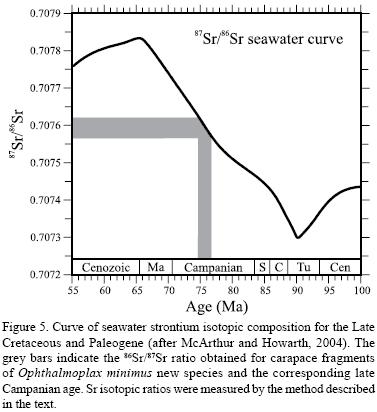
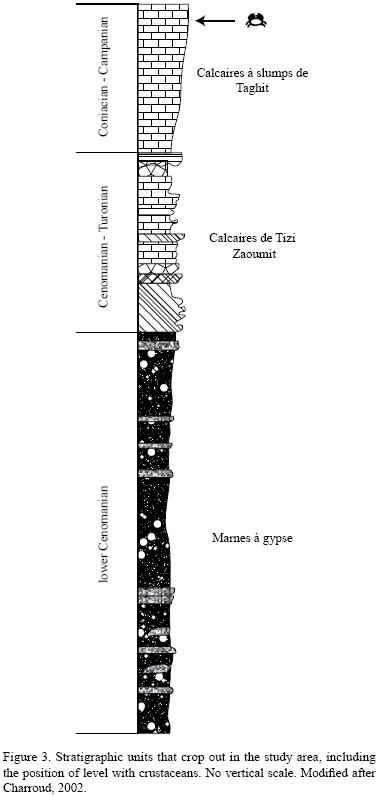
<body><![CDATA[<p align="justify"><font face="verdana" size="2"><b>Palabras clave:</b> <i>Crustacea, Decapoda, Ophthalmoplax, Costacopluma, Campaniano, Marruecos.</i></font></p>     <p align="justify"><font face="verdana" size="2">&nbsp;</font></p>     <p align="justify"><font face="verdana" size="2"><b>INTRODUCTION</b></font></p>     <p align="justify"><font face="verdana" size="2">Formal reports on fossil decapod crustaceans from Africa are very scarce, in particular those from Morocco (Secretan, 1961; Garassino <i>et al., </i>2007). The present study is a contribution to the systematic, paleobiogeographic and evolutionary knowledge of Late Cretaceous decapod crustaceans from the Tethyan realm, and documents the presence of <i>Ophthalmoplax </i>Rathbun, 1935, previously considered as an exclusively Pan&#150;American genus. Our knowledge on the distribution patterns, endemism and origins of crustacean decapod taxa is expanding rapidly, and drastic changes are being experienced in the way we understand the evolution of this interesting group. The Ibericancridae Artal, Guinot, Van Bakel and Castillo, 2008, a new brachyuran family closely related with what was once considered an exclusively American group (Dakoticancridae Rathbun, 1917, see Bishop <i>et al.</i>, 1998), was recently reported for the upper Campanian of Spain (Artal <i>et al., </i>2008).</font></p>     <p align="justify"><font face="verdana" size="2">The crustaceans herein described were collected from the Calcaires &aacute; slumps de Taghit Formation that crops out near to the village of Merija, between the cities of Missour and Talsint in northeast Morocco, within the Plis Marginaux at the Moyenne Moulouya region (<a href="/img/revistas/rmcg/v27n2/a2f1.jpg" target="_blank">Figures 1</a> and <a href="/img/revistas/rmcg/v27n2/a2f2.jpg" target="_blank">2</a>). The Calcaires &aacute; slumps de Taghit Formation was established for the zone situated between Tizi Zaoumit and Ras Rcheg, with a range of Coniacian&#150;Campanian; it overlies the Calcaires de Tizi Zaoumit Formation, which comprises the Cenomanian&#150;Turonian interval (Charroud, 2002) (<a href="#f3">Figure 3</a>). The fossiliferous outcrops consist of yellow calcareous marls with scarce macrofauna (<a href="/img/revistas/rmcg/v27n2/a2f4.jpg" target="_blank">Figure 4</a>). Complete absence of index fossils (microfossils, ammonoids, rudists, etc.) makes it difficult to define a biostratigraphic age. However, studies on the stratigraphy and general geology from nearby areas (EnBlin, 1993; Charroud, 2002; Haddoumi <i>et al., </i>2008) indicate an Upper Cretaceous sedimentary sequence for the regional lithostratigraphic units. With the aim to resolve the chronological uncertainty of the strata where the fossil crustaceans were found, we obtained <sup>87</sup>Sr/<sup>86</sup>Sr isotopic analyses on carapace fragments of <i>Ophthalmoplax minimus </i>new species. The carapace fragments were extracted by handpicking and its chemical composition was analyzed by X&#150;ray diffraction at the Laboratorio de Difracci&oacute;n de Rayos X, Instituto de Geolog&iacute;a, UNAM, with a result of 100% calcite. The calcite is considered to be of primary origin based upon its mineralogy and textural preservation. The measurement of the <sup>87</sup>Sr/<sup>86</sup>Sr ratio was made by mass spectrometry with a thermal ionisation mass spectrometer Finnigan MAT 262, after acid digestion and cation exchange separation, all processed at the Laboratorio Universitario de Geoqu&iacute;mica Isot&oacute;pica, Instituto de Geolog&iacute;a, UNAM. We obtained a value of <sup>87</sup>Sr/<sup>86</sup>Sr = 0.707595 &plusmn; 0.000028 (one standard deviation) for a run of 58 measurements. By comparison with the <sup>87</sup>Sr/<sup>86</sup>Sr seawater curve for the Late Cretaceous&#150; Paleogene (McArthur and Howarth, 2004), the obtained isotopic ratio corresponds to an age of the late Campanian (approximately 76 Ma; <a href="#f5">Figure 5</a>).</font></p>     <p align="center"><font face="verdana" size="2"><a name="f3"></a></font></p>     <p align="center"><font face="verdana" size="2"><img src="/img/revistas/rmcg/v27n2/a2f3.jpg"></font></p>     <p align="center"><font face="verdana" size="2"><a name="f5"></a></font></p>     <p align="center"><font face="verdana" size="2"><img src="/img/revistas/rmcg/v27n2/a2f5.jpg"></font></p>     <p align="justify"><font face="verdana" size="2">The associated fauna includes small oysters and echinoids, mainly <i>Goniopygus </i>sp. and <i>Mecaster fourneli </i>Deshayes, in Agassiz and Desor, 1847. <i>Goniopygus </i>has been usually assigned to <i>Goniopygus durandi in </i>Cotteau, Peron and Gauthier, 1881 (Petitot, 1959), but the current attribution of this species has been questioned (Gallem&iacute;, pers. comm.). The presence of oysters and echinoids, together with the eustatic conditions for the Upper Cretaceous deposits, suggests a shallow marine environment from the Coniacian to the Campanian in the study area. Previous studies suggest a markedly regressive cycle, and the connection to an Atlantic realm more than a Tethyan influence (Charroud, pers. comm.).</font></p>     ]]></body>
<body><![CDATA[<p align="justify"><font face="verdana" size="2">Specimens are deposited in the paleontological collection of the Museo Geol&oacute;gico del Seminario de Barcelona, under acronym MGSB, and in the Museo Civico di Storia Naturale di Milano, under acronym MSNM.</font></p>     <p align="justify"><font face="verdana" size="2">&nbsp;</font></p>     <p align="justify"><font face="verdana" size="2"><b>SYSTEMATIC PALEONTOLOGY</b></font></p>     <p align="center"><font face="verdana" size="2">Order Decapoda Latreille, 1802 </font></p>     <p align="center"><font face="verdana" size="2">Infraorder Brachyura Latreille, 1802 </font></p>     <p align="center"><font face="verdana" size="2">Superfamily Portunoidea Rafinesque, 1815 </font></p>     <p align="center"><font face="verdana" size="2">Family Macropipidae Stephenson and Campbell, 1960 </font></p>     <p align="center"><font face="verdana" size="2">Genus <i>Ophthalmpoplax </i>Rathbun, 1935</font></p>     <p align="justify"><font face="verdana" size="2"><b>Type species. </b><i>Ophthalmoplax stephensoni, </i>Rathbun, 1935, by original designation.</font></p>     <p align="center"><font face="verdana" size="2"><b><i>Ophthalmoplax minimus </i>new species </b></font></p>     ]]></body>
<body><![CDATA[<p align="center"><font face="verdana" size="2"><b><a href="/img/revistas/rmcg/v27n2/a2f6.jpg" target="_blank">Figure 6</a></b></font></p>     <p align="justify"><font face="verdana" size="2"><b>Diagnosis. </b>Carapace small, transversely subtrapezoidal in outline, orbito&#150;frontal margin large, with triangular supramarginal spines fairly directed upwards; dorsal surface longitudinally convex, somewhat less in transverse section; orbits large; front relatively narrow, strongly deflexed, with robust, salient orbital nodes and bifid tip; lateral margins of carapace arched, with stout spines; dorsal surface bearing acute transverse ridges on gastric, branchial and cardiac regions; stenum large, subcircular, with sternite 3 extending laterally; male abdomen not totally covering sternites 7 and 8; eyestalks long, chelipeds large, with short spines on ventral and dorsal margins of palm; palm ridged on lateral surface.</font></p>     <p align="justify"><font face="verdana" size="2"><b>Etymology. </b>From the latin minimus, in reference to the reduced size of carapaces, compared with the large size in other species.</font></p>     <p align="justify"><font face="verdana" size="2"><b>Description. </b>Carapace small to medium in size, transversely subtrapezoidal in outline, somewhat broader than long, maximum width at the level of epibranchial region; dorsal surface fairly convex in longitudinal section. Orbito&#150;frontal margin notably large, bearing a reduced fissure with angular marginal corners and a subtriangular tooth markedly directed upwards, close to the outer orbital spines which are stout, robust, with triangular base. Front relatively narrow, deflexed, with salient orbital nodes and bifid termination. Anterolateral margins short, slightly concave, with cervical notch. Posterolateral margins longer, arched, bearing four large spines or tubercular nodes, and two additional smaller ones between first and second spines. Posterior margin noticeably shorter than orbito&#150;frontal margin, straight, weakly rimmed. Swellings and furrows define dorsal regions of carapace. Mesogastric region large, subpentagonal, with anterior process narrow, long bounded by weak furrows; ridge at medial portion. Protogastric lobes large, inflated, with transverse ridge. Epigastric lobes small, defined by two small swellings. Anterior epibranchial lobes slightly inflated, leading to a robust marginal spine, posterior lobes inflated, oblique, axially bounded by branchiocardiac furrow. Mesobranchial regions large, with two marginal nodes and short transverse ridges. Metabranchial regions small, with short transverse crest. Cardiac region large, inverted subpentagonal in shape; medial ridge, protuberance present at lower corner. Intestinal region depressed. Pterygostomial regions small, subtriangular, rimmed. Buccal frame large. Sternum large, subcircular. Sternites 1&#150;2 subtriangular, small. Sternite 3 salient, extending laterally, axially depressed. Small notch separating sternites 3 from 4. Sternite 4 with raised oblique margins. Sternites 5 to7 decreasing in size posteriorly, with long episternites directed backwards. Abdomen sexually differentiated. Narrow in males, subtriangular, not totally covering sternites 7&#150;8; telson triangular; pleomere 6 subtrapezoidal; pleomere 5 subsquare, as wide and long as pleomere 6; pleomere 4 subrectangular elongated, slightly shorter and narrower than pleomere 5, with median ridge; pleomere 3 broader, extending laterally. Broad, suboval abdomen in females; telson broad, subtriangular; pleomere 6 subtrapezoidal, one&#150;third wider but one&#150;fouth shorter than telson; pleomere 5 rectangular, one third the length and nearly as wide as pleomere 6, with median transverse ridge; pleomere 4 very similar to pleomere 5; pleomere 3 nearly as wide but slightly shorter than pleomere 4, concave on median portion of anterior margin, with median transverse ridge; pleomere 2 one&#150;third narrower than pleomere 3, with median transverse ridge. Chelipeds robust, basisischium fused, merus robust and long with tubercles on inner surface; carpus with denticled surface, palm long, robust, outer surface medially ridged, margins profusely spinose; dactily spinose, with robust inner denticles; first tooth of mobile finger stout and extremely long on right cheliped. Pereiopods 2 to 5 long, flattened. Lateral surface covered by large, spaced granules. </font></p>     <p align="justify"><font face="verdana" size="2"><b>Material. </b>Holotype MSGB74546; paratypes MGSB74547a, MGSB74547b and MGSB74547c. </font></p>     <p align="justify"><font face="verdana" size="2"><b>Measurements (in mm). </b>Holotype MSGB74546, carapace length = 23, width = 26, orbito&#150;frontal width = 25; paratypes MGSB74547a, carapace length = 21, width = 23, orbito&#150;frontal width = 21; paratype MGSB74547b , carapace length = 31, carapace width = 33, orbito&#150;frontal width = 30; MGSB74547c, carapace length = about 50. </font></p>     <p align="justify"><font face="verdana" size="2"><b>Genus discussion. </b><i>Ophthalmoplax </i>has been reported from the Upper Cretaceous Atlantic and Gulf Coast of the SE of North America (South Carolina, Alabama, Mississippi, Texas, Coahuila, Nuevo Le&oacute;n) (Rathbun, 1935; Stenzel, 1952; Vega and Feldmann, 1991, as <i>Mascaranada; </i>Schweitzer <i>et al.</i>, 2007; Vega <i>et al.</i>, 2007) and also from the Upper Cretaceous of South America (Colombia, Venezuela, Brazil) (Maury, 1930, as <i>Zanthopsis; </i>Beurlen, 1958; 1965 as <i>Archaeopus; </i>Feldmann and Villamil, 2002; Souza&#150;Lima <i>et al., </i>2003; Aguilera <i>et al., </i>2010). Feldmann <i>et al. </i>(1999) described <i>Ophthalmoplax spinosus </i>from the Turonian of Colombia; however, Guinot <i>et al. </i>(2008) considered it to be <i>Cenomanocarcinus vanstraeleni </i>Stenzel, 1945. All of the stratigraphic occurrences for <i>Ophthalmoplax </i>in America correspond to Maastrichtian lithostratigraphic units, except for <i>O. triambonatus </i>Feldmann and Villamil, 2002 assigned to upper Turonian sediments of the Puerto Romero Formation in the north&#150;central part of the Middle Magdalena River Valley, Colombia; in their report, Feldmann and Villamil (2002, p. 718) commented: "Baculitid ammonites encountered in association with the crab specimens are possibly of Maastrichtian age (Etayo, pers. comm.); however, baculites are poorly known for this region of South America and the age is not reliable". Their interpretation for a Turonian age is then based on bivalves and foraminifera that suggest an age not younger than Coniacian; however, other foraminifera from the study section indicated a Campanian age (Feldmann and Villamil, 2002, p. 720). Nevertheless, other stratigraphic studies suggest a late Maastrichtian age for the Puerto Romero Formation (V&aacute;squez <i>et al.</i>, 2000). A summary of current status of species described as <i>Ophthalmoplax </i>is presented in <a href="/img/revistas/rmcg/v27n2/a2t1.jpg" target="_blank">Table 1</a>.</font></p>     <p align="justify"><font face="verdana" size="2">Schweitzer <i>et al. </i>(2007) considered the following species of <i>Ophthalmoplax: O. stephensoni </i>Rathbun, 1935; <i>O. brasiliana </i>(Maury, 1930); O. <i>comancheensis </i>Rathbun, 1935; <i>O. triambonatus </i>Feldmann and Villamil, 2002; and questionably O. <i>spinosus </i>Feldmann <i>et al. </i>(1999). Similarities between <i>O. brasiliana </i>and <i>O. triambonatus </i>were noticed by Feldmann and Villamil (2002, p. 273), and used differences in shape of carapace and degree of development of dorsal regions of carapace to define a new species. However, the sole type specimen of <i>O. triambonatus </i>is deformed, and thus differences observed may be result of such deformation. Large specimens of O. <i>stephensoni </i>from Maastrichtian deposits of NE Mexico are under study, but show that such large forms of <i>Ophthalmoplax </i>were present in the Tethyan realm during Maastrichtian times. <i>Ophthamoplax comancheensis </i>was described on the basis of small movable and fixed fingers that according to Rathbun (1935, p. 54) "...resemble those of O. <i>stephensoni </i>more than any other Cretaceous species". Based on the stratigraphic occurrence of O. <i>comancheensis </i>in Albian deposits of Texas, Feldmann and Schweitzer (2006) considered an origin of this genus during the Early Cretaceous. Similarity with <i>Archaeopus rathbunae </i>Beurlen, 1965 from the Albian of Brazil and members of the Carcineretidae has been suggested (Vega and Feldmann, 1992). The inverted subtrapezoidal shape of the carapace and the bifid rostrum resembles <i>Ophthalmoplax, </i>but the small size (18x15 mm) and the inclined epi&#150; and mesobranchial ridges makes it different. The sharp, inclined ridges recall those of <i>Branchiocarcinus </i>Vega, Feldmann and Sour&#150;Tovar, 1995, from the Maastrichtian of NE Mexico, but the epibranchial ridges are inclined in a different direction. A direct observation of the holotype is needed in order to define if <i>"Archaeopus" rathbunae </i>is the oldest representative of this carcineretid/portunid group.</font></p>     <p align="justify"><font face="verdana" size="2">Based on morphological similarities between <i>Ophthalmoplax </i>and <i>Bathynectes </i>Stimpson, 1871 and <i>Raymaninnus </i>Ng, 2000, genera of the Subfamily Polybiinae Ortmann, 1893, Schweitzer <i>et al. </i>(2007) removed <i>Ophthalmoplax </i>from the Carcineretidae Beurlen, 1930, to include it into the Portunidae. Later, Karasawa <i>et al. </i>(2008) included <i>Ophthalmoplax </i>into the Macropipidae. Although we agree in this systematic placement, there are some features to be discussed for a future review of the familiar affinity of <i>Ophthalmoplax. </i>Carapace morphology of the extant genera referred to the Macropipidae is not so similar to <i>Ophthalmoplax, </i>whose flattened fifth pereiopods are most similar to members of the Portunidae Rafinesque, 1815. Also, <i>Bathynectes </i>and <i>Raymaninnus </i>have transverse dorsal ridges relatively similar to <i>Ophthalmoplax, </i>but their anterolateral margins bear two to four sharp spines, the orbits are smaller, rostrum with two sharp spines, female telson is smaller and triangular and the male abdomen wider at its base, among other differences. In commenting the systematic affinity of <i>Ophthalmoplax </i>to the Macropipidae, Karasawa <i>et al. </i>(2008, p. 102) stated: "The extinct members of the family form a remarkably homogenous group in terms of dorsal carapace morphology with the exception of <i>Ophthalmoplax, </i>the only Cretaceous form. However, the features of the male sternum and abdomen of <i>Ophthalmoplax </i>are remarkably congruent with those of the other members of the family." In our opinion, the combination of a subtrapezoial, flattened carapace, sharp transverse ridges on dorsal carapace, bifid rostrum, sharp, inclined outer orbital spine, male abdominal segments keeled, female abdominal segments smooth and spinose dorsal and ventral chelipeds margins may justify to keep <i>Ophthalmoplax </i>into a different subfamily. At this moment, we follow Karasawa <i>et al. </i>(2008), confirmed by a more recent classification (De Grave <i>et al.</i>, 2009) that place <i>Ophthalmoplax </i>as part of the Macropipidae.</font></p>     <p align="justify"><font face="verdana" size="2"><b>Species discussion. </b><i>Ophthalmoplax minimus </i>new species differs from other species of the genus by the following combination of characters: smaller size of the carapace; outer orbital and anterolateral spines proportionally smaller; protogastric process stronger, dividing protogastric transverse ridge; cardiac ridge not so sharp; intestinal region clearly defined; male abdomen proportionally wider; and dorsal and ventral margins of chelae with not so developed sharp spines.</font></p>     ]]></body>
<body><![CDATA[<p align="justify"><font face="verdana" size="2">The late Campanian record of O. <i>minimus </i>new species may represent the oldest record for the genus, and suggest a possible African origin, with a westward migration across the proto&#150;Atlantic, to rapidly spread along the northeast coast of South America and the southeast coast of North America. The absence of <i>Ophthalmoplax </i>in Maastrichtian sediments of southern Mexico and the Caribbean region may have been due to competition, habitat preference (most Maastrichtian deposits with decapod crustaceans in southern Mexico and the Caribbean are reefal, in contrast with the terrigenous deposits of SE North America and NE South America), preference for more temperate waters, or a combination of those elements.</font></p>     <p align="center"><font face="verdana" size="2">Superfamily Retroplumoidea Gill, 1894 </font></p>     <p align="center"><font face="verdana" size="2">Family Retroplumidae Gill, 1894 </font></p>     <p align="center"><font face="verdana" size="2">Genus <i>Costacopluma </i>Collins and Morris, 1975</font></p>     <p align="justify"><font face="verdana" size="2"><b>Type species. </b><i>Costacopluma concava </i>Collins and Morris, 1975, by original designation.</font></p>     <p align="center"><font face="verdana" size="2"><b><i>Costacopluma maroccana </i>new species </b></font></p>     <p align="center"><font face="verdana" size="2"><b><a href="/img/revistas/rmcg/v27n2/a2f7.jpg" target="_blank">Figure 7</a></b></font></p>     <p align="justify"><font face="verdana" size="2"><b>Diagnosis. </b>Carapace of moderate size, transversely suboval to rounded subhexagonal in outline; wider at posterior half of the carapace; orbito&#150;frontal margin long; front narrow, bifid, slightly to fairly downturned; orbit large; anterolateral margins very short; posterolateral margins longer, broadly arched; posterior margin wider than orbito&#150;frontal margin; lateral flanks nearly at right angles from dorsal surface; dorsal surface bearing a set of transverse crests, with top of ridges from sharp to slightly rounded; dorsal regions swollen, ornamented with ridges; cervical furrow well&#150;defined at lateral margins; mesogastric region large, subrhomboidal in shape; protogastric lobes fairly swollen; cardiac region extremelly large, subpentagonal inverted in shape; sternum broad, anterior portion (sternites 3&#150;4) subtrapezoidal, posterior portion (sternites 5&#150;7) transversely subrectangular, strongly ridged; oblique deep depressions separating sternite 3 from sternite 4; eyestalks long.</font></p>     <p align="justify"><font face="verdana" size="2"><b>Etymology. </b>Named after Maroc (Morocco), country of collection.</font></p>     <p align="justify"><font face="verdana" size="2"><b>Description. </b>Carapace of medium size for the genus, transversely suboval in outline, broader than long; dorsal surface convex in both directions, maximum width at the posterior half of the carapace, at level of postbranchial regions. Orbito&#150;frontal margin long, with robust outer orbital spines directed forward; dorsal border sinuous, infraorbital margin terminating in long and conical spine. Eyestalk very long, slender, subcylindrical. Front relatively narrow, with bifid tip, downturned, lateral margins fairly concave, broadening distally to a two divergent rounded lobes. Anterolateral margins short, nearly straight. Cervical notch well&#150;marked at lateral margins and sides of carapace. Posterolateral margins longer than anterolateral margins, broadly arched. Lateral sides (flanks of carapace) from extraorbital spine to posterior margin, situated at about right angles from dorsal surface. Posterior margin convex, with axial portion nearly straight, noticeably longer than orbito&#150;frontal margin. Dorsal regions well defined by swellings and depressions, crossed by a set of three transverse crests. Anterior crest markedly sinuous, with convex lateral portions directed forwards and axial portion forwardly concave. Two median crests nearly straight, obliquely directed from lateral margins to branchiocardiac furrow, being fairly interrupted by mesogastric lobe. Posterior crest relatively well&#150;defined by lateral branchial swellings and a tranverse ridge in cardiac region. Mesogastric region large, subrhomboidal in shape, weakly separated from protogastric regions, bounded by posterolateral deep furrows. Protogastric regions large, swollen, crossed by anterior crest. Small epigastric swellings present at base of front. Branchial regions fairly swollen. Cardiac region well&#150;defined, large, subpentagonal inverted in shape, bounded by shallow but evident branchiocardiac furrow; median portion of cardiac lobe crossed by a strong transverse crest that may be more or less rounded or ridged by preservation/deformation, inferior portion bearing a small protuberance. Intestinal region depressed. Dorsal surface with numerous granules mainly at top of inflations of regions and densely pitted at depressions. Sternum large, anterior portion (sternites 3&#150;4) subtrapezoidal, posterior portion (sternites 4&#150;7) transversely subrectangular. Sternite 3 swollen, axially depressed, separated from sternite 4 by a weak notch and oblique depressions. Sternite 4 large with oblique margins, gynglyme for the first pereipod fairly re&#150;entrant. Sternites 5 to 7 transversely disposed, strongly ridged, with spaced granules. Sternoabdominal cavity relatively deep, fairly narrow in males. Abdomen narrow in males, subtriangular in shape. All pleomeres free, with medial transverse ridges. Pleomere 6 with salient posterior portion for abdominal holding system. Telson slightly elongated, rounded distally. Buccal frame large; third maxiliped large. Chelipeds robust, palm relatively large, somewhat flattened dorsoventraly; dactyli long and slender, inner teeth robust. Merus short; carpus long, globular. Pereiopods 2 to 4 fairly long, flattened. Pereiopod 5 not seen. </font></p>     ]]></body>
<body><![CDATA[<p align="justify"><font face="verdana" size="2"><b>Material. </b>Holotype MGSB74544; paratypes MSGB74545a, MSGB74545b, MSNMi27216.</font></p>     <p align="justify"><font face="verdana" size="2"><b>Measurements (in mm). </b>Holotype MGSB74544, carapace length = 19, width = 23, orbito&#150;frontal width = 14; paratypes MGSB74545a, carapace length = 15, width = 19, orbito&#150;frontal width = 11; MGSB74545b, carapace length = 19, width = 25, orbito&#150;frontal width = 15; MSNMi27216, carapace length = 19, width = 25, orbito&#150;frontal width = 16. </font></p>     <p align="justify"><font face="verdana" size="2"><b>Discussion. </b>To the moment, 13 species of <i>Costacopluma </i>have been reported from Upper Cretaceous and Paleogene sediments of America, Greenland, West Africa, India and Europe (<a href="/img/revistas/rmcg/v27n2/a2t2.jpg" target="_blank">Table 2</a>). Most species are known from Paleogene deposits of Venezuela (C. <i>bifida </i>Collins, Higgs and Cortitula, 1994) , Brazil (C. <i>nordestiana </i>Feldmann and Martins&#150;Neto, 1995) , Argentina (C. <i>australis </i>Feldmann, Casadlo Chirino&#150;G&aacute;lvez, and Aguirre&#150;Urreta, 1995; <i>C. salamanca </i>Feldmann, Rodrlguez, Marlnez and Aguirre&#150;Urreta, 1997), Senegal (C. <i>senegalensis </i>&#91;R&eacute;my in Gorodiski and R&eacute;my, 1959&#93;), Alabama (<i>C. grayi </i>Feldmann and Portell, 2007), Texas (<i>C. texana </i>Armstrong, Nyborg, Bishop, Oss&oacute;&#150;Morales and Vega, 2009), California (<i>C. squiresi </i>Nyborg, Vega and Filkorn, 2009) and Hungary (<i>Costacopluma </i>sp. &#91;M&uuml;ller and Collins, 1991&#93;) . The first report for a Paleocene species from the Pacific slope has recently been published from California (Nyborg <i>et al., </i>2009). It is interesting to note that all Paleocene species are of small size (about 1 cm in width), while Cretaceous species tend to be larger, with the exception of the Coniacian <i>C. bishopi </i>Vega and Feldmann, 1992, with a mean width of 4 mm and <i>C. binodosa </i>Collins and Rasmussen, 1992 from the Campanian of Greenland. Small size has been interpreted as a response to environmental stress (Fraaije <i>et al., </i>2006; Amstrong <i>et al., </i>2009). The origin and paleobiogeographic distribution patterns of <i>Costacopluma </i>are still a matter of debate. McLay (2006) suggested that only four species of <i>Costacopluma </i>should be considered true retroplumids. A discussion on interpretations of this author are given by other authors (Armstrong <i>et al., </i>2009; Nyborg <i>et al., </i>2009). It is important to note existence of two main morphologic groups that embrace all of the described species of <i>Costacopluma. </i>The first group (Group A, <a href="/img/revistas/rmcg/v27n2/a2t2.jpg" target="_blank">Table 2</a>) includes species with an ovate carapace, comprising species from the Cretaceous to the Eocene of Africa and America, while second group (Group B, <a href="/img/revistas/rmcg/v27n2/a2t2.jpg" target="_blank">Table 2</a>) includes species with a subhexagonal to inverted subtrapezoidal carapace, comprising only Paleocene species from America. A closer morphological study of all of the species within this genus is needed in order to define if it is pertinent to formally subdivide in these two groups all the species of <i>Costacopluma. </i>Presence of this genus in Campanian sediments of NW Africa is expected, on the basis of the occurrence of <i>C. concava </i>Collins and Morris, 1975 in the Maastrichtian of North India (Gaetani <i>et al., </i>1983) and Coniacian to ?Maastrichtian (mostly Campanian) sediments of Nigeria (Collins and Morris, 1975, altough no lithostratigraphic unit is mentioned by these authors, and recent regional stratigraphic reports must be reviewed in order to define the stratigraphic range for this species), and the presence of <i>C. senegalensis </i>in Paleocene strata of Senegal (R&eacute;my in Gorodiski and R&eacute;my, 1959). <i>Costacopluma maroccana </i>new species is most similar to <i>C. concava, </i>but the new species can be clearly distinguished by the following main features: a more inflated&#150;globose general appearance; swollen and rounded ridges and regions (even the lateral margins); a broader posterior half of carapace, being more subhexagonal in <i>C. concava; </i>a different orbito&#150;frontal/width ratio, about 0.6 (about 0.5 in <i>C. concava). Costacopluma senegalensis </i>is smaller and ridges of the dorsal carapace are more slender, with coarser tubercles on crests. <i>Costacopluma bishopi </i>is much smaller and has an ovate shape of carapace, widest at midlength of the carapace. <i>Costacopluma mexicana </i>Vega and Perrilliat, 1989 has a similar shape of the carapace; however, crests of transverse ridges are typically flat, with strong tubercles, and the protogastric ridge is much more sinuous in the Mexican species. <i>Costacopluma grayi </i>is smaller, has narrow ridges on dorsal carapace with tubercles on crests. Reminder Paleocene species are the smaller, inverted subtrapezoidal carapace and ridges of the dorsal carapace are slender and have tubercles on crests.</font></p>     <p align="justify"><font face="verdana" size="2">&nbsp;</font></p>     <p align="justify"><font face="verdana" size="2"><b>CONCLUSIONS</b></font></p>     <p align="justify"><font face="verdana" size="2">The presence of <i>Ophthalmoplax minimus </i>new species in sediments of the Calcaires &aacute; slumps de Taghit Formation, Morocco, represents the oldest and the first record for the genus outside the Americas. <sup>87</sup>Sr/<sup>86</sup>Sr analysis based on cuticle remains of <i>O. minimus </i>indicate a Campanian age for this lithostratigraphic unit. A second species, <i>Costacopluma maroccana </i>new species, is found associated with <i>O. minimus </i>and represents the second Cretaceous species for the genus in Africa, and confirm that <i>Costacopluma </i>was one of the most diverse brachyuran genus during the Late Cretaceous.</font></p>     <p align="justify"><font face="verdana" size="2">&nbsp;</font></p>     <p align="justify"><font face="verdana" size="2"><b>ACKNOWLEDGMENTS</b></font></p>     <p align="justify"><font face="verdana" size="2">Gabriela Solls and Jes&uacute;s Sol&eacute; (Instituto de Geolog&iacute;a, UNAM) offered support with isotopic analysis and result interpretations. We thank Dr. Jaume Galleml (Barcelona, Spain) for providing literature, useful comments and levigation of matrix. Dr. Hamid Haddoumi and Dr. Mohammed Charroud (Morocco) offered their points of view on the possible age of specimens. Dr. A. Garassino (Milano, Italy) loaned important specimens. Mr. Phillippe Nicolleau (Aiffres, France) and Mr. Roland Reboul (Saint Chinian, France) provided precise geographical information, geological data and information on associated fauna. Mr. Moha Ouhouiss (Rich, Morocco) handled several specimens. Images of specimens were provided by Mr. Ferr&aacute;n Aguilar (Tarragona). Our sincere gratitude to H. Karasawa and G. Bishop for their accurate suggestions to improve the manuscript.</font></p>     <p align="justify"><font face="verdana" size="2">&nbsp;</font></p>     ]]></body>
<body><![CDATA[<p align="justify"><font face="verdana" size="2"><b>REFERENCES</b></font></p>     <!-- ref --><p align="justify"><font face="verdana" size="2">Agassiz, L., Desor, E., 1846&#150;1847, Catalogue raisonn&eacute; des familles, des genres et des esp&egrave;ces de la classe des &eacute;chinodermes: Annales des Sciences Naturelles, 6&#150;8 (3 Zoologie), 1846, v. 6. 305&#150;374, pls. 15, 16; 1847, v. 7, 129&#150;168; 1847, v. 8, 5&#150;35, 355&#150;380.</font>&nbsp;&nbsp;&nbsp;&nbsp;&nbsp;&nbsp;&nbsp;&nbsp;[&#160;<a href="javascript:void(0);" onclick="javascript: window.open('/scielo.php?script=sci_nlinks&ref=8084379&pid=S1026-8774201000020000200001&lng=','','width=640,height=500,resizable=yes,scrollbars=1,menubar=yes,');">Links</a>&#160;]<!-- end-ref --><!-- ref --><p align="justify"><font face="verdana" size="2">Aguilera, O., Rodrigues&#150;de Aguilera, D., Vega, F.J., S&aacute;nchez&#150;Villagra, M., 2010, Mesozoic and Cenozoic decapod crustaceans from Venezuela and related trace&#150;fossil assemblages, <i>in </i>S&aacute;nchez&#150;Villagra, M.R., Aguilera, O.A., Carlini, A.A. (eds.), Urumaco and Venezuelan Paleontology; The Fossil Record of the Northern Neotropics: Indiana University Press, in press.</font>&nbsp;&nbsp;&nbsp;&nbsp;&nbsp;&nbsp;&nbsp;&nbsp;[&#160;<a href="javascript:void(0);" onclick="javascript: window.open('/scielo.php?script=sci_nlinks&ref=8084380&pid=S1026-8774201000020000200002&lng=','','width=640,height=500,resizable=yes,scrollbars=1,menubar=yes,');">Links</a>&#160;]<!-- end-ref --><!-- ref --><p align="justify"><font face="verdana" size="2">Armstrong, A., Nyborg, T., Bishop, G.A., Oss&oacute;&#150;Morales, &Agrave;., Vega, F.J., 2009, Decapod crustaceans from the Paleocene of Central Texas, USA: Revista Mexicana de Ciencias Geol&oacute;gicas, 26(3), 745&#150;763.</font>&nbsp;&nbsp;&nbsp;&nbsp;&nbsp;&nbsp;&nbsp;&nbsp;[&#160;<a href="javascript:void(0);" onclick="javascript: window.open('/scielo.php?script=sci_nlinks&ref=8084381&pid=S1026-8774201000020000200003&lng=','','width=640,height=500,resizable=yes,scrollbars=1,menubar=yes,');">Links</a>&#160;]<!-- end-ref --><!-- ref --><p align="justify"><font face="verdana" size="2">Artal, P., Guinot, D., Van Bakel, B., Castillo, J., 2008, Ibericancridae, a new dakoticancroid family (Decapoda, Brachyura, Podotremata) from the upper Campanian (Upper Cretaceous) of Spain: Zootaxa, 1907, 1&#150;27.</font>&nbsp;&nbsp;&nbsp;&nbsp;&nbsp;&nbsp;&nbsp;&nbsp;[&#160;<a href="javascript:void(0);" onclick="javascript: window.open('/scielo.php?script=sci_nlinks&ref=8084382&pid=S1026-8774201000020000200004&lng=','','width=640,height=500,resizable=yes,scrollbars=1,menubar=yes,');">Links</a>&#160;]<!-- end-ref --><!-- ref --><p align="justify"><font face="verdana" size="2">Beurlen, K., 1930, Vergleichende Stammesgeschichte Grundlagen, Methoden, Probleme unter besonderer Ber&uuml;cksichtigung der hoheren Krebse: Fortschritte der Geologie und P&auml;laontologie, 8, 317&#150;586.</font>&nbsp;&nbsp;&nbsp;&nbsp;&nbsp;&nbsp;&nbsp;&nbsp;[&#160;<a href="javascript:void(0);" onclick="javascript: window.open('/scielo.php?script=sci_nlinks&ref=8084383&pid=S1026-8774201000020000200005&lng=','','width=640,height=500,resizable=yes,scrollbars=1,menubar=yes,');">Links</a>&#160;]<!-- end-ref --><!-- ref --><p align="justify"><font face="verdana" size="2">Beurlen, K., 1958, Dois crust&aacute;ceos do Cret&aacute;ceo Superior do nordeste do Brasil (Decapoda, Brachyura): Boletim do Museu Nacional, Nova S&eacute;rie, Geologia, 26, 1&#150;23.</font>&nbsp;&nbsp;&nbsp;&nbsp;&nbsp;&nbsp;&nbsp;&nbsp;[&#160;<a href="javascript:void(0);" onclick="javascript: window.open('/scielo.php?script=sci_nlinks&ref=8084384&pid=S1026-8774201000020000200006&lng=','','width=640,height=500,resizable=yes,scrollbars=1,menubar=yes,');">Links</a>&#160;]<!-- end-ref --><!-- ref --><p align="justify"><font face="verdana" size="2">Beurlen K., 1965, Crust&aacute;ceos dec&aacute;podes na Forma&ccedil;&atilde;o Riachuelo (Cret&aacute;ceous&#150;Sergipe): Anais da Academia Brasileira de Ciencias, 37(2), 267&#150;272.</font>&nbsp;&nbsp;&nbsp;&nbsp;&nbsp;&nbsp;&nbsp;&nbsp;[&#160;<a href="javascript:void(0);" onclick="javascript: window.open('/scielo.php?script=sci_nlinks&ref=8084385&pid=S1026-8774201000020000200007&lng=','','width=640,height=500,resizable=yes,scrollbars=1,menubar=yes,');">Links</a>&#160;]<!-- end-ref --><!-- ref --><p align="justify"><font face="verdana" size="2">Bishop, G.A., Feldmann, R.M., Vega, F. 1998, The Dakoticancridae (Decapoda, Brachyura) from the Late Cretaceous of North America and Mexico: Contributions to Zoology, 67(4), 237&#150;256.</font>&nbsp;&nbsp;&nbsp;&nbsp;&nbsp;&nbsp;&nbsp;&nbsp;[&#160;<a href="javascript:void(0);" onclick="javascript: window.open('/scielo.php?script=sci_nlinks&ref=8084386&pid=S1026-8774201000020000200008&lng=','','width=640,height=500,resizable=yes,scrollbars=1,menubar=yes,');">Links</a>&#160;]<!-- end-ref --><!-- ref --><p align="justify"><font face="verdana" size="2">Charroud, M., 2002, Evolution g&eacute;odynamique des Hauts Plateaux (Maroc) et leurs bordures du Mesozoique au Cenozoique: Universit&eacute; de F&egrave;s, Th&egrave;se d'Etat, 315 pp.</font>&nbsp;&nbsp;&nbsp;&nbsp;&nbsp;&nbsp;&nbsp;&nbsp;[&#160;<a href="javascript:void(0);" onclick="javascript: window.open('/scielo.php?script=sci_nlinks&ref=8084387&pid=S1026-8774201000020000200009&lng=','','width=640,height=500,resizable=yes,scrollbars=1,menubar=yes,');">Links</a>&#160;]<!-- end-ref --><!-- ref --><p align="justify"><font face="verdana" size="2">Collins, J.S.H., Morris, S.F., 1975, A new crab, <i>Costacopluma concava, </i>from the Upper Cretaceous of Niger: Palaeontology, 18, 823&#150;829.</font>&nbsp;&nbsp;&nbsp;&nbsp;&nbsp;&nbsp;&nbsp;&nbsp;[&#160;<a href="javascript:void(0);" onclick="javascript: window.open('/scielo.php?script=sci_nlinks&ref=8084388&pid=S1026-8774201000020000200010&lng=','','width=640,height=500,resizable=yes,scrollbars=1,menubar=yes,');">Links</a>&#160;]<!-- end-ref --><!-- ref --><p align="justify"><font face="verdana" size="2">Collins, J.S.H., Rasmussen, W., 1992, Upper Cretaceous&#150;Lower Tertiary decapod crustaceans from West Greenland: Granlands Geologiske Undersegelse Bulletin, 162, 1&#150;46.</font>&nbsp;&nbsp;&nbsp;&nbsp;&nbsp;&nbsp;&nbsp;&nbsp;[&#160;<a href="javascript:void(0);" onclick="javascript: window.open('/scielo.php?script=sci_nlinks&ref=8084389&pid=S1026-8774201000020000200011&lng=','','width=640,height=500,resizable=yes,scrollbars=1,menubar=yes,');">Links</a>&#160;]<!-- end-ref --><!-- ref --><p align="justify"><font face="verdana" size="2">Collins, J.S.H., Higgs, R., Cortitula, B., 1994, A new crab, <i>Costacopluma bifida </i>(Crustacea, Decapoda) from the Paleocene of Venezuela: Bulletin of the Mizunami Fossil Museum, 21, 29&#150;34.</font>&nbsp;&nbsp;&nbsp;&nbsp;&nbsp;&nbsp;&nbsp;&nbsp;[&#160;<a href="javascript:void(0);" onclick="javascript: window.open('/scielo.php?script=sci_nlinks&ref=8084390&pid=S1026-8774201000020000200012&lng=','','width=640,height=500,resizable=yes,scrollbars=1,menubar=yes,');">Links</a>&#160;]<!-- end-ref --><!-- ref --><p align="justify"><font face="verdana" size="2">Cotteau, G., P&eacute;ron, A., Gauthier, V., 1881, &Eacute;chinides fossiles de l'Alg&eacute;rie. Description des esp&eacute;ces d&eacute;ja recueillies dans ce pays et consid&eacute;rations sur leur position stratigraphique. Terrains Secondaires; Tome 2, &Eacute;tages Turonien et S&eacute;nonien; Septi&egrave;me fascicule, &Eacute;tage S&eacute;nonien, premi&egrave;re partie: Paris, G. Masson &Eacute;diteur, 118 pp., 8 pl.</font>&nbsp;&nbsp;&nbsp;&nbsp;&nbsp;&nbsp;&nbsp;&nbsp;[&#160;<a href="javascript:void(0);" onclick="javascript: window.open('/scielo.php?script=sci_nlinks&ref=8084391&pid=S1026-8774201000020000200013&lng=','','width=640,height=500,resizable=yes,scrollbars=1,menubar=yes,');">Links</a>&#160;]<!-- end-ref --><!-- ref --><p align="justify"><font face="verdana" size="2">De Grave, S., Pentcheff, N.D., Ahyong, S.T., Chan, T.&#150;Y., Crandall, K.A., Dworschak, P.C., Felder, D.L., Feldmann, R.M., Fransen, C.H.J.M., Goulding, L.Y.D., Lemaitre, R., Low, M.E.Y., Martin, J.W., Ng, P.K.L., Schweitzer, C.E., Tan, S.H., Thudy, D.T., Wetzer, R., 2009, A classification of living and fossil genera of decapods crustaceans: Raffles Bulletin of Zoology, Supplement 21, 1&#150;109.</font>&nbsp;&nbsp;&nbsp;&nbsp;&nbsp;&nbsp;&nbsp;&nbsp;[&#160;<a href="javascript:void(0);" onclick="javascript: window.open('/scielo.php?script=sci_nlinks&ref=8084392&pid=S1026-8774201000020000200014&lng=','','width=640,height=500,resizable=yes,scrollbars=1,menubar=yes,');">Links</a>&#160;]<!-- end-ref --><!-- ref --><p align="justify"><font face="verdana" size="2">En&#223;lin, R., 1993, Die Kreide des zentralen Mittleren Atlas und der Haute Moulouya, Marokko: Berliner geowissenschaftliche Abhandlungen, 153, 1&#150;85.</font>&nbsp;&nbsp;&nbsp;&nbsp;&nbsp;&nbsp;&nbsp;&nbsp;[&#160;<a href="javascript:void(0);" onclick="javascript: window.open('/scielo.php?script=sci_nlinks&ref=8084393&pid=S1026-8774201000020000200015&lng=','','width=640,height=500,resizable=yes,scrollbars=1,menubar=yes,');">Links</a>&#160;]<!-- end-ref --><!-- ref --><p align="justify"><font face="verdana" size="2">Feldmann, R.M., Martins&#150;Neto, R.G., 1995, <i>Costacopluma nordestiana </i>n. sp. (Decapoda: Retroplumidae) from the Maria Farinha Formation (Paleocene) of Brazil: Journal of Paleontology, 69, 610&#150;611.</font>&nbsp;&nbsp;&nbsp;&nbsp;&nbsp;&nbsp;&nbsp;&nbsp;[&#160;<a href="javascript:void(0);" onclick="javascript: window.open('/scielo.php?script=sci_nlinks&ref=8084394&pid=S1026-8774201000020000200016&lng=','','width=640,height=500,resizable=yes,scrollbars=1,menubar=yes,');">Links</a>&#160;]<!-- end-ref --><!-- ref --><p align="justify"><font face="verdana" size="2">Feldmann, R.M., Portell, R.W., 2007, First report of <i>Costacopluma </i>Collins and Morris, 1975 (Decapoda: Brachyura: Retroplumidae) from the Eocene o Alabama, U.S.A.: Journal of Crustacean Biology, 27, 90&#150;96.</font>&nbsp;&nbsp;&nbsp;&nbsp;&nbsp;&nbsp;&nbsp;&nbsp;[&#160;<a href="javascript:void(0);" onclick="javascript: window.open('/scielo.php?script=sci_nlinks&ref=8084395&pid=S1026-8774201000020000200017&lng=','','width=640,height=500,resizable=yes,scrollbars=1,menubar=yes,');">Links</a>&#160;]<!-- end-ref --><!-- ref --><p align="justify"><font face="verdana" size="2">Feldmann, R.M., Schweitzer, C.E., 2006, Paleobiogeography of Southern Hemisphere decapod Crustacea: Journal of Paleontology, 80, 83&#150;103.</font>&nbsp;&nbsp;&nbsp;&nbsp;&nbsp;&nbsp;&nbsp;&nbsp;[&#160;<a href="javascript:void(0);" onclick="javascript: window.open('/scielo.php?script=sci_nlinks&ref=8084396&pid=S1026-8774201000020000200018&lng=','','width=640,height=500,resizable=yes,scrollbars=1,menubar=yes,');">Links</a>&#160;]<!-- end-ref --><!-- ref --><p align="justify"><font face="verdana" size="2">Feldmann, R.M., Villamil, T., 2002, A new carcineretid crab (upper Turonian, Cretaceous) of Colombia: Journal of Paleontology, 76(4), 718&#150;724.</font>&nbsp;&nbsp;&nbsp;&nbsp;&nbsp;&nbsp;&nbsp;&nbsp;[&#160;<a href="javascript:void(0);" onclick="javascript: window.open('/scielo.php?script=sci_nlinks&ref=8084397&pid=S1026-8774201000020000200019&lng=','','width=640,height=500,resizable=yes,scrollbars=1,menubar=yes,');">Links</a>&#160;]<!-- end-ref --><!-- ref --><p align="justify"><font face="verdana" size="2">Feldmann, R.M., Casadlo, S., Chirino&#150;G&aacute;lvez, L., Aguirre&#150;Urreta, M., 1995, Fossil decapod crustaceans from the Jaguel and Roca formations (Maastrichtian&#150;Danian) of the Neuqu&eacute;n basin, Argentina: Journal of Paleontology, 69, Supplement 5(II), 1&#150;22.</font>&nbsp;&nbsp;&nbsp;&nbsp;&nbsp;&nbsp;&nbsp;&nbsp;[&#160;<a href="javascript:void(0);" onclick="javascript: window.open('/scielo.php?script=sci_nlinks&ref=8084398&pid=S1026-8774201000020000200020&lng=','','width=640,height=500,resizable=yes,scrollbars=1,menubar=yes,');">Links</a>&#160;]<!-- end-ref --><!-- ref --><p align="justify"><font face="verdana" size="2">Feldmann, R.M., Rodrlguez, M.F., Marlnez, G.A., Aguirre&#150;Urreta, M., 1997, <i>Costacopluma salamanca </i>new species (Decapoda, Retroplumidae) from the Salamanca Formation (Danian) of Patagonia, Argentina: Journal of Paleontology, 71, 125&#150;130.</font>&nbsp;&nbsp;&nbsp;&nbsp;&nbsp;&nbsp;&nbsp;&nbsp;[&#160;<a href="javascript:void(0);" onclick="javascript: window.open('/scielo.php?script=sci_nlinks&ref=8084399&pid=S1026-8774201000020000200021&lng=','','width=640,height=500,resizable=yes,scrollbars=1,menubar=yes,');">Links</a>&#160;]<!-- end-ref --><!-- ref --><p align="justify"><font face="verdana" size="2">Feldmann, R.M., Villamil, T., Kauffman, E.G., 1999, Decapod and stomatopod crustaceans from mass mortality Lagerstatten: Turonian (Cretaceous) of Colombia: Journal of Paleontology, 73, 91&#150;101.</font>&nbsp;&nbsp;&nbsp;&nbsp;&nbsp;&nbsp;&nbsp;&nbsp;[&#160;<a href="javascript:void(0);" onclick="javascript: window.open('/scielo.php?script=sci_nlinks&ref=8084400&pid=S1026-8774201000020000200022&lng=','','width=640,height=500,resizable=yes,scrollbars=1,menubar=yes,');">Links</a>&#160;]<!-- end-ref --><!-- ref --><p align="justify"><font face="verdana" size="2">Fraaije, R.H.B., Vega, F.J., Van Bakel, B.W.M., Garibay&#150;Romero, L.M., 2006, Late Cretaceous dwarf decapods from Guerrero, Southern Mexico and their migration patterns: Contributions to Zoology, 75, 121&#150;132.</font>&nbsp;&nbsp;&nbsp;&nbsp;&nbsp;&nbsp;&nbsp;&nbsp;[&#160;<a href="javascript:void(0);" onclick="javascript: window.open('/scielo.php?script=sci_nlinks&ref=8084401&pid=S1026-8774201000020000200023&lng=','','width=640,height=500,resizable=yes,scrollbars=1,menubar=yes,');">Links</a>&#160;]<!-- end-ref --><!-- ref --><p align="justify"><font face="verdana" size="2">Gaetani, M., Nicora, A., Permoli&#150;Silva, I., Fois, A., Garzanti, E., Tintori, A., 1983, Upper Cretaceous and Paleocene in Zanskar Range (NW Himalaya): Rivista Italiana di Paleontolog&iacute;a e Stratigrafia, 89(1), 81&#150;118.</font>&nbsp;&nbsp;&nbsp;&nbsp;&nbsp;&nbsp;&nbsp;&nbsp;[&#160;<a href="javascript:void(0);" onclick="javascript: window.open('/scielo.php?script=sci_nlinks&ref=8084402&pid=S1026-8774201000020000200024&lng=','','width=640,height=500,resizable=yes,scrollbars=1,menubar=yes,');">Links</a>&#160;]<!-- end-ref --><!-- ref --><p align="justify"><font face="verdana" size="2">Garassino A., De Angeli A., Pasini G., 2007, New decapod assemblage from the Upper Cretaceous (Cenomanian/Turonian) of Gara Sbaa, Southeastern Marocco: Memorie della Societ&aacute; Italiana di Scienze Naturali e del Museo Civico di Storia Naturale di Milano, 35(2), 45&#150;47.</font>&nbsp;&nbsp;&nbsp;&nbsp;&nbsp;&nbsp;&nbsp;&nbsp;[&#160;<a href="javascript:void(0);" onclick="javascript: window.open('/scielo.php?script=sci_nlinks&ref=8084403&pid=S1026-8774201000020000200025&lng=','','width=640,height=500,resizable=yes,scrollbars=1,menubar=yes,');">Links</a>&#160;]<!-- end-ref --><!-- ref --><p align="justify"><font face="verdana" size="2">Gill, T., 1894, A new bassalian type of crabs: American Naturalist, 28, 1043&#150;1045.</font>&nbsp;&nbsp;&nbsp;&nbsp;&nbsp;&nbsp;&nbsp;&nbsp;[&#160;<a href="javascript:void(0);" onclick="javascript: window.open('/scielo.php?script=sci_nlinks&ref=8084404&pid=S1026-8774201000020000200026&lng=','','width=640,height=500,resizable=yes,scrollbars=1,menubar=yes,');">Links</a>&#160;]<!-- end-ref --><!-- ref --><p align="justify"><font face="verdana" size="2">Gorodiski, A., R&eacute;my, J.&#150;M., 1959, Sur les D&egrave;capodes e&oacute;c&egrave;nes du S&eacute;n&eacute;gal occidental: Bulletin de la Societ&eacute; g&eacute;ologique de France, 7th Series 1, 315&#150;319.</font>&nbsp;&nbsp;&nbsp;&nbsp;&nbsp;&nbsp;&nbsp;&nbsp;[&#160;<a href="javascript:void(0);" onclick="javascript: window.open('/scielo.php?script=sci_nlinks&ref=8084405&pid=S1026-8774201000020000200027&lng=','','width=640,height=500,resizable=yes,scrollbars=1,menubar=yes,');">Links</a>&#160;]<!-- end-ref --><!-- ref --><p align="justify"><font face="verdana" size="2">Guinot, D., Vega, F.J., Van Bakel, B., 2008, Cenomanocarcinidae, a new Cretaceous podotreme family, with remarks on related families (Crustacea, Decapoda, Brachyura): Geodiversitas, 30(4), 681&#150;719.</font>&nbsp;&nbsp;&nbsp;&nbsp;&nbsp;&nbsp;&nbsp;&nbsp;[&#160;<a href="javascript:void(0);" onclick="javascript: window.open('/scielo.php?script=sci_nlinks&ref=8084406&pid=S1026-8774201000020000200028&lng=','','width=640,height=500,resizable=yes,scrollbars=1,menubar=yes,');">Links</a>&#160;]<!-- end-ref --><!-- ref --><p align="justify"><font face="verdana" size="2">Haddoumi, H., Charri&eacute;re, A., Andreu, B., Mojon, P.O., 2008, Les d&eacute;p&ocirc;ts continentaux du Jurassique moyen au Cr&eacute;tac&eacute; inf&eacute;rieur dans le Haut Atlas oriental (Maroc): pal&eacute;oenvironnements successifs et signification pal&eacute;og&eacute;ographique: Carnets de G&eacute;ologie /Notebooks on Geology, Article 2008/06 (CG2008 A06).</font>&nbsp;&nbsp;&nbsp;&nbsp;&nbsp;&nbsp;&nbsp;&nbsp;[&#160;<a href="javascript:void(0);" onclick="javascript: window.open('/scielo.php?script=sci_nlinks&ref=8084407&pid=S1026-8774201000020000200029&lng=','','width=640,height=500,resizable=yes,scrollbars=1,menubar=yes,');">Links</a>&#160;]<!-- end-ref --><!-- ref --><p align="justify"><font face="verdana" size="2">Karasawa, H., Schweitzer, C.E., Feldmann, R.M., 2008, Revision of the Portunoidea Rafinesque, 1815 (Decapoda: Brachyura) with emphasis on the fossil genera and families: Journal of Crustacean Biology, 28, 82&#150;127.</font>&nbsp;&nbsp;&nbsp;&nbsp;&nbsp;&nbsp;&nbsp;&nbsp;[&#160;<a href="javascript:void(0);" onclick="javascript: window.open('/scielo.php?script=sci_nlinks&ref=8084408&pid=S1026-8774201000020000200030&lng=','','width=640,height=500,resizable=yes,scrollbars=1,menubar=yes,');">Links</a>&#160;]<!-- end-ref --><!-- ref --><p align="justify"><font face="verdana" size="2">Latreille, P.A., 1802&#150;1803, Histoire naturelle, g&eacute;n&eacute;rale et particuli&egrave;re, des crustac&eacute;s et des insectes, Tome 3: Paris, F. Dufart, 468 pp.</font>&nbsp;&nbsp;&nbsp;&nbsp;&nbsp;&nbsp;&nbsp;&nbsp;[&#160;<a href="javascript:void(0);" onclick="javascript: window.open('/scielo.php?script=sci_nlinks&ref=8084409&pid=S1026-8774201000020000200031&lng=','','width=640,height=500,resizable=yes,scrollbars=1,menubar=yes,');">Links</a>&#160;]<!-- end-ref --><!-- ref --><p align="justify"><font face="verdana" size="2">Maury, C.J., 1930, O Cretaceo da Parahyba do Norte: Servi&ccedil;o Geologico e Mineralogico do Brasil, Monograf&iacute;as, 8, 350 pp.</font>&nbsp;&nbsp;&nbsp;&nbsp;&nbsp;&nbsp;&nbsp;&nbsp;[&#160;<a href="javascript:void(0);" onclick="javascript: window.open('/scielo.php?script=sci_nlinks&ref=8084410&pid=S1026-8774201000020000200032&lng=','','width=640,height=500,resizable=yes,scrollbars=1,menubar=yes,');">Links</a>&#160;]<!-- end-ref --><!-- ref --><p align="justify"><font face="verdana" size="2">McLay, C.L., 2006, Retroplumidae (Crustacea, Decapoda) from the Indo&#150;Malayan archipelago (Indonesia, Philippine) and the Melanesian arc islands (Solomon Islands, Fiji and New Caledonia), and paleogeographical comments, <i>in </i>Richer de Forges, B.,Justine, J.&#150;L. (eds.), Tropical Deep&#150;Sea Benthos, v. 24: Paris, M&eacute;moires du Mus&eacute;um national d'Histoire naturelle, 193, 375&#150;391.</font>&nbsp;&nbsp;&nbsp;&nbsp;&nbsp;&nbsp;&nbsp;&nbsp;[&#160;<a href="javascript:void(0);" onclick="javascript: window.open('/scielo.php?script=sci_nlinks&ref=8084411&pid=S1026-8774201000020000200033&lng=','','width=640,height=500,resizable=yes,scrollbars=1,menubar=yes,');">Links</a>&#160;]<!-- end-ref --><!-- ref --><p align="justify"><font face="verdana" size="2">M&uuml;ller, P., Collins, J.S.H., 1991, Late Eocene coral&#150;associated decapods (Crustacea) from Hungary: Contributions to Tertiary and Quaternary Geology, 28(2&#150;3), 47&#150;92.</font>&nbsp;&nbsp;&nbsp;&nbsp;&nbsp;&nbsp;&nbsp;&nbsp;[&#160;<a href="javascript:void(0);" onclick="javascript: window.open('/scielo.php?script=sci_nlinks&ref=8084412&pid=S1026-8774201000020000200034&lng=','','width=640,height=500,resizable=yes,scrollbars=1,menubar=yes,');">Links</a>&#160;]<!-- end-ref --><!-- ref --><p align="justify"><font face="verdana" size="2">Ng, P. K.L., 2000, The deep&#150;water swimming crabs of the genus <i>Benthochascon </i>(Decapoda, Brachyura, Portunidae), with description of a new genus for the American <i>B. schmitti: </i>Journal of Crustacean Biology, 20(special number 2), 310&#150;324.</font>&nbsp;&nbsp;&nbsp;&nbsp;&nbsp;&nbsp;&nbsp;&nbsp;[&#160;<a href="javascript:void(0);" onclick="javascript: window.open('/scielo.php?script=sci_nlinks&ref=8084413&pid=S1026-8774201000020000200035&lng=','','width=640,height=500,resizable=yes,scrollbars=1,menubar=yes,');">Links</a>&#160;]<!-- end-ref --><!-- ref --><p align="justify"><font face="verdana" size="2">Nyborg, T., Vega, F.J., Filkorn, H.F., 2009, First described species of <i>Costacopluma </i>(Crustacea: Brachyura: Retroplumidae) from the Pacific slope, Paleocene of California, USA: Bolet&iacute;n de la Sociedad Geol&oacute;gica Mexicana, 61(2), 203&#150;209.</font>&nbsp;&nbsp;&nbsp;&nbsp;&nbsp;&nbsp;&nbsp;&nbsp;[&#160;<a href="javascript:void(0);" onclick="javascript: window.open('/scielo.php?script=sci_nlinks&ref=8084414&pid=S1026-8774201000020000200036&lng=','','width=640,height=500,resizable=yes,scrollbars=1,menubar=yes,');">Links</a>&#160;]<!-- end-ref --><!-- ref --><p align="justify"><font face="verdana" size="2">Ortmann, A., 1893, Die Decapoden&#150;Krebse des Strassburger Museums, mit besonderer Ber&uuml;cksichtigung der von Herrn Dr. D&oacute;derlein bei Japan und bei den Liu&#150;Kiu&#150;Inseln gesammelten und zur Zeit im Strassburger Museum aufbewahrten Formen; VII. Theil. Abtheilung: Brachyura (Brachyura genuina Boas), II. Unterabtheilung: Cancroidea, 2. Section: Cancrinea, 1. Gruppe: Cyclometopa: Zoologische Jahrb&uuml;cher, Abtheilung f&uuml;r Systematik, Geographie, und Biologie der Thiere, Siebenter Band, 411&#150;495.</font>&nbsp;&nbsp;&nbsp;&nbsp;&nbsp;&nbsp;&nbsp;&nbsp;[&#160;<a href="javascript:void(0);" onclick="javascript: window.open('/scielo.php?script=sci_nlinks&ref=8084415&pid=S1026-8774201000020000200037&lng=','','width=640,height=500,resizable=yes,scrollbars=1,menubar=yes,');">Links</a>&#160;]<!-- end-ref --><!-- ref --><p align="justify"><font face="verdana" size="2">Petitot, M.L., 1959, Contribution &aacute; l'&eacute;tude des &eacute;chinides fossils du Maroc (Jurassique et Cr&eacute;tac&eacute;): Service Geologique du Maroc, Notes et Memoires, 146, 183 pp. </font>&nbsp;&nbsp;&nbsp;&nbsp;&nbsp;&nbsp;&nbsp;&nbsp;[&#160;<a href="javascript:void(0);" onclick="javascript: window.open('/scielo.php?script=sci_nlinks&ref=8084416&pid=S1026-8774201000020000200038&lng=','','width=640,height=500,resizable=yes,scrollbars=1,menubar=yes,');">Links</a>&#160;]<!-- end-ref --><!-- ref --><p align="justify"><font face="verdana" size="2">Rafinesque, C.S., 1815, Analyse de la Nature, ou Tableau de l'Univers et des corps organis&eacute;es: Palermo, Italy, L'Imprimerie de Jean Barravecchia, 224 pp</font>&nbsp;&nbsp;&nbsp;&nbsp;&nbsp;&nbsp;&nbsp;&nbsp;[&#160;<a href="javascript:void(0);" onclick="javascript: window.open('/scielo.php?script=sci_nlinks&ref=8084417&pid=S1026-8774201000020000200039&lng=','','width=640,height=500,resizable=yes,scrollbars=1,menubar=yes,');">Links</a>&#160;]<!-- end-ref --><!-- ref --><p align="justify"><font face="verdana" size="2">Rathbun, M.J., 1935, Fossil Crustacea of the Atlantic and Gulf Coastal Plain: Geological Society of America, Special Papers, 2, 1&#150;160. </font>&nbsp;&nbsp;&nbsp;&nbsp;&nbsp;&nbsp;&nbsp;&nbsp;[&#160;<a href="javascript:void(0);" onclick="javascript: window.open('/scielo.php?script=sci_nlinks&ref=8084418&pid=S1026-8774201000020000200040&lng=','','width=640,height=500,resizable=yes,scrollbars=1,menubar=yes,');">Links</a>&#160;]<!-- end-ref --><!-- ref --><p align="justify"><font face="verdana" size="2">Schweitzer, C.E., Feldmann, R.M., Karasawa H., 2007, Revision of the Carcineretidae Beurlen, 1930 (Decapoda: Brachyura: Portunoidea) and remarks on the Portunidae Rafinesque, 1815: Annals of Carnegie Museum, 76(1), 15&#150;37. </font>&nbsp;&nbsp;&nbsp;&nbsp;&nbsp;&nbsp;&nbsp;&nbsp;[&#160;<a href="javascript:void(0);" onclick="javascript: window.open('/scielo.php?script=sci_nlinks&ref=8084419&pid=S1026-8774201000020000200041&lng=','','width=640,height=500,resizable=yes,scrollbars=1,menubar=yes,');">Links</a>&#160;]<!-- end-ref --><!-- ref --><p align="justify"><font face="verdana" size="2">Secretan, S., 1961, Une nouvelle esp&egrave;ce de Xanthides au Maroc: <i>Titanocarcinus meridionalis </i>nov. sp.: Notes du Service G&eacute;ologique du Maroc, 20, 39&#150;57.</font>&nbsp;&nbsp;&nbsp;&nbsp;&nbsp;&nbsp;&nbsp;&nbsp;[&#160;<a href="javascript:void(0);" onclick="javascript: window.open('/scielo.php?script=sci_nlinks&ref=8084420&pid=S1026-8774201000020000200042&lng=','','width=640,height=500,resizable=yes,scrollbars=1,menubar=yes,');">Links</a>&#160;]<!-- end-ref --><!-- ref --><p align="justify"><font face="verdana" size="2">Souza&#150;Lima, W., Athayde&#150;Albertao, G., de Oliveira&#150;Lima, F.H., 2003, Bacias sedimentares brasileiras, Bacia de Pernambuco&#150;Paralba: Phoenix, 5, 55, &lt;<a href="http://www.phoenix.org.br/Phoenix55_Jul03.htm" target="_blank">http://www.phoenix.org.br/Phoenix55_Jul03.htm</a>&gt;.</font>&nbsp;&nbsp;&nbsp;&nbsp;&nbsp;&nbsp;&nbsp;&nbsp;[&#160;<a href="javascript:void(0);" onclick="javascript: window.open('/scielo.php?script=sci_nlinks&ref=8084421&pid=S1026-8774201000020000200043&lng=','','width=640,height=500,resizable=yes,scrollbars=1,menubar=yes,');">Links</a>&#160;]<!-- end-ref --><!-- ref --><p align="justify"><font face="verdana" size="2">Stenzel, H.B., 1945, Decapod crustaceans from the Cretaceous of Texas: The University of Texas, Publication 4401, 401&#150;476.</font>&nbsp;&nbsp;&nbsp;&nbsp;&nbsp;&nbsp;&nbsp;&nbsp;[&#160;<a href="javascript:void(0);" onclick="javascript: window.open('/scielo.php?script=sci_nlinks&ref=8084422&pid=S1026-8774201000020000200044&lng=','','width=640,height=500,resizable=yes,scrollbars=1,menubar=yes,');">Links</a>&#160;]<!-- end-ref --><!-- ref --><p align="justify"><font face="verdana" size="2">Stenzel, H.B., 1952, Decapod crustaceans from the Woodbine Formation of Texas: United States Geological Survey, Professional Paper 242, 212&#150;217.</font>&nbsp;&nbsp;&nbsp;&nbsp;&nbsp;&nbsp;&nbsp;&nbsp;[&#160;<a href="javascript:void(0);" onclick="javascript: window.open('/scielo.php?script=sci_nlinks&ref=8084423&pid=S1026-8774201000020000200045&lng=','','width=640,height=500,resizable=yes,scrollbars=1,menubar=yes,');">Links</a>&#160;]<!-- end-ref --><!-- ref --><p align="justify"><font face="verdana" size="2">Stephenson, W., Campbell, B., 1960, The Australian portunids (Crustacea: Portunidae) IV: Remaining genera: Australian Journal of Marine and Freshwater Research, 11(1), 73&#150;122.</font>&nbsp;&nbsp;&nbsp;&nbsp;&nbsp;&nbsp;&nbsp;&nbsp;[&#160;<a href="javascript:void(0);" onclick="javascript: window.open('/scielo.php?script=sci_nlinks&ref=8084424&pid=S1026-8774201000020000200046&lng=','','width=640,height=500,resizable=yes,scrollbars=1,menubar=yes,');">Links</a>&#160;]<!-- end-ref --><!-- ref --><p align="justify"><font face="verdana" size="2">Stimpson, W., 1871, Preliminary report on the Crustacea dredged in the Gulf Stream in the Straits of Florida, by L. F. de Pourtal&egrave;s, Assistant United States Coast Survey, Part I. Brachyura: Bulletin of the Museum of Comparative Zoology at Harvard College, 2, 109&#150;160.</font>&nbsp;&nbsp;&nbsp;&nbsp;&nbsp;&nbsp;&nbsp;&nbsp;[&#160;<a href="javascript:void(0);" onclick="javascript: window.open('/scielo.php?script=sci_nlinks&ref=8084425&pid=S1026-8774201000020000200047&lng=','','width=640,height=500,resizable=yes,scrollbars=1,menubar=yes,');">Links</a>&#160;]<!-- end-ref --><!-- ref --><p align="justify"><font face="verdana" size="2">V&aacute;squez, M.F., Concha, A.E., Moreno, J.M., Patarroyo, P. 2000, Caracterizaci&oacute;n geoqu&iacute;mica y petrogr&aacute;fica de los cuerpos intrusivos b&aacute;sicos aflorantes en la regi&oacute;n de C&aacute;ceres y Puerto Romero, Departamentos de Cundinamarca y Boyaca, Colombia: Geolog&iacute;a Colombiana 25, 185&#150;198.</font>&nbsp;&nbsp;&nbsp;&nbsp;&nbsp;&nbsp;&nbsp;&nbsp;[&#160;<a href="javascript:void(0);" onclick="javascript: window.open('/scielo.php?script=sci_nlinks&ref=8084426&pid=S1026-8774201000020000200048&lng=','','width=640,height=500,resizable=yes,scrollbars=1,menubar=yes,');">Links</a>&#160;]<!-- end-ref --><!-- ref --><p align="justify"><font face="verdana" size="2">Vega, F.J., Feldmann, R.M., 1991, Fossil crabs (Crustacea, Decapoda) from the Maastrichtian Difunta Group, northeastern Mexico: Annals of Carnegie Museum, 60, 163&#150;177.</font>&nbsp;&nbsp;&nbsp;&nbsp;&nbsp;&nbsp;&nbsp;&nbsp;[&#160;<a href="javascript:void(0);" onclick="javascript: window.open('/scielo.php?script=sci_nlinks&ref=8084427&pid=S1026-8774201000020000200049&lng=','','width=640,height=500,resizable=yes,scrollbars=1,menubar=yes,');">Links</a>&#160;]<!-- end-ref --><!-- ref --><p align="justify"><font face="verdana" size="2">Vega, F.J., Feldmann, R.M., 1992, Occurrence of <i>Costacopluma </i>(Decapoda: Brachyura: Retroplumidae) in the Maastrichtian of southern Mexico and its paleobiogeographic implications: Annals of Carnegie Museum, 61, 133&#150;152.</font>&nbsp;&nbsp;&nbsp;&nbsp;&nbsp;&nbsp;&nbsp;&nbsp;[&#160;<a href="javascript:void(0);" onclick="javascript: window.open('/scielo.php?script=sci_nlinks&ref=8084428&pid=S1026-8774201000020000200050&lng=','','width=640,height=500,resizable=yes,scrollbars=1,menubar=yes,');">Links</a>&#160;]<!-- end-ref --><!-- ref --><p align="justify"><font face="verdana" size="2">Vega, F.J., Perrilliat, M.C., 1989, Una especie nueva del g&eacute;nero <i>Costacopluma </i>(Crustacea: Decapoda: Retroplumidae) del Maastrichtiano del estado de Nuevo Le&oacute;n: Universidad Nacional Aut&oacute;noma de M&eacute;xico, Revista del Instituto de Geologla, 8(1), 84&#150;87.</font>&nbsp;&nbsp;&nbsp;&nbsp;&nbsp;&nbsp;&nbsp;&nbsp;[&#160;<a href="javascript:void(0);" onclick="javascript: window.open('/scielo.php?script=sci_nlinks&ref=8084429&pid=S1026-8774201000020000200051&lng=','','width=640,height=500,resizable=yes,scrollbars=1,menubar=yes,');">Links</a>&#160;]<!-- end-ref --><!-- ref --><p align="justify"><font face="verdana" size="2">Vega, F.J., Feldmann, R.M., Sour&#150;Tovar, F., 1995, Fossil crabs (Crustacea: Decapoda) from the Late Cretaceous C&aacute;rdenas Formation, east&#150;central Mexico: Journal of Paleontology, 69, 340&#150;350.</font>&nbsp;&nbsp;&nbsp;&nbsp;&nbsp;&nbsp;&nbsp;&nbsp;[&#160;<a href="javascript:void(0);" onclick="javascript: window.open('/scielo.php?script=sci_nlinks&ref=8084430&pid=S1026-8774201000020000200052&lng=','','width=640,height=500,resizable=yes,scrollbars=1,menubar=yes,');">Links</a>&#160;]<!-- end-ref --><!-- ref --><p align="justify"><font face="verdana" size="2">Vega, F.J., Dietl, G.P., Ventura, J.F., 2007, Evidence for specialized shell&#150;breaking crab claws from the Late Cretaceous of Mexico: Geological Society of America Abstracts with Programs, 39(6), p. 402.</font>&nbsp;&nbsp;&nbsp;&nbsp;&nbsp;&nbsp;&nbsp;&nbsp;[&#160;<a href="javascript:void(0);" onclick="javascript: window.open('/scielo.php?script=sci_nlinks&ref=8084431&pid=S1026-8774201000020000200053&lng=','','width=640,height=500,resizable=yes,scrollbars=1,menubar=yes,');">Links</a>&#160;]<!-- end-ref --> ]]></body><back>
<ref-list>
<ref id="B1">
<nlm-citation citation-type="journal">
<person-group person-group-type="author">
<name>
<surname><![CDATA[Agassiz]]></surname>
<given-names><![CDATA[L]]></given-names>
</name>
<name>
<surname><![CDATA[Desor]]></surname>
<given-names><![CDATA[E]]></given-names>
</name>
</person-group>
<article-title xml:lang="fr"><![CDATA[1846-1847, Catalogue raisonné des familles, des genres et des espèces de la classe des échinodermes]]></article-title>
<source><![CDATA[Annales des Sciences Naturelles]]></source>
<year>1846</year>
<volume>6</volume>
<numero>3</numero>
<issue>3</issue>
<page-range>305-374</page-range></nlm-citation>
</ref>
<ref id="B2">
<nlm-citation citation-type="book">
<person-group person-group-type="author">
<name>
<surname><![CDATA[Aguilera]]></surname>
<given-names><![CDATA[O]]></given-names>
</name>
<name>
<surname><![CDATA[Rodrigues-de Aguilera]]></surname>
<given-names><![CDATA[D]]></given-names>
</name>
<name>
<surname><![CDATA[Vega]]></surname>
<given-names><![CDATA[F.J]]></given-names>
</name>
<name>
<surname><![CDATA[Sánchez-Villagra]]></surname>
<given-names><![CDATA[M]]></given-names>
</name>
</person-group>
<article-title xml:lang="en"><![CDATA[Mesozoic and Cenozoic decapod crustaceans from Venezuela and related trace-fossil assemblage]]></article-title>
<person-group person-group-type="editor">
<name>
<surname><![CDATA[Sánchez-Villagra]]></surname>
<given-names><![CDATA[M.R.]]></given-names>
</name>
<name>
<surname><![CDATA[Aguilera]]></surname>
<given-names><![CDATA[O.A]]></given-names>
</name>
<name>
<surname><![CDATA[Carlini]]></surname>
<given-names><![CDATA[A.A]]></given-names>
</name>
</person-group>
<source><![CDATA[Urumaco and Venezuelan Paleontology; The Fossil Record of the Northern Neotropics]]></source>
<year>2010</year>
<publisher-name><![CDATA[Indiana University Press]]></publisher-name>
</nlm-citation>
</ref>
<ref id="B3">
<nlm-citation citation-type="journal">
<person-group person-group-type="author">
<name>
<surname><![CDATA[Armstrong]]></surname>
<given-names><![CDATA[A]]></given-names>
</name>
<name>
<surname><![CDATA[Nyborg]]></surname>
<given-names><![CDATA[T]]></given-names>
</name>
<name>
<surname><![CDATA[Bishop]]></surname>
<given-names><![CDATA[G.A]]></given-names>
</name>
<name>
<surname><![CDATA[Ossó-Morales]]></surname>
<given-names><![CDATA[À]]></given-names>
</name>
<name>
<surname><![CDATA[Vega]]></surname>
<given-names><![CDATA[F.J]]></given-names>
</name>
</person-group>
<article-title xml:lang="en"><![CDATA[Decapod crustaceans from the Paleocene of Central Texas, USA]]></article-title>
<source><![CDATA[Revista Mexicana de Ciencias Geológicas]]></source>
<year>2009</year>
<volume>26</volume>
<numero>3</numero>
<issue>3</issue>
<page-range>745-763</page-range></nlm-citation>
</ref>
<ref id="B4">
<nlm-citation citation-type="journal">
<person-group person-group-type="author">
<name>
<surname><![CDATA[Artal]]></surname>
<given-names><![CDATA[P]]></given-names>
</name>
<name>
<surname><![CDATA[Guinot]]></surname>
<given-names><![CDATA[D]]></given-names>
</name>
<name>
<surname><![CDATA[Van Bakel]]></surname>
<given-names><![CDATA[B]]></given-names>
</name>
<name>
<surname><![CDATA[Castillo]]></surname>
<given-names><![CDATA[J]]></given-names>
</name>
</person-group>
<article-title xml:lang="en"><![CDATA[Ibericancridae, a new dakoticancroid family (Decapoda, Brachyura, Podotremata) from the upper Campanian (Upper Cretaceous) of Spain]]></article-title>
<source><![CDATA[Zootaxa]]></source>
<year>2008</year>
<month>19</month>
<day>07</day>
<page-range>1-27</page-range></nlm-citation>
</ref>
<ref id="B5">
<nlm-citation citation-type="journal">
<person-group person-group-type="author">
<name>
<surname><![CDATA[Beurlen]]></surname>
<given-names><![CDATA[K]]></given-names>
</name>
</person-group>
<article-title xml:lang="de"><![CDATA[Vergleichende Stammesgeschichte Grundlagen, Methoden, Probleme unter besonderer Berücksichtigung der hoheren Krebse]]></article-title>
<source><![CDATA[Fortschritte der Geologie und Pälaontologie]]></source>
<year>1930</year>
<volume>8</volume>
<page-range>317-586</page-range></nlm-citation>
</ref>
<ref id="B6">
<nlm-citation citation-type="journal">
<person-group person-group-type="author">
<name>
<surname><![CDATA[Beurlen]]></surname>
<given-names><![CDATA[K]]></given-names>
</name>
</person-group>
<article-title xml:lang="pt"><![CDATA[Dois crustáceos do Cretáceo Superior do nordeste do Brasil (Decapoda, Brachyura)]]></article-title>
<source><![CDATA[Boletim do Museu Nacional]]></source>
<year>1958</year>
<volume>Nova Série</volume>
<page-range>Geologia, 26, 1-23</page-range></nlm-citation>
</ref>
<ref id="B7">
<nlm-citation citation-type="journal">
<person-group person-group-type="author">
<name>
<surname><![CDATA[Beurlen]]></surname>
<given-names><![CDATA[K]]></given-names>
</name>
</person-group>
<article-title xml:lang="pt"><![CDATA[Crustáceos decápodes na Formação Riachuelo (Cretáceous-Sergipe)]]></article-title>
<source><![CDATA[Anais da Academia Brasileira de Ciencias]]></source>
<year>1965</year>
<volume>37</volume>
<numero>2</numero>
<issue>2</issue>
<page-range>267-272</page-range></nlm-citation>
</ref>
<ref id="B8">
<nlm-citation citation-type="journal">
<person-group person-group-type="author">
<name>
<surname><![CDATA[Bishop]]></surname>
<given-names><![CDATA[G.A]]></given-names>
</name>
<name>
<surname><![CDATA[Feldmann]]></surname>
<given-names><![CDATA[R.M]]></given-names>
</name>
<name>
<surname><![CDATA[Vega]]></surname>
<given-names><![CDATA[F]]></given-names>
</name>
</person-group>
<article-title xml:lang="en"><![CDATA[The Dakoticancridae (Decapoda, Brachyura) from the Late Cretaceous of North America and Mexico]]></article-title>
<source><![CDATA[Contributions to Zoology]]></source>
<year>1998</year>
<volume>67</volume>
<numero>4</numero>
<issue>4</issue>
<page-range>237-256</page-range></nlm-citation>
</ref>
<ref id="B9">
<nlm-citation citation-type="">
<person-group person-group-type="author">
<name>
<surname><![CDATA[Charroud]]></surname>
<given-names><![CDATA[M]]></given-names>
</name>
</person-group>
<source><![CDATA[Evolution géodynamique des Hauts Plateaux (Maroc) et leurs bordures du Mesozoique au Cenozoique]]></source>
<year>2002</year>
<page-range>315</page-range></nlm-citation>
</ref>
<ref id="B10">
<nlm-citation citation-type="journal">
<person-group person-group-type="author">
<name>
<surname><![CDATA[Collins]]></surname>
<given-names><![CDATA[J.S.H]]></given-names>
</name>
<name>
<surname><![CDATA[Morris]]></surname>
<given-names><![CDATA[S.F]]></given-names>
</name>
</person-group>
<article-title xml:lang="en"><![CDATA[A new crab, Costacopluma concava, from the Upper Cretaceous of Niger]]></article-title>
<source><![CDATA[Palaeontology]]></source>
<year>1975</year>
<volume>18</volume>
<page-range>823-829</page-range></nlm-citation>
</ref>
<ref id="B11">
<nlm-citation citation-type="journal">
<person-group person-group-type="author">
<name>
<surname><![CDATA[Collins]]></surname>
<given-names><![CDATA[J.S.H]]></given-names>
</name>
<name>
<surname><![CDATA[Rasmussen]]></surname>
<given-names><![CDATA[W]]></given-names>
</name>
</person-group>
<article-title xml:lang="en"><![CDATA[Upper Cretaceous-Lower Tertiary decapod crustaceans from West Greenland]]></article-title>
<source><![CDATA[Granlands Geologiske Undersegelse Bulletin]]></source>
<year>1992</year>
<volume>162</volume>
<page-range>1-46</page-range></nlm-citation>
</ref>
<ref id="B12">
<nlm-citation citation-type="journal">
<person-group person-group-type="author">
<name>
<surname><![CDATA[Collins]]></surname>
<given-names><![CDATA[J.S.H]]></given-names>
</name>
<name>
<surname><![CDATA[Higgs]]></surname>
<given-names><![CDATA[R]]></given-names>
</name>
<name>
<surname><![CDATA[Cortitula]]></surname>
<given-names><![CDATA[B]]></given-names>
</name>
</person-group>
<article-title xml:lang="en"><![CDATA[A new crab, Costacopluma bifida (Crustacea, Decapoda) from the Paleocene of Venezuela]]></article-title>
<source><![CDATA[Bulletin of the Mizunami Fossil Museum]]></source>
<year>1994</year>
<volume>21</volume>
<page-range>29-34</page-range></nlm-citation>
</ref>
<ref id="B13">
<nlm-citation citation-type="book">
<person-group person-group-type="author">
<name>
<surname><![CDATA[Cotteau]]></surname>
<given-names><![CDATA[G]]></given-names>
</name>
<name>
<surname><![CDATA[Péron]]></surname>
<given-names><![CDATA[A]]></given-names>
</name>
<name>
<surname><![CDATA[Gauthier]]></surname>
<given-names><![CDATA[V]]></given-names>
</name>
</person-group>
<source><![CDATA[Échinides fossiles de l'Algérie. Description des espéces déja recueillies dans ce pays et considérations sur leur position stratigraphique. Terrains Secondaires]]></source>
<year>1881</year>
<volume>2</volume>
<page-range>118</page-range><publisher-loc><![CDATA[Paris ]]></publisher-loc>
<publisher-name><![CDATA[G. Masson Éditeur]]></publisher-name>
</nlm-citation>
</ref>
<ref id="B14">
<nlm-citation citation-type="journal">
<person-group person-group-type="author">
<name>
<surname><![CDATA[De Grave]]></surname>
<given-names><![CDATA[S]]></given-names>
</name>
<name>
<surname><![CDATA[Pentcheff]]></surname>
<given-names><![CDATA[N.D]]></given-names>
</name>
<name>
<surname><![CDATA[Ahyong]]></surname>
<given-names><![CDATA[S.T]]></given-names>
</name>
<name>
<surname><![CDATA[Chan]]></surname>
<given-names><![CDATA[T.-Y]]></given-names>
</name>
<name>
<surname><![CDATA[Crandall]]></surname>
<given-names><![CDATA[K.A]]></given-names>
</name>
<name>
<surname><![CDATA[Dworschak]]></surname>
<given-names><![CDATA[P.C]]></given-names>
</name>
<name>
<surname><![CDATA[Felder]]></surname>
<given-names><![CDATA[D.L]]></given-names>
</name>
<name>
<surname><![CDATA[Feldmann]]></surname>
<given-names><![CDATA[R.M]]></given-names>
</name>
<name>
<surname><![CDATA[Fransen]]></surname>
<given-names><![CDATA[C.H.J.M]]></given-names>
</name>
<name>
<surname><![CDATA[Goulding]]></surname>
<given-names><![CDATA[L.Y.D]]></given-names>
</name>
<name>
<surname><![CDATA[Lemaitre]]></surname>
<given-names><![CDATA[R]]></given-names>
</name>
<name>
<surname><![CDATA[Low]]></surname>
<given-names><![CDATA[M.E.Y]]></given-names>
</name>
<name>
<surname><![CDATA[Martin]]></surname>
<given-names><![CDATA[J.W]]></given-names>
</name>
<name>
<surname><![CDATA[Ng]]></surname>
<given-names><![CDATA[P.K.L]]></given-names>
</name>
<name>
<surname><![CDATA[Schweitzer]]></surname>
<given-names><![CDATA[C.E]]></given-names>
</name>
<name>
<surname><![CDATA[Tan]]></surname>
<given-names><![CDATA[S.H]]></given-names>
</name>
<name>
<surname><![CDATA[Thudy]]></surname>
<given-names><![CDATA[D.T]]></given-names>
</name>
<name>
<surname><![CDATA[Wetzer]]></surname>
<given-names><![CDATA[R]]></given-names>
</name>
</person-group>
<article-title xml:lang="en"><![CDATA[A classification of living and fossil genera of decapods crustaceans]]></article-title>
<source><![CDATA[Raffles Bulletin of Zoology]]></source>
<year>2009</year>
<volume>Supplement 21</volume>
<page-range>1-109</page-range></nlm-citation>
</ref>
<ref id="B15">
<nlm-citation citation-type="journal">
<person-group person-group-type="author">
<name>
<surname><![CDATA[Enßlin]]></surname>
<given-names><![CDATA[R]]></given-names>
</name>
</person-group>
<article-title xml:lang="de"><![CDATA[Die Kreide des zentralen Mittleren Atlas und der Haute Moulouya, Marokko]]></article-title>
<source><![CDATA[Berliner geowissenschaftliche Abhandlungen]]></source>
<year>1993</year>
<volume>153</volume>
<page-range>1-85</page-range></nlm-citation>
</ref>
<ref id="B16">
<nlm-citation citation-type="journal">
<person-group person-group-type="author">
<name>
<surname><![CDATA[Feldmann]]></surname>
<given-names><![CDATA[R.M]]></given-names>
</name>
<name>
<surname><![CDATA[Martins-Neto]]></surname>
<given-names><![CDATA[R.G]]></given-names>
</name>
</person-group>
<article-title xml:lang="en"><![CDATA[Costacopluma nordestiana n. sp. (Decapoda: Retroplumidae) from the Maria Farinha Formation (Paleocene) of Brazil]]></article-title>
<source><![CDATA[Journal of Paleontology]]></source>
<year>1995</year>
<volume>69</volume>
<page-range>610-611</page-range></nlm-citation>
</ref>
<ref id="B17">
<nlm-citation citation-type="journal">
<person-group person-group-type="author">
<name>
<surname><![CDATA[Feldmann]]></surname>
<given-names><![CDATA[R.M]]></given-names>
</name>
<name>
<surname><![CDATA[Portell]]></surname>
<given-names><![CDATA[R.W]]></given-names>
</name>
</person-group>
<article-title xml:lang="en"><![CDATA[First report of Costacopluma Collins and Morris, 1975 (Decapoda: Brachyura: Retroplumidae) from the Eocene o Alabama, U.S.A]]></article-title>
<source><![CDATA[Journal of Crustacean Biology]]></source>
<year>2007</year>
<volume>27</volume>
<page-range>90-96</page-range></nlm-citation>
</ref>
<ref id="B18">
<nlm-citation citation-type="journal">
<person-group person-group-type="author">
<name>
<surname><![CDATA[Feldmann]]></surname>
<given-names><![CDATA[R.M]]></given-names>
</name>
<name>
<surname><![CDATA[Schweitzer]]></surname>
<given-names><![CDATA[C.E]]></given-names>
</name>
</person-group>
<article-title xml:lang="en"><![CDATA[Paleobiogeography of Southern Hemisphere decapod Crustacea]]></article-title>
<source><![CDATA[Journal of Paleontology]]></source>
<year>2006</year>
<volume>80</volume>
<page-range>83-103</page-range></nlm-citation>
</ref>
<ref id="B19">
<nlm-citation citation-type="journal">
<person-group person-group-type="author">
<name>
<surname><![CDATA[Feldmann]]></surname>
<given-names><![CDATA[R.M]]></given-names>
</name>
<name>
<surname><![CDATA[Villamil]]></surname>
<given-names><![CDATA[T]]></given-names>
</name>
</person-group>
<article-title xml:lang="en"><![CDATA[A new carcineretid crab (upper Turonian, Cretaceous) of Colombia]]></article-title>
<source><![CDATA[Journal of Paleontology]]></source>
<year>2002</year>
<volume>76</volume>
<numero>4</numero>
<issue>4</issue>
<page-range>718-724</page-range></nlm-citation>
</ref>
<ref id="B20">
<nlm-citation citation-type="journal">
<person-group person-group-type="author">
<name>
<surname><![CDATA[Feldmann]]></surname>
<given-names><![CDATA[R.M]]></given-names>
</name>
<name>
<surname><![CDATA[Casadlo]]></surname>
<given-names><![CDATA[S]]></given-names>
</name>
<name>
<surname><![CDATA[Chirino-Gálvez]]></surname>
<given-names><![CDATA[L]]></given-names>
</name>
<name>
<surname><![CDATA[Aguirre-Urreta]]></surname>
<given-names><![CDATA[M]]></given-names>
</name>
</person-group>
<article-title xml:lang="en"><![CDATA[Fossil decapod crustaceans from the Jaguel and Roca formations (Maastrichtian-Danian) of the Neuquén basin, Argentina]]></article-title>
<source><![CDATA[Journal of Paleontology]]></source>
<year>1995</year>
<volume>69</volume>
<numero>^sSupplement 5</numero>
<issue>^sSupplement 5</issue>
<supplement>Supplement 5</supplement>
<page-range>1-22</page-range></nlm-citation>
</ref>
<ref id="B21">
<nlm-citation citation-type="journal">
<person-group person-group-type="author">
<name>
<surname><![CDATA[Feldmann]]></surname>
<given-names><![CDATA[R.M]]></given-names>
</name>
<name>
<surname><![CDATA[Rodrlguez]]></surname>
<given-names><![CDATA[M.F]]></given-names>
</name>
<name>
<surname><![CDATA[Marlnez]]></surname>
<given-names><![CDATA[G.A]]></given-names>
</name>
<name>
<surname><![CDATA[Aguirre-Urreta]]></surname>
<given-names><![CDATA[M]]></given-names>
</name>
</person-group>
<article-title xml:lang="en"><![CDATA[Costacopluma salamanca new species (Decapoda, Retroplumidae) from the Salamanca Formation (Danian) of Patagonia, Argentina]]></article-title>
<source><![CDATA[Journal of Paleontology]]></source>
<year>1997</year>
<volume>71</volume>
<page-range>125-130</page-range></nlm-citation>
</ref>
<ref id="B22">
<nlm-citation citation-type="">
<person-group person-group-type="author">
<name>
<surname><![CDATA[Feldmann]]></surname>
<given-names><![CDATA[R.M]]></given-names>
</name>
<name>
<surname><![CDATA[Villamil]]></surname>
<given-names><![CDATA[T]]></given-names>
</name>
<name>
<surname><![CDATA[Kauffman]]></surname>
<given-names><![CDATA[E.G]]></given-names>
</name>
</person-group>
<article-title xml:lang="en"><![CDATA[Decapod and stomatopod crustaceans from mass mortality Lagerstatten: Turonian (Cretaceous) of Colombia]]></article-title>
<source><![CDATA[]]></source>
<year>1999</year>
</nlm-citation>
</ref>
<ref id="B23">
<nlm-citation citation-type="journal">
<person-group person-group-type="author">
<name>
<surname><![CDATA[Fraaije]]></surname>
<given-names><![CDATA[R.H.B]]></given-names>
</name>
<name>
<surname><![CDATA[Vega]]></surname>
<given-names><![CDATA[F.J]]></given-names>
</name>
<name>
<surname><![CDATA[Van Bakel]]></surname>
<given-names><![CDATA[B.W.M]]></given-names>
</name>
<name>
<surname><![CDATA[Garibay-Romero]]></surname>
<given-names><![CDATA[L.M]]></given-names>
</name>
</person-group>
<article-title xml:lang="en"><![CDATA[Late Cretaceous dwarf decapods from Guerrero, Southern Mexico and their migration patterns]]></article-title>
<source><![CDATA[Contributions to Zoology]]></source>
<year>2006</year>
<volume>75</volume>
<page-range>121-132</page-range></nlm-citation>
</ref>
<ref id="B24">
<nlm-citation citation-type="journal">
<person-group person-group-type="author">
<name>
<surname><![CDATA[Gaetani]]></surname>
<given-names><![CDATA[M]]></given-names>
</name>
<name>
<surname><![CDATA[Nicora]]></surname>
<given-names><![CDATA[A]]></given-names>
</name>
<name>
<surname><![CDATA[Permoli-Silva]]></surname>
<given-names><![CDATA[I]]></given-names>
</name>
<name>
<surname><![CDATA[Fois]]></surname>
<given-names><![CDATA[A]]></given-names>
</name>
<name>
<surname><![CDATA[Garzanti]]></surname>
<given-names><![CDATA[E]]></given-names>
</name>
<name>
<surname><![CDATA[Tintori]]></surname>
<given-names><![CDATA[A]]></given-names>
</name>
</person-group>
<article-title xml:lang="en"><![CDATA[Upper Cretaceous and Paleocene in Zanskar Range (NW Himalaya)]]></article-title>
<source><![CDATA[Rivista Italiana di Paleontología e Stratigrafia]]></source>
<year>1983</year>
<volume>89</volume>
<numero>1</numero>
<issue>1</issue>
<page-range>81-118</page-range></nlm-citation>
</ref>
<ref id="B25">
<nlm-citation citation-type="journal">
<person-group person-group-type="author">
<name>
<surname><![CDATA[Garassino]]></surname>
<given-names><![CDATA[A]]></given-names>
</name>
<name>
<surname><![CDATA[De Angeli]]></surname>
<given-names><![CDATA[A]]></given-names>
</name>
<name>
<surname><![CDATA[Pasini]]></surname>
<given-names><![CDATA[G]]></given-names>
</name>
</person-group>
<source><![CDATA[Memorie della Societá Italiana di Scienze Naturali e del Museo Civico di Storia Naturale di Milano]]></source>
<year>2007</year>
<volume>35</volume>
<numero>2</numero>
<issue>2</issue>
<page-range>45-47</page-range></nlm-citation>
</ref>
<ref id="B26">
<nlm-citation citation-type="journal">
<person-group person-group-type="author">
<name>
<surname><![CDATA[Gill]]></surname>
<given-names><![CDATA[T]]></given-names>
</name>
</person-group>
<article-title xml:lang="en"><![CDATA[A new bassalian type of crabs]]></article-title>
<source><![CDATA[American Naturalist]]></source>
<year>1894</year>
<volume>28</volume>
<page-range>1043-1045</page-range></nlm-citation>
</ref>
<ref id="B27">
<nlm-citation citation-type="journal">
<person-group person-group-type="author">
<name>
<surname><![CDATA[Gorodiski]]></surname>
<given-names><![CDATA[A]]></given-names>
</name>
<name>
<surname><![CDATA[Rémy]]></surname>
<given-names><![CDATA[J.-M]]></given-names>
</name>
</person-group>
<article-title xml:lang="fr"><![CDATA[Sur les Dècapodes eócènes du Sénégal occidental]]></article-title>
<source><![CDATA[Bulletin de la Societé géologique de France]]></source>
<year>1959</year>
<volume>1</volume>
<page-range>315-319</page-range></nlm-citation>
</ref>
<ref id="B28">
<nlm-citation citation-type="journal">
<person-group person-group-type="author">
<name>
<surname><![CDATA[Guinot]]></surname>
<given-names><![CDATA[D]]></given-names>
</name>
<name>
<surname><![CDATA[Vega]]></surname>
<given-names><![CDATA[F.J]]></given-names>
</name>
<name>
<surname><![CDATA[Van Bakel]]></surname>
<given-names><![CDATA[B]]></given-names>
</name>
</person-group>
<article-title xml:lang="en"><![CDATA[Cenomanocarcinidae, a new Cretaceous podotreme family, with remarks on related families (Crustacea, Decapoda, Brachyura)]]></article-title>
<source><![CDATA[Geodiversitas]]></source>
<year>2008</year>
<volume>30</volume>
<numero>4</numero>
<issue>4</issue>
<page-range>681-719</page-range></nlm-citation>
</ref>
<ref id="B29">
<nlm-citation citation-type="">
<person-group person-group-type="author">
<name>
<surname><![CDATA[Haddoumi]]></surname>
<given-names><![CDATA[H]]></given-names>
</name>
<name>
<surname><![CDATA[Charriére]]></surname>
<given-names><![CDATA[A]]></given-names>
</name>
<name>
<surname><![CDATA[Andreu]]></surname>
<given-names><![CDATA[B]]></given-names>
</name>
<name>
<surname><![CDATA[Mojon]]></surname>
<given-names><![CDATA[P.O]]></given-names>
</name>
</person-group>
<source><![CDATA[Les dépôts continentaux du Jurassique moyen au Crétacé inférieur dans le Haut Atlas oriental (Maroc): paléoenvironnements successifs et signification paléogéographique]]></source>
<year>2008</year>
</nlm-citation>
</ref>
<ref id="B30">
<nlm-citation citation-type="journal">
<person-group person-group-type="author">
<name>
<surname><![CDATA[Karasawa]]></surname>
<given-names><![CDATA[H]]></given-names>
</name>
<name>
<surname><![CDATA[Schweitzer]]></surname>
<given-names><![CDATA[C.E]]></given-names>
</name>
<name>
<surname><![CDATA[Feldmann]]></surname>
<given-names><![CDATA[R.M]]></given-names>
</name>
</person-group>
<article-title xml:lang="en"><![CDATA[Revision of the Portunoidea Rafinesque, 1815 (Decapoda: Brachyura) with emphasis on the fossil genera and families]]></article-title>
<source><![CDATA[Journal of Crustacean Biology]]></source>
<year>2008</year>
<volume>28</volume>
<page-range>82-127</page-range></nlm-citation>
</ref>
<ref id="B31">
<nlm-citation citation-type="book">
<person-group person-group-type="author">
<name>
<surname><![CDATA[Latreille]]></surname>
<given-names><![CDATA[P.A]]></given-names>
</name>
</person-group>
<source><![CDATA[Histoire naturelle, générale et particulière, des crustacés et des insectes]]></source>
<year>1802</year>
<volume>3</volume>
<page-range>468</page-range><publisher-loc><![CDATA[Paris ]]></publisher-loc>
<publisher-name><![CDATA[F. Dufart]]></publisher-name>
</nlm-citation>
</ref>
<ref id="B32">
<nlm-citation citation-type="journal">
<person-group person-group-type="author">
<name>
<surname><![CDATA[Maury]]></surname>
<given-names><![CDATA[C.J]]></given-names>
</name>
</person-group>
<article-title xml:lang="pt"><![CDATA[O Cretaceo da Parahyba do Norte]]></article-title>
<source><![CDATA[Serviço Geologico e Mineralogico do Brasil]]></source>
<year>1930</year>
<volume>Monografías</volume>
<page-range>8, 350 pp</page-range></nlm-citation>
</ref>
<ref id="B33">
<nlm-citation citation-type="book">
<person-group person-group-type="author">
<name>
<surname><![CDATA[McLay]]></surname>
<given-names><![CDATA[C.L]]></given-names>
</name>
</person-group>
<article-title xml:lang="en"><![CDATA[Retroplumidae (Crustacea, Decapoda) from the Indo-Malayan archipelago (Indonesia, Philippine) and the Melanesian arc islands (Solomon Islands, Fiji and New Caledonia), and paleogeographical comments]]></article-title>
<person-group person-group-type="editor">
<name>
<surname><![CDATA[Richer de Forges]]></surname>
<given-names><![CDATA[B]]></given-names>
</name>
<name>
<surname><![CDATA[Justine]]></surname>
<given-names><![CDATA[J.-L.]]></given-names>
</name>
</person-group>
<source><![CDATA[Tropical Deep-Sea Benthos]]></source>
<year>2006</year>
<volume>24</volume>
<page-range>375-391</page-range><publisher-loc><![CDATA[Paris ]]></publisher-loc>
<publisher-name><![CDATA[Mémoires du Muséum national d'Histoire naturelle]]></publisher-name>
</nlm-citation>
</ref>
<ref id="B34">
<nlm-citation citation-type="journal">
<person-group person-group-type="author">
<name>
<surname><![CDATA[Müller]]></surname>
<given-names><![CDATA[P]]></given-names>
</name>
<name>
<surname><![CDATA[Collins]]></surname>
<given-names><![CDATA[J.S.H]]></given-names>
</name>
</person-group>
<article-title xml:lang="en"><![CDATA[Late Eocene coral-associated decapods (Crustacea) from Hungary]]></article-title>
<source><![CDATA[Contributions to Tertiary and Quaternary Geology]]></source>
<year>1991</year>
<volume>28</volume>
<numero>2-3</numero>
<issue>2-3</issue>
<page-range>47-92</page-range></nlm-citation>
</ref>
<ref id="B35">
<nlm-citation citation-type="journal">
<person-group person-group-type="author">
<name>
<surname><![CDATA[Ng]]></surname>
<given-names><![CDATA[P. K.L]]></given-names>
</name>
</person-group>
<article-title xml:lang="en"><![CDATA[The deep-water swimming crabs of the genus Benthochascon (Decapoda, Brachyura, Portunidae), with description of a new genus for the American B. schmitti]]></article-title>
<source><![CDATA[Journal of Crustacean Biology]]></source>
<year>2000</year>
<volume>20</volume>
<numero>2</numero>
<issue>2</issue>
<page-range>310-324</page-range></nlm-citation>
</ref>
<ref id="B36">
<nlm-citation citation-type="journal">
<person-group person-group-type="author">
<name>
<surname><![CDATA[Nyborg]]></surname>
<given-names><![CDATA[T]]></given-names>
</name>
<name>
<surname><![CDATA[Vega]]></surname>
<given-names><![CDATA[F.J]]></given-names>
</name>
<name>
<surname><![CDATA[Filkorn]]></surname>
<given-names><![CDATA[H.F]]></given-names>
</name>
</person-group>
<article-title xml:lang="en"><![CDATA[First described species of Costacopluma (Crustacea: Brachyura: Retroplumidae) from the Pacific slope, Paleocene of California, USA]]></article-title>
<source><![CDATA[Boletín de la Sociedad Geológica Mexicana]]></source>
<year>2009</year>
<volume>61</volume>
<numero>2</numero>
<issue>2</issue>
<page-range>203-209</page-range></nlm-citation>
</ref>
<ref id="B37">
<nlm-citation citation-type="book">
<person-group person-group-type="author">
<name>
<surname><![CDATA[Ortmann]]></surname>
<given-names><![CDATA[A]]></given-names>
</name>
</person-group>
<source><![CDATA[Die Decapoden-Krebse des Strassburger Museums, mit besonderer Berücksichtigung der von Herrn Dr. Dóderlein bei Japan und bei den Liu-Kiu-Inseln gesammelten und zur Zeit im Strassburger Museum aufbewahrten Formen; VII. Theil. Abtheilung: Brachyura (Brachyura genuina Boas), II. Unterabtheilung: Cancroidea, 2. Section: Cancrinea, 1. Gruppe: Cyclometopa]]></source>
<year>1893</year>
<page-range>411-495</page-range><publisher-name><![CDATA[Zoologische Jahrbücher, Abtheilung für Systematik, Geographie, und Biologie der Thiere, Siebenter Band]]></publisher-name>
</nlm-citation>
</ref>
<ref id="B38">
<nlm-citation citation-type="journal">
<person-group person-group-type="author">
<name>
<surname><![CDATA[Petitot]]></surname>
<given-names><![CDATA[M.L]]></given-names>
</name>
</person-group>
<article-title xml:lang="fr"><![CDATA[Contribution á l'étude des échinides fossils du Maroc (Jurassique et Crétacé)]]></article-title>
<source><![CDATA[Service Geologique du Maroc]]></source>
<year>1959</year>
<volume>146</volume>
<page-range>183</page-range></nlm-citation>
</ref>
<ref id="B39">
<nlm-citation citation-type="book">
<person-group person-group-type="author">
<name>
<surname><![CDATA[Rafinesque]]></surname>
<given-names><![CDATA[C.S]]></given-names>
</name>
</person-group>
<source><![CDATA[Analyse de la Nature, ou Tableau de l'Univers et des corps organisées]]></source>
<year>1815</year>
<page-range>224</page-range><publisher-loc><![CDATA[Palermo ]]></publisher-loc>
<publisher-name><![CDATA[L'Imprimerie de Jean Barravecchia]]></publisher-name>
</nlm-citation>
</ref>
<ref id="B40">
<nlm-citation citation-type="journal">
<person-group person-group-type="author">
<name>
<surname><![CDATA[Rathbun]]></surname>
<given-names><![CDATA[M.J]]></given-names>
</name>
</person-group>
<article-title xml:lang="en"><![CDATA[Fossil Crustacea of the Atlantic and Gulf Coastal Plain]]></article-title>
<source><![CDATA[Geological Society of America]]></source>
<year>1935</year>
<volume>2</volume>
<page-range>1-160</page-range></nlm-citation>
</ref>
<ref id="B41">
<nlm-citation citation-type="journal">
<person-group person-group-type="author">
<name>
<surname><![CDATA[Schweitzer]]></surname>
<given-names><![CDATA[C.E]]></given-names>
</name>
<name>
<surname><![CDATA[Feldmann]]></surname>
<given-names><![CDATA[R.M]]></given-names>
</name>
<name>
<surname><![CDATA[Karasawa]]></surname>
<given-names><![CDATA[H]]></given-names>
</name>
</person-group>
<article-title xml:lang="en"><![CDATA[Revision of the Carcineretidae Beurlen, 1930 (Decapoda: Brachyura: Portunoidea) and remarks on the Portunidae Rafinesque, 1815]]></article-title>
<source><![CDATA[Annals of Carnegie Museum]]></source>
<year>2007</year>
<volume>76</volume>
<numero>1</numero>
<issue>1</issue>
<page-range>15-37</page-range></nlm-citation>
</ref>
<ref id="B42">
<nlm-citation citation-type="journal">
<person-group person-group-type="author">
<name>
<surname><![CDATA[Secretan]]></surname>
<given-names><![CDATA[S]]></given-names>
</name>
</person-group>
<article-title xml:lang="fr"><![CDATA[Une nouvelle espèce de Xanthides au Maroc]]></article-title>
<source><![CDATA[Titanocarcinus meridionalis nov. sp.: Notes du Service Géologique du Maroc]]></source>
<year>1961</year>
<volume>20</volume>
<page-range>39-57</page-range></nlm-citation>
</ref>
<ref id="B43">
<nlm-citation citation-type="journal">
<person-group person-group-type="author">
<name>
<surname><![CDATA[Souza-Lima]]></surname>
<given-names><![CDATA[W]]></given-names>
</name>
<name>
<surname><![CDATA[Athayde-Albertao]]></surname>
<given-names><![CDATA[G]]></given-names>
</name>
<name>
<surname><![CDATA[de Oliveira-Lima]]></surname>
<given-names><![CDATA[F.H]]></given-names>
</name>
</person-group>
<article-title xml:lang="pt"><![CDATA[Bacias sedimentares brasileiras, Bacia de Pernambuco-Paralba]]></article-title>
<source><![CDATA[Phoenix]]></source>
<year>2003</year>
<volume>5</volume>
<page-range>55</page-range></nlm-citation>
</ref>
<ref id="B44">
<nlm-citation citation-type="journal">
<person-group person-group-type="author">
<name>
<surname><![CDATA[Stenzel]]></surname>
<given-names><![CDATA[H.B]]></given-names>
</name>
</person-group>
<article-title xml:lang="en"><![CDATA[Decapod crustaceans from the Cretaceous of Texas]]></article-title>
<source><![CDATA[The University of Texas, Publication]]></source>
<year>1945</year>
<volume>4401</volume>
<page-range>401-476</page-range></nlm-citation>
</ref>
<ref id="B45">
<nlm-citation citation-type="journal">
<person-group person-group-type="author">
<name>
<surname><![CDATA[Stenzel]]></surname>
<given-names><![CDATA[H.B]]></given-names>
</name>
</person-group>
<article-title xml:lang="en"><![CDATA[Decapod crustaceans from the Woodbine Formation of Texas]]></article-title>
<source><![CDATA[United States Geological Survey, Professional Paper]]></source>
<year>1952</year>
<volume>242</volume>
<page-range>212-217</page-range></nlm-citation>
</ref>
<ref id="B46">
<nlm-citation citation-type="journal">
<person-group person-group-type="author">
<name>
<surname><![CDATA[Stephenson]]></surname>
<given-names><![CDATA[W]]></given-names>
</name>
<name>
<surname><![CDATA[Campbell]]></surname>
<given-names><![CDATA[B]]></given-names>
</name>
</person-group>
<article-title xml:lang="en"><![CDATA[The Australian portunids (Crustacea: Portunidae) IV: Remaining genera]]></article-title>
<source><![CDATA[Australian Journal of Marine and Freshwater Research]]></source>
<year>1960</year>
<volume>11</volume>
<numero>1</numero>
<issue>1</issue>
<page-range>73-122</page-range></nlm-citation>
</ref>
<ref id="B47">
<nlm-citation citation-type="journal">
<person-group person-group-type="author">
<name>
<surname><![CDATA[Stimpson]]></surname>
<given-names><![CDATA[W]]></given-names>
</name>
</person-group>
<article-title xml:lang="en"><![CDATA[Preliminary report on the Crustacea dredged in the Gulf Stream in the Straits of Florida, by L. F. de Pourtalès, Assistant United States Coast Survey, Part I. Brachyura]]></article-title>
<source><![CDATA[Bulletin of the Museum of Comparative Zoology at Harvard College]]></source>
<year>1871</year>
<volume>2</volume>
<page-range>109-160</page-range></nlm-citation>
</ref>
<ref id="B48">
<nlm-citation citation-type="journal">
<person-group person-group-type="author">
<name>
<surname><![CDATA[Vásquez]]></surname>
<given-names><![CDATA[M.F]]></given-names>
</name>
<name>
<surname><![CDATA[Concha]]></surname>
<given-names><![CDATA[A.E]]></given-names>
</name>
<name>
<surname><![CDATA[Moreno]]></surname>
<given-names><![CDATA[J.M]]></given-names>
</name>
<name>
<surname><![CDATA[Patarroyo]]></surname>
<given-names><![CDATA[P]]></given-names>
</name>
</person-group>
<article-title xml:lang="es"><![CDATA[Caracterización geoquímica y petrográfica de los cuerpos intrusivos básicos aflorantes en la región de Cáceres y Puerto Romero, Departamentos de Cundinamarca y Boyaca, Colombia]]></article-title>
<source><![CDATA[Geología Colombiana]]></source>
<year>2000</year>
<volume>25</volume>
<page-range>185-198</page-range></nlm-citation>
</ref>
<ref id="B49">
<nlm-citation citation-type="journal">
<person-group person-group-type="author">
<name>
<surname><![CDATA[Vega]]></surname>
<given-names><![CDATA[F.J]]></given-names>
</name>
<name>
<surname><![CDATA[Feldmann]]></surname>
<given-names><![CDATA[R.M]]></given-names>
</name>
</person-group>
<article-title xml:lang="en"><![CDATA[Fossil crabs (Crustacea, Decapoda) from the Maastrichtian Difunta Group, northeastern Mexico]]></article-title>
<source><![CDATA[Annals of Carnegie Museum]]></source>
<year>1991</year>
<volume>60</volume>
<page-range>163-177</page-range></nlm-citation>
</ref>
<ref id="B50">
<nlm-citation citation-type="journal">
<person-group person-group-type="author">
<name>
<surname><![CDATA[Vega]]></surname>
<given-names><![CDATA[F.J]]></given-names>
</name>
<name>
<surname><![CDATA[Feldmann]]></surname>
<given-names><![CDATA[R.M]]></given-names>
</name>
</person-group>
<article-title xml:lang="en"><![CDATA[Occurrence of Costacopluma (Decapoda: Brachyura: Retroplumidae) in the Maastrichtian of southern Mexico and its paleobiogeographic implications]]></article-title>
<source><![CDATA[Annals of Carnegie Museum]]></source>
<year>1992</year>
<volume>61</volume>
<page-range>133-152</page-range></nlm-citation>
</ref>
<ref id="B51">
<nlm-citation citation-type="journal">
<person-group person-group-type="author">
<name>
<surname><![CDATA[Vega]]></surname>
<given-names><![CDATA[F.J]]></given-names>
</name>
<name>
<surname><![CDATA[Perrilliat]]></surname>
<given-names><![CDATA[M.C]]></given-names>
</name>
</person-group>
<article-title xml:lang="es"><![CDATA[Una especie nueva del género Costacopluma (Crustacea: Decapoda: Retroplumidae) del Maastrichtiano del estado de Nuevo León]]></article-title>
<source><![CDATA[Revista del Instituto de Geologla]]></source>
<year>1989</year>
<volume>8</volume>
<numero>1</numero>
<issue>1</issue>
<page-range>84-87</page-range></nlm-citation>
</ref>
<ref id="B52">
<nlm-citation citation-type="journal">
<person-group person-group-type="author">
<name>
<surname><![CDATA[Vega]]></surname>
<given-names><![CDATA[F.J]]></given-names>
</name>
<name>
<surname><![CDATA[Feldmann]]></surname>
<given-names><![CDATA[R.M]]></given-names>
</name>
<name>
<surname><![CDATA[Sour-Tovar]]></surname>
<given-names><![CDATA[F]]></given-names>
</name>
</person-group>
<article-title xml:lang="en"><![CDATA[Fossil crabs (Crustacea: Decapoda) from the Late Cretaceous Cárdenas Formation, east-central Mexico]]></article-title>
<source><![CDATA[Journal of Paleontology]]></source>
<year>1995</year>
<volume>69</volume>
<page-range>340-350</page-range></nlm-citation>
</ref>
<ref id="B53">
<nlm-citation citation-type="journal">
<person-group person-group-type="author">
<name>
<surname><![CDATA[Vega]]></surname>
<given-names><![CDATA[F.J]]></given-names>
</name>
<name>
<surname><![CDATA[Dietl]]></surname>
<given-names><![CDATA[G.P]]></given-names>
</name>
<name>
<surname><![CDATA[Ventura]]></surname>
<given-names><![CDATA[J.F]]></given-names>
</name>
</person-group>
<article-title xml:lang="en"><![CDATA[Evidence for specialized shell-breaking crab claws from the Late Cretaceous of Mexico]]></article-title>
<source><![CDATA[Geological Society of America]]></source>
<year>2007</year>
<volume>39</volume>
<numero>6</numero>
<issue>6</issue>
<page-range>402</page-range></nlm-citation>
</ref>
</ref-list>
</back>
</article>