<?xml version="1.0" encoding="ISO-8859-1"?><article xmlns:mml="http://www.w3.org/1998/Math/MathML" xmlns:xlink="http://www.w3.org/1999/xlink" xmlns:xsi="http://www.w3.org/2001/XMLSchema-instance">
<front>
<journal-meta>
<journal-id>1026-8774</journal-id>
<journal-title><![CDATA[Revista mexicana de ciencias geológicas]]></journal-title>
<abbrev-journal-title><![CDATA[Rev. mex. cienc. geol]]></abbrev-journal-title>
<issn>1026-8774</issn>
<publisher>
<publisher-name><![CDATA[Universidad Nacional Autónoma de México, Instituto de Geología]]></publisher-name>
</publisher>
</journal-meta>
<article-meta>
<article-id>S1026-87742010000100011</article-id>
<title-group>
<article-title xml:lang="en"><![CDATA[Single chondrule K-Ar and Pb-Pb ages of Mexican ordinary chondrites as tracers of extended impact events]]></article-title>
<article-title xml:lang="es"><![CDATA[Edades K-Ar y Pb-Pb de condros individuales de condritas ordinarias mexicanas como trazadores de eventos de impacto prolongadas]]></article-title>
</title-group>
<contrib-group>
<contrib contrib-type="author">
<name>
<surname><![CDATA[Hernández-Bernal]]></surname>
<given-names><![CDATA[María del Sol]]></given-names>
</name>
<xref ref-type="aff" rid="A01"/>
</contrib>
<contrib contrib-type="author">
<name>
<surname><![CDATA[Solé]]></surname>
<given-names><![CDATA[Jesús]]></given-names>
</name>
</contrib>
</contrib-group>
<aff id="A01">
<institution><![CDATA[,Universidad Nacional Autónoma de México Instituto de Geología ]]></institution>
<addr-line><![CDATA[México D.F.]]></addr-line>
<country>Mexico</country>
</aff>
<pub-date pub-type="pub">
<day>00</day>
<month>04</month>
<year>2010</year>
</pub-date>
<pub-date pub-type="epub">
<day>00</day>
<month>04</month>
<year>2010</year>
</pub-date>
<volume>27</volume>
<numero>1</numero>
<fpage>123</fpage>
<lpage>133</lpage>
<copyright-statement/>
<copyright-year/>
<self-uri xlink:href="http://www.scielo.org.mx/scielo.php?script=sci_arttext&amp;pid=S1026-87742010000100011&amp;lng=en&amp;nrm=iso"></self-uri><self-uri xlink:href="http://www.scielo.org.mx/scielo.php?script=sci_abstract&amp;pid=S1026-87742010000100011&amp;lng=en&amp;nrm=iso"></self-uri><self-uri xlink:href="http://www.scielo.org.mx/scielo.php?script=sci_pdf&amp;pid=S1026-87742010000100011&amp;lng=en&amp;nrm=iso"></self-uri><abstract abstract-type="short" xml:lang="en"><p><![CDATA[There is a good consensus about the age of the most primitive materials in the Solar System represented by carbonaceous chondrites. From these, a canonical age of the Solar System of 4567 Ma has been defined. Nevertheless, the age of the subsequent events that modified the accreted material that formed meteorites has been only partially constrained by geochronological methods. In this work, we report K-Ar and Pb-Pb ages for individual chondrules from eight Mexican chondrites: three H5 (Cosina, Nuevo Mercurio and Aldama), one LL5 (Tuxtuac), one L4 (Zapotitlán Salinas), one L5 (El Pozo), one L6 (Pácula), and one carbonaceous CV3 (Allende). Analysis were performed by using combined isotope dilution thermal ionization mass spectrometry and noble gas mass spectrometry. The purpose was to obtain some understanding of the thermal history of these meteorites and their parent bodies. The analyzed chondrules and matrix show a comprehensive K-Ar age range from the Solar System formation to 442 Ma, demonstrating that ordinary chondrites preserve an extensive record of disruption and accretion of their parent bodies. The large time span recorded in the analyzed meteorites suggests that some chondrules were able to maintain a closed isotopic system, whereas the whole rock and other chondrules did not. To explain these ages, we suggest that partial heating from impact events, presumably from protracted bombardment of the parent body surface that also affected the surfaces of the Moon and Mars, is responsible for resetting the K-Ar chronometer. It is remarkable that some of the studied chondrules show pre-solar ages similar to those reported for the Allende meteorite by the Ar-Ar method, implying that primordial bodies incorporated some kind of pre-solar materials, as suggested previously.]]></p></abstract>
<abstract abstract-type="short" xml:lang="es"><p><![CDATA[La edad del Sistema Solar se ha establecido en 4567 Ma, tomando en cuenta la edad obtenida en condritas carbonáceas consideradas como el material más primitivo del Sistema Solar. Sin embargo, la edad de los eventos posteriores que modificaron los materiales primigenios ha sido definida sólo parcialmente a través del uso de diferentes métodos geocronológicos. Para establecer la historia térmica de ocho condritas mexicanas y sus cuerpos parentales, en este trabajo se ha utilizado una combinación de análisis isotópicos por espectrometría de masas con ionización térmica, dilución isotópica y espectrometría de masas de gases nobles aplicada a condros individuales a fin de obtener edades K-Ar y Pb-Pb. Las condritas analizadas son tres del tipo H5 (Cosina, Nuevo Marcurio y Aldama), una del tipo LL5 (Tuxtuac), una L4 (Zapotitlán Salinas), una L5 (El Pozo), una L6 (Pácula), todas ellas del tipo ordinario, además de una carbonácea CV3 (Allende). Los condros analizados y la matriz de algunos de ellos muestran un rango amplio de edades K-Ar que van desde 4581 hasta 442 Ma, señalando que las condritas preservan un registro extenso de perturbaciones en el proceso de acreción de sus cuerpos parentales. Se sugiere que el calentamiento parcial de los cuerpos parentales es el responsable de la gran diversidad de edades registradas en los condros, roca total y matrices de los meteoritos analizados. Los eventos prolongados e intensos de impacto bien documentados en las superficies de Marte y la Luna pudieron generar calentamiento y reiniciar parcialmente el cronómetro K-Ar de los cuerpos parentales de estos meteoritos. Algunos condros de este estudio muestran edades presolares, similares a aquéllas de Ar-Ar reportadas previamente en el meteorito de Allende, sugiriendo que los cuerpos primordiales incorporaron algún tipo de material presolar, como ya se ha propuesto anteriormente.]]></p></abstract>
<kwd-group>
<kwd lng="en"><![CDATA[meteorites]]></kwd>
<kwd lng="en"><![CDATA[impact processes]]></kwd>
<kwd lng="en"><![CDATA[isotope dilution]]></kwd>
<kwd lng="en"><![CDATA[K-Ar dating]]></kwd>
<kwd lng="en"><![CDATA[Pb-Pb age]]></kwd>
<kwd lng="en"><![CDATA[Mexico]]></kwd>
<kwd lng="es"><![CDATA[meteoritas]]></kwd>
<kwd lng="es"><![CDATA[procesos de impacto]]></kwd>
<kwd lng="es"><![CDATA[dilución isotópica]]></kwd>
<kwd lng="es"><![CDATA[fechamiento K-Ar]]></kwd>
<kwd lng="es"><![CDATA[fechamiento Pb-Pb]]></kwd>
<kwd lng="es"><![CDATA[México]]></kwd>
</kwd-group>
</article-meta>
</front><body><![CDATA[ <p align="justify"><font face="verdana" size="4">Secci&oacute;n especial</font></p>     <p align="justify"><font face="verdana" size="4">&nbsp;</font></p>     <p align="center"><font face="verdana" size="4"><b>Single chondrule K&#150;Ar and Pb&#150;Pb ages of Mexican ordinary chondrites as tracers of extended impact events</b></font></p>     <p align="center"><font face="verdana" size="2">&nbsp;</font></p>     <p align="center"><font face="verdana" size="3"><b>Edades K&#150;Ar y Pb&#150;Pb de condros individuales de condritas ordinarias mexicanas como trazadores de eventos de impacto prolongadas </b></font></p>     <p align="center"><font face="verdana" size="2">&nbsp;</font></p>     <p align="center"><font face="verdana" size="2"><b>Mar&iacute;a del Sol Hern&aacute;ndez&#150;Bernal* and Jes&uacute;s Sol&eacute;</b></font></p>     <p align="justify"><font face="verdana" size="2">&nbsp;</font></p>     <p align="justify"><font face="verdana" size="2"><i>Instituto de Geolog&iacute;a, Universidad Nacional Aut&oacute;noma de M&eacute;xico, Circuito de la Investigaci&oacute;n Cient&iacute;fica s/n, Cd. Universitaria, Coyoac&aacute;n, 04510 M&eacute;xico D.F., Mexico. *E&#150;mail: <a href="mailto:msol@geologia.unam.mx">msol@geologia.unam.mx</a>.</i></font></p>     <p align="justify"><font face="verdana" size="2">&nbsp;</font></p>     ]]></body>
<body><![CDATA[<p align="justify"><font face="verdana" size="2">Manuscript received: July 7, 2008.    <br> Corrected manuscript received: April 22, 2009.    <br> Manuscript accepted: November 23, 2009.</font></p>     <p align="justify"><font face="verdana" size="2">&nbsp;</font></p>     <p align="justify"><font face="verdana" size="2"><b>ABSTRACT</b></font></p>     <p align="justify"><i><font face="verdana" size="2">There is a good consensus about the age of the most primitive materials in the Solar System represented by carbonaceous chondrites. From these, a canonical age of the Solar System of 4567 Ma has been defined. Nevertheless, the age of the subsequent events that modified the accreted material that formed meteorites has been only partially constrained by geochronological methods. In this work, we report K&#150;Ar and Pb&#150;Pb ages for individual chondrules from eight Mexican chondrites: three H5 (Cosina, Nuevo Mercurio and Aldama), one LL5 (Tuxtuac), one L4 (Zapotitl&aacute;n Salinas), one L5 (El Pozo), one L6 (P&aacute;cula), and one carbonaceous CV3 (Allende). Analysis were performed by using combined isotope dilution thermal ionization mass spectrometry and noble gas mass spectrometry. The purpose was to obtain some understanding of the thermal history of these meteorites and their parent bodies. The analyzed chondrules and matrix show a comprehensive K&#150;Ar age range from the Solar System formation to 442 Ma, demonstrating that ordinary chondrites preserve an extensive record of disruption and accretion of their parent bodies.</font></i><font face="verdana" size="2"> </font></p>     <p align="justify"><i><font face="verdana" size="2">The large time span recorded in the analyzed meteorites suggests that some chondrules were able to maintain a closed isotopic system, whereas the whole rock and other chondrules did not. To explain these ages, we suggest that partial heating from impact events, presumably from protracted bombardment of the parent body surface that also affected the surfaces of the Moon and Mars, is responsible for resetting the K&#150;Ar chronometer.</font></i><font face="verdana" size="2"> </font></p>     <p align="justify"><i><font face="verdana" size="2">It is remarkable that some of the studied chondrules show pre&#150;solar ages similar to those reported for the Allende meteorite by the Ar&#150;Ar method, implying that primordial bodies incorporated some kind of pre&#150;solar materials, as suggested previously.</font></i></p>     <p align="justify"><font face="verdana" size="2"><b>Key words:</b> <i>meteorites</i>, <i>impact processes</i>, <i>isotope dilution</i>, <i>K&#150;Ar dating</i>, <i>Pb&#150;Pb age</i>, <i>Mexico</i>.</font></p>     <p align="justify"><font face="verdana" size="2">&nbsp;</font></p>     ]]></body>
<body><![CDATA[<p align="justify"><font face="verdana" size="2"><b>RESUMEN</b></font></p>     <p align="justify"><i><font face="verdana" size="2">La edad del Sistema Solar se ha establecido en 4567 Ma, tomando en cuenta la edad obtenida en condritas carbon&aacute;ceas consideradas como el material m&aacute;s primitivo del Sistema Solar. Sin embargo, la edad de los eventos posteriores que modificaron los materiales primigenios ha sido definida s&oacute;lo parcialmente a trav&eacute;s del uso de diferentes m&eacute;todos geocronol&oacute;gicos. Para establecer la historia t&eacute;rmica de ocho condritas mexicanas y sus cuerpos parentales, en este trabajo se ha utilizado una combinaci&oacute;n de an&aacute;lisis isot&oacute;picos por espectrometr&iacute;a de masas con ionizaci&oacute;n t&eacute;rmica, diluci&oacute;n isot&oacute;pica y espectrometr&iacute;a de masas de gases nobles aplicada a condros individuales a fin de obtener edades K&#150;Ar y Pb&#150;Pb. Las condritas analizadas son tres del tipo H5 (Cosina, Nuevo Marcurio y Aldama), una del tipo LL5 (Tuxtuac), una L4 (Zapotitl&aacute;n Salinas), una L5 (El Pozo), una L6 (P&aacute;cula), todas ellas del tipo ordinario, adem&aacute;s de una carbon&aacute;cea CV3 (Allende). Los condros analizados y la matriz de algunos de ellos muestran un rango amplio de edades K&#150;Ar que van desde 4581 hasta 442 Ma, se&ntilde;alando que las condritas preservan un registro extenso de perturbaciones en el proceso de acreci&oacute;n de sus cuerpos parentales.</font></i></p>     <p align="justify"><i><font face="verdana" size="2">Se sugiere que el calentamiento parcial de los cuerpos parentales es el responsable de la gran diversidad de edades registradas en los condros, roca total y matrices de los meteoritos analizados. Los eventos prolongados e intensos de impacto bien documentados en las superficies de Marte y la Luna pudieron generar calentamiento y reiniciar parcialmente el cron&oacute;metro K&#150;Ar de los cuerpos parentales de estos meteoritos.</font></i></p>     <p align="justify"><i><font face="verdana" size="2">Algunos condros de este estudio muestran edades presolares, similares a aqu&eacute;llas de Ar&#150;Ar reportadas previamente en el meteorito de Allende, sugiriendo que los cuerpos primordiales incorporaron alg&uacute;n tipo de material presolar, como ya se ha propuesto anteriormente.</font></i></p>     <p align="justify"><font face="verdana" size="2"><b>Palabras clave:</b> <i>meteoritas</i>, <i>procesos de impacto</i>, <i>diluci&oacute;n isot&oacute;pica</i>, <i>fechamiento K&#150;Ar</i>, <i>fechamiento Pb&#150;Pb</i>, <i>M&eacute;xico</i>.</font></p>     <p align="justify"><font face="verdana" size="2">&nbsp;</font></p>     <p align="justify"><font face="verdana" size="2"><b>INTRODUCTION</b></font></p>     <p align="justify"><font face="verdana" size="2">Chondrules are spheres of silicates, which together with calcium&#150;aluminum&#150;rich inclusions (CAIs) are believed to be the oldest and earliest bodies solidified in the Solar System. The chronology of chondrules is of particular importance because they are the main components of chondrites and they are among the few materials we have to understand the origin and early evolution of our planet. There are unresolved questions about the thermal history of parent bodies of chondrites. The bulk of the meteorites (80%) among the observed falls are ordinary (H, L and LL) chondrites. For this reason, this group is receiving close attention in an attempt to establish their thermal history.</font></p>     <p align="justify"><font face="verdana" size="2">Chondrules ages can reflect the time of actual chondrule formation or a very early stage of thermal metamorphism, which is significant to our understanding of when and how the chondritic parent bodies formed, and of the heating&#150;impact events they underwent. The content and distribution of the isotopes of noble gases in meteorites made it possible to suggest processes that took place at the early and middle stages of the evolution of the meteorite material, as well as the recent stages, after the segregation of the meteorites from the parent bodies as meter&#150;sized and smaller objects.</font></p>     <p align="justify"><font face="verdana" size="2">Several isotopic methods have been used since decades to estimate the different ages preserved in meteorite components. In most cases those ages were obtained in whole&#150;rock samples and mineral concentrates, and in some cases, in single CAIs and chondrules. The oldest reported ages, which vary in a narrow range from &#126;4570 to &#126;4550 Ma, have been obtained from Pb isotopic analysis and are thought to represent crystallization or accretion dates at early times. Isotopic systems like Rb&#150;Sr or K&#150;Ar seem to reflect thermal events at younger times. </font></p>     ]]></body>
<body><![CDATA[<p align="justify"><font face="verdana" size="2">Some authors have determined Ar&#150;Ar ages in individual CAIs and chondrules of a carbonaceous chondrite (Jessberger <i>et al.</i>, 1980) and K&#150;Ar ages of ordinary chondrite whole&#150;rock samples (<i>e.g.</i>, Alekseev, 1996; Mackiewicz and Halas, 2003 and references therein). In some studies of H and LL chondrites, histories for their parent bodies have been suggested on the basis of geochronological data (Bogard, 1995; Trieloff <i>et al.</i>, 2003; Rubin, 2004). In this work we used the K&#150;Ar and Pb&#150;Pb geochronometers to obtain the crystallization ages and/or to recognize heating events in chondritic parent bodies. We report ages obtained in single chondrules, matrix, or whole rocks from eight Mexican chondrites.</font></p>     <p align="justify"><font face="verdana" size="2">&nbsp;</font></p>     <p align="justify"><font face="verdana" size="2"><b>SAMPLES</b></font></p>     <p align="justify"><font face="verdana" size="2">Eight chondrites were studied and reported here: Allende (CV3), Cosina, Nuevo Mercurio and Aldama (H5), Zapotitl&aacute;n Salinas (L4), El Pozo (L5), P&aacute;cula (L6), and Tuxtuac (LL5). They all belong to the National Collection of Meteorites of the Instituto de Geolog&iacute;a, UNAM, M&eacute;xico. The samples were chosen on the basis of their availability in the collection and their description corresponds to that included in the Meteoritical Bulletin Database. Allende is the most studied meteorite in the world and for this reason it was chosen to compare with previous results and to test our methodology. Nuevo Mercurio is a H5 olivine&#150;bronzite chondrite (olivine Fa<sub>17.3</sub>) that fell about 10 km north of the Villa de Nuevo Mercurio, Zacatecas, on 15 December 1978. Cosina is an olivine&#150;bronzite H5 fall (Cerro Cosina, Hgo., M&eacute;xico, January 1844). Aldama (H5) was found in 1996, in Chihuahua; it is an olivine, Fa<sub>18.7</sub>; pyroxene, Fs<sub>16.5</sub> Wo<sub>1.6</sub>; plagioclase, An<sub>12.4</sub> Or<sub>5.6</sub>; shock stage S2, weathering grade W3. Zapotitl&aacute;n Salinas is an ordinary chondrite (L4) (olivine Fa<sub>24.5</sub>, pyroxene Fs<sub>20.3</sub>) found in 1984 near the town of Zapotitl&aacute;n Salinas, Puebla, Mexico. El Pozo is an ordinary chondrite (L5) (olivine, Fa<sub>23.6</sub>; pyroxene, Fs<sub>22.2</sub>) found in summer 1998 in Chihuahua, Mexico. P&aacute;cula (L6) is an observed fall near the P&aacute;cula village, Hgo., Mexico in 1881. Tuxtuac is a LL5 olivine hypersthene fall in 16 October 1975 in Tuxtuac village, Zac., M&eacute;xico.</font></p>     <p align="justify"><font face="verdana" size="2">&nbsp;</font></p>     <p align="justify"><font face="verdana" size="2"><b>ANALYTICAL TECHNIQUES</b></font></p>     <p align="justify"><font face="verdana" size="2"><b>Potassium&#150;Argon</b></font></p>     <p align="justify"><font face="verdana" size="2">The K&#150;Ar method is a standard long&#150;lived chronometer in which it is assumed that systems crystallized with negligible amounts of the daughter isotope, allowing ages to be calculated for each sample individually from the accumulation of the radiogenic isotope. One of the main problems in this kind of studies resides on the low weight of chondrule samples. For the K&#150;Ar method, the K content is usually determined by X&#150;ray Fluorescence or flame photometry, but these techniques require several hundreds of milligrams of material or, for Ar&#150;Ar dating, the material has to be irradiated in a nuclear reactor. Since the mean K concentration in chondrules is about 800 &#956;g/g, isotopic dilution (ID) is a suitable method for its determination.</font></p>     <p align="justify"><font face="verdana" size="2">Leaching, sample dissolution, K separation, and mass spectrometry measurements were carried out in the Laboratorio Universitario de Geoqu&iacute;mica Isot&oacute;pica (LUGIS), at UNAM, M&eacute;xico. Chondrules were separated from matrix using stainless steel tools, two new corundum mortars and a binocular microscope. Separated chondrules were rinsed several times in high purity ethanol with the aid of an ultrasonic bath in order to remove all matrix residues. All analyzed chondrules were spherical and clean, so it was not necessary to use magnetic or heavy liquids separation. The weight of each chondrule ranged from 7 to 40 milligram (<a href="/img/revistas/rmcg/v27n1/a11t1.jpg" target="_blank">Table 1</a>). Each piece was further divided in several fragments; the mean&#150;weight of the aliquots used for chemical separation in the K and Ar determinations was 3 mg. </font></p>     <p align="justify"><font face="verdana" size="2">Samples were dissolved by acid attack with concentrated and highly purified HF&#150;HNO<sub>3</sub>, followed by 6N HCl, in 10 mL PFA beakers. A <sup>41</sup>K enriched and calibrated spike was added to the samples before the dissolution and separation procedures. The chemical purification of K was carried out using an anion exchange quartz column with DOWEX 50WX12 (mesh 200&#150;400). Potassium was recovered with 2N HCl before rubidium and strontium recovery. Concentration of K in analytical blanks was between 12 and 50 &#951;g/g, which means sample/blank ratios of 160 to 40 for the smaller chondrules.</font></p>     ]]></body>
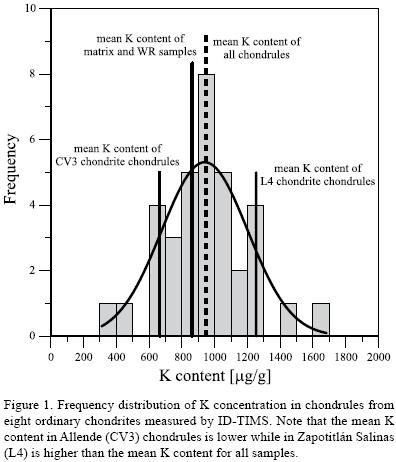
<body><![CDATA[<p align="justify"><font face="verdana" size="2">For precise isotopic potassium determinations, a NIST&#150;type thermal ionization mass spectrometer with 12" radius and a single Faraday collector was used; samples were loaded on Re outgassed filaments. Acquisition of isotopic ratios was done with a GPIB &#150; Visual Basic protocol for drift correction. The isotopic relationships were corrected by a factor calculated with the accepted natural value of <sup>39</sup>K /<sup>41</sup>K= 13.8567 and an internal standard. External reproducibility lies within 2% (2&#963;).</font></p>     <p align="justify"><font face="verdana" size="2">Measurement of <sup>40</sup>Ar was accomplished by static vacuum noble gas mass spectrometry. Samples were fused with an infrared CO<sub>2</sub> laser. The constants for the calculations were taken from Steiger and J&auml;ger (1977) and the equation used for age calculation is</font></p>     <p align="center"><font face="verdana" size="2"><img src="/img/revistas/rmcg/v27n1/a11s1.jpg"></font></p>     <p align="justify"><font face="verdana" size="2">where <sup>40</sup>Ar* is the measured value in mol/g. A detailed description of the laser&#150;based K&#150;Ar technique used in this work can be found in Sol&eacute; (2009).</font></p>     <p align="justify"><font face="verdana" size="2"><b>Lead&#150;Lead</b></font></p>     <p align="justify"><font face="verdana" size="2">Age determinations with the Pb&#150;Pb method were carried out in samples of three chondrites: Cosina, Nuevo Mercurio and Allende. Procedures for chondrule separation and cleaning were similar to those described for potassium&#150;argon analysis. Before sample dissolution, we applied a leaching procedure consisting in three 10 minutes cycles with 2N HCl in Savillex vials, and then a 30 minutes cycle with 6N HCl in an ultrasonic bath. For the digestion process we used highly purified HF plus HNO<sub>3</sub>, followed by 3N HCl in PFA beakers. The chemical purification of Pb was carried out in columns filled with BioRad AG&#150;1x8 (mesh 100&#150;200). Lead was recovered with 6N HCl. Concentration in analytical blanks was between 40 and 65 &#951;g/g. The isotopic lead determinations were obtained with a secondary electron multiplier (SEM) using a Finnigan MAT262 Thermal Ionization Mass Spectrometer (TIMS) in dynamic mode; samples were loaded with H<sub>3</sub>PO<sub>4</sub> and silica gel on Re outgassed filaments.</font></p>     <p align="justify"><font face="verdana" size="2">&nbsp;</font></p>     <p align="justify"><font face="verdana" size="2"><b>RESULTS</b></font></p>     <p align="justify"><font face="verdana" size="2">The reported K content in the chondrules of Richardton (H5; Evensen <i>et al.</i>, 1979) ranges between 250 and 800 &#956;g/g. The reported distribution of K contents in 114 falls is a Gaussian curve with a peak at a value of 782 &plusmn; 83 &#956;g/g for H chondrites and 860 &#956;g/g for L and LL type chondrites (Wasson and Kallemeyn, 1988; Kallemeyn <i>et al.</i>, 1989). The concentration of K obtained in this study for Cosina chondrules ranges between 723 and 1489 &#956;g/g and from 673 to 1135 &#956;g/g in Nuevo Mercurio chondrules. We obtained a K concentration of 479 to 1208 &#956;g/g for the chondrules of Tuxtuac (LL5), whereas the concentration reported for whole&#150;rock samples of LL5 type chondrites ranges between 842 and 878 (Kallemeyn, <i>et al.</i>, 1989). In this study, we obtained K concentrations in an interval between 310 and 1010 &#956;g/g for Allende chondrules (CV3), in good agreement with previously reported contents of 250 to 1001 &#956;g/g (Jessberger <i>et al.</i>, 1980). The distribution of potassium content in all analyzed chondrules is described by a Gaussian behavior (<a href="#f1">Figure 1</a>). A mean K concentration value of 946 &#956;g/g was found for chondrules of all studied chondrites, although a higher mean value was found for Zapotitl&aacute;n Salinas (1253 &#956;g/g), whereas CV3 Allende shows a lower mean value of 664 &#956;g/g. The mean of all matrix and whole&#150;rock (WR) samples of the studied chondrites is 862 &#956;g/g, with a small difference between matrix and WR mean concentrations (845 and 885 &#956;g/g, respectively).</font></p>     <p align="center"><font face="verdana" size="2"><a name="f1"></a></font></p>     ]]></body>
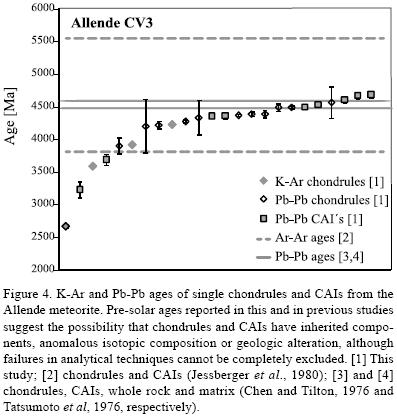
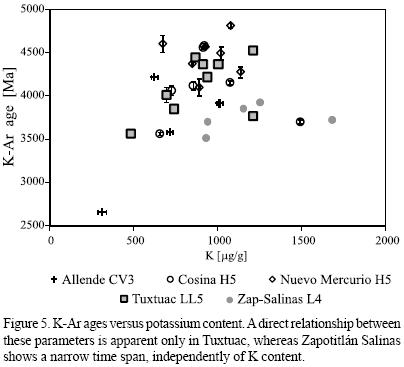
<body><![CDATA[<p align="center"><font face="verdana" size="2"><img src="/img/revistas/rmcg/v27n1/a11f1.jpg"></font></p>     <p align="justify"><font face="verdana" size="2">The K&#150;Ar ages obtained in this study for the several types of chondrites (including CV3, H5, LL5 and L4, L5 and L6 types) lie in a wide main range, from the canonical age of 4565 Ma to 3500 Ma, with only four lower ages of 36 measurements (<a href="/img/revistas/rmcg/v27n1/a11f2.jpg" target="_blank">Figure 2</a>; <a href="/img/revistas/rmcg/v27n1/a11t1.jpg" target="_blank">Table 1</a>). </font></p>     <p align="justify"><font face="verdana" size="2">The H5 chondrites show a broad time interval. The K&#150;Ar ages calculated for Cosina chondrules range from 3703 to 4581 Ma, whereas the matrix has an age of 3565 Ma. Ages of Nuevo Mercurio chondrules are between a presolar age of 4816 and 4100 Ma, with an of 4376 Ma age obtained for the matrix. Aldama WR age is very young, with only 442 Ma. On the other hand, L chondrites show the following results: Zapotitl&aacute;n Salinas (L4) chondrules are in the range from 3923 to 2089 Ma, and its matrix has an age of 3699 Ma; El Pozo (L5) WR age is 3103 Ma; P&aacute;cula (L6) WR age is 4188 Ma; and Tuxtuac (LL5) chondrules range from 4532 to 3567 Ma, with a matrix age of 4216 Ma. Finally, the ages of chondrules from Allende (CV3) lie in a time interval of 4219 to 2661 Ma.</font></p>     <p align="justify"><font face="verdana" size="2">Considering the K&#150;Ar and Pb&#150;Pb ages reported in this work (<a href="/img/revistas/rmcg/v27n1/a11t1.jpg" target="_blank">Tables 1</a> and <a href="/img/revistas/rmcg/v27n1/a11t2.jpg" target="_blank">2</a>), Cosina displays three age ranges (<a href="/img/revistas/rmcg/v27n1/a11f3.jpg" target="_blank">Figure 3a</a>): a) the primordial Solar System age; b) a short hiatus interval between 4533 and 4425 (108 My); and c) a long and prolonged hiatus of 358 My, between 4061 and 3703 Ma. Taking account only post&#150;solar ages, the total resetting interval registered in Cosina is at least 1000 My. For Nuevo Mercurio no ages were registered in two small periods between 4496 and 4380 Ma (116 My) and between 4202 and 4109 Ma (93 My) (<a href="/img/revistas/rmcg/v27n1/a11f3.jpg" target="_blank">Figure 3b</a>). Sampling effects can not be excluded as cause of such hiatuses.</font></p>     <p align="justify"><font face="verdana" size="2">Tuxtuac was previously dated by the Pb&#150;Pb method. Rotenberg and Amelin (2003) reported an age of 4493 &plusmn; 50 Ma for chondrules; Bouvier <i>et al.</i> (2007) a whole&#150;rock age of 4547.4 &plusmn; 2.5 Ma and a chondrule age of 4555.3 &plusmn; 0.4 Ma; and G&ouml;pel <i>et al.</i> (1994) an age for phosphates of 4543.6 &plusmn; 2.1 Ma. Further, whole&#150;rock K&#150;Ar ages for this chondrite are 4391 and 4433 Ma (recalculated from Schultz and Kruse, 1989) and 4286 &plusmn; 4 Ma (Bernatowicz et al, 1988). Our K&#150;Ar ages are lower than those previously obtained by the Pb&#150;Pb method (<a href="/img/revistas/rmcg/v27n1/a11f3.jpg" target="_blank">Figure 3c</a>); they range from 4532 to 3567 Ma, with a difference of 965 My between the minimum and maximum ages registered in the chondrules.</font></p>     <p align="justify"><font face="verdana" size="2">Zapotitl&aacute;n Salinas show K&#150;Ar ages from 3923 to 2089 Ma. Apparently, ages older than about 4 Ga have not been preserved in this meteorite (<a href="/img/revistas/rmcg/v27n1/a11f3.jpg" target="_blank">Figure 3d</a>).</font></p>     <p align="justify"><font face="verdana" size="2">Allende displays a more complex behavior, with a main time span between &#126;4570 and 3585 Ma in both K&#150;Ar and Pb&#150;Pb ages of chondrules and CAIs (<a href="#f4">Figure 4</a>), and two younger ages at 3223 and 2661 Ma are recorded. However, Allende also shows a wide pre&#150;solar period, previously documented by Jessgberger <i>et al.</i> (1980), who reported ages as old as 5260 Ma.</font></p>     <p align="center"><font face="verdana" size="2"><a name="f4"></a></font></p>     <p align="center"><font face="verdana" size="2"><img src="/img/revistas/rmcg/v27n1/a11f4.jpg"></font></p>     <p align="justify"><font face="verdana" size="2">The relationship between chondrite size, potassium concentration and K&#150;Ar age is not so clear in our samples (<a href="#f5">Figure 5</a>). Tuxtuac shows a positive correlation between potassium content and age, indicative of a mineralogical control of argon retention, but such correlation is not as evident in chondrules from other chondrites. Furthermore, Zapotitl&aacute;n Salinas chondrules show a narrow age range, independently of the potassium content of the chondrule.</font></p>     ]]></body>
<body><![CDATA[<p align="center"><font face="verdana" size="2"><a name="f5"></a></font></p>     <p align="center"><font face="verdana" size="2"><img src="/img/revistas/rmcg/v27n1/a11f5.jpg"></font></p>     <p align="justify"><font face="verdana" size="2">In the studied chondrules, both Pb&#150;Pb and K&#150;Ar ages of matrix and whole rocks samples fall in a major interval of almost 1000 My, if pre&#150;solar Pb&#150;Pb and K&#150;Ar ages in CAIs and chondrules reported here and by Jessberger <i>et al.</i> (1980) are not taken into account. A comparison between our data and published whole&#150;rock K&#150;Ar ages of H and LL chondrites reveals that previously reported dates are younger or similar than the single chondrule dates obtained in this study. Chondrules from every studied meteorite preserve a range of dates, whereas the whole&#150;rock age is only a mean of chondrules and matrix ages.</font></p>     <p align="justify"><font face="verdana" size="2">For the previous discussion, it should be taken into account that some of the reported Pb ages have very large errors, although errors of pre&#150;solar Pb ages for Cosina and Nuevo Mercurio are relatively small. We consider that the reasons for unsatisfactory precision of the Pb ages obtained in this study could be: disturbance of the U&#150;Pb system during thermal processing on the parent bodies, redistribution of Pb during impact events, and terrestrial contamination. However, it must be observed that five of the eight studied chondrites are falls and should not have been exposed to heavy intense terrestrial contamination for long time.</font></p>     <p align="justify"><font face="verdana" size="2">&nbsp;</font></p>     <p align="justify"><font face="verdana" size="2"><b>DISCUSSION</b></font></p>     <p align="justify"><font face="verdana" size="2">A large amount of meteorites are marked with traces of thermal effects produced by metamorphism or melting and differentiation of the parent bodies at the early stages of evolution of the Solar System. To explain some of these traces there are a few models. Consistent with <sup>26</sup>Al/<sup>27</sup>Al and Pb&#150;Pb data, the entire period of chondrule formation took place over &#126;4&#150;5 My after the time of CAIs formation, (Amelin and Krot, 2007). According to Huss <i>et al.</i> (2006), following metamorphism path can be traced in chondrites, relative to the time of CAIs formation: metamorphism of type 3.0&#150;3.2 took place between 2 and 4 My later; in type 3.7&#150;4 chondrite it lasted until 6 My later; and in type 6 chondrites it continued for &gt;7 My after CAIs formed. The Pb&#150;Pb ages, which reflect cooling below &#126;750 &deg;K, indicate that metamorphism of H4 chondrites ended 4&#150;6 My after the time of CAIs formation, consistent with estimates from <sup>26</sup>Al. This system also indicates that, for H5 and H6 chondrites, metamorphism ended 10&#150;16 My and 45&#150;63 My after CAIs formation, respectively. Fission tracks are retained at &#126;550 &deg;K (pyroxene) or &#126;390 &deg;K (merillite), so <sup>244</sup>Pu fission tracks reflect a later stage in the cooling history. These ages indicate that metamorphism ended &#126;10 My for H4, 50&#150;65 My for H5, and 55&#150;65 My for H6 after CAIs formed (Trieloff <i>et al.</i>, 2003).</font></p>     <p align="justify"><font face="verdana" size="2">This "onion shell" model predicts the structure of the parent bodies of ordinary chondrites with the most metamorphosed material (petrologic type 6) in the central part of the body and the degree of thermal metamorphism and petrologic type being reduced with the transition to the outer parts of the body (Trieloff <i>et al.</i>, 2003). According with this model, the parent bodies of chondrites were formed during a short time interval &#91;a few millions years (4.55&#150;4.56 Ga)&#93; and the thermal evolution of these bodies was fast and occurred within 10<sup>7</sup> &#150; 10<sup>8</sup> years after their accretion. At the same time, the age, characterizing the "freezing" time of the isotopic system invoked for dating, must be lower for the more metamorphosed material compared to that for the less metamorphosed material. G&ouml;pel <i>et al.</i> (1994) found a negative correlation between the Pb&#150;Pb ages of phosphates isolated from H chondrites and the petrologic type of these chondrites, consistent with the "onion" structure of the H chondrites parent body and the <i>in situ</i> radioactive decay of short lived nuclei as internal thermal sources.</font></p>     <p align="justify"><font face="verdana" size="2">On the other hand, theoretical research on the evolution of asteroids showed that collisions could lead to the disruption of asteroids to fragments. It seems that the parent bodies of H&#150; and L&#150;group ordinary chondrites broke up and reassembled after they experienced heating, metamorphism, and slow cooling. The lack of correlation between high metallographic cooling rates and petrographic type implies either that chondrite parent asteroids were not assembled originally with onion&#150;shell structures or that, if they had been, they were broken due to self&#150;gravitation; these fragments can integrate again, forming a "rubble pile", before they had cooled to below 500 &deg;C. If the latter explanation is correct, these bodies apparently suffered at least two fragmentation and reassembly events since their formation (Taylor <i>et al.</i>, 1987). Many facts, including the high cooling rates, the low density of asteroids, and their low rupture strength, suggest that the catastrophic fragmentation and reaccumulations of asteroids is the rule rather than the exception (Alexeev, 2005). Recent observation of asteroid Itokawa by a spatial probe (Fujiwara <i>et al.</i>, 2006) show it as a rubble&#150;pile with an L or LL composition.</font></p>     <p align="justify"><font face="verdana" size="2">Most impact ages of chondrites reflect partial rather than total loss of Ar. A reasonable, but not definitive, conclusion therefore is that Ar degassing was caused by large and extended impact events on the parent body, possibly one that caused its disruption. It is conceivable that Ar degassing from these meteorites was associated with events that initiated their cosmic&#150;ray exposure (Bogard, 1995). Ar&#150;Ar and some Rb&#150;Sr ages of eucrites/howardites were partially to totally reset in a similar time period, as were ages for lunar highland rocks, with somewhat lower age distribution in howardite&#150;eucrite&#150;diogenite (HED) meteorites compared to lunar samples (Bogard, 1995 and <a href="/img/revistas/rmcg/v27n1/a11f6.jpg" target="_blank">Figure 6</a>). For Bogard (1995), ordinary chondrites, however, suggest a different impact history from that of HED meteorites and the lunar highlands. Based on the old isotopic ages of most chondrites, he suggested that these early impacts did not produce widespread heating in cratering deposits for chondrites and would imply that the parent bodies of chondrites were even smaller than those of HED meteorites. However, in <a href="/img/revistas/rmcg/v27n1/a11f6.jpg" target="_blank">Figure 6</a> it can be see that K&#150;Ar and Ar&#150;Ar ages of chondrites reported in this study and by other authors cover at least the same period of time. The two types of ordinary chondrites, H and L, suggest impact heating more recently than 1.0 Ga ago and LL seems to have experienced episodic heating from 2 to 1 Ga. A sampling effect of the different groups cannot be excluded, because the LL group has been less sampled. In a chondrite study of Alekseev (1996), the LL group represents only the 5% of 718 samples.</font></p>     ]]></body>
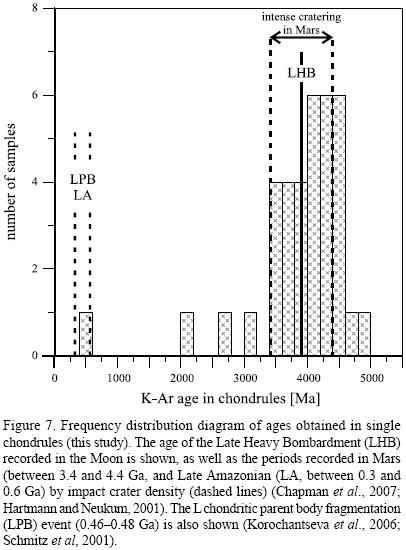
<body><![CDATA[<p align="justify"><font face="verdana" size="2">Alexeev (2005) made an analysis of U, Th&#150;He and K&#150;Ar age distribution in chondrites and found that the maximum K&#150;Ar peak for the H, L and LL chondrites is at an age of 4.33 &plusmn; 0.02, 4.24 &plusmn; 0.03 Ga and 4.06 &plusmn; 0.06 Ga, respectively, although an important event in which heating ceased is recognized at 3.5 Ga for all groups. These peaks are close and, on average, about 200 My younger than currently assumed age of the Solar System, 4.56 Ga. The age values of 85% of the H and LL chondrites and 50% of the L chondrites are located around this peak. In <a href="#f7">Figure 7</a>, it can be seen that the frequency distribution diagram for chondrules of this study show similar periods. Alekseev (1996) and Alexeev (2005) used about 700 noble gases isotopic signatures of Antarctic and non&#150;Antarctic, H, L and LL chondrites for age calculation, and made use of mean whole rock concentrations for K, U, and Th. In this study, we used different chondrules of the same meteorite and the individual concentration of K determined for each one, and obtained the same age distribution as Alekseev (1996) and Alexeev (2005), but using only eight meteorites. The power of the single chondrule dating developed in this work is evidenced by these results. </font></p>     <p align="center"><font face="verdana" size="2"><a name="f7"></a></font></p>     <p align="center"><font face="verdana" size="2"><img src="/img/revistas/rmcg/v27n1/a11f7.jpg"></font></p>     <p align="justify"><font face="verdana" size="2">A comparison between K&#150;Ar chondrule dates (<a href="/img/revistas/rmcg/v27n1/a11t1.jpg" target="_blank">Table 1</a>) and single chondrule <sup>207</sup>Pb&#150;<sup>206</sup>Pb ages (<a href="/img/revistas/rmcg/v27n1/a11t2.jpg" target="_blank">Table 2</a>) of the same meteorites suggests that K&#150;Ar ages very close to Pb ages are preserved in some chondrules. Another interesting point is that in the three chondrites dated by the Pb&#150;Pb method, the K&#150;Ar ages of individual chondrules are intercalated with Pb&#150;Pb chondrule ages (<a href="/img/revistas/rmcg/v27n1/a11f3.jpg" target="_blank">Figures 3</a> and <a href="#f4">4</a>) and that the matrix K&#150;Ar age is not always the youngest age, as it would be expected. It means that the diverse chondrules in the same meteorite kept different closure (or partial heating) events. We compared the results obtained using single chondrules K&#150;Ar dating with those using Ar&#150;Ar degassing steps in whole rock of a Tuxtuac sample (Bernatowicz <i>et al.</i>, 1988) and it is clear that our ages are in agreement with several of the plateaus formed by degassing; the matrix age in this study is 4.21 Ga, whereas the Bernatowicz's age is 4.29 Ga for whole rock.</font></p>     <p align="justify"><font face="verdana" size="2">The intercalated K&#150;Ar and Pb&#150;Pb ages are difficult to explain because of the different closure temperatures of these systems. It is doubtful that two geochemically different isotopic clocks could be affected in a similar way in the same rock.One explanation could be that the chondrules come from different sources with a different thermal history. The fact that matrices of three of the specimens studied did not yield the youngest age, nor the oldest, and that only in one of the studied meteorites, Cosina, the matrix shows the youngest age, seems to point to the idea that the chondrules arrived from different environments, ages and alteration degree and that they were accreted into a body (rubble pile). The matrix is reflecting a mean value of the ages registered by chondrules. </font></p>     <p align="justify"><font face="verdana" size="2">Chondrules formed by several nebular processes (closed&#150;system melting, condensation, and possibly evaporation) and at least one asteroidal process (impact in regoliths). Each chondrite component appears to have been built predominantly by brief high&#150;temperature processes. Rapid cooling in the formation environment or removal to cooler localities ensured an extraordinary diversity of mineralogical and chemical compositions among chondritic components (Scott and Krot, 2005). The obtained ages in chondrules reflect a different original environment, possibly different mineralogy and thus different responses to impact events. Impact events are not single episodes; the wide spectrum of ages showed by chondrites and achondrites seems to be evidence that the impacts and thermal disruptions of meteorites parent bodies were protracted at least during the first 1000 My of the Solar System history, producing endogen metamorphism not so strong to melt the rocks. This is in agreement with Lunar and Martian cratering dating (Hartmann and Neukum, 2001).</font></p>     <p align="justify"><font face="verdana" size="2">Impact craters are one the most characteristic features of inner planetary bodies. The Late Heavy Bombardment (LHB) has played a significant role in the planetary science since it was proposed to have happened on the Moon. It has generally been presumed that all terrestrial planets &#150; including the Earth&#150; were heavily bombarded at the same time. At least for Mars, this assumption is the basis of their stratigraphic chronology (Chapman <i>et al.</i>, 2007). The age of the LHB is constrained from 10&#150;12 basin&#150;forming impacts, which happened during the Nectarian from 3.90 &#150; 3.85 Ga; thereafter, bombardment ended sharply, with only Orientale occurring a little bit later, &#126;3.82 Ga. Later cratering by smaller projectiles continued to decline by another order of magnitude until about 3.4 Ga, after which the cratering flux has been roughly constant to within a factor of two. The impact ages for the achondrites and the ordinary chondrites seem to provide evidence for a lunar&#150;like LHB cataclysm affecting the meteorite parent bodies (Chapman <i>et al.</i>, 2007 and <a href="#f7">Figure 7</a>). These authors consider that lunar resetting ages span a period of 200 My, but when other reported lunar ages are used, the impact resetting in the Moon can be prolonged as far as 3.5 Ga in an anorthosite suite (<a href="/img/revistas/rmcg/v27n1/a11f6.jpg" target="_blank">Figure 6</a>).</font></p>     <p align="justify"><font face="verdana" size="2">Finally, the pre&#150;solar ages determined in this study and previously by other authors (<a href="#f4">Figure 4</a>), suggest the possibility that chondrules have inherited components. Anomalous isotopic composition, geologic alteration or failures in analytical techniques can be also alternative explanations. With respect to the pre&#150;solar Ar&#150;Ar ages for Allende CAIs and chondrules reported by Jessberger <i>et al.</i> (1980), revisions of their analytical procedures and of the potassium isotopic signature concluded that this older ages should not be interpreted as evidence for the survival of pre&#150;solar grains &#150;although the ages are highly suggestive&#150; until the carrier material of the extra <sup>40</sup>Ar is identified and further isotopic evidence is obtained (Jessberger and Dominik, 1979). At the same time, Stegmann and Begemann (1979) concluded that the isotopic composition of potassium in Allende inclusions is indistinguishable from that of normal terrestrial potassium (within &plusmn; 1%). Potassium ratios in Allende show no evidence for an anomaly because this would imply an enrichment by about 35% in <sup>40</sup>K. Besides, Yin <i>et al.</i> (2008) calculated pre&#150;solar ages in Allende CAIs to be 10&#150;14 Ga old, based on <sup>232</sup>Th/<sup>238</sup>U ratios. It can be expected that some old pre&#150;solar ages will be found in other chondritic materials.</font></p>     <p align="justify"><font face="verdana" size="2">&nbsp;</font></p>     <p align="justify"><font face="verdana" size="2"><b>CONCLUSIONS</b></font></p>     ]]></body>
<body><![CDATA[<p align="justify"><font face="verdana" size="2">Observing the dates from the eight different chondrites studied, we can suggest that their history was more complicated and less peacefully than some simple models predict. However, after the end of the major impacts documented in most of the bodies at about 3.5 Ga, it seems that only chondritic parent bodies and their typical structures (chondrules) were disturbed by multiple collisions throughout their history. It appears that achondritic bodies follow a distinct evolution path toward planetary environments. The ages obtained in matrix and chondrules of the same specimen support the rubble pile model, at least for a certain time span of meteorite's life. This model could apply for different petrologic types. The onion&#150;like model can be possible for large meteorite bodies or during their first stages of evolution, i.e., in the oldest age range (&gt;4.4 Ga).</font></p>     <p align="justify"><font face="verdana" size="2">&nbsp;</font></p>     <p align="justify"><font face="verdana" size="2"><b>ACKNOWLEDGMENTS</b></font></p>     <p align="justify"><font face="verdana" size="2">We thank the National Collection of Meteorites of the Instituto de Geolog&iacute;a (UNAM, M&eacute;xico) for providing all the chondritic samples. We also thank Juan Morales, Gabriela Sol&iacute;s and Teodoro Hern&aacute;ndez for analytical support at LUGIS. Two anonymous reviewers improved the paper. The work was supported by CONACyT Basic Research Program Project 43227 and 50619, a DGAPA&#150;PASPA scholarship to M.S. Hern&aacute;ndez, and PAPIIT grant IN112605&#150;3 to J. Sol&eacute;.</font></p>     <p align="justify"><font face="verdana" size="2">&nbsp;</font></p>     <p align="justify"><font face="verdana" size="2"><b>REFERENCES</b></font></p>     <!-- ref --><p align="justify"><font face="verdana" size="2">Alekseev, V.A., 1996, Uranium&#150;Thorium&#150;Helium and Potassium&#150;Argon ages of ordinary chondrites: Solar System Research, 3(3), 243&#150;250.</font>&nbsp;&nbsp;&nbsp;&nbsp;&nbsp;&nbsp;&nbsp;&nbsp;[&#160;<a href="javascript:void(0);" onclick="javascript: window.open('/scielo.php?script=sci_nlinks&ref=8044824&pid=S1026-8774201000010001100001&lng=','','width=640,height=500,resizable=yes,scrollbars=1,menubar=yes,');">Links</a>&#160;]<!-- end-ref --><!-- ref --><p align="justify"><font face="verdana" size="2">Alexeev, V.A., 2005, The history of ordinary chondrites from the data on stable isotopes of noble gases (a review): Solar System Research, 39(2), 124&#150;149.</font>&nbsp;&nbsp;&nbsp;&nbsp;&nbsp;&nbsp;&nbsp;&nbsp;[&#160;<a href="javascript:void(0);" onclick="javascript: window.open('/scielo.php?script=sci_nlinks&ref=8044825&pid=S1026-8774201000010001100002&lng=','','width=640,height=500,resizable=yes,scrollbars=1,menubar=yes,');">Links</a>&#160;]<!-- end-ref --><!-- ref --><p align="justify"><font face="verdana" size="2">Amelin, Y., Krot, A., 2007, Pb isotopic age of the Allende chondrules: Meteoritics and Planetary Science, 42(7&#150;8), 1321&#150;1335.</font>&nbsp;&nbsp;&nbsp;&nbsp;&nbsp;&nbsp;&nbsp;&nbsp;[&#160;<a href="javascript:void(0);" onclick="javascript: window.open('/scielo.php?script=sci_nlinks&ref=8044826&pid=S1026-8774201000010001100003&lng=','','width=640,height=500,resizable=yes,scrollbars=1,menubar=yes,');">Links</a>&#160;]<!-- end-ref --><!-- ref --><p align="justify"><font face="verdana" size="2">Bernatowicz, T.J., Podosek, F.A., Swindle, T.D., Honda, M., 1988, I&#150;Xe systematics in LL chondrites: Geochimica et Cosmochimica Acta, 52, 1113&#150;1121.</font>&nbsp;&nbsp;&nbsp;&nbsp;&nbsp;&nbsp;&nbsp;&nbsp;[&#160;<a href="javascript:void(0);" onclick="javascript: window.open('/scielo.php?script=sci_nlinks&ref=8044827&pid=S1026-8774201000010001100004&lng=','','width=640,height=500,resizable=yes,scrollbars=1,menubar=yes,');">Links</a>&#160;]<!-- end-ref --><!-- ref --><p align="justify"><font face="verdana" size="2">Bogard, D., 1995, Impact ages of meteorites: A synthesis: Meteoritics, 30, 244&#150;268.</font>&nbsp;&nbsp;&nbsp;&nbsp;&nbsp;&nbsp;&nbsp;&nbsp;[&#160;<a href="javascript:void(0);" onclick="javascript: window.open('/scielo.php?script=sci_nlinks&ref=8044828&pid=S1026-8774201000010001100005&lng=','','width=640,height=500,resizable=yes,scrollbars=1,menubar=yes,');">Links</a>&#160;]<!-- end-ref --><!-- ref --><p align="justify"><font face="verdana" size="2">Bouvier, A., Blichert&#150;Toft, J., Moynier, F., Vervoort, J., Albar&egrave;de, F., 2007, Pb&#150;Pb dating constraints on the accretion and cooling history of chondrites: Geochimica et Cosmochimica Acta, 71(6), 1583&#150;1604.</font>&nbsp;&nbsp;&nbsp;&nbsp;&nbsp;&nbsp;&nbsp;&nbsp;[&#160;<a href="javascript:void(0);" onclick="javascript: window.open('/scielo.php?script=sci_nlinks&ref=8044829&pid=S1026-8774201000010001100006&lng=','','width=640,height=500,resizable=yes,scrollbars=1,menubar=yes,');">Links</a>&#160;]<!-- end-ref --><!-- ref --><p align="justify"><font face="verdana" size="2">Chapman, C.R., Cohen, B.A., Grinspoon, D.H., 2007, What are the real constraints on the existence and magnitude of the late heavy bombardment?: Icarus, 189(1), 233&#150;245.</font>&nbsp;&nbsp;&nbsp;&nbsp;&nbsp;&nbsp;&nbsp;&nbsp;[&#160;<a href="javascript:void(0);" onclick="javascript: window.open('/scielo.php?script=sci_nlinks&ref=8044830&pid=S1026-8774201000010001100007&lng=','','width=640,height=500,resizable=yes,scrollbars=1,menubar=yes,');">Links</a>&#160;]<!-- end-ref --><!-- ref --><p align="justify"><font face="verdana" size="2">Chen, J.H., Tilton, G.R., 1976, Isotopic Lead investigations on the Allende carbonaceous chondrite: Geochimica et Cosmochimica Acta, 40, 635&#150;643.</font>&nbsp;&nbsp;&nbsp;&nbsp;&nbsp;&nbsp;&nbsp;&nbsp;[&#160;<a href="javascript:void(0);" onclick="javascript: window.open('/scielo.php?script=sci_nlinks&ref=8044831&pid=S1026-8774201000010001100008&lng=','','width=640,height=500,resizable=yes,scrollbars=1,menubar=yes,');">Links</a>&#160;]<!-- end-ref --><!-- ref --><p align="justify"><font face="verdana" size="2">Dixon, E.T., Bogard, D.D., Garrison, D.H., Rubin, A.E., 2004, <sup>39</sup>Ar&#150;<sup>40</sup>Ar evidence for early impact events on the LL parent body: Geochimica et Cosmochimica Acta, 68(18), 3779&#150;3790.</font>&nbsp;&nbsp;&nbsp;&nbsp;&nbsp;&nbsp;&nbsp;&nbsp;[&#160;<a href="javascript:void(0);" onclick="javascript: window.open('/scielo.php?script=sci_nlinks&ref=8044832&pid=S1026-8774201000010001100009&lng=','','width=640,height=500,resizable=yes,scrollbars=1,menubar=yes,');">Links</a>&#160;]<!-- end-ref --><!-- ref --><p align="justify"><font face="verdana" size="2">Evensen, N.M., Carter, S.R., Hamilton, P.J., O'Nions, R.K., Ridley, W.I., 1979, A combined chemical&#150;petrological study of separated chondrules from the Richardton meteorite: Earth and Planetary Science Letters, 2(2), 223&#150;236.</font>&nbsp;&nbsp;&nbsp;&nbsp;&nbsp;&nbsp;&nbsp;&nbsp;[&#160;<a href="javascript:void(0);" onclick="javascript: window.open('/scielo.php?script=sci_nlinks&ref=8044833&pid=S1026-8774201000010001100010&lng=','','width=640,height=500,resizable=yes,scrollbars=1,menubar=yes,');">Links</a>&#160;]<!-- end-ref --><!-- ref --><p align="justify"><font face="verdana" size="2">Fujiwara, A., Kawaguchi, J., Yeomans, D.K., Abe, M., Mukai, T., Okada, T., Saito, J., Yano, H., Yoshikawa, M., Scheeres, D.J., Barnouin&#150;Jha, O., Cheng, A.F., Demura, H., Gaskell, R.W., Hirata, N., Ikeda, H., Kominato, T., Miyamoto, H., Nakamura, A.M., Nakamura, R., Sasaki, S., Uesugi, K., 2006, The rubble&#150;pile asteroid Itokawa as observed by Hayabusa: Science, 312(5778), 1330&#150;1334.</font>&nbsp;&nbsp;&nbsp;&nbsp;&nbsp;&nbsp;&nbsp;&nbsp;[&#160;<a href="javascript:void(0);" onclick="javascript: window.open('/scielo.php?script=sci_nlinks&ref=8044834&pid=S1026-8774201000010001100011&lng=','','width=640,height=500,resizable=yes,scrollbars=1,menubar=yes,');">Links</a>&#160;]<!-- end-ref --><!-- ref --><p align="justify"><font face="verdana" size="2">G&ouml;pel, C., Manh&egrave;s, G., All&egrave;gre, C.J., 1994, U&#150;Pb systematics of phosphates from equilibrated ordinary chondrites: Earth and Planetary Sciences Letters, 121(1&#150;2), 153&#150;171.</font>&nbsp;&nbsp;&nbsp;&nbsp;&nbsp;&nbsp;&nbsp;&nbsp;[&#160;<a href="javascript:void(0);" onclick="javascript: window.open('/scielo.php?script=sci_nlinks&ref=8044835&pid=S1026-8774201000010001100012&lng=','','width=640,height=500,resizable=yes,scrollbars=1,menubar=yes,');">Links</a>&#160;]<!-- end-ref --><!-- ref --><p align="justify"><font face="verdana" size="2">Hartmann, W.K., Neukum, G., 2001, Cratering chronology and the evolution Of Mars: Space Science Reviews, 96, 165&#150;194.</font>&nbsp;&nbsp;&nbsp;&nbsp;&nbsp;&nbsp;&nbsp;&nbsp;[&#160;<a href="javascript:void(0);" onclick="javascript: window.open('/scielo.php?script=sci_nlinks&ref=8044836&pid=S1026-8774201000010001100013&lng=','','width=640,height=500,resizable=yes,scrollbars=1,menubar=yes,');">Links</a>&#160;]<!-- end-ref --><!-- ref --><p align="justify"><font face="verdana" size="2">Huss, G.R., Rubin, A.E., Grossman, J.N., 2006, Thermal metamorphism in chondrites, <i>in</i> Lauretta, D.S., McSween, H.Y. (eds.), Meteorites and the early solar system II: Tucson, The University of Arizona Press, 567&#150;586.</font>&nbsp;&nbsp;&nbsp;&nbsp;&nbsp;&nbsp;&nbsp;&nbsp;[&#160;<a href="javascript:void(0);" onclick="javascript: window.open('/scielo.php?script=sci_nlinks&ref=8044837&pid=S1026-8774201000010001100014&lng=','','width=640,height=500,resizable=yes,scrollbars=1,menubar=yes,');">Links</a>&#160;]<!-- end-ref --><!-- ref --><p align="justify"><font face="verdana" size="2">Jessberger, E.K., Dominik, B., 1979, Gerontology of the Allende meteorite: Nature, 277, 554&#150;556.</font>&nbsp;&nbsp;&nbsp;&nbsp;&nbsp;&nbsp;&nbsp;&nbsp;[&#160;<a href="javascript:void(0);" onclick="javascript: window.open('/scielo.php?script=sci_nlinks&ref=8044838&pid=S1026-8774201000010001100015&lng=','','width=640,height=500,resizable=yes,scrollbars=1,menubar=yes,');">Links</a>&#160;]<!-- end-ref --><!-- ref --><p align="justify"><font face="verdana" size="2">Jessberger, E.K., Dominik, B., Staudacher, T., Herzog, G., 1980, <sup>40</sup>Ar &#150;39Ar ages of Allende: Icarus, 42(3), 380&#150;405.</font>&nbsp;&nbsp;&nbsp;&nbsp;&nbsp;&nbsp;&nbsp;&nbsp;[&#160;<a href="javascript:void(0);" onclick="javascript: window.open('/scielo.php?script=sci_nlinks&ref=8044839&pid=S1026-8774201000010001100016&lng=','','width=640,height=500,resizable=yes,scrollbars=1,menubar=yes,');">Links</a>&#160;]<!-- end-ref --><!-- ref --><p align="justify"><font face="verdana" size="2">Kallemeyn, G.W., Rubin, A.E., Wang, D., Wasson, J.T., 1989, Ordinary chondrites: Bulk compositions, classification, lithofile&#150;element fractionation, and composition&#150;petrographic type relationships: Geochimica et Cosmochimica Acta, 53, 2747&#150;2767.</font>&nbsp;&nbsp;&nbsp;&nbsp;&nbsp;&nbsp;&nbsp;&nbsp;[&#160;<a href="javascript:void(0);" onclick="javascript: window.open('/scielo.php?script=sci_nlinks&ref=8044840&pid=S1026-8774201000010001100017&lng=','','width=640,height=500,resizable=yes,scrollbars=1,menubar=yes,');">Links</a>&#160;]<!-- end-ref --><!-- ref --><p align="justify"><font face="verdana" size="2">Korochantseva, E.V., Trieloff, M., Buikin, A.I., Lorenz, C.A., Ivanova, M.A.,Schwarz, W.H., Hopp, J., Jessberger, E.K., 2006, L&#150;chondrite asteroid breakup tied to Ordovician meteorite shower by multiple isochron <sup>40</sup>Ar &#150;<sup>39</sup>Ar dating, <i>in</i> Proceedings of 69th Annual Meeting of the Meteoritical Society: Zurich, Switzerland, Meteorite Planetary Science, 41, p. 5087.</font>&nbsp;&nbsp;&nbsp;&nbsp;&nbsp;&nbsp;&nbsp;&nbsp;[&#160;<a href="javascript:void(0);" onclick="javascript: window.open('/scielo.php?script=sci_nlinks&ref=8044841&pid=S1026-8774201000010001100018&lng=','','width=640,height=500,resizable=yes,scrollbars=1,menubar=yes,');">Links</a>&#160;]<!-- end-ref --><!-- ref --><p align="justify"><font face="verdana" size="2">Mackiewicz, P., Halas, S., 2003, Datowanie meteoryt&oacute;w kamiennych metoda potasowo&#150;argonowa (Potassium&#150;Argon dating of stone meteorites): Przeglad Geologiczny, 51(7), 594&#150;596.</font>&nbsp;&nbsp;&nbsp;&nbsp;&nbsp;&nbsp;&nbsp;&nbsp;[&#160;<a href="javascript:void(0);" onclick="javascript: window.open('/scielo.php?script=sci_nlinks&ref=8044842&pid=S1026-8774201000010001100019&lng=','','width=640,height=500,resizable=yes,scrollbars=1,menubar=yes,');">Links</a>&#160;]<!-- end-ref --><!-- ref --><p align="justify"><font face="verdana" size="2">Nyquist, L.E., Shih, C.Y., 1992, The isotopic record of lunar volcanism: Geochimica et Cosmochimica Acta, 56(6), 2213&#150;2234.</font>&nbsp;&nbsp;&nbsp;&nbsp;&nbsp;&nbsp;&nbsp;&nbsp;[&#160;<a href="javascript:void(0);" onclick="javascript: window.open('/scielo.php?script=sci_nlinks&ref=8044843&pid=S1026-8774201000010001100020&lng=','','width=640,height=500,resizable=yes,scrollbars=1,menubar=yes,');">Links</a>&#160;]<!-- end-ref --><!-- ref --><p align="justify"><font face="verdana" size="2">Rotenberg, E., Amelin, Y., 2003, Age variations among ordinary chondrites: U&#150;Pb chronology of chondrules, <i>in</i> 34th Lunar and Planetary Science Conference, abstract 1902, 2 p.</font>&nbsp;&nbsp;&nbsp;&nbsp;&nbsp;&nbsp;&nbsp;&nbsp;[&#160;<a href="javascript:void(0);" onclick="javascript: window.open('/scielo.php?script=sci_nlinks&ref=8044844&pid=S1026-8774201000010001100021&lng=','','width=640,height=500,resizable=yes,scrollbars=1,menubar=yes,');">Links</a>&#160;]<!-- end-ref --><!-- ref --><p align="justify"><font face="verdana" size="2">Rubin, A.E., 2004, Postshock annealing and postannealing shock in equilibrated ordinary chondrites: Implications for the thermal and shock histories of chondritic asteroids: Geochimica et Cosmochimica Acta, 68(3), 673&#150;689.</font>&nbsp;&nbsp;&nbsp;&nbsp;&nbsp;&nbsp;&nbsp;&nbsp;[&#160;<a href="javascript:void(0);" onclick="javascript: window.open('/scielo.php?script=sci_nlinks&ref=8044845&pid=S1026-8774201000010001100022&lng=','','width=640,height=500,resizable=yes,scrollbars=1,menubar=yes,');">Links</a>&#160;]<!-- end-ref --><!-- ref --><p align="justify"><font face="verdana" size="2">Schmitz, B., Tassinari, M., Peucker&#150;Ehrenbrink, B., 2001, A rain of ordinary chondritic meteorites in the Early Ordovician: Earth and Planetary Science Letters, 194(1&#150;2), 1&#150;15.</font>&nbsp;&nbsp;&nbsp;&nbsp;&nbsp;&nbsp;&nbsp;&nbsp;[&#160;<a href="javascript:void(0);" onclick="javascript: window.open('/scielo.php?script=sci_nlinks&ref=8044846&pid=S1026-8774201000010001100023&lng=','','width=640,height=500,resizable=yes,scrollbars=1,menubar=yes,');">Links</a>&#160;]<!-- end-ref --><!-- ref --><p align="justify"><font face="verdana" size="2">Schultz, L., Kruse H., 1989, Helium, neon and argon in meteorites &#150;A data compilation: Meteoritics, 24, 155&#150;172.</font>&nbsp;&nbsp;&nbsp;&nbsp;&nbsp;&nbsp;&nbsp;&nbsp;[&#160;<a href="javascript:void(0);" onclick="javascript: window.open('/scielo.php?script=sci_nlinks&ref=8044847&pid=S1026-8774201000010001100024&lng=','','width=640,height=500,resizable=yes,scrollbars=1,menubar=yes,');">Links</a>&#160;]<!-- end-ref --><!-- ref --><p align="justify"><font face="verdana" size="2">Scott, E.R.D., Krot, A.N., 2005, Chondrites and their component, <i>in</i> Davis, A.M. (ed.), Meteorites, Comets and Planets: Oxford, Elsevier&#150;Pergamon, Treatise on Geochemistry (Holland, H.D., Turekian, K.K., eds.), v. 1, pp. 143&#150;200.</font>&nbsp;&nbsp;&nbsp;&nbsp;&nbsp;&nbsp;&nbsp;&nbsp;[&#160;<a href="javascript:void(0);" onclick="javascript: window.open('/scielo.php?script=sci_nlinks&ref=8044848&pid=S1026-8774201000010001100025&lng=','','width=640,height=500,resizable=yes,scrollbars=1,menubar=yes,');">Links</a>&#160;]<!-- end-ref --><!-- ref --><p align="justify"><font face="verdana" size="2">Sol&eacute;, J., 2009, Determination of K&#150;Ar ages in milligram samples using an infrared laser for argon extraction: Rapid Communications in Mass Spectrometry, 23, 3579&#150;3590. </font>&nbsp;&nbsp;&nbsp;&nbsp;&nbsp;&nbsp;&nbsp;&nbsp;[&#160;<a href="javascript:void(0);" onclick="javascript: window.open('/scielo.php?script=sci_nlinks&ref=8044849&pid=S1026-8774201000010001100026&lng=','','width=640,height=500,resizable=yes,scrollbars=1,menubar=yes,');">Links</a>&#160;]<!-- end-ref --><!-- ref --><p align="justify"><font face="verdana" size="2">Stegmann, W., Begemann, F., 1979, Allende meteorite&#150;old age but normal isotopic composition of potassium: Nature, 282, 290&#150;291.</font>&nbsp;&nbsp;&nbsp;&nbsp;&nbsp;&nbsp;&nbsp;&nbsp;[&#160;<a href="javascript:void(0);" onclick="javascript: window.open('/scielo.php?script=sci_nlinks&ref=8044850&pid=S1026-8774201000010001100027&lng=','','width=640,height=500,resizable=yes,scrollbars=1,menubar=yes,');">Links</a>&#160;]<!-- end-ref --><!-- ref --><p align="justify"><font face="verdana" size="2">Steiger, R.H., J&auml;ger, E., 1977, Subcommission on geochronology: Convention on the use of decay constants in geo&#150; and cosmochronolgy: Earth and Planetary Science Letters, 36(3), 35&#150;362.</font>&nbsp;&nbsp;&nbsp;&nbsp;&nbsp;&nbsp;&nbsp;&nbsp;[&#160;<a href="javascript:void(0);" onclick="javascript: window.open('/scielo.php?script=sci_nlinks&ref=8044851&pid=S1026-8774201000010001100028&lng=','','width=640,height=500,resizable=yes,scrollbars=1,menubar=yes,');">Links</a>&#160;]<!-- end-ref --><!-- ref --><p align="justify"><font face="verdana" size="2">Tatsumoto, M., Unruh, D.M., Desborough, G.A., 1976, U&#150;Th&#150;Pb and Rb&#150;Sr systematics of Allende and U&#150;Th&#150;Pb systematics of Orgueil: Geochimica et Cosmochimica Acta, 40, 617&#150;634.</font>&nbsp;&nbsp;&nbsp;&nbsp;&nbsp;&nbsp;&nbsp;&nbsp;[&#160;<a href="javascript:void(0);" onclick="javascript: window.open('/scielo.php?script=sci_nlinks&ref=8044852&pid=S1026-8774201000010001100029&lng=','','width=640,height=500,resizable=yes,scrollbars=1,menubar=yes,');">Links</a>&#160;]<!-- end-ref --><!-- ref --><p align="justify"><font face="verdana" size="2">Taylor, G.J., Maggiore, P., Scott, E.R.D., Rubin, A.E., Keil, K., 1987, Original structures, and fragmentation and reassembly histories of asteroids: Evidence from Meteorites: Icarus, 69(1), 1&#150;13.</font>&nbsp;&nbsp;&nbsp;&nbsp;&nbsp;&nbsp;&nbsp;&nbsp;[&#160;<a href="javascript:void(0);" onclick="javascript: window.open('/scielo.php?script=sci_nlinks&ref=8044853&pid=S1026-8774201000010001100030&lng=','','width=640,height=500,resizable=yes,scrollbars=1,menubar=yes,');">Links</a>&#160;]<!-- end-ref --><!-- ref --><p align="justify"><font face="verdana" size="2">Trieloff, M., Jessberger, E.K., Herrwerth, I., Hopp, J., Fi&eacute;ni, C., Ghelis, M., Bourot&#150;Denise, M., Pellas P., 2003, Structure and thermal history of the H&#150;chondrite parent asteroid revealed by thermochronometry: Nature, 422, 502&#150;503.</font>&nbsp;&nbsp;&nbsp;&nbsp;&nbsp;&nbsp;&nbsp;&nbsp;[&#160;<a href="javascript:void(0);" onclick="javascript: window.open('/scielo.php?script=sci_nlinks&ref=8044854&pid=S1026-8774201000010001100031&lng=','','width=640,height=500,resizable=yes,scrollbars=1,menubar=yes,');">Links</a>&#160;]<!-- end-ref --><!-- ref --><p align="justify"><font face="verdana" size="2">Wasson, J.T., Kallemeyn, G.W., 1988, Compositions of chondrites: Philosophical Transactions of the Royal Society of London. Series A325, 535&#150;544.</font>&nbsp;&nbsp;&nbsp;&nbsp;&nbsp;&nbsp;&nbsp;&nbsp;[&#160;<a href="javascript:void(0);" onclick="javascript: window.open('/scielo.php?script=sci_nlinks&ref=8044855&pid=S1026-8774201000010001100032&lng=','','width=640,height=500,resizable=yes,scrollbars=1,menubar=yes,');">Links</a>&#160;]<!-- end-ref --><!-- ref --><p align="justify"><font face="verdana" size="2">Yin, Q., Jacobsen, B., Moynier, F., Amelin, Y., Krot, A.N., Nagashima, K., Hutcheon, I., Palme, H., 2008, <sup>26</sup>Al &#150;<sup>26</sup>Mg and <sup>207</sup>Pb&#150;<sup>206</sup>Pb systematic of Allende CAIs: Reinstated canonical solar initial <sup>26</sup>Al / <sup>27</sup>Al ratio, variable &#954;&#150;values (<sup>232</sup>Th/ <sup>238</sup>U) and the age of the galaxy, <i>in</i> 39th Lunar and Planetary Science Conference, LPI Contribution 1391, p.1525.</font>&nbsp;&nbsp;&nbsp;&nbsp;&nbsp;&nbsp;&nbsp;&nbsp;[&#160;<a href="javascript:void(0);" onclick="javascript: window.open('/scielo.php?script=sci_nlinks&ref=8044856&pid=S1026-8774201000010001100033&lng=','','width=640,height=500,resizable=yes,scrollbars=1,menubar=yes,');">Links</a>&#160;]<!-- end-ref --> ]]></body><back>
<ref-list>
<ref id="B1">
<nlm-citation citation-type="journal">
<person-group person-group-type="author">
<name>
<surname><![CDATA[Alekseev]]></surname>
<given-names><![CDATA[V.A]]></given-names>
</name>
</person-group>
<article-title xml:lang="en"><![CDATA[Uranium-Thorium-Helium and Potassium-Argon ages of ordinary chondrites]]></article-title>
<source><![CDATA[Solar System Research]]></source>
<year>1996</year>
<volume>3</volume>
<numero>3</numero>
<issue>3</issue>
<page-range>243-250</page-range></nlm-citation>
</ref>
<ref id="B2">
<nlm-citation citation-type="journal">
<person-group person-group-type="author">
<name>
<surname><![CDATA[Alexeev]]></surname>
<given-names><![CDATA[V.A]]></given-names>
</name>
</person-group>
<article-title xml:lang="en"><![CDATA[The history of ordinary chondrites from the data on stable isotopes of noble gases (a review)]]></article-title>
<source><![CDATA[Solar System Research]]></source>
<year>2005</year>
<volume>39</volume>
<numero>2</numero>
<issue>2</issue>
<page-range>124-149</page-range></nlm-citation>
</ref>
<ref id="B3">
<nlm-citation citation-type="journal">
<person-group person-group-type="author">
<name>
<surname><![CDATA[Amelin]]></surname>
<given-names><![CDATA[Y]]></given-names>
</name>
<name>
<surname><![CDATA[Krot]]></surname>
<given-names><![CDATA[A]]></given-names>
</name>
</person-group>
<article-title xml:lang="en"><![CDATA[Pb isotopic age of the Allende chondrules]]></article-title>
<source><![CDATA[Meteoritics and Planetary Science]]></source>
<year>2007</year>
<volume>42</volume>
<numero>7-8</numero>
<issue>7-8</issue>
<page-range>1321-1335</page-range></nlm-citation>
</ref>
<ref id="B4">
<nlm-citation citation-type="journal">
<person-group person-group-type="author">
<name>
<surname><![CDATA[Bernatowicz]]></surname>
<given-names><![CDATA[T.J]]></given-names>
</name>
<name>
<surname><![CDATA[Podosek]]></surname>
<given-names><![CDATA[F.A]]></given-names>
</name>
<name>
<surname><![CDATA[Swindle]]></surname>
<given-names><![CDATA[T.D]]></given-names>
</name>
<name>
<surname><![CDATA[Honda]]></surname>
<given-names><![CDATA[M]]></given-names>
</name>
</person-group>
<article-title xml:lang="en"><![CDATA[I-Xe systematics in LL chondrites]]></article-title>
<source><![CDATA[Geochimica et Cosmochimica Acta]]></source>
<year>1988</year>
<volume>52</volume>
<page-range>1113-1121</page-range></nlm-citation>
</ref>
<ref id="B5">
<nlm-citation citation-type="journal">
<person-group person-group-type="author">
<name>
<surname><![CDATA[Bogard]]></surname>
<given-names><![CDATA[D]]></given-names>
</name>
</person-group>
<article-title xml:lang="en"><![CDATA[Impact ages of meteorites: A synthesis]]></article-title>
<source><![CDATA[Meteoritics]]></source>
<year>1995</year>
<volume>30</volume>
<page-range>244-268</page-range></nlm-citation>
</ref>
<ref id="B6">
<nlm-citation citation-type="journal">
<person-group person-group-type="author">
<name>
<surname><![CDATA[Bouvier]]></surname>
<given-names><![CDATA[A]]></given-names>
</name>
<name>
<surname><![CDATA[Blichert-Toft]]></surname>
<given-names><![CDATA[J]]></given-names>
</name>
<name>
<surname><![CDATA[Moynier]]></surname>
<given-names><![CDATA[F]]></given-names>
</name>
<name>
<surname><![CDATA[Vervoort]]></surname>
<given-names><![CDATA[J]]></given-names>
</name>
<name>
<surname><![CDATA[Albarède]]></surname>
<given-names><![CDATA[F]]></given-names>
</name>
</person-group>
<article-title xml:lang="en"><![CDATA[Pb-Pb dating constraints on the accretion and cooling history of chondrites]]></article-title>
<source><![CDATA[Geochimica et Cosmochimica Acta]]></source>
<year>2007</year>
<volume>71</volume>
<numero>6</numero>
<issue>6</issue>
<page-range>1583-1604</page-range></nlm-citation>
</ref>
<ref id="B7">
<nlm-citation citation-type="journal">
<person-group person-group-type="author">
<name>
<surname><![CDATA[Chapman]]></surname>
<given-names><![CDATA[C.R]]></given-names>
</name>
<name>
<surname><![CDATA[Cohen]]></surname>
<given-names><![CDATA[B.A]]></given-names>
</name>
<name>
<surname><![CDATA[Grinspoon]]></surname>
<given-names><![CDATA[D.H]]></given-names>
</name>
</person-group>
<article-title xml:lang="en"><![CDATA[What are the real constraints on the existence and magnitude of the late heavy bombardment?]]></article-title>
<source><![CDATA[Icarus]]></source>
<year>2007</year>
<volume>189</volume>
<numero>1</numero>
<issue>1</issue>
<page-range>233-245</page-range></nlm-citation>
</ref>
<ref id="B8">
<nlm-citation citation-type="journal">
<person-group person-group-type="author">
<name>
<surname><![CDATA[Chen]]></surname>
<given-names><![CDATA[J.H]]></given-names>
</name>
<name>
<surname><![CDATA[Tilton]]></surname>
<given-names><![CDATA[G.R]]></given-names>
</name>
</person-group>
<article-title xml:lang="en"><![CDATA[Isotopic Lead investigations on the Allende carbonaceous chondrite]]></article-title>
<source><![CDATA[Geochimica et Cosmochimica Acta]]></source>
<year>1976</year>
<volume>40</volume>
<page-range>635-643</page-range></nlm-citation>
</ref>
<ref id="B9">
<nlm-citation citation-type="journal">
<person-group person-group-type="author">
<name>
<surname><![CDATA[Dixon]]></surname>
<given-names><![CDATA[E.T]]></given-names>
</name>
<name>
<surname><![CDATA[Bogard]]></surname>
<given-names><![CDATA[D.D]]></given-names>
</name>
<name>
<surname><![CDATA[Garrison]]></surname>
<given-names><![CDATA[D.H]]></given-names>
</name>
<name>
<surname><![CDATA[Rubin]]></surname>
<given-names><![CDATA[A.E]]></given-names>
</name>
</person-group>
<article-title xml:lang="en"><![CDATA[39Ar-40Ar evidence for early impact events on the LL parent body]]></article-title>
<source><![CDATA[Geochimica et Cosmochimica Acta]]></source>
<year>2004</year>
<volume>68</volume>
<numero>18</numero>
<issue>18</issue>
<page-range>3779-3790</page-range></nlm-citation>
</ref>
<ref id="B10">
<nlm-citation citation-type="journal">
<person-group person-group-type="author">
<name>
<surname><![CDATA[Evensen]]></surname>
<given-names><![CDATA[N.M]]></given-names>
</name>
<name>
<surname><![CDATA[Carter]]></surname>
<given-names><![CDATA[S.R]]></given-names>
</name>
<name>
<surname><![CDATA[Hamilton]]></surname>
<given-names><![CDATA[P.J]]></given-names>
</name>
<name>
<surname><![CDATA[O'Nions]]></surname>
<given-names><![CDATA[R.K]]></given-names>
</name>
<name>
<surname><![CDATA[Ridley]]></surname>
<given-names><![CDATA[W.I]]></given-names>
</name>
</person-group>
<article-title xml:lang="en"><![CDATA[A combined chemical-petrological study of separated chondrules from the Richardton meteorite]]></article-title>
<source><![CDATA[Earth and Planetary Science Letters]]></source>
<year>1979</year>
<volume>2</volume>
<numero>2</numero>
<issue>2</issue>
<page-range>223-236</page-range></nlm-citation>
</ref>
<ref id="B11">
<nlm-citation citation-type="journal">
<person-group person-group-type="author">
<name>
<surname><![CDATA[Fujiwara]]></surname>
<given-names><![CDATA[A]]></given-names>
</name>
<name>
<surname><![CDATA[Kawaguchi]]></surname>
<given-names><![CDATA[J]]></given-names>
</name>
<name>
<surname><![CDATA[Yeomans]]></surname>
<given-names><![CDATA[D.K]]></given-names>
</name>
<name>
<surname><![CDATA[Abe]]></surname>
<given-names><![CDATA[M]]></given-names>
</name>
<name>
<surname><![CDATA[Mukai]]></surname>
<given-names><![CDATA[T]]></given-names>
</name>
<name>
<surname><![CDATA[Okada]]></surname>
<given-names><![CDATA[T]]></given-names>
</name>
<name>
<surname><![CDATA[Saito]]></surname>
<given-names><![CDATA[J]]></given-names>
</name>
<name>
<surname><![CDATA[Yano]]></surname>
<given-names><![CDATA[H]]></given-names>
</name>
<name>
<surname><![CDATA[Yoshikawa]]></surname>
<given-names><![CDATA[M]]></given-names>
</name>
<name>
<surname><![CDATA[Scheeres]]></surname>
<given-names><![CDATA[D.J]]></given-names>
</name>
<name>
<surname><![CDATA[Barnouin-Jha]]></surname>
<given-names><![CDATA[O]]></given-names>
</name>
<name>
<surname><![CDATA[Cheng]]></surname>
<given-names><![CDATA[A.F]]></given-names>
</name>
<name>
<surname><![CDATA[Demura]]></surname>
<given-names><![CDATA[H]]></given-names>
</name>
<name>
<surname><![CDATA[Gaskell]]></surname>
<given-names><![CDATA[R.W]]></given-names>
</name>
<name>
<surname><![CDATA[Hirata]]></surname>
<given-names><![CDATA[N]]></given-names>
</name>
<name>
<surname><![CDATA[Ikeda]]></surname>
<given-names><![CDATA[H]]></given-names>
</name>
<name>
<surname><![CDATA[Kominato]]></surname>
<given-names><![CDATA[T]]></given-names>
</name>
<name>
<surname><![CDATA[Miyamoto]]></surname>
<given-names><![CDATA[H]]></given-names>
</name>
<name>
<surname><![CDATA[Nakamura]]></surname>
<given-names><![CDATA[A.M]]></given-names>
</name>
<name>
<surname><![CDATA[Nakamura]]></surname>
<given-names><![CDATA[R]]></given-names>
</name>
<name>
<surname><![CDATA[Sasaki]]></surname>
<given-names><![CDATA[S]]></given-names>
</name>
<name>
<surname><![CDATA[Uesugi]]></surname>
<given-names><![CDATA[K]]></given-names>
</name>
</person-group>
<article-title xml:lang="en"><![CDATA[The rubble-pile asteroid Itokawa as observed by Hayabusa]]></article-title>
<source><![CDATA[Science]]></source>
<year>2006</year>
<volume>312</volume>
<numero>5778</numero>
<issue>5778</issue>
<page-range>1330-1334</page-range></nlm-citation>
</ref>
<ref id="B12">
<nlm-citation citation-type="journal">
<person-group person-group-type="author">
<name>
<surname><![CDATA[Göpel]]></surname>
<given-names><![CDATA[C]]></given-names>
</name>
<name>
<surname><![CDATA[Manhès]]></surname>
<given-names><![CDATA[G]]></given-names>
</name>
<name>
<surname><![CDATA[Allègre]]></surname>
<given-names><![CDATA[C.J]]></given-names>
</name>
</person-group>
<article-title xml:lang="en"><![CDATA[U-Pb systematics of phosphates from equilibrated ordinary chondrites]]></article-title>
<source><![CDATA[Earth and Planetary Sciences Letters]]></source>
<year>1994</year>
<volume>121</volume>
<numero>1-2</numero>
<issue>1-2</issue>
<page-range>153-171</page-range></nlm-citation>
</ref>
<ref id="B13">
<nlm-citation citation-type="journal">
<person-group person-group-type="author">
<name>
<surname><![CDATA[Hartmann]]></surname>
<given-names><![CDATA[W.K]]></given-names>
</name>
<name>
<surname><![CDATA[Neukum]]></surname>
<given-names><![CDATA[G]]></given-names>
</name>
</person-group>
<article-title xml:lang="en"><![CDATA[Cratering chronology and the evolution Of Mars]]></article-title>
<source><![CDATA[Space Science Reviews]]></source>
<year>2001</year>
<volume>96</volume>
<page-range>165-194</page-range></nlm-citation>
</ref>
<ref id="B14">
<nlm-citation citation-type="book">
<person-group person-group-type="author">
<name>
<surname><![CDATA[Huss]]></surname>
<given-names><![CDATA[G.R.]]></given-names>
</name>
<name>
<surname><![CDATA[Rubin]]></surname>
<given-names><![CDATA[A.E.]]></given-names>
</name>
<name>
<surname><![CDATA[Grossman]]></surname>
<given-names><![CDATA[J.N.]]></given-names>
</name>
</person-group>
<article-title xml:lang="en"><![CDATA[Thermal metamorphism in chondrites]]></article-title>
<person-group person-group-type="editor">
<name>
<surname><![CDATA[Lauretta]]></surname>
<given-names><![CDATA[D.S.]]></given-names>
</name>
<name>
<surname><![CDATA[McSween]]></surname>
<given-names><![CDATA[H.Y.]]></given-names>
</name>
</person-group>
<source><![CDATA[Meteorites and the early solar system II]]></source>
<year>2006</year>
<page-range>567-586</page-range><publisher-loc><![CDATA[Tucson ]]></publisher-loc>
<publisher-name><![CDATA[The University of Arizona Press]]></publisher-name>
</nlm-citation>
</ref>
<ref id="B15">
<nlm-citation citation-type="journal">
<person-group person-group-type="author">
<name>
<surname><![CDATA[Jessberger]]></surname>
<given-names><![CDATA[E.K]]></given-names>
</name>
<name>
<surname><![CDATA[Dominik]]></surname>
<given-names><![CDATA[B]]></given-names>
</name>
</person-group>
<article-title xml:lang="en"><![CDATA[Gerontology of the Allende meteorite]]></article-title>
<source><![CDATA[Nature]]></source>
<year>1979</year>
<volume>277</volume>
<page-range>554-556</page-range></nlm-citation>
</ref>
<ref id="B16">
<nlm-citation citation-type="journal">
<person-group person-group-type="author">
<name>
<surname><![CDATA[Jessberger]]></surname>
<given-names><![CDATA[E.K]]></given-names>
</name>
<name>
<surname><![CDATA[Dominik]]></surname>
<given-names><![CDATA[B]]></given-names>
</name>
<name>
<surname><![CDATA[Staudacher]]></surname>
<given-names><![CDATA[T]]></given-names>
</name>
<name>
<surname><![CDATA[Herzog]]></surname>
<given-names><![CDATA[G]]></given-names>
</name>
</person-group>
<article-title xml:lang="en"><![CDATA[40Ar -39Ar ages of Allende]]></article-title>
<source><![CDATA[Icarus]]></source>
<year>1980</year>
<volume>42</volume>
<numero>3</numero>
<issue>3</issue>
<page-range>380-405</page-range></nlm-citation>
</ref>
<ref id="B17">
<nlm-citation citation-type="journal">
<person-group person-group-type="author">
<name>
<surname><![CDATA[Kallemeyn]]></surname>
<given-names><![CDATA[G.W]]></given-names>
</name>
<name>
<surname><![CDATA[Rubin]]></surname>
<given-names><![CDATA[A.E]]></given-names>
</name>
<name>
<surname><![CDATA[Wang]]></surname>
<given-names><![CDATA[D]]></given-names>
</name>
<name>
<surname><![CDATA[Wasson]]></surname>
<given-names><![CDATA[J.T]]></given-names>
</name>
</person-group>
<article-title xml:lang="en"><![CDATA[Ordinary chondrites: Bulk compositions, classification, lithofile-element fractionation, and composition-petrographic type relationships]]></article-title>
<source><![CDATA[Geochimica et Cosmochimica Acta]]></source>
<year>1989</year>
<volume>53</volume>
<page-range>2747-2767</page-range></nlm-citation>
</ref>
<ref id="B18">
<nlm-citation citation-type="book">
<person-group person-group-type="author">
<name>
<surname><![CDATA[Korochantseva]]></surname>
<given-names><![CDATA[E.V.]]></given-names>
</name>
<name>
<surname><![CDATA[Trieloff]]></surname>
<given-names><![CDATA[M.]]></given-names>
</name>
<name>
<surname><![CDATA[Buikin]]></surname>
<given-names><![CDATA[A.I.]]></given-names>
</name>
<name>
<surname><![CDATA[Lorenz]]></surname>
<given-names><![CDATA[C.A.]]></given-names>
</name>
<name>
<surname><![CDATA[Ivanova]]></surname>
<given-names><![CDATA[M.A.]]></given-names>
</name>
<name>
<surname><![CDATA[Schwarz]]></surname>
<given-names><![CDATA[W.H.]]></given-names>
</name>
<name>
<surname><![CDATA[Hopp]]></surname>
<given-names><![CDATA[J.]]></given-names>
</name>
<name>
<surname><![CDATA[Jessberger]]></surname>
<given-names><![CDATA[E.K.]]></given-names>
</name>
</person-group>
<article-title xml:lang="en"><![CDATA[L-chondrite asteroid breakup tied to Ordovician meteorite shower by multiple isochron 40Ar -39Ar dating]]></article-title>
<source><![CDATA[Proceedings of 69th Annual Meeting of the Meteoritical Society]]></source>
<year>2006</year>
<volume>41</volume>
<page-range>5087</page-range><publisher-loc><![CDATA[Zurich ]]></publisher-loc>
<publisher-name><![CDATA[Meteorite Planetary Science]]></publisher-name>
</nlm-citation>
</ref>
<ref id="B19">
<nlm-citation citation-type="journal">
<person-group person-group-type="author">
<name>
<surname><![CDATA[Mackiewicz]]></surname>
<given-names><![CDATA[P]]></given-names>
</name>
<name>
<surname><![CDATA[Halas]]></surname>
<given-names><![CDATA[S]]></given-names>
</name>
</person-group>
<article-title xml:lang="en"><![CDATA[Datowanie meteorytów kamiennych metoda potasowo-argonowa (Potassium-Argon dating of stone meteorites)]]></article-title>
<source><![CDATA[Przeglad Geologiczny]]></source>
<year>2003</year>
<volume>51</volume>
<numero>7</numero>
<issue>7</issue>
<page-range>594-596</page-range></nlm-citation>
</ref>
<ref id="B20">
<nlm-citation citation-type="journal">
<person-group person-group-type="author">
<name>
<surname><![CDATA[Nyquist]]></surname>
<given-names><![CDATA[L.E]]></given-names>
</name>
<name>
<surname><![CDATA[Shih]]></surname>
<given-names><![CDATA[C.Y]]></given-names>
</name>
</person-group>
<article-title xml:lang="en"><![CDATA[The isotopic record of lunar volcanism]]></article-title>
<source><![CDATA[Geochimica et Cosmochimica Acta]]></source>
<year>1992</year>
<volume>56</volume>
<numero>6</numero>
<issue>6</issue>
<page-range>2213-2234</page-range></nlm-citation>
</ref>
<ref id="B21">
<nlm-citation citation-type="confpro">
<person-group person-group-type="author">
<name>
<surname><![CDATA[Rotenberg]]></surname>
<given-names><![CDATA[E.]]></given-names>
</name>
<name>
<surname><![CDATA[Amelin]]></surname>
<given-names><![CDATA[Y]]></given-names>
</name>
</person-group>
<article-title xml:lang="en"><![CDATA[Age variations among ordinary chondrites: U-Pb chronology of chondrules]]></article-title>
<source><![CDATA[]]></source>
<year>2003</year>
<conf-name><![CDATA[34 Lunar and Planetary Science Conference]]></conf-name>
<conf-loc> </conf-loc>
<page-range>2</page-range></nlm-citation>
</ref>
<ref id="B22">
<nlm-citation citation-type="journal">
<person-group person-group-type="author">
<name>
<surname><![CDATA[Rubin]]></surname>
<given-names><![CDATA[A.E]]></given-names>
</name>
</person-group>
<article-title xml:lang="en"><![CDATA[Postshock annealing and postannealing shock in equilibrated ordinary chondrites: Implications for the thermal and shock histories of chondritic asteroids]]></article-title>
<source><![CDATA[Geochimica et Cosmochimica Acta]]></source>
<year>2004</year>
<volume>68</volume>
<numero>3</numero>
<issue>3</issue>
<page-range>673-689</page-range></nlm-citation>
</ref>
<ref id="B23">
<nlm-citation citation-type="journal">
<person-group person-group-type="author">
<name>
<surname><![CDATA[Schmitz]]></surname>
<given-names><![CDATA[B]]></given-names>
</name>
<name>
<surname><![CDATA[Tassinari]]></surname>
<given-names><![CDATA[M]]></given-names>
</name>
<name>
<surname><![CDATA[Peucker-Ehrenbrink]]></surname>
<given-names><![CDATA[B]]></given-names>
</name>
</person-group>
<article-title xml:lang="en"><![CDATA[A rain of ordinary chondritic meteorites in the Early Ordovician]]></article-title>
<source><![CDATA[Earth and Planetary Science Letters]]></source>
<year>2001</year>
<volume>194</volume>
<numero>1-2</numero>
<issue>1-2</issue>
<page-range>1-15</page-range></nlm-citation>
</ref>
<ref id="B24">
<nlm-citation citation-type="journal">
<person-group person-group-type="author">
<name>
<surname><![CDATA[Schultz]]></surname>
<given-names><![CDATA[L.]]></given-names>
</name>
<name>
<surname><![CDATA[Kruse]]></surname>
<given-names><![CDATA[H.]]></given-names>
</name>
</person-group>
<article-title xml:lang="en"><![CDATA[Helium, neon and argon in meteorites -A data compilation]]></article-title>
<source><![CDATA[Meteoritics]]></source>
<year>1989</year>
<volume>24</volume>
<page-range>155-172</page-range></nlm-citation>
</ref>
<ref id="B25">
<nlm-citation citation-type="book">
<person-group person-group-type="author">
<name>
<surname><![CDATA[Scott]]></surname>
<given-names><![CDATA[E.R.D.]]></given-names>
</name>
<name>
<surname><![CDATA[Krot]]></surname>
<given-names><![CDATA[A.N.]]></given-names>
</name>
</person-group>
<article-title xml:lang="en"><![CDATA[Chondrites and their component]]></article-title>
<person-group person-group-type="editor">
<name>
<surname><![CDATA[Davis]]></surname>
<given-names><![CDATA[A.M.]]></given-names>
</name>
</person-group>
<source><![CDATA[Meteorites, Comets and Planets]]></source>
<year>2005</year>
<volume>1</volume>
<page-range>143-200</page-range><publisher-loc><![CDATA[Oxford ]]></publisher-loc>
<publisher-name><![CDATA[Elsevier-Pergamon]]></publisher-name>
</nlm-citation>
</ref>
<ref id="B26">
<nlm-citation citation-type="journal">
<person-group person-group-type="author">
<name>
<surname><![CDATA[Solé]]></surname>
<given-names><![CDATA[J]]></given-names>
</name>
</person-group>
<article-title xml:lang="en"><![CDATA[Determination of K-Ar ages in milligram samples using an infrared laser for argon extraction]]></article-title>
<source><![CDATA[Rapid Communications in Mass Spectrometry]]></source>
<year>2009</year>
<volume>23</volume>
<page-range>3579-3590</page-range></nlm-citation>
</ref>
<ref id="B27">
<nlm-citation citation-type="journal">
<person-group person-group-type="author">
<name>
<surname><![CDATA[Stegmann]]></surname>
<given-names><![CDATA[W]]></given-names>
</name>
<name>
<surname><![CDATA[Begemann]]></surname>
<given-names><![CDATA[F]]></given-names>
</name>
</person-group>
<article-title xml:lang="en"><![CDATA[Allende meteorite-old age but normal isotopic composition of potassium]]></article-title>
<source><![CDATA[Nature]]></source>
<year>1979</year>
<volume>282</volume>
<page-range>290-291</page-range></nlm-citation>
</ref>
<ref id="B28">
<nlm-citation citation-type="journal">
<person-group person-group-type="author">
<name>
<surname><![CDATA[Steiger]]></surname>
<given-names><![CDATA[R.H]]></given-names>
</name>
<name>
<surname><![CDATA[Jäger]]></surname>
<given-names><![CDATA[E]]></given-names>
</name>
</person-group>
<article-title xml:lang="en"><![CDATA[Subcommission on geochronology: Convention on the use of decay constants in geo- and cosmochronolgy]]></article-title>
<source><![CDATA[Earth and Planetary Science Letters]]></source>
<year>1977</year>
<volume>36</volume>
<numero>3</numero>
<issue>3</issue>
<page-range>35-362</page-range></nlm-citation>
</ref>
<ref id="B29">
<nlm-citation citation-type="journal">
<person-group person-group-type="author">
<name>
<surname><![CDATA[Tatsumoto]]></surname>
<given-names><![CDATA[M]]></given-names>
</name>
<name>
<surname><![CDATA[Unruh]]></surname>
<given-names><![CDATA[D.M]]></given-names>
</name>
<name>
<surname><![CDATA[Desborough]]></surname>
<given-names><![CDATA[G.A]]></given-names>
</name>
</person-group>
<article-title xml:lang="en"><![CDATA[U-Th-Pb and Rb-Sr systematics of Allende and U-Th-Pb systematics of Orgueil]]></article-title>
<source><![CDATA[Geochimica et Cosmochimica Acta]]></source>
<year>1976</year>
<volume>40</volume>
<page-range>617-634</page-range></nlm-citation>
</ref>
<ref id="B30">
<nlm-citation citation-type="journal">
<person-group person-group-type="author">
<name>
<surname><![CDATA[Taylor]]></surname>
<given-names><![CDATA[G.J]]></given-names>
</name>
<name>
<surname><![CDATA[Maggiore]]></surname>
<given-names><![CDATA[P]]></given-names>
</name>
<name>
<surname><![CDATA[Scott]]></surname>
<given-names><![CDATA[E.R.D]]></given-names>
</name>
<name>
<surname><![CDATA[Rubin]]></surname>
<given-names><![CDATA[A.E]]></given-names>
</name>
<name>
<surname><![CDATA[Keil]]></surname>
<given-names><![CDATA[K]]></given-names>
</name>
</person-group>
<article-title xml:lang="en"><![CDATA[Original structures, and fragmentation and reassembly histories of asteroids: Evidence from Meteorites]]></article-title>
<source><![CDATA[Icarus]]></source>
<year>1987</year>
<volume>69</volume>
<numero>1</numero>
<issue>1</issue>
<page-range>1-13</page-range></nlm-citation>
</ref>
<ref id="B31">
<nlm-citation citation-type="journal">
<person-group person-group-type="author">
<name>
<surname><![CDATA[Trieloff]]></surname>
<given-names><![CDATA[M]]></given-names>
</name>
<name>
<surname><![CDATA[Jessberger]]></surname>
<given-names><![CDATA[E.K]]></given-names>
</name>
<name>
<surname><![CDATA[Herrwerth]]></surname>
<given-names><![CDATA[I]]></given-names>
</name>
<name>
<surname><![CDATA[Hopp]]></surname>
<given-names><![CDATA[J]]></given-names>
</name>
<name>
<surname><![CDATA[Fiéni]]></surname>
<given-names><![CDATA[C]]></given-names>
</name>
<name>
<surname><![CDATA[Ghelis]]></surname>
<given-names><![CDATA[M]]></given-names>
</name>
<name>
<surname><![CDATA[Bourot-Denise]]></surname>
<given-names><![CDATA[M]]></given-names>
</name>
<name>
<surname><![CDATA[Pellas]]></surname>
<given-names><![CDATA[P.]]></given-names>
</name>
</person-group>
<article-title xml:lang="en"><![CDATA[Structure and thermal history of the H-chondrite parent asteroid revealed by thermochronometry]]></article-title>
<source><![CDATA[Nature]]></source>
<year>2003</year>
<volume>422</volume>
<page-range>502-503</page-range></nlm-citation>
</ref>
<ref id="B32">
<nlm-citation citation-type="journal">
<person-group person-group-type="author">
<name>
<surname><![CDATA[Wasson]]></surname>
<given-names><![CDATA[J.T.]]></given-names>
</name>
<name>
<surname><![CDATA[Kallemeyn]]></surname>
<given-names><![CDATA[G.W.]]></given-names>
</name>
</person-group>
<article-title xml:lang="en"><![CDATA[Compositions of chondrites]]></article-title>
<source><![CDATA[Philosophical Transactions of the Royal Society of London]]></source>
<year>1988</year>
<volume>325</volume>
<page-range>535-544</page-range></nlm-citation>
</ref>
<ref id="B33">
<nlm-citation citation-type="confpro">
<person-group person-group-type="author">
<name>
<surname><![CDATA[Yin]]></surname>
<given-names><![CDATA[Q.]]></given-names>
</name>
<name>
<surname><![CDATA[Jacobsen]]></surname>
<given-names><![CDATA[B.]]></given-names>
</name>
<name>
<surname><![CDATA[Moynier]]></surname>
<given-names><![CDATA[F.]]></given-names>
</name>
<name>
<surname><![CDATA[Amelin]]></surname>
<given-names><![CDATA[Y.]]></given-names>
</name>
<name>
<surname><![CDATA[Krot]]></surname>
<given-names><![CDATA[A.N.]]></given-names>
</name>
<name>
<surname><![CDATA[Nagashima]]></surname>
<given-names><![CDATA[K.]]></given-names>
</name>
<name>
<surname><![CDATA[Hutcheon]]></surname>
<given-names><![CDATA[I.]]></given-names>
</name>
<name>
<surname><![CDATA[Palme]]></surname>
<given-names><![CDATA[H.]]></given-names>
</name>
</person-group>
<source><![CDATA[26Al -26Mg and 207Pb-206Pb systematic of Allende CAIs: Reinstated canonical solar initial 26Al / 27Al ratio, variable &#954;-values (232Th/ 238U) and the age of the galaxy]]></source>
<year>2008</year>
<conf-name><![CDATA[39 Lunar and Planetary Science Conference, LPI Contribution]]></conf-name>
<conf-loc> </conf-loc>
<page-range>1525</page-range></nlm-citation>
</ref>
</ref-list>
</back>
</article>