<?xml version="1.0" encoding="ISO-8859-1"?><article xmlns:mml="http://www.w3.org/1998/Math/MathML" xmlns:xlink="http://www.w3.org/1999/xlink" xmlns:xsi="http://www.w3.org/2001/XMLSchema-instance">
<front>
<journal-meta>
<journal-id>1026-8774</journal-id>
<journal-title><![CDATA[Revista mexicana de ciencias geológicas]]></journal-title>
<abbrev-journal-title><![CDATA[Rev. mex. cienc. geol]]></abbrev-journal-title>
<issn>1026-8774</issn>
<publisher>
<publisher-name><![CDATA[Universidad Nacional Autónoma de México, Instituto de Geología]]></publisher-name>
</publisher>
</journal-meta>
<article-meta>
<article-id>S1026-87742009000300009</article-id>
<title-group>
<article-title xml:lang="en"><![CDATA[First record of the genus Trichites (Mollusca, Bivalvia) from the Upper Jurassic (Kimmeridgian) of Santiago Coatepec, Puebla, México]]></article-title>
<article-title xml:lang="es"><![CDATA[Primer registro del género Trichites (Mollusca, Bivalvia) del Jurásico Superior (Kimmeridgiano) de Santiago Coatepec, Puebla, México]]></article-title>
</title-group>
<contrib-group>
<contrib contrib-type="author">
<name>
<surname><![CDATA[Alencáster]]></surname>
<given-names><![CDATA[Gloria]]></given-names>
</name>
<xref ref-type="aff" rid="A01"/>
</contrib>
<contrib contrib-type="author">
<name>
<surname><![CDATA[Omaña]]></surname>
<given-names><![CDATA[Lourdes]]></given-names>
</name>
<xref ref-type="aff" rid="A01"/>
</contrib>
<contrib contrib-type="author">
<name>
<surname><![CDATA[González-Arreola]]></surname>
<given-names><![CDATA[Celestina]]></given-names>
</name>
<xref ref-type="aff" rid="A01"/>
</contrib>
<contrib contrib-type="author">
<name>
<surname><![CDATA[Hernández-Láscares]]></surname>
<given-names><![CDATA[Delfino]]></given-names>
</name>
<xref ref-type="aff" rid="A02"/>
</contrib>
</contrib-group>
<aff id="A01">
<institution><![CDATA[,Universidad Nacional Autónoma de México Instituto de Geología ]]></institution>
<addr-line><![CDATA[México D. F.]]></addr-line>
<country>Mexico</country>
</aff>
<aff id="A02">
<institution><![CDATA[,Universidad Autónoma Metropolitana-Unidad Iztapalapa Departamento de Biología ]]></institution>
<addr-line><![CDATA[México D. F.]]></addr-line>
<country>Mexico</country>
</aff>
<pub-date pub-type="pub">
<day>00</day>
<month>12</month>
<year>2009</year>
</pub-date>
<pub-date pub-type="epub">
<day>00</day>
<month>12</month>
<year>2009</year>
</pub-date>
<volume>26</volume>
<numero>3</numero>
<fpage>647</fpage>
<lpage>657</lpage>
<copyright-statement/>
<copyright-year/>
<self-uri xlink:href="http://www.scielo.org.mx/scielo.php?script=sci_arttext&amp;pid=S1026-87742009000300009&amp;lng=en&amp;nrm=iso"></self-uri><self-uri xlink:href="http://www.scielo.org.mx/scielo.php?script=sci_abstract&amp;pid=S1026-87742009000300009&amp;lng=en&amp;nrm=iso"></self-uri><self-uri xlink:href="http://www.scielo.org.mx/scielo.php?script=sci_pdf&amp;pid=S1026-87742009000300009&amp;lng=en&amp;nrm=iso"></self-uri><abstract abstract-type="short" xml:lang="en"><p><![CDATA[This article proves the presence of the bivalve of the genus Trichites in the Upper Jurassic of Santiago Coatepec, a small area located at the southeast of the state of Puebla, Mexico, and describes a new species, Trichites pueblaensis. This is also the first Upper Jurassic record of the genus for the American continent. The associated larger foraminifera indicate a Kimmeridgian age for this sedimentary sequence. Other important aspect is that during about two centuries it was supposed that the genus Trichites did not exist in the American continent. However, in this article is shown that this assumption was wrong, because the genus has been reported from some places of the western hemisphere.]]></p></abstract>
<abstract abstract-type="short" xml:lang="es"><p><![CDATA[Este artículo prueba la presencia del bivalvo del genero Trichites, en el Jurásico Superior de Santiago Coatepec, una pequeña área localizada en el sureste del Estado de Puebla, México, y se describe una nueva especie, Trichites pueblaensis. También es el primer registro del Jurásico Superior del género en el continente americano. Los macroforaminíferos asociados indican una edad del Kimmeridgiano para esta secuencia sedimentaria. Otro aspecto importante es que durante dos siglos se supuso que el género Trichites no existió en el continente americano. Sin embargo en este artículo se demuestra que esta suposición estaba equivocada, ya que el género ha sido reportado en varios lugares del hemisferio occidental.]]></p></abstract>
<kwd-group>
<kwd lng="en"><![CDATA[Trichites]]></kwd>
<kwd lng="en"><![CDATA[bivalve]]></kwd>
<kwd lng="en"><![CDATA[larger foraminifers]]></kwd>
<kwd lng="en"><![CDATA[Upper Jurassic]]></kwd>
<kwd lng="en"><![CDATA[Mexico]]></kwd>
<kwd lng="es"><![CDATA[Trichites]]></kwd>
<kwd lng="es"><![CDATA[bivalvo]]></kwd>
<kwd lng="es"><![CDATA[macroforaminíferos]]></kwd>
<kwd lng="es"><![CDATA[Jurásico Superior]]></kwd>
<kwd lng="es"><![CDATA[México]]></kwd>
</kwd-group>
</article-meta>
</front><body><![CDATA[  	    <p align="center"><font face="verdana" size="4"><b>First record of the genus <i>Trichites</i> (Mollusca, Bivalvia) from the Upper Jurassic (Kimmeridgian) of Santiago Coatepec, Puebla, M&eacute;xico</b></font></p> 	    <p align="center"><font face="verdana" size="2">&nbsp;</font></p> 	    <p align="center"><font face="verdana" size="3"><b>Primer registro del g&eacute;nero <i>Trichites</i> (Mollusca, Bivalvia) del Jur&aacute;sico Superior (Kimmeridgiano) de Santiago Coatepec, Puebla, M&eacute;xico </b></font></p> 	    <p align="center"><font face="verdana" size="2">&nbsp;</font></p> 	    <p align="center"><font face="verdana" size="2"><b>Gloria Alenc&aacute;ster<sup>1 *</sup>, Lourdes Oma&ntilde;a<sup>1</sup>, Celestina Gonz&aacute;lez&#150;Arreola<sup>1</sup> and Delfino Hern&aacute;ndez&#150;L&aacute;scares<sup> 2</sup></b></font></p> 	    <p align="justify"><font face="verdana" size="2">&nbsp;</font></p> 	    <p align="justify"><font face="verdana" size="2"><sup>1</sup> <i>Instituto de Geolog&iacute;a, Universidad Nacional Aut&oacute;noma de M&eacute;xico, Ciudad Universitaria, Del. Coyoac&aacute;n, 04510, M&eacute;xico D. F., Mexico.</i> <sup>* </sup><a href="mailto:gloalenc@geologia.unam.mx">gloalenc@geologia.unam.mx</a></font></p> 	    <p align="justify"><font face="verdana" size="2"><sup>2 </sup><i>Departamento de Biolog&iacute;a, Universidad Aut&oacute;noma Metropolitana&#150;Unidad Iztapalapa, Av. San Rafael Atlixco 186, Col. Vicentina, Delegaci&oacute;n Iztapalapa, 09340 M&eacute;xico, D. F., Mexico.</i></font></p> 	    <p align="justify"><font face="verdana" size="2">&nbsp;</font></p> 	    ]]></body>
<body><![CDATA[<p align="justify"><font face="verdana" size="2">Manuscript received: September 1, 2008    <br>       Corrected manuscript received: June 16, 2009    <br>       Manuscript accepted: July 27, 2009</font></p> 	    <p align="justify"><font face="verdana" size="2">&nbsp;</font></p> 	    <p align="justify"><font face="verdana" size="2"><b>ABSTRACT</b></font></p> 	    <p align="justify"><font face="verdana" size="2"><i>This article proves the presence of the bivalve of the genus Trichites in the Upper Jurassic of Santiago Coatepec, a small area located at the southeast of the state of Puebla, Mexico, and describes a new species, Trichites pueblaensis. This is also the first Upper Jurassic record of the genus for the American continent. The associated larger foraminifera indicate a Kimmeridgian age for this sedimentary sequence. Other important aspect is that during about two centuries it was supposed that the genus Trichites did not exist in the American continent. However, in this article is shown that this assumption was wrong, because the genus has been reported from some places of the western hemisphere.</i></font></p> 	    <p align="justify"><font face="verdana" size="2"><b>Key words:</b> Trichites, <i>bivalve</i>, <i>larger foraminifers</i>, <i>Upper Jurassic</i>, <i>Mexico</i>.</font></p> 	    <p align="justify"><font face="verdana" size="2">&nbsp;</font></p> 	    <p align="justify"><font face="verdana" size="2"><b>RESUMEN</b></font></p> 	    <p align="justify"><font face="verdana" size="2"><i>Este art&iacute;culo prueba la presencia del bivalvo del genero Trichites, en el Jur&aacute;sico Superior de Santiago Coatepec, una peque&ntilde;a &aacute;rea localizada en el sureste del Estado de Puebla, M&eacute;xico, y se describe una nueva especie, Trichites pueblaensis. Tambi&eacute;n es el primer registro del Jur&aacute;sico Superior del g&eacute;nero en el continente americano. Los macroforamin&iacute;feros asociados indican una edad del Kimmeridgiano para esta secuencia sedimentaria. Otro aspecto importante es que durante dos siglos se supuso que el g&eacute;nero Trichites no existi&oacute; en el continente americano. Sin embargo en este art&iacute;culo se demuestra que esta suposici&oacute;n estaba equivocada, ya que el g&eacute;nero ha sido reportado en varios lugares del hemisferio occidental.</i></font></p> 	    ]]></body>
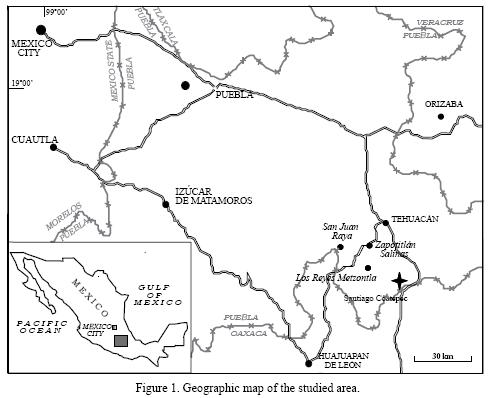
<body><![CDATA[<p align="justify"><font face="verdana" size="2"><b>Palabras clave:</b> <i>Trichites</i>, <i>bivalvo</i>, <i>macroforamin&iacute;feros</i>, <i>Jur&aacute;sico Superior</i>, <i>M&eacute;xico</i>.</font></p> 	    <p align="justify"><font face="verdana" size="2">&nbsp;</font></p> 	    <p align="justify"><font face="verdana" size="2"><b>INTRODUCTION</b></font></p> 	    <p align="justify"><font face="verdana" size="2">The extinct bivalve genus <i>Trichites</i> is very interesting for several reasons. It was abundant in shallow water seas from the Upper Triassic to the Upper Jurassic of Europe, Asia, North and East Africa and very scarce during the Lower Cretaceous. For more than two centuries, it was believed that the genus was absent on the American continent (Cox and Hertlein, 1969, p. N284; Hallam, 1977, Appendix, p.71, and others). However, it was recorded from the Lower Jurassic of Mendoza, Argentina (Damborenea, 1987, p. 98) and from Chile, on deposits of the same age (P&eacute;rez d'Angelo, 1982, p. 118, pl. 12, fig. 12). <i>Trichites</i> was also recorded from the Lower Cretaceous of Venezuela (Guillaum&eacute; <i>et al.</i>, 1972; Vivas, 1987) and from the Upper Triassic of the Karluk Quadrangle, Alaska (Silberling, 1965). Still does occur in the Lower Cretaceous of Puebla, M&eacute;xico (Alenc&aacute;ster and Hern&aacute;ndez&#150;L&aacute;scares, 1991). In all these places it is reported as <i>Trichites</i> sp. On the American continent as in the Old World, these species lived as suspensivorous epifauna in marine shallow water (F&uuml;rsich, 1980).</font></p> 	    <p align="justify"><font face="verdana" size="2">&nbsp;</font></p> 	    <p align="justify"><font face="verdana" size="2"><b>GEOGRAPHIC AND STRATIGRAPHIC POSITION</b></font></p> 	    <p align="justify"><font face="verdana" size="2">The specimens of <i>Trichites</i> here described were collected from a measured section that crops out in the brook located to the east of the town of Santiago Coatepec, southeast Puebla (<a href="#f1">Figure 1</a>), not far from Zapotitl&aacute;n and San Juan Raya, well known fossiliferous localities. This area belongs to the Tlaxiaco Basin (L&oacute;pez&#150;Ticha, 1985), which includes part of the states of Oaxaca, Guerrero and Puebla, within the Sierra Madre del Sur province, characterized by a tectonic evolution with folding, normal and thrust faults and intrusive and volcanic events, all of which contribute to make a very complex structure.</font></p> 	    <p align="center"><font face="verdana" size="2"><a name="f1"></a></font></p> 	    <p align="center"><font face="verdana" size="2"><img src="/img/revistas/rmcg/v26n3/a9f1.jpg"></font></p> 	    <p align="justify"><font face="verdana" size="2">The sedimentary sequence (<a href="#f2">Figure 2</a>) contains at the bottom the Matzitzi Formation, which is a continental unit with an abundant and well&#150;preserved Upper Paleozoic flora (Silva&#150;Pineda, 1970; Silva&#150;Pineda <i>et al.</i>, 1992) with lepidodendrales, calamitales, pteridosperms and ferns. Overlying the continental Matzitzi Formation, there is a bed of red conglomerate and above this there is a marine unit, still not named, of thick and thin sandstone layers from where the marine fauna was collected, including <i>Trichites</i>, other bivalves and large gastropods. This mollusk fauna is associated with larger foraminifers (Oma&ntilde;a and Gonz&aacute;lez&#150;Arreola, 2008), of which the following species are of stratigraphic value: <i>Alveosepta jaccardi</i>, <i>Everticyclammina virguliana</i>, <i>Rectocyclammina chouberti</i>, <i>Nautiloculina oolitica</i> and <i>Pseudocyclammina lituus</i>. These species are the base to establish the age of the deposit. The assemblage is Kimmeridgian, on account of the stratigraphic distribution of these foraminifers (Oma&ntilde;a <i>et al.</i>, 2006; Oma&ntilde;a and Gonz&aacute;lez&#150;Arreola, 2008).</font></p> 	    ]]></body>
<body><![CDATA[<p align="center"><font face="verdana" size="2"><a name="f2"></a></font></p> 	    <p align="center"><font face="verdana" size="2"><img src="/img/revistas/rmcg/v26n3/a9f2.jpg"></font></p> 	    <p align="justify"><font face="verdana" size="2">&nbsp;</font></p> 	    <p align="justify"><font face="verdana" size="2"><b>NOMENCLATURAL NOTES</b></font></p> 	    <p align="justify"><font face="verdana" size="2">The word trichites (from <i>latin trichos</i>=hair) has several meanings, and it applies to things shaped like needles, threads, spines, rods, etc. of many sizes, different chemical composition, either organic or inorganic, and natural or artificial. The most important for us, is the generic name of the studied bivalve, which was named owing the resemblance of its fibrous shell wall to inorganic fibrous prismatic crystals, long known as trichites. These inorganic crystals may be of different nature, and are found in diverse type of rocks, and of different ages. For instance, trichites and needles of vesuvianite are found in Lower Cretaceous granites; in Quaternary alluvium deposits (Galuskin <i>et al.</i>, 2003); in the Cretaceous area north of the Colorado River, trichites are scattered through the whole mass (Cragin, 1892) and in Upper Cretaceous rocks of Woodson County there are longulites and trichites which are most likely pyroxene (Cullers <i>et al.</i>, 1985).</font></p> 	    <p align="justify"><font face="verdana" size="2">Artificial trichites, also called whiskers, are commonly fabricated as monocrystals of silicon carbide, and used in the ceramic, vitreous, and petroleum industries (Bagnol, 1974; Bessaguet <i>et al.</i>, 1990). But the artificial trichites are made of many different components and have very varied applications (IMPI, 2000).</font></p> 	    <p align="justify"><font face="verdana" size="2">In Protozoology the word trichites designates diverse elements, like hairs or rods, as in the Ciliophora, they are in different places of the cell, as in the oral aperture, or in a citofaringeal basket (Colin and Curds, 1982). Also in the Ciliophora Strombidium and related genera, trichites were considered a cytoskeletal armature, but the authors concluded that the structure is the result of extrusomes (Modeo <i>et al.</i>, 2001).</font></p> 	    <p align="justify"><font face="verdana" size="2"><b>Historical background of <i>Trichites</i> as scientific name</b></font></p> 	    <p align="justify"><font face="verdana" size="2">The earliest publication mentioning <i>Trichites</i> was by Plot in 1677 (p. 128, pl.7, fig.7). Lhuyd was the successor of Plot as keeper of the Museum of Natural History of Oxford and published <i>Trichites</i> in 1699 (p. 90), described T. Plotii and three species more of this genus, from the Corallian of Burlington, near Oxford. These species were distinguished by him with the numbers from 1748 to 1753. The descriptions were very brief and in latin. In 1760 Lhuyd published an exact reprint of the same article. This reprint appeared in the second edition of Lhuyd's Lithophylacii Britanici, two years after the Tenth edition of Linn&eacute;'s (1758) Systema Naturae, and therefore, it could be regarded as a valid name.</font></p> 	    <p align="justify"><font face="verdana" size="2">However, the International Code of Zoological Nomenclature did not give validity to Lhuyd, because the publication of 1760 was a reprint of a study made in 1699. There was need to look for another author.</font></p> 	    ]]></body>
<body><![CDATA[<p align="justify"><font face="verdana" size="2">Arkell (1933, p. 224) remarked that there is no rule or opinion in the ICZN to indicate that revived pre&#150;Linn&eacute;an names should never be adopted. Moreover, Opinion 5 may imply that if a pre&#150;Linn&eacute;an name is adopted by a post&#150;Linn&eacute;an author before any other post&#150;Linn&eacute;an name has been published in its place, then validity is secured for the pre&#150;Linn&eacute;an name.</font></p> 	    <p align="justify"><font face="verdana" size="2">Related with this concept, De Saussure made an extensive work in four tomes entitled "Voyages dans les Alpes" (1779&#150;1796, of 618 pages). On the first tome, chapter 7, there is an article in which De Luc (1779, p. 190&#150;194) studied a peculiar bivalve which he named Pinnigene. This form is like <i>Trichites</i> and became a synonym. Undoubtedly De Luc was not acquainted with Lhuyd's work. This idea is accepted by Cox (1940) and is in disagreement to Arkell (1933), who regarded them as two different genera.</font></p> 	    <p align="justify"><font face="verdana" size="2">After that appeared a publication of Thurmann about the geological structure of Porrentruy (1832&#150;1836). On page 13 is a list of Jurassic invertebrates, and only on a line is the following: &lt;<i>Trichites</i> Saussiri, Voltz (Pinneg&eacute;nne de Saussure, Voy. dans les Alpes, t.1)&gt;.</font></p> 	    <p align="justify"><font face="verdana" size="2">More recently, on the Treatise of Invertebrate Paleontology (Cox and Hertlein, 1969, p. N 284) is written: &lt;<i>Trichites</i> Voltz (in Thurmann, 1833, p.13)&gt;.</font></p> 	    <p align="justify"><font face="verdana" size="2">These are the documents where the authorship of <i>Trichites</i> is given to Voltz by Thurmann. In my opinion, Voltz should not be considered the author of <i>Trichites</i>, since he never published any study of this genus. It is known that Voltz and Thurmann were great friends and Thurmann was indebted to Voltz because he determined some of his fossils, as well as other paleontologists.</font></p> 	    <p align="justify"><font face="verdana" size="2">At the contrary to Voltz, Lycett (1850, p. 343&#150;347) made a detailed study of Thichites, and manifested respect and admiration to the first naturalists Plot and Lhuyd, who discovered the genus. Also considered as valid the species <i>Trichites Plotii</i> (Lycett, 1850, p. 344). This species existed, is well&#150;known and excellently described by Arkel (1934, p. 225, pl. 30, fig. 1&#150;3). Furthermore, is the oldest species of <i>Trichites</i>, and should be the true type species of this genus. Arkell considered to Quenstedt (1857) the author of <i>Trichites</i> because he assumed that the study of <i>Trichites</i> of Lycett (1850) corresponded to Pinnigena. Arkell did not accept that Pinnigena was a synonym of <i>Trichites</i>.</font></p> 	    <p align="justify"><font face="verdana" size="2"><i>Trichites saussurei</i> was described by Thurmann from the Kimmeridgian of Yonne, France. Thurmann is considered the author of this species, which is to some authors the type species of <i>Trichites</i>. Loriol (1888, p. 300) and Loriol and Lambert (1893, p.136) studied <i>T. sausurei</i> Thurmann, and in the synonymy list they cited Thurmann 1830, p 25. This paper was not found by us, in spite of an intensive search. Its title is the same that the large work by Thurmann (1832&#150;1836). The paper of 1830 possibly does not exist anymore.</font></p> 	    <p align="justify"><font face="verdana" size="2"><i>T. saussurei</i> was first discovered by De Luc in 1779 (in De Saussure, 1779&#150;1796) under the name Pinnigene (p.192). As this name is a synonym of <i>Trichites</i>, the real author of the species is De Luc, and his name should be in parenthesis because the change of genus: <i>Trichites</i> saussurei (De Luc, 1779). This species occurs in many places of Europe (Bayle, 1878; Loriol et Lambert, 1893, and others). Some paleontologists attributed to them the authorship of this species, for instance Favre (1867).</font></p> 	    <p align="justify"><font face="verdana" size="2">About the prismatic shell wall structure, <i>Pinna</i> and <i>Trichites</i> are similar in the fibrous calcite outer layer, which in <i>Pinna</i> is thinner, and is provided by a nacreous layer (Cox, 1969 p. N76; Carter, 1990, p.212) which is not present in <i>Trichites</i>. However, they are so different in shape to that level that is not possible to confuse them. Nevertheless, Cox (1940) included T. plotti, T. granulatus (Sowerby, 1823, p. 65, pl. 347) and other similar forms in Stegoconcha B&ouml;hm, a subgenus of <i>Pinna</i>. Also Rollier (1914) confused both genera, since considered <i>Trichites</i> as a subgenus of <i>Pinna</i>.</font></p> 	    <p align="justify"><font face="verdana" size="2"><b>Robert Plot (1640&#150;1696)</b></font></p> 	    ]]></body>
<body><![CDATA[<p align="justify"><font face="verdana" size="2">Although Robert Plot is an almost unknown pioneer naturalist, it seems adequate to get slightly acquainted with him because he first gave the name <i>Trichites</i>, and the type species of the genus, <i>T. plotii</i> Lhuyd 1760, was named in his honor. He was born in 1640 in Kent, England, and died in 1696. He obtained a doctoral degree and wrote The Natural History of Oxfordshire (Plot, 1677), which contains an illustrated list of fossils, minerals and rocks. He was professor and the first Keeper of the Museum of the School of Natural History of Oxford. At that time, the nature of fossils was still matter of debate in England, and Plot, in spite of his many observations and illustrations of fossils, considered them as inorganic salt crystals resembling living organisms.</font></p> 	    <p align="justify"><font face="verdana" size="2">&nbsp;</font></p> 	    <p align="justify"><font face="verdana" size="2"><b>SYSTEMATIC PALEONTOLOGY BY GLORIA ALENC&Aacute;STER</b></font></p> 	    <p align="justify"><font face="verdana" size="2">The specimens studied are deposited in the Colecci&oacute;n Nacional de Paleontolog&iacute;a, Museo Ma. Carmen Perrilliat M., Instituto de Geolog&iacute;a, Universidad Nacional Aut&oacute;noma de M&eacute;xico, in Ciudad Universitaria, 04510 M&eacute;xico, D. F., Mexico.</font></p> 	    <p align="center"><font face="verdana" size="2">Class Bivalvia Linn&eacute;, 1758    <br>     Subclass Pteriomorphia Beurlen, 1944    <br>     Order Mytiloida F&eacute;russac, 1822    <br>     Superfamily Pinnoidea Leach, 1819    <br>     Family Pinnidae Leach, 1819    <br>     Genus <i>Trichites</i> Lhuyd, 1760, Lycett, 1850</font></p> 	    ]]></body>
<body><![CDATA[<p align="center"><font face="verdana" size="2"><b>Type species.</b> <i>Trichites</i> plotii Lhuyd, 1760</font></p> 	    <p align="center"><font face="verdana" size="2"><i>Trichites</i> <i>pueblaensis</i>, new species <a href="/img/revistas/rmcg/v26n3/a9f3.jpg" target="_blank">Figures 3</a>, <a href="/img/revistas/rmcg/v26n3/a9f4.jpg" target="_blank">4</a>, <a href="/img/revistas/rmcg/v26n3/a9f5.jpg" target="_blank">5</a>, <a href="/img/revistas/rmcg/v26n3/a9f6.jpg" target="_blank">6</a></font></p> 	    <p align="justify"><font face="verdana" size="2"><b>Diagnosis.</b> Large&#150;sized species (about 30Ã—20 cm) with very thick fibrous outer shell wall (from 30 to 60 mm). Outline oval, elongated, nearly equivalve and inequilateral; both valves convex. Anterior side with a short depressed extension. Surface smooth. Umbo central to terminal and acute.</font></p> 	    <p align="justify"><font face="verdana" size="2"><b>Description.</b> The holotype (IGM&#150; 9531) is a large specimen, of about 30 cm height and 20 cm length with a very thick outer wall of fibrous calcite. The long and slender prismatic fibers (from 30 mm to 60 mm long and 1 mm wide) are parallel each other, and perpendicular to shell surface. The fibrous layer shell wall is black in color, and is covered by a thin and smooth layer of light cream color.</font></p> 	    <p align="justify"><font face="verdana" size="2">Shell biconvex, inequilateral and nearly equivalve. The left valve is a little larger and slightly more convex. The commissure in both valves is slightly undulated with some waves long and others short. The outline is oval&#150;elongated. The height (dorso&#150;ventral measure) is larger than the length (antero&#150;posterior measure). The umbonal beak is central to terminal, and acute. From there the valves gradually increase in length towards the ventral area, which is the wider part of the valve, with a slightly curved margin. The posterior margin is straight, forming an angle varying from 90&deg; to 75&deg;, with the dorsal hinge line, which is edentulous, short and straight. The anterior side is extended a short distance, where the convexity gradually decreases, ending in an acute angle formed by both valves. In adult specimens the outer surface is smooth, somewhat wavy, with well&#150;marked concentric growth lines, and presents a very short gibbosity located at the anterior center of the valve.</font></p> 	    <p align="justify"><font face="verdana" size="2">A complete left valve of a juvenile specimen (IGM&#150;9533) probably of the same species, presents three radial ridges, with concentric lamellae, more prominent in the ventral half. The umbonal area is long and narrow, with a concave anterior margin. The ventral half is wider and the anterior margin, in the ventral half, is extended and curved; the posterior margin is straight, and the postero&#150;ventral and ventral margins are a continuous curve. Medium&#150;sized specimen (IGM&#150;9532) has a smooth surface with prominent growth lines, and a central, acute keel. These specimens show that the ornamentation and keel change with age, disappearing in the adult, probably because of erosion.</font></p> 	    <p align="justify"><font face="verdana" size="2"><b>Measurements.</b>The largest, almost complete left valve (IGM&#150;9531) measures 32 cm height and 20 cm length. A smaller specimen (IGM&#150;9535) with the two valves joined, on tangential section has a diameter of 14 cm. The thickest fibrous layer of a large specimen (IGM&#150;9531) measures 60 mm, and smaller individuals present a fibrous layer about 30 mm thick.</font></p> 	    <p align="justify"><font face="verdana" size="2"><b>Materials.</b> The study was made on a few almost complete valves and ten fragments of different size.</font></p> 	    <p align="justify"><font face="verdana" size="2"><b>Types.</b> Holotype IGM&#150;9531 left valve almost complete.</font></p> 	    <p align="justify"><font face="verdana" size="2"><b>Paratypes.</b> IGM&#150;9532, IGM&#150;9533, IGM&#150;9534, IGM&#150;9535.</font></p> 	    ]]></body>
<body><![CDATA[<p align="justify"><font face="verdana" size="2"><b>Etymology.</b> The name of the new species <i>Trichites</i> <i>pueblaensis</i>, refers to the state of Puebla, where the fossils were found, plus the latin suffix ensis, which means place.</font></p> 	    <p align="justify"><font face="verdana" size="2"><b>Occurrence.</b> The fossils were collected on the thick layers of sandstone, on the lower part of the column, corresponding to a stratigraphic unit, still not formally named, but provisionally called Coatepec sandstone. The red conglomerate and the Matzitzi Formation are below this unit.</font></p> 	    <p align="justify"><font face="verdana" size="2">&nbsp;</font></p> 	    <p align="justify"><font face="verdana" size="2"><b>DISCUSSION</b></font></p> 	    <p align="justify"><font face="verdana" size="2"><i>Trichites plotii</i> Lhuyd is the species most similar to <i>T. pueblaensis</i> and, therefore, is the species phylogenetically most closely related. They resemble each other in the large size, the thick fibrous wall, lack of ornamentation, and somewhat in the shape, because both species are biconvex and nearly equivalves. However, they differ in that <i>T. plotii</i> is frankly trapezoidal, with the dorsal half narrower, the beak longer and more acute, and the ventral half wider with the margin straight. The most notable difference is that the Mexican species presents a short depressed extension of the anterior margin of both valves.</font></p> 	    <p align="justify"><font face="verdana" size="2"><i>T. plotii</i> was first described by Plot in 1677 (p. 128, pl. 7, fig.7) from the Corallian (Oxfordian) of Oxfordshire, England. Arkell (1933, p. 224&#150;228, and 1934, pl. 30, fig. 1&#150;3) detailly described this species from the Kimmeridgian (Osmington Oolite Series) of Malton in Yorkshire. This species is among the largest of the genus and the measurements are comparable to those of the new species, since a fragmentary specimen has an actual height of 258 mm, so that the calculated complete height was probably between 300 to 350 mm. </font></p> 	    <p align="justify"><font face="verdana" size="2"><i>Trichites</i> thurmanni (Choffat, 1885) from the Upper Jurassic (Malm) of Lisboa, Portugal has a similar, smooth surface but differs in outline and the markedly inequivalve shell, the right valve shell flat or concave; the shell is also smaller. <i>Trichites</i> granulatus (Sowerby) (1823, p. 65, pl. 347) from the Kimmeridgian of Dorset, U. K., is similar to T. <i>pueblaensis</i> in shape, but smaller, and in the adult has ornamentation of radial ridges and tubercles.</font></p> 				    <p align="justify"><font face="verdana" size="2"><i>Trichites</i> saussurei Thurmann (1830, p 25) was described from the Kimmeridgian of Yonne, France. It differs from the Mexican species because it is inequivalve and has prominent radial ridges. </font></p> 				    <p align="justify"><font face="verdana" size="2">The Early Cretaceous species <i>Trichites</i> picteti Campiche et Pictet (1868&#150;1871, p. 76, pl.153) from Switzerland, and T. marcou Choffat (1886, p. 34, pl.1) from Portugal, differ from the new species because they are smaller and inequivalves, one valve is flat and the other convex, arched in shape, and with radial ribs.</font></p> 				    <p align="justify"><font face="verdana" size="2">&nbsp;</font></p> 				    ]]></body>
<body><![CDATA[<p align="justify"><font face="verdana" size="2"><b>ACKNOWLEDGMENTS</b></font></p> 				    <p align="justify"><font face="verdana" size="2">We express our gratitude and admiration to the reviewers, Dr. Susana Damborenea and Dr. Nikolaus Malchus, who made an excellent work and contributed to the improvement of the article. We are very grateful to the following persons who participated in the elaboration of the paper: Antonio Altamira made some photos; Laura Flores Timoteo transcribed the text, obtained some inaccessible papers through internet and in the library, took some photos and prepared the figures; Blanca Margarita Ram&iacute;rez Garza draw the stratigraphic column, and Ivan Erick Sanchez draw the sketch of figure 6.</font></p> 				    <p align="justify"><font face="verdana" size="2">&nbsp;</font></p> 				    <p align="justify"><font face="verdana" size="2"><b>REFERENCES</b></font></p> 				    <!-- ref --><p align="justify"><font face="verdana" size="2">Alenc&aacute;ster, G., Hern&aacute;ndez&#150;L&aacute;scares, D., 1991, Nueva fauna de moluscos del Neocomiano de la regi&oacute;n de Los Reyes Metzontla, Puebla (abstract), in Res&uacute;menes del Tercer Congreso Nacional de Paleontolog&iacute;a: Sociedad Mexicana de Paleontolog&iacute;a, p. 86.</font>&nbsp;&nbsp;&nbsp;&nbsp;&nbsp;&nbsp;&nbsp;&nbsp;[&#160;<a href="javascript:void(0);" onclick="javascript: window.open('/scielo.php?script=sci_nlinks&ref=8044369&pid=S1026-8774200900030000900001&lng=','','width=640,height=500,resizable=yes,scrollbars=1,menubar=yes,');">Links</a>&#160;]<!-- end-ref --> 				    <!-- ref --><p align="justify"><font face="verdana" size="2">Arkell, W.J., 1933, A monograph of British Corallian Lamellibranchia:  Paleontographical Society London, London, 85(386), part 5, 181&#150;228.</font>&nbsp;&nbsp;&nbsp;&nbsp;&nbsp;&nbsp;&nbsp;&nbsp;[&#160;<a href="javascript:void(0);" onclick="javascript: window.open('/scielo.php?script=sci_nlinks&ref=8044371&pid=S1026-8774200900030000900002&lng=','','width=640,height=500,resizable=yes,scrollbars=1,menubar=yes,');">Links</a>&#160;]<!-- end-ref --> 				    <!-- ref --><p align="justify"><font face="verdana" size="2">Arkell, W.J., 1934, A monograph of British Corallian Lamellibranchia:  Paleontographical Society Monographs, London, 86(389), part 6, 229&#150;276.</font>&nbsp;&nbsp;&nbsp;&nbsp;&nbsp;&nbsp;&nbsp;&nbsp;[&#160;<a href="javascript:void(0);" onclick="javascript: window.open('/scielo.php?script=sci_nlinks&ref=8044373&pid=S1026-8774200900030000900003&lng=','','width=640,height=500,resizable=yes,scrollbars=1,menubar=yes,');">Links</a>&#160;]<!-- end-ref --> 				    ]]></body>
<body><![CDATA[<!-- ref --><p align="justify"><font face="verdana" size="2">Bagnol, J., 1974, &Eacute;tude de la croissance des trichites m&eacute;talliques par diffusion en phase solide: France, Universit&eacute; des Sciences et Techniques du Languedoc, Th&egrave;se (unpublished).</font>&nbsp;&nbsp;&nbsp;&nbsp;&nbsp;&nbsp;&nbsp;&nbsp;[&#160;<a href="javascript:void(0);" onclick="javascript: window.open('/scielo.php?script=sci_nlinks&ref=8044375&pid=S1026-8774200900030000900004&lng=','','width=640,height=500,resizable=yes,scrollbars=1,menubar=yes,');">Links</a>&#160;]<!-- end-ref --> 				    <!-- ref --><p align="justify"><font face="verdana" size="2">Bayle, E., 1878, Fossiles principaux des terraines, in M&eacute;moires d'Explication de la carte g&eacute;ologique de France:  Atlas Nationale, Paris, 4(1).</font>&nbsp;&nbsp;&nbsp;&nbsp;&nbsp;&nbsp;&nbsp;&nbsp;[&#160;<a href="javascript:void(0);" onclick="javascript: window.open('/scielo.php?script=sci_nlinks&ref=8044377&pid=S1026-8774200900030000900005&lng=','','width=640,height=500,resizable=yes,scrollbars=1,menubar=yes,');">Links</a>&#160;]<!-- end-ref --> 				    <!-- ref --><p align="justify"><font face="verdana" size="2">Bessaguet, J.P., Bonnetain, L., Ginoux, J.L., 1990, Elaboration de trichites de carbure de silicium: France, Institute Nationale Polytechnique de Grenoble, th&egrave;se doctorat, 351 pp.</font>&nbsp;&nbsp;&nbsp;&nbsp;&nbsp;&nbsp;&nbsp;&nbsp;[&#160;<a href="javascript:void(0);" onclick="javascript: window.open('/scielo.php?script=sci_nlinks&ref=8044379&pid=S1026-8774200900030000900006&lng=','','width=640,height=500,resizable=yes,scrollbars=1,menubar=yes,');">Links</a>&#160;]<!-- end-ref --> 				    <!-- ref --><p align="justify"><font face="verdana" size="2">Beurlen, K., 1944, Beitr&auml;ge zur Stammesgeschichte der Muscheln: Sitzungsberichte der Bayerischen Akademie der Wissenschaften, 1.2, 133&#150;145.</font>&nbsp;&nbsp;&nbsp;&nbsp;&nbsp;&nbsp;&nbsp;&nbsp;[&#160;<a href="javascript:void(0);" onclick="javascript: window.open('/scielo.php?script=sci_nlinks&ref=8044381&pid=S1026-8774200900030000900007&lng=','','width=640,height=500,resizable=yes,scrollbars=1,menubar=yes,');">Links</a>&#160;]<!-- end-ref --> 				    <!-- ref --><p align="justify"><font face="verdana" size="2">Carter, J.G., 1990, Evolutionary significance of shell microstructure in the Palaeotaxodonta, Pteriomorphia and Isofilibranchia (Bivalvia:Mollusca), <i>in</i> Carter, J.G. (ed.), Skeletal Biomineralization: Patterns, Processes and Evolutionary Trends: New York, Van Nostrand Reinhold,135&#150;296.</font>&nbsp;&nbsp;&nbsp;&nbsp;&nbsp;&nbsp;&nbsp;&nbsp;[&#160;<a href="javascript:void(0);" onclick="javascript: window.open('/scielo.php?script=sci_nlinks&ref=8044383&pid=S1026-8774200900030000900008&lng=','','width=640,height=500,resizable=yes,scrollbars=1,menubar=yes,');">Links</a>&#160;]<!-- end-ref --> 				    ]]></body>
<body><![CDATA[<!-- ref --><p align="justify"><font face="verdana" size="2">Curds, C.R., 1982, British Freshwater Ciliate Protozoa (Synopses of the British Fauna): United Kingdom, Cambridge University Press, 395 pp.</font>&nbsp;&nbsp;&nbsp;&nbsp;&nbsp;&nbsp;&nbsp;&nbsp;[&#160;<a href="javascript:void(0);" onclick="javascript: window.open('/scielo.php?script=sci_nlinks&ref=8044385&pid=S1026-8774200900030000900009&lng=','','width=640,height=500,resizable=yes,scrollbars=1,menubar=yes,');">Links</a>&#160;]<!-- end-ref --> 				    <!-- ref --><p align="justify"><font face="verdana" size="2">Cox, L.R., 1940, The Jurassic Lamellibranch Fauna of Kuchh: Memoirs of the Geological Survey of India. Palaeontologia Indica, 9(3), 31&#150;157.</font>&nbsp;&nbsp;&nbsp;&nbsp;&nbsp;&nbsp;&nbsp;&nbsp;[&#160;<a href="javascript:void(0);" onclick="javascript: window.open('/scielo.php?script=sci_nlinks&ref=8044387&pid=S1026-8774200900030000900010&lng=','','width=640,height=500,resizable=yes,scrollbars=1,menubar=yes,');">Links</a>&#160;]<!-- end-ref --> 				    <!-- ref --><p align="justify"><font face="verdana" size="2">Cox, L.R., 1969, Structure of shell wall, <i>in</i> Moore, R.C. (ed.), Treatise on Invertebrate Paleontology. Part N Mollusca, 6. Bivalvia (1 of 3): Lawrence, The Geological Society of America and University of Kansas Press, N73&#150;N78.</font>&nbsp;&nbsp;&nbsp;&nbsp;&nbsp;&nbsp;&nbsp;&nbsp;[&#160;<a href="javascript:void(0);" onclick="javascript: window.open('/scielo.php?script=sci_nlinks&ref=8044389&pid=S1026-8774200900030000900011&lng=','','width=640,height=500,resizable=yes,scrollbars=1,menubar=yes,');">Links</a>&#160;]<!-- end-ref --> 				    <!-- ref --><p align="justify"><font face="verdana" size="2">Cox, L.R., Hertlein, L.G., 1969, Systematic Description Superfamily Pinnacea Leach 1819, in Moore, R.C. (ed.), Treatise on Invertebrate Paleontology. Part N Mollusca, 6. Bivalvia (2 of 3): Lawrence, The Geological Society of America and University of Kansas Press, N281&#150;N285.</font>&nbsp;&nbsp;&nbsp;&nbsp;&nbsp;&nbsp;&nbsp;&nbsp;[&#160;<a href="javascript:void(0);" onclick="javascript: window.open('/scielo.php?script=sci_nlinks&ref=8044391&pid=S1026-8774200900030000900012&lng=','','width=640,height=500,resizable=yes,scrollbars=1,menubar=yes,');">Links</a>&#160;]<!-- end-ref --> 				    <!-- ref --><p align="justify"><font face="verdana" size="2">Cullers, R.L., Ramakrishnan, S., Berendsen, P., Griffin, T., 1985, Geochemistry and petrogenesis of Lamproites, Late Cretaceous age, Woodson Country, Kansas, U.S.A: Geochimica et Cosmochimica Acta, 49(6), 1383&#150;1402.</font>&nbsp;&nbsp;&nbsp;&nbsp;&nbsp;&nbsp;&nbsp;&nbsp;[&#160;<a href="javascript:void(0);" onclick="javascript: window.open('/scielo.php?script=sci_nlinks&ref=8044393&pid=S1026-8774200900030000900013&lng=','','width=640,height=500,resizable=yes,scrollbars=1,menubar=yes,');">Links</a>&#160;]<!-- end-ref --> 				    ]]></body>
<body><![CDATA[<!-- ref --><p align="justify"><font face="verdana" size="2">Choffat, P., 1885, Description de la faune jurassique du Portugal. Mollusques Lamellibranches, 2me ordre Asiphonidae: Lisbonne, Imprimerie de l'Acad&eacute;mie royale des sciences, Direction des Travaux G&eacute;ologiques en Portugal, 76 pp.</font>&nbsp;&nbsp;&nbsp;&nbsp;&nbsp;&nbsp;&nbsp;&nbsp;[&#160;<a href="javascript:void(0);" onclick="javascript: window.open('/scielo.php?script=sci_nlinks&ref=8044395&pid=S1026-8774200900030000900014&lng=','','width=640,height=500,resizable=yes,scrollbars=1,menubar=yes,');">Links</a>&#160;]<!-- end-ref --> 				    <!-- ref --><p align="justify"><font face="verdana" size="2">Choffat, P., 1886&#150;1902, Esp&egrave;ces Nouvelles ou Peu Connues, in Recueil d'&Eacute;tudes Pal&eacute;ontologiques sur la Faune Cr&eacute;tacique du Portugal: M&eacute;moires de la Commission du Services G&eacute;ologiques du Portugal, 1st to 4th Series, 171 pp.</font>&nbsp;&nbsp;&nbsp;&nbsp;&nbsp;&nbsp;&nbsp;&nbsp;[&#160;<a href="javascript:void(0);" onclick="javascript: window.open('/scielo.php?script=sci_nlinks&ref=8044397&pid=S1026-8774200900030000900015&lng=','','width=640,height=500,resizable=yes,scrollbars=1,menubar=yes,');">Links</a>&#160;]<!-- end-ref --> 				    <!-- ref --><p align="justify"><font face="verdana" size="2">Cragin, F.W., 1892, A contribution to the invertebrate paleontology of the Texas Cretaceous, in Dumble, E.T. (ed.), Fourth Annual Report of the Geological Survey of Texas 1892, Part II. Paleontology and Natural History: Austin, Geological Survey of Texas, Ben C. Jones &amp; Co., State Printers, 141&#150;294</font>&nbsp;&nbsp;&nbsp;&nbsp;&nbsp;&nbsp;&nbsp;&nbsp;[&#160;<a href="javascript:void(0);" onclick="javascript: window.open('/scielo.php?script=sci_nlinks&ref=8044399&pid=S1026-8774200900030000900016&lng=','','width=640,height=500,resizable=yes,scrollbars=1,menubar=yes,');">Links</a>&#160;]<!-- end-ref --> 				    <!-- ref --><p align="justify"><font face="verdana" size="2">Damborenea, S.E., 1987, Early Jurassic Bivalvia of Argentina, Part 1, Stratigraphical Introduction and Superfamilies Nuculanacea, Arcacea, Mytilacea and Pinnacea: Palaeontolgraphica Abteilung A, 99(1&#150;3), 23&#150;111.</font>&nbsp;&nbsp;&nbsp;&nbsp;&nbsp;&nbsp;&nbsp;&nbsp;[&#160;<a href="javascript:void(0);" onclick="javascript: window.open('/scielo.php?script=sci_nlinks&ref=8044401&pid=S1026-8774200900030000900017&lng=','','width=640,height=500,resizable=yes,scrollbars=1,menubar=yes,');">Links</a>&#160;]<!-- end-ref --> 				    <!-- ref --><p align="justify"><font face="verdana" size="2">De Luc, J.A., 1779, Le mont Sal&egrave;ve, in de Saussure, H.B., Voyages dans les Alpes, tome I. Chapter 7: Neuch&acirc;tel, Chez Samuel Fauche, 190&#150;194.</font>&nbsp;&nbsp;&nbsp;&nbsp;&nbsp;&nbsp;&nbsp;&nbsp;[&#160;<a href="javascript:void(0);" onclick="javascript: window.open('/scielo.php?script=sci_nlinks&ref=8044403&pid=S1026-8774200900030000900018&lng=','','width=640,height=500,resizable=yes,scrollbars=1,menubar=yes,');">Links</a>&#160;]<!-- end-ref --> 				    ]]></body>
<body><![CDATA[<!-- ref --><p align="justify"><font face="verdana" size="2">Favre, A., 1867, Recherches g&eacute;ologiques dans les parties de la Savoie, du Pi&eacute;mont et de la Suisse voisines du Mont&#150;Blanc: Paris, Victor Masson et Fils, v.1, xix, 464 pp.</font>&nbsp;&nbsp;&nbsp;&nbsp;&nbsp;&nbsp;&nbsp;&nbsp;[&#160;<a href="javascript:void(0);" onclick="javascript: window.open('/scielo.php?script=sci_nlinks&ref=8044405&pid=S1026-8774200900030000900019&lng=','','width=640,height=500,resizable=yes,scrollbars=1,menubar=yes,');">Links</a>&#160;]<!-- end-ref --> 				    <!-- ref --><p align="justify"><font face="verdana" size="2">F&eacute;russac, A.E., 1822, Tableaux syst&eacute;matique des animaux mollusques class&eacute;s et familles naturelles: Paris, A. Bertrand, 111 pp.</font>&nbsp;&nbsp;&nbsp;&nbsp;&nbsp;&nbsp;&nbsp;&nbsp;[&#160;<a href="javascript:void(0);" onclick="javascript: window.open('/scielo.php?script=sci_nlinks&ref=8044407&pid=S1026-8774200900030000900020&lng=','','width=640,height=500,resizable=yes,scrollbars=1,menubar=yes,');">Links</a>&#160;]<!-- end-ref --> 				    <!-- ref --><p align="justify"><font face="verdana" size="2">F&uuml;rsich, F.T., 1980, Preserved life position of some Jurassic bivalves:  Pal&auml;ontologische Zeitschrift, Stuttgart, 54 (3/4), 289&#150;300.</font>&nbsp;&nbsp;&nbsp;&nbsp;&nbsp;&nbsp;&nbsp;&nbsp;[&#160;<a href="javascript:void(0);" onclick="javascript: window.open('/scielo.php?script=sci_nlinks&ref=8044409&pid=S1026-8774200900030000900021&lng=','','width=640,height=500,resizable=yes,scrollbars=1,menubar=yes,');">Links</a>&#160;]<!-- end-ref --> 				    <!-- ref --><p align="justify"><font face="verdana" size="2">Galuskin, T.A., Malsy, A., Galuskina, I.O., Sitarzm, M., 2003, Morphology, composition and structure of low temperature P4/nnc high fluorine vesuvianite whiskers from Polar Yakutia, Russia: The Canadian Mineralogist, 41(4) 843&#150;856.</font>&nbsp;&nbsp;&nbsp;&nbsp;&nbsp;&nbsp;&nbsp;&nbsp;[&#160;<a href="javascript:void(0);" onclick="javascript: window.open('/scielo.php?script=sci_nlinks&ref=8044411&pid=S1026-8774200900030000900022&lng=','','width=640,height=500,resizable=yes,scrollbars=1,menubar=yes,');">Links</a>&#160;]<!-- end-ref --> 				    <!-- ref --><p align="justify"><font face="verdana" size="2">Guillaum&eacute;, H.A., Bolli, H.M., Beckmann, J.P., 1972, Estratigraf&iacute;a del Cret&aacute;cico Inferior en la Serran&iacute;a del Interior, Oriente de Venezuela:  Bolet&iacute;n Geol&oacute;gico, Caracas, 5(3) 1619&#150;1655.</font>&nbsp;&nbsp;&nbsp;&nbsp;&nbsp;&nbsp;&nbsp;&nbsp;[&#160;<a href="javascript:void(0);" onclick="javascript: window.open('/scielo.php?script=sci_nlinks&ref=8044413&pid=S1026-8774200900030000900023&lng=','','width=640,height=500,resizable=yes,scrollbars=1,menubar=yes,');">Links</a>&#160;]<!-- end-ref --> 				    ]]></body>
<body><![CDATA[<!-- ref --><p align="justify"><font face="verdana" size="2">Hallam, A., 1977, Jurassic bivalve biogeography: Paleobiology, 3, 58&#150;73.</font>&nbsp;&nbsp;&nbsp;&nbsp;&nbsp;&nbsp;&nbsp;&nbsp;[&#160;<a href="javascript:void(0);" onclick="javascript: window.open('/scielo.php?script=sci_nlinks&ref=8044415&pid=S1026-8774200900030000900024&lng=','','width=640,height=500,resizable=yes,scrollbars=1,menubar=yes,');">Links</a>&#160;]<!-- end-ref --> 				    <!-- ref --><p align="justify"><font face="verdana" size="2">Instituto Mexicano de la Propiedad Industrial (IMPI), 2000, <a href="http://www.pymetec.gob.mx/" target="_blank">www.pymetec.gob.mx</a>, b&uacute;squeda: trichites, consulted on october 12, 2007.</font>&nbsp;&nbsp;&nbsp;&nbsp;&nbsp;&nbsp;&nbsp;&nbsp;[&#160;<a href="javascript:void(0);" onclick="javascript: window.open('/scielo.php?script=sci_nlinks&ref=8044417&pid=S1026-8774200900030000900025&lng=','','width=640,height=500,resizable=yes,scrollbars=1,menubar=yes,');">Links</a>&#160;]<!-- end-ref --> 				    <!-- ref --><p align="justify"><font face="verdana" size="2">Leach, W.E., 1819, A list of invertebrate animals discovered by H.M.S. Isabella, in a voyage to the Arctic regions, in Ross, J.A. (ed.), A Voyage of Discovery, Made under the Order of the Admirality, in His Majesty's Ships Isabella and Alexander (in 1818) for the Purpose of Exploring Baffin's Bay and Enquiring into the Probability of a North&#150;West Passage. Appendix II, Zoological Memoranda lxi&#150;lxiv: London, John Murray, 252 pp.</font>&nbsp;&nbsp;&nbsp;&nbsp;&nbsp;&nbsp;&nbsp;&nbsp;[&#160;<a href="javascript:void(0);" onclick="javascript: window.open('/scielo.php?script=sci_nlinks&ref=8044419&pid=S1026-8774200900030000900026&lng=','','width=640,height=500,resizable=yes,scrollbars=1,menubar=yes,');">Links</a>&#160;]<!-- end-ref --> 				    <!-- ref --><p align="justify"><font face="verdana" size="2">Lhuyd, E., 1699, Lithophylacii Britannici Ichnographia. Lapidum aliorumque Fossilium Britannicorum singulari figura insignium: London, Ex Officina M.C., 139 pp,</font>&nbsp;&nbsp;&nbsp;&nbsp;&nbsp;&nbsp;&nbsp;&nbsp;[&#160;<a href="javascript:void(0);" onclick="javascript: window.open('/scielo.php?script=sci_nlinks&ref=8044421&pid=S1026-8774200900030000900027&lng=','','width=640,height=500,resizable=yes,scrollbars=1,menubar=yes,');">Links</a>&#160;]<!-- end-ref --> 				    <!-- ref --><p align="justify"><font face="verdana" size="2">Lhuyd, E., 1760, Lithophylacii Britannici Ichnographia. Lapidum aliorumque Fossilium Britannicorum singulari figura insignium: London, E Typographeo Clarendoniano, editio alterata, 156 pp.</font>&nbsp;&nbsp;&nbsp;&nbsp;&nbsp;&nbsp;&nbsp;&nbsp;[&#160;<a href="javascript:void(0);" onclick="javascript: window.open('/scielo.php?script=sci_nlinks&ref=8044423&pid=S1026-8774200900030000900028&lng=','','width=640,height=500,resizable=yes,scrollbars=1,menubar=yes,');">Links</a>&#160;]<!-- end-ref --> 				    ]]></body>
<body><![CDATA[<!-- ref --><p align="justify"><font face="verdana" size="2">Linn&eacute;, C., 1758, Systema Naturae per regna tria naturae. Secundum classes, ordines, genera, species, cum characteribus, differentiis, synonymis, locis, Tomus I.: Stockholm, Laurentii Salvii, Editio decima, reformata. 824 pp.</font>&nbsp;&nbsp;&nbsp;&nbsp;&nbsp;&nbsp;&nbsp;&nbsp;[&#160;<a href="javascript:void(0);" onclick="javascript: window.open('/scielo.php?script=sci_nlinks&ref=8044425&pid=S1026-8774200900030000900029&lng=','','width=640,height=500,resizable=yes,scrollbars=1,menubar=yes,');">Links</a>&#160;]<!-- end-ref --> 				    <!-- ref --><p align="justify"><font face="verdana" size="2">L&oacute;pez&#150;Ticha, D., 1985, Revisi&oacute;n de la estratigraf&iacute;a y potencial petrolero de la Cuenca de Tlaxiaco: Bolet&iacute;n de la Asociaci&oacute;n Mexicana de Ge&oacute;logos Petroleros, 37, 49&#150;92.</font>&nbsp;&nbsp;&nbsp;&nbsp;&nbsp;&nbsp;&nbsp;&nbsp;[&#160;<a href="javascript:void(0);" onclick="javascript: window.open('/scielo.php?script=sci_nlinks&ref=8044427&pid=S1026-8774200900030000900030&lng=','','width=640,height=500,resizable=yes,scrollbars=1,menubar=yes,');">Links</a>&#160;]<!-- end-ref --> 				    <!-- ref --><p align="justify"><font face="verdana" size="2">Loriol, P. de., 1888, &Eacute;tudes sur les mollusques des couches corallig&egrave;nes de Valfin (Jura): M&eacute;moires de la Soci&eacute;t&eacute; Pal&eacute;ontologique Suisse, 13&#150;15, 369 pp.</font>&nbsp;&nbsp;&nbsp;&nbsp;&nbsp;&nbsp;&nbsp;&nbsp;[&#160;<a href="javascript:void(0);" onclick="javascript: window.open('/scielo.php?script=sci_nlinks&ref=8044429&pid=S1026-8774200900030000900031&lng=','','width=640,height=500,resizable=yes,scrollbars=1,menubar=yes,');">Links</a>&#160;]<!-- end-ref --> 				    <!-- ref --><p align="justify"><font face="verdana" size="2">Loriol, P. de, Lambert, J., 1893, Description des mollusques et braquiopodes des couches sequaniennes de Tonnerre (Yonne): M&eacute;moires de la Soci&eacute;t&eacute; Pal&eacute;ontologique Suisse, 20, 213 pp.</font>&nbsp;&nbsp;&nbsp;&nbsp;&nbsp;&nbsp;&nbsp;&nbsp;[&#160;<a href="javascript:void(0);" onclick="javascript: window.open('/scielo.php?script=sci_nlinks&ref=8044431&pid=S1026-8774200900030000900032&lng=','','width=640,height=500,resizable=yes,scrollbars=1,menubar=yes,');">Links</a>&#160;]<!-- end-ref --> 				    <!-- ref --><p align="justify"><font face="verdana" size="2">Lycett, J., 1850, On <i>Trichites</i>, a fossil genus of Bivalve Mollusk: Annals and Magazine of Natural History, 5, 343&#150;347.</font>&nbsp;&nbsp;&nbsp;&nbsp;&nbsp;&nbsp;&nbsp;&nbsp;[&#160;<a href="javascript:void(0);" onclick="javascript: window.open('/scielo.php?script=sci_nlinks&ref=8044433&pid=S1026-8774200900030000900033&lng=','','width=640,height=500,resizable=yes,scrollbars=1,menubar=yes,');">Links</a>&#160;]<!-- end-ref --> 				    ]]></body>
<body><![CDATA[<!-- ref --><p align="justify"><font face="verdana" size="2">Modeo, L., Petroni, G., Bonaldo, M., Rosati, G., 2001, <i>Trichites</i> of Strombidium (Ciliata Oligotrichita) are extrusomes: Journal of Eukaryotic Microbiology, 48(1), 95&#150;101.</font>&nbsp;&nbsp;&nbsp;&nbsp;&nbsp;&nbsp;&nbsp;&nbsp;[&#160;<a href="javascript:void(0);" onclick="javascript: window.open('/scielo.php?script=sci_nlinks&ref=8044435&pid=S1026-8774200900030000900034&lng=','','width=640,height=500,resizable=yes,scrollbars=1,menubar=yes,');">Links</a>&#160;]<!-- end-ref --> 				    <!-- ref --><p align="justify"><font face="verdana" size="2">Oma&ntilde;a, L., Gonz&aacute;lez&#150;Arreola, C., 2008, Late Jurassic (Kimmeridgian) large benthic Foraminifera from Santiago Coatepec, SE Puebla, M&eacute;xico: Geobios 41(6) 799&#150;817.</font>&nbsp;&nbsp;&nbsp;&nbsp;&nbsp;&nbsp;&nbsp;&nbsp;[&#160;<a href="javascript:void(0);" onclick="javascript: window.open('/scielo.php?script=sci_nlinks&ref=8044437&pid=S1026-8774200900030000900035&lng=','','width=640,height=500,resizable=yes,scrollbars=1,menubar=yes,');">Links</a>&#160;]<!-- end-ref --> 				    <!-- ref --><p align="justify"><font face="verdana" size="2">Oma&ntilde;a, L., Gonz&aacute;lez&#150;Arreola, C., Villase&ntilde;or, A.B., 2006, Late Jurassic (Kimmeridgian) larger foraminifera from Santiago Coatepec, SE Puebla, M&eacute;xico, in International Symposium on Foraminifera, "Forams 2006" Natal, Brasil: Anuario do Instituto de Geociencias, 29(1), p. 350.</font>&nbsp;&nbsp;&nbsp;&nbsp;&nbsp;&nbsp;&nbsp;&nbsp;[&#160;<a href="javascript:void(0);" onclick="javascript: window.open('/scielo.php?script=sci_nlinks&ref=8044439&pid=S1026-8774200900030000900036&lng=','','width=640,height=500,resizable=yes,scrollbars=1,menubar=yes,');">Links</a>&#160;]<!-- end-ref --> 				    <!-- ref --><p align="justify"><font face="verdana" size="2">P&eacute;rez d'Angelo, E., 1982, Bioestratigraf&iacute;a del Jur&aacute;sico de Quebrada Asientos, Norte de Potrerillos, Regi&oacute;n de Atacama: Santiago de Chile, Servicio Nacional de Geolog&iacute;a y Miner&iacute;a, Bolet&iacute;n 37, 149 pp.</font>&nbsp;&nbsp;&nbsp;&nbsp;&nbsp;&nbsp;&nbsp;&nbsp;[&#160;<a href="javascript:void(0);" onclick="javascript: window.open('/scielo.php?script=sci_nlinks&ref=8044441&pid=S1026-8774200900030000900037&lng=','','width=640,height=500,resizable=yes,scrollbars=1,menubar=yes,');">Links</a>&#160;]<!-- end-ref --> 				    <!-- ref --><p align="justify"><font face="verdana" size="2">Pictet, F.J., Campiche, G., 1868&#150;1871, Description des Fossiles du Terrain Cr&eacute;tac&eacute; des Environs de Sainte&#150;Croix. Quatri&eacute;me Partie: Genev&eacute;, H. Georg, 352 pp.</font>&nbsp;&nbsp;&nbsp;&nbsp;&nbsp;&nbsp;&nbsp;&nbsp;[&#160;<a href="javascript:void(0);" onclick="javascript: window.open('/scielo.php?script=sci_nlinks&ref=8044443&pid=S1026-8774200900030000900038&lng=','','width=640,height=500,resizable=yes,scrollbars=1,menubar=yes,');">Links</a>&#160;]<!-- end-ref --> 				    ]]></body>
<body><![CDATA[<!-- ref --><p align="justify"><font face="verdana" size="2">Plot, R., 1677, The Natural History of Oxfordshire, being an essay towards the Natural History of England: Oxford, printed at the Theater, 358 p, 16 pls.</font>&nbsp;&nbsp;&nbsp;&nbsp;&nbsp;&nbsp;&nbsp;&nbsp;[&#160;<a href="javascript:void(0);" onclick="javascript: window.open('/scielo.php?script=sci_nlinks&ref=8044445&pid=S1026-8774200900030000900039&lng=','','width=640,height=500,resizable=yes,scrollbars=1,menubar=yes,');">Links</a>&#160;]<!-- end-ref --> 				    <!-- ref --><p align="justify"><font face="verdana" size="2">Quenstedt, F.A., 1856&#150;1858. Der Jura: T&uuml;bingen, Germany, H. Laupp, 842 pp. 100 pl.</font>&nbsp;&nbsp;&nbsp;&nbsp;&nbsp;&nbsp;&nbsp;&nbsp;[&#160;<a href="javascript:void(0);" onclick="javascript: window.open('/scielo.php?script=sci_nlinks&ref=8044447&pid=S1026-8774200900030000900040&lng=','','width=640,height=500,resizable=yes,scrollbars=1,menubar=yes,');">Links</a>&#160;]<!-- end-ref --> 				    <!-- ref --><p align="justify"><font face="verdana" size="2">Rollier, L, 1914, Fossiles nouveaux ou peu connus des terrains secondaires (M&eacute;sozo&iuml;ques) du Jura et des contr&eacute;es environnantes: M&eacute;moires de la Soci&eacute;t&eacute; Pal&eacute;ontologique Suisse, 40, 319&#150;443, pl. 21&#150;28.</font>&nbsp;&nbsp;&nbsp;&nbsp;&nbsp;&nbsp;&nbsp;&nbsp;[&#160;<a href="javascript:void(0);" onclick="javascript: window.open('/scielo.php?script=sci_nlinks&ref=8044449&pid=S1026-8774200900030000900041&lng=','','width=640,height=500,resizable=yes,scrollbars=1,menubar=yes,');">Links</a>&#160;]<!-- end-ref --> 				    <!-- ref --><p align="justify"><font face="verdana" size="2">Saussure, de H.B., 1779&#150;1796, Voyages dans les Alpes, pr&eacute;c&eacute;d&eacute;s d'un essai sur l'histoire naturelle des environs de Gen&egrave;ve: Neuchatel, Samuel Fauche; Gen&egrave;ve, Barde, Manget, &amp; cie, 4 tomes.</font>&nbsp;&nbsp;&nbsp;&nbsp;&nbsp;&nbsp;&nbsp;&nbsp;[&#160;<a href="javascript:void(0);" onclick="javascript: window.open('/scielo.php?script=sci_nlinks&ref=8044451&pid=S1026-8774200900030000900042&lng=','','width=640,height=500,resizable=yes,scrollbars=1,menubar=yes,');">Links</a>&#160;]<!-- end-ref --> 				    <!-- ref --><p align="justify"><font face="verdana" size="2">Silva&#150;Pineda, A., 1970, Plantas del Pensilv&aacute;nico de la regi&oacute;n de Tehuac&aacute;n, Puebla: Universidad Nacional Aut&oacute;noma de M&eacute;xico, Instituto de Geolog&iacute;a, Paleontolog&iacute;a Mexicana, 29, 109 pp.</font>&nbsp;&nbsp;&nbsp;&nbsp;&nbsp;&nbsp;&nbsp;&nbsp;[&#160;<a href="javascript:void(0);" onclick="javascript: window.open('/scielo.php?script=sci_nlinks&ref=8044453&pid=S1026-8774200900030000900043&lng=','','width=640,height=500,resizable=yes,scrollbars=1,menubar=yes,');">Links</a>&#160;]<!-- end-ref --> 				    ]]></body>
<body><![CDATA[<!-- ref --><p align="justify"><font face="verdana" size="2">Silva&#150;Pineda, A., Pantoja, J., Buitr&oacute;n, B.E., 1992, El Paleozoico Tard&iacute;o de M&eacute;xico de acuerdo a su paleobiota, in Convenci&oacute;n Geol&oacute;gica Nacional, Veracruz, Res&uacute;menes, 182&#150;184.</font>&nbsp;&nbsp;&nbsp;&nbsp;&nbsp;&nbsp;&nbsp;&nbsp;[&#160;<a href="javascript:void(0);" onclick="javascript: window.open('/scielo.php?script=sci_nlinks&ref=8044455&pid=S1026-8774200900030000900044&lng=','','width=640,height=500,resizable=yes,scrollbars=1,menubar=yes,');">Links</a>&#160;]<!-- end-ref --> 				    <!-- ref --><p align="justify"><font face="verdana" size="2">Silberling, N.J., 1965, Upper Triassic marine invertebrate fauna, Karlcok quadrangle, Alaska: The Paleontolgical Database, Report on Referred Fossils. <a href="http://paleodb.org/cgi-bin/bridge.pl" target="_blank">http://paleodb.org</a>, consulted on december 11, 2007.</font>&nbsp;&nbsp;&nbsp;&nbsp;&nbsp;&nbsp;&nbsp;&nbsp;[&#160;<a href="javascript:void(0);" onclick="javascript: window.open('/scielo.php?script=sci_nlinks&ref=8044457&pid=S1026-8774200900030000900045&lng=','','width=640,height=500,resizable=yes,scrollbars=1,menubar=yes,');">Links</a>&#160;]<!-- end-ref --> 				    <!-- ref --><p align="justify"><font face="verdana" size="2">Sowerby, J., 1823, The Mineral Conchology of Great Britain: London, W.Arding, v. 4, 160 pp., 340 pl. </font>&nbsp;&nbsp;&nbsp;&nbsp;&nbsp;&nbsp;&nbsp;&nbsp;[&#160;<a href="javascript:void(0);" onclick="javascript: window.open('/scielo.php?script=sci_nlinks&ref=8044459&pid=S1026-8774200900030000900046&lng=','','width=640,height=500,resizable=yes,scrollbars=1,menubar=yes,');">Links</a>&#160;]<!-- end-ref --> 				    <!-- ref --><p align="justify"><font face="verdana" size="2">Thurmann., J., 1832&#150;1836, Essai sur les soul&egrave;vements jurassiques de Porrentruy. Description g&eacute;ognostique de la s&eacute;rie jurassique et th&eacute;orie orographique du soul&egrave;vements: Strasbourg, France, M&eacute;moire de la Soci&eacute;t&eacute; d'Histoire Naturelle, 95 pp.</font>&nbsp;&nbsp;&nbsp;&nbsp;&nbsp;&nbsp;&nbsp;&nbsp;[&#160;<a href="javascript:void(0);" onclick="javascript: window.open('/scielo.php?script=sci_nlinks&ref=8044461&pid=S1026-8774200900030000900047&lng=','','width=640,height=500,resizable=yes,scrollbars=1,menubar=yes,');">Links</a>&#160;]<!-- end-ref --> 				    <!-- ref --><p align="justify"><font face="verdana" size="2">Vivas, V., 1987, Bioestratigraf&iacute;a del Cret&aacute;ceo de la regi&oacute;n de Bergant&iacute;n&#150;Santa In&eacute;s, Estado Anzo&aacute;stegui, Venezuela nororiental: Bolet&iacute;n Geol&oacute;gico, Caracas, 16(29) 128 pp.</font>&nbsp;&nbsp;&nbsp;&nbsp;&nbsp;&nbsp;&nbsp;&nbsp;[&#160;<a href="javascript:void(0);" onclick="javascript: window.open('/scielo.php?script=sci_nlinks&ref=8044463&pid=S1026-8774200900030000900048&lng=','','width=640,height=500,resizable=yes,scrollbars=1,menubar=yes,');">Links</a>&#160;]<!-- end-ref --> ]]></body><back>
<ref-list>
<ref id="B1">
<nlm-citation citation-type="confpro">
<person-group person-group-type="author">
<name>
<surname><![CDATA[Alencáster]]></surname>
<given-names><![CDATA[G.]]></given-names>
</name>
<name>
<surname><![CDATA[Hernández-Láscares]]></surname>
<given-names><![CDATA[D.]]></given-names>
</name>
</person-group>
<article-title xml:lang="es"><![CDATA[Nueva fauna de moluscos del Neocomiano de la región de Los Reyes Metzontla, Puebla]]></article-title>
<source><![CDATA[]]></source>
<year>1991</year>
<conf-name><![CDATA[Tercer Congreso Nacional de Paleontología]]></conf-name>
<conf-loc> </conf-loc>
<page-range>86</page-range></nlm-citation>
</ref>
<ref id="B2">
<nlm-citation citation-type="journal">
<person-group person-group-type="author">
<name>
<surname><![CDATA[Arkell]]></surname>
<given-names><![CDATA[W.J.]]></given-names>
</name>
</person-group>
<article-title xml:lang="en"><![CDATA[A monograph of British Corallian Lamellibranchia]]></article-title>
<source><![CDATA[Paleontographical Society London]]></source>
<year>1933</year>
<volume>85</volume>
<numero>386</numero>
<issue>386</issue>
<page-range>181–228</page-range><publisher-loc><![CDATA[London ]]></publisher-loc>
</nlm-citation>
</ref>
<ref id="B3">
<nlm-citation citation-type="journal">
<person-group person-group-type="author">
<name>
<surname><![CDATA[Arkell]]></surname>
<given-names><![CDATA[W.J.]]></given-names>
</name>
</person-group>
<article-title xml:lang="en"><![CDATA[A monograph of British Corallian Lamellibranchia]]></article-title>
<source><![CDATA[Paleontographical Society Monographs]]></source>
<year>1934</year>
<volume>86</volume>
<numero>389</numero>
<issue>389</issue>
<page-range>229–276</page-range><publisher-loc><![CDATA[London ]]></publisher-loc>
</nlm-citation>
</ref>
<ref id="B4">
<nlm-citation citation-type="">
<person-group person-group-type="author">
<name>
<surname><![CDATA[Bagnol]]></surname>
<given-names><![CDATA[J.]]></given-names>
</name>
</person-group>
<source><![CDATA[Étude de la croissance des trichites métalliques par diffusion en phase solide]]></source>
<year>1974</year>
</nlm-citation>
</ref>
<ref id="B5">
<nlm-citation citation-type="journal">
<person-group person-group-type="author">
<name>
<surname><![CDATA[Bayle]]></surname>
<given-names><![CDATA[E.]]></given-names>
</name>
</person-group>
<article-title xml:lang="fr"><![CDATA[Fossiles principaux des terraines]]></article-title>
<source><![CDATA[Atlas NationaleMémoires d'Explication de la carte géologique de France]]></source>
<year>1878</year>
<volume>4</volume>
<numero>1</numero>
<issue>1</issue>
<publisher-loc><![CDATA[Paris ]]></publisher-loc>
</nlm-citation>
</ref>
<ref id="B6">
<nlm-citation citation-type="">
<person-group person-group-type="author">
<name>
<surname><![CDATA[Bessaguet]]></surname>
<given-names><![CDATA[J.P.]]></given-names>
</name>
<name>
<surname><![CDATA[Bonnetain]]></surname>
<given-names><![CDATA[L.]]></given-names>
</name>
<name>
<surname><![CDATA[Ginoux]]></surname>
<given-names><![CDATA[J.L.]]></given-names>
</name>
</person-group>
<source><![CDATA[Elaboration de trichites de carbure de silicium]]></source>
<year>1990</year>
<page-range>351</page-range></nlm-citation>
</ref>
<ref id="B7">
<nlm-citation citation-type="journal">
<person-group person-group-type="author">
<name>
<surname><![CDATA[Beurlen]]></surname>
<given-names><![CDATA[K]]></given-names>
</name>
</person-group>
<article-title xml:lang="de"><![CDATA[Beiträge zur Stammesgeschichte der Muscheln]]></article-title>
<source><![CDATA[Sitzungsberichte der Bayerischen Akademie der Wissenschaften]]></source>
<year>1944</year>
<volume>1.2</volume>
<page-range>133-145</page-range></nlm-citation>
</ref>
<ref id="B8">
<nlm-citation citation-type="book">
<person-group person-group-type="author">
<name>
<surname><![CDATA[Carter]]></surname>
<given-names><![CDATA[J.G.]]></given-names>
</name>
</person-group>
<article-title xml:lang="en"><![CDATA[Evolutionary significance of shell microstructure in the Palaeotaxodonta, Pteriomorphia and Isofilibranchia (Bivalvia:Mollusca)]]></article-title>
<person-group person-group-type="editor">
<name>
<surname><![CDATA[Carter]]></surname>
<given-names><![CDATA[J.G.]]></given-names>
</name>
</person-group>
<source><![CDATA[Skeletal Biomineralization: Patterns, Processes and Evolutionary Trends]]></source>
<year>1990</year>
<page-range>135-296</page-range><publisher-loc><![CDATA[New York ]]></publisher-loc>
<publisher-name><![CDATA[Van Nostrand Reinhold]]></publisher-name>
</nlm-citation>
</ref>
<ref id="B9">
<nlm-citation citation-type="book">
<person-group person-group-type="author">
<name>
<surname><![CDATA[Curds]]></surname>
<given-names><![CDATA[C.R.]]></given-names>
</name>
</person-group>
<source><![CDATA[British Freshwater Ciliate Protozoa (Synopses of the British Fauna)]]></source>
<year>1982</year>
<page-range>395</page-range><publisher-name><![CDATA[Cambridge University Press]]></publisher-name>
</nlm-citation>
</ref>
<ref id="B10">
<nlm-citation citation-type="journal">
<person-group person-group-type="author">
<name>
<surname><![CDATA[Cox]]></surname>
<given-names><![CDATA[L.R]]></given-names>
</name>
</person-group>
<article-title xml:lang="en"><![CDATA[The Jurassic Lamellibranch Fauna of Kuchh]]></article-title>
<source><![CDATA[Memoirs of the Geological Survey of India. Palaeontologia Indica]]></source>
<year>1940</year>
<volume>9</volume>
<numero>3</numero>
<issue>3</issue>
<page-range>31-157</page-range></nlm-citation>
</ref>
<ref id="B11">
<nlm-citation citation-type="book">
<person-group person-group-type="author">
<name>
<surname><![CDATA[Cox]]></surname>
<given-names><![CDATA[L.R.]]></given-names>
</name>
</person-group>
<article-title xml:lang="en"><![CDATA[Structure of shell wall]]></article-title>
<person-group person-group-type="editor">
<name>
<surname><![CDATA[Moore]]></surname>
<given-names><![CDATA[R.C.]]></given-names>
</name>
</person-group>
<source><![CDATA[Treatise on Invertebrate Paleontology: Part N Mollusca, 6. Bivalvia (1 of 3)]]></source>
<year>1969</year>
<publisher-loc><![CDATA[Lawrence ]]></publisher-loc>
<publisher-name><![CDATA[The Geological Society of America and University of Kansas Press]]></publisher-name>
</nlm-citation>
</ref>
<ref id="B12">
<nlm-citation citation-type="book">
<person-group person-group-type="author">
<name>
<surname><![CDATA[Cox]]></surname>
<given-names><![CDATA[L.R.]]></given-names>
</name>
<name>
<surname><![CDATA[Hertlein]]></surname>
<given-names><![CDATA[L.G.]]></given-names>
</name>
</person-group>
<article-title xml:lang="en"><![CDATA[Systematic Description Superfamily Pinnacea Leach 1819]]></article-title>
<person-group person-group-type="editor">
<name>
<surname><![CDATA[Moore]]></surname>
<given-names><![CDATA[R.C.]]></given-names>
</name>
</person-group>
<source><![CDATA[Treatise on Invertebrate Paleontology. Part N Mollusca, 6. Bivalvia (2 of 3)]]></source>
<year>1969</year>
<publisher-loc><![CDATA[Lawrence ]]></publisher-loc>
<publisher-name><![CDATA[The Geological Society of America and University of Kansas Press]]></publisher-name>
</nlm-citation>
</ref>
<ref id="B13">
<nlm-citation citation-type="journal">
<person-group person-group-type="author">
<name>
<surname><![CDATA[Cullers]]></surname>
<given-names><![CDATA[R.L]]></given-names>
</name>
<name>
<surname><![CDATA[Ramakrishnan]]></surname>
<given-names><![CDATA[S]]></given-names>
</name>
<name>
<surname><![CDATA[Berendsen]]></surname>
<given-names><![CDATA[P]]></given-names>
</name>
<name>
<surname><![CDATA[Griffin]]></surname>
<given-names><![CDATA[T]]></given-names>
</name>
</person-group>
<article-title xml:lang="en"><![CDATA[Geochemistry and petrogenesis of Lamproites, Late Cretaceous age, Woodson Country, Kansas, U.S.A]]></article-title>
<source><![CDATA[Geochimica et Cosmochimica Acta]]></source>
<year>1985</year>
<volume>49</volume>
<numero>6</numero>
<issue>6</issue>
<page-range>1383-1402</page-range></nlm-citation>
</ref>
<ref id="B14">
<nlm-citation citation-type="book">
<person-group person-group-type="author">
<name>
<surname><![CDATA[Choffat]]></surname>
<given-names><![CDATA[P.]]></given-names>
</name>
</person-group>
<source><![CDATA[Description de la faune jurassique du Portugal. Mollusques Lamellibranches, 2me ordre Asiphonidae: Lisbonne, Imprimerie de l'Académie royale des sciences]]></source>
<year>1885</year>
<page-range>76</page-range><publisher-name><![CDATA[Direction des Travaux Géologiques en Portugal]]></publisher-name>
</nlm-citation>
</ref>
<ref id="B15">
<nlm-citation citation-type="">
<person-group person-group-type="author">
<name>
<surname><![CDATA[Choffat]]></surname>
<given-names><![CDATA[P.]]></given-names>
</name>
</person-group>
<article-title xml:lang="fr"><![CDATA[Espèces Nouvelles ou Peu Connues]]></article-title>
<source><![CDATA[Recueil d'Études Paléontologiques sur la Faune Crétacique du Portugal: Mémoires de la Commission du Services Géologiques du Portugal]]></source>
<year>1886</year>
<page-range>171</page-range></nlm-citation>
</ref>
<ref id="B16">
<nlm-citation citation-type="book">
<person-group person-group-type="author">
<name>
<surname><![CDATA[Cragin]]></surname>
<given-names><![CDATA[F.W.]]></given-names>
</name>
</person-group>
<article-title xml:lang="en"><![CDATA[A contribution to the invertebrate paleontology of the Texas Cretaceous]]></article-title>
<person-group person-group-type="editor">
<name>
<surname><![CDATA[Dumble]]></surname>
<given-names><![CDATA[E.T.]]></given-names>
</name>
</person-group>
<source><![CDATA[Fourth Annual Report of the Geological Survey of Texas 1892, Part II: Paleontology and Natural History]]></source>
<year>1892</year>
<page-range>141-294</page-range><publisher-loc><![CDATA[Austin ]]></publisher-loc>
<publisher-name><![CDATA[Geological Survey of TexasBen C. Jones & Co.State Printers]]></publisher-name>
</nlm-citation>
</ref>
<ref id="B17">
<nlm-citation citation-type="journal">
<person-group person-group-type="author">
<name>
<surname><![CDATA[Damborenea]]></surname>
<given-names><![CDATA[S.E]]></given-names>
</name>
</person-group>
<article-title xml:lang="en"><![CDATA[Early Jurassic Bivalvia of Argentina, Part 1, Stratigraphical Introduction and Superfamilies Nuculanacea, Arcacea, Mytilacea and Pinnacea]]></article-title>
<source><![CDATA[Palaeontolgraphica Abteilung A]]></source>
<year>1987</year>
<volume>99</volume>
<numero>1-3</numero>
<issue>1-3</issue>
<page-range>23-111</page-range></nlm-citation>
</ref>
<ref id="B18">
<nlm-citation citation-type="book">
<person-group person-group-type="author">
<name>
<surname><![CDATA[De Luc]]></surname>
<given-names><![CDATA[J.A.]]></given-names>
</name>
</person-group>
<article-title xml:lang="sv"><![CDATA[Le mont Salève]]></article-title>
<person-group person-group-type="editor">
<name>
<surname><![CDATA[de Saussure]]></surname>
<given-names><![CDATA[H.B.]]></given-names>
</name>
</person-group>
<source><![CDATA[Voyages dans les Alpes]]></source>
<year>1779</year>
<volume>I</volume>
<page-range>190-194</page-range><publisher-loc><![CDATA[Neuchâtel ]]></publisher-loc>
<publisher-name><![CDATA[Chez Samuel Fauche]]></publisher-name>
</nlm-citation>
</ref>
<ref id="B19">
<nlm-citation citation-type="book">
<person-group person-group-type="author">
<name>
<surname><![CDATA[Favre]]></surname>
<given-names><![CDATA[A.]]></given-names>
</name>
</person-group>
<source><![CDATA[Recherches géologiques dans les parties de la Savoie, du Piémont et de la Suisse voisines du Mont-Blanc]]></source>
<year>1867</year>
<volume>1</volume>
<page-range>464</page-range><publisher-loc><![CDATA[Paris ]]></publisher-loc>
<publisher-name><![CDATA[Victor Masson et Fils]]></publisher-name>
</nlm-citation>
</ref>
<ref id="B20">
<nlm-citation citation-type="book">
<person-group person-group-type="author">
<name>
<surname><![CDATA[Férussac]]></surname>
<given-names><![CDATA[A.E.]]></given-names>
</name>
</person-group>
<source><![CDATA[Tableaux systématique des animaux mollusques classés et familles naturelles]]></source>
<year>1822</year>
<page-range>111</page-range><publisher-loc><![CDATA[Paris ]]></publisher-loc>
<publisher-name><![CDATA[A. Bertrand]]></publisher-name>
</nlm-citation>
</ref>
<ref id="B21">
<nlm-citation citation-type="journal">
<person-group person-group-type="author">
<name>
<surname><![CDATA[Fürsich]]></surname>
<given-names><![CDATA[F.T.]]></given-names>
</name>
</person-group>
<article-title xml:lang="en"><![CDATA[Preserved life position of some Jurassic bivalves]]></article-title>
<source><![CDATA[Paläontologische Zeitschrift]]></source>
<year>1980</year>
<volume>54</volume>
<numero>3/4</numero>
<issue>3/4</issue>
<page-range>289–300</page-range><publisher-loc><![CDATA[Stuttgart ]]></publisher-loc>
</nlm-citation>
</ref>
<ref id="B22">
<nlm-citation citation-type="journal">
<person-group person-group-type="author">
<name>
<surname><![CDATA[Galuskin]]></surname>
<given-names><![CDATA[T.A.]]></given-names>
</name>
<name>
<surname><![CDATA[Malsy]]></surname>
<given-names><![CDATA[A.]]></given-names>
</name>
<name>
<surname><![CDATA[Galuskina]]></surname>
<given-names><![CDATA[I.O.]]></given-names>
</name>
<name>
<surname><![CDATA[Sitarzm]]></surname>
<given-names><![CDATA[M.]]></given-names>
</name>
</person-group>
<article-title xml:lang="en"><![CDATA[Morphology, composition and structure of low temperature P4/nnc high fluorine vesuvianite whiskers from Polar Yakutia, Russia]]></article-title>
<source><![CDATA[The Canadian Mineralogist]]></source>
<year>2003</year>
<volume>41</volume>
<numero>4</numero>
<issue>4</issue>
<page-range>843-856</page-range></nlm-citation>
</ref>
<ref id="B23">
<nlm-citation citation-type="journal">
<person-group person-group-type="author">
<name>
<surname><![CDATA[Guillaumé]]></surname>
<given-names><![CDATA[H.A.]]></given-names>
</name>
<name>
<surname><![CDATA[Bolli]]></surname>
<given-names><![CDATA[H.M.]]></given-names>
</name>
<name>
<surname><![CDATA[Beckmann]]></surname>
<given-names><![CDATA[J.P.]]></given-names>
</name>
</person-group>
<article-title xml:lang="es"><![CDATA[Estratigrafía del Cretácico Inferior en la Serranía del Interior, Oriente de Venezuela]]></article-title>
<source><![CDATA[Boletín Geológico]]></source>
<year>1972</year>
<volume>5</volume>
<numero>3</numero>
<issue>3</issue>
<page-range>1619–1655</page-range></nlm-citation>
</ref>
<ref id="B24">
<nlm-citation citation-type="journal">
<person-group person-group-type="author">
<name>
<surname><![CDATA[Hallam]]></surname>
<given-names><![CDATA[A]]></given-names>
</name>
</person-group>
<article-title xml:lang="en"><![CDATA[Jurassic bivalve biogeography]]></article-title>
<source><![CDATA[Paleobiology]]></source>
<year>1977</year>
<volume>3</volume>
<page-range>58-73</page-range></nlm-citation>
</ref>
<ref id="B25">
<nlm-citation citation-type="">
<collab>Instituto Mexicano de la Propiedad Industrial (IMPI)</collab>
<source><![CDATA[]]></source>
<year>2000</year>
</nlm-citation>
</ref>
<ref id="B26">
<nlm-citation citation-type="book">
<person-group person-group-type="author">
<name>
<surname><![CDATA[Leach]]></surname>
<given-names><![CDATA[W.E.]]></given-names>
</name>
</person-group>
<article-title xml:lang="en"><![CDATA[A list of invertebrate animals discovered by H.M.S. Isabella, in a voyage to the Arctic regions]]></article-title>
<person-group person-group-type="editor">
<name>
<surname><![CDATA[Ross]]></surname>
<given-names><![CDATA[J.A.]]></given-names>
</name>
</person-group>
<source><![CDATA[A Voyage of Discovery, Made under the Order of the Admirality, in His Majesty's Ships Isabella and Alexander (in 1818) for the Purpose of Exploring Baffin's Bay and Enquiring into the Probability of a North-West Passage: Appendix II, Zoological Memoranda lxi-lxiv]]></source>
<year>1819</year>
<page-range>252</page-range><publisher-loc><![CDATA[London ]]></publisher-loc>
<publisher-name><![CDATA[John Murray]]></publisher-name>
</nlm-citation>
</ref>
<ref id="B27">
<nlm-citation citation-type="book">
<person-group person-group-type="author">
<name>
<surname><![CDATA[Lhuyd]]></surname>
<given-names><![CDATA[E.]]></given-names>
</name>
</person-group>
<source><![CDATA[Lithophylacii Britannici Ichnographia: Lapidum aliorumque Fossilium Britannicorum singulari figura insignium]]></source>
<year>1699</year>
<page-range>139</page-range><publisher-loc><![CDATA[London ]]></publisher-loc>
<publisher-name><![CDATA[Ex Officina M.C.]]></publisher-name>
</nlm-citation>
</ref>
<ref id="B28">
<nlm-citation citation-type="book">
<person-group person-group-type="author">
<name>
<surname><![CDATA[Lhuyd]]></surname>
<given-names><![CDATA[E.]]></given-names>
</name>
</person-group>
<source><![CDATA[Lithophylacii Britannici Ichnographia: Lapidum aliorumque Fossilium Britannicorum singulari figura insignium]]></source>
<year>1760</year>
<publisher-loc><![CDATA[London ]]></publisher-loc>
<publisher-name><![CDATA[editio alterata156]]></publisher-name>
</nlm-citation>
</ref>
<ref id="B29">
<nlm-citation citation-type="book">
<person-group person-group-type="author">
<name>
<surname><![CDATA[Linné]]></surname>
<given-names><![CDATA[C.]]></given-names>
</name>
</person-group>
<source><![CDATA[Systema Naturae per regna tria naturae: Secundum classes, ordines, genera, species, cum characteribus, differentiis, synonymis, locis]]></source>
<year>1758</year>
<volume>I</volume>
<edition>decima</edition>
<page-range>824</page-range><publisher-loc><![CDATA[Stockholm ]]></publisher-loc>
<publisher-name><![CDATA[reformata]]></publisher-name>
</nlm-citation>
</ref>
<ref id="B30">
<nlm-citation citation-type="journal">
<person-group person-group-type="author">
<name>
<surname><![CDATA[López-Ticha]]></surname>
<given-names><![CDATA[D]]></given-names>
</name>
</person-group>
<article-title xml:lang="es"><![CDATA[Revisión de la estratigrafía y potencial petrolero de la Cuenca de Tlaxiaco]]></article-title>
<source><![CDATA[Boletín de la Asociación Mexicana de Geólogos Petroleros]]></source>
<year>1985</year>
<volume>37</volume>
<page-range>49-92</page-range></nlm-citation>
</ref>
<ref id="B31">
<nlm-citation citation-type="journal">
<person-group person-group-type="author">
<name>
<surname><![CDATA[Loriol]]></surname>
<given-names><![CDATA[P. de]]></given-names>
</name>
</person-group>
<article-title xml:lang="fr"><![CDATA[Études sur les mollusques des couches coralligènes de Valfin (Jura)]]></article-title>
<source><![CDATA[Mémoires de la Société Paléontologique Suisse]]></source>
<year>1888</year>
<volume>13-15</volume>
<page-range>369 pp</page-range></nlm-citation>
</ref>
<ref id="B32">
<nlm-citation citation-type="journal">
<person-group person-group-type="author">
<name>
<surname><![CDATA[Loriol]]></surname>
<given-names><![CDATA[P. de]]></given-names>
</name>
<name>
<surname><![CDATA[Lambert]]></surname>
<given-names><![CDATA[J.]]></given-names>
</name>
</person-group>
<article-title xml:lang="sv"><![CDATA[Description des mollusques et braquiopodes des couches sequaniennes de Tonnerre (Yonne)]]></article-title>
<source><![CDATA[Mémoires de la Société Paléontologique Suisse]]></source>
<year>1893</year>
<volume>20</volume>
<page-range>213</page-range></nlm-citation>
</ref>
<ref id="B33">
<nlm-citation citation-type="journal">
<person-group person-group-type="author">
<name>
<surname><![CDATA[Lycett]]></surname>
<given-names><![CDATA[J]]></given-names>
</name>
</person-group>
<article-title xml:lang="en"><![CDATA[On Trichites, a fossil genus of Bivalve Mollusk]]></article-title>
<source><![CDATA[Annals and Magazine of Natural History]]></source>
<year>1850</year>
<volume>5</volume>
<page-range>343-347</page-range></nlm-citation>
</ref>
<ref id="B34">
<nlm-citation citation-type="journal">
<person-group person-group-type="author">
<name>
<surname><![CDATA[Modeo]]></surname>
<given-names><![CDATA[L]]></given-names>
</name>
<name>
<surname><![CDATA[Petroni]]></surname>
<given-names><![CDATA[G]]></given-names>
</name>
<name>
<surname><![CDATA[Bonaldo]]></surname>
<given-names><![CDATA[M]]></given-names>
</name>
<name>
<surname><![CDATA[Rosati]]></surname>
<given-names><![CDATA[G]]></given-names>
</name>
</person-group>
<article-title xml:lang="en"><![CDATA[Trichites of Strombidium (Ciliata Oligotrichita) are extrusomes]]></article-title>
<source><![CDATA[Journal of Eukaryotic Microbiology]]></source>
<year>2001</year>
<volume>48</volume>
<numero>1</numero>
<issue>1</issue>
<page-range>95-101</page-range></nlm-citation>
</ref>
<ref id="B35">
<nlm-citation citation-type="journal">
<person-group person-group-type="author">
<name>
<surname><![CDATA[Omaña]]></surname>
<given-names><![CDATA[L.]]></given-names>
</name>
<name>
<surname><![CDATA[González-Arreola]]></surname>
<given-names><![CDATA[C.]]></given-names>
</name>
</person-group>
<article-title xml:lang="en"><![CDATA[Late Jurassic (Kimmeridgian) large benthic Foraminifera from Santiago Coatepec, SE Puebla, México]]></article-title>
<source><![CDATA[Geobios]]></source>
<year>2008</year>
<volume>41</volume>
<numero>6</numero>
<issue>6</issue>
<page-range>799-817</page-range></nlm-citation>
</ref>
<ref id="B36">
<nlm-citation citation-type="journal">
<person-group person-group-type="author">
<name>
<surname><![CDATA[Omaña]]></surname>
<given-names><![CDATA[L.]]></given-names>
</name>
<name>
<surname><![CDATA[González-Arreola]]></surname>
<given-names><![CDATA[C.]]></given-names>
</name>
<name>
<surname><![CDATA[Villaseñor]]></surname>
<given-names><![CDATA[A.B.]]></given-names>
</name>
</person-group>
<article-title xml:lang="en"><![CDATA[Late Jurassic (Kimmeridgian) larger foraminifera from Santiago Coatepec, SE Puebla, México]]></article-title>
<source><![CDATA[Anuario do Instituto de Geociencias]]></source>
<year>2006</year>
<volume>29</volume>
<numero>1</numero>
<conf-name><![CDATA[ International Symposium on Foraminifera, "Forams 2006"]]></conf-name>
<conf-loc> </conf-loc>
<issue>1</issue>
<page-range>350</page-range></nlm-citation>
</ref>
<ref id="B37">
<nlm-citation citation-type="book">
<person-group person-group-type="author">
<name>
<surname><![CDATA[Pérez d'Angelo]]></surname>
<given-names><![CDATA[E.]]></given-names>
</name>
</person-group>
<source><![CDATA[Bioestratigrafía del Jurásico de Quebrada Asientos, Norte de Potrerillos, Región de Atacama]]></source>
<year>1982</year>
<volume>37</volume>
<page-range>149</page-range><publisher-loc><![CDATA[Santiago de Chile ]]></publisher-loc>
<publisher-name><![CDATA[Servicio Nacional de Geología y Minería]]></publisher-name>
</nlm-citation>
</ref>
<ref id="B38">
<nlm-citation citation-type="book">
<person-group person-group-type="author">
<name>
<surname><![CDATA[Pictet]]></surname>
<given-names><![CDATA[F.J.]]></given-names>
</name>
<name>
<surname><![CDATA[Campiche]]></surname>
<given-names><![CDATA[G.]]></given-names>
</name>
</person-group>
<source><![CDATA[Description des Fossiles du Terrain Crétacé des Environs de Sainte-Croix: Quatriéme Partie]]></source>
<year>1868</year>
<page-range>352</page-range><publisher-loc><![CDATA[Genevé ]]></publisher-loc>
<publisher-name><![CDATA[H. Georg]]></publisher-name>
</nlm-citation>
</ref>
<ref id="B39">
<nlm-citation citation-type="">
<person-group person-group-type="author">
<name>
<surname><![CDATA[Plot]]></surname>
<given-names><![CDATA[R.]]></given-names>
</name>
</person-group>
<source><![CDATA[The Natural History of Oxfordshire, being an essay towards the Natural History of England]]></source>
<year>1677</year>
<page-range>358</page-range><publisher-loc><![CDATA[Oxford ]]></publisher-loc>
</nlm-citation>
</ref>
<ref id="B40">
<nlm-citation citation-type="book">
<person-group person-group-type="author">
<name>
<surname><![CDATA[Quenstedt]]></surname>
<given-names><![CDATA[F.A.]]></given-names>
</name>
</person-group>
<source><![CDATA[Der Jura: Tübingen]]></source>
<year>1856</year>
<page-range>842</page-range><publisher-name><![CDATA[H. Laupp]]></publisher-name>
</nlm-citation>
</ref>
<ref id="B41">
<nlm-citation citation-type="journal">
<person-group person-group-type="author">
<name>
<surname><![CDATA[Rollier]]></surname>
<given-names><![CDATA[L]]></given-names>
</name>
</person-group>
<article-title xml:lang="fr"><![CDATA[Fossiles nouveaux ou peu connus des terrains secondaires (Mésozoïques) du Jura et des contrées environnantes]]></article-title>
<source><![CDATA[Mémoires de la Société Paléontologique Suisse]]></source>
<year>1914</year>
<volume>40</volume>
<page-range>319-443</page-range><page-range>21-28</page-range></nlm-citation>
</ref>
<ref id="B42">
<nlm-citation citation-type="book">
<person-group person-group-type="author">
<name>
<surname><![CDATA[Saussure]]></surname>
<given-names><![CDATA[de H.B.]]></given-names>
</name>
</person-group>
<source><![CDATA[Voyages dans les Alpes, précédés d'un essai sur l'histoire naturelle des environs de Genève]]></source>
<year>1779</year>
<volume>4</volume>
<publisher-loc><![CDATA[Neuchatel^eSamuel FaucheGenève Samuel Fauche]]></publisher-loc>
<publisher-name><![CDATA[Barde, Manget, & cie]]></publisher-name>
</nlm-citation>
</ref>
<ref id="B43">
<nlm-citation citation-type="book">
<person-group person-group-type="author">
<name>
<surname><![CDATA[Silva-Pineda]]></surname>
<given-names><![CDATA[A.]]></given-names>
</name>
</person-group>
<source><![CDATA[Plantas del Pensilvánico de la región de Tehuacán, Puebla]]></source>
<year>1970</year>
<volume>29</volume>
<page-range>109</page-range><publisher-name><![CDATA[Universidad Nacional Autónoma de México, Instituto de Geología]]></publisher-name>
</nlm-citation>
</ref>
<ref id="B44">
<nlm-citation citation-type="confpro">
<person-group person-group-type="author">
<name>
<surname><![CDATA[Silva-Pineda]]></surname>
<given-names><![CDATA[A.]]></given-names>
</name>
<name>
<surname><![CDATA[Pantoja]]></surname>
<given-names><![CDATA[J.]]></given-names>
</name>
<name>
<surname><![CDATA[Buitrón]]></surname>
<given-names><![CDATA[B.E.]]></given-names>
</name>
</person-group>
<source><![CDATA[El Paleozoico Tardío de México de acuerdo a su paleobiota]]></source>
<year>1992</year>
<conf-name><![CDATA[ Convención Geológica Nacional]]></conf-name>
<conf-loc>Veracruz Veracruz</conf-loc>
<page-range>182-184</page-range></nlm-citation>
</ref>
<ref id="B45">
<nlm-citation citation-type="">
<person-group person-group-type="author">
<name>
<surname><![CDATA[Silberling]]></surname>
<given-names><![CDATA[N.J.]]></given-names>
</name>
</person-group>
<source><![CDATA[Upper Triassic marine invertebrate fauna, Karlcok quadrangle, Alaska: The Paleontolgical Database]]></source>
<year>1965</year>
</nlm-citation>
</ref>
<ref id="B46">
<nlm-citation citation-type="book">
<person-group person-group-type="author">
<name>
<surname><![CDATA[Sowerby]]></surname>
<given-names><![CDATA[J.]]></given-names>
</name>
</person-group>
<source><![CDATA[The Mineral Conchology of Great Britain]]></source>
<year>1823</year>
<volume>4</volume>
<page-range>160</page-range><publisher-loc><![CDATA[London ]]></publisher-loc>
<publisher-name><![CDATA[W.Arding]]></publisher-name>
</nlm-citation>
</ref>
<ref id="B47">
<nlm-citation citation-type="">
<person-group person-group-type="author">
<name>
<surname><![CDATA[Thurmann]]></surname>
<given-names><![CDATA[J.]]></given-names>
</name>
</person-group>
<source><![CDATA[Essai sur les soulèvements jurassiques de Porrentruy: Description géognostique de la série jurassique et théorie orographique du soulèvements]]></source>
<year>1832</year>
<page-range>95</page-range><publisher-loc><![CDATA[Strasbourg ]]></publisher-loc>
</nlm-citation>
</ref>
<ref id="B48">
<nlm-citation citation-type="journal">
<person-group person-group-type="author">
<name>
<surname><![CDATA[Vivas]]></surname>
<given-names><![CDATA[V.]]></given-names>
</name>
</person-group>
<article-title xml:lang="es"><![CDATA[Bioestratigrafía del Cretáceo de la región de Bergantín-Santa Inés, Estado Anzoástegui, Venezuela nororiental]]></article-title>
<source><![CDATA[Boletín Geológico]]></source>
<year>1987</year>
<volume>16</volume>
<numero>29</numero>
<issue>29</issue>
<page-range>128</page-range><publisher-loc><![CDATA[Caracas ]]></publisher-loc>
</nlm-citation>
</ref>
</ref-list>
</back>
</article>
