<?xml version="1.0" encoding="ISO-8859-1"?><article xmlns:mml="http://www.w3.org/1998/Math/MathML" xmlns:xlink="http://www.w3.org/1999/xlink" xmlns:xsi="http://www.w3.org/2001/XMLSchema-instance">
<front>
<journal-meta>
<journal-id>1026-8774</journal-id>
<journal-title><![CDATA[Revista mexicana de ciencias geológicas]]></journal-title>
<abbrev-journal-title><![CDATA[Rev. mex. cienc. geol]]></abbrev-journal-title>
<issn>1026-8774</issn>
<publisher>
<publisher-name><![CDATA[Universidad Nacional Autónoma de México, Instituto de Geología]]></publisher-name>
</publisher>
</journal-meta>
<article-meta>
<article-id>S1026-87742009000100010</article-id>
<title-group>
<article-title xml:lang="en"><![CDATA[Geochemistry of modern sediments from San Quintín coastal lagoon, Baja California: Implication for provenance]]></article-title>
<article-title xml:lang="es"><![CDATA[Composición geoquímica de sedimentos modernos de la laguna costera de San Quintín, Baja California: implicaciones para la proveniencia]]></article-title>
</title-group>
<contrib-group>
<contrib contrib-type="author">
<name>
<surname><![CDATA[Daesslé]]></surname>
<given-names><![CDATA[Luis Walter]]></given-names>
</name>
<xref ref-type="aff" rid="A01"/>
</contrib>
<contrib contrib-type="author">
<name>
<surname><![CDATA[Rendón-Márquez]]></surname>
<given-names><![CDATA[Gabriel]]></given-names>
</name>
<xref ref-type="aff" rid="A02"/>
</contrib>
<contrib contrib-type="author">
<name>
<surname><![CDATA[Camacho-Ibar]]></surname>
<given-names><![CDATA[Víctor F.]]></given-names>
</name>
<xref ref-type="aff" rid="A01"/>
</contrib>
<contrib contrib-type="author">
<name>
<surname><![CDATA[Gutiérrez-Galindo]]></surname>
<given-names><![CDATA[Efraín A.]]></given-names>
</name>
<xref ref-type="aff" rid="A01"/>
</contrib>
<contrib contrib-type="author">
<name>
<surname><![CDATA[Shumilin]]></surname>
<given-names><![CDATA[Evgueny]]></given-names>
</name>
<xref ref-type="aff" rid="A03"/>
</contrib>
<contrib contrib-type="author">
<name>
<surname><![CDATA[Ortiz-Campos]]></surname>
<given-names><![CDATA[Eduardo]]></given-names>
</name>
<xref ref-type="aff" rid="A01"/>
</contrib>
</contrib-group>
<aff id="A01">
<institution><![CDATA[,Universidad Autónoma de Baja California (UABC) Instituto de Investigaciones Oceanológicas ]]></institution>
<addr-line><![CDATA[Ensenada Baja California]]></addr-line>
<country>Mexico</country>
</aff>
<aff id="A02">
<institution><![CDATA[,Centro de Investigación Científica y Educación Superior de Ensenada (CICESE) Departamento de Geología ]]></institution>
<addr-line><![CDATA[Ensenada Baja California]]></addr-line>
<country>Mexico</country>
</aff>
<aff id="A03">
<institution><![CDATA[,Instituto Politécnico Nacional (IPN) Centro Interdisciplinario de Ciencias Marinas (CICIMAR) ]]></institution>
<addr-line><![CDATA[La Paz Baja California Sur]]></addr-line>
<country>Mexico</country>
</aff>
<pub-date pub-type="pub">
<day>00</day>
<month>04</month>
<year>2009</year>
</pub-date>
<pub-date pub-type="epub">
<day>00</day>
<month>04</month>
<year>2009</year>
</pub-date>
<volume>26</volume>
<numero>1</numero>
<fpage>117</fpage>
<lpage>132</lpage>
<copyright-statement/>
<copyright-year/>
<self-uri xlink:href="http://www.scielo.org.mx/scielo.php?script=sci_arttext&amp;pid=S1026-87742009000100010&amp;lng=en&amp;nrm=iso"></self-uri><self-uri xlink:href="http://www.scielo.org.mx/scielo.php?script=sci_abstract&amp;pid=S1026-87742009000100010&amp;lng=en&amp;nrm=iso"></self-uri><self-uri xlink:href="http://www.scielo.org.mx/scielo.php?script=sci_pdf&amp;pid=S1026-87742009000100010&amp;lng=en&amp;nrm=iso"></self-uri><abstract abstract-type="short" xml:lang="en"><p><![CDATA[A detailed regional grid of 97 surficial sediment samples is studied for the San Quintín coastal lagoon, which is a shallow embayment located adjacent to a "regionally-rare" intraplate-type basaltic terrain known as San Quintín volcanic field. The influence that this unique lithology and other potential sources have on the recent sediment geochemistry is discussed on the basis of geochemical, petrographic and sedimentological results. The sandy silts and silts in the lagoon are enriched in ferromagnesian minerals such as pyroxenes and hornblende, which form up to 6 and 22%, respectively, of the total mineral count in the sand fraction. These relatively immature feldspathic sediments are characterized by the presence of abundant angular plagioclase (25-60%) and absence of lithics. The La-Sc-Th and Cr-Sc-Th discrimination diagrams suggest that mafic ferromagnesian minerals have a significant effect on the geochemical variance of the sediments. The Cr/Th (median=28) and Co/Th (median=59) ratios are similar to those reported for sands derived from basic rocks. A mafic provenance is probably responsible for the statistical association of Fe, Hf, U, Th, Sc, Cr, Ca, Na and the rare earth elements. An association of Fe, organic carbon and total P with the trace elements Sb, Cr, Br, As, Na, Sc and Co indicates that their distribution is mainly controlled by the presence of Fe-rich minerals, such as hornblende, and organic matter throughout Bahía San Quintín and the northernmost Bahía Falsa, beneath aquaculture racks. Low enrichment factors (<1) for Cr, Sb, As and P indicate that anthropogenic contaminant sources derived from agrochemicals are not significant.]]></p></abstract>
<abstract abstract-type="short" xml:lang="es"><p><![CDATA[Se estudia en detalle una malla regional de 97 muestras de sedimento superficial de la laguna costera de San Quintín. Dicha laguna adyace un terreno basáltico de tipo intraplaca con composición regionalmente atípica, denominado Campo Volcánico de San Quintín. Con base en resultados geoquímicos, petrográficos y sedimentológicos se discute la influencia que tiene la litología característica del campo volcánico, así como otras fuentes potenciales, en la composición del sedimento en la laguna. Los limos arenosos de la laguna están enriquecidos en minerales ferromagnesianos como piroxenos y hornblenda, los cuales forman hasta un 6 y 22%, respectivamente, del conteo de minerales en la fracción de arenas. Estos sedimentos feldespáticos inmaduros se caracterizan por la presencia de abundante plagioclasa angular (25-60%) y la ausencia de líticos. Los diagramas de discriminación de La-Sc-Th y Cr-Sc-Th señalan que los minerales máficos ferromagnesianos tienen un efecto significativo en la variablilidad geoquímica de los sedimentos. Las razones Cr/Th (mediana= 28) y Co/Th (mediana= 59) son similares a aquéllas reportadas para arenas derivadas de rocas básicas. Una proveniencia máfica es probablemente responsable de la asociación entre Fe, Hf, U, Th, Sc, Cr, Ca, Na y los elementos de las Tierras Raras. La asociación entre Fe, carbono orgánico y P total con los elementos traza Sb, Cr, Br, As, Na, Sc y Co, señala que la distribución de estos elementos está controlada dominantemente por la presencia de minerales de Fe, como la horblenda, y por la materia orgánica a lo largo de Bahía San Quintín y el norte de Bahía Falsa, debajo de los sitios de acuacultura. Los bajos factores de enriquecimiento (<1) para Cr, Sb, As y P indican que la contaminación antropogénica por el aporte de agroquímicos no es significativa.]]></p></abstract>
<kwd-group>
<kwd lng="en"><![CDATA[sediment]]></kwd>
<kwd lng="en"><![CDATA[geochemistry]]></kwd>
<kwd lng="en"><![CDATA[volcaniclastic]]></kwd>
<kwd lng="en"><![CDATA[heavy minerals]]></kwd>
<kwd lng="en"><![CDATA[phosphorus]]></kwd>
<kwd lng="en"><![CDATA[coastal lagoon]]></kwd>
<kwd lng="en"><![CDATA[San Quintín]]></kwd>
<kwd lng="en"><![CDATA[Mexico]]></kwd>
<kwd lng="es"><![CDATA[sedimento]]></kwd>
<kwd lng="es"><![CDATA[geoquímica]]></kwd>
<kwd lng="es"><![CDATA[volcaniclástico]]></kwd>
<kwd lng="es"><![CDATA[metales pesados]]></kwd>
<kwd lng="es"><![CDATA[laguna costera]]></kwd>
<kwd lng="es"><![CDATA[San Quintín]]></kwd>
<kwd lng="es"><![CDATA[México]]></kwd>
</kwd-group>
</article-meta>
</front><body><![CDATA[  	    <p align="center"><font face="verdana" size="4"><b>Geochemistry of modern sediments from San Quint&iacute;n coastal lagoon, Baja California: Implication for provenance</b></font></p> 	    <p align="center"><font face="verdana" size="2">&nbsp;</font></p> 	    <p align="center"><font face="verdana" size="3"><b>Composici&oacute;n geoqu&iacute;mica de sedimentos modernos de la laguna costera de San Quint&iacute;n, Baja California: implicaciones para la proveniencia</b></font></p> 	    <p align="center"><font face="verdana" size="2">&nbsp;</font></p> 	    <p align="center"><font face="verdana" size="2"><b>Luis Walter Daessl&eacute;<sup>1, 2, *</sup>, Gabriel Rend&oacute;n&#150;M&aacute;rquez<sup>3</sup>, V&iacute;ctor F. Camacho&#150;Ibar<sup>1</sup>, Efra&iacute;n A. Guti&eacute;rrez&#150;Galindo<sup>1</sup>, Evgueny Shumilin<sup>4</sup>, and Eduardo Ortiz&#150;Campos<sup>1</sup></b></font></p> 	    <p align="justify"><font face="verdana" size="2">&nbsp;</font></p> 	    <p align="justify"><font face="verdana" size="2"><i><sup>1</sup> Universidad Aut&oacute;noma de Baja California (UABC), Instituto de Investigaciones Oceanol&oacute;gicas , Carretera Tijuana&#150;Ensenada Km. 107, 22830 Ensenada, Baja California, Mexico.</i><sup> *</sup><a href="mailto:walter@uabc.mx">walter@uabc.mx</a></font></p> 	    <p align="justify"><font face="verdana" size="2"><i><sup>2 </sup>Friedrich Alexander Universit&auml;t Erlangen&#150;N&uuml;rnberg FAU, Institut f&uuml;r Geologie und Mineralogie, Lehrstuhl f&uuml;r Angewandte Geologie, Schlo&#946;garten 5, 91054 Erlangen, Germany.</i></font></p> 				    <p align="justify"><font face="verdana" size="2"><i><sup>3 </sup>Centro de Investigaci&oacute;n Cient&iacute;fica y Educaci&oacute;n Superior de Ensenada (CICESE), Departamento de Geolog&iacute;a, Carretera Tijuana&#150;Ensenada Km. 107, 22830 Ensenada, Baja California, Mexico.</i></font></p> 				    ]]></body>
<body><![CDATA[<p align="justify"><font face="verdana" size="2"><i><sup>4 </sup>Instituto Polit&eacute;cnico Nacional&#150;Centro Interdisciplinario de Ciencias Marinas (IPN&#150;CICIMAR), Departamento de Oceanolog&iacute;a, Av. IPN. S/N, Col. Playa Palo de Santa Rita, Apdo. Postal 592, 23096 La Paz, Baja California Sur, Mexico.</i></font></p> 				    <p align="justify"><font face="verdana" size="2">&nbsp;</font></p> 				    <p align="justify"><font face="verdana" size="2">Manuscript received: June 16, 2008    <br> 			    Corrected manuscript received: Octuber 24, 2008    <br> 			    Manuscript acepted: Octuber 30, 2008</font></p> 				    <p align="justify"><font face="verdana" size="2">&nbsp;</font></p> 				    <p align="justify"><font face="verdana" size="2"><b>ABSTRACT</b></font></p> 				    <p align="justify"><font face="verdana" size="2">A detailed regional grid of 97 surficial sediment samples is studied for the San Quint&iacute;n coastal lagoon, which is a shallow embayment located adjacent to a "regionally&#150;rare" intraplate&#150;type basaltic terrain known as San Quint&iacute;n volcanic field. The influence that this unique lithology and other potential sources have on the recent sediment geochemistry is discussed on the basis of geochemical, petrographic and sedimentological results. The sandy silts and silts in the lagoon are enriched in ferromagnesian minerals such as pyroxenes and hornblende, which form up to 6 and 22%, respectively, of the total mineral count in the sand fraction. These relatively immature feldspathic sediments are characterized by the presence of abundant angular plagioclase (25&#150;60%) and absence of lithics. The La&#150;Sc&#150;Th and Cr&#150;Sc&#150;Th discrimination diagrams suggest that mafic ferromagnesian minerals have a significant effect on the geochemical variance of the sediments. The Cr/Th (median=28) and Co/Th (median=59) ratios are similar to those reported for sands derived from basic rocks. A mafic provenance is probably responsible for the statistical association of Fe, Hf, U, Th, Sc, Cr, Ca, Na and the rare earth elements. An association of Fe, organic carbon and total P with the trace elements Sb, Cr, Br, As, Na, Sc and Co indicates that their distribution is mainly controlled by the presence of Fe&#150;rich minerals, such as hornblende, and organic matter throughout Bah&iacute;a San Quint&iacute;n and the northernmost Bah&iacute;a Falsa, beneath aquaculture racks. Low enrichment factors (&lt;1) for Cr, Sb, As and P indicate that anthropogenic contaminant sources derived from agrochemicals are not significant.</font></p> 				    <p align="justify"><font face="verdana" size="2"><b>Key words:</b> sediment, geochemistry, volcaniclastic, heavy minerals, phosphorus, coastal lagoon, San Quint&iacute;n, Mexico.</font></p> 				    <p align="justify"><font face="verdana" size="2">&nbsp;</font></p> 				    ]]></body>
<body><![CDATA[<p align="justify"><font face="verdana" size="2"><b>RESUMEN</b></font></p> 				    <p align="justify"><font face="verdana" size="2">Se estudia en detalle una malla regional de 97 muestras de sedimento superficial de la laguna costera de San Quint&iacute;n. Dicha laguna adyace un terreno bas&aacute;ltico de tipo intraplaca con composici&oacute;n regionalmente at&iacute;pica, denominado Campo Volc&aacute;nico de San Quint&iacute;n. Con base en resultados geoqu&iacute;micos, petrogr&aacute;ficos y sedimentol&oacute;gicos se discute la influencia que tiene la litolog&iacute;a caracter&iacute;stica del campo volc&aacute;nico, as&iacute; como otras fuentes potenciales, en la composici&oacute;n del sedimento en la laguna. Los limos arenosos de la laguna est&aacute;n enriquecidos en minerales ferromagnesianos como piroxenos y hornblenda, los cuales forman hasta un 6 y 22%, respectivamente, del conteo de minerales en la fracci&oacute;n de arenas. Estos sedimentos feldesp&aacute;ticos inmaduros se caracterizan por la presencia de abundante plagioclasa angular (25&#150;60%) y la ausencia de l&iacute;ticos. Los diagramas de discriminaci&oacute;n de La&#150;Sc&#150;Th y Cr&#150;Sc&#150;Th se&ntilde;alan que los minerales m&aacute;ficos ferromagnesianos tienen un efecto significativo en la variablilidad geoqu&iacute;mica de los sedimentos. Las razones Cr/Th (mediana= 28) y Co/Th (mediana= 59) son similares a aqu&eacute;llas reportadas para arenas derivadas de rocas b&aacute;sicas. Una proveniencia m&aacute;fica es probablemente responsable de la asociaci&oacute;n entre Fe, Hf, U, Th, Sc, Cr, Ca, Na y los elementos de las Tierras Raras. La asociaci&oacute;n entre Fe, carbono org&aacute;nico y P total con los elementos traza Sb, Cr, Br, As, Na, Sc y Co, se&ntilde;ala que la distribuci&oacute;n de estos elementos est&aacute; controlada dominantemente por la presencia de minerales de Fe, como la horblenda, y por la materia org&aacute;nica a lo largo de Bah&iacute;a San Quint&iacute;n y el norte de Bah&iacute;a Falsa, debajo de los sitios de acuacultura. Los bajos factores de enriquecimiento (&lt;1) para Cr, Sb, As y P indican que la contaminaci&oacute;n antropog&eacute;nica por el aporte de agroqu&iacute;micos no es significativa.</font></p> 				    <p align="justify"><font face="verdana" size="2"><b>Palabras clave:</b> sedimento, geoqu&iacute;mica, volcanicl&aacute;stico, metales pesados, laguna costera, San Quint&iacute;n, M&eacute;xico.</font></p> 				    <p align="justify"><font face="verdana" size="2">&nbsp;</font></p> 				    <p align="justify"><font face="verdana" size="2"><b>INTRODUCTION</b></font></p> 				    <p align="justify"><font face="verdana" size="2">The San Quint&iacute;n coastal lagoon (SQCL) is a shallow embayment located adjacent to a "regionally&#150;rare" intraplate&#150;type basaltic terrain known as San Quint&iacute;n volcanic field (SQVF). The SQVF is a group of cinder cones that were active from Pleistocene to Holocene, and probably until historic times (Woodford, 1928; <a href="/img/revistas/rmcg/v26n1/a10f1.jpg" target="_blank">Figure 1</a>). These rocks have an uncommon composition compared with the lithology of the Baja California peninsula. They are composed of alkaline intraplate&#150;type basalts and contain upper mantle peridotite and lower crustal granulite xenoliths (Basu and Murthy, 1977; Rogers <i>et al.</i>, 1985; Saunders <i>et al.</i>, 1987; Luhr <i>et al.</i>, 1995). Stable minerals identified in the basalts are olivine, spinel inclusions, plagioclase, clinopyroxene, titanomagnetite and ilmenite (Luhr <i>et al.</i>, 1995). Although the volcanic rocks show varying degrees of erosion and form most of the inner shoreline of SQCL, no evidence for significant weathering of the basalts was found by Gorsline and Stewart (1962). These authors observed uniformity in the mineral composition throughout the bay, which, in addition to the absence of rock fragments and coarse material, led them to conclude that the SQVF only contributed relatively small amounts of sediment to the lagoon.</font></p> 				    <p align="justify"><font face="verdana" size="2">Recent interest on the biogeochemistry of SQCL has motivated research on the role that the sediment may play as a sink and/or a source of dissolved chemicals in the system. Little is known about the regional heterogeneity of sediment composition and its likely relationship with the biogeochemistry of SQCL. Sediments in the SQCL play an important role in the non&#150;conservative fluxes of dissolved inorganic phosphorus (DIP), and therefore in the primary productivity of this system. Bed sediments act as a net source of phosphorus to the water column because of the organic matter re&#150;mineralization (Camacho&#150;Ibar <i>et al.</i>, 2003; Ibarra&#150;Obando <i>et al.</i>, 2004). However, the chemical and mineralogical composition of surficial sediments seems to allow them to act as sinks of DIP through sorption during resuspension (Ortiz&#150;Hern&aacute;ndez <i>et al.</i>, 2004). The finding of uncommonly high Fe and Ti concentrations in the sediments from the SQCL and their heterogenous regional distribution in the SQCL, as well as the lack of correlation of these metals with the mud (silt+clay) grain size fraction, led Navarro <i>et al.</i> (2006) to conclude that lithics and/or heavy minerals from the SQVF may be important hosts of these metals in the sediments. Guti&eacute;rrez&#150;Galindo <i>et al.</i> (2007) suggested that the spatial distributions of Cr and Ni in 39 samples studied from SQCL in 1992 could also be the result of SQVF influence, but that Cd, Cu and Zn could be influenced by upwelling, because of their association with organic matter. No evidence has yet been found for contamination by anthropogenic sources despite the intensive agriculture in the adjacent San Quint&iacute;n valley and oyster aquaculture in the lagoon. Even though oyster aquaculture can induce changes in shallow coastal ecosystems, including oxygen depletion, alteration of sedimentary geochemical processes, and increased sedimentation beneath culture racks (see Newell <i>et al.</i>, 2002; Forrest and Creese, 2006 and references therein), the effect of oyster aquaculture on sediment geochemistry in the SQCL has not been evaluated. Thus characterizing in detail the composition and sedimentology of surface sediments in the SQCL is important not only from the geochemical point of view, but also from an environmental perspective.</font></p> 				    <p align="justify"><font face="verdana" size="2">In view of the geochemical heterogeneity of modern sediments in the SQCL and the influence of metal&#150;rich volcaniclastic sources, the aim of the present work is to identify the sediment sources to the SQCL using a much wider range of geochemical (including Ca, Na, Fe, Sc, Cr, Co, Br, Ba, Th, U, and rare earth elements), petrographic and sedimentological variables, and a higher sampling resolution than before. The information on surficial sediments (upper 3 cm) of the SQCL floor is used to assess the influence of erosion and/or weathering of metal&#150;rich particles from the SQVF and other sources on the modern sediment geochemistry. In addition, the presence of potential contaminants (P, As, Cr and Sb) associated with input from agrochemicals is assessed. The information in this work is also intended as an important tool for ongoing biogeochemical and biological research projects in the area.</font></p> 				    <p align="justify"><font face="verdana" size="2">&nbsp;</font></p> 				    <p align="justify"><font face="verdana" size="2"><b>REGIONAL SETTING</b></font></p> 				    ]]></body>
<body><![CDATA[<p align="justify"><font face="verdana" size="2">The SQCL is a shallow coastal lagoon located 350 km south of the Mexico &#150; US Pacific border. Its geomorphology was defined mainly by the eruption of cinder cones belonging to the SQVF and a large dune and beach tombolo separating the lagoon from the Pacific Ocean (<a href="/img/revistas/rmcg/v26n1/a10f1.jpg" target="_blank">Figure 1</a>). The SQCL has an average depth of 2 m, with extensive tidal flats, but with depths that reach 9 m along the tidal channels and the region adjacent to the mouth connecting it with the ocean (<a href="/img/revistas/rmcg/v26n1/a10f1.jpg" target="_blank">Figure 1</a>). It is divided in two sections: Bah&iacute;a Falsa (BF) and Bah&iacute;a San Quint&iacute;n (BSQ). Most of the rocks surrounding the SQCL originated from strombolian volcanic eruptions forming pyroclastic and lava deposits covering an area of 50 &#150; 5000 m<sup>2</sup> (Luhr <i>et al.</i>, 1995). The coastal plain is composed of beach sands and fluvial gravel. East of the SQCL (&#126;40 km) crop out the plutons belonging to the Peninsular Range batholith, and andesites and rhyolite tuffs from the Alisitos Formation (Gastil <i>et al.</i>, 1975).</font></p> 				    <p align="justify"><font face="verdana" size="2">The climate in the region is dry with a mean annual rainfall of 150 mm and a mean evaporation of 1400 mm. There is little freshwater and sediment supply from land, as the San Sim&oacute;n watercourse, the main stream draining into the bay, is dry most of the time. Land inputs through this stream seem to occur only during winters of wet years, for example, under El Ni&ntilde;o conditions. Tides are mixed semidiurnal with a range of 2.5 m during spring tides. Maximum tidal current velocities occur in the channels, with values up to 160 cm s<sup>&#150;1</sup> in the mouth (Flores&#150;Vidal, 2006). Hydrodynamic conditions are different in the two bays, as indicated for example by the difference in water exchange time. During summer, water exchange time is approximately one week in BF and three weeks in BSQ (Camacho&#150;Ibar <i>et al.</i>, 2003). One of the main biological features related to sediment transport and accumulation in the bay is the ubiquitous presence of seagrass (Zostera marina L. and Ruppia maritima L.) in the intertidal and subtidal areas (Ward <i>et al.</i>, 2003). San Quint&iacute;n has &#126;5,021 inhabitants. The most important economic activity in the SQCL is oyster aquaculture, which by regulation is concentrated in BF, where it covers &#126;300 ha. On land, agriculture is the most important activity.</font></p> 				    <p align="justify"><font face="verdana" size="2">&nbsp;</font></p> 				    <p align="justify"><font face="verdana" size="2"><b>METHODS</b></font></p> 				    <p align="justify"><font face="verdana" size="2">Sediment samples were collected in 2004 on a regional grid with an in&#150;house designed PVC&#150;polyethylene corer designed to retrieve only the upper &#126;3 cm of the lagoon floor sediments, in order to study the most recent sediments only. Homogenized sub&#150;samples were used for petrographic, particle size distribution and chemical analyses. For petrography, 16 samples from different sites covering the entire SQCL were selected (<a href="/img/revistas/rmcg/v26n1/a10f1.jpg" target="_blank">Figure 1</a>, <a href="/img/revistas/rmcg/v26n1/a10t1.jpg" target="_blank">Table 1</a>). They were wet&#150;sieved, oven dried and impregnated with epoxic resin. Thin slides were cut and stained to identify quartz, K&#150;feldspar and plagioclase, as well as heavy minerals. Three hundred points were counted using a spacing of &#126;0.1 mm. Particle size distribution was determined by means of a HORIBA LA910 laser/tungsten analyzer, and the % sand (&gt; 62.5 &micro;m), silt (4&#150;62.5 &micro;m) and clay (&lt; 4 &micro;m) reported (<a href="/img/revistas/rmcg/v26n1/a10t2.jpg" target="_blank">Table 2</a>, <a href="/img/revistas/rmcg/v26n1/html/appendix.htm" target="_blank">Appendix</a>). Prior to geochemical analyses, the sediments were finely ground with an agate pestle and mortar. Major, trace and rare earth elements (REE) in the samples were analyzed by means of instrumental neutron activation analysis (INAA), along with duplicates, a laboratory in&#150;house reference material, as well as USGS MAG&#150;1 marine reference sediment. Only those elements determined with analytical bias and precision better than &plusmn;15% are discussed. These elements include seven REE, and Na, Ca, Ba, Sc, Cr, Fe, Co, As, Sb, Th, U, Br and Hf. Organic carbon (C<sub>org</sub>) was determined after eliminating carbonates with 0.5 M HCl overnight and rinsing with deionized water. The C<sub>org</sub> analyses were carried out with a LECO CHNS 932 elemental analyzer. Total P was determined, after ignition at 550&deg;C and leaching with 1M HCl, with a Varian Cary 50 spectrophotometer (Aspila <i>et al.</i> 1976).</font></p> 				    <p align="justify"><font face="verdana" size="2">&nbsp;</font></p> 				    <p align="justify"><font face="verdana" size="2"><b>RESULTS</b></font></p> 				    <p align="justify"><font face="verdana" size="2"><b>Sediment distribution</b></font></p> 				    <p align="justify"><font face="verdana" size="2">Sediments in the SQCL are mainly composed of green and grayish green sandy silts and clay, with clay size particles exceeding 20% mainly in the heads of BF and BSQ, and a localized spot in southern BSQ (<a href="/img/revistas/rmcg/v26n1/a10f2.jpg" target="_blank">Figures 2a and b</a>). Consistently, muds (silt+clay) are found mainly in shallow waters in the heads of BSQ and BF, as well as in central BSQ, where depths are &lt; 2 m. Sands are dominant near the mouth of the bay toward the ocean along the deeper (&lt;9 m) tidal channels and adjacent to the dune and beach sand bar. Coarse sands are absent. Near the discharge site of the San Sim&oacute;n watercourse, silty sands are dominant and no evidence is seen for preferential coarse sediment deposition associated with stream inflow. This arroyo is flooded only occasionally during extreme rainfall, and its riverbed is currently covered by sand and shrubs. Field observations of the extensive sand deposits along the arroyo, marshland along the coastline and the absence of a defined delta structure (<i>cf.</i> Gorsline and Stewart 1962), suggest that any occasional sediment input from this source may have been already mixed by the dominant and continuous coastal hydrodynamics.</font></p> 				    <p align="justify"><font face="verdana" size="2"><b>Petrography</b></font></p> 				    ]]></body>
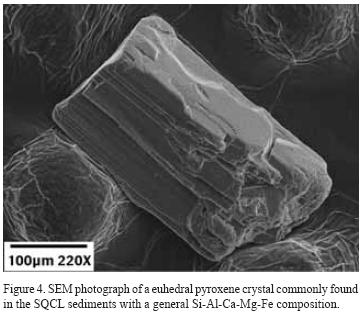
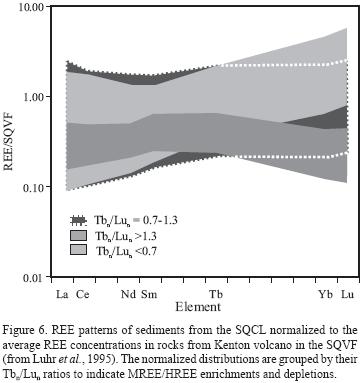
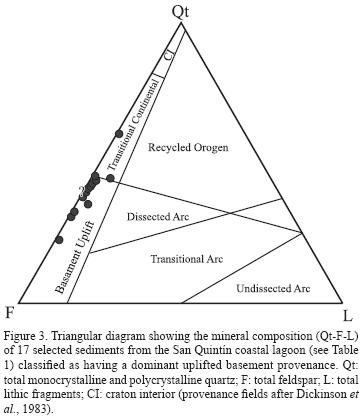
<body><![CDATA[<p align="justify"><font face="verdana" size="2">The minerals counted are shown in <a href="/img/revistas/rmcg/v26n1/a10t1.jpg" target="_blank">Table 1</a>. The modal analysis of the sandy fraction shows a high content of plagioclase and quartz (both &gt;75% of total count), and a low K&#150;feldspar content. Lithic fragments are practically absent, probably because coarse sand is also absent. According to the mineralogic classification of Okada (1971), the sands are classified as feldspathic sediment, with plagiocalse dominant relative to K&#150;felspar, and can be classified as having an uplifted basement source (<a href="#f3">Figure 3</a>; Dickinson <i>et al.</i>, 1983). The high abundance of hornblende, monocrystalline quartz and lesser amounts of K&#150;feldspar suggests the importance of the granitic regional basement. Heavy mineral content in the determined samples is as much as 30% of the total mineral count, and includes hornblende, pyroxene, mica (biotite &gt; muscovite) and opaque minerals (magnetite &gt; titanomagnetite). Hornblende and pyroxene are present as euhedral crystals (<a href="#f4">Figure 4</a>) without evidence for extensive weathering and/or transport, suggestive of a local source. Thus, two predominant mineral sources can be defined for the SQCL: (1) of local volcanic origin belonging to the SQVF, and (2) from the erosion of the batholitic basement. Scanning electronic microscopy (SEM) confirmed the presence of the minerals identified with the petrographic microscope. Owing to its unstable nature, olivine was seldom identified and only as small crystals. <a href="#f4">Figure 4</a> shows a pyroxene crystal from the SQCL with a Si, Al, Ca, Mg and Fe general composition, as identified by SEM. This chemical composition, that corresponds to diopside, is only possible from an ultramafic xenolith source from San Quint&iacute;n, as described by Basu (1975). No chromite or spinel was identified in the samples.</font></p> 				    <p align="center"><font face="verdana" size="2"><a name="f3"></a></font></p> 				    <p align="center"><font face="verdana" size="2"><img src="/img/revistas/rmcg/v26n1/a10f3.jpg"></font></p> 				    <p align="center"><font face="verdana" size="2">&nbsp;</font></p> 				    <p align="center"><font face="verdana" size="2"><a name="f4"></a></font></p> 				    <p align="center"><font face="verdana" size="2"><img src="/img/revistas/rmcg/v26n1/a10f4.jpg"></font></p> 				    <p align="justify"><font face="verdana" size="2"><b>Sediment geochemistry and statistical factor analyses</b></font></p> 				    <p align="justify"><font face="verdana" size="2">The raw geochemical results are given in the <a href="/img/revistas/rmcg/v26n1/html/appendix.htm" target="_blank">Appendix</a> and summarized in <a href="/img/revistas/rmcg/v26n1/a10t2.jpg" target="_blank">Table 2</a>. Of all the elements studied, Cr has a unique regional distribution, in that it is relatively enriched adjacent to the entire coast surrounding BF (above average lagoon concentrations), and also in the eastern SQCL, adjacent to the San Sim&oacute;n discharge site (<a href="/img/revistas/rmcg/v26n1/a10f5.jpg" target="_blank">Figure 5</a>). This distribution partially resembles that of Fe, especially near the entrance of the San Sim&oacute;n watercourse (<a href="/img/revistas/rmcg/v26n1/a10f5.jpg" target="_blank">Figure 5b</a>). The regional distribution of P shows enrichment in the head of BF and central BSQ (<a href="/img/revistas/rmcg/v26n1/a10f5.jpg" target="_blank">Figure 5c</a>). Although its distribution is similar to that of Fe, high concentrations are also found in sites where silts are dominant (<a href="/img/revistas/rmcg/v26n1/a10f2.jpg" target="_blank">Figure 2a</a>).</font></p> 				    <p align="justify"><font face="verdana" size="2">The chondrite normalized REE patterns show a distribution that is similar to that of rocks from the SQVF (Luhr <i>et al.</i>, 1995). They are enriched in light REE (LREE) and depleted in heavy REE (HREE) (average La<sub>n</sub>/Lu<sub>n</sub>&#126;4). However, some samples show a slight HREE enrichment in relation to the medium REE (MREE). This enrichment is better assessed by using chondrite normalized Tb<sub>n</sub>/Lu<sub>n</sub> ratios. The Tb<sub>n</sub>/Lu<sub>n</sub> ratios in the sediments average 1.7 (0.7&#150;4.3), and are similar to those of the SQVF rocks (Luhr <i>et al.</i>, 1995), with Tb<sub>n</sub>/Lu<sub>n</sub> = 1.9 (1.7&#150;2.1). The Tb<sub>n</sub>/Lu<sub>n</sub> ratios in the SQVF and SQCL are only slightly higher than those in the upper continental crust (UCC; Rudnick and Gao, 2004), and in the North American shale composite (NASC; Gromet <i>et al.</i>, 1984), which are 1.5 and 1.2, respectively. In order to closer assess any similarities between the REE patterns of the sediments with those of the SQVF, the concentrations of the seven reported REE were normalized to the average REE composition of Kenton volcano (Luhr <i>et al.</i>, 1995). Three types of SQVF&#150;normalized REE distributions were empirically identified on the basis of their Tb<sub>n</sub>/Lu<sub>n</sub> ratios, indicating three different groups in the sediments (<a href="#f6">Figure 6</a>).</font></p> 				    <p align="center"><font face="verdana" size="2"><a name="f6"></a></font></p> 				    ]]></body>
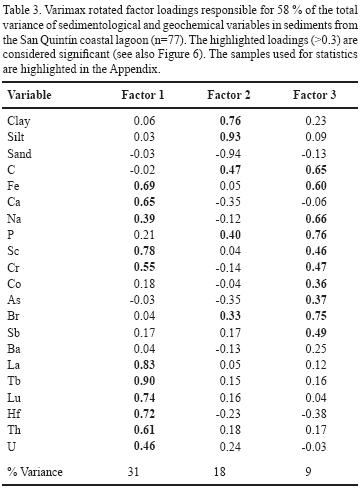
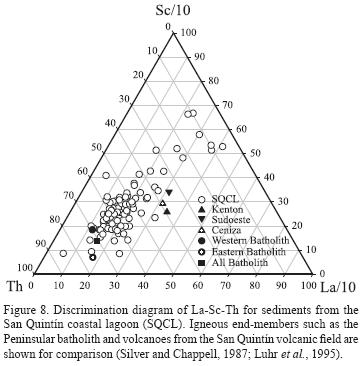
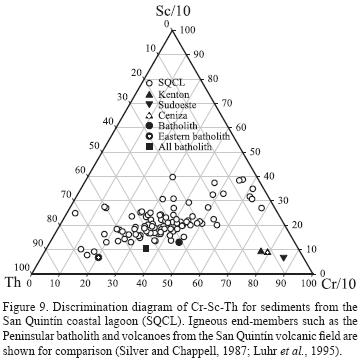
<body><![CDATA[<p align="center"><font face="verdana" size="2"><img src="/img/revistas/rmcg/v26n1/a10f6.jpg"></font></p> 				    <p align="justify"><font face="verdana" size="2">Varimax rotated factor analysis was used to describe the main sediment geochemical components in SQCL and to better explain the sedimentary and/or hydrodynamic factors controlling sediment composition. In addition to the elements determined with INAA, the factor analysis includes results for abundance of sand, silt, clay, C<sub>org</sub>, and P. Only those samples for which all the mentioned variables could be determined, were used for statistical analyses (n=77; <a href="#t3">Table 3</a>). Three factors explain 58% of the total geochemical variance in the lagoon. Factor 1 (accounting for 31% of the total variance) groups Fe, Ca, Cr, Na, Hf, Sc, Th, U and the REE. Positive factor scores (&gt;0.3) for this factor are found in most samples from BSQ (except northern BSQ) and in some from western BF (<a href="/img/revistas/rmcg/v26n1/a10f7.jpg" target="_blank">Figure 7a</a>). The second factor groups those sediments with high silt, clay, C<sub>org</sub> and P content. Positive Factor 2 scores are found in samples from northern and central BSQ, and northern BF (<a href="/img/revistas/rmcg/v26n1/a10f7.jpg" target="_blank">Figure 7b</a>). The third factor groups Fe, C<sub>org</sub> and P with As, Br, Ca, Co, Cr, Na and Sc. Unlike the first two factors, Factor 3 scores are positive in most of BSQ and only in a few samples in northernmost BF, where the aquaculture racks are located (<a href="/img/revistas/rmcg/v26n1/a10f7.jpg" target="_blank">Figure 7c</a>).</font></p> 				    <p align="center"><font face="verdana" size="2"><a name="t3"></a></font></p> 				    <p align="center"><font face="verdana" size="2"><img src="/img/revistas/rmcg/v26n1/a10t3.jpg"></font></p> 				    <p align="justify"><font face="verdana" size="2">&nbsp;</font></p> 				    <p align="justify"><font face="verdana" size="2"><b>DISCUSSION</b></font></p> 				    <p align="justify"><font face="verdana" size="2"><b>Weathering and provenance</b></font></p> 				    <p align="justify"><font face="verdana" size="2">Sediments from the SQCL have a relatively low abundance of C<sub>org</sub> (0.07&#150;2.1%). The absence of lithics in most of the sediments studied suggests that, if any volcanic rock fragments were present, these were rapidly weathered during more humid past conditions, and weathering products were dispersed out of the basin by the active tidal currents and/or are currently buried. This would explain the low abundance of clay&#150;sized sediments in the SQCL, except for a few samples (<a href="/img/revistas/rmcg/v26n1/a10f2.jpg" target="_blank">Figure 2b</a>). Gorsline and Stewart (1962) reported unusual high abundances of hornblende, exceeding 50% of the total heavy mineral counts in the SQCL sediments. These authors however, did not report the presence of pyroxenes identified in the present work as a dominant (as much as 6%) heavy mineral component (<a href="/img/revistas/rmcg/v26n1/a10t1.jpg" target="_blank">Table 1</a>). Thus, it is possible that clinopyroxenes eroded from the SQVF (more likely from the ultramafic xenoliths), remained in the SQCL and were distributed by tidal currents. The angular appearance of these minerals (as well as that of plagioclase) is suggestive of a nearby source and low degree of weathering (<a href="#f4">Figure 4</a>). Luhr <i>et al.</i> (1995) identified clinopyroxenes in several rock samples from the SQVF. Clinopyroxenes (&gt;5%) are found in mounts Kenton, Basu, Woodford and Mazo, mainly as microphenocrysts. Phenocrysts are present in Mount Mazo (at the end of the dune and beach sand tombolo; <a href="/img/revistas/rmcg/v26n1/a10f1.jpg" target="_blank">Figure 1</a>), but are rare in other cones surrounding the lagoon. One phenocrystic pyroxene from mount Mazo is reported to have exceptionally high SiO<sub>2</sub>, Cr<sub>2</sub>O<sub>3</sub>, NiO, and MgO concentrations, whereas clinopyroxene megacrysts analyzed from the Woodford complex are characterized by very low Cr<sub>2</sub>O<sub>3</sub> and NiO concentrations (&lt;0.02%; Luhr <i>et al.</i>, 1995). Oxide mineral microphenocrysts such as Al&#150;Fe&#150;Cr&#150;Mg spinel, spinel inclusions in olivines, groundmass spinel and groundmass ilmenite form &gt;5% of mounts Basu, Kenton and Woodford (Luhr <i>et al.</i>, 1995). According to these authors, spinel inclusions may have 24% Cr<sub>2</sub>O<sub>3</sub>. Chromian spinels are described as being resistant to weathering and abrasion (Pooley, 2004), whereas pyroxenes are only moderately resistant to weathering. Thus, the presence of chromian spinels together with clynopyroxene phenocrysts and microphenocrysts may play an important role in determining the distribution of Fe and Cr in the SQCL (and probably also of V, Co and Ni, as indicated by the partition coefficients of these metals in clinopyroxenes; Rollinson, 1993). However, in the SQCL only a few olivine&#150;bearing, and no spinel&#150;bearing, sediment samples were identified.</font></p> 				    <p align="justify"><font face="verdana" size="2">Selected element ratios are used to compare the composition of sediments from the SQCL with that published for the SQVF, the Peninsular Ranges batholith, UCC, NASC, post&#150;Archean Australian shale (PAAS) and other sediments eroded from basic and felsic rocks (<a href="/img/revistas/rmcg/v26n1/a10t4.jpg" target="_blank">Table 4</a>; Nagarajan <i>et al.</i>, 2007). The La/Sc ratios in sediments from the SQCL (0.1&#150;3.1) are similar to those in the SQVF, and sediments from basaltic rocks. However they are on the lower range of the Peninsular Ranges batholith, UCC, NASC, PAAS and sediment from felsic rocks. This suggests the presence of minerals from a mafic source in sediments in the SQCL, but with an important contribution from felsic rocks (Dokuz and Tanyolu, 2006). High Cr/Th and Co/Cr ratios also suggest a mafic source (<a href="/img/revistas/rmcg/v26n1/a10t4.jpg" target="_blank">Table 4</a>), when compared to the felsic UCC, NASC and PAAS ratios. Sediments with a mafic geochemical signature are ubiquitous in the SQCL, except perhaps those samples adjacent to the dune and beach sand bar (around samples 15, 16 and 94), as well as the inner coast of BF (around sample 107), which also have unusually high REE concentrations (&sum;REE &gt;100 &micro;g g&#150;1), and are probably identified as part of the elements associated with heavy minerals in statistical Factor 1. High Cr/Th and Co/Th ratios were also found in the Magdalena&#150;Almejas lagoon (Baja California Sur), adjacent to the Magdalena and Margarita Islands (<a href="/img/revistas/rmcg/v26n1/a10t4.jpg" target="_blank">Table 4</a>), as well as near Cedros Island (Baja California). Enrichments in both areas were probably caused by the weathering and erosion of the ophiolitic rocks in these islands (Daessl&eacute; <i>et al.</i>, 2000; Rodr&iacute;guez&#150;Meza, 2005).</font></p> 				    <p align="justify"><font face="verdana" size="2">Discrimination diagrams (<a href="#f8">Figures 8</a> and <a href="#f9">9</a>) are further used to assess the geochemical affinity of the sediments with the two most likely geochemical end&#150;members in the region: the SQVF and the Peninsular Ranges batholith, which are located &#126;40 km east of the SQCL. Although a mixing and integration of the geochemical signatures by the hydrodynamic forces in the lagoon is highly likely, the distinctive composition of the end&#150;members is thought to be reflected to some extent in the sediments. The La&#150;Sc&#150;Th diagram includes the data of the average composition of the Eastern and Western batholith. Sediments from the SQCL have La&#150;Sc&#150;Th compositions that increase in La from a batholith&#150;type composition toward and beyond a SQVF composition (<a href="#f8">Figure 8</a>), suggestive of an additional sediment component enriched in La, probably heavy minerals. <a href="#f9">Figure 9</a> shows the proportions of Cr&#150;Sc&#150;Th, in order to assess the potential sources of Cr in the sediment. In the diagram, the sediments show a distribution similar to the trend seen from East to West in the Peninsular batholith rocks (Silver and Chappell, 1987), reaching proportions of Sc comparable to those in the SQVF, but still not the same Th depletion and Cr enrichment as in these rocks. The regional distribution of bulk Cr concentrations strongly suggest that Cr&#150;bearing minerals such as diopside from the xenoliths (with Cr above the average of 30 &micro;g g<sup>&#150;1</sup>) have preferentially been deposited along the entire coast of BF and throughout BSQ. Mantle&#150;derived ultramafic xenoliths are abundant in the SQVF (Basu, 1975). They are characterized by chromium&#150;diopside rich lherzolite. These rocks are easily friable and may provide the anomalous sources of Sc and Cr in theSQCL. However, a significant enrichment of Cr (along with Fe) along the shallow eastern coast of BSQ (adjacent to the San Sim&oacute;n drainage area), is indicative of peculiar conditions that favor the deposition of these metals there. Since Cr concentrations in the Western batholith (67 &micro;g g<sup>&#150;1</sup>) are almost three times those from the Eastern batholith (24 &micro;g g<sup>&#150;1</sup>) (&#126;150 km east), a felsic source for Cr at that specific site (probably as hornblende) could be partially responsible for this enrichment. However, as no opaque minerals (including chromite) were identified in this area, a diagenetic signal may be responsible at least in part for the enrichment in Fe and Cr there, probably as pyrite.</font></p> 				    ]]></body>
<body><![CDATA[<p align="center"><font face="verdana" size="2"><a name="f8"></a></font></p> 				    <p align="center"><font face="verdana" size="2"><img src="/img/revistas/rmcg/v26n1/a10f8.jpg"></font></p> 				    <p align="center"><font face="verdana" size="2">&nbsp;</font></p> 				    <p align="center"><font face="verdana" size="2"><a name="f9"></a></font></p> 				    <p align="center"><font face="verdana" size="2"><img src="/img/revistas/rmcg/v26n1/a10f9.jpg"></font></p> 				    <p align="justify"><font face="verdana" size="2">While most of the samples show a similar REE pattern, which is almost identical to that of SQVF rocks, the slight differences in Tb<sub>n</sub>/Lu<sub>n</sub> (normalized to REE concentrations in SQVF rocks) allow for the identification of two additional factors controlling their distribution (<a href="#f6">Figure 6</a>). Slight enrichments of HREE along most of the western coast of BF, the southern coast of BSQ and some sites adjacent to the inner coast of BSQ, may indicate the presence (although in small amounts) of minerals such as orthopyroxenes, olivine or other (most likely mafic) minerals enriched in HREE (Rollinson, 1993). This distribution of samples with Tb<sub>n</sub>/Lu<sub>n</sub> &lt;0.7 closely resembles that of the factor scores belonging to statistical Factor 1 (<a href="/img/revistas/rmcg/v26n1/a10f7.jpg" target="_blank">Figure 7a</a>), which associates the REE with elements such as Sc, Cr, Hf, U, Th, Ca, Na and Fe.</font></p> 				    <p align="justify"><font face="verdana" size="2"><b>Grain size effect and element enrichments</b></font></p> 				    <p align="justify"><font face="verdana" size="2">Commonly, fine grained particles are a dominant factor controlling metal distribution in aquatic sediments (Lakhan <i>et al.</i>, 2003). This suggests the mechanistic link between the sedimentation of organic matter and clastic fines, either through sorption and/or comparable sedimentation conditions. In the SQCL, the abundance of clay and silt are statistically associated only to C<sub>org</sub> and P, signaling sites of low hydrodynamic energy in the heads of BF and BSQ, as well as in a shallow mud&#150;bank in central BSQ (<a href="/img/revistas/rmcg/v26n1/a10f2.jpg" target="_blank">Figure 2a and b</a>). However, unlike other marine sediments where small grain size is an important factor controlling metal enrichment (Covelli and Fantolan, 1997 and references therein), in SQLC the grain&#150;size effect plays only a secondary role in explaining the compositional variance of the sediments. This is suggested from the bivariate scatter plot of Fe against silt+clay (<a href="/img/revistas/rmcg/v26n1/a10f10.jpg" target="_blank">Figure 10a</a>), where no correlation is seen between these variables. Results by Navarro <i>et al.</i> (2006) indicate that neither does Al correlate with grain size in the SQCL. This unusual no&#150;correlation between grain size and metal concentrations may be explained by the abundance of Fe&#150;rich hornblende in the fine sand&#150;size fraction throughout SQCL. Thus, normalization against grain size is not an appropriate tool to determine element enrichments in the SQCL. However, Fe appears to control part of the enrichment of Cr and P in most of the samples, as suggested by the positive correlation between these elements in the SQCL (<a href="/img/revistas/rmcg/v26n1/a10f10.jpg" target="_blank">Figures 10b and 10c</a>).</font></p> 				    <p align="justify"><font face="verdana" size="2">The association of Fe in Factor 1, with elements such as Hf, Th, Cr, Sc and the REE indicates that, in parts of BF and BSQ, these elements are contained in heavy minerals (<a href="/img/revistas/rmcg/v26n1/a10f7.jpg" target="_blank">Figure 7a</a>). However, the association of Fe in factor 3 (<a href="/img/revistas/rmcg/v26n1/a10f7.jpg" target="_blank">Figure 7c</a>) with several other trace elements (As, Br, Co, Cr, Sb and Sc), C<sub>org</sub> and P in BSQ and the northernmost BF (underneath aquaculture sites), may be caused by combined sources in addition to the heavy minerals. Likely additional sediment components that may be responsible for the element association seen in factor 3 are: a) sorption of anions to Fe oxyhydroxides or other Fe minerals; b) formation of authigenic pyrite associated to sediment anoxia in the shallow mud flat adjacent to the mouth of the San Sim&oacute;n watercourse and underneath the aquaculture racks in BF; c) organic matter; and/or d) input of fertilizers containing P, As and Sb (He and Yang, 1999; Otero <i>et al.</i>, 2005), or arsenical pesticides (Robinson and Ayuso, 2004) that might be carried from nearby agriculture fields during flooding of the San Sim&oacute;n.</font></p> 				    <p align="justify"><font face="verdana" size="2">Bromine is an element typically enriched in organic matter formed in saline waters, and shows a strong correlation with organic carbon in sediment (Cosgrove, 1970). This explains the association of Br with C<sub>org</sub> and P in factor 3. However, considering the relatively low concentration of P, As and Sb (<a href="/img/revistas/rmcg/v26n1/html/appendix.htm" target="_blank">Appendix</a>) in the sediments directly adjacent to the mouth of the San Sim&oacute;n watercourse (samples 1&#150;5 and 109; <a href="/img/revistas/rmcg/v26n1/a10f1.jpg" target="_blank">Figure 1</a>), it is unlikely that these elements were derived from agrochemical pollution. Furthermore, they have low element enrichment factors (EF &le; 1) when compared to NASC. The EF (calculated as EF = &#91;element<sub>sample</sub>/Fe<sub>sample</sub>&#93; / &#91;element<sub>NASC</sub>/Fe<sub>NASC</sub>&#93;) in these samples are 0&#150;0.8 for P, 0.02&#150;0.3 for Cr, 0.01&#150;0.3 for As and 0&#150;0.6 for Sb. Samples throughout SQCL have a mean EF of 0.7, 0.3, 0.1 and 0.1 for P, Cr, As and Sb, respectively. These results indicate that anthropogenic sources for these elements, if any, are minor in the SQCL, and that Fe mineralogy (as heavy minerals and probably diagenetic sulphides) and organic matter are the dominant sediment components controlling the geochemistry of trace elements and P.</font></p> 				    ]]></body>
<body><![CDATA[<p align="justify"><font face="verdana" size="2">&nbsp;</font></p> 				    <p align="justify"><font face="verdana" size="2"><b>CONCLUSIONS</b></font></p> 				    <p align="justify"><font face="verdana" size="2">The sediment in the San Quint&iacute;n coastal lagoon is immature with high feldspar contents relative to quartz and can be classified as having an uplifted basement source. The abundant ferromagnesian minerals have a significant effect on the geochemical variance of SQCL sediments. The presence of ferromagnesian minerals other than hornblende is mainly attributed to their erosion from the San Quint&iacute;n volcanic field, and their dispersion throughout SQCL by the action of tidal currents, especially near the coastline. Furthermore, elemental ratios (La/Sc, Cr/Th and Co/Th) also suggest a mafic provenance. Discrimination diagrams (La&#150;Sc&#150;Th and Cr&#150;Sc&#150;Th), that include local igneous endmembers and other sediments of known sources for comparison, indicate a dominant felsic source (Peninsular Ranges batholith diorites), with a superimposed mafic (SQVF and its ultramafic xenoliths) secondary heavy mineral source. Factor analyses and REE patterns (especially the normalized MREE/HREE ratios) also suggest a ubiquitous influence of ferromagnesian minerals in the SQCL. No correlation exists between the abundance of mud and the concentration of Fe or other metals, and thus grain size cannot be used as a normalizer for assessing contaminant sources in this coastal lagoon. However, the association of Sb, Cr, Br, As, Na, Sc and Co with Fe, C<sub>org</sub> and P indicates that, although secondary, the distribution of these trace elements and P is mainly controlled by the presence of Fe&#150;rich minerals such as hornblende (and probably also Fe&#150;oxides and diagenetic Fe&#150;sulphides), and organic matter throughout BSQ and northernmost BF below the aquaculture racks. No evidence for contamination by P, As, Cr and Sb from the use of agrochemicals was found.</font></p> 				    <p align="justify"><font face="verdana" size="2">&nbsp;</font></p> 				    <p align="justify"><font face="verdana" size="2"><b>ACKNOWLEDGMENTS</b></font></p> 				    <p align="justify"><font face="verdana" size="2">We are grateful to V. Guerrero, G. Paniagua and V.A. Mac&iacute;as for their invaluable boating skills while sampling in shallow San Quint&iacute;n waters. Thanks to E. Navarro for his field and laboratory assistance, A. Siqueiros for helping out with phosphorus analyses, and D. Saposhnikov for INAA analyses. We acknowledge the reviewers of this manuscript for helping us to improve it, especially J. Madhavaraju and A.C. Edwards. Thanks to Prof. H.J Tobschall at the University Erlangen&#150;N&uuml;rnberg for his unconditional support and friendship. This work benefited from funding by the Mexican Research and Technology Council CONACYT grant 40144&#150;F to V.F. Camacho&#150;Ibar and a Georg Forster fellowship to L.W. Daessl&eacute; from the Alexander von Humboldt Foundation in Germany.</font></p> 				    <p align="justify"><font face="verdana" size="2">&nbsp;</font></p> 				    <p align="justify"><font face="verdana" size="2"><b>REFERENCES</b></font></p> 				    <!-- ref --><p align="justify"><font face="verdana" size="2">Aspila, K.I., Agemian, H., Cahu, A.S.Y., 1976, A semi&#150;automated method for the determination of inorganic, organic and total phosphate in sediments: Analyst, 101, 187&#150;197.</font>&nbsp;&nbsp;&nbsp;&nbsp;&nbsp;&nbsp;&nbsp;&nbsp;[&#160;<a href="javascript:void(0);" onclick="javascript: window.open('/scielo.php?script=sci_nlinks&ref=8030958&pid=S1026-8774200900010001000001&lng=','','width=640,height=500,resizable=yes,scrollbars=1,menubar=yes,');">Links</a>&#160;]<!-- end-ref --> 				    ]]></body>
<body><![CDATA[<!-- ref --><p align="justify"><font face="verdana" size="2">Basu, A.R., 1975, Hot&#150;spots, mantle plumes and a model for the origin of ultramafic xenoliths in alkali basalts: Earth and Planetary Science Letters, 28, 261&#150;274.</font>&nbsp;&nbsp;&nbsp;&nbsp;&nbsp;&nbsp;&nbsp;&nbsp;[&#160;<a href="javascript:void(0);" onclick="javascript: window.open('/scielo.php?script=sci_nlinks&ref=8030960&pid=S1026-8774200900010001000002&lng=','','width=640,height=500,resizable=yes,scrollbars=1,menubar=yes,');">Links</a>&#160;]<!-- end-ref --> 				    <!-- ref --><p align="justify"><font face="verdana" size="2">Basu, A.R., Murthy, V.R., 1977, Olivine&#150;spinel equilibria in lherzolite xenoliths from San Quint&iacute;n, Baja California: Earth and Planetary Science Letters, 33, 443&#150;450.</font>&nbsp;&nbsp;&nbsp;&nbsp;&nbsp;&nbsp;&nbsp;&nbsp;[&#160;<a href="javascript:void(0);" onclick="javascript: window.open('/scielo.php?script=sci_nlinks&ref=8030962&pid=S1026-8774200900010001000003&lng=','','width=640,height=500,resizable=yes,scrollbars=1,menubar=yes,');">Links</a>&#160;]<!-- end-ref --> 				    <!-- ref --><p align="justify"><font face="verdana" size="2">Camacho&#150;Ibar, V.F., Carriquiry, J.D., Smith, S.V., 2003, Non&#150;conservative P and N fluxes and net ecosystem production in San Quintin Bay, M&eacute;xico: Estuaries, 26, 1220&#150;1237.</font>&nbsp;&nbsp;&nbsp;&nbsp;&nbsp;&nbsp;&nbsp;&nbsp;[&#160;<a href="javascript:void(0);" onclick="javascript: window.open('/scielo.php?script=sci_nlinks&ref=8030964&pid=S1026-8774200900010001000004&lng=','','width=640,height=500,resizable=yes,scrollbars=1,menubar=yes,');">Links</a>&#160;]<!-- end-ref --> 				    <!-- ref --><p align="justify"><font face="verdana" size="2">Cosgrove, M.E., 1970, Iodine in the Bituminous Kimmeridge shales of the Dorset coast, England: Geochimica et Cosmochimica Acta, 34, 830&#150;836.</font>&nbsp;&nbsp;&nbsp;&nbsp;&nbsp;&nbsp;&nbsp;&nbsp;[&#160;<a href="javascript:void(0);" onclick="javascript: window.open('/scielo.php?script=sci_nlinks&ref=8030966&pid=S1026-8774200900010001000005&lng=','','width=640,height=500,resizable=yes,scrollbars=1,menubar=yes,');">Links</a>&#160;]<!-- end-ref --> 				    <!-- ref --><p align="justify"><font face="verdana" size="2">Covelli, S., Fantolan, G., 1997, Application of normalization procedure in determining regional geochemical baseline: Environmental Geology, 30, 34&#150;45.</font>&nbsp;&nbsp;&nbsp;&nbsp;&nbsp;&nbsp;&nbsp;&nbsp;[&#160;<a href="javascript:void(0);" onclick="javascript: window.open('/scielo.php?script=sci_nlinks&ref=8030968&pid=S1026-8774200900010001000006&lng=','','width=640,height=500,resizable=yes,scrollbars=1,menubar=yes,');">Links</a>&#160;]<!-- end-ref --> 				    ]]></body>
<body><![CDATA[<!-- ref --><p align="justify"><font face="verdana" size="2">Cullers, R.L., 1994, The controls on the major and trace element variation on shales, siltstones, and sandstones of Pennsylvanian&#150;Permian age from uplifted continental blocks in Colorado to platform sediment in Kansas, USA: Geochimica et Cosmochimica Acta, 58, 4955&#150;4972.</font>&nbsp;&nbsp;&nbsp;&nbsp;&nbsp;&nbsp;&nbsp;&nbsp;[&#160;<a href="javascript:void(0);" onclick="javascript: window.open('/scielo.php?script=sci_nlinks&ref=8030970&pid=S1026-8774200900010001000007&lng=','','width=640,height=500,resizable=yes,scrollbars=1,menubar=yes,');">Links</a>&#160;]<!-- end-ref --> 				    <!-- ref --><p align="justify"><font face="verdana" size="2">Cullers, R.L., Basu, A., Suttner, L., 1988, Geochemical signature of provenance in sand size material in soils and stream sediments near the Tobacco root batholith, Montana, USA: Chemical Geology, 70, 335&#150;348.</font>&nbsp;&nbsp;&nbsp;&nbsp;&nbsp;&nbsp;&nbsp;&nbsp;[&#160;<a href="javascript:void(0);" onclick="javascript: window.open('/scielo.php?script=sci_nlinks&ref=8030972&pid=S1026-8774200900010001000008&lng=','','width=640,height=500,resizable=yes,scrollbars=1,menubar=yes,');">Links</a>&#160;]<!-- end-ref --> 				    <!-- ref --><p align="justify"><font face="verdana" size="2">Daessl&eacute;, L.W., Carriquiry, J.D., Navarro, R., Villaescusa&#150;Celaya, J.A., 2000, Geochemistry of surficial sediments from Sebasti&aacute;n Vizca&iacute;no Bay, Baja California: Journal of Coastal Research, 16, 1133&#150;1145.</font>&nbsp;&nbsp;&nbsp;&nbsp;&nbsp;&nbsp;&nbsp;&nbsp;[&#160;<a href="javascript:void(0);" onclick="javascript: window.open('/scielo.php?script=sci_nlinks&ref=8030974&pid=S1026-8774200900010001000009&lng=','','width=640,height=500,resizable=yes,scrollbars=1,menubar=yes,');">Links</a>&#160;]<!-- end-ref --> 				    <!-- ref --><p align="justify"><font face="verdana" size="2">Dickinson, W.R., Beard, L.S., Brakenridge, G.R., Erjavec, J.L., Ferguson, R.C., Inman, K.F., Knepp, R.A., Lindberg, F.A., Ryberg, P.T., 1983, Provenance of North American Phanerozoic sandstone in relation to tectonic setting: Geological Society of America Bulletin, 94, 222&#150;235.</font>&nbsp;&nbsp;&nbsp;&nbsp;&nbsp;&nbsp;&nbsp;&nbsp;[&#160;<a href="javascript:void(0);" onclick="javascript: window.open('/scielo.php?script=sci_nlinks&ref=8030976&pid=S1026-8774200900010001000010&lng=','','width=640,height=500,resizable=yes,scrollbars=1,menubar=yes,');">Links</a>&#160;]<!-- end-ref --> 				    <!-- ref --><p align="justify"><font face="verdana" size="2">Dokuz, A., Tanyolu, E., 2006, Geochemical constraints on the provenance, mineral sorting and subaerial weathering of Lower Jurassic and Upper Cretaceous clastic rocks of the Eastern Pontides, Yusufeli (Artvin), NE Turkey: Turkish Journal of Earth Sciences, 15, 181&#150;209.</font>&nbsp;&nbsp;&nbsp;&nbsp;&nbsp;&nbsp;&nbsp;&nbsp;[&#160;<a href="javascript:void(0);" onclick="javascript: window.open('/scielo.php?script=sci_nlinks&ref=8030978&pid=S1026-8774200900010001000011&lng=','','width=640,height=500,resizable=yes,scrollbars=1,menubar=yes,');">Links</a>&#160;]<!-- end-ref --> 				    ]]></body>
<body><![CDATA[<!-- ref --><p align="justify"><font face="verdana" size="2">Flores&#150;Vidal, X., 2006, Circulaci&oacute;n residual en Bah&iacute;a San Quint&iacute;n, B.C., M&eacute;xico: Ensenada, B.C., Mexico, Centro de Investigaci&oacute;n Cient&iacute;fica y de Educaci&oacute;n Superior de Ensenada (CICESE), MSc thesis, 80 p.</font>&nbsp;&nbsp;&nbsp;&nbsp;&nbsp;&nbsp;&nbsp;&nbsp;[&#160;<a href="javascript:void(0);" onclick="javascript: window.open('/scielo.php?script=sci_nlinks&ref=8030980&pid=S1026-8774200900010001000012&lng=','','width=640,height=500,resizable=yes,scrollbars=1,menubar=yes,');">Links</a>&#160;]<!-- end-ref --> 				    <!-- ref --><p align="justify"><font face="verdana" size="2">Forrest, B.M., Creese, R.G., 2006, Benthic impacts of intertidal oyster culture, with consideration of taxonomic sufficiency: Environmental Monitoring and Assessment, 112, 159&#150;176.</font>&nbsp;&nbsp;&nbsp;&nbsp;&nbsp;&nbsp;&nbsp;&nbsp;[&#160;<a href="javascript:void(0);" onclick="javascript: window.open('/scielo.php?script=sci_nlinks&ref=8030982&pid=S1026-8774200900010001000013&lng=','','width=640,height=500,resizable=yes,scrollbars=1,menubar=yes,');">Links</a>&#160;]<!-- end-ref --> 				    <!-- ref --><p align="justify"><font face="verdana" size="2">Gastil R.G., Phillips, R.P., Allison, C.C., 1975, Reconnaissance geology of the State of Baja California: Geological Society of America, Memoir 140, 170 p.</font>&nbsp;&nbsp;&nbsp;&nbsp;&nbsp;&nbsp;&nbsp;&nbsp;[&#160;<a href="javascript:void(0);" onclick="javascript: window.open('/scielo.php?script=sci_nlinks&ref=8030984&pid=S1026-8774200900010001000014&lng=','','width=640,height=500,resizable=yes,scrollbars=1,menubar=yes,');">Links</a>&#160;]<!-- end-ref --> 				    <!-- ref --><p align="justify"><font face="verdana" size="2">Gorsline D.S., Stewart R.A., 1962, Benthic marine exploration of Bah&iacute;a de San Quint&iacute;n, Baja California: Pacific Naturalist, 3, 282&#150;319.</font>&nbsp;&nbsp;&nbsp;&nbsp;&nbsp;&nbsp;&nbsp;&nbsp;[&#160;<a href="javascript:void(0);" onclick="javascript: window.open('/scielo.php?script=sci_nlinks&ref=8030986&pid=S1026-8774200900010001000015&lng=','','width=640,height=500,resizable=yes,scrollbars=1,menubar=yes,');">Links</a>&#160;]<!-- end-ref --> 				    <!-- ref --><p align="justify"><font face="verdana" size="2">Gromet, L.P., Dymek, R.F., Haskin, L.A., Korotev, R.L., 1984, The "North American shale composite": Its compilation, major and trace element characteristics: Geochimica et Cosmochimica Acta, 48, 2469&#150;2482.</font>&nbsp;&nbsp;&nbsp;&nbsp;&nbsp;&nbsp;&nbsp;&nbsp;[&#160;<a href="javascript:void(0);" onclick="javascript: window.open('/scielo.php?script=sci_nlinks&ref=8030988&pid=S1026-8774200900010001000016&lng=','','width=640,height=500,resizable=yes,scrollbars=1,menubar=yes,');">Links</a>&#160;]<!-- end-ref --> 				    ]]></body>
<body><![CDATA[<!-- ref --><p align="justify"><font face="verdana" size="2">Guti&eacute;rrez&#150;Galindo. E.A., Mu&ntilde;oz&#150;Barbosa, A., Daessl&eacute;, L.W., Segovia&#150;Zavala, J.A., Macias&#150;Zamora, J.V., 2007, Sources and factors influencing the spatial distribution of heavymetals in a coastal lagoon adjacent to the San Quint&iacute;n volcanic field, Baja California, Mexico: Marine Pollution Bulletin, 54, 1985&#150;1989.</font>&nbsp;&nbsp;&nbsp;&nbsp;&nbsp;&nbsp;&nbsp;&nbsp;[&#160;<a href="javascript:void(0);" onclick="javascript: window.open('/scielo.php?script=sci_nlinks&ref=8030990&pid=S1026-8774200900010001000017&lng=','','width=640,height=500,resizable=yes,scrollbars=1,menubar=yes,');">Links</a>&#160;]<!-- end-ref --> 				    <!-- ref --><p align="justify"><font face="verdana" size="2">He, M., Yang, J., 1999, Effects of different forms of antimony on rice during the period of germination and growth and antimony concentration in rice tissue: Science of The Total Environment, 243/244,149&#150;155.</font>&nbsp;&nbsp;&nbsp;&nbsp;&nbsp;&nbsp;&nbsp;&nbsp;[&#160;<a href="javascript:void(0);" onclick="javascript: window.open('/scielo.php?script=sci_nlinks&ref=8030992&pid=S1026-8774200900010001000018&lng=','','width=640,height=500,resizable=yes,scrollbars=1,menubar=yes,');">Links</a>&#160;]<!-- end-ref --> 				    <!-- ref --><p align="justify"><font face="verdana" size="2">Ibarra&#150;Obando, S.E., Smith, S.V., Poumian&#150;Tapia, M., Camacho&#150;Ibar, V.F., Carriquiry, J.D., Montes&#150;Hugo, M., 2004, Benthic metabolism in San Quintin Bay, Baja California, Mexico: Marine Ecology Progress Series, 283, 99&#150;112.</font>&nbsp;&nbsp;&nbsp;&nbsp;&nbsp;&nbsp;&nbsp;&nbsp;[&#160;<a href="javascript:void(0);" onclick="javascript: window.open('/scielo.php?script=sci_nlinks&ref=8030994&pid=S1026-8774200900010001000019&lng=','','width=640,height=500,resizable=yes,scrollbars=1,menubar=yes,');">Links</a>&#160;]<!-- end-ref --> 				    <!-- ref --><p align="justify"><font face="verdana" size="2">Lakhan, V.C., Cabana, K., LaValle, P.D., 2003, Relationship between grain size and heavy metals in sediments from beaches along the coast of Guyana: Journal of Coastal Research, 19, 600&#150;608.</font>&nbsp;&nbsp;&nbsp;&nbsp;&nbsp;&nbsp;&nbsp;&nbsp;[&#160;<a href="javascript:void(0);" onclick="javascript: window.open('/scielo.php?script=sci_nlinks&ref=8030996&pid=S1026-8774200900010001000020&lng=','','width=640,height=500,resizable=yes,scrollbars=1,menubar=yes,');">Links</a>&#160;]<!-- end-ref --> 				    <!-- ref --><p align="justify"><font face="verdana" size="2">Luhr, J.F., Aranda&#150;G&oacute;mez, J.J., Todd, B.H., 1995, The San Quintin volcanic field, Baja California Norte, M&eacute;xico: Geology, petrology, and geochemistry: Journal of Geophysical Reseearch, 100(B7), 10353&#150;10380.</font>&nbsp;&nbsp;&nbsp;&nbsp;&nbsp;&nbsp;&nbsp;&nbsp;[&#160;<a href="javascript:void(0);" onclick="javascript: window.open('/scielo.php?script=sci_nlinks&ref=8030998&pid=S1026-8774200900010001000021&lng=','','width=640,height=500,resizable=yes,scrollbars=1,menubar=yes,');">Links</a>&#160;]<!-- end-ref --> 				    ]]></body>
<body><![CDATA[<!-- ref --><p align="justify"><font face="verdana" size="2">Nagarajan, R., Madhavaraju, J., Nagendra, R., Armstrong&#150;Altrin, J.S., Moutte, J., 2007, Geochemistry of Neoproterozoic shales of the Rabanpalli Formation, Bhima Basin, northern Karnataka, southern India: implications for provenance and paleoredox conditions: Revista Mexicana de Ciencias Geol&oacute;gicas, 24, 150&#150;160.</font>&nbsp;&nbsp;&nbsp;&nbsp;&nbsp;&nbsp;&nbsp;&nbsp;[&#160;<a href="javascript:void(0);" onclick="javascript: window.open('/scielo.php?script=sci_nlinks&ref=8031000&pid=S1026-8774200900010001000022&lng=','','width=640,height=500,resizable=yes,scrollbars=1,menubar=yes,');">Links</a>&#160;]<!-- end-ref --> 				    <!-- ref --><p align="justify"><font face="verdana" size="2">Navarro, E., Daessl&eacute;, L.W., Camacho&#150;Ibar, V.F., Ort&iacute;z&#150;Hern&aacute;ndez, M.C., Guti&eacute;rrez&#150;Galindo, E.A., 2006, The geochemistry of Fe, Ti and Al as an indicator of volcanogenic sedimentation in San Quint&iacute;n coastal lagoon, Baja California, Mexico: Ciencias Marinas, 32, 205&#150;217.</font>&nbsp;&nbsp;&nbsp;&nbsp;&nbsp;&nbsp;&nbsp;&nbsp;[&#160;<a href="javascript:void(0);" onclick="javascript: window.open('/scielo.php?script=sci_nlinks&ref=8031002&pid=S1026-8774200900010001000023&lng=','','width=640,height=500,resizable=yes,scrollbars=1,menubar=yes,');">Links</a>&#160;]<!-- end-ref --> 				    <!-- ref --><p align="justify"><font face="verdana" size="2">Newell, R.I.E., Cornwell, J.C., Owens, M.S., 2002, Influence of simulated bivalve biodeposition and microphytobenthos on sediment nitrogen dynamics: a laboratory study; Limnology and. Oceanography, 47, 1367&#150;1379.</font>&nbsp;&nbsp;&nbsp;&nbsp;&nbsp;&nbsp;&nbsp;&nbsp;[&#160;<a href="javascript:void(0);" onclick="javascript: window.open('/scielo.php?script=sci_nlinks&ref=8031004&pid=S1026-8774200900010001000024&lng=','','width=640,height=500,resizable=yes,scrollbars=1,menubar=yes,');">Links</a>&#160;]<!-- end-ref --> 				    <!-- ref --><p align="justify"><font face="verdana" size="2">Okada, H., 1971, Classification of sandstone: analysis and proposal: Journal of Geology, 79, 509&#150;525.</font>&nbsp;&nbsp;&nbsp;&nbsp;&nbsp;&nbsp;&nbsp;&nbsp;[&#160;<a href="javascript:void(0);" onclick="javascript: window.open('/scielo.php?script=sci_nlinks&ref=8031006&pid=S1026-8774200900010001000025&lng=','','width=640,height=500,resizable=yes,scrollbars=1,menubar=yes,');">Links</a>&#160;]<!-- end-ref --> 				    <!-- ref --><p align="justify"><font face="verdana" size="2">Ortiz&#150;Hern&aacute;ndez, M.C., Camacho&#150;Ibar, V.F., Carriquiry, J.D., Obando, S., Daessl&eacute; L.W., 2004, Contribution of sedimentary resuspension to non&#150;conservative fluxes of dissolved inorganic phosphorus in San Quint&iacute;n Bay, Baja California: An experimental estimate: Ciencias Marinas, 30, 85&#150;89.</font>&nbsp;&nbsp;&nbsp;&nbsp;&nbsp;&nbsp;&nbsp;&nbsp;[&#160;<a href="javascript:void(0);" onclick="javascript: window.open('/scielo.php?script=sci_nlinks&ref=8031008&pid=S1026-8774200900010001000026&lng=','','width=640,height=500,resizable=yes,scrollbars=1,menubar=yes,');">Links</a>&#160;]<!-- end-ref --> 				    ]]></body>
<body><![CDATA[<!-- ref --><p align="justify"><font face="verdana" size="2">Otero, N., Vit&ograve;ria, L., Soler, A., Canals, A., 2005, Fertiliser characterisation: Major, trace and rare earth elements: Applied Geochemistry, 20, 1473&#150;1488.</font>&nbsp;&nbsp;&nbsp;&nbsp;&nbsp;&nbsp;&nbsp;&nbsp;[&#160;<a href="javascript:void(0);" onclick="javascript: window.open('/scielo.php?script=sci_nlinks&ref=8031010&pid=S1026-8774200900010001000027&lng=','','width=640,height=500,resizable=yes,scrollbars=1,menubar=yes,');">Links</a>&#160;]<!-- end-ref --> 				    <!-- ref --><p align="justify"><font face="verdana" size="2">Pooley, G.D., 2004, Secondary and backscattered electron imaging of weathered chromian spinel: Scanning, 26, 240&#150;249.</font>&nbsp;&nbsp;&nbsp;&nbsp;&nbsp;&nbsp;&nbsp;&nbsp;[&#160;<a href="javascript:void(0);" onclick="javascript: window.open('/scielo.php?script=sci_nlinks&ref=8031012&pid=S1026-8774200900010001000028&lng=','','width=640,height=500,resizable=yes,scrollbars=1,menubar=yes,');">Links</a>&#160;]<!-- end-ref --> 				    <!-- ref --><p align="justify"><font face="verdana" size="2">Robinson Jr, G.R., Ayuso, R.A., 2004, Use of spatial statistics and isotopic tracers to measure the influence of arsenical pesticide use on stream sediment chemistry in New England, USA: Applied Geochemistry, 19, 1097&#150;1110.</font>&nbsp;&nbsp;&nbsp;&nbsp;&nbsp;&nbsp;&nbsp;&nbsp;[&#160;<a href="javascript:void(0);" onclick="javascript: window.open('/scielo.php?script=sci_nlinks&ref=8031014&pid=S1026-8774200900010001000029&lng=','','width=640,height=500,resizable=yes,scrollbars=1,menubar=yes,');">Links</a>&#160;]<!-- end-ref --> 				    <!-- ref --><p align="justify"><font face="verdana" size="2">Rodr&iacute;guez&#150;Meza, G.D., 2005, Caracterizaci&oacute;n geoqu&iacute;mica por componentes mayores y elementos traza de sedimentos de los ambientes marinos costeros adyacentes a la pen&iacute;nsula de Baja California Sur: La Paz, Baja California Sur, Mexico, PhD thesis, Instituto Polit&eacute;cnico Nacional, Centro Interdisciplinario de Ciencias Marinas (CICIMAR&#150;IPN), 279 p.</font>&nbsp;&nbsp;&nbsp;&nbsp;&nbsp;&nbsp;&nbsp;&nbsp;[&#160;<a href="javascript:void(0);" onclick="javascript: window.open('/scielo.php?script=sci_nlinks&ref=8031016&pid=S1026-8774200900010001000030&lng=','','width=640,height=500,resizable=yes,scrollbars=1,menubar=yes,');">Links</a>&#160;]<!-- end-ref --> 				    <!-- ref --><p align="justify"><font face="verdana" size="2">Rogers, G., Saunders, A.D., Terrell, D.J., Verma, S.P., Marriner, G.F., 1985, Geochemistry of Holocene volcanic rocks associated with ridge subduction in Baja California, Mexico: Nature, 315, 389&#150;392.</font>&nbsp;&nbsp;&nbsp;&nbsp;&nbsp;&nbsp;&nbsp;&nbsp;[&#160;<a href="javascript:void(0);" onclick="javascript: window.open('/scielo.php?script=sci_nlinks&ref=8031018&pid=S1026-8774200900010001000031&lng=','','width=640,height=500,resizable=yes,scrollbars=1,menubar=yes,');">Links</a>&#160;]<!-- end-ref --> 				    ]]></body>
<body><![CDATA[<!-- ref --><p align="justify"><font face="verdana" size="2">Rollinson, H., 1993, Using Geochemical Data: Evaluation, Presentation and Interpretation: London, Prentice Hall, 352 p.</font>&nbsp;&nbsp;&nbsp;&nbsp;&nbsp;&nbsp;&nbsp;&nbsp;[&#160;<a href="javascript:void(0);" onclick="javascript: window.open('/scielo.php?script=sci_nlinks&ref=8031020&pid=S1026-8774200900010001000032&lng=','','width=640,height=500,resizable=yes,scrollbars=1,menubar=yes,');">Links</a>&#160;]<!-- end-ref --> 				    <!-- ref --><p align="justify"><font face="verdana" size="2">Rudnick, R.L., Gao, S., 2004, Composition of the continental crust, <i>in</i> Holland, H.D., Turekian, K.K. (eds.), Treatise on Geochemistry, v. 3, The Crust: Amsterdam, Elsevier, 1&#150;64.</font>&nbsp;&nbsp;&nbsp;&nbsp;&nbsp;&nbsp;&nbsp;&nbsp;[&#160;<a href="javascript:void(0);" onclick="javascript: window.open('/scielo.php?script=sci_nlinks&ref=8031022&pid=S1026-8774200900010001000033&lng=','','width=640,height=500,resizable=yes,scrollbars=1,menubar=yes,');">Links</a>&#160;]<!-- end-ref --> 				    <!-- ref --><p align="justify"><font face="verdana" size="2">Saunders, A.D., Rogers, G., Marriner, G.F., Terrel, D.J. Verma, S.P., 1987, Geochemistry of Cenozoic volcanic rocks, Baja California, Mexico: implications for the petrogenesis of post&#150;subduction magmas: Journal of Volcanology and Geothermal Research, 33, 223&#150;245.</font>&nbsp;&nbsp;&nbsp;&nbsp;&nbsp;&nbsp;&nbsp;&nbsp;[&#160;<a href="javascript:void(0);" onclick="javascript: window.open('/scielo.php?script=sci_nlinks&ref=8031024&pid=S1026-8774200900010001000034&lng=','','width=640,height=500,resizable=yes,scrollbars=1,menubar=yes,');">Links</a>&#160;]<!-- end-ref --> 				    <!-- ref --><p align="justify"><font face="verdana" size="2">Silver, L.T., Chappell, B.W., 1987, The Peninsular Ranges Batholith: and insight into the evolution of the Cordilleran batholiths of southwestern North America: Transactions of the Royal Society of Edinburgh Earth Science, 79, 105&#150;121.</font>&nbsp;&nbsp;&nbsp;&nbsp;&nbsp;&nbsp;&nbsp;&nbsp;[&#160;<a href="javascript:void(0);" onclick="javascript: window.open('/scielo.php?script=sci_nlinks&ref=8031026&pid=S1026-8774200900010001000035&lng=','','width=640,height=500,resizable=yes,scrollbars=1,menubar=yes,');">Links</a>&#160;]<!-- end-ref --> 				    <!-- ref --><p align="justify"><font face="verdana" size="2">Taylor, S.R., McLennan, S.M., 1985, The Continental Crust: its Composition and Evolution: Oxford, Blackwell Scientific, 312 p.</font>&nbsp;&nbsp;&nbsp;&nbsp;&nbsp;&nbsp;&nbsp;&nbsp;[&#160;<a href="javascript:void(0);" onclick="javascript: window.open('/scielo.php?script=sci_nlinks&ref=8031028&pid=S1026-8774200900010001000036&lng=','','width=640,height=500,resizable=yes,scrollbars=1,menubar=yes,');">Links</a>&#160;]<!-- end-ref --> 				    ]]></body>
<body><![CDATA[<!-- ref --><p align="justify"><font face="verdana" size="2">Ward, D., Morton, A., Tibbits, T., Douglass, D., Carrera&#150;Gonz&aacute;lez, E., 2003, Long&#150;term change in eelgrass distribution at Bah&iacute;a San Quint&iacute;n Baja California, M&eacute;xico, using satellite imagery: Estuaries, 26, 1529&#150;1539.</font>&nbsp;&nbsp;&nbsp;&nbsp;&nbsp;&nbsp;&nbsp;&nbsp;[&#160;<a href="javascript:void(0);" onclick="javascript: window.open('/scielo.php?script=sci_nlinks&ref=8031030&pid=S1026-8774200900010001000037&lng=','','width=640,height=500,resizable=yes,scrollbars=1,menubar=yes,');">Links</a>&#160;]<!-- end-ref --> 				    <!-- ref --><p align="justify"><font face="verdana" size="2">Woodford. A.O., 1928, The San Quint&iacute;n volcanic field, Lower California: American Journal of Science, 15, 337&#150;345.</font>&nbsp;&nbsp;&nbsp;&nbsp;&nbsp;&nbsp;&nbsp;&nbsp;[&#160;<a href="javascript:void(0);" onclick="javascript: window.open('/scielo.php?script=sci_nlinks&ref=8031032&pid=S1026-8774200900010001000038&lng=','','width=640,height=500,resizable=yes,scrollbars=1,menubar=yes,');">Links</a>&#160;]<!-- end-ref --> ]]></body><back>
<ref-list>
<ref id="B1">
<nlm-citation citation-type="journal">
<person-group person-group-type="author">
<name>
<surname><![CDATA[Aspila]]></surname>
<given-names><![CDATA[K.I]]></given-names>
</name>
<name>
<surname><![CDATA[Agemian]]></surname>
<given-names><![CDATA[H]]></given-names>
</name>
<name>
<surname><![CDATA[Cahu]]></surname>
<given-names><![CDATA[A.S.Y]]></given-names>
</name>
</person-group>
<article-title xml:lang="en"><![CDATA[A semi-automated method for the determination of inorganic, organic and total phosphate in sediments]]></article-title>
<source><![CDATA[Analyst]]></source>
<year>1976</year>
<volume>101</volume>
<page-range>187-197</page-range></nlm-citation>
</ref>
<ref id="B2">
<nlm-citation citation-type="journal">
<person-group person-group-type="author">
<name>
<surname><![CDATA[Basu]]></surname>
<given-names><![CDATA[A.R]]></given-names>
</name>
</person-group>
<article-title xml:lang="en"><![CDATA[Hot-spots, mantle plumes and a model for the origin of ultramafic xenoliths in alkali basalts]]></article-title>
<source><![CDATA[Earth and Planetary Science Letters]]></source>
<year>1975</year>
<volume>28</volume>
<page-range>261-274</page-range></nlm-citation>
</ref>
<ref id="B3">
<nlm-citation citation-type="journal">
<person-group person-group-type="author">
<name>
<surname><![CDATA[Basu]]></surname>
<given-names><![CDATA[A.R]]></given-names>
</name>
<name>
<surname><![CDATA[Murthy]]></surname>
<given-names><![CDATA[V.R]]></given-names>
</name>
</person-group>
<article-title xml:lang="en"><![CDATA[Olivine-spinel equilibria in lherzolite xenoliths from San Quintín, Baja California]]></article-title>
<source><![CDATA[Earth and Planetary Science Letters]]></source>
<year>1977</year>
<volume>33</volume>
<page-range>443-450</page-range></nlm-citation>
</ref>
<ref id="B4">
<nlm-citation citation-type="journal">
<person-group person-group-type="author">
<name>
<surname><![CDATA[Camacho-Ibar]]></surname>
<given-names><![CDATA[V.F]]></given-names>
</name>
<name>
<surname><![CDATA[Carriquiry]]></surname>
<given-names><![CDATA[J.D]]></given-names>
</name>
<name>
<surname><![CDATA[Smith]]></surname>
<given-names><![CDATA[S.V]]></given-names>
</name>
</person-group>
<article-title xml:lang="en"><![CDATA[Non-conservative P and N fluxes and net ecosystem production in San Quintin Bay, México]]></article-title>
<source><![CDATA[Estuaries]]></source>
<year>2003</year>
<volume>26</volume>
<page-range>1220-1237</page-range></nlm-citation>
</ref>
<ref id="B5">
<nlm-citation citation-type="journal">
<person-group person-group-type="author">
<name>
<surname><![CDATA[Cosgrove]]></surname>
<given-names><![CDATA[M.E]]></given-names>
</name>
</person-group>
<article-title xml:lang="en"><![CDATA[Iodine in the Bituminous Kimmeridge shales of the Dorset coast, England]]></article-title>
<source><![CDATA[Geochimica et Cosmochimica Acta]]></source>
<year>1970</year>
<volume>34</volume>
<page-range>830-836</page-range></nlm-citation>
</ref>
<ref id="B6">
<nlm-citation citation-type="journal">
<person-group person-group-type="author">
<name>
<surname><![CDATA[Covelli]]></surname>
<given-names><![CDATA[S]]></given-names>
</name>
<name>
<surname><![CDATA[Fantolan]]></surname>
<given-names><![CDATA[G]]></given-names>
</name>
</person-group>
<article-title xml:lang="en"><![CDATA[Application of normalization procedure in determining regional geochemical baseline]]></article-title>
<source><![CDATA[Environmental Geology]]></source>
<year>1997</year>
<volume>30</volume>
<page-range>34-45</page-range></nlm-citation>
</ref>
<ref id="B7">
<nlm-citation citation-type="journal">
<person-group person-group-type="author">
<name>
<surname><![CDATA[Cullers]]></surname>
<given-names><![CDATA[R.L]]></given-names>
</name>
</person-group>
<article-title xml:lang="en"><![CDATA[The controls on the major and trace element variation on shales, siltstones, and sandstones of Pennsylvanian-Permian age from uplifted continental blocks in Colorado to platform sediment in Kansas, USA]]></article-title>
<source><![CDATA[Geochimica et Cosmochimica Acta]]></source>
<year>1994</year>
<volume>58</volume>
<page-range>4955-4972</page-range></nlm-citation>
</ref>
<ref id="B8">
<nlm-citation citation-type="journal">
<person-group person-group-type="author">
<name>
<surname><![CDATA[Cullers]]></surname>
<given-names><![CDATA[R.L]]></given-names>
</name>
<name>
<surname><![CDATA[Basu]]></surname>
<given-names><![CDATA[A]]></given-names>
</name>
<name>
<surname><![CDATA[Suttner]]></surname>
<given-names><![CDATA[L]]></given-names>
</name>
</person-group>
<article-title xml:lang="en"><![CDATA[Geochemical signature of provenance in sand size material in soils and stream sediments near the Tobacco root batholith, Montana, USA]]></article-title>
<source><![CDATA[Chemical Geology]]></source>
<year>1988</year>
<volume>70</volume>
<page-range>335-348</page-range></nlm-citation>
</ref>
<ref id="B9">
<nlm-citation citation-type="journal">
<person-group person-group-type="author">
<name>
<surname><![CDATA[Daesslé]]></surname>
<given-names><![CDATA[L.W]]></given-names>
</name>
<name>
<surname><![CDATA[Carriquiry]]></surname>
<given-names><![CDATA[J.D]]></given-names>
</name>
<name>
<surname><![CDATA[Navarro]]></surname>
<given-names><![CDATA[R]]></given-names>
</name>
<name>
<surname><![CDATA[Villaescusa-Celaya]]></surname>
<given-names><![CDATA[J.A]]></given-names>
</name>
</person-group>
<article-title xml:lang="en"><![CDATA[Geochemistry of surficial sediments from Sebastián Vizcaíno Bay, Baja California]]></article-title>
<source><![CDATA[Journal of Coastal Research]]></source>
<year>2000</year>
<volume>16</volume>
<page-range>1133-1145</page-range></nlm-citation>
</ref>
<ref id="B10">
<nlm-citation citation-type="journal">
<person-group person-group-type="author">
<name>
<surname><![CDATA[Dickinson]]></surname>
<given-names><![CDATA[W.R]]></given-names>
</name>
<name>
<surname><![CDATA[Beard]]></surname>
<given-names><![CDATA[L.S]]></given-names>
</name>
<name>
<surname><![CDATA[Brakenridge]]></surname>
<given-names><![CDATA[G.R]]></given-names>
</name>
<name>
<surname><![CDATA[Erjavec]]></surname>
<given-names><![CDATA[J.L]]></given-names>
</name>
<name>
<surname><![CDATA[Ferguson]]></surname>
<given-names><![CDATA[R.C]]></given-names>
</name>
<name>
<surname><![CDATA[Inman]]></surname>
<given-names><![CDATA[K.F]]></given-names>
</name>
<name>
<surname><![CDATA[Knepp]]></surname>
<given-names><![CDATA[R.A]]></given-names>
</name>
<name>
<surname><![CDATA[Lindberg]]></surname>
<given-names><![CDATA[F.A]]></given-names>
</name>
<name>
<surname><![CDATA[Ryberg]]></surname>
<given-names><![CDATA[P.T]]></given-names>
</name>
</person-group>
<article-title xml:lang="en"><![CDATA[Provenance of North American Phanerozoic sandstone in relation to tectonic setting]]></article-title>
<source><![CDATA[Geological Society of America Bulletin]]></source>
<year>1983</year>
<volume>94</volume>
<page-range>222-235</page-range></nlm-citation>
</ref>
<ref id="B11">
<nlm-citation citation-type="journal">
<person-group person-group-type="author">
<name>
<surname><![CDATA[Dokuz]]></surname>
<given-names><![CDATA[A.]]></given-names>
</name>
<name>
<surname><![CDATA[Tanyolu]]></surname>
<given-names><![CDATA[E.]]></given-names>
</name>
</person-group>
<article-title xml:lang="en"><![CDATA[Geochemical constraints on the provenance, mineral sorting and subaerial weathering of Lower Jurassic and Upper Cretaceous clastic rocks of the Eastern Pontides, Yusufeli (Artvin), NE Turkey]]></article-title>
<source><![CDATA[Turkish Journal of Earth Sciences]]></source>
<year>2006</year>
<volume>15</volume>
<page-range>181-209</page-range></nlm-citation>
</ref>
<ref id="B12">
<nlm-citation citation-type="">
<person-group person-group-type="author">
<name>
<surname><![CDATA[Flores-Vidal]]></surname>
<given-names><![CDATA[X.]]></given-names>
</name>
</person-group>
<source><![CDATA[Circulación residual en Bahía San Quintín, B.C., México]]></source>
<year>2006</year>
<page-range>80</page-range></nlm-citation>
</ref>
<ref id="B13">
<nlm-citation citation-type="journal">
<person-group person-group-type="author">
<name>
<surname><![CDATA[Forrest]]></surname>
<given-names><![CDATA[B.M]]></given-names>
</name>
<name>
<surname><![CDATA[Creese]]></surname>
<given-names><![CDATA[R.G]]></given-names>
</name>
</person-group>
<article-title xml:lang="en"><![CDATA[Benthic impacts of intertidal oyster culture, with consideration of taxonomic sufficiency]]></article-title>
<source><![CDATA[Environmental Monitoring and Assessment]]></source>
<year>2006</year>
<volume>112</volume>
<page-range>159-176</page-range></nlm-citation>
</ref>
<ref id="B14">
<nlm-citation citation-type="journal">
<person-group person-group-type="author">
<name>
<surname><![CDATA[Gastil]]></surname>
<given-names><![CDATA[R.G.]]></given-names>
</name>
<name>
<surname><![CDATA[Phillips]]></surname>
<given-names><![CDATA[R.P.]]></given-names>
</name>
<name>
<surname><![CDATA[Allison]]></surname>
<given-names><![CDATA[C.C.]]></given-names>
</name>
</person-group>
<article-title xml:lang="en"><![CDATA[Reconnaissance geology of the State of Baja California]]></article-title>
<source><![CDATA[Geological Society of America, Memoir]]></source>
<year>1975</year>
<volume>140</volume>
<page-range>170 p</page-range></nlm-citation>
</ref>
<ref id="B15">
<nlm-citation citation-type="journal">
<person-group person-group-type="author">
<name>
<surname><![CDATA[Gorsline]]></surname>
<given-names><![CDATA[D.S.]]></given-names>
</name>
<name>
<surname><![CDATA[Stewart]]></surname>
<given-names><![CDATA[R.A.]]></given-names>
</name>
</person-group>
<article-title xml:lang="en"><![CDATA[Benthic marine exploration of Bahía de San Quintín, Baja California]]></article-title>
<source><![CDATA[Pacific Naturalist]]></source>
<year>1962</year>
<volume>3</volume>
<page-range>282-319</page-range></nlm-citation>
</ref>
<ref id="B16">
<nlm-citation citation-type="journal">
<person-group person-group-type="author">
<name>
<surname><![CDATA[Gromet]]></surname>
<given-names><![CDATA[L.P.]]></given-names>
</name>
<name>
<surname><![CDATA[Dymek]]></surname>
<given-names><![CDATA[R.F.]]></given-names>
</name>
<name>
<surname><![CDATA[Haskin]]></surname>
<given-names><![CDATA[L.A.]]></given-names>
</name>
<name>
<surname><![CDATA[Korotev]]></surname>
<given-names><![CDATA[R.L.]]></given-names>
</name>
</person-group>
<article-title xml:lang="en"><![CDATA[The "North American shale composite": Its compilation, major and trace element characteristics]]></article-title>
<source><![CDATA[Geochimica et Cosmochimica Acta]]></source>
<year>1984</year>
<volume>48</volume>
<page-range>2469-2482</page-range></nlm-citation>
</ref>
<ref id="B17">
<nlm-citation citation-type="journal">
<person-group person-group-type="author">
<name>
<surname><![CDATA[Gutiérrez-Galindo]]></surname>
<given-names><![CDATA[E.A.]]></given-names>
</name>
<name>
<surname><![CDATA[Muñoz-Barbosa]]></surname>
<given-names><![CDATA[A.]]></given-names>
</name>
<name>
<surname><![CDATA[Daesslé]]></surname>
<given-names><![CDATA[L.W.]]></given-names>
</name>
<name>
<surname><![CDATA[Segovia-Zavala]]></surname>
<given-names><![CDATA[J.A.]]></given-names>
</name>
<name>
<surname><![CDATA[Macias-Zamora]]></surname>
<given-names><![CDATA[J.V.]]></given-names>
</name>
</person-group>
<article-title xml:lang="en"><![CDATA[Sources and factors influencing the spatial distribution of heavymetals in a coastal lagoon adjacent to the San Quintín volcanic field, Baja California, Mexico]]></article-title>
<source><![CDATA[Marine Pollution Bulletin]]></source>
<year>2007</year>
<volume>54</volume>
<page-range>1985-1989</page-range></nlm-citation>
</ref>
<ref id="B18">
<nlm-citation citation-type="journal">
<person-group person-group-type="author">
<name>
<surname><![CDATA[He]]></surname>
<given-names><![CDATA[M.]]></given-names>
</name>
<name>
<surname><![CDATA[Yang]]></surname>
<given-names><![CDATA[J.]]></given-names>
</name>
</person-group>
<article-title xml:lang="en"><![CDATA[Effects of different forms of antimony on rice during the period of germination and growth and antimony concentration in rice tissue]]></article-title>
<source><![CDATA[Science of The Total Environment]]></source>
<year>1999</year>
<volume>243/244</volume>
<page-range>149-155</page-range></nlm-citation>
</ref>
<ref id="B19">
<nlm-citation citation-type="journal">
<person-group person-group-type="author">
<name>
<surname><![CDATA[Ibarra-Obando]]></surname>
<given-names><![CDATA[S.E]]></given-names>
</name>
<name>
<surname><![CDATA[Smith]]></surname>
<given-names><![CDATA[S.V]]></given-names>
</name>
<name>
<surname><![CDATA[Poumian-Tapia]]></surname>
<given-names><![CDATA[M]]></given-names>
</name>
<name>
<surname><![CDATA[Camacho-Ibar]]></surname>
<given-names><![CDATA[V.F]]></given-names>
</name>
<name>
<surname><![CDATA[Carriquiry]]></surname>
<given-names><![CDATA[J.D]]></given-names>
</name>
<name>
<surname><![CDATA[Montes-Hugo]]></surname>
<given-names><![CDATA[M]]></given-names>
</name>
</person-group>
<article-title xml:lang="en"><![CDATA[Benthic metabolism in San Quintin Bay, Baja California, Mexico]]></article-title>
<source><![CDATA[Marine Ecology Progress Series]]></source>
<year>2004</year>
<volume>283</volume>
<page-range>99-112</page-range></nlm-citation>
</ref>
<ref id="B20">
<nlm-citation citation-type="journal">
<person-group person-group-type="author">
<name>
<surname><![CDATA[Lakhan]]></surname>
<given-names><![CDATA[V.C]]></given-names>
</name>
<name>
<surname><![CDATA[Cabana]]></surname>
<given-names><![CDATA[K]]></given-names>
</name>
<name>
<surname><![CDATA[LaValle]]></surname>
<given-names><![CDATA[P.D]]></given-names>
</name>
</person-group>
<article-title xml:lang="en"><![CDATA[Relationship between grain size and heavy metals in sediments from beaches along the coast of Guyana]]></article-title>
<source><![CDATA[Journal of Coastal Research]]></source>
<year>2003</year>
<volume>19</volume>
<page-range>600-608</page-range></nlm-citation>
</ref>
<ref id="B21">
<nlm-citation citation-type="journal">
<person-group person-group-type="author">
<name>
<surname><![CDATA[Luhr]]></surname>
<given-names><![CDATA[J.F.]]></given-names>
</name>
<name>
<surname><![CDATA[Aranda-Gómez]]></surname>
<given-names><![CDATA[J.J.]]></given-names>
</name>
<name>
<surname><![CDATA[Todd]]></surname>
<given-names><![CDATA[B.H.]]></given-names>
</name>
</person-group>
<article-title xml:lang="en"><![CDATA[The San Quintin volcanic field, Baja California Norte, México: Geology, petrology, and geochemistry]]></article-title>
<source><![CDATA[Journal of Geophysical Reseearch]]></source>
<year>1995</year>
<volume>100</volume>
<numero>B7</numero>
<issue>B7</issue>
<page-range>10353-10380</page-range></nlm-citation>
</ref>
<ref id="B22">
<nlm-citation citation-type="journal">
<person-group person-group-type="author">
<name>
<surname><![CDATA[Nagarajan]]></surname>
<given-names><![CDATA[R.]]></given-names>
</name>
<name>
<surname><![CDATA[Madhavaraju]]></surname>
<given-names><![CDATA[J.]]></given-names>
</name>
<name>
<surname><![CDATA[Nagendra]]></surname>
<given-names><![CDATA[R.]]></given-names>
</name>
<name>
<surname><![CDATA[Armstrong-Altrin]]></surname>
<given-names><![CDATA[J.S.]]></given-names>
</name>
<name>
<surname><![CDATA[Moutte]]></surname>
<given-names><![CDATA[J.]]></given-names>
</name>
</person-group>
<article-title xml:lang="en"><![CDATA[Geochemistry of Neoproterozoic shales of the Rabanpalli Formation, Bhima Basin, northern Karnataka, southern India: implications for provenance and paleoredox conditions]]></article-title>
<source><![CDATA[Revista Mexicana de Ciencias Geológicas]]></source>
<year>2007</year>
<volume>24</volume>
<page-range>150-160</page-range></nlm-citation>
</ref>
<ref id="B23">
<nlm-citation citation-type="journal">
<person-group person-group-type="author">
<name>
<surname><![CDATA[Navarro]]></surname>
<given-names><![CDATA[E]]></given-names>
</name>
<name>
<surname><![CDATA[Daesslé]]></surname>
<given-names><![CDATA[L.W]]></given-names>
</name>
<name>
<surname><![CDATA[Camacho-Ibar]]></surname>
<given-names><![CDATA[V.F]]></given-names>
</name>
<name>
<surname><![CDATA[Ortíz-Hernández]]></surname>
<given-names><![CDATA[M.C]]></given-names>
</name>
<name>
<surname><![CDATA[Gutiérrez-Galindo]]></surname>
<given-names><![CDATA[E.A]]></given-names>
</name>
</person-group>
<article-title xml:lang="en"><![CDATA[The geochemistry of Fe, Ti and Al as an indicator of volcanogenic sedimentation in San Quintín coastal lagoon, Baja California, Mexico]]></article-title>
<source><![CDATA[Ciencias Marinas]]></source>
<year>2006</year>
<volume>32</volume>
<page-range>205-217</page-range></nlm-citation>
</ref>
<ref id="B24">
<nlm-citation citation-type="journal">
<person-group person-group-type="author">
<name>
<surname><![CDATA[Newell]]></surname>
<given-names><![CDATA[R.I.E.]]></given-names>
</name>
<name>
<surname><![CDATA[Cornwell]]></surname>
<given-names><![CDATA[J.C.]]></given-names>
</name>
<name>
<surname><![CDATA[Owens]]></surname>
<given-names><![CDATA[M.S.]]></given-names>
</name>
</person-group>
<article-title xml:lang="en"><![CDATA[Influence of simulated bivalve biodeposition and microphytobenthos on sediment nitrogen dynamics: a laboratory study; Limnology and]]></article-title>
<source><![CDATA[Oceanography]]></source>
<year>2002</year>
<volume>47</volume>
<page-range>1367-1379</page-range></nlm-citation>
</ref>
<ref id="B25">
<nlm-citation citation-type="journal">
<person-group person-group-type="author">
<name>
<surname><![CDATA[Okada]]></surname>
<given-names><![CDATA[H]]></given-names>
</name>
</person-group>
<article-title xml:lang="en"><![CDATA[Classification of sandstone]]></article-title>
<source><![CDATA[analysis and proposal: Journal of Geology]]></source>
<year>1971</year>
<volume>79</volume>
<page-range>509-525</page-range></nlm-citation>
</ref>
<ref id="B26">
<nlm-citation citation-type="journal">
<person-group person-group-type="author">
<name>
<surname><![CDATA[Ortiz-Hernández]]></surname>
<given-names><![CDATA[M.C]]></given-names>
</name>
<name>
<surname><![CDATA[Camacho-Ibar]]></surname>
<given-names><![CDATA[V.F.]]></given-names>
</name>
<name>
<surname><![CDATA[Carriquiry]]></surname>
<given-names><![CDATA[J.D.]]></given-names>
</name>
<name>
<surname><![CDATA[Obando]]></surname>
<given-names><![CDATA[S.]]></given-names>
</name>
<name>
<surname><![CDATA[Daesslé]]></surname>
<given-names><![CDATA[L.W.]]></given-names>
</name>
</person-group>
<article-title xml:lang="en"><![CDATA[Contribution of sedimentary resuspension to non-conservative fluxes of dissolved inorganic phosphorus in San Quintín Bay, Baja California: An experimental estimate]]></article-title>
<source><![CDATA[Ciencias Marinas]]></source>
<year>2004</year>
<volume>30</volume>
<page-range>85-89</page-range></nlm-citation>
</ref>
<ref id="B27">
<nlm-citation citation-type="journal">
<person-group person-group-type="author">
<name>
<surname><![CDATA[Otero]]></surname>
<given-names><![CDATA[N.]]></given-names>
</name>
<name>
<surname><![CDATA[Vitòria]]></surname>
<given-names><![CDATA[L.]]></given-names>
</name>
<name>
<surname><![CDATA[Soler]]></surname>
<given-names><![CDATA[A.]]></given-names>
</name>
<name>
<surname><![CDATA[Canals]]></surname>
<given-names><![CDATA[A]]></given-names>
</name>
</person-group>
<article-title xml:lang="en"><![CDATA[Fertiliser characterisation: Major, trace and rare earth elements]]></article-title>
<source><![CDATA[Applied Geochemistry]]></source>
<year>2005</year>
<volume>20</volume>
<page-range>1473-1488</page-range></nlm-citation>
</ref>
<ref id="B28">
<nlm-citation citation-type="journal">
<person-group person-group-type="author">
<name>
<surname><![CDATA[Pooley]]></surname>
<given-names><![CDATA[G.D]]></given-names>
</name>
</person-group>
<article-title xml:lang="en"><![CDATA[Secondary and backscattered electron imaging of weathered chromian spinel]]></article-title>
<source><![CDATA[Scanning]]></source>
<year>2004</year>
<volume>26</volume>
<page-range>240-249</page-range></nlm-citation>
</ref>
<ref id="B29">
<nlm-citation citation-type="journal">
<person-group person-group-type="author">
<name>
<surname><![CDATA[Robinson]]></surname>
<given-names><![CDATA[G.R]]></given-names>
</name>
<name>
<surname><![CDATA[Ayuso]]></surname>
<given-names><![CDATA[R.A]]></given-names>
</name>
</person-group>
<article-title xml:lang="en"><![CDATA[Use of spatial statistics and isotopic tracers to measure the influence of arsenical pesticide use on stream sediment chemistry in New England, USA]]></article-title>
<source><![CDATA[Applied Geochemistry]]></source>
<year>2004</year>
<volume>19</volume>
<page-range>1097-1110</page-range></nlm-citation>
</ref>
<ref id="B30">
<nlm-citation citation-type="">
<person-group person-group-type="author">
<name>
<surname><![CDATA[Rodríguez-Meza]]></surname>
<given-names><![CDATA[G.D.]]></given-names>
</name>
</person-group>
<source><![CDATA[Caracterización geoquímica por componentes mayores y elementos traza de sedimentos de los ambientes marinos costeros adyacentes a la península de Baja California Sur]]></source>
<year>2005</year>
<page-range>279</page-range></nlm-citation>
</ref>
<ref id="B31">
<nlm-citation citation-type="journal">
<person-group person-group-type="author">
<name>
<surname><![CDATA[Rogers]]></surname>
<given-names><![CDATA[G]]></given-names>
</name>
<name>
<surname><![CDATA[Saunders]]></surname>
<given-names><![CDATA[A.D]]></given-names>
</name>
<name>
<surname><![CDATA[Terrell]]></surname>
<given-names><![CDATA[D.J]]></given-names>
</name>
<name>
<surname><![CDATA[Verma]]></surname>
<given-names><![CDATA[S.P]]></given-names>
</name>
<name>
<surname><![CDATA[Marriner]]></surname>
<given-names><![CDATA[G.F]]></given-names>
</name>
</person-group>
<article-title xml:lang="en"><![CDATA[Geochemistry of Holocene volcanic rocks associated with ridge subduction in Baja California, Mexico]]></article-title>
<source><![CDATA[Nature]]></source>
<year>1985</year>
<volume>315</volume>
<page-range>389-392</page-range></nlm-citation>
</ref>
<ref id="B32">
<nlm-citation citation-type="book">
<person-group person-group-type="author">
<name>
<surname><![CDATA[Rollinson]]></surname>
<given-names><![CDATA[H.]]></given-names>
</name>
</person-group>
<source><![CDATA[Using Geochemical Data: Evaluation, Presentation and Interpretation]]></source>
<year>1993</year>
<page-range>352</page-range><publisher-loc><![CDATA[London ]]></publisher-loc>
<publisher-name><![CDATA[Prentice Hall]]></publisher-name>
</nlm-citation>
</ref>
<ref id="B33">
<nlm-citation citation-type="book">
<person-group person-group-type="author">
<name>
<surname><![CDATA[Rudnick]]></surname>
<given-names><![CDATA[R.L.]]></given-names>
</name>
<name>
<surname><![CDATA[Gao]]></surname>
<given-names><![CDATA[S.]]></given-names>
</name>
</person-group>
<article-title xml:lang="en"><![CDATA[Composition of the continental crust]]></article-title>
<person-group person-group-type="editor">
<name>
<surname><![CDATA[Holland]]></surname>
<given-names><![CDATA[H.D.]]></given-names>
</name>
<name>
<surname><![CDATA[Turekian]]></surname>
<given-names><![CDATA[K.K.]]></given-names>
</name>
</person-group>
<source><![CDATA[Treatise on Geochemistry, v. 3, The Crust]]></source>
<year>2004</year>
<page-range>1-64</page-range><publisher-loc><![CDATA[Amsterdam ]]></publisher-loc>
<publisher-name><![CDATA[Elsevier]]></publisher-name>
</nlm-citation>
</ref>
<ref id="B34">
<nlm-citation citation-type="journal">
<person-group person-group-type="author">
<name>
<surname><![CDATA[Saunders]]></surname>
<given-names><![CDATA[A.D.]]></given-names>
</name>
<name>
<surname><![CDATA[Rogers]]></surname>
<given-names><![CDATA[G.]]></given-names>
</name>
<name>
<surname><![CDATA[Marriner]]></surname>
<given-names><![CDATA[G.F.]]></given-names>
</name>
<name>
<surname><![CDATA[Terrel]]></surname>
<given-names><![CDATA[D.J.]]></given-names>
</name>
<name>
<surname><![CDATA[Verma]]></surname>
<given-names><![CDATA[S.P.]]></given-names>
</name>
</person-group>
<article-title xml:lang="en"><![CDATA[Geochemistry of Cenozoic volcanic rocks, Baja California, Mexico: implications for the petrogenesis of post-subduction magmas]]></article-title>
<source><![CDATA[Journal of Volcanology and Geothermal Research]]></source>
<year>1987</year>
<volume>33</volume>
<page-range>223-245</page-range></nlm-citation>
</ref>
<ref id="B35">
<nlm-citation citation-type="journal">
<person-group person-group-type="author">
<name>
<surname><![CDATA[Silver]]></surname>
<given-names><![CDATA[L.T.]]></given-names>
</name>
<name>
<surname><![CDATA[Chappell]]></surname>
<given-names><![CDATA[B.W.]]></given-names>
</name>
</person-group>
<article-title xml:lang="en"><![CDATA[The Peninsular Ranges Batholith: and insight into the evolution of the Cordilleran batholiths of southwestern North America]]></article-title>
<source><![CDATA[Transactions of the Royal Society of Edinburgh Earth Science]]></source>
<year>1987</year>
<volume>79</volume>
<page-range>105-121</page-range></nlm-citation>
</ref>
<ref id="B36">
<nlm-citation citation-type="book">
<person-group person-group-type="author">
<name>
<surname><![CDATA[Taylor]]></surname>
<given-names><![CDATA[S.R.]]></given-names>
</name>
<name>
<surname><![CDATA[McLennan]]></surname>
<given-names><![CDATA[S.M.]]></given-names>
</name>
</person-group>
<source><![CDATA[The Continental Crust: its Composition and Evolution]]></source>
<year>1985</year>
<page-range>312</page-range><publisher-loc><![CDATA[Oxford ]]></publisher-loc>
<publisher-name><![CDATA[Blackwell Scientific]]></publisher-name>
</nlm-citation>
</ref>
<ref id="B37">
<nlm-citation citation-type="journal">
<person-group person-group-type="author">
<name>
<surname><![CDATA[Ward]]></surname>
<given-names><![CDATA[D]]></given-names>
</name>
<name>
<surname><![CDATA[Morton]]></surname>
<given-names><![CDATA[A]]></given-names>
</name>
<name>
<surname><![CDATA[Tibbits]]></surname>
<given-names><![CDATA[T]]></given-names>
</name>
<name>
<surname><![CDATA[Douglass]]></surname>
<given-names><![CDATA[D]]></given-names>
</name>
<name>
<surname><![CDATA[Carrera-González]]></surname>
<given-names><![CDATA[E]]></given-names>
</name>
</person-group>
<article-title xml:lang="en"><![CDATA[Long-term change in eelgrass distribution at Bahía San Quintín Baja California, México, using satellite imagery]]></article-title>
<source><![CDATA[Estuaries]]></source>
<year>2003</year>
<volume>26</volume>
<page-range>1529-1539</page-range></nlm-citation>
</ref>
<ref id="B38">
<nlm-citation citation-type="journal">
<person-group person-group-type="author">
<name>
<surname><![CDATA[Woodford]]></surname>
<given-names><![CDATA[A.O.]]></given-names>
</name>
</person-group>
<article-title xml:lang="en"><![CDATA[The San Quintín volcanic field, Lower California]]></article-title>
<source><![CDATA[American Journal of Science]]></source>
<year>1928</year>
<volume>15</volume>
<page-range>337-345</page-range></nlm-citation>
</ref>
</ref-list>
</back>
</article>