<?xml version="1.0" encoding="ISO-8859-1"?><article xmlns:mml="http://www.w3.org/1998/Math/MathML" xmlns:xlink="http://www.w3.org/1999/xlink" xmlns:xsi="http://www.w3.org/2001/XMLSchema-instance">
<front>
<journal-meta>
<journal-id>1026-8774</journal-id>
<journal-title><![CDATA[Revista mexicana de ciencias geológicas]]></journal-title>
<abbrev-journal-title><![CDATA[Rev. mex. cienc. geol]]></abbrev-journal-title>
<issn>1026-8774</issn>
<publisher>
<publisher-name><![CDATA[Universidad Nacional Autónoma de México, Instituto de Geología]]></publisher-name>
</publisher>
</journal-meta>
<article-meta>
<article-id>S1026-87742008000300003</article-id>
<title-group>
<article-title xml:lang="en"><![CDATA[A new fossiliferous site of Lower Liassic (Upper Sinemurian) marine sediments from the southern Sierra Madre Oriental (Puebla, Mexico): ammonite fauna, biostratigraphy, and description of Ectocentrites hillebrandti new species]]></article-title>
<article-title xml:lang="es"><![CDATA[Una nueva localidad fosilífera de sedimentos marinos del Liásico Inferior (Sinemuriano Superior) del sur de la Sierra Madre Oriental (Puebla, México): fauna de ammonites, bioestratigrafía y descripción de Ectocentrites hillebrandti nueva especie]]></article-title>
</title-group>
<contrib-group>
<contrib contrib-type="author">
<name>
<surname><![CDATA[Blau]]></surname>
<given-names><![CDATA[Joachim]]></given-names>
</name>
<xref ref-type="aff" rid="A01"/>
</contrib>
<contrib contrib-type="author">
<name>
<surname><![CDATA[Meister]]></surname>
<given-names><![CDATA[Christian]]></given-names>
</name>
<xref ref-type="aff" rid="A02"/>
</contrib>
<contrib contrib-type="author">
<name>
<surname><![CDATA[Schmidt-Effing]]></surname>
<given-names><![CDATA[Reinhard]]></given-names>
</name>
<xref ref-type="aff" rid="A03"/>
</contrib>
<contrib contrib-type="author">
<name>
<surname><![CDATA[Villaseñor]]></surname>
<given-names><![CDATA[Ana B.]]></given-names>
</name>
<xref ref-type="aff" rid="A04"/>
</contrib>
</contrib-group>
<aff id="A01">
<institution><![CDATA[,Rosbach-Rodheim  ]]></institution>
<addr-line><![CDATA[ ]]></addr-line>
<country>Germany</country>
</aff>
<aff id="A02">
<institution><![CDATA[,Muséum d'Histoire Naturelle Département de Géologie et Paléontologie ]]></institution>
<addr-line><![CDATA[ ]]></addr-line>
<country>Switzerland</country>
</aff>
<aff id="A03">
<institution><![CDATA[,Institutfür Geologie und Paläontologie  ]]></institution>
<addr-line><![CDATA[Marburg ]]></addr-line>
<country>Germany</country>
</aff>
<aff id="A04">
<institution><![CDATA[,Instituto de Geología Departamento de Paleontología ]]></institution>
<addr-line><![CDATA[México D.F.]]></addr-line>
<country>México</country>
</aff>
<pub-date pub-type="pub">
<day>00</day>
<month>12</month>
<year>2008</year>
</pub-date>
<pub-date pub-type="epub">
<day>00</day>
<month>12</month>
<year>2008</year>
</pub-date>
<volume>25</volume>
<numero>3</numero>
<fpage>402</fpage>
<lpage>407</lpage>
<copyright-statement/>
<copyright-year/>
<self-uri xlink:href="http://www.scielo.org.mx/scielo.php?script=sci_arttext&amp;pid=S1026-87742008000300003&amp;lng=en&amp;nrm=iso"></self-uri><self-uri xlink:href="http://www.scielo.org.mx/scielo.php?script=sci_abstract&amp;pid=S1026-87742008000300003&amp;lng=en&amp;nrm=iso"></self-uri><self-uri xlink:href="http://www.scielo.org.mx/scielo.php?script=sci_pdf&amp;pid=S1026-87742008000300003&amp;lng=en&amp;nrm=iso"></self-uri><abstract abstract-type="short" xml:lang="en"><p><![CDATA[We describe ammonites from a newly discovered, fossil-bearing, marine Liassic locality (Lower Jurassic, Huayacocotla Fm.) in the vicinity of the Zongozotla Municipality (southern Sierra Madre Oriental) in the northern part of Puebla State (Mexico). The fossiliferous strata are about 1 m in thickness and yield ammonites and bivalves. The ammonites are Late Sinemurian in age and they represent a biohorizon which is correlated with the Paltechioceras gr. burckhardti horizon reported from the Tenango de Doria area. Ectocentrites hillebrandti n. sp. is described.]]></p></abstract>
<abstract abstract-type="short" xml:lang="es"><p><![CDATA[Se describen ammonites de una nueva localidad fosilífera Liásica marina (Jurásico Inferior, Fm. Huayacocotla) ubicada en las cercanías del Municipio de Zongozotla (Sur de la Sierra Madre Oriental) en la parte norte del Estado de Puebla (México). Las capas fosilíferas tienen un espesor de 1 m y contienen ammonites y bivalvos. Los ammonites tienen una edad Sinemuriano Tardío y representan un biohorizonte que puede ser correlacionado con el horizonte Paltechioceras gr. burckhardti previamente reportado para la región de Tenango de Doria. Se describe la nueva especie Ectocentrites hillebrandti n. sp.]]></p></abstract>
<kwd-group>
<kwd lng="en"><![CDATA[Ammonites]]></kwd>
<kwd lng="en"><![CDATA[Ectocentrites hillebrandti n. sp.]]></kwd>
<kwd lng="en"><![CDATA[Lower Jurassic]]></kwd>
<kwd lng="en"><![CDATA[Upper Sinemurian]]></kwd>
<kwd lng="en"><![CDATA[Puebla]]></kwd>
<kwd lng="en"><![CDATA[Mexico]]></kwd>
<kwd lng="es"><![CDATA[Ammonites]]></kwd>
<kwd lng="es"><![CDATA[Ectocentrites hillebrandti n. sp.]]></kwd>
<kwd lng="es"><![CDATA[Jurásico Inferior]]></kwd>
<kwd lng="es"><![CDATA[Sinemuriano Superior]]></kwd>
<kwd lng="es"><![CDATA[Puebla]]></kwd>
<kwd lng="es"><![CDATA[México]]></kwd>
</kwd-group>
</article-meta>
</front><body><![CDATA[ <p align="center"><font face="verdana" size="4"><b>A new fossiliferous site of Lower Liassic (Upper Sinemurian) marine sediments from the southern Sierra Madre Oriental (Puebla, Mexico): ammonite fauna, biostratigraphy, and description of <i>Ectocentrites hillebrandti </i>new species</b></font></p>     <p align="center"><font face="verdana" size="2">&nbsp;</font></p>     <p align="center"><font face="verdana" size="3"><b>Una nueva localidad fosil&iacute;fera de sedimentos marinos del Li&aacute;sico Inferior (Sinemuriano Superior) del sur de la Sierra Madre Oriental (Puebla, M&eacute;xico): fauna de ammonites, bioestratigraf&iacute;a y descripci&oacute;n de <i>Ectocentrites hillebrandti </i>nueva especie</b></font></p>     <p align="center"><font face="verdana" size="2">&nbsp;</font></p>     <p align="center"><font face="verdana" size="2"><b>Joachim Blau<sup>1 ,*</sup>, Christian Meister<sup>2</sup>, Reinhard Schmidt&#150;Effing<sup>3</sup>, and Ana B. Villase&ntilde;or<sup>4</sup></b></font></p>     <p align="justify"><font face="verdana" size="2">&nbsp;</font></p>     <p align="justify"><font face="verdana" size="2"><i><sup>1 </sup>Feldbergstrasse 5, D&#150;61191 Rosbach&#150;Rodheim, Germany.</i> *<i><a href="mailto:joachim.blau@geolo.uni-giessen.de">joachim.blau@geolo.-giessen.de</a></i></font></p>     <p align="justify"><font face="verdana" size="2"><i><sup>2 </sup>Mus&eacute;um d'Histoire Naturelle, D&eacute;partement de G&eacute;ologie et Pal&eacute;ontologie, </i><i>1 Rte de Malagnou, CP. 6434, CH&#150;1211 Gen&egrave;ve 6, Switzerland.</i></font></p>     <p align="justify"><font face="verdana" size="2"><i><sup>3 </sup>Institutf&uuml;r Geologie und Pal&auml;ontologie, Hans&#150;Meerwein&#150;Strasse 11a, D&#150;35032 Marburg, Germany. </i></font></p>     <p align="justify"><font face="verdana" size="2"><i><sup>4 </sup>Instituto de Geolog&iacute;a, Departamento de Paleontolog&iacute;a, Ciudad Universitaria, 04510, M&eacute;xico, D.F., M&eacute;xico. </i></font></p>     ]]></body>
<body><![CDATA[<p align="justify"><font face="verdana" size="2">&nbsp;</font></p>     <p align="justify"><font face="verdana" size="2">Manuscript received: March 17, 2008     <br> Corrected manuscript received: June 11, 2008     <br> Manuscript accepted: June 16, 2008</font></p>     <p align="justify"><font face="verdana" size="2">&nbsp;</font></p>     <p align="justify"><font face="verdana" size="2"><b>ABSTRACT</b></font></p>     <p align="justify"><font face="verdana" size="2">We describe ammonites from a newly discovered, fossil&#150;bearing, marine Liassic locality (Lower Jurassic, Huayacocotla Fm.) in the vicinity of the Zongozotla Municipality (southern Sierra Madre Oriental) in the northern part of Puebla State (Mexico). The fossiliferous strata are about 1 m in thickness and yield ammonites and bivalves. The ammonites are Late Sinemurian in age and they represent a biohorizon which is correlated with the <u>Paltechioceras</u> gr. <u>burckhardti</u> horizon reported from the Tenango de Doria area. <u>Ectocentrites hillebrandti</u> n. sp. is described.</font></p>     <p align="justify"><font face="verdana" size="2"><b>Key words:</b> Ammonites, <u>Ectocentrites hillebrandti</u> n. sp., Lower Jurassic, Upper Sinemurian, Puebla, Mexico.</font></p>     <p align="justify"><font face="verdana" size="2">&nbsp;</font></p>     <p align="justify"><font face="verdana" size="2"><b>RESUMEN</b></font></p>     ]]></body>
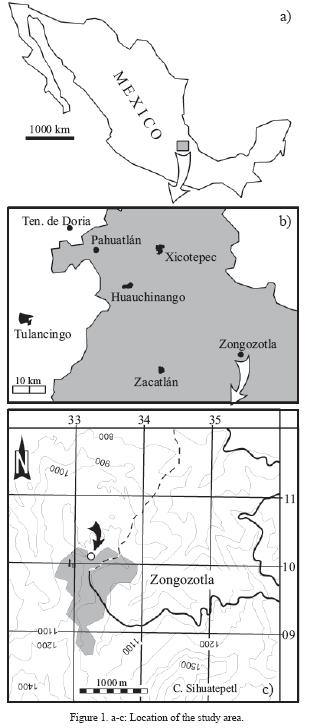
<body><![CDATA[<p align="justify"><font face="verdana" size="2">Se describen ammonites de una nueva localidad fosil&iacute;fera Li&aacute;sica marina (Jur&aacute;sico Inferior, Fm. Huayacocotla) ubicada en las cercan&iacute;as del Municipio de Zongozotla (Sur de la Sierra Madre Oriental) en la parte norte del Estado de Puebla (M&eacute;xico). Las capas fosil&iacute;feras tienen un espesor de 1 m y contienen ammonites y bivalvos. Los ammonites tienen una edad Sinemuriano Tard&iacute;o y representan un biohorizonte que puede ser correlacionado con el horizonte <u>Paltechioceras</u> gr. <u>burckhardti</u> previamente reportado para la regi&oacute;n de Tenango de Doria. Se describe la nueva especie <u>Ectocentrites hillebrandti</u> n. sp.</font></p>     <p align="justify"><font face="verdana" size="2"><b>Palabras clave:</b> Ammonites, <u>Ectocentrites hillebrandti</u> n. sp., Jur&aacute;sico Inferior, Sinemuriano Superior, Puebla, M&eacute;xico.</font></p>     <p align="justify"><font face="verdana" size="2">&nbsp;</font></p>     <p align="justify"><font face="verdana" size="2"><b>INTRODUCTION</b></font></p>     <p align="justify"><font face="verdana" size="2">During field work in 2006 one of us (R. S.&#150;E.) discovered a new site of fossil&#150;bearing Lower Liassic marine sediments in the vicinity of Zongozotla Municipality in the northern part of Puebla State (Mexico, <a href="#f1">Figure 1</a>). The geological map (1:50.000 Zacatl&aacute;n sheet, E13&#150;B14, Puebla, Servicio Geol&oacute;gico Mexicano, 1997) shows this area to be underlain by the Lower Jurassic Huayacocotla Formation. The locality was again sampled by R. S.&#150;E. in 2007. The collected ammonite fauna allows correlation with already proposed biostratigraphic schemes (Meister <i>et al., </i>2005, in press).</font></p>     <p align="center"><font face="verdana" size="2"><a name="f1" id="f1"></a></font></p>     <p align="center"><font face="verdana" size="2"><img src="/img/revistas/rmcg/v25n3/a3f1.jpg"></font></p>     <p align="justify"><font face="verdana" size="2">Liassic marine sediments crop out in the core&#150;zone of the Sierra Madre Oriental in the Huayacocotla Anticline <i>(e.g., </i>Schmidt&#150;Effing, 1976, 1977, 1980). They can be observed over a distance of about 200 km from the area of Tamazunchale (San Luis Potos&iacute;) in the NW to the Totolapa ravine in the vicinity of Huauchinango (Puebla, <a href="#f1">Figure 1b</a>) in the SE. Farther to the SE, the marine Liassic sediments either dip below younger Mesozoic formations or are covered by Tertiary volcanics. On the occasion of road construction for a hydroelectric power plant, Flores (1967) discovered marine Liassic in the area of Mazatepec in the vicinity of Tezuitl&aacute;n (Puebla). Presently, the latter outcrops are more or less inaccessible.</font></p>     <p align="justify"><font face="verdana" size="2">The newly found fossiliferous site at Zongozotla is part of the Huayacocotla Fm., forming the mountain ridge between 1000 and 1100 m in altitude directly to the north of the village (<a href="#f1">Figure 1c</a>). This ridge is the continuation of the ridge bearing the village itself with an altitude between 900 and 1000 m. The sampled beds crop out over a length of about 100 m along a road cut close to the northern end of Zongozotla on the eastern flank of the mountain ridge. Bedding is horizontal. The outcropping rocks are well bedded and consist of alternating very fine grained claystone and siltstone. Due to their surface position, the sediments are bleached pale by weathering. The thickness of the fossil bearing series is about 1 m. So far, only this locality in the vicinity of Zongozotla has produced Liassic ammonites.</font></p>     <p align="justify"><font face="verdana" size="2">On the northern flank of the mountain ridge, comparable beds crop out along stairs leading uphill 20 m. These beds are more intensely weathered than those of the road cut. According to information provided by inhabitants of the houses in the vicinity, the outcropping series should yield ammonites. Nevertheless, none was found during fieldwork. Additional outcrops especially on the summit of the mountain ridge have not been seen.</font></p>     ]]></body>
<body><![CDATA[<p align="justify"><font face="verdana" size="2">&nbsp;</font></p>     <p align="justify"><font face="verdana" size="2"><b>SAMPLE DEPOSITION</b></font></p>     <p align="justify"><font face="verdana" size="2">All figured specimens are presently held in the Mus&eacute;um d'Histoire Naturelle Gen&egrave;ve (D&eacute;partement de G&eacute;ologie et Pal&eacute;ontologie) and will be transferred to the National Paleontological Collection of the Museum of the Institute of Geology (IGM) at the UNAM. The IGM collection numbers are provided in the figure captions.</font></p>     <p align="justify"><font face="verdana" size="2">&nbsp;</font></p>     <p align="justify"><font face="verdana" size="2"><b>SYSTEMATIC PALAEONTOLOGY</b></font></p>     <p align="justify"><font face="verdana" size="2"><b>Remark. </b>All our material is crushed; therefore, our identifications are based on the lateral view of the shell.</font></p>     <p align="center"><font face="verdana" size="2">Order Psiloceratida Hou&scaron;a, 1965    <br> Superfamily Lytoceratoidea Neumayr, 1875    <br> Family Pleuroacanthitidae Hyatt, 1900    <br> (=Analytoceratidae Spath, 1927)    ]]></body>
<body><![CDATA[<br> Subfamily Ectocentritinae Spath, 1926    <br> Genus <i>Ectocentrites </i>Canavari, 1888</font></p>     <p align="justify"><font face="verdana" size="2"><b>Type species. </b><i>Ammonites petersi </i>Hauer, 1856</font></p>     <p align="center"><font face="verdana" size="2"><b><i>Ectocentrites hillebrandti </i>new species    <br> </b><a href="/img/revistas/rmcg/v25n3/a3f2.jpg" target="_blank">Figures 2a&#150;c</a>, <a href="/img/revistas/rmcg/v25n3/a3f3.jpg" target="_blank">3a&#150;f</a></font></p>     <p align="justify"><font face="verdana" size="2"><b>Diagnosis. </b>The species is charaterized by smooth inner whorls, an intermediate stage with ribs becoming strong and ending abruptly on the outer part of the flank, and a fine,densely ribbed stage on the outer whorls. Constrictions are not developed throughout ontogeny. </font></p>     <p align="justify"><font face="verdana" size="2"><b>Derivatio nominis. </b>In honour of Prof. Dr. Axel von Hillebrandt for his major ammonite studies in South America.</font></p>     <p align="justify"><font face="verdana" size="2"><b>Holotype. </b>Specimen IGM 6220 illustrated in Figures 2a&#150;b, 3f.</font></p>     <p align="justify"><font face="verdana" size="2"><b>Type locality and stratum typicum. </b>The ammonite horizon at Zongozotla village, Puebla, Mexico (<a href="#f1">Figure 1c</a>). </font></p>     <p align="justify"><font face="verdana" size="2"><b>Material. </b>10 specimens.</font></p>     ]]></body>
<body><![CDATA[<p align="justify"><font face="verdana" size="2"><b>Description. </b>Amongst our material, only the holotype shows the whole ontogeny of the species. All other specimens either are real juveniles or represent inner whorls. In none of our specimens the suture line is preserved.</font></p>     <p align="justify"><font face="verdana" size="2">The smooth initial stage prevails up to an umbilical width of about 10&#150;12 mm. The length of the intermediate strong ribbed stage as well as the fine, densely ribbed adult stage can be observed only in the holotype. Due to bad preservation <i>(cf. </i><a href="/img/revistas/rmcg/v25n3/a3f2.jpg" target="_blank">Figure 2a</a>) we cannot measure exactly at which whorl diameter the change in the two ribbing stages occurs. We estimate an umbilical width of approximately 25 mm.</font></p>     <p align="justify"><font face="verdana" size="2">The last but two and three preserved ribs of the specimen in <a href="/img/revistas/rmcg/v25n3/a3f3.jpg" target="_blank">Figure 3b</a> appear to end "tubercle&#150;like". We interpret this as a diagenetic artefact due to shell crushing. A similar preservation of the ribs can be seen at the beginning of the outermost quarter whorl of the specimen in <a href="/img/revistas/rmcg/v25n3/a3f3.jpg" target="_blank">Figure 3e</a>.</font></p>     <p align="justify"><font face="verdana" size="2"><b>Comparison. </b>The new species differs by its composite ontogeny from all other known small <i>Ectocentrites. E. dommerguesi </i>Meister, Khuc, Huyen and Doyle (2000) is finely and densely ribbed from a very early ontogenetic stage and shows constrictions. <i>E. leslei </i>(Taylor, Guex and Rakus, 2001) is the closest form but differs mainly by persistence of strong ribbing on the upper flanks of the outer whorls. The new species is a peramorphic form showing a short <i>&laquo;leslei&raquo; </i>ontogenetic stage and it develops a new ornamental character in the adult stage.</font></p>     <p align="justify"><font face="verdana" size="2"><b>Local occurrence. </b>The ammonite horizon at Zongozotla village, Puebla, Mexico (<a href="#f1">Figure 1c</a>). </font></p>     <p align="justify"><font face="verdana" size="2"><b>Age.</b> ?Raricostatum Subzone (middle/upper part). </font></p>     <p align="justify"><font face="verdana" size="2"><b>Geographical distribution. </b>The species is known only from Mexico.</font></p>     <p align="center"><font face="verdana" size="2">Superfamily Psiloceratoidea Hyatt, 1875    <br> Family Oxynoticeratidae Hyatt, 1875    <br> Genus <i>Gleviceras </i>Buckman, 1918</font></p>     ]]></body>
<body><![CDATA[<p align="justify"><font face="verdana" size="2"><b>Type species. </b><i>Glevicer as glevense </i>Buckman, 1918 by original definition.</font></p>     <p align="justify"><font face="verdana" size="2"><b>Remarks. </b>The distinction between <i>Gleviceras </i>and <i>Oxynoticeras </i>based on crushed material is very ambiguous. Although the ranges of the two genera are well known in the Euroboreal domain (Dommergues <i>et al., </i>1994), their ranges in the Pacific domain seem to be different based on associated ammonites. For example the association of <i>Gleviceras with Epophioceras, Asteroceras and Euerbenites </i>may indicate an earlier age there for <i>Gleviceras </i>(see Taylor <i>et al., </i>2001).</font></p>     <p align="center"><font face="verdana" size="2"><b><i>Gleviceras </i>aff. <i>palomense </i>(Erben, 1956)</b>    <br> <a href="/img/revistas/rmcg/v25n3/a3f3.jpg" target="_blank">Figure 3g&#150;i</a></font></p>     <p align="justify"><font face="verdana" size="2">aff. * <i>Oxynoticeras (Radstockiceras?) palomense </i>Erben, 1956, p. 349, pl. 37, figs. 2&#150;5. </font></p>     <p align="justify"><font face="verdana" size="2">aff. <i>Oxynoticeras palomense; </i>Meister, Blau, Schlatter and Schmidt&#150;Effing, 2002, p. 398, pl. 3, figs. 5, 8&#150;10. </font></p>     <p align="justify"><font face="verdana" size="2"><b>Description. </b>The three small specimens represent probably the inner whorls of <i>Gleviceras palomense </i>(Erben). The ribbing is dense and fine as in Erben's species. At this diameter the ribs are straight, slightly prorsiradiate and bend forward near the keel. </font></p>     <p align="justify"><font face="verdana" size="2"><b>Material. </b>4 specimens.</font></p>     <p align="justify"><font face="verdana" size="2"><b>Local occurrence. </b>The ammonite horizon at Zongozotla village, Puebla, Mexico (<a href="#f1">Figure 1c</a>). </font></p>     <p align="justify"><font face="verdana" size="2"><b>Age.</b> <i>Oxynoticeras palomense </i>Erben is known to be associated either with <i>Euerbenites </i>or with <i>Plesechioceras </i>from the Tenango de Doria area (<a href="#f1">Figure 1b</a>) (Meister <i>et al., </i>2000). In Zongozotla, the species is associated with <i>Paltechioceras. </i>Therefore it spans a period from the top of the Obtusum Zone up to the middle/upper part of the Raricostatum Zone.</font></p>     ]]></body>
<body><![CDATA[<p align="justify"><font face="verdana" size="2"><b>Geographical distribution. </b>The species is known only from Mexico.</font></p>     <p align="center"><font face="verdana" size="2">Family Echioceratidae Buckman, 1913     <br> Genus <i>Paltechioceras </i>Buckman, 1924</font></p>     <p align="justify"><font face="verdana" size="2"><b>Type species. </b><i>Paltechioceras elicitum </i>Buckman (1924) by original definition.</font></p>     <p align="center"><font face="verdana" size="2"><b><i>Paltechioceras mexicanum </i>(Erben, 1956)</b>    <br> <a href="/img/revistas/rmcg/v25n3/a3f3.jpg" target="_blank">Figure 3j&#150;n</a></font></p>     <p align="justify"><font face="verdana" size="2">* <i>Arnioceras ceratitoides </i>(Quenstedt) <i>mexicanum </i>Erben,1956, p. 254, pl. 29, fig. 3 (holotype). </font></p>     <p align="justify"><font face="verdana" size="2"><b>Description. </b>Five specimens represent inner whorls which are characterized by straight and radial ribs and a relatively narrow umbilicus. The coiling and rib pattern fit well with that of the holotype. Two fragmentary specimens represent the outer whorls with quite strong and more widely spaced ribs, becoming smooth near the outer part. </font></p>     <p align="justify"><font face="verdana" size="2"><b>Material. </b>7 specimens.</font></p>     <p align="justify"><font face="verdana" size="2"><b>Comparison.</b> In comparison to <i>P. </i>aff. <i>mexicanum </i>(Erben) <i>in </i>Blau <i>et al. </i>(2003, pl. 4, fig. 9) from the area of Tenango de Doria, the shell morphology is less evolute.</font></p>     ]]></body>
<body><![CDATA[<p align="justify"><font face="verdana" size="2"><b>Local occurrence. </b>The ammonite horizon at Zongozotla village, Puebla, Mexico (<a href="#f1">Figure 1c</a>).</font></p>     <p align="justify"><font face="verdana" size="2"><b>Age.</b> ?Raricostatum Subzone (middle/upper part).</font></p>     <p align="justify"><font face="verdana" size="2"><b>Geographical distribution. </b>The species is known only from Mexico.</font></p>     <p align="center"><font face="verdana" size="2"><b><i>Paltechioceras </i>gr. <i>burckhardti </i>(Erben, 1956)</b>    <br> <a href="/img/revistas/rmcg/v25n3/a3f3.jpg" target="_blank">Figure 3o&#150;q</a></font></p>     <p align="justify"><font face="verdana" size="2">* <i>Echioceras (Echioceras) burckhardti </i>Erben, 1956, p. 295, pl. 39, fig. 2. </font></p>     <p align="justify"><font face="verdana" size="2"><i>Paltechioceras </i>gr. <i>burckhardti; </i>Meister, Blau, Dommergues, Schlatter, Schmidt&#150;Effing and Burk, 2005, p. 376, pl.3, figs. 2&#150;4, 6, 11, 12. (with synonymy). </font></p>     <p align="justify"><font face="verdana" size="2"><b>Description. </b>Our 3 specimens are characterized by quite strong ribs already on the innermost whorls. The specimens correspond well to the concept of <i>P. burckhardti </i>(Erben) as presented by Meister <i>et al. </i>(2005). According to these authors, the inner whorls of this small species show a great variability in rib density and rib strength while the outer whorls bear coarser and more widely spaced ribs. This concept comprises 11 species of Erben (1956) from the <i>&laquo;Echioceras burckhardti </i>unit&raquo; <i>sensu </i>Erben, including <i>P. burckhardti </i>(Erben). The three specimens from Zongozotla are close to the morphology of <i>&laquo;Echioceras (Echioceras) angustisulcatum </i>Erben&raquo;. </font></p>     <p align="justify"><font face="verdana" size="2"><b>Material. </b>3 specimens.</font></p>     <p align="justify"><font face="verdana" size="2"><b>Local occurrence. </b>The ammonite horizon at Zongozotla village, Puebla, Mexico (<a href="#f1">Figure 1c</a>). </font></p>     ]]></body>
<body><![CDATA[<p align="justify"><font face="verdana" size="2"><b>Age.</b> ?Raricostatum Subzone (middle/upper part). </font></p>     <p align="justify"><font face="verdana" size="2"><b>Geographical distribution. </b>The species is known only from Mexico.</font></p>     <p align="justify"><font face="verdana" size="2">&nbsp;</font></p>     <p align="justify"><font face="verdana" size="2"><b>BIOSTRATIGRAPHY</b></font></p>     <p align="justify"><font face="verdana" size="2">For the fi rst time, Early Jurassic ammonites are reported from the Zongozotla area in Mexico. The spatially nearest comparable Liassic fossiliferous sites are known from the NE (Totolapa gorge near Huauchinango, <a href="#f1">Figure 1b</a>), and from Mazatepec (Flores, 1967) in the NNE.</font></p>     <p align="justify"><font face="verdana" size="2">The association of <i>P. mexicanum, P. burckhardti, G. </i>aff. <i>palomense </i>and <i>E. hillebrandti </i>can be easily correlated with the <i>P. </i>gr. <i>burckhardti </i>horizon described from the Tenango de Doria area (Meister <i>et al., </i>2005; in press). This horizon probably indicates the middle/upper Raricostatum Subzone (Raricostatum zone).</font></p>     <p align="justify"><font face="verdana" size="2">&nbsp;</font></p>     <p align="justify"><font face="verdana" size="2"><b>CONCLUSIONS</b></font></p>     <p align="justify"><font face="verdana" size="2">The new ammonite findings from the Huayacocotla Fm. show that field work can reveal additional information on the Lower Liassic ammonite biostratigraphy of Mexico. The already published ammonite zonations (Erben, 1956; Meister <i>et al., </i>2005, in press) are based mainly on dispersed outcrops and therefore are synthetic. The search of new and continuous sections in not yet extensively investigated areas may expand our knowledge of Mexican Lower Liassic ammonite successions. The Mexican (Sierra Madre Oriental) Lower Jurassic probably is a key area connecting the North American (partly terrane bounded) and South American Early Jurassic ammonite &laquo;provinces&raquo;.</font></p>     <p align="justify"><font face="verdana" size="2">&nbsp;</font></p>     ]]></body>
<body><![CDATA[<p align="justify"><font face="verdana" size="2"><b>ACKNOWLEDGEMENTS</b></font></p>     <p align="justify"><font face="verdana" size="2">The present paper benefits from the critical reviews of Dr. Russel Hall (University of Calgary, Canada) and of Prof. Dr. Axel von Hillebrandt (Technical University of Berlin, Germany). R. Hall additionally improved our English. We cordially thank both reviewers.</font></p>     <p align="justify"><font face="verdana" size="2">&nbsp;</font></p>     <p align="justify"><font face="verdana" size="2"><b>REFERENCES</b></font></p>     <!-- ref --><p align="justify"><font face="verdana" size="2">Blau, J., Meister, C., Schlatter, R., Schmidt&#150;Effing, R., 2003, Ammonites from the Lower Jurassic (Sinemurian) of Tenango de Doria (Sierra Madre Oriental, Mexico). Part III: Echioceratidae: Revue de Pal&eacute;obiologie, 22(1), 421&#150;437.</font>&nbsp;&nbsp;&nbsp;&nbsp;&nbsp;&nbsp;&nbsp;&nbsp;[&#160;<a href="javascript:void(0);" onclick="javascript: window.open('/scielo.php?script=sci_nlinks&ref=8029202&pid=S1026-8774200800030000300001&lng=','','width=640,height=500,resizable=yes,scrollbars=1,menubar=yes,');">Links</a>&#160;]<!-- end-ref --><!-- ref --><p align="justify"><font face="verdana" size="2">Buckman, S.S., 1909&#150;1930, Yorkshire Type Ammonites, v. 3 Type Ammonites, parts 1&#150;7: London, Weldon and Wesley, 709 pls.</font>&nbsp;&nbsp;&nbsp;&nbsp;&nbsp;&nbsp;&nbsp;&nbsp;[&#160;<a href="javascript:void(0);" onclick="javascript: window.open('/scielo.php?script=sci_nlinks&ref=8029203&pid=S1026-8774200800030000300002&lng=','','width=640,height=500,resizable=yes,scrollbars=1,menubar=yes,');">Links</a>&#160;]<!-- end-ref --><!-- ref --><p align="justify"><font face="verdana" size="2">Canavari, M., 1888, Contribuzione alla fauna de Lias inferiore di Spezia: Memorie Regio Comitato Geologico Italiano, 3, 57&#150;227.</font>&nbsp;&nbsp;&nbsp;&nbsp;&nbsp;&nbsp;&nbsp;&nbsp;[&#160;<a href="javascript:void(0);" onclick="javascript: window.open('/scielo.php?script=sci_nlinks&ref=8029204&pid=S1026-8774200800030000300003&lng=','','width=640,height=500,resizable=yes,scrollbars=1,menubar=yes,');">Links</a>&#160;]<!-- end-ref --><!-- ref --><p align="justify"><font face="verdana" size="2">Dommergues, J.&#150;L., Page, K.N., Meister, C., 1994, A detailed correlation of Upper Sinemurian (Lower Jurassic) ammonite biohorizons between Burgundy (France) and Britain: Newsletters on Stratigraphy, 30(2), 61&#150;73.</font>&nbsp;&nbsp;&nbsp;&nbsp;&nbsp;&nbsp;&nbsp;&nbsp;[&#160;<a href="javascript:void(0);" onclick="javascript: window.open('/scielo.php?script=sci_nlinks&ref=8029205&pid=S1026-8774200800030000300004&lng=','','width=640,height=500,resizable=yes,scrollbars=1,menubar=yes,');">Links</a>&#160;]<!-- end-ref --><!-- ref --><p align="justify"><font face="verdana" size="2">Erben, H.K., 1956, El Jur&aacute;sico Inferior de M&eacute;xico y sus Amonitas, <i>in </i>20. Congreso Geol&oacute;gico International: M&eacute;xico, D. F., Universidad Nacional Aut&oacute;noma de M&eacute;xico, Instituto de Geolog&iacute;a, xii + 393 p.</font>&nbsp;&nbsp;&nbsp;&nbsp;&nbsp;&nbsp;&nbsp;&nbsp;[&#160;<a href="javascript:void(0);" onclick="javascript: window.open('/scielo.php?script=sci_nlinks&ref=8029206&pid=S1026-8774200800030000300005&lng=','','width=640,height=500,resizable=yes,scrollbars=1,menubar=yes,');">Links</a>&#160;]<!-- end-ref --><!-- ref --><p align="justify"><font face="verdana" size="2">Flores&#150;L&oacute;pez, R., 1967, La fauna Li&aacute;sica de Mazatepec, Puebla: Instituto M&eacute;xicano del Petr&oacute;leo, Secci&oacute;n Geolog&iacute;a, Monograf&iacute;a, 1, 25&#150;30.</font>&nbsp;&nbsp;&nbsp;&nbsp;&nbsp;&nbsp;&nbsp;&nbsp;[&#160;<a href="javascript:void(0);" onclick="javascript: window.open('/scielo.php?script=sci_nlinks&ref=8029207&pid=S1026-8774200800030000300006&lng=','','width=640,height=500,resizable=yes,scrollbars=1,menubar=yes,');">Links</a>&#160;]<!-- end-ref --><!-- ref --><p align="justify"><font face="verdana" size="2">Hauer, F. von, 1856, &Uuml;ber die Cephalopoden aus dem Lias der nord&ouml;stlichen Alpen: Denkschriften der Akademie der Wissenschaften Wien, mathematisch&#150;naturwissenschaftliche Classe, 11, 1&#150;86.</font>&nbsp;&nbsp;&nbsp;&nbsp;&nbsp;&nbsp;&nbsp;&nbsp;[&#160;<a href="javascript:void(0);" onclick="javascript: window.open('/scielo.php?script=sci_nlinks&ref=8029208&pid=S1026-8774200800030000300007&lng=','','width=640,height=500,resizable=yes,scrollbars=1,menubar=yes,');">Links</a>&#160;]<!-- end-ref --><!-- ref --><p align="justify"><font face="verdana" size="2">Housa, V., 1965, Sexual dimorphism and the system of Jurassic and Cretaceous Ammonoidea (prelimanary note): Casopis n&aacute;rodniho muzea, 134(7), 33&#150;35.</font>&nbsp;&nbsp;&nbsp;&nbsp;&nbsp;&nbsp;&nbsp;&nbsp;[&#160;<a href="javascript:void(0);" onclick="javascript: window.open('/scielo.php?script=sci_nlinks&ref=8029209&pid=S1026-8774200800030000300008&lng=','','width=640,height=500,resizable=yes,scrollbars=1,menubar=yes,');">Links</a>&#160;]<!-- end-ref --><!-- ref --><p align="justify"><font face="verdana" size="2">Hyatt, A., 1875, Remarks on two new genera of Ammonites: <i>Agassiceras </i>and <i>Oxynoticeras: </i>Boston Society of Natural History, Proceedings, 17, 225&#150;235.</font>&nbsp;&nbsp;&nbsp;&nbsp;&nbsp;&nbsp;&nbsp;&nbsp;[&#160;<a href="javascript:void(0);" onclick="javascript: window.open('/scielo.php?script=sci_nlinks&ref=8029210&pid=S1026-8774200800030000300009&lng=','','width=640,height=500,resizable=yes,scrollbars=1,menubar=yes,');">Links</a>&#160;]<!-- end-ref --><!-- ref --><p align="justify"><font face="verdana" size="2">Hyatt, A., 1900, Cephalopoda, <i>in </i>Zittel, K.A. von (ed.), Textbook of Palaeontology: London, Macmillan, 1<sup>st</sup> English edition, 502&#150;604.</font>&nbsp;&nbsp;&nbsp;&nbsp;&nbsp;&nbsp;&nbsp;&nbsp;[&#160;<a href="javascript:void(0);" onclick="javascript: window.open('/scielo.php?script=sci_nlinks&ref=8029211&pid=S1026-8774200800030000300010&lng=','','width=640,height=500,resizable=yes,scrollbars=1,menubar=yes,');">Links</a>&#160;]<!-- end-ref --><!-- ref --><p align="justify"><font face="verdana" size="2">Meister, C., Khuc, V., Huyen, D.T., Doyle, P., 2000, Les ammonites et les b&eacute;lemnites du Jurassique inf&eacute;rieur de Huu Ni&acirc;n, province de Quang Nam, Vi&acirc;t Nam Central: G&eacute;obios, 33(1), 79&#150;96.</font>&nbsp;&nbsp;&nbsp;&nbsp;&nbsp;&nbsp;&nbsp;&nbsp;[&#160;<a href="javascript:void(0);" onclick="javascript: window.open('/scielo.php?script=sci_nlinks&ref=8029212&pid=S1026-8774200800030000300011&lng=','','width=640,height=500,resizable=yes,scrollbars=1,menubar=yes,');">Links</a>&#160;]<!-- end-ref --><!-- ref --><p align="justify"><font face="verdana" size="2">Meister, C., Blau, J., Schlatter, R., Schmidt&#150;Effing, R., 2002, Ammonites from the Lower Jurassic (Sinemurian) of Tenango de Doria (Sierra Madre Oriental, Mexico). Part II: Phylloceratoidea, Lytoceratoidea, Schlotheimiidae, Arietitinae, Oxynoticeratidae, and Eoderoceratidae: Revue de Pal&eacute;obiologie, 21(1), 391&#150;409.</font>&nbsp;&nbsp;&nbsp;&nbsp;&nbsp;&nbsp;&nbsp;&nbsp;[&#160;<a href="javascript:void(0);" onclick="javascript: window.open('/scielo.php?script=sci_nlinks&ref=8029213&pid=S1026-8774200800030000300012&lng=','','width=640,height=500,resizable=yes,scrollbars=1,menubar=yes,');">Links</a>&#160;]<!-- end-ref --><!-- ref --><p align="justify"><font face="verdana" size="2">Meister, C., Blau, J., Dommergues, J.&#150;L., Schlatter, R., Schmidt&#150;Effing, R., Burk, K., 2005, Ammonites from the Lower Jurassic (Sinemurian) of Tenango de Doria (Sierra Madre Oriental, Mexico). Part IV: Biostratigraphy, Palaeobiogeography and taxonomic addendum: Revue de Pal&eacute;obiologie, 24(1), 365&#150;384. </font>&nbsp;&nbsp;&nbsp;&nbsp;&nbsp;&nbsp;&nbsp;&nbsp;[&#160;<a href="javascript:void(0);" onclick="javascript: window.open('/scielo.php?script=sci_nlinks&ref=8029214&pid=S1026-8774200800030000300013&lng=','','width=640,height=500,resizable=yes,scrollbars=1,menubar=yes,');">Links</a>&#160;]<!-- end-ref --><!-- ref --><p align="justify"><font face="verdana" size="2">Meister, C., Blau, J., Dommergues, J.&#150;L., Schlatter, R., Schmidt&#150;Effing, R., in press, Upper Sinemurian ammonite succession from the Sierra Madre Oriental (Mexico): Volumina Jurassica (Tomy Jurajskie). </font>&nbsp;&nbsp;&nbsp;&nbsp;&nbsp;&nbsp;&nbsp;&nbsp;[&#160;<a href="javascript:void(0);" onclick="javascript: window.open('/scielo.php?script=sci_nlinks&ref=8029215&pid=S1026-8774200800030000300014&lng=','','width=640,height=500,resizable=yes,scrollbars=1,menubar=yes,');">Links</a>&#160;]<!-- end-ref --><!-- ref --><p align="justify"><font face="verdana" size="2">Neumayr, M., 1875, Die Ammonitiden der Kreide und die Systematik der Ammonitiden: Zeitschrift der Deutschen Geologischen Gesellschaft, 27(4), 854&#150;942. </font>&nbsp;&nbsp;&nbsp;&nbsp;&nbsp;&nbsp;&nbsp;&nbsp;[&#160;<a href="javascript:void(0);" onclick="javascript: window.open('/scielo.php?script=sci_nlinks&ref=8029216&pid=S1026-8774200800030000300015&lng=','','width=640,height=500,resizable=yes,scrollbars=1,menubar=yes,');">Links</a>&#160;]<!-- end-ref --><!-- ref --><p align="justify"><font face="verdana" size="2">Schmidt&#150;Effing, R., 1976, Daten zur Entstehungsgeschichte von Golf, Karibik und Atlantik im Mesozoikum: M&uuml;nstersche Forschungen zur Geologie und Pal&auml;ontologie, 38/39, 201&#150;217. </font>&nbsp;&nbsp;&nbsp;&nbsp;&nbsp;&nbsp;&nbsp;&nbsp;[&#160;<a href="javascript:void(0);" onclick="javascript: window.open('/scielo.php?script=sci_nlinks&ref=8029217&pid=S1026-8774200800030000300016&lng=','','width=640,height=500,resizable=yes,scrollbars=1,menubar=yes,');">Links</a>&#160;]<!-- end-ref --><!-- ref --><p align="justify"><font face="verdana" size="2">Schmidt&#150;Effing, R., 1977, Der marine Unterjura Mexikos und seine Beziehung zur Entstehung des Golfes von Mexiko: Nachrichten der Deutschen Geologischen Gesellschaft, 17, 59&#150;62. </font>&nbsp;&nbsp;&nbsp;&nbsp;&nbsp;&nbsp;&nbsp;&nbsp;[&#160;<a href="javascript:void(0);" onclick="javascript: window.open('/scielo.php?script=sci_nlinks&ref=8029218&pid=S1026-8774200800030000300017&lng=','','width=640,height=500,resizable=yes,scrollbars=1,menubar=yes,');">Links</a>&#160;]<!-- end-ref --><!-- ref --><p align="justify"><font face="verdana" size="2">Schmidt&#150;Effing, R., 1980, The Huayacocotla aulacogen in Mexico (Lower Jurassic) and the origin of the Gulf of Mexico, <i>in </i>Pilger, R.H. (ed.), The origin of the Gulf of Mexico and the early opening of the central North Atlantic Ocean: Baton Rouge, Louisiana State University, 79&#150;86.</font>&nbsp;&nbsp;&nbsp;&nbsp;&nbsp;&nbsp;&nbsp;&nbsp;[&#160;<a href="javascript:void(0);" onclick="javascript: window.open('/scielo.php?script=sci_nlinks&ref=8029219&pid=S1026-8774200800030000300018&lng=','','width=640,height=500,resizable=yes,scrollbars=1,menubar=yes,');">Links</a>&#160;]<!-- end-ref --><!-- ref --><p align="justify"><font face="verdana" size="2">Spath, L.F., 1926, Notes on Yorkshire ammonites: Naturalist, 1926, pp. 45&#150;49, 137&#150;140, 169&#150;171, 201&#150;206, 265&#150;268. </font>&nbsp;&nbsp;&nbsp;&nbsp;&nbsp;&nbsp;&nbsp;&nbsp;[&#160;<a href="javascript:void(0);" onclick="javascript: window.open('/scielo.php?script=sci_nlinks&ref=8029220&pid=S1026-8774200800030000300019&lng=','','width=640,height=500,resizable=yes,scrollbars=1,menubar=yes,');">Links</a>&#160;]<!-- end-ref --><!-- ref --><p align="justify"><font face="verdana" size="2">Spath, L.F., 1927&#150;1933, Revision of the Jurassic cephalopod faunas of Kachh (India): Palaeontographica Indica, 9/2, part 1, 1&#150;945. </font>&nbsp;&nbsp;&nbsp;&nbsp;&nbsp;&nbsp;&nbsp;&nbsp;[&#160;<a href="javascript:void(0);" onclick="javascript: window.open('/scielo.php?script=sci_nlinks&ref=8029221&pid=S1026-8774200800030000300020&lng=','','width=640,height=500,resizable=yes,scrollbars=1,menubar=yes,');">Links</a>&#160;]<!-- end-ref --><!-- ref --><p align="justify"><font face="verdana" size="2">Servicio Geol&oacute;gico Mexicano, 1997, Geological map 1:50,000, Zacatl&aacute;n sheet, E13&#150;B14, Puebla: Pachuca, Hgo., Mexico, Servicio Geol&oacute;gico Mexicano, 1 map. </font>&nbsp;&nbsp;&nbsp;&nbsp;&nbsp;&nbsp;&nbsp;&nbsp;[&#160;<a href="javascript:void(0);" onclick="javascript: window.open('/scielo.php?script=sci_nlinks&ref=8029222&pid=S1026-8774200800030000300021&lng=','','width=640,height=500,resizable=yes,scrollbars=1,menubar=yes,');">Links</a>&#160;]<!-- end-ref --><!-- ref --><p align="justify"><font face="verdana" size="2">Taylor, D.G., Guex, J., Rak&uacute;s, M., 2001, Hettangian and Sinemurian ammonoid zonation for the Western Cordillera of North America: Bulletin de la Soci&eacute;t&eacute; Vaudoise des Sciences Naturelles, 87(4), 381&#150;405.</font>&nbsp;&nbsp;&nbsp;&nbsp;&nbsp;&nbsp;&nbsp;&nbsp;[&#160;<a href="javascript:void(0);" onclick="javascript: window.open('/scielo.php?script=sci_nlinks&ref=8029223&pid=S1026-8774200800030000300022&lng=','','width=640,height=500,resizable=yes,scrollbars=1,menubar=yes,');">Links</a>&#160;]<!-- end-ref --> ]]></body><back>
<ref-list>
<ref id="B1">
<nlm-citation citation-type="journal">
<person-group person-group-type="author">
<name>
<surname><![CDATA[Blau]]></surname>
<given-names><![CDATA[J]]></given-names>
</name>
<name>
<surname><![CDATA[Meister]]></surname>
<given-names><![CDATA[C]]></given-names>
</name>
<name>
<surname><![CDATA[Schlatter]]></surname>
<given-names><![CDATA[R]]></given-names>
</name>
<name>
<surname><![CDATA[Schmidt-Effing]]></surname>
<given-names><![CDATA[R]]></given-names>
</name>
</person-group>
<article-title xml:lang="en"><![CDATA[Ammonites from the Lower Jurassic (Sinemurian) of Tenango de Doria (Sierra Madre Oriental, Mexico): Part III: Echioceratidae]]></article-title>
<source><![CDATA[Revue de Paléobiologie]]></source>
<year>2003</year>
<volume>22</volume>
<numero>1</numero>
<issue>1</issue>
<page-range>421-437</page-range></nlm-citation>
</ref>
<ref id="B2">
<nlm-citation citation-type="book">
<person-group person-group-type="author">
<name>
<surname><![CDATA[Buckman]]></surname>
<given-names><![CDATA[S.S.]]></given-names>
</name>
</person-group>
<source><![CDATA[Yorkshire Type Ammonites: v. 3 Type Ammonites, parts 1-7]]></source>
<year>1909</year>
<month>-1</month>
<day>93</day>
<publisher-loc><![CDATA[^eLondon London]]></publisher-loc>
<publisher-name><![CDATA[Weldon and Wesley]]></publisher-name>
</nlm-citation>
</ref>
<ref id="B3">
<nlm-citation citation-type="journal">
<person-group person-group-type="author">
<name>
<surname><![CDATA[Canavari]]></surname>
<given-names><![CDATA[M]]></given-names>
</name>
</person-group>
<article-title xml:lang="it"><![CDATA[Contribuzione alla fauna de Lias inferiore di Spezia]]></article-title>
<source><![CDATA[Memorie Regio Comitato Geologico Italiano]]></source>
<year>1888</year>
<volume>3</volume>
<page-range>57-227</page-range></nlm-citation>
</ref>
<ref id="B4">
<nlm-citation citation-type="journal">
<person-group person-group-type="author">
<name>
<surname><![CDATA[Dommergues]]></surname>
<given-names><![CDATA[J.-L]]></given-names>
</name>
<name>
<surname><![CDATA[Page]]></surname>
<given-names><![CDATA[K.N]]></given-names>
</name>
<name>
<surname><![CDATA[Meister]]></surname>
<given-names><![CDATA[C]]></given-names>
</name>
</person-group>
<article-title xml:lang="en"><![CDATA[A detailed correlation of Upper Sinemurian (Lower Jurassic) ammonite biohorizons between Burgundy (France) and Britain]]></article-title>
<source><![CDATA[Newsletters on Stratigraphy]]></source>
<year>1994</year>
<volume>30</volume>
<numero>2</numero>
<issue>2</issue>
<page-range>61-73</page-range></nlm-citation>
</ref>
<ref id="B5">
<nlm-citation citation-type="confpro">
<person-group person-group-type="author">
<name>
<surname><![CDATA[Erben]]></surname>
<given-names><![CDATA[H.K.]]></given-names>
</name>
</person-group>
<article-title xml:lang="es"><![CDATA[El Jurásico Inferior de México y sus Amonitas]]></article-title>
<source><![CDATA[]]></source>
<year>1956</year>
<conf-name><![CDATA[20 Congreso Geológico International]]></conf-name>
<conf-loc>D. F. D. F.</conf-loc>
<page-range>xii + 393 p</page-range></nlm-citation>
</ref>
<ref id="B6">
<nlm-citation citation-type="book">
<person-group person-group-type="author">
<name>
<surname><![CDATA[Flores-López]]></surname>
<given-names><![CDATA[R]]></given-names>
</name>
</person-group>
<source><![CDATA[La fauna Liásica de Mazatepec, Puebla]]></source>
<year>1967</year>
<volume>1</volume>
<page-range>25-30</page-range><publisher-name><![CDATA[Instituto Méxicano del Petróleo, Sección Geología]]></publisher-name>
</nlm-citation>
</ref>
<ref id="B7">
<nlm-citation citation-type="book">
<person-group person-group-type="author">
<name>
<surname><![CDATA[Hauer]]></surname>
<given-names><![CDATA[F]]></given-names>
</name>
</person-group>
<source><![CDATA[Über die Cephalopoden aus dem Lias der nordöstlichen Alpen]]></source>
<year>1856</year>
<volume>11</volume>
<page-range>1-86</page-range><publisher-name><![CDATA[Denkschriften der Akademie der Wissenschaften Wien]]></publisher-name>
</nlm-citation>
</ref>
<ref id="B8">
<nlm-citation citation-type="journal">
<person-group person-group-type="author">
<name>
<surname><![CDATA[Housa]]></surname>
<given-names><![CDATA[V]]></given-names>
</name>
</person-group>
<article-title xml:lang="en"><![CDATA[Sexual dimorphism and the system of Jurassic and Cretaceous Ammonoidea (prelimanary note)]]></article-title>
<source><![CDATA[Casopis národniho muzea]]></source>
<year>1965</year>
<volume>134</volume>
<numero>7</numero>
<issue>7</issue>
<page-range>33-35</page-range></nlm-citation>
</ref>
<ref id="B9">
<nlm-citation citation-type="journal">
<person-group person-group-type="author">
<name>
<surname><![CDATA[Hyatt]]></surname>
<given-names><![CDATA[A]]></given-names>
</name>
</person-group>
<article-title xml:lang="en"><![CDATA[Remarks on two new genera of Ammonites: Agassiceras and Oxynoticeras]]></article-title>
<source><![CDATA[Boston Society of Natural History, Proceedings]]></source>
<year>1875</year>
<volume>17</volume>
<page-range>225-235</page-range></nlm-citation>
</ref>
<ref id="B10">
<nlm-citation citation-type="book">
<person-group person-group-type="author">
<name>
<surname><![CDATA[Hyatt]]></surname>
<given-names><![CDATA[A]]></given-names>
</name>
</person-group>
<article-title xml:lang="en"><![CDATA[Cephalopoda]]></article-title>
<person-group person-group-type="editor">
<name>
<surname><![CDATA[Zittel]]></surname>
<given-names><![CDATA[K.A. von]]></given-names>
</name>
</person-group>
<source><![CDATA[Textbook of Palaeontology]]></source>
<year>1900</year>
<edition>1</edition>
<page-range>502-604</page-range><publisher-loc><![CDATA[London ]]></publisher-loc>
<publisher-name><![CDATA[Macmillan]]></publisher-name>
</nlm-citation>
</ref>
<ref id="B11">
<nlm-citation citation-type="journal">
<person-group person-group-type="author">
<name>
<surname><![CDATA[Meister]]></surname>
<given-names><![CDATA[C]]></given-names>
</name>
<name>
<surname><![CDATA[Khuc]]></surname>
<given-names><![CDATA[V]]></given-names>
</name>
<name>
<surname><![CDATA[Huyen]]></surname>
<given-names><![CDATA[D.T]]></given-names>
</name>
<name>
<surname><![CDATA[Doyle]]></surname>
<given-names><![CDATA[P]]></given-names>
</name>
</person-group>
<article-title xml:lang="fr"><![CDATA[Les ammonites et les bélemnites du Jurassique inférieur de Huu Niân, province de Quang Nam, Viât Nam Central]]></article-title>
<source><![CDATA[Géobios]]></source>
<year>2000</year>
<volume>33</volume>
<numero>1</numero>
<issue>1</issue>
<page-range>79-96</page-range></nlm-citation>
</ref>
<ref id="B12">
<nlm-citation citation-type="journal">
<person-group person-group-type="author">
<name>
<surname><![CDATA[Meister]]></surname>
<given-names><![CDATA[C]]></given-names>
</name>
<name>
<surname><![CDATA[Blau]]></surname>
<given-names><![CDATA[J]]></given-names>
</name>
<name>
<surname><![CDATA[Schlatter]]></surname>
<given-names><![CDATA[R]]></given-names>
</name>
<name>
<surname><![CDATA[Schmidt-Effing]]></surname>
<given-names><![CDATA[R]]></given-names>
</name>
</person-group>
<article-title xml:lang="en"><![CDATA[Ammonites from the Lower Jurassic (Sinemurian) of Tenango de Doria (Sierra Madre Oriental, Mexico): Part II: Phylloceratoidea, Lytoceratoidea, Schlotheimiidae, Arietitinae, Oxynoticeratidae, and Eoderoceratidae]]></article-title>
<source><![CDATA[Revue de Paléobiologie]]></source>
<year>2002</year>
<volume>21</volume>
<numero>1</numero>
<issue>1</issue>
<page-range>391-409</page-range></nlm-citation>
</ref>
<ref id="B13">
<nlm-citation citation-type="journal">
<person-group person-group-type="author">
<name>
<surname><![CDATA[Meister]]></surname>
<given-names><![CDATA[C]]></given-names>
</name>
<name>
<surname><![CDATA[Blau]]></surname>
<given-names><![CDATA[J]]></given-names>
</name>
<name>
<surname><![CDATA[Dommergues]]></surname>
<given-names><![CDATA[J.-L.]]></given-names>
</name>
<name>
<surname><![CDATA[Schlatter]]></surname>
<given-names><![CDATA[R]]></given-names>
</name>
<name>
<surname><![CDATA[Schmidt-Effing]]></surname>
<given-names><![CDATA[R]]></given-names>
</name>
<name>
<surname><![CDATA[Burk]]></surname>
<given-names><![CDATA[K]]></given-names>
</name>
</person-group>
<article-title xml:lang="en"><![CDATA[Ammonites from the Lower Jurassic (Sinemurian) of Tenango de Doria (Sierra Madre Oriental, Mexico): Part IV: Biostratigraphy, Palaeobiogeography and taxonomic addendum]]></article-title>
<source><![CDATA[Revue de Paléobiologie]]></source>
<year>2005</year>
<volume>24</volume>
<numero>1</numero>
<issue>1</issue>
<page-range>365-384</page-range></nlm-citation>
</ref>
<ref id="B14">
<nlm-citation citation-type="">
<person-group person-group-type="author">
<name>
<surname><![CDATA[Meister]]></surname>
<given-names><![CDATA[C]]></given-names>
</name>
<name>
<surname><![CDATA[Blau]]></surname>
</name>
<name>
<surname><![CDATA[Dommergues]]></surname>
<given-names><![CDATA[J.-L.]]></given-names>
</name>
<name>
<surname><![CDATA[Schlatter]]></surname>
<given-names><![CDATA[R]]></given-names>
</name>
<name>
<surname><![CDATA[Schmidt-Effing]]></surname>
<given-names><![CDATA[R]]></given-names>
</name>
</person-group>
<source><![CDATA[Upper Sinemurian ammonite succession from the Sierra Madre Oriental (Mexico)]]></source>
<year></year>
</nlm-citation>
</ref>
<ref id="B15">
<nlm-citation citation-type="journal">
<person-group person-group-type="author">
<name>
<surname><![CDATA[Neumayr]]></surname>
<given-names><![CDATA[M]]></given-names>
</name>
</person-group>
<article-title xml:lang="de"><![CDATA[Die Ammonitiden der Kreide und die Systematik der Ammonitiden]]></article-title>
<source><![CDATA[Zeitschrift der Deutschen Geologischen Gesellschaft]]></source>
<year>1875</year>
<volume>27</volume>
<numero>4</numero>
<issue>4</issue>
<page-range>854-942</page-range></nlm-citation>
</ref>
<ref id="B16">
<nlm-citation citation-type="journal">
<person-group person-group-type="author">
<name>
<surname><![CDATA[Schmidt-Effing]]></surname>
<given-names><![CDATA[R]]></given-names>
</name>
</person-group>
<article-title xml:lang="de"><![CDATA[Daten zur Entstehungsgeschichte von Golf, Karibik und Atlantik im Mesozoikum]]></article-title>
<source><![CDATA[Münstersche Forschungen zur Geologie und Paläontologie]]></source>
<year>1976</year>
<volume>38/39</volume>
<page-range>201-217</page-range></nlm-citation>
</ref>
<ref id="B17">
<nlm-citation citation-type="journal">
<person-group person-group-type="author">
<name>
<surname><![CDATA[Schmidt-Effing]]></surname>
<given-names><![CDATA[R]]></given-names>
</name>
</person-group>
<article-title xml:lang="de"><![CDATA[Der marine Unterjura Mexikos und seine Beziehung zur Entstehung des Golfes von Mexiko]]></article-title>
<source><![CDATA[Nachrichten der Deutschen Geologischen Gesellschaft]]></source>
<year>1977</year>
<volume>17</volume>
<page-range>59-62</page-range></nlm-citation>
</ref>
<ref id="B18">
<nlm-citation citation-type="book">
<person-group person-group-type="author">
<name>
<surname><![CDATA[Schmidt-Effing]]></surname>
<given-names><![CDATA[R]]></given-names>
</name>
</person-group>
<article-title xml:lang="en"><![CDATA[The Huayacocotla aulacogen in Mexico (Lower Jurassic) and the origin of the Gulf of Mexico]]></article-title>
<person-group person-group-type="editor">
<name>
<surname><![CDATA[Pilger]]></surname>
<given-names><![CDATA[R.H.]]></given-names>
</name>
</person-group>
<source><![CDATA[The origin of the Gulf of Mexico and the early opening of the central North Atlantic Ocean]]></source>
<year>1980</year>
<page-range>79-86</page-range><publisher-loc><![CDATA[Baton Rouge ]]></publisher-loc>
<publisher-name><![CDATA[Louisiana State University]]></publisher-name>
</nlm-citation>
</ref>
<ref id="B19">
<nlm-citation citation-type="journal">
<person-group person-group-type="author">
<name>
<surname><![CDATA[Spath]]></surname>
<given-names><![CDATA[L.F.]]></given-names>
</name>
</person-group>
<article-title xml:lang="en"><![CDATA[Notes on Yorkshire ammonites]]></article-title>
<source><![CDATA[Naturalist]]></source>
<year>1926</year>
<month>19</month>
<day>26</day>
<page-range>45-49, 137-140, 169-171, 201-206, 265-268</page-range></nlm-citation>
</ref>
<ref id="B20">
<nlm-citation citation-type="journal">
<person-group person-group-type="author">
<name>
<surname><![CDATA[Spath]]></surname>
<given-names><![CDATA[L.F.]]></given-names>
</name>
</person-group>
<article-title xml:lang="en"><![CDATA[Revision of the Jurassic cephalopod faunas of Kachh (India)]]></article-title>
<source><![CDATA[Palaeontographica Indica]]></source>
<year>1927</year>
<month>-1</month>
<day>93</day>
<volume>9</volume>
<numero>2</numero>
<issue>2</issue>
<page-range>1-945</page-range></nlm-citation>
</ref>
<ref id="B21">
<nlm-citation citation-type="book">
<collab>Servicio Geológico Mexicano</collab>
<source><![CDATA[Geological map 1:50,000, Zacatlán sheet, E13-B14, Puebla]]></source>
<year>1997</year>
<publisher-loc><![CDATA[Pachuca^eHgo Hgo]]></publisher-loc>
<publisher-name><![CDATA[Servicio Geológico Mexicano]]></publisher-name>
</nlm-citation>
</ref>
<ref id="B22">
<nlm-citation citation-type="journal">
<person-group person-group-type="author">
<name>
<surname><![CDATA[Taylor]]></surname>
<given-names><![CDATA[D.G]]></given-names>
</name>
<name>
<surname><![CDATA[Guex]]></surname>
<given-names><![CDATA[J]]></given-names>
</name>
<name>
<surname><![CDATA[Rakús]]></surname>
<given-names><![CDATA[M]]></given-names>
</name>
</person-group>
<article-title xml:lang="en"><![CDATA[Hettangian and Sinemurian ammonoid zonation for the Western Cordillera of North America]]></article-title>
<source><![CDATA[Bulletin de la Société Vaudoise des Sciences Naturelles]]></source>
<year>2001</year>
<volume>87</volume>
<numero>4</numero>
<issue>4</issue>
<page-range>381-405</page-range></nlm-citation>
</ref>
</ref-list>
</back>
</article>
