<?xml version="1.0" encoding="ISO-8859-1"?><article xmlns:mml="http://www.w3.org/1998/Math/MathML" xmlns:xlink="http://www.w3.org/1999/xlink" xmlns:xsi="http://www.w3.org/2001/XMLSchema-instance">
<front>
<journal-meta>
<journal-id>1026-8774</journal-id>
<journal-title><![CDATA[Revista mexicana de ciencias geológicas]]></journal-title>
<abbrev-journal-title><![CDATA[Rev. mex. cienc. geol]]></abbrev-journal-title>
<issn>1026-8774</issn>
<publisher>
<publisher-name><![CDATA[Universidad Nacional Autónoma de México, Instituto de Geología]]></publisher-name>
</publisher>
</journal-meta>
<article-meta>
<article-id>S1026-87742008000200010</article-id>
<title-group>
<article-title xml:lang="en"><![CDATA[Morphometric analysis of equid cheek teeth using a digital image processor: a case study of the Pleistocene Cedazo local fauna equids, Mexico]]></article-title>
<article-title xml:lang="es"><![CDATA[Análisis morfométrico de molares de équidos usando un procesador digital de imágenes: un estudio de caso de los équidos de la fauna Cedazo del Pleistoceno, México]]></article-title>
</title-group>
<contrib-group>
<contrib contrib-type="author">
<name>
<surname><![CDATA[Barrón-Ortiz]]></surname>
<given-names><![CDATA[Christian Raúl]]></given-names>
</name>
<xref ref-type="aff" rid="A02"/>
</contrib>
<contrib contrib-type="author">
<name>
<surname><![CDATA[de la Riva-Hernández]]></surname>
<given-names><![CDATA[Gilfredo]]></given-names>
</name>
<xref ref-type="aff" rid="A01"/>
</contrib>
<contrib contrib-type="author">
<name>
<surname><![CDATA[Barrón-Corvera]]></surname>
<given-names><![CDATA[Raúl]]></given-names>
</name>
<xref ref-type="aff" rid="A03"/>
</contrib>
</contrib-group>
<aff id="A01">
<institution><![CDATA[,Universidad Autónoma de Aguascalientes Centro de Ciencias Básicas Departamento de Biología]]></institution>
<addr-line><![CDATA[Aguascalientes Ags.]]></addr-line>
<country>México</country>
</aff>
<aff id="A02">
<institution><![CDATA[,Instituto Nacional de Antropología e Historia Aguascalientes  ]]></institution>
<addr-line><![CDATA[Aguascalientes Ags.]]></addr-line>
<country>México</country>
</aff>
<aff id="A03">
<institution><![CDATA[,Universidad Autónoma de Zacatecas Facultad de Ingeniería ]]></institution>
<addr-line><![CDATA[Zacatecas Zac.]]></addr-line>
<country>México</country>
</aff>
<pub-date pub-type="pub">
<day>00</day>
<month>08</month>
<year>2008</year>
</pub-date>
<pub-date pub-type="epub">
<day>00</day>
<month>08</month>
<year>2008</year>
</pub-date>
<volume>25</volume>
<numero>2</numero>
<fpage>334</fpage>
<lpage>345</lpage>
<copyright-statement/>
<copyright-year/>
<self-uri xlink:href="http://www.scielo.org.mx/scielo.php?script=sci_arttext&amp;pid=S1026-87742008000200010&amp;lng=en&amp;nrm=iso"></self-uri><self-uri xlink:href="http://www.scielo.org.mx/scielo.php?script=sci_abstract&amp;pid=S1026-87742008000200010&amp;lng=en&amp;nrm=iso"></self-uri><self-uri xlink:href="http://www.scielo.org.mx/scielo.php?script=sci_pdf&amp;pid=S1026-87742008000200010&amp;lng=en&amp;nrm=iso"></self-uri><abstract abstract-type="short" xml:lang="en"><p><![CDATA[The occlusal pattern of the cheek teeth has traditionally been one of the most widely used features to determinate equid species. Nevertheless, its large ontogenetic variation and subjective assessment of characters has diminished its reliability. For this reason, many workers have reduced emphasis on the cheek teeth in identifying equid species and have turned their attention to other skeletal elements. We re-emphasize the analysis of the oclusal pattern to determine the number of equid species present in the Cedazo local fauna, Aguascalientes, Mexico. In contrast to previous studies, we only analyzed cheek teeth with an equivalent stage of wear and developed a computer program that integrates a digital image processor to analyze the occlusal pattern and also to take measurements of different features of the occlusal surface. Selecting teeth with an equivalent stage of wear reduced the usable sample size significantly. For this reason, the analysis concentrated on the third upper premolars (P³), because they represent the largest sample size. Specimens of Equus caballus, E. asinus and hybrids were also included to serve as controls. Principal Components and Canonical Discriminant Functions analyses were performed. The extant species were positively discriminated. Moreover, these analyses suggest the presence of two distinct P³ morphotypes for the fossil sample studied, which indicate the possible occurrence of at least two separate equid species for the Cedazo local fauna. However, it is prudent to collect more material and evaluate these results with a larger sample size and using the remaining tooth positions. The computer program developed in this study serves as a useful tool for analyzing the occlusal pattern of equid cheek teeth.]]></p></abstract>
<abstract abstract-type="short" xml:lang="es"><p><![CDATA[El patrón o dibujo oclusal de los molares ha sido tradicionalmente uno de los rasgos más utilizados para determinar especies de équidos. Sin embargo, una gran variación ontogenética y la subjetividad en la valoración de los caracteres dentales ha disminuido su confiabilidad. Es por ello que muchos investigadores han reducido el énfasis en los molares para la identificación de especies de équidos y han concentrado su atención en otros elementos esqueléticos. En el presente trabajo se retoma el análisis del patrón oclusal de los molares para determinar el número de especies de équidos presentes en la fauna Cedazo, Aguascalientes, México. En contraste con otros estudios, solamente se analizaron aquellos molares con un grado de desgaste equivalente. Además, se desarrolló un programa de cómputo que integra un procesador digital de imágenes el cual permitió analizar el patrón oclusal, así como realizar mediciones de diversos rasgos del mismo. El seleccionar molares con un grado de desgaste equivalente redujo el tamaño de muestra efectivo drásticamente. Por tal motivo, solamente se estudiaron los terceros premolares superiores (P³), los cuales presentaban el tamaño de muestra más grande. Así mismo, se incluyeron ejemplares de Equus caballus, E asinus e híbridos de éstos, con la finalidad de actuar como especímenes de control. Se realizó un análisis de Componentes Principales, además de un análisis Canónico de Funciones Discriminantes. Como era esperado, estos análisis segregaron a las especies actuales. Más aún, sugieren la existencia de dos morfotipos de P³ para la muestra fósil estudiada, lo que pudiera indicar la presencia de al menos dos especies distintas de équidos para la fauna Cedazo. Aunque estos resultados son prometedores, es conveniente colectar más material y evaluar los resultados con un tamaño de muestra más grande, que además incluya el resto de las posiciones dentales. El programa de cómputo desarrollado en esta investigación prueba ser una herramienta útil para el análisis del patrón oclusal de molares de équidos.]]></p></abstract>
<kwd-group>
<kwd lng="en"><![CDATA[morphometrics]]></kwd>
<kwd lng="en"><![CDATA[vertebrate paleontology]]></kwd>
<kwd lng="en"><![CDATA[equids]]></kwd>
<kwd lng="en"><![CDATA[Cedazo local fauna]]></kwd>
<kwd lng="en"><![CDATA[Pleistocene]]></kwd>
<kwd lng="en"><![CDATA[Mexico]]></kwd>
<kwd lng="es"><![CDATA[morfometría]]></kwd>
<kwd lng="es"><![CDATA[paleontología de vertebrados]]></kwd>
<kwd lng="es"><![CDATA[équidos]]></kwd>
<kwd lng="es"><![CDATA[fauna Cedazo]]></kwd>
<kwd lng="es"><![CDATA[Pleistoceno]]></kwd>
<kwd lng="es"><![CDATA[México]]></kwd>
</kwd-group>
</article-meta>
</front><body><![CDATA[ <p align="center"><font face="verdana" size="4"><b>Morphometric analysis of equid cheek teeth using a digital image processor: a case study of the Pleistocene Cedazo local fauna equids, Mexico</b></font></p>     <p align="justify"><font face="verdana" size="2">&nbsp;</font></p>     <p align="center"><font face="verdana" size="3"><b>An&aacute;lisis morfom&eacute;trico de molares de &eacute;quidos usando un procesador digital de im&aacute;genes: un estudio de caso de los &eacute;quidos de la fauna Cedazo del Pleistoceno, M&eacute;xico</b></font></p>     <p align="justify"><font face="verdana" size="2">&nbsp;</font></p>     <p align="center"><font face="verdana" size="2"><b>Christian Ra&uacute;l Barr&oacute;n&#150;Ortiz<sup>1,2,</sup>*, Gilfredo de la Riva&#150;Hern&aacute;ndez<sup>1</sup>, and Ra&uacute;l Barr&oacute;n&#150;Corvera<sup>3</sup></b></font></p>     <p align="justify"><font face="verdana" size="2">&nbsp;</font></p>     <p align="justify"><font face="verdana" size="2"><i><sup>1</sup> Departamento de Biolog&iacute;a, Centro de Ciencias B&aacute;sicas, Universidad Aut&oacute;noma de Aguascalientes, </i><i>Av. Universidad # 940, 20100, Aguascalientes, Ags., M&eacute;xico.</i></font></p>     <p align="justify"><font face="verdana" size="2"><i><sup>2 </sup>Present address: Instituto Nacional de Antropolog&iacute;a e Historia, Centro INAH Aguascalientes, </i><i>Juan de Montoro #226, Zona Centro, 20000 Aguascalientes, Ags., M&eacute;xico. * <i><a href="mailto:chbarron45@yahoo.com">chbarron45@yahoo.com</a></i></i></font></p>     <p align="justify"><font face="verdana" size="2"><i><sup>3</sup> Facultad de Ingenier&iacute;a, Universidad Aut&oacute;noma de Zacatecas, </i><i>Av. Ram&oacute;n L&oacute;pez Velarde # 810, 98000, Zacatecas, Zac. M&eacute;xico. </i></font></p>     <p align="justify"><font face="verdana" size="2">&nbsp;</font></p>     ]]></body>
<body><![CDATA[<p align="justify"><font face="verdana" size="2">Manuscript received: October 8, 2007    <br>   Corrected manuscript received: February 25, 2008    <br>   Manuscript accepted: March 13, 2008</font></p>     <p align="justify"><font face="verdana" size="2">&nbsp;</font></p>     <p align="justify"><font face="verdana" size="2"><b>ABSTRACT</b></font></p>     <p align="justify"><font face="verdana" size="2">The occlusal pattern of the cheek teeth has traditionally been one of the most widely used features to determinate equid species. Nevertheless, its large ontogenetic variation and subjective assessment of characters has diminished its reliability. For this reason, many workers have reduced emphasis on the cheek teeth in identifying equid species and have turned their attention to other skeletal elements. We re&#150;emphasize the analysis of the oclusal pattern to determine the number of equid species present in the Cedazo local fauna, Aguascalientes, Mexico. In contrast to previous studies, we only analyzed cheek teeth with an equivalent stage of wear and developed a computer program that integrates a digital image processor to analyze the occlusal pattern and also to take measurements of different features of the occlusal surface. Selecting teeth with an equivalent stage of wear reduced the usable sample size significantly. For this reason, the analysis concentrated on the third upper premolars (P<sup>3</sup>), because they represent the largest sample size. Specimens of<u> Equus caballus,</u> <u>E. asinus</u> and hybrids were also included to serve as controls. Principal Components and Canonical Discriminant Functions analyses were performed. The extant species were positively discriminated. Moreover, these analyses suggest the presence of two distinct P<sup>3</sup> morphotypes for the fossil sample studied, which indicate the possible occurrence of at least two separate equid species for the Cedazo local fauna. However, it is prudent to collect more material and evaluate these results with a larger sample size and using the remaining tooth positions. The computer program developed in this study serves as a useful tool for analyzing the occlusal pattern of equid cheek teeth.</font></p>     <p align="justify"><font face="verdana" size="2"><b>Key words:</b> morphometrics, vertebrate paleontology, equids, Cedazo local fauna, Pleistocene, Mexico.</font></p>     <p align="justify"><font face="verdana" size="2">&nbsp;</font></p>     <p align="justify"><font face="verdana" size="2"><b>RESUMEN</b></font></p>     <p align="justify"><font face="verdana" size="2">El patr&oacute;n o dibujo oclusal de los molares ha sido tradicionalmente uno de los rasgos m&aacute;s utilizados para determinar especies de &eacute;quidos. Sin embargo, una gran variaci&oacute;n ontogen&eacute;tica y la subjetividad en la valoraci&oacute;n de los caracteres dentales ha disminuido su confiabilidad. Es por ello que muchos investigadores han reducido el &eacute;nfasis en los molares para la identificaci&oacute;n de especies de &eacute;quidos y han concentrado su atenci&oacute;n en otros elementos esquel&eacute;ticos. En el presente trabajo se retoma el an&aacute;lisis del patr&oacute;n oclusal de los molares para determinar el n&uacute;mero de especies de &eacute;quidos presentes en la fauna Cedazo, Aguascalientes, M&eacute;xico. En contraste con otros estudios, solamente se analizaron aquellos molares con un grado de desgaste equivalente. Adem&aacute;s, se desarroll&oacute; un programa de c&oacute;mputo que integra un procesador digital de im&aacute;genes el cual permiti&oacute; analizar el patr&oacute;n oclusal, as&iacute; como realizar mediciones de diversos rasgos del mismo. El seleccionar molares con un grado de desgaste equivalente redujo el tama&ntilde;o de muestra efectivo dr&aacute;sticamente. Por tal motivo, solamente se estudiaron los terceros premolares superiores (P<sup>3</sup>), los cuales presentaban el tama&ntilde;o de muestra m&aacute;s grande. As&iacute; mismo, se incluyeron ejemplares de <u>Equus caballus,</u> <u>E asinus</u> e h&iacute;bridos de &eacute;stos, con la finalidad de actuar como espec&iacute;menes de control. Se realiz&oacute; un an&aacute;lisis de Componentes Principales, adem&aacute;s de un an&aacute;lisis Can&oacute;nico de Funciones Discriminantes. Como era esperado, estos an&aacute;lisis segregaron a las especies actuales. M&aacute;s a&uacute;n, sugieren la existencia de dos morfotipos de P<sup>3</sup> para la muestra f&oacute;sil estudiada, lo que pudiera indicar la presencia de al menos dos especies distintas de &eacute;quidos para la fauna Cedazo. Aunque estos resultados son prometedores, es conveniente colectar m&aacute;s material y evaluar los resultados con un tama&ntilde;o de muestra m&aacute;s grande, que adem&aacute;s incluya el resto de las posiciones dentales. El programa de c&oacute;mputo desarrollado en esta investigaci&oacute;n prueba ser una herramienta &uacute;til para el an&aacute;lisis del patr&oacute;n oclusal de molares de &eacute;quidos.</font></p>     ]]></body>
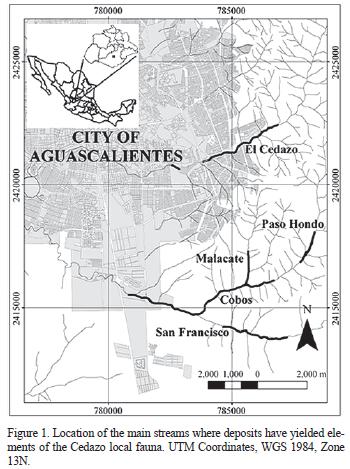
<body><![CDATA[<p align="justify"><font face="verdana" size="2"><b>Palabras clave: </b>morfometr&iacute;a, paleontolog&iacute;a de vertebrados, &eacute;quidos, fauna Cedazo, Pleistoceno, M&eacute;xico.</font></p>     <p align="justify"><font face="verdana" size="2">&nbsp;</font></p>     <p align="justify"><font face="verdana" size="2"><b>INTRODUCTION</b></font></p>     <p align="justify"><font face="verdana" size="2">Southeast from the city of Aguascalientes, M&eacute;xico, several streams (including El Cedazo, San Francisco, Cobos, Pargas; <a href="#f1">Figure 1</a>) cut through Pleistocene sediments that have yielded a varied fossil fauna (Mooser, 1958; Mooser and Dalquest, 1975; Guzm&aacute;n&#150;Guti&eacute;rrez <i>et al, </i>1997). This fossil assemblage was first studied during the 1950's by O. Mooser, who christened it the Cedazo local fauna (Mooser, 1958). Montellano&#150;Ballesteros (1990) assigned it an Irvingtonian to Rancholabrean age, based on the taxa that have been found.</font></p>     <p align="center"><font face="verdana" size="2"><a name="f1"></a></font></p>     <p align="center"><font face="verdana" size="2"><img src="/img/revistas/rmcg/v25n2/a10f1.jpg"></font></p>     <p align="justify"><font face="verdana" size="2">The most abundant material and the one that has been studied in most detail, corresponds to the equids. Nevertheless, the number of equid species present in this assemblage remains unresolved. Some authors have proposed from as many as ten (Mooser, 1958) to seven species (Mooser and Dalquest, 1975), while others have suggested that only two (Guzm&aacute;n&#150;Guti&eacute;rrez <i>et al., </i>1997; Malgarejo&#150;Dami&aacute;n, 2007) or one equid species (Reynoso&#150;Rosales and Montellano&#150;Ballesteros, 1994) are present. This scenario is not exclusive for the Cedazo local fauna and reflects the still problematic state of the <i>Equus </i>systematics (Winans, 1989; Eisenmann, 2004; Churcher, 2006). This is because many of the characters that have been used to determine species are either too variable for reliability <i>(i.e., </i>cheek teeth) or too similar <i>(i.e., </i>post&#150;cranial elements) to really give much insight into specific variation (Winans, 1989; MacFadden, 1992; Churcher, written communication 2008). The occlusal pattern of the cheek teeth, which has been traditionally one of the most widely used features to determine equid species, changes drastically as the teeth wear down (Gidley, 1901; Carranza&#150;Casta&ntilde;eda and Ferrusquia&#150;Villafranca, 1979). This variation, in addition to the subjective assessment of dental characters, significantly lowers the reliability of the cheek teeth for determining equid species (MacFadden, 1992).</font></p>     <p align="justify"><font face="verdana" size="2">Some authors have suggested a quantitative approach for the analysis ofequid cheek teeth <i>(e.g.</i>, Reynoso&#150;Rosales and Montellano&#150;Ballesteros, 1994). However, the dimensions commonly used are restricted mainly to four: antero&#150;posterior length, transverse width, protocone length, and tooth height. The first three dimensions can be useful in the discrimination of equid species when these differ significantly in size. But when that is not the case, a great deal of overlap between species may exist, making discrimination between them difficult.</font></p>     <p align="justify"><font face="verdana" size="2">This study presents an analysis of the equid cheek teeth from the Cedazo local fauna, but with two significant differences: 1) Instead of analyzing all the cheek teeth, only those with an equivalent stage of wear were studied, in order to control ontogenetic variation; 2) a computer program that integrates a digital image processor was developed. This program performs an objective analysis of the cheek teeth and allows the user to take measurements of any feature of the occlusal pattern; eliminating the subjectivity in assessing tooth characters and increasing the number of variables that can be analyzed quantitatively for taxonomic purposes.</font></p>     <p align="justify"><font face="verdana" size="2">&nbsp;</font></p>     ]]></body>
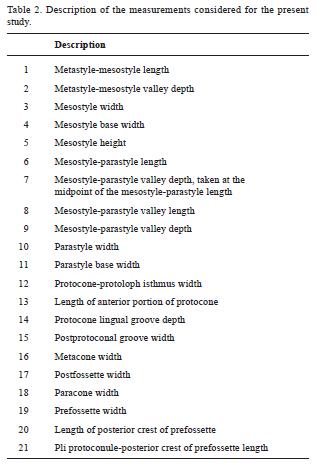
<body><![CDATA[<p align="justify"><font face="verdana" size="2"><b>MATERIALS AND METHODS</b></font></p>     <p align="justify"><font face="verdana" size="2">A Kodak Easy Share DX6490 digital camera was used to photograph all the equid upper cheek teeth from the Cedazo local fauna deposited in the following collections: 1) Colecci&oacute;n Nacional de Paleontolog&iacute;a, Instituto de Geolog&iacute;a, UNAM; 2) Laboratorio de Paleontolog&iacute;a, desarrollo tur&iacute;stico "El Caracol," Secretar&iacute;a de Turismo (SECTURE), Aguascalientes, Ags; 3) Colecci&oacute;n de Paleontolog&iacute;a de la Universidad Aut&oacute;noma de Aguascalientes; 4) Bi&oacute;l. Alberto Rodr&iacute;guez, personal collection, Aguascalientes, Ags; and 5) Luis Miguel V&aacute;zquez S&aacute;nchez, personal collection, Aguascalientes, Ags. Atotal of 80 teeth were photographed: 11 P<sup>2,</sup>s, 16 P<sup>3,</sup>s, 15 P<sup>4,</sup>s, 16 M<sup>1,</sup>s, 10 M<sup>2,</sup>s, and 12 M<sup>3,</sup>s. Each photograph was taken perpendicular to the occlusal surface of the tooth.</font></p>     <p align="justify"><font face="verdana" size="2">To be able to make valid comparisons and to reduce the ontogenetic variation due to tooth wear, only those cheek teeth with an equivalent stage of wear were studied. The stage of wear was determined as it is subsequently described. Crown height relates directly with tooth wear: as the tooth wears down its crown height decreases. Thus, it could be used to determine equivalent stages of wear between equids with a comparable hypsodonty index. We did not use a predetermined crown height, because the teeth showed a range of different sizes; for example, in large and small teeth, a crown height of 3 3 mm does not represent the same stage of wear for both sizes. Therefore, a ratio of tooth size to crown height was used as the criterion to determine an equivalent stage of wear. Transverse width was used as the indicator of tooth size rather than anteroposterior length, because the latter changes with crown and interdental wear, whereas transverse width remains less variable (Gidley, 1901). Using this criterion, we analyzed only those cheek teeth that had a tooth crown height similar to its corresponding transverse width (ratio 1:1); allowing a maximum margin of difference of 5 mm. Crown height was measured along the mid&#150;line of the posterior side of the tooth, from the top of the crown down to the point just before the metastyle converges with the mesostyle.</font></p>     <p align="justify"><font face="verdana" size="2">Selecting teeth with an equivalent stage of wear reduced the usable sample size to just 22 cheek teeth: four P<sup>2,</sup>s, seven P<sup>3,</sup>s, three P<sup>4,</sup>s, four M<sup>1,</sup>s, three M<sup>2,</sup>s, and one M<sup>3</sup>. Moreover, these should not be analyzed as a combined sample; each type of tooth has to be analyzed separately. For this reason, only the P<sup>3</sup> were studied, because of their larger sample size. The third upper premolars (P<sup>3</sup>) analyzed are listed in <a href="/img/revistas/rmcg/v25n2/a10t1.jpg" target="_blank">Table 1</a>. To increase the sample size, the right P<sup>3</sup> FC 205 (Mooser, 1958, fig. 10) in the original description of the Cedazo local fauna was included.</font></p>     <p align="justify"><font face="verdana" size="2">In addition, a sample of P<sup>3,</sup>s of extant equids were also included in the analysis to serve as controls and test the discrimination potential of the morphometric dimensions used in this study. These samples were: 21 P<sup>3,</sup>s from domestic horses <i>(Equus caballus), </i>three from donkeys <i>(E. asinus) </i>and two from hybrids. These teeth were donated by the meat processing company Frigor&iacute;fico Zacatecas, except for two of <i>E. caballus </i>that were taken from skulls in the Zoological Collection, Universidad Aut&oacute;noma de Aguascalientes.</font></p>     <p align="justify"><font face="verdana" size="2">To be able to compare these teeth with the eight P<sup>3,</sup>s from the Cedazo local fauna listed in <a href="/img/revistas/rmcg/v25n2/a10t1.jpg" target="_blank">Table 1</a>, they were sectioned to show a similar wear stage according to the criterion given above. This was done at the Laboratorio de Petrograf&iacute;a y Paleontolog&iacute;a, INEGI, Aguascalientes. Five of the 21 <i>E. caballus </i>premolars were not sectioned as they already were worn to the required tooth height.</font></p>     <p align="justify"><font face="verdana" size="2">&nbsp;</font></p>     <p align="justify"><font face="verdana" size="2"><b>Digital image analysis</b></font></p>     <p align="justify"><font face="verdana" size="2">A computer program that integrates a digital image processor was developed using the computer software MATLAB 7.0 (The MathWorks, 2004). This program, termed here <i>'An&aacute;lisis de Patrones Oclusales' </i>(APO) and which is available upon request, allows to study the occlusal patterns of cheek teeth on digital photographs. The program is capable of representing the enamel oclusal pattern as a matrix of single points in a Cartesian grid, based on a digital image of the occlusal surface of the tooth (<a href="/img/revistas/rmcg/v25n2/a10f2.jpg" target="_blank">Figure 2a</a>), as is briefly described below.</font></p>     <p align="justify"><font face="verdana" size="2">The program identifies the occlusal pattern from the image according to color, highlighting a specific value and "shutting off' all of the rest. Due to preservation factors and light, the occlusal pattern did not show a distinct color, so it was necessary to redraw it using a uniform color (<a href="/img/revistas/rmcg/v25n2/a10f2.jpg" target="_blank">Figure 2b</a>). In this way, only those cells from the raster image with this color are given a value of one, whereas the rest of the cells are given a value of zero, thus obtaining a binary image that shows only the enamel occlusal pattern as three distinct lines: one for the outline of the occlusal surface and one for each fossette. To be able to analyze the occlusal pattern as a matrix of single points, the lines of the occlusal pattern in the binary image, which have a thickness of several pixels, must to be converted into one pixel&#150;thick lines. This was done using the 'skeletonization' function of MATLAB, which calculates the center of the lines from the previous binary image. These central lines have a resulting thickness of one pixel (<a href="/img/revistas/rmcg/v25n2/a10f2.jpg" target="_blank">Figure 2c</a>). From this new binary image, the program obtains the (x,y) coordinates of the occlusal pattern (<a href="/img/revistas/rmcg/v25n2/a10f2.jpg" target="_blank">Figure 2d</a>). These coordinates were scaled to the real size of the tooth by placing a small ruler next to the occlusal surface, so that in the image a relation between the number of pixels for a given length of the ruler could be established. Moreover, the total number of these coordinate points was kept constant for every tooth, so that comparisons between different teeth were possible. With the occlusal pattern drawn in (x,y) coordinates, it is easy to obtain the length between any two given points, allowing to measure any feature of the occlusal surface of the tooth.</font></p>     ]]></body>
<body><![CDATA[<p align="justify"><font face="verdana" size="2">It is important to mention that the enamel thickness is not constant throughout the occlusal pattern. To cope with this variation, special care was taken to redraw the occlusal pattern with the uniform color right through the middle of the enamel band. This was done so that the resulting point matrix would represent the real central line of the enamel band of the original tooth.</font></p>     <p align="justify"><font face="verdana" size="2">&nbsp;</font></p>     <p align="justify"><font face="verdana" size="2"><b>Measurements used in this study</b></font></p>     <p align="justify"><font face="verdana" size="2">With the aid of the APO software, measurements of 21 dimensions of the occlusal pattern were taken for each tooth studied (<a href="/img/revistas/rmcg/v25n2/a10a1.jpg" target="_blank">Appendix A</a>). These dimensions and the terminology used are shown on <a href="/img/revistas/rmcg/v25n2/a10f3.jpg" target="_blank">Figure 3</a>. <a href="#t2">Table 2</a> gives brief descriptions of each dimension.</font></p>     <p align="center"><font face="verdana" size="2"><a name="t2"></a></font></p>     <p align="center"><font face="verdana" size="2"><img src="/img/revistas/rmcg/v25n2/a10t2.jpg"></font></p>     <p align="justify"><font face="verdana" size="2">Measurements of dimensions 2,3, 5 to 7,13 to 15,17 and 19 were taken to study characters that had previously been used by other authors (<i>e.g., </i>Quinn, 1956; Mooser, 1958) for equid taxonomy. Even though these authors used these characters qualitatively, the measurements taken reflected the variations described by them; for example, for 'postprotoconal groove narrow,' we measured the width of the postprotoconal groove (dimension 15, <a href="/img/revistas/rmcg/v25n2/a10f3.jpg" target="_blank">Figure 3</a>). Measurements 1, 4, 8 to 12, 16, 18, 20 and 21 were characters that were considered to have a high potential for specific discrimination, on the basis of our previous investigations.</font></p>     <p align="justify"><font face="verdana" size="2">Because the object of this study was to carry out an analysis of the form of the occlusal pattern, the effects of differences in size was removed by normalizing the measurements. For every tooth, each of the 21 dimensions was divided by a value reflecting each tooth's size. This value is the diagonal of the quadrilateral formed by the anteroposterior length (Ap) and transverse width (Tr). The resulting ratios (<a href="/img/revistas/rmcg/v25n2/a10a2.jpg" target="_blank">Appendix B</a>), where subjected to multivariate analyses.</font></p>     <p align="justify"><font face="verdana" size="2">&nbsp;</font></p>     <p align="justify"><font face="verdana" size="2"><b>Quantitative analyses</b></font></p>     ]]></body>
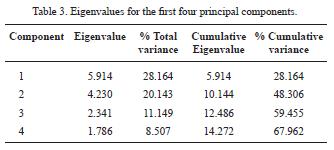
<body><![CDATA[<p align="justify"><font face="verdana" size="2">A Principal Components Analysis (PCA) was performed to identify patterns in the data and recognize different groups present in the sample under study. The relevant variables that contributed to the main principal components were identified. From these, a Canonical Discriminant Analysis (CDA) was performed to evaluate if the groups were correctly identified. These analyses were performed using the software STATISTICA7.0 (StatSoft, 2004), employing the default settings.</font></p>     <p align="justify"><font face="verdana" size="2">Once the groups were recognized, a mean occlusal enamel pattern for each distinct group was calculated using APO. To accomplish this, the teeth were scaled to the mean diagonal length of its corresponding group and then overlapped using a least squares criterion to minimize the distance between each (x,y) point of the occlusal pattern;, and obtaining in this way the best fit. Because APO assigns the same number of coordinate points for each tooth, it was possible to statistically analyze each point to obtain its mean. Drawing the mean of all the points creates a mean occlusal pattern for the teeth analyzed. It should be mentioned that a mean occlusal pattern is obtained under the assumption that the occlusal patterns within each group vary continuously. This is shown to be the case, on the basis of specimen analyses of <i>Equus caballus.</i></font></p>     <p align="justify"><font face="verdana" size="2">&nbsp;</font></p>     <p align="justify"><font face="verdana" size="2"><b>RESULTS AND DISCUSION</b></font></p>     <p align="justify"><font face="verdana" size="2"><b>Multivariate analyses</b></font></p>     <p align="justify"><font face="verdana" size="2">The first four principal components comprise nearly 70 % of the total variation (67.962 %; <a href="#t3">Table 3</a>). Of these, the first two best explain most of the variation within the data and are the ones that better discriminate the specimens studied (<a href="/img/revistas/rmcg/v25n2/a10f4.jpg" target="_blank">Figure 4</a>).</font></p>     <p align="center"><font face="verdana" size="2"><a name="t3"></a></font></p>     <p align="center"><font face="verdana" size="2"><img src="/img/revistas/rmcg/v25n2/a10t3.jpg"></font></p>     <p align="justify"><font face="verdana" size="2">The first principal component separates six of the eight Cedazo third upper premolars and two <i>o&iacute; Equus asinus </i>from the rest of the teeth analyzed; whereas the second component separates all three <i>E. asinus </i>P<sup>3,</sup>s from the remaining specimens. Plotting both components, four different groups are identified (<a href="/img/revistas/rmcg/v25n2/a10f4.jpg" target="_blank">Figure 4</a>): one comprising the three premolars of <i>E. asinus, </i>a second with six of the eight Cedazo premolars, a third containing the 21 P<sup>3,</sup>s of <i>E. caballus </i>and the remaining two Cedazo premolars, and a fourth comprised by the two hybrids. Distinction between these groups is clear, except for the hybrids, which marginally overlap with the group of <i>E. caballus. </i>One specimen clusters closely with the group of <i>E. caballus </i>whereas the other one falls between the groups of <i>E. asinus </i>and <i>E. caballus.</i></font></p>     <p align="justify"><font face="verdana" size="2">The case of the hybrids is special because it is expected that they show features of<i> E. asinus </i>as well as <i>E. caballus. </i>As the sample size is incremented, it is expected that the hybrids cluster between these two species, with some specimens falling just within the <i>E. asinus </i>group and others within the <i>E. caballus </i>group. In the breeding of 'mules,' as the egg carries matrilineal DNA, this could influence the development of the embryo and, in a normal mule (jack x mare), it is the horse matrilineal DNA that may have a major influence (Churcher, written communication 2008). Unfortunately, it is not possible to test this since we do not know if the hybrid P<sup>3</sup> that clusters close to the <i>E. caballus </i>group belongs to a mule (jack x mare), as the two hybrid P<sup>3,</sup>s here studied were obtained from broken and weathered skulls, which were not assignable to a particular hybrid type.</font></p>     ]]></body>
<body><![CDATA[<p align="justify"><font face="verdana" size="2">The most revealing conclusion that can be seen from the PCA results is that the specimens of <i>Equus caballus </i>and <i>E. asinus </i>are positively discriminated. Furthermore, six of the eight Cedazo premolars cluster in a distinct group whereas the remaining two fall within the group of <i>E. caballus </i>(<a href="/img/revistas/rmcg/v25n2/a10f4.jpg" target="_blank">Figure 4</a>). These two premolars correspond to specimens c4 and c8 in <a href="#t1">Table 1</a>. A Canonical Discriminant Analysis supports this arrangement of the data (<a href="#f5">Figure 5</a>). With a Wilk's lambda of 0.008 (<a href="/img/revistas/rmcg/v25n2/a10t4.jpg" target="_blank">Table 4</a>), this analysis is highly significant (Podani, 2000). Moreover, the CD A analysis shows that all of the specimens where correctly identified.</font></p>     <p align="center"><font face="verdana" size="2"><a name="f5"></a></font></p>     <p align="center"><font face="verdana" size="2"><img src="/img/revistas/rmcg/v25n2/a10f5.jpg"></font></p>     <p align="justify"><font face="verdana" size="2">The results suggest the presence of two distinct equid P<sup>3</sup> morphotypes for the Cedazo local fauna sample analyzed in this study, which may indicate the occurrence of at least two separate equid species. This contrasts with the revision of the Cedazo local fauna by Mooser and Dalquest (1975) where, on the basis qualitative appreciations of the occlusal pattern, the number of equid species was reduced from ten (originally in Mooser, 1958) to seven. These results also differ from those of Reynoso&#150;Rosales and Montellano&#150;Ballesteros (1994). These authors concluded, based on a univariate and qualitative statistical analysis, that only one equid species was present They identified this as <i>E. conversidens. </i>Guzm&aacute;n&#150;Gutierrez <i>et al. </i>(1997), and recently Malgarejo&#150;Dami&aacute;n (2007), identified two equid species from the Cedazo local fauna <i>(E. </i>cf. <i>excelsus/E. </i>cf. <i>conversidens </i>and <i>E. mexicanus/ E. conversidens, </i>respectively) which agrees with the results here presented.</font></p>     <p align="justify"><font face="verdana" size="2">It is interesting to note, that one of the many criteria used by Guzm&aacute;n&#150;Gutierrez <i>et al. </i>(1997) and Malgarejo&#150;Dami&aacute;n (2007) to identify two distinct equid species is size. They both identify a large and a medium size species. Our analysis supports the presence of at least two separate species based on the P<sup>3</sup> morphology, regardless of size. Though, one of the morphotypes (<a href="/img/revistas/rmcg/v25n2/a10f6.jpg" target="_blank">Figure 6d</a>) does appear to be slightly smaller.</font></p>     <p align="justify"><font face="verdana" size="2">Given the small sample size analyzed and the still problematic state <i>in Equus </i>systematics, at the present we do not feel confident to assign the P<sup>3,</sup>s studied to any particular species. A larger sample must be obtained and evaluated to justify a two species concept, and the results must reflect parallel situations for each tooth position. This will reveal if the two species pattern remains, or whether it becomes lost, showing an equid species with a high degree of morphological plasticity.</font></p>     <p align="justify"><font face="verdana" size="2">Regarding the issue of ontogenetic variation, it is well known to be an important factor to consider when working on the taxonomy of hypsodont equids (Gidley, 1901; Ferrusquia&#150;Villafranca and Carranza&#150;Casta&ntilde;eda, 1979; MacFadden, 1992). In the present PCA analysis, a P<sup>3</sup> of <i>Equus asinus </i>was analyzed at two different stages of wear: one corresponding to that described in the methodology (tooth crown height similar to the transverse width; identified as 2b in <a href="/img/revistas/rmcg/v25n2/a10f4.jpg" target="_blank">Figure 4</a>) and the other 33 mm above this level (2bb in <a href="/img/revistas/rmcg/v25n2/a10f4.jpg" target="_blank">Figure 4</a>). It can be clearly seen that 2bb wrongly places within the <i>E. caballus </i>group. As was expected, this reinforces the suggestion that, to make a reliable discrimination it is important to keep the sample homogeneous, with cheek teeth in an equivalent stage of wear.</font></p>     <p align="justify"><font face="verdana" size="2">Currently, many authors have significantly reduced emphasis on the dentition, whether tooth rows or single teeth, as basis for discriminating equid species, because of its wide ontogenetic and intraspecific variation, and have turned their attention to other skeletal elements (<i>e.g., </i>Eisenmann and Karchoud, 1982; MacFadden, 1992). Contrary to this, the results here presented suggest that the dentition can be useful in discriminating species of<i> Equus, </i>as long as cheek teeth from a single position and an equivalent stage of wear are compared.</font></p>     <p align="justify"><font face="verdana" size="2">&nbsp;</font></p>     <p align="justify"><font face="verdana" size="2"><b>Analysis of the measurements used in this study</b></font></p>     ]]></body>
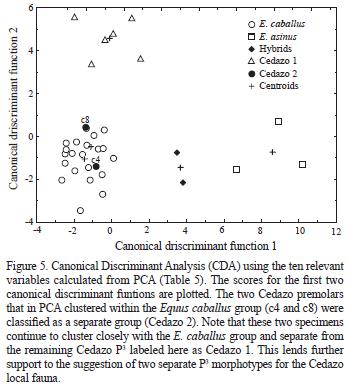
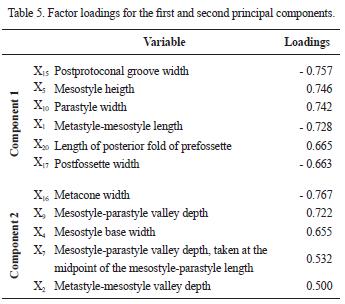
<body><![CDATA[<p align="justify"><font face="verdana" size="2">An important aspect of PCA is that it allows to identify those variables that contribute the most to the formation of each principal component (Manly, 2004). In this way, it is possible to identify the measurements that were more relevant for discriminating each group (<a href="#t5">Table 5</a>). Thus, the six Cedazo P<sup>3,</sup>s are distinguished from the specimens of <i>Equus caballus </i>and the remaining two Cedazo premolars because the metastyle&#150;mesostyle length (dimension 1, <a href="/img/revistas/rmcg/v25n2/a10f3.jpg" target="_blank">Figure 3</a>) is proportionally shorter, as are the width of the postprotoconal grove (dimension 15) and the postfossette (dimension 17). Likewise, the parastyle width (dimension 10), mesostyle height (dimension 5), and the length of the posterior crest of the prefossette (dimension 20) are proportionally longer in the six Cedazo premolars. The P<sup>3,</sup>s of <i>E. asinus </i>are separated from the rest of the specimens studied because they show a proportionally shorter mesostyle base width (dimension 4) as well as a shallower metastyle&#150;mesostyle valley (dimension 9) and a proportionally wider metacone (dimension 16).</font></p>     <p align="center"><font face="verdana" size="2"><a name="t5"></a></font></p>     <p align="center"><font face="verdana" size="2"><img src="/img/revistas/rmcg/v25n2/a10t5.jpg"></font></p>     <p align="justify"><font face="verdana" size="2"><a href="/img/revistas/rmcg/v25n2/a10f6.jpg" target="_blank">Figure 6</a> shows the mean occlusal patterns calculated for the P<sup>3,</sup>s of the three <i>Equus asinus </i>teeth (<a href="/img/revistas/rmcg/v25n2/a10f6.jpg" target="_blank">Figure 6a</a>), the specimens of <i>E. caballus </i>(<a href="/img/revistas/rmcg/v25n2/a10f6.jpg" target="_blank">Figure 6b</a>), the six Cedazo P<sup>3,</sup>s (<a href="/img/revistas/rmcg/v25n2/a10f6.jpg" target="_blank">Figure 6c</a>), and the remaining two Cedazo P<sup>3,</sup>s (<a href="/img/revistas/rmcg/v25n2/a10f6.jpg" target="_blank">Figure 6d</a>). The differences in the features mentioned above are apparent, as is the possible occurrence of two distinct P<sup>3</sup> morphotypes for the Cedazo sample analyzed, one (<a href="/img/revistas/rmcg/v25n2/a10f6.jpg" target="_blank">Figure 6d</a>) morphologically more similar, in the dimensions studied, to the mean occlusal pattern of <i>E. caballus </i>(<a href="/img/revistas/rmcg/v25n2/a10f6.jpg" target="_blank">Figure 6b</a>).</font></p>     <p align="justify"><font face="verdana" size="2">This similarity with the dimensions studied for the sample of <i>Equus caballus </i>is intriguing. Recently, Weinstock <i>et al. </i>(2005) performed a cladistic molecular study in which they analyzed the mitochondrial DNA sequence of North and South American late&#150;Pleistocene fossil metapodials and specimens of extant species. The North American fossil sample arranged in two distinct clades, which they assign species status. One of this clade included the domestic horse, <i>E. przewalskii, </i>and all of the stout fossil metapodials analyzed by them. Further study will reveal if the Cedazo P<sup>3,</sup>s that cluster close to the specimens of <i>E. caballus </i>have any true affinity with them.</font></p>     <p align="justify"><font face="verdana" size="2">&nbsp;</font></p>     <p align="justify"><font face="verdana" size="2"><b>CONCLUSIONS</b></font></p>     <p align="justify"><font face="verdana" size="2">The computer program developed for this study proved to be a useful tool for analyzing equid cheek teeth. It allows to take measurements of any feature of the occlusal enamel of the tooth; thus eliminating the subjectivity in assessing tooth characters and increasing the number of variables that canbe incorporated in the quantitative analysis of equid cheek teeth for taxonomic purposes.</font></p>     <p align="justify"><font face="verdana" size="2">The multivariate quantitative analyses of the dimensions here considered positively discriminated the teeth of the control specimens. In addition, the results suggest the presence of two distinct equid P<sup>3</sup> morphotypes for the Cedazo local fauna sample analyzed in this study. This </font><font face="verdana" size="2">indicates the occurrence of at least two separate equid species for this assemblage, which agrees with other recent studies. However, as the sample size is small, additional specimens must be collected and studied to substantiate this conclusion based on only P<sup>3,</sup>s. Furthermore, similar and parallel analyses should be performed on cheek teeth from the other five maxillary tooth positions and the six mandibular tooth positions.</font></p>     <p align="justify"><font face="verdana" size="2">Although an analysis comprising more species, including zebras and hemiones, is needed to fully evaluate the taxonomic significance of the occlusal pattern, these results suggest that the quantitative study of the occlusal surface of the cheek teeth can be useful in the discrimination <i>o&iacute; Equus </i>species, as long as cheek teeth from a single position and an equivalent stage of wear are compared. This could complement other studies that use different cranial and postcranial characters, helping to reveal a much clearer picture of the systematics of this important genus. Such comparative analyses would be useful in establishing the relative reliability of diverse elements in equine taxonomy.</font></p>     ]]></body>
<body><![CDATA[<p align="justify"><font face="verdana" size="2">&nbsp;</font></p>     <p align="justify"><font face="verdana" size="2"><b>ACKNOWLEDGMENTS</b></font></p>     <p align="justify"><font face="verdana" size="2">We would like to thank the coordinators of the different collections visited, for kindly making available the fossil material under their custody: Dra. Ma. del Carmen Perrilliat, Colecci&oacute;n Nacional de Paleontolog&iacute;a, Instituto de Geolog&iacute;a, UNAM; Bi&oacute;l. Rub&eacute;n Guzm&aacute;n Guti&eacute;rrez, Laboratorio de Paleontolog&iacute;a, desarrollo tur&iacute;stico "El Caracol," SECTURE, Aguascalientes, Ags; M. en C. Jaime Escoto Rocha, Colecci&oacute;n de Paleontolog&iacute;a de la Universidad Aut&oacute;noma de Aguascalientes, UAA; Bi&oacute;l. Alberto Rodr&iacute;guez, Personal Collection; Lu&iacute;s Miguel V&aacute;zquez S&aacute;nchez, Personal Collection. We also thank Juan de Dios Magallanes, owner of Frigor&iacute;fico Zacatecas, and Juan Antonio Salazar, for letting us go through the waste piles and helping to collect modern equid teeth and skulls. We much appreciate the help of Mrs. Graciela Ortiz Lizalde in collecting and safekeeping the extant equid material analyzed in this study. Thanks are due to Gustavo Hern&aacute;ndez, Francisco Palomino and Edgar Miguel &Aacute;ngel Guzm&aacute;n from the Laboratorio de Petrograf&iacute;a y Paleontolog&iacute;a, INEGI, for sectioning some of the upper cheek teeth (P<sup>3</sup>) of the extant species. We thank Jaqueline and Taily Barr&oacute;n Ortiz for reviewing the first draft of the manuscript. Very special thanks go to Bi&oacute;l. Elizabeth Romo R&aacute;bago for all her constant support. Finally, we would like to thank the reviewers, Bruce MacFadden and C.S. Churcher, for their valuable comments and suggestions which improved the original manuscript.</font></p>     <p align="justify"><font face="verdana" size="2">&nbsp;</font></p>     <p align="justify"><font face="verdana" size="2"><b>REFERENCES</b></font></p>     <!-- ref --><p align="justify"><font face="verdana" size="2">Carranza&#150;Casta&ntilde;eda, O., Ferrusqu&iacute;a&#150;Villafranca, I., 1979, El g&eacute;nero <i>Neohipparion </i>(Mammalia&#150;Perisodactyla) de la fauna local Rancho el Ocote, (Plioceno medio) de Guanajuato, M&eacute;xico: Universidad Nacional Aut&oacute;noma de M&eacute;xico, Revista del Instituto de Geolog&iacute;a, 3(1), 29&#150;38.</font>&nbsp;&nbsp;&nbsp;&nbsp;&nbsp;&nbsp;&nbsp;&nbsp;[&#160;<a href="javascript:void(0);" onclick="javascript: window.open('/scielo.php?script=sci_nlinks&ref=8025666&pid=S1026-8774200800020001000001&lng=','','width=640,height=500,resizable=yes,scrollbars=1,menubar=yes,');">Links</a>&#160;]<!-- end-ref --><!-- ref --><p align="justify"><font face="verdana" size="2">Churcher, C.S., 2006, Distribution and history of the Cape zebra <i>(Equus capensis) </i>in the Quaternary of Africa: Transactions of the Royal Society of South Africa, 61(2), 89&#150;95.</font>&nbsp;&nbsp;&nbsp;&nbsp;&nbsp;&nbsp;&nbsp;&nbsp;[&#160;<a href="javascript:void(0);" onclick="javascript: window.open('/scielo.php?script=sci_nlinks&ref=8025667&pid=S1026-8774200800020001000002&lng=','','width=640,height=500,resizable=yes,scrollbars=1,menubar=yes,');">Links</a>&#160;]<!-- end-ref --><!-- ref --><p align="justify"><font face="verdana" size="2">Eisenmann, V., 2004, Equus: an evolution without lineages?, <i>in </i>18<sup>th </sup>International Senckenberg Conference, VI International Palaeontological Colloquium, Late Neogene and Quaternary biodiversity and evolution: Regional developments and interregional correlations, Weimar, Germany: Terra Nostra, Conference volume, 2, 61&#150;64.</font>&nbsp;&nbsp;&nbsp;&nbsp;&nbsp;&nbsp;&nbsp;&nbsp;[&#160;<a href="javascript:void(0);" onclick="javascript: window.open('/scielo.php?script=sci_nlinks&ref=8025668&pid=S1026-8774200800020001000003&lng=','','width=640,height=500,resizable=yes,scrollbars=1,menubar=yes,');">Links</a>&#160;]<!-- end-ref --><!-- ref --><p align="justify"><font face="verdana" size="2">Eisenmann, V., Karchoud, A., 1982, Analyses multidimensionnelles de m&eacute;tapodes <i>d'Equus </i>sensu lato (Mammalia, Perissodactyla): Bulletin du Museum national d'Histoire naturelle, Paris, 4<sup>e</sup> s&eacute;r, Section C, 4(1&#150;2), 75&#150;103.</font>&nbsp;&nbsp;&nbsp;&nbsp;&nbsp;&nbsp;&nbsp;&nbsp;[&#160;<a href="javascript:void(0);" onclick="javascript: window.open('/scielo.php?script=sci_nlinks&ref=8025669&pid=S1026-8774200800020001000004&lng=','','width=640,height=500,resizable=yes,scrollbars=1,menubar=yes,');">Links</a>&#160;]<!-- end-ref --><!-- ref --><p align="justify"><font face="verdana" size="2">Evander, R.L., 2004, A revised dental nomenclature for fossil horses: American Museum of Natural History Bulletin, 285, 209&#150;218.</font>&nbsp;&nbsp;&nbsp;&nbsp;&nbsp;&nbsp;&nbsp;&nbsp;[&#160;<a href="javascript:void(0);" onclick="javascript: window.open('/scielo.php?script=sci_nlinks&ref=8025670&pid=S1026-8774200800020001000005&lng=','','width=640,height=500,resizable=yes,scrollbars=1,menubar=yes,');">Links</a>&#160;]<!-- end-ref --><!-- ref --><p align="justify"><font face="verdana" size="2">Ferrusqu&iacute;a&#150;Villafranca, I., Carranza&#150;Casta&ntilde;eda, O., 1979, Revisi&oacute;n del g&eacute;nero <i>Neohipparion </i>(Mammalia&#150;Perisodactyla) en M&eacute;xico: Universidad Nacional Aut&oacute;noma de M&eacute;xico, Revista del Instituto de Geolog&iacute;a, 3(2), 126&#150;137.</font>&nbsp;&nbsp;&nbsp;&nbsp;&nbsp;&nbsp;&nbsp;&nbsp;[&#160;<a href="javascript:void(0);" onclick="javascript: window.open('/scielo.php?script=sci_nlinks&ref=8025671&pid=S1026-8774200800020001000006&lng=','','width=640,height=500,resizable=yes,scrollbars=1,menubar=yes,');">Links</a>&#160;]<!-- end-ref --><!-- ref --><p align="justify"><font face="verdana" size="2">Gidley, J.W., 1901, Tooth characters and revision of the North American species of the genus <i>Equus: </i>American Museum of Natural History Bulletin, 14, 91&#150;142.</font>&nbsp;&nbsp;&nbsp;&nbsp;&nbsp;&nbsp;&nbsp;&nbsp;[&#160;<a href="javascript:void(0);" onclick="javascript: window.open('/scielo.php?script=sci_nlinks&ref=8025672&pid=S1026-8774200800020001000007&lng=','','width=640,height=500,resizable=yes,scrollbars=1,menubar=yes,');">Links</a>&#160;]<!-- end-ref --><!-- ref --><p align="justify"><font face="verdana" size="2">Guzm&aacute;n&#150;Gutierrez, R., Acosta&#150;Rinc&oacute;n, O.E., and Palomino&#150;S&aacute;nchez, F., 1997, Cat&aacute;logo de los sitios paleontol&oacute;gicos del estado de Aguascalientes: Aguscalientes, Ags., Gobierno del Estado de Aguascalientes, Cuadernos de Trabajo, 60, 38 p.</font>&nbsp;&nbsp;&nbsp;&nbsp;&nbsp;&nbsp;&nbsp;&nbsp;[&#160;<a href="javascript:void(0);" onclick="javascript: window.open('/scielo.php?script=sci_nlinks&ref=8025673&pid=S1026-8774200800020001000008&lng=','','width=640,height=500,resizable=yes,scrollbars=1,menubar=yes,');">Links</a>&#160;]<!-- end-ref --><!-- ref --><p align="justify"><font face="verdana" size="2">MacFadden, B.J., 1992, Fossil Horses, Systematics, Paleobiology and Evolution of the Family Equidae: New York, Cambridge University Press, 362 p.</font>&nbsp;&nbsp;&nbsp;&nbsp;&nbsp;&nbsp;&nbsp;&nbsp;[&#160;<a href="javascript:void(0);" onclick="javascript: window.open('/scielo.php?script=sci_nlinks&ref=8025674&pid=S1026-8774200800020001000009&lng=','','width=640,height=500,resizable=yes,scrollbars=1,menubar=yes,');">Links</a>&#160;]<!-- end-ref --><!-- ref --><p align="justify"><font face="verdana" size="2">Malgarejo&#150;Dami&aacute;n, M. P., 2007, Diferenciaci&oacute;n cuantitativa de especies de &eacute;quidos del Pleistoceno de M&eacute;xico: M&eacute;xico, D.F., Universidad Nacional Aut&oacute;noma de M&eacute;xico, tesis de licenciatura, 132 p.</font>&nbsp;&nbsp;&nbsp;&nbsp;&nbsp;&nbsp;&nbsp;&nbsp;[&#160;<a href="javascript:void(0);" onclick="javascript: window.open('/scielo.php?script=sci_nlinks&ref=8025675&pid=S1026-8774200800020001000010&lng=','','width=640,height=500,resizable=yes,scrollbars=1,menubar=yes,');">Links</a>&#160;]<!-- end-ref --><!-- ref --><p align="justify"><font face="verdana" size="2">Manly, B.F., 2004, Multivariate statistical methods, a primer: New York, USA, Chapman &amp; Hall/CRC, 3<sup>rd </sup>edition, 75&#150;90.</font>&nbsp;&nbsp;&nbsp;&nbsp;&nbsp;&nbsp;&nbsp;&nbsp;[&#160;<a href="javascript:void(0);" onclick="javascript: window.open('/scielo.php?script=sci_nlinks&ref=8025676&pid=S1026-8774200800020001000011&lng=','','width=640,height=500,resizable=yes,scrollbars=1,menubar=yes,');">Links</a>&#160;]<!-- end-ref --><!-- ref --><p align="justify"><font face="verdana" size="2">Montellano&#150;Ballesteros, M., 1990 (1992), Una edad del Irvingtoniano al Rancholabreano para la fauna Cedazo del Estado de Aguascalientes: Universidad Nacional Aut&oacute;noma de M&eacute;xico, Revista del Instituto de Geolog&iacute;a, 9(2), 195&#150;203.</font>&nbsp;&nbsp;&nbsp;&nbsp;&nbsp;&nbsp;&nbsp;&nbsp;[&#160;<a href="javascript:void(0);" onclick="javascript: window.open('/scielo.php?script=sci_nlinks&ref=8025677&pid=S1026-8774200800020001000012&lng=','','width=640,height=500,resizable=yes,scrollbars=1,menubar=yes,');">Links</a>&#160;]<!-- end-ref --><!-- ref --><p align="justify"><font face="verdana" size="2">Mooser, O., 1958, La fauna "Cedazo" del Pleistoceno de Aguascalientes: Universidad Nacional Aut&oacute;noma de M&eacute;xico, Instituto de Biolog&iacute;a, Anales, 29, 409&#150;452.</font>&nbsp;&nbsp;&nbsp;&nbsp;&nbsp;&nbsp;&nbsp;&nbsp;[&#160;<a href="javascript:void(0);" onclick="javascript: window.open('/scielo.php?script=sci_nlinks&ref=8025678&pid=S1026-8774200800020001000013&lng=','','width=640,height=500,resizable=yes,scrollbars=1,menubar=yes,');">Links</a>&#160;]<!-- end-ref --><!-- ref --><p align="justify"><font face="verdana" size="2">Mooser, O., Dalquest, W.W., 1975, Pleistocene mammals from Aguascalientes, Central Mexico: Journal of Mammalogy, 56(4), 781&#150;820.</font>&nbsp;&nbsp;&nbsp;&nbsp;&nbsp;&nbsp;&nbsp;&nbsp;[&#160;<a href="javascript:void(0);" onclick="javascript: window.open('/scielo.php?script=sci_nlinks&ref=8025679&pid=S1026-8774200800020001000014&lng=','','width=640,height=500,resizable=yes,scrollbars=1,menubar=yes,');">Links</a>&#160;]<!-- end-ref --><!-- ref --><p align="justify"><font face="verdana" size="2">Podani, J., 2000, Introduction to the exploration of multivariate biological data: Netherlands, Backhuys Publishers, 263&#150;270.</font>&nbsp;&nbsp;&nbsp;&nbsp;&nbsp;&nbsp;&nbsp;&nbsp;[&#160;<a href="javascript:void(0);" onclick="javascript: window.open('/scielo.php?script=sci_nlinks&ref=8025680&pid=S1026-8774200800020001000015&lng=','','width=640,height=500,resizable=yes,scrollbars=1,menubar=yes,');">Links</a>&#160;]<!-- end-ref --><!-- ref --><p align="justify"><font face="verdana" size="2">Quinn, J.H., 1956, Pleistocene Equidae of Texas: Fayetteville, USA, University of Arkansas, Ph.D. thesis, 83 p.</font>&nbsp;&nbsp;&nbsp;&nbsp;&nbsp;&nbsp;&nbsp;&nbsp;[&#160;<a href="javascript:void(0);" onclick="javascript: window.open('/scielo.php?script=sci_nlinks&ref=8025681&pid=S1026-8774200800020001000016&lng=','','width=640,height=500,resizable=yes,scrollbars=1,menubar=yes,');">Links</a>&#160;]<!-- end-ref --><!-- ref --><p align="justify"><font face="verdana" size="2">Reynoso&#150;Rosales, V.H., Montellano&#150;Ballesteros, M., 1994, Revisi&oacute;n de los &eacute;quidos de la fauna Cedazo del Pleistoceno de Aguascalientes, M&eacute;xico: Revista Mexicana de Ciencias Geol&oacute;gicas, 11(1), 87&#150;105.</font>&nbsp;&nbsp;&nbsp;&nbsp;&nbsp;&nbsp;&nbsp;&nbsp;[&#160;<a href="javascript:void(0);" onclick="javascript: window.open('/scielo.php?script=sci_nlinks&ref=8025682&pid=S1026-8774200800020001000017&lng=','','width=640,height=500,resizable=yes,scrollbars=1,menubar=yes,');">Links</a>&#160;]<!-- end-ref --><!-- ref --><p align="justify"><font face="verdana" size="2">StatSoft, 2004, STATISTICA, ver. 7.0: Tulsa, OK, USA, StatSoft, 1 cd&#150;rom, computer software.</font>&nbsp;&nbsp;&nbsp;&nbsp;&nbsp;&nbsp;&nbsp;&nbsp;[&#160;<a href="javascript:void(0);" onclick="javascript: window.open('/scielo.php?script=sci_nlinks&ref=8025683&pid=S1026-8774200800020001000018&lng=','','width=640,height=500,resizable=yes,scrollbars=1,menubar=yes,');">Links</a>&#160;]<!-- end-ref --><!-- ref --><p align="justify"><font face="verdana" size="2">The Math Works Inc., 2004, MATLAB The Language of Technical Computing, version 7.0: MathWorks Inc., 1 cd&#150;rom, computer software.</font>&nbsp;&nbsp;&nbsp;&nbsp;&nbsp;&nbsp;&nbsp;&nbsp;[&#160;<a href="javascript:void(0);" onclick="javascript: window.open('/scielo.php?script=sci_nlinks&ref=8025684&pid=S1026-8774200800020001000019&lng=','','width=640,height=500,resizable=yes,scrollbars=1,menubar=yes,');">Links</a>&#160;]<!-- end-ref --><!-- ref --><p align="justify"><font face="verdana" size="2">Weinstock, J., Willerslev, E., Sher, A., Tong, W., Ho, S.Y.W., Rubenstein, D., Storer, J., Burns, J., Martin, L., Bravi, C., Prieto, A., Froese, D., Scott, E., Xulong, L., Cooper, A., 2005, Evolution, systematics, and phylogeography of Pleistocene horses in the New World: a molecular perspective: PLoS Biology, 3(8): e241.</font>&nbsp;&nbsp;&nbsp;&nbsp;&nbsp;&nbsp;&nbsp;&nbsp;[&#160;<a href="javascript:void(0);" onclick="javascript: window.open('/scielo.php?script=sci_nlinks&ref=8025685&pid=S1026-8774200800020001000020&lng=','','width=640,height=500,resizable=yes,scrollbars=1,menubar=yes,');">Links</a>&#160;]<!-- end-ref --><!-- ref --><p align="justify"><font face="verdana" size="2">Winans, M., 1989, A quantitative study of North American fossil species of the genus <i>Equus, in </i>Prothrero, D.R., Schoch, R.M. (eds.), The Evolution of Perissodactyls: New York, Oxford University Press, 262&#150;297.</font>&nbsp;&nbsp;&nbsp;&nbsp;&nbsp;&nbsp;&nbsp;&nbsp;[&#160;<a href="javascript:void(0);" onclick="javascript: window.open('/scielo.php?script=sci_nlinks&ref=8025686&pid=S1026-8774200800020001000021&lng=','','width=640,height=500,resizable=yes,scrollbars=1,menubar=yes,');">Links</a>&#160;]<!-- end-ref --> ]]></body><back>
<ref-list>
<ref id="B1">
<nlm-citation citation-type="journal">
<person-group person-group-type="author">
<name>
<surname><![CDATA[Carranza-Castañeda]]></surname>
<given-names><![CDATA[O]]></given-names>
</name>
<name>
<surname><![CDATA[Ferrusquía-Villafranca]]></surname>
<given-names><![CDATA[I]]></given-names>
</name>
</person-group>
<article-title xml:lang="es"><![CDATA[El género Neohipparion (Mammalia-Perisodactyla) de la fauna local Rancho el Ocote, (Plioceno medio) de Guanajuato, México]]></article-title>
<source><![CDATA[Revista del Instituto de Geología]]></source>
<year>1979</year>
<volume>3</volume>
<numero>1</numero>
<issue>1</issue>
<page-range>29-38</page-range></nlm-citation>
</ref>
<ref id="B2">
<nlm-citation citation-type="journal">
<person-group person-group-type="author">
<name>
<surname><![CDATA[Churcher]]></surname>
<given-names><![CDATA[C.S]]></given-names>
</name>
</person-group>
<article-title xml:lang="en"><![CDATA[Distribution and history of the Cape zebra (Equus capensis) in the Quaternary of Africa]]></article-title>
<source><![CDATA[Transactions of the Royal Society of South Africa]]></source>
<year>2006</year>
<volume>61</volume>
<numero>2</numero>
<issue>2</issue>
<page-range>89-95</page-range></nlm-citation>
</ref>
<ref id="B3">
<nlm-citation citation-type="confpro">
<person-group person-group-type="author">
<name>
<surname><![CDATA[Eisenmann]]></surname>
<given-names><![CDATA[V]]></given-names>
</name>
</person-group>
<article-title xml:lang="en"><![CDATA[Equus: an evolution without lineages?]]></article-title>
<source><![CDATA[]]></source>
<year>2004</year>
<conf-name><![CDATA[2 18th International Senckenberg Conference, VI International Palaeontological Colloquium, Late Neogene and Quaternary biodiversity and evolution: Regional developments and interregional correlations, Weimar, Germany]]></conf-name>
<conf-loc>Terra Nostra </conf-loc>
<page-range>61-64</page-range></nlm-citation>
</ref>
<ref id="B4">
<nlm-citation citation-type="journal">
<person-group person-group-type="author">
<name>
<surname><![CDATA[Eisenmann]]></surname>
<given-names><![CDATA[V]]></given-names>
</name>
<name>
<surname><![CDATA[Karchoud]]></surname>
<given-names><![CDATA[A]]></given-names>
</name>
</person-group>
<article-title xml:lang="fr"><![CDATA[Analyses multidimensionnelles de métapodes d'Equus sensu lato (Mammalia, Perissodactyla)]]></article-title>
<source><![CDATA[Bulletin du Museum national d'Histoire naturelle]]></source>
<year>1982</year>
<volume>4</volume>
<numero>1-2</numero>
<issue>1-2</issue>
<page-range>75-103</page-range></nlm-citation>
</ref>
<ref id="B5">
<nlm-citation citation-type="journal">
<person-group person-group-type="author">
<name>
<surname><![CDATA[Evander]]></surname>
<given-names><![CDATA[R.L]]></given-names>
</name>
</person-group>
<article-title xml:lang="en"><![CDATA[A revised dental nomenclature for fossil horses]]></article-title>
<source><![CDATA[American Museum of Natural History Bulletin]]></source>
<year>2004</year>
<volume>285</volume>
<page-range>209-218</page-range></nlm-citation>
</ref>
<ref id="B6">
<nlm-citation citation-type="journal">
<person-group person-group-type="author">
<name>
<surname><![CDATA[Ferrusquía-Villafranca]]></surname>
<given-names><![CDATA[I]]></given-names>
</name>
<name>
<surname><![CDATA[Carranza-Castañeda]]></surname>
<given-names><![CDATA[O]]></given-names>
</name>
</person-group>
<article-title xml:lang="es"><![CDATA[Revisión del género Neohipparion (Mammalia-Perisodactyla) en México]]></article-title>
<source><![CDATA[Revista del Instituto de Geología]]></source>
<year>1979</year>
<volume>3</volume>
<numero>2</numero>
<issue>2</issue>
<page-range>126-137</page-range></nlm-citation>
</ref>
<ref id="B7">
<nlm-citation citation-type="journal">
<person-group person-group-type="author">
<name>
<surname><![CDATA[Gidley]]></surname>
<given-names><![CDATA[J.W]]></given-names>
</name>
</person-group>
<article-title xml:lang="en"><![CDATA[Tooth characters and revision of the North American species of the genus Equus]]></article-title>
<source><![CDATA[American Museum of Natural History Bulletin]]></source>
<year>1901</year>
<volume>14</volume>
<page-range>91-142</page-range></nlm-citation>
</ref>
<ref id="B8">
<nlm-citation citation-type="book">
<person-group person-group-type="author">
<name>
<surname><![CDATA[Guzmán-Gutierrez]]></surname>
<given-names><![CDATA[R]]></given-names>
</name>
<name>
<surname><![CDATA[Acosta-Rincón]]></surname>
<given-names><![CDATA[O.E.]]></given-names>
</name>
<name>
<surname><![CDATA[Palomino-Sánchez]]></surname>
<given-names><![CDATA[F]]></given-names>
</name>
</person-group>
<source><![CDATA[Catálogo de los sitios paleontológicos del estado de Aguascalientes]]></source>
<year>1997</year>
<volume>60</volume>
<page-range>38</page-range><publisher-loc><![CDATA[Aguscalientes^eAgs. Ags.]]></publisher-loc>
<publisher-name><![CDATA[Gobierno del Estado de Aguascalientes]]></publisher-name>
</nlm-citation>
</ref>
<ref id="B9">
<nlm-citation citation-type="book">
<person-group person-group-type="author">
<name>
<surname><![CDATA[MacFadden]]></surname>
<given-names><![CDATA[B.J.]]></given-names>
</name>
</person-group>
<source><![CDATA[Fossil Horses, Systematics, Paleobiology and Evolution of the Family Equidae]]></source>
<year>1992</year>
<page-range>362</page-range><publisher-loc><![CDATA[^eNew York New York]]></publisher-loc>
<publisher-name><![CDATA[Cambridge University Press]]></publisher-name>
</nlm-citation>
</ref>
<ref id="B10">
<nlm-citation citation-type="">
<person-group person-group-type="author">
<name>
<surname><![CDATA[Malgarejo-Damián]]></surname>
<given-names><![CDATA[M. P.]]></given-names>
</name>
</person-group>
<source><![CDATA[Diferenciación cuantitativa de especies de équidos del Pleistoceno de México]]></source>
<year>2007</year>
<page-range>132</page-range></nlm-citation>
</ref>
<ref id="B11">
<nlm-citation citation-type="book">
<person-group person-group-type="author">
<name>
<surname><![CDATA[Manly]]></surname>
<given-names><![CDATA[B.F.]]></given-names>
</name>
</person-group>
<source><![CDATA[Multivariate statistical methods, a primer]]></source>
<year>2004</year>
<edition>3</edition>
<page-range>75-90</page-range><publisher-loc><![CDATA[^eNew York New York]]></publisher-loc>
<publisher-name><![CDATA[Chapman & Hall/CRC]]></publisher-name>
</nlm-citation>
</ref>
<ref id="B12">
<nlm-citation citation-type="journal">
<person-group person-group-type="author">
<name>
<surname><![CDATA[Montellano-Ballesteros]]></surname>
<given-names><![CDATA[M]]></given-names>
</name>
</person-group>
<article-title xml:lang="es"><![CDATA[Una edad del Irvingtoniano al Rancholabreano para la fauna Cedazo del Estado de Aguascalientes]]></article-title>
<source><![CDATA[Revista del Instituto de Geología]]></source>
<year>1990</year>
<month> (</month>
<day>19</day>
<volume>9</volume>
<numero>2</numero>
<issue>2</issue>
<page-range>195-203</page-range></nlm-citation>
</ref>
<ref id="B13">
<nlm-citation citation-type="journal">
<person-group person-group-type="author">
<name>
<surname><![CDATA[Mooser]]></surname>
<given-names><![CDATA[O]]></given-names>
</name>
</person-group>
<article-title xml:lang="es"><![CDATA[La fauna "Cedazo" del Pleistoceno de Aguascalientes]]></article-title>
<source><![CDATA[Anales]]></source>
<year>1958</year>
<volume>29</volume>
<page-range>409-452</page-range></nlm-citation>
</ref>
<ref id="B14">
<nlm-citation citation-type="journal">
<person-group person-group-type="author">
<name>
<surname><![CDATA[Mooser]]></surname>
<given-names><![CDATA[O]]></given-names>
</name>
<name>
<surname><![CDATA[Dalquest]]></surname>
<given-names><![CDATA[W.W]]></given-names>
</name>
</person-group>
<article-title xml:lang="en"><![CDATA[Pleistocene mammals from Aguascalientes, Central Mexico]]></article-title>
<source><![CDATA[Journal of Mammalogy]]></source>
<year>1975</year>
<volume>56</volume>
<numero>4</numero>
<issue>4</issue>
<page-range>781-820</page-range></nlm-citation>
</ref>
<ref id="B15">
<nlm-citation citation-type="book">
<person-group person-group-type="author">
<name>
<surname><![CDATA[Podani]]></surname>
<given-names><![CDATA[J]]></given-names>
</name>
</person-group>
<source><![CDATA[Introduction to the exploration of multivariate biological data]]></source>
<year>2000</year>
<page-range>263-270</page-range><publisher-name><![CDATA[Backhuys Publishers]]></publisher-name>
</nlm-citation>
</ref>
<ref id="B16">
<nlm-citation citation-type="">
<person-group person-group-type="author">
<name>
<surname><![CDATA[Quinn]]></surname>
<given-names><![CDATA[J.H.]]></given-names>
</name>
</person-group>
<source><![CDATA[Pleistocene Equidae of Texas: Fayetteville]]></source>
<year>1956</year>
<page-range>83</page-range></nlm-citation>
</ref>
<ref id="B17">
<nlm-citation citation-type="journal">
<person-group person-group-type="author">
<name>
<surname><![CDATA[Reynoso-Rosales]]></surname>
<given-names><![CDATA[V.H]]></given-names>
</name>
<name>
<surname><![CDATA[Montellano-Ballesteros]]></surname>
<given-names><![CDATA[M]]></given-names>
</name>
</person-group>
<article-title xml:lang="es"><![CDATA[Revisión de los équidos de la fauna Cedazo del Pleistoceno de Aguascalientes, México]]></article-title>
<source><![CDATA[Revista Mexicana de Ciencias Geológicas]]></source>
<year>1994</year>
<volume>11</volume>
<numero>1</numero>
<issue>1</issue>
<page-range>87-105</page-range></nlm-citation>
</ref>
<ref id="B18">
<nlm-citation citation-type="">
<collab>StatSoft</collab>
<source><![CDATA[STATISTICA, ver. 7.0]]></source>
<year>2004</year>
<publisher-loc><![CDATA[Tulsa^eOK OK]]></publisher-loc>
</nlm-citation>
</ref>
<ref id="B19">
<nlm-citation citation-type="">
<collab>The Math Works Inc.</collab>
<source><![CDATA[MATLAB The Language of Technical Computing, version 7.0]]></source>
<year>2004</year>
</nlm-citation>
</ref>
<ref id="B20">
<nlm-citation citation-type="journal">
<person-group person-group-type="author">
<name>
<surname><![CDATA[Weinstock]]></surname>
<given-names><![CDATA[J]]></given-names>
</name>
<name>
<surname><![CDATA[Willerslev]]></surname>
<given-names><![CDATA[E]]></given-names>
</name>
<name>
<surname><![CDATA[Sher]]></surname>
<given-names><![CDATA[A]]></given-names>
</name>
<name>
<surname><![CDATA[Tong]]></surname>
<given-names><![CDATA[W]]></given-names>
</name>
<name>
<surname><![CDATA[Ho]]></surname>
<given-names><![CDATA[S.Y.W.]]></given-names>
</name>
<name>
<surname><![CDATA[Rubenstein]]></surname>
<given-names><![CDATA[D]]></given-names>
</name>
<name>
<surname><![CDATA[Storer]]></surname>
<given-names><![CDATA[J]]></given-names>
</name>
<name>
<surname><![CDATA[Burns]]></surname>
<given-names><![CDATA[J]]></given-names>
</name>
<name>
<surname><![CDATA[Martin]]></surname>
<given-names><![CDATA[L]]></given-names>
</name>
<name>
<surname><![CDATA[Bravi]]></surname>
<given-names><![CDATA[C]]></given-names>
</name>
<name>
<surname><![CDATA[Prieto]]></surname>
<given-names><![CDATA[A]]></given-names>
</name>
<name>
<surname><![CDATA[Froese]]></surname>
<given-names><![CDATA[D]]></given-names>
</name>
<name>
<surname><![CDATA[Scott]]></surname>
<given-names><![CDATA[E]]></given-names>
</name>
<name>
<surname><![CDATA[Xulong]]></surname>
<given-names><![CDATA[L]]></given-names>
</name>
<name>
<surname><![CDATA[Cooper]]></surname>
<given-names><![CDATA[A]]></given-names>
</name>
</person-group>
<article-title xml:lang="en"><![CDATA[Evolution, systematics, and phylogeography of Pleistocene horses in the New World: a molecular perspective]]></article-title>
<source><![CDATA[PLoS Biology]]></source>
<year>2005</year>
<volume>3</volume>
<numero>8</numero>
<issue>8</issue>
<page-range>e241</page-range></nlm-citation>
</ref>
<ref id="B21">
<nlm-citation citation-type="book">
<person-group person-group-type="author">
<name>
<surname><![CDATA[Winans]]></surname>
<given-names><![CDATA[M]]></given-names>
</name>
</person-group>
<article-title xml:lang="en"><![CDATA[A quantitative study of North American fossil species of the genus Equus]]></article-title>
<person-group person-group-type="editor">
<name>
<surname><![CDATA[Prothrero]]></surname>
<given-names><![CDATA[D.R.]]></given-names>
</name>
<name>
<surname><![CDATA[Schoch]]></surname>
<given-names><![CDATA[R.M.]]></given-names>
</name>
</person-group>
<source><![CDATA[The Evolution of Perissodactyls]]></source>
<year>1989</year>
<page-range>262-297</page-range><publisher-loc><![CDATA[^eNew York New York]]></publisher-loc>
<publisher-name><![CDATA[Oxford University Press]]></publisher-name>
</nlm-citation>
</ref>
</ref-list>
</back>
</article>