1026-87741026-8774S1026-87742008000200006SpainMéxicoMéxico0008200800082008252261283Middle Oxfordian ammonite biostratigraphy of the Lower Santiago Formation at Taman, San Luis Potosi, Mexico — with notes on Mexico–Caribbean ochetoceratins
Bioestratigrafía de amonitas del Oxfordiano medio de la parte basal de la Formación Santiago en Tamán, San Luis Potosí, México – con notas sobre ochetoceratinos de México y el Caribe
Federico Olóriz1, Ana B. Villaseñor2,*, and Isabel López–Palomino3
1 Departamento de Estratigrafía y Paleontología, Facultad de Ciencias, Universidad de Granada, Fuente Nueva s/n, 18002 Granada, Spain.
2 Departamento de Paleontología, Instituto de Geología, Universidad Nacional Autónoma de México, Ciudad Universitaria, 04510 México Distrito Federal, México. * anab@servidor.unam.mx
3 Servicio Geológico Mexicano, Av. Felipe Angeles Km. 93.50–4, Col. Venta Prieta, 42080 Pachuca, Hidalgo, México.
]]>
Manuscript received: October 1, 2007 Corrected manuscript received: January 16, 2008 Manuscript accepted: January 30, 2008
ABSTRACT
Bed–by–bed sampling of ammonites from clayey to calcareous siltstones of the basal part of the Santiago Formation at the type section in Tamán, San Luis Potosi (Mexico) is first reported. Ammonites belonging to assemblages described by Burckhardt (1912), usually interpreted as Middle to Upper Oxfordian, are restricted to the lowerMiddle Oxfordian Plicatilis Zone, Antecedens Subzone. Perisphinctes (Dichotomosphinctes) durangensis (Burckhardt, 1912) is revised and its biostratigraphic interpretation constrained by its co–occurrence with Gregoryceras. Evidence for the occurrence of Perisphinctes (Perisphinctes), Perisphinctes (Otosphinctes), and Passendorferia or Sequeirosia is first reported from Mexico –within a precise biostratigraphic context. Burckhardt's Oxfordian ochetoceratins are re–examined and their affinity with Cuban counterparts is approached. From a paleobiogeographical point of view, metapopulation dynamics and potentially involved events (e.g., temporary, ancillary, selective vicariancy and subsequent ecological capture) well apply for understanding the biogeographical significance of the ammonite assemblies described.
Key words: ammonites, Oxfordian, Santiago Formation, Taman, Mexico.
RESUMEN
Se reporta la fauna de ammonites recolectada estrato a estrato en las limolitas calcáreas de la parte basal de la Formación Santiago en su sección tipo ubicada en Tamán, San Luis Potosí (México). Los ammonites de las asociaciones descritas por Burckhardt (1912), que usualmente se interpretan como Oxfordiano Medio a Superior, se restringen a la parte inferior del Oxfordiano Medio, Zona de Plicatilis, Subzona Antecedens. Se revisa Perisphinctes (Dichotomosphinctes) durangensis (Burckhardt, 1912) y se restringe su interpretación bioestratigráfica en función del registro conjunto con Gregoryceras. En un contexto bioestratigráfico preciso se reporta por primera vez para México la presencia de Perisphinctes (Perisphinctes), Perisphinctes (Otosphinctes), y Passendorferia o Sequeirosia. Se reexaminan los ochetoceratinos oxfordianos estudiados por Burckhardt y se analiza su afinidad con sus equivalentes Cubanos. Desde un punto de vista paleobiogeográfico, la dinámica asociada a la estructuración en metapoblaciones y eventos potencialmente relacionados (p. ej. episodios de vicarianza selectiva y retención ecológica posterior) es de utilidad para la comprensión de la relevancia biogeográfica de las asociaciones de ammonites descritas.
]]>
Palabras clave: ammonites, Oxfordiano, Formación Santiago, Tamán, México.
INTRODUCTION
Burckhardt (1912) documented Oxfordian ammonite assemblages from Mexico, but their biochronostratigraphic interpretation has been controversial. Other ammonites were collected from grayish–brownish calcareous siltstones and claystones, sandy limestones, and limestones from the La Gloria (Imlay, 1939, 1953), Tamán (Imlay, 1952; Erben, 1956a, 1956b, 1956c, 1957), and Santiago Formations (Cantó–Chapa, 1969, 1971, 1999; Imlay, 1980). General information about Oxfordian ammonites from Mexico can be found in Burckhardt (1912, 1930), Imlay (1939, 1943, 1952, 1980), Erben (1956a, 1956b, 1956c, 1957), Cantó–Chapa (1969, 1971, 1984, 1999), Rangin (1977), Conteras etal. (1988), Callomon(1992), and Myzczynski et al. (1998), but no data from Mexican Oxfordian sections sampled bed–by–bed were reported.
The most recent information about Mexican Middle Oxfordian, with precise biostratigraphy, has been provided by the authors (López–Palomino, 2002; Villaseñor et al, 2002,2004; López–Palomino et al, 2006) who reported the record oí Gregory ceras, as well as of ammonites with both Mediterranean and Cuban affinity.
A synoptic view of biostratigraphic interpretations of Mexican ammonite assemblages gathered from Oxfordian deposits is given in Figure 1.
This paper first report, with precise descriptions, Mexican records of Perisphinctes (Perisphinctes), Perisphinctes (Otosphinctes), and Passendorferia or Sequeirosia, as well as precise comparisons among Burckhardt's Dichotomosphinctes, together with the reinterpretation of P. (Dichotomosphinctes) durangensis (Burckhardt) and its precise stratigraphical horizons in the section studied; a preliminary revision of Burckhardt's ochetoceratins is included. The specimens were collected recently during field surveys in the type section of the Santiago Formation, located on the left bank of the Moctezuma River close to the village of Tamán, San Luis Potosí. This research is part of a revision of Upper Jurassic type sections in Mexico, based onbed–by–bed sampling (ResearchProgram by F. Olóriz and A. B.Villaseñor initiated in 1985).
THE STUDIED SECTION
Close to the village of Tamán, San Luis Potosi (Figure 2a), the section studied herein corresponds to outcrops 57 to 60 of Reyes (1964) and later selected as the type section for the Santiago Formation (Cantó–Chapa, 1969). The outcrop is situated along the left bank of the Moctezuma River and includes parts of the Santiago, Tamán, and Pimienta Formations. However, the combination of severe folding and faulting (well exposed along the mountain road to Chilocuil), together with soil coverage and dense tropical rain–forest, makes precise recognition of a continuous succession of beds difficult. Thus, Figures 2b and 2c only show sedimentary packages that represent the lowermost part of the Santiago Formation accessible in the outcrop and containing successive ammonite assemblages. The interpretation of these is relevant in evaluating the significance of the covered intervals. We conclude that no major structural disturbance affected the section, which is 21.3 m thick and made up of dominant brownish claystones and siltstones, the latter including local calcareous concretions. Bed thickness varies between 20 and 50 cm.
]]>
SYSTEMATIC PALEONTOLOGY
Macrofossil preservation is generally poor in the Tamán section, but improved in more calcareous horizons as compared to clayey–silty ones. The overwhelming majority of macrofossils are internal molds and imprints of incomplete and fragmented ammonites and bivalves. A total of 100 ammonites were collected but their precise identification is usually difficult due to preservation. Taken into account the material available, and to make easy pale–ontological comparisons, we preliminarily applied the usual interpretation of assumed dimorphic couples as separate taxa. The following abbreviations are used throughout this paper, Dm: diameter; U: umbilicus; Wt: whorl thickness; Wh: whorl height; UR/2 and ER/2: umbilical and external ribs per half–a–whorl, respectively; Lg: locationof the lateral groove given as Wh minus the distance from the umbilical edge to the lateral groove, divided by Wh; (x) no lateral groove developed, (*) approximate values, and (+) for data from Burckhardt's types.
All the material is housed at the National Paleontológica! Collection in the Museum of the Instituto de Geología (IGM codes), Universidad Nacional Autónoma de México.
To ammonite descriptions and biostratigraphic interpretations follow comments on genus Ochetoceras, which is of special significance, but inconclusively known in the Mexico–Caribbean area.
Superfamily Perisphinctoidea Steinmann in Steinmann and Doderlein, 1890 Family Perisphinctidae Steinmann in Steinmann and Doderlein, 1890 Subfamily Perisphinctinae Steinmann in Steinmann and Doderlein, 1890 Genus Perisphinctes Waagen, 1869 ]]>
Subgenus Perisphinctes Waagen, 1869
Description. Evolute, macroconchiate individual, at least 180 mm in diameter, with three ephebic (gerontic?) ribs preserved, which are widely spaced, simple, rursiradiate on the umbilical wall, radial and crescent in the flank, and slightly prorsiradiate on the ventral edge. Ribs are asymmetrical, with abruptly sloping posterior part, maximal relief close to the umbilicus and then remaining constant. The ventral region is not preserved, but at least one of the ribs was not smoothed on the ventro–lateral shoulder.
Material. IGM–6092 a fragment of the left side of the body chamber.
Occurrence. IGM–6092 was collected together with the Gregoryceras specimens interpreted as from the Plicatilis Zone, Antecedens Subzone, from bed 20 in Tamán section.
Discussion. Among Oxfordian macroconchiates, the ribbing style described accords with the subgenus Perisphinctes, especially those forms showing "cotes non modifiées ou peu modifiées" (Enay, 1966, p. 340; ephebic and gerontic ribs in his pi. 1, fig. 3a–b rather than in pi. 3, fig. la–b) with other ephebic to gerontic rib structures being clearly distinct (e.g., "cotes cuneiforms'" and "variqueuses"' in Enay, 1966). Perisphinctes (Arisphinctes) typically shows denser ribbing on the body chamber, and loosely spaced, but strongly prorsiradiate, ribs occur in rare forms [P. (Arisphinctes) n. sp.?; Enay, 1966, pi. 19, fig. 1], Perisphinctes (Ampthillia) shows prorsiradiate ribs with a more or less complicated division and/or the massive appearance of comparatively closer and ventrally enlarged ribs. Perisphinctes (Kranaosphinctes) displays smoothing of ephebic sculpture on the shell periphery, and Perisphinctes (Liosphinctes) experiences marked sculptural weakening on the outer whorl. In contrast to Perisphinctinae taxa, body chambers in Passendorferia contain simple ribs, which are denser, more prominent at the ventro–lateral shoulder, and lacking a well–developed oblique cross cutting of the umbilical wall.
Gygi and Hillebrandt (1991, pi. 1, fig. 5) described a well–preserved specimen with peripheral bifurcates and simple ribs occupying more than a half of the outer whorl. This small macroconchiate was interpreted as Perisphinctes (Perisphinctes) sp., although its unusual rib–curve was noted. In fact, fig. 13 in Gygi and Hillebrandt (1991) shows that the rib curve decreases earlier than usual in Perisphinctes (e.g., Enay, 1966; Malinowska, 1972), and more closely resembles that in Passendor feria (e.g., Brochwicz–Lewinski, 1973; Meléndez, 1989). This accords the occurrence of frequent oblique constrictions throughout the ontogeny in the Chilean specimen (not commented on by Gygi and Hillebrandt, 1991). This Chilean specimen seems to belong to Passendor feria teresiformis (Brochwicz–Lewinski), and especially to morphs close to Perisphinctes (Pseudoarisphinctes) sp. nov. A (Enay, 1966, pi. 24, fig. 1), which was included in the synonymy list of the Polish species by Meléndez (1989), and therefore does not represent a South American Perisphinctes.
]]>
Subgenus Dichotomosphinctes Buckman, 1926
The usage of this subgenus follows the restrictions applied by Olóriz (1976–1978) and Meléndez (1989) to the wider interpretation made by Enay (1966). Dichotomosphinctes shows two clearly identifiable groups, the older made up of coarser ribbed, near serpenticone ("colubrinoid") shells and the younger showing more tightly coiled platycone shells with comparatively crowded and delicate ribbing. These groups are present in Mexico, as documented by Callomon (1992) and Myzczinski et al. (1998).
?Dichotomosphinctes durangensis (Burckhardt) (Conteras et al.,1988, pl. 1, figs. 2, 7).
Description. Incomplete specimen preserved as an internal mold lacking inner to middle portions of the phragmocone, as well as initial to middle parts of the body chamber. Suture lines are absent, but the sculpture is well preserved. Shell coiling is loose and the umbilical diameter increases throughout ontogeny (U/Dm = 0.43 to 0.53). The whorl section appears to be depressed in the nucleus, then sub–quadrate (Wt/Wh 1; Table 1) and finally wide suboval–subrectangular with flattened to slightly convex flanks and wide, but subtly arched, ventral region (Wt/Wh =0.97). The relative whorl thickness and whorl height diminish with size. The umbilical edge is rounded and progressively fades in the outer whorl. Ribbing is well realized, but incomplete preservation makes it impossible to obtain rib curves per complete whorl (see Table 1). Dominant ribs are gently prorsiradiate bifurcates, but both simple and intercalatory ribs also are present. On the left side of the preserved body chamber (right–side largely eroded) there are two simple and four intercalatory ribs. Two oblique, well–excavated constrictions are conspicuous on the flanks and venter of the body chamber, and their posterior edge intersects the ribbing (false polygyrate rib) while the anterior one appears isolated, which allows them to be readily recognized. Recrystallization of the phragmocone largely precludes its precise observation, the only perceptible feature being the uniform and relatively dense Dichotomosphinctes–like ribbing, together with very deep oblique constrictions at ca. 1 mm and 15 mm diameter, and another excavated inter–rib space at approximately 30 mm diameter that could be the outermost constriction identifiable within the umbilicus. We interpret IGM–6093 as a probable mature microconchiate showing incomplete growth.
]]>
Material. IGM–6093 and fragments.
Occurrence. Burckhardt (1912, p. 212) interpreted his "'couches inférieures" from San Pedro del Gallo as mainly belonging to the Transversarium Zone (see above). Callomon (1992, p. 265) interpreted his M2 assemblage with P. (Dichotomosphinctes) durangensis from the upper part of the Plicatilis Zone, below the Transversarium Zone, which has a more limited range than Burckhardt interpreted. Myczynski et al. (1998, p. 189, 193) interpreted the lower Dichotomosphinctes assemblage in Mexico, which contains P. (D.) durangensis, as belonging to a slightly longer interval corresponding to the Plicatilis Zone. Based on the ammonites collected from bed 42 in the section studied in the surroundings of Tamán, P. (D.) durangensis belongs to the Plicatilis Zone, Antecedens Subzone in this section.
Discussion. Table 1 shows parametric relationships from smaller to larger sizes in the specimens included in the synonymy list. In addition, parametric relationships corresponding to Wt/Wh are the following: IGM–6093 1 to 0.97; Perisphinctes durangensis Burckhardt (IGM417) 0.89 to 0.99; P. lagunitasensis Burckhardt (IGM416) 1.16; and P. cf. promiscuus Bukowski in Burckhardt (IGM419) 0.96. At the first sight, these values together with those in Table 1 indicate shared trends in shell morphology as well as occasional convergence (specimens with measurements obtained from a single diameter). The former is evident between IGM–6093 and P. durangensis, both showing increased coiling, relative whorl thickness and whorl height throughout the ontogeny, resulting in shells with suboval–subrectangular whorl sections with flattened to slightly convex flanks and wide ventral regions. The small differences between IGM–6093 at 42 mm and P. durangensis at 49 mm accord with the interpretation of IGM–6093 as a slightly less tightly coiled juvenile with thicker and higher whorl section (e.g., a more robust shell). Their equivalent values at 110 mm and 143 mm, respectively, support the ontogenetic pathway in mature individuals belonging to a given morphotype or variety within a biospecies. Burckhardt's type of P. cf. promiscuus shows comparable values when the body chambers are >100 mm, but a slightly lower Wt/Wh (0.96 vs. 0.97–0.99), which reveals a more compressed phenotype. However, the lower Wt/Wh value might be evaluated taken into account the lower size in P. cf. promiscuus with respect to the larger IGM–6093 and P. durangensis. In turn, P. durangensis shows values close to P. cf. promiscuus at 76 and 90 mm, while P. lagunitasensis represents a different morphotype, resulting from the relative inflation of the shell (observation for the body chamber only) without influencing coiling or whorl height.
Analysis of the sculpture serves to evaluate the hypothesis of conspecificity advanced in the synonymy list. Perisphinctes durangensis (Burckhardt, 1912, pl. 3, figs. 1–2; pl. 4, fig. 6) is the most complete specimen for comparison with IGM6093, although this cannot be done at the same diameters because of the different state of preservation and the smaller size of the latter (the outermost whorl of IGM–6093 would correspond to the lost portion of the outer whorl in Burckhardt's specimen). The phragmocone of P. durangensis shows equivalent, slightly prorsiradiate ribbing with constricted inner whorls (in part assumed from the periumbilical convergence of the ribs). The bifurcation of the ribs is assumed to be covered by whorl junctions. Ribs on the body chamber in P. durangensis are bifurcate (14), simple (three) and intercalatory (seven), and the trifurcations described by Burckhardt (1912, p. 17) associated with constrictions (see above) do not exist. There are 27 primary (umbilical) ribs and 69 secondary ones, which, taking into account the size difference, correspond well to the 27 primaries and 52 secondaries in IGM–6093. In the penultimate whorl, constrictions are not apparent, but more deeply excavated inter–rib spaces exist. Constrictions, therefore, are parallel to the ribs, which reveal a change through ontogeny (not visible in IGM–6093 due to poor preservation). On the body chamber, constrictions are inconspicuous, but identifiable through wider inter–rib spaces oblique to ribs that result from convergence of their single anterior edge and the previous bifurcate rib. Among these, an incomplete bifurcate rib develops that does not reach the umbilical edge. In a comparatively adoral position, another wide inter–rib space does not incorporate the incomplete bifurcate rib and the anterior single edge is preceded by normal bifurcate ribbing. In both cases, the ventral expression of the constriction is a slightly deeper excavation of the inner mold. All these differences with respect to IGM–6093 are interpreted as being minor and related to intraspecific variability, in specimens of different sizes (and ontogenetic age?).
As noted above, Perisphinctes cf. promiscuas (Bukowski in Burckhardt, 1912 pl. 3, figs. 4–6) has a narrower body chamber (see values above), which results in a slightly higher venter. As a result of subtle extensional deformation of shell's periphery (but not on the flanks; see values above), there are slightly lower points of rib division on the flanks. The slightly coarser ribbing in P. cf. promis–cuus (Bukowski in Burckhardt, 1912 pl. 3, figs. 4–6) is equivalent to that described in IGM–6093 (bifurcate ribs and three intercalatory ribs, two of which connect with division points on the opposite flank, as usual in perisphinctids; e.g., O'Connell, 1920, p. 653; Bourseau, 1977, p. 46) as well as to the Burckhardt's type oí P. durangensis (with an identical rib–style), the only difference relating to the influence of venter modification on the appearance of the ventral ribs. The lower number of primary (21) and secondary (43) ribs accords with its smaller size. In contrast, constrictions are identical to those in IGM–6093 (e.g., excavated on flanks and venter, with reinforced anterior edge and a posterior one that is oblique to the ribbing), and therefore they are not comparable with the subtle ones described in the body chamber of the larger Burckhardt's type of P. durangensis.
The thicker body chamber in Perisphinctes lagunita–sensis (Burckhardt, 1912, pl. 2, figs. 13–15,17) presumably resulted from similar deformation (extensional effects) that affected only the flanks. Therefore, unaffected ribbing appears to be identical to that in IGM–6093 and P. durangensis (Burckhardt's type). Alternating intercalatory ribs exist (see above), four on the right side (limited preservation) and two on the left side. There are 24 primary and 47 secondary ribs, which is in accordance with the smaller size. Similar sculptural structuring also affects to constrictions, it being identifiable in the earlier constriction on the right side in IGM–6093, which is identical to that described in P. cf. promiscuus (Bukowski in Burckhardt, 1912). As in the P. cf. promiscuus mentioned, the left–side and right–side expression of this constriction is different due to local dissimilarities in sculpture (see above).
From the comments above, we interpret minor differences in shell structure and sculpture, some of which are co–variant, to be in accordance with accepted degrees of intra–species variability noted in perisphinctids elsewhere. Burckhardt's "species" were collected from the same locality and stratigraphic interval (assumed from Burckhardt, 1912, p. 211; to Callomon, 1992, p. 265; and Myczynski et al, 1998, p. 193). In addition to the more complete preservation in Burckhardt's Perisphinctes durangensis, the selection of this name for the species is supported by the page order in which Burckhardt described P. durangensis (Burckhardt, 1912, p. 16) and P. lagunitasensis (Burckhardt, 1912, p. 18), both gathered from locality 10 at San Pedro del Gallo, Durango, Mexico.
Jaworski (1940, pl. 6, fig. 1) illustrated a roughly comparable specimen with intercalatory ribs, which was assigned to Perisphinctes (Dichotomosphinctes) plicatiloides O'Connell (a nucleus described by O'Connell, 1920), and considered Perisphinctes cf. promiscuus (Bukowski in Burckhardt, 1912) to be synonymous. Judoley and Furrazola–Bermúdez (1968) and Wierzbowski (1976) referred the O'Connell species to P. (D.) plicatiloides and P. (Antiiloceras) plicatiloides, respectively. These authors presumably applied the same taxonomic treatment to Burckhardt "species", a suggestion confirmed at least for the former authors through their synonymy list. However, the specimens illustrated by Judoley and Furrazola–Bermúdez (1968) and Wierzbowski (1976) are not morphologically similar to Perisphinctes cf. promiscuus described by Burckhardt (1912) and here interpreted as conspecific with P. (D.) durangensis (Burckhardt).
Subgenus Otosphinctes Buckman, 1926 ]]>
Perisphinctes (Otosphinctes) sp. group paturattensis (De Loriol, 1901) Figures 4a–f
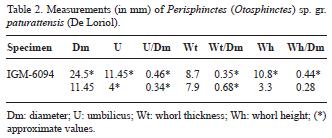
Description. Incomplete internal mold with maximum diameter of ca. 26 mm (Table 2), and well preserved but with largely covered umbilicus. The inner whorls at ca. 4–5 mm show an unsculptured ventral region and the ventro–lateral extremes of relatively "coarse" ribs. At 11.5 mm, the shell is heavily constricted and depressed (Wt/Wh = 2.39), and the exposure of a delicate septal surface in the internal mold indicates recrystallizationof the phragmocone, although no suture lines are discernible. At this ontogenetic stage, there are at least four deep, oblique constrictions ("constrictions delphïnoides"; Enay, 1966) with clearly reinforced "edges" ("bourrelet" aboral and "côte épaisse" adoral in Enay, 1966), and four parabolic nodes of low relief on the venter. Poor preservation (obscured by silty limestone plug and/ or recrystallization) impedes observation of whether the parabolic nodes continue in parabolic ribs on the flanks to form parabolae s.s. Primary and secondary ribs are equally coarse, and it is impossible to determine the number of bifurcate and simple ribs. The preserved outer whorl, filled with sediment and with no recrystallization, is interpreted as comprising one quarter of the body chamber (Wt/Wh= 0.80–0.81). In this part of the internal mold, which has no continuity with the whorls described above (broken specimen), the flanks are convex and neither the umbilical edge nor the shoulders are differentiated. Bifurcate ribs divide at mid flank and alternate with simple ribs. This ribbing is more prorsiradiate on the inner flank and bends to a more radial course from the midflank to the venter, which is orthogonally crossed by ribs. A deep, oblique constriction marks this segment of growth and precedes five ribs that are clearly more prorsiradiate at the lowermost part of the flanks. The small size, the regular alternation of bifurcate and simple ribs in the body chamber, the occurrence of parabolic nodes in the nucleus, and the insufficient increase in Wt/Wh could be in accordance with the interpretation of this specimen as immature. However, IGM–6094 is too incomplete for us to be conclusive about its ontogenetic stage.
Material. IGM–6094.
Occurrence. Otosphinctes species are reported from the Lower and Middle Oxfordian in Europe. Enay (1966), Bourseau (1977), and Meléndez (1989) interpreted the range of P. (Otosphinctes) paturattensis to embrace the lower part of the Middle Oxfordian, and the stratigraphic interval mentioned by these authors correlates with part of the Plicatilis Zone (Antecedens Subzone) in Cariou et al. (1991,1997). IGM–6094 was collected from the uppermost bed 43 in the Tamán section (Figure 2), just above bed 42 that contains Perisphinctes (Dichotomosphinctes) duran–gensis (Burckhardt), Ochetoceras (Cubaochetoceras) and O. (C.) cf. mexicanum, and is interpreted to be from the Plicatilis Zone, Antecedens Subzone. It is most likely that the Otosphinctes sp. group of paturattensis (IGM–6094) belongs to the same subzone in the Tamán section, but it may also come from the lowermost Transversarium Zone.
Discussion. Although IGM–6094 is very incomplete, the values obtained for coiling and whorl section could accord with the "involute" group identified by Enay (1966; with coarser ribbing) and Meléndez (1989; with a more inflated whorl section). Ribbing in IGM–6094 is too coarse for Passendorferia (Enayites) birmendorfensis (Moesch) and, in general, the subgenus Enayites developed a finer sculpture and constrictions at the same small size, and the latter did not affect body chamber ribbing as strongly as in IGM–6094. P. (E.) czestochowiensis (Siemiradzki) is usually interpreted as related to P. (E.) birmendorfensis and assigned to Perisphinctes (Otosphinctes), but the finer ribbing, especially on the inner whorls, supports its actual inclusion in Passendorferia (Enayites).
]]>
Coarser ribs and lower points of ribs' division, bending from prorsiradiate to radial in the body chamber, are relatively frequent in Perisphinctes (Otosphinctes) (e.g., Enay, 1966; Bourseau, 1977). Species such as P. (O.)mont–falconensis (De Loriol) andP. (O.)paturattensis (De Loriol) illustrated by these authors show individuals with shell features comparable to those described above for IGM–6094, especially the rib bending on the body chamber. The smaller size of P. (O.) paturattensis and the more compressed whorl section in P. (O.) montfalconensis permit their differentiation supporting the taxonomic interpretation of IGM–6094. According to Bourseau (1977), variants of the small–sized P. (O.) paturattensis with coarser ribs are more frequent in the upper part of the Middle Oxfordian (Beauvoisin, Drome, Subalpine Range). The incomplete preservation of IGM–6094 precludes a more precise interpretation within the subgenus Otosphinctes.
Subfamily Passendorferiinae Meléndez, 1989 For systematic details see Brochwicz–Lewinski (1973) and Meléndez (1989), the latter providing the most recent overview of Passendorferiinae with extensive references.
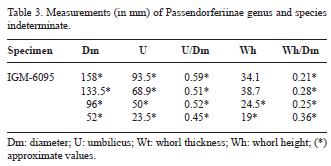
Description. Crushed specimen of at least 140 mm diameter and showing ellipsoidal deformation. The outer half whorl is preserved as internal mold, while the remaining identifiable whorls are imprints without vestiges of suture lines. A total of five whorls plus the nucleus itself are recognizable, despite the severe distortion and the virtual overlapping of successive whorls. The degree of coiling is approximately 55 percent, and whorl height increase is low (Table 3). Unfortunately, the ribs' counting within the umbilicus is obscured, but where preserved the ribs are fine, dense, and radial to slightly prorsiradiate. No rib bifurcation canbe seen within the umbilicus (but see below), which we interpret as resulting from peripheral division of ribs. Some cases of rib convergence near whorl junctions could reveal constrictions, and an excavated notch parallel to ribbing at approximately 15 mm diameter could be related to an edge–reinforced constriction, which is typical of birmendorfensis–like ammonites (Passendorferiinae). A rather abrupt change in ribbing seems to exist at the rear part of the outermost half whorl, but this could be a product of preservation. In this part of the shell, the only clearly bifurcate rib (division at the three quarters of whorl height) precedes what, on the basis of at least the last five to six ribs, seem to be simple, uniformly reinforced ribs that expand slightly towards their ventro–lateral extremes. It is unclear whether any of these ribs are in fact partially obliterated bifurcates, but the last 11 elements are simple and presumably were conspicuous on the ventral shoulders, although the above–mentioned expansion of the outermost extremes could be related to the combined effect of umbilical edge compression and shoulder extension.
]]>
Material. IGM–6095.
Occurrence. IGM–6095 was collected from bed 23 in the Tamán section (San Luis Potosi, Mexico), 70 cm above the lowest known record of Gregoryceras and approximately 17 m below the highest one, and therefore belongs to the Plicatilis Zone, Antecedens Subzone.
Discussion. Conclusive taxonomic interpretation of this specimen is complicated by its poor preservation, especially the lack of data about the ventral region, but also due to differential preservation of the inner whorls and the outer whorl (phragmocone or body chamber?; see below) that could distort the appearance in the former (finer ribbing in clay stone imprints?). Taking into account its perisphinctoid appearance, two options seem most appropriate to interpret what is assumed to be a small macroconchiate: (1) it is a perisphinctid such as Ampthillia or Arisphinctes, with crowded ribbed body chambers or showing a comparatively low modification of ribbing (Perisphinctes group oí alatus Enay); and (2) it is a passendorferiid such as Passendorferia or Sequeirosia. Brochwicz–Lewinski (1973, p. 306) noted the marked similarity between these two ammonite clades, especially when the inner whorls are crushed. Stratigraphy (see below) precludes Ampthillia, which shows a more complicated rib subdivision and massive telescoped ribs (e.g., Enay, 1966, pi. 17). We favor the interpretation of morphology in the outermost five to six ribs to include preservation imprint, whereas that of gerontic ribs in Perisphinctes (Perisphinctes) is different and preceded by diversely modified ribbing (e.g., Enay, 1966, pl. 3, fig. 2; pl. 4, fig. 1; pl. 5, fig. 1a; pl. 12, fig. 1a; Malinowska, 1972, pls. 13, 14). In addition, Arisphinctes, as well as some Perisphinctes (Perisphinctes), shows rather slightly constricted whorls and trifurcates prior to reinforced ribbing. The last mentioned alternative within perisphinctids points to the group of P. (P.) alatus Enay, especially to adult phragmocones that show no change in ribbing (only a comparatively minor one exists in the body chamber compared to other species of subgenus Perisphinctes; Enay, 1966, p. 586–587). This species has been related to forms morphologically close to P. bocconii Gemmellaro, currently interpreted as a typical member of Passendorferiinae (Sequeirosia in Meléndez, 1989 and Meléndez and D'Arpa, 2002; among others). In addition, P. (P.) alatus Enay shows a quadratic to rectangular whorl section, which is usual in the Passendorferiinae genera we favor (see below). We recognize similarity between our specimen and the final parts of the phragmocone in P. (P.) alatus Enay, and serious difficulty for separation from Sequeirosia, even from Passendorferia, when the body chamber lacks.
The Mexican specimen could represent a small individual within the Passendorferiinae genus Passendor feria, as it is relatively close in outer whorl sculpture to that illustrated by Gygi and Hillebrandt (1991, pli. 1, fig. 5). However, ribbing is denser and the only obvious bifurcation seems too deep within the flank for this genus (taphonomic distortion?). Moreover, we interpret the final preserved whorl in IGM–6095 as body chamber on the basis of taphonomic considerations —sedimentary infilling in the last whorl (body chamber) permitted 3D preservation, while inner whorls (phragmocone) were preserved as imprints because no sedimentary infilling occurred. On this basis, the Passendorferiinae genus Sequeirosia could be a more appropriate interpretation, being the bizarre Perisphinctesl inmutabilis n. sp. (Enay, 1966, pi. 24, fig. 4) and P. (Arisphinctes) sp. ex. group tenuisEnay in Brochwicz–Lewinski (1973, pl. 22, fig. 1) extreme morphologies within this genus. Passendorferia tenuis (Enay), which is close to the latter, differs in having constricted innermost whorls, which accords with the conceptual grounds established by Brochwicz–Lewinski (1973) and with the interpretation (e.g., Enay, 1966; Meléndez, 1989) of P. lucingensis Favre in De Riaz (1898, pli. 14, fig. 4) as synonymous. Two species of Sequeirosia bear partial resemblance to the specimen described: P. bocconii Gemmellaro in De Riaz (1898, pi. 13 = P. (P.) alatus Enay), which could be Passendorferia or Sequeirosia depending on the inner whorls (covered), is more evolute and has outer divisions, but shows similarly reinforced simple ribs; while in P. navillei Favre inDe Riaz (1898, pl. 9, figs. 1–2), ribs are less straight in the outer whorl, more widely spaced in the penultimate whorl, and probably similar in the inner whorls (if De Riaz's figure 2 is assumed to represent intra–species variability). In addition, Sequeirosia brochwiczi (Sequeiros) in Meléndez (1989, pl. 15, fig. 1) shows simple ribs at the end of the outer preserved whorl (phragmocone) that roughly resemble those in IGM–6095, as well as Nebrodites (Passendorferia) sp. in Brochwicz–Lewinski (1976, pl. 34, fig. 1).
No Cuban ammonites morphologically similar to IGM–6095 have been found, although Passendorferiinae or closely related ammonites are assumed to occur in Cuba [e.g., Perisphinctes (Ampthillia?) corrali Judo ley and Furrrazola–Bermudez (1968, p. 95, pls. 41–42), which was considered the type species for Vinalesphinctes (Subvinalesphinctes) subgen. nov. in Wierzbowski (1976, p. 179)]. Meléndez and Myczynski (1987) proposed an equivalent interpretation for Chilean perisphinctids, created Vinalesphinctinae as a subfamily within Perisphinctidae, and interpreted its origination from Passendorferiinae in the context of a paleobiogeographic relationship between Cuban and Andean provinces. Basically, we agree with these authors regarding a Cuban–Andean biogeographic affinity as long ago recognized by O'Connell (1920), and confirmed by our analysis of ochetoceratins (see below). However, on the basis of the original definition and treatment of Cuban perisphinctid genera and subgenera in Wierzbowski (1976), and Oxfordian ammonite records in Mexico, we interpret Vinalesphinctinae in a more restricted sense (e.g., for Vinalesphinctes, Subvinalesphinctes, and Roigites) and envisage the real occurrence of Perisphinctinae or Perisphinctinae–related stock for Cubasphinctes, Antilloceras, and the so–called Cuban Discosphinctes. For northern Chile, Meléndez and Myczynski (1987) assumed the occurrence of Perisphinctes (Kranaosphinctes) and ammonites close to Passendorferia, which indicates the occurrence of Perisphinctinae and Passendorferiinae, respectively [data in Gygi and Hillebrandt (1991) confirmed this interpretation].
Poor preservation precludes a more conclusive interpretation of IGM–6095, but we interpret this specimen to show an unequivocal Tethyan affinity in agreement with its record within the range of Gregoryceras and its association with Perisphinctes (Dichotomosphinctes), forms which are related to Burckhardt's types of P. cf. chloroolithicus and P. aff. plicatilis (see below). Accordingly, we interpret IGM–6095 as a macroconchiate Passendorferiinae —i.e., Passendorferia or Sequeirosia sp.
REMARKS ON MEXICO–CARIBBEAN OCHETOCERATINS
As mentioned above, precise description of specimens belonging to genus Ochetoceras is important for updating systematic interpretation at genus and species levels. For the purposes of this paper, we use the standard distinction based on the separation of mainly unicarinate versus "tri–carinate" venters. The revision of Ochetoceratinae species from d'Orbigny's collection made by Enay and Gauthier (in Fischer et al., 1994) shows the incidence of homeomorphism in their systematic and biostratigraphic interpretations, and reinforces the needs for updated reinterpretations of ochetoceratins based on material collected bed–by–bed. Enay and Gygi (2001) recognized confusion in the usual interpretation of genus Ochetoceras. These authors proposed the use of genus Ochetoceras for unicarinate ochetoceratins and Neoprionoceras for tricarinate ones (Mexican forms included). However, until a combined revision of Mexico–Caribbean and European ochetoceratins becomes available, we favor the use of Cubaochetoceras for tricarinate forms in the Mexico–Caribbean area.
]]>
Subgenus Cubaochetoceras Sánchez–Roig, 1951
Our interpretation of subgenus Ochetoceras (Cubaochetoceras) basically accords with that of Wierzbowski (1976). However, Wierzbowski (1976) gave systematic value to crenulated versus "smooth" carinae (see below) and assigned generic significance to this differential feature. We favor subgeneric status due to reanalysis of Burckhardt's (1912) type specimens and our own new material. In fact, a transition in characteristic ventral regions from Ochetoceras (unicarinate) to Cubaochetoceras ("tricarinate"; see below) has been identified early in ontogeny, as well as in more advanced ontogenetic stages. Concerning the latter, the Mexican type of O. pedroanum Burckhardt, does not show a "tricarinate" venter comparable to other Mexican Cubaochetoceras, but rather an "intermediate" morphology closer to Ochetoceras; e.g., Burckhardt's type of O. (C) pedroanum developed a "pseudotricarinate" or "subtricari–nate" venter; incipient "tricarination" that faded throughout the preserved outer whorl due to its comparatively thick and coarsely sculptured shell (see below). In accordance with our comments about genus Ochetoceras (above), we assume the taxonomic interpretation of Bourseau (1977) for Campylites (= Neocampylites according to Callomon, 1973) to be referred to Neoprionoceras (e.g., Enay and Gauthier in Fischer et al., 1994; Enay and Gygi, 2001), which could have a mainly paleobiogeographic significance, until an updated revision of Ochetoceras–like ammonites is available.
Description. Although small, the specimens show partial preservation of the body chamber (one eighth of the outer whorl in the IGM–6096 and one fourth in the other two), but no crowding of suture lines. Thus, we interpret them as juveniles. IGM–6099 seems to be the phragmocone (nucleus) of an equivalent individual. Even though shells are smooth, IGM–6096 and IGM–6097 show coarser sculpture (falcate ribs) above the lateral groove, whereas the dorsal parts of the flanks are practically smooth (i. e., occupied by extremely delicate, dense and slightly arched prorsiradiate costae). On these inner flanks, the only significant relief is related to irregularly spaced depressions that follow the course of costae concave towards the peristome. These structures could indicate ontogenetic phases, especially where equivalent depressions occur above the lateral groove (e.g., on the better–preserved right side of IGM–6096). In these cases, the lateral groove was reinforced by fine sculpture coincident with its typical inflection (falcate ornamentation). These depressions with a reinforced anterior edge are assumed to represent transient peristomes in juveniles. The position of the lateral groove seems almost constant and scarcely fluctuates around the mid–flank (Lg = 0.54–0.5; Table 4), perhaps slightly displaced ventrally to the mid–flank through ontogeny within a given population (see discussion).
The smaller specimens IGM–6098 and IGM–6099 have absolutely smooth inner whorls with no development of lateral grooves. This interpretation accords with increased shallowing until the disappearance of lateral grooves in IGM–6096 and IGM–6097 at the beginning of the preserved outer whorl, which contrasts with the known trend towards disappearance in adult ochetoceratins (e.g., Gygi and Hillebrandt, 1991) and reinforces their interpretation as juveniles. Taking into account that IGM–6098 shows body chamber but no lateral groove, the appearance of the lateral groove at sizes greater than 10 mm could be paleobiologically established (e.g., largely under genetic control).
The structure of the ventral region is a key parameter for systematics in the genus Ochetoceras, as considered here. The small size of the specimens allows insight into the ontogenetic development of so–called tricarinate venters. IGM–6096, IGM–6097, and IGM–6098 show the progressive development of peripheral (i.e., ventro–lateral, on the shoulders) "carinae", which are always smooth, due to their origin from the increased sharpness of the flank periphery at its connection with the venter. In contrast, the siphonal carina is generally crenulate; smooth ones could result from localized defective preservation, even in specimens with well–preserved neomorphic shells. Careful analysis shows that crenulations of the siphonal carina result from the crossing of extremely delicate costae. In the studied specimens there is variability in the implantation of "tricarination", both in strength (relief) and shell size. The larger IGM–6096 has a rounded periphery throughout most of the exposed phragmocone, and sharp edges at the periphery of the venter become identifiable towards the end of the phragmocone. Increasing "tricarination" occurs along the body chamber. The siphonal carina is crenulated. The smaller IGM–6097 has smooth venter due to shell exfoliation, which is consistent with poor preservation of shell on the siphonal carina, and evidence of the notable reduction of relief in this part. However, we observe a progressive change towards a narrower and higher venter throughout the outer whorl. Thus, analysis of IGM–6097 confirms descriptions of smooth (i.e., eroded, incompletely preserved) "tricarinate" venters. The even smaller IGM–6098 shows a very incipient lateral groove towards the end of the outer whorl (left side) and less developed shoulders, which accords with its small size (see above). Although neomorphic shell is largely missing on the ventral region, the impression of very subtle peripheral ribs can be observed, as well as vestiges of undulation in the secondarily smoothed siphonal carina. The latter demonstrates the relationship between preservation and the crenulated or smoothed appearance of siphonal carinae. The smallest phragmocone, IGM–6099, shows a relatively raised and "undulating" venter with respect to the impressions of subtle costae. Taking into account its very small size, this could indicate variability in ventral structure, including a comparatively early onset of differentiated shoulders (increasing sharpness along the ventro–lateral edges) at the periphery of the venter (incipient "tricarination").
Material. IGM–6096–6099.
Occurrence. Burckhardt (1912) envisaged the correlation of horizons containing his Ochetoceras canaliculatum in San Pedro del Gallo (couches supérieures de I 'Oxfordien supérieur) with the Transversarium to Bimammatum Zone interval in Europe. O'Connell (1920) interpreted his O. canaliculatum var. burckhardti to be "the best and most reliable horizon–marker in the Cuban fauna" (literal translation) with reference to correlation with the Transversarium Zone in Europe. Jaworski (1940) envisaged correlation with the Cordatum Zone of beds at Puerto Ancon (Cuba) that provided his Neoprionoceras girardoti. Judoley and Furrazola–Bermúdez (1968) interpreted their O. canaliculatum var. burckhardti and O. burckhardti from the Pinar del Rio province as Upper Oxfordian Bimammatum Zone. Wierzbowski (1976, p. 156–157) interpreted the ammonite assemblages containing Cubaochetoceras as representing the Middle Oxfordian in Sierra de los Órganos (Cuba), most probably parts of the Transversarium and Bifurcatus Zones (with no major differences from interpretation applied in Cariou et al., 1991, 1997).
]]>
The specimens analyzed were recovered from bed 42 in the Tamán section (San Luis Potosi, Mexico) together with Gregoryceras sp. Therefore, they represent the Plicatilis Zone, Antecedens Subzone.
Discussion. The above analysis of these specimens of Ochetoceras (Cubaochetoceras) burckhardti (O'Connell) indicates that within this subgenus the ventral region started with crenulate–unicarinate venters and progressively modified to "tricarinate" ones throughout ontogeny. Therefore, Ochetoceras and Cubaochetoceras seem to be indistinguishable at early ontogenetic stages, especially at those showing crenulate–unicarinate venters, as well as at earlier stages before the growth of the siphonal carina (i.e., glochiceratin–like nuclei with presumed subrounded–to–oval venters). This supports the interpretation of the relationship between Cubaochetoceras and Ochetoceras at the subgenus level, and lends further relevance to early ontogenetic phases. This, in turn, accords with an evolutionary context that combines paleobiogeography and phytogeny.
Among Burckhardt types, Ochetoceras canaliculatum d'Orbigny (nonBuch) in Burckhardt (1912, pl. 1, figs. 1–7) is morphologically the closest relative to the specimens discussed due to its subtly sculptured inner flanks (costae), especially at smaller sizes (Burckhardt, 1912, pl. 1, fig. 4). The specimen that corresponds with Burckhardt's figs. 1–3 represents part or the entire (?) phragmocone of a larger specimen. The abrupt interruption of the deep lateral groove (adorally shallower; see above) and the irregular, unsculptured surface of the internal mold (missing ornamentation) that terminates abruptly at the beginning of the preserved outer whorl are both the result of preparation to expose the suture rather than of injuries to the mantle. The specimen figured by Burckhardt (1912, pl. l, fig.4) has less than one fourth of the outer whorl as body chamber, and the rear half–outer whorl shows the closest resemblance to the individuals analyzed from Tamán (note the similar size in this case). Burckhardt's specimens of O. canaliculatum contain remains of the crenulate siphonal carina connected to extremely fine and strongly prorsiradiate costae (that locally bend to intersect the keel perpendicularly), and episodic depressions of inter–rib spaces that would represent growth phases (as assumed previously for Tamán specimens), while lateral grooves indicate the ventral displacement towards the mid–flank at greater sizes (Lg = 0.60 –0.58).
Ochetoceras mexicanum (Burckhardt, 1912, pl. 1, figs. 8–12) also shows a crenulate siphonal carina, but coarser ribbing as compared with similar–sized Mexican O. canaliculatum, and the sculpture below the lateral groove is straight prorsiradiate rather than concave towards the peristome. Both of Burckhardt's "species", O. canaliculatum and O. mexicanum belong to subgenus Cubaochetoceras.
As mentioned above, the thicker and coarsely ribbed O. pedroanum n.sp. inBurckhardt (1912, pl. 1, figs. 13–17) shows a crenulate ventral region that is transitional between unicarinate and "tricarinate" ("... quille peu élevée... accompagnée de chaqué côte par un faible sillón, separé...des flancs par une carène latérale peu marquée... "; Burckhardt, 1912, p. 9). The interpretation made by Höroldt (1964) was probably influenced by Burckhardt's emphasis on" carenes accessories'" (Burckhardt, 1912, p. 10) when discussing differences from European species. In fact, close observation reveals no distinct acute shoulders, and "pseudo/subtricarination" results from locally variable flat to slightly concave surfaces that raise the keel, showing extremely fine prorsiradiate striation that connects to siphonal crenulation. The interpretation of these features as indicating that pedroanum belongs to Ochetoceras or Cubaochetoceras is an open question (the comments of Gygi and Hillebrandt, 1991, on the type–species of the genus Ochetoceras, Ammonites canaliculatus von Buch, are of special interest). Nevertheless, in addition to indistinct development of acute shoulders, the lack of increased relief throughout the outer whorl preserved in this phragmocone does not accord with the typical appearance in Cubaochetoceras. Alternatively, sharpness in shoulders could decrease in Cubaochetoceras with shell inflation (cf C. pinarense, C. submexicanum, C. imlayi in Wierzbowski, 1976), especially if these were shell features of secondary significance in such a situation (i.e., in covariation with whorl thickness in the opposite sense to ventro–lateraltuberculationintaramelliceratins). Based on this assumption, the narrower the shell, the sharper the shoulders is expected. However, this does not apply to the crenulate–unicarinate O. (Ochetoceras) neohispanicum (Burckhardt, 1912, pl. 10, figs. 1–3, 7) from the Kimmeridgian section at the southern talus of the Cerro del Volcán (San Pedro del Gallo, Durango) and to O. (Ochetoceras) sanlazarense (Imlay, 1939, pl. 1, figs. 1–4) from the Kimmeridgian at San Lázaro Canyon, Nuevo León. Concerning the present question, these two occurrences of O. (Ochetoceras) support the taxonomic separation of Ochetoceras and Cubaochetoceras, on the basis of phenotypic differences that probably express paleobiologic processes (s. Gould, 1977) related to the colonization of American seas by Ochetoceras.
A precise comparison with Cuban Cubaochetoceras is difficult because of the lack of suitable illustration (mainly from Judoley and Furrazola–Bermúdez, 1968) and the lack of comparative material in the collections housed in the National Paleontológica! Collection (UNAM). On the basis of the assumed occurrence of bifurcated outer ribs in the subtly and dense ribbed adoral outer whorl oí Ammonites canaliculatus figured by D'Orbigny (1842–1849, pl. 199, figs. 1,2 = Ochetoceras semifalcatum (Oppel) according to Enay and Gauthier in Fischer et al, 1994), although no reference to it was made in his description (D'Orbigny, 1842–1849, p. 525–527), O'Connell (1920, p. 681) proposed that it should be separated from the homonym in Oppel (1862–63, pl. 51, fig. 3), which agrees with interpretations made by Enay and Gauthier (in Fischer et al., 1994). This seems a valid observation for the external ribbing, but no attention was paid to the close similarity of Oppel's specimen to the rear half–outer whorl inD'Orbigny's illustration, except the concave vs. straight ribbing below the lateral groove (not commented by O'Connell).
The difference noted by O'Connell (1920) could be related to the absence of body chamber in the specimen figured by Oppel. If these two specimens represent differential preservation of conspecific individuals, the interpretation made by O'Connell (1920) would be incorrect. O'Connell (1920, p. 683,685–686) correctly stated the equivalence between his specimen and those studied by Burckhardt (1912), which supposedly developed bifurcate ribs (but see above), although the latter author never described bifurcation in his specimen. On this basis, we assume co–specificity between O. canaliculatus var. burckhardti in O'Connell (1920) and Burckhardt's O. canaliculatus. The only (real?) difference with Ammonites canaliculatus in D'Orbigny (1842–1849 = Ochetoceras semifalcatum (Oppel) according to Enay and Gauthier in Fischer et al., 1994) is restricted to the ventral region (clearly "tricarinate" in Mexican and Caribbean individuals). Based on the latter, European representatives of canaliculatus would belong to O. (Ochetoceras) (but see Gygi and Hillebrandt, 1991), whereas Mexican and Cuban representatives would be O. (Cubaochetoceras) and, therefore, they might be referred to another species. Accordingly, we refer our material to O. (C.) burckhardti (O'Connell), including O. (C.) aff. burckhardti (O'Connell in Wierzbowski, 1976) and O. (C.) burckhardti (O'Connell in Wierzbowski, 1976, p. 243) with the only doubts concerning references to Sánchez–Roig (1920), which were not available for analysis.
Wierzbowski (1976) reinterpreted Ochetoceras canaliculatum D'Orbigny (non Buch) in Burckhardt (1912, pl. 1, figs. 1–7) as Cubaochetoceras aff. burckhardti but he did not include an illustration of the Cuban material studied. Wierzbowski (1976) envisaged the possible co–specificity of Burckhardt's O. canaliculatus with O. burckhardti in Judoley and Furrazola–Bermúdez (1968, pl. 7, figs. 2a–b, non pl. 5, figs. 2a–d), but the individuals illustrated by these authors are more advanced adults with less developed "tricarination", and show a sculpture not observed in incomplete Mexican specimens (Burckhardt, 1912, pl. 1, figs. 1–3) or subadults (Burckhardt, 1912, pl. 1, fig. 4). In this case, the interpretation made by Wierzbowski (1976) is difficult to evaluate, but it can be assumed that differences relate to more or less advanced ontogeny. Even assuming cases of morphologic convergence between Ochetoceras and Neoprionoceras (see Enay and Gauthier in Fischer et al., 1994), we agree with Wierzbowski on the conspecificity of Neoprionoceras girardoti (Jaworski, 1940, pl. 3, fig. 5; pl. 6, fig. 3) and O. canaliculatus (Burckhardt, 1912). but differ with respect to his proposal for separation of O. canaliculatus (Burckhardt, 1912) and O. canaliculatus var. burckhardti (O'Connell, 1920) on the basis of bifurcate ribs in Burckhardt's specimens. The latter has been widely assumed (Judoley and Furrazola–Bermúdez, 1968, p. 62; Wierzbowski, 1976, p. 245), but close observation of Burckhardt's types shows that true bifurcation seems to be not attained in Mexican specimens. It is difficult to differentiate real from incomplete bifurcation in cases of subtle and dense ribbed ochetoceratins, and this has led to some confusion (e.g., O'Connell, 1920, p. 681; Judoley and Furrazola–Bermúdez, 198, p. 62; Wierzbowski, 1976, p. 245). Jaworski (1940) mentioned (without illustration) the occurrence of Mexican O. canaliculatus and O. mexicanum in Cuba.
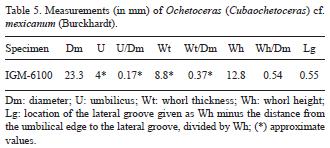
Description. IGM–6100 is a small internal mold, preserved in volume, with a fracture at the phragmocone to body chamber transition (18.7 mm diameter; Table 5) that slightly displaced shell fragments. The body chamber occupies at least one quarter of the outer whorl. The phragmocone shows falcate ribs that are more prominent above an incipient, very shallow, lateral groove. The sculpture on the preserved body chamber is coarser, especially on the inner flanks, due to wide folding that results in blunt "ribs" superimposed on subtle costae. These blunt "ribs" fade before connecting with the lateral groove, which is relatively deep and reveals a transient, pointed peristome. Above the lateral groove, four to five coarser ribs are present; they are widely spaced and concave to the peristome, among which there are intercalated costulae. No bifurcation has been observed. The ventral region changes throughout the outer whorl, from subrounded–suboval with incipient shoulders to higher and crenulated from the end of the phragmocone towards the aperture. The absence of crenulations on a large part of the phragmocone is related to poor preservation. The combination of the excavated lateral groove and the sculpture of the phragmocone indicate that this specimen is immature.
IGM–6101 is 24.4 mm in diameter, crushed and with slightly more than one quarter of the outer whorl belonging to the body chamber. The phragmocone is recrystallized and the lack of suture lines impedes evaluation of the on–togenetic stage of this individual (juvenile or small adult?). Falcate and relatively coarse ribbing exists, and this specimen shows a tricarinate–crenulate ventral region.
Material. IGM–6100–6102.
Occurrence. Burckhardt (1912) obtained the type of Ochetoceras mexicanum from the "couches supérieures'" of his Upper Oxfordian at the southeastern slope of the Cerro del Volcán in San Pedro del Gallo, Durango. Gygi and Hillebrandt (1991) found O. (Ochetoceras) mexicanum at the Agua del Carretón section in northern Chile and interpreted a late Bimammatum to early Planula age. Our specimens were obtained from bed 42 in the studied section, together with Gregoryceras sp. and hence it occurs in the Plicatilis Zone, Antecedens Subzone. Therefore, O. (C.) mexicanum seems to have a wide range within the Middle–Upper Oxfordian in the Americas, or, alternatively, there are poorly known homeomorphs.
Discussion. Ochetoceras (Cubaochetoceras) mexicanum (Burckhardt, 1912, pl. 1, figs. 8–12) shows crenulate siphonal carina, coarser ribbing than Burckhardt's O. canaliculatum = O. (C.) burckhardti at the same shell size, and the sculpture below the lateral groove is straight prorsiradiate rather than concave towards the peristome. However, as they were obtained from the same locality 10 of Burckhardt (1912) and presumably the same beds in the San Pedro del Gallo area, the morphological differences of Burckhardt's types do not preclude their inclusion within a single species, as morphot–ypes. The material collected from bed 42 at the Moctezuma River section in Tamán is too small (early ontogenetic stages) to provide conclusive evidence for this hypothesis, but at least the overlapping of the biostratigraphic ranges of Burckhardt's species is demonstrated. According to the analysis of his types, Burckhardt's (1912) O. pedroanum, from the same provenance in San Pedro del Gallo, shows a thicker shell, but the style of ribbing is not significantly different from that interpreted for the inner whorls in O. mexicanum. The ventral structure in O. pedroanum remains an open question. Authors suchas O'Connell (1922, p. 327), Wierzbowski (1976, p. 246) and Jaworski (1940, p. 91) considered the possible co–specificity of Burckhardt's O. pedroanum and O. mexicanum, but, for the time being, O. pedroanum persists as the rarer Ochetoceras described by Burckhardt [Imlay, 1939 included the species in his table 3 from the same locality studied by Burckhardt, but did not list this species on p. 17]; and new material with stratigraphic control is necessary for a conclusive interpretation. Judoley and Furrazola–Bermúdez (1968, p. 70) recognized the morphological similarity between their Cubaochetoceras sub–vignalensis (submexicanum O'Connell is synonymous) and Burckhardt's O. mexicanum, but the Cuban specimens are crenulate–unicarinate (= O. subvignalense in Wiezbowski, 1976) and some of them (Judoley and Furrazola–Bermúdez, 1968, pl. 9, fig. 2) are similar to Burckhardt's O. pedroanum but with straighter rursiradiate ribs (see points 8 and 10 below). This reflects the importance of shell inflation and transitional unicarinate to "tricarinate" venters with respect to interpretation of the "pseudo– or subtricarinate" ventral region in O. (Cubaochetoceras?) pedroanum (Burckhardt; see discussion for O. (Cubaochetoceras) burckhardti).
Ochetoceras (Cubaochetoceras) mexicanum (Burckhardt) and/or mexicanum–type ochetoceratins were widely distributed in the Americas (e.g., Burckhardt, 1912; O'Connell, 1920, Imlay, 1939; Jaworski, 1940; Judoley and Furrazola–Bermúdez, 1968; Wierzbowski, 1976; Gygiand Hillebrandt, 1991). Unfortunately, sampling limitations and the scarcity of successive fossiliferous horizons in Cuba, Mexico and Chile mean that few data with precise biostratigraphic control are available, and material from equivalent horizons is insufficient to interpret intra–species variability. In addition, adapted to epicontinental environments, ammonite assemblages in the region experienced notable endemism due to the limited connection with Tethyan faunas (Olóriz, 1992). The latter results in restricted possibilities for direct extrapolation of ontogenetic and evolutionary trends identified in better known Mediterranean and sub–Mediterranean ammonites, among which, ochetoceratins need revision. Therefore, only rather preliminary remarks can be made about interpreting the morphologic similarity among American ochetoceratins gathered from equivalent stratigraphic intervals. The following observations in support of wide biogeographic distribution of mexicanum–like Ochetoceras (Cubaochetoceras) advance hypotheses for future testing with new, stratigraphically sound data:
1) The type of O. (Cubaochetoceras) mexicanum was based on a single immature phragmocone (no crowded sutures), and the more recently reported Chilean specimen (Gygi and Hillebrandt, 1991) only adds information on the incomplete and weakly ribbed inner flanks in two thirds of the body chamber. The latter specimen suggest the co–specifity between Burckhardt's types of O. mexicanum and O. canaliculatum, and indicates a wide biostratigraphic range for O. mexicanum in the Oxfordian of the Americas, based on reinterpretations of Burckhardt's assemblages (Myzczinski et al, 1998) and the new data in this paper.
]]>
2) The existence of Cuban forms similar to O. (Cubaochetoceras) mexicanum, but more coarsely ribbed including bifurcates (submexicanum; Ochetoceras for Judoley and Furrazola–Bermúdez, 1968, and Cubaochetoceras in Wierzbowski, 1976); Burckhardt (1912, p. 8) described bifurcate ribs in the Mexican type.
3) The Chilean O. (Cubaochetoceras) imlayi in Gygi and Hillebrandt (1991, pl. 1, fig. 4) is a phragmocone that closely resembles Burckhardt's mexicanum type and increases the morphologic spectrum for the chambered portion compared to that previously documented by Judoley and Furrazola–Bermúdez (1968) and Wierzbowski (1976, pl. 7, fig. 13); illustrations of Cuban specimens seem to conforma group of O. (Cubaochetoceras) mexicanum affinity in which they might be simply more complete specimens, expanding restrictive interpretations based on Burckhardt's type.
4) Judoley and Furrazola–Bermúdez (1968, pi. 6, fig. 1) first described Cubaochetoceras brevicostatum Judoley and Furrazola–Bermúdez. They placed Ochetoceras canaliculatum var. burckhardti O'Connell in Sánchez–Roig (1951; not available for us when writing the present paper) in synonymy suggesting similarity to O'Connell's material, here interpreted as O. (Cubaochetoceras) burckhardti (O'Connell; see point 1 above), and hence more in accordance with the original interpretation made by O'Connell (1920). On the basis of known intraspecific variability (point 3), the less dense ribbing in C. brevicostatum Judoley and Furrazola–Bermúdez than in O. (C) mexicanum could be related to slightly larger phragmocones compared with Burckhardt's type (also phragmocone). The specimen figured in Wierzbowski (1976, pl. 7, fig. 14) depicts variable ribbing on the inner flanks.
5) On the basis of possible relationships between Burckhardt's mexicanum and pedroanum (see below), C. diversicostatum in Judoley and Furrazola–Bermúdez (1968, pl. 12, figs. 1–2) may correspond to a more straightly sculptured variety of O. (C.) mexicanum.
6) Cubaochetoceras chudoleyi in Wierzbowski (1976, pl. 8, fig. 6 = Ochetoceras burckhardti in Judoley and Furrazola–Bermúdez, 1968, pli. 5, fig. 2a) was identified as close to the O. aff. burckhardti that is included in O. (Cubaochetoceras) burckhardti in this paper (see above) and, therefore, conspecific with Burckhardt's type of O. canaliculatum. The latter, in turn, could be conspecific with Burckhardt's type of O. mexicanum (point 1).
The following comments are pertinent to the possible relationship between Burckhardt's "species" O. mexicanum and O. pedroanum (see above for references):
7) Burckhardt (1912) described Ochetoceras pedroanum from the same locality as O. mexicanum in San Pedro del Gallo. It has a wider shell than O. mexicanum, but the style of ribbing of the inner whorls is not significantly different.
8) Cuban O. mexicanum in O'Connell (1920, pl. 38, figs. 1–3), from Vinales, shows similarly coarse, but straight–er and denser ribbing and indistinct shoulders; thus, it might be closer form to O. pedroanum. O'Connell (in Jaworski, 1940, p. 92) suspected O. pedroanum to represent the inner whorls of O. mexicanum, and Jaworski (1940) proposed a similar interpretation, with transitional forms between these two taxa. Moreover, the close morphologic resemblance between O. mexicanum in O'Connell (1920, pl. 38, figs. 1–3) and C. diversicostatum Judoley and Furrazola–Bermúdez (1968, pl. 12, fig. 2), which only differ in the curvature of the external ribs, supports previous comments on possible relationships between Burckhardt's O. mexicanum and O. pedroanum and C. diversicostatum as revealing a well–expressed morphological trend.
9) Judoley and Furrazola–Bermúdez, (1968, p. 64,65) separated O. mexicanum var. cubensis from O. mexicanum because of the connected outer ribs [also present in O. (C) mexicanum; point 2] and the more distant inner ribs. At small shell diameters, these Cuban specimens seem barely distinguishable from the small phragmocone of Burckhardt's pedroanum. This is relevant to previous comments about forms related to O. (C) mexicanum.
10) Judoley and Furrazola–Bermúdez (1968, p. 68, 69) described the crenulate unicarinate Cubaochetoceras vignalensis, which we interpret as Ochetoceras in agreement with Wierzbowski (1976), although distinct from Burckhardt's O. mexicanum because of the lack of falcate ribs. Thus, vignalense is similarto O. pedroanum–like ochet–oceratins with straighter rursiradiate ribs (point 8), although it represents a more irregularly ribbed variant (see Judoley and Furrazola–Bermúdez, 1968, p. 69 for ribbing irregularity and comparisons with "species" discussed above).
Description. A fragmented body chamber of an individual of approximately 35 mm in size. Only the left side is observable, with coarse ribbing below and above the lateral groove. On the inner flank, ribs are prorsiradiate and fairly straight to slightly arched adorally. On the outer flank, simple ribs (two of which show approximated dorsal extremes) are blunt, prorsiradiate, and slightly arched. The lateral groove is deep and the ventral region is eroded.
Material. IGM–6103.
Occurrence. Ochetoceras pedroanum Burckhardt was collected by Burckhardt (1912) from the "couches supérieures'" of his Upper Oxfordian at the southeastern talus of the Cerro del Volcán in San Pedro del Gallo, Durango. IGM–6103 was obtained from bed 42 in the section studied in association with Gregoryceras sp. Therefore, it belongs to the Plicatilis Zone, Antecedens Subzone.
Discussion. In accordance with previous comments on Ochetoceras (Cubaochetoceras) pedroanum and related forms, we interpret this larger fragment as representing a more advanced ontogenetic stage in this species. IGM–6103 develops slightly wider spaced, subradial ribs above the lateral groove, a trend identifiable in the outermost ribs of the Burckhardt's type. The closely related Ochetoceras mexicanum var. cubensis shows similar inner ribbing but denser external ribs, some of which bifurcate. Taking into account the equivalent size, other forms illustrated by these authors develop denser inner ribs but their outer ribs are similar at the middle part of the outer whorl (Cubaochetoceras brevicostatum, Judoley and Furrazola–Bermúdez, 1968, pl. 6, fig. 1a); or have similar inner and outer ribs but the latter are denser (C imlayi, Judoley and Furrazola–Bermúdez, 1968, pl. 9, fig. 2); similar but more crowded and irregular ribbing (C vignalensis, Judoley and Furrazola–Bermúdez, 1968, pli. 11, figs, 1a, Id); denser and straighter outer ribs (C diversicostatum, Judoley and Furrazola–Bermúdez, 1968, pl. 12, figs. 2a, 2d); and similar inner and outer ribs with some bifurcates (C pinarensis, Judoley and Furrazola–Bermúdez, 1968, pl. 13, figs. 4, 5). All these Cuban "species" present phenotypic expression "in mosaic" that deserves future research, focusing on new material collected within precise biostratigraphic control, to achieve an accurate interpretation of the paleobiological significance of Burckhardt's pedroanum type.
Subgenus Ochetoceras Haug, 1885
The interpretation of subgenus Ochetoceras (Ochetoceras) basically corresponds with characteristics described by Wierzbowski (1976), enlarged by additional comments made by Gygi and Hillebrandt (1991).
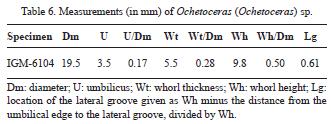
Description. In the specimen analyzed, approximately one third of the outer whorl belongs to the body chamber. Absence of crowded sutures indicates immature individual. The whorl section is high–oval, with flanks arched below the lateral groove, and flattened and convergent to the venter above. Maximum whorl thickness is just below the lateral groove. The acute ventral region is slightly wider in the phragmocone and narrower in the body chamber, with persistent subrounded shoulders and crenulations early in the outer whorl. The umbilicus is moderately deep with subrounded umbilical edges and a steep umbilical wall. The sculpture is extremely subtle, difficult to observe, falcate, widely concave adorally below the lateral groove and more arched above; increased ribbing relief in the outerflank occurs towards the end of the preserved body chamber. The lateral groove is narrow, shallower in the phragmocone and shows small and discontinuous relieves that indicate the crossing of costae (Table 6).
Material. IGM–6104.
Occurrence. The specimen was recovered from bed 42 together with Gregoryceras sp.. Therefore, it represents the Plicatilis Zone, Antecedens Subzone.
Discussion. The small size of the specimen described slightly exceeds the limit of ca. 15 mm in diameter for distinction between Ochetoceras and Glochiceras (cf. Ziegler, 1974). However, the whorl section, and especially the morphology of the ventral region accords with its inclusion in Ochetoceras. At the same shell size, the whorl thickness is similar to that obtained from O. (Cubaochetoceras) burck–hardti (O'Connell) described above, but the compression above the lateral canal is clearly greater, producing a much narrower ventral region. In addition, ribbing and the lateral groove are less accentuated, and the umbilical wall is more vertical. All these features favor its interpretation as O. (Ochetoceras) rather than O. (Cubaochetoceras).
Complementary material
]]>
The specimens described below are inappropriate for precise interpretation, but some ones are of interest to provide information about the composition of the ammonite assemblages studied.
IGM–6105 is a crushed specimen (75 mm diameter) with relatively coarse bifurcate ribbing, some intercalated, simple ribs and two to three constrictions. Perisphinctes cf. plicatilis De Riaz in Burckhardt (1912, pl. 4, fig. 5) may be morphologically close if the inner points of rib division observed in IGM–6107 (40a) resulted from severe crushing (Figures 3 l–m).
IGM–6106 morphologically corresponds to several nuclei of densely ribbed individuals with constricted, but not strictly serpenticone whorls (Figures 3 i–k). Ribs are finer and prorsiradiate, and some coalesce on the umbilical edge (subpolyplocoid divisions induced by dense ribbing). In all these nuclei, ribbing is finer and denser than in Perisphinctes virgulatus Quenstedt in Burckhardt (1912, pl. 7, figs. 4–14), but resembles that in Cuban "Discosphinctes" illustrated in Wierzbowski (1976, pl. 7, especially D. acandai Judoley and Furrazola–Bermudez). Similar nuclei were reported from the Middle Oxfordian on the northern rim of the Gulf of Mexico Basin by Young and Olóriz (1993). Wierzbowski (1976, p. 157) envisaged a maximum stratigraphic range from the upper Antecedens to Bifurcatus zones for Cuban ''Discosphinctes".
IGM–6107 is an incomplete phragmocone of a specimen of approximately 60–70 mm in diameter, with sub–quadrate whorl section (Figures 3 c–h). Ribs are bifurcated and simple, extremely dense in the inner whorls and less dense in the preserved outer whorl. No Cuban ''Discosphinctes" show a similar sculpture. Perisphinctes trichoplocoides in Burckhardt (1912, pl. 5, figs. 11–14 = Sequeirosia (Gemmellarites) trichoplocoides) has a wider whorl section and constricted, less densely ribbed, inner whorls. IGM–6107 (43) resembles P. (Subdiscosphinctes) aeneas (Gemmellaro) from the Transversarium Zone.
IGM–6108 is a fragment of the crushed body chamber of a large Euaspidoceras (Euaspidoceras) sp. with prominent tubercles showing connecting ribs (Figure 6a).
IGM–6109 is a small Euaspidoceras sp. with flattened flanks covered by riblets and two rows of tubercles connected by raised ribs. This specimen represents the phragmocone up to 20 mm (Figures 6b–c).
IGM–6110 is a small phragmocone (21.5 mm in size) with involute coiling and fine, dense ribs that coalesce on the umbilical edge periodically to give raised, blunt and slightly prorsiradiate swellings ("thicker primary ribs"; Figures 6d–e). This specimen resembles the small Cuban ammonites interpreted as mainly inner whorls classified as Euaspidoceras (Euaspidoceras) aff. costatum (Dorn) by Myczynski (1976, pl. 3, fig. 5) from the Middle Oxfordian in Cuba.
FINAL DISCUSSION
The stratigraphic analysis of the lower part of the Santiago Formation at the studied section, provides interesting ammonite assemblages from different beds. Many of the taxa were first described by Burckhardt (1912) for the San Pedro del Gallo area. Burckhardt's assemblages have been considered the reference for Oxfordian ammonites in Mexico, but it has not been complemented with an updated biostratigraphy based on bed–by–bed analysis. Therefore, the bio stratigraphic information obtained from precise sampling in the lower part of the Santiago Formation at the type section represents a significant improvement for Middle Oxfordian biochronostratigraphy in Mexico.
]]>
The ammonite assemblages studied are mainly restricted to the lower Middle Oxfordian Plicatilis Zone, Antecedens Subzone. Among the ammonites obtained, the occurrence of small specimens of the genus Gregoryceras is of special relevance, as noted by Villaseñor et al. (2004). These specimens present a combination of morphologic features identified in ubiquitous species adapted to epioce–anic and epicontinental environments, as well as in more biogeographically restricted forms adapted to neritic seas in the Americas, most probably according to metapopulation dynamics (see below). This interpretation needs confirmation from the analysis of more complete specimens, but, for the present, the Mexican record obtained provides a more complete, continuous paleobiogeographic range for Gregoryceras in the Americas, as gathered from an intermediate area between existing records from northern Chile and the northern rim of the Gulf of Mexico Basin. The record of Gregoryceras in Mexico clearly correlates with significant colonization of Mexican seas by Late Jurassic ammonites of Tethyan affinity, which was favored by generalized transgression, as experienced elsewhere during the Middle Oxfordian.
In addition to Gregoryceras, other Tethyan (i. e., tropical–subtropical ubiquitous) ammonites reached Mexico during the major Oxfordian transgression. This has been largely accepted for perisphinctids since Burckhardt's (1912) time, but species were largely interpreted as being generally endemic and belonging to a single subgenus (e.g., Dichotomosphinctes in current interpretations). The ammonites from the section studied here reveal a wider spectrum of Tethyan perisphinctids accompanying Gregoryceras. Among these, Perisphinctes (Perisphinctes), P. (Otosphinctes) and Passendorferia or Sequeirosia were present, and some of these taxa through widespread species, the record of which is first reported from Mexico with precise stratigraphy.
The revision of some of Burckhardt's "species" has been facilitated by the new material collected. Thus, P. (Dichotomosphinctes) durangensis is reinterpreted, and its precise stratigraphic location revised on the basis of its co–occurrence with Gregoryceras. In addition, a preliminary approach has been made to the reinterpretation of Burckhardt's Oxfordian ochetoceratins with regard to their possible relationships with similar faunas in Cuba.
From a paleobiogeographical point of view, the new information here reported is in accordance with metapopulation dynamics (e.g., Gilpin and Hanksi, 1991) supported by temporary, ancillary and selective vicariance events (i.e., fragmentation of biogeographic range), which were favored (accentuated?) during flooding events and subsequent, relative isolation of Middle Oxfordian ammonite assemblies colonizing water masses on neritic shelves in the Mexico–Caribbean area, as well as in northwest South America (e.g., Chile). In the case study, this interpretation most probably applies to genera Gregoryceras (Mexico and Chile), Dichotomosphinctes (Mexico), and ochetoceratins (Mexico and Cuba).
ACKNOWLEDGMENTS
This research was supported by Consejo Nacional de Ciencia y Tecnología (CONACYT), Project 27555T, PAPIIT Project IN 103602, the Institute of Geology UNAM (Mexico) and the EMMI Group of the University of Granada, Spain (RNM 178, Junta de Andalucía; Projects BTE2002–3029/Ministerio de Ciencia y Tecnología (MCyT, Spain) and CGL2005–01316/BTE/Ministerio de Educación y Ciencia (MEC, Spain). The authors are indebted to R. Enay (Univ. Lyon) by valuable comments and suggestions on an early draft of this contribution, to B. Marques (Univ. Lisboa) and C. Sarti (Univ. Bologna) for suggestions on the final version of the manuscript, and to the editors.
REFERENCES
Bourseau, J.P., 1977, L'Oxfordien moyen a nodules des "Terres noires" de Beauvoisin (Drôme); (Ammonitina de la zone á Plicatilis, paléontologie et biostratigraphie; milieu de sedimentation et genèse des nodules carbonates): Nouvelles Archives du Museum d'Histoire Naturelle de Lyon, 15, 1–116. [ Links ]
Brochwicz–Lewisnski, W., 1973, Some remarks on the origin of the subfamily Idoceratinae Spath, 1934 (Perisphinctidae, Ammonoidea): Acta Palaeontologica Polonica, 18, 299–320. [ Links ]
Brochwicz–Lewisnski, W., Rozak, Z., 1976, Oxfordian idoceratids (Ammonoidea) and their relation to Perisphinctes proper: Acta Palaeontologica Polonica, 21, 373–390. [ Links ]
Buckman, S., 1909–1930, Yorkshire type Ammonites: London, Wheldon and Wesley Editors, v. 1–7, 300 p. [ Links ]
Burckhardt, C, 1912, Faunes Jurassiques et Cretaciques de San Pedro del Gallo, Durango: Boletín del Instituto Geológico de Mexico, 29, 264 p. [ Links ]
Burckhardt, C, 1930, Etude synthétique sur le Mésozoique mexicain: Mémoires de la Société Paléontoloqique Suisse, 49–50, 279 p. [ Links ]
Callomon, J.H., 1973, On Campylites Rollier, 1992, and Neoprionoceras Spath, 1928 (Ammonoidea, Jurassic): Journal of Paleontology, 47, 1003. [ Links ]
Callomon, J.H., 1992, Upper Jurassic, especially of Mexico, in Westermann G.E.G. (ed.), The Jurassic of the Circum–Pacific, Part IV. Biochronology, 12. Ammonites zones of the circum–Pacific region (Hillebrandt, A. von, Smith, P., Westermann, G.E.G., Callomon, J.H.): New York, Cambridge University Press, Series World and Regional Geology, 3, 261–269. [ Links ]
Cantú–Chapa, A., 1969, Estratigrafía del Jurásico Medio–Superior del subsuelo de Poza Rica, Ver. (Área de Soledad–Miquetla): Revista del Instituto Mexicano del Petróleo, 1, 3–9. [ Links ]
Cantú–Chapa, A., 1971, La Serie Huasteca (Jurásico Medio–Superior) del Centro–Este de México: Revista del Instituto Mexicano del Petróleo, 3, 17–40. [ Links ]
Cantú–Chapa, A., 1984, El Jurásico Superior de Tamán, San Luis Potosí, Este de México, en Perrilliat, M.C. (ed.), Memoria del 3er. Congreso Latinoamericano de Paleontología: Instituto de Geología, Universidad Nacional Autónoma de México, 207–215. [ Links ]
Cantú–Chapa, A., 1999, Two unconformable stratigraphic relationships between Upper Jurassic red beds and marine sequences in northeastern and eastern Mexico subsurface, in Bartolini, C, Wilson, J.L., Lawton, T.F. (eds.), Mesozoic sedimentary and tectonic history of north–central Mexico: Geological Society of America Special Paper, 340, 333–337. [ Links ]
Cariou, E., Atrops, F., Hantzpergue, P., Enay, R., Rioult, M., 1991, Oxfordien (abstract), 3rd International Symposium on Jurassic Stratigraphy, Poitiers, p. 132. [ Links ]
Cariou, E., Enay, R., Atrops, F., Hantzpergue, P., Marchand, D., Rioult, M., 1997, Oxfordien, in Cariou, E., Hantzpergue, P., (coord.), Biostratigraphie du Jurassique ouest–européen et méditerranéen: zonations paralléles et distribution des invertébrés et microfos–siles: Bulletin Centre Recherches Elf Exploration Production, Mémoire, 17, 144–147. [ Links ]
Contreras, B., Cortéz, A., Gómez, M. E., 1988, Bioestratigrafía y sedimentología del Jurásico Superior en San Pedro del Gallo, Durango, México: Revista del Instituto Mexicano del Petróleo, 20, 5–49. [ Links ]
De Loriol, P., 1901, Etude sur les Mollusques et brachiopodes de l'Oxfordien supérieur et moyen du Jura bernois: Mémoires de la Société Paléontologique Suisse, 28, 1–119. [ Links ]
De Riaz, A., 1898, Descriptions des ammonites des couches à Peltoceras transversarium (Oxfordien supérieur) de Trep (Isère): Paris, Masson Editeur, 69 p. [ Links ]
Enay, R., 1966, L'Oxfordien dans la moitié sud du Jura francais: Nouvelles Archives du Museum d'Histoire Naturelle Lyon, 8, 1–624. [ Links ]
Enay, R., Gygi, R., 2001, Les ammonites de la zone à Bifurcatus (Jurassique supérieur, Oxfordien) de Hinsterstein, près de Oberehrendingen (canton d'Argovie, Suisse): Eclogae geologicae Helvetiae, 94, 447–487. [ Links ]
Erben, H.K., 1956a, New biostratigraphie correlations in the Jurassic of Eastern and South–Central Mexico (abstract), in Thalmann, E. (ed.), XX Congreso Geológico Internacional, México: México, D.F., International Geological Congress, p. 26. [ Links ]
Erben, H.K., 1956b, El Jurásico Inferior de México y sus amonitas, in XX Congreso Geológico Internacional: Universidad Nacional Autónoma de México, Instituto de Geología, 393 p. [ Links ]
Erben, H.K., 1956c, El Jurásico Medio y el Calloviano de México, XX Congreso Geológico Internacional: Universidad Nacional Autónoma de México, Instituto de Geología, 140 p. [ Links ]
Erben, H.K., 1957, New biostratigraphie correlations in the Jurassic of Eastern and South–Central Mexico, en García–Rojas, A., Guzmán, E.J., González–Reyna, J., Mina Uhink, F., Figueroa, S., Maldonado–Koerdell, M. (eds.), El Mesozoico del Hemisferio Occidental, Sección 2: México, XX Congreso Geológico Internacional, 44–52. [ Links ]
Fischer, J.C., (ed.), Enay, R., Gauthier, H., Mouterde, R., Thierry, J., Tintant, H., (collaborateurs), 1994, Revision critique de la Paléontologie francaise d'Alcide d'Orbigny, incluant la réédition de l'original. Vol. 1 Céphalopodes Jurassiques: Paris, Museum National de Histoire Naturelle, Masson, 340 p. [ Links ]
Gilpin, M., Hanski, I., 1991, Metapopulation dynamics: empirical and theoretical investigations: Biological Journal of the Linnean Society, 42, 1–336. [ Links ]
Gould, S.J., 1977, Ontogeny and Phylogeny: Massachusetts, Belknap Press of Harvard University Press, 501 p. [ Links ]
Gygi, R. A., Hillebrandt, A. von, 1991, Ammonites (mainly Gregoryceras) of the Oxfordian (Late Jurassic) in northern Chile and time–correlation with Europe: Schweizerische Palaeontologische Abhandlungen, 113, 137–167. [ Links ]
Haug, E., 1885, Beiträge zu einer Monographie der Ammonitengattung Harpoceras: Neues Jahrbuch fur Mineralogie Geologie und Palaeontologie, Beilage–Band 3, 585–722. [ Links ]
Höroldt, U., 1964, Morphologie und Systematik der weissjurassichen Ammoniten–Gattungen Streblites und Ochetoceras unter besonderer Berücksichtigung des Hohlkiels: Tubingen, Eberhard–Karls–Universität, Inaugural Dissertation, 105 p. [ Links ]
Imlay, R.W., 1939, Upper Jurassic ammonites from Mexico: Geological Society of America Bulletin, 50, 1–78. [ Links ]
Imlay, R.W., 1943, Jurassic Formations of Gulf Region: American Association of Petroleum Geologists Bulletin, 27, 1407–1533. [ Links ]
Imlay, R.W., 1952, Correlation of the Jurassic formations of North America, exclusive of Canada: Geological Society of America Bulletin, 63, 953–992. [ Links ]
Imlay, R.W., 1953, Las formaciones Jurásicas de México: Boletín de la Sociedad Geológica Mexicana, 15, 1–65. [ Links ]
Imlay, R.W., 1980, Jurassic Paleobiogeography of the conterminous United States in its continental setting: United States Geological Survey, Professional Paper, 1062, 1–134. [ Links ]
Imlay, R.W., 1984, Jurassic ammonite successions in North America and biogeographic implications, in Westerman, G.E.G. (ed.), Jurassic–Cretaceous biochronology and paleontology of North America: Geological Association of Canada, Special Paper, 27, 1–12. [ Links ]
Jaworski, E., 1940, Oxfordian–Ammoniten von Cuba: Neues Jahrbuch für Mineralogie, Geologie und Palaeontologie, Beilage Band 83 AbteilungB, 87–137. [ Links ]
Judoley, CM., Furrazola–Bérmudez, G., 1968, Estratigrafía y fauna del Jurásico de Cuba: Instituto Cubano de Recursos Minerales, Departamento Científico de Geología, Habana, Publicación Especial, 126 p. [ Links ]
López–Palomino, I., 2002, Análisis bioestratigráfico basado en fauna de Ammonites del Oxfordiano (Jurásico superior) en la región de Tamán, San Luís Potosí: México, Universidad Nacional Autónoma de México, tesis de maestría, 146 p. [ Links ]
López–Palomino, I., Villaseñor, A.B., Olóriz, F., 2006, Primer registro del género Vinalesphinctes (Ammonitina) en el Oxfordiano de México: Significación bioestratigráfica y consideraciones paleobiogeográficas en el Jurásico superior de América: Revista Mexicana de Ciencias Geológicas, 23, 162–183. [ Links ]
Malinowska, L., 1972, The Middle Oxfordian Perisphinctidae of Zawodzie near Czestochowa (Poland): Acta Palaeontologica Polonica, 17, 167–242. [ Links ]
Meléndez, G., 1989, El Oxfordiense en el sector central de la Cordillera Ibérica (Provincias de Zaragoza y Teruel): Zaragoza, Instituto Fernando El Católico, Instituto de Estudios Turolenses, tesis doctorado, 418 p. [ Links ]
Meléndez, G., D'Arpa, C, 2002, Sequeirosia bocconii (Gemmellaro) in: Pavia, G., Cresta, S., (sci. coords.), Revision of Jurassic Ammonites of the Gemmellaro Collection: Quaderni del Museo Geológico "G.G. Gemmellaro", 6, 275–278. [ Links ]
Meléndez, G., Myczynski, R., 1987, Sobre la posición sistemática de los ammonites del Oxfordiense de los Andes Chilenos (Cordillera Domeyko, Chile, Provincia Andina): Geogaceta, 2, 12–14. [ Links ]
Myczynski, R., 1976, A new ammonite fauna from the Oxfordian of the Pinar del Rio province, western Cuba: Acta Geológica Polonica, 26, 261–297. [ Links ]
Myczynski, R., Olóriz, F., Villaseñor, A.B., 1998, Revised biostratigraphy and correlations of the Middle–Upper Oxfordian in the Americas (Southern USA, Mexico, Cuba, and Chile): Neues Jahrbuch für Geologie und Palaeontologie, Abhandlungen, 207, 185–206. [ Links ]
O'Connell, M., 1920, The Jurassic ammonite fauna of Cuba: American Museum of Natural History Bulletin, 42, 643–692. [ Links ]
O'Connell, M., 1922, Phylogeny of the ammonite genus Ochetoceras: American Museum of Natural History Bulletin, 46, 387–411. [ Links ]
Olóriz, F., 1976–1978, Kimmeridgiense–Tithonico inferior en el sector central de la Zona Subbética. Paleontología. Bioestratigrafía: Granada, Universidad de Granada, tesis de doctorado, 184 (1– 2), 758 p. [ Links ]
Olóriz, F.,1992, North–central and eastern Mexico, in Westermann, G.E.G. (ed.), The Jurassic of the Circum–Pacific, Part III. Regional Geology and Stratigraphy, 5. Meso–America (Salvador, A., Westermann, G.E.G., Olóriz, F., Gordon. M.B., Gursky, H.–J): New York, Cambridge University Press, Series World and Regional Geology, 3, 100–107. [ Links ]
Olóriz, F., Villaseñor, A.B., Gonzalez, C., Westermann, G.E.G., 1990, Problems of litho–correlation in the Mexico–Caribbean area and the significance of upper Oxfordian "Discosphinctes": Publicaciones del Seminario de Paleontología de Zaragoza, 2, 191–204. [ Links ]
Oppel, A., 1862–63, Über jurassische Cephalopoden: Stuttgart, Palaeontologische Mitteilungen aus dem Museum des Kloenig Bayer Staates, Text und Atlas, 163–266. [ Links ]
D'Orbigny, A., 1842–1849, Paléontologie française. Description des mollusques etrayonnés fossiles. Terrains jurassiques: Paris, Masson, G., Libraire de l'Académie de Médecine, 642 p. [ Links ]
Rangin, C., 1977, Sobre la presencia del Jurásico Superior con amonitas en Sonora Septentrional: Revista del Instituto de Geología, Universidad Nacional Autónoma de México, 1, 1–4. [ Links ]
Reyes, D.E., 1964, El Jurásico Superior del área de Tamán, S. L. P.: Superintendencia de Exploración de Tampico, Tamaulipas, PEMEX, Informe Geológico 508, 36 p. [ Links ]
Sánchez–Roig, M., 1920, La fauna Jurásica de Vinales: La Habana, Cuba, Secretaría Agrícola Comercial del Trabajo, Boletín Especial, 61 p. [ Links ]
Sánchez–Roig, M., 1951, La fauna Jurásica de Vinales: La Habana, Cuba, Anales de la Academia de Ciencias Médicas, Físicas y Naturales de la Habana, 89, 46–94. [ Links ]
Steinmann, G., Doderlein, L., 1890, Elemente der Paläontologie: Leipzig, W. Engelmann, 5, 848 p. [ Links ]
Suter, M., 1990, Geología de la hoja de Tamazunchale, Estado de Hidalgo, Querétaro y San Luis Potosí, escala 1:100,000: México, D. F., Universidad Nacional Autónoma de México, Instituto de Geología, 1 mapa con texto, 55 p. [ Links ]
Young, K., Olóriz, F., 1993, Ammonites from the Smackover Limestone, Cotton Valley Field, Webster Parish, Louisiana, U.S.A, in Elmi, S., Mangold, Ch. and Alméras, Y. (eds.), 3éme Symposium International Céphalopodes Actuéis et Fossiles (Symposium F. Roman): Geobios Mémoire Special, 15, 401–409. [ Links ]
Villaseñor, A.B., Olóriz, E, López–Palomino, I., 2002, The finding of the ammonite genus Gregoryceras (Ammonitina) from Mexico (abstract), in Martire, L., (ed.), 6th International Symposium on the Jurassic System, Palermo, p. 191. [ Links ]
Villaseñor, A.B., Olóriz, F., López–Palomino, I., 2004, Inner whorls of Gregoryceras (Ammonitina, Peltoceratinae) as the first occurrence of the genus in Mexico: Rivista Italiana di Paleontología e Stratigrafia, 110, 249–254. [ Links ]
Waagen, W., 1869, Die Formenreihe des Ammonites subradiatus: Geognostisch Palaeontologische Beitrage, 2, 181–256. [ Links ]
Wierzbowski, A., 1976, Oxfordian ammonites of the Pinar del Rio province (western Cuba); their revision and stratigraphical significance: Acta Geológica Polonica, 26, 137–260. [ Links ]
Ziegler, A., 1974, Über Dimorphismus und Verwandtschaftsbezeihungen bei "Oppelien" des oberen Juras (Ammonoidea: Haplocerateceae): Stuttgarter Beiträge zur Naturkunde, Serie B, 11, 1–43. [ Links ] ]]>
1977151-116197318299-320197621373-3901909-1931-7300191229264193049-50279197347100319923261-269196913-91971317-401984207-2151999340333-3371991132199717144-1471988205-491901281-119189869196681-624200194447-4871956aD.F. 261956b3931956140195744-5219943401991421-33619775011991113137-16718853585-72219641051939501-781943271407-1533195263953-9921953151-65198010621-1341984271-1219408387-13719681262002146200623162-183197217167-242198941820026275-2781987212-14197626261-2971998207185-206192042643-692192246387-4111976-19718475819923100-10719902191-2041862-63163-2661842-184642197711-419645083619206119518946-9418905848199055199315401-40920021912004110249-25418692181-256197626137-2601974111-43
 1; Table 1) and finally wide suboval–subrectangular with flattened to slightly convex flanks and wide, but subtly arched, ventral region (Wt/Wh =0.97). The relative whorl thickness and whorl height diminish with size. The umbilical edge is rounded and progressively fades in the outer whorl. Ribbing is well realized, but incomplete preservation makes it impossible to obtain rib curves per complete whorl (see Table 1). Dominant ribs are gently prorsiradiate bifurcates, but both simple and intercalatory ribs also are present. On the left side of the preserved body chamber (right–side largely eroded) there are two simple and four intercalatory ribs. Two oblique, well–excavated constrictions are conspicuous on the flanks and venter of the body chamber, and their posterior edge intersects the ribbing (false polygyrate rib) while the anterior one appears isolated, which allows them to be readily recognized. Recrystallization of the phragmocone largely precludes its precise observation, the only perceptible feature being the uniform and relatively dense Dichotomosphinctes–like ribbing, together with very deep oblique constrictions at ca. 1 mm and 15 mm diameter, and another excavated inter–rib space at approximately 30 mm diameter that could be the outermost constriction identifiable within the umbilicus. We interpret IGM–6093 as a probable mature microconchiate showing incomplete growth.