<?xml version="1.0" encoding="ISO-8859-1"?><article xmlns:mml="http://www.w3.org/1998/Math/MathML" xmlns:xlink="http://www.w3.org/1999/xlink" xmlns:xsi="http://www.w3.org/2001/XMLSchema-instance">
<front>
<journal-meta>
<journal-id>1026-8774</journal-id>
<journal-title><![CDATA[Revista mexicana de ciencias geológicas]]></journal-title>
<abbrev-journal-title><![CDATA[Rev. mex. cienc. geol]]></abbrev-journal-title>
<issn>1026-8774</issn>
<publisher>
<publisher-name><![CDATA[Universidad Nacional Autónoma de México, Instituto de Geología]]></publisher-name>
</publisher>
</journal-meta>
<article-meta>
<article-id>S1026-87742008000200005</article-id>
<title-group>
<article-title xml:lang="en"><![CDATA[Petrography and geochemistry of Ahwaz Sandstone Member of Asmari Formation, Zagros, Iran: implications on provenance and tectonic setting]]></article-title>
<article-title xml:lang="es"><![CDATA[Petrografía y geoquímica del Miembro de Arenisca Ahwas de la Formación Asmari, Zagros, Irán: Implicaciones para la proveniencia y el ambiente tectónico]]></article-title>
</title-group>
<contrib-group>
<contrib contrib-type="author">
<name>
<surname><![CDATA[Jafarzadeh]]></surname>
<given-names><![CDATA[Mahdi]]></given-names>
</name>
<xref ref-type="aff" rid="A01"/>
</contrib>
<contrib contrib-type="author">
<name>
<surname><![CDATA[Hosseini-Barzi]]></surname>
<given-names><![CDATA[Mahboobeh]]></given-names>
</name>
<xref ref-type="aff" rid="A01"/>
</contrib>
</contrib-group>
<aff id="A01">
<institution><![CDATA[,Shahid Beheshti University Geology Department Faculty of Earth Science]]></institution>
<addr-line><![CDATA[ ]]></addr-line>
<country>Iran</country>
</aff>
<pub-date pub-type="pub">
<day>00</day>
<month>08</month>
<year>2008</year>
</pub-date>
<pub-date pub-type="epub">
<day>00</day>
<month>08</month>
<year>2008</year>
</pub-date>
<volume>25</volume>
<numero>2</numero>
<fpage>247</fpage>
<lpage>260</lpage>
<copyright-statement/>
<copyright-year/>
<self-uri xlink:href="http://www.scielo.org.mx/scielo.php?script=sci_arttext&amp;pid=S1026-87742008000200005&amp;lng=en&amp;nrm=iso"></self-uri><self-uri xlink:href="http://www.scielo.org.mx/scielo.php?script=sci_abstract&amp;pid=S1026-87742008000200005&amp;lng=en&amp;nrm=iso"></self-uri><self-uri xlink:href="http://www.scielo.org.mx/scielo.php?script=sci_pdf&amp;pid=S1026-87742008000200005&amp;lng=en&amp;nrm=iso"></self-uri><abstract abstract-type="short" xml:lang="en"><p><![CDATA[An integrated petrographic and geochemical study of the Ahwaz Sandstone Member ofOligocene-Miocene age, Asmari Formation in Zagros, southwest Iran, was carried out to infer their provenance and tectonic setting. This study is based on the analysis of core samples from three subsurface sections (wells Az-85, Az-11, andAz-89) in Ahwaz oilfield in the Dezful embayment subzone. On the basis of the framework composition (point counting) and whole-rock geochemistry (major elements), the sandstones are classified as quartzarenite, sublitharenite, and subarkose types. Petrographic studies reveal that these sandstones contain quartz, feldspars and fragments of sedimentary and metasedimentary rocks. The modal analysis data of 50 collected (medium size and well sorted) samples, imply a recycled orogen and craton interior tectonic provenance. Moreover, petrographic point count data indicate quartz-rich sedimentary (recycled), middle to high-grade metamorphic, andplutonic parent rocks for the Ahwaz Sandstone. Tectonic setting discrimination diagrams based on major elements suggest a quarizose sedimentary provenance in a passive continental margin. As indicated by the CIW index (chemical index of weathering) of the Ahwaz Sandstone (average value of 67) their source area underwent "intense" recycling but "moderate" degree of chemical weathering. The petrography and geochemistry results are consistent with a semiarid climate and low-relief highlands.]]></p></abstract>
<abstract abstract-type="short" xml:lang="es"><p><![CDATA[Un estudio petrográfico y geoquímico del Miembro de Arenisca Ahwaz del Oligoceno-Mioceno, Formación Asmari en Zagros, suroeste de Iran, fue realizado con el objeto de inferir su proveniencia y el ambiente tectónico. Este estudio se basó en el análisis de muestras de núcleos de tres secciones (pozos Az-85, Az-11, y Az-89) del campo petrolero Ahwaz, en la subzona de la bahía de Dezful. Usando la abundancia de los minerales principales (conteo de puntos) y la geoquímica de roca total (elementos mayores), las areniscas se clasificaron como cuarzoarenita, sublitoarenita y subarcosas. El estudio petrográfico revela que estas areniscas consisten de cuarzo, feldespatos y fragmentos de rocas sedimentarias y metasedimentarias. El análisis modal de 50 muestras recolectadas de grano medio y bien clasificadas, indica la proveniencia tectónica de un orógeno reciclado y del interior del cratón. Además, los datos petrográficos del conteo de puntos señalan que las rocas parentales fueron rocas sedimentarias ricas en cuarzo (recicladas), metamórficas de grado medio a alto, así como plutónicas. Los diagramas para ambientes tectónicos basados en elementos mayores sugieren una proveniencia sedimentaria rica en cuarzo en un ambiente tectónico de margen pasivo continental. Como lo indica el índice CIW' (índice químico de intemperismo) para las muestras de la Arenisca Ahwaz (con valor promedio de 67) su área fuente fue sujeta a reciclaje intenso, pero a intemperismo químico de grado moderado. Los resultados de la petrografía y la geoquímica son consistentes con un clima semiárido y con terrenos poco elevados (de bajo relieve).]]></p></abstract>
<kwd-group>
<kwd lng="en"><![CDATA[provenance]]></kwd>
<kwd lng="en"><![CDATA[tectonic setting]]></kwd>
<kwd lng="en"><![CDATA[sandstone]]></kwd>
<kwd lng="en"><![CDATA[geochemistry]]></kwd>
<kwd lng="en"><![CDATA[Ahwaz Sandstone Member]]></kwd>
<kwd lng="en"><![CDATA[Asmari Formation]]></kwd>
<kwd lng="en"><![CDATA[Iran]]></kwd>
<kwd lng="es"><![CDATA[proveniencia]]></kwd>
<kwd lng="es"><![CDATA[ambiente tectónico]]></kwd>
<kwd lng="es"><![CDATA[arenisca]]></kwd>
<kwd lng="es"><![CDATA[geoquímica]]></kwd>
<kwd lng="es"><![CDATA[Miembro de Arenisca Ahwaz]]></kwd>
<kwd lng="es"><![CDATA[Formación Asmari]]></kwd>
<kwd lng="es"><![CDATA[Irán]]></kwd>
</kwd-group>
</article-meta>
</front><body><![CDATA[ <p align="center"><font face="verdana" size="4"><b>Petrography and geochemistry of Ahwaz Sandstone Member of Asmari Formation, Zagros, Iran: implications on provenance and tectonic setting</b></font></p>     <p align="justify"><font face="verdana" size="2">&nbsp;</font></p>     <p align="center"><font face="verdana" size="3"><b>Petrograf&iacute;a y geoqu&iacute;mica del Miembro de Arenisca Ahwas de la Formaci&oacute;n Asmari, Zagros, Ir&aacute;n: Implicaciones para la proveniencia y el ambiente tect&oacute;nico </b></font></p>     <p align="justify"><font face="verdana" size="2">&nbsp;</font></p>     <p align="center"><font face="verdana" size="2"><b>Mahdi Jafarzadeh and Mahboobeh Hosseini&#150;Barzi*</b></font></p>     <p align="justify"><font face="verdana" size="2">&nbsp;</font></p>     <p align="justify"><font face="verdana" size="2"><i>Faculty of Earth Science, Geology Department, Shahid Beheshti University, Iran. </i>* <i><a href="mailto:hosseini@khayam.ut.ac.ir">hosseini@khayam.ut.ac.ir</a></i></font></p>     <p align="justify"><font face="verdana" size="2">&nbsp;</font></p>     <p align="justify"><font face="verdana" size="2">Manuscript received: December 3, 2007     <br>   Corrected manuscript received: March 2, 2008     ]]></body>
<body><![CDATA[<br>   Manuscript accepted: March 3, 2008</font></p>     <p align="justify"><font face="verdana" size="2">&nbsp;</font></p>     <p align="justify"><font face="verdana" size="2"><b>ABSTRACT</b></font></p>     <p align="justify"><font face="verdana" size="2">An integrated petrographic and geochemical study of the Ahwaz Sandstone Member ofOligocene&#150;Miocene age, Asmari Formation in Zagros, southwest Iran, was carried out to infer their provenance and tectonic setting. This study is based on the analysis of core samples from three subsurface sections (wells Az&#150;85, Az&#150;11, andAz&#150;89) in Ahwaz oilfield in the Dezful embayment subzone.</font></p>     <p align="justify"><font face="verdana" size="2">On the basis of the framework composition (point counting) and whole&#150;rock geochemistry (major elements), the sandstones are classified as quartzarenite, sublitharenite, and subarkose types. Petrographic studies reveal that these sandstones contain quartz, feldspars and fragments of sedimentary and metasedimentary rocks. The modal analysis data of 50 collected (medium size and well sorted) samples, imply a recycled orogen and craton interior tectonic provenance. Moreover, petrographic point count data indicate quartz&#150;rich sedimentary (recycled), middle to high&#150;grade metamorphic, andplutonic parent rocks for the Ahwaz Sandstone. Tectonic setting discrimination diagrams based on major elements suggest a quarizose sedimentary provenance in a passive continental margin. As indicated by the CIW index (chemical index of weathering) of the Ahwaz Sandstone (average value of 67) their source area underwent "intense" recycling but "moderate" degree of chemical weathering. The petrography and geochemistry results are consistent with a semiarid climate and low&#150;relief highlands.</font></p>     <p align="justify"><font face="verdana" size="2"><b>Key words: </b>provenance, tectonic setting, sandstone, geochemistry, Ahwaz Sandstone Member, Asmari Formation, Iran.</font></p>     <p align="justify"><font face="verdana" size="2">&nbsp;</font></p>     <p align="justify"><font face="verdana" size="2"><b>RESUMEN</b></font></p>     <p align="justify"><font face="verdana" size="2">Un estudio petrogr&aacute;fico y geoqu&iacute;mico del Miembro de Arenisca Ahwaz del Oligoceno&#150;Mioceno, Formaci&oacute;n Asmari en Zagros, suroeste de Iran, fue realizado con el objeto de inferir su proveniencia y el ambiente tect&oacute;nico. Este estudio se bas&oacute; en el an&aacute;lisis de muestras de n&uacute;cleos de tres secciones (pozos Az&#150;85, Az&#150;11, y Az&#150;89) del campo petrolero Ahwaz, en la subzona de la bah&iacute;a de Dezful.</font></p>     <p align="justify"><font face="verdana" size="2">Usando la abundancia de los minerales principales (conteo de puntos) y la geoqu&iacute;mica de roca total (elementos mayores), las areniscas se clasificaron como cuarzoarenita, sublitoarenita y subarcosas. El estudio petrogr&aacute;fico revela que estas areniscas consisten de cuarzo, feldespatos y fragmentos de rocas sedimentarias y metasedimentarias. El an&aacute;lisis modal de 50 muestras recolectadas de grano medio y bien clasificadas, indica la proveniencia tect&oacute;nica de un or&oacute;geno reciclado y del interior del crat&oacute;n. Adem&aacute;s, los datos petrogr&aacute;ficos del conteo de puntos se&ntilde;alan que las rocas parentales fueron rocas sedimentarias ricas en cuarzo (recicladas), metam&oacute;rficas de grado medio a alto, as&iacute; como plut&oacute;nicas. Los diagramas para ambientes tect&oacute;nicos basados en elementos mayores sugieren una proveniencia sedimentaria rica en cuarzo en un ambiente tect&oacute;nico de margen pasivo continental. Como lo indica el &iacute;ndice CIW' (&iacute;ndice qu&iacute;mico de intemperismo) para las muestras de la Arenisca Ahwaz (con valor promedio de 67) su &aacute;rea fuente fue sujeta a reciclaje intenso, pero a intemperismo qu&iacute;mico de grado moderado. Los resultados de la petrograf&iacute;a y la geoqu&iacute;mica son consistentes con un clima semi&aacute;rido y con terrenos poco elevados (de bajo relieve).</font></p>     ]]></body>
<body><![CDATA[<p align="justify"><font face="verdana" size="2"><b>Palabras clave:</b> proveniencia, ambiente tect&oacute;nico, arenisca, geoqu&iacute;mica, Miembro de Arenisca Ahwaz, Formaci&oacute;n Asmari, Ir&aacute;n.</font></p>     <p align="justify"><font face="verdana" size="2">&nbsp;</font></p>     <p align="justify"><font face="verdana" size="2"><b>INTRODUCTION</b></font></p>     <p align="justify"><font face="verdana" size="2">The combination of petrography and geochemistry data of sedimentary rocks can reveal the nature of source regions, the tectonic setting of sedimentary basins, and paleoclimate conditions (<em>e.g.</em>, Dickinson and Suczek, 1979; Valloni and Mezzardi, 1984; Bhatia and Crook, 1986; McLennan <i>et al, </i>1993; Armstrong&#150;Altrin <i>et al, </i>2004). Basu <i>et al. </i>(1975) and Tortosa <i>et al. </i>(1991) used the frequency of different types of quartz grains to infer the type of source rocks. Thus, simple petrographic descriptions of different quartz constituents canbe utilized for this purpose (Folk, 1974; Blatt <i>et al, </i>1980; Asiedu <i>et al, </i>2000). The determination of the tectonic setting of sandstones using the framework mineral composition (detrital modes) was first proposed by Crook (1974) and has since undergone considerable refinement <i>(e.g., </i>Dickinson and Suczek, 1979; Dickinson <i>et al, </i>1983, Weltje, 2002, Basu, 2003). The main assumption behind sandstone provenance studies is that different tectonic settings contain their own rock types, which when eroded, produce sandstones with specific compositional ranges <i>(e.g., </i>Dickinson and Suczek, 1979; Dickinson e/ <i>al, </i>1983; Dickinson, 1985).</font></p>     <p align="justify"><font face="verdana" size="2">Although some geochemical ratios can be altered during weathering (through oxidation) (Taylor and McLennan, 1985) and/or diagenesis (Nesbitt and Young, 1989; Milodowski and Zalasiewicz, 1991), as long as the bulk composition of a rock is not totally altered, geochemical analysis is a valuable tool in the study of sandstones (McLennan <i>et al, </i>1993). Major element discrimination diagrams <i>(e.g., </i>Bhatia, 1983) have been used to discriminate the tectonic settings of sedimentary basins and have been commonly applied in more recent publications (<i>e.g., </i>Kroonenberg, 1994; Zimmermann and Bahlburg, 2003; Armstrong&#150;Altrin <i>et al, </i>2004), although,caution is required in their indiscriminate use (Armstrong&#150;Altrin and Verma, 2005). The most important clues for the tectonic setting of the basin comes from the relative depletion of oxides like CaO and Na<sub>2</sub>O (the most mobile elements) and enrichment of SiO<sub>2</sub> and TiO<sub>2</sub> (the most immobile elements), among others. These oxides are assumed to show enrichment or depletion in quartz, K&#150;feldspar, micas, and plagioclase. The ratio of the most immobile elements to the most mobile ones increases toward passive margins due to the relative tectonic stability (Bhatia 1983; Kroonenberg 1994; Roser and Korsch 1986; Zimmermann and Bahlburg, 2003; Armstrong&#150;Altrin <i>et al, </i>2004) and hence prolonged weathering. This can be recorded in sediments as paleoclimate index (Nesbitt and Young, 1982; Harnois, 1988; Chittleborough, 1991) and high degree of sediment recycling.</font></p>     <p align="justify"><font face="verdana" size="2">The carbonate rocks of the Asmari Formation (the major oil reservoir in the Zagros mountain) are well studied (Lacassagne, 1963; Seyrafian, 2000; Vaziri&#150;Moghaddam<i> et al, </i>2006). However, only a few petrography and palaeo&#150;environment studies of Ahwaz Sandstone Member of this formation <i>(e.g., </i>Zahedinezhad, 1987; Buck, 1991) have been reported. In this study, we present new petrography, point count and geochemical data from three subsurface sections (from three wells: Az&#150;85, Az&#150;11 and Az&#150;89) of the Ahwaz Sandstone Member in the Dezful embayment zone, southwest of Zagros structural province (<a href="/img/revistas/rmcg/v25n2/a5f1.jpg" target="_blank">Figure 1</a>). These data were utilized for reconstructing the parent rock assemblages of these sandstones, their tectonic provenance, and the physiographic conditions under which these sediments deposited. Although these kinds of results from Asmari reservoir are of considerable importance for oil industries, the consistency of different approaches (petrography, point counting and geochemistry) in provenance and tectonic setting studies of sandstones like Ahwaz Sandstone is of further significance, being the main reason why we carried out such an integrated study.</font></p>     <p align="justify"><font face="verdana" size="2">&nbsp;</font></p>     <p align="justify"><font face="verdana" size="2"><b>GENERAL GEOLOGY OF THE STUDY AREA</b></font></p>     <p align="justify"><font face="verdana" size="2">The geological evidence suggests that the Zagros region was part of a passive continental margin, which subsequently underwent rifting during the Permo&#150;Triassic and collision during the Late Tertiary (Stocklin, 1974; Berberian and King, 1981; Beydoun <i>et al, </i>1992). In fact, the Zagros fold&#150;thrust belt lies on the northeastern margin of the Arabian plate and has been divided into NW&#150;SE trending structural zones (imbricated and simply folded belt) parallel to the plate margin separated by major fault zones such as the High Zagros and Mountain Front Faults (<a href="/img/revistas/rmcg/v25n2/a5f1.jpg" target="_blank">Figure 1</a>). In addition to the tectonic divisions parallel to the mountain belt, the belt has also been divided laterally to the Lurestan, Dezful embayment and Fars regions from northwest to southeast.</font></p>     <p align="justify"><font face="verdana" size="2">The Asmari Formation (one of the best&#150;known carbonate reservoirs in the world) was deposited in the Oligocene&#150;Miocene shallow marine environment of the Zagros foreland basin (Alavi, 2004) and it is best developed in the Dezful embayment zone. Lithologically, the Asmari Formation consists of 314 m of limestones, dolomitic limestones, and argillaceous limestones (Motiei, 1993). In the south of Dezful embayment, its lithology changes into a mixed siliciclastic&#150;carbonate deposit consisting of carbonate beds with several intervals of sandstone, sandy limestone and shale. This facies provides the Ahwaz Sandstone Member in some oil fields such as Ahwaz, Marun and Mansuri (Motiei, 1993).</font></p>     ]]></body>
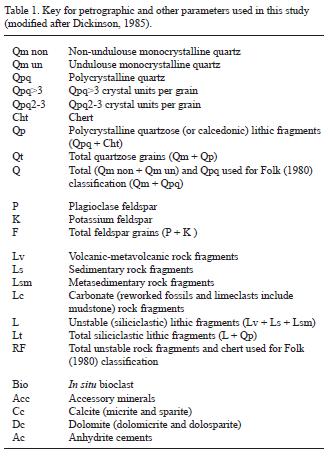
<body><![CDATA[<p align="justify"><font face="verdana" size="2">The Ahwaz Sandstone is a shoreface deposit. Their distribution along the strike of the Zagros foreland basin is restricted to the southwestern margin as a number of elongate northwest&#150;southeast siliciclastic bars (Alavi, 2004). Alsharhan and Nairn (1997) considered the Ahwaz Sandstone to correlate with Ghar Formation in Kuwait whose clastic input is believed to have been derived from the pre&#150;rift uplift of the Red Sea to the west (Alsharhan and Nairn, 1997). The localization of the Ghar/Ahwaz delta of southern Iraq and southwestern Iran was probably influenced by deep&#150;seated 'Hercynian'&#150;age (<img src="/img/revistas/rmcg/v25n2/a5s1.jpg">330 Ma) lineaments that extended northward from the Central Arabian Arch (Ziegler, 2001).</font></p>     <p align="justify"><font face="verdana" size="2">&nbsp;</font></p>     <p align="justify"><font face="verdana" size="2"><b>SAMPLING AND METHODS</b></font></p>     <p align="justify"><font face="verdana" size="2">Nine hundred samples were collected from three wells in the Ahwaz oil field (well no. Az&#150;85A, Az&#150;89 and Az&#150;11; 300 samples from each well) to represent the entire thickness of the Asmari Formation and thin sections were prepared, which were etched and stained for calcite and dolomite as matrix. Following a detailed petrographic study of thin sections, 50 thin sections of the Ahwaz Sandstone were selected for modal analysis, among 450 sandstone samples, from the three subsurface sections (12 samples from well Az&#150;85 A, 13 samples from well Az&#150;89 and25 samples from well Az&#150;11) (<a href="/img/revistas/rmcg/v25n2/a5f2.jpg" target="_blank">Figure 2</a>). The sample selection was based on petrography to choose well&#150;sorted and unweathered, fine&#150; to medium&#150;grained, sand&#150;size samples and to cover the entire thickness of the formation. Framework mineral composition (modal analysis) was quantified using the point&#150;counting method of Gazzi&#150;Dickinson as described by Ingersoll <i>et al. </i>(1984).</font></p>     <p align="justify"><font face="verdana" size="2">In the Gazzi&#150;Dickinson method (Ingersoll <i>et al., </i>1984), minerals &gt; 0.625 mm within lithoclasts are counted acording to the mineral type (phaneritic grains: crystal size exceeding 0.0625 mm; aphanitic grains: crystal size less than 0.0625 mm). Classification of grain types was done following the Dickinson (1985) method (<a href="#t1">Table 1</a>). The grid spacing used in point counting exceeded the grain size so as to avoid individual grains being counted more than once (<i>e.g., </i>Van Der Plas and Tobi, 1965). In order to reconstruct the original detrital composition of the sandstone, the effects of diagenesis such as calcitization, zeolitization, and albitization of feldspars (Shanmugam, 1985) were taken into consideration as much as possible during counting. Framework grains were counted for 300 to 350 counts per thin section; recalculated modal analysis data from point counting of the framework grains are listed in <a href="/img/revistas/rmcg/v25n2/a5t2.jpg" target="_blank">Table 2</a>.</font></p>     <p align="center"><font size="2" face="verdana"><a name="t1"></a></font></p>     <p align="center"><font size="2" face="verdana"><img src="/img/revistas/rmcg/v25n2/a5t1.jpg"></font></p>     <p align="justify"><font face="verdana" size="2">Chemical analyses (major elements) of nine selected samples (finer sandstones from the three wells were selected because they are likely to provide better geochemical results than the coarser grained rocks) were performed by X&#150;ray fluorescence (XRF) spectrometry technique on fused beads (Rollinson, 1993), at the laboratories of the Geological Society of Iran (<a href="/img/revistas/rmcg/v25n2/a5t3.jpg" target="_blank">Table 3</a>). Analytical precision is better than 3% for the major oxides. Relative errors on major elements are usually &lt;2% and loss on ignition (LOI) was determined by heating the dried samples to 950 &deg;C for 2 hours. Moreover, the total iron is expressed as Fe<sub>2</sub>O<sub>3</sub>.</font></p>     <p align="justify"><font face="verdana" size="2">&nbsp;</font></p>     <p align="justify"><font face="verdana" size="2"><b>DETRITAL FRAMEWORK COMPONENTS AND CLASSIFICATION</b></font></p>     ]]></body>
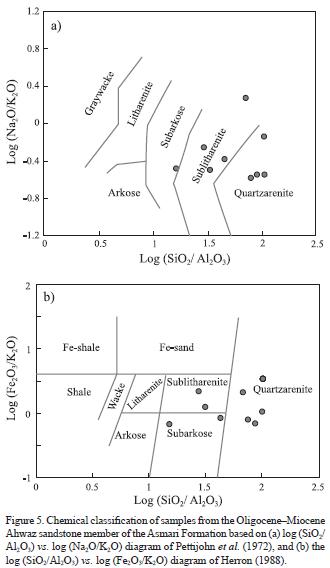
<body><![CDATA[<p align="justify"><font face="verdana" size="2">The detrital framework grains of the Ahwaz Sandstone Member include quartz, feldspars, rock fragments and accessory minerals such as zircon and sphene. By studying the texture of these sandstone we observed that fine grains are angular, and coarser ones are rounded to broken rounded. This occurs because in a high&#150;energy environment or through long&#150;distance transport, the well&#150;sorted, coarsegrained sands not only round completely, but also break to fine&#150;grained, angular sands, which results in a decrease of the sediment sorting. Although chemical mechanisms can round the grains by corroding them, these mechanisms round the fine&#150;grained sands more than the coarser ones (more exposed surface in fine&#150;grained particles), which is not the case in this study. Therefore, the heterogeneous roundness of grains for different grain sizes in the Ahwaz Sandstone reflect the importance of mechanical factors for the final grain shapes.</font></p>     <p align="justify"><font face="verdana" size="2">Quartz is the dominating framework grain in the studied thin sections (<a href="/img/revistas/rmcg/v25n2/a5f3.jpg" target="_blank">Figure 3a&#150;d</a>; also see <a href="/img/revistas/rmcg/v25n2/a5t2.jpg" target="_blank">Table 2</a>). Monocrystalline quartz (Qm) occurs in three variants: non&#150;undulose, slightly undul&oacute;se (&lt;5&deg;), and undul&oacute;se (&gt;5&deg;) (Scholle, 1979; Basu, 1985; Tortosa <i>et al., </i>1991). The polycrystalline quartz (Qpq) was distinguished into two groups: polycrystaline quartz with 2&#150;3 subgrains and polycrystalline quartz with more than 3 subgrains (<a href="/img/revistas/rmcg/v25n2/a5f3.jpg" target="_blank">Figure 3b</a>). Chert was considered as a monomineral (Folk, 1974) and was found only in a few samples. Some of the non&#150;undulatory monocrystalline quartz contain inclusions of apatite and rutile needles, which could have been derived from plutonic source rocks or sedimentary recycling (<a href="/img/revistas/rmcg/v25n2/a5f3.jpg" target="_blank">Figure 3c&#150;d</a>).</font></p>     <p align="justify"><font face="verdana" size="2">All studied thin sections contain small amounts of potassium feldspar (K), including twinned microcline. Furthermore, the low potassium values (mean value for K<sub>2</sub>O=0.94&plusmn;0.40%; n=9) of the bulk rock analyses of sandstone samples, support the results of the petrography concerning the low K&#150;feldspar content (<a href="/img/revistas/rmcg/v25n2/a5t3.jpg" target="_blank">Table 3</a>). Plagioclase occurs in some thin sections and seems to be linked to samples with smaller grain sizes (fine&#150;grained sand). Petrographic study of these sandstones reveals that K&#150;feldspar is more abundant than plagioclase, which can be originated from durability of K&#150;feldspars, non&#150;occurrence of plagioclase&#150;bearing source rocks, or both. The feldspars are fresh, which implies limited chemical weathering.</font></p>     <p align="justify"><font face="verdana" size="2">The thin sections contain lesser amount of lithic fragments than quartz and feldspar grains. Lithoclasts found in the studied samples include: siltstones, sandstones, carbonate fragments (rare), and metamorphic fragments. Volcanic fragments are absent in these sandstones.</font></p>     <p align="justify"><font face="verdana" size="2">Metamorphic lithoclasts are usually made up of metamorphic polycrystalline quartz fragments of high&#150;grade metamorphic origin. The recrystallized subcrystals of a metamorphic polycrystalline quartz are lengthened and display different extinction angles under crossed polars due to the variable orientation of the C&#150;axis (Scholle, 1979). Typical source rocks for these lithoclasts would be gneisses (Scholle, 1979).</font></p>     <p align="justify"><font face="verdana" size="2">A limited range of heavy minerals was observed in thin section. The most common is zircon, which occurs as well&#150;rounded grains (<a href="/img/revistas/rmcg/v25n2/a5f3.jpg" target="_blank">Figure 3e</a>). Other heavy minerals observed in thin&#150;section include tourmaline and rutile. Also, re&#150;sedimented quartz grains with thin, rounded, syntaxial relictic rims of quartz cement (<a href="/img/revistas/rmcg/v25n2/a5f3.jpg" target="_blank">Figure 3f</a>) are common. Calcite and dolomite occur in the well&#150;cemented sandstone samples.</font></p>     <p align="justify"><font face="verdana" size="2">Using Folk (1974) classification (QFL ternary plot), the Ahwaz Sandstone samples were classified as quartza&#150;renite, sublitharenite and subarkose, thus reflecting their slightly mineralogical matured character (<a href="/img/revistas/rmcg/v25n2/a5f4.jpg" target="_blank">Figure 4</a>). The geochemical classification diagrams of Pettijohn <i>et al. </i>(1972) and Herr&oacute;n (1988) for these sandstones (<a href="#f5">Figure 5</a>) provide the same results.</font></p>     <p align="center"><font face="verdana" size="2"><a name="f5"></a></font></p>     <p align="center"><font face="verdana" size="2"><img src="/img/revistas/rmcg/v25n2/a5f5.jpg"></font></p>     <p align="justify"><font face="verdana" size="2">&nbsp;</font></p>     ]]></body>
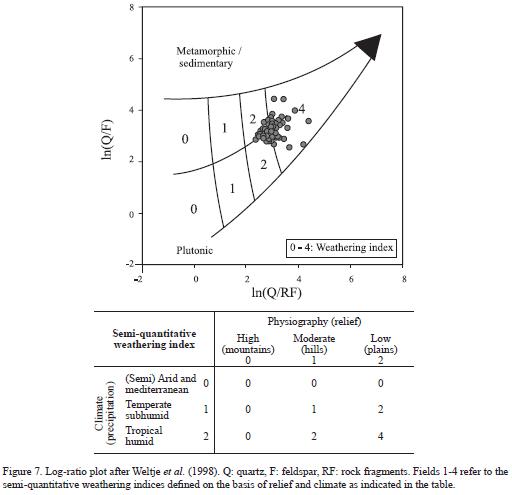
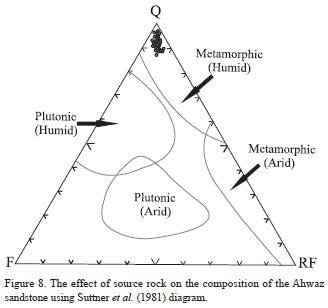
<body><![CDATA[<p align="justify"><font face="verdana" size="2"><b>PARENT ROCK LITHOLOGY</b></font></p>     <p align="justify"><font face="verdana" size="2">Because of the low abundance of feldspars, rock fragments and heavy minerals (<a href="/img/revistas/rmcg/v25n2/a5t2.jpg" target="_blank">Table 2</a>), recognition of the source rock lithology of the Ahwaz Sandstone was established mainly by the study of quartz types.</font></p>     <p align="justify"><font face="verdana" size="2">Petrographic analysis of the thin sections shows small percentages of polycrystalline quartz grains (<a href="/img/revistas/rmcg/v25n2/a5t2.jpg" target="_blank">Table 2</a>), which are of two types: the first type correspond to polycrystalline grains composed of five or more crystals with straight to slightly curved intercrystalline boundaries. The second type consists of polycrystalline quartz grains composed of more than five elongated crystals, exhibiting irregular to crenulated intercry stal boundaries (<a href="/img/revistas/rmcg/v25n2/a5f3.jpg" target="_blank">Figure 3b</a>). The first type suggests an origin for the Ahwaz Sandstone from plutonic igneous rocks (Folk, 1974; Blatt <i>et al, </i>1980), while the second type indicates an origin from metamorphic source rocks (Blatt <i>et al. </i>,1980; Asiedu <i>et al.</i>, 2000). Moreover, the Ahwaz Sandstone consists of monocrystalline quartz grains showing strong undulatory extinction and crypto&#150;polycrystalline quartz grains, both suggestive of metamorphic source rocks. Nevertheless, the presence of strain&#150;free quartz grains suggests plutonic source rock (<em>e.g.</em>, Basu, 1985).</font></p>     <p align="justify"><font face="verdana" size="2">To evaluate the relative importance of plutonic and metamorphic rocks as quartz sources, we plotted polycrystalline quartz vs. non&#150;undulatory and undulatory monocrystalline quartz in a double&#150;triangular diagram following the technique of Basu <i>et al. </i>(1975) and Tortosa <i>et al. </i>(1991) (<a href="/img/revistas/rmcg/v25n2/a5f6.jpg" target="_blank">Figure 6</a>). These approaches give dramatically different results; a medium to low metamorphic origin and a granitic source rocks. These contrasting results can be partially explained by considering that the Ahwaz Sandstone samples plot in a region of the diagram where only some of the granite sourced modern sands analyzed by Tortosa <i>et al. </i>(1991) plot. In contrast, the North American sands studied by Basu <i>et al. </i>(1975) do not contain comparable quartz populations. Furthermore, Weltje <i>et al. </i>(1998) diagram shows that the point count data from the Ahwaz Sandstone plot in the arrow&#150;shaped fields (<a href="#f7">Figure 7a</a>) at the middle of the diagram, which represents a mixture of metamorphic and plutonic source rocks.</font></p>     <p align="center"><font face="verdana" size="2"><a name="f7"></a></font></p>     <p align="center"><font face="verdana" size="2"><img src="/img/revistas/rmcg/v25n2/a5f7.jpg"></font></p>     <p align="justify"><font face="verdana" size="2">The effect of source rock on the composition of the Ahwaz Sandstone could be distinguished by plotting the point count data on Suttner <i>et al. </i>(1981) diagram (<a href="#f8">Figure 8</a>). This approach also point to a metamorphic source rock for these sandstones.</font></p>     <p align="center"><font face="verdana" size="2"><a name="f8"></a></font></p>     <p align="center"><font face="verdana" size="2"><img src="/img/revistas/rmcg/v25n2/a5f8.jpg"></font></p>     <p align="justify"><font face="verdana" size="2">In the Ahwaz Sandstone samples, most quartz grains are colorless and may include crystals of zircon or apatite (plutonic origin) (<a href="/img/revistas/rmcg/v25n2/a5f3.jpg" target="_blank">Figure 3 c</a>). However, a few quartz grains are dusty because of a profusion of rutile needle inclusions, and generally do not contain any other mineral inclusions (<a href="/img/revistas/rmcg/v25n2/a5f3.jpg" target="_blank">Figure 3d</a>), which is typical of granulite&#150;facies rocks.</font></p>     ]]></body>
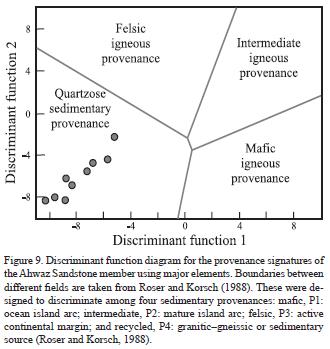
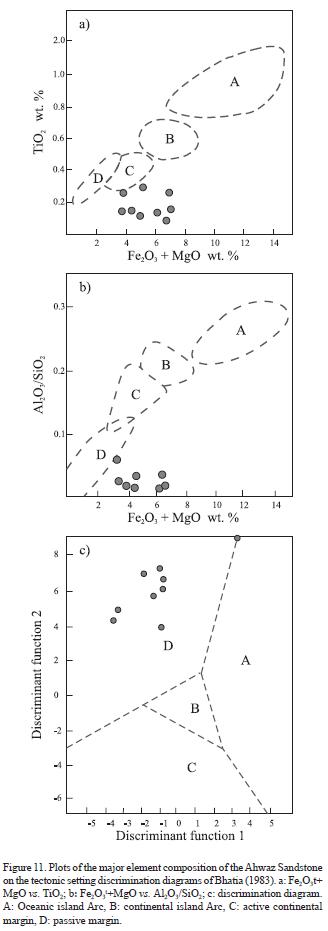
<body><![CDATA[<p align="justify"><font face="verdana" size="2">Accordingly, the monocrystalline (Basu <i>et al., </i>1975; Tortosa <i>et al. </i>1991) and polycrystaline quartz grain characteristics (Folk, 1974; Blatt <i>et al.,</i> 1980; Asiedu <i>et al., </i>2000) as well as the logarithmic ratios of quartz to feldspars and rock fragments (diagram introduced by Weltje <i>et al.</i>, 1998) (<a href="#f7">Figure 7a</a>) and quartz grain inclusions imply a mixed origin from plutonic and medium&#150; to high&#150;grade metamorphic rocks for the Ahwaz Sandstone. Furthermore, the evidence of recycling (rounded zircon and rounded overgrowths in some quartz grains) (<a href="/img/revistas/rmcg/v25n2/a5f3.jpg" target="_blank">Figure 3e&#150;f</a>) in the studied samples, indicate that quartz&#150;rich sedimentary rocks should be considered as one of the major source rocks.</font></p>     <p align="justify"><font face="verdana" size="2">In order to use major elements for provenance interpretations we considered the discriminant functions of Roser and Korsch (1988), which use A1<sub>2</sub>O<sub>3</sub>, TiO<sub>2</sub>, Fe<sub>2</sub>O<sub>3</sub><sup>t</sup>, MgO, CaO, Na<sub>2</sub>O, and K<sub>2</sub>O contents as variables. In this diagram (<a href="#f9">Figure 9</a>), the majority of the Ahwaz Sandstone samples plot on the quartzose sedimentary provenance field. This is equivalent to a passive margin tectonic setting (Bathia, 1983).</font></p>     <p align="center"><font face="verdana" size="2"><a name="f9"></a></font></p>     <p align="center"><font face="verdana" size="2"><img src="/img/revistas/rmcg/v25n2/a5f9.jpg"></font></p>     <p align="justify"><font face="verdana" size="2">&nbsp;</font></p>     <p align="justify"><font face="verdana" size="2"><b>TECTONIC PROVENANCE</b></font></p>     <p align="justify"><font face="verdana" size="2">In the QtFL and QmFLt ternary diagrams of Dickinson <i>et al. </i>(1983), the point counting data plot in the craton interior and recycled orogen (quartzose recycled) field (<a href="/img/revistas/rmcg/v25n2/a5f10.jpg" target="_blank">Figure 10</a>). As pointed out by Dickinson <i>et al. </i>(1983), sandstones plotting in the craton field are mature sandstones derived from relatively low&#150;lying granitoid and gneissic sources, supplemented by recycled sands from associated platform or passive margin basins.</font></p>     <p align="justify"><font face="verdana" size="2">The major element geochemistry of the Ahwaz Sandstone samples (<a href="/img/revistas/rmcg/v25n2/a5t3.jpg" target="_blank">Table 3</a>) is discussed in terms of ternary plots and discrimination diagrams to characterize the tectonic setting as proposed by Bhatia (1983) and Kroonenberg (1994). These diagrams show that the Ahwaz Sandstone was deposited in a passive continental margin (<a href="#f11">Figures 11c</a> and <a href="#f12">12</a>). However, in the diagrams of Bhatia (1983; <a href="#f11">Figures 11a, 11b</a>), the Ahwaz Sandstone samples are shifted to the right of the passive margin field because of secondary MgO enrichment related to dolomite cement. Other reason for this discrepancy may be the deficient functioning of these diagrams as documented by Armstrong&#150;Altrin and Verma (2005). The high&#150;MgO contents of the studied samples (average 3.4%) appear to be largely derived from dolomite (Von Eynatten, 2003), although the expected positive correlation between MgO and CaO, and between MgO and LOI was not statistically valid at 99% (or even at 95%) confidence level (using the computer program OYNYL by Verma <i>et al, </i>2006a).</font></p>     <p align="center"><font face="verdana" size="2"><a name="f11"></a></font></p>     <p align="center"><font face="verdana" size="2"><img src="/img/revistas/rmcg/v25n2/a5f11.jpg"></font></p>     ]]></body>
<body><![CDATA[<p align="center"><font face="verdana" size="2"><a name="f12"></a></font></p>     <p align="center"><font face="verdana" size="2"><img src="/img/revistas/rmcg/v25n2/a5f12.jpg"></font></p>     <p align="justify"><font face="verdana" size="2">&nbsp;</font></p>     <p align="justify"><font face="verdana" size="2"><b>SOURCE AREA WEATHERING</b></font></p>     <p align="justify"><font face="verdana" size="2"><b>Climate indexes</b></font></p>     <p align="justify"><font face="verdana" size="2">Petrographic evidence such as heterogeneous roundness for different grains (coarser ones are rounded and finer ones are angular) implies the importance of mechanical effects for grain shape configuration. Coarse&#150;grained feldspars are related to a low degree of chemical weathering. Moreover, the rounded quartz overgrowths indicate recycling, which, in turn, can modify the compositional data towards the quartz&#150;rich sandstones. Therefore, the petrographic evidence suggests that the compositional maturity of these sandstones may be due to recycling and long transport on low&#150;relief Arabian craton as has already been indicated by Ziegler (2001) and may not be related to a humid climatic condition.</font></p>     <p align="justify"><font face="verdana" size="2">The point count data for most Ahwaz Sandstone samples on Weltje <i>et al. </i>(1998) diagram plot in the field number 4 (<a href="#f7">Figure 7b</a>), which points to the sedimentation in a low&#150;relief and tropical, humid climatic conditions. The samples plotting in the field number 2 were either deposited on a low&#150;relief with a temperate and sub&#150;humid climate or on tropical, humid conditions within an area with a moderate relief. The diagram of Suttner <i>et al. </i>(1981) (<a href="#f8">Figure 8</a>), however, indicate a metamorphic source rock in a humid climate. However, this particular diagram can discriminate only sources of metamorphic and plutonic rocks (humid or arid conditions) and does not discriminate between different tectonic settings. The diagrams (<a href="#f7">Figures 7b</a> and <a href="#f8">8</a>) are defined for first&#150;cycle sediments and the effect of recycling and long distance transportation can shift the data on these diagrams toward the humid conditions. These considerations probably imply that new diagrams should be proposed such as those suggested in the field of sedimentary rock geochemistry (Armstrong&#150;Altrin and Verma, 2005) and already proposed in the area of igneous rock geochemistry (<i>e.g., </i>Agrawal <i>et al, </i>2004; Verma <i>et al, </i>2006b).</font></p>     <p align="justify"><font face="verdana" size="2">&nbsp;</font></p>     <p align="justify"><font face="verdana" size="2"><b>Geochemistry and source area weathering</b></font></p>     <p align="justify"><font face="verdana" size="2">Alteration of rocks during weathering results in depletion of alkalis and alkaline earth elements and preferential enrichment of A1<sub>2</sub>O<sub>3</sub> (<i>e.g.</i>, Cingolani <i>et al.</i>, 2003). Therefore, weathering effects canbe evaluated in terms of the molecular percentage of the oxide components, using the formulae of chemical index of weathering (CIW = &#91;A1<sub>2</sub>O<sub>3</sub>/(A1<sub>2</sub>O<sub>3</sub> + CaO* + Na<sub>2</sub>O&#93; x 100; Harnois, 1988) and chemical index of alteration (CIA= &#91;A1<sub>2</sub>O<sub>3</sub>/(A1<sub>2</sub>O<sub>3</sub> + CaO* + Na<sub>2</sub>O +K<sub>2</sub>O&#93; x 100); Nesbitt and Young, 1982). However, samples having highly variable CaO contents due to variation in calcite or dolomite abundance (such as those included in this study), may produce misleading conclusions if the CIW and CIA are used to infer the degree of weathering (Cullers, 2000). Therefore, in this study we used a modified chemical index of weathering (CIW = molecular &#91;A1<sub>2</sub>O<sub>3</sub>/ (A1<sub>2</sub>O<sub>3</sub> + Na<sub>2</sub>O&#93; x 100, in which CaO is left out of the CIW; Cullers, 2000). The CIW' value of the Ahwaz Sandstone samples vary from 32 to 79 (<i>n=9, </i>mean <img src="/img/revistas/rmcg/v25n2/a5s1.jpg">67, <i>s</i>=15; median <img src="/img/revistas/rmcg/v25n2/a5s1.jpg">70), which indicate a moderate weathering (recycling) for these sandstones. These CIW' values, in general, can be due to either absence of intense recycling in a humid climate or intense recycling in an arid/semiarid climate (Osae <i>et al, </i>2006; Wanas and Andel&#150;Maguid, 2006).</font></p>     ]]></body>
<body><![CDATA[<p align="justify"><font face="verdana" size="2">Petrographic evidence from the Ahwaz Sandstone (heterogeneous roundness for different grain sizes; fresh coarse&#150;grained feldspars) is consistent with a more important role for mechanical weathering than for chemical weathering. Similarly, petrographic evidence of rounded quartz overgrowths can be related to an intense recycling of their source rock. The geochemical (<a href="#f9">Figure 9</a>) and point count (<a href="/img/revistas/rmcg/v25n2/a5f10.jpg" target="_blank">Figure 10</a>) data as well as CIW values are consistent with an active recycling in an arid/semiarid climate for Ahwaz Sandstone. However, more accurate interpretation of climate conditions of these deposits would require further studies such as clay mineral investigations.</font></p>     <p align="justify"><font face="verdana" size="2">&nbsp;</font></p>     <p align="justify"><font face="verdana" size="2"><b>CONCLUSIONS</b></font></p>     <p align="justify"><font face="verdana" size="2">Quartz arenites, sublitharenite and subarkose of the Ahwaz Sandstone (sandy member of Asmari Formation, the major oil reservoir in Zagros mountain) have petrographic (texture, framework mineralogy, quartz types and inclusions in quartz) and geochemical characteristics that suggest quartzose recycled sedimentary rocks as the main source rocks, in addition to high&#150;grade metamorphic and plutonic igneous rocks as minor parent rocks. Moreover, the obtained data are consistent with a long distance transport, in an arid/semiarid climate, over the Arabian shield, which supplied these sands to their depositional basin along the passive marginal coast of the Oligocene&#150;Miocene Zagros foreland basin.</font></p>     <p align="justify"><font face="verdana" size="2">&nbsp;</font></p>     <p align="justify"><font face="verdana" size="2"><b>ACKNOWLEDGMENTS</b></font></p>     <p align="justify"><font face="verdana" size="2">We thank the National Iranian Oil Company, especially H. Ghalavand for providing us with the core samples and thin sections, and the Shahid Beheshti University of Tehran for providing laboratory equipments. In addition, we are grateful to M.H. Adabi for his considerable help throughout this study. We would like to thank IS. Armstrong&#150;Altrin and an anonymous reviewer for helpful and constructive reviews. The manuscript has largely been improved by constructive comments and corrections from the RMCG editor, Dr S.P. Verma.</font></p>     <p align="justify"><font face="verdana" size="2">&nbsp;</font></p>     <p align="justify"><font face="verdana" size="2"><b>REFERENCES</b></font></p>     <!-- ref --><p align="justify"><font face="verdana" size="2">Agrawal, S., Guevara, M., Verma, S.P., 2004, Discriminant analysis applied to establish major element field boundaries fortectonic varieties of basic rocks: International Geology Review, 46(7), 575&#150;594.</font>&nbsp;&nbsp;&nbsp;&nbsp;&nbsp;&nbsp;&nbsp;&nbsp;[&#160;<a href="javascript:void(0);" onclick="javascript: window.open('/scielo.php?script=sci_nlinks&ref=8076422&pid=S1026-8774200800020000500001&lng=','','width=640,height=500,resizable=yes,scrollbars=1,menubar=yes,');">Links</a>&#160;]<!-- end-ref --><!-- ref --><p align="justify"><font face="verdana" size="2">Alavi, M., 2004, Regional stratigraphy of the Zagros fold&#150;thrust belt of Iran and its proforeland evolution: American Journal of Science, 304, 1&#150;20.</font>&nbsp;&nbsp;&nbsp;&nbsp;&nbsp;&nbsp;&nbsp;&nbsp;[&#160;<a href="javascript:void(0);" onclick="javascript: window.open('/scielo.php?script=sci_nlinks&ref=8076423&pid=S1026-8774200800020000500002&lng=','','width=640,height=500,resizable=yes,scrollbars=1,menubar=yes,');">Links</a>&#160;]<!-- end-ref --><!-- ref --><p align="justify"><font face="verdana" size="2">Alsharhan, A.S., Nairn, A.E.M., 1997, Sedimentary Basins and Petroleum Geology of the Middle East: Amsterdam, Elsevier, 843 p.</font>&nbsp;&nbsp;&nbsp;&nbsp;&nbsp;&nbsp;&nbsp;&nbsp;[&#160;<a href="javascript:void(0);" onclick="javascript: window.open('/scielo.php?script=sci_nlinks&ref=8076424&pid=S1026-8774200800020000500003&lng=','','width=640,height=500,resizable=yes,scrollbars=1,menubar=yes,');">Links</a>&#160;]<!-- end-ref --><!-- ref --><p align="justify"><font face="verdana" size="2">Armstrong&#150;Altrin, J.S., Verma, S.P., 2005, Critical evaluation of six tectonic setting discrimination diagrams using geochemical data of Neogene sediments from known tectonic settings: Sedimentary Geology, 177(1&#150;2), 115&#150;129.</font>&nbsp;&nbsp;&nbsp;&nbsp;&nbsp;&nbsp;&nbsp;&nbsp;[&#160;<a href="javascript:void(0);" onclick="javascript: window.open('/scielo.php?script=sci_nlinks&ref=8076425&pid=S1026-8774200800020000500004&lng=','','width=640,height=500,resizable=yes,scrollbars=1,menubar=yes,');">Links</a>&#160;]<!-- end-ref --><!-- ref --><p align="justify"><font face="verdana" size="2">Armstrong&#150;Altrin, J.S., Lee, Y.I., Verma, S.P., Ramasamy, S., 2004, Geochemistry of sandstones from the Upper Miocene Kudankulam Formation, southern India: implication for provenance, weathering and tectonic setting: Journal of Sedimentary Research, 74(2), 285&#150;297.</font>&nbsp;&nbsp;&nbsp;&nbsp;&nbsp;&nbsp;&nbsp;&nbsp;[&#160;<a href="javascript:void(0);" onclick="javascript: window.open('/scielo.php?script=sci_nlinks&ref=8076426&pid=S1026-8774200800020000500005&lng=','','width=640,height=500,resizable=yes,scrollbars=1,menubar=yes,');">Links</a>&#160;]<!-- end-ref --><!-- ref --><p align="justify"><font face="verdana" size="2">Asiedu, D.K., Suzui, S., Shibata, T., 2000, Provenance of sandstones from the Lower Cretaceous Sasayama Group, inner zone of southwest Japan: Sedimentary Geology, 131, 9&#150;24.</font>&nbsp;&nbsp;&nbsp;&nbsp;&nbsp;&nbsp;&nbsp;&nbsp;[&#160;<a href="javascript:void(0);" onclick="javascript: window.open('/scielo.php?script=sci_nlinks&ref=8076427&pid=S1026-8774200800020000500006&lng=','','width=640,height=500,resizable=yes,scrollbars=1,menubar=yes,');">Links</a>&#160;]<!-- end-ref --><!-- ref --><p align="justify"><font face="verdana" size="2">Barnett, V, Lewis, T, 1994, Outliers in Statistical Data: Chichester, John Wiley, third edition, 584 p.</font>&nbsp;&nbsp;&nbsp;&nbsp;&nbsp;&nbsp;&nbsp;&nbsp;[&#160;<a href="javascript:void(0);" onclick="javascript: window.open('/scielo.php?script=sci_nlinks&ref=8076428&pid=S1026-8774200800020000500007&lng=','','width=640,height=500,resizable=yes,scrollbars=1,menubar=yes,');">Links</a>&#160;]<!-- end-ref --><!-- ref --><p align="justify"><font face="verdana" size="2">Basu, A., 1985, Reading Provenance from Detrital Quartz, <i>in </i>Zuffa, G.G. (ed.), Provenance of Arenites: Dordrecht, NATO ASI Series, C 148, D. Reidel Publishing Company, 231&#150;247.</font>&nbsp;&nbsp;&nbsp;&nbsp;&nbsp;&nbsp;&nbsp;&nbsp;[&#160;<a href="javascript:void(0);" onclick="javascript: window.open('/scielo.php?script=sci_nlinks&ref=8076429&pid=S1026-8774200800020000500008&lng=','','width=640,height=500,resizable=yes,scrollbars=1,menubar=yes,');">Links</a>&#160;]<!-- end-ref --><!-- ref --><p align="justify"><font face="verdana" size="2">Basu, A., 2003, A perspective on quantitative provenance analysis, <i>in </i>Valloni, R., Basu, A. (eds.), Quantitative Provenance Studies in Italy: Memorie Descrittive Delia Carta Geol&oacute;gica dell'Italia, 61, 11&#150;22.</font>&nbsp;&nbsp;&nbsp;&nbsp;&nbsp;&nbsp;&nbsp;&nbsp;[&#160;<a href="javascript:void(0);" onclick="javascript: window.open('/scielo.php?script=sci_nlinks&ref=8076430&pid=S1026-8774200800020000500009&lng=','','width=640,height=500,resizable=yes,scrollbars=1,menubar=yes,');">Links</a>&#160;]<!-- end-ref --><!-- ref --><p align="justify"><font face="verdana" size="2">Basu, A., Young, S., Suttner, L., James, W., Mack, G.H., 1975, Re&#150;evaluation of the use of undulatory extinction and crystallinity in detrital quartz for provenance interpretation: Journal of Sedimentary Petrology, 45, 873&#150;882.</font>&nbsp;&nbsp;&nbsp;&nbsp;&nbsp;&nbsp;&nbsp;&nbsp;[&#160;<a href="javascript:void(0);" onclick="javascript: window.open('/scielo.php?script=sci_nlinks&ref=8076431&pid=S1026-8774200800020000500010&lng=','','width=640,height=500,resizable=yes,scrollbars=1,menubar=yes,');">Links</a>&#160;]<!-- end-ref --><!-- ref --><p align="justify"><font face="verdana" size="2">Berberian, M., King, G.C.P., 1981, Towards the paleogeography and tectonic evolution of Iran: Canadian Journal of the Earth Sciences, 18, 210&#150;265.</font>&nbsp;&nbsp;&nbsp;&nbsp;&nbsp;&nbsp;&nbsp;&nbsp;[&#160;<a href="javascript:void(0);" onclick="javascript: window.open('/scielo.php?script=sci_nlinks&ref=8076432&pid=S1026-8774200800020000500011&lng=','','width=640,height=500,resizable=yes,scrollbars=1,menubar=yes,');">Links</a>&#160;]<!-- end-ref --><!-- ref --><p align="justify"><font face="verdana" size="2">Beydoun, Z.R., Hughes Clarke, M.W., Stoneley, R., 1992, Petroleum in the Zagros basin: A Late Tertiary foreland basin overprinted onto the outer edge of a vast hydrocarbon&#150;rich Palaeozoic&#150;Mesozoic passive margin shelf: American Association of Petroleum Geologists, Memoir, 55, 309&#150;339.</font>&nbsp;&nbsp;&nbsp;&nbsp;&nbsp;&nbsp;&nbsp;&nbsp;[&#160;<a href="javascript:void(0);" onclick="javascript: window.open('/scielo.php?script=sci_nlinks&ref=8076433&pid=S1026-8774200800020000500012&lng=','','width=640,height=500,resizable=yes,scrollbars=1,menubar=yes,');">Links</a>&#160;]<!-- end-ref --><!-- ref --><p align="justify"><font face="verdana" size="2">Bhatia, M.R., 1983, Plate tectonics and geochemical composition of sandstones: Journal of Geology, 91, 611&#150;627.</font>&nbsp;&nbsp;&nbsp;&nbsp;&nbsp;&nbsp;&nbsp;&nbsp;[&#160;<a href="javascript:void(0);" onclick="javascript: window.open('/scielo.php?script=sci_nlinks&ref=8076434&pid=S1026-8774200800020000500013&lng=','','width=640,height=500,resizable=yes,scrollbars=1,menubar=yes,');">Links</a>&#160;]<!-- end-ref --><!-- ref --><p align="justify"><font face="verdana" size="2">Bhatia, M.R., Crook, K.A.W., 1986, Trace element characteristics of greywackes and tectonic setting discrimination of sedimentary basins: Contributions to Mineralogy and Petrology, 92, 181&#150;193.</font>&nbsp;&nbsp;&nbsp;&nbsp;&nbsp;&nbsp;&nbsp;&nbsp;[&#160;<a href="javascript:void(0);" onclick="javascript: window.open('/scielo.php?script=sci_nlinks&ref=8076435&pid=S1026-8774200800020000500014&lng=','','width=640,height=500,resizable=yes,scrollbars=1,menubar=yes,');">Links</a>&#160;]<!-- end-ref --><!-- ref --><p align="justify"><font face="verdana" size="2">Blatt, H., Middleton, G., Murray, R., 1980, Origin of Sedimentary Rocks: Prentice&#150;Hall, New Jersey.</font>&nbsp;&nbsp;&nbsp;&nbsp;&nbsp;&nbsp;&nbsp;&nbsp;[&#160;<a href="javascript:void(0);" onclick="javascript: window.open('/scielo.php?script=sci_nlinks&ref=8076436&pid=S1026-8774200800020000500015&lng=','','width=640,height=500,resizable=yes,scrollbars=1,menubar=yes,');">Links</a>&#160;]<!-- end-ref --><!-- ref --><p align="justify"><font face="verdana" size="2">Buck, S.G., 1991, Ahwaz Reservoir Characterization Study: Schlumberger&#150;National Iranian Oil Company (unpublished).</font>&nbsp;&nbsp;&nbsp;&nbsp;&nbsp;&nbsp;&nbsp;&nbsp;[&#160;<a href="javascript:void(0);" onclick="javascript: window.open('/scielo.php?script=sci_nlinks&ref=8076437&pid=S1026-8774200800020000500016&lng=','','width=640,height=500,resizable=yes,scrollbars=1,menubar=yes,');">Links</a>&#160;]<!-- end-ref --><!-- ref --><p align="justify"><font face="verdana" size="2">Chittleborough, D.J., 1991, Indices of weathering for soils and palaeosols formed on silicate rocks: Australian Journal of Earth Sciences, 38, 115&#150;120.</font>&nbsp;&nbsp;&nbsp;&nbsp;&nbsp;&nbsp;&nbsp;&nbsp;[&#160;<a href="javascript:void(0);" onclick="javascript: window.open('/scielo.php?script=sci_nlinks&ref=8076438&pid=S1026-8774200800020000500017&lng=','','width=640,height=500,resizable=yes,scrollbars=1,menubar=yes,');">Links</a>&#160;]<!-- end-ref --><!-- ref --><p align="justify"><font face="verdana" size="2">Cingolani, C. A., Manassero, M., Abre, P., 2003, Composition, provenance, and tectonic setting of Ordovician siliciclastic rocks in the San Rafael block: Southern extension of the Precordillera crustal fragment, Argentina: Journal of South American Earth Sciences, 16(1), 91&#150;106.</font>&nbsp;&nbsp;&nbsp;&nbsp;&nbsp;&nbsp;&nbsp;&nbsp;[&#160;<a href="javascript:void(0);" onclick="javascript: window.open('/scielo.php?script=sci_nlinks&ref=8076439&pid=S1026-8774200800020000500018&lng=','','width=640,height=500,resizable=yes,scrollbars=1,menubar=yes,');">Links</a>&#160;]<!-- end-ref --><!-- ref --><p align="justify"><font face="verdana" size="2">Crook, K.A.W., 1974, Lithogenesis and geotectonics: the significance of compositional cariations in flysch arenites (graywackes), <i>in </i>Dott, R.H., Shaver, R.H. (eds.), Modern and Ancient Geosynclinal Sedimentation: Society for Sedimentary Geology Special Publication, 19, 304&#150;310.</font>&nbsp;&nbsp;&nbsp;&nbsp;&nbsp;&nbsp;&nbsp;&nbsp;[&#160;<a href="javascript:void(0);" onclick="javascript: window.open('/scielo.php?script=sci_nlinks&ref=8076440&pid=S1026-8774200800020000500019&lng=','','width=640,height=500,resizable=yes,scrollbars=1,menubar=yes,');">Links</a>&#160;]<!-- end-ref --><!-- ref --><p align="justify"><font face="verdana" size="2">Cullers, R.L., 2000, The geochemistry of shales, siltstones and sandstones of Pennsylvanian&#150;Permian age, Colorado, USA: implications for provenance and metamorphic studies: Lithos, 51, 181&#150;203.</font>&nbsp;&nbsp;&nbsp;&nbsp;&nbsp;&nbsp;&nbsp;&nbsp;[&#160;<a href="javascript:void(0);" onclick="javascript: window.open('/scielo.php?script=sci_nlinks&ref=8076441&pid=S1026-8774200800020000500020&lng=','','width=640,height=500,resizable=yes,scrollbars=1,menubar=yes,');">Links</a>&#160;]<!-- end-ref --><!-- ref --><p align="justify"><font face="verdana" size="2">Dickinson, W.R., 1985, Interpreting provenance relation from detrital modes of sandstones, <i>in</i> Zuffa, G.G. (ed.), Provenance of Arenites: NATO ASI Series, C 148, D. Reidel Publishing Company, Dordrecht, 333&#150;363.</font>&nbsp;&nbsp;&nbsp;&nbsp;&nbsp;&nbsp;&nbsp;&nbsp;[&#160;<a href="javascript:void(0);" onclick="javascript: window.open('/scielo.php?script=sci_nlinks&ref=8076442&pid=S1026-8774200800020000500021&lng=','','width=640,height=500,resizable=yes,scrollbars=1,menubar=yes,');">Links</a>&#160;]<!-- end-ref --><!-- ref --><p align="justify"><font face="verdana" size="2">Dickinson, W.R., Suczek, C.A., 1979, Plate tectonics and sandstone compositions: American Association of Petroleum Geologist, 63, 2164&#150;2182.</font>&nbsp;&nbsp;&nbsp;&nbsp;&nbsp;&nbsp;&nbsp;&nbsp;[&#160;<a href="javascript:void(0);" onclick="javascript: window.open('/scielo.php?script=sci_nlinks&ref=8076443&pid=S1026-8774200800020000500022&lng=','','width=640,height=500,resizable=yes,scrollbars=1,menubar=yes,');">Links</a>&#160;]<!-- end-ref --><!-- ref --><p align="justify"><font face="verdana" size="2">Dickinson, W.R., Beard, L.S., Brakenridge, G.R., Erjavec, J.L., Ferguson, R.C., Inman, K.F., Knepp, R.A., Lindberg, F.A., Ryberg, P.T., 1983, Provenance of North American Phanerozoic sandstones in relation to tectonic setting: Geological Society of America Bulletin, 94, 222&#150;235.</font>&nbsp;&nbsp;&nbsp;&nbsp;&nbsp;&nbsp;&nbsp;&nbsp;[&#160;<a href="javascript:void(0);" onclick="javascript: window.open('/scielo.php?script=sci_nlinks&ref=8076444&pid=S1026-8774200800020000500023&lng=','','width=640,height=500,resizable=yes,scrollbars=1,menubar=yes,');">Links</a>&#160;]<!-- end-ref --><!-- ref --><p align="justify"><font face="verdana" size="2">Folk, R.L., 1974, Petrology of Sedimentary Rocks: Austin, TX, Hemphill Press, second edition, 182 p.</font>&nbsp;&nbsp;&nbsp;&nbsp;&nbsp;&nbsp;&nbsp;&nbsp;[&#160;<a href="javascript:void(0);" onclick="javascript: window.open('/scielo.php?script=sci_nlinks&ref=8076445&pid=S1026-8774200800020000500024&lng=','','width=640,height=500,resizable=yes,scrollbars=1,menubar=yes,');">Links</a>&#160;]<!-- end-ref --><!-- ref --><p align="justify"><font face="verdana" size="2">Folk, R.L., 1980, Petrology of Sedimentary Rocks: Austin, Texas, Hemphill, 159 p.</font>&nbsp;&nbsp;&nbsp;&nbsp;&nbsp;&nbsp;&nbsp;&nbsp;[&#160;<a href="javascript:void(0);" onclick="javascript: window.open('/scielo.php?script=sci_nlinks&ref=8076446&pid=S1026-8774200800020000500025&lng=','','width=640,height=500,resizable=yes,scrollbars=1,menubar=yes,');">Links</a>&#160;]<!-- end-ref --><!-- ref --><p align="justify"><font face="verdana" size="2">Harnois, L., 1988, The CIW index: A new chemical index of weathering: Sedimentary Geology, 55, 319&#150;322.</font>&nbsp;&nbsp;&nbsp;&nbsp;&nbsp;&nbsp;&nbsp;&nbsp;[&#160;<a href="javascript:void(0);" onclick="javascript: window.open('/scielo.php?script=sci_nlinks&ref=8076447&pid=S1026-8774200800020000500026&lng=','','width=640,height=500,resizable=yes,scrollbars=1,menubar=yes,');">Links</a>&#160;]<!-- end-ref --><!-- ref --><p align="justify"><font face="verdana" size="2">Herron, M.M., 1988, Geochemical classification of terrigenous sands and shales from core or log data: Journal of Sedimentary Petrology, 58, 820&#150;829.</font>&nbsp;&nbsp;&nbsp;&nbsp;&nbsp;&nbsp;&nbsp;&nbsp;[&#160;<a href="javascript:void(0);" onclick="javascript: window.open('/scielo.php?script=sci_nlinks&ref=8076448&pid=S1026-8774200800020000500027&lng=','','width=640,height=500,resizable=yes,scrollbars=1,menubar=yes,');">Links</a>&#160;]<!-- end-ref --><!-- ref --><p align="justify"><font face="verdana" size="2">Ingersoll, R.V., Bulard, T.F., Ford, R.L., Grimn, J.P., Pickle, J.P., Sares, S.W., 1984, The effect of grain size on detrital modes: a text of the Gazzi&#150;Dickinson Point Counting method: Journal of Sedimentary Petrology, 54, 103&#150;116.</font>&nbsp;&nbsp;&nbsp;&nbsp;&nbsp;&nbsp;&nbsp;&nbsp;[&#160;<a href="javascript:void(0);" onclick="javascript: window.open('/scielo.php?script=sci_nlinks&ref=8076449&pid=S1026-8774200800020000500028&lng=','','width=640,height=500,resizable=yes,scrollbars=1,menubar=yes,');">Links</a>&#160;]<!-- end-ref --><!-- ref --><p align="justify"><font face="verdana" size="2">Insalaco, E., Virgone, A., Courme, B., Gaillot, J., Kamali, M., Moallemi, A., Lotfpour, M., Monibi, S., 2006, Upper Dalan Member and Kangan Formation between the Zagros Mountains and offshore Fars, Iran: depositional system, biostratigraphy and stratigraphic architecture: Bahrain, Gulf PetroLink, GeoArabia, 11(2), 75&#150;176.</font>&nbsp;&nbsp;&nbsp;&nbsp;&nbsp;&nbsp;&nbsp;&nbsp;[&#160;<a href="javascript:void(0);" onclick="javascript: window.open('/scielo.php?script=sci_nlinks&ref=8076450&pid=S1026-8774200800020000500029&lng=','','width=640,height=500,resizable=yes,scrollbars=1,menubar=yes,');">Links</a>&#160;]<!-- end-ref --><!-- ref --><p align="justify"><font face="verdana" size="2">Kroonenberg, S.B., 1994, Effects of provenance, sorting and weathering on the geochemistry of fluvial sands from different tectonic and climatic environments: Proceedings of the 29<sup>th</sup> International Geological Congress, Part A, 69&#150;81.</font>&nbsp;&nbsp;&nbsp;&nbsp;&nbsp;&nbsp;&nbsp;&nbsp;[&#160;<a href="javascript:void(0);" onclick="javascript: window.open('/scielo.php?script=sci_nlinks&ref=8076451&pid=S1026-8774200800020000500030&lng=','','width=640,height=500,resizable=yes,scrollbars=1,menubar=yes,');">Links</a>&#160;]<!-- end-ref --><!-- ref --><p align="justify"><font face="verdana" size="2">Lacassagne, R.M., 1963, Asmari sedimentary Environment of southwest Iran: Iranian Oil Operating Companies, Geology and Exploration Division, Paleontology Department, 50 p.</font>&nbsp;&nbsp;&nbsp;&nbsp;&nbsp;&nbsp;&nbsp;&nbsp;[&#160;<a href="javascript:void(0);" onclick="javascript: window.open('/scielo.php?script=sci_nlinks&ref=8076452&pid=S1026-8774200800020000500031&lng=','','width=640,height=500,resizable=yes,scrollbars=1,menubar=yes,');">Links</a>&#160;]<!-- end-ref --><!-- ref --><p align="justify"><font face="verdana" size="2">McLennan, S.M., 1993, Weathering and global denudation: The Journal of Geology, 101, 295&#150;303.</font>&nbsp;&nbsp;&nbsp;&nbsp;&nbsp;&nbsp;&nbsp;&nbsp;[&#160;<a href="javascript:void(0);" onclick="javascript: window.open('/scielo.php?script=sci_nlinks&ref=8076453&pid=S1026-8774200800020000500032&lng=','','width=640,height=500,resizable=yes,scrollbars=1,menubar=yes,');">Links</a>&#160;]<!-- end-ref --><!-- ref --><p align="justify"><font face="verdana" size="2">McLennan, S.M., Hemming, S., McDaniel, D.K., Hanson, G.N., 1993, Geochemical approaches to sedimentation, provenance and tectonics, <i>in </i>Johnsson, M.J., Basu, A. (eds.): Geological Society of America, Special Papers 285, 21&#150;40.</font>&nbsp;&nbsp;&nbsp;&nbsp;&nbsp;&nbsp;&nbsp;&nbsp;[&#160;<a href="javascript:void(0);" onclick="javascript: window.open('/scielo.php?script=sci_nlinks&ref=8076454&pid=S1026-8774200800020000500033&lng=','','width=640,height=500,resizable=yes,scrollbars=1,menubar=yes,');">Links</a>&#160;]<!-- end-ref --><!-- ref --><p align="justify"><font face="verdana" size="2">Milodowski A.E, Zalasiewicz J.A, 1991, Redistribution of rare earth elements during diagenesis of turbidite/hemipelagic mudrock sequences of Llandovery age from central Wales, <i>in </i>Morton, A.C., Todd, S.P, Haughton, P.D.W. (eds.), Developments in Sedimentary Provenance Studies: Geological Society of London, Special Publication, 57, 101&#150;124.</font>&nbsp;&nbsp;&nbsp;&nbsp;&nbsp;&nbsp;&nbsp;&nbsp;[&#160;<a href="javascript:void(0);" onclick="javascript: window.open('/scielo.php?script=sci_nlinks&ref=8076455&pid=S1026-8774200800020000500034&lng=','','width=640,height=500,resizable=yes,scrollbars=1,menubar=yes,');">Links</a>&#160;]<!-- end-ref --><!-- ref --><p align="justify"><font face="verdana" size="2">Motiei, H., 1993, Stratigraphy of Zagros, <i>in </i>Hushmandzadeh, A. (ed.), Treatise on the Geology of Iran: Tehran, Geological Survey of Iran, 536 p.</font>&nbsp;&nbsp;&nbsp;&nbsp;&nbsp;&nbsp;&nbsp;&nbsp;[&#160;<a href="javascript:void(0);" onclick="javascript: window.open('/scielo.php?script=sci_nlinks&ref=8076456&pid=S1026-8774200800020000500035&lng=','','width=640,height=500,resizable=yes,scrollbars=1,menubar=yes,');">Links</a>&#160;]<!-- end-ref --><!-- ref --><p align="justify"><font face="verdana" size="2">Nesbitt, H.W., Young, G.M., 1982, Early Proterozoic climates and plate motions inferred from major element chemistry of lutites: Nature, 299, 715&#150;717.</font>&nbsp;&nbsp;&nbsp;&nbsp;&nbsp;&nbsp;&nbsp;&nbsp;[&#160;<a href="javascript:void(0);" onclick="javascript: window.open('/scielo.php?script=sci_nlinks&ref=8076457&pid=S1026-8774200800020000500036&lng=','','width=640,height=500,resizable=yes,scrollbars=1,menubar=yes,');">Links</a>&#160;]<!-- end-ref --><!-- ref --><p align="justify"><font face="verdana" size="2">Nesbitt, H. W., Young, G.M., 1989, Formation and diagenesis of weathering profile: Journal of Geology, 97, 129&#150;147.</font>&nbsp;&nbsp;&nbsp;&nbsp;&nbsp;&nbsp;&nbsp;&nbsp;[&#160;<a href="javascript:void(0);" onclick="javascript: window.open('/scielo.php?script=sci_nlinks&ref=8076458&pid=S1026-8774200800020000500037&lng=','','width=640,height=500,resizable=yes,scrollbars=1,menubar=yes,');">Links</a>&#160;]<!-- end-ref --><!-- ref --><p align="justify"><font face="verdana" size="2">Osae, S., Asiedu, D.K., Banoeng&#150;Yakubo, B., Koeberl, C, Dampare, S.B., 2006, Provenance and tectonic setting of Late Proterozoic Buem sandstones of southeastern Ghana: Evidence from geochemistry and detrital modes: Journal of Asian Earth Sciences, 44, 85&#150;96.</font>&nbsp;&nbsp;&nbsp;&nbsp;&nbsp;&nbsp;&nbsp;&nbsp;[&#160;<a href="javascript:void(0);" onclick="javascript: window.open('/scielo.php?script=sci_nlinks&ref=8076459&pid=S1026-8774200800020000500038&lng=','','width=640,height=500,resizable=yes,scrollbars=1,menubar=yes,');">Links</a>&#160;]<!-- end-ref --><!-- ref --><p align="justify"><font face="verdana" size="2">Pettijohn, F.J., Potter, PE., Siever, R., 1972, Sand and Sandstones: New York, Springer&#150;Verlag.</font>&nbsp;&nbsp;&nbsp;&nbsp;&nbsp;&nbsp;&nbsp;&nbsp;[&#160;<a href="javascript:void(0);" onclick="javascript: window.open('/scielo.php?script=sci_nlinks&ref=8076460&pid=S1026-8774200800020000500039&lng=','','width=640,height=500,resizable=yes,scrollbars=1,menubar=yes,');">Links</a>&#160;]<!-- end-ref --><!-- ref --><p align="justify"><font face="verdana" size="2">Rollinson, H.R., 1993, Using Geochemical Data: Evaluation, Presentation, Interpretation: United Kingdom, Longman, 352 p.</font>&nbsp;&nbsp;&nbsp;&nbsp;&nbsp;&nbsp;&nbsp;&nbsp;[&#160;<a href="javascript:void(0);" onclick="javascript: window.open('/scielo.php?script=sci_nlinks&ref=8076461&pid=S1026-8774200800020000500040&lng=','','width=640,height=500,resizable=yes,scrollbars=1,menubar=yes,');">Links</a>&#160;]<!-- end-ref --><!-- ref --><p align="justify"><font face="verdana" size="2">Roser, B.P., Korsch, R.J., 1986, Determination of tectonic setting of sand&#150;stone&#150;mudstone suites using SiO<sub>2</sub> content and K<sub>2</sub>O/Na<sub>2</sub>O ratio: Journal of Geology, 94, 635&#150;650.</font>&nbsp;&nbsp;&nbsp;&nbsp;&nbsp;&nbsp;&nbsp;&nbsp;[&#160;<a href="javascript:void(0);" onclick="javascript: window.open('/scielo.php?script=sci_nlinks&ref=8076462&pid=S1026-8774200800020000500041&lng=','','width=640,height=500,resizable=yes,scrollbars=1,menubar=yes,');">Links</a>&#160;]<!-- end-ref --><!-- ref --><p align="justify"><font face="verdana" size="2">Roser, B.P., Korsch, R.J., 1988, Provenance signatures of sandstone&#150;mud&#150;stone suites determined using discriminant function analysis of major&#150;element data: Chemical Geology, 67, 119&#150;139.</font>&nbsp;&nbsp;&nbsp;&nbsp;&nbsp;&nbsp;&nbsp;&nbsp;[&#160;<a href="javascript:void(0);" onclick="javascript: window.open('/scielo.php?script=sci_nlinks&ref=8076463&pid=S1026-8774200800020000500042&lng=','','width=640,height=500,resizable=yes,scrollbars=1,menubar=yes,');">Links</a>&#160;]<!-- end-ref --><!-- ref --><p align="justify"><font face="verdana" size="2">Scholle, PA., 1979, A Color Illustrated Guide to Constituents, Textures, Cements, and Porosities of Sandstones and Associated Rocks: Tulsa, Oklahoma, American Association of Petroleum Geologists, Memoir, 28, 201 p.</font>&nbsp;&nbsp;&nbsp;&nbsp;&nbsp;&nbsp;&nbsp;&nbsp;[&#160;<a href="javascript:void(0);" onclick="javascript: window.open('/scielo.php?script=sci_nlinks&ref=8076464&pid=S1026-8774200800020000500043&lng=','','width=640,height=500,resizable=yes,scrollbars=1,menubar=yes,');">Links</a>&#160;]<!-- end-ref --><!-- ref --><p align="justify"><font face="verdana" size="2">Seyrafian, A., 2000, Microfacies and depositional environment of the Asmari Formation at Dehdez area (A correlation across Central Zagross Basin): Carbonates and Evaporites, 15, 22&#150;48.</font>&nbsp;&nbsp;&nbsp;&nbsp;&nbsp;&nbsp;&nbsp;&nbsp;[&#160;<a href="javascript:void(0);" onclick="javascript: window.open('/scielo.php?script=sci_nlinks&ref=8076465&pid=S1026-8774200800020000500044&lng=','','width=640,height=500,resizable=yes,scrollbars=1,menubar=yes,');">Links</a>&#160;]<!-- end-ref --><!-- ref --><p align="justify"><font face="verdana" size="2">Shanmugam, G., 1985, Type of porosity in sandstone and their significance in interpreting provenance, <i>in </i>Zuffa, G.G. (ed.), Provenance of Arenites: Dordrecht, NATO ASI Series, C 148, D. Reidel Publishing Company, 115&#150;138.</font>&nbsp;&nbsp;&nbsp;&nbsp;&nbsp;&nbsp;&nbsp;&nbsp;[&#160;<a href="javascript:void(0);" onclick="javascript: window.open('/scielo.php?script=sci_nlinks&ref=8076466&pid=S1026-8774200800020000500045&lng=','','width=640,height=500,resizable=yes,scrollbars=1,menubar=yes,');">Links</a>&#160;]<!-- end-ref --><!-- ref --><p align="justify"><font face="verdana" size="2">Stocklin, J., 1974, Possible ancient continental margins in Iran, <i>in </i>Burk, C.A., Drake, C.L. (eds.), The Geology of Continental Margins: New York, Springer, 873&#150;887.</font>&nbsp;&nbsp;&nbsp;&nbsp;&nbsp;&nbsp;&nbsp;&nbsp;[&#160;<a href="javascript:void(0);" onclick="javascript: window.open('/scielo.php?script=sci_nlinks&ref=8076467&pid=S1026-8774200800020000500046&lng=','','width=640,height=500,resizable=yes,scrollbars=1,menubar=yes,');">Links</a>&#160;]<!-- end-ref --><!-- ref --><p align="justify"><font face="verdana" size="2">Suttner, L.J., Basu, A., Mack, G.H., 1981, Climate and the origin of quartz arenites: Journal of Sedimentary Petrology, 51, 235&#150;246.</font>&nbsp;&nbsp;&nbsp;&nbsp;&nbsp;&nbsp;&nbsp;&nbsp;[&#160;<a href="javascript:void(0);" onclick="javascript: window.open('/scielo.php?script=sci_nlinks&ref=8076468&pid=S1026-8774200800020000500047&lng=','','width=640,height=500,resizable=yes,scrollbars=1,menubar=yes,');">Links</a>&#160;]<!-- end-ref --><!-- ref --><p align="justify"><font face="verdana" size="2">Taylor, S.R., McLennan, S.M., 1985, The continental crust: its composition and evolution: Oxford, Blackwell, 312 p.</font>&nbsp;&nbsp;&nbsp;&nbsp;&nbsp;&nbsp;&nbsp;&nbsp;[&#160;<a href="javascript:void(0);" onclick="javascript: window.open('/scielo.php?script=sci_nlinks&ref=8076469&pid=S1026-8774200800020000500048&lng=','','width=640,height=500,resizable=yes,scrollbars=1,menubar=yes,');">Links</a>&#160;]<!-- end-ref --><!-- ref --><p align="justify"><font face="verdana" size="2">Tortosa, A., Palomares, M., Arribas, J., 1991, Quartz grain types in Holocene deposits from the Spanish Central System: some problems in provenance analysis, <i>in </i>Morton, A.C., Todd, S.P., Haughton, P.D.W. (eds.), Developments in Sedimentary Provenance Studies: Geological Society of London, Special Publication, 57, 47&#150; 54.</font>&nbsp;&nbsp;&nbsp;&nbsp;&nbsp;&nbsp;&nbsp;&nbsp;[&#160;<a href="javascript:void(0);" onclick="javascript: window.open('/scielo.php?script=sci_nlinks&ref=8076470&pid=S1026-8774200800020000500049&lng=','','width=640,height=500,resizable=yes,scrollbars=1,menubar=yes,');">Links</a>&#160;]<!-- end-ref --><!-- ref --><p align="justify"><font face="verdana" size="2">Valloni, R., Mezzardi, G., 1984, Compositional suites of terrigenous deepsea sands of the present continental margins: Sedimentology, 31, 353&#150;364.</font>&nbsp;&nbsp;&nbsp;&nbsp;&nbsp;&nbsp;&nbsp;&nbsp;[&#160;<a href="javascript:void(0);" onclick="javascript: window.open('/scielo.php?script=sci_nlinks&ref=8076471&pid=S1026-8774200800020000500050&lng=','','width=640,height=500,resizable=yes,scrollbars=1,menubar=yes,');">Links</a>&#160;]<!-- end-ref --><!-- ref --><p align="justify"><font face="verdana" size="2">Van der Plas, L., Tobi, A.C., 1965, Achart for judging the reliability of point counting results: American Journal of Science, 263, 87&#150;90.</font>&nbsp;&nbsp;&nbsp;&nbsp;&nbsp;&nbsp;&nbsp;&nbsp;[&#160;<a href="javascript:void(0);" onclick="javascript: window.open('/scielo.php?script=sci_nlinks&ref=8076472&pid=S1026-8774200800020000500051&lng=','','width=640,height=500,resizable=yes,scrollbars=1,menubar=yes,');">Links</a>&#160;]<!-- end-ref --><!-- ref --><p align="justify"><font face="verdana" size="2">Vaziri&#150;Moghaddam, H., Kimiagari, M., Taheri, A., 2006, Depositional environment and sequence stratigraphy of the Oligo&#150;Miocene Asmari Formation in SW Iran: Facies, 52, 41&#150;51.</font>&nbsp;&nbsp;&nbsp;&nbsp;&nbsp;&nbsp;&nbsp;&nbsp;[&#160;<a href="javascript:void(0);" onclick="javascript: window.open('/scielo.php?script=sci_nlinks&ref=8076473&pid=S1026-8774200800020000500052&lng=','','width=640,height=500,resizable=yes,scrollbars=1,menubar=yes,');">Links</a>&#160;]<!-- end-ref --><!-- ref --><p align="justify"><font face="verdana" size="2">Verma, S.P., Quiroz&#150;Ruiz, A., 2006a, Critical values for six Dixon tests for outliers in normal samples up to sizes 100, and applications in science and engineering: Revista Mexicana de Ciencias Geol&oacute;gicas, 23(2), 133&#150;161.</font>&nbsp;&nbsp;&nbsp;&nbsp;&nbsp;&nbsp;&nbsp;&nbsp;[&#160;<a href="javascript:void(0);" onclick="javascript: window.open('/scielo.php?script=sci_nlinks&ref=8076474&pid=S1026-8774200800020000500053&lng=','','width=640,height=500,resizable=yes,scrollbars=1,menubar=yes,');">Links</a>&#160;]<!-- end-ref --><!-- ref --><p align="justify"><font face="verdana" size="2">Verma, S.P., Quiroz&#150;Ruiz, A., 2006b, Critical values for 22 discordancy test variants for outliers in normal samples up to sizes 100, and applications in science and engineering: Revista Mexicana de Ciencias Geol&oacute;gicas, 23(3), 302&#150;319; with electronic tables available at <a href="http://satori.geociencias.unam.mx/" target="_blank">http://satori.geociencias.unam.mx</a>.</font>&nbsp;&nbsp;&nbsp;&nbsp;&nbsp;&nbsp;&nbsp;&nbsp;[&#160;<a href="javascript:void(0);" onclick="javascript: window.open('/scielo.php?script=sci_nlinks&ref=8076475&pid=S1026-8774200800020000500054&lng=','','width=640,height=500,resizable=yes,scrollbars=1,menubar=yes,');">Links</a>&#160;]<!-- end-ref --><!-- ref --><p align="justify"><font face="verdana" size="2">Verma, S.P., D&iacute;az&#150;Gonz&aacute;lez, L., S&aacute;nchez&#150;Upton, P., Santoyo, E., 2006a, OYNYL: A new computer program for ordinary, York, and New York least&#150;squares linear regressions: WSEAS Transactions on Environment and Development, 2(8), 997&#150;1002.</font>&nbsp;&nbsp;&nbsp;&nbsp;&nbsp;&nbsp;&nbsp;&nbsp;[&#160;<a href="javascript:void(0);" onclick="javascript: window.open('/scielo.php?script=sci_nlinks&ref=8076476&pid=S1026-8774200800020000500055&lng=','','width=640,height=500,resizable=yes,scrollbars=1,menubar=yes,');">Links</a>&#160;]<!-- end-ref --><!-- ref --><p align="justify"><font face="verdana" size="2">Verma, S.P., Guevara, M., Agrawal, S., 2006b, Discriminating four tectonic settings: Five new geochemical diagrams for basic and ultrabasic volcanic rocks based on log&#150;ratio transformation of major&#150;element data: Journal of Earth System Science, 115(5), 485&#150;528.</font>&nbsp;&nbsp;&nbsp;&nbsp;&nbsp;&nbsp;&nbsp;&nbsp;[&#160;<a href="javascript:void(0);" onclick="javascript: window.open('/scielo.php?script=sci_nlinks&ref=8076477&pid=S1026-8774200800020000500056&lng=','','width=640,height=500,resizable=yes,scrollbars=1,menubar=yes,');">Links</a>&#160;]<!-- end-ref --><!-- ref --><p align="justify"><font face="verdana" size="2">Verma, S.P., Quiroz&#150;Ruiz, A., D&iacute;az&#150;Gonz&aacute;lez, L., 2008, Critical values for 33 discordancy test variants for outliers in normal samples up to sizes 1000, and applications in quality control in Earth Sciences: Revista Mexicana de Ciencias Geol&oacute;gicas, 25(1), 82&#150;96, with 209 pages of electronic supplement 25&#150;1&#150;01 Critical values for 33 discordancy tests.</font>&nbsp;&nbsp;&nbsp;&nbsp;&nbsp;&nbsp;&nbsp;&nbsp;[&#160;<a href="javascript:void(0);" onclick="javascript: window.open('/scielo.php?script=sci_nlinks&ref=8076478&pid=S1026-8774200800020000500057&lng=','','width=640,height=500,resizable=yes,scrollbars=1,menubar=yes,');">Links</a>&#160;]<!-- end-ref --><!-- ref --><p align="justify"><font face="verdana" size="2">Von Eynatten, H., 2003, Petrography and chemistry of sandstones from the Swiss Molasse Basin: an archive of the Oligocene to Miocene evolution of the Central Alps: Sedimentology, 50, 703&#150;724.</font>&nbsp;&nbsp;&nbsp;&nbsp;&nbsp;&nbsp;&nbsp;&nbsp;[&#160;<a href="javascript:void(0);" onclick="javascript: window.open('/scielo.php?script=sci_nlinks&ref=8076479&pid=S1026-8774200800020000500058&lng=','','width=640,height=500,resizable=yes,scrollbars=1,menubar=yes,');">Links</a>&#160;]<!-- end-ref --><!-- ref --><p align="justify"><font face="verdana" size="2">Wanas, H.A., Andel&#150;Maguid, N.M., 2006, Petrography and geochemistry of the Cambro&#150;Ordovician Wajid Sandstone, southwest Saudi Arabia: Implications for provenance and tectonic setting: Journal of Asian Earth Sciences, 27, 416&#150;429.</font>&nbsp;&nbsp;&nbsp;&nbsp;&nbsp;&nbsp;&nbsp;&nbsp;[&#160;<a href="javascript:void(0);" onclick="javascript: window.open('/scielo.php?script=sci_nlinks&ref=8076480&pid=S1026-8774200800020000500059&lng=','','width=640,height=500,resizable=yes,scrollbars=1,menubar=yes,');">Links</a>&#160;]<!-- end-ref --><!-- ref --><p align="justify"><font face="verdana" size="2">Weltje, G.J., 2002, Quantitative analysis of detrital modes: statistically rigorous confidence regions in ternary diagrams and their use in sedimentary petrology: Earth&#150;Science Review, 57, 211&#150;253.</font>&nbsp;&nbsp;&nbsp;&nbsp;&nbsp;&nbsp;&nbsp;&nbsp;[&#160;<a href="javascript:void(0);" onclick="javascript: window.open('/scielo.php?script=sci_nlinks&ref=8076481&pid=S1026-8774200800020000500060&lng=','','width=640,height=500,resizable=yes,scrollbars=1,menubar=yes,');">Links</a>&#160;]<!-- end-ref --><!-- ref --><p align="justify"><font face="verdana" size="2">Weltje, G.J., Meijer, X.D., De Boer, PL., 1998, Stratigraphic inversion of siliciclastic basin fills: a note on the distinction between supply signals resulting from tectonic and climatic forcing: Basin Research, 10, 129&#150;153.</font>&nbsp;&nbsp;&nbsp;&nbsp;&nbsp;&nbsp;&nbsp;&nbsp;[&#160;<a href="javascript:void(0);" onclick="javascript: window.open('/scielo.php?script=sci_nlinks&ref=8076482&pid=S1026-8774200800020000500061&lng=','','width=640,height=500,resizable=yes,scrollbars=1,menubar=yes,');">Links</a>&#160;]<!-- end-ref --><!-- ref --><p align="justify"><font face="verdana" size="2">Zahedinezhad, J., 1987, Geological study of Ahwaz sandstone member in southern part of Asmari sedimentary basin: National Iranian Oil Company, Report No. 4028, 125 p.</font>&nbsp;&nbsp;&nbsp;&nbsp;&nbsp;&nbsp;&nbsp;&nbsp;[&#160;<a href="javascript:void(0);" onclick="javascript: window.open('/scielo.php?script=sci_nlinks&ref=8076483&pid=S1026-8774200800020000500062&lng=','','width=640,height=500,resizable=yes,scrollbars=1,menubar=yes,');">Links</a>&#160;]<!-- end-ref --><!-- ref --><p align="justify"><font face="verdana" size="2">Ziegler, M.A., 2001, Late Permian to Holocene paleofacies evolution of the Arabian plate and its hydrocarbon occurrences: Bahrain, Gulf Petrolink, Geo Arabia, 6(3), 445&#150;505.</font>&nbsp;&nbsp;&nbsp;&nbsp;&nbsp;&nbsp;&nbsp;&nbsp;[&#160;<a href="javascript:void(0);" onclick="javascript: window.open('/scielo.php?script=sci_nlinks&ref=8076484&pid=S1026-8774200800020000500063&lng=','','width=640,height=500,resizable=yes,scrollbars=1,menubar=yes,');">Links</a>&#160;]<!-- end-ref --><!-- ref --><p align="justify"><font face="verdana" size="2">Zimmermann, U., Bahlburg, H., 2003, Provenance analysis and tectonic setting of the Ordovician clastic deposits in the southern Puna Basin, NW Argentina: Sedimentology, 50, 1079&#150;1104.</font>&nbsp;&nbsp;&nbsp;&nbsp;&nbsp;&nbsp;&nbsp;&nbsp;[&#160;<a href="javascript:void(0);" onclick="javascript: window.open('/scielo.php?script=sci_nlinks&ref=8076485&pid=S1026-8774200800020000500064&lng=','','width=640,height=500,resizable=yes,scrollbars=1,menubar=yes,');">Links</a>&#160;]<!-- end-ref --> ]]></body><back>
<ref-list>
<ref id="B1">
<nlm-citation citation-type="journal">
<person-group person-group-type="author">
<name>
<surname><![CDATA[Agrawal]]></surname>
<given-names><![CDATA[S]]></given-names>
</name>
<name>
<surname><![CDATA[Guevara]]></surname>
<given-names><![CDATA[M]]></given-names>
</name>
<name>
<surname><![CDATA[Verma]]></surname>
<given-names><![CDATA[S.P]]></given-names>
</name>
</person-group>
<article-title xml:lang="en"><![CDATA[Discriminant analysis applied to establish major element field boundaries fortectonic varieties of basic rocks]]></article-title>
<source><![CDATA[International Geology Review]]></source>
<year>2004</year>
<volume>46</volume>
<numero>7</numero>
<issue>7</issue>
<page-range>575-594</page-range></nlm-citation>
</ref>
<ref id="B2">
<nlm-citation citation-type="journal">
<person-group person-group-type="author">
<name>
<surname><![CDATA[Alavi]]></surname>
<given-names><![CDATA[M]]></given-names>
</name>
</person-group>
<article-title xml:lang="en"><![CDATA[Regional stratigraphy of the Zagros fold-thrust belt of Iran and its proforeland evolution]]></article-title>
<source><![CDATA[American Journal of Science]]></source>
<year>2004</year>
<volume>304</volume>
<page-range>1-20</page-range></nlm-citation>
</ref>
<ref id="B3">
<nlm-citation citation-type="book">
<person-group person-group-type="author">
<name>
<surname><![CDATA[Alsharhan]]></surname>
<given-names><![CDATA[A.S.]]></given-names>
</name>
<name>
<surname><![CDATA[Nairn]]></surname>
<given-names><![CDATA[A.E.M.]]></given-names>
</name>
</person-group>
<source><![CDATA[Sedimentary Basins and Petroleum Geology of the Middle East]]></source>
<year>1997</year>
<page-range>843</page-range><publisher-loc><![CDATA[^eAmsterdam Amsterdam]]></publisher-loc>
<publisher-name><![CDATA[Elsevier]]></publisher-name>
</nlm-citation>
</ref>
<ref id="B4">
<nlm-citation citation-type="journal">
<person-group person-group-type="author">
<name>
<surname><![CDATA[Armstrong-Altrin]]></surname>
<given-names><![CDATA[J.S]]></given-names>
</name>
<name>
<surname><![CDATA[Verma]]></surname>
<given-names><![CDATA[S.P]]></given-names>
</name>
</person-group>
<article-title xml:lang="en"><![CDATA[Critical evaluation of six tectonic setting discrimination diagrams using geochemical data of Neogene sediments from known tectonic settings]]></article-title>
<source><![CDATA[Sedimentary Geology]]></source>
<year>2005</year>
<volume>177</volume>
<numero>1-2</numero>
<issue>1-2</issue>
<page-range>115-129</page-range></nlm-citation>
</ref>
<ref id="B5">
<nlm-citation citation-type="journal">
<person-group person-group-type="author">
<name>
<surname><![CDATA[Armstrong-Altrin]]></surname>
<given-names><![CDATA[J.S]]></given-names>
</name>
<name>
<surname><![CDATA[Lee]]></surname>
<given-names><![CDATA[Y.I]]></given-names>
</name>
<name>
<surname><![CDATA[Verma]]></surname>
<given-names><![CDATA[S.P]]></given-names>
</name>
<name>
<surname><![CDATA[Ramasamy]]></surname>
<given-names><![CDATA[S]]></given-names>
</name>
</person-group>
<article-title xml:lang="en"><![CDATA[Geochemistry of sandstones from the Upper Miocene Kudankulam Formation, southern India]]></article-title>
<source><![CDATA[implication for provenance]]></source>
<year>2004</year>
<volume>weathering and tectonic setting: Journal of Sedimentary Research, 74</volume>
<numero>2</numero>
<issue>2</issue>
<page-range>285-297</page-range></nlm-citation>
</ref>
<ref id="B6">
<nlm-citation citation-type="journal">
<person-group person-group-type="author">
<name>
<surname><![CDATA[Asiedu]]></surname>
<given-names><![CDATA[D.K]]></given-names>
</name>
<name>
<surname><![CDATA[Suzui]]></surname>
<given-names><![CDATA[S]]></given-names>
</name>
<name>
<surname><![CDATA[Shibata]]></surname>
<given-names><![CDATA[T]]></given-names>
</name>
</person-group>
<article-title xml:lang="en"><![CDATA[Provenance of sandstones from the Lower Cretaceous Sasayama Group, inner zone of southwest Japan]]></article-title>
<source><![CDATA[Sedimentary Geology]]></source>
<year>2000</year>
<volume>131</volume>
<page-range>9-24</page-range></nlm-citation>
</ref>
<ref id="B7">
<nlm-citation citation-type="book">
<person-group person-group-type="author">
<name>
<surname><![CDATA[Barnett]]></surname>
<given-names><![CDATA[V]]></given-names>
</name>
<name>
<surname><![CDATA[Lewis]]></surname>
<given-names><![CDATA[T]]></given-names>
</name>
</person-group>
<source><![CDATA[Outliers in Statistical Data]]></source>
<year>1994</year>
<edition>third</edition>
<page-range>584</page-range><publisher-loc><![CDATA[Chichester ]]></publisher-loc>
<publisher-name><![CDATA[John Wiley]]></publisher-name>
</nlm-citation>
</ref>
<ref id="B8">
<nlm-citation citation-type="book">
<person-group person-group-type="author">
<name>
<surname><![CDATA[Basu]]></surname>
<given-names><![CDATA[A]]></given-names>
</name>
</person-group>
<article-title xml:lang="en"><![CDATA[Reading Provenance from Detrital Quartz]]></article-title>
<person-group person-group-type="editor">
<name>
<surname><![CDATA[Zuffa]]></surname>
<given-names><![CDATA[G.G.]]></given-names>
</name>
</person-group>
<source><![CDATA[Provenance of Arenites]]></source>
<year>1985</year>
<volume>C 148</volume>
<page-range>231-247</page-range><publisher-loc><![CDATA[Dordrecht ]]></publisher-loc>
<publisher-name><![CDATA[D. Reidel Publishing Company]]></publisher-name>
</nlm-citation>
</ref>
<ref id="B9">
<nlm-citation citation-type="journal">
<person-group person-group-type="author">
<name>
<surname><![CDATA[Basu]]></surname>
<given-names><![CDATA[A]]></given-names>
</name>
</person-group>
<article-title xml:lang="en"><![CDATA[A perspective on quantitative provenance analysis]]></article-title>
<person-group person-group-type="editor">
<name>
<surname><![CDATA[Valloni]]></surname>
<given-names><![CDATA[R]]></given-names>
</name>
<name>
<surname><![CDATA[Basu]]></surname>
<given-names><![CDATA[A]]></given-names>
</name>
</person-group>
<source><![CDATA[Memorie Descrittive Delia Carta Geológica dell'ItaliaQuantitative Provenance Studies in Italy]]></source>
<year>2003</year>
<volume>61</volume>
<page-range>11-22</page-range></nlm-citation>
</ref>
<ref id="B10">
<nlm-citation citation-type="journal">
<person-group person-group-type="author">
<name>
<surname><![CDATA[Basu]]></surname>
<given-names><![CDATA[A]]></given-names>
</name>
<name>
<surname><![CDATA[Young]]></surname>
<given-names><![CDATA[S]]></given-names>
</name>
<name>
<surname><![CDATA[Suttner]]></surname>
<given-names><![CDATA[L]]></given-names>
</name>
<name>
<surname><![CDATA[James]]></surname>
<given-names><![CDATA[W]]></given-names>
</name>
<name>
<surname><![CDATA[Mack]]></surname>
<given-names><![CDATA[G.H]]></given-names>
</name>
</person-group>
<article-title xml:lang="en"><![CDATA[Re-evaluation of the use of undulatory extinction and crystallinity in detrital quartz for provenance interpretation]]></article-title>
<source><![CDATA[Journal of Sedimentary Petrology]]></source>
<year>1975</year>
<volume>45</volume>
<page-range>873-882</page-range></nlm-citation>
</ref>
<ref id="B11">
<nlm-citation citation-type="journal">
<person-group person-group-type="author">
<name>
<surname><![CDATA[Berberian]]></surname>
<given-names><![CDATA[M]]></given-names>
</name>
<name>
<surname><![CDATA[King]]></surname>
<given-names><![CDATA[G.C.P]]></given-names>
</name>
</person-group>
<article-title xml:lang="en"><![CDATA[Towards the paleogeography and tectonic evolution of Iran]]></article-title>
<source><![CDATA[Canadian Journal of the Earth Sciences]]></source>
<year>1981</year>
<volume>18</volume>
<page-range>210-265</page-range></nlm-citation>
</ref>
<ref id="B12">
<nlm-citation citation-type="book">
<person-group person-group-type="author">
<name>
<surname><![CDATA[Beydoun]]></surname>
<given-names><![CDATA[Z.R.]]></given-names>
</name>
<name>
<surname><![CDATA[Hughes Clarke]]></surname>
<given-names><![CDATA[M.W.]]></given-names>
</name>
<name>
<surname><![CDATA[Stoneley]]></surname>
<given-names><![CDATA[R]]></given-names>
</name>
</person-group>
<source><![CDATA[Petroleum in the Zagros basin: A Late Tertiary foreland basin overprinted onto the outer edge of a vast hydrocarbon-rich Palaeozoic-Mesozoic passive margin shelf]]></source>
<year>1992</year>
<volume>55</volume>
<page-range>309-339</page-range><publisher-name><![CDATA[American Association of Petroleum Geologists]]></publisher-name>
</nlm-citation>
</ref>
<ref id="B13">
<nlm-citation citation-type="journal">
<person-group person-group-type="author">
<name>
<surname><![CDATA[Bhatia]]></surname>
<given-names><![CDATA[M.R]]></given-names>
</name>
</person-group>
<article-title xml:lang="en"><![CDATA[Plate tectonics and geochemical composition of sandstones]]></article-title>
<source><![CDATA[Journal of Geology]]></source>
<year>1983</year>
<volume>91</volume>
<page-range>611-627</page-range></nlm-citation>
</ref>
<ref id="B14">
<nlm-citation citation-type="journal">
<person-group person-group-type="author">
<name>
<surname><![CDATA[Bhatia]]></surname>
<given-names><![CDATA[M.R]]></given-names>
</name>
<name>
<surname><![CDATA[Crook]]></surname>
<given-names><![CDATA[K.A.W]]></given-names>
</name>
</person-group>
<article-title xml:lang="en"><![CDATA[Trace element characteristics of greywackes and tectonic setting discrimination of sedimentary basins]]></article-title>
<source><![CDATA[Contributions to Mineralogy and Petrology]]></source>
<year>1986</year>
<volume>92</volume>
<page-range>181-193</page-range></nlm-citation>
</ref>
<ref id="B15">
<nlm-citation citation-type="book">
<person-group person-group-type="author">
<name>
<surname><![CDATA[Blatt]]></surname>
<given-names><![CDATA[H]]></given-names>
</name>
<name>
<surname><![CDATA[Middleton]]></surname>
<given-names><![CDATA[G]]></given-names>
</name>
<name>
<surname><![CDATA[Murray]]></surname>
<given-names><![CDATA[R]]></given-names>
</name>
</person-group>
<source><![CDATA[Origin of Sedimentary Rocks]]></source>
<year>1980</year>
<publisher-loc><![CDATA[New Jersey ]]></publisher-loc>
<publisher-name><![CDATA[Prentice-Hall]]></publisher-name>
</nlm-citation>
</ref>
<ref id="B16">
<nlm-citation citation-type="book">
<person-group person-group-type="author">
<name>
<surname><![CDATA[Buck]]></surname>
<given-names><![CDATA[S.G.]]></given-names>
</name>
</person-group>
<source><![CDATA[Ahwaz Reservoir Characterization Study]]></source>
<year>1991</year>
<publisher-name><![CDATA[Schlumberger-National Iranian Oil Company]]></publisher-name>
</nlm-citation>
</ref>
<ref id="B17">
<nlm-citation citation-type="journal">
<person-group person-group-type="author">
<name>
<surname><![CDATA[Chittleborough]]></surname>
<given-names><![CDATA[D.J]]></given-names>
</name>
</person-group>
<article-title xml:lang="en"><![CDATA[Indices of weathering for soils and palaeosols formed on silicate rocks]]></article-title>
<source><![CDATA[Australian Journal of Earth Sciences]]></source>
<year>1991</year>
<volume>38</volume>
<page-range>115-120</page-range></nlm-citation>
</ref>
<ref id="B18">
<nlm-citation citation-type="journal">
<person-group person-group-type="author">
<name>
<surname><![CDATA[Cingolani]]></surname>
<given-names><![CDATA[C. A]]></given-names>
</name>
<name>
<surname><![CDATA[Manassero]]></surname>
<given-names><![CDATA[M]]></given-names>
</name>
<name>
<surname><![CDATA[Abre]]></surname>
<given-names><![CDATA[P]]></given-names>
</name>
</person-group>
<article-title xml:lang="en"><![CDATA[Composition, provenance, and tectonic setting of Ordovician siliciclastic rocks in the San Rafael block]]></article-title>
<source><![CDATA[Southern extension of the Precordillera crustal fragment]]></source>
<year>2003</year>
<volume>Argentina: Journal of South American Earth Sciences, 16</volume>
<numero>1</numero>
<issue>1</issue>
<page-range>91-106</page-range></nlm-citation>
</ref>
<ref id="B19">
<nlm-citation citation-type="book">
<person-group person-group-type="author">
<name>
<surname><![CDATA[Crook]]></surname>
<given-names><![CDATA[K.A.W.]]></given-names>
</name>
</person-group>
<article-title xml:lang="en"><![CDATA[Lithogenesis and geotectonics: the significance of compositional cariations in flysch arenites (graywackes)]]></article-title>
<person-group person-group-type="editor">
<name>
<surname><![CDATA[Dott]]></surname>
<given-names><![CDATA[R.H.]]></given-names>
</name>
<name>
<surname><![CDATA[Shaver]]></surname>
<given-names><![CDATA[R.H.]]></given-names>
</name>
</person-group>
<source><![CDATA[Modern and Ancient Geosynclinal Sedimentation]]></source>
<year>1974</year>
<volume>19</volume>
<page-range>304-310</page-range><publisher-name><![CDATA[Society for Sedimentary Geology Special Publication]]></publisher-name>
</nlm-citation>
</ref>
<ref id="B20">
<nlm-citation citation-type="journal">
<person-group person-group-type="author">
<name>
<surname><![CDATA[Cullers]]></surname>
<given-names><![CDATA[R.L]]></given-names>
</name>
</person-group>
<article-title xml:lang="en"><![CDATA[The geochemistry of shales, siltstones and sandstones of Pennsylvanian-Permian age, Colorado, USA: implications for provenance and metamorphic studies]]></article-title>
<source><![CDATA[Lithos]]></source>
<year>2000</year>
<volume>51</volume>
<page-range>181-203</page-range></nlm-citation>
</ref>
<ref id="B21">
<nlm-citation citation-type="book">
<person-group person-group-type="author">
<name>
<surname><![CDATA[Dickinson]]></surname>
<given-names><![CDATA[W.R.]]></given-names>
</name>
</person-group>
<article-title xml:lang="en"><![CDATA[Interpreting provenance relation from detrital modes of sandstones]]></article-title>
<person-group person-group-type="editor">
<name>
<surname><![CDATA[Zuffa]]></surname>
<given-names><![CDATA[G.G.]]></given-names>
</name>
</person-group>
<source><![CDATA[Provenance of Arenites]]></source>
<year>1985</year>
<volume>C 148</volume>
<page-range>333-363</page-range><publisher-name><![CDATA[D. Reidel Publishing Company, Dordrecht]]></publisher-name>
</nlm-citation>
</ref>
<ref id="B22">
<nlm-citation citation-type="journal">
<person-group person-group-type="author">
<name>
<surname><![CDATA[Dickinson]]></surname>
<given-names><![CDATA[W.R]]></given-names>
</name>
<name>
<surname><![CDATA[Suczek]]></surname>
<given-names><![CDATA[C.A]]></given-names>
</name>
</person-group>
<article-title xml:lang="en"><![CDATA[Plate tectonics and sandstone compositions]]></article-title>
<source><![CDATA[American Association of Petroleum Geologist]]></source>
<year>1979</year>
<volume>63</volume>
<page-range>2164-2182</page-range></nlm-citation>
</ref>
<ref id="B23">
<nlm-citation citation-type="journal">
<person-group person-group-type="author">
<name>
<surname><![CDATA[Dickinson]]></surname>
<given-names><![CDATA[W.R]]></given-names>
</name>
<name>
<surname><![CDATA[Beard]]></surname>
<given-names><![CDATA[L.S]]></given-names>
</name>
<name>
<surname><![CDATA[Brakenridge]]></surname>
<given-names><![CDATA[G.R]]></given-names>
</name>
<name>
<surname><![CDATA[Erjavec]]></surname>
<given-names><![CDATA[J.L]]></given-names>
</name>
<name>
<surname><![CDATA[Ferguson]]></surname>
<given-names><![CDATA[R.C]]></given-names>
</name>
<name>
<surname><![CDATA[Inman]]></surname>
<given-names><![CDATA[K.F]]></given-names>
</name>
<name>
<surname><![CDATA[Knepp]]></surname>
<given-names><![CDATA[R.A]]></given-names>
</name>
<name>
<surname><![CDATA[Lindberg]]></surname>
<given-names><![CDATA[F.A]]></given-names>
</name>
<name>
<surname><![CDATA[Ryberg]]></surname>
<given-names><![CDATA[P.T]]></given-names>
</name>
</person-group>
<article-title xml:lang="en"><![CDATA[Provenance of North American Phanerozoic sandstones in relation to tectonic setting]]></article-title>
<source><![CDATA[Geological Society of America Bulletin]]></source>
<year>1983</year>
<volume>94</volume>
<page-range>222-235</page-range></nlm-citation>
</ref>
<ref id="B24">
<nlm-citation citation-type="book">
<person-group person-group-type="author">
<name>
<surname><![CDATA[Folk]]></surname>
<given-names><![CDATA[R.L.]]></given-names>
</name>
</person-group>
<source><![CDATA[Petrology of Sedimentary Rocks]]></source>
<year>1974</year>
<edition>second</edition>
<page-range>182</page-range><publisher-loc><![CDATA[Austin^eTX TX]]></publisher-loc>
<publisher-name><![CDATA[Hemphill Press]]></publisher-name>
</nlm-citation>
</ref>
<ref id="B25">
<nlm-citation citation-type="book">
<person-group person-group-type="author">
<name>
<surname><![CDATA[Folk]]></surname>
<given-names><![CDATA[R.L.]]></given-names>
</name>
</person-group>
<source><![CDATA[Petrology of Sedimentary Rocks]]></source>
<year>1980</year>
<page-range>159</page-range><publisher-loc><![CDATA[Austin^eTexas Texas]]></publisher-loc>
<publisher-name><![CDATA[Hemphill]]></publisher-name>
</nlm-citation>
</ref>
<ref id="B26">
<nlm-citation citation-type="journal">
<person-group person-group-type="author">
<name>
<surname><![CDATA[Harnois]]></surname>
<given-names><![CDATA[L]]></given-names>
</name>
</person-group>
<article-title xml:lang="en"><![CDATA[The CIW index: A new chemical index of weathering]]></article-title>
<source><![CDATA[Sedimentary Geology]]></source>
<year>1988</year>
<volume>55</volume>
<page-range>319-322</page-range></nlm-citation>
</ref>
<ref id="B27">
<nlm-citation citation-type="journal">
<person-group person-group-type="author">
<name>
<surname><![CDATA[Herron]]></surname>
<given-names><![CDATA[M.M]]></given-names>
</name>
</person-group>
<article-title xml:lang="en"><![CDATA[Geochemical classification of terrigenous sands and shales from core or log data]]></article-title>
<source><![CDATA[Journal of Sedimentary Petrology]]></source>
<year>1988</year>
<volume>58</volume>
<page-range>820-829</page-range></nlm-citation>
</ref>
<ref id="B28">
<nlm-citation citation-type="journal">
<person-group person-group-type="author">
<name>
<surname><![CDATA[Ingersoll]]></surname>
<given-names><![CDATA[R.V]]></given-names>
</name>
<name>
<surname><![CDATA[Bulard]]></surname>
<given-names><![CDATA[T.F]]></given-names>
</name>
<name>
<surname><![CDATA[Ford]]></surname>
<given-names><![CDATA[R.L]]></given-names>
</name>
<name>
<surname><![CDATA[Grimn]]></surname>
<given-names><![CDATA[J.P]]></given-names>
</name>
<name>
<surname><![CDATA[Pickle]]></surname>
<given-names><![CDATA[J.P]]></given-names>
</name>
<name>
<surname><![CDATA[Sares]]></surname>
<given-names><![CDATA[S.W]]></given-names>
</name>
</person-group>
<article-title xml:lang="en"><![CDATA[The effect of grain size on detrital modes: a text of the Gazzi-Dickinson Point Counting method]]></article-title>
<source><![CDATA[Journal of Sedimentary Petrology]]></source>
<year>1984</year>
<volume>54</volume>
<page-range>103-116</page-range></nlm-citation>
</ref>
<ref id="B29">
<nlm-citation citation-type="journal">
<person-group person-group-type="author">
<name>
<surname><![CDATA[Insalaco]]></surname>
<given-names><![CDATA[E]]></given-names>
</name>
<name>
<surname><![CDATA[Virgone]]></surname>
<given-names><![CDATA[A]]></given-names>
</name>
<name>
<surname><![CDATA[Courme]]></surname>
<given-names><![CDATA[B]]></given-names>
</name>
<name>
<surname><![CDATA[Gaillot]]></surname>
<given-names><![CDATA[J]]></given-names>
</name>
<name>
<surname><![CDATA[Kamali]]></surname>
<given-names><![CDATA[M]]></given-names>
</name>
<name>
<surname><![CDATA[Moallemi]]></surname>
<given-names><![CDATA[A]]></given-names>
</name>
<name>
<surname><![CDATA[Lotfpour]]></surname>
<given-names><![CDATA[M]]></given-names>
</name>
<name>
<surname><![CDATA[Monibi]]></surname>
<given-names><![CDATA[S]]></given-names>
</name>
</person-group>
<article-title xml:lang="en"><![CDATA[Upper Dalan Member and Kangan Formation between the Zagros Mountains and offshore Fars, Iran: depositional system, biostratigraphy and stratigraphic architecture]]></article-title>
<source><![CDATA[Bahrain, Gulf PetroLink, GeoArabia]]></source>
<year>2006</year>
<volume>11</volume>
<numero>2</numero>
<issue>2</issue>
<page-range>75-176</page-range></nlm-citation>
</ref>
<ref id="B30">
<nlm-citation citation-type="confpro">
<person-group person-group-type="author">
<name>
<surname><![CDATA[Kroonenberg]]></surname>
<given-names><![CDATA[S.B.]]></given-names>
</name>
</person-group>
<source><![CDATA[Effects of provenance, sorting and weathering on the geochemistry of fluvial sands from different tectonic and climatic environments]]></source>
<year>1994</year>
<conf-name><![CDATA[ Proceedings of the 29th International Geological Congress, Part A]]></conf-name>
<conf-loc> </conf-loc>
<page-range>69-81</page-range></nlm-citation>
</ref>
<ref id="B31">
<nlm-citation citation-type="book">
<person-group person-group-type="author">
<name>
<surname><![CDATA[Lacassagne]]></surname>
<given-names><![CDATA[R.M.]]></given-names>
</name>
</person-group>
<source><![CDATA[Asmari sedimentary Environment of southwest Iran]]></source>
<year>1963</year>
<page-range>50</page-range><publisher-name><![CDATA[Iranian Oil Operating Companies, Geology and Exploration Division, Paleontology Department]]></publisher-name>
</nlm-citation>
</ref>
<ref id="B32">
<nlm-citation citation-type="journal">
<person-group person-group-type="author">
<name>
<surname><![CDATA[McLennan]]></surname>
<given-names><![CDATA[S.M]]></given-names>
</name>
</person-group>
<article-title xml:lang="en"><![CDATA[Weathering and global denudation]]></article-title>
<source><![CDATA[The Journal of Geology]]></source>
<year>1993</year>
<volume>101</volume>
<page-range>295-303</page-range></nlm-citation>
</ref>
<ref id="B33">
<nlm-citation citation-type="book">
<person-group person-group-type="author">
<name>
<surname><![CDATA[McLennan]]></surname>
<given-names><![CDATA[S.M.]]></given-names>
</name>
<name>
<surname><![CDATA[Hemming]]></surname>
<given-names><![CDATA[S]]></given-names>
</name>
<name>
<surname><![CDATA[McDaniel]]></surname>
<given-names><![CDATA[D.K.]]></given-names>
</name>
<name>
<surname><![CDATA[Hanson]]></surname>
<given-names><![CDATA[G.N.]]></given-names>
</name>
</person-group>
<article-title xml:lang="en"><![CDATA[Geochemical approaches to sedimentation, provenance and tectonics]]></article-title>
<person-group person-group-type="editor">
<name>
<surname><![CDATA[Johnsson]]></surname>
<given-names><![CDATA[M.J.]]></given-names>
</name>
<name>
<surname><![CDATA[Basu]]></surname>
<given-names><![CDATA[A]]></given-names>
</name>
</person-group>
<source><![CDATA[]]></source>
<year>1993</year>
<volume>285</volume>
<page-range>21-40</page-range><publisher-name><![CDATA[Geological Society of America]]></publisher-name>
</nlm-citation>
</ref>
<ref id="B34">
<nlm-citation citation-type="book">
<person-group person-group-type="author">
<name>
<surname><![CDATA[Milodowski]]></surname>
<given-names><![CDATA[A.E]]></given-names>
</name>
<name>
<surname><![CDATA[Zalasiewicz]]></surname>
<given-names><![CDATA[J.A]]></given-names>
</name>
</person-group>
<article-title xml:lang="en"><![CDATA[Redistribution of rare earth elements during diagenesis of turbidite/hemipelagic mudrock sequences of Llandovery age from central Wales]]></article-title>
<person-group person-group-type="editor">
<name>
<surname><![CDATA[Morton]]></surname>
<given-names><![CDATA[A.C.]]></given-names>
</name>
<name>
<surname><![CDATA[Todd]]></surname>
<given-names><![CDATA[S.P]]></given-names>
</name>
<name>
<surname><![CDATA[Haughton]]></surname>
<given-names><![CDATA[P.D.W.]]></given-names>
</name>
</person-group>
<source><![CDATA[Developments in Sedimentary Provenance Studies]]></source>
<year>1991</year>
<volume>57</volume>
<page-range>101-124</page-range><publisher-name><![CDATA[Geological Society of London]]></publisher-name>
</nlm-citation>
</ref>
<ref id="B35">
<nlm-citation citation-type="book">
<person-group person-group-type="author">
<name>
<surname><![CDATA[Motiei]]></surname>
<given-names><![CDATA[H]]></given-names>
</name>
</person-group>
<article-title xml:lang="en"><![CDATA[Stratigraphy of Zagros]]></article-title>
<person-group person-group-type="editor">
<name>
<surname><![CDATA[Hushmandzadeh]]></surname>
<given-names><![CDATA[A]]></given-names>
</name>
</person-group>
<source><![CDATA[Treatise on the Geology of Iran]]></source>
<year>1993</year>
<page-range>536</page-range><publisher-loc><![CDATA[Tehran ]]></publisher-loc>
<publisher-name><![CDATA[Geological Survey of Iran]]></publisher-name>
</nlm-citation>
</ref>
<ref id="B36">
<nlm-citation citation-type="journal">
<person-group person-group-type="author">
<name>
<surname><![CDATA[Nesbitt]]></surname>
<given-names><![CDATA[H.W]]></given-names>
</name>
<name>
<surname><![CDATA[Young]]></surname>
<given-names><![CDATA[G.M]]></given-names>
</name>
</person-group>
<article-title xml:lang="en"><![CDATA[Early Proterozoic climates and plate motions inferred from major element chemistry of lutites]]></article-title>
<source><![CDATA[Nature]]></source>
<year>1982</year>
<volume>299</volume>
<page-range>715-717</page-range></nlm-citation>
</ref>
<ref id="B37">
<nlm-citation citation-type="journal">
<person-group person-group-type="author">
<name>
<surname><![CDATA[Nesbitt]]></surname>
<given-names><![CDATA[H. W]]></given-names>
</name>
<name>
<surname><![CDATA[Young]]></surname>
<given-names><![CDATA[G.M]]></given-names>
</name>
</person-group>
<article-title xml:lang="en"><![CDATA[Formation and diagenesis of weathering profile]]></article-title>
<source><![CDATA[Journal of Geology]]></source>
<year>1989</year>
<volume>97</volume>
<page-range>129-147</page-range></nlm-citation>
</ref>
<ref id="B38">
<nlm-citation citation-type="journal">
<person-group person-group-type="author">
<name>
<surname><![CDATA[Osae]]></surname>
<given-names><![CDATA[S]]></given-names>
</name>
<name>
<surname><![CDATA[Asiedu]]></surname>
<given-names><![CDATA[D.K]]></given-names>
</name>
<name>
<surname><![CDATA[Banoeng-Yakubo]]></surname>
<given-names><![CDATA[B]]></given-names>
</name>
<name>
<surname><![CDATA[Koeberl]]></surname>
<given-names><![CDATA[C]]></given-names>
</name>
<name>
<surname><![CDATA[Dampare]]></surname>
<given-names><![CDATA[S.B.]]></given-names>
</name>
</person-group>
<article-title xml:lang="en"><![CDATA[Provenance and tectonic setting of Late Proterozoic Buem sandstones of southeastern Ghana: Evidence from geochemistry and detrital modes]]></article-title>
<source><![CDATA[Journal of Asian Earth Sciences]]></source>
<year>2006</year>
<volume>44</volume>
<page-range>85-96</page-range></nlm-citation>
</ref>
<ref id="B39">
<nlm-citation citation-type="book">
<person-group person-group-type="author">
<name>
<surname><![CDATA[Pettijohn]]></surname>
<given-names><![CDATA[F.J.]]></given-names>
</name>
<name>
<surname><![CDATA[Potter]]></surname>
<given-names><![CDATA[PE]]></given-names>
</name>
<name>
<surname><![CDATA[Siever]]></surname>
<given-names><![CDATA[R]]></given-names>
</name>
</person-group>
<source><![CDATA[Sand and Sandstones]]></source>
<year>1972</year>
<publisher-loc><![CDATA[New York ]]></publisher-loc>
<publisher-name><![CDATA[Springer-Verlag]]></publisher-name>
</nlm-citation>
</ref>
<ref id="B40">
<nlm-citation citation-type="book">
<person-group person-group-type="author">
<name>
<surname><![CDATA[Rollinson]]></surname>
<given-names><![CDATA[H.R.]]></given-names>
</name>
</person-group>
<source><![CDATA[Using Geochemical Data: Evaluation, Presentation, Interpretation]]></source>
<year>1993</year>
<page-range>352</page-range><publisher-name><![CDATA[Longman]]></publisher-name>
</nlm-citation>
</ref>
<ref id="B41">
<nlm-citation citation-type="journal">
<person-group person-group-type="author">
<name>
<surname><![CDATA[Roser]]></surname>
<given-names><![CDATA[B.P]]></given-names>
</name>
<name>
<surname><![CDATA[Korsch]]></surname>
<given-names><![CDATA[R.J]]></given-names>
</name>
</person-group>
<article-title xml:lang="en"><![CDATA[Determination of tectonic setting of sand-stone-mudstone suites using SiO2 content and K2O/Na2O ratio]]></article-title>
<source><![CDATA[Journal of Geology]]></source>
<year>1986</year>
<volume>94</volume>
<page-range>635-650</page-range></nlm-citation>
</ref>
<ref id="B42">
<nlm-citation citation-type="journal">
<person-group person-group-type="author">
<name>
<surname><![CDATA[Roser]]></surname>
<given-names><![CDATA[B.P]]></given-names>
</name>
<name>
<surname><![CDATA[Korsch]]></surname>
<given-names><![CDATA[R.J]]></given-names>
</name>
</person-group>
<article-title xml:lang="en"><![CDATA[Provenance signatures of sandstone-mud-stone suites determined using discriminant function analysis of major-element data]]></article-title>
<source><![CDATA[Chemical Geology]]></source>
<year>1988</year>
<volume>67</volume>
<page-range>119-139</page-range></nlm-citation>
</ref>
<ref id="B43">
<nlm-citation citation-type="book">
<person-group person-group-type="author">
<name>
<surname><![CDATA[Scholle]]></surname>
<given-names><![CDATA[PA]]></given-names>
</name>
</person-group>
<source><![CDATA[A Color Illustrated Guide to Constituents, Textures, Cements, and Porosities of Sandstones and Associated Rocks]]></source>
<year>1979</year>
<volume>28</volume>
<page-range>201</page-range><publisher-loc><![CDATA[Tulsa^eOklahoma Oklahoma]]></publisher-loc>
<publisher-name><![CDATA[American Association of Petroleum Geologists]]></publisher-name>
</nlm-citation>
</ref>
<ref id="B44">
<nlm-citation citation-type="journal">
<person-group person-group-type="author">
<name>
<surname><![CDATA[Seyrafian]]></surname>
<given-names><![CDATA[A]]></given-names>
</name>
</person-group>
<article-title xml:lang="en"><![CDATA[Microfacies and depositional environment of the Asmari Formation at Dehdez area (A correlation across Central Zagross Basin)]]></article-title>
<source><![CDATA[Carbonates and Evaporites]]></source>
<year>2000</year>
<volume>15</volume>
<page-range>22-48</page-range></nlm-citation>
</ref>
<ref id="B45">
<nlm-citation citation-type="book">
<person-group person-group-type="author">
<name>
<surname><![CDATA[Shanmugam]]></surname>
<given-names><![CDATA[G]]></given-names>
</name>
</person-group>
<article-title xml:lang="en"><![CDATA[Type of porosity in sandstone and their significance in interpreting provenance]]></article-title>
<person-group person-group-type="editor">
<name>
<surname><![CDATA[Zuffa]]></surname>
<given-names><![CDATA[G.G.]]></given-names>
</name>
</person-group>
<source><![CDATA[Provenance of Arenites]]></source>
<year>1985</year>
<volume>C 148</volume>
<page-range>115-138</page-range><publisher-loc><![CDATA[Dordrecht ]]></publisher-loc>
<publisher-name><![CDATA[D. Reidel Publishing Company]]></publisher-name>
</nlm-citation>
</ref>
<ref id="B46">
<nlm-citation citation-type="book">
<person-group person-group-type="author">
<name>
<surname><![CDATA[Stocklin]]></surname>
<given-names><![CDATA[J]]></given-names>
</name>
</person-group>
<article-title xml:lang="en"><![CDATA[Possible ancient continental margins in Iran]]></article-title>
<person-group person-group-type="editor">
<name>
<surname><![CDATA[Burk]]></surname>
<given-names><![CDATA[C.A.]]></given-names>
</name>
<name>
<surname><![CDATA[Drake]]></surname>
<given-names><![CDATA[C.L.]]></given-names>
</name>
</person-group>
<source><![CDATA[The Geology of Continental Margins]]></source>
<year>1974</year>
<page-range>873-887</page-range><publisher-loc><![CDATA[New York ]]></publisher-loc>
<publisher-name><![CDATA[Springer]]></publisher-name>
</nlm-citation>
</ref>
<ref id="B47">
<nlm-citation citation-type="journal">
<person-group person-group-type="author">
<name>
<surname><![CDATA[Suttner]]></surname>
<given-names><![CDATA[L.J]]></given-names>
</name>
<name>
<surname><![CDATA[Basu]]></surname>
<given-names><![CDATA[A]]></given-names>
</name>
<name>
<surname><![CDATA[Mack]]></surname>
<given-names><![CDATA[G.H]]></given-names>
</name>
</person-group>
<article-title xml:lang="en"><![CDATA[Climate and the origin of quartz arenites]]></article-title>
<source><![CDATA[Journal of Sedimentary Petrology]]></source>
<year>1981</year>
<volume>51</volume>
<page-range>235-246</page-range></nlm-citation>
</ref>
<ref id="B48">
<nlm-citation citation-type="">
<person-group person-group-type="author">
<name>
<surname><![CDATA[Taylor]]></surname>
<given-names><![CDATA[S.R.]]></given-names>
</name>
<name>
<surname><![CDATA[McLennan]]></surname>
<given-names><![CDATA[S.M.]]></given-names>
</name>
</person-group>
<source><![CDATA[The continental crust: its composition and evolution]]></source>
<year>1985</year>
<page-range>312</page-range><publisher-loc><![CDATA[Oxford ]]></publisher-loc>
</nlm-citation>
</ref>
<ref id="B49">
<nlm-citation citation-type="book">
<person-group person-group-type="author">
<name>
<surname><![CDATA[Tortosa]]></surname>
<given-names><![CDATA[A]]></given-names>
</name>
<name>
<surname><![CDATA[Palomares]]></surname>
<given-names><![CDATA[M]]></given-names>
</name>
<name>
<surname><![CDATA[Arribas]]></surname>
<given-names><![CDATA[J]]></given-names>
</name>
</person-group>
<article-title xml:lang="en"><![CDATA[Quartz grain types in Holocene deposits from the Spanish Central System: some problems in provenance analysis]]></article-title>
<person-group person-group-type="editor">
<name>
<surname><![CDATA[Morton]]></surname>
<given-names><![CDATA[A.C.]]></given-names>
</name>
<name>
<surname><![CDATA[Todd]]></surname>
<given-names><![CDATA[S.P.]]></given-names>
</name>
<name>
<surname><![CDATA[Haughton]]></surname>
<given-names><![CDATA[P.D.W.]]></given-names>
</name>
</person-group>
<source><![CDATA[Developments in Sedimentary Provenance Studies]]></source>
<year>1991</year>
<volume>57</volume>
<page-range>47- 54</page-range><publisher-name><![CDATA[Geological Society of London]]></publisher-name>
</nlm-citation>
</ref>
<ref id="B50">
<nlm-citation citation-type="journal">
<person-group person-group-type="author">
<name>
<surname><![CDATA[Valloni]]></surname>
<given-names><![CDATA[R]]></given-names>
</name>
<name>
<surname><![CDATA[Mezzardi]]></surname>
<given-names><![CDATA[G]]></given-names>
</name>
</person-group>
<article-title xml:lang="en"><![CDATA[Compositional suites of terrigenous deepsea sands of the present continental margins]]></article-title>
<source><![CDATA[Sedimentology]]></source>
<year>1984</year>
<volume>31</volume>
<page-range>353-364</page-range></nlm-citation>
</ref>
<ref id="B51">
<nlm-citation citation-type="journal">
<person-group person-group-type="author">
<name>
<surname><![CDATA[Van der Plas]]></surname>
<given-names><![CDATA[L]]></given-names>
</name>
<name>
<surname><![CDATA[Tobi]]></surname>
<given-names><![CDATA[A.C]]></given-names>
</name>
</person-group>
<article-title xml:lang="en"><![CDATA[Achart for judging the reliability of point counting results]]></article-title>
<source><![CDATA[American Journal of Science]]></source>
<year>1965</year>
<volume>263</volume>
<page-range>87-90</page-range></nlm-citation>
</ref>
<ref id="B52">
<nlm-citation citation-type="journal">
<person-group person-group-type="author">
<name>
<surname><![CDATA[Vaziri-Moghaddam]]></surname>
<given-names><![CDATA[H]]></given-names>
</name>
<name>
<surname><![CDATA[Kimiagari]]></surname>
<given-names><![CDATA[M]]></given-names>
</name>
<name>
<surname><![CDATA[Taheri]]></surname>
<given-names><![CDATA[A]]></given-names>
</name>
</person-group>
<article-title xml:lang="en"><![CDATA[Depositional environment and sequence stratigraphy of the Oligo-Miocene Asmari Formation in SW Iran]]></article-title>
<source><![CDATA[Facies]]></source>
<year>2006</year>
<volume>52</volume>
<page-range>41-51</page-range></nlm-citation>
</ref>
<ref id="B53">
<nlm-citation citation-type="journal">
<person-group person-group-type="author">
<name>
<surname><![CDATA[Verma]]></surname>
<given-names><![CDATA[S.P]]></given-names>
</name>
<name>
<surname><![CDATA[Quiroz-Ruiz]]></surname>
<given-names><![CDATA[A]]></given-names>
</name>
</person-group>
<article-title xml:lang="en"><![CDATA[Critical values for six Dixon tests for outliers in normal samples up to sizes 100, and applications in science and engineering]]></article-title>
<source><![CDATA[Revista Mexicana de Ciencias Geológicas]]></source>
<year>2006</year>
<month>a</month>
<volume>23</volume>
<numero>2</numero>
<issue>2</issue>
<page-range>133-161</page-range></nlm-citation>
</ref>
<ref id="B54">
<nlm-citation citation-type="journal">
<person-group person-group-type="author">
<name>
<surname><![CDATA[Verma]]></surname>
<given-names><![CDATA[S.P.]]></given-names>
</name>
<name>
<surname><![CDATA[Quiroz-Ruiz]]></surname>
<given-names><![CDATA[A]]></given-names>
</name>
</person-group>
<article-title xml:lang="en"><![CDATA[Critical values for 22 discordancy test variants for outliers in normal samples up to sizes 100, and applications in science and engineering]]></article-title>
<source><![CDATA[Revista Mexicana de Ciencias Geológicas]]></source>
<year>2006</year>
<month>b</month>
<volume>23</volume>
<numero>3</numero>
<issue>3</issue>
<page-range>302-319</page-range></nlm-citation>
</ref>
<ref id="B55">
<nlm-citation citation-type="journal">
<person-group person-group-type="author">
<name>
<surname><![CDATA[Verma]]></surname>
<given-names><![CDATA[S.P]]></given-names>
</name>
<name>
<surname><![CDATA[Díaz-González]]></surname>
<given-names><![CDATA[L]]></given-names>
</name>
<name>
<surname><![CDATA[Sánchez-Upton]]></surname>
<given-names><![CDATA[P]]></given-names>
</name>
<name>
<surname><![CDATA[Santoyo]]></surname>
<given-names><![CDATA[E]]></given-names>
</name>
</person-group>
<article-title xml:lang="en"><![CDATA[OYNYL: A new computer program for ordinary, York, and New York least-squares linear regressions]]></article-title>
<source><![CDATA[WSEAS Transactions on Environment and Development]]></source>
<year>2006</year>
<month>a</month>
<volume>2</volume>
<numero>8</numero>
<issue>8</issue>
<page-range>997-1002</page-range></nlm-citation>
</ref>
<ref id="B56">
<nlm-citation citation-type="journal">
<person-group person-group-type="author">
<name>
<surname><![CDATA[Verma]]></surname>
<given-names><![CDATA[S.P]]></given-names>
</name>
<name>
<surname><![CDATA[Guevara]]></surname>
<given-names><![CDATA[M]]></given-names>
</name>
<name>
<surname><![CDATA[Agrawal]]></surname>
<given-names><![CDATA[S]]></given-names>
</name>
</person-group>
<article-title xml:lang="en"><![CDATA[Discriminating four tectonic settings: Five new geochemical diagrams for basic and ultrabasic volcanic rocks based on log-ratio transformation of major-element data]]></article-title>
<source><![CDATA[Journal of Earth System Science]]></source>
<year>2006</year>
<month>b</month>
<volume>115</volume>
<numero>5</numero>
<issue>5</issue>
<page-range>485-528</page-range></nlm-citation>
</ref>
<ref id="B57">
<nlm-citation citation-type="journal">
<person-group person-group-type="author">
<name>
<surname><![CDATA[Verma]]></surname>
<given-names><![CDATA[S.P]]></given-names>
</name>
<name>
<surname><![CDATA[Quiroz-Ruiz]]></surname>
<given-names><![CDATA[A]]></given-names>
</name>
<name>
<surname><![CDATA[Díaz-González]]></surname>
<given-names><![CDATA[L]]></given-names>
</name>
</person-group>
<article-title xml:lang="en"><![CDATA[Critical values for 33 discordancy test variants for outliers in normal samples up to sizes 1000, and applications in quality control in Earth Sciences]]></article-title>
<source><![CDATA[Revista Mexicana de Ciencias Geológicas]]></source>
<year>2008</year>
<volume>25</volume>
<numero>1</numero>
<issue>1</issue>
<page-range>82-96</page-range></nlm-citation>
</ref>
<ref id="B58">
<nlm-citation citation-type="journal">
<person-group person-group-type="author">
<name>
<surname><![CDATA[Von Eynatten]]></surname>
<given-names><![CDATA[H]]></given-names>
</name>
</person-group>
<article-title xml:lang="en"><![CDATA[Petrography and chemistry of sandstones from the Swiss Molasse Basin: an archive of the Oligocene to Miocene evolution of the Central Alps]]></article-title>
<source><![CDATA[Sedimentology]]></source>
<year>2003</year>
<volume>50</volume>
<page-range>703-724</page-range></nlm-citation>
</ref>
<ref id="B59">
<nlm-citation citation-type="journal">
<person-group person-group-type="author">
<name>
<surname><![CDATA[Wanas]]></surname>
<given-names><![CDATA[H.A]]></given-names>
</name>
<name>
<surname><![CDATA[Andel-Maguid]]></surname>
<given-names><![CDATA[N.M]]></given-names>
</name>
</person-group>
<article-title xml:lang="en"><![CDATA[Petrography and geochemistry of the Cambro-Ordovician Wajid Sandstone, southwest Saudi Arabia: Implications for provenance and tectonic setting]]></article-title>
<source><![CDATA[Journal of Asian Earth Sciences]]></source>
<year>2006</year>
<volume>27</volume>
<page-range>416-429</page-range></nlm-citation>
</ref>
<ref id="B60">
<nlm-citation citation-type="journal">
<person-group person-group-type="author">
<name>
<surname><![CDATA[Weltje]]></surname>
<given-names><![CDATA[G.J]]></given-names>
</name>
</person-group>
<article-title xml:lang="en"><![CDATA[Quantitative analysis of detrital modes: statistically rigorous confidence regions in ternary diagrams and their use in sedimentary petrology]]></article-title>
<source><![CDATA[Earth-Science Review]]></source>
<year>2002</year>
<volume>57</volume>
<page-range>211-253</page-range></nlm-citation>
</ref>
<ref id="B61">
<nlm-citation citation-type="journal">
<person-group person-group-type="author">
<name>
<surname><![CDATA[Weltje]]></surname>
<given-names><![CDATA[G.J]]></given-names>
</name>
<name>
<surname><![CDATA[Meijer]]></surname>
<given-names><![CDATA[X.D]]></given-names>
</name>
<name>
<surname><![CDATA[De Boer]]></surname>
<given-names><![CDATA[PL]]></given-names>
</name>
</person-group>
<article-title xml:lang="en"><![CDATA[Stratigraphic inversion of siliciclastic basin fills]]></article-title>
<source><![CDATA[a note on the distinction between supply signals resulting from tectonic and climatic forcing: Basin Research]]></source>
<year>1998</year>
<volume>10</volume>
<page-range>129-153</page-range></nlm-citation>
</ref>
<ref id="B62">
<nlm-citation citation-type="book">
<person-group person-group-type="author">
<name>
<surname><![CDATA[Zahedinezhad]]></surname>
<given-names><![CDATA[J]]></given-names>
</name>
</person-group>
<source><![CDATA[Geological study of Ahwaz sandstone member in southern part of Asmari sedimentary basin]]></source>
<year>1987</year>
<page-range>125</page-range><publisher-name><![CDATA[National Iranian Oil Company]]></publisher-name>
</nlm-citation>
</ref>
<ref id="B63">
<nlm-citation citation-type="journal">
<person-group person-group-type="author">
<name>
<surname><![CDATA[Ziegler]]></surname>
<given-names><![CDATA[M.A]]></given-names>
</name>
</person-group>
<article-title xml:lang="en"><![CDATA[Late Permian to Holocene paleofacies evolution of the Arabian plate and its hydrocarbon occurrences]]></article-title>
<source><![CDATA[Bahrain, Gulf Petrolink, Geo Arabia]]></source>
<year>2001</year>
<volume>6</volume>
<numero>3</numero>
<issue>3</issue>
<page-range>445-505</page-range></nlm-citation>
</ref>
<ref id="B64">
<nlm-citation citation-type="journal">
<person-group person-group-type="author">
<name>
<surname><![CDATA[Zimmermann]]></surname>
<given-names><![CDATA[U]]></given-names>
</name>
<name>
<surname><![CDATA[Bahlburg]]></surname>
<given-names><![CDATA[H]]></given-names>
</name>
</person-group>
<article-title xml:lang="en"><![CDATA[Provenance analysis and tectonic setting of the Ordovician clastic deposits in the southern Puna Basin, NW Argentina]]></article-title>
<source><![CDATA[Sedimentology]]></source>
<year>2003</year>
<volume>50</volume>
<page-range>1079-1104</page-range></nlm-citation>
</ref>
</ref-list>
</back>
</article>