<?xml version="1.0" encoding="ISO-8859-1"?><article xmlns:mml="http://www.w3.org/1998/Math/MathML" xmlns:xlink="http://www.w3.org/1999/xlink" xmlns:xsi="http://www.w3.org/2001/XMLSchema-instance">
<front>
<journal-meta>
<journal-id>1026-8774</journal-id>
<journal-title><![CDATA[Revista mexicana de ciencias geológicas]]></journal-title>
<abbrev-journal-title><![CDATA[Rev. mex. cienc. geol]]></abbrev-journal-title>
<issn>1026-8774</issn>
<publisher>
<publisher-name><![CDATA[Universidad Nacional Autónoma de México, Instituto de Geología]]></publisher-name>
</publisher>
</journal-meta>
<article-meta>
<article-id>S1026-87742008000100011</article-id>
<title-group>
<article-title xml:lang="en"><![CDATA[Structural configuration of the Teras fault (southern Basin and Range Province) and its rupture in the 3 May 1887 Mw 7.5 Sonora, Mexico earthquake]]></article-title>
<article-title xml:lang="es"><![CDATA[Configuración estructural de la falla Teras (Provincia de Cuencas y Sierras) y su ruptura en el temblor sonorense del 3 de mayo de 1887 con magnitud Mw 7.5]]></article-title>
</title-group>
<contrib-group>
<contrib contrib-type="author">
<name>
<surname><![CDATA[Suter]]></surname>
<given-names><![CDATA[Max]]></given-names>
</name>
<xref ref-type="aff" rid="A01"/>
</contrib>
</contrib-group>
<aff id="A01">
<institution><![CDATA[,Universidad Nacional Autónoma de México Instituto de Geología Estación Regional del Noroeste]]></institution>
<addr-line><![CDATA[Hermosillo Sonora]]></addr-line>
<country>México</country>
</aff>
<pub-date pub-type="pub">
<day>00</day>
<month>00</month>
<year>2008</year>
</pub-date>
<pub-date pub-type="epub">
<day>00</day>
<month>00</month>
<year>2008</year>
</pub-date>
<volume>25</volume>
<numero>1</numero>
<fpage>179</fpage>
<lpage>195</lpage>
<copyright-statement/>
<copyright-year/>
<self-uri xlink:href="http://www.scielo.org.mx/scielo.php?script=sci_arttext&amp;pid=S1026-87742008000100011&amp;lng=en&amp;nrm=iso"></self-uri><self-uri xlink:href="http://www.scielo.org.mx/scielo.php?script=sci_abstract&amp;pid=S1026-87742008000100011&amp;lng=en&amp;nrm=iso"></self-uri><self-uri xlink:href="http://www.scielo.org.mx/scielo.php?script=sci_pdf&amp;pid=S1026-87742008000100011&amp;lng=en&amp;nrm=iso"></self-uri><abstract abstract-type="short" xml:lang="en"><p><![CDATA[During the great 3 May 1887 Sonoran earthquake (surface rupture end-to-end length: 101.8 km; Mw = 7.5±0.3), an array of three north-south striking Basin and Range Province faults (from north to south Pitáycachi, Teras, and Otates) snapped along the -western margin of the Sierra Madre Occidental plateau. My detailed field survey of the Teras fault and the 1887 earthquake rupture zone along this fault included mapping the rupture scarp and measuring surface deformation at 27 sites. The Teras fault is -20 km long, strikes N12°E, and has an average dip of62°W; its maximum throw is >1,640 m and its long-term slip rate >0.08 mm/yr. The fault is structurally simple; it is not internally segmented along strike and does not branch. Striation measurements and the style of faulting indicate extensional dip-slip without significant lateral displacement. In the north, a 2.5-km wide, unbreached right step-over separates the Pitáycachi and Teras faults, whereas the southern limit of the Teras fault is a partly breached relay ramp, where the fault trace shows a 60° bend and jogs to the west. Here, the displacement of the Teras fault is transferred onto the Otates fault and the normal faults bounding the Iglesitas horst. The 1887 surface rupture along the Teras fault (end-to-end length 19.9 km) generally coincides with the mapped trace of the Teras Basin and Range Province fault. Based on 27 measurements, the maximum surface offset is 184 cm and the mean offset 112 cm. The along-rupture surface offset distribution is asymmetric, with the maximum near the southern end of the segment. This suggests that the Teras and Otates segments could be part of a single continuous 1887 rupture that stepped across the structurally complex basement ridge between them. A rough estimate of the average recurrence interval of 1887-size earthquakes on the Teras fault can be obtained from the average slip rate since 23 Ma and the amount of slip on this segment during the 1887 earthquake; the resulting values are 15 to 26 kyr.]]></p></abstract>
<abstract abstract-type="short" xml:lang="es"><p><![CDATA[Durante el gran temblor sonorense del 3 de mayo de 1887 (largo de la ruptura: 101.8 km; magnitud Mw = 7.5±0.3), un arreglo de tresfallas con rumbo norte-sur de la Provincia de Cuencas y Sierras-es decir, de norte a sur, las fallas Pitáycachi, Teras y Otates- se reactivaron a lo largo del borde poniente del plateau de la Sierra Madre Occidental. Dentro del estudio de la falla Teras y de la zona de ruptura del temblor de 1887 a lo largo de esta misma falla se cartografía el escarpe de la ruptura y se midieron datos morfológicos-estructurales de la deformación en 27 sitios. La falla Teras tiene -20 km de largo, un rumbo de N12°Ey un echado promedio de 62°; su salto máximo es > 1,640 m y su tasa promedio de deslizamiento desde 23 Ma es > 0.08 mm/yr. La falla es estructuralmente sencilla; no muestra en planta ni segmentación interna ni bifurcaciones. Este estilo de fallamiento y las estrias medidas indican deslizamiento sobre el plano de falla por extensión, sin componente relevante de desplazamiento lateral. En el norte, un escalón derecho no afiliado, de 2.5 km de ancho, separa las fallas Pitáycachi y Teras, mientras que el límite sur de la falla Teras es una rampa de relevo parcialmente rota, donde la traza de la falla muestra un cambio de rumbo de 60° hacia al poniente y su movimiento es transferido tanto a la falla Otates como a las fallas normales que delimitan al horst de Iglesitas. El escarpe de la ruptura sísmica de 1887 a lo largo de la falla Teras mide 19.9 km y coincide en general con la traza geológica de la misma falla. Con base en 27 mediciones, la separación vertical máxima a través del escarpe es 184 cm y el promedio 112 cm. La distribución de estas separaciones a lo largo de la falla es asimétrica, ubicándose el máximo cerca de la terminación sur de la falla. Esto sugiere que los segmentos Teras y Otates pudieran ser partes de una ruptura continua a través del estructuralmente complejo alto de basamento que existe entre los dos segmentos. Una estimación burda del intervalo promedio de recurrencia de temblores de tamaño 1887 se puede obtener a partir de la tasa promedio de deslizamiento de la falla Teras desde 23 May de la cantidad de deslizamiento en el temblor de 1887; los resultados varian entre 15 y 26 kyr.]]></p></abstract>
<kwd-group>
<kwd lng="en"><![CDATA[southern Basin and Range Province]]></kwd>
<kwd lng="en"><![CDATA[1887 Sonoran earthquake]]></kwd>
<kwd lng="en"><![CDATA[earthquake surface rupture]]></kwd>
<kwd lng="en"><![CDATA[seismotectonics]]></kwd>
<kwd lng="en"><![CDATA[earthquake geology]]></kwd>
<kwd lng="es"><![CDATA[Provincia de Cuencas y Sierras]]></kwd>
<kwd lng="es"><![CDATA[temblor sonorense de 1887]]></kwd>
<kwd lng="es"><![CDATA[ruptura de temblor]]></kwd>
<kwd lng="es"><![CDATA[sismotectónica]]></kwd>
<kwd lng="es"><![CDATA[geología de temblores]]></kwd>
</kwd-group>
</article-meta>
</front><body><![CDATA[ <p align="center"><font face="verdana" size="4"><b>Structural configuration of the Teras fault (southern Basin and Range Province) and its rupture in the 3 May 1887 <i>M</i><sub>w</sub> 7.5 Sonora, Mexico earthquake</b></font></p>     <p align="center"><font face="verdana" size="2">&nbsp;</font></p>     <p align="center"><font face="verdana" size="3"><b>Configuraci&oacute;n estructural de la falla Teras (Provincia de Cuencas y Sierras) y su ruptura en el temblor sonorense del 3 de mayo de 1887 con magnitud <i>M</i><sub>w</sub> 7.5</b></font></p>     <p align="center"><font face="verdana" size="2">&nbsp;</font></p>     <p align="center"><font face="verdana" size="2"><b>Max Suter</b></font></p>     <p align="justify"><font face="verdana" size="2">&nbsp;</font></p>     <p align="justify"><font face="verdana" size="2"><i>Instituto de Geolog&iacute;a, Universidad Nacional Aut&oacute;noma de M&eacute;xico, Estaci&oacute;n Regional del Noroeste, Apartado Postal 1039, 83000 Hermosillo, Sonora, M&eacute;xico. <a href="mailto:sutermax@aol.com" target="_blank">sutermax@aol.com</a></i></font></p>     <p align="justify"><font face="verdana" size="2">&nbsp;</font></p>     <p align="justify"><font face="verdana" size="2">Manuscript received: June 17, 2007    <br> Corrected manuscript received: December 10, 2007    ]]></body>
<body><![CDATA[<br> Manuscript accepted: December 12, 2007</font></p>     <p align="justify"><font face="verdana" size="2">&nbsp;</font></p>     <p align="justify"><font face="verdana" size="2"><b>ABSTRACT</b></font></p>     <p align="justify"><font face="verdana" size="2">During the great 3 May 1887 Sonoran earthquake (surface rupture end&#150;to&#150;end length: 101.8 km; <i>M</i><sub>w</sub> = 7.5&plusmn;0.3), an array of three north&#150;south striking Basin and Range Province faults (from north to south Pit&aacute;ycachi, Teras, and Otates) snapped along the &#150;western margin of the Sierra Madre Occidental plateau. My detailed field survey of the Teras fault and the 1887 earthquake rupture zone along this fault included mapping the rupture scarp and measuring surface deformation at 27 sites.</font></p>     <p align="justify"><font face="verdana" size="2">The Teras fault is &#150;20 km long, strikes N12&deg;E, and has an average dip of62&deg;W; its maximum throw is &gt;1,640 m and its long&#150;term slip rate &gt;0.08 mm/yr. The fault is structurally simple; it is not internally segmented along strike and does not branch. Striation measurements and the style of faulting indicate extensional dip&#150;slip without significant lateral displacement. In the north, a 2.5&#150;km wide, unbreached right step&#150;over separates the Pit&aacute;ycachi and Teras faults, whereas the southern limit of the Teras fault is a partly breached relay ramp, where the fault trace shows a 60&deg; bend and jogs to the west. Here, the displacement of the Teras fault is transferred onto the Otates fault and the normal faults bounding the Iglesitas horst.</font></p>     <p align="justify"><font face="verdana" size="2">The 1887 surface rupture along the Teras fault (end&#150;to&#150;end length 19.9 km) generally coincides with the mapped trace of the Teras Basin and Range Province fault. Based on 27 measurements, the maximum surface offset is 184 cm and the mean offset 112 cm. The along&#150;rupture surface offset distribution is asymmetric, with the maximum near the southern end of the segment. This suggests that the Teras and Otates segments could be part of a single continuous 1887 rupture that stepped across the structurally complex basement ridge between them. A rough estimate of the average recurrence interval of 1887&#150;size earthquakes on the Teras fault can be obtained from the average slip rate since 23 Ma and the amount of slip on this segment during the 1887 earthquake; the resulting values are 15 to 26 kyr.</font></p>     <p align="justify"><font face="verdana" size="2"><b>Key words:</b> southern Basin and Range Province, 1887 Sonoran earthquake, earthquake surface rupture, seismotectonics, earthquake geology.</font></p>     <p align="justify"><font face="verdana" size="2">&nbsp;</font></p>     <p align="justify"><font face="verdana" size="2"><b>RESUMEN</b></font></p>     <p align="justify"><font face="verdana" size="2">Durante el gran temblor sonorense del 3 de mayo de 1887 (largo de la ruptura: 101.8 km; magnitud <i>M</i><sub>w</sub> = 7.5&plusmn;0.3), un arreglo de tresfallas con rumbo norte&#150;sur de la Provincia de Cuencas y Sierras&#151;es decir, de norte a sur, las fallas Pit&aacute;ycachi, Teras y Otates&#151; se reactivaron a lo largo del borde poniente del plateau de la Sierra Madre Occidental. Dentro del estudio de la falla Teras y de la zona de ruptura del temblor de 1887 a lo largo de esta misma falla se cartograf&iacute;a el escarpe de la ruptura y se midieron datos morfol&oacute;gicos&#150;estructurales de la deformaci&oacute;n en 27 sitios.</font></p>     ]]></body>
<body><![CDATA[<p align="justify"><font face="verdana" size="2">La falla Teras tiene &#150;20 km de largo, un rumbo de N12&deg;Ey un echado promedio de 62&deg;; su salto m&aacute;ximo es &gt; 1,640 m y su tasa promedio de deslizamiento desde 23 Ma es &gt; 0.08 mm/yr. La falla es estructuralmente sencilla; no muestra en planta ni segmentaci&oacute;n interna ni bifurcaciones. Este estilo de fallamiento y las estrias medidas indican deslizamiento sobre el plano de falla por extensi&oacute;n, sin componente relevante de desplazamiento lateral. En el norte, un escal&oacute;n derecho no afiliado, de 2.5 km de ancho, separa las fallas Pit&aacute;ycachi y Teras, mientras que el l&iacute;mite sur de la falla Teras es una rampa de relevo parcialmente rota, donde la traza de la falla muestra un cambio de rumbo de 60&deg; hacia al poniente y su movimiento es transferido tanto a la falla Otates como a las fallas normales que delimitan al horst de Iglesitas.</font></p>     <p align="justify"><font face="verdana" size="2">El escarpe de la ruptura s&iacute;smica de 1887 a lo largo de la falla Teras mide 19.9 km y coincide en general con la traza geol&oacute;gica de la misma falla. Con base en 27 mediciones, la separaci&oacute;n vertical m&aacute;xima a trav&eacute;s del escarpe es 184 cm y el promedio 112 cm. La distribuci&oacute;n de estas separaciones a lo largo de la falla es asim&eacute;trica, ubic&aacute;ndose el m&aacute;ximo cerca de la terminaci&oacute;n sur de la falla. Esto sugiere que los segmentos Teras y Otates pudieran ser partes de una ruptura continua a trav&eacute;s del estructuralmente complejo alto de basamento que existe entre los dos segmentos. Una estimaci&oacute;n burda del intervalo promedio de recurrencia de temblores de tama&ntilde;o 1887 se puede obtener a partir de la tasa promedio de deslizamiento de la falla Teras desde 23 May de la cantidad de deslizamiento en el temblor de 1887; los resultados varian entre 15 y 26 kyr.</font></p>     <p align="justify"><font face="verdana" size="2"><b>Palabras clave:</b> Provincia de Cuencas y Sierras, temblor sonorense de 1887, ruptura de temblor, sismotect&oacute;nica, geolog&iacute;a de temblores.</font></p>     <p align="justify"><font face="verdana" size="2">&nbsp;</font></p>     <p align="justify"><font face="verdana" size="2"><b>INTRODUCTION</b></font></p>     <p align="justify"><font face="verdana" size="2">North&#150;south striking, west&#150;dipping Basin and Range Province normal faults and associated half&#150;grabens form the western edge of the Sierra Madre Occidental plateau in northeastern Sonora, Mexico over a distance greater than 300 km. Slip in 1887 within this segmented normal fault array caused the largest historical earthquake of the southern Basin and Range tectonic&#150;physiographic province and produced the world's longest recorded normal&#150;fault surface rupture in historic time (dePolo <i>et al, </i>1991; Yeats <i>et al., </i>1997). Field observations indicate that three major range&#150;bounding normal faults ruptured in the 1887 Sonoran earthquake (Suter and Conteras, 2002). The surface rupture dips &#150;74&deg;W, has a maximum vertical displacement of 5.1 m, and is composed (from north to south) of the Pit&aacute;ycachi, Teras, and Otates segments (<a href="/img/revistas/rmcg/v25n1/a11f1.jpg" target="_blank">Figure 1</a>). These are the only Basin and Range Province faults in Mexico with known historical earthquake surface rupture. Including two isolated minor segments to the north of the Pit&aacute;ycachi segment (<a href="/img/revistas/rmcg/v25n1/a11f1.jpg" target="_blank">Figure 1</a>), the 1887 rupture trace adds up to 86.7 km, and the distance between the rupture trace extremities is 101.8 km. Based on the end&#150;to&#150;end length of the rupture trace and the length versus magnitude regression for normal faults by Wells and Coppersmith (1994, tab. 2A), <i>M</i><sub>w</sub> is estimated as 7.5&plusmn;0.3.</font></p>     <p align="justify"><font face="verdana" size="2">This article focuses on the Teras fault and its rupture in the 1887 earthquake. The first part of the paper documents the stratigraphy and structural configuration of the fault. These regional geologic data are essential to the documentation and interpretation of the new earthquake&#150;related field observations and the understanding of the structural interaction between the Pit&aacute;ycachi, Teras, and Otates faults. The second part presents in detail the surface rupture of the 1887 earthquake along the Teras fault. Ultimately, these data should be integrated in regional seismic hazard evaluations and will contribute towards a better kinematic model of complex interactions between earthquake rupture segments. Knowledge of the rupture geometry, slip distribution, and fault zone properties is also necessary to understand the spatial distribution of energy dissipation during coseismic slip (Kanamori and Rivera, 2006; Shipton <i>et al., </i>2006). Moreover, detailed mapping of the rupture geometry is a prerequisite to characterize the rupture propagation, rupture speed, and seismic wave radiation of this earthquake.</font></p>     <p align="justify"><font face="verdana" size="2">The study is based on field mapping, structural and morphological field measurements, and the structural interpretation of digital elevation models and satellite images. The Teras fault is accessible by vehicle on an improved dirt road that leads from Morelos across the Bavispe River to Vega Azul and from there along the 1887 surface rupture past El Toro Ranch, over Puerto El Aire to Pilares de Teras (<a href="/img/revistas/rmcg/v25n1/a11f2.jpg" target="_blank">Figure 2</a>). Field mapping was based on 1:50,000 scale vertical aerial photographs supplied by <i>Instituto Nacional de Estad&iacute;stica, Geograf&iacute;a e Inform&aacute;tica </i>(INEGI); these data were subsequently transferred onto the corresponding INEGI 1:50,000 scale topographic map sheets Morelos (H12&#150;B56, 1981) and Colonia Oaxaca (H12&#150;B66, 1982).</font></p>     <p align="justify"><font face="verdana" size="2">&nbsp;</font></p>     <p align="justify"><font face="verdana" size="2"><b>PHYSIOGRAPHY AND VEGETATION</b></font></p>     ]]></body>
<body><![CDATA[<p align="justify"><font face="verdana" size="2">The traces of the Teras fault and the 1887 surface rupture (<a href="/img/revistas/rmcg/v25n1/a11f1.jpg" target="_blank">Figures 1 </a>and <a href="/img/revistas/rmcg/v25n1/a11f2.jpg" target="_blank">2</a>) are located along the steep western flank of the Sierra Pilares de Teras (in early publications known as Sierra de Teras or Teras Mountains; Aguilera, 1888; Goodfellow, 1888; Bandelier, 1892; Imlay, 1939; White, 1948), at elevations between 860 m and 1,340 m above sea level (asl). Sierra Pilares de Teras is located in a major horseshoe&#150;shaped bend of the Bavispe River (<a href="/img/revistas/rmcg/v25n1/a11f1.jpg" target="_blank">Figure 1</a>). The bend is up to 40 km wide and ~80 km long, and the area within the bend measures &#150;2,400 km<sup>2</sup>. The name Sierra Pilares de Teras applies to the northern part of the mountain range located within this bend, whereas the southern part of these mountains (and sometimes the entire mountain range within the bend) is known as Sierra El Tigre. No permanent settlements exist within this bend of the Bavispe River with exception of the villages on the river flood plain; the former mining settlements of El Tigre (<a href="/img/revistas/rmcg/v25n1/a11f1.jpg" target="_blank">Figure 1</a>) and Pilares de Teras (<a href="/img/revistas/rmcg/v25n1/a11f2.jpg" target="_blank">Figure 2</a>) are abandoned. The river is at a level of 900 m asl in its eastern part and at 800 m in its western part, whereas the Sierra Pilares de Teras reaches an elevation of &#150;2,450 m asl. The highest elevations of Sierra Pilares de Teras are located along the Teras fault scarp (<a href="/img/revistas/rmcg/v25n1/a11f1.jpg" target="_blank">Figure 1</a>) due to long&#150;term footwall uplift. The footwall of the Teras fault is characterized by a series of short but deeply incised canyons that are oriented perpendicularly to the fault trace (<a href="/img/revistas/rmcg/v25n1/a11f1.jpg" target="_blank">Figures 1</a> and <a href="/img/revistas/rmcg/v25n1/a11f2.jpg" target="_blank">2</a>). Additionally, a narrow fault&#150;controlled valley extends parallel to the fault trace in the hanging wall (<a href="/img/revistas/rmcg/v25n1/a11f2.jpg" target="_blank">Figure 2</a>). These features can be appreciated on a satellite image included in the electronic supplement of a companion paper about the 1887 rupture along the Otates fault (Suter, in press, fig. S2).</font></p>     <p align="justify"><font face="verdana" size="2">Due to its location within the horseshoe&#150;shaped bend of the Bavispe River, Sierra El Tigre is a sky&#150;island range within the desert (Felger and Wilson, 1995; Fishbein <i>et al, </i>1995). The vegetation is conifer forest above 1800 m, oak&#150;grassland between 1800 and 1100 m, and mesquite&#150;grass&#150;land and desert scrub below 1100 m (White, 1948; Brown and Lowe, 1994). Differences in vegetation and rates of erosion and sedimentation along the 1887 surface rupture are probably the major reasons for the variable degree of conservation of the rupture scarp. The better&#150;preserved northern (lower) part of the surface rupture is in the desert, whereas the less preserved southern (higher) part, which receives more precipitation, is in grassland and oak forest.</font></p>     <p align="justify"><font face="verdana" size="2">&nbsp;</font></p>     <p align="justify"><font face="verdana" size="2"><b>PREVIOUS STUDIES</b></font></p>     <p align="justify"><font face="verdana" size="2">Previous studies of the 1887 earthquake focused on intensity distribution and attenuation (DuBois and Smith, 1980; Sbar and DuBois, 1984; Bakun, 2006), regional seis&#150;motectonics (Suter and Contreras, 2002), the geomorphol&#150;ogy (Bull and Pearthree, 1988; Pearthree <i>et al, </i>1990) and microseismicity (Natali and Sbar, 1982) of the Pit&aacute;ycachi segment (<a href="/img/revistas/rmcg/v25n1/a11f1.jpg" target="_blank">Figure 1</a>), and the 1887 surface rupture along the Otates segment (Suter, in press).</font></p>     <p align="justify"><font face="verdana" size="2">The fault along the western margin of the Sierra Pilares de Teras was first reported by Mishler (1920), who indicated between 450 and 920 m of throw. Imlay (1939, p. 1727 and 1732) introduced the name "Teras" for the fault. Both of these authors also mentioned the 1887 surface rupture along the fault but did not provide details, since Mishler's paper was focused on mining and Imlay's work on stratigraphy. Previously, Goodfellow (1888) had mentioned a possible southern continuation of the surface rupture, ~24 km long, beyond the Pit&aacute;ycachi segment (<a href="/img/revistas/rmcg/v25n1/a11f1.jpg" target="_blank">Figure 1</a>) into the Teras mountain range, based on observations relayed to him by some prospectors. In their unpublished fieldwork in 1980 and 1981, Darrell G. Herd and Catherine R. McMasters of the U. S. Geological Survey traced the surface rupture for 21 km along the Sierra Pilares de Teras following a linear S12&deg;W trend and measured throws of ~1 m (Herd and McMasters, 1982; USGS, 1982, p. 209). The unpublished rupture trace map by Herd and McMasters was included repeatedly, on a reduced scale, in overview maps of the 1887 rupture (for example, Natali and Sbar, 1982; Nakata <i>et al, </i>1982; Bull and Pearthree, 1988; Wallace e/ <i>al, </i>1988; Wallace and Pearthree, 1989; Pearthree <i>et al, </i>1990; dePolo <i>et al, </i>1991; Yeats <i>et al, </i>1997). The trace mapped by Herd and McMasters mostly coincides with the rupture trace documented in this study (<a href="/img/revistas/rmcg/v25n1/a11f2.jpg" target="_blank">Figure 2</a>).</font></p>     <p align="justify"><font face="verdana" size="2">A seismotectonic map of this region including epicenters, focal mechanisms, and the traces of Basin and Range Province faults was provided in Suter and Contreras (2002). A generalized view of the regional geology is given on the INEGI 1:250,000 scale geologic map sheetNacozari (H12&#150;6, 1983), the 1:500,000 scale geological map of Sonora by Fern&aacute;ndez&#150;Aguirre <i>et al. </i>(1993), the 1:1,000,000 scale geological map of Sonora by Gonz&aacute;lez&#150;Le&oacute;n <i>et al. </i>(2006), and the <i>Consejo de Recursos Minerales </i>1:50,000 scale geologic map sheet Colonia Oaxaca (H12&#150;B66) by Cerecero&#150;Luna and Castro&#150;Escarrega (1996).</font></p>     <p align="justify"><font face="verdana" size="2">&nbsp;</font></p>     <p align="justify"><font face="verdana" size="2"><b>STRATIGRAPHY</b></font></p>     <p align="justify"><font face="verdana" size="2">Lithostratigraphic units in the footwall of the Teras fault include Paleozoic limestone, the Cretaceous Bisbee Group, early Tertiary lakebeds, and Early Oligocene felsic volcanic rocks; lithostratigraphic units in the hanging wall of the fault include Early Oligocene felsic volcanic rocks, Oligocene mafic volcanic rocks, Quaternary piedmont alluvium, scree along the fault scarp, and alluvium of the Bavispe River (<a href="/img/revistas/rmcg/v25n1/a11f2.jpg" target="_blank">Figure 2</a>).</font></p>     ]]></body>
<body><![CDATA[<p align="justify"><font face="verdana" size="2">About 0.8 km<sup>2</sup> of granitic basement (Mishler, 1920; Monta&ntilde;o&#150;Jim&eacute;nez, 1988) crop out at two locations within the footwall of the Otates fault, 0.5&#150;1.5 km west and southwest of the abandoned mining settlement of El Tigre (<a href="/img/revistas/rmcg/v25n1/a11f1.jpg" target="_blank">Figure 1</a>), where they are faulted against Tertiary felsic volcanic rocks. According to Monta&ntilde;o&#150;Jim&eacute;nez (1988), this granite is similar in its composition and texture (large pink feldspar megacrysts with Rapakivi texture) to the Precambrian Cananea granite, located&#151;120 km WNW of El Tigre, which yielded a U&#150;Pb isotope age of 1,440&plusmn;15 Ma (Anderson and Silver, 1977).</font></p>     <p align="justify"><font face="verdana" size="2">About 5 km<sup>2</sup> of Paleozoic marine limestone crop out in the footwall near Pilares de Teras, where they are faulted against Tertiary felsic volcanic rocks and scree (<a href="/img/revistas/rmcg/v25n1/a11f2.jpg" target="_blank">Figure 2</a>). The limestone was studied by Imlay (1939) along Arroyo El Cinco de Mayo (<a href="/img/revistas/rmcg/v25n1/a11f2.jpg" target="_blank">Figure 2</a>), where the section is &#151;750 m thick and mostly thick&#150;bedded. In this area, the limestone contains diagenetic stylotites, chert, brachiopods, and fu&#150;sulinids, and is overlain by siliciclastic rocks of the Glance Conglomerate and La Monta Formation (<a href="/img/revistas/rmcg/v25n1/a11f2.jpg" target="_blank">Figure 2</a>). Imlay (1939) correlated the Arroyo El Cinco de Mayo section with the lower part of the section cropping out in La Pita (Santa Rosa) canyon (<a href="/img/revistas/rmcg/v25n1/a11f1.jpg" target="_blank">Figure 1</a>), 15 km farther southeast (Devery, 1979). Paleozoic limestone also crops out (&#150;0.2 km<sup>2</sup>) in the footwall of the Otates fault (<a href="/img/revistas/rmcg/v25n1/a11f1.jpg" target="_blank">Figure 1</a>), where it is faulted against Tertiary mafic volcanic rocks and talus (Suter, in press, <a href="#f4">fig. 4</a>). This limestone is coarse to medium bedded, has diagenetic stylotites, and contains recrystallized fusulinids. It is lithologically similar to the Paleozoic marine carbonates reported from La Pita (Santa Rosa) canyon and the Pilares de Teras region.</font></p>     <p align="center"><font face="verdana" size="2"><a name="f4"></a></font></p>     <p align="center"><font face="verdana" size="2"><img src="/img/revistas/rmcg/v25n1/a11f4.jpg"></font></p>     <p align="justify"><font face="verdana" size="2">Previously unmapped outcrops of the Cretaceous Bisbee Group exist along Arroyo de los Estrada (<a href="/img/revistas/rmcg/v25n1/a11f2.jpg" target="_blank">Figure 2</a>). In this section, the Paleozoic limestone is overlain by a 26&deg;E dipping, gray&#150;purplish basal conglomerate (Glance Conglomerate), &gt;50 m thick, with poorly sorted and poorly rounded clasts that are mostly quartzite and partly limestone. The Glance Conglomerate is overlain by &#150;600 m of felsic lava, with a porphyritic texture, a glassy matrix, &#150;10% quartz, &#150;20% feldspars, and no mafics. The lava is overlain by 48&deg;E dipping, well&#150;stratified red mudstone and conglomerate, &#150;300 m thick; 80% of the components are from the underlying lava, 10% are quartzite, and 10% are limestone. These siliciclastic rocks belong to either the Glance Conglomerate or the La Morita Formation. Up&#150;section follows green&#150;gray felsic lava, &#150;50 m thick, which may be a Tertiary sill, and which in turn is overlain by more red mudstone and conglomerate of the La Morita Formation, &#150;150 m thick. These uppermost siliciclastic rocks are overlain by the Aptian&#150;Albian Mural Limestone (<a href="/img/revistas/rmcg/v25n1/a11f2.jpg" target="_blank">Figure 2</a>), which is here composed of oolitic&#150;bioclastic grainstone with chert lenses and 1&#150;m&#150;thick banks of shell hash.</font></p>     <p align="justify"><font face="verdana" size="2">Volcanic rocks interstratified in the Glance Conglomerate and La Morita Formation, similarly to the ones in the Estrada section, have also been observed elsewhere in northeastern Sonora (Cerro La Muella section southeast of Naco; Araujo&#150;Mendieta and Estavillo&#150;Gonz&aacute;lez, 1987), northwestern Sonora (Nourse, 2001) and southeastern Arizona (Dickinson and Lawton, 2001, and references therein). The Glance Conglomerate and La Morita Formation in the Estrada section are lithologically similar to the sections described by Monta&ntilde;o&#150;Jim&eacute;nez (1988) from La Carabina canyon (<a href="/img/revistas/rmcg/v25n1/a11f1.jpg" target="_blank">Figure 1</a>; southernmost east&#150;west drainage on <a href="/img/revistas/rmcg/v25n1/a11f2.jpg" target="_blank">Figure 2</a>) and farther south (his "Conglomerado Carabinas" unit). Large local topographic relief must have existed during the deposition of the Glance Conglomerate and La Morita Formation. In the Estrada section, these rocks are &#151; 1,200 m thick and overlie Permian limestone, whereas 15 km farther southeast, in La Pita canyon, the Glance Conglomerate and La Morita Formation are missing, and the Mural Limestone overlies directly Paleozoic limestone (Imlay, 1939).</font></p>     <p align="justify"><font face="verdana" size="2">On the northern slope of Arroyo de Los Estrada, this Permian&#150;Mesozoic section is overlain with an angular unconformity by horizontally oriented green&#150;yellow greywacke (<a href="/img/revistas/rmcg/v25n1/a11f2.jpg" target="_blank">Figure 2</a>), most likely lake deposits, &#150;100 m thick, followed up&#150;section by &gt;500 m of Early Oligocene rhyolite of the Sierra Madre Occidental volcanic province (see below). These lakebeds also crop out at two places between Arroyo de Los Estrada and Arroyo El Cinco de Mayo (<a href="/img/revistas/rmcg/v25n1/a11f2.jpg" target="_blank">Figure 2</a>). They are probably of Late Cretaceous and/or early Tertiary age &#151;younger than the underlying Cretaceous Bisbee Group but older than the overlying Early Oligocene rhyolite&#151; and may belong to the Tarahumara Formation (McDowell <i>et al. </i>2001).</font></p>     <p align="justify"><font face="verdana" size="2">Overlying the Paleozoic limestone and the Cretaceous Bisbee Group with an angular unconformity and locally overlying the Late Cretaceous&#150;early Tertiary lakebeds are ignimbrites, rhyolite, and rhyolitic tuff of the Sierra Madre Occidental volcanic province, which is part of the Cordilleran magmatic&#150;volcanic arc system (Ferrari <i>et al, </i>2005). This volcanic sequence, which is mapped as single unit in this study (<a href="/img/revistas/rmcg/v25n1/a11f2.jpg" target="_blank">Figure 2</a>), is up to &#150;900 m thick in the Sierra El Tigre and occupies by far the largest part of the footwall of the Teras fault. These rocks are also exposed in the hanging wall along the southern part of the Teras fault. Detailed stratigraphic and petrographic descriptions of these rocks are provided by Mishler (1920) and Montano&#150;Jim&eacute;nez (1988) for the region of El Tigre (<a href="/img/revistas/rmcg/v25n1/a11f1.jpg" target="_blank">Figure 1</a>), and by Piguet (1987) and Montigny <i>et al. </i>(1987) for the western margin of the Sierra Madre Occidental plateau in the Hu&aacute;sabas &#150; Nacori Chico &#150; Mesa Tres R&iacute;os region, &#150;100 km farther south. The upper part of this sequence yielded a K&#150;Ar age of 31&plusmn; 1.3 Ma (Early Oligocene) near El Tigre mine (Monta&ntilde;o&#150;Jim&eacute;nez, 1988). Stratigraphically equivalent ignimbrites of the Boot Heel volcanic field in the southern Peloncillo Mountains, &#150;70 km north of Sierra Pilares de Teras, yielded <sup>40</sup>Ar/<sup>39</sup>Ar ages of 26.8&#150;35.1 Ma (Mclntosh and Bryan, 2000).</font></p>     <p align="justify"><font face="verdana" size="2">The Early Oligocene felsic volcanic sequence of the study area is overlain by locally erupted basalt and mafic scoria. In the Nacori Chico &#150; Mesa Tres R&iacute;os region, stratigraphically equivalent basalts have Oligocene K&#150;Ar ages of 26&#150;30 Ma (Montigny <i>et al, </i>1987; Demant <i>et al, </i>1989). These rocks crop out in the hanging wall of the Teras fault and reach a thickness &gt;500 m where the Bavispe River is carved into them. They are overlain by remnants of Quaternary alluvial fans (<a href="/img/revistas/rmcg/v25n1/a11f2.jpg" target="_blank">Figure 2</a>). Well&#150;indurated, poorly stratified conglomerate and sandstone of the Miocene syntectonic B&aacute;ucarit Formation crop out in the very southwestern corner of <a href="/img/revistas/rmcg/v25n1/a11f2.jpg" target="_blank">Figure 2</a>; they are part of the fill of the Angostura basin (<a href="/img/revistas/rmcg/v25n1/a11f3.jpg" target="_blank">Figure 3</a>).</font></p>     <p align="justify"><font face="verdana" size="2">Beside alluvial fans, the Quaternary deposits consist of alluvium along the Bavispe River and the arroyos that drain Sierra Pilares de Teras, and scree along the Teras fault south of Puerto El Aire (<a href="/img/revistas/rmcg/v25n1/a11f2.jpg" target="_blank">Figure 2</a>). The scree is typically composed of coarse (0.5&#150;40 cm diameter) unstratified rock debris and covered by desert grassland. In some sections, the lower part of the scree is cemented by carbonate.</font></p>     ]]></body>
<body><![CDATA[<p align="justify"><font face="verdana" size="2">&nbsp;</font></p>     <p align="justify"><font face="verdana" size="2"><b>STRUCTURAL CONFIGURATION OF THE TERAS FAULT</b></font></p>     <p align="justify"><font face="verdana" size="2">The Teras fault delimits Sierra Pilares de Teras on its western side. Similarly to the Otates fault (Suter, in press), the Teras fault is characterized in cross section by a steep footwall escarpment (<a href="/img/revistas/rmcg/v25n1/a11f1.jpg" target="_blank">Figures 1</a> and <a href="/img/revistas/rmcg/v25n1/a11f3.jpg" target="_blank">3</a>) that has not retreated with time; no pediment exists either along the Teras or along the Otates fault. The highest elevations of Sierra Pilares de Teras are located along this escarpment due to long&#150;term footwall uplift. The length of the Teras fault is &#150;20 km and its average strike is N12&deg;E (<a href="/img/revistas/rmcg/v25n1/a11f2.jpg" target="_blank">Figure 2</a>). The average dip of the fault is 62&deg;W based on measurements at six outcrops of the fault plane in Paleozoic limestone (<a href="/img/revistas/rmcg/v25n1/a11f2.jpg" target="_blank">Figure 2</a>). The maximum throw of the Teras fault is &gt; l,640 m as indicated by the offset of the boundary between the felsic and mafic volcanic sequences. This value is based on the elevation of the lowermost outcrops of the mafic sequence in the Bavispe River valley (800 m asl) and the highest elevation of the erosional surface of the felsic sequence in the Sierra Pilares de Teras (2,440 m asl). The footwall is not significantly rotated along the Teras fault; in the Arroyo de los Estrada outcrops (<a href="/img/revistas/rmcg/v25n1/a11f2.jpg" target="_blank">Figure 2</a>), the Late Cretaceous&#150;early Tertiary lakebeds are still horizontal.</font></p>     <p align="justify"><font face="verdana" size="2">In map view the Teras fault is structurally simple; it is not internally segmented along strike and does not branch. The entire fault ruptured in the Sonoran earthquake; the fault trace is practically identical to the 1887 surface rupture (<a href="/img/revistas/rmcg/v25n1/a11f2.jpg" target="_blank">Figure 2</a>). The trace extends from the piedmont alluvium southeast of Morelos in the north to Arroyo La Bota in the south, where the trace shows a 60&deg; bend and jogs to the west. In the north, a 2.5&#150;km&#150;wide right step separates the Teras from the Pit&aacute;ycachi fault across an unbreached relay ramp (northernmost part of Sierra Pilares de Teras) and the Bavispe River (<a href="/img/revistas/rmcg/v25n1/a11f1.jpg" target="_blank">Figures 1</a> and <a href="/img/revistas/rmcg/v25n1/a11f2.jpg" target="_blank">2</a>).</font></p>     <p align="justify"><font face="verdana" size="2">A major transverse basement ridge exists south of the Teras fault (<a href="/img/revistas/rmcg/v25n1/a11f3.jpg" target="_blank">Figure 3</a>). The dogleg at the southern termination of the Teras fault is located at the northern margin of this basement ridge. Structurally, the basement ridge coincides with a fault relay zone where the displacement of the Teras fault is transferred onto the Otates fault and the normal faults bounding the Iglesitas horst. The north&#150;south striking fault separating the Iglesitas horst from the Angostura basin (<a href="/img/revistas/rmcg/v25n1/a11f3.jpg" target="_blank">Figure 3</a>) dips 56&deg; to 78&deg; W; its throw is a minimum of 1,420 m and likely to be &#150;2,000 m. The fault separating the Iglesitas horst from the Higueras basin (<a href="/img/revistas/rmcg/v25n1/a11f3.jpg" target="_blank">Figure 3</a>) dips subvertically and has a minimum throw of 1,080 m (Suter, in press). There is a 6&#150;km&#150;wide right step in the range&#150;bounding normal fault segments between the Teras fault and the fault delimiting the Iglesitas horst from the Angostura basin (<a href="/img/revistas/rmcg/v25n1/a11f1.jpg" target="_blank">Figures 1</a> and <a href="/img/revistas/rmcg/v25n1/a11f3.jpg" target="_blank">3</a>). The step is partly breached by the dogleg of the Teras fault and by a major bend in the trace of the fault delimiting the Iglesitas horst from the Angostura basin (<a href="/img/revistas/rmcg/v25n1/a11f3.jpg" target="_blank">Figure 3</a>).</font></p>     <p align="justify"><font face="verdana" size="2">The region northwest of the basement ridge is a sediment sink characterized by large relict alluvial fans and the valleys of three major arroyos incised into them (<a href="/img/revistas/rmcg/v25n1/a11f3.jpg" target="_blank">Figure 3</a>). The southern two of these arroyos drain the transverse basement ridge, whereas the northern arroyo, La Bota, which has by far the largest catchment area, drains the footwall of the Teras fault (<a href="/img/revistas/rmcg/v25n1/a11f3.jpg" target="_blank">Figure 3</a>). Major sediment accumulation in form of alluvial fans is typical at relay ramps of en echelon fault arrays (Jackson and Leeder, 1994; Gawthorpe and Leeder, 2000) and has also resulted from numerical experiments of the development of segmented normal fault systems using a model integrating tectonics and surface processes (Contreras and Scholz, 2001).</font></p>     <p align="justify"><font face="verdana" size="2">The hanging walls of the Otates and Pit&aacute;y cachi faults (<a href="/img/revistas/rmcg/v25n1/a11f1.jpg" target="_blank">Figure 1</a>) are characterized by major alluvial basins. The Higueras basin (hanging wall of the Otates fault; <a href="/img/revistas/rmcg/v25n1/a11f3.jpg" target="_blank">Figure 3</a>) is filled with the syntectonic B&aacute;ucarit Formation, which consists of as muchas 250 m of well&#150;indurated, poorly stratified conglomerate and sandstone (Suter, in press). The basin in the hanging wall of the Pit&aacute;y cachi fault (<a href="/img/revistas/rmcg/v25n1/a11f1.jpg" target="_blank">Figure 1</a>) is filled with alluvial fan deposits overlying siltstone, thin sandstone, and conglomerate typical of braided steam deposits (Biggs <i>et al, </i>1999), initially described by Aguilera in 1888 (Suter, 2007). Conversely, the Teras fault is a range&#150;front fault with only minor alluviation. The deposits may already have been eroded, since this area is dissected by the Bavispe River (<a href="/img/revistas/rmcg/v25n1/a11f1.jpg" target="_blank">Figures 1</a> and <a href="/img/revistas/rmcg/v25n1/a11f3.jpg" target="_blank">3</a>). However, at places where remnants of alluvial fan surfaces are preserved locally (<a href="/img/revistas/rmcg/v25n1/a11f2.jpg" target="_blank">Figure 2</a>), it can be inferred that these fans were &lt; 100 m thick. Alternatively, the syntectonic depression formed by the hanging wall of the Teras fault may have been filled by locally erupted basalt and mafic scoria, which cover a large area (<a href="/img/revistas/rmcg/v25n1/a11f2.jpg" target="_blank">Figure 2</a>) and reach a thickness &gt;500 m.</font></p>     <p align="justify"><font face="verdana" size="2"><a href="#f4">Figure 4</a> shows an exhumed part of the Teras fault plane in a large natural outcrop at site 227 (<a href="/img/revistas/rmcg/v25n1/a11f2.jpg" target="_blank">Figure 2</a>). The photograph is approximately 15&#150;30 mwide. The 43&#150;56&deg;W dipping fault cuts off Paleozoic limestone and is partly mantled by fault gouge and scree. The fault plane is characterized by major subvertical wear groove striations. Four striations measured at this site and two more from sites 231 and 233 (<a href="/img/revistas/rmcg/v25n1/a11f2.jpg" target="_blank">Figure 2</a>) are shown on a lower hemisphere, equal&#150;area stereoplot (<a href="#f5">Figure 5</a>). These six striations (<a href="#t1">Table 1</a>) are a proxy for the 1887 earthquake slip vector, since it is unknown whether they formed during the 1887 event, and since no striations have been observed on the Teras segment of the 1887 surface rupture in surficial deposits. The striations indicate consistently extensional dip&#150;slip motion with a very minor left&#150;lateral strike&#150;slip component. Also shown on <a href="#f5">Figure 5</a> are the P (shortening) and T (extension) kinematic axes corresponding to each measurement, the average P and T kinematic axes (heavy black squares), and the corresponding great circles in form of earthquake focal mechanism nodal planes (T quadrant shaded in grey). They resulted from a kinematic analysis of these fault slip data using the program FaultKinWin developed by Richard W. Allmendinger (version 1.2, 2001, courtesy of <A href=http://www.geo.cornell.edu/pub/rwaAVindows target="_blank">http://www.geo.cornell.edu/pub/rwaAVindows</A>); see also Marrett and Allmendinger (1990). The fault plane of the focal mechanism strikes N24&deg;E and dips 55&deg;W, whereas the auxiliary plane strikes N1&deg;W and dips 38&deg;E (<a href="#f5">Figure 5</a>). The result is practically identical to the focal mechanism of the 25 May 1989 M 4.2 earthquake (Wallace and Pearthree, 1989), which had its epicenter ~20 km northwest of the trace of the Teras fault, and is similar to the composite focal mechanism obtained by Natali and Sbar (1982) for well&#150;located microearthquakes near the southern tip of the Pit&aacute;ycachi segment of the 1887 rupture. The similarity of the focal mechanism presentation of the striations measured on the Teras fault (<a href="#f5">Figure 5</a>) and the focal mechanism of the 25 May 1989 M 4.2 earthquake (Suter and Conteras, 2002, <a href="/img/revistas/rmcg/v25n1/a11f2.jpg" target="_blank">fig. 2</a>) suggests that this earthquake may have had its source on the Teras fault plane.</font></p>     <p align="center"><font face="verdana" size="2"><a name="f5"></a></font></p>     <p align="center"><font face="verdana" size="2"><img src="/img/revistas/rmcg/v25n1/a11f5.jpg"></font></p>     ]]></body>
<body><![CDATA[<p align="center"><font face="verdana" size="2"><a name="t1"></a></font></p>     <p align="center"><font face="verdana" size="2"><img src="/img/revistas/rmcg/v25n1/a11t1.jpg"></font></p>     <p align="justify"><font face="verdana" size="2">From the age of basalt flows intercalated with the lowermost fill of nearby basins (McDowell <i>et al., </i>1997; Gonz&aacute;lez&#150;Le&oacute;n <i>et al., </i>2000; Paz&#150;Moreno <i>et al, </i>2003), it canbe inferred that the activity of the Teras fault, and Basin and Range Province faulting in the epicentral region of the 1887 earthquake in general, started ~23 Myr ago. The average slip rate of the Teras fault is &gt;0.08 mm/yr based on 23 Myr of fault activity, a maximum throw of 1,640 m, and an average dip of 62&deg;.</font></p>     <p align="justify"><font face="verdana" size="2">&nbsp;</font></p>     <p align="justify"><font face="verdana" size="2"><b>Pre&#150;Basin and Range Province structures within the footwall of the Teras fault</b></font></p>     <p align="justify"><font face="verdana" size="2">In the Arroyo de los Estrada valley, southeast of Puerto El Aire, the top of the Paleozoic limestone is vertically displaced by 600 m across a NW&#150;SE striking normal fault (<a href="/img/revistas/rmcg/v25n1/a11f2.jpg" target="_blank">Figure 2</a>). The same fault does not displace either the Teras fault or apparently the overlying Oligocene felsic volcanic rocks (<a href="/img/revistas/rmcg/v25n1/a11f2.jpg" target="_blank">Figure 2</a>). Several normal faults of the same orientation were mapped within Sierra El Tigre farther south where they do displace the Oligocene felsic volcanic rocks (Suter, in press; <a href="/img/revistas/rmcg/v25n1/a11f3.jpg" target="_blank">Figure 3</a>).</font></p>     <p align="justify"><font face="verdana" size="2">The Paleozoic limestone and the Cretaceous Bisbee Group within the footwall of the Teras fault dip 20&#150;52&deg;E southeast of Puerto El Aire and in El Cinco de Mayo canyon and up to 70&deg;W in Las Carabinas canyon (<a href="/img/revistas/rmcg/v25n1/a11f2.jpg" target="_blank">Figure 2</a>). The strata in the El Cinco de Mayo &#150; Carabinas region can be interpreted as forming a fold with a NNW&#150;SSE trending axis (<a href="/img/revistas/rmcg/v25n1/a11f2.jpg" target="_blank">Figure 2</a>). Since the lakebeds overlying these rocks southeast of Puerto El Aire are horizontal, it follows that this rotation cannot be due to motion along the Teras fault but is probably entirely the result of Late Cretaceous &#150; early Tertiary Laramide shortening.</font></p>     <p align="justify"><font face="verdana" size="2">&nbsp;</font></p>     <p align="justify"><font face="verdana" size="2"><b>THE 1887 EARTHQUAKE RUPTURE ALONG THE TERAS FAULT</b></font></p>     <p align="justify"><font face="verdana" size="2">Here I provide a detailed account of the surface rapture of the 1887 earthquake along the Teras fault based on field observations. I mapped the surface rapture as well as the nearby geology at a 1:50,000 scale (<a href="/img/revistas/rmcg/v25n1/a11f2.jpg" target="_blank">Figure 2</a>) and studied the rapture scarp at 27 sites, where I measured the scarp width, scarp height, and the height of the free face (<a href="#f6">Figure 6</a>, <a href="/img/revistas/rmcg/v25n1/a11t2.jpg" target="_blank">Table 2</a>). At sites with a basal fissure (<a href="/img/revistas/rmcg/v25n1/a11t2.jpg" target="_blank">Table 2</a>), the height and width of the scarp were measured across the fissure. I also noted at each site the material exposed by the fault and, in the case of rock debris, the fragment size, and whether the material is cemented or not. Furthermore, I photographed the 120&#150;year old rapture scarp at several sites (<a href="#f7">Figures 7</a>, <a href="/img/revistas/rmcg/v25n1/a11f8.jpg" target="_blank">8</a>, <a href="#f9">9</a> and <a href="/img/revistas/rmcg/v25n1/a11f10.jpg" target="_blank">10</a>, from north to south).</font></p>     ]]></body>
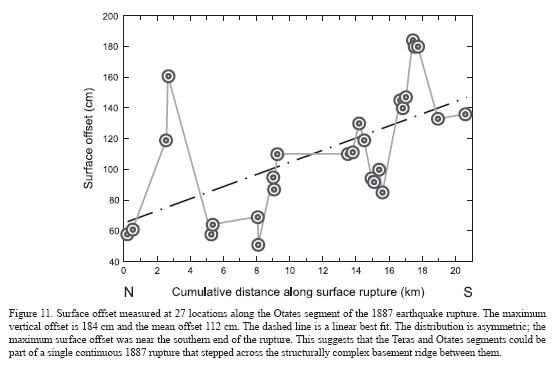
<body><![CDATA[<p align="center"><font face="verdana" size="2"><a name="f6"></a></font></p>     <p align="center"><font face="verdana" size="2"><img src="/img/revistas/rmcg/v25n1/a11f6.jpg"></font></p>     <p align="center"><font face="verdana" size="2"><a name="f7"></a></font></p>     <p align="center"><font face="verdana" size="2"><img src="/img/revistas/rmcg/v25n1/a11f7.jpg"></font></p>     <p align="center"><font face="verdana" size="2"><a name="f9"></a></font></p>     <p align="center"><font face="verdana" size="2"><img src="/img/revistas/rmcg/v25n1/a11f9.jpg"></font></p>     <p align="justify"><font face="verdana" size="2">The 1887 surface rapture along the Teras fault generally coincides with the mapped trace of the fault (<a href="/img/revistas/rmcg/v25n1/a11f2.jpg" target="_blank">Figure 2</a>). The endpoints of the documented surface rapture are located in the south at 109.259&deg;W/ 30.635&deg;N, at an elevation of 1,130 masl and in the north at 109.212&deg;W/30.810&deg;N at an elevation of 860 m (<a href="/img/revistas/rmcg/v25n1/a11f2.jpg" target="_blank">Figure 2</a>). The length along the rapture trace of the Teras segment is &#150;20.6 km (<a href="#f11">Figure 11</a> and <a href="/img/revistas/rmcg/v25n1/a11t2.jpg" target="_blank">Table 2</a>), whereas the endpoint&#150;to&#150;endpoint distance is 19.9 km. In the northernmost part of the Teras fault, the 1887 surface rapture passes within alluvial fan deposits (sites 64 and 65) or displaces alluvial fans against Tertiary volcanic rocks of the Sierra El Tigre (sites 10 and 11; <a href="/img/revistas/rmcg/v25n1/a11f2.jpg" target="_blank">Figure 2</a>). In the central part of the Teras fault, the rapture passes within Tertiary volcanic rocks in a fault&#150;parallel, long, and narrow valley &#151;erroneously labeled El Tigre valley in Natali and Sbar (1982), Wallace <i>et al. </i>(1988), and Wallace and Pearthree (1989)&#151; which passes through El Toro ranch and Puerto el Aire (<a href="/img/revistas/rmcg/v25n1/a11f2.jpg" target="_blank">Figure 2</a>; Suter, in press, fig. S2). Here rhyolite is faulted against basalt, which is partly overlain by relict alluvial fans (<a href="/img/revistas/rmcg/v25n1/a11f2.jpg" target="_blank">Figure 2</a>). Erosion of this tectonically controlled valley and down cutting of the Bavispe River canyon must have occurred after deposition of the alluvial fans. The 1887 rapture was most likely continuous along this part of the fault, but the amount of displacement can only be documented at some few places where the fault&#150;parallel valley is intersected by alluviated east&#150;west valleys draining Sierra El Tigre (<a href="/img/revistas/rmcg/v25n1/a11f2.jpg" target="_blank">Figures 2</a> and <a href="#f7">7</a>). In its southern part (south of Puerto el Aire), the 1887 rapture passes within scree slopes as steep as 22&deg; (<a href="/img/revistas/rmcg/v25n1/a11t2.jpg" target="_blank">Table 2</a>, <a href="#f9">Figure 9</a>) at the base of the talus formed by the Teras fault, which delimits Permian carbonates and subordinately Mesozoic siliciclastic rocks from Tertiary volcanic rocks (<a href="/img/revistas/rmcg/v25n1/a11f2.jpg" target="_blank">Figure 2</a>). The southern endpoint of the 1887 surface rapture on the Teras fault is north of Arroyo La Bota (<a href="/img/revistas/rmcg/v25n1/a11f2.jpg" target="_blank">Figure 2</a>, site 33), where the fault makes a 60&deg; bend to the west. At several locations, the surface rapture passes only a few meters from the stratigraphic contact between bedrock and scree (<a href="/img/revistas/rmcg/v25n1/a11f2.jpg" target="_blank">Figures 2</a> and <a href="/img/revistas/rmcg/v25n1/a11f8.jpg" target="_blank">8</a>&#150;<a href="/img/revistas/rmcg/v25n1/a11f10.jpg" target="_blank">10</a>). Therefore, the earthquake rapture likely coincides with the Teras fault at depth.</font></p>     <p align="center"><font face="verdana" size="2"><a name="f11"></a></font></p>     <p align="center"><font face="verdana" size="2"><img src="/img/revistas/rmcg/v25n1/a11f11.jpg"></font></p>     <p align="justify"><font face="verdana" size="2">The 1887 surface rapture along the Teras is structurally simple; it is not internally segmented along strike and, unlike the Pitaycachi segment, it has no significant branches or subsidiary faults (<a href="/img/revistas/rmcg/v25n1/a11f2.jpg" target="_blank">Figure 2</a>). An exception is the step faulting observed at site 37 (<a href="/img/revistas/rmcg/v25n1/a11t2.jpg" target="_blank">Table 2</a>), where a minor scarp, with a height of 20 cm, is located 30 m upslope of the main scarp. Small&#150;scale surficial complications could be observed in an exceptionally well&#150;exposed cross section (<a href="/img/revistas/rmcg/v25n1/a11f8.jpg" target="_blank">Figure 8</a>) of the rapture zone directly south of site 35 (<a href="/img/revistas/rmcg/v25n1/a11f2.jpg" target="_blank">Figure 2</a>). The 1887 motion is partitioned there along two west&#150;dipping normal faults, which seem to merge at a shallow depth, and two minor antithetic normal faults. Most of the displacement was along the eastern one of the two west&#150;dipping normal faults, which is in this section partly a shear zone rather than a discrete fault plane. Coarse rock fragments in the lower part of the hanging wall section terminate against this fault, which suggests prior movement along the same fault.</font></p>     ]]></body>
<body><![CDATA[<p align="justify"><font face="verdana" size="2">Fault scarp segments steeper than the angle of repose (free faces, <a href="#f6">Figure 6</a>) still exist at 23 of the 27 observation sites (<a href="/img/revistas/rmcg/v25n1/a11t2.jpg" target="_blank">Table 2</a>). Scarp free&#150;faces are best preserved where the rock debris is cemented. The four sites without a free face (61, 62, 4, and 4A) are located in the recent alluvium of east&#150;west streams draining Sierra El Tigre (<a href="/img/revistas/rmcg/v25n1/a11f2.jpg" target="_blank">Figure 2</a>). The fault scarp slopes range from 12&deg; to 60&deg; (<a href="/img/revistas/rmcg/v25n1/a11t2.jpg" target="_blank">Table 2</a>); the slope is lowest (12&deg; to 19&deg;) at the four sites without free face. The rock debris displaced by the surface rapture is coarse and poorly stratified (<a href="#f7">Figures 7</a>, <a href="/img/revistas/rmcg/v25n1/a11f8.jpg" target="_blank">8</a>, and <a href="/img/revistas/rmcg/v25n1/a11f10.jpg" target="_blank">10</a>) and therefore not suitable for paleoseismological trenching investigation.</font></p>     <p align="justify"><font face="verdana" size="2">&nbsp;</font></p>     <p align="justify"><font face="verdana" size="2"><b>Surface offset and coseismic slip</b></font></p>     <p align="justify"><font face="verdana" size="2">The surface offset (vertical separation of the ground surface) was calculated from the scarp height and the slope angle above and below the scarp (<a href="#f6">Figure 6</a>) (Bucknam and Anderson, 1979; McCalpin, 1996; Yeats <i>et al., </i>1997). The surface offset remains constant, whereas the scarp width and height increase as the scarp broadens with age (<a href="#f6">Figure 6</a>). Because of the steep, up to 22&deg; inclined slopes adjacent to the 1887 rupture, the surface offset deviates significantly from the scarp height (<a href="/img/revistas/rmcg/v25n1/a11t2.jpg" target="_blank">Table 2</a>). For three of the sites (5, 6, and 36), the calculated surface offset is smaller than the (vertically) measured free face (<a href="/img/revistas/rmcg/v25n1/a11t2.jpg" target="_blank">Table 2</a>) and therefore not useful. This problem did not arise with any of the numerous surface offsets calculated for the Pit&aacute;ycachi segment but was frequent with the surface offsets computed for the Otates segment (Suter, in press). Because of the steep slopes along the southern part of the Teras fault (<a href="/img/revistas/rmcg/v25n1/a11t2.jpg" target="_blank">Table 2</a>) and especially along the Otates fault, the base of the rupture scarp is often not well defined unless marked by a basal fissure. The transition from the small debris apron at the base of the scarp (<a href="#f6">Figure 6</a>) to the steep hillslope below is often gradual. Furthermore, the hillslope values used to calculate the surface offset have an uncertainty of &plusmn;2&deg;; they were taken from the corresponding INEGI 1:50,000 scale topographic map sheets, which have 20&#150;m contour intervals. The most reliable scarp parameter is the free face (<a href="#f6">Figure 6</a>), which gives a minimum estimate for the surface offset, whereas the scarp height should give a maximum estimate. For the three sites where the computed surface offset turned out to be smaller than the measured free face (<a href="/img/revistas/rmcg/v25n1/a11t2.jpg" target="_blank">Table 2</a>), I assumed the offset was not more than the free face value (<a href="#f11">Figure 11</a>). This assumption provides a minimum value for the vertical separation of the ground surface.</font></p>     <p align="justify"><font face="verdana" size="2">A distribution of the surface offsets measured at 27 sites (<a href="/img/revistas/rmcg/v25n1/a11t2.jpg" target="_blank">Table 2</a>) along the rupture trace is shown on <a href="#f11">Figure 11</a>. The maximum vertical separation is 184 cm at site 15, the minimum vertical separation 51 cm, and the arithmetic average (mean) of the vertical separations is 112 cm. The dashed line on <a href="#f11">Figure 11</a> is a linear best fit to the surface offset <i>y</i> values. The regression line corresponds to the function <i>y</i> = a<i>x</i> + b, where a= 3.939 and b = 65.15 cm. The correlation coefficient is 0.6020. The along&#150;scarp distribution is asymmetric, with the maximum offset near the southern end of the segment. The high surface offset values at the southern end of the mapped surface rupture of the Teras segment and at the northern end of the mapped surface rupture of the Otates segment suggest that the two segments could be part of a single continuous rupture that stepped across the structurally complex basement ridge between them (Suter, in press). The median of the predicted values (106 cm; y&#150;coordinate forthe midpoint of the regression line) is somewhat smaller than the arithmetic average of the individual vertical separation measurements (112 cm).</font></p>     <p align="justify"><font face="verdana" size="2">The ground surface offset distribution can be used to estimate the coseismic slip distribution at depth. The transform from surface offset <i>y </i>to slip <i>s </i>is <i>s = y / </i>sin <i><img src="/img/revistas/rmcg/v25n1/a11s1.jpg">, </i>where <i><img src="/img/revistas/rmcg/v25n1/a11s1.jpg"></i>is the average dip of the rupture surface. Since no striations were observed on the surface rupture scarp, the 62&deg; average dip measured on the Teras fault plane (<a href="/img/revistas/rmcg/v25n1/a11f2.jpg" target="_blank">Figure 2</a>) is taken as a proxy. Based on this assumption, the maximum slip along the Teras fault in the 1887 earthquake was 208 cm, the slip resulting from the arithmetic average of the vertical separation measurements was 127 cm, and the slip resulting from the average value of the regression function was 120 cm.</font></p>     <p align="justify"><font face="verdana" size="2">&nbsp;</font></p>     <p align="justify"><font face="verdana" size="2"><b>Magnitude</b></font></p>     <p align="justify"><font face="verdana" size="2">Based on the above slip values and the rupture length, we can estimate the moment magnitude <i>M</i><sub>w</sub> for the rupture of this individual segment from the corresponding empirical scaling laws for normal faults by Wells and Coppersmith (1994). Their maximum displacement&#150;versus&#150;magnitude regression indicates a magnitude of 6.84&plusmn;0.34 forthe 1887 rupture of the Teras fault. Assuming an average displacement of 127 cm, their average displacement&#150;versus&#150;magnitude regression indicates the practically identical magnitude of 6.85&plusmn;0.33. Based on the 19.9 km endpoint&#150;to&#150;endpoint distance of the rupture trace of the Teras segment, the length&#150;versus&#150;magnitude regression for normal faults by Wells and Coppersmith (1994, tab. 2A) yields a lower <i>M</i><sub>w </sub>of 6.57&plusmn;0.34 for the 1887 rupture of the Teras fault. These calculations indicate that the aspect (displacement/length) ratio of the 1887 rupture of the Teras fault is somewhat higher than for the average normal fault rupture of the Wells and Coppersmith (1994) data set. According to their regressions, the typical length of a magnitude <i>M</i><sub>w</sub> 6.85 normal fault rupture is 26.0 km, whereas the maximum and average displacements of a <i>M</i><sub>w</sub> 6.57 normal fault rupture are 160 and 74 cm, respectively.</font></p>     <p align="justify"><font face="verdana" size="2">&nbsp;</font></p>     ]]></body>
<body><![CDATA[<p align="justify"><font face="verdana" size="2"><b>Slip rate and recurrence interval</b></font></p>     <p align="justify"><font face="verdana" size="2">To date, no Quaternary slip rate has been calculated for the Teras fault. Basin and Range Province faults that separate bedrock from internally unfaulted basin fill, such as the Teras fault, typically have vertical slip rates &gt;0.1 mm/yr (dePolo and Anderson, 2000). As mentioned previously, the estimated long&#150;term geologic slip rate of the Teras fault is 0.08 mm/yr based on an estimated throw of 1,640 m along a 62&deg;&#150;dipping fault over a period of 23 Myr. A rough estimate of the average recurrence interval of 1887&#150;size earthquakes on the Teras fault can be obtained from this slip rate and the amount of slip on this segment during the 1887 earthquake; the resulting values are 26 kyr based on the maximum slip, 16 kyr based on the slip resulting from the arithmetic average of the vertical separation measurements, and 15 kyr based on the slip resulting from the average value of the regression function. These estimates are within the range of recurrence intervals documented for normal faults of the southern Basin and Range Province and the Rio Grande rift (10 to 100 kyr; Menges and Pearthree, 1989; Machette, 1998).</font></p>     <p align="justify"><font face="verdana" size="2">Conversely, the Quaternary slip rate of the Pit&aacute;y cachi fault, obtained from the fault scarp morphology and the estimated age of soils formed on alluvial surfaces displaced by the fault, is only 0.015 mm/yr (Bull and Pearthree, 1988; Pearthree <i>et al., </i>1990), twelve times slower than its long&#150;term rate of ~0.18 mm/yr (Suter and Conteras, 2002). Such a decrease of slip rate with time is also characteristic for many faults of the Rio Grande rift; the Socorro fault zone, for example, slowed from 0.18&#150;0.20 mm/yr in the latest Miocene, to about 0.05 mm/yr in the Pliocene, and 0.02&#150;0.04 mm/yrin the past 750 kyr (Machette, 1998). Given this decrease of long&#150;term slip rate with time, the above estimate of the average recurrence interval of 1887&#150;size earthquakes on the Teras fault is likely to be a lower bound.</font></p>     <p align="justify"><font face="verdana" size="2">The change in Coulomb failure stress caused by the rupture of individual segments of a fault zone may advance or delay the rupture of adjacent segments (King <i>et al., </i>1994; Crider and Pollard, 1998; Stein, 1999; Gupta and Scholz, 2000). This suggests that the various segments of the fault zone on the western edge of the Sierra Madre Occidental plateau may have failed in the past in segment combinations that are different from the one that ruptured in 1887 (Pit&aacute;ycachi&#150;Teras&#150;Otates), which probably results in major fluctuations of the recurrence intervals for the individual fault segments.</font></p>     <p align="justify"><font face="verdana" size="2">&nbsp;</font></p>     <p align="justify"><font face="verdana" size="2"><b>Structural interaction between the Teras and Otates rupture segments</b></font></p>     <p align="justify"><font face="verdana" size="2">A 15&#150;km&#150;long gap separates the southern end of the Teras segment from the northern end of the Otates segment (<a href="/img/revistas/rmcg/v25n1/a11f3.jpg" target="_blank">Figure 3</a>). Assuming the rupture propagated from north to south, the 1887 rupture was arrested along the southern Teras fault where the fault trace has a 60&deg; bend and jogs to the west. A model of changes in Coulomb failure stress resulting from the 1887 rupture indicates lobes of stress increase at the tips of the rupture segments, especially in the step&#150;over between the Teras and Otates faults (Suter and Conteras, 2002). The northern part of the Otates fault and the northern parts of the normal faults bounding the Iglesitas horst (<a href="/img/revistas/rmcg/v25n1/a11f3.jpg" target="_blank">Figure 3</a>) are located in this zone of stress concentration. Therefore, the 1887 rupture could have either jumped from the Teras to the Otates fault or triggered slip along the faults bounding the Iglesitas horst. However, field&#150;checking the fault traces along the Iglesitas horst did not reveal any obvious morphological or stratigraphic evidence of Quaternary fault activity.</font></p>     <p align="justify"><font face="verdana" size="2">The Teras surface rupture segment has lower surface offset (vertical separation) values than the Otates segment to the south, even though the Teras segment is slightly longer (Suter and Conteras, 2002; Suter, in press). This suggests that the Otates rupture segment may be longer than mapped. This hypothesis is also supported by the high surface offset values at the northern end of the mapped surface rupture of the Otates segment (Suter, in press, <a href="#f9">fig. 9</a>). Furthermore, the high surface offset values at the southern end of the mapped surface rupture of the Teras segment (<a href="#f11">Figure 11</a>) and at the northern end of the mapped surface rupture of the Otates segment suggest that the two segments could be part of a single continuous rupture that stepped across the structurally complex basement ridge between them. However, there is no clear evidence of young surface ruptures supporting this hypothesis.</font></p>     <p align="justify"><font face="verdana" size="2">&nbsp;</font></p>     <p align="justify"><font face="verdana" size="2"><b>Structural interaction between the Teras and Pit&aacute;ycachi rupture segments</b></font></p>     ]]></body>
<body><![CDATA[<p align="justify"><font face="verdana" size="2">Near Morelos, a 2.5&#150;km&#150;wide, unbreached right step&#150;over separates the Pit&aacute;ycachi and Teras segments of the 1887 earthquake surface rupture across the Bavispe River (<a href="/img/revistas/rmcg/v25n1/a11f1.jpg" target="_blank">Figures 1</a> and <a href="/img/revistas/rmcg/v25n1/a11f2.jpg" target="_blank">2</a>). This step&#150;over is also defined by a minimum in the 1887 slip distribution, which suggests that the Pit&aacute;ycachi and Teras are independent rupture segments that do not merge at depth (Suter and Conteras, 2002). In their approach to the step&#150;over, the traces of the Pit&aacute;ycachi and Teras rupture segments are characterized on a smaller length scale by right&#150;stepping en echelon patterns (Suter, unpublished data, and Figure 2) indicating a distributed left&#150;lateral component of motion within this transfer zone.</font></p>     <p align="justify"><font face="verdana" size="2">According to observations by Goodfellow (1887), the Pit&aacute;ycachi and Teras rupture segments overlap. Based on his rupture map (facsimile in Suter, 2006, <a href="/img/revistas/rmcg/v25n1/a11f3.jpg" target="_blank">fig. 3</a>), the Pit&aacute;ycachi segment continues in the south across the Bavispe River into the Sierra Pilares de Teras for at least 8 km. The same rupture configuration is shown on the map by Aguilera (1888) (facsimile in Suter, 2006, <a href="#f5">fig. 5</a>). According to Goodfellow (1888), the scarp heights along the Pit&aacute;ycachi rupture segment in the Sierra Pilares de Teras are ~0.9 m and do not exceed 1.5 m. Both, Goodfellow (1888) and Aguilera (1888) noticed the scarp height attenuation to near zero, approaching either side of the Bavispe River valley, and Goodfellow (1888) observed locally reverse faulting, 3.2 km south of the river. At his southernmost observation point, 8 km south of the river, the scarp height was one foot or less (<u>&lt;</u>30 cm) and the rupture branched. Since the rupture passes in the Sierra Pilares de Teras within volcanic rocks and is not expressed by a multi&#150;event rupture scarp, I have not been able to confirm Goodfellow's observations. A photograph by C.S. Fly (Suter, 2006, <a href="/img/revistas/rmcg/v25n1/a11f10.jpg" target="_blank">fig. 10</a>) documents the 1887 rupture trace directly south of the river where it separates Tertiary volcanic rocks from scree.</font></p>     <p align="justify"><font face="verdana" size="2">According to independent observations by both Aguilera (1888) and Goodfellow (1888), the aftershocks of the 1887 earthquake were concentrated in the northernmost part of Sierra Pilares de Teras, where the step&#150;over between the Teras and Pit&aacute;ycachi rupture segments is located. Based on its intensity distribution, the 26 May 1907 Colonia Morelos, Sonora (I<sub>max</sub>= VIII, <i>M<sub>I</sub> = </i>5.2&plusmn;0.4) earthquake also seems to have had its origin in this region (Suter, 2001, <a href="#f4">fig. 4</a>). These earthquakes may have been caused by an increase of static Coulomb stress at the tips of the Pit&aacute;ycachi and Teras rupture segments (Suter and Conteras, 2002).</font></p>     <p align="justify"><font face="verdana" size="2">&nbsp;</font></p>     <p align="justify"><font face="verdana" size="2"><b>Rupture kinematics</b></font></p>     <p align="justify"><font face="verdana" size="2">The structural configuration of the 1887 rupture along the Teras fault does not indicate where the rupture originated and how it propagated. Conversely, the surface rupture along the Pit&aacute;ycachi segment has a well&#150;developed branching pattern (five north&#150;facing bifurcations in the northern part of the segment, two south&#150;facing bifurcations in its southern part), which indicates that the rupture of the Pit&aacute;ycachi segment initiated in its central part where the polarity of the rupture bifurcations changes (Suter and Conteras, 2002).</font></p>     <p align="justify"><font face="verdana" size="2">It is therefore very likely that the rupture first propagated bilaterally along the Pit&aacute;ycachi fault, from where the southern rupture front jumped across the step&#150;over to the Teras fault and from there to the Otates fault (<a href="/img/revistas/rmcg/v25n1/a11f1.jpg" target="_blank">Figure 1</a>). This scenario is supported by the macroseismic observations made by Aguilera (1888), which indicate that this event was a composite earthquake with the sub&#150;events separated by several seconds. Geological observations indicate that historical Basin and Range Province earthquakes with large magnitudes involved sequential rupture of two or more discrete segments (dePolo <i>et al, </i>1991; Zhang <i>et al, </i>1999). Furthermore, in a study of the source parameters of Basin and Range Province earthquakes, Doser and Smith (1989) concluded that earthquakes of magnitude <u>&gt;</u>7.0 have complex ruptures best modeled by multiple sub&#150;events. Moreover, the directivity effect of a north&#150;to&#150;south propagating rupture along the southern part of the Pit&aacute;ycachi fault and the Teras and Otates faults also explains why the isoseismals of this earthquake (Aguilera, 1888; Suter, 2006) are so much elongated in a SSE direction.</font></p>     <p align="justify"><font face="verdana" size="2">&nbsp;</font></p>     <p align="justify"><font face="verdana" size="2"><b>CONCLUSIONS</b></font></p>     <p align="justify"><font face="verdana" size="2">The Basin and Range Province Teras fault, which forms the steep western flank of Sierra Pilares de Teras in northeastern Sonora, ruptured in the 1887 Sonoran earthquake. Rocks exposed along the Teras fault include Paleozoic marine limestone, a lower part of the Cretaceous Bisbee Group (Glance Conglomerate, La Morita Formation, Mural Limestone), early Tertiary lakebeds, Oligocene volcanic rocks, and Quaternary piedmont alluvium and scree. In a previously undocumented section along Arroyo de los Estrada, volcanic rocks are interstratified in the Glance Conglomerate and La Morita Formation. A large topographic relief must have existed locally during the deposition of the Glance Conglomerate and La Morita Formation; in the Estrada section, these rocks are &#150;1,200 m thick and overly Permian limestone, whereas 15 km farther southeast, in La Pita canyon, the Glance Conglomerate and La Morita Formation are missing, and the Mural Limestone overlies directly Paleozoic limestone. The dips measured in the Paleozoic limestone and the Cretaceous Bisbee Group within the footwall of the Teras fault define a NNW&#150;SSE trending fold axis, which must be due to Laramide shortening, since horizontal lakebeds of Late Cretaceous and/or early Tertiary age overly these folded rocks.</font></p>     ]]></body>
<body><![CDATA[<p align="justify"><font face="verdana" size="2">The length of the Teras fault is ~20 km, its average strike N12&deg;E, its average dip 62&deg;W, and its maximum throw &gt;1,640 m. At its northern end, a 2.5&#150;km&#150;wide right&#150;step separates the Teras from the Pit&aacute;ycachi fault across an unbreached relay ramp. In the south, the trace of the Teras fault shows a 60&deg; bend and jogs to the west. A major transverse basement ridge exists south of the Teras fault. The dogleg at the southern termination of the Teras fault is located at the northern margin of this basement ridge. Structurally, the basement ridge coincides with a fault relay zone where the displacement of the Teras fault is transferred onto the Otates fault and the normal faults bounding the Iglesitas horst. There is a 6&#150;km&#150;wide right&#150;step in the range&#150;bounding normal fault segments between the Teras fault and the fault delimiting the Iglesitas horst from the Angostura basin. The step is partly breached by the dogleg of the Teras fault and by a major bend in the trace of the fault delimiting the Iglesitas horst from the Angostura basin.</font></p>     <p align="justify"><font face="verdana" size="2">The 1887 surface rupture along the Teras fault generally coincides with the mapped trace of the fault. The rupture is structurally simple; it is not internally segmented along strike and, unlike the Pit&aacute;ycachi segment, it has no branches or subsidiary faults. The vertical separation of the ground surface by the rupture scarp (surface offset) was measured at 27 sites; the scarp free face still exists at 23 of these sites. The maximum vertical separation is 184 cm, and the mean of the vertical separations is 112 cm. A linear best fit to the surface offset values shows the along&#150;scarp distribution to be asymmetric, with the maximum offset near the southern end of the segment. The high surface offsets at the southern end of the Teras and at the northern end of the Otates rupture segments suggest that the two segments could be part of a single continuous rupture that stepped across the structurally complex basement ridge between them.</font></p>     <p align="justify"><font face="verdana" size="2">An unbreached right step&#150;over, 2.5&#150;km wide and with an 8&#150;km overlap (Goodfellow, 1887, 1888), separates the northern end of the mapped surface rupture of the Teras segment from the Pit&aacute;ycachi segment. This step&#150;over is also defined by a minimum in the 1887 slip distribution, which suggests that the Pit&aacute;ycachi and Teras are independent rupture segments that do not merge at depth. In their approach to the step&#150;over, the traces of the Pit&aacute;ycachi and Teras rupture segments are characterized on a smaller length scale by right&#150;stepping en echelon patterns indicating a distributed left&#150;lateral component of motion within this transfer zone.</font></p>     <p align="justify"><font face="verdana" size="2">No striations have been observed on the Teras segment of the 1887 surface rupture in surficial deposits. Striations measured on the Teras fault, which are a proxy for the 1887 earthquake slip vector, indicate consistently extensional dip&#150;slip motion with a very minor left&#150;lateral strike&#150;slip component. The similarity of the focal mechanism presentation of these striations and the focal mechanism of the 25 May 1989 M 4.2 earthquake (Suter and Conteras, 2002, <a href="/img/revistas/rmcg/v25n1/a11f2.jpg" target="_blank">fig. 2</a>) suggests that this earthquake may have had its source on the Teras fault plane.</font></p>     <p align="justify"><font face="verdana" size="2">The surface rupture along the Pit&aacute;y cachi segment has a well&#150;developed branching pattern (five north&#150;facing bifurcations in the northern part of the segment, two south&#150;facing bifurcations in its southern part), which indicates that the rupture of the Pit&aacute;y cachi segment initiated in its central part where the polarity of the rupture bifurcations changes. It is therefore very likely that the rupture first propagated bilaterally along the Pit&aacute;ycachi fault, from where the southern rupture front jumped across the step&#150;over to the Teras fault and from there to the Otates fault.</font></p>     <p align="justify"><font face="verdana" size="2">&nbsp;</font></p>     <p align="justify"><font face="verdana" size="2"><b>ACKNOWLEDGMENTS</b></font></p>     <p align="justify"><font face="verdana" size="2">I am thankful to Philip A. Pearthree (Arizona Geological Survey) and Craig dePolo (Nevada Bureau of Mines and Geology) for their careful reviews of this manuscript. Financial and logistic support for this work came in part from <i>Universidad Nacional Aut&oacute;noma de M&eacute;xico </i>(UNAM) and <i>Consejo Nacional de Ciencia y Tecnolog&iacute;a </i>(CONACYT, grant G33102&#150;T).</font></p>     <p align="justify"><font face="verdana" size="2">&nbsp;</font></p>     <p align="justify"><font face="verdana" size="2"><b>REFERENCES</b></font></p>     ]]></body>
<body><![CDATA[<!-- ref --><p align="justify"><font face="verdana" size="2">Aguilera, J.G., 1888, Estudio de los fen&oacute;menos se&iacute;smicos del 3 de mayo de 1887: Anales del Ministerio de Fomento de la Rep&uacute;blica Mexicana, 10, 5&#150;56.</font>&nbsp;&nbsp;&nbsp;&nbsp;&nbsp;&nbsp;&nbsp;&nbsp;[&#160;<a href="javascript:void(0);" onclick="javascript: window.open('/scielo.php?script=sci_nlinks&ref=8072740&pid=S1026-8774200800010001100001&lng=','','width=640,height=500,resizable=yes,scrollbars=1,menubar=yes,');">Links</a>&#160;]<!-- end-ref --><!-- ref --><p align="justify"><font face="verdana" size="2">Anderson, T.H., Silver, L.T., 1977, U&#150;Pb isotope ages of granitic plutons near Cananea, Sonora: Economic Geology, 72, 827&#150;836.</font>&nbsp;&nbsp;&nbsp;&nbsp;&nbsp;&nbsp;&nbsp;&nbsp;[&#160;<a href="javascript:void(0);" onclick="javascript: window.open('/scielo.php?script=sci_nlinks&ref=8072741&pid=S1026-8774200800010001100002&lng=','','width=640,height=500,resizable=yes,scrollbars=1,menubar=yes,');">Links</a>&#160;]<!-- end-ref --><!-- ref --><p align="justify"><font face="verdana" size="2">Araujo&#150;Mendieta, J., Estavillo&#150;Gonz&aacute;lez, C.F., 1987, Evoluci&oacute;n tect&oacute;nica sedimentaria del Jur&aacute;sico Superior y Cret&aacute;cico Inferior en el NE de Sonora, M&eacute;xico: Revista del Instituto Mexicano del Petr&oacute;leo, 19(3), 4&#150;39.</font>&nbsp;&nbsp;&nbsp;&nbsp;&nbsp;&nbsp;&nbsp;&nbsp;[&#160;<a href="javascript:void(0);" onclick="javascript: window.open('/scielo.php?script=sci_nlinks&ref=8072742&pid=S1026-8774200800010001100003&lng=','','width=640,height=500,resizable=yes,scrollbars=1,menubar=yes,');">Links</a>&#160;]<!-- end-ref --><!-- ref --><p align="justify"><font face="verdana" size="2">Bakun, W.H., 2006, MMI attenuation and historical earthquakes in the Basin and Range province of western North America: Bulletin of the Seismological Society of America, 96, 2206&#150;2220.</font>&nbsp;&nbsp;&nbsp;&nbsp;&nbsp;&nbsp;&nbsp;&nbsp;[&#160;<a href="javascript:void(0);" onclick="javascript: window.open('/scielo.php?script=sci_nlinks&ref=8072743&pid=S1026-8774200800010001100004&lng=','','width=640,height=500,resizable=yes,scrollbars=1,menubar=yes,');">Links</a>&#160;]<!-- end-ref --><!-- ref --><p align="justify"><font face="verdana" size="2">Bandelier, A.F., 1892, Final report of investigations among the Indians of the southwestern United States, carried on mainly in the years 1880 to 1885: Papers of the Archaeological Institute of America, American Series 4, part 2, 591 p.</font>&nbsp;&nbsp;&nbsp;&nbsp;&nbsp;&nbsp;&nbsp;&nbsp;[&#160;<a href="javascript:void(0);" onclick="javascript: window.open('/scielo.php?script=sci_nlinks&ref=8072744&pid=S1026-8774200800010001100005&lng=','','width=640,height=500,resizable=yes,scrollbars=1,menubar=yes,');">Links</a>&#160;]<!-- end-ref --><!-- ref --><p align="justify"><font face="verdana" size="2">Biggs, T.H., Leighty, R.S., Skotnicki, S.J., Pearthree, PA., 1999, Geology and geomorphology of the San Bernardino valley, southeastern Arizona: Arizona Geological Survey, Open&#150;File Report 99&#150;19, 20 p.</font>&nbsp;&nbsp;&nbsp;&nbsp;&nbsp;&nbsp;&nbsp;&nbsp;[&#160;<a href="javascript:void(0);" onclick="javascript: window.open('/scielo.php?script=sci_nlinks&ref=8072745&pid=S1026-8774200800010001100006&lng=','','width=640,height=500,resizable=yes,scrollbars=1,menubar=yes,');">Links</a>&#160;]<!-- end-ref --><!-- ref --><p align="justify"><font face="verdana" size="2">Brown, D.E., Lowe, C.H., 1994, Biotic Communities of the Southwest: Salt Lake City, Utah, University of Utah Press, scale 1:1,000,000.</font>&nbsp;&nbsp;&nbsp;&nbsp;&nbsp;&nbsp;&nbsp;&nbsp;[&#160;<a href="javascript:void(0);" onclick="javascript: window.open('/scielo.php?script=sci_nlinks&ref=8072746&pid=S1026-8774200800010001100007&lng=','','width=640,height=500,resizable=yes,scrollbars=1,menubar=yes,');">Links</a>&#160;]<!-- end-ref --><!-- ref --><p align="justify"><font face="verdana" size="2">Bucknam, R.C., Anderson, R.E., 1979, Estimation of fault&#150;scarp ages from a scarp&#150;height slope&#150;angle relationship: Geology, 7, 11&#150;14.</font>&nbsp;&nbsp;&nbsp;&nbsp;&nbsp;&nbsp;&nbsp;&nbsp;[&#160;<a href="javascript:void(0);" onclick="javascript: window.open('/scielo.php?script=sci_nlinks&ref=8072747&pid=S1026-8774200800010001100008&lng=','','width=640,height=500,resizable=yes,scrollbars=1,menubar=yes,');">Links</a>&#160;]<!-- end-ref --><!-- ref --><p align="justify"><font face="verdana" size="2">Bull, W.B., Pearthree, PA., 1988, Frequency and size of Quaternary surface rupture of the Pitaycachi fault, northeastern Sonora, Mexico: Bulletin of the Seismological Society of America, 78, 956&#150;978.</font>&nbsp;&nbsp;&nbsp;&nbsp;&nbsp;&nbsp;&nbsp;&nbsp;[&#160;<a href="javascript:void(0);" onclick="javascript: window.open('/scielo.php?script=sci_nlinks&ref=8072748&pid=S1026-8774200800010001100009&lng=','','width=640,height=500,resizable=yes,scrollbars=1,menubar=yes,');">Links</a>&#160;]<!-- end-ref --><!-- ref --><p align="justify"><font face="verdana" size="2">Cerecero&#150;Luna, M., Castro&#150;Escarrega, J., 1996, Carta geol&oacute;gico&#150;minera Colonia Oaxaca H12&#150;B66, scale 1:50,000: Secretar&iacute;a de Comercio y Fomento Industrial, Consejo de Recursos Minerales.</font>&nbsp;&nbsp;&nbsp;&nbsp;&nbsp;&nbsp;&nbsp;&nbsp;[&#160;<a href="javascript:void(0);" onclick="javascript: window.open('/scielo.php?script=sci_nlinks&ref=8072749&pid=S1026-8774200800010001100010&lng=','','width=640,height=500,resizable=yes,scrollbars=1,menubar=yes,');">Links</a>&#160;]<!-- end-ref --><!-- ref --><p align="justify"><font face="verdana" size="2">Contreras, J., Scholz, C.H., 2001, Evolution of stratigraphic sequences in multisegmented continental rift basins &#150;Comparison of computer models with the basins of the East African rift system: American Association of Petroleum Geologists Bulletin, 85, 1565&#150;1581.</font>&nbsp;&nbsp;&nbsp;&nbsp;&nbsp;&nbsp;&nbsp;&nbsp;[&#160;<a href="javascript:void(0);" onclick="javascript: window.open('/scielo.php?script=sci_nlinks&ref=8072750&pid=S1026-8774200800010001100011&lng=','','width=640,height=500,resizable=yes,scrollbars=1,menubar=yes,');">Links</a>&#160;]<!-- end-ref --><!-- ref --><p align="justify"><font face="verdana" size="2">Crider, J.G., Pollard, D.D., 1998, Fault linkage: three&#150;dimensional mechanical interaction between echelon normal faults: Journal of Geophysical Research, 103, 24,373&#150;24,391.</font>&nbsp;&nbsp;&nbsp;&nbsp;&nbsp;&nbsp;&nbsp;&nbsp;[&#160;<a href="javascript:void(0);" onclick="javascript: window.open('/scielo.php?script=sci_nlinks&ref=8072751&pid=S1026-8774200800010001100012&lng=','','width=640,height=500,resizable=yes,scrollbars=1,menubar=yes,');">Links</a>&#160;]<!-- end-ref --><!-- ref --><p align="justify"><font face="verdana" size="2">Demant, A., Cochem&eacute;, J.J., Delpretti, P., Piguet, P., 1989, Geology and petrology of the Tertiary volcanics of the northwestern Sierra Madre Occidental, Mexico: Bulletin de la Soci&eacute;t&eacute; G&eacute;oloqique de France, Series 8, 5, 737&#150;748.</font>&nbsp;&nbsp;&nbsp;&nbsp;&nbsp;&nbsp;&nbsp;&nbsp;[&#160;<a href="javascript:void(0);" onclick="javascript: window.open('/scielo.php?script=sci_nlinks&ref=8072752&pid=S1026-8774200800010001100013&lng=','','width=640,height=500,resizable=yes,scrollbars=1,menubar=yes,');">Links</a>&#160;]<!-- end-ref --><!-- ref --><p align="justify"><font face="verdana" size="2">dePolo, C.,M., Anderson, J.G., 2000, Estimating the slip rates of normal faults in the Great Basin, USA: Basin Research, 12, 227&#150;240.</font>&nbsp;&nbsp;&nbsp;&nbsp;&nbsp;&nbsp;&nbsp;&nbsp;[&#160;<a href="javascript:void(0);" onclick="javascript: window.open('/scielo.php?script=sci_nlinks&ref=8072753&pid=S1026-8774200800010001100014&lng=','','width=640,height=500,resizable=yes,scrollbars=1,menubar=yes,');">Links</a>&#160;]<!-- end-ref --><!-- ref --><p align="justify"><font face="verdana" size="2">dePolo, CM., Clark, D.G., Slemmons, D.B., Ramelli, A.R., 1991, Historical surface faulting in the Basin and Range province, western North America: implications for fault segmentation: Journal of Structural Geology, 13, 123&#150;136.</font>&nbsp;&nbsp;&nbsp;&nbsp;&nbsp;&nbsp;&nbsp;&nbsp;[&#160;<a href="javascript:void(0);" onclick="javascript: window.open('/scielo.php?script=sci_nlinks&ref=8072754&pid=S1026-8774200800010001100015&lng=','','width=640,height=500,resizable=yes,scrollbars=1,menubar=yes,');">Links</a>&#160;]<!-- end-ref --><!-- ref --><p align="justify"><font face="verdana" size="2">Devery, J.V., 1979, Sedimentary petrology of the Upper Paleozoic carbonates near Bavispe, Sonora, Mexico: Newark, New Jersey, Rutgers University, M. S. thesis, 79 p.</font>&nbsp;&nbsp;&nbsp;&nbsp;&nbsp;&nbsp;&nbsp;&nbsp;[&#160;<a href="javascript:void(0);" onclick="javascript: window.open('/scielo.php?script=sci_nlinks&ref=8072755&pid=S1026-8774200800010001100016&lng=','','width=640,height=500,resizable=yes,scrollbars=1,menubar=yes,');">Links</a>&#160;]<!-- end-ref --><!-- ref --><p align="justify"><font face="verdana" size="2">Dickinson, W.R., Lawton, T.F., 2001, Tectonic setting and sandstone petrofacies of the Bisbee basin (USA&#150;Mexico): Journal of South American Earth Sciences, 14, 475&#150;504.</font>&nbsp;&nbsp;&nbsp;&nbsp;&nbsp;&nbsp;&nbsp;&nbsp;[&#160;<a href="javascript:void(0);" onclick="javascript: window.open('/scielo.php?script=sci_nlinks&ref=8072756&pid=S1026-8774200800010001100017&lng=','','width=640,height=500,resizable=yes,scrollbars=1,menubar=yes,');">Links</a>&#160;]<!-- end-ref --><!-- ref --><p align="justify"><font face="verdana" size="2">Doser, D.I., Smith, R.B., 1989, An assessment of source parameters of earthquakes in the Cordillera of the western United States: Bulletin of the Seismological Society of America, 79, 1383&#150;1409.</font>&nbsp;&nbsp;&nbsp;&nbsp;&nbsp;&nbsp;&nbsp;&nbsp;[&#160;<a href="javascript:void(0);" onclick="javascript: window.open('/scielo.php?script=sci_nlinks&ref=8072757&pid=S1026-8774200800010001100018&lng=','','width=640,height=500,resizable=yes,scrollbars=1,menubar=yes,');">Links</a>&#160;]<!-- end-ref --><!-- ref --><p align="justify"><font face="verdana" size="2">DuBois, S.M., Smith, A. W., 1980, The 1887 Earthquake in San Bernardino valley, Sonora: State of Arizona, Bureau of Geology and Mineral Technology, Special Paper 3, 112 pp.</font>&nbsp;&nbsp;&nbsp;&nbsp;&nbsp;&nbsp;&nbsp;&nbsp;[&#160;<a href="javascript:void(0);" onclick="javascript: window.open('/scielo.php?script=sci_nlinks&ref=8072758&pid=S1026-8774200800010001100019&lng=','','width=640,height=500,resizable=yes,scrollbars=1,menubar=yes,');">Links</a>&#160;]<!-- end-ref --><!-- ref --><p align="justify"><font face="verdana" size="2">Felger, R.S., Wilson, M.F., 1995, Northern Sierra Madre Occidental and its Apachian outliers: a neglected center of biodiversity, <i>in </i>Leonard, E, Ffolliott, PE, Ortega&#150;Rubio, A., Gottfried, G.J., Harare, R.H., and Edminster, C.B. (eds.), Biodiversity and management of the Madrean archipelago: The sky islands of the southwestern United States and northern Mexico: Fort Collins, Colorado, U.S. Department of Agriculture, Forest Service, General Technical Report RM&#150;GTR&#150;264, p. 36&#150;51.</font>&nbsp;&nbsp;&nbsp;&nbsp;&nbsp;&nbsp;&nbsp;&nbsp;[&#160;<a href="javascript:void(0);" onclick="javascript: window.open('/scielo.php?script=sci_nlinks&ref=8072759&pid=S1026-8774200800010001100020&lng=','','width=640,height=500,resizable=yes,scrollbars=1,menubar=yes,');">Links</a>&#160;]<!-- end-ref --><!-- ref --><p align="justify"><font face="verdana" size="2">Fern&aacute;ndez&#150;Aguirre, M.A., Monreal&#150;Saavedra, R., Grijalva Haro, A.S., 1993, Carta geol&oacute;gica de Sonora, Hermosillo, Sonora, Mexico, Centro de Estudios Superiores del Estado de Sonora (CESUES), scale 1:500 000.</font>&nbsp;&nbsp;&nbsp;&nbsp;&nbsp;&nbsp;&nbsp;&nbsp;[&#160;<a href="javascript:void(0);" onclick="javascript: window.open('/scielo.php?script=sci_nlinks&ref=8072760&pid=S1026-8774200800010001100021&lng=','','width=640,height=500,resizable=yes,scrollbars=1,menubar=yes,');">Links</a>&#160;]<!-- end-ref --><!-- ref --><p align="justify"><font face="verdana" size="2">Ferrari, L., Valencia&#150;Moreno, M., Bryan, S., 2005, Magmatismo y tect&oacute;nica en la Sierra Madre Occidental y su relaci&oacute;n con la evoluci&oacute;n de la margen occidental de Norteam&eacute;rica: Bolet&iacute;n de la Sociedad Geol&oacute;gica Mexicana, 57, 343&#150;378.</font>&nbsp;&nbsp;&nbsp;&nbsp;&nbsp;&nbsp;&nbsp;&nbsp;[&#160;<a href="javascript:void(0);" onclick="javascript: window.open('/scielo.php?script=sci_nlinks&ref=8072761&pid=S1026-8774200800010001100022&lng=','','width=640,height=500,resizable=yes,scrollbars=1,menubar=yes,');">Links</a>&#160;]<!-- end-ref --><!-- ref --><p align="justify"><font face="verdana" size="2">Fishbein, M., Felger, R., Garza, F., 1995, Another jewel in the crown: a report on the flora of the Sierra de los Ajos, Sonora, Mexico, <i>in </i>Leonard, F, Ffolliott, P.F., Ortega Rubio, A., Gottfried, G.J., Hamre, R.H., Edminster, C.B. (eds.), Biodiversity and management of the Madrean archipelago: The sky islands of the southwestern United States and northern Mexico: Fort Collins, Colorado, U.S. Department of Agriculture, Forest Service, General Technical Report RM&#150;GTR&#150;264, p. 126&#150;131</font>&nbsp;&nbsp;&nbsp;&nbsp;&nbsp;&nbsp;&nbsp;&nbsp;[&#160;<a href="javascript:void(0);" onclick="javascript: window.open('/scielo.php?script=sci_nlinks&ref=8072762&pid=S1026-8774200800010001100023&lng=','','width=640,height=500,resizable=yes,scrollbars=1,menubar=yes,');">Links</a>&#160;]<!-- end-ref --><!-- ref --><p align="justify"><font face="verdana" size="2">Gawthorpe, R.L., Leeder, M.R., 2000, Tectono&#150;sedimentary evolution of active extensional basins: Basin Research, 12, 195&#150;218.</font>&nbsp;&nbsp;&nbsp;&nbsp;&nbsp;&nbsp;&nbsp;&nbsp;[&#160;<a href="javascript:void(0);" onclick="javascript: window.open('/scielo.php?script=sci_nlinks&ref=8072763&pid=S1026-8774200800010001100024&lng=','','width=640,height=500,resizable=yes,scrollbars=1,menubar=yes,');">Links</a>&#160;]<!-- end-ref --><!-- ref --><p align="justify"><font face="verdana" size="2">Gonz&aacute;lez&#150;Le&oacute;n, CM., Mclntosh, W.C, Lozano&#150;Santacruz, R., Valencia&#150;Moreno, M., Amaya&#150;Mart&iacute;nez, R., Rodr&iacute;guez&#150;Casta&ntilde;eda, J.L., 2000, Cretaceous and Tertiary sedimentary, magmatic, and tectonic evolution of north&#150;central Sonora (Arizpe and Bacanuchi Quadrangles), northwest Mexico: Geological Society of America Bulletin, 112,600&#150;610.</font>&nbsp;&nbsp;&nbsp;&nbsp;&nbsp;&nbsp;&nbsp;&nbsp;[&#160;<a href="javascript:void(0);" onclick="javascript: window.open('/scielo.php?script=sci_nlinks&ref=8072764&pid=S1026-8774200800010001100025&lng=','','width=640,height=500,resizable=yes,scrollbars=1,menubar=yes,');">Links</a>&#160;]<!-- end-ref --><!-- ref --><p align="justify"><font face="verdana" size="2">Gonz&aacute;lez&#150;Le&oacute;n, C.M., Valencia&#150;Moreno, M.A., Noguez&#150;Alc&aacute;ntara, B., Salvatierra&#150;Dom&iacute;nguez, E., 2006, Mapa geol&oacute;gico de Sonora, M&eacute;xico, scale 1:1,000,000: Digital Geosciences, <A href=http://digitalgeosciences.unam.mx/dgojs/index.php/DG target="_blank">http://digital&#150;geosciences.unam.mx/toc.htm#Gonzalez_2006</A>.</font>&nbsp;&nbsp;&nbsp;&nbsp;&nbsp;&nbsp;&nbsp;&nbsp;[&#160;<a href="javascript:void(0);" onclick="javascript: window.open('/scielo.php?script=sci_nlinks&ref=8072765&pid=S1026-8774200800010001100026&lng=','','width=640,height=500,resizable=yes,scrollbars=1,menubar=yes,');">Links</a>&#160;]<!-- end-ref --><!-- ref --><p align="justify"><font face="verdana" size="2">Goodfellow, G.E., 1887, The Sonora earthquake: Science, 10 (236), 81&#150;82.</font>&nbsp;&nbsp;&nbsp;&nbsp;&nbsp;&nbsp;&nbsp;&nbsp;[&#160;<a href="javascript:void(0);" onclick="javascript: window.open('/scielo.php?script=sci_nlinks&ref=8072766&pid=S1026-8774200800010001100027&lng=','','width=640,height=500,resizable=yes,scrollbars=1,menubar=yes,');">Links</a>&#160;]<!-- end-ref --><!-- ref --><p align="justify"><font face="verdana" size="2">Goodfellow, G.E., 1888, The Sonora earthquake: Science, 11 (270), 162&#150;166.</font>&nbsp;&nbsp;&nbsp;&nbsp;&nbsp;&nbsp;&nbsp;&nbsp;[&#160;<a href="javascript:void(0);" onclick="javascript: window.open('/scielo.php?script=sci_nlinks&ref=8072767&pid=S1026-8774200800010001100028&lng=','','width=640,height=500,resizable=yes,scrollbars=1,menubar=yes,');">Links</a>&#160;]<!-- end-ref --><!-- ref --><p align="justify"><font face="verdana" size="2">Gupta, A., Scholz, C.H., 2000, A model of normal fault interaction based on observations and theory: Journal of Structural Geology, 22, 865&#150;879.</font>&nbsp;&nbsp;&nbsp;&nbsp;&nbsp;&nbsp;&nbsp;&nbsp;[&#160;<a href="javascript:void(0);" onclick="javascript: window.open('/scielo.php?script=sci_nlinks&ref=8072768&pid=S1026-8774200800010001100029&lng=','','width=640,height=500,resizable=yes,scrollbars=1,menubar=yes,');">Links</a>&#160;]<!-- end-ref --><!-- ref --><p align="justify"><font face="verdana" size="2">Herd, D.G., McMasters, C.R., 1982, Surface faulting in the Sonora, Mexico, earthquake of 1887 (abstract): Geological Society of America, Abstracts with Programs, 14, p. 172.</font>&nbsp;&nbsp;&nbsp;&nbsp;&nbsp;&nbsp;&nbsp;&nbsp;[&#160;<a href="javascript:void(0);" onclick="javascript: window.open('/scielo.php?script=sci_nlinks&ref=8072769&pid=S1026-8774200800010001100030&lng=','','width=640,height=500,resizable=yes,scrollbars=1,menubar=yes,');">Links</a>&#160;]<!-- end-ref --><!-- ref --><p align="justify"><font face="verdana" size="2">Imlay, R.W., 1939, Paleogeographic studies in northeastern Sonora: Geological Society of America Bulletin, 50, 1723&#150;1744.</font>&nbsp;&nbsp;&nbsp;&nbsp;&nbsp;&nbsp;&nbsp;&nbsp;[&#160;<a href="javascript:void(0);" onclick="javascript: window.open('/scielo.php?script=sci_nlinks&ref=8072770&pid=S1026-8774200800010001100031&lng=','','width=640,height=500,resizable=yes,scrollbars=1,menubar=yes,');">Links</a>&#160;]<!-- end-ref --><!-- ref --><p align="justify"><font face="verdana" size="2">Jackson, J., Leeder, M., 1994, Drainage systems and the development of normal faults: an example from Pleasant Valley, Nevada: Journal of Structural Geology, 16, 1041&#150;1059.</font>&nbsp;&nbsp;&nbsp;&nbsp;&nbsp;&nbsp;&nbsp;&nbsp;[&#160;<a href="javascript:void(0);" onclick="javascript: window.open('/scielo.php?script=sci_nlinks&ref=8072771&pid=S1026-8774200800010001100032&lng=','','width=640,height=500,resizable=yes,scrollbars=1,menubar=yes,');">Links</a>&#160;]<!-- end-ref --><!-- ref --><p align="justify"><font face="verdana" size="2">Kanamori, H., Rivera, L., 2006, Energy partitioning during an earthquake, <i>in </i>Abercrombie, R., McGarr, A., DiToro, G., Kanamori, H. (eds.), Earthquakes: Radiated energy and the physics of faulting: American Geophysical Union, Geophysical Monograph Series 170,3&#150;13.</font>&nbsp;&nbsp;&nbsp;&nbsp;&nbsp;&nbsp;&nbsp;&nbsp;[&#160;<a href="javascript:void(0);" onclick="javascript: window.open('/scielo.php?script=sci_nlinks&ref=8072772&pid=S1026-8774200800010001100033&lng=','','width=640,height=500,resizable=yes,scrollbars=1,menubar=yes,');">Links</a>&#160;]<!-- end-ref --><!-- ref --><p align="justify"><font face="verdana" size="2">King, G.C.P., Stein, R.S., Lin, J., 1994, Static stress changes and the triggering of earthquakes: Bulletin of the Seismological Society of America, 84, 935&#150;953.</font>&nbsp;&nbsp;&nbsp;&nbsp;&nbsp;&nbsp;&nbsp;&nbsp;[&#160;<a href="javascript:void(0);" onclick="javascript: window.open('/scielo.php?script=sci_nlinks&ref=8072773&pid=S1026-8774200800010001100034&lng=','','width=640,height=500,resizable=yes,scrollbars=1,menubar=yes,');">Links</a>&#160;]<!-- end-ref --><!-- ref --><p align="justify"><font face="verdana" size="2">Machette, M.N., 1998, Contrasts between short&#150;term and long&#150;term records of seismicity, <i>in </i>Lund, W.R. (ed.), The Rio Grande rift &#150; important implications for seismic&#150;hazard assessments in areas of slow extension, Basin and Range province seismic&#150;hazards summit: Utah Geological Survey, Miscellaneous Publication 98&#150;2, 84&#150;95.</font>&nbsp;&nbsp;&nbsp;&nbsp;&nbsp;&nbsp;&nbsp;&nbsp;[&#160;<a href="javascript:void(0);" onclick="javascript: window.open('/scielo.php?script=sci_nlinks&ref=8072774&pid=S1026-8774200800010001100035&lng=','','width=640,height=500,resizable=yes,scrollbars=1,menubar=yes,');">Links</a>&#160;]<!-- end-ref --><!-- ref --><p align="justify"><font face="verdana" size="2">Marrett, R., Allmendinger, R.W., 1990, Kinematic analysis of fault&#150;slip data: Journal of Structural Geology, 12, 973&#150;986.</font>&nbsp;&nbsp;&nbsp;&nbsp;&nbsp;&nbsp;&nbsp;&nbsp;[&#160;<a href="javascript:void(0);" onclick="javascript: window.open('/scielo.php?script=sci_nlinks&ref=8072775&pid=S1026-8774200800010001100036&lng=','','width=640,height=500,resizable=yes,scrollbars=1,menubar=yes,');">Links</a>&#160;]<!-- end-ref --><!-- ref --><p align="justify"><font face="verdana" size="2">McCalpin, J.P., 1996, Paleoseismology: San Diego, California, Academic Press, 583 p.</font>&nbsp;&nbsp;&nbsp;&nbsp;&nbsp;&nbsp;&nbsp;&nbsp;[&#160;<a href="javascript:void(0);" onclick="javascript: window.open('/scielo.php?script=sci_nlinks&ref=8072776&pid=S1026-8774200800010001100037&lng=','','width=640,height=500,resizable=yes,scrollbars=1,menubar=yes,');">Links</a>&#160;]<!-- end-ref --><!-- ref --><p align="justify"><font face="verdana" size="2">McDowell, F.W., Rold&aacute;n&#150;Quintana, J., Amaya&#150;Mart&iacute;nez, R., 1997, Interrelationship of sedimentary and volcanic deposits associated with Tertiary extension in Sonora, Mexico: Geological Society of America Bulletin, 109, 1349&#150;1360.</font>&nbsp;&nbsp;&nbsp;&nbsp;&nbsp;&nbsp;&nbsp;&nbsp;[&#160;<a href="javascript:void(0);" onclick="javascript: window.open('/scielo.php?script=sci_nlinks&ref=8072777&pid=S1026-8774200800010001100038&lng=','','width=640,height=500,resizable=yes,scrollbars=1,menubar=yes,');">Links</a>&#160;]<!-- end-ref --><!-- ref --><p align="justify"><font face="verdana" size="2">McDowell, F.W., Roldan&#150;Quintana, J., Connelly, J.N., 2001, Duration of Late Cretaceous&#150;early Tertiary magmatism in east&#150;central Sonora, Mexico: Geological Society of America Bulletin, 113, 521&#150;531.</font>&nbsp;&nbsp;&nbsp;&nbsp;&nbsp;&nbsp;&nbsp;&nbsp;[&#160;<a href="javascript:void(0);" onclick="javascript: window.open('/scielo.php?script=sci_nlinks&ref=8072778&pid=S1026-8774200800010001100039&lng=','','width=640,height=500,resizable=yes,scrollbars=1,menubar=yes,');">Links</a>&#160;]<!-- end-ref --><!-- ref --><p align="justify"><font face="verdana" size="2">Mclntosh, W.C., Bryan, C, 2000, Chronology and geochemistry of the Boot Heel volcanic field, New Mexico, <i>in </i>Lawton, T.F., McMillan, N.J., McLemore, V.T. (eds.), Southwest passage, atrip through the Phanerozoic: New Mexico Geological Society Guidebook, Fifty&#150;first Annual Field Conference, 157&#150;174.</font>&nbsp;&nbsp;&nbsp;&nbsp;&nbsp;&nbsp;&nbsp;&nbsp;[&#160;<a href="javascript:void(0);" onclick="javascript: window.open('/scielo.php?script=sci_nlinks&ref=8072779&pid=S1026-8774200800010001100040&lng=','','width=640,height=500,resizable=yes,scrollbars=1,menubar=yes,');">Links</a>&#160;]<!-- end-ref --><!-- ref --><p align="justify"><font face="verdana" size="2">Menges, CM., Pearthree, PA., 1989, Late Cenozoic tectonism in Arizona and its impact on regional landscape evolution: Arizona Geological Society Digest, 17, 649&#150;680.</font>&nbsp;&nbsp;&nbsp;&nbsp;&nbsp;&nbsp;&nbsp;&nbsp;[&#160;<a href="javascript:void(0);" onclick="javascript: window.open('/scielo.php?script=sci_nlinks&ref=8072780&pid=S1026-8774200800010001100041&lng=','','width=640,height=500,resizable=yes,scrollbars=1,menubar=yes,');">Links</a>&#160;]<!-- end-ref --><!-- ref --><p align="justify"><font face="verdana" size="2">Mishler, R.T., 1920, Geology of the El Tigre district, Mexico: Mining and Scientific Press, 121, 583&#150;591.</font>&nbsp;&nbsp;&nbsp;&nbsp;&nbsp;&nbsp;&nbsp;&nbsp;[&#160;<a href="javascript:void(0);" onclick="javascript: window.open('/scielo.php?script=sci_nlinks&ref=8072781&pid=S1026-8774200800010001100042&lng=','','width=640,height=500,resizable=yes,scrollbars=1,menubar=yes,');">Links</a>&#160;]<!-- end-ref --><!-- ref --><p align="justify"><font face="verdana" size="2">Monta&ntilde;o&#150;Jim&eacute;nez, T.R., 1988, Geolog&iacute;a del &aacute;rea de El Tigre, noreste de Sonora: Hermosillo, Sonora, Universidad de Sonora, B. Se. thesis, 135 p.</font>&nbsp;&nbsp;&nbsp;&nbsp;&nbsp;&nbsp;&nbsp;&nbsp;[&#160;<a href="javascript:void(0);" onclick="javascript: window.open('/scielo.php?script=sci_nlinks&ref=8072782&pid=S1026-8774200800010001100043&lng=','','width=640,height=500,resizable=yes,scrollbars=1,menubar=yes,');">Links</a>&#160;]<!-- end-ref --><!-- ref --><p align="justify"><font face="verdana" size="2">Montigny, R., Demant, A., Delpretti, P, Piguet, P, Cochem&eacute;, J.J., 1987, Chronologie K/Ar des sequences volcaniques tertiaires du nord de la Sierra Madre Occidental (Mexique): Comptes Rendus de l'Acad&eacute;mie des Sciences, serie II, 304(16), 987&#150;992.</font>&nbsp;&nbsp;&nbsp;&nbsp;&nbsp;&nbsp;&nbsp;&nbsp;[&#160;<a href="javascript:void(0);" onclick="javascript: window.open('/scielo.php?script=sci_nlinks&ref=8072783&pid=S1026-8774200800010001100044&lng=','','width=640,height=500,resizable=yes,scrollbars=1,menubar=yes,');">Links</a>&#160;]<!-- end-ref --><!-- ref --><p align="justify"><font face="verdana" size="2">Nakata, J.K., Wentworth, CM., Machette, M., 1982, Quaternary fault map of the Basin and Range and Rio Grande rift provinces, western United States: U. S. Geological Survey Open&#150;File Report 82&#150;579.</font>&nbsp;&nbsp;&nbsp;&nbsp;&nbsp;&nbsp;&nbsp;&nbsp;[&#160;<a href="javascript:void(0);" onclick="javascript: window.open('/scielo.php?script=sci_nlinks&ref=8072784&pid=S1026-8774200800010001100045&lng=','','width=640,height=500,resizable=yes,scrollbars=1,menubar=yes,');">Links</a>&#160;]<!-- end-ref --><!-- ref --><p align="justify"><font face="verdana" size="2">Natali, S.G., Sbar, M.L., 1982, Seismicity in the epicentral region of the 1887 northeastern Sonora earthquake, Mexico: Bulletin of the Seismological Society of America, 72, 181&#150;196.</font>&nbsp;&nbsp;&nbsp;&nbsp;&nbsp;&nbsp;&nbsp;&nbsp;[&#160;<a href="javascript:void(0);" onclick="javascript: window.open('/scielo.php?script=sci_nlinks&ref=8072785&pid=S1026-8774200800010001100046&lng=','','width=640,height=500,resizable=yes,scrollbars=1,menubar=yes,');">Links</a>&#160;]<!-- end-ref --><!-- ref --><p align="justify"><font face="verdana" size="2">Nourse, J.A., 2001, Tectonic insights from an Upper Jurassic&#150;Lower Cretaceous stretched&#150;clast conglomerate, Caborca&#150;Altar region, Sonora, Mexico: Journal of South American Earth Sciences, 14, 453&#150;474.</font>&nbsp;&nbsp;&nbsp;&nbsp;&nbsp;&nbsp;&nbsp;&nbsp;[&#160;<a href="javascript:void(0);" onclick="javascript: window.open('/scielo.php?script=sci_nlinks&ref=8072786&pid=S1026-8774200800010001100047&lng=','','width=640,height=500,resizable=yes,scrollbars=1,menubar=yes,');">Links</a>&#160;]<!-- end-ref --><!-- ref --><p align="justify"><font face="verdana" size="2">Paz&#150;Moreno, F.A., Demant, A., Cochem&eacute;, J.J., Dostal, J., Montigny, R., 2003, The Quaternary Moctezuma volcanic field: Atholeiitic to alkali basaltic episode in the central Sonoran Basin and Range province, M&eacute;xico, <i>in </i>Johnson, S.E., Paterson, S.R., Fletcher, J.M., Girty, G.H., Kimbrough, D.L., Mart&iacute;n&#150;Barajas, A. (eds.), Tectonic evolution of northwestern M&eacute;xico and the southwestern USA: Geological Society of America, Special Paper 374, 439&#150;455.</font>&nbsp;&nbsp;&nbsp;&nbsp;&nbsp;&nbsp;&nbsp;&nbsp;[&#160;<a href="javascript:void(0);" onclick="javascript: window.open('/scielo.php?script=sci_nlinks&ref=8072787&pid=S1026-8774200800010001100048&lng=','','width=640,height=500,resizable=yes,scrollbars=1,menubar=yes,');">Links</a>&#160;]<!-- end-ref --><!-- ref --><p align="justify"><font face="verdana" size="2">Pearthree, PA., Bull, W.B., Wallace, T.C, 1990, Geomorphology and Quaternary geology of the Pitaycachi fault, northeastern Sonora, Mexico, <i>in </i>Gehrels, G.E., Spencer, J.E. (eds.), Geologic excursions through the Sonoran desert region, Arizona and Sonora: Arizona Geological Survey, Special Paper 7, 124&#150;135.</font>&nbsp;&nbsp;&nbsp;&nbsp;&nbsp;&nbsp;&nbsp;&nbsp;[&#160;<a href="javascript:void(0);" onclick="javascript: window.open('/scielo.php?script=sci_nlinks&ref=8072788&pid=S1026-8774200800010001100049&lng=','','width=640,height=500,resizable=yes,scrollbars=1,menubar=yes,');">Links</a>&#160;]<!-- end-ref --><!-- ref --><p align="justify"><font face="verdana" size="2">Piguet, P., 1987, Contribution a l'&eacute;tude de la Sierra Madre Occidental (Mexique): La sequence volcanique tertiaire de la transversale Moctezuma &#150; La Norte&ntilde;a: Universit&eacute; de Droit, d'Economie et des Sciences d'Aix&#150;Marseille, Facult&eacute; des Sciences et Techniques de St&#150;Jerome, These pour obtenir le grade de Docteur en Sciences, 208 p.</font>&nbsp;&nbsp;&nbsp;&nbsp;&nbsp;&nbsp;&nbsp;&nbsp;[&#160;<a href="javascript:void(0);" onclick="javascript: window.open('/scielo.php?script=sci_nlinks&ref=8072789&pid=S1026-8774200800010001100050&lng=','','width=640,height=500,resizable=yes,scrollbars=1,menubar=yes,');">Links</a>&#160;]<!-- end-ref --><!-- ref --><p align="justify"><font face="verdana" size="2">Sbar, M.L., DuBois, S.M., 1984, Attenuation of intensityfor the 1887 northern Sonora, Mexico earthquake: Bulletin of the Seismological Society of America, 74, 2613&#150;2628.</font>&nbsp;&nbsp;&nbsp;&nbsp;&nbsp;&nbsp;&nbsp;&nbsp;[&#160;<a href="javascript:void(0);" onclick="javascript: window.open('/scielo.php?script=sci_nlinks&ref=8072790&pid=S1026-8774200800010001100051&lng=','','width=640,height=500,resizable=yes,scrollbars=1,menubar=yes,');">Links</a>&#160;]<!-- end-ref --><!-- ref --><p align="justify"><font face="verdana" size="2">Shipton, Z.K., Evans, J.P, Abercrombie, R.E., Brodsky, E.E., 2006, The missing sinks: Slip localization in faults, damage zones, and the seismic energy budget, <i>in </i>Abercrombie, R., McGarr, A., DiToro, G., Kanamori, H. (eds.), Earthquakes: Radiated energy and the physics of faulting: American Geophysical Union, Geophysical Monograph Series 170, 217&#150;222.</font>&nbsp;&nbsp;&nbsp;&nbsp;&nbsp;&nbsp;&nbsp;&nbsp;[&#160;<a href="javascript:void(0);" onclick="javascript: window.open('/scielo.php?script=sci_nlinks&ref=8072791&pid=S1026-8774200800010001100052&lng=','','width=640,height=500,resizable=yes,scrollbars=1,menubar=yes,');">Links</a>&#160;]<!-- end-ref --><!-- ref --><p align="justify"><font face="verdana" size="2">Stein, R.S., 1999, The role of stress transfer in earthquake occurrence: Nature, 402, 605&#150;609.</font>&nbsp;&nbsp;&nbsp;&nbsp;&nbsp;&nbsp;&nbsp;&nbsp;[&#160;<a href="javascript:void(0);" onclick="javascript: window.open('/scielo.php?script=sci_nlinks&ref=8072792&pid=S1026-8774200800010001100053&lng=','','width=640,height=500,resizable=yes,scrollbars=1,menubar=yes,');">Links</a>&#160;]<!-- end-ref --><!-- ref --><p align="justify"><font face="verdana" size="2">Suter, M., 2001, The historical seismicity of northeastern Sonora and northwestern Chihuahua, Mexico (28&#150;32&deg; N, 106&#150;111&deg; W): Journal of South American Earth Sciences, 14, 521&#150;532.</font>&nbsp;&nbsp;&nbsp;&nbsp;&nbsp;&nbsp;&nbsp;&nbsp;[&#160;<a href="javascript:void(0);" onclick="javascript: window.open('/scielo.php?script=sci_nlinks&ref=8072793&pid=S1026-8774200800010001100054&lng=','','width=640,height=500,resizable=yes,scrollbars=1,menubar=yes,');">Links</a>&#160;]<!-- end-ref --><!-- ref --><p align="justify"><font face="verdana" size="2">Suter, M., 2006, Contemporary studies of the 3 May 1887 <i>M</i><sub>W</sub> 7.5 Sonora, Mexico (Basin and Range Province) earthquake: Seismological Research Letters, 77, 134&#150;147.</font>&nbsp;&nbsp;&nbsp;&nbsp;&nbsp;&nbsp;&nbsp;&nbsp;[&#160;<a href="javascript:void(0);" onclick="javascript: window.open('/scielo.php?script=sci_nlinks&ref=8072794&pid=S1026-8774200800010001100055&lng=','','width=640,height=500,resizable=yes,scrollbars=1,menubar=yes,');">Links</a>&#160;]<!-- end-ref --><!-- ref --><p align="justify"><font face="verdana" size="2">Suter, M., 2007, The first geologic map of Sonora: Bolet&iacute;n de la Sociedad Geol&oacute;gica Mexicana, 59, 1&#150;7.</font>&nbsp;&nbsp;&nbsp;&nbsp;&nbsp;&nbsp;&nbsp;&nbsp;[&#160;<a href="javascript:void(0);" onclick="javascript: window.open('/scielo.php?script=sci_nlinks&ref=8072795&pid=S1026-8774200800010001100056&lng=','','width=640,height=500,resizable=yes,scrollbars=1,menubar=yes,');">Links</a>&#160;]<!-- end-ref --><!-- ref --><p align="justify"><font face="verdana" size="2">Suter, M., in press, Structural configuration of the Otates fault (southern Basin and Range Province) and its rupture in the 3 May 1887 <i>M</i><sub>W </sub>7.5 Sonora, Mexico earthquake: Bulletin of the Seismological Society of America.</font>&nbsp;&nbsp;&nbsp;&nbsp;&nbsp;&nbsp;&nbsp;&nbsp;[&#160;<a href="javascript:void(0);" onclick="javascript: window.open('/scielo.php?script=sci_nlinks&ref=8072796&pid=S1026-8774200800010001100057&lng=','','width=640,height=500,resizable=yes,scrollbars=1,menubar=yes,');">Links</a>&#160;]<!-- end-ref --><!-- ref --><p align="justify"><font face="verdana" size="2">Suter, M., Contreras, J., 2002, Active tectonics of northeastern Sonora, Mexico (southern Basin and Range Province) and the 3 May 1887 <i>M</i><sub>W</sub>= 7.4 earthquake: Bulletin of the Seismological Society of America, 92, 581&#150;589.</font>&nbsp;&nbsp;&nbsp;&nbsp;&nbsp;&nbsp;&nbsp;&nbsp;[&#160;<a href="javascript:void(0);" onclick="javascript: window.open('/scielo.php?script=sci_nlinks&ref=8072797&pid=S1026-8774200800010001100058&lng=','','width=640,height=500,resizable=yes,scrollbars=1,menubar=yes,');">Links</a>&#160;]<!-- end-ref --><!-- ref --><p align="justify"><font face="verdana" size="2">United States Geological Survey (USGS), 1982, Geological Survey Research 1982 (Fiscal Year 1981): U.S. Geological Survey, Professional Paper 1375, 424 p.</font>&nbsp;&nbsp;&nbsp;&nbsp;&nbsp;&nbsp;&nbsp;&nbsp;[&#160;<a href="javascript:void(0);" onclick="javascript: window.open('/scielo.php?script=sci_nlinks&ref=8072798&pid=S1026-8774200800010001100059&lng=','','width=640,height=500,resizable=yes,scrollbars=1,menubar=yes,');">Links</a>&#160;]<!-- end-ref --><!-- ref --><p align="justify"><font face="verdana" size="2">Wallace, T.C, Pearthree, PA., 1989, Recent earthquakes in northern Sonora: Arizona Geology, 19 (3), 6&#150;7.</font>&nbsp;&nbsp;&nbsp;&nbsp;&nbsp;&nbsp;&nbsp;&nbsp;[&#160;<a href="javascript:void(0);" onclick="javascript: window.open('/scielo.php?script=sci_nlinks&ref=8072799&pid=S1026-8774200800010001100060&lng=','','width=640,height=500,resizable=yes,scrollbars=1,menubar=yes,');">Links</a>&#160;]<!-- end-ref --><!-- ref --><p align="justify"><font face="verdana" size="2">Wallace, T.C, Domitrovic, A.M., Pearthree, PA., 1988, Southern Arizona earthquake update: Arizona Geology, 18 (4), 6&#150;7.</font>&nbsp;&nbsp;&nbsp;&nbsp;&nbsp;&nbsp;&nbsp;&nbsp;[&#160;<a href="javascript:void(0);" onclick="javascript: window.open('/scielo.php?script=sci_nlinks&ref=8072800&pid=S1026-8774200800010001100061&lng=','','width=640,height=500,resizable=yes,scrollbars=1,menubar=yes,');">Links</a>&#160;]<!-- end-ref --><!-- ref --><p align="justify"><font face="verdana" size="2">Wells, D.L., Coppersmith, K.J., 1994, New empirical relationships among magnitude, rupture length, rupture width, rupture area, and surface displacement: Bulletin of the Seismological Society of America, 84, 974&#150;1002.</font>&nbsp;&nbsp;&nbsp;&nbsp;&nbsp;&nbsp;&nbsp;&nbsp;[&#160;<a href="javascript:void(0);" onclick="javascript: window.open('/scielo.php?script=sci_nlinks&ref=8072801&pid=S1026-8774200800010001100062&lng=','','width=640,height=500,resizable=yes,scrollbars=1,menubar=yes,');">Links</a>&#160;]<!-- end-ref --><!-- ref --><p align="justify"><font face="verdana" size="2">White, S.S., 1948, The vegetation and flora of the region of the Rio de Bavispe in northeastern Sonora, Mexico: Lloydia, 11(4), 229&#150;302.</font>&nbsp;&nbsp;&nbsp;&nbsp;&nbsp;&nbsp;&nbsp;&nbsp;[&#160;<a href="javascript:void(0);" onclick="javascript: window.open('/scielo.php?script=sci_nlinks&ref=8072802&pid=S1026-8774200800010001100063&lng=','','width=640,height=500,resizable=yes,scrollbars=1,menubar=yes,');">Links</a>&#160;]<!-- end-ref --><!-- ref --><p align="justify"><font face="verdana" size="2">Yeats, R.S., Sieh, K., Allen, C.R., 1997, The geology of earthquakes: New York, Oxford University Press, 568 p.</font>&nbsp;&nbsp;&nbsp;&nbsp;&nbsp;&nbsp;&nbsp;&nbsp;[&#160;<a href="javascript:void(0);" onclick="javascript: window.open('/scielo.php?script=sci_nlinks&ref=8072803&pid=S1026-8774200800010001100064&lng=','','width=640,height=500,resizable=yes,scrollbars=1,menubar=yes,');">Links</a>&#160;]<!-- end-ref --><!-- ref --><p align="justify"><font face="verdana" size="2">Zhang, P., Mao, F., Slemmons, D.B., 1999, Rupture terminations and size of segment boundaries from historical earthquake ruptures in the Basin and Range Province: Tectonophysics, 308, 37&#150;52.</font>&nbsp;&nbsp;&nbsp;&nbsp;&nbsp;&nbsp;&nbsp;&nbsp;[&#160;<a href="javascript:void(0);" onclick="javascript: window.open('/scielo.php?script=sci_nlinks&ref=8072804&pid=S1026-8774200800010001100065&lng=','','width=640,height=500,resizable=yes,scrollbars=1,menubar=yes,');">Links</a>&#160;]<!-- end-ref --> ]]></body><back>
<ref-list>
<ref id="B1">
<nlm-citation citation-type="journal">
<person-group person-group-type="author">
<name>
<surname><![CDATA[Aguilera]]></surname>
<given-names><![CDATA[J.G.]]></given-names>
</name>
</person-group>
<article-title xml:lang="es"><![CDATA[Estudio de los fenómenos seísmicos del 3 de mayo de 1887]]></article-title>
<source><![CDATA[Anales del Ministerio de Fomento de la República Mexicana]]></source>
<year>1888</year>
<volume>10</volume>
<page-range>5-56</page-range></nlm-citation>
</ref>
<ref id="B2">
<nlm-citation citation-type="journal">
<person-group person-group-type="author">
<name>
<surname><![CDATA[Anderson]]></surname>
<given-names><![CDATA[T.H.]]></given-names>
</name>
<name>
<surname><![CDATA[Silver]]></surname>
<given-names><![CDATA[L.T.]]></given-names>
</name>
</person-group>
<article-title xml:lang="en"><![CDATA[U-Pb isotope ages of granitic plutons near Cananea, Sonora]]></article-title>
<source><![CDATA[Economic Geology]]></source>
<year>1977</year>
<volume>72</volume>
<page-range>827-836</page-range></nlm-citation>
</ref>
<ref id="B3">
<nlm-citation citation-type="journal">
<person-group person-group-type="author">
<name>
<surname><![CDATA[Araujo-Mendieta]]></surname>
<given-names><![CDATA[J]]></given-names>
</name>
<name>
<surname><![CDATA[Estavillo-González]]></surname>
<given-names><![CDATA[C.F.]]></given-names>
</name>
</person-group>
<article-title xml:lang="es"><![CDATA[Evolución tectónica sedimentaria del Jurásico Superior y Cretácico Inferior en el NE de Sonora, México]]></article-title>
<source><![CDATA[Revista del Instituto Mexicano del Petróleo]]></source>
<year>1987</year>
<volume>19</volume>
<numero>3</numero>
<issue>3</issue>
<page-range>4-39</page-range></nlm-citation>
</ref>
<ref id="B4">
<nlm-citation citation-type="journal">
<person-group person-group-type="author">
<name>
<surname><![CDATA[Bakun]]></surname>
<given-names><![CDATA[W.H.]]></given-names>
</name>
</person-group>
<article-title xml:lang="en"><![CDATA[MMI attenuation and historical earthquakes in the Basin and Range province of western North America]]></article-title>
<source><![CDATA[Bulletin of the Seismological Society of America]]></source>
<year>2006</year>
<volume>96</volume>
<page-range>2206-2220</page-range></nlm-citation>
</ref>
<ref id="B5">
<nlm-citation citation-type="book">
<person-group person-group-type="author">
<name>
<surname><![CDATA[Bandelier]]></surname>
<given-names><![CDATA[A.F.]]></given-names>
</name>
</person-group>
<source><![CDATA[Final report of investigations among the Indians of the southwestern United States, carried on mainly in the years 1880 to 1885]]></source>
<year>1892</year>
<page-range>591</page-range><publisher-name><![CDATA[Papers of the Archaeological Institute of America]]></publisher-name>
</nlm-citation>
</ref>
<ref id="B6">
<nlm-citation citation-type="book">
<person-group person-group-type="author">
<name>
<surname><![CDATA[Biggs]]></surname>
<given-names><![CDATA[T.H.]]></given-names>
</name>
<name>
<surname><![CDATA[Leighty]]></surname>
<given-names><![CDATA[R.S.]]></given-names>
</name>
<name>
<surname><![CDATA[Skotnicki]]></surname>
<given-names><![CDATA[S.J.]]></given-names>
</name>
<name>
<surname><![CDATA[Pearthree]]></surname>
<given-names><![CDATA[PA]]></given-names>
</name>
</person-group>
<source><![CDATA[Geology and geomorphology of the San Bernardino valley, southeastern Arizona]]></source>
<year>1999</year>
<page-range>20</page-range><publisher-name><![CDATA[Arizona Geological Survey]]></publisher-name>
</nlm-citation>
</ref>
<ref id="B7">
<nlm-citation citation-type="book">
<person-group person-group-type="author">
<name>
<surname><![CDATA[Brown]]></surname>
<given-names><![CDATA[D.E.]]></given-names>
</name>
<name>
<surname><![CDATA[Lowe]]></surname>
<given-names><![CDATA[C.H.]]></given-names>
</name>
</person-group>
<source><![CDATA[Biotic Communities of the Southwest]]></source>
<year>1994</year>
<publisher-loc><![CDATA[Salt Lake City^eUtah Utah]]></publisher-loc>
<publisher-name><![CDATA[University of Utah Press]]></publisher-name>
</nlm-citation>
</ref>
<ref id="B8">
<nlm-citation citation-type="journal">
<person-group person-group-type="author">
<name>
<surname><![CDATA[Bucknam]]></surname>
<given-names><![CDATA[R.C.]]></given-names>
</name>
<name>
<surname><![CDATA[Anderson]]></surname>
<given-names><![CDATA[R.E.]]></given-names>
</name>
</person-group>
<article-title xml:lang="en"><![CDATA[Estimation of fault-scarp ages from a scarp-height slope-angle relationship]]></article-title>
<source><![CDATA[Geology]]></source>
<year>1979</year>
<volume>7</volume>
<page-range>11-14</page-range></nlm-citation>
</ref>
<ref id="B9">
<nlm-citation citation-type="journal">
<person-group person-group-type="author">
<name>
<surname><![CDATA[Bull]]></surname>
<given-names><![CDATA[W.B.]]></given-names>
</name>
<name>
<surname><![CDATA[Pearthree]]></surname>
<given-names><![CDATA[PA]]></given-names>
</name>
</person-group>
<article-title xml:lang="en"><![CDATA[Frequency and size of Quaternary surface rupture of the Pitaycachi fault, northeastern Sonora, Mexico]]></article-title>
<source><![CDATA[Bulletin of the Seismological Society of America]]></source>
<year>1988</year>
<volume>78</volume>
<page-range>956-978</page-range></nlm-citation>
</ref>
<ref id="B10">
<nlm-citation citation-type="book">
<person-group person-group-type="author">
<name>
<surname><![CDATA[Cerecero-Luna]]></surname>
<given-names><![CDATA[M]]></given-names>
</name>
<name>
<surname><![CDATA[Castro-Escarrega]]></surname>
<given-names><![CDATA[J]]></given-names>
</name>
</person-group>
<source><![CDATA[Carta geológico-minera Colonia Oaxaca H12-B66, scale 1:50,000]]></source>
<year>1996</year>
<publisher-name><![CDATA[Secretaría de Comercio y Fomento Industrial, Consejo de Recursos Minerales]]></publisher-name>
</nlm-citation>
</ref>
<ref id="B11">
<nlm-citation citation-type="journal">
<person-group person-group-type="author">
<name>
<surname><![CDATA[Contreras]]></surname>
<given-names><![CDATA[J]]></given-names>
</name>
<name>
<surname><![CDATA[Scholz]]></surname>
<given-names><![CDATA[C.H.]]></given-names>
</name>
</person-group>
<article-title xml:lang="en"><![CDATA[Evolution of stratigraphic sequences in multisegmented continental rift basins -Comparison of computer models with the basins of the East African rift system]]></article-title>
<source><![CDATA[American Association of Petroleum Geologists Bulletin]]></source>
<year>2001</year>
<volume>85</volume>
<page-range>1565-1581</page-range></nlm-citation>
</ref>
<ref id="B12">
<nlm-citation citation-type="journal">
<person-group person-group-type="author">
<name>
<surname><![CDATA[Crider]]></surname>
<given-names><![CDATA[J.G]]></given-names>
</name>
<name>
<surname><![CDATA[Pollard]]></surname>
<given-names><![CDATA[D.D.]]></given-names>
</name>
</person-group>
<article-title xml:lang="en"><![CDATA[Fault linkage: three-dimensional mechanical interaction between echelon normal faults]]></article-title>
<source><![CDATA[Journal of Geophysical Research]]></source>
<year>1998</year>
<volume>103</volume>
<numero>24</numero>
<issue>24</issue>
<page-range>373-24,391</page-range></nlm-citation>
</ref>
<ref id="B13">
<nlm-citation citation-type="journal">
<person-group person-group-type="author">
<name>
<surname><![CDATA[Demant]]></surname>
<given-names><![CDATA[A]]></given-names>
</name>
<name>
<surname><![CDATA[Cochemé]]></surname>
<given-names><![CDATA[J.J.]]></given-names>
</name>
<name>
<surname><![CDATA[Delpretti]]></surname>
<given-names><![CDATA[P]]></given-names>
</name>
<name>
<surname><![CDATA[Piguet]]></surname>
<given-names><![CDATA[P]]></given-names>
</name>
</person-group>
<article-title xml:lang="en"><![CDATA[Geology and petrology of the Tertiary volcanics of the northwestern Sierra Madre Occidental, Mexico]]></article-title>
<source><![CDATA[Bulletin de la Société Géoloqique de France]]></source>
<year>1989</year>
<volume>5</volume>
<page-range>737-748</page-range></nlm-citation>
</ref>
<ref id="B14">
<nlm-citation citation-type="journal">
<person-group person-group-type="author">
<name>
<surname><![CDATA[dePolo]]></surname>
<given-names><![CDATA[C.,M.]]></given-names>
</name>
<name>
<surname><![CDATA[Anderson]]></surname>
<given-names><![CDATA[J.G.]]></given-names>
</name>
</person-group>
<article-title xml:lang="en"><![CDATA[Estimating the slip rates of normal faults in the Great Basin, USA]]></article-title>
<source><![CDATA[Basin Research]]></source>
<year>2000</year>
<volume>12</volume>
<page-range>227-240</page-range></nlm-citation>
</ref>
<ref id="B15">
<nlm-citation citation-type="journal">
<person-group person-group-type="author">
<name>
<surname><![CDATA[dePolo]]></surname>
<given-names><![CDATA[CM]]></given-names>
</name>
<name>
<surname><![CDATA[Clark]]></surname>
<given-names><![CDATA[D.G.]]></given-names>
</name>
<name>
<surname><![CDATA[Slemmons]]></surname>
<given-names><![CDATA[D.B.]]></given-names>
</name>
<name>
<surname><![CDATA[Ramelli]]></surname>
<given-names><![CDATA[A.R.]]></given-names>
</name>
</person-group>
<article-title xml:lang="en"><![CDATA[Historical surface faulting in the Basin and Range province, western North America: implications for fault segmentation]]></article-title>
<source><![CDATA[Journal of Structural Geology]]></source>
<year>1991</year>
<volume>13</volume>
<page-range>123-136</page-range></nlm-citation>
</ref>
<ref id="B16">
<nlm-citation citation-type="">
<person-group person-group-type="author">
<name>
<surname><![CDATA[Devery]]></surname>
<given-names><![CDATA[J.V.]]></given-names>
</name>
</person-group>
<source><![CDATA[Sedimentary petrology of the Upper Paleozoic carbonates near Bavispe, Sonora, Mexico]]></source>
<year>1979</year>
<page-range>79</page-range></nlm-citation>
</ref>
<ref id="B17">
<nlm-citation citation-type="journal">
<person-group person-group-type="author">
<name>
<surname><![CDATA[Dickinson]]></surname>
<given-names><![CDATA[W.R.]]></given-names>
</name>
<name>
<surname><![CDATA[Lawton]]></surname>
<given-names><![CDATA[T.F.]]></given-names>
</name>
</person-group>
<article-title xml:lang="en"><![CDATA[Tectonic setting and sandstone petrofacies of the Bisbee basin (USA-Mexico)]]></article-title>
<source><![CDATA[Journal of South American Earth Sciences]]></source>
<year>2001</year>
<volume>14</volume>
<page-range>475-504</page-range></nlm-citation>
</ref>
<ref id="B18">
<nlm-citation citation-type="journal">
<person-group person-group-type="author">
<name>
<surname><![CDATA[Doser]]></surname>
<given-names><![CDATA[D.I.]]></given-names>
</name>
<name>
<surname><![CDATA[Smith]]></surname>
<given-names><![CDATA[R.B.]]></given-names>
</name>
</person-group>
<article-title xml:lang="en"><![CDATA[An assessment of source parameters of earthquakes in the Cordillera of the western United States]]></article-title>
<source><![CDATA[Bulletin of the Seismological Society of America]]></source>
<year>1989</year>
<volume>79</volume>
<page-range>1383-1409</page-range></nlm-citation>
</ref>
<ref id="B19">
<nlm-citation citation-type="book">
<person-group person-group-type="author">
<name>
<surname><![CDATA[DuBois]]></surname>
<given-names><![CDATA[S.M.]]></given-names>
</name>
<name>
<surname><![CDATA[Smith]]></surname>
<given-names><![CDATA[A. W.]]></given-names>
</name>
</person-group>
<source><![CDATA[The 1887 Earthquake in San Bernardino valley, Sonora]]></source>
<year>1980</year>
<page-range>112</page-range><publisher-loc><![CDATA[^eState of Arizona State of Arizona]]></publisher-loc>
<publisher-name><![CDATA[Bureau of Geology and Mineral Technology]]></publisher-name>
</nlm-citation>
</ref>
<ref id="B20">
<nlm-citation citation-type="book">
<person-group person-group-type="author">
<name>
<surname><![CDATA[Felger]]></surname>
<given-names><![CDATA[R.S.]]></given-names>
</name>
<name>
<surname><![CDATA[Wilson]]></surname>
<given-names><![CDATA[M.F.]]></given-names>
</name>
</person-group>
<article-title xml:lang="en"><![CDATA[Northern Sierra Madre Occidental and its Apachian outliers: a neglected center of biodiversity]]></article-title>
<person-group person-group-type="editor">
<name>
<surname><![CDATA[Leonard]]></surname>
<given-names><![CDATA[E]]></given-names>
</name>
<name>
<surname><![CDATA[Ffolliott]]></surname>
<given-names><![CDATA[PE]]></given-names>
</name>
<name>
<surname><![CDATA[Ortega-Rubio]]></surname>
<given-names><![CDATA[A]]></given-names>
</name>
<name>
<surname><![CDATA[Gottfried]]></surname>
<given-names><![CDATA[G.J.]]></given-names>
</name>
<name>
<surname><![CDATA[Harare]]></surname>
<given-names><![CDATA[R.H.]]></given-names>
</name>
<name>
<surname><![CDATA[Edminster]]></surname>
<given-names><![CDATA[C.B.]]></given-names>
</name>
</person-group>
<source><![CDATA[Biodiversity and management of the Madrean archipelago: The sky islands of the southwestern United States and northern Mexico]]></source>
<year>1995</year>
<page-range>36-51</page-range><publisher-loc><![CDATA[Fort Collins^eColorado Colorado]]></publisher-loc>
<publisher-name><![CDATA[Department of Agriculture, Forest Service]]></publisher-name>
</nlm-citation>
</ref>
<ref id="B21">
<nlm-citation citation-type="book">
<person-group person-group-type="author">
<name>
<surname><![CDATA[Fernández-Aguirre]]></surname>
<given-names><![CDATA[M.A.]]></given-names>
</name>
<name>
<surname><![CDATA[Monreal-Saavedra]]></surname>
<given-names><![CDATA[R]]></given-names>
</name>
<name>
<surname><![CDATA[Grijalva Haro]]></surname>
<given-names><![CDATA[A.S.]]></given-names>
</name>
</person-group>
<source><![CDATA[Carta geológica de Sonora]]></source>
<year>1993</year>
<publisher-loc><![CDATA[Hermosillo^eSonora Sonora]]></publisher-loc>
<publisher-name><![CDATA[Centro de Estudios Superiores del Estado de Sonora (CESUES)]]></publisher-name>
</nlm-citation>
</ref>
<ref id="B22">
<nlm-citation citation-type="journal">
<person-group person-group-type="author">
<name>
<surname><![CDATA[Ferrari]]></surname>
<given-names><![CDATA[L]]></given-names>
</name>
<name>
<surname><![CDATA[Valencia-Moreno]]></surname>
<given-names><![CDATA[M]]></given-names>
</name>
<name>
<surname><![CDATA[Bryan]]></surname>
<given-names><![CDATA[S]]></given-names>
</name>
</person-group>
<article-title xml:lang="es"><![CDATA[Magmatismo y tectónica en la Sierra Madre Occidental y su relación con la evolución de la margen occidental de Norteamérica]]></article-title>
<source><![CDATA[Boletín de la Sociedad Geológica Mexicana]]></source>
<year>2005</year>
<volume>57</volume>
<page-range>343-378</page-range></nlm-citation>
</ref>
<ref id="B23">
<nlm-citation citation-type="book">
<person-group person-group-type="author">
<name>
<surname><![CDATA[Fishbein]]></surname>
<given-names><![CDATA[M]]></given-names>
</name>
<name>
<surname><![CDATA[Felger]]></surname>
<given-names><![CDATA[R]]></given-names>
</name>
<name>
<surname><![CDATA[Garza]]></surname>
<given-names><![CDATA[F]]></given-names>
</name>
</person-group>
<article-title xml:lang="en"><![CDATA[Another jewel in the crown: a report on the flora of the Sierra de los Ajos, Sonora, Mexico]]></article-title>
<person-group person-group-type="editor">
<name>
<surname><![CDATA[Leonard]]></surname>
<given-names><![CDATA[F]]></given-names>
</name>
<name>
<surname><![CDATA[Ffolliott]]></surname>
<given-names><![CDATA[P.F.]]></given-names>
</name>
<name>
<surname><![CDATA[Ortega Rubio]]></surname>
<given-names><![CDATA[A]]></given-names>
</name>
<name>
<surname><![CDATA[Gottfried]]></surname>
<given-names><![CDATA[G.J.]]></given-names>
</name>
<name>
<surname><![CDATA[Hamre]]></surname>
<given-names><![CDATA[R.H.]]></given-names>
</name>
<name>
<surname><![CDATA[Edminster]]></surname>
<given-names><![CDATA[C.B.]]></given-names>
</name>
</person-group>
<source><![CDATA[Biodiversity and management of the Madrean archipelago: The sky islands of the southwestern United States and northern Mexico]]></source>
<year>1995</year>
<page-range>126-131</page-range><publisher-loc><![CDATA[Fort Collins^eColorado Colorado]]></publisher-loc>
<publisher-name><![CDATA[Department of Agriculture, Forest Service]]></publisher-name>
</nlm-citation>
</ref>
<ref id="B24">
<nlm-citation citation-type="journal">
<person-group person-group-type="author">
<name>
<surname><![CDATA[Gawthorpe]]></surname>
<given-names><![CDATA[R.L.]]></given-names>
</name>
<name>
<surname><![CDATA[Leeder]]></surname>
<given-names><![CDATA[M.R.]]></given-names>
</name>
</person-group>
<article-title xml:lang="en"><![CDATA[Tectono-sedimentary evolution of active extensional basins]]></article-title>
<source><![CDATA[Basin Research]]></source>
<year>2000</year>
<volume>12</volume>
<page-range>195-218</page-range></nlm-citation>
</ref>
<ref id="B25">
<nlm-citation citation-type="">
<person-group person-group-type="author">
<name>
<surname><![CDATA[González-León]]></surname>
<given-names><![CDATA[CM]]></given-names>
</name>
<name>
<surname><![CDATA[Mclntosh]]></surname>
<given-names><![CDATA[W.C]]></given-names>
</name>
<name>
<surname><![CDATA[Lozano-Santacruz]]></surname>
<given-names><![CDATA[R]]></given-names>
</name>
<name>
<surname><![CDATA[Valencia-Moreno]]></surname>
<given-names><![CDATA[M]]></given-names>
</name>
<name>
<surname><![CDATA[Amaya-Martínez]]></surname>
<given-names><![CDATA[R]]></given-names>
</name>
<name>
<surname><![CDATA[Rodríguez-Castañeda]]></surname>
<given-names><![CDATA[J.L.]]></given-names>
</name>
</person-group>
<article-title xml:lang="en"><![CDATA[Cretaceous and Tertiary sedimentary, magmatic, and tectonic evolution of north-central Sonora (Arizpe and Bacanuchi Quadrangles), northwest Mexico]]></article-title>
<source><![CDATA[]]></source>
<year>2000</year>
</nlm-citation>
</ref>
<ref id="B26">
<nlm-citation citation-type="">
<person-group person-group-type="author">
<name>
<surname><![CDATA[González-León]]></surname>
<given-names><![CDATA[C.M.]]></given-names>
</name>
<name>
<surname><![CDATA[Valencia-Moreno]]></surname>
<given-names><![CDATA[M.A.]]></given-names>
</name>
<name>
<surname><![CDATA[Noguez-Alcántara]]></surname>
<given-names><![CDATA[B]]></given-names>
</name>
<name>
<surname><![CDATA[Salvatierra-Domínguez]]></surname>
<given-names><![CDATA[E]]></given-names>
</name>
</person-group>
<source><![CDATA[Mapa geológico de Sonora, México, scale 1:1,000,000: Digital Geosciences]]></source>
<year>2006</year>
</nlm-citation>
</ref>
<ref id="B27">
<nlm-citation citation-type="journal">
<person-group person-group-type="author">
<name>
<surname><![CDATA[Goodfellow]]></surname>
<given-names><![CDATA[G.E.]]></given-names>
</name>
</person-group>
<article-title xml:lang="en"><![CDATA[The Sonora earthquake]]></article-title>
<source><![CDATA[Science]]></source>
<year>1887</year>
<volume>10</volume>
<numero>236</numero>
<issue>236</issue>
<page-range>81-82</page-range></nlm-citation>
</ref>
<ref id="B28">
<nlm-citation citation-type="journal">
<person-group person-group-type="author">
<name>
<surname><![CDATA[Goodfellow]]></surname>
<given-names><![CDATA[G.E.]]></given-names>
</name>
</person-group>
<article-title xml:lang="en"><![CDATA[The Sonora earthquake]]></article-title>
<source><![CDATA[Science]]></source>
<year>1888</year>
<volume>11</volume>
<numero>270</numero>
<issue>270</issue>
<page-range>162-166</page-range></nlm-citation>
</ref>
<ref id="B29">
<nlm-citation citation-type="">
<person-group person-group-type="author">
<name>
<surname><![CDATA[Gupta]]></surname>
<given-names><![CDATA[A]]></given-names>
</name>
<name>
<surname><![CDATA[Scholz]]></surname>
<given-names><![CDATA[C.H.]]></given-names>
</name>
</person-group>
<article-title xml:lang="en"><![CDATA[A model of normal fault interaction based on observations and theory]]></article-title>
<source><![CDATA[]]></source>
<year>2000</year>
</nlm-citation>
</ref>
<ref id="B30">
<nlm-citation citation-type="book">
<person-group person-group-type="author">
<name>
<surname><![CDATA[Herd]]></surname>
<given-names><![CDATA[D.G.]]></given-names>
</name>
<name>
<surname><![CDATA[McMasters]]></surname>
<given-names><![CDATA[C.R.]]></given-names>
</name>
</person-group>
<source><![CDATA[Surface faulting in the Sonora, Mexico, earthquake of 1887 (abstract)]]></source>
<year>1982</year>
<volume>14</volume>
<page-range>172</page-range><publisher-name><![CDATA[Geological Society of America]]></publisher-name>
</nlm-citation>
</ref>
<ref id="B31">
<nlm-citation citation-type="journal">
<person-group person-group-type="author">
<name>
<surname><![CDATA[Imlay]]></surname>
<given-names><![CDATA[R.W.]]></given-names>
</name>
</person-group>
<article-title xml:lang="en"><![CDATA[Paleogeographic studies in northeastern Sonora]]></article-title>
<source><![CDATA[Geological Society of America Bulletin]]></source>
<year>1939</year>
<volume>50</volume>
<page-range>1723-1744</page-range></nlm-citation>
</ref>
<ref id="B32">
<nlm-citation citation-type="journal">
<person-group person-group-type="author">
<name>
<surname><![CDATA[Jackson]]></surname>
<given-names><![CDATA[J]]></given-names>
</name>
<name>
<surname><![CDATA[Leeder]]></surname>
<given-names><![CDATA[M]]></given-names>
</name>
</person-group>
<article-title xml:lang="en"><![CDATA[Drainage systems and the development of normal faults: an example from Pleasant Valley, Nevada]]></article-title>
<source><![CDATA[Journal of Structural Geology]]></source>
<year>1994</year>
<volume>16</volume>
<page-range>1041-1059</page-range></nlm-citation>
</ref>
<ref id="B33">
<nlm-citation citation-type="book">
<person-group person-group-type="author">
<name>
<surname><![CDATA[Kanamori]]></surname>
<given-names><![CDATA[H]]></given-names>
</name>
<name>
<surname><![CDATA[Rivera]]></surname>
<given-names><![CDATA[L]]></given-names>
</name>
</person-group>
<article-title xml:lang="en"><![CDATA[Energy partitioning during an earthquake]]></article-title>
<person-group person-group-type="editor">
<name>
<surname><![CDATA[Abercrombie]]></surname>
<given-names><![CDATA[R]]></given-names>
</name>
<name>
<surname><![CDATA[McGarr]]></surname>
<given-names><![CDATA[A]]></given-names>
</name>
<name>
<surname><![CDATA[DiToro]]></surname>
<given-names><![CDATA[G]]></given-names>
</name>
<name>
<surname><![CDATA[Kanamori]]></surname>
<given-names><![CDATA[H]]></given-names>
</name>
</person-group>
<source><![CDATA[Earthquakes: Radiated energy and the physics of faulting]]></source>
<year>2006</year>
<volume>170</volume>
<page-range>3-13</page-range><publisher-name><![CDATA[American Geophysical Union]]></publisher-name>
</nlm-citation>
</ref>
<ref id="B34">
<nlm-citation citation-type="journal">
<person-group person-group-type="author">
<name>
<surname><![CDATA[King]]></surname>
<given-names><![CDATA[G.C.P.]]></given-names>
</name>
<name>
<surname><![CDATA[Stein]]></surname>
<given-names><![CDATA[R.S.]]></given-names>
</name>
<name>
<surname><![CDATA[Lin]]></surname>
<given-names><![CDATA[J]]></given-names>
</name>
</person-group>
<article-title xml:lang="en"><![CDATA[Static stress changes and the triggering of earthquakes]]></article-title>
<source><![CDATA[Bulletin of the Seismological Society of America]]></source>
<year>1994</year>
<volume>84</volume>
<page-range>935-953</page-range></nlm-citation>
</ref>
<ref id="B35">
<nlm-citation citation-type="book">
<person-group person-group-type="author">
<name>
<surname><![CDATA[Machette]]></surname>
<given-names><![CDATA[M.N.]]></given-names>
</name>
</person-group>
<person-group person-group-type="editor">
<name>
<surname><![CDATA[Lund]]></surname>
<given-names><![CDATA[W.R.]]></given-names>
</name>
</person-group>
<source><![CDATA[The Rio Grande rift - important implications for seismic-hazard assessments in areas of slow extension, Basin and Range province seismic-hazards summit]]></source>
<year></year>
<page-range>84-95</page-range><publisher-name><![CDATA[Utah Geological Survey]]></publisher-name>
</nlm-citation>
</ref>
<ref id="B36">
<nlm-citation citation-type="journal">
<person-group person-group-type="author">
<name>
<surname><![CDATA[Marrett]]></surname>
<given-names><![CDATA[R]]></given-names>
</name>
<name>
<surname><![CDATA[Allmendinger]]></surname>
<given-names><![CDATA[R.W.]]></given-names>
</name>
</person-group>
<article-title xml:lang="en"><![CDATA[Kinematic analysis of fault-slip data]]></article-title>
<source><![CDATA[Journal of Structural Geology]]></source>
<year>1990</year>
<volume>12</volume>
<page-range>973-986</page-range></nlm-citation>
</ref>
<ref id="B37">
<nlm-citation citation-type="book">
<person-group person-group-type="author">
<name>
<surname><![CDATA[McCalpin]]></surname>
<given-names><![CDATA[J.P.]]></given-names>
</name>
</person-group>
<source><![CDATA[Paleoseismology]]></source>
<year>1996</year>
<page-range>583</page-range><publisher-loc><![CDATA[San Diego^eCalifornia California]]></publisher-loc>
<publisher-name><![CDATA[Academic Press]]></publisher-name>
</nlm-citation>
</ref>
<ref id="B38">
<nlm-citation citation-type="journal">
<person-group person-group-type="author">
<name>
<surname><![CDATA[McDowell]]></surname>
<given-names><![CDATA[F.W.]]></given-names>
</name>
<name>
<surname><![CDATA[Roldán-Quintana]]></surname>
<given-names><![CDATA[J]]></given-names>
</name>
<name>
<surname><![CDATA[Amaya-Martínez]]></surname>
<given-names><![CDATA[R]]></given-names>
</name>
</person-group>
<article-title xml:lang="en"><![CDATA[Interrelationship of sedimentary and volcanic deposits associated with Tertiary extension in Sonora, Mexico]]></article-title>
<source><![CDATA[Geological Society of America Bulletin]]></source>
<year>1997</year>
<volume>109</volume>
<page-range>1349-1360</page-range></nlm-citation>
</ref>
<ref id="B39">
<nlm-citation citation-type="journal">
<person-group person-group-type="author">
<name>
<surname><![CDATA[McDowell]]></surname>
<given-names><![CDATA[F.W.]]></given-names>
</name>
<name>
<surname><![CDATA[Roldan-Quintana]]></surname>
<given-names><![CDATA[J]]></given-names>
</name>
<name>
<surname><![CDATA[Connelly]]></surname>
<given-names><![CDATA[J.N.]]></given-names>
</name>
</person-group>
<article-title xml:lang="en"><![CDATA[Duration of Late Cretaceous-early Tertiary magmatism in east-central Sonora, Mexico]]></article-title>
<source><![CDATA[Geological Society of America Bulletin]]></source>
<year>2001</year>
<volume>113</volume>
<page-range>521-531</page-range></nlm-citation>
</ref>
<ref id="B40">
<nlm-citation citation-type="confpro">
<person-group person-group-type="author">
<name>
<surname><![CDATA[Mclntosh]]></surname>
<given-names><![CDATA[W.C.]]></given-names>
</name>
<name>
<surname><![CDATA[Bryan]]></surname>
<given-names><![CDATA[C]]></given-names>
</name>
</person-group>
<article-title xml:lang="en"><![CDATA[hronology and geochemistry of the Boot Heel volcanic field, New Mexico]]></article-title>
<person-group person-group-type="editor">
<name>
<surname><![CDATA[Lawton]]></surname>
<given-names><![CDATA[T.F.]]></given-names>
</name>
<name>
<surname><![CDATA[McMillan]]></surname>
<given-names><![CDATA[N.J.]]></given-names>
</name>
<name>
<surname><![CDATA[McLemore]]></surname>
<given-names><![CDATA[V.T.]]></given-names>
</name>
</person-group>
<source><![CDATA[Southwest passage, atrip through the Phanerozoic]]></source>
<year>2000</year>
<conf-name><![CDATA[ Fifty-first Annual Field Conference]]></conf-name>
<conf-loc> </conf-loc>
<page-range>157-174</page-range></nlm-citation>
</ref>
<ref id="B41">
<nlm-citation citation-type="book">
<person-group person-group-type="author">
<name>
<surname><![CDATA[Menges]]></surname>
<given-names><![CDATA[CM]]></given-names>
</name>
<name>
<surname><![CDATA[Pearthree]]></surname>
<given-names><![CDATA[PA]]></given-names>
</name>
</person-group>
<source><![CDATA[Late Cenozoic tectonism in Arizona and its impact on regional landscape evolution]]></source>
<year>1989</year>
<volume>17</volume>
<page-range>649-680</page-range><publisher-name><![CDATA[Arizona Geological Society Digest]]></publisher-name>
</nlm-citation>
</ref>
<ref id="B42">
<nlm-citation citation-type="book">
<person-group person-group-type="author">
<name>
<surname><![CDATA[Mishler]]></surname>
<given-names><![CDATA[R.T.]]></given-names>
</name>
</person-group>
<source><![CDATA[Geology of the El Tigre district, Mexico]]></source>
<year>1920</year>
<volume>121</volume>
<page-range>583-591</page-range><publisher-name><![CDATA[Mining and Scientific Press]]></publisher-name>
</nlm-citation>
</ref>
<ref id="B43">
<nlm-citation citation-type="">
<person-group person-group-type="author">
<name>
<surname><![CDATA[Montaño-Jiménez]]></surname>
<given-names><![CDATA[T.R.]]></given-names>
</name>
</person-group>
<source><![CDATA[Geología del área de El Tigre, noreste de Sonora]]></source>
<year>1988</year>
<page-range>135</page-range></nlm-citation>
</ref>
<ref id="B44">
<nlm-citation citation-type="journal">
<person-group person-group-type="author">
<name>
<surname><![CDATA[Montigny]]></surname>
<given-names><![CDATA[R]]></given-names>
</name>
<name>
<surname><![CDATA[Demant]]></surname>
<given-names><![CDATA[A]]></given-names>
</name>
<name>
<surname><![CDATA[Delpretti]]></surname>
<given-names><![CDATA[P]]></given-names>
</name>
<name>
<surname><![CDATA[Piguet]]></surname>
<given-names><![CDATA[P]]></given-names>
</name>
<name>
<surname><![CDATA[Cochemé]]></surname>
<given-names><![CDATA[J.J.]]></given-names>
</name>
</person-group>
<article-title xml:lang="fr"><![CDATA[Chronologie K/Ar des sequences volcaniques tertiaires du nord de la Sierra Madre Occidental (Mexique)]]></article-title>
<source><![CDATA[Comptes Rendus de l'Académie des Sciences]]></source>
<year>1987</year>
<volume>304</volume>
<numero>16</numero>
<issue>16</issue>
<page-range>987-992</page-range></nlm-citation>
</ref>
<ref id="B45">
<nlm-citation citation-type="">
<person-group person-group-type="author">
<name>
<surname><![CDATA[Nakata]]></surname>
<given-names><![CDATA[J.K.]]></given-names>
</name>
<name>
<surname><![CDATA[Wentworth]]></surname>
<given-names><![CDATA[CM]]></given-names>
</name>
<name>
<surname><![CDATA[Machette]]></surname>
<given-names><![CDATA[M]]></given-names>
</name>
</person-group>
<source><![CDATA[Quaternary fault map of the Basin and Range and Rio Grande rift provinces, western United States]]></source>
<year>1982</year>
</nlm-citation>
</ref>
<ref id="B46">
<nlm-citation citation-type="journal">
<person-group person-group-type="author">
<name>
<surname><![CDATA[Natali]]></surname>
<given-names><![CDATA[S.G.]]></given-names>
</name>
<name>
<surname><![CDATA[Sbar]]></surname>
<given-names><![CDATA[M.L.]]></given-names>
</name>
</person-group>
<article-title xml:lang="en"><![CDATA[Seismicity in the epicentral region of the 1887 northeastern Sonora earthquake, Mexico]]></article-title>
<source><![CDATA[Bulletin of the Seismological Society of America]]></source>
<year>1982</year>
<volume>72</volume>
<page-range>181-196</page-range></nlm-citation>
</ref>
<ref id="B47">
<nlm-citation citation-type="journal">
<person-group person-group-type="author">
<name>
<surname><![CDATA[Nourse]]></surname>
<given-names><![CDATA[J.A.]]></given-names>
</name>
</person-group>
<article-title xml:lang="en"><![CDATA[Tectonic insights from an Upper Jurassic-Lower Cretaceous stretched-clast conglomerate, Caborca-Altar region, Sonora, Mexico]]></article-title>
<source><![CDATA[Journal of South American Earth Sciences]]></source>
<year>2001</year>
<volume>14</volume>
<page-range>453-474</page-range></nlm-citation>
</ref>
<ref id="B48">
<nlm-citation citation-type="book">
<person-group person-group-type="author">
<name>
<surname><![CDATA[Paz-Moreno]]></surname>
<given-names><![CDATA[F.A.]]></given-names>
</name>
<name>
<surname><![CDATA[Demant]]></surname>
<given-names><![CDATA[A]]></given-names>
</name>
<name>
<surname><![CDATA[Cochemé]]></surname>
<given-names><![CDATA[J.J.]]></given-names>
</name>
<name>
<surname><![CDATA[Dostal]]></surname>
<given-names><![CDATA[J]]></given-names>
</name>
<name>
<surname><![CDATA[Montigny]]></surname>
<given-names><![CDATA[R]]></given-names>
</name>
</person-group>
<article-title xml:lang="en"><![CDATA[The Quaternary Moctezuma volcanic field: Atholeiitic to alkali basaltic episode in the central Sonoran Basin and Range province, México]]></article-title>
<person-group person-group-type="editor">
<name>
<surname><![CDATA[Johnson]]></surname>
<given-names><![CDATA[S.E.]]></given-names>
</name>
<name>
<surname><![CDATA[Paterson]]></surname>
</name>
<name>
<surname><![CDATA[Fletcher]]></surname>
<given-names><![CDATA[J.M.]]></given-names>
</name>
<name>
<surname><![CDATA[Girty]]></surname>
<given-names><![CDATA[G.H.]]></given-names>
</name>
<name>
<surname><![CDATA[Kimbrough]]></surname>
<given-names><![CDATA[D.L.]]></given-names>
</name>
<name>
<surname><![CDATA[Martín-Barajas]]></surname>
<given-names><![CDATA[A]]></given-names>
</name>
</person-group>
<source><![CDATA[Tectonic evolution of northwestern México and the southwestern USA]]></source>
<year>2003</year>
<volume>374</volume>
<page-range>439-455</page-range><publisher-name><![CDATA[Geological Society of America]]></publisher-name>
</nlm-citation>
</ref>
<ref id="B49">
<nlm-citation citation-type="book">
<person-group person-group-type="author">
<name>
<surname><![CDATA[Pearthree]]></surname>
<given-names><![CDATA[PA]]></given-names>
</name>
<name>
<surname><![CDATA[Bull]]></surname>
<given-names><![CDATA[W.B.]]></given-names>
</name>
<name>
<surname><![CDATA[Wallace]]></surname>
<given-names><![CDATA[T.C]]></given-names>
</name>
</person-group>
<article-title xml:lang="en"><![CDATA[Geomorphology and Quaternary geology of the Pitaycachi fault, northeastern Sonora, Mexico]]></article-title>
<person-group person-group-type="editor">
<name>
<surname><![CDATA[Gehrels]]></surname>
<given-names><![CDATA[G.E.]]></given-names>
</name>
<name>
<surname><![CDATA[Spencer]]></surname>
<given-names><![CDATA[J.E.]]></given-names>
</name>
</person-group>
<source><![CDATA[Geologic excursions through the Sonoran desert region, Arizona and Sonora]]></source>
<year>1990</year>
<volume>7</volume>
<page-range>124-135</page-range><publisher-name><![CDATA[Arizona Geological Survey]]></publisher-name>
</nlm-citation>
</ref>
<ref id="B50">
<nlm-citation citation-type="">
<person-group person-group-type="author">
<name>
<surname><![CDATA[Piguet]]></surname>
<given-names><![CDATA[P]]></given-names>
</name>
</person-group>
<source><![CDATA[Contribution a l'étude de la Sierra Madre Occidental (Mexique): La sequence volcanique tertiaire de la transversale Moctezuma - La Norteña]]></source>
<year>1987</year>
<page-range>208</page-range></nlm-citation>
</ref>
<ref id="B51">
<nlm-citation citation-type="journal">
<person-group person-group-type="author">
<name>
<surname><![CDATA[Sbar]]></surname>
<given-names><![CDATA[M.L.]]></given-names>
</name>
<name>
<surname><![CDATA[DuBois]]></surname>
<given-names><![CDATA[S.M.]]></given-names>
</name>
</person-group>
<article-title xml:lang="en"><![CDATA[Attenuation of intensityfor the 1887 northern Sonora, Mexico earthquake]]></article-title>
<source><![CDATA[Bulletin of the Seismological Society of America]]></source>
<year>1984</year>
<volume>74</volume>
<page-range>2613-2628</page-range></nlm-citation>
</ref>
<ref id="B52">
<nlm-citation citation-type="book">
<person-group person-group-type="author">
<name>
<surname><![CDATA[Shipton]]></surname>
<given-names><![CDATA[Z.K.]]></given-names>
</name>
<name>
<surname><![CDATA[Evans]]></surname>
<given-names><![CDATA[J.P]]></given-names>
</name>
<name>
<surname><![CDATA[Abercrombie]]></surname>
<given-names><![CDATA[R.E.]]></given-names>
</name>
<name>
<surname><![CDATA[Brodsky]]></surname>
<given-names><![CDATA[E.E.]]></given-names>
</name>
</person-group>
<article-title xml:lang="en"><![CDATA[The missing sinks: Slip localization in faults, damage zones, and the seismic energy budget]]></article-title>
<person-group person-group-type="editor">
<name>
<surname><![CDATA[Abercrombie]]></surname>
<given-names><![CDATA[R]]></given-names>
</name>
<name>
<surname><![CDATA[McGarr]]></surname>
<given-names><![CDATA[A]]></given-names>
</name>
<name>
<surname><![CDATA[DiToro]]></surname>
<given-names><![CDATA[G]]></given-names>
</name>
<name>
<surname><![CDATA[Kanamori]]></surname>
<given-names><![CDATA[H]]></given-names>
</name>
</person-group>
<source><![CDATA[Earthquakes: Radiated energy and the physics of faulting]]></source>
<year>2006</year>
<volume>170</volume>
<page-range>217-222</page-range><publisher-name><![CDATA[American Geophysical Union]]></publisher-name>
</nlm-citation>
</ref>
<ref id="B53">
<nlm-citation citation-type="journal">
<person-group person-group-type="author">
<name>
<surname><![CDATA[Stein]]></surname>
<given-names><![CDATA[R.S.]]></given-names>
</name>
</person-group>
<article-title xml:lang="en"><![CDATA[The role of stress transfer in earthquake occurrence]]></article-title>
<source><![CDATA[Nature]]></source>
<year>1999</year>
<volume>402</volume>
<page-range>605-609</page-range></nlm-citation>
</ref>
<ref id="B54">
<nlm-citation citation-type="journal">
<person-group person-group-type="author">
<name>
<surname><![CDATA[Suter]]></surname>
<given-names><![CDATA[M]]></given-names>
</name>
</person-group>
<article-title xml:lang="en"><![CDATA[The historical seismicity of northeastern Sonora and northwestern Chihuahua, Mexico (28-32° N, 106-111° W)]]></article-title>
<source><![CDATA[Journal of South American Earth Sciences]]></source>
<year>2001</year>
<volume>14</volume>
<page-range>521-532</page-range></nlm-citation>
</ref>
<ref id="B55">
<nlm-citation citation-type="journal">
<person-group person-group-type="author">
<name>
<surname><![CDATA[Suter]]></surname>
<given-names><![CDATA[M]]></given-names>
</name>
</person-group>
<article-title xml:lang="en"><![CDATA[Contemporary studies of the 3 May 1887 M W 7.5 Sonora, Mexico (Basin and Range Province) earthquake]]></article-title>
<source><![CDATA[Seismological Research Letters]]></source>
<year>2006</year>
<volume>77</volume>
<page-range>134-147</page-range></nlm-citation>
</ref>
<ref id="B56">
<nlm-citation citation-type="journal">
<person-group person-group-type="author">
<name>
<surname><![CDATA[Suter]]></surname>
<given-names><![CDATA[M]]></given-names>
</name>
</person-group>
<article-title xml:lang="en"><![CDATA[The first geologic map of Sonora]]></article-title>
<source><![CDATA[Boletín de la Sociedad Geológica Mexicana]]></source>
<year>2007</year>
<volume>59</volume>
<page-range>1-7</page-range></nlm-citation>
</ref>
<ref id="B57">
<nlm-citation citation-type="journal">
<person-group person-group-type="author">
<name>
<surname><![CDATA[Suter]]></surname>
<given-names><![CDATA[M]]></given-names>
</name>
</person-group>
<article-title xml:lang="en"><![CDATA[Structural configuration of the Otates fault (southern Basin and Range Province) and its rupture in the 3 May 1887 M W 7.5 Sonora, Mexico earthquake]]></article-title>
<source><![CDATA[Bulletin of the Seismological Society of America]]></source>
<year></year>
</nlm-citation>
</ref>
<ref id="B58">
<nlm-citation citation-type="journal">
<person-group person-group-type="author">
<name>
<surname><![CDATA[Suter]]></surname>
<given-names><![CDATA[M]]></given-names>
</name>
<name>
<surname><![CDATA[Contreras]]></surname>
<given-names><![CDATA[J]]></given-names>
</name>
</person-group>
<article-title xml:lang="en"><![CDATA[Active tectonics of northeastern Sonora, Mexico (southern Basin and Range Province) and the 3 May 1887 M W= 7.4 earthquake]]></article-title>
<source><![CDATA[Bulletin of the Seismological Society of America]]></source>
<year>2002</year>
<volume>92</volume>
<page-range>581-589</page-range></nlm-citation>
</ref>
<ref id="B59">
<nlm-citation citation-type="book">
<collab>United States Geological Survey (USGS)</collab>
<source><![CDATA[Geological Survey Research 1982 (Fiscal Year 1981)]]></source>
<year>1982</year>
<volume>1375</volume>
<page-range>424</page-range><publisher-name><![CDATA[Geological Survey]]></publisher-name>
</nlm-citation>
</ref>
<ref id="B60">
<nlm-citation citation-type="journal">
<person-group person-group-type="author">
<name>
<surname><![CDATA[Wallace]]></surname>
<given-names><![CDATA[T.C]]></given-names>
</name>
<name>
<surname><![CDATA[Pearthree]]></surname>
<given-names><![CDATA[PA]]></given-names>
</name>
</person-group>
<article-title xml:lang="en"><![CDATA[Recent earthquakes in northern Sonora]]></article-title>
<source><![CDATA[Arizona Geology]]></source>
<year>1989</year>
<volume>19</volume>
<numero>3</numero>
<issue>3</issue>
<page-range>6-7</page-range></nlm-citation>
</ref>
<ref id="B61">
<nlm-citation citation-type="journal">
<person-group person-group-type="author">
<name>
<surname><![CDATA[Wallace]]></surname>
<given-names><![CDATA[T.C]]></given-names>
</name>
<name>
<surname><![CDATA[Domitrovic]]></surname>
<given-names><![CDATA[A.M.]]></given-names>
</name>
<name>
<surname><![CDATA[Pearthree]]></surname>
<given-names><![CDATA[PA]]></given-names>
</name>
</person-group>
<article-title xml:lang="en"><![CDATA[Southern Arizona earthquake update]]></article-title>
<source><![CDATA[Arizona Geology]]></source>
<year>1988</year>
<volume>18</volume>
<numero>4</numero>
<issue>4</issue>
<page-range>6-7</page-range></nlm-citation>
</ref>
<ref id="B62">
<nlm-citation citation-type="journal">
<person-group person-group-type="author">
<name>
<surname><![CDATA[Wells]]></surname>
<given-names><![CDATA[D.L.]]></given-names>
</name>
<name>
<surname><![CDATA[Coppersmith]]></surname>
<given-names><![CDATA[K.J.]]></given-names>
</name>
</person-group>
<article-title xml:lang="en"><![CDATA[New empirical relationships among magnitude, rupture length, rupture width, rupture area, and surface displacement]]></article-title>
<source><![CDATA[Bulletin of the Seismological Society of America]]></source>
<year>1994</year>
<volume>84</volume>
<page-range>974-1002</page-range></nlm-citation>
</ref>
<ref id="B63">
<nlm-citation citation-type="journal">
<person-group person-group-type="author">
<name>
<surname><![CDATA[White]]></surname>
<given-names><![CDATA[S.S.]]></given-names>
</name>
</person-group>
<article-title xml:lang="en"><![CDATA[The vegetation and flora of the region of the Rio de Bavispe in northeastern Sonora, Mexico]]></article-title>
<source><![CDATA[Lloydia]]></source>
<year>1948</year>
<volume>11</volume>
<numero>4</numero>
<issue>4</issue>
<page-range>229-302</page-range></nlm-citation>
</ref>
<ref id="B64">
<nlm-citation citation-type="book">
<person-group person-group-type="author">
<name>
<surname><![CDATA[Yeats]]></surname>
<given-names><![CDATA[R.S.]]></given-names>
</name>
<name>
<surname><![CDATA[Sieh]]></surname>
<given-names><![CDATA[K]]></given-names>
</name>
<name>
<surname><![CDATA[Allen]]></surname>
<given-names><![CDATA[C.R.]]></given-names>
</name>
</person-group>
<source><![CDATA[The geology of earthquakes]]></source>
<year>1997</year>
<page-range>568</page-range><publisher-loc><![CDATA[^eNew York New York]]></publisher-loc>
<publisher-name><![CDATA[Oxford University Press]]></publisher-name>
</nlm-citation>
</ref>
<ref id="B65">
<nlm-citation citation-type="journal">
<person-group person-group-type="author">
<name>
<surname><![CDATA[Zhang]]></surname>
<given-names><![CDATA[P]]></given-names>
</name>
<name>
<surname><![CDATA[Mao]]></surname>
<given-names><![CDATA[F]]></given-names>
</name>
<name>
<surname><![CDATA[Slemmons]]></surname>
<given-names><![CDATA[D.B.]]></given-names>
</name>
</person-group>
<article-title xml:lang="en"><![CDATA[Rupture terminations and size of segment boundaries from historical earthquake ruptures in the Basin and Range Province]]></article-title>
<source><![CDATA[Tectonophysics]]></source>
<year>1999</year>
<volume>308</volume>
<page-range>37-52</page-range></nlm-citation>
</ref>
</ref-list>
</back>
</article>