<?xml version="1.0" encoding="ISO-8859-1"?><article xmlns:mml="http://www.w3.org/1998/Math/MathML" xmlns:xlink="http://www.w3.org/1999/xlink" xmlns:xsi="http://www.w3.org/2001/XMLSchema-instance">
<front>
<journal-meta>
<journal-id>1026-8774</journal-id>
<journal-title><![CDATA[Revista mexicana de ciencias geológicas]]></journal-title>
<abbrev-journal-title><![CDATA[Rev. mex. cienc. geol]]></abbrev-journal-title>
<issn>1026-8774</issn>
<publisher>
<publisher-name><![CDATA[Universidad Nacional Autónoma de México, Instituto de Geología]]></publisher-name>
</publisher>
</journal-meta>
<article-meta>
<article-id>S1026-87742007000300005</article-id>
<title-group>
<article-title xml:lang="en"><![CDATA[Middle Permian crinoids (Echinodermata, Crinoidea) from Cerros Los Monos, Caborca, Sonora, Mexico and paleogeographic considerations]]></article-title>
<article-title xml:lang="es"><![CDATA[Crinoides del Pérmico Medio (Echinodermata, Crinoidea) de Cerro Los Monos, Caborca, Sonora, México y consideraciones paleogeográficas]]></article-title>
</title-group>
<contrib-group>
<contrib contrib-type="author">
<name>
<surname><![CDATA[Buitrón-Sánchez]]></surname>
<given-names><![CDATA[Blanca E.]]></given-names>
</name>
<xref ref-type="aff" rid="A01"/>
</contrib>
<contrib contrib-type="author">
<name>
<surname><![CDATA[Almazán-Vázquez]]></surname>
<given-names><![CDATA[Emilio]]></given-names>
</name>
<xref ref-type="aff" rid="A02"/>
</contrib>
<contrib contrib-type="author">
<name>
<surname><![CDATA[Vachard]]></surname>
<given-names><![CDATA[Daniel]]></given-names>
</name>
<xref ref-type="aff" rid="A03"/>
</contrib>
</contrib-group>
<aff id="A01">
<institution><![CDATA[,Universidad Nacional Autónoma de México Instituto de Geología Departamento de Paleontología]]></institution>
<addr-line><![CDATA[México D. F.]]></addr-line>
<country>México</country>
</aff>
<aff id="A02">
<institution><![CDATA[,Universidad de Sonora Departamento de Geología ]]></institution>
<addr-line><![CDATA[Hermosillo Sonora]]></addr-line>
<country>México</country>
</aff>
<aff id="A03">
<institution><![CDATA[,Université de Lille 1 Unité de Formation et Recherche Sciences de la Terre ]]></institution>
<addr-line><![CDATA[ ]]></addr-line>
<country>France</country>
</aff>
<pub-date pub-type="pub">
<day>00</day>
<month>12</month>
<year>2007</year>
</pub-date>
<pub-date pub-type="epub">
<day>00</day>
<month>12</month>
<year>2007</year>
</pub-date>
<volume>24</volume>
<numero>3</numero>
<fpage>344</fpage>
<lpage>353</lpage>
<copyright-statement/>
<copyright-year/>
<self-uri xlink:href="http://www.scielo.org.mx/scielo.php?script=sci_arttext&amp;pid=S1026-87742007000300005&amp;lng=en&amp;nrm=iso"></self-uri><self-uri xlink:href="http://www.scielo.org.mx/scielo.php?script=sci_abstract&amp;pid=S1026-87742007000300005&amp;lng=en&amp;nrm=iso"></self-uri><self-uri xlink:href="http://www.scielo.org.mx/scielo.php?script=sci_pdf&amp;pid=S1026-87742007000300005&amp;lng=en&amp;nrm=iso"></self-uri><abstract abstract-type="short" xml:lang="en"><p><![CDATA[Crinoid columnals and pluricolumnals assigned to five species, Pentaridica (col.) rothi Moore and Jeffords, Cyclocaudex cf. C. (col.) jucundus Moore and Jeffords, Cyclocaudex cf. C. (col.) costatus Moore and Jeffords, Preptopremnum (col.) rugosum Moore and Jeffords, and Heterostelechus (col.) texanus Moore and Jeffords, were studied from the Permian beds of the Monos Formation which is exposed 50 kilometers west of Caborca, Sonora, in northwest Mexico. Heterostelechus (col.) texanus Moore and Jeffords is recorded for the first time in Mexico. Some crinoid samples preserve morphological features in the articular surface, allowing the species identification. The age of the fossiliferous strata was determined by the identification of fusulinids (Parafusulina antimonioensis Dunbar), ammonites (Waagenoceras dieneri Boese), and brachiopods (Waagenoconcha montpelierensis (Girty)) that are index fossils of Wordian (Middle Permian) age.]]></p></abstract>
<abstract abstract-type="short" xml:lang="es"><p><![CDATA[Se identificaron placas columnares de crinoides de las especies Pentaridica (col.) rothi Moore y Jeffords, Cyclocaudex cf. C. (col.) jucundus Moore y Jeffords, Cyclocaudex cf. C. (col.) costatus Moore y Jeffords, Preptopremnum (col.) rugosum Moore y Jeffords y Heterostelechus (col.) texanus Moore y Jeffords; la presencia de Heterostelechus (col.) texanus se reporta por vez primera para México y los fósiles proceden de la Formación Monos que aflora a 50 km al poniente de la Ciudad de Caborca, Estado de Sonora, en el noroeste de México. Algunas de las muestras de fósiles de crinoides han conservado, en la superficie articular, caracteres morfológicos que han permitido la identificación de las especies. La previa determinación de la edad de los estratos con crinoides fue posible gracias a la presencia de fusulínidos de la especie Parafusulina antimonioensis Dunbar, de amonites (Waagenoceras dieneri Boese) y braquiópodos (Waagenoconcha montpelierensis (Girty)), todas especies índices del Wordiano, Pérmico Medio.]]></p></abstract>
<kwd-group>
<kwd lng="en"><![CDATA[crinoids]]></kwd>
<kwd lng="en"><![CDATA[paleogeography]]></kwd>
<kwd lng="en"><![CDATA[Wordian]]></kwd>
<kwd lng="en"><![CDATA[Caborca]]></kwd>
<kwd lng="en"><![CDATA[Sonora]]></kwd>
<kwd lng="en"><![CDATA[Mexico]]></kwd>
<kwd lng="es"><![CDATA[crinoides]]></kwd>
<kwd lng="es"><![CDATA[paleogeografía]]></kwd>
<kwd lng="es"><![CDATA[Wordiano]]></kwd>
<kwd lng="es"><![CDATA[Caborca]]></kwd>
<kwd lng="es"><![CDATA[Sonora]]></kwd>
<kwd lng="es"><![CDATA[México]]></kwd>
</kwd-group>
</article-meta>
</front><body><![CDATA[  				    <p align="center"><font face="verdana" size="4"><b>Middle Permian crinoids (Echinodermata, Crinoidea) from Cerros Los Monos, Caborca, Sonora, Mexico and paleogeographic considerations</b></font></p> 				    <p align="center"><font face="verdana" size="2">&nbsp;</font></p> 				    <p align="center"><font face="verdana" size="3"><b>Crinoides del P&eacute;rmico Medio (Echinodermata, Crinoidea) de Cerro Los Monos, Caborca, Sonora, M&eacute;xico  y consideraciones paleogeogr&aacute;ficas </b></font></p> 				    <p align="center"><font face="verdana" size="2">&nbsp;</font></p> 				    <p align="center"><font face="verdana" size="2"><b>Blanca E. Buitr&oacute;n&#150;S&aacute;nchez<sup>1, 2</sup>*, Emilio Almaz&aacute;n&#150;V&aacute;zquez<sup>2</sup>, and Daniel Vachard<sup>3</sup></b></font></p> 				    <p align="justify"><font face="verdana" size="2">&nbsp;</font></p> 				    <p align="justify"><font face="verdana" size="2"><i><sup>1 </sup>Universidad Nacional Aut&oacute;noma de M&eacute;xico, Instituto de Geolog&iacute;a, Departamento de Paleontolog&iacute;a, Ciudad Universitaria, Delegaci&oacute;n Coyoac&aacute;n, 04510, M&eacute;xico D. F., M&eacute;xico.* <a href="mailto:blancab@servidor.unam.mx" target="_blank">blancab@servidor.unam.mx</a></i></font></p> 				    <p align="justify"><font face="verdana" size="2"><i><sup>2 </sup>Universidad de Sonora, Departamento de Geolog&iacute;a, Boulevard Luis Encinas y Rosales, 83000, Hermosillo, Sonora, M&eacute;xico.</i></font></p> 				    <p align="justify"><font face="verdana" size="2"><i><sup>3 </sup>Unit&eacute; de Formation et Recherche Sciences de la Terre, UMR 8014 du CNRS, Universit&eacute; de Lille 1, B&acirc;timent SN5, 59655 Villeneuve d' Ascq Cedex, France.</i></font></p> 				    ]]></body>
<body><![CDATA[<p align="justify"><font face="verdana" size="2">&nbsp;</font></p> 				    <p align="justify"><font face="verdana" size="2">Manuscript received: November 29, 2006    <br> 			    Corrected manuscript received: May 24, 2007    <br> 			    Manuscript accepted: June 5, 2007</font></p> 				    <p align="justify"><font face="verdana" size="2">&nbsp; </font></p> 				    <p align="justify"><font face="verdana" size="2">&nbsp;</font></p> 				    <p align="justify"><font face="verdana" size="2"><b>ABSTRACT</b></font></p> 				    <p align="justify"><font face="verdana" size="2">Crinoid columnals and pluricolumnals assigned to five species, Pentaridica (col.) rothi Moore and Jeffords, Cyclocaudex cf. C. (col.) jucundus Moore and Jeffords, Cyclocaudex cf. C. (col.) costatus Moore and Jeffords, Preptopremnum (col.) rugosum Moore and Jeffords, and Heterostelechus (col.) texanus Moore and Jeffords, were studied from the Permian beds of the Monos Formation which is exposed 50 kilometers west of Caborca, Sonora, in northwest Mexico. Heterostelechus (col.) texanus Moore and Jeffords is recorded for the first time in Mexico. Some crinoid samples preserve morphological features in the articular surface, allowing the species identification. The age of the fossiliferous strata was determined by the identification of fusulinids (Parafusulina antimonioensis Dunbar), ammonites (Waagenoceras dieneri Boese), and brachiopods (Waagenoconcha montpelierensis (Girty)) that are index fossils of Wordian (Middle Permian) age.</font></p> 				    <p align="justify"><font face="verdana" size="2"><b>Key words:</b> crinoids, paleogeography, Wordian, Caborca, Sonora, Mexico.</font></p> 				    <p align="justify"><font face="verdana" size="2">&nbsp;</font></p> 				    ]]></body>
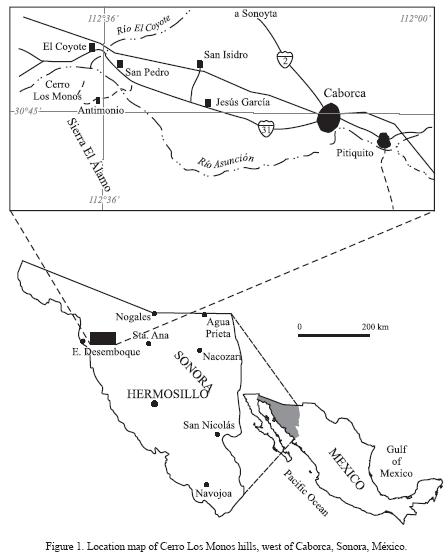
<body><![CDATA[<p align="justify"><font face="verdana" size="2"><b>RESUMEN</b></font></p> 				    <p align="justify"><font face="verdana" size="2">Se identificaron placas columnares de crinoides de las especies <i>Pentaridica</i> (col.) <i>rothi</i> Moore y Jeffords, <i>Cyclocaudex</i> cf. <i>C.</i> (col.) <i>jucundus</i> Moore y Jeffords, <i>Cyclocaudex</i> cf. <i>C.</i> (col.) <i>costatus</i> Moore y Jeffords, <i>Preptopremnum</i> (col.) <i>rugosum</i> Moore y Jeffords y <i>Heterostelechus</i> (col.) <i>texanus</i> Moore y Jeffords; la presencia de Heterostelechus (col.) texanus se reporta por vez primera para M&eacute;xico y los f&oacute;siles proceden de la Formaci&oacute;n Monos que aflora a 50 km al poniente de la Ciudad de Caborca, Estado de Sonora, en el noroeste de M&eacute;xico. Algunas de las muestras de f&oacute;siles de crinoides han conservado, en la superficie articular, caracteres morfol&oacute;gicos que han permitido la identificaci&oacute;n de las especies. La previa determinaci&oacute;n de la edad de los estratos con crinoides fue posible gracias a la presencia de fusul&iacute;nidos de la especie Parafusulina antimonioensis Dunbar, de amonites (<i>Waagenoceras dieneri Boese</i>) y braqui&oacute;podos (<i>Waagenoconcha montpelierensis</i> (Girty)), todas especies &iacute;ndices del Wordiano, P&eacute;rmico Medio.</font></p> 				    <p align="justify"><font face="verdana" size="2"><b>Palabras clave:</b> crinoides, paleogeograf&iacute;a, Wordiano, Caborca, Sonora, M&eacute;xico.</font></p> 				    <p align="justify"><font face="verdana" size="2">&nbsp;</font></p> 				    <p align="justify"><font face="verdana" size="2"><b>INTRODUCTION</b></font></p> 				    <p align="justify"><font face="verdana" size="2">The Monos Formation is a Middle Permian sedimentary unit that was deposited in a shallow marine environment. It crops out at Los Monos Hills, located about 50 km west of the City of Caborca, in northwestern Sonora, at 30&deg;45' N and 112&deg;36' W (<a href="#f1">Figure 1</a>). The Monos Formation is a mostly carbonate fossiliferous sequence which includes algae, fusulinids and other foraminifers, sponges, corals, bryozoans, brachiopods, gastropods, ammonites, and crinoids. This contribution reports and illustrates several columnals and pluricolumnals. The species herein described belongs to <i>Pentaridica</i> (col.) rothi Moore and Jeffords, <i>Cyclocaudex</i> (col.) cf. <i>C. jucundus</i> Moore and Jeffords, <i>Cyclocaudex</i> (col.) cf. <i>C. costatus</i> Moore and Jeffords, <i>Preptopremnum</i> (col.) rugosum Moore and Jeffords, and Heterostelechus texanus Moore and Jeffords. These identifications, which were made following the methodology of Moore and Jeffords (1968), Jeffords and Miller (1968), Moore <i>et al.</i>, (1968) and Wright (1983), provide significant paleogeographic information relative to faunal affinity with the North American Craton Province (Ross and Ross, 1979).</font></p> 				    <p align="center"><font face="verdana" size="2"><a name="f1"></a></font></p> 				    <p align="center"><font face="verdana" size="2"><img src="/img/revistas/rmcg/v24n3/a5f1.jpg"></font></p> 				    <p align="justify"><font face="verdana" size="2">The Monos strata were first reported by Keller (1928) who described the rocks as Pennsylvanian in age. Later, Cooper and Arellano (1946) named this succession as Monos Formation. Subsequently, Cooper <i>et al.</i> (1953) reported that the stratigraphic section of the Monos Formation is more than 600 m thick and composed of reddish siltstone and sandstone alternating with fossiliferous limestone that contains a rich fauna of fusulinids, solitary corals, fenestellids&#150;bryozoans, terebratulids, rhynchonellids like <i>Wellerella</i> sp, spiriferids and productids (including <i>Dictyoclostus, Liosotella, Muirwoodia, Chonetes and Marginifera</i>), pleurotomarids (<i>Pleurotomaria, Euphemites, Straparollus</i>), ammonites (<i>Waagenoceras</i>) and echinoderms. The species of crinoids here reported were collected from the middle part of the Monos Formation and correspond to columnals first identified by Moore and Jeffords (1968) from Late Pennsylvanian and Permian strata of Texas. In association with the crinoids, the fusulinid Parafusulina antimonioensis Dumbar has been found and indicates a middle&#150;late Wordian, (Middle Permian) age (<a href="#f2">Figure 2</a>).</font></p> 				    <p align="center"><font face="verdana" size="2"><a name="f2"></a></font></p> 				    ]]></body>
<body><![CDATA[<p align="center"><font face="verdana" size="2"><img src="/img/revistas/rmcg/v24n3/a5f2.jpg"></font></p> 				    <p align="justify"><font face="verdana" size="2">The aim of this paper is to report the systematic study of crinoidal articular plates from the northwest region of Mexico. For this purpose, we adopt the convention suggested by Donovan (1995) that uses the suffix (col.) for crinoid genera identifications that are based on elements of the columnal. The relatively good preservation of the specimens allowed to recognize paleontological diagnostic features that identify them to the species level, on the basis of the works of Moore and Jeffords (1968); Jeffords and Miller (1968); Moore, Jeffords, and Miller (1968); and Wright (1983). </font></p> 				    <p align="justify"><font face="verdana" size="2">&nbsp;</font></p> 				    <p align="justify"><font face="verdana" size="2"><b>AGE OF THE FAUNA</b></font></p> 				    <p align="justify"><font face="verdana" size="2">The crinoid species from the middle part of the Monos Formation correspond to paleontological forms that were previously identified by Moore and Jeffords (1968) from Late Pennsylvanian and Permian strata of Texas. Particularly, <i>Pentaridica</i> (col.) rothi was cited from the Blach Ranch Limestone (Virgilian); <i>Preptopremnum</i> (col.) rugosum from the Thrifty and Graham Formations (Virgilian); <i>Heterostelechus</i> (col.) <i>texanus</i> from the Thrifty Formation of the Cisco Group (Virgilian) and from the Pueblo Formation of the Wichita Group (Wolfcampian). In the Monos Formation, these crinoids occur in association with fusulinids of the species <i>Parafusulina antimonioensis</i> index of a middle&#150;late Wordian age (Dunbar in Cooper <i>et al.</i>, 1965, p. 18; Wilde, 1990; Vachard <i>et al.</i>, 1997).</font></p> 				    <p align="justify"><font face="verdana" size="2">The age of the fossiliferous layers was also supported by the ammonites <i>Waagenoceras dieneri</i> Boese (see Miller in Cooper <i>et al.</i>, 1965, p. 89) and the brachiopod <i>Waagenoconcha montpelierensis</i> (Girty) (see Cooper <i>et al.</i>, 1965, p. 49), both index fossils of the late Wordian (Wilde, 1990).</font></p> 				    <p align="justify"><font face="verdana" size="2">&nbsp;</font></p> 				    <p align="justify"><font face="verdana" size="2"><b>SYSTEMATIC PALEONTOLOGY</b></font></p> 				    <p align="justify"><font face="verdana" size="2">The material herein reported is deposited in the National Paleontological Collection of the Instituto de Geolog&iacute;a, Universidad Nacional Aut&oacute;noma de M&eacute;xico, with the abbreviations IGM and catalogue numbers from IGM&#150;8829 to IGM&#150;8837.</font></p> 				    <p align="center"><font face="verdana" size="2">Phylum Echinodermata    ]]></body>
<body><![CDATA[<br> 			    Class Crinoidea Miller, 1821    <br> 			    Group Pentameri Moore and Jeffords, 1968    <br> 			    Family Pentacauliscidae Moore and Jeffords, 1968    <br> 			    Genus <i>Pentaridica</i> Moore and Jeffords, 1968    <br> 				</font></p> 	    <p align="center"><font face="verdana" size="2">		      <b><i>Pentaridica</i> (col.) <i>rothi</i> Moore and Jeffords, 1968</b>    <br>         <a href="/img/revistas/rmcg/v24n3/a5f3.jpg" target="_blank">Figures 3a, 3b</a></font></p> 				    <p align="center"><font face="verdana" size="2"><i>Pentaridica rothi</i> Moore and Jeffords, 1968, p. 55, pl. 9, figs. 12 and 13.    <br> 			      <i>Pentaridica rothi</i> Moore and Jeffords, 1968, Vachard, <i>et al.</i>, 1997, p. 361.</font></p> 				    <p align="justify"><font face="verdana" size="2"><b>Description</b>. Heteromorphic column with two preserved plates of slightly pentagonal sides, one of them corresponds to a large nodal plate with two cirrus scars, and the other one is an internodal plate smaller than the nodal. Articular facet has a pentagonal outline and is slightly angled. There is a thick culmina separated by thin crenellae. There is a pentagonal and smooth areola. Lumen and areola are half width of the plate. Lumen has a slightly pentagonal outline.</font></p> 				    ]]></body>
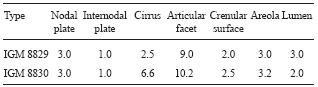
<body><![CDATA[<p align="justify"><font face="verdana" size="2"><b>Dimensions in mm.</b></font></p> 				    <p align="justify"><font face="verdana" size="2"><img src="/img/revistas/rmcg/v24n3/a5t.jpg"></font></p> 				    <p align="justify"><font face="verdana" size="2"><b>Observations</b>. Wright (1983, p. 595) proposed that the Pentameri Group is characterized by the presence of pentagonal to quinquelobate columns, and the <i>Pentagonopentagonopa morphogenus</i> with a pentagonal lumen belongs to this group.</font></p> 				    <p align="justify"><font face="verdana" size="2">Pentaridica rothi Moore and Jeffords (1968) was described for the first time from the Virgilian Blach Ranch Limestone and Cisco Group of Texas, USA. The Mexican specimens have slightly more sunken areola than specimens from Texas, and are more closely related to <i>Pentaridica simplicis</i> Moore and Jeffords (1968, p. 55, pl. 9, figs. 11a, b), but differ from this last one by the subpentagonal shape of the plates and because the crenularium presents a more conspicuous culmina.</font></p> 				    <p align="justify"><font face="verdana" size="2">Specimens of <i>Pentaridica rothi</i> associated with <i>Cyclocaudex typicus</i>, C. lineolata, and <i>Pentagonopterix insculptus</i> were found associated with the middle&#150;late Wordian fusulinids <i>Parafusulina deliciasensis</i> and <i>P. maleyi</i> in the La Cruz formation, Ihualtepec, Oaxaca (Vachard <i>et al.</i>, 1997).</font></p> 				    <p align="center"><font face="verdana" size="2">Group Cyclici Moore and Jeffords, 1968    <br> 			    Family Cyclomischidae Moore and Jeffords, 1968    <br> 			    Genus <i>Cyclocaudex</i> Moore and Jeffords, 1968</font></p> 				    <p align="center"><font face="verdana" size="2"><b><i>Cyclocaudex</i> cf. C. (col.) <i>jucundus</i> Moore and Jeffords, 1968</b>    <br> 			        <a href="/img/revistas/rmcg/v24n3/a5f3.jpg" target="_blank">Figures 3c, 3d</a></font></p> 				    ]]></body>
<body><![CDATA[<p align="justify"><font face="verdana" size="2"><b>Description</b>. Heteromorphic column with five plates of right side, the middle is an internodal plate, slightly thicker than the nodal plate, also with a cirrus scar. The articulation is a symplexy. The articular facet of the plate has a circular outline with a wide crenularium, and the culmina is separated by crenulae narrower than the culmina. The wide and depressed areola and the lumen cannot be observed and occupy a third of the surface of the articular facet.</font></p> 				    <p align="justify"><font face="verdana" size="2"><b>Dimensions in mm.</b></font></p> 				    <p align="justify"><font face="verdana" size="2"><img src="/img/revistas/rmcg/v24n3/a5ta.jpg"></font></p> 				    <p align="justify"><font face="verdana" size="2"><b>Observations</b>. Wright (1983, p. 595) proposed that the Cyclici Group has circular columns, lumen of a circular outlines and that the <i>Cyclocycopa morphogenus</i> belongs to this group.</font></p> 				    <p align="justify"><font face="verdana" size="2">Moore and Jeffords (1968, p. 66, pl. 17, figs. 6, 7) described <i>Cyclocaudex jucundus</i> from the Chaffin and Belknap Limestone members of the Thrifty Formation, and from the Virgilian Cisco Group of Texas, USA. Buitr&oacute;n <i>et al.</i> (1987, p. 132, fig. 5) recorded <i>Cyclocaudex jucundus</i> in the Del Monte Formation of Late Pennsylvanian (Virgilian) at Calnali, Hidalgo State, Mexico, and Velasco&#150;de Le&oacute;n and Buitr&oacute;n (1992, p. 75, pl. 2, figs. 1&#150;4) reported the same species from the Late Pennsylvanian (Virgilian) rocks of the Patlanoaya Formation from Patlanoaya, Puebla, Mexico. Arellano&#150;Gil <i>et al.</i> (1998) also reported this species along with the fusulinid Skinnerella from the Early Permian of the Guacamaya Formation in Pemuxco, Hidalgo.</font></p> 				    <p align="justify"><font face="verdana" size="2">The crinoid plates are abundant and poorly preserved in the rocks of the Monos Formation that are exposed in the Caborca region; this is insufficient for make a positive identification to species level.</font></p> 	    <p align="center"><font face="verdana" size="2"><b><i>Cyclocaudex</i> cf. C. (col.) <i>costatus</i> Moore and Jeffords, 1968</b>    <br>         <a href="/img/revistas/rmcg/v24n3/a5f3.jpg" target="_blank">Figure 3e</a></font></p> 				    <p align="justify"><font face="verdana" size="2"><b>Description</b>. Straigth&#150;sided heteromorphic column with three plate. The middle is a nodal with the scar of the cirrus and its width is double of internodal plate. The articular facet of the plate has a circular outline with a wide crenularium which covers one fifth of the columnal width. It also has a wide culminae, separated by crenellae narrower than the culminae. There are no details of the areola and lumen, but their dimensions have been measured.</font></p> 				    <p align="justify"><font face="verdana" size="2"><b>Dimensions in mm.</b></font></p> 				    ]]></body>
<body><![CDATA[<p align="justify"><font face="verdana" size="2"><img src="/img/revistas/rmcg/v24n3/a5tb.jpg"></font></p> 				    <p align="justify"><font face="verdana" size="2"><b>Observations</b>. <i>Cyclocaudex costatus</i> (Moore and Jeffords, 1968, p. 66, pl. 17, figs. 8a and 8b) was described from the South Bed Shale Member of the Graham Formation in the Virgilian Cisco Group of Texas, USA. Buitr&oacute;n <i>et al.</i> (1987) published about the Late Pennsylvanian (Virgilian) species <i>Cyclocaudex</i> cf. <i>C. costatus</i>, <i>C. insaturatus</i>, <i>C. jucundus</i>, and <i>Heterostelechus keithi</i> from the Vicente Guerrero Formation in Calnali region, Hidalgo State in central Mexico; the species has been reported from the Upper Pennsylvanian of Olinal&aacute; (Olinal&aacute; Formation), Guerrero State (Flores de Dios and Buitr&oacute;n, 1982). The difference between C. jucundus and C. costatus is that the first one has a wide areola and a crenularium formed by narrower culmina and crenellate. </font></p> 				    <p align="center"><font face="verdana" size="2">Family Leptocarphiidae Moore and Jeffords, 1968    <br> 			    Genus <i>Preptopremnum</i> Moore and Jeffords, 1968    <br> 			    </font></p> 	    <p align="center"><font face="verdana" size="2"><b><i>Preptopremnum</i> (col.) <i>rugosum</i> Moore and Jeffords, 1968</b>    <br>         <a href="/img/revistas/rmcg/v24n3/a5f3.jpg" target="_blank">Figure 3f, 3g</a></font></p> 				    <p align="center"><font face="verdana" size="2"><i>Preptopremnum rugosum</i> Moore and Jeffords, 1968, p. 81, pl. 27, figs.1&#150;9; pl. 28, fig. 1.    <br> 			      <i>Preptopremnum rugosum</i> Moore and Jeffords, 1968; Arellano&#150;Gil <i>et al.</i>, 1998, p. 11.    <br> 			      <i>Preptopremnum rugosum</i> Moore and Jeffords, 1968; Esquivel&#150;Mac&iacute;as <i>et al.</i>, 2000, p. 1188.</font></p> 				    ]]></body>
<body><![CDATA[<p align="justify"><font face="verdana" size="2"><b>Description</b>. Heteromorphic column with sides finely granulose, with ten well rounded plates. The nodal plate is slightly wider than the internodal; with crenellate and indented suture. The articular facet, with short and wide culmina, in a series of two bifurcated between two simple culmina, in the contact with the areola; crenellae narrower than the culmen, which covers one third of the width of the articular facet. Areola has a circular outline and many small granulations, and the lumen is large and bordered by narrow perilumen, less wide than the articular facet.</font></p> 				    <p align="justify"><font face="verdana" size="2"><b>Dimensions in mm.</b></font></p> 				    <p align="justify"><font face="verdana" size="2"><img src="/img/revistas/rmcg/v24n3/a5tc.jpg"></font></p> 				    <p align="justify"><font face="verdana" size="2"><b>Observations</b>. <i>Preptopremnum rugosum</i> was assigned to the Cyclici Group by Moore and Jeffords (1968) and Wright (1983). Wright (op. cit.) proposed the morphogenus <i>Cyclocyclopa</i> characterized by plates with granular sides, wide and short areola, with single and slender culmina. Nevertheless, this last author did not report specimens with bifurcated culmina. The authors of the present work consider the bifurcated culmina to be an evolutionarily derived feature in these Middle Permian crinoids from the Monos Formation.</font></p> 				    <p align="justify"><font face="verdana" size="2">Preptopremnum rugosum Moore and Jeffords (1968) was described for the first time in the Chaffin Limestone Member of the Thrifty Formation and the Gunsight Limestone and Wayland Shale Members of the Graham Formation, Cisco Group (Virgilian) of Texas, USA. There is a little variation in the morphology of this species, with mainly only the shape and size of the crenularium according to the conclusions of Jeffords and Miller (1968), who studied the ontogenic development of this species and confirmed the variability of these structures.</font></p> 				    <p align="justify"><font face="verdana" size="2">In Mexico, the species was studied by Buitr&oacute;n (in Arellano&#150;Gil <i>et al.</i>, 1998, p. 12) from Early Permian outcrops in the Guacamaya Formation of Pemuxco, Hidalgo. In this locality the species was associated with <i>Cyclocrista cheneyi</i>, <i>Cyclocaudex plenus</i>, <i>C. jucundus</i>, and <i>Mooreanteris perforatus</i> and associated also with a primitive species of fusulinids of the genus Skinnerella.</font></p> 				    <p align="center"><font face="verdana" size="2">Genus <i>Heterostelechus</i> Moore and Jeffords, 1968    <br> 			    </font></p> 	    <p align="center"><font face="verdana" size="2"><b><i>Heterostelechus</i> (col.) <i>texanus</i> Moore and Jeffords, 1968</b>    <br>         <a href="/img/revistas/rmcg/v24n3/a5f3.jpg" target="_blank">Figures 3h, 3i</a></font></p> 				    ]]></body>
<body><![CDATA[<p align="center"><font face="verdana" size="2"><i>Heterostelechus texanus</i> Moore and Jeffords, 1968, p 81, pl. 28, fig. 7a, 7b.    <br> 			      <i>Heterostelechus texanus</i> Moore and Jeffords, 1968; Esquivel&#150;Mac&iacute;as <i>et al.</i>, 2000, p. 1188.</font></p> 				    <p align="justify"><font face="verdana" size="2"><b>Description</b>. The plates have an articular facet of circular outline, and the crenularium covers one quarter of the column diameter. Short and wide culmina are separated by coarse and straight crenellae, narrower than the culminae. The areola is circular in outline with a smooth sunken and a small perilumen. The lumen is small and circular.</font></p> 				    <p align="justify"><font face="verdana" size="2"><b>Dimensions in mm.</b></font></p> 				    <p align="justify"><font face="verdana" size="2"><img src="/img/revistas/rmcg/v24n3/a5td.jpg"></font></p> 				    <p align="justify"><font face="verdana" size="2"><b>Observations</b>. Moore and Jeffords (1968) described <i>Heterostelechus</i> (col.) texanus from the Belknap Limestone of the Thrifty Formation of the Virgilian Cisco Group and also from the Waldrip Shale Member of the Pueblo Formation of the Wichita Group of Wolfcampian (Early Permian) age.</font></p> 				    <p align="justify"><font face="verdana" size="2">At Cerro Los Monos, Sonora, only two specimens of the species had been found and are associated with <i>Parafusulina antimonioensis</i> Dunbar (Cooper <i>et al.</i>, 1965; Wilde, 1990; Vachard <i>et al.</i>, 1997), consequently it is of late Wordian age. <i>Heterostelechus</i> (col.) <i>texanus</i> is reported for the first time for Mexico.</font></p> 				    <p align="justify"><font face="verdana" size="2">&nbsp;</font></p> 				    <p align="justify"><font face="verdana" size="2"><b>PALEOGEOGRAPHIC CONSIDERATIONS</b></font></p> 				    <p align="justify"><font face="verdana" size="2">Characteristic Permian benthic invertebrate faunas of warm marine environments are present in several formations in Sonora; among them is the Monos Formation that crops out in the Monos hills of the Caborca region. The main fossil groups in this unit are foraminifera (<a href="/img/revistas/rmcg/v24n3/a5f4.jpg" target="_blank">Figure 4 a&#150;d, h&#150;l</a>), corals, bryozoans (<a href="/img/revistas/rmcg/v24n3/a5f4.jpg" target="_blank">Figure 4g, m</a>), brachiopods (<a href="/img/revistas/rmcg/v24n3/a5f4.jpg" target="_blank">Figure 4m, p</a>), conodonts, and crinoids <a href="/img/revistas/rmcg/v24n3/a5f3.jpg" target="_blank">(Figure 3</a>, <a href="/img/revistas/rmcg/v24n3/a5f4.jpg" target="_blank">Figure 4f</a>). The Permian brachiopods include Productacea (<i>Avonia, Diaphragmus, Echinoconchus</i>, and <i>Dictyoclostus</i>), Rhynchonellacea (<i>Wellerella</i>), Spiriferacea (<i>Cyrtospirifer, Eumetria, Spirifer, Hustedia</i>, and <i>Crurithyris</i>) and Terebratulacea (<i>Dielasma</i>). Although these genus have a wide distribution around the world, the biota is stratigraphically and paleogeographically significative due to its relationship with the North American Craton and other global provinces (Ross and Ross, 1979; Buitr&oacute;n <i>et al.</i>, 2004; Molina&#150;Garza and Iriondo, 2005).</font></p> 				    ]]></body>
<body><![CDATA[<p align="justify"><font face="verdana" size="2">Disarticulated skeletal elements of crinoids are abundant in Palozoic rocks (Moore and Jeffords, 1968; Gluchowski, 2002; Itano <i>et al.</i>, 2003), but commonly the rocks are formed primarily only by fragmented columnal and columnal plates to form encrinites.</font></p> 				    <p align="justify"><font face="verdana" size="2">The Middle Permian fauna of the Monos Formation has a great affinity with faunas from other localities of Mexico. Specially the crinoid species here reported have a strong relationship with Olinal&aacute;, Guerrero (Olinala Formation); Ihualtepec, Oaxaca (La Cruz formation); Calnali (Del Monte Formation) and Pemuxco (Guacamaya Formation), Hidalgo; and Patlanoaya, Puebla (Patlanoaya Formation).</font></p> 				    <p align="justify"><font face="verdana" size="2">From the Pennsylvanian of Olinal&aacute; (Olinal&aacute; Formation), Guerrero, has been cited <i>Heterostelechus jeffordsi</i>, and <i>Pentaridica pentagonalis</i> (Flores de Dios and Buitr&oacute;n, 1982; Esquivel&#150;Mac&iacute;as, <i>et al.</i> 2004). Buitr&oacute;n <i>et al.</i> (1987) had mentioned <i>Cyclocaudex</i> cf. C. <i>costatus</i>, <i>C. jucundus</i>, and <i>Heterosteleschus keithi</i> from the Pennsylvanian of Calnali, Hidalgo. V&aacute;zquez&#150;Echeverr&iacute;a (1986) and Villase&ntilde;or <i>et al.</i> (1987) in their biostratigraphycal studies from Patlanoaya, Puebla southern Mexico, had mentioned <i>Cyclocaudex</i> sp. and <i>Cyclocaudex typicus</i>. Velasco de Le&oacute;n and Buitr&oacute;n (1992) had described also another species of crinoids common with Sonora, closed to <i>Cyclocaudex jucundus</i> of Virgilian age (Late Pennsylvanian) from Patlanoaya. Buitr&oacute;n and Sol&iacute;s&#150;Mar&iacute;n (1993) made a catalogue of echinoderm species of Mexico and cited <i>Cyclocaudex</i> sp., <i>C. typicus</i>, <i>C. insaturatus</i>, and <i>C. jucundus</i>.</font></p> 				    <p align="justify"><font face="verdana" size="2">Vachard <i>et al.</i> (1997) conducted geologic and paleontologic studies in Ihualtepec (La Cruz formation) Oaxaca, southeastern Mexico, and mentioned the presence of fusulinids (<i>Parafusulina deliciasensis</i> = <i>P. maleyi</i>) and crinoids (<i>Cyclocaudex typicus</i> and <i>Pentaridica rothi</i>) both attributed to the early&#150;middle Wordian. </font></p> 				    <p align="justify"><font face="verdana" size="2">Buitr&oacute;n in Arellano <i>et al.</i> (1998) cited the species <i>Cyclocaudex plenus</i>, <i>C. jucundus</i>, and <i>Preptopremnum rugosum</i> associated to fusulinids Skinerella (Vachard in Arellano, <i>et al.</i>, 1998) from Lower Permian rocks of Pemuxco, Hidalgo State. Esquivel&#150;Mac&iacute;as <i>et al.</i> (2000) had published crinoids with a tetralobulate lumen from Patlanoaya region, Puebla State of Missourian&#150;Virgilian age, and also their cited the species <i>Cyclocaudex jucundus</i>, <i>C. costatus</i>, <i>Heterosteleschus texanus</i>, <i>Pentaridica rothi</i>, and <i>Preptopremnun rugosum</i> also present in Cerro Los Monos, Sonora.</font></p> 				    <p align="justify"><font face="verdana" size="2">The Pennsylvanian&#150;Permian crinoids <i>Pentaridica</i>, <i>Cyclocaudex</i>, <i>Preptopremnum</i>, and <i>Heterostelechus</i> indicate similarities between Texas and Sonora. Some Permian fusulinids from Sonora are characteristic of the North American Craton (Midcontinent, Glass Mountains), specifically with exotic terranes of the North American Cordillera faunal region and also related with faunas of Eurasiatic&#150;Arctic provinces. This fauna includes fusulinids of the genera <i>Pseudofusulina</i>, <i>Parafusulina</i>, <i>Triticites</i>, <i>Schwagerina</i>, and <i>Boultonia</i>. </font></p> 				    <p align="justify"><font face="verdana" size="2">During the Permian, the Sonora territories were also characterized by a diverse faunal association typical of the North American region that include brachiopods such as <i>Composita</i>, <i>Martinia</i>, <i>Wellerella</i>, <i>Liosotella</i>, <i>Hustedia</i>, <i>Rhynchopora</i>, <i>Spiriferellina</i> and <i>Dictyoclostus</i>, the tetracoral <i>Lophophyllidium</i>, the bryozoan <i>Fenestella</i>, ammonites (<i>Waagenoceras</i>) and the algae <i>Paraepimastopora</i> (Ross and Ross, 1979; Buitr&oacute;n <i>et al.</i>, 2004). Among the fusulinids of Sonora, <i>Parafusulina antimonioensis</i> Dunbar (<a href="/img/revistas/rmcg/v24n3/a5f4.jpg" target="_blank">Figure 4 a&#150;e, i&#150;j, l, n&#150;o, q&#150;t</a>) is very close to <i>Parafusulina californica</i> (von Staff), and is a characteristic index fossil of late Wordian (Wilde, 1990) because it is transitional between the typical <i>Parafusulina</i> of the middle Wordian with a large central tunnel (<a href="/img/revistas/rmcg/v24n3/a5f4.jpg" target="_blank">Figure 4 A</a>) and relatively irregular polar septal arches (<a href="/img/revistas/rmcg/v24n3/a5f4.jpg" target="_blank">Figure 4. L, T</a>), and the typical <i>Polydiexodina</i> of early&#150;middle Capitanian with relative gigantism and the developed cuniculi (<a href="/img/revistas/rmcg/v24n3/a5f4.jpg" target="_blank">Figure 4o</a>). <i>P. antimonioensis</i> appears at diverse localities and has a strong relationship with Sonora, California, New Mexico, Texas, and Canada paleoprovinces, whilst <i>Pseudoschwagerina</i> appears in Sonora, North America, and some Russian localities.</font></p> 				    <p align="justify"><font face="verdana" size="2">The Cerro Los Monos area could constitute a separate terrain due to the presence of the giant <i>Parafusulina antimonioensis</i> Dunbar, which is considered a guide fossil of North American Exotic Terrains (Ross and Ross, 1983; Gonz&aacute;lez&#150;Le&oacute;n and Stanley, 1993; Calmus <i>et al.</i>, 1997; Stewart et al, 1990; Vachard <i>et al.</i>, 2000) because it is found from the Klamath Mountains (North California) to the northeastern to the State of Washington. Nevertheless, this argument is not completely convincing because this taxon has also been reported in the Glass Mountains, Texas on the American craton (Ross, 1963; Kobayashi, 1957). Consequently, the so&#150;called El Antimonio Terrain, where the Monos Formation is included, is considered here as a different terrain from that named Caborca or Seri Terrain and a piece of the North American Craton (<a href="/img/revistas/rmcg/v24n3/a5f5.jpg" target="_blank">Figure 5</a>).</font></p> 				    <p align="justify"><font face="verdana" size="2">After this analysis of the Permian biota is concluded that the cosmopolitan distribution of the fauna studied is due to the connections between the seas of West North America and Eastern Asia. The benthic Late Permian Sonora fauna was widely dispersed in the Tethyan realm, which was extended from Western North America to Northern Africa and Asia.</font></p> 				    <p align="justify"><font face="verdana" size="2">&nbsp;</font></p> 				    ]]></body>
<body><![CDATA[<p align="justify"><font face="verdana" size="2"><b>ACKNOWLEDGMENTS</b></font></p> 				    <p align="justify"><font face="verdana" size="2">The authors wish to thank to the Departamento de Geolog&iacute;a of the Universidad de Sonora and the Instituto de Geolog&iacute;a of the Universidad Nacional Aut&oacute;noma de M&eacute;xico for the financial support for the field work. This research is part of the following projects: ECOS (France), ANUIES, UNAM, and CONACYT (M&eacute;xico) No. M00&#150;U01 "Un estudio sedimentol&oacute;gico, micropaleontol&oacute;gico y geoqu&iacute;mico del Paleozoico de M&eacute;xico"; UNAM, DGAPA, PAPIIT No. 104103 titled "Bioestratigraf&iacute;a de rocas de plataforma del Pensilv&aacute;nico y P&eacute;rmico de Sonora, M&eacute;xico"; and CONACYT, M&eacute;xico No. 49088&#150;F "Sonora y las facies carbonatadas de la margen austral del Crat&oacute;n Norteamericano". We thank the reviewers Dr. Carlos Gonz&aacute;lez&#150;Le&oacute;n and Dr. William I. Ausich, for their constructive remarks and corrections. We also appreciated the help of Jeremie Gaillot from University of Lille and Total Company.</font></p> 				    <p align="justify"><font face="verdana" size="2">&nbsp;</font></p> 				    <p align="justify"><font face="verdana" size="2"><b>REFERENCES</b></font></p> 				    <!-- ref --><p align="justify"><font face="verdana" size="2">Arellano&#150;Gil, J., Vachard, D., Yussim, S., Flores de Dios&#150;Gonz&aacute;lez, A., 1998, Aspectos estratigr&aacute;ficos, estructurales y paleogeogr&aacute;ficos del P&eacute;rmico Inferior al Jur&aacute;sico Inferior en Pemuxco, Estado de Hidalgo, M&eacute;xico: Revista Mexicana de Ciencias Geol&oacute;gicas, 15(1), 9&#150;13.</font>&nbsp;&nbsp;&nbsp;&nbsp;&nbsp;&nbsp;&nbsp;&nbsp;[&#160;<a href="javascript:void(0);" onclick="javascript: window.open('/scielo.php?script=sci_nlinks&ref=8035038&pid=S1026-8774200700030000500001&lng=','','width=640,height=500,resizable=yes,scrollbars=1,menubar=yes,');">Links</a>&#160;]<!-- end-ref --> 				    <!-- ref --><p align="justify"><font face="verdana" size="2">Buitr&oacute;n, B.E., Sol&iacute;s&#150;Mar&iacute;n, F., 1993, La biodiversidad en los equinodermos f&oacute;siles y recientes de M&eacute;xico: Revista de la Sociedad Mexicana de Historia Natural, 44, 209&#150;231. </font>&nbsp;&nbsp;&nbsp;&nbsp;&nbsp;&nbsp;&nbsp;&nbsp;[&#160;<a href="javascript:void(0);" onclick="javascript: window.open('/scielo.php?script=sci_nlinks&ref=8035040&pid=S1026-8774200700030000500002&lng=','','width=640,height=500,resizable=yes,scrollbars=1,menubar=yes,');">Links</a>&#160;]<!-- end-ref --> 				    <!-- ref --><p align="justify"><font face="verdana" size="2">Buitr&oacute;n, B.E., Pati&ntilde;o, J., Moreno, A., 1987, Crinoides del Paleozoico Tard&iacute;o (Pensilv&aacute;nico) de Calnali, Hidalgo: Revista de la Sociedad Mexicana de Paleontolog&iacute;a, 1, 125&#150;136.</font>&nbsp;&nbsp;&nbsp;&nbsp;&nbsp;&nbsp;&nbsp;&nbsp;[&#160;<a href="javascript:void(0);" onclick="javascript: window.open('/scielo.php?script=sci_nlinks&ref=8035042&pid=S1026-8774200700030000500003&lng=','','width=640,height=500,resizable=yes,scrollbars=1,menubar=yes,');">Links</a>&#160;]<!-- end-ref --> 				    ]]></body>
<body><![CDATA[<!-- ref --><p align="justify"><font face="verdana" size="2">Buitr&oacute;n, B.E., Almaz&aacute;n&#150;V&aacute;zquez, E., Vachard, D., 2004, Benthic invertebrates, of Carboniferous&#150;Permian age, from Sonora: Their paleogeographic implications (resumen), in 32nd Internacional Geological Congress, Florencia, Italia, p. 202.</font>&nbsp;&nbsp;&nbsp;&nbsp;&nbsp;&nbsp;&nbsp;&nbsp;[&#160;<a href="javascript:void(0);" onclick="javascript: window.open('/scielo.php?script=sci_nlinks&ref=8035044&pid=S1026-8774200700030000500004&lng=','','width=640,height=500,resizable=yes,scrollbars=1,menubar=yes,');">Links</a>&#160;]<!-- end-ref --> 				    <!-- ref --><p align="justify"><font face="verdana" size="2">Calmus, T., P&eacute;rez&#150;Segura, E., Stinnesbeck, W., 1997, La structuration de la marge pacifique nord&#150;am&eacute;ricaine et du &lt;&lt;terrane Caborca&gt;&gt;&nbsp;: apports de la decouverte d'une faune du Jurassique inf&eacute;rieur et moyen dans la s&eacute;rie de Pozos de Serna (Sonora, Mexique): Comptes Rendus de l'Academie des Sciences, 323, s&eacute;rie IIa, 795&#150;800.</font>&nbsp;&nbsp;&nbsp;&nbsp;&nbsp;&nbsp;&nbsp;&nbsp;[&#160;<a href="javascript:void(0);" onclick="javascript: window.open('/scielo.php?script=sci_nlinks&ref=8035046&pid=S1026-8774200700030000500005&lng=','','width=640,height=500,resizable=yes,scrollbars=1,menubar=yes,');">Links</a>&#160;]<!-- end-ref --> 				    <!-- ref --><p align="justify"><font face="verdana" size="2">Cooper, G.A., Arellano, A.R.V., 1946, Stratigraphy near Caborca, northwest Sonora, Mexico: Bulletin of the American Association of Petroleum Geologists, 30(4), 606&#150;611.</font>&nbsp;&nbsp;&nbsp;&nbsp;&nbsp;&nbsp;&nbsp;&nbsp;[&#160;<a href="javascript:void(0);" onclick="javascript: window.open('/scielo.php?script=sci_nlinks&ref=8035048&pid=S1026-8774200700030000500006&lng=','','width=640,height=500,resizable=yes,scrollbars=1,menubar=yes,');">Links</a>&#160;]<!-- end-ref --> 				    <!-- ref --><p align="justify"><font face="verdana" size="2">Cooper, G.A., Dunbar, C.O., Duncan, H., Miller, A.K., Knight, J.B., 1953, Permian fauna at El Antimonio, western Sonora, M&eacute;xico: Smithsonian Miscellaneous Collections, 119 (2), 1&#150;111.</font>&nbsp;&nbsp;&nbsp;&nbsp;&nbsp;&nbsp;&nbsp;&nbsp;[&#160;<a href="javascript:void(0);" onclick="javascript: window.open('/scielo.php?script=sci_nlinks&ref=8035050&pid=S1026-8774200700030000500007&lng=','','width=640,height=500,resizable=yes,scrollbars=1,menubar=yes,');">Links</a>&#160;]<!-- end-ref --> 				    <!-- ref --><p align="justify"><font face="verdana" size="2">Cooper, G.A., Dunbar, C.O., Duncan, H., Miller, A.K., Knight, J. B., 1965, Fauna p&eacute;rmica de El Antimonio del oeste de Sonora: Universidad Nacional Aut&oacute;noma de M&eacute;xico, Instituto de Geolog&iacute;a, Bolet&iacute;n, 58(3), 122 p.</font>&nbsp;&nbsp;&nbsp;&nbsp;&nbsp;&nbsp;&nbsp;&nbsp;[&#160;<a href="javascript:void(0);" onclick="javascript: window.open('/scielo.php?script=sci_nlinks&ref=8035052&pid=S1026-8774200700030000500008&lng=','','width=640,height=500,resizable=yes,scrollbars=1,menubar=yes,');">Links</a>&#160;]<!-- end-ref --> 				    ]]></body>
<body><![CDATA[<!-- ref --><p align="justify"><font face="verdana" size="2">Donovan, S.K., 1995, Pelmatozoan columnals from the Ordovician of the British Isles, Part 3: Palaeontographical Society Monograph, 149(3), 115&#150;193.</font>&nbsp;&nbsp;&nbsp;&nbsp;&nbsp;&nbsp;&nbsp;&nbsp;[&#160;<a href="javascript:void(0);" onclick="javascript: window.open('/scielo.php?script=sci_nlinks&ref=8035054&pid=S1026-8774200700030000500009&lng=','','width=640,height=500,resizable=yes,scrollbars=1,menubar=yes,');">Links</a>&#160;]<!-- end-ref --> 				    <!-- ref --><p align="justify"><font face="verdana" size="2">Esquivel&#150;Mac&iacute;as, C., Ausich, W., Buitr&oacute;n, B.E., Flores de Dios, A., 2000, Pennsylvanian and Mississippian pluricolumnal assemblages (Class Crinoidea) from Southern Mexico and new occurrence of column with a tetralobate lumen: Journal of Paleontology, 74(6), 1187&#150;1190.</font>&nbsp;&nbsp;&nbsp;&nbsp;&nbsp;&nbsp;&nbsp;&nbsp;[&#160;<a href="javascript:void(0);" onclick="javascript: window.open('/scielo.php?script=sci_nlinks&ref=8035056&pid=S1026-8774200700030000500010&lng=','','width=640,height=500,resizable=yes,scrollbars=1,menubar=yes,');">Links</a>&#160;]<!-- end-ref --> 				    <!-- ref --><p align="justify"><font face="verdana" size="2">Esquivel&#150;Mac&iacute;as, C., Sol&iacute;s&#150;Mar&iacute;n F., Buitr&oacute;n, B.E., A., 2004, Nuevos registros de placas columnares de crinoideos (Echinodermata Crinoidea) del Paleozoico Superior de M&eacute;xico, algunas implicaciones paleobiogeograficas y paleoambientales: Coloquios de Paleontolog&iacute;a, 54, 15&#150;23.</font>&nbsp;&nbsp;&nbsp;&nbsp;&nbsp;&nbsp;&nbsp;&nbsp;[&#160;<a href="javascript:void(0);" onclick="javascript: window.open('/scielo.php?script=sci_nlinks&ref=8035058&pid=S1026-8774200700030000500011&lng=','','width=640,height=500,resizable=yes,scrollbars=1,menubar=yes,');">Links</a>&#160;]<!-- end-ref --> 				    <!-- ref --><p align="justify"><font face="verdana" size="2">Flores de Dios, A., Buitr&oacute;n, B. E., 1982, Revisi&oacute;n y aportes a la estratigraf&iacute;a de la Monta&ntilde;a de Guerrero: Universidad de Guerrero, Serie T&eacute;cnico&#150;Cient&iacute;fica 12, 28 p.</font>&nbsp;&nbsp;&nbsp;&nbsp;&nbsp;&nbsp;&nbsp;&nbsp;[&#160;<a href="javascript:void(0);" onclick="javascript: window.open('/scielo.php?script=sci_nlinks&ref=8035060&pid=S1026-8774200700030000500012&lng=','','width=640,height=500,resizable=yes,scrollbars=1,menubar=yes,');">Links</a>&#160;]<!-- end-ref --> 				    <!-- ref --><p align="justify"><font face="verdana" size="2">Gluchowski, E., 2002, Crinoids from the Famennian of the Holy Cross Mountains, Poland: Acta Paleontol&oacute;gica Polonica, 47 (2), 319&#150;328.</font>&nbsp;&nbsp;&nbsp;&nbsp;&nbsp;&nbsp;&nbsp;&nbsp;[&#160;<a href="javascript:void(0);" onclick="javascript: window.open('/scielo.php?script=sci_nlinks&ref=8035062&pid=S1026-8774200700030000500013&lng=','','width=640,height=500,resizable=yes,scrollbars=1,menubar=yes,');">Links</a>&#160;]<!-- end-ref --> 				    ]]></body>
<body><![CDATA[<!-- ref --><p align="justify"><font face="verdana" size="2">Gonz&aacute;lez&#150;Le&oacute;n, C., Stanley, G.D., Jr., 1993, The Antimonio Terrane of Western Sonora and its paleogeographic significance, in Gonz&aacute;lez&#150;Le&oacute;n C., Vega&#150;Granillo, E. L. (eds.), III Simposio de la Geolog&iacute;a de Sonora y &aacute;reas adyacentes, Memorias: Hermosillo, Sonora, Instituto de Geolog&iacute;a, Universidad Nacional Aut&oacute;noma de M&eacute;xico, Universidad de Sonora, 3, p. 41&#150;43.</font>&nbsp;&nbsp;&nbsp;&nbsp;&nbsp;&nbsp;&nbsp;&nbsp;[&#160;<a href="javascript:void(0);" onclick="javascript: window.open('/scielo.php?script=sci_nlinks&ref=8035064&pid=S1026-8774200700030000500014&lng=','','width=640,height=500,resizable=yes,scrollbars=1,menubar=yes,');">Links</a>&#160;]<!-- end-ref --> 				    <!-- ref --><p align="justify"><font face="verdana" size="2">Itano, W.M., Webster, G.D., Houck, K.J., Bateman, W.D., 2003, The First Pennsylvanian Batocrinid and other New Echinoderms from the Minturn Formation of Central Colorado: The Mountain Geologist, 40(3), 83&#150;100.</font>&nbsp;&nbsp;&nbsp;&nbsp;&nbsp;&nbsp;&nbsp;&nbsp;[&#160;<a href="javascript:void(0);" onclick="javascript: window.open('/scielo.php?script=sci_nlinks&ref=8035066&pid=S1026-8774200700030000500015&lng=','','width=640,height=500,resizable=yes,scrollbars=1,menubar=yes,');">Links</a>&#160;]<!-- end-ref --> 				    <!-- ref --><p align="justify"><font face="verdana" size="2">Jeffords, M., Miller, T.H., 1968, Ontogenetic development in Late Pennsylvanian crinoids columnals and pluricolumnals: University of Kansas, Paleontological Contributions, Echinodermata, Article 10 (47), 1&#150;14.</font>&nbsp;&nbsp;&nbsp;&nbsp;&nbsp;&nbsp;&nbsp;&nbsp;[&#160;<a href="javascript:void(0);" onclick="javascript: window.open('/scielo.php?script=sci_nlinks&ref=8035068&pid=S1026-8774200700030000500016&lng=','','width=640,height=500,resizable=yes,scrollbars=1,menubar=yes,');">Links</a>&#160;]<!-- end-ref --> 				    <p align="justify"><font face="verdana" size="2">Keller, W.T., 1928. Stratigraphische Beobachtungen in Sonora, N.W. M&eacute;xico: Eclogae Geologicae Helvetiae, 21, 237&#150;335.</font></p> 				    <!-- ref --><p align="justify"><font face="verdana" size="2">Kobayashi, M., 1957, Paleontological study of the Ibukiyama limestone, shiga Prefecture, Central Japan: Sciences Reports of Tokyo Kyoiku Daigaku, C. 5 (48), 247&#150;311.</font>&nbsp;&nbsp;&nbsp;&nbsp;&nbsp;&nbsp;&nbsp;&nbsp;[&#160;<a href="javascript:void(0);" onclick="javascript: window.open('/scielo.php?script=sci_nlinks&ref=8035071&pid=S1026-8774200700030000500017&lng=','','width=640,height=500,resizable=yes,scrollbars=1,menubar=yes,');">Links</a>&#160;]<!-- end-ref --> 				    <!-- ref --><p align="justify"><font face="verdana" size="2">Miller, J.S., 1821, A natural history of the crinoidea or lily&#150;shaped animals, with observation on the genera <i>Asteria, Euryale, Comatula</i> and <i>Marsupites</i>: Bristol England, Bryan and Company, 150 p.</font>&nbsp;&nbsp;&nbsp;&nbsp;&nbsp;&nbsp;&nbsp;&nbsp;[&#160;<a href="javascript:void(0);" onclick="javascript: window.open('/scielo.php?script=sci_nlinks&ref=8035073&pid=S1026-8774200700030000500018&lng=','','width=640,height=500,resizable=yes,scrollbars=1,menubar=yes,');">Links</a>&#160;]<!-- end-ref --> 				    <!-- ref --><p align="justify"><font face="verdana" size="2">Molina&#150;Garza, R.S., Iriondo, A., 2005, La Megacizalla Mojave&#150;Sonora: la hip&oacute;tesis, la controversia y el estado actual del conocimiento: Bolet&iacute;n de la Sociedad Geol&oacute;gica Mexicana, Volumen Conmemorativo del Centenario Grandes Fronteras Tect&oacute;nicas de M&eacute;xico, 57(1), 1&#150;26.</font>&nbsp;&nbsp;&nbsp;&nbsp;&nbsp;&nbsp;&nbsp;&nbsp;[&#160;<a href="javascript:void(0);" onclick="javascript: window.open('/scielo.php?script=sci_nlinks&ref=8035075&pid=S1026-8774200700030000500019&lng=','','width=640,height=500,resizable=yes,scrollbars=1,menubar=yes,');">Links</a>&#160;]<!-- end-ref --> 				    <!-- ref --><p align="justify"><font face="verdana" size="2">Moore, R.C., Jeffords, R.S., 1968, Classification and nomenclature of fossil crinoids based on studies of dissociated parts of their columns: University of Kansas, Paleontological Contributions, Echinodermata, Article 9 (46), 1&#150;86.</font>&nbsp;&nbsp;&nbsp;&nbsp;&nbsp;&nbsp;&nbsp;&nbsp;[&#160;<a href="javascript:void(0);" onclick="javascript: window.open('/scielo.php?script=sci_nlinks&ref=8035077&pid=S1026-8774200700030000500020&lng=','','width=640,height=500,resizable=yes,scrollbars=1,menubar=yes,');">Links</a>&#160;]<!-- end-ref --> 				    <!-- ref --><p align="justify"><font face="verdana" size="2">Moore, R.C, Jeffords, R.S., Miller, T.H., 1968, Morphological features of crinoid columns: University of Kansas, Paleontological Contributions, Echinodermata, Article 8 (45), 1&#150;30.</font>&nbsp;&nbsp;&nbsp;&nbsp;&nbsp;&nbsp;&nbsp;&nbsp;[&#160;<a href="javascript:void(0);" onclick="javascript: window.open('/scielo.php?script=sci_nlinks&ref=8035079&pid=S1026-8774200700030000500021&lng=','','width=640,height=500,resizable=yes,scrollbars=1,menubar=yes,');">Links</a>&#160;]<!-- end-ref --> 				    <!-- ref --><p align="justify"><font face="verdana" size="2">Ross, C.A., 1963, Standard Wolfcampian Series (Permian), Glass Mountains, Texas: Geological Society of America, Memoir 88, 205 p.</font>&nbsp;&nbsp;&nbsp;&nbsp;&nbsp;&nbsp;&nbsp;&nbsp;[&#160;<a href="javascript:void(0);" onclick="javascript: window.open('/scielo.php?script=sci_nlinks&ref=8035081&pid=S1026-8774200700030000500022&lng=','','width=640,height=500,resizable=yes,scrollbars=1,menubar=yes,');">Links</a>&#160;]<!-- end-ref --> 				    <!-- ref --><p align="justify"><font face="verdana" size="2">Ross, C.A., Ross, J.P. ,1979, Permian, in Robison, R.A., Teichert, C. (eds.), Treatise on Invertebrate Paleontology, Part A. Introduction: Lawrence, Kansas and Boulder Colorado, The University of Kansas and The Geological Society of America and A291&#150;A350. </font>&nbsp;&nbsp;&nbsp;&nbsp;&nbsp;&nbsp;&nbsp;&nbsp;[&#160;<a href="javascript:void(0);" onclick="javascript: window.open('/scielo.php?script=sci_nlinks&ref=8035083&pid=S1026-8774200700030000500023&lng=','','width=640,height=500,resizable=yes,scrollbars=1,menubar=yes,');">Links</a>&#160;]<!-- end-ref --> 				    <!-- ref --><p align="justify"><font face="verdana" size="2">Ross, C.A., Ross, J.R.P., 1983, Late Paleozoic accreted terrains of western North America, in Stevens, C.H. (ed.), Pre&#150;Jurassic rocks in western North America suspect terranes: The Society of Economic Paleontologists and Mineralogists, Pacific Section, 7&#150;22.</font>&nbsp;&nbsp;&nbsp;&nbsp;&nbsp;&nbsp;&nbsp;&nbsp;[&#160;<a href="javascript:void(0);" onclick="javascript: window.open('/scielo.php?script=sci_nlinks&ref=8035085&pid=S1026-8774200700030000500024&lng=','','width=640,height=500,resizable=yes,scrollbars=1,menubar=yes,');">Links</a>&#160;]<!-- end-ref --> 				    <!-- ref --><p align="justify"><font face="verdana" size="2">Stewart, J.H., Poole, F.G., Ketner, K.B., Madrid, R.J., Rold&aacute;n&#150;Quintana, J., Amaya&#150;Mart&iacute;nez, R., 1990, Tectonics and stratigraphy of the Paleozoic and Triassic southern margin of North America, Sonora, Mexico, in Gehrels, G.E., Spencer, J.E. (eds.), Geologic excursions through the Sonoran Desert region, Arizona and Sonora: Arizona Geological Survey Special Paper, 7, 183&#150;202.</font>&nbsp;&nbsp;&nbsp;&nbsp;&nbsp;&nbsp;&nbsp;&nbsp;[&#160;<a href="javascript:void(0);" onclick="javascript: window.open('/scielo.php?script=sci_nlinks&ref=8035087&pid=S1026-8774200700030000500025&lng=','','width=640,height=500,resizable=yes,scrollbars=1,menubar=yes,');">Links</a>&#160;]<!-- end-ref --> 				    <!-- ref --><p align="justify"><font face="verdana" size="2">Vachard, D., Flores de Dios, A., Buitr&oacute;n, B.E., 1997, Sur une nouvelle localit&eacute; a fusulinides du Wordien (Permien sup&eacute;rieur) du Mexique, cons&eacute;quences pal&eacute;og&eacute;ographiques: GEOBIOS, 30(3), 361&#150;370.</font>&nbsp;&nbsp;&nbsp;&nbsp;&nbsp;&nbsp;&nbsp;&nbsp;[&#160;<a href="javascript:void(0);" onclick="javascript: window.open('/scielo.php?script=sci_nlinks&ref=8035089&pid=S1026-8774200700030000500026&lng=','','width=640,height=500,resizable=yes,scrollbars=1,menubar=yes,');">Links</a>&#160;]<!-- end-ref --> 				    <!-- ref --><p align="justify"><font face="verdana" size="2">Vachard, D., Flores de Dios, A., Pantoja, J., Buitr&oacute;n, B., Grajales, M., 2000, Les fusulines du Mexique, une revue biostratigraphique et pal&eacute;og&eacute;ographique: GEOBIOS, 33(6), 655&#150;679.</font>&nbsp;&nbsp;&nbsp;&nbsp;&nbsp;&nbsp;&nbsp;&nbsp;[&#160;<a href="javascript:void(0);" onclick="javascript: window.open('/scielo.php?script=sci_nlinks&ref=8035091&pid=S1026-8774200700030000500027&lng=','','width=640,height=500,resizable=yes,scrollbars=1,menubar=yes,');">Links</a>&#160;]<!-- end-ref --> 				    <!-- ref --><p align="justify"><font face="verdana" size="2">V&aacute;zquez&#150;Echeverr&iacute;a, A., 1986, Descubrimiento de una nueva localidad de rocas marinas del Paleozoico al suroeste del Estado de Puebla, in 24 Congreso Nacional de la Asociaci&oacute;n de Ge&oacute;logos Petroleros Mexicanos, Petr&oacute;leos Mexicanos, Exploraci&oacute;n, Zona centro, 20 p.</font>&nbsp;&nbsp;&nbsp;&nbsp;&nbsp;&nbsp;&nbsp;&nbsp;[&#160;<a href="javascript:void(0);" onclick="javascript: window.open('/scielo.php?script=sci_nlinks&ref=8035093&pid=S1026-8774200700030000500028&lng=','','width=640,height=500,resizable=yes,scrollbars=1,menubar=yes,');">Links</a>&#160;]<!-- end-ref --> 				    <!-- ref --><p align="justify"><font face="verdana" size="2">Velasco&#150;de Le&oacute;n, M.P., Buitr&oacute;n, B.E., 1992, Algunos crinoides (Echinodermata&#150;Crinoidea) del Misis&iacute;pico&#150;Pensilv&aacute;nico de San Salvador Patlanoaya, Estado de Puebla: Revista de la Sociedad Mexicana de Paleontolog&iacute;a, 5, 71&#150;81.</font>&nbsp;&nbsp;&nbsp;&nbsp;&nbsp;&nbsp;&nbsp;&nbsp;[&#160;<a href="javascript:void(0);" onclick="javascript: window.open('/scielo.php?script=sci_nlinks&ref=8035095&pid=S1026-8774200700030000500029&lng=','','width=640,height=500,resizable=yes,scrollbars=1,menubar=yes,');">Links</a>&#160;]<!-- end-ref --> 				    <!-- ref --><p align="justify"><font face="verdana" size="2">Villase&ntilde;or, A.B., Mart&iacute;nez, A., Contreras, B., 1987, Bioestratigraf&iacute;a del Paleozoico Superior de San Salvador Patlanoaya, Puebla: Revista de la Sociedad Mexicana de Paleontolog&iacute;a, 1(1), 396&#150;413. </font>&nbsp;&nbsp;&nbsp;&nbsp;&nbsp;&nbsp;&nbsp;&nbsp;[&#160;<a href="javascript:void(0);" onclick="javascript: window.open('/scielo.php?script=sci_nlinks&ref=8035097&pid=S1026-8774200700030000500030&lng=','','width=640,height=500,resizable=yes,scrollbars=1,menubar=yes,');">Links</a>&#160;]<!-- end-ref --> 				    <!-- ref --><p align="justify"><font face="verdana" size="2">Wilde, G.L., 1990, Practical fusulinid zonation: The species concept; with Permian basin emphasis: West Texas Geological Society Bulletin, 29(7), 5&#150;34.</font>&nbsp;&nbsp;&nbsp;&nbsp;&nbsp;&nbsp;&nbsp;&nbsp;[&#160;<a href="javascript:void(0);" onclick="javascript: window.open('/scielo.php?script=sci_nlinks&ref=8035099&pid=S1026-8774200700030000500031&lng=','','width=640,height=500,resizable=yes,scrollbars=1,menubar=yes,');">Links</a>&#160;]<!-- end-ref --> 				    <!-- ref --><p align="justify"><font face="verdana" size="2">Wright, D.K., 1983, Crinoids ossicles in Upper Ordovician benthic marine assemblages from Snowdonia, North Wales: Paleontology, 16(3), 585&#150;603.</font>&nbsp;&nbsp;&nbsp;&nbsp;&nbsp;&nbsp;&nbsp;&nbsp;[&#160;<a href="javascript:void(0);" onclick="javascript: window.open('/scielo.php?script=sci_nlinks&ref=8035101&pid=S1026-8774200700030000500032&lng=','','width=640,height=500,resizable=yes,scrollbars=1,menubar=yes,');">Links</a>&#160;]<!-- end-ref --> 	     ]]></body><back>
<ref-list>
<ref id="B1">
<nlm-citation citation-type="journal">
<person-group person-group-type="author">
<name>
<surname><![CDATA[Arellano-Gil]]></surname>
<given-names><![CDATA[J]]></given-names>
</name>
<name>
<surname><![CDATA[Vachard]]></surname>
<given-names><![CDATA[D]]></given-names>
</name>
<name>
<surname><![CDATA[Yussim]]></surname>
<given-names><![CDATA[S]]></given-names>
</name>
<name>
<surname><![CDATA[Flores de Dios-González]]></surname>
<given-names><![CDATA[A]]></given-names>
</name>
</person-group>
<article-title xml:lang="es"><![CDATA[Aspectos estratigráficos, estructurales y paleogeográficos del Pérmico Inferior al Jurásico Inferior en Pemuxco, Estado de Hidalgo, México]]></article-title>
<source><![CDATA[Revista Mexicana de Ciencias Geológicas]]></source>
<year>1998</year>
<volume>15</volume>
<numero>1</numero>
<issue>1</issue>
<page-range>9-13</page-range></nlm-citation>
</ref>
<ref id="B2">
<nlm-citation citation-type="journal">
<person-group person-group-type="author">
<name>
<surname><![CDATA[Buitrón]]></surname>
<given-names><![CDATA[B.E]]></given-names>
</name>
<name>
<surname><![CDATA[Solís-Marín]]></surname>
<given-names><![CDATA[F]]></given-names>
</name>
</person-group>
<article-title xml:lang="es"><![CDATA[La biodiversidad en los equinodermos fósiles y recientes de México]]></article-title>
<source><![CDATA[Revista de la Sociedad Mexicana de Historia Natural]]></source>
<year>1993</year>
<volume>44</volume>
<page-range>209-231</page-range></nlm-citation>
</ref>
<ref id="B3">
<nlm-citation citation-type="journal">
<person-group person-group-type="author">
<name>
<surname><![CDATA[Buitrón]]></surname>
<given-names><![CDATA[B.E]]></given-names>
</name>
<name>
<surname><![CDATA[Patiño]]></surname>
<given-names><![CDATA[J]]></given-names>
</name>
<name>
<surname><![CDATA[Moreno]]></surname>
<given-names><![CDATA[A]]></given-names>
</name>
</person-group>
<article-title xml:lang="es"><![CDATA[Crinoides del Paleozoico Tardío (Pensilvánico) de Calnali, Hidalgo]]></article-title>
<source><![CDATA[Revista de la Sociedad Mexicana de Paleontología]]></source>
<year>1987</year>
<volume>1</volume>
<page-range>125-136</page-range></nlm-citation>
</ref>
<ref id="B4">
<nlm-citation citation-type="confpro">
<person-group person-group-type="author">
<name>
<surname><![CDATA[Buitrón]]></surname>
<given-names><![CDATA[B.E.]]></given-names>
</name>
<name>
<surname><![CDATA[Almazán-Vázquez]]></surname>
<given-names><![CDATA[E]]></given-names>
</name>
<name>
<surname><![CDATA[Vachard]]></surname>
<given-names><![CDATA[D]]></given-names>
</name>
</person-group>
<article-title xml:lang="en"><![CDATA[Benthic invertebrates, of Carboniferous-Permian age, from Sonora: Their paleogeographic implications (resumen)]]></article-title>
<source><![CDATA[]]></source>
<year>2004</year>
<conf-name><![CDATA[ 32nd Internacional Geological Congress]]></conf-name>
<conf-loc>Florencia Florencia</conf-loc>
<page-range>202</page-range></nlm-citation>
</ref>
<ref id="B5">
<nlm-citation citation-type="journal">
<person-group person-group-type="author">
<name>
<surname><![CDATA[Calmus]]></surname>
<given-names><![CDATA[T]]></given-names>
</name>
<name>
<surname><![CDATA[Pérez-Segura]]></surname>
<given-names><![CDATA[E]]></given-names>
</name>
<name>
<surname><![CDATA[Stinnesbeck]]></surname>
<given-names><![CDATA[W]]></given-names>
</name>
</person-group>
<article-title xml:lang="fr"><![CDATA[La structuration de la marge pacifique nord-américaine et du <<terrane Caborca>>: apports de la decouverte d'une faune du Jurassique inférieur et moyen dans la série de Pozos de Serna (Sonora, Mexique)]]></article-title>
<source><![CDATA[Comptes Rendus de l'Academie des Sciences]]></source>
<year>1997</year>
<volume>323</volume>
<page-range>795-800</page-range></nlm-citation>
</ref>
<ref id="B6">
<nlm-citation citation-type="journal">
<person-group person-group-type="author">
<name>
<surname><![CDATA[Cooper]]></surname>
<given-names><![CDATA[G.A]]></given-names>
</name>
<name>
<surname><![CDATA[Arellano]]></surname>
<given-names><![CDATA[A.R.V]]></given-names>
</name>
</person-group>
<article-title xml:lang="en"><![CDATA[Stratigraphy near Caborca, northwest Sonora, Mexico]]></article-title>
<source><![CDATA[Bulletin of the American Association of Petroleum Geologists]]></source>
<year>1946</year>
<volume>30</volume>
<numero>4</numero>
<issue>4</issue>
<page-range>606-611</page-range></nlm-citation>
</ref>
<ref id="B7">
<nlm-citation citation-type="journal">
<person-group person-group-type="author">
<name>
<surname><![CDATA[Cooper]]></surname>
<given-names><![CDATA[G.A]]></given-names>
</name>
<name>
<surname><![CDATA[Dunbar]]></surname>
<given-names><![CDATA[C.O]]></given-names>
</name>
<name>
<surname><![CDATA[Duncan]]></surname>
<given-names><![CDATA[H]]></given-names>
</name>
<name>
<surname><![CDATA[Miller]]></surname>
<given-names><![CDATA[A.K]]></given-names>
</name>
<name>
<surname><![CDATA[Knight]]></surname>
<given-names><![CDATA[J.B]]></given-names>
</name>
</person-group>
<article-title xml:lang="en"><![CDATA[Permian fauna at El Antimonio, western Sonora, México]]></article-title>
<source><![CDATA[Smithsonian Miscellaneous Collections]]></source>
<year>1953</year>
<volume>119</volume>
<numero>2</numero>
<issue>2</issue>
<page-range>1-111</page-range></nlm-citation>
</ref>
<ref id="B8">
<nlm-citation citation-type="journal">
<person-group person-group-type="author">
<name>
<surname><![CDATA[Cooper]]></surname>
<given-names><![CDATA[G.A.]]></given-names>
</name>
<name>
<surname><![CDATA[Dunbar]]></surname>
<given-names><![CDATA[C.O.]]></given-names>
</name>
<name>
<surname><![CDATA[Duncan]]></surname>
<given-names><![CDATA[H]]></given-names>
</name>
<name>
<surname><![CDATA[Miller]]></surname>
<given-names><![CDATA[A.K.]]></given-names>
</name>
<name>
<surname><![CDATA[Knight]]></surname>
<given-names><![CDATA[J. B.]]></given-names>
</name>
</person-group>
<article-title xml:lang="es"><![CDATA[Fauna pérmica de El Antimonio del oeste de Sonora]]></article-title>
<source><![CDATA[Instituto de Geología, Boletín]]></source>
<year>1965</year>
<volume>58</volume>
<numero>3</numero>
<issue>3</issue>
<page-range>122</page-range></nlm-citation>
</ref>
<ref id="B9">
<nlm-citation citation-type="journal">
<person-group person-group-type="author">
<name>
<surname><![CDATA[Donovan]]></surname>
<given-names><![CDATA[S.K]]></given-names>
</name>
</person-group>
<article-title xml:lang="en"><![CDATA[Pelmatozoan columnals from the Ordovician of the British Isles, Part 3]]></article-title>
<source><![CDATA[Palaeontographical Society Monograph]]></source>
<year>1995</year>
<volume>149</volume>
<numero>3</numero>
<issue>3</issue>
<page-range>115-193</page-range></nlm-citation>
</ref>
<ref id="B10">
<nlm-citation citation-type="journal">
<person-group person-group-type="author">
<name>
<surname><![CDATA[Esquivel-Macías]]></surname>
<given-names><![CDATA[C]]></given-names>
</name>
<name>
<surname><![CDATA[Ausich]]></surname>
<given-names><![CDATA[W]]></given-names>
</name>
<name>
<surname><![CDATA[Buitrón]]></surname>
<given-names><![CDATA[B.E]]></given-names>
</name>
<name>
<surname><![CDATA[Flores de Dios]]></surname>
<given-names><![CDATA[A]]></given-names>
</name>
</person-group>
<article-title xml:lang="en"><![CDATA[Pennsylvanian and Mississippian pluricolumnal assemblages (Class Crinoidea) from Southern Mexico and new occurrence of column with a tetralobate lumen]]></article-title>
<source><![CDATA[Journal of Paleontology]]></source>
<year>2000</year>
<volume>74</volume>
<numero>6</numero>
<issue>6</issue>
<page-range>1187-1190</page-range></nlm-citation>
</ref>
<ref id="B11">
<nlm-citation citation-type="journal">
<person-group person-group-type="author">
<name>
<surname><![CDATA[Esquivel-Macías]]></surname>
<given-names><![CDATA[C]]></given-names>
</name>
<name>
<surname><![CDATA[Solís-Marín]]></surname>
<given-names><![CDATA[F]]></given-names>
</name>
<name>
<surname><![CDATA[Buitrón, B.E.]]></surname>
<given-names><![CDATA[A]]></given-names>
</name>
</person-group>
<article-title xml:lang="es"><![CDATA[Nuevos registros de placas columnares de crinoideos (Echinodermata Crinoidea) del Paleozoico Superior de México, algunas implicaciones paleobiogeograficas y paleoambientales]]></article-title>
<source><![CDATA[Coloquios de Paleontología]]></source>
<year>2004</year>
<volume>54</volume>
<page-range>15-23</page-range></nlm-citation>
</ref>
<ref id="B12">
<nlm-citation citation-type="book">
<person-group person-group-type="author">
<name>
<surname><![CDATA[Flores de Dios]]></surname>
<given-names><![CDATA[A]]></given-names>
</name>
<name>
<surname><![CDATA[Buitrón]]></surname>
<given-names><![CDATA[B. E.]]></given-names>
</name>
</person-group>
<source><![CDATA[Revisión y aportes a la estratigrafía de la Montaña de Guerrero]]></source>
<year>1982</year>
<page-range>28</page-range><publisher-name><![CDATA[Universidad de Guerrero]]></publisher-name>
</nlm-citation>
</ref>
<ref id="B13">
<nlm-citation citation-type="journal">
<person-group person-group-type="author">
<name>
<surname><![CDATA[Gluchowski]]></surname>
<given-names><![CDATA[E]]></given-names>
</name>
</person-group>
<article-title xml:lang="en"><![CDATA[Crinoids from the Famennian of the Holy Cross Mountains, Poland]]></article-title>
<source><![CDATA[Acta Paleontológica Polonica]]></source>
<year>2002</year>
<volume>47</volume>
<numero>2</numero>
<issue>2</issue>
<page-range>319-328</page-range></nlm-citation>
</ref>
<ref id="B14">
<nlm-citation citation-type="confpro">
<person-group person-group-type="author">
<name>
<surname><![CDATA[González-León]]></surname>
<given-names><![CDATA[C]]></given-names>
</name>
<name>
<surname><![CDATA[Stanley]]></surname>
<given-names><![CDATA[G.D.]]></given-names>
</name>
</person-group>
<article-title xml:lang="en"><![CDATA[The Antimonio Terrane of Western Sonora and its paleogeographic significance]]></article-title>
<person-group person-group-type="editor">
<name>
<surname><![CDATA[González-León]]></surname>
<given-names><![CDATA[C]]></given-names>
</name>
<name>
<surname><![CDATA[Vega-Granillo]]></surname>
<given-names><![CDATA[E. L.]]></given-names>
</name>
</person-group>
<source><![CDATA[]]></source>
<year>1993</year>
<conf-name><![CDATA[3 III Simposio de la Geología de Sonora y áreas adyacentes, Memorias]]></conf-name>
<conf-loc>Hermosillo Sonora</conf-loc>
<page-range>41-43</page-range></nlm-citation>
</ref>
<ref id="B15">
<nlm-citation citation-type="journal">
<person-group person-group-type="author">
<name>
<surname><![CDATA[Itano]]></surname>
<given-names><![CDATA[W.M]]></given-names>
</name>
<name>
<surname><![CDATA[Webster]]></surname>
<given-names><![CDATA[G.D]]></given-names>
</name>
<name>
<surname><![CDATA[Houck]]></surname>
<given-names><![CDATA[K.J]]></given-names>
</name>
<name>
<surname><![CDATA[Bateman]]></surname>
<given-names><![CDATA[W.D]]></given-names>
</name>
</person-group>
<article-title xml:lang="en"><![CDATA[The First Pennsylvanian Batocrinid and other New Echinoderms from the Minturn Formation of Central Colorado]]></article-title>
<source><![CDATA[The Mountain Geologist]]></source>
<year>2003</year>
<volume>40</volume>
<numero>3</numero>
<issue>3</issue>
<page-range>83-100</page-range></nlm-citation>
</ref>
<ref id="B16">
<nlm-citation citation-type="journal">
<person-group person-group-type="author">
<name>
<surname><![CDATA[Jeffords]]></surname>
<given-names><![CDATA[M]]></given-names>
</name>
<name>
<surname><![CDATA[Miller]]></surname>
<given-names><![CDATA[T.H]]></given-names>
</name>
</person-group>
<article-title xml:lang="en"><![CDATA[Ontogenetic development in Late Pennsylvanian crinoids columnals and pluricolumnals]]></article-title>
<source><![CDATA[Paleontological Contributions, Echinodermata]]></source>
<year>1968</year>
<numero>47</numero>
<issue>47</issue>
<page-range>1-14</page-range></nlm-citation>
</ref>
<ref id="B17">
<nlm-citation citation-type="journal">
<person-group person-group-type="author">
<name>
<surname><![CDATA[Kobayashi]]></surname>
<given-names><![CDATA[M]]></given-names>
</name>
</person-group>
<article-title xml:lang="en"><![CDATA[Paleontological study of the Ibukiyama limestone, shiga Prefecture, Central Japan]]></article-title>
<source><![CDATA[Sciences Reports of Tokyo Kyoiku Daigaku]]></source>
<year>1957</year>
<volume>C. 5</volume>
<numero>48</numero>
<issue>48</issue>
<page-range>247-311</page-range></nlm-citation>
</ref>
<ref id="B18">
<nlm-citation citation-type="book">
<person-group person-group-type="author">
<name>
<surname><![CDATA[Miller]]></surname>
<given-names><![CDATA[J.S.]]></given-names>
</name>
</person-group>
<source><![CDATA[A natural history of the crinoidea or lily-shaped animals, with observation on the genera Asteria, Euryale, Comatula and Marsupites]]></source>
<year>1821</year>
<page-range>150</page-range><publisher-loc><![CDATA[^eBristol England Bristol England]]></publisher-loc>
<publisher-name><![CDATA[Bryan and Company]]></publisher-name>
</nlm-citation>
</ref>
<ref id="B19">
<nlm-citation citation-type="journal">
<person-group person-group-type="author">
<name>
<surname><![CDATA[Molina-Garza]]></surname>
<given-names><![CDATA[R.S]]></given-names>
</name>
<name>
<surname><![CDATA[Iriondo]]></surname>
<given-names><![CDATA[A]]></given-names>
</name>
</person-group>
<article-title xml:lang="es"><![CDATA[La Megacizalla Mojave-Sonora: la hipótesis, la controversia y el estado actual del conocimiento]]></article-title>
<source><![CDATA[Boletín de la Sociedad Geológica Mexicana]]></source>
<year>2005</year>
<volume>57</volume>
<numero>1</numero>
<issue>1</issue>
<page-range>1-26</page-range></nlm-citation>
</ref>
<ref id="B20">
<nlm-citation citation-type="journal">
<person-group person-group-type="author">
<name>
<surname><![CDATA[Moore]]></surname>
<given-names><![CDATA[R.C.]]></given-names>
</name>
<name>
<surname><![CDATA[Jeffords]]></surname>
<given-names><![CDATA[R.S.]]></given-names>
</name>
</person-group>
<article-title xml:lang="en"><![CDATA[Classification and nomenclature of fossil crinoids based on studies of dissociated parts of their columns]]></article-title>
<source><![CDATA[Paleontological Contributions, Echinodermata]]></source>
<year>1968</year>
<volume>46</volume>
<page-range>1-86</page-range></nlm-citation>
</ref>
<ref id="B21">
<nlm-citation citation-type="journal">
<person-group person-group-type="author">
<name>
<surname><![CDATA[Moore]]></surname>
<given-names><![CDATA[R.C]]></given-names>
</name>
<name>
<surname><![CDATA[Jeffords]]></surname>
<given-names><![CDATA[R.S.]]></given-names>
</name>
<name>
<surname><![CDATA[Miller]]></surname>
<given-names><![CDATA[T.H.]]></given-names>
</name>
</person-group>
<article-title xml:lang="en"><![CDATA[Morphological features of crinoid columns]]></article-title>
<source><![CDATA[Paleontological Contributions, Echinodermata]]></source>
<year>1968</year>
<volume>45</volume>
<page-range>1-30</page-range></nlm-citation>
</ref>
<ref id="B22">
<nlm-citation citation-type="book">
<person-group person-group-type="author">
<name>
<surname><![CDATA[Ross]]></surname>
<given-names><![CDATA[C.A.]]></given-names>
</name>
</person-group>
<source><![CDATA[Standard Wolfcampian Series (Permian), Glass Mountains, Texas]]></source>
<year>1963</year>
<volume>88</volume>
<page-range>205</page-range><publisher-name><![CDATA[Geological Society of America]]></publisher-name>
</nlm-citation>
</ref>
<ref id="B23">
<nlm-citation citation-type="book">
<person-group person-group-type="author">
<name>
<surname><![CDATA[Ross]]></surname>
<given-names><![CDATA[C.A.]]></given-names>
</name>
<name>
<surname><![CDATA[Ross]]></surname>
<given-names><![CDATA[J.P.]]></given-names>
</name>
</person-group>
<article-title xml:lang="en"><![CDATA[Permian]]></article-title>
<person-group person-group-type="editor">
<name>
<surname><![CDATA[Robison]]></surname>
<given-names><![CDATA[R.A.]]></given-names>
</name>
<name>
<surname><![CDATA[Teichert]]></surname>
<given-names><![CDATA[C]]></given-names>
</name>
</person-group>
<source><![CDATA[Treatise on Invertebrate Paleontology, Part A: Introduction]]></source>
<year>1979</year>
<page-range>A291-A350</page-range><publisher-loc><![CDATA[Lawrence^eKansas and Boulder Colorado Kansas and Boulder Colorado]]></publisher-loc>
<publisher-name><![CDATA[The University of Kansas and The Geological Society of America]]></publisher-name>
</nlm-citation>
</ref>
<ref id="B24">
<nlm-citation citation-type="book">
<person-group person-group-type="author">
<name>
<surname><![CDATA[Ross]]></surname>
<given-names><![CDATA[C.A.]]></given-names>
</name>
<name>
<surname><![CDATA[Ross]]></surname>
<given-names><![CDATA[J.R.P.]]></given-names>
</name>
</person-group>
<article-title xml:lang="en"><![CDATA[Late Paleozoic accreted terrains of western North America]]></article-title>
<person-group person-group-type="editor">
<name>
<surname><![CDATA[Stevens]]></surname>
<given-names><![CDATA[C.H.]]></given-names>
</name>
</person-group>
<source><![CDATA[Pre-Jurassic rocks in western North America suspect terranes]]></source>
<year>1983</year>
<page-range>7-22</page-range><publisher-name><![CDATA[The Society of Economic Paleontologists and Mineralogists]]></publisher-name>
</nlm-citation>
</ref>
<ref id="B25">
<nlm-citation citation-type="book">
<person-group person-group-type="author">
<name>
<surname><![CDATA[Stewart]]></surname>
<given-names><![CDATA[J.H.]]></given-names>
</name>
<name>
<surname><![CDATA[Poole]]></surname>
<given-names><![CDATA[F.G.]]></given-names>
</name>
<name>
<surname><![CDATA[Ketner]]></surname>
<given-names><![CDATA[K.B.]]></given-names>
</name>
<name>
<surname><![CDATA[Madrid]]></surname>
<given-names><![CDATA[R.J.]]></given-names>
</name>
<name>
<surname><![CDATA[Roldán-Quintana]]></surname>
<given-names><![CDATA[J]]></given-names>
</name>
<name>
<surname><![CDATA[Amaya-Martínez]]></surname>
<given-names><![CDATA[R]]></given-names>
</name>
</person-group>
<article-title xml:lang="en"><![CDATA[Tectonics and stratigraphy of the Paleozoic and Triassic southern margin of North America, Sonora, Mexico]]></article-title>
<person-group person-group-type="editor">
<name>
<surname><![CDATA[Gehrels]]></surname>
<given-names><![CDATA[G.E.]]></given-names>
</name>
<name>
<surname><![CDATA[Spencer]]></surname>
<given-names><![CDATA[J.E.]]></given-names>
</name>
</person-group>
<source><![CDATA[Geologic excursions through the Sonoran Desert region, Arizona and Sonora]]></source>
<year>1990</year>
<volume>7</volume>
<page-range>183-202</page-range><publisher-name><![CDATA[Arizona Geological Survey]]></publisher-name>
</nlm-citation>
</ref>
<ref id="B26">
<nlm-citation citation-type="journal">
<person-group person-group-type="author">
<name>
<surname><![CDATA[Vachard]]></surname>
<given-names><![CDATA[D]]></given-names>
</name>
<name>
<surname><![CDATA[Flores de Dios]]></surname>
<given-names><![CDATA[A]]></given-names>
</name>
<name>
<surname><![CDATA[Buitrón]]></surname>
<given-names><![CDATA[B.E]]></given-names>
</name>
</person-group>
<article-title xml:lang="fr"><![CDATA[Sur une nouvelle localité a fusulinides du Wordien (Permien supérieur) du Mexique, conséquences paléogéographiques]]></article-title>
<source><![CDATA[GEOBIOS]]></source>
<year>1997</year>
<volume>30</volume>
<numero>3</numero>
<issue>3</issue>
<page-range>361-370</page-range></nlm-citation>
</ref>
<ref id="B27">
<nlm-citation citation-type="journal">
<person-group person-group-type="author">
<name>
<surname><![CDATA[Vachard]]></surname>
<given-names><![CDATA[D]]></given-names>
</name>
<name>
<surname><![CDATA[Flores de Dios]]></surname>
<given-names><![CDATA[A]]></given-names>
</name>
<name>
<surname><![CDATA[Pantoja]]></surname>
<given-names><![CDATA[J]]></given-names>
</name>
<name>
<surname><![CDATA[Buitrón]]></surname>
<given-names><![CDATA[B]]></given-names>
</name>
<name>
<surname><![CDATA[Grajales]]></surname>
<given-names><![CDATA[M]]></given-names>
</name>
</person-group>
<article-title xml:lang="fr"><![CDATA[Les fusulines du Mexique, une revue biostratigraphique et paléogéographique]]></article-title>
<source><![CDATA[GEOBIOS]]></source>
<year>2000</year>
<volume>33</volume>
<numero>6</numero>
<issue>6</issue>
<page-range>655-679</page-range></nlm-citation>
</ref>
<ref id="B28">
<nlm-citation citation-type="confpro">
<person-group person-group-type="author">
<name>
<surname><![CDATA[Vázquez-Echeverría]]></surname>
<given-names><![CDATA[A]]></given-names>
</name>
</person-group>
<article-title xml:lang="es"><![CDATA[Descubrimiento de una nueva localidad de rocas marinas del Paleozoico al suroeste del Estado de Puebla]]></article-title>
<source><![CDATA[]]></source>
<year>1986</year>
<conf-name><![CDATA[ 24 Congreso Nacional de la Asociación de Geólogos Petroleros Mexicanos]]></conf-name>
<conf-loc> </conf-loc>
<page-range>20</page-range></nlm-citation>
</ref>
<ref id="B29">
<nlm-citation citation-type="journal">
<person-group person-group-type="author">
<name>
<surname><![CDATA[Velasco-de León]]></surname>
<given-names><![CDATA[M.P]]></given-names>
</name>
<name>
<surname><![CDATA[Buitrón]]></surname>
<given-names><![CDATA[B.E]]></given-names>
</name>
</person-group>
<article-title xml:lang="es"><![CDATA[Algunos crinoides (Echinodermata-Crinoidea) del Misisípico-Pensilvánico de San Salvador Patlanoaya, Estado de Puebla]]></article-title>
<source><![CDATA[Revista de la Sociedad Mexicana de Paleontología]]></source>
<year>1992</year>
<volume>5</volume>
<page-range>71-81</page-range></nlm-citation>
</ref>
<ref id="B30">
<nlm-citation citation-type="journal">
<person-group person-group-type="author">
<name>
<surname><![CDATA[Villaseñor]]></surname>
<given-names><![CDATA[A.B]]></given-names>
</name>
<name>
<surname><![CDATA[Martínez]]></surname>
<given-names><![CDATA[A]]></given-names>
</name>
<name>
<surname><![CDATA[Contreras]]></surname>
<given-names><![CDATA[B]]></given-names>
</name>
</person-group>
<article-title xml:lang="es"><![CDATA[Bioestratigrafía del Paleozoico Superior de San Salvador Patlanoaya, Puebla]]></article-title>
<source><![CDATA[Revista de la Sociedad Mexicana de Paleontología]]></source>
<year>1987</year>
<volume>1</volume>
<numero>1</numero>
<issue>1</issue>
<page-range>396-413</page-range></nlm-citation>
</ref>
<ref id="B31">
<nlm-citation citation-type="journal">
<person-group person-group-type="author">
<name>
<surname><![CDATA[Wilde]]></surname>
<given-names><![CDATA[G.L]]></given-names>
</name>
</person-group>
<article-title xml:lang="en"><![CDATA[Practical fusulinid zonation: The species concept; with Permian basin emphasis]]></article-title>
<source><![CDATA[West Texas Geological Society Bulletin]]></source>
<year>1990</year>
<volume>29</volume>
<numero>7</numero>
<issue>7</issue>
<page-range>5-34</page-range></nlm-citation>
</ref>
<ref id="B32">
<nlm-citation citation-type="journal">
<person-group person-group-type="author">
<name>
<surname><![CDATA[Wright]]></surname>
<given-names><![CDATA[D.K]]></given-names>
</name>
</person-group>
<article-title xml:lang="en"><![CDATA[Crinoids ossicles in Upper Ordovician benthic marine assemblages from Snowdonia, North Wales]]></article-title>
<source><![CDATA[Paleontology]]></source>
<year>1983</year>
<volume>16</volume>
<numero>3</numero>
<issue>3</issue>
<page-range>585-603</page-range></nlm-citation>
</ref>
</ref-list>
</back>
</article>