<?xml version="1.0" encoding="ISO-8859-1"?><article xmlns:mml="http://www.w3.org/1998/Math/MathML" xmlns:xlink="http://www.w3.org/1999/xlink" xmlns:xsi="http://www.w3.org/2001/XMLSchema-instance">
<front>
<journal-meta>
<journal-id>1026-8774</journal-id>
<journal-title><![CDATA[Revista mexicana de ciencias geológicas]]></journal-title>
<abbrev-journal-title><![CDATA[Rev. mex. cienc. geol]]></abbrev-journal-title>
<issn>1026-8774</issn>
<publisher>
<publisher-name><![CDATA[Universidad Nacional Autónoma de México, Instituto de Geología]]></publisher-name>
</publisher>
</journal-meta>
<article-meta>
<article-id>S1026-87742007000200011</article-id>
<title-group>
<article-title xml:lang="en"><![CDATA[Soil genesis in a marine terrace sequence of Sicily, Italy]]></article-title>
<article-title xml:lang="es"><![CDATA[Génesis de suelos en una secuencia de terrazas marinas de Sicilia, Italia]]></article-title>
</title-group>
<contrib-group>
<contrib contrib-type="author">
<name>
<surname><![CDATA[Wagner]]></surname>
<given-names><![CDATA[Stephen]]></given-names>
</name>
<xref ref-type="aff" rid="A01"/>
</contrib>
<contrib contrib-type="author">
<name>
<surname><![CDATA[Costantini]]></surname>
<given-names><![CDATA[Edoardo A.C.]]></given-names>
</name>
<xref ref-type="aff" rid="A02"/>
</contrib>
<contrib contrib-type="author">
<name>
<surname><![CDATA[Sauer]]></surname>
<given-names><![CDATA[Daniela]]></given-names>
</name>
<xref ref-type="aff" rid="A01"/>
</contrib>
<contrib contrib-type="author">
<name>
<surname><![CDATA[Stahr]]></surname>
<given-names><![CDATA[Karl]]></given-names>
</name>
<xref ref-type="aff" rid="A01"/>
</contrib>
</contrib-group>
<aff id="A01">
<institution><![CDATA[,University of Hohenheim Institute of Soil Science and Land Evaluation ]]></institution>
<addr-line><![CDATA[Stuttgart ]]></addr-line>
<country>Germany</country>
</aff>
<aff id="A02">
<institution><![CDATA[,Ministry of Agricultural Policies Experimental Institute for Soil Study and Conservation ]]></institution>
<addr-line><![CDATA[Firenze ]]></addr-line>
<country>Italy</country>
</aff>
<pub-date pub-type="pub">
<day>00</day>
<month>08</month>
<year>2007</year>
</pub-date>
<pub-date pub-type="epub">
<day>00</day>
<month>08</month>
<year>2007</year>
</pub-date>
<volume>24</volume>
<numero>2</numero>
<fpage>247</fpage>
<lpage>260</lpage>
<copyright-statement/>
<copyright-year/>
<self-uri xlink:href="http://www.scielo.org.mx/scielo.php?script=sci_arttext&amp;pid=S1026-87742007000200011&amp;lng=en&amp;nrm=iso"></self-uri><self-uri xlink:href="http://www.scielo.org.mx/scielo.php?script=sci_abstract&amp;pid=S1026-87742007000200011&amp;lng=en&amp;nrm=iso"></self-uri><self-uri xlink:href="http://www.scielo.org.mx/scielo.php?script=sci_pdf&amp;pid=S1026-87742007000200011&amp;lng=en&amp;nrm=iso"></self-uri><abstract abstract-type="short" xml:lang="en"><p><![CDATA[Knowledge about the rates of pedogenic processes is essential to understand landscape development and history. It can be attained by the quantitative investigation of soil chronosequences. In this work, the development of Chromic Luvisols in the Mediterranean is addressed. The soils investigated are located on five uplifted Pleistocene marine terraces in south-western Sicily, and have developed on calcareous marine and fluvial sediments. The soil on the highest terrace is a Ferri-Profondic Luvisol, while soils on the lower terraces represent a Chromi-Profondic Luvisol (Bathifragic), a Chromi-Profondic Luvisol and two Bathicalci-Chromic Luvisols. The soils on the 1st (lowest) and 2nd terrace are 100cm thick, the one on the 3rd terrace, 160cm and those on the 4th and 6th (highest) terrace more than 200cm. All soils are decalcified, while greater CaCO3 contents in the Ap horizons of the soils on the three lower terraces are due to deposition of younger calcareous fluvial sediments. Soil pH (water) drops from pH7.7-8.9 in the soils on the three lower terraces to values below pH7 in the soils on the two higher terraces. In general, the chemical alteration and the leaching of silicic acid increase with elevation, and are most pronounced on the 4th and 6th terrace. Clay illuviation and associated translocation of Fe, Al and K is pronounced in all soils. The clay minerals include kaolinite, illite and expandable three-layer silicates. Irregularly interstratified clay minerals are composed of illite, vermiculite, smectite and chlorite, and usually constitute 20-40% of all clay minerals, indicating proceeding soil development. The comparatively more advanced weathering and the high kaolinite content on the most elevated terrace point to soil development under warmer and wetter climate, that is early Pleistocene or earlier. The soil on the 4th terrace is more developed than the soils on the less elevated terraces. The 3rd terrace was exposed to local rejuvenation by sedimentation in a lagoon/lacustrine environment. Above the lacustrine layer, the Chromi-Profondic Luvisol on the 3rd terrace shows a similar development as the soils on the two lower terraces. Therefore, we assume that the marine terraces around Menfi in south-western Sicily emerged at least at three different time steps; the 6th terrace and the 4th terrace developed at different times, whereas the lower three terraces formed at similar times. The latter may have formed also at the same time, and later dislocated to different elevations by tectonics.]]></p></abstract>
<abstract abstract-type="short" xml:lang="es"><p><![CDATA[El conocimiento sobre las tasas de procesos pedogenéticos es esencial para entender el desarrollo y la historia del paisaje. Este puede obtenerse a través de la investigación cuantitativa de cronosecuencias de suelos. En este trabajo analizamos el desarrollo de Luvisoles crómicos en el Mediterráneo, en una secuencia de cinco terrazas marinas pleistocénicas emergidas, localizada en el suroeste de Sicilia. Las terrazas se desarrollan a partir de sedimentos marinos y fluviales calcáreos. El suelo de la terraza más alta es un Luvisol Ferri-Profóndico, mientras que los suelos en las terrazas más bajas representan un Luvisol Cromi-Profóndico (Bathifragic), un Luvisol Chromi-Profóndico y dos Luvisoles Bathicalci-Crómicos. Los suelos en la 1a (más baja) y 2ª terraza tienen 100cm de profundidad, el situado en la 3ª terraza tiene 160cm y aquellos de la 4ª y 6ª (más alta) terraza tienen más de 200cm de profundidad. Todos los suelos están descalcificados; el mayor contenido de CaCO3 en los horizontes Ap de los suelos en las tres terrazas más bajas se debe a la deposición de sedimentos fluviales. El pH (en agua) disminuye de pH7.7-8.9, en los suelos de las tres terrazas más bajas, a valores debajo de pH7 en las dos terrazas más altas. De manera general, la alteración química y la lixiviación de ácido silícico aumentan con la elevación, y son más pronunciadas en la 4a y 6a terraza. La iluviación de arcilla y la translocación de Fe, Al y K asociada es evidente en todos los suelos. Las minerales arcillosos presentes incluyen a caolinita, illita, vermiculita y esmectita. Los minerales interestratificados irregulares se componen de illita, vermiculita, esmectita y clorita, y constituyen generalmente un 20-40% de todos los minerales arcillosos, indicando que el desarrollo del suelo sigue en proceso. La meteorizacion comparativamente más avanzada y el alto contenido de caolinita en la terraza más alta indican que este suelo se ha desarrollado bajo un clima más cálido y más húmedo al actual, es decir en el Pleistoceno temprano o antes. El suelo en la 4a terraza se encuentra más desarrollado que los de las terrazas menos elevadas. La 3ª terraza estuvo sujeta a un rejuvenecimiento local por el aporte de sedimentos lacustres. Sobre la capa lacustre, el Luvisol Cromi-Profóndico de la 3ª terraza muestra un desarrollo similar al de los suelos en las dos terrazas más bajas. Por lo tanto, asumimos que las terrazas marinas alrededor de Menfi, al suroeste de Sicilia, se formaron en por lo menos tres períodos distintos de tiempo: la 6ª terraza y la 4ª terraza se formaron en dos períodos distintos, mientras que las tres terrazas más bajas se formaron en un tiempo posterior. Las últimas tres terrazas también pudieron haberse formado al mismo tiempo y haber sufrido posteriormente un levantamiento diferencial por tectonismo.]]></p></abstract>
<kwd-group>
<kwd lng="en"><![CDATA[soil genesis]]></kwd>
<kwd lng="en"><![CDATA[Chromic Luvisols]]></kwd>
<kwd lng="en"><![CDATA[marine terraces]]></kwd>
<kwd lng="en"><![CDATA[terrace sequence]]></kwd>
<kwd lng="en"><![CDATA[weathering]]></kwd>
<kwd lng="en"><![CDATA[Sicily]]></kwd>
<kwd lng="es"><![CDATA[pedogénesis]]></kwd>
<kwd lng="es"><![CDATA[Luvisoles crómicos]]></kwd>
<kwd lng="es"><![CDATA[terrazas marinas]]></kwd>
<kwd lng="es"><![CDATA[secuencia de terrazas]]></kwd>
<kwd lng="es"><![CDATA[meteorización]]></kwd>
<kwd lng="es"><![CDATA[Sicilia]]></kwd>
</kwd-group>
</article-meta>
</front><body><![CDATA[  		 			 				    <p align="justify"><font face="verdana" size="4">Special Section</font></p> 				    <p align="justify"><font face="verdana" size="2">&nbsp;</font></p> 				    <p align="center"><font face="verdana" size="4"><b>Soil genesis in a marine terrace sequence of Sicily, Italy</b></font></p> 				    <p align="center"><font face="verdana" size="2">&nbsp;</font></p> 				    <p align="center"><font face="verdana" size="3"><b>G&eacute;nesis de suelos en una secuencia de terrazas marinas de Sicilia, Italia </b></font></p> 				    <p align="center"><font face="verdana" size="2">&nbsp;</font></p> 				    <p align="center"><font face="verdana" size="2"><b>Stephen Wagner<sup>1,*</sup>, Edoardo A.C. Costantini<sup>2</sup>, Daniela Sauer<sup>1</sup>, and Karl Stahr<sup>1</sup></b></font></p> 				    <p align="justify"><font face="verdana" size="2">&nbsp;</font></p> 				    <p align="justify"><font face="verdana" size="2"><i><sup>1</sup> Institute of Soil Science and Land Evaluation, University of Hohenheim, Emil&#150;Wolff&#150;Str. 27, D&#150;70599 Stuttgart, Germany. * <a href="mailto:stwagner@uni-hohenheim.de">stwagner@uni-hohenheim.de</a></i></font></p> 				    ]]></body>
<body><![CDATA[<p align="justify"><font face="verdana" size="2"><i><sup>2</sup> Experimental Institute for Soil Study and Conservation, Ministry of Agricultural Policies, Piazza M. D'Azeglio 30, 50121 Firenze, Italy.</i></font></p> 				    <p align="justify"><font face="verdana" size="2">&nbsp;</font></p> 				    <p align="justify"><font face="verdana" size="2">Manuscript received: October 10, 2005    <br> 			    Corrected manuscript received: February 2, 2007    <br> 			    Manuscript accepted: February 15, 2007</font></p> 				    <p align="justify"><font face="verdana" size="2">&nbsp;</font></p> 				    <p align="justify"><font face="verdana" size="2"><b>ABSTRACT</b></font></p> 				    <p align="justify"><font face="verdana" size="2">Knowledge about the rates of pedogenic processes is essential to understand landscape development and history. It can be attained by the quantitative investigation of soil chronosequences. In this work, the development of Chromic Luvisols in the Mediterranean is addressed. The soils investigated are located on five uplifted Pleistocene marine terraces in south&#150;western Sicily, and have developed on calcareous marine and fluvial sediments. The soil on the highest terrace is a Ferri&#150;Profondic Luvisol, while soils on the lower terraces represent a Chromi&#150;Profondic Luvisol (Bathifragic), a Chromi&#150;Profondic Luvisol and two Bathicalci&#150;Chromic Luvisols. The soils on the 1st (lowest) and 2nd terrace are 100cm thick, the one on the 3rd terrace, 160cm and those on the 4th and 6th (highest) terrace more than 200cm. All soils are decalcified, while greater CaCO<sub>3</sub> contents in the Ap horizons of the soils on the three lower terraces are due to deposition of younger calcareous fluvial sediments. Soil pH (water) drops from pH7.7&#150;8.9 in the soils on the three lower terraces to values below pH7 in the soils on the two higher terraces. In general, the chemical alteration and the leaching of silicic acid increase with elevation, and are most pronounced on the 4th and 6th terrace. Clay illuviation and associated translocation of Fe, Al and K is pronounced in all soils. The clay minerals include kaolinite, illite and expandable three&#150;layer silicates. Irregularly interstratified clay minerals are composed of illite, vermiculite, smectite and chlorite, and usually constitute 20&#150;40% of all clay minerals, indicating proceeding soil development. The comparatively more advanced weathering and the high kaolinite content on the most elevated terrace point to soil development under warmer and wetter climate, that is early Pleistocene or earlier. The soil on the 4th terrace is more developed than the soils on the less elevated terraces. </font></p> 				    <p align="justify"><font face="verdana" size="2">The 3rd terrace was exposed to local rejuvenation by sedimentation in a lagoon/lacustrine environment. Above the lacustrine layer, the Chromi&#150;Profondic Luvisol on the 3rd terrace shows a similar development as the soils on the two lower terraces. Therefore, we assume that the marine terraces around Menfi in south&#150;western Sicily emerged at least at three different time steps; the 6th terrace and the 4th terrace developed at different times, whereas the lower three terraces formed at similar times. The latter may have formed also at the same time, and later dislocated to different elevations by tectonics.</font></p> 				    <p align="justify"><font face="verdana" size="2"><b>Key words:</b> soil genesis, Chromic Luvisols, marine terraces, terrace sequence, weathering, Sicily.</font></p> 				    ]]></body>
<body><![CDATA[<p align="justify"><font face="verdana" size="2">&nbsp;</font></p> 				    <p align="justify"><font face="verdana" size="2"><b>RESUMEN</b></font></p> 				    <p align="justify"><font face="verdana" size="2">El conocimiento sobre las tasas de procesos pedogen&eacute;ticos es esencial para entender el desarrollo y la historia del paisaje. Este puede obtenerse a trav&eacute;s de la investigaci&oacute;n cuantitativa de cronosecuencias de suelos. En este trabajo analizamos el desarrollo de Luvisoles cr&oacute;micos en el Mediterr&aacute;neo, en una secuencia de cinco terrazas marinas pleistoc&eacute;nicas emergidas, localizada en el suroeste de Sicilia. Las terrazas se desarrollan a partir de sedimentos marinos y fluviales calc&aacute;reos. El suelo de la terraza m&aacute;s alta es un Luvisol Ferri&#150;Prof&oacute;ndico, mientras que los suelos en las terrazas m&aacute;s bajas representan un Luvisol Cromi&#150;Prof&oacute;ndico (Bathifragic), un Luvisol Chromi&#150;Prof&oacute;ndico y dos Luvisoles Bathicalci&#150;Cr&oacute;micos. Los suelos en la 1a (m&aacute;s baja) y 2&ordf; terraza tienen 100cm de profundidad, el situado en la 3&ordf; terraza tiene 160cm y aquellos de la 4&ordf; y 6&ordf; (m&aacute;s alta) terraza tienen m&aacute;s de 200cm de profundidad. Todos los suelos est&aacute;n descalcificados; el mayor contenido de CaCO<sub>3</sub> en los horizontes Ap de los suelos en las tres terrazas m&aacute;s bajas se debe a la deposici&oacute;n de sedimentos fluviales. El pH (en agua) disminuye de pH7.7&#150;8.9, en los suelos de las tres terrazas m&aacute;s bajas, a valores debajo de pH7 en las dos terrazas m&aacute;s altas. De manera general, la alteraci&oacute;n qu&iacute;mica y la lixiviaci&oacute;n de &aacute;cido sil&iacute;cico aumentan con la elevaci&oacute;n, y son m&aacute;s pronunciadas en la 4a y 6a terraza. La iluviaci&oacute;n de arcilla y la translocaci&oacute;n de Fe, Al y K asociada es evidente en todos los suelos. Las minerales arcillosos presentes incluyen a caolinita, illita, vermiculita y esmectita. Los minerales interestratificados irregulares se componen de illita, vermiculita, esmectita y clorita, y constituyen generalmente un 20&#150;40% de todos los minerales arcillosos, indicando que el desarrollo del suelo sigue en proceso. La meteorizacion comparativamente m&aacute;s avanzada y el alto contenido de caolinita en la terraza m&aacute;s alta indican que este suelo se ha desarrollado bajo un clima m&aacute;s c&aacute;lido y m&aacute;s h&uacute;medo al actual, es decir en el Pleistoceno temprano o antes. El suelo en la 4a terraza se encuentra m&aacute;s desarrollado que los de las terrazas menos elevadas. </font></p> 				    <p align="justify"><font face="verdana" size="2">La 3&ordf; terraza estuvo sujeta a un rejuvenecimiento local por el aporte de sedimentos lacustres. Sobre la capa lacustre, el Luvisol Cromi&#150;Prof&oacute;ndico de la 3&ordf; terraza muestra un desarrollo similar al de los suelos en las dos terrazas m&aacute;s bajas. Por lo tanto, asumimos que las terrazas marinas alrededor de Menfi, al suroeste de Sicilia, se formaron en por lo menos tres per&iacute;odos distintos de tiempo: la 6&ordf; terraza y la 4&ordf; terraza se formaron en dos per&iacute;odos distintos, mientras que las tres terrazas m&aacute;s bajas se formaron en un tiempo posterior. Las &uacute;ltimas tres terrazas tambi&eacute;n pudieron haberse formado al mismo tiempo y haber sufrido posteriormente un levantamiento diferencial por tectonismo. </font></p> 				    <p align="justify"><font face="verdana" size="2"><b>Palabras clave:</b> pedog&eacute;nesis, Luvisoles cr&oacute;micos, terrazas marinas, secuencia de terrazas, meteorizaci&oacute;n, Sicilia.</font></p> 				    <p align="justify"><font face="verdana" size="2">&nbsp;</font></p> 				    <p align="justify"><font face="verdana" size="2"><b>INTRODUCTION</b></font></p> 				    <p align="justify"><font face="verdana" size="2">Knowledge on the rate of soil genesis is important for the reconstruction of landscape development. An estimation of the time of soil formation is also required to evaluate tolerable soil erosion rates for different environments. However, research on the time frame of pedogenic processes is limited, because soil chronosequence studies require constant parent material, topography, climate and vegetation within the time of soil formation for all pedons. In uplifted coastal environments, fresh material is successively raised above the water level, forming sequences of marine terraces of different ages, and allowing the observation of subsequent stages of soil genesis. Such conditions exist along the tectonically active coast in western Sicily. In this area, soils have developed from calcareous parent materials. Typical soils on such materials are Chromic Luvisols. Here we address the issue of the development of Chromic Luvisols in a sequence of Pleistocene marine terraces.</font></p> 				    <p align="justify"><font face="verdana" size="2">Merritts <i>et al.</i> (1991) determined relative soil age and degree of soil development on marine terraces in California by calculating clay mass accumulation, with the latter increasing by <i>ca.</i> 0.4 g<img src="/img/revistas/rmcg/v24n2/a11s1.jpg">cm<sup>&#150;2</sup> per 1,000years. Torrent <i>et al.</i> (1980) calculated redness rating (RR) by hue, chroma and value according to the Munsell soil colour charts and found a strong relationship between RR and hematite content for soils on river terraces in Spain. This correlation was confirmed for soils developed on calcarenites in southern Spain (Torrent and Cabedo, 1986). The degree of weathering for red tropical soils has been estimated by the silt/clay ratio, with prolonged weathering being characterised by a ratio of less than 0.2 (Fitzpatrick, 1971).</font></p> 				    <p align="justify"><font face="verdana" size="2">The dynamics of elements such as Fe, Al and Mn can be studied by different extractions, and may be used as proxy for soil age. While dithionite dissolves crystalline, amorphous and poorly crystallised oxides and hydroxides, oxalate dissolves only the amorphous and poorly crystalline minerals. Ratios of these reflect weathering stages and degree of soil development, as the Fe<sub>d</sub>/Fe<sub>t</sub> ratio increases and the Fe<sub>o</sub>/Fe<sub>d</sub> ratio decreases with terrace age. The Fe<sub>o</sub>/Fe<sub>d</sub> ratio characterises a progressive transformation of ferrihydrite into goethite and hematite (Muhs, 1982; Aniku and Singer, 1990). This behaviour is not found where volcanic ashes played a role in the chronosequence (Grez, 1977; Jahn, 1988).</font></p> 				    ]]></body>
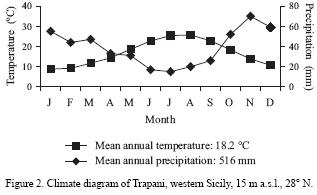
<body><![CDATA[<p align="justify"><font face="verdana" size="2">An often neglected, nevertheless important aspect of soil genesis in the Mediterranean region is that most of the soils in this region contain considerable amounts of eolian material. Yaalon (1997) stated that dust derived from the Sahara continuously affects soil formation since around five million years ago, when the Sahara began to convert into a desert, with the accumulated dust being calcareous and supplying enough CaCO<sub>3</sub> over time to form calcic horizons. </font></p> 				    <p align="justify"><font face="verdana" size="2">In western Africa, the source area of dust outblown during the dry season is probably characterised by secondary carbonates, because calcite proportions increase with their distance to the source (Stahr and Herrmann, 2001). Dust deposition is generated by gravitational settling, rainfall or "catch&#150;out". Consequently, the rate of dust deposition is largely influenced by the weather conditions and the processes involved (Stahr <i>et al.</i>, 1996). A less intense, continuous dust accumulation provides the condition of gradual incorporation by bioturbation which often impedes its identification (Jahn <i>et al.</i>, 1991). The provenience of sediments can be traced by heavy minerals, clay mineralogy and particle&#150;size distribution, as well as by element ratios (<i>e.g.</i>, Herrmann<i>et al.</i>, 1996).The objective of this study was to characterise processes of soil development and weathering of parent materials by soil description and analysis of texture, clay mineralogy, total element contents and element ratios, composition of secondary amorphous and crystalline phases, and to verify if the state of pedogenesis varies according to the elevation of the marine terraces.</font></p> 				    <p align="justify"><font face="verdana" size="2">&nbsp;</font></p> 				    <p align="justify"><font face="verdana" size="2"><b>MATERIALS AND METHODS</b></font></p> 				    <p align="justify"><font face="verdana" size="2"><b>General setting</b></font></p> 				    <p align="justify"><font face="verdana" size="2">The study area is located in the south&#150;west of Sicily, close to Menfi (<a href="/img/revistas/rmcg/v24n2/a11f1.jpg" target="_blank">Figure 1</a>). The climate at the nearby station of Trapani (15m a.s.l.) is Mediterranean, with an average annual precipitation of 516mm and a mean annual temperature of 18.2&deg;C (<a href="#f2">Figure 2</a>), and is classified as thermic&#150;xeric, with moderate excess humidity in winter and an annual water deficit of 255mm. The land in this area is typically cultivated by olive groves, vineyards, cereals and pastures (Guaitoli <i>et al.</i>, 1998). The geological map of the area shows a sequence of marine abrasion or sedimentary terraces of Pleistocene age underlain by marl deposits (Guaitoli <i>et al.</i>, 1998).</font></p> 				    <p align="center"><font face="verdana" size="2"><a name="f2"></a> </font></p> 				    <p align="center"><font face="verdana" size="2"><img src="/img/revistas/rmcg/v24n2/a11f2.jpg"></font></p> 				    <p align="justify"><font face="verdana" size="2">The soils investigated are located on five marine terraces that rise from 97m to 361m a.s.l.. The lowest and the 5th terrace (T5) were excluded from the study, because they are actively influenced by present fluvial deposition (lowest terrace), or limited in extension and only supporting strongly eroded soils (T5). </font></p> 				    <p align="justify"><font face="verdana" size="2">Recent studies carried out by local geologists, however, have recognised eight marine terraces in an adjacent area between Punta Granitola and Porto Palo (D'Angelo <i>et al.</i>, 2001), which can be correlated with the terraces studied by us as follows: terraces 1 to 5 (from 0 to about 80 m a.s.l.) correlate with our lowest excluded terrace, terraces 6 and 7 (from 90 to 114 m a.s.l.) with our T1, terrace 8 (from 115 to 214 m a.s.l.) with our T2, T3 and T4. They tentatively dated the terraces by means of regional correlation, and related them to oxygen isotope stages. The eight terraces were respectively attributed to stages 5e, 7, 9, 11 (both 4th and 5th), 13, 15, 17. That would mean that the terraces studied in this work should be middle Pleistocene in age, with the exception of our terraces T5 and T6, which could be older. D'Angelo <i>et al.</i> (2001), in fact, report the presence of sandy clays and calcarenite ("Calcarenite di Marsala") of early Pleistocene age (Santerniano&#150;Siciliano) between marine terraces and pre&#150;Quaternary marine deposits. They also indicate the occasional occurrence of a reddish paleosol at the top of the "Calcarenite di Marsala". The paleosol should have been formed during the so&#150;called "regressione romana" (sea regression), which lasted from oxygen isotopic stage 21 to 17.</font></p> 				    ]]></body>
<body><![CDATA[<p align="justify"><font face="verdana" size="2">The studied soils have developed on calcarenite, locally covered by fluvial sediments. The fluvial sediments are akin to the calcarenite and can be individuated by the presence of unweathered rounded pebbles, mixed with the marine sandy material. The soils on the two most elevated terraces T4 and T6, which are assumed to be the oldest ones, are a Chromi&#150;Profondic Luvisol (Bathifragic) and a Ferri&#150;Profondic Luvisol, while the soils on the three lower terraces (T1, T2 and T3) represent Bathicalci&#150;Chromic Luvisols.</font></p> 				    <p align="justify"><font face="verdana" size="2">&nbsp;</font></p> 				    <p align="justify"><font face="verdana" size="2"><b>Field and laboratory methods</b></font></p> 				    <p align="justify"><font face="verdana" size="2">The sequence of five soil profiles was described in the field and sampled for laboratory analyses. Bulk samples were air&#150;dried and passed through a 2mm mesh sieve to obtain the fine earth fraction. The Munsell soil colours were determined on moist samples. The pH values were measured in water at a soil:solution ratio of 1:2.5. The electrical conductivity was determined using a 1:5 soil:water extract. Carbonate&#150;carbon (C<sub>carb</sub>) and organic carbon (C<sub>org</sub>) content were determined by a LECO RC 412 analyser. Particle&#150;size analysis was performed after removal of carbonates and organic matter (OM) by treatment with HCl (pH 4.5) and H<sub>2</sub>O<sub>2</sub> (10%), and of excessive salts by repeated addition of deionised water, centrifugation and decantation until the electrical conductivity (EC) dropped below 40&micro;S cm&#150;<sup>1</sup>. After subsequent addition of NH<sub>3</sub> for water dispersion, overnight shaking and ultrasonic treatment, the sand fractions (63&#150;2000&micro;m) were obtained by wet&#150;sieving, while the silt and clay fractions were separated by pipette analysis. Clay mineralogy was determined by X&#150;ray diffraction (XRD) of oriented clay specimens using a Siemens D&#150;500 instrument with Cu K&alpha; radiation. Different treatments of the clay samples included K and Mg saturation, heating to 110&deg;C, 220&deg;C, 400&deg;C and 600&deg;C of the K&#150; and glycerol solvation of the Mg&#150;saturated samples. The amounts of the different clay minerals were estimated on a semi&#150;quantitative basis by using the computer package DIFFRAC AT V3.3 Siemens 1993. The cation exchange capacity (CEC) was measured by use of 1M Na&#150;acetate at pH 7.0. Exchangeable bases were extracted with 1M NH<sub>4</sub>&#150;acetate at pH 7.0 and measured by flame photometry (Na, K and Ca) and atomic absorption spectroscopy (Mg). Element compositions were obtained by X&#150;ray fluorescence spectrometry (Siemens SRS 200) of fused discs with Li<sub>2</sub>B<sub>4</sub>O<sub>7</sub>. Loss on ignition (LOI) was derived from the weight loss of the soil sample after fusing. Dithionite&#150;citrate&#150;bicarbonate extractable Fe (Fe<sub>d</sub>) was analysed by atomic absorption spectrometry (AAS). Oxalate extractable Fe (Fe<sub>o</sub>) was measured by inductive coupled plasma &#150; optical emission spectrometry (ICP&#150;OES). Redness rating (RR) was calculated according to Torrent <i>et al.</i> (1980). All soils were classified according to the World Reference Base for Soil Resources (WRB) (FAO, 1998). Fifty two undisturbed soil samples were taken to prepare 80 &times;50 mm thin sections for petrographic and micromorphological observation.</font></p> 				    <p align="justify"><font face="verdana" size="2">&nbsp;</font></p> 				    <p align="justify"><font face="verdana" size="2"><b>RESULTS AND DISCUSSION</b></font></p> 				    <p align="justify"><font face="verdana" size="2"><b>General characterisation</b></font></p> 				    <p align="justify"><font face="verdana" size="2">Soil thickness is about 100 cm on the 1st terrace, it increases to 160cm on the 2nd terrace and exceeds 200cm on the three higher terraces (<a href="/img/revistas/rmcg/v24n2/a11t1.jpg" target="_blank">Table 1</a>). The two lower terraces are covered by fluvial deposits (42 to 105 cm). At the location on the 3rd terrace, a deposit assumed to originate from a former lagoon environment covers the marine terrace. On the two highest terraces, the marine sediments were relocated by colluvial activity (<a href="/img/revistas/rmcg/v24n2/a11t1.jpg" target="_blank">Table 1</a>). The boundaries between the different layers are generally sharp or distinct as result of differences in the hue of soil colour (<a href="/img/revistas/rmcg/v24n2/a11t1.jpg" target="_blank">Tables 1</a>, <a href="/img/revistas/rmcg/v24n2/a11t2.jpg" target="_blank">2</a>). Soil structure is mostly subangular blocky in the Ap horizons and prismatic or angular blocky in the Bt horizons (<a href="/img/revistas/rmcg/v24n2/a11t1.jpg" target="_blank">Table 1</a>).</font></p> 				    <p align="justify"><font face="verdana" size="2">In the solum of all soils, carbonate assembles 0&#150;3% (<a href="/img/revistas/rmcg/v24n2/a11t2.jpg" target="_blank">Table 2</a>), indicating more or less complete decalcification in the soil sequence. Values of pH in water down to pH 6.8 and pH 6.4 indicate incipient acidification of the soils on the 4th and 6th terrace, respectively. On the lower terraces, the pH ranges between 7.7 and 8.9 (<a href="/img/revistas/rmcg/v24n2/a11t2.jpg" target="_blank">Table 2</a>). The electrical conductivity (EC) is rather low. The soils on the three lower terraces show a greater EC than those on the two higher terraces (<a href="/img/revistas/rmcg/v24n2/a11t2.jpg" target="_blank">Table 2</a>), because of their closer vicinity to the sea. OM contents range between 0.7 and 1.7% in the Ap horizons and rapidly decline downwards (<a href="/img/revistas/rmcg/v24n2/a11t2.jpg" target="_blank">Table 2</a>).</font></p> 				    <p align="justify"><font face="verdana" size="2">&nbsp;</font></p> 				    ]]></body>
<body><![CDATA[<p align="justify"><font face="verdana" size="2"><b>Soil colour</b></font></p> 				    <p align="justify"><font face="verdana" size="2">Across the soil sequence under study, the hue of the soil colour is generally brown and ranges between (dark) reddish and bright yellowish brown in the soils on the 1st and 2nd terrace, brown and reddish brown in the soils on the 3rd terrace, dark to bright brown on T4, and brown to orange on T6. Reddish colours support advanced weathering in the soils on T1 and T2, while higher RR values (<a href="/img/revistas/rmcg/v24n2/a11t2.jpg" target="_blank">Table 2</a>) suggest comparatively greater contents of hematite relative to the soils on T3 and on T6 (Torrent and Cabedo, 1986). The lower RR of the latter reflects the specific redoximorphic environment for the soils on T3 and T6 (<a href="/img/revistas/rmcg/v24n2/a11t1.jpg" target="_blank">Table 1</a>).</font></p> 				    <p align="justify"><font face="verdana" size="2">&nbsp;</font></p> 				    <p align="justify"><font face="verdana" size="2"><b>Soil texture</b></font></p> 				    <p align="justify"><font face="verdana" size="2">Clay coatings and a concomitant increase of pedogenic iron oxides (Fe<sub>d</sub>) in the Bt horizons in all soils of the sequence indicate co&#150;illuviation of clay and iron oxides (Mirabella <i>et al.</i>, 1992). This is confirmed by a fairly constant Fe<sub>d</sub>/clay ratio and a significant correlation between Fe<sub>d</sub> and clay (r<sup>2</sup>=0.99). Higher carbonate contents in the Ap horizons of the soils on the 2nd and 3rd terrace and in the Bt horizons of the Ferri&#150;Profondic Luvisol on the 6th terrace (<a href="/img/revistas/rmcg/v24n2/a11t2.jpg" target="_blank">Table 2</a>) indicate that after carbonate leaching and clay illuviation, allochthonous calcareous material was deposited and carbonates infiltrated. Apart from the soil on the 4th terrace, no increase of silt content towards the surface can be observed, so we assume that eolian deposition is not substantial in most soils in this area, or has been removed by earlier erosion. </font></p> 				    <p align="justify"><font face="verdana" size="2">Although the textural differences between the Ap and the Bt horizons in the soils on the 1st and 2nd terrace (<a href="/img/revistas/rmcg/v24n2/a11f3.jpg" target="_blank">Figures 3a</a>, <a href="/img/revistas/rmcg/v24n2/a11f3.jpg" target="_blank">3b</a>) are primary due to the change in parent material (<a href="/img/revistas/rmcg/v24n2/a11t1.jpg" target="_blank">Table 1</a>), moderate to prominent clay illuviation features are present in both soils, and were also found in thin sections. On the 3rd terrace, fluvial sediments are underlain by a 10 cm thick petrocalcic layer followed by lagoon sediment (<a href="/img/revistas/rmcg/v24n2/a11t1.jpg" target="_blank">Table 1</a>). The textural differences clearly show the boundaries of the different sediments (<a href="/img/revistas/rmcg/v24n2/a11f3.jpg" target="_blank">Figure 3c</a>). In the soil on the 4th terrace, the solum exceeds the profile depth of 200 cm. The greater sand content in the Ap horizon (<a href="/img/revistas/rmcg/v24n2/a11f3.jpg" target="_blank">Figure 3d</a>) indicates recent deposition related to slope transport. A distinct decrease of the silt content to a depth of 110 cm indicates different layers of marine sediments. The soil on the highest terrace is characterised by a 5 cm thick massive iron crust at about 100 cm depth. The Bt horizons above are characterised by high contents of Fe and Al (<a href="/img/revistas/rmcg/v24n2/a11t3.jpg" target="_blank">Table 3</a>), and particularly by large proportions of the dithionite&#150;soluble fractions of these elements. The texture is conspicuously uniform in all horizons, except for 2Bt1 and 2Bt2. The latter, however, have the same distribution of sand fractions (<a href="/img/revistas/rmcg/v24n2/a11f3.jpg" target="_blank">Figure 3e</a>). Clay illuviation is less pronounced than in the other soils, as shown by comparatively thin clay coatings.</font></p> 				    <p align="justify"><font face="verdana" size="2">The silt/clay ratio is often used as a measure of the degree of weathering. However, abrupt changes in the silt/clay ratio between layers reflect the major influence of the parent material. The silt/clay ratios in the fluvial sediments on T1, T2 and T3 are noticeably higher when compared with the underlying calcarenitic material (<a href="/img/revistas/rmcg/v24n2/a11f3.jpg" target="_blank">Figure 3f</a>), because in the younger and coarser&#150;textured fluvial sediments, clay formation is less pronounced (Durn, 2003). The highest silt/clay ratios are found in the colluvial layers on T4 and T6 (<a href="/img/revistas/rmcg/v24n2/a11f3.jpg" target="_blank">Figure 3f</a>). In all soils where colluvium occurs, the material transport is accompanied by clay loss and subsequent deposition of coarser material.</font></p> 				    <p align="justify"><font face="verdana" size="2">&nbsp;</font></p> 				    <p align="justify"><font face="verdana" size="2"><b>Clay mineralogy</b></font></p> 				    <p align="justify"><font face="verdana" size="2">On all marine terraces, the clay fractions of the Luvisols contain mixtures of kaolinite, illite, smectite and interstratifications of clay minerals. It is obvious, however, that the clay mineralogical composition of the soils on the three lower terraces is characterised by distinctly higher proportions of smectites, compared to the soils on the two more elevated terraces (<a href="/img/revistas/rmcg/v24n2/a11f4.jpg" target="_blank">Figures 4a&#150;e</a>). Interstratified clay minerals constitute conspicuously higher proportions in the soil on T1 than on T2 and T3, which is related to a more intense weathering. Kaolinite is also, albeit only slightly, increased in the soil on the 1st terrace. This is concordant with Churchman <i>et al.</i> (1994), who found discrete kaolinites occurring parallel to interstratified kaolinite&#150;smectites in Australian soils and Herbillon <i>et al.</i> (1981), who found increased change of smectite to kaolinite not only towards the more intensively weathered soil surface, but also in a sequence from black to red soils of Burundi. The smectite of the soils on the 1st and 2nd terrace is presumably inherited from the calcarenite and gradually transformed into interstratified forms during weathering (Allen and Hajek, 1989). Increased kaolinite proportions in the fluvial sediments of T1 and T2 (<a href="/img/revistas/rmcg/v24n2/a11t1.jpg" target="_blank">Table 1</a>, <a href="/img/revistas/rmcg/v24n2/a11f4.jpg" target="_blank">Figures 4a&#150;b</a>) possibly reflect higher weathering rates and leaching environment (<i>e.g.</i>, Kantor and Schwertmann, 1974) where this material was once formed. Similar smectite distributions in the soil formed in fluvial and lagoon sediments of T3 suggest inheritance from the underlying material. Although illite and interstratifications are present in all layers, they are more common in the calcarenite between the fluvial and lacustrine sediments (<a href="/img/revistas/rmcg/v24n2/a11f4.jpg" target="_blank">Figure 4c</a>). On the two most elevated terraces, smectite constitutes less than 15 % of all clay minerals. Originally, smectite, vermiculite and kaolinite are formed from biotite. While smectite and vermiculite are formed under more temperate climates, biotite tends to weather directly to kaolinite in the humid tropics. Thus, the abundance of kaolinite, the absence of vermiculite, and the scarcity of smectite in the soils of the two highest terraces (<a href="/img/revistas/rmcg/v24n2/a11f4.jpg" target="_blank">Figures 4d</a>, <a href="/img/revistas/rmcg/v24n2/a11f4.jpg" target="_blank">4e</a>) reflect a more humid climate than at present or longer time of formation.</font></p> 				    ]]></body>
<body><![CDATA[<p align="justify"><font face="verdana" size="2">Irregular interstratifications of illite, vermiculite, smectite and chlorite are common in most of the soil horizons in this soil sequence, with a proportion of 20&#150;35 % of irregularly interstratified clay minerals in 23 out of 30 horizons (<a href="/img/revistas/rmcg/v24n2/a11f4.jpg" target="_blank">Figures 4a&#150;e</a>). Such interstratifications are caused by weathering under transitional conditions (Sawhney, 1989) and demonstrate ongoing soil genesis. The proportion of interstratification is rather weak in the soils on the 2nd and 3rd terrace (<a href="/img/revistas/rmcg/v24n2/a11f4.jpg" target="_blank">Figures 4b</a>, <a href="/img/revistas/rmcg/v24n2/a11f4.jpg" target="_blank">4c</a>). Kaolinite is widespread and generally comprises more than 20 % of all clay minerals. On T6, kaolinite comprises between 36 % and 54 % of all clay minerals (<a href="/img/revistas/rmcg/v24n2/a11f4.jpg" target="_blank">Figure 4e</a>), indicating soil genesis under strong leaching conditions.</font></p> 				    <p align="justify"><font face="verdana" size="2">&nbsp;</font></p> 				    <p align="justify"><font face="verdana" size="2"><b>Geochemistry</b></font></p> 				    <p align="justify"><font face="verdana" size="2">Clay neogenesis and illuviation seem to induce relocation of Al, Fe, and K, when comparing the chemical composition of the soils. This assumption is confirmed by significant correlations between clay content and Al (r<sup>2</sup> = 0.99), Fe (r<sup>2</sup> = 0.86), and K (r<sup>2</sup> = 0.73), which is valid for all soils. In the Chromi&#150;Profondic Luvisol on T3, however, 3Bkgb was excluded, because the lacustrine material contained distinctly less K than the Bt horizons above, while clay contents were noticeably higher (59.3 %, <a href="/img/revistas/rmcg/v24n2/a11f3.jpg" target="_blank">Figure 3c</a>). This demonstrates the distinguishing character of the lacustrine sediments in this soil. The noticeably higher concentration of Mn oxides in the soil on T4 compared to the soils on the other terraces (<a href="/img/revistas/rmcg/v24n2/a10t3.jpg" target="_blank">Table 3</a>) is due to stagnic properties. In this soil, Mn oxide nodules reach diameters of 2 mm, while mottles on aggregate surfaces are up to 20 mm in diameter. Such mottling is typical for periodic wetness, <i>i.e.</i>, seasonal wetting and drying with accompanied mobilisation, translocation and immobilisation of Mn (Allen and Hajek, 1989). In the soils on the other terraces, mottling is less pronounced or absent (<a href="/img/revistas/rmcg/v24n2/a11t3.jpg" target="_blank">Table 3</a>).</font></p> 				    <p align="justify"><font face="verdana" size="2">The composition and stratification of parent material is well reflected by the ratios of Ti/Zr and Zr/Si (<i>e.g.</i>, Stahr <i>et al.</i>, 2000). On the three lower terraces, the boundaries between calcarenite and fluvial sediments are expressed by higher Zr/Si ratios in the fluvial sediments. The sediment on the 4th terrace is fairly uniform, except for the Ap horizon. Distinctly higher Zr/Si ratios in the 2Bt horizons relative to the horizons above and below may suggest a lithological discontinuity in the soil on the highest terrace (<a href="/img/revistas/rmcg/v24n2/a11f5.jpg" target="_blank">Figures 5a</a>, <a href="/img/revistas/rmcg/v24n2/a11f5.jpg" target="_blank">5b</a>). Silica leaching in the soil on T6 was accompanied by oxidation of and enrichment with Fe<sub>2</sub>O<sub>3</sub> and Al<sub>2</sub>O<sub>3</sub> (<a href="/img/revistas/rmcg/v24n2/a11t3.jpg" target="_blank">Table 3</a>). Associated lateral water flow enhanced weathering and subsequently caused the cementation of the marine sediment by iron, as suggested by Igwe <i>et al.</i> (2005), who observed this process in coarse sand fractions of highly weathered but Holocene floodplain soils on alluvial sands of the river Niger. The decalcification of soils reduces the ratio of (CaO+MgO)/Al<sub>2</sub>O<sub>3</sub> (Retallack, 1997). CaO contents of less than 1 % in all soils (<a href="/img/revistas/rmcg/v24n2/a11t3.jpg" target="_blank">Table 3</a>) suggest almost complete decalcification.</font></p> 				    <p align="justify"><font face="verdana" size="2">An abrupt boundary between the weathering front with clay coatings stained by iron and the unweathered calcarenite underneath was observed by micromorphological studies (<a href="/img/revistas/rmcg/v24n2/a11f6.jpg" target="_blank">Figure&nbsp;6</a>) in the soils of the three lower terraces, while in the soils on T4 and T6, the parent material could not be sampled. Field and micromorphological observations, <i>e.g.</i>, thin CaCO<sub>3</sub> coatings and recrystallisation of calcite nodules indicate secondary carbonate enrichment in some horizons, reflecting seasonal wetting and drying typical for a Mediterranean environment (<a href="/img/revistas/rmcg/v24n2/a11f5.jpg" target="_blank">Figure 5c</a>). Higher ratios of (CaO+MgO)/Al<sub>2</sub>O<sub>3</sub> in all Ap horizons (<a href="/img/revistas/rmcg/v24n2/a11f5.jpg" target="_blank">Figure&nbsp;5c</a>) are likely due to accretion of calcareous dust and subsequent enrichment of secondary carbonates (Yaalon, 1997), while higher concentrations of CaO and MgO in the soil on the 3rd terrace (<a href="/img/revistas/rmcg/v24n2/a11f5.jpg" target="_blank">Figure 5c</a>) reflect the dolomitic character of the parent material on this terrace. </font></p> 				    <p align="justify"><font face="verdana" size="2">The weathering progress has been evaluated by the "Chemical Index of Alteration" (CIA) of Nesbitt&nbsp;and&nbsp;Young (1984), which is calculated by Al<sub>2</sub>O<sub>3</sub>/(Al<sub>2</sub>O<sub>3</sub>+CaO+Na<sub>2</sub>O+K<sub>2</sub>O). On all terraces, weathering is more advanced in the Bt horizons compared to the Ap (<a href="/img/revistas/rmcg/v24n2/a11f5.jpg" target="_blank">Figure 5d</a>). The largest indices were calculated for the soils on T4 and T6, while the soil on the 2nd and parts of the soil on the 3rd terrace seem to be less developed than the soil on the 1st terrace. This is due to a more intense clay mineral alteration with noticeably higher amounts of interstratifications and kaolinite in the soil on the 1st terrace. Effects of <i>in situ</i> weathering were acquired by calculation of SiO<sub>2</sub>/(Al<sub>2</sub>O<sub>3</sub>+Fe<sub>2</sub>O<sub>3</sub>+TiO<sub>2</sub>). This ratio characterises the degree of silicate destruction and Si removal in a leaching environment. Colman (1982) suggested that this ratio should decrease during weathering, because of the greater stability of Al, Fe, and Ti relative to Si. In most of the soils, the ratio decreases in the B horizons and increases below, which testifies the <i>in situ</i> weathering of the parent materials of the B and C horizons. Only the soils on the 3rd and 4th terrace do not show this pattern, where an increase of SiO<sub>2</sub>/(Al<sub>2</sub>O<sub>3</sub>+Fe<sub>2</sub>O<sub>3</sub>+TiO<sub>2</sub>) in the Ap horizons (<a href="/img/revistas/rmcg/v24n2/a11f5.jpg" target="_blank">Figure&nbsp;5e</a>) is possibly due to the human influence. A slight decrease of this ratio below the Ap horizons with time also testifies silicate weathering within the terrace sequence (<a href="/img/revistas/rmcg/v24n2/a11f5.jpg" target="_blank">Figure&nbsp;5e</a>). A comparison of the most developed horizons of each terrace (generally Bt) shows that this ratio clearly decreases from T1 to T6, testifying the assumed progressive silicate weathering in the terrace sequence.</font></p> 				    <p align="justify"><font face="verdana" size="2">&nbsp;</font></p> 				    <p align="justify"><font face="verdana" size="2"><b>Weathering dynamics</b></font></p> 				    <p align="justify"><font face="verdana" size="2">The degree of weathering and formation of pedogenic iron oxides and hydroxides is expressed by the ratio of Fe<sub>d</sub>/Fe<sub>t</sub>. In the Ferri&#150;Profondic Luvisol on T6, the release of 73&#150;88 % of iron (<a href="/img/revistas/rmcg/v24n2/a11f7.jpg" target="_blank">Figure&nbsp;7a</a>) substantiates strong soil development. The Fe<sub>d</sub>/Fe<sub>t</sub> ratio generally ranges between 50&#150;60&nbsp;% in the soils on T1, T2 and T4 (<a href="/img/revistas/rmcg/v24n2/a11f7.jpg" target="_blank">Figure&nbsp;7a</a>) and reflects enhanced weathering, whereas lower ratios in the soil on T3 are due to little release of iron in the younger fluvial sediment. For appropriate estimation of the degree of weathering, Bronger <i>et al.</i> (1984) stress the necessity to compare solum and parent material. In fact, this could be done only in the soil on T2, whereas in the soils on T4 and T6, solum thickness exceeds 200&nbsp;cm, and the parent material could not be sampled.</font></p> 				    ]]></body>
<body><![CDATA[<p align="justify"><font face="verdana" size="2">The Fe<sub>o</sub>/Fe<sub>d</sub> ratio characterises the degree of iron oxide and hydroxide crystallisation, where in general, lower ratios reflect more advanced stages of soil development (Alexander, 1974; Arduino <i>et al.</i>, 1986). Hence the Fe<sub>o</sub>/Fe<sub>d</sub> ratio tends to decrease with soil age (Moody&nbsp;and&nbsp;Graham, 1995; Bronger&nbsp;and&nbsp;Bruhn&#150;Lobin, 1997). The lowest Fe<sub>o</sub>/Fe<sub>d</sub> ratios were found in the soil on the 6th terrace (ranging from 0.00&nbsp;to&nbsp;0.04, <a href="/img/revistas/rmcg/v24n2/a11f7.jpg" target="_blank">Figure&nbsp;7b</a>). In the Bt horizons of the soil on T4, the Fe<sub>o</sub>/Fe<sub>d</sub> ratio ranged from 0.03&#150;0.07&nbsp;compared to 0.02&#150;0.04&nbsp;in the Bt horizons on T1 and T2, reflecting a higher crystallinity in the latter (<a href="/img/revistas/rmcg/v24n2/a11f7.jpg" target="_blank">Figure&nbsp;7b</a>), and indicating rejuvenation of the soil on T4. Irrespective of the wide range of quantities, the average values of the Fe<sub>o</sub>/Fe<sub>d</sub> ratio in the soils of this terrace sequence account for mainly crystalline iron oxides (Torrent <i>et al.</i>, 1980). Comparatively higher Fe<sub>o</sub>/Fe<sub>d</sub> ratios of 0.10&#150;0.37 in the soil on the 3rd terrace attest a correspondingly less developed solum and an accordingly younger soil, whereas a ratio of 0.02 in the 3Bkgb at depth reflects gleyic features. Across all soils, abrupt changes in the Fe<sub>o</sub>/Fe<sub>d</sub> ratio follow lithological discontinuities (Bech <i>et al.</i>, 1997).</font></p> 				    <p align="justify"><font face="verdana" size="2">The gradual transformation of ferrihydrite into more crystalline forms of iron oxide during pedogenesis can be expressed by Fe<sub>d</sub>&#150;Fe<sub>o</sub> (Torrent <i>et al.</i>, 1980; Aniku&nbsp;and&nbsp;Singer, 1990; Costantini <i>et al.</i>, 1996). In the soils investigated, the largest difference was found within the Bt horizons, especially in that of the 6th terrace (<a href="/img/revistas/rmcg/v24n2/a11f7.jpg" target="_blank">Figure 7c</a>). Smaller differences were calculated for the parent material on T2, the alluvial layer on T3 and the soil on T4.</font></p> 				    <p align="justify"><font face="verdana" size="2">&nbsp;</font></p> 				    <p align="justify"><font face="verdana" size="2"><b>CONCLUSIONS</b></font></p> 				    <p align="justify"><font face="verdana" size="2">The soil sequence investigated generally shows a time&#150;progressive soil development with terrace elevation expressed by increasing solum depths. The soils on the two lower terraces represent Bathicalci&#150;Chromic Luvisols and on the 3rd terrace, a Chromi&#150;Profondic Luvisol has developed, whereas on the two highest terraces prolonged soil formation has led to a Chromi&#150;Profondic Luvisol (Bathifragic) and a Ferri&#150;Profondic Luvisol. The rather individual pattern of soil texture is due to the varying provenance of the overlying materials.</font></p> 				    <p align="justify"><font face="verdana" size="2">The degree of weathering and the degree of iron oxide crystallisation generally increase with terrace elevation, but local differences such as rejuvenation by fluvial sediments on the three lower terraces, which is most distinct on T3, and periodic wetness resulting in mottling on the 3rd, 4th and 6th terrace contribute to a certain variability of soil properties within the terrace sequence. Acidification is more advanced in the soil on T6 than on T4, but has not started in the soils on the three lower terraces. Greater amounts of kaolinite in the soils on the 4th and 6th terrace and interstratifications in the whole sequence suggest proceeding soil development. The trends of increasing chemical alteration and silica leaching with terrace elevation also support the assumption of progressive weathering with terrace elevation.</font></p> 				    <p align="justify"><font face="verdana" size="2">The presence of a horizon with cemented iron concretions, high contents of kaolinite, the geochemistry and the form of iron transformation suggest that the soil on the highest terrace might have been exposed to a warmer and wetter climate than at present. Hence, soil genesis on this terrace is consistent with that which occurred in the Mediterranean environment during early Pleistocene or earlier (Costantini <i>et al.</i>, 2002). Because of the rather minor amount of silt in the soil, we assume that eolian depositions play a minor role in this area.</font></p> 				    <p align="justify"><font face="verdana" size="2">The assumption of a soil chronosequence is supported by the tendency of increased weathering with higher terrace elevations. These data suggest that the 4th and 6th terrace have formed at different times, whereas the less elevated terraces presumably arose in shorter time intervals. Further studies are required to confirm whether each of the three lower terraces has formed individually at similar times or whether these terraces arose as a single body and were later dissected by tectonic activity. Moreover, the causes for the difference in numbers of terraces between the Menfi area and the nearby area where D'Angelo <i>et al.</i> (2001) distinguished eight marine terraces still need to be identified. These differences may be caused by different tectonics in the two areas or by the presence of some unconspicious terraces which may have been overlooked and might be detected in a re&#150;investigation of both areas.</font></p> 				    <p align="justify"><font face="verdana" size="2">&nbsp;</font></p> 				    <p align="justify"><font face="verdana" size="2"><b>ACKNOWLEDGEMENTS</b></font></p> 				    ]]></body>
<body><![CDATA[<p align="justify"><font face="verdana" size="2">We wish to thank Dr. P. Campo (Office of Agriculture and Forestry, Regione Siciliana, Menfi, Sicily), Dr. F. Guaitoli and Dr. M. Perciabosco (Office of Agriculture and Forestry, Regione Siciliana, Palermo, Sicily), S. Priori (Department of Geoscience, University of Siena, Italy), N. Gorican (Department of Geography, University of Cologne, Germany), R. Stolz (Institute of Geography, Ruhr&#150;University of Bochum, Germany), A. B&ouml;ttcher, D. Frobel, K. Ruf, C. Stein, M. Wagner and M. Zarei (University of Hohenheim, Germany), M. Sipos (University of Debrecen, Centre of Agricultural Sciences, Hungary), and P. Wiens (UNICAMP, Brazil) for their help. This work is partly financed by a PhD scholarship from the foundation Evangelisches Studienwerk, Villigst, Germany.</font></p> 				    <p align="justify"><font face="verdana" size="2">&nbsp;</font></p> 				    <p align="justify"><font face="verdana" size="2"><b>REFERENCES</b></font></p> 				    <!-- ref --><p align="justify"><font face="verdana" size="2">Alexander, E.B., 1974, Extractable iron in relation to soil age on terraces along the Truckee River, Nevada: Soil Science Society of America Proceedings, 38, 121&#150;124.</font>&nbsp;&nbsp;&nbsp;&nbsp;&nbsp;&nbsp;&nbsp;&nbsp;[&#160;<a href="javascript:void(0);" onclick="javascript: window.open('/scielo.php?script=sci_nlinks&ref=8065294&pid=S1026-8774200700020001100001&lng=','','width=640,height=500,resizable=yes,scrollbars=1,menubar=yes,');">Links</a>&#160;]<!-- end-ref --> 				    <!-- ref --><p align="justify"><font face="verdana" size="2">Allen, B.L., Hajek, B.F., 1989, Mineral occurrence in soil environments, <i>in</i> Dixon, J.B., Weed, S.B. (eds.), Minerals in soil environments: Madison, Wisconsin, Soil Science Society of America, Book Series, 199&#150;278.</font>&nbsp;&nbsp;&nbsp;&nbsp;&nbsp;&nbsp;&nbsp;&nbsp;[&#160;<a href="javascript:void(0);" onclick="javascript: window.open('/scielo.php?script=sci_nlinks&ref=8065296&pid=S1026-8774200700020001100002&lng=','','width=640,height=500,resizable=yes,scrollbars=1,menubar=yes,');">Links</a>&#160;]<!-- end-ref --> 				    <!-- ref --><p align="justify"><font face="verdana" size="2">Aniku, J.R.F., Singer, M.J., 1990, Pedogenic iron oxide trends in a marine terrace sequence: Soil Science Society of America Journal, 54, 147&#150;152.</font>&nbsp;&nbsp;&nbsp;&nbsp;&nbsp;&nbsp;&nbsp;&nbsp;[&#160;<a href="javascript:void(0);" onclick="javascript: window.open('/scielo.php?script=sci_nlinks&ref=8065298&pid=S1026-8774200700020001100003&lng=','','width=640,height=500,resizable=yes,scrollbars=1,menubar=yes,');">Links</a>&#160;]<!-- end-ref --> 				    <!-- ref --><p align="justify"><font face="verdana" size="2">Arduino, E., Berberis, E., Marsan, F.A., Zanini, E., Franchini, M., 1986, Iron oxides and clay minerals within profiles as indicators of soil age in Northern Italy: Geoderma, 37, 45&#150;55.</font>&nbsp;&nbsp;&nbsp;&nbsp;&nbsp;&nbsp;&nbsp;&nbsp;[&#160;<a href="javascript:void(0);" onclick="javascript: window.open('/scielo.php?script=sci_nlinks&ref=8065300&pid=S1026-8774200700020001100004&lng=','','width=640,height=500,resizable=yes,scrollbars=1,menubar=yes,');">Links</a>&#160;]<!-- end-ref --> 				    <!-- ref --><p align="justify"><font face="verdana" size="2">Bech, J., Rustullet, J., Garrig&oacute;, J., Tobias, F.J., Mart&iacute;nez, R., 1997, The iron content of some red Mediterranean soils from northeast Spain and its pedogenic significance: Catena, 28, 211&#150;229.</font>&nbsp;&nbsp;&nbsp;&nbsp;&nbsp;&nbsp;&nbsp;&nbsp;[&#160;<a href="javascript:void(0);" onclick="javascript: window.open('/scielo.php?script=sci_nlinks&ref=8065302&pid=S1026-8774200700020001100005&lng=','','width=640,height=500,resizable=yes,scrollbars=1,menubar=yes,');">Links</a>&#160;]<!-- end-ref --> 				    <!-- ref --><p align="justify"><font face="verdana" size="2">Bronger, A., Bruhn&#150;Lobin, N., 1997, Paleopedology of Terrae rossae&#150;Rhodoxeralfs from Quaternary calcarenites in NW Morocco: Catena, 28, 279&#150;295.</font>&nbsp;&nbsp;&nbsp;&nbsp;&nbsp;&nbsp;&nbsp;&nbsp;[&#160;<a href="javascript:void(0);" onclick="javascript: window.open('/scielo.php?script=sci_nlinks&ref=8065304&pid=S1026-8774200700020001100006&lng=','','width=640,height=500,resizable=yes,scrollbars=1,menubar=yes,');">Links</a>&#160;]<!-- end-ref --> 				    <!-- ref --><p align="justify"><font face="verdana" size="2">Bronger, A., Ensling, J., Kalk, E., 1984, Mineralverwitterung, Tonmineralbildung und Rubefizierung in Terrae calcis der Slowakei. Ein Beitrag zum pal&auml;oklimatischen Aussagewert von Kalkstein&#150;Rotlehmen in Mitteleuropa: Catena, 11, 115&#150;132.</font>&nbsp;&nbsp;&nbsp;&nbsp;&nbsp;&nbsp;&nbsp;&nbsp;[&#160;<a href="javascript:void(0);" onclick="javascript: window.open('/scielo.php?script=sci_nlinks&ref=8065306&pid=S1026-8774200700020001100007&lng=','','width=640,height=500,resizable=yes,scrollbars=1,menubar=yes,');">Links</a>&#160;]<!-- end-ref --> 				    <!-- ref --><p align="justify"><font face="verdana" size="2">Chartres, C.J., Chivas, A.R., Walker, P.H., 1988, The effect of aeolian accessions on soil development on granitic rocks in south&#150;eastern Australia, II. Oxygen&#150;isotope, mineralogical and geochemical evidence for aeolian accession: Australian Journal of Soil Research, 26, 17&#150;31.</font>&nbsp;&nbsp;&nbsp;&nbsp;&nbsp;&nbsp;&nbsp;&nbsp;[&#160;<a href="javascript:void(0);" onclick="javascript: window.open('/scielo.php?script=sci_nlinks&ref=8065308&pid=S1026-8774200700020001100008&lng=','','width=640,height=500,resizable=yes,scrollbars=1,menubar=yes,');">Links</a>&#160;]<!-- end-ref --> 				    <!-- ref --><p align="justify"><font face="verdana" size="2">Churchman, G.J., Slade, P.G., Self, P.G., Janik, L.J., 1994, Nature of interstratified kaolin&#150;smectites in some Australian soils: Australian Journal of Soil Research, 32, 805&#150;822.</font>&nbsp;&nbsp;&nbsp;&nbsp;&nbsp;&nbsp;&nbsp;&nbsp;[&#160;<a href="javascript:void(0);" onclick="javascript: window.open('/scielo.php?script=sci_nlinks&ref=8065310&pid=S1026-8774200700020001100009&lng=','','width=640,height=500,resizable=yes,scrollbars=1,menubar=yes,');">Links</a>&#160;]<!-- end-ref --> 				    <!-- ref --><p align="justify"><font face="verdana" size="2">Colman, S.M., 1982, Chemical weathering of basalts and andesites: evidence from weathering rinds: U.S. Geological Survey Professional Paper, 1246.</font>&nbsp;&nbsp;&nbsp;&nbsp;&nbsp;&nbsp;&nbsp;&nbsp;[&#160;<a href="javascript:void(0);" onclick="javascript: window.open('/scielo.php?script=sci_nlinks&ref=8065312&pid=S1026-8774200700020001100010&lng=','','width=640,height=500,resizable=yes,scrollbars=1,menubar=yes,');">Links</a>&#160;]<!-- end-ref --> 				    <!-- ref --><p align="justify"><font face="verdana" size="2">Costantini, E.A.C., Napoli, R., Bragato, G., 1996, Properties and geographic relevance of fragipan and other close&#150;packed horizons in a non&#150;glaciated Mediterranean region: Geografia Fisica e Dinamica Quaternaria, 19, 29&#150;45.</font>&nbsp;&nbsp;&nbsp;&nbsp;&nbsp;&nbsp;&nbsp;&nbsp;[&#160;<a href="javascript:void(0);" onclick="javascript: window.open('/scielo.php?script=sci_nlinks&ref=8065314&pid=S1026-8774200700020001100011&lng=','','width=640,height=500,resizable=yes,scrollbars=1,menubar=yes,');">Links</a>&#160;]<!-- end-ref --> 				    <!-- ref --><p align="justify"><font face="verdana" size="2">Costantini, E.A.C., Angelone, M., Damiani, D., 2002, Physical, geochemical and mineralogical indicators of aging in Quaternary soils of Central Italy, <i>in</i> 17<sup>th</sup> World Congress of Soil Science, Transactions (cd&#150;rom): International Union of Soil Sciences, 599, 1&#150;9.</font>&nbsp;&nbsp;&nbsp;&nbsp;&nbsp;&nbsp;&nbsp;&nbsp;[&#160;<a href="javascript:void(0);" onclick="javascript: window.open('/scielo.php?script=sci_nlinks&ref=8065316&pid=S1026-8774200700020001100012&lng=','','width=640,height=500,resizable=yes,scrollbars=1,menubar=yes,');">Links</a>&#160;]<!-- end-ref --> 				    <!-- ref --><p align="justify"><font face="verdana" size="2">D'Angelo, U., Parrino, G., Vernuccio, S., 2001, Il Quaternario della fascia costira compresa fra Punta Granitola e Porto Palo (Sicilia sud occidentale): Naturalistica sicil, 4(25), 333&#150;344.</font>&nbsp;&nbsp;&nbsp;&nbsp;&nbsp;&nbsp;&nbsp;&nbsp;[&#160;<a href="javascript:void(0);" onclick="javascript: window.open('/scielo.php?script=sci_nlinks&ref=8065318&pid=S1026-8774200700020001100013&lng=','','width=640,height=500,resizable=yes,scrollbars=1,menubar=yes,');">Links</a>&#160;]<!-- end-ref --> 				    <!-- ref --><p align="justify"><font face="verdana" size="2">Durn, G., 2003, Terra Rossa in the Mediterranean region: Parent materials, composition and origin: Geologica Croatica, 56, 83&#150;100.</font>&nbsp;&nbsp;&nbsp;&nbsp;&nbsp;&nbsp;&nbsp;&nbsp;[&#160;<a href="javascript:void(0);" onclick="javascript: window.open('/scielo.php?script=sci_nlinks&ref=8065320&pid=S1026-8774200700020001100014&lng=','','width=640,height=500,resizable=yes,scrollbars=1,menubar=yes,');">Links</a>&#160;]<!-- end-ref --> 				    <!-- ref --><p align="justify"><font face="verdana" size="2">Food and Agricultural Organization of the United Nations (FAO), 1998, World Reference Base for Soil Resources: Rome, Food and Agricultural Organization of the United Nations, International Society of Soil Science (ISSS), International Soil Reference and Information Centre (ISRIC), World Soil Resources Reports, 84, 89 p.</font>&nbsp;&nbsp;&nbsp;&nbsp;&nbsp;&nbsp;&nbsp;&nbsp;[&#160;<a href="javascript:void(0);" onclick="javascript: window.open('/scielo.php?script=sci_nlinks&ref=8065322&pid=S1026-8774200700020001100015&lng=','','width=640,height=500,resizable=yes,scrollbars=1,menubar=yes,');">Links</a>&#160;]<!-- end-ref --> 				    <!-- ref --><p align="justify"><font face="verdana" size="2">Fitzpatrick, E.A., 1971, Pedology. A systematic approach to soil science: Edinburgh, Oliver and Boyd, 306 p.</font>&nbsp;&nbsp;&nbsp;&nbsp;&nbsp;&nbsp;&nbsp;&nbsp;[&#160;<a href="javascript:void(0);" onclick="javascript: window.open('/scielo.php?script=sci_nlinks&ref=8065324&pid=S1026-8774200700020001100016&lng=','','width=640,height=500,resizable=yes,scrollbars=1,menubar=yes,');">Links</a>&#160;]<!-- end-ref --> 				    <!-- ref --><p align="justify"><font face="verdana" size="2">Grez, R., 1977, N&auml;hrelementhaushalt und Genese von B&ouml;den aus vulkanischen Aschen in S&uuml;dchile: Germany, Albert&#150;Ludwigs&#150;Universit&auml;t Freiburg, Institut f&uuml;r Bodenkunde und Waldern&auml;hrungslehre, Freiburger Bodenkundliche Abhandlungen, 6, 177&nbsp;p.</font>&nbsp;&nbsp;&nbsp;&nbsp;&nbsp;&nbsp;&nbsp;&nbsp;[&#160;<a href="javascript:void(0);" onclick="javascript: window.open('/scielo.php?script=sci_nlinks&ref=8065326&pid=S1026-8774200700020001100017&lng=','','width=640,height=500,resizable=yes,scrollbars=1,menubar=yes,');">Links</a>&#160;]<!-- end-ref --> 				    <!-- ref --><p align="justify"><font face="verdana" size="2">Guaitoli, F., Matranga, M.G., Paladino, A., Perciabosco, M., Pumo, A., 1998, I suoli dell'area Monte Magaggiaro (AG), scale 1:25.000: Palermo, Progetto Carta Pedologica, 109&nbsp;p., 1&nbsp;map with text.</font>&nbsp;&nbsp;&nbsp;&nbsp;&nbsp;&nbsp;&nbsp;&nbsp;[&#160;<a href="javascript:void(0);" onclick="javascript: window.open('/scielo.php?script=sci_nlinks&ref=8065328&pid=S1026-8774200700020001100018&lng=','','width=640,height=500,resizable=yes,scrollbars=1,menubar=yes,');">Links</a>&#160;]<!-- end-ref --> 				    <!-- ref --><p align="justify"><font face="verdana" size="2">Herbillon, A.J., Frankart, R., Vielvoye, L., 1981, An occurrence of interstratified kaolinite&#150;smectite minerals in a red&#150;black soil toposequence: Clay Minerals, 16, 195&#150;201.</font>&nbsp;&nbsp;&nbsp;&nbsp;&nbsp;&nbsp;&nbsp;&nbsp;[&#160;<a href="javascript:void(0);" onclick="javascript: window.open('/scielo.php?script=sci_nlinks&ref=8065330&pid=S1026-8774200700020001100019&lng=','','width=640,height=500,resizable=yes,scrollbars=1,menubar=yes,');">Links</a>&#160;]<!-- end-ref --> 				    <!-- ref --><p align="justify"><font face="verdana" size="2">Herrmann, L., Jahn, R., Stahr, K., 1996, Identification and quantification of dust additions in peri&#150;saharan soils, <i>in</i> Guerzoni, S., Chester, R. (eds.), The impact of african dust across the Mediterranean: Dordrecht, The Nederlands, Kluwer, 173&#150;182.</font>&nbsp;&nbsp;&nbsp;&nbsp;&nbsp;&nbsp;&nbsp;&nbsp;[&#160;<a href="javascript:void(0);" onclick="javascript: window.open('/scielo.php?script=sci_nlinks&ref=8065332&pid=S1026-8774200700020001100020&lng=','','width=640,height=500,resizable=yes,scrollbars=1,menubar=yes,');">Links</a>&#160;]<!-- end-ref --> 				    <!-- ref --><p align="justify"><font face="verdana" size="2">Igwe, C.A., Zarei, M., Stahr, K., 2005, Mineral and elemental distribution in soils formed on the River Niger floodplain, Eastern Nigeria: Australian Journal of Soil Research, 43, 147&#150;158.</font>&nbsp;&nbsp;&nbsp;&nbsp;&nbsp;&nbsp;&nbsp;&nbsp;[&#160;<a href="javascript:void(0);" onclick="javascript: window.open('/scielo.php?script=sci_nlinks&ref=8065334&pid=S1026-8774200700020001100021&lng=','','width=640,height=500,resizable=yes,scrollbars=1,menubar=yes,');">Links</a>&#160;]<!-- end-ref --> 				    <!-- ref --><p align="justify"><font face="verdana" size="2">Jahn, R., 1988, B&ouml;den Lanzarotes &#150;Vorkommen, Genese und Eigenschaften von B&ouml;den auf Vulkaniten im semiariden Klima Lanzarotes (Kanarische Inseln): Germany, Ulmer Verlag, Hohenheimer Arbeiten, 257&nbsp;pp.</font>&nbsp;&nbsp;&nbsp;&nbsp;&nbsp;&nbsp;&nbsp;&nbsp;[&#160;<a href="javascript:void(0);" onclick="javascript: window.open('/scielo.php?script=sci_nlinks&ref=8065336&pid=S1026-8774200700020001100022&lng=','','width=640,height=500,resizable=yes,scrollbars=1,menubar=yes,');">Links</a>&#160;]<!-- end-ref --> 				    <!-- ref --><p align="justify"><font face="verdana" size="2">Jahn, R., Zarei, M., Stahr, K., 1991, Genetic implications of quartz in "Terra Rossa"&#150;soils in Portugal, <i>in</i> 7<sup>th</sup> Euroclay Conference, Proceedings: Dresden, Greifswald, European Clay Groups Association, 541&#150;546. </font>&nbsp;&nbsp;&nbsp;&nbsp;&nbsp;&nbsp;&nbsp;&nbsp;[&#160;<a href="javascript:void(0);" onclick="javascript: window.open('/scielo.php?script=sci_nlinks&ref=8065338&pid=S1026-8774200700020001100023&lng=','','width=640,height=500,resizable=yes,scrollbars=1,menubar=yes,');">Links</a>&#160;]<!-- end-ref --> 				    <!-- ref --><p align="justify"><font face="verdana" size="2">Kantor, W., Schwertmann, U., 1974, Mineralogy and genesis of clay in red&#150;black soil toposequences on basic igneous rocks in Kenya: Journal of Soil Science, 25, 67&#150;78.</font>&nbsp;&nbsp;&nbsp;&nbsp;&nbsp;&nbsp;&nbsp;&nbsp;[&#160;<a href="javascript:void(0);" onclick="javascript: window.open('/scielo.php?script=sci_nlinks&ref=8065340&pid=S1026-8774200700020001100024&lng=','','width=640,height=500,resizable=yes,scrollbars=1,menubar=yes,');">Links</a>&#160;]<!-- end-ref --> 				    <!-- ref --><p align="justify"><font face="verdana" size="2">Merritts, D.J., Chadwick, O.A., Hendricks, D.M., 1991, Rates and processes of soil evolution on uplifted marine terraces, northern California: Geoderma, 51, 241&#150;275.</font>&nbsp;&nbsp;&nbsp;&nbsp;&nbsp;&nbsp;&nbsp;&nbsp;[&#160;<a href="javascript:void(0);" onclick="javascript: window.open('/scielo.php?script=sci_nlinks&ref=8065342&pid=S1026-8774200700020001100025&lng=','','width=640,height=500,resizable=yes,scrollbars=1,menubar=yes,');">Links</a>&#160;]<!-- end-ref --> 				    <!-- ref --><p align="justify"><font face="verdana" size="2">Mirabella, A., Costantini, E.A.C., Carnicelli, S., 1992, Genesis of polycyclic Terra Rossa (Chromic Cambisol on Rhodic Nitisol) at the Poggio del Commune in Central Italy: Zeitschrift f&uuml;r Pflanzenern&auml;hrung und Bodenkunde, 155, 407&#150;413. </font>&nbsp;&nbsp;&nbsp;&nbsp;&nbsp;&nbsp;&nbsp;&nbsp;[&#160;<a href="javascript:void(0);" onclick="javascript: window.open('/scielo.php?script=sci_nlinks&ref=8065344&pid=S1026-8774200700020001100026&lng=','','width=640,height=500,resizable=yes,scrollbars=1,menubar=yes,');">Links</a>&#160;]<!-- end-ref --> 				    <!-- ref --><p align="justify"><font face="verdana" size="2">Moody, L.E., Graham, R.C, 1995, Geomorphic and pedogenic evolution in coastal sediments, central California: Geoderma, 67, 181&#150;201. </font>&nbsp;&nbsp;&nbsp;&nbsp;&nbsp;&nbsp;&nbsp;&nbsp;[&#160;<a href="javascript:void(0);" onclick="javascript: window.open('/scielo.php?script=sci_nlinks&ref=8065346&pid=S1026-8774200700020001100027&lng=','','width=640,height=500,resizable=yes,scrollbars=1,menubar=yes,');">Links</a>&#160;]<!-- end-ref --> 				    <!-- ref --><p align="justify"><font face="verdana" size="2">Muhs, D.R., 1982, A soil chronosequence on quaternary marine terraces, San Clemente Island, California: Geoderma, 28, 257&#150;283.</font>&nbsp;&nbsp;&nbsp;&nbsp;&nbsp;&nbsp;&nbsp;&nbsp;[&#160;<a href="javascript:void(0);" onclick="javascript: window.open('/scielo.php?script=sci_nlinks&ref=8065348&pid=S1026-8774200700020001100028&lng=','','width=640,height=500,resizable=yes,scrollbars=1,menubar=yes,');">Links</a>&#160;]<!-- end-ref --> 				    <!-- ref --><p align="justify"><font face="verdana" size="2">Nesbitt, H.W., Young, G.M., 1984, Prediction of some weathering trends of plutonic and volcanic rocks based on thermodynamic and kinetic considerations: Geochimica et Cosmochimica Acta, 48, 1523&#150;1534.</font>&nbsp;&nbsp;&nbsp;&nbsp;&nbsp;&nbsp;&nbsp;&nbsp;[&#160;<a href="javascript:void(0);" onclick="javascript: window.open('/scielo.php?script=sci_nlinks&ref=8065350&pid=S1026-8774200700020001100029&lng=','','width=640,height=500,resizable=yes,scrollbars=1,menubar=yes,');">Links</a>&#160;]<!-- end-ref --> 				    <!-- ref --><p align="justify"><font face="verdana" size="2">Retallack, G.J., 1997, A colour guide to paleosols: New York, John Wiley&nbsp;&amp;&nbsp;Sons, 175&nbsp;p.</font>&nbsp;&nbsp;&nbsp;&nbsp;&nbsp;&nbsp;&nbsp;&nbsp;[&#160;<a href="javascript:void(0);" onclick="javascript: window.open('/scielo.php?script=sci_nlinks&ref=8065352&pid=S1026-8774200700020001100030&lng=','','width=640,height=500,resizable=yes,scrollbars=1,menubar=yes,');">Links</a>&#160;]<!-- end-ref --> 				    <!-- ref --><p align="justify"><font face="verdana" size="2">Sawhney, B.L., 1989, Interstratification in layer silicates, <i>in</i> Dixon, J.B., Weed, S.B. (eds.), Minerals in soil environments: Madison, Wisconsin, Soil Science Society of America, Book Series, 789&#150;828.</font>&nbsp;&nbsp;&nbsp;&nbsp;&nbsp;&nbsp;&nbsp;&nbsp;[&#160;<a href="javascript:void(0);" onclick="javascript: window.open('/scielo.php?script=sci_nlinks&ref=8065354&pid=S1026-8774200700020001100031&lng=','','width=640,height=500,resizable=yes,scrollbars=1,menubar=yes,');">Links</a>&#160;]<!-- end-ref --> 				    <!-- ref --><p align="justify"><font face="verdana" size="2">Stahr, K., Herrmann, L., 2001, Eigenschaften von &auml;olischen St&auml;uben im weltweiten Vergleich: Mitteilungen der Deutschen Bodenkundlichen Gesellschaft, 96, 695&#150;696.</font>&nbsp;&nbsp;&nbsp;&nbsp;&nbsp;&nbsp;&nbsp;&nbsp;[&#160;<a href="javascript:void(0);" onclick="javascript: window.open('/scielo.php?script=sci_nlinks&ref=8065356&pid=S1026-8774200700020001100032&lng=','','width=640,height=500,resizable=yes,scrollbars=1,menubar=yes,');">Links</a>&#160;]<!-- end-ref --> 				    <!-- ref --><p align="justify"><font face="verdana" size="2">Stahr, K., Herrmann, L., Jahn, R., 1996, Long distance dust transport in the Sudano&#150;Sahelian Zone and the consequences for soil properties, <i>in</i> B&uuml;rkert, B., Allison, B., von Oppen, M. (eds.), Wind erosion in West Africa: The problem and its control: Weikersheim, Margraf Verlag, 23&#150;33. </font>&nbsp;&nbsp;&nbsp;&nbsp;&nbsp;&nbsp;&nbsp;&nbsp;[&#160;<a href="javascript:void(0);" onclick="javascript: window.open('/scielo.php?script=sci_nlinks&ref=8065358&pid=S1026-8774200700020001100033&lng=','','width=640,height=500,resizable=yes,scrollbars=1,menubar=yes,');">Links</a>&#160;]<!-- end-ref --> 				    <!-- ref --><p align="justify"><font face="verdana" size="2">Stahr, K., K&uuml;hn, J., Trommler, J., Papenfu&szlig;, K.H., Zarei, M., Singer, A., 2000, Palygorskite&#150;cemented crusts (palycretes) in southern Portugal: Australian Journal of Soil Research, 38, 169&#150;188.</font>&nbsp;&nbsp;&nbsp;&nbsp;&nbsp;&nbsp;&nbsp;&nbsp;[&#160;<a href="javascript:void(0);" onclick="javascript: window.open('/scielo.php?script=sci_nlinks&ref=8065360&pid=S1026-8774200700020001100034&lng=','','width=640,height=500,resizable=yes,scrollbars=1,menubar=yes,');">Links</a>&#160;]<!-- end-ref --> 				    <!-- ref --><p align="justify"><font face="verdana" size="2">Torrent, J., Cabedo, A., 1986, Sources of iron oxides in reddish brown soil profiles from calcarenites in southern Spain: Geoderma, 37, 57&#150;66.</font>&nbsp;&nbsp;&nbsp;&nbsp;&nbsp;&nbsp;&nbsp;&nbsp;[&#160;<a href="javascript:void(0);" onclick="javascript: window.open('/scielo.php?script=sci_nlinks&ref=8065362&pid=S1026-8774200700020001100035&lng=','','width=640,height=500,resizable=yes,scrollbars=1,menubar=yes,');">Links</a>&#160;]<!-- end-ref --> 				    <!-- ref --><p align="justify"><font face="verdana" size="2">Torrent, J., Schwertmann, U., Schulze, D.G., 1980, Iron oxide mineralogy of two river terrace sequences in Spain: Geoderma, 23, 191&#150;208.</font>&nbsp;&nbsp;&nbsp;&nbsp;&nbsp;&nbsp;&nbsp;&nbsp;[&#160;<a href="javascript:void(0);" onclick="javascript: window.open('/scielo.php?script=sci_nlinks&ref=8065364&pid=S1026-8774200700020001100036&lng=','','width=640,height=500,resizable=yes,scrollbars=1,menubar=yes,');">Links</a>&#160;]<!-- end-ref --> 				    <!-- ref --><p align="justify"><font face="verdana" size="2">Yaalon, D.H., 1997, Soils in the Mediterranean region: what makes them different?: Catena, 28, 157&#150;169.</font>&nbsp;&nbsp;&nbsp;&nbsp;&nbsp;&nbsp;&nbsp;&nbsp;[&#160;<a href="javascript:void(0);" onclick="javascript: window.open('/scielo.php?script=sci_nlinks&ref=8065366&pid=S1026-8774200700020001100037&lng=','','width=640,height=500,resizable=yes,scrollbars=1,menubar=yes,');">Links</a>&#160;]<!-- end-ref --> ]]></body><back>
<ref-list>
<ref id="B1">
<nlm-citation citation-type="journal">
<person-group person-group-type="author">
<name>
<surname><![CDATA[Alexander]]></surname>
<given-names><![CDATA[E.B]]></given-names>
</name>
</person-group>
<article-title xml:lang="en"><![CDATA[Extractable iron in relation to soil age on terraces along the Truckee River, Nevada]]></article-title>
<source><![CDATA[Soil Science Society of America Proceedings]]></source>
<year>1974</year>
<volume>38</volume>
<page-range>121-124</page-range></nlm-citation>
</ref>
<ref id="B2">
<nlm-citation citation-type="book">
<person-group person-group-type="author">
<name>
<surname><![CDATA[Allen]]></surname>
<given-names><![CDATA[B.L.]]></given-names>
</name>
<name>
<surname><![CDATA[Hajek]]></surname>
<given-names><![CDATA[B.F.]]></given-names>
</name>
</person-group>
<article-title xml:lang="en"><![CDATA[Mineral occurrence in soil environments]]></article-title>
<person-group person-group-type="editor">
<name>
<surname><![CDATA[Dixon]]></surname>
<given-names><![CDATA[J.B.]]></given-names>
</name>
<name>
<surname><![CDATA[Weed]]></surname>
<given-names><![CDATA[S.B.]]></given-names>
</name>
</person-group>
<source><![CDATA[Minerals in soil environments]]></source>
<year>1989</year>
<page-range>199-278</page-range><publisher-loc><![CDATA[Madison^eWisconsin Wisconsin]]></publisher-loc>
<publisher-name><![CDATA[Soil Science Society of America]]></publisher-name>
</nlm-citation>
</ref>
<ref id="B3">
<nlm-citation citation-type="journal">
<person-group person-group-type="author">
<name>
<surname><![CDATA[Aniku]]></surname>
<given-names><![CDATA[J.R.F]]></given-names>
</name>
<name>
<surname><![CDATA[Singer]]></surname>
<given-names><![CDATA[M.J]]></given-names>
</name>
</person-group>
<article-title xml:lang="en"><![CDATA[Pedogenic iron oxide trends in a marine terrace sequence]]></article-title>
<source><![CDATA[Soil Science Society of America Journal]]></source>
<year>1990</year>
<volume>54</volume>
<page-range>147-152</page-range></nlm-citation>
</ref>
<ref id="B4">
<nlm-citation citation-type="journal">
<person-group person-group-type="author">
<name>
<surname><![CDATA[Arduino]]></surname>
<given-names><![CDATA[E]]></given-names>
</name>
<name>
<surname><![CDATA[Berberis]]></surname>
<given-names><![CDATA[E]]></given-names>
</name>
<name>
<surname><![CDATA[Marsan]]></surname>
<given-names><![CDATA[F.A]]></given-names>
</name>
<name>
<surname><![CDATA[Zanini]]></surname>
<given-names><![CDATA[E]]></given-names>
</name>
<name>
<surname><![CDATA[Franchini]]></surname>
<given-names><![CDATA[M]]></given-names>
</name>
</person-group>
<article-title xml:lang="en"><![CDATA[Iron oxides and clay minerals within profiles as indicators of soil age in Northern Italy]]></article-title>
<source><![CDATA[Geoderma]]></source>
<year>1986</year>
<volume>37</volume>
<page-range>45-55</page-range></nlm-citation>
</ref>
<ref id="B5">
<nlm-citation citation-type="journal">
<person-group person-group-type="author">
<name>
<surname><![CDATA[Bech]]></surname>
<given-names><![CDATA[J]]></given-names>
</name>
<name>
<surname><![CDATA[Rustullet]]></surname>
<given-names><![CDATA[J]]></given-names>
</name>
<name>
<surname><![CDATA[Garrigó]]></surname>
<given-names><![CDATA[J]]></given-names>
</name>
<name>
<surname><![CDATA[Tobias]]></surname>
<given-names><![CDATA[F.J]]></given-names>
</name>
<name>
<surname><![CDATA[Martínez]]></surname>
<given-names><![CDATA[R]]></given-names>
</name>
</person-group>
<article-title xml:lang="en"><![CDATA[The iron content of some red Mediterranean soils from northeast Spain and its pedogenic significance]]></article-title>
<source><![CDATA[Catena]]></source>
<year>1997</year>
<volume>28</volume>
<page-range>211-229</page-range></nlm-citation>
</ref>
<ref id="B6">
<nlm-citation citation-type="journal">
<person-group person-group-type="author">
<name>
<surname><![CDATA[Bronger]]></surname>
<given-names><![CDATA[A]]></given-names>
</name>
<name>
<surname><![CDATA[Bruhn-Lobin]]></surname>
<given-names><![CDATA[N]]></given-names>
</name>
</person-group>
<article-title xml:lang="en"><![CDATA[Paleopedology of Terrae rossae-Rhodoxeralfs from Quaternary calcarenites in NW Morocco]]></article-title>
<source><![CDATA[Catena]]></source>
<year>1997</year>
<volume>28</volume>
<page-range>279-295</page-range></nlm-citation>
</ref>
<ref id="B7">
<nlm-citation citation-type="journal">
<person-group person-group-type="author">
<name>
<surname><![CDATA[Bronger]]></surname>
<given-names><![CDATA[A]]></given-names>
</name>
<name>
<surname><![CDATA[Ensling]]></surname>
<given-names><![CDATA[J]]></given-names>
</name>
<name>
<surname><![CDATA[Kalk]]></surname>
<given-names><![CDATA[E]]></given-names>
</name>
</person-group>
<article-title xml:lang="de"><![CDATA[Mineralverwitterung, Tonmineralbildung und Rubefizierung in Terrae calcis der Slowakei. Ein Beitrag zum paläoklimatischen Aussagewert von Kalkstein-Rotlehmen in Mitteleuropa]]></article-title>
<source><![CDATA[Catena]]></source>
<year>1984</year>
<volume>11</volume>
<page-range>115-132</page-range></nlm-citation>
</ref>
<ref id="B8">
<nlm-citation citation-type="journal">
<person-group person-group-type="author">
<name>
<surname><![CDATA[Chartres]]></surname>
<given-names><![CDATA[C.J]]></given-names>
</name>
<name>
<surname><![CDATA[Chivas]]></surname>
<given-names><![CDATA[A.R]]></given-names>
</name>
<name>
<surname><![CDATA[Walker]]></surname>
<given-names><![CDATA[P.H]]></given-names>
</name>
</person-group>
<article-title xml:lang="en"><![CDATA[The effect of aeolian accessions on soil development on granitic rocks in south-eastern Australia, II: Oxygen-isotope, mineralogical and geochemical evidence for aeolian accession]]></article-title>
<source><![CDATA[Australian Journal of Soil Research]]></source>
<year>1988</year>
<volume>26</volume>
<page-range>17-31</page-range></nlm-citation>
</ref>
<ref id="B9">
<nlm-citation citation-type="journal">
<person-group person-group-type="author">
<name>
<surname><![CDATA[Churchman]]></surname>
<given-names><![CDATA[G.J]]></given-names>
</name>
<name>
<surname><![CDATA[Slade]]></surname>
<given-names><![CDATA[P.G]]></given-names>
</name>
<name>
<surname><![CDATA[Self]]></surname>
<given-names><![CDATA[P.G]]></given-names>
</name>
<name>
<surname><![CDATA[Janik]]></surname>
<given-names><![CDATA[L.J]]></given-names>
</name>
</person-group>
<article-title xml:lang="en"><![CDATA[Nature of interstratified kaolin-smectites in some Australian soils]]></article-title>
<source><![CDATA[Australian Journal of Soil Research]]></source>
<year>1994</year>
<volume>32</volume>
<page-range>805-822</page-range></nlm-citation>
</ref>
<ref id="B10">
<nlm-citation citation-type="book">
<person-group person-group-type="author">
<name>
<surname><![CDATA[Colman]]></surname>
<given-names><![CDATA[S.M.]]></given-names>
</name>
</person-group>
<source><![CDATA[Chemical weathering of basalts and andesites: evidence from weathering rinds]]></source>
<year>1982</year>
<page-range>1246</page-range><publisher-name><![CDATA[Geological Survey Professional]]></publisher-name>
</nlm-citation>
</ref>
<ref id="B11">
<nlm-citation citation-type="journal">
<person-group person-group-type="author">
<name>
<surname><![CDATA[Costantini]]></surname>
<given-names><![CDATA[E.A.C]]></given-names>
</name>
<name>
<surname><![CDATA[Napoli]]></surname>
<given-names><![CDATA[R]]></given-names>
</name>
<name>
<surname><![CDATA[Bragato]]></surname>
<given-names><![CDATA[G]]></given-names>
</name>
</person-group>
<article-title xml:lang="en"><![CDATA[Properties and geographic relevance of fragipan and other close-packed horizons in a non-glaciated Mediterranean region]]></article-title>
<source><![CDATA[Geografia Fisica e Dinamica Quaternaria]]></source>
<year>1996</year>
<volume>19</volume>
<page-range>29-45</page-range></nlm-citation>
</ref>
<ref id="B12">
<nlm-citation citation-type="confpro">
<person-group person-group-type="author">
<name>
<surname><![CDATA[Costantini]]></surname>
<given-names><![CDATA[E.A.C.]]></given-names>
</name>
<name>
<surname><![CDATA[Angelone]]></surname>
<given-names><![CDATA[M]]></given-names>
</name>
<name>
<surname><![CDATA[Damiani]]></surname>
<given-names><![CDATA[D]]></given-names>
</name>
</person-group>
<article-title xml:lang="en"><![CDATA[Physical, geochemical and mineralogical indicators of aging in Quaternary soils of Central Italy]]></article-title>
<source><![CDATA[]]></source>
<year>2002</year>
<volume>599</volume>
<conf-name><![CDATA[17 World Congress of Soil Science, Transactions (cd-rom)]]></conf-name>
<conf-loc> </conf-loc>
<page-range>1-9</page-range></nlm-citation>
</ref>
<ref id="B13">
<nlm-citation citation-type="journal">
<person-group person-group-type="author">
<name>
<surname><![CDATA[D'Angelo]]></surname>
<given-names><![CDATA[U]]></given-names>
</name>
<name>
<surname><![CDATA[Parrino]]></surname>
<given-names><![CDATA[G]]></given-names>
</name>
<name>
<surname><![CDATA[Vernuccio]]></surname>
<given-names><![CDATA[S]]></given-names>
</name>
</person-group>
<article-title xml:lang="it"><![CDATA[Il Quaternario della fascia costira compresa fra Punta Granitola e Porto Palo (Sicilia sud occidentale)]]></article-title>
<source><![CDATA[Naturalistica sicil]]></source>
<year>2001</year>
<volume>4</volume>
<numero>25</numero>
<issue>25</issue>
<page-range>333-344</page-range></nlm-citation>
</ref>
<ref id="B14">
<nlm-citation citation-type="journal">
<person-group person-group-type="author">
<name>
<surname><![CDATA[Durn]]></surname>
<given-names><![CDATA[G]]></given-names>
</name>
</person-group>
<article-title xml:lang="en"><![CDATA[Terra Rossa in the Mediterranean region: Parent materials, composition and origin]]></article-title>
<source><![CDATA[Geologica Croatica]]></source>
<year>2003</year>
<volume>56</volume>
<page-range>83-100</page-range></nlm-citation>
</ref>
<ref id="B15">
<nlm-citation citation-type="book">
<collab>Food and Agricultural Organization of the United Nations (FAO)</collab>
<source><![CDATA[World Reference Base for Soil Resources]]></source>
<year>1998</year>
<volume>84</volume>
<page-range>89</page-range><publisher-loc><![CDATA[^eRome Rome]]></publisher-loc>
<publisher-name><![CDATA[Food and Agricultural Organization of the United Nations, International Society of Soil Science (ISSS), International Soil Reference and Information Centre (ISRIC)]]></publisher-name>
</nlm-citation>
</ref>
<ref id="B16">
<nlm-citation citation-type="book">
<person-group person-group-type="author">
<name>
<surname><![CDATA[Fitzpatrick]]></surname>
<given-names><![CDATA[E.A.]]></given-names>
</name>
</person-group>
<source><![CDATA[Pedology: A systematic approach to soil science]]></source>
<year>1971</year>
<page-range>306</page-range><publisher-loc><![CDATA[^eEdinburgh Edinburgh]]></publisher-loc>
<publisher-name><![CDATA[Oliver and Boyd]]></publisher-name>
</nlm-citation>
</ref>
<ref id="B17">
<nlm-citation citation-type="journal">
<person-group person-group-type="author">
<name>
<surname><![CDATA[Grez]]></surname>
<given-names><![CDATA[R]]></given-names>
</name>
</person-group>
<source><![CDATA[Freiburger Bodenkundliche AbhandlungenNährelementhaushalt und Genese von Böden aus vulkanischen Aschen in Südchile]]></source>
<year>1977</year>
<volume>6</volume>
<page-range>177</page-range><publisher-name><![CDATA[Albert-Ludwigs-Universität Freiburg, Institut für Bodenkunde und Waldernährungslehre]]></publisher-name>
</nlm-citation>
</ref>
<ref id="B18">
<nlm-citation citation-type="">
<person-group person-group-type="author">
<name>
<surname><![CDATA[Guaitoli]]></surname>
<given-names><![CDATA[F]]></given-names>
</name>
<name>
<surname><![CDATA[Matranga]]></surname>
<given-names><![CDATA[M.G.]]></given-names>
</name>
<name>
<surname><![CDATA[Paladino]]></surname>
</name>
<name>
<surname><![CDATA[Perciabosco]]></surname>
<given-names><![CDATA[M]]></given-names>
</name>
<name>
<surname><![CDATA[Pumo]]></surname>
</name>
</person-group>
<source><![CDATA[I suoli dell'area Monte Magaggiaro (AG), scale 1:25.000]]></source>
<year>1998</year>
<page-range>109</page-range><publisher-loc><![CDATA[Palermo ]]></publisher-loc>
</nlm-citation>
</ref>
<ref id="B19">
<nlm-citation citation-type="journal">
<person-group person-group-type="author">
<name>
<surname><![CDATA[Herbillon]]></surname>
<given-names><![CDATA[A.J]]></given-names>
</name>
<name>
<surname><![CDATA[Frankart]]></surname>
<given-names><![CDATA[R]]></given-names>
</name>
<name>
<surname><![CDATA[Vielvoye]]></surname>
<given-names><![CDATA[L]]></given-names>
</name>
</person-group>
<article-title xml:lang="en"><![CDATA[An occurrence of interstratified kaolinite-smectite minerals in a red-black soil toposequence]]></article-title>
<source><![CDATA[Clay Minerals]]></source>
<year>1981</year>
<volume>16</volume>
<page-range>195-201</page-range></nlm-citation>
</ref>
<ref id="B20">
<nlm-citation citation-type="book">
<person-group person-group-type="author">
<name>
<surname><![CDATA[Herrmann]]></surname>
<given-names><![CDATA[L]]></given-names>
</name>
<name>
<surname><![CDATA[Jahn]]></surname>
<given-names><![CDATA[R]]></given-names>
</name>
<name>
<surname><![CDATA[Stahr]]></surname>
<given-names><![CDATA[K]]></given-names>
</name>
</person-group>
<article-title xml:lang="en"><![CDATA[Identification and quantification of dust additions in peri-saharan soils]]></article-title>
<person-group person-group-type="editor">
<name>
<surname><![CDATA[Guerzoni]]></surname>
<given-names><![CDATA[S]]></given-names>
</name>
<name>
<surname><![CDATA[Chester]]></surname>
<given-names><![CDATA[R]]></given-names>
</name>
</person-group>
<source><![CDATA[The impact of african dust across the Mediterranean]]></source>
<year>1996</year>
<page-range>173-182</page-range><publisher-loc><![CDATA[Dordrecht ]]></publisher-loc>
<publisher-name><![CDATA[Kluwer]]></publisher-name>
</nlm-citation>
</ref>
<ref id="B21">
<nlm-citation citation-type="journal">
<person-group person-group-type="author">
<name>
<surname><![CDATA[Igwe]]></surname>
<given-names><![CDATA[C.A]]></given-names>
</name>
<name>
<surname><![CDATA[Zarei]]></surname>
<given-names><![CDATA[M]]></given-names>
</name>
<name>
<surname><![CDATA[Stahr]]></surname>
<given-names><![CDATA[K]]></given-names>
</name>
</person-group>
<article-title xml:lang="en"><![CDATA[Mineral and elemental distribution in soils formed on the River Niger floodplain, Eastern Nigeria]]></article-title>
<source><![CDATA[Australian Journal of Soil Research]]></source>
<year>2005</year>
<volume>43</volume>
<page-range>147-158</page-range></nlm-citation>
</ref>
<ref id="B22">
<nlm-citation citation-type="book">
<person-group person-group-type="author">
<name>
<surname><![CDATA[Jahn]]></surname>
<given-names><![CDATA[R]]></given-names>
</name>
</person-group>
<source><![CDATA[Böden Lanzarotes -Vorkommen, Genese und Eigenschaften von Böden auf Vulkaniten im semiariden Klima Lanzarotes (Kanarische Inseln)]]></source>
<year>1988</year>
<page-range>257</page-range><publisher-name><![CDATA[Ulmer Verlag, Hohenheimer Arbeiten]]></publisher-name>
</nlm-citation>
</ref>
<ref id="B23">
<nlm-citation citation-type="confpro">
<person-group person-group-type="author">
<name>
<surname><![CDATA[Jahn]]></surname>
<given-names><![CDATA[R]]></given-names>
</name>
<name>
<surname><![CDATA[Zarei]]></surname>
<given-names><![CDATA[M]]></given-names>
</name>
<name>
<surname><![CDATA[Stahr]]></surname>
<given-names><![CDATA[K]]></given-names>
</name>
</person-group>
<article-title xml:lang="en"><![CDATA[Genetic implications of quartz in "Terra Rossa"-soils in Portugal]]></article-title>
<source><![CDATA[]]></source>
<year>1991</year>
<conf-name><![CDATA[7 Euroclay Conference, Proceedings]]></conf-name>
<conf-loc>Dresden Greifswald</conf-loc>
<page-range>541-546</page-range></nlm-citation>
</ref>
<ref id="B24">
<nlm-citation citation-type="journal">
<person-group person-group-type="author">
<name>
<surname><![CDATA[Kantor]]></surname>
<given-names><![CDATA[W]]></given-names>
</name>
<name>
<surname><![CDATA[Schwertmann]]></surname>
<given-names><![CDATA[U]]></given-names>
</name>
</person-group>
<article-title xml:lang="en"><![CDATA[Mineralogy and genesis of clay in red-black soil toposequences on basic igneous rocks in Kenya]]></article-title>
<source><![CDATA[Journal of Soil Science]]></source>
<year>1974</year>
<volume>25</volume>
<page-range>67-78</page-range></nlm-citation>
</ref>
<ref id="B25">
<nlm-citation citation-type="journal">
<person-group person-group-type="author">
<name>
<surname><![CDATA[Merritts]]></surname>
<given-names><![CDATA[D.J]]></given-names>
</name>
<name>
<surname><![CDATA[Chadwick]]></surname>
<given-names><![CDATA[O.A]]></given-names>
</name>
<name>
<surname><![CDATA[Hendricks]]></surname>
<given-names><![CDATA[D.M]]></given-names>
</name>
</person-group>
<article-title xml:lang="en"><![CDATA[Rates and processes of soil evolution on uplifted marine terraces, northern California]]></article-title>
<source><![CDATA[Geoderma]]></source>
<year>1991</year>
<volume>51</volume>
<page-range>241-275</page-range></nlm-citation>
</ref>
<ref id="B26">
<nlm-citation citation-type="journal">
<person-group person-group-type="author">
<name>
<surname><![CDATA[Mirabella]]></surname>
<given-names><![CDATA[A]]></given-names>
</name>
<name>
<surname><![CDATA[Costantini]]></surname>
<given-names><![CDATA[E.A.C]]></given-names>
</name>
<name>
<surname><![CDATA[Carnicelli]]></surname>
<given-names><![CDATA[S]]></given-names>
</name>
</person-group>
<article-title xml:lang="en"><![CDATA[Genesis of polycyclic Terra Rossa (Chromic Cambisol on Rhodic Nitisol) at the Poggio del Commune in Central Italy]]></article-title>
<source><![CDATA[Zeitschrift für Pflanzenernährung und Bodenkunde]]></source>
<year>1992</year>
<volume>155</volume>
<page-range>407-413</page-range></nlm-citation>
</ref>
<ref id="B27">
<nlm-citation citation-type="journal">
<person-group person-group-type="author">
<name>
<surname><![CDATA[Moody]]></surname>
<given-names><![CDATA[L.E]]></given-names>
</name>
<name>
<surname><![CDATA[Graham]]></surname>
<given-names><![CDATA[R.C]]></given-names>
</name>
</person-group>
<article-title xml:lang="en"><![CDATA[Geomorphic and pedogenic evolution in coastal sediments, central California]]></article-title>
<source><![CDATA[Geoderma]]></source>
<year>1995</year>
<volume>67</volume>
<page-range>181-201</page-range></nlm-citation>
</ref>
<ref id="B28">
<nlm-citation citation-type="journal">
<person-group person-group-type="author">
<name>
<surname><![CDATA[Muhs]]></surname>
<given-names><![CDATA[D.R]]></given-names>
</name>
</person-group>
<article-title xml:lang="en"><![CDATA[A soil chronosequence on quaternary marine terraces, San Clemente Island, California]]></article-title>
<source><![CDATA[Geoderma]]></source>
<year>1982</year>
<volume>28</volume>
<page-range>257-283</page-range></nlm-citation>
</ref>
<ref id="B29">
<nlm-citation citation-type="journal">
<person-group person-group-type="author">
<name>
<surname><![CDATA[Nesbitt]]></surname>
<given-names><![CDATA[H.W]]></given-names>
</name>
<name>
<surname><![CDATA[Young]]></surname>
<given-names><![CDATA[G.M]]></given-names>
</name>
</person-group>
<article-title xml:lang="en"><![CDATA[Prediction of some weathering trends of plutonic and volcanic rocks based on thermodynamic and kinetic considerations]]></article-title>
<source><![CDATA[Geochimica et Cosmochimica Acta]]></source>
<year>1984</year>
<volume>48</volume>
<page-range>1523-1534</page-range></nlm-citation>
</ref>
<ref id="B30">
<nlm-citation citation-type="book">
<person-group person-group-type="author">
<name>
<surname><![CDATA[Retallack]]></surname>
<given-names><![CDATA[G.J.]]></given-names>
</name>
</person-group>
<source><![CDATA[A colour guide to paleosols]]></source>
<year>1997</year>
<page-range>175</page-range><publisher-loc><![CDATA[^eNew York New York]]></publisher-loc>
<publisher-name><![CDATA[John Wiley & Sons]]></publisher-name>
</nlm-citation>
</ref>
<ref id="B31">
<nlm-citation citation-type="book">
<person-group person-group-type="author">
<name>
<surname><![CDATA[Sawhney]]></surname>
<given-names><![CDATA[B.L.]]></given-names>
</name>
</person-group>
<article-title xml:lang="en"><![CDATA[Interstratification in layer silicates]]></article-title>
<person-group person-group-type="editor">
<name>
<surname><![CDATA[Dixon]]></surname>
<given-names><![CDATA[J.B.]]></given-names>
</name>
<name>
<surname><![CDATA[Weed]]></surname>
<given-names><![CDATA[S.B.]]></given-names>
</name>
</person-group>
<source><![CDATA[Minerals in soil environments]]></source>
<year>1989</year>
<page-range>789-828</page-range><publisher-loc><![CDATA[Madison^eWisconsin Wisconsin]]></publisher-loc>
<publisher-name><![CDATA[Soil Science Society of America]]></publisher-name>
</nlm-citation>
</ref>
<ref id="B32">
<nlm-citation citation-type="journal">
<person-group person-group-type="author">
<name>
<surname><![CDATA[Stahr]]></surname>
<given-names><![CDATA[K]]></given-names>
</name>
<name>
<surname><![CDATA[Herrmann]]></surname>
<given-names><![CDATA[L]]></given-names>
</name>
</person-group>
<article-title xml:lang="de"><![CDATA[Eigenschaften von äolischen Stäuben im weltweiten Vergleich]]></article-title>
<source><![CDATA[Mitteilungen der Deutschen Bodenkundlichen Gesellschaft]]></source>
<year>2001</year>
<volume>96</volume>
<page-range>695-696</page-range></nlm-citation>
</ref>
<ref id="B33">
<nlm-citation citation-type="book">
<person-group person-group-type="author">
<name>
<surname><![CDATA[Stahr]]></surname>
<given-names><![CDATA[K]]></given-names>
</name>
<name>
<surname><![CDATA[Herrmann]]></surname>
<given-names><![CDATA[L]]></given-names>
</name>
<name>
<surname><![CDATA[Jahn]]></surname>
<given-names><![CDATA[R]]></given-names>
</name>
</person-group>
<article-title xml:lang="en"><![CDATA[Long distance dust transport in the Sudano-Sahelian Zone and the consequences for soil properties]]></article-title>
<person-group person-group-type="editor">
<name>
<surname><![CDATA[Bürkert]]></surname>
<given-names><![CDATA[B]]></given-names>
</name>
<name>
<surname><![CDATA[Allison]]></surname>
<given-names><![CDATA[B]]></given-names>
</name>
<name>
<surname><![CDATA[von Oppen]]></surname>
<given-names><![CDATA[M]]></given-names>
</name>
</person-group>
<source><![CDATA[Wind erosion in West Africa: The problem and its control]]></source>
<year>1996</year>
<page-range>23-33</page-range><publisher-loc><![CDATA[Weikersheim ]]></publisher-loc>
<publisher-name><![CDATA[Margraf Verlag]]></publisher-name>
</nlm-citation>
</ref>
<ref id="B34">
<nlm-citation citation-type="journal">
<person-group person-group-type="author">
<name>
<surname><![CDATA[Stahr]]></surname>
<given-names><![CDATA[K]]></given-names>
</name>
<name>
<surname><![CDATA[Kühn]]></surname>
<given-names><![CDATA[J]]></given-names>
</name>
<name>
<surname><![CDATA[Trommler]]></surname>
<given-names><![CDATA[J]]></given-names>
</name>
<name>
<surname><![CDATA[Papenfuß]]></surname>
<given-names><![CDATA[K.H]]></given-names>
</name>
<name>
<surname><![CDATA[Zarei]]></surname>
<given-names><![CDATA[M]]></given-names>
</name>
<name>
<surname><![CDATA[Singer]]></surname>
<given-names><![CDATA[A]]></given-names>
</name>
</person-group>
<article-title xml:lang="en"><![CDATA[Palygorskite-cemented crusts (palycretes) in southern Portugal]]></article-title>
<source><![CDATA[Australian Journal of Soil Research]]></source>
<year>2000</year>
<volume>38</volume>
<page-range>169-188</page-range></nlm-citation>
</ref>
<ref id="B35">
<nlm-citation citation-type="journal">
<person-group person-group-type="author">
<name>
<surname><![CDATA[Torrent]]></surname>
<given-names><![CDATA[J]]></given-names>
</name>
<name>
<surname><![CDATA[Cabedo]]></surname>
<given-names><![CDATA[A]]></given-names>
</name>
</person-group>
<article-title xml:lang="en"><![CDATA[Sources of iron oxides in reddish brown soil profiles from calcarenites in southern Spain]]></article-title>
<source><![CDATA[Geoderma]]></source>
<year>1986</year>
<volume>37</volume>
<page-range>57-66</page-range></nlm-citation>
</ref>
<ref id="B36">
<nlm-citation citation-type="journal">
<person-group person-group-type="author">
<name>
<surname><![CDATA[Torrent]]></surname>
<given-names><![CDATA[J]]></given-names>
</name>
<name>
<surname><![CDATA[Schwertmann]]></surname>
<given-names><![CDATA[U]]></given-names>
</name>
<name>
<surname><![CDATA[Schulze]]></surname>
<given-names><![CDATA[D.G]]></given-names>
</name>
</person-group>
<article-title xml:lang="en"><![CDATA[Iron oxide mineralogy of two river terrace sequences in Spain]]></article-title>
<source><![CDATA[Geoderma]]></source>
<year>1980</year>
<volume>23</volume>
<page-range>191-208</page-range></nlm-citation>
</ref>
<ref id="B37">
<nlm-citation citation-type="journal">
<person-group person-group-type="author">
<name>
<surname><![CDATA[Yaalon]]></surname>
<given-names><![CDATA[D.H]]></given-names>
</name>
</person-group>
<article-title xml:lang="en"><![CDATA[Soils in the Mediterranean region: what makes them different?]]></article-title>
<source><![CDATA[Catena]]></source>
<year>1997</year>
<volume>28</volume>
<page-range>157-169</page-range></nlm-citation>
</ref>
</ref-list>
</back>
</article>
