<?xml version="1.0" encoding="ISO-8859-1"?><article xmlns:mml="http://www.w3.org/1998/Math/MathML" xmlns:xlink="http://www.w3.org/1999/xlink" xmlns:xsi="http://www.w3.org/2001/XMLSchema-instance">
<front>
<journal-meta>
<journal-id>1026-8774</journal-id>
<journal-title><![CDATA[Revista mexicana de ciencias geológicas]]></journal-title>
<abbrev-journal-title><![CDATA[Rev. mex. cienc. geol]]></abbrev-journal-title>
<issn>1026-8774</issn>
<publisher>
<publisher-name><![CDATA[Universidad Nacional Autónoma de México, Instituto de Geología]]></publisher-name>
</publisher>
</journal-meta>
<article-meta>
<article-id>S1026-87742007000200002</article-id>
<title-group>
<article-title xml:lang="en"><![CDATA[High-temperature dolomite in the Lower Cretaceous Cupido Formation, Bustamante Canyon, northeast Mexico: petrologic, geochemical and microthermometric constraints]]></article-title>
<article-title xml:lang="es"><![CDATA[Dolomita de alta temperatura en la Formación Cupido del Cretácico Inferior, Cañón Bustamante, noreste de México: evidencias petrológicas, geoquímicas y microtermométricas]]></article-title>
</title-group>
<contrib-group>
<contrib contrib-type="author">
<name>
<surname><![CDATA[Guzzy-Arredondo]]></surname>
<given-names><![CDATA[Gabriela Sara]]></given-names>
</name>
<xref ref-type="aff" rid="A01"/>
</contrib>
<contrib contrib-type="author">
<name>
<surname><![CDATA[Murillo-Muñetón]]></surname>
<given-names><![CDATA[Gustavo]]></given-names>
</name>
<xref ref-type="aff" rid="A02"/>
</contrib>
<contrib contrib-type="author">
<name>
<surname><![CDATA[Morán-Zenteno]]></surname>
<given-names><![CDATA[Dante Jaime]]></given-names>
</name>
<xref ref-type="aff" rid="A03"/>
</contrib>
<contrib contrib-type="author">
<name>
<surname><![CDATA[Grajales-Nishimura]]></surname>
<given-names><![CDATA[José Manuel]]></given-names>
</name>
<xref ref-type="aff" rid="A02"/>
</contrib>
<contrib contrib-type="author">
<name>
<surname><![CDATA[Martínez-Ibarra]]></surname>
<given-names><![CDATA[Ricardo]]></given-names>
</name>
<xref ref-type="aff" rid="A02"/>
</contrib>
<contrib contrib-type="author">
<name>
<surname><![CDATA[Schaaf]]></surname>
<given-names><![CDATA[Peter]]></given-names>
</name>
<xref ref-type="aff" rid="A03"/>
</contrib>
</contrib-group>
<aff id="A01">
<institution><![CDATA[,Universidad Nacional Autónoma de México Instituto de Geología Posgrado en Ciencias de la Tierra]]></institution>
<addr-line><![CDATA[México D. F]]></addr-line>
<country>Mexico</country>
</aff>
<aff id="A02">
<institution><![CDATA[,Instituto Mexicano del Petróleo Programa de Investigación en Exploración Petrolera ]]></institution>
<addr-line><![CDATA[México D. F]]></addr-line>
<country>Mexico</country>
</aff>
<aff id="A03">
<institution><![CDATA[,Universidad Nacional Autónoma de México Instituto de Geología ]]></institution>
<addr-line><![CDATA[México D. F]]></addr-line>
<country>Mexico</country>
</aff>
<pub-date pub-type="pub">
<day>00</day>
<month>08</month>
<year>2007</year>
</pub-date>
<pub-date pub-type="epub">
<day>00</day>
<month>08</month>
<year>2007</year>
</pub-date>
<volume>24</volume>
<numero>2</numero>
<fpage>131</fpage>
<lpage>149</lpage>
<copyright-statement/>
<copyright-year/>
<self-uri xlink:href="http://www.scielo.org.mx/scielo.php?script=sci_arttext&amp;pid=S1026-87742007000200002&amp;lng=en&amp;nrm=iso"></self-uri><self-uri xlink:href="http://www.scielo.org.mx/scielo.php?script=sci_abstract&amp;pid=S1026-87742007000200002&amp;lng=en&amp;nrm=iso"></self-uri><self-uri xlink:href="http://www.scielo.org.mx/scielo.php?script=sci_pdf&amp;pid=S1026-87742007000200002&amp;lng=en&amp;nrm=iso"></self-uri><abstract abstract-type="short" xml:lang="en"><p><![CDATA[The Lower Cretaceous Cupido Formation, a carbonate system developed in northeastern Mexico, like many ancient carbonate platforms contains numerous dolomite bodies. These diagenetic features are particularly -well exposed at Bustamante Canyon (Nuevo Leon State) -where the Cupido Formation crops out from base to top along 6 km. Dolomitization affected practically all fades and crosscuts bedding planes; dolomite bodies are irregular in outer and margin platform fades and tabular/subhorizontal in inner platform fades. Most dolomite is replacive and also occurs as cement in small amounts. Crystal shape of replacement dolomite varies from nonplanar, planar-s toplanar-e, whereas the dolomite cement consists mostly of saddle dolomite. Dolomite is nonferroan and shows dull red luminescence, its <img border=0 src="../../../../../img/revistas/rmcg/v24n2/a2s1.jpg">18 O PDB varies from -4.2 to -6.4&#8240; and its <img border=0 src="../../../../../img/revistas/rmcg/v24n2/a2s1.jpg">13C PDB from 1.8 to 3.4&#8240;. 87Sr / 86Sr ratios of replacement dolomite vary from 0.70754 to 0.70770. Homogenization temperatures in dolomite from fluid inclusion analysis range from 190 °C to 200 °C and are interpreted as the minimum temperatures for the dolomite formation. Petrographic data, geometries and distribution of dolomite bodies, microthermometric results from fluid inclusions and geochemical information suggest that the dolomitization occurred under deep-burial diagenetic conditions. Similar homogenization temperatures were determined in dolomite and post-dolomite calcite cement of the Cupido Formation from southern locations including Potrero Chico and Potrero Minas Viejas. The high temperatures recorded in the Cupido Formation dolomites are the result of a regional thermal anomaly developed probably around salt structures. 87Sr / 86 values, oxygen stable isotopes, and trace element composition of dolomite suggest that the dolomitizing fluid was perhaps a hot mixture of formation water (modified sea water) of the Cupido Formation and brines derived from the updip La Virgen Formation, a carbonate-evaporite succession equivalent in age to the Cupido Formation. Dolomite distribution was apparently not controlled by major tectonic features (e.g., faults orfractures); the dolomitizing fluid seems to have followed subhorizontal or lateral flowing circulating patterns controlled by the former porosity and permeability of the calcareous facies.]]></p></abstract>
<abstract abstract-type="short" xml:lang="es"><p><![CDATA[La Formación Cupido del Cretácico Inferior, un sistema carbonatado desarrollado en el noreste de México, como muchas de las plataformas carbonatadas antiguas contiene numerosos cuerpos de dolomita. Estas rasgos diagenéticos están particularmente bien expuestas en el Cañón de Bustamante (Estado de Nuevo León), donde la Formación Cupido aflora desde su base hasta su cima a lo largo de 6 km. La dolomitización afectó prácticamente todas las fades cruzando los planos de estratificación; los cuerpos de dolomita son irregulares en las fades de plataforma externa y margen de plataforma y tabulares a subhorizontales en las fades de interior de plataforma. La mayoría de la dolomita es de reemplazamiento y también ocurre como cemento en cantidades menores. Las formas de los cristales de la dolomita de reemplazamiento varían de no-planar, a planar-s y a planar-e; la dolomita de cemento es en su mayoría dolomita barroca. La dolomita es no ferrosa y exhibe luminiscencia opaca de color rojo, su <img border=0 src="../../../../../img/revistas/rmcg/v24n2/a2s1.jpg">(18)0PDB varía de -4.2 a -6.4&#8240; y su <img border=0 src="../../../../../img/revistas/rmcg/v24n2/a2s1.jpg">13C PDB de 1.8a 3.4&#8240;. La relación87Sr / 86Srde la dolomita de reemplazamiento varía de 0.70754 a 0.70770. Las temperaturas de homogeneización de la dolomita medidas en inclusiones fluidas varían de 190 a 200 °C y se interpretan como las temperaturas mínimas deformación de la dolomita. Los datos petrográficos, la geometría y la distribución de los cuerpos de dolomita, los resultados microtermométricos de inclusiones fluidas y la información geoquímica sugieren que la dolomitización ocurrió bajo condiciones diagenéticas de sepultamiento profundo. Temperaturas de homogeneización similares fueron determinadas en dolomita y cemento de calcita post-dolomita de la Formación Cupido de localidades más al sur, incluyendo Potrero Chico y Potrero Minas Viejas. Las altas temperaturas registradas en las dolomitas de la Formación Cupido son el resultado de una anomalía térmica regional desarrollada probablemente alrededor de estructuras salinas. Las relaciones de 87Sr/86Sr, los isótopos de oxígeno y la composición de los elementos traza de la dolomita sugieren que el fluido dolomitizante fue posiblemente una mezcla caliente de agua deformación (agua marina modificada) de la Formación Cupido y salmueras derivadas de la Formación La Virgen, una sucesión carbonatada-evaporítica equivalente en edad a la Formación Cupido. La distribución de la dolomita no estuvo aparentemente controlada por rasgos tectónicos mayores (e.g., fallas o fracturas); los fluidos dolomitizantes parecen haber seguido patrones de circulación de flujo subhorizontal o lateral, controlados por la porosidad y permeabilidad originales de las fades calcáreas.]]></p></abstract>
<kwd-group>
<kwd lng="en"><![CDATA[dolomite]]></kwd>
<kwd lng="en"><![CDATA[high-temperature]]></kwd>
<kwd lng="en"><![CDATA[thermal anomaly]]></kwd>
<kwd lng="en"><![CDATA[Cupido Formation]]></kwd>
<kwd lng="en"><![CDATA[Lower Cretaceous]]></kwd>
<kwd lng="es"><![CDATA[Dolomita]]></kwd>
<kwd lng="es"><![CDATA[alta temperatura]]></kwd>
<kwd lng="es"><![CDATA[anomalía térmica]]></kwd>
<kwd lng="es"><![CDATA[Formación Cupido]]></kwd>
<kwd lng="es"><![CDATA[Cretácico Inferior]]></kwd>
</kwd-group>
</article-meta>
</front><body><![CDATA[ <p align="center"><font face="verdana" size="4"><b>High&#150;temperature dolomite in the Lower Cretaceous Cupido Formation, Bustamante Canyon, northeast Mexico: petrologic, geochemical and microthermometric constraints</b></font></p>     <p align="center"><font face="verdana" size="2">&nbsp;</font></p>     <p align="center"><font face="verdana" size="3"><b>Dolomita de alta temperatura en la Formaci&oacute;n Cupido del Cret&aacute;cico Inferior, Ca&ntilde;&oacute;n Bustamante, noreste de M&eacute;xico: evidencias petrol&oacute;gicas, geoqu&iacute;micas y microtermom&eacute;tricas </b></font></p>     <p align="center"><font face="verdana" size="2">&nbsp;</font></p>     <p align="center"><font face="verdana" size="2"><b>Gabriela Sara Guzzy&#150;Arredondo<sup>1</sup>*, Gustavo Murillo&#150;Mu&ntilde;et&oacute;n<sup>2</sup>, Dante Jaime Mor&aacute;n&#150;Zenteno<sup>3</sup>, Jos&eacute; Manuel Grajales&#150;Nishimura<sup>2</sup>, Ricardo Mart&iacute;nez&#150;Ibarra<sup>2</sup>, and Peter Schaaf<sup>3</sup></b></font></p>     <p align="justify"><font face="verdana" size="2">&nbsp;</font></p>     <p align="justify"><font face="verdana" size="2"><i><sup>1</sup> Posgrado en Ciencias de la Tierra, Instituto de Geolog&iacute;a, Universidad Nacional Aut&oacute;noma de M&eacute;xico, </i><i>Ciudad Universitaria, 04510 M&eacute;xico, D. F, Mexico. </i>* <i><a href="mailto:gguzzy@servidor.unam.mx">gguzzy@servidor.unam.mx</a></i></font></p>     <p align="justify"><font face="verdana" size="2"><i><sup>2</sup> Instituto Mexicano del Petr&oacute;leo, Programa de Investigaci&oacute;n en Exploraci&oacute;n Petrolera </i><i>Eje Central L&aacute;zaro C&aacute;rdenas 152, 07730 M&eacute;xico, D. F, Mexico.</i></font></p>     <p align="justify"><font face="verdana" size="2"><i><sup>3</sup> Instituto de Geolog&iacute;a, Universidad Nacional Aut&oacute;noma de M&eacute;xico, </i><i>Ciudad Universitaria, 04510 M&eacute;xico, D. F, Mexico. </i></font></p>     <p align="justify"><font face="verdana" size="2">&nbsp;</font></p>     ]]></body>
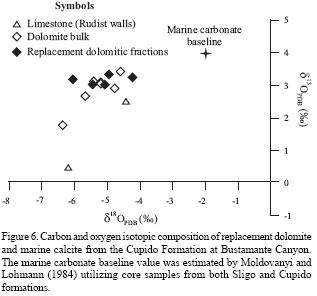
<body><![CDATA[<p align="justify"><font face="verdana" size="2">Manuscritpt received: June 2, 2006    <br> Corrected manuscript received: September 6, 2006    <br> Manuscript accepted: December 4, 2006</font></p>     <p align="justify"><font face="verdana" size="2">&nbsp;</font></p>     <p align="justify"><font face="verdana" size="2"><b>ABSTRACT</b></font></p>     <p align="justify"><font face="verdana" size="2">The Lower Cretaceous Cupido Formation, a carbonate system developed in northeastern Mexico, like many ancient carbonate platforms contains numerous dolomite bodies. These diagenetic features are particularly &#150;well exposed at Bustamante Canyon (Nuevo Leon State) &#150;where the Cupido Formation crops out from base to top along 6 km. Dolomitization affected practically all fades and crosscuts bedding planes; dolomite bodies are irregular in outer and margin platform fades and tabular/subhorizontal in inner platform fades. Most dolomite is replacive and also occurs as cement in small amounts. Crystal shape of replacement dolomite varies from nonplanar, planar&#150;s toplanar&#150;e, whereas the dolomite cement consists mostly of saddle dolomite. Dolomite is nonferroan and shows dull red luminescence, its <img src="/img/revistas/rmcg/v24n2/a2s1.jpg"><sup>18 </sup>O<sub>PDB </sub>varies from &#150;4.2 to &#150;6.4&permil; and its <img src="/img/revistas/rmcg/v24n2/a2s1.jpg"><sup>13</sup>C<sub>PDB</sub> from 1.8 to 3.4&permil;. <sup>87</sup>Sr / <sup>86</sup>Sr ratios of replacement dolomite vary from 0.70754 to 0.70770. Homogenization temperatures in dolomite from fluid inclusion analysis range from 190 &deg;C to 200 &deg;C and are interpreted as the minimum temperatures for the dolomite formation. Petrographic data, geometries and distribution of dolomite bodies, microthermometric results from fluid inclusions and geochemical information suggest that the dolomitization occurred under deep&#150;burial diagenetic conditions. Similar homogenization temperatures were determined in dolomite and post&#150;dolomite calcite cement of the Cupido Formation from southern locations including Potrero Chico and Potrero Minas Viejas. The high temperatures recorded in the Cupido Formation dolomites are the result of a regional thermal anomaly developed probably around salt structures. <sup>87</sup>Sr / <sup>86</sup> values, oxygen stable isotopes, and trace element composition of dolomite suggest that the dolomitizing fluid was perhaps a hot mixture of formation water (modified sea water) of the Cupido Formation and brines derived from the updip La Virgen Formation, a carbonate&#150;evaporite succession equivalent in age to the Cupido Formation. Dolomite distribution was apparently not controlled by major tectonic features (<i>e.g.</i>, faults orfractures); the dolomitizing fluid seems to have followed subhorizontal or lateral flowing circulating patterns controlled by the former porosity and permeability of the calcareous facies.</font></p>     <p align="justify"><font face="verdana" size="2"><b>Key words:</b> dolomite, high&#150;temperature, thermal anomaly, Cupido Formation, Lower Cretaceous.</font></p>     <p align="justify"><font face="verdana" size="2">&nbsp;</font></p>     <p align="justify"><font face="verdana" size="2"><b>RESUMEN</b></font></p>     <p align="justify"><font face="verdana" size="2">La Formaci&oacute;n Cupido del Cret&aacute;cico Inferior, un sistema carbonatado desarrollado en el noreste de M&eacute;xico, como muchas de las plataformas carbonatadas antiguas contiene numerosos cuerpos de dolomita. Estas rasgos diagen&eacute;ticos est&aacute;n particularmente bien expuestas en el Ca&ntilde;&oacute;n de Bustamante (Estado de Nuevo Le&oacute;n), donde la Formaci&oacute;n Cupido aflora desde su base hasta su cima a lo largo de 6 km. La dolomitizaci&oacute;n afect&oacute; pr&aacute;cticamente todas las fades cruzando los planos de estratificaci&oacute;n; los cuerpos de dolomita son irregulares en las fades de plataforma externa y margen de plataforma y tabulares a subhorizontales en las fades de interior de plataforma. La mayor&iacute;a de la dolomita es de reemplazamiento y tambi&eacute;n ocurre como cemento en cantidades menores. Las formas de los cristales de la dolomita de reemplazamiento var&iacute;an de no&#150;planar, a planar&#150;s y a planar&#150;e; la dolomita de cemento es en su mayor&iacute;a dolomita barroca. La dolomita es no ferrosa y exhibe luminiscencia opaca de color rojo, su <img src="/img/revistas/rmcg/v24n2/a2s1.jpg"><sup>18</sup>0<sub>PDB</sub> var&iacute;a de &#150;4.2 a &#150;6.4&permil; y su <img src="/img/revistas/rmcg/v24n2/a2s1.jpg"><sup>13</sup>C<sub>PDB</sub> de 1.8a 3.4&permil;. La relaci&oacute;n<sup>87</sup>Sr / <sup>86</sup>Srde la dolomita de reemplazamiento var&iacute;a de 0.70754 a 0.70770. Las temperaturas de homogeneizaci&oacute;n de la dolomita medidas en inclusiones fluidas var&iacute;an de 190 a 200 &deg;C y se interpretan como las temperaturas m&iacute;nimas deformaci&oacute;n de la dolomita. Los datos petrogr&aacute;ficos, la geometr&iacute;a y la distribuci&oacute;n de los cuerpos de dolomita, los resultados microtermom&eacute;tricos de inclusiones fluidas y la informaci&oacute;n geoqu&iacute;mica sugieren que la dolomitizaci&oacute;n ocurri&oacute; bajo condiciones diagen&eacute;ticas de sepultamiento profundo. Temperaturas de homogeneizaci&oacute;n similares fueron determinadas en dolomita y cemento de calcita post&#150;dolomita de la Formaci&oacute;n Cupido de localidades m&aacute;s al sur, incluyendo Potrero Chico y Potrero Minas Viejas. Las altas temperaturas registradas en las dolomitas de la Formaci&oacute;n Cupido son el resultado de una anomal&iacute;a t&eacute;rmica regional desarrollada probablemente alrededor de estructuras salinas. Las relaciones de <sup>87</sup>Sr/<sup>86</sup>Sr, los is&oacute;topos de ox&iacute;geno y la composici&oacute;n de los elementos traza de la dolomita sugieren que el fluido dolomitizante fue posiblemente una mezcla caliente de agua deformaci&oacute;n (agua marina modificada) de la Formaci&oacute;n Cupido y salmueras derivadas de la Formaci&oacute;n La Virgen, una sucesi&oacute;n carbonatada&#150;evapor&iacute;tica equivalente en edad a la Formaci&oacute;n Cupido. La distribuci&oacute;n de la dolomita no estuvo aparentemente controlada por rasgos tect&oacute;nicos mayores (<i>e.g.</i>, fallas o fracturas); los fluidos dolomitizantes parecen haber seguido patrones de circulaci&oacute;n de flujo subhorizontal o lateral, controlados por la porosidad y permeabilidad originales de las fades calc&aacute;reas.</font></p>     ]]></body>
<body><![CDATA[<p align="justify"><font face="verdana" size="2"><b>Palabras clave:</b> Dolomita, alta temperatura, anomal&iacute;a t&eacute;rmica, Formaci&oacute;n Cupido, Cret&aacute;cico Inferior.</font></p>     <p align="justify"><font face="verdana" size="2">&nbsp;</font></p>     <p align="justify"><font face="verdana" size="2"><b>INTRODUCTION</b></font></p>     <p align="justify"><font face="verdana" size="2">The Cupido Formation is part of an extensive carbonate platform developed during Early Cretaceous time from northeastern Mexico to western Florida. This carbonate platform is exceptionally well exposed across northern Mexico, which allows conducting geologic research in great detail (Murillo&#150;Mu&ntilde;et&oacute;n, 1999). The age of the Cupido Formation ranges from upper Hauterivian to lower Aptian (Humphrey, 1949; Humphrey and Diaz, 1956; Guzman, 1974; Alfonso&#150;Zwanziger, 1978; Zarate&#150;Mendoza, 1984; Garc&iacute;a <i>et al, </i>1989; McFarlan and Menes, 1991; Guzman&#150;Garcia, 1991). This lithostratigraphic unit includes carbonate facies ranging from shallow water (inner platform and platform margin) to deeper water (outer platform) environments (Conklin and Moore, 1977; Selvius and Wilson, 1985; Murillo&#150;Mu&ntilde;et&oacute;n, 1999).</font></p>     <p align="justify"><font face="verdana" size="2">The diagenetic history of the Cupido Formation is poorly known. Only a few studies have been conducted to understand the diagenetic changes in the Cupido carbonate platform. Based on detailed petrography, Guzman (1974) identified effects of marine, meteoric and burial diagenesis on the inner platform facies of the Cupido Formation at the Cortinas Canyon, State of Nuevo Le&oacute;n. In their classic paper on the definition of saddle dolomite, Radke and Mathis (1980) included dolomite samples of the Sligo Formation which is the equivalent of the Cupido Formation in the United States Gulf Coast region. Moldovany i and Lohmann (1984) estimated a <img src="/img/revistas/rmcg/v24n2/a2s1.jpg" "14"><sup>18</sup>O<sub>PDB</sub> value of &#150;2.0&permil; and a <img src="/img/revistas/rmcg/v24n2/a2s1.jpg"><sup>13</sup>C<sub>PDB</sub> of +4.0&permil; for the original marine carbonate composition for Lower Cretaceous time utilizing carbonate constituents of the Cupido and Sligo formations. Like most ancient carbonate systems, the Cupido platform commonly shows dolo&#150;mitized segments, which are well exposed in northeastern Mexico. Bustamante Canyon is an extraordinary location where the Cupido Formation crops out completely from base to top; and the geometry of the dolomitized bodies can be traced accurately in two dimensions (Murillo&#150;Mu&ntilde;et&oacute;n, 1999; Murillo&#150;Mu&ntilde;et&oacute;n and Dorobek, 2003; <a href="#f1">Figures 1</a> and <a href="/img/revistas/rmcg/v24n2/a2f2.jpg" target="_blank">2</a>). Distribution and geometries of the dolomitized bodies of the Cupido Formation were mapped at Bustamante Canyon by Murillo&#150;Mu&ntilde;et&oacute;n (1999), who inferred that they could have been the result of deep&#150;burial diagenesis conditions. However, a systematic study of the origin of these dolomite bodies was still lacking. Understanding the diagenetic processes, including dolomitization that affected the evolution of the porosity in the Cupido Formation, can be useful in oil exploration and production activities in the Sabinas Basin.</font></p>     <p align="center"><font face="verdana" size="2"><a name="f1"></a></font></p>     <p align="center"><font face="verdana" size="2"><img src="/img/revistas/rmcg/v24n2/a2f1.jpg"></font></p>     <p align="justify"><font face="verdana" size="2">This paper presents the results of an integrated study of the dolomitization processes that affected the Cupido Formation exposed at Bustamante Canyon. The occurrence of high&#150;temperature dolomite in the Cupido Formation is reported for the first time at this location, and its possible origin is discussed.</font></p>     <p align="justify"><font face="verdana" size="2">&nbsp;</font></p>     <p align="justify"><font face="verdana" size="2"><b>METHODS</b></font></p>     ]]></body>
<body><![CDATA[<p align="justify"><font face="verdana" size="2">To conduct this research, an integrated approach was followed to understand the dolomitization processes of the Cupido Formation at Bustamante Canyon. Several techniques were applied including: field work, petrography (plane light, cathodoluminescence and epifluorescence), major and trace element geochemistry, carbon and oxygen stable isotope analysis, strontium isotope analysis, and fluid inclusion thermometry.</font></p>     <p align="justify"><font face="verdana" size="2">&nbsp;</font></p>     <p align="justify"><font face="verdana" size="2"><b>Field work</b></font></p>     <p align="justify"><font face="verdana" size="2">A representative stratigraphic section on the northern wall of Bustamante Canyon was selected for this study on the basis of previous field work by Murillo&#150;Mu&ntilde;et&oacute;n (1999). This stratigraphic section was chosen where all the sedimentary facies of the Cupido Formation, including cyclic inner platform, platform margin and outer platform facies have been partially dolomitized. Reconnaissance work was also done to verify whether the underlying Taraises Formation and overlying La Pe&ntilde;a Formation were affected by the dolomitization processes. Dolomite characteristics such as crystal shape and size according to the precursor limestone facies were recorded carefully. Forty two rock samples were collected and 85 additional rock samples collected by Murillo&#150;Mu&ntilde;et&oacute;n (1999) were utilized for further petrographic, geochemical and thermo&#150;metric analyses.</font></p>     <p align="justify"><font face="verdana" size="2">&nbsp;</font></p>     <p align="justify"><font face="verdana" size="2"><b>Petrography</b></font></p>     <p align="justify"><font face="verdana" size="2">One hundred and twenty seven thin sections were prepared for petrographic studies. The thin sections were stained with Alizarine Red S and K&#150;ferricyanide following the technique of Dickson (1966). Depositional texture, grain constituents, cement types, and other major diagenetic features were documented for each sedimentary lithofacies. Dolomite characteristics such as crystal shape and size, presence of fluid inclusions and its timing relative to other diagenetic features (<i>e.g., </i>compaction and stylolites) were carefully documented.</font></p>     <p align="justify"><font face="verdana" size="2">&nbsp;</font></p>     <p align="justify"><font face="verdana" size="2"><b>Cathodoluminescence petrography</b></font></p>     <p align="justify"><font face="verdana" size="2">A subset of 60 thin sections was chosen from the different dolomitized facies and was examined by cathodoluminescence. This work was done using a Relion lumino&#150;scope at the Instituto de Geolog&iacute;a (Universidad Nacional Aut&oacute;noma de M&eacute;xico) and a Relion luminoscope coupled to a Nikon petrographic microscope with image analysis software at the Instituto Mexicano del Petr&oacute;leo. Operating conditions in both places were: accelerating potential 15 kV, 250 &micro;A beam current, and 0.01 torr for vacuum. Luminescence of replacement dolomite and dolomite cement as well as post&#150;dolomite calcite cement was recorded. Special attention was focused on the presence or absence of luminescence zoning in the diagenetic mineral phases.</font></p>     ]]></body>
<body><![CDATA[<p align="justify"><font face="verdana" size="2">&nbsp;</font></p>     <p align="justify"><font face="verdana" size="2"><b>Geochemical analyses</b></font></p>     <p align="justify"><font face="verdana" size="2">Field relationships and the results from plane light/ cathodoluminescence petrography were used to select representative samples of dolomite from the different facies for geochemical studies. These analysis included major and trace element geochemistry, oxygen and carbon stable isotope geochemistry and strontium isotopes.</font></p>     <p align="justify"><font face="verdana" size="2"><b><i>Major and trace element geochemistry</i></b></font></p>     <p align="justify"><font face="verdana" size="2">Six samples of dolomite and one of post&#150;dolomite calcite cement were analyzed for major and trace element composition. A total of 84 points (analyses) were examined utilizing a Cameca electron microprobe at the Texas A &amp; M University (Department of Geology and Geophysics, College Station, Texas). Operating conditions were as follows: accelerating voltage 15 kV, beam current 15 nA, and beam diameter 10 um. Major elements quantified included Ca and Mg; and trace elements included: Fe, Mn, Na, and Sr. Lower detection limits, in ppm, for trace element measurements were: 20, 100, 90, 130, and 30 for Mg, Fe, Mn, Sr, and Na, respectively.</font></p>     <p align="justify"><font face="verdana" size="2"><b><i>Oxygen and carbon stable isotopes</i></b></font></p>     <p align="justify"><font face="verdana" size="2">Oxygen and carbon stable isotope analyses were performed on six samples of individual replacement dolomite, six samples of bulk dolomite, two samples of original marine calcite, and one sample of post&#150;dolomite calcite cement at the Stable Isotope Laboratory of the Laboratorio Universitario de Geoqu&iacute;mica Isot&oacute;pica (LUGIS) of the Instituto de Geolog&iacute;a (Universidad Nacional Aut&oacute;noma de M&eacute;xico). The isotopic ratios represent bulk compositions of replacement dolomite and post&#150;dolomite calcite cement. Rock samples were crushed in an agate mortar. Replacement dolomite was extracted by hand with pointed pliers and a dissection needle. Special care was taken to exclude dolomite cement from the analyses. The dolomite concentrates were cleaned with deionized water in an ultrasonic bath, dryed and powdered in an agate mortar. The original marine calcite was extracted also by hand utilizing a dissection needle and a microdrill. These samples were taken directly from a bivalve shell on a thin section under a petrographic microscope. All carbonate samples were placed in individual test tubes. They were washed with acetone in an ultrasonic bath for 30 minutes and dried in an oven at 80 &deg;C. Approximately 400 &micro;g of powdered sample was employed for each isotopic analysis. Samples were reacted with orthophosphoric acid at 25 &deg;C for calcite and at 72 &deg;C for dolomite; the produced CO<sub>2</sub> gas was fed directly into the mass spectrometer. The isotopic ratios were measured in a Thermoquest Finnigan Delta Plus&#150;XL mass spectrometer with dual inlet, Gas Bench II as interface utilizing an autosampler GC PAL. The isotope ratio was determined simultaneously for carbon and oxygen following the procedure described by Revez <i>et al. </i>(2001) and Revez and Landwehr (2002). Isotopic ratios were measured relative to the NBS&#150;18 and LSVEC standards and converted to PDB values. Accuracy of the analyses was checked using a calcite reference sample which was analyzed every seven samples. The standard deviation reported is 0.2&permil; for <img src="/img/revistas/rmcg/v24n2/a2s1.jpg" "14"><sup>18</sup>O and 0.2&permil; for<img src="/img/revistas/rmcg/v24n2/a2s1.jpg"><sup>13</sup>C.</font></p>     <p align="justify"><font face="verdana" size="2"><b><i>Strontium isotopes</i></b></font></p>     <p align="justify"><font face="verdana" size="2">The <sup>87</sup>Sr/<sup>86</sup>Sr ratios of six samples of replacement dolomite, two samples of original marine calcite and one sample of post&#150;dolomite calcite cement from the Cupido Formation were measured at LUGIS of the Instituto de Geof&iacute;sica. Additionally, the<sup>87</sup>Sr / <sup>86</sup>Srratios of two samples of gypsum, three samples of marine lime mud and three samples of fine&#150;grained dolomite from the La Virgen Formation, an updip time&#150;equivalent stratigraphic unit of the Cupido Formation, were measured. Sr&#150;Spec resin (Eichcrom&reg;) was used to separate strontium, nitric acid (8N) for sample dissolution, nitric acid (3N) for column cleaning, and milli Q water to collect the Sr. The isotopic ratios were measured in a Finnigan MAT 262 thermal ionization mass spectrometer equipped with a variable multicollector system (eight Faraday cups) in static mode. The samples were loaded as chlorides on double rhenium filaments and were measured as metallic ions. Sixty Sr isotopic ratios (n) were measured for each sample. Reported analytical errors (lsd) are referred to the last two digits. The standard utilized was NBS 987 (<sup>87</sup>Sr/ <sup>86</sup>Sr= 0.710237 &plusmn; 21; n = 317). All Sr isotopic ratios were corrected for mass fractionation by normalizing to <sup>87</sup>Sr/ <sup>86</sup>Sr= 0.1194. The average analytical blank obtained during the time of the sample analyses was 5.5 ng Sr (total blank). For interpretation of the <sup>87</sup>Sr/ <sup>86</sup>Sr ratios, the Burke's marine Sr isotope curve recently improved by McArthur <i>et al. </i>(2001) was utilized and the absolute values were referred to the International Stratigraphic Chart (International Commission of Stratigraphy, 2004).</font></p>     <p align="justify"><font face="verdana" size="2">&nbsp;</font></p>     ]]></body>
<body><![CDATA[<p align="justify"><font face="verdana" size="2"><b>Fluid inclusion microthermometry</b></font></p>     <p align="justify"><font face="verdana" size="2">Fluid inclusion microthermometry was carried out to estimate the crystallization homogenization temperatures of dolomites of the Cupido Formation. Ninety eight measurements of homogenization temperature (Th) were made on six dolomite samples. Thirty two measurements were made on three samples of post&#150;dolomite calcite cement. These analyses were conducted at the Instituto Mexicano del Petr&oacute;leo employing a Linkam heating&#150;cooling stage (model THMSG&#150;600) adapted to a petrographic microscope. The equipment also includes a monitor to observe phase changes that occur to the fluid inclusions; a computer allows the total control of the instrument performance. The stage is connected to both a temperature controller that heats up the sample and to a cooling pump that circulates liquid nitrogen. Temperature range varies from &#150;180 &deg;C to 600 &deg;C with both devices. Heating velocity of the analyses was 10 &deg;C/min. The standard utilized for calibration was synthetic quartz; it was calibrated with H<sub>2</sub>O at critical density (0 &deg;C and 374.1 &deg;C) and also calibrated with H<sub>2</sub>O and CO<sub>2</sub> (25%M; &#150;56.6 &deg;C). For this study, only primary fluid inclusions were considered, avoiding those fluid inclusions showing necking down. An additional group of seven samples were analyzed under epifluorescence in a petrographic microscope with an adapted mercury lamp to identify hydrocarbon fluid inclusions.</font></p>     <p align="justify"><font face="verdana" size="2">&nbsp;</font></p>     <p align="justify"><font face="verdana" size="2"><b>REGIONAL GEOLOGIC FRAMEWORK</b></font></p>     <p align="justify"><font face="verdana" size="2">Excellent outcrops of Mesozoic strata in northeast Mexico are distributed across the Coahuila Folded Belt and the Sierra Madre Oriental. The outcropping stratigraphy in this region includes marine sedimentary rocks that range in age from Middle Jurassic to early Tertiary. This heterogeneous sedimentary package is the result of the opening and subsequent evolution of the Gulf of Mexico Basin (Salvador, 1987; Wilson, 1990; Goldhammer <i>et al.</i>, 1991; Michalzik, 1991). The central parts of some localities <i>{e.g., </i>Potrero Minas Viejas and Potrero Chico) contain Middle Jurassic marine evaporites (gypsum and halite) of the Minas Viejas Formation (Salvador, 1987; Wilson, 1990; Goldhammer <i>et al., </i>1991; Michalzik, 1991). Upper Jurassic carbonate&#150;evaporitic strata of the Oxfordian Zuloaga Formation are the oldest marine carbonate sediments in the region and unconformably overlie Upper Triassic continental beds of the Huizachal or Boca Formation (Carrillo&#150;Bravo, 1961). Marine carbonates, evaporites and terrigenous sediments of the Olvido and La Gloria formations (Kimmeridgian) as well as marine siliciclastic rocks of the La Casita Formation (Kimmeridgian&#150;Berriasian) make up the remainder of the Upper Jurassic strata in this area.</font></p>     <p align="justify"><font face="verdana" size="2">The Lower Cretaceous stratigraphy in northeastern Mexico shows important vertical and lateral facies variations. These strata include both shallow&#150;water and deep&#150;water carbonates, inner platform evaporites, and continental and marine siliciclastic sediments. A thick section of fluvial and shallow&#150;marine sediments was deposited adjacent to the Coahuila paleo&#150;Peninsula during Berriasian&#150;Hauterivian time. These include conglomerates, sandstones, shales, and limestones of the San Marcos Arkose, Patula Arkose, Menchaca, and Barril Viejo formations (<a href="/img/revistas/rmcg/v24n2/a2f3.jpg" target="_blank">Figure 3</a>). These units grade basinward into coeval deeper&#150;water marine shales and limestones of the Taraises Formation.</font></p>     <p align="justify"><font face="verdana" size="2">During late Hauterivian to early Aptian time, the Cupido carbonate system was developed in the region. Updip, limestones and shales of the La Mula Formation followed by cyclic carbonates and evaporites of the La Virgen Formation as well as shallow&#150;water carbonates of the Cupido Formation were accumulated in inner platform region (Humphrey and Diaz, 1956; Guzm&aacute;n&#150;Garc&iacute;a, 1991; Hern&aacute;ndez&#150;Trejo, 2003). The Cupido platform margin facies tract consists of rudist fragment&#150;rich grainstone and pack&#150;stone with minor rudist boundstone. These facies change seaward to open marine lime mudstone andbasinal carbonates of the Lower Tamaulipas Formation (Murillo&#150;Mu&ntilde;et&oacute;n, 1999, and references therein).</font></p>     <p align="justify"><font face="verdana" size="2">During the late Aptian, the Cupido carbonate platform was succeeded by open marine shaly carbonates of the La Pe&ntilde;a Formation (Salvador, 1987; Wilson, 1990; Goldhammer <i>et al., </i>1991; McFarlan and Menes, 1991; Murillo&#150;Mu&ntilde;et&oacute;n, 1999). The middle and Upper Cretaceous is represented by deep&#150;water carbonates (Upper Tamaulipas and Aurora formations) and shaly carbonates and siliciclastic facies (San Felipe and M&eacute;ndez formations, Parras Shale and Difunta Group; Humphrey and Diaz, 1956; Weidie and Murray, 1967; Padilla y S&aacute;nchez, 1978; Wilson <i>et al, </i>1984).</font></p>     <p align="justify"><font face="verdana" size="2">Finally, during Late Cretaceous time, the tectonic regime changed dramatically from a typical passive margin regime to a compressional tectonic scenario as a consequence of the Laramide Orogeny that ended in Eocene time (Lawton and Giles, 1997). The Coahuila Folded Belt, the Sierra Madre Oriental, and the Parras and La Popa foreland basins were formed during the Laramide Orogeny (Kellum <i>et al, </i>1936; Imlay, 1936; Humphrey and Diaz, 1956; Charleston, 1973, 1981).</font></p>     <p align="justify"><font face="verdana" size="2">&nbsp;</font></p>     ]]></body>
<body><![CDATA[<p align="justify"><font face="verdana" size="2"><b>STRATIGRAPHY AND SEDIMENTOLOGY OF THE CUPIDO FORMATION IN NORTHEASTERN MEXICO</b></font></p>     <p align="justify"><font face="verdana" size="2">As mentioned above, the Cupido Formation represents a marine carbonate platform that includes inner platform, platform margin and open marine facies. This carbonate system represents a large&#150;scale prograding carbonate platform with lower hierarchy transgressive&#150;regressive cycles developed from late Hauterivian to early Aptian time in a passive margin (Goldhammer <i>et al, </i>1991; Goldhammer, 1995, 1999; Lehmann <i>et al., </i>1998, 1999, 2000; Murillo&#150;Mu&ntilde;et&oacute;n, 1999). The Cupido platform has traditionally been considered as a rimmed shelf, however, extensive field work suggests that during its early development the platform had rather a low&#150;angle, ramp&#150;type depositional profile in the study area (Murillo&#150;Mu&ntilde;et&oacute;n, 1999; Murillo&#150;Mu&ntilde;et&oacute;n and Dorobek, 2003).</font></p>     <p align="justify"><font face="verdana" size="2">&nbsp;</font></p>     <p align="justify"><font face="verdana" size="2"><b>Sedimentary facies</b></font></p>     <p align="justify"><font face="verdana" size="2">A brief description of the Cupido Formation sedimentary facies at Bustamante Canyon is given in this section; for further details refer to Murillo&#150;Mu&ntilde;et&oacute;n (1999). Shallow&#150;water subtidal facies constitute the inner platform and platform margin facies tracts. Interior platform facies are typically arranged cyclically, forming shallowing&#150;up&#150;ward subtidal cycles. A typical cycle begins with a highly bioturbated lime mudstone/wackestone or a skeletal&#150;coated grain&#150;peloidal packstone/grainstone that grades upward to a skeletal&#150;coated grain&#150;peloidal packstone/grainstone. Skeletal carbonate grains in the cycles include shallow&#150;water marine biota such as fragments of rudists (mainly requieniids), green calcareous algae (dasycladacean and codiacean algae), red coralline algae, gastropods, corals, echinoderms, ostracodes, and benthic foraminifers. The platform margin facies consist of massive rudist fragment&#150;peloidal&#150;skeletal&#150;intraclast packstone, and scarce buildups of coral&#150;stromatoporoid&#150;rudist boundstone. Cycles are apparently absent in the platform margin facies tract. Skeletal carbonate grains in this tract are similar to those in the inner platform facies but with a significant amount of fragments of caprinid and requieniid rudists.</font></p>     <p align="justify"><font face="verdana" size="2">Open platform facies include both outer ramp facies and deep ramp/basin facies. Outer ramp facies consist of medium&#150; to thick&#150;bedded, peloidal&#150;skeletal&#150;intraclast wackestone and packstone with chert nodules. Benthic foraminifers, ostracodes, and fragments of echinoderms, bryozoans, mollusks, as well as whole fossils of pelecy&#150;pods, siliceous sponges, and small solitary and colonial corals comprise the skeletal content in these strata. Deep ramp/basin facies consist of lime mudstone and shaly lime mudstone. The lime mudstone facies are medium to very thick bedded and show bioturbation whereas the shaly lime mudstone facies are typically thin and nodular bedded. The skeletal content in these facies is poor and includes small benthic foraminifers, ostracodes, and fragments of bryo&#150;zoans, echinoderms, mollusks, and siliceous sponges.</font></p>     <p align="justify"><font face="verdana" size="2">Numerous carbonate mud mounds also developed throughout the Cupido platform margin and outer platform settings at Bustamante Canyon. Further details on these organic carbonate buildups are presented in Murillo&#150;Mu&ntilde;et&oacute;n (1999) and Murillo&#150;Mu&ntilde;et&oacute;n and Dorobek (2003). Four types of carbonate mud mounds occur at this location: Type 1 siliceous sponge&#150;microbial mud mounds; Type 2 sponge&#150;microbial mud mounds; Type 3 sponge microbial&#150;coral mud mounds; and Type 4 calcisponge&#150;microbial&#150;coral biodetrital mud mounds. Type 1 siliceous sponge&#150;microbial mud mounds are the oldest and most abundant mounds; they grow up adjacent to deep ramp/basinal lime mudstone facies. These carbonate buildups consist of microbial mud with siliceous sponges and encrusting organisms such as bryozoans, foraminifers, and agglutinating and serpulid worm tubes. Type 2 sponge&#150;microbial mud mounds are associated with outer ramp wackestone/packstone facies and their fossil content is similar to that of the sponge&#150;microbial mud mounds, but they also contain calcareous sponges, red coralline algae and benthic foraminifers. Type 3 sponge&#150;microbial&#150;coral mounds developed adjacent to outer ramp packstone facies, and their skeletal components are similar to those of Type 2 mounds but also contain small colonial corals. Pockets of skeletal grains are common in mounds of types 2 and 3. Type 4 calcisponge&#150;microbial&#150;coral biodetrital mounds are the youngest mounds and are associated with outer ramp packstone and ramp crest rudist packstone facies. These carbonate buildups also contain abundant shallow&#150;water skeletal constituents including benthic foraminifers, worm tubes, and fragments of calcareous algae, gastropods, pelecypods, and echinoderms. Both length and height of individual Type 1,2, and 3 mounds range from a few to tens of meters whereas Type 4 mounds reach several hundred meters in length and are up to 90 m thick.</font></p>     <p align="justify"><font face="verdana" size="2">&nbsp;</font></p>     <p align="justify"><font face="verdana" size="2"><b>DISTRIBUTION AND CHARACTERIZATION OF THE CUPIDO FORMATION DOLOMITE AT BUSTAMANTE CANYON</b></font></p>     <p align="justify"><font face="verdana" size="2"><b>Dolomite distribution and its controls at Bustamante Canyon</b></font></p>     ]]></body>
<body><![CDATA[<p align="justify"><font face="verdana" size="2">Dolomite bodies in the Cupido Formation show a complex but systematic distribution at Bustamante Canyon. The dolomite distribution was controlled, in part, by the type of sedimentary facies that was eventually dolomi&#150;tized. Overall, two main geometries in the dolomite bodies are distinguished: (1) very irregular dolomite bodies and (2) tabular/subhorizontal dolomite bodies. The irregular dolomite bodies occur within the lower part of the Cupido Formation where the carbonate mud mounds are abundant. These dolomite bodies form large carbonate masses that are partially to completely dolomitized. Dolomitization in these bodies crosscuts bedding planes and is more penetrative in the facies containing the shallowest&#150;water carbonate mud mounds (types 3 and 4) and less intense in the lime mud&#150;rich facies containing the deeper&#150;water carbonate mud mounds (types 2 and 1). In contrast, tabular/subhorizontal dolomite bodies occur in the upper part of the Cupido Formation consisting of lime mud&#150;poor, cyclic inner platform facies. Dolomitization, often, was more pervasive in the lower transgressive part of the cycles. Since the Cupido Formation at this location is completely exposed from base to top, it is clear that the dolomite is distributed, to different degrees, throughout this lithostratigraphic unit. Nevertheless, the dolomitization event did not affected the sedimentary facies of both the underlying Taraises and overlying La Pe&ntilde;a formations. Furthermore, it is also clear that the dolomite bodies are not spatially related to faulting. Although normal faults with a few meters of displacement occur at this location, no major faults that might have controlled the dolomite distribution are present at Bustamante Canyon (Murillo&#150;Mu&ntilde;et&oacute;n, 1999).</font></p>     <p align="justify"><font face="verdana" size="2">&nbsp;</font></p>     <p align="justify"><font face="verdana" size="2"><b>Dolomite types</b></font></p>     <p align="justify"><font face="verdana" size="2">Two main dolomite types can be distinguished petrographically in the Cupido Formation at Bustamante Canyon. The most abundant type is replacement dolomite and the less common is dolomite cement. Crystal size of the replacement dolomite was controlled, in part, by the depositional texture of the sedimentary facies that were subsequently dolomitized. Crystal size of dolomite varies from very fine to coarse&#150;grained (30 &micro;m to <img src="/img/revistas/rmcg/v24n2/a2s2.jpg">2 mm). Very&#150;fine grained dolomite replaced calcareous mud, peloids, and calcite cement veins. Medium&#150; and coarse&#150;grained dolomite replaced blocky calcite cement and larger carbonate constituents including skeletal grains and intraclasts. Thus, fine&#150;grained dolomite occurs mostly in carbonate mud&#150;rich facies suchas lime mudstone and wackestone lithofacies whereas coarser dolomite is found mostly in carbonate mud&#150;poor lithofacies such as packstone and grainstone. Likewise, dolomitized deep&#150;water carbonate mud mounds (types 1 and 2) contain commonly fine&#150;grained dolomite whereas dolomitized shallower&#150;water carbonate mud mounds (types 3 and 4) contain coarser&#150;grained dolomite. Following the classification by Sibley and Gregg (1987), shapes of dolomite crystals in the Cupido Formation include: anhedral (nonplanar), subhedral (planar&#150;s), and euhedral (planar&#150;e) (<a href="/img/revistas/rmcg/v24n2/a2f4.jpg" target="_blank">Figure 4</a>). The most abundant is nonplanar dolomite and the less common are planar&#150;s and planar&#150;e. Some dolomite crystals have cloudy cores, due to the presence of fluid inclusions, and limpid rims. Dolomite cement is found filling voids related to primary porosity, intercrystalline porosity and small fractures resulting from deep&#150;burial diagenetic events (<a href="/img/revistas/rmcg/v24n2/a2f4.jpg" target="_blank">Figure 4e</a>). Dolomite cement is commonly euhedral and its size ranges from medium to coarse (0.1 mm a 2.3 mm; <a href="/img/revistas/rmcg/v24n2/a2f4.jpg" target="_blank">Figure 4e</a>). Most dolomite cement has cloudy cores and limpid rims and some is saddle dolomite. Under epifluorescence petrography, some dolostone samples show a yellow color along the crystal boundaries due to the presence of aromatic hydrocarbons. Fluorescence is not observed inside dolomite crystals suggesting that the fluid inclusions lack liquid hydrocarbons. A common late diagenetic phase consists of post&#150;dolomite blocky calcite cement that fills crystalline porosity and fractures (<a href="/img/revistas/rmcg/v24n2/a2f4.jpg" target="_blank">Figure 4h</a>).</font></p>     <p align="justify"><font face="verdana" size="2">&nbsp;</font></p>     <p align="justify"><font face="verdana" size="2"><b>Cathodoluminescence petrography of dolomite</b></font></p>     <p align="justify"><font face="verdana" size="2">Cathodoluminescence patterns of carbonate constituents were analyzed in 60 representative samples of the Cupido Formation. Luminescence of the different components and diagenetic phases of the precursor limestones, do&#150;lostones and post&#150;dolomite calcite cement was documented. Overall, the original carbonate phases of the limestones show no luminescence. Both replacement dolomite and dolomite cement show dull luminescence with a typical homogeneous red color lacking zoning (<a href="/img/revistas/rmcg/v24n2/a2f4.jpg" target="_blank">Figures 4b</a>, <a href="/img/revistas/rmcg/v24n2/a2f4.jpg" target="_blank">4d</a> and <a href="/img/revistas/rmcg/v24n2/a2f4.jpg" target="_blank">4f</a>).). In contrast, the post&#150;dolomite blocky calcite cement shows concentric zoning consisting of alternating brilliant bands, dull bands and non&#150;luminescent bands (<a href="/img/revistas/rmcg/v24n2/a2f4.jpg" target="_blank">Figure 4h</a>).</font></p>     <p align="justify"><font face="verdana" size="2">&nbsp;</font></p>     <p align="justify"><font face="verdana" size="2"><b>Geochemistry of dolomites</b></font></p>     <p align="justify"><font face="verdana" size="2"><b><i>Major and trace elements</i></b></font></p>     ]]></body>
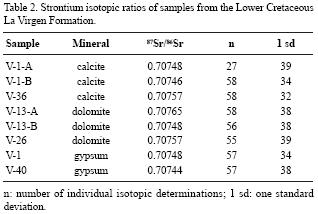
<body><![CDATA[<p align="justify"><font face="verdana" size="2">From major element analyses, the Ca/Mg ratio of the Cupido Formation replacement dolomite varies from 1.03 to 1.10 (<a href="/img/revistas/rmcg/v24n2/a2t1.jpg" target="_blank">Table 1</a>). This ratio indicates that the replacement dolomite of the Cupido Formation is very close to stoichiometry (Scoffin, 1987; Morse and Mackenzie, 1990; Tucker and Wright, 1990). The trace element abundances in the dolomite from different dolomitized lithofacies and different stratigraphic position vary as follows: 111 to 3,292 ppm for Fe; 91 to 234 ppm for Mn; 30 to 566 ppm for Na; and 131 to 1,608 ppm for Sr. There is no obvious pattern in those variations between samples nor between cores and rims of individual dolomite crystals (<a href="/img/revistas/rmcg/v24n2/a2f5.jpg" target="_blank">Figure 5a</a> and <a href="/img/revistas/rmcg/v24n2/a2f5.jpg" target="_blank">5b</a>). The post&#150;dolomite calcite cement has the following trace element concentrations: 207 to 3,148 ppm for Fe; 91 to 235 ppm for Mn; 56 to 616 ppm for Na; and 134 to 789 ppm for Sr. Compared to the Fe content, Mn concentration is relatively low (91 to 234 ppm) in all samples.</font></p>     <p align="justify"><font face="verdana" size="2"><b><i>Oxygen and carbon stable isotopes</i></b></font></p>     <p align="justify"><font face="verdana" size="2">The <img src="/img/revistas/rmcg/v24n2/a2s1.jpg" "14"><sup>18</sup>O<sub>PDB</sub> values of the Cupido Formation replacement dolomites at Bustamante Canyon ranges from &#150;6.4 to &#150;4.2&permil; (<a href="#f6">Figure 6</a>; <a href="/img/revistas/rmcg/v24n2/a2t1.jpg" target="_blank">Table 1</a>). Similar oxygen isotopic composition was determined from two primary marine constituents taken from rudist walls (&#150;6.2 and &#150;4.4&permil;, PDB). A <img src="/img/revistas/rmcg/v24n2/a2s1.jpg" "14"><sup>18</sup>O<sub>PDB </sub>value of the post&#150;dolomite calcite cement is remarkably <sup>18</sup>O&#150;depleted (&#150;10.2&permil; ). Murillo&#150;Mu&ntilde;et&oacute;n and Dorobek (2003) reported the following oxygen isotopic compositions for marine constituents of the Cupido Formation mud mounds: &#150;6.5 to &#150;3 &permil; for carbonate components of Type 1,2, and 3 mounds and &#150;10 to &#150;6.5&permil; for carbonate components of Type 4 mounds. Furthermore, unpublished isotopic data by G. Murillo&#150;Mu&ntilde;et&oacute;n for Cupido Formation replacement dolomite (&#150;6.9 to &#150;5.1&permil;), and post&#150;dolomite calcite cement (&#150;12.2 to &#150;7.2&permil;) are similar to the geochemical results obtained in this study. A pristine oxygen isotopic value for the Early Cretaceous marine water has not been established for the Cupido Formation limestones in northeastern Mexico (Murillo&#150;Mu&ntilde;et&oacute;n, 1999). However, a <img src="/img/revistas/rmcg/v24n2/a2s1.jpg" "14"><sup>18</sup>O<sub>PDB</sub> value of &#150;2.0&permil; was estimated by Moldovanyi and Lohman (1984) to represent the original marine carbonate composition for Lower Cretaceous time utilizing marine calcium carbonate constituents mainly from the Sligo Formation, which is the equivalent to the Cupido Formation in the United States Gulf Coast area. Therefore, the oxygen isotopic composition of the different carbonate components in this work suggests a temperature&#150;diagenetic effect that is discussed below.</font></p>     <p align="center"><font face="verdana" size="2"><a name="f6"></a></font></p>     <p align="center"><font face="verdana" size="2"><img src="/img/revistas/rmcg/v24n2/a2f6.jpg"></font></p>     <p align="justify"><font face="verdana" size="2">The <img src="/img/revistas/rmcg/v24n2/a2s1.jpg"><sup>13</sup>C<sub>PDB</sub> values for the two samples of rudist walls are +0.5 and +2.5&permil;. The carbon isotopic composition of the Cupido Formation replacement dolomite ranges from +1.8 to +3.4&permil; (PDB). Considering that the carbon isotopic marine values reported by Moldovanyi and Lohman (1984) for the Sligo/Cupido Formation marine carbonates vary from +1.8to +4.0&permil;(PDB), then the <img src="/img/revistas/rmcg/v24n2/a2s1.jpg"><sup>13</sup>C<sub>PDB</sub> values of the Cupido Formation carbonates (calcite and dolomite) reported in this work reflect a somewhat typical marine isotopic composition (Hudson, 1977; Lohmann, 1988; Tucker and Wright, 1990; Allan and Wiggins, 1993).</font></p>     <p align="justify"><font face="verdana" size="2"><b><i>Strontium isotopes</i></b></font></p>     <p align="justify"><font face="verdana" size="2">The<sup>87</sup>Sr/<sup>86</sup>Sr ratios of the Cupido Formation carbonate phases at Bustamante Canyon range from 0.70749 to 0.70770 (<a href="/img/revistas/rmcg/v24n2/a2t1.jpg" target="_blank">Table 1</a>). The <sup>87</sup>Sr/<sup>86</sup>Sr ratios of replacement dolomite vary from 0.70754 to 0.70770. The measured <sup>87</sup>Sr/<sup>86</sup>Sr ratio for a sample from the precursor limestone was 0.70749 which is slightly lower but significantly different to those of the dolomites. A <sup>87</sup>Sr/<sup>86</sup>Sr value of 0.70752 was determined for a sample of post&#150;dolomite calcite cement. The <sup>87</sup>Sr/<sup>86</sup>Sr ratio of the original limestone intersects the Burke's Sr&#150;isotope curve improved by Me Arthur <i>et al. </i>(2001) at three different dates: 81.5 Ma(Campanian), 126 Ma (Barremian), and 197 Ma (Sinemurian). Since the age of the lower part of the Cupido Formation is upper Hauterivian to Barremian (Murillo&#150;Mu&ntilde;et&oacute;n, 1999), it is reasonable to interpret the <sup>87</sup>Sr/<sup>86</sup>Sr value of 0.70749 from the precursor limestone most likely as the value of Barremian marine water (<a href="/img/revistas/rmcg/v24n2/a2t1.jpg" target="_blank">Table 1</a>). On the other hand, the <sup>87</sup>Sr/<sup>86</sup>Sr values for the replacement dolomites and post&#150;dolomite calcite cement are higher than those of the late Hauterivian to early Aptian marine water (McArthur <i>et al., </i>2001), but are similar to the strontium ratios of Late Cretaceous (Campanian) marine water (McArthur <i>et al., </i>2001). However, these more radiogenic ratios probably resulted from the interaction of the dolomitizing fluid with siliciclastic rocks, because it is unlikely that unmodified Late Cretaceous marine water have been the dolomitizing fluid, as is discussed below.</font></p>     <p align="justify"><font face="verdana" size="2">To aid with the genetic interpretation of the Cupido Formation dolomite, the <sup>87</sup>Sr/<sup>86</sup>Sr ratios of eight samples from different components of the La Virgen Formation, which is the updip equivalent of the Cupido Formation, were also measured (<a href="#t2">Table 2</a>). The La Virgen Formation is an inner platform, cyclic sedimentary succession consisting of shales, marine carbonates, and evaporites (Hern&aacute;ndez Trejo, 2003). Since the La Virgen Formation has no age&#150;diagnostic fossils its precise age is unknown. By stratigraphic position, its age could range from upper Hauterivian to the lower Aptian (Humphrey and Diaz, 1956; Alfonso&#150;Zwanziger, 1978; M&aacute;rquez&#150;Dom&iacute;nguez, 1979; Charleston, 1981; Hern&aacute;ndez&#150;Trejo, 2003). The strontium isotopic ratios of two La Virgen gypsum samples are 0.70744 and 0.70748. These two values intersect the Sr&#150;isotope curve of McArthur <i>et al. </i>(2001) at the Santonian&#150;Campanian boundary and the Barremian. Likewise, two calcite samples from an oyster boundstone provided three strontium isotopic ratios of 0.70746,0.70748 and 0.70757. The first two strontium ratios intersect the Sr&#150;isotope curve of McArthur <i>et al. </i>(2001) at the Hauterivian, Barremian and Santonian; whereas the third one corresponds to Campanian sea water. Additionally, the strontium isotopic ratios measured for three samples of sabkha(?)&#150;type dolomite were: 0.70748, 0.70757 and 0.70765, which are also similar to the strontium ratio of the Campanian sea water. These strontium isotopic ratios of La Virgen dolomites are very similar to those of the replacement dolomite of the Cupido Formation. Thus, it is very likely that the dolomitizing fluid of the Cupido Formation at Bustamante Canyon was influenced, in part, by more radiogenic fluids that interacted with siliciclastic sediments, coming from the most proximal updip inner platform area of the Cupido system.</font></p>     <p align="center"><font face="verdana" size="2"><a name="t2"></a></font></p>     ]]></body>
<body><![CDATA[<p align="center"><font face="verdana" size="2"><img src="/img/revistas/rmcg/v24n2/a2t2.jpg"></font></p>     <p align="justify"><font face="verdana" size="2"><b>Fluid inclusion analyses</b></font></p>     <p align="justify"><font face="verdana" size="2">In order to constrain the temperature conditions of the formation of the Cupido Formation dolomite, 98 fluid inclusion analyses were performed. These fluid inclusions were present within both replacement dolomite and cement dolomite. Fluid inclusions in the Cupido Formation dolomite contain two phases (liquid&#150;vapor) and their shape is rectangular or irregular. The fluid inclusions occur in both cores and rims of dolomite crystals (<a href="/img/revistas/rmcg/v24n2/a2f7.jpg" target="_blank">Figure 7</a>). There are also fluid inclusions showing necking down and stretching that were not included in this study because they do not provide reliable dolomite formation temperatures (Crawford, 1981; Allan and Wiggins 1993; Martinez&#150;Ibarra, 1999). Nearly 75% of the measured homogemzation temperatures on the primary fluid inclusions in dolomites lie between 190 &deg;C and 200 &deg;C (<a href="/img/revistas/rmcg/v24n2/a2f8.jpg" target="_blank">Figure 8</a>; <a href="/img/revistas/rmcg/v24n2/a2t1.jpg" target="_blank">Table 1</a>). These homogemzation temperature values strongly suggest that the dolomite in the Cupido Formation is a high&#150;temperature diagenetic phase. Five measured homogemzation temperatures range from 205 &deg;C to 217 &deg;C (<a href="/img/revistas/rmcg/v24n2/a2f8.jpg" target="_blank">Figure 8</a>). The temperatures higher than 223 &deg;C are not considered as real homogenization temperatures; they are interpreted as the result of stretching probably due to post&#150;dolomitization high temperatures. To evaluate if the high homogenization temperatures could extend southward of the Bustamante Canyon, 21 fluid inclusion analyses on both replacement and cement dolomites of the Cupido Formation from Potrero Minas Viejas and Potrero Chico (<a href="#f1">Figure 1</a>) were performed in this investigation. The range of the homogenization temperatures in these southern localities spans also from 190 &deg;C to 200 &deg;C. Since large primary fluid inclusions are not common in the dolomite crystals, it was not possible to estimate melt temperatures. Therefore, it was unfeasible to infer the salinity of the diagenetic fluid that dolomitized the Cupido Formation at Bustamante Canyon.</font></p>     <p align="justify"><font face="verdana" size="2">Additionally, 32 measurements of homogenization temperatures on primary fluid inclusions of the post&#150;dolomite calcite cement were performed. The obtained homogenization temperatures range from 170 &deg;C to 180 &deg;C for luminescent yellow bands and from 135 &deg;C to 145 &deg;C for non&#150;luminescent and dull bands. These results are also indicative of high&#150;temperature conditions. This suggests that the Cupido Formation remained deeply buried after the dolomitization process. For the fluid inclusions in the post&#150;dolomite calcite cement, it was possible to infer the salinity of the diagenetic fluid utilizing three melt temperatures (Tm). These Tm are: &#150;20.3 &deg;C, &#150;8 &deg;C and &#150;3.7 &deg;C, which correspond to salinities of 22.6 wt. %, 11.7 wt. % and 6.0 wt. % NaCl equivalents, respectively (<a href="/img/revistas/rmcg/v24n2/a2t1.jpg" target="_blank">Table 1</a>). Thus, the fluid from which the post&#150;dolomite calcite cement was precipitated probably was a hot brine.</font></p>     <p align="justify"><font face="verdana" size="2">&nbsp;</font></p>     <p align="justify"><font face="verdana" size="2"><b>POSSIBLE DOLOMITIZATION MECHANISMS OF THE CUPIDO FORMATION</b></font></p>     <p align="justify"><font face="verdana" size="2">The possible mechanisms that caused the high&#150;temperature dolomitization of the Cupido Formation sedimentary succession at Bustamante Canyon are analyzed below.</font></p>     <p align="justify"><font face="verdana" size="2">&nbsp;</font></p>     <p align="justify"><font face="verdana" size="2"><b>Dolomite distribution</b></font></p>     <p align="justify"><font face="verdana" size="2">Murillo&#150;Mu&ntilde;et&oacute;n (1999) showed that the dolomite bodies within the Cupido Formation crosscut stratification planes. These stratigraphic relationships clearly imply a post&#150;depositional origin for the dolomites. The Sierra de Bustamante is part of a NW&#150;SE trending, large open anticline with no field evidence of major faulting (<a href="/img/revistas/rmcg/v24n2/a2f2.jpg" target="_blank">Figure 2</a>). Only minor normal faults whose displacements are just a few meters are present in the area (Murillo&#150;Mu&ntilde;et&oacute;n, 1999). Thus, zones of intense deformation or fracturing are absent at Bustamante Canyon. It is clear that dolomite distribution is not spatially related to deformational features <i>(e.g.</i>, faulting or fractures zones). Rather, the geometries of massive dolomite bodies were controlled, in part, by facies types. For instance, the geometries of dolomite bodies are generally irregular in the lower part of the Cupido Formation, whose facies are mainly outer platform and platform margin facies. In contrast, the geometries of dolomite bodies are commonly tabular or subhorizontal in the upper part of the Cupido Formation whose facies are cyclic inner platform facies.</font></p>     ]]></body>
<body><![CDATA[<p align="justify"><font face="verdana" size="2">&nbsp;</font></p>     <p align="justify"><font face="verdana" size="2"><b>Diagenetic environment</b></font></p>     <p align="justify"><font face="verdana" size="2">Petrographic, microthermometric, and geochemical analyses of the carbonate phases strongly suggest that dolomitization of the Cupido Formation occurred in a deep&#150;burial diagenetic environment. This interpretation is based on the following observations.</font></p>     <p align="justify"><font face="verdana" size="2">Shape of replacement dolomite crystals is mostly nonplanar forming mosaics of brownish anhedral crystals that commonly emulate the former crystal size of the dolomitized carbonate facies. Hence, lime mudstone facies were commonly transformed to fine&#150;grained dolostones whereas coarser facies such as grainstone or packstone facies were transformed to coarse&#150;grained dolostones. On the other hand, dolomite cement is commonly coarse grained and euhedral, and often present as the typical high&#150;temperature saddle dolomite. These petrographic characteristics are diagnostic of deep&#150;burial conditions (Radke and Mathis, 1980; Zenger, 1983; Morrow, 1990b; Tucker and Wright, 1990; Choquette and James, 1990; Purser <i>et al, </i>1994; Warren, 2000). Additional data that support this interpretation include (1) late diagenetic features such as mechanical compaction and pressure solution that pre&#150;dates the dolomitization event and hydrocarbon migration, and (2) late high&#150;temperature, blocky calcite cement that post&#150;dates the massive dolomitization process. Dull red homogeneous luminescence also supports the interpretation that the dolomitization event of the Cupido Formation occurred under deep&#150;burial conditions (Tucker and Wright, 1990). In contrast, the post&#150;dolomite blocky calcite cement shows concentric zoning. The high concentrations of Fe (up to 3,292 ppm) also indicate deep&#150;burial conditions for the formation of the dolomite (Dickson and Coleman, 1980; Reeder, 1981; Tucker and Wright, 1990; Allan and Wiggins, 1993; Warren, 2000).</font></p>     <p align="justify"><font face="verdana" size="2">The microthermometry of primary fluid inclusions of the Cupido Formation dolomites is one of the most striking supports for a deep&#150;burial origin. The range of homogenization temperatures from primary fluid inclusions varies commonly from 190 &deg;C to 200 &deg;C and is considered as the minimum temperature range for the dolomite formation. It is likely that the dolomitization process could have reached maximum temperatures between 205 &deg;C and 217 &deg;C. This is suggested by fluid inclusion temperatures higher than 200 &deg;C reported for the Monterrey area by Gray <i>et al. </i>(2001) and Lefticariu <i>et al. </i>(2005). These temperature values are typical of a deep&#150;burial diagenetic environment (Land, 1980; Zenger, 1983; Tucker and Wright, 1990; Allan and Wiggins 1993; Montanez, 1994; QingandMountjoy, 1994; Veizer, <i>et al, </i>1999; Warren, 2000). Moreover, fluid inclusions in the Cupido Formation dolomite are typically composed by two phases (liquid&#150;vapor), which is a diagnostic characteristic of dolomite formed under high&#150;temperature conditions in a deep&#150;burial setting (Allan and Wiggins, 1993). The <img src="/img/revistas/rmcg/v24n2/a2s1.jpg" "14"><sup>18</sup>O<sub>PDB </sub>values of the Cupido Formation replacement dolomites vary from &#150;6.4 to &#150;4.2&permil; and unpublished oxygen isotopic data of replacement dolomite by G. Murillo&#150;Mu&ntilde;et&oacute;n range from &#150;6.9 to &#150;5.1&permil;. Those <img src="/img/revistas/rmcg/v24n2/a2s1.jpg" "14"><sup>18</sup>O<sub>PDB</sub> values are relatively lighter than the <img src="/img/revistas/rmcg/v24n2/a2s1.jpg" "14"><sup>18</sup>O<sub>PDB</sub> value (&#150;2&permil;) estimated by Moldovanyi and Lohman (1984) for original marine carbonate composition for Lower Cretaceous time. Therefore, the relatively lighter <img src="/img/revistas/rmcg/v24n2/a2s1.jpg" "14"><sup>18</sup>Op<sub>DB</sub> values of the Cupido Formation dolomites are interpreted to be the result of isotopic fractionation due to a thermal effect. On the other hand, the remarkably more negative 5<sup>18</sup>O<sub>PDB</sub> value of &#150;10.2&permil; for a sample of post&#150;dolomite blocky calcite cement as well as the unpublished oxygen isotopic data by G. Murillo Mu&ntilde;et&oacute;n are also interpreted here as due to thermal effects. This indicates that the Cupido Formation continued under deep&#150;burial conditions after the formation of the dolomite.</font></p>     <p align="justify"><font face="verdana" size="2">The <img src="/img/revistas/rmcg/v24n2/a2s1.jpg" "14"><sup>18</sup>O<sub>SMOW</sub> value of the diagenetic fluid that dolomitized the Cupido Formation at Bustamante Canyon was calculated using the oxygen isotopic composition and homogenization temperatures of the dolomite. One geother&#150;mometric equation commonly used is the one of Friedman and O'Neil (10<sup>3</sup> ln&alpha;<sub>dolomite&#150;water</sub> = 3.2 &times; 10<sup>6</sup>T<sup>2</sup> (K) &#150; 1.5; <i>e.g., </i>Allan and Wiggins, 1991; Montanez, 1994). Considering that the homogenization temperatures range from 180 &deg;C to 200 &deg;C and the 5<sup>18</sup>O<sub>PDB</sub> values vary from &#150;6.9 to &#150;4.2&permil;, then the <img src="/img/revistas/rmcg/v24n2/a2s1.jpg" "14"><sup>18</sup>O<sub>SM</sub>ow of the dolomitizing fluid ranges from +11 to +13&permil;. These calculations imply that the dolomitizing fluid was <sup>18</sup>O&#150;enriched water compared to Cretaceous seawater whose <img src="/img/revistas/rmcg/v24n2/a2s1.jpg" "14"><sup>18</sup>O<sub>SMOW</sub> was approximately &#150;1&permil; (Veizer <i>et al, </i>1999).</font></p>     <p align="justify"><font face="verdana" size="2">The Ca/Mg ratio of the Cupido Formation replacement dolomite ranges from 1.03 to 1.10 and indicates a nearly stoichiometric composition. The dolomite formed under high&#150;temperature conditions tends to be more stoichiometric (Morrow, 1978, 1990a; Tucker and Wright, 1990). Stoichiometry may reflect a slow dolomite growth favored by the high&#150;temperature regime (Morrow, 1978; Tucker and Wright, 1990; Barnaby and Read, 1992). Fabrics of dolomite including the common nonplanar mosaics of replacement dolomite and the saddle dolomite are a further support of late&#150;stage diagenetic features under a high&#150;temperature burial environment (Scoffin, 1987; Morse and Mackenzie, 1990; Tucker and Wright, 1990; Choquette and James, 1990; Barnaby and Read, 1992; Warren, 2000). The typical absence of crystal zoning observed in the scanning electron microscopy and cathodoluminescence studies of Cupido Formation dolomite suggest that the dolomitization most probably occurred as a single event rather than by steps. Absence of crystal zoning indicates that either the chemistry of the diagenetic fluid remained constant during the formation of the dolomite (Reeder, 1981; Tucker and Wright, 1990; Walker and Burley, 1991; Allan and Wiggins, 1993; Warren, 2000) or that no changes in the precipitation rate of the crystals occured (Tucker and Wright, 1990). According to those observations, the replacement dolomite apparently was not affected by significant recrystallization (Land, 1985; Kupecz <i>et al.,</i> 1993).</font></p>     <p align="justify"><font face="verdana" size="2">&nbsp;</font></p>     <p align="justify"><font face="verdana" size="2"><b>DISCUSSION</b></font></p>     <p align="justify"><font face="verdana" size="2">Probably, one of the most difficult tasks in carbonate diagenesis is deciphering the nature of the diagenetic fluids that dolomitize large masses of marine carbonates. In the case of the Cupido Formation dolomite, the chemical data do not unequivocally define the type of the dolomitizing fluid. However, stratigraphic information together with the collected geochemical data suggests that the diagenetic fluid of the Cupido Formation dolomite was perhaps formation water (modified sea water) from both the Cupido Formation and its updip equivalent La Virgen Formation. This inference is based on the spatial distribution of the dolomite and on the geometries of the dolomite bodies. The dolomite bodies occur only within the Cupido Formation and do not extend across the underlying Taraises Formation and the overlying La Pe&ntilde;a Formation. Trace element concentrations of dolomite (111 to 3,292 ppm for Fe, 91 to 234 ppm for Mn, 30 to 566 ppm for Na, and 131 to 1,608 ppm for Sr) fall within the range of formation water (Veizer, 1983; Morse and Mackenzie, 1990; Allan and Wiggins, 1993; Banner, 1995; Warren, 2000). The calculated <img src="/img/revistas/rmcg/v24n2/a2s1.jpg" "14"><sup>18</sup>O<sub>SMOW</sub> of the dolomitizing fluid varying from +11 to +13&permil; suggests <sup>18</sup>O&#150;enriched water, probably saline water.<sup>87</sup>Sr / <sup>86</sup>Srratios of the Cupido Formation dolomite are similar to those of the sabkha(?)&#150;type dolomites of the La Virgen Formation. The <sup>87</sup>Sr/<sup>86</sup>Sr ratios varying from 0.70754 to 0.70770 for Cupido Formation replacement dolomite and 0.70748 to 0.70765 for La Virgen Formation sabkha(?)&#150;type dolomite, are slightly more radiogenic than the <sup>87</sup>Sr/<sup>86</sup>Sr ratio (0.70749) of marine constituents of the Cupido Formation. As was mentioned above, the geometries of the dolomite bodies of the upper cyclic inner platform facies are in general tabular or sub&#150;horizontal. These observations suggest that formation water, slightly more radiogenic and probably more saline and with a higher Mg/Ca ratio, coming from La Virgen Formation moved basinward within the Cupido Formation facies and mixed with formation water of the Cupido Formation itself. Later, this diagenetic fluid partially dolomitized the calcareous facies of the Cupido Formation in a deep&#150;burial, high&#150;temperature environment.</font></p>     ]]></body>
<body><![CDATA[<p align="justify"><font face="verdana" size="2">Regarding the movement of the dolomitizing fluid and the pumping mechanism that allowed the dolomitization of the Cupido Formation at Bustamante Canyon, several inferences can be made consistent with the collected data. Field data indicate that the dolomitization process is restricted to the Cupido Formation and that it did not affected the underlying Taraises Formation and the overlying La Pe&ntilde;a Formation. This fluid moved laterally along the beds of the Cupido Formation probably through the more porous and permeable beds. Both low&#150;permeability units, the underlying Taraises Formation and overlying La Pe&ntilde;a Formation, functioned as aquitards. This inference is compatible with the hydrologic system of passive margins proposed by Heydari (1997) that explain some dolomitization processes along the margins of the Gulf of Mexico Basin during Cretaceous time. It is very likely that the hydrologic mechanism could have been facilitated by convective thermohaline movements (Heydari, 1997) at the start of the Laramide Orogeny (Lawtonand Giles, 1997).</font></p>     <p align="justify"><font face="verdana" size="2">The unusually high temperatures (190 &deg;C to 200 &deg;C) recorded in the dolomite of the Cupido Formation at Bustamante Canyon are higher than the expected temperatures for a tectonic passive margin (<i>e.g.</i>, from 50 &deg;C to 100 &deg;C; Warren, 2000). The typical geothermal gradient in this type of tectonic scenario varies from 15 &deg;C/km to 30 &deg;C/km (Warren, 2000). Considering that the maximum burial depth reached by the Cupido Formation in this tectonic scenario (<i>e.g., </i>a passive margin) was roughly 5 km (Goldhammer <i>et al., </i>1991), the maximum value for the geothermal regime (30 &deg;C/km), and an assumed surface temperature of 20 &deg;C then the maximum expected temperature would be 170 &deg;C. If we consider an average geothermal regime (20 &deg;C/km) and the same maximum burial depth and assumed surface temperature, then the maximum expected temperature would only be 120 &deg;C. These hypothetical temperature values are lower than the temperatures documented in this study, therefore, it is likely that a thermal anomaly was the cause of the extra heat recorded in the Cupido Formation dolomite and the post&#150;dolomite calcite cement. The thermometric data from this work and the study of Gray <i>et al. </i>(2001) suggest that this thermal anomaly was regionally extensive. Gray <i>et al. </i>(2001) carried out an integrated regional study to define the thermal evolution of the Sierra Madre Oriental fold belt utilizing fluid inclusion analysis and geochrono&#150;logical techniques. These authors reported homogenization temperatures for the Monterrey salient area from 140 &deg;C to 240 &deg;C, with most temperatures varying from 150 &deg;C to 200 &deg;C. The high temperatures measuredin this work, 190 &deg;C to 200 &deg;C, also in Cupido Formation dolomites from Potrero Minas Viejas and Potrero Chico, located approximately 65 and 70 km southward, respectively, support the presence of that thermal anomaly. This conclusion is also supported by thermometric work, based on fluid inclusions, conducted in the area of Monterrey by Lefticariu <i>et al. </i>(2005). These authors determined homogenization temperatures from 180 &deg;C to 220 &deg;C for calcite cements of the Cupido Formation.</font></p>     <p align="justify"><font face="verdana" size="2">The origin of the documented regional thermal anomaly is not fully understood. This thermal anomaly could have originated by either regional magmatism or halokinetic activity. Damon and Clark (1981) estimated that the magmatic arc developed during Late Cretaceous and early Tertiary times and associated with the Laramide Orogeny (between 80 and 60 My ago) along the Pacific margin, extended for 700 km into the hinterland region. However, the studied area was located at least 900 km away from the Pacific trench, and it could not have been affected by the magmatic activity related to the Laramide Orogeny. Indeed, there are no reports of Late Cretaceous&#150;early Tertiary plutons in the Monterrey&#150;Bustamante corridor. The magmatic bodies cropping out about 13 km northeast of Bustamante Canyon near Candela, State of Coahuila, consist of small granitic stocks, that developed contact metamorphic aureoles affecting the Cretaceous marine sediments. K&#150;Ar ages of 44.29 &plusmn; 0.19 Ma (hornblende) and 41.23 &plusmn; 0.02 Ma (biotite) reported by Ch&aacute;vez&#150;Cabello <i>et al. </i>(2002) for these magmatic bodies suggest that these plutons are post&#150;Laramide in age (Middle Eocene). As was cited above, the Laramide Orogeny deformed the Cupido Formation after the high&#150;temperature dolomitization event, hence, the Middle Eocene magmatic event obviously was not responsible for the regional thermal anomaly.</font></p>     <p align="justify"><font face="verdana" size="2">An alternative origin for the regional thermal anomaly implies saline structures (Warren, 2000). The salt bodies conduct heat more efficiently than common sedimentary rocks suchas shale, sandstone, and limestone (O'Brien and Lerche, 1987). Besides, the massive salt structures have a more extensive vertical relief providing high conductivity pathways for heat coming up from deeper beds (O'Brien and Lerche, 1987). The thick Minas Viejas Formation, dominated by marine halite and gypsum, is widely distributed throughout northeastern Mexico and salt diapirs are well documented in this region (Weidie and Murray, 1967; Weidie and Wolleben, 1969; McBride <i>et al.,</i> 1974; Laudon, 1984; Giles and Lawton, 2002). Using a geothermal gradient of 30 &deg;C/km and assuming a surface temperature of 10 &deg;C, Mill&aacute;n&#150;Garrido (2004) calculated paleotemperatures suggesting that, by the time of deformation, the top of the Minas Viejas salt horizon had temperatures between &gt;150 &deg;C and 197 &deg;C in the La Popa Basin. Although, it is not well known when the diapiric activity began in northeastern Mexico, it is likely that this halokinetic activity started during the onset of the tectonic compressive event related to the Laramide Orogeny in Maastrichtian time (Mill&aacute;n&#150;Garrido, 2004). Detailed stratigraphic analysis of the Papalote diapir area in the La Popa Basin demonstrated that the salt movement was active during the deposition of late Maastrichtian&#150;Early Paleocene siliciclastic and carbonate sediments (Giles and Lawton, 2002).</font></p>     <p align="justify"><font face="verdana" size="2">Gray <i>et al. </i>(2001) concluded that a foreland basin was developed contemporaneously and adjacent to the Sierra Madre Oriental fold belt during the Laramide Orogeny. That foreland basin included the Parras and La Popa basins and probably extended northward into the Sabinas Basin (Gray <i>et al., </i>2001). These authors documented temperatures between 140 &deg;C to 155 &deg;C in the La Popa Basin. As was pointed out previously, they also reported high homogenization temperatures varying from 140 &deg;C to 250 &deg;C, ranging the majority from 150 &deg;C to 200 &deg;C, for Upper Jurassic to Eocene samples from the Monterrey salient area. Gray <i>et al. </i>(2001) interpreted their measured high temperatures as the result of normal burial assuming a geothermal gradient of 30 &deg;C/km in a foreland tectonic setting. Hence, the La Popa Basin was buried from 5 to 6 km (Gray <i>et al., </i>2001). To explain the unusual higher temperatures for the Monterrey salient area, they proposed that this region (part of the Parras Basin) reached a deeper burial depth, probably of 7 km. Recently, Gray <i>et al. </i>(2005) also documented relatively high temperatures of 150 &deg;C for Cretaceous sediments from the Sabinas Basin and also attributed them to normal burial conditions. If the Bustamante Canyon area was part of the same tectonic scenario as that proposed for the Monterrey region, which was buried up to 7 km in a foreland setting, it would explain the similar high temperatures measured in the Cupido Formation dolomite. However, the Bustamante Canyon area was located approximately in the northeastern part of the La Popa foreland basin, where the basin was relatively thinner. Therefore, we would expect lower temperatures than those measured in the Cupido Formation dolomite. If the actual burial depth reached at Bustamante Canyon could be estimated and the accurate timing of the dolomitization event could be constrained (see below), then it would be possible to evaluate whether the cause of the thermal anomaly was solely normal burial.</font></p>     <p align="justify"><font face="verdana" size="2">Defining unequivocally the timing of the dolomitization event of the Cupido Formation is also difficult. There is some tectonic information that suggests that the Cupido Formation was dolomitized perhaps during Late Cretaceous time. The fact that the dolomite distribution is not spatially related to major tectonic features such as faults or fractures implies that the dolomite was formed before significant tectonic deformation. This is consistent with one of the main conclusions of this work, that is, the dolomite was formed under a deep&#150;burial diagenetic environment. Furthermore, the superb Cupido Formation outcrops at Bustamante Canyon clearly show that the dolomitized bodies, mainly the tabular&#150;shaped bodies in the upper cyclic inner platform facies, are also folded as are the undolomitized limestone beds. Regarding the post&#150;dolomite calcite cement, its cathodoluminescence patterns (zoning), homogenization temperatures (135 &deg;C to 180 &deg;C), <img src="/img/revistas/rmcg/v24n2/a2s1.jpg" "14"><sup>18</sup>O<sub>PDB</sub> values (&#150;10.2&permil;) and trace element concentrations (207 to 3,148 ppm for Fe, 91 to 234 ppm for Mn, 56 to 616 ppm for Na, and 134 to 789 ppm for Sr) considered together are diagnostic also of deep&#150;burial diagenetic conditions (Morrow, 1990a; Tucker and Wright, 1990; Allan and Wiggins, 1993). This information also implies that the Cupido Formation probably still remained deeply buried after the dolomitization event. Moreover, both thermometric data of the post&#150;dolomite calcite cement and the interpreted stretching in the fluid inclusions of dolomite also suggest that the regional thermal anomaly persisted after the dolomitization process of the Cupido Formation. Thus, the dolomitization of the Cupido Formation at Bustamante Canyon occurred perhaps during the initial stage of the Laramide Orogeny, which took place from Late Cretaceous to Eocene time (Lawton and Giles, 1997) and also probably caused the onset of the main saline diapiric activity in the region.</font></p>     <p align="justify"><font face="verdana" size="2">&nbsp;</font></p>     <p align="justify"><font face="verdana" size="2"><b>CONCLUSIONS</b></font></p>     <p align="justify"><font face="verdana" size="2">The main conclusions of this study are as follows.</font></p>     <p align="justify"><font face="verdana" size="2">1. The Lower Cretaceous Cupido Formation is partially dolomitized at Bustamante Canyon. The dolomite distribution is complex, forming massive irregular to tabular/subhorizontal bodies not spatially related to major tectonic deformation (faults or fractures). Dolomite distribution crosscuts bedding planes throughout the Cupido Formation. Geometries of dolomite bodies in the lower part of the Cupido Formation, dominated by platform margin and outer platform facies, are irregular masses. In contrast, geometries of dolomite bodies in the upper part of the Cupido Formation, dominated by cyclic inner platform facies, are tabular to subhorizontal.</font></p>     ]]></body>
<body><![CDATA[<p align="justify"><font face="verdana" size="2">2. The Cupido Formation dolomite is dark gray in color and consists mostly of replacement dolomite and minor dolomite cement. Crystal size of dolomite was controlled, in part, by the former depositional fabrics of the calcareous facies. Fine&#150;grained dolomite occurs mainly in carbonate mud&#150;rich facies and coarser dolomite is found mostly in carbonate mud&#150;poor lithofacies. Both replacement dolomite and dolomite cement show dull luminescence with a typical homogeneous red color, lacking zoning. In contrast, post&#150;dolomite blocky calcite cement shows concentric zoning consisting of alternating brilliant bands, dull bands and non&#150;luminescent bands.</font></p>     <p align="justify"><font face="verdana" size="2">3. Plane light petrography, cathodoluminescence and epifluorescence petrography, trace element geochemistry, oxygen stable isotopes and fluid inclusion microther&#150;mometry indicate unquestionably that the formation of the Cupido Formation dolomite occurred in a deep&#150;burial diagenetic environment. Unexpectedly high homogenization temperatures, ranging from 190 &deg;C to 200 &deg;C, measured from two&#150;phase fluid inclusions in replacement dolomite allow defining the Cupido Formation dolomite as a high&#150;temperature diagenetic phase.</font></p>     <p align="justify"><font face="verdana" size="2">4. Strontium isotopic ratios from the Cupido Formation carbonate phases (calcite and dolomite) suggest that the dolomitizing fluid was slightly more radiogenic water (modified sea water) rather than solely formation water of the Cupido Formation. Strontium isotopic ratios from carbonate phases and evaporites from the inner platform La Virgen Formation, an updip Cupido Formation equivalent, and the fact that the underlying Taraises Formation and the overlying La Pe&ntilde;a Formation are undolomitized, suggest that the dolomitizing fluid was perhaps a mixture of saline brines coming laterally from the Virgen Formation that mixed eventually with formation water (modified sea water) of the Cupido Formation itself. This dolomitizing fluid was heated up by a high&#150;temperature regime that facilitated the dolomitizing pumping mechanism and the dolomitization process as well.</font></p>     <p align="justify"><font face="verdana" size="2">5.&nbsp;The unusually high temperatures (190 &deg;C to 200 &deg;C) recorded in the two&#150;phase fluid inclusions of the Cupido Formation replacement dolomite from Bustamante Canyon and other southern locations (Potrero Minas Viejas and Potrero Chico) are higher than the temperatures (50 &deg;C to 100 &deg;C) that would be expected in a typical passive margin tectonic setting. It is proposed that a regional thermal anomaly existed in the study area during the time of the formation of the Cupido Formation dolomite. The origin of this thermal anomaly is not fully understood; it is likely the result of halokinetic activity which has been well documented in northeast Mexico. Salt structures of the Jurassic Minas Viejas Formation acted perhaps as efficient conduits of heat coming up from deeper beds. Although similar and/or higher temperatures for the Monterrey salient area are known and attributed by previous studies to deep&#150;burial conditions in a foreland setting, more geologic data are needed to evaluate whether this interpretation also applies to the Cupido Formation dolomite at Bustamante Canyon.</font></p>     <p align="justify"><font face="verdana" size="2">6.&nbsp;Timing of the dolomitization event of the Cupido Formation is still unknown. However, field relationships suggest that the dolomitization process took place probably during Late Cretaceous time at the start of the Laramide Orogeny. There is no spatial relation of dolomite bodies to major tectonic features (<i>e.g., </i>faults or fractures) implying that the dolomite was formed before significant tectonic folding. The presence of post&#150;dolomite calcite cement that also represents a deep&#150;burial diagenetic phase indicates that the Cupido Formation remained buried deeply after the dolomitization event.</font></p>     <p align="justify"><font face="verdana" size="2">&nbsp;</font></p>     <p align="justify"><font face="verdana" size="2"><b>ACKNOWLEDGEMENTS</b></font></p>     <p align="justify"><font face="verdana" size="2">This study was financially supported by the Fondo para la Investigaci&oacute;n con Instituciones de Educaci&oacute;n Superior from the Instituto Mexicano del Petr&oacute;leo (IMP). It was part of the research project FIES&#150;98&#150;76&#150;1. Further financial support for the oxygen and carbon stable isotope analyses was provided by CONACYT (Project G35442&#150;T). We thank the authorities from the IMP, Universidad Nacional Aut&oacute;noma de M&eacute;xico (Instituto de Geolog&iacute;a and Instituto de Geof&iacute;sica), and CONACYT for the financial support and utilization of their facilities. This work represents the results of the senior author's master thesis. This paper was significantly improved by the constructive reviews of Eugene Perry (Northern Illinois University) and Gary C. Gray (ExxonMobil Upstream Research Company). Dr. Arturo Mart&iacute;n also provided important observations on the manuscript. Mart&iacute;n Hern&aacute;ndez Trejo supplied samples of the La Virgen Formation. We also are grateful to Gabriela Sol&iacute;s, Edith Cienfuegos, Pedro Morales, Elena Lounejeva, Rosalinda Rodriguez, and Rufino Lozano for their assistance in the analytical work.</font></p>     <p align="justify"><font face="verdana" size="2">&nbsp;</font></p>     <p align="justify"><font face="verdana" size="2"><b>REFERENCES</b></font></p>     ]]></body>
<body><![CDATA[<!-- ref --><p align="justify"><font face="verdana" size="2">Alfonso&#150;Zwanziger, J., 1978, Geolog&iacute;a regional del sistema sedimentario Cupido: Bolet&iacute;n de la Asociaci&oacute;n Mexicana de Ge&oacute;logos Petroleros, 30, 1&#150;55.</font>&nbsp;&nbsp;&nbsp;&nbsp;&nbsp;&nbsp;&nbsp;&nbsp;[&#160;<a href="javascript:void(0);" onclick="javascript: window.open('/scielo.php?script=sci_nlinks&ref=8016506&pid=S1026-8774200700020000200001&lng=','','width=640,height=500,resizable=yes,scrollbars=1,menubar=yes,');">Links</a>&#160;]<!-- end-ref --><!-- ref --><p align="justify"><font face="verdana" size="2">Allan, J.R., Wiggins, W.D., 1993, Dolomite Reservoirs: American Association of Petroleum Geologists, Curse Note Series # 36, 129 p.</font>&nbsp;&nbsp;&nbsp;&nbsp;&nbsp;&nbsp;&nbsp;&nbsp;[&#160;<a href="javascript:void(0);" onclick="javascript: window.open('/scielo.php?script=sci_nlinks&ref=8016507&pid=S1026-8774200700020000200002&lng=','','width=640,height=500,resizable=yes,scrollbars=1,menubar=yes,');">Links</a>&#160;]<!-- end-ref --><!-- ref --><p align="justify"><font face="verdana" size="2">Banner, XL., 1995, Application of the trace element and isotope geochemistry of strontium to studies of carbonate diagenesis: Sedimentology, 45(2), 805&#150;824.</font>&nbsp;&nbsp;&nbsp;&nbsp;&nbsp;&nbsp;&nbsp;&nbsp;[&#160;<a href="javascript:void(0);" onclick="javascript: window.open('/scielo.php?script=sci_nlinks&ref=8016508&pid=S1026-8774200700020000200003&lng=','','width=640,height=500,resizable=yes,scrollbars=1,menubar=yes,');">Links</a>&#160;]<!-- end-ref --><!-- ref --><p align="justify"><font face="verdana" size="2">Barnaby, G.J., Read, J.F., 1992, Dolomitization of a carbonate platform during late burial: Lower to Middle Cambrian shady dolomite, Virginia Appalachians: Journal of Sedimentary Petrology, 62(6), 1023&#150;1043.</font>&nbsp;&nbsp;&nbsp;&nbsp;&nbsp;&nbsp;&nbsp;&nbsp;[&#160;<a href="javascript:void(0);" onclick="javascript: window.open('/scielo.php?script=sci_nlinks&ref=8016509&pid=S1026-8774200700020000200004&lng=','','width=640,height=500,resizable=yes,scrollbars=1,menubar=yes,');">Links</a>&#160;]<!-- end-ref --><!-- ref --><p align="justify"><font face="verdana" size="2">Carrillo&#150;Bravo, J., 1961, Geolog&iacute;a del Anticlinorio Huizachal&#150;Peregrina al N&#150;W de Ciudad Victoria, Tamaulipas: Bolet&iacute;n de la Asociaci&oacute;n Mexicana de Ge&oacute;logos Petroleros, 13, 1&#150;98.</font>&nbsp;&nbsp;&nbsp;&nbsp;&nbsp;&nbsp;&nbsp;&nbsp;[&#160;<a href="javascript:void(0);" onclick="javascript: window.open('/scielo.php?script=sci_nlinks&ref=8016510&pid=S1026-8774200700020000200005&lng=','','width=640,height=500,resizable=yes,scrollbars=1,menubar=yes,');">Links</a>&#160;]<!-- end-ref --><!-- ref --><p align="justify"><font face="verdana" size="2">Charleston, S., 1973, Stratigraphy, tectonics, and hydrocarbon potential of the Lower Cretaceous, Coahuila Series, Coahuila, Mexico: The University of Michigan, Ph. D. Dissertation, 268 p. (unpublished).</font>&nbsp;&nbsp;&nbsp;&nbsp;&nbsp;&nbsp;&nbsp;&nbsp;[&#160;<a href="javascript:void(0);" onclick="javascript: window.open('/scielo.php?script=sci_nlinks&ref=8016511&pid=S1026-8774200700020000200006&lng=','','width=640,height=500,resizable=yes,scrollbars=1,menubar=yes,');">Links</a>&#160;]<!-- end-ref --><!-- ref --><p align="justify"><font face="verdana" size="2">Charleston, S., 1981, A summary of the structural geology and tectonics of the state of Coahuila, Mexico, <i>in </i>Smith, C.I. (eds.), Lower Cretaceous Stratigraphy and Structure, Northern Mexico: West Texas Geological Society, Publication 81&#150;74, 28&#150;36.</font>&nbsp;&nbsp;&nbsp;&nbsp;&nbsp;&nbsp;&nbsp;&nbsp;[&#160;<a href="javascript:void(0);" onclick="javascript: window.open('/scielo.php?script=sci_nlinks&ref=8016512&pid=S1026-8774200700020000200007&lng=','','width=640,height=500,resizable=yes,scrollbars=1,menubar=yes,');">Links</a>&#160;]<!-- end-ref --><!-- ref --><p align="justify"><font face="verdana" size="2">Ch&aacute;vez&#150;Cabello, G., Aranda&#150;G&oacute;mez, J.J., Tovar&#150;Cort&eacute;s, J A., Morton&#150;Bermea, O.E Iriondo, A., 2002, Relaci&oacute;n entre la deformaci&oacute;n compresiva y la actividad magm&aacute;tica del pale&oacute;geno en el Cintur&oacute;n Plegado de Coahuila, M&eacute;xico, <i>in </i>XII Congreso Nacional de Geoqu&iacute;mica, Puerto Vallarta, Jal.: Instituto Nacional de Geoqu&iacute;mica, Actas INAGEQ, 8(1), 167&#150;168.</font>&nbsp;&nbsp;&nbsp;&nbsp;&nbsp;&nbsp;&nbsp;&nbsp;[&#160;<a href="javascript:void(0);" onclick="javascript: window.open('/scielo.php?script=sci_nlinks&ref=8016513&pid=S1026-8774200700020000200008&lng=','','width=640,height=500,resizable=yes,scrollbars=1,menubar=yes,');">Links</a>&#160;]<!-- end-ref --><!-- ref --><p align="justify"><font face="verdana" size="2">Choquette, P.W., James, N.P., 1990, Limestone &#150;the burial diagenetic environment, <i>in </i>Mcllreath, I.A., and Morrow, D.W. (eds.), Diagenesis: Ottawa, The Runge Press Ltd., Geoscience Canada, Reprint Series 4, 75&#150;111.</font>&nbsp;&nbsp;&nbsp;&nbsp;&nbsp;&nbsp;&nbsp;&nbsp;[&#160;<a href="javascript:void(0);" onclick="javascript: window.open('/scielo.php?script=sci_nlinks&ref=8016514&pid=S1026-8774200700020000200009&lng=','','width=640,height=500,resizable=yes,scrollbars=1,menubar=yes,');">Links</a>&#160;]<!-- end-ref --><!-- ref --><p align="justify"><font face="verdana" size="2">Conklin, J., Moore, C, 1977, Paleoenvironmental analysis of the Lower Cretaceous Cupido Formation, northeast Mexico, in Bebout, D.G., Loucks, R.D. (eds.), Cretaceous Carbonates of Texas and Mexico Applications of Subsurface Exploration: The University of Texas at Austin, Bureau of Economic Geology, Report of Investigations, 89, 302&#150;323.</font>&nbsp;&nbsp;&nbsp;&nbsp;&nbsp;&nbsp;&nbsp;&nbsp;[&#160;<a href="javascript:void(0);" onclick="javascript: window.open('/scielo.php?script=sci_nlinks&ref=8016515&pid=S1026-8774200700020000200010&lng=','','width=640,height=500,resizable=yes,scrollbars=1,menubar=yes,');">Links</a>&#160;]<!-- end-ref --><!-- ref --><p align="justify"><font face="verdana" size="2">Crawford, M.L., 1981, Phase equilibria in aqueous fluid inclusions, <i>in </i>Hollister, L.S., Crawford M.L. (eds.), Short Course in Fluid Inclusions. Applications to Petrology: Mineralogical Association of Canada, Short Course Handbook 6, 75&#150;100.</font>&nbsp;&nbsp;&nbsp;&nbsp;&nbsp;&nbsp;&nbsp;&nbsp;[&#160;<a href="javascript:void(0);" onclick="javascript: window.open('/scielo.php?script=sci_nlinks&ref=8016516&pid=S1026-8774200700020000200011&lng=','','width=640,height=500,resizable=yes,scrollbars=1,menubar=yes,');">Links</a>&#160;]<!-- end-ref --><!-- ref --><p align="justify"><font face="verdana" size="2">Damon, P.E., Clark, K.F., 1981, Evoluci&oacute;n de los arcos magm&aacute;ticos en M&eacute;xico y su relaci&oacute;n con la metalog&eacute;nesis: Universidad Nacional Aut&oacute;noma de M&eacute;xico, Revista del Instituto de Geolog&iacute;a, 5, 1981 (1984), 223&#150;238.</font>&nbsp;&nbsp;&nbsp;&nbsp;&nbsp;&nbsp;&nbsp;&nbsp;[&#160;<a href="javascript:void(0);" onclick="javascript: window.open('/scielo.php?script=sci_nlinks&ref=8016517&pid=S1026-8774200700020000200012&lng=','','width=640,height=500,resizable=yes,scrollbars=1,menubar=yes,');">Links</a>&#160;]<!-- end-ref --><!-- ref --><p align="justify"><font face="verdana" size="2">Dickson, J. A.D., 1966, Carbonate identification and genesis as revealed by staining: Journal of Sedimentary Petrology, 36, 491&#150;505.</font>&nbsp;&nbsp;&nbsp;&nbsp;&nbsp;&nbsp;&nbsp;&nbsp;[&#160;<a href="javascript:void(0);" onclick="javascript: window.open('/scielo.php?script=sci_nlinks&ref=8016518&pid=S1026-8774200700020000200013&lng=','','width=640,height=500,resizable=yes,scrollbars=1,menubar=yes,');">Links</a>&#160;]<!-- end-ref --><!-- ref --><p align="justify"><font face="verdana" size="2">Dickson, J.A.D., Coleman, M.L., 1980, Changes in carbon and oxygen isotope composition during limestone diagenesis: Sedimentology, 27, 107&#150;118.</font>&nbsp;&nbsp;&nbsp;&nbsp;&nbsp;&nbsp;&nbsp;&nbsp;[&#160;<a href="javascript:void(0);" onclick="javascript: window.open('/scielo.php?script=sci_nlinks&ref=8016519&pid=S1026-8774200700020000200014&lng=','','width=640,height=500,resizable=yes,scrollbars=1,menubar=yes,');">Links</a>&#160;]<!-- end-ref --><!-- ref --><p align="justify"><font face="verdana" size="2">Garc&iacute;a, A., Gallo, I., Aguilera, L., 1989, Interpretaci&oacute;n geol&oacute;gica regional en el Prospecto Magiscatzin I, N. L., Tamps.: Instituto Mexicano del Petr&oacute;leo, Subdirecci&oacute;n de Tecnolog&iacute;a de Exploraci&oacute;n, Proyecto C&#150;4013, 182 p. (unpublished).</font>&nbsp;&nbsp;&nbsp;&nbsp;&nbsp;&nbsp;&nbsp;&nbsp;[&#160;<a href="javascript:void(0);" onclick="javascript: window.open('/scielo.php?script=sci_nlinks&ref=8016520&pid=S1026-8774200700020000200015&lng=','','width=640,height=500,resizable=yes,scrollbars=1,menubar=yes,');">Links</a>&#160;]<!-- end-ref --><!-- ref --><p align="justify"><font face="verdana" size="2">Giles, K.A., Lawton, T.F., 2002, Halokinetic sequence stratigraphy adjacent to the El Papalote diapir, northeastern M&eacute;xico: American Association of Petroleum Geologists Bulletin, 86(5), 823&#150;840.</font>&nbsp;&nbsp;&nbsp;&nbsp;&nbsp;&nbsp;&nbsp;&nbsp;[&#160;<a href="javascript:void(0);" onclick="javascript: window.open('/scielo.php?script=sci_nlinks&ref=8016521&pid=S1026-8774200700020000200016&lng=','','width=640,height=500,resizable=yes,scrollbars=1,menubar=yes,');">Links</a>&#160;]<!-- end-ref --><!-- ref --><p align="justify"><font face="verdana" size="2">Goldhammer, R.K., 1995, Geologic field log for Mesozoic of the Sierra Madre Oriental in the Monterrey&#150;Saltillo salient: American Association of Petroleum Geologists, Field Trip # 10, 18 p.</font>&nbsp;&nbsp;&nbsp;&nbsp;&nbsp;&nbsp;&nbsp;&nbsp;[&#160;<a href="javascript:void(0);" onclick="javascript: window.open('/scielo.php?script=sci_nlinks&ref=8016522&pid=S1026-8774200700020000200017&lng=','','width=640,height=500,resizable=yes,scrollbars=1,menubar=yes,');">Links</a>&#160;]<!-- end-ref --><!-- ref --><p align="justify"><font face="verdana" size="2">Goldhammer, R.K., 1999, Mesozoic sequence stratigraphy and paleogeographic evolution of northeast Mexico, <i>in </i>Bartolini, C, Wilson, J.L., Lawton, T.F. (eds.), Mesozoic Sedimentary and Tectonic History of North&#150;Central Mexico: Geological Society of America, Special Paper 340, 1&#150;58.</font>&nbsp;&nbsp;&nbsp;&nbsp;&nbsp;&nbsp;&nbsp;&nbsp;[&#160;<a href="javascript:void(0);" onclick="javascript: window.open('/scielo.php?script=sci_nlinks&ref=8016523&pid=S1026-8774200700020000200018&lng=','','width=640,height=500,resizable=yes,scrollbars=1,menubar=yes,');">Links</a>&#160;]<!-- end-ref --><!-- ref --><p align="justify"><font face="verdana" size="2">Goldhammer, R.K., Lehmann, P.J., Todd, R.G., Wilson, J.L., Ward, W.C., Johnson, C.R., 1991, Sequence Stratigraphy and Cyclostratigraphy of the Mesozoic of the Sierra Madre Oriental, Northeast Mexico, a Field Guidebook: Gulf Coast Section Society of Economic Paleontologists and Mineralogists, 85 p.</font>&nbsp;&nbsp;&nbsp;&nbsp;&nbsp;&nbsp;&nbsp;&nbsp;[&#160;<a href="javascript:void(0);" onclick="javascript: window.open('/scielo.php?script=sci_nlinks&ref=8016524&pid=S1026-8774200700020000200019&lng=','','width=640,height=500,resizable=yes,scrollbars=1,menubar=yes,');">Links</a>&#160;]<!-- end-ref --><!-- ref --><p align="justify"><font face="verdana" size="2">Gray, G., Pottorf, R.J., Lopez, C.J., Atkinson, G.L., 2005, Maduraci&oacute;n termal y levantamiento regional del noreste de M&eacute;xico (abstract in CD&#150;ROM), <i>in </i>Simposium sobre Plays y Yacimientos de Aceite y Gas en Rocas Silicicl&aacute;sticas, Reynosa, Mexico: Asociaci&oacute;n Mexicana de Ge&oacute;logos Petroleros, Res&uacute;menes, CD&#150;ROM.</font>&nbsp;&nbsp;&nbsp;&nbsp;&nbsp;&nbsp;&nbsp;&nbsp;[&#160;<a href="javascript:void(0);" onclick="javascript: window.open('/scielo.php?script=sci_nlinks&ref=8016525&pid=S1026-8774200700020000200020&lng=','','width=640,height=500,resizable=yes,scrollbars=1,menubar=yes,');">Links</a>&#160;]<!-- end-ref --><!-- ref --><p align="justify"><font face="verdana" size="2">Gray, G.G., Pottorf, R.J., Yurewicz, D.A., Mahon, K.I., Pevear D.R., Chuchla, R.J., 2001, Thermal and chronological record of syn&#150;and post&#150;Laramide burial and exhumation, Sierra Madre Oriental, Mexico, <i>in </i>Bartolini, C, Buffler, R.T., Cantu&#150;Chapa, A. (eds.), The Western Gulf of Mexico Basin: Tectonics, Sedimentary Basins, and Petroleum Systems: American Association of Petroleum Geologists, Memoir 75, 159&#150;181.</font>&nbsp;&nbsp;&nbsp;&nbsp;&nbsp;&nbsp;&nbsp;&nbsp;[&#160;<a href="javascript:void(0);" onclick="javascript: window.open('/scielo.php?script=sci_nlinks&ref=8016526&pid=S1026-8774200700020000200021&lng=','','width=640,height=500,resizable=yes,scrollbars=1,menubar=yes,');">Links</a>&#160;]<!-- end-ref --><!-- ref --><p align="justify"><font face="verdana" size="2">Guzm&aacute;n, A.E., 1974, Diagenesis de la Caliza Cupido del Cret&aacute;cico Inferior, Coahuila, M&eacute;xico: Revista del Instituto Mexicano del Petr&oacute;leo, 6, 20&#150;40.</font>&nbsp;&nbsp;&nbsp;&nbsp;&nbsp;&nbsp;&nbsp;&nbsp;[&#160;<a href="javascript:void(0);" onclick="javascript: window.open('/scielo.php?script=sci_nlinks&ref=8016527&pid=S1026-8774200700020000200022&lng=','','width=640,height=500,resizable=yes,scrollbars=1,menubar=yes,');">Links</a>&#160;]<!-- end-ref --><!-- ref --><p align="justify"><font face="verdana" size="2">Guzm&aacute;n&#150;Garc&iacute;a, J., 1991, Evaluaci&oacute;n geol&oacute;gica petrolera del Golfo de Sabinas: Petr&oacute;leos Mexicanos, Informe T&eacute;cnico NE&#150;M 2362, 72 p. (unpublished).</font>&nbsp;&nbsp;&nbsp;&nbsp;&nbsp;&nbsp;&nbsp;&nbsp;[&#160;<a href="javascript:void(0);" onclick="javascript: window.open('/scielo.php?script=sci_nlinks&ref=8016528&pid=S1026-8774200700020000200023&lng=','','width=640,height=500,resizable=yes,scrollbars=1,menubar=yes,');">Links</a>&#160;]<!-- end-ref --><!-- ref --><p align="justify"><font face="verdana" size="2">Heydari, E., 1997, The role of burial diagenesis in hydrocarbon destruction and H<sub>2</sub>S accumulation, Upper Jurassic Smackover Formation, Black Creek Field, Mississippi: American Association of Petroleum Geologists Bulletin, 81(1), 26&#150;45.</font>&nbsp;&nbsp;&nbsp;&nbsp;&nbsp;&nbsp;&nbsp;&nbsp;[&#160;<a href="javascript:void(0);" onclick="javascript: window.open('/scielo.php?script=sci_nlinks&ref=8016529&pid=S1026-8774200700020000200024&lng=','','width=640,height=500,resizable=yes,scrollbars=1,menubar=yes,');">Links</a>&#160;]<!-- end-ref --><!-- ref --><p align="justify"><font face="verdana" size="2">Hern&aacute;ndez Trejo, J.M., 2003, Cicloestratigraf&iacute;a en un sistema carbonatado&#150;evaporitico del Cret&aacute;cico Inferior, Formaci&oacute;n La Virgen, noreste de M&eacute;xico: Instituto Polit&eacute;cnico Nacional, Escuela Superior de Ingenier&iacute;a y Arquitectura, Unidad Ticom&aacute;n, Master Thesis, 86 p. (unpublished).</font>&nbsp;&nbsp;&nbsp;&nbsp;&nbsp;&nbsp;&nbsp;&nbsp;[&#160;<a href="javascript:void(0);" onclick="javascript: window.open('/scielo.php?script=sci_nlinks&ref=8016530&pid=S1026-8774200700020000200025&lng=','','width=640,height=500,resizable=yes,scrollbars=1,menubar=yes,');">Links</a>&#160;]<!-- end-ref --><!-- ref --><p align="justify"><font face="verdana" size="2">Hudson, J.D., 1977, Stable isotopes and limestone lithification: Journal of the Geological Society of London, 133, 637&#150;660.</font>&nbsp;&nbsp;&nbsp;&nbsp;&nbsp;&nbsp;&nbsp;&nbsp;[&#160;<a href="javascript:void(0);" onclick="javascript: window.open('/scielo.php?script=sci_nlinks&ref=8016531&pid=S1026-8774200700020000200026&lng=','','width=640,height=500,resizable=yes,scrollbars=1,menubar=yes,');">Links</a>&#160;]<!-- end-ref --><!-- ref --><p align="justify"><font face="verdana" size="2">Humphrey, W.E., 1949, Geology of the Sierra de Los Muertos area, Mexico (with descriptions of Aptian cephalopods from the La Pe&ntilde;a Formation): Geological Society of America Bulletin, 6, 89&#150;176.</font>&nbsp;&nbsp;&nbsp;&nbsp;&nbsp;&nbsp;&nbsp;&nbsp;[&#160;<a href="javascript:void(0);" onclick="javascript: window.open('/scielo.php?script=sci_nlinks&ref=8016532&pid=S1026-8774200700020000200027&lng=','','width=640,height=500,resizable=yes,scrollbars=1,menubar=yes,');">Links</a>&#160;]<!-- end-ref --><!-- ref --><p align="justify"><font face="verdana" size="2">Humphrey, W.E., Diaz, G.T., 1956, Jurassic and Lower Cretaceous stratigraphy and tectonics of northeast Mexico: Petr&oacute;leos Mexicanos, Informe T&eacute;cnico NE&#150;M 799, 393 p. (unpublished)</font>&nbsp;&nbsp;&nbsp;&nbsp;&nbsp;&nbsp;&nbsp;&nbsp;[&#160;<a href="javascript:void(0);" onclick="javascript: window.open('/scielo.php?script=sci_nlinks&ref=8016533&pid=S1026-8774200700020000200028&lng=','','width=640,height=500,resizable=yes,scrollbars=1,menubar=yes,');">Links</a>&#160;]<!-- end-ref --><!-- ref --><p align="justify"><font face="verdana" size="2">Imlay, R.W., 1936, Geology of the western part of the Sierra de Parras, Coahuila, Mexico: Geological Society of America Bulletin, 47, 1091&#150;1152.</font>&nbsp;&nbsp;&nbsp;&nbsp;&nbsp;&nbsp;&nbsp;&nbsp;[&#160;<a href="javascript:void(0);" onclick="javascript: window.open('/scielo.php?script=sci_nlinks&ref=8016534&pid=S1026-8774200700020000200029&lng=','','width=640,height=500,resizable=yes,scrollbars=1,menubar=yes,');">Links</a>&#160;]<!-- end-ref --><!-- ref --><p align="justify"><font face="verdana" size="2">International Commision on Stratigraphy, 2004, International Stratigraphic Chart (on line): International Union of Geological Sciences, International Commision on Stratigraphy, &lt;<a href="http://www.stratigraphy.org/" target="_blank">http://www.stratigraphy.org/chus.pdf</a>&gt;</font>&nbsp;&nbsp;&nbsp;&nbsp;&nbsp;&nbsp;&nbsp;&nbsp;[&#160;<a href="javascript:void(0);" onclick="javascript: window.open('/scielo.php?script=sci_nlinks&ref=8016535&pid=S1026-8774200700020000200030&lng=','','width=640,height=500,resizable=yes,scrollbars=1,menubar=yes,');">Links</a>&#160;]<!-- end-ref --><!-- ref --><p align="justify"><font face="verdana" size="2">Kellum, L.B., Imlay, R.W., Kane, W.G., 1936, Evolution of the Coahuila Peninsula, Mexico, Part I. Relation of structure, stratigraphy, and igneous activity to an early continental margin: Geological Society of America Bulletin, 47, 969&#150;1008.</font>&nbsp;&nbsp;&nbsp;&nbsp;&nbsp;&nbsp;&nbsp;&nbsp;[&#160;<a href="javascript:void(0);" onclick="javascript: window.open('/scielo.php?script=sci_nlinks&ref=8016536&pid=S1026-8774200700020000200031&lng=','','width=640,height=500,resizable=yes,scrollbars=1,menubar=yes,');">Links</a>&#160;]<!-- end-ref --><!-- ref --><p align="justify"><font face="verdana" size="2">Kupecz, J.A., Montaflez, I.P., Gao, G., 1993, Recrystallization of dolomite with time, <i>in </i>Rezak, R., Lavoie, D.L. (eds.), Carbonate Microfabrics: New York, Springer&#150;Verlag, Frontiers in Sedimentary Geology, 187&#150;194.</font>&nbsp;&nbsp;&nbsp;&nbsp;&nbsp;&nbsp;&nbsp;&nbsp;[&#160;<a href="javascript:void(0);" onclick="javascript: window.open('/scielo.php?script=sci_nlinks&ref=8016537&pid=S1026-8774200700020000200032&lng=','','width=640,height=500,resizable=yes,scrollbars=1,menubar=yes,');">Links</a>&#160;]<!-- end-ref --><!-- ref --><p align="justify"><font face="verdana" size="2">Land, L.S., 1980, The isotopic and trace element geochemistry of dolomite: the state of the art, <i>in </i>Zenger, D.H. Dunham, J.B., Ethington, R.L. (eds.), Concepts and Models of Dolomitization: Society of Economic Paleontologists and Mineralogists, Special Publication 28,87&#150;110.</font>&nbsp;&nbsp;&nbsp;&nbsp;&nbsp;&nbsp;&nbsp;&nbsp;[&#160;<a href="javascript:void(0);" onclick="javascript: window.open('/scielo.php?script=sci_nlinks&ref=8016538&pid=S1026-8774200700020000200033&lng=','','width=640,height=500,resizable=yes,scrollbars=1,menubar=yes,');">Links</a>&#160;]<!-- end-ref --><!-- ref --><p align="justify"><font face="verdana" size="2">Land, L.S., 1985, The origin of massive dolomite: Journal of Geological Education, 33, 112&#150;125.</font>&nbsp;&nbsp;&nbsp;&nbsp;&nbsp;&nbsp;&nbsp;&nbsp;[&#160;<a href="javascript:void(0);" onclick="javascript: window.open('/scielo.php?script=sci_nlinks&ref=8016539&pid=S1026-8774200700020000200034&lng=','','width=640,height=500,resizable=yes,scrollbars=1,menubar=yes,');">Links</a>&#160;]<!-- end-ref --><!-- ref --><p align="justify"><font face="verdana" size="2">Laudon, R.C., 1984, Evaporite diapirs in the La Popa basin, Nuevo Leon, Mexico: Geological Society of America Bulletin., 95, 1219&#150;1225.</font>&nbsp;&nbsp;&nbsp;&nbsp;&nbsp;&nbsp;&nbsp;&nbsp;[&#160;<a href="javascript:void(0);" onclick="javascript: window.open('/scielo.php?script=sci_nlinks&ref=8016540&pid=S1026-8774200700020000200035&lng=','','width=640,height=500,resizable=yes,scrollbars=1,menubar=yes,');">Links</a>&#160;]<!-- end-ref --><!-- ref --><p align="justify"><font face="verdana" size="2">Lawton, T.F., Giles, K.A., 1997, El Papalote Diapir, La Popa Basin: structure, stratigraphy and paleontology of Late Cretaceous&#150;Early Tertiary Parras&#150;La Popa near Foreland Basin near Monterrey, northeast Mexico, Tulsa, Oklahoma: American Association of Petroleum Geologists, Field Trip Guidebook 10, 55&#150;74.</font>&nbsp;&nbsp;&nbsp;&nbsp;&nbsp;&nbsp;&nbsp;&nbsp;[&#160;<a href="javascript:void(0);" onclick="javascript: window.open('/scielo.php?script=sci_nlinks&ref=8016541&pid=S1026-8774200700020000200036&lng=','','width=640,height=500,resizable=yes,scrollbars=1,menubar=yes,');">Links</a>&#160;]<!-- end-ref --><!-- ref --><p align="justify"><font face="verdana" size="2">Lefticariu, L., Perry, E.C., Fisher, M.P., Banner, J.L., 2005, Evolution of fluid compartmentalization in detachment fold complex: Geology, 33(1), 69&#150;72.</font>&nbsp;&nbsp;&nbsp;&nbsp;&nbsp;&nbsp;&nbsp;&nbsp;[&#160;<a href="javascript:void(0);" onclick="javascript: window.open('/scielo.php?script=sci_nlinks&ref=8016542&pid=S1026-8774200700020000200037&lng=','','width=640,height=500,resizable=yes,scrollbars=1,menubar=yes,');">Links</a>&#160;]<!-- end-ref --><!-- ref --><p align="justify"><font face="verdana" size="2">Lehmann, C., Osleger, D.A., Montaflez, I.P., 1998, Controls on cyclostratigraphy of Lower Cretaceous carbonates and evaporites, Cupido and Coahuila platforms, northeastern Mexico: Journal of Sedimentary Research, 68, 1109&#150;1130.</font>&nbsp;&nbsp;&nbsp;&nbsp;&nbsp;&nbsp;&nbsp;&nbsp;[&#160;<a href="javascript:void(0);" onclick="javascript: window.open('/scielo.php?script=sci_nlinks&ref=8016543&pid=S1026-8774200700020000200038&lng=','','width=640,height=500,resizable=yes,scrollbars=1,menubar=yes,');">Links</a>&#160;]<!-- end-ref --><!-- ref --><p align="justify"><font face="verdana" size="2">Lehmann, C., Osleger, D.A., Montaflez, I.P., 1999, Evolution of Cupido and Coahuila carbonate platforms, Early Cretaceous, northeastern Mexico: Geological Society of America Bulletin, 111(7), 1010&#150;1029.</font>&nbsp;&nbsp;&nbsp;&nbsp;&nbsp;&nbsp;&nbsp;&nbsp;[&#160;<a href="javascript:void(0);" onclick="javascript: window.open('/scielo.php?script=sci_nlinks&ref=8016544&pid=S1026-8774200700020000200039&lng=','','width=640,height=500,resizable=yes,scrollbars=1,menubar=yes,');">Links</a>&#160;]<!-- end-ref --><!-- ref --><p align="justify"><font face="verdana" size="2">Lehmann, C., Osleger, D.A., Montaflez, I.P., 2000, Sequence stratigraphy of Lower Cretaceous (Barremian&#150;Aptian) carbonate platforms of northeastern Mexico: regional and global correlations: Journal of Sedimentary Research, 70, 373&#150;391.</font>&nbsp;&nbsp;&nbsp;&nbsp;&nbsp;&nbsp;&nbsp;&nbsp;[&#160;<a href="javascript:void(0);" onclick="javascript: window.open('/scielo.php?script=sci_nlinks&ref=8016545&pid=S1026-8774200700020000200040&lng=','','width=640,height=500,resizable=yes,scrollbars=1,menubar=yes,');">Links</a>&#160;]<!-- end-ref --><!-- ref --><p align="justify"><font face="verdana" size="2">Lohmann, K.C., 1988, Geochemical patterns of meteoric diagenetic systems and their application to studies of paleokarst, <i>in </i>James, N.P., Choquette, P.W. (eds.), Paleokarst: New York, Springer&#150;Verlag, 58&#150;80.</font>&nbsp;&nbsp;&nbsp;&nbsp;&nbsp;&nbsp;&nbsp;&nbsp;[&#160;<a href="javascript:void(0);" onclick="javascript: window.open('/scielo.php?script=sci_nlinks&ref=8016546&pid=S1026-8774200700020000200041&lng=','','width=640,height=500,resizable=yes,scrollbars=1,menubar=yes,');">Links</a>&#160;]<!-- end-ref --><!-- ref --><p align="justify"><font face="verdana" size="2">M&aacute;rquez&#150;Dom&iacute;nguez, B., 1979, Proyecto Formaci&oacute;n La Virgen (Par&aacute;metros que controlan la producci&oacute;n en La Virgen): M&eacute;xico, D.F., Petr&oacute;leos Mexicanos, Informe T&eacute;cnico NE&#150;M&#150;1594, 49 p.</font>&nbsp;&nbsp;&nbsp;&nbsp;&nbsp;&nbsp;&nbsp;&nbsp;[&#160;<a href="javascript:void(0);" onclick="javascript: window.open('/scielo.php?script=sci_nlinks&ref=8016547&pid=S1026-8774200700020000200042&lng=','','width=640,height=500,resizable=yes,scrollbars=1,menubar=yes,');">Links</a>&#160;]<!-- end-ref --><!-- ref --><p align="justify"><font face="verdana" size="2">Mart&iacute;nez&#150;Ibarra, R., 1999, Estudio de inclusiones fluidas en dolomita asociados a emplazamiento de hidrocarburos: Parte sur del Campo Cantarell, Zona Marina&#150;Campeche: M&eacute;xico, Universidad Nacional Aut&oacute;noma de M&eacute;xico, Master Thesis, 90 p. (unpublished).</font>&nbsp;&nbsp;&nbsp;&nbsp;&nbsp;&nbsp;&nbsp;&nbsp;[&#160;<a href="javascript:void(0);" onclick="javascript: window.open('/scielo.php?script=sci_nlinks&ref=8016548&pid=S1026-8774200700020000200043&lng=','','width=640,height=500,resizable=yes,scrollbars=1,menubar=yes,');">Links</a>&#160;]<!-- end-ref --><!-- ref --><p align="justify"><font face="verdana" size="2">McArthur, J.M., Howarth, R.J., Bailey, T.R., 2001, Strontium isotope stratigraphy: LOWESS version 3. Best&#150;fit line to the marine Sr isotope curve for 0 to 509 Ma and accompanying look up table for deriving numerical age: Journal of Geology, 109, 155&#150;169.</font>&nbsp;&nbsp;&nbsp;&nbsp;&nbsp;&nbsp;&nbsp;&nbsp;[&#160;<a href="javascript:void(0);" onclick="javascript: window.open('/scielo.php?script=sci_nlinks&ref=8016549&pid=S1026-8774200700020000200044&lng=','','width=640,height=500,resizable=yes,scrollbars=1,menubar=yes,');">Links</a>&#160;]<!-- end-ref --><!-- ref --><p align="justify"><font face="verdana" size="2">McBride, E.F., Weidie, A.E., Wolleben, J.A., Laudon, R.C., 1974, Stratigraphy and structure of the Parras and La Popa basins, northeastern Mexico: Geological Society of America Bulletin, 84, 1603&#150;1622.</font>&nbsp;&nbsp;&nbsp;&nbsp;&nbsp;&nbsp;&nbsp;&nbsp;[&#160;<a href="javascript:void(0);" onclick="javascript: window.open('/scielo.php?script=sci_nlinks&ref=8016550&pid=S1026-8774200700020000200045&lng=','','width=640,height=500,resizable=yes,scrollbars=1,menubar=yes,');">Links</a>&#160;]<!-- end-ref --><!-- ref --><p align="justify"><font face="verdana" size="2">McFarlan, E. Jr., Menes, L.S., 1991, Lower Cretaceous, <i>in </i>Salvador, A. (ed.), The Gulf of Mexico Basin: Geological Society of America, The Geology of North America, J, 181&#150;204.</font>&nbsp;&nbsp;&nbsp;&nbsp;&nbsp;&nbsp;&nbsp;&nbsp;[&#160;<a href="javascript:void(0);" onclick="javascript: window.open('/scielo.php?script=sci_nlinks&ref=8016551&pid=S1026-8774200700020000200046&lng=','','width=640,height=500,resizable=yes,scrollbars=1,menubar=yes,');">Links</a>&#160;]<!-- end-ref --><!-- ref --><p align="justify"><font face="verdana" size="2">Michalzik, D., 1991, Facies sequence of Triassic&#150;Jurassic red beds in the Sierra Madre Oriental (NE Mexico) and its relation to the early opening of the Gulf of Mexico: Sedimentary Geology, 71, 243&#150;259.</font>&nbsp;&nbsp;&nbsp;&nbsp;&nbsp;&nbsp;&nbsp;&nbsp;[&#160;<a href="javascript:void(0);" onclick="javascript: window.open('/scielo.php?script=sci_nlinks&ref=8016552&pid=S1026-8774200700020000200047&lng=','','width=640,height=500,resizable=yes,scrollbars=1,menubar=yes,');">Links</a>&#160;]<!-- end-ref --><!-- ref --><p align="justify"><font face="verdana" size="2">Mill&aacute;n&#150;Garrido, H., 2004, Geometry and kinematics of compressional growth structures and diapirs in the La Popa basin of northeast Mexico: Insights from sequential restoration of a regional cross section and three&#150;dimensional analysis: Tectonics, 23, 1&#150;21.</font>&nbsp;&nbsp;&nbsp;&nbsp;&nbsp;&nbsp;&nbsp;&nbsp;[&#160;<a href="javascript:void(0);" onclick="javascript: window.open('/scielo.php?script=sci_nlinks&ref=8016553&pid=S1026-8774200700020000200048&lng=','','width=640,height=500,resizable=yes,scrollbars=1,menubar=yes,');">Links</a>&#160;]<!-- end-ref --><!-- ref --><p align="justify"><font face="verdana" size="2">Moldovanyi, E.P., Lohmann, K.C., 1984, Isotopic and petrographic record of phreatic diagenesis: Sligo and Cupido formations: Journal of Sedimentary Petrology, 54, 972&#150;985.</font>&nbsp;&nbsp;&nbsp;&nbsp;&nbsp;&nbsp;&nbsp;&nbsp;[&#160;<a href="javascript:void(0);" onclick="javascript: window.open('/scielo.php?script=sci_nlinks&ref=8016554&pid=S1026-8774200700020000200049&lng=','','width=640,height=500,resizable=yes,scrollbars=1,menubar=yes,');">Links</a>&#160;]<!-- end-ref --><!-- ref --><p align="justify"><font face="verdana" size="2">Monta&ntilde;ez, I.P., 1994, Late diagenetic dolomitization of Lower Ordo vician, Upper Knox carbonates: a record of the hydrodynamic evolution of the southern Appalachian Basin: American Association of Petroleum Geologists Bulletin, 74(8), 1210&#150;1239.</font>&nbsp;&nbsp;&nbsp;&nbsp;&nbsp;&nbsp;&nbsp;&nbsp;[&#160;<a href="javascript:void(0);" onclick="javascript: window.open('/scielo.php?script=sci_nlinks&ref=8016555&pid=S1026-8774200700020000200050&lng=','','width=640,height=500,resizable=yes,scrollbars=1,menubar=yes,');">Links</a>&#160;]<!-- end-ref --><!-- ref --><p align="justify"><font face="verdana" size="2">Morse, J.W., Mackenzie, F.T., 1990, Geochemistry of Sedimentary Carbonates: The Netherlands, Elsevier Science Publishers B.V., Developments in Sedimentology 48, 707 p.</font>&nbsp;&nbsp;&nbsp;&nbsp;&nbsp;&nbsp;&nbsp;&nbsp;[&#160;<a href="javascript:void(0);" onclick="javascript: window.open('/scielo.php?script=sci_nlinks&ref=8016556&pid=S1026-8774200700020000200051&lng=','','width=640,height=500,resizable=yes,scrollbars=1,menubar=yes,');">Links</a>&#160;]<!-- end-ref --><!-- ref --><p align="justify"><font face="verdana" size="2">Morrow, D.W., 1978, The influence of the Mg/Ca ratio and salinity on dolomitization in evaporite basins: Bulletin of Canadian Petroleum Geology, 26, 389&#150;392.</font>&nbsp;&nbsp;&nbsp;&nbsp;&nbsp;&nbsp;&nbsp;&nbsp;[&#160;<a href="javascript:void(0);" onclick="javascript: window.open('/scielo.php?script=sci_nlinks&ref=8016557&pid=S1026-8774200700020000200052&lng=','','width=640,height=500,resizable=yes,scrollbars=1,menubar=yes,');">Links</a>&#160;]<!-- end-ref --><!-- ref --><p align="justify"><font face="verdana" size="2">Morrow, D.W., 1990a, Dolomite&#150;Part 1: The Chemistry of Dolomitization and Dolomite Precipitation, <i>in </i>Mcllreath, I.A., Morrow, D.W. (eds.), Diagenesis: Ottawa, The Runge Press Ltd., Geoscience Canada, Reprint Series 4, 113&#150;123.</font>&nbsp;&nbsp;&nbsp;&nbsp;&nbsp;&nbsp;&nbsp;&nbsp;[&#160;<a href="javascript:void(0);" onclick="javascript: window.open('/scielo.php?script=sci_nlinks&ref=8016558&pid=S1026-8774200700020000200053&lng=','','width=640,height=500,resizable=yes,scrollbars=1,menubar=yes,');">Links</a>&#160;]<!-- end-ref --><!-- ref --><p align="justify"><font face="verdana" size="2">Morrow, D.W., 1990b, Dolomite &#150;Part 2: Dolomitization Models and Ancient Dolostones, <i>in </i>Mcllreath, I.A., Morrow, D.W. (eds.), Diagenesis: Ottawa, The Runge Press Ltd., Geoscience Canada, Reprint Series 4, 125&#150;139.</font>&nbsp;&nbsp;&nbsp;&nbsp;&nbsp;&nbsp;&nbsp;&nbsp;[&#160;<a href="javascript:void(0);" onclick="javascript: window.open('/scielo.php?script=sci_nlinks&ref=8016559&pid=S1026-8774200700020000200054&lng=','','width=640,height=500,resizable=yes,scrollbars=1,menubar=yes,');">Links</a>&#160;]<!-- end-ref --><!-- ref --><p align="justify"><font face="verdana" size="2">Murillo&#150;Mu&ntilde;et&oacute;n, G., 1999, Stratigraphic architecture, platform evolution, and mud&#150;mound development in the Lower Cupido Formation (Lower Cretaceous), northeastern Mexico: Texas, U.S.A., Texas A &amp; M University, Ph. D. Dissertation, 153 p. (unpublished)</font>&nbsp;&nbsp;&nbsp;&nbsp;&nbsp;&nbsp;&nbsp;&nbsp;[&#160;<a href="javascript:void(0);" onclick="javascript: window.open('/scielo.php?script=sci_nlinks&ref=8016560&pid=S1026-8774200700020000200055&lng=','','width=640,height=500,resizable=yes,scrollbars=1,menubar=yes,');">Links</a>&#160;]<!-- end-ref --><!-- ref --><p align="justify"><font face="verdana" size="2">Murillo&#150;Mu&ntilde;et&oacute;n, G., Dorobek, S.L., 2003, Control on the evolution of carbonate mud mounds in the Lower Cretaceous Cupido Formation, northeastern Mexico: Journal of Sedimentary Research, 73(6), 869&#150;886.</font>&nbsp;&nbsp;&nbsp;&nbsp;&nbsp;&nbsp;&nbsp;&nbsp;[&#160;<a href="javascript:void(0);" onclick="javascript: window.open('/scielo.php?script=sci_nlinks&ref=8016561&pid=S1026-8774200700020000200056&lng=','','width=640,height=500,resizable=yes,scrollbars=1,menubar=yes,');">Links</a>&#160;]<!-- end-ref --><!-- ref --><p align="justify"><font face="verdana" size="2">O'Brien, J.J., Lerche, I., 1987, Heat flow and thermal maturation near salt diapers, <i>in </i>Lerche, I., O'Brien, J.J. (eds.), Dynamical Geology of Salt and Related Structures: San Diego, Academic Press, 711&#150;751.</font>&nbsp;&nbsp;&nbsp;&nbsp;&nbsp;&nbsp;&nbsp;&nbsp;[&#160;<a href="javascript:void(0);" onclick="javascript: window.open('/scielo.php?script=sci_nlinks&ref=8016562&pid=S1026-8774200700020000200057&lng=','','width=640,height=500,resizable=yes,scrollbars=1,menubar=yes,');">Links</a>&#160;]<!-- end-ref --><!-- ref --><p align="justify"><font face="verdana" size="2">Qing, H., Mountjoy, E.W., 1994, Formation of coarsely crystalline, hydrothermal dolomite reservoirs in the Prequ'ile Barrier, western Canada sedimentary Basin: American Association of Petroleum Geologists Bulletin, 78(1), 55&#150;77.</font>&nbsp;&nbsp;&nbsp;&nbsp;&nbsp;&nbsp;&nbsp;&nbsp;[&#160;<a href="javascript:void(0);" onclick="javascript: window.open('/scielo.php?script=sci_nlinks&ref=8016563&pid=S1026-8774200700020000200058&lng=','','width=640,height=500,resizable=yes,scrollbars=1,menubar=yes,');">Links</a>&#160;]<!-- end-ref --><!-- ref --><p align="justify"><font face="verdana" size="2">Padilla y S&aacute;nchez, R.J., 1978, Geolog&iacute;a y estratigraf&iacute;a (Cret&aacute;cico Superior) del l&iacute;mite suroeste del estado de Nuevo Le&oacute;n: Universidad Nacional Aut&oacute;noma de M&eacute;xico, Revista del Instituto de Geolog&iacute;a, 2(1), 37&#150;44.</font>&nbsp;&nbsp;&nbsp;&nbsp;&nbsp;&nbsp;&nbsp;&nbsp;[&#160;<a href="javascript:void(0);" onclick="javascript: window.open('/scielo.php?script=sci_nlinks&ref=8016564&pid=S1026-8774200700020000200059&lng=','','width=640,height=500,resizable=yes,scrollbars=1,menubar=yes,');">Links</a>&#160;]<!-- end-ref --><!-- ref --><p align="justify"><font face="verdana" size="2">Purser, B.H., Tucker, M.E., Zenger, D.H., 1994, Problems, progress, and future research concerning dolomites and dolomitization, <i>in </i>Purser, B., Tucker, M., Zenger, D. (eds.), Dolomites, a Volume in Honor of Dolomieu: Oxford, Blackwell Scientific Publications, International Association of Sedimentologists, Special Publication 21,3&#150;20.</font>&nbsp;&nbsp;&nbsp;&nbsp;&nbsp;&nbsp;&nbsp;&nbsp;[&#160;<a href="javascript:void(0);" onclick="javascript: window.open('/scielo.php?script=sci_nlinks&ref=8016565&pid=S1026-8774200700020000200060&lng=','','width=640,height=500,resizable=yes,scrollbars=1,menubar=yes,');">Links</a>&#160;]<!-- end-ref --><!-- ref --><p align="justify"><font face="verdana" size="2">Radke, R.M., Mathis, R.L., 1980, On the formation and occurrence of saddle dolomite: Journal of Sedimentary Petrology, 50, 1149&#150;1168.</font>&nbsp;&nbsp;&nbsp;&nbsp;&nbsp;&nbsp;&nbsp;&nbsp;[&#160;<a href="javascript:void(0);" onclick="javascript: window.open('/scielo.php?script=sci_nlinks&ref=8016566&pid=S1026-8774200700020000200061&lng=','','width=640,height=500,resizable=yes,scrollbars=1,menubar=yes,');">Links</a>&#160;]<!-- end-ref --><!-- ref --><p align="justify"><font face="verdana" size="2">Reeder, R.E., 1981, Electron optical investigation of sedimentary dolomites: Contributions to Mineralogy and Petrology, 76, 148&#150;157.</font>&nbsp;&nbsp;&nbsp;&nbsp;&nbsp;&nbsp;&nbsp;&nbsp;[&#160;<a href="javascript:void(0);" onclick="javascript: window.open('/scielo.php?script=sci_nlinks&ref=8016567&pid=S1026-8774200700020000200062&lng=','','width=640,height=500,resizable=yes,scrollbars=1,menubar=yes,');">Links</a>&#160;]<!-- end-ref --><!-- ref --><p align="justify"><font face="verdana" size="2">Revez, K.R., Landwehr, J.M., 2002, <img src="/img/revistas/rmcg/v24n2/a2s1.jpg" "14"><sup>13</sup>C and <img src="/img/revistas/rmcg/v24n2/a2s1.jpg" "14"><sup>18</sup>O isotopic composition of CaCO<sub>3</sub> measured by continuous flow isotope ratio mass spectrometry statistical evaluation and verification by application to Devils Hole Core DH&#150;11 calcite: Rapid Communications in Mass Spectrometry 16, 2102&#150;2114.</font>&nbsp;&nbsp;&nbsp;&nbsp;&nbsp;&nbsp;&nbsp;&nbsp;[&#160;<a href="javascript:void(0);" onclick="javascript: window.open('/scielo.php?script=sci_nlinks&ref=8016568&pid=S1026-8774200700020000200063&lng=','','width=640,height=500,resizable=yes,scrollbars=1,menubar=yes,');">Links</a>&#160;]<!-- end-ref --><!-- ref --><p align="justify"><font face="verdana" size="2">Revez, K.R., Landwehr, J.M., Keybl, J., 2001, Measurement of <img src="/img/revistas/rmcg/v24n2/a2s1.jpg" "14"><sup>13</sup>C and <img src="/img/revistas/rmcg/v24n2/a2s1.jpg" "14"><sup>18</sup>O isotopic ratios of CaCO<sub>3</sub> using a thermoquest Finnigan Gas Bench II Delta Plus XL Continuous flow isotope ratio mass spectrometer with application to Devils Hole Core DH&#150;11 calcite: United States Geological Survey, Open&#150;File Report 01&#150;257.</font>&nbsp;&nbsp;&nbsp;&nbsp;&nbsp;&nbsp;&nbsp;&nbsp;[&#160;<a href="javascript:void(0);" onclick="javascript: window.open('/scielo.php?script=sci_nlinks&ref=8016569&pid=S1026-8774200700020000200064&lng=','','width=640,height=500,resizable=yes,scrollbars=1,menubar=yes,');">Links</a>&#160;]<!-- end-ref --><!-- ref --><p align="justify"><font face="verdana" size="2">Salvador, A., 1987, Late Triassic&#150;Jurassic paleogeography and origin of Gulf of Mexico Basin: American Association of Petroleum Geologists Bulletin, 71, 419&#150;451.</font>&nbsp;&nbsp;&nbsp;&nbsp;&nbsp;&nbsp;&nbsp;&nbsp;[&#160;<a href="javascript:void(0);" onclick="javascript: window.open('/scielo.php?script=sci_nlinks&ref=8016570&pid=S1026-8774200700020000200065&lng=','','width=640,height=500,resizable=yes,scrollbars=1,menubar=yes,');">Links</a>&#160;]<!-- end-ref --><!-- ref --><p align="justify"><font face="verdana" size="2">Scoffin, T.P., 1987, An Introduction to Carbonate Sediments and Rocks: Bishopgriggs, Blackie &amp; Son Ltd, 274 p.</font>&nbsp;&nbsp;&nbsp;&nbsp;&nbsp;&nbsp;&nbsp;&nbsp;[&#160;<a href="javascript:void(0);" onclick="javascript: window.open('/scielo.php?script=sci_nlinks&ref=8016571&pid=S1026-8774200700020000200066&lng=','','width=640,height=500,resizable=yes,scrollbars=1,menubar=yes,');">Links</a>&#160;]<!-- end-ref --><!-- ref --><p align="justify"><font face="verdana" size="2">Selvius, D.B., Wilson, J.L., 1985, Lithostratigraphy and algal&#150;foraminiferal biostratigraphy of the Cupido Formation, Lower Cretaceous, northeast Mexico, <i>in </i>Perkins, B.F., Martin, G.B. (eds.), Habitat of Oil and Gas in the Gulf Coast: Society of Economic Paleontologists and Mineralogists, Gulf Coast Section, Proceedings of the Fourth Annual Research Conference, 285&#150;311.</font>&nbsp;&nbsp;&nbsp;&nbsp;&nbsp;&nbsp;&nbsp;&nbsp;[&#160;<a href="javascript:void(0);" onclick="javascript: window.open('/scielo.php?script=sci_nlinks&ref=8016572&pid=S1026-8774200700020000200067&lng=','','width=640,height=500,resizable=yes,scrollbars=1,menubar=yes,');">Links</a>&#160;]<!-- end-ref --><!-- ref --><p align="justify"><font face="verdana" size="2">Sibley, D.F., Gregg, J.M., 1987, Classification of dolomite rock textures: Journal of Sedimentary Petrology, 57(6), 967&#150;975.</font>&nbsp;&nbsp;&nbsp;&nbsp;&nbsp;&nbsp;&nbsp;&nbsp;[&#160;<a href="javascript:void(0);" onclick="javascript: window.open('/scielo.php?script=sci_nlinks&ref=8016573&pid=S1026-8774200700020000200068&lng=','','width=640,height=500,resizable=yes,scrollbars=1,menubar=yes,');">Links</a>&#160;]<!-- end-ref --><!-- ref --><p align="justify"><font face="verdana" size="2">Tucker, M.E., Wright, V.P., 1990, Carbonate Sedimentology: Oxford, Blackwell Scientific Publications, 482 p.</font>&nbsp;&nbsp;&nbsp;&nbsp;&nbsp;&nbsp;&nbsp;&nbsp;[&#160;<a href="javascript:void(0);" onclick="javascript: window.open('/scielo.php?script=sci_nlinks&ref=8016574&pid=S1026-8774200700020000200069&lng=','','width=640,height=500,resizable=yes,scrollbars=1,menubar=yes,');">Links</a>&#160;]<!-- end-ref --><!-- ref --><p align="justify"><font face="verdana" size="2">Veizer, J., 1983, Chemical diagenesis of carbonates: theory and application oftrace element technique, <i>in </i>Arthur, M.A. Anderson, T.F. (eds.), Stable Isotopes in Sedimentary Geology: Society of Economic Paleontologists and Mineralogists, Short Course 10, 3.1&#150; 3.100.</font>&nbsp;&nbsp;&nbsp;&nbsp;&nbsp;&nbsp;&nbsp;&nbsp;[&#160;<a href="javascript:void(0);" onclick="javascript: window.open('/scielo.php?script=sci_nlinks&ref=8016575&pid=S1026-8774200700020000200070&lng=','','width=640,height=500,resizable=yes,scrollbars=1,menubar=yes,');">Links</a>&#160;]<!-- end-ref --><!-- ref --><p align="justify"><font face="verdana" size="2">Veizer, J., Ala, D., Bruckschen, P., Buhl, D., Bruhn, E, Carden, G.A.F., Diener, A., Ebneth, S., Godderis, Y., Jasper, T., Korte, C., Pawellek, E., Podlaba, O.G, Strauss, H., 1999,<sup>87</sup>Sr/<sup>86</sup> Sr, <img src="/img/revistas/rmcg/v24n2/a2s1.jpg"><sup>13</sup>C and <img src="/img/revistas/rmcg/v24n2/a2s1.jpg" "14"><sup>18</sup>O evolution of Phanerozoic seawater: Chemical Geology, 161, 59&#150;88.</font>&nbsp;&nbsp;&nbsp;&nbsp;&nbsp;&nbsp;&nbsp;&nbsp;[&#160;<a href="javascript:void(0);" onclick="javascript: window.open('/scielo.php?script=sci_nlinks&ref=8016576&pid=S1026-8774200700020000200071&lng=','','width=640,height=500,resizable=yes,scrollbars=1,menubar=yes,');">Links</a>&#160;]<!-- end-ref --><!-- ref --><p align="justify"><font face="verdana" size="2">Walker, G., Burley, S.D., 1991, Luminescence petrography and spectroscopic studies of diagenetic minerals, <i>in</i> Barker, C.E., Koop, O. (eds.), Luminescence Microscopy: Quantitative and Qualitative Aspects: Society of Economic Paleontologists and Mineralogists, Short Course Notes 11, 83&#150;96.</font>&nbsp;&nbsp;&nbsp;&nbsp;&nbsp;&nbsp;&nbsp;&nbsp;[&#160;<a href="javascript:void(0);" onclick="javascript: window.open('/scielo.php?script=sci_nlinks&ref=8016577&pid=S1026-8774200700020000200072&lng=','','width=640,height=500,resizable=yes,scrollbars=1,menubar=yes,');">Links</a>&#160;]<!-- end-ref --><!-- ref --><p align="justify"><font face="verdana" size="2">Warren, J.K., 2000, Dolomite: occurrence, evolution and economically important associations: Earth&#150;Science Reviews, 52, 1&#150;81.</font>&nbsp;&nbsp;&nbsp;&nbsp;&nbsp;&nbsp;&nbsp;&nbsp;[&#160;<a href="javascript:void(0);" onclick="javascript: window.open('/scielo.php?script=sci_nlinks&ref=8016578&pid=S1026-8774200700020000200073&lng=','','width=640,height=500,resizable=yes,scrollbars=1,menubar=yes,');">Links</a>&#160;]<!-- end-ref --><!-- ref --><p align="justify"><font face="verdana" size="2">Weidie, A.E., Murray, G.E., 1967, Geology of the Parras Basin and adjacent areas of northeastern Mexico: American Association of Petroleum Geologists Bulletin, 51, 678&#150;695.</font>&nbsp;&nbsp;&nbsp;&nbsp;&nbsp;&nbsp;&nbsp;&nbsp;[&#160;<a href="javascript:void(0);" onclick="javascript: window.open('/scielo.php?script=sci_nlinks&ref=8016579&pid=S1026-8774200700020000200074&lng=','','width=640,height=500,resizable=yes,scrollbars=1,menubar=yes,');">Links</a>&#160;]<!-- end-ref --><!-- ref --><p align="justify"><font face="verdana" size="2">Weidie, A.E., Wolleben, J. A., 1969, Upper Jurassic stratigraphic relations near Monterrey, Nuevo Le&oacute;n, Mexico: American Association of Petroleum Geologists Bulletin, 53(12), 2418&#150;2420.</font>&nbsp;&nbsp;&nbsp;&nbsp;&nbsp;&nbsp;&nbsp;&nbsp;[&#160;<a href="javascript:void(0);" onclick="javascript: window.open('/scielo.php?script=sci_nlinks&ref=8016580&pid=S1026-8774200700020000200075&lng=','','width=640,height=500,resizable=yes,scrollbars=1,menubar=yes,');">Links</a>&#160;]<!-- end-ref --><!-- ref --><p align="justify"><font face="verdana" size="2">Wilson, J.L., 1990, Basement structural controls on Mesozoic carbonate facies in northeastern Mexico &#150;a review, <i>in </i>Tucker, M.E., Wilson, J.L Crevello, P.D. Sarg, J.R., Read, F.R. (eds.), Carbonate Platforms Facies, Sequences and Evolution: Oxford, Blackwell Scientific Publications, International Association of Sedimentologists, Special Publication 9, 235&#150; 255.</font>&nbsp;&nbsp;&nbsp;&nbsp;&nbsp;&nbsp;&nbsp;&nbsp;[&#160;<a href="javascript:void(0);" onclick="javascript: window.open('/scielo.php?script=sci_nlinks&ref=8016581&pid=S1026-8774200700020000200076&lng=','','width=640,height=500,resizable=yes,scrollbars=1,menubar=yes,');">Links</a>&#160;]<!-- end-ref --><!-- ref --><p align="justify"><font face="verdana" size="2">Wilson, J.L., Ward, W.C., Finneran, J., 1984, A Field Guide to Upper Jurassic and Lower Cretaceous Carbonate Platform and Basin Systems Monterrey&#150;Saltillo Area, Northeast Mexico: Society of Economic Paleontologists and Mineralogists, Gulf Coast Section, 76 p.</font>&nbsp;&nbsp;&nbsp;&nbsp;&nbsp;&nbsp;&nbsp;&nbsp;[&#160;<a href="javascript:void(0);" onclick="javascript: window.open('/scielo.php?script=sci_nlinks&ref=8016582&pid=S1026-8774200700020000200077&lng=','','width=640,height=500,resizable=yes,scrollbars=1,menubar=yes,');">Links</a>&#160;]<!-- end-ref --><!-- ref --><p align="justify"><font face="verdana" size="2">Z&aacute;rate&#150;Mendoza, J.P., 1984, Evaluaci&oacute;n geol&oacute;gica&#150;econ&oacute;mica del Golfo de Sabinas I, Prospecto: Cret&aacute;cico Inferior (Neocomiano) Sabinas I: Petr&oacute;leos Mexicanos (PEMEX), Informe T&eacute;cnico NE&#150;M&#150;1965, 71 p. (unpublished).</font>&nbsp;&nbsp;&nbsp;&nbsp;&nbsp;&nbsp;&nbsp;&nbsp;[&#160;<a href="javascript:void(0);" onclick="javascript: window.open('/scielo.php?script=sci_nlinks&ref=8016583&pid=S1026-8774200700020000200078&lng=','','width=640,height=500,resizable=yes,scrollbars=1,menubar=yes,');">Links</a>&#160;]<!-- end-ref --><!-- ref --><p align="justify"><font face="verdana" size="2">Zenger, D.H., 1983, Burial dolomitization in the lost Burro Formation (Devonian), east&#150;central California, and the significance of late diagenetic dolomitization: Geology, 11, 519&#150;522.</font>&nbsp;&nbsp;&nbsp;&nbsp;&nbsp;&nbsp;&nbsp;&nbsp;[&#160;<a href="javascript:void(0);" onclick="javascript: window.open('/scielo.php?script=sci_nlinks&ref=8016584&pid=S1026-8774200700020000200079&lng=','','width=640,height=500,resizable=yes,scrollbars=1,menubar=yes,');">Links</a>&#160;]<!-- end-ref --> ]]></body><back>
<ref-list>
<ref id="B1">
<nlm-citation citation-type="journal">
<person-group person-group-type="author">
<name>
<surname><![CDATA[Alfonso-Zwanziger]]></surname>
<given-names><![CDATA[J]]></given-names>
</name>
</person-group>
<article-title xml:lang="es"><![CDATA[Geología regional del sistema sedimentario Cupido]]></article-title>
<source><![CDATA[Boletín de la Asociación Mexicana de Geólogos Petroleros]]></source>
<year>1978</year>
<volume>30</volume>
<page-range>1-55</page-range></nlm-citation>
</ref>
<ref id="B2">
<nlm-citation citation-type="book">
<person-group person-group-type="author">
<name>
<surname><![CDATA[Allan]]></surname>
<given-names><![CDATA[J.R.]]></given-names>
</name>
<name>
<surname><![CDATA[Wiggins]]></surname>
<given-names><![CDATA[W.D.]]></given-names>
</name>
</person-group>
<source><![CDATA[Dolomite Reservoirs]]></source>
<year>1993</year>
<volume>36</volume>
<page-range>129</page-range><publisher-name><![CDATA[American Association of Petroleum Geologists]]></publisher-name>
</nlm-citation>
</ref>
<ref id="B3">
<nlm-citation citation-type="journal">
<person-group person-group-type="author">
<name>
<surname><![CDATA[Banner]]></surname>
<given-names><![CDATA[XL]]></given-names>
</name>
</person-group>
<article-title xml:lang="en"><![CDATA[Application of the trace element and isotope geochemistry of strontium to studies of carbonate diagenesis]]></article-title>
<source><![CDATA[Sedimentology]]></source>
<year>1995</year>
<volume>45</volume>
<numero>2</numero>
<issue>2</issue>
<page-range>805-824</page-range></nlm-citation>
</ref>
<ref id="B4">
<nlm-citation citation-type="journal">
<person-group person-group-type="author">
<name>
<surname><![CDATA[Barnaby]]></surname>
<given-names><![CDATA[G.J]]></given-names>
</name>
<name>
<surname><![CDATA[Read]]></surname>
<given-names><![CDATA[J.F]]></given-names>
</name>
</person-group>
<article-title xml:lang="en"><![CDATA[Dolomitization of a carbonate platform during late burial: Lower to Middle Cambrian shady dolomite, Virginia Appalachians]]></article-title>
<source><![CDATA[Journal of Sedimentary Petrology]]></source>
<year>1992</year>
<volume>62</volume>
<numero>6</numero>
<issue>6</issue>
<page-range>1023-1043</page-range></nlm-citation>
</ref>
<ref id="B5">
<nlm-citation citation-type="journal">
<person-group person-group-type="author">
<name>
<surname><![CDATA[Carrillo-Bravo]]></surname>
<given-names><![CDATA[J]]></given-names>
</name>
</person-group>
<article-title xml:lang="es"><![CDATA[Geología del Anticlinorio Huizachal-Peregrina al N-W de Ciudad Victoria, Tamaulipas]]></article-title>
<source><![CDATA[Boletín de la Asociación Mexicana de Geólogos Petroleros]]></source>
<year>1961</year>
<volume>13</volume>
<page-range>1-98</page-range></nlm-citation>
</ref>
<ref id="B6">
<nlm-citation citation-type="">
<person-group person-group-type="author">
<name>
<surname><![CDATA[Charleston]]></surname>
<given-names><![CDATA[S]]></given-names>
</name>
</person-group>
<source><![CDATA[Stratigraphy, tectonics, and hydrocarbon potential of the Lower Cretaceous, Coahuila Series, Coahuila, Mexico]]></source>
<year>1973</year>
<page-range>268</page-range></nlm-citation>
</ref>
<ref id="B7">
<nlm-citation citation-type="book">
<person-group person-group-type="author">
<name>
<surname><![CDATA[Charleston]]></surname>
<given-names><![CDATA[S]]></given-names>
</name>
</person-group>
<article-title xml:lang="en"><![CDATA[A summary of the structural geology and tectonics of the state of Coahuila, Mexico]]></article-title>
<person-group person-group-type="editor">
<name>
<surname><![CDATA[Smith]]></surname>
<given-names><![CDATA[C.I.]]></given-names>
</name>
</person-group>
<source><![CDATA[Lower Cretaceous Stratigraphy and Structure, Northern Mexico]]></source>
<year>1981</year>
<volume>81-74</volume>
<page-range>28-36</page-range><publisher-name><![CDATA[West Texas Geological Society]]></publisher-name>
</nlm-citation>
</ref>
<ref id="B8">
<nlm-citation citation-type="journal">
<person-group person-group-type="author">
<name>
<surname><![CDATA[Chávez-Cabello]]></surname>
<given-names><![CDATA[G]]></given-names>
</name>
<name>
<surname><![CDATA[Aranda-Gómez]]></surname>
<given-names><![CDATA[J.J.]]></given-names>
</name>
<name>
<surname><![CDATA[Tovar-Cortés]]></surname>
<given-names><![CDATA[J A.]]></given-names>
</name>
<name>
<surname><![CDATA[Morton-Bermea]]></surname>
<given-names><![CDATA[O.E]]></given-names>
</name>
<name>
<surname><![CDATA[Iriondo]]></surname>
<given-names><![CDATA[A]]></given-names>
</name>
</person-group>
<article-title xml:lang="es"><![CDATA[Relación entre la deformación compresiva y la actividad magmática del paleógeno en el Cinturón Plegado de Coahuila, México]]></article-title>
<source><![CDATA[Actas INAGEQ]]></source>
<year>2002</year>
<volume>8</volume>
<numero>1</numero>
<conf-name><![CDATA[ XII Congreso Nacional de Geoquímica]]></conf-name>
<conf-loc>Puerto Vallarta Jal.</conf-loc>
<issue>1</issue>
<page-range>167-168</page-range></nlm-citation>
</ref>
<ref id="B9">
<nlm-citation citation-type="book">
<person-group person-group-type="author">
<name>
<surname><![CDATA[Choquette]]></surname>
<given-names><![CDATA[P.W.]]></given-names>
</name>
<name>
<surname><![CDATA[James]]></surname>
<given-names><![CDATA[N.P.]]></given-names>
</name>
</person-group>
<article-title xml:lang="en"><![CDATA[Limestone -the burial diagenetic environment]]></article-title>
<person-group person-group-type="editor">
<name>
<surname><![CDATA[Mcllreath]]></surname>
<given-names><![CDATA[I.A.]]></given-names>
</name>
<name>
<surname><![CDATA[Morrow]]></surname>
<given-names><![CDATA[D.W.]]></given-names>
</name>
</person-group>
<source><![CDATA[Diagenesis]]></source>
<year>1990</year>
<page-range>75-111</page-range><publisher-loc><![CDATA[^eOttawa Ottawa]]></publisher-loc>
<publisher-name><![CDATA[The Runge Press Ltd.,]]></publisher-name>
</nlm-citation>
</ref>
<ref id="B10">
<nlm-citation citation-type="book">
<person-group person-group-type="author">
<name>
<surname><![CDATA[Conklin]]></surname>
<given-names><![CDATA[J]]></given-names>
</name>
<name>
<surname><![CDATA[Moore]]></surname>
<given-names><![CDATA[C]]></given-names>
</name>
</person-group>
<article-title xml:lang="en"><![CDATA[aleoenvironmental analysis of the Lower Cretaceous Cupido Formation, northeast Mexico]]></article-title>
<person-group person-group-type="editor">
<name>
<surname><![CDATA[Bebout]]></surname>
<given-names><![CDATA[D.G.]]></given-names>
</name>
<name>
<surname><![CDATA[Loucks]]></surname>
<given-names><![CDATA[R.D.]]></given-names>
</name>
</person-group>
<source><![CDATA[Cretaceous Carbonates of Texas and Mexico Applications of Subsurface Exploration]]></source>
<year>1977</year>
<volume>89</volume>
<page-range>302-323</page-range><publisher-name><![CDATA[The University of Texas at Austin, Bureau of Economic Geology]]></publisher-name>
</nlm-citation>
</ref>
<ref id="B11">
<nlm-citation citation-type="book">
<person-group person-group-type="author">
<name>
<surname><![CDATA[Crawford]]></surname>
<given-names><![CDATA[M.L.]]></given-names>
</name>
</person-group>
<article-title xml:lang="en"><![CDATA[Phase equilibria in aqueous fluid inclusions]]></article-title>
<person-group person-group-type="editor">
<name>
<surname><![CDATA[Hollister]]></surname>
<given-names><![CDATA[L.S.]]></given-names>
</name>
<name>
<surname><![CDATA[Crawford]]></surname>
<given-names><![CDATA[M.L.]]></given-names>
</name>
</person-group>
<source><![CDATA[Short Course in Fluid Inclusions: Applications to Petrology]]></source>
<year>1981</year>
<page-range>75-100</page-range><publisher-name><![CDATA[Mineralogical Association of Canada]]></publisher-name>
</nlm-citation>
</ref>
<ref id="B12">
<nlm-citation citation-type="journal">
<person-group person-group-type="author">
<name>
<surname><![CDATA[Damon]]></surname>
<given-names><![CDATA[P.E.]]></given-names>
</name>
<name>
<surname><![CDATA[Clark]]></surname>
<given-names><![CDATA[K.F.]]></given-names>
</name>
</person-group>
<article-title xml:lang="es"><![CDATA[Evolución de los arcos magmáticos en México y su relación con la metalogénesis]]></article-title>
<source><![CDATA[Revista del Instituto de Geología]]></source>
<year>1981</year>
<month>19</month>
<day>84</day>
<volume>5</volume>
<page-range>223-238</page-range></nlm-citation>
</ref>
<ref id="B13">
<nlm-citation citation-type="journal">
<person-group person-group-type="author">
<name>
<surname><![CDATA[Dickson]]></surname>
<given-names><![CDATA[J. A.D]]></given-names>
</name>
</person-group>
<article-title xml:lang="en"><![CDATA[Carbonate identification and genesis as revealed by staining]]></article-title>
<source><![CDATA[Journal of Sedimentary Petrology]]></source>
<year>1966</year>
<volume>36</volume>
<page-range>491-505</page-range></nlm-citation>
</ref>
<ref id="B14">
<nlm-citation citation-type="journal">
<person-group person-group-type="author">
<name>
<surname><![CDATA[Dickson]]></surname>
<given-names><![CDATA[J.A.D]]></given-names>
</name>
<name>
<surname><![CDATA[Coleman]]></surname>
<given-names><![CDATA[M.L]]></given-names>
</name>
</person-group>
<article-title xml:lang="en"><![CDATA[Changes in carbon and oxygen isotope composition during limestone diagenesis]]></article-title>
<source><![CDATA[Sedimentology]]></source>
<year>1980</year>
<volume>27</volume>
<page-range>107-118</page-range></nlm-citation>
</ref>
<ref id="B15">
<nlm-citation citation-type="book">
<person-group person-group-type="author">
<name>
<surname><![CDATA[García]]></surname>
<given-names><![CDATA[A]]></given-names>
</name>
<name>
<surname><![CDATA[Gallo]]></surname>
<given-names><![CDATA[I]]></given-names>
</name>
<name>
<surname><![CDATA[Aguilera]]></surname>
<given-names><![CDATA[L]]></given-names>
</name>
</person-group>
<source><![CDATA[Interpretación geológica regional en el Prospecto Magiscatzin I, N. L., Tamps.]]></source>
<year>1989</year>
<page-range>182</page-range><publisher-name><![CDATA[Instituto Mexicano del Petróleo, Subdirección de Tecnología de Exploración]]></publisher-name>
</nlm-citation>
</ref>
<ref id="B16">
<nlm-citation citation-type="journal">
<person-group person-group-type="author">
<name>
<surname><![CDATA[Giles]]></surname>
<given-names><![CDATA[K.A]]></given-names>
</name>
<name>
<surname><![CDATA[Lawton]]></surname>
<given-names><![CDATA[T.F]]></given-names>
</name>
</person-group>
<article-title xml:lang="en"><![CDATA[Halokinetic sequence stratigraphy adjacent to the El Papalote diapir, northeastern México]]></article-title>
<source><![CDATA[American Association of Petroleum Geologists Bulletin]]></source>
<year>2002</year>
<volume>86</volume>
<numero>5</numero>
<issue>5</issue>
<page-range>823-840</page-range></nlm-citation>
</ref>
<ref id="B17">
<nlm-citation citation-type="book">
<person-group person-group-type="author">
<name>
<surname><![CDATA[Goldhammer]]></surname>
<given-names><![CDATA[R.K.]]></given-names>
</name>
</person-group>
<source><![CDATA[Geologic field log for Mesozoic of the Sierra Madre Oriental in the Monterrey-Saltillo salient]]></source>
<year>1995</year>
<page-range>18</page-range><publisher-name><![CDATA[American Association of Petroleum Geologists]]></publisher-name>
</nlm-citation>
</ref>
<ref id="B18">
<nlm-citation citation-type="book">
<person-group person-group-type="author">
<name>
<surname><![CDATA[Goldhammer]]></surname>
<given-names><![CDATA[R.K.]]></given-names>
</name>
</person-group>
<article-title xml:lang="en"><![CDATA[Mesozoic sequence stratigraphy and paleogeographic evolution of northeast Mexico]]></article-title>
<person-group person-group-type="editor">
<name>
<surname><![CDATA[Bartolini]]></surname>
<given-names><![CDATA[C]]></given-names>
</name>
<name>
<surname><![CDATA[Wilson]]></surname>
<given-names><![CDATA[J.L.]]></given-names>
</name>
<name>
<surname><![CDATA[Lawton]]></surname>
<given-names><![CDATA[T.F.]]></given-names>
</name>
</person-group>
<source><![CDATA[Mesozoic Sedimentary and Tectonic History of North-Central Mexico]]></source>
<year>1999</year>
<volume>340</volume>
<page-range>1-58</page-range><publisher-name><![CDATA[Geological Society of America]]></publisher-name>
</nlm-citation>
</ref>
<ref id="B19">
<nlm-citation citation-type="book">
<person-group person-group-type="author">
<name>
<surname><![CDATA[Goldhammer]]></surname>
<given-names><![CDATA[R.K.]]></given-names>
</name>
<name>
<surname><![CDATA[Lehmann]]></surname>
<given-names><![CDATA[P.J.]]></given-names>
</name>
<name>
<surname><![CDATA[Todd]]></surname>
<given-names><![CDATA[R.G.]]></given-names>
</name>
<name>
<surname><![CDATA[Wilson]]></surname>
<given-names><![CDATA[J.L.]]></given-names>
</name>
<name>
<surname><![CDATA[Ward]]></surname>
<given-names><![CDATA[W.C.]]></given-names>
</name>
<name>
<surname><![CDATA[Johnson]]></surname>
<given-names><![CDATA[C.R.]]></given-names>
</name>
</person-group>
<source><![CDATA[Sequence Stratigraphy and Cyclostratigraphy of the Mesozoic of the Sierra Madre Oriental, Northeast Mexico, a Field Guidebook]]></source>
<year>1991</year>
<page-range>85</page-range><publisher-name><![CDATA[Gulf Coast Section Society of Economic Paleontologists and Mineralogists]]></publisher-name>
</nlm-citation>
</ref>
<ref id="B20">
<nlm-citation citation-type="confpro">
<person-group person-group-type="author">
<name>
<surname><![CDATA[Gray]]></surname>
<given-names><![CDATA[G]]></given-names>
</name>
<name>
<surname><![CDATA[Pottorf]]></surname>
<given-names><![CDATA[R.J.]]></given-names>
</name>
<name>
<surname><![CDATA[Lopez]]></surname>
<given-names><![CDATA[C.J.]]></given-names>
</name>
<name>
<surname><![CDATA[Atkinson]]></surname>
<given-names><![CDATA[G.L.]]></given-names>
</name>
</person-group>
<article-title xml:lang="es"><![CDATA[Maduración termal y levantamiento regional del noreste de México (abstract in CD-ROM)]]></article-title>
<source><![CDATA[]]></source>
<year>2005</year>
<conf-name><![CDATA[ Simposium sobre Plays y Yacimientos de Aceite y Gas en Rocas Siliciclásticas]]></conf-name>
<conf-loc>Reynosa Reynosa</conf-loc>
</nlm-citation>
</ref>
<ref id="B21">
<nlm-citation citation-type="book">
<person-group person-group-type="author">
<name>
<surname><![CDATA[Gray]]></surname>
<given-names><![CDATA[G.G.]]></given-names>
</name>
<name>
<surname><![CDATA[Pottorf]]></surname>
<given-names><![CDATA[R.J.]]></given-names>
</name>
<name>
<surname><![CDATA[Yurewicz]]></surname>
<given-names><![CDATA[D.A.]]></given-names>
</name>
<name>
<surname><![CDATA[Mahon]]></surname>
<given-names><![CDATA[K.I.]]></given-names>
</name>
<name>
<surname><![CDATA[Pevear]]></surname>
<given-names><![CDATA[D.R.]]></given-names>
</name>
<name>
<surname><![CDATA[Chuchla]]></surname>
<given-names><![CDATA[R.J.]]></given-names>
</name>
</person-group>
<article-title xml:lang="en"><![CDATA[Thermal and chronological record of syn-and post-Laramide burial and exhumation, Sierra Madre Oriental, Mexico]]></article-title>
<person-group person-group-type="editor">
<name>
<surname><![CDATA[Bartolini]]></surname>
<given-names><![CDATA[C]]></given-names>
</name>
<name>
<surname><![CDATA[Buffler]]></surname>
<given-names><![CDATA[R.T.]]></given-names>
</name>
<name>
<surname><![CDATA[Cantu-Chapa]]></surname>
<given-names><![CDATA[A]]></given-names>
</name>
</person-group>
<source><![CDATA[The Western Gulf of Mexico Basin: Tectonics, Sedimentary Basins, and Petroleum Systems]]></source>
<year>2001</year>
<volume>75</volume>
<page-range>159-181</page-range><publisher-name><![CDATA[American Association of Petroleum Geologists]]></publisher-name>
</nlm-citation>
</ref>
<ref id="B22">
<nlm-citation citation-type="journal">
<person-group person-group-type="author">
<name>
<surname><![CDATA[Guzmán]]></surname>
<given-names><![CDATA[A.E]]></given-names>
</name>
</person-group>
<article-title xml:lang="es"><![CDATA[Diagenesis de la Caliza Cupido del Cretácico Inferior, Coahuila, México]]></article-title>
<source><![CDATA[Revista del Instituto Mexicano del Petróleo]]></source>
<year>1974</year>
<volume>6</volume>
<page-range>20-40</page-range></nlm-citation>
</ref>
<ref id="B23">
<nlm-citation citation-type="book">
<person-group person-group-type="author">
<name>
<surname><![CDATA[Guzmán-García]]></surname>
<given-names><![CDATA[J]]></given-names>
</name>
</person-group>
<source><![CDATA[Evaluación geológica petrolera del Golfo de Sabinas]]></source>
<year>1991</year>
<page-range>72</page-range><publisher-name><![CDATA[Petróleos Mexicanos]]></publisher-name>
</nlm-citation>
</ref>
<ref id="B24">
<nlm-citation citation-type="journal">
<person-group person-group-type="author">
<name>
<surname><![CDATA[Heydari]]></surname>
<given-names><![CDATA[E]]></given-names>
</name>
</person-group>
<article-title xml:lang="en"><![CDATA[The role of burial diagenesis in hydrocarbon destruction and H2S accumulation, Upper Jurassic Smackover Formation, Black Creek Field, Mississippi]]></article-title>
<source><![CDATA[American Association of Petroleum Geologists Bulletin]]></source>
<year>1997</year>
<volume>81</volume>
<numero>1</numero>
<issue>1</issue>
<page-range>26-45</page-range></nlm-citation>
</ref>
<ref id="B25">
<nlm-citation citation-type="">
<person-group person-group-type="author">
<name>
<surname><![CDATA[Hernández Trejo]]></surname>
<given-names><![CDATA[J.M.]]></given-names>
</name>
</person-group>
<source><![CDATA[Cicloestratigrafía en un sistema carbonatado-evaporitico del Cretácico Inferior, Formación La Virgen, noreste de México]]></source>
<year>2003</year>
<page-range>86</page-range></nlm-citation>
</ref>
<ref id="B26">
<nlm-citation citation-type="journal">
<person-group person-group-type="author">
<name>
<surname><![CDATA[Hudson]]></surname>
<given-names><![CDATA[J.D]]></given-names>
</name>
</person-group>
<article-title xml:lang="en"><![CDATA[Stable isotopes and limestone lithification]]></article-title>
<source><![CDATA[Journal of the Geological Society of London]]></source>
<year>1977</year>
<volume>133</volume>
<page-range>637-660</page-range></nlm-citation>
</ref>
<ref id="B27">
<nlm-citation citation-type="journal">
<person-group person-group-type="author">
<name>
<surname><![CDATA[Humphrey]]></surname>
<given-names><![CDATA[W.E]]></given-names>
</name>
</person-group>
<article-title xml:lang="en"><![CDATA[Geology of the Sierra de Los Muertos area, Mexico (with descriptions of Aptian cephalopods from the La Peña Formation)]]></article-title>
<source><![CDATA[Geological Society of America Bulletin]]></source>
<year>1949</year>
<volume>6</volume>
<page-range>89-176</page-range></nlm-citation>
</ref>
<ref id="B28">
<nlm-citation citation-type="book">
<person-group person-group-type="author">
<name>
<surname><![CDATA[Humphrey]]></surname>
<given-names><![CDATA[W.E.]]></given-names>
</name>
<name>
<surname><![CDATA[Diaz]]></surname>
<given-names><![CDATA[G.T.]]></given-names>
</name>
</person-group>
<source><![CDATA[Jurassic and Lower Cretaceous stratigraphy and tectonics of northeast Mexico]]></source>
<year>1956</year>
<page-range>393</page-range><publisher-name><![CDATA[Petróleos Mexicanos]]></publisher-name>
</nlm-citation>
</ref>
<ref id="B29">
<nlm-citation citation-type="journal">
<person-group person-group-type="author">
<name>
<surname><![CDATA[Imlay]]></surname>
<given-names><![CDATA[R.W]]></given-names>
</name>
</person-group>
<article-title xml:lang="en"><![CDATA[Geology of the western part of the Sierra de Parras, Coahuila, Mexico]]></article-title>
<source><![CDATA[Geological Society of America Bulletin]]></source>
<year>1936</year>
<volume>47</volume>
<page-range>1091-1152</page-range></nlm-citation>
</ref>
<ref id="B30">
<nlm-citation citation-type="book">
<collab>International Commision on Stratigraphy</collab>
<source><![CDATA[International Stratigraphic Chart (on line)]]></source>
<year>2004</year>
<publisher-name><![CDATA[International Union of Geological Sciences, International Commision on Stratigraphy]]></publisher-name>
</nlm-citation>
</ref>
<ref id="B31">
<nlm-citation citation-type="journal">
<person-group person-group-type="author">
<name>
<surname><![CDATA[Kellum]]></surname>
<given-names><![CDATA[L.B]]></given-names>
</name>
<name>
<surname><![CDATA[Imlay]]></surname>
<given-names><![CDATA[R.W]]></given-names>
</name>
<name>
<surname><![CDATA[Kane]]></surname>
<given-names><![CDATA[W.G]]></given-names>
</name>
</person-group>
<article-title xml:lang="en"><![CDATA[Evolution of the Coahuila Peninsula, Mexico, Part I: Relation of structure, stratigraphy, and igneous activity to an early continental margin]]></article-title>
<source><![CDATA[Geological Society of America Bulletin]]></source>
<year>1936</year>
<volume>47</volume>
<page-range>969-1008</page-range></nlm-citation>
</ref>
<ref id="B32">
<nlm-citation citation-type="book">
<person-group person-group-type="author">
<name>
<surname><![CDATA[Kupecz]]></surname>
<given-names><![CDATA[J.A.]]></given-names>
</name>
<name>
<surname><![CDATA[Montaflez]]></surname>
<given-names><![CDATA[I.P.]]></given-names>
</name>
<name>
<surname><![CDATA[Gao]]></surname>
<given-names><![CDATA[G]]></given-names>
</name>
</person-group>
<article-title xml:lang="en"><![CDATA[Recrystallization of dolomite with time]]></article-title>
<person-group person-group-type="editor">
<name>
<surname><![CDATA[Rezak]]></surname>
<given-names><![CDATA[R]]></given-names>
</name>
<name>
<surname><![CDATA[Lavoie]]></surname>
<given-names><![CDATA[D.L.]]></given-names>
</name>
</person-group>
<source><![CDATA[Carbonate Microfabrics]]></source>
<year>1993</year>
<page-range>187-194</page-range><publisher-loc><![CDATA[^eNew York New York]]></publisher-loc>
<publisher-name><![CDATA[Springer-Verlag, Frontiers in Sedimentary Geology]]></publisher-name>
</nlm-citation>
</ref>
<ref id="B33">
<nlm-citation citation-type="book">
<person-group person-group-type="author">
<name>
<surname><![CDATA[Land]]></surname>
<given-names><![CDATA[L.S.]]></given-names>
</name>
</person-group>
<article-title xml:lang="en"><![CDATA[The isotopic and trace element geochemistry of dolomite: the state of the art]]></article-title>
<person-group person-group-type="editor">
<name>
<surname><![CDATA[Zenger]]></surname>
<given-names><![CDATA[D.H.]]></given-names>
</name>
<name>
<surname><![CDATA[Dunham]]></surname>
<given-names><![CDATA[J.B.]]></given-names>
</name>
<name>
<surname><![CDATA[Ethington]]></surname>
<given-names><![CDATA[R.L.]]></given-names>
</name>
</person-group>
<source><![CDATA[Concepts and Models of Dolomitization]]></source>
<year>1980</year>
<volume>28</volume>
<page-range>87-110</page-range><publisher-name><![CDATA[Society of Economic Paleontologists and Mineralogists]]></publisher-name>
</nlm-citation>
</ref>
<ref id="B34">
<nlm-citation citation-type="journal">
<person-group person-group-type="author">
<name>
<surname><![CDATA[Land]]></surname>
<given-names><![CDATA[L.S]]></given-names>
</name>
</person-group>
<article-title xml:lang="en"><![CDATA[The origin of massive dolomite]]></article-title>
<source><![CDATA[Journal of Geological Education]]></source>
<year>1985</year>
<volume>33</volume>
<page-range>112-125</page-range></nlm-citation>
</ref>
<ref id="B35">
<nlm-citation citation-type="journal">
<person-group person-group-type="author">
<name>
<surname><![CDATA[Laudon]]></surname>
<given-names><![CDATA[R.C]]></given-names>
</name>
</person-group>
<article-title xml:lang="en"><![CDATA[Evaporite diapirs in the La Popa basin, Nuevo Leon, Mexico]]></article-title>
<source><![CDATA[Geological Society of America Bulletin.]]></source>
<year>1984</year>
<volume>95</volume>
<page-range>1219-1225</page-range></nlm-citation>
</ref>
<ref id="B36">
<nlm-citation citation-type="book">
<person-group person-group-type="author">
<name>
<surname><![CDATA[Lawton]]></surname>
<given-names><![CDATA[T.F.]]></given-names>
</name>
<name>
<surname><![CDATA[Giles]]></surname>
<given-names><![CDATA[K.A.]]></given-names>
</name>
</person-group>
<source><![CDATA[El Papalote Diapir, La Popa Basin: structure, stratigraphy and paleontology of Late Cretaceous-Early Tertiary Parras-La Popa near Foreland Basin near Monterrey, northeast Mexico, Tulsa, Oklahoma]]></source>
<year>1997</year>
<volume>10</volume>
<page-range>55-74</page-range><publisher-name><![CDATA[American Association of Petroleum Geologists]]></publisher-name>
</nlm-citation>
</ref>
<ref id="B37">
<nlm-citation citation-type="journal">
<person-group person-group-type="author">
<name>
<surname><![CDATA[Lefticariu]]></surname>
<given-names><![CDATA[L]]></given-names>
</name>
<name>
<surname><![CDATA[Perry]]></surname>
<given-names><![CDATA[E.C]]></given-names>
</name>
<name>
<surname><![CDATA[Fisher]]></surname>
<given-names><![CDATA[M.P]]></given-names>
</name>
<name>
<surname><![CDATA[Banner]]></surname>
<given-names><![CDATA[J.L]]></given-names>
</name>
</person-group>
<article-title xml:lang="en"><![CDATA[Evolution of fluid compartmentalization in detachment fold complex]]></article-title>
<source><![CDATA[Geology]]></source>
<year>2005</year>
<volume>33</volume>
<numero>1</numero>
<issue>1</issue>
<page-range>69-72</page-range></nlm-citation>
</ref>
<ref id="B38">
<nlm-citation citation-type="journal">
<person-group person-group-type="author">
<name>
<surname><![CDATA[Lehmann]]></surname>
<given-names><![CDATA[C]]></given-names>
</name>
<name>
<surname><![CDATA[Osleger]]></surname>
<given-names><![CDATA[D.A]]></given-names>
</name>
<name>
<surname><![CDATA[Montaflez]]></surname>
<given-names><![CDATA[I.P]]></given-names>
</name>
</person-group>
<article-title xml:lang="en"><![CDATA[Controls on cyclostratigraphy of Lower Cretaceous carbonates and evaporites, Cupido and Coahuila platforms, northeastern Mexico]]></article-title>
<source><![CDATA[Journal of Sedimentary Research]]></source>
<year>1998</year>
<volume>68</volume>
<page-range>1109-1130</page-range></nlm-citation>
</ref>
<ref id="B39">
<nlm-citation citation-type="journal">
<person-group person-group-type="author">
<name>
<surname><![CDATA[Lehmann]]></surname>
<given-names><![CDATA[C]]></given-names>
</name>
<name>
<surname><![CDATA[Osleger]]></surname>
<given-names><![CDATA[D.A]]></given-names>
</name>
<name>
<surname><![CDATA[Montaflez]]></surname>
<given-names><![CDATA[I.P]]></given-names>
</name>
</person-group>
<article-title xml:lang="en"><![CDATA[Evolution of Cupido and Coahuila carbonate platforms, Early Cretaceous, northeastern Mexico]]></article-title>
<source><![CDATA[Geological Society of America Bulletin]]></source>
<year>1999</year>
<volume>111</volume>
<numero>7</numero>
<issue>7</issue>
<page-range>1010-1029</page-range></nlm-citation>
</ref>
<ref id="B40">
<nlm-citation citation-type="journal">
<person-group person-group-type="author">
<name>
<surname><![CDATA[Lehmann]]></surname>
<given-names><![CDATA[C]]></given-names>
</name>
<name>
<surname><![CDATA[Osleger]]></surname>
<given-names><![CDATA[D.A]]></given-names>
</name>
<name>
<surname><![CDATA[Montaflez]]></surname>
<given-names><![CDATA[I.P]]></given-names>
</name>
</person-group>
<article-title xml:lang="en"><![CDATA[Sequence stratigraphy of Lower Cretaceous (Barremian-Aptian) carbonate platforms of northeastern Mexico: regional and global correlations]]></article-title>
<source><![CDATA[Journal of Sedimentary Research]]></source>
<year>2000</year>
<volume>70</volume>
<page-range>373-391</page-range></nlm-citation>
</ref>
<ref id="B41">
<nlm-citation citation-type="book">
<person-group person-group-type="author">
<name>
<surname><![CDATA[Lohmann]]></surname>
<given-names><![CDATA[K.C]]></given-names>
</name>
</person-group>
<article-title xml:lang="en"><![CDATA[Geochemical patterns of meteoric diagenetic systems and their application to studies of paleokarst]]></article-title>
<person-group person-group-type="editor">
<name>
<surname><![CDATA[James]]></surname>
<given-names><![CDATA[N.P.]]></given-names>
</name>
<name>
<surname><![CDATA[Choquette]]></surname>
<given-names><![CDATA[P.W.]]></given-names>
</name>
</person-group>
<source><![CDATA[Paleokarst]]></source>
<year>1988</year>
<page-range>58-80</page-range><publisher-loc><![CDATA[^eNew York New York]]></publisher-loc>
<publisher-name><![CDATA[Springer-Verlag]]></publisher-name>
</nlm-citation>
</ref>
<ref id="B42">
<nlm-citation citation-type="book">
<person-group person-group-type="author">
<name>
<surname><![CDATA[Márquez-Domínguez]]></surname>
<given-names><![CDATA[B]]></given-names>
</name>
</person-group>
<source><![CDATA[Proyecto Formación La Virgen (Parámetros que controlan la producción en La Virgen)]]></source>
<year>1979</year>
<page-range>49</page-range><publisher-loc><![CDATA[^eD.F. D.F.]]></publisher-loc>
<publisher-name><![CDATA[Petróleos Mexicanos]]></publisher-name>
</nlm-citation>
</ref>
<ref id="B43">
<nlm-citation citation-type="">
<person-group person-group-type="author">
<name>
<surname><![CDATA[Martínez-Ibarra]]></surname>
<given-names><![CDATA[R]]></given-names>
</name>
</person-group>
<source><![CDATA[Estudio de inclusiones fluidas en dolomita asociados a emplazamiento de hidrocarburos: Parte sur del Campo Cantarell, Zona Marina-Campeche]]></source>
<year>1999</year>
<page-range>90</page-range></nlm-citation>
</ref>
<ref id="B44">
<nlm-citation citation-type="journal">
<person-group person-group-type="author">
<name>
<surname><![CDATA[McArthur]]></surname>
<given-names><![CDATA[J.M]]></given-names>
</name>
<name>
<surname><![CDATA[Howarth]]></surname>
<given-names><![CDATA[R.J]]></given-names>
</name>
<name>
<surname><![CDATA[Bailey]]></surname>
<given-names><![CDATA[T.R]]></given-names>
</name>
</person-group>
<article-title xml:lang="en"><![CDATA[Strontium isotope stratigraphy: LOWESS version 3. Best-fit line to the marine Sr isotope curve for 0 to 509 Ma and accompanying look up table for deriving numerical age]]></article-title>
<source><![CDATA[Journal of Geology]]></source>
<year>2001</year>
<volume>109</volume>
<page-range>155-169</page-range></nlm-citation>
</ref>
<ref id="B45">
<nlm-citation citation-type="journal">
<person-group person-group-type="author">
<name>
<surname><![CDATA[McBride]]></surname>
<given-names><![CDATA[E.F]]></given-names>
</name>
<name>
<surname><![CDATA[Weidie]]></surname>
<given-names><![CDATA[A.E]]></given-names>
</name>
<name>
<surname><![CDATA[Wolleben]]></surname>
<given-names><![CDATA[J.A]]></given-names>
</name>
<name>
<surname><![CDATA[Laudon]]></surname>
<given-names><![CDATA[R.C]]></given-names>
</name>
</person-group>
<article-title xml:lang="en"><![CDATA[Stratigraphy and structure of the Parras and La Popa basins, northeastern Mexico]]></article-title>
<source><![CDATA[Geological Society of America Bulletin]]></source>
<year>1974</year>
<volume>84</volume>
<page-range>1603-1622</page-range></nlm-citation>
</ref>
<ref id="B46">
<nlm-citation citation-type="book">
<person-group person-group-type="author">
<name>
<surname><![CDATA[McFarlan]]></surname>
<given-names><![CDATA[E]]></given-names>
</name>
<name>
<surname><![CDATA[Menes]]></surname>
<given-names><![CDATA[L.S.]]></given-names>
</name>
</person-group>
<person-group person-group-type="editor">
<name>
<surname><![CDATA[Salvador]]></surname>
<given-names><![CDATA[A]]></given-names>
</name>
</person-group>
<source><![CDATA[The Gulf of Mexico Basin]]></source>
<year>1991</year>
<page-range>181-204</page-range><publisher-name><![CDATA[Geological Society of America, The Geology of North America, J]]></publisher-name>
</nlm-citation>
</ref>
<ref id="B47">
<nlm-citation citation-type="journal">
<person-group person-group-type="author">
<name>
<surname><![CDATA[Michalzik]]></surname>
<given-names><![CDATA[D]]></given-names>
</name>
</person-group>
<article-title xml:lang="en"><![CDATA[Facies sequence of Triassic-Jurassic red beds in the Sierra Madre Oriental (NE Mexico) and its relation to the early opening of the Gulf of Mexico]]></article-title>
<source><![CDATA[Sedimentary Geology]]></source>
<year>1991</year>
<volume>71</volume>
<page-range>243-259</page-range></nlm-citation>
</ref>
<ref id="B48">
<nlm-citation citation-type="journal">
<person-group person-group-type="author">
<name>
<surname><![CDATA[Millán-Garrido]]></surname>
<given-names><![CDATA[H]]></given-names>
</name>
</person-group>
<article-title xml:lang="en"><![CDATA[Geometry and kinematics of compressional growth structures and diapirs in the La Popa basin of northeast Mexico: Insights from sequential restoration of a regional cross section and three-dimensional analysis]]></article-title>
<source><![CDATA[Tectonics]]></source>
<year>2004</year>
<volume>23</volume>
<page-range>1-21</page-range></nlm-citation>
</ref>
<ref id="B49">
<nlm-citation citation-type="journal">
<person-group person-group-type="author">
<name>
<surname><![CDATA[Moldovanyi]]></surname>
<given-names><![CDATA[E.P]]></given-names>
</name>
<name>
<surname><![CDATA[Lohmann]]></surname>
<given-names><![CDATA[K.C]]></given-names>
</name>
</person-group>
<article-title xml:lang="en"><![CDATA[Isotopic and petrographic record of phreatic diagenesis: Sligo and Cupido formations]]></article-title>
<source><![CDATA[Journal of Sedimentary Petrology]]></source>
<year>1984</year>
<volume>54</volume>
<page-range>972-985</page-range></nlm-citation>
</ref>
<ref id="B50">
<nlm-citation citation-type="journal">
<person-group person-group-type="author">
<name>
<surname><![CDATA[Montañez]]></surname>
<given-names><![CDATA[I.P]]></given-names>
</name>
</person-group>
<article-title xml:lang="en"><![CDATA[Late diagenetic dolomitization of Lower Ordo vician, Upper Knox carbonates: a record of the hydrodynamic evolution of the southern Appalachian Basin]]></article-title>
<source><![CDATA[American Association of Petroleum Geologists Bulletin]]></source>
<year>1994</year>
<volume>74</volume>
<numero>8</numero>
<issue>8</issue>
<page-range>1210-1239</page-range></nlm-citation>
</ref>
<ref id="B51">
<nlm-citation citation-type="book">
<person-group person-group-type="author">
<name>
<surname><![CDATA[Morse]]></surname>
<given-names><![CDATA[J.W.]]></given-names>
</name>
<name>
<surname><![CDATA[Mackenzie]]></surname>
<given-names><![CDATA[F.T.]]></given-names>
</name>
</person-group>
<source><![CDATA[Geochemistry of Sedimentary Carbonates]]></source>
<year>1990</year>
<volume>48</volume>
<page-range>707</page-range><publisher-name><![CDATA[Elsevier Science Publishers B.V.]]></publisher-name>
</nlm-citation>
</ref>
<ref id="B52">
<nlm-citation citation-type="journal">
<person-group person-group-type="author">
<name>
<surname><![CDATA[Morrow]]></surname>
<given-names><![CDATA[D.W]]></given-names>
</name>
</person-group>
<article-title xml:lang="en"><![CDATA[The influence of the Mg/Ca ratio and salinity on dolomitization in evaporite basins]]></article-title>
<source><![CDATA[Bulletin of Canadian Petroleum Geology]]></source>
<year>1978</year>
<volume>26</volume>
<page-range>389-392</page-range></nlm-citation>
</ref>
<ref id="B53">
<nlm-citation citation-type="book">
<person-group person-group-type="author">
<name>
<surname><![CDATA[Morrow]]></surname>
<given-names><![CDATA[D.W.]]></given-names>
</name>
</person-group>
<article-title xml:lang="en"><![CDATA[Dolomite-Part 1: The Chemistry of Dolomitization and Dolomite Precipitation]]></article-title>
<person-group person-group-type="editor">
<name>
<surname><![CDATA[Mcllreath]]></surname>
<given-names><![CDATA[I.A.]]></given-names>
</name>
<name>
<surname><![CDATA[Morrow]]></surname>
<given-names><![CDATA[D.W.]]></given-names>
</name>
</person-group>
<source><![CDATA[Diagenesis]]></source>
<year>1990</year>
<month>a</month>
<volume>4</volume>
<page-range>113-123</page-range><publisher-loc><![CDATA[^eOttawa Ottawa]]></publisher-loc>
<publisher-name><![CDATA[The Runge Press Ltd., Geoscience Canada]]></publisher-name>
</nlm-citation>
</ref>
<ref id="B54">
<nlm-citation citation-type="book">
<person-group person-group-type="author">
<name>
<surname><![CDATA[Morrow]]></surname>
<given-names><![CDATA[D.W.]]></given-names>
</name>
</person-group>
<article-title xml:lang="en"><![CDATA[Dolomite -Part 2: Dolomitization Models and Ancient Dolostones]]></article-title>
<person-group person-group-type="editor">
<name>
<surname><![CDATA[Mcllreath]]></surname>
<given-names><![CDATA[I.A.]]></given-names>
</name>
<name>
<surname><![CDATA[Morrow]]></surname>
<given-names><![CDATA[D.W.]]></given-names>
</name>
</person-group>
<source><![CDATA[Diagenesis]]></source>
<year>1990</year>
<month>b</month>
<volume>4</volume>
<page-range>125-139</page-range><publisher-loc><![CDATA[^eOttawa Ottawa]]></publisher-loc>
<publisher-name><![CDATA[The Runge Press Ltd., Geoscience Canada]]></publisher-name>
</nlm-citation>
</ref>
<ref id="B55">
<nlm-citation citation-type="">
<person-group person-group-type="author">
<name>
<surname><![CDATA[Murillo-Muñetón]]></surname>
<given-names><![CDATA[G]]></given-names>
</name>
</person-group>
<source><![CDATA[Stratigraphic architecture, platform evolution, and mud-mound development in the Lower Cupido Formation (Lower Cretaceous), northeastern Mexico]]></source>
<year>1999</year>
<page-range>153</page-range></nlm-citation>
</ref>
<ref id="B56">
<nlm-citation citation-type="journal">
<person-group person-group-type="author">
<name>
<surname><![CDATA[Murillo-Muñetón]]></surname>
<given-names><![CDATA[G]]></given-names>
</name>
<name>
<surname><![CDATA[Dorobek]]></surname>
<given-names><![CDATA[S.L]]></given-names>
</name>
</person-group>
<article-title xml:lang="en"><![CDATA[Control on the evolution of carbonate mud mounds in the Lower Cretaceous Cupido Formation, northeastern Mexico]]></article-title>
<source><![CDATA[Journal of Sedimentary Research]]></source>
<year>2003</year>
<volume>73</volume>
<numero>6</numero>
<issue>6</issue>
<page-range>869-886</page-range></nlm-citation>
</ref>
<ref id="B57">
<nlm-citation citation-type="book">
<person-group person-group-type="author">
<name>
<surname><![CDATA[O'Brien]]></surname>
<given-names><![CDATA[J.J.]]></given-names>
</name>
<name>
<surname><![CDATA[Lerche]]></surname>
<given-names><![CDATA[I]]></given-names>
</name>
</person-group>
<article-title xml:lang="en"><![CDATA[Heat flow and thermal maturation near salt diapers]]></article-title>
<person-group person-group-type="editor">
<name>
<surname><![CDATA[Lerche]]></surname>
<given-names><![CDATA[I]]></given-names>
</name>
<name>
<surname><![CDATA[O'Brien]]></surname>
<given-names><![CDATA[J.J.]]></given-names>
</name>
</person-group>
<source><![CDATA[Dynamical Geology of Salt and Related Structures]]></source>
<year>1987</year>
<page-range>711-751</page-range><publisher-loc><![CDATA[San Diego ]]></publisher-loc>
<publisher-name><![CDATA[Academic Press]]></publisher-name>
</nlm-citation>
</ref>
<ref id="B58">
<nlm-citation citation-type="journal">
<person-group person-group-type="author">
<name>
<surname><![CDATA[Qing]]></surname>
<given-names><![CDATA[H]]></given-names>
</name>
<name>
<surname><![CDATA[Mountjoy]]></surname>
<given-names><![CDATA[E.W]]></given-names>
</name>
</person-group>
<article-title xml:lang="en"><![CDATA[Formation of coarsely crystalline, hydrothermal dolomite reservoirs in the Prequ'ile Barrier, western Canada sedimentary Basin]]></article-title>
<source><![CDATA[American Association of Petroleum Geologists Bulletin]]></source>
<year>1994</year>
<volume>78</volume>
<numero>1</numero>
<issue>1</issue>
<page-range>55-77</page-range></nlm-citation>
</ref>
<ref id="B59">
<nlm-citation citation-type="journal">
<person-group person-group-type="author">
<name>
<surname><![CDATA[Padilla y Sánchez]]></surname>
<given-names><![CDATA[R.J]]></given-names>
</name>
</person-group>
<article-title xml:lang="es"><![CDATA[Geología y estratigrafía (Cretácico Superior) del límite suroeste del estado de Nuevo León]]></article-title>
<source><![CDATA[Revista del Instituto de Geología]]></source>
<year>1978</year>
<volume>2</volume>
<numero>1</numero>
<issue>1</issue>
<page-range>37-44</page-range></nlm-citation>
</ref>
<ref id="B60">
<nlm-citation citation-type="book">
<person-group person-group-type="author">
<name>
<surname><![CDATA[Purser]]></surname>
<given-names><![CDATA[B.H.]]></given-names>
</name>
<name>
<surname><![CDATA[Tucker]]></surname>
<given-names><![CDATA[M.E.]]></given-names>
</name>
<name>
<surname><![CDATA[Zenger]]></surname>
<given-names><![CDATA[D.H.]]></given-names>
</name>
</person-group>
<article-title xml:lang="en"><![CDATA[Problems, progress, and future research concerning dolomites and dolomitization]]></article-title>
<person-group person-group-type="editor">
<name>
<surname><![CDATA[Purser]]></surname>
<given-names><![CDATA[B]]></given-names>
</name>
<name>
<surname><![CDATA[Tucker]]></surname>
<given-names><![CDATA[M]]></given-names>
</name>
<name>
<surname><![CDATA[Zenger]]></surname>
<given-names><![CDATA[D]]></given-names>
</name>
</person-group>
<source><![CDATA[Dolomites, a Volume in Honor of Dolomieu]]></source>
<year>1994</year>
<volume>21</volume>
<page-range>3-20</page-range><publisher-loc><![CDATA[^eOxford Oxford]]></publisher-loc>
<publisher-name><![CDATA[Blackwell Scientific Publications, International Association of Sedimentologists]]></publisher-name>
</nlm-citation>
</ref>
<ref id="B61">
<nlm-citation citation-type="journal">
<person-group person-group-type="author">
<name>
<surname><![CDATA[Radke]]></surname>
<given-names><![CDATA[R.M]]></given-names>
</name>
<name>
<surname><![CDATA[Mathis]]></surname>
<given-names><![CDATA[R.L]]></given-names>
</name>
</person-group>
<article-title xml:lang="en"><![CDATA[On the formation and occurrence of saddle dolomite]]></article-title>
<source><![CDATA[Journal of Sedimentary Petrology]]></source>
<year>1980</year>
<volume>50</volume>
<page-range>1149-1168</page-range></nlm-citation>
</ref>
<ref id="B62">
<nlm-citation citation-type="journal">
<person-group person-group-type="author">
<name>
<surname><![CDATA[Reeder]]></surname>
<given-names><![CDATA[R.E]]></given-names>
</name>
</person-group>
<article-title xml:lang="en"><![CDATA[Electron optical investigation of sedimentary dolomites]]></article-title>
<source><![CDATA[Contributions to Mineralogy and Petrology]]></source>
<year>1981</year>
<volume>76</volume>
<page-range>148-157</page-range></nlm-citation>
</ref>
<ref id="B63">
<nlm-citation citation-type="journal">
<person-group person-group-type="author">
<name>
<surname><![CDATA[Revez]]></surname>
<given-names><![CDATA[K.R.]]></given-names>
</name>
<name>
<surname><![CDATA[Landwehr]]></surname>
<given-names><![CDATA[J.M.]]></given-names>
</name>
</person-group>
<article-title xml:lang="en"><![CDATA[<img border=0 width=32 height=32 src="../../../../../img/revistas/rmcg/v24n2/a2s1.jpg">13C and <img border=0 width=32 height=32 src="../../../../../img/revistas/rmcg/v24n2/a2s1.jpg">18O isotopic composition of CaCO3 measured by continuous flow isotope ratio mass spectrometry statistical evaluation and verification by application to Devils Hole Core DH-11 calcite]]></article-title>
<source><![CDATA[Rapid Communications in Mass Spectrometry]]></source>
<year>2002</year>
<volume>16</volume>
<page-range>2102-2114</page-range></nlm-citation>
</ref>
<ref id="B64">
<nlm-citation citation-type="book">
<person-group person-group-type="author">
<name>
<surname><![CDATA[Revez]]></surname>
<given-names><![CDATA[K.R.]]></given-names>
</name>
<name>
<surname><![CDATA[Landwehr]]></surname>
<given-names><![CDATA[J.M.]]></given-names>
</name>
<name>
<surname><![CDATA[Keybl]]></surname>
<given-names><![CDATA[J]]></given-names>
</name>
</person-group>
<source><![CDATA[Measurement of <img border=0 width=32 height=32 src="../../../../../img/revistas/rmcg/v24n2/a2s1.jpg">13C and <img border=0 width=32 height=32 src="../../../../../img/revistas/rmcg/v24n2/a2s1.jpg">18O isotopic ratios of CaCO3 using a thermoquest Finnigan Gas Bench II Delta Plus XL Continuous flow isotope ratio mass spectrometer with application to Devils Hole Core DH-11 calcite]]></source>
<year>2001</year>
<publisher-name><![CDATA[United States Geological Survey]]></publisher-name>
</nlm-citation>
</ref>
<ref id="B65">
<nlm-citation citation-type="journal">
<person-group person-group-type="author">
<name>
<surname><![CDATA[Salvador]]></surname>
<given-names><![CDATA[A]]></given-names>
</name>
</person-group>
<article-title xml:lang="en"><![CDATA[Late Triassic-Jurassic paleogeography and origin of Gulf of Mexico Basin]]></article-title>
<source><![CDATA[American Association of Petroleum Geologists Bulletin]]></source>
<year>1987</year>
<volume>71</volume>
<page-range>419-451</page-range></nlm-citation>
</ref>
<ref id="B66">
<nlm-citation citation-type="book">
<person-group person-group-type="author">
<name>
<surname><![CDATA[Scoffin]]></surname>
<given-names><![CDATA[T.P.]]></given-names>
</name>
</person-group>
<source><![CDATA[An Introduction to Carbonate Sediments and Rocks]]></source>
<year>1987</year>
<page-range>274</page-range><publisher-loc><![CDATA[^eBishopgriggs Bishopgriggs]]></publisher-loc>
<publisher-name><![CDATA[Blackie & Son Ltd]]></publisher-name>
</nlm-citation>
</ref>
<ref id="B67">
<nlm-citation citation-type="confpro">
<person-group person-group-type="author">
<name>
<surname><![CDATA[Selvius]]></surname>
<given-names><![CDATA[D.B.]]></given-names>
</name>
<name>
<surname><![CDATA[Wilson]]></surname>
<given-names><![CDATA[J.L.]]></given-names>
</name>
</person-group>
<article-title xml:lang="en"><![CDATA[Lithostratigraphy and algal-foraminiferal biostratigraphy of the Cupido Formation, Lower Cretaceous, northeast Mexic]]></article-title>
<person-group person-group-type="editor">
<name>
<surname><![CDATA[Perkins]]></surname>
<given-names><![CDATA[B.F.]]></given-names>
</name>
<name>
<surname><![CDATA[Martin]]></surname>
<given-names><![CDATA[G.B.]]></given-names>
</name>
</person-group>
<source><![CDATA[Habitat of Oil and Gas in the Gulf Coast]]></source>
<year>1985</year>
<conf-name><![CDATA[ Proceedings of the Fourth Annual Research Conference]]></conf-name>
<conf-loc> </conf-loc>
<page-range>285-311</page-range></nlm-citation>
</ref>
<ref id="B68">
<nlm-citation citation-type="journal">
<person-group person-group-type="author">
<name>
<surname><![CDATA[Sibley]]></surname>
<given-names><![CDATA[D.F]]></given-names>
</name>
<name>
<surname><![CDATA[Gregg]]></surname>
<given-names><![CDATA[J.M]]></given-names>
</name>
</person-group>
<article-title xml:lang="en"><![CDATA[Classification of dolomite rock textures]]></article-title>
<source><![CDATA[Journal of Sedimentary Petrology]]></source>
<year>1987</year>
<volume>57</volume>
<numero>6</numero>
<issue>6</issue>
<page-range>967-975</page-range></nlm-citation>
</ref>
<ref id="B69">
<nlm-citation citation-type="book">
<person-group person-group-type="author">
<name>
<surname><![CDATA[Tucker]]></surname>
<given-names><![CDATA[M.E.]]></given-names>
</name>
<name>
<surname><![CDATA[Wright]]></surname>
<given-names><![CDATA[V.P.]]></given-names>
</name>
</person-group>
<source><![CDATA[Carbonate Sedimentology]]></source>
<year>1990</year>
<page-range>482</page-range><publisher-loc><![CDATA[^eOxford Oxford]]></publisher-loc>
<publisher-name><![CDATA[Blackwell Scientific Publications]]></publisher-name>
</nlm-citation>
</ref>
<ref id="B70">
<nlm-citation citation-type="book">
<person-group person-group-type="author">
<name>
<surname><![CDATA[Veizer]]></surname>
<given-names><![CDATA[J]]></given-names>
</name>
</person-group>
<article-title xml:lang="en"><![CDATA[Chemical diagenesis of carbonates: theory and application oftrace element technique]]></article-title>
<person-group person-group-type="editor">
<name>
<surname><![CDATA[Arthur]]></surname>
<given-names><![CDATA[M.A.]]></given-names>
</name>
<name>
<surname><![CDATA[Anderson]]></surname>
<given-names><![CDATA[T.F.]]></given-names>
</name>
</person-group>
<source><![CDATA[Stable Isotopes in Sedimentary Geology]]></source>
<year>1983</year>
<publisher-name><![CDATA[Society of Economic Paleontologists and Mineralogists]]></publisher-name>
</nlm-citation>
</ref>
<ref id="B71">
<nlm-citation citation-type="journal">
<person-group person-group-type="author">
<name>
<surname><![CDATA[Veizer]]></surname>
<given-names><![CDATA[J]]></given-names>
</name>
<name>
<surname><![CDATA[Ala]]></surname>
<given-names><![CDATA[D]]></given-names>
</name>
<name>
<surname><![CDATA[Bruckschen]]></surname>
<given-names><![CDATA[P]]></given-names>
</name>
<name>
<surname><![CDATA[Buhl]]></surname>
<given-names><![CDATA[D]]></given-names>
</name>
<name>
<surname><![CDATA[Bruhn]]></surname>
<given-names><![CDATA[E]]></given-names>
</name>
<name>
<surname><![CDATA[Carden]]></surname>
</name>
<name>
<surname><![CDATA[Diener]]></surname>
<given-names><![CDATA[A]]></given-names>
</name>
<name>
<surname><![CDATA[Ebneth]]></surname>
<given-names><![CDATA[S]]></given-names>
</name>
<name>
<surname><![CDATA[Godderis]]></surname>
<given-names><![CDATA[Y]]></given-names>
</name>
<name>
<surname><![CDATA[Jasper]]></surname>
<given-names><![CDATA[T]]></given-names>
</name>
<name>
<surname><![CDATA[Korte]]></surname>
<given-names><![CDATA[C]]></given-names>
</name>
<name>
<surname><![CDATA[Pawellek]]></surname>
<given-names><![CDATA[E]]></given-names>
</name>
<name>
<surname><![CDATA[Podlaba]]></surname>
<given-names><![CDATA[O.G]]></given-names>
</name>
<name>
<surname><![CDATA[Strauss]]></surname>
<given-names><![CDATA[H]]></given-names>
</name>
</person-group>
<article-title xml:lang="en"><![CDATA[87Sr/86 Sr, <img border=0 width=32 height=32 src="../../../../../img/revistas/rmcg/%5b/title%5d%5b/ocontrib%5d%5b/%5boiserial%5d%5bsertitle%5dtitle%5d%5b/ocontrib%5b/sertitle%5d%5dv%5bvolid%5d2%5bo%5b/volid%5dis%5bpages%5derial%5b/pages%5d%5b/oiserial%5d%5d%5bsertitle%5d4n2/a2s1.jpg">13C and <img border=0 width=32 height=32 src="../../../../../img/revistas/rmcg/v24n2/a2s1.jpg">18O evolution of Phanerozoic seawater]]></article-title>
<source><![CDATA[Chemical Geology]]></source>
<year>1999</year>
<volume>161</volume>
<page-range>59-88</page-range></nlm-citation>
</ref>
<ref id="B72">
<nlm-citation citation-type="book">
<person-group person-group-type="author">
<name>
<surname><![CDATA[Walker]]></surname>
<given-names><![CDATA[G]]></given-names>
</name>
<name>
<surname><![CDATA[Burley]]></surname>
<given-names><![CDATA[S.D.]]></given-names>
</name>
</person-group>
<article-title xml:lang="en"><![CDATA[Luminescence petrography and spectroscopic studies of diagenetic minerals]]></article-title>
<person-group person-group-type="editor">
<name>
<surname><![CDATA[Barker]]></surname>
<given-names><![CDATA[C.E.]]></given-names>
</name>
<name>
<surname><![CDATA[Koop]]></surname>
<given-names><![CDATA[O]]></given-names>
</name>
</person-group>
<source><![CDATA[Luminescence Microscopy: Quantitative and Qualitative Aspects]]></source>
<year>1991</year>
<page-range>83-96</page-range><publisher-name><![CDATA[Society of Economic Paleontologists and Mineralogists]]></publisher-name>
</nlm-citation>
</ref>
<ref id="B73">
<nlm-citation citation-type="journal">
<person-group person-group-type="author">
<name>
<surname><![CDATA[Warren]]></surname>
<given-names><![CDATA[J.K]]></given-names>
</name>
</person-group>
<article-title xml:lang="en"><![CDATA[Dolomite: occurrence, evolution and economically important associations]]></article-title>
<source><![CDATA[Earth-Science Reviews]]></source>
<year>2000</year>
<volume>52</volume>
<page-range>1-81</page-range></nlm-citation>
</ref>
<ref id="B74">
<nlm-citation citation-type="journal">
<person-group person-group-type="author">
<name>
<surname><![CDATA[Weidie]]></surname>
<given-names><![CDATA[A.E]]></given-names>
</name>
<name>
<surname><![CDATA[Murray]]></surname>
<given-names><![CDATA[G.E]]></given-names>
</name>
</person-group>
<article-title xml:lang="en"><![CDATA[Geology of the Parras Basin and adjacent areas of northeastern Mexico]]></article-title>
<source><![CDATA[American Association of Petroleum Geologists Bulletin]]></source>
<year>1967</year>
<volume>51</volume>
<page-range>678-695</page-range></nlm-citation>
</ref>
<ref id="B75">
<nlm-citation citation-type="journal">
<person-group person-group-type="author">
<name>
<surname><![CDATA[Weidie]]></surname>
<given-names><![CDATA[A.E]]></given-names>
</name>
<name>
<surname><![CDATA[Wolleben]]></surname>
<given-names><![CDATA[J. A]]></given-names>
</name>
</person-group>
<article-title xml:lang="en"><![CDATA[Upper Jurassic stratigraphic relations near Monterrey, Nuevo León, Mexico]]></article-title>
<source><![CDATA[American Association of Petroleum Geologists Bulletin]]></source>
<year>1969</year>
<volume>53</volume>
<numero>12</numero>
<issue>12</issue>
<page-range>2418-2420</page-range></nlm-citation>
</ref>
<ref id="B76">
<nlm-citation citation-type="book">
<person-group person-group-type="author">
<name>
<surname><![CDATA[Wilson]]></surname>
<given-names><![CDATA[J.L.]]></given-names>
</name>
</person-group>
<article-title xml:lang="en"><![CDATA[Basement structural controls on Mesozoic carbonate facies in northeastern Mexico -a review]]></article-title>
<person-group person-group-type="editor">
<name>
<surname><![CDATA[Tucker]]></surname>
<given-names><![CDATA[M.E.]]></given-names>
</name>
<name>
<surname><![CDATA[Wilson]]></surname>
<given-names><![CDATA[J.L]]></given-names>
</name>
<name>
<surname><![CDATA[Crevello]]></surname>
<given-names><![CDATA[P.D.]]></given-names>
</name>
<name>
<surname><![CDATA[Sarg]]></surname>
<given-names><![CDATA[J.R.]]></given-names>
</name>
<name>
<surname><![CDATA[Read]]></surname>
<given-names><![CDATA[F.R.]]></given-names>
</name>
</person-group>
<source><![CDATA[Carbonate Platforms Facies, Sequences and Evolution]]></source>
<year>1990</year>
<volume>9</volume>
<page-range>235- 255</page-range><publisher-loc><![CDATA[^eOxford Oxford]]></publisher-loc>
<publisher-name><![CDATA[Blackwell Scientific Publications, International Association of Sedimentologists]]></publisher-name>
</nlm-citation>
</ref>
<ref id="B77">
<nlm-citation citation-type="book">
<person-group person-group-type="author">
<name>
<surname><![CDATA[Wilson]]></surname>
<given-names><![CDATA[J.L.]]></given-names>
</name>
<name>
<surname><![CDATA[Ward]]></surname>
<given-names><![CDATA[W.C.]]></given-names>
</name>
<name>
<surname><![CDATA[Finneran]]></surname>
<given-names><![CDATA[J]]></given-names>
</name>
</person-group>
<source><![CDATA[A Field Guide to Upper Jurassic and Lower Cretaceous Carbonate Platform and Basin Systems Monterrey-Saltillo Area, Northeast Mexico]]></source>
<year>1984</year>
<page-range>76</page-range><publisher-name><![CDATA[Society of Economic Paleontologists and Mineralogists, Gulf Coast Section]]></publisher-name>
</nlm-citation>
</ref>
<ref id="B78">
<nlm-citation citation-type="book">
<person-group person-group-type="author">
<name>
<surname><![CDATA[Zárate-Mendoza]]></surname>
<given-names><![CDATA[J.P.]]></given-names>
</name>
</person-group>
<source><![CDATA[Evaluación geológica-económica del Golfo de Sabinas I, Prospecto: Cretácico Inferior (Neocomiano) Sabinas I]]></source>
<year>1984</year>
<page-range>71</page-range><publisher-name><![CDATA[Petróleos Mexicanos (PEMEX)]]></publisher-name>
</nlm-citation>
</ref>
<ref id="B79">
<nlm-citation citation-type="journal">
<person-group person-group-type="author">
<name>
<surname><![CDATA[Zenger]]></surname>
<given-names><![CDATA[D.H]]></given-names>
</name>
</person-group>
<article-title xml:lang="en"><![CDATA[Burial dolomitization in the lost Burro Formation (Devonian), east-central California, and the significance of late diagenetic dolomitization]]></article-title>
<source><![CDATA[Geology]]></source>
<year>1983</year>
<volume>11</volume>
<page-range>519-522</page-range></nlm-citation>
</ref>
</ref-list>
</back>
</article>