<?xml version="1.0" encoding="ISO-8859-1"?><article xmlns:mml="http://www.w3.org/1998/Math/MathML" xmlns:xlink="http://www.w3.org/1999/xlink" xmlns:xsi="http://www.w3.org/2001/XMLSchema-instance">
<front>
<journal-meta>
<journal-id>0583-7693</journal-id>
<journal-title><![CDATA[Revista de la Sociedad Química de México]]></journal-title>
<abbrev-journal-title><![CDATA[Rev. Soc. Quím. Méx]]></abbrev-journal-title>
<issn>0583-7693</issn>
<publisher>
<publisher-name><![CDATA[Sociedad Química de México A.C.]]></publisher-name>
</publisher>
</journal-meta>
<article-meta>
<article-id>S0583-76932004000400019</article-id>
<title-group>
<article-title xml:lang="en"><![CDATA[Synthesis and Multinuclear (¹H, 13C, 31P, 119Sn) NMR Study of Trimethyl- and Triphenyl-tin (IV) with Cyclic Dithiophosphate Ligands]]></article-title>
</title-group>
<contrib-group>
<contrib contrib-type="author">
<name>
<surname><![CDATA[García y García]]></surname>
<given-names><![CDATA[Patricia]]></given-names>
</name>
<xref ref-type="aff" rid="A01"/>
</contrib>
<contrib contrib-type="author">
<name>
<surname><![CDATA[López-Cardoso]]></surname>
<given-names><![CDATA[Marcela]]></given-names>
</name>
<xref ref-type="aff" rid="A01"/>
</contrib>
<contrib contrib-type="author">
<name>
<surname><![CDATA[Pérez-Redondo]]></surname>
<given-names><![CDATA[María del Carmen]]></given-names>
</name>
<xref ref-type="aff" rid="A01"/>
</contrib>
<contrib contrib-type="author">
<name>
<surname><![CDATA[Martínez-Salas]]></surname>
<given-names><![CDATA[Patricia]]></given-names>
</name>
<xref ref-type="aff" rid="A01"/>
</contrib>
<contrib contrib-type="author">
<name>
<surname><![CDATA[Cotero-Villegas]]></surname>
<given-names><![CDATA[Ave María]]></given-names>
</name>
<xref ref-type="aff" rid="A01"/>
</contrib>
<contrib contrib-type="author">
<name>
<surname><![CDATA[Cea-Olivares]]></surname>
<given-names><![CDATA[Raymundo]]></given-names>
</name>
<xref ref-type="aff" rid="A02"/>
</contrib>
</contrib-group>
<aff id="A01">
<institution><![CDATA[,Universidad Autónoma del Estado de Morelos Centro de Investigaciones Químicas ]]></institution>
<addr-line><![CDATA[Cuernavaca Morelos]]></addr-line>
<country>México</country>
</aff>
<aff id="A02">
<institution><![CDATA[,Universidad Nacional Autónoma de México, Instituto de Química ]]></institution>
<addr-line><![CDATA[México Distrito Federal]]></addr-line>
<country>México</country>
</aff>
<pub-date pub-type="pub">
<day>00</day>
<month>12</month>
<year>2004</year>
</pub-date>
<pub-date pub-type="epub">
<day>00</day>
<month>12</month>
<year>2004</year>
</pub-date>
<volume>48</volume>
<numero>4</numero>
<fpage>305</fpage>
<lpage>309</lpage>
<copyright-statement/>
<copyright-year/>
<self-uri xlink:href="http://www.scielo.org.mx/scielo.php?script=sci_arttext&amp;pid=S0583-76932004000400019&amp;lng=en&amp;nrm=iso"></self-uri><self-uri xlink:href="http://www.scielo.org.mx/scielo.php?script=sci_abstract&amp;pid=S0583-76932004000400019&amp;lng=en&amp;nrm=iso"></self-uri><self-uri xlink:href="http://www.scielo.org.mx/scielo.php?script=sci_pdf&amp;pid=S0583-76932004000400019&amp;lng=en&amp;nrm=iso"></self-uri><abstract abstract-type="short" xml:lang="en"><p><![CDATA[We report the synthesis and characterization of six new trimethyl- and triphenyl-tin dithiophosphates. Compounds 1-6 were characterized by IR, EM-EI, and multinuclear NMR (¹H, 13C, 19P and 119Sn). The six compounds show a monomeric behavior with five-coordinated tin as well as a biconective monometallic behavior of the ligands. Compounds 1-4 show, in solution, a conformational equilibrium between an equal population of the two chair conformations of the dioxaphosphinane ring and a rapid exchange of the exocyclic sulfur atoms, resulting from the chelated situation of the tin atom.]]></p></abstract>
<abstract abstract-type="short" xml:lang="es"><p><![CDATA[En este trabajo se informa la síntesis y caracterización estructural de seis nuevos ditiofosfatos de trimetil- y trifenil-estaño (IV). Los compuestos 1-6 fueron caracterizados por IR, EM IE y RMN multinuclear, (¹H, 13C, 19P y 119Sn). Los seis compuestos manifiestan un comportamiento monomérico, con una pentacoordinación del átomo de estaño y un comportamiento monometálico biconectivo de los ligantes. Los compuestos 1-4 presentan en solución una rápida interconversión entre igual población de las dos conformaciones silla del anillo dioxafosfinano y un rápido intercambio de los átomos de azufre exocíclicos, resultado de la quelatación del átomo de estaño con el ligante.]]></p></abstract>
<kwd-group>
<kwd lng="en"><![CDATA[Dithiophosphates]]></kwd>
<kwd lng="en"><![CDATA[triorgantin-dithiophosphates]]></kwd>
<kwd lng="en"><![CDATA[Cyclics dithiophosphates]]></kwd>
<kwd lng="es"><![CDATA[ditiofosfatos]]></kwd>
<kwd lng="es"><![CDATA[triorgano-estaño-ditiofosfatos]]></kwd>
<kwd lng="es"><![CDATA[ditiofosfatos cíclicos]]></kwd>
</kwd-group>
</article-meta>
</front><body><![CDATA[ <p align="justify"><font face="Verdana" size="4">Investigaci&oacute;n</font></p>     <p align="justify"><font face="Verdana" size="2">&nbsp;</font></p>     <p align="center"><font face="Verdana" size="4"><b>Synthesis and Multinuclear (<sup>1</sup>H, <sup>13</sup>C, <sup>31</sup>P, <sup>119</sup>Sn) NMR Study of Trimethyl&#45; and Triphenyl&#45;tin (IV) with Cyclic Dithiophosphate Ligands</b></font></p>     <p align="justify"><font face="Verdana" size="2">&nbsp;</font></p>     <p align="center"><font face="Verdana" size="2"><b>Patricia Garc&iacute;a y Garc&iacute;a,<sup>a</sup>* Marcela L&oacute;pez&#45;Cardoso,<sup>a</sup> Mar&iacute;a del Carmen P&eacute;rez&#45;Redondo,<sup>a</sup> Patricia Mart&iacute;nez&#45;Salas,<sup>a</sup> Ave Mar&iacute;a Cotero&#45;Villegas,<sup>a </sup>and Raymundo Cea&#45;Olivares<sup>b</sup></b></font></p>     <p align="justify"><font face="Verdana" size="2">&nbsp;</font></p>     <p align="justify"><font face="verdana" size="2"><i><sup>a</sup> Centro de Investigaciones Qu&iacute;micas, Universidad Aut&oacute;noma del Estado de Morelos, Avenida Universidad 1001, Chamilpa. Cuernavaca, 62210, Morelos, M&eacute;xico.</i> E&#45;mail: <a href="mailto:pgarcia@ciq.unam.mx">pgarcia@ciq.unam.mx</a></font></p>     <p align="justify"><font face="verdana" size="2"><i><sup>b</sup> Instituto de Qu&iacute;mica, Universidad Nacional Aut&oacute;noma de M&eacute;xico, Circuito Exterior, Ciudad Universitaria, M&eacute;xico 04510, D.F., M&eacute;xico.</i></font></p>     <p align="justify"><font face="Verdana" size="2">&nbsp;</font></p>     <p align="justify"><font face="verdana" size="2">Recibido el 29 de septiembre del 2004.    ]]></body>
<body><![CDATA[<br> Aceptado el 7 de diciembre del 2004.</font></p>     <p align="justify"><font face="Verdana" size="2">&nbsp;</font></p>     <p align="justify"><font face="verdana" size="2"><b>Abstract</b></font></p>     <p align="justify"><font face="verdana" size="2">We report the synthesis and characterization of six new trimethyl&#45; and triphenyl&#45;tin dithiophosphates. Compounds <b>1</b>&#45;<b>6</b> were characterized by IR, EM&#45;EI, and multinuclear NMR (<sup>1</sup>H, <sup>13</sup>C, <sup>19</sup>P and <sup>119</sup>Sn). The six compounds show a monomeric behavior with five&#45;coordinated tin as well as a biconective monometallic behavior of the ligands. Compounds <b>1</b>&#45;<b>4</b> show, in solution, a conformational equilibrium between an equal population of the two chair conformations of the dioxaphosphinane ring and a rapid exchange of the exocyclic sulfur atoms, resulting from the chelated situation of the tin atom.</font></p>     <p align="justify"><font face="verdana" size="2"><b>Key words:</b> Dithiophosphates, triorgantin&#45;dithiophosphates, Cyclics dithiophosphates.</font></p>     <p align="justify"><font face="Verdana" size="2">&nbsp;</font></p>     <p align="justify"><font face="verdana" size="2"><b>Resumen</b></font></p>     <p align="justify"><font face="verdana" size="2">En este trabajo se informa la s&iacute;ntesis y caracterizaci&oacute;n estructural de seis nuevos ditiofosfatos de trimetil&#45; y trifenil&#45;esta&ntilde;o (IV). Los compuestos <b>1</b>&#45;<b>6</b> fueron caracterizados por IR, EM IE y RMN multinuclear, (<sup>1</sup>H, <sup>13</sup>C, <sup>19</sup>P y <sup>119</sup>Sn). Los seis compuestos manifiestan un comportamiento monom&eacute;rico, con una pentacoordinaci&oacute;n del &aacute;tomo de esta&ntilde;o y un comportamiento monomet&aacute;lico biconectivo de los ligantes. Los compuestos <b>1</b>&#45;<b>4</b> presentan en soluci&oacute;n una r&aacute;pida interconversi&oacute;n entre igual poblaci&oacute;n de las dos conformaciones silla del anillo dioxafosfinano y un r&aacute;pido intercambio de los &aacute;tomos de azufre exoc&iacute;clicos, resultado de la quelataci&oacute;n del &aacute;tomo de esta&ntilde;o con el ligante.</font></p>     <p align="justify"><font face="verdana" size="2"><b>Palabras clave:</b> ditiofosfatos, triorgano&#45;esta&ntilde;o&#45;ditiofosfatos, ditiofosfatos c&iacute;clicos.</font></p>     <p align="justify">&nbsp;</p>     ]]></body>
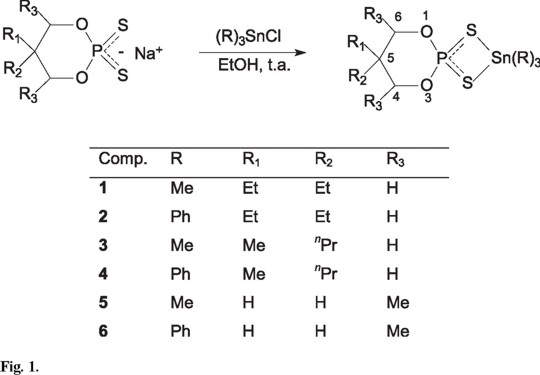
<body><![CDATA[<p align="justify"><font face="verdana" size="2"><i>Dedicated to the memory of Dr. Raymundo Cruz Almanza.</i></font></p>     <p align="justify"><font face="Verdana" size="2">&nbsp;</font></p>     <p align="justify"><font face="verdana" size="2"><b>Introduction</b></font></p>     <p align="justify"><font face="verdana" size="2">The dithiophosphates (RO)<sub>2</sub>PS<sub>2</sub><sup>&#45;</sup> and dithiophosphinates R<sub>2</sub>PS<sub>2</sub><sup>&#45;</sup> ligands, show a broad diversity of coordination patterns, basically due to the ability to involve the sulfur atoms in primary or secondary (intra or intermolecular) bonds as well as the metal tendency to modify its coordination number, which can be influenced by the nature of the dithio&#45;ligands, the type of the organic groups on the phosphorus atom and the substituents attached to the main group metal &#91;1&#45;3&#93;. Most of the Tin (IV) dialkyl dithiophosphates &#91;2&#93; exhibit an anisobidentate or isobidentate coordination, except in the cases of Ph<sub>3</sub>SnS<sub>2</sub>P(OEt)<sub>2</sub> &#91;4&#93; and O(CH<sub>2</sub>CH<sub>2</sub>S)<sub>2</sub>Sn(<i><sup>n</sup></i>Bu)S<sub>2</sub>P(OCH<sub>2</sub>)<sub>2</sub>CEt<sub>2</sub> &#91;5&#93; that display a monodentate coordination. In the last years, considerable attention has been directed to the synthesis of O,O'&#45;alkylene&#45;dithiophosphates which incorporate five and six membered 1,3,2&#45;dioxaphospholanes or 1,3,2&#45;dioxaphosphinane rings &#91;3&#93;, with a view to study the effect of the ring size and the nature of the substituents on the bonding modes. Two structures of tin(IV)&#45; 2,2&#45;dithio&#45;1,3,2&#45;dioxaphospholanes are known: Ph<sub>3</sub>SnS<sub>2</sub>P(OCMe<sub>2</sub>)<sub>2</sub> &#91;6&#93; and Me<sub>2</sub>Sn&#91;S<sub>2</sub>P(OCMe<sub>2</sub>)<sub>2</sub>&#93;<sub>2</sub> &#91;7&#93; both displaying an anisobidentate coordination, the first one shows an intermediate geometry between tetrahedral and trigonal bipyramidal, whereas the second one corresponds to the octahedral one. We have reported the structure of two tin(IV) 2,2&#45;dithio&#45;1,3,2&#45;dioxaphosphinanes X(CH<sub>2</sub>CH<sub>2</sub>S)<sub>2</sub>Sn(<i><sup>n</sup></i>Bu)S<sub>2</sub>P (OCH<sub>2</sub>)<sub>2</sub> CEt<sub>2</sub> (X= O, S) &#91;5&#93;. The coordination of the Sn atom is trigonal bipyramidal in the first case and intermediate between trigonal bipyramidal and a bicapped tetrahedral arrangement in the second one.</font></p>     <p align="justify"><font face="verdana" size="2">In this work, we report the synthesis and characterization of six new trimethyl&#45; and triphenyl&#45;tin(IV) dithiophosphates, in order to know the coordination mode of the tin atom, as well as the conformational behavior of the three 2,2&#45;dithio&#45;1,3,2&#45;dioxaphosphinane ligands.</font></p>     <p align="justify"><font face="Verdana" size="2">&nbsp;</font></p>     <p align="justify"><font face="verdana" size="2"><b>Results and discussion</b></font></p>     <p align="justify"><font face="verdana" size="2">Dithiophosphoric acids (5,5&#45;diethyl&#45;2&#45;mercapto&#45;2&#45;thiono&#45;1,3,2&#45;dioxaphosphinane, 5&#45;methyl&#45;5&#45;<i>n</i>&#45;propyl&#45;2&#45;mercapto&#45;2&#45;thiono&#45;3,2&#45;dioxaphosphinane and 4,6&#45;dimethyl&#45;2&#45;mercapto&#45;2&#45;thiono&#45;1,3,2&#45;dioxaphosphinane) were prepared by the reaction of phosphorus pentasulphide with the corresponding diols (2,2&#45;diethyl&#45;1,3&#45;propanediol, 2&#45;methyl&#45;2&#45;propyl&#45;1,3&#45;propanediol and 2,4&#45;pentanediol) in 1:2 molar ratio in dry benzene, according to the method proposed by Chauhan &#91;8&#93;. The sodium salts were obtained by treatment with ethanolic solution of sodium hydroxide.</font></p>     <p align="justify"><font face="verdana" size="2">Stoichiometric amount of each one of the sodium salts of the cyclic dithiphosphates reacted with chloro trimethyl&#45;tin and chloro triphenyl&#45;tin in ethanol according to <a href="#f1">Figure 1</a>. Compounds <b>1</b>&#45;<b>6</b> are solid, air stable compounds, soluble in organic solvents, and were characterized by elemental analyses, mass spectrometry, infrared and multinuclear magnetic resonance <sup>1</sup>H, <sup>13</sup>C, <sup>31</sup>P, <sup>119</sup>Sn. The IR spectra exhibit absorption bands characteristic of the phosphorodithioate ligand, the assignment of such bands was done by comparison whit the spectra of the starting materials and literature data &#91;3,9,10&#93;. The bands in the region 1058&#45;1083 cm<sup>&#45;1</sup> are due to the stretching vibrations &#957;&#91;(P)&#45;O&#45;C&#93; and 960&#45;1014 cm<sup>&#45;1</sup> for &#957; &#91;P&#45;O(C )&#93;. Two strong absorption bands in the regions 681&#45;697 cm<sup>&#45;1</sup> y 499&#45;526 cm<sup>&#45;1</sup> were assigned to the stretching vibration (&#957;P=S) y (&#957;P&#45;S) respectively &#91;3,9&#93;, or to the stretching vibration phosphorus&#45;sulfur, &#957;<i><sub>asim</sub></i>(PS<sub>2</sub>) y &#957;<i><sub>sim</sub></i>(PS<sub>2</sub>) &#91;10&#93;. The organotin compounds <b>1&#45;6</b> show a displacement to higher frequencies with respect to free acid but lower in relation to the sodium salts of the ligand. The absorption band between 930 to 965 cm<sup>&#45;1</sup> is due to the dioxaphosphinane ring &#91;3,9,11&#93;. The spectra also exhibit absorption bands characteristic of the symmetrical and asymmetrical methyl or phenyl groups on the tin atom.</font></p>     <p align="center"><font face="verdana" size="2"><a name="f1"></a></font></p>     ]]></body>
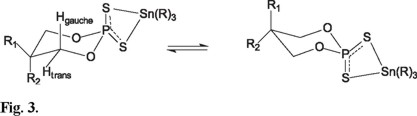
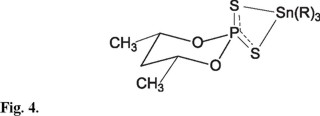
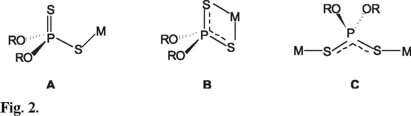
<body><![CDATA[<p align="center"><font face="verdana" size="2"><img src="/img/revistas/rsqm/v48n4/a19f1.jpg"></font></p>     <p align="justify"><font face="verdana" size="2">Electron impact mass spectra (70eV) display, with exception of compound <b>2</b>, the molecular ion, showing a similar pattern of fragmentation, since in all cases the base peak corresponds to the fragment result of the loss of a methyl LSnMe<sub>2</sub><sup>+</sup> or phenyl LSnPh<sub>2</sub><sup>+</sup> (L= Ligand) group, and the presence of fragments due to Me<sub>3</sub>Sn<sup>+</sup>, MeSn<sup>+</sup>, in compounds <b>1</b>, <b>3</b>, <b>5</b> and Ph<sub>3</sub>Sn<sup>+</sup>, PhSn<sup>+</sup> in <b>2</b>, <b>4</b>, <b>6</b>. No fragments were found at higher mass than the molecular mass, situation that is consistent with a monomeric nature of the obtained compounds.</font></p>     <p align="justify"><font face="verdana" size="2">The <sup>31</sup>P NMR spectral data show the presence of a single peak in compounds <b>1&#45;4</b>, whereas compounds <b>5&#45;6</b> display two signals in 4:1 ratio, indicative of the presence of the one and two species respectively. Glidewell &#91;12&#93; has proposed that the difference in the phosphorus chemical shift between the appropriate free acid and its metallic derivatives is a strong evidence of the coordination mode. Upfield shifts or values smaller to 82 ppm are associated with a monodentate coordination (a), <a href="#f2">Figure 2</a>, while downfield shifts in the range 82&#45;101 ppm were consistent with the presence of bidentate ligands &#91;chelate (b) or bridge (c)&#93; and higher chemical shifts than 101 ppm, the behavior is indicative of the ionic type. The compounds containing triphenyltin display chemical shifts in the range of 86.11 to 87.09 and the trimethyltin ones in the range of 90.91 to 91.81 ppm, these data suggest that, in solution the six compounds present a isobidentate coordination of the ligand (monometallic biconective) and a five&#45;coordination of the tin atom (the free acids display chemical shifts in the range of 76.9 to 78.7 ppm).</font></p>     <p align="center"><font face="verdana" size="2"><a name="f2"></a></font></p>     <p align="center"><font face="verdana" size="2"><img src="/img/revistas/rsqm/v48n4/a19f2.jpg"></font></p>     <p align="justify"><font face="verdana" size="2">The <sup>1</sup>H NMR spectrum of compounds <b>1&#45;6</b> exhibit characteristic signals for the dioxaphosphorinane ring. As well as the free acid and some metallic derivatives as As&#91;S<sub>2</sub>P(OCH<sub>2</sub>) CEt<sub>2</sub>&#93;<sub>3</sub> &#91;13&#93;, Me<sub>2</sub>Te&#91;S<sub>2</sub>P(OCH<sub>2</sub>)CEt<sub>2</sub>&#93;<sub>2</sub> &#91;14&#93; and X(CH<sub>2</sub>CH<sub>2</sub>S)<sub>2</sub> Sn(<i><sup>n</sup></i>Bu) S<sub>2</sub>P(OCH<sub>2</sub>)<sub>2</sub>CEt<sub>2</sub> (X= O, S) &#91;5&#93; <b>1</b> and <b>2,</b> show only one double signal for the methylene group (C<b>H</b><sub>2</sub>OP) of the 1,3,2&#45;dioxaphosphinane ring at 4.08 and 4.05 ppm respectively, due to the coupling with the phosphorus atom, with coupling constants of <sup>3</sup><i>J</i><sub>(POCH)</sub> 15.66 y 16.2 Hz, that indicate the equivalence of the hydrogen of the methylene groups, which is explained by the degeneration of a system A<sub>2</sub>B<sub>2</sub>X that would be expected for such protons to a A<sub>4</sub>X system, derived from a rapid interconversion between equal populations of the two chair conformations of the dioxaphosphinane ring and a rapid interchange between the two exocyclic sulfur atoms. Compounds <b>3</b> and <b>4,</b> like the free acid, show an equilibrium between two chair conformations, <a href="#f3">Figure 3</a>, showing in this case the signals of the diastereotopics protons of the fragment C<b>H</b><sub>2</sub>OP at 4.07 and 4.01 ppm, with coupling constants <sup>3</sup><i>J</i><sub>(POCH)</sub> = 15.6 and 16.2 Hz, <i>J<sub>gem</sub></i> = 11.2 and 11.1 Hz respectively. It is interesting to note, that the coupling constants <sup>3</sup><i>J</i><sub>(</sub><sup>31</sup>P&#45;O&#45;C&#45;<sup>1</sup>H) of compounds <b>1&#45;4</b> correspond to the average value for the sum of coupling constants <sup>3</sup><i>J<sub>gauche</sub></i> and <sup>3</sup><i>J<sub>trans</sub></i> of the chair conformation of the dioxaphosphinane ring in the methyl derivative &#91;5&#93;, compound that also display the non&#45;equivalence of the groups R<sub>1</sub> and R<sub>2</sub>, in contrast with the tin derivatives <b>1</b>&#45;<b>4</b>.</font></p>     <p align="center"><font face="verdana" size="2"><a name="f3"></a></font></p>     <p align="center"><font face="verdana" size="2"><img src="/img/revistas/rsqm/v48n4/a19f3.jpg"></font></p>     <p align="justify"><font face="verdana" size="2">Compounds <b>5&#45;6</b>, <a href="#f4">Figure 4</a>, display at high field, the signal corresponding to the <i>cis</i> equatorials methyls C&#45;4 and C&#45;6 as a double of double at 1.36 and 1.33 ppm respectively, with coupling constants <i>J</i><sub>(H&#45;H)</sub> of 6.2 and 6.4 Hz and <sup>4</sup><i>J</i><sub>(P&#45;O&#45;C&#45;C&#45;H)</sub> of 1.8 and 2 Hz, respectively. A multiple signal at 4.69 and 4.62 ppm, corresponding to the axial protons C&#45;4 and C&#45;6, with coupling constants that are consistent with a chair conformation of the dioxaphosphinane ring, with values of 10.8 and 10.5 Hz, and a coupling situation of the <i>trans&#45;</i>diaxial disposition of the hydrogen of C&#45;4 and C&#45;6 with the hydrogen of the C&#45;5 and values of the coupling constants, 2.2 and 2.0 Hz, that correspond to the coupling of hydrogen in C&#45;4 and C&#45;6 with the equatorial hydrogen of C&#45;5, according to the Karplus relationship &#91;15&#93;. Additionally, the signals in the range 1.95 &#45;1.57 ppm are assigned to the geminal hydrogens at C&#45;5. It was also observed a small proportion of the product with the methyl groups in <i>trans</i> disposition, and this was confirmed by <sup>31</sup>P NMR.</font></p>     <p align="center"><font face="verdana" size="2"><a name="f4"></a></font></p>     ]]></body>
<body><![CDATA[<p align="center"><font face="verdana" size="2"><img src="/img/revistas/rsqm/v48n4/a19f4.jpg"></font></p>     <p align="justify"><font face="verdana" size="2"><sup>13</sup>C NMR, spectra data for compounds <b>1</b>&#45;<b>6</b> show for the dioxaphosphinane ring, two double signals due to the phosphorus&#45;carbon coupling, with chemical shifts between 76.32 &#45; 73.25 for C&#45;4 and C&#45;6 and to upfield shift in the range 41.2&#45;35.21 ppm for C&#45;5. The coupling constant for compounds <b>1</b>&#45;<b>4</b> are in the intervals <sup>2</sup><i>J</i>(<sup>31</sup>P&#45;O&#45;<sup>13</sup>C) 9.2 &#45; 8.6 Hz and <sup>3</sup><i>J</i>(<sup>31</sup>P&#45;O&#45;C&#45;<sup>13</sup>C) 6.0 &#45; 5.2 Hz respectively, this last value is close to 6.2 Hz, in accord with the Karplus relationship &#91;15&#93; for these compounds when the angle is equal to zero, which confirms the equilibrium between a equal population of chair conformers. Whereas compounds <b>5</b>&#45;<b>6</b> display coupling constant values phosphorus&#45;carbon <sup>3</sup><i>J</i>(POCC) for C&#45;5 of 4.12 and 4.87 Hz, that are the expected ones for the chair conformation of the dioxaphosphinane ring with an angle of &#952; C(5)&#45;C(4)&#45;O&#45;P of 60&deg; and the equatorial methyls on C&#45;4 and C&#45;6 display values of 10.05 and 10.25 Hz, respectively, that correspond to the angle of &#952; CH<sub>3</sub>&#45;C(4)&#45;O&#45;P or CH<sub>3</sub>&#45;C(6)&#45;O&#45;P of 180&deg; &#91;8.5&#45;10 Hz&#93;.</font></p>     <p align="justify"><font face="verdana" size="2">The <sup>119</sup>Sn&#45;NMR spectrum of compounds <b>1</b>&#45;<b>6</b> show chemical shifts in the range of 118.9 to 108.96 and &#45;77.9 to &#45;84.15 ppm for the trimethyl&#45;tin and triphenyl&#45;tin derivatives, respectively. These last values are close to the interval proposed by Otera &#91;16&#93; for a five&#45;coordination, in agreement with the isobidentate behavior of the ligand, also suggested by <sup>31</sup>P&#45;NMR. In all the cases were observed upfield shifts between 30 and 55 ppm with respect to chlorotrimethyl&#45;tin (165.7) and chlorotriphenyl&#45;tin (&#45;44.7), situation that suggests the change of tetra&#45;coordination to penta&#45;coordination of the tin atom.</font></p>     <p align="justify"><font face="Verdana" size="2">&nbsp;</font></p>     <p align="justify"><font face="verdana" size="2"><b>Experimental</b></font></p>     <p align="justify"><font face="verdana" size="2">All reagents were commercial grade and were used as received. Dithiophosphoric acids were obtained using the published procedures &#91;8&#93;. The sodium salts of cyclic dithiophosphates were obtained with ethanolic solution of sodium hydroxide. Solvents were dried by standard methods before use. Elemental analyses (C, H) were performed by Galbraith Laboratories. Inc. (Knoxville, TN). IR spectra were recorded as KBr pellets using Bruker and MIDAC Prospect spectrometers. <sup>1</sup>H, <sup>13</sup>C, <sup>31</sup>P and <sup>119</sup>Sn NMR spectra were obtained in a JEOL Eclipse+ 300 and Varian Gemini 200 spectrometers operating at (299.949, 199.99), 75.57, 121.65 and 112.06 MHz, respectively, using CDCl<sub>3</sub> as solvent. The chemical shifts are relative to internal Me<sub>4</sub>Si (<sup>1</sup>H, <sup>13</sup>C), external H<sub>3</sub>PO<sub>4</sub> (85%) (<sup>31</sup>P) and Me<sub>4</sub>Sn (<sup>119</sup>Sn) for the indicated nuclei.</font></p>     <p align="justify"><font face="Verdana" size="2">&nbsp;</font></p>     <p align="justify"><font face="verdana" size="2"><b>General procedure</b></font></p>     <p align="justify"><font face="verdana" size="2">Stoichometric amounts of trimethyl&#45;tin and triphenyl&#45;tin chlrorides and the sodium salts of the dithiophosphates in ethanol were stirred for 24 h. The reaction mixture was filtered to remove the resulting NaCl, the clear filtrate was evaporated at low pressure and the resulting powder was recrystallized from a CH<sub>2</sub>Cl<sub>2</sub>&#45;hexane mixture.</font></p>     <p align="justify"><font face="verdana" size="2"><b>Trimethyl&#45;tin (5,5&#45;diethyl&#45;2&#45;thiono&#45;1,3,2&#45;dioxaphosphinane&#45;2&#45;thioate)</b></font></p>     ]]></body>
<body><![CDATA[<p align="justify"><font face="verdana" size="2">(CH<sub>3</sub>)<sub>3</sub>Sn&#91;S<sub>2</sub>P(OCH<sub>2</sub>)<sub>2</sub>CEt<sub>2</sub>&#93; <b>1</b>. White solid, stable on exposure to air, mp 119&#45;20&deg;C. Yield (250 mg, 64 %). Anal. Calc. for C<sub>10</sub>H<sub>23</sub>O<sub>2</sub>S<sub>2</sub>PSn: C, 30.88 %; H, 5.95 %. Found C, 31.08 %; H, 6.01 %. EI&#45;MS (70eV): <i>m</i>/<i>z</i> 375 &#91;(C<sub>7</sub>H<sub>14</sub>O<sub>2</sub>P S<sub>2</sub>Sn(CH<sub>3</sub>)<sub>2</sub><sup>+</sup>; (M<sup>+</sup> &#45; Me), 100%&#93;; 359 (C<sub>7</sub>H<sub>14</sub>O<sub>2</sub>PS<sub>2</sub>SnCH<sub>3</sub><sup>+</sup> &lt;10%), 344 (C<sub>7</sub>H<sub>14</sub>O<sub>2</sub>S<sub>2</sub>PSn<sup>+</sup>, &lt;10%); 259 (Me<sub>3</sub>SnS<sub>2</sub>P<sup>+</sup>, 26%); 229 (Me<sub>3</sub>SnS<sub>2</sub><sup>+</sup>, 8%); 165 (Me<sub>3</sub>Sn<sup>+</sup>, 13%); 135 (MeSn<sup>+</sup>, 5%). IR (KBr): 2965m, 2922m, 2876m, (&#957;C&#45;H); 1462m (&#948; CH<sub>2</sub>); 1066m &#91;&#957;(P)&#45;O&#45;C&#93;; 994f, &#91;&#957;(P&#45;O&#45;(C )&#93;, 933m &#91;dioxaphosphinane ring&#93; 683 (&#957;<i><sub>sym</sub></i> PS<sub>2</sub>), 523f cm<sup>&#45;1</sup> (&#957;<i><sub>asym</sub></i> PS<sub>2</sub> ). <sup>1</sup>H NMR (CDCl<sub>3</sub>): &#948; 4.08 (d, <sup>3</sup><i>J</i>(<sup>31</sup>P&#45;O&#45;C&#45;<sup>1</sup>H) = 15.66 Hz, 4H) (C<b>H</b><sub>2</sub>OP); 1.44 (c, <i>J</i>= 7.41 Hz, 4H) C<b>H</b><sub>2</sub>CH<sub>3</sub>, 0.81 (t, <i>J</i>= 7.41 Hz, 6H) CH<sub>2</sub>C<b>H</b><sub>3</sub>; 0.69 (s, 9H) C<b>H</b><sub>3</sub>Sn. <sup>13</sup>C&#45;NMR (CDCl<sub>3</sub>): &#948; 74.24 &#91;d, <sup>2</sup><i>J</i>(<sup>31</sup>P&#45;O&#45;<sup>13</sup>C = 9.2 Hz)&#93; <b>C</b>H<sub>2</sub>OP; 37.38 &#91;d <sup>3</sup><i>J</i>(<sup>31</sup>P&#45;O&#45;CH<sub>2</sub>&#45;<sup>13</sup><b>C</b>) = 5.7 Hz&#93; <b>C</b>CH<sub>2</sub>OP; 22.94 <b>C</b>H<sub>2</sub>CH<sub>3</sub>; 7.14 CH<sub>2</sub><b>C</b>H<sub>3</sub>; &#45;1.57 <b>C</b>H<sub>3</sub>Sn. <sup>31</sup>P NMR (CDCl<sub>3</sub>): &#948; 91.35. <sup>119</sup>Sn NMR (CDCl<sub>3</sub>): &#948; 118.88.</font></p>     <p align="justify"><font face="verdana" size="2"><b>Triphenyl&#45;tin (5,5&#45;diethyl&#45;2 thiono&#45;1,3,2&#45;dioxaphosphinane 2&#45;thioate)</b></font></p>     <p align="justify"><font face="verdana" size="2">Ph<sub>3</sub>Sn&#91;S<sub>2</sub>P(OCH<sub>2</sub>)<sub>2</sub>CEt<sub>2</sub>&#93; <b>2</b>. White solid, stable on exposure to air, mp 96&#45;98&deg;C. Yield (235 mg, 67 %). Anal. Calc. for C<sub>25</sub>H<sub>29</sub>O<sub>2</sub>S<sub>2</sub>PSn: C, 52.2 %; H, 5.081 %. Found C, 51.69 %; H, 5.089 %. EI&#45;MS (70 eV): M<sup>+</sup>. 576 (7%); <i>m</i>/<i>z</i> 499 (M<sup>+</sup> &#45; Ph, 100%) 421 &#91;(C<sub>7</sub>H<sub>14</sub>O<sub>2</sub>S<sub>2</sub>PSnPh)<sup>+</sup>, 5%&#93;; 385 (Ph<sub>3</sub>SnS<sup>+</sup>, 6%), 351 (Ph<sub>3</sub>Sn<sup>+</sup>, 15%); 229 (PhSnS<sup>+</sup>, 34%); 197 (PhSn<sup>+</sup>, 15%). IR (KBr): 3064m, 2979m, 2941m, 2879m, (&#957;C&#45;H); 1460m (&#948; CH<sub>2</sub>&#45;); 1068m &#91;&#957;(P)&#45;O&#45;C&#93;; 995, &#91;&#957;(P&#45;O&#45;(C )&#93;, 935 &#91;dioxaphosphinane ring&#93; 686 (&#957;<i><sub>sym</sub></i> PS<sub>2</sub>), 507m cm<sup>&#45;1</sup> (&#957;<i><sub>asym</sub></i> PS<sub>2</sub> ). <sup>1</sup>H&#45;NMR (CDCl<sub>3</sub>): &#948; 4.05 (d, <sup>3</sup><i>J</i>(<sup>31</sup>P&#45;O&#45;C&#45;<sup>1</sup>H) = 16.2 Hz, 4H) (C<b>H</b><sub>2</sub>OP); 1.40 (c, <i>J</i> = 7.41 Hz, 4H) C<b>H</b><sub>2</sub>CH<sub>3</sub>, 0.80 (t, <i>J</i>= 7.41 Hz, 6H) CH<sub>2</sub>C<b>H</b><sub>3</sub>; 7.73 (sa, 6H) &#91;H&#45;Ar (<i>o&#45;</i>H)&#93;; 7.44 (m, 9H) &#91;<i>m&#45;</i>H and <i>p&#45;</i>H&#93;. <sup>13</sup>C NMR (CDCl<sub>3</sub>): &#948; 74.60 &#91;d, <sup>2</sup><i>J</i>(<sup>31</sup>P&#45;O&#45;<sup>13</sup>C = 8.6 Hz)&#93; <b>C</b>H<sub>2</sub>OP; 37.30 &#91;d <sup>3</sup><i>J</i>(<sup>31</sup>P&#45;O&#45;CH<sub>2</sub>&#45;<sup>13</sup><b>C</b>) = 5.2 Hz&#93; <b>C</b>CH<sub>2</sub>OP; 22.94 <b>C</b>H<sub>2</sub>CH<sub>3</sub>; 7.13 CH<sub>2</sub><b>C</b>H<sub>3</sub>; 137.91 &#91;C&#45;Ar (<i>o&#45;</i> C)&#93;; 136.94 (<i>p&#45;</i>C) 130.13 (<i>m&#45;</i>C), 128.98 (<i>i&#45;</i>C). <sup>31</sup>P NMR (CDCl<sub>3</sub>): &#948; 86.37. <sup>119</sup>Sn NMR (CDCl<sub>3</sub>): &#948; &#45;77.9.</font></p>     <p align="justify"><font face="verdana" size="2"><b>Trimethyl&#45;tin (5&#45;methyl&#45;5&#45;propyl&#45;2&#45;thiono&#45;1,3,2&#45;dioxaphosphinane&#45;2&#45;tioate)</b></font></p>     <p align="justify"><font face="verdana" size="2">(CH<sub>3</sub>)<sub>3</sub>Sn&#91;S<sub>2</sub>P(OCH<sub>2</sub>)<sub>2</sub>CMe(<i><sup>n</sup></i>Pr)&#93; <b>3</b>. Pale yellow solid, stable on exposure to air, mp 52&deg;C. Yield (59 mg, 16 %). Anal. Calc. for C<sub>10</sub>H<sub>23</sub>O<sub>2</sub>S<sub>2</sub>PSn: C, 30.88 %; H, 5.96 %. Found C, 31.96 %; H, 5.95 %. EI&#45;MS (70 eV): M<sup>+</sup> 390 (16); <i>m</i>/<i>z</i> 375 &#91;(C<sub>7</sub>H<sub>14</sub>O<sub>2</sub>P S<sub>2</sub>Sn(CH<sub>3</sub>)<sub>2</sub><sup>+</sup>; (M<sup>+</sup> &#45; Me), 100%&#93;; 359 (C<sub>7</sub>H<sub>14</sub>O<sub>2</sub>PS<sub>2</sub>SnMe<sup>+</sup>, 5%), 344 (C<sub>7</sub>H<sub>14</sub>O<sub>2</sub>S<sub>2</sub>PSn<sup>+</sup>, 15%); 259 (Me<sub>3</sub>SnS<sub>2</sub>P<sup>+</sup>, 12%); 165 (Me<sub>3</sub>Sn<sup>+</sup>, 40%); 135 (MeSn<sup>+</sup>, 10%). IR (KBr): 2958m, 2928m, 2871m, 2869m, (&#957;C&#45;H); 1466m (&#948; CH<sub>2</sub>); 1058m &#91;&#957;(P)&#45;O&#45;C&#93;; 989, &#91;&#957;(P&#45;O&#45;(C )&#93;, 960m &#91;dioxaphosphinane ring&#93; 681 (&#957;<i><sub>sym</sub></i> PS<sub>2</sub>), 501 cm<sup>&#45;1</sup> (&#957;<i><sub>asym</sub></i> PS<sub>2</sub>). <sup>1</sup>HNMR (CDCl<sub>3</sub>): &#948; 4.07 (m, <sup>3</sup><i>J</i>(<sup>31</sup>P&#45;O&#45;C&#45;<sup>1</sup>H) = 15.66 Hz, <i>J<sub>gem</sub></i>(<sup>31</sup>P&#45;O&#45;C&#45;<sup>1</sup>H) = 11.2 Hz, 4H) (C<b>H</b><sub>2</sub>OP); 1.38 (m, 4H) C<b>H</b><sub>2</sub>CH<sub>2</sub>CH<sub>3</sub>; 1.31 (m, 4H) CH<sub>2</sub>C<b>H</b><sub>2</sub>CH<sub>3</sub>; 0.94 (t, <i>J</i>= 7.2 Hz, 3H) CH<sub>2</sub>CH<sub>2</sub>C<b>H</b><sub>3</sub>; 0.94 (s, 9H) C<b>H</b><sub>3</sub>Sn. <sup>13</sup>C NMR (CDCl<sub>3</sub>): &#948; 76.31 &#91;d, <sup>2</sup><i>J</i>(<sup>31</sup>P&#45;O&#45;<sup>13</sup>C = 8.9Hz)&#93; <b>C</b>H<sub>2</sub>OP; 35.21 &#91;d, <sup>3</sup><i>J</i>(<sup>31</sup>P&#45;O&#45;CH<sub>2</sub>&#45;<sup>13</sup><b>C</b>) = 6 Hz); 36.92 <b>C</b>H<sub>2</sub>CH<sub>2</sub>CH<sub>3</sub>; 16.52 CH<sub>2</sub><b>C</b>H<sub>2</sub>CH<sub>3</sub>; 14.85 CH<sub>2</sub>CH<sub>2</sub><b>C</b>H<sub>3</sub>; 18.94 <b>C</b>H<sub>3</sub>; &#45;1.377 <b>C</b>H<sub>3</sub>Sn. <sup>31</sup>P NMR (CDCl<sub>3</sub>): &#948; 90.91. <sup>119</sup>Sn NMR (CDCl<sub>3</sub>): &#948; 113.019.</font></p>     <p align="justify"><font face="verdana" size="2"><b>Triphenyl&#45;tin (5&#45;methyl&#45;5&#45;propyl&#45;2&#45;thiono&#45;1,3,2&#45;dioxaphosphinane&#45;2&#45;thioate)</b>.</font></p>     <p align="justify"><font face="verdana" size="2">Ph<sub>3</sub>Sn&#91;S<sub>2</sub>P(OCH<sub>2</sub>)<sub>2</sub>CMe(<i><sup>n</sup></i>Pr)&#93; <b>4</b>. White solid, stable on exposure to air, mp 96&#45;98&deg;C. Yield (235 mg, 67 %). Anal. Calc. for C<sub>25</sub>H<sub>29</sub>O<sub>2</sub>S<sub>2</sub>PSn: C, 52.19 %; H, 5.08 %. Found C, 53.69.69 %; H, 4.92 %. EI&#45;MS (70eV): M<sup>+.</sup> 576 (7%); <i>m</i>/<i>z</i> 499 (M<sup>+</sup> &#45;Ph, 100%); 421 &#91;(C<sub>7</sub>H<sub>14</sub>O<sub>2</sub>S<sub>2</sub>PSnPh)<sup>+</sup>, 5%&#93;; 351 (Ph<sub>3</sub>Sn<sup>+</sup>, 65%); 229 (PhSnS<sup>+</sup>, 22%); 197 (PhSn<sup>+</sup>, 16%). IR (KBr): 3065m, 2965m, 2922m, 2876m, (&#957;C&#45;H); 1466m (&#948; CH<sub>2</sub>); 1074m &#91;&#957;(P)&#45;O&#45;C&#93;; 1014, &#91;&#957;(P&#45;O&#45;(C )&#93;, 930 &#91;dioxaphosphinane ring&#93; 681 (&#957;<i><sub>sym</sub></i> PS<sub>2</sub>), 501m cm<sup>&#45;1</sup> (&#957;<i><sub>asym</sub></i> PS<sub>2</sub> ). <sup>1</sup>H NMR (CDCl<sub>3</sub>): &#948; 4.03 (m, <sup>3</sup><i>J</i>(<sup>31</sup>P&#45;O&#45;C&#45;<sup>1</sup>H) = 16.2 Hz, <i>J<sub>gem</sub></i>(<sup>31</sup>P&#45;O&#45;C&#45;<sup>1</sup>H) = 11.2Hz, 4H) (C<b>H</b><sub>2</sub>OP); 1.25 (m, 4H) C<b>H</b><sub>2</sub>CH<sub>2</sub>CH<sub>3</sub>; 1.25 (m, 4H) CH<sub>2</sub>C<b>H</b><sub>2</sub>CH<sub>3</sub>; 0.94 (t, <i>J</i>= 7.2 Hz, 3H) CH<sub>2</sub>CH<sub>2</sub>C<b>H</b><sub>3</sub>; 0.94 (s, 3H) C<b>H</b><sub>3</sub>; 7.40 (m, 6H) &#91;H&#45;Ar (<i>o&#45;</i>H)&#93;; 7.71 (m, 9H) &#91;<i>m and p&#45;</i>H&#93;. <sup>13</sup>C&#45;NMR (CDCl<sub>3</sub>): &#948; 75.94 &#91;d, <sup>2</sup><i>J</i>(<sup>31</sup>P&#45;O&#45;<sup>13</sup>C = 9.1 Hz)&#93; <b>C</b>H<sub>2</sub>OP; 35.28 &#91;d, <sup>3</sup><i>J</i>(<sup>31</sup>P&#45;O&#45;CH<sub>2</sub>&#45;<sup>13</sup><b>C</b>) = 5.7Hz); 36.81 <b>C</b>H<sub>2</sub>CH<sub>2</sub>CH<sub>3</sub>; 16.47 CH<sub>2</sub><b>C</b>H<sub>2</sub>CH<sub>3</sub>; 14.81 CH<sub>2</sub>CH<sub>2</sub><b>C</b>H<sub>3</sub>; 18.86 <b>C</b>H<sub>3</sub>; 137.01 &#91;C&#45;Ar (<i>o&#45;</i>C)&#93;; 136.29 (<i>p&#45;</i>C) 130.20 (<i>m&#45;</i>C), 128.90 (<i>i&#45;</i>C). <sup>31</sup>P NMR (CDCl<sub>3</sub>): &#948; 86.112. <sup>119</sup>Sn NMR (CDCl<sub>3</sub>): &#948; 15.52.</font></p>     <p align="justify"><font face="verdana" size="2"><b>Trimethyl&#45;tin (4,6&#45;dimethyl&#45;2&#45;thiono&#45;1,3,2&#45;dioxaphosphinane&#45;2&#45;thioate)</b>.</font></p>     <p align="justify"><font face="verdana" size="2">(CH<sub>3</sub>)<sub>3</sub>Sn&#91;S<sub>2</sub>P(OCHMe)<sub>2</sub>CH<sub>2</sub>&#93; <b>5</b>. Pale yellow solid, stable on exposure to air, mp 137&#45;39 &deg;C. Yield (271 mg, 75 %). Anal. Calc. for C<sub>8</sub>H<sub>19</sub>O<sub>2</sub>S<sub>2</sub>PSn: C, 26.613 %; H, 5.304 %. Found C, 26.88 %; H, 5.602 %. EI&#45;MS (70eV): M<sup>+</sup> 361 (6%); <i>m</i>/<i>z</i> 347 &#91;(C<sub>5</sub>H<sub>10</sub>O<sub>2</sub>PS<sub>2</sub>Sn(CH<sub>3</sub>)<sub>2</sub><sup>+</sup>; (M<sup>+</sup> &#45; Me), 100%&#93;; 332 (C<sub>5</sub>H<sub>10</sub>O<sub>2</sub>PS<sub>2</sub>SnMe<sup>+</sup>, 30%), 165 (Me<sub>3</sub>Sn<sup>+</sup>, 60%); 135 (MeSn<sup>+</sup>, 23%). IR (KBr): 2974m, 2923m, 2860m, (&#957;C&#45;H); 1447m (&#948; CH<sub>2</sub>); 1083m &#91;&#957;(P)&#45;O&#45;C&#93;; 960, &#91;&#957;(P&#45;O&#45;(C )&#93;, 960m &#91;dioxaphosphinane ring&#93; 696 (&#957;<i><sub>sym</sub></i> PS<sub>2</sub>), 499 cm<sup>&#45;1</sup> (&#957;<i><sub>asym</sub></i> PS<sub>2</sub>). <sup>1</sup>H NMR (CDCl<sub>3</sub>): &#948; 4.69 (m, 2H) C<b>H</b><i><sub>ax</sub></i>OP; 1.95 (td, <i>J</i>= 2, 13.8 1H) C&#45;5, C<b>H</b><i><sub>ax</sub></i>; 1.67 (sa, 1H) C&#45;5, C<b>H</b><i><sub>ec</sub></i>; 1.36 (dd, <i>J</i>= 1.8, 6.2 Hz, 6H), C<b>H</b><sub>3</sub><i><sub>ec</sub></i> en C&#45;4 y C&#45;6; 0.71 (s, 9H) C<b>H</b><sub>3</sub>Sn. <sup>13</sup>C&#45;NMR (CDCl<sub>3</sub>): &#948; 73.25 &#91;d, <sup>2</sup><i>J</i>(<sup>31</sup>P&#45;O&#45;<sup>13</sup>C = 9.0 Hz)&#93; <b>C</b>HOP, C&#45;4 y C&#45;6; 41.2 &#91;d, <sup>3</sup><i>J</i>(<sup>31</sup>P&#45;O&#45;CH<sub>2</sub>&#45;<sup>13</sup><b>C</b>) = 4.87 Hz&#93; <b>C</b>CH<sub>2</sub>OP, C&#45;5; 22.67 &#91;d, <sup>3</sup><i>J</i>(<sup>31</sup>P&#45;O&#45;CH&#45;<sup>13</sup><b>C</b>) = 10.05 Hz&#93; <b>C</b>H<sub>3</sub>CHOP; &#45;1.065 <b>C</b>H<sub>3</sub>Sn. <sup>31</sup>P NMR (CDCl<sub>3</sub>): &#948; 91.81 y 89.84 (4:1). <sup>119</sup>Sn NMR (CDCl<sub>3</sub>): &#948; 108.96.</font></p>     <p align="justify"><font face="verdana" size="2"><b>Triphenyl&#45;tin (4,6&#45;dimethyl&#45;2&#45;thiono&#45;1,3,2&#45;dioxaphosphinane&#45;2&#45;thiolate</b>. </font></p>     ]]></body>
<body><![CDATA[<p align="justify"><font face="verdana" size="2">(Ph<sub>3</sub>)<sub>3</sub>Sn&#91;S<sub>2</sub>P(OCHMe)<sub>2</sub>CH<sub>2</sub>&#93; <b>6</b>. White solid, stable on exposure to air, mp 91&#45;96 &deg;C. Yield (285 mg, 52 %). Anal. Calc. for C<sub>23</sub>H<sub>25</sub>O<sub>2</sub>PS<sub>2</sub>Sn: C, 50.478 %; H, 4.605 %. Found C, 50.97 %; H, 4.621 %. EI&#45;MS (70eV): M<sup>+.</sup> 547 (5%); <i>m</i>/<i>z</i> 471 (M<sup>+</sup> &#45; Ph, 100%); 316 &#91;(C<sub>5</sub>H<sub>10</sub>O<sub>2</sub>PS<sub>2</sub>SnPh)<sup>+</sup>, 22%&#93;; 385 (Ph<sub>3</sub>SnS<sup>+</sup>, 12%); 351 (Ph<sub>3</sub>Sn<sup>+</sup>, 95%); 229 (PhSnS<sup>+</sup>, 33%); 197 (PhSn<sup>+</sup>, 58%). IR (KBr): 3060m, 2960m, 2878m, (&#957;C&#45;H); 1460m; 1083m &#91;&#957;(P)&#45;O&#45;C&#93;; 994, &#91;&#957;(P&#45;O&#45;(C )&#93;, 965 &#91;dioxaphosphinane ring&#93; 697 (&#957;<i><sub>sym</sub></i> PS<sub>2</sub>), 526m (&#957;<i><sub>asym</sub></i> PS<sub>2</sub> ) cm<sup>&#45;1</sup>. <sup>1</sup>H NMR (CDCl<sub>3</sub>): &#948; 4.62 (m, 2H) C<b>H</b><i><sub>ax</sub></i>OP; 1.76 (td, <i>J</i>= 2, 13.6Hz, 1H) C&#45;5, C<b>H</b><i><sub>ax</sub></i>; 1.57 (1H) C&#45;5, C<b>H</b><i><sub>ec</sub></i>; 1.33 (dd, <i>J</i>= 1.8, 6.2 Hz, 6H), C<b>H</b><sub>3</sub><i><sub>ec</sub></i>.en C&#45;4 y C&#45;6; 7.40 (m, 6H) &#91;H&#45;Ar (<i>o&#45;</i> H)&#93;; 7.69 (m, 9H) &#91;<i>m</i> and <i>p&#45;</i>H&#93;. <sup>13</sup>C NMR (CDCl<sub>3</sub>): &#948; 73.25 &#91;d, <sup>2</sup><i>J</i><sub>(</sub><sup>31</sup><sub>P&#45;O&#45;</sub><sup>13</sup>C = 8.9Hz)&#93; <b>C</b>HOP, C&#45;4 y C&#45;6; 36.81 &#91;d, <sup>3</sup><i>J</i>(<sup>31</sup>P&#45;O&#45;CH<sub>2</sub>&#45;<sup>13</sup><b>C</b>) = 4.87 Hz&#93; <b>C</b>CH<sub>2</sub>OP, C&#45;5; 22.11 &#91;d, <sup>3</sup><i>J</i>(<sup>31</sup>P&#45;O&#45;CH&#45;<sup>13</sup><b>C</b>) = 10.0Hz&#93; <b>C</b>H<sub>3</sub>CHOP; 136.85 &#91;C&#45;Ar (<i>o&#45;</i>C)&#93;; 136.12 (<i>p&#45;</i>C) 129.97 (<i>m&#45;</i>C), 128.85 (<i>i&#45;</i>C). <sup>31</sup>P NMR (CDCl<sub>3</sub>): &#948; 87.09 y 85.9. <sup>119</sup>Sn NMR (CDCl<sub>3</sub>): &#948; &#45;84.15.</font></p>     <p align="justify"><font face="Verdana" size="2">&nbsp;</font></p>     <p align="justify"><font face="verdana" size="2"><b>References</b></font></p>     <!-- ref --><p align="justify"><font face="verdana" size="2">1. a) Haiduc, I.; Sowerby, D.B.; Lu, S.F. <i>Polyhedron</i> <b>1995</b>, <i>14</i>, 3389&#45;3472.    &nbsp;&nbsp;&nbsp;&nbsp;&nbsp;&nbsp;&nbsp;&nbsp;[&#160;<a href="javascript:void(0);" onclick="javascript: window.open('/scielo.php?script=sci_nlinks&ref=6980114&pid=S0583-7693200400040001900001&lng=','','width=640,height=500,resizable=yes,scrollbars=1,menubar=yes,');">Links</a>&#160;]<!-- end-ref --><!-- ref --> b) Haiduc, I. <i>Coord. Chem. Rev.</i> <b>1997</b>, <i>158</i>, 325&#45;358.    &nbsp;&nbsp;&nbsp;&nbsp;&nbsp;&nbsp;&nbsp;&nbsp;[&#160;<a href="javascript:void(0);" onclick="javascript: window.open('/scielo.php?script=sci_nlinks&ref=6980115&pid=S0583-7693200400040001900002&lng=','','width=640,height=500,resizable=yes,scrollbars=1,menubar=yes,');">Links</a>&#160;]<!-- end-ref --><!-- ref --> c) Silvestru, C.; Haiduc, I. <i>Coord. Chem. Rev.</i> <b>1996</b>, <i>147</i>, 117&#45;146.    &nbsp;&nbsp;&nbsp;&nbsp;&nbsp;&nbsp;&nbsp;&nbsp;[&#160;<a href="javascript:void(0);" onclick="javascript: window.open('/scielo.php?script=sci_nlinks&ref=6980116&pid=S0583-7693200400040001900003&lng=','','width=640,height=500,resizable=yes,scrollbars=1,menubar=yes,');">Links</a>&#160;]<!-- end-ref --></font></p>     <!-- ref --><p align="justify"><font face="verdana" size="2">2. Jain, V.K. <i>Coord. Chem. Rev.</i> <b>1994</b>, <i>135</i>/<i>136</i>, 809&#45;843.    &nbsp;&nbsp;&nbsp;&nbsp;&nbsp;&nbsp;&nbsp;&nbsp;[&#160;<a href="javascript:void(0);" onclick="javascript: window.open('/scielo.php?script=sci_nlinks&ref=6980118&pid=S0583-7693200400040001900004&lng=','','width=640,height=500,resizable=yes,scrollbars=1,menubar=yes,');">Links</a>&#160;]<!-- end-ref --></font></p>     <!-- ref --><p align="justify"><font face="verdana" size="2">3. Chauhan, H.P.S. <i>Coord. Chem. Rev.</i> <b>1998</b>, <i>173</i>, 1&#45;30.    &nbsp;&nbsp;&nbsp;&nbsp;&nbsp;&nbsp;&nbsp;&nbsp;[&#160;<a href="javascript:void(0);" onclick="javascript: window.open('/scielo.php?script=sci_nlinks&ref=6980120&pid=S0583-7693200400040001900005&lng=','','width=640,height=500,resizable=yes,scrollbars=1,menubar=yes,');">Links</a>&#160;]<!-- end-ref --></font></p>     <!-- ref --><p align="justify"><font face="verdana" size="2">4. Molloy, K.C.; Hossain, M.B.; Van der Helm, D.; Zuckerman, J.J.; Haiduc, I. <i>Inorg. Chem</i>. <b>1979</b>, <i>18</i>, 3507&#45;3511.    &nbsp;&nbsp;&nbsp;&nbsp;&nbsp;&nbsp;&nbsp;&nbsp;[&#160;<a href="javascript:void(0);" onclick="javascript: window.open('/scielo.php?script=sci_nlinks&ref=6980122&pid=S0583-7693200400040001900006&lng=','','width=640,height=500,resizable=yes,scrollbars=1,menubar=yes,');">Links</a>&#160;]<!-- end-ref --></font></p>     <!-- ref --><p align="justify"><font face="verdana" size="2">5. Garc&iacute;a y Garc&iacute;a, P.; Toscano, R.A.; Cea&#45;Olivares R. <i>J. Organomet. Chem</i>. <b>2000</b>, <i>598</i>, 160&#45;166.    &nbsp;&nbsp;&nbsp;&nbsp;&nbsp;&nbsp;&nbsp;&nbsp;[&#160;<a href="javascript:void(0);" onclick="javascript: window.open('/scielo.php?script=sci_nlinks&ref=6980124&pid=S0583-7693200400040001900007&lng=','','width=640,height=500,resizable=yes,scrollbars=1,menubar=yes,');">Links</a>&#160;]<!-- end-ref --></font></p>     <!-- ref --><p align="justify"><font face="verdana" size="2">6. Preut, H.; Ngo, V.D.; Huber, F. <i>Acta Cryst</i>. <b>1987</b>, <i>C43</i>, 164&#45;165.    &nbsp;&nbsp;&nbsp;&nbsp;&nbsp;&nbsp;&nbsp;&nbsp;[&#160;<a href="javascript:void(0);" onclick="javascript: window.open('/scielo.php?script=sci_nlinks&ref=6980126&pid=S0583-7693200400040001900008&lng=','','width=640,height=500,resizable=yes,scrollbars=1,menubar=yes,');">Links</a>&#160;]<!-- end-ref --></font></p>     <!-- ref --><p align="justify"><font face="verdana" size="2">7. Preut, H.; Ngo, V.D.; Huber, F. <i>Acta Cryst</i>. <b>1986</b>, <i>C42</i>, 809&#45;811.    &nbsp;&nbsp;&nbsp;&nbsp;&nbsp;&nbsp;&nbsp;&nbsp;[&#160;<a href="javascript:void(0);" onclick="javascript: window.open('/scielo.php?script=sci_nlinks&ref=6980128&pid=S0583-7693200400040001900009&lng=','','width=640,height=500,resizable=yes,scrollbars=1,menubar=yes,');">Links</a>&#160;]<!-- end-ref --></font></p>     <!-- ref --><p align="justify"><font face="verdana" size="2">8. Chauhan, H.P.S.; Bhasin, C.P.; Srivastava, G.; Mehrotra, R.C. <i>Phosphorus Sulfur</i>, <b>1983</b>, 15, 99&#45;104.    &nbsp;&nbsp;&nbsp;&nbsp;&nbsp;&nbsp;&nbsp;&nbsp;[&#160;<a href="javascript:void(0);" onclick="javascript: window.open('/scielo.php?script=sci_nlinks&ref=6980130&pid=S0583-7693200400040001900010&lng=','','width=640,height=500,resizable=yes,scrollbars=1,menubar=yes,');">Links</a>&#160;]<!-- end-ref --></font></p>     <p align="justify"><font face="verdana" size="2">9. Chauhan, H.P.S.; Srivastava, G. K.; Mehrotra, R.C. <i>Polyhedron</i> <b>1984</b>, <i>3</i>, 1337&#45;1345.</font></p>     <!-- ref --><p align="justify"><font face="verdana" size="2">10. Sowerby, D.B.; Haiduc, I.; Barbul&#45;Rusu, A.; Salajan, M. <i>Inorg. Chim. Acta.</i> <b>1983</b>, <i>68</i>, 87&#45;96.    &nbsp;&nbsp;&nbsp;&nbsp;&nbsp;&nbsp;&nbsp;&nbsp;[&#160;<a href="javascript:void(0);" onclick="javascript: window.open('/scielo.php?script=sci_nlinks&ref=6980133&pid=S0583-7693200400040001900012&lng=','','width=640,height=500,resizable=yes,scrollbars=1,menubar=yes,');">Links</a>&#160;]<!-- end-ref --></font></p>     <!-- ref --><p align="justify"><font face="verdana" size="2">11. Gupta, R.K.; Rai, A.K.; Mehrotra, R.C.; Jain, V.K. <i>Inorg. Chem</i>. <i>Acta</i>. <b>1984</b>, <i>88</i>, 201&#45;207.    &nbsp;&nbsp;&nbsp;&nbsp;&nbsp;&nbsp;&nbsp;&nbsp;[&#160;<a href="javascript:void(0);" onclick="javascript: window.open('/scielo.php?script=sci_nlinks&ref=6980135&pid=S0583-7693200400040001900013&lng=','','width=640,height=500,resizable=yes,scrollbars=1,menubar=yes,');">Links</a>&#160;]<!-- end-ref --></font></p>     <!-- ref --><p align="justify"><font face="verdana" size="2">12. Glidewell, C. <i>Inorg. Chem. Acta</i>. <b>1977</b>, <i>24</i>, 255&#45;260.    &nbsp;&nbsp;&nbsp;&nbsp;&nbsp;&nbsp;&nbsp;&nbsp;[&#160;<a href="javascript:void(0);" onclick="javascript: window.open('/scielo.php?script=sci_nlinks&ref=6980137&pid=S0583-7693200400040001900014&lng=','','width=640,height=500,resizable=yes,scrollbars=1,menubar=yes,');">Links</a>&#160;]<!-- end-ref --></font></p>     <!-- ref --><p align="justify"><font face="verdana" size="2">13. El Khadi, A.A.S.; Singh, Y.P.; Bohra, R.; Mehrotra, R.C.; Srivastava, G. <i>Main Group Met. Chem</i>. <b>1991</b>, <i>14</i>, 305&#45;311.    &nbsp;&nbsp;&nbsp;&nbsp;&nbsp;&nbsp;&nbsp;&nbsp;[&#160;<a href="javascript:void(0);" onclick="javascript: window.open('/scielo.php?script=sci_nlinks&ref=6980139&pid=S0583-7693200400040001900015&lng=','','width=640,height=500,resizable=yes,scrollbars=1,menubar=yes,');">Links</a>&#160;]<!-- end-ref --></font></p>     ]]></body>
<body><![CDATA[<!-- ref --><p align="justify"><font face="verdana" size="2">14. Drake, J.E.; Khsrou, L.N.; Mislankar, A.G.; Ratnani, R. <i>Can. J. Chem</i>. <b>1994</b>, <i>72</i>, 1328&#45;1337.    &nbsp;&nbsp;&nbsp;&nbsp;&nbsp;&nbsp;&nbsp;&nbsp;[&#160;<a href="javascript:void(0);" onclick="javascript: window.open('/scielo.php?script=sci_nlinks&ref=6980141&pid=S0583-7693200400040001900016&lng=','','width=640,height=500,resizable=yes,scrollbars=1,menubar=yes,');">Links</a>&#160;]<!-- end-ref --></font></p>     <!-- ref --><p align="justify"><font face="verdana" size="2">15. Samitov, Yu. Yu.; Karataeva, F. Kh.; Ovchinnkov V.V.; Cherkasov, R.A. <i>J. Gen. Chem</i>. <b>1986</b>, <i>56</i>, 1979&#45;1991.    &nbsp;&nbsp;&nbsp;&nbsp;&nbsp;&nbsp;&nbsp;&nbsp;[&#160;<a href="javascript:void(0);" onclick="javascript: window.open('/scielo.php?script=sci_nlinks&ref=6980143&pid=S0583-7693200400040001900017&lng=','','width=640,height=500,resizable=yes,scrollbars=1,menubar=yes,');">Links</a>&#160;]<!-- end-ref --></font></p>     <!-- ref --><p align="justify"><font face="verdana" size="2">16. Otera, J. <i>J. Organomet. Chem</i>. <b>1981</b>, <i>221</i>, 57&#45;61.    &nbsp;&nbsp;&nbsp;&nbsp;&nbsp;&nbsp;&nbsp;&nbsp;[&#160;<a href="javascript:void(0);" onclick="javascript: window.open('/scielo.php?script=sci_nlinks&ref=6980145&pid=S0583-7693200400040001900018&lng=','','width=640,height=500,resizable=yes,scrollbars=1,menubar=yes,');">Links</a>&#160;]<!-- end-ref --></font></p>      ]]></body><back>
<ref-list>
<ref id="B1">
<label>1</label><nlm-citation citation-type="journal">
<person-group person-group-type="author">
<name>
<surname><![CDATA[Haiduc]]></surname>
<given-names><![CDATA[I.]]></given-names>
</name>
<name>
<surname><![CDATA[Sowerby]]></surname>
<given-names><![CDATA[D.B.]]></given-names>
</name>
<name>
<surname><![CDATA[Lu]]></surname>
<given-names><![CDATA[S.F.]]></given-names>
</name>
</person-group>
<source><![CDATA[Polyhedron]]></source>
<year>1995</year>
<volume>14</volume>
<page-range>3389-3472</page-range></nlm-citation>
</ref>
<ref id="B2">
<nlm-citation citation-type="journal">
<person-group person-group-type="author">
<name>
<surname><![CDATA[Haiduc]]></surname>
<given-names><![CDATA[I.]]></given-names>
</name>
</person-group>
<source><![CDATA[Coord. Chem. Rev.]]></source>
<year>1997</year>
<volume>158</volume>
<page-range>325-358</page-range></nlm-citation>
</ref>
<ref id="B3">
<nlm-citation citation-type="journal">
<person-group person-group-type="author">
<name>
<surname><![CDATA[Silvestru]]></surname>
<given-names><![CDATA[C.]]></given-names>
</name>
<name>
<surname><![CDATA[Haiduc]]></surname>
<given-names><![CDATA[I.]]></given-names>
</name>
</person-group>
<source><![CDATA[Coord. Chem. Rev.]]></source>
<year>1996</year>
<volume>147</volume>
<page-range>117-146</page-range></nlm-citation>
</ref>
<ref id="B4">
<label>2</label><nlm-citation citation-type="journal">
<person-group person-group-type="author">
<name>
<surname><![CDATA[Jain]]></surname>
<given-names><![CDATA[V.K.]]></given-names>
</name>
</person-group>
<source><![CDATA[Coord. Chem. Rev.]]></source>
<year>1994</year>
<numero>135</numero><numero>136</numero>
<issue>135</issue><issue>136</issue>
<page-range>809-843</page-range></nlm-citation>
</ref>
<ref id="B5">
<label>3</label><nlm-citation citation-type="journal">
<person-group person-group-type="author">
<name>
<surname><![CDATA[Chauhan]]></surname>
<given-names><![CDATA[H.P.S.]]></given-names>
</name>
</person-group>
<source><![CDATA[Coord. Chem. Rev.]]></source>
<year>1998</year>
<volume>173</volume>
<page-range>1-30</page-range></nlm-citation>
</ref>
<ref id="B6">
<label>4</label><nlm-citation citation-type="journal">
<person-group person-group-type="author">
<name>
<surname><![CDATA[Molloy]]></surname>
<given-names><![CDATA[K.C.]]></given-names>
</name>
<name>
<surname><![CDATA[Hossain]]></surname>
<given-names><![CDATA[M.B.]]></given-names>
</name>
<name>
<surname><![CDATA[Van der Helm]]></surname>
<given-names><![CDATA[D.]]></given-names>
</name>
<name>
<surname><![CDATA[Zuckerman]]></surname>
<given-names><![CDATA[J.J.]]></given-names>
</name>
<name>
<surname><![CDATA[Haiduc]]></surname>
<given-names><![CDATA[I.]]></given-names>
</name>
</person-group>
<source><![CDATA[Inorg. Chem.]]></source>
<year>1979</year>
<volume>18</volume>
<page-range>3507-3511</page-range></nlm-citation>
</ref>
<ref id="B7">
<label>5</label><nlm-citation citation-type="journal">
<person-group person-group-type="author">
<name>
<surname><![CDATA[García y García]]></surname>
<given-names><![CDATA[P.]]></given-names>
</name>
<name>
<surname><![CDATA[Toscano]]></surname>
<given-names><![CDATA[R.A.]]></given-names>
</name>
<name>
<surname><![CDATA[Cea-Olivares]]></surname>
<given-names><![CDATA[R.]]></given-names>
</name>
</person-group>
<source><![CDATA[J. Organomet. Chem.]]></source>
<year>2000</year>
<volume>598</volume>
<page-range>160-166</page-range></nlm-citation>
</ref>
<ref id="B8">
<label>6</label><nlm-citation citation-type="journal">
<person-group person-group-type="author">
<name>
<surname><![CDATA[Preut]]></surname>
<given-names><![CDATA[H.]]></given-names>
</name>
<name>
<surname><![CDATA[Ngo]]></surname>
<given-names><![CDATA[V.D.]]></given-names>
</name>
<name>
<surname><![CDATA[Huber]]></surname>
<given-names><![CDATA[F.]]></given-names>
</name>
</person-group>
<source><![CDATA[Acta Cryst.]]></source>
<year>1987</year>
<volume>C43</volume>
<page-range>164-165</page-range></nlm-citation>
</ref>
<ref id="B9">
<label>7</label><nlm-citation citation-type="journal">
<person-group person-group-type="author">
<name>
<surname><![CDATA[Preut]]></surname>
<given-names><![CDATA[H.]]></given-names>
</name>
<name>
<surname><![CDATA[Ngo]]></surname>
<given-names><![CDATA[V.D.]]></given-names>
</name>
<name>
<surname><![CDATA[Huber]]></surname>
<given-names><![CDATA[F.]]></given-names>
</name>
</person-group>
<source><![CDATA[Acta Cryst.]]></source>
<year>1986</year>
<volume>C42</volume>
<page-range>809-811</page-range></nlm-citation>
</ref>
<ref id="B10">
<label>8</label><nlm-citation citation-type="journal">
<person-group person-group-type="author">
<name>
<surname><![CDATA[Chauhan]]></surname>
<given-names><![CDATA[H.P.S.]]></given-names>
</name>
<name>
<surname><![CDATA[Bhasin]]></surname>
<given-names><![CDATA[C.P.]]></given-names>
</name>
<name>
<surname><![CDATA[Srivastava]]></surname>
<given-names><![CDATA[G.]]></given-names>
</name>
<name>
<surname><![CDATA[Mehrotra]]></surname>
<given-names><![CDATA[R.C.]]></given-names>
</name>
</person-group>
<source><![CDATA[Phosphorus Sulfur]]></source>
<year>1983</year>
<volume>15</volume>
<page-range>99-104</page-range></nlm-citation>
</ref>
<ref id="B11">
<label>9</label><nlm-citation citation-type="journal">
<person-group person-group-type="author">
<name>
<surname><![CDATA[Chauhan]]></surname>
<given-names><![CDATA[H.P.S.]]></given-names>
</name>
<name>
<surname><![CDATA[Srivastava]]></surname>
<given-names><![CDATA[G.]]></given-names>
</name>
<name>
<surname><![CDATA[Mehrotra]]></surname>
<given-names><![CDATA[R.C.]]></given-names>
</name>
</person-group>
<source><![CDATA[Polyhedron]]></source>
<year>1984</year>
<volume>3</volume>
<page-range>1337-1345</page-range></nlm-citation>
</ref>
<ref id="B12">
<label>10</label><nlm-citation citation-type="journal">
<person-group person-group-type="author">
<name>
<surname><![CDATA[Sowerby]]></surname>
<given-names><![CDATA[D.B.]]></given-names>
</name>
<name>
<surname><![CDATA[Haiduc]]></surname>
<given-names><![CDATA[I.]]></given-names>
</name>
<name>
<surname><![CDATA[Barbul-Rusu]]></surname>
<given-names><![CDATA[A.]]></given-names>
</name>
<name>
<surname><![CDATA[Salajan]]></surname>
<given-names><![CDATA[M.]]></given-names>
</name>
</person-group>
<source><![CDATA[Inorg. Chim. Acta.]]></source>
<year>1983</year>
<volume>68</volume>
<page-range>87-96</page-range></nlm-citation>
</ref>
<ref id="B13">
<label>11</label><nlm-citation citation-type="journal">
<person-group person-group-type="author">
<name>
<surname><![CDATA[Gupta]]></surname>
<given-names><![CDATA[R.K.]]></given-names>
</name>
<name>
<surname><![CDATA[Rai]]></surname>
<given-names><![CDATA[A.K.]]></given-names>
</name>
<name>
<surname><![CDATA[Mehrotra]]></surname>
<given-names><![CDATA[R.C.]]></given-names>
</name>
<name>
<surname><![CDATA[Jain]]></surname>
<given-names><![CDATA[V.K.]]></given-names>
</name>
</person-group>
<source><![CDATA[Inorg. Chem. Acta.]]></source>
<year>1984</year>
<volume>88</volume>
<page-range>201-207</page-range></nlm-citation>
</ref>
<ref id="B14">
<label>12</label><nlm-citation citation-type="journal">
<person-group person-group-type="author">
<name>
<surname><![CDATA[Glidewell]]></surname>
<given-names><![CDATA[C.]]></given-names>
</name>
</person-group>
<source><![CDATA[Inorg. Chem. Acta.]]></source>
<year>1977</year>
<volume>24</volume>
<page-range>255-260</page-range></nlm-citation>
</ref>
<ref id="B15">
<label>13</label><nlm-citation citation-type="journal">
<person-group person-group-type="author">
<name>
<surname><![CDATA[El Khadi]]></surname>
<given-names><![CDATA[A.A.S.]]></given-names>
</name>
<name>
<surname><![CDATA[Singh]]></surname>
<given-names><![CDATA[Y.P.]]></given-names>
</name>
<name>
<surname><![CDATA[Bohra]]></surname>
<given-names><![CDATA[R.]]></given-names>
</name>
<name>
<surname><![CDATA[Mehrotra]]></surname>
<given-names><![CDATA[R.C.]]></given-names>
</name>
<name>
<surname><![CDATA[Srivastava]]></surname>
<given-names><![CDATA[G.]]></given-names>
</name>
</person-group>
<source><![CDATA[Main Group Met. Chem.]]></source>
<year>1991</year>
<volume>14</volume>
<page-range>305-311</page-range></nlm-citation>
</ref>
<ref id="B16">
<label>14</label><nlm-citation citation-type="journal">
<person-group person-group-type="author">
<name>
<surname><![CDATA[Drake]]></surname>
<given-names><![CDATA[J.E.]]></given-names>
</name>
<name>
<surname><![CDATA[Khsrou]]></surname>
<given-names><![CDATA[L.N.]]></given-names>
</name>
<name>
<surname><![CDATA[Mislankar]]></surname>
<given-names><![CDATA[A.G.]]></given-names>
</name>
<name>
<surname><![CDATA[Ratnani]]></surname>
<given-names><![CDATA[R.]]></given-names>
</name>
</person-group>
<source><![CDATA[Can. J. Chem.]]></source>
<year>1994</year>
<volume>72</volume>
<page-range>1328-1337</page-range></nlm-citation>
</ref>
<ref id="B17">
<label>15</label><nlm-citation citation-type="journal">
<person-group person-group-type="author">
<name>
<surname><![CDATA[Samitov]]></surname>
<given-names><![CDATA[Yu. Yu.]]></given-names>
</name>
<name>
<surname><![CDATA[Karataeva]]></surname>
<given-names><![CDATA[F. Kh.]]></given-names>
</name>
<name>
<surname><![CDATA[Ovchinnkov]]></surname>
<given-names><![CDATA[V.V.]]></given-names>
</name>
<name>
<surname><![CDATA[Cherkasov]]></surname>
<given-names><![CDATA[R.A.]]></given-names>
</name>
</person-group>
<source><![CDATA[J. Gen. Chem.]]></source>
<year>1986</year>
<volume>56</volume>
<page-range>1979-1991</page-range></nlm-citation>
</ref>
<ref id="B18">
<label>16</label><nlm-citation citation-type="journal">
<person-group person-group-type="author">
<name>
<surname><![CDATA[Otera]]></surname>
<given-names><![CDATA[J.]]></given-names>
</name>
</person-group>
<source><![CDATA[J. Organomet. Chem.]]></source>
<year>1981</year>
<volume>221</volume>
<page-range>57-61</page-range></nlm-citation>
</ref>
</ref-list>
</back>
</article>