<?xml version="1.0" encoding="ISO-8859-1"?><article xmlns:mml="http://www.w3.org/1998/Math/MathML" xmlns:xlink="http://www.w3.org/1999/xlink" xmlns:xsi="http://www.w3.org/2001/XMLSchema-instance">
<front>
<journal-meta>
<journal-id>0583-7693</journal-id>
<journal-title><![CDATA[Revista de la Sociedad Química de México]]></journal-title>
<abbrev-journal-title><![CDATA[Rev. Soc. Quím. Méx]]></abbrev-journal-title>
<issn>0583-7693</issn>
<publisher>
<publisher-name><![CDATA[Sociedad Química de México A.C.]]></publisher-name>
</publisher>
</journal-meta>
<article-meta>
<article-id>S0583-76932004000400004</article-id>
<title-group>
<article-title xml:lang="en"><![CDATA[Synthesis of Potential Anti-inflammatory Compounds, Selective Inhibitors of Cyclooxygenase-2 (COX-2)]]></article-title>
</title-group>
<contrib-group>
<contrib contrib-type="author">
<name>
<surname><![CDATA[Guzmán]]></surname>
<given-names><![CDATA[Angel]]></given-names>
</name>
<xref ref-type="aff" rid="A01"/>
</contrib>
<contrib contrib-type="author">
<name>
<surname><![CDATA[Díaz]]></surname>
<given-names><![CDATA[Eduardo]]></given-names>
</name>
<xref ref-type="aff" rid="A01"/>
</contrib>
<contrib contrib-type="author">
<name>
<surname><![CDATA[Trejo]]></surname>
<given-names><![CDATA[Blanca E.]]></given-names>
</name>
<xref ref-type="aff" rid="A01"/>
</contrib>
<contrib contrib-type="author">
<name>
<surname><![CDATA[López-Muñoz]]></surname>
<given-names><![CDATA[Francisco J.]]></given-names>
</name>
<xref ref-type="aff" rid="A02"/>
</contrib>
</contrib-group>
<aff id="A01">
<institution><![CDATA[,Universidad Nacional Autónoma de México, Instituto de Química ]]></institution>
<addr-line><![CDATA[México Distrito Federal]]></addr-line>
<country>México</country>
</aff>
<aff id="A02">
<institution><![CDATA[,Instituto Politécnico Nacional Centro de Investigación y Estudios Avanzados Departamento de Farmacobiología]]></institution>
<addr-line><![CDATA[México Distrito Federal]]></addr-line>
<country>México</country>
</aff>
<pub-date pub-type="pub">
<day>00</day>
<month>12</month>
<year>2004</year>
</pub-date>
<pub-date pub-type="epub">
<day>00</day>
<month>12</month>
<year>2004</year>
</pub-date>
<volume>48</volume>
<numero>4</numero>
<fpage>230</fpage>
<lpage>234</lpage>
<copyright-statement/>
<copyright-year/>
<self-uri xlink:href="http://www.scielo.org.mx/scielo.php?script=sci_arttext&amp;pid=S0583-76932004000400004&amp;lng=en&amp;nrm=iso"></self-uri><self-uri xlink:href="http://www.scielo.org.mx/scielo.php?script=sci_abstract&amp;pid=S0583-76932004000400004&amp;lng=en&amp;nrm=iso"></self-uri><self-uri xlink:href="http://www.scielo.org.mx/scielo.php?script=sci_pdf&amp;pid=S0583-76932004000400004&amp;lng=en&amp;nrm=iso"></self-uri><abstract abstract-type="short" xml:lang="en"><p><![CDATA[Seven compounds were synthesized as potential anti-inflammatory drugs, selective inhibitors of the enzyme cyclooxygenase-2 (COX-2). The structural design was based on the knowledge of the active site of the enzyme. The synthesized compounds present a combined naproxen and celecoxib structures.]]></p></abstract>
<abstract abstract-type="short" xml:lang="es"><p><![CDATA[Se sintetizaron siete compuestos como drogas potencialmente anti-inflamatorias, inhibidores selectivos de la enzima ciclooxigenasa-2 (COX-2). El diseño estructural se basó en el conocimiento del sitio activo de la enzima. Los compuestos sintetizados presentan estructuras combinadas de naproxen y celecoxib.]]></p></abstract>
<kwd-group>
<kwd lng="en"><![CDATA[Cyclooxygenase]]></kwd>
<kwd lng="en"><![CDATA[anti-inflammatory drugs]]></kwd>
<kwd lng="en"><![CDATA[naproxen]]></kwd>
<kwd lng="en"><![CDATA[celecoxib]]></kwd>
<kwd lng="en"><![CDATA[synthesis]]></kwd>
<kwd lng="es"><![CDATA[ciclooxigenasa]]></kwd>
<kwd lng="es"><![CDATA[drogas antiinflamatorias]]></kwd>
<kwd lng="es"><![CDATA[naproxen]]></kwd>
<kwd lng="es"><![CDATA[celecoxib]]></kwd>
<kwd lng="es"><![CDATA[síntesis]]></kwd>
</kwd-group>
</article-meta>
</front><body><![CDATA[ <p align="justify"><font face="Verdana" size="4">Investigaci&oacute;n</font></p>     <p align="justify"><font face="Verdana" size="2">&nbsp;</font></p>     <p align="center"><font face="Verdana" size="4"><b>Synthesis of Potential Anti&#45;inflammatory Compounds, Selective Inhibitors of Cyclooxygenase&#45;2 (COX&#45;2)</b></font></p>     <p align="justify"><font face="Verdana" size="2">&nbsp;</font></p>     <p align="center"><font face="Verdana" size="2"><b>Angel Guzm&aacute;n,*<sup>1</sup> Eduardo D&iacute;az,<sup>1</sup> Blanca E. Trejo<sup>1</sup> and Francisco J. L&oacute;pez&#45;Mu&ntilde;oz<sup>2</sup></b></font></p>     <p align="justify"><font face="Verdana" size="2">&nbsp;</font></p>     <p align="justify"><font face="verdana" size="2"><i><sup>1</sup> Instituto de Qu&iacute;mica, Universidad Nacional Aut&oacute;noma de M&eacute;xico, Circuito Exterior, Ciudad Universitaria, Coyoac&aacute;n, 04510. M&eacute;xico, D. F.</i> E&#45;mail: <a href="mailto:angelgs@servidor.unam.mx">angelgs@servidor.unam.mx</a></font></p>     <p align="justify"><font face="verdana" size="2"><i><sup>2</sup> Laboratorio Dolor y Analgesia, Departamento de Farmacobiolog&iacute;a, Centro de Investigaci&oacute;n y Estudios Avanzados del Instituto Polit&eacute;cnico Nacional.</i></font></p>     <p align="justify"><font face="Verdana" size="2">&nbsp;</font></p>     <p align="justify"><font face="verdana" size="2">Recibido el 19 de mayo del 2004.    ]]></body>
<body><![CDATA[<br> Aceptado el 30 de agosto del 2004.</font></p>     <p align="justify"><font face="Verdana" size="2">&nbsp;</font></p>     <p align="justify"><font face="verdana" size="2"><b>Abstract</b></font></p>     <p align="justify"><font face="verdana" size="2">Seven compounds were synthesized as potential anti&#45;inflammatory drugs, selective inhibitors of the enzyme cyclooxygenase&#45;2 (COX&#45;2). The structural design was based on the knowledge of the active site of the enzyme. The synthesized compounds present a combined naproxen and celecoxib structures.</font></p>     <p align="justify"><font face="verdana" size="2"><b>Key words:</b> Cyclooxygenase, anti&#45;inflammatory drugs, naproxen, celecoxib, synthesis.</font></p>     <p align="justify"><font face="Verdana" size="2">&nbsp;</font></p>     <p align="justify"><font face="verdana" size="2"><b>Resumen</b></font></p>     <p align="justify"><font face="verdana" size="2">Se sintetizaron siete compuestos como drogas potencialmente anti&#45;inflamatorias, inhibidores selectivos de la enzima ciclooxigenasa&#45;2 (COX&#45;2). El dise&ntilde;o estructural se bas&oacute; en el conocimiento del sitio activo de la enzima. Los compuestos sintetizados presentan estructuras combinadas de naproxen y celecoxib.</font></p>     <p align="justify"><font face="verdana" size="2"><b>Palabras clave</b>: ciclooxigenasa, drogas antiinflamatorias, naproxen, celecoxib, s&iacute;ntesis.</font></p>     <p align="justify">&nbsp;</p>     ]]></body>
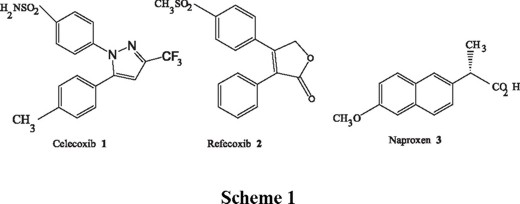
<body><![CDATA[<p align="justify"><font face="verdana" size="2"><i>This paper is dedicated to the memory of Dr. Raymundo Cruz Almanza</i></font></p>     <p align="justify"><font face="Verdana" size="2">&nbsp;</font></p>     <p align="justify"><font face="verdana" size="2">The non&#45;steroidal anti&#45;inflammatory drugs (NSAID's), developed in the 60's, were well accepted as a treatment for rheumatoid arthritis, osteoarthritis and pain. However, these drugs tend to cause significant side effects, which include gastric and intestinal toxicity as well as a decrease in the renal function &#91;1&#93;.</font></p>     <p align="justify"><font face="verdana" size="2">The demonstration that inhibition of prostaglandin synthesis, via a cyclooxygenase (COX) enzyme, is the mechanism of action of non&#45;steroidal anti&#45;inflammatory drugs, was the central issue in understanding both the therapeutic and toxic effects of these substances. Cyclooxygenase is the enzyme that catalyzes the biological oxidation of arachidonic acid to prostaglandins, which are biosynthesized in practically all tissues of the human body, eliciting a variety of pharmacological effects, some of them beneficial, as support of renal and platelet functions, gastrointestinal protection, and other non&#45;beneficial as pain, fever and other symptoms associated with the inflammatory response.</font></p>     <p align="justify"><font face="verdana" size="2">It was long held that cyclooxygenase was a single enzyme present in most cells. More recently, two forms of cyclooxygenase have been found: COX&#45;1 and COX&#45;2. COX&#45;1 is a constitutive form found in the intestine, stomach, kidneys and platelets, while COX&#45;2 is an inducible form, expressed during inflammation &#91;2&#93;. Existing nonsteroidal antiinflamatory drugs inhibit both forms of the enzyme, thus blocking both the positive and negative effects of prostaglandins.</font></p>     <p align="justify"><font face="verdana" size="2">Based on this discovery, it was proposed that a selective inhibitor of COX&#45;2 would be an attractive approach for the treatment of inflammatory conditions, discarding side effects as gastric ulcers and renal toxicity &#91;2&#93;. Recently, two compounds with good selectivity as inhibitors of COX&#45;2, came out to the market: celecoxib (<b>1)</b> and rofecoxib (<b>2)</b> (<a href="#f1">Scheme 1</a>).</font></p>     <p align="center"><font face="verdana" size="2"><a name="f1"></a></font></p>     <p align="center"><font face="verdana" size="2"><img src="/img/revistas/rsqm/v48n4/a4f1.jpg"></font></p>     <p align="justify"><font face="verdana" size="2">Celecoxib showed excellent selectivity for COX&#45;2 over COX&#45;1 in vitro ( IC <sub>50</sub>: 0.04 vs. 15.0 &micro;M, respectively). In a number of in vivo models, celecoxib demonstrated potent anti&#45;inflammatory activity after oral dosing, decreasing acute inflammation in the carrageenan&#45;induced edema assay (ED<sub>50</sub>: 7.1 mg/Kg) &#91;1&#93;. These results, although similar to those obtained with standard NSAID's, demonstrated that celecoxib produced neither acute nor chronic gastrointestinal toxicity in rats at the respective doses of up to 600 mg/Kg/day during 10 days. Celecoxib had a good bioavailability, as well as an excellent safety profile in these preclinical models.</font></p>     <p align="justify"><font face="verdana" size="2">On the other hand, Rofecoxib showed to be highly specific for COX&#45;2 in a randomized, double blind trial, in which it was orally administered to volunteers, 25 mg once a day, vs. naproxen 500 mg. The results showed that while naproxen inhibited gastric prostaglandin synthesis by 70%, rofecoxib had no effects on these parameters &#91;3&#93;. In other studies, patients with osteoarthritis showed a lower incidence of upper gastrointestinal ulcers after treatment with rofecoxib at 12.5, 25 or 50 mg once a day, compared to patients treated with ibuprofen 800 mg daily, during 6 weeks.</font></p>     ]]></body>
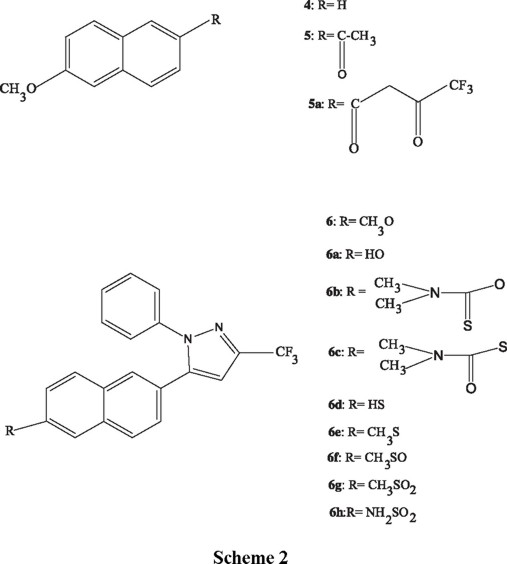
<body><![CDATA[<p align="justify"><font face="verdana" size="2">Considering the recent discovery of COX&#45;2 as well as the inhibitors of this enzyme, we established the hypothesis that other chemical structures should have similar pharmacological properties as celecoxib or rofecoxib, but with a better profile, less side reactions and more selectivity; the discovery of these molecules will be very important for handling and treatment of rheumatic diseases such as arthritis, osteoarthritis, inflammation and pain.</font></p>     <p align="justify"><font face="verdana" size="2">The objective of this work was to prepare a series of compounds in which we incorporated part of the structure of naproxen and part of the rofecoxib or celecoxib, and their biological evaluation as anti&#45;inflammatory drugs.</font></p>     <p align="justify"><font face="verdana" size="2">COX&#45;1 and COX&#45;2 are two very similar proteins, consisting of a long narrow channel with a hairpin bend at the end. For COX&#45;1, arachidonic acid is sucked in on the channel; in the inner of the channel a residue of serine 530 can be found, placed so to control the access of arachidonic acid, then there is as well, a residue of arginine 120, used to bind the carboxylic acid group of the fatty acid substrate. When arachidonic acid is bound, a residue of tyrosine 385 thought initiate the COX oxidation reaction, resulting in the five&#45;carbon ring that characterizes prostaglandins &#91;4&#93;. The nonsteroidal anti&#45;inflammatory drugs, most of which are also carboxylic acids are also considered to bind to this arginine 120.</font></p>     <p align="justify"><font face="verdana" size="2">Several lines of experimental evidence have suggested that the substrate binding site for fatty acids to be oxidized at the active site in COX&#45;2 is larger than that in COX&#45;1 &#91;5,6&#93;. For COX&#45;2, the reactive site also consists of a long narrow channel &#91;7&#93;, a serine 530 lies halfway along the tunnel and controls the access of arachidonic acid. The arginine 120 is also present, but this is not the site of binding for the selective inhibitors of COX&#45;2 since these compounds do not have a carboxylic group. It is the nearby single aminoacid difference that is critical for the selectivity of many drugs; at position 523 an isoleucine molecule in COX&#45;1 and a valine in COX&#45;2 are located. The smaller valine molecule in COX&#45;2 leaves a gap in the wall of the channel, giving access to a side pocket, which is thought to be the site of binding for the selective drugs. The bulkier isoleucine at 523 in COX&#45;1 is large enough to block access to the side pocket. Targeted single aminoacid substitution of valine for isoleucine is sufficient to turn COX&#45;1 into an enzyme that can be inhibited by COX&#45;2 selective agents.</font></p>     <p align="justify"><font face="verdana" size="2">Considering the before mentioned, a COX&#45;2 inhibitor should have a structure that enter the channel formed by the enzyme and bind within the COX&#45;2 side pocket, often via sulfonyl, sulfone, or sulfonamide groups to achieve selectivity.</font></p>     <p align="justify"><font face="verdana" size="2">Naproxen <b>3</b> is a COX&#45;1 inhibitor; this substance has been an excellent anti&#45;inflammatory drug in clinical use for more than 20 years. The chemical structure of this compound corresponds to the first generation of NSAID's; a flat ring, a naphthalene in this case and a 2&#45;propionic acid fragment at C&#45;2. Based on the good pharmacological properties of this compound, we established the hypothesis that combining the bulky naphthalene ring of naproxen, which we assume would enter easily into the active channel of COX&#45;1 or COX&#45;2, and structural fragments of celecoxib or rofecoxib, which would bind within the COX&#45;2 side pocket, we would be able to obtain potent and selective inhibitors of COX&#45;2, which would be expected to have good anti&#45;inflammatory properties.</font></p>     <p align="justify"><font face="verdana" size="2">This paper describes the synthesis of compounds <b>6</b> and <b>6c</b> to <b>6h</b> (<a href="#f2">scheme 2</a>) which were designed taken in consideration the structure of the active site of the enzyme and our hypothesis. Compound <b>6</b> was prepared starting with 2&#45;methoxynaphthalene <b>4</b>, which was transformed in the acetyl derivative <b>5</b> by a Friedel&#45;Crafts acylation &#91;8&#93;. Condensation of <b>5</b> with isopropyl trifluoroacetate in presence of sodium methoxide gave diketone <b>5a</b> in 55% yield. Reaction of <b>5a</b> with phenylhydrazine hydrochloride provided pyrazol <b>6</b> in 91% yield. The orientation of the phenyl ring was assigned on the base of other examples &#91;9&#93;, and was confirmed by X ray diffraction (<i>vide infra</i>). Cleavage of the ether group with hydrobromic acid in acetic acid solution afforded phenol <b>6a</b> in 97% yield. Phenol <b>6a</b> was transformed into the thiol <b>6d</b> by rearrangement of <i>O</i>&#45;aryl dialkylthiocarbamate to <i>S</i>&#45;aryl dialkylthiocarbamate, followed by basic hydrolysis &#91;10&#93;. Thus, compound <b>6a</b> was reacted with dimethylthiocarbamoyl chloride to give the derivative <b>6b</b> in 85% yield. Heating <b>6b</b> at 270&#45;280&deg;C for 1.5 h followed by purification, gave <b>6c</b> in 73% yield, which was hydrolyzed with sodium hydroxide in methanol solution to afford the thiol <b>6d</b> in 90% yield. Thiol <b>6d</b> was transformed into the methyl thioether &#91;11&#93; <b>6e</b> by treatment with methyl iodide and potassium carbonate in DMF solution (77%), and this into the sulfoxide <b>6f</b> &#91;12&#93; and the sulfone &#91;13&#93; <b>6g</b> by reaction with sodium periodate (93%) and <i>m</i>&#45;chloroperbenzoic acid (89%) respectively. In order to confirm the position of the phenyl substituent around the pyrazol ring, sulfone <b>6g</b> was submitted to X ray diffraction, this experiment was in agreement with the preliminary structural assignment (<a href="/img/revistas/rsqm/v48n4/a4f3.jpg" target="_blank">fig.1</a>).</font></p>     <p align="center"><font face="verdana" size="2"><a name="f2"></a></font></p>     <p align="center"><font face="verdana" size="2"><img src="/img/revistas/rsqm/v48n4/a4f2.jpg"></font></p>     <p align="justify"><font face="verdana" size="2">Trying to synthesize sulfonamide <b>6h</b>, the <i>S</i>&#45;aryl dimethylthiocarbamate <b>6c</b> was oxidized with hydrogen peroxide in formic acid solution &#91;14&#93;, but despite of the attempts, the reaction was unsuccessful. After several experiments, we found that treating the thiol <b>6d</b> with chlorine and hydrogen peroxide, it is converted to the corresponding aryl sulfonyl chloride &#91;15&#93;, which turns into sulfonamide <b>6h</b> in 53% yield by reaction with aqueous ammonia .</font></p>     ]]></body>
<body><![CDATA[<p align="justify"><font face="verdana" size="2">The synthesized compounds were submitted to biological evaluation. They are being evaluated by the PIFIR method &#91;16&#93; and the results will be presented elsewhere.</font></p>     <p align="justify"><font face="Verdana" size="2">&nbsp;</font></p>     <p align="justify"><font face="verdana" size="2"><b>Experimental section</b></font></p>     <p align="justify"><font face="verdana" size="2">All starting materials were commercially available research grade chemicals and were used without further purification. Silica gel 60 F<sub>254</sub> was used for TLC and the spots were detected with UV. Flash column chromatography was carried out in silica gel 200&#45;325 mesh. IR spectra were taken on Nicolet FX&#45;SX and Nicolet 55&#45;X spectrophotometers in CHCl<sub>3</sub> solution, unless otherwise stated. The NMR spectra were obtained with a Varian Gemini 200 and Unity 300 spectrometers using chloroform as solvent and TMS as an internal reference. Mass spectra were taken in a Jeol JMS&#45;AX505 HA instrument. Melting points were obtained on a B&uuml;chi 510 and are uncorrected.</font></p>     <p align="justify"><font face="verdana" size="2"><b>4,4,4&#45;Trifluoro&#45;1&#45;(6&#45;methoxy&#45;2&#45;naphthalenyl)&#45;1,3&#45;butanodione (5a)</b>. To a solution of 6&#45;methoxy&#45;2&#45;acetonaphtone <b>5,</b> 28.7 g, 0.14 mol) in 130 mL of 1,2&#45;dimetoxyethane was added 7.5 g (0.14 mol) of sodium methoxide and 37.22 g, (0.23 mol) of isopropyl trifluoroacetate. The solution was heated under reflux for 16 h and then 50 mL of water were added, the pH adjusted to 1.0 with aqueous HCl and extracted with methylene chloride, the combined extracts were washed with water, dried over anhydrous sodium sulfate. The methylene chloride was evaporated and the residue crystallized from methylene chloride&#45;hexane to give 23.6 g (55% yield) of <b>5a</b>, mp 85&#45;87&deg;. IR (KBr): 1620, 1483, 1276,1194 cm<sup>&#45;1</sup>; <sup>1</sup>H NMR (CDCl<sub>3</sub>, 300 MHz): &#948; 3.96 (s, 3H), 6.68 (s, 2H), 7.25 (m, 3H), 7.90 (m, 3H), 8.44 (s 1H); MS (EI), <i>m</i>/<i>z</i> 296 (M<sup>+</sup>)</font></p>     <p align="justify"><font face="verdana" size="2"><b>1&#45;Phenyl&#45;3&#45;trifluoromethyl&#45;5&#45;(6&#45;methoxy&#45;2&#45;naphthalenyl)pyrazol (6)</b>. To a solution of 27 g (0.09 mol) of <b>5a</b> in 200 mL of ethanol, was added 20 g (0.14 mol) of phenylhydrazine hydrochloride in 110 mL of water. The resulting solution was heated under reflux for 1 h and then poured into 200 mL of water. The product was isolated by methylene chloride extraction; the extracts were dried over sodium sulfate and evaporated under vacuo. The residue was purified by crystallization from methylene chloride&#45;hexane to give 30.7 g (91%) of <b>6</b>, mp 96&#45;98&deg;. IR (KBr): 1629, 1601, 1493, 1259, 1237 cm<sup>&#45;1</sup>; <sup>1</sup>H NMR (CDCl<sub>3</sub>, 300 MHz): &#948; 3.92 (s, 3H), 6.82 (s, 1H), 7.25 (m, 5H), 7.15 (m, 3H), 7.60 (m, 3H); MS (EI): <i>m</i>/<i>z</i> 368( M<sup>+</sup>).</font></p>     <p align="justify"><font face="verdana" size="2"><b>1&#45;Phenyl&#45;3&#45;trifluoromethyl&#45;5&#45;(6&#45;hydroxy&#45;2&#45;naphthalenyl)pirazol (6a)</b>. To a solution of <b>6</b>, 30.72 g, (0.83 mol) in 200 mL of acetic acid, were added 150 mL of 48% hydrobromic acid (0.89 mol). The solution was heated under reflux for 24 h and then diluted with 150 mL of water and extracted with methylene chloride; the extracts were dried over sodium sulfate and evaporated under vacuo. The residue was purified by column chromatography on 600 g of silica gel (hexane&#45;ethyl acetate 9:1), yielding 28.7 g (97%) of <b>6a</b>. IR (KBr): 3317, 1631, 1608, 1496, 1163 cm<sup>&#45;1</sup> ; <sup>1</sup>H NMR (CDCl<sub>3</sub>, 300 MHz): &#948; 5.12 (s, 1H), 6.82 (s, 1H), 7.34 (m, 5H), 7.20 (m, 3H), 7.60 (m, 6H); MS (EI): <i>m/z</i> 354 (M<sup>+</sup>).</font></p>     <p align="justify"><font face="verdana" size="2"><b>1&#45;Phenyl&#45;3&#45;trifluoromethyl&#45;5&#45;(6&#45;O&#45;dimethylthionocarbamoyl&#45;2&#45;naphthalenyl)pyrazol (6b)</b>. To a solution of 28.67 g (0.08 mol) of <b>6a</b> in 220 mL of DMF, 17.96 g (0.13 mol) of DABCO and 14.83 g, (0.12 mol) of dimethylthiocarbamoyl chloride was added. The mixture was heated at 30&#45;35&deg; for 30 min and then at 75&deg; for 1 h. The reaction mixture was poured in 100 mL of cold water and extracted with methylene chloride. The extracts were washed with water, dried over sodium sulfate and evaporated under vacuo. The residue was crystallized from methanol to give 30.3 g (85%) of <b>6b</b>, mp 118&#45;120&deg;; IR (KBr): 1539, 1487, 1236 cm<sup>&#45;1</sup>; <sup>1</sup>H NMR (CDCl<sub>3</sub>, 300 MHz): &#948; 3.40, 3.48 (2s, 6H), 6.85 (s, 1H), 7.35 (m, 5H), 7.20 (m, 3H), 7.70 (m, 3H); MS (EI): <i>m/z</i> 441 (M<sup>+</sup>).</font></p>     <p align="justify"><font face="verdana" size="2"><b>1&#45;Phenyl&#45;3&#45;trifluoromethyl&#45;5&#45;(6&#45;S&#45;dimethylthiocarbamoyl&#45;2&#45;naphthalenyl)&#45;pyrazol (6c)</b>. Compound <b>6b</b>, 30.3 g, (68 mmol) was heated in a round&#45;bottomed flask to 270&#45;280&deg; for 1.5 hr. After cooling to rt the residue was chromatographed on 600 g of silica gel (Hexane&#45;Ethyl acetate 98:2), giving 22 g (73%) of <b>6c</b>, mp 83&#45;84&deg;. IR (KBr): 1662, 1362, 1237 cm<sup>&#45;1</sup>; <sup>1</sup>H NMR (CDCl<sub>3</sub>, 300 MHz): &#948; 3.06, 3.11 (2s, 6H), 6.86 (s, 1H), 7.25 (m, 5H), 7.20 (m, 3H),7.80 (m, 3H); MS (EI): <i>m/z</i> 441 (M<sup>+</sup>).</font></p>     <p align="justify"><font face="verdana" size="2"><b>1&#45;Phenyl&#45;3&#45;trifluoromethyl&#45;5&#45;(6&#45;mercapto&#45;2&#45;naphthalenyl)pyrazol (6d)</b>. To a solution of 8 g (0.2 mol) of sodium hydroxide in 80 mL of methanol, 22 g (0.05 mol) of compound <b>6c</b> was added. The mixture was heated under reflux for 10 min, allowed to cool, poured in 80 mL of water, acidified with 10% hydrochloric acid and extracted with methylene chloride. The extracts were washed with water, dried over sodium sulfate and evaporated. The residue was treated with charcoal to give 16.6 g (90%) of <b>6d</b>, as a brown solid. IR (KBr): 2568, 1596, 1489, 1239 cm<sup>&#45;1</sup>; <sup>1</sup>H NMR (CDCl<sub>3</sub>, 300 MHz): &#948; 2.90 (s, 1H), 6.84 (s, 1H), 7.33 (m, 5H), 7.20, 760 (2m, 6H); MS (EI): <i>m/z</i> 370 (M<sup>+</sup>).</font></p>     ]]></body>
<body><![CDATA[<p align="justify"><font face="verdana" size="2"><b>1&#45;Phenyl&#45;3&#45;trifluoromethyl&#45;5&#45;(6&#45;methylthio&#45;2&#45;naphthalenyl)pyrazol (6e)</b>. To a solution of 8.61 g (23.2 mmol) of <b>6d</b> in 200 mL of DMF, 3.2 g (23.2 mmol) of potassium carbonate and 2.9 mL (6.612 g, 46.5 mmol) of methyl iodide were added. The mixture was stirred at rt for 30 min. The excess of DMF was evaporated under vacuo, the residue was diluted with 30 mL of water and extracted with methylene chloride. The extracts were washed with water, dried over sodium sulfate and evaporated. The residue was purified by column chromatography on 150 g of silica gel (hexane&#45;ethyl acetate 98:2), yielding 6.9 g of compound <b>6e</b>, (77% yield), mp 65&#45;67&deg;. IR (KBr): 1595, 1485, 1237, 1134 cm<sup>&#45;1</sup>; <sup>1</sup>H NMR (CDCl<sub>3</sub>, 300 MHz); &#948; 2.57 (s, 3H), 6.84 (s, 1H), 7.35 (m, 5H), 7.2 (m, 3H), 7.60 (m, 3H); MS (EI): <i>m/z</i> 384 (M<sup>+</sup>).</font></p>     <p align="justify"><font face="verdana" size="2"><b>1&#45;Phenyl&#45;3&#45;trifluoromethyl&#45;5&#45;(6&#45;methylsulfinyl&#45;2&#45;naphthalenyl)pyrazol (6f)</b>. To a solution of 1 g, (2.6 mmol) of <b>6e</b> in 20 mL of methanol, a solution of 725 mg (3.38 mmol) of sodium periodate in 1.5 mL of water was added . The reaction was stirred for 72 h at rt and then diluted with 10 mL of water, extracted with methylene chloride, the extracts were dried over sodium sulfate and evaporated. The residue was purified by preparative TLC (hexane&#45;ethyl acetate 1:1), to obtain 970 mg (93%) of <b>6f</b> as a white solid, mp 111&#45;112&deg;; IR (KBr): 1597, 1490, 1238, 1135, 1105 cm<sup>&#45;1</sup>; <sup>1</sup>H NMR (CDCl<sub>3</sub>, 300 MHz): &#948; 2.8 (s, 3H), 6.89 (s, 1H), 7.36 (m, 6H), 7.61 (m, 1H), 7.86 (m, 3H), 8.21 (d, 1H); MS (EI): <i>m/z</i> 400 (M<sup>+</sup>).</font></p>     <p align="justify"><font face="verdana" size="2"><b>1&#45;Phenyl&#45;3&#45;trifluoromethyl&#45;5&#45;(6&#45;methylsulfonyl&#45;2&#45;naphthalenyl)&#45;pyrazol (6g)</b>. To a solution of 3 g (7.2 mmol) of compound <b>6f</b> in 50 mL of methylene chloride, 3.8 g (22 mmol) of <i>m</i>&#45;chloroperbenzoic acid was added. The reaction was stirred for 24 h, diluted with 50 mL of methylene chloride and washed with saturated solution of sodium bicarbonate and water, dried with sodium sulfate and evaporated. The residue was purified by column chromatography on 60 g of silica gel (hexane&#45;ethyl acetate 8:2), to give 2.9 g of <b>6g</b> (89%), mp 138&#45;139&deg;; IR (KBr): 1597, 1497, 1301, 1131 cm<sup>&#45;1</sup>; <sup>1</sup>H NMR (CDCl<sub>3</sub>, 300 MHz) &#948; 3.12 (s, 3H), 6.92 (s, 1H), 7.26 (m, 6H), 7.35 (m, 2H), 7.93, (m, 3H) 8.5 (s, 1H); MS (EI): <i>m/z</i> 416 (M<sup>+</sup>).</font></p>     <p align="justify"><font face="verdana" size="2"><b>6&#45;&#91;5&#45;(1&#45;phenyl&#45;3&#45;trifluoromethyl)&#45;pyrazolyl)&#93;&#45;naphthalen&#45;2&#45;sulfonamide( 6h)</b>. A solution of 740 mg of compound <b>6d</b> in 20 mL of methylene chloride was cooled to 0&deg; and then 0.2 mL (3 mmol) of 50% hydrogen peroxide was added and 568 mg (8 mmol) of chlorine was bubbled. The reaction was stirred for 10 min, the phases were separated and the organic phase was poured in 14 mL of 28% ammonium hydroxide. The mixture was stirred for 10 min a 0&deg;; the phases separated and the organic phase washed with water, dried over sodium sulfate and evaporated. The residue was purified by column chromatography in 15 g of silica gel (hexane&#45;ethyl acetate 9:1), to give 439 mg of compound <b>6h</b> (53% yield) as a white solid, mp 158&#45;160&deg;; IR (KBr): 1597, 1491, 1335, 1238, 1158 cm<sup>&#45;1</sup>; <sup>1</sup>H NMR (CDCl<sub>3</sub>, 300 MHz): &#948; 4.99 (s, 2H), 6.90 (s, 1H), 7.35 (m, 5H), 7.91 (m, 4H), 8.45 (s, 1H); MS (EI): <i>m</i>/<i>z</i> 417 (M<sup>+</sup>).</font></p>     <p align="justify"><font face="Verdana" size="2">&nbsp;</font></p>     <p align="justify"><font face="verdana" size="2"><b>References</b></font></p>     <!-- ref --><p align="justify"><font face="verdana" size="2">1. Graul, A.; Martel, A.M. <i>Drugs of the future</i> <b>1997</b>, <i>22</i>, 711&#45;714.    &nbsp;&nbsp;&nbsp;&nbsp;&nbsp;&nbsp;&nbsp;&nbsp;[&#160;<a href="javascript:void(0);" onclick="javascript: window.open('/scielo.php?script=sci_nlinks&ref=6962262&pid=S0583-7693200400040000400001&lng=','','width=640,height=500,resizable=yes,scrollbars=1,menubar=yes,');">Links</a>&#160;]<!-- end-ref --></font></p>     <!-- ref --><p align="justify"><font face="verdana" size="2">2. Battistine, B.; Botting, R. Bankhle, Y.S.; <i>Drugs News Perspect.</i> <b>1994</b>, <i>7</i>, 501&#45;512.    &nbsp;&nbsp;&nbsp;&nbsp;&nbsp;&nbsp;&nbsp;&nbsp;[&#160;<a href="javascript:void(0);" onclick="javascript: window.open('/scielo.php?script=sci_nlinks&ref=6962264&pid=S0583-7693200400040000400002&lng=','','width=640,height=500,resizable=yes,scrollbars=1,menubar=yes,');">Links</a>&#160;]<!-- end-ref --></font></p>     ]]></body>
<body><![CDATA[<!-- ref --><p align="justify"><font face="verdana" size="2">3. Cryer, B. <i>Drugs of the future</i> <b>1999</b>, <i>24</i>, 1374&#45;1378.    &nbsp;&nbsp;&nbsp;&nbsp;&nbsp;&nbsp;&nbsp;&nbsp;[&#160;<a href="javascript:void(0);" onclick="javascript: window.open('/scielo.php?script=sci_nlinks&ref=6962266&pid=S0583-7693200400040000400003&lng=','','width=640,height=500,resizable=yes,scrollbars=1,menubar=yes,');">Links</a>&#160;]<!-- end-ref --></font></p>     <!-- ref --><p align="justify"><font face="verdana" size="2">4. Bakhle, Y. S. <i>Drugs of Today</i> <b>1999</b>, <i>35</i>, 237&#45;250.    &nbsp;&nbsp;&nbsp;&nbsp;&nbsp;&nbsp;&nbsp;&nbsp;[&#160;<a href="javascript:void(0);" onclick="javascript: window.open('/scielo.php?script=sci_nlinks&ref=6962268&pid=S0583-7693200400040000400004&lng=','','width=640,height=500,resizable=yes,scrollbars=1,menubar=yes,');">Links</a>&#160;]<!-- end-ref --></font></p>     <!-- ref --><p align="justify"><font face="verdana" size="2">5. Loung, C.; Miller, A.; Barnett, J.; Chow, J. Ramesha, C.; Browne, M.F. <i>Nat Struc. Biol</i>. <b>1996</b>, <i>3</i>, 927&#45;933.    &nbsp;&nbsp;&nbsp;&nbsp;&nbsp;&nbsp;&nbsp;&nbsp;[&#160;<a href="javascript:void(0);" onclick="javascript: window.open('/scielo.php?script=sci_nlinks&ref=6962270&pid=S0583-7693200400040000400005&lng=','','width=640,height=500,resizable=yes,scrollbars=1,menubar=yes,');">Links</a>&#160;]<!-- end-ref --></font></p>     <!-- ref --><p align="justify"><font face="verdana" size="2">6. Kurumball, R.G.; Stevens, A. M.; Gierse, J. K. <i>Nature</i> <b>1996</b>, <i>384</i>, 644&#45;648.    &nbsp;&nbsp;&nbsp;&nbsp;&nbsp;&nbsp;&nbsp;&nbsp;[&#160;<a href="javascript:void(0);" onclick="javascript: window.open('/scielo.php?script=sci_nlinks&ref=6962272&pid=S0583-7693200400040000400006&lng=','','width=640,height=500,resizable=yes,scrollbars=1,menubar=yes,');">Links</a>&#160;]<!-- end-ref --></font></p>     <!-- ref --><p align="justify"><font face="verdana" size="2">7. Hawkey, C. J. <i>The Lancet</i>, <b>1999</b>, <i>353</i>, 307&#45;314.    &nbsp;&nbsp;&nbsp;&nbsp;&nbsp;&nbsp;&nbsp;&nbsp;[&#160;<a href="javascript:void(0);" onclick="javascript: window.open('/scielo.php?script=sci_nlinks&ref=6962274&pid=S0583-7693200400040000400007&lng=','','width=640,height=500,resizable=yes,scrollbars=1,menubar=yes,');">Links</a>&#160;]<!-- end-ref --></font></p>     ]]></body>
<body><![CDATA[<!-- ref --><p align="justify"><font face="verdana" size="2">8. (a) Arsenijevic, L.; Arsenijevic, J.; Horeau, A., and Jacques, J. <i>Org. Synth.</i> <b>1973</b>, <i>53</i>, 5;    &nbsp;&nbsp;&nbsp;&nbsp;&nbsp;&nbsp;&nbsp;&nbsp;[&#160;<a href="javascript:void(0);" onclick="javascript: window.open('/scielo.php?script=sci_nlinks&ref=6962276&pid=S0583-7693200400040000400008&lng=','','width=640,height=500,resizable=yes,scrollbars=1,menubar=yes,');">Links</a>&#160;]<!-- end-ref --><!-- ref --> (b) <i>Chemical Abstracts</i> <b>1984</b>, <i>101</i>, 151604e.    &nbsp;&nbsp;&nbsp;&nbsp;&nbsp;&nbsp;&nbsp;&nbsp;[&#160;<a href="javascript:void(0);" onclick="javascript: window.open('/scielo.php?script=sci_nlinks&ref=6962277&pid=S0583-7693200400040000400009&lng=','','width=640,height=500,resizable=yes,scrollbars=1,menubar=yes,');">Links</a>&#160;]<!-- end-ref --></font></p>     <!-- ref --><p align="justify"><font face="verdana" size="2">9. Finar, I. L.; Simmonds, A. B. <i>J. Chem. Soc</i><b>. 1958</b>, 200&#45;204.    &nbsp;&nbsp;&nbsp;&nbsp;&nbsp;&nbsp;&nbsp;&nbsp;[&#160;<a href="javascript:void(0);" onclick="javascript: window.open('/scielo.php?script=sci_nlinks&ref=6962279&pid=S0583-7693200400040000400010&lng=','','width=640,height=500,resizable=yes,scrollbars=1,menubar=yes,');">Links</a>&#160;]<!-- end-ref --></font></p>     <!-- ref --><p align="justify"><font face="verdana" size="2">10. Newman, M. S.; Karnes, H. A. <i>J. Org. Chem</i>. <b>1966</b>, <i>31</i>, 3980&#45;3981.    &nbsp;&nbsp;&nbsp;&nbsp;&nbsp;&nbsp;&nbsp;&nbsp;[&#160;<a href="javascript:void(0);" onclick="javascript: window.open('/scielo.php?script=sci_nlinks&ref=6962281&pid=S0583-7693200400040000400011&lng=','','width=640,height=500,resizable=yes,scrollbars=1,menubar=yes,');">Links</a>&#160;]<!-- end-ref --></font></p>     <!-- ref --><p align="justify"><font face="verdana" size="2">11. Sandler, S. R.; Karo, W. <i>Organic Functional Group Preparations</i>, Academic Press, New York, <b>1968</b>, p 486.    &nbsp;&nbsp;&nbsp;&nbsp;&nbsp;&nbsp;&nbsp;&nbsp;[&#160;<a href="javascript:void(0);" onclick="javascript: window.open('/scielo.php?script=sci_nlinks&ref=6962283&pid=S0583-7693200400040000400012&lng=','','width=640,height=500,resizable=yes,scrollbars=1,menubar=yes,');">Links</a>&#160;]<!-- end-ref --></font></p>     <!-- ref --><p align="justify"><font face="verdana" size="2">12. Leonard, N. J.; Johnson, C.R. <i>J. Org. Chem.</i> <b>1962</b>, <i>27</i> , 282&#45;284.    &nbsp;&nbsp;&nbsp;&nbsp;&nbsp;&nbsp;&nbsp;&nbsp;[&#160;<a href="javascript:void(0);" onclick="javascript: window.open('/scielo.php?script=sci_nlinks&ref=6962285&pid=S0583-7693200400040000400013&lng=','','width=640,height=500,resizable=yes,scrollbars=1,menubar=yes,');">Links</a>&#160;]<!-- end-ref --></font></p>     <!-- ref --><p align="justify"><font face="verdana" size="2">13. Donalson, R. E; Saddler, J. C. Byrn, S.; Mckenzie, A.T.; Fuchs, P. L. <i>J. Am</i>. <i>Chem. Soc</i>. <b>1983</b>, <i>48</i>, 2167&#45;2188.    &nbsp;&nbsp;&nbsp;&nbsp;&nbsp;&nbsp;&nbsp;&nbsp;[&#160;<a href="javascript:void(0);" onclick="javascript: window.open('/scielo.php?script=sci_nlinks&ref=6962287&pid=S0583-7693200400040000400014&lng=','','width=640,height=500,resizable=yes,scrollbars=1,menubar=yes,');">Links</a>&#160;]<!-- end-ref --></font></p>     <!-- ref --><p align="justify"><font face="verdana" size="2">14. Cooper, J.E.; Paul, J.M. <i>J. Org. Chem.</i> <b>1970</b>, <i>35</i>, 2046&#45;2048.    &nbsp;&nbsp;&nbsp;&nbsp;&nbsp;&nbsp;&nbsp;&nbsp;[&#160;<a href="javascript:void(0);" onclick="javascript: window.open('/scielo.php?script=sci_nlinks&ref=6962289&pid=S0583-7693200400040000400015&lng=','','width=640,height=500,resizable=yes,scrollbars=1,menubar=yes,');">Links</a>&#160;]<!-- end-ref --></font></p>     <p align="justify"><font face="verdana" size="2">15. This method, developed in our laboratory, will be reported elsewhere.</font></p>     <!-- ref --><p align="justify"><font face="verdana" size="2">16. L&oacute;pez Mu&ntilde;oz, F. J.; Salazar, L. A.; Casta&ntilde;eda Hern&aacute;ndez, G.; Villarreal, J .E. <i>Drug Development Research</i> <b>1993</b>, <i>28</i>, 169&#45;175.    &nbsp;&nbsp;&nbsp;&nbsp;&nbsp;&nbsp;&nbsp;&nbsp;[&#160;<a href="javascript:void(0);" onclick="javascript: window.open('/scielo.php?script=sci_nlinks&ref=6962292&pid=S0583-7693200400040000400016&lng=','','width=640,height=500,resizable=yes,scrollbars=1,menubar=yes,');">Links</a>&#160;]<!-- end-ref --></font></p>      ]]></body><back>
<ref-list>
<ref id="B1">
<label>1</label><nlm-citation citation-type="journal">
<person-group person-group-type="author">
<name>
<surname><![CDATA[Graul]]></surname>
<given-names><![CDATA[A.]]></given-names>
</name>
<name>
<surname><![CDATA[Martel]]></surname>
<given-names><![CDATA[A.M.]]></given-names>
</name>
</person-group>
<source><![CDATA[Drugs of the future]]></source>
<year>1997</year>
<volume>22</volume>
<page-range>711-714</page-range></nlm-citation>
</ref>
<ref id="B2">
<label>2</label><nlm-citation citation-type="journal">
<person-group person-group-type="author">
<name>
<surname><![CDATA[Battistine]]></surname>
<given-names><![CDATA[B.]]></given-names>
</name>
<name>
<surname><![CDATA[Botting]]></surname>
<given-names><![CDATA[R.]]></given-names>
</name>
<name>
<surname><![CDATA[Bankhle]]></surname>
<given-names><![CDATA[Y.S.]]></given-names>
</name>
</person-group>
<source><![CDATA[Drugs News Perspect]]></source>
<year>1994</year>
<volume>7</volume>
<page-range>501-512</page-range></nlm-citation>
</ref>
<ref id="B3">
<label>3</label><nlm-citation citation-type="journal">
<person-group person-group-type="author">
<name>
<surname><![CDATA[Cryer]]></surname>
<given-names><![CDATA[B.]]></given-names>
</name>
</person-group>
<source><![CDATA[Drugs of the future]]></source>
<year>1999</year>
<volume>24</volume>
<page-range>1374-1378</page-range></nlm-citation>
</ref>
<ref id="B4">
<label>4</label><nlm-citation citation-type="journal">
<person-group person-group-type="author">
<name>
<surname><![CDATA[Bakhle]]></surname>
<given-names><![CDATA[Y. S.]]></given-names>
</name>
</person-group>
<source><![CDATA[Drugs of Today]]></source>
<year>1999</year>
<volume>35</volume>
<page-range>237-250</page-range></nlm-citation>
</ref>
<ref id="B5">
<label>5</label><nlm-citation citation-type="journal">
<person-group person-group-type="author">
<name>
<surname><![CDATA[Loung]]></surname>
<given-names><![CDATA[C.]]></given-names>
</name>
<name>
<surname><![CDATA[Miller]]></surname>
<given-names><![CDATA[A.]]></given-names>
</name>
<name>
<surname><![CDATA[Barnett]]></surname>
<given-names><![CDATA[J.]]></given-names>
</name>
<name>
<surname><![CDATA[Chow]]></surname>
<given-names><![CDATA[J.]]></given-names>
</name>
<name>
<surname><![CDATA[Ramesha]]></surname>
<given-names><![CDATA[C.]]></given-names>
</name>
<name>
<surname><![CDATA[Browne]]></surname>
<given-names><![CDATA[M.F.]]></given-names>
</name>
</person-group>
<source><![CDATA[Nat Struc. Biol.]]></source>
<year>1996</year>
<volume>3</volume>
<page-range>927-933</page-range></nlm-citation>
</ref>
<ref id="B6">
<label>6</label><nlm-citation citation-type="journal">
<person-group person-group-type="author">
<name>
<surname><![CDATA[Kurumball]]></surname>
<given-names><![CDATA[R.G.]]></given-names>
</name>
<name>
<surname><![CDATA[Stevens]]></surname>
<given-names><![CDATA[A. M.]]></given-names>
</name>
<name>
<surname><![CDATA[Gierse]]></surname>
<given-names><![CDATA[J. K.]]></given-names>
</name>
</person-group>
<source><![CDATA[Nature]]></source>
<year>1996</year>
<volume>384</volume>
<page-range>644-648</page-range></nlm-citation>
</ref>
<ref id="B7">
<label>7</label><nlm-citation citation-type="journal">
<person-group person-group-type="author">
<name>
<surname><![CDATA[Hawkey]]></surname>
<given-names><![CDATA[C. J.]]></given-names>
</name>
</person-group>
<source><![CDATA[The Lancet]]></source>
<year>1999</year>
<volume>353</volume>
<page-range>307-314</page-range></nlm-citation>
</ref>
<ref id="B8">
<label>8</label><nlm-citation citation-type="journal">
<person-group person-group-type="author">
<name>
<surname><![CDATA[Arsenijevic]]></surname>
<given-names><![CDATA[L.]]></given-names>
</name>
<name>
<surname><![CDATA[Arsenijevic]]></surname>
<given-names><![CDATA[J.]]></given-names>
</name>
<name>
<surname><![CDATA[Horeau]]></surname>
<given-names><![CDATA[A.]]></given-names>
</name>
<name>
<surname><![CDATA[Jacques]]></surname>
<given-names><![CDATA[J.]]></given-names>
</name>
</person-group>
<source><![CDATA[Org. Synth.]]></source>
<year>1973</year>
<volume>53</volume>
<page-range>5</page-range></nlm-citation>
</ref>
<ref id="B9">
<nlm-citation citation-type="journal">
<source><![CDATA[Chemical Abstracts]]></source>
<year>1984</year>
<volume>101</volume>
</nlm-citation>
</ref>
<ref id="B10">
<label>9</label><nlm-citation citation-type="journal">
<person-group person-group-type="author">
<name>
<surname><![CDATA[Finar]]></surname>
<given-names><![CDATA[I. L.]]></given-names>
</name>
<name>
<surname><![CDATA[Simmonds]]></surname>
<given-names><![CDATA[A. B.]]></given-names>
</name>
</person-group>
<source><![CDATA[J. Chem. Soc.]]></source>
<year>1958</year>
<page-range>200-204</page-range></nlm-citation>
</ref>
<ref id="B11">
<label>10</label><nlm-citation citation-type="journal">
<person-group person-group-type="author">
<name>
<surname><![CDATA[Newman]]></surname>
<given-names><![CDATA[M. S.]]></given-names>
</name>
<name>
<surname><![CDATA[Karnes]]></surname>
<given-names><![CDATA[H. A.]]></given-names>
</name>
</person-group>
<source><![CDATA[J. Org. Chem.]]></source>
<year>1966</year>
<volume>31</volume>
<page-range>3980-3981</page-range></nlm-citation>
</ref>
<ref id="B12">
<label>11</label><nlm-citation citation-type="book">
<person-group person-group-type="author">
<name>
<surname><![CDATA[Sandler]]></surname>
<given-names><![CDATA[S. R.]]></given-names>
</name>
<name>
<surname><![CDATA[Karo]]></surname>
<given-names><![CDATA[W.]]></given-names>
</name>
</person-group>
<source><![CDATA[Organic Functional Group Preparations]]></source>
<year>1968</year>
<page-range>486</page-range><publisher-loc><![CDATA[New York ]]></publisher-loc>
<publisher-name><![CDATA[Academic Press]]></publisher-name>
</nlm-citation>
</ref>
<ref id="B13">
<label>12</label><nlm-citation citation-type="journal">
<person-group person-group-type="author">
<name>
<surname><![CDATA[Leonard]]></surname>
<given-names><![CDATA[N. J.]]></given-names>
</name>
<name>
<surname><![CDATA[Johnson]]></surname>
<given-names><![CDATA[C.R.]]></given-names>
</name>
</person-group>
<source><![CDATA[J. Org. Chem.]]></source>
<year>1962</year>
<volume>27</volume>
<page-range>282-284</page-range></nlm-citation>
</ref>
<ref id="B14">
<label>13</label><nlm-citation citation-type="journal">
<person-group person-group-type="author">
<name>
<surname><![CDATA[Donalson]]></surname>
<given-names><![CDATA[R. E]]></given-names>
</name>
<name>
<surname><![CDATA[Saddler]]></surname>
<given-names><![CDATA[J. C.]]></given-names>
</name>
<name>
<surname><![CDATA[Byrn]]></surname>
<given-names><![CDATA[S.]]></given-names>
</name>
<name>
<surname><![CDATA[Mckenzie]]></surname>
<given-names><![CDATA[A.T.]]></given-names>
</name>
<name>
<surname><![CDATA[Fuchs]]></surname>
<given-names><![CDATA[P. L.]]></given-names>
</name>
</person-group>
<source><![CDATA[J. Am. Chem. Soc.]]></source>
<year>1983</year>
<volume>48</volume>
<page-range>2167-2188</page-range></nlm-citation>
</ref>
<ref id="B15">
<label>14</label><nlm-citation citation-type="journal">
<person-group person-group-type="author">
<name>
<surname><![CDATA[Cooper]]></surname>
<given-names><![CDATA[J.E.]]></given-names>
</name>
<name>
<surname><![CDATA[Paul]]></surname>
<given-names><![CDATA[J.M.]]></given-names>
</name>
</person-group>
<source><![CDATA[J. Org. Chem.]]></source>
<year>1970</year>
<volume>35</volume>
<page-range>2046-2048</page-range></nlm-citation>
</ref>
<ref id="B16">
<label>16</label><nlm-citation citation-type="journal">
<person-group person-group-type="author">
<name>
<surname><![CDATA[López Muñoz]]></surname>
<given-names><![CDATA[F. J]]></given-names>
</name>
<name>
<surname><![CDATA[Salazar]]></surname>
<given-names><![CDATA[L. A.]]></given-names>
</name>
<name>
<surname><![CDATA[Castañeda Hernández]]></surname>
<given-names><![CDATA[G.]]></given-names>
</name>
<name>
<surname><![CDATA[Villarreal]]></surname>
<given-names><![CDATA[J .E.]]></given-names>
</name>
</person-group>
<source><![CDATA[Drug Development Research]]></source>
<year>1993</year>
<volume>28</volume>
<page-range>169-175</page-range></nlm-citation>
</ref>
</ref-list>
</back>
</article>