<?xml version="1.0" encoding="ISO-8859-1"?><article xmlns:mml="http://www.w3.org/1998/Math/MathML" xmlns:xlink="http://www.w3.org/1999/xlink" xmlns:xsi="http://www.w3.org/2001/XMLSchema-instance">
<front>
<journal-meta>
<journal-id>0583-7693</journal-id>
<journal-title><![CDATA[Revista de la Sociedad Química de México]]></journal-title>
<abbrev-journal-title><![CDATA[Rev. Soc. Quím. Méx]]></abbrev-journal-title>
<issn>0583-7693</issn>
<publisher>
<publisher-name><![CDATA[Sociedad Química de México A.C.]]></publisher-name>
</publisher>
</journal-meta>
<article-meta>
<article-id>S0583-76932004000100008</article-id>
<title-group>
<article-title xml:lang="en"><![CDATA[Study of the Influence of the Polyacetylene Main Chain Configuration and the Internal Stacking of Pendant Groups over the Optical and Photophysical Properties of trans and cis-Poly(1-pyrenylacetylene)s by UV-Vis and Fluorescence Spectroscopy]]></article-title>
</title-group>
<contrib-group>
<contrib contrib-type="author">
<name>
<surname><![CDATA[Rivera]]></surname>
<given-names><![CDATA[Ernesto]]></given-names>
</name>
<xref ref-type="aff" rid="A01"/>
</contrib>
</contrib-group>
<aff id="A01">
<institution><![CDATA[,Universidad Nacional Autónoma de México Instituto de Investigaciones en Materiales ]]></institution>
<addr-line><![CDATA[México Distrito Federal]]></addr-line>
<country>México</country>
</aff>
<pub-date pub-type="pub">
<day>00</day>
<month>03</month>
<year>2004</year>
</pub-date>
<pub-date pub-type="epub">
<day>00</day>
<month>03</month>
<year>2004</year>
</pub-date>
<volume>48</volume>
<numero>1</numero>
<fpage>38</fpage>
<lpage>45</lpage>
<copyright-statement/>
<copyright-year/>
<self-uri xlink:href="http://www.scielo.org.mx/scielo.php?script=sci_arttext&amp;pid=S0583-76932004000100008&amp;lng=en&amp;nrm=iso"></self-uri><self-uri xlink:href="http://www.scielo.org.mx/scielo.php?script=sci_abstract&amp;pid=S0583-76932004000100008&amp;lng=en&amp;nrm=iso"></self-uri><self-uri xlink:href="http://www.scielo.org.mx/scielo.php?script=sci_pdf&amp;pid=S0583-76932004000100008&amp;lng=en&amp;nrm=iso"></self-uri><abstract abstract-type="short" xml:lang="en"><p><![CDATA[The influence of the polyacetylene backbone configuration and the internal stacking of pendant groups over the optical and photophysical properties of trans-poly(1-ethynylpyrene) (trans-PEP) and cis-poly(1-ethynylpyrene) (cis-PEP) was studied by UV-vis and fluorescence spectroscopy. From the absorption spectra of both polymers, it was found that trans-PEP possesses a higher degree of conjugation than its cis analogue. Besides, intramolecular interactions occur between the pendant pyrene units (associated pyrenes) present in each polymer, giving rise to a new emission. These interactions are stronger in cis-PEP due to a coiling of the main polyacetylene chain. Excitation spectra jointly with fluorescence decay profiles show that these interactions occur in the ground state (static excimer).]]></p></abstract>
<abstract abstract-type="short" xml:lang="es"><p><![CDATA[Se estudió la influencia de la configuración de la cadena principal de poliacetileno y el apilamiento interno de los grupos pendientes en las propiedades ópticas y fotofísicas del trans-poli(1-etinilpireno) (trans-PEP) y el cis-poli(1-etinilpireno) (cis-PEP) por espectroscopía UV-vis y de fluorescencia. A partir de los espectros de absorción de ambos polímeros, se encontró que el trans-PEP posee un grado de conjugación más alto que su análogo cis. Además, en cada polímero tienen lugar interacciones intramoleculares entre las unidades de pireno pendientes (pirenos asociados), dando lugar a una nueva emisión. Estas interacciones son más fuertes en cis-PEP debido al pliegue de la cadena principal de poliacetileno en si misma. Los espectros de excitación conjuntamente con los perfiles de desactivación de fluorescencia mostraron que estas interacciones ocurren en el estado fundamental (excímero estático).]]></p></abstract>
<kwd-group>
<kwd lng="en"><![CDATA[Intramolecular interactions]]></kwd>
<kwd lng="en"><![CDATA[polyarylacetylenes]]></kwd>
<kwd lng="en"><![CDATA[pyrene]]></kwd>
<kwd lng="en"><![CDATA[UV-vis]]></kwd>
<kwd lng="en"><![CDATA[fluorescence]]></kwd>
<kwd lng="es"><![CDATA[Interacciones intramoleculares]]></kwd>
<kwd lng="es"><![CDATA[poliarilacetilenos]]></kwd>
<kwd lng="es"><![CDATA[pireno]]></kwd>
<kwd lng="es"><![CDATA[UV-vis]]></kwd>
<kwd lng="es"><![CDATA[fluorescencia]]></kwd>
</kwd-group>
</article-meta>
</front><body><![CDATA[ <p align="justify"><font face="Verdana" size="4">Investigaci&oacute;n</font></p>     <p align="justify"><font face="Verdana" size="2">&nbsp;</font></p>     <p align="center"><font face="verdana" size="4"><b>Study of the Influence of the Polyacetylene Main Chain Configuration and the Internal Stacking of Pendant Groups over the Optical and Photophysical Properties of <i>trans</i> and <i>cis&#45;</i>Poly(1&#45;pyrenylacetylene)s by UV&#45;Vis and Fluorescence Spectroscopy</b></font></p>     <p align="justify"><font face="Verdana" size="2">&nbsp;</font></p>     <p align="center"><font face="verdana" size="2"><b>Ernesto Rivera*</b></font></p>     <p align="justify"><font face="Verdana" size="2">&nbsp;</font></p>     <p align="justify"><font face="verdana" size="2"><i>Instituto de Investigaciones en Materiales, Universidad Nacional Aut&oacute;noma de M&eacute;xico, Circuito Exterior, Ciudad Universitaria C.P. 04510 M&eacute;xico D.F. M&eacute;xico. Tel.: (52&#45;55) 56 22 47 33; fax: (55&#45;25) 56 16 12 01.</i> E&#45;mail: <a href="mailto:riverage@zinalco.iimatercu.unam.mx">riverage@zinalco.iimatercu.unam.mx</a></font></p>     <p align="justify"><font face="Verdana" size="2">&nbsp;</font></p>     <p align="justify"><font face="verdana" size="2">Recibido el 3 de febrero del 2004.    <br> Aceptado el 29 de marzo del 2004.</font></p>     ]]></body>
<body><![CDATA[<p align="justify"><font face="Verdana" size="2">&nbsp;</font></p>     <p align="justify"><font face="verdana" size="2"><b>Abstract</b></font></p>     <p align="justify"><font face="verdana" size="2">The influence of the polyacetylene backbone configuration and the internal stacking of pendant groups over the optical and photophysical properties of <i>trans</i>&#45;poly(1&#45;ethynylpyrene) (<i>trans</i>&#45;PEP) and <i>cis&#45;</i>poly(1&#45;ethynylpyrene) (<i>cis</i>&#45;PEP) was studied by UV&#45;vis and fluorescence spectroscopy. From the absorption spectra of both polymers, it was found that <i>trans</i>&#45;PEP possesses a higher degree of conjugation than its <i>cis</i> analogue. Besides, intramolecular interactions occur between the pendant pyrene units (associated pyrenes) present in each polymer, giving rise to a new emission. These interactions are stronger in <i>cis</i>&#45;PEP due to a coiling of the main polyacetylene chain. Excitation spectra jointly with fluorescence decay profiles show that these interactions occur in the ground state (static excimer).</font></p>     <p align="justify"><font face="verdana" size="2"><b>Key words:</b> Intramolecular interactions, polyarylacetylenes, pyrene, UV&#45;vis, fluorescence.</font></p>     <p align="justify"><font face="Verdana" size="2">&nbsp;</font></p>     <p align="justify"><font face="verdana" size="2"><b>Resumen</b></font></p>     <p align="justify"><font face="verdana" size="2">Se estudi&oacute; la influencia de la configuraci&oacute;n de la cadena principal de poliacetileno y el apilamiento interno de los grupos pendientes en las propiedades &oacute;pticas y fotof&iacute;sicas del <i>trans</i>&#45;poli(1&#45;etinilpireno) (<i>trans</i>&#45;PEP) y el <i>cis&#45;</i>poli(1&#45;etinilpireno) (<i>cis</i>&#45;PEP) por espectroscop&iacute;a UV&#45;vis y de fluorescencia. A partir de los espectros de absorci&oacute;n de ambos pol&iacute;meros, se encontr&oacute; que el <i>trans</i>&#45;PEP posee un grado de conjugaci&oacute;n m&aacute;s alto que su an&aacute;logo <i>cis</i>. Adem&aacute;s, en cada pol&iacute;mero tienen lugar interacciones intramoleculares entre las unidades de pireno pendientes (pirenos asociados), dando lugar a una nueva emisi&oacute;n. Estas interacciones son m&aacute;s fuertes en <i>cis</i>&#45;PEP debido al pliegue de la cadena principal de poliacetileno en si misma. Los espectros de excitaci&oacute;n conjuntamente con los perfiles de desactivaci&oacute;n de fluorescencia mostraron que estas interacciones ocurren en el estado fundamental (exc&iacute;mero est&aacute;tico).</font></p>     <p align="justify"><font face="verdana" size="2"><b>Palabras clave:</b> Interacciones intramoleculares, poliarilacetilenos, pireno, UV&#45;vis, fluorescencia.</font></p>     <p align="justify"><font face="Verdana" size="2">&nbsp;</font></p>     <p align="justify"><font face="verdana" size="2"><b>Introduction</b></font></p>     ]]></body>
<body><![CDATA[<p align="justify"><font face="verdana" size="2">&#960;&#45;Conjugated polymers have been regarded in the last 30 years as promising materials for the development of electronic devices such as light emitting diodes, photovoltaic cells and non linear optical systems &#91;1&#45;5&#93;. The opto&#45;electronic properties vary significantly depending on the degree of extended conjugation between the consecutive repeat units. In particular, polyacetylene is the most conjugated polymer and shows metallic conductivity upon doping. However its insolubility, instability as well as its improcessability limit its practical applications as a functional material &#91;6&#93;. Introduction of alkyl or aryl substituents into polyacetylenes, can improve remarkably its stability. However, this increase in stability is often accompanied by a decrease in the degree of conjugation due to torsions of the polymer backbone, skewing it from planarity due to steric interactions between pendant substituents &#91;7&#45;10&#93;.</font></p>     <p align="justify"><font face="verdana" size="2">Polyarylacetylenes have been widely studied by many research groups, specially polyphenylacetylene &#91;11&#93;. In fact, there are four possible geometries for polyarylacetylenes (<a href="#f1">Fig. 1</a>): <i>trans&#45;</i>transoidal (<b>1</b>), <i>cis&#45;</i>transoidal (<b>2</b>), <i>trans&#45;</i>cisoidal (<b>3</b>) and <i>cis&#45;</i>cisoidal (<b>4</b>). For polyphenylacetylene, all these geometries can be easily differentiated by IR and <sup>1</sup>H&#45;NMR spectroscopies &#91;12&#45;13&#93;.</font></p>     <p align="center"><font face="verdana" size="2"><a name="f1"></a></font></p>     <p align="center"><font face="verdana" size="2"><img src="/img/revistas/rsqm/v48n1/a8f1.jpg"></font></p>     <p align="justify"><font face="verdana" size="2">Arylacetylenes bearing non&#45;polar groups are usually polymerised in the presence of WCl<sub>6</sub> and disubstituted acetylenes with TaCl<sub>5</sub> &#91;14&#93;. Masuda and co&#45;workers &#91;15&#93; carried out the polymerisation of several arylcetylenes bearing bulky condensed aromatic rings obtaining polymers with molecular weights up to 140 000 g/mol depending on the structure of the monomer. Surprisingly, these polymers showed to be highly conjugated in despite of enhanced steric effects. The position of the acetylene bond in the aromatic ring influences significantly the reactivity of the monomer towards polymerisation due to steric and electronic effects &#91;15&#93;. Nevertheless, arylacetylenes bearing polar groups such as &#45;CN, &#45;OR, &#45;SR, NR and &#45;N=N&#45;cannot be polymerised with WCl<sub>6</sub> &#91;16&#93; but they can be polymerised using other catalytic systems &#91;16&#45;19&#93;.</font></p>     <p align="justify"><font face="verdana" size="2">In the present work, we study the influence of the polyacetylene backbone geometry and the internal stacking of pendant substituents on polyarylacetylenes bearing condensed aromatic groups. We selected poly(1&#45;pyrenylacetylene) or poly(1&#45;ethynylpyrene) as model because pyrene has been widely used as probe in many fluorescence studies on a huge variety of labeled polymers and biopolymers &#91;20&#45;29&#93;. Pyrene has a long single lifetime and readily form excimers. The most important features of the photophysics of pyrene in various environments were discussed in detail by F.M. Winnik in a recent review &#91;30&#93;.</font></p>     <p align="justify"><font face="verdana" size="2">In a previous study &#91;31&#45;32&#93;, we polymerised 1&#45;ethynylpyrene (EP) or 1&#45;pyrenylacetylene and other monomer derivatives trying different reaction conditions. Poly(1&#45;ethynylpyrene)s (PEP) obtained using WCl<sub>6</sub> as catalyst, sometimes in the presence of a co&#45;catalyst, gave molecular weights from 24 000 to 470 000 g/mol and polydispersities from 2.9 to 11. <i>Trans&#45;</i>poly(1&#45;ethynylpyrene)s (<i>trans&#45;</i>PEP) (<a href="#f2">Fig. 2</a>) obtained by this method possess <i>trans&#45;</i>transoidal geometry were dark purple polymers, totally soluble in o&#45;dichlorobenzene, very soluble in THF and partially soluble in toluene and CHCl<sub>3</sub> &#91;31&#93;. On the other hand, EP was also polymerised in the presence of Rh<sub>2</sub>nbd<sub>2</sub>Cl<sub>2</sub> to give <i>cis&#45;</i>poly(1&#45;ethynylpyrene). The obtained polymer was dark brown and practically insoluble in all common organic solvents &#91;15&#93;. It is very well known that this behaviour is characteristic for <i>cis&#45;</i>cisoidal polyarylacetylenes. Tabata and co&#45;workers studied a similar polymer, poly(1&#45;naphtylacetylene), obtained with the same catalyst by Resonance Raman spectroscopy and it was found to possess <i>cis&#45;</i>cisoidal geometry &#91;33&#93;.</font></p>     <p align="center"><font face="verdana" size="2"><a name="f2"></a></font></p>     <p align="center"><font face="verdana" size="2"><img src="/img/revistas/rsqm/v48n1/a8f2.jpg"></font></p>     <p align="justify"><font face="verdana" size="2">Since <i>cis&#45;</i>cisoidal polymers are insoluble and difficult to characterized by the common methods, we carried out the polymerisation of EP trying a new catalytic system (1&#45;Me&#45;Indenyl)(PPh<sub>3</sub>)Ni&#45;C&equiv;C&#45;Ph and methylaluminoxane (MAO), (named here NiC/MAO) &#91;32&#93; developed by Zargarian and co&#45;workers &#91;34&#93;. <i>Cis</i>&#45;poly(1&#45;ethynylpyrene)s (<i>cis&#45;</i>PEP) obtained with this catalyst were soluble in various organic solvents and possesed <i>cis&#45;</i>transoidal geometry (<a href="#f2">Figure 2</a>). Molecular weights M<sub>w</sub> from 2 200 to 24 000 g/mol and polydispersities about 2 were obtained with this catalytic system. <i>Cis&#45;</i>PEP obtained with NiC/MAO were dark brown polymers, totally soluble in <i>o&#45;</i>dichlorobenzene, fairly soluble in THF and poorly soluble in CHCl<sub>3</sub>. Since the optical properties of polyarylacetylenes depend on a big measure of the geometry of the polyacetylene main chain, we decided to carry out a comparative study between <i>trans&#45;</i>PEP synthesized with WCl<sub>6</sub> and <i>cis&#45;</i>PEP obtained with NiC/MAO, bearing identical molecular weights (M<sub>w</sub> = 24 000 g/mol).</font></p>     ]]></body>
<body><![CDATA[<p align="justify"><font face="Verdana" size="2">&nbsp;</font></p>     <p align="justify"><font face="verdana" size="2"><b>Experimental Part</b></font></p>     <p align="justify"><font face="verdana" size="2">The synthesis and characterization of <i>trans</i>&#45;poly(1&#45;ethynylpyrene) (<i>trans</i>&#45;PEP) &#91;31&#93; and <i>cis</i>&#45;poly(1&#45;ethynylpyrene) (<i>cis&#45;</i>PEP) &#91;32&#93; was achieved according to our previously published procedures. Polymers having identical molecular weights (M<sub>w</sub> = 24 000 g/mol) were selected for this work. The chemical structures of <i>trans</i>&#45;PEP and <i>cis</i>&#45;PEP are shown in <a href="#f2">Fig. 2</a>.</font></p>     <p align="justify"><font face="verdana" size="2">For UV&#45;vis and fluorescence spectroscopies, tetrahydrofuran (THF) was purchased from Aldrich (spectrophotometric grade). Prior to use, the solvent was checked for spurious emission in the region of interest and found to be satisfactory. Pyrene was purified by crystallization from hexanes prior to be used. The absorption spectra in solution and in the solid state (casted film from THF solution) were recorded on a Varian Cary 1 Bio UV/vis spectrophotometer (model 8452A) using 1 cm quartz cells and solute concentrations of 1&#45;3 &times; 10<sup>&#45;5</sup> M for the polymers. It has been verified that the Beer&#45;Lambert law applies for the concentrations used. Fluorescence spectra corrected for the emission detection were recorded on a Spex Fluorolog&#45;2 spectrophotometer with an F2T11 special configuration. Each solution was excited near the absorption wave&#45;length maximum using a 1 cm quartz cell. Concentrations 5.4 &times; 10<sup>&#45;3</sup> and 1.45 &times; 10<sup>&#45;6</sup> M were used for pyrene solutions, whereas for the polymers a concentration about 1&#45;3 &times; 10<sup>&#45;6</sup> M was used giving absorbances less than 0.1 in order to avoid any inner filter effect.</font></p>     <p align="justify"><font face="verdana" size="2">Fluorescence lifetimes were measured on a multiplexed time&#45;correlated single photon counting fluorometer (Edinburgh Instruments, model 299T). The instrument incorporates an all&#45;metal coaxial hydrogen flash&#45;lamp. Reconvolution analysis was performed by fitting over all the fluorescence decay including the rising edge. The kinetic interpretation of the goodness&#45;of&#45;fit was assessed using plots of weighted residuals, reduced &#967;<sup>2</sup> value, and Durbin&#45;Watson (DW) parameters. The lifetime measurements were performed in argon&#45;saturated solutions of the substrates at room temperature.</font></p>     <p align="justify"><font face="Verdana" size="2">&nbsp;</font></p>     <p align="justify"><font face="verdana" size="2"><b>Results and Discussion</b></font></p>     <p align="justify"><font face="verdana" size="2"><i>Absorption spectra of pyrene derivatives</i> </font></p>     <p align="justify"><font face="verdana" size="2">The absorption spectrum of pyrene in THF diluted solution (not shown) exhibits three sets of absorption bands around 336, 273 and 241 nm corresponding to the S<sub>2</sub>, S<sub>3</sub> and S<sub>4</sub> excited states. However, the absorption band due to S<sub>1</sub> is so weak that it can be seen only at high concentrations and appears around &#955; = 372 nm. According to the Kasha's rule, fluorescence comes exclusively from the S<sub>1</sub> state and higher excited states have to decay to S<sub>1</sub> before light emission takes place &#91;35&#93;. Thus, it is more practical to excite at the wavelength corresponding to the S<sub>2</sub> band, which is more visible. Pyrene polymers usually exhibit this band around &#955; = 336 nm. For all the molecules studied in this work, this band appears at &#955; = 346 nm, 10 nm red&#45;shifted compared to that of pyrene itself. Therefore, in the present study we recorded the fluorescence spectra of DEP, <i>trans&#45;</i>PEP and <i>cis&#45;</i>PEP exciting at this wave&#45;length in order to obtain maximum emission.</font></p>     <p align="justify"><font face="verdana" size="2"><i>Characterization, thermal and optical properties of trans&#45;PEP and cis&#45;PEP</i></font></p>     ]]></body>
<body><![CDATA[<p align="justify"><font face="verdana" size="2"><i>Trans</i> and <i>cis&#45;</i>PEP were previously characterized by IR, solid state <sup>1</sup>H and <sup>13</sup>C&#45;NMR and Resonance Raman spectroscopies &#91;31&#45;33&#93;. Thermal properties of these polymers were determined by TGA from 0 to 1000 &deg;C and DSC from &#45;40 to 400&deg;C &#91;32&#93;. According to the absorption spectra of <i>trans&#45;</i>PEP and <i>cis&#45;</i>PEP in THF (<a href="#f3">Figure 3</a>), <i>trans&#45;</i>PEP exhibit a peak at 336 nm which is attributed to the pyrene groups in the non&#45;associated state. Another peak at 346 nm has its origin in intramolecular interactions between adjacent pyrene units (associated pyrenes) along the polymer backbone. Finally, the broad band observed at 580 nm is caused by the polyacetylene chain, which indicates that the effective electronic conjugation is longer for this polymer. This was confirmed because the absorption spectrum of a <i>trans&#45;</i>PEP derivative with DP = 2, di(1&#45;ethynylpyrene) (DEP), did not show any absorption band at this wavelength (<a href="#f3">Figure 3</a>). ZINDO/S calculations confirmed that 10 to 12 coplanar repetitive units can reproduce the energy of this band &#91;36&#93;.</font></p>     <p align="center"><font face="verdana" size="2"><a name="f3"></a></font></p>     <p align="center"><font face="verdana" size="2"><img src="/img/revistas/rsqm/v48n1/a8f3.jpg"></font></p>     <p align="justify"><font face="verdana" size="2">On the other hand, the absorption spectrum of <i>cis</i>&#45;PEP is very different from that observed for <i>trans</i>&#45;PEP. Indeed, a new band appears at 453 nm, which clearly indicates that another kind of intramolecular interactions take place in <i>cis&#45;</i>PEP. Moreover, the band observed at 580 nm in the absorption spectrum of <i>trans</i>&#45;PEP is not observed for <i>cis</i>&#45;PEP. Instead, a shoulder at 537 nm, which cannot be attributed to the absorption spectrum of associated pyrene units. This shoulder is due to the polyacetylene main chain and is an indication that the effective degree of conjugation is shorter for <i>cis</i>&#45;PEP. Previously, molecular mechanics calculations (MM2) performed on short segments of <i>trans</i>&#45;PEP and <i>cis&#45;</i>PEP (<a href="#f4">Fig. 4</a>) &#91;32&#93; confirmed that for the <i>trans</i>&#45;PEP the polymer backbone is well aligned with pyrene pendant units perpendicular to the polyacetylene main chain plane. Pyrene groups adopted an almost parallel orientation giving regioregular intramolecular stacking. By contrast, in <i>cis&#45;</i>PEP (<a href="#f4">Figure 4</a>) steric interactions between pyrene groups and neighbour hydrogen groups force the main chain to twist out of plane thereby reducing the effective conjugation length. This gives rise to a partial and non&#45;regioregular stacking of the pyrene units. Thus, in <i>cis&#45;</i>PEP pendant pyrene groups interact in a non&#45;paralell way. Distances between pyrene units varies from 3.1 &Aring; (near the backbone) to 4.1 &Aring; (far away from it) in the <i>trans&#45;</i>PEP and in <i>cis&#45;</i>PEP were estimated to be from 4.4 to 5.3 &Aring; in a selected almost parallel pyrene&#45;pyrene complex. Nevertheless, it can be shorter or longer along the <i>cis&#45;</i>polyacetylene backbone for other pyrene pairs. It is worth to point out that in <i>cis&#45;</i>PEP, pyrene units are not well aligned bearing a random orientation.</font></p>     <p align="center"><font face="verdana" size="2"><a name="f4"></a></font></p>     <p align="center"><font face="verdana" size="2"><img src="/img/revistas/rsqm/v48n1/a8f4.jpg"></font></p>     <p align="justify"><font face="verdana" size="2"><i>Brief aspects of pyrene excimers</i></font></p>     <p align="justify"><font face="verdana" size="2">An excimer was defined by Birks as a dimer which is associated in an electronic excited state and which is dissociative in its ground state &#91;35&#93;. The formation of a pyrene excimer requires encounter by diffusion of an electronically excited pyrene with a second pyrene in its ground state. According to this definition the two pyrenes must be sufficiently far apart when light is absorbed, so that the excitation is localized only on one of them. This excited pyrene often referred as "locally excited", named also "excited pyrene in the non&#45;associated state" gives rise to a "monomer emission" or "non&#45;associated pyrene emission". Since both pyrene units have to move in order to interact, the emission resulting from this process is known as "excimer" or "dynamic excimer". For intermolecular interactions, high concentration ensures the encounter of two pyrene molecules by diffusion since they are closer, whereas in diluted solutions pyrene units are considerably far apart to interact. <a href="#f5">Figure 5</a> shows fluorescence spectra of pyrene in THF at low and high concentration. In diluted solution we can observe a well structured emission band of excited pyrene in the non&#45;associated state at 385&#45;464 nm with a cut off about 470 nm. By contrast, in concentrated solution, besides this band an excimer emission band at 476 nm is also observed, due to intermolecular interactions between pyrene units.</font></p>     <p align="center"><font face="verdana" size="2"><a name="f5"></a></font></p>     <p align="center"><font face="verdana" size="2"><img src="/img/revistas/rsqm/v48n1/a8f5.jpg"></font></p>     ]]></body>
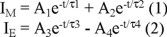
<body><![CDATA[<p align="justify"><font face="verdana" size="2">There are also instances where a like&#45;excimer emission is observed, when two pyrenes are close to each other forming a complex before light is absorbed. Because this emission strongly resembles a pyrene excimer emission and pyrene units did not have to move to interact, many people name these excited species "static excimers" or "excited complexes" &#91;30&#93;.</font></p>     <p align="justify"><font face="verdana" size="2">Mainly, there are two ways to distinguish between dynamic and static excimers: analysing excitation spectra and fluorescence life time decay profiles. For dynamic excimers, if we record excitation spectra at the fluorescence wavelength (&#955;<sub>F</sub>) of excited non&#45;associated pyrene and at &#955;<sub>F</sub> of the excimer emission, both excitation spectra have to be identical (<a href="#f6">Fig. 6</a>). On the other hand, if we record the fluorescence life time decay profile at &#955;<sub>F</sub> of excited non&#45;associated pyrene and at &#955;<sub>F</sub> of the excimer emission, in the latter we can observe a rising component for the excimer formation followed by a negative slope showing fluorescence decay and in the former only decay. Regarding static excimers, if we record the fluorescence life time decay profile at &#955;<sub>F</sub> of excited non&#45;associated pyrene and at &#955;<sub>F</sub> of the like&#45;excimer emission, in both cases only a negative slope or fluorescence decay is observed (<a href="#f6">Fig. 6</a>).</font></p>     <p align="center"><font face="verdana" size="2"><a name="f6"></a></font></p>     <p align="center"><font face="verdana" size="2"><img src="/img/revistas/rsqm/v48n1/a8f6.jpg"></font></p>     <p align="justify"><font face="verdana" size="2">The classic Birks two&#45;state mechanism for excimer formation and decay is expressed in two biexponential equations: (1) for the monomer emission and (2) for the excimer formation.</font></p>     <p align="center"><font face="Verdana" size="2"><img src="/img/revistas/rsqm/v48n1/a8e1.jpg"></font></p>     <p align="justify"><font face="verdana" size="2">According to these equations the monomer or the excited non&#45;associated pyrene and the excimer are coupled species &#964;1 = &#964;3, &#964;2 = &#964;4 and A<sub>4</sub>/A<sub>3</sub> = 1. For a dynamic excimer this model applies and as we can see &#45;A<sub>4</sub> is a negative coefficient. However, for static excimers reconvolution analysis gives a positive A<sub>4</sub> value &#91;30&#93;.</font></p>     <p align="justify"><font face="verdana" size="2"><i>Steady state fluorescence spectra of trans&#45;PEP and cis&#45;PEP.</i> The fluorescence spectrum of <i>trans</i>&#45;PEP (<a href="#f7">Fig. 7</a>) in THF solution shows a band in the 360&#45;465 nm region, due to non&#45;associated pyrene units. Apparently, it does not show any excimer emission but it shows an important emission intensity near 500 nm, a wavelength where pyrene itself does not emit. According to the photophysical behaviour of pyrene, this provides evidence of the formation of a excited&#45;complex between pyrene units. By contrast, the fluorescence spectrum of <i>cis&#45;</i>PEP in the same solvent shows two distinct bands (<a href="#f7">Fig. 7</a>). The first band, with vibronic peaks, was very similar to that observed for <i>trans</i>&#45;PEP and could be attributed to non&#45;associated pyrene units. The broad band around 550 nm results from the formation of intramolecular interactions between adjacent pyrene units along the molecular frame. Indeed, similar spectral properties observed in the fluorescence spectrum of <i>cis</i>&#45;PEP were previously reported by us for di(1&#45;ethynylpyrene) (DEP) (<a href="#f7">Fig. 7</a>). The spectral position of this band is very different from that observed for DEP (&#955;<sub>F</sub> &#8776; 480 nm) because of the different conformation adopted by the main chain in <i>cis</i>&#45;PEP. Indeed, in <i>cis&#45;</i>PEP intramolecular interactions formed by a coiling of the main chain take place giving rise to shorter distances for several pyrene units, and consequently to a large red&#45;shift of this emission band.</font></p>     <p align="center"><font face="verdana" size="2"><a name="f7"></a></font></p>     <p align="center"><font face="verdana" size="2"><img src="/img/revistas/rsqm/v48n1/a8f7.jpg"></font></p>     ]]></body>
<body><![CDATA[<p align="justify"><font face="verdana" size="2"><i>Excitation spectra of trans&#45;PEP and cis&#45;PEP.</i> In order to differentiate between the formation of a dynamic or static excimer, excitation spectra of <i>trans</i>&#45;PEP were recorded at &#955;<sub>F</sub> = 404 nm and at &#955;<sub>F</sub> = 480 nm and showed to be quite different. Excitation spectra were measured for <i>cis</i>&#45;PEP at &#955;<sub>F</sub> = 404 nm and &#955;<sub>F</sub> = 560 nm as well (<a href="#f8">Figure 8</a>). The excitation spectrum measured at &#955;<sub>F</sub> = 560 nm is very different from that measured at &#955;<sub>F</sub> = 404 nm. This is against the rule of the formation of a dynamic excimer, which should exhibit an excitation spectrum identical to that of the non&#45;associated pyrene units. The band centered at 385 nm and the large band around 446 nm correspond to the shoulder at 365 nm and the band at 453 nm observed in the absorption spectrum of <i>cis</i>&#45;PEP (<a href="#f3">Fig. 3</a>). However, the shoulder observed at 537 nm in the absorption spectrum of <i>cis</i>&#45;PEP is not observed in the excitation spectrum of this compound. This clearly shows that this band was not caused by pyrene groups (associated or non&#45;associated) and involved only the polyacetylene main chain as mentioned above.</font></p>     <p align="center"><font face="verdana" size="2"><a name="f8"></a></font></p>     <p align="center"><font face="verdana" size="2"><img src="/img/revistas/rsqm/v48n1/a8f8.jpg"></font></p>     <p align="justify"><font face="verdana" size="2"><i>Lifetime fluorescence decay profiles of trans&#45;PEP and cis&#45;PEP.</i> The fluorescence decay profiles of <i>trans</i>&#45;PEP and <i>cis&#45;</i>PEP, recorded at the non&#45;associated pyrene &#955;<sub>F</sub> and at the excimer fluorescence wavelength (<a href="#f9">Figure 9</a>) provided interesting results of the kinetic analysis and are summarized in <a href="/img/revistas/rsqm/v48n1/a8c1.jpg" target="_blank">Table 1</a>. The best fits obtained for these decays are complex and involve a triexponential expression. This is due to the presence of various species (arrangements) along the polymer backbones. The fluorescence decay recorded at the longer wavelength of each polymer does not show any rising component, which should be observed for an emission originating from a dynamic excimer &#91;30&#93;. Moreover, no negative component was calculated from the decay profile analysis, which is against the formation of a dynamic excimer in <i>trans</i>&#45;PEP and <i>cis</i>&#45;PEP. Thus, we can conclude that we have static excimers in both polymers and interactions between adjacent pyrene groups take place in the ground state.</font></p>     <p align="center"><font face="verdana" size="2"><a name="f9"></a></font></p>     <p align="center"><font face="verdana" size="2"><img src="/img/revistas/rsqm/v48n1/a8f9.jpg"></font></p>     <p align="justify"><font face="verdana" size="2">The average lifetime measured for <i>trans&#45;</i>PEP and <i>cis&#45;</i>PEP (<a href="/img/revistas/rsqm/v48n1/a8c1.jpg" target="_blank">Table 1</a>) at the longer wavelengths are significantly shorter than that measured about &#955;<sub>F</sub> = 404 nm. This is a proof that a new static complex (static excimer) between the pendant pyrene units present in the polymer appear at longer wavelengths. Surprisingly, the fluorescence lifetime of non&#45;associated pyrene units is unusually low. Indeed, the fluorescence lifetime of the pyrene chromophore is normally quite high, reaching 450 ns in non&#45;polar solvents such as cyclohexane and decreasing drastically depending on the polarity of the solvent &#91;37&#93;. Recently, Borgig <i>et al</i> reported that pyrene chromophores grafted to polyethylene showed similar short fluorescence life&#45;times &#91;38&#93;. For instance, 1&#45;pyrenylbutyl methacrylate (PyBMA) grafted to polyethylene, which have a fluorescence spectrum (385 nm, 406 nm) very close to that of our polymers, exhibits a lifetime of 13.3 ns.</font></p>     <p align="justify"><font face="verdana" size="2">Therefore, the average fluorescence lifetime obtained about &#955;<sub>F</sub> = 404 nm for <i>cis</i>&#45;PEP is much shorter than that of <i>trans</i>&#45;PEP measured at the same wavelength. This is a proof that pyrene units in the <i>cis</i>&#45;PEP are in a different arrangement, being closer to each other by a coiling of the main chain (<a href="#f4">Figure 4</a>). Similarly, the average lifetime calculated at &#955;<sub>F</sub> = 560 nm is shorter than that of <i>trans</i>&#45;PEP at &#955;<sub>F</sub> = 480, suggesting that this complex is stronger than that formed with pyrene units in the <i>trans</i>&#45;polymer. All these facts are in agreement with the spectral band positions of both complexes, indicating that the complex present in the <i>cis</i>&#45;polymer is more stabilized.</font></p>     <p align="justify"><font face="Verdana" size="2">&nbsp;</font></p>     <p align="justify"><font face="verdana" size="2"><b>Conclusion</b></font></p>     ]]></body>
<body><![CDATA[<p align="justify"><font face="verdana" size="2">Optical properties of <i>trans</i>&#45;PEP and <i>cis</i>&#45;PEP in THF solution were investigated by UV&#45;vis and fluorescence spectroscopy. <i>Trans</i>&#45;PEP possesses an effective degree of conjugation, which is higher than that of <i>cis</i>&#45;PEP. Both polymers show emissions originating from excited non&#45;associated pyrene units and static excimers. From excitation spectra and fluorescence decay profiles measured at the maximum of both fluorescence bands, it is evident that ground state interactions (static excimers) are responsible for the resulting long wavelength emissions. It is worth pointing out that the long&#45;wavelength fluorescence band of <i>cis</i>&#45;PEP is more stabilized, suggesting that pyrene units are closer to each other in this polymer and interact in a non&#45;parallel way.</font></p>     <p align="justify"><font face="verdana" size="2">The fluorescence decay profiles of both polymers are complex and are best fitted by a triexponential expression. Since the average fluorescence lifetime of <i>cis</i>&#45;PEP is much shorter than that of <i>trans</i>&#45;PEP, stronger interactions between pyrene units (correlated to shorter intermolecular distances) in the <i>cis</i>&#45;PEP are responsible for this behaviour.</font></p>     <p align="justify"><font face="Verdana" size="2">&nbsp;</font></p>     <p align="justify"><font face="verdana" size="2"><b>Acknowledgements</b></font></p>     <p align="justify"><font face="verdana" size="2">The author is grateful to Prof Gilles Durocher and Dr. Michel Bellet&ecirc;te of the Universit&eacute; de Montr&eacute;al for their valuable help with steady state and lifetime fluorescence experiments. This work was financially supported by NSERC&#45;Canada and IIM&#45;UNAM.</font></p>     <p align="justify"><font face="Verdana" size="2">&nbsp;</font></p>     <p align="justify"><font face="verdana" size="2"><b>References</b></font></p>     <!-- ref --><p align="justify"><font face="verdana" size="2">1. Friend, R.H.; Gymer, R.W.; Holmes, A.B.; Burroughes, J.H.; Marks, R.N.; Taliani, C.; Bradley, D.D.C., Dos Santos, D.A.; Br&eacute;das, J.L.; Logdlung, M.; Salanek, W.R. <i>Nature</i> <b>1999</b>, <i>397</i>, 121&#45;128.    &nbsp;&nbsp;&nbsp;&nbsp;&nbsp;&nbsp;&nbsp;&nbsp;[&#160;<a href="javascript:void(0);" onclick="javascript: window.open('/scielo.php?script=sci_nlinks&ref=6984094&pid=S0583-7693200400010000800001&lng=','','width=640,height=500,resizable=yes,scrollbars=1,menubar=yes,');">Links</a>&#160;]<!-- end-ref --></font></p>     <!-- ref --><p align="justify"><font face="verdana" size="2">2. Heeger, A.J. <i>Angew. Chem, Int. Ed. Eng.</i> <b>2001</b>, <i>40</i>, 2591&#45;2611.    &nbsp;&nbsp;&nbsp;&nbsp;&nbsp;&nbsp;&nbsp;&nbsp;[&#160;<a href="javascript:void(0);" onclick="javascript: window.open('/scielo.php?script=sci_nlinks&ref=6984096&pid=S0583-7693200400010000800002&lng=','','width=640,height=500,resizable=yes,scrollbars=1,menubar=yes,');">Links</a>&#160;]<!-- end-ref --></font></p>     <!-- ref --><p align="justify"><font face="verdana" size="2">3. Segura, J.L.; Martin, N. <i>J. Mater. Chem.</i> <b>2000</b>, <i>10</i>, 2403&#45;2435.    &nbsp;&nbsp;&nbsp;&nbsp;&nbsp;&nbsp;&nbsp;&nbsp;[&#160;<a href="javascript:void(0);" onclick="javascript: window.open('/scielo.php?script=sci_nlinks&ref=6984098&pid=S0583-7693200400010000800003&lng=','','width=640,height=500,resizable=yes,scrollbars=1,menubar=yes,');">Links</a>&#160;]<!-- end-ref --></font></p>     <!-- ref --><p align="justify"><font face="verdana" size="2">4. Kraft, A.; Grimsdale, A.C.; Holmes, A.B. <i>Angew. Chem. Int. Ed. Eng.</i> <b>1998</b>, <i>37</i>, 402&#45;428.    &nbsp;&nbsp;&nbsp;&nbsp;&nbsp;&nbsp;&nbsp;&nbsp;[&#160;<a href="javascript:void(0);" onclick="javascript: window.open('/scielo.php?script=sci_nlinks&ref=6984100&pid=S0583-7693200400010000800004&lng=','','width=640,height=500,resizable=yes,scrollbars=1,menubar=yes,');">Links</a>&#160;]<!-- end-ref --></font></p>     <!-- ref --><p align="justify"><font face="verdana" size="2">5. Bernius, M.T.; Inbasekaran, M.; O'Brien, J.; Wu, W.S. <i>Adv. Mater.</i> <b>2000</b>, <i>12</i>, 1737&#45;1750.    &nbsp;&nbsp;&nbsp;&nbsp;&nbsp;&nbsp;&nbsp;&nbsp;[&#160;<a href="javascript:void(0);" onclick="javascript: window.open('/scielo.php?script=sci_nlinks&ref=6984102&pid=S0583-7693200400010000800005&lng=','','width=640,height=500,resizable=yes,scrollbars=1,menubar=yes,');">Links</a>&#160;]<!-- end-ref --></font></p>     <!-- ref --><p align="justify"><font face="verdana" size="2">6. Chien, J.C.W. <i>Polyacetylene</i>. Academic Press New York, <b>1984</b>.    &nbsp;&nbsp;&nbsp;&nbsp;&nbsp;&nbsp;&nbsp;&nbsp;[&#160;<a href="javascript:void(0);" onclick="javascript: window.open('/scielo.php?script=sci_nlinks&ref=6984104&pid=S0583-7693200400010000800006&lng=','','width=640,height=500,resizable=yes,scrollbars=1,menubar=yes,');">Links</a>&#160;]<!-- end-ref --></font></p>     <!-- ref --><p align="justify"><font face="verdana" size="2">7. Gingsburg, E.J.; Gorman C.B.; Grubbs, R.H., in: <i>Modern Acetylene Chemistry.</i> Stang, P.J., Diederich, F. Editors. VCH, New York, 1995.    &nbsp;&nbsp;&nbsp;&nbsp;&nbsp;&nbsp;&nbsp;&nbsp;[&#160;<a href="javascript:void(0);" onclick="javascript: window.open('/scielo.php?script=sci_nlinks&ref=6984106&pid=S0583-7693200400010000800007&lng=','','width=640,height=500,resizable=yes,scrollbars=1,menubar=yes,');">Links</a>&#160;]<!-- end-ref --></font></p>     <!-- ref --><p align="justify"><font face="verdana" size="2">8. Shirakawa H; Masuda T; Takeda K; Patai S. <i>The Chemistry of Triple Bonded Functional Groups Supplement</i> C2. Wiley, New York, 1994. Chapter 17.    &nbsp;&nbsp;&nbsp;&nbsp;&nbsp;&nbsp;&nbsp;&nbsp;[&#160;<a href="javascript:void(0);" onclick="javascript: window.open('/scielo.php?script=sci_nlinks&ref=6984108&pid=S0583-7693200400010000800008&lng=','','width=640,height=500,resizable=yes,scrollbars=1,menubar=yes,');">Links</a>&#160;]<!-- end-ref --></font></p>     <!-- ref --><p align="justify"><font face="verdana" size="2">9. Schrock, R.R. <i>Acc. Chem. Res.</i> <b>1990</b>, <i>23</i>, 158&#45;165.    &nbsp;&nbsp;&nbsp;&nbsp;&nbsp;&nbsp;&nbsp;&nbsp;[&#160;<a href="javascript:void(0);" onclick="javascript: window.open('/scielo.php?script=sci_nlinks&ref=6984110&pid=S0583-7693200400010000800009&lng=','','width=640,height=500,resizable=yes,scrollbars=1,menubar=yes,');">Links</a>&#160;]<!-- end-ref --></font></p>     <!-- ref --><p align="justify"><font face="verdana" size="2">10. Masuda, T.; Higashimura, T. <i>Adv. Polym. Sci.</i> <b>1987</b>, <i>81</i>, 121.    &nbsp;&nbsp;&nbsp;&nbsp;&nbsp;&nbsp;&nbsp;&nbsp;[&#160;<a href="javascript:void(0);" onclick="javascript: window.open('/scielo.php?script=sci_nlinks&ref=6984112&pid=S0583-7693200400010000800010&lng=','','width=640,height=500,resizable=yes,scrollbars=1,menubar=yes,');">Links</a>&#160;]<!-- end-ref --></font></p>     <!-- ref --><p align="justify"><font face="verdana" size="2">11. Tang, B.Z. ; Poon, W. H.; Leung, S.M. ; Leung, W.H.; Peng, H. <i>Macromolecules</i> <b>1997</b>, <i>30</i>, 2209&#45;2212.    &nbsp;&nbsp;&nbsp;&nbsp;&nbsp;&nbsp;&nbsp;&nbsp;[&#160;<a href="javascript:void(0);" onclick="javascript: window.open('/scielo.php?script=sci_nlinks&ref=6984114&pid=S0583-7693200400010000800011&lng=','','width=640,height=500,resizable=yes,scrollbars=1,menubar=yes,');">Links</a>&#160;]<!-- end-ref --></font></p>     <!-- ref --><p align="justify"><font face="verdana" size="2">12. Simionescu, C.I.; Percec, V. <i>J. Polym. Sci. Polym. Symp.</i> <b>1980</b>, <i>67</i>, 43&#45;71.    &nbsp;&nbsp;&nbsp;&nbsp;&nbsp;&nbsp;&nbsp;&nbsp;[&#160;<a href="javascript:void(0);" onclick="javascript: window.open('/scielo.php?script=sci_nlinks&ref=6984116&pid=S0583-7693200400010000800012&lng=','','width=640,height=500,resizable=yes,scrollbars=1,menubar=yes,');">Links</a>&#160;]<!-- end-ref --></font></p>     <!-- ref --><p align="justify"><font face="verdana" size="2">13. Simionescu, C.I.; Percec, V.; Dumitrescu, S. <i>J. Polym. Sci., Polym. Chem. Ed.</i> <b>1977</b>, <i>15</i>, 2497&#45;2509.    &nbsp;&nbsp;&nbsp;&nbsp;&nbsp;&nbsp;&nbsp;&nbsp;[&#160;<a href="javascript:void(0);" onclick="javascript: window.open('/scielo.php?script=sci_nlinks&ref=6984118&pid=S0583-7693200400010000800013&lng=','','width=640,height=500,resizable=yes,scrollbars=1,menubar=yes,');">Links</a>&#160;]<!-- end-ref --></font></p>     <!-- ref --><p align="justify"><font face="verdana" size="2">14. Masuda, T.; Tavhimori, H.J.M.S. <i>Pure. Appl. Chem.</i> <b>1994</b>, <i>A31</i>, 1675&#45;1690.    &nbsp;&nbsp;&nbsp;&nbsp;&nbsp;&nbsp;&nbsp;&nbsp;[&#160;<a href="javascript:void(0);" onclick="javascript: window.open('/scielo.php?script=sci_nlinks&ref=6984120&pid=S0583-7693200400010000800014&lng=','','width=640,height=500,resizable=yes,scrollbars=1,menubar=yes,');">Links</a>&#160;]<!-- end-ref --></font></p>     <!-- ref --><p align="justify"><font face="verdana" size="2">15. Masuda, T.; Karim, S.M.A.; Nomura, R. <i>J. Mol. Catal. A.</i> <b>2000</b>, <i>160</i>, 125&#45;131.    &nbsp;&nbsp;&nbsp;&nbsp;&nbsp;&nbsp;&nbsp;&nbsp;[&#160;<a href="javascript:void(0);" onclick="javascript: window.open('/scielo.php?script=sci_nlinks&ref=6984122&pid=S0583-7693200400010000800015&lng=','','width=640,height=500,resizable=yes,scrollbars=1,menubar=yes,');">Links</a>&#160;]<!-- end-ref --></font></p>     <!-- ref --><p align="justify"><font face="verdana" size="2">16. Tang, B.Z.; Kong, X.; Wan, X.; Feng, X.D. <i>Macromolecules</i> <b>1997</b>, <i>30</i>, 5620&#45;5628.    &nbsp;&nbsp;&nbsp;&nbsp;&nbsp;&nbsp;&nbsp;&nbsp;[&#160;<a href="javascript:void(0);" onclick="javascript: window.open('/scielo.php?script=sci_nlinks&ref=6984124&pid=S0583-7693200400010000800016&lng=','','width=640,height=500,resizable=yes,scrollbars=1,menubar=yes,');">Links</a>&#160;]<!-- end-ref --></font></p>     <!-- ref --><p align="justify"><font face="verdana" size="2">17. Shimizu, T.; Yamamoto, T<i>. Inorg. Chim. Acta.</i> <b>1999</b>, <i>296</i>, 278&#45;280.    &nbsp;&nbsp;&nbsp;&nbsp;&nbsp;&nbsp;&nbsp;&nbsp;[&#160;<a href="javascript:void(0);" onclick="javascript: window.open('/scielo.php?script=sci_nlinks&ref=6984126&pid=S0583-7693200400010000800017&lng=','','width=640,height=500,resizable=yes,scrollbars=1,menubar=yes,');">Links</a>&#160;]<!-- end-ref --></font></p>     <!-- ref --><p align="justify"><font face="verdana" size="2">18. Shimizu,T.; Yamamoto, T. <i>Chem Commun</i> <b>1999</b>, <i>6</i>, 515&#45;516.    &nbsp;&nbsp;&nbsp;&nbsp;&nbsp;&nbsp;&nbsp;&nbsp;[&#160;<a href="javascript:void(0);" onclick="javascript: window.open('/scielo.php?script=sci_nlinks&ref=6984128&pid=S0583-7693200400010000800018&lng=','','width=640,height=500,resizable=yes,scrollbars=1,menubar=yes,');">Links</a>&#160;]<!-- end-ref --></font></p>     <!-- ref --><p align="justify"><font face="verdana" size="2">19. Mastrorilli, P.; Nobile, C.F.; Rizzuti, A.; Suranna, G.P.; Acierno, D.; Amendola, E. <i>J. Mol. Catal. A</i> <b>2002</b>, <i>178</i>, 35&#45;42.    &nbsp;&nbsp;&nbsp;&nbsp;&nbsp;&nbsp;&nbsp;&nbsp;[&#160;<a href="javascript:void(0);" onclick="javascript: window.open('/scielo.php?script=sci_nlinks&ref=6984130&pid=S0583-7693200400010000800019&lng=','','width=640,height=500,resizable=yes,scrollbars=1,menubar=yes,');">Links</a>&#160;]<!-- end-ref --></font></p>     <!-- ref --><p align="justify"><font face="verdana" size="2">20. Pi&ccedil;arra, S.; Relogio, P.; Afonso, C.A.M.; J. M. G. Martinho, J.M.G.; Farinha J.P.S. <i>Macromolecules</i> <b>2003</b>, <i>36</i>, 8119&#45;8129.    &nbsp;&nbsp;&nbsp;&nbsp;&nbsp;&nbsp;&nbsp;&nbsp;[&#160;<a href="javascript:void(0);" onclick="javascript: window.open('/scielo.php?script=sci_nlinks&ref=6984132&pid=S0583-7693200400010000800020&lng=','','width=640,height=500,resizable=yes,scrollbars=1,menubar=yes,');">Links</a>&#160;]<!-- end-ref --></font></p>     <!-- ref --><p align="justify"><font face="verdana" size="2">21. Duhamel, J.; Kanagalingam, S.; O'Brien, T.J.; Ingratta M.W. <i>J. Am. Chem. Soc.</i> <b>2003</b>, <i>125</i>, 12810&#45;12822.    &nbsp;&nbsp;&nbsp;&nbsp;&nbsp;&nbsp;&nbsp;&nbsp;[&#160;<a href="javascript:void(0);" onclick="javascript: window.open('/scielo.php?script=sci_nlinks&ref=6984134&pid=S0583-7693200400010000800021&lng=','','width=640,height=500,resizable=yes,scrollbars=1,menubar=yes,');">Links</a>&#160;]<!-- end-ref --></font></p>     <!-- ref --><p align="justify"><font face="verdana" size="2">22. Mizayazawa, K.; Winnik F.M<i>. J. Phys. Chem. B</i> <b>2003</b>, <i>107</i>, 10667&#45;10682.    &nbsp;&nbsp;&nbsp;&nbsp;&nbsp;&nbsp;&nbsp;&nbsp;[&#160;<a href="javascript:void(0);" onclick="javascript: window.open('/scielo.php?script=sci_nlinks&ref=6984136&pid=S0583-7693200400010000800022&lng=','','width=640,height=500,resizable=yes,scrollbars=1,menubar=yes,');">Links</a>&#160;]<!-- end-ref --></font></p>     <!-- ref --><p align="justify"><font face="verdana" size="2">23. Pandey, S.; Redden, R.A.; Fletcher, K.A. <i>Macromol. Chem. Phys.</i> <b>2003</b>, <i>204</i>, 425&#45;435.    &nbsp;&nbsp;&nbsp;&nbsp;&nbsp;&nbsp;&nbsp;&nbsp;[&#160;<a href="javascript:void(0);" onclick="javascript: window.open('/scielo.php?script=sci_nlinks&ref=6984138&pid=S0583-7693200400010000800023&lng=','','width=640,height=500,resizable=yes,scrollbars=1,menubar=yes,');">Links</a>&#160;]<!-- end-ref --></font></p>     <!-- ref --><p align="justify"><font face="verdana" size="2">24. Berglund, K.D.; Przybycien, T.M.; Tilton, R.D. <i>Langmuir</i> <b>2003</b>, <i>19</i>, 2705&#45;2713.    &nbsp;&nbsp;&nbsp;&nbsp;&nbsp;&nbsp;&nbsp;&nbsp;[&#160;<a href="javascript:void(0);" onclick="javascript: window.open('/scielo.php?script=sci_nlinks&ref=6984140&pid=S0583-7693200400010000800024&lng=','','width=640,height=500,resizable=yes,scrollbars=1,menubar=yes,');">Links</a>&#160;]<!-- end-ref --></font></p>     <!-- ref --><p align="justify"><font face="verdana" size="2">25. Beaudoin, E.; Hiorns, R.C.; Borisov, O.; Fran&ccedil;ois, J. <i>Langmuir</i> <b>2003</b>, <i>19</i>, 2058&#45;2066.    &nbsp;&nbsp;&nbsp;&nbsp;&nbsp;&nbsp;&nbsp;&nbsp;[&#160;<a href="javascript:void(0);" onclick="javascript: window.open('/scielo.php?script=sci_nlinks&ref=6984142&pid=S0583-7693200400010000800025&lng=','','width=640,height=500,resizable=yes,scrollbars=1,menubar=yes,');">Links</a>&#160;]<!-- end-ref --></font></p>     <!-- ref --><p align="justify"><font face="verdana" size="2">26. Gao, C.; Qian, H.; Wang, S.J.; Wei Chen, D.Y.; Yu, G. <i>Polymer</i> <b>2003</b>, <i>44</i>, 1547&#45;1552.    &nbsp;&nbsp;&nbsp;&nbsp;&nbsp;&nbsp;&nbsp;&nbsp;[&#160;<a href="javascript:void(0);" onclick="javascript: window.open('/scielo.php?script=sci_nlinks&ref=6984144&pid=S0583-7693200400010000800026&lng=','','width=640,height=500,resizable=yes,scrollbars=1,menubar=yes,');">Links</a>&#160;]<!-- end-ref --></font></p>     <!-- ref --><p align="justify"><font face="verdana" size="2">27. Morimoto, H.; Hashidzume, A.; Morishima, Y. <i>Polymer</i>, <b>2003</b>, <i>44</i>, 943&#45;952.    &nbsp;&nbsp;&nbsp;&nbsp;&nbsp;&nbsp;&nbsp;&nbsp;[&#160;<a href="javascript:void(0);" onclick="javascript: window.open('/scielo.php?script=sci_nlinks&ref=6984146&pid=S0583-7693200400010000800027&lng=','','width=640,height=500,resizable=yes,scrollbars=1,menubar=yes,');">Links</a>&#160;]<!-- end-ref --></font></p>     <!-- ref --><p align="justify"><font face="verdana" size="2">28. Yusa, S.; Sakakibara, A.; Yamamoto, T.; Morishima, Y. <i>Macromolecules</i> <b>2002</b>, <i>35</i>, 10182&#45;10188.    &nbsp;&nbsp;&nbsp;&nbsp;&nbsp;&nbsp;&nbsp;&nbsp;[&#160;<a href="javascript:void(0);" onclick="javascript: window.open('/scielo.php?script=sci_nlinks&ref=6984148&pid=S0583-7693200400010000800028&lng=','','width=640,height=500,resizable=yes,scrollbars=1,menubar=yes,');">Links</a>&#160;]<!-- end-ref --></font></p>     <!-- ref --><p align="justify"><font face="verdana" size="2">29. Ellison, C.J.; Torkelson, J.M. <i>J. Polym. Sci. B Polym. Phys.</i> <b>2002</b>, <i>40</i>, 2745&#45;2758.    &nbsp;&nbsp;&nbsp;&nbsp;&nbsp;&nbsp;&nbsp;&nbsp;[&#160;<a href="javascript:void(0);" onclick="javascript: window.open('/scielo.php?script=sci_nlinks&ref=6984150&pid=S0583-7693200400010000800029&lng=','','width=640,height=500,resizable=yes,scrollbars=1,menubar=yes,');">Links</a>&#160;]<!-- end-ref --></font></p>     <!-- ref --><p align="justify"><font face="verdana" size="2">30. Winnik, F.M. <i>Chem. Rev.</i> <b>1993</b>, <i>93</i>, 587&#45;614.    &nbsp;&nbsp;&nbsp;&nbsp;&nbsp;&nbsp;&nbsp;&nbsp;[&#160;<a href="javascript:void(0);" onclick="javascript: window.open('/scielo.php?script=sci_nlinks&ref=6984152&pid=S0583-7693200400010000800030&lng=','','width=640,height=500,resizable=yes,scrollbars=1,menubar=yes,');">Links</a>&#160;]<!-- end-ref --></font></p>     <!-- ref --><p align="justify"><font face="verdana" size="2">31. Rivera, E.; Bellet&ecirc;te, M.; Zhu, X.X.; Durocher, G.; Giasson, R. <i>Polymer</i> <b>2002</b>, <i>43</i>, 5059&#45;5058.    &nbsp;&nbsp;&nbsp;&nbsp;&nbsp;&nbsp;&nbsp;&nbsp;[&#160;<a href="javascript:void(0);" onclick="javascript: window.open('/scielo.php?script=sci_nlinks&ref=6984154&pid=S0583-7693200400010000800031&lng=','','width=640,height=500,resizable=yes,scrollbars=1,menubar=yes,');">Links</a>&#160;]<!-- end-ref --></font></p>     <!-- ref --><p align="justify"><font face="verdana" size="2">32. Rivera, E.; Wang, R.; Zhu, X.X.; Zargarian, D., Giasson, R. <i>J. Mol. Catal. A.</i> <b>2003</b>, <i>204&#45;205</i>, 325&#45;332.    &nbsp;&nbsp;&nbsp;&nbsp;&nbsp;&nbsp;&nbsp;&nbsp;[&#160;<a href="javascript:void(0);" onclick="javascript: window.open('/scielo.php?script=sci_nlinks&ref=6984156&pid=S0583-7693200400010000800032&lng=','','width=640,height=500,resizable=yes,scrollbars=1,menubar=yes,');">Links</a>&#160;]<!-- end-ref --></font></p>     <!-- ref --><p align="justify"><font face="verdana" size="2">33. Tabata, M. Sone, T. Sadahiro, Y. <i>Macromol. Chem. Phys.</i> <b>1999</b>, <i>200</i>, 265&#45;282.    &nbsp;&nbsp;&nbsp;&nbsp;&nbsp;&nbsp;&nbsp;&nbsp;[&#160;<a href="javascript:void(0);" onclick="javascript: window.open('/scielo.php?script=sci_nlinks&ref=6984158&pid=S0583-7693200400010000800033&lng=','','width=640,height=500,resizable=yes,scrollbars=1,menubar=yes,');">Links</a>&#160;]<!-- end-ref --></font></p>     <!-- ref --><p align="justify"><font face="verdana" size="2">34. Wang, R.; B&eacute;langer&#45;Gari&eacute;py, F.; Zargarian, D. <i>Organometallics</i> <b>1999</b>, <i>18</i>, 5548&#45;5552.    &nbsp;&nbsp;&nbsp;&nbsp;&nbsp;&nbsp;&nbsp;&nbsp;[&#160;<a href="javascript:void(0);" onclick="javascript: window.open('/scielo.php?script=sci_nlinks&ref=6984160&pid=S0583-7693200400010000800034&lng=','','width=640,height=500,resizable=yes,scrollbars=1,menubar=yes,');">Links</a>&#160;]<!-- end-ref --></font></p>     <!-- ref --><p align="justify"><font face="verdana" size="2">35. Birks, J.B. Photophysics of Aromatic Molecules; John Wiley, New York, 1970.    &nbsp;&nbsp;&nbsp;&nbsp;&nbsp;&nbsp;&nbsp;&nbsp;[&#160;<a href="javascript:void(0);" onclick="javascript: window.open('/scielo.php?script=sci_nlinks&ref=6984162&pid=S0583-7693200400010000800035&lng=','','width=640,height=500,resizable=yes,scrollbars=1,menubar=yes,');">Links</a>&#160;]<!-- end-ref --></font></p>     <!-- ref --><p align="justify"><font face="verdana" size="2">36. Forber, C.; Zerner M.C. <i>J. Am. Chem. Soc.</i> <b>1985</b>, <i>107</i>, 5884&#45;5890.    &nbsp;&nbsp;&nbsp;&nbsp;&nbsp;&nbsp;&nbsp;&nbsp;[&#160;<a href="javascript:void(0);" onclick="javascript: window.open('/scielo.php?script=sci_nlinks&ref=6984164&pid=S0583-7693200400010000800036&lng=','','width=640,height=500,resizable=yes,scrollbars=1,menubar=yes,');">Links</a>&#160;]<!-- end-ref --></font></p>     <!-- ref --><p align="justify"><font face="verdana" size="2">37. Nijegorodov, N.I.; Downy, W.S. <i>J. Phys. Chem.</i> <b>1994</b>, <i>98</i>, 5639&#45;5643.    &nbsp;&nbsp;&nbsp;&nbsp;&nbsp;&nbsp;&nbsp;&nbsp;[&#160;<a href="javascript:void(0);" onclick="javascript: window.open('/scielo.php?script=sci_nlinks&ref=6984166&pid=S0583-7693200400010000800037&lng=','','width=640,height=500,resizable=yes,scrollbars=1,menubar=yes,');">Links</a>&#160;]<!-- end-ref --></font></p>     <!-- ref --><p align="justify"><font face="verdana" size="2">38. Danko, M.; Hrdlovic, P.; Borsig, E. <i>J. Macromol. Sci.&#45;Pure Appl. Chem.</i> <b>2001</b>, <i>A38</i>, 467&#45;486.    &nbsp;&nbsp;&nbsp;&nbsp;&nbsp;&nbsp;&nbsp;&nbsp;[&#160;<a href="javascript:void(0);" onclick="javascript: window.open('/scielo.php?script=sci_nlinks&ref=6984168&pid=S0583-7693200400010000800038&lng=','','width=640,height=500,resizable=yes,scrollbars=1,menubar=yes,');">Links</a>&#160;]<!-- end-ref --></font></p>      ]]></body><back>
<ref-list>
<ref id="B1">
<label>1</label><nlm-citation citation-type="journal">
<person-group person-group-type="author">
<name>
<surname><![CDATA[Friend]]></surname>
<given-names><![CDATA[R.H.]]></given-names>
</name>
<name>
<surname><![CDATA[Gymer]]></surname>
<given-names><![CDATA[R.W.]]></given-names>
</name>
<name>
<surname><![CDATA[Holmes]]></surname>
<given-names><![CDATA[A.B.]]></given-names>
</name>
<name>
<surname><![CDATA[Burroughes]]></surname>
<given-names><![CDATA[J.H.]]></given-names>
</name>
<name>
<surname><![CDATA[Marks]]></surname>
<given-names><![CDATA[R.N.]]></given-names>
</name>
<name>
<surname><![CDATA[Taliani]]></surname>
<given-names><![CDATA[C.]]></given-names>
</name>
<name>
<surname><![CDATA[Bradley]]></surname>
<given-names><![CDATA[D.D.C.]]></given-names>
</name>
<name>
<surname><![CDATA[Dos Santos]]></surname>
<given-names><![CDATA[D.A.]]></given-names>
</name>
<name>
<surname><![CDATA[Brédas]]></surname>
<given-names><![CDATA[J.L.]]></given-names>
</name>
<name>
<surname><![CDATA[Logdlung]]></surname>
<given-names><![CDATA[M.]]></given-names>
</name>
<name>
<surname><![CDATA[Salanek]]></surname>
<given-names><![CDATA[W.R.]]></given-names>
</name>
</person-group>
<source><![CDATA[Nature]]></source>
<year>1999</year>
<volume>397</volume>
<page-range>121-128</page-range></nlm-citation>
</ref>
<ref id="B2">
<label>2</label><nlm-citation citation-type="journal">
<person-group person-group-type="author">
<name>
<surname><![CDATA[Heeger]]></surname>
<given-names><![CDATA[A.J.]]></given-names>
</name>
</person-group>
<source><![CDATA[Angew. Chem, Int. Ed. Eng.]]></source>
<year>2001</year>
<volume>40</volume>
<page-range>2591-2611</page-range></nlm-citation>
</ref>
<ref id="B3">
<label>3</label><nlm-citation citation-type="journal">
<person-group person-group-type="author">
<name>
<surname><![CDATA[Segura]]></surname>
<given-names><![CDATA[J.L.]]></given-names>
</name>
<name>
<surname><![CDATA[Martin]]></surname>
<given-names><![CDATA[N.]]></given-names>
</name>
</person-group>
<source><![CDATA[J. Mater. Chem.]]></source>
<year>2000</year>
<volume>10</volume>
<page-range>2403-2435</page-range></nlm-citation>
</ref>
<ref id="B4">
<label>4</label><nlm-citation citation-type="journal">
<person-group person-group-type="author">
<name>
<surname><![CDATA[Kraft]]></surname>
<given-names><![CDATA[A.]]></given-names>
</name>
<name>
<surname><![CDATA[Grimsdale]]></surname>
<given-names><![CDATA[A.C.]]></given-names>
</name>
<name>
<surname><![CDATA[Holmes]]></surname>
<given-names><![CDATA[A.B.]]></given-names>
</name>
</person-group>
<source><![CDATA[Angew. Chem. Int. Ed. Eng.]]></source>
<year>1998</year>
<volume>37</volume>
<page-range>402-428</page-range></nlm-citation>
</ref>
<ref id="B5">
<label>5</label><nlm-citation citation-type="journal">
<person-group person-group-type="author">
<name>
<surname><![CDATA[Bernius]]></surname>
<given-names><![CDATA[M.T.]]></given-names>
</name>
<name>
<surname><![CDATA[Inbasekaran]]></surname>
<given-names><![CDATA[M.]]></given-names>
</name>
<name>
<surname><![CDATA[O'Brien]]></surname>
<given-names><![CDATA[J.]]></given-names>
</name>
<name>
<surname><![CDATA[Wu]]></surname>
<given-names><![CDATA[W.S.]]></given-names>
</name>
</person-group>
<source><![CDATA[Adv. Mater.]]></source>
<year>2000</year>
<volume>12</volume>
<page-range>1737-1750</page-range></nlm-citation>
</ref>
<ref id="B6">
<label>6</label><nlm-citation citation-type="book">
<person-group person-group-type="author">
<name>
<surname><![CDATA[Chien]]></surname>
<given-names><![CDATA[J.C.W.]]></given-names>
</name>
</person-group>
<source><![CDATA[Polyacetylene]]></source>
<year>1984</year>
<publisher-loc><![CDATA[New York ]]></publisher-loc>
<publisher-name><![CDATA[Academic Press]]></publisher-name>
</nlm-citation>
</ref>
<ref id="B7">
<label>7</label><nlm-citation citation-type="book">
<person-group person-group-type="author">
<name>
<surname><![CDATA[Gingsburg]]></surname>
<given-names><![CDATA[E.J.]]></given-names>
</name>
<name>
<surname><![CDATA[Gorman]]></surname>
<given-names><![CDATA[C.B.]]></given-names>
</name>
<name>
<surname><![CDATA[Grubbs]]></surname>
<given-names><![CDATA[R.H.]]></given-names>
</name>
</person-group>
<person-group person-group-type="editor">
<name>
<surname><![CDATA[Stang]]></surname>
<given-names><![CDATA[P.J.]]></given-names>
</name>
<name>
<surname><![CDATA[Diederich]]></surname>
<given-names><![CDATA[F.]]></given-names>
</name>
</person-group>
<source><![CDATA[Modern Acetylene Chemistry]]></source>
<year>1995</year>
<publisher-loc><![CDATA[New York ]]></publisher-loc>
<publisher-name><![CDATA[VCH]]></publisher-name>
</nlm-citation>
</ref>
<ref id="B8">
<label>8</label><nlm-citation citation-type="book">
<person-group person-group-type="author">
<name>
<surname><![CDATA[Shirakawa]]></surname>
<given-names><![CDATA[H]]></given-names>
</name>
<name>
<surname><![CDATA[Masuda]]></surname>
<given-names><![CDATA[T]]></given-names>
</name>
<name>
<surname><![CDATA[Takeda]]></surname>
<given-names><![CDATA[K]]></given-names>
</name>
<name>
<surname><![CDATA[Patai]]></surname>
<given-names><![CDATA[S.]]></given-names>
</name>
</person-group>
<source><![CDATA[The Chemistry of Triple Bonded Functional Groups Supplement C2]]></source>
<year>1994</year>
<publisher-loc><![CDATA[New York ]]></publisher-loc>
<publisher-name><![CDATA[Wiley]]></publisher-name>
</nlm-citation>
</ref>
<ref id="B9">
<label>9</label><nlm-citation citation-type="journal">
<person-group person-group-type="author">
<name>
<surname><![CDATA[Schrock]]></surname>
<given-names><![CDATA[R.R.]]></given-names>
</name>
</person-group>
<source><![CDATA[Acc. Chem. Res.]]></source>
<year>1990</year>
<volume>23</volume>
<page-range>158-165</page-range></nlm-citation>
</ref>
<ref id="B10">
<label>10</label><nlm-citation citation-type="journal">
<person-group person-group-type="author">
<name>
<surname><![CDATA[Masuda]]></surname>
<given-names><![CDATA[T.]]></given-names>
</name>
<name>
<surname><![CDATA[Higashimura]]></surname>
<given-names><![CDATA[T.]]></given-names>
</name>
</person-group>
<source><![CDATA[Adv. Polym. Sci.]]></source>
<year>1987</year>
<volume>81</volume>
<page-range>121</page-range></nlm-citation>
</ref>
<ref id="B11">
<label>11</label><nlm-citation citation-type="journal">
<person-group person-group-type="author">
<name>
<surname><![CDATA[Tang]]></surname>
<given-names><![CDATA[B.Z.]]></given-names>
</name>
<name>
<surname><![CDATA[Poon]]></surname>
<given-names><![CDATA[W. H.]]></given-names>
</name>
<name>
<surname><![CDATA[Leung]]></surname>
<given-names><![CDATA[S.M.]]></given-names>
</name>
<name>
<surname><![CDATA[Leung]]></surname>
<given-names><![CDATA[W.H.]]></given-names>
</name>
<name>
<surname><![CDATA[Peng]]></surname>
<given-names><![CDATA[H.]]></given-names>
</name>
</person-group>
<source><![CDATA[Macromolecules]]></source>
<year>1997</year>
<volume>30</volume>
<page-range>2209-2212</page-range></nlm-citation>
</ref>
<ref id="B12">
<label>12</label><nlm-citation citation-type="journal">
<person-group person-group-type="author">
<name>
<surname><![CDATA[Simionescu]]></surname>
<given-names><![CDATA[C.I.]]></given-names>
</name>
<name>
<surname><![CDATA[Percec]]></surname>
<given-names><![CDATA[V.]]></given-names>
</name>
</person-group>
<source><![CDATA[J. Polym. Sci. Polym. Symp.]]></source>
<year>1980</year>
<volume>67</volume>
<page-range>43-71</page-range></nlm-citation>
</ref>
<ref id="B13">
<label>13</label><nlm-citation citation-type="journal">
<person-group person-group-type="author">
<name>
<surname><![CDATA[Simionescu]]></surname>
<given-names><![CDATA[C.I.]]></given-names>
</name>
<name>
<surname><![CDATA[Percec]]></surname>
<given-names><![CDATA[V.]]></given-names>
</name>
<name>
<surname><![CDATA[Dumitrescu]]></surname>
<given-names><![CDATA[S.]]></given-names>
</name>
</person-group>
<source><![CDATA[J. Polym. Sci., Polym. Chem. Ed.]]></source>
<year>1977</year>
<volume>15</volume>
<page-range>2497-2509</page-range></nlm-citation>
</ref>
<ref id="B14">
<label>14</label><nlm-citation citation-type="journal">
<person-group person-group-type="author">
<name>
<surname><![CDATA[Masuda]]></surname>
<given-names><![CDATA[T.]]></given-names>
</name>
<name>
<surname><![CDATA[Tavhimori]]></surname>
<given-names><![CDATA[H.J.M.S.]]></given-names>
</name>
</person-group>
<source><![CDATA[Pure. Appl. Chem.]]></source>
<year>1994</year>
<volume>A31</volume>
<page-range>1675-1690</page-range></nlm-citation>
</ref>
<ref id="B15">
<label>15</label><nlm-citation citation-type="journal">
<person-group person-group-type="author">
<name>
<surname><![CDATA[Masuda]]></surname>
<given-names><![CDATA[T.]]></given-names>
</name>
<name>
<surname><![CDATA[Karim]]></surname>
<given-names><![CDATA[S.M.A]]></given-names>
</name>
<name>
<surname><![CDATA[Nomura]]></surname>
<given-names><![CDATA[R.]]></given-names>
</name>
</person-group>
<source><![CDATA[J. Mol. Catal. A.]]></source>
<year>2000</year>
<volume>160</volume>
<page-range>125-131</page-range></nlm-citation>
</ref>
<ref id="B16">
<label>16</label><nlm-citation citation-type="journal">
<person-group person-group-type="author">
<name>
<surname><![CDATA[Tang]]></surname>
<given-names><![CDATA[B.Z.]]></given-names>
</name>
<name>
<surname><![CDATA[Kong]]></surname>
<given-names><![CDATA[X.]]></given-names>
</name>
<name>
<surname><![CDATA[Wan]]></surname>
<given-names><![CDATA[X.]]></given-names>
</name>
<name>
<surname><![CDATA[Feng]]></surname>
<given-names><![CDATA[X.D.]]></given-names>
</name>
</person-group>
<source><![CDATA[Macromolecules]]></source>
<year>1997</year>
<volume>30</volume>
<page-range>5620-5628</page-range></nlm-citation>
</ref>
<ref id="B17">
<label>17</label><nlm-citation citation-type="journal">
<person-group person-group-type="author">
<name>
<surname><![CDATA[Shimizu]]></surname>
<given-names><![CDATA[T.]]></given-names>
</name>
<name>
<surname><![CDATA[Yamamoto]]></surname>
<given-names><![CDATA[T.]]></given-names>
</name>
</person-group>
<source><![CDATA[Inorg. Chim. Acta.]]></source>
<year>1999</year>
<volume>296</volume>
<page-range>278-280</page-range></nlm-citation>
</ref>
<ref id="B18">
<label>18</label><nlm-citation citation-type="journal">
<person-group person-group-type="author">
<name>
<surname><![CDATA[Shimizu]]></surname>
<given-names><![CDATA[T.]]></given-names>
</name>
<name>
<surname><![CDATA[Yamamoto]]></surname>
<given-names><![CDATA[T.]]></given-names>
</name>
</person-group>
<source><![CDATA[Chem Commun]]></source>
<year>1999</year>
<volume>6</volume>
<page-range>515-516</page-range></nlm-citation>
</ref>
<ref id="B19">
<label>19</label><nlm-citation citation-type="journal">
<person-group person-group-type="author">
<name>
<surname><![CDATA[Mastrorilli]]></surname>
<given-names><![CDATA[P.]]></given-names>
</name>
<name>
<surname><![CDATA[Nobile]]></surname>
<given-names><![CDATA[C.F.]]></given-names>
</name>
<name>
<surname><![CDATA[Rizzuti]]></surname>
<given-names><![CDATA[A.]]></given-names>
</name>
<name>
<surname><![CDATA[Suranna]]></surname>
<given-names><![CDATA[G.P.]]></given-names>
</name>
<name>
<surname><![CDATA[Acierno]]></surname>
<given-names><![CDATA[D.]]></given-names>
</name>
<name>
<surname><![CDATA[Amendola]]></surname>
<given-names><![CDATA[E.]]></given-names>
</name>
</person-group>
<source><![CDATA[J. Mol. Catal. A]]></source>
<year>2002</year>
<volume>178</volume>
<page-range>35-42</page-range></nlm-citation>
</ref>
<ref id="B20">
<label>20</label><nlm-citation citation-type="journal">
<person-group person-group-type="author">
<name>
<surname><![CDATA[Piçarra]]></surname>
<given-names><![CDATA[S.]]></given-names>
</name>
<name>
<surname><![CDATA[Relogio]]></surname>
<given-names><![CDATA[P.]]></given-names>
</name>
<name>
<surname><![CDATA[Afonso]]></surname>
<given-names><![CDATA[C.A.M.]]></given-names>
</name>
<name>
<surname><![CDATA[Martinho]]></surname>
<given-names><![CDATA[J. M. G]]></given-names>
</name>
<name>
<surname><![CDATA[Farinha]]></surname>
<given-names><![CDATA[J.P.S.]]></given-names>
</name>
</person-group>
<source><![CDATA[Macromolecules]]></source>
<year>2003</year>
<volume>36</volume>
<page-range>8119-8129</page-range></nlm-citation>
</ref>
<ref id="B21">
<label>21</label><nlm-citation citation-type="journal">
<person-group person-group-type="author">
<name>
<surname><![CDATA[Duhamel]]></surname>
<given-names><![CDATA[J.]]></given-names>
</name>
<name>
<surname><![CDATA[Kanagalingam]]></surname>
<given-names><![CDATA[S]]></given-names>
</name>
<name>
<surname><![CDATA[O'Brien]]></surname>
<given-names><![CDATA[T.J.]]></given-names>
</name>
<name>
<surname><![CDATA[Ingratta]]></surname>
<given-names><![CDATA[M.W.]]></given-names>
</name>
</person-group>
<source><![CDATA[J. Am. Chem. Soc.]]></source>
<year>2003</year>
<volume>125</volume>
<page-range>12810-12822</page-range></nlm-citation>
</ref>
<ref id="B22">
<label>22</label><nlm-citation citation-type="journal">
<person-group person-group-type="author">
<name>
<surname><![CDATA[Mizayazawa]]></surname>
<given-names><![CDATA[K.]]></given-names>
</name>
<name>
<surname><![CDATA[Winnik]]></surname>
<given-names><![CDATA[F.M.]]></given-names>
</name>
</person-group>
<source><![CDATA[J. Phys. Chem. B]]></source>
<year>2003</year>
<volume>107</volume>
<page-range>10667-10682</page-range></nlm-citation>
</ref>
<ref id="B23">
<label>23</label><nlm-citation citation-type="journal">
<person-group person-group-type="author">
<name>
<surname><![CDATA[Pandey]]></surname>
<given-names><![CDATA[S.]]></given-names>
</name>
<name>
<surname><![CDATA[Redden]]></surname>
<given-names><![CDATA[R.A.]]></given-names>
</name>
<name>
<surname><![CDATA[Fletcher]]></surname>
<given-names><![CDATA[K.A.]]></given-names>
</name>
</person-group>
<source><![CDATA[Macromol. Chem. Phys.]]></source>
<year>2003</year>
<volume>204</volume>
<page-range>425-435</page-range></nlm-citation>
</ref>
<ref id="B24">
<label>24</label><nlm-citation citation-type="journal">
<person-group person-group-type="author">
<name>
<surname><![CDATA[Berglund]]></surname>
<given-names><![CDATA[K.D.]]></given-names>
</name>
<name>
<surname><![CDATA[Przybycien]]></surname>
<given-names><![CDATA[T.M.]]></given-names>
</name>
<name>
<surname><![CDATA[Tilton]]></surname>
<given-names><![CDATA[R.D.]]></given-names>
</name>
</person-group>
<source><![CDATA[Langmuir]]></source>
<year>2003</year>
<volume>19</volume>
<page-range>2705-2713</page-range></nlm-citation>
</ref>
<ref id="B25">
<label>25</label><nlm-citation citation-type="journal">
<person-group person-group-type="author">
<name>
<surname><![CDATA[Beaudoin]]></surname>
<given-names><![CDATA[E.]]></given-names>
</name>
<name>
<surname><![CDATA[Hiorns]]></surname>
<given-names><![CDATA[R.C.]]></given-names>
</name>
<name>
<surname><![CDATA[Borisov]]></surname>
<given-names><![CDATA[O.]]></given-names>
</name>
<name>
<surname><![CDATA[François]]></surname>
<given-names><![CDATA[J.]]></given-names>
</name>
</person-group>
<source><![CDATA[Langmuir]]></source>
<year>2003</year>
<volume>19</volume>
<page-range>2058-2066</page-range></nlm-citation>
</ref>
<ref id="B26">
<label>26</label><nlm-citation citation-type="journal">
<person-group person-group-type="author">
<name>
<surname><![CDATA[Gao]]></surname>
<given-names><![CDATA[C.]]></given-names>
</name>
<name>
<surname><![CDATA[Qian]]></surname>
<given-names><![CDATA[H.]]></given-names>
</name>
<name>
<surname><![CDATA[Wang]]></surname>
<given-names><![CDATA[S.J.]]></given-names>
</name>
<name>
<surname><![CDATA[Wei Chen]]></surname>
<given-names><![CDATA[D.Y.]]></given-names>
</name>
<name>
<surname><![CDATA[Yu]]></surname>
<given-names><![CDATA[G.]]></given-names>
</name>
</person-group>
<source><![CDATA[Polymer]]></source>
<year>2003</year>
<volume>44</volume>
<page-range>1547-1552</page-range></nlm-citation>
</ref>
<ref id="B27">
<label>27</label><nlm-citation citation-type="journal">
<person-group person-group-type="author">
<name>
<surname><![CDATA[Morimoto]]></surname>
<given-names><![CDATA[H.]]></given-names>
</name>
<name>
<surname><![CDATA[Hashidzume]]></surname>
<given-names><![CDATA[A.]]></given-names>
</name>
<name>
<surname><![CDATA[Morishima]]></surname>
<given-names><![CDATA[Y.]]></given-names>
</name>
</person-group>
<source><![CDATA[Polymer]]></source>
<year>2003</year>
<volume>44</volume>
<page-range>943-952</page-range></nlm-citation>
</ref>
<ref id="B28">
<label>28</label><nlm-citation citation-type="journal">
<person-group person-group-type="author">
<name>
<surname><![CDATA[Yusa]]></surname>
<given-names><![CDATA[S.]]></given-names>
</name>
<name>
<surname><![CDATA[Sakakibara]]></surname>
<given-names><![CDATA[A.]]></given-names>
</name>
<name>
<surname><![CDATA[Yamamoto]]></surname>
<given-names><![CDATA[T.]]></given-names>
</name>
<name>
<surname><![CDATA[Morishima]]></surname>
<given-names><![CDATA[Y.]]></given-names>
</name>
</person-group>
<source><![CDATA[Macromolecules]]></source>
<year>2002</year>
<volume>35</volume>
<page-range>10182-10188</page-range></nlm-citation>
</ref>
<ref id="B29">
<label>29</label><nlm-citation citation-type="journal">
<person-group person-group-type="author">
<name>
<surname><![CDATA[Ellison]]></surname>
<given-names><![CDATA[C.J.]]></given-names>
</name>
<name>
<surname><![CDATA[Torkelson]]></surname>
<given-names><![CDATA[J.M.]]></given-names>
</name>
</person-group>
<source><![CDATA[J. Polym. Sci. B Polym. Phys.]]></source>
<year>2002</year>
<volume>40</volume>
<page-range>2745-2758</page-range></nlm-citation>
</ref>
<ref id="B30">
<label>30</label><nlm-citation citation-type="journal">
<person-group person-group-type="author">
<name>
<surname><![CDATA[Winnik]]></surname>
<given-names><![CDATA[F.M.]]></given-names>
</name>
</person-group>
<source><![CDATA[Chem. Rev.]]></source>
<year>1993</year>
<volume>93</volume>
<page-range>587-614</page-range></nlm-citation>
</ref>
<ref id="B31">
<label>31</label><nlm-citation citation-type="journal">
<person-group person-group-type="author">
<name>
<surname><![CDATA[Rivera]]></surname>
<given-names><![CDATA[E.]]></given-names>
</name>
<name>
<surname><![CDATA[Belletête]]></surname>
<given-names><![CDATA[M.]]></given-names>
</name>
<name>
<surname><![CDATA[Zhu]]></surname>
<given-names><![CDATA[X.X.]]></given-names>
</name>
<name>
<surname><![CDATA[Durocher]]></surname>
<given-names><![CDATA[G.]]></given-names>
</name>
<name>
<surname><![CDATA[Giasson]]></surname>
<given-names><![CDATA[R.]]></given-names>
</name>
</person-group>
<source><![CDATA[Polymer]]></source>
<year>2002</year>
<volume>43</volume>
<page-range>5059-5058</page-range></nlm-citation>
</ref>
<ref id="B32">
<label>32</label><nlm-citation citation-type="journal">
<person-group person-group-type="author">
<name>
<surname><![CDATA[Rivera]]></surname>
<given-names><![CDATA[E.]]></given-names>
</name>
<name>
<surname><![CDATA[Wang]]></surname>
<given-names><![CDATA[R.]]></given-names>
</name>
<name>
<surname><![CDATA[Zhu]]></surname>
<given-names><![CDATA[X.X.]]></given-names>
</name>
<name>
<surname><![CDATA[Zargarian]]></surname>
<given-names><![CDATA[D.]]></given-names>
</name>
<name>
<surname><![CDATA[Giasson]]></surname>
<given-names><![CDATA[R.]]></given-names>
</name>
</person-group>
<source><![CDATA[J. Mol. Catal. A.]]></source>
<year>2003</year>
<numero>204</numero><numero>205</numero>
<issue>204</issue><issue>205</issue>
<page-range>325-332</page-range></nlm-citation>
</ref>
<ref id="B33">
<label>33</label><nlm-citation citation-type="journal">
<person-group person-group-type="author">
<name>
<surname><![CDATA[Tabata]]></surname>
<given-names><![CDATA[M.]]></given-names>
</name>
<name>
<surname><![CDATA[Sone]]></surname>
<given-names><![CDATA[T.]]></given-names>
</name>
<name>
<surname><![CDATA[Sadahiro]]></surname>
<given-names><![CDATA[Y.]]></given-names>
</name>
</person-group>
<source><![CDATA[Macromol. Chem. Phys.]]></source>
<year>1999</year>
<volume>200</volume>
<page-range>265-282</page-range></nlm-citation>
</ref>
<ref id="B34">
<label>34</label><nlm-citation citation-type="journal">
<person-group person-group-type="author">
<name>
<surname><![CDATA[Wang]]></surname>
<given-names><![CDATA[R.]]></given-names>
</name>
<name>
<surname><![CDATA[Bélanger-Gariépy]]></surname>
<given-names><![CDATA[F.]]></given-names>
</name>
<name>
<surname><![CDATA[Zargarian]]></surname>
<given-names><![CDATA[D.]]></given-names>
</name>
</person-group>
<source><![CDATA[Organometallics]]></source>
<year>1999</year>
<volume>18</volume>
<page-range>5548-5552</page-range></nlm-citation>
</ref>
<ref id="B35">
<label>35</label><nlm-citation citation-type="book">
<person-group person-group-type="author">
<name>
<surname><![CDATA[Birks]]></surname>
<given-names><![CDATA[J.B.]]></given-names>
</name>
</person-group>
<source><![CDATA[Photophysics of Aromatic Molecules]]></source>
<year>1970</year>
<publisher-loc><![CDATA[New York ]]></publisher-loc>
<publisher-name><![CDATA[John Wiley]]></publisher-name>
</nlm-citation>
</ref>
<ref id="B36">
<label>36</label><nlm-citation citation-type="journal">
<person-group person-group-type="author">
<name>
<surname><![CDATA[Forber]]></surname>
<given-names><![CDATA[C.]]></given-names>
</name>
<name>
<surname><![CDATA[Zerner]]></surname>
<given-names><![CDATA[M.C.]]></given-names>
</name>
</person-group>
<source><![CDATA[J. Am. Chem. Soc.]]></source>
<year>1985</year>
<volume>107</volume>
<page-range>5884-5890</page-range></nlm-citation>
</ref>
<ref id="B37">
<label>37</label><nlm-citation citation-type="journal">
<person-group person-group-type="author">
<name>
<surname><![CDATA[Nijegorodov]]></surname>
<given-names><![CDATA[N.I.]]></given-names>
</name>
<name>
<surname><![CDATA[Downy]]></surname>
<given-names><![CDATA[W.S.]]></given-names>
</name>
</person-group>
<source><![CDATA[J. Phys. Chem.]]></source>
<year>1994</year>
<volume>98</volume>
<page-range>5639-5643</page-range></nlm-citation>
</ref>
<ref id="B38">
<label>38</label><nlm-citation citation-type="journal">
<person-group person-group-type="author">
<name>
<surname><![CDATA[Danko]]></surname>
<given-names><![CDATA[M.]]></given-names>
</name>
<name>
<surname><![CDATA[Hrdlovic]]></surname>
<given-names><![CDATA[P.]]></given-names>
</name>
<name>
<surname><![CDATA[Borsig]]></surname>
<given-names><![CDATA[E.]]></given-names>
</name>
</person-group>
<source><![CDATA[J. Macromol. Sci.-Pure Appl. Chem.]]></source>
<year>2001</year>
<volume>A38</volume>
<page-range>467-486</page-range></nlm-citation>
</ref>
</ref-list>
</back>
</article>