<?xml version="1.0" encoding="ISO-8859-1"?><article xmlns:mml="http://www.w3.org/1998/Math/MathML" xmlns:xlink="http://www.w3.org/1999/xlink" xmlns:xsi="http://www.w3.org/2001/XMLSchema-instance">
<front>
<journal-meta>
<journal-id>0583-7693</journal-id>
<journal-title><![CDATA[Revista de la Sociedad Química de México]]></journal-title>
<abbrev-journal-title><![CDATA[Rev. Soc. Quím. Méx]]></abbrev-journal-title>
<issn>0583-7693</issn>
<publisher>
<publisher-name><![CDATA[Sociedad Química de México A.C.]]></publisher-name>
</publisher>
</journal-meta>
<article-meta>
<article-id>S0583-76932004000100002</article-id>
<title-group>
<article-title xml:lang="en"><![CDATA[Fruit Bud Initiation in Apple cv Red Delicious Linked to Gibberellins and Cytokinins]]></article-title>
</title-group>
<contrib-group>
<contrib contrib-type="author">
<name>
<surname><![CDATA[Ramírez]]></surname>
<given-names><![CDATA[Homero]]></given-names>
</name>
<xref ref-type="aff" rid="A01"/>
</contrib>
<contrib contrib-type="author">
<name>
<surname><![CDATA[Torres]]></surname>
<given-names><![CDATA[Joel]]></given-names>
</name>
<xref ref-type="aff" rid="A01"/>
</contrib>
<contrib contrib-type="author">
<name>
<surname><![CDATA[Benavides]]></surname>
<given-names><![CDATA[Adalberto]]></given-names>
</name>
<xref ref-type="aff" rid="A01"/>
</contrib>
<contrib contrib-type="author">
<name>
<surname><![CDATA[Hernández]]></surname>
<given-names><![CDATA[José]]></given-names>
</name>
<xref ref-type="aff" rid="A01"/>
</contrib>
<contrib contrib-type="author">
<name>
<surname><![CDATA[Robledo]]></surname>
<given-names><![CDATA[Valentín]]></given-names>
</name>
<xref ref-type="aff" rid="A01"/>
</contrib>
</contrib-group>
<aff id="A01">
<institution><![CDATA[,Universidad Autónoma Agraria Antonio Narro Departamento de Horticultura ]]></institution>
<addr-line><![CDATA[Saltillo Coahuila]]></addr-line>
<country>México</country>
</aff>
<pub-date pub-type="pub">
<day>00</day>
<month>03</month>
<year>2004</year>
</pub-date>
<pub-date pub-type="epub">
<day>00</day>
<month>03</month>
<year>2004</year>
</pub-date>
<volume>48</volume>
<numero>1</numero>
<fpage>07</fpage>
<lpage>10</lpage>
<copyright-statement/>
<copyright-year/>
<self-uri xlink:href="http://www.scielo.org.mx/scielo.php?script=sci_arttext&amp;pid=S0583-76932004000100002&amp;lng=en&amp;nrm=iso"></self-uri><self-uri xlink:href="http://www.scielo.org.mx/scielo.php?script=sci_abstract&amp;pid=S0583-76932004000100002&amp;lng=en&amp;nrm=iso"></self-uri><self-uri xlink:href="http://www.scielo.org.mx/scielo.php?script=sci_pdf&amp;pid=S0583-76932004000100002&amp;lng=en&amp;nrm=iso"></self-uri><abstract abstract-type="short" xml:lang="en"><p><![CDATA[This work was designed with the purpose to learn more about the presence and possible role of gibberellins and cytokinins in flower formation on apple cv Red Delicious. The presence of endogenous cytokinins was detected in immature seeds. These hormones presumably are produced in these tissues since extremely low cytokinin activity was found in xylem sap at the physiological stage when seeds were analyzed. The application of exogenous cytokinins to spurs at the time of flower initiation, increased the amount of flowers number. The radioactivity of labeled cytokinin injected to spurs, accumulated mainly in the bourse bud. The presence of endogenous gibberellins was also found in seeds; however their level was lower than cytokinins. The gibberellin content was slightly higher than cytokinins in xylem sap. When [³H]-GA4 was applied to seeds of fruits, higher radioactivity was found in the bourse bud. The gas chromatography-mass spectrometry analysis detected gibberellins A1, A4, iso-A7, A15, A20, A44 and A53 in 42 days old seeds. These results are discussed in relation to flower bud initiation in apple.]]></p></abstract>
<abstract abstract-type="short" xml:lang="es"><p><![CDATA[El presente trabajo se diseñó con el objetivo de ampliar el conocimiento sobre la presencia y posible rol de giberelinas y citocininas en la formación de yema floral en manzano cv Red Delicious. Se detectó la presencia de citocininas endógenas en semillas inmaduras. Estas hormonas, presumiblemente son generadas en esos tejidos, considerando que los niveles de las mismas fueron menores en la savia del xilema durante la etapa fisiológica presente cuando se analizaron las semillas. La aplicación al dardo de citocininas exógenas en la fase de iniciación floral, aumentó la formación de flores. Cuando se inyectó al dardo citocinina marcada, mayor radioactividad se acumuló en la yema del mismo. La presencia de giberelinas endógenas también se detectaron en semillas; sin embargo, su contenido fue menor al de citocininas. El contenido de giberelinas fue ligeramente mayor que el de citocininas en la savia del xilema. Cuando se inyectó [³H]-AG4 a semillas de frutos, se encontró mayor radioactividad en la yema del dardo. El análisis de cromatografía de gases y espectrometría de masas permitió identificar las giberelinas A1, A4, iso-A7, A15, A20, A44 y A53 en semillas de 42 días de edad. Los resultados obtenidos en esta investigación se discuten en relación a la iniciación de la yema floral en manzano.]]></p></abstract>
<kwd-group>
<kwd lng="en"><![CDATA[Malus domestica]]></kwd>
<kwd lng="en"><![CDATA[endogenous hormones]]></kwd>
<kwd lng="en"><![CDATA[flower formation]]></kwd>
<kwd lng="es"><![CDATA[Malus domestica]]></kwd>
<kwd lng="es"><![CDATA[hormonas endógenas]]></kwd>
<kwd lng="es"><![CDATA[formación floral]]></kwd>
</kwd-group>
</article-meta>
</front><body><![CDATA[ <p align="justify"><font face="Verdana" size="4">Investigaci&oacute;n</font></p>     <p align="justify"><font face="Verdana" size="2">&nbsp;</font></p>     <p align="center"><font face="verdana" size="4"><b>Fruit Bud Initiation in Apple <i>cv</i> Red Delicious Linked to Gibberellins and Cytokinins</b></font></p>     <p align="justify"><font face="Verdana" size="2">&nbsp;</font></p>     <p align="center"><font face="verdana" size="2"><b>Homero Ram&iacute;rez,*<sup>1</sup> Joel Torres,<sup>1</sup> Adalberto Benavides,<sup>1</sup> Jos&eacute; Hern&aacute;ndez<sup>1</sup> and Valent&iacute;n Robledo<sup>1</sup></b></font></p>     <p align="justify"><font face="Verdana" size="2">&nbsp;</font></p>     <p align="justify"><font face="verdana" size="2"><i><sup>1</sup> Departamento de Horticultura, Universidad Aut&oacute;noma Agraria Antonio Narro, Buenavista, Saltillo, Coahuila, M&eacute;xico. Tel.: (01) (844) 4 11 03 06.</i> E&#45;mail: <a href="mailto:homeror@terra.com.mx">homeror@terra.com.mx</a></font></p>     <p align="justify"><font face="Verdana" size="2">&nbsp;</font></p>     <p align="justify"><font face="verdana" size="2">Recibido el 29 de septiembre del 2003.    <br> Aceptado el 18 de febrero del 2004.</font></p>     ]]></body>
<body><![CDATA[<p align="justify"><font face="Verdana" size="2">&nbsp;</font></p>     <p align="justify"><font face="verdana" size="2"><b>Abstract</b></font></p>     <p align="justify"><font face="verdana" size="2">This work was designed with the purpose to learn more about the presence and possible role of gibberellins and cytokinins in flower formation on apple <i>cv</i> Red Delicious. The presence of endogenous cytokinins was detected in immature seeds. These hormones presumably are produced in these tissues since extremely low cytokinin activity was found in xylem sap at the physiological stage when seeds were analyzed. The application of exogenous cytokinins to spurs at the time of flower initiation, increased the amount of flowers number. The radioactivity of labeled cytokinin injected to spurs, accumulated mainly in the bourse bud. The presence of endogenous gibberellins was also found in seeds; however their level was lower than cytokinins. The gibberellin content was slightly higher than cytokinins in xylem sap. When &#91;<sup>3</sup>H&#93;&#45;GA<sub>4</sub> was applied to seeds of fruits, higher radioactivity was found in the bourse bud. The gas chromatography&#45;mass spectrometry analysis detected gibberellins A<sub>1</sub>, A<sub>4</sub>, iso&#45;A<sub>7</sub>, A<sub>15</sub>, A<sub>20</sub>, A<sub>44</sub> and A<sub>53</sub> in 42 days old seeds. These results are discussed in relation to flower bud initiation in apple.</font></p>     <p align="justify"><font face="verdana" size="2"><b>Key words:</b> <i>Malus domestica</i>, endogenous hormones, flower formation.</font></p>     <p align="justify"><font face="Verdana" size="2">&nbsp;</font></p>     <p align="justify"><font face="verdana" size="2"><b>Resumen</b></font></p>     <p align="justify"><font face="verdana" size="2">El presente trabajo se dise&ntilde;&oacute; con el objetivo de ampliar el conocimiento sobre la presencia y posible rol de giberelinas y citocininas en la formaci&oacute;n de yema floral en manzano <i>cv</i> Red Delicious. Se detect&oacute; la presencia de citocininas end&oacute;genas en semillas inmaduras. Estas hormonas, presumiblemente son generadas en esos tejidos, considerando que los niveles de las mismas fueron menores en la savia del xilema durante la etapa fisiol&oacute;gica presente cuando se analizaron las semillas. La aplicaci&oacute;n al dardo de citocininas ex&oacute;genas en la fase de iniciaci&oacute;n floral, aument&oacute; la formaci&oacute;n de flores. Cuando se inyect&oacute; al dardo citocinina marcada, mayor radioactividad se acumul&oacute; en la yema del mismo. La presencia de giberelinas end&oacute;genas tambi&eacute;n se detectaron en semillas; sin embargo, su contenido fue menor al de citocininas. El contenido de giberelinas fue ligeramente mayor que el de citocininas en la savia del xilema. Cuando se inyect&oacute; &#91;<sup>3</sup>H&#93;&#45;AG<sub>4</sub> a semillas de frutos, se encontr&oacute; mayor radioactividad en la yema del dardo. El an&aacute;lisis de cromatograf&iacute;a de gases y espectrometr&iacute;a de masas permiti&oacute; identificar las giberelinas A<sub>1</sub>, A<sub>4</sub>, iso&#45;A<sub>7</sub>, A<sub>15</sub>, A<sub>20</sub>, A<sub>44</sub> y A<sub>53</sub> en semillas de 42 d&iacute;as de edad. Los resultados obtenidos en esta investigaci&oacute;n se discuten en relaci&oacute;n a la iniciaci&oacute;n de la yema floral en manzano.</font></p>     <p align="justify"><font face="verdana" size="2"><b>Palabras clave:</b> <i>Malus domestica</i>, hormonas end&oacute;genas, formaci&oacute;n floral.</font></p>     <p align="justify"><font face="Verdana" size="2">&nbsp;</font></p>     <p align="justify"><font face="verdana" size="2"><b>Introduction</b></font></p>     ]]></body>
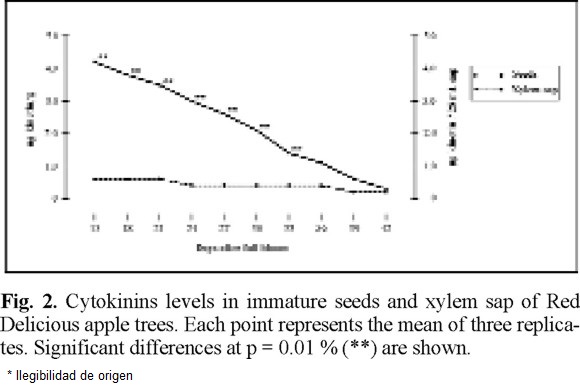
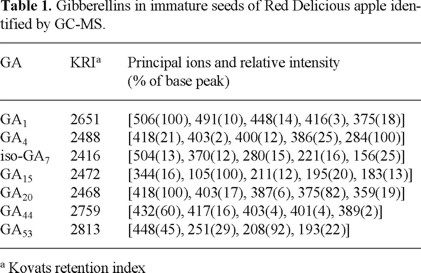
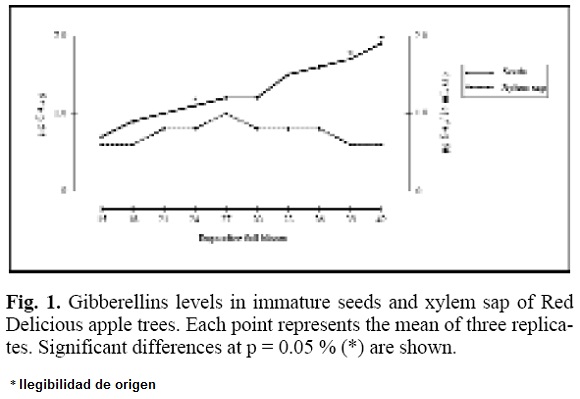
<body><![CDATA[<p align="justify"><font face="verdana" size="2">Plant hormones have been shown to play a role in flower initiation in fruit trees &#91;1&#93;. Gibberellins are reported to inhibit flowering when sprayed on apples, pears and stone fruits at or shortly after flowering &#91;2, 3&#93;. When cultivars which normally produce parthenocarpic fruit are hand pollinated to induce the formation of seeds, flowering is also inhibited, suggesting that the seeds themselves are involved &#91;4&#93;. The presence of high levels of gibberellins in seeds has led to the suggestion that movement of these hormones from the seeds to the bourse stops the bourse&#45;bud becoming floral &#91;5, 6&#93;. Recent evidence using diffusates collected from developing apples has shown that there is indeed an inverse relationship between the amount of gibberellin emanating from fruitlets and return bloom &#91;7&#93;.</font></p>     <p align="justify"><font face="verdana" size="2">It has been stated that in several apple cultivars the spurs tend to be biennial in habit, and whether or not flower primordial are formed depends on the presence or absence of fruit on the parent bourse &#91;8&#93;. The presence of fruit inhibits flower initiation in the bourse bud, but this inhibition can be relieved if the fruits are removed at an early stage of development &#91;9&#93;. In the strongly biennial cultivar Emneth Early, it is found that fruits only exert a strong inhibitory influence on flower initiation when they reach the age of 6 &#45; 8 weeks. If they are removed prior to this time flower initiation can proceed normally. In fact, Luckwill &#91;8&#93; found that up to the age of three weeks after full bloom, the presence of young fruits may even promote flower initiation. The way in which fruits exert their inhibitory or promotive effect on flower formation remains unclear &#91;10&#93;. There is evidence that immature apple seeds are exceptionally rich sources of gibberellins which may play an important role in fruit bud inhibition &#91;11&#93;. In recent years, cytokinins have been related to fruit bud initiation in apple &#91;12&#93;. When exogenous cytokinins are applied to apple spurs at the time fruit bud initiation is taking place, a return bloom is often increased the following spring &#91;13&#93;. However the way how they act is little understood. Therefore, the objetive of this research was to study the possible role of gibberellins and cytokinins on fruit bud initiation in Red Delicious apple trees.</font></p>     <p align="justify"><font face="Verdana" size="2">&nbsp;</font></p>     <p align="justify"><font face="verdana" size="2"><b>Results and discussion</b></font></p>     <p align="justify"><font face="verdana" size="2">The amount of endogenous gibberellins in seeds was higher than in xylem sap samples during the time the experiment was conducted (<a href="#f1">Fig. 1</a>). The content of endogenous cytokinins, was higher than in xylem sap during the whole collecting time (<a href="#f2">Fig. 2</a>). The total amount of cytokinins was in most cases higher than gibberellins in seeds and xylem sap. As a result of gas chromatography&#45;mass spectrometry analysis, it was possible to identify the gibberellins A<sub>1</sub>, A<sub>4</sub>, iso&#45;A<sub>7</sub>, A<sub>15</sub>, A<sub>20</sub>, A<sub>44</sub>, and A<sub>53</sub> (<a href="#c1">Table 1</a>).</font></p>     <p align="center"><font face="verdana" size="2"><a name="f1"></a></font></p>     <p align="center"><font face="verdana" size="2"><img src="/img/revistas/rsqm/v48n1/a2f1.jpg"></font></p>     <p align="center"><font face="verdana" size="2"><a name="f2"></a></font></p>     <p align="center"><font face="verdana" size="2"><img src="/img/revistas/rsqm/v48n1/a2f2.jpg"></font></p>     <p align="center"><font face="verdana" size="2"><a name="c1"></a></font></p>     ]]></body>
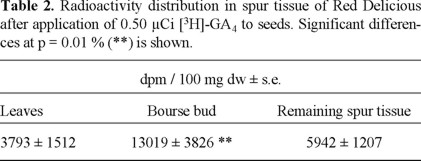
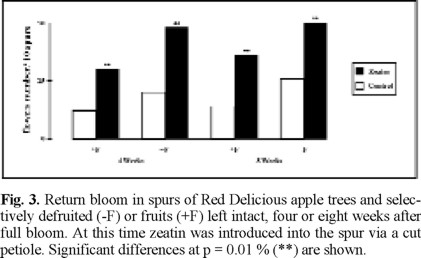
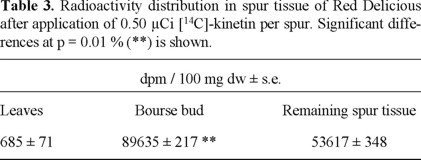
<body><![CDATA[<p align="center"><font face="verdana" size="2"><img src="/img/revistas/rsqm/v48n1/a2c1.jpg"></font></p>     <p align="justify"><font face="verdana" size="2"><a href="#c2">Table 2</a> shows the amount of radioactivity present in different spur tissues of Red Delicious apple when &#91;<sup>3</sup>H&#93;&#45;GA<sub>4</sub> was applied to seeds within the fruit. Radioactivity of this gibberellin previously confirmed with TLC analysis was present in all the tissues which were examined. However the highest activity was detected in the bourse&#45;bud samples. The effect of zeatin on return bloom is shown in <a href="#f3">figure 3</a>. An increase can be seen in flower formation when the cytokinin was injected into spurs either 4 or 8 weeks after full bloom. The effect of cytokinin on return bloom was consistent even when fruits were present. <a href="#c3">Table 3</a> illustrates that a considerable proportion of radioactivity was transported to the bourse bud when &#91;<sup>14</sup>C&#93;&#45;kinetin was applied to cut petioles.</font></p>     <p align="center"><font face="verdana" size="2"><a name="c2"></a></font></p>     <p align="center"><font face="verdana" size="2"><img src="/img/revistas/rsqm/v48n1/a2c2.jpg"></font></p>     <p align="center"><font face="verdana" size="2"><a name="f3"></a></font></p>     <p align="center"><font face="verdana" size="2"><img src="/img/revistas/rsqm/v48n1/a2f3.jpg"></font></p>     <p align="center"><font face="verdana" size="2"><a name="c3"></a></font></p>     <p align="center"><font face="verdana" size="2"><img src="/img/revistas/rsqm/v48n1/a2c3.jpg"></font></p>     <p align="justify"><font face="verdana" size="2">The Red Delicious apple is a cultivar which behaves as a regular bearing tree under Arteaga, Coahuila, Mexico conditions. The fact that the presence of fruit on apple trees is a decisive factor in subsequent flower formation has been well documented &#91;5,18&#93;. The general evidence is that seeded fruit may exert some inhibitory effect through the gibberellins they produce &#91;6&#93;. This fruit bud inhibition, seems to depend on quantitative and qualitative effects of gibberellins &#91;4&#93;. The identification in this study of gibberellins A<sub>1</sub>, A<sub>4</sub>, iso&#45;A<sub>7</sub>, A<sub>15</sub>, A<sub>20</sub>, A<sub>44</sub>, and A<sub>53</sub> (<a href="#c1">Table 1</a>), suggest that the inhibition of flowering mechanism by gibberellins could be more complicated than the previously supposed &#91;18&#93;. It has been shown that gibberellins A<sub>1</sub>, A<sub>4</sub> and iso&#45;A<sub>7</sub> are quite mobile as a result of their hydroxyl group at C&#45;3 &#91;19, 23&#93;. This characteristic was observed in the present study, where &#91;<sup>3</sup>H&#93;&#45;GA<sub>4</sub> moved out of fruits into the bourse&#45;bud (<a href="#c2">Table 2</a>). It is well documented that gibberellins A<sub>1</sub>, A<sub>4</sub> and A<sub>7</sub> inhibit flower formation in apple when they are present in the bourse bud &#91;19&#93;. On these basis, it is possible to suggest that from the gibberellins identified in Red Delicious (<a href="#c1">Table 1</a>), A<sub>1</sub>, A<sub>4</sub> and iso&#45;A<sub>7</sub>, may exert an inhibitory effect on flower formation as a result of their hydroxyl characteristic when compared with the rest of gibberellins found in seed tissue &#91;18&#93;.</font></p>     <p align="justify"><font face="verdana" size="2">Fruit bud initiation is promoted quite often in fruit trees when exogenous cytokinins are applied &#91;20, 21&#93;. On these basis and with the results of this work, it is possible to consider that the high cytokinin levels (<a href="#f2">Fig. 2</a>) when compared with gibberellins in immature seeds (<a href="#f1">Fig. 1</a>) may contribute to fruit bud initiation to take place. This condition may depend from cytokinins in these tissues since virtually no activity was found in xylem sap (<a href="#f2">Fig. 2</a>). Although different gibberellins are present at that time (<a href="#c1">Table 1</a>), perhaps the amount of them is to low in comparison to cytokinins (<a href="#f1">Fig. 1</a>) and therefore they can not inhibit the process &#91;22,23&#93;. The proposal that cytokinin is promoting the formation of flower buds is also supported with the accumulation of radioactivity &#91;<sup>14</sup>C&#93;&#45;kinetin in the bourse bud (<a href="#c3">Table 3</a>) and the return bloom with zeatin application (<a href="#f3">Fig. 3</a>). Therefore, it is possible that in this cultivar, more cytokinins are produced by developing seeds. Some of them could be translocated out of the fruit into the bourse bud where fruit bud initiation would be promoted. More research is required in this line in order to establish a direct link between cytokinins and fruit bud formation in apple.</font></p>     ]]></body>
<body><![CDATA[<p align="justify"><font face="Verdana" size="2">&nbsp;</font></p>     <p align="justify"><font face="verdana" size="2"><b>Conclusions</b></font></p>     <p align="justify"><font face="verdana" size="2">1. Gibberellins A<sub>1</sub>, A<sub>4</sub> and iso&#45;A<sub>7</sub> reported as inhibitors of fruit bud formation in apple, were identified in seeds.</font></p>     <p align="justify"><font face="verdana" size="2">2. &#91;<sup>3</sup>H&#93;&#45;GA<sub>4</sub> moves out of the fruit into the spur tissue, particularly to the bourse bud.</font></p>     <p align="justify"><font face="verdana" size="2">3. Labelled kinetin when applied to spur tissue mainly accumulates in the bourse bud.</font></p>     <p align="justify"><font face="verdana" size="2">4. Zeatin promotes the formation of flower buds.</font></p>     <p align="justify"><font face="verdana" size="2">5. Endogenous gibberellins and cytokinins levels in apple seeds may define the promotion or inhibition of flower bud formation in apple trees.</font></p>     <p align="justify"><font face="Verdana" size="2">&nbsp;</font></p>     <p align="justify"><font face="verdana" size="2"><b>Experimental Section</b></font></p>     <p align="justify"><font face="verdana" size="2">For cytokinin and gibberellin analysis, immature seeds were removed at various times between 15 to 42 days after full bloom, from developing fruits of 16 years old Red Delicious/MM 106 trees grown in a conventional plantation system located in Arteaga, Coahuila, Mexico. During the spring of 2001 removed seeds were frozen, freeze dried and grounded. Endogenous cytokinins were biologically evaluated using the <i>callus</i> test technique. Gibberellin content in seeds was determinated by the lettuce hypocotyls bioassay &#91;14&#93;.</font></p>     ]]></body>
<body><![CDATA[<p align="justify"><font face="verdana" size="2">Seed samples (80 g dry weight) were collected on July 15, 2001 from developing fruits of apple trees grown in the same orchard and used for the identification of gibberellins by gas chromatography&#45;mass spectrometry (GC&#45;MS). The seeds were collected at the time when the highest levels of gibberellins activity occurred, <i>i.e.</i> about 10 weeks after full bloom. Removed seeds were frozen, freeze&#45;dried and grounded. The extraction and purification procedure prior to GC&#45;MS analysis was performed as previously described &#91;15&#93;. Purified extracts of immature apple seeds were dissolved in a few drops of methanol and methylated with diazomethane. A portion of the methylated extract was dissolved in pyridine and treated with trimethylchlorosilane and hexamethyldisilazane. Aliquots were examined using a Pye 104 GLC coupled through a silicone membrane separator to an AEI MS30 dual beam mass spectrometer. Silanized glass columns (213 x 0.2 cm) were packed with 2 % SE&#45;33 on 80&#45;100 Gas Chrom Q. The Heflow rate was 25 mL / min and the column temperature was programmed from 180 &deg;C to 280 &deg;C at 2&deg; / min. The MS were determined at 24eV at a source temperature of 210 &deg;C and a separator temperature of 190 &deg;C with a scan speed of 6.5 s per mass decade. The spectra were recorded by a DEC Linc 8 computer. Identification of gibberellins was conducted by comparison of KRI and MS spectra of their methyl ester trimethylsilyl ether derivatives with those of authentic samples &#91;16&#93;.</font></p>     <p align="justify"><font face="verdana" size="2">Xylem sap was extracted from stems of 3 years old Red Delicious/MM 106 potted trees &#91;17&#93;, and cytokinin and gibberellin content was determined in the same manner as above.</font></p>     <p align="justify"><font face="verdana" size="2">The application of labeled cytokinin was carried out when flower bud induction presumably took place. At this time, 10 &micro;L of a 50 % ethanolic solution containing 0.50 &micro;Ci of &#91;<sup>14</sup>C&#93;&#45;kinetin was injected into 6 spurs via a cut petiole of Red Delicious trees. After a 48 h period, the spurs were removed from the trees and divided into bourse&#45;bud, leaves and remaining spur tissue. The samples were assayed for radioactivity by scintillation counting &#91;17&#93;.</font></p>     <p align="justify"><font face="verdana" size="2">In order to study the effect of cytokinins on return bloom, several fruiting spurs of six years old Red Delicious/MM 106 were selected. Fruits were removed or left intact 4 and 8 weeks after full bloom in the spring of 2001. At these times the laminae of a selected leaf was removed and 20 &micro;g of zeatin per spur was injected through the remained cut petiole using a microsyringe. The number of flowers in the spurs was evaluated the following spring.</font></p>     <p align="justify"><font face="verdana" size="2">For the study of &#91;<sup>3</sup>H&#93;&#45;GA<sub>4</sub> transport, three fruits carrying spurs from selected Red Delicious/MM 106 apple trees grown on the same plantation were used. The fruits were sliced across the stylar end just above the seeds. Thus the intact seeds, partly immersed in the flesh, became visible. A 10 &micro;L drop of 50 % ethanolic solution containing 0.50 &micro;Ci of &#91;<sup>3</sup>H&#93;&#45;GA<sub>4</sub>, was applied to the seeds of each fruit using a microsyringe; the top of the fruit was replaced and sealed in position using adhesive tape. The operation was performed on July 19, 2001 <i>e.g.</i> about the time when the peak of endogenous gibberellin activity in the seeds occurred. After a 48 h period, the spurs with the treated fruits were collected from the trees and the fruits removed from the spur. The spur was divided into leaves, bourse&#45;bud and remaining spur tissue. Each tissue sample was freeze&#45;dried and ground. The extraction and purification procedure for &#91;<sup>3</sup>H&#93;&#45;GA<sub>4</sub>, was performed as previously reported &#91;17&#93;. Aliquots of extracts were pipetted into glass vials and 10 mL of PRO&#45;POPOP scintillation solution was added to each one. The radioactivity present was measured in an LS150 automatic liquid scintillation counter and dpm values worked out with the aid of a correlation curve &#91;17&#93;.</font></p>     <p align="justify"><font face="Verdana" size="2">&nbsp;</font></p>     <p align="justify"><font face="verdana" size="2"><b>References</b></font></p>     <!-- ref --><p align="justify"><font face="verdana" size="2">1. Bangerth, F.K. <i>Acta Hort.</i> <b>1998</b>, <i>463</i>, 77&#45;88.    &nbsp;&nbsp;&nbsp;&nbsp;&nbsp;&nbsp;&nbsp;&nbsp;[&#160;<a href="javascript:void(0);" onclick="javascript: window.open('/scielo.php?script=sci_nlinks&ref=6943909&pid=S0583-7693200400010000200001&lng=','','width=640,height=500,resizable=yes,scrollbars=1,menubar=yes,');">Links</a>&#160;]<!-- end-ref --></font></p>     <!-- ref --><p align="justify"><font face="verdana" size="2">2. Greene, D.W. <i>J. Hort. Sci.</i> <b>1993</b>, <i>68</i>, 171&#45;176.    &nbsp;&nbsp;&nbsp;&nbsp;&nbsp;&nbsp;&nbsp;&nbsp;[&#160;<a href="javascript:void(0);" onclick="javascript: window.open('/scielo.php?script=sci_nlinks&ref=6943911&pid=S0583-7693200400010000200002&lng=','','width=640,height=500,resizable=yes,scrollbars=1,menubar=yes,');">Links</a>&#160;]<!-- end-ref --></font></p>     <!-- ref --><p align="justify"><font face="verdana" size="2">3. Williams, M.W. <i>J. Amer. Soc. Hort. Sci.</i> <b>1972</b>, <i>97</i>,210&#45;212.    &nbsp;&nbsp;&nbsp;&nbsp;&nbsp;&nbsp;&nbsp;&nbsp;[&#160;<a href="javascript:void(0);" onclick="javascript: window.open('/scielo.php?script=sci_nlinks&ref=6943913&pid=S0583-7693200400010000200003&lng=','','width=640,height=500,resizable=yes,scrollbars=1,menubar=yes,');">Links</a>&#160;]<!-- end-ref --></font></p>     <!-- ref --><p align="justify"><font face="verdana" size="2">4. Tromp, J. <i>J. Hort. Sci.</i> <b>1992</b>, <i>57</i>, 277&#45;282.    &nbsp;&nbsp;&nbsp;&nbsp;&nbsp;&nbsp;&nbsp;&nbsp;[&#160;<a href="javascript:void(0);" onclick="javascript: window.open('/scielo.php?script=sci_nlinks&ref=6943915&pid=S0583-7693200400010000200004&lng=','','width=640,height=500,resizable=yes,scrollbars=1,menubar=yes,');">Links</a>&#160;]<!-- end-ref --></font></p>     <!-- ref --><p align="justify"><font face="verdana" size="2">5. Hoad, G.V. <i>Acta Hort.</i> <b>1978</b>, <i>80</i>, 93&#45;103.    &nbsp;&nbsp;&nbsp;&nbsp;&nbsp;&nbsp;&nbsp;&nbsp;[&#160;<a href="javascript:void(0);" onclick="javascript: window.open('/scielo.php?script=sci_nlinks&ref=6943917&pid=S0583-7693200400010000200005&lng=','','width=640,height=500,resizable=yes,scrollbars=1,menubar=yes,');">Links</a>&#160;]<!-- end-ref --></font></p>     <!-- ref --><p align="justify"><font face="verdana" size="2">6. Ram&iacute;rez, H.; Hoad, G.V. <i>Acta Hort.</i> <b>1981</b>, <i>120</i> 131&#45;136.    &nbsp;&nbsp;&nbsp;&nbsp;&nbsp;&nbsp;&nbsp;&nbsp;[&#160;<a href="javascript:void(0);" onclick="javascript: window.open('/scielo.php?script=sci_nlinks&ref=6943919&pid=S0583-7693200400010000200006&lng=','','width=640,height=500,resizable=yes,scrollbars=1,menubar=yes,');">Links</a>&#160;]<!-- end-ref --></font></p>     <!-- ref --><p align="justify"><font face="verdana" size="2">7. Ram&iacute;rez, H. <i>Acta Hort.</i> <b>2001</b>, <i>565</i>, 87&#45;90.    &nbsp;&nbsp;&nbsp;&nbsp;&nbsp;&nbsp;&nbsp;&nbsp;[&#160;<a href="javascript:void(0);" onclick="javascript: window.open('/scielo.php?script=sci_nlinks&ref=6943921&pid=S0583-7693200400010000200007&lng=','','width=640,height=500,resizable=yes,scrollbars=1,menubar=yes,');">Links</a>&#160;]<!-- end-ref --></font></p>     <!-- ref --><p align="justify"><font face="verdana" size="2">8. Luckwill, L.C. <i>Acta Hort.</i> <b>1977</b>, <i>34</i>, 213&#45;300.    &nbsp;&nbsp;&nbsp;&nbsp;&nbsp;&nbsp;&nbsp;&nbsp;[&#160;<a href="javascript:void(0);" onclick="javascript: window.open('/scielo.php?script=sci_nlinks&ref=6943923&pid=S0583-7693200400010000200008&lng=','','width=640,height=500,resizable=yes,scrollbars=1,menubar=yes,');">Links</a>&#160;]<!-- end-ref --></font></p>     <!-- ref --><p align="justify"><font face="verdana" size="2">9. Dennis, G.F., in: <i>Tree Fruit Physiology</i>, Maib, K.M., Ed., Good Fruit Grower, Washington DC, 1997, 107&#45;116.    &nbsp;&nbsp;&nbsp;&nbsp;&nbsp;&nbsp;&nbsp;&nbsp;[&#160;<a href="javascript:void(0);" onclick="javascript: window.open('/scielo.php?script=sci_nlinks&ref=6943925&pid=S0583-7693200400010000200009&lng=','','width=640,height=500,resizable=yes,scrollbars=1,menubar=yes,');">Links</a>&#160;]<!-- end-ref --></font></p>     <!-- ref --><p align="justify"><font face="verdana" size="2">10. Ram&iacute;rez, H. <i>Acta Hort.</i> <b>1993</b>, <i>329</i>, 95&#45;97.    &nbsp;&nbsp;&nbsp;&nbsp;&nbsp;&nbsp;&nbsp;&nbsp;[&#160;<a href="javascript:void(0);" onclick="javascript: window.open('/scielo.php?script=sci_nlinks&ref=6943927&pid=S0583-7693200400010000200010&lng=','','width=640,height=500,resizable=yes,scrollbars=1,menubar=yes,');">Links</a>&#160;]<!-- end-ref --></font></p>     <!-- ref --><p align="justify"><font face="verdana" size="2">11. Ram&iacute;rez, H. <i>Acta Hort.</i> <b>1998</b>, <i>463</i>, 231&#45;234.    &nbsp;&nbsp;&nbsp;&nbsp;&nbsp;&nbsp;&nbsp;&nbsp;[&#160;<a href="javascript:void(0);" onclick="javascript: window.open('/scielo.php?script=sci_nlinks&ref=6943929&pid=S0583-7693200400010000200011&lng=','','width=640,height=500,resizable=yes,scrollbars=1,menubar=yes,');">Links</a>&#160;]<!-- end-ref --></font></p>     <!-- ref --><p align="justify"><font face="verdana" size="2">12. Ram&iacute;rez, H. <i>Acta Hort.</i> <b>2000</b>, <i>514</i>, 245&#45;248.    &nbsp;&nbsp;&nbsp;&nbsp;&nbsp;&nbsp;&nbsp;&nbsp;[&#160;<a href="javascript:void(0);" onclick="javascript: window.open('/scielo.php?script=sci_nlinks&ref=6943931&pid=S0583-7693200400010000200012&lng=','','width=640,height=500,resizable=yes,scrollbars=1,menubar=yes,');">Links</a>&#160;]<!-- end-ref --></font></p>     <!-- ref --><p align="justify"><font face="verdana" size="2">13. Ram&iacute;rez, H. <i>Acta Hort.</i> <b>1995</b>, <i>394</i>, 101&#45;103.    &nbsp;&nbsp;&nbsp;&nbsp;&nbsp;&nbsp;&nbsp;&nbsp;[&#160;<a href="javascript:void(0);" onclick="javascript: window.open('/scielo.php?script=sci_nlinks&ref=6943933&pid=S0583-7693200400010000200013&lng=','','width=640,height=500,resizable=yes,scrollbars=1,menubar=yes,');">Links</a>&#160;]<!-- end-ref --></font></p>     <!-- ref --><p align="justify"><font face="verdana" size="2">14. Oliveira, C.M.; Browning, G. <i>Plant Growth Reg.</i> <b>1993</b>, <i>13</i>, 55&#45;63.    &nbsp;&nbsp;&nbsp;&nbsp;&nbsp;&nbsp;&nbsp;&nbsp;[&#160;<a href="javascript:void(0);" onclick="javascript: window.open('/scielo.php?script=sci_nlinks&ref=6943935&pid=S0583-7693200400010000200014&lng=','','width=640,height=500,resizable=yes,scrollbars=1,menubar=yes,');">Links</a>&#160;]<!-- end-ref --></font></p>     <!-- ref --><p align="justify"><font face="verdana" size="2">15. Looney, N.E.; Pharis, R.P.; Noma, M. <i>Planta.</i> <b>1985</b>, <i>165</i>, 292&#45;294.    &nbsp;&nbsp;&nbsp;&nbsp;&nbsp;&nbsp;&nbsp;&nbsp;[&#160;<a href="javascript:void(0);" onclick="javascript: window.open('/scielo.php?script=sci_nlinks&ref=6943937&pid=S0583-7693200400010000200015&lng=','','width=640,height=500,resizable=yes,scrollbars=1,menubar=yes,');">Links</a>&#160;]<!-- end-ref --></font></p>     <!-- ref --><p align="justify"><font face="verdana" size="2">16. Hoad, G.V.; Monselise, S.P. <i>Scientia Hort.</i> <b>1976</b>, <i>4</i>, 41&#45;47.    &nbsp;&nbsp;&nbsp;&nbsp;&nbsp;&nbsp;&nbsp;&nbsp;[&#160;<a href="javascript:void(0);" onclick="javascript: window.open('/scielo.php?script=sci_nlinks&ref=6943939&pid=S0583-7693200400010000200016&lng=','','width=640,height=500,resizable=yes,scrollbars=1,menubar=yes,');">Links</a>&#160;]<!-- end-ref --></font></p>     <!-- ref --><p align="justify"><font face="verdana" size="2">17. Pharis, R.P.; King, R. W. <i>Ann. Rev. Plant Physiol.</i> <b>1985</b>, <i>36</i>, 517&#45;568.    &nbsp;&nbsp;&nbsp;&nbsp;&nbsp;&nbsp;&nbsp;&nbsp;[&#160;<a href="javascript:void(0);" onclick="javascript: window.open('/scielo.php?script=sci_nlinks&ref=6943941&pid=S0583-7693200400010000200017&lng=','','width=640,height=500,resizable=yes,scrollbars=1,menubar=yes,');">Links</a>&#160;]<!-- end-ref --></font></p>     <!-- ref --><p align="justify"><font face="verdana" size="2">18. Looney, N.E., in: <i>Manipulation of Fruiting</i>, Wright, C.J., Ed., Butterworths, London, <b>1990</b>, 39&#45;50.    &nbsp;&nbsp;&nbsp;&nbsp;&nbsp;&nbsp;&nbsp;&nbsp;[&#160;<a href="javascript:void(0);" onclick="javascript: window.open('/scielo.php?script=sci_nlinks&ref=6943943&pid=S0583-7693200400010000200018&lng=','','width=640,height=500,resizable=yes,scrollbars=1,menubar=yes,');">Links</a>&#160;]<!-- end-ref --></font></p>     <!-- ref --><p align="justify"><font face="verdana" size="2">19. Looney, N.E., in: <i>Tree Fruit Physiology</i>, Maib, K.M., Ed., Good Fruit Grower, Washington DC, <b>1997</b>, 31&#45;40.    &nbsp;&nbsp;&nbsp;&nbsp;&nbsp;&nbsp;&nbsp;&nbsp;[&#160;<a href="javascript:void(0);" onclick="javascript: window.open('/scielo.php?script=sci_nlinks&ref=6943945&pid=S0583-7693200400010000200019&lng=','','width=640,height=500,resizable=yes,scrollbars=1,menubar=yes,');">Links</a>&#160;]<!-- end-ref --></font></p>     <!-- ref --><p align="justify"><font face="verdana" size="2">20. Stephan, M.; Bangerth, F.; Scheneider, G. <i>Acta Hort.</i> <b>1998</b>, <i>463</i>, 113&#45;120.    &nbsp;&nbsp;&nbsp;&nbsp;&nbsp;&nbsp;&nbsp;&nbsp;[&#160;<a href="javascript:void(0);" onclick="javascript: window.open('/scielo.php?script=sci_nlinks&ref=6943947&pid=S0583-7693200400010000200020&lng=','','width=640,height=500,resizable=yes,scrollbars=1,menubar=yes,');">Links</a>&#160;]<!-- end-ref --></font></p>     <!-- ref --><p align="justify"><font face="verdana" size="2">21. Wertheim, S.J. <i>Acta Hort.</i> <b>1997</b>, <i>497</i>, 445&#45;462.    &nbsp;&nbsp;&nbsp;&nbsp;&nbsp;&nbsp;&nbsp;&nbsp;[&#160;<a href="javascript:void(0);" onclick="javascript: window.open('/scielo.php?script=sci_nlinks&ref=6943949&pid=S0583-7693200400010000200021&lng=','','width=640,height=500,resizable=yes,scrollbars=1,menubar=yes,');">Links</a>&#160;]<!-- end-ref --></font></p>     <!-- ref --><p align="justify"><font face="verdana" size="2">22. Ram&iacute;rez, H.; Hoad, G.V.; Benavides, A.; Rangel, E. <i>Rev. Soc. Qu&iacute;m. M&eacute;x.</i> <b>2001</b>, <i>45</i>, <i>2</i>, 47&#45;50.    &nbsp;&nbsp;&nbsp;&nbsp;&nbsp;&nbsp;&nbsp;&nbsp;[&#160;<a href="javascript:void(0);" onclick="javascript: window.open('/scielo.php?script=sci_nlinks&ref=6943951&pid=S0583-7693200400010000200022&lng=','','width=640,height=500,resizable=yes,scrollbars=1,menubar=yes,');">Links</a>&#160;]<!-- end-ref --></font></p>     <!-- ref --><p align="justify"><font face="verdana" size="2">23. Srivastava, L. M. <i>Plant Growth and Development</i>. Academic Press, New York, <b>2002</b>.    &nbsp;&nbsp;&nbsp;&nbsp;&nbsp;&nbsp;&nbsp;&nbsp;[&#160;<a href="javascript:void(0);" onclick="javascript: window.open('/scielo.php?script=sci_nlinks&ref=6943953&pid=S0583-7693200400010000200023&lng=','','width=640,height=500,resizable=yes,scrollbars=1,menubar=yes,');">Links</a>&#160;]<!-- end-ref --></font></p>      ]]></body><back>
<ref-list>
<ref id="B1">
<label>1</label><nlm-citation citation-type="journal">
<person-group person-group-type="author">
<name>
<surname><![CDATA[Bangerth]]></surname>
<given-names><![CDATA[F.K.]]></given-names>
</name>
</person-group>
<source><![CDATA[Acta Hort.]]></source>
<year>1998</year>
<volume>463</volume>
<page-range>77-88</page-range></nlm-citation>
</ref>
<ref id="B2">
<label>2</label><nlm-citation citation-type="journal">
<person-group person-group-type="author">
<name>
<surname><![CDATA[Greene]]></surname>
<given-names><![CDATA[D.W.]]></given-names>
</name>
</person-group>
<source><![CDATA[J. Hort. Sci.]]></source>
<year>1993</year>
<volume>68</volume>
<page-range>171-176</page-range></nlm-citation>
</ref>
<ref id="B3">
<label>3</label><nlm-citation citation-type="journal">
<person-group person-group-type="author">
<name>
<surname><![CDATA[Williams]]></surname>
<given-names><![CDATA[M.W.]]></given-names>
</name>
</person-group>
<source><![CDATA[J. Amer. Soc. Hort. Sci.]]></source>
<year>1972</year>
<volume>97</volume>
<page-range>210-212</page-range></nlm-citation>
</ref>
<ref id="B4">
<label>4</label><nlm-citation citation-type="journal">
<person-group person-group-type="author">
<name>
<surname><![CDATA[Tromp]]></surname>
<given-names><![CDATA[J.]]></given-names>
</name>
</person-group>
<source><![CDATA[J. Hort. Sci.]]></source>
<year>1992</year>
<volume>57</volume>
<page-range>277-282</page-range></nlm-citation>
</ref>
<ref id="B5">
<label>5</label><nlm-citation citation-type="journal">
<person-group person-group-type="author">
<name>
<surname><![CDATA[Hoad]]></surname>
<given-names><![CDATA[G.V.]]></given-names>
</name>
</person-group>
<source><![CDATA[Acta Hort.]]></source>
<year>1978</year>
<volume>80</volume>
<page-range>93-103</page-range></nlm-citation>
</ref>
<ref id="B6">
<label>6</label><nlm-citation citation-type="journal">
<person-group person-group-type="author">
<name>
<surname><![CDATA[Ramírez]]></surname>
<given-names><![CDATA[H.]]></given-names>
</name>
<name>
<surname><![CDATA[Hoad]]></surname>
<given-names><![CDATA[G.V.]]></given-names>
</name>
</person-group>
<source><![CDATA[Acta Hort.]]></source>
<year>1981</year>
<volume>120</volume>
<page-range>131-136</page-range></nlm-citation>
</ref>
<ref id="B7">
<label>7</label><nlm-citation citation-type="journal">
<person-group person-group-type="author">
<name>
<surname><![CDATA[Ramírez]]></surname>
<given-names><![CDATA[H.]]></given-names>
</name>
</person-group>
<source><![CDATA[Acta Hort.]]></source>
<year>2001</year>
<volume>565</volume>
<page-range>87-90</page-range></nlm-citation>
</ref>
<ref id="B8">
<label>8</label><nlm-citation citation-type="journal">
<person-group person-group-type="author">
<name>
<surname><![CDATA[Luckwill]]></surname>
<given-names><![CDATA[L.C.]]></given-names>
</name>
</person-group>
<source><![CDATA[Acta Hort.]]></source>
<year>1977</year>
<volume>34</volume>
<page-range>213-300</page-range></nlm-citation>
</ref>
<ref id="B9">
<label>9</label><nlm-citation citation-type="book">
<person-group person-group-type="author">
<name>
<surname><![CDATA[Dennis]]></surname>
<given-names><![CDATA[G.F.]]></given-names>
</name>
</person-group>
<person-group person-group-type="editor">
<name>
<surname><![CDATA[Maib]]></surname>
<given-names><![CDATA[K.M.]]></given-names>
</name>
</person-group>
<source><![CDATA[Tree Fruit Physiology]]></source>
<year>1997</year>
<page-range>107-116</page-range><publisher-loc><![CDATA[Washington^eDC DC]]></publisher-loc>
<publisher-name><![CDATA[Good Fruit Grower]]></publisher-name>
</nlm-citation>
</ref>
<ref id="B10">
<label>10</label><nlm-citation citation-type="journal">
<person-group person-group-type="author">
<name>
<surname><![CDATA[Ramírez]]></surname>
<given-names><![CDATA[H.]]></given-names>
</name>
</person-group>
<source><![CDATA[Acta Hort.]]></source>
<year>1993</year>
<volume>329</volume>
<page-range>95-97</page-range></nlm-citation>
</ref>
<ref id="B11">
<label>11</label><nlm-citation citation-type="journal">
<person-group person-group-type="author">
<name>
<surname><![CDATA[Ramírez]]></surname>
<given-names><![CDATA[H.]]></given-names>
</name>
</person-group>
<source><![CDATA[Acta Hort.]]></source>
<year>1998</year>
<volume>463</volume>
<page-range>231-234</page-range></nlm-citation>
</ref>
<ref id="B12">
<label>12</label><nlm-citation citation-type="journal">
<person-group person-group-type="author">
<name>
<surname><![CDATA[Ramírez]]></surname>
<given-names><![CDATA[H.]]></given-names>
</name>
</person-group>
<source><![CDATA[Acta Hort.]]></source>
<year>2000</year>
<volume>514</volume>
<page-range>245-248</page-range></nlm-citation>
</ref>
<ref id="B13">
<label>13</label><nlm-citation citation-type="journal">
<person-group person-group-type="author">
<name>
<surname><![CDATA[Ramírez]]></surname>
<given-names><![CDATA[H.]]></given-names>
</name>
</person-group>
<source><![CDATA[Acta Hort.]]></source>
<year>1995</year>
<volume>394</volume>
<page-range>101-103</page-range></nlm-citation>
</ref>
<ref id="B14">
<label>14</label><nlm-citation citation-type="journal">
<person-group person-group-type="author">
<name>
<surname><![CDATA[Oliveira]]></surname>
<given-names><![CDATA[C.M.]]></given-names>
</name>
<name>
<surname><![CDATA[Browning]]></surname>
<given-names><![CDATA[G.]]></given-names>
</name>
</person-group>
<source><![CDATA[Plant Growth Reg.]]></source>
<year>1993</year>
<volume>13</volume>
<page-range>55-63</page-range></nlm-citation>
</ref>
<ref id="B15">
<label>15</label><nlm-citation citation-type="journal">
<person-group person-group-type="author">
<name>
<surname><![CDATA[Looney]]></surname>
<given-names><![CDATA[N.E.]]></given-names>
</name>
<name>
<surname><![CDATA[Pharis]]></surname>
<given-names><![CDATA[R.P.]]></given-names>
</name>
<name>
<surname><![CDATA[Noma]]></surname>
<given-names><![CDATA[M.]]></given-names>
</name>
</person-group>
<source><![CDATA[Planta]]></source>
<year>1985</year>
<volume>165</volume>
<page-range>292-294</page-range></nlm-citation>
</ref>
<ref id="B16">
<label>16</label><nlm-citation citation-type="journal">
<person-group person-group-type="author">
<name>
<surname><![CDATA[Hoad]]></surname>
<given-names><![CDATA[G.V.]]></given-names>
</name>
<name>
<surname><![CDATA[Monselise]]></surname>
<given-names><![CDATA[S.P.]]></given-names>
</name>
</person-group>
<source><![CDATA[Scientia Hort.]]></source>
<year>1976</year>
<volume>4</volume>
<page-range>41-47</page-range></nlm-citation>
</ref>
<ref id="B17">
<label>17</label><nlm-citation citation-type="journal">
<person-group person-group-type="author">
<name>
<surname><![CDATA[Pharis]]></surname>
<given-names><![CDATA[R.P.]]></given-names>
</name>
<name>
<surname><![CDATA[King]]></surname>
<given-names><![CDATA[R. W.]]></given-names>
</name>
</person-group>
<source><![CDATA[Ann. Rev. Plant Physiol.]]></source>
<year>1985</year>
<volume>36</volume>
<page-range>517-568</page-range></nlm-citation>
</ref>
<ref id="B18">
<label>18</label><nlm-citation citation-type="book">
<person-group person-group-type="author">
<name>
<surname><![CDATA[Looney]]></surname>
<given-names><![CDATA[N.E.]]></given-names>
</name>
</person-group>
<person-group person-group-type="editor">
<name>
<surname><![CDATA[Wright]]></surname>
<given-names><![CDATA[C.J.]]></given-names>
</name>
</person-group>
<source><![CDATA[Manipulation of Fruiting]]></source>
<year>1990</year>
<page-range>39-50</page-range><publisher-loc><![CDATA[London ]]></publisher-loc>
<publisher-name><![CDATA[Butterworths]]></publisher-name>
</nlm-citation>
</ref>
<ref id="B19">
<label>19</label><nlm-citation citation-type="book">
<person-group person-group-type="author">
<name>
<surname><![CDATA[Looney]]></surname>
<given-names><![CDATA[N.E.]]></given-names>
</name>
</person-group>
<person-group person-group-type="editor">
<name>
<surname><![CDATA[Maib]]></surname>
<given-names><![CDATA[K.M.]]></given-names>
</name>
</person-group>
<source><![CDATA[Tree Fruit Physiology]]></source>
<year>1997</year>
<page-range>31-40</page-range><publisher-loc><![CDATA[Washington^eDC DC]]></publisher-loc>
<publisher-name><![CDATA[Good Fruit Grower]]></publisher-name>
</nlm-citation>
</ref>
<ref id="B20">
<label>20</label><nlm-citation citation-type="journal">
<person-group person-group-type="author">
<name>
<surname><![CDATA[Stephan]]></surname>
<given-names><![CDATA[M.]]></given-names>
</name>
<name>
<surname><![CDATA[Bangerth]]></surname>
<given-names><![CDATA[F.]]></given-names>
</name>
<name>
<surname><![CDATA[Scheneider]]></surname>
<given-names><![CDATA[G.]]></given-names>
</name>
</person-group>
<source><![CDATA[Acta Hort.]]></source>
<year>1998</year>
<volume>463</volume>
<page-range>113-120</page-range></nlm-citation>
</ref>
<ref id="B21">
<label>21</label><nlm-citation citation-type="journal">
<person-group person-group-type="author">
<name>
<surname><![CDATA[Wertheim]]></surname>
<given-names><![CDATA[S.J.]]></given-names>
</name>
</person-group>
<source><![CDATA[Acta Hort.]]></source>
<year>1997</year>
<volume>497</volume>
<page-range>445-462</page-range></nlm-citation>
</ref>
<ref id="B22">
<label>22</label><nlm-citation citation-type="journal">
<person-group person-group-type="author">
<name>
<surname><![CDATA[Ramírez]]></surname>
<given-names><![CDATA[H.]]></given-names>
</name>
<name>
<surname><![CDATA[Hoad]]></surname>
<given-names><![CDATA[G.V.]]></given-names>
</name>
<name>
<surname><![CDATA[Benavides]]></surname>
<given-names><![CDATA[A.]]></given-names>
</name>
<name>
<surname><![CDATA[Rangel]]></surname>
<given-names><![CDATA[E.]]></given-names>
</name>
</person-group>
<source><![CDATA[Rev. Soc. Quím. Méx.]]></source>
<year>2001</year>
<volume>45</volume>
<numero>2</numero>
<issue>2</issue>
<page-range>47-50</page-range></nlm-citation>
</ref>
<ref id="B23">
<label>23</label><nlm-citation citation-type="book">
<person-group person-group-type="author">
<name>
<surname><![CDATA[Srivastava]]></surname>
<given-names><![CDATA[L. M.]]></given-names>
</name>
</person-group>
<source><![CDATA[Plant Growth and Development]]></source>
<year>2002</year>
<publisher-loc><![CDATA[New York ]]></publisher-loc>
<publisher-name><![CDATA[Academic Press]]></publisher-name>
</nlm-citation>
</ref>
</ref-list>
</back>
</article>