<?xml version="1.0" encoding="ISO-8859-1"?><article xmlns:mml="http://www.w3.org/1998/Math/MathML" xmlns:xlink="http://www.w3.org/1999/xlink" xmlns:xsi="http://www.w3.org/2001/XMLSchema-instance">
<front>
<journal-meta>
<journal-id>0583-7693</journal-id>
<journal-title><![CDATA[Revista de la Sociedad Química de México]]></journal-title>
<abbrev-journal-title><![CDATA[Rev. Soc. Quím. Méx]]></abbrev-journal-title>
<issn>0583-7693</issn>
<publisher>
<publisher-name><![CDATA[Sociedad Química de México A.C.]]></publisher-name>
</publisher>
</journal-meta>
<article-meta>
<article-id>S0583-76932002000100007</article-id>
<title-group>
<article-title xml:lang="en"><![CDATA[Kinetic modeling of vacuum gas oil catalytic cracking]]></article-title>
</title-group>
<contrib-group>
<contrib contrib-type="author">
<name>
<surname><![CDATA[Ancheyta]]></surname>
<given-names><![CDATA[Jorge]]></given-names>
</name>
<xref ref-type="aff" rid="A01"/>
</contrib>
<contrib contrib-type="author">
<name>
<surname><![CDATA[Sotelo]]></surname>
<given-names><![CDATA[Rogelio]]></given-names>
</name>
<xref ref-type="aff" rid="A02"/>
</contrib>
</contrib-group>
<aff id="A01">
<institution><![CDATA[,Instituto Mexicano del Petróleo  ]]></institution>
<addr-line><![CDATA[México Distrito Federal]]></addr-line>
<country>México</country>
</aff>
<aff id="A02">
<institution><![CDATA[,Instituto Politécnico Nacional Escuela Superior de Ingeniería Química e Industrias Extractivas ]]></institution>
<addr-line><![CDATA[México Distrito Federal]]></addr-line>
<country>México</country>
</aff>
<pub-date pub-type="pub">
<day>00</day>
<month>03</month>
<year>2002</year>
</pub-date>
<pub-date pub-type="epub">
<day>00</day>
<month>03</month>
<year>2002</year>
</pub-date>
<volume>46</volume>
<numero>1</numero>
<fpage>38</fpage>
<lpage>42</lpage>
<copyright-statement/>
<copyright-year/>
<self-uri xlink:href="http://www.scielo.org.mx/scielo.php?script=sci_arttext&amp;pid=S0583-76932002000100007&amp;lng=en&amp;nrm=iso"></self-uri><self-uri xlink:href="http://www.scielo.org.mx/scielo.php?script=sci_abstract&amp;pid=S0583-76932002000100007&amp;lng=en&amp;nrm=iso"></self-uri><self-uri xlink:href="http://www.scielo.org.mx/scielo.php?script=sci_pdf&amp;pid=S0583-76932002000100007&amp;lng=en&amp;nrm=iso"></self-uri><abstract abstract-type="short" xml:lang="en"><p><![CDATA[A new kinetic model for catalytic cracking of vacuum gas oil is presented. The proposed model is based on lumping technique and considers the most important products in the FCC process: (1) gasoline (C5-493 K), (2) C4's (butane, i-butane and butenes), (3) C3's (propane and propylene), (4) dry gas (H2, C1-C2), (5) coke and (6) unconverted VGO (decanted and light cycle oils). A vacuum gas oil and an equilibrium catalyst recovered from a commercial FCC unit were employed to evaluate the kinetic and deactivation constants by using experimental information obtained in a microactivity plant. Good predictions of product yields with average absolute deviation less than 5 % with respect to experimental information were obtained.]]></p></abstract>
<abstract abstract-type="short" xml:lang="es"><p><![CDATA[Se presenta un modelo cinético para la desintegración catalítica de gasóleos. El modelo propuesto se basa en la técnica de agrupamiento por pseudocomponentes y considera los productos más importantes del proceso FCC: (1) gasolina (C5-493 K), (2) C4's (butano, i-butano y butenos), (3) C3's (propano y propileno), (4) gas seco (H2, C1-C2), (5) coque y (6) gasóleo no convertido (aceites decantado y cíclico ligero). El gasóleo de vacío y el catalizador de equilibrio se recuperaron de una unidad comercial de FCC, y ambas muestras se utilizaron para evaluar las constantes cinéticas y de desactivación usando información experimental obtenida en una planta de microactividad. La predicción de los rendimientos de productos fue aceptable con desviaciones absolutas en promedio menores a 5 % con respecto a la información experimental.]]></p></abstract>
<kwd-group>
<kwd lng="en"><![CDATA[Catalytic cracking]]></kwd>
<kwd lng="en"><![CDATA[kinetic model]]></kwd>
<kwd lng="es"><![CDATA[Desintegración catalítica]]></kwd>
<kwd lng="es"><![CDATA[modelo cinético]]></kwd>
</kwd-group>
</article-meta>
</front><body><![CDATA[ <p align="justify"><font face="Verdana" size="4">Investigaci&oacute;n</font></p>     <p align="justify"><font face="Verdana" size="2">&nbsp;</font></p>     <p align="center"><font face="verdana" size="4"><b>Kinetic modeling of vacuum gas oil catalytic cracking</b></font></p>     <p align="justify"><font face="Verdana" size="2">&nbsp;</font></p>     <p align="center"><font face="verdana" size="2"><b>Jorge Ancheyta<sup>1</sup>* and Rogelio Sotelo<sup>2</sup></b></font></p>     <p align="justify"><font face="Verdana" size="2">&nbsp;</font></p>     <p align="justify"><font face="verdana" size="2"><i><sup>1</sup> Instituto Mexicano del Petr&oacute;leo, Eje Central L&aacute;zaro C&aacute;rdenas 152, M&eacute;xico 07730, D.F. Fax: 3003&#45;8429.</i> E&#45;mail: <a href="mailto:jancheyt@imp.mx">jancheyt@imp.mx</a></font></p>     <p align="justify"><font face="verdana" size="2"><i><sup>2</sup> Instituto Polit&eacute;cnico Nacional, Escuela Superior de Ingenier&iacute;a Qu&iacute;mica e Industrias Extractivas, M&eacute;xico 07738, D.F.</i></font></p>     <p align="justify"><font face="Verdana" size="2">&nbsp;</font></p>     <p align="justify"><font face="verdana" size="2">Recibido el 9 de agosto del 2001.    ]]></body>
<body><![CDATA[<br> Aceptado el 23 de enero del 2002.</font></p>     <p align="justify"><font face="Verdana" size="2">&nbsp;</font></p>     <p align="justify"><font face="verdana" size="2"><b>Abstract</b></font></p>     <p align="justify"><font face="verdana" size="2">A new kinetic model for catalytic cracking of vacuum gas oil is presented. The proposed model is based on lumping technique and considers the most important products in the FCC process: (1) gasoline (C<sub>5</sub>&#45;493 K), (2) C<sub>4</sub>'s (butane, i&#45;butane and butenes), (3) C<sub>3</sub>'s (propane and propylene), (4) dry gas (H<sub>2</sub>, C<sub>1</sub>&#45;C<sub>2</sub>), (5) coke and (6) unconverted VGO (decanted and light cycle oils). A vacuum gas oil and an equilibrium catalyst recovered from a commercial FCC unit were employed to evaluate the kinetic and deactivation constants by using experimental information obtained in a microactivity plant. Good predictions of product yields with average absolute deviation less than 5 % with respect to experimental information were obtained.</font></p>     <p align="justify"><font face="verdana" size="2"><b>Keywords:</b> Catalytic cracking, kinetic model.</font></p>     <p align="justify"><font face="Verdana" size="2">&nbsp;</font></p>     <p align="justify"><font face="verdana" size="2"><b>Resumen</b></font></p>     <p align="justify"><font face="verdana" size="2">Se presenta un modelo cin&eacute;tico para la desintegraci&oacute;n catal&iacute;tica de gas&oacute;leos. El modelo propuesto se basa en la t&eacute;cnica de agrupamiento por pseudocomponentes y considera los productos m&aacute;s importantes del proceso FCC: (1) gasolina (C<sub>5</sub>&#45;493 K), (2) C<sub>4</sub>'s (butano, i&#45;butano y butenos), (3) C<sub>3</sub>'s (propano y propileno), (4) gas seco (H<sub>2</sub>, C<sub>1</sub>&#45;C<sub>2</sub>), (5) coque y (6) gas&oacute;leo no convertido (aceites decantado y c&iacute;clico ligero). El gas&oacute;leo de vac&iacute;o y el catalizador de equilibrio se recuperaron de una unidad comercial de FCC, y ambas muestras se utilizaron para evaluar las constantes cin&eacute;ticas y de desactivaci&oacute;n usando informaci&oacute;n experimental obtenida en una planta de microactividad. La predicci&oacute;n de los rendimientos de productos fue aceptable con desviaciones absolutas en promedio menores a 5 % con respecto a la informaci&oacute;n experimental.</font></p>     <p align="justify"><font face="verdana" size="2"><b>Palabras clave:</b> Desintegraci&oacute;n catal&iacute;tica, modelo cin&eacute;tico.</font></p>     <p align="justify"><font face="Verdana" size="2">&nbsp;</font></p>     ]]></body>
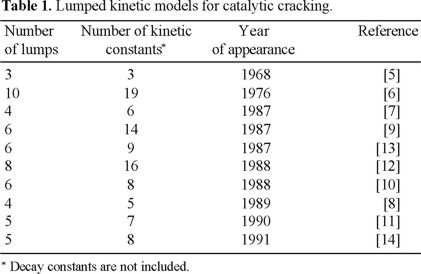
<body><![CDATA[<p align="justify"><font face="verdana" size="2"><b>Introduction</b></font></p>     <p align="justify"><font face="verdana" size="2">Fluid Catalytic Cracking, better known as FCC, is one of the most important and complex processes in petroleum refining which is used to upgrade heavy petroleum gas oils into gasoline, diesel fuel, light olefins and other valuable products. Since its first commercial advent in 1942, various papers have been written dealing with different aspects of this technology &#91;1, 2&#93;.</font></p>     <p align="justify"><font face="verdana" size="2">The FCC process comprises mainly of two parts: (1) a reactor, where high molecular weight hydrocarbons come in contact with the catalyst and crack to lower molecular weight products with simultaneous deposition of coke on the catalyst, and (2) a regenerator, where the coke on the catalyst is burnt with air and the catalyst is returned to the reactor &#91;3&#93;.</font></p>     <p align="justify"><font face="verdana" size="2">The FCC process can be applied to many different types of feedstocks. The Fluid Catalytic Cracking feeds, mainly integrated by vacuum gas oils (VGO) and heavy atmospheric gas oil, are mixtures of innumerable individual molecular hydrocarbons species containing 20 to 50 carbons that exhibit a wide range of cracking rates, including paraffins, isoparaffins, naphthenes, aromatics and asphaltenes. A typical gas oil also contains significant quantities of multiringed molecules containing heteroatoms, such as nitrogen, sulfur and metals &#91;4&#93;.</font></p>     <p align="justify"><font face="verdana" size="2">In developing of kinetic models for the catalytic cracking of VGO the usual approach has been to use lumping techniques. This is due to the large number of individual species present in the feedstock.</font></p>     <p align="justify"><font face="verdana" size="2">One of the first studies about FCC kinetic modeling based on lumping technique was the three&#45;lump kinetic scheme &#91;5&#93;, which consist of a VGO lump, a gasoline lump (C<sub>5</sub> to 493 K) and a gases lump (C<sub>4</sub> and lighter) plus coke. In this model the gasoline fraction is the most profitable component of the cracked products. The VGO lump can crack either to form gasoline or to form gases plus coke. The gasoline formed may also undergo further cracking to gases plus coke.</font></p>     <p align="justify"><font face="verdana" size="2">Other kinetic models based on lumping have been reported in the literature &#91;6&#45;14&#93;. Yen <i>et al.</i> &#91;7&#93; and Lee <i>et al.</i> &#91;8&#93; expanded the 3&#45;lump model into a 4&#45;lump kinetic model by separating the gases and the coke lumps. Takatsuka <i>et al.</i> &#91;9&#93; presented a 6&#45;lump model for residual oil cracking. This model was adapted by Corella <i>et al.</i> &#91;10&#93; for VGO cracking, which considers the VGO, heavy and light cycle oils, gasoline, gases and coke as lumps.</font></p>     <p align="justify"><font face="verdana" size="2">A 10&#45;lump model identifies lumps whose kinetic constants are independent of feedstock composition &#91;6&#93;. This model is an extension of the 3&#45;lump model. The difference is that the feedstock lump was divided into paraffins, naphthenes, aromatic rings, and aromatic substituent groups in light (473 to 618 K) and heavy oil (618 K<sup>+</sup>) fractions. The gasoline and gases plus coke lumps remain the same as in the 3&#45;lump model. Similar models with 5, 7 and 8 lumps have also been reported in the literature &#91;11&#45;13&#93;, which are essentially simplified versions of the 10&#45;lump model. <a href="#c1">Table 1</a> shows the evolution of the most important lumped kinetic models for catalytic cracking process over the last 30 years.</font></p>     <p align="center"><font face="verdana" size="2"><a name="c1"></a></font></p>     <p align="center"><font face="verdana" size="2"><img src="/img/revistas/rsqm/v46n1/a7c1.jpg"></font></p>     ]]></body>
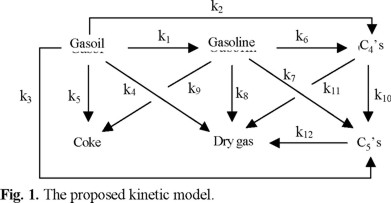
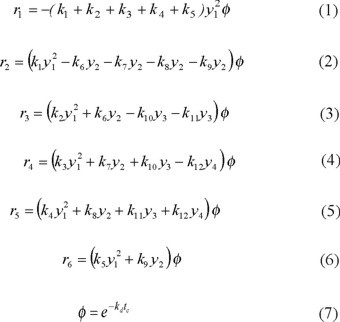
<body><![CDATA[<p align="justify"><font face="verdana" size="2">The number of lumps of the reported models for catalytic cracking reactions has been increased to obtain a more detailed prediction of product distribution, however, most of them involve gaseous products (C<sub>3</sub>'s, C<sub>4</sub>'s and dry gas) as a lump and in some cases these gases are also lumped together with the coke yield.</font></p>     <p align="justify"><font face="verdana" size="2">In order to predict individually the key FCC products in this work we present a new kinetic model for catalytic cracking which takes into account C3's, C4's, dry gas and coke yields separately from the unconverted VGO and gasoline lumps.</font></p>     <p align="justify"><font face="Verdana" size="2">&nbsp;</font></p>     <p align="justify"><font face="verdana" size="2"><b>The kinetic model</b></font></p>     <p align="justify"><font face="verdana" size="2">The kinetic model proposed in this work has 6 lumps and is shown in <a href="#f1">figure 1</a>. It takes into account the most important products in the Fluid Catalytic Cracking process: (1) gasoline (C<sub>5</sub>&#45;493 K), (2) C<sub>3</sub>'s (propane and propylene), (3) C<sub>4</sub>'s (butane, i&#45;butane and butenes), (4) dry gas (H<sub>2</sub>, C<sub>1</sub>&#45;C<sub>2</sub>), (5) coke and (6) unconverted VGO (decanted and light cycle oils). This model has twelve kinetic constants and one for catalyst deactivation to be estimated.</font></p>     <p align="center"><font face="verdana" size="2"><a name="f1"></a></font></p>     <p align="center"><font face="verdana" size="2"><img src="/img/revistas/rsqm/v46n1/a7f1.jpg"></font></p>     <p align="justify"><font face="verdana" size="2">The kinetics for VGO cracking has been found experimentally to follow a reaction order close to two. Pure hydrocarbons are know to crack according to a first reaction order, by this reason the gasoline, being a mixture of hydrocarbons having a limited range of boiling points, C<sub>3</sub>'s and C<sub>4</sub>'s lumps are assumed to crack with an order of one &#91;15&#93;.</font></p>     <p align="justify"><font face="verdana" size="2">Based on these considerations, the following kinetic expressions were formulated as a function of product yields, deactivation function and kinetic constants. The exponential law was assumed for catalyst decay. A non&#45;selective deactivation model was used in this study in order to simplify the overall kinetic model and parameter estimation.</font></p>     <p align="center"><font face="Verdana" size="2"><img src="/img/revistas/rsqm/v46n1/a7e1.jpg"></font></p>     ]]></body>
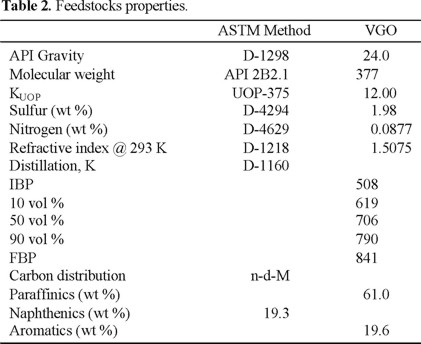
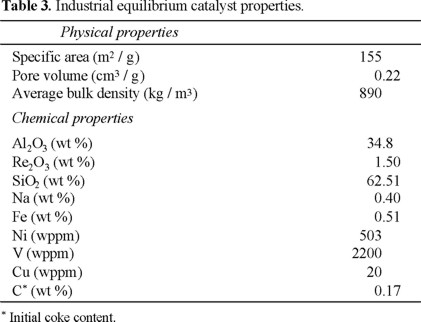
<body><![CDATA[<p align="justify"><font face="Verdana" size="2">&nbsp;</font></p>     <p align="justify"><font face="verdana" size="2"><b>Experimental</b></font></p>     <p align="justify"><font face="verdana" size="2"><b>Feedstock and catalyst</b></font></p>     <p align="justify"><font face="verdana" size="2">A typical vacuum gas oil and a commercial equilibrium catalyst taken directly from the circulating inventory of an industrial catalytic cracking plant were used in this study. The equilibrium catalyst was previously decoked at 853 K during 3 h.</font></p>     <p align="justify"><font face="verdana" size="2">Properties of feedstock and catalyst are reported in <a href="#c2">Tables 2</a> and <a href="#c3">3</a> respectively.</font></p>     <p align="center"><font face="verdana" size="2"><a name="c2"></a></font></p>     <p align="center"><font face="verdana" size="2"><img src="/img/revistas/rsqm/v46n1/a7c2.jpg"></font></p>     <p align="center"><font face="verdana" size="2"><a name="c3"></a></font></p>     <p align="center"><font face="verdana" size="2"><img src="/img/revistas/rsqm/v46n1/a7c3.jpg"></font></p>     <p align="justify"><font face="verdana" size="2"><b>Experimental runs</b></font></p>     ]]></body>
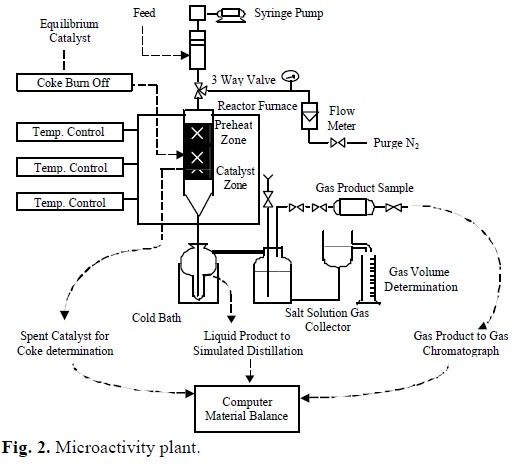
<body><![CDATA[<p align="justify"><font face="verdana" size="2">The MAT (Microactivity Test) technique, a normalized ASTM procedure for a standard feedstock which allows change easily the reactions conditions, was used for kinetic measurements (<a href="#f2">Fig. 2</a>).</font></p>     <p align="center"><font face="verdana" size="2"><a name="f2"></a></font></p>     <p align="center"><font face="verdana" size="2"><img src="/img/revistas/rsqm/v46n1/a7f2.jpg"></font></p>     <p align="justify"><font face="verdana" size="2">The fixed&#45;bed tubular plug flow reactor, reactor oven, oil injection and products recovery system is described by ASTM D3907&#45;92 method.</font></p>     <p align="justify"><font face="verdana" size="2">Experimental runs were performed at reaction temperature of 773 K and space&#45;velocities in the range of 6&#45;48 h&#45;1.</font></p>     <p align="justify"><font face="verdana" size="2">In each experiment, a new portion of equilibrium catalyst was used. Varying the time of injection, and consequently the gas oil rate, establishes a range of catalyst time&#45;on&#45;stream values to provide different space&#45;velocities.</font></p>     <p align="justify"><font face="verdana" size="2">Preheated feed (0.8 &plusmn; 0.005 g) is injected using a syringe bomb through a 4 g bed of catalyst maintained at the required cracking temperature.</font></p>     <p align="justify"><font face="verdana" size="2">Liquid product from the reactor is collected in an ice&#45;cooled receiver. The uncondensed gaseous products pass through the liquid products and are collected in a brine solution. The gas volume is determined by displacement of the brine volume.</font></p>     <p align="justify">&nbsp;</p>     <p align="justify"><font face="verdana" size="2"><b>Analysis of products</b></font></p>     ]]></body>
<body><![CDATA[<p align="justify"><font face="verdana" size="2">Gaseous products (H<sub>2</sub> and C<sub>1</sub>&#45;C<sub>6</sub>) were analyzed isothermally at 323 K using an HP 5890 Series 2 GC equipped with two thermal conductivity detectors (TCD).</font></p>     <p align="justify"><font face="verdana" size="2">Liquid products were analyzed by the chromatographic simulated distillation procedure described by ASTM D&#45;2887 method.</font></p>     <p align="justify"><font face="verdana" size="2">The carbon content of the catalyst was determined after reaction by combustion using an infrared analysis of the produced CO<sub>2</sub> (LECO VIA&#45;510).</font></p>     <p align="justify"><font face="verdana" size="2">The fractions of gasoline and unconverted VGO were defined by the cut points at C<sub>5</sub>&#45;493 K and 493 K+, respectively.</font></p>     <p align="justify"><font face="verdana" size="2">The product yields were calculated as weight percent of the reactant. Mass balances were performed for each run in the range 100 &plusmn; 5 % and the conversion in weight percent was evaluated as the sum of C<sub>5</sub> + gasoline, propanes, butanes, dry gas and coke, representing 100 % minus unconverted gas oil yield.</font></p>     <p align="justify"><font face="Verdana" size="2">&nbsp;</font></p>     <p align="justify"><font face="verdana" size="2"><b>Results and discussion</b></font></p>     <p align="justify"><font face="verdana" size="2"><b>MAT experiments</b></font></p>     <p align="justify"><font face="verdana" size="2"><a href="#f3">Figure 3</a> presents the experimental data for gasoline, C<sub>4</sub>'s, C<sub>3</sub>'s, dry gas, coke and unconverted VGO yields at 773 K as a function of space velocity (WHSV).</font></p>     <p align="center"><font face="verdana" size="2"><a name="f3"></a></font></p>     ]]></body>
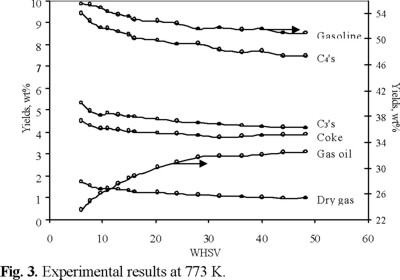
<body><![CDATA[<p align="center"><font face="verdana" size="2"><img src="/img/revistas/rsqm/v46n1/a7f3.jpg"></font></p>     <p align="justify"><font face="verdana" size="2">It can be seen from this figure that unconverted gas oil and gasoline yields were obtained in the range of 23.5&#45;32.5 wt % (67.5&#45;76.5 wt % conversion) and 50.9&#45;55.5 wt % respectively, which are similar to those reported in commercial units &#91;2&#93;.</font></p>     <p align="justify"><font face="verdana" size="2">When VGO is catalytically cracked many of the primary products undergo secondary reactions. The gasoline fraction (C<sub>5</sub>&#45;493 K) reach a maximum yield with conversion and then undergoes further cracking usually referred to as over&#45;cracking. From <a href="#f3">figure 3</a> can be seen that gasoline yield is always increasing as the WHSV decreases, it means that the reaction is below the over&#45;cracking. The smaller WHSV increases the contact time and favors gas oil conversion and cracking products yields.</font></p>     <p align="justify"><font face="verdana" size="2"><b>Kinetic modeling</b></font></p>     <p align="justify"><font face="verdana" size="2">The kinetic model was incorporated into an isothermal plug flow reactor model. Axial dispersion and external and internal diffusion in the reactor were neglected.</font></p>     <p align="justify"><font face="verdana" size="2">The mass balance equations for each lump were used to evaluate the product yields from a set of kinetic constants.</font></p>     <p align="justify"><font face="verdana" size="2">The following objective function, based on the sum of square errors between experimental and calculated yields, was applied to find the best set of kinetic parameters:</font></p>     <p align="center"><font face="Verdana" size="2"><img src="/img/revistas/rsqm/v46n1/a7e2.jpg"></font></p>     <p align="justify"><font face="verdana" size="2">This objective function was solved using the least squares criterion with a non&#45;linear regression procedure based on Marquardt's algorithm &#91;16&#93;.</font></p>     <p align="justify"><font face="verdana" size="2"><a href="#c4">Table 4</a> shows the estimated kinetic constants at 773 K for each reaction lump involved. A comparison of the values of these kinetic constants with other values reported in the literature is difficult. The reasons for this are that in the literature all the gases and coke yields are referred as a lump (gases plus coke) and most of the models do not separate the gases lump in C<sub>3</sub>'s, C<sub>4</sub>'s and dry gas. Despite this, the following ratios of the kinetic constants can be compared:</font></p>     ]]></body>
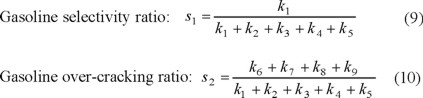
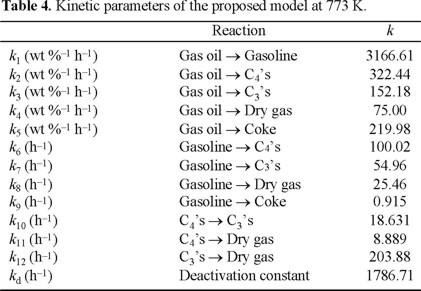
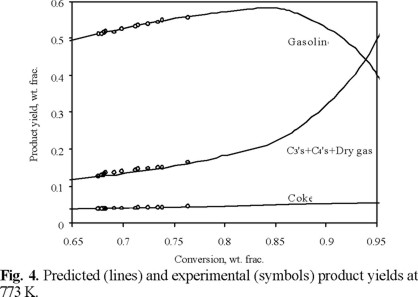
<body><![CDATA[<p align="center"><font face="Verdana" size="2"><img src="/img/revistas/rsqm/v46n1/a7e3.jpg"></font></p>     <p align="center">&nbsp;</p>     <p align="center"><font face="verdana" size="2"><a name="c4"></a></font></p>     <p align="center"><font face="verdana" size="2"><img src="/img/revistas/rsqm/v46n1/a7c4.jpg"></font></p>     <p align="justify"><font face="verdana" size="2"><i>s</i><sub>1</sub> and <i>s</i><sub>2</sub> values were 0.8044 and 0.0461, and those reported in the literature are in the range 0.63&#45;0.90 and 0&#45;0.086, respectively.</font></p>     <p align="justify"><font face="verdana" size="2">It can be observed that our results are in full accordance with the range of the ratios of kinetic constants reported in the literature &#91;6&#45;14&#93;.</font></p>     <p align="justify"><font face="verdana" size="2">With the values of the kinetic constants reported in <a href="#c4">Table 4</a>, equations (1)&#45;(7) were solved numerically using a fourth order Runge&#45;Kutta method with the following boundary condition: <i>y</i><sub>1</sub> = 1, <i>y</i><sub>2</sub> = <i>y</i><sub>3</sub> = <i>y</i><sub>4</sub> = <i>y</i><sub>5</sub> = <i>y</i><sub>6</sub> =0 at conversion (<i>x</i>)=0.</font></p>     <p align="justify"><font face="verdana" size="2"><a href="#f4">Figure 4</a> shows a comparison of the predicted and experimental yields for gasoline, gases (C<sub>4</sub>'s, C<sub>3</sub>'s and dry gas) and coke versus conversion. It can be seen that the kinetic parameters obtained with the proposed model predicted very well the MAT product yields at 773 K with average deviations less than 5 %.</font></p>     <p align="center"><font face="verdana" size="2"><a name="f4"></a></font></p>     <p align="center"><font face="verdana" size="2"><img src="/img/revistas/rsqm/v46n1/a7f4.jpg"></font></p>     ]]></body>
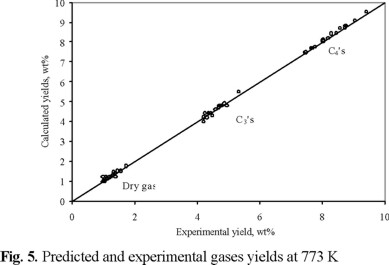
<body><![CDATA[<p align="justify"><font face="verdana" size="2">Experimental and calculated C<sub>4</sub>'s, C<sub>3</sub>'s and dry gas yields are also compared in <a href="#f5">figure 5</a>. The slope of the straight line between these values was very close to unity (1.0039) with a correlation coefficient of 0.99.</font></p>     <p align="center"><font face="verdana" size="2"><a name="f5"></a></font></p>     <p align="center"><font face="verdana" size="2"><img src="/img/revistas/rsqm/v46n1/a7f5.jpg"></font></p>     <p align="justify"><font face="verdana" size="2">The conversion range with the most significant differences in gasoline yields is from 65 to 90 wt %, which is in the range of industrial FCC units.</font></p>     <p align="justify"><font face="verdana" size="2">Gasoline is an intermediate product in the reaction scheme shown in <a href="#f1">figure 1</a> and its kinetic constants are very important, since gasoline fraction is the most profitable product of the FCC products.</font></p>     <p align="justify"><font face="verdana" size="2">The kinetic constants for gasoline cracking (<i>k</i><sub>6</sub>, <i>k</i><sub>7</sub>, <i>k</i><sub>8</sub> and <i>k</i><sub>9</sub>) are considerably smaller than the rate constant for gasoline formation (<i>k</i><sub>1</sub>) (100.02, 54.96, 25.46 and 0.915 versus 3166.61). It confirms, first, that the MAT experiments were conducted below over&#45;cracking region, and secondly, that gasoline gives mainly C<sub>4</sub>'s and C<sub>3</sub>'s, while the coke is produced mainly by the cracking of VGO, since the kinetic constant (<i>k</i><sub>9</sub>) for the reaction Gasoline &#x2192; Coke was many orders of magnitude smaller than for the others.</font></p>     <p align="justify"><font face="verdana" size="2">The value of the maximum gasoline yield predicted with the proposed model is about 85 wt % which agrees with those reported industrially &#91;2&#93;. This maximum occurs near the small values of WHSV (&lt; 4) as can be observed in <a href="#f3">figure 3</a>.</font></p>     <p align="justify">&nbsp;</p>     <p align="justify"><font face="verdana" size="2"><b>Advantages and limitations of the proposed model</b></font></p>     <p align="justify"><font face="verdana" size="2">The catalytic cracking of VGO results in a broad spectrum of products, ranging from hydrogen and methane to heavy polymeric material adhering to the catalyst as coke. By this reason, lumps model are commonly used to describe the kinetics of this process in order to reduce the broad spectrum of catalytic cracking charge stocks and products into a few pseudocomponents.</font></p>     ]]></body>
<body><![CDATA[<p align="justify"><font face="verdana" size="2">As it was mentioned before, various lump models have been proposed in the literature for FCC process &#91;6&#45;14&#93;. The main disadvantage of these models is that most of them consider the gaseous products as a lump.</font></p>     <p align="justify"><font face="verdana" size="2">The advantage of the model proposed in the present work is that it can predict separately the most important product of the FCC process (gasoline, C<sub>4</sub>'s, C<sub>3</sub>'s, dry gas and coke).</font></p>     <p align="justify"><font face="verdana" size="2">The problems with the lump models is that the relative concentrations of the species making up individual kinetic lumps can change as the reaction proceeds and thus these models cannot be extrapolated to new conditions or feed&#45;stocks and they are specific for the feedstock, catalysts and operating conditions used to obtain the kinetic information.</font></p>     <p align="justify"><font face="verdana" size="2">However, even though there are in the literature more realistic kinetic models that describe the cracking reactions using more detailed schemes, lump models are frequently used for modeling and simulation purposes because they are still capable to illustrate the interactions between the process variables and the reactions rate and catalyst decay velocity.</font></p>     <p align="justify"><font face="verdana" size="2">In the case of the proposed model, it is possible to predict gasoline, C<sub>4</sub>'s and C<sub>3</sub>'s selectivities that represent the most significant contributions to the profitability of a catalytic cracking unit. In addition, a simplified reaction scheme can perfectly illustrate the capabilities of computational techniques in modeling complex process operations, within acceptable computational costs.</font></p>     <p align="justify"><font face="Verdana" size="2">&nbsp;</font></p>     <p align="justify"><font face="verdana" size="2"><b>Conclusions</b></font></p>     <p align="justify"><font face="verdana" size="2">Experimental data about the catalytic cracking of vacuum gas oil obtained in a microactivity reactor (MAT) at reaction temperature of 773 K and WHSV between 6&#45;48 h&#45;1 using a commercial equilibrium catalyst were utilized to evaluate the kinetic parameters of a new lump kinetic model for catalytic cracking process.</font></p>     <p align="justify"><font face="verdana" size="2">Ratios of the obtained kinetic constants with respect to the global gas oil cracking kinetic constant agreed with those reported in the literature.</font></p>     <p align="justify"><font face="verdana" size="2">The kinetic parameters have been used to predict gasoline, C<sub>3</sub>'s, C<sub>4</sub>'s, dry gas, coke and unconverted VGO yields. Good predictions of these product yields were obtained with average absolute deviation less than 5% with respect to experimental information.</font></p>     ]]></body>
<body><![CDATA[<p align="justify"><font face="Verdana" size="2">&nbsp;</font></p>     <p align="justify"><font face="verdana" size="2"><b>Acknowledgements</b></font></p>     <p align="justify"><font face="verdana" size="2">The authors wish to thank Instituto Mexicano del Petr&oacute;leo for its financial support. R. Sotelo also thanks CONACyT for financial support.</font></p>     <p align="justify"><font face="Verdana" size="2">&nbsp;</font></p>     <p align="justify"><font face="verdana" size="2"><b>References</b></font></p>     <!-- ref --><p align="justify"><font face="verdana" size="2">1. Venuto, P.; Habib, E. <i>Cat. Rev.&#45;Sci.</i> <b>1978</b>, <i>18</i>, 1&#45;150.    &nbsp;&nbsp;&nbsp;&nbsp;&nbsp;&nbsp;&nbsp;&nbsp;[&#160;<a href="javascript:void(0);" onclick="javascript: window.open('/scielo.php?script=sci_nlinks&ref=6924846&pid=S0583-7693200200010000700001&lng=','','width=640,height=500,resizable=yes,scrollbars=1,menubar=yes,');">Links</a>&#160;]<!-- end-ref --></font></p>     <!-- ref --><p align="justify"><font face="verdana" size="2">2. Sadeghbeigi, R. <i>Fluid Catalytic Cracking Handbook: Design, Operation and Troubleshooting of FCC Facilities</i>. Gulf Publishing Co., Houston, TX, <b>1995</b>.    &nbsp;&nbsp;&nbsp;&nbsp;&nbsp;&nbsp;&nbsp;&nbsp;[&#160;<a href="javascript:void(0);" onclick="javascript: window.open('/scielo.php?script=sci_nlinks&ref=6924848&pid=S0583-7693200200010000700002&lng=','','width=640,height=500,resizable=yes,scrollbars=1,menubar=yes,');">Links</a>&#160;]<!-- end-ref --></font></p>     <!-- ref --><p align="justify"><font face="verdana" size="2">3. Moharir, A. S.; Sarae, S. K. <i>Chem. Age of India</i> <b>1984</b>, <i>35</i>, 433&#45;440.    &nbsp;&nbsp;&nbsp;&nbsp;&nbsp;&nbsp;&nbsp;&nbsp;[&#160;<a href="javascript:void(0);" onclick="javascript: window.open('/scielo.php?script=sci_nlinks&ref=6924850&pid=S0583-7693200200010000700003&lng=','','width=640,height=500,resizable=yes,scrollbars=1,menubar=yes,');">Links</a>&#160;]<!-- end-ref --></font></p>     <!-- ref --><p align="justify"><font face="verdana" size="2">4. Harding, R. H.; Zhao, X.; Kuangnan, Q.; Rajagopalan, K.; Cheng, W. <i>Ind. Eng. Chem. Res.</i> <b>1996</b>, <i>35</i>, 2561&#45;2569.    &nbsp;&nbsp;&nbsp;&nbsp;&nbsp;&nbsp;&nbsp;&nbsp;[&#160;<a href="javascript:void(0);" onclick="javascript: window.open('/scielo.php?script=sci_nlinks&ref=6924852&pid=S0583-7693200200010000700004&lng=','','width=640,height=500,resizable=yes,scrollbars=1,menubar=yes,');">Links</a>&#160;]<!-- end-ref --></font></p>     <!-- ref --><p align="justify"><font face="verdana" size="2">5. Weekman, V. M. <i>Ind. Eng. Chem. Prod. Res. Dev.</i> <b>1968</b>, <i>7</i>, 90&#45;95.    &nbsp;&nbsp;&nbsp;&nbsp;&nbsp;&nbsp;&nbsp;&nbsp;[&#160;<a href="javascript:void(0);" onclick="javascript: window.open('/scielo.php?script=sci_nlinks&ref=6924854&pid=S0583-7693200200010000700005&lng=','','width=640,height=500,resizable=yes,scrollbars=1,menubar=yes,');">Links</a>&#160;]<!-- end-ref --></font></p>     <!-- ref --><p align="justify"><font face="verdana" size="2">6. Jacob, S. M.; Gross, B.; Voltz, S. E.; Weekman, V.W. <i>AIChE J.</i> <b>1976</b>, <i>22</i>, 701&#45;713.    &nbsp;&nbsp;&nbsp;&nbsp;&nbsp;&nbsp;&nbsp;&nbsp;[&#160;<a href="javascript:void(0);" onclick="javascript: window.open('/scielo.php?script=sci_nlinks&ref=6924856&pid=S0583-7693200200010000700006&lng=','','width=640,height=500,resizable=yes,scrollbars=1,menubar=yes,');">Links</a>&#160;]<!-- end-ref --></font></p>     <!-- ref --><p align="justify"><font face="verdana" size="2">7. Yen, L. C.; Wrench, R. E.; Ong, A. S. in: Katalistics' 8th Annual Fluid Cat Cracking Symp. Budapest, Hungr&iacute;a. <b>1987</b>, 7:1&#45;7:7.    &nbsp;&nbsp;&nbsp;&nbsp;&nbsp;&nbsp;&nbsp;&nbsp;[&#160;<a href="javascript:void(0);" onclick="javascript: window.open('/scielo.php?script=sci_nlinks&ref=6924858&pid=S0583-7693200200010000700007&lng=','','width=640,height=500,resizable=yes,scrollbars=1,menubar=yes,');">Links</a>&#160;]<!-- end-ref --></font></p>     <!-- ref --><p align="justify"><font face="verdana" size="2">8. Lee, L. S.; Chen, Y.W.; Huang, T.N.; Pan, W.Y. <i>Can. J. Chem. Eng.</i> <b>1989</b>, <i>67</i>, 615&#45;619.    &nbsp;&nbsp;&nbsp;&nbsp;&nbsp;&nbsp;&nbsp;&nbsp;[&#160;<a href="javascript:void(0);" onclick="javascript: window.open('/scielo.php?script=sci_nlinks&ref=6924860&pid=S0583-7693200200010000700008&lng=','','width=640,height=500,resizable=yes,scrollbars=1,menubar=yes,');">Links</a>&#160;]<!-- end-ref --></font></p>     <!-- ref --><p align="justify"><font face="verdana" size="2">9. Takatsuka, T.; Sato, S.; Morimoto, Y.; Hashimoto, H. <i>Int. Chem. Eng.</i> <b>1987</b>, <i>27</i>, 107&#45;116.    &nbsp;&nbsp;&nbsp;&nbsp;&nbsp;&nbsp;&nbsp;&nbsp;[&#160;<a href="javascript:void(0);" onclick="javascript: window.open('/scielo.php?script=sci_nlinks&ref=6924862&pid=S0583-7693200200010000700009&lng=','','width=640,height=500,resizable=yes,scrollbars=1,menubar=yes,');">Links</a>&#160;]<!-- end-ref --></font></p>     <!-- ref --><p align="justify"><font face="verdana" size="2">10. Corella, J.; Provost, M.; Espinosa, A.; Gutierrez&#45;Morales, F. in: <i>Proc. of the XI Iberoamerican Symp. on Cat.</i>, M&eacute;xico, <b>1988</b>, 415&#45;421.    &nbsp;&nbsp;&nbsp;&nbsp;&nbsp;&nbsp;&nbsp;&nbsp;[&#160;<a href="javascript:void(0);" onclick="javascript: window.open('/scielo.php?script=sci_nlinks&ref=6924864&pid=S0583-7693200200010000700010&lng=','','width=640,height=500,resizable=yes,scrollbars=1,menubar=yes,');">Links</a>&#160;]<!-- end-ref --></font></p>     <!-- ref --><p align="justify"><font face="verdana" size="2">11. Larocca, M.; Ng, S. de Lasa, H.I. <i>Ind. Eng. Chem. Res.</i> <b>1990</b>, <i>29</i>, 171&#45;180.    &nbsp;&nbsp;&nbsp;&nbsp;&nbsp;&nbsp;&nbsp;&nbsp;[&#160;<a href="javascript:void(0);" onclick="javascript: window.open('/scielo.php?script=sci_nlinks&ref=6924866&pid=S0583-7693200200010000700011&lng=','','width=640,height=500,resizable=yes,scrollbars=1,menubar=yes,');">Links</a>&#160;]<!-- end-ref --></font></p>     <!-- ref --><p align="justify"><font face="verdana" size="2">12. Kraemer, D. W., de Lasa, H.I. <i>Ind. Eng. Chem. Res.</i> <b>1988</b>, <i>27</i>, 2002&#45;2008.    &nbsp;&nbsp;&nbsp;&nbsp;&nbsp;&nbsp;&nbsp;&nbsp;[&#160;<a href="javascript:void(0);" onclick="javascript: window.open('/scielo.php?script=sci_nlinks&ref=6924868&pid=S0583-7693200200010000700012&lng=','','width=640,height=500,resizable=yes,scrollbars=1,menubar=yes,');">Links</a>&#160;]<!-- end-ref --></font></p>     <!-- ref --><p align="justify"><font face="verdana" size="2">13. Coxson, P.G.; Bischoff, K.B. <i>Ind. Eng. Chem. Res.</i> <b>1987</b>, <i>26</i>, 1239&#45;1248.    &nbsp;&nbsp;&nbsp;&nbsp;&nbsp;&nbsp;&nbsp;&nbsp;[&#160;<a href="javascript:void(0);" onclick="javascript: window.open('/scielo.php?script=sci_nlinks&ref=6924870&pid=S0583-7693200200010000700013&lng=','','width=640,height=500,resizable=yes,scrollbars=1,menubar=yes,');">Links</a>&#160;]<!-- end-ref --></font></p>     <!-- ref --><p align="justify"><font face="verdana" size="2">14. Corella, J.; Frances, E. in: <i>Fluid Catalytic Cracking II, ACS Symposium Series</i>, Vol. 452, <b>1991</b>, 165&#45;182.    &nbsp;&nbsp;&nbsp;&nbsp;&nbsp;&nbsp;&nbsp;&nbsp;[&#160;<a href="javascript:void(0);" onclick="javascript: window.open('/scielo.php?script=sci_nlinks&ref=6924872&pid=S0583-7693200200010000700014&lng=','','width=640,height=500,resizable=yes,scrollbars=1,menubar=yes,');">Links</a>&#160;]<!-- end-ref --></font></p>     <!-- ref --><p align="justify"><font face="verdana" size="2">15. Blanding, F. H. <i>Ind. Eng. Chem.</i> <b>1953</b>, <i>45</i>, 1186&#45;1197.    &nbsp;&nbsp;&nbsp;&nbsp;&nbsp;&nbsp;&nbsp;&nbsp;[&#160;<a href="javascript:void(0);" onclick="javascript: window.open('/scielo.php?script=sci_nlinks&ref=6924874&pid=S0583-7693200200010000700015&lng=','','width=640,height=500,resizable=yes,scrollbars=1,menubar=yes,');">Links</a>&#160;]<!-- end-ref --></font></p>     <!-- ref --><p align="justify"><font face="verdana" size="2">16. Marquardt, D. W. <i>J. Soc. Ind. Appl. Math.</i> <b>1963</b>, <i>2</i>, 431&#45;441.    &nbsp;&nbsp;&nbsp;&nbsp;&nbsp;&nbsp;&nbsp;&nbsp;[&#160;<a href="javascript:void(0);" onclick="javascript: window.open('/scielo.php?script=sci_nlinks&ref=6924876&pid=S0583-7693200200010000700016&lng=','','width=640,height=500,resizable=yes,scrollbars=1,menubar=yes,');">Links</a>&#160;]<!-- end-ref --></font></p>      ]]></body><back>
<ref-list>
<ref id="B1">
<label>1</label><nlm-citation citation-type="journal">
<person-group person-group-type="author">
<name>
<surname><![CDATA[Venuto]]></surname>
<given-names><![CDATA[P.]]></given-names>
</name>
<name>
<surname><![CDATA[Habib]]></surname>
<given-names><![CDATA[E.]]></given-names>
</name>
</person-group>
<source><![CDATA[Cat. Rev.-Sci.]]></source>
<year>1978</year>
<volume>18</volume>
<page-range>1-150</page-range></nlm-citation>
</ref>
<ref id="B2">
<label>2</label><nlm-citation citation-type="book">
<person-group person-group-type="author">
<name>
<surname><![CDATA[Sadeghbeigi]]></surname>
<given-names><![CDATA[R.]]></given-names>
</name>
</person-group>
<source><![CDATA[Fluid Catalytic Cracking Handbook: Design, Operation and Troubleshooting of FCC Facilities]]></source>
<year>1995</year>
<publisher-loc><![CDATA[Houston^eTX TX]]></publisher-loc>
<publisher-name><![CDATA[Gulf Publishing Co.]]></publisher-name>
</nlm-citation>
</ref>
<ref id="B3">
<label>3</label><nlm-citation citation-type="journal">
<person-group person-group-type="author">
<name>
<surname><![CDATA[Moharir]]></surname>
<given-names><![CDATA[A. S.]]></given-names>
</name>
<name>
<surname><![CDATA[Sarae]]></surname>
<given-names><![CDATA[S. K.]]></given-names>
</name>
</person-group>
<source><![CDATA[Chem. Age of India]]></source>
<year>1984</year>
<volume>35</volume>
<page-range>433-440</page-range></nlm-citation>
</ref>
<ref id="B4">
<label>4</label><nlm-citation citation-type="journal">
<person-group person-group-type="author">
<name>
<surname><![CDATA[Harding]]></surname>
<given-names><![CDATA[R. H.]]></given-names>
</name>
<name>
<surname><![CDATA[Zhao]]></surname>
<given-names><![CDATA[X.]]></given-names>
</name>
<name>
<surname><![CDATA[Kuangnan]]></surname>
<given-names><![CDATA[Q.]]></given-names>
</name>
<name>
<surname><![CDATA[Rajagopalan]]></surname>
<given-names><![CDATA[K.]]></given-names>
</name>
<name>
<surname><![CDATA[Cheng]]></surname>
<given-names><![CDATA[W.]]></given-names>
</name>
</person-group>
<source><![CDATA[Ind. Eng. Chem. Res.]]></source>
<year>1996</year>
<volume>35</volume>
<page-range>2561-2569</page-range></nlm-citation>
</ref>
<ref id="B5">
<label>5</label><nlm-citation citation-type="journal">
<person-group person-group-type="author">
<name>
<surname><![CDATA[Weekman]]></surname>
<given-names><![CDATA[V. M.]]></given-names>
</name>
</person-group>
<source><![CDATA[Ind. Eng. Chem. Prod. Res. Dev.]]></source>
<year>1968</year>
<volume>7</volume>
<page-range>90-95</page-range></nlm-citation>
</ref>
<ref id="B6">
<label>6</label><nlm-citation citation-type="journal">
<person-group person-group-type="author">
<name>
<surname><![CDATA[Jacob]]></surname>
<given-names><![CDATA[S. M.]]></given-names>
</name>
<name>
<surname><![CDATA[Gross]]></surname>
<given-names><![CDATA[B.]]></given-names>
</name>
<name>
<surname><![CDATA[Voltz]]></surname>
<given-names><![CDATA[S. E.]]></given-names>
</name>
<name>
<surname><![CDATA[Weekman]]></surname>
<given-names><![CDATA[V.W.]]></given-names>
</name>
</person-group>
<source><![CDATA[AIChE J.]]></source>
<year>1976</year>
<volume>22</volume>
<page-range>701-713</page-range></nlm-citation>
</ref>
<ref id="B7">
<label>7</label><nlm-citation citation-type="">
<person-group person-group-type="author">
<name>
<surname><![CDATA[Yen]]></surname>
<given-names><![CDATA[L. C.]]></given-names>
</name>
<name>
<surname><![CDATA[Wrench]]></surname>
<given-names><![CDATA[R. E.]]></given-names>
</name>
<name>
<surname><![CDATA[Ong]]></surname>
<given-names><![CDATA[A. S.]]></given-names>
</name>
</person-group>
<source><![CDATA[Katalistics' 8th Annual Fluid Cat Cracking Symp.]]></source>
<year>1987</year>
<volume>7</volume>
<page-range>1-7:7</page-range><publisher-loc><![CDATA[Budapest ]]></publisher-loc>
</nlm-citation>
</ref>
<ref id="B8">
<label>8</label><nlm-citation citation-type="journal">
<person-group person-group-type="author">
<name>
<surname><![CDATA[Lee]]></surname>
<given-names><![CDATA[L. S.]]></given-names>
</name>
<name>
<surname><![CDATA[Chen]]></surname>
<given-names><![CDATA[Y.W.]]></given-names>
</name>
<name>
<surname><![CDATA[Huang]]></surname>
<given-names><![CDATA[T.N.]]></given-names>
</name>
<name>
<surname><![CDATA[Pan]]></surname>
<given-names><![CDATA[W.Y.]]></given-names>
</name>
</person-group>
<source><![CDATA[Can. J. Chem. Eng.]]></source>
<year>1989</year>
<volume>67</volume>
<page-range>615-619</page-range></nlm-citation>
</ref>
<ref id="B9">
<label>9</label><nlm-citation citation-type="journal">
<person-group person-group-type="author">
<name>
<surname><![CDATA[Takatsuka]]></surname>
<given-names><![CDATA[T.]]></given-names>
</name>
<name>
<surname><![CDATA[Sato]]></surname>
<given-names><![CDATA[S.]]></given-names>
</name>
<name>
<surname><![CDATA[Morimoto]]></surname>
<given-names><![CDATA[Y.]]></given-names>
</name>
<name>
<surname><![CDATA[Hashimoto]]></surname>
<given-names><![CDATA[H.]]></given-names>
</name>
</person-group>
<source><![CDATA[Int. Chem. Eng.]]></source>
<year>1987</year>
<volume>27</volume>
<page-range>107-116</page-range></nlm-citation>
</ref>
<ref id="B10">
<label>10</label><nlm-citation citation-type="">
<person-group person-group-type="author">
<name>
<surname><![CDATA[Corella]]></surname>
<given-names><![CDATA[J.]]></given-names>
</name>
<name>
<surname><![CDATA[Provost]]></surname>
<given-names><![CDATA[M.]]></given-names>
</name>
<name>
<surname><![CDATA[Espinosa]]></surname>
<given-names><![CDATA[A.]]></given-names>
</name>
<name>
<surname><![CDATA[Gutierrez-Morales]]></surname>
<given-names><![CDATA[F.]]></given-names>
</name>
</person-group>
<source><![CDATA[Proc. of the XI Iberoamerican Symp. on Cat.]]></source>
<year>1988</year>
<page-range>415-421</page-range><publisher-loc><![CDATA[México ]]></publisher-loc>
</nlm-citation>
</ref>
<ref id="B11">
<label>11</label><nlm-citation citation-type="journal">
<person-group person-group-type="author">
<name>
<surname><![CDATA[Larocca]]></surname>
<given-names><![CDATA[M.]]></given-names>
</name>
<name>
<surname><![CDATA[Ng]]></surname>
<given-names><![CDATA[S.]]></given-names>
</name>
<name>
<surname><![CDATA[de Lasa]]></surname>
<given-names><![CDATA[H.I.]]></given-names>
</name>
</person-group>
<source><![CDATA[Ind. Eng. Chem. Res.]]></source>
<year>1990</year>
<volume>29</volume>
<page-range>171-180</page-range></nlm-citation>
</ref>
<ref id="B12">
<label>12</label><nlm-citation citation-type="journal">
<person-group person-group-type="author">
<name>
<surname><![CDATA[Kraemer]]></surname>
<given-names><![CDATA[D. W.]]></given-names>
</name>
<name>
<surname><![CDATA[de Lasa]]></surname>
<given-names><![CDATA[H.I.]]></given-names>
</name>
</person-group>
<source><![CDATA[Ind. Eng. Chem. Res.]]></source>
<year>1988</year>
<month>20</month>
<day>08</day>
<volume>27</volume>
</nlm-citation>
</ref>
<ref id="B13">
<label>13</label><nlm-citation citation-type="journal">
<person-group person-group-type="author">
<name>
<surname><![CDATA[Coxson]]></surname>
<given-names><![CDATA[P.G.]]></given-names>
</name>
<name>
<surname><![CDATA[Bischoff]]></surname>
<given-names><![CDATA[K.B.]]></given-names>
</name>
</person-group>
<source><![CDATA[Ind. Eng. Chem. Res.]]></source>
<year>1987</year>
<volume>26</volume>
<page-range>1239-1248</page-range></nlm-citation>
</ref>
<ref id="B14">
<label>14</label><nlm-citation citation-type="journal">
<person-group person-group-type="author">
<name>
<surname><![CDATA[Corella]]></surname>
<given-names><![CDATA[J.]]></given-names>
</name>
<name>
<surname><![CDATA[Frances]]></surname>
<given-names><![CDATA[E.]]></given-names>
</name>
</person-group>
<source><![CDATA[Fluid Catalytic Cracking II, ACS Symposium Series]]></source>
<year>1991</year>
<volume>452</volume>
<page-range>165-182</page-range></nlm-citation>
</ref>
<ref id="B15">
<label>15</label><nlm-citation citation-type="journal">
<person-group person-group-type="author">
<name>
<surname><![CDATA[Blanding]]></surname>
<given-names><![CDATA[F. H.]]></given-names>
</name>
</person-group>
<source><![CDATA[Ind. Eng. Chem.]]></source>
<year>1953</year>
<volume>45</volume>
<page-range>1186-1197</page-range></nlm-citation>
</ref>
<ref id="B16">
<label>16</label><nlm-citation citation-type="journal">
<person-group person-group-type="author">
<name>
<surname><![CDATA[Marquardt]]></surname>
<given-names><![CDATA[D. W.]]></given-names>
</name>
</person-group>
<source><![CDATA[J. Soc. Ind. Appl. Math.]]></source>
<year>1963</year>
<volume>2</volume>
<page-range>431-441</page-range></nlm-citation>
</ref>
</ref-list>
</back>
</article>