<?xml version="1.0" encoding="ISO-8859-1"?><article xmlns:mml="http://www.w3.org/1998/Math/MathML" xmlns:xlink="http://www.w3.org/1999/xlink" xmlns:xsi="http://www.w3.org/2001/XMLSchema-instance">
<front>
<journal-meta>
<journal-id>0583-7693</journal-id>
<journal-title><![CDATA[Revista de la Sociedad Química de México]]></journal-title>
<abbrev-journal-title><![CDATA[Rev. Soc. Quím. Méx]]></abbrev-journal-title>
<issn>0583-7693</issn>
<publisher>
<publisher-name><![CDATA[Sociedad Química de México A.C.]]></publisher-name>
</publisher>
</journal-meta>
<article-meta>
<article-id>S0583-76932001000400016</article-id>
<title-group>
<article-title xml:lang="en"><![CDATA[Enthalpic and Entropic Contributions to the Conformational Free Energy Differences in Monosubstituted Cyclohexanes]]></article-title>
</title-group>
<contrib-group>
<contrib contrib-type="author">
<name>
<surname><![CDATA[Juaristi]]></surname>
<given-names><![CDATA[Eusebio]]></given-names>
</name>
<xref ref-type="aff" rid="A01"/>
</contrib>
<contrib contrib-type="author">
<name>
<surname><![CDATA[Muñoz-Muñiz]]></surname>
<given-names><![CDATA[Omar]]></given-names>
</name>
<xref ref-type="aff" rid="A01"/>
</contrib>
</contrib-group>
<aff id="A01">
<institution><![CDATA[,Instituto Politécnico Nacional Centro de Investigación y de Estudios Avanzados Departamento de Química]]></institution>
<addr-line><![CDATA[México Distrito Federal]]></addr-line>
<country>México</country>
</aff>
<pub-date pub-type="pub">
<day>00</day>
<month>12</month>
<year>2001</year>
</pub-date>
<pub-date pub-type="epub">
<day>00</day>
<month>12</month>
<year>2001</year>
</pub-date>
<volume>45</volume>
<numero>4</numero>
<fpage>218</fpage>
<lpage>224</lpage>
<copyright-statement/>
<copyright-year/>
<self-uri xlink:href="http://www.scielo.org.mx/scielo.php?script=sci_arttext&amp;pid=S0583-76932001000400016&amp;lng=en&amp;nrm=iso"></self-uri><self-uri xlink:href="http://www.scielo.org.mx/scielo.php?script=sci_abstract&amp;pid=S0583-76932001000400016&amp;lng=en&amp;nrm=iso"></self-uri><self-uri xlink:href="http://www.scielo.org.mx/scielo.php?script=sci_pdf&amp;pid=S0583-76932001000400016&amp;lng=en&amp;nrm=iso"></self-uri><abstract abstract-type="short" xml:lang="en"><p><![CDATA[Variable-temperature ¹H and 13C NMR spectroscopy of substituted cyclohexanes permitted the evaluation of the thermodynamic parameters for the axial &#8652; equatorial conformational equilibria when the substituent is methyl, ethyl, isopropyl, tert-butyl, benzyl, and the sulfur-containing methylthio, methylsulfinyl, and methylsulfonyl. Interpretation of the results confirms the premise that a proper understanding of conformational preferences requires the knowledge of the enthalpic and entropic contributions to the conformational free energy differences. A comment on the determination of thermodynamic parameters by means of theoretical methods is also included.]]></p></abstract>
<abstract abstract-type="short" xml:lang="es"><p><![CDATA[Estudios espectroscópicos mediante resonancia magnética nuclear a diferentes temperaturas hicieron posible la evaluación de los parámetros termodinámicos asociados a equilibrios conformacionales axial &#8652; ecuatorial en ciclohexanos sustituidos, en los que el sustituyente es metilo, etilo, isopropilo, terbutilo, bencilo, o algunos de los grupos tiometilo, metilsulfinilo o metilsulfonilo. La interpretación de los resultados obtenidos muestra que para alcanzar el entendimiento correcto de las preferencias conformacionales es necesario conocer las componentes entálpicas y entrópicas además de las diferencias en la energía libre conformacional. Finalmente, se presenta también el uso de métodos teóricos para la determinación de parámetros termodinámicos.]]></p></abstract>
<kwd-group>
<kwd lng="en"><![CDATA[Conformational analysis]]></kwd>
<kwd lng="en"><![CDATA[A-values, NMR spectroscopy]]></kwd>
<kwd lng="en"><![CDATA[Variable-temperature NMR]]></kwd>
<kwd lng="es"><![CDATA[Análisis conformacional]]></kwd>
<kwd lng="es"><![CDATA[valores-A]]></kwd>
<kwd lng="es"><![CDATA[Resonancia magnética nuclear]]></kwd>
<kwd lng="es"><![CDATA[RMN a temperatura variable]]></kwd>
</kwd-group>
</article-meta>
</front><body><![CDATA[ <p align="justify"><font face="Verdana" size="4">Revisi&oacute;n</font></p>     <p align="justify"><font face="Verdana" size="2">&nbsp;</font></p>     <p align="center"><font face="Verdana" size="4"><b>Enthalpic and Entropic Contributions to the Conformational Free Energy Differences in Monosubstituted Cyclohexanes</b></font></p>     <p align="justify"><font face="Verdana" size="2">&nbsp;</font></p>     <p align="center"><font face="Verdana" size="2"><b>Eusebio Juaristi* and Omar Mu&ntilde;oz&#45;Mu&ntilde;iz</b></font></p>     <p align="justify"><font face="Verdana" size="2">&nbsp;</font></p>     <p align="justify"><font face="verdana" size="2"><i>Departamento de Qu&iacute;mica, Centro de Investigaci&oacute;n y de Estudios Avanzados del Instituto Polit&eacute;cnico Nacional, Apartado Postal 14&#45;740, M&eacute;xico 07000, D. F.</i> E&#45;mail: <a href="mailto:juaristi@relaq.mx">juaristi@relaq.mx</a></font></p>     <p align="justify"><font face="Verdana" size="2">&nbsp;</font></p>     <p align="justify"><font face="verdana" size="2">Recibido el 10 de febrero del 2001.    <br> Aceptado el 16 de julio del 2001.</font></p>     ]]></body>
<body><![CDATA[<p align="justify"><font face="Verdana" size="2">&nbsp;</font></p>     <p align="justify"><font face="verdana" size="2"><i>Dedicated to Professor Fernando Walls, Instituto de Qu&iacute;mica, UNAM, on the occasion of his 70th Birthday.</i></font></p>     <p align="justify"><font face="Verdana" size="2">&nbsp;</font></p>     <p align="justify"><font face="verdana" size="2"><b>Abstract</b></font></p>     <p align="justify"><font face="verdana" size="2">Variable&#45;temperature <sup>1</sup>H and <sup>13</sup>C NMR spectroscopy of substituted cyclohexanes permitted the evaluation of the thermodynamic parameters for the axial &#8652;  equatorial conformational equilibria when the substituent is methyl, ethyl, isopropyl, <i>tert</i>&#45;butyl, benzyl, and the sulfur&#45;containing methylthio, methylsulfinyl, and methylsulfonyl. Interpretation of the results confirms the premise that a proper understanding of conformational preferences requires the knowledge of the enthalpic and entropic contributions to the conformational free energy differences. A comment on the determination of thermodynamic parameters by means of theoretical methods is also included.</font></p>     <p align="justify"><font face="verdana" size="2"><b>Keywords:</b> Conformational analysis, <i>A</i>&#45;values, NMR spectroscopy, Variable&#45;temperature NMR.</font></p>     <p align="justify"><font face="Verdana" size="2">&nbsp;</font></p>     <p align="justify"><font face="verdana" size="2"><b>Resumen</b></font></p>     <p align="justify"><font face="verdana" size="2">Estudios espectrosc&oacute;picos mediante resonancia magn&eacute;tica nuclear a diferentes temperaturas hicieron posible la evaluaci&oacute;n de los par&aacute;metros termodin&aacute;micos asociados a equilibrios conformacionales axial &#8652;  ecuatorial en ciclohexanos sustituidos, en los que el sustituyente es metilo, etilo, isopropilo, terbutilo, bencilo, o algunos de los grupos tiometilo, metilsulfinilo o metilsulfonilo. La interpretaci&oacute;n de los resultados obtenidos muestra que para alcanzar el entendimiento correcto de las preferencias conformacionales es necesario conocer las componentes ent&aacute;lpicas y entr&oacute;picas adem&aacute;s de las diferencias en la energ&iacute;a libre conformacional. Finalmente, se presenta tambi&eacute;n el uso de m&eacute;todos te&oacute;ricos para la determinaci&oacute;n de par&aacute;metros termodin&aacute;micos.</font></p>     <p align="justify"><font face="verdana" size="2"><b>Palabras clave:</b> An&aacute;lisis conformacional, valores&#45;<i>A</i>, Resonancia magn&eacute;tica nuclear, RMN a temperatura variable.</font></p>     ]]></body>
<body><![CDATA[<p align="justify"><font face="Verdana" size="2">&nbsp;</font></p>     <p align="justify"><font face="verdana" size="2"><b>Enthalpic and entropic contributions to the conformational preference of the benzyl group in cyclohexane</b></font></p>     <p align="justify"><font face="verdana" size="2">Substituted cyclohexanes generally exist in a conformational equilibrium that involves ring inversion, and therefore interconversion of the axial and equatorial orientation of the substituent (Eq. 1).</font></p>     <p align="center"><font face="Verdana" size="2"><img src="/img/revistas/rsqm/v45n4/a16e3.jpg"></font></p>     <p align="justify"><font face="verdana" size="2">Inversion of the cyclohexane ring is slow at low temperatures (<i>e.g.</i> &minus;70 &deg;C or lower), so that a NMR spectrum registers then the signals that correspond to each isomer. Integration of the signals allows then determination of the equatorial/axial ratio, <i>i.e.</i> the equilibrium constant <i>K</i> in equation 1. Now, application of Gibbs' equation (Eq. 2) affords the free energy difference for the axial <img src="/img/revistas/rsqm/v45n4/a16e4.jpg"> equatorial equilibrium, which corresponds to the conformational preference (<i>A</i>&#45;value) of the substituent R, where <i>R</i> is the gas constant (1.987 kcal/mol) and <i>T</i> is the temperature (in kelvin degrees) &#91;1&#93;.</font></p>     <p align="center"><font face="Verdana" size="2"><img src="/img/revistas/rsqm/v45n4/a16e5.jpg"></font></p>     <p align="justify"><font face="verdana" size="2"><i>A</i>&#45;values (differences in free energy, &minus;&#916;<i>G</i>&deg;, between the axial and equatorial conformations of monosubstituted cyclohexanes) are of great interest to chemists since they serve as models in the understanding of the conformational behavior of more complex molecules. For example, when R is an alkyl group, the equilibrium shown in equation 1 is displaced to the right since an equatorial orientation of the substituent avoids the repulsive steric interactions with the axial hydrogens at carbons 3 and 5 (Eq. 3). Thus, it is not surprising that the bigger the substituent R, the greater the preference for the equatorial conformation.</font></p>     <p align="center"><font face="Verdana" size="2"><img src="/img/revistas/rsqm/v45n4/a16e6.jpg"></font></p>     <p align="justify"><font face="verdana" size="2">However, we must remember that the free energy of a molecule in a particular conformation is the result of two contributing factors: its enthalpy (<i>H</i>&deg;) and its entropy (<i>S</i>&deg;) components, as described in equation 4.</font></p>     <p align="center"><font face="Verdana" size="2"><img src="/img/revistas/rsqm/v45n4/a16e7.jpg"></font></p>     ]]></body>
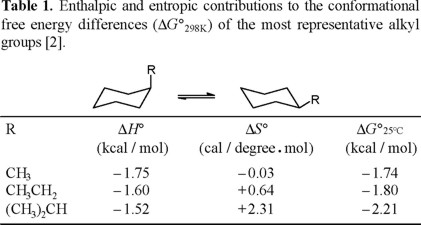
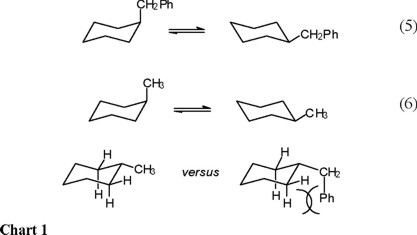
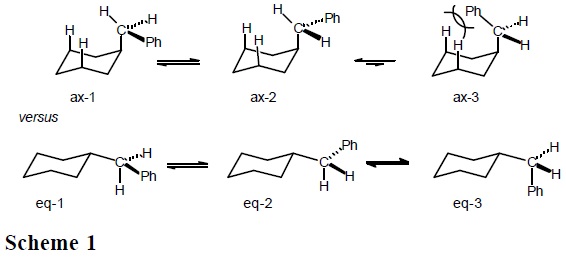
<body><![CDATA[<p align="justify"><font face="verdana" size="2">Specifically, the <i>A</i>&#45;values for the methyl, ethyl, and isopropyl groups are 1.74, 1.80 and 2.21 kcal/mol &#91;1&#93;, that appear to be congruent with their relative size; that is, isopropyl larger than ethyl, and ethyl larger than methyl. Nevertheless, an NMR study showed that enthalpy differences for this series <i>decreases</i>, contrary to intuition: &minus; &#916;<i>H</i>&deg; (CH<sub>3</sub>) = 1.75 kcal/mol ; &minus; &#916;<i>H</i>&deg; (CH<sub>3</sub>CH<sub>2</sub>) = 1.60 kcal/mol, and &minus;&#916;<i>H</i>&deg; ((CH<sub>3</sub>)<sub>2</sub>CH) = 1.52 kcal/mol &#91;2&#93;.</font></p>     <p align="justify"><font face="verdana" size="2">The contrasting trends for &#916;<i>G</i>&deg; and &#916;<i>H</i>&deg; values in the methyl&#45;ethyl&#45;isopropyl series is explained in terms of the entropy differences, which make a substantial contribution to the corresponding free energy differences (<a href="#c1">Table 1</a>).</font></p>     <p align="center"><font face="verdana" size="2"><a name="c1"></a></font></p>     <p align="center"><font face="verdana" size="2"><img src="/img/revistas/rsqm/v45n4/a16c1.jpg"></font></p>     <p align="justify"><font face="verdana" size="2">We deemed it of interest to carry out the conformational study, by means of NMR spectroscopy, of benzylcyclohexane (Eq. 5). Consideration of the repulsive steric interactions present in the axial and equatorial conformers, leads to the conclusion that the enthalpy difference in the axial to equatorial benzylcyclohexane equilibrium must be lower than the one for methylcyclohexane (Eq. 6), since one of the rotamers in equatorial benzylcyclohexane suffers from increased steric repulsion relative to equatorial methylcyclohexane (<a href="#f1">Chart 1</a>).</font></p>     <p align="center"><font face="verdana" size="2"><a name="f1"></a></font></p>     <p align="center"><font face="verdana" size="2"><img src="/img/revistas/rsqm/v45n4/a16f1.jpg"></font></p>     <p align="justify"><font face="verdana" size="2">On the other hand, it can be appreciated that the equatorial form of benzylcyclohexane must present three populated rotamers, whereas the axial form only two (the phenyl&#45;inside rotamers, ax&#45;3 in <a href="#f2">scheme 1</a>, is energetically too unfavorable), so that the &#916;<i>S</i>&deg; term (entropy of the axial conformer versus entropy of the equatorial conformer) favors the equatorial benzylcyclohexane.</font></p>     <p align="center"><font face="verdana" size="2"><a name="f2"></a></font></p>     <p align="center"><font face="verdana" size="2"><img src="/img/revistas/rsqm/v45n4/a16f2.jpg"></font></p>     ]]></body>
<body><![CDATA[<p align="justify"><font face="verdana" size="2">Therefore, the strong steric repulsion between the phenyl and the cyclohexane ring in ax&#45;3 (<a href="#f2">Scheme 1</a>) brings as consequence that only rotamers ax&#45;1 and ax&#45;2 are populated in the axial conformation. In contrast, it is anticipated that all three equatorial rotamers (ec&#45;1, ec&#45;2, and ec&#45;3 in <a href="#f2">Scheme 1</a>) are populated, since all three have low energy. In this way, there is more entropy (freedom of movement) in the equatorial conformer; that is, &#916;<i>S</i>&deg; = &#91;<i>S</i>&deg;(equatorial) &minus; <i>S</i>&deg;(axial)&#93; &gt; 0.</font></p>     <p align="justify"><font face="verdana" size="2">Experimentally &#91;3&#93;, the <sup>1</sup>H NMR spectrum of <i>cis</i>&#45;1&#45;benzyl&#45;4&#45;methylcyclohexane (<i>cis</i>&#45;<b>1</b>, a cyclohexane derivative where the methyl and benzyl groups compete for the equatorial position) shows a doublet signal with J = 7.9 Hz at &#948; = 2.57 ppm, which corresponds to the benzylic hydrogens in an averaged spectrum, due to rapid inversion of the cyclohexane ring (Eq. 7) &#91;4&#93;.</font></p>     <p align="center"><font face="Verdana" size="2"><img src="/img/revistas/rsqm/v45n4/a16e8.jpg"></font></p>     <p align="justify"><font face="verdana" size="2">When the spectrum is registered at &minus;71 &deg;C, the signal for the benzylic hydrogens appears as two doublet signals at 2.65 and 2.46 ppm, in a 56.4:43.6 ratio, an estimated &#916;<i>G</i>&deg;202&deg;K = &minus;<i>RT</i> ln <i>K</i> = + 0.10 kcal/mol is obtained. This "doubling" of the spectrum is due to the fact that at low temperature the inversion process is sufficiently slow to permit the recording of the signals associated to <i>cis</i>&#45;<b>1</b>&#45;ax (axial benzyl and equatorial methyl), as well as those corresponding to <i>cis</i>&#45;<b>1</b>&#45;eq; that is, decoalescence of the signals is achieved at &minus;71 &deg;C.</font></p>     <p align="justify"><font face="verdana" size="2">Because the methylene signal in conformationally fixed <i>trans</i>&#45;<b>1</b> has &#948; = 2.47 ppm (Eq. 8), a reasonable conclusion is that the downfield signal at &#948; = 2.65 ppm corresponds to the axial benzyl. Therefore, at low temperature the conformational equilibrium of <i>cis</i>&#45;<b>1</b> (Eq. 7) is displaced to the left; that is, the conformer with axial benzyl is predominant despite its larger size relative to methyl.</font></p>     <p align="center"><font face="Verdana" size="2"><img src="/img/revistas/rsqm/v45n4/a16e9.jpg"></font></p>     <p align="justify"><font face="verdana" size="2">We then recorded <sup>13</sup>C NMR spectra for <i>cis</i>&#45;<b>1</b>, both at 25 &deg;C (rapid inversion, averaged spectrum) and at &minus;71 &deg;C (slow inversion, separate spectra for individual conformers). The most relevant signals at ambient temperature are those for the methyl group at &#948; = 20.40 ppm, and at 41.06 ppm for the benzylic methylene. Below coalescence (at &minus;71 &deg;C), these signals separate into two pairs of signals: one at &#948; = 17.53 and 44.39 ppm for methyl and benzylic methylene in <i>cis</i>&#45;<b>1</b>&#45;eq, and the second at &#948; = 23.39 and 37.20 ppm for the same carbons in <i>cis</i>&#45;<b>1</b>&#45;ax. (Eq. 9).</font></p>     <p align="center"><font face="Verdana" size="2"><img src="/img/revistas/rsqm/v45n4/a16e10.jpg"></font></p>     <p align="justify"><font face="verdana" size="2">From integration of the C&#45;13 NMR signals for each conformer, a 54.7:45.3 ratio in favor of <i>cis</i>&#45;<b>1</b>&#45;ax was determined (Eq. 9). Again, application of Gibbs' equation affords &#916;<i>G</i>&deg;&#45;71&deg;C = &minus;<i>RT</i> ln 45.3/54.7 = +0.08 kcal/mol. It is then confirmed that at low temperature, the conformer with equatorial methyl and axial benzyl predominates, in spite of the larger size of the latter substituent.</font></p>     <p align="justify"><font face="verdana" size="2">Most interestingly, with the results obtained at &minus;71&deg;C, and the application of Eliel's equation &#91;5&#93; (Eq. 10) to room&#45;temperature <sup>13</sup>C NMR data gives,</font></p>     ]]></body>
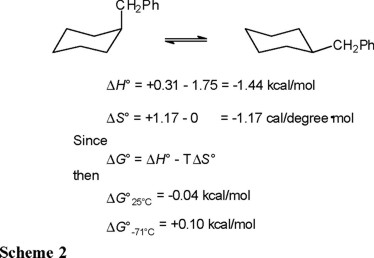
<body><![CDATA[<p align="center"><font face="Verdana" size="2"><img src="/img/revistas/rsqm/v45n4/a16e11.jpg"></font></p>     <p align="justify"><font face="verdana" size="2">Nevertheless, from Gibbs' equation, &#916;<i>G</i>&deg;<sub>25&deg;C</sub> = &minus;<i>RT</i> ln <i>K</i> = &minus;0.04 kcal/mol. That is, at 25 &deg;C the <i>cis</i>&#45;<b>1</b>&#45;ax <img src="/img/revistas/rsqm/v45n4/a16e12.jpg"> <i>cis</i>&#45;<b>1</b>&#45;eq equilibrium shown in equation 7 favors <i>cis</i>&#45;<b>1</b>&#45;eq, so that now it is the more voluminous substituent that predominates in the equatorial position.</font></p>     <p align="justify"><font face="verdana" size="2">Therefore, the conformational behavior of <i>cis</i>&#45;<b>1</b> is highly dependent on the experimental temperature of measurement, &#916;<i>G</i>&deg;&#45;71&deg;C = + 0.10 kcal/mol <i>versus</i> &#916;<i>G</i>&deg;<sub>25&deg;C</sub> = &minus; 0.04 kcal/mol.</font></p>     <p align="justify"><font face="verdana" size="2">This dependence of &#916;<i>G</i>&deg; with temperature shows that entropy plays an important role on the conformational equilibrium of <i>cis</i>&#45;<b>1</b>. Indeed, the setting and solving two equations with two unknowns (&#916;<i>H</i>&deg; and &#916;<i>S</i>&deg; in equations 11 and 12) &#91;6&#93; allows determination of the thermodynamic parameters (Eqs. 13 and 14).</font></p>     <p align="center"><font face="Verdana" size="2"><img src="/img/revistas/rsqm/v45n4/a16e13.jpg"></font></p>     <p align="justify"><font face="verdana" size="2">It is then clear that at low temperature, &#916;<i>G</i>&deg; in equation 7 is dominated by the enthalpic term (greater intrinsic preference of the CH<sub>3</sub> group to be equatorial), but at ambient or higher temperature (<i>T</i> &ge; 25 &deg;C) &#916;<i>G</i>&deg; is dominated by the entropic term <i>T</i>&#916;<i>S</i>, and as a consequence the observed preferences for the equatorial position follow the "expected" order, PhCH<sub>2</sub> &gt; CH<sub>3</sub>.</font></p>     <p align="justify"><font face="verdana" size="2">The thermodynamic parameters given by equations 13 and 14 refer, of course, to the conformational equilibrium depicted in equation 7. In order to derive the corresponding &#916;<i>H</i>&deg; and &#916;<i>S</i>&deg; values in benzylcyclohexane (Eq. 5) one must subtract the contributions of the methyl group ("counterpoise" &#91;1&#93;) given in <a href="#c1">Table 1</a>. In this way, the values presented in <a href="#f3">Scheme 2</a> are obtained.</font></p>     <p align="center"><font face="verdana" size="2"><a name="f3"></a></font></p>     <p align="center"><font face="verdana" size="2"><img src="/img/revistas/rsqm/v45n4/a16f3.jpg"></font></p>     <p align="justify"><font face="verdana" size="2"><b>Enthalpic and entropic contributions to the conformational free energies of methylthio, methylsulfinyl, and methylsulfonyl groups in cyclohexane</b></font></p>     ]]></body>
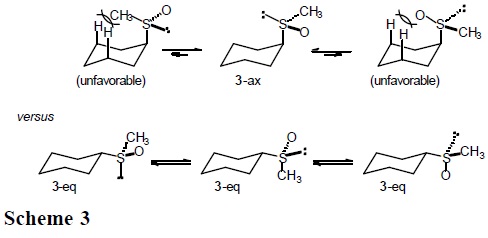
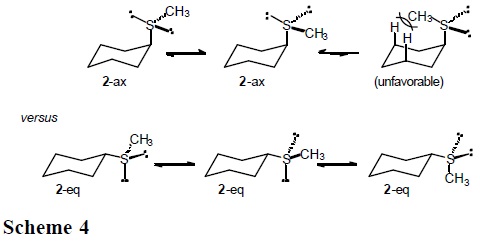
<body><![CDATA[<p align="justify"><font face="verdana" size="2">It is expected that the conformational behavior of cyclohexane derivatives containing the methylthio (CH<sub>3</sub>S), methylsulfinyl (CH<sub>3</sub>SO), and methylsulfonyl group (CH<sub>3</sub>SO<sub>2</sub>) will depend substantially on the entropic term. In particular, for sulfoxide <b>3</b> one anticipates three populated rotamers in the equatorial conformers, but only one in the axial conformation (<a href="#f4">Scheme 3</a>).</font></p>     <p align="center"><font face="verdana" size="2"><a name="f4"></a></font></p>     <p align="center"><font face="verdana" size="2"><img src="/img/revistas/rsqm/v45n4/a16f4.jpg"></font></p>     <p align="justify"><font face="verdana" size="2">Similarly, three low&#45;energy rotamers are anticipated for the equatorial forms in sulfide <b>2</b> and sulfone <b>4</b>, but only two for the axial conformations (<a href="#f6">Schemes 4</a> and <a href="#f7">5</a>).</font></p>     <p align="center"><font face="verdana" size="2"><a name="f6"></a></font></p>     <p align="center"><font face="verdana" size="2"><img src="/img/revistas/rsqm/v45n4/a16f6.jpg"></font></p>     <p align="center"><font face="verdana" size="2"><a name="f7"></a></font></p>     <p align="center"><font face="verdana" size="2"><img src="/img/revistas/rsqm/v45n4/a16f7.jpg"></font></p>     <p align="justify"><font face="verdana" size="2">This section reports the results of variable&#45;temperature <sup>13</sup>C NMR measurements in (<i>cis</i>&#45;4&#45;methylcyclohexyl)methyl sulfide, sulfoxide and sulfone (<b>5&#45;7</b> in <a href="#f8">Scheme 6</a>), which permitted the determination of &#916;<i>H</i>&deg; and &#916;<i>S</i>&deg; in axial to equatorial equilibria &#91;7&#93;. The <i>cis</i>&#45;methyl at C(4) serves as a counterpoise substituent &#91;1&#93;, so that equilibrium constants, <i>K</i>, are closer to unity.</font></p>     <p align="center"><font face="verdana" size="2"><a name="f8"></a></font></p>     ]]></body>
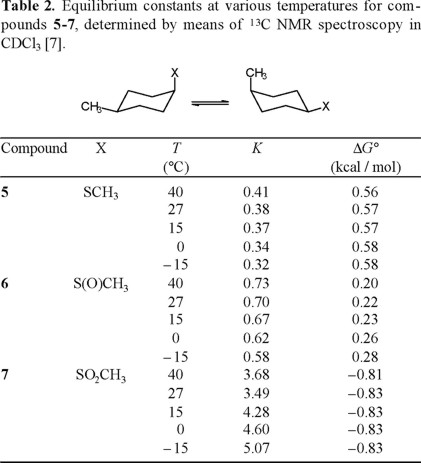
<body><![CDATA[<p align="center"><font face="verdana" size="2"><img src="/img/revistas/rsqm/v45n4/a16f8.jpg"></font></p>     <p align="justify"><font face="verdana" size="2">Application of Eliel's equation (Eq. 10) to the C&#45;13 NMR data for <b>5&#45;7</b>, obtained at various temperatures, afforded the equilibrium constants <i>K</i> that are collected in <a href="#c2">Table 2</a>. Linear regression analysis of the correlations ln <i>K versus</i> 1/<i>T</i> (<a href="#f5">Fig. 1</a>) provided the thermodynamic parameters listed in <a href="#c3">Table 3</a> &#91;8&#93;.</font></p>     <p align="center"><font face="verdana" size="2"><a name="c2"></a></font></p>     <p align="center"><font face="verdana" size="2"><img src="/img/revistas/rsqm/v45n4/a16c2.jpg"></font></p>     <p align="center"><font face="verdana" size="2"><a name="f5"></a></font></p>     <p align="center"><font face="verdana" size="2"><img src="/img/revistas/rsqm/v45n4/a16f5.jpg"></font></p>     <p align="center"><font face="verdana" size="2"><a name="c3"></a></font></p>     <p align="center"><font face="verdana" size="2"><img src="/img/revistas/rsqm/v45n4/a16c3.jpg"></font></p>     <p align="justify"><font face="verdana" size="2">The results reported in <a href="#c3">Table 3</a>, especially the similarity in enthalpy values for the thiomethyl and methylsulfinyl groups (&#916;<i>H</i>&deg; = &minus;1.05 and &minus;1.08 kcal/mol, respectively) are in line with expectation when one considers that for both compounds the axial conformer orients the sulfur lone pair towards the cyclohexane ring, presenting similar steric hindrance. On the other hand, the enthalpy term for the methylsulfonyl group, &#916;<i>H</i>&deg;(SO<sub>2</sub>CH<sub>3</sub>) = &minus; 2.66 kcal/mol, is more than twice the one for CH<sub>3</sub>S and CH<sub>3</sub>S(O), as a consequence of having the sulfonyl oxygen pointing inside the ring (<a href="#f7">Scheme 5</a>).</font></p>     <p align="justify"><font face="verdana" size="2">The entropy values determined in this work are also congruent in the case of sulfide <b>2</b> and sulfoxide <b>3</b>, since these compounds present three populated rotamers in the equatorial conformation, but only two for axial SCH<sub>3</sub> and only one for axial CH<sub>3</sub>S(O). Indeed, it can be calculated that for X = CH<sub>3</sub>S, &#916;<i>S</i>&deg; = <i>R</i> ln 3 &minus; <i>R</i> ln 2 = +0.80 cal/degree <b>&middot;</b> mol, and &#916;<i>S</i>&deg; = <i>R</i> ln 3 &minus; <i>R</i> ln 1 = + 2.18 cal/degree <b>&middot;</b> mol for X = CH<sub>3</sub>S(O). The experimental values are +0.48 and + 1.55 cal/degree <b>&middot;</b> mol, respectively.</font></p>     ]]></body>
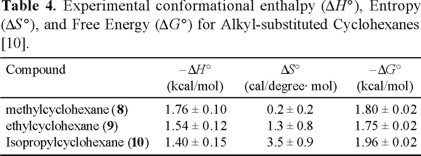
<body><![CDATA[<p align="justify"><font face="verdana" size="2"><b>Reinvestigation of the conformational enthalphy, entropy, and free energy of methyl&#45; (8), ethyl&#45; (9), and isopropylcyclohexane (10) &#91;10&#93;</b></font></p>     <p align="justify"><font face="verdana" size="2">The determination of the conformational energy difference between the axial and equatorial isomers of methylcyclohexane (<b>8</b>) by Booth and Everett (see section A and reference 2) involved measurement of the ratio of the intensities of the enriched <sup>13</sup>C resonances in the two isomers <b>8</b>&#45;ax and <b>8</b>&#45;eq (Eq. 15).</font></p>     <p align="center"><font face="Verdana" size="2"><img src="/img/revistas/rsqm/v45n4/a16e14.jpg"></font></p>     <p align="justify"><font face="verdana" size="2">Wiberg and coworkers &#91;10&#93; have recently questioned the accuracy of the reported equilibrium constants which ranged from <i>K</i> = 164 at 172 K to <i>K</i> = 427 at 149 K, since it was considered that the determination of isomer ratios greater than 100 is extremely difficult. Consequently, the approach used by Wiberg, <i>et al.</i> involved comparision of the NMR signal intensities for natural abundance <sup>13</sup>C(2,6) in equatorial methylcyclohexane (&#948; = 36.1 ppm) versus the small signal for the <sup>13</sup>C&#45;enriched axial methyl in <b>8</b>&#45;ax (&#948; = 17.6 ppm). In this fashion, <i>K</i> ratios on the order of 4&#45;10 were accurately measured.</font></p>     <p align="justify"><font face="verdana" size="2">Furthermore, Wiberg and coworkers reported the use of a low&#45;temperature "thermometer" based on the temperature&#45;sensitive <sup>13</sup>C chemical shifts of 2&#45;chlorobutane, as an internal reference &#91;10,11&#93;.</font></p>     <p align="justify"><font face="verdana" size="2">The conformational enthalpy, entropy, and free energy of methyl, ethyl, and isopropyl groups in cyclohexane determined in this study &#91;10&#93; are summarized in <a href="#c4">Table 4</a>. These values do not differ appreciably from those reported by Booth and Everett &#91;2&#93;.</font></p>     <p align="center"><font face="verdana" size="2"><a name="c4"></a></font></p>     <p align="center"><font face="verdana" size="2"><img src="/img/revistas/rsqm/v45n4/a16c4.jpg"></font></p>     <p align="justify"><font face="verdana" size="2"><b>Conformational study of phenylcyclohexane &#91;12&#93;</b></font></p>     <p align="justify"><font face="verdana" size="2">The conformational free energy (&minus;&#916;<i>G</i>&deg; = <i>A</i>&#45;value) of phenylcyclohexane (<b>11</b>) was determined by Eliel and Manoharam from a low&#45;temperature <sup>13</sup>C NMR study of <i>cis</i>&#45;4&#45;methyl&#45;1&#45;phenylcyclohexane &#91;13&#93;, and a value of &#916;<i>G</i>&deg;<sub>173</sub> K = &minus;2.87 &plusmn; 0.09 kcal/mol was obtained for equation 16.</font></p>     ]]></body>
<body><![CDATA[<p align="center"><font face="Verdana" size="2"><img src="/img/revistas/rsqm/v45n4/a16e15.jpg"></font></p>     <p align="justify"><font face="verdana" size="2">Very recently, the conformational isomers of phenylcyclohexane (<b>11</b>&#45;ax and <b>11</b>&#45;eq) were studied via geometry optimization at the HF/6&#45;31G*, B3LYP/6&#45;311G*, and MP2/6&#45;31G* theoretical levels, and the results are summarized in <a href="#c5">Table 5</a>. At all levels of theory, equatorial phenylcyclohexane (<b>11</b>&#45;eq) was found to preferentially adopt a conformation in which the phenyl is eclipsed with the C(1)&#45;H bond (<a href="#f9">Fig. 2a</a>). The lowest energy rotational arrangement of the phenyl group in the axial isomer (<b>11</b>&#45;ax) is one in which the plane of the phenyl is rotated nearly perpendicular to the bisecting plane of the cyclohexane ring (<a href="#f9">Fig. 2b</a>).</font></p>     <p align="center"><font face="verdana" size="2"><a name="c5"></a></font></p>     <p align="center"><font face="verdana" size="2"><img src="/img/revistas/rsqm/v45n4/a16c5.jpg"></font></p>     <p align="center"><font face="verdana" size="2"><a name="f9"></a></font></p>     <p align="center"><font face="verdana" size="2"><img src="/img/revistas/rsqm/v45n4/a16f9.jpg"></font></p>     <p align="justify"><font face="verdana" size="2">When &#916;<i>E</i> values were corrected for the difference in zero&#45;point energies between the two conformers, &#916;<i>H</i>&deg; values calculated on going from 0 K to higher temperatures, and &#916;<i>G</i>&deg; values derived from the calculated entropy differences, the results shown in <a href="#c6">Table 6</a> were obtained. The calculated &#916;<i>G</i>&deg; at &minus;100 &deg;C, &minus;2.9 kcal / mol, is in excellent accord with the experimental value.</font></p>     <p align="center"><font face="verdana" size="2"><a name="c6"></a></font></p>     <p align="center"><font face="verdana" size="2"><img src="/img/revistas/rsqm/v45n4/a16c6.jpg"></font></p>     <p align="justify"><font face="verdana" size="2">The sizable enthalpy difference between <b>11</b>&#45;ax and <b>11</b>&#45;eq (3.1 kcal/mol at 25 &deg;C) can be ascribed to steric repulsion in the axial isomer. On the other hand, the near&#45;zero entropy difference in this equilibrium is in line with the highly based rotameric distribution of <b>11</b>&#45;ax and <b>11</b>&#45;eq, adopting the "parallel" and "perpendicular" conformations depicted in <a href="#f9">figure 2</a>; that is, &#916;<i>S</i>&deg; = <i>S</i>&deg;(<b>11</b>&#45;ax) &minus; <i>S</i>&deg;(<b>11</b>&#45;eq) &asymp; <i>R</i> ln 2 &minus; <i>R</i> ln 2 &asymp; 0.</font></p>     ]]></body>
<body><![CDATA[<p align="justify"><font face="verdana" size="2"><b>Thermodynamics of the axial <img src="/img/revistas/rsqm/v45n4/a16e16.jpg"> equatorial conformational equilibrium of <i>tert</i>&#45;butylcyclohexane &#91;14&#93;</b></font></p>     <p align="justify"><font face="verdana" size="2">In contrast with methyl&#45;, ethyl&#45;, and isopropylcyclohexane, the axial isomer of <i>tert</i>&#45;butylcyclohexane necessarily orients a methyl group inside the ring, giving rise to a large steric repulsion in axial <i>tert</i>&#45;butylcyclohexane (<b>12</b>&#45;ax), equation 17.</font></p>     <p align="center"><font face="Verdana" size="2"><img src="/img/revistas/rsqm/v45n4/a16e17.jpg"></font></p>     <p align="justify"><font face="verdana" size="2">The extreme one&#45;sidedness of equilibrium 17 has precluded so far the experimental estimation of the enthalpic and entropic contributions to &minus;&#916;<i>G</i>&deg;(<i>t</i>&#45;Bu) &#91;15&#93;. While this situation brings to mind the potential of theoretical calculations as an alternative for determinations not amenable to experiment, apparently only one force&#45;field study &#91;16&#93; has addressed the question of entropy difference in the <b>12</b>&#45;ax <img src="/img/revistas/rsqm/v45n4/a16e18.jpg"> <b>12</b>&#45;eq equilibrium (Eq. 17). The estimated &#916;<i>S</i>&deg; = 0 for this equilibrium seems intuitively plausible by consideration of the three isoenergetic staggered conformers both in <b>12</b>&#45;ax and <b>12</b>&#45;eq.</font></p>     <p align="justify"><font face="verdana" size="2">The fundamental importance of the <i>tert</i>&#45;butyl group in chemistry motivated the reexamination of the enthalpic and entropic contributions to the conformational preference of <i>tert</i>&#45;butyl in cyclohexane &#91;14&#93;. The MM2 &#91;17&#93; and MM3 &#91;18&#93; force fields were used to evaluate the intramolecular energetics. While the former program has proven quite successful for modeling a large variety of hydrocarbons, MM3 does take into account entropy components to free energy.</font></p>     <p align="justify"><font face="verdana" size="2">The intramolecular entropy was calculated according to equation 18 where <i>R</i> is the gas constant, <i>n</i> is the number of conformational states sampled, and <i>P<sub>i</sub></i> is the Boltzmann probability of the ith conformational state &#91;19&#93;. The <i>P<sub>i</sub></i>, in turn, were computed from the relationship depicted in equation 19.</font></p>     <p align="center"><font face="Verdana" size="2"><img src="/img/revistas/rsqm/v45n4/a16e19.jpg"></font></p>     <p align="justify"><font face="verdana" size="2"><a href="#f10">Figure 3</a> presents the MM2 energy profiles for rotation around the C&#45;C(CH<sub>3</sub>)<sub>3</sub> bond in axial and equatorial <b>12</b>. The most interesting feature of these plots is the presence of two minima for each staggered arrangement in axial <b>12</b>, relative to only one for each staggered rotamer in <b>12</b>&#45;eq.</font></p>     <p align="center"><font face="verdana" size="2"><a name="f10"></a></font></p>     <p align="center"><font face="verdana" size="2"><img src="/img/revistas/rsqm/v45n4/a16f10.jpg"></font></p>     ]]></body>
<body><![CDATA[<p align="justify"><font face="verdana" size="2"><a href="#f11">Figure 4</a> clearly shows that a <i>libration</i> phenomenom results in twice as many conformational states available to axial <i>tert</i>&#45;butylcyclohexane relative to the equatorial isomer.</font></p>     <p align="center"><font face="verdana" size="2"><a name="f11"></a></font></p>     <p align="center"><font face="verdana" size="2"><img src="/img/revistas/rsqm/v45n4/a16f11.jpg"></font></p>     <p align="justify"><font face="verdana" size="2">This is reflected in increased entropy content for <b>12</b>&#45;ax, as confirmed in the calculated &#916;<i>S</i>&deg;ax/eq = <i>S</i>&deg;a x &minus; <i>S</i>&deg;eq = &minus;0.44 cal / degree <b>&middot;</b> mol &#91;14&#93;.</font></p>     <p align="justify"><font face="verdana" size="2">The calculated difference in enthalpy between axial and equatorial <b>12</b>, &#916;<i>H</i>&deg;ax/eq = &minus;5.0 kcal/mol, agrees quite well with the value determined by Eliel, &#916;<i>G</i>&deg;ax/eq = &minus; 4.9 kcal/mol &#91;20, 21&#93;.</font></p>     <p align="justify"><font face="Verdana" size="2">&nbsp;</font></p>     <p align="justify"><font face="verdana" size="2"><b>Conclusion</b></font></p>     <p align="justify"><font face="verdana" size="2">Variable&#45;temperature NMR spectroscopy and theoretical calculations are powerful tools for the determination of thermodynamic parameters. It is clear that a proper understanding of the conformational behavior of substituted cyclohexanes requieres knowledge of the enthalpic and entropic components to the conformational free energy difference.</font></p>     <p align="justify"><font face="Verdana" size="2">&nbsp;</font></p>     <p align="justify"><font face="verdana" size="2"><b>References and notes</b></font></p>     ]]></body>
<body><![CDATA[<!-- ref --><p align="justify"><font face="verdana" size="2">1. Juaristi, E. <i>Introduction to Stereochemistry and Conformational Analysis</i>; Wiley: New York, <b>1991</b>.    &nbsp;&nbsp;&nbsp;&nbsp;&nbsp;&nbsp;&nbsp;&nbsp;[&#160;<a href="javascript:void(0);" onclick="javascript: window.open('/scielo.php?script=sci_nlinks&ref=6921701&pid=S0583-7693200100040001600001&lng=','','width=640,height=500,resizable=yes,scrollbars=1,menubar=yes,');">Links</a>&#160;]<!-- end-ref --></font></p>     <!-- ref --><p align="justify"><font face="verdana" size="2">2. Booth, H.; Everett, J. R. <i>J. Chem. Soc.</i>, <i>Perkin Trans. 2</i>, <b>1980</b>, 255&#45;259.    &nbsp;&nbsp;&nbsp;&nbsp;&nbsp;&nbsp;&nbsp;&nbsp;[&#160;<a href="javascript:void(0);" onclick="javascript: window.open('/scielo.php?script=sci_nlinks&ref=6921703&pid=S0583-7693200100040001600002&lng=','','width=640,height=500,resizable=yes,scrollbars=1,menubar=yes,');">Links</a>&#160;]<!-- end-ref --></font></p>     <!-- ref --><p align="justify"><font face="verdana" size="2">3. Juaristi, E.; Labastida, V.; Ant&uacute;nez, S. <i>J. Org. Chem.</i> <b>1991</b>, <i>56</i>, 4802&#45;4804.    &nbsp;&nbsp;&nbsp;&nbsp;&nbsp;&nbsp;&nbsp;&nbsp;[&#160;<a href="javascript:void(0);" onclick="javascript: window.open('/scielo.php?script=sci_nlinks&ref=6921705&pid=S0583-7693200100040001600003&lng=','','width=640,height=500,resizable=yes,scrollbars=1,menubar=yes,');">Links</a>&#160;]<!-- end-ref --></font></p>     <p align="justify"><font face="verdana" size="2">4. The methyl group in <i>cis</i>&#45;<b>1</b> serves as "counterpoise", so that the conformational equilibrium is not overly displaced toward the form with equatorial benzyl &#91;1&#93;.</font></p>     <!-- ref --><p align="justify"><font face="verdana" size="2">5. Eliel, E. L. <i>Chem Ind.</i> (Londres) <b>1959</b>, 568&#45;570.    &nbsp;&nbsp;&nbsp;&nbsp;&nbsp;&nbsp;&nbsp;&nbsp;[&#160;<a href="javascript:void(0);" onclick="javascript: window.open('/scielo.php?script=sci_nlinks&ref=6921708&pid=S0583-7693200100040001600004&lng=','','width=640,height=500,resizable=yes,scrollbars=1,menubar=yes,');">Links</a>&#160;]<!-- end-ref --></font></p>     <p align="justify"><font face="verdana" size="2">6. Note that temperature is given in Kelvin degrees.</font></p>     ]]></body>
<body><![CDATA[<!-- ref --><p align="justify"><font face="verdana" size="2">7. Juaristi, E.; Labastida, V.; Ant&uacute;nez, S. <i>J. Org. Chem.</i> <b>2000</b>, <i>65</i>, 969&#45;973.    &nbsp;&nbsp;&nbsp;&nbsp;&nbsp;&nbsp;&nbsp;&nbsp;[&#160;<a href="javascript:void(0);" onclick="javascript: window.open('/scielo.php?script=sci_nlinks&ref=6921711&pid=S0583-7693200100040001600005&lng=','','width=640,height=500,resizable=yes,scrollbars=1,menubar=yes,');">Links</a>&#160;]<!-- end-ref --></font></p>     <p align="justify"><font face="verdana" size="2">8. The values reported in <a href="#c3">Table 3</a> have been "corrected" for the presence of the counterpoise substituent, the methyl group.</font></p>     <!-- ref --><p align="justify"><font face="verdana" size="2">9. Juaristi, E. "Fisicoqu&iacute;mica Org&aacute;nica"; Minal: M&eacute;xico, <b>1998</b>.    &nbsp;&nbsp;&nbsp;&nbsp;&nbsp;&nbsp;&nbsp;&nbsp;[&#160;<a href="javascript:void(0);" onclick="javascript: window.open('/scielo.php?script=sci_nlinks&ref=6921714&pid=S0583-7693200100040001600006&lng=','','width=640,height=500,resizable=yes,scrollbars=1,menubar=yes,');">Links</a>&#160;]<!-- end-ref --></font></p>     <!-- ref --><p align="justify"><font face="verdana" size="2">10. Wiberg, K. B.; Hammer. J. D.; Castejon, H.; Bailey, W. F.; DeLeon, E. L.; Jarrett, R. M. <i>J. Org. Chem.</i> <b>1999</b>, <i>64</i>, 2085&#45;2095.    &nbsp;&nbsp;&nbsp;&nbsp;&nbsp;&nbsp;&nbsp;&nbsp;[&#160;<a href="javascript:void(0);" onclick="javascript: window.open('/scielo.php?script=sci_nlinks&ref=6921716&pid=S0583-7693200100040001600007&lng=','','width=640,height=500,resizable=yes,scrollbars=1,menubar=yes,');">Links</a>&#160;]<!-- end-ref --></font></p>     <!-- ref --><p align="justify"><font face="verdana" size="2">11. Schneider, H. J.; Freitag, W. <i>J. Am. Chem. Soc.</i> <b>1976</b>, <i>98</i>, 478&#45;481.    &nbsp;&nbsp;&nbsp;&nbsp;&nbsp;&nbsp;&nbsp;&nbsp;[&#160;<a href="javascript:void(0);" onclick="javascript: window.open('/scielo.php?script=sci_nlinks&ref=6921718&pid=S0583-7693200100040001600008&lng=','','width=640,height=500,resizable=yes,scrollbars=1,menubar=yes,');">Links</a>&#160;]<!-- end-ref --></font></p>     <!-- ref --><p align="justify"><font face="verdana" size="2">12. Wiberg, K. B.; Castejon, H.; Bailey, W. F.; Ochterski, J. <i>J. Org. Chem.</i> <b>2000</b>, <i>65</i>, 1181&#45;1187.    &nbsp;&nbsp;&nbsp;&nbsp;&nbsp;&nbsp;&nbsp;&nbsp;[&#160;<a href="javascript:void(0);" onclick="javascript: window.open('/scielo.php?script=sci_nlinks&ref=6921720&pid=S0583-7693200100040001600009&lng=','','width=640,height=500,resizable=yes,scrollbars=1,menubar=yes,');">Links</a>&#160;]<!-- end-ref --></font></p>     <!-- ref --><p align="justify"><font face="verdana" size="2">13. Eliel, E. L.; Manoharan, M. <i>J. Org. Chem.</i> <b>1981</b>, <i>46</i>, 1959&#45;1962.    &nbsp;&nbsp;&nbsp;&nbsp;&nbsp;&nbsp;&nbsp;&nbsp;[&#160;<a href="javascript:void(0);" onclick="javascript: window.open('/scielo.php?script=sci_nlinks&ref=6921722&pid=S0583-7693200100040001600010&lng=','','width=640,height=500,resizable=yes,scrollbars=1,menubar=yes,');">Links</a>&#160;]<!-- end-ref --></font></p>     <!-- ref --><p align="justify"><font face="verdana" size="2">14. Ant&uacute;nez, S.; Juaristi, E. <i>J. Org. Chem.</i> <b>1996</b>, <i>61</i>, 6465&#45;6469.    &nbsp;&nbsp;&nbsp;&nbsp;&nbsp;&nbsp;&nbsp;&nbsp;[&#160;<a href="javascript:void(0);" onclick="javascript: window.open('/scielo.php?script=sci_nlinks&ref=6921724&pid=S0583-7693200100040001600011&lng=','','width=640,height=500,resizable=yes,scrollbars=1,menubar=yes,');">Links</a>&#160;]<!-- end-ref --></font></p>     <!-- ref --><p align="justify"><font face="verdana" size="2">15. Furthermore, an axial <i>tert</i>&#45;butyl group usually causes the ring to adopt non&#45;chair conformations: Remijnse, J. D.; Bekkum, H. V.; Wepster, B. M. <i>Recl. Trav. Chim. Pays&#45;Bas</i>, <b>1974</b>, <i>93</i>, 93&#45;98.    &nbsp;&nbsp;&nbsp;&nbsp;&nbsp;&nbsp;&nbsp;&nbsp;[&#160;<a href="javascript:void(0);" onclick="javascript: window.open('/scielo.php?script=sci_nlinks&ref=6921726&pid=S0583-7693200100040001600012&lng=','','width=640,height=500,resizable=yes,scrollbars=1,menubar=yes,');">Links</a>&#160;]<!-- end-ref --></font></p>     <!-- ref --><p align="justify"><font face="verdana" size="2">16. Allinger, N. L.; Hirsch, J. A.; Miller, M. A.; Tyminski, I. J.; Van Catledge, F. A. <i>J. Am. Chem. Soc.</i> <b>1968</b>, <i>90</i>, 1199&#45;1210.    &nbsp;&nbsp;&nbsp;&nbsp;&nbsp;&nbsp;&nbsp;&nbsp;[&#160;<a href="javascript:void(0);" onclick="javascript: window.open('/scielo.php?script=sci_nlinks&ref=6921728&pid=S0583-7693200100040001600013&lng=','','width=640,height=500,resizable=yes,scrollbars=1,menubar=yes,');">Links</a>&#160;]<!-- end-ref --></font></p>     <!-- ref --><p align="justify"><font face="verdana" size="2">17. Allinger, N. L. <i>J. Am. Chem. Soc.</i> <b>1977</b>, <i>99</i>, 8127&#45;8134.    &nbsp;&nbsp;&nbsp;&nbsp;&nbsp;&nbsp;&nbsp;&nbsp;[&#160;<a href="javascript:void(0);" onclick="javascript: window.open('/scielo.php?script=sci_nlinks&ref=6921730&pid=S0583-7693200100040001600014&lng=','','width=640,height=500,resizable=yes,scrollbars=1,menubar=yes,');">Links</a>&#160;]<!-- end-ref --></font></p>     <!-- ref --><p align="justify"><font face="verdana" size="2">18. Allinger, N. L.; Yuh, Y. H.; Lii, J.&#45;H. <i>J. Am. Chem. Soc.</i> <b>1989</b>, <i>111</i>, 8551&#45;8566.    &nbsp;&nbsp;&nbsp;&nbsp;&nbsp;&nbsp;&nbsp;&nbsp;[&#160;<a href="javascript:void(0);" onclick="javascript: window.open('/scielo.php?script=sci_nlinks&ref=6921732&pid=S0583-7693200100040001600015&lng=','','width=640,height=500,resizable=yes,scrollbars=1,menubar=yes,');">Links</a>&#160;]<!-- end-ref --></font></p>     <!-- ref --><p align="justify"><font face="verdana" size="2">19. Flory, P. J. <i>Statistical Mechanics of Chain Molecules</i>; Wiley: New York, <b>1969</b>.    &nbsp;&nbsp;&nbsp;&nbsp;&nbsp;&nbsp;&nbsp;&nbsp;[&#160;<a href="javascript:void(0);" onclick="javascript: window.open('/scielo.php?script=sci_nlinks&ref=6921734&pid=S0583-7693200100040001600016&lng=','','width=640,height=500,resizable=yes,scrollbars=1,menubar=yes,');">Links</a>&#160;]<!-- end-ref --></font></p>     <!-- ref --><p align="justify"><font face="verdana" size="2">20. Manoharan, M.; Eliel, E. L. <i>Tetrahedron Lett.</i> <b>1984</b>, <i>25</i>, 3267&#45;3268.    &nbsp;&nbsp;&nbsp;&nbsp;&nbsp;&nbsp;&nbsp;&nbsp;[&#160;<a href="javascript:void(0);" onclick="javascript: window.open('/scielo.php?script=sci_nlinks&ref=6921736&pid=S0583-7693200100040001600017&lng=','','width=640,height=500,resizable=yes,scrollbars=1,menubar=yes,');">Links</a>&#160;]<!-- end-ref --></font></p>     <!-- ref --><p align="justify"><font face="verdana" size="2">21. See, also: Freeman, F.; Tsegai, Z. M.; Kasmer, M. L.; Hehre, W. J. <i>J. Chem. Educ.</i> <b>2000</b>, <i>77</i>, 661&#45;667.    &nbsp;&nbsp;&nbsp;&nbsp;&nbsp;&nbsp;&nbsp;&nbsp;[&#160;<a href="javascript:void(0);" onclick="javascript: window.open('/scielo.php?script=sci_nlinks&ref=6921738&pid=S0583-7693200100040001600018&lng=','','width=640,height=500,resizable=yes,scrollbars=1,menubar=yes,');">Links</a>&#160;]<!-- end-ref --></font></p>      ]]></body><back>
<ref-list>
<ref id="B1">
<label>1</label><nlm-citation citation-type="book">
<person-group person-group-type="author">
<name>
<surname><![CDATA[Juaristi]]></surname>
<given-names><![CDATA[E.]]></given-names>
</name>
</person-group>
<source><![CDATA[Introduction to Stereochemistry and Conformational Analysis]]></source>
<year>1991</year>
<publisher-loc><![CDATA[New York ]]></publisher-loc>
<publisher-name><![CDATA[Wiley]]></publisher-name>
</nlm-citation>
</ref>
<ref id="B2">
<label>2</label><nlm-citation citation-type="journal">
<person-group person-group-type="author">
<name>
<surname><![CDATA[Booth]]></surname>
<given-names><![CDATA[H.]]></given-names>
</name>
<name>
<surname><![CDATA[Everett]]></surname>
<given-names><![CDATA[J. R.]]></given-names>
</name>
</person-group>
<source><![CDATA[J. Chem. Soc., Perkin Trans]]></source>
<year>1980</year>
<volume>2</volume>
<page-range>255-259</page-range></nlm-citation>
</ref>
<ref id="B3">
<label>3</label><nlm-citation citation-type="journal">
<person-group person-group-type="author">
<name>
<surname><![CDATA[Juaristi]]></surname>
<given-names><![CDATA[E.]]></given-names>
</name>
<name>
<surname><![CDATA[Labastida]]></surname>
<given-names><![CDATA[V.]]></given-names>
</name>
<name>
<surname><![CDATA[Antúnez]]></surname>
<given-names><![CDATA[S.]]></given-names>
</name>
</person-group>
<source><![CDATA[J. Org. Chem.]]></source>
<year>1991</year>
<volume>56</volume>
<page-range>4802-4804</page-range></nlm-citation>
</ref>
<ref id="B4">
<label>5</label><nlm-citation citation-type="journal">
<person-group person-group-type="author">
<name>
<surname><![CDATA[Eliel]]></surname>
<given-names><![CDATA[E. L.]]></given-names>
</name>
</person-group>
<source><![CDATA[Chem Ind.]]></source>
<year>1959</year>
<page-range>568-570</page-range><publisher-loc><![CDATA[Londres ]]></publisher-loc>
</nlm-citation>
</ref>
<ref id="B5">
<label>7</label><nlm-citation citation-type="journal">
<person-group person-group-type="author">
<name>
<surname><![CDATA[Juaristi]]></surname>
<given-names><![CDATA[E]]></given-names>
</name>
<name>
<surname><![CDATA[Labastida]]></surname>
<given-names><![CDATA[V.]]></given-names>
</name>
<name>
<surname><![CDATA[Antúnez]]></surname>
<given-names><![CDATA[S.]]></given-names>
</name>
</person-group>
<source><![CDATA[J. Org. Chem.]]></source>
<year>2000</year>
<volume>65</volume>
<page-range>969-973</page-range></nlm-citation>
</ref>
<ref id="B6">
<label>9</label><nlm-citation citation-type="book">
<person-group person-group-type="author">
<name>
<surname><![CDATA[Juaristi]]></surname>
<given-names><![CDATA[E.]]></given-names>
</name>
</person-group>
<source><![CDATA[Fisicoquímica Orgánica]]></source>
<year>1998</year>
<publisher-loc><![CDATA[México ]]></publisher-loc>
<publisher-name><![CDATA[Minal]]></publisher-name>
</nlm-citation>
</ref>
<ref id="B7">
<label>10</label><nlm-citation citation-type="journal">
<person-group person-group-type="author">
<name>
<surname><![CDATA[Wiberg]]></surname>
<given-names><![CDATA[K. B.]]></given-names>
</name>
<name>
<surname><![CDATA[Hammer]]></surname>
<given-names><![CDATA[J. D.]]></given-names>
</name>
<name>
<surname><![CDATA[Castejon]]></surname>
<given-names><![CDATA[H.]]></given-names>
</name>
<name>
<surname><![CDATA[Bailey]]></surname>
<given-names><![CDATA[W. F.]]></given-names>
</name>
<name>
<surname><![CDATA[DeLeon]]></surname>
<given-names><![CDATA[E. L.]]></given-names>
</name>
<name>
<surname><![CDATA[Jarrett]]></surname>
<given-names><![CDATA[R. M.]]></given-names>
</name>
</person-group>
<source><![CDATA[J. Org. Chem.]]></source>
<year>1999</year>
<volume>64</volume>
<page-range>2085-2095</page-range></nlm-citation>
</ref>
<ref id="B8">
<label>11</label><nlm-citation citation-type="journal">
<person-group person-group-type="author">
<name>
<surname><![CDATA[Schneider]]></surname>
<given-names><![CDATA[H. J.]]></given-names>
</name>
<name>
<surname><![CDATA[Freitag]]></surname>
<given-names><![CDATA[W.]]></given-names>
</name>
</person-group>
<source><![CDATA[J. Am. Chem. Soc.]]></source>
<year>1976</year>
<volume>98</volume>
<page-range>478-481</page-range></nlm-citation>
</ref>
<ref id="B9">
<label>12</label><nlm-citation citation-type="journal">
<person-group person-group-type="author">
<name>
<surname><![CDATA[Wiberg]]></surname>
<given-names><![CDATA[K. B.]]></given-names>
</name>
<name>
<surname><![CDATA[Castejon]]></surname>
<given-names><![CDATA[H.]]></given-names>
</name>
<name>
<surname><![CDATA[Bailey]]></surname>
<given-names><![CDATA[W. F.]]></given-names>
</name>
<name>
<surname><![CDATA[Ochterski]]></surname>
<given-names><![CDATA[J.]]></given-names>
</name>
</person-group>
<source><![CDATA[J. Org. Chem.]]></source>
<year>2000</year>
<volume>65</volume>
<page-range>1181-1187</page-range></nlm-citation>
</ref>
<ref id="B10">
<label>13</label><nlm-citation citation-type="journal">
<person-group person-group-type="author">
<name>
<surname><![CDATA[Eliel]]></surname>
<given-names><![CDATA[E. L.]]></given-names>
</name>
<name>
<surname><![CDATA[Manoharan]]></surname>
<given-names><![CDATA[M.]]></given-names>
</name>
</person-group>
<source><![CDATA[J. Org. Chem.]]></source>
<year>1981</year>
<volume>46</volume>
<page-range>1959-1962</page-range></nlm-citation>
</ref>
<ref id="B11">
<label>14</label><nlm-citation citation-type="journal">
<person-group person-group-type="author">
<name>
<surname><![CDATA[Antúnez]]></surname>
<given-names><![CDATA[S.]]></given-names>
</name>
<name>
<surname><![CDATA[Juaristi]]></surname>
<given-names><![CDATA[E.]]></given-names>
</name>
</person-group>
<source><![CDATA[J. Org. Chem.]]></source>
<year>1996</year>
<volume>61</volume>
<page-range>6465-6469</page-range></nlm-citation>
</ref>
<ref id="B12">
<nlm-citation citation-type="journal">
<person-group person-group-type="author">
<name>
<surname><![CDATA[Remijnse]]></surname>
<given-names><![CDATA[J. D.]]></given-names>
</name>
<name>
<surname><![CDATA[Bekkum]]></surname>
<given-names><![CDATA[H. V.]]></given-names>
</name>
<name>
<surname><![CDATA[Wepster]]></surname>
<given-names><![CDATA[B. M.]]></given-names>
</name>
</person-group>
<source><![CDATA[Recl. Trav. Chim. Pays-Bas]]></source>
<year>1974</year>
<volume>93</volume>
<page-range>93-98</page-range></nlm-citation>
</ref>
<ref id="B13">
<label>16</label><nlm-citation citation-type="journal">
<person-group person-group-type="author">
<name>
<surname><![CDATA[Allinger]]></surname>
<given-names><![CDATA[N. L.]]></given-names>
</name>
<name>
<surname><![CDATA[Hirsch]]></surname>
<given-names><![CDATA[J. A.]]></given-names>
</name>
<name>
<surname><![CDATA[Miller]]></surname>
<given-names><![CDATA[M. A.]]></given-names>
</name>
<name>
<surname><![CDATA[Tyminski]]></surname>
<given-names><![CDATA[I. J.]]></given-names>
</name>
<name>
<surname><![CDATA[Van Catledge]]></surname>
<given-names><![CDATA[F. A]]></given-names>
</name>
</person-group>
<source><![CDATA[J. Am. Chem. Soc]]></source>
<year>1968</year>
<volume>90</volume>
<page-range>1199-1210</page-range></nlm-citation>
</ref>
<ref id="B14">
<label>17</label><nlm-citation citation-type="journal">
<person-group person-group-type="author">
<name>
<surname><![CDATA[Allinger]]></surname>
<given-names><![CDATA[N. L.]]></given-names>
</name>
</person-group>
<source><![CDATA[J. Am. Chem. Soc.]]></source>
<year>1977</year>
<volume>99</volume>
<page-range>8127-8134</page-range></nlm-citation>
</ref>
<ref id="B15">
<label>18</label><nlm-citation citation-type="journal">
<person-group person-group-type="author">
<name>
<surname><![CDATA[Allinger]]></surname>
<given-names><![CDATA[N. L.]]></given-names>
</name>
<name>
<surname><![CDATA[Yuh]]></surname>
<given-names><![CDATA[Y. H.]]></given-names>
</name>
<name>
<surname><![CDATA[Lii]]></surname>
<given-names><![CDATA[J.-H.]]></given-names>
</name>
</person-group>
<source><![CDATA[J. Am. Chem. Soc.]]></source>
<year>1989</year>
<volume>111</volume>
<page-range>8551-8566</page-range></nlm-citation>
</ref>
<ref id="B16">
<label>19</label><nlm-citation citation-type="">
<person-group person-group-type="author">
<name>
<surname><![CDATA[Flory]]></surname>
<given-names><![CDATA[P. J.]]></given-names>
</name>
</person-group>
<source><![CDATA[Statistical Mechanics of Chain Molecules]]></source>
<year>1969</year>
<publisher-loc><![CDATA[WileyNew York ]]></publisher-loc>
</nlm-citation>
</ref>
<ref id="B17">
<label>20</label><nlm-citation citation-type="journal">
<person-group person-group-type="author">
<name>
<surname><![CDATA[Manoharan]]></surname>
<given-names><![CDATA[M.]]></given-names>
</name>
<name>
<surname><![CDATA[Eliel]]></surname>
<given-names><![CDATA[E. L.]]></given-names>
</name>
</person-group>
<source><![CDATA[Tetrahedron Lett.]]></source>
<year>1984</year>
<volume>25</volume>
<page-range>3267-3268</page-range></nlm-citation>
</ref>
<ref id="B18">
<label>21</label><nlm-citation citation-type="journal">
<person-group person-group-type="author">
<name>
<surname><![CDATA[Freeman]]></surname>
<given-names><![CDATA[F.]]></given-names>
</name>
<name>
<surname><![CDATA[Tsegai]]></surname>
<given-names><![CDATA[Z. M.]]></given-names>
</name>
<name>
<surname><![CDATA[Kasmer]]></surname>
<given-names><![CDATA[M. L.]]></given-names>
</name>
<name>
<surname><![CDATA[Hehre]]></surname>
<given-names><![CDATA[W. J]]></given-names>
</name>
</person-group>
<source><![CDATA[J. Chem. Educ.]]></source>
<year>2000</year>
<volume>77</volume>
<page-range>661-667</page-range></nlm-citation>
</ref>
</ref-list>
</back>
</article>