<?xml version="1.0" encoding="ISO-8859-1"?><article xmlns:mml="http://www.w3.org/1998/Math/MathML" xmlns:xlink="http://www.w3.org/1999/xlink" xmlns:xsi="http://www.w3.org/2001/XMLSchema-instance">
<front>
<journal-meta>
<journal-id>0583-7693</journal-id>
<journal-title><![CDATA[Revista de la Sociedad Química de México]]></journal-title>
<abbrev-journal-title><![CDATA[Rev. Soc. Quím. Méx]]></abbrev-journal-title>
<issn>0583-7693</issn>
<publisher>
<publisher-name><![CDATA[Sociedad Química de México A.C.]]></publisher-name>
</publisher>
</journal-meta>
<article-meta>
<article-id>S0583-76932001000400008</article-id>
<title-group>
<article-title xml:lang="en"><![CDATA[Highly Diastereoselective Addition of a Racemic &#946;-Alanine Enolate Derivative to Electrophiles]]></article-title>
</title-group>
<contrib-group>
<contrib contrib-type="author">
<name>
<surname><![CDATA[Escalante]]></surname>
<given-names><![CDATA[Jaime]]></given-names>
</name>
<xref ref-type="aff" rid="A01"/>
</contrib>
<contrib contrib-type="author">
<name>
<surname><![CDATA[Hernández]]></surname>
<given-names><![CDATA[Ana Lilia]]></given-names>
</name>
<xref ref-type="aff" rid="A01"/>
</contrib>
<contrib contrib-type="author">
<name>
<surname><![CDATA[Juaristi]]></surname>
<given-names><![CDATA[Eusebio]]></given-names>
</name>
<xref ref-type="aff" rid="A02"/>
</contrib>
</contrib-group>
<aff id="A01">
<institution><![CDATA[,Universidad Autónoma del Estado de Morelos Centro de Investigaciones Químicas ]]></institution>
<addr-line><![CDATA[Cuernavaca Morelos]]></addr-line>
<country>México</country>
</aff>
<aff id="A02">
<institution><![CDATA[,Instituto Politécnico Nacional Centro de Investigación y de Estudios Avanzados Departamento de Química]]></institution>
<addr-line><![CDATA[México Distrito Federal]]></addr-line>
<country>México</country>
</aff>
<pub-date pub-type="pub">
<day>00</day>
<month>12</month>
<year>2001</year>
</pub-date>
<pub-date pub-type="epub">
<day>00</day>
<month>12</month>
<year>2001</year>
</pub-date>
<volume>45</volume>
<numero>4</numero>
<fpage>177</fpage>
<lpage>182</lpage>
<copyright-statement/>
<copyright-year/>
<self-uri xlink:href="http://www.scielo.org.mx/scielo.php?script=sci_arttext&amp;pid=S0583-76932001000400008&amp;lng=en&amp;nrm=iso"></self-uri><self-uri xlink:href="http://www.scielo.org.mx/scielo.php?script=sci_abstract&amp;pid=S0583-76932001000400008&amp;lng=en&amp;nrm=iso"></self-uri><self-uri xlink:href="http://www.scielo.org.mx/scielo.php?script=sci_pdf&amp;pid=S0583-76932001000400008&amp;lng=en&amp;nrm=iso"></self-uri><abstract abstract-type="short" xml:lang="en"><p><![CDATA[&#946;-Alanine, an inexpensive &#946;-amino acid, was converted into the 2-phenylperhydropyrimidin-4-one derivative (1), which can be alkylated with high diastereoselectivity via the corresponding enolate. The high stereoselectivity observed for the reaction of (1)-Li with electrophiles seems to be due to steric hindrance generated by an axial disposition of the phenyl group at C(2), which directs addition from the enolate face opposite to this group. These results pave the road to the enantioselective synthesis of &#945;-substituted &#946;-amino acids.]]></p></abstract>
<abstract abstract-type="short" xml:lang="es"><p><![CDATA[&#946;-Alanina, un aminoácido accesible, fue transformado al derivado 2-fenilperhidropirimidín-4-ona (1), que puede ser alquilado con alta diastereoselectividad mediante el enolato correspondiente. La alta estereoselectividad observada para la reacción de (1)-Li con electrófilos parece ser debida al impedimento generado por la disposición axial del grupo fenilo en C(2), el cual dirige la adición por la parte opuesta a este grupo. Estos resultados facilitan el camino a la síntesis enantioselectiva de &#946;-aminoácidos substituidos en &#945;.]]></p></abstract>
<kwd-group>
<kwd lng="en"><![CDATA[&#946;-amino acid]]></kwd>
<kwd lng="en"><![CDATA[diastereoselective alkylation]]></kwd>
<kwd lng="en"><![CDATA[perhydropyrimidinone]]></kwd>
<kwd lng="es"><![CDATA[&#946;-aminoácidos]]></kwd>
<kwd lng="es"><![CDATA[alquilación diastereoselectiva]]></kwd>
<kwd lng="es"><![CDATA[per-hidropirimidinona]]></kwd>
</kwd-group>
</article-meta>
</front><body><![CDATA[ <p align="justify"><font face="Verdana" size="4">Investigaci&oacute;n</font></p>     <p align="justify"><font face="Verdana" size="2">&nbsp;</font></p>     <p align="center"><font face="Verdana" size="4"><b>Highly Diastereoselective Addition of a Racemic &#946;&#45;Alanine Enolate Derivative to Electrophiles</b></font></p>     <p align="justify"><font face="Verdana" size="2">&nbsp;</font></p>     <p align="center"><font face="Verdana" size="2"><b>Jaime Escalante,*<sup>,1</sup> Ana Lilia Hern&aacute;ndez,<sup>1</sup> and Eusebio Juaristi*<sup>,2</sup></b></font></p>     <p align="justify"><font face="Verdana" size="2">&nbsp;</font></p>     <p align="justify"><font face="verdana" size="2"><i><sup>1</sup> Centro de Investigaciones Qu&iacute;micas, Universidad Aut&oacute;noma del Estado de Morelos, Av. Universidad 1001, Cuernavaca, Mor., 62210, M&eacute;xico.</i> E&#45;mail: <a href="mailto:escalante_jaime@hotmail.com">escalante_jaime@hotmail.com</a></font></p>     <p align="justify"><font face="verdana" size="2"><i><sup>2</sup> Departamento de Qu&iacute;mica, Centro de Investigaci&oacute;n y de Estudios Avanzados del IPN, Apartado Postal 14&#45;740, M&eacute;xico 07000, D.F.</i> E&#45;mail: <a href="mailto:juaristi@relaq.mx">juaristi@relaq.mx</a></font></p>     <p align="justify"><font face="Verdana" size="2">&nbsp;</font></p>     <p align="justify"><font face="verdana" size="2">Recibido el 15 de noviembre del 2001.    ]]></body>
<body><![CDATA[<br> Aceptado el 11 de diciembre del 2001.</font></p>     <p align="justify"><font face="Verdana" size="2">&nbsp;</font></p>     <p align="justify"><font face="verdana" size="2"><i>Dedicated to Professor Fernando Walls, Instituto de Qu&iacute;mica, UNAM, on the occasion of his 70th birthday.</i></font></p>     <p align="justify"><font face="Verdana" size="2">&nbsp;</font></p>     <p align="justify"><font face="verdana" size="2"><b>Abstract</b></font></p>     <p align="justify"><font face="verdana" size="2">&#946;&#45;Alanine, an inexpensive &#946;&#45;amino acid, was converted into the 2&#45;phenylperhydropyrimidin&#45;4&#45;one derivative (<b>1</b>), which can be alkylated with high diastereoselectivity via the corresponding enolate. The high stereoselectivity observed for the reaction of (<b>1</b>)&#45;Li with electrophiles seems to be due to steric hindrance generated by an axial disposition of the phenyl group at C(2), which directs addition from the enolate face opposite to this group. These results pave the road to the enantioselective synthesis of &#945;&#45;substituted &#946;&#45;amino acids.</font></p>     <p align="justify"><font face="verdana" size="2"><b>Keywords:</b> &#946;&#45;amino acid, diastereoselective alkylation, perhydropyrimidinone.</font></p>     <p align="justify"><font face="Verdana" size="2">&nbsp;</font></p>     <p align="justify"><font face="verdana" size="2"><b>Resumen</b></font></p>     <p align="justify"><font face="verdana" size="2">&#946;&#45;Alanina, un amino&aacute;cido accesible, fue transformado al derivado 2&#45;fenilperhidropirimid&iacute;n&#45;4&#45;ona (<b>1</b>), que puede ser alquilado con alta diastereoselectividad mediante el enolato correspondiente. La alta estereoselectividad observada para la reacci&oacute;n de (<b>1</b>)&#45;Li con electr&oacute;filos parece ser debida al impedimento generado por la disposici&oacute;n axial del grupo fenilo en C(2), el cual dirige la adici&oacute;n por la parte opuesta a este grupo. Estos resultados facilitan el camino a la s&iacute;ntesis enantioselectiva de &#946;&#45;amino&aacute;cidos substituidos en &#945;.</font></p>     ]]></body>
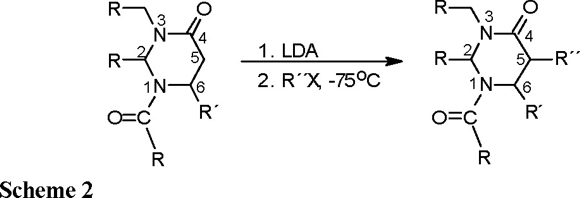
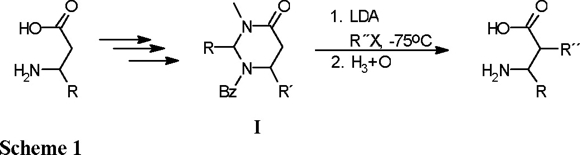
<body><![CDATA[<p align="justify"><font face="verdana" size="2"><b>Palabras clave:</b> &#946;&#45;amino&aacute;cidos, alquilaci&oacute;n diastereoselectiva, per&#45;hidropirimidinona.</font></p>     <p align="justify"><font face="Verdana" size="2">&nbsp;</font></p>     <p align="justify"><font face="verdana" size="2"><b>Introduction</b></font></p>     <p align="justify"><font face="verdana" size="2">Perhydropyrimidin&#45;4&#45;ones (<b>I</b>) are interesting heterocyclic compounds that represent protected forms of &#946;&#45;amino acids and are chiral precursors for the asymmetric synthesis of &#945;&#45;substituted &#946;&#45;amino acids &#91;1&#93;. The presence of the cyclic amidal moiety allows the acid hydrolysis of these compounds, affording directly the corresponding &#946;&#45;amino acids (<a href="#f1">Scheme 1</a>).</font></p>     <p align="center"><font face="verdana" size="2"><a name="f1"></a></font></p>     <p align="center"><font face="verdana" size="2"><img src="/img/revistas/rsqm/v45n4/a8f1.jpg"></font></p>     <p align="justify"><font face="verdana" size="2">The preparation of &#946;&#45;amino acids is an interesting topic that now has attracted a great deal of attention, because unusual amino acids, such as &#945;&#45;substituted &#945;&#45;amino acids, &#946;&#45;amino acids, and &#947;&#45;amino acids, allow the preparation of novel types of peptides that are catalysts or carriers of biologically active residues with pharmacologically interesting properties &#91;2&#93;. In order to design new enzyme&#45;type ligands, conformational constraints have been introduced in the peptide chain, and this approach has provided an important rationalization for protein ligand development. In this context, the incorporation of unusual amino acids &#91;3&#93; results in conformational restriction and increased rigidity, leading to enhanced resistance towards protease enzymes and to the favoring of a particular secondary structure.</font></p>     <p align="justify"><font face="verdana" size="2">With the aim of obtaining &#945;&#45;substituted &#946;&#45;amino acids in enantiomerically pure form, the functionalization at C(5) of the perhydropyrimidin&#45;4&#45;ones through alkylation of the corresponding enolates has been designed by Juaristi &#91;4&#93;, Cardillo &#91;5&#93; and Konopelski &#91;6&#93;. The presence in the heterocyclic ring of one or more stereocenters favors high diastereoselection in the alkylation step (<a href="#f2">Scheme 2</a>).</font></p>     <p align="center"><font face="verdana" size="2"><a name="f2"></a></font></p>     <p align="center"><font face="verdana" size="2"><img src="/img/revistas/rsqm/v45n4/a8f2.jpg"></font></p>     ]]></body>
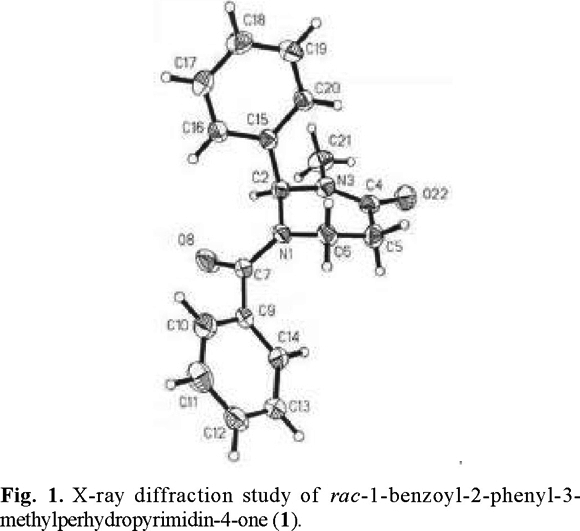
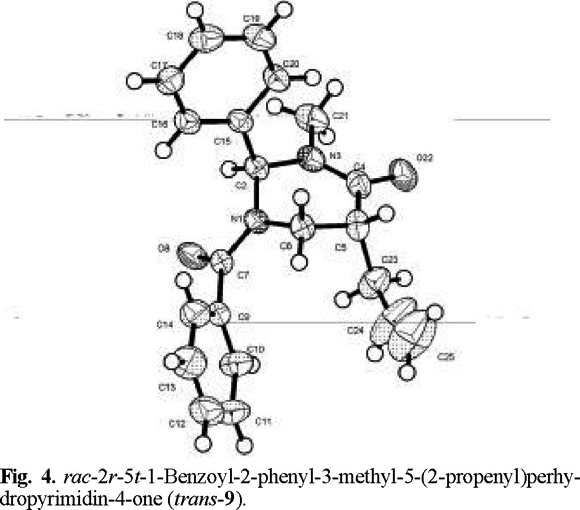
<body><![CDATA[<p align="justify"><font face="verdana" size="2">In particular, in view of the successful development of 2&#45;<i>t</i>&#45;butylperhydropyrimidinones for the preparation of &#945;&#45;alkyl &#946;&#45;amino acids &#91;4&#93;, it was considered that the 2&#45;phenylperhydropyrimidin&#45;4&#45;one derivative (<b>1</b>) might serve as an effective chiral substrate for the synthesis of &#945;&#45;substituted &#946;&#45;amino acids.</font></p>     <p align="justify"><font face="Verdana" size="2">&nbsp;</font></p>     <p align="justify"><font face="verdana" size="2"><b>Results and discussion</b></font></p>     <p align="justify"><font face="verdana" size="2"><b>A. Synthesis of 1&#45;benzoyl&#45;2&#45;phenyl&#45;3&#45;methylperhydropyrimidin&#45;4&#45;one (1)</b>. The heterocycle <i>rac</i>&#45;(<b>1</b>) was prepared from &#946;&#45;alanine by initial conversion to its methyl ester (<b>2</b>) and then to the corresponding <i>N</i>&#45;methylamide (<b>3</b>), which formed a Schiff base with benzaldehyde (azeotropic removal of water). Cyclization of imine (<b>4</b>) with benzoyl chloride/DMAP afforded the desired <i>rac</i>&#45;perhydropyrimidinone (<b>1</b>), with an overall yield of 51 % (<a href="#f3">Scheme 3</a>).</font></p>     <p align="center"><font face="verdana" size="2"><a name="f3"></a></font></p>     <p align="center"><font face="verdana" size="2"><img src="/img/revistas/rsqm/v45n4/a8f3.jpg"></font></p>     <p align="justify"><font face="verdana" size="2"><b>B. X&#45;Ray diffraction study of 1&#45;benzoyl&#45;2&#45;phenyl&#45;3&#45;methylperhydropyrimidin&#45;4&#45;one (1)</b>. Because of the present interest in the understanding of the precise structure of nitrogen&#45;containing heterocycles &#91;4d&#93;, and because such information can be important in ascertaining the factors responsible for the stereoselectivities observed (see below), we carried out X&#45;ray structural analysis with a suitable crystal of perhydropyrimidinone (<b>1</b>). A view of the solid&#45;state structure of (<b>1</b>) is provided in <a href="#f4">figure 1</a>. The pyrimidinone ring is rather flat and has a sofa conformation with four of the six atoms approximately in a plane, and the nitrogen N(1) and carbon C(6) out of plane. The most interesting feature of the crystal structure is, however, that the six&#45;membered ring adopts a conformation with an <i>axial</i> phenyl group, just like the <i>tert</i>&#45;butyl group in the 2&#45;<i>t</i>&#45;butyl analogs. &#91;4&#93;. The practical consequences are also significant: if the enolate would still have a conformation with an axial phenyl group, one of its faces would be sterically hindered for attack by electrophiles. This was indeed the case, as described in the following section.</font></p>     <p align="center"><font face="verdana" size="2"><a name="f4"></a></font></p>     <p align="center"><font face="verdana" size="2"><img src="/img/revistas/rsqm/v45n4/a8f4.jpg"></font></p>     <p align="justify"><font face="verdana" size="2"><b>C. Diastereoselectivity of alkylation of enolate (1)&#45;Li</b>. The alkylation products <b>5</b>, <b>7</b> and <b>9</b> were formed by treatment of enolate <b>1</b>&#45;Li, generated with lithium diisopropylamide (LDA) in THF, with halides RX at &minus; 78 &deg;C. High diastereoselectivity (ds &gt; 96 %) was found as indicated by integration of the 13C NMR spectra of the crude products (<a href="#c1">Table 1</a>).</font></p>     ]]></body>
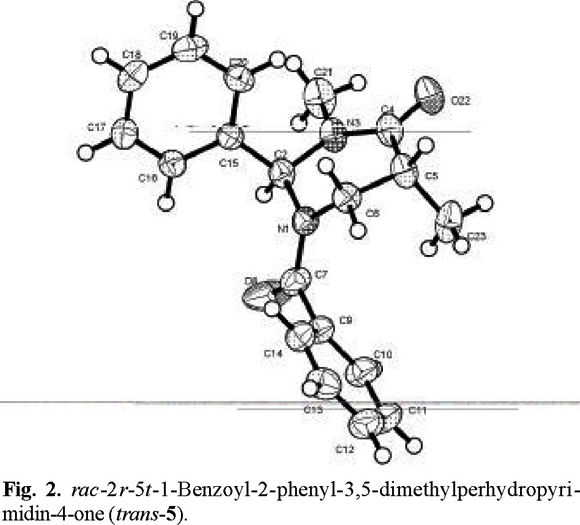
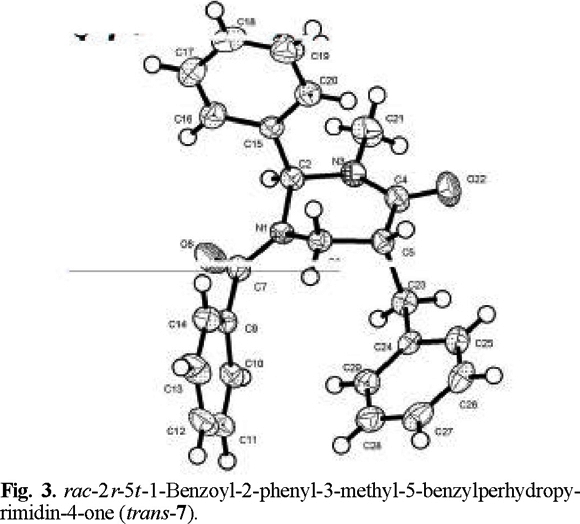
<body><![CDATA[<p align="center"><font face="verdana" size="2"><a name="c1"></a></font></p>     <p align="center"><font face="verdana" size="2"><img src="/img/revistas/rsqm/v45n4/a8c1.jpg"></font></p>     <p align="justify"><font face="verdana" size="2">That addition took place preferentially from the side opposite to the phenyl group, to afford the trans products, was determined by X&#45;ray diffraction analysis (<a href="#f5">Figs. 2</a>&#45;<a href="#f7">4</a> (<a href="#f6">3</a>)).</font></p>     <p align="center"><font face="verdana" size="2"><a name="f5"></a></font></p>     <p align="center"><font face="verdana" size="2"><img src="/img/revistas/rsqm/v45n4/a8f5.jpg"></font></p>     <p align="center"><font face="verdana" size="2"><a name="f6"></a></font></p>     <p align="center"><font face="verdana" size="2"><img src="/img/revistas/rsqm/v45n4/a8f6.jpg"></font></p>     <p align="center"><font face="verdana" size="2"><a name="f7"></a></font></p>     <p align="center"><font face="verdana" size="2"><img src="/img/revistas/rsqm/v45n4/a8f7.jpg"></font></p>     <p align="justify"><font face="verdana" size="2">In addition, we obtained the dimethylated product (<b>6</b>) when the electrophile is CH<sub>3</sub>I, as consequence of a second addition of CH<sub>3</sub>I (Eq 1). The solid&#45;state crystal structure of <b>6</b> shows that steric repulsion provokes bending of the 2&#45;phenyl ring. (<a href="#f8">Fig. 5</a>).</font></p>     ]]></body>
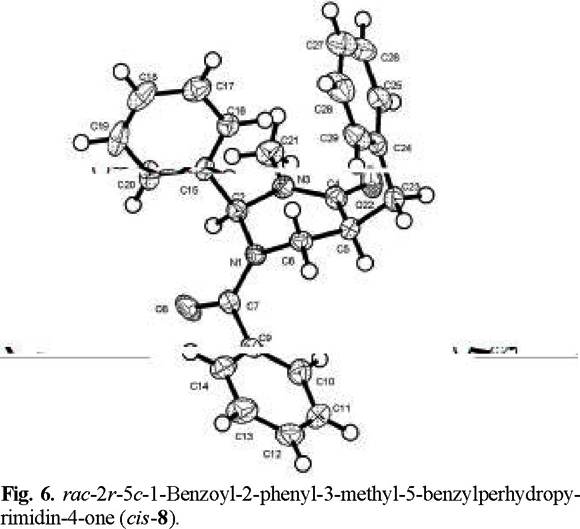
<body><![CDATA[<p align="center"><font face="Verdana" size="2"><img src="/img/revistas/rsqm/v45n4/a8e1.jpg"></font></p>     <p align="center"><font face="verdana" size="2"><a name="f8"></a></font></p>     <p align="center"><font face="verdana" size="2"><img src="/img/revistas/rsqm/v45n4/a8f8.jpg"></font></p>     <p align="justify"><font face="verdana" size="2">Finally, an X&#45;ray diffraction study of the benzylated derivative (<b>8</b>) (<a href="#f9">Fig. 6</a>) confirmed its relative configuration as <i>cis</i>, which can be envisaged to result from epimerization at C(5) in adduct (<b>7</b>) (eq 2). Interestingly, the solid&#45;state conformation of <i>cis</i>&#45;<b>8</b> suggests that the aromatic phenyl rings at C(2) and the benzyl substituent may experience &#982;/&#982; attraction &#91;7&#93;.</font></p>     <p align="center"><font face="Verdana" size="2"><img src="/img/revistas/rsqm/v45n4/a8e2.jpg"></font></p>     <p align="center"><font face="verdana" size="2"><a name="f9"></a></font></p>     <p align="center"><font face="verdana" size="2"><img src="/img/revistas/rsqm/v45n4/a8f9.jpg"></font></p>     <p align="justify"><font face="verdana" size="2">Finally, no alkylation reaction was observed with isopropyl iodide as electrophile, as consequence of the lower reactivity of the secondary halide.</font></p>     <p align="justify"><font face="Verdana" size="2">&nbsp;</font></p>     <p align="justify"><font face="verdana" size="2"><b>Conclusions</b></font></p>     ]]></body>
<body><![CDATA[<p align="justify"><font face="verdana" size="2">&#946;&#45;Alanine, an inexpensive and achiral amino acid, was converted efficiently into the racemic perhydropyrimidinone <b>1</b>. The high diastereoselectivity observed in the addition of enolate <b>1</b>&#45;Li to electrophiles shows that the chirality center at C(2) supporting the phenyl group induces the stereoselective formation of the new stereogenic center at C(5). These results pave the way to the exploitation of enatiopure analogs of <i>rac&#45;</i><b>1</b> in the asymmetric synthesis of &#945;&#45;substituted &#946;&#45;amino acids.</font></p>     <p align="justify"><font face="Verdana" size="2">&nbsp;</font></p>     <p align="justify"><font face="verdana" size="2"><b>Experimental Section</b></font></p>     <p align="justify"><font face="verdana" size="2"><b>General</b>. Flasks, stirring bars, and hypodermic needles used for the generation and reactions of organolithiums were dried for 12 h at 120 &deg;C and allowed to cool in a desiccator over anhydrous CaSO<sub>4</sub>. Anhydrous solvents were obtained by distillation from benzophenone ketyl &#91;8&#93;. The <i>n</i>&#45;BuLi employed was titrated according to the method of Juaristi <i>et al.</i> &#91;9&#93;.</font></p>     <p align="justify"><font face="verdana" size="2"><i>TLC:</i> Merck&#45;DC&#45;F<sub>254</sub> plates; detection by UV light. Flash column chromatography &#91;10&#93;: Merck silica gel (0.040&#45;0.063 mm).</font></p>     <p align="justify"><font face="verdana" size="2"><i>Melting points:</i> Mel&#45;Temp apparatus; not corrected. 1H NMR spectra: Hitachi: 60 MHz, JEOL: 270 MHz, Varian 200 MHz and 400 MHz. 13C NMR spectra: Varian 50 MHz and 100 MHz. Chemical shifts (&#948;) are given in parts per million down&#45;field from the internal TMS reference; the coupling constants (<i>J</i>) in hertz.</font></p>     <p align="justify"><font face="verdana" size="2"><i>X&#45;Ray diffraction analysis:</i> CAD4&#45;Enraf&#45;Nonius and APEX&#45;Bruker diffractometer. The structures were solved by direct methods using the program SHELXS &#91;11&#93;. Space groups, cell constants, number of reflections measured, and final R values are collected in <a href="/img/revistas/rsqm/v45n4/a8c2.jpg" target="_blank">Table 2</a>.</font></p>     <p align="justify"><font face="verdana" size="2"><b>Methyl &#946;&#45;Aminopropionate Hydrochloride (2)</b>. &#946;&#45;Aminopropionic acid (10 g, 112.3 mmol) in 60 mL of freshly distilled methanol was placed in a round&#45;bottom flask provided with an addition funnel and a magnetic stirrer. The solution was cooled to 0 &deg;C and treated dropwise with 10.64 mL (145.99 mmol) of thionyl chloride. The reaction mixture was stirred at ambient temperature for 1 h, concentrated in a rotary evaporator, and the precipitate was then filtered to afford 15.38 g (98 % yield) of the desired ester as crystals with mp 92&#45;94 &deg;C (lit &#91;12&#93;. mp 94&#45;95 &deg;C). RMN 1H (60 MHz, D<sub>2</sub>O) &#948; 2.5 (br, 2H, C(O)&#45;CH<sub>2</sub>), 3.0 (br, 2H, N&#45;CH<sub>2</sub>), 3.6 (s, 3H, O&#45;CH<sub>3</sub>).</font></p>     <p align="justify"><font face="verdana" size="2"><b><i>N</i>&#45;Methyl &#946;&#45;Aminopropionamide Hydrochloride (3)</b>. Methyl &#946;&#45;aminopropionate hydrochloride (15.35 g, 110 mmol) in 70 mL of methanol was placed in a round&#45;bottom flask provided with a magnetic stirrer and an addition funnel. The soluction was cooled to 0 &deg;C and treated dropwise with 16 mL (215 mmol) of aqueous 40 % methylamine. The resulting mixture was stirred at 0 &deg;C for 72 h. The solvent was evaporated to afford 15.08 g (99 % yield) of the desired amide (<b>3</b>) as hygroscopic oil: RMN 1H (60 MHz, D<sub>2</sub>O,) &#948;, 2.6 (brs, 2H, C(O)&#45;CH<sub>2</sub>), 3.0 (s, 3H, N&#45;CH<sub>3</sub>), 3.1 (br, 2H N&#45;CH<sub>2</sub>).</font></p>     <p align="justify"><font face="verdana" size="2"><b>&#946;&#45;(<i>N</i>&#45;3&#45;Benzylidenamino)&#45;<i>N</i>&#45;methylpropionamide (4)</b>. Amide <b>3</b> (15.00 g, 108 mmol) in 70 mL of benzene was placed in a round&#45;bottom flask provided with an addition funnel and a magnetic stirrer. The resulting suspension was treated dropwise and with stirring with 24.1 mL (173.3 mmol) of freshly distilled Et<sub>3</sub>N, and then with 12.9 mL (127.1 mmol) of benzaldehyde. The reaction mixture was heated to reflux for 17 h, with a Dean&#45;Stark trap being used to collect the water that was generated. The precipitated triethylamine hydrochloride was removed by filtration, and the filtrate was concentrated to afford 20.52 g (~100 % yield) of the crude imine (<b>4</b>) as a brown oil. This product was not purified because is very sensitive to water.</font></p>     ]]></body>
<body><![CDATA[<p align="justify"><font face="verdana" size="2"><b>1&#45;Benzoyl&#45;2&#45;phenyl&#45;3&#45;methylperhydropyrimidin&#45;4&#45;one (1)</b>. Imine (<b>4</b>) (20.52 g, 108 mmol) in 90 mL of benzene was placed in a round&#45;bottom flask provided with an addition funnel and a magnetic stirrer. The resulting suspension was treated with 12.7 g (104 mmol) of DMAP and with 14.6 mL (127.1 mmol) of benzoyl chloride (dropwise). The reaction mixture was heated to reflux for 3 h. The reaction mixture was allowed to cool to ambient temperature, and the precipitated dimethylaminopyridine hydrochloride was removed by filtration, and the filtrate was concentrated vacuum. The product (<b>1</b>) was purified by flash chromatography (<i>n</i>&#45;hexane / ethyl acetate, 90:10 to 50:50) to furnish 16.84 g (53 % yield) of a white solid, mp 145&#45;149 &deg;C. 1H RMN (270 MHz, CDCl<sub>3</sub>) &#948; 2.41 (ddd, J<sub>gem</sub> = 17.5 Hz, Jgauche = 5.4 Hz, Jgauche = 2.22 Hz, 1H, C(O)&#45;CH<sub>2</sub>); 2.54 (ddd, J<sub>gem</sub> = 17.5 Hz, J<sub>anti</sub> = 11.13 Hz, Jgauche = 7.67 Hz, 1H, C(O)&#45;CH<sub>2</sub>), 2.96 (s, 3H, N&#45;CH<sub>3</sub>), 3.21 (ddd, J<sub>gem</sub> = 13.85 Hz, J<sub>anti</sub> = 11.13, Jgauche = 5.44 Hz, 1H, N&#45;CH<sub>2</sub>), 3.75 (brs, 1H, N&#45;CH<sub>2</sub>), 6.9 (brs, 1H, Ph&#45;CH), 7.3 (m, 10H, Ph y Bz); 13C RMN (50 MHz, CDCl<sub>3</sub>) &#948; 31.9 (CH<sub>2</sub>CO), 33.5 (CH<sub>3</sub>N), 39.0 (CH<sub>2</sub>N), 69.0 (PhCH), 126.6 (C<i>p</i> phenyl), 129.1 (C<i>o</i> phenyl), 129.18 (C<i>m</i> phenyl), 136.9 (C<i>ipso</i> phenyl), 126.8 (C<i>m</i> benzoyl), 128.8 (C<i>o</i> benzoyl),130.5 (C<i>p</i> benzoyl), 134.50 (C<i>ipso</i> benzoyl), 167.7 (Ph&#45;CO),169.9 (NCO).</font></p>     <p align="justify"><font face="verdana" size="2"><b>General Procedure for the Reaction of Pyrimidinone Enolate (1&#45;Li) with Electrophiles</b>. A solution of (<i>i</i>&#45;Pr)<sub>2</sub>NH (154 mg 1.1 mmol) in 50 mL of THF was cooled down to &minus;78 &deg;C (dry ice / acetone bath) before the slow addition of 0.45 mL (1.1 mmol) of <i>n</i>&#45;BuLi in hexane (2.5 M). The resulting solution was stirred at &minus;78 &deg;C for 20 min ant then treated with 294 mg (1 mmol) of pyrimidinone (<b>1</b>) in 20 mL of THF. The yellow solution formed was stirred at &minus;78 &deg;C for 1 h before the addition of the electrophile (1.2 mmol), and the reaction mixture was stirred at this temperature for 1 h and at ambient temperature for 15 min. Then the mixture was treated with 10 mL of saturated aqueous ammonium chloride. The aqueous phase was separated and extracted three times with 50&#45;mL portions of CH<sub>2</sub>Cl<sub>2</sub>. The combined extracts were dried (Na<sub>2</sub> SO<sub>4</sub>), filtered, and evaporated to give the crude product.</font></p>     <p align="justify"><font face="verdana" size="2"><b><i>rac</i>&#45;2<i>r</i>&#45;5<i>t</i>&#45;1&#45;Benzoyl&#45;2&#45;phenyl&#45;3,5&#45;dimethylperhydropyrimidin&#45;4&#45;one (<i>trans</i>&#45;5) and <i>rac</i>&#45;1&#45;Benzoyl&#45;2&#45;phenyl&#45;3,5,5&acute;&#45;trimethylperhydropyrimidin&#45;4&#45;one (6)</b>. The general procedure was followed for the alkylation of 0.588 g (2 mmol) of <b>1</b> with 0.13 mL (2.2 mmol) of CH<sub>3</sub>I. Purification of the crude product by flash chromatography (<i>n</i>&#45;hexane / ethyl acetate, 90:10 to 40:60) afforded 450 mg (76 % yield) of <i>trans</i>&#45;<b>5</b> and 110 mg (24 % yield) of <b>6</b>.</font></p>     <p align="justify"><font face="verdana" size="2"><b><i>cis</i>&#45;5:</b> mp 111&#45;113 &deg;C; 1H RMN (200 MHz, CDCl<sub>3</sub>) &#948; 1.18 (br, 3H, CH&#45;CH<sub>3</sub>), 2.51 (br, 1H, CH&#45;CH<sub>3</sub>), 3.05 (<i>s</i>, 3H, <i>N&#45;</i>CH<sub>3</sub>), 3.48 (br, 2H, CH&#45;CH<sub>2</sub>), 7.4 (br, 1H, Ph&#45;CH), 7.6 (<i>m</i>, 10H, Ph and Bz); 13C RMN (50 MHz, CDCl<sub>3</sub>) &#948; 17.16 (CH&#45;CH<sub>3</sub>), 34.0 (CH&#45;CH<sub>3</sub>), 36.39 (<i>N</i>&#45;CH<sub>3</sub>), 46.29 (CH&#45;CH<sub>2</sub>), 68.93 (Ph&#45;C), 126.3 (C<i>p</i> phenyl), 129.1 (C<i>o</i> phenyl), 129.3 (C<i>m</i> phenyl), 137.5 (C<i>ipso</i> phenyl), 127.1 (C<i>m</i> benzoyl), 128.9 (Co benzoyl), 130.4 (C<i>p</i> benzoyl), 134.8 (C<i>ipso</i> benzoyl), 170.71 (Ph&#45;CO), 171.98 (<i>N</i>&#45;CO).</font></p>     <p align="justify"><font face="verdana" size="2"><b>6:</b> mp 136&#45;137 &deg;C; 1H RMN (200 MHz, CDCl<sub>3</sub>) &#948; 1.12 (br, 6H, C&#45;(CH<sub>3</sub>)<sub>2</sub>), 2.95 (<i>s</i>, 3H, <i>N</i>&#45;CH<sub>3</sub>), 3.29 (br, 2H, <i>N</i>&#45;CH<sub>2</sub>), 7.1 (br, 1H, Ph&#45;CH), 7.4 (<i>m</i>, 10H, Ph y Bz); 13C RMN (50 MHz, CDCl<sub>3</sub>) &#948; 23.5 (C&#45;(CH<sub>3</sub>)<sub>2</sub>), 33.6 (<i>N</i>&#45;CH<sub>3</sub>), 40.1 (C&#45;(CH<sub>3</sub>)<sub>2</sub>), 51.4 (<i>N</i>&#45;CH<sub>2</sub>), 69.2 (Ph&#45;C), 126.6 (C<i>p</i> phenyl), 129.2 (C <i>o</i> phenyl), 129.3 (C<i>m</i> phenyl), 137.5 (C<i>ipso</i> phenyl), 127.3 (C<i>m</i> benzoyl), 128.8 (C <i>o</i> benzoyl), 130.5 (C <i>p</i> benzoyl), 134.6 (C<i>ipso</i> benzoyl), 170.7 (Ph&#45;CO), 174.55 (<i>N</i>CO).</font></p>     <p align="justify"><font face="verdana" size="2"><b><i>rac</i>&#45;2<i>r</i>&#45;5<i>t</i>&#45;1&#45;Benzoyl&#45;2&#45;phenyl&#45;3&#45;methyl&#45;5&#45;benzylperhydropyrimidin&#45;4&#45;one (<i>trans</i>&#45;7) and <i>rac</i>&#45;2<i>r</i>&#45;5<i>c</i>&#45;1&#45;benzoyl&#45;2&#45;phenyl&#45;3&#45;methyl&#45;5&#45;benzylperhydropyrimid&iacute;n&#45;4&#45;one (<i>cis</i>&#45;8)</b>. The general procedure was followed for the alkylation of 0.588 g (2 mmol) of <b>1</b> with 0.24 mL (2.1 mmol) of C<sub>6</sub>H<sub>5</sub> CH<sub>2</sub>Br. Purification of the crude product by flash chromatography (<i>n</i>&#45;hexane / ethyl acetate, 90:10 to 30:70) afforded 299 mg (40 % yield) of <i>trans</i>&#45;<b>7</b> and <i>cis</i>&#45;<b>8</b>. The separation of the products was made with a spatula under a microscope.</font></p>     <p align="justify"><font face="verdana" size="2"><b><i>trans</i>&#45;7:</b> mp 165&#45;166 &deg;C; 1H RMN (250 MHz, CDCl<sub>3</sub>) &#948; 2.4 (brs, 1H, CH&#45;CH<sub>2</sub>Ph), 2.6 (brs, 1H, CH&#45;CH<sub>2</sub>Ph), 2.7 (brs, 1H, C(O)&#45;CH), 3.1 (brs , 3H, <i>N</i>&#45;CH<sub>3</sub>), 3.27 (brs, 1H, <i>N</i>&#45;CH<sub>2</sub>), 3.6 (brs, 1H, <i>N</i>&#45;CH<sub>2</sub>), 6.5 (brs, 1H, Ph&#45;CH), 7.0&#45;7.6 (m, 15H, 2Ph and Bz ); 13C RMN (100 MHz, CDCl<sub>3</sub>) &#948; 34.0 (<i>N</i>&#45;CH<sub>3</sub>), 36.5 &#91;C(5)&#93;, 42.0 &#91;C(6)&#93;, 44.5 (CH&#45;CH<sub>2</sub>Ph), 69.5 &#91;C(2)&#93;, 126.5 (C<i>p</i> phenyl), 127.7 (C<i>o</i> phenyl), 129.1 (C<i>m</i> phenyl), 137.3 (C<i>ipso</i> phenyl), 129.0 (C<i>o</i> benzoyl), 128.5 (C<i>m</i> benzoyl), 130.7 (C<i>p</i> benzoyl), 134.5 (C <i>ipso</i> benzoyl), 128.9 (C<i>o</i> benzyl), 129.3 (C<i>m</i> benzyl), 126.0 (C<i>p</i> benzyl), 138.7 (C<i>ipso</i> benzyl), 170.1 (COPh), 170.6 (NCO).</font></p>     <p align="justify"><font face="verdana" size="2"><b><i>cis</i>&#45;8:</b> mp 243&#45;244 &deg;C; 1H RMN (400 MHz, CDCl<sub>3</sub>) &#948; 2.4 (brs, 1H, CH&#45;CH<sub>2</sub>Ph), 2.6 (brs, 1H, CH&#45;CH<sub>2</sub>Ph), 2.7 (brs, 1H, C(O)&#45;CH), 3.1 (brs, 3H, <i>N</i>&#45;CH<sub>3</sub>), 3.27 (brs, 1H, <i>N</i>&#45;CH<sub>2</sub>), 3.6 (brs, 1H, <i>N</i>&#45;CH<sub>2</sub>), 6.5 (brs, 1H, Ph&#45;CH), 7.0&#45;7.6 (<i>m</i>, 15H, 2Ph and Bz ); 13C RMN (100 MHz, CDCl<sub>3</sub>) &#948; 34.8 (<i>N</i>&#45;CH<sub>3</sub>), 37.1 &#91;C(5)&#93;, 43.2 &#91;C(6)&#93;, 44.1 (CH&#45;CH<sub>2</sub>Ph), 69.3 &#91;C(2)&#93;, 126.8 (C<i>p</i> phenyl), 128.7 (C<i>o</i> phenyl), 129.7 (C<i>m</i> phenyl), 137.8 (C<i>ipso</i> phenyl), 129.7 (C<i>o</i> benzoyl), 129.2 (C<i>m</i> benzoyl), 130.9 (C<i>p</i> benzoyl), 134.5 (C <i>ipso</i> benzoyl), 129.3 (C<i>o</i> benzyl), 130.5 (C<i>m</i> benzyl), 126.5 (C<i>p</i> benzyl),138.7 (C<i>ipso</i> benzyl), 169.9 (COPh), 171.6 (NCO).</font></p>     <p align="justify"><font face="verdana" size="2"><b><i>rac</i>&#45;2<i>r</i>&#45;5<i>t</i>&#45;1&#45;Benzoyl&#45;2&#45;phenyl&#45;3&#45;methyl&#45;5&#45;(2&#45;propenyl)perhydropyrimidin&#45;4&#45;one (<i>trans</i>&#45;9)</b>. The general procedure was followed for the alkylation of 0.588 g (2 mmol) of (<b>1</b>) with 0.19 mL (2.1 mmol) of allyl bromide. Purification of the crude product by flash chromatography (<i>n</i>&#45;hexane / ethyl acetate, 90:10 to 40:60) afforded 0.661 g (~100 % yield) of <i>trans</i>&#45;<b>9</b>: mp 100&#45;101 &deg;C; 1H RMN (200 MHz, CDCl<sub>3</sub>) &#948; 2.1 (brs, 1H, C<sub>1&acute;</sub>), 2.4 (brs, 1H, C<sub>1&acute;</sub>), 2.5 (brs, 1H, C<sub>5</sub>), 3.0 (<i>s</i>, 3H, <i>N</i>&#45;CH<sub>3</sub>), 3.4 (brs, 1H, C<sub>6</sub>), 3.7 (brs, 1H, C<sub>6</sub>), 4.1 (brs, 1H, C<sub>3&acute;</sub>), 4.6 (brs, 1H, C<sub>4&acute;</sub>), 5.4 (brs, 1H, C<sub>4&acute;</sub>), 7.1 (brs, 1H, Ph&#45;CH), 7.4 (<i>m</i>, 10H, Ph and Bz); <sup>13</sup>C RMN (50 MHz, CDCl<sub>3</sub>) &#948; 33.8 (CH&#45;C H<sub>2&#45;</sub> HC=), 35.4 (CH&#45;CH<sub>2</sub>&#45;HC=), 41.5 (CH<sub>3</sub>&#45;<i>N</i>), 42.4 (CH<sub>2</sub>&#45;N), 44.0 &#91;C(6)&#93;, 68.9 (CH&#45;Ph), 117.94 (C=CH<sub>2</sub>), 137.29 (C=CH<sub>2</sub>), 126.6 (C<i>p</i> phenyl), 129.2 (C<i>o</i> phenyl), 129.7 (C<i>m</i> phenyl), 137.5 (C<i>ipso</i> phenyl), 127.3 (C<i>m</i> benzoyl), 128.8 (C<i>o</i> benzoyl),130.5 (C<i>p</i> benzoyl), 134.6 (C<i>ipso</i> benzoyl), 170.1 (N&#45;CO), 169.6 (Ph&#45;CO).</font></p>     <p align="justify"><font face="Verdana" size="2">&nbsp;</font></p>     ]]></body>
<body><![CDATA[<p align="justify"><font face="verdana" size="2"><b>Acknowledgment</b></font></p>     <p align="justify"><font face="verdana" size="2">We are grateful to CONACyT for a scholarship to A.L.H. and for financial support via grant 3559P&#45;E9607.</font></p>     <p align="justify"><font face="Verdana" size="2">&nbsp;</font></p>     <p align="justify"><font face="verdana" size="2"><b>References</b></font></p>     <!-- ref --><p align="justify"><font face="verdana" size="2">1. Juaristi, E. (Editor) in: <i>Enantioselective Synthesis of &#946;&#45;Amino Acids</i>. Wiley&#45;VCH, New York, <b>1997</b>, and references cited.    &nbsp;&nbsp;&nbsp;&nbsp;&nbsp;&nbsp;&nbsp;&nbsp;[&#160;<a href="javascript:void(0);" onclick="javascript: window.open('/scielo.php?script=sci_nlinks&ref=6922621&pid=S0583-7693200100040000800001&lng=','','width=640,height=500,resizable=yes,scrollbars=1,menubar=yes,');">Links</a>&#160;]<!-- end-ref --></font></p>     <!-- ref --><p align="justify"><font face="verdana" size="2">2. (a) Spatola, A. F. in: <i>Chemistry and Biochemistry of Amino Acids, Peptides and Proteins</i>, Ed. (Marcel Dekker, N.Y., <b>1983</b>) vol. VII, p. 267;    &nbsp;&nbsp;&nbsp;&nbsp;&nbsp;&nbsp;&nbsp;&nbsp;[&#160;<a href="javascript:void(0);" onclick="javascript: window.open('/scielo.php?script=sci_nlinks&ref=6922623&pid=S0583-7693200100040000800002&lng=','','width=640,height=500,resizable=yes,scrollbars=1,menubar=yes,');">Links</a>&#160;]<!-- end-ref --><!-- ref --> (b) R. A. Wiley, D. H. Rich, <i>Med. Res. Rev.</i> <b>1993</b>, <i>13</i>, 328.    &nbsp;&nbsp;&nbsp;&nbsp;&nbsp;&nbsp;&nbsp;&nbsp;[&#160;<a href="javascript:void(0);" onclick="javascript: window.open('/scielo.php?script=sci_nlinks&ref=6922624&pid=S0583-7693200100040000800003&lng=','','width=640,height=500,resizable=yes,scrollbars=1,menubar=yes,');">Links</a>&#160;]<!-- end-ref --></font></p>     <!-- ref --><p align="justify"><font face="verdana" size="2">3. Brunner, J. <i>Chem. Soc. Review</i> <b>1993</b>, <i>22</i>, 183&#45;189.    &nbsp;&nbsp;&nbsp;&nbsp;&nbsp;&nbsp;&nbsp;&nbsp;[&#160;<a href="javascript:void(0);" onclick="javascript: window.open('/scielo.php?script=sci_nlinks&ref=6922626&pid=S0583-7693200100040000800004&lng=','','width=640,height=500,resizable=yes,scrollbars=1,menubar=yes,');">Links</a>&#160;]<!-- end-ref --></font></p>     <!-- ref --><p align="justify"><font face="verdana" size="2">4. (a) Juaristi, E; Quintana, D.; Balderas, M.; Garc&iacute;a&#45;L&oacute;pez, E. <i>Tetrahedron: Asymmetry</i> <b>1996</b>, <i>7</i>, 2233&#45;2246.    &nbsp;&nbsp;&nbsp;&nbsp;&nbsp;&nbsp;&nbsp;&nbsp;[&#160;<a href="javascript:void(0);" onclick="javascript: window.open('/scielo.php?script=sci_nlinks&ref=6922628&pid=S0583-7693200100040000800005&lng=','','width=640,height=500,resizable=yes,scrollbars=1,menubar=yes,');">Links</a>&#160;]<!-- end-ref --><!-- ref --> (b) Juaristi, E.; L&oacute;pez&#45;Ruiz, H.; Madrigal, D.; Ram&iacute;rez&#45;Quir&oacute;s, Y.; Escalante, <i>J. J. Org. Chem.</i> <b>1998</b>, <i>63</i>, 4706&#45;4710.    &nbsp;&nbsp;&nbsp;&nbsp;&nbsp;&nbsp;&nbsp;&nbsp;[&#160;<a href="javascript:void(0);" onclick="javascript: window.open('/scielo.php?script=sci_nlinks&ref=6922629&pid=S0583-7693200100040000800006&lng=','','width=640,height=500,resizable=yes,scrollbars=1,menubar=yes,');">Links</a>&#160;]<!-- end-ref --><!-- ref --> (c) Juaristi, E. <i>Enclyclopedia of Reagents for Organic Synthesis</i>, Paquette, L.A. (Editor), Wiley New York, in press.    &nbsp;&nbsp;&nbsp;&nbsp;&nbsp;&nbsp;&nbsp;&nbsp;[&#160;<a href="javascript:void(0);" onclick="javascript: window.open('/scielo.php?script=sci_nlinks&ref=6922630&pid=S0583-7693200100040000800007&lng=','','width=640,height=500,resizable=yes,scrollbars=1,menubar=yes,');">Links</a>&#160;]<!-- end-ref --><!-- ref --> (d) Ram&iacute;rez&#45;Quir&oacute;s, Y.; Balderas, M.; Escalante, J.; Quintana, D.; Gallardo, I.; Madrigal, D.; Molins, E. and Juaristi, E. <i>J. Org. Chem.</i>, <b>1999</b>, <i>64</i>, 8668&#45;8680.    &nbsp;&nbsp;&nbsp;&nbsp;&nbsp;&nbsp;&nbsp;&nbsp;[&#160;<a href="javascript:void(0);" onclick="javascript: window.open('/scielo.php?script=sci_nlinks&ref=6922631&pid=S0583-7693200100040000800008&lng=','','width=640,height=500,resizable=yes,scrollbars=1,menubar=yes,');">Links</a>&#160;]<!-- end-ref --></font></p>     <!-- ref --><p align="justify"><font face="verdana" size="2">5. Cardillo, G. and Tomasini, C. in: <i>Enantioselective Synthesis of &#946;&#45;Amino Acids, Juaristi</i>, E. (Editor), Wiley&#45;VCH, New York, <b>1997</b>, 211&#45;248.    &nbsp;&nbsp;&nbsp;&nbsp;&nbsp;&nbsp;&nbsp;&nbsp;[&#160;<a href="javascript:void(0);" onclick="javascript: window.open('/scielo.php?script=sci_nlinks&ref=6922633&pid=S0583-7693200100040000800009&lng=','','width=640,height=500,resizable=yes,scrollbars=1,menubar=yes,');">Links</a>&#160;]<!-- end-ref --></font></p>     <!-- ref --><p align="justify"><font face="verdana" size="2">6. Konopelski, J. in: <i>Enantioselective Synthesis of &#946;&#45;Amino Acids</i>, Juaristi, E. (Editor), Wiley&#45;VCH, New York, <b>1997</b>, 249&#45;260.    &nbsp;&nbsp;&nbsp;&nbsp;&nbsp;&nbsp;&nbsp;&nbsp;[&#160;<a href="javascript:void(0);" onclick="javascript: window.open('/scielo.php?script=sci_nlinks&ref=6922635&pid=S0583-7693200100040000800010&lng=','','width=640,height=500,resizable=yes,scrollbars=1,menubar=yes,');">Links</a>&#160;]<!-- end-ref --></font></p>     ]]></body>
<body><![CDATA[<!-- ref --><p align="justify"><font face="verdana" size="2">7. See, for example: Jorgensen, W.L.; Severance, D.L. <i>J. Am. Chem. Soc.</i> <b>1990</b>, <i>112</i>, 4768&#45;4774.    &nbsp;&nbsp;&nbsp;&nbsp;&nbsp;&nbsp;&nbsp;&nbsp;[&#160;<a href="javascript:void(0);" onclick="javascript: window.open('/scielo.php?script=sci_nlinks&ref=6922637&pid=S0583-7693200100040000800011&lng=','','width=640,height=500,resizable=yes,scrollbars=1,menubar=yes,');">Links</a>&#160;]<!-- end-ref --></font></p>     <!-- ref --><p align="justify"><font face="verdana" size="2">8. Brown, H.C. in: <i>Organic Synthesis via Boranes</i>; Wiley: New York, <b>1975</b>, 256.    &nbsp;&nbsp;&nbsp;&nbsp;&nbsp;&nbsp;&nbsp;&nbsp;[&#160;<a href="javascript:void(0);" onclick="javascript: window.open('/scielo.php?script=sci_nlinks&ref=6922639&pid=S0583-7693200100040000800012&lng=','','width=640,height=500,resizable=yes,scrollbars=1,menubar=yes,');">Links</a>&#160;]<!-- end-ref --></font></p>     <!-- ref --><p align="justify"><font face="verdana" size="2">9. Juaristi, E.; Mart&iacute;nez&#45;Richa, A.; Garc&iacute;a&#45;Rivera, A.; Cruz&#45;S&aacute;nchez, J.S. <i>J. Org. Chem.</i> <b>1983</b>, <i>48</i>, 2603&#45;2606.    &nbsp;&nbsp;&nbsp;&nbsp;&nbsp;&nbsp;&nbsp;&nbsp;[&#160;<a href="javascript:void(0);" onclick="javascript: window.open('/scielo.php?script=sci_nlinks&ref=6922641&pid=S0583-7693200100040000800013&lng=','','width=640,height=500,resizable=yes,scrollbars=1,menubar=yes,');">Links</a>&#160;]<!-- end-ref --></font></p>     <!-- ref --><p align="justify"><font face="verdana" size="2">10. Still, W. C.; Kahn, M.; Mitra, A. <i>J. Org. Chem.</i> <b>1978</b>, <i>43</i>, 2923&#45;2925.    &nbsp;&nbsp;&nbsp;&nbsp;&nbsp;&nbsp;&nbsp;&nbsp;[&#160;<a href="javascript:void(0);" onclick="javascript: window.open('/scielo.php?script=sci_nlinks&ref=6922643&pid=S0583-7693200100040000800014&lng=','','width=640,height=500,resizable=yes,scrollbars=1,menubar=yes,');">Links</a>&#160;]<!-- end-ref --></font></p>     <!-- ref --><p align="justify"><font face="verdana" size="2">11. Sheldrick , G. M. SHELX97, Programs for Crystal Structure Analysis, release 97&#45;2; Institute for Inorganic Chemistry der Universit&auml;t: Tommanstrasse 4, D&#45;3400 G&ouml;ttingen, Germany, <b>1998</b>.    &nbsp;&nbsp;&nbsp;&nbsp;&nbsp;&nbsp;&nbsp;&nbsp;[&#160;<a href="javascript:void(0);" onclick="javascript: window.open('/scielo.php?script=sci_nlinks&ref=6922645&pid=S0583-7693200100040000800015&lng=','','width=640,height=500,resizable=yes,scrollbars=1,menubar=yes,');">Links</a>&#160;]<!-- end-ref --></font></p>     ]]></body>
<body><![CDATA[<!-- ref --><p align="justify"><font face="verdana" size="2">12. <i>Dictionary of Organic Compounds</i>; Eyre &amp; Spottiswoode Publishers: London, <b>1965</b>, Vol. 1, p. 206.    &nbsp;&nbsp;&nbsp;&nbsp;&nbsp;&nbsp;&nbsp;&nbsp;[&#160;<a href="javascript:void(0);" onclick="javascript: window.open('/scielo.php?script=sci_nlinks&ref=6922647&pid=S0583-7693200100040000800016&lng=','','width=640,height=500,resizable=yes,scrollbars=1,menubar=yes,');">Links</a>&#160;]<!-- end-ref --></font></p>      ]]></body><back>
<ref-list>
<ref id="B1">
<label>1</label><nlm-citation citation-type="book">
<person-group person-group-type="author">
<name>
<surname><![CDATA[Juaristi]]></surname>
<given-names><![CDATA[E.]]></given-names>
</name>
</person-group>
<source><![CDATA[Enantioselective Synthesis of &#946;-Amino Acids]]></source>
<year>1997</year>
<publisher-loc><![CDATA[New York ]]></publisher-loc>
<publisher-name><![CDATA[Wiley-VCH]]></publisher-name>
</nlm-citation>
</ref>
<ref id="B2">
<label>2</label><nlm-citation citation-type="book">
<person-group person-group-type="author">
<name>
<surname><![CDATA[Spatola]]></surname>
<given-names><![CDATA[A. F.]]></given-names>
</name>
</person-group>
<source><![CDATA[Chemistry and Biochemistry of Amino Acids, Peptides and Proteins]]></source>
<year>1983</year>
<volume>VII</volume>
<page-range>267</page-range><publisher-loc><![CDATA[N.Y. ]]></publisher-loc>
<publisher-name><![CDATA[Marcel Dekker]]></publisher-name>
</nlm-citation>
</ref>
<ref id="B3">
<nlm-citation citation-type="journal">
<person-group person-group-type="author">
<name>
<surname><![CDATA[Wiley]]></surname>
<given-names><![CDATA[R. A.]]></given-names>
</name>
<name>
<surname><![CDATA[Rich]]></surname>
<given-names><![CDATA[D. H.]]></given-names>
</name>
</person-group>
<source><![CDATA[Med. Res. Rev]]></source>
<year>1993</year>
<volume>13</volume>
<page-range>328</page-range></nlm-citation>
</ref>
<ref id="B4">
<label>3</label><nlm-citation citation-type="journal">
<person-group person-group-type="author">
<name>
<surname><![CDATA[Brunner]]></surname>
<given-names><![CDATA[J.]]></given-names>
</name>
</person-group>
<source><![CDATA[Chem. Soc. Review]]></source>
<year>1993</year>
<volume>22</volume>
<page-range>183-189</page-range></nlm-citation>
</ref>
<ref id="B5">
<label>4</label><nlm-citation citation-type="journal">
<person-group person-group-type="author">
<name>
<surname><![CDATA[Juaristi]]></surname>
<given-names><![CDATA[E]]></given-names>
</name>
<name>
<surname><![CDATA[Quintana]]></surname>
<given-names><![CDATA[D.]]></given-names>
</name>
<name>
<surname><![CDATA[Balderas]]></surname>
<given-names><![CDATA[M.]]></given-names>
</name>
<name>
<surname><![CDATA[García-López]]></surname>
<given-names><![CDATA[E.]]></given-names>
</name>
</person-group>
<source><![CDATA[Tetrahedron: Asymmetry]]></source>
<year>1996</year>
<volume>7</volume>
<page-range>2233-2246</page-range></nlm-citation>
</ref>
<ref id="B6">
<nlm-citation citation-type="journal">
<person-group person-group-type="author">
<name>
<surname><![CDATA[Juaristi]]></surname>
<given-names><![CDATA[E.]]></given-names>
</name>
<name>
<surname><![CDATA[López-Ruiz]]></surname>
<given-names><![CDATA[H.]]></given-names>
</name>
<name>
<surname><![CDATA[Madrigal]]></surname>
<given-names><![CDATA[D.]]></given-names>
</name>
<name>
<surname><![CDATA[Ramírez-Quirós]]></surname>
<given-names><![CDATA[Y.]]></given-names>
</name>
<name>
<surname><![CDATA[Escalante]]></surname>
<given-names><![CDATA[J.]]></given-names>
</name>
</person-group>
<source><![CDATA[J. Org. Chem.]]></source>
<year>1998</year>
<volume>63</volume>
<page-range>4706-4710</page-range></nlm-citation>
</ref>
<ref id="B7">
<nlm-citation citation-type="book">
<person-group person-group-type="author">
<name>
<surname><![CDATA[Juaristi]]></surname>
<given-names><![CDATA[E.]]></given-names>
</name>
</person-group>
<person-group person-group-type="editor">
<name>
<surname><![CDATA[Paquette]]></surname>
<given-names><![CDATA[L.A.]]></given-names>
</name>
</person-group>
<source><![CDATA[Enclyclopedia of Reagents for Organic Synthesis]]></source>
<year></year>
<publisher-loc><![CDATA[New York ]]></publisher-loc>
<publisher-name><![CDATA[Wiley]]></publisher-name>
</nlm-citation>
</ref>
<ref id="B8">
<nlm-citation citation-type="journal">
<person-group person-group-type="author">
<name>
<surname><![CDATA[Ramírez-Quirós]]></surname>
<given-names><![CDATA[Y.]]></given-names>
</name>
<name>
<surname><![CDATA[Balderas]]></surname>
<given-names><![CDATA[M.]]></given-names>
</name>
<name>
<surname><![CDATA[Escalante]]></surname>
<given-names><![CDATA[J.]]></given-names>
</name>
<name>
<surname><![CDATA[Quintana]]></surname>
<given-names><![CDATA[D.]]></given-names>
</name>
<name>
<surname><![CDATA[Gallardo]]></surname>
<given-names><![CDATA[I.]]></given-names>
</name>
<name>
<surname><![CDATA[Madrigal]]></surname>
<given-names><![CDATA[D.]]></given-names>
</name>
<name>
<surname><![CDATA[Molins]]></surname>
<given-names><![CDATA[E.]]></given-names>
</name>
<name>
<surname><![CDATA[Juaristi]]></surname>
<given-names><![CDATA[E.]]></given-names>
</name>
</person-group>
<source><![CDATA[J. Org. Chem.]]></source>
<year>1999</year>
<volume>64</volume>
<page-range>8668-8680</page-range></nlm-citation>
</ref>
<ref id="B9">
<label>5</label><nlm-citation citation-type="book">
<person-group person-group-type="author">
<name>
<surname><![CDATA[Cardillo]]></surname>
<given-names><![CDATA[G.]]></given-names>
</name>
<name>
<surname><![CDATA[Tomasini]]></surname>
<given-names><![CDATA[C.]]></given-names>
</name>
</person-group>
<person-group person-group-type="editor">
<name>
<surname><![CDATA[Juaristi]]></surname>
<given-names><![CDATA[E.]]></given-names>
</name>
</person-group>
<source><![CDATA[Enantioselective Synthesis of &#946;-Amino Acids]]></source>
<year>1997</year>
<page-range>211-248</page-range><publisher-loc><![CDATA[New York ]]></publisher-loc>
<publisher-name><![CDATA[Wiley-VCH]]></publisher-name>
</nlm-citation>
</ref>
<ref id="B10">
<label>6</label><nlm-citation citation-type="book">
<person-group person-group-type="author">
<name>
<surname><![CDATA[Konopelski]]></surname>
<given-names><![CDATA[J.]]></given-names>
</name>
</person-group>
<person-group person-group-type="editor">
<name>
<surname><![CDATA[Juaristi]]></surname>
<given-names><![CDATA[E.]]></given-names>
</name>
</person-group>
<source><![CDATA[Enantioselective Synthesis of &#946;-Amino Acids]]></source>
<year>1997</year>
<page-range>249-260</page-range><publisher-loc><![CDATA[New York ]]></publisher-loc>
<publisher-name><![CDATA[Wiley-VCH]]></publisher-name>
</nlm-citation>
</ref>
<ref id="B11">
<label>7</label><nlm-citation citation-type="journal">
<person-group person-group-type="author">
<name>
<surname><![CDATA[Jorgensen]]></surname>
<given-names><![CDATA[W.L.]]></given-names>
</name>
<name>
<surname><![CDATA[Severance]]></surname>
<given-names><![CDATA[D.L.]]></given-names>
</name>
</person-group>
<source><![CDATA[J. Am. Chem. Soc.]]></source>
<year>1990</year>
<volume>112</volume>
<page-range>4768-4774</page-range></nlm-citation>
</ref>
<ref id="B12">
<label>8</label><nlm-citation citation-type="book">
<person-group person-group-type="author">
<name>
<surname><![CDATA[Brown]]></surname>
<given-names><![CDATA[H.C.]]></given-names>
</name>
</person-group>
<source><![CDATA[Organic Synthesis via Boranes]]></source>
<year>1975</year>
<page-range>256</page-range><publisher-loc><![CDATA[New York ]]></publisher-loc>
<publisher-name><![CDATA[Wiley]]></publisher-name>
</nlm-citation>
</ref>
<ref id="B13">
<label>9</label><nlm-citation citation-type="journal">
<person-group person-group-type="author">
<name>
<surname><![CDATA[Juaristi]]></surname>
<given-names><![CDATA[E.]]></given-names>
</name>
<name>
<surname><![CDATA[Martínez-Richa]]></surname>
<given-names><![CDATA[A.]]></given-names>
</name>
<name>
<surname><![CDATA[García-Rivera]]></surname>
<given-names><![CDATA[A.]]></given-names>
</name>
<name>
<surname><![CDATA[Cruz-Sánchez]]></surname>
<given-names><![CDATA[J.S]]></given-names>
</name>
</person-group>
<source><![CDATA[J. Org. Chem.]]></source>
<year>1983</year>
<volume>48</volume>
<page-range>2603-2606</page-range></nlm-citation>
</ref>
<ref id="B14">
<label>10</label><nlm-citation citation-type="journal">
<person-group person-group-type="author">
<name>
<surname><![CDATA[Still]]></surname>
<given-names><![CDATA[W. C.]]></given-names>
</name>
<name>
<surname><![CDATA[Kahn]]></surname>
<given-names><![CDATA[M.]]></given-names>
</name>
<name>
<surname><![CDATA[Mitra]]></surname>
<given-names><![CDATA[A.]]></given-names>
</name>
</person-group>
<source><![CDATA[J. Org. Chem.]]></source>
<year>1978</year>
<volume>43</volume>
<page-range>2923-2925</page-range></nlm-citation>
</ref>
<ref id="B15">
<label>11</label><nlm-citation citation-type="book">
<person-group person-group-type="author">
<name>
<surname><![CDATA[Sheldrick]]></surname>
<given-names><![CDATA[G. M.]]></given-names>
</name>
</person-group>
<source><![CDATA[SHELX97, Programs for Crystal Structure Analysis]]></source>
<year>1998</year>
<publisher-loc><![CDATA[Göttingen ]]></publisher-loc>
<publisher-name><![CDATA[Institute for Inorganic Chemistry der Universität]]></publisher-name>
</nlm-citation>
</ref>
<ref id="B16">
<label>12</label><nlm-citation citation-type="book">
<source><![CDATA[Dictionary of Organic Compounds]]></source>
<year>1965</year>
<volume>1</volume>
<page-range>206</page-range><publisher-loc><![CDATA[London ]]></publisher-loc>
<publisher-name><![CDATA[Eyre & Spottiswoode Publishers]]></publisher-name>
</nlm-citation>
</ref>
</ref-list>
</back>
</article>