<?xml version="1.0" encoding="ISO-8859-1"?><article xmlns:mml="http://www.w3.org/1998/Math/MathML" xmlns:xlink="http://www.w3.org/1999/xlink" xmlns:xsi="http://www.w3.org/2001/XMLSchema-instance">
<front>
<journal-meta>
<journal-id>0583-7693</journal-id>
<journal-title><![CDATA[Revista de la Sociedad Química de México]]></journal-title>
<abbrev-journal-title><![CDATA[Rev. Soc. Quím. Méx]]></abbrev-journal-title>
<issn>0583-7693</issn>
<publisher>
<publisher-name><![CDATA[Sociedad Química de México A.C.]]></publisher-name>
</publisher>
</journal-meta>
<article-meta>
<article-id>S0583-76932001000200004</article-id>
<title-group>
<article-title xml:lang="en"><![CDATA[New Bioactive Derivatives of Xanthorrhizol]]></article-title>
</title-group>
<contrib-group>
<contrib contrib-type="author">
<name>
<surname><![CDATA[Aguilar]]></surname>
<given-names><![CDATA[María Isabel]]></given-names>
</name>
<xref ref-type="aff" rid="A01"/>
</contrib>
<contrib contrib-type="author">
<name>
<surname><![CDATA[Delgado]]></surname>
<given-names><![CDATA[Guillermo]]></given-names>
</name>
<xref ref-type="aff" rid="A02"/>
</contrib>
<contrib contrib-type="author">
<name>
<surname><![CDATA[Villarreal]]></surname>
<given-names><![CDATA[María Luisa]]></given-names>
</name>
<xref ref-type="aff" rid="A03"/>
</contrib>
</contrib-group>
<aff id="A01">
<institution><![CDATA[,Universidad Nacional Autónoma de Mëxico Facultad de Química Departamento de Farmacia]]></institution>
<addr-line><![CDATA[México Distrito Federal]]></addr-line>
<country>México</country>
</aff>
<aff id="A02">
<institution><![CDATA[,Universidad Nacional Autónoma de Mëxico Instituto de Química ]]></institution>
<addr-line><![CDATA[México Distrito Federal]]></addr-line>
<country>México</country>
</aff>
<aff id="A03">
<institution><![CDATA[,Instituto Mexicano del Seguro Social Centro de Investigación Biomédica del Sur ]]></institution>
<addr-line><![CDATA[Xochitepec Morelos]]></addr-line>
<country>México</country>
</aff>
<pub-date pub-type="pub">
<day>00</day>
<month>06</month>
<year>2001</year>
</pub-date>
<pub-date pub-type="epub">
<day>00</day>
<month>06</month>
<year>2001</year>
</pub-date>
<volume>45</volume>
<numero>2</numero>
<fpage>56</fpage>
<lpage>59</lpage>
<copyright-statement/>
<copyright-year/>
<self-uri xlink:href="http://www.scielo.org.mx/scielo.php?script=sci_arttext&amp;pid=S0583-76932001000200004&amp;lng=en&amp;nrm=iso"></self-uri><self-uri xlink:href="http://www.scielo.org.mx/scielo.php?script=sci_abstract&amp;pid=S0583-76932001000200004&amp;lng=en&amp;nrm=iso"></self-uri><self-uri xlink:href="http://www.scielo.org.mx/scielo.php?script=sci_pdf&amp;pid=S0583-76932001000200004&amp;lng=en&amp;nrm=iso"></self-uri><abstract abstract-type="short" xml:lang="en"><p><![CDATA[The chemical preparation and the antifungic and cytotoxic evaluations of several new derivatives of xanthorrhizol, a bioactive natural product isolated from certain plants used in traditional medicine, are described. Acylation of the phenol, bromination of the benzene ring, as well as reduction and oxidation of the olefin of the natural sesquiterpene, allowed obtaining a series of derivatives which displayed mild antifungic activities and did not show cytotoxic activities toward certain human tumor cell lines.]]></p></abstract>
<abstract abstract-type="short" xml:lang="es"><p><![CDATA[Se decribe la preparación química y las evaluaciones antifúngicas y citotóxicas de algunos derivados novedosos del xantorrhizol, un producto natural bioactivo aislado de ciertas plantas usadas en la medicina tradicional. La acilación del fenol, la bromación del anillo bencénico, y la oxidación y reducción de la olefina del sesquiterpeno natural permitieron la obtención de una serie de derivados, los cuales mostraron actividades fúngicas moderadas y no mostraron actividad citotóxica en ciertas líneas celulares.]]></p></abstract>
<kwd-group>
<kwd lng="en"><![CDATA[Xanthorrhizol]]></kwd>
<kwd lng="en"><![CDATA[Iostephane heterophylla]]></kwd>
<kwd lng="en"><![CDATA[antifungic agents]]></kwd>
<kwd lng="en"><![CDATA[bisabolene derivatives]]></kwd>
<kwd lng="es"><![CDATA[Xantorrhizol]]></kwd>
<kwd lng="es"><![CDATA[Iostephane heterophylla]]></kwd>
<kwd lng="es"><![CDATA[agentes antifúngicos]]></kwd>
<kwd lng="es"><![CDATA[derivados del bisaboleno]]></kwd>
</kwd-group>
</article-meta>
</front><body><![CDATA[ <p align="justify"><font face="Verdana" size="4">Investigaci&oacute;n</font></p>     <p align="justify"><font face="Verdana" size="2">&nbsp;</font></p>     <p align="center"><font face="verdana" size="4"><b>New Bioactive Derivatives of Xanthorrhizol</b></font></p>     <p align="justify"><font face="Verdana" size="2">&nbsp;</font></p>     <p align="center"><font face="verdana" size="2"><b>Mar&iacute;a Isabel Aguilar,*<sup>1</sup> Guillermo Delgado<sup>2</sup> and Mar&iacute;a Luisa Villarreal<sup>3</sup></b></font></p>     <p align="justify"><font face="Verdana" size="2">&nbsp;</font></p>     <p align="justify"><font face="verdana" size="2"><i><sup>1</sup> Departamento de Farmacia, Conjunto "E" de la Facultad de Qu&iacute;mica. Universidad Nacional Aut&oacute;noma de M&eacute;xico. Ciudad Universitaria, Coyoac&aacute;n, M&eacute;xico 04510, D. F.</i> E&#45;mail: <a href="mailto:laurents@servidor.unam.mx">laurents@servidor.unam.mx</a></font></p>     <p align="justify"><font face="verdana" size="2"><i><sup>2</sup> Instituto de Qu&iacute;mica, Universidad Nacional Aut&oacute;noma de M&eacute;xico. Circuito Exterior, Ciudad Universitaria, Coyoac&aacute;n, M&eacute;xico 04510, D.F.</i></font></p>     <p align="justify"><font face="verdana" size="2"><i><sup>3</sup> Centro de Investigaci&oacute;n Biom&eacute;dica del Sur, IMSS, Argentina No. 1, Xochitepec, Morelos, M&eacute;xico.</i></font></p>     <p align="justify"><font face="Verdana" size="2">&nbsp;</font></p>     ]]></body>
<body><![CDATA[<p align="justify"><font face="verdana" size="2">Recibido el 6 de febrero del 2001.    <br> Aceptado el 12 de junio del 2001.</font></p>     <p align="justify"><font face="Verdana" size="2">&nbsp;</font></p>     <p align="justify"><font face="verdana" size="2"><b>Abstract</b></font></p>     <p align="justify"><font face="verdana" size="2">The chemical preparation and the antifungic and cytotoxic evaluations of several new derivatives of xanthorrhizol, a bioactive natural product isolated from certain plants used in traditional medicine, are described. Acylation of the phenol, bromination of the benzene ring, as well as reduction and oxidation of the olefin of the natural sesquiterpene, allowed obtaining a series of derivatives which displayed mild antifungic activities and did not show cytotoxic activities toward certain human tumor cell lines.</font></p>     <p align="justify"><font face="verdana" size="2"><b>Key words:</b> Xanthorrhizol, <i>Iostephane heterophylla</i>, antifungic agents, bisabolene derivatives.</font></p>     <p align="justify"><font face="Verdana" size="2">&nbsp;</font></p>     <p align="justify"><font face="verdana" size="2"><b>Resumen</b></font></p>     <p align="justify"><font face="verdana" size="2">Se decribe la preparaci&oacute;n qu&iacute;mica y las evaluaciones antif&uacute;ngicas y citot&oacute;xicas de algunos derivados novedosos del xantorrhizol, un producto natural bioactivo aislado de ciertas plantas usadas en la medicina tradicional. La acilaci&oacute;n del fenol, la bromaci&oacute;n del anillo benc&eacute;nico, y la oxidaci&oacute;n y reducci&oacute;n de la olefina del sesquiterpeno natural permitieron la obtenci&oacute;n de una serie de derivados, los cuales mostraron actividades f&uacute;ngicas moderadas y no mostraron actividad citot&oacute;xica en ciertas l&iacute;neas celulares.</font></p>     <p align="justify"><font face="verdana" size="2"><b>Palabras clave:</b> Xantorrhizol, <i>Iostephane heterophylla</i>, agentes antif&uacute;ngicos, derivados del bisaboleno.</font></p>     ]]></body>
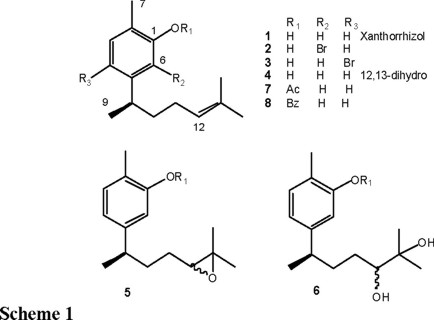
<body><![CDATA[<p align="justify"><font face="Verdana" size="2">&nbsp;</font></p>     <p align="justify"><font face="verdana" size="2"><b>Introduction</b></font></p>     <p align="justify"><font face="verdana" size="2">Xanthorrhizol (<b>1</b>), a sesquiterpene of the bisabolene type, has been isolated from Zingiberaceae and Asteraceae families of higher plants &#91;1,2&#93;. This compound constitutes the major secondary metabolite in the chloroform extract of the roots of <i>Iostephane heterophylla</i> (Asteraceae), a plant that has been medicinally used in Central Mexico to treat skin illnesses such as wounds and sores, among other diseases &#91;3&#93;. Previous evaluations on this compound, as antifungic and cytotoxic agent &#91;3&#93;, for prolonging pentobarbital induced sleeping time &#91;4&#93;, and as inhibitor of the tonic contraction of rat uterus &#91;5&#93;, have shown positive results. Xanthorrhizol is a sesquiterpenic phenol, with an unsaturated prenylic chain at C&#45;5. The antimicrobial activity of phenol derivatives is well documented in the literature, and phenol itself is employed as a standard of bactericidal activity in the USP Pharmacopoeia, reporting its antimicrobial action as the "phenol coefficient" &#91;6&#93;. Introduction of chlorine or bromine atoms in phenolic ring enhances the antiseptic activities, as well as the presence of alkyl chains, being more potent the lineal than the ramified ones. Acetylation of the phenolic group produces an ester that slowly liberates the phenol when it contacts the tissues. This property diminishes its irritant action and allows it to be employed as an antiinfective agent in nose, throat and ears &#91;6&#93;.</font></p>     <p align="justify"><font face="verdana" size="2">Since chemical modifications of a bioactive natural product result in the modification of its biological properties &#91;7&#45;9&#93;, some new derivatives of xanthorrhizol (<b>1</b>) were prepared, in which the phenol was modified to acetate and benzoate esters. Other modifications of <b>1</b> were the bromination of the aromatic ring and the saturation and oxidation of the &#916;12,13 double bond. In this paper, we report the preparation of the above mentioned derivatives and their evaluation in the anti&#45;dermatophytic and cytotoxic bioassays.</font></p>     <p align="justify"><font face="Verdana" size="2">&nbsp;</font></p>     <p align="justify"><font face="verdana" size="2"><b>Results and discussion</b></font></p>     <p align="justify"><font face="verdana" size="2">6&#45;Bromo&#45; (<b>2</b>), 4&#45;bromo&#45; (<b>3</b>), 12,13&#45;dihydro&#45; (<b>4</b>), 1&#45;<i>O</i>&#45;acetyl&#45;(<b>7</b>), and 1&#45;<i>O</i>&#45;benzoyl&#45; (<b>8</b>), 12, 13&#45;epoxy&#45; (<b>5</b>), and 12, 13&#45;dihydro&#45;dihydroxy&#45;xanthorrhizol (<b>6</b>) were prepared from xanthorrhizol (<b>1</b>), obtained from the CHCl<sub>3</sub> extract of the roots of <i>I. heterophylla</i> &#91;3&#93;. Halogenation of <b>1</b> with NBS afforded the sterically hindered 6&#45;bromo&#45;xanthorrhizol (<b>2</b>) as the main product, together with the bromination product at C&#45;4 (<b>3</b>). Both compounds possessed similar spectroscopic characteristics and according to their MS, they showed to be isomers. The molecular ion appeared at <i>m/z</i> 298 &#91;M<sup>+</sup>+2&#93;, 297 &#91;M<sup>+</sup>+1&#93; and 296 &#91;M<sup>+</sup>&#93;, and other fragments were at <i>m/z</i> 217 M<sup>+</sup>&#45;Br and 135 M<sup>+</sup>&#45;C<sub>6</sub>H<sub>11</sub>O (base peak). The 1H NMR spectrum of <b>2</b>, showed signals for two <i>ortho</i> benzenic hydrogens at &#948; 6.71 (H&#45;5) and &#948; 7.03 (H&#45;4), as a pair of doublets (J = 7.8), while in compound <b>3</b>, the benzenic hydrogens appeared <i>para</i> to each other, as a pair of singlets at &#948; 6.65 (H&#45;6) and &#948; 7.26 (H&#45;3). The remaining signals corresponded to a benzylic hydrogen, and four methyls (1 H NMR data in the Experimental). Compound <b>4</b> was obtained quantitatively by catalytic hydrogenation of xanthorrhizol (10 % Pd / C), and its spectroscopic constants were similar to those of xanthorrhizol, being observed a difference of two additional units in the MS of <b>4</b>. <b>4</b> was previously characterized &#91;1&#93;. Compounds <b>5</b> and <b>6</b> were obtained previously as minor natural products &#91;3&#93; and they were prepared as a C&#45;12 epimeric mixture from <b>1</b>: epoxidation with <i>m</i>&#45;chloroperbenzoic acid, afforded <b>5</b>, and diol <b>6</b> was obtained via <i>trans</i>&#45;hydroxylation with performic acid &#91;3&#93;. Acetylation and benzoylation of xanthorrhizol (<b>1</b>) led to compounds <b>7</b> and <b>8</b>. 1H (se Experimental) and 13C NMR (<a href="/img/revistas/rsqm/v45n2/a4c1.jpg" target="_blank">Table 1</a>) data for compounds <b>2&#45;8</b> were in agreement with the proposed structures, and the assignments were supported by comparison with the data in the literature &#91;10&#93;.</font></p>     <p align="center"><font face="verdana" size="2"><img src="/img/revistas/rsqm/v45n2/a4f1.jpg"></font></p>     <p align="justify"><font face="verdana" size="2">Compounds <b>1&#45;8</b> were tested for their antimicrobial activities toward <i>Trichophyton mentagrophytes</i> and <i>Microsporum gypseum</i> growing <i>in vitro</i>, and the results (<a href="/img/revistas/rsqm/v45n2/a4c2.jpg" target="_blank">Table 2</a>) showed that the majority of the structural modifications to xanthorrhizol (derivatives <b>2</b>, <b>3</b>, <b>5&#45;8</b>) led to reduced but clear activities (MIC &lt; 400 &micro;g / mL), while the 12,13&#45;dihydro derivative (<b>4</b>) displayed the same bioactivities of the standard antifungic reference (nystatin) and xanthorrhizol (<b>1</b>). These preliminary results suggested the structural requirements of xanthorrhizol (<b>1</b>) for the activity toward the tested microorganisms. Regarding the antiploriferative activities, although xanthorrhizol (<b>1</b>) showed activity against sarcoma 180 ascites in mice &#91;11&#93;, the evaluation of compounds <b>1&#45;8</b> in KB, UISO&#45;SQC&#45;1 and HCT&#45;15 human tumor cell lines indicated that they did not display significant cytotoxicity (ED<sub>50</sub> &gt; 4 &micro;g / ml).</font></p>     <p align="justify"><font face="Verdana" size="2">&nbsp;</font></p>     ]]></body>
<body><![CDATA[<p align="justify"><font face="verdana" size="2"><b>Experimental</b></font></p>     <p align="justify"><font face="verdana" size="2">IR spectra were taken on an 80A Nicolet FT. MS were measured on a 5985&#45;B Hewlett Packard instrument. Optical rotation was determined on a 241 Perkin Elmer polarimeter. NMR spectra were recorded on a Varian VXR 300 spectrometer, operating at 300 MHz (1H) and 75 MHz (13C). CDCl<sub>3</sub> was used as solvent. Chemical shifts are reported in parts per million (&#948;) relative to TMS, and coupling constants (<i>J</i>) are in Hertz. Carbon substitution degrees were established by DEPT multipulse sequence. Xanthorrhizol (<b>1</b>) was isolated from the roots of <i>I. heterophylla</i>, as described previously &#91;2,3&#93;.</font></p>     <p align="justify"><font face="verdana" size="2"><b>6&#45;Bromo&#45;xanthorrhizol (2) and 4&#45;Bromo&#45;xanthorrhizol (3)</b>. Xanthorrhizol (<b>1</b>) (225 mg, 1.02 mmol) and <i>N</i>&#45;bromo&#45;succinimide (178 mg, 1 mmol) were dissolved in CCl<sub>4</sub> (2.5 mL). The reaction was initiated adding catalytic quantities of dibenzoyl peroxide, and refluxed for 2 h. The starting material was consumed, and the formation of two reaction products less polar than xanthorrhizol was observed by TLC. Evaporation of the solvent afforded a residue which was loaded to a Si gel column chromatography (70&#45;230 mesh) packed with petroleum ether. The chromatography was developed using a gradient of petroleum ether&#45;EtOAc. Two oily compounds were separated, and characterized as <b>2</b> (205 mg, 66 %), and <b>3</b> (66 mg, 21.6 %). <b>2</b>: IR &#957;<sub>m&aacute;x</sub> (film): 3507, 2961, 2856, 1607, 1489, 1450, 1120, 811 cm<sup>&minus;1</sup>; <sup>1</sup>H NMR (CDCl<sub>3</sub>, 300 MHz) &#948;: 1.19 (3H, d, J 7.0, H&#45;9), 1.51 (3H, s, H&#45;15), 1.58 (2H, m, H&#45;11), 1.67 (3H, s, H&#45;14), 1.93 (2H, m, H&#45;10), 2.27 (3H, s, H&#45;7), 3.12 (1H, q, J=7.0. H&#45;8), 5.09 (1H, t, J=7.1, H&#45;12), 6.71 (1H, d, J=7.8, H&#45;5), 7.03 (1H, d, J=7.8, H&#45;4); <sup>13</sup>C NMR (75 MHz, CDCl<sub>3</sub>) in <a href="/img/revistas/rsqm/v45n2/a4c1.jpg" target="_blank">Table 1</a>; EIMS <i>m/z</i> (rel. int.): 298 &#91;M<sup>+</sup>+2&#93;, 297 &#91;M<sup>+</sup>+1&#93;, 296 &#91;M<sup>+</sup>, 2.0&#93;, 217 (M<sup>+</sup>&#45;Br, 32.6), 214 (22.1), 201 (12.4), 135 (100), 134 (39.3), 115 (17.4), 105 (17.7), 91 (31.9), 79 (22.4), 77 (31.4). <b>4&#45;Bromo&#45;xanthorrhizol (3):</b> IR &#957;<sub>max</sub> (film): 3500, 2950, 2860, 1610, 1450, 1115, 990, 815 cm<sup>&minus;1</sup>; <sup>1</sup>H NMR (CDCl<sub>3</sub>, 300 MHz) &#948;: 1.14 (3H, d, J=6.8, H&#45;9), 1.53 (3H, s, H&#45;15), 1.67 (3H, s, H&#45;14), 1.4&#45;1.7 (2H, m, H&#45;11), 1.93 (2H, m, H&#45;10), 2.18 (3H, s, H&#45;7), 3.10 (1H, m, H&#45;8), 4.72 (1H, br s, OH), 5.09 (1H, m, H&#45;12), 6.65 (1H, s, H&#45;6), 7.26 (1H, s, H&#45;3); 13C NMR (CDCl<sub>3</sub>, 75 MHz) in <a href="/img/revistas/rsqm/v45n2/a4c1.jpg" target="_blank">Table 1</a>.</font></p>     <p align="justify"><font face="verdana" size="2"><b>12, 13&#45;Dihydro&#45;xanthorrhizol (4)</b>. A solution of xanthorrhizol (<b>1</b>) (80 mg) dissolved in ethyl acetate (10 mL) was hydrogenated using 10 % Pd / C (20 mg), as catalyst. The reaction was monitored by TLC (petroleum ether / ethyl acetate 85:15), and the reaction product was purified by preparative chromatography as a yellowish oil (100 % yield). &#91;&#945;&#93;<sub>D</sub>&#45;5.61&deg; (<i>c</i> 1.3, MeOH); UV &#955;<sub>max</sub> (MeOH): 215, 273 nm (&#949; 17,982, 2324); IR &#957;<sub>max</sub> (film): 3400, 3372, 2955, 2867, 1620, 1587, 1458, 1365, 1160, 1116, 993, 811 cm<sup>&minus;1</sup>; <sup>1</sup>H NMR (CDCl<sub>3</sub>, 300 MHz) &#948;: 0.62 (3H, d, J=6.6, H&#45;14), 0.63 (3H, d, J=6.6, H&#45;15), 1.11&#45;1.19 (2H, m, H&#45;12, 13), 1.18 (3H, br d, J=7.2, H&#45;9), 1.44&#45;1.52 (2H, m, H&#45;10), 2.21 (3H, s, H&#45;7), 2.57 (1H, m, H&#45;8), 4.85 (1H, br s, &#45;OH), 6.61 (1H, d, J=1.6, H&#45;6), 6.68 (1H, dd, J=7.8, 1.6, H&#45;4), 7.03 (1H, d, J=7.8, H&#45;3); <sup>13</sup>C NMR (CDCl<sub>3</sub>, 75 MHz) in <a href="/img/revistas/rsqm/v45n2/a4c2.jpg" target="_blank">Table 2</a>; EIMS <i>m/z</i> (rel. int.): 220 &#91;M<sup>+</sup>, 8&#93;, 136 (27), 135 (100), 121 (15), 91 (15), 77 (5), 79 (5), 43 (7).</font></p>     <p align="justify"><font face="verdana" size="2"><b>1&#45;<i>O</i>&#45;Acetyl&#45;xanthorrhizol (7)</b>. Xanthorrhizol (<b>1</b>) (322 mg) was acetylated with acetic anhydride (3.3 mL) and pyridine (1 ml) overnight at room temperature. Usual work&#45;up afforded <b>7</b> which was purified by column chromatography to obtain 280 mg as an oil (68.7 %). <sup>1</sup>H NMR (CDCl<sub>3</sub>, 300 MHz) &#948;: 1.19 (3H, d, J=6.8, H&#45;9), 1.50&#45;1.63 (2H, m, H&#45;10), 1.52 (3H, s, H&#45;15), 1.67 (3H, s, H&#45;14), 1.94&#45;1.83 (2H, m, H&#45;11), 2.13 (3H, s, H&#45;7), 2.31 (3H, s, H&#45;1'), 2.66 (1H, qt, H&#45;8), 5.08 (1H, m, H&#45;12), 6.82 (1H, d, J=1.8, H&#45;6), 6.99 (1H, dd, J=7.7, 1.8, H&#45;4), 7.14 (1H, d, J=7.7, H&#45;3); <sup>13</sup>C NMR (CDCl<sub>3</sub>, 75 MHz) in <a href="/img/revistas/rsqm/v45n2/a4c1.jpg" target="_blank">Table 1</a>.</font></p>     <p align="justify"><font face="verdana" size="2"><b>1&#45;<i>O</i>&#45;Benzoyl&#45;xanthorrhizol (8)</b>. Xanthorrhizol (<b>1</b>) (250 mg), benzoyl chloride (0.5 mL) and pyridine (0.5 mL) were allowed to react overnight at room temperature. Usual work&#45;up and purification of the product by column chromatography allowed to obtain 240 mg of <b>6</b> (62 %). IR &#957;<sub>max</sub> (film): 3061, 2960, 2865, 1601, 1579, 1451, 1176, 1120, 862, 821, 708 cm<sup>&minus;1</sup>; <sup>1</sup>H NMR (300 MHz, CDCl<sub>3</sub>) &#948;: 1.24 (2H, d, J 7.0, H&#45;9), 1.51&#45;1.69 (2H, m, H&#45;10), 1.67 (3H, s, H&#45;15), 1.54 (3H, s, H&#45;14), 1.98&#45;1.86 (2H, m, H&#45;11), 2.19 (3H, s, H&#45;7), 2.78&#45;2.63 (1H, m, H&#45;8), 5.09 (1H, m, H&#45;12), 6.96 (1H, d, J=1.6, H&#45;6), 7.01 (1H, dd, J=7.70, 1.6, H&#45;4), 7.19 (1H, d, J=7.7, H&#45;3), 7.69&#45;7.48 (3H, m, H&#45;3', 4', 5'), 8.23 (2H, m, H&#45;2', 6'); <sup>13</sup>C NMR (CDCl<sub>3</sub>, 75 MHz) in <a href="/img/revistas/rsqm/v45n2/a4c1.jpg" target="_blank">Table 1</a>; EIMS <i>m/z</i> (rel. int.): 322 &#91;M<sup>+</sup>, 6&#93;, 254 (35), 217 (20), 105 (100), 91 (18), 68 (5), 43 (7).</font></p>     <p align="justify"><font face="verdana" size="2"><b>Biological Assays. Antimicrobial activity</b>. Studies were performed with cultures of <i>Trichophyton mentagrophytes</i> (ATCC 10742) and <i>Microsporum gypseum</i> (ATCC 10435). The dermatophytes were maintained on Saboureaud's dextrose agar &#91;12&#93;. <b>Cytotoxic activity</b>. Cell cultures were maintained in Basal Medium Eagle (BME) with 10 % fetal bovine serum (FBS), and the assays were performed using standard protocols &#91;12&#93;.</font></p>     <p align="justify"><font face="Verdana" size="2">&nbsp;</font></p>     <p align="justify"><font face="verdana" size="2"><b>Acknowledgments</b></font></p>     <p align="justify"><font face="verdana" size="2">The authors thank Mar&iacute;a Isabel Ch&aacute;vez, Marisela Guti&eacute;rrez, Graciela Ch&aacute;vez, Luis Velasco and Javier P&eacute;rez&#45;Flores for technical assistance.</font></p>     ]]></body>
<body><![CDATA[<p align="justify"><font face="Verdana" size="2">&nbsp;</font></p>     <p align="justify"><font face="verdana" size="2"><b>References</b></font></p>     <!-- ref --><p align="justify"><font face="verdana" size="2">1. Rimpler, H.; H&auml;nsel, R.; Kochendoerfer, L. Z. <i>Naturforsch.</i> <b>1970</b>, <i>25b</i>, 995&#45;998.    &nbsp;&nbsp;&nbsp;&nbsp;&nbsp;&nbsp;&nbsp;&nbsp;[&#160;<a href="javascript:void(0);" onclick="javascript: window.open('/scielo.php?script=sci_nlinks&ref=6919196&pid=S0583-7693200100020000400001&lng=','','width=640,height=500,resizable=yes,scrollbars=1,menubar=yes,');">Links</a>&#160;]<!-- end-ref --></font></p>     <!-- ref --><p align="justify"><font face="verdana" size="2">2. Aguilar, M. I.; Delgado, G.; Bye, R.; Linares, E. <i>Phytochemistry</i> <b>1993</b>, <i>33</i>, 1161&#45;1163.    &nbsp;&nbsp;&nbsp;&nbsp;&nbsp;&nbsp;&nbsp;&nbsp;[&#160;<a href="javascript:void(0);" onclick="javascript: window.open('/scielo.php?script=sci_nlinks&ref=6919198&pid=S0583-7693200100020000400002&lng=','','width=640,height=500,resizable=yes,scrollbars=1,menubar=yes,');">Links</a>&#160;]<!-- end-ref --></font></p>     <!-- ref --><p align="justify"><font face="verdana" size="2">3. Aguilar, M. I.; Delgado, G.; Hern&aacute;ndez, M. L.; Villarreal, M. L. <i>Nat. Prod. Lett.</i> <b>2001</b>, <i>15</i> (in the press).    &nbsp;&nbsp;&nbsp;&nbsp;&nbsp;&nbsp;&nbsp;&nbsp;[&#160;<a href="javascript:void(0);" onclick="javascript: window.open('/scielo.php?script=sci_nlinks&ref=6919200&pid=S0583-7693200100020000400003&lng=','','width=640,height=500,resizable=yes,scrollbars=1,menubar=yes,');">Links</a>&#160;]<!-- end-ref --></font></p>     <!-- ref --><p align="justify"><font face="verdana" size="2">4. Yamazaki, M.; Maebayashi, Y.; Iwase, N.; Kaneko, T. <i>Chem. Pharm. Bull.</i> <b>1988</b>, <i>36</i>, 2070&#45;2074.    &nbsp;&nbsp;&nbsp;&nbsp;&nbsp;&nbsp;&nbsp;&nbsp;[&#160;<a href="javascript:void(0);" onclick="javascript: window.open('/scielo.php?script=sci_nlinks&ref=6919202&pid=S0583-7693200100020000400004&lng=','','width=640,height=500,resizable=yes,scrollbars=1,menubar=yes,');">Links</a>&#160;]<!-- end-ref --></font></p>     ]]></body>
<body><![CDATA[<!-- ref --><p align="justify"><font face="verdana" size="2">5. Ponce&#45;Monter, H.; Campos, M.; Aguilar, M.I.; Delgado, G. <i>Phytotherapy Res.</i> <b>1999</b>, <i>13</i>, 1&#45;4.    &nbsp;&nbsp;&nbsp;&nbsp;&nbsp;&nbsp;&nbsp;&nbsp;[&#160;<a href="javascript:void(0);" onclick="javascript: window.open('/scielo.php?script=sci_nlinks&ref=6919204&pid=S0583-7693200100020000400005&lng=','','width=640,height=500,resizable=yes,scrollbars=1,menubar=yes,');">Links</a>&#160;]<!-- end-ref --></font></p>     <!-- ref --><p align="justify"><font face="verdana" size="2">6. Gisvold, O., Phenols and their Derivatives. In: <i>Textbook of Organic Medicinal and Pharmaceutical Chemistry</i>. 6th Ed. J. B Lippincott,. Philadelphia, <b>1971</b>.    &nbsp;&nbsp;&nbsp;&nbsp;&nbsp;&nbsp;&nbsp;&nbsp;[&#160;<a href="javascript:void(0);" onclick="javascript: window.open('/scielo.php?script=sci_nlinks&ref=6919206&pid=S0583-7693200100020000400006&lng=','','width=640,height=500,resizable=yes,scrollbars=1,menubar=yes,');">Links</a>&#160;]<!-- end-ref --></font></p>     <!-- ref --><p align="justify"><font face="verdana" size="2">7. Silverman, R. B. <i>The Organic Chemistry of Drug Design and Drug Action</i>. Academic Press, New York, Chapt. 1, <b>1992</b>.    &nbsp;&nbsp;&nbsp;&nbsp;&nbsp;&nbsp;&nbsp;&nbsp;[&#160;<a href="javascript:void(0);" onclick="javascript: window.open('/scielo.php?script=sci_nlinks&ref=6919208&pid=S0583-7693200100020000400007&lng=','','width=640,height=500,resizable=yes,scrollbars=1,menubar=yes,');">Links</a>&#160;]<!-- end-ref --></font></p>     <!-- ref --><p align="justify"><font face="verdana" size="2">8. Cannon, J. G. In: <i>Burger's Medicinal Chemistry. Analog Design</i>, M. E. Wolff, Ed. Wiley&#45;Interscience, New York, <b>1995</b>, 783&#45;802.    &nbsp;&nbsp;&nbsp;&nbsp;&nbsp;&nbsp;&nbsp;&nbsp;[&#160;<a href="javascript:void(0);" onclick="javascript: window.open('/scielo.php?script=sci_nlinks&ref=6919210&pid=S0583-7693200100020000400008&lng=','','width=640,height=500,resizable=yes,scrollbars=1,menubar=yes,');">Links</a>&#160;]<!-- end-ref --></font></p>     <!-- ref --><p align="justify"><font face="verdana" size="2">9. Wermuth, C. Specific Substituent Effects. In: <i>The Practice of Organic Chemistry</i>, Academic Press, New York, Chapt. 17, <b>1996</b>, 312&#45;342.    &nbsp;&nbsp;&nbsp;&nbsp;&nbsp;&nbsp;&nbsp;&nbsp;[&#160;<a href="javascript:void(0);" onclick="javascript: window.open('/scielo.php?script=sci_nlinks&ref=6919212&pid=S0583-7693200100020000400009&lng=','','width=640,height=500,resizable=yes,scrollbars=1,menubar=yes,');">Links</a>&#160;]<!-- end-ref --></font></p>     ]]></body>
<body><![CDATA[<!-- ref --><p align="justify"><font face="verdana" size="2">10. Joseph&#45;Nathan, P.; Tovar&#45;Miranda, R.; Mart&iacute;nez, E.; Santill&aacute;n, R. L. <i>J. Nat. Prod.</i> <b>1988</b>, <i>51</i>, 1116&#45;1128.    &nbsp;&nbsp;&nbsp;&nbsp;&nbsp;&nbsp;&nbsp;&nbsp;[&#160;<a href="javascript:void(0);" onclick="javascript: window.open('/scielo.php?script=sci_nlinks&ref=6919214&pid=S0583-7693200100020000400010&lng=','','width=640,height=500,resizable=yes,scrollbars=1,menubar=yes,');">Links</a>&#160;]<!-- end-ref --></font></p>     <!-- ref --><p align="justify"><font face="verdana" size="2">11. Itokawa, H.; Hirayama, F.; Funakoshi, K.; Takeya, K. <i>Chem. Pharm. Bull.</i> <b>1985</b>, <i>33</i>, 3488&#45;3492.    &nbsp;&nbsp;&nbsp;&nbsp;&nbsp;&nbsp;&nbsp;&nbsp;[&#160;<a href="javascript:void(0);" onclick="javascript: window.open('/scielo.php?script=sci_nlinks&ref=6919216&pid=S0583-7693200100020000400011&lng=','','width=640,height=500,resizable=yes,scrollbars=1,menubar=yes,');">Links</a>&#160;]<!-- end-ref --></font></p>     <!-- ref --><p align="justify"><font face="verdana" size="2">12. Villarreal, M. L.; Alvarez, L.; Alonso, D.; Navarro, V.; Garc&iacute;a P.; Delgado, G. <i>J. Ethnopharm.</i> <b>1994</b>, <i>42</i>, 25&#45;29.    &nbsp;&nbsp;&nbsp;&nbsp;&nbsp;&nbsp;&nbsp;&nbsp;[&#160;<a href="javascript:void(0);" onclick="javascript: window.open('/scielo.php?script=sci_nlinks&ref=6919218&pid=S0583-7693200100020000400012&lng=','','width=640,height=500,resizable=yes,scrollbars=1,menubar=yes,');">Links</a>&#160;]<!-- end-ref --></font></p>      ]]></body><back>
<ref-list>
<ref id="B1">
<label>1</label><nlm-citation citation-type="journal">
<person-group person-group-type="author">
<name>
<surname><![CDATA[Rimpler]]></surname>
<given-names><![CDATA[H.]]></given-names>
</name>
<name>
<surname><![CDATA[Hänsel]]></surname>
<given-names><![CDATA[R.]]></given-names>
</name>
<name>
<surname><![CDATA[Kochendoerfer]]></surname>
<given-names><![CDATA[L. Z.]]></given-names>
</name>
</person-group>
<source><![CDATA[Naturforsch.]]></source>
<year>1970</year>
<volume>25b</volume>
<page-range>995-998</page-range></nlm-citation>
</ref>
<ref id="B2">
<label>2</label><nlm-citation citation-type="journal">
<person-group person-group-type="author">
<name>
<surname><![CDATA[Aguilar]]></surname>
<given-names><![CDATA[M. I.]]></given-names>
</name>
<name>
<surname><![CDATA[Delgado]]></surname>
<given-names><![CDATA[G.]]></given-names>
</name>
<name>
<surname><![CDATA[Bye]]></surname>
<given-names><![CDATA[R.]]></given-names>
</name>
<name>
<surname><![CDATA[Linares]]></surname>
<given-names><![CDATA[E.]]></given-names>
</name>
</person-group>
<source><![CDATA[Phytochemistry]]></source>
<year>1993</year>
<volume>33</volume>
<page-range>1161-1163</page-range></nlm-citation>
</ref>
<ref id="B3">
<label>3</label><nlm-citation citation-type="journal">
<person-group person-group-type="author">
<name>
<surname><![CDATA[Aguilar]]></surname>
<given-names><![CDATA[M. I.]]></given-names>
</name>
<name>
<surname><![CDATA[Delgado]]></surname>
<given-names><![CDATA[G.]]></given-names>
</name>
<name>
<surname><![CDATA[Hernández]]></surname>
<given-names><![CDATA[M. L.]]></given-names>
</name>
<name>
<surname><![CDATA[Villarreal]]></surname>
<given-names><![CDATA[M. L.]]></given-names>
</name>
</person-group>
<source><![CDATA[Nat. Prod. Lett.]]></source>
<year>2001</year>
<volume>15</volume>
</nlm-citation>
</ref>
<ref id="B4">
<label>4</label><nlm-citation citation-type="journal">
<person-group person-group-type="author">
<name>
<surname><![CDATA[Yamazaki]]></surname>
<given-names><![CDATA[M.]]></given-names>
</name>
<name>
<surname><![CDATA[Maebayashi]]></surname>
<given-names><![CDATA[Y.]]></given-names>
</name>
<name>
<surname><![CDATA[Iwase]]></surname>
<given-names><![CDATA[N.]]></given-names>
</name>
<name>
<surname><![CDATA[Kaneko]]></surname>
<given-names><![CDATA[T.]]></given-names>
</name>
</person-group>
<source><![CDATA[Chem. Pharm. Bull.]]></source>
<year>1988</year>
<volume>36</volume>
<page-range>2070-2074</page-range></nlm-citation>
</ref>
<ref id="B5">
<label>5</label><nlm-citation citation-type="journal">
<person-group person-group-type="author">
<name>
<surname><![CDATA[Ponce-Monter]]></surname>
<given-names><![CDATA[H.]]></given-names>
</name>
<name>
<surname><![CDATA[Campos]]></surname>
<given-names><![CDATA[M.]]></given-names>
</name>
<name>
<surname><![CDATA[Aguilar]]></surname>
<given-names><![CDATA[M.I.]]></given-names>
</name>
<name>
<surname><![CDATA[Delgado]]></surname>
<given-names><![CDATA[G.]]></given-names>
</name>
</person-group>
<source><![CDATA[Phytotherapy Res.]]></source>
<year>1999</year>
<volume>13</volume>
<page-range>1-4</page-range></nlm-citation>
</ref>
<ref id="B6">
<label>6</label><nlm-citation citation-type="">
<person-group person-group-type="author">
<name>
<surname><![CDATA[Gisvold]]></surname>
<given-names><![CDATA[O.]]></given-names>
</name>
</person-group>
<article-title xml:lang="en"><![CDATA[Phenols and their Derivatives]]></article-title>
<person-group person-group-type="editor">
<name>
<surname><![CDATA[Lippincott]]></surname>
<given-names><![CDATA[J. B]]></given-names>
</name>
</person-group>
<source><![CDATA[Textbook of Organic Medicinal and Pharmaceutical Chemistry]]></source>
<year>1971</year>
<edition>6</edition>
<publisher-loc><![CDATA[Philadelphia ]]></publisher-loc>
</nlm-citation>
</ref>
<ref id="B7">
<label>7</label><nlm-citation citation-type="book">
<person-group person-group-type="author">
<name>
<surname><![CDATA[Silverman]]></surname>
<given-names><![CDATA[R. B.]]></given-names>
</name>
</person-group>
<source><![CDATA[The Organic Chemistry of Drug Design and Drug Action]]></source>
<year>1992</year>
<publisher-loc><![CDATA[New York ]]></publisher-loc>
<publisher-name><![CDATA[Academic Press]]></publisher-name>
</nlm-citation>
</ref>
<ref id="B8">
<label>8</label><nlm-citation citation-type="book">
<person-group person-group-type="author">
<name>
<surname><![CDATA[Cannon]]></surname>
<given-names><![CDATA[J. G.]]></given-names>
</name>
</person-group>
<person-group person-group-type="editor">
<name>
<surname><![CDATA[Wolff]]></surname>
<given-names><![CDATA[M. E.]]></given-names>
</name>
</person-group>
<source><![CDATA[Burger's Medicinal Chemistry. Analog Design]]></source>
<year>1995</year>
<page-range>783-802</page-range><publisher-loc><![CDATA[New York ]]></publisher-loc>
<publisher-name><![CDATA[Wiley-Interscience]]></publisher-name>
</nlm-citation>
</ref>
<ref id="B9">
<label>9</label><nlm-citation citation-type="book">
<person-group person-group-type="author">
<name>
<surname><![CDATA[Wermuth]]></surname>
<given-names><![CDATA[C.]]></given-names>
</name>
</person-group>
<article-title xml:lang="en"><![CDATA[Specific Substituent Effects]]></article-title>
<source><![CDATA[The Practice of Organic Chemistry]]></source>
<year>1996</year>
<page-range>312-342</page-range><publisher-loc><![CDATA[New York ]]></publisher-loc>
<publisher-name><![CDATA[Academic Press]]></publisher-name>
</nlm-citation>
</ref>
<ref id="B10">
<label>10</label><nlm-citation citation-type="journal">
<person-group person-group-type="author">
<name>
<surname><![CDATA[Joseph-Nathan]]></surname>
<given-names><![CDATA[P.]]></given-names>
</name>
<name>
<surname><![CDATA[Tovar-Miranda]]></surname>
<given-names><![CDATA[R.]]></given-names>
</name>
<name>
<surname><![CDATA[Martínez]]></surname>
<given-names><![CDATA[E.]]></given-names>
</name>
<name>
<surname><![CDATA[Santillán]]></surname>
<given-names><![CDATA[R. L]]></given-names>
</name>
</person-group>
<source><![CDATA[J. Nat. Prod.]]></source>
<year>1988</year>
<volume>51</volume>
<page-range>1116-1128</page-range></nlm-citation>
</ref>
<ref id="B11">
<label>11</label><nlm-citation citation-type="journal">
<person-group person-group-type="author">
<name>
<surname><![CDATA[Itokawa]]></surname>
<given-names><![CDATA[H.]]></given-names>
</name>
<name>
<surname><![CDATA[Hirayama]]></surname>
<given-names><![CDATA[F.]]></given-names>
</name>
<name>
<surname><![CDATA[Funakoshi]]></surname>
<given-names><![CDATA[K.]]></given-names>
</name>
<name>
<surname><![CDATA[Takeya]]></surname>
<given-names><![CDATA[K.]]></given-names>
</name>
</person-group>
<source><![CDATA[Chem. Pharm. Bull.]]></source>
<year>1985</year>
<volume>33</volume>
<page-range>3488-3492</page-range></nlm-citation>
</ref>
<ref id="B12">
<label>12</label><nlm-citation citation-type="journal">
<person-group person-group-type="author">
<name>
<surname><![CDATA[Villarreal]]></surname>
<given-names><![CDATA[M. L.]]></given-names>
</name>
<name>
<surname><![CDATA[Alvarez]]></surname>
<given-names><![CDATA[L.]]></given-names>
</name>
<name>
<surname><![CDATA[Alonso]]></surname>
<given-names><![CDATA[D.]]></given-names>
</name>
<name>
<surname><![CDATA[Navarro]]></surname>
<given-names><![CDATA[V.]]></given-names>
</name>
<name>
<surname><![CDATA[García]]></surname>
<given-names><![CDATA[P.]]></given-names>
</name>
<name>
<surname><![CDATA[Delgado]]></surname>
<given-names><![CDATA[G.]]></given-names>
</name>
</person-group>
<source><![CDATA[J. Ethnopharm.]]></source>
<year>1994</year>
<volume>42</volume>
<page-range>25-29</page-range></nlm-citation>
</ref>
</ref-list>
</back>
</article>
