<?xml version="1.0" encoding="ISO-8859-1"?><article xmlns:mml="http://www.w3.org/1998/Math/MathML" xmlns:xlink="http://www.w3.org/1999/xlink" xmlns:xsi="http://www.w3.org/2001/XMLSchema-instance">
<front>
<journal-meta>
<journal-id>0583-7693</journal-id>
<journal-title><![CDATA[Revista de la Sociedad Química de México]]></journal-title>
<abbrev-journal-title><![CDATA[Rev. Soc. Quím. Méx]]></abbrev-journal-title>
<issn>0583-7693</issn>
<publisher>
<publisher-name><![CDATA[Sociedad Química de México A.C.]]></publisher-name>
</publisher>
</journal-meta>
<article-meta>
<article-id>S0583-76932001000100005</article-id>
<title-group>
<article-title xml:lang="en"><![CDATA[Asymmetric Synthesis of Naturally Occurring &#946;-Hydroxyamides (R)-Tembamide and (R)-Aegeline]]></article-title>
</title-group>
<contrib-group>
<contrib contrib-type="author">
<name>
<surname><![CDATA[Aguirre]]></surname>
<given-names><![CDATA[Gerardo]]></given-names>
</name>
<xref ref-type="aff" rid="A01"/>
</contrib>
<contrib contrib-type="author">
<name>
<surname><![CDATA[Salgado-Rodríguez]]></surname>
<given-names><![CDATA[Araceli]]></given-names>
</name>
<xref ref-type="aff" rid="A01"/>
</contrib>
<contrib contrib-type="author">
<name>
<surname><![CDATA[Flores-López]]></surname>
<given-names><![CDATA[Lucía Z.]]></given-names>
</name>
<xref ref-type="aff" rid="A01"/>
</contrib>
<contrib contrib-type="author">
<name>
<surname><![CDATA[Parra-Hake]]></surname>
<given-names><![CDATA[Miguel]]></given-names>
</name>
<xref ref-type="aff" rid="A01"/>
</contrib>
<contrib contrib-type="author">
<name>
<surname><![CDATA[Somanathan]]></surname>
<given-names><![CDATA[Ratnasamy]]></given-names>
</name>
<xref ref-type="aff" rid="A01"/>
</contrib>
</contrib-group>
<aff id="A01">
<institution><![CDATA[,Instituto Tecnológico de Tijuana Centro de Graduados e Investigación ]]></institution>
<addr-line><![CDATA[Tijuana Baja California]]></addr-line>
<country>México</country>
</aff>
<pub-date pub-type="pub">
<day>00</day>
<month>03</month>
<year>2001</year>
</pub-date>
<pub-date pub-type="epub">
<day>00</day>
<month>03</month>
<year>2001</year>
</pub-date>
<volume>45</volume>
<numero>1</numero>
<fpage>21</fpage>
<lpage>24</lpage>
<copyright-statement/>
<copyright-year/>
<self-uri xlink:href="http://www.scielo.org.mx/scielo.php?script=sci_arttext&amp;pid=S0583-76932001000100005&amp;lng=en&amp;nrm=iso"></self-uri><self-uri xlink:href="http://www.scielo.org.mx/scielo.php?script=sci_abstract&amp;pid=S0583-76932001000100005&amp;lng=en&amp;nrm=iso"></self-uri><self-uri xlink:href="http://www.scielo.org.mx/scielo.php?script=sci_pdf&amp;pid=S0583-76932001000100005&amp;lng=en&amp;nrm=iso"></self-uri><abstract abstract-type="short" xml:lang="en"><p><![CDATA[Chiral cyanohydrins were synthesized from anisaldehyde and trimethylsilylcyanide catalyzed by a chiral Schiff-base titanium complex. Cyanohydrins were converted into chiral the ß-hydroxyamides, (R)-Tembamide and (R)-Aegeline.]]></p></abstract>
<abstract abstract-type="short" xml:lang="es"><p><![CDATA[Se sintetizaron cianohidrinas quirales a partir de anisaldehído y cianuro de trimetilsililo por medio de la reacción catalizada con un complejo de titanio y una base de Schiff quiral. Las cianohidrinas fueron convertidas a las ß-hydroxyamidas quirales, (R)-Tembamida y (R)-Aegelina.]]></p></abstract>
<kwd-group>
<kwd lng="en"><![CDATA[Chiral cyanohydrins]]></kwd>
<kwd lng="en"><![CDATA[chiral Schiff base-titanium complex]]></kwd>
<kwd lng="en"><![CDATA[ß-hydroxyamides]]></kwd>
<kwd lng="es"><![CDATA[Cianohidrinas quirales]]></kwd>
<kwd lng="es"><![CDATA[bases de Schiff quirales-complejo de titanio]]></kwd>
<kwd lng="es"><![CDATA[ß-hydroxyamidas]]></kwd>
</kwd-group>
</article-meta>
</front><body><![CDATA[ <p align="justify"><font face="Verdana" size="4">Investigaci&oacute;n</font></p>     <p align="justify"><font face="Verdana" size="2">&nbsp;</font></p>     <p align="center"><font face="verdana" size="4"><b>Asymmetric Synthesis of Naturally Occurring &#946;&#45;Hydroxyamides <i>(R)</i>&#45;Tembamide and <i>(R)</i>&#45;Aegeline</b></font></p>     <p align="justify"><font face="Verdana" size="2">&nbsp;</font></p>     <p align="center"><font face="verdana" size="2"><b>Gerardo Aguirre, Araceli Salgado&#45;Rodr&iacute;guez, Luc&iacute;a Z. Flores&#45;L&oacute;pez, Miguel Parra&#45;Hake y Ratnasamy Somanathan*</b></font></p>     <p align="justify"><font face="Verdana" size="2">&nbsp;</font></p>     <p align="justify"><font face="verdana" size="2"><i>Centro de Graduados e Investigaci&oacute;n del Instituto Tecnol&oacute;gico de Tijuana, Blvd. Industrial S/N, Mesa de Otay. Tijuana 2200, Baja California Norte, M&eacute;xico. Apdo. Postal 1166, 22,000. Tel: (66) 233&#45;772; Fax: (66) 234&#45;043.</i> E&#45;mail: <a href="mailto:mparra@tectijuana.mx">mparra@tectijuana.mx</a></font></p>     <p align="justify"><font face="Verdana" size="2">&nbsp;</font></p>     <p align="justify"><font face="verdana" size="2">Recibido el 17 de febrero del 2001.    <br> Aceptado el 16 de marzo del 2001.</font></p>     ]]></body>
<body><![CDATA[<p align="justify"><font face="Verdana" size="2">&nbsp;</font></p>     <p align="justify"><font face="verdana" size="2"><b>Abstract</b></font></p>     <p align="justify"><font face="verdana" size="2">Chiral cyanohydrins were synthesized from anisaldehyde and trimethylsilylcyanide catalyzed by a chiral Schiff&#45;base titanium complex. Cyanohydrins were converted into chiral the &szlig;&#45;hydroxyamides, (<i>R</i>)&#45;Tembamide and (<i>R</i>)&#45;Aegeline.</font></p>     <p align="justify"><font face="verdana" size="2"><b>Keywords:</b> Chiral cyanohydrins, chiral Schiff base&#45;titanium complex, &szlig;&#45;hydroxyamides.</font></p>     <p align="justify"><font face="Verdana" size="2">&nbsp;</font></p>     <p align="justify"><font face="verdana" size="2"><b>Resumen</b></font></p>     <p align="justify"><font face="verdana" size="2">Se sintetizaron cianohidrinas quirales a partir de anisaldeh&iacute;do y cianuro de trimetilsililo por medio de la reacci&oacute;n catalizada con un complejo de titanio y una base de Schiff quiral. Las cianohidrinas fueron convertidas a las &szlig;&#45;hydroxyamidas quirales, (<i>R</i>)&#45;Tembamida y (<i>R</i>)&#45;Aegelina.</font></p>     <p align="justify"><font face="verdana" size="2"><b>Palabras clave:</b> Cianohidrinas quirales, bases de Schiff quirales&#45;complejo de titanio, &szlig;&#45;hydroxyamidas.</font></p>     <p align="justify"><font face="Verdana" size="2">&nbsp;</font></p>     <p align="justify"><font face="verdana" size="2"><b>Introduction</b></font></p>     ]]></body>
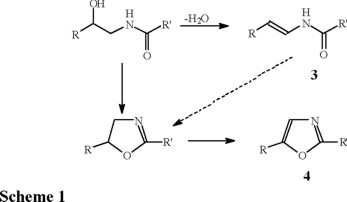
<body><![CDATA[<p align="justify"><font face="verdana" size="2">(<i>R</i>)&#45;(&minus;)&#45;Tembamide (<b>1</b>) and (<i>R</i>)&#45;(&minus;)&#45;aegeline (<b>2</b>) are two naturally occurring &szlig;&#45;hydroxyamides isolated from <i>Fagara hyemalis</i> (St. Hill) Engler and <i>Aegele marmelos</i> Correa, respectively, belonging to the family Rutaceae &#91;1&#45;4&#93;. These &#946;&#45;hydroxyamides have been reported to have insecticide and adrenaline&#45;like activity. Extracts of <i>Aegle marmelos</i>, containing tembamide (<b>1</b>), have been used in the Indian traditional medicine as a control for hypoglycemia &#91;5&#93;. One report also claims that the leaves of <i>Aegle marmelos</i> are used in Bangladesh for fertility control &#91;6&#93;.</font></p>     <p align="center"><font face="verdana" size="2"><img src="/img/revistas/rsqm/v45n1/a5f1.jpg"></font></p>     <p align="justify"><font face="verdana" size="2">In addition to their varied biological properties, these &szlig;&#45;hydroxyamides are possible intermediates in the plant biosynthesis of enamides (<b>3</b>) and oxazoles (<b>4</b>), as they have been isolated from several species of the same family &#91;7&#45;10&#93;. The enamides and oxazoles may be formed from the &szlig;&#45;hydroxyamide (<b>1</b> and <b>2</b>) by a simple dehydration process to enamide (<b>3</b>) or by an internal SN<sub>2</sub> type displacement to oxazoline followed by oxidation to oxazole (<b>4</b>) (<a href="#f2">Scheme 1</a>). In a recent publication we have shown the facile formation of oxazolines from chiral &szlig;&#45;hydroxyamides (<i>erythro</i>&#45; and <i>threo</i>&#45;) by chemical or thermal induced cyclization processes, where the chirality in the oxazoline is either retained or inverted &#91;11&#93;. To our knowledge, the biosynthetic interconnection between these compounds has not been fully established in the family Rutaceae.</font></p>     <p align="center"><font face="verdana" size="2"><a name="f2"></a></font></p>     <p align="center"><font face="verdana" size="2"><img src="/img/revistas/rsqm/v45n1/a5f2.jpg"></font></p>     <p align="justify"><font face="verdana" size="2">These two &#946;&#45;hydroxyamides (<b>1</b> and <b>2</b>) were isolated from Nature as racemic mixtures and later resolved into their enantiomers as tartrate salts &#91;12&#93;. A previous report from this laboratory described the synthesis of racemic tembamide (<b>1</b>) and aegeline (<b>2</b>) from the cyanohydrin obtained by the addition of trimethylsilylcyanide to anisaldehyde with catalysis by zinc iodide &#91;13&#93;. More recent advances now allow addition of trimethylsilylcyanide to carbonyl groups in an enantioselective fashion, using chiral Lewis acid catalysts &#91;14&#45;17&#93;. In view of their interesting biological and possible biosynthetic roles, we embarked on the enantioselective synthesis of tembamide (<b>1</b>) and aegeline (<b>2</b>). Here we report the synthesis of a chiral cyanohydrin and its transformation to the chiral &szlig;&#45;hydroxyamides, tembamide (<b>1</b>) and aegeline (<b>2</b>).</font></p>     <p align="justify"><font face="Verdana" size="2">&nbsp;</font></p>     <p align="justify"><font face="verdana" size="2"><b>Results and discussion</b></font></p>     <p align="justify"><font face="verdana" size="2">Recently we reported the asymmetric addition of trimethylsilylcyanide to benzaldehyde catalyzed by titanium (IV)&#45;Schiff base complexes derived from a chiral <i>cis</i>&#45;indanol system &#91;17&#93;. In this study we discovered that ligands <b>5</b> and <b>6</b> gave the best enantioselectivity in the hydrocyanation reaction. We believe the reason for this high enantioselectivity is due to the rigid five&#45;membered ring backbone of the <i>cis</i>&#45;indanol and the presence of two chiral centers, probably enhancing the chirality in the final cyanohydrin. Further, the X&#45;ray structure of ligand <b>5</b> &#91;18&#93; (<a href="#f5">Fig. 1</a>) suggests that the indanol ring may sterically hinder one face of the carbonyl from cyanide ion attack in the transition state involving the titanium complex.</font></p>     <p align="center"><font face="verdana" size="2"><img src="/img/revistas/rsqm/v45n1/a5f3.jpg"></font></p>     ]]></body>
<body><![CDATA[<p align="center"><font face="verdana" size="2"><a name="f5"></a></font></p>     <p align="center"><font face="verdana" size="2"><img src="/img/revistas/rsqm/v45n1/a5f5.jpg"></font></p>     <p align="justify"><font face="verdana" size="2">Having shown the versatility of these chiral Schiff base ligands, we turned our attention to exploiting these ligands in the asymmetric synthesis of a variety of oxygenated natural products, such as &szlig;&#45;hydroxyamides <b>1</b> and <b>2</b>. Here we report the use of ligands <b>5</b> and <b>6</b> and titanium tetraisopropoxide as catalyst in the addition of trimethylsilylcyanide to anisaldehyde (<b>7</b>), giving the cyanohydrin in 95 and 89 % ee, respectively. Reduction of the cyanohydrin (<b>8</b>) with diborane gave the &szlig;&#45;amino alcohol (<b>9</b>) and subsequent acylation with benzoyl and cinnamoyl chlorides gave tembamide (<b>1</b>) and aegeline (<b>2</b>), respectively, in high optical purity (95 % ee) (<a href="#f4">Scheme 2</a>). Amides (<b>1</b>) and (<b>2</b>) were characterized by 1H, 13C and X&#45;ray (<a href="#f6">Figs. 2</a> and <a href="#f7">3</a>) &#91;19, 20&#93;.</font></p>     <p align="center"><font face="verdana" size="2"><a name="f4"></a></font></p>     <p align="center"><font face="verdana" size="2"><img src="/img/revistas/rsqm/v45n1/a5f4.jpg"></font></p>     <p align="center"><font face="verdana" size="2"><a name="f6"></a></font></p>     <p align="center"><font face="verdana" size="2"><img src="/img/revistas/rsqm/v45n1/a5f6.jpg"></font></p>     <p align="center"><font face="verdana" size="2"><a name="f7"></a></font></p>     <p align="center"><font face="verdana" size="2"><img src="/img/revistas/rsqm/v45n1/a5f7.jpg"></font></p>     <p align="justify"><font face="Verdana" size="2">&nbsp;</font></p>     ]]></body>
<body><![CDATA[<p align="justify"><font face="verdana" size="2"><b>Conclusions</b></font></p>     <p align="justify"><font face="verdana" size="2">Chiral cyanohydrins are versatile synthetic intermediates which can be converted to &#945;&#45;hydroxy carboxylic acids, &#945;&#45;hydroxy aldehydes, &#945;&#45;hydroxy ketones. Here we have demonstrated the enantioselective synthesis of a cyanohydrin derived from anisaldehyde and its transformation to the chiral &szlig;&#45;aminoalcohol (<b>9</b>) and &szlig;&#45;hydroxyamides <b>1</b> and <b>2</b> in high optical purity. Although our method is complementary to the one reported by Jackson and co&#45;workers employing a chiral dipeptide and hydrogen cyanide &#91;21&#93;, our method has several advantages: it is not necessary to use HCN; in our case using trimethylsilylcyanide as the source for cyanide makes it easier to handle, and the trimethylsilyloxycyanohydrin adduct (<b>8a</b>) itself can be purified by distillation under reduced pressure. Further, cyanohydrin with the <i>S</i>&#45;configuration can also be synthesized conveniently using ligand <b>5</b> with the <i>S,R</i>&#45;configuration.</font></p>     <p align="justify"><font face="Verdana" size="2">&nbsp;</font></p>     <p align="justify"><font face="verdana" size="2"><b>Experimental</b></font></p>     <p align="justify"><font face="verdana" size="2"><sup>1</sup>H and <sup>13</sup>C NMR spectra were recorded on a Varian Gemini 200 Spectrometer, and on a Varian Unity Inova 500 MHz spectrometer with TMS as internal standard. X&#45;ray data were collected on a Siemens P4 difractometer. Structure solution were performed by direct methods, and structure refinement was done with the program SHELXS &#91;22&#93;. IR spectra were obtained on a Perkin&#45;Elmer 1600 series spectrometer. Enantiomeric excesses were determined using a Hewlet&#45;Packard 6890 gas chromatograph with a 30 m Supelco &szlig;&#45;DEX column. The optical rotations were obtained on a Rudolph Research Flanders automatic polarimeter. Unless otherwise specified all reagents were purchased from Aldrich Chemical Co. and used without further purification.</font></p>     <p align="justify"><font face="verdana" size="2"><b>(<i>R</i>)&#45;(&minus;)&#45;2(4&#45;Methoxyphenyl)&#45;2&#45;(trimethylsilyloxy)&#45;acetonitrile, (8a)</b>. Under a nitrogen atmosphere, ligand <b>5</b> &#91;17&#93; (0.264 g, 0.85 mmol) was stirred with 6 mL CH<sub>2</sub>Cl<sub>2</sub> at 23 &deg;C. To the stirred solution Ti(O&#45;<i>i</i>&#45;Pr)<sub>4</sub> (0.244 g, 0.85 mmol) was added and the mixture stirred at room temperature for 1 h. The solution was then cooled to &minus;780 &deg;C and trimethylsilylcyanide (0.72 mL, 5.65 mmol) and anisaldehyde (0.56 mL, 4.6 mmol) were added and the mixture stirred at &minus;78 &deg;C for 36 h. The crude mixture was passed through a short column of silica gel and the product concentrated and subjected to short path distillation using Kugelrohr oven, fraction boiling at 95 &deg;C/3 mm Hg was collected. Orange&#45;yellow liquid (0.82 g 77 % yield); bp 95 &deg;C/3 mm Hg; &#91;&#945;&#93;<sub>D</sub> = + 21.80&deg; (c = 1.00, CHCl<sub>3</sub>) {lit. &#91;21&#93;, &#91;&#945;&#93;<sub>D</sub> = +22&deg; (c = 1.00, CHCl<sub>3</sub>)}; IR (film): 1600, 1512,1460, 1250 cm<sup>&minus;1</sup>; <sup>1</sup>H NMR (200 MHz, CDCl<sub>3</sub>): &#948; 7.37 (d, 2H, J = 7.9 Hz), 6.90 (d, 2H, J = 7.9Hz), 5.50 (s, 1H), 3.77 (s, 3H) and 0.18 (s, 9H); 13C NMR (50 MHz, CDCl<sub>3</sub>): &#948; 160.28, 128.37, 127.86, 119.30, 114.17, 63.17, 55.14 and 0.42.</font></p>     <p align="justify"><font face="verdana" size="2"><b>(R)&#45;(+)&#45;2&#45;Hydroxy&#45;2&#45;(4&#45;methoxyphenyl) acetonitrile, (8b)</b>. Compound <b>8a</b> (0.50 g) was stirred with 1M HCl (10 mL) for 4 h, and the product extracted into dichloromethane. The crude material was recrystallized from dichloromethane/hexane to give 8b (0.48 g) in 95 % yield and 95 % ee. Enantiomeric excess was determined by derivatizing the alcohol with acetic anhydride and injecting into a Hewlet&#45;Packard 6890 gas chromatograph with a 30 m Supelco &#946;&#45;DEX column. The retention times of the enantiomers were 15.17 min (<i>R</i>) and 15.45 min (<i>S</i>). Mp: 84&#45;87 &deg;C (lit. &#91;23&#93;, 74&#45;76 &deg;C); &#91;&#945;&#93;<sub>D</sub> = + 47.50&deg; (c = 1, CHCl<sub>3</sub>), {lit. &#91;23&#93;, &#91;&#945;&#93;<sub>D</sub> = + 48.80&deg; (c = 1, CHCl<sub>3</sub>)}. IR (KBr): 3398, 2247 cm<sup>&minus;1</sup>; <sup>1</sup>H NMR (200 MHz, CDCl<sub>3</sub>): &#948; 7.42 (d, 2H, J = 8.9Hz), 6.93 (d, 2H, J = 8.9Hz), 5.45 (s, 1H), 3.81 (s, 3H) and 3.21 (brs, 1H); <sup>13</sup>C (50 MHz, CDCl<sub>3</sub>): &#948; 160.78, 128.32, 127.66, 119.40, 114.57, 63.22 and 55.35.</font></p>     <p align="justify"><font face="verdana" size="2"><b>Reduction of (8b)</b>. Compound <b>8b</b> (0.5 g, 3 mmol) in dry ether (50 mL) was added to a stirred ice&#45;cold solution of BH<sub>3</sub>:S Me<sub>2</sub> solution (3.07 mL, 6 mmol). The mixture was allowed to stand at room temperature overnight and the excess BH<sub>3</sub> was destroyed by addition of methanol. Solvent was removed under reduced pressure to give a brownish oil in 74 % yield (0.38 g). <sup>1</sup>H NMR (200 MHz, CDCl<sub>3</sub>): &#948; 7.13 (d, 2H, J = 7.9 Hz), 6.76 (d, 2H, J = 7.9 Hz), 4.42 (m, 1H), 3.71 (s, 3H), 3.1 (brs. 1H) and 2.62 (m, 2H); <sup>13</sup>C (50 MHz, CDCl<sub>3</sub>): &#948; 158.53, 134.89, 126.77, 113.32, 73.49, 54.74 and 48.86.</font></p>     <p align="justify"><font face="verdana" size="2"><b>Acylation of amino alcohol (9)</b>. Without further purification, the crude amino alcohol <b>9</b> was reacted with benzoyl chloride and <i>trans</i>&#45;cinnamoyl chloride under Schotten&#45;Bauman conditions &#91;13&#93; to give (<i>R</i>)&#45;(&minus;)&#45;tembamide (<b>1</b>) and (<i>R</i>)&#45;(&minus;)&#45;aegeline (<b>2</b>) &#91;13&#93; in 83 % and 85 % yields, respectively.</font></p>     <p align="justify"><font face="verdana" size="2"><b>(<i>R</i>)&#45;(&minus;)&#45;Tembamide (1)</b>. White solid (0.53 g, 83 %), Mp: 144&#45;146 &deg;C (lit &#91;12&#93;, 156&#45;157 &deg;C); &#91;&#945;&#93;<sub>D</sub> = &minus;58.40&deg; (c = 0.53, CHCl<sub>3</sub>), {lit. &#91;12&#93;, &#91;&#945;&#93;<sub>D</sub> = &minus;55.31&deg; (c = 0.5, CHCl<sub>3</sub>)}. IR(KBr): 3345, 3299, 1633, 1245 and 1031 cm<sup>&minus;1</sup>; <sup>1</sup>H NMR (500 MHz, CDCl<sub>3</sub>): &#948; 7.74 (d, 2H, J = 7.1 Hz), 7.48 (t, 1 H, J = 7.4 Hz), 7.39 (t, 2H, J = 7.8 Hz), 7.29 (d, 2H, J = 8.5 Hz), 6.88 (d, 2H, J = 8.7 Hz), 6.69 (br. s 1H), 4.85 (dd, 1H, J<sub>1</sub> = 3.2 Hz and J<sub>2</sub> = 7.8 Hz) 3.88&#45;3.81 (m, 1H), 3.77 (s, 3H), 3.53&#45;3.39 (m, 1H); <sup>13</sup>C (125 MHz, CDCl<sub>3</sub>): &#948; 168.52, 159.31, 134.12, 133.89, 131.61, 128.55, 127.07, 113.43, 73.19, 55.27 and 47.74.</font></p>     ]]></body>
<body><![CDATA[<p align="justify"><font face="verdana" size="2"><b>(R)&#45;(&minus;)&#45;Aegeline (2)</b>. White solid (0.58 g, 85 %); Mp: 193&#45;195 &deg;C (lit. &#91;12&#93;, 196&#45;197 &deg;C); &#91;&#945;&#93;<sub>D</sub> = &minus;39.30&deg; (c = 0.45, CHCl<sub>3</sub>), {lit. &#91;12&#93;, &#91;&#945;&#93;<sub>D</sub> = &minus;35.1&deg; (c = 0.4, CHCl<sub>3</sub>)}. IR(KBr): 3368, 3283, 1653, 1596, 1241, 1074 and 1032 cm<sup>&minus;1</sup>; <sup>1</sup>H NMR (500 MHz, CDCl<sub>3</sub>): &#948; 7.57 (d, 1H, J = 15.62 Hz), 7.50 (d, 2H, J = 8 Hz), 7.43 (br. t, 1H, J = Hz), 7.36&#45;7.35 (m, 3H), 7.33 (d, 2H, J = 8 Hz), 6.77 (d, 2H, J = 8 Hz), 6.56 (d, 1H, J = 15.62 Hz), 5.08 (br. s, 1H), 4.79 (dd, 1H, J<sub>1</sub> = 3.39 Hz and J<sub>2</sub> = 8.19 Hz), 3.80 (s, 3H), 3.72 (ddd, 1H, J<sub>1</sub> = 3.5 Hz, J<sub>2</sub> = 6.9 Hz and J<sub>3</sub> = 13.79 Hz) and 3.35 (ddd, 1H, J<sub>1</sub> = 4.6 Hz, J<sub>2</sub> = 8.5 Hz and J<sub>3</sub> = 13.8 Hz); <sup>13</sup>C NMR (125 MHz, CDCl<sub>3</sub>): &#948; 165.67, 138.89, 134.15, 127.88, 127.04, 126.73, 126.28, 120.71, 112.65, 71.21, 54.18 and 46.74.</font></p>     <p align="justify"><font face="verdana" size="2"><b>Supporting Information Available</b>. The X&#45;ray crystal structure data for <b>1</b>, <b>2</b> and <b>5</b> are available. Tables of final atomic coordinates for the non&#45;hydrogen atoms, anisotropic thermal parameters, complete list of bond distances and angles and complete crystallographic data are included &#91;24&#93;.</font></p>     <p align="justify"><font face="Verdana" size="2">&nbsp;</font></p>     <p align="justify"><font face="verdana" size="2"><b>Acknowledgments</b></font></p>     <p align="justify"><font face="verdana" size="2">We gratefully acknowledge support for this project by COSNET grant (735.99P) 1998, CONACyT Proyecto Infraestructura (F264&#45;E9207) for funding of an X&#45;ray diffractometer for Instituto Tecnol&oacute;gico de Tijuana and also for fellowship by CONACyT for A.S.R. and L.Z.F.L.</font></p>     <p align="justify"><font face="Verdana" size="2">&nbsp;</font></p>     <p align="justify"><font face="verdana" size="2"><b>References</b></font></p>     <!-- ref --><p align="justify"><font face="verdana" size="2">1. Kuck, A. M.; Albonico, S. M.; Deulofeu, V. <i>Chem. and Ind.</i> <b>1966</b>, 945&#45;946.    &nbsp;&nbsp;&nbsp;&nbsp;&nbsp;&nbsp;&nbsp;&nbsp;[&#160;<a href="javascript:void(0);" onclick="javascript: window.open('/scielo.php?script=sci_nlinks&ref=6949352&pid=S0583-7693200100010000500001&lng=','','width=640,height=500,resizable=yes,scrollbars=1,menubar=yes,');">Links</a>&#160;]<!-- end-ref --></font></p>     <!-- ref --><p align="justify"><font face="verdana" size="2">2. Chatterjee, A.; Bose, S. <i>J. Indian. Chem. Soc.</i> <b>1952</b>, <i>29</i>, 425.    &nbsp;&nbsp;&nbsp;&nbsp;&nbsp;&nbsp;&nbsp;&nbsp;[&#160;<a href="javascript:void(0);" onclick="javascript: window.open('/scielo.php?script=sci_nlinks&ref=6949354&pid=S0583-7693200100010000500002&lng=','','width=640,height=500,resizable=yes,scrollbars=1,menubar=yes,');">Links</a>&#160;]<!-- end-ref --></font></p>     <!-- ref --><p align="justify"><font face="verdana" size="2">3. Johns, S. R.; Lamberton, J. A.; Price, J. R. <i>Aust. J. Chem.</i> <b>1967</b>, <i>20</i>, 2795&#45;2797.    &nbsp;&nbsp;&nbsp;&nbsp;&nbsp;&nbsp;&nbsp;&nbsp;[&#160;<a href="javascript:void(0);" onclick="javascript: window.open('/scielo.php?script=sci_nlinks&ref=6949356&pid=S0583-7693200100010000500003&lng=','','width=640,height=500,resizable=yes,scrollbars=1,menubar=yes,');">Links</a>&#160;]<!-- end-ref --></font></p>     <!-- ref --><p align="justify"><font face="verdana" size="2">4. Johns, S. R.; Lamberton, J. R; Tweeddale, H. J.; Willing, R. I. <i>Aust. J . Chem.</i> <b>1969</b>, <i>22</i>, 2233&#45;2236.    &nbsp;&nbsp;&nbsp;&nbsp;&nbsp;&nbsp;&nbsp;&nbsp;[&#160;<a href="javascript:void(0);" onclick="javascript: window.open('/scielo.php?script=sci_nlinks&ref=6949358&pid=S0583-7693200100010000500004&lng=','','width=640,height=500,resizable=yes,scrollbars=1,menubar=yes,');">Links</a>&#160;]<!-- end-ref --></font></p>     <!-- ref --><p align="justify"><font face="verdana" size="2">5. Shoeb, A.; Kapil, R. S.; Popli, S. P. <i>Phytochemistry</i> <b>1973</b>, <i>12</i>, 2071&#45;2072.    &nbsp;&nbsp;&nbsp;&nbsp;&nbsp;&nbsp;&nbsp;&nbsp;[&#160;<a href="javascript:void(0);" onclick="javascript: window.open('/scielo.php?script=sci_nlinks&ref=6949360&pid=S0583-7693200100010000500005&lng=','','width=640,height=500,resizable=yes,scrollbars=1,menubar=yes,');">Links</a>&#160;]<!-- end-ref --></font></p>     <!-- ref --><p align="justify"><font face="verdana" size="2">6. Govindachari, T. R.; Premila, M. S. <i>Phytochemistry</i> <b>1983</b>, <i>22</i>, 755&#45;757.    &nbsp;&nbsp;&nbsp;&nbsp;&nbsp;&nbsp;&nbsp;&nbsp;[&#160;<a href="javascript:void(0);" onclick="javascript: window.open('/scielo.php?script=sci_nlinks&ref=6949362&pid=S0583-7693200100010000500006&lng=','','width=640,height=500,resizable=yes,scrollbars=1,menubar=yes,');">Links</a>&#160;]<!-- end-ref --></font></p>     <!-- ref --><p align="justify"><font face="verdana" size="2">7. Brossi A., <i>The Alkaloids</i>, Chemistry and Pharmacology. Vol. 35, Edit. Academic Press, <b>1989</b>.    &nbsp;&nbsp;&nbsp;&nbsp;&nbsp;&nbsp;&nbsp;&nbsp;[&#160;<a href="javascript:void(0);" onclick="javascript: window.open('/scielo.php?script=sci_nlinks&ref=6949364&pid=S0583-7693200100010000500007&lng=','','width=640,height=500,resizable=yes,scrollbars=1,menubar=yes,');">Links</a>&#160;]<!-- end-ref --></font></p>     <!-- ref --><p align="justify"><font face="verdana" size="2">8. Chatterjee, A.; Chakrabarty, M.; Kundu, A. B. <i>Aust. J. Chem.</i> <b>1975</b>, <i>28</i>, 457.    &nbsp;&nbsp;&nbsp;&nbsp;&nbsp;&nbsp;&nbsp;&nbsp;[&#160;<a href="javascript:void(0);" onclick="javascript: window.open('/scielo.php?script=sci_nlinks&ref=6949366&pid=S0583-7693200100010000500008&lng=','','width=640,height=500,resizable=yes,scrollbars=1,menubar=yes,');">Links</a>&#160;]<!-- end-ref --></font></p>     <!-- ref --><p align="justify"><font face="verdana" size="2">9. Burke, B. A.; Perkins, H. <i>Tetrahedron Lett.</i> <b>1978</b>, 2723.    &nbsp;&nbsp;&nbsp;&nbsp;&nbsp;&nbsp;&nbsp;&nbsp;[&#160;<a href="javascript:void(0);" onclick="javascript: window.open('/scielo.php?script=sci_nlinks&ref=6949368&pid=S0583-7693200100010000500009&lng=','','width=640,height=500,resizable=yes,scrollbars=1,menubar=yes,');">Links</a>&#160;]<!-- end-ref --></font></p>     <!-- ref --><p align="justify"><font face="verdana" size="2">10. Burke, B. A.; Philip, S. <i>Heterocycles</i> <b>1985</b>, <i>23</i>, 257&#45;260.    &nbsp;&nbsp;&nbsp;&nbsp;&nbsp;&nbsp;&nbsp;&nbsp;[&#160;<a href="javascript:void(0);" onclick="javascript: window.open('/scielo.php?script=sci_nlinks&ref=6949370&pid=S0583-7693200100010000500010&lng=','','width=640,height=500,resizable=yes,scrollbars=1,menubar=yes,');">Links</a>&#160;]<!-- end-ref --></font></p>     <p align="justify"><font face="verdana" size="2">11. Somanathan, R.; Aguilar, H. R.; Rivero, I. A.; Aguirre, G.; Hellberg, L. H.; Yu, Z.; Thomas A. <i>J .Chem. Res.</i> (s) (in print).</font></p>     <!-- ref --><p align="justify"><font face="verdana" size="2">12. Albonico, S. M.; Kuck, A. M.; Deulofeu, V. <i>J. Chem. Soc.</i> (C). <b>1967</b>, 1327&#45;1328.    &nbsp;&nbsp;&nbsp;&nbsp;&nbsp;&nbsp;&nbsp;&nbsp;[&#160;<a href="javascript:void(0);" onclick="javascript: window.open('/scielo.php?script=sci_nlinks&ref=6949373&pid=S0583-7693200100010000500011&lng=','','width=640,height=500,resizable=yes,scrollbars=1,menubar=yes,');">Links</a>&#160;]<!-- end-ref --></font></p>     ]]></body>
<body><![CDATA[<!-- ref --><p align="justify"><font face="verdana" size="2">13. Somanathan, R.; Aguilar, H. R.; Ventura, G. R. Smith, K. M. <i>Synth. Commun.</i> <b>1983</b>, <i>13</i>, 273&#45;280.    &nbsp;&nbsp;&nbsp;&nbsp;&nbsp;&nbsp;&nbsp;&nbsp;[&#160;<a href="javascript:void(0);" onclick="javascript: window.open('/scielo.php?script=sci_nlinks&ref=6949375&pid=S0583-7693200100010000500012&lng=','','width=640,height=500,resizable=yes,scrollbars=1,menubar=yes,');">Links</a>&#160;]<!-- end-ref --></font></p>     <!-- ref --><p align="justify"><font face="verdana" size="2">14. North, M. In Comprehensive Organic Functional Group Transformations; Eds. Katritzky, A.R.; Meth&#45;Cohn, O.; Rees, C. W.; Pattenden, G. Pergmon Press: Oxford. <b>1995</b>, Vol. 3, Chapter 18.    &nbsp;&nbsp;&nbsp;&nbsp;&nbsp;&nbsp;&nbsp;&nbsp;[&#160;<a href="javascript:void(0);" onclick="javascript: window.open('/scielo.php?script=sci_nlinks&ref=6949377&pid=S0583-7693200100010000500013&lng=','','width=640,height=500,resizable=yes,scrollbars=1,menubar=yes,');">Links</a>&#160;]<!-- end-ref --></font></p>     <!-- ref --><p align="justify"><font face="verdana" size="2">15. North, M. <i>Synlett</i> <b>1993</b>, 807&#45;820.    &nbsp;&nbsp;&nbsp;&nbsp;&nbsp;&nbsp;&nbsp;&nbsp;[&#160;<a href="javascript:void(0);" onclick="javascript: window.open('/scielo.php?script=sci_nlinks&ref=6949379&pid=S0583-7693200100010000500014&lng=','','width=640,height=500,resizable=yes,scrollbars=1,menubar=yes,');">Links</a>&#160;]<!-- end-ref --></font></p>     <!-- ref --><p align="justify"><font face="verdana" size="2">16. Effenberger, F. <i>Angew. Chem. Int. Ed. Engl.</i> <b>1994</b>, <i>33</i>, 1555&#45;1564.    &nbsp;&nbsp;&nbsp;&nbsp;&nbsp;&nbsp;&nbsp;&nbsp;[&#160;<a href="javascript:void(0);" onclick="javascript: window.open('/scielo.php?script=sci_nlinks&ref=6949381&pid=S0583-7693200100010000500015&lng=','','width=640,height=500,resizable=yes,scrollbars=1,menubar=yes,');">Links</a>&#160;]<!-- end-ref --></font></p>     <!-- ref --><p align="justify"><font face="verdana" size="2">17. Flores&#45;Lopez, L. Z.; Parra&#45;Hake, M.; Somanathan, R.; Walsh, P. J. <i>Organometallics</i> <b>2000</b>, <i>19</i>, 2153&#45;2160.    &nbsp;&nbsp;&nbsp;&nbsp;&nbsp;&nbsp;&nbsp;&nbsp;[&#160;<a href="javascript:void(0);" onclick="javascript: window.open('/scielo.php?script=sci_nlinks&ref=6949383&pid=S0583-7693200100010000500016&lng=','','width=640,height=500,resizable=yes,scrollbars=1,menubar=yes,');">Links</a>&#160;]<!-- end-ref --></font></p>     ]]></body>
<body><![CDATA[<p align="justify"><font face="verdana" size="2">18. X&#45;ray quality crystals were obtained from a methanol&#45;hexane solution of (<b>5</b>). X&#45;ray analysis: empirical formula C<sub>20</sub>H<sub>23</sub>NO<sub>2</sub>, F. W. 309.39, T = 294 K, orthorhombic, space group P2<sub>1</sub>2<sub>1</sub>2<sub>1</sub>, a = 9.0434(12) &Aring;, b = 10.259(2) &Aring;, c = 18.788(3) &Aring;, &#945; = 90&deg;, &szlig; = 90&deg;, &#947; = 90&deg;, V = 1743.0(5) &Aring;3, z = 4, D<sub>c</sub> = 1.179 mg / m3, F (000) = 664, &#955; = 0.71073 &Aring;, &micro;= 0.075 mm<sup>&minus;1</sup>, 2.17&deg; &lt; 2&#977; &lt; 30.00, R<sub>1</sub> = 0.1079, wR<sub>2</sub> = 0.2006, largest diff. Peak and hole 0.200 and &minus;0.196 e&Aring;<sup>&minus;3</sup>.</font></p>     <p align="justify"><font face="verdana" size="2">19. X&#45;ray quality crystals were obtained by slow evaporation of a CDCl 3 solution of (<b>1</b>). X&#45;ray analysis: empirical formula C<sub>16</sub>H<sub>17</sub>NO<sub>3</sub>, F.W. 271.31, T = 294 K, monoclinic, space group I<sub>2</sub> / a, a = 19.188(14) &Aring;, b = 9.560(4) &Aring;, c = 30.90(3) &Aring;, &#945; = 90&deg;, &szlig; = 95.45(4)&deg;, &#947; = 90&deg;, V = 5643(7) &Aring;3, z = 16, D<sub>c</sub> = 1.277 mg / m3, F (000) = 2304, &#955; = 0.71073 &Aring;, &micro; = 0.088 mm<sup>&minus;1</sup>, 2.13&deg; &lt; 2&#977; &lt; 22.61, R<sub>1</sub> = 0.0968, wR2 = 0.2285, largest diff. Peak and hole 0.315 and &minus;0.357 e&Aring;<sup>&minus;3</sup>.</font></p>     <p align="justify"><font face="verdana" size="2">20. X&#45;ray quality crystals were obtained by slow evaporation of a CDCl 3 solution of (<b>2</b>). X&#45;ray analysis: empirical formula C<sub>18</sub>H<sub>19</sub>NO<sub>3</sub>, F.W. 297.34, T = 293 K, monoclinic, space group P<sub>21</sub>, a = 6.866(5) &Aring;, b = 8.944(4) &Aring;, c = 12.942(12) &Aring;, &#945; = 90&deg;, &szlig; = 90.21(4)&deg;, &#947; = 90&deg;, V = 794.7(10) &Aring;3, z = 2, D<sub>c</sub> = 1.243 mg / m3, F (000)= 316, &#955; = 0.71073 &Aring;, &micro;= 0.085 mm<sup>&minus;1</sup>, 1.57 &deg; &lt; 2&#977; &lt; 22.49, R<sub>1</sub> = 0.0851, wR2 = 0.1729, largest diff. Peak and hole 0.199 and &minus;0.205 e&Aring;<sup>&minus;3</sup>.</font></p>     <!-- ref --><p align="justify"><font face="verdana" size="2">21. Jackson, W. R.; Jacobs, H. A Jayatileke, G. S.; Mathews, B. R.; Watson, K. G. <i>Aust. J. Chem.</i> <b>1990</b>, <i>43</i>, 2045&#45;2062.    &nbsp;&nbsp;&nbsp;&nbsp;&nbsp;&nbsp;&nbsp;&nbsp;[&#160;<a href="javascript:void(0);" onclick="javascript: window.open('/scielo.php?script=sci_nlinks&ref=6949388&pid=S0583-7693200100010000500017&lng=','','width=640,height=500,resizable=yes,scrollbars=1,menubar=yes,');">Links</a>&#160;]<!-- end-ref --></font></p>     <!-- ref --><p align="justify"><font face="verdana" size="2">22. Sheldrick, G. M. SHELXTL PC Version 5.03. <i>An Integrated System for Solving, Refining and Displaying Crystal Structures from Diffractometer Data</i>; Siemens Analytical X&#45;ray Instruments, Inc.: Madison, WI, <b>1994</b>.    &nbsp;&nbsp;&nbsp;&nbsp;&nbsp;&nbsp;&nbsp;&nbsp;[&#160;<a href="javascript:void(0);" onclick="javascript: window.open('/scielo.php?script=sci_nlinks&ref=6949390&pid=S0583-7693200100010000500018&lng=','','width=640,height=500,resizable=yes,scrollbars=1,menubar=yes,');">Links</a>&#160;]<!-- end-ref --></font></p>     <!-- ref --><p align="justify"><font face="verdana" size="2">23. Brown, R. F. C.; Donohue, A. C.; Jackson, W. R.; McCarthy, T. D. <i>Tetrahedron</i> <b>1994</b>, <i>50</i>, 13739&#45;13752.    &nbsp;&nbsp;&nbsp;&nbsp;&nbsp;&nbsp;&nbsp;&nbsp;[&#160;<a href="javascript:void(0);" onclick="javascript: window.open('/scielo.php?script=sci_nlinks&ref=6949392&pid=S0583-7693200100010000500019&lng=','','width=640,height=500,resizable=yes,scrollbars=1,menubar=yes,');">Links</a>&#160;]<!-- end-ref --></font></p>     <p align="justify"><font face="verdana" size="2">24. CCDC (<i>Cambridge Crystallographic Data Centre</i>) numbers, 158726, 158727 and 158868 for compounds <b>1</b>, <b>2</b> and <b>5</b>, respectively.</font></p>     ]]></body>
<body><![CDATA[ ]]></body><back>
<ref-list>
<ref id="B1">
<label>1</label><nlm-citation citation-type="journal">
<person-group person-group-type="author">
<name>
<surname><![CDATA[Kuck]]></surname>
<given-names><![CDATA[A. M.]]></given-names>
</name>
<name>
<surname><![CDATA[Albonico]]></surname>
<given-names><![CDATA[S. M.]]></given-names>
</name>
<name>
<surname><![CDATA[Deulofeu]]></surname>
<given-names><![CDATA[V.]]></given-names>
</name>
</person-group>
<source><![CDATA[Chem. and Ind.]]></source>
<year>1966</year>
<page-range>945-946</page-range></nlm-citation>
</ref>
<ref id="B2">
<label>2</label><nlm-citation citation-type="journal">
<person-group person-group-type="author">
<name>
<surname><![CDATA[Chatterjee]]></surname>
<given-names><![CDATA[A.]]></given-names>
</name>
<name>
<surname><![CDATA[Bose]]></surname>
<given-names><![CDATA[S.]]></given-names>
</name>
</person-group>
<source><![CDATA[J. Indian. Chem. Soc.]]></source>
<year>1952</year>
<volume>29</volume>
<page-range>425</page-range></nlm-citation>
</ref>
<ref id="B3">
<label>3</label><nlm-citation citation-type="journal">
<person-group person-group-type="author">
<name>
<surname><![CDATA[Johns]]></surname>
<given-names><![CDATA[S. R.]]></given-names>
</name>
<name>
<surname><![CDATA[Lamberton]]></surname>
<given-names><![CDATA[J. A.]]></given-names>
</name>
<name>
<surname><![CDATA[Price]]></surname>
<given-names><![CDATA[J. R.]]></given-names>
</name>
</person-group>
<source><![CDATA[Aust. J. Chem.]]></source>
<year>1967</year>
<volume>20</volume>
<page-range>2795-2797</page-range></nlm-citation>
</ref>
<ref id="B4">
<label>4</label><nlm-citation citation-type="journal">
<person-group person-group-type="author">
<name>
<surname><![CDATA[Johns]]></surname>
<given-names><![CDATA[S. R.]]></given-names>
</name>
<name>
<surname><![CDATA[Lamberton]]></surname>
<given-names><![CDATA[J. R]]></given-names>
</name>
<name>
<surname><![CDATA[Tweeddale]]></surname>
<given-names><![CDATA[H. J.]]></given-names>
</name>
<name>
<surname><![CDATA[Willing]]></surname>
<given-names><![CDATA[R. I.]]></given-names>
</name>
</person-group>
<source><![CDATA[Aust. J . Chem.]]></source>
<year>1969</year>
<volume>22</volume>
<page-range>2233-2236</page-range></nlm-citation>
</ref>
<ref id="B5">
<label>5</label><nlm-citation citation-type="journal">
<person-group person-group-type="author">
<name>
<surname><![CDATA[Shoeb]]></surname>
<given-names><![CDATA[A.]]></given-names>
</name>
<name>
<surname><![CDATA[Kapil]]></surname>
<given-names><![CDATA[R. S.]]></given-names>
</name>
<name>
<surname><![CDATA[Popli]]></surname>
<given-names><![CDATA[S. P.]]></given-names>
</name>
</person-group>
<source><![CDATA[Phytochemistry]]></source>
<year>1973</year>
<volume>12</volume>
<page-range>2071-2072</page-range></nlm-citation>
</ref>
<ref id="B6">
<label>6</label><nlm-citation citation-type="journal">
<person-group person-group-type="author">
<name>
<surname><![CDATA[Govindachari]]></surname>
<given-names><![CDATA[T. R.]]></given-names>
</name>
<name>
<surname><![CDATA[Premila]]></surname>
<given-names><![CDATA[M. S.]]></given-names>
</name>
</person-group>
<source><![CDATA[Phytochemistry]]></source>
<year>1983</year>
<volume>22</volume>
<page-range>755-757</page-range></nlm-citation>
</ref>
<ref id="B7">
<label>7</label><nlm-citation citation-type="book">
<person-group person-group-type="author">
<name>
<surname><![CDATA[Brossi]]></surname>
<given-names><![CDATA[A.]]></given-names>
</name>
</person-group>
<source><![CDATA[The Alkaloids]]></source>
<year>1989</year>
<publisher-name><![CDATA[Academic Press]]></publisher-name>
</nlm-citation>
</ref>
<ref id="B8">
<label>8</label><nlm-citation citation-type="journal">
<person-group person-group-type="author">
<name>
<surname><![CDATA[Chatterjee]]></surname>
<given-names><![CDATA[A.]]></given-names>
</name>
<name>
<surname><![CDATA[Chakrabarty]]></surname>
<given-names><![CDATA[M.]]></given-names>
</name>
<name>
<surname><![CDATA[Kundu]]></surname>
<given-names><![CDATA[A. B.]]></given-names>
</name>
</person-group>
<source><![CDATA[Aust. J. Chem.]]></source>
<year>1975</year>
<volume>28</volume>
<page-range>457</page-range></nlm-citation>
</ref>
<ref id="B9">
<label>9</label><nlm-citation citation-type="journal">
<person-group person-group-type="author">
<name>
<surname><![CDATA[Burke]]></surname>
<given-names><![CDATA[B. A.]]></given-names>
</name>
<name>
<surname><![CDATA[Perkins]]></surname>
<given-names><![CDATA[H.]]></given-names>
</name>
</person-group>
<source><![CDATA[Tetrahedron Lett.]]></source>
<year>1978</year>
<page-range>2723</page-range></nlm-citation>
</ref>
<ref id="B10">
<label>10</label><nlm-citation citation-type="journal">
<person-group person-group-type="author">
<name>
<surname><![CDATA[Burke]]></surname>
<given-names><![CDATA[B. A.]]></given-names>
</name>
<name>
<surname><![CDATA[Philip]]></surname>
<given-names><![CDATA[S.]]></given-names>
</name>
</person-group>
<source><![CDATA[Heterocycles]]></source>
<year>1985</year>
<volume>23</volume>
<page-range>257-260</page-range></nlm-citation>
</ref>
<ref id="B11">
<label>12</label><nlm-citation citation-type="journal">
<person-group person-group-type="author">
<name>
<surname><![CDATA[Albonico]]></surname>
<given-names><![CDATA[S. M.]]></given-names>
</name>
<name>
<surname><![CDATA[Kuck]]></surname>
<given-names><![CDATA[A. M.]]></given-names>
</name>
<name>
<surname><![CDATA[Deulofeu]]></surname>
<given-names><![CDATA[V.]]></given-names>
</name>
</person-group>
<source><![CDATA[J. Chem. Soc. (C).]]></source>
<year>1967</year>
<page-range>1327-1328</page-range></nlm-citation>
</ref>
<ref id="B12">
<label>13</label><nlm-citation citation-type="journal">
<person-group person-group-type="author">
<name>
<surname><![CDATA[Somanathan]]></surname>
<given-names><![CDATA[R.]]></given-names>
</name>
<name>
<surname><![CDATA[Aguilar]]></surname>
<given-names><![CDATA[H. R.]]></given-names>
</name>
<name>
<surname><![CDATA[Ventura]]></surname>
<given-names><![CDATA[G. R.]]></given-names>
</name>
<name>
<surname><![CDATA[Smith]]></surname>
<given-names><![CDATA[K. M.]]></given-names>
</name>
</person-group>
<source><![CDATA[Synth. Commun.]]></source>
<year>1983</year>
<volume>13</volume>
<page-range>273-280</page-range></nlm-citation>
</ref>
<ref id="B13">
<label>14</label><nlm-citation citation-type="book">
<person-group person-group-type="author">
<name>
<surname><![CDATA[North]]></surname>
<given-names><![CDATA[M.]]></given-names>
</name>
</person-group>
<person-group person-group-type="editor">
<name>
<surname><![CDATA[Katritzky]]></surname>
<given-names><![CDATA[A.R.]]></given-names>
</name>
<name>
<surname><![CDATA[Meth-Cohn]]></surname>
<given-names><![CDATA[O.]]></given-names>
</name>
<name>
<surname><![CDATA[Rees]]></surname>
<given-names><![CDATA[C. W.]]></given-names>
</name>
<name>
<surname><![CDATA[Pattenden]]></surname>
<given-names><![CDATA[G.]]></given-names>
</name>
</person-group>
<source><![CDATA[Comprehensive Organic Functional Group Transformations]]></source>
<year>1995</year>
<volume>3</volume>
<publisher-loc><![CDATA[Oxford ]]></publisher-loc>
<publisher-name><![CDATA[Pergmon Press]]></publisher-name>
</nlm-citation>
</ref>
<ref id="B14">
<label>15</label><nlm-citation citation-type="journal">
<person-group person-group-type="author">
<name>
<surname><![CDATA[North]]></surname>
<given-names><![CDATA[M.]]></given-names>
</name>
</person-group>
<source><![CDATA[Synlett]]></source>
<year>1993</year>
<page-range>807-820</page-range></nlm-citation>
</ref>
<ref id="B15">
<label>16</label><nlm-citation citation-type="journal">
<person-group person-group-type="author">
<name>
<surname><![CDATA[Effenberger]]></surname>
<given-names><![CDATA[F.]]></given-names>
</name>
</person-group>
<source><![CDATA[Angew. Chem. Int. Ed. Engl.]]></source>
<year>1994</year>
<volume>33</volume>
<page-range>1555-1564</page-range></nlm-citation>
</ref>
<ref id="B16">
<label>17</label><nlm-citation citation-type="journal">
<person-group person-group-type="author">
<name>
<surname><![CDATA[Flores-Lopez]]></surname>
<given-names><![CDATA[L. Z.]]></given-names>
</name>
<name>
<surname><![CDATA[Parra-Hake]]></surname>
<given-names><![CDATA[M.]]></given-names>
</name>
<name>
<surname><![CDATA[Somanathan]]></surname>
<given-names><![CDATA[R.]]></given-names>
</name>
<name>
<surname><![CDATA[Walsh]]></surname>
<given-names><![CDATA[P. J.]]></given-names>
</name>
</person-group>
<source><![CDATA[Organometallics]]></source>
<year>2000</year>
<volume>19</volume>
<page-range>2153-2160</page-range></nlm-citation>
</ref>
<ref id="B17">
<label>21</label><nlm-citation citation-type="journal">
<person-group person-group-type="author">
<name>
<surname><![CDATA[Jackson]]></surname>
<given-names><![CDATA[W. R.]]></given-names>
</name>
<name>
<surname><![CDATA[Jacobs]]></surname>
<given-names><![CDATA[H. A]]></given-names>
</name>
<name>
<surname><![CDATA[Jayatileke]]></surname>
<given-names><![CDATA[G. S.]]></given-names>
</name>
<name>
<surname><![CDATA[Mathews]]></surname>
<given-names><![CDATA[B. R.]]></given-names>
</name>
<name>
<surname><![CDATA[Watson]]></surname>
<given-names><![CDATA[K. G.]]></given-names>
</name>
</person-group>
<source><![CDATA[Aust. J. Chem.]]></source>
<year>1990</year>
<volume>43</volume>
<page-range>2045-2062</page-range></nlm-citation>
</ref>
<ref id="B18">
<label>22</label><nlm-citation citation-type="book">
<person-group person-group-type="author">
<name>
<surname><![CDATA[Sheldrick]]></surname>
<given-names><![CDATA[G. M.]]></given-names>
</name>
</person-group>
<source><![CDATA[SHELXTL PC Version 5.03. An Integrated System for Solving, Refining and Displaying Crystal Structures from Diffractometer Data]]></source>
<year>1994</year>
<publisher-loc><![CDATA[Madison^eWI WI]]></publisher-loc>
<publisher-name><![CDATA[Siemens Analytical X-ray Instruments, Inc.]]></publisher-name>
</nlm-citation>
</ref>
<ref id="B19">
<label>23</label><nlm-citation citation-type="journal">
<person-group person-group-type="author">
<name>
<surname><![CDATA[Brown]]></surname>
<given-names><![CDATA[R. F. C.]]></given-names>
</name>
<name>
<surname><![CDATA[Donohue]]></surname>
<given-names><![CDATA[A. C.]]></given-names>
</name>
<name>
<surname><![CDATA[Jackson]]></surname>
<given-names><![CDATA[W. R.]]></given-names>
</name>
<name>
<surname><![CDATA[McCarthy]]></surname>
<given-names><![CDATA[T. D.]]></given-names>
</name>
</person-group>
<source><![CDATA[Tetrahedron]]></source>
<year>1994</year>
<volume>50</volume>
<page-range>13739-13752</page-range></nlm-citation>
</ref>
</ref-list>
</back>
</article>