<?xml version="1.0" encoding="ISO-8859-1"?><article xmlns:mml="http://www.w3.org/1998/Math/MathML" xmlns:xlink="http://www.w3.org/1999/xlink" xmlns:xsi="http://www.w3.org/2001/XMLSchema-instance">
<front>
<journal-meta>
<journal-id>0568-2517</journal-id>
<journal-title><![CDATA[Agricultura técnica en México]]></journal-title>
<abbrev-journal-title><![CDATA[Agric. Téc. Méx]]></abbrev-journal-title>
<issn>0568-2517</issn>
<publisher>
<publisher-name><![CDATA[Instituto Nacional de Investigaciones Forestales, Agrícolas y Pecuarias]]></publisher-name>
</publisher>
</journal-meta>
<article-meta>
<article-id>S0568-25172009000400006</article-id>
<title-group>
<article-title xml:lang="en"><![CDATA[Acceptance of maize Platino, Oro Blanco and Protemas cultivars of high proteinic quality in El Salvador, Central America]]></article-title>
<article-title xml:lang="es"><![CDATA[Aceptación de los cultivares de maíz Platino, Oro Blanco y Protemás, de alta calidad proteínica en El Salvador, América Central]]></article-title>
</title-group>
<contrib-group>
<contrib contrib-type="author">
<name>
<surname><![CDATA[Arístides Deleón]]></surname>
<given-names><![CDATA[José]]></given-names>
</name>
<xref ref-type="aff" rid="A01"/>
</contrib>
<contrib contrib-type="author">
<name>
<surname><![CDATA[Sangerman-Jarquín]]></surname>
<given-names><![CDATA[Dora Ma.]]></given-names>
</name>
<xref ref-type="aff" rid="A02"/>
</contrib>
<contrib contrib-type="author">
<name>
<surname><![CDATA[Cuevas Sánchez]]></surname>
<given-names><![CDATA[Jesús Axayacatl]]></given-names>
</name>
<xref ref-type="aff" rid="A03"/>
</contrib>
</contrib-group>
<aff id="A01">
<institution><![CDATA[,Ministerio de Agricultura y Ganadería Centro Nacional de Tecnología Agropecuaria y Forestal Unidad de Socioeconomía]]></institution>
<addr-line><![CDATA[ ]]></addr-line>
<country>El Salvador</country>
</aff>
<aff id="A02">
<institution><![CDATA[,Instituto Nacional de Investigaciones Forestales, Agrícolas y Pecuarias Campo Experimental Valle de México ]]></institution>
<addr-line><![CDATA[Texcoco Estado de México]]></addr-line>
<country>México</country>
</aff>
<aff id="A03">
<institution><![CDATA[,Universidad Autónoma Chapingo Banco de Germoplasma ]]></institution>
<addr-line><![CDATA[Texcoco Estado de México]]></addr-line>
<country>México</country>
</aff>
<pub-date pub-type="pub">
<day>00</day>
<month>12</month>
<year>2009</year>
</pub-date>
<pub-date pub-type="epub">
<day>00</day>
<month>12</month>
<year>2009</year>
</pub-date>
<volume>35</volume>
<numero>4</numero>
<fpage>409</fpage>
<lpage>418</lpage>
<copyright-statement/>
<copyright-year/>
<self-uri xlink:href="http://www.scielo.org.mx/scielo.php?script=sci_arttext&amp;pid=S0568-25172009000400006&amp;lng=en&amp;nrm=iso"></self-uri><self-uri xlink:href="http://www.scielo.org.mx/scielo.php?script=sci_abstract&amp;pid=S0568-25172009000400006&amp;lng=en&amp;nrm=iso"></self-uri><self-uri xlink:href="http://www.scielo.org.mx/scielo.php?script=sci_pdf&amp;pid=S0568-25172009000400006&amp;lng=en&amp;nrm=iso"></self-uri><abstract abstract-type="short" xml:lang="en"><p><![CDATA[In El Salvador, the nutritional diet average is composed by a high percentage of maize and kidney bean, especially in the countryside, which is in addition, intimately bound to the traditional culture. In 2007 the Ministry of Agriculture and Livestock (MAL) of El Salvador, plans a strategy, to give solution to the problems of the producers, stimulating the maize culture with high proteinic content (HPC). It means the promotion of new hybrids and varieties of maize, that within the validation tests, contribute to the increase of the productivity, at the same time as they improve the nutritious quality of grains. The objective of the investigation was, to consider the index of acceptance of Oro Blanco, Platino and Protemas cultivars; and to identify social, economic, agronomic and technological variables, that explain the causes of the acceptance or rejection of that technology, by the beneficiary producers of the programme. The investigation was made in the year 2008, at the regions I and IV of El Salvador. A survey was done to 133 maize producers, which was applied to the program to promote the productivity of basic grains and pastures, 2006-2007 beneficiary producers. Some of the highlighted results were that 60% of the producers were willing to cultivate during the next agricultural cycle, the materials undern study, in 96% of the areas seeded with HPC, in 2007. The cv Oro Blanco turned out to have major acceptance, with an index of acceptance of 82.5%; Protemas, reached 69.6% and the Platino obtained 53.7%.]]></p></abstract>
<abstract abstract-type="short" xml:lang="es"><p><![CDATA[En El Salvador, la dieta alimenticia promedio está compuesta por un alto porcentaje de maíz y frijol, especialmente en las zonas rurales, lo cual se encuentra además, íntimamente ligado a la cultura tradicional. En 2007 el Ministerio de Agricultura y Ganadería (MAG) de El Salvador, planea una estrategia, para dar solución a los problemas de los productores, incentivando el cultivo de maíces con alto contenido proteínico (ACP). Significa la promoción de nuevos híbridos y variedades de maíz, que dentro de las pruebas de validación, contribuyen al incremento de la productividad, a la vez que mejoran la calidad nutritiva de los granos. El objetivo de la investigación fue, estimar el índice de aceptación (IA), de los cultivares Oro Blanco, Platino y Protemás; e identificar las variables sociales, económicas, agronómicas y tecnológicas, que explican las causas de aceptación o rechazo a la tecnología, por parte de los productores beneficiarios del programa. La investigación se realizó en 2008, en las regiones I y IV de El Salvador, Se elaboró una encuesta, a 133 productores de maíz, la cual se aplicó a los productores beneficiarios del fomento a la productividad de granos básicos y pastos 2006-2007. Algunos de los resultados más sobresalientes fueron que 60% de los productores estuvieron dispuestos a cultivar durante el próximo ciclo agrícola, los materiales en estudio, en 96% de las áreas sembradas con ACP, en 2007. El cv Oro Blanco resultó tener mayor aceptación, con un IA de 82.5 %; Protemás, alcanzó 69.6%, y Platino obtuvo 53.7%.]]></p></abstract>
<kwd-group>
<kwd lng="en"><![CDATA[maize]]></kwd>
<kwd lng="en"><![CDATA[proteinic quality]]></kwd>
<kwd lng="en"><![CDATA[cultivar]]></kwd>
<kwd lng="en"><![CDATA[farmers]]></kwd>
<kwd lng="es"><![CDATA[maíz]]></kwd>
<kwd lng="es"><![CDATA[calidad proteínica]]></kwd>
<kwd lng="es"><![CDATA[cultivares]]></kwd>
<kwd lng="es"><![CDATA[productores]]></kwd>
</kwd-group>
</article-meta>
</front><body><![CDATA[ <p align="justify"><font face="verdana" size="4">Art&iacute;culos</font></p>     <p align="justify"><font face="verdana" size="2">&nbsp;</font></p>     <p align="center"><font face="verdana" size="4"><b>Acceptance of maize Platino, Oro Blanco and Protemas cultivars of high proteinic quality in El Salvador, Central America*</b></font></p>     <p align="justify"><font face="verdana" size="2">&nbsp;</font></p>     <p align="center"><font face="verdana" size="3"><b>Aceptaci&oacute;n de los cultivares de ma&iacute;z Platino, Oro Blanco y Protem&aacute;s, de alta calidad prote&iacute;nica en El Salvador, Am&eacute;rica Central</b></font></p>     <p align="justify"><font face="verdana" size="2">&nbsp;</font></p>     <p align="center"><font face="verdana" size="2"><b>Jos&eacute; Ar&iacute;stides Dele&oacute;n<sup>1</sup>, Dora Ma. Sangerman&#150;Jarqu&iacute;n<sup>2&sect;</sup> and Jes&uacute;s Axayacatl Cuevas S&aacute;nchez<sup>3</sup></b></font></p>     <p align="justify"><font face="verdana" size="2">&nbsp;</font></p>     <p align="justify"><font face="verdana" size="2"><sup>1 </sup><i>Unidad de Socioeconom&iacute;a, Centro Nacional de Tecnolog&iacute;a Agropecuaria y Forestal, Ministerio de Agricultura y Ganader&iacute;a (CENTA&#150;MAG), km. 33. 5, carretera a Santa Ana, La libertad, El Salvador, C. A. Tel. 503 23 02 02 00.</i></font></p>     <p align="justify"><font face="verdana" size="2"><sup>2 </sup><i>Campo Experimental Valle de M&eacute;xico, INIFAP. Km 18.5 carretera Los Reyes&#150; Lecher&iacute;a, A. P. 10, C. P. 56230, Chapingo, Texcoco, Estado de M&eacute;xico, M&eacute;xico. Tel. y Fax. 01 595 95 4 29 64 y 01 595 95 42877 y 43536.</i></font></p>     ]]></body>
<body><![CDATA[<p align="justify"><font face="verdana" size="2"><sup>3 </sup><i>Banco de Germoplasma, Universidad Aut&oacute;noma Chapingo, km 38.5 carretera M&eacute;xico&#150; Lecher&iacute;a, C. P. 56230, Chapingo, Texcoco, Estado de M&eacute;xico, M&eacute;xico, Tel. 01 595 95 216 14.</i></font></p>     <p align="justify"><font face="verdana" size="2">&nbsp;</font></p>     <p align="justify"><font face="verdana" size="2"><b><sup>2&sect;</sup>Autora para correspondencia: </b>    <br>   <a href="mailto:dsangerman@yahoo.com.mx">dsangerman@yahoo.com.mx</a>.</font></p>     <p align="justify"><font face="verdana" size="2">&nbsp;</font></p>     <p align="justify"><font face="verdana" size="2">* Recibido: Agosto de 2008    <br>   Aceptado: Diciembre de 2009</font></p>     <p align="justify"><font face="verdana" size="2">&nbsp;</font></p>     <p align="justify"><font face="verdana" size="2"><b>ABSTRACT</b></font></p>     <p align="justify"><font face="verdana" size="2">In El Salvador, the nutritional diet average is composed by a high percentage of maize and kidney bean, especially in the countryside, which is in addition, intimately bound to the traditional culture. In 2007 the Ministry of Agriculture and Livestock (MAL) of El Salvador, plans a strategy, to give solution to the problems of the producers, stimulating the maize culture with high proteinic content (HPC). It means the promotion of new hybrids and varieties of maize, that within the validation tests, contribute to the increase of the productivity, at the same time as they improve the nutritious quality of grains. The objective of the investigation was, to consider the index of acceptance of Oro Blanco, Platino and Protemas cultivars; and to identify social, economic, agronomic and technological variables, that explain the causes of the acceptance or rejection of that technology, by the beneficiary producers of the programme. The investigation was made in the year 2008, at the regions I and IV of El Salvador. A survey was done to 133 maize producers, which was applied to the program to promote the productivity of basic grains and pastures, 2006&#150;2007 beneficiary producers. Some of the highlighted results were that 60% of the producers were willing to cultivate during the next agricultural cycle, the materials undern study, in 96% of the areas seeded with HPC, in 2007. The cv Oro Blanco turned out to have major acceptance, with an index of acceptance of 82.5%; Protemas, reached 69.6% and the Platino obtained 53.7%.</font></p>     ]]></body>
<body><![CDATA[<p align="justify"><font face="verdana" size="2"><b>Key word: </b>maize, proteinic quality, cultivar, farmers.</font></p>     <p align="justify"><font face="verdana" size="2">&nbsp;</font></p>     <p align="justify"><font face="verdana" size="2"><b>RESUMEN</b></font></p>     <p align="justify"><font face="verdana" size="2">En El Salvador, la dieta alimenticia promedio est&aacute; compuesta por un alto porcentaje de ma&iacute;z y frijol, especialmente en las zonas rurales, lo cual se encuentra adem&aacute;s, &iacute;ntimamente ligado a la cultura tradicional. En 2007 el Ministerio de Agricultura y Ganader&iacute;a (MAG) de El Salvador, planea una estrategia, para dar soluci&oacute;n a los problemas de los productores, incentivando el cultivo de ma&iacute;ces con alto contenido prote&iacute;nico (ACP). Significa la promoci&oacute;n de nuevos h&iacute;bridos y variedades de ma&iacute;z, que dentro de las pruebas de validaci&oacute;n, contribuyen al incremento de la productividad, a la vez que mejoran la calidad nutritiva de los granos. El objetivo de la investigaci&oacute;n fue, estimar el &iacute;ndice de aceptaci&oacute;n (IA), de los cultivares Oro Blanco, Platino y Protem&aacute;s; e identificar las variables sociales, econ&oacute;micas, agron&oacute;micas y tecnol&oacute;gicas, que explican las causas de aceptaci&oacute;n o rechazo a la tecnolog&iacute;a, por parte de los productores beneficiarios del programa. La investigaci&oacute;n se realiz&oacute; en 2008, en las regiones I y IV de El Salvador, Se elabor&oacute; una encuesta, a 133 productores de ma&iacute;z, la cual se aplic&oacute; a los productores beneficiarios del fomento a la productividad de granos b&aacute;sicos y pastos 2006&#150;2007. Algunos de los resultados m&aacute;s sobresalientes fueron que 60% de los productores estuvieron dispuestos a cultivar durante el pr&oacute;ximo ciclo agr&iacute;cola, los materiales en estudio, en 96% de las &aacute;reas sembradas con ACP, en 2007. El cv Oro Blanco result&oacute; tener mayor aceptaci&oacute;n, con un IA de 82.5 %; Protem&aacute;s, alcanz&oacute; 69.6%, y Platino obtuvo 53.7%.</font></p>     <p align="justify"><font face="verdana" size="2"><b>Palabras clave: </b>ma&iacute;z, calidad prote&iacute;nica, cultivares, productores.</font></p>     <p align="justify"><font face="verdana" size="2">&nbsp;</font></p>     <p align="justify"><font face="verdana" size="2"><b>INTRODUCTION</b></font></p>     <p align="justify"><font face="verdana" size="2">Agricultural research contributes knowledge to improve the profitability of crops and conservation of natural resources (Huato <i>et al., </i>2007). The Ministry of Agriculture and Livestock (MAL) is the institution dedicated to research, develop and disseminate technologies that are applicable to environmental and socioeconomic conditions of the country and leading to increased production and productivity of the different items that constitute the agricultural activity, mainly those that support the nutritional needs for domestic consumption (MAL, 2007).</font></p>     <p align="justify"><font face="verdana" size="2">As part of the efforts to determine the efficiency of programs of improved seed, with maize pruducers in El Salvador in 2007 the Ministry of Agriculture and Livestock of El Salvador, gives a new step in solving the problems of the producers, encouraging the cultivation of maize with high protein content (QPM). This change of strategy, means the promotion of new hybrids and varieties of maize, wich within the validation tests, contribute to increased productivity, while improving the nutritional quality of grains (MALDEC, 2005&#150;2006 ).</font></p>     <p align="justify"><font face="verdana" size="2">For the implementation, a systemic assessment tool was used, which feeds the system of generation and transfer of technology, with information obtained from producers, having a first contact with the transferred technologies (MAC&#150;Center, 2006ab). This tool was developed by PASOLAC, under the name of index acceptability, which was adapted for this study to be known as index acceptance (IA). The research was conducted through a survey during 2007 in regions I and IV of El Salvador, cultivars with high quality protein (QPM). (MAC&#150;DGEA, 2007). With beneficiaries of the program to promote the productivity of basic grains and pastures, 2006&#150;2007, promoted by the Ministry of Agriculture and Livestock (MAL) of El Salvador, through the National Center for Agricultural and Forestry Technology (NCAFT&#150;MAL, 2006).</font></p>     ]]></body>
<body><![CDATA[<p align="justify"><font face="verdana" size="2">&nbsp;</font></p>     <p align="justify"><font face="verdana" size="2"><b>STUDY AREA</b></font></p>     <p align="justify"><font face="verdana" size="2">We selected western and eastern areas of El Salvador, identified as regions I and IV, to present major problems of malnutrition. Region I includes the departments of Santa Ana, Sonsonate and Ahuachap&aacute;n, which grow 62 803 ha, 26% of the total area reaches an average yield of 2 140 kg ha<sup>&#150;1</sup> (MAL&#150;DGEA, 2007).</font></p>     <p align="justify"><font face="verdana" size="2">The region IV comprises the departments of La Union, San Miguel, Moraz&aacute;n and Usulut&aacute;n, which grow 85 837 ha of maize (MAL&#150;DGEA, 2007), 35.6% of the total area of cultivars. In this region, harvesting 33.2% of national grain production and average yields are obtained from 2 010 kg ha<sup>&#150;1</sup>.</font></p>     <p align="justify"><font face="verdana" size="2">For the calculations of the hybrid maize Oro Blanco, some municipalities were added such as La Nueva Concepci&oacute;n and La Palma, from the department of Chalatenango, which politically belongs to the region II within the structure of the CENTA, is assigned to the region I (<a href="/img/revistas/agritm/v35n4/a6f1.jpg" target="_blank">Figure 1</a>).</font></p>     <p align="justify"><font face="verdana" size="2">&nbsp;</font></p>     <p align="justify"><font face="verdana" size="2"><b>MATERIALS AND METHODS</b></font></p>     <p align="justify"><font face="verdana" size="2"><b>Sample</b></font></p>     <p align="justify"><font face="verdana" size="2">The survey was conducted on a sample of a total of 541 producers, beneficiaries of the project, which in 2007, came into contact with technology in one of 15 extension agencies located in the eastern and western regions, in a completely randomly way, selected 133 (about 25%), of which 36 producers have used Oro Blanco, 73 Platino and 25 Protemas, respectively. The selection of sampling units (producers) were conducted randomly one by one without replacement.</font></p>     <p align="justify"><font face="verdana" size="2">Within the statistical analysis, qualitative variables were contrasted by means of the x 2 test, and the quantitatives using Pearson correction, Student t test, the medium test was applied to the collected data, with a probability <i>p&lt;</i>0.05.</font></p>     ]]></body>
<body><![CDATA[<p align="justify"><font face="verdana" size="2"><b>Evaluated cultivars characteristics</b></font></p>     <p align="justify"><font face="verdana" size="2">Oro Blanco: maize hybrid, white grain, high&#150;quality protein with IC= 92% (CENTA&#150;MAL, 2008) with a potential yield of 7 143 kg ha<sup>&#150;1</sup> and yield of 4 870 kg ha<sup>&#150;1</sup>. It features good size and cob appearance with excellent coverage, texture crystalline grain, weevil damage tolerant and relative tolerance to erratic rainfall and lodging.</font></p>     <p align="justify"><font face="verdana" size="2">Platino: maize hybrid, white grain, high&#150;quality protein (IC= 90%). It has yield potential of 6 494 kg ha<sup>&#150;1</sup> and average yield of 4 545 kg ha<sup>&#150;1</sup>. Good size and cob appearance, excellent coverage, texture crystalline grain, weevil damage tolerant and relative tolerance to erratic rainfall and lodging (CIMMYT&#150;Pardue, 1977a).</font></p>     <p align="justify"><font face="verdana" size="2">Protemas: maize variety, growing open&#150;pollinated white crystalline grain, high quality protein (IC= 90%) yield potential of up to 5 844 kg ha&#150;<sup>1</sup>, and average of 3 701 kg ha<sup>&#150;1</sup>. Good size and cob appearance, and excellent coverage. Root system that provides good anchorage (CIMMYT&#150;Pardue, 1977b; MAL&#150;Center, 2008).</font></p>     <p align="justify"><font face="verdana" size="2"><b>Acceptance index</b></font></p>     <p align="justify"><font face="verdana" size="2">The acceptance index (AI) is an easy way to monitor the activities of technology transfer that was developed by the project PASOLAC in 1999. The AI is part of a group of socio&#150;economic tools used in the process of introducing and disseminating agricultural technology participatory, as a follow up to these technologies. This process begins with the validation of a technology, passes through a transfer period, finally allowing researchers, know if the technology is adapted to study specific production, consumption and marketing to meet the needs of producers who use them.</font></p>     <p align="justify"><font face="verdana" size="2">The AI of a variety, mathematically estimated based on the base years for calculating and comparing the years of using percentages of total area planted with producers and the HPC, as seen in the general formula, which is presented to below:</font></p>     <p align="justify"><font face="verdana" size="2"><img src="/img/revistas/agritm/v35n4/a6s1.jpg"></font></p>     <p align="justify"><font face="verdana" size="2">&nbsp;</font></p>     <p align="justify"><font face="verdana" size="2"><b>Modified formula to calculate the acceptance index</b></font></p>     ]]></body>
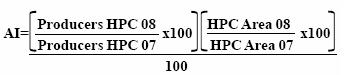
<body><![CDATA[<p align="justify"><font face="verdana" size="2">This study used the modified formula by Deleon 2007, PASOLAC 1999, to be called the acceptance index (AI), which calculates by comparing data from producers who used the HPC technology in 2007, with those who expressed a desire to apply technology in 2008, if they have supplied the seed, or if available on the market.</font></p>     <p align="justify"><font face="verdana" size="2"><img src="/img/revistas/agritm/v35n4/a6s2.jpg"></font></p>     <p align="justify"><font face="verdana" size="2">where, HPC producers 08= number of producers of the sample that would apply the HPC technology in 2008, having seed in the market, HPC producers 07= number of producers who applied the technology in 2007; HPC area 08= area where the technology was applied by the will of the producer, if there was any seed on the market during 2008; HPC area 07= total area planted with HPC maize in 2007 (Reyes, 1982; Sarmiento, 2002; Pedroza and Dicovskyi, 2006).</font></p>     <p align="justify"><font face="verdana" size="2"><b>Conceptual model</b></font></p>     <p align="justify"><font face="verdana" size="2">Like a Gordian knot, all variables are inter&#150;related, at certain levels of complexity equal to that reality as it is presented for the maize producer.</font></p>     <p align="justify"><font face="verdana" size="2">The maize crop is influenced by outside world variables &#150;exogenous&#150; that are beyond the control of producers and their own particular reality &#150;endogenous&#150;, to whom should make decisions for their crops.</font></p>     <p align="justify"><font face="verdana" size="2">From this perspective, the survey data within the model represent the endogenous variables or internal producer, which allow to relate the concepts of external reality and understand the phenomenon of acceptance of maize HCP as a whole, combining variables that controls with system components that do not depend on it.</font></p>     <p align="justify"><font face="verdana" size="2"><b>Technological component</b></font></p>     <p align="justify"><font face="verdana" size="2">The technical assistance provided by the CENTA within state policy and transfer of technology generation, supports technological information to growers in the area where it produces, this will allow a better perception of the advantages or disadvantages of the technologies that are transferred.</font></p>     <p align="justify"><font face="verdana" size="2"><b>Agronomic component</b></font></p>     ]]></body>
<body><![CDATA[<p align="justify"><font face="verdana" size="2">Where internal and external dynamics of maize, is contrasted with the varieties planted, agronomic factors, nutritional content and crop cycles, which can bring benefits to production. In a future implementation of the model can be seen climate variables or seasonal nature, such as droughts in a given area.</font></p>     <p align="justify"><font face="verdana" size="2"><b>Economic component</b></font></p>     <p align="justify"><font face="verdana" size="2">The short&#150;and medium term producers, local markets, global trade agreements, tariff policy and how they affect the wealth of the producer: farm size, tenure, purpose of crops and incomes from the producers.</font></p>     <p align="justify"><font face="verdana" size="2"><b>Social component</b></font></p>     <p align="justify"><font face="verdana" size="2">Food security, rural poverty, global economic crisis, etc., that are associated in the real production environment with some demographic variables: education, age, household composition, orientation of production and, most importantly, experience in growing maize. With the understanding of how the producer makes decisions in the process of technology transfer, the theoretical model allows for connection of external variables outside their scope of action with the complex reality of the producer.</font></p>     <p align="justify"><font face="verdana" size="2">&nbsp;</font></p>     <p align="justify"><font face="verdana" size="2"><b>RESULTS AND DISCUSSION</b></font></p>     <p align="justify"><font face="verdana" size="2">The reality of the producer from the subsystems theoretical model that was used, explains the national situation, the farmer produces in a complex environment, where linked to technology transfer, has access to agronomic products, which allows them to modify its economic reality and have a different social environment, improved quality of life, a systemic approach to the factors of production.</font></p>     <p align="justify"><font face="verdana" size="2">Thus, the producer, seeking a balance that enables it to be profitable in the cultivation and keep producing in an adverse economic environment, while allowing it to provide food security to his family, being up to date with advances in science and technology, it receives from the outside world through the technology transfer process that drive the institutions and the state.</font></p>     <p align="justify"><font face="verdana" size="2"><b>Calculating the acceptance index for HPC materials for 2008</b></font></p>     ]]></body>
<body><![CDATA[<p align="justify"><font face="verdana" size="2">The original concept of index acceptance used to monitor the early dissemination of agricultural technologies, considered a technology to succeed in acceptance, the percentage of producers who accept it should be at least 5 0%, while the numerical value of the index, at least equivalent to 25 units. The index acceptance calculated based on data from the survey was for 2008, as regards (<a href="/img/revistas/agritm/v35n4/a6t1.jpg" target="_blank">Table 1</a>).</font></p>     <p align="justify"><font face="verdana" size="2">The above table shows that 60.1% of producers surveyed (80 out of 133), are willing to grow 94.6% in their areas (71 out of 75 ha) and are willing to grow during the next agriculture cycle.</font></p>     <p align="justify"><font face="verdana" size="2">It is noted, according to results of the index acceptance 2008, materials under study, producers benefited from the distribution of maize seed HPC in 2007, hybrid maize Oro Blanco was the best qualified, with an IA in general regions of 82.5, second, reached Protem&aacute;s IA= 69.6 and Platinum, third, scored IA= 53.7. The Oro Blanco is an exceptional case, 82.5% of producers agreed 23% of these extra plant a total area of the areas during the investigation, the same way, with Protemas; 67.1% of producers are willing to grow 28.5% extra 100% of sown areas favored with the distribution of maize seed HPC in 2007.</font></p>     <p align="justify"><font face="verdana" size="2">It shows that the producer's intentions regarding the new technology in the region I was IA= 57.4, while in region IV, was IA= 61.5, although the information gathered was not possible to determine the cause of the difference of the index in both regions.</font></p>     <p align="justify"><font face="verdana" size="2">By comparing the IA between the materials evaluated and their geographical location, we find that the Oro Blanco in the region I, has much less acceptance (IA= 58.8) than in region IV (AI= 93.7), the Platinum's conduct was completely opposite, being more accepted in the region I (IA= 56.7) than in region IV (AI= 46.1).</font></p>     <p align="justify"><font face="verdana" size="2">The Protemas was not cultivated in the region I, while it had an IA= 69.6 in region IV. This shows that we can adapt the distribution of HPC materials based on the IA, in a given geographical area.</font></p>     <p align="justify"><font face="verdana" size="2">Moreover, women of childbearing age (between 15 and 49 years of age) and children under 3 years are approximately 40% of the family and the wider rural population.</font></p>     <p align="justify"><font face="verdana" size="2">An average rural family in El Salvador, consumed in tortillas and other corn uses daily, a total of 2.5 kg, at an average price of U.S. $ 0.22 (year 2008), with a daily spend of U.S. $ 0.54 cents annually totaling about 95 8.2 kg with a value of $ 210.</font></p>     <p align="justify"><font face="verdana" size="2"><b>Age and experience in growing maize</b></font></p>     <p align="justify"><font face="verdana" size="2">The key is the fact that only those producers with more experience in growing, solvency and financial ability, could maintain an economically viable production. The experience allows you to identify the advantages and disadvantages of new technology, adapt it to its economic goals, to become profitable on their crops.</font></p>     ]]></body>
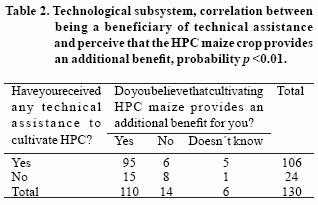
<body><![CDATA[<p align="justify"><font face="verdana" size="2">It was noted that the average age of participating farmers is 51 years, where 75% of farmers are older than 40 years and remaining 25%, ages 21 to 40 years.</font></p>     <p align="justify"><font face="verdana" size="2">On average, farmers have 32 years cultivating maize and others about 18 since they've begun to cultivate improved varieties and hybrids, because most of them began cultivating maize at the age of 12 to 20 years old.</font></p>     <p align="justify"><font face="verdana" size="2">Furthermore, the data shows that the age is a variable that has a highly significant correlation (99%) with the experience of producers and influences their ability to recognize that the HPC maize will provide an additional benefit. The variable age was a determining factor in technology transfer studies in countries like Mexico, India, Bangladesh (Bigg, 1997, Galindo <i>et al., </i>2000, Viana and Villar, 2001; Sangerman <i>et al., </i>2009).</font></p>     <p align="justify"><font face="verdana" size="2"><b>Technological subsystem</b></font></p>     <p align="justify"><font face="verdana" size="2">The transfer of technology <i>per se, </i>is a external component &#150;exogenous&#150; that benefits the producer when making decisions about what to produce, which variety or some type of agricultural practice to use in the field or farm, that is to say, an endogenously to production index.</font></p>     <p align="justify"><font face="verdana" size="2">The calculated test statistic of independence between these variables had a significance of 99%, meaning, it is perceived that being a beneficiary of technical assistance for HPC maize provides an additional benefit to the production, so it states that both variables are related (<a href="#t2">Table 2</a>).</font></p>     <p align="center"><font face="verdana" size="2"><a name="t2"></a></font></p>     <p align="center"><font face="verdana" size="2"><img src="/img/revistas/agritm/v35n4/a6t2.jpg"></font></p>     <p align="justify"><font face="verdana" size="2">From table values, it follows, in percentage terms, that from all the producers who received technical assistance during 2007, 89.6% of them perceive that the HPC maize provided an additional benefit.</font></p>     <p align="justify"><font face="verdana" size="2">It is considered as a first step, that the technology transfer method used by the institutions to provide additional nutritional benefits of HPC maize, has been efficient, while 60% of the 133 producers, decided to plant HCP in cycles subsequent agricultural cultivation in their fields.</font></p>     ]]></body>
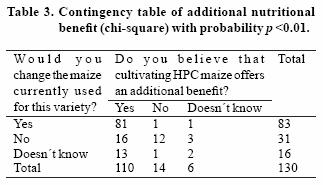
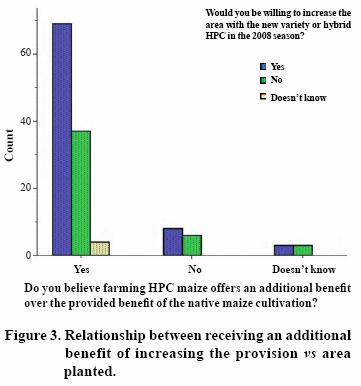
<body><![CDATA[<p align="center"><font face="verdana" size="2"><img src="/img/revistas/agritm/v35n4/a6t3.jpg"></font></p>     <p align="justify"><font face="verdana" size="2">This is logical, as well as being important that producers know and accept the benefits of this technology, it is also important to have available resources for its use.</font></p>     <p align="justify"><font face="verdana" size="2"><b>Nutritional quality of HPC materials</b></font></p>     <p align="justify"><font face="verdana" size="2">The nutritional quality of HPC maize measured from rates and tryptophan containing protein, was determined at a laboratory level within the study made by (CENTA&#150;MAL, 2008).</font></p>     <p align="justify"><font face="verdana" size="2">It was noted that the evaluated cultivars, HPC maize have a quality index greater than or equal to 0.90, which puts them way above of some traditional hybrids used by the maize producers, like H&#150;5 9 with a value in the table of 0.40 (<a href="/img/revistas/agritm/v35n4/a6t4.jpg" target="_blank">Table 4</a>).</font></p>     <p align="justify"><font face="verdana" size="2">Basically the agronomic analysis has shown the nutritional importance of this technology, which entails improved regarded as crucial by the producer, although its decision on the acceptance of technology has yet to undergo the economic criteria, as detailed below.</font></p>     <p align="justify"><font face="verdana" size="2"><a href="#f3">Figure 3</a>, shows that there is no statistical relationship between the perception of farmers about the utility of HPC maize for food (human or animal) and the arrangement they have to increase the production areas of maize cultivation in the coming years, with a statistical significance of 95%.</font></p>     <p align="center"><font face="verdana" size="2"><a name="f3"></a></font></p>     <p align="center"><font face="verdana" size="2"><img src="/img/revistas/agritm/v35n4/a6f3.jpg"></font></p>     <p align="justify"><font face="verdana" size="2"><b>Current use of maize areas</b></font></p>     ]]></body>
<body><![CDATA[<p align="justify"><font face="verdana" size="2">In the last decade, the nacional enviroment of the maize crop has changed in response to global trade policies of regional and international integration. Producers have developed responsiveness that allows them to constantly innovate the technologies used for production, with state support directed to the use of improved and hybrid maize.</font></p>     <p align="justify"><font face="verdana" size="2">Maize producers in El Salvador, are classified as small farmers from the area used for cultivation, since 40% of the crop area sown in the study area are smaller than one hectare. 48% is grown in plots of up to 2.4 ha and 12% balance is in areas between 2.3 to 5 ha.</font></p>     <p align="justify"><font face="verdana" size="2">Thus, 65% of the total area planted with maize (187 ha), is in the hands of owners, while 29% (84 ha) are cultivated and the remaining leases are land loans or other forms of tenure.</font></p>     <p align="justify"><font face="verdana" size="2">Considering the amount and the use or guidance given to the production, the statistical determined that 15% of production is oriented towards consumption and 85% marketing, with a positive relationship between both variables. A greater amount produced, more dedicated to marketing, in 99 of the cases studied.</font></p>     <p align="justify"><font face="verdana" size="2">Another important relationship to compare variables, specifically the land tenure and disposition of producing future incorporation of a larger area than it does now for the cultivation of HPC maize is negative.</font></p>     <p align="justify"><font face="verdana" size="2"><b>Effect of HPC maize yield in the index acceptance</b></font></p>     <p align="justify"><font face="verdana" size="2">In the case of HPC materials, it was proved that its nutritive quality of perception yields, with farmers in different areas of the country, contributing to its acceptance.</font></p>     <p align="justify"><font face="verdana" size="2">It was mentioned in the agronomic subsystem that the materials were accepted by 60% of the producers, who are in favor to keep cultivating, but is the economic factor, the most decisive.</font></p>     <p align="justify"><font face="verdana" size="2">So the real reason for not achieving 100% acceptance was that the HPC maize yields were 564 kg ha&#150;<sup>1</sup>, down from hybrid cultivars, or a decline in profitability of the crop of U.S. $ 149 per hectare.</font></p>     <p align="justify"><font face="verdana" size="2">This allows us to assert that significant differences exist between the yields of traditional materials and HPC maize hybrids, as shown in <a href="/img/revistas/agritm/v35n4/a6t5.jpg" target="_blank">Table 5</a>, which has high statistical significance (99%) in the middle term tests.</font></p>     ]]></body>
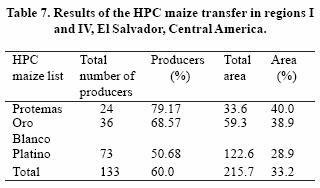
<body><![CDATA[<p align="justify"><font face="verdana" size="2">Even so, producers who accept the HPC consider that these varieties provide an additional benefit of good yields, which are seen up to 43.5% of producers. Moreover, 45.4% of the very same producers, believe that HPC provides better quality maize protein for human and animal consumption. It is noted that establishes a significant difference between the yields of maize hybrids and HPC, equivalent to 564 kg ha<sup>&#150;1</sup> averaged 425 kg ha<sup>&#150;1</sup> at the lower limit and 704 kg ha<sup>&#150;1</sup> in the upper range, either producer subsistence or commercial.</font></p>     <p align="justify"><font face="verdana" size="2">The obtained results estimate the economic benchmarking of the producers of maize in 2007, considering averages and percentils, from the producers' strata related to the income parameters, costs and benefits of both producers in general and HPC cultivars (<a href="/img/revistas/agritm/v35n4/a6t6.jpg" target="_blank">Table 6</a>).</font></p>     <p align="justify"><font face="verdana" size="2">By comparing the average net income of hybrid maize against HPC materials, the 2007 data, show that the hybrids were $ 80 ha<sup>&#150;1</sup> while the HPC maize, had a deficit of nearly U.S. $ 69 ha<sup>&#150;1</sup>.</font></p>     <p align="justify"><font face="verdana" size="2">Regarding the statistical distribution of data, it appears that the 25th percentile for both the hybrid cultivars ($ &#150;166 ha<sup>&#150;1</sup>) and the HPC ($ &#150;310 ha<sup>&#150;1</sup>) have a negative result, although the economic loss for the hybrid is less traditional.</font></p>     <p align="justify"><font face="verdana" size="2">Thus, the difference in income from the sale of hybrid materials for an average family, is increased to 3 356 kg compared to 1 295 kg HPC maize produced.</font></p>     <p align="justify"><font face="verdana" size="2"><b>Prospects for HPC maize</b></font></p>     <p align="justify"><font face="verdana" size="2">It was found that 60% of the producers (133 individuals) accept the HPC maize technology and are willing to continue growing at 3 3.2% (total= 215.7) from total cases, in the area of cultivated maize in 2007.</font></p>     <p align="justify"><font face="verdana" size="2">According to <a href="#t7">Table 7</a>, 79.17% of farmers who cultivated Protemas in 2007, are willing to grow 40% from total area (total= 33.6), the 68.57% of Oro Blanco producers are willing to grow 38.9% (total= 59.3) and 50.68% of Platino producers are willing to grow 28.9% (total= 28.9) of their areas with this technology.</font></p>     <p align="center"><font face="verdana" size="2"><a name="t7"></a></font></p>     <p align="center"><font face="verdana" size="2"><img src="/img/revistas/agritm/v35n4/a6t7.jpg"></font></p>     ]]></body>
<body><![CDATA[<p align="justify"><font face="verdana" size="2">The materials are rejected by 40% of the population of producers and won't be introduced in about 66.7% of total areas, if the current perception is not improved, related to the efficiency of these materials, according to them the HPC mazie is not up to expectations they've got.</font></p>     <p align="justify"><font face="verdana" size="2">The index acceptance analysis of HPC maize, under the set of internal and external variables that are under consideration, can make some assumptions about the potential coverage area, which in the future could have these materials, which stems the current perception that farmers've got of their performance.</font></p>     <p align="justify"><font face="verdana" size="2">&nbsp;</font></p>     <p align="justify"><font face="verdana" size="2"><b>CONCLUSIONS</b></font></p>     <p align="justify"><font face="verdana" size="2">The IA of HPC materials in the region I and IV of El Salvador CA, reflect their acceptance by 60% of the population of maize producers, who are willing to grow in subsequent cycles, about 33% of all areas to be cultivated during 2007.</font></p>     <p align="justify"><font face="verdana" size="2">From the HPC cultivars included in the study, the Oro Blanco hybrid is the most favored with an IA general of 82.54, while the variety Protemas, second, reached a rate of 69.64 while platinum hybrid maize gets a IA 53.70. In the region IV is more accepted the Oro Blanco hybrid, while the I is the hybrid Platino.</font></p>     <p align="justify"><font face="verdana" size="2">At establishing social, economic, agronomic and technological factors as a cause that influences the determination of IA, every level plays a specific role and taking all of them into account the economic factor determines more forcefully, the decision by the producers, regarding the use of these materials in subsequent periods of the agricultural cycle.</font></p>     <p align="justify"><font face="verdana" size="2">&nbsp;</font></p>     <p align="justify"><font face="verdana" size="2"><b>ACKNOWLEDGEMENT</b></font></p>     <p align="justify"><font face="verdana" size="2">Thanks to the great support in the elaboration of theis article to Air line pilot Jes&uacute;s Cuevas Coeto. Tank you very much.</font></p>     ]]></body>
<body><![CDATA[<p align="justify"><font face="verdana" size="2">&nbsp;</font></p>     <p align="justify"><font face="verdana" size="2"><b>LITERATURE CITED</b></font></p>     <!-- ref --><p align="justify"><font face="verdana" size="2">Biggs, S. 1997. Resourse&#150;poor farmer participation in research: a synthesis of experience in nine national agricultural research systems. OFCOR. Comparative Study Paper N&deg; 3. ISNAR. The Hague.</font>&nbsp;&nbsp;&nbsp;&nbsp;&nbsp;&nbsp;&nbsp;&nbsp;[&#160;<a href="javascript:void(0);" onclick="javascript: window.open('/scielo.php?script=sci_nlinks&ref=513342&pid=S0568-2517200900040000600001&lng=','','width=640,height=500,resizable=yes,scrollbars=1,menubar=yes,');">Links</a>&#160;]<!-- end-ref --><!-- ref --><p align="justify"><font face="verdana" size="2">Centro Internacional del Mejoramiento del Ma&iacute;z y Trigo (CIMMYT&#150; PURDUE). 1977a. Compendio de las ponencias presentadas en el simposio internacional ma&iacute;z de alta calidad prote&iacute;nica. Lafayette, Indiana, EUA, CIMMYT. (Conferencia).</font>&nbsp;&nbsp;&nbsp;&nbsp;&nbsp;&nbsp;&nbsp;&nbsp;[&#160;<a href="javascript:void(0);" onclick="javascript: window.open('/scielo.php?script=sci_nlinks&ref=513343&pid=S0568-2517200900040000600002&lng=','','width=640,height=500,resizable=yes,scrollbars=1,menubar=yes,');">Links</a>&#160;]<!-- end-ref --><!-- ref --><p align="justify"><font face="verdana" size="2">Centro Internacional del Mejoramiento del Ma&iacute;z y Trigo (CIMMYT&#150; PURDUE). 1977b. Compendio de las ponencias presentadas en el simposio internacional ma&iacute;z de alta calidad prote&iacute;nica. Lafayette, Indiana, EUA. CIMMYT. (Conferencia).</font>&nbsp;&nbsp;&nbsp;&nbsp;&nbsp;&nbsp;&nbsp;&nbsp;[&#160;<a href="javascript:void(0);" onclick="javascript: window.open('/scielo.php?script=sci_nlinks&ref=513344&pid=S0568-2517200900040000600003&lng=','','width=640,height=500,resizable=yes,scrollbars=1,menubar=yes,');">Links</a>&#160;]<!-- end-ref --><!-- ref --><p align="justify"><font face="verdana" size="2">Centro Nacional de Tecnolog&iacute;a Agropecuaria&#150; Direcci&oacute;n General de Estad&iacute;stica Agropecuaria (CENTA&#150;DGEA). 2007. Memoria de labores San Andr&eacute;s, El Salvador, C. A. (Informe).</font>&nbsp;&nbsp;&nbsp;&nbsp;&nbsp;&nbsp;&nbsp;&nbsp;[&#160;<a href="javascript:void(0);" onclick="javascript: window.open('/scielo.php?script=sci_nlinks&ref=513345&pid=S0568-2517200900040000600004&lng=','','width=640,height=500,resizable=yes,scrollbars=1,menubar=yes,');">Links</a>&#160;]<!-- end-ref --><!-- ref --><p align="justify"><font face="verdana" size="2">Centro Nacional de Tecnolog&iacute;a Agropecuaria y Forestal del Ministerio de Agricultura y Ganader&iacute;a (CENTA). <a href="http://www.centa.gob.sv/" target="_blank">WWW.CENTA.GOB.SV</a> (En l&iacute;nea) // Centro Nacional de Tecnolog&iacute;a Agropecuaria y Forestal. Centro de Documentaci&oacute;n, (consultado febrero, 2008). <a href="http://www.centa.gob.sv/" target="_blank">http://www.centa.gob.sv/</a></A>.</font>&nbsp;&nbsp;&nbsp;&nbsp;&nbsp;&nbsp;&nbsp;&nbsp;[&#160;<a href="javascript:void(0);" onclick="javascript: window.open('/scielo.php?script=sci_nlinks&ref=513346&pid=S0568-2517200900040000600005&lng=','','width=640,height=500,resizable=yes,scrollbars=1,menubar=yes,');">Links</a>&#160;]<!-- end-ref --><!-- ref --><p align="justify"><font face="verdana" size="2">Centro Nacional de Tecnolog&iacute;a Agropecuaria y Forestal del Ministerio de Agricultura y Ganader&iacute;a (CENTA&#150;MAG). 2002. H&iacute;bridos de ma&iacute;z HQ&#150;6 1. San Andr&eacute;s, El Salvador, C. A. (Bolet&iacute;n T&eacute;cnico 1).</font>&nbsp;&nbsp;&nbsp;&nbsp;&nbsp;&nbsp;&nbsp;&nbsp;[&#160;<a href="javascript:void(0);" onclick="javascript: window.open('/scielo.php?script=sci_nlinks&ref=513347&pid=S0568-2517200900040000600006&lng=','','width=640,height=500,resizable=yes,scrollbars=1,menubar=yes,');">Links</a>&#160;]<!-- end-ref --><!-- ref --><p align="justify"><font face="verdana" size="2">Centro Nacional de Tecnolog&iacute;a Agropecuaria y Forestal del Ministerio de Agricultura y Ganader&iacute;a (CENTA&#150;MAG). 2006a. Programa de granos b&aacute;sicos CENTA&#150;Protem&aacute;s: ma&iacute;z de polinizaci&oacute;n libre con alta calidad proteica. San Andr&eacute;s, El Salvador.</font>&nbsp;&nbsp;&nbsp;&nbsp;&nbsp;&nbsp;&nbsp;&nbsp;[&#160;<a href="javascript:void(0);" onclick="javascript: window.open('/scielo.php?script=sci_nlinks&ref=513348&pid=S0568-2517200900040000600007&lng=','','width=640,height=500,resizable=yes,scrollbars=1,menubar=yes,');">Links</a>&#160;]<!-- end-ref --><!-- ref --><p align="justify"><font face="verdana" size="2">Centro Nacional de Tecnolog&iacute;a Agropecuaria y Forestal del Ministerio de Agricultura y Ganader&iacute;a (CENTA&#150;MAG). 2006b. Memoria de labores. San Andr&eacute;s, El Salvador. (Informe).</font>&nbsp;&nbsp;&nbsp;&nbsp;&nbsp;&nbsp;&nbsp;&nbsp;[&#160;<a href="javascript:void(0);" onclick="javascript: window.open('/scielo.php?script=sci_nlinks&ref=513349&pid=S0568-2517200900040000600008&lng=','','width=640,height=500,resizable=yes,scrollbars=1,menubar=yes,');">Links</a>&#160;]<!-- end-ref --><!-- ref --><p align="justify"><font face="verdana" size="2">Dami&aacute;n, H. M. A. 2007. Apropiaci&oacute;n de tecnolog&iacute;a por actividades del ciclo agr&iacute;cola del ma&iacute;z. <i>In: </i>apropiaci&oacute;n de tecnolog&iacute;a agr&iacute;cola. Dami&aacute;n, H. M. A (coord.). Benem&eacute;rita Universidad Aut&oacute;noma de Puebla&#150; CONACYT&#150;Siza&#150; H. Congreso del estado Tlaxcala, LVII Legislatura, Puebla, Puebla.</font>&nbsp;&nbsp;&nbsp;&nbsp;&nbsp;&nbsp;&nbsp;&nbsp;[&#160;<a href="javascript:void(0);" onclick="javascript: window.open('/scielo.php?script=sci_nlinks&ref=513350&pid=S0568-2517200900040000600009&lng=','','width=640,height=500,resizable=yes,scrollbars=1,menubar=yes,');">Links</a>&#160;]<!-- end-ref --><!-- ref --><p align="justify"><font face="verdana" size="2">Galindo, G. G.; G&oacute;mez, A. G. y Tabares, R. W. C. 2000. Caracterizaci&oacute;n de los extensionistas del programa elemental de asistencia t&eacute;cnica en Zacatecas. Rev. Fitotec. Mex. 23(2):307&#150;320.</font>&nbsp;&nbsp;&nbsp;&nbsp;&nbsp;&nbsp;&nbsp;&nbsp;[&#160;<a href="javascript:void(0);" onclick="javascript: window.open('/scielo.php?script=sci_nlinks&ref=513351&pid=S0568-2517200900040000600010&lng=','','width=640,height=500,resizable=yes,scrollbars=1,menubar=yes,');">Links</a>&#160;]<!-- end-ref --><!-- ref --><p align="justify"><font face="verdana" size="2">Ministerio de Agricultura y Ganader&iacute;a (MAG). Direcci&oacute;n de estad&iacute;sticas y censos. 2005&#150;2006. El Salvador, C. A.</font>&nbsp;&nbsp;&nbsp;&nbsp;&nbsp;&nbsp;&nbsp;&nbsp;[&#160;<a href="javascript:void(0);" onclick="javascript: window.open('/scielo.php?script=sci_nlinks&ref=513352&pid=S0568-2517200900040000600011&lng=','','width=640,height=500,resizable=yes,scrollbars=1,menubar=yes,');">Links</a>&#160;]<!-- end-ref --><!-- ref --><p align="justify"><font face="verdana" size="2">Ministerio de Agricultura y Ganader&iacute;a&#150; Centro Nacional de Tecnolog&iacute;a Agropecuaria y Forestal del Ministerio de Agricultura y Ganader&iacute;a. Direcci&oacute;n General de Econom&iacute;a Agropecuaria. (CENTA&#150;MAG&#150;a). 2006. Anuario de Estad&iacute;sticas Agropecuarias (Informe). El Salvador.</font>&nbsp;&nbsp;&nbsp;&nbsp;&nbsp;&nbsp;&nbsp;&nbsp;[&#160;<a href="javascript:void(0);" onclick="javascript: window.open('/scielo.php?script=sci_nlinks&ref=513353&pid=S0568-2517200900040000600012&lng=','','width=640,height=500,resizable=yes,scrollbars=1,menubar=yes,');">Links</a>&#160;]<!-- end-ref --><!-- ref --><p align="justify"><font face="verdana" size="2">Ministerio de Agricultura y Ganader&iacute;a&#150; Centro Nacional de Tecnolog&iacute;a Agropecuaria y Forestal del Ministerio de Agricultura y Ganader&iacute;a. Direcci&oacute;n General de Econom&iacute;a Agropecuaria. (CENTA&#150; MAG). 2007. Anuario de Estad&iacute;sticas Agropecuarias. El Salvador, C. A. (Informe).</font>&nbsp;&nbsp;&nbsp;&nbsp;&nbsp;&nbsp;&nbsp;&nbsp;[&#160;<a href="javascript:void(0);" onclick="javascript: window.open('/scielo.php?script=sci_nlinks&ref=513354&pid=S0568-2517200900040000600013&lng=','','width=640,height=500,resizable=yes,scrollbars=1,menubar=yes,');">Links</a>&#160;]<!-- end-ref --><!-- ref --><p align="justify"><font face="verdana" size="2">Ministerio de Agricultura y Ganader&iacute;a&#150; Centro Nacional de Tecnolog&iacute;a Agropecuaria y Forestal (CENTA&#150;MAG&#150;Agroinnovaci&oacute;n). 2008. (Publicaci&oacute;n peri&oacute;dica). El Salvador, C. A.</font>&nbsp;&nbsp;&nbsp;&nbsp;&nbsp;&nbsp;&nbsp;&nbsp;[&#160;<a href="javascript:void(0);" onclick="javascript: window.open('/scielo.php?script=sci_nlinks&ref=513355&pid=S0568-2517200900040000600014&lng=','','width=640,height=500,resizable=yes,scrollbars=1,menubar=yes,');">Links</a>&#160;]<!-- end-ref --><!-- ref --><p align="justify"><font face="verdana" size="2">PASOLAC&#150;IMPHRU&#150;FIDER.1999. &Iacute;ndice de aceptabilidad. Managua, Nicaragua. Serviprin, S. A. p. 145.</font>&nbsp;&nbsp;&nbsp;&nbsp;&nbsp;&nbsp;&nbsp;&nbsp;[&#160;<a href="javascript:void(0);" onclick="javascript: window.open('/scielo.php?script=sci_nlinks&ref=513356&pid=S0568-2517200900040000600015&lng=','','width=640,height=500,resizable=yes,scrollbars=1,menubar=yes,');">Links</a>&#160;]<!-- end-ref --><!-- ref --><p align="justify"><font face="verdana" size="2">Pedroza, H. y Dicovskyi, L. 2006. Sistema de an&aacute;lisis estad&iacute;stico con SPSS. Managua, Nicaragua: Instituto Interamericano de Tecnolog&iacute;a Agr&iacute;cola (IICA)&#150; Instituto de Tecnolog&iacute;a Agropecuaria (INTA). p. 321.</font>&nbsp;&nbsp;&nbsp;&nbsp;&nbsp;&nbsp;&nbsp;&nbsp;[&#160;<a href="javascript:void(0);" onclick="javascript: window.open('/scielo.php?script=sci_nlinks&ref=513357&pid=S0568-2517200900040000600016&lng=','','width=640,height=500,resizable=yes,scrollbars=1,menubar=yes,');">Links</a>&#160;]<!-- end-ref --><!-- ref --><p align="justify"><font face="verdana" size="2">Reyes, P. 1982. Bioestad&iacute;stica aplicada. M&eacute;xico, Trillas. p. 342.</font>&nbsp;&nbsp;&nbsp;&nbsp;&nbsp;&nbsp;&nbsp;&nbsp;[&#160;<a href="javascript:void(0);" onclick="javascript: window.open('/scielo.php?script=sci_nlinks&ref=513358&pid=S0568-2517200900040000600017&lng=','','width=640,height=500,resizable=yes,scrollbars=1,menubar=yes,');">Links</a>&#160;]<!-- end-ref --><!-- ref --><p align="justify"><font face="verdana" size="2">Sangerman, J. D. M; Espitia, R. E.; Villase&ntilde;or, M. H. E.; Ram&iacute;rez, V. V. y Alberti, M. P. 2009. Estudio de caso de la transferencia de tecnolog&iacute;a de trigo del INIFAP. Rev. Agric. T&eacute;c. M&eacute;x. 35(1)25&#150;37.</font>&nbsp;&nbsp;&nbsp;&nbsp;&nbsp;&nbsp;&nbsp;&nbsp;[&#160;<a href="javascript:void(0);" onclick="javascript: window.open('/scielo.php?script=sci_nlinks&ref=513359&pid=S0568-2517200900040000600018&lng=','','width=640,height=500,resizable=yes,scrollbars=1,menubar=yes,');">Links</a>&#160;]<!-- end-ref --><!-- ref --><p align="justify"><font face="verdana" size="2">Sarmiento, Ma. 2002. An&aacute;lisis sist&eacute;mico: consideraciones generales sobre el tema. Aplicaci&oacute;n ejemplificada: equilibrio entre el poder judicial y los otros poderes estatales en el marco de una democracia constitucional. Buenos Aires, Argentina. p. 145.</font>&nbsp;&nbsp;&nbsp;&nbsp;&nbsp;&nbsp;&nbsp;&nbsp;[&#160;<a href="javascript:void(0);" onclick="javascript: window.open('/scielo.php?script=sci_nlinks&ref=513360&pid=S0568-2517200900040000600019&lng=','','width=640,height=500,resizable=yes,scrollbars=1,menubar=yes,');">Links</a>&#160;]<!-- end-ref --><!-- ref --><p align="justify"><font face="verdana" size="2">Viana, A y Villar, B. 2001. Adopci&oacute;n de variedades mejoradas de frijol en la regi&oacute;n de la Frailesca, Chiapas, M&eacute;xico. Secretar&iacute;a de Agricultura, Ganader&iacute;a y Desarrollo Rural. Instituto Nacional de Investigaciones Forestales, Agr&iacute;colas y Pecuarias. Centro de Investigaci&oacute;n Regional del Pac&iacute;fico Sur. Campo Experimental, Centro de Chiapas. Divisi&oacute;n Agr&iacute;cola. M&eacute;xico, D. F. p. 1&#150;25 (Libro T&eacute;cnico N&uacute;m. 1).</font>&nbsp;&nbsp;&nbsp;&nbsp;&nbsp;&nbsp;&nbsp;&nbsp;[&#160;<a href="javascript:void(0);" onclick="javascript: window.open('/scielo.php?script=sci_nlinks&ref=513361&pid=S0568-2517200900040000600020&lng=','','width=640,height=500,resizable=yes,scrollbars=1,menubar=yes,');">Links</a>&#160;]<!-- end-ref --> ]]></body><back>
<ref-list>
<ref id="B1">
<nlm-citation citation-type="book">
<person-group person-group-type="author">
<name>
<surname><![CDATA[Biggs]]></surname>
<given-names><![CDATA[S.]]></given-names>
</name>
</person-group>
<source><![CDATA[Resourse-poor farmer participation in research: a synthesis of experience in nine national agricultural research systems]]></source>
<year>1997</year>
<volume>3</volume>
<publisher-loc><![CDATA[The Hague ]]></publisher-loc>
<publisher-name><![CDATA[ISNAR]]></publisher-name>
</nlm-citation>
</ref>
<ref id="B2">
<nlm-citation citation-type="confpro">
<collab>Centro Internacional del Mejoramiento del Maíz y Trigo (CIMMYT- PURDUE)</collab>
<source><![CDATA[]]></source>
<year>1977</year>
<conf-name><![CDATA[ Compendio de las ponencias presentadas en el simposio internacional maíz de alta calidad proteínica]]></conf-name>
<conf-loc>Lafayette Indiana</conf-loc>
</nlm-citation>
</ref>
<ref id="B3">
<nlm-citation citation-type="confpro">
<collab>Centro Internacional del Mejoramiento del Maíz y Trigo (CIMMYT- PURDUE)</collab>
<source><![CDATA[]]></source>
<year>1977</year>
<conf-name><![CDATA[ Compendio de las ponencias presentadas en el simposio internacional maíz de alta calidad proteínica]]></conf-name>
<conf-loc>Lafayette Indiana</conf-loc>
</nlm-citation>
</ref>
<ref id="B4">
<nlm-citation citation-type="">
<collab>Dirección General de Estadística Agropecuaria^dCentro Nacional de Tecnología Agropecuaria</collab>
<source><![CDATA[Memoria de labores San Andrés, El Salvador, C. A]]></source>
<year>2007</year>
</nlm-citation>
</ref>
<ref id="B5">
<nlm-citation citation-type="">
<collab>Ministerio de Agricultura y Ganadería^dCentro Nacional de Tecnología Agropecuaria y Forestal</collab>
<source><![CDATA[]]></source>
<year></year>
</nlm-citation>
</ref>
<ref id="B6">
<nlm-citation citation-type="">
<collab>Ministerio de Agricultura y Ganadería^dCentro Nacional de Tecnología Agropecuaria y Forestal</collab>
<source><![CDATA[Híbridos de maíz HQ-6 1]]></source>
<year>2002</year>
<volume>1</volume>
<publisher-loc><![CDATA[San Andrés ]]></publisher-loc>
</nlm-citation>
</ref>
<ref id="B7">
<nlm-citation citation-type="">
<collab>Ministerio de Agricultura y Ganadería^dCentro Nacional de Tecnología Agropecuaria y Forestal</collab>
<source><![CDATA[Programa de granos básicos CENTA-Protemás: maíz de polinización libre con alta calidad proteica]]></source>
<year>2006</year>
<publisher-loc><![CDATA[San Andrés ]]></publisher-loc>
</nlm-citation>
</ref>
<ref id="B8">
<nlm-citation citation-type="">
<collab>Ministerio de Agricultura y Ganadería^dCentro Nacional de Tecnología Agropecuaria y Forestal</collab>
<source><![CDATA[Memoria de labores]]></source>
<year>2006</year>
<publisher-loc><![CDATA[San Andrés ]]></publisher-loc>
</nlm-citation>
</ref>
<ref id="B9">
<nlm-citation citation-type="book">
<person-group person-group-type="author">
<name>
<surname><![CDATA[Damián]]></surname>
<given-names><![CDATA[H. M. A.]]></given-names>
</name>
</person-group>
<article-title xml:lang="es"><![CDATA[Apropiación de tecnología por actividades del ciclo agrícola del maíz]]></article-title>
<person-group person-group-type="editor">
<name>
<surname><![CDATA[Damián]]></surname>
<given-names><![CDATA[H. M. A]]></given-names>
</name>
</person-group>
<source><![CDATA[apropiación de tecnología agrícola]]></source>
<year>2007</year>
<publisher-loc><![CDATA[Puebla^ePuebla Puebla]]></publisher-loc>
<publisher-name><![CDATA[Benemérita Universidad Autónoma de PueblaCONACYTSizaH. Congreso del estado Tlaxcala, LVII Legislatura]]></publisher-name>
</nlm-citation>
</ref>
<ref id="B10">
<nlm-citation citation-type="journal">
<person-group person-group-type="author">
<name>
<surname><![CDATA[Galindo]]></surname>
<given-names><![CDATA[G. G.]]></given-names>
</name>
<name>
<surname><![CDATA[Gómez]]></surname>
<given-names><![CDATA[A. G.]]></given-names>
</name>
<name>
<surname><![CDATA[Tabares]]></surname>
<given-names><![CDATA[R. W. C.]]></given-names>
</name>
</person-group>
<article-title xml:lang="es"><![CDATA[Caracterización de los extensionistas del programa elemental de asistencia técnica en Zacatecas]]></article-title>
<source><![CDATA[Rev. Fitotec. Mex.]]></source>
<year>2000</year>
<volume>23</volume>
<numero>2</numero>
<issue>2</issue>
<page-range>307-320</page-range></nlm-citation>
</ref>
<ref id="B11">
<nlm-citation citation-type="">
<collab>Ministerio de Agricultura y Ganadería (MAG)</collab>
<source><![CDATA[Dirección de estadísticas y censos. 2005-2006]]></source>
<year></year>
</nlm-citation>
</ref>
<ref id="B12">
<nlm-citation citation-type="">
<collab>Ministerio de Agricultura y Ganadería^dCentro Nacional de Tecnología Agropecuaria y Forestal del Ministerio de Agricultura y Ganadería. Dirección General de Economía Agropecuaria</collab>
<source><![CDATA[Anuario de Estadísticas Agropecuarias (Informe)]]></source>
<year>2006</year>
</nlm-citation>
</ref>
<ref id="B13">
<nlm-citation citation-type="">
<collab>Ministerio de Agricultura y Ganadería^dCentro Nacional de Tecnología Agropecuaria y Forestal del Ministerio de Agricultura y Ganadería. Dirección General de Economía Agropecuaria</collab>
<source><![CDATA[Anuario de Estadísticas Agropecuarias]]></source>
<year>2007</year>
</nlm-citation>
</ref>
<ref id="B14">
<nlm-citation citation-type="">
<collab>Ministerio de Agricultura y Ganadería^dCentro Nacional de Tecnología Agropecuaria y Forestal</collab>
<source><![CDATA[]]></source>
<year>2008</year>
</nlm-citation>
</ref>
<ref id="B15">
<nlm-citation citation-type="book">
<collab>PASOLAC</collab>
<collab>IMPHRU</collab>
<collab>FIDER</collab>
<source><![CDATA[Índice de aceptabilidad]]></source>
<year>1999</year>
<page-range>145</page-range><publisher-loc><![CDATA[Managua ]]></publisher-loc>
<publisher-name><![CDATA[Serviprin, S. A.]]></publisher-name>
</nlm-citation>
</ref>
<ref id="B16">
<nlm-citation citation-type="book">
<person-group person-group-type="author">
<name>
<surname><![CDATA[Pedroza]]></surname>
<given-names><![CDATA[H.]]></given-names>
</name>
<name>
<surname><![CDATA[Dicovskyi]]></surname>
<given-names><![CDATA[L.]]></given-names>
</name>
</person-group>
<source><![CDATA[Sistema de análisis estadístico con SPSS]]></source>
<year>2006</year>
<page-range>321</page-range><publisher-loc><![CDATA[Managua ]]></publisher-loc>
<publisher-name><![CDATA[Instituto Interamericano de Tecnología Agrícola (IICA)Instituto de Tecnología Agropecuaria (INTA)]]></publisher-name>
</nlm-citation>
</ref>
<ref id="B17">
<nlm-citation citation-type="book">
<person-group person-group-type="author">
<name>
<surname><![CDATA[Reyes]]></surname>
<given-names><![CDATA[P.]]></given-names>
</name>
</person-group>
<source><![CDATA[Bioestadística aplicada]]></source>
<year>1982</year>
<page-range>342</page-range><publisher-name><![CDATA[Trillas]]></publisher-name>
</nlm-citation>
</ref>
<ref id="B18">
<nlm-citation citation-type="journal">
<person-group person-group-type="author">
<name>
<surname><![CDATA[Sangerman]]></surname>
<given-names><![CDATA[J. D. M]]></given-names>
</name>
<name>
<surname><![CDATA[Espitia]]></surname>
<given-names><![CDATA[R. E.]]></given-names>
</name>
<name>
<surname><![CDATA[Villaseñor]]></surname>
<given-names><![CDATA[M. H. E.]]></given-names>
</name>
<name>
<surname><![CDATA[Ramírez]]></surname>
<given-names><![CDATA[V. V.]]></given-names>
</name>
<name>
<surname><![CDATA[Alberti]]></surname>
<given-names><![CDATA[M. P.]]></given-names>
</name>
</person-group>
<article-title xml:lang="es"><![CDATA[Estudio de caso de la transferencia de tecnología de trigo del INIFAP]]></article-title>
<source><![CDATA[Rev. Agric. Téc. Méx.]]></source>
<year>2009</year>
<volume>35</volume>
<numero>1</numero>
<issue>1</issue>
<page-range>25-37</page-range></nlm-citation>
</ref>
<ref id="B19">
<nlm-citation citation-type="">
<person-group person-group-type="author">
<name>
<surname><![CDATA[Sarmiento]]></surname>
<given-names><![CDATA[Ma.]]></given-names>
</name>
</person-group>
<source><![CDATA[Análisis sistémico: consideraciones generales sobre el tema. Aplicación ejemplificada: equilibrio entre el poder judicial y los otros poderes estatales en el marco de una democracia constitucional]]></source>
<year>2002</year>
<page-range>145</page-range><publisher-loc><![CDATA[Buenos Aires ]]></publisher-loc>
</nlm-citation>
</ref>
<ref id="B20">
<nlm-citation citation-type="book">
<person-group person-group-type="author">
<name>
<surname><![CDATA[Viana]]></surname>
<given-names><![CDATA[A]]></given-names>
</name>
<name>
<surname><![CDATA[Villar]]></surname>
<given-names><![CDATA[B.]]></given-names>
</name>
</person-group>
<source><![CDATA[Adopción de variedades mejoradas de frijol en la región de la Frailesca, Chiapas, México]]></source>
<year>2001</year>
<volume>1</volume>
<page-range>1-25</page-range><publisher-loc><![CDATA[México^eD. F. D. F.]]></publisher-loc>
<publisher-name><![CDATA[Secretaría de Agricultura, Ganadería y Desarrollo RuralInstituto Nacional de Investigaciones Forestales, Agrícolas y Pecuarias. Centro de Investigación Regional del Pacífico Sur. Campo Experimental, Centro de Chiapas. División Agrícola]]></publisher-name>
</nlm-citation>
</ref>
</ref-list>
</back>
</article>