<?xml version="1.0" encoding="ISO-8859-1"?><article xmlns:mml="http://www.w3.org/1998/Math/MathML" xmlns:xlink="http://www.w3.org/1999/xlink" xmlns:xsi="http://www.w3.org/2001/XMLSchema-instance">
<front>
<journal-meta>
<journal-id>0370-5943</journal-id>
<journal-title><![CDATA[Revista latinoamericana de química]]></journal-title>
<abbrev-journal-title><![CDATA[Rev. latinoam. quím]]></abbrev-journal-title>
<issn>0370-5943</issn>
<publisher>
<publisher-name><![CDATA[Laboratorios Mixim S.A.]]></publisher-name>
</publisher>
</journal-meta>
<article-meta>
<article-id>S0370-59432013000200002</article-id>
<title-group>
<article-title xml:lang="en"><![CDATA[Chemical composition and antibacterial activity of Astronium graveolens Jacq essential oil]]></article-title>
</title-group>
<contrib-group>
<contrib contrib-type="author">
<name>
<surname><![CDATA[Hernández]]></surname>
<given-names><![CDATA[Vanessa]]></given-names>
</name>
<xref ref-type="aff" rid="A01"/>
</contrib>
<contrib contrib-type="author">
<name>
<surname><![CDATA[Mora]]></surname>
<given-names><![CDATA[Flor]]></given-names>
</name>
<xref ref-type="aff" rid="A01"/>
</contrib>
<contrib contrib-type="author">
<name>
<surname><![CDATA[Araque]]></surname>
<given-names><![CDATA[María]]></given-names>
</name>
<xref ref-type="aff" rid="A02"/>
</contrib>
<contrib contrib-type="author">
<name>
<surname><![CDATA[De Montijo]]></surname>
<given-names><![CDATA[Soumi]]></given-names>
</name>
<xref ref-type="aff" rid="A02"/>
</contrib>
<contrib contrib-type="author">
<name>
<surname><![CDATA[Rojas]]></surname>
<given-names><![CDATA[Luis]]></given-names>
</name>
<xref ref-type="aff" rid="A03"/>
</contrib>
<contrib contrib-type="author">
<name>
<surname><![CDATA[Meléndez]]></surname>
<given-names><![CDATA[Pablo]]></given-names>
</name>
<xref ref-type="aff" rid="A01"/>
</contrib>
<contrib contrib-type="author">
<name>
<surname><![CDATA[De Tommasi]]></surname>
<given-names><![CDATA[Nunziatina]]></given-names>
</name>
<xref ref-type="aff" rid="A04"/>
</contrib>
</contrib-group>
<aff id="A01">
<institution><![CDATA[,University of Los Andes Faculty of Pharmacy and Bioanalysis Department of Pharmacognosy and Organic Medicaments]]></institution>
<addr-line><![CDATA[Mérida ]]></addr-line>
<country>Venezuela</country>
</aff>
<aff id="A02">
<institution><![CDATA[,University of Los Andes Faculty of Pharmacy and Bioanalysis Department of Microbiology and Parasitology]]></institution>
<addr-line><![CDATA[Mérida ]]></addr-line>
<country>Venezuela</country>
</aff>
<aff id="A03">
<institution><![CDATA[,University of Los Andes Faculty of Pharmacy and Bioanalysis Research Institute]]></institution>
<addr-line><![CDATA[Mérida ]]></addr-line>
<country>Venezuela</country>
</aff>
<aff id="A04">
<institution><![CDATA[,University of Salerno Department of Pharmaceutical and Biomedical Sciences ]]></institution>
<addr-line><![CDATA[Fisciano ]]></addr-line>
<country>Italia</country>
</aff>
<pub-date pub-type="pub">
<day>00</day>
<month>00</month>
<year>2013</year>
</pub-date>
<pub-date pub-type="epub">
<day>00</day>
<month>00</month>
<year>2013</year>
</pub-date>
<volume>41</volume>
<numero>2</numero>
<fpage>89</fpage>
<lpage>94</lpage>
<copyright-statement/>
<copyright-year/>
<self-uri xlink:href="http://www.scielo.org.mx/scielo.php?script=sci_arttext&amp;pid=S0370-59432013000200002&amp;lng=en&amp;nrm=iso"></self-uri><self-uri xlink:href="http://www.scielo.org.mx/scielo.php?script=sci_abstract&amp;pid=S0370-59432013000200002&amp;lng=en&amp;nrm=iso"></self-uri><self-uri xlink:href="http://www.scielo.org.mx/scielo.php?script=sci_pdf&amp;pid=S0370-59432013000200002&amp;lng=en&amp;nrm=iso"></self-uri><abstract abstract-type="short" xml:lang="en"><p><![CDATA[In this paper is presented a study on the chemical characterization of Astronium graveolens Jacq essential oil, obtained by hydrodistillation of its aerial parts. The separation of the components was performed by GC-MS. Twenty-six compounds (99.3% of the sample) were identified of which, the major ones (84.8%). Were trans-&#946;-ocimene (23.9%), &#945;-pinene (19.8%), &#948;-3-carene (15.5%), &#945;-phellandrene (12.7%), czs-ocimene (6.4%), &#945;-terpineol (3.3%) and p-cimene (3.2%). The essential oil showed a strong antibacterial activity, regardless of bacterial species or resistance mechanism.]]></p></abstract>
<abstract abstract-type="short" xml:lang="es"><p><![CDATA[En este trabajo se presenta un estudio sobre la caracterización química del aceite esencial de Astronium graveolens Jacq, obtenido por hidrodestilación de sus partes aéreas. La separación de los componentes se realizó por CG-MS. Veintiséis compuestos (99,3%) fueron identificados, de los cuales los más importantes (84,8%) fueron trans-&#946;-ocimeno (23.9%), &#945;-pineno (19.8%), &#948;-3-careno (15.5%), &#945;-phellandreno (12.7%), czs-ocimeno (6.4%), &#945;-terpineol (3.3%) and p-cimeno (3.2%).El aceite esencial mostró una fuerte actividad antibacteriana, independientemente de la especie bacteriana o mecanismo de resistencia.]]></p></abstract>
<kwd-group>
<kwd lng="en"><![CDATA[Astronium graveolens Jacq]]></kwd>
<kwd lng="en"><![CDATA[Anacardiaceae]]></kwd>
<kwd lng="en"><![CDATA[trans-&#946;-ocimene]]></kwd>
<kwd lng="en"><![CDATA[essential oil]]></kwd>
<kwd lng="en"><![CDATA[antibacterial activity]]></kwd>
<kwd lng="en"><![CDATA[nosocomial infections]]></kwd>
<kwd lng="es"><![CDATA[Astronium graveolens Jacq]]></kwd>
<kwd lng="es"><![CDATA[Anacardiaceae]]></kwd>
<kwd lng="es"><![CDATA[trans-&#946;-ocimeno]]></kwd>
<kwd lng="es"><![CDATA[aceite esencial]]></kwd>
<kwd lng="es"><![CDATA[actividad antibacteriana]]></kwd>
<kwd lng="es"><![CDATA[infección hospitalaria]]></kwd>
</kwd-group>
</article-meta>
</front><body><![CDATA[  	    <p align="center"><font face="verdana" size="4"><b>Chemical composition and antibacterial activity of <i>Astronium graveolens</i> Jacq essential oil</b></font></p>  	    <p align="justify"><font face="verdana" size="2">&nbsp;</font></p>  	    <p align="center"><font face="verdana" size="2"><b>Vanessa Hern&aacute;ndez<sup>a</sup>*, Flor Mora<sup>a</sup>, Mar&iacute;a Araque<sup>b</sup>, Soumi De Montijo<sup>b</sup>, Luis Rojas<sup>c</sup>, Pablo Mel&eacute;ndez<sup>a</sup> and Nunziatina De Tommasi<sup>d</sup></b></font></p>  	    <p align="justify"><font face="verdana" size="2">&nbsp;</font></p>  	    <p align="justify"><font face="verdana" size="2"><sup><i>a</i></sup> <i>Department of Pharmacognosy and Organic Medicaments, Faculty of Pharmacy and Bioanalysis, University of Los Andes, M&eacute;rida, Venezuela, 5101.</i></font></p>  	    <p align="justify"><font face="verdana" size="2"><i><sup>b</sup> Department of Microbiology and Parasitology, Faculty of Pharmacy and Bioanalysis, University of Los Andes, M&eacute;rida, Venezuela, 5101.</i></font></p>  	    <p align="justify"><font face="verdana" size="2"><i><sup>c</sup> Research Institute, Faculty of Pharmacy and Bioanalysis, University of Los Andes, M&eacute;rida, Venezuela, 5101.</i></font></p>  	    <p align="justify"><font face="verdana" size="2"><i><sup>d</sup> Department of Pharmaceutical and Biomedical Sciences, University of Salerno, Fisciano, Italia, 84084.</i></font></p>  	    <p align="justify">&nbsp;</p> 	    ]]></body>
<body><![CDATA[<p align="justify"><font face="verdana" size="2"><b>*Corresponding author:</b><i>    <br> 	Sector Campo de Oro.     <br> 	Facultad de Farmacia y Bioan&aacute;lisis     <br> 	Universidad de Los Andes.     <br> 	M&eacute;rida. Venezuela. TFL. 00582742403486    <br> </i><a href="mailto:vanessah@ula.ve">vanessah@ula.ve</a></font></p>     <p align="justify"><font face="verdana" size="2">&nbsp;</font></p>  	    <p align="justify"><font face="verdana" size="2">Received November 2012.    <br> 	Accepted July 2013.</font></p>  	    <p align="justify"><font face="verdana" size="2">&nbsp;</font></p>  	    ]]></body>
<body><![CDATA[<p align="justify"><font face="verdana" size="2"><b>ABSTRACT</b></font></p>  	    <p align="justify"><font face="verdana" size="2">In this paper is presented a study on the chemical characterization of <i>Astronium graveolens</i> Jacq essential oil, obtained by hydrodistillation of its aerial parts. The separation of the components was performed by GC&#45;MS. Twenty&#45;six compounds (99.3% of the sample) were identified of which, the major ones (84.8%). Were <i>trans&#45;</i>&#946;&#45;ocimene (23.9%), &#945;&#45;pinene (19.8%), &#948;&#45;3&#45;carene (15.5%), &#945;&#45;phellandrene (12.7%), czs&#45;ocimene (6.4%), &#945;&#45;terpineol (3.3%) and <i>p</i>&#45;cimene (3.2%). The essential oil showed a strong antibacterial activity, regardless of bacterial species or resistance mechanism.</font></p>  	    <p align="justify"><font face="verdana" size="2"><b>KEY WORDS:</b> <i>Astronium graveolens</i> Jacq, Anacardiaceae, <i>trans&#45;</i>&#946;&#45;ocimene, essential oil, antibacterial activity, nosocomial infections.</font></p>  	    <p align="justify"><font face="verdana" size="2">&nbsp;</font></p>  	    <p align="justify"><font face="verdana" size="2"><b>RESUMEN</b></font></p>  	    <p align="justify"><font face="verdana" size="2">En este trabajo se presenta un estudio sobre la caracterizaci&oacute;n qu&iacute;mica del aceite esencial de <i>Astronium graveolens</i> Jacq, obtenido por hidrodestilaci&oacute;n de sus partes a&eacute;reas. La separaci&oacute;n de los componentes se realiz&oacute; por CG&#45;MS. Veintis&eacute;is compuestos (99,3%) fueron identificados, de los cuales los m&aacute;s importantes (84,8%) fueron <i>trans&#45;</i>&#946;&#45;ocimeno (23.9%), &#945;&#45;pineno (19.8%), &#948;&#45;3&#45;careno (15.5%), &#945;&#45;phellandreno (12.7%), czs&#45;ocimeno (6.4%), &#945;&#45;terpineol (3.3%) and <i>p</i>&#45;cimeno (3.2%).El aceite esencial mostr&oacute; una fuerte actividad antibacteriana, independientemente de la especie bacteriana o mecanismo de resistencia.</font></p>  	    <p align="justify"><font face="verdana" size="2"><b>PALABRAS CLAVE:</b> <i>Astronium graveolens</i> Jacq, Anacardiaceae, <i>trans&#45;</i>&#946;&#45;ocimeno, aceite esencial, actividad antibacteriana, infecci&oacute;n hospitalaria.</font></p>  	    <p align="justify"><font face="verdana" size="2">&nbsp;</font></p>  	    <p align="justify"><font face="verdana" size="2"><b>INTRODUCTION</b></font></p>  	    <p align="justify"><font face="verdana" size="2">The Anacardiaceae L. family includes more than 82 genera and 700 species, mainly distributed in the tropics (Pell, 2004). From the 32 Anacardiaceae genera 82 species are known to cause contact dermatitis because of the presence of phenolic compounds (Aguilar and Sosa, 2004). They are probably a defense against pests or insects and vertebrates (Aguilar and Sosa, 2004). <i>Astronium</i> genus (synonym: <i>Myracrodruon M.</i> Allem&atilde;o), comprises 23 species of native trees from Brazil, Suriname, Colombia and Venezuela rainforests. From this genus <i>Astronium urundeuva</i> is a widely used medicinal plant in northeastern Brazil, being the aqueous extract of the bark of branches used in gynecology as an antiinflammatory of the female genital tract, in the treatment of respiratory and urinary infections, hemoptysis, metrorrhagia and diarrhea; while as an infusion or decoction it is used in the skin wounds treatment (Viana, <i>et al.,</i> 2003).</font></p>  	    ]]></body>
<body><![CDATA[<p align="justify"><font face="verdana" size="2">The essential oils of few <i>Astronium</i> species have been studied. Their main components are: (Z)&#45;&#946;&#45;ocimene, bicyclogermacrene, limonene, (E)&#45;&#946;&#45;ocimene and &#948;&#45;carene (Alencar, <i>et al.,</i> 1996; Maia, <i>et al.,</i> 2002).</font></p>  	    <p align="justify"><font face="verdana" size="2"><i>Astronium graveolens</i> Jacq commonly known as "Gateado" or "Gateado&#45;Gal&aacute;n," is a tree of more 25 m tall, which blooms from March to May. It presents a clear, sticky resin that smells like turpentine. It is mainly used for its high quality wood, grained and highly regarded for making fine furniture (Mendoza, 2008). From its fresh leaves it has been reported the presence of trans&#45;ocimene as main volatile compound showing repellent activity against <i>Acromyrnex lundi</i> (Chen and Wiemer, 1984). The essential oil composition of <i>A. graveolens</i> leaves from Colombia, showed the presence of (E)&#45;&#946;&#45;ocimene (40.1%) and myrcene (17.0%) as the major constituents (Rodriguez&#45;Burbano, <i>et al.,</i> 2010). In this study we aim to chemically characterize the essential oil of <i>A. graveolens</i> Jacq, from the Caparo Forest Reserve (Barinas Province, Venezuela). And to evaluate its antibacterial activity against reference bacteria.</font></p>  	    <p align="justify"><font face="verdana" size="2">&nbsp;</font></p>  	    <p align="justify"><font face="verdana" size="2"><b>MATERIAL AND METHODS</b></font></p>  	    <p align="justify"><font face="verdana" size="2"><b>Plant material:</b> The aerial parts of <i>Astronium graveolens</i> were collected (November 2009) at the Experimental Station "Caparo", Barinas Province, Venezuela. A sample was deposited in the Faculty of Pharmacy and Bioanalysis Herbarium (FM031), Universidad de Los Andes, Merida, Venezuela (MERF Herbarium).</font></p>  	    <p align="justify"><font face="verdana" size="2"><b>Isolation of the essential oil:</b> Fresh leaves (1000 g) were cut into small pieces and subjected to hydrodistillation for 3 h using a Clevenger&#45;type apparatus. The oil (1.5 % v/w) was dried over anhydrous sodium sulphate and stored at 4&deg;C (Adams, 2007).</font></p>  	    <p align="justify"><font face="verdana" size="2"><b>Gas chromatography:</b> GC analyses were performed using a Perkin&#45;Elmer Au&#45;toSystem gas chromatograph equipped with a flame ionization detector and a data handling system. A 5% phenylmethyl poly&#45;siloxane fused&#45;silica column (AT&#45;5, Alltech Associates Inc., Deerfield, IL), 60 m x 0.25 mm, 0.25 |im film thickness, was used. The temperature program was as follows 60&#45;260&deg;C at 4&deg;C/min, 260&deg;C (20 min). The injector and detector temperatures were 200&deg;C and 250&deg;C, respectively. The carrier gas was helium at 1.0 mL/min. The sample (1&#181;L) was injected using a Hewlett&#45;Packard ALS injector with a split ratio of 50:1. Retention indices were calculated relative to C<sub>8</sub>&#45;C<sub>24</sub> <i>n</i>&#45;alkanes, and compared with values reported in the literature (Sandra, 1987).</font></p>  	    <p align="justify"><font face="verdana" size="2"><b>Gas chromatography&#45;mass spectrometry:</b> GC&#45;MS analyses were carried out on a Model 5973 Hewlett&#45;Packard GC&#45;MS system fitted with a HP&#45;5MS fused silica column (30 m x 0.25 mm i.d., film thickness 0.25 &#181;m, Hewlett&#45;Packard). The oven temperature program was the same used for the GC analysis; the source and qua&#45;drupole temperatures were 230 &deg;C and 150 &deg;C respectively; carrier gas, helium, (34 cm/s); ionization energy, 70 eV; scan range, 40:500 amu; 3.9 scans/s. The sample was diluted with diethyl ether (20&#181;L in 1 mL) and 1&#181;L was injected using a Hewlett&#45;Packard ALS injector with a split ratio of 50:1. The identity of the oil components was established from their GC retention indices, by comparison of their MS spectra with those of standard compounds available in the laboratory, and by a library search (Nist, 05) (Sandra, 1987; Adams, 2007).</font></p>  	    <p align="justify"><font face="verdana" size="2"><b>Bacterial strains and antibacterial assays:</b> The inhibitory activity of <i>A. graveolens</i> essential oil was tested against eight selective resistant strains bacteria from nosocomial origin. Two Gram&#45;positive: <i>Enterococcus faecalis</i> LMM904 (resistant to vancomicyn &#91;VAM B&#93;); <i>Staphylococcus aureus</i> LMM906 (resistant to oxacillin <i>&#91;mec</i>A&#93;); and six Gram&#45;negative bacteria: <i>Salmonella</i> Heidelberg LMM175 (CTX&#45;M&#45;2 and SHV&#45;12 &#946;&#45;lactamases producer); <i>Klebsiella pneumoniae</i> LMM28 (CTX&#45;M&#45;1 b&#45;lactamase producer and resistant ami&#45;noglucosides); <i>Escherichia coli</i> LMM913 (AmpC &#946;&#45;lactamase producer); <i>Pseudomo&#45;nas aeruginosa</i> LMM85 (VIM&#45;2 metallo&#45;&#946;&#45;lactamase producer); <i>Pseudomonas aeruginosa</i> LMM299 (mutant OPR resistant all &#946;&#45;lactamic antibiotics); <i>Pseudomonas aeruginosa</i> LMM301 (KPC &#946;&#45;lactamase producer). <i>Staphylococcus aureus</i> ATCC 29213 and <i>Escherichia coli</i> ATCC 25922 were used as control strains for susceptibility testing. Overnight cultures (37 <sup>0</sup>C) in Brain Heart Infusion (BHI) were adjusted to 0.5 Mac Farland standard (10<sup>5&#45;6</sup> cfu/ml). Minimal inhibitory concentration (MIC) and minimal bactericidal concentration (MBC) were determined by the dilution&#45;in&#45;broth method (Mueller Hinton) according to the Clinical Laboratory Standard Institute (CLSI, 2011). MIC was determined in the range of 0.012 &#45;8 &#181;g/ml. The essential oil was dissolved in DMSO and MICs was carried out twice for all the strains tested (CLSI, 2011). Tigecycline was used as positive control.</font></p>  	    <p align="center"><font face="verdana" size="2"><img src="/img/revistas/rlq/v41n2/a2t1.jpg"></font></p>  	    ]]></body>
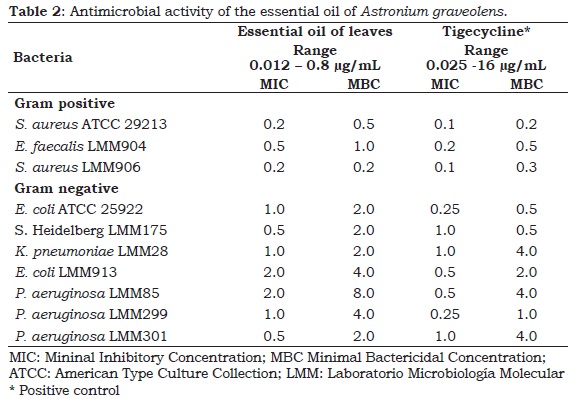
<body><![CDATA[<p align="justify"><font face="verdana" size="2">&nbsp;</font></p>  	    <p align="justify"><font face="verdana" size="2"><b>RESULTS AND DISCUSSION</b></font></p>  	    <p align="justify"><font face="verdana" size="2">The essential oil of <i>A. graveolens,</i> was obtained with 1.5 % v/w yield. Analysis of the essential oil by GC&#45;MS allowed the identification of twenty&#45;six compounds (99.3% of the sample). The monoterpenes were the predominant ones in the sample (59% of the sample): frans&#45;&#946;&#45;ocimene (23.9%), &#945;&#45;pinene (19.8%), &#948;&#45;3&#45;carene (15.5%), &#945;&#45;phellandrene (12.7%).</font></p>  	    <p align="justify"><font face="verdana" size="2">The chemical composition of the essential oil of <i>A. graveolens</i> collected at the forest reserve "Caparo" (Venezuela), was comparable with the one reported for <i>A. graveolens</i> collected in Colombia, and other <i>Astronium</i> species from Brasil. The major component, <i>trans</i>&#45;&#946;&#45;ocimene, seems to be the common and most abundant component for all the species of the genus studied (Alencar, <i>et al.,</i> 1996; Maia, <i>et al.,</i> 2002; Rodriguez&#45;Burbano, <i>et al.,</i> 2010).</font></p>  	    <p align="justify"><font face="verdana" size="2">Regarding the antibacterial activity was evaluated, the "Caparo" essential oil showed strong inhibitory properties against all resistant bacteria strains tested (<a href="#t2">Table 2</a>). Bacterial growth was considerably inhibited with concentrations between 0.25 to 2 |ig/mL. Regardless of bacterial species or resistance mechanism, the MIC values were very near to MBC (0.25 to 8 &#181;g/mL). Hence, MICs are almost at biocidal levels. These results were comparable with the excellent inhibitory activity of tigecycline.</font></p>  	    <p align="center"><font face="verdana" size="2"><a name="t2"></a></font></p>  	    <p align="center"><font face="verdana" size="2"><img src="/img/revistas/rlq/v41n2/a2t2.jpg"></font></p>  	    <p align="justify"><font face="verdana" size="2">The results obtained suggest that the <i>A. graveolens</i> leaves essential oil had inhibitory activity against resistant nosocomial pathogens. The correlation composition/ activity leads us to suppose that the antibacterial properties of the essential oil could be attributable to its main monoterpene constituents: trans&#45;&#946&#45;ocimene (23.9%), &#945;&#45;pinene (19.1%) and &#948;&#45;3&#45;carene (15.5%). Further investigations are necessary to determine the antibacterial activity of these compounds, either pure or combined, to establish the possible mechanism of action of the most active compound to combat resistant human pathogens.</font></p>  	    <p align="justify"><font face="verdana" size="2">&nbsp;</font></p>  	    <p align="justify"><font face="verdana" size="2"><b>CONCLUSIONS</b></font></p>  	    ]]></body>
<body><![CDATA[<p align="justify"><font face="verdana" size="2">This report represents a new contribution to the phytochemical and biological study of on <i>A. graveolens</i> essential oil. Most important, considering <i>A. graveolens</i> is a timber species, the results obtained suggest the use of their leaves to prepare medicinal essential oils should be a good way to take advantage of the leaves that are throwing aside in the wood industry.</font></p>  	    <p align="justify"><font face="verdana" size="2">&nbsp;</font></p>  	    <p align="justify"><font face="verdana" size="2"><b>ACKNOWLEDGMENTS</b></font></p>  	    <p align="justify"><font face="verdana" size="2">The authors would like to thank Dr. Alfredo Usubillaga for GC&#45;MS analysis. Consejo de Desarrollo Cient&iacute;fico, Human&iacute;stico, Tecnol&oacute;gico y de las Artes (CDCHTA&#45;M&eacute;rida&#45;Venezuela) for partial financial support of this study (projects FA&#45;479&#45;10&#45;03&#45;ED and ADG&#45;FA&#45;02&#45;97&#45;07).</font></p>  	    <p align="justify"><font face="verdana" size="2">&nbsp;</font></p>  	    <p align="justify"><font face="verdana" size="2"><b>REFERENCES</b></font></p>  	    <!-- ref --><p align="justify"><font face="verdana" size="2">Adams, R. (2007) Identification of essential oils components by gas chromatography/mass spectroscopy. 4<sup>th</sup> Edition. Allured Publishing. Corporation, Carol Stream IL, USA.    &nbsp;&nbsp;&nbsp;&nbsp;&nbsp;&nbsp;&nbsp;&nbsp;[&#160;<a href="javascript:void(0);" onclick="javascript: window.open('/scielo.php?script=sci_nlinks&ref=7371711&pid=S0370-5943201300020000200001&lng=','','width=640,height=500,resizable=yes,scrollbars=1,menubar=yes,');">Links</a>&#160;]<!-- end-ref --></font></p>  	    <!-- ref --><p align="justify"><font face="verdana" size="2">Aguilar, C., Sosa V. (2004) The evolution of toxic phenolic compounds in a group of Anacardiaceae genera. <i>Taxon</i> <b>53</b> : 357&#45;364.    &nbsp;&nbsp;&nbsp;&nbsp;&nbsp;&nbsp;&nbsp;&nbsp;[&#160;<a href="javascript:void(0);" onclick="javascript: window.open('/scielo.php?script=sci_nlinks&ref=7371713&pid=S0370-5943201300020000200002&lng=','','width=640,height=500,resizable=yes,scrollbars=1,menubar=yes,');">Links</a>&#160;]<!-- end-ref --></font></p>  	    ]]></body>
<body><![CDATA[<!-- ref --><p align="justify"><font face="verdana" size="2">Alencar, J., Matos F., Machado M., Craveiro A. (1996) Essential oil from <i>Astronium fraxinifolium</i> Schott (Anacardiaceae) in different growth stages. <i>Journal of essential oil research</i> <b>8</b> : 177&#45;178.    &nbsp;&nbsp;&nbsp;&nbsp;&nbsp;&nbsp;&nbsp;&nbsp;[&#160;<a href="javascript:void(0);" onclick="javascript: window.open('/scielo.php?script=sci_nlinks&ref=7371715&pid=S0370-5943201300020000200003&lng=','','width=640,height=500,resizable=yes,scrollbars=1,menubar=yes,');">Links</a>&#160;]<!-- end-ref --></font></p>  	    <!-- ref --><p align="justify"><font face="verdana" size="2">Chen, T., Wiemer D. (1984) A volatile leafcutter ant repellent from <i>Astronium graveolens. Naturwissenschaften</i> <b>71</b> : 97&#45;98.    &nbsp;&nbsp;&nbsp;&nbsp;&nbsp;&nbsp;&nbsp;&nbsp;[&#160;<a href="javascript:void(0);" onclick="javascript: window.open('/scielo.php?script=sci_nlinks&ref=7371717&pid=S0370-5943201300020000200004&lng=','','width=640,height=500,resizable=yes,scrollbars=1,menubar=yes,');">Links</a>&#160;]<!-- end-ref --></font></p>  	    <!-- ref --><p align="justify"><font face="verdana" size="2">Clinical and Laboratory Standards Institute (CLSI). <i>Performance standards for antimicrobial susceptibility testing; Twentieth Informational supplement.</i> CLSI (2011) Clinical and Laboratory Standards Institute, 940 West Valley Road, Suite 1400, Wayne, Pennsylvania, USA.    &nbsp;&nbsp;&nbsp;&nbsp;&nbsp;&nbsp;&nbsp;&nbsp;[&#160;<a href="javascript:void(0);" onclick="javascript: window.open('/scielo.php?script=sci_nlinks&ref=7371719&pid=S0370-5943201300020000200005&lng=','','width=640,height=500,resizable=yes,scrollbars=1,menubar=yes,');">Links</a>&#160;]<!-- end-ref --></font></p>  	    <!-- ref --><p align="justify"><font face="verdana" size="2">Davies, N. (1990) Gas chromatographic retention indices of monoterpenes and sesquiterpenes on methyl silicone and Carbowax 20 M phases. <i>Journal of Chromatography A</i> <b>503</b> : 1&#45;24.    &nbsp;&nbsp;&nbsp;&nbsp;&nbsp;&nbsp;&nbsp;&nbsp;[&#160;<a href="javascript:void(0);" onclick="javascript: window.open('/scielo.php?script=sci_nlinks&ref=7371721&pid=S0370-5943201300020000200006&lng=','','width=640,height=500,resizable=yes,scrollbars=1,menubar=yes,');">Links</a>&#160;]<!-- end-ref --></font></p>  	    <!-- ref --><p align="justify"><font face="verdana" size="2">Maia, J., Da Silva M., Andrade E., Zoghbi M., Carreira L. (2002) Essential oils from <i>Astronium urundeuva</i> (Allemao) Engl. and <i>A. fraxinifolium</i> Schott ex Spreng. <i>Flavour and Fragrance Journal</i> <b>17</b> : 72&#45;74.    &nbsp;&nbsp;&nbsp;&nbsp;&nbsp;&nbsp;&nbsp;&nbsp;[&#160;<a href="javascript:void(0);" onclick="javascript: window.open('/scielo.php?script=sci_nlinks&ref=7371723&pid=S0370-5943201300020000200007&lng=','','width=640,height=500,resizable=yes,scrollbars=1,menubar=yes,');">Links</a>&#160;]<!-- end-ref --></font></p>  	    ]]></body>
<body><![CDATA[<!-- ref --><p align="justify"><font face="verdana" size="2">Mendoza, A. (2008) <i>Astronium graveolens</i> Jacq. Universidad Nacional Aut&oacute;noma de M&eacute;xico. Instituto de Biolog&iacute;a. M&eacute;xico.    &nbsp;&nbsp;&nbsp;&nbsp;&nbsp;&nbsp;&nbsp;&nbsp;[&#160;<a href="javascript:void(0);" onclick="javascript: window.open('/scielo.php?script=sci_nlinks&ref=7371725&pid=S0370-5943201300020000200008&lng=','','width=640,height=500,resizable=yes,scrollbars=1,menubar=yes,');">Links</a>&#160;]<!-- end-ref --></font></p>  	    <!-- ref --><p align="justify"><font face="verdana" size="2">Pell, S. (2004) Molecular systematics of the cashew family (Anacardiaceae). Louisiana State University and Agricultural and Mechanical College. Louisiana, USA.    &nbsp;&nbsp;&nbsp;&nbsp;&nbsp;&nbsp;&nbsp;&nbsp;[&#160;<a href="javascript:void(0);" onclick="javascript: window.open('/scielo.php?script=sci_nlinks&ref=7371727&pid=S0370-5943201300020000200009&lng=','','width=640,height=500,resizable=yes,scrollbars=1,menubar=yes,');">Links</a>&#160;]<!-- end-ref --></font></p>  	    <!-- ref --><p align="justify"><font face="verdana" size="2">Rodriguez&#45;Burbano, D., Quijano&#45;Celis C., Pino J. (2010) Composition of the essential oil from leaves of <i>Astronium graveolens</i> Jacq grown in Colombia. <i>Journal of Essential Oil Research</i> <b>22</b> : 488&#45;489.    &nbsp;&nbsp;&nbsp;&nbsp;&nbsp;&nbsp;&nbsp;&nbsp;[&#160;<a href="javascript:void(0);" onclick="javascript: window.open('/scielo.php?script=sci_nlinks&ref=7371729&pid=S0370-5943201300020000200010&lng=','','width=640,height=500,resizable=yes,scrollbars=1,menubar=yes,');">Links</a>&#160;]<!-- end-ref --></font></p>  	    <!-- ref --><p align="justify"><font face="verdana" size="2">Sandra, P., Bicchi, C. (1987) Capillary gas chromatography in essential oil analysis. Huethig. Heidelberg.    &nbsp;&nbsp;&nbsp;&nbsp;&nbsp;&nbsp;&nbsp;&nbsp;[&#160;<a href="javascript:void(0);" onclick="javascript: window.open('/scielo.php?script=sci_nlinks&ref=7371731&pid=S0370-5943201300020000200011&lng=','','width=640,height=500,resizable=yes,scrollbars=1,menubar=yes,');">Links</a>&#160;]<!-- end-ref --></font></p>  	    <!-- ref --><p align="justify"><font face="verdana" size="2">Viana, G., Bandeira M., Matos F. (2003) Analgesic and antiinflammatory effects of chalcones isolated from <i>Myracrodruon urundeuva</i> Allem&atilde;o. <i>Phytomedicine</i> <b>10</b> : 189&#45;195.    &nbsp;&nbsp;&nbsp;&nbsp;&nbsp;&nbsp;&nbsp;&nbsp;[&#160;<a href="javascript:void(0);" onclick="javascript: window.open('/scielo.php?script=sci_nlinks&ref=7371733&pid=S0370-5943201300020000200012&lng=','','width=640,height=500,resizable=yes,scrollbars=1,menubar=yes,');">Links</a>&#160;]<!-- end-ref --></font></p>     ]]></body>
<body><![CDATA[ ]]></body><back>
<ref-list>
<ref id="B1">
<nlm-citation citation-type="book">
<person-group person-group-type="author">
<name>
<surname><![CDATA[Adams]]></surname>
<given-names><![CDATA[R.]]></given-names>
</name>
</person-group>
<source><![CDATA[Identification of essential oils components by gas chromatography/mass spectroscopy]]></source>
<year>2007</year>
<edition>4</edition>
<publisher-loc><![CDATA[Carol Stream^eIL IL]]></publisher-loc>
<publisher-name><![CDATA[Allured Publishing]]></publisher-name>
</nlm-citation>
</ref>
<ref id="B2">
<nlm-citation citation-type="journal">
<person-group person-group-type="author">
<name>
<surname><![CDATA[Aguilar]]></surname>
<given-names><![CDATA[C.]]></given-names>
</name>
<name>
<surname><![CDATA[Sosa]]></surname>
<given-names><![CDATA[V.]]></given-names>
</name>
</person-group>
<article-title xml:lang="en"><![CDATA[The evolution of toxic phenolic compounds in a group of Anacardiaceae genera]]></article-title>
<source><![CDATA[Taxon]]></source>
<year>2004</year>
<volume>53</volume>
<page-range>357-364</page-range></nlm-citation>
</ref>
<ref id="B3">
<nlm-citation citation-type="journal">
<person-group person-group-type="author">
<name>
<surname><![CDATA[Alencar]]></surname>
<given-names><![CDATA[J.]]></given-names>
</name>
<name>
<surname><![CDATA[Matos]]></surname>
<given-names><![CDATA[F.]]></given-names>
</name>
<name>
<surname><![CDATA[Machado]]></surname>
<given-names><![CDATA[M.]]></given-names>
</name>
<name>
<surname><![CDATA[Craveiro]]></surname>
<given-names><![CDATA[A.]]></given-names>
</name>
</person-group>
<article-title xml:lang="en"><![CDATA[Essential oil from Astronium fraxinifolium Schott (Anacardiaceae) in different growth stages]]></article-title>
<source><![CDATA[Journal of essential oil research]]></source>
<year>1996</year>
<volume>8</volume>
<page-range>177-178</page-range></nlm-citation>
</ref>
<ref id="B4">
<nlm-citation citation-type="journal">
<person-group person-group-type="author">
<name>
<surname><![CDATA[Chen]]></surname>
<given-names><![CDATA[T.]]></given-names>
</name>
<name>
<surname><![CDATA[Wiemer]]></surname>
<given-names><![CDATA[D.]]></given-names>
</name>
</person-group>
<article-title xml:lang="en"><![CDATA[A volatile leafcutter ant repellent from Astronium graveolens]]></article-title>
<source><![CDATA[Naturwissenschaften]]></source>
<year>1984</year>
<volume>71</volume>
<page-range>97-98</page-range></nlm-citation>
</ref>
<ref id="B5">
<nlm-citation citation-type="book">
<collab>Clinical and Laboratory Standards Institute</collab>
<source><![CDATA[Performance standards for antimicrobial susceptibility testing; Twentieth Informational supplement]]></source>
<year>2011</year>
<publisher-loc><![CDATA[Wayne^ePennsylvania Pennsylvania]]></publisher-loc>
<publisher-name><![CDATA[Clinical and Laboratory Standards Institute]]></publisher-name>
</nlm-citation>
</ref>
<ref id="B6">
<nlm-citation citation-type="journal">
<person-group person-group-type="author">
<name>
<surname><![CDATA[Davies]]></surname>
<given-names><![CDATA[N.]]></given-names>
</name>
</person-group>
<article-title xml:lang="en"><![CDATA[Gas chromatographic retention indices of monoterpenes and sesquiterpenes on methyl silicone and Carbowax 20 M phases]]></article-title>
<source><![CDATA[Journal of Chromatography A]]></source>
<year>1990</year>
<volume>503</volume>
<page-range>1-24</page-range></nlm-citation>
</ref>
<ref id="B7">
<nlm-citation citation-type="journal">
<person-group person-group-type="author">
<name>
<surname><![CDATA[Maia]]></surname>
<given-names><![CDATA[J.]]></given-names>
</name>
<name>
<surname><![CDATA[Da Silva]]></surname>
<given-names><![CDATA[M.]]></given-names>
</name>
<name>
<surname><![CDATA[Andrade]]></surname>
<given-names><![CDATA[E.]]></given-names>
</name>
<name>
<surname><![CDATA[Zoghbi]]></surname>
<given-names><![CDATA[M.]]></given-names>
</name>
<name>
<surname><![CDATA[Carreira]]></surname>
<given-names><![CDATA[L.]]></given-names>
</name>
</person-group>
<article-title xml:lang="en"><![CDATA[Essential oils from Astronium urundeuva (Allemao) Engl. and A. fraxinifolium Schott ex Spreng]]></article-title>
<source><![CDATA[Flavour and Fragrance Journal]]></source>
<year>2002</year>
<volume>17</volume>
<page-range>72-74</page-range></nlm-citation>
</ref>
<ref id="B8">
<nlm-citation citation-type="book">
<person-group person-group-type="author">
<name>
<surname><![CDATA[Mendoza]]></surname>
<given-names><![CDATA[A.]]></given-names>
</name>
</person-group>
<source><![CDATA[Astronium graveolens Jacq]]></source>
<year>2008</year>
<publisher-loc><![CDATA[México ]]></publisher-loc>
<publisher-name><![CDATA[Universidad Nacional Autónoma de México. Instituto de Biología]]></publisher-name>
</nlm-citation>
</ref>
<ref id="B9">
<nlm-citation citation-type="book">
<person-group person-group-type="author">
<name>
<surname><![CDATA[Pell]]></surname>
<given-names><![CDATA[S.]]></given-names>
</name>
</person-group>
<source><![CDATA[Molecular systematics of the cashew family (Anacardiaceae)]]></source>
<year>2004</year>
<publisher-loc><![CDATA[^eLouisiana Louisiana]]></publisher-loc>
<publisher-name><![CDATA[Louisiana State University and Agricultural and Mechanical College]]></publisher-name>
</nlm-citation>
</ref>
<ref id="B10">
<nlm-citation citation-type="journal">
<person-group person-group-type="author">
<name>
<surname><![CDATA[Rodriguez-Burbano]]></surname>
<given-names><![CDATA[D.]]></given-names>
</name>
<name>
<surname><![CDATA[Quijano-Celis]]></surname>
<given-names><![CDATA[C.]]></given-names>
</name>
<name>
<surname><![CDATA[Pino]]></surname>
<given-names><![CDATA[J.]]></given-names>
</name>
</person-group>
<article-title xml:lang="en"><![CDATA[Composition of the essential oil from leaves of Astronium graveolens Jacq grown in Colombia]]></article-title>
<source><![CDATA[Journal of Essential Oil Research]]></source>
<year>2010</year>
<volume>22</volume>
<page-range>488-489</page-range></nlm-citation>
</ref>
<ref id="B11">
<nlm-citation citation-type="book">
<person-group person-group-type="author">
<name>
<surname><![CDATA[Sandra]]></surname>
<given-names><![CDATA[P.]]></given-names>
</name>
<name>
<surname><![CDATA[Bicchi]]></surname>
<given-names><![CDATA[C.]]></given-names>
</name>
</person-group>
<source><![CDATA[Capillary gas chromatography in essential oil analysis]]></source>
<year>1987</year>
<publisher-loc><![CDATA[Heidelberg ]]></publisher-loc>
<publisher-name><![CDATA[Huethig]]></publisher-name>
</nlm-citation>
</ref>
<ref id="B12">
<nlm-citation citation-type="journal">
<person-group person-group-type="author">
<name>
<surname><![CDATA[Viana]]></surname>
<given-names><![CDATA[G.]]></given-names>
</name>
<name>
<surname><![CDATA[Bandeira]]></surname>
<given-names><![CDATA[M.]]></given-names>
</name>
<name>
<surname><![CDATA[Matos]]></surname>
<given-names><![CDATA[F.]]></given-names>
</name>
</person-group>
<article-title xml:lang="en"><![CDATA[Analgesic and antiinflammatory effects of chalcones isolated from Myracrodruon urundeuva Allemão]]></article-title>
<source><![CDATA[Phytomedicine]]></source>
<year>2003</year>
<volume>10</volume>
<page-range>189-195</page-range></nlm-citation>
</ref>
</ref-list>
</back>
</article>