<?xml version="1.0" encoding="ISO-8859-1"?><article xmlns:mml="http://www.w3.org/1998/Math/MathML" xmlns:xlink="http://www.w3.org/1999/xlink" xmlns:xsi="http://www.w3.org/2001/XMLSchema-instance">
<front>
<journal-meta>
<journal-id>0370-5943</journal-id>
<journal-title><![CDATA[Revista latinoamericana de química]]></journal-title>
<abbrev-journal-title><![CDATA[Rev. latinoam. quím]]></abbrev-journal-title>
<issn>0370-5943</issn>
<publisher>
<publisher-name><![CDATA[Laboratorios Mixim S.A.]]></publisher-name>
</publisher>
</journal-meta>
<article-meta>
<article-id>S0370-59432012000300004</article-id>
<title-group>
<article-title xml:lang="en"><![CDATA[Ion trap tandem mass spectrometry of C- and N-methyl, benzyl, and prenyl substituted 2-oxopyrrolidinoindolines]]></article-title>
</title-group>
<contrib-group>
<contrib contrib-type="author">
<name>
<surname><![CDATA[Morales-Ríos]]></surname>
<given-names><![CDATA[Martha S.]]></given-names>
</name>
<xref ref-type="aff" rid="A01"/>
</contrib>
<contrib contrib-type="author">
<name>
<surname><![CDATA[Burgueño-Tapia]]></surname>
<given-names><![CDATA[Eleuterio]]></given-names>
</name>
<xref ref-type="aff" rid="A02"/>
</contrib>
<contrib contrib-type="author">
<name>
<surname><![CDATA[Pérez-Rojas]]></surname>
<given-names><![CDATA[Nadia A.]]></given-names>
</name>
<xref ref-type="aff" rid="A01"/>
</contrib>
<contrib contrib-type="author">
<name>
<surname><![CDATA[Mora-Pérez]]></surname>
<given-names><![CDATA[Yolanda]]></given-names>
</name>
<xref ref-type="aff" rid="A01"/>
</contrib>
<contrib contrib-type="author">
<name>
<surname><![CDATA[Alvarez-Cisneros]]></surname>
<given-names><![CDATA[Celina]]></given-names>
</name>
<xref ref-type="aff" rid="A01"/>
</contrib>
</contrib-group>
<aff id="A01">
<institution><![CDATA[,Instituto Politécnico Nacional Centro de Investigación y de Estudios Avanzados Departamento de Química]]></institution>
<addr-line><![CDATA[México D.F.]]></addr-line>
<country>México</country>
</aff>
<aff id="A02">
<institution><![CDATA[,Instituto Politécnico Nacional , Escuela Nacional de Ciencias Biológicas Departamento de Química Orgánica]]></institution>
<addr-line><![CDATA[México D.F.]]></addr-line>
<country>México</country>
</aff>
<pub-date pub-type="pub">
<day>00</day>
<month>00</month>
<year>2012</year>
</pub-date>
<pub-date pub-type="epub">
<day>00</day>
<month>00</month>
<year>2012</year>
</pub-date>
<volume>40</volume>
<numero>3</numero>
<fpage>130</fpage>
<lpage>139</lpage>
<copyright-statement/>
<copyright-year/>
<self-uri xlink:href="http://www.scielo.org.mx/scielo.php?script=sci_arttext&amp;pid=S0370-59432012000300004&amp;lng=en&amp;nrm=iso"></self-uri><self-uri xlink:href="http://www.scielo.org.mx/scielo.php?script=sci_abstract&amp;pid=S0370-59432012000300004&amp;lng=en&amp;nrm=iso"></self-uri><self-uri xlink:href="http://www.scielo.org.mx/scielo.php?script=sci_pdf&amp;pid=S0370-59432012000300004&amp;lng=en&amp;nrm=iso"></self-uri><abstract abstract-type="short" xml:lang="en"><p><![CDATA[The electron impact induced fragmentations of C- and N-methyl, benzyl, and prenyl substituted 2-oxopyrrolidinoindolines were studied using an ion trap mass spectrometer (IT-MS). Correlations of characteristic fragment ions of the 2-oxopyrrolidinoindoline skeleton with specific modifications of the substituents around it were supported by stepwise fragmentation MS/MS analysis and accurate mass measurements. The MS³ spectra evidenced the neutral loss of methyl- or benzylisocyanate from the 2-oxopyrrolidine ring, which would result in a rearranged stable quinolinium ion.]]></p></abstract>
<abstract abstract-type="short" xml:lang="es"><p><![CDATA[Se estudiaron las fragmentaciones inducidas por impacto electrónico de 2-oxopirrolidinoindolinas sustituidas en C y N por grupos metilo, bencilo, y prenilo usando un espectrómetro de trampa de iones (EM-TI). Las correlaciones de iones-fragmento característicos del esqueleto de 2-oxopirrolidinoindolinas con modificaciones específicas de los sustituyentes alrededor del mismo se sustentaron por análisis de fragmentación gradual EM/EM y mediciones de masa exacta. Los espectros EM³ evidenciaron la pérdida neutra de metil- o bencilisocianato proveniente del anillo de 2-oxopirrolidina que podría resultar en un ión reordenado quinolinio estable.]]></p></abstract>
<kwd-group>
<kwd lng="en"><![CDATA[2-oxopyrrolidinoindolines]]></kwd>
<kwd lng="en"><![CDATA[mass spectra]]></kwd>
<kwd lng="en"><![CDATA[EI-ion trap]]></kwd>
<kwd lng="en"><![CDATA[MS/MS analysis]]></kwd>
<kwd lng="en"><![CDATA[quinolinium ion]]></kwd>
<kwd lng="en"><![CDATA[accurate mass]]></kwd>
<kwd lng="es"><![CDATA[2-oxopirrolidinoindolinas]]></kwd>
<kwd lng="es"><![CDATA[espectros de masa]]></kwd>
<kwd lng="es"><![CDATA[trampa de iones-IE]]></kwd>
<kwd lng="es"><![CDATA[análisis EM/EM]]></kwd>
<kwd lng="es"><![CDATA[ión quinolinio]]></kwd>
<kwd lng="es"><![CDATA[masa exacta]]></kwd>
</kwd-group>
</article-meta>
</front><body><![CDATA[ <p align="center"><font face="verdana" size="4"><b>Ion trap tandem mass spectrometry of <i>C&#45;</i> and <i>N&#45;</i>methyl, benzyl, and prenyl substituted 2&#45;oxopyrrolidinoindolines</b></font></p>              <p align="center"><font face="verdana" size="2">&nbsp;</font></p>              <p align="center"><font face="verdana" size="2"><b>Martha S. Morales&#45;R&iacute;os<sup>a,*</sup>, Eleuterio Burgue&ntilde;o&#45;Tapia<sup>b</sup>, Nadia A. P&eacute;rez&#45;Rojas<sup>a</sup>, Yolanda Mora&#45;P&eacute;rez<sup>a</sup>, Celina Alvarez&#45;Cisneros<sup>a</sup></b></font></p>              <p align="justify"><font face="verdana" size="2">&nbsp;</font></p>              <p align="justify"><font face="verdana" size="2"><sup>a</sup> <i>Departamento de Qu&iacute;mica, Centro de Investigaci&oacute;n y de Estudios Avanzados del Instituto Polit&eacute;cnico Nacional, Apartado 14&#45;740, M&eacute;xico D.F., 07000 M&eacute;xico.</i> <i>*Corresponding author. Tel.: &#43;52 55 57477112; Fax: &#43;52 55 57477137;</i> E&#45;mail: <a href="mailto:smorales@cinvestav.mx">smorales@cinvestav.mx</a>.</font></p>              <p align="justify"><font face="verdana" size="2"><sup>b</sup> <i>Departamento de Qu&iacute;mica Org&aacute;nica, Escuela Nacional de Ciencias Biol&oacute;gicas, Instituto Polit&eacute;cnico Nacional, Prolongaci&oacute;n de Carpio y Plan de Ayala, Col. Santo Tom&aacute;s, M&eacute;xico, D.F. 11340, M&eacute;xico.</i></font></p>              <p align="justify"><font face="verdana" size="2">&nbsp;</font></p>              <p align="justify"><font face="verdana" size="2">Received August 2012.    <br>     Accepted October 2012.</font></p>              <p align="justify"><font face="verdana" size="2">&nbsp;</font></p>              ]]></body>
<body><![CDATA[<p align="justify"><font face="verdana" size="2"><b>ABSTRACT</b></font></p>              <p align="justify"><font face="verdana" size="2">The electron impact induced fragmentations of <i>C&#45;</i> and <i>N</i>&#45;methyl, benzyl, and prenyl substituted 2&#45;oxopyrrolidinoindolines were studied using an ion trap mass spectrometer (IT&#45;MS). Correlations of characteristic fragment ions of the 2&#45;oxopyrrolidinoindoline skeleton with specific modifications of the substituents around it were supported by stepwise fragmentation MS/MS analysis and accurate mass measurements. The MS<sup>3</sup> spectra evidenced the neutral loss of methyl&#45; or benzylisocyanate from the 2&#45;oxopyrrolidine ring, which would result in a rearranged stable quinolinium ion.</font></p>              <p align="justify"><font face="verdana" size="2"><b>Keywords:</b> 2&#45;oxopyrrolidinoindolines, mass spectra, EI&#45;ion trap, MS/MS analysis, quinolinium ion, accurate mass.</font></p>              <p align="justify"><font face="verdana" size="2">&nbsp;</font></p>              <p align="justify"><font face="verdana" size="2"><b>RESUMEN</b></font></p>              <p align="justify"><font face="verdana" size="2">Se estudiaron las fragmentaciones inducidas por impacto electr&oacute;nico de 2&#45;oxopirrolidinoindolinas sustituidas en <i>C</i> y <i>N</i> por grupos metilo, bencilo, y prenilo usando un espectr&oacute;metro de trampa de iones (EM&#45;TI). Las correlaciones de iones&#45;fragmento caracter&iacute;sticos del esqueleto de 2&#45;oxopirrolidinoindolinas con modificaciones espec&iacute;ficas de los sustituyentes alrededor del mismo se sustentaron por an&aacute;lisis de fragmentaci&oacute;n gradual EM/EM y mediciones de masa exacta. Los espectros EM<sup>3</sup> evidenciaron la p&eacute;rdida neutra de metil&#45; o bencilisocianato proveniente del anillo de 2&#45;oxopirrolidina que podr&iacute;a resultar en un i&oacute;n reordenado quinolinio estable.</font></p>              <p align="justify"><font face="verdana" size="2"><b>Palabras clave:</b> 2&#45;oxopirrolidinoindolinas, espectros de masa, trampa de iones&#45;IE, an&aacute;lisis EM/EM, i&oacute;n quinolinio, masa exacta.</font></p>              <p align="justify"><font face="verdana" size="2">&nbsp;</font></p>              <p align="justify"><font face="verdana" size="2"><b>INTRODUCTION</b></font></p>              <p align="justify"><font face="verdana" size="2">Pyrrolidinoindolines are the basic nuclei of a number of alkaloids that have been isolated from a widespread series of natural sources, including amphibians, plants, and marine organisms (Anthoni <i>et al.,</i> 1990; Ayg&uuml;n and Pindur, 2003; Spande <i>et al.,</i> 1988; Tokuyama and Daly, 1983). These alkaloids exhibit an impressive array of promising biological properties which includes anticholinesterase activitiy (Rivera&#45;Becerril <i>et al.,</i> 2008; Thal <i>et al.,</i> 1996; Yu <i>et al.,</i> 2010). Owing to their medicinal relevance and structural complexity, pyrrolidinoindoline alkaloids have served as a fertile area for the development of chemical strategies for their synthesis (Crich and Banerjee, 2007; Kim and Movassaghi, 2009; Morales&#45;R&iacute;os and Su&aacute;rez&#45;Castillo, 2008; Morales&#45;R&iacute;os <i>et al.,</i> 2001; Steven and Overman, 2007). A structural survey of this alkaloid family reveals a central cis&#45;fused pyrrolidinoindoline core that in all cases incorporates a quaternary center at the C(3a) site. In addition, N(1), C(3a), and N(8) positions have been shown to incorporate broad variation in substituents.</font></p>              ]]></body>
<body><![CDATA[<p align="justify"><font face="verdana" size="2">Mass spectrometry (MS) has proven to be a successful approach for structural elucidation of furoindolines (Clayton and Reed, 1963; Morales&#45;R&iacute;os <i>et al.,</i> 2011) and pyrrolidinoindolines (Fales <i>et al.,</i> 1970; Rubino and Zecca, 1991; Spande <i>et al.,</i> 1988; Spiteller and Spiteller&#45;Friedmann, 1963). In the current study, we were interested in establishing and validating MS fragmentation patterns of a series of 2&#45;oxopyrrolidinoindolines <b>1a&#45;1f</b> diversely substituted at N(1), C(3a), and N(8) by methyl, benzyl, and prenyl groups (<a href="#f1">Fig. 1</a>) in order to provide correlations of characteristic fragment ions of the 2&#45;oxopyrrolidinoindoline skeleton with specific modifications of the substituents around it.</font></p>              <p align="center"><font face="verdana" size="2"><a name="f1"></a></font></p>              <p align="center"><font face="verdana" size="2"><img src="/img/revistas/rlq/v40n3/a4f1.jpg"></font></p>              <p align="justify"><font face="verdana" size="2">&nbsp;</font></p>              <p align="justify"><font face="verdana" size="2"><b>MATERIALS AND METHODS</b></font></p>              <p align="justify"><font face="verdana" size="2"><b>General    <br></b>Melting point was measured on a Fisher&#45;Johns apparatus and is uncorrected. NMR experiments were performed using Varian Mercury spectrometers working at 300 and 75.4 MHz for <sup>1</sup>H and <sup>13</sup>C, respectively. Chemical shifts are reported in ppm downfield from tetramethylsilane. IR spectrum was measured with a Perkin&#45;Elmer 16 FPC FT infrared spectrophotometer. All solvents and reagents were purchased in the reagent grade quality and were used without further purification. Solvents for chromatography were purified by distillation. Column chromatography was performed on Silica Gel 60 (230&#45;400 mesh) from Aldrich. 2&#45;Oxopyrrolidinoindolines <b>1a&#45;1c</b> are known and were synthesized as described (Morales&#45;R&iacute;os <i>et al.</i> 2012) from the corresponding 2&#45;oxofuroindolines <b>3a&#45;3c</b> by treatment with methylamine.</font></p>              <p align="justify"><font face="verdana" size="2">&nbsp;</font></p>              <p align="justify"><font face="verdana" size="2"><b>EI&#45;MS Analysis    <br></b>The electron impact mass spectrometry (EI&#45;MS) analyses were performed using an ion trap Varian Saturn 2000 spectrometer coupled with a Varian 3800 gas chromatograph. The MS conditions were as follows: transfer line heater, 280 &#176;C; ion source temperature, 220 &#176;C; electron impact ionization (EI) mode; ionization energy, 70 eV; electron multiplier voltage (EMV), 1950 V. The typical mass spectrum was recorded by averaging 1200 scans from <i>m/z</i> 20 to 650 at a scan rate of 1 s/scan. For multistage sequencing MS<sup>2</sup>/MS<sup>3</sup>, the compounds were introduced by direct insertion probe and the precursor ions were selected within an isolation width of 2 u. Exact mass measurements for the ions of interest were recorded on a Jeol JMS&#45;GCMate II instrument or on an Agilent LCTOF spectrometer at the UCR Mass Spectrometry Facility, University of California, Riverside, with an error less than &#177;3 ppm for all ions discussed.</font></p>              ]]></body>
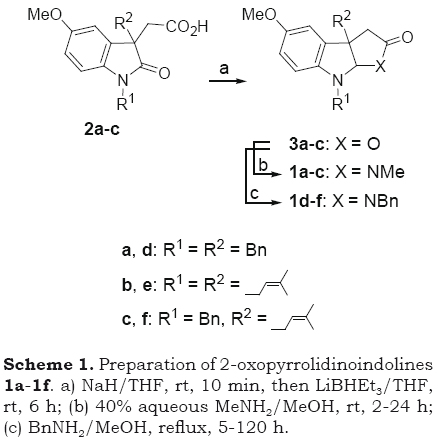
<body><![CDATA[<p align="justify"><font face="verdana" size="2">&nbsp;</font></p>              <p align="justify"><font face="verdana" size="2"><b>General lactamization procedure</b></font></p>              <p align="justify"><font face="verdana" size="2">To a solution of the appropriate 2&#45;oxofuroindoline <b>3a, 3b</b> or <b>3c</b> (0.65 mmol) in MeOH (20 mL) was added BnNH<sub>2</sub> (2.3 equiv, 0.17 mL). The reaction mixture was kept at room temperature for 5&#45;120 h. After this, the solvent was removed under reduced pressure and the residue was suspended in EtOAc (30 mL). The suspension was washed successively with a 5&#37; aq HCl solution (2 x 10 mL) and brine (2 x 10 mL). The organic layer was dried over anhydrous Na<sub>2</sub>SO<sub>4</sub>, and concentrated under reduced pressure. The crude product was purified by flash chromatography (7:3 hexane/EtOAc).</font></p>              <p align="justify"><font face="verdana" size="2"><b>1,3a,8&#45;Tribenzyl&#45;5&#45;methoxy&#45;2&#45;oxo&#45;2,3,3a,8a&#45;tetrahydro&#45;8H&#45;pyrrolo&#91;2,3&#45;b&#93; indole (1d).</b> Following the general procedure, a mixture of <b>3a</b> (250 mg) and BnNH<sub>2</sub> in MeOH was refluxed for 96 h to give <b>1d</b> (219 mg, 71&#37;) as colorless crystals, mp 118&#45;119 &#176;C. TLC: R<sub><i>f</i></sub> 0.42 (7:3 hexane/ EtOAc); IR (CHCl<sub>3</sub>) <i>v</i><sub>max</sub> 3010, 2934, 1678, 1602, 1496 cm<sup>1</sup>. <sup>1</sup>H NMR (CDCl<sub>3</sub>) &#948; 6.69 (1H, dd, <i>J</i> = 8.6, 2.6 Hz, H6), 6.58 (1H, d, <i>J</i> = 2.5 Hz, H4), 6.39 (1H, d, <i>J</i> = 8.5 Hz, H7), 4.80 (1H, s, H8a), 3.73 (3H, s, OMe), 2.93 and 2.82 (2H, AB, <i>J</i> = 17.2 Hz, H3), N1&#45;Bn: 7.28&#45;7.13 (overlapped, 2H<sub>m</sub>, H<sub>p</sub>), 6.85 (2H, m, 2H<sub>o</sub>), 4.92 and 3.93 (2H, AB, <i>J</i> = 17.5 Hz, CH<sub>2</sub>), <i>C</i>3a&#45;Bn: 7.28&#45;7.13 (overlapped, 2H<sub>m</sub>, H<sub>p</sub>), 6.65 (2H, m, 2H<sub>o</sub>), 2.80 and 2.66 (2H, AB, <i>J</i> = 13.5 Hz, CH<sub>2</sub>), N8&#45;Bn: 7.28&#45;7.13 (overlapped, 2H<sub>m</sub>, H<sub>p</sub>), 6.96 (2H, m, 2H<sub>o</sub>), 4.04 and 3.75 (2H, AB, <i>J</i> = 15.7 Hz, CH<sub>2</sub>); <sup>13</sup>C NMR (CDCl<sub>3</sub>) &#948; 172.4 (C2), 154.1 (C5), 143.9 (C7a), 136.0 (C3b), 114.2 (C6), 111.0 (C7), 110.2 (C4), 84.9 (C8a), 55.9 (OMe), 51.3 (C3a), 41.9 (C3), N1&#45;Bn 136.5 (C<sub>i</sub>), 128.3 (2C<sub>m</sub>), 127.6 (2C<sub>o</sub>), 127.3 <i>(C<sub>p</sub>),</i> 43.5 (CH<sub>2</sub>), C3a&#45;Bn: 136.2 (C<sub>i</sub>), 130.1 (2C<sub>o</sub>), 128.6&nbsp;(2C<sub>m</sub>), 126.9 (C<sub>p</sub>), 44.7 (CH<sub>2</sub>), N8&#45;Bn: 138.7&nbsp;(C<sub>i</sub>), 128.5 (2C<sub>m</sub>), 127.5 (2C<sub>o</sub>), 127.4 (C<sub>p</sub>), 54.7 (CH<sub>2</sub>); EIMS <i>m/z</i> (&#37;) M<sup>&#43;&#8226;</sup> 474 (100), 383 (42), 292 (6), 250 (13), 91 (23).</font></p>              <p align="justify"><font face="verdana" size="2"><b>1&#45;Benzyl&#45;5&#45;methoxy&#45;3a,8&#45;bis(3&#45;methyl&#45;2&#45;buten&#45;1&#45;yl)&#45;2&#45;oxo&#45;2,3,3a,8a&#45;tetrahydro&#45;8H&#45;pyrrolo&#91;2,3&#45;b&#93;indole (1e).</b> Following the general procedure, a mixture of <b>3b</b> (223 mg) and BnNH<sub>2</sub> in MeOH was refluxed for 5 h to give <b>1e</b> (197 mg, 70&#37;) as pale yellow oil. TLC: R<sub><i>f</i></sub> 0.20 (7:3 hexane/ EtOAc); IR (CHCl<sub>3</sub>) <i>&#957;</i><sub>max</sub> 3006, 2972, 1676, 1598, 1494 cm<sup>&#45;1</sup>;<sup>1</sup>H NMR (CDCl<sub>3</sub>) &#948; 6.69 (1H, dd, <i>J</i> = 8.4, 2.5 Hz, H6), 6.67 (1H, d, <i>J</i> = 2.5 Hz, H4), 6.50 (1H, d, <i>J</i> = 8.5 Hz, H7), 4.62 (1H, s, H8a), 3.75 (3H, s, OMe), 2.81 and 2.72 (2H, AB, <i>J</i> = 17.3 Hz, H3), V1&#45;Bn: 7.32 (2H, m, 2H<sub>m</sub>), 7.28 (1H, m, H<sub>p</sub>), 7.21 (2H, m, 2H<sub>o</sub>), 5.05 and 4.13 (2H, AB, <i>J</i> =15.7&nbsp;Hz, CH<sub>2</sub>), C3a&#45;Pre: 5.00 (1H, partially overlapped, AB<u>X</u>, tm, <i>J</i> = 7.4 Hz, CH=), 2.39 and 2.24 (2H, <u>AB</u>X, <i>J</i> = 14.6, 8.0, 7.4 Hz, CH<sub>2</sub>), 1.70 (3H, s, Me), 1.48 (3H, s, Me); N8&#45;Pre: 5.10 (1H, partially overlapped, AB<u>X</u>, tm, <i>J</i> = 7.0 Hz, CH=), 3.74 and 3.60 (2H, <u>AB</u>X, <i>J</i> = 15.8, 7.7, 7.0 Hz, CH<sub>2</sub>), 1.59 (3H, s, Me), 1.74 (3H, s, Me); <sup>13</sup>C NMR (CDCl<sub>3</sub>) &#948; 173.0 (C2), 154.1 (C5), 143.5 (C7a), 137.7 (C3b), 113.6 (C6), 111.1 (C7), 109.8 (C4), 85.5 (C8a), 55.8 (OMe), 50.2 (C3a), 41.5 (C3), N1&#45;Bn: 136.3 (C<sub>i</sub>),128.5 (2C<sub>m</sub>)<b>,</b> 127.3 (2C<sub>o</sub>), 127.2 (C<sub>p</sub>), 43.4 (CH<sub>2</sub>), C3a&#45;Pre: 135.9 (C=), 118.4 (CH=), 37.3 (CH<sub>2</sub>), 25.9 (Me), 17.9 (Me), <i>N</i>8&#45;Pre: 135.1 (C=), 120.8 (CH=), 48.8&nbsp;(CH<sub>2</sub>), 25.6 (Me), 17.6 (Me); EIMS <i>m/z</i> (&#37;) M<sup>&#43;&#8226;</sup> 430 (100), 362 (17), 293 (67), 160 (22), 91 (10).</font></p>              <p align="justify"><font face="verdana" size="2"><b>1,8&#45;Dibenzyl&#45;5&#45;methoxy&#45;3a&#45;(3&#45;methyl&#45;2&#45;buten&#45;1&#45;yl)&#45;2&#45;oxo&#45;2,3,3a,8a&#45;tetrahydro&#45;8H&#45;pyrrolo&#91;2,3&#45;b&#93;indole (1f).</b> Following the general procedure, a mixture of <b>3c</b> (236 mg) and BnNH<sub>2</sub> in MeOH was refluxed for 120 h to give <b>1f</b> (244 mg, 83&#37;) as pale yellow oil. TLC: R<sub><i>f</i></sub> 0.48 (7:3 hexane/ EtOAc); IR (CHCl<sub>3</sub>) <i>v</i><sub>max</sub> 3016, 2934, 1678, 1598 cm<sup>&#45;1</sup>; <sup>1</sup>H NMR (CDCl<sub>3</sub>) &#948; 6.67 (1H, overlapped, H4), 6.64 (1H, partially overlapped, dd, <i>J</i> = 8.4, 2.6 Hz, H6), 6.38 (1H, d, <i>J</i> = 8.0 Hz, H7), 4.70 (1H, s, H8a), 3.74 (3H, s, OMe), 2.78 (2H, s, H3), <i>N</i>1&#45;Bn: 7.32&#45;7.22 (overlapped, 2H<sub>m</sub><b>,</b> <i>H<sub>p</sub>),</i> 7.03 (2H, m, 2H<sub>o</sub>)<b>,</b> 5.04 and 3.93 (2H, AB, <i>J</i> = 15.6 Hz, CH<sub>2</sub>), C3a&#45;Pre: 4.91 (1H, AB<u>X</u>, tm, <i>J</i> = 7.3 Hz, CH=), 2.29 and 2.13 (2H, <u>AB</u>X, <i>J</i> = 14.5, 8.1, 7.3 Hz, CH<sub>2</sub>), 1.66 (3H, s, Me), 1.39 (3H, s, Me), <i>N</i>8&#45;Bn: 7.32&#45;7.22 (overlapped, 2H<sub>m</sub>, H<sub>p</sub>), 7.12 (2H, m, 2H<sub>o</sub>), 4.33 and 4.18 (2H, AB, <i>J</i> = 16.2 Hz, CH<sub>2</sub>); <sup>13</sup>C NMR (CDCl<sub>3</sub>) &#948; 173.2 (C2), 154.1 (C5), 143.9 (C7a), 137.0 (C3b), 113.5 (C6), 110.3 (C7), 110.1 (C4), 86.4 (C8a), 55.9 (OMe), 50.1 (C3a), 41.8 (C3), <i>N</i>1&#45;Bn: 136.2 (C<sub>i</sub>, 128.6 (2C<sub>m</sub>), 127.6 (2C<sub>o</sub>), 127.4 (C<sub>p</sub>), 43.8 (CH<sub>2</sub>), C3a&#45;Pre: 136.0 (C=), 118.3 (CH=), 37.4 (CH<sub>2</sub>), 25.9 (Me), 18.0 (Me), <i>N</i>8&#45;Bn: 138.7 (C<sub>i</sub>, 128.5 (2C<sub>m</sub>), 127.3 (C<sub>p</sub>), 127.2 (C<sub>o</sub>), 55.3 (CH<sub>2</sub>); EIMS <i>m/z</i> (&#37;) M<sup>&#43;&#8226;</sup> 452 (100), 383 (41), 292 (3), 250 (7), 91 (2).</font></p>              <p align="justify"><font face="verdana" size="2">&nbsp;</font></p>              <p align="justify"><font face="verdana" size="2"><b>RESULTS AND DISCUSSION</b></font></p>              <p align="justify"><font face="verdana" size="2">The preparation of 2&#45;oxopyrrolidinoindoli&#45;nes <b>1a&#45;1f</b> was achieved in two steps from the sodium salt of 2&#45;(1,3&#45;dialkyl&#45;2&#45;oxo&#45;3&#45;indolyl)acetic acids <b>2a&#45;2c.</b> The reductive cyclization of <b>2a&#45;2c</b> with LiBHEt<sub>3</sub> gave the corresponding 2&#45;oxofuroindolines <b>3a&#45;3c.</b> Stirring MeOH solutions of <b>3a&#45;c</b> with methylamine at room temperature for 2&#45;24 h or with benzylamine in boiling methanol for 5&#45;120 h gave the expected 2&#45;oxopyrrolidinoindolines <b>1a&#45;1f</b> in a combined yield of 40&#45;65&#37; for the two&#45;step process (<a href="#s1">Scheme 1</a>).</font></p>              <p align="center"><font face="verdana" size="2"><a name="s1"></a></font></p>              ]]></body>
<body><![CDATA[<p align="center"><font face="verdana" size="2"><img src="/img/revistas/rlq/v40n3/a4s1.jpg"></font></p>              <p align="justify"><font face="verdana" size="2">The electron impact mass spectra (EI&#45;MS) of compounds <b>1a&#45;1f</b> (<a href="/img/revistas/rlq/v40n3/a4t1.jpg" target="_blank">Table 1</a>) were complemented by tandem mass spectrometry (MS/MS). This technique involves the isolation of a specific ion, and the subsequent fragmentation thereof. <a href="/img/revistas/rlq/v40n3/a4f2.jpg" target="_blank">Figure 2</a> illustrates MS<sup>1</sup> and MS<sup>2</sup> spectra obtained from <b>1a&#45;1f.</b> In single IT&#45;MS mode (<a href="/img/revistas/rlq/v40n3/a4f2.jpg" target="_blank">Fig. 2</a>, left side), the base peaks corresponding to M<sup>&#43;&#8226;</sup> were observed along with several fragment ions. These spectra are very alike, exhibiting common peaks that correspond to losses of 91 Da for <b>1a</b> and <b>1d,</b> and of 69 Da for <b>1b, 1c, 1e</b> and <b>1f.</b> The accurate mass measurement and the stepwise fragmentation MS<sup>2</sup> analysis of <b>1a&#45;1f</b> (<a href="/img/revistas/rlq/v40n3/a4f2.jpg" target="_blank">Fig. 2</a>, right side) revealed that such losses involved the cleavage of the benzyl or prenyl moieties (<a href="/img/revistas/rlq/v40n3/a4t1.jpg" target="_blank">Table 1</a>). The EI&#45;MS of compounds <b>1a</b> or <b>1d</b> acquired in MS<sup>3</sup> mode revealed that the fragment ions were very similar from those of <b>1c</b> or <b>1f,</b> respectively, evidencing that the base peaks in the MS<sup>2</sup> mode (<a href="/img/revistas/rlq/v40n3/a4f2.jpg" target="_blank">Fig. 2</a>, right side) were formed from loss of the angular C(3a)&#45;substituent moiety. Whereas, compounds <b>1b</b> and <b>1e,</b> both characterized by the presence of two prenyl groups at positions C(3a) and N(8), exhibit significant peaks in the MS<sup>2</sup> mode at <i>m/ z</i> 285 and 217 for <b>1b</b> and at <i>m/z</i> 362 and 293 for <b>1e</b> attributed to the loss of one or two of the prenyl groups from the molecular ions (<a href="/img/revistas/rlq/v40n3/a4f2.jpg" target="_blank">Fig. 2</a>, right side). The elemental compositions of these ions were confirmed using accurate mass measurements, which afforded relative errors within the range &#45;2.7 to 1.4 ppm (<a href="/img/revistas/rlq/v40n3/a4t2.jpg" target="_blank">Table 2</a>).</font></p>              <p align="justify"><font face="verdana" size="2">Continuing with the fragmentation process of <b>1a&#45;1f,</b> the cleavage of the lactam ring give rise to <i>m/ z</i> 160 ion in the MS<sup>3</sup> spectra of <b>1b</b> and <b>1e</b> and to <i>m/ z</i> 250 ion in the MS<sup>3</sup> spectra of <b>1a, 1c, 1d,</b> and <b>1f</b> (<a href="#s2">Scheme 2</a>). These ions could derived from neutral loss of methyl&#45; or benzylisocyanate (MeN=C=O or BnN=C=O), which are concurrent with the elimination of the prenyl group at N8 in the case of <b>1b</b> and <b>1e.</b> The <i>m/ z</i> 160 and 250 are probably formed with simultaneous rearrangement to the stable ring&#45;expanded quinolinium ions, whose plausible structures are shown in <a href="#s2">Scheme 2</a>. The accurate mass measurements (<a href="/img/revistas/rlq/v40n3/a4t2.jpg" target="_blank">Table 2</a>) confirmed the composition of the fragments of interest, i.e. <i>m/z</i> 250.1233 for <b>1a</b> (calcd for C<sub>17</sub>H<sub>16</sub>NO<sup>&#43;</sup> 250.1232) and <i>m/z</i> 160.0765 for <b>1b</b> (calcd for C<sub>10</sub>H<sub>10</sub>NO &#43; H<sup>&#43;</sup> 160.0762).</font></p>              <p align="center"><font face="verdana" size="2"><a name="s2"></a></font></p>              <p align="center"><font face="verdana" size="2"><img src="/img/revistas/rlq/v40n3/a4s2.jpg"></font></p>              <p align="justify"><font face="verdana" size="2">Although the dominant fragmentation pathway for <b>1a, 1c, 1d</b> and <b>1f</b> includes the consecutive losses of R<sup>2&#8226;</sup> and X=C=O from M<sup>&#43;&#8226;</sup> to give ion <b>II</b> (<a href="/img/revistas/rlq/v40n3/a4f3.jpg" target="_blank">Fig. 3</a>, path <i>i</i>), an alternative fragmentation route of ion <b>I</b> proceeds via elimination of Bn<sup>&#8226;</sup> to give ion <b>III</b> (path <i>ii)</i> nevertheless in very low relative intensity (&#8804; 3&#37;, <a href="/img/revistas/rlq/v40n3/a4t1.jpg" target="_blank">Table 1</a>). In contrast, elimination of Pre<sup>&#8226;</sup> from ion <b>I</b> (path <i>ii)</i> is the only one fragmentation pathway for <b>1b</b> and <b>1e</b> giving &#91;M&#45;Pre&#45;Pre &#43; H&#93;<sup>&#43;</sup> ion <b>III</b> in 24&#37; and 67&#37;, respectively (<a href="/img/revistas/rlq/v40n3/a4t1.jpg" target="_blank">Table 1</a>).</font></p>              <p align="justify"><font face="verdana" size="2">&nbsp;</font></p>              <p align="justify"><font face="verdana" size="2"><b>CONCLUSIONS</b></font></p>              <p align="justify"><font face="verdana" size="2">The present study provided insight into the fragmentation patterns of diversely substituted 2&#45;oxopyrrolidinoindolines <b>1a&#45;1f.</b> The multiple&#45;stage capability of the IT&#45;MS together with accurate mass measurements on high&#45;resolution instruments were invaluable for establishing fragmentation pathways, and greatly aided in proposing fragment ion structures.</font></p>              <p align="justify"><font face="verdana" size="2">&nbsp;</font></p>              ]]></body>
<body><![CDATA[<p align="justify"><font face="verdana" size="2"><b>ACKNOWLEDGEMENTS</b></font></p>              <p align="justify"><font face="verdana" size="2">This work was supported by Conacyt&#45;M&eacute;xico (grants 139736 and 168066).</font></p>              <p align="justify"><font face="verdana" size="2">&nbsp;</font></p>              <p align="justify"><font face="verdana" size="2"><b>REFERENCES</b></font></p>              <!-- ref --><p align="justify"><font face="verdana" size="2">Anthoni, U., Nielsen, P.H., Pereira, M., Christophersen, C. (1990) Bryozoan secondary metabolites: a chemotaxonomical challenge. <i>Biochemistry &amp; Molecular Biology</i> <b>96B:</b> 431&#45;437.    &nbsp;&nbsp;&nbsp;&nbsp;&nbsp;&nbsp;&nbsp;&nbsp;[&#160;<a href="javascript:void(0);" onclick="javascript: window.open('/scielo.php?script=sci_nlinks&ref=7369546&pid=S0370-5943201200030000400001&lng=','','width=640,height=500,resizable=yes,scrollbars=1,menubar=yes,');">Links</a>&#160;]<!-- end-ref --></font></p>              <!-- ref --><p align="justify"><font face="verdana" size="2">Ayg&uuml;n, A., Pindur, U. (2003) Chemistry and biology of new marine alkaloids from the indole and annelated indole series. <i>Current Medicinal Chemistry</i> <b>10:</b> 1113&#45;1127.    &nbsp;&nbsp;&nbsp;&nbsp;&nbsp;&nbsp;&nbsp;&nbsp;[&#160;<a href="javascript:void(0);" onclick="javascript: window.open('/scielo.php?script=sci_nlinks&ref=7369548&pid=S0370-5943201200030000400002&lng=','','width=640,height=500,resizable=yes,scrollbars=1,menubar=yes,');">Links</a>&#160;]<!-- end-ref --></font></p>              <!-- ref --><p align="justify"><font face="verdana" size="2">Clayton, E., Reed, R.I. (1963) The mass spectra of physostigmine and some related compounds. <i>Tetrahedron</i> <b>19:</b> 1345&#45;1357.    &nbsp;&nbsp;&nbsp;&nbsp;&nbsp;&nbsp;&nbsp;&nbsp;[&#160;<a href="javascript:void(0);" onclick="javascript: window.open('/scielo.php?script=sci_nlinks&ref=7369550&pid=S0370-5943201200030000400003&lng=','','width=640,height=500,resizable=yes,scrollbars=1,menubar=yes,');">Links</a>&#160;]<!-- end-ref --></font></p>              ]]></body>
<body><![CDATA[<!-- ref --><p align="justify"><font face="verdana" size="2">Crich, D., Banerjee, A. (2007) Chemistry of the hexahydropyrrolo&#91;2,3&#45;b&#93;indoles: configuration, conformation, reactivity, and applications in synthesis. <i>Accounts of Chemical Research</i> <b>40:</b> 151&#45;161.    &nbsp;&nbsp;&nbsp;&nbsp;&nbsp;&nbsp;&nbsp;&nbsp;[&#160;<a href="javascript:void(0);" onclick="javascript: window.open('/scielo.php?script=sci_nlinks&ref=7369552&pid=S0370-5943201200030000400004&lng=','','width=640,height=500,resizable=yes,scrollbars=1,menubar=yes,');">Links</a>&#160;]<!-- end-ref --></font></p>              <!-- ref --><p align="justify"><font face="verdana" size="2">Fales, H.M., Lloyd, H.A., Milne, G.W.A. (1970) Chemical ionization mass spectrometry of complex molecules. II. Alkaloids. <i>Journal of the American Chemical Society</i> <b>92:</b> 1590&#45;1597.    &nbsp;&nbsp;&nbsp;&nbsp;&nbsp;&nbsp;&nbsp;&nbsp;[&#160;<a href="javascript:void(0);" onclick="javascript: window.open('/scielo.php?script=sci_nlinks&ref=7369554&pid=S0370-5943201200030000400005&lng=','','width=640,height=500,resizable=yes,scrollbars=1,menubar=yes,');">Links</a>&#160;]<!-- end-ref --></font></p>              <!-- ref --><p align="justify"><font face="verdana" size="2">Kim, J., Movassaghi, M. (2009) Biogenetically inspired syntheses of alkaloid natural products. <i>Chemical Society Reviews</i> <b>38:</b> 3035&#45;3050.    &nbsp;&nbsp;&nbsp;&nbsp;&nbsp;&nbsp;&nbsp;&nbsp;[&#160;<a href="javascript:void(0);" onclick="javascript: window.open('/scielo.php?script=sci_nlinks&ref=7369556&pid=S0370-5943201200030000400006&lng=','','width=640,height=500,resizable=yes,scrollbars=1,menubar=yes,');">Links</a>&#160;]<!-- end-ref --></font></p>              <!-- ref --><p align="justify"><font face="verdana" size="2">Morales&#45;R&iacute;os, M.S., L&oacute;pez&#45;Camacho, P.Y., Jacobo&#45;Cabral, C.O., P&eacute;rez&#45;Rojas, N.A., Trujillo&#45;Serrato, J.J., Burgue&ntilde;o&#45;Tapia, E., Su&aacute;rez&#45;Castillo, O.R., Joseph&#45;Nathan P. (2011) Unimolecular rearrangements of ketene&#45;0,0&#45;acetals and fragmentations occurring in the gas phase. <i>Journal of Mass Spectrometry</i> <b>46:</b> 489&#45;495.    &nbsp;&nbsp;&nbsp;&nbsp;&nbsp;&nbsp;&nbsp;&nbsp;[&#160;<a href="javascript:void(0);" onclick="javascript: window.open('/scielo.php?script=sci_nlinks&ref=7369558&pid=S0370-5943201200030000400007&lng=','','width=640,height=500,resizable=yes,scrollbars=1,menubar=yes,');">Links</a>&#160;]<!-- end-ref --></font></p>              <!-- ref --><p align="justify"><font face="verdana" size="2">Morales&#45;R&iacute;os, M.S., Rivera&#45;Becerril, E., L&oacute;pez Camacho, P.Y., P&eacute;rez&#45;Rojas, N.A., Su&aacute;rez&#45;Castillo, O. R. (2012) Preparation of <i>0</i>&#45;methyl substituted 2&#45;oxofuro&#45; and 2&#45;oxopyrrolidinoindolines by reductive lactonization of oxindol&#45;3&#45;ylacetic acids. <i>Natural Product Communications</i> <b>7:</b> 1445&#45;1451.    &nbsp;&nbsp;&nbsp;&nbsp;&nbsp;&nbsp;&nbsp;&nbsp;[&#160;<a href="javascript:void(0);" onclick="javascript: window.open('/scielo.php?script=sci_nlinks&ref=7369560&pid=S0370-5943201200030000400008&lng=','','width=640,height=500,resizable=yes,scrollbars=1,menubar=yes,');">Links</a>&#160;]<!-- end-ref --></font></p>              ]]></body>
<body><![CDATA[<!-- ref --><p align="justify"><font face="verdana" size="2">Morales&#45;R&iacute;os, M.S., Su&aacute;rez&#45;Castillo O.R. (2008) Synthesis of marine indole alkaloids from <i>Flustra foliacea. Natural Product Communications</i> <b>3:</b> 629&#45;642.    &nbsp;&nbsp;&nbsp;&nbsp;&nbsp;&nbsp;&nbsp;&nbsp;[&#160;<a href="javascript:void(0);" onclick="javascript: window.open('/scielo.php?script=sci_nlinks&ref=7369562&pid=S0370-5943201200030000400009&lng=','','width=640,height=500,resizable=yes,scrollbars=1,menubar=yes,');">Links</a>&#160;]<!-- end-ref --></font></p>              <!-- ref --><p align="justify"><font face="verdana" size="2">Morales&#45;R&iacute;os, M.S., Su&aacute;rez&#45;Castillo, O.R., Trujillo&#45;Serrato, J.J., Joseph&#45;Nathan P. (2001) Total syntheses of five indole alkaloids from the marine bryozoan <i>Flustra foliacea. Journal of Organic Chemistry</i> <b>66:</b> 1186&#45;1192.    &nbsp;&nbsp;&nbsp;&nbsp;&nbsp;&nbsp;&nbsp;&nbsp;[&#160;<a href="javascript:void(0);" onclick="javascript: window.open('/scielo.php?script=sci_nlinks&ref=7369564&pid=S0370-5943201200030000400010&lng=','','width=640,height=500,resizable=yes,scrollbars=1,menubar=yes,');">Links</a>&#160;]<!-- end-ref --></font></p>              <!-- ref --><p align="justify"><font face="verdana" size="2">Rivera&#45;Becerril, E., Joseph&#45;Nathan, P., P&eacute;rez&#45;Alvarez, V.M., Morales&#45;R&iacute;os, M.S. (2008) Synthesis and biological evaluation of (&#45;)&#45; and (&#43;)&#45;debromoflustramine B and its analogues as selective butyrylcholinesterase inhibitors. <i>Journal of Medicinal Chemistry</i> <b>51</b>: 5271&#45;5284.    &nbsp;&nbsp;&nbsp;&nbsp;&nbsp;&nbsp;&nbsp;&nbsp;[&#160;<a href="javascript:void(0);" onclick="javascript: window.open('/scielo.php?script=sci_nlinks&ref=7369566&pid=S0370-5943201200030000400011&lng=','','width=640,height=500,resizable=yes,scrollbars=1,menubar=yes,');">Links</a>&#160;]<!-- end-ref --></font></p>              <!-- ref --><p align="justify"><font face="verdana" size="2">Rubino, F.M., Zecca, L. (1991) Retrosynthetic fragmentation in the fast atom bombardment mass spectra of eserine and some related compounds. <i>Organic Mass Spectrometry</i> <b>26:</b> 961&#45;966.    &nbsp;&nbsp;&nbsp;&nbsp;&nbsp;&nbsp;&nbsp;&nbsp;[&#160;<a href="javascript:void(0);" onclick="javascript: window.open('/scielo.php?script=sci_nlinks&ref=7369568&pid=S0370-5943201200030000400012&lng=','','width=640,height=500,resizable=yes,scrollbars=1,menubar=yes,');">Links</a>&#160;]<!-- end-ref --></font></p>              <!-- ref --><p align="justify"><font face="verdana" size="2">Spande, T. F., Edwards, M.W., Pannell, L.K., Daly, J.W. (1988) Pseudophrynamine A: an unusual prenyl pyrrolo&#91;2,3&#45;b&#93;indole ester from an australian frog, <i>Pseudophryne cori&aacute;cea</i> (Myobatrachidae). <i>Journal of Organic Chemistry</i> <b>53:</b> 1222&#45;1226.    &nbsp;&nbsp;&nbsp;&nbsp;&nbsp;&nbsp;&nbsp;&nbsp;[&#160;<a href="javascript:void(0);" onclick="javascript: window.open('/scielo.php?script=sci_nlinks&ref=7369570&pid=S0370-5943201200030000400013&lng=','','width=640,height=500,resizable=yes,scrollbars=1,menubar=yes,');">Links</a>&#160;]<!-- end-ref --></font></p>              ]]></body>
<body><![CDATA[<!-- ref --><p align="justify"><font face="verdana" size="2">Spiteller, G., Spiteller&#45;Friedmann, M. (1963) Key fragments in alkaloid mass spectra. <i>Tetrahedron Letters</i> 147&#45;152.    &nbsp;&nbsp;&nbsp;&nbsp;&nbsp;&nbsp;&nbsp;&nbsp;[&#160;<a href="javascript:void(0);" onclick="javascript: window.open('/scielo.php?script=sci_nlinks&ref=7369572&pid=S0370-5943201200030000400014&lng=','','width=640,height=500,resizable=yes,scrollbars=1,menubar=yes,');">Links</a>&#160;]<!-- end-ref --></font></p>              <!-- ref --><p align="justify"><font face="verdana" size="2">Steven, A., Overman, L.E. (2007) Total synthesis of complex cyclotryptamine alkaloids: stereocontrolled construction of quaternary carbon stereocenters. <i>Angewandte Chemie International Edition</i> <b>46:</b> 5488&#45;5508.    &nbsp;&nbsp;&nbsp;&nbsp;&nbsp;&nbsp;&nbsp;&nbsp;[&#160;<a href="javascript:void(0);" onclick="javascript: window.open('/scielo.php?script=sci_nlinks&ref=7369574&pid=S0370-5943201200030000400015&lng=','','width=640,height=500,resizable=yes,scrollbars=1,menubar=yes,');">Links</a>&#160;]<!-- end-ref --></font></p>              <!-- ref --><p align="justify"><font face="verdana" size="2">Thal, L.J., Schwartz, G., Sano, M., Weiner, M., Knopman, D., Harrell, L., Bodenheimer, S., Rosser, M., Philpot, M., Schor, J., Goldberg, A. (1996) A multicenter double&#45;blind study of controlled&#45;release physostigmine for the treatment of symptoms secondary to Alzheimer's disease. <i>Neurology 47: 1389&#45;1395.    &nbsp;&nbsp;&nbsp;&nbsp;&nbsp;&nbsp;&nbsp;&nbsp;[&#160;<a href="javascript:void(0);" onclick="javascript: window.open('/scielo.php?script=sci_nlinks&ref=7369576&pid=S0370-5943201200030000400016&lng=','','width=640,height=500,resizable=yes,scrollbars=1,menubar=yes,');">Links</a>&#160;]<!-- end-ref --></i></font></p>              <!-- ref --><p align="justify"><font face="verdana" size="2">Tokuyama, T., Daly, J.W. (1983) Steroidal alkaloids (batrachotoxins and 4p&#45;hydroxybatrachotoxins), "indole alkaloids" (calycanthine and chimonanthine) and a piperidinyldipyridin. <i>Tetrahedron</i> <b>39:</b> 41&#45;47.    &nbsp;&nbsp;&nbsp;&nbsp;&nbsp;&nbsp;&nbsp;&nbsp;[&#160;<a href="javascript:void(0);" onclick="javascript: window.open('/scielo.php?script=sci_nlinks&ref=7369578&pid=S0370-5943201200030000400017&lng=','','width=640,height=500,resizable=yes,scrollbars=1,menubar=yes,');">Links</a>&#160;]<!-- end-ref --></font></p>              <!-- ref --><p align="justify"><font face="verdana" size="2">Yu, Q.&#45;s., Holloway, H.W., Luo, W., Lahiri, D.K., Brossi, A., Greig, N.H. (2010) Long&#45;acting anticholinesterases for myasthenia gravis: synthesis and activities of quaternary phenylcarbamates of neostigmine, pyridostigmine and physostigmine. <i>Bioorganic &amp; Medicinal</i> <i>Chemistry</i> <b>18:</b> 4687&#45;4693.    &nbsp;&nbsp;&nbsp;&nbsp;&nbsp;&nbsp;&nbsp;&nbsp;[&#160;<a href="javascript:void(0);" onclick="javascript: window.open('/scielo.php?script=sci_nlinks&ref=7369580&pid=S0370-5943201200030000400018&lng=','','width=640,height=500,resizable=yes,scrollbars=1,menubar=yes,');">Links</a>&#160;]<!-- end-ref --></font></p>              ]]></body>
<body><![CDATA[<p align="justify"><font face="verdana" size="2">&nbsp;</font></p>  	    <p align="justify"><font face="verdana" size="2"><b>Note</b></font></p>  	    <p align="justify"><font face="verdana" size="2">This paper is dedicated to Professor Pedro Joseph&#45;Nathan in recognition of his 50 years of outstanding scientific trajectory.</font></p>      ]]></body><back>
<ref-list>
<ref id="B1">
<nlm-citation citation-type="journal">
<person-group person-group-type="author">
<name>
<surname><![CDATA[Anthoni]]></surname>
<given-names><![CDATA[U.]]></given-names>
</name>
<name>
<surname><![CDATA[Nielsen]]></surname>
<given-names><![CDATA[P.H.]]></given-names>
</name>
<name>
<surname><![CDATA[Pereira]]></surname>
<given-names><![CDATA[M.]]></given-names>
</name>
<name>
<surname><![CDATA[Christophersen]]></surname>
</name>
</person-group>
<article-title xml:lang="en"><![CDATA[Bryozoan secondary metabolites: a chemotaxonomical challenge]]></article-title>
<source><![CDATA[Biochemistry & Molecular Biology]]></source>
<year>1990</year>
<volume>96B</volume>
<page-range>431-437</page-range></nlm-citation>
</ref>
<ref id="B2">
<nlm-citation citation-type="journal">
<person-group person-group-type="author">
<name>
<surname><![CDATA[Aygün]]></surname>
<given-names><![CDATA[A.]]></given-names>
</name>
<name>
<surname><![CDATA[Pindur]]></surname>
<given-names><![CDATA[U.]]></given-names>
</name>
</person-group>
<article-title xml:lang="en"><![CDATA[Chemistry and biology of new marine alkaloids from the indole and annelated indole ser]]></article-title>
<source><![CDATA[Current Medicinal Chemistry]]></source>
<year>2003</year>
<volume>10</volume>
</nlm-citation>
</ref>
<ref id="B3">
<nlm-citation citation-type="journal">
<person-group person-group-type="author">
<name>
<surname><![CDATA[Clayton]]></surname>
<given-names><![CDATA[E.]]></given-names>
</name>
<name>
<surname><![CDATA[Reed]]></surname>
<given-names><![CDATA[R.I.]]></given-names>
</name>
</person-group>
<article-title xml:lang="en"><![CDATA[The mass spectra of physostigmine and some related compounds]]></article-title>
<source><![CDATA[Tetrahedron]]></source>
<year>1963</year>
<volume>19</volume>
<page-range>1345-1357</page-range></nlm-citation>
</ref>
<ref id="B4">
<nlm-citation citation-type="journal">
<person-group person-group-type="author">
<name>
<surname><![CDATA[Crich]]></surname>
<given-names><![CDATA[D.]]></given-names>
</name>
<name>
<surname><![CDATA[Banerjee]]></surname>
<given-names><![CDATA[A.]]></given-names>
</name>
</person-group>
<article-title xml:lang="en"><![CDATA[Chemistry of the hexahydropyrrolo[2,3-b]indoles: configuration, conformation, reactivity, and applications in synthesis]]></article-title>
<source><![CDATA[Accounts of Chemical Research]]></source>
<year>2007</year>
<volume>40</volume>
<page-range>151-161</page-range></nlm-citation>
</ref>
<ref id="B5">
<nlm-citation citation-type="journal">
<person-group person-group-type="author">
<name>
<surname><![CDATA[Fales]]></surname>
<given-names><![CDATA[H.M.]]></given-names>
</name>
<name>
<surname><![CDATA[Lloyd]]></surname>
<given-names><![CDATA[H.A.]]></given-names>
</name>
<name>
<surname><![CDATA[Milne]]></surname>
<given-names><![CDATA[G.W.A.]]></given-names>
</name>
</person-group>
<article-title xml:lang="en"><![CDATA[Chemical ionization mass spectrometry of complex molecules. II. Alkaloids]]></article-title>
<source><![CDATA[Journal of the American Chemical Society]]></source>
<year>1970</year>
<volume>92</volume>
<page-range>1590-1597</page-range></nlm-citation>
</ref>
<ref id="B6">
<nlm-citation citation-type="journal">
<person-group person-group-type="author">
<name>
<surname><![CDATA[Kim]]></surname>
<given-names><![CDATA[J.]]></given-names>
</name>
<name>
<surname><![CDATA[Movassaghi]]></surname>
<given-names><![CDATA[M.]]></given-names>
</name>
</person-group>
<article-title xml:lang="en"><![CDATA[Biogenetically inspired syntheses of alkaloid natural products]]></article-title>
<source><![CDATA[Chemical Society Reviews]]></source>
<year>2009</year>
<volume>38</volume>
<page-range>3035-3050</page-range></nlm-citation>
</ref>
<ref id="B7">
<nlm-citation citation-type="journal">
<person-group person-group-type="author">
<name>
<surname><![CDATA[Morales-Ríos]]></surname>
<given-names><![CDATA[M.S.]]></given-names>
</name>
<name>
<surname><![CDATA[López-Camacho]]></surname>
<given-names><![CDATA[P.Y.]]></given-names>
</name>
<name>
<surname><![CDATA[Jacobo-Cabral]]></surname>
<given-names><![CDATA[C.O.]]></given-names>
</name>
<name>
<surname><![CDATA[Pérez-Rojas]]></surname>
<given-names><![CDATA[N.A.]]></given-names>
</name>
<name>
<surname><![CDATA[Trujillo-Serrato]]></surname>
<given-names><![CDATA[J.J.]]></given-names>
</name>
<name>
<surname><![CDATA[Burgueño-Tapia]]></surname>
<given-names><![CDATA[E.]]></given-names>
</name>
<name>
<surname><![CDATA[Suárez-Castillo]]></surname>
<given-names><![CDATA[O.R.]]></given-names>
</name>
<name>
<surname><![CDATA[Joseph-Nathan]]></surname>
<given-names><![CDATA[P.]]></given-names>
</name>
</person-group>
<article-title xml:lang="en"><![CDATA[Unimolecular rearrangements of ketene-0,0-acetals and fragmentations occurring in the gas phase]]></article-title>
<source><![CDATA[Journal of Mass Spectrometry]]></source>
<year>2011</year>
<volume>46</volume>
<page-range>489-495</page-range></nlm-citation>
</ref>
<ref id="B8">
<nlm-citation citation-type="journal">
<person-group person-group-type="author">
<name>
<surname><![CDATA[Morales-Ríos]]></surname>
<given-names><![CDATA[M.S.]]></given-names>
</name>
<name>
<surname><![CDATA[Rivera-Becerril]]></surname>
<given-names><![CDATA[E.]]></given-names>
</name>
<name>
<surname><![CDATA[López Camacho]]></surname>
<given-names><![CDATA[P.Y.]]></given-names>
</name>
<name>
<surname><![CDATA[Pérez-Rojas]]></surname>
<given-names><![CDATA[N.A.]]></given-names>
</name>
<name>
<surname><![CDATA[Suárez-Castillo]]></surname>
<given-names><![CDATA[O. R.]]></given-names>
</name>
</person-group>
<article-title xml:lang="en"><![CDATA[Preparation of 0-methyl substituted 2-oxofuro- and 2-oxopyrrolidinoindolines by reductive lactonization of oxindol-3-ylacetic acids]]></article-title>
<source><![CDATA[Natural Product Communications]]></source>
<year>2012</year>
<volume>7</volume>
<page-range>1445-1451</page-range></nlm-citation>
</ref>
<ref id="B9">
<nlm-citation citation-type="journal">
<person-group person-group-type="author">
<name>
<surname><![CDATA[Morales-Ríos]]></surname>
<given-names><![CDATA[M.S.]]></given-names>
</name>
<name>
<surname><![CDATA[Suárez-Castillo]]></surname>
<given-names><![CDATA[O.R.]]></given-names>
</name>
</person-group>
<article-title xml:lang="en"><![CDATA[Synthesis of marine indole alkaloids from Flustra foliacea]]></article-title>
<source><![CDATA[Natural Product Communications]]></source>
<year>2008</year>
<volume>3</volume>
<page-range>629-642</page-range></nlm-citation>
</ref>
<ref id="B10">
<nlm-citation citation-type="journal">
<person-group person-group-type="author">
<name>
<surname><![CDATA[Morales-Ríos]]></surname>
<given-names><![CDATA[M.S.]]></given-names>
</name>
<name>
<surname><![CDATA[Suárez-Castillo]]></surname>
<given-names><![CDATA[O.R.]]></given-names>
</name>
<name>
<surname><![CDATA[Trujillo-Serrato]]></surname>
<given-names><![CDATA[J.J.]]></given-names>
</name>
<name>
<surname><![CDATA[Joseph-Nathan]]></surname>
<given-names><![CDATA[P.]]></given-names>
</name>
</person-group>
<article-title xml:lang="en"><![CDATA[Total syntheses of five indole alkaloids from the marine bryozoan Flustra foliacea]]></article-title>
<source><![CDATA[Journal of Organic Chemistry]]></source>
<year>2001</year>
<volume>66</volume>
<page-range>1186-1192</page-range></nlm-citation>
</ref>
<ref id="B11">
<nlm-citation citation-type="journal">
<person-group person-group-type="author">
<name>
<surname><![CDATA[Rivera-Becerril]]></surname>
<given-names><![CDATA[E.]]></given-names>
</name>
<name>
<surname><![CDATA[Joseph-Nathan]]></surname>
<given-names><![CDATA[P.]]></given-names>
</name>
<name>
<surname><![CDATA[Pérez-Alvarez]]></surname>
<given-names><![CDATA[V.M.]]></given-names>
</name>
<name>
<surname><![CDATA[Morales-Ríos]]></surname>
<given-names><![CDATA[M.S.]]></given-names>
</name>
</person-group>
<article-title xml:lang="en"><![CDATA[Synthesis and biological evaluation of (-)- and (+)-debromoflustramine B and its analogues as selective butyrylcholinesterase inhibitors]]></article-title>
<source><![CDATA[Journal of Medicinal Chemistry]]></source>
<year>2008</year>
<volume>51</volume>
<page-range>5271-5284</page-range></nlm-citation>
</ref>
<ref id="B12">
<nlm-citation citation-type="journal">
<person-group person-group-type="author">
<name>
<surname><![CDATA[Rubino]]></surname>
<given-names><![CDATA[F.M.]]></given-names>
</name>
<name>
<surname><![CDATA[Zecca]]></surname>
<given-names><![CDATA[L.]]></given-names>
</name>
</person-group>
<article-title xml:lang="en"><![CDATA[Retrosynthetic fragmentation in the fast atom bombardment mass spectra of eserine and some related compounds]]></article-title>
<source><![CDATA[Organic Mass Spectrometry]]></source>
<year>1991</year>
<volume>26</volume>
<page-range>961-9</page-range></nlm-citation>
</ref>
<ref id="B13">
<nlm-citation citation-type="journal">
<person-group person-group-type="author">
<name>
<surname><![CDATA[Spande]]></surname>
<given-names><![CDATA[T. F.]]></given-names>
</name>
<name>
<surname><![CDATA[Edwards]]></surname>
<given-names><![CDATA[M.W.]]></given-names>
</name>
<name>
<surname><![CDATA[Pannell]]></surname>
<given-names><![CDATA[L.K.]]></given-names>
</name>
<name>
<surname><![CDATA[Daly]]></surname>
<given-names><![CDATA[J.W.]]></given-names>
</name>
</person-group>
<article-title xml:lang="en"><![CDATA[Pseudophrynamine A: an unusual prenyl pyrrolo[2,3-b]indole ester from an australian frog, Pseudophryne coriácea (Myobatrachidae)]]></article-title>
<source><![CDATA[Journal of Organic Chemistry]]></source>
<year>1988</year>
<volume>53</volume>
<page-range>1222-1226</page-range></nlm-citation>
</ref>
<ref id="B14">
<nlm-citation citation-type="journal">
<person-group person-group-type="author">
<name>
<surname><![CDATA[Spiteller]]></surname>
<given-names><![CDATA[G.]]></given-names>
</name>
<name>
<surname><![CDATA[Spiteller-Friedmann]]></surname>
<given-names><![CDATA[M.]]></given-names>
</name>
</person-group>
<article-title xml:lang="en"><![CDATA[Key fragments in alkaloid mass spectra]]></article-title>
<source><![CDATA[Tetrahedron Letters]]></source>
<year>1963</year>
<page-range>147-152</page-range></nlm-citation>
</ref>
<ref id="B15">
<nlm-citation citation-type="journal">
<person-group person-group-type="author">
<name>
<surname><![CDATA[Steven]]></surname>
<given-names><![CDATA[A.]]></given-names>
</name>
<name>
<surname><![CDATA[Overman]]></surname>
<given-names><![CDATA[L.E.]]></given-names>
</name>
</person-group>
<article-title xml:lang="en"><![CDATA[Total synthesis of complex cyclotryptamine alkaloids: stereocontrolled construction of quaternary carbon stereocenters]]></article-title>
<source><![CDATA[Angewandte Chemie International Edition]]></source>
<year>2007</year>
<volume>46</volume>
<page-range>5488-5508</page-range></nlm-citation>
</ref>
<ref id="B16">
<nlm-citation citation-type="journal">
<person-group person-group-type="author">
<name>
<surname><![CDATA[Thal]]></surname>
<given-names><![CDATA[L.J.]]></given-names>
</name>
<name>
<surname><![CDATA[Schwartz]]></surname>
<given-names><![CDATA[G.]]></given-names>
</name>
<name>
<surname><![CDATA[Sano]]></surname>
<given-names><![CDATA[M.]]></given-names>
</name>
<name>
<surname><![CDATA[Weiner]]></surname>
<given-names><![CDATA[M.]]></given-names>
</name>
<name>
<surname><![CDATA[Knopman]]></surname>
<given-names><![CDATA[D.]]></given-names>
</name>
<name>
<surname><![CDATA[Harrell]]></surname>
<given-names><![CDATA[L.]]></given-names>
</name>
<name>
<surname><![CDATA[Bodenheimer]]></surname>
<given-names><![CDATA[S.]]></given-names>
</name>
<name>
<surname><![CDATA[Rosser]]></surname>
<given-names><![CDATA[M.]]></given-names>
</name>
<name>
<surname><![CDATA[Philpot]]></surname>
<given-names><![CDATA[M.]]></given-names>
</name>
<name>
<surname><![CDATA[Schor]]></surname>
</name>
<name>
<surname><![CDATA[Goldberg]]></surname>
<given-names><![CDATA[A.]]></given-names>
</name>
</person-group>
<article-title xml:lang="en"><![CDATA[A multicenter double-blind study of controlled-release physostigmine for the treatment of symptoms secondary to Alzheimer's disease]]></article-title>
<source><![CDATA[Neurology]]></source>
<year>1996</year>
<volume>47</volume>
<page-range>1389-1395</page-range></nlm-citation>
</ref>
<ref id="B17">
<nlm-citation citation-type="journal">
<person-group person-group-type="author">
<name>
<surname><![CDATA[Tokuyama]]></surname>
<given-names><![CDATA[T.]]></given-names>
</name>
<name>
<surname><![CDATA[Daly]]></surname>
<given-names><![CDATA[J.W.]]></given-names>
</name>
</person-group>
<article-title xml:lang="en"><![CDATA[Steroidal alkaloids (batrachotoxins and 4p-hydroxybatrachotoxins), "indole alkaloids" (calycanthine and chimonanthine) and a piperidinyldipyridin]]></article-title>
<source><![CDATA[Tetrahedron]]></source>
<year>1983</year>
<volume>39</volume>
<page-range>41-47</page-range></nlm-citation>
</ref>
<ref id="B18">
<nlm-citation citation-type="journal">
<person-group person-group-type="author">
<name>
<surname><![CDATA[Yu]]></surname>
<given-names><![CDATA[Q.-s.]]></given-names>
</name>
<name>
<surname><![CDATA[Holloway]]></surname>
<given-names><![CDATA[H.W.]]></given-names>
</name>
<name>
<surname><![CDATA[Luo]]></surname>
<given-names><![CDATA[W.]]></given-names>
</name>
<name>
<surname><![CDATA[Lahiri]]></surname>
<given-names><![CDATA[D.K.]]></given-names>
</name>
<name>
<surname><![CDATA[Brossi]]></surname>
<given-names><![CDATA[A.]]></given-names>
</name>
<name>
<surname><![CDATA[Greig]]></surname>
<given-names><![CDATA[N.H.]]></given-names>
</name>
</person-group>
<article-title xml:lang="en"><![CDATA[Long-acting anticholinesterases for myasthenia gravis: synthesis and activities of quaternary phenylcarbamates of neostigmine, pyridostigmine and physostigmine]]></article-title>
<source><![CDATA[Bioorganic & Medicinal Chemistry]]></source>
<year>2010</year>
<volume>18</volume>
<page-range>4687-4693</page-range></nlm-citation>
</ref>
</ref-list>
</back>
</article>