<?xml version="1.0" encoding="ISO-8859-1"?><article xmlns:mml="http://www.w3.org/1998/Math/MathML" xmlns:xlink="http://www.w3.org/1999/xlink" xmlns:xsi="http://www.w3.org/2001/XMLSchema-instance">
<front>
<journal-meta>
<journal-id>0370-5943</journal-id>
<journal-title><![CDATA[Revista latinoamericana de química]]></journal-title>
<abbrev-journal-title><![CDATA[Rev. latinoam. quím]]></abbrev-journal-title>
<issn>0370-5943</issn>
<publisher>
<publisher-name><![CDATA[Laboratorios Mixim S.A.]]></publisher-name>
</publisher>
</journal-meta>
<article-meta>
<article-id>S0370-59432012000100003</article-id>
<title-group>
<article-title xml:lang="en"><![CDATA[Acute toxicity and decreased peristalsis in mice caused by Taxodium mucronatum and Acacia farnesiana extracts]]></article-title>
</title-group>
<contrib-group>
<contrib contrib-type="author">
<name>
<surname><![CDATA[de la Cruz]]></surname>
<given-names><![CDATA[Steve]]></given-names>
</name>
<xref ref-type="aff" rid="A01"/>
</contrib>
<contrib contrib-type="author">
<name>
<surname><![CDATA[Rodríguez]]></surname>
<given-names><![CDATA[Eduardo]]></given-names>
</name>
<xref ref-type="aff" rid="A01"/>
</contrib>
<contrib contrib-type="author">
<name>
<surname><![CDATA[Dávalos]]></surname>
<given-names><![CDATA[Hortencia N.]]></given-names>
</name>
<xref ref-type="aff" rid="A01"/>
</contrib>
<contrib contrib-type="author">
<name>
<surname><![CDATA[Astudillo-Vázquez]]></surname>
<given-names><![CDATA[Adela]]></given-names>
</name>
<xref ref-type="aff" rid="A01"/>
</contrib>
</contrib-group>
<aff id="A01">
<institution><![CDATA[,Instituto Politécnico Nacional Escuela Nacional de Ciencias Biológicas Departamento de Biofísica]]></institution>
<addr-line><![CDATA[México Distrito Federal]]></addr-line>
<country>México</country>
</aff>
<pub-date pub-type="pub">
<day>00</day>
<month>00</month>
<year>2012</year>
</pub-date>
<pub-date pub-type="epub">
<day>00</day>
<month>00</month>
<year>2012</year>
</pub-date>
<volume>40</volume>
<numero>1</numero>
<fpage>19</fpage>
<lpage>25</lpage>
<copyright-statement/>
<copyright-year/>
<self-uri xlink:href="http://www.scielo.org.mx/scielo.php?script=sci_arttext&amp;pid=S0370-59432012000100003&amp;lng=en&amp;nrm=iso"></self-uri><self-uri xlink:href="http://www.scielo.org.mx/scielo.php?script=sci_abstract&amp;pid=S0370-59432012000100003&amp;lng=en&amp;nrm=iso"></self-uri><self-uri xlink:href="http://www.scielo.org.mx/scielo.php?script=sci_pdf&amp;pid=S0370-59432012000100003&amp;lng=en&amp;nrm=iso"></self-uri><abstract abstract-type="short" xml:lang="en"><p><![CDATA[Diarrheal diseases remain a health problem in Mexico and the world. Taxodium mucronatun Ten. (Taxodiaceae) (Ahuehuete, Sabino) and Acacia farnesiana (L.) Will. (Leguminosae) (Huizache) are popularly used in the treatment of diarrhea. The aim of this work was to determine, in vivo, the lethal media doses and effect on intestinal propulsion of aqueous and ethanol extracts from leaves and small stems in mice. The lethal media doses were estimated using the Lorke method, modified by the Reed-Müench approach, and probit units; the results indicated a weak acute toxicity level. The effects on intestinal propulsion were tested using the charcoal meal method and we found that the extracts inhibited the movement of the gastrointestinal content. The data explain in part the medicinal use of T. mucronatum and A. farnesiana, and support their use as antidiarrheal agents.]]></p></abstract>
<abstract abstract-type="short" xml:lang="es"><p><![CDATA[Las enfermedades diarreicas siguen siendo un problema de salud en México y el mundo. Taxodium mucronatum Ten. (Taxodiaceae) (Ahuehuete, Sabino) y Acacia farnesiana (L.) Will. (Leguminosae) (Huizache), se usan popularmente en el tratamiento de la diarrea. El objetivo de este trabajo fue determinar, in vivo, la dosis letal media y el efecto sobre la propulsión intestinal en ratones, de los extractos acuoso y etanólico de hojas y tallos pequeños de T. mucronatum y de A. farnesiana. Las dosis letales medias se estimaron por el método de Lorke modificado tomando en consideración los planteamientos de Reed-Müench y el uso de unidades probitas, los resultados indicaron un débil nivel de toxicidad aguda de estas especies. El efecto sobre la propulsión intestinal se probó utilizando el método de carbón activado, se encontró que ambos extractos inhibieron el avance del contenido gastrointestinal. Los resultados contribuyen a explicar el uso medicinal del Ahuehuete y del Huizache como agentes antidiarreicos.]]></p></abstract>
<kwd-group>
<kwd lng="en"><![CDATA[Taxodium mucronatum]]></kwd>
<kwd lng="en"><![CDATA[Ahuehuete]]></kwd>
<kwd lng="en"><![CDATA[Acacia farnesiana]]></kwd>
<kwd lng="en"><![CDATA[Huizache]]></kwd>
<kwd lng="en"><![CDATA[lethal media dose]]></kwd>
<kwd lng="en"><![CDATA[antidiarrheal]]></kwd>
<kwd lng="es"><![CDATA[Taxodium mucronatum]]></kwd>
<kwd lng="es"><![CDATA[Ahuehuete]]></kwd>
<kwd lng="es"><![CDATA[Acacia farnesiana]]></kwd>
<kwd lng="es"><![CDATA[Huizache]]></kwd>
<kwd lng="es"><![CDATA[dosis letal media]]></kwd>
<kwd lng="es"><![CDATA[antidiarreico]]></kwd>
</kwd-group>
</article-meta>
</front><body><![CDATA[ <p align="center"><font face="verdana" size="4"><b>Acute toxicity and decreased peristalsis in mice caused by <i>Taxodium mucronatum</i> and <i>Acacia farnesiana</i> extracts</b></font></p>              <p align="justify"><font face="verdana" size="2">&nbsp;</font></p>              <p align="center"><font face="verdana" size="2"><b>Steve de la Cruz, Eduardo Rodr&iacute;guez, Hortencia N. D&aacute;valos, Adela Astudillo&#45;V&aacute;zquez*</b></font></p>              <p align="justify"><font face="verdana" size="2">&nbsp;</font></p>              <p align="justify"><font face="verdana" size="2"><i>Departamento de Biof&iacute;sica, Escuela Nacional de Ciencias Biol&oacute;gicas, Instituto Polit&eacute;cnico Nacional, Carpio y Plan de Ayala s/n, Casco de Santo Tom&aacute;s, CP 11340, M&eacute;xico, Distrito Federal, M&eacute;xico.</i> *Corresponding author: <a href="mailto:adela_av@yahoo.com.mx">adela_av@yahoo.com.mx</a>, <a href="mailto:adelaav@unam.mx">adelaav@unam.mx</a>.</font></p>              <p align="justify"><font face="verdana" size="2">&nbsp;</font></p>              <p align="justify"><font face="verdana" size="2">Received May 2012    <br>Accepted September 2012</font></p>              <p align="justify"><font face="verdana" size="2">&nbsp;</font></p>              <p align="justify"><font face="verdana" size="2"><b>Abstract</b></font></p>              ]]></body>
<body><![CDATA[<p align="justify"><font face="verdana" size="2">Diarrheal diseases remain a health problem in Mexico and the world. <i>Taxodium mucronatun</i> Ten. (Taxodiaceae) (Ahuehuete, Sabino) and <i>Acacia farnesiana</i> (L.) Will. (Leguminosae) (Huizache) are popularly used in the treatment of diarrhea. The aim of this work was to determine, <i>in vivo</i>, the lethal media doses and effect on intestinal propulsion of aqueous and ethanol extracts from leaves and small stems in mice. The lethal media doses were estimated using the Lorke method, modified by the Reed&#45;M&uuml;ench approach, and probit units; the results indicated a weak acute toxicity level. The effects on intestinal propulsion were tested using the charcoal meal method and we found that the extracts inhibited the movement of the gastrointestinal content. The data explain in part the medicinal use of <i>T. mucronatum</i> and <i>A. farnesiana</i>, and support their use as antidiarrheal agents.</font></p>              <p align="justify"><font face="verdana" size="2"><b>Key words:</b> <i>Taxodium mucronatum</i>, Ahuehuete, <i>Acacia farnesiana</i>, Huizache, lethal media dose, antidiarrheal.</font></p>              <p align="justify"><font face="verdana" size="2">&nbsp;</font></p>              <p align="justify"><font face="verdana" size="2"><b>Resumen</b></font></p>              <p align="justify"><font face="verdana" size="2">Las enfermedades diarreicas siguen siendo un problema de salud en M&eacute;xico y el mundo. <i>Taxodium mucronatum</i> Ten. (Taxodiaceae) (Ahuehuete, Sabino) y <i>Acacia farnesiana</i> (L.) Will. (Leguminosae) (Huizache), se usan popularmente en el tratamiento de la diarrea. El objetivo de este trabajo fue determinar, <i>in vivo</i>, la dosis letal media y el efecto sobre la propulsi&oacute;n intestinal en ratones, de los extractos acuoso y etan&oacute;lico de hojas y tallos peque&ntilde;os de <i>T. mucronatum</i> y de <i>A. farnesiana</i>. Las dosis letales medias se estimaron por el m&eacute;todo de Lorke modificado tomando en consideraci&oacute;n los planteamientos de Reed&#45;M&uuml;ench y el uso de unidades probitas, los resultados indicaron un d&eacute;bil nivel de toxicidad aguda de estas especies. El efecto sobre la propulsi&oacute;n intestinal se prob&oacute; utilizando el m&eacute;todo de carb&oacute;n activado, se encontr&oacute; que ambos extractos inhibieron el avance del contenido gastrointestinal. Los resultados contribuyen a explicar el uso medicinal del Ahuehuete y del Huizache como agentes antidiarreicos.</font></p>              <p align="justify"><font face="verdana" size="2"><b>Palabras clave:</b> <i>Taxodium mucronatum</i>, Ahuehuete, <i>Acacia farnesiana</i>, Huizache, dosis letal media, antidiarreico.</font></p>              <p align="justify"><font face="verdana" size="2">&nbsp;</font></p>              <p align="justify"><font face="verdana" size="2"><b>Introduction</b></font></p>              <p align="justify"><font face="verdana" size="2">Diarrheal diseases continue to be a cause of morbidity and mortality worldwide (WHO&#45;SIS, 2009; WHO, 2009; UNICEF, 2009). In Mexico, in 2005, infectious intestinal diseases (including diarrhea) were included in the top 20 causes of death in men, women, and people over 65 years of age (SS, 2005).</font></p>              <p align="justify"><font face="verdana" size="2"><i>Taxodium mucronatum</i> Ten. (Taxodiaceae) (Ahuehuete, Sabino) (synonymy with <i>Taxodium montezumae</i>, <i>Taxodium mexicanum</i>). Ahuehuete is a tree that is mentioned in the Florentine Codex. Its name is a nahuatl word that translates to "old man from the water", it is a millenary species linked to Mexican history. The Ahuehuete is 20 to 30 m high, its trunk is thick and frequently divided from the base, it has a brown&#45;reddish bark. The branches form a wide crown, with hanging twigs and linear sheets (Rzedowski and Rzedowski, 1991). In Mexican traditional medicine, it is used to treat diarrhea as well as skin diseases, sores, hemorroids, burns (Argueta, 1994). It contains biflavones (Ishratullah <i>et al</i>., 1978), amentoflavone and its derivatives (Pan <i>et al</i>., 2005), flavonoids, quercetin glucoside, and a diterpenoid (Argueta, 1994).</font></p>              ]]></body>
<body><![CDATA[<p align="justify"><font face="verdana" size="2"><i>Acacia farnesiana</i> (L.) Willd. (Leguminosae) (Huizache, Cascalote, Colita, Espino blanco), (synonymy with <i>Acacia aciculans</i>, <i>Mimosa farnesiana</i> and <i>Vachellia farnesiana</i>). Huizache is a tree or shrub, 2 to 5 m in height, its trunk is highly branched, stipules has shaped thorns, short&#45;petioled leaves, 2 to 6 cm long (Rzedowski and Rzedowski, 1990), the flowers are fragrant, yellow, and its fruits are cylindrical dark pods; this species is distributed throughout the country, mainly in arid and semiarid regions (Argueta, 1994). <i>A. farnesiana</i> is used in the Mexican traditional medicine for the treatment of diarrhea, dysentery, diabetes, wounds, cough, and typhoid (Argueta, 1994). <i>A. farnesiana</i> contains 7, 3' dihydroxy&#45;4' methoxy flavone (farnisin) (Sahu <i>et al</i>., 1998), cyanogens (linamarin and lotaustralin) (Seigler <i>et al</i>., 1979), tannins (Wassel <i>et al</i>., 1990), kaempferol and its derivatives (El&#45;Negoumy <i>et al</i>., 1982), naringenin 7&#45;O&#45;&#946;&#45;(4"6"&#45;digalloylglucopyranoside), quercetin 7&#45;O&#45;&#946;&#45;(6"&#45;galloylglucopyranoside), myricetin 7&#45;O&#45;&#946;&#45;(6"&#45;galloylglucoside), kaempferol 7&#45;(6" galloylglucoside) (Barakat <i>et al</i>., 1999), among other compounds.</font></p>              <p align="justify"><font face="verdana" size="2">Both species, <i>Taxodium mucronatum</i> and <i>Acacia farnesiana</i>, are used to treat diarrhea, in aqueous decoction from leaves and small stems.</font></p>              <p align="justify"><font face="verdana" size="2">There are drugs that have proved to be effective to treat diarrhea (loperamide, diphenoxylate); however, they have shown adverse effects (Burks, 1998; Guststein and Alkil, 2003; Jafri and Pasricha, 2003) and they are not readily available for the majority of the population due to their price. For these reasons, it is necessary to undertake the study of plants whose ethnobotanic references point them out as species with action against diarrhea. It is imperative to explore their toxicity degree given that not all species are innocuous. Moreover, considering that the common factor in diarrheas is an increased intestinal motility, research on this issue must be done. The aim of the present work was to determine the acute degree of toxicity, as well as the effect on the gastrointestinal motility in mice of two medicinal plants currently used for the treatment of diarrhea in Mexico.</font></p>              <p align="justify"><font face="verdana" size="2">&nbsp;</font></p>              <p align="justify"><font face="verdana" size="2"><b>Material and methods</b></font></p>              <p align="justify"><font face="verdana" size="2"><b>Plant material</b>. Leaves and small stems from <i>Taxodium mucronatum</i> Ten. were collected in Mexico City and leaves and small stems from <i>Acacia farnesiana</i> (L.) Willd. in Hidalgo State, Mexico. These specimens were taxonomically identified by Biol. Alfredo Pati&ntilde;o&#45;Siciliano (<i>Departamento de Bot&aacute;nica, Escuela Nacional de Ciencias Biol&oacute;gicas, Instituto Polit&eacute;cnico Nacional</i>). Voucher specimens were deposited in the IEB Herbarium (<i>Centro Regional del Baj&iacute;o, Instituto de Ecolog&iacute;a, A. C., P&aacute;tzcuaro, Mich.</i>) &#91;<i>T. mucronatum</i>: IEB 007069; <i>A. farnesiana</i>: IEB 071574&#93;.</font></p>              <p align="justify"><font face="verdana" size="2"><b>Animals</b>. Swiss albino mice (20&#45;25 g, NIH) maintained under standard conditions and fed with standard diet and water <i>ad libitum</i> were used in all experiments. The animals were treated in compliance with the national and international recommendations (Olfert <i>et al</i>., 1993; SS, 1999; Lomel&iacute;, 2002), routinely used in our laboratory.</font></p>              <p align="justify"><font face="verdana" size="2"><b>Materials</b>. Loperamide (Sigma&#45;Aldrich, Inc., St. Louis, MO, USA), Arabic gum (Qu&iacute;mica Meyer), charcoal meal (Hycel Mexico). Other chemicals were analytical grade.</font></p>              <p align="justify"><font face="verdana" size="2"><b>HPLC analysis</b></font></p>              <p align="justify"><font face="verdana" size="2">Sample: Quercetin, aqueous and ethanol extracts of leaves and twigs of <i>T. mucronatum</i> and <i>A. farnesiana</i>. Chromatographic conditions: Column Symmetry C18 5 &micro;m (4.6 &times; 250 mm). DAD detector at 270 nm. Oven temperature 30&deg;C. Injection volume of 10 &micro;L. Mobile phase: A: Phosphoric acid 3% (v/v). B: MeOH; C: ACN. Elution gradient: initio 100% A; 10 min, 85% A, 15% C; 30 min, 70% A, 10% B, 20% C; 40 min, 10% A, 15% B, 75% C; 55 min, 5% A, 15% B, 80% C; 56 min, 100% A; 66 min 100% A. Flow: 1 mL/min).</font></p>              ]]></body>
<body><![CDATA[<p align="justify"><font face="verdana" size="2"><b>Extract preparation</b></font></p>              <p align="justify"><font face="verdana" size="2">Dried and powdered leaves and small stems of each plant were Soxhlet extracted with distilled water. The extract was filtered through gravity and concentrated in a rotary evaporator Buchi RE&#45;111, and finally exposed to an air current at room temperature (22 &plusmn; 2 &deg;C), until a dark brown semisolid mass was formed (yield 16.8% dry weight of <i>T. mucronatum</i> and 25.4% dry weight of <i>A. farnesiana</i>). Ethanol extracts were prepared in ethanol (96%) maceration until a dark green semisolid mass was formed (yield 8.7% dry weight of <i>T. mucronatum</i> and 16.8% dry wt. of <i>A. farnesiana</i>).</font></p>              <p align="justify"><font face="verdana" size="2">Plant extracts were freshly prepared each time and administered at a volume of 0.1 mL/10 g body weight for all the pharmacological tests.</font></p>              <p align="justify"><font face="verdana" size="2"><b>Acute toxicity test</b></font></p>              <p align="justify"><font face="verdana" size="2">The following was administered i.p. to groups of three mice: isotonic saline solution to the control group. The test group dosing was given according to that established by Lorke (1983). The 48&#45;hour mortality was registered and the survivors were kept in observation for the next 15 days.</font></p>              <p align="justify"><font face="verdana" size="2">Taking into account the Lorke method (1983), modified by the Reed&#45;M&uuml;ench approach (Pouillot <i>et al</i>., 2003), and the use of probit analysis. The equation to determine the lethal media doses (LD<sub>50</sub>):</font></p>              <p align="center"><font face="verdana" size="2"><img src="/img/revistas/rlq/v40n1/a3e1.jpg"></font></p>              <p align="justify"><font face="verdana" size="2">&#91;<i>a</i>: dose &lt; 50% mortality; <i>b</i>: dose &gt; 50% mortality; P<sub>50</sub>: probit units at 50% mortality; P<sub>a</sub>: probit units at dose <i>a</i>; P<sub>b</sub>: probit units at dose <i>b</i>&#93;.</font></p>              <p align="justify"><font face="verdana" size="2"><b>Intestinal motility test</b></font></p>              <p align="justify"><font face="verdana" size="2">Mice were starved for 24 h prior to the experiment, but were allowed free access to water. Extract was (1&#45;300 mg/kg) (Astudillo&#45;V&aacute;zquez <i>et al</i>., 2008) orally administered to animals (n = 10). Loperamide (5 mg/kg, <i>po</i>) was given to animals in the reference group while control animals received isotonic saline solution. Thirty minutes after drug administration, a 10% charcoal suspension in a 5% aqueous suspension of arabic gum was <i>po</i> administered to each animal. After thirty minutes, the animals were killed by cervical dislocation and the entire length of the intestine (from the pylorus to the cecum) was removed carefully. The distance travelled by the charcoal plug in the intestine (A) and the total length of the intestine (B) was measured (Williamson <i>et al</i>, 1996). The percentage of intestinal transit was calculated for each mouse as (A/B) &times; 100.</font></p>              ]]></body>
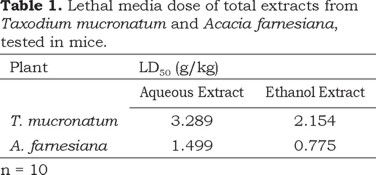
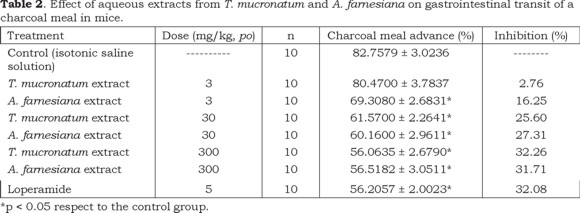
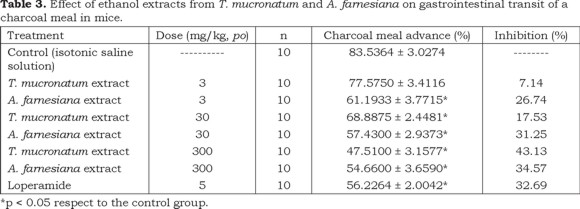
<body><![CDATA[<p align="justify"><font face="verdana" size="2"><b>Statistical analysis</b></font></p>              <p align="justify"><font face="verdana" size="2">The results were statistically evaluated using a one&#45;way ANOVA followed by Dunnett's t test (<i>p</i> &lt; 0.05).</font></p>              <p align="justify"><font face="verdana" size="2">&nbsp;</font></p>              <p align="justify"><font face="verdana" size="2"><b>Results and discussion</b></font></p>              <p align="justify"><font face="verdana" size="2">The results obtained for the LD<sub>50</sub> from the extracts of <i>T. mucronatum</i> and <i>A. farnesiana</i> (<a href="#c1">Table 1</a>) show that they are weakly toxic according to classifications based on this parameter (D&eacute;ciga&#45;Campos <i>et al</i>., 2007). This means that they do not induce immediate toxicity in the tested experimental conditions. Also the pharmacologically active doses were lower than lethal media doses obtained. It has been reported that the genus <i>Acacia</i> is included in the wide group of plants that contain cyanogens (Seigler <i>et al</i>., 1979). LD<sub>50</sub> results suggest that <i>A. farnesiana</i> does not have or has low concentrations of cyanogen compounds.</font></p>              <p align="center"><font face="verdana" size="2"><a name="c1"></a></font></p>              <p align="center"><font face="verdana" size="2"><img src="/img/revistas/rlq/v40n1/a3c1.jpg"></font></p>              <p align="justify"><font face="verdana" size="2">The results show that the extracts of both the Ahuehuete and the Huizache were able to diminish the intestinal motility; with all the extracts a rising tendency of the inhibitory effect on the gastrointestinal motility was observed when the doses were increased (<a href="#c2">Tables 2</a> and <a href="#c3">3</a>). Inhibition percentages of peristaltic motion at the highest dose tested (300 mg/kg) for both extracts were 30% higher as compared to the control group. This level is considered appropriate for the total extract, considering that the population consumes medicinal teas of both species to treat diarrhea. In this study, the charcoal meal method was selected to follow the displacement of the gastrointestinal content because reduction of gastrointestinal motility is one mechanism by which many antidiarrheal agents can act (Akah <i>et al</i>., 1999; Astudillo&#45;V&aacute;zquez <i>et al</i>., 2009); this may be the case of both <i>Taxodium mucronatum</i> and <i>Acacia farnesiana</i>. Phytochemical studies of the Ahuehuete (Ishratullah <i>et al</i>., 1978, Argueta, 1994; Pan <i>et al</i>., 2005) and the Huizache (Barakat <i>et al</i>., 1999), have detected that they contain flavonoids among other compounds.</font></p>              <p align="center"><font face="verdana" size="2"><a name="c2"></a></font></p>              <p align="center"><font face="verdana" size="2"><img src="/img/revistas/rlq/v40n1/a3c2.jpg"></font></p>              ]]></body>
<body><![CDATA[<p align="center"><font face="verdana" size="2"><a name="c3"></a></font></p>              <p align="center"><font face="verdana" size="2"><img src="/img/revistas/rlq/v40n1/a3c3.jpg"></font></p>              <p align="justify"><font face="verdana" size="2">One of the flavonoids present in <i>A. farnesiana</i> is kaempferol (El&#45;Negoumy <i>et al</i>., 1982), which is a compound with antispasmodic activity in guinea pig isolated ileum (Trute <i>et al</i>., 1997) and its mechanism is exerted through calcium mobilization (Capasso <i>et al</i>., 1991). Furthermore, the mucilage that contains <i>A. farnesiana</i> gives body and volume to feces by favoring water absorption, which may contribute to decrease the amount of liquid feces.</font></p>              <p align="justify"><font face="verdana" size="2">On the other hand, quercetin derivatives are present in <i>A. farnesiana</i> (Barakat <i>et al</i>., 1999) and <i>T. mucronatum</i> (Argueta, 1994), this flavonoid inhibits the contractile responses in guinea pig isolated ileum (Lutterodt, 1989), probably by reducing the available calcium concentration (Capasso <i>et al</i>., 1991). More research is needed to elucidate the mechanism by which the extracts work. Of course, it is also necessary to isolate the active compounds. HPLC analysis of the extracts studied did not indicate the presence of quercetin, but it showed other aromatic compounds, perhaps biflavonoids, however this cannot be stated conclusively.</font></p>              <p align="justify"><font face="verdana" size="2">&nbsp;</font></p>              <p align="justify"><font face="verdana" size="2"><b>Conclusions</b></font></p>              <p align="justify"><font face="verdana" size="2">Our results suggest that the extracts obtained from the species studied do not induce immediate toxicity in the tested experimental conditions.</font></p>              <p align="justify"><font face="verdana" size="2">The obtained data present evidence that supports the use of <i>T. mucronatum</i> and <i>A. farnesiana</i> as antidiarrheal agents in Mexican traditional medicine.</font></p>              <p align="justify"><font face="verdana" size="2">&nbsp;</font></p>              <p align="justify"><font face="verdana" size="2"><b>Acknowledgements</b></font></p>              ]]></body>
<body><![CDATA[<p align="justify"><font face="verdana" size="2">The authors thank Biol. Alfredo Pati&ntilde;o Siciliano for the taxonomic identification of the plant material. Thanks to Prof. Daniel Villegas Estrada for mathematical assistance. A. Astudillo&#45;V&aacute;zquez is thankful for the COFAA&#45;IPN grant. Sponsors: SIP&#45;IPN (20121460) through partial support.</font></p>              <p align="justify"><font face="verdana" size="2">&nbsp;</font></p>              <p align="justify"><font face="verdana" size="2"><b>References</b></font></p>              <!-- ref --><p align="justify"><font face="verdana" size="2">Akah, P.A., Aguwa, C.N., Agu, R.U. (1999) Studies on the antidiarrhoeal properties of <i>Pentaclethra macrophylla</i> leaf extracts. <i>Phytoterapy Research</i> <b>13</b> : 292&#45;295.    &nbsp;&nbsp;&nbsp;&nbsp;&nbsp;&nbsp;&nbsp;&nbsp;[&#160;<a href="javascript:void(0);" onclick="javascript: window.open('/scielo.php?script=sci_nlinks&ref=7367870&pid=S0370-5943201200010000300001&lng=','','width=640,height=500,resizable=yes,scrollbars=1,menubar=yes,');">Links</a>&#160;]<!-- end-ref --></font></p>              <!-- ref --><p align="justify"><font face="verdana" size="2">Argueta, A. (Coordinador general). (1994) Atlas de las plantas de la medicina tradicional mexicana. Tomos I y II. Instituto Nacional Indigenista. Mexico City. Mexico. pp. 61&#45;62, 833&#45;834.    &nbsp;&nbsp;&nbsp;&nbsp;&nbsp;&nbsp;&nbsp;&nbsp;[&#160;<a href="javascript:void(0);" onclick="javascript: window.open('/scielo.php?script=sci_nlinks&ref=7367872&pid=S0370-5943201200010000300002&lng=','','width=640,height=500,resizable=yes,scrollbars=1,menubar=yes,');">Links</a>&#160;]<!-- end-ref --></font></p>              <!-- ref --><p align="justify"><font face="verdana" size="2">Astudillo&#45;V&aacute;zquez, A., D&aacute;valos, H., De Jes&uacute;s, L., Herrera, G., Navarrete, A. (2008) Investigation of <i>Alternanthera repens</i> and <i>Bidens odorata</i> on gastrointestinal disease. <i>Fitoterapia</i> <b>79</b> : 577&#45;580.    &nbsp;&nbsp;&nbsp;&nbsp;&nbsp;&nbsp;&nbsp;&nbsp;[&#160;<a href="javascript:void(0);" onclick="javascript: window.open('/scielo.php?script=sci_nlinks&ref=7367874&pid=S0370-5943201200010000300003&lng=','','width=640,height=500,resizable=yes,scrollbars=1,menubar=yes,');">Links</a>&#160;]<!-- end-ref --></font></p>              <!-- ref --><p align="justify"><font face="verdana" size="2">Astudillo&#45;V&aacute;zquez, A., Mata, R., Navarrete, A. (2009) El reino vegetal, fuente de agentes antiespasm&oacute;dicos gastrointestinales y antidiarreicos. Revista Latinoamericana de Qu&iacute;mica <b>37</b> : 7&#45;44.    &nbsp;&nbsp;&nbsp;&nbsp;&nbsp;&nbsp;&nbsp;&nbsp;[&#160;<a href="javascript:void(0);" onclick="javascript: window.open('/scielo.php?script=sci_nlinks&ref=7367876&pid=S0370-5943201200010000300004&lng=','','width=640,height=500,resizable=yes,scrollbars=1,menubar=yes,');">Links</a>&#160;]<!-- end-ref --></font></p>              <!-- ref --><p align="justify"><font face="verdana" size="2">Barakat, H.H., Souleman, A.M., Hussein, S.A.M., Ibrahiem, O.A., Nawwar, M.A.M. (1999) Flavonoid galloyl glucosides from the pods of <i>Acacia farnesiana</i>. <i>Phytochemistry</i> <b>51</b> : 139&#45;142.    &nbsp;&nbsp;&nbsp;&nbsp;&nbsp;&nbsp;&nbsp;&nbsp;[&#160;<a href="javascript:void(0);" onclick="javascript: window.open('/scielo.php?script=sci_nlinks&ref=7367878&pid=S0370-5943201200010000300005&lng=','','width=640,height=500,resizable=yes,scrollbars=1,menubar=yes,');">Links</a>&#160;]<!-- end-ref --></font></p>              <!-- ref --><p align="justify"><font face="verdana" size="2">Burks, T.F. (1998) Gastrointestinal drugs. Chapter 62. In: <i>Human pharmacology. Molecular to clinical.</i> Brody, T.M., Larner, J., Minneman, K.P. (editors). 3<sup>rd</sup> edition. Mosby. St. Louis Missouri, USA. pp. 827&#45;841.    &nbsp;&nbsp;&nbsp;&nbsp;&nbsp;&nbsp;&nbsp;&nbsp;[&#160;<a href="javascript:void(0);" onclick="javascript: window.open('/scielo.php?script=sci_nlinks&ref=7367880&pid=S0370-5943201200010000300006&lng=','','width=640,height=500,resizable=yes,scrollbars=1,menubar=yes,');">Links</a>&#160;]<!-- end-ref --></font></p>              <!-- ref --><p align="justify"><font face="verdana" size="2">Capasso, A., Pinto, A., Sorrentino, R., Capasso, F. (1991) Inhibitory effects of quercetin and other flavonoids on electrically&#45;induced contractions of guinea pig isolated ileum. <i>Jounal of Ethnopharmacology</i> <b>34</b> : 279&#45;281.    &nbsp;&nbsp;&nbsp;&nbsp;&nbsp;&nbsp;&nbsp;&nbsp;[&#160;<a href="javascript:void(0);" onclick="javascript: window.open('/scielo.php?script=sci_nlinks&ref=7367882&pid=S0370-5943201200010000300007&lng=','','width=640,height=500,resizable=yes,scrollbars=1,menubar=yes,');">Links</a>&#160;]<!-- end-ref --></font></p>              <!-- ref --><p align="justify"><font face="verdana" size="2">D&eacute;ciga&#45;Campos, M., Rivero&#45;Cruz, I., Arriaga&#45;Alba, M., Casta&ntilde;eda&#45;Corral, G., Angeles&#45;L&oacute;pez, G.E., Navarrete, A., Mata, R. (2007) Acute toxicity and mutagenic activity of Mexican plants used in traditional medicine. <i>Journal of Ethnopharmacology</i> <b>110</b> : 334&#45;342.    &nbsp;&nbsp;&nbsp;&nbsp;&nbsp;&nbsp;&nbsp;&nbsp;[&#160;<a href="javascript:void(0);" onclick="javascript: window.open('/scielo.php?script=sci_nlinks&ref=7367884&pid=S0370-5943201200010000300008&lng=','','width=640,height=500,resizable=yes,scrollbars=1,menubar=yes,');">Links</a>&#160;]<!-- end-ref --></font></p>              <!-- ref --><p align="justify"><font face="verdana" size="2">El&#45;Negoumy, S.I., El&#45;Ansari, M.A. (1982) Kaempferol 7&#45;galloylglucosa from <i>Acacia farnesiana</i>. <i>Egyptian Journal of Chemistry</i> <b>24</b> : 471&#45;473.    &nbsp;&nbsp;&nbsp;&nbsp;&nbsp;&nbsp;&nbsp;&nbsp;[&#160;<a href="javascript:void(0);" onclick="javascript: window.open('/scielo.php?script=sci_nlinks&ref=7367886&pid=S0370-5943201200010000300009&lng=','','width=640,height=500,resizable=yes,scrollbars=1,menubar=yes,');">Links</a>&#160;]<!-- end-ref --></font></p>              <!-- ref --><p align="justify"><font face="verdana" size="2">Gutstein, H.B., Akil, H. (2003) Analg&eacute;sicos opioides. In: <i>Goodman &amp; Gilman. Las bases farmacol&oacute;gicas de la terap&eacute;utica</i>. Hardman, J.G, Limbird, L.E., Goodman Gilman A. (eds).10<sup>th</sup> Edition. Volume I. Mexico City. Mexico. pp. 577&#45;628. <a href="http://sinais.salud.gob.mx/" target="_blank">http://sinais.salud.gob.mx/</a></font>&nbsp;&nbsp;&nbsp;&nbsp;&nbsp;&nbsp;&nbsp;&nbsp;[&#160;<a href="javascript:void(0);" onclick="javascript: window.open('/scielo.php?script=sci_nlinks&ref=7367888&pid=S0370-5943201200010000300010&lng=','','width=640,height=500,resizable=yes,scrollbars=1,menubar=yes,');">Links</a>&#160;]<!-- end-ref --><!-- ref --><p align="justify"><font face="verdana" size="2">Ishratullah, K.H., Rahman, W., Okigawa, M., Kawano, N. (1978) Biflavones from <i>Taxodium mucronatum</i>. <i>Phytochemistry</i> <b>17</b> : 335.    &nbsp;&nbsp;&nbsp;&nbsp;&nbsp;&nbsp;&nbsp;&nbsp;[&#160;<a href="javascript:void(0);" onclick="javascript: window.open('/scielo.php?script=sci_nlinks&ref=7367889&pid=S0370-5943201200010000300011&lng=','','width=640,height=500,resizable=yes,scrollbars=1,menubar=yes,');">Links</a>&#160;]<!-- end-ref --></font></p>              <!-- ref --><p align="justify"><font face="verdana" size="2">Jafri, S., Pasricha, P.J. (2003) F&aacute;rmacos usados para diarrea, estre&ntilde;imiento y enfermedad inflamatoria intestinal; f&aacute;rmacos usados para enfermedades biliar y pancre&aacute;tica. In: <i>Goodman &amp; Gilman. Las bases farmacol&oacute;gicas de la terap&eacute;utica</i>. Hardman, J.G., Limbird, L.E., Goodman Gilman A. (eds).10<sup>th</sup> Edition. Volume I. Mexico City. Mexico. pp. 1051&#45;1072.    &nbsp;&nbsp;&nbsp;&nbsp;&nbsp;&nbsp;&nbsp;&nbsp;[&#160;<a href="javascript:void(0);" onclick="javascript: window.open('/scielo.php?script=sci_nlinks&ref=7367891&pid=S0370-5943201200010000300012&lng=','','width=640,height=500,resizable=yes,scrollbars=1,menubar=yes,');">Links</a>&#160;]<!-- end-ref --></font></p>              <!-- ref --><p align="justify"><font face="verdana" size="2">Lomel&iacute;, C. (ed.) (2002) Gu&iacute;a para el cuidado y uso de los animales de laboratorio. Institute of Laboratory Animal Resources Council, Commission on Life Sciences, National Research Council. Mexico: Academia Nacional de Medicina. pp. 25&#45;55.    &nbsp;&nbsp;&nbsp;&nbsp;&nbsp;&nbsp;&nbsp;&nbsp;[&#160;<a href="javascript:void(0);" onclick="javascript: window.open('/scielo.php?script=sci_nlinks&ref=7367893&pid=S0370-5943201200010000300013&lng=','','width=640,height=500,resizable=yes,scrollbars=1,menubar=yes,');">Links</a>&#160;]<!-- end-ref --></font></p>              <!-- ref --><p align="justify"><font face="verdana" size="2">Lorke, D. (1983) A new approach to practical acute toxicity testing. <i>Archives of Toxicology</i> <b>54</b> : 275&#45;287.    &nbsp;&nbsp;&nbsp;&nbsp;&nbsp;&nbsp;&nbsp;&nbsp;[&#160;<a href="javascript:void(0);" onclick="javascript: window.open('/scielo.php?script=sci_nlinks&ref=7367895&pid=S0370-5943201200010000300014&lng=','','width=640,height=500,resizable=yes,scrollbars=1,menubar=yes,');">Links</a>&#160;]<!-- end-ref --></font></p>              ]]></body>
<body><![CDATA[<!-- ref --><p align="justify"><font face="verdana" size="2">Lutterodt, G.D. (1989) Inhibition of gastrointestinal release of acetylcholine by quercetin as a possible mode of action of <i>Psidium guajava</i> leaf extracts in the treatment of acute diarrhoeal disease. <i>Journal of Ethnopharmacology</i> <b>25</b> : 235&#45;247.    &nbsp;&nbsp;&nbsp;&nbsp;&nbsp;&nbsp;&nbsp;&nbsp;[&#160;<a href="javascript:void(0);" onclick="javascript: window.open('/scielo.php?script=sci_nlinks&ref=7367897&pid=S0370-5943201200010000300015&lng=','','width=640,height=500,resizable=yes,scrollbars=1,menubar=yes,');">Links</a>&#160;]<!-- end-ref --></font></p>              <!-- ref --><p align="justify"><font face="verdana" size="2">Olfert, E. D., Cross, B. M., McWilliam, A. A. (eds.). (1993) Guide to the care and use of experimental animals. Vol 1, Ontario, Canada: Canadian Council on Animal Care. 211 p.    &nbsp;&nbsp;&nbsp;&nbsp;&nbsp;&nbsp;&nbsp;&nbsp;[&#160;<a href="javascript:void(0);" onclick="javascript: window.open('/scielo.php?script=sci_nlinks&ref=7367899&pid=S0370-5943201200010000300016&lng=','','width=640,height=500,resizable=yes,scrollbars=1,menubar=yes,');">Links</a>&#160;]<!-- end-ref --></font></p>              <!-- ref --><p align="justify"><font face="verdana" size="2">Pan, X., Tan, N., Zeng, G., Zhang, Y., Jia, R. (2005) Amentoflavone and its derivatives as novel natural inhibitors of human cathepsin B. <i>Bioorganic &amp; Medicinal Chemistry</i> <b>13</b> : 5819&#45;5825.    &nbsp;&nbsp;&nbsp;&nbsp;&nbsp;&nbsp;&nbsp;&nbsp;[&#160;<a href="javascript:void(0);" onclick="javascript: window.open('/scielo.php?script=sci_nlinks&ref=7367901&pid=S0370-5943201200010000300017&lng=','','width=640,height=500,resizable=yes,scrollbars=1,menubar=yes,');">Links</a>&#160;]<!-- end-ref --></font></p>              <!-- ref --><p align="justify"><font face="verdana" size="2">Pouillot, R., Grill&oacute;, M.J., Alabart, J.L., Garin&#45;Bastuji, B., Blasco, J.M. (2003) Statistical procedures for calculating the residual virulence of <i>Brucella abortus</i> strain 19(S19) and <i>Brucella melitensis</i> strain Rev 1 vaccines in mice: theoretical basis and practical applications. <i>Scientific and Technical Review</i> <b>22</b>:1051&#45;1063.    &nbsp;&nbsp;&nbsp;&nbsp;&nbsp;&nbsp;&nbsp;&nbsp;[&#160;<a href="javascript:void(0);" onclick="javascript: window.open('/scielo.php?script=sci_nlinks&ref=7367903&pid=S0370-5943201200010000300018&lng=','','width=640,height=500,resizable=yes,scrollbars=1,menubar=yes,');">Links</a>&#160;]<!-- end-ref --></font></p>              <!-- ref --><p align="justify"><font face="verdana" size="2">Rzedowski, J., Rzedowski, G.C. (1990) Flora fanerog&aacute;mica del Valle de M&eacute;xico. Vol. III. Instituto de Ecolog&iacute;a. Mexico p. 405.    &nbsp;&nbsp;&nbsp;&nbsp;&nbsp;&nbsp;&nbsp;&nbsp;[&#160;<a href="javascript:void(0);" onclick="javascript: window.open('/scielo.php?script=sci_nlinks&ref=7367905&pid=S0370-5943201200010000300019&lng=','','width=640,height=500,resizable=yes,scrollbars=1,menubar=yes,');">Links</a>&#160;]<!-- end-ref --></font></p>              ]]></body>
<body><![CDATA[<!-- ref --><p align="justify"><font face="verdana" size="2">Rzedowski, J., Rzedowski, G.C. (1991) Flora fanerog&aacute;mica del Valle de M&eacute;xico. Vol. I. Escuela Nacional de Ciencias Biol&oacute;gicas. Instituto Polit&eacute;cnico Nacional. Mexico, pp. 71&#45;72.    &nbsp;&nbsp;&nbsp;&nbsp;&nbsp;&nbsp;&nbsp;&nbsp;[&#160;<a href="javascript:void(0);" onclick="javascript: window.open('/scielo.php?script=sci_nlinks&ref=7367907&pid=S0370-5943201200010000300020&lng=','','width=640,height=500,resizable=yes,scrollbars=1,menubar=yes,');">Links</a>&#160;]<!-- end-ref --></font></p>              <!-- ref --><p align="justify"><font face="verdana" size="2">Sahu, N.P., Achari, B., Banerjee, S. (1998) 7,3'&#45;dihydroxy&#45;4'&#45;methoxyflavone from seeds of <i>Acacia farnesiana</i>. <i>Phytochemistry</i> <b>49</b> : 1425&#45;1426.    &nbsp;&nbsp;&nbsp;&nbsp;&nbsp;&nbsp;&nbsp;&nbsp;[&#160;<a href="javascript:void(0);" onclick="javascript: window.open('/scielo.php?script=sci_nlinks&ref=7367909&pid=S0370-5943201200010000300021&lng=','','width=640,height=500,resizable=yes,scrollbars=1,menubar=yes,');">Links</a>&#160;]<!-- end-ref --></font></p>              <!-- ref --><p align="justify"><font face="verdana" size="2">Seigler, D.S., Conn, E.E., Dunn, J.E., Janzen, D.H. (1979) Cyanogenesis in <i>Acacia farnesiana</i>. <i>Phytochemistry</i> <b>18</b> : 1389&#45;1390.    &nbsp;&nbsp;&nbsp;&nbsp;&nbsp;&nbsp;&nbsp;&nbsp;[&#160;<a href="javascript:void(0);" onclick="javascript: window.open('/scielo.php?script=sci_nlinks&ref=7367911&pid=S0370-5943201200010000300022&lng=','','width=640,height=500,resizable=yes,scrollbars=1,menubar=yes,');">Links</a>&#160;]<!-- end-ref --></font></p>              <!-- ref --><p align="justify"><font face="verdana" size="2">SS, Secretar&iacute;a de Salud (1999) Norma Oficial Mexicana. Especificaciones t&eacute;cnicas para la producci&oacute;n, cuidado y uso de los animales de laboratorio (NOM&#45;062&#45;ZOO&#45;1999). Mexico: <i>Diario Oficial de la Federaci&oacute;n</i>.    &nbsp;&nbsp;&nbsp;&nbsp;&nbsp;&nbsp;&nbsp;&nbsp;[&#160;<a href="javascript:void(0);" onclick="javascript: window.open('/scielo.php?script=sci_nlinks&ref=7367913&pid=S0370-5943201200010000300023&lng=','','width=640,height=500,resizable=yes,scrollbars=1,menubar=yes,');">Links</a>&#160;]<!-- end-ref --></font></p>              <!-- ref --><p align="justify"><font face="verdana" size="2">SS, Secretar&iacute;a de Salud (2005) Principales causas de mortalidad general, en hombres, en mujeres y en edad posproductiva (65 a&ntilde;os y m&aacute;s). Mexico.    &nbsp;&nbsp;&nbsp;&nbsp;&nbsp;&nbsp;&nbsp;&nbsp;[&#160;<a href="javascript:void(0);" onclick="javascript: window.open('/scielo.php?script=sci_nlinks&ref=7367915&pid=S0370-5943201200010000300024&lng=','','width=640,height=500,resizable=yes,scrollbars=1,menubar=yes,');">Links</a>&#160;]<!-- end-ref --></font></p>              ]]></body>
<body><![CDATA[<!-- ref --><p align="justify"><font face="verdana" size="2">Trute, A., Gross, J., Mutschler, E., Nahrstedt, A. (1997) <i>In vitro</i> antispasmodic compounds of the dry extract obtained from <i>Hedera helix</i>. <i>Planta Medica</i> <b>63</b> : 125&#45;129.    &nbsp;&nbsp;&nbsp;&nbsp;&nbsp;&nbsp;&nbsp;&nbsp;[&#160;<a href="javascript:void(0);" onclick="javascript: window.open('/scielo.php?script=sci_nlinks&ref=7367917&pid=S0370-5943201200010000300025&lng=','','width=640,height=500,resizable=yes,scrollbars=1,menubar=yes,');">Links</a>&#160;]<!-- end-ref --></font></p>              <!-- ref --><p align="justify"><font face="verdana" size="2">UNICEF, Fondo de las Naciones Unidas para la Infancia (2009) Estado mundial de la infancia 2009. Salud materna y neonatal: Situaci&oacute;n actual. <a href="http://www.unicef.org/" target="_blank">http://www.unicef.org/</a></font>&nbsp;&nbsp;&nbsp;&nbsp;&nbsp;&nbsp;&nbsp;&nbsp;[&#160;<a href="javascript:void(0);" onclick="javascript: window.open('/scielo.php?script=sci_nlinks&ref=7367919&pid=S0370-5943201200010000300026&lng=','','width=640,height=500,resizable=yes,scrollbars=1,menubar=yes,');">Links</a>&#160;]<!-- end-ref --><!-- ref --><p align="justify"><font face="verdana" size="2">Wassel, G.M., Abd&#45;El&#45;Wahab, S.M., Aboutabl, E.A., Ammar, N.M., Afifi, M.S. (1990) Study of phenolic constituents and tannins isolated from <i>Acacia nilotica</i> (L.) Willd and <i>Acacia farnesiana</i> (L.) Willd growing in Egypt. <i>Herba Hung</i> <b>29</b> : 43&#45;49.    &nbsp;&nbsp;&nbsp;&nbsp;&nbsp;&nbsp;&nbsp;&nbsp;[&#160;<a href="javascript:void(0);" onclick="javascript: window.open('/scielo.php?script=sci_nlinks&ref=7367920&pid=S0370-5943201200010000300027&lng=','','width=640,height=500,resizable=yes,scrollbars=1,menubar=yes,');">Links</a>&#160;]<!-- end-ref --></font></p>              <!-- ref --><p align="justify"><font face="verdana" size="2">WHO, Organizaci&oacute;n Mundial de la Salud (2009). Estad&iacute;sticas Sanitarias Mundiales. WHO. p. 53.    &nbsp;&nbsp;&nbsp;&nbsp;&nbsp;&nbsp;&nbsp;&nbsp;[&#160;<a href="javascript:void(0);" onclick="javascript: window.open('/scielo.php?script=sci_nlinks&ref=7367922&pid=S0370-5943201200010000300028&lng=','','width=640,height=500,resizable=yes,scrollbars=1,menubar=yes,');">Links</a>&#160;]<!-- end-ref --></font></p>              <!-- ref --><p align="justify"><font face="verdana" size="2">WHOSIS, World Health Statistics Information System (2009) <a href="http://www.who.int/whosis/" target="_blank">http://www.who.int/whosis/</a></font>&nbsp;&nbsp;&nbsp;&nbsp;&nbsp;&nbsp;&nbsp;&nbsp;[&#160;<a href="javascript:void(0);" onclick="javascript: window.open('/scielo.php?script=sci_nlinks&ref=7367924&pid=S0370-5943201200010000300029&lng=','','width=640,height=500,resizable=yes,scrollbars=1,menubar=yes,');">Links</a>&#160;]<!-- end-ref --><!-- ref --><p align="justify"><font face="verdana" size="2">Williamson, E. M., Okpako, D.T., Evans, F. J. (1996) Selection, preparation and pharmacological evaluation of plant material. <i>Pharmacological methods in Phytotherapy Research</i>. John Wiley and Sons. Chichester. p. 28.    &nbsp;&nbsp;&nbsp;&nbsp;&nbsp;&nbsp;&nbsp;&nbsp;[&#160;<a href="javascript:void(0);" onclick="javascript: window.open('/scielo.php?script=sci_nlinks&ref=7367925&pid=S0370-5943201200010000300030&lng=','','width=640,height=500,resizable=yes,scrollbars=1,menubar=yes,');">Links</a>&#160;]<!-- end-ref --></font></p>     ]]></body>
<body><![CDATA[ ]]></body><back>
<ref-list>
<ref id="B1">
<nlm-citation citation-type="journal">
<person-group person-group-type="author">
<name>
<surname><![CDATA[Akah]]></surname>
<given-names><![CDATA[P.A.]]></given-names>
</name>
<name>
<surname><![CDATA[Aguwa]]></surname>
<given-names><![CDATA[C.N.]]></given-names>
</name>
<name>
<surname><![CDATA[Agu]]></surname>
<given-names><![CDATA[R.U.]]></given-names>
</name>
</person-group>
<article-title xml:lang="en"><![CDATA[Studies on the antidiarrhoeal properties of Pentaclethra macrophylla leaf extracts]]></article-title>
<source><![CDATA[Phytoterapy Research]]></source>
<year>1999</year>
<volume>13</volume>
<page-range>292-295</page-range></nlm-citation>
</ref>
<ref id="B2">
<nlm-citation citation-type="book">
<person-group person-group-type="author">
<name>
<surname><![CDATA[Argueta]]></surname>
<given-names><![CDATA[A.]]></given-names>
</name>
</person-group>
<source><![CDATA[Atlas de las plantas de la medicina tradicional mexicana]]></source>
<year>1994</year>
<page-range>61-62, 833-834</page-range><publisher-loc><![CDATA[Mexico City ]]></publisher-loc>
<publisher-name><![CDATA[Instituto Nacional Indigenista]]></publisher-name>
</nlm-citation>
</ref>
<ref id="B3">
<nlm-citation citation-type="journal">
<person-group person-group-type="author">
<name>
<surname><![CDATA[Astudillo-Vázquez]]></surname>
<given-names><![CDATA[A.]]></given-names>
</name>
<name>
<surname><![CDATA[Dávalos]]></surname>
<given-names><![CDATA[H.]]></given-names>
</name>
<name>
<surname><![CDATA[De Jesús]]></surname>
<given-names><![CDATA[L.]]></given-names>
</name>
<name>
<surname><![CDATA[Herrera]]></surname>
<given-names><![CDATA[G.]]></given-names>
</name>
<name>
<surname><![CDATA[Navarrete]]></surname>
<given-names><![CDATA[A.]]></given-names>
</name>
</person-group>
<article-title xml:lang="en"><![CDATA[Investigation of Alternanthera repens and Bidens odorata on gastrointestinal disease]]></article-title>
<source><![CDATA[Fitoterapia]]></source>
<year>2008</year>
<volume>79</volume>
<page-range>577-580</page-range></nlm-citation>
</ref>
<ref id="B4">
<nlm-citation citation-type="journal">
<person-group person-group-type="author">
<name>
<surname><![CDATA[Astudillo-Vázquez]]></surname>
<given-names><![CDATA[A.]]></given-names>
</name>
<name>
<surname><![CDATA[Mata]]></surname>
<given-names><![CDATA[R.]]></given-names>
</name>
<name>
<surname><![CDATA[Navarrete]]></surname>
<given-names><![CDATA[A.]]></given-names>
</name>
</person-group>
<article-title xml:lang="es"><![CDATA[El reino vegetal, fuente de agentes antiespasmódicos gastrointestinales y antidiarreicos]]></article-title>
<source><![CDATA[Revista Latinoamericana de Química]]></source>
<year>2009</year>
<volume>37</volume>
<page-range>7-44</page-range></nlm-citation>
</ref>
<ref id="B5">
<nlm-citation citation-type="journal">
<person-group person-group-type="author">
<name>
<surname><![CDATA[Barakat]]></surname>
<given-names><![CDATA[H.H.]]></given-names>
</name>
<name>
<surname><![CDATA[Souleman]]></surname>
<given-names><![CDATA[A.M.]]></given-names>
</name>
<name>
<surname><![CDATA[Hussein]]></surname>
<given-names><![CDATA[S.A.M.]]></given-names>
</name>
<name>
<surname><![CDATA[Ibrahiem]]></surname>
<given-names><![CDATA[O.A.]]></given-names>
</name>
<name>
<surname><![CDATA[Nawwar]]></surname>
<given-names><![CDATA[M.A.M.]]></given-names>
</name>
</person-group>
<article-title xml:lang="en"><![CDATA[Flavonoid galloyl glucosides from the pods of Acacia farnesiana]]></article-title>
<source><![CDATA[Phytochemistry]]></source>
<year>1999</year>
<volume>51</volume>
<page-range>139-142</page-range></nlm-citation>
</ref>
<ref id="B6">
<nlm-citation citation-type="">
<person-group person-group-type="author">
<name>
<surname><![CDATA[Burks]]></surname>
<given-names><![CDATA[T.F.]]></given-names>
</name>
</person-group>
<article-title xml:lang="en"><![CDATA[Gastrointestinal drugs: Chapter 62]]></article-title>
<person-group person-group-type="editor">
<name>
<surname><![CDATA[Brody]]></surname>
<given-names><![CDATA[T.M.]]></given-names>
</name>
<name>
<surname><![CDATA[Larner]]></surname>
<given-names><![CDATA[J.]]></given-names>
</name>
<name>
<surname><![CDATA[Minneman]]></surname>
<given-names><![CDATA[K.P.]]></given-names>
</name>
</person-group>
<source><![CDATA[]]></source>
<year>1998</year>
<edition>3</edition>
<page-range>827-841</page-range><publisher-loc><![CDATA[Mosby^eSt. Louis Missouri St. Louis Missouri]]></publisher-loc>
</nlm-citation>
</ref>
<ref id="B7">
<nlm-citation citation-type="journal">
<person-group person-group-type="author">
<name>
<surname><![CDATA[Capasso]]></surname>
<given-names><![CDATA[A.]]></given-names>
</name>
<name>
<surname><![CDATA[Pinto]]></surname>
<given-names><![CDATA[A.]]></given-names>
</name>
<name>
<surname><![CDATA[Sorrentino]]></surname>
<given-names><![CDATA[R.]]></given-names>
</name>
<name>
<surname><![CDATA[Capasso]]></surname>
<given-names><![CDATA[F.]]></given-names>
</name>
</person-group>
<article-title xml:lang="en"><![CDATA[Inhibitory effects of quercetin and other flavonoids on electrically-induced contractions of guinea pig isolated ileum]]></article-title>
<source><![CDATA[Jounal of Ethnopharmacology]]></source>
<year>1991</year>
<volume>34</volume>
<page-range>279-281</page-range></nlm-citation>
</ref>
<ref id="B8">
<nlm-citation citation-type="journal">
<person-group person-group-type="author">
<name>
<surname><![CDATA[Déciga-Campos]]></surname>
<given-names><![CDATA[M.]]></given-names>
</name>
<name>
<surname><![CDATA[Rivero-Cruz]]></surname>
<given-names><![CDATA[I.]]></given-names>
</name>
<name>
<surname><![CDATA[Arriaga-Alba]]></surname>
<given-names><![CDATA[M.]]></given-names>
</name>
<name>
<surname><![CDATA[Castañeda-Corral]]></surname>
<given-names><![CDATA[G.]]></given-names>
</name>
<name>
<surname><![CDATA[Angeles-López]]></surname>
<given-names><![CDATA[G.E.]]></given-names>
</name>
<name>
<surname><![CDATA[Navarrete]]></surname>
<given-names><![CDATA[A.]]></given-names>
</name>
<name>
<surname><![CDATA[Mata]]></surname>
<given-names><![CDATA[R.]]></given-names>
</name>
</person-group>
<article-title xml:lang="en"><![CDATA[Acute toxicity and mutagenic activity of Mexican plants used in traditional medicine]]></article-title>
<source><![CDATA[Journal of Ethnopharmacology]]></source>
<year>2007</year>
<volume>110</volume>
<page-range>334-342</page-range></nlm-citation>
</ref>
<ref id="B9">
<nlm-citation citation-type="journal">
<person-group person-group-type="author">
<name>
<surname><![CDATA[El-Negoumy]]></surname>
<given-names><![CDATA[S.I.]]></given-names>
</name>
<name>
<surname><![CDATA[El-Ansari]]></surname>
<given-names><![CDATA[M.A.]]></given-names>
</name>
</person-group>
<article-title xml:lang="en"><![CDATA[Kaempferol 7-galloylglucosa from Acacia farnesiana]]></article-title>
<source><![CDATA[Egyptian Journal of Chemistry]]></source>
<year>1982</year>
<volume>24</volume>
<page-range>471-473</page-range></nlm-citation>
</ref>
<ref id="B10">
<nlm-citation citation-type="">
<person-group person-group-type="author">
<name>
<surname><![CDATA[Gutstein]]></surname>
<given-names><![CDATA[H.B.]]></given-names>
</name>
<name>
<surname><![CDATA[Akil]]></surname>
<given-names><![CDATA[H.]]></given-names>
</name>
</person-group>
<article-title xml:lang="es"><![CDATA[Analgésicos opioides]]></article-title>
<person-group person-group-type="editor">
<name>
<surname><![CDATA[Hardman]]></surname>
<given-names><![CDATA[J.G.]]></given-names>
</name>
<name>
<surname><![CDATA[Limbird]]></surname>
<given-names><![CDATA[L.E.]]></given-names>
</name>
<name>
<surname><![CDATA[Goodman Gilman]]></surname>
<given-names><![CDATA[A.]]></given-names>
</name>
</person-group>
<source><![CDATA[Goodman & Gilman: Las bases farmacológicas de la terapéutica]]></source>
<year>2003</year>
<volume>I</volume>
<edition>10</edition>
<page-range>577-628</page-range><publisher-loc><![CDATA[Mexico City ]]></publisher-loc>
</nlm-citation>
</ref>
<ref id="B11">
<nlm-citation citation-type="journal">
<person-group person-group-type="author">
<name>
<surname><![CDATA[Ishratullah]]></surname>
<given-names><![CDATA[K.H.]]></given-names>
</name>
<name>
<surname><![CDATA[Rahman]]></surname>
<given-names><![CDATA[W.]]></given-names>
</name>
<name>
<surname><![CDATA[Okigawa]]></surname>
<given-names><![CDATA[M.]]></given-names>
</name>
<name>
<surname><![CDATA[Kawano]]></surname>
<given-names><![CDATA[N.]]></given-names>
</name>
</person-group>
<article-title xml:lang="en"><![CDATA[Biflavones from Taxodium mucronatum]]></article-title>
<source><![CDATA[Phytochemistry]]></source>
<year>1978</year>
<volume>17</volume>
<page-range>335</page-range></nlm-citation>
</ref>
<ref id="B12">
<nlm-citation citation-type="">
<person-group person-group-type="author">
<name>
<surname><![CDATA[Jafri]]></surname>
<given-names><![CDATA[S.]]></given-names>
</name>
<name>
<surname><![CDATA[Pasricha]]></surname>
<given-names><![CDATA[P.J.]]></given-names>
</name>
</person-group>
<article-title xml:lang="es"><![CDATA[Fármacos usados para diarrea, estreñimiento y enfermedad inflamatoria intestinal; fármacos usados para enfermedades biliar y pancreática]]></article-title>
<person-group person-group-type="editor">
<name>
<surname><![CDATA[Hardman]]></surname>
<given-names><![CDATA[J.G.]]></given-names>
</name>
<name>
<surname><![CDATA[Limbird]]></surname>
<given-names><![CDATA[L.E.]]></given-names>
</name>
<name>
<surname><![CDATA[Goodman Gilman]]></surname>
<given-names><![CDATA[A.]]></given-names>
</name>
</person-group>
<source><![CDATA[Goodman & Gilman: Las bases farmacológicas de la terapéutica]]></source>
<year>2003</year>
<volume>I</volume>
<edition>10</edition>
<page-range>1051-1072</page-range><publisher-loc><![CDATA[Mexico City ]]></publisher-loc>
</nlm-citation>
</ref>
<ref id="B13">
<nlm-citation citation-type="book">
<person-group person-group-type="author">
<name>
<surname><![CDATA[Lomelí]]></surname>
<given-names><![CDATA[C.]]></given-names>
</name>
</person-group>
<source><![CDATA[Guía para el cuidado y uso de los animales de laboratorio]]></source>
<year>2002</year>
<page-range>25-55</page-range><publisher-name><![CDATA[Institute of Laboratory Animal Resources CouncilCommission on Life SciencesNational Research CouncilAcademia Nacional de Medicina]]></publisher-name>
</nlm-citation>
</ref>
<ref id="B14">
<nlm-citation citation-type="journal">
<person-group person-group-type="author">
<name>
<surname><![CDATA[Lorke]]></surname>
<given-names><![CDATA[D.]]></given-names>
</name>
</person-group>
<article-title xml:lang="en"><![CDATA[A new approach to practical acute toxicity testing]]></article-title>
<source><![CDATA[Archives of Toxicology]]></source>
<year>1983</year>
<volume>54</volume>
<page-range>275-287</page-range></nlm-citation>
</ref>
<ref id="B15">
<nlm-citation citation-type="journal">
<person-group person-group-type="author">
<name>
<surname><![CDATA[Lutterodt]]></surname>
<given-names><![CDATA[G.D.]]></given-names>
</name>
</person-group>
<article-title xml:lang="en"><![CDATA[Inhibition of gastrointestinal release of acetylcholine by quercetin as a possible mode of action of Psidium guajava leaf extracts in the treatment of acute diarrhoeal disease]]></article-title>
<source><![CDATA[Journal of Ethnopharmacology]]></source>
<year>1989</year>
<volume>25</volume>
<page-range>235-247</page-range></nlm-citation>
</ref>
<ref id="B16">
<nlm-citation citation-type="book">
<person-group person-group-type="author">
<name>
<surname><![CDATA[Olfert]]></surname>
<given-names><![CDATA[E. D.]]></given-names>
</name>
<name>
<surname><![CDATA[Cross]]></surname>
<given-names><![CDATA[B. M.]]></given-names>
</name>
<name>
<surname><![CDATA[McWilliam]]></surname>
<given-names><![CDATA[A. A.]]></given-names>
</name>
</person-group>
<source><![CDATA[Guide to the care and use of experimental animals]]></source>
<year>1993</year>
<volume>1</volume>
<page-range>211</page-range><publisher-loc><![CDATA[Ontario ]]></publisher-loc>
<publisher-name><![CDATA[Canadian Council on Animal Care]]></publisher-name>
</nlm-citation>
</ref>
<ref id="B17">
<nlm-citation citation-type="journal">
<person-group person-group-type="author">
<name>
<surname><![CDATA[Pan]]></surname>
<given-names><![CDATA[X.]]></given-names>
</name>
<name>
<surname><![CDATA[Tan]]></surname>
<given-names><![CDATA[N.]]></given-names>
</name>
<name>
<surname><![CDATA[Zeng]]></surname>
<given-names><![CDATA[G.]]></given-names>
</name>
<name>
<surname><![CDATA[Zhang]]></surname>
<given-names><![CDATA[Y.]]></given-names>
</name>
<name>
<surname><![CDATA[Jia]]></surname>
<given-names><![CDATA[R.]]></given-names>
</name>
</person-group>
<article-title xml:lang="en"><![CDATA[Amentoflavone and its derivatives as novel natural inhibitors of human cathepsin B]]></article-title>
<source><![CDATA[Bioorganic & Medicinal Chemistry]]></source>
<year>2005</year>
<volume>13</volume>
<page-range>5819-5825</page-range></nlm-citation>
</ref>
<ref id="B18">
<nlm-citation citation-type="journal">
<person-group person-group-type="author">
<name>
<surname><![CDATA[Pouillot]]></surname>
<given-names><![CDATA[R.]]></given-names>
</name>
<name>
<surname><![CDATA[Grilló]]></surname>
<given-names><![CDATA[M.J.]]></given-names>
</name>
<name>
<surname><![CDATA[Alabart]]></surname>
<given-names><![CDATA[J.L.]]></given-names>
</name>
<name>
<surname><![CDATA[Garin-Bastuji]]></surname>
<given-names><![CDATA[B.]]></given-names>
</name>
<name>
<surname><![CDATA[Blasco]]></surname>
<given-names><![CDATA[J.M.]]></given-names>
</name>
</person-group>
<article-title xml:lang="en"><![CDATA[Statistical procedures for calculating the residual virulence of Brucella abortus strain 19(S19) and Brucella melitensis strain Rev 1 vaccines in mice: theoretical basis and practical applications]]></article-title>
<source><![CDATA[Scientific and Technical Review]]></source>
<year>2003</year>
<volume>22</volume>
<page-range>1051-1063</page-range></nlm-citation>
</ref>
<ref id="B19">
<nlm-citation citation-type="book">
<person-group person-group-type="author">
<name>
<surname><![CDATA[Rzedowski]]></surname>
<given-names><![CDATA[J.]]></given-names>
</name>
<name>
<surname><![CDATA[Rzedowski]]></surname>
<given-names><![CDATA[G.C.]]></given-names>
</name>
</person-group>
<source><![CDATA[Flora fanerogámica del Valle de México]]></source>
<year>1990</year>
<volume>III</volume>
<page-range>405</page-range><publisher-loc><![CDATA[Mexico ]]></publisher-loc>
<publisher-name><![CDATA[Instituto de Ecología]]></publisher-name>
</nlm-citation>
</ref>
<ref id="B20">
<nlm-citation citation-type="book">
<person-group person-group-type="author">
<name>
<surname><![CDATA[Rzedowski]]></surname>
<given-names><![CDATA[J.]]></given-names>
</name>
<name>
<surname><![CDATA[Rzedowski]]></surname>
<given-names><![CDATA[G.C.]]></given-names>
</name>
</person-group>
<source><![CDATA[Flora fanerogámica del Valle de México]]></source>
<year>1991</year>
<volume>I</volume>
<page-range>71-72</page-range><publisher-loc><![CDATA[Mexico ]]></publisher-loc>
<publisher-name><![CDATA[Escuela Nacional de Ciencias Biológicas. Instituto Politécnico Nacional]]></publisher-name>
</nlm-citation>
</ref>
<ref id="B21">
<nlm-citation citation-type="journal">
<person-group person-group-type="author">
<name>
<surname><![CDATA[Sahu]]></surname>
<given-names><![CDATA[N.P.]]></given-names>
</name>
<name>
<surname><![CDATA[Achari]]></surname>
<given-names><![CDATA[B.]]></given-names>
</name>
<name>
<surname><![CDATA[Banerjee]]></surname>
<given-names><![CDATA[S.]]></given-names>
</name>
</person-group>
<article-title xml:lang="en"><![CDATA[7,3'-dihydroxy-4'-methoxyflavone from seeds of Acacia farnesiana]]></article-title>
<source><![CDATA[Phytochemistry]]></source>
<year>1998</year>
<volume>49</volume>
<page-range>1425-1426</page-range></nlm-citation>
</ref>
<ref id="B22">
<nlm-citation citation-type="journal">
<person-group person-group-type="author">
<name>
<surname><![CDATA[Seigler]]></surname>
<given-names><![CDATA[D.S.]]></given-names>
</name>
<name>
<surname><![CDATA[Conn]]></surname>
<given-names><![CDATA[E.E.]]></given-names>
</name>
<name>
<surname><![CDATA[Dunn]]></surname>
<given-names><![CDATA[J.E.]]></given-names>
</name>
<name>
<surname><![CDATA[Janzen]]></surname>
<given-names><![CDATA[D.H.]]></given-names>
</name>
</person-group>
<article-title xml:lang="en"><![CDATA[Cyanogenesis in Acacia farnesiana]]></article-title>
<source><![CDATA[Phytochemistry]]></source>
<year>1979</year>
<volume>18</volume>
<page-range>1389-1390</page-range></nlm-citation>
</ref>
<ref id="B23">
<nlm-citation citation-type="journal">
<collab>Secretaría de Salud</collab>
<article-title xml:lang="es"><![CDATA[Norma Oficial Mexicana. Especificaciones técnicas para la producción, cuidado y uso de los animales de laboratorio (NOM-062-ZOO-1999)]]></article-title>
<source><![CDATA[Diario Oficial de la Federación]]></source>
<year>1999</year>
</nlm-citation>
</ref>
<ref id="B24">
<nlm-citation citation-type="">
<collab>Secretaría de Salud</collab>
<source><![CDATA[Principales causas de mortalidad general, en hombres, en mujeres y en edad posproductiva (65 años y más)]]></source>
<year>2005</year>
</nlm-citation>
</ref>
<ref id="B25">
<nlm-citation citation-type="journal">
<person-group person-group-type="author">
<name>
<surname><![CDATA[Trute]]></surname>
<given-names><![CDATA[A.]]></given-names>
</name>
<name>
<surname><![CDATA[Gross]]></surname>
<given-names><![CDATA[J.]]></given-names>
</name>
<name>
<surname><![CDATA[Mutschler]]></surname>
<given-names><![CDATA[E.]]></given-names>
</name>
<name>
<surname><![CDATA[Nahrstedt]]></surname>
<given-names><![CDATA[A.]]></given-names>
</name>
</person-group>
<article-title xml:lang="en"><![CDATA[In vitro antispasmodic compounds of the dry extract obtained from Hedera helix]]></article-title>
<source><![CDATA[Planta Medica]]></source>
<year>1997</year>
<volume>63</volume>
<page-range>125-129</page-range></nlm-citation>
</ref>
<ref id="B26">
<nlm-citation citation-type="">
<collab>Fondo de las Naciones Unidas para la Infancia</collab>
<source><![CDATA[Estado mundial de la infancia 2009: Salud materna y neonatal: Situación actual]]></source>
<year>2009</year>
</nlm-citation>
</ref>
<ref id="B27">
<nlm-citation citation-type="journal">
<person-group person-group-type="author">
<name>
<surname><![CDATA[Wassel]]></surname>
<given-names><![CDATA[G.M.]]></given-names>
</name>
<name>
<surname><![CDATA[Abd-El-Wahab]]></surname>
<given-names><![CDATA[S.M.]]></given-names>
</name>
<name>
<surname><![CDATA[Aboutabl]]></surname>
<given-names><![CDATA[E.A.]]></given-names>
</name>
<name>
<surname><![CDATA[Ammar]]></surname>
<given-names><![CDATA[N.M.]]></given-names>
</name>
<name>
<surname><![CDATA[Afifi]]></surname>
<given-names><![CDATA[M.S.]]></given-names>
</name>
</person-group>
<article-title xml:lang="en"><![CDATA[Study of phenolic constituents and tannins isolated from Acacia nilotica (L.) Willd and Acacia farnesiana (L.) Willd growing in Egypt]]></article-title>
<source><![CDATA[Herba Hung]]></source>
<year>1990</year>
<volume>29</volume>
<page-range>43-49</page-range></nlm-citation>
</ref>
<ref id="B28">
<nlm-citation citation-type="book">
<collab>Organización Mundial de la Salud</collab>
<source><![CDATA[Estadísticas Sanitarias Mundiales]]></source>
<year>2009</year>
<page-range>53</page-range><publisher-name><![CDATA[WHO]]></publisher-name>
</nlm-citation>
</ref>
<ref id="B29">
<nlm-citation citation-type="">
<source><![CDATA[WHOSIS, World Health Statistics Information System]]></source>
<year>2009</year>
</nlm-citation>
</ref>
<ref id="B30">
<nlm-citation citation-type="book">
<person-group person-group-type="author">
<name>
<surname><![CDATA[Williamson]]></surname>
<given-names><![CDATA[E. M.]]></given-names>
</name>
<name>
<surname><![CDATA[Okpako]]></surname>
<given-names><![CDATA[D.T.]]></given-names>
</name>
<name>
<surname><![CDATA[Evans]]></surname>
<given-names><![CDATA[F. J.]]></given-names>
</name>
</person-group>
<article-title xml:lang="en"><![CDATA[Selection, preparation and pharmacological evaluation of plant material]]></article-title>
<source><![CDATA[Pharmacological methods in Phytotherapy Research]]></source>
<year>1996</year>
<page-range>28</page-range><publisher-loc><![CDATA[Chichester ]]></publisher-loc>
<publisher-name><![CDATA[John Wiley and Sons]]></publisher-name>
</nlm-citation>
</ref>
</ref-list>
</back>
</article>