<?xml version="1.0" encoding="ISO-8859-1"?><article xmlns:mml="http://www.w3.org/1998/Math/MathML" xmlns:xlink="http://www.w3.org/1999/xlink" xmlns:xsi="http://www.w3.org/2001/XMLSchema-instance">
<front>
<journal-meta>
<journal-id>0370-5943</journal-id>
<journal-title><![CDATA[Revista latinoamericana de química]]></journal-title>
<abbrev-journal-title><![CDATA[Rev. latinoam. quím]]></abbrev-journal-title>
<issn>0370-5943</issn>
<publisher>
<publisher-name><![CDATA[Laboratorios Mixim S.A.]]></publisher-name>
</publisher>
</journal-meta>
<article-meta>
<article-id>S0370-59432011000200003</article-id>
<title-group>
<article-title xml:lang="en"><![CDATA[Study by infrared spectroscopy and thermogravimetric analysis of Tannins and Tannic acid]]></article-title>
</title-group>
<contrib-group>
<contrib contrib-type="author">
<name>
<surname><![CDATA[Pantoja-Castro]]></surname>
<given-names><![CDATA[Mayra A.]]></given-names>
</name>
<xref ref-type="aff" rid="A01"/>
</contrib>
<contrib contrib-type="author">
<name>
<surname><![CDATA[González-Rodríguez]]></surname>
<given-names><![CDATA[Horacio]]></given-names>
</name>
<xref ref-type="aff" rid="A01"/>
</contrib>
</contrib-group>
<aff id="A01">
<institution><![CDATA[,Universidad Michoacana de San Nicolás de Hidalgo Facultad de Ingeniería Química División de Estudios de Posgrado]]></institution>
<addr-line><![CDATA[Morelia Michoacán]]></addr-line>
<country>México</country>
</aff>
<pub-date pub-type="pub">
<day>00</day>
<month>00</month>
<year>2011</year>
</pub-date>
<pub-date pub-type="epub">
<day>00</day>
<month>00</month>
<year>2011</year>
</pub-date>
<volume>39</volume>
<numero>3</numero>
<fpage>107</fpage>
<lpage>112</lpage>
<copyright-statement/>
<copyright-year/>
<self-uri xlink:href="http://www.scielo.org.mx/scielo.php?script=sci_arttext&amp;pid=S0370-59432011000200003&amp;lng=en&amp;nrm=iso"></self-uri><self-uri xlink:href="http://www.scielo.org.mx/scielo.php?script=sci_abstract&amp;pid=S0370-59432011000200003&amp;lng=en&amp;nrm=iso"></self-uri><self-uri xlink:href="http://www.scielo.org.mx/scielo.php?script=sci_pdf&amp;pid=S0370-59432011000200003&amp;lng=en&amp;nrm=iso"></self-uri><abstract abstract-type="short" xml:lang="en"><p><![CDATA[Among the compounds in nature useful for people are tannins, which present large molecular complexity and they had have an ancient use as tanning agents, and nowadays some of them are used due their antioxidant properties for protect metals of corrosion. Also elucidation, synthesis and purification represent a great challenge to obtain them. Due this fact researches have tried to copy the synthesis of less complex compounds similar to tannins. From a different point of view, the use of tannins extracted from trees bark, considered in many places as a waste, grant an extra value to the bark. In this work we have studied and analyzed through gel permeation chromatography (GPC), infrared spectroscopy (FT-IR) and thermogravimetric analysis (TGA) the average molecular weight, main functional groups and thermal properties of tannins extracted from Schinopsis quebracho colorado. The results of these analyses are compared with those obtained for the commercial grade tannic acid. The comparison allowed to corroborate that is possible to use tannins from the Schinopsis quebracho colorado bark, with functional groups and thermal properties which tend to be similar to the tannic acid.]]></p></abstract>
<abstract abstract-type="short" xml:lang="es"><p><![CDATA[Entre los compuestos que existen en la naturaleza útil para la población, se encuentran los taninos, los cuales presentan una gran complejidad molecular y han tenido un uso desde la antigüedad como agentes para curtido. Hoy en día algunos de ellos se utilizan por sus propiedades antioxidantes para proteger los metales de la corrosión. Además la elucidación, síntesis y purificación representa un gran reto para su obtención y aplicación. Debido a lo anterior muchas investigaciones han tratado de copiar la síntesis de compuestos menos complejos similares a los taninos. Desde el punto de vista, el uso de taninos extraídos de la corteza de los árboles, considerada en muchos lugares como un desecho, le otorga un valor agregado a ésta. En este trabajo se estudió y analizó por cromatografía de permeación en gel (GPC), espectroscopia infrarroja (IR) y análisis termogravimétrico (TGA), el peso molecular medio, grupos funcionales y propiedades térmicas de los taninos extraídos de Schinopsis quebracho colorado. Los resultados de estos análisis se compararon con los obtenidos para el ácido tánico grado comercial. Esta comparación permitió corroborar que es posible utilizar taninos de Schinopsis quebracho colorado, con grupos funcionales y propiedades térmicas que tienden a parecerse a las que presenta el ácido tánico.]]></p></abstract>
<kwd-group>
<kwd lng="en"><![CDATA[coating]]></kwd>
<kwd lng="en"><![CDATA[corrosion]]></kwd>
<kwd lng="en"><![CDATA[Schinopsis quebracho colorado]]></kwd>
<kwd lng="en"><![CDATA[tannic acid]]></kwd>
<kwd lng="en"><![CDATA[tannins]]></kwd>
<kwd lng="es"><![CDATA[ácido tánico]]></kwd>
<kwd lng="es"><![CDATA[corrosión]]></kwd>
<kwd lng="es"><![CDATA[recubrimientos]]></kwd>
<kwd lng="es"><![CDATA[Schinopsis quebracho colorado]]></kwd>
<kwd lng="es"><![CDATA[taninos]]></kwd>
</kwd-group>
</article-meta>
</front><body><![CDATA[ <p align="center"><font face="verdana" size="4"><b>Study by infrared spectroscopy and thermogravimetric analysis of Tannins and Tannic acid</b></font></p>              <p align="center"><font face="verdana" size="2">&nbsp;</font></p>              <p align="center"><font face="verdana" size="2"><b>Mayra A. Pantoja&#45;Castro<sup>a,*</sup>, Horacio Gonz&aacute;lez&#45;Rodr&iacute;guez<sup>a</sup></b></font></p>              <p align="justify"><font face="verdana" size="2">&nbsp;</font></p>              <p align="justify"><font face="verdana" size="2"><sup><i>a</i></sup> <i>Divisi&oacute;n de Estudios de Posgrado de la Facultad de Ingenier&iacute;a Qu&iacute;mica, Universidad Michoacana de San Nicol&aacute;s de Hidalgo, Av. Francisco. J. M&uacute;gica s/n Col. Villa Universidad 58030, Morelia, Michoac&aacute;n, M&eacute;xico. *Correspondence should be addressed to</i>: <a href="mailto:m_pantojaq@yahoo.com.mx">m_pantojaq@yahoo.com.mx</a> <i>Tel: +52 01 (443) 316&#45;71&#45;76 Fax: +52 01 (443) 316&#45;71&#45;76.</i></font></p>              <p align="justify"><font face="verdana" size="2">&nbsp;</font></p>              <p align="justify"><font face="verdana" size="2">Received October 2011.    <br>     Accepted February 2012.</font></p>              <p align="justify"><font face="verdana" size="2">&nbsp;</font></p>              <p align="justify"><font face="verdana" size="2"><b>ABSTRACT</b></font></p>              ]]></body>
<body><![CDATA[<p align="justify"><font face="verdana" size="2">Among the compounds in nature useful for people are tannins, which present large molecular complexity and they had have an ancient use as tanning agents, and nowadays some of them are used due their antioxidant properties for protect metals of corrosion. Also elucidation, synthesis and purification represent a great challenge to obtain them. Due this fact researches have tried to copy the synthesis of less complex compounds similar to tannins. From a different point of view, the use of tannins extracted from trees bark, considered in many places as a waste, grant an extra value to the bark. In this work we have studied and analyzed through gel permeation chromatography (GPC), infrared spectroscopy (FT&#45;IR) and thermogravimetric analysis (TGA) the average molecular weight, main functional groups and thermal properties of tannins extracted from <i>Schinopsis quebracho colorado.</i> The results of these analyses are compared with those obtained for the commercial grade tannic acid. The comparison allowed to corroborate that is possible to use tannins from the <i>Schinopsis quebracho colorado</i> bark, with functional groups and thermal properties which tend to be similar to the tannic acid.</font></p>              <p align="justify"><font face="verdana" size="2"><b>Keywords:</b> coating, corrosion, <i>Schinopsis quebracho colorado,</i> tannic acid, tannins.</font></p>              <p align="justify"><font face="verdana" size="2">&nbsp;</font></p>              <p align="justify"><font face="verdana" size="2"><b>RESUMEN</b></font></p>              <p align="justify"><font face="verdana" size="2">Entre los compuestos que existen en la naturaleza &uacute;til para la poblaci&oacute;n, se encuentran los taninos, los cuales presentan una gran complejidad molecular y han tenido un uso desde la antig&uuml;edad como agentes para curtido. Hoy en d&iacute;a algunos de ellos se utilizan por sus propiedades antioxidantes para proteger los metales de la corrosi&oacute;n. Adem&aacute;s la elucidaci&oacute;n, s&iacute;ntesis y purificaci&oacute;n representa un gran reto para su obtenci&oacute;n y aplicaci&oacute;n. Debido a lo anterior muchas investigaciones han tratado de copiar la s&iacute;ntesis de compuestos menos complejos similares a los taninos. Desde el punto de vista, el uso de taninos extra&iacute;dos de la corteza de los &aacute;rboles, considerada en muchos lugares como un desecho, le otorga un valor agregado a &eacute;sta. En este trabajo se estudi&oacute; y analiz&oacute; por cromatograf&iacute;a de permeaci&oacute;n en gel (GPC), espectroscopia infrarroja (IR) y an&aacute;lisis termogravim&eacute;trico (TGA), el peso molecular medio, grupos funcionales y propiedades t&eacute;rmicas de los taninos extra&iacute;dos de <i>Schinopsis quebracho colorado.</i> Los resultados de estos an&aacute;lisis se compararon con los obtenidos para el &aacute;cido t&aacute;nico grado comercial. Esta comparaci&oacute;n permiti&oacute; corroborar que es posible utilizar taninos de <i>Schinopsis quebracho colorado,</i> con grupos funcionales y propiedades t&eacute;rmicas que tienden a parecerse a las que presenta el &aacute;cido t&aacute;nico.</font></p>              <p align="justify"><font face="verdana" size="2"><b>Palabras clave:</b> &aacute;cido t&aacute;nico, corrosi&oacute;n, recubrimientos, <i>Schinopsis quebracho colorado,</i> taninos.</font></p>              <p align="justify"><font face="verdana" size="2">&nbsp;</font></p>              <p align="justify"><font face="verdana" size="2"><b>INTRODUCTION</b></font></p>              <p align="justify"><font face="verdana" size="2">Tannic acid and tannins are polyphenolic compounds able to build very complex chemical structures. The tannic acid, which has an estimated chemical formula C<sub>76</sub>H<sub>52</sub>O<sub>46</sub> , is a commercial form of tannins. 3 300 years ago Egyptians extracted these compounds and used them as tanning agents. Due their tanning capacity these compounds were very important at an industrial level and tanneries. Although nowadays salts and synthetic tannins have acquired more importance against tannins extracted from natural sources (Matamala <i>et al.,</i> 1994; Haslam, 1996).</font></p>              <p align="justify"><font face="verdana" size="2">In the last two decades the isolation and structural determination of many types of tannins, which also include hydrolysable and condensable tannins have been possible using techniques as UV&#45;visible, nuclear magnetic resonance (<sup>1</sup>H&#45;NMR, <sup>13</sup>C&#45;NMR), mass spectroscopy (Isaza <i>et al.,</i> 2004; Meagher <i>et al.,</i> 2004) and soon. According to their structural differences between many species of tannins, some researchers have been used these compounds for different applications within which are find as fungicide, antibiotic and antioxidant (Schofield <i>et al.,</i> 2001; Latt&eacute; and Kolodziej, 2004). The antioxidant property of tannins has awaked special interest in the corrosion area, due to the fact that these compounds can inhibit corrosion in metals when they are incorporate in coatings. It can find in literature many researches about corrosion inhibition using tannic acid or tannins extracted i.e. from pine, mimosa and acacia species (Ja&eacute;n <i>et al.,</i> 2003; Hernes <i>et al.,</i> 2004). The antioxidant effect of these polyphenols compounds is attributed at their quelating action over transition metals and their capacity to attach free radicals through the synthesis of less reactive structures like show Iglesias <i>et al.</i> (2001). It is worth to mention that tannins extraction from trees bark offer an extra value to the barks, which is considered in many places as a waste. Even when tannins formula varies among tree species, tannins present structures similar than the tannic acid, for this reason elucidation and comparison between these compounds is important.</font></p>              ]]></body>
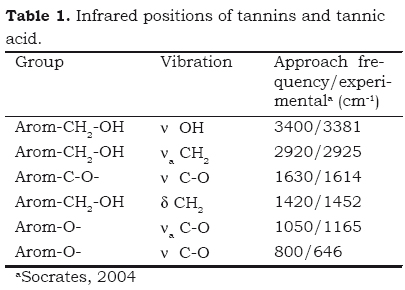
<body><![CDATA[<p align="justify"><font face="verdana" size="2">The aim of this work is to corroborate by gel permeation chromatography, infrared spectroscopy and thermogravimetric analysis that tannins extracted industrially (tannic acid), and tannins extracted from <i>Schinopsis quebracho colorado</i> have almost thermal, chemical and physicochemical similar characteristics, and therefore tannins can be reliable compounds for used <i>i.e</i> in anticorrosive coatings.</font></p>              <p align="justify"><font face="verdana" size="2">&nbsp;</font></p>              <p align="justify"><font face="verdana" size="2"><b>MATERIALS AND METHODS</b></font></p>              <p align="justify"><font face="verdana" size="2">In this study it has used tannic acid supplied by Sigma&#45;Aldrich. Condensed tannins (98&#37;) were provided by FITECMA&#45;UMSNH (Facultad de Ingenier&iacute;a en Tecnolog&iacute;a de la Madera de la Universidad Michoacana de San Nicol&aacute;s de Hidalgo) and they were extracted from <i>Schinopsis quebracho colorado</i> bark based in the works of Isaza <i>et al.</i> (2004) and Sivakumaran <i>et al.</i> (2006). Tannins were milled to generate size smaller particles (100 micrometers).</font></p>              <p align="justify"><font face="verdana" size="2">The molecular weight of tannins was obtained by high pressure liquid chromatography (HPLC) with a gel permeation chromatography system, 717 Plus Auto&#45;sample model using dimethylformamide as solvent. Structural characteristics of the compounds were analyzed with a FT&#45;IR spectrometer (Nicolet 5ZDA) in the absorption mode, ranging from 4000 to 400 cm<sup>&#45;1</sup>. Thermogravimetric analyses were performed at a heating rate of 10&#176;C/min under nitrogen flow by a differential scanning calorimetric (DSC) 822 Toledo Mettler.</font></p>              <p align="justify"><font face="verdana" size="2">&nbsp;</font></p>              <p align="justify"><font face="verdana" size="2"><b>RESULT AND DISCUSSION</b></font></p>              <p align="justify"><font face="verdana" size="2">The number average molecular weights (Mw) obtained through GPC for tannins from <i>Schinopsis quebracho colorado</i> and tannic acid (Sigma&#45;Aldrich) were of 6 485 and 1 701.23 respectively. The molecular weight of tannins is approximately four times higher than acid tannic because a lot of hydroxyl benzene rings are connected with similar structures forming a big structure as is suggested by Grassino <i>et al.</i> (1999) and Meagher <i>et al.</i> (2004).</font></p>              <p align="justify"><font face="verdana" size="2">The <a href="#f1">Figure 1</a> shows the spectrum of tannins and tannic acid where it can find a strong absorption around 3700 and 3000 cm<sup>&#45;1</sup> with a wide and strong band centered at 3381 and 3356 cm<sup>&#45;1</sup> respectively. These bands are assigned to the hydroxyl groups (OH) stretching vibrations and due to the wide variety of hydrogen bonding between OH.</font></p>              <p align="center"><font face="verdana" size="2"><a name="f1"></a></font></p>              ]]></body>
<body><![CDATA[<p align="center"><font face="verdana" size="2"><img src="/img/revistas/rlq/v39n3/a3f1.jpg"></font></p>              <p align="justify"><font face="verdana" size="2">In this spectrum it can notice a sharp peak at 2927 and a small shoulder at 2860 cm<sup>&#45;1</sup> associated with the symmetric and antysimmetric &#45;C&#45;H&#45; stretching vibrations of CH<sub>2</sub> and CH<sub>3</sub> groups respectively. Also it does not appear signals of free water molecules due there is no evidence of bands at 2130 cm<sup>&#45;1</sup> and 1650 cm<sup>&#45;1</sup> (H&#45;O&#45;H bending vibrations) and at about 700 cm<sup>&#45;1</sup>; but in the tannic acid spectrum some of these peaks appear due some hydrogen and oxygen atoms in this molecule can be bonding and they are observed in the spectrum as water signals.</font></p>              <p align="justify"><font face="verdana" size="2">The deformation vibration of the carbon&#45;carbon bonds in the phenolic groups absorbs in the region of 1500&#45;1400 cm<sup>1</sup>.</font></p>              <p align="justify"><font face="verdana" size="2">At 754 cm<sup>&#45;1</sup> shows the result distortion vibration of C=C in benzene rings (Socrates, 2004). Around 1452 cm<sup>&#45;1</sup> stretching vibrations of &#45;C&#45;C<sub>aromatic</sub> groups appear in both spectrums respectively.</font></p>              <p align="justify"><font face="verdana" size="2">Spectrum of tannins compared with tannic acid and tannins shows a decrease in many peaks located at 1718, 1614, 1452, 1328 and 1191 cm<sup>&#45;1</sup> which are not sharp and strong as is observed in tannic acid. Also it can be observed that only the tannic acid contains some aromatic esters due to the signal characteristics bands of carbonyl groups: C=O stretching vibration at 1730&#45;1705 cm<sup>&#45;1</sup> and C&#45;O at 1100&#45;1300 cm<sup>&#45;1</sup> (Silverstein <i>et</i> al.,1981; Stuart, 2005).</font></p>              <p align="justify"><font face="verdana" size="2">Detailed information is listed in <a href="#t1">Table 1</a>; these results are similar to those reported in the literature for polyphenolic compounds as tannic acid (Socrates, 2004).</font></p>              <p align="center"><font face="verdana" size="2"><a name="t1"></a></font></p>              <p align="center"><font face="verdana" size="2"><img src="/img/revistas/rlq/v39n3/a3t1.jpg"></font></p>              <p align="justify"><font face="verdana" size="2">The TGA traces and mass spectra obtained for the tannins and tannic acid heated at a rate of 5 &#176;C cm<sup>&#45;1</sup> are shown in the Figures 2(a)&#45;(b), which show the dependence of the mass loss of the samples expressed as a percentage of the initial mass and temperature. Also the first derivative is below of them.</font></p>              <p align="justify"><font face="verdana" size="2">Two distinct mass loss peaks can be seen in the <a href="/img/revistas/rlq/v39n3/a3f2.jpg" target="_blank">Fig. 2(a)</a>: a weak peak centered at 48.8 &#176;C where almost 11.47&#37; of weight due the postcuring, thermal reforming, preliminary oxidation steps and elimination of volatile fractions. The second peak, is sharper and more pronounced and it is found at 249.9 &#176;C where the degradation tannins begins and it could be the result of the partial breakdown of the intermolecular bonding. Finally after at 500 &#176;C remains a carbonized residue of 55.29&#37; w.</font></p>              ]]></body>
<body><![CDATA[<p align="justify"><font face="verdana" size="2">TGA of tannic acid in <a href="/img/revistas/rlq/v39n3/a3f2.jpg" target="_blank">Fig. 2 (b)</a> shows five thermal zones, the first one is appreciated between 25 and 150&#176;C with a mass loss centered at 37.7 &#176;C where preliminary oxidation steps and elimination of volatile fractions occurs.</font></p>              <p align="justify"><font face="verdana" size="2">In the second zone (151 and 205 &#176;C) is carried out the first depolymerization of tannic acid approximately 1.004&#37;w. Between 206 and 295 &#176;C is presented a second depolymerization of the material (36.62&#37;w) with a pronounced peak at 255.49&#176;C. Third degradation of tannic acid takes place after 296 &#176;C with a remarked peak at 306.39&#176;C; in this section is seen a mass loss of 26.41&#37;w. Finally after 500 &#176;C remains 28.3&#37; w of carbon.</font></p>              <p align="justify"><font face="verdana" size="2">Comparing differences between tannic acid and tannins, we observe in the last one, a difference of more than 27&#37; weight of carbon residues, due tannins contain impurity traces. Also, tannins contain more atoms of carbon in their structure than tannic acid. Another important difference between tannins and tannic acid thermograms, is that in the first one we observe three thermal zones while in tannic acid it observe five zones, due tannic acid has a less complex structure, and its bonds can be easily broken forming smaller structures.</font></p>              <p align="justify"><font face="verdana" size="2">&nbsp;</font></p>              <p align="justify"><font face="verdana" size="2"><b>CONCLUSIONS</b></font></p>              <p align="justify"><font face="verdana" size="2">In this work we have studied the molecular weight, main functional groups and thermal stability of a natural product, tannins from <i>Schinopsis quebracho colorado</i> and it was compared with results of a similar synthetic compound (tannic acid, Aldrich&#174;). Trough infrared spectroscopy it was observed that tannins do not shows important signal from carbonyl groups (aromatic esters) while they appears in tannic acid. Another important difference is in the hydroxyl group band, which in tannins is less pronounced, because several hydroxyls are interacting among them.</font></p>              <p align="justify"><font face="verdana" size="2">Thermogravimetric analysis shows that tannins show a similar stability thermal that tannic acid, which also have more depolymerization stages due to the easily break in smaller structures than tannins (compound con some monomer units similar to the tannic acid).</font></p>              <p align="justify"><font face="verdana" size="2">Even when results of GPC, FT&#45;IR and TGA vary slightly, it can be observed that <i>Schinopsis quebracho colorado</i> tannins present structures and functional groups which tend to be similar to the tannic acid. The above makes tannins ideal candidates to give them a good application, for example as anticorrosive coatings.</font></p>              <p align="justify"><font face="verdana" size="2">&nbsp;</font></p>              <p align="justify"><font face="verdana" size="2"><b>ACKNOWLEDGEMENTS</b></font></p>              ]]></body>
<body><![CDATA[<p align="justify"><font face="verdana" size="2">The authors acknowledge the economical support provided by project 20.3&#45;CIC&#45;UMSNH. Also we special thank to F. Bucio&#45;P. and N. Flores&#45;R. for supply us with tannins.</font></p>              <p align="justify"><font face="verdana" size="2">&nbsp;</font></p>              <p align="justify"><font face="verdana" size="2"><b>REFERENCES</b></font></p>              <!-- ref --><p align="justify"><font face="verdana" size="2">Grassino, S.B., Strumia, M.C., Couve, J., Abadie M.J.M. (1999) Photoactive films obtained from methacrylo&#45;urethanes tannic acid&#45;based with potential usage as coating materials: analytic and kinetic studies. <i>Journal of Progress in Organic Coatings</i> <b>37,</b> 1&#45;2 : 39&#45;48.    &nbsp;&nbsp;&nbsp;&nbsp;&nbsp;&nbsp;&nbsp;&nbsp;[&#160;<a href="javascript:void(0);" onclick="javascript: window.open('/scielo.php?script=sci_nlinks&ref=7367374&pid=S0370-5943201100020000300001&lng=','','width=640,height=500,resizable=yes,scrollbars=1,menubar=yes,');">Links</a>&#160;]<!-- end-ref --></font></p>              <!-- ref --><p align="justify"><font face="verdana" size="2">Haslam, E.J. (1996) Natural polyphenols (vegetal tannins) as drugs: possible modes of action. <i>Journal</i> of <i>Natural Products</i> <b>59,</b> 2 : 205&#45;215.    &nbsp;&nbsp;&nbsp;&nbsp;&nbsp;&nbsp;&nbsp;&nbsp;[&#160;<a href="javascript:void(0);" onclick="javascript: window.open('/scielo.php?script=sci_nlinks&ref=7367376&pid=S0370-5943201100020000300002&lng=','','width=640,height=500,resizable=yes,scrollbars=1,menubar=yes,');">Links</a>&#160;]<!-- end-ref --></font></p>              <!-- ref --><p align="justify"><font face="verdana" size="2">Hernes, P.J., Hedges, J. I. (2004) Tannin signatures of barks, needles, leaves, cones, and wood at the molecular level. <i>Geochimica et Cosmochimica Acta</i> <b>68,</b> 6 : 1293&#45;1307.    &nbsp;&nbsp;&nbsp;&nbsp;&nbsp;&nbsp;&nbsp;&nbsp;[&#160;<a href="javascript:void(0);" onclick="javascript: window.open('/scielo.php?script=sci_nlinks&ref=7367378&pid=S0370-5943201100020000300003&lng=','','width=640,height=500,resizable=yes,scrollbars=1,menubar=yes,');">Links</a>&#160;]<!-- end-ref --></font></p>              <!-- ref --><p align="justify"><font face="verdana" size="2">Iglesias, J., Garc&iacute;a de Salda&ntilde;a, E., Ja&eacute;n J.A. (2001) On the tannic acid interaction with metallic iron. <i>Journal of Hyperfine Interactions</i> <b>134,</b> 1 : 109&#45;114.    &nbsp;&nbsp;&nbsp;&nbsp;&nbsp;&nbsp;&nbsp;&nbsp;[&#160;<a href="javascript:void(0);" onclick="javascript: window.open('/scielo.php?script=sci_nlinks&ref=7367380&pid=S0370-5943201100020000300004&lng=','','width=640,height=500,resizable=yes,scrollbars=1,menubar=yes,');">Links</a>&#160;]<!-- end-ref --></font></p>              <!-- ref --><p align="justify"><font face="verdana" size="2">Isaza, J.H., Ito, H., Yoshida, T. (2004) Oligomeric hydrolysable tannins from <i>Monochaetum multiflorum. Journal</i> of <i>Phytochemistry</i> <b>65,</b> 3 : 359&#45;364.    &nbsp;&nbsp;&nbsp;&nbsp;&nbsp;&nbsp;&nbsp;&nbsp;[&#160;<a href="javascript:void(0);" onclick="javascript: window.open('/scielo.php?script=sci_nlinks&ref=7367382&pid=S0370-5943201100020000300005&lng=','','width=640,height=500,resizable=yes,scrollbars=1,menubar=yes,');">Links</a>&#160;]<!-- end-ref --></font></p>              <!-- ref --><p align="justify"><font face="verdana" size="2">Ja&eacute;n, J.A., Ara&uacute;z, E.Y., Iglesias, J., Delgado, Y.J. (2003) Reactivity of tannic acid with common corrosion products and its influence on the hydrolysis of iron in alkaline solutions. <i>Journal of Hyperfine Interactions</i> <b>148&#45;149,</b> 1&#45;4 : 199&#45;209.    &nbsp;&nbsp;&nbsp;&nbsp;&nbsp;&nbsp;&nbsp;&nbsp;[&#160;<a href="javascript:void(0);" onclick="javascript: window.open('/scielo.php?script=sci_nlinks&ref=7367384&pid=S0370-5943201100020000300006&lng=','','width=640,height=500,resizable=yes,scrollbars=1,menubar=yes,');">Links</a>&#160;]<!-- end-ref --></font></p>              <!-- ref --><p align="justify"><font face="verdana" size="2">Latt&eacute;, K.P., Kolodziej, H.J. (2004) Antioxidant properties of phenolic compounds from <i>Pelargonium reniforme. Journal of Agricultural and Food Chemistry</i> <b>52,</b> 15 : 4899&#45;4902.    &nbsp;&nbsp;&nbsp;&nbsp;&nbsp;&nbsp;&nbsp;&nbsp;[&#160;<a href="javascript:void(0);" onclick="javascript: window.open('/scielo.php?script=sci_nlinks&ref=7367386&pid=S0370-5943201100020000300007&lng=','','width=640,height=500,resizable=yes,scrollbars=1,menubar=yes,');">Links</a>&#160;]<!-- end-ref --></font></p>              <!-- ref --><p align="justify"><font face="verdana" size="2">Matamala, G., Smeltzer, W., Droguett G. (1994) Comparison of steel anticorrosive protection formulated with natural tannins extracted from acacia and from pine bark. <i>Journal</i> of <i>Corrosion Science</i> <b>42,</b> 8 : 1351&#45;1362.    &nbsp;&nbsp;&nbsp;&nbsp;&nbsp;&nbsp;&nbsp;&nbsp;[&#160;<a href="javascript:void(0);" onclick="javascript: window.open('/scielo.php?script=sci_nlinks&ref=7367388&pid=S0370-5943201100020000300008&lng=','','width=640,height=500,resizable=yes,scrollbars=1,menubar=yes,');">Links</a>&#160;]<!-- end-ref --></font></p>              <!-- ref --><p align="justify"><font face="verdana" size="2">Meagher, L.P., Lane, G., Sivakumaran, S., Tavendale, M.H., Fraser, K.J. (2004) Characterization of condensed tannins from <i>Lotus</i> species by thiolytic degradation and electrospray mass spectrometry. <i>Journal of Animal Feed Science and Technology</i> <b>117,</b> 1 : 151&#45;163.    &nbsp;&nbsp;&nbsp;&nbsp;&nbsp;&nbsp;&nbsp;&nbsp;[&#160;<a href="javascript:void(0);" onclick="javascript: window.open('/scielo.php?script=sci_nlinks&ref=7367390&pid=S0370-5943201100020000300009&lng=','','width=640,height=500,resizable=yes,scrollbars=1,menubar=yes,');">Links</a>&#160;]<!-- end-ref --></font></p>              <!-- ref --><p align="justify"><font face="verdana" size="2">Schofield, P., Mbugua, D.M., Pell, A.N. (2001) Analysis of condensed tannins: a review. <i>Journal of Animal Science and Technology</i> <b>91,</b> 1 : 21&#45;40.    &nbsp;&nbsp;&nbsp;&nbsp;&nbsp;&nbsp;&nbsp;&nbsp;[&#160;<a href="javascript:void(0);" onclick="javascript: window.open('/scielo.php?script=sci_nlinks&ref=7367392&pid=S0370-5943201100020000300010&lng=','','width=640,height=500,resizable=yes,scrollbars=1,menubar=yes,');">Links</a>&#160;]<!-- end-ref --></font></p>              <!-- ref --><p align="justify"><font face="verdana" size="2">Sivakumaran, S., Rumball, W., Lane, G.A., Fraser, K., Foo, L.Y., Yu M., Meagher, L.P. (2006) Variation of proanthocyanidins in Lotus species. <i>Journal of Chemical Ecology</i> <b>32,</b> 8: 1797&#45;1816.    &nbsp;&nbsp;&nbsp;&nbsp;&nbsp;&nbsp;&nbsp;&nbsp;[&#160;<a href="javascript:void(0);" onclick="javascript: window.open('/scielo.php?script=sci_nlinks&ref=7367394&pid=S0370-5943201100020000300011&lng=','','width=640,height=500,resizable=yes,scrollbars=1,menubar=yes,');">Links</a>&#160;]<!-- end-ref --></font></p>              <!-- ref --><p align="justify"><font face="verdana" size="2">Socrates, G. (2001) Infrared and Raman Characteristics Group Frequencies, Tables and Chart. 3a. ed., John Wiley &amp; Sons, Inc., USA pp: 125&#45;142.    &nbsp;&nbsp;&nbsp;&nbsp;&nbsp;&nbsp;&nbsp;&nbsp;[&#160;<a href="javascript:void(0);" onclick="javascript: window.open('/scielo.php?script=sci_nlinks&ref=7367396&pid=S0370-5943201100020000300012&lng=','','width=640,height=500,resizable=yes,scrollbars=1,menubar=yes,');">Links</a>&#160;]<!-- end-ref --></font></p>              <!-- ref --><p align="justify"><font face="verdana" size="2">Stuart, B. H. (2005) Experimental Methods in Infrared Spectroscopy: Fundamentals and Applications, John Wiley &amp; Sons, Ltd, Chichester, UK pp: 76&#45;77.    &nbsp;&nbsp;&nbsp;&nbsp;&nbsp;&nbsp;&nbsp;&nbsp;[&#160;<a href="javascript:void(0);" onclick="javascript: window.open('/scielo.php?script=sci_nlinks&ref=7367398&pid=S0370-5943201100020000300013&lng=','','width=640,height=500,resizable=yes,scrollbars=1,menubar=yes,');">Links</a>&#160;]<!-- end-ref --></font></p>              <!-- ref --><p align="justify"><font face="verdana" size="2">Silverstein, R.M., Bassler, G.C., Morrill, T.C. (1981) Spectrometric Identification of Organic Compounds. 7th ed., John Wiley &amp; Sons Inc., USA pp: 95&#45;98.    &nbsp;&nbsp;&nbsp;&nbsp;&nbsp;&nbsp;&nbsp;&nbsp;[&#160;<a href="javascript:void(0);" onclick="javascript: window.open('/scielo.php?script=sci_nlinks&ref=7367400&pid=S0370-5943201100020000300014&lng=','','width=640,height=500,resizable=yes,scrollbars=1,menubar=yes,');">Links</a>&#160;]<!-- end-ref --></font></p>      ]]></body><back>
<ref-list>
<ref id="B1">
<nlm-citation citation-type="journal">
<person-group person-group-type="author">
<name>
<surname><![CDATA[Grassino]]></surname>
<given-names><![CDATA[S.B.]]></given-names>
</name>
<name>
<surname><![CDATA[Strumia]]></surname>
<given-names><![CDATA[M.C.]]></given-names>
</name>
<name>
<surname><![CDATA[Couve]]></surname>
<given-names><![CDATA[J.]]></given-names>
</name>
<name>
<surname><![CDATA[Abadie]]></surname>
<given-names><![CDATA[M.J.M.]]></given-names>
</name>
</person-group>
<article-title xml:lang="en"><![CDATA[Photoactive films obtained from methacrylo-urethanes tannic acid-based with potential usage as coating materials: analytic and kinetic studies]]></article-title>
<source><![CDATA[Journal of Progress in Organic Coatings]]></source>
<year>1999</year>
<volume>37</volume>
<numero>1-2</numero>
<issue>1-2</issue>
<page-range>39-48</page-range></nlm-citation>
</ref>
<ref id="B2">
<nlm-citation citation-type="journal">
<person-group person-group-type="author">
<name>
<surname><![CDATA[Haslam]]></surname>
<given-names><![CDATA[E.J.]]></given-names>
</name>
</person-group>
<article-title xml:lang="en"><![CDATA[Natural polyphenols (vegetal tannins) as drugs: possible modes of action]]></article-title>
<source><![CDATA[Journal of Natural Products]]></source>
<year>1996</year>
<volume>59</volume>
<numero>2</numero>
<issue>2</issue>
<page-range>205-215</page-range></nlm-citation>
</ref>
<ref id="B3">
<nlm-citation citation-type="journal">
<person-group person-group-type="author">
<name>
<surname><![CDATA[Hernes]]></surname>
<given-names><![CDATA[P.J.]]></given-names>
</name>
<name>
<surname><![CDATA[Hedges]]></surname>
<given-names><![CDATA[J. I.]]></given-names>
</name>
</person-group>
<article-title xml:lang="en"><![CDATA[Tannin signatures of barks, needles, leaves, cones, and wood at the molecular level]]></article-title>
<source><![CDATA[Geochimica et Cosmochimica Acta]]></source>
<year>2004</year>
<volume>68</volume>
<numero>6</numero>
<issue>6</issue>
<page-range>1293-1307</page-range></nlm-citation>
</ref>
<ref id="B4">
<nlm-citation citation-type="journal">
<person-group person-group-type="author">
<name>
<surname><![CDATA[Iglesias]]></surname>
<given-names><![CDATA[J.]]></given-names>
</name>
<name>
<surname><![CDATA[García de Saldaña]]></surname>
<given-names><![CDATA[E.]]></given-names>
</name>
<name>
<surname><![CDATA[Jaén]]></surname>
<given-names><![CDATA[J.A.]]></given-names>
</name>
</person-group>
<article-title xml:lang="en"><![CDATA[On the tannic acid interaction with metallic iron]]></article-title>
<source><![CDATA[Journal of Hyperfine Interactions]]></source>
<year>2001</year>
<volume>134</volume>
<numero>1</numero>
<issue>1</issue>
<page-range>109-114</page-range></nlm-citation>
</ref>
<ref id="B5">
<nlm-citation citation-type="journal">
<person-group person-group-type="author">
<name>
<surname><![CDATA[Isaza]]></surname>
<given-names><![CDATA[J.H.]]></given-names>
</name>
<name>
<surname><![CDATA[Ito]]></surname>
<given-names><![CDATA[H.]]></given-names>
</name>
<name>
<surname><![CDATA[Yoshida]]></surname>
<given-names><![CDATA[T.]]></given-names>
</name>
</person-group>
<article-title xml:lang="en"><![CDATA[Oligomeric hydrolysable tannins from Monochaetum multiflorum]]></article-title>
<source><![CDATA[Journal of Phytochemistry]]></source>
<year>2004</year>
<volume>65</volume>
<numero>3</numero>
<issue>3</issue>
<page-range>359-364</page-range></nlm-citation>
</ref>
<ref id="B6">
<nlm-citation citation-type="journal">
<person-group person-group-type="author">
<name>
<surname><![CDATA[Jaén]]></surname>
<given-names><![CDATA[J.A.]]></given-names>
</name>
<name>
<surname><![CDATA[Araúz]]></surname>
<given-names><![CDATA[E.Y.]]></given-names>
</name>
<name>
<surname><![CDATA[Iglesias]]></surname>
<given-names><![CDATA[J.]]></given-names>
</name>
<name>
<surname><![CDATA[Delgado]]></surname>
<given-names><![CDATA[Y.J.]]></given-names>
</name>
</person-group>
<article-title xml:lang="en"><![CDATA[Reactivity of tannic acid with common corrosion products and its influence on the hydrolysis of iron in alkaline solutions]]></article-title>
<source><![CDATA[Journal of Hyperfine Interactions]]></source>
<year>2003</year>
<volume>148-149</volume>
<numero>1-4</numero>
<issue>1-4</issue>
<page-range>199-209</page-range></nlm-citation>
</ref>
<ref id="B7">
<nlm-citation citation-type="journal">
<person-group person-group-type="author">
<name>
<surname><![CDATA[Latté]]></surname>
<given-names><![CDATA[K.P.]]></given-names>
</name>
<name>
<surname><![CDATA[Kolodziej]]></surname>
<given-names><![CDATA[H.J.]]></given-names>
</name>
</person-group>
<article-title xml:lang="en"><![CDATA[Antioxidant properties of phenolic compounds from Pelargonium reniforme]]></article-title>
<source><![CDATA[Journal of Agricultural and Food Chemistry]]></source>
<year>2004</year>
<volume>52</volume>
<numero>15</numero>
<issue>15</issue>
<page-range>4899-4902</page-range></nlm-citation>
</ref>
<ref id="B8">
<nlm-citation citation-type="journal">
<person-group person-group-type="author">
<name>
<surname><![CDATA[Matamala]]></surname>
<given-names><![CDATA[G.]]></given-names>
</name>
<name>
<surname><![CDATA[Smeltzer]]></surname>
<given-names><![CDATA[W.]]></given-names>
</name>
<name>
<surname><![CDATA[Droguett]]></surname>
<given-names><![CDATA[G.]]></given-names>
</name>
</person-group>
<article-title xml:lang="en"><![CDATA[Comparison of steel anticorrosive protection formulated with natural tannins extracted from acacia and from pine bark]]></article-title>
<source><![CDATA[Journal of Corrosion Science]]></source>
<year>1994</year>
<volume>42</volume>
<numero>8</numero>
<issue>8</issue>
<page-range>1351-1362</page-range></nlm-citation>
</ref>
<ref id="B9">
<nlm-citation citation-type="journal">
<person-group person-group-type="author">
<name>
<surname><![CDATA[Meagher]]></surname>
<given-names><![CDATA[L.P.]]></given-names>
</name>
<name>
<surname><![CDATA[Lane]]></surname>
<given-names><![CDATA[G.]]></given-names>
</name>
<name>
<surname><![CDATA[Sivakumaran]]></surname>
<given-names><![CDATA[S.]]></given-names>
</name>
<name>
<surname><![CDATA[Tavendale]]></surname>
<given-names><![CDATA[M.H.]]></given-names>
</name>
<name>
<surname><![CDATA[Fraser]]></surname>
<given-names><![CDATA[K.J.]]></given-names>
</name>
</person-group>
<article-title xml:lang="en"><![CDATA[Characterization of condensed tannins from Lotus species by thiolytic degradation and electrospray mass spectrometry]]></article-title>
<source><![CDATA[Journal of Animal Feed Science and Technology]]></source>
<year>2004</year>
<volume>117</volume>
<numero>1</numero>
<issue>1</issue>
<page-range>151-163</page-range></nlm-citation>
</ref>
<ref id="B10">
<nlm-citation citation-type="journal">
<person-group person-group-type="author">
<name>
<surname><![CDATA[Schofield]]></surname>
<given-names><![CDATA[P.]]></given-names>
</name>
<name>
<surname><![CDATA[Mbugua]]></surname>
<given-names><![CDATA[D.M.]]></given-names>
</name>
<name>
<surname><![CDATA[Pell]]></surname>
<given-names><![CDATA[A.N.]]></given-names>
</name>
</person-group>
<article-title xml:lang="en"><![CDATA[Analysis of condensed tannins: a review]]></article-title>
<source><![CDATA[Journal of Animal Science and Technology]]></source>
<year>2001</year>
<volume>91</volume>
<numero>1</numero>
<issue>1</issue>
<page-range>21-40</page-range></nlm-citation>
</ref>
<ref id="B11">
<nlm-citation citation-type="journal">
<person-group person-group-type="author">
<name>
<surname><![CDATA[Sivakumaran]]></surname>
<given-names><![CDATA[S.]]></given-names>
</name>
<name>
<surname><![CDATA[Rumball]]></surname>
<given-names><![CDATA[W.]]></given-names>
</name>
<name>
<surname><![CDATA[Lane]]></surname>
<given-names><![CDATA[G.A.]]></given-names>
</name>
<name>
<surname><![CDATA[Fraser]]></surname>
<given-names><![CDATA[K.]]></given-names>
</name>
<name>
<surname><![CDATA[Foo]]></surname>
<given-names><![CDATA[L.Y.]]></given-names>
</name>
<name>
<surname><![CDATA[Yu]]></surname>
<given-names><![CDATA[M.]]></given-names>
</name>
<name>
<surname><![CDATA[Meagher]]></surname>
<given-names><![CDATA[L.P.]]></given-names>
</name>
</person-group>
<article-title xml:lang="en"><![CDATA[Variation of proanthocyanidins in Lotus species]]></article-title>
<source><![CDATA[Journal of Chemical Ecology]]></source>
<year>2006</year>
<volume>32</volume>
<numero>8</numero>
<issue>8</issue>
<page-range>1797-1816</page-range></nlm-citation>
</ref>
<ref id="B12">
<nlm-citation citation-type="book">
<person-group person-group-type="author">
<name>
<surname><![CDATA[Socrates]]></surname>
<given-names><![CDATA[G.]]></given-names>
</name>
</person-group>
<source><![CDATA[Infrared and Raman Characteristics Group Frequencies, Tables and Chart]]></source>
<year>2001</year>
<edition>3</edition>
<page-range>125-142</page-range><publisher-name><![CDATA[John Wiley & Sons, Inc.]]></publisher-name>
</nlm-citation>
</ref>
<ref id="B13">
<nlm-citation citation-type="book">
<person-group person-group-type="author">
<name>
<surname><![CDATA[Stuart]]></surname>
<given-names><![CDATA[B. H.]]></given-names>
</name>
</person-group>
<source><![CDATA[Experimental Methods in Infrared Spectroscopy: Fundamentals and Applications]]></source>
<year>2005</year>
<page-range>76-77</page-range><publisher-loc><![CDATA[Chichester ]]></publisher-loc>
<publisher-name><![CDATA[John Wiley & Sons]]></publisher-name>
</nlm-citation>
</ref>
<ref id="B14">
<nlm-citation citation-type="book">
<person-group person-group-type="author">
<name>
<surname><![CDATA[Silverstein]]></surname>
<given-names><![CDATA[R.M.]]></given-names>
</name>
<name>
<surname><![CDATA[Bassler]]></surname>
<given-names><![CDATA[G.C.]]></given-names>
</name>
<name>
<surname><![CDATA[Morrill]]></surname>
<given-names><![CDATA[T.C.]]></given-names>
</name>
</person-group>
<source><![CDATA[Spectrometric Identification of Organic Compounds]]></source>
<year>1981</year>
<edition>7</edition>
<page-range>95-98</page-range><publisher-name><![CDATA[John Wiley & Sons Inc.]]></publisher-name>
</nlm-citation>
</ref>
</ref-list>
</back>
</article>
