<?xml version="1.0" encoding="ISO-8859-1"?><article xmlns:mml="http://www.w3.org/1998/Math/MathML" xmlns:xlink="http://www.w3.org/1999/xlink" xmlns:xsi="http://www.w3.org/2001/XMLSchema-instance">
<front>
<journal-meta>
<journal-id>0370-5943</journal-id>
<journal-title><![CDATA[Revista latinoamericana de química]]></journal-title>
<abbrev-journal-title><![CDATA[Rev. latinoam. quím]]></abbrev-journal-title>
<issn>0370-5943</issn>
<publisher>
<publisher-name><![CDATA[Laboratorios Mixim S.A.]]></publisher-name>
</publisher>
</journal-meta>
<article-meta>
<article-id>S0370-59432011000100005</article-id>
<title-group>
<article-title xml:lang="en"><![CDATA[Ca2+, Mg2+ OR Fe2+ ion-exchanged cancrinite-type zeolites as possible hypoglycemiant agents]]></article-title>
</title-group>
<contrib-group>
<contrib contrib-type="author">
<name>
<surname><![CDATA[Cisneros]]></surname>
<given-names><![CDATA[Vanessa]]></given-names>
</name>
<xref ref-type="aff" rid="A01"/>
</contrib>
<contrib contrib-type="author">
<name>
<surname><![CDATA[Ocanto]]></surname>
<given-names><![CDATA[Freddy]]></given-names>
</name>
<xref ref-type="aff" rid="A01"/>
</contrib>
<contrib contrib-type="author">
<name>
<surname><![CDATA[Linares]]></surname>
<given-names><![CDATA[Carlos F.]]></given-names>
</name>
<xref ref-type="aff" rid="A01"/>
</contrib>
</contrib-group>
<aff id="A01">
<institution><![CDATA[,Universidad de Carabobo Facultad de Ciencias y Tecnología Departamento de Química]]></institution>
<addr-line><![CDATA[Valencia Edo. Carabobo]]></addr-line>
<country>Venezuela</country>
</aff>
<pub-date pub-type="pub">
<day>00</day>
<month>00</month>
<year>2011</year>
</pub-date>
<pub-date pub-type="epub">
<day>00</day>
<month>00</month>
<year>2011</year>
</pub-date>
<volume>39</volume>
<numero>1-2</numero>
<fpage>55</fpage>
<lpage>61</lpage>
<copyright-statement/>
<copyright-year/>
<self-uri xlink:href="http://www.scielo.org.mx/scielo.php?script=sci_arttext&amp;pid=S0370-59432011000100005&amp;lng=en&amp;nrm=iso"></self-uri><self-uri xlink:href="http://www.scielo.org.mx/scielo.php?script=sci_abstract&amp;pid=S0370-59432011000100005&amp;lng=en&amp;nrm=iso"></self-uri><self-uri xlink:href="http://www.scielo.org.mx/scielo.php?script=sci_pdf&amp;pid=S0370-59432011000100005&amp;lng=en&amp;nrm=iso"></self-uri><abstract abstract-type="short" xml:lang="en"><p><![CDATA[A nitrate-sodium cancrinite-type zeolite was synthesized and exchanged with calcium (II), magnesium (II) and iron (II) cations. These exchanged zeolites were previously characterized by XRD, BET specific surface area, chemical analysis and FT-IR. XRD confirmed only the presence of the cancrinite phase. Other phases, such as sodalite, were not identified. Different amounts of these ion-exchanged zeolites were put in contact with a glucose solution during variable time. Results showed that these ion-exchanged cancrinites were active for the glucose adsorption, especially those exchanged with Fe; while the Ca2+, Mg2+ and Na+ cancrinites displayed an adsorption capacity much lower than the Fe2+ cancrinite. Moreover, the kinetic studies showed that the glucose adsorption capacity by using these modified cancrinites, it is affected by the glucose concentration in the reaction medium.]]></p></abstract>
<abstract abstract-type="short" xml:lang="es"><p><![CDATA[Se sintetizó una zeolita tipo cancrinita sódica y nitrada, y se intercambió con cationes calcio (II), magnesio (II) y hierro (II). Estas zeolitas se caracterizaron, previamente, por difracción de rayos X, área superficial específica BET, análisis químico e infrarrojo con transformada de Fourier. Los datos de DRX confirmaron únicamente la presencia de la fase cancrinita. Otras fases, como la sodalita, no fueron detectadas. Estas zeolitas intercambiadas fueron puestas en contacto con una solución de glucosa a diferentes masas y tiempos de contacto. Los resultados señalaron que estas cancrinitas modificadas fueron activas para la adsorción de glucosa, especialmente las zeolitas intercambiadas con Fe, mientras que las cancrinitas intercambiadas con Ca2+, Mg2+ y Na+ mostraron una capacidad de adsorción mucho más baja que la cancrinita de Fe. Además, los estudios cinéticos demostraron que la capacidad de adsorción de glucosa por estas zeolitas es afectada por la concentración de glucosa en el medio de reacción.]]></p></abstract>
<kwd-group>
<kwd lng="en"><![CDATA[cancrinite]]></kwd>
<kwd lng="en"><![CDATA[hypoglycemiant agents]]></kwd>
<kwd lng="en"><![CDATA[diabetes]]></kwd>
<kwd lng="en"><![CDATA[cationic exchange]]></kwd>
<kwd lng="es"><![CDATA[cancrinita]]></kwd>
<kwd lng="es"><![CDATA[agentes hipoglicemiantes]]></kwd>
<kwd lng="es"><![CDATA[diabetes]]></kwd>
<kwd lng="es"><![CDATA[intercambio catiónico]]></kwd>
</kwd-group>
</article-meta>
</front><body><![CDATA[ <p align="center"><font face="verdana" size="4"><b>Ca<sup>2&#43;</sup>, Mg<sup>2&#43;</sup> OR Fe<sup>2&#43;</sup> ion&#45;exchanged cancrinite&#45;type zeolites as possible hypoglycemiant agents</b></font></p>              <p align="center"><font face="verdana" size="2">&nbsp;</font></p>              <p align="center"><font face="verdana" size="2"><b>Vanessa Cisneros, Freddy Ocanto, Carlos F. Linares*</b></font></p>              <p align="justify"><font face="verdana" size="2">&nbsp;</font></p>              <p align="justify"><font face="verdana" size="2"><i>* Laboratorio de Cat&aacute;lisis y Metales de Transici&oacute;n. Facultad de Ciencias y Tecnolog&iacute;a. Departamento de Qu&iacute;mica. Universidad de Carabobo. Valencia. Edo. Carabobo. Venezuela. Apartado Postal 3336, email</i>: <a href="mailto:clinares@uc.edu.ve">clinares@uc.edu.ve</a>.</font></p>              <p align="justify"><font face="verdana" size="2">&nbsp;</font></p>              <p align="justify"><font face="verdana" size="2">Received September 2011.    <br>     Accepted November 2011.</font></p>              <p align="justify"><font face="verdana" size="2">&nbsp;</font></p>              <p align="justify"><font face="verdana" size="2"><b>ABSTRACT</b></font></p>              ]]></body>
<body><![CDATA[<p align="justify"><font face="verdana" size="2">A nitrate&#45;sodium cancrinite&#45;type zeolite was synthesized and exchanged with calcium (II), magnesium (II) and iron (II) cations. These exchanged zeolites were previously characterized by XRD, BET specific surface area, chemical analysis and FT&#45;IR. XRD confirmed only the presence of the cancrinite phase. Other phases, such as sodalite, were not identified. Different amounts of these ion&#45;exchanged zeolites were put in contact with a glucose solution during variable time. Results showed that these ion&#45;exchanged cancrinites were active for the glucose adsorption, especially those exchanged with Fe; while the Ca<sup>2</sup><sup>&#43;</sup>, Mg<sup>2</sup><sup>&#43;</sup> and Na<sup>&#43;</sup> cancrinites displayed an adsorption capacity much lower than the Fe<sup>2&#43;</sup> cancrinite. Moreover, the kinetic studies showed that the glucose adsorption capacity by using these modified cancrinites, it is affected by the glucose concentration in the reaction medium.</font></p>              <p align="justify"><font face="verdana" size="2"><b>Key words:</b> cancrinite, hypoglycemiant agents, diabetes, cationic exchange.</font></p>              <p align="justify"><font face="verdana" size="2">&nbsp;</font></p>              <p align="justify"><font face="verdana" size="2"><b>RESUMEN</b></font></p>              <p align="justify"><font face="verdana" size="2">Se sintetiz&oacute; una zeolita tipo cancrinita s&oacute;dica y nitrada, y se intercambi&oacute; con cationes calcio (II), magnesio (II) y hierro (II). Estas zeolitas se caracterizaron, previamente, por difracci&oacute;n de rayos X, &aacute;rea superficial espec&iacute;fica BET, an&aacute;lisis qu&iacute;mico e infrarrojo con transformada de Fourier. Los datos de DRX confirmaron &uacute;nicamente la presencia de la fase cancrinita. Otras fases, como la sodalita, no fueron detectadas. Estas zeolitas intercambiadas fueron puestas en contacto con una soluci&oacute;n de glucosa a diferentes masas y tiempos de contacto. Los resultados se&ntilde;alaron que estas cancrinitas modificadas fueron activas para la adsorci&oacute;n de glucosa, especialmente las zeolitas intercambiadas con Fe, mientras que las cancrinitas intercambiadas con Ca<sup>2&#43;</sup>, Mg<sup>2&#43;</sup> y Na<sup>&#43;</sup> mostraron una capacidad de adsorci&oacute;n mucho m&aacute;s baja que la cancrinita de Fe. Adem&aacute;s, los estudios cin&eacute;ticos demostraron que la capacidad de adsorci&oacute;n de glucosa por estas zeolitas es afectada por la concentraci&oacute;n de glucosa en el medio de reacci&oacute;n.</font></p>              <p align="justify"><font face="verdana" size="2"><b>Palabras clave:</b> cancrinita, agentes hipoglicemiantes, diabetes, intercambio cati&oacute;nico</font></p>              <p align="justify"><font face="verdana" size="2">&nbsp;</font></p>              <p align="justify"><font face="verdana" size="2"><b>INTRODUCTION</b></font></p>              <p align="justify"><font face="verdana" size="2">Type&#45;II diabetes or Diabetes mellitus is characterized by the inadequate use of the insulin by human organism; therefore, the glucose levels in the blood are not normal. This type of diabetes can be controlled by diets, exercises and a low ingestion of sugar or carbohydrates to control the glycemia levels. However, when the sugar levels in the blood are very high, several drugs should be frequently administered in order to regulate the glucose concentration in the organism. These drugs are composed of sulfonylureas, which stimulate to the pancreas to produce insulin (White <i>et al.</i> 1959). These compounds are very effective but when they are used for long time, their effectiveness is lost. Then, new treatments based on the insulin administration should be started.</font></p>         <p align="center"><font face="verdana" size="2"><img src="/img/revistas/rlq/v39n1-2/a5i1.jpg"></font></p>              ]]></body>
<body><![CDATA[<p align="justify"><font face="verdana" size="2">Nowadays, new alternatives based on zeolites can also be considered. Because of their well&#45;know adsorption properties, they can reduce the glucose concentration in blood. Concepci&oacute;n&#45;Rosabal <i>et al.</i> (1997) tested exchanged natural clinoptilolites with diverse cations, and they found that these modified zeolites could be used as glucose adsorbents. However, the heterogeneity, normally present in the natural zeolite ores, could be an undesirable element. Therefore, synthetic&#45;instead of natural&#45; zeolites could be considered. Previously, Sherman and Chao (1989) had tested zeolites X and Y modified with K<sup>&#43;</sup> and Ca<sup>2</sup><sup>&#43;</sup>. They found that those zeolites were able to separate different saccharides. Likewise, Heper <i>et al.</i> (2007) established studies of adsorption kinetics at 50&#176;C by Na<sup>&#43;</sup>, NH<sub>4</sub><sup>&#43;</sup>, Ca<sup>2</sup><sup>&#43;</sup> and Mg<sup>2&#43;</sup> forms of zeolite Y contacted with aqueous solutions containing glucose and/or fructose. They found a selective adsorption of the glucose or fructose depending on the cationic form. These cations form complexes with the hydroxyl group of the adsorbed sugar, leading to a selective adsorption according to the orientation of the hydroxyl group (Nobre <i>et al.</i> 2009)</font></p>              <p align="justify"><font face="verdana" size="2">On the other hand, Buttersack <i>et al</i> (1993) studied dealuminated zeolites Y and found that Si/Al ratio had a significant influence on the sugar's selective adsorption.</font></p>              <p align="justify"><font face="verdana" size="2">Taking into account these results, it is possible to consider the use of zeolites for adsorption of glucose.</font></p>              <p align="justify"><font face="verdana" size="2">In that sense, our group has tested cancrinite&#45;type zeolites to relieve diverse pathologies such as stomach acidity (Linares <i>et al.</i> 2005) and hypercholesterolemia (Linares <i>et al.</i> 2008). Cancrinites have a Si/Al ratio equal to 1, which is favourable for the cationic exchange procedures (Buttersack <i>et al.</i> 1993). Therefore, this work represents a new opportunity offered by modified cancrinite zeolites as a glucose adsorbent.</font></p>              <p align="justify"><font face="verdana" size="2">&nbsp;</font></p>              <p align="justify"><font face="verdana" size="2"><b>MATERIALS AND METHODS</b></font></p>              <p align="justify"><font face="verdana" size="2">A nitrate&#45;sodium cancrinite zeolite was synthesized according to the previously reported procedure (Hackbarth <i>et al.</i> 1999). Then, this cancrinite was ion&#45;exchanged with 0.01M Ca<sup>2</sup><sup>&#43;</sup>, Mg<sup>2</sup><sup>&#43;</sup> or Fe<sup>2</sup><sup>&#43;</sup> solutions by using a ratio of 10 mL salt solution/g zeolite. The slurry was kept in reflux for 24h, centrifuged and the solid was refluxed again twice. Fe<sup>2&#43;</sup> oxidation state was preserved by using a N<sub>2</sub> atmosphere during the reflux condition. After the last reflux, the slurry was centrifuged again and solids were washed off with abundant distilled water and dried at 80&#176;C for 18 h in a convection oven. Samples were identified as Na&#45;Can (sodium&#45;cancrinite), Mg&#45;Can (magnesium&#45;cancrinite), Fe&#45;Can (iron (II) cancrinite) and Ca&#45;Can (calcium&#45;cancrinite). Obtained solids were characterized by techniques such as: X&#45;ray diffraction (XRD), Fourier transforms infrared spectroscopy (FT&#45;IR), N<sub>2</sub> physisorption measurements and chemical analysis. XRD analyses were performed in a Siemens 5000 difractometer with CuKa radiation (1.542 &#197; C5 &Aring; ) for crystalline phase detection from 5 to 80&#176; (2&#920;). The presence of functional groups and an evaluation of purity of solids were achieved by FT&#45;IR. Spectra were recorded in a Perkin&#45;Elmer 283 spectrometer in the 4000&#45;400 cm<sup>&#45;1</sup> range. Physisorption measurements were carried out in a Beckman Coulter SA 3100 instrument; BET surface areas were determined by nitrogen adsorption at &#45;196&#176;C with an Ar/N<sub>2</sub> ratio of 70/30. Inductively Coupled Plasma Emission Spectroscopy (ICP) using a Perkin Elmer ICP/ 5500 instrument was used to analyze the chemical compositions of the original and exchanged zeolites.</font></p>              <p align="justify"><font face="verdana" size="2">Characterized cancrinites were contacted with 3mL of a glucose solution (100 ppm) at different masses: 50, 100, 200 and 500 mg for 60 min. In order to determine the contact time, 100 mg of solids were also put in contact with a glucose solution at 15, 30, 45 and 60 min. Solids were centrifuged and analyzed by FT&#45;IR. The quantitative determination of glucose was performed by enzymatic techniques whose coloured complex was followed by UV&#45;Visible at 506 nm.</font></p>              <p align="justify"><font face="verdana" size="2">&nbsp;</font></p>              <p align="justify"><font face="verdana" size="2"><b>RESULTS AND DISCUSSION</b></font></p>              ]]></body>
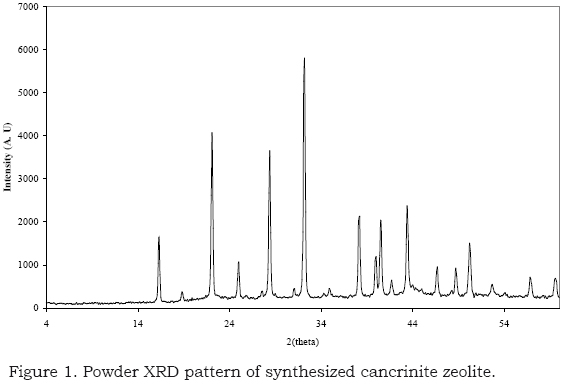
<body><![CDATA[<p align="justify"><font face="verdana" size="2">The XRD pattern of the Na<sup>&#43;</sup> cancrinite sample shows reflections attributed to the nitrated&#45;cancrinite&#45;type zeolite that was consistent with the P<sub>63</sub> spatial group (ICDD&#45;<b>PDF</b># 38&#45;0513) (Robson and Lillerud 2001) (<a href="#f1">Fig. 1</a>). Other phases, such as sodalite, were not detected by XRD. XRD patterns for the exchanged cancrinites were similar to that reported by nitrate&#45;sodium cancrinite.</font></p>              <p align="center"><font face="verdana" size="2"><a name="f1"></a></font></p>              <p align="center"><font face="verdana" size="2"><img src="/img/revistas/rlq/v39n1-2/a5f1.jpg"></font></p>              <p align="justify"><font face="verdana" size="2">On the other hand, FT&#45;IR spectrum (<a href="#f2">Fig. 2</a>) of the synthesized sodium cancrinite&#45;type zeolite showed different bands: a band at 1425 cm<sup>&#45;1</sup> was assigned to the presence of nitrate anions occluded in the zeolite framework structure. The band placed at 1631 cm<sup>&#45;1</sup> corresponds to water molecules localized inside the cancrinite cavity, while bands in the region between 1095 and 500 cm<sup>&#45;1</sup> were attributed to Si&#45;O&#45;Al bonds (Hackbarth <i>et al.</i> 1999).</font></p>              <p align="center"><font face="verdana" size="2"><a name="f2"></a></font></p>              <p align="center"><font face="verdana" size="2"><img src="/img/revistas/rlq/v39n1-2/a5f2.jpg"></font></p>              <p align="justify"><font face="verdana" size="2">Likewise, <a href="#t1">Table 1</a> shows the chemical analysis and textural properties of exchanged cancrinites. Because Mg and Ca are di&#45;valence cations, they are exchanged in minor proportion in comparison to monovalence cations.</font></p>              <p align="center"><font face="verdana" size="2"><a name="t1"></a></font></p>              <p align="center"><font face="verdana" size="2"><img src="/img/revistas/rlq/v39n1-2/a5t1.jpg"></font></p>              <p align="justify"><font face="verdana" size="2">The BET specific surface area of Na&#45;Can is quite low if it is compared to other zeolites whose pores are free. The presence of nitrate anions occluded inside the framework structure is responsible for this low surface area (Hackbarth <i>et al.</i> 1999). As the pores are blocking, the BET area is almost entirely the external area of these solids. The micropores area is quite negligible. These results are expanded to the other exchanged cancrinites.</font></p>              ]]></body>
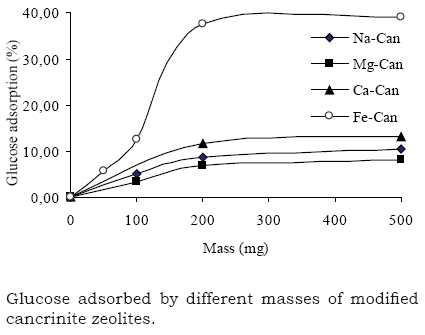
<body><![CDATA[<p align="justify"><font face="verdana" size="2">When, the Na&#45;Can is exchanged with Mg<sup>2&#43;</sup> or Ca<sup>2&#43;</sup> cations, the BET surface area is slightly increased in comparison to Na&#45;Can. Due to the fact that, Mg<sup>&#43;</sup><sup>2</sup> and Ca<sup>2</sup><sup>&#43;</sup> cations are di&#45;valences, they allow a major access to the cancrinite pores</font></p>              <p align="justify"><font face="verdana" size="2">The previously characterized samples were, then, tested as glucose adsorbents. As it is depicted in <a href="#f3">Fig. 3</a>, the adsorption process is largely enhanced during the first 200 mg sample; after that, the adsorption rate remains constant until the 500&#45;mg sample. A possible explanation could be associated to mass transference troubles. This glucose adsorption takes place on the external crystal surface due to the pore blocking showed by the cancrinite type&#45;zeolites as showed in <a href="#t1">Table 1</a> (Hackbarth <i>et al.</i> 1999).</font></p>              <p align="center"><font face="verdana" size="2"><a name="f3" id="f3"></a></font></p>              <p align="center"><font face="verdana" size="2"><img src="/img/revistas/rlq/v39n1-2/a5f3.jpg"></font></p>              <p align="center"><font face="verdana" size="2">&nbsp;</font></p>              <p align="justify"><font face="verdana" size="2">On the other hand, it was observed a preference on the glucose adsorption when Fe&#45;Can (&#126; 40&#37;) was used in comparison with the other ion&#45;exchanged zeolites (&#126;5&#45;10&#37;). According to literature (Wolowiec and Drabent 1985), Fe<sup>2&#43;</sup> can produce a stable complex with glucose molecules while glucose interactions with Ca<sup>2&#43;</sup> or Mg<sup>2&#43;</sup> zeolites are weaker (Angyal 1984). Mg&#45;cancrinite showed the lowest adsorption capacity among all the tested cations. According to Heper <i>et al</i> (2007), Mg<sup>2&#43;</sup>&#45;zeolite Y presents lack of free space inside the zeolite pores to accommodate glucose. The reason for this could be a higher affinity of the zeolite to Mg<sup>2</sup>&#43; or a greater hydration layer of Mg<sup>2</sup>&#43; resulting in its inability to leave the cages.</font></p>              <p align="justify"><font face="verdana" size="2">Previously, Sherman and Chao (1989) and Kulprathipanja (1991), had reported the preference of Ca<sup>2&#43;</sup> and K<sup>&#43;</sup> cations for fructose or glucose molecules. However, K<sup>&#43;</sup> and Na<sup>&#43;</sup> are considered non&#45;complex ions, as it has been reported that sugars and univalent cations form very weak complexes in comparison to divalent cations (Churm 1996, Nobre <i>et al.</i> 2009).</font></p>              <p align="justify"><font face="verdana" size="2">Concepci&oacute;n&#45;Rosabal <i>et al</i> . (1997) reported the use of Fe<sup>&#43;2</sup>, Ca<sup>2&#43;</sup> and Mg<sup>2&#43;</sup> ion&#45;exchanged clinoptilolites as glucose adsorbent. They found an adsorption order similar to our results: Fe&#62;&#62;Mg&#62;Ca &#8776; Na. However, no comparison related to the glucose adsorption capacity could be established because the glucose concentration in the Concepci&oacute;n&#45;Rosabals work was not reported.</font></p>              <p align="justify"><font face="verdana" size="2">Likewise, the time influence on the glucose adsorption was also determined for modified cancrinites using 100 mg of sample (<a href="#f4">Fig. 4</a>). In general, the adsorption of glucose increased as contact time is increased.</font></p>              <p align="center"><font face="verdana" size="2"><a name="f4"></a></font></p>              ]]></body>
<body><![CDATA[<p align="center"><font face="verdana" size="2"><img src="/img/revistas/rlq/v39n1-2/a5f4.jpg"></font></p>              <p align="justify"><font face="verdana" size="2">A maximum adsorption was determined at 60 min of contact time. This time is ideal if gastric functions are carried out (Linares <i>et al.</i> 2005). On the other hand, the adsorption behaviour by exchanged cations was similar to that reported for mass influence.</font></p>              <p align="justify"><font face="verdana" size="2">In order to investigate the controlling mechanism of adsorption processes such as mass transfer or chemical reaction, the pseudo&#45;first&#45;order and pseudo&#45;second order equations were applied to model the kinetics of glucose adsorption onto exchanged cancrinites</font></p>              <p align="justify"><font face="verdana" size="2">The possibility of adsorption data to follow Lagergren pseudo&#45;first order kinetics (Lagergren 1898) is given by:</font></p>              <p align="center"><font face="verdana" size="2"><i>dq/dt = K<sub>1</sub> (qe&#45;q)</i> (1)</font></p>              <p align="justify"><font face="verdana" size="2">by integrating Eq (1), the kinetic rate expression becomes:</font></p>              <p align="center"><font face="verdana" size="2"><i>log(q<sub>e</sub>&#45; q<sub>t</sub>) = log q<sub>e</sub>&#45; (K<sub>1</sub> *t)/2.3</i> (2)</font></p>              <p align="justify"><font face="verdana" size="2">The first order rate constant <i>K<sub>1</sub></i> can be obtained from the slope of plot between <i>log (q<sub>e</sub> &#45; q)</i> versus time <i>t.</i></font></p>              <p align="justify"><font face="verdana" size="2">A pseudo&#45;second order model proposed by Ho and Mckay (Ho and McKay 1999) can be used to explain the sorption kinetics. This model is based on the assumption that the adsorption follows second order chemisorptions (Ho 2004). The pseudo&#45;second order can be expressed as:</font></p>              <p align="center"><font face="verdana" size="2"><i>dq/dt = K<sub>11.</sub> (qe&#45;q)<sup>2</sup></i> (3)</font></p>              ]]></body>
<body><![CDATA[<p align="center"><font face="verdana" size="2"><i>dq/(qe &#45;q)<sup>2</sup> = K<sub>11.</sub> dt</i> (4)</font></p>              <p align="justify"><font face="verdana" size="2">Integrating Eq 4 simplifies it to:</font></p>              <p align="center"><font face="verdana" size="2">t/qt = 1/(K<sub>11</sub>. qe<sup>2</sup>) &#43; t/qe (5)</font></p>              <p align="justify"><font face="verdana" size="2">where <i>t</i> is the contact time, min, <i>qe</i> and <i>qt</i> are the amount of glucose adsorbed by zeolite (mg/g) at equilibrium and at any time <i>t.</i> A plot between <i>t/qt</i> versus <i>t</i> gives the value of the constant K<sub>11</sub> (g(mg.min)<sup>&#45;1</sup>) and also <i>qe,</i> mg/g, can be calculated.</font></p>              <p align="justify"><font face="verdana" size="2">In this study, the pseudo&#45;first order model fitted better when compared with the pseudo&#45;second order according to r<sup>2</sup> and qe values (<a href="/img/revistas/rlq/v39n1-2/a5t2.jpg" target="_blank">Table 2</a>). Therefore, the adsorption data in the present study could show a physical adsorption which will depend on the glucose concentration (Kushwaha <i>et al.</i> 2008). A major glucose concentration could increase the adsorption capacity of cancrinites.</font></p>              <p align="justify"><font face="verdana" size="2">&nbsp;</font></p>              <p align="justify"><font face="verdana" size="2"><b>CONCLUSIONS</b></font></p>              <p align="justify"><font face="verdana" size="2">New solids, the ion&#45;exchanged cancrinite&#45;type zeolites, could be used as hypoglycemiant drugs. The best results were obtained with Fe<sup>2&#43;</sup> cancrinites while the Ca<sup>2&#43;</sup>, Mg<sup>2&#43;</sup> and Na<sup>&#43;</sup> cancrinites displayed much lower adsorption than that of Fe<sup>2&#43;</sup>. Similarly, the influence of time on the glucose adsorption showed that Fe<sup>2&#43;</sup> cancrinite was more active at short contact times than that showed by the ion&#45;exchanged zeolites with other cations.</font></p>              <p align="justify"><font face="verdana" size="2">&nbsp;</font></p>              <p align="justify"><font face="verdana" size="2"><b>ACKNOWLEDGEMENT</b></font></p>              ]]></body>
<body><![CDATA[<p align="justify"><font face="verdana" size="2">This work was supported by CDCH&#45;UC. Thanks to Ilse Rodr&iacute;guez de Georges for checking the manuscript.</font></p>              <p align="justify"><font face="verdana" size="2">&nbsp;</font></p>              <p align="justify"><font face="verdana" size="2"><b>REFERENCES</b></font></p>              <!-- ref --><p align="justify"><font face="verdana" size="2">Angyal, S. J. (1984) The composition of reducing sugars in solution. <i>Advances in Carbohydrate</i> <i>Chemical and Biochemistry</i> <b>42:</b> 15&#45;68.    &nbsp;&nbsp;&nbsp;&nbsp;&nbsp;&nbsp;&nbsp;&nbsp;[&#160;<a href="javascript:void(0);" onclick="javascript: window.open('/scielo.php?script=sci_nlinks&ref=7366589&pid=S0370-5943201100010000500001&lng=','','width=640,height=500,resizable=yes,scrollbars=1,menubar=yes,');">Links</a>&#160;]<!-- end-ref --></font></p>              <!-- ref --><p align="justify"><font face="verdana" size="2">Buttersack, C., Wach, W., Buchholz, K. (1993) Specific adsorption of saccarides by dealuminated Y&#45;zeolites. <i>Journal of Physical Chemistry B</i> <b>97:</b> 11861&#45;11862.    &nbsp;&nbsp;&nbsp;&nbsp;&nbsp;&nbsp;&nbsp;&nbsp;[&#160;<a href="javascript:void(0);" onclick="javascript: window.open('/scielo.php?script=sci_nlinks&ref=7366591&pid=S0370-5943201100010000500002&lng=','','width=640,height=500,resizable=yes,scrollbars=1,menubar=yes,');">Links</a>&#160;]<!-- end-ref --></font></p>              <!-- ref --><p align="justify"><font face="verdana" size="2">Concepci&oacute;n&#45;Rosabal, B., Rodr&iacute;guez&#45;Fuentes, G., Sim&oacute;n&#45;Carballo, R. (1997) Development and featuring of the zeolitic active principle FZ: a glucose adsorbent. <i>Zeolites</i> <b><i>19:</i></b> 47&#45;50.    &nbsp;&nbsp;&nbsp;&nbsp;&nbsp;&nbsp;&nbsp;&nbsp;[&#160;<a href="javascript:void(0);" onclick="javascript: window.open('/scielo.php?script=sci_nlinks&ref=7366593&pid=S0370-5943201100010000500003&lng=','','width=640,height=500,resizable=yes,scrollbars=1,menubar=yes,');">Links</a>&#160;]<!-- end-ref --></font></p>              <!-- ref --><p align="justify"><font face="verdana" size="2">Churms, S. C. (1996) Recent progress in carbohydrate separation by high&#45;performance liquid chromatography based on size exclusion. <i>Journal of Chromatography A</i> <b>720:</b> <i>151&#45;166</i>.    &nbsp;&nbsp;&nbsp;&nbsp;&nbsp;&nbsp;&nbsp;&nbsp;[&#160;<a href="javascript:void(0);" onclick="javascript: window.open('/scielo.php?script=sci_nlinks&ref=7366595&pid=S0370-5943201100010000500004&lng=','','width=640,height=500,resizable=yes,scrollbars=1,menubar=yes,');">Links</a>&#160;]<!-- end-ref --></font></p>              <!-- ref --><p align="justify"><font face="verdana" size="2">Hackbarth, K., Fechtelkord, T., Stief F., Buhl, J. (1999) Synthesis and crystal structure of carbonate cancrinite Na<sub>8</sub>&#91;AlSiO<sub>4</sub>&#93;<sub>6</sub>CO<sub>3</sub>(H<sub>2</sub>O)<sub>3.4,</sub> grown under low&#45;temperature hydrothermal conditions. <i>Microporous and Mesoporous Materials</i> <b>30:</b> 347&#45;358.    &nbsp;&nbsp;&nbsp;&nbsp;&nbsp;&nbsp;&nbsp;&nbsp;[&#160;<a href="javascript:void(0);" onclick="javascript: window.open('/scielo.php?script=sci_nlinks&ref=7366597&pid=S0370-5943201100010000500005&lng=','','width=640,height=500,resizable=yes,scrollbars=1,menubar=yes,');">Links</a>&#160;]<!-- end-ref --></font></p>              <!-- ref --><p align="justify"><font face="verdana" size="2">Heper, M., T&uuml;rker, L., Kincal N. S. (2007) Sodium, ammonium, calcium, and magnesium forms of zeolite Y for the adsorption of glucose and fructose from aqueous solutions. <i>Journal of</i> <i>Colloid and Interface Science</i> <b>306:</b> 11&#45;15.    &nbsp;&nbsp;&nbsp;&nbsp;&nbsp;&nbsp;&nbsp;&nbsp;[&#160;<a href="javascript:void(0);" onclick="javascript: window.open('/scielo.php?script=sci_nlinks&ref=7366599&pid=S0370-5943201100010000500006&lng=','','width=640,height=500,resizable=yes,scrollbars=1,menubar=yes,');">Links</a>&#160;]<!-- end-ref --></font></p>              <!-- ref --><p align="justify"><font face="verdana" size="2">Ho, Y. S. (2004) Citation review of Lagergren kinetic rate equation on adsorption reaction. <i>Scientometrics</i> <b>59:</b> 171&#45;177.    &nbsp;&nbsp;&nbsp;&nbsp;&nbsp;&nbsp;&nbsp;&nbsp;[&#160;<a href="javascript:void(0);" onclick="javascript: window.open('/scielo.php?script=sci_nlinks&ref=7366601&pid=S0370-5943201100010000500007&lng=','','width=640,height=500,resizable=yes,scrollbars=1,menubar=yes,');">Links</a>&#160;]<!-- end-ref --></font></p>              <!-- ref --><p align="justify"><font face="verdana" size="2">Ho, Y.S., McKay, G. (1999) Pseudo&#45;second order model for sorption processes. <i>Process Biochemistry</i> <b>34:</b> 451&#45;465.    &nbsp;&nbsp;&nbsp;&nbsp;&nbsp;&nbsp;&nbsp;&nbsp;[&#160;<a href="javascript:void(0);" onclick="javascript: window.open('/scielo.php?script=sci_nlinks&ref=7366603&pid=S0370-5943201100010000500008&lng=','','width=640,height=500,resizable=yes,scrollbars=1,menubar=yes,');">Links</a>&#160;]<!-- end-ref --></font></p>              <!-- ref --><p align="justify"><font face="verdana" size="2">Kulprathipanja S (1991) Pat. 5000794.    &nbsp;&nbsp;&nbsp;&nbsp;&nbsp;&nbsp;&nbsp;&nbsp;[&#160;<a href="javascript:void(0);" onclick="javascript: window.open('/scielo.php?script=sci_nlinks&ref=7366605&pid=S0370-5943201100010000500009&lng=','','width=640,height=500,resizable=yes,scrollbars=1,menubar=yes,');">Links</a>&#160;]<!-- end-ref --></font></p>              <!-- ref --><p align="justify"><font face="verdana" size="2">Kushwaha, S., Sodaye, S., Padmaja, P. (2008) Equilibrium, kinetics and thermodynamic studies for adsorption of Hg (II) on palm shell powder. <i>World Academy of Science, Engineering and Technology</i> <b>43:</b> 600&#45;606.    &nbsp;&nbsp;&nbsp;&nbsp;&nbsp;&nbsp;&nbsp;&nbsp;[&#160;<a href="javascript:void(0);" onclick="javascript: window.open('/scielo.php?script=sci_nlinks&ref=7366607&pid=S0370-5943201100010000500010&lng=','','width=640,height=500,resizable=yes,scrollbars=1,menubar=yes,');">Links</a>&#160;]<!-- end-ref --></font></p>              <!-- ref --><p align="justify"><font face="verdana" size="2">Lagergren, S. (1898) Zur theorie der sogenannten adsorption gel&ouml;ster stoffe. Kungliga Svenska Vetenskapsakademiens. <i>Handlingar,</i> Band <b>24:</b> 1&#45;39.    &nbsp;&nbsp;&nbsp;&nbsp;&nbsp;&nbsp;&nbsp;&nbsp;[&#160;<a href="javascript:void(0);" onclick="javascript: window.open('/scielo.php?script=sci_nlinks&ref=7366609&pid=S0370-5943201100010000500011&lng=','','width=640,height=500,resizable=yes,scrollbars=1,menubar=yes,');">Links</a>&#160;]<!-- end-ref --></font></p>              <!-- ref --><p align="justify"><font face="verdana" size="2">Linares, CF., Colmenares M., Ocanto F., Valbuena, O. (2008) Human bile sorption by cancrinite&#45;type zeolites. <i>Material Science and Engineering C</i> <b>29:</b> 350&#45;355.    &nbsp;&nbsp;&nbsp;&nbsp;&nbsp;&nbsp;&nbsp;&nbsp;[&#160;<a href="javascript:void(0);" onclick="javascript: window.open('/scielo.php?script=sci_nlinks&ref=7366611&pid=S0370-5943201100010000500012&lng=','','width=640,height=500,resizable=yes,scrollbars=1,menubar=yes,');">Links</a>&#160;]<!-- end-ref --></font></p>              <!-- ref --><p align="justify"><font face="verdana" size="2">Linares, CF., S&aacute;nchez, S., Urbina de Navarro, C., Rodr&iacute;guez, K., Goldwasser, M. R. (2005) Study of cancrinite&#45;type zeolite as possible antacid agents. <i>Microporous and Mesoporous Materials</i> <b>77:</b> 215&#45;221.    &nbsp;&nbsp;&nbsp;&nbsp;&nbsp;&nbsp;&nbsp;&nbsp;[&#160;<a href="javascript:void(0);" onclick="javascript: window.open('/scielo.php?script=sci_nlinks&ref=7366613&pid=S0370-5943201100010000500013&lng=','','width=640,height=500,resizable=yes,scrollbars=1,menubar=yes,');">Links</a>&#160;]<!-- end-ref --></font></p>              <!-- ref --><p align="justify"><font face="verdana" size="2">Nobre, C., Santos M. J., Dominguez, A., Torres, D., Rocha O., Peres A. M., Rocha, I., Ferreira E. C., Teixeira J. A., Rodr&iacute;guez, L. R. (2009). Comparison of adsorption equilibrium of fructose, glucose and sucrose on potassium gel&#45;macroporous sodium ion&#45;exchange resins. <i>Analytical Chimica Acta</i> <b>654:</b> 71&#45;75.    &nbsp;&nbsp;&nbsp;&nbsp;&nbsp;&nbsp;&nbsp;&nbsp;[&#160;<a href="javascript:void(0);" onclick="javascript: window.open('/scielo.php?script=sci_nlinks&ref=7366615&pid=S0370-5943201100010000500014&lng=','','width=640,height=500,resizable=yes,scrollbars=1,menubar=yes,');">Links</a>&#160;]<!-- end-ref --></font></p>              <!-- ref --><p align="justify"><font face="verdana" size="2">Robson, H., Lillerud, KP. (2001) Verified Synthesis of Zeolitic Materials, 2nd ed., ed. by Elsevier, Amsterdam, pp. 27.    &nbsp;&nbsp;&nbsp;&nbsp;&nbsp;&nbsp;&nbsp;&nbsp;[&#160;<a href="javascript:void(0);" onclick="javascript: window.open('/scielo.php?script=sci_nlinks&ref=7366617&pid=S0370-5943201100010000500015&lng=','','width=640,height=500,resizable=yes,scrollbars=1,menubar=yes,');">Links</a>&#160;]<!-- end-ref --></font></p>              <!-- ref --><p align="justify"><font face="verdana" size="2">Sherman, J. D., Chao, Ch. C.(1989) Pat. 4471114.    &nbsp;&nbsp;&nbsp;&nbsp;&nbsp;&nbsp;&nbsp;&nbsp;[&#160;<a href="javascript:void(0);" onclick="javascript: window.open('/scielo.php?script=sci_nlinks&ref=7366619&pid=S0370-5943201100010000500016&lng=','','width=640,height=500,resizable=yes,scrollbars=1,menubar=yes,');">Links</a>&#160;]<!-- end-ref --></font></p>              <!-- ref --><p align="justify"><font face="verdana" size="2">White, A., Handler, P., Smith, E. (1959) Principles of Biochemistry, 3er ed, Edt. Mcgraw&#45;Hill, New York (USA) pp. 896&#45;898.    &nbsp;&nbsp;&nbsp;&nbsp;&nbsp;&nbsp;&nbsp;&nbsp;[&#160;<a href="javascript:void(0);" onclick="javascript: window.open('/scielo.php?script=sci_nlinks&ref=7366621&pid=S0370-5943201100010000500017&lng=','','width=640,height=500,resizable=yes,scrollbars=1,menubar=yes,');">Links</a>&#160;]<!-- end-ref --></font></p>              <!-- ref --><p align="justify"><font face="verdana" size="2">Wolowiec, S., Drabent, K. (1985) M&ouml;ssbauer study of Fe/III/&#45;reducing sugar complexes, <i>Journal of Radioanalytical and. Nuclear Chemistry</i> <b>95:</b> 1&#45;2.    &nbsp;&nbsp;&nbsp;&nbsp;&nbsp;&nbsp;&nbsp;&nbsp;[&#160;<a href="javascript:void(0);" onclick="javascript: window.open('/scielo.php?script=sci_nlinks&ref=7366623&pid=S0370-5943201100010000500018&lng=','','width=640,height=500,resizable=yes,scrollbars=1,menubar=yes,');">Links</a>&#160;]<!-- end-ref --></font></p>      ]]></body><back>
<ref-list>
<ref id="B1">
<nlm-citation citation-type="journal">
<person-group person-group-type="author">
<name>
<surname><![CDATA[Angyal]]></surname>
<given-names><![CDATA[S. J.]]></given-names>
</name>
</person-group>
<article-title xml:lang="en"><![CDATA[The composition of reducing sugars in solution]]></article-title>
<source><![CDATA[Advances in Carbohydrate Chemical and Biochemistry]]></source>
<year>1984</year>
<volume>42</volume>
<page-range>15-68</page-range></nlm-citation>
</ref>
<ref id="B2">
<nlm-citation citation-type="journal">
<person-group person-group-type="author">
<name>
<surname><![CDATA[Buttersack]]></surname>
<given-names><![CDATA[C.]]></given-names>
</name>
<name>
<surname><![CDATA[Wach]]></surname>
<given-names><![CDATA[W.]]></given-names>
</name>
<name>
<surname><![CDATA[Buchholz]]></surname>
<given-names><![CDATA[K.]]></given-names>
</name>
</person-group>
<article-title xml:lang="en"><![CDATA[Specific adsorption of saccarides by dealuminated Y-zeolites]]></article-title>
<source><![CDATA[Journal of Physical Chemistry]]></source>
<year>1993</year>
<volume>B 97</volume>
<page-range>11861-11862</page-range></nlm-citation>
</ref>
<ref id="B3">
<nlm-citation citation-type="journal">
<person-group person-group-type="author">
<name>
<surname><![CDATA[Concepción-Rosabal]]></surname>
<given-names><![CDATA[B.]]></given-names>
</name>
<name>
<surname><![CDATA[Rodríguez-Fuentes]]></surname>
<given-names><![CDATA[G.]]></given-names>
</name>
<name>
<surname><![CDATA[Simón-Carballo]]></surname>
<given-names><![CDATA[R.]]></given-names>
</name>
</person-group>
<article-title xml:lang="en"><![CDATA[Development and featuring of the zeolitic active principle FZ: a glucose adsorbent]]></article-title>
<source><![CDATA[Zeolites]]></source>
<year>1997</year>
<volume>19</volume>
<page-range>47-50</page-range></nlm-citation>
</ref>
<ref id="B4">
<nlm-citation citation-type="journal">
<person-group person-group-type="author">
<name>
<surname><![CDATA[Churms]]></surname>
<given-names><![CDATA[S. C.]]></given-names>
</name>
</person-group>
<article-title xml:lang="en"><![CDATA[Recent progress in carbohydrate separation by high-performance liquid chromatography based on size exclusion]]></article-title>
<source><![CDATA[Journal of Chromatography]]></source>
<year>1996</year>
<volume>A 720</volume>
<page-range>151-166</page-range></nlm-citation>
</ref>
<ref id="B5">
<nlm-citation citation-type="journal">
<person-group person-group-type="author">
<name>
<surname><![CDATA[Hackbarth]]></surname>
<given-names><![CDATA[K.]]></given-names>
</name>
<name>
<surname><![CDATA[Fechtelkord]]></surname>
<given-names><![CDATA[T.]]></given-names>
</name>
<name>
<surname><![CDATA[Stief]]></surname>
<given-names><![CDATA[F.]]></given-names>
</name>
<name>
<surname><![CDATA[Buhl]]></surname>
<given-names><![CDATA[J.]]></given-names>
</name>
</person-group>
<article-title xml:lang="en"><![CDATA[Synthesis and crystal structure of carbonate cancrinite Na8[AlSiO4]6CO3(H2O)3.4, grown under low-temperature hydrothermal conditions]]></article-title>
<source><![CDATA[Microporous and Mesoporous Materials]]></source>
<year>1999</year>
<volume>30</volume>
<page-range>347-358</page-range></nlm-citation>
</ref>
<ref id="B6">
<nlm-citation citation-type="journal">
<person-group person-group-type="author">
<name>
<surname><![CDATA[Heper]]></surname>
<given-names><![CDATA[M.]]></given-names>
</name>
<name>
<surname><![CDATA[Türker]]></surname>
<given-names><![CDATA[L.]]></given-names>
</name>
<name>
<surname><![CDATA[Kincal]]></surname>
<given-names><![CDATA[N. S.]]></given-names>
</name>
</person-group>
<article-title xml:lang="en"><![CDATA[Sodium, ammonium, calcium, and magnesium forms of zeolite Y for the adsorption of glucose and fructose from aqueous solutions]]></article-title>
<source><![CDATA[Journal of Colloid and Interface Science]]></source>
<year>2007</year>
<volume>306</volume>
<page-range>11-15</page-range></nlm-citation>
</ref>
<ref id="B7">
<nlm-citation citation-type="journal">
<person-group person-group-type="author">
<name>
<surname><![CDATA[Ho]]></surname>
<given-names><![CDATA[Y. S.]]></given-names>
</name>
</person-group>
<article-title xml:lang="en"><![CDATA[Citation review of Lagergren kinetic rate equation on adsorption reaction]]></article-title>
<source><![CDATA[Scientometrics]]></source>
<year>2004</year>
<volume>59</volume>
<page-range>171-177</page-range></nlm-citation>
</ref>
<ref id="B8">
<nlm-citation citation-type="journal">
<person-group person-group-type="author">
<name>
<surname><![CDATA[Ho]]></surname>
<given-names><![CDATA[Y.S.]]></given-names>
</name>
<name>
<surname><![CDATA[McKay]]></surname>
<given-names><![CDATA[G.]]></given-names>
</name>
</person-group>
<article-title xml:lang="en"><![CDATA[Pseudo-second order model for sorption processes]]></article-title>
<source><![CDATA[Process Biochemistry]]></source>
<year>1999</year>
<volume>34</volume>
<page-range>451-465</page-range></nlm-citation>
</ref>
<ref id="B9">
<nlm-citation citation-type="">
<person-group person-group-type="author">
<name>
<surname><![CDATA[Kulprathipanja]]></surname>
<given-names><![CDATA[S]]></given-names>
</name>
</person-group>
<source><![CDATA[]]></source>
<year>1991</year>
</nlm-citation>
</ref>
<ref id="B10">
<nlm-citation citation-type="journal">
<person-group person-group-type="author">
<name>
<surname><![CDATA[Kushwaha]]></surname>
<given-names><![CDATA[S.]]></given-names>
</name>
<name>
<surname><![CDATA[Sodaye]]></surname>
<given-names><![CDATA[S.]]></given-names>
</name>
<name>
<surname><![CDATA[Padmaja]]></surname>
<given-names><![CDATA[P.]]></given-names>
</name>
</person-group>
<article-title xml:lang="en"><![CDATA[Equilibrium, kinetics and thermodynamic studies for adsorption of Hg (II) on palm shell powder]]></article-title>
<source><![CDATA[World Academy of Science, Engineering and Technology]]></source>
<year>2008</year>
<volume>43</volume>
<page-range>600-606</page-range></nlm-citation>
</ref>
<ref id="B11">
<nlm-citation citation-type="journal">
<person-group person-group-type="author">
<name>
<surname><![CDATA[Lagergren]]></surname>
<given-names><![CDATA[S.]]></given-names>
</name>
</person-group>
<article-title xml:lang="en"><![CDATA[Zur theorie der sogenannten adsorption gelöster stoffe. Kungliga Svenska Vetenskapsakademiens]]></article-title>
<source><![CDATA[Handlingar, Band]]></source>
<year>1898</year>
<volume>24</volume>
<page-range>1-39</page-range></nlm-citation>
</ref>
<ref id="B12">
<nlm-citation citation-type="journal">
<person-group person-group-type="author">
<name>
<surname><![CDATA[Linares]]></surname>
<given-names><![CDATA[CF.]]></given-names>
</name>
<name>
<surname><![CDATA[Colmenares]]></surname>
<given-names><![CDATA[M.]]></given-names>
</name>
<name>
<surname><![CDATA[Ocanto]]></surname>
<given-names><![CDATA[F.]]></given-names>
</name>
<name>
<surname><![CDATA[Valbuena]]></surname>
<given-names><![CDATA[O.]]></given-names>
</name>
</person-group>
<article-title xml:lang="en"><![CDATA[Human bile sorption by cancrinite-type zeolites]]></article-title>
<source><![CDATA[Material Science and Engineering]]></source>
<year>2008</year>
<volume>C 29</volume>
<page-range>350-355</page-range></nlm-citation>
</ref>
<ref id="B13">
<nlm-citation citation-type="journal">
<person-group person-group-type="author">
<name>
<surname><![CDATA[Linares]]></surname>
<given-names><![CDATA[CF.]]></given-names>
</name>
<name>
<surname><![CDATA[Sánchez]]></surname>
<given-names><![CDATA[S.]]></given-names>
</name>
<name>
<surname><![CDATA[Urbina de Navarro]]></surname>
<given-names><![CDATA[C.]]></given-names>
</name>
<name>
<surname><![CDATA[Rodríguez]]></surname>
<given-names><![CDATA[K.]]></given-names>
</name>
<name>
<surname><![CDATA[Goldwasser]]></surname>
<given-names><![CDATA[M. R.]]></given-names>
</name>
</person-group>
<article-title xml:lang="en"><![CDATA[Study of cancrinite-type zeolite as possible antacid agents]]></article-title>
<source><![CDATA[Microporous and Mesoporous Materials]]></source>
<year>2005</year>
<volume>77</volume>
<page-range>215-221</page-range></nlm-citation>
</ref>
<ref id="B14">
<nlm-citation citation-type="journal">
<person-group person-group-type="author">
<name>
<surname><![CDATA[Nobre]]></surname>
<given-names><![CDATA[C.]]></given-names>
</name>
<name>
<surname><![CDATA[Santos]]></surname>
<given-names><![CDATA[M. J.]]></given-names>
</name>
<name>
<surname><![CDATA[Dominguez]]></surname>
<given-names><![CDATA[A.]]></given-names>
</name>
<name>
<surname><![CDATA[Torres]]></surname>
<given-names><![CDATA[D.]]></given-names>
</name>
<name>
<surname><![CDATA[Rocha]]></surname>
<given-names><![CDATA[O.]]></given-names>
</name>
<name>
<surname><![CDATA[Peres]]></surname>
<given-names><![CDATA[A. M.]]></given-names>
</name>
<name>
<surname><![CDATA[Rocha]]></surname>
<given-names><![CDATA[I.]]></given-names>
</name>
<name>
<surname><![CDATA[Ferreira]]></surname>
<given-names><![CDATA[E. C.]]></given-names>
</name>
<name>
<surname><![CDATA[Teixeira]]></surname>
<given-names><![CDATA[J. A.]]></given-names>
</name>
<name>
<surname><![CDATA[Rodríguez]]></surname>
<given-names><![CDATA[L. R.]]></given-names>
</name>
</person-group>
<article-title xml:lang="en"><![CDATA[Comparison of adsorption equilibrium of fructose, glucose and sucrose on potassium gel-macroporous sodium ion-exchange resins]]></article-title>
<source><![CDATA[Analytical Chimica Acta]]></source>
<year>2009</year>
<volume>654</volume>
<page-range>71-75</page-range></nlm-citation>
</ref>
<ref id="B15">
<nlm-citation citation-type="book">
<person-group person-group-type="author">
<name>
<surname><![CDATA[Robson]]></surname>
<given-names><![CDATA[H.]]></given-names>
</name>
<name>
<surname><![CDATA[Lillerud]]></surname>
<given-names><![CDATA[KP.]]></given-names>
</name>
</person-group>
<source><![CDATA[Verified Synthesis of Zeolitic Materials]]></source>
<year>2001</year>
<edition>2nd</edition>
<page-range>27</page-range><publisher-loc><![CDATA[Amsterdam ]]></publisher-loc>
<publisher-name><![CDATA[Elsevier]]></publisher-name>
</nlm-citation>
</ref>
<ref id="B16">
<nlm-citation citation-type="">
<person-group person-group-type="author">
<name>
<surname><![CDATA[Sherman]]></surname>
<given-names><![CDATA[J. D.]]></given-names>
</name>
<name>
<surname><![CDATA[Chao]]></surname>
<given-names><![CDATA[Ch. C.]]></given-names>
</name>
</person-group>
<source><![CDATA[]]></source>
<year>1989</year>
</nlm-citation>
</ref>
<ref id="B17">
<nlm-citation citation-type="book">
<person-group person-group-type="author">
<name>
<surname><![CDATA[White]]></surname>
<given-names><![CDATA[A.]]></given-names>
</name>
<name>
<surname><![CDATA[Handler]]></surname>
<given-names><![CDATA[P.]]></given-names>
</name>
<name>
<surname><![CDATA[Smith]]></surname>
<given-names><![CDATA[E.]]></given-names>
</name>
</person-group>
<source><![CDATA[Principles of Biochemistry]]></source>
<year>1959</year>
<edition>3er</edition>
<page-range>896-898</page-range><publisher-loc><![CDATA[New York ]]></publisher-loc>
<publisher-name><![CDATA[Mcgraw-Hill]]></publisher-name>
</nlm-citation>
</ref>
<ref id="B18">
<nlm-citation citation-type="journal">
<person-group person-group-type="author">
<name>
<surname><![CDATA[Wolowiec]]></surname>
<given-names><![CDATA[S.]]></given-names>
</name>
<name>
<surname><![CDATA[Drabent]]></surname>
<given-names><![CDATA[K.]]></given-names>
</name>
</person-group>
<article-title xml:lang="en"><![CDATA[Mössbauer study of Fe/III/-reducing sugar complexes]]></article-title>
<source><![CDATA[Journal of Radioanalytical and. Nuclear Chemistry]]></source>
<year>1985</year>
<volume>95</volume>
<page-range>1-2</page-range></nlm-citation>
</ref>
</ref-list>
</back>
</article>