<?xml version="1.0" encoding="ISO-8859-1"?><article xmlns:mml="http://www.w3.org/1998/Math/MathML" xmlns:xlink="http://www.w3.org/1999/xlink" xmlns:xsi="http://www.w3.org/2001/XMLSchema-instance">
<front>
<journal-meta>
<journal-id>0370-5943</journal-id>
<journal-title><![CDATA[Revista latinoamericana de química]]></journal-title>
<abbrev-journal-title><![CDATA[Rev. latinoam. quím]]></abbrev-journal-title>
<issn>0370-5943</issn>
<publisher>
<publisher-name><![CDATA[Laboratorios Mixim S.A.]]></publisher-name>
</publisher>
</journal-meta>
<article-meta>
<article-id>S0370-59432010000300005</article-id>
<title-group>
<article-title xml:lang="en"><![CDATA[Effect of photo-oxygenation on biological activities of some commercial egyptian essential oils]]></article-title>
</title-group>
<contrib-group>
<contrib contrib-type="author">
<name>
<surname><![CDATA[Dawidar]]></surname>
<given-names><![CDATA[A.M.]]></given-names>
</name>
<xref ref-type="aff" rid="A01"/>
</contrib>
<contrib contrib-type="author">
<name>
<surname><![CDATA[Abdel-Mogib]]></surname>
<given-names><![CDATA[M.]]></given-names>
</name>
<xref ref-type="aff" rid="A01"/>
</contrib>
<contrib contrib-type="author">
<name>
<surname><![CDATA[Abou-Elzahab]]></surname>
<given-names><![CDATA[M.M.]]></given-names>
</name>
<xref ref-type="aff" rid="A01"/>
</contrib>
<contrib contrib-type="author">
<name>
<surname><![CDATA[Berghot]]></surname>
<given-names><![CDATA[M.A.]]></given-names>
</name>
<xref ref-type="aff" rid="A01"/>
</contrib>
<contrib contrib-type="author">
<name>
<surname><![CDATA[Mahfouz]]></surname>
<given-names><![CDATA[M.]]></given-names>
</name>
<xref ref-type="aff" rid="A01"/>
</contrib>
<contrib contrib-type="author">
<name>
<surname><![CDATA[El-Ghorab]]></surname>
<given-names><![CDATA[A.H.]]></given-names>
</name>
<xref ref-type="aff" rid="A02"/>
</contrib>
<contrib contrib-type="author">
<name>
<surname><![CDATA[Hussien]]></surname>
<given-names><![CDATA[Kh.]]></given-names>
</name>
<xref ref-type="aff" rid="A01"/>
</contrib>
</contrib-group>
<aff id="A01">
<institution><![CDATA[,Mansoura University Faculty of Science Chemistry Department]]></institution>
<addr-line><![CDATA[Mansoura ]]></addr-line>
<country>Egypt</country>
</aff>
<aff id="A02">
<institution><![CDATA[,National Research Center Flavour and Aromatic Chemistry Department ]]></institution>
<addr-line><![CDATA[Dokki Cairo]]></addr-line>
<country>Egypt</country>
</aff>
<pub-date pub-type="pub">
<day>00</day>
<month>12</month>
<year>2010</year>
</pub-date>
<pub-date pub-type="epub">
<day>00</day>
<month>12</month>
<year>2010</year>
</pub-date>
<volume>38</volume>
<numero>3</numero>
<fpage>168</fpage>
<lpage>179</lpage>
<copyright-statement/>
<copyright-year/>
<self-uri xlink:href="http://www.scielo.org.mx/scielo.php?script=sci_arttext&amp;pid=S0370-59432010000300005&amp;lng=en&amp;nrm=iso"></self-uri><self-uri xlink:href="http://www.scielo.org.mx/scielo.php?script=sci_abstract&amp;pid=S0370-59432010000300005&amp;lng=en&amp;nrm=iso"></self-uri><self-uri xlink:href="http://www.scielo.org.mx/scielo.php?script=sci_pdf&amp;pid=S0370-59432010000300005&amp;lng=en&amp;nrm=iso"></self-uri><abstract abstract-type="short" xml:lang="en"><p><![CDATA[The components of five common commercial Egyptian essential oils; caraway, cumin, basil, thyme, and rose oils, were identified using gas chromatography/ mass spectrometry (GC/MS) and Kovats retention index. For each oil the main components were reported. Their biological activities, including deoxyribonucleic acid (DNA) damage, protein cleavage, antioxidant, antimicrobial and anti-diabetic effect were tested. The effect of photo-oxygenation reaction on their biological activities, using UV-irradiation in the presence of singlet oxygen sensitizer was investigated.]]></p></abstract>
<abstract abstract-type="short" xml:lang="es"><p><![CDATA[Se analizaron cinco aceites esenciales comerciales de Egipto: aceite de alcaravea, comino, albahaca, tomillo y rosas, por cromatografía de gases acoplado a espectrometría de masas y utilizando el índice de retención de Kovats para identificar a sus componentes. Se reportan los componentes principales de cada aceite. También se probo la actividad biológica de cada acite sobre el daño al ADN, la ruptura de proteínas, la actividad antioxidante, antimicrobiana y antidiabética. También se investigó el efecto de la fotooxigenación, por irradiación con luz UV. En general la fotooxigenación aumentó el daño sobre el AND y las proteínas, lo que pone de manifiesto la importancia de proteger los aceites esenciales de la luz y la oxigenación.]]></p></abstract>
<kwd-group>
<kwd lng="en"><![CDATA[Essential oils]]></kwd>
<kwd lng="en"><![CDATA[Caraway]]></kwd>
<kwd lng="en"><![CDATA[Carum carvi]]></kwd>
<kwd lng="en"><![CDATA[Cumin]]></kwd>
<kwd lng="en"><![CDATA[Cuminum cyminum]]></kwd>
<kwd lng="en"><![CDATA[Basil]]></kwd>
<kwd lng="en"><![CDATA[Ocimum basilicum]]></kwd>
<kwd lng="en"><![CDATA[Thyme]]></kwd>
<kwd lng="en"><![CDATA[Thymus vulgaris]]></kwd>
<kwd lng="en"><![CDATA[Rosa damascema]]></kwd>
<kwd lng="en"><![CDATA[Free radical scavenging]]></kwd>
<kwd lng="en"><![CDATA[DNA and protein cleavage]]></kwd>
<kwd lng="en"><![CDATA[Antioxidants]]></kwd>
<kwd lng="en"><![CDATA[Antimicrobial]]></kwd>
<kwd lng="en"><![CDATA[Hypoglycaemia]]></kwd>
<kwd lng="en"><![CDATA[Photo-oxygenation]]></kwd>
<kwd lng="es"><![CDATA[Aceites esenciales]]></kwd>
<kwd lng="es"><![CDATA[Alcaravea]]></kwd>
<kwd lng="es"><![CDATA[Carum carvi]]></kwd>
<kwd lng="es"><![CDATA[Comino]]></kwd>
<kwd lng="es"><![CDATA[Cuminum cyminum]]></kwd>
<kwd lng="es"><![CDATA[Albahaca]]></kwd>
<kwd lng="es"><![CDATA[Ocimum basilicum]]></kwd>
<kwd lng="es"><![CDATA[Tomillo]]></kwd>
<kwd lng="es"><![CDATA[Thymus vulgaris]]></kwd>
<kwd lng="es"><![CDATA[Rosa damascema]]></kwd>
<kwd lng="es"><![CDATA[atrapamiento de radicales libres]]></kwd>
<kwd lng="es"><![CDATA[rompimiento de ADN y proteínas]]></kwd>
<kwd lng="es"><![CDATA[Antioxidante]]></kwd>
<kwd lng="es"><![CDATA[Antimicrobiano]]></kwd>
<kwd lng="es"><![CDATA[Hipoglucemia]]></kwd>
<kwd lng="es"><![CDATA[Foto-oxigenación]]></kwd>
</kwd-group>
</article-meta>
</front><body><![CDATA[ <p align="center"><font face="verdana" size="4"><b>Effect of photo&#150;oxygenation on biological activities of some commercial egyptian essential oils</b></font></p>     <p align="center"><font face="verdana" size="2">&nbsp;</font></p>     <p align="center"><font face="verdana" size="2"><b>A.M.Dawidar*&ordf;, M.Abdel&#150;Mogib&ordf;, M.M. Abou&#150;Elzahab, M.A. Berghot, M.Mahfouz&ordf;, A.H.El&#150;Ghorab<sup>b</sup>, Kh. Hussien&ordf;</b></font></p>     <p align="justify"><font face="verdana" size="2">&nbsp;</font></p>     <p align="justify"><font face="verdana" size="2"><i>&ordf; Chemistry Dept., Fac, of Sci., Mansoura Univ., Mansoura, Egypt. *Corresponding author E&#150;mail:</i> <a href="mailto:adawidar@yahoo.com">adawidar@yahoo.com</a></font></p>     <p align="justify"><font face="verdana" size="2"><i><sup>b</sup> Flavour and Aromatic Chem. Dept., National research Center, Dokki, Cairo, Egypt.</i></font></p>     <p align="justify"><font face="verdana" size="2">&nbsp;</font></p>     <p align="justify"><font face="verdana" size="2">Received May 2010.    <br> Accepted December 2010.</font></p>     <p align="justify"><font face="verdana" size="2">&nbsp;</font></p>     ]]></body>
<body><![CDATA[<p align="justify"><font face="verdana" size="2"><b>ABSTRACT</b></font></p>     <p align="justify"><font face="verdana" size="2">The components of five common commercial Egyptian essential oils; caraway, cumin, basil, thyme, and rose oils, were identified using gas chromatography/ mass spectrometry (GC/MS) and Kovats retention index. For each oil the main components were reported. Their biological activities, including deoxyribonucleic acid (DNA) damage, protein cleavage, antioxidant, antimicrobial and anti&#150;diabetic effect were tested. The effect of photo&#150;oxygenation reaction on their biological activities, using UV&#150;irradiation in the presence of singlet oxygen sensitizer was investigated.</font></p>     <p align="justify"><font face="verdana" size="2"><b>Keywords:</b> Essential oils; Caraway; <i>Carum carvi; </i>Cumin; <i>Cuminum cyminum; </i>Basil; <i>Ocimum basilicum; </i>Thyme; <i>Thymus vulgaris; Rosa damascema; </i>Free radical scavenging; DNA and protein cleavage; Antioxidants; Antimicrobial; Hypoglycaemia; Photo&#150;oxygenation.</font></p>     <p align="justify"><font face="verdana" size="2">&nbsp;</font></p>     <p align="justify"><font face="verdana" size="2"><b>RESUMEN</b></font></p>     <p align="justify"><font face="verdana" size="2">Se analizaron cinco aceites esenciales comerciales de Egipto: aceite de alcaravea, comino, albahaca, tomillo y rosas, por cromatograf&iacute;a de gases acoplado a espectrometr&iacute;a de masas y utilizando el &iacute;ndice de retenci&oacute;n de Kovats para identificar a sus componentes. Se reportan los componentes principales de cada aceite. Tambi&eacute;n se probo la actividad biol&oacute;gica de cada acite sobre el da&ntilde;o al ADN, la ruptura de prote&iacute;nas, la actividad antioxidante, antimicrobiana y antidiab&eacute;tica. Tambi&eacute;n se investig&oacute; el efecto de la fotooxigenaci&oacute;n, por irradiaci&oacute;n con luz UV. En general la fotooxigenaci&oacute;n aument&oacute; el da&ntilde;o sobre el AND y las prote&iacute;nas, lo que pone de manifiesto la importancia de proteger los aceites esenciales de la luz y la oxigenaci&oacute;n.</font></p>     <p align="justify"><font face="verdana" size="2"><b>Palabras clave:</b> Aceites esenciales; Alcaravea; <i>Carum carvi; </i>Comino; <i>Cuminum cyminum; </i>Albahaca; <i>Ocimum basilicum; </i>Tomillo; <i>Thymus vulgaris; Rosa damascema; </i>atrapamiento de radicales libres; rompimiento de ADN y prote&iacute;nas; Antioxidante; Antimicrobiano; Hipoglucemia; Foto&#150;oxigenaci&oacute;n.</font></p>     <p align="justify"><font face="verdana" size="2">&nbsp;</font></p>     <p align="justify"><font face="verdana" size="2"><b>INTRODUCTION</b></font></p>     <p align="justify"><font face="verdana" size="2">Essential oils are of great importance and are used extensively in our daily&#150;life in various domains of human activities such as aromatherapy, food flavoring fragrances, cosmetics and pharmacy. The investigated essential oils are obtained from local market for Caraway (<i>Carum carvi </i>L.); Cumin (<i>Cuminum cyminum </i>L.); Basil (<i>Ocimum basilicum); </i>Thyme (<i>Thymus vulgaris </i>L.) and Rose (<i>Rosa damascema </i>L.). The biological properties of these essential oils as well as their applications have been studied extensively by several workers, (Nicola <i>et al., </i>2005; Peter, 2001; Micklefield, 2000; Opalchenova, 2003).</font></p>     ]]></body>
<body><![CDATA[<p align="justify"><font face="verdana" size="2">The unsaturated compounds of essential oils are easily oxidized to products as alcohols, ketons, acids or aldehydes, depending on the oxidation conditions and consequently there will be a change in their biological properties.</font></p>     <p align="justify"><font face="verdana" size="2">This article aims to study the effect of photo&#150;oxygenation on biological activities of the mentioned commercial essential oils. This was performed by using photolytic singlet oxygen sensitizer. The biological properties that have been investigated are DNA and protein oxidative damage, antioxidant, antimicrobial and antidiabetic activities (Dawidar <i>et al., </i>2010; Hussien, 2006).</font></p>     <p align="justify"><font face="verdana" size="2">&nbsp;</font></p>     <p align="justify"><font face="verdana" size="2"><b>MATERIALS AND METHODS</b></font></p>     <p align="justify"><font face="verdana" size="2"><b>Chemicals</b></font></p>     <p align="justify"><font face="verdana" size="2">Caraway, cumin, basil, thyme and rose essential oils were purchased from Harraz Drug stores, Bab El&#150;Khalk, Cairo Egypt. The chemicals used in this study are of analytical reagents or molecular biology grade and were obtained from Sigma, BDH chemicals LTD. Albino rats, with an average body weight of 100 to 120 g, were purchased from National Research Center, Giza, Egypt. The chromosomal DNA was supplied by one of the authors (M. Mahfouz).</font></p>     <p align="justify"><font face="verdana" size="2"><b>Instrumentation</b></font></p>     <p align="justify"><font face="verdana" size="2">Infrared spectra were measured on thin films cast from chloroform, and performed on Mattson 5000 FT&#150;IR spectrometer by sample oil films. Ultra violet spectra were determined using Unicom UV/Vis, UV spectrophotometer. The photo&#150;oxygenation reaction was carried out by a photo&#150;oxygenation apparatus which consists of a sodium lamp (Phillips G/5812 SON) for photolysis, cylindrical jar (15 <i>w </i>x 20 <i>l </i>x 30 <i>h </i>cm) filled with ethanol, sample tube inserted in the jar and cooling unit with alcoholic thermometer. Dry oxygen was supplied from external cylinder. The distance between sodium lamp and sample tube was 10 cm. Optical rotation of the investigated oils were determined using Euromax microscopes b.v polarimeter (nr. Po 450 model) with tube length 10 cm and sodium lamp. Refractive index were performed by ABBE&#150;Refractometer model G VEB Carl Zeiss JENA.</font></p>     <p align="justify"><font face="verdana" size="2"><b>Isolation of essential oils by hydro&#150;distillation</b></font></p>     <p align="justify"><font face="verdana" size="2">Each oil (200 g) was placed in a 2 L round&#150;bottom flask with 1 L of deionized water. The solution was steam&#150;distilled for 4 h. The distillate was extracted with 100 mL of dichloromethane. The extract was dried over anhydrous sodium sulfate and the solvent was removed by using a rotary evaporator.</font></p>     ]]></body>
<body><![CDATA[<p align="justify"><font face="verdana" size="2"><b>Infrared absorption bands of caraway oil</b></font></p>     <p align="justify"><font face="verdana" size="2">IR, &#91;<i>v</i>,(oil film),cm<sup>&#150;1</sup>&#93;: 3350, br. band (OH), 3019 (CH, aromatic, str.), 2964, 2933, 2875 (CH, aliphatic, str.), 1702 (non conjugated CO), 1673 (conjugated CO), 1606, 1575, 1459 (C=C, aromatic and aliphatic), 1382 (isopropyl moiety), 1305, 1211, 1172 (C=C&#150;O&#150;C&#150;aliphatic),1054, 833 (terminal methylene group), 727.</font></p>     <p align="justify"><font face="verdana" size="2"><b>Ultra Violet absorption of caraway oil</b></font></p>     <p align="justify"><font face="verdana" size="2">UV, &#955;<sub>max</sub>. (ethanolic solution), nm: 317 and 259.</font></p>     <p align="justify"><font face="verdana" size="2"><b>Infrared absorption bands of Cumin oil</b></font></p>     <p align="justify"><font face="verdana" size="2">IR, &#91;<i>v</i>, (oil film), cm<sup>&#150;1</sup>&#93;: 3380 &#150; 3494 br. band (OH, str,), 2964, 2933, 2875, 2831 (CH, aromatic and CH aliphatic), 2724 (CH, aldehydic proton, str.), 1671, 1698 (non conjugated and conjugated CO), 1605, 1573 (C=C aromatic and aliphatic), 1459, 1430, 1388 (isopropyl moiety), 1305, 1284, 1211, 1172 (C=C&#150;O&#150;C&#150;aliphatic ), 1054, 835 (terminal methylene group), 757, 727.</font></p>     <p align="justify"><font face="verdana" size="2"><b>Ultra Violet absorption of Cumin oil</b></font></p>     <p align="justify"><font face="verdana" size="2">UV, &#955;<sub>max</sub>. (ethanolic solution), nm: 318 and 260.</font></p>     <p align="justify"><font face="verdana" size="2"><b>Infrared absorption bands of Basil oil</b></font></p>     <p align="justify"><font face="verdana" size="2">IR, &#91;<i>v</i>, (oil film), cm<sup>&#150;1</sup>&#93;: 3455 br. band (OH), 2954, 2927, 2867 (CH, aromatic and aliphatic, str), 1722 (non conjugated CO) 1639, 1612, 1511 (C=C aromatic and aliphatic), 1450, 1373 (isopropyl moiety), 1299, 1245, 1035, 995 (propenyl group), 914, 815.</font></p>     ]]></body>
<body><![CDATA[<p align="justify"><font face="verdana" size="2"><b>Ultra Violet absorption of Basil oil</b></font></p>     <p align="justify"><font face="verdana" size="2">UV, &#955;<sub>max</sub>. (ethanolic solution), nm: 285, 278 and 251.</font></p>     <p align="justify"><font face="verdana" size="2"><b>Infrared absorption bands of Thyme oil</b></font></p>     <p align="justify"><font face="verdana" size="2">IR, &#91;<i>v</i>, (oil film),cm<sup>&#150;1</sup>&#93;: 3388&#150;3229 br. band (OH), 2962 (CH, aromatic, str.), 2927, 2877 (CH, aliphatic, str.), 1444, 1429, 1376 (isopropyl moiety), 1288, 1228, 1157, 808, 759.</font></p>     <p align="justify"><font face="verdana" size="2"><b>Ultra Violet absorption of Thyme oil</b></font></p>     <p align="justify"><font face="verdana" size="2">UV, &#955;<sub>max</sub>. (ethanolic solution), nm: 281, 275 and 242.</font></p>     <p align="justify"><font face="verdana" size="2"><b>Infrared absorption bands of Rose oil</b></font></p>     <p align="justify"><font face="verdana" size="2">IR, &#91;<i>v</i> (oil film), cm<sup>&#150;1</sup>&#93;: 3434&#150;3377 br. band (OH, str.), 3011 (CH, aromatic, str.), 2965, 2927, 2879 (CH, aliphatic, str.), 1663 (conjugated CO), 1451, 1379 (isopropyl group), 1217, 1047, 762, 700 and 668.</font></p>     <p align="justify"><font face="verdana" size="2"><b>Ultra Violet absorption of Rose oil</b></font></p>     <p align="justify"><font face="verdana" size="2">UV, &#955;<sub>max</sub>. (ethanolic solution), nm: 247, 285 and 304.</font></p>     ]]></body>
<body><![CDATA[<p align="justify"><font face="verdana" size="2"><b>GC/MS identification of essential oils components</b></font></p>     <p align="justify"><font face="verdana" size="2">The components of the essential oils were identified by GC/MS instrument (Varian GC interfaced to Finnigan SSQ 7000 Mass Selective Detector, MSD) with ICIS V2.0 data system for MS identification of the GC components. The column used was DB&#150;5 (J &amp; W Scientific, Folosm, CA) cross&#150;linked fused silica capillary column (30 m long, 0.25 mm internal diameter) coated with polydimethylsiloxane (0.5 pm film thickness). The oven temperature was programmed from 50&ordm;C for 3 min., at isothermal, then heating by 7 &ordm;C / min. to 250 &ordm;C and isothermally for 10 min., at 250 &ordm;C. Injector temperature was 200 &ordm;C and the volume injected was 0.5 pl. Transition&#150;line and ion source temperature were 250 &ordm;C and 150 &ordm;C respectively. The mass spectrometer had a delay of 3 min. to avoid the solvent peak and then scanned from m/z 50 to m/z 300. Ionization energy was set at 70 eV. Kovats retention index were determined by co&#150;injection of the sample with a solution containing homologous series of n&#150;hydrocarbons (C<sub>9</sub>&#150;C<sub>22</sub>) in a temperature programmed run identical to that described for the samples under investigation.</font></p>     <p align="justify"><font face="verdana" size="2">The separated components were identified by matching with the NIST mass&#150;spectral library data, comparison of the Kovats retention index with those of authentic components and with authentic spectra (Adams, 1995). The percentage composition of the essential oil was computed in each case from GC peak areas without correction.</font></p>     <p align="justify"><font face="verdana" size="2"><b>Photo&#150;oxygenation</b></font></p>     <p align="justify"><font face="verdana" size="2">A solution of each of caraway, cumin, basil, thyme, rose essential oils, <i>d</i>&#150;carvone and geraniol (1 ml) in chloroform (50 ml) and a few milligrams of hematoporphyrine (HP) was irradiated externally by mean of a sodium lamp (Philips G/5812 SON) at &#150;20 &deg;C for 24 hrs. During the irradiation a continuous stream of dry oxygen was allowed to pass through the reaction mixture at a slow rate to avoid the solvent evaporation. The hydroperoxide formation was followed up by TLC (silica gel 60 GF 254, 10% Potassium iodide as a spray reagent). The solvent was removed at 20 &deg;C/0.1 torr to give oily material. The crude photoproduct was purified from hematoporphyrine (HP) by silica gel CC using petroleum ether, ethyl acetate (3:2) as an eluent.</font></p>     <p align="justify"><font face="verdana" size="2"><b>DNA Assay</b></font></p>     <p align="justify"><font face="verdana" size="2">A solution of essential oil (10&#956;l) in 10 &#956;l 1% dimethyl sulfoxide (DMSO) was mixed with 10 &#956;l of chromosomal DNA solution. The mixture was incubated for 3 hours at 37&deg;C. DNA was analyzed by using horizontal agarose gel electrophoresis. The gels were photographed using a digital camera. The same procedure was repeated with photo&#150;oxygenated essential oils and authentic sample before and after photo&#150;oxygenation (Dawidar <i>et al., </i>2010; Hussien, 2006).</font></p>     <p align="justify"><font face="verdana" size="2"><b>Protein Assay</b></font></p>     <p align="justify"><font face="verdana" size="2">A solution of essential oil (10&#956;l) in 10 &#956;l 1% DMSO was mixed with 10 &#956;l of bovine serum albumin solution. The mixture was incubated for 3 hours at 37&deg;C. The electro&#150;phoresis apparatus was connected to the power supply with 80 V for 2 hours. The gel was photographed after staining. The same procedure was repeated with photo&#150;oxygenated essential oils and authentic sample before and after photo&#150;oxygenation (Dawidar <i>et al., </i>2009). </font></p>     <p align="justify"><font face="verdana" size="2"><b>Antioxidant Activity</b></font></p>     ]]></body>
<body><![CDATA[<p align="justify"><font face="verdana" size="2">Assay of superoxide dismutase activity: Superoxide dismutase (SOD) activity was assayed by the procedure of Niskikimi <i>et al., </i>(1972).</font></p>     <p align="justify"><font face="verdana" size="2">1,1'&#150;Diphenylpicrylhydrazyl (DPPH) assay: In this spectrophotometric assay, a stable DPPH radical is used as a reagent (Miliauskas <i>et al., </i>2004). Inhibition of DPPH in percent (I %) was calculated. Both methods were used <i>in vitro </i>and tests were carried out in triplicate.</font></p>     <p align="justify"><font face="verdana" size="2"><b>Antimicrobial Activity</b></font></p>     <p align="justify"><font face="verdana" size="2">The investigated samples were individually tested against four bacterial strains including <i>Bacillus thuringenesis, Bacillus subtillus </i>as Gram positive and <i>Escherichia coli, Klebsiella pneumonia </i>as Gram negative, as well as two fungal strains; <i>Apsergillus flavus </i>and <i>Trichoderma harzianum. </i>The discagar diffusion method was employed for the determination of antimicrobial activities of the investigated samples. Filter paper discs (6 mm in diameter) were impregnated with 50 pl of the oil and placed on the inoculated plates. The procedure used by Lacobellis <i>et al., </i>(2005) was applied. All tests were performed in duplicate.</font></p>     <p align="justify"><font face="verdana" size="2"><b>Glycaemic activity</b></font></p>     <p align="justify"><font face="verdana" size="2">Chemicals and experimental animals Streptozotocin (STZ) was obtained from sigma. Other chemicals used were purchased from EDWIC. All experiments were performed using adult male albino rats, with an average body weight of 100 to 120 g, purchased from National Research Center, Giza, Egypt. The rats were housed in steel mesh cage and provided with commercial diet and tap water, and allowed to adapt to the environment for one week after their arrival before the experiment started.</font></p>     <p align="justify"><font face="verdana" size="2"><b>Experimental procedure</b></font></p>     <p align="justify"><font face="verdana" size="2">Diabetes was induced by intravenous injection of streptozotocin (65 mg/Kg body weight; STZ was dissolved in 0.05M sodium citrate buffer, PH 4.5) into a lateral lail vein. The control rats were injected with the same volume of vehicle. Three days after the injection, the diabetic animals were randomly assigned to two groups: STZ&#150;diabetic untreated rats (group 1) and STZ&#150;diabetic treated rats (group 2). The group 2 individually received investigated oils by gavages (2 ml/ kg body weight). During two hours of treatment, the animals were housed in steel mesh cage and were given free access to water and a powdered diet. After 2 hours blood samples were collected from the medial canthus of the eye for measuring blood glucose levels by One Touch blood glucose meter from life scan (Eddouks <i>et al., </i>2004) (Johnson &amp; Johnson Company USA). The procedure used by (Cheng&#150;Tzu Liu <i>et al., </i>2006) was applied.</font></p>     <p align="justify"><font face="verdana" size="2">&nbsp;</font></p>     <p align="justify"><font face="verdana" size="2"><b>RESULTS AND DISCUSSION</b></font></p>     ]]></body>
<body><![CDATA[<p align="justify"><font face="verdana" size="2">GC/MS and Kovats retention index analyses were performed for the five investigated essential oils (<a href="/img/revistas/rlq/v38n3/a5t1.jpg" target="_blank">Tables 1</a>). The identification of <i>d</i>&#150;carvone was supported by IR (1673 cm<sup>&#150;1</sup>An absorption band appeared at 1720 cm<sup>&#150;1</sup>, characteristic to the carbonyl group of both perilladehyde and isomenthone. d&#150;Carvone in caraway essential oil, was detected by UV absorption (&#955;<sub>max</sub> 317 nm).</font></p>     <p align="justify"><font face="verdana" size="2">In agreement with the cumin oil, it was reported by Georgiev <i>et al. </i>(1988) that Bulgarian, Egyptian and Turkish cumin essential oil components were cuminalde&#150;hyde (22&#150;46%), p&#150;cymene (9&#150;23%), &#946;&#150;pinene (15&#150;18%) and &#947;&#150;terpinene (4&#150;23%).</font></p>     <p align="justify"><font face="verdana" size="2">It is important to report that the sesqui&#150;terpenes, caryophyllene, khusimone, carotol, guaiol, cedranone, cadinol, which were identified from the volatile fraction of commercial basil oil were not detected by Karaway <i>et al., </i>(1974), Hoertrammer <i>et al., </i>(1964) in a laboratory prepared Egyptian basil oil. Egyptian basil oil, basil volatile fraction and laboratory prepared sample, resembles type 2&nbsp;of Benin basil, type 2 of Italian basil, type 3&nbsp;of Turkish basil, type 1 of Iranian basil and European type basil oil, all of them contain linalool and methyl chavicol as main constituents (Panuwat <i>et al., </i>2003). The oils differed especially with respect to the relative amounts of linalool, methyl chavicol and the sesquiterpenes.</font></p>     <p align="justify"><font face="verdana" size="2">The aromatic odour of the thyme oil is mainly related to thymol and carvacrol. The thyme commercial oil investigated here belongs to the thymol chemotype; which may be adulterated by origenum oil (carvacrol type oil) (Schulz <i>et al., </i>2003). Literature survey revealed no information about the effect of photo&#150;oxygenation on the biological properties of the essential oils. The photo&#150;oxygenation was evidenced from the change of densities (<a href="/img/revistas/rlq/v38n3/a5t2.jpg" target="_blank">Table 2</a>). No significant changes in the refractive indices were observed, before and after photo&#150;oxygenation. The hydro&#150;peroxide formation was detected by TLC and potassium iodide, as well as by the IR spectrum. </font></p>     <p align="justify"><font face="verdana" size="2">Reactive oxygen species such as free radicals like hydroxyl radical (<img src="/img/revistas/rlq/v38n3/a5s1.jpg">OH) or non free radical such as singlet oxygen (<sup>1</sup>O<sub>2</sub>) have a damage effect on deoxy ribonucleic acid (DNA) and proteins. This damage may cause aging, cancer and many other di&#150;seases (G&uuml;l&ccedil;in <i>et al., </i>2003). <a href="/img/revistas/rlq/v38n3/a5t3.jpg" target="_blank">Table 3</a> reports the results for the five investigated essential oils, in addition to d&#150;carvone and geraniol as the major constituents of caraway and rose oils. The table revealed that the effect of the oils before photo&#150;oxygenation was in the following descending order: rose&gt; basil&gt; thyme=cumin&gt; caraway, while the protein oxidative damage order was rose = thyme &gt; basil = cumin. Caraway and <i>d</i>&#150;carvone showed no effect on both DNA and protein. After photo&#150;oxygenation, caraway, cumin, basil, thyme and rose essential oils all showed strong DNA and protein cleavage effect and also <i>d</i>&#150;carvone, while geraniol showed a moderate effect. In the protein oxidative damage, all showed strong effect except caraway and rose which showed no effect. Generally, photo&#150;oxygenation enhanced the damage effect of both DNA and protein.</font></p>     <p align="justify"><font face="verdana" size="2">Antioxidants act as radical&#150;scavengers, and inhibit lipid peroxidation and other free&#150;radical mediated process. Therefore, they are able to protect the human body from several diseases (Epe <i>et al., </i>1993). In our study two complementary test systems were used which are 1,1&#150;diphenyl&#150;2&#150;picrylhydrazyl (DPPH) (Miliauskas <i>et al., </i>2004) and superoxide dismutase (SOD) (Niskikimi <i>et al., </i>1972) like activity assays to evaluate the investigated essential oils, before and after photo&#150;oxidation.</font></p>     <p align="justify"><font face="verdana" size="2">The antioxidant bioassay results for the investigated essential oils are reported in <a href="/img/revistas/rlq/v38n3/a5t4.jpg" target="_blank">table 4</a>.</font></p>     <p align="justify"><font face="verdana" size="2">Before photo&#150;oxygenation, the DPPH assay indicated that the investigated regular essential oils have free radical scavenging activity (as antioxidant effect) in the following descending order; rose &gt; thyme &gt; basil &gt; cumin &gt; <i>d</i>&#150;carvone &gt; caraway &gt; geraniol. The SOD assay showed that caraway and <i>d</i>&#150;carvone do not have effect, but cumin, thyme and geraniol on the other hand exhibited large free radical scavenging activity. After photo&#150;oxygenation, DPPH assay indicated that the investigated photolytic essential oils have free radical scavenging activity in the descending order; basil &gt; <i>d&#150;</i>carvone &gt; thyme &gt; cumin&gt;caraway = rose &gt; geraniol. The SOD assay showed also that generally the antioxidant property is enhanced by photo&#150;oxygenation in the descending order; cumin &gt; <i>d</i>&#150;carvone &gt; basil &gt; thyme &gt; caraway &gt; geraniol = rose. The increasing of free radical scavenging activity by photo&#150;oxygenation may be explained by the probable increasing of phenolic content (Al&#150;Ismail and Aburjai, 2004).</font></p>     <p align="justify"><font face="verdana" size="2">It was reported by Tomaino <i>et al., </i>(2005) that basil and thyme essential oils exhibited good antioxidant properties which is in agreement with our results (<a href="/img/revistas/rlq/v38n3/a5t4.jpg" target="_blank">Table 4</a>). Al&#150;Ismail and Aburjai (2004) reported that the higher content of phenolic compounds means the higher antioxidant activity except in the case of the water extract of dill seeds, which had the lowest phenolic content but showed higher antioxidant activity than anise seed extract. It is worthwhile mentioning that cumin and basil essential oils were reported by Aruna and Sivara&#150;makrishnan (1996) as anticarcinogenic.</font></p>     <p align="justify"><font face="verdana" size="2">Essential oils as antimicrobial agents received comprehensive studies by several authors (Nicola <i>et al., </i>2005; Hudaib, 2002). The investigation of the five commercial essential oils before and after photo&#150;oxygenation as antimicrobial agents were performed against the fungal <i>(Aspergillus flavus </i>and <i>Triechoderma harzianum) </i>and bacterial (Gram positive: <i>Bacillus thuringenesis, Bacillus subitilus </i>and Gram negative: <i>Escherichia coli, Klebsiella pneumonia) </i>strains. The obtained results are reported in <a href="/img/revistas/rlq/v38n3/a5t5.jpg" target="_blank">table 5</a>.</font></p>     ]]></body>
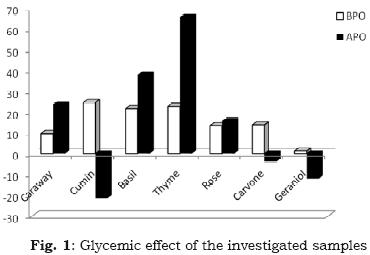
<body><![CDATA[<p align="justify"><font face="verdana" size="2">After photo&#150;oxygenation, caraway and basil oils acrtivity was not changed, <i>d&#150;</i>carvone, and geraniol showed a complete inhibition of fungal grow; while for cumin, rose and thyme oils weak increase of inhibition effect was observed.</font></p>     <p align="justify"><font face="verdana" size="2">The antimicrobial activity of cumin oil could be due to the high level of cuminalde&#150;hyde (23.37%), whereas the antimicrobial activity of caraway oil is apparently due to <i>d</i>&#150;carvone (42.61%). This is in agreement with Lacobellis <i>et al., </i>(2005). It is most likely that the decreasing effect of the photo&#150;oxygenation reaction on the antimicrobial activity of some investigated samples probably due to the conversion of the alcoholic derivatives to the corresponding aldehydes or ketons.</font></p>     <p align="justify"><font face="verdana" size="2">The search for hypoglycaemic agents from plants used in traditional medicine was reported (Fararh <i>et. al, </i>2004). In this article, we tried to test caraway, cumin, basil , thyme and rose essential oils as hypoglycaemic agents, along with <i>d</i>&#150;carvone and geraniol as major individual constituents on streptozotocin (STZ)&#150; diabetic rats, <i>via </i>induction by intravenous injection (65 mg/kg body weight in citrate buffer, pH 4.5) in a lateral tail vein. For measuring blood glucose levels, a blood droplet was collected from the eye medial canthus after anesthetization using diethyl ether, and measured by "One&#150;Touch" blood glucose meter. The results (<a href="/img/revistas/rlq/v38n3/a5t6.jpg" target="_blank">Table 6</a> and <a href="#f1">Fig. 1</a>) indicated that before photo&#150;oxygenation, the tested samples are arranged in the hypo&#150;glycemic descending order; cumin &gt; thyme &gt; basil &gt; rose<i>=d</i>&#150;carvone &gt; caraway&gt;geraniol. After photo&#150;oxygenation, caraway oil efficacy was enhanced as hypoglycaemic agent. On the other hand for cumin and <i>d</i>&#150;carvone hypoglycaemic effect was inverted by photo&#150;oxygenation.</font></p>     <p align="center"><font face="verdana" size="2"><a name="f1"></a></font></p>     <p align="center"><font face="verdana" size="2"><img src="/img/revistas/rlq/v38n3/a5f1.jpg"></font></p>     <p align="justify"><font face="verdana" size="2">Several workers have studied various essential oils from plant origin as glycaemic agents. For example, it was documented by Fararh <i>et al. </i>(2002), that essential oil of <i>Nigella sativa </i>has hypoglycaemic effect in STZ&#150;induced diabetic rats and rabbits. Others also reported a hypoglycaemic effect of garlic oil in diabetic animals (Cheng&#150;Tzu Liu <i>et al., </i>2006), and in diabetic patient it was shown that garlic oil can correct hypo&#150;glycaemia (Duncan, 1999), Significant and potent hypoglycaemic activity was observed by myrtle oil in diabetic rats (Sepici <i>et. al., </i>2004). The aqueous extract of caraway <i>(Carium carvi) </i>produced a significant decrease on blood glucose levels in STZ&#150;diabetic rats (Eddouks <i>et al., </i>2004).</font></p>     <p align="justify"><font face="verdana" size="2">&nbsp;</font></p>     <p align="justify"><font face="verdana" size="2"><b>CONCLUSION</b></font></p>     <p align="justify"><font face="verdana" size="2">In addition to identification of the volatile components of oils of caraway, cumin, basil, thyme, and rose using GC/MS and Kovats retention index, biological activities, including DNA damage, protein cleavage, antioxi&#150;dant, antimicrobial and anti&#150;diabetic effect were studied for d&#150;carvone, geraniol and the 5 oils before and after photo&#150; oxygenation of the oils. The chemical composition could be of value in identifying adulteration and different chemo&#150;types of these oils.</font></p>     <p align="justify"><font face="verdana" size="2">Generally, photo&#150;oxygenation enhanced the damage effect of both DNA and protein, which revealed the importance of essential oils to protect from light and oxygen. The tested oils act as free radical scavengers, both before and after photo&#150;oxygenation. The increasing of free radical scavenging activity by photo&#150;oxygenation may be explained by the probable increasing of phenolic content.</font></p>     ]]></body>
<body><![CDATA[<p align="justify"><font face="verdana" size="2">The antimicrobial studies indicated that caraway and basil are good antifungal agents, while <i>d</i>&#150;carvone and geraniol are antibacterial against Gram + bacteria. After photo&#150;oxygenation, caraway and basil oils acrtivity was not changed, <i>d</i>&#150;carvone, and geraniol showed a complete inhibition of fungal grow; while for cumin, rose and thyme oils weak increase of inhibition effect was observed</font></p>     <p align="justify"><font face="verdana" size="2">As hypoglycemic agents, the tested samples are arranged in the descending order, before photo&#150;oxygenation: cumin &gt; thyme &gt; basil &gt; rose<i>= d</i>&#150;carvone &gt; caraway&gt;geraniol; after photo&#150;oxygenation, caraway oil efficacy was enhanced as hypoglycaemic agent. On the other hand for cumin and <i>d&#150;</i>carvone hypoglycaemic effect was inverted by photo&#150;oxygenation.</font></p>     <p align="justify"><font face="verdana" size="2">&nbsp;</font></p>     <p align="justify"><font face="verdana" size="2"><b>REFERENCES</b></font></p>     <!-- ref --><p align="justify"><font face="verdana" size="2">Adams, R. P. (1995) Identification of volatile oil components by gas chromatography/mass spectroscopy. USA: Allured Publishing Corporation.    &nbsp;&nbsp;&nbsp;&nbsp;&nbsp;&nbsp;&nbsp;&nbsp;[&#160;<a href="javascript:void(0);" onclick="javascript: window.open('/scielo.php?script=sci_nlinks&ref=7365735&pid=S0370-5943201000030000500001&lng=','','width=640,height=500,resizable=yes,scrollbars=1,menubar=yes,');">Links</a>&#160;]<!-- end-ref --> </font></p>     <!-- ref --><p align="justify"><font face="verdana" size="2">Al&#150;Ismail, Kh. M.; Aburjai, T. (2004) Antioxidant activity of water and alcohol extracts of chamomile flowers, anise seeds and dill seeds. <i>J. Sci. Food Agric., </i><b>84: </b>173&#150;178.    &nbsp;&nbsp;&nbsp;&nbsp;&nbsp;&nbsp;&nbsp;&nbsp;[&#160;<a href="javascript:void(0);" onclick="javascript: window.open('/scielo.php?script=sci_nlinks&ref=7365737&pid=S0370-5943201000030000500002&lng=','','width=640,height=500,resizable=yes,scrollbars=1,menubar=yes,');">Links</a>&#160;]<!-- end-ref --> </font></p>     <!-- ref --><p align="justify"><font face="verdana" size="2">Aruna, K.; Sivaramakrishnan, V. M. (1996) Anticarcinogenic effects of the essential oils from cumin, poppy and basil. <i>Phytother. Res. </i><b>10: </b>577&#150;580.    &nbsp;&nbsp;&nbsp;&nbsp;&nbsp;&nbsp;&nbsp;&nbsp;[&#160;<a href="javascript:void(0);" onclick="javascript: window.open('/scielo.php?script=sci_nlinks&ref=7365739&pid=S0370-5943201000030000500003&lng=','','width=640,height=500,resizable=yes,scrollbars=1,menubar=yes,');">Links</a>&#160;]<!-- end-ref --> </font></p>     ]]></body>
<body><![CDATA[<!-- ref --><p align="justify"><font face="verdana" size="2">Burt, S. (2004). Essential oils: their antibacterial properties and potential applications in foods&#150;a review. International <i>Journal of Food Microbiology. </i><b>94: </b>223&#150;253.    &nbsp;&nbsp;&nbsp;&nbsp;&nbsp;&nbsp;&nbsp;&nbsp;[&#160;<a href="javascript:void(0);" onclick="javascript: window.open('/scielo.php?script=sci_nlinks&ref=7365741&pid=S0370-5943201000030000500004&lng=','','width=640,height=500,resizable=yes,scrollbars=1,menubar=yes,');">Links</a>&#160;]<!-- end-ref --> </font></p>     <!-- ref --><p align="justify"><font face="verdana" size="2">Cheng&#150;Tzu, L.; Pei&#150;Linn, W.; Chong&#150;Kuei, L.; Hunry, H.; Lee&#150;Yan, S. (2006) Antidiabetic effect of garlic oil but not diallyl disulfide in rats with streptozotocin&#150;induced diabetes. <i>Food and Chemical Toxicology </i><b>44: </b>1377&#150;1384.    &nbsp;&nbsp;&nbsp;&nbsp;&nbsp;&nbsp;&nbsp;&nbsp;[&#160;<a href="javascript:void(0);" onclick="javascript: window.open('/scielo.php?script=sci_nlinks&ref=7365743&pid=S0370-5943201000030000500005&lng=','','width=640,height=500,resizable=yes,scrollbars=1,menubar=yes,');">Links</a>&#160;]<!-- end-ref --> </font></p>     <!-- ref --><p align="justify"><font face="verdana" size="2">Dawidar, A. M.; Abdel&#150;Mogib, M; El&#150;Ghorab, A. H.; Hussien, Kh. (2009). Chemical composition and effect of photooxygenation on biological activities of Egyptian commercial spearmint and dill essential oils. <i>Mansoura J. Chem. </i><b>36: </b>49&#150;60.    &nbsp;&nbsp;&nbsp;&nbsp;&nbsp;&nbsp;&nbsp;&nbsp;[&#160;<a href="javascript:void(0);" onclick="javascript: window.open('/scielo.php?script=sci_nlinks&ref=7365745&pid=S0370-5943201000030000500006&lng=','','width=640,height=500,resizable=yes,scrollbars=1,menubar=yes,');">Links</a>&#160;]<!-- end-ref --> </font></p>     <!-- ref --><p align="justify"><font face="verdana" size="2">Dawidar, A.; Hussien, Kh. (2010) Essential oils Composition, photo&#150;oxidation, <i>Bioactivity. Cairo, Egypt: </i>Osiris Bookstore.    &nbsp;&nbsp;&nbsp;&nbsp;&nbsp;&nbsp;&nbsp;&nbsp;[&#160;<a href="javascript:void(0);" onclick="javascript: window.open('/scielo.php?script=sci_nlinks&ref=7365747&pid=S0370-5943201000030000500007&lng=','','width=640,height=500,resizable=yes,scrollbars=1,menubar=yes,');">Links</a>&#160;]<!-- end-ref --> </font></p>     <!-- ref --><p align="justify"><font face="verdana" size="2">Duncan, M. G. (1999) The effects of nutritional supplements on the treatment of depression, diabetes, and hypercholesterolemia in the renal patient, <i>J. Renal Nutr. </i><b>9: </b>58&#150;62.    &nbsp;&nbsp;&nbsp;&nbsp;&nbsp;&nbsp;&nbsp;&nbsp;[&#160;<a href="javascript:void(0);" onclick="javascript: window.open('/scielo.php?script=sci_nlinks&ref=7365749&pid=S0370-5943201000030000500008&lng=','','width=640,height=500,resizable=yes,scrollbars=1,menubar=yes,');">Links</a>&#160;]<!-- end-ref --> </font></p>     ]]></body>
<body><![CDATA[<!-- ref --><p align="justify"><font face="verdana" size="2">Eddouks, M.; Lemhadri, A.; Michel, J. (2004) Caraway and caper: potential anti&#150;hyperglycemic plants in diabetic rats. <i>J. Enthopharma. </i><b>94</b>:143&#150;148.    &nbsp;&nbsp;&nbsp;&nbsp;&nbsp;&nbsp;&nbsp;&nbsp;[&#160;<a href="javascript:void(0);" onclick="javascript: window.open('/scielo.php?script=sci_nlinks&ref=7365751&pid=S0370-5943201000030000500009&lng=','','width=640,height=500,resizable=yes,scrollbars=1,menubar=yes,');">Links</a>&#160;]<!-- end-ref --> </font></p>     <!-- ref --><p align="justify"><font face="verdana" size="2">Epe, B.; Haring, M.; Ramaiah, D.; Stopper, H.; Abou&#150;Elzahab, M. M.; Adam, W.; Saha&#150;Moller, C. R. (1993) Carcinog. <b>14: </b>2271&#150;2276.    &nbsp;&nbsp;&nbsp;&nbsp;&nbsp;&nbsp;&nbsp;&nbsp;[&#160;<a href="javascript:void(0);" onclick="javascript: window.open('/scielo.php?script=sci_nlinks&ref=7365753&pid=S0370-5943201000030000500010&lng=','','width=640,height=500,resizable=yes,scrollbars=1,menubar=yes,');">Links</a>&#160;]<!-- end-ref --> </font></p>     <!-- ref --><p align="justify"><font face="verdana" size="2">Fararh, K. M.; Atoji, Y.; Shimizu, Y.; Shiina, T.; Nikami, H.; Takewaki, T. (2004) Mechanisms of the hypoglycaemic and immunopotentiating effects of <i>Nigella sativa </i>L. oil in streptozotocin&#150;induced diabetic hamsters, <i>Research in Veterinary Science </i><b>77: </b>123&#150;129.    &nbsp;&nbsp;&nbsp;&nbsp;&nbsp;&nbsp;&nbsp;&nbsp;[&#160;<a href="javascript:void(0);" onclick="javascript: window.open('/scielo.php?script=sci_nlinks&ref=7365755&pid=S0370-5943201000030000500011&lng=','','width=640,height=500,resizable=yes,scrollbars=1,menubar=yes,');">Links</a>&#160;]<!-- end-ref --> </font></p>     <!-- ref --><p align="justify"><font face="verdana" size="2">Fararh, K. M.; Atoji, Y.; Shimizu, Y.; Takewaki, T. (2002) Isulinotropic properties of <i>Nigella sativa </i>oil in Streptozotocin plus Nicotinamide diabetic hamster, <i>Research in Veterinary Science </i><b>73: </b>279&#150;282.    &nbsp;&nbsp;&nbsp;&nbsp;&nbsp;&nbsp;&nbsp;&nbsp;[&#160;<a href="javascript:void(0);" onclick="javascript: window.open('/scielo.php?script=sci_nlinks&ref=7365757&pid=S0370-5943201000030000500012&lng=','','width=640,height=500,resizable=yes,scrollbars=1,menubar=yes,');">Links</a>&#160;]<!-- end-ref --></font></p>     <!-- ref --><p align="justify"><font face="verdana" size="2">Georgiev, E.; Badr, F. H. M.; Kostadinova, S. I. (1988) Comparative studies on Bulgarian, Egyptian and Turkish cumin <i>(Cuminum cyminum) </i>Nauchni Tr. &#150;Visch, <i>Inst. Khranit. Vkusova Prom. St., Ploudiv </i><b>35: </b>239&#150;248.    &nbsp;&nbsp;&nbsp;&nbsp;&nbsp;&nbsp;&nbsp;&nbsp;[&#160;<a href="javascript:void(0);" onclick="javascript: window.open('/scielo.php?script=sci_nlinks&ref=7365759&pid=S0370-5943201000030000500013&lng=','','width=640,height=500,resizable=yes,scrollbars=1,menubar=yes,');">Links</a>&#160;]<!-- end-ref --></font></p>     ]]></body>
<body><![CDATA[<!-- ref --><p align="justify"><font face="verdana" size="2">G&uuml;l&ccedil;in, I.; Oktay, M.; Kire&ccedil;ci, E.; K&uuml;frevioglu. O.I. (2003) <i>Food Chemistry </i><b>83: </b>371&#150;382.    &nbsp;&nbsp;&nbsp;&nbsp;&nbsp;&nbsp;&nbsp;&nbsp;[&#160;<a href="javascript:void(0);" onclick="javascript: window.open('/scielo.php?script=sci_nlinks&ref=7365761&pid=S0370-5943201000030000500014&lng=','','width=640,height=500,resizable=yes,scrollbars=1,menubar=yes,');">Links</a>&#160;]<!-- end-ref --></font></p>     <!-- ref --><p align="justify"><font face="verdana" size="2">Hoertrammer, L.; El Hamidi, A. E.; Richter, G. (1964) <i>J. Pharm. Sci. </i><b>53: </b>1033&#150;1036.    &nbsp;&nbsp;&nbsp;&nbsp;&nbsp;&nbsp;&nbsp;&nbsp;[&#160;<a href="javascript:void(0);" onclick="javascript: window.open('/scielo.php?script=sci_nlinks&ref=7365763&pid=S0370-5943201000030000500015&lng=','','width=640,height=500,resizable=yes,scrollbars=1,menubar=yes,');">Links</a>&#160;]<!-- end-ref --></font></p>     <!-- ref --><p align="justify"><font face="verdana" size="2">Hudaib, M.; Speroni, E.; Di Pietra, A. M.; Cavrini, V. (2002). GC/MS evaluation of thyme (<i>Thymus vulgaris </i>L.) oil composition and variations during the vegetative cycle <i>J. Pharm. Biomed. Anal. </i><b>29: </b>691&#150;700.    &nbsp;&nbsp;&nbsp;&nbsp;&nbsp;&nbsp;&nbsp;&nbsp;[&#160;<a href="javascript:void(0);" onclick="javascript: window.open('/scielo.php?script=sci_nlinks&ref=7365765&pid=S0370-5943201000030000500016&lng=','','width=640,height=500,resizable=yes,scrollbars=1,menubar=yes,');">Links</a>&#160;]<!-- end-ref --></font></p>     <!-- ref --><p align="justify"><font face="verdana" size="2">Hussien, Kh. (2006) Chemical and biological studies on terpenoids of some commercially available essential oils, Ph.D.Thesis; <i>Mansoura university, Egypt.    &nbsp;&nbsp;&nbsp;&nbsp;&nbsp;&nbsp;&nbsp;&nbsp;[&#160;<a href="javascript:void(0);" onclick="javascript: window.open('/scielo.php?script=sci_nlinks&ref=7365767&pid=S0370-5943201000030000500017&lng=','','width=640,height=500,resizable=yes,scrollbars=1,menubar=yes,');">Links</a>&#160;]<!-- end-ref --></i></font></p>     <!-- ref --><p align="justify"><font face="verdana" size="2">Iacobellis, N. S.; Lo Cantore, P.; Capasso, F.; Senatore, F. (2005). Antibacterial activity of <i>Cumium cyminum </i>L. and <i>Carum carvi </i>L. essential oils. <i>J. Agric. Food Chem. </i><b>53: </b>57&#150;61.    &nbsp;&nbsp;&nbsp;&nbsp;&nbsp;&nbsp;&nbsp;&nbsp;[&#160;<a href="javascript:void(0);" onclick="javascript: window.open('/scielo.php?script=sci_nlinks&ref=7365769&pid=S0370-5943201000030000500018&lng=','','width=640,height=500,resizable=yes,scrollbars=1,menubar=yes,');">Links</a>&#160;]<!-- end-ref --></font></p>     ]]></body>
<body><![CDATA[<!-- ref --><p align="justify"><font face="verdana" size="2">Karawya, M. S.; Hashim, F. M.; Hifnawy M. S. (1974). Oils of jasmin, rose and cassie of Egyptian origin. Bull. <i>Fac. Pharm., Cairo Univ. </i><b>13: </b>183&#150;192.    &nbsp;&nbsp;&nbsp;&nbsp;&nbsp;&nbsp;&nbsp;&nbsp;[&#160;<a href="javascript:void(0);" onclick="javascript: window.open('/scielo.php?script=sci_nlinks&ref=7365771&pid=S0370-5943201000030000500019&lng=','','width=640,height=500,resizable=yes,scrollbars=1,menubar=yes,');">Links</a>&#160;]<!-- end-ref --></font></p>     <!-- ref --><p align="justify"><font face="verdana" size="2">Lacobellis, S.; Pietro, L.; Francesco, C.; Felice. S. (2005) J. <i>Agric. Food. Chem. </i><b>53: </b>57&#150;61.    &nbsp;&nbsp;&nbsp;&nbsp;&nbsp;&nbsp;&nbsp;&nbsp;[&#160;<a href="javascript:void(0);" onclick="javascript: window.open('/scielo.php?script=sci_nlinks&ref=7365773&pid=S0370-5943201000030000500020&lng=','','width=640,height=500,resizable=yes,scrollbars=1,menubar=yes,');">Links</a>&#160;]<!-- end-ref --></font></p>     <!-- ref --><p align="justify"><font face="verdana" size="2">Micklefield, G. H.; Greving, I.; May, B. (2000). Effects of peppermint oil and caraway oil on gastroduodenal motility. <i>Phytotherapy Research </i><b>14: </b>20&#150;23.    &nbsp;&nbsp;&nbsp;&nbsp;&nbsp;&nbsp;&nbsp;&nbsp;[&#160;<a href="javascript:void(0);" onclick="javascript: window.open('/scielo.php?script=sci_nlinks&ref=7365775&pid=S0370-5943201000030000500021&lng=','','width=640,height=500,resizable=yes,scrollbars=1,menubar=yes,');">Links</a>&#160;]<!-- end-ref --></font></p>     <!-- ref --><p align="justify"><font face="verdana" size="2">Miliauskas, G.; Venskutonis, P.R.; Beek. T.A. (2004). Screening of radical scavenging activity of some medicinal and aromatic plant extracts. <i>Food Chemistry </i><b>85: </b>231&#150;237.    &nbsp;&nbsp;&nbsp;&nbsp;&nbsp;&nbsp;&nbsp;&nbsp;[&#160;<a href="javascript:void(0);" onclick="javascript: window.open('/scielo.php?script=sci_nlinks&ref=7365777&pid=S0370-5943201000030000500022&lng=','','width=640,height=500,resizable=yes,scrollbars=1,menubar=yes,');">Links</a>&#160;]<!-- end-ref --></font></p>     <!-- ref --><p align="justify"><font face="verdana" size="2">Niskikimi, M.; Roa, N.A.; Yagi. K. (1972). The occurrence of superoxide anion in the reaction of reduced phenazine methosulfate and molecular oxygen. Bi<i>ochem. Biophy. Res. Commun. </i><b>46: </b>849&#150;854.    &nbsp;&nbsp;&nbsp;&nbsp;&nbsp;&nbsp;&nbsp;&nbsp;[&#160;<a href="javascript:void(0);" onclick="javascript: window.open('/scielo.php?script=sci_nlinks&ref=7365779&pid=S0370-5943201000030000500023&lng=','','width=640,height=500,resizable=yes,scrollbars=1,menubar=yes,');">Links</a>&#160;]<!-- end-ref --></font></p>     ]]></body>
<body><![CDATA[<!-- ref --><p align="justify"><font face="verdana" size="2">Opalchenova, G.; Obreshkova, D. (2003). Comparative studies on the activity of basil&#150;an essential oil from Ocimum basilicum L.&#150;against multidrug resistant clinical isolates of the genera Staphylococcus, Enterococcus and Pseudomonas by using different test methods. <i>Journal of Microbiological methods, </i><b>54: </b>105&#150;110.    &nbsp;&nbsp;&nbsp;&nbsp;&nbsp;&nbsp;&nbsp;&nbsp;[&#160;<a href="javascript:void(0);" onclick="javascript: window.open('/scielo.php?script=sci_nlinks&ref=7365781&pid=S0370-5943201000030000500024&lng=','','width=640,height=500,resizable=yes,scrollbars=1,menubar=yes,');">Links</a>&#160;]<!-- end-ref --></font></p>     <!-- ref --><p align="justify"><font face="verdana" size="2">Panuwat, S.; Joseph, M.; Kees, S.; Stephen, B.W. (2003) <i>J. Agric. Food Chem., </i><b>51: </b>3197&#150;3207.    &nbsp;&nbsp;&nbsp;&nbsp;&nbsp;&nbsp;&nbsp;&nbsp;[&#160;<a href="javascript:void(0);" onclick="javascript: window.open('/scielo.php?script=sci_nlinks&ref=7365783&pid=S0370-5943201000030000500025&lng=','','width=640,height=500,resizable=yes,scrollbars=1,menubar=yes,');">Links</a>&#160;]<!-- end-ref --></font></p>     <!-- ref --><p align="justify"><font face="verdana" size="2">Peter, K. V. (2001). Handbook of Herbs and Spices, first published, Woodhead Publishing Limited and CRC Press LTC. Cambridge England.    &nbsp;&nbsp;&nbsp;&nbsp;&nbsp;&nbsp;&nbsp;&nbsp;[&#160;<a href="javascript:void(0);" onclick="javascript: window.open('/scielo.php?script=sci_nlinks&ref=7365785&pid=S0370-5943201000030000500026&lng=','','width=640,height=500,resizable=yes,scrollbars=1,menubar=yes,');">Links</a>&#160;]<!-- end-ref --></font></p>     <!-- ref --><p align="justify"><font face="verdana" size="2">Schulz, H.; Quilitzsch, R.; Kruger, H. (2003). Classification of Essential Oils with FT&#150;IR Spectroscopy in Routine Quality and Process Control. <i>Journal of Molecular Structure, </i><b>661&#150;662: </b>299&#150;306.    &nbsp;&nbsp;&nbsp;&nbsp;&nbsp;&nbsp;&nbsp;&nbsp;[&#160;<a href="javascript:void(0);" onclick="javascript: window.open('/scielo.php?script=sci_nlinks&ref=7365787&pid=S0370-5943201000030000500027&lng=','','width=640,height=500,resizable=yes,scrollbars=1,menubar=yes,');">Links</a>&#160;]<!-- end-ref --></font></p>     <!-- ref --><p align="justify"><font face="verdana" size="2">Sepici, A.; G&uuml;rb&uuml;z, I.; &Ccedil;evik, C.; Yesilada, E. (2004). Hypoglycaemic effects of myrtle oil in normal and alloxan&#150;diabetic rabbits. <i>Journal Ethnopharmacology. </i><b>93: </b>311&#150;318.    &nbsp;&nbsp;&nbsp;&nbsp;&nbsp;&nbsp;&nbsp;&nbsp;[&#160;<a href="javascript:void(0);" onclick="javascript: window.open('/scielo.php?script=sci_nlinks&ref=7365789&pid=S0370-5943201000030000500028&lng=','','width=640,height=500,resizable=yes,scrollbars=1,menubar=yes,');">Links</a>&#160;]<!-- end-ref --></font></p>     ]]></body>
<body><![CDATA[<!-- ref --><p align="justify"><font face="verdana" size="2">Tomaino, A.; Cimino, F.; Zimbalatti, V.; Venuti, V.; Sulfaro, V.; De Pasquale, A.; Saija, A. (2005). Influence of heating on antioxidant activity and the chemical composition of some spice essential oils. <i>Food Chemistry. </i><b>89: </b>549&#150;554.    &nbsp;&nbsp;&nbsp;&nbsp;&nbsp;&nbsp;&nbsp;&nbsp;[&#160;<a href="javascript:void(0);" onclick="javascript: window.open('/scielo.php?script=sci_nlinks&ref=7365791&pid=S0370-5943201000030000500029&lng=','','width=640,height=500,resizable=yes,scrollbars=1,menubar=yes,');">Links</a>&#160;]<!-- end-ref --></font></p>      ]]></body><back>
<ref-list>
<ref id="B1">
<nlm-citation citation-type="book">
<person-group person-group-type="author">
<name>
<surname><![CDATA[Adams]]></surname>
<given-names><![CDATA[R. P.]]></given-names>
</name>
</person-group>
<source><![CDATA[Identification of volatile oil components by gas chromatography/mass spectroscopy]]></source>
<year>1995</year>
<publisher-name><![CDATA[Allured Publishing Corporation]]></publisher-name>
</nlm-citation>
</ref>
<ref id="B2">
<nlm-citation citation-type="journal">
<person-group person-group-type="author">
<name>
<surname><![CDATA[Al-Ismail]]></surname>
<given-names><![CDATA[Kh. M.]]></given-names>
</name>
<name>
<surname><![CDATA[Aburjai]]></surname>
<given-names><![CDATA[T.]]></given-names>
</name>
</person-group>
<article-title xml:lang="en"><![CDATA[Antioxidant activity of water and alcohol extracts of chamomile flowers, anise seeds and dill seeds]]></article-title>
<source><![CDATA[J. Sci. Food Agric.]]></source>
<year>2004</year>
<volume>84</volume>
<page-range>173-178</page-range></nlm-citation>
</ref>
<ref id="B3">
<nlm-citation citation-type="journal">
<person-group person-group-type="author">
<name>
<surname><![CDATA[Aruna]]></surname>
<given-names><![CDATA[K.]]></given-names>
</name>
<name>
<surname><![CDATA[Sivaramakrishnan]]></surname>
<given-names><![CDATA[V. M.]]></given-names>
</name>
</person-group>
<article-title xml:lang="en"><![CDATA[Anticarcinogenic effects of the essential oils from cumin, poppy and basil]]></article-title>
<source><![CDATA[Phytother. Res.]]></source>
<year>1996</year>
<volume>10</volume>
<page-range>577-580</page-range></nlm-citation>
</ref>
<ref id="B4">
<nlm-citation citation-type="journal">
<person-group person-group-type="author">
<name>
<surname><![CDATA[Burt]]></surname>
<given-names><![CDATA[S.]]></given-names>
</name>
</person-group>
<article-title xml:lang="en"><![CDATA[Essential oils: their antibacterial properties and potential applications in foods-a review]]></article-title>
<source><![CDATA[International Journal of Food Microbiology]]></source>
<year>2004</year>
<volume>94</volume>
<page-range>223-253</page-range></nlm-citation>
</ref>
<ref id="B5">
<nlm-citation citation-type="journal">
<person-group person-group-type="author">
<name>
<surname><![CDATA[Cheng-Tzu]]></surname>
<given-names><![CDATA[L.]]></given-names>
</name>
<name>
<surname><![CDATA[Pei-Linn]]></surname>
<given-names><![CDATA[W.]]></given-names>
</name>
<name>
<surname><![CDATA[Chong-Kuei]]></surname>
<given-names><![CDATA[L.]]></given-names>
</name>
<name>
<surname><![CDATA[Hunry]]></surname>
<given-names><![CDATA[H.]]></given-names>
</name>
<name>
<surname><![CDATA[Lee-Yan]]></surname>
<given-names><![CDATA[S.]]></given-names>
</name>
</person-group>
<article-title xml:lang="en"><![CDATA[Antidiabetic effect of garlic oil but not diallyl disulfide in rats with streptozotocin-induced diabetes]]></article-title>
<source><![CDATA[Food and Chemical Toxicology]]></source>
<year>2006</year>
<volume>44</volume>
<page-range>1377-1384</page-range></nlm-citation>
</ref>
<ref id="B6">
<nlm-citation citation-type="journal">
<person-group person-group-type="author">
<name>
<surname><![CDATA[Dawidar]]></surname>
<given-names><![CDATA[A. M.]]></given-names>
</name>
<name>
<surname><![CDATA[Abdel-Mogib]]></surname>
<given-names><![CDATA[M]]></given-names>
</name>
<name>
<surname><![CDATA[El-Ghorab]]></surname>
<given-names><![CDATA[A. H.]]></given-names>
</name>
<name>
<surname><![CDATA[Hussien]]></surname>
<given-names><![CDATA[Kh.]]></given-names>
</name>
</person-group>
<article-title xml:lang="en"><![CDATA[Chemical composition and effect of photooxygenation on biological activities of Egyptian commercial spearmint and dill essential oils]]></article-title>
<source><![CDATA[Mansoura J. Chem.]]></source>
<year>2009</year>
<volume>36</volume>
<page-range>49-60</page-range></nlm-citation>
</ref>
<ref id="B7">
<nlm-citation citation-type="book">
<person-group person-group-type="author">
<name>
<surname><![CDATA[Dawidar]]></surname>
<given-names><![CDATA[A.]]></given-names>
</name>
<name>
<surname><![CDATA[Hussien]]></surname>
<given-names><![CDATA[Kh.]]></given-names>
</name>
</person-group>
<source><![CDATA[Essential oils Composition, photo-oxidation, Bioactivity]]></source>
<year>2010</year>
<publisher-loc><![CDATA[Cairo ]]></publisher-loc>
<publisher-name><![CDATA[Osiris Bookstore]]></publisher-name>
</nlm-citation>
</ref>
<ref id="B8">
<nlm-citation citation-type="journal">
<person-group person-group-type="author">
<name>
<surname><![CDATA[Duncan]]></surname>
<given-names><![CDATA[M. G.]]></given-names>
</name>
</person-group>
<article-title xml:lang="en"><![CDATA[The effects of nutritional supplements on the treatment of depression, diabetes, and hypercholesterolemia in the renal patient]]></article-title>
<source><![CDATA[J. Renal Nutr.]]></source>
<year>1999</year>
<volume>9</volume>
<page-range>58-62</page-range></nlm-citation>
</ref>
<ref id="B9">
<nlm-citation citation-type="journal">
<person-group person-group-type="author">
<name>
<surname><![CDATA[Eddouks]]></surname>
<given-names><![CDATA[M.]]></given-names>
</name>
<name>
<surname><![CDATA[Lemhadri]]></surname>
<given-names><![CDATA[A.]]></given-names>
</name>
<name>
<surname><![CDATA[Michel]]></surname>
<given-names><![CDATA[J.]]></given-names>
</name>
</person-group>
<article-title xml:lang="en"><![CDATA[Caraway and caper: potential anti-hyperglycemic plants in diabetic rats]]></article-title>
<source><![CDATA[J. Enthopharma]]></source>
<year>2004</year>
<volume>94</volume>
<page-range>143-148</page-range></nlm-citation>
</ref>
<ref id="B10">
<nlm-citation citation-type="journal">
<person-group person-group-type="author">
<name>
<surname><![CDATA[Epe]]></surname>
<given-names><![CDATA[B.]]></given-names>
</name>
<name>
<surname><![CDATA[Haring]]></surname>
<given-names><![CDATA[M.]]></given-names>
</name>
<name>
<surname><![CDATA[Ramaiah]]></surname>
<given-names><![CDATA[D.]]></given-names>
</name>
<name>
<surname><![CDATA[Stopper]]></surname>
<given-names><![CDATA[H.]]></given-names>
</name>
<name>
<surname><![CDATA[Abou-Elzahab]]></surname>
<given-names><![CDATA[M. M.]]></given-names>
</name>
<name>
<surname><![CDATA[Adam]]></surname>
<given-names><![CDATA[W.]]></given-names>
</name>
<name>
<surname><![CDATA[Saha-Moller]]></surname>
<given-names><![CDATA[C. R.]]></given-names>
</name>
</person-group>
<source><![CDATA[Carcinog]]></source>
<year>1993</year>
<volume>14</volume>
<page-range>2271-2276</page-range></nlm-citation>
</ref>
<ref id="B11">
<nlm-citation citation-type="journal">
<person-group person-group-type="author">
<name>
<surname><![CDATA[Fararh]]></surname>
<given-names><![CDATA[K. M.]]></given-names>
</name>
<name>
<surname><![CDATA[Atoji]]></surname>
<given-names><![CDATA[Y.]]></given-names>
</name>
<name>
<surname><![CDATA[Shimizu]]></surname>
<given-names><![CDATA[Y.]]></given-names>
</name>
<name>
<surname><![CDATA[Shiina]]></surname>
<given-names><![CDATA[T.]]></given-names>
</name>
<name>
<surname><![CDATA[Nikami]]></surname>
<given-names><![CDATA[H.]]></given-names>
</name>
<name>
<surname><![CDATA[Takewaki]]></surname>
<given-names><![CDATA[T.]]></given-names>
</name>
</person-group>
<article-title xml:lang="en"><![CDATA[Mechanisms of the hypoglycaemic and immunopotentiating effects of Nigella sativa L. oil in streptozotocin-induced diabetic hamsters]]></article-title>
<source><![CDATA[Research in Veterinary Science]]></source>
<year>2004</year>
<volume>77</volume>
<page-range>123-129</page-range></nlm-citation>
</ref>
<ref id="B12">
<nlm-citation citation-type="journal">
<person-group person-group-type="author">
<name>
<surname><![CDATA[Fararh]]></surname>
<given-names><![CDATA[K. M.]]></given-names>
</name>
<name>
<surname><![CDATA[Atoji]]></surname>
<given-names><![CDATA[Y.]]></given-names>
</name>
<name>
<surname><![CDATA[Shimizu]]></surname>
<given-names><![CDATA[Y.]]></given-names>
</name>
<name>
<surname><![CDATA[Takewaki]]></surname>
<given-names><![CDATA[T.]]></given-names>
</name>
</person-group>
<article-title xml:lang="en"><![CDATA[Isulinotropic properties of Nigella sativa oil in Streptozotocin plus Nicotinamide diabetic hamster]]></article-title>
<source><![CDATA[Research in Veterinary Science]]></source>
<year>2002</year>
<volume>73</volume>
<page-range>279-282</page-range></nlm-citation>
</ref>
<ref id="B13">
<nlm-citation citation-type="journal">
<person-group person-group-type="author">
<name>
<surname><![CDATA[Georgiev]]></surname>
<given-names><![CDATA[E.]]></given-names>
</name>
<name>
<surname><![CDATA[Badr]]></surname>
<given-names><![CDATA[F. H. M.]]></given-names>
</name>
<name>
<surname><![CDATA[Kostadinova]]></surname>
<given-names><![CDATA[S. I.]]></given-names>
</name>
</person-group>
<article-title xml:lang="en"><![CDATA[Comparative studies on Bulgarian, Egyptian and Turkish cumin (Cuminum cyminum) Nauchni Tr. -Visch]]></article-title>
<source><![CDATA[Inst. Khranit. Vkusova Prom. St., Ploudiv]]></source>
<year>1988</year>
<volume>35</volume>
<page-range>239-248</page-range></nlm-citation>
</ref>
<ref id="B14">
<nlm-citation citation-type="journal">
<person-group person-group-type="author">
<name>
<surname><![CDATA[Gülçin]]></surname>
<given-names><![CDATA[I.]]></given-names>
</name>
<name>
<surname><![CDATA[Oktay]]></surname>
<given-names><![CDATA[M.]]></given-names>
</name>
<name>
<surname><![CDATA[Kireçci]]></surname>
<given-names><![CDATA[E.]]></given-names>
</name>
<name>
<surname><![CDATA[Küfrevioglu]]></surname>
<given-names><![CDATA[O.I.]]></given-names>
</name>
</person-group>
<source><![CDATA[Food Chemistry]]></source>
<year>2003</year>
<volume>83</volume>
<page-range>371-382</page-range></nlm-citation>
</ref>
<ref id="B15">
<nlm-citation citation-type="journal">
<person-group person-group-type="author">
<name>
<surname><![CDATA[Hoertrammer]]></surname>
<given-names><![CDATA[L.]]></given-names>
</name>
<name>
<surname><![CDATA[El Hamidi]]></surname>
<given-names><![CDATA[A. E.]]></given-names>
</name>
<name>
<surname><![CDATA[Richter]]></surname>
<given-names><![CDATA[G.]]></given-names>
</name>
</person-group>
<source><![CDATA[J. Pharm. Sci.]]></source>
<year>1964</year>
<volume>53</volume>
<page-range>1033-1036</page-range></nlm-citation>
</ref>
<ref id="B16">
<nlm-citation citation-type="journal">
<person-group person-group-type="author">
<name>
<surname><![CDATA[Hudaib]]></surname>
<given-names><![CDATA[M.]]></given-names>
</name>
<name>
<surname><![CDATA[Speroni]]></surname>
<given-names><![CDATA[E.]]></given-names>
</name>
<name>
<surname><![CDATA[Di Pietra]]></surname>
<given-names><![CDATA[A. M.]]></given-names>
</name>
<name>
<surname><![CDATA[Cavrini]]></surname>
<given-names><![CDATA[V.]]></given-names>
</name>
</person-group>
<article-title xml:lang="en"><![CDATA[GC/MS evaluation of thyme (Thymus vulgaris L.) oil composition and variations during the vegetative cycle]]></article-title>
<source><![CDATA[J. Pharm. Biomed. Anal.]]></source>
<year>2002</year>
<volume>29</volume>
<page-range>691-700</page-range></nlm-citation>
</ref>
<ref id="B17">
<nlm-citation citation-type="">
<person-group person-group-type="author">
<name>
<surname><![CDATA[Hussien]]></surname>
<given-names><![CDATA[Kh.]]></given-names>
</name>
</person-group>
<source><![CDATA[Chemical and biological studies on terpenoids of some commercially available essential oils]]></source>
<year>2006</year>
</nlm-citation>
</ref>
<ref id="B18">
<nlm-citation citation-type="journal">
<person-group person-group-type="author">
<name>
<surname><![CDATA[Iacobellis]]></surname>
<given-names><![CDATA[N. S.]]></given-names>
</name>
<name>
<surname><![CDATA[Lo Cantore]]></surname>
<given-names><![CDATA[P.]]></given-names>
</name>
<name>
<surname><![CDATA[Capasso]]></surname>
<given-names><![CDATA[F.]]></given-names>
</name>
<name>
<surname><![CDATA[Senatore]]></surname>
<given-names><![CDATA[F.]]></given-names>
</name>
</person-group>
<article-title xml:lang="en"><![CDATA[Antibacterial activity of Cumium cyminum L. and Carum carvi L. essential oils]]></article-title>
<source><![CDATA[J. Agric. Food Chem.]]></source>
<year>2005</year>
<volume>53</volume>
<page-range>57-61</page-range></nlm-citation>
</ref>
<ref id="B19">
<nlm-citation citation-type="journal">
<person-group person-group-type="author">
<name>
<surname><![CDATA[Karawya]]></surname>
<given-names><![CDATA[M. S.]]></given-names>
</name>
<name>
<surname><![CDATA[Hashim]]></surname>
<given-names><![CDATA[F. M.]]></given-names>
</name>
<name>
<surname><![CDATA[Hifnawy]]></surname>
<given-names><![CDATA[M. S.]]></given-names>
</name>
</person-group>
<article-title xml:lang="en"><![CDATA[Oils of jasmin, rose and cassie of Egyptian origin]]></article-title>
<source><![CDATA[Bull. Fac. Pharm., Cairo Univ.]]></source>
<year>1974</year>
<volume>13</volume>
<page-range>183-192</page-range></nlm-citation>
</ref>
<ref id="B20">
<nlm-citation citation-type="journal">
<person-group person-group-type="author">
<name>
<surname><![CDATA[Lacobellis]]></surname>
<given-names><![CDATA[S.]]></given-names>
</name>
<name>
<surname><![CDATA[Pietro]]></surname>
<given-names><![CDATA[L.]]></given-names>
</name>
<name>
<surname><![CDATA[Francesco]]></surname>
<given-names><![CDATA[C.]]></given-names>
</name>
<name>
<surname><![CDATA[Felice]]></surname>
<given-names><![CDATA[S.]]></given-names>
</name>
</person-group>
<source><![CDATA[J. Agric. Food. Chem.]]></source>
<year>2005</year>
<volume>53</volume>
<page-range>57-61</page-range></nlm-citation>
</ref>
<ref id="B21">
<nlm-citation citation-type="journal">
<person-group person-group-type="author">
<name>
<surname><![CDATA[Micklefield]]></surname>
<given-names><![CDATA[G. H.]]></given-names>
</name>
<name>
<surname><![CDATA[Greving]]></surname>
<given-names><![CDATA[I.]]></given-names>
</name>
<name>
<surname><![CDATA[May]]></surname>
<given-names><![CDATA[B.]]></given-names>
</name>
</person-group>
<article-title xml:lang="en"><![CDATA[Effects of peppermint oil and caraway oil on gastroduodenal motility]]></article-title>
<source><![CDATA[Phytotherapy Research]]></source>
<year>2000</year>
<volume>14</volume>
<page-range>20-23</page-range></nlm-citation>
</ref>
<ref id="B22">
<nlm-citation citation-type="journal">
<person-group person-group-type="author">
<name>
<surname><![CDATA[Miliauskas]]></surname>
<given-names><![CDATA[G.]]></given-names>
</name>
<name>
<surname><![CDATA[Venskutonis]]></surname>
<given-names><![CDATA[P.R.]]></given-names>
</name>
<name>
<surname><![CDATA[Beek]]></surname>
<given-names><![CDATA[T.A.]]></given-names>
</name>
</person-group>
<article-title xml:lang="en"><![CDATA[Screening of radical scavenging activity of some medicinal and aromatic plant extracts]]></article-title>
<source><![CDATA[Food Chemistry]]></source>
<year>2004</year>
<volume>85</volume>
<page-range>231-237</page-range></nlm-citation>
</ref>
<ref id="B23">
<nlm-citation citation-type="journal">
<person-group person-group-type="author">
<name>
<surname><![CDATA[Niskikimi]]></surname>
<given-names><![CDATA[M.]]></given-names>
</name>
<name>
<surname><![CDATA[Roa]]></surname>
<given-names><![CDATA[N.A.]]></given-names>
</name>
<name>
<surname><![CDATA[Yagi]]></surname>
<given-names><![CDATA[K.]]></given-names>
</name>
</person-group>
<article-title xml:lang="en"><![CDATA[The occurrence of superoxide anion in the reaction of reduced phenazine methosulfate and molecular oxygen]]></article-title>
<source><![CDATA[Biochem. Biophy. Res. Commun.]]></source>
<year>1972</year>
<volume>46</volume>
<page-range>849-854</page-range></nlm-citation>
</ref>
<ref id="B24">
<nlm-citation citation-type="journal">
<person-group person-group-type="author">
<name>
<surname><![CDATA[Opalchenova]]></surname>
<given-names><![CDATA[G.]]></given-names>
</name>
<name>
<surname><![CDATA[Obreshkova]]></surname>
<given-names><![CDATA[D.]]></given-names>
</name>
</person-group>
<article-title xml:lang="en"><![CDATA[Comparative studies on the activity of basil-an essential oil from Ocimum basilicum L.-against multidrug resistant clinical isolates of the genera Staphylococcus, Enterococcus and Pseudomonas by using different test methods]]></article-title>
<source><![CDATA[Journal of Microbiological methods]]></source>
<year>2003</year>
<volume>54</volume>
<page-range>105-110</page-range></nlm-citation>
</ref>
<ref id="B25">
<nlm-citation citation-type="journal">
<person-group person-group-type="author">
<name>
<surname><![CDATA[Panuwat]]></surname>
<given-names><![CDATA[S.]]></given-names>
</name>
<name>
<surname><![CDATA[Joseph]]></surname>
<given-names><![CDATA[M.]]></given-names>
</name>
<name>
<surname><![CDATA[Kees]]></surname>
<given-names><![CDATA[S.]]></given-names>
</name>
<name>
<surname><![CDATA[Stephen]]></surname>
<given-names><![CDATA[B.W.]]></given-names>
</name>
</person-group>
<source><![CDATA[J. Agric. Food Chem.]]></source>
<year>2003</year>
<volume>51</volume>
<page-range>3197-3207</page-range></nlm-citation>
</ref>
<ref id="B26">
<nlm-citation citation-type="book">
<person-group person-group-type="author">
<name>
<surname><![CDATA[Peter]]></surname>
<given-names><![CDATA[K. V.]]></given-names>
</name>
</person-group>
<source><![CDATA[Handbook of Herbs and Spices]]></source>
<year>2001</year>
<publisher-loc><![CDATA[Cambridge ]]></publisher-loc>
<publisher-name><![CDATA[Woodhead Publishing LimitedCRC Press LTC]]></publisher-name>
</nlm-citation>
</ref>
<ref id="B27">
<nlm-citation citation-type="journal">
<person-group person-group-type="author">
<name>
<surname><![CDATA[Schulz]]></surname>
<given-names><![CDATA[H.]]></given-names>
</name>
<name>
<surname><![CDATA[Quilitzsch]]></surname>
<given-names><![CDATA[R.]]></given-names>
</name>
<name>
<surname><![CDATA[Kruger]]></surname>
<given-names><![CDATA[H.]]></given-names>
</name>
</person-group>
<article-title xml:lang="en"><![CDATA[Classification of Essential Oils with FT-IR Spectroscopy in Routine Quality and Process Control]]></article-title>
<source><![CDATA[Journal of Molecular Structure]]></source>
<year>2003</year>
<volume>661-662</volume>
<page-range>299-306</page-range></nlm-citation>
</ref>
<ref id="B28">
<nlm-citation citation-type="journal">
<person-group person-group-type="author">
<name>
<surname><![CDATA[Sepici]]></surname>
<given-names><![CDATA[A.]]></given-names>
</name>
<name>
<surname><![CDATA[Gürbüz]]></surname>
<given-names><![CDATA[I.]]></given-names>
</name>
<name>
<surname><![CDATA[Çevik]]></surname>
<given-names><![CDATA[C.]]></given-names>
</name>
<name>
<surname><![CDATA[Yesilada]]></surname>
<given-names><![CDATA[E.]]></given-names>
</name>
</person-group>
<article-title xml:lang="en"><![CDATA[Hypoglycaemic effects of myrtle oil in normal and alloxan-diabetic rabbits]]></article-title>
<source><![CDATA[Journal Ethnopharmacology]]></source>
<year>2004</year>
<volume>93</volume>
<page-range>311-318</page-range></nlm-citation>
</ref>
<ref id="B29">
<nlm-citation citation-type="journal">
<person-group person-group-type="author">
<name>
<surname><![CDATA[Tomaino]]></surname>
<given-names><![CDATA[A.]]></given-names>
</name>
<name>
<surname><![CDATA[Cimino]]></surname>
<given-names><![CDATA[F.]]></given-names>
</name>
<name>
<surname><![CDATA[Zimbalatti]]></surname>
<given-names><![CDATA[V.]]></given-names>
</name>
<name>
<surname><![CDATA[Venuti]]></surname>
<given-names><![CDATA[V.]]></given-names>
</name>
<name>
<surname><![CDATA[Sulfaro]]></surname>
<given-names><![CDATA[V.]]></given-names>
</name>
<name>
<surname><![CDATA[De Pasquale]]></surname>
<given-names><![CDATA[A.]]></given-names>
</name>
<name>
<surname><![CDATA[Saija]]></surname>
<given-names><![CDATA[A.]]></given-names>
</name>
</person-group>
<article-title xml:lang="en"><![CDATA[Influence of heating on antioxidant activity and the chemical composition of some spice essential oils]]></article-title>
<source><![CDATA[Food Chemistry]]></source>
<year>2005</year>
<volume>89</volume>
<page-range>549-554</page-range></nlm-citation>
</ref>
</ref-list>
</back>
</article>
