<?xml version="1.0" encoding="ISO-8859-1"?><article xmlns:mml="http://www.w3.org/1998/Math/MathML" xmlns:xlink="http://www.w3.org/1999/xlink" xmlns:xsi="http://www.w3.org/2001/XMLSchema-instance">
<front>
<journal-meta>
<journal-id>0370-5943</journal-id>
<journal-title><![CDATA[Revista latinoamericana de química]]></journal-title>
<abbrev-journal-title><![CDATA[Rev. latinoam. quím]]></abbrev-journal-title>
<issn>0370-5943</issn>
<publisher>
<publisher-name><![CDATA[Laboratorios Mixim S.A.]]></publisher-name>
</publisher>
</journal-meta>
<article-meta>
<article-id>S0370-59432010000200004</article-id>
<title-group>
<article-title xml:lang="en"><![CDATA[Secondary metabolites and pharmacology of Foeniculum vulgare Mill. Subsp. Piperitum]]></article-title>
</title-group>
<contrib-group>
<contrib contrib-type="author">
<name>
<surname><![CDATA[Nassar]]></surname>
<given-names><![CDATA[Mahmoud I.]]></given-names>
</name>
<xref ref-type="aff" rid="A01"/>
</contrib>
<contrib contrib-type="author">
<name>
<surname><![CDATA[Aboutabl]]></surname>
<given-names><![CDATA[El-sayed A.]]></given-names>
</name>
<xref ref-type="aff" rid="A02"/>
</contrib>
<contrib contrib-type="author">
<name>
<surname><![CDATA[Makled]]></surname>
<given-names><![CDATA[Yousrya A.]]></given-names>
</name>
<xref ref-type="aff" rid="A03"/>
</contrib>
<contrib contrib-type="author">
<name>
<surname><![CDATA[El-Khrisy]]></surname>
<given-names><![CDATA[Ezzel-DIN A.]]></given-names>
</name>
<xref ref-type="aff" rid="A01"/>
</contrib>
<contrib contrib-type="author">
<name>
<surname><![CDATA[Osman]]></surname>
<given-names><![CDATA[Abeer F.]]></given-names>
</name>
<xref ref-type="aff" rid="A01"/>
</contrib>
</contrib-group>
<aff id="A01">
<institution><![CDATA[,National Research Centre Chemistry of Natural Compounds Department ]]></institution>
<addr-line><![CDATA[Dokki Cairo]]></addr-line>
<country>Egypt</country>
</aff>
<aff id="A02">
<institution><![CDATA[,Cairo University Faculty of Pharmacy Pharmacognosy Department]]></institution>
<addr-line><![CDATA[Cairo ]]></addr-line>
<country>Egypt</country>
</aff>
<aff id="A03">
<institution><![CDATA[,National Research Centre Pharmaceutical and Medicinal Chemistry Department ]]></institution>
<addr-line><![CDATA[Dokki Cairo]]></addr-line>
<country>Egypt</country>
</aff>
<pub-date pub-type="pub">
<day>10</day>
<month>08</month>
<year>2010</year>
</pub-date>
<pub-date pub-type="epub">
<day>10</day>
<month>08</month>
<year>2010</year>
</pub-date>
<volume>38</volume>
<numero>2</numero>
<fpage>103</fpage>
<lpage>112</lpage>
<copyright-statement/>
<copyright-year/>
<self-uri xlink:href="http://www.scielo.org.mx/scielo.php?script=sci_arttext&amp;pid=S0370-59432010000200004&amp;lng=en&amp;nrm=iso"></self-uri><self-uri xlink:href="http://www.scielo.org.mx/scielo.php?script=sci_abstract&amp;pid=S0370-59432010000200004&amp;lng=en&amp;nrm=iso"></self-uri><self-uri xlink:href="http://www.scielo.org.mx/scielo.php?script=sci_pdf&amp;pid=S0370-59432010000200004&amp;lng=en&amp;nrm=iso"></self-uri><abstract abstract-type="short" xml:lang="en"><p><![CDATA[From hexane extract of Foeniculum vulgare Mill. Subsp. piperitum the fatty acids, hydrocarbons and sterols were identified. The furocoumarins imperatorin, psoralen, bergapten, xanthotoxin and isopimpinellin were isolated from the methylene chloride extract. The flavonoids isorhamnetin 3-O-&#945;-rhamnoside, quercetin and kaempferol were isolated from the ethyl acetate extract, whereas quercetin 3-O-rutinoside, kaempferol 3-O-rutinoside and quercetin 3-O- &#946;-glucoside were isolated from the methanol extract. The crude hexane, methylene chloride, ethyl acetate and methanol extracts of this plant showed antinociceptive and anti-inflammatory activity.]]></p></abstract>
<abstract abstract-type="short" xml:lang="es"><p><![CDATA[Se realizó la investigación de la constitución química y la actividad biológica de Foeniculum vulgare Mill. Subsp. Piperitum. En el extracto de n-hexano de Foeniculum vulgare Mill. Subsp. Piperitum. se identificaron ácidos grasos, hidrocarburos y esteroles. Las furocumarinas imperatorina, psoraleno, bergapteno, xantotoxina y isopimpinelina se aislaron del extracto de cloruro de metileno. Los flavonoides 3-O-&#945;-ramnosido de isoramnetina, quercetina y kaempferol se aislados del extracto de acetato de etilo, en tanto que la 3-O-rutinósido de quercetina, el 3-O-rutinósido de kaempferol y 3-O-&#946;-glucósido de quercetina se aislaron del extracto metanólico. Los extractos crudos de n-hexano, cloruro de metileno,acetato de etilo y metanol presentaron actividad antinociceptiva y anti-inflamatoria.]]></p></abstract>
<kwd-group>
<kwd lng="en"><![CDATA[Foeniculum vulgare Mill. Subsp. piperitum]]></kwd>
<kwd lng="en"><![CDATA[coumarins]]></kwd>
<kwd lng="en"><![CDATA[flavonoids]]></kwd>
<kwd lng="en"><![CDATA[antinociceptive]]></kwd>
<kwd lng="en"><![CDATA[antiinflammatory]]></kwd>
</kwd-group>
</article-meta>
</front><body><![CDATA[ <p align="center"><font face="verdana" size="4"><b>Secondary metabolites and pharmacology of <i>Foeniculum vulgare</i> Mill. Subsp. <i>Piperitum</i></b></font></p>     <p align="center"><font face="verdana" size="2">&nbsp;</font></p>     <p align="center"><font face="verdana" size="2"><b>Mahmoud I. Nassar&ordf;*, El&#150;sayed A. Aboutabl<sup>b</sup>, Yousrya A. Makled<sup>c</sup>, Ezzel&#150;DIN A. El&#150;Khrisy&ordf;, Abeer F. Osman&ordf;</b></font></p>     <p align="justify"><font face="verdana" size="2">&nbsp;</font></p>     <p align="justify"><font face="verdana" size="2"><i>&ordf; Chemistry of Natural Compounds Department, National Research Centre, 12622 Dokki, Cairo, Egypt. *Corresponding author: Tel. 20222337651; Fax: 20233370931. Email:</i> <a href="mailto:mnassar_eg@yahoo.com">mnassar_eg@yahoo.com</a></font></p>     <p align="justify"><font face="verdana" size="2"><i><sup>b</sup> Pharmacognosy Department, Faculty of Pharmacy, Cairo University, Kasr&#150;el&#150;Aini St., 11562 Cairo, Egypt. </i></font></p>     <p align="justify"><font face="verdana" size="2"><i><sup>c</sup> Pharmaceutical and Medicinal Chemistry Department, National Research Centre, 12622 Dokki, Cairo, Egypt.</i></font></p>     <p align="justify"><font face="verdana" size="2">&nbsp;</font></p>     <p align="justify"><font face="verdana" size="2">Received March 2010.    <br> Accepted August 2010.</font></p>     ]]></body>
<body><![CDATA[<p align="justify"><font face="verdana" size="2">&nbsp;</font></p>     <p align="justify"><font face="verdana" size="2"><b>ABSTRACT</b></font></p>     <p align="justify"><font face="verdana" size="2">From hexane extract of <i>Foeniculum vulgare </i>Mill. Subsp. <i>piperitum </i>the fatty acids, hydrocarbons and sterols were identified. The furocoumarins imperatorin, psoralen, bergapten, xanthotoxin and isopimpinellin were isolated from the methylene chloride extract. The flavonoids isorhamnetin 3&#150;O&#150;&#945;&#150;rhamnoside, quercetin and kaempferol were isolated from the ethyl acetate extract, whereas quercetin 3&#150;O&#150;rutinoside, kaempferol 3&#150;O&#150;rutinoside and quercetin 3&#150;O&#150; &#946;&#150;glucoside were isolated from the methanol extract. The crude hexane, methylene chloride, ethyl acetate and methanol extracts of this plant showed antinociceptive and anti&#150;inflammatory activity.</font></p>     <p align="justify"><font face="verdana" size="2"><b>Keywords:</b> <i>Foeniculum vulgare </i>Mill. Subsp. <i>piperitum, </i>coumarins, flavonoids, antinociceptive, antiinflammatory.</font></p>     <p align="justify"><font face="verdana" size="2">&nbsp;</font></p>     <p align="justify"><font face="verdana" size="2"><b>RESUMEN</b></font></p>     <p align="justify"><font face="verdana" size="2">Se realiz&oacute; la investigaci&oacute;n de la constituci&oacute;n qu&iacute;mica y la actividad biol&oacute;gica de <i>Foeniculum vulgare </i>Mill. Subsp. <i>Piperitum. </i>En el extracto de <i>n</i>&#150;hexano de <i>Foeniculum vulgare </i>Mill. Subsp. <i>Piperitum. </i>se identificaron &aacute;cidos grasos, hidrocarburos y esteroles. Las furocumarinas imperatorina, psoraleno, bergapteno, xantotoxina y isopimpinelina se aislaron del extracto de cloruro de metileno. Los flavonoides 3&#150;O&#150;&#945;&#150;ramnosido de isoramnetina, quercetina y kaempferol se aislados del extracto de acetato de etilo, en tanto que la 3&#150;O&#150;rutin&oacute;sido de quercetina, el 3&#150;O&#150;rutin&oacute;sido de kaempferol y 3&#150;O&#150;&#946;&#150;gluc&oacute;sido de quercetina se aislaron del extracto metan&oacute;lico. Los extractos crudos de n&#150;hexano, cloruro de metileno,acetato de etilo y metanol presentaron actividad antinociceptiva y anti&#150;inflamatoria.</font></p>     <p align="justify"><font face="verdana" size="2">&nbsp;</font></p>     <p align="justify"><font face="verdana" size="2"><b>INTRODUCTION</b></font></p>     <p align="justify"><font face="verdana" size="2"><i>Foeniculum vulgare </i>Mill. subsp. <i>piperitum </i>(Ucria) Coutinho (Fam. Apiaceae) grows wildly in the Mediterranean coastal strip, Egypt (Tackholm, l974). It has been widely used as a folk remedy by the native people for treatment of various inflammatory ailments. Chemically, <i>Foeniculum </i>species are characterized by the presence of essential oils (Ozbek <i>et </i>al.,2003), sterols (Ivanov <i>et al., </i>1979), coumarins (El&#150;Khrisy <i>et al., </i>1980; Kwon, <i>et al., </i>2002) and flavonoids (Kunzemann <i>et al., </i>1977; Parejo <i>et al., </i>2004). Certain bioactivities have been attributed to some <i>Foeniculum </i>species; <i>viz, </i>antioxidant and antimicrobial activities for <i>F. vulgare </i>Mill. aerial parts (Ruberto <i>et al., </i>2000), anti&#150;inflammatory and analgesic activities for the fruits of the same plant ( Eun and Jae, 2004). Volatiles reported from the fruits of <i>F. vulgare </i>subsp. <i>piperitum </i>comprise anethol, methyl chavicol, fenchone and limonene (Muckensturm <i>et al., </i>1997), as well as piperitenone and piperitenone oxide (Badoc <i>et al., </i>1994). Chlorogenic acid (Ishikawa <i>et al., </i>1999), caffeic acid and cynarin (Scarpati, 1957) have also been isolated from the plant. The purpose of this study was the isolation and identification of chemical constituents from <i>Foeniculum vulgare </i>Mill. subsp. <i>piperitum </i>growing in Egypt, as well as the evaluation of antino&#150;ciceptive and antiinflammatory activities of crude extracts of the plant.</font></p>     ]]></body>
<body><![CDATA[<p align="justify"><font face="verdana" size="2">&nbsp;</font></p>     <p align="justify"><font face="verdana" size="2"><b>PLANT MATERIAL</b></font></p>     <p align="justify"><font face="verdana" size="2">The aerial parts and fruits of <i>Foeniculum vulgare </i>Mill. subsp. <i>piperitum </i>were collected from North Western Mediterranean coastal strip near El&#150;Salloum, Egypt in October 2005. The plant material was identified by Prof. Dr. S.A. Kawashty, Phytochemistry and Plant Systematics Department, NRC, Cairo, Egypt. Voucher specimen (F121) is kept in Herbarium, Pharmacognosy Department Faculty of Pharmacy, Cairo University.</font></p>     <p align="justify"><font face="verdana" size="2">&nbsp;</font></p>     <p align="justify"><font face="verdana" size="2"><b>EXTRACTION AND ISOLATION</b></font></p>     <p align="justify"><font face="verdana" size="2">Successive extracts of the air&#150;dried powdered aerial parts (1.8 kg) and fruits (150 g) of <i>Foeniculum vulgare </i>Mill. subsp. <i>piperitum </i>were prepared using <i>n</i>&#150;hexane, methylene chloride, ethyl acetate and methanol, in succession. <i>n</i>&#150;Hexane extracts (7 g) from each of the aerial parts and fruits were saponified (El&#150;Said and Amer,1965) to yield the unsaponifiable matter fractions (USM) (3.5 g and 4 g, respectively), and fatty acids fractions (FA) (2.0 g and 2.5 g, respectively). Methylation of FA was carried out by refluxing in 50 ml absolute methanol and 1.5 ml sulphuric acid for 2 h to give fatty acids methyl esters.</font></p>     <p align="justify"><font face="verdana" size="2"><b>GLC of unsaponfiable matter (USM)</b></font></p>     <p align="justify"><font face="verdana" size="2">Agilent 6890N gas chromatograph (Hewlett Packard) equipped with FID (Flame Ionization Detector) was used. Column: capillary, 30 m length, 0.53 mm internal diameter, film thickness 0.5 pm, packed with 5% phenyl &#150; 95% dimethyl polysiloxane; temperature program: 80&ordm;C, for 1min, increased at a rate of 8&ordm;C/min.; final temperature, 250&ordm;C (kept for 20 min). Injector temperature: 280&ordm;C; detector temperature: 300&ordm;C; carrier gas: nitrogen, flow&#150;rate 30 ml/min; H<sub>2</sub> flow&#150;rate: 30 ml/min.; air flow&#150;rate, 300ml/min.</font></p>     <p align="justify"><font face="verdana" size="2"><b>GLC of fatty acids methyl esters (FAME)</b></font></p>     <p align="justify"><font face="verdana" size="2">Agilent 6890N gas chromatograph (Hewlett Packard) equipped with FID was used. Column: capillary, 30 m length, HP&#150;INWAX Polyethylene glycol, 320 pm internal diameter, 0.25 &#956;m film thickness; temperature program: 70&ordm;C for 2min., increased at a rate of 4&ordm;C/min. till 220&ordm;C; carrier gas: nitrogen, flow&#150;rate, 30 ml/min.; air flowrate, 230 ml/min.</font></p>     ]]></body>
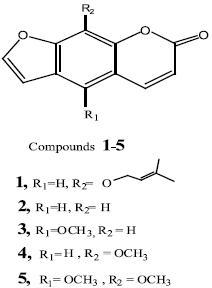
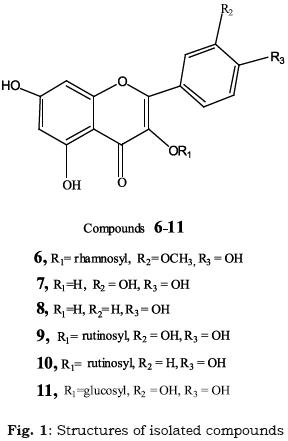
<body><![CDATA[<p align="justify"><font face="verdana" size="2"><b>Isolation of coumarins from methylene chloride extract:</b></font></p>     <p align="justify"><font face="verdana" size="2">The solvent&#150;free methylene chloride extract (greenish brown, 37g) was subjected to silica gel CC (75 x 3cm, 150 g) and eluted with benzene and step&#150;gradient benzene/ethyl acetate; 50 ml fractions being collected, monitored by TLC using solvent system benzene/ethyl acetate (8:2) and similar fractions were pooled. Fractions eluted with benzene afforded compound <b>1 </b>(20 mg), while those eluted with benzene/ethyl acetate (9.5:0.5) afforded compound <b>2 </b>(18 mg), Fractions eluted with benzene/ethyl acetate (9:1) gave a mixture (1.5 g) of compounds <b>3,4 </b>and <b>5 </b>which was subjected to silica gel CC (30 x 2 cm, 25g), eluted successively with benzene, benzene/ethyl acetate (9.5: 0.5) and benzene/ethyl acetate (9:1); yielding 60 subfractions (each, 20 ml). Subfractions eluted with benzene/ethyl acetate (9.5:0.5) afforded compounds <b>3 </b>(20 mg), and <b>4 </b>(22 mg), while those eluted with benzene/ ethyl acetate (9:1) afforded compound <b>5 </b>(15 mg).</font></p>     <p align="justify"><font face="verdana" size="2"><b>Isolation of flavonoids from ethyl acetate extract</b></font></p>     <p align="justify"><font face="verdana" size="2">The ethyl acetate extract (24 g) was subjected to polyamide 6S CC (100 x 4 cm, 200 g). Elution with water, followed by methanol (40 %, 60 %, 80 % and 100 %, in succession) yielded 130 fractions (200 ml, each) which were monitored by PC using BAW and 15 % AcOH as developing systems; similar fractions being pooled. Fractions eluted with 80%methanol yielded the isolate <b>6 </b>(23 mg) which was further purified by Sephadex LH&#150;20 CC (30 &times; 2cm, 40g) using methanol as eluent. Fractions eluted with methanol afforded a mixture of two compounds which were separated and purified by Sephadex LH&#150;20 CC (30 &times; 2cm, 40g) using methanol as eluent, to give the compounds <b>7 </b>(30 mg) and <b>8 </b>(28 mg).</font></p>     <p align="justify"><font face="verdana" size="2"><b>Isolation of flavonoids from the methanolic extract</b></font></p>     <p align="justify"><font face="verdana" size="2">The methanolic extract (77 g) was treated as the ethyl acetate extract. The fractions eluted with 40 % MeOH yielded the isolate <b>9 </b>(22 mg), those eluted with 60% MeOH afforded the isolate <b>10 </b>(30 mg), while fractions eluted with 80% MeOH yielded the isolate <b>11 </b>(20 mg). Each isolate was further purified by Sephadex LH&#150;20 CC, using methanol as eluent.</font></p>     <p align="justify"><font face="verdana" size="2"><b>Evaluation of Bioactivities</b></font></p>     <p align="justify"><font face="verdana" size="2">The powdered air&#150;dried aerial parts of <i>F. volgare </i>Sups. <i>piperitum </i>(1.2 kg) was successively extracted with <i>n</i>&#150;hexane, methylene chloride, ethyl acetate and methanol to yield 40, 25, 16 and 70 g of extractives, respectively. 1 mg of the individual extracts was equivalent to 30, 48, 75 and 17.1 mg dry plant, respectively. The extracts were suspended in 7% Tween 80 and biologically tested in different doses. All doses were expressed in terms of extract weight/animal body weight (Berhrens and Kerber, 1953).</font></p>     <p align="justify"><font face="verdana" size="2"><b>Animals and Reference drugs</b></font></p>     <p align="justify"><font face="verdana" size="2">Adult male albino rats weighing (120&#150;150 g) and adult albino mice of both sex (2025 g) used in this study, were obtained from the animal&#150;breeding unit of National Research Centre, Cairo. The animals were fed a standard laboratory diet composed of vitamin mix (1 %), mineral mix. (4 %), corn oil (10 %), sucrose (20 %), cellulose (0.2 %), casein (10.5 %) and starch (54.3 %) and allowed free access to water. Animal procedures were in accordance with the recommendations for the proper care and use of laboratory animals. This study was performed according to the international rules and to the guidelines of ethical comity of National Research Centre for experimental animal use. Acetylsalicylic acid (El Nasr Co., Egypt), Ibuprofen (Egyptian International Pharma. Industries Co., Egypt), Carrageenan (BDH, England) and Fluconazole (Pfizer INC., USA) were used in bioactivity testing.</font></p>     ]]></body>
<body><![CDATA[<p align="justify"><font face="verdana" size="2"><b>Acute toxicity (LD<sub>50</sub>)</b></font></p>     <p align="justify"><font face="verdana" size="2">Acute toxicity (LD<sub>50</sub>) of each of the extracts from the plant was determined in mice (Finney, 1964). They were subcutaneously (S.C.) administered in doses ranging from 4 to 13 g/kg body weight. Animals were observed and mortality rates were recorded within the first 24 h after administration. Different extracts assayed up to 5.5 g/kg did not show toxicity. LD<sub>50</sub> being: 6.75, 11.0, 6.92 and 15 g/kg for <i>n</i>&#150;hexane, methylene chloride, ethyl acetate and methanol extracts, respectively.</font></p>     <p align="justify"><font face="verdana" size="2"><b>Antinociceptive activity</b></font></p>     <p align="justify"><font face="verdana" size="2">This activity was investigated using the writhing method in mice (Margarita <i>et al., </i>1995). The tested extracts were administered in doses ranging 200&#150;2000 mg/kg as well as acetylsalicylic acid (200 mg/kg) as a peripheral antinociceptive reference drug (Margarita <i>et al., </i>1995) and the control vehicle (7% v/v between 80 in normal saline) were S.C. injected to groups of six animals 15 minutes before the intraperitoneal injection of a freshly prepared acetic acid solution (2% w/v in saline, pH 2.7, 10 ml/kg) and transferred immediately to individual observation cages and the assay was observed over a period of 25 min. The number of abdominal writhes was counted and the percentage of protection was expressed as the following:</font></p>     <p align="center"><font face="verdana" size="2"><img src="/img/revistas/rlq/v38n2/a4s1.jpg">Where: C = mean writhing of the control group; T = mean writhing of the treated group</font></p>     <p align="center"><font face="verdana" size="2"><img src="/img/revistas/rlq/v38n2/a4s2.jpg"></font></p>     <p align="center"><font face="verdana" size="2"><img src="/img/revistas/rlq/v38n2/a4f1.jpg"></font></p>     <p align="justify"><font face="verdana" size="2"><b>Anti&#150;inflammatory activity</b></font></p>     <p align="justify"><font face="verdana" size="2">Anti&#150;inflammatory activity was studied using Carrageenan&#150;induced rat's paw edema (Winter <i>et al., </i>1963). Groups of 18 h&#150;fasted male rats (110&#150;130 g, 6 animals each) were orally&#150;dosed with either one of the tested extracts from <i>Foeniculum vulgare </i>1h before induction of Carra&#150;geenan foot paw edema by subplanter injection of 0.05 ml of 1% suspension of Carrageenan in saline into the planter tissue of one hind paw. An equal volume of saline was injected into the other hind paw and served as control. Four hours later, the animals were sacrificed and the hind paws were rapidly amputated at the tibiotarsal joint and weighed (Margarita <i>et al., </i>1995; El&#150;Azzouny <i>et al., </i>1995). The average weight of edema was estimated for the treated as well as the control group and the percentage inhibition of weight of edema was also evaluated. Ibuprofen (35 mg/kg) (Makhlouf and Maklad, 2004) was employed as a standard.</font></p>     <p align="justify"><font face="verdana" size="2"><b>IDENTIFICATION: SPECTRAL DATA</b></font></p>     ]]></body>
<body><![CDATA[<p align="justify"><font face="verdana" size="2">GLC analysis of FAME (<a href="/img/revistas/rlq/v38n2/a4t1.jpg" target="_blank">Table 1</a>) revealed 15 compounds in the aerial parts and 14 compounds in the fruits. In the aerial parts and fruits, saturated fatty acids represent 68.43 and 75.03%, respectively; the major being: palmitic, undecanoic and myristic acids, while the unsaturated acids represent 22.01% and 20.32%, respectively; the major being pentadecadienoic and pen&#150;tadecenoic acids. GLC of USM revealed 27 compounds in the aerial parts, as well as the fruits (<a href="/img/revistas/rlq/v38n2/a4t2.jpg" target="_blank">Table 2</a>). Hydrocarbons (56.51, 54.17%),, cholesterol (1.71, 0.84%), &#946;&#150;sitosterol (5.52, 5.95%), campesterol (3.33, 4.04%) and stigmasterol (14.86, 19.04%) were identified in the aerial parts as well as the fruits, respectively.</font></p>     <p align="justify"><font face="verdana" size="2"><b><i>Imperatorin </i></b>(1): UV &#955;<sub>max</sub> (MeOH): 262 and 300 nm. EI&#150;MS: <i>m/z </i>270 &#91;M+, base peak, C<sub>16</sub>H<sub>14</sub>O<sub>4</sub>&#93;; <i>m/z </i>202 &#91;M<sup>+</sup> &#150;C<sub>5</sub>H<sub>9</sub> &#93;; <i>m/z </i>174 &#91;M<sup>+</sup> &#150;C<sub>5</sub>H<sub>9</sub>&#150; CO&#93;; <i>m/z </i>146 &#91;M+ &#150;C<sub>5</sub>H<sub>9</sub>&#150;CO&#150;CO&#93;; <sup>1</sup>H&#150;NMR (CDCl<sub>3</sub>, 270 MHz): &#948; 7.76 (H&#150;4, d, <i>J </i>= 9.5 Hz), &#948; 7.73, (H&#150;5,s), &#948; 7.34 (H&#150;7, d, <i>J </i>= 2.5 Hz), &#948; 6.79 (H&#150;6,d, <i>J </i>= 2.5 Hz), &#948;6.35 (H&#150;3, d, <i>J </i>= 9.5 Hz), &#948;5.58 (H, t, <i>J </i>= 6.5 Hz), &#948;4.99 (two protons for OCH<sub>2</sub>, d, <i>J </i>= 7.1 Hz), &#948;1.69 and &#948;1.71 (singlets for the two methyls).</font></p>     <p align="justify"><font face="verdana" size="2"><b><i>Psoralen </i>(2): </b>UV &#955;<sub>max</sub> (MeOH): 246 and 293 nm. EI&#150;MS: <i>m/z </i>186 &#91;M<sup>+</sup>, base peak, CHOI which loses three carbon monoxide molecules, successively, to give the fragments <i>m/z: </i>158, 130 and 102. <sup>1</sup>H&#150;NMR (CDCl<sub>3</sub>, 270 MHz): &#948;7.48 (H&#150;4, d, <i>J </i>= 9.5 Hz), &#948;7.36 (H&#150;5, s), &#948;7.35 (H&#150;9, s), &#948;7.13 (H&#150;7,d, <i>J </i>= 2.5 Hz), &#948;6.50 (H&#150;6 ,d, <i>J </i>= 2.5), &#948; 6.06 (H&#150;3,d, <i>J </i>= 9.5 Hz).</font></p>     <p align="justify"><font face="verdana" size="2"><b><i>Bergapten </i>(3): </b>UV &#955;<sub>max</sub> (MeOH): 249, 259, 267 and 310 nm. EI&#150;MS: <i>m/z </i>216 &#91;M<sup>+</sup>, C<sub>12</sub>H<sub>8</sub>O<sub>3</sub>&#93;, <i>m/z </i>201 &#91;M<sup>+</sup>&#150;CH<sub>3</sub> &#93;, followed by four successive expulsions of carbon monoxide to give the fragments <i>m/z: </i>173, 145, 117 and 89. <sup>1</sup>H&#150;NMR (CDCl<sub>3</sub>, 270 MHz): &#948;8.13 (H&#150;4, d, <i>J </i>= 9.7 Hz), &#948;7.57 (H&#150;7, d, <i>J </i>= 2.5Hz), &#948;7.08 (H&#150;9, s), &#948;7.00 (H&#150;6, d, <i>J </i>= 2.5 Hz), &#948; 6.25 (H&#150;3, d, <i>J </i>= 9.7 Hz), &#948; 4.25 (singlet, 5&#150;OCH<sub>3</sub>).</font></p>     <p align="justify"><font face="verdana" size="2"><b><i>Xanthotoxin </i>(4): </b>UV &#955;<sub>max</sub> (MeOH):240 and 298 nm. EI&#150;MS: <i>m/z </i>216 &#91;M<sup>+</sup>, C<sub>12</sub>H<sub>8</sub>O<sub>3</sub>&#93;, m/z 201 &#91;M<sup>+</sup>&#150;CH<sub>3</sub>&#93;, followed by four successive expulsions of carbon monoxide to give the fragments: <i>m/z </i>173, 145, 117 and 89. <sup>1</sup>H&#150;NMR (CDCl<sub>3</sub>, 270 MHz): &#948; 7.76 (H&#150;4, d, <i>J </i>= 9.5 Hz), &#948; 7.67 (H&#150;7, d, <i>J </i>= 2.1 Hz), &#948; 7.32 (H&#150;5, s), &#948;6.80 (H&#150;6, d, <i>J </i>= 2.1 Hz), &#948;6.35 (H&#150;3, d, <i>J </i>= 9.5 Hz), &#948; 4.26 (singlet, 9&#150;OCH<sub>3</sub>).</font></p>     <p align="justify"><font face="verdana" size="2"><b><i>Isopimpinellin </i>(5): </b>UV &#955;<sub>max</sub> (MeOH): 248, 267and 309 nm. EI&#150;MS: <i>m/z </i>246 &#91;M<sup>+</sup>, C<sub>13</sub>H<sub>10</sub>O<sub>5</sub>&#93;, <i>m/z </i>231 &#91;M<sup>+</sup>&#150;CH<sub>3</sub>&#93;, followed by two successive expulsions of carbon monoxide to give the fragments <i>m/z </i>203 and 175, and loss of methyl group to give the fragment <i>m/z </i>160. <sup>1</sup>H&#150;NMR (CDCl<sub>3</sub>, 300 MHz): &#948;8.14 (H&#150;4, d, <i>J </i>= 9.5 Hz), &#948;7.64 (H&#150;7, d, <i>J </i>= 2.5 Hz), &#948;7.06 (H&#150;6, d, <i>J </i>= 2.5 Hz), &#948;6.36 (H&#150;3, d, <i>J </i>= 9.5 Hz) and two singlets at &#948; 4.13 and 4.09 for 5&#150; and 9&#150;OCH<sub>3</sub>. </font></p>     <p align="justify"><font face="verdana" size="2"><b><i>Isorhamnetin 3&#150;O</i></b><i>&#150;</i>&#945;<i><b>&#150;L&#150;rhamnoside </b></i><b>(6):</b></font></p>     <p align="justify"><font face="verdana" size="2">EI&#150;MS: <i>m/z </i>316 &#91;Aglycone+H&#93;<sup>+</sup>, +ve ESI&#150;MS: <i>m/z </i>462 &#91;M+H<sup>+</sup>, C<sub>22</sub>H<sub>22</sub>O<sub>11</sub>&#93;. <sup>1</sup>H&#150;NMR (DMSO&#150;d<sub>6</sub>, 270 MHz): &#948;12.63 (5&#150;OH,s), &#948;7.27 (H&#150;2', d, meta&#150;coupling with H&#150;6', J = 2.0Hz), &#948;7.25 (H&#150;6' d, <i>J </i>= 8.8 Hz), &#948; 6.85 (H&#150;5\ d, <i>J </i>= 8.3 Hz), &#948; 6.32 (H&#150;8, d, <i>J </i>= 2.0 Hz), &#948; 6.13 (H&#150;6, d, <i>J </i>= 2.0 Hz ), &#948;5.24 (broad singlet for anomeric proton of rhamnose), &#948;0.95 (CH<sub>3</sub> methyl rhamnosyl protons, d, <i>J </i>= 5.3 Hz), &#948;3.95 (OCH<sub>3</sub> at position 3', sharp singlet) (Chang <i>et al., </i>1998).</font></p>     <p align="justify"><font face="verdana" size="2"><b><i>Quercetin </i>(7): </b>UV spectral data suggested a flavonol type with free hydroxyl groups at positions 3, 5, 7, 3' and 4'. <b>EI&#150;MS: </b><i>m/z </i>303 &#91;M+1&#93;<sup>+</sup>, C<sub>15</sub>H<sub>10</sub>O<sub>7</sub>.</font></p>     <p align="justify"><font face="verdana" size="2"><b><i>Kaempferol </i>(8): </b>UV spectral data suggested a flavonol type with free hydroxyl groups at positions 3, 5, 7 and 4'. EI&#150;MS: <i>m/z </i>285 &#91;M&#150;1&#93; &#150;, C<sub>15</sub>H<sub>10</sub>O<sub>6</sub>.</font></p>     ]]></body>
<body><![CDATA[<p align="justify"><font face="verdana" size="2"><b><i>Quercetin 3&#150;O&#150; rutinoside </i>(9): </b><sup>1</sup>H&#150;NMR: &#948;7.55 (H&#150;2' and H&#150;6' overlapping protons, d, <i>J </i>= 7.6 Hz), &#948; 6.85 (H&#150;5', d, <i>J </i>= 8.0 Hz), &#948; 6.38 (H&#150;8 , d, <i>J </i>= 1.8 Hz), &#948; 6.19 (H&#150;6, d, <i>J </i>= 1.8 Hz), ,&#948;5.32 (anomeric proton of glucose, <i>J </i>= 8.1 Hz), &#948; 4.37 (anomeric proton of rhamnose, broad singlet), &#948;0.99 (CH<sub>3</sub>&#150;rhamnosyl, d, <i>J </i>= 5.4 Hz).</font></p>     <p align="justify"><font face="verdana" size="2"><b><i>Kaempferol 3&#150;O&#150; rutinoside </i>(10): </b>UV spectra with shift reagents indicated a flavonol type with free hydroxyl groups at positions 5, 7 and 4', while that at position 3 being substituted (Mabry <i>et al., </i>1970). Complete acid hydrolysis afforded glucose, rhamnose and kaempferol, identified by CoPC in comparison with authentic samples. <sup>1</sup>H&#150;NMR (DMSO&#150;d<sub>6</sub>, 270 MHz): &#948;7.61 (H&#150;2'and H&#150;6', d, <i>J </i>= 8.5 Hz) &#948; 6.77 (H&#150;3' and H&#150;5', d, J = 8.5 Hz) , &#948;6.20 (H&#150;8 , d, <i>J </i>= 1.8 Hz) , &#948;6.0 (H&#150;6, d, <i>J </i>= 1.8 Hz), &#948; 5.21 (anomeric proton of glucose, d, <i>J </i>= 7.6 Hz), &#948; 4.40 (anomeric proton of rhamnose, broad singlet) &#948; 1.04 (methyl rhamnosyl protons, d, <i>J </i>= 6.1 Hz). ESI&#150;MS: <i>m/z </i>593 &#91;M&#150;1&#93;<sup>+</sup>, C<sub>21</sub>H<sub>20</sub>O<sub>12</sub>.</font></p>     <p align="justify"><font face="verdana" size="2"><b><i>Quercetin 3&#150;O</i></b><i>&#150;</i>&#946;<i> <b>&#150; glucoside </b></i><b>(11): </b>UV spectral data suggested a flavonol type with free hydroxyl groups at positions 5, 7, 3' and 4', while being substituted at position 3. Complete acid hydrolysis afforded glucose. <sup>1</sup>H&#150;NMR: &#948; 7.66 (H&#150;6', d, <i>J </i>= 8.6 Hz), &#948; 7.55 (H&#150;2', d, <i>J </i>=2.0 Hz) , &#948; 6.84 (H&#150;5', d, <i>J </i>= 6.6 Hz), &#948; 6.38 (H&#150;8, d, <i>J </i>= 1.8 Hz), &#948; 6.17 (H&#150;6, d, <i>J </i>= 1.8 Hz), &#948;5.34 (anomeric proton of glucose, d, <i>J </i>= 7.5 Hz). ESI&#150;MS: <i>m/z </i>464 &#91;M+1&#93; +, C<sub>21</sub>H<sub>20</sub>O<sub>12</sub>.</font></p>     <p align="justify"><font face="verdana" size="2"><b>Bioactivities</b></font></p>     <p align="justify"><font face="verdana" size="2">The methanolic extract of the aerial parts of <i>Foeniculum vulgare </i>subsp. <i>piperitum </i>exhibited the highest antinociceptive activity at a dose level of 2000 mg/kg (<a href="/img/revistas/rlq/v38n2/a4t3.jpg" target="_blank">Table 3</a>), while the activity exhibited by the ethyl acetate extract was at (800 mg/kg). On the other hand, <i>n</i>&#150;hexane extract (700 mg/kg) and methylene chloride extract (500 mg/kg) exhibited similar antinociceptive activities, being less than that of acetylsalicylic acid (200 mg/kg). Data presented in <a href="/img/revistas/rlq/v38n2/a4t4.jpg" target="_blank">Table 4</a> revealed that the extracts under investigation exhibited significant anti&#150;inflammatory activity. The methanolic extract possessed the highest activity, where it significantly decreased the weight of edema induced by carrageenan in the rat paw at dose levels of 1500 and 2000 mg/kg, it exerted a protective effect of 28 and 47%, respectively, compared to the control value, while ibu&#150;profen (35 mg/kg), used as a reference drug, exhibited a protective effect of 52.23 %. The present study showed that the four extracts of the aerial parts of the plant exhibited antinociceptive activity. Moreover, the potent antinociceptive activity expressed by the methanolic (2000 mg/kg) and ethyl acetate (800 mg/kg) extracts can be attributed to the content of phenolic constituents (Paulino <i>et al., </i>2003). Also, the four extracts under investigation exhibited a significant anti&#150;inflammatory activity. The highest anti&#150;inflammatory activity of methanolic extract (2000 mg/kg) of the aerial parts of the plant can possibly be attributed to the presence of phenolic content. In conclusion, traditional application of <i>F. vulgare </i>Mill subsp. <i>piperitum </i>could be beneficial in the management of different inflammatory disease cases. Our current findings suggested that <i>F. vulgare </i>Mill subsp. <i>piperitum </i>contains a high amount of flavonoids, which exhibited a strong potency towards suppressing inflammation, as evidenced by our <i>in vivo </i>models.</font></p>     <p align="justify"><font face="verdana" size="2">&nbsp;</font></p>     <p align="justify"><font face="verdana" size="2"><b>CONCLUSION</b></font></p>     <p align="justify"><font face="verdana" size="2"><i>Foeniculum vulgare </i>Mill. Subsp. Piperi&#150;tum to contain fatty acids, hydrocarbons and sterols in the <i>n</i>&#150;hexane extract. Fu&#150;rocoumarins; imperatorin, psoralen, bergapten, xanthotoxin and isopimpinellin were isolated from the methylene chloride extract. Flavonoids; isorhamnetin 3&#150;O&#150;&#945;&#150;rhamnoside, quercetin and kaempferol were isolated from the ethyl acetate extract, whereas quercetin 3<i>&#150;O</i>&#150;rutinoside, kaempferol 3<i>&#150;O</i>&#150;rutinoside and quercetin 3&#150;O&#150; &#946;&#150;glucoside were isolated from the methanol extract. The crude extracts exhibited significant antinociceptive and anti&#150;inflammatory activity.</font></p>     <p align="justify"><font face="verdana" size="2">&nbsp;</font></p>     <p align="justify"><font face="verdana" size="2"><b>REFERENCES</b></font></p>     ]]></body>
<body><![CDATA[<!-- ref --><p align="justify"><font face="verdana" size="2">Abdel&#150;Hay, F., Abu&#150;Mustafa, E. A., Fayez, M. B. (1966) Isolation of isopimpinellin from <i>Ammi majus </i>L. natural coumarins.IV. <i>Naturwissenschaften </i><b>53: </b>406&#150;407.    &nbsp;&nbsp;&nbsp;&nbsp;&nbsp;&nbsp;&nbsp;&nbsp;[&#160;<a href="javascript:void(0);" onclick="javascript: window.open('/scielo.php?script=sci_nlinks&ref=7397834&pid=S0370-5943201000020000400001&lng=','','width=640,height=500,resizable=yes,scrollbars=1,menubar=yes,');">Links</a>&#160;]<!-- end-ref --></font></p>     <!-- ref --><p align="justify"><font face="verdana" size="2">Badoc, A., Deffieux, G., Lamarti, A., Bourgeois, G., Carde, J. P. (1994) Essential oil of <i>Foeniculum vulgare </i>Mill. (fennel) subsp. piperitum (Ucria) Cout. fruit. <i>Journal Essential Oil Research </i><b>6: </b>333&#150;336.    &nbsp;&nbsp;&nbsp;&nbsp;&nbsp;&nbsp;&nbsp;&nbsp;[&#160;<a href="javascript:void(0);" onclick="javascript: window.open('/scielo.php?script=sci_nlinks&ref=7397836&pid=S0370-5943201000020000400002&lng=','','width=640,height=500,resizable=yes,scrollbars=1,menubar=yes,');">Links</a>&#160;]<!-- end-ref --></font></p>     <!-- ref --><p align="justify"><font face="verdana" size="2">Behrens, B., Kerber, J. (1953) Wie sind reichenversuche fur biologische auswertungen am zweckmassigsten anzwerdnen. <i>Archive Ex. Path Pharm </i><b>177: </b>379&#150;388.    &nbsp;&nbsp;&nbsp;&nbsp;&nbsp;&nbsp;&nbsp;&nbsp;[&#160;<a href="javascript:void(0);" onclick="javascript: window.open('/scielo.php?script=sci_nlinks&ref=7397838&pid=S0370-5943201000020000400003&lng=','','width=640,height=500,resizable=yes,scrollbars=1,menubar=yes,');">Links</a>&#160;]<!-- end-ref --></font></p>     <!-- ref --><p align="justify"><font face="verdana" size="2">Cuendet, M., Potterat, O., Hostettmann, K. (2001) Flavonoids and phenylpropanoid derivatives from <i>Campanula barbata, Phytochemistry </i><b>56: </b>1631&#150;1636.    &nbsp;&nbsp;&nbsp;&nbsp;&nbsp;&nbsp;&nbsp;&nbsp;[&#160;<a href="javascript:void(0);" onclick="javascript: window.open('/scielo.php?script=sci_nlinks&ref=7397840&pid=S0370-5943201000020000400004&lng=','','width=640,height=500,resizable=yes,scrollbars=1,menubar=yes,');">Links</a>&#160;]<!-- end-ref --></font></p>     <!-- ref --><p align="justify"><font face="verdana" size="2">El&#150;Azzouny, A. A., El&#150;Shabrawy, O. A., El&#150;Azzouny, M. M., Ebeid, M. Y., Lehmann, J. (1995) Synthesis and pharmacological evaluation of fenamate analogues: 2&#150;&#91;(7&#150;Substuted&#150;4&#150;quinolinyl)&#150;amino&#93; benzoic acid esters. <i>Scientia Pharmacentica </i><b>63: </b>81&#150;92.    &nbsp;&nbsp;&nbsp;&nbsp;&nbsp;&nbsp;&nbsp;&nbsp;[&#160;<a href="javascript:void(0);" onclick="javascript: window.open('/scielo.php?script=sci_nlinks&ref=7397842&pid=S0370-5943201000020000400005&lng=','','width=640,height=500,resizable=yes,scrollbars=1,menubar=yes,');">Links</a>&#160;]<!-- end-ref --></font></p>     ]]></body>
<body><![CDATA[<!-- ref --><p align="justify"><font face="verdana" size="2">El&#150;Khrisy, E. A. M., Mahmoud, A. M., Abu&#150;Mustafa, E. A. (1980) Chemical constituents of <i>Foeniculum vulgare fruits, Fitoterapia </i><b>51 </b>: 273 &#150;275.    &nbsp;&nbsp;&nbsp;&nbsp;&nbsp;&nbsp;&nbsp;&nbsp;[&#160;<a href="javascript:void(0);" onclick="javascript: window.open('/scielo.php?script=sci_nlinks&ref=7397844&pid=S0370-5943201000020000400006&lng=','','width=640,height=500,resizable=yes,scrollbars=1,menubar=yes,');">Links</a>&#160;]<!-- end-ref --></font></p>     <!-- ref --><p align="justify"><font face="verdana" size="2">El&#150;Khrisy, E. A. M., Meshaal, S. A., Abdel&#150;Hafez, O. M., Khattab, A. A., Abu&#150;Mustafa, E. A. (1985) The constituents of <i>Ficus eriobryoides, Ficus cunnghamii </i>and <i>Ficus sycomorus leaves. Fitoterapia </i><b>56: </b>184&#150;187.    &nbsp;&nbsp;&nbsp;&nbsp;&nbsp;&nbsp;&nbsp;&nbsp;[&#160;<a href="javascript:void(0);" onclick="javascript: window.open('/scielo.php?script=sci_nlinks&ref=7397846&pid=S0370-5943201000020000400007&lng=','','width=640,height=500,resizable=yes,scrollbars=1,menubar=yes,');">Links</a>&#160;]<!-- end-ref --> </font></p>     <!-- ref --><p align="justify"><font face="verdana" size="2">El&#150;Said, M. E., Amer, M. M. (1965) Oils, fats, waxes and surfactants. Anglo&#150;Egyptian Bookshop, Cairo, Egypt.    &nbsp;&nbsp;&nbsp;&nbsp;&nbsp;&nbsp;&nbsp;&nbsp;[&#160;<a href="javascript:void(0);" onclick="javascript: window.open('/scielo.php?script=sci_nlinks&ref=7397848&pid=S0370-5943201000020000400008&lng=','','width=640,height=500,resizable=yes,scrollbars=1,menubar=yes,');">Links</a>&#160;]<!-- end-ref --></font></p>     <!-- ref --><p align="justify"><font face="verdana" size="2">Eun, M. C., Jae, K. H. (2004) Anti&#150;inflammatory, analgesic and antioxidant activities of the fruit of <i>Foeniculum Vulgare. Fitoterapia </i><b>75: </b>557&#150;565.    &nbsp;&nbsp;&nbsp;&nbsp;&nbsp;&nbsp;&nbsp;&nbsp;[&#160;<a href="javascript:void(0);" onclick="javascript: window.open('/scielo.php?script=sci_nlinks&ref=7397850&pid=S0370-5943201000020000400009&lng=','','width=640,height=500,resizable=yes,scrollbars=1,menubar=yes,');">Links</a>&#160;]<!-- end-ref --> </font></p>     <!-- ref --><p align="justify"><font face="verdana" size="2">Finney, D. J. (1964) Statistical methods in biological assay. Charles Griffin Company limited, London.    &nbsp;&nbsp;&nbsp;&nbsp;&nbsp;&nbsp;&nbsp;&nbsp;[&#160;<a href="javascript:void(0);" onclick="javascript: window.open('/scielo.php?script=sci_nlinks&ref=7397852&pid=S0370-5943201000020000400010&lng=','','width=640,height=500,resizable=yes,scrollbars=1,menubar=yes,');">Links</a>&#160;]<!-- end-ref --></font></p>     ]]></body>
<body><![CDATA[<!-- ref --><p align="justify"><font face="verdana" size="2">Ishikawa, T., Tanaka, Y., Kitajima, J., Ida, Y. (1999) Water&#150;soluble constituents of fennel. viii. monoterpenoid alcohols and thujane&#150;, camphene&#150;, norfenchane&#150;type monoterpenoid glycosides. <i>Chemical Pharm Bulletin </i><b>47: </b>805&#150;808.    &nbsp;&nbsp;&nbsp;&nbsp;&nbsp;&nbsp;&nbsp;&nbsp;[&#160;<a href="javascript:void(0);" onclick="javascript: window.open('/scielo.php?script=sci_nlinks&ref=7397854&pid=S0370-5943201000020000400011&lng=','','width=640,height=500,resizable=yes,scrollbars=1,menubar=yes,');">Links</a>&#160;]<!-- end-ref --></font></p>     <!-- ref --><p align="justify"><font face="verdana" size="2">Ivanov, S., Seher, A., Schiller, H. (1979) Natural antioxdants. IV: Antioxidants in the fatty oil of <i>Foeniculum vulgare </i>Mill. 2. <i>Fette, Seifen, Anstrichm. </i><b>81: </b>105&#150;107.    &nbsp;&nbsp;&nbsp;&nbsp;&nbsp;&nbsp;&nbsp;&nbsp;[&#160;<a href="javascript:void(0);" onclick="javascript: window.open('/scielo.php?script=sci_nlinks&ref=7397856&pid=S0370-5943201000020000400012&lng=','','width=640,height=500,resizable=yes,scrollbars=1,menubar=yes,');">Links</a>&#160;]<!-- end-ref --></font></p>     <!-- ref --><p align="justify"><font face="verdana" size="2">Kunzemann, J., Herrmann, K. (1977) Isolation and identification of flavonol&#150;O&#150;glycosides in Caraway <i>(Carum Carvi), </i>fennel <i>(Foeniculum vulgare), </i>anise <i>(Pimpinella anisum) </i>and Coriander <i>(Coriandrum sativum) </i>and of flavone&#150;C&#150;glycosides in anise. I. Phenolics of spices. <i>Untersuchung Zeitschrift fur Lebensmittel Forschung </i><b>164: </b>194&#150;200.    &nbsp;&nbsp;&nbsp;&nbsp;&nbsp;&nbsp;&nbsp;&nbsp;[&#160;<a href="javascript:void(0);" onclick="javascript: window.open('/scielo.php?script=sci_nlinks&ref=7397858&pid=S0370-5943201000020000400013&lng=','','width=640,height=500,resizable=yes,scrollbars=1,menubar=yes,');">Links</a>&#160;]<!-- end-ref --></font></p>     <!-- ref --><p align="justify"><font face="verdana" size="2">Kwon, Y. S., Choi, W. G., Kim, W. J., Kim, W. K., Kim, M. J., Kang, W. H., Kim, C. M. (2002) Antimicrobial constituents of <i>Foeniculum vulgare. Archives of Pharmacol Research </i><b>25: </b>154&#150;157.    &nbsp;&nbsp;&nbsp;&nbsp;&nbsp;&nbsp;&nbsp;&nbsp;[&#160;<a href="javascript:void(0);" onclick="javascript: window.open('/scielo.php?script=sci_nlinks&ref=7397860&pid=S0370-5943201000020000400014&lng=','','width=640,height=500,resizable=yes,scrollbars=1,menubar=yes,');">Links</a>&#160;]<!-- end-ref --></font></p>     <!-- ref --><p align="justify"><font face="verdana" size="2">Mabry, T. J., Markham, K. R., Thomas, M. B. (1970) The Systematic Identification of Flavo&#150;noids. Springer Verlag, New York.    &nbsp;&nbsp;&nbsp;&nbsp;&nbsp;&nbsp;&nbsp;&nbsp;[&#160;<a href="javascript:void(0);" onclick="javascript: window.open('/scielo.php?script=sci_nlinks&ref=7397862&pid=S0370-5943201000020000400015&lng=','','width=640,height=500,resizable=yes,scrollbars=1,menubar=yes,');">Links</a>&#160;]<!-- end-ref --></font></p>     ]]></body>
<body><![CDATA[<!-- ref --><p align="justify"><font face="verdana" size="2">Makhlouf, A. A., Maklad, Y. A. (2004) Synthesis and analgesic&#150;anti&#150;inflammatory activities of some 1, 2, 4&#150;triazine derivatives. <i>Arzneimit Forsch/ Drug Research </i><b>54: </b>42&#150;49.    &nbsp;&nbsp;&nbsp;&nbsp;&nbsp;&nbsp;&nbsp;&nbsp;[&#160;<a href="javascript:void(0);" onclick="javascript: window.open('/scielo.php?script=sci_nlinks&ref=7397864&pid=S0370-5943201000020000400016&lng=','','width=640,height=500,resizable=yes,scrollbars=1,menubar=yes,');">Links</a>&#160;]<!-- end-ref --></font></p>     <!-- ref --><p align="justify"><font face="verdana" size="2">Margarita, H. P., Rosa, M. R., Carmen dela Torre, M., Rodriguez, B. (1995) Analgesic, anti&#150;inflammatory and haematological effects of aethiopinone and o&#150;naphthoquinone diterpenoid from <i>Salvia aethiopis </i>roots and two hemisynthetic derivatives. <i>Planta Medica </i><b>61 </b>: 505&#150;507.    &nbsp;&nbsp;&nbsp;&nbsp;&nbsp;&nbsp;&nbsp;&nbsp;[&#160;<a href="javascript:void(0);" onclick="javascript: window.open('/scielo.php?script=sci_nlinks&ref=7397866&pid=S0370-5943201000020000400017&lng=','','width=640,height=500,resizable=yes,scrollbars=1,menubar=yes,');">Links</a>&#160;]<!-- end-ref --></font></p>     <!-- ref --><p align="justify"><font face="verdana" size="2">Muckensturm, B., Foechterlen, D., Reduron, J. P., Danton, P., Hildenbrand, M. (1997) Phy&#150;tochemical and chemotaxonomic studies of <i>Foeniculum vulgare. Biochemical Systematics and Ecology </i><b>25: </b>353&#150;358.    &nbsp;&nbsp;&nbsp;&nbsp;&nbsp;&nbsp;&nbsp;&nbsp;[&#160;<a href="javascript:void(0);" onclick="javascript: window.open('/scielo.php?script=sci_nlinks&ref=7397868&pid=S0370-5943201000020000400018&lng=','','width=640,height=500,resizable=yes,scrollbars=1,menubar=yes,');">Links</a>&#160;]<!-- end-ref --></font></p>     <!-- ref --><p align="justify"><font face="verdana" size="2">&Ouml;zbek, H., Ugras, S., D&uuml;glar, H., Bayram, T., &Ouml;zturk, G., &Ouml;zturk, A. (2003) Hepatoprotective effect of <i>Foeniculum vulgare </i>essential oil, <i>Fitoterapia </i><b>74: </b>317&#150;319.    &nbsp;&nbsp;&nbsp;&nbsp;&nbsp;&nbsp;&nbsp;&nbsp;[&#160;<a href="javascript:void(0);" onclick="javascript: window.open('/scielo.php?script=sci_nlinks&ref=7397870&pid=S0370-5943201000020000400019&lng=','','width=640,height=500,resizable=yes,scrollbars=1,menubar=yes,');">Links</a>&#160;]<!-- end-ref --></font></p>     <!-- ref --><p align="justify"><font face="verdana" size="2">Parejo, I., Viladomat, F., Bastida, J., Codina, C. (2004) Development and validation of a high&#150;performance liquid chromatographic method for the analysis of antioxidative phenolic compounds in fennel using a narrow pore reversed phase C<sub>18</sub> column, <i>Anal. Chem. Acta </i><b>519: </b>271&#150;280.    &nbsp;&nbsp;&nbsp;&nbsp;&nbsp;&nbsp;&nbsp;&nbsp;[&#160;<a href="javascript:void(0);" onclick="javascript: window.open('/scielo.php?script=sci_nlinks&ref=7397872&pid=S0370-5943201000020000400020&lng=','','width=640,height=500,resizable=yes,scrollbars=1,menubar=yes,');">Links</a>&#160;]<!-- end-ref --></font></p>     ]]></body>
<body><![CDATA[<!-- ref --><p align="justify"><font face="verdana" size="2">Paulino, N., Dantas, A. P., Bankova, V., Longhi, D. T., Scremin, A., Caixto, J. B. (2003) <i>Journal Pharmaceutical Sciences </i><b>93: </b>307&#150;313.    &nbsp;&nbsp;&nbsp;&nbsp;&nbsp;&nbsp;&nbsp;&nbsp;[&#160;<a href="javascript:void(0);" onclick="javascript: window.open('/scielo.php?script=sci_nlinks&ref=7397874&pid=S0370-5943201000020000400021&lng=','','width=640,height=500,resizable=yes,scrollbars=1,menubar=yes,');">Links</a>&#160;]<!-- end-ref --></font></p>     <!-- ref --><p align="justify"><font face="verdana" size="2">Ruberto, G., Baratta, M. T., Deans, S. G., Dorman, H. J. D. (2000) Antioxidant and antimicrobial activity of <i>Foeniculum vulgare </i>and <i>Crithmum maritimum </i>essential oils, <i>Planta Medica </i><b>66: </b>687&#150; 693.    &nbsp;&nbsp;&nbsp;&nbsp;&nbsp;&nbsp;&nbsp;&nbsp;[&#160;<a href="javascript:void(0);" onclick="javascript: window.open('/scielo.php?script=sci_nlinks&ref=7397876&pid=S0370-5943201000020000400022&lng=','','width=640,height=500,resizable=yes,scrollbars=1,menubar=yes,');">Links</a>&#160;]<!-- end-ref --></font></p>     <!-- ref --><p align="justify"><font face="verdana" size="2">Scarpati, M. L. (1957) Oriented search for cynarin in plants containing other caffeyl derivatives, <i>Ann. Chim. </i><b>47: </b>155&#150;162.    &nbsp;&nbsp;&nbsp;&nbsp;&nbsp;&nbsp;&nbsp;&nbsp;[&#160;<a href="javascript:void(0);" onclick="javascript: window.open('/scielo.php?script=sci_nlinks&ref=7397878&pid=S0370-5943201000020000400023&lng=','','width=640,height=500,resizable=yes,scrollbars=1,menubar=yes,');">Links</a>&#160;]<!-- end-ref --></font></p>     <!-- ref --><p align="justify"><font face="verdana" size="2">Stanley, W. L., Vannier, S.H. (1967) Psoralens and substituted coumarins from oil of lime, <i>Phytochemistry </i><b>6: </b>585&#150;588. Tackholm, V. (1974) Students' Flora of Egypt 2<sup>nd</sup>.ed., Cairo Univ., Beirut, Lebanon.    &nbsp;&nbsp;&nbsp;&nbsp;&nbsp;&nbsp;&nbsp;&nbsp;[&#160;<a href="javascript:void(0);" onclick="javascript: window.open('/scielo.php?script=sci_nlinks&ref=7397880&pid=S0370-5943201000020000400024&lng=','','width=640,height=500,resizable=yes,scrollbars=1,menubar=yes,');">Links</a>&#160;]<!-- end-ref --></font></p>     <!-- ref --><p align="justify"><font face="verdana" size="2">Winter, C. A., Risley, E. A., Nuss, G. W. (1963) Anti&#150;inflammatory and antipyretic activities of indomethacin, 1&#150;(p&#150;chlorobenzoyl)&#150;5&#150;methoxy&#150;2&#150;methyl&#150;indoie&#150;3&#150;acetic acid, <i>Pharm Experimental Therapy </i><b>141 </b>: 369 &#150;376.    &nbsp;&nbsp;&nbsp;&nbsp;&nbsp;&nbsp;&nbsp;&nbsp;[&#160;<a href="javascript:void(0);" onclick="javascript: window.open('/scielo.php?script=sci_nlinks&ref=7397882&pid=S0370-5943201000020000400025&lng=','','width=640,height=500,resizable=yes,scrollbars=1,menubar=yes,');">Links</a>&#160;]<!-- end-ref --></font></p>     ]]></body>
<body><![CDATA[<!-- ref --><p align="justify"><font face="verdana" size="2">Wu, C. M., Koehler, P. E., Ayres, J. C. (1972) Isolation and identification of xanthotoxin (8&#150;me&#150;thoxypsoralen) and bergapten (5&#150;methoxypsoralen) from celery infected with <i>Sclerotiorum, Appied Microbiology </i><b>23: </b>852&#150;856.    &nbsp;&nbsp;&nbsp;&nbsp;&nbsp;&nbsp;&nbsp;&nbsp;[&#160;<a href="javascript:void(0);" onclick="javascript: window.open('/scielo.php?script=sci_nlinks&ref=7397884&pid=S0370-5943201000020000400026&lng=','','width=640,height=500,resizable=yes,scrollbars=1,menubar=yes,');">Links</a>&#160;]<!-- end-ref --></font></p>      ]]></body><back>
<ref-list>
<ref id="B1">
<nlm-citation citation-type="journal">
<person-group person-group-type="author">
<name>
<surname><![CDATA[Abdel-Hay]]></surname>
<given-names><![CDATA[F.]]></given-names>
</name>
<name>
<surname><![CDATA[Abu-Mustafa]]></surname>
<given-names><![CDATA[E. A.]]></given-names>
</name>
<name>
<surname><![CDATA[Fayez]]></surname>
<given-names><![CDATA[M. B.]]></given-names>
</name>
</person-group>
<article-title xml:lang="en"><![CDATA[Isolation of isopimpinellin from Ammi majus L. natural coumarins.IV]]></article-title>
<source><![CDATA[Naturwissenschaften]]></source>
<year>1966</year>
<volume>53</volume>
<page-range>406-407</page-range></nlm-citation>
</ref>
<ref id="B2">
<nlm-citation citation-type="journal">
<person-group person-group-type="author">
<name>
<surname><![CDATA[Badoc]]></surname>
<given-names><![CDATA[A.]]></given-names>
</name>
<name>
<surname><![CDATA[Deffieux]]></surname>
<given-names><![CDATA[G.]]></given-names>
</name>
<name>
<surname><![CDATA[Lamarti]]></surname>
<given-names><![CDATA[A.]]></given-names>
</name>
<name>
<surname><![CDATA[Bourgeois]]></surname>
<given-names><![CDATA[G.]]></given-names>
</name>
<name>
<surname><![CDATA[Carde]]></surname>
<given-names><![CDATA[J. P.]]></given-names>
</name>
</person-group>
<article-title xml:lang="en"><![CDATA[Essential oil of Foeniculum vulgare Mill. (fennel) subsp. piperitum (Ucria) Cout. fruit]]></article-title>
<source><![CDATA[Journal Essential Oil Research]]></source>
<year>1994</year>
<volume>6</volume>
<page-range>333-336</page-range></nlm-citation>
</ref>
<ref id="B3">
<nlm-citation citation-type="journal">
<person-group person-group-type="author">
<name>
<surname><![CDATA[Behrens]]></surname>
<given-names><![CDATA[B.]]></given-names>
</name>
<name>
<surname><![CDATA[Kerber]]></surname>
<given-names><![CDATA[J.]]></given-names>
</name>
</person-group>
<article-title xml:lang="de"><![CDATA[Wie sind reichenversuche fur biologische auswertungen am zweckmassigsten anzwerdnen]]></article-title>
<source><![CDATA[Archive Ex. Path Pharm]]></source>
<year>1953</year>
<volume>177</volume>
<page-range>379-388</page-range></nlm-citation>
</ref>
<ref id="B4">
<nlm-citation citation-type="journal">
<person-group person-group-type="author">
<name>
<surname><![CDATA[Cuendet]]></surname>
<given-names><![CDATA[M.]]></given-names>
</name>
<name>
<surname><![CDATA[Potterat]]></surname>
<given-names><![CDATA[O.]]></given-names>
</name>
<name>
<surname><![CDATA[Hostettmann]]></surname>
<given-names><![CDATA[K.]]></given-names>
</name>
</person-group>
<article-title xml:lang="en"><![CDATA[Flavonoids and phenylpropanoid derivatives from Campanula barbata]]></article-title>
<source><![CDATA[Phytochemistry]]></source>
<year>2001</year>
<volume>56</volume>
<page-range>1631-1636</page-range></nlm-citation>
</ref>
<ref id="B5">
<nlm-citation citation-type="journal">
<person-group person-group-type="author">
<name>
<surname><![CDATA[El-Azzouny]]></surname>
<given-names><![CDATA[A. A.]]></given-names>
</name>
<name>
<surname><![CDATA[El-Shabrawy]]></surname>
<given-names><![CDATA[O. A.]]></given-names>
</name>
<name>
<surname><![CDATA[El-Azzouny]]></surname>
<given-names><![CDATA[M. M.]]></given-names>
</name>
<name>
<surname><![CDATA[Ebeid]]></surname>
<given-names><![CDATA[M. Y.]]></given-names>
</name>
<name>
<surname><![CDATA[Lehmann]]></surname>
<given-names><![CDATA[J.]]></given-names>
</name>
</person-group>
<article-title xml:lang="en"><![CDATA[Synthesis and pharmacological evaluation of fenamate analogues: 2-[(7-Substuted-4-quinolinyl)-amino] benzoic acid esters]]></article-title>
<source><![CDATA[Scientia Pharmacentica]]></source>
<year>1995</year>
<volume>63</volume>
<page-range>81-92</page-range></nlm-citation>
</ref>
<ref id="B6">
<nlm-citation citation-type="journal">
<person-group person-group-type="author">
<name>
<surname><![CDATA[El-Khrisy]]></surname>
<given-names><![CDATA[E. A. M.]]></given-names>
</name>
<name>
<surname><![CDATA[Mahmoud]]></surname>
<given-names><![CDATA[A. M.]]></given-names>
</name>
<name>
<surname><![CDATA[Abu-Mustafa]]></surname>
<given-names><![CDATA[E. A.]]></given-names>
</name>
</person-group>
<article-title xml:lang="en"><![CDATA[Chemical constituents of Foeniculum vulgare fruits]]></article-title>
<source><![CDATA[Fitoterapia]]></source>
<year>1980</year>
<volume>51</volume>
<page-range>273 -275</page-range></nlm-citation>
</ref>
<ref id="B7">
<nlm-citation citation-type="journal">
<person-group person-group-type="author">
<name>
<surname><![CDATA[El-Khrisy]]></surname>
<given-names><![CDATA[E. A. M.]]></given-names>
</name>
<name>
<surname><![CDATA[Meshaal]]></surname>
<given-names><![CDATA[S. A.]]></given-names>
</name>
<name>
<surname><![CDATA[Abdel-Hafez]]></surname>
<given-names><![CDATA[O. M.]]></given-names>
</name>
<name>
<surname><![CDATA[Khattab]]></surname>
<given-names><![CDATA[A. A.]]></given-names>
</name>
<name>
<surname><![CDATA[Abu-Mustafa]]></surname>
<given-names><![CDATA[E. A.]]></given-names>
</name>
</person-group>
<article-title xml:lang="en"><![CDATA[The constituents of Ficus eriobryoides, Ficus cunnghamii and Ficus sycomorus leaves]]></article-title>
<source><![CDATA[Fitoterapia]]></source>
<year>1985</year>
<volume>56</volume>
<page-range>184-187</page-range></nlm-citation>
</ref>
<ref id="B8">
<nlm-citation citation-type="book">
<person-group person-group-type="author">
<name>
<surname><![CDATA[El-Said]]></surname>
<given-names><![CDATA[M. E.]]></given-names>
</name>
<name>
<surname><![CDATA[Amer]]></surname>
<given-names><![CDATA[M. M.]]></given-names>
</name>
</person-group>
<source><![CDATA[Oils, fats, waxes and surfactants]]></source>
<year>1965</year>
<publisher-loc><![CDATA[Cairo ]]></publisher-loc>
<publisher-name><![CDATA[Anglo-Egyptian Bookshop]]></publisher-name>
</nlm-citation>
</ref>
<ref id="B9">
<nlm-citation citation-type="journal">
<person-group person-group-type="author">
<name>
<surname><![CDATA[Eun]]></surname>
<given-names><![CDATA[M. C.]]></given-names>
</name>
<name>
<surname><![CDATA[Jae]]></surname>
<given-names><![CDATA[K. H.]]></given-names>
</name>
</person-group>
<article-title xml:lang="en"><![CDATA[Anti-inflammatory, analgesic and antioxidant activities of the fruit of Foeniculum Vulgare]]></article-title>
<source><![CDATA[Fitoterapia]]></source>
<year>2004</year>
<volume>75</volume>
<page-range>557-565</page-range></nlm-citation>
</ref>
<ref id="B10">
<nlm-citation citation-type="book">
<person-group person-group-type="author">
<name>
<surname><![CDATA[Finney]]></surname>
<given-names><![CDATA[D. J.]]></given-names>
</name>
</person-group>
<source><![CDATA[Statistical methods in biological assay]]></source>
<year>1964</year>
<publisher-loc><![CDATA[London ]]></publisher-loc>
<publisher-name><![CDATA[Charles Griffin Company limited]]></publisher-name>
</nlm-citation>
</ref>
<ref id="B11">
<nlm-citation citation-type="journal">
<person-group person-group-type="author">
<name>
<surname><![CDATA[Ishikawa]]></surname>
<given-names><![CDATA[T.]]></given-names>
</name>
<name>
<surname><![CDATA[Tanaka]]></surname>
<given-names><![CDATA[Y.]]></given-names>
</name>
<name>
<surname><![CDATA[Kitajima]]></surname>
<given-names><![CDATA[J.]]></given-names>
</name>
<name>
<surname><![CDATA[Ida]]></surname>
<given-names><![CDATA[Y.]]></given-names>
</name>
</person-group>
<article-title xml:lang="en"><![CDATA[Water-soluble constituents of fennel. viii. monoterpenoid alcohols and thujane-, camphene-, norfenchane-type monoterpenoid glycosides]]></article-title>
<source><![CDATA[Chemical Pharm Bulletin]]></source>
<year>1999</year>
<volume>47</volume>
<page-range>805-808</page-range></nlm-citation>
</ref>
<ref id="B12">
<nlm-citation citation-type="journal">
<person-group person-group-type="author">
<name>
<surname><![CDATA[Ivanov]]></surname>
<given-names><![CDATA[S.]]></given-names>
</name>
<name>
<surname><![CDATA[Seher]]></surname>
<given-names><![CDATA[A.]]></given-names>
</name>
<name>
<surname><![CDATA[Schiller]]></surname>
<given-names><![CDATA[H.]]></given-names>
</name>
</person-group>
<article-title xml:lang="en"><![CDATA[Natural antioxdants. IV: Antioxidants in the fatty oil of Foeniculum vulgare Mill. 2]]></article-title>
<source><![CDATA[Fette, Seifen, Anstrichm]]></source>
<year>1979</year>
<volume>81</volume>
<page-range>105-107</page-range></nlm-citation>
</ref>
<ref id="B13">
<nlm-citation citation-type="journal">
<person-group person-group-type="author">
<name>
<surname><![CDATA[Kunzemann]]></surname>
<given-names><![CDATA[J.]]></given-names>
</name>
<name>
<surname><![CDATA[Herrmann]]></surname>
<given-names><![CDATA[K.]]></given-names>
</name>
</person-group>
<article-title xml:lang="en"><![CDATA[Isolation and identification of flavonol-O-glycosides in Caraway (Carum Carvi), fennel (Foeniculum vulgare), anise (Pimpinella anisum) and Coriander (Coriandrum sativum) and of flavone-C-glycosides in anise. I. Phenolics of spices]]></article-title>
<source><![CDATA[Untersuchung Zeitschrift fur Lebensmittel Forschung]]></source>
<year>1977</year>
<volume>164</volume>
<page-range>194-200</page-range></nlm-citation>
</ref>
<ref id="B14">
<nlm-citation citation-type="journal">
<person-group person-group-type="author">
<name>
<surname><![CDATA[Kwon]]></surname>
<given-names><![CDATA[Y. S.]]></given-names>
</name>
<name>
<surname><![CDATA[Choi]]></surname>
<given-names><![CDATA[W. G.]]></given-names>
</name>
<name>
<surname><![CDATA[Kim]]></surname>
<given-names><![CDATA[W. J.]]></given-names>
</name>
<name>
<surname><![CDATA[Kim]]></surname>
<given-names><![CDATA[W. K.]]></given-names>
</name>
<name>
<surname><![CDATA[Kim]]></surname>
<given-names><![CDATA[M. J.]]></given-names>
</name>
<name>
<surname><![CDATA[Kang]]></surname>
<given-names><![CDATA[W. H.]]></given-names>
</name>
<name>
<surname><![CDATA[Kim]]></surname>
<given-names><![CDATA[C. M.]]></given-names>
</name>
</person-group>
<article-title xml:lang="en"><![CDATA[Antimicrobial constituents of Foeniculum vulgare]]></article-title>
<source><![CDATA[Archives of Pharmacol Research]]></source>
<year>2002</year>
<volume>25</volume>
<page-range>154-157</page-range></nlm-citation>
</ref>
<ref id="B15">
<nlm-citation citation-type="book">
<person-group person-group-type="author">
<name>
<surname><![CDATA[Mabry]]></surname>
<given-names><![CDATA[T. J.]]></given-names>
</name>
<name>
<surname><![CDATA[Markham]]></surname>
<given-names><![CDATA[K. R.]]></given-names>
</name>
<name>
<surname><![CDATA[Thomas]]></surname>
<given-names><![CDATA[M. B.]]></given-names>
</name>
</person-group>
<source><![CDATA[The Systematic Identification of Flavo-noids]]></source>
<year>1970</year>
<publisher-loc><![CDATA[New York ]]></publisher-loc>
<publisher-name><![CDATA[Springer Verlag]]></publisher-name>
</nlm-citation>
</ref>
<ref id="B16">
<nlm-citation citation-type="journal">
<person-group person-group-type="author">
<name>
<surname><![CDATA[Makhlouf]]></surname>
<given-names><![CDATA[A. A.]]></given-names>
</name>
<name>
<surname><![CDATA[Maklad]]></surname>
<given-names><![CDATA[Y. A.]]></given-names>
</name>
</person-group>
<article-title xml:lang="en"><![CDATA[Synthesis and analgesic-anti-inflammatory activities of some 1, 2, 4-triazine derivatives]]></article-title>
<source><![CDATA[Arzneimit Forsch/ Drug Research]]></source>
<year>2004</year>
<volume>54</volume>
<page-range>42-49</page-range></nlm-citation>
</ref>
<ref id="B17">
<nlm-citation citation-type="journal">
<person-group person-group-type="author">
<name>
<surname><![CDATA[Margarita]]></surname>
<given-names><![CDATA[H. P.]]></given-names>
</name>
<name>
<surname><![CDATA[Rosa]]></surname>
<given-names><![CDATA[M. R.]]></given-names>
</name>
<name>
<surname><![CDATA[Carmen dela Torre]]></surname>
<given-names><![CDATA[M.]]></given-names>
</name>
<name>
<surname><![CDATA[Rodriguez]]></surname>
<given-names><![CDATA[B.]]></given-names>
</name>
</person-group>
<article-title xml:lang="en"><![CDATA[Analgesic, anti-inflammatory and haematological effects of aethiopinone and o-naphthoquinone diterpenoid from Salvia aethiopis roots and two hemisynthetic derivatives]]></article-title>
<source><![CDATA[Planta Medica]]></source>
<year>1995</year>
<volume>61</volume>
<page-range>505-507</page-range></nlm-citation>
</ref>
<ref id="B18">
<nlm-citation citation-type="journal">
<person-group person-group-type="author">
<name>
<surname><![CDATA[Muckensturm]]></surname>
<given-names><![CDATA[B.]]></given-names>
</name>
<name>
<surname><![CDATA[Foechterlen]]></surname>
<given-names><![CDATA[D.]]></given-names>
</name>
<name>
<surname><![CDATA[Reduron]]></surname>
<given-names><![CDATA[J. P.]]></given-names>
</name>
<name>
<surname><![CDATA[Danton]]></surname>
<given-names><![CDATA[P.]]></given-names>
</name>
<name>
<surname><![CDATA[Hildenbrand]]></surname>
<given-names><![CDATA[M.]]></given-names>
</name>
</person-group>
<article-title xml:lang="en"><![CDATA[Phy-tochemical and chemotaxonomic studies of Foeniculum vulgare]]></article-title>
<source><![CDATA[Biochemical Systematics and Ecology]]></source>
<year>1997</year>
<volume>25</volume>
<page-range>353-358</page-range></nlm-citation>
</ref>
<ref id="B19">
<nlm-citation citation-type="journal">
<person-group person-group-type="author">
<name>
<surname><![CDATA[Özbek]]></surname>
<given-names><![CDATA[H.]]></given-names>
</name>
<name>
<surname><![CDATA[Ugras]]></surname>
<given-names><![CDATA[S.]]></given-names>
</name>
<name>
<surname><![CDATA[Düglar]]></surname>
<given-names><![CDATA[H.]]></given-names>
</name>
<name>
<surname><![CDATA[Bayram]]></surname>
<given-names><![CDATA[T.]]></given-names>
</name>
<name>
<surname><![CDATA[Özturk]]></surname>
<given-names><![CDATA[G.]]></given-names>
</name>
<name>
<surname><![CDATA[Özturk]]></surname>
<given-names><![CDATA[A.]]></given-names>
</name>
</person-group>
<article-title xml:lang="en"><![CDATA[Hepatoprotective effect of Foeniculum vulgare essential oil]]></article-title>
<source><![CDATA[Fitoterapia]]></source>
<year>2003</year>
<volume>74</volume>
<page-range>317-319</page-range></nlm-citation>
</ref>
<ref id="B20">
<nlm-citation citation-type="journal">
<person-group person-group-type="author">
<name>
<surname><![CDATA[Parejo]]></surname>
<given-names><![CDATA[I.]]></given-names>
</name>
<name>
<surname><![CDATA[Viladomat]]></surname>
<given-names><![CDATA[F.]]></given-names>
</name>
<name>
<surname><![CDATA[Bastida]]></surname>
<given-names><![CDATA[J.]]></given-names>
</name>
<name>
<surname><![CDATA[Codina]]></surname>
<given-names><![CDATA[C.]]></given-names>
</name>
</person-group>
<article-title xml:lang="en"><![CDATA[Development and validation of a high-performance liquid chromatographic method for the analysis of antioxidative phenolic compounds in fennel using a narrow pore reversed phase C18 column]]></article-title>
<source><![CDATA[Anal. Chem. Acta]]></source>
<year>2004</year>
<volume>519</volume>
<page-range>271-280</page-range></nlm-citation>
</ref>
<ref id="B21">
<nlm-citation citation-type="journal">
<person-group person-group-type="author">
<name>
<surname><![CDATA[Paulino]]></surname>
<given-names><![CDATA[N.]]></given-names>
</name>
<name>
<surname><![CDATA[Dantas]]></surname>
<given-names><![CDATA[A. P.]]></given-names>
</name>
<name>
<surname><![CDATA[Bankova]]></surname>
<given-names><![CDATA[V.]]></given-names>
</name>
<name>
<surname><![CDATA[Longhi]]></surname>
<given-names><![CDATA[D. T.]]></given-names>
</name>
<name>
<surname><![CDATA[Scremin]]></surname>
<given-names><![CDATA[A.]]></given-names>
</name>
<name>
<surname><![CDATA[Caixto]]></surname>
<given-names><![CDATA[J. B.]]></given-names>
</name>
</person-group>
<source><![CDATA[Journal Pharmaceutical Sciences]]></source>
<year>2003</year>
<volume>93</volume>
<page-range>307-313</page-range></nlm-citation>
</ref>
<ref id="B22">
<nlm-citation citation-type="journal">
<person-group person-group-type="author">
<name>
<surname><![CDATA[Ruberto]]></surname>
<given-names><![CDATA[G.]]></given-names>
</name>
<name>
<surname><![CDATA[Baratta]]></surname>
<given-names><![CDATA[M. T.]]></given-names>
</name>
<name>
<surname><![CDATA[Deans]]></surname>
<given-names><![CDATA[S. G.]]></given-names>
</name>
<name>
<surname><![CDATA[Dorman]]></surname>
<given-names><![CDATA[H. J. D.]]></given-names>
</name>
</person-group>
<article-title xml:lang="en"><![CDATA[Antioxidant and antimicrobial activity of Foeniculum vulgare and Crithmum maritimum essential oils]]></article-title>
<source><![CDATA[Planta Medica]]></source>
<year>2000</year>
<volume>66</volume>
<page-range>687- 693</page-range></nlm-citation>
</ref>
<ref id="B23">
<nlm-citation citation-type="journal">
<person-group person-group-type="author">
<name>
<surname><![CDATA[Scarpati]]></surname>
<given-names><![CDATA[M. L.]]></given-names>
</name>
</person-group>
<article-title xml:lang="en"><![CDATA[Oriented search for cynarin in plants containing other caffeyl derivatives]]></article-title>
<source><![CDATA[Ann. Chim.]]></source>
<year>1957</year>
<volume>47</volume>
<page-range>155-162</page-range></nlm-citation>
</ref>
<ref id="B24">
<nlm-citation citation-type="journal">
<person-group person-group-type="author">
<name>
<surname><![CDATA[Stanley]]></surname>
<given-names><![CDATA[W. L.]]></given-names>
</name>
<name>
<surname><![CDATA[Vannier]]></surname>
<given-names><![CDATA[S.H.]]></given-names>
</name>
</person-group>
<article-title xml:lang="en"><![CDATA[Psoralens and substituted coumarins from oil of lime]]></article-title>
<person-group person-group-type="editor">
<name>
<surname><![CDATA[Tackholm]]></surname>
<given-names><![CDATA[V.]]></given-names>
</name>
</person-group>
<source><![CDATA[PhytochemistryStudents' Flora of Egypt]]></source>
<year>1967</year>
<month>19</month>
<day>74</day>
<volume>6</volume>
<edition>2nd</edition>
<page-range>585-588</page-range><publisher-loc><![CDATA[Beirut ]]></publisher-loc>
<publisher-name><![CDATA[Cairo Univ.]]></publisher-name>
</nlm-citation>
</ref>
<ref id="B25">
<nlm-citation citation-type="journal">
<person-group person-group-type="author">
<name>
<surname><![CDATA[Winter]]></surname>
<given-names><![CDATA[C. A.]]></given-names>
</name>
<name>
<surname><![CDATA[Risley]]></surname>
<given-names><![CDATA[E. A.]]></given-names>
</name>
<name>
<surname><![CDATA[Nuss]]></surname>
<given-names><![CDATA[G. W.]]></given-names>
</name>
</person-group>
<article-title xml:lang="en"><![CDATA[Anti-inflammatory and antipyretic activities of indomethacin, 1-(p-chlorobenzoyl)-5-methoxy-2-methyl-indoie-3-acetic acid]]></article-title>
<source><![CDATA[Pharm Experimental Therapy]]></source>
<year>1963</year>
<volume>141</volume>
<page-range>369 -376</page-range></nlm-citation>
</ref>
<ref id="B26">
<nlm-citation citation-type="journal">
<person-group person-group-type="author">
<name>
<surname><![CDATA[Wu]]></surname>
<given-names><![CDATA[C. M.]]></given-names>
</name>
<name>
<surname><![CDATA[Koehler]]></surname>
<given-names><![CDATA[P. E.]]></given-names>
</name>
<name>
<surname><![CDATA[Ayres]]></surname>
<given-names><![CDATA[J. C.]]></given-names>
</name>
</person-group>
<article-title xml:lang="en"><![CDATA[Isolation and identification of xanthotoxin (8-me-thoxypsoralen) and bergapten (5-methoxypsoralen) from celery infected with Sclerotiorum]]></article-title>
<source><![CDATA[Appied Microbiology]]></source>
<year>1972</year>
<volume>23</volume>
<page-range>852-856</page-range></nlm-citation>
</ref>
</ref-list>
</back>
</article>